Tuesday, December 30, 2025
Home Blog Page 4762

‘Iran seeks friendly ties with all regional countries’

Amir Abdollahian

A senior Iranian diplomat says Tehran seeks to improve its relations with all countries in the Middle East region, including Saudi Arabia.

“The Islamic Republic of Iran seeks to establish friendly ties along with mutual respect with regional countries, including Saudi Arabia,” said Iran’s Deputy Foreign Minister for Arab and African Affairs Hossein Amir-Abdollahian during a meeting with Lebanese Prime Minister Tammam Salam in Beirut on Wednesday.

“We are ready to hold talks with our Saudi friends and we believe that this country enjoys an important role and status in the region,” he stated.
Amir-Abdollahian also voiced Iran’s readiness to cooperate with regional countries to ensure Lebanon’s security, adding that undermining the security of the Arab country just benefits the Israeli regime.

“Iran has always been concerned about Lebanon’s security and stability, and the frequent meetings of Iranian officials with their Lebanese counterparts indicate this concern,” the senior diplomat stressed.
He further touched upon the “important” visits of Iranian Foreign Minister Mohammad Javad Zarif to regional countries immediately following the recent breakthrough in nuclear talks between Tehran and P5+1, saying they testify that “Iran’s foreign policy is to improve regional relations within the framework of maintaining stability and security.”

Tehran and P5+1 – the US, Russia, China, France, Britain, and Germany – finalized the Joint Comprehensive Plan of Action (JCPOA) over the Iranian nuclear program on July 14. Under JCPOA, limits will be put on Iran’s nuclear activities in exchange for, among other things, the removal of all economic and financial bans against the Islamic Republic.
Later in the day, Amir-Abdollahian left the Arab country for neighboring Syria and was welcomed by Syrian Deputy Foreign Minister Faisal Mekdad.

According to Syria’s official news agency SANA, the Iranian official also met with Prime Minister Wael al-Halqi to discuss ways to boost bilateral relations in such fields as industry, agriculture, health, oil and electricity.

During the meeting, Amir-Abdollahian reiterated Iran’s pledge to support the Syrian government and people in their battle against foreign-backed Takfiri terrorists.

Halqi, for his part, hailed Iran’s stance towards the crisis in the Arab country, saying Tehran has responsibly tried to reduce the impacts of war and unjust economic sanctions on the lives of Syrian people.

The Iranian diplomat further held talks with Syrian Foreign Minister Walid Muallem, SANA reported.

Syria has been facing a foreign-backed militancy since 2011. Takfiri terrorists, who currently control areas across Syria as well as northern and western Iraq, have been carrying out horrific acts of violence, including public decapitations, against Iraqi and Syrian communities such as Shias, Sunnis, Kurds and Christians.

Iran determined to reclaim its share in global oil market: Zanganeh

Zangeneh

“Immediately after lifting sanctions, it’s our right to return to the level of production we historically had,” Bijan Zangeneh said, adding, “We have no other choice.”

The Iranian minister made the remarks in an interview with Bloomberg, which was published on Wednesday, at the Iranian Oil Ministry in Tehran.

Iran lost part of its share in the global oil market after sanctions were imposed on the country by the United States and the European Union at the beginning of 2012, with Western countries claiming that there was diversion in Iran’s nuclear program toward military purposes. Iran rejected Western countries’ claims categorically, insisting that its civilian nuclear program was only meant for peaceful purposes.

Iran reached an agreement with the P5+1 group of countries – the US, the UK, France, Germany, China, and Russia – in Vienna on July 14, known as the Joint Comprehensive Plan of Action (JCPOA). According to JCPOA, sanctions against Iran’s economic sectors, including oil and gas industry, will be lifted in return for certain restrictions on Tehran’s nuclear program.

Elsewhere in his interview, Zangeneh said Iran plans to produce 3.8-3.9 million barrels per day (bpd) of oil by March 2016.

He noted that the country will raise its output by 500,000 bpd soon after sanctions are lifted and by 1 million bpd within the following five months.

He added that Iran’s oil output currently stands at 2.8 million bpd, which is the highest level the country has achieved in three years, and is exporting more than 1 million bpd.

Referring to the drastic oil price fall in global markets, the Iranian oil minister emphasized that the oil price slump will not slow Iran’s return to the market.

Oil has dropped by about half in the past year from more than USD 100 a barrel in September 2014 after the 12-member Organization of the Petroleum Exporting Countries (OPEC) decided during meetings in December 2014 and June 2015 not to reduce output despite a global crude glut.

In another part of his interview, Zangeneh said most OPEC members would like to see crude prices at $70-$80 a barrel and the organization does not need to coordinate with other oil suppliers to determine output levels.

An oil price at $70-$80 a barrel would be “fair,” he said, adding that OPEC is open to coordinating its action with non-members, although it won’t wait for others to determine or approve its action.

Iran not to allow inspections beyond NPT: Defense chief

General Dehghan

In an interview with the Lebanese Arabic-language al-Mayadeen news network aired on Tuesday, Dehqan said that the Islamic Republic plans to continue its cooperation with the International Atomic Energy Agency (IAEA) within the framework of the NPT.

“We are committed to our obligations, but we have no plans for the future to allow them access to whatever site they want,” said the defense chief.

Many US officials have repeatedly called on Iran to provide the international inspectors with access to its military sites under the pretext of the NPT.

He said that Tehran and the IAEA are determined to resolve the ambiguities surrounding Iran’s nuclear program.

On July 14, Iran and the IAEA signed a roadmap for “the clarification of past and present issues” regarding Iran’s nuclear program in Vienna, Austria.

Earlier on August 27, the IAEA confirmed Iran’s compliance with its commitments regarding its nuclear program. IAEA Director General Yukiya Amano also confirmed on August 25 that Iran had delivered on its promises concerning informing the agency of the country’s nuclear activities.

Elsewhere in his remarks, Dehghan said Iran regards the United States and Israel as the true enemies of Islam and freedom-seeking movements of the world.

He said the Israeli regime attempts to expand its hegemony in other regions, saying that the Zionists have a key role in the US foreign policy.

What is the solution? Water imports or efficient management?

Kahrom

The Iranian energy minister has recently said that Bandar Abbas, Bushehr and Kerman are facing acute drinking water shortages. Hamid Chitchian has also said that his ministry is contemplating a plan to import water from other countries and has opened talks with certain neighboring countries to that end.

Fararu.com on September 1 published a report on water scarcity in Iran and its possible solutions, saying that government officials have raised the issue of water import as a solution to the shortage of water in the country. The following is the translation of part of that report which includes Fararu’s interview with experts in this field:

The energy minister in May said that Iran was likely to bring in water from three neighboring countries, but the minister of agriculture frowned upon his comment. Mahmoud Hojjati said that unauthorized wells should be spotted, adding that officials and water users should cooperate to meet water demands in the country.

Despite the agriculture minister’s opposition, the country’s Fifth Development Plan has also identified imports of water [as a solution to the water crisis], saying that under Article 142 of the Fifth Development Plan the government can take measures to bring in water from other countries.

[…]

Should Iran import water or not?

At this juncture, is water import the best option for officials to tackle water shortages in Iran? Environment experts hold different views.

Esmail Kahrom, an advisor to the director of the Environment Protection Organization, has said that importing water would be possible only for drinking purposes, adding imports of water for agriculture purposes would be futile.

Kahrom, who is also an environmental activist and an ecologist, has further said that water imports will definitely raise water prices. […] The country needs piping and other facilities to transfer the imported water to the agriculture sector and this will trigger a drastic rise in agricultural products, which in turn will create serious problems in the country. He said that importing water for agricultural purposes is far from rational.

[…]

No need for water imports

An environmental activist has said that Iran has no water scarcity, blaming the country’s drought and the existing serious water shortages on management of resources in the country.

Hossein Rafi further said that Iran imported water to fill the reservoir of the [Iran–Turkmenistan] Friendship Dam [Doosti Reservoir Dam on the Hariroud River] in the northeast a while ago, adding it was not a good experience and we should learn a lesson from such that experience.

If water imports result in Iran’s dependence on water purchase, more problems will be created for the country, among them security issues, he said, adding that the exporting country is likely to halt its water exports to Iran sometime in the future.

Rafi also said that Iran does not have water scarcity problems, adding what the country lacks is proper water management, not water reserves. “For years, the country’s water management has been plagued by problems. We build a dam, but 35 percent of its water is wasted. So do we really need to import water from abroad? If we stop such a trend, there will be no need for importing water”.

He went on to say that it is also an issue at an international level. “For instance, Afghanistan lets water flow into Hamoon [Lagoon], but the water is left unattended thanks to mismanagement. Part of the water evaporates and the rest is used for other purposes. Before anything else, we need to correct water management techniques in this country. As long as Iran’s water management is beset by challenges, water imports would do little to solve the country’s problems,” he added.


Regulations governing tourism facilities approved

Iran Historical itecture

Under the 20-year Outlook Plan, Iran is expected to host 20 million foreign tourists in 2025. That means the country should build 20 four- or five-star hotels each year over the course of the next decade.

The following is the translation of part of an August 31 report by Donyay-e Eghtesad on a new directive issued by the Rouhani government to help the country achieve that goal:

Director of the Cultural Heritage, Handicrafts and Tourism Organization Masoud Soltanifar said under recently approved regulations, tourism facilities will not operate under the supervision of a guild; rather, they will have their own rules and regulations which will be released in 10 days.

Speaking at the inaugural of a hotel on August 29, the tourism chief said, “The new regulations will help remove the ambiguities of the individuals involved in the tourism sector which will be known as an industry under new arrangements.”

In the new directive tourism facilities are defined and regulations governing the establishment, operations, rating and supervision of these facilities are specified, Soltanifar said.

Iran’s tourism needs read fast growth 

Soltanifar described Iran’s tourism sector as attractive to foreign investors and said, “For the very reason, hotel construction companies from Arab countries are already working on several projects in Iran; actually they have seven hotels under construction. European companies, which had stayed away [from Iran] because of the unfair sanctions have started working here after the Vienna nuclear deal between Iran and P5+1.”

He added, “We must encourage municipalities to offer incentives such as tax breaks for hotel construction.”

The director of the Cultural Heritage, Handicrafts and Tourism Organization said that if the country is determined to get itself ready for the arrival of 20 million tourists as stipulated in the 2025 Outlook Plan, its tourism industry needs to grow 14 percent annually; that is three times more than the global average.

Soltanifar described tourism as an effective way for communication between nations and said, “In 1950, five years after the end of World War II, 25 million tourists traveled across the world and that generated $2 billion in revenues for the host countries.”

He added, “In 2014 the number of global tourists stood at 1.2 billion. The World Travel and Tourism Council (WTTC), an affiliate of the World Economic Forum (WEF), has projected that the figure will rise 4.5 percent to reach 1.6 billion in 2020, 1.8 billion in 2030 and 2.6 billion in 2050.”

Soltanifar went on to say, “According to the 20-year Outlook Plan, Iran is expected to host 20 million tourists in 2025 who will bring in $25 to $30 billion in revenues. For a number of reasons, a decade after the launch of the plan, the number of tourists hasn’t gone beyond five million.”

He said that presently there are only 130 four- and five-star hotels in the country, adding, “If we want to raise the number of tourists by 15 million in a decade, we need to increase the number of these hotels to 400, and that translates into annual construction of 20 four- or five-star hotels in the country.”

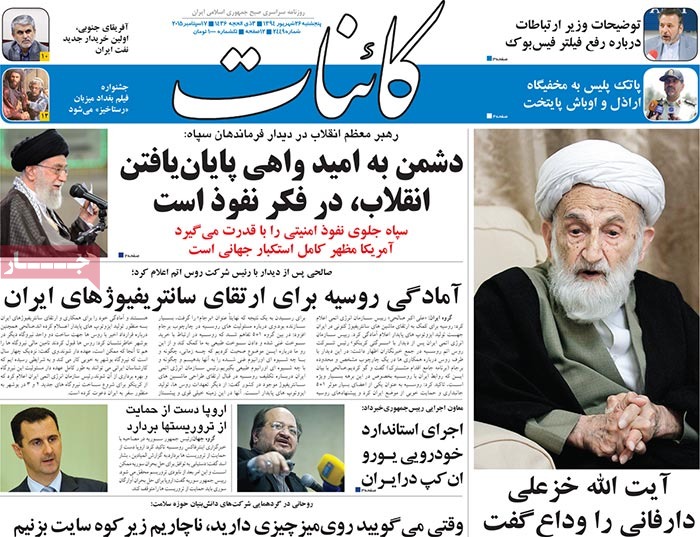
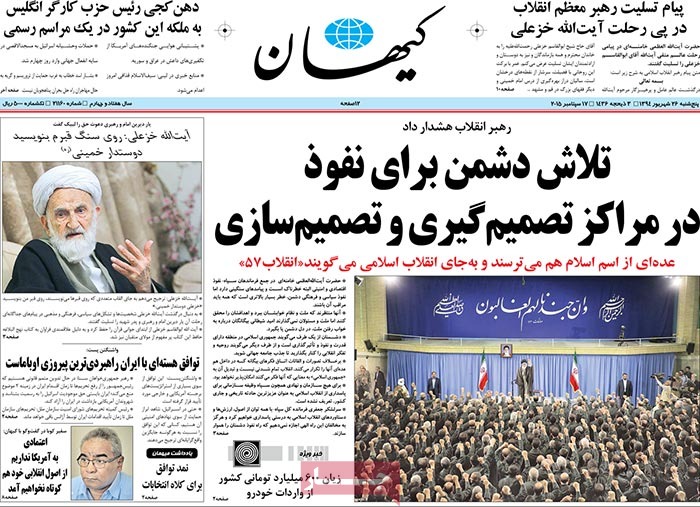
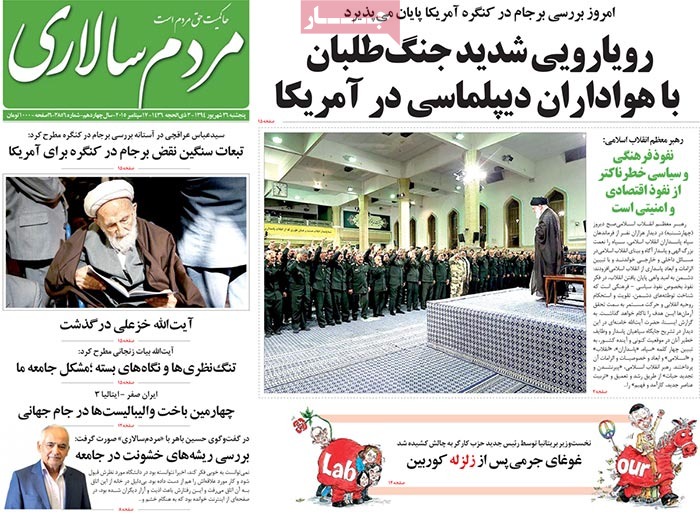
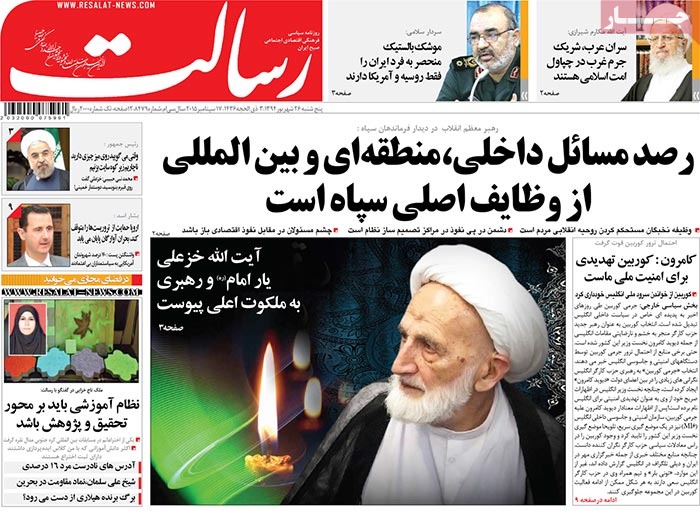
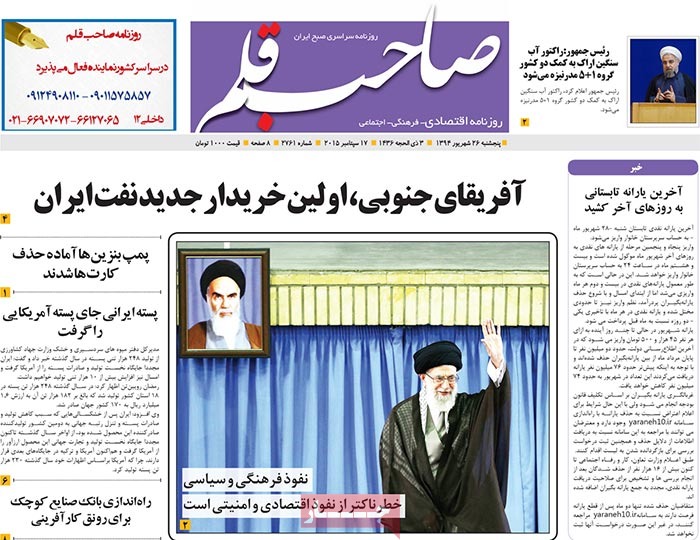
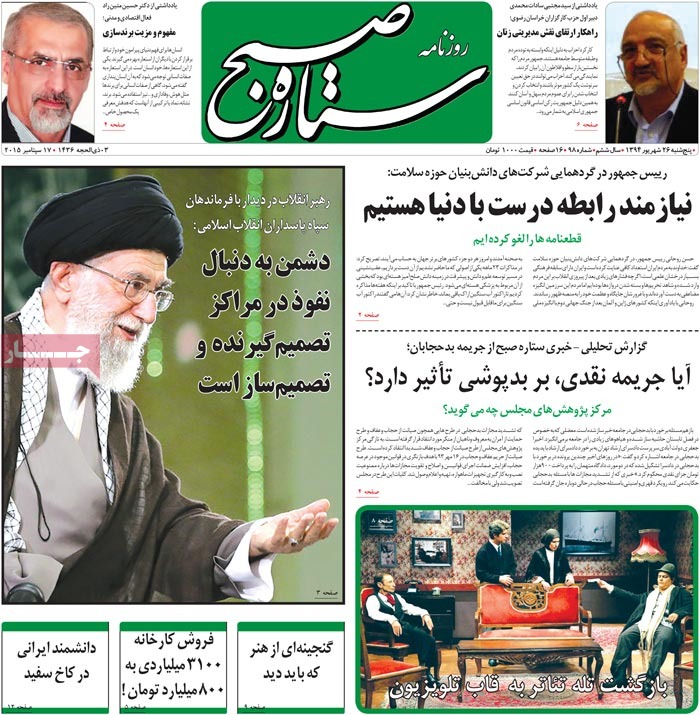
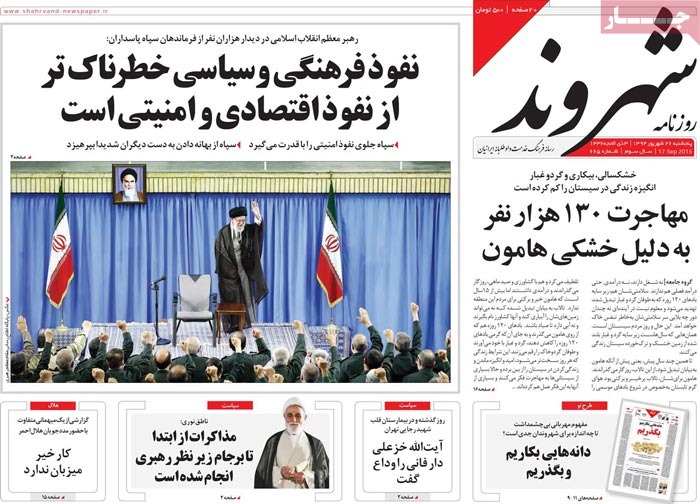
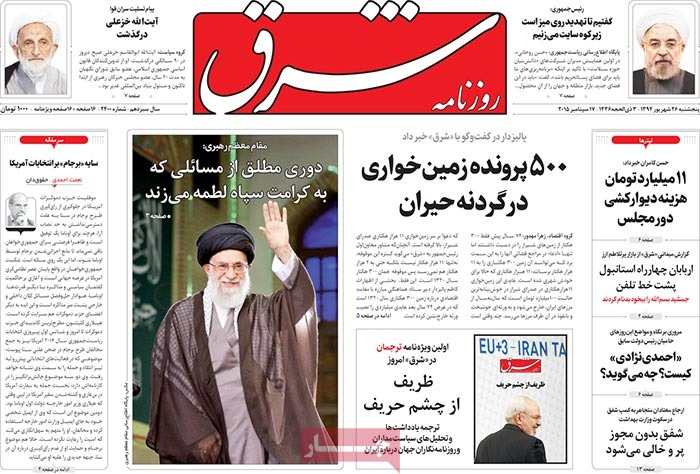
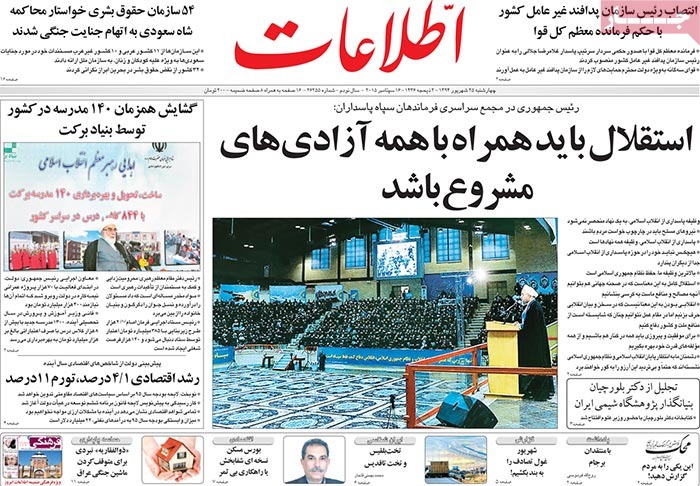
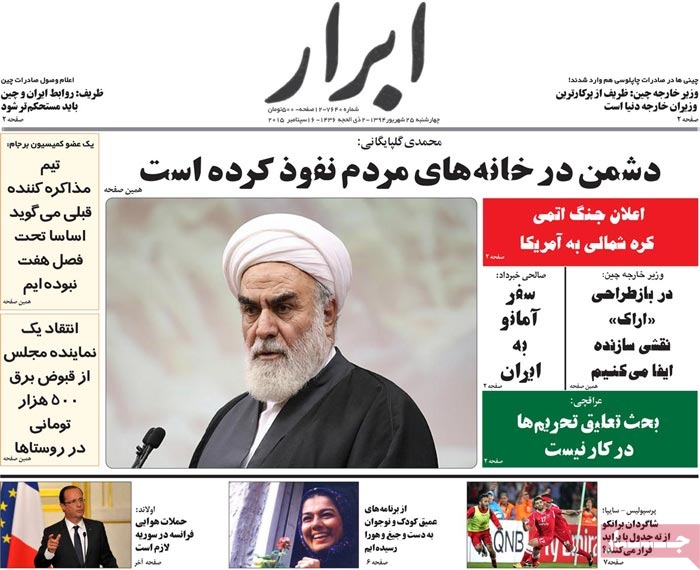
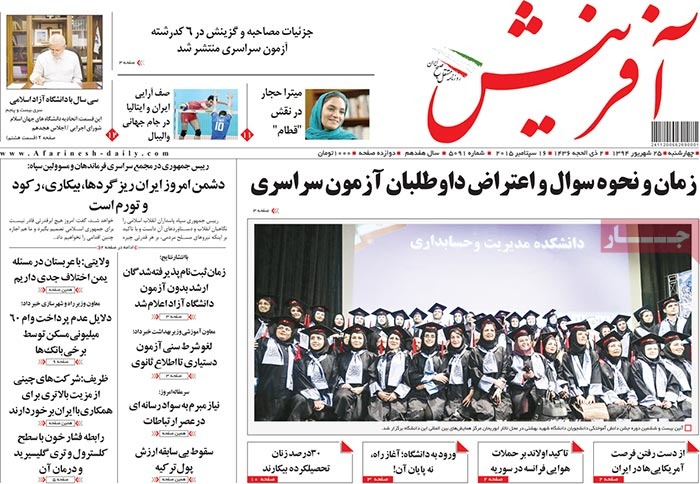
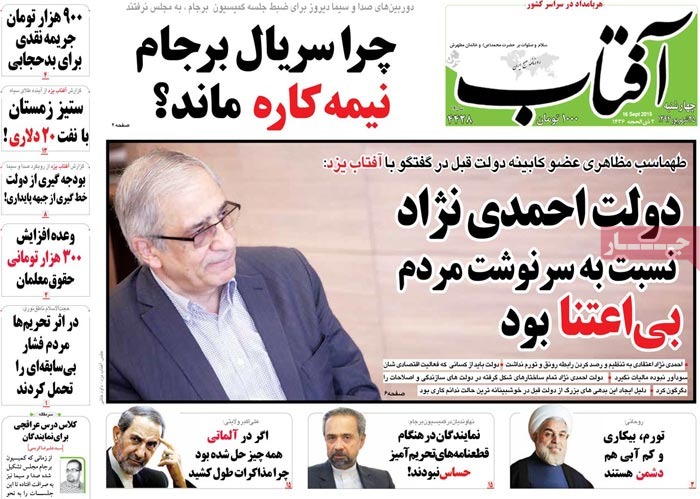
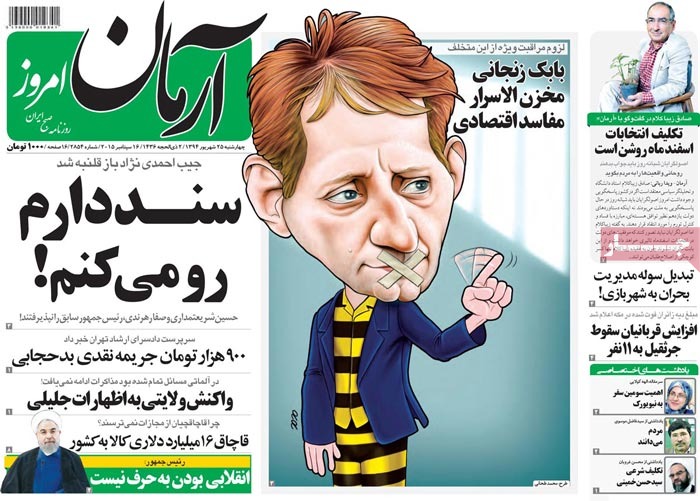
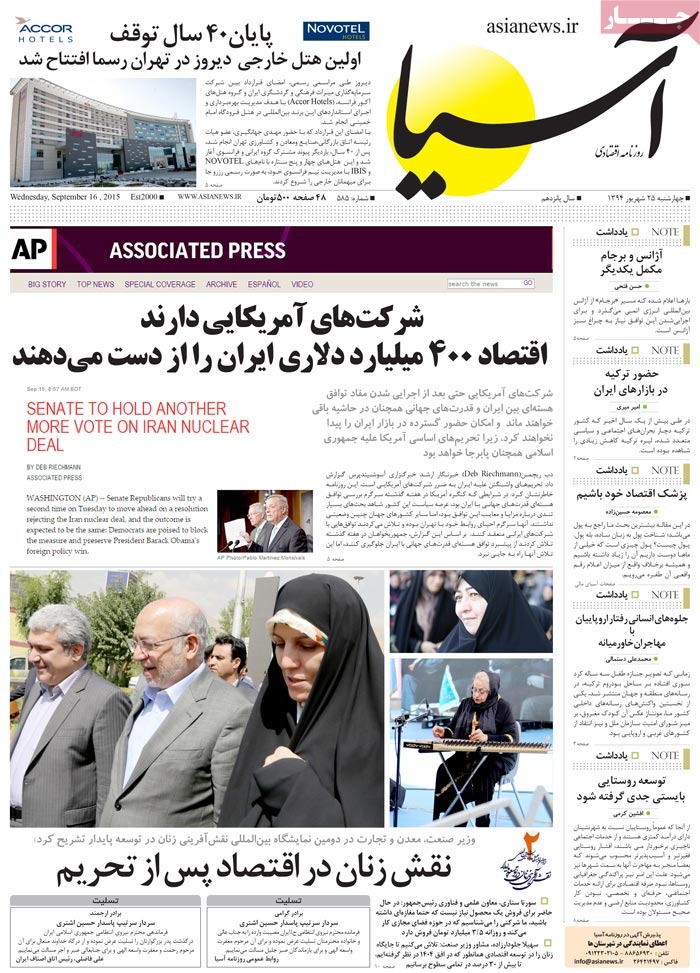
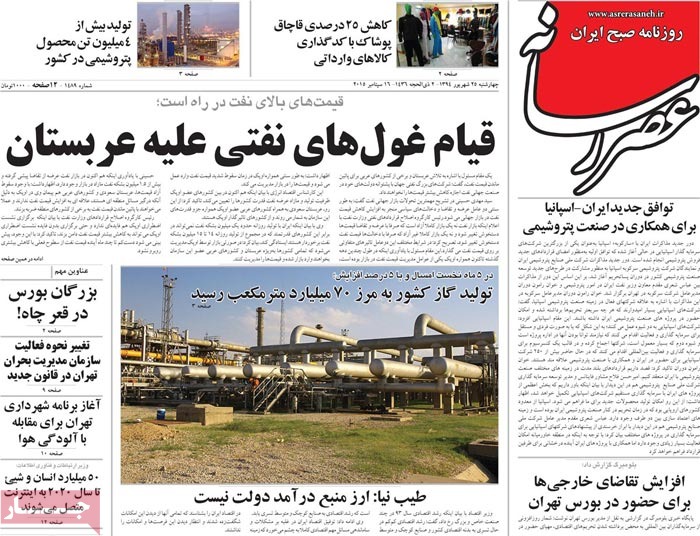
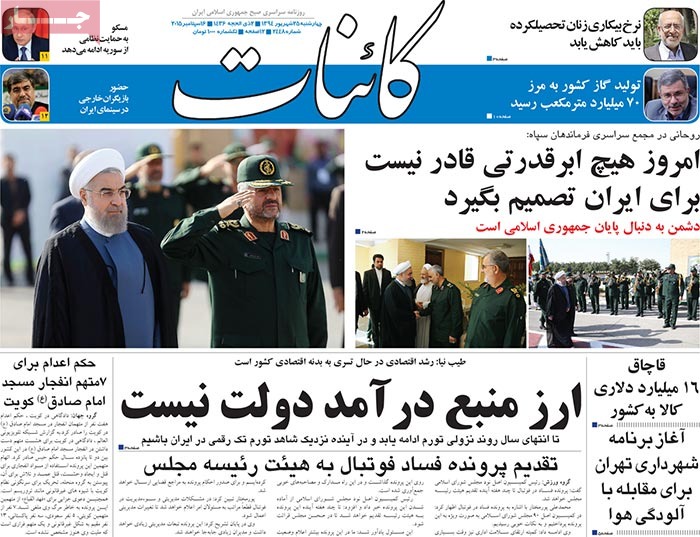
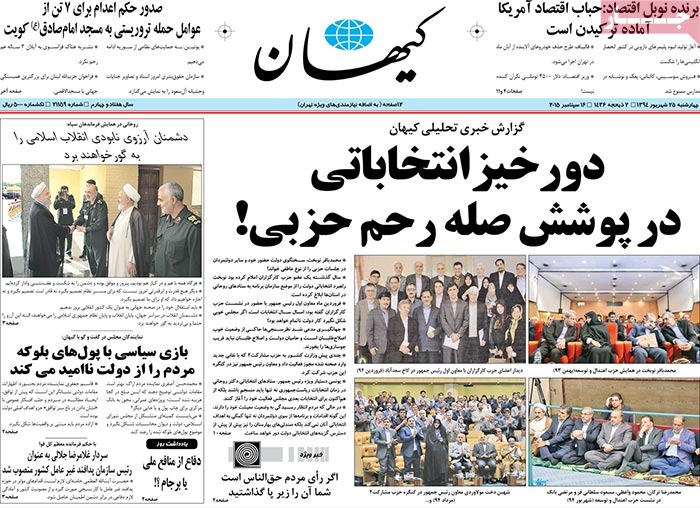
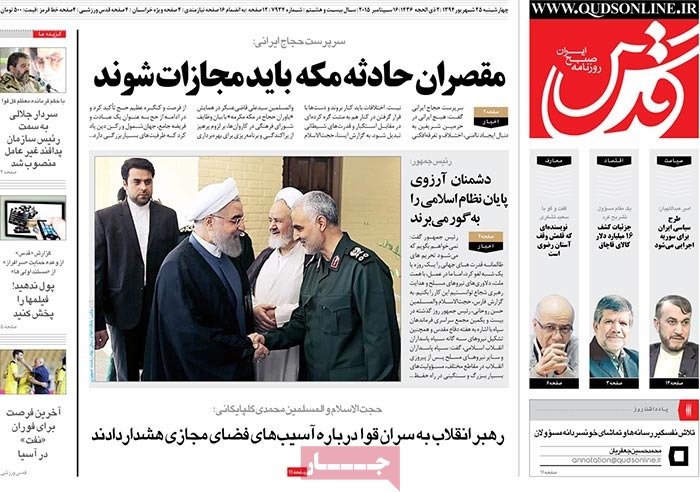
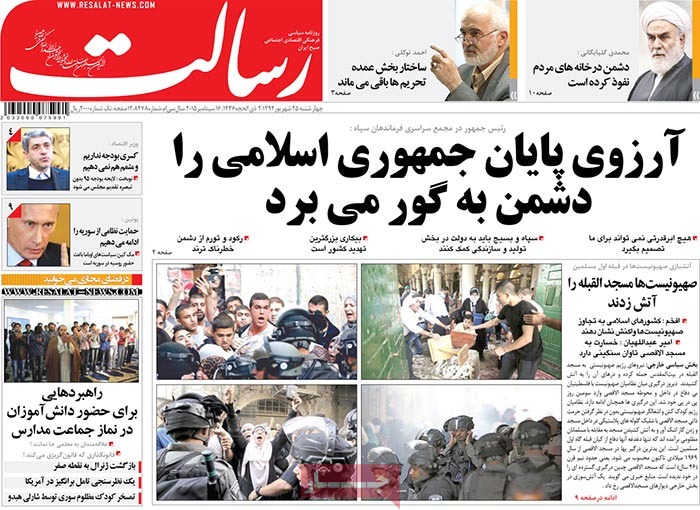
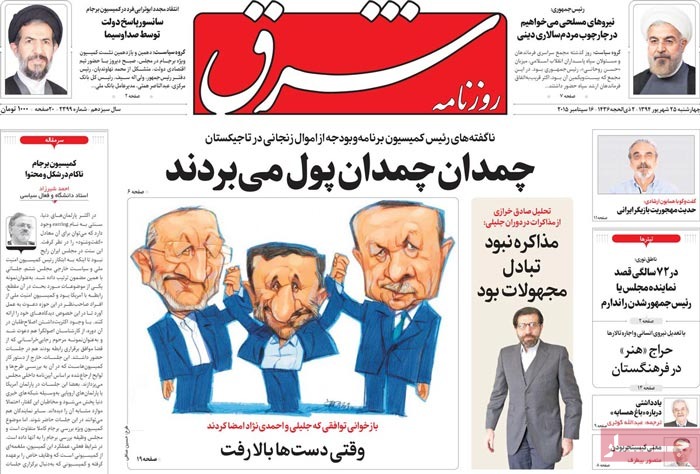
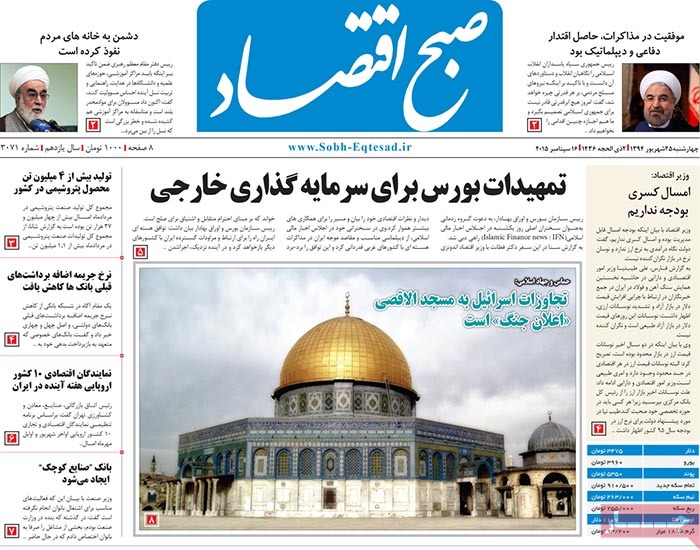
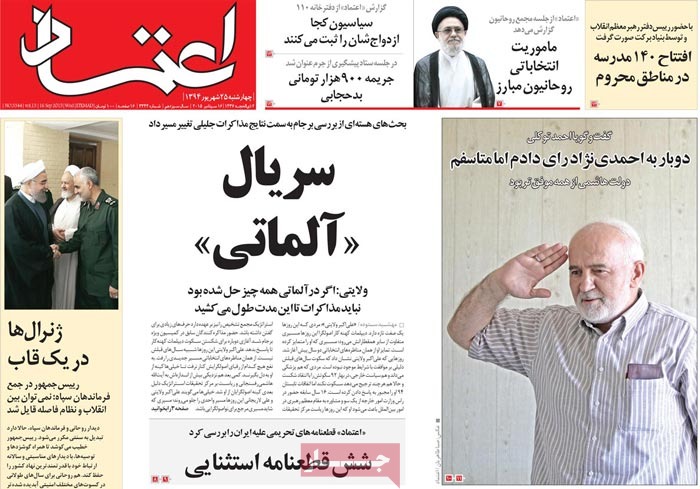
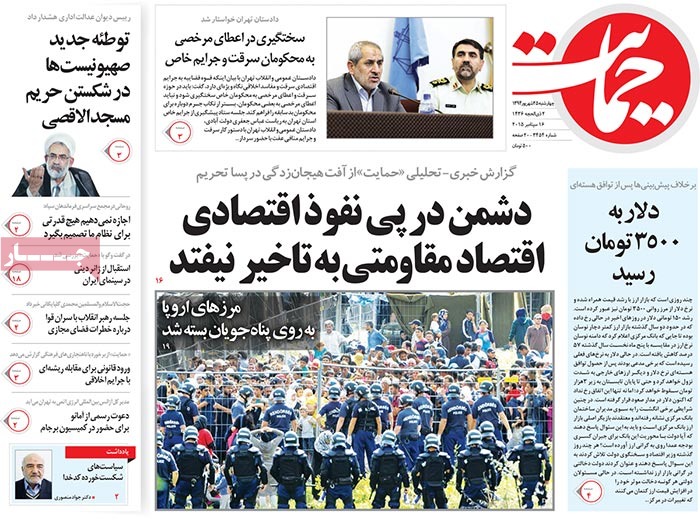
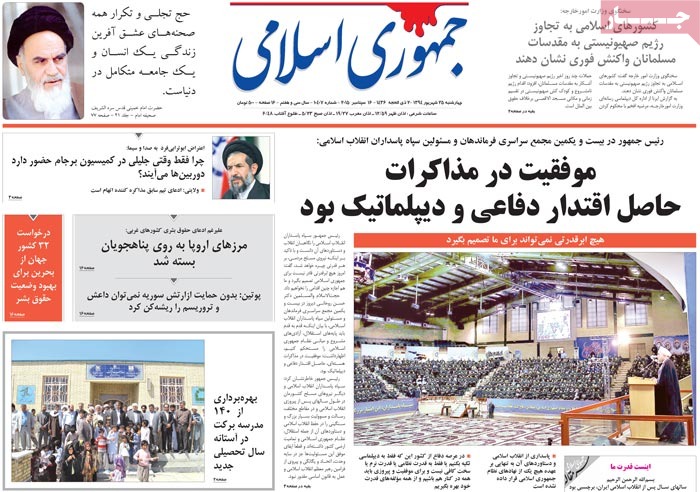
A look at Iranian newspaper front pages on September 2

Iranian Newspapers Headlines

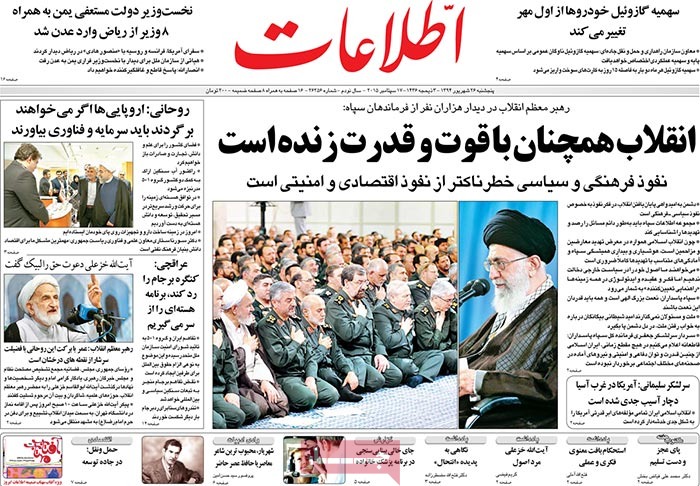
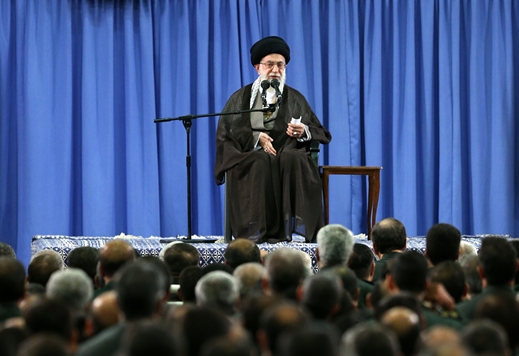
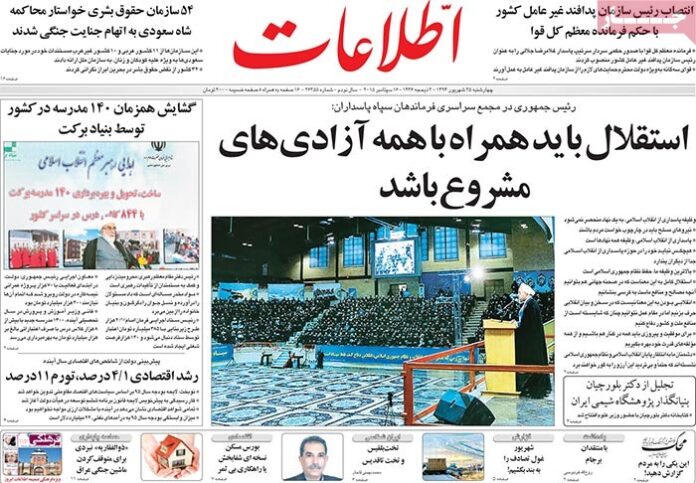
The comments of the Supreme Leader at a meeting with military commanders on the need to promote the country’s military preparedness and the remarks of the chairman of the Assembly of Experts on nuclear talks and the role of the Guardian Council in electoral oversight dominated the front pages of Iranian newspapers on Wednesday.


Ettela’at: “Defense options to counter threats should be diversified,” said the Supreme Leader at a meeting with senior officials of Khatamulanbia Air Defense Base.

Ayatollah Khamenei further said that officials in different sectors, especially with the armed forces, should appreciate the trust members of the public place in them, and reciprocate that trust by fulfilling their duties.


Abrar-e Eghtesadi: Parliament is to conduct an investigation into imports of low-quality cars.


A look at Iranian newspaper front pages on September 2


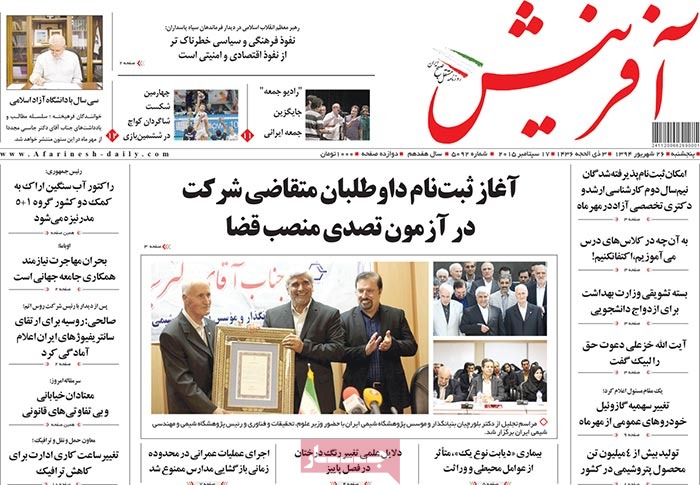
Afarinesh: German Chancellor Angela Merkel has welcomed Iran’s participation in talks on the fight against IS.

Afarinesh: The deputy director of the Cultural Heritage Organization has said that 1,020 projects with the potential to absorb local and foreign investment have been conceived.


A look at Iranian newspaper front pages on September 2


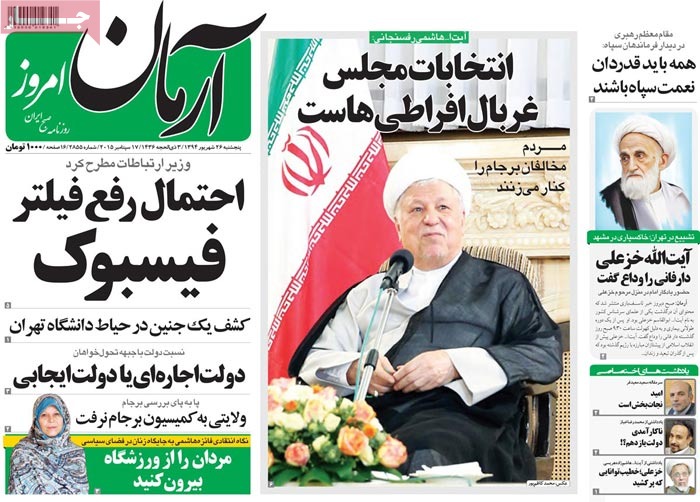
Arman-e Emrooz: “The number of oil derricks which went missing [when Ahmadinejad was in power] stands at least at 17,” said Amir Abbas Soltani, a member of parliament’s Energy Committee.

Arman-e Emrooz: The UN secretary general is to visit Tehran; the Vienna nuclear deal was a huge international achievement.

Arman-e Emrooz: The commander of the Islamic Revolution Guard Corps has said that his men would stage 20 maneuvers by the end of the year [March 20, 2016].


A look at Iranian newspaper front pages on September 2


Asr-e Azadi: Lack of interagency cooperation is the first hurdle standing in the way of foreign investors’ arrival in Iran.


A look at Iranian newspaper front pages on September 2


Asr-e Rasaneh: It now takes less than 48 hours for Iranian authorities to issue visas to foreign tourists.

Asr-e Rasaneh: The country’s first pumped-storage hydro power plant has been inaugurated.


A look at Iranian newspaper front pages on September 2


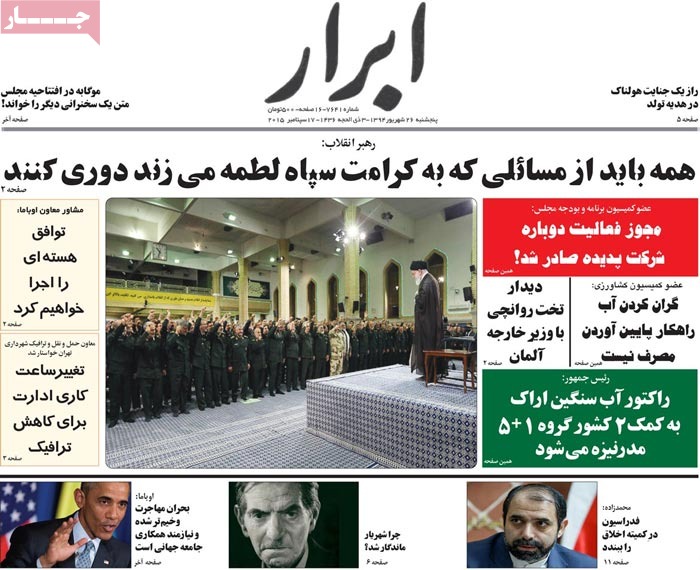
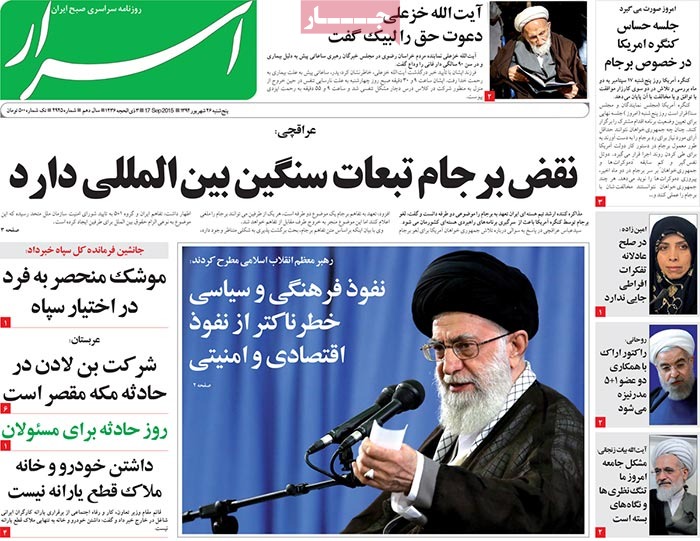
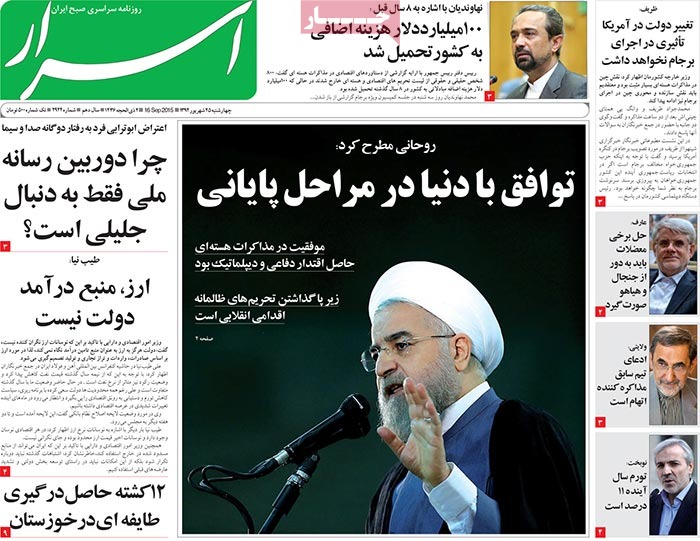
Asrar: The interior minister has said that there should be documentary reasons for possible disqualification of candidates.

Asrar: Mohammad Reza Bahonar, [a principlist MP], has said that presentation to parliament of the Joint Comprehensive Plan of Action in the form of a bill is not necessary.

Asrar: Tehran Provincial Governor’s Office has said security forces will deal with those who take part in any unauthorized rally.

Asrar: “Implementation of the Joint Comprehensive Plan of Action is an opportunity for the US to build trust,” said Iranian Foreign Minister Mohammad Javad Zarif.


A look at Iranian newspaper front pages on September 2


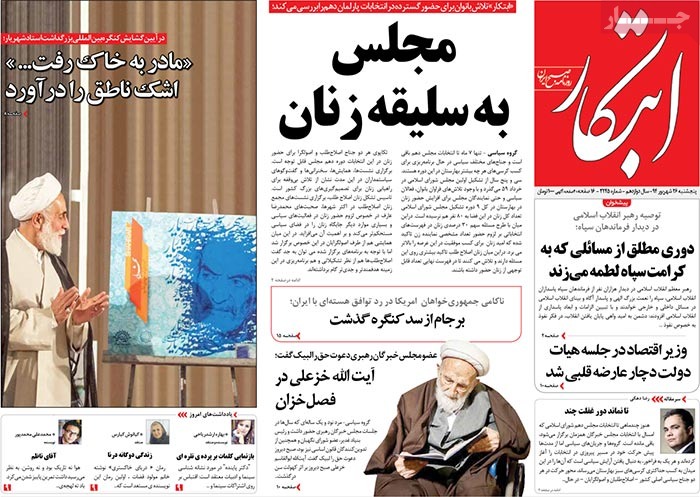
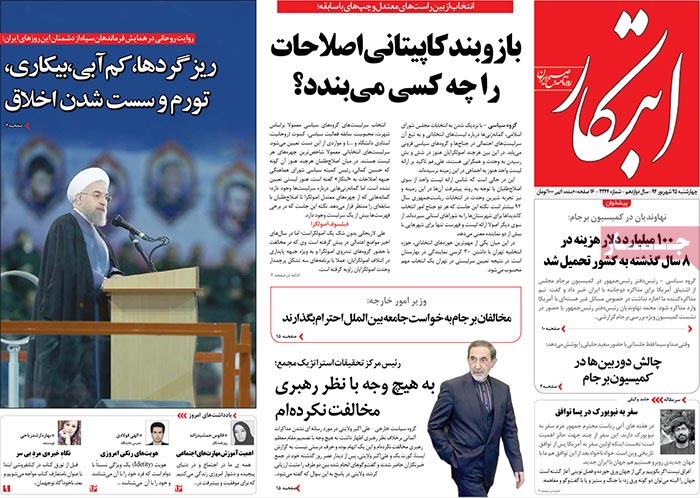
Ebtekar: Critics of the Vienna accord have appeared before a parliamentary committee tasked with reviewing the Joint Comprehensive Plan of Action.

Saeed Jalili and Fereydoon Abbasi [former top negotiator and former nuclear chief] have defended their performance.


A look at Iranian newspaper front pages on September 2


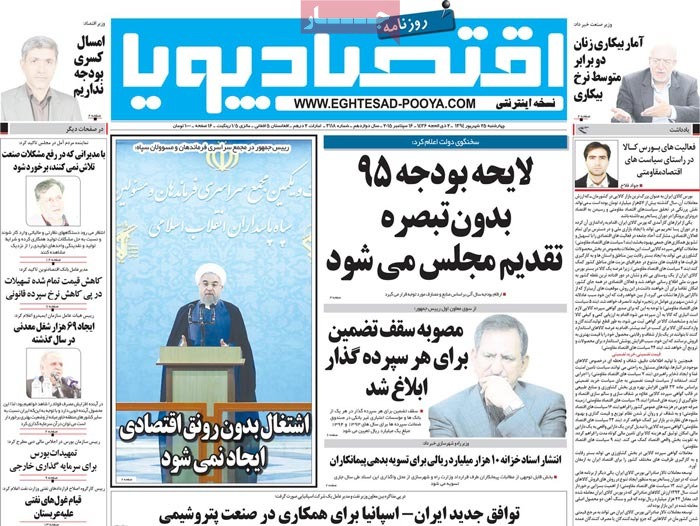
Eghtesad-e Pooya: Iran’s proven mineral reserves are now worth $700 billion.


A look at Iranian newspaper front pages on September 2


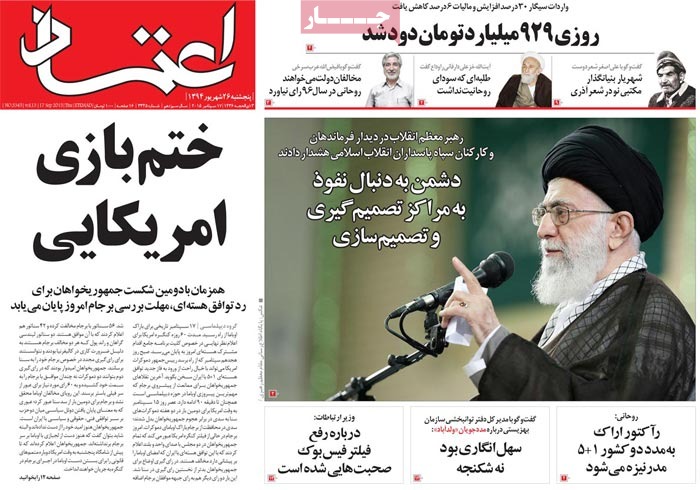
Etemad: Rouhani is warned in the Assembly of Experts

The chairman of the assembly has said that parliament is entitled to reviewing the Joint Comprehensive Plan of Action.

Ayatollah Yazdi further said that the kind of oversight the Guardian Council practices is not idle.


A look at Iranian newspaper front pages on September 2


Hambastegi: Iranian Foreign Minister Mohammad Javad Zarif has told a news conference in Tunis that there is no need for neighbors to be locked in rivalry.


A look at Iranian newspaper front pages on September 2


Hamshahri: The dust storm in the capital has seen a hike in the number of emergency room arrivals for respiratory and cardiovascular complications.


A look at Iranian newspaper front pages on September 2


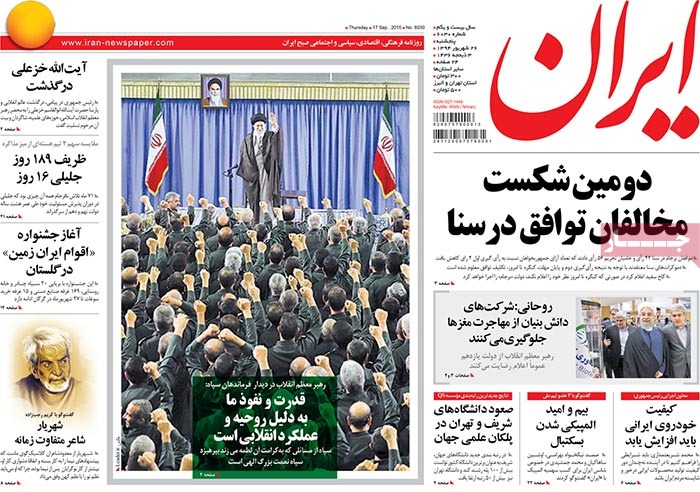
Iran: The Assembly of Experts has thanked the nuclear negotiating team.


A look at Iranian newspaper front pages on September 2


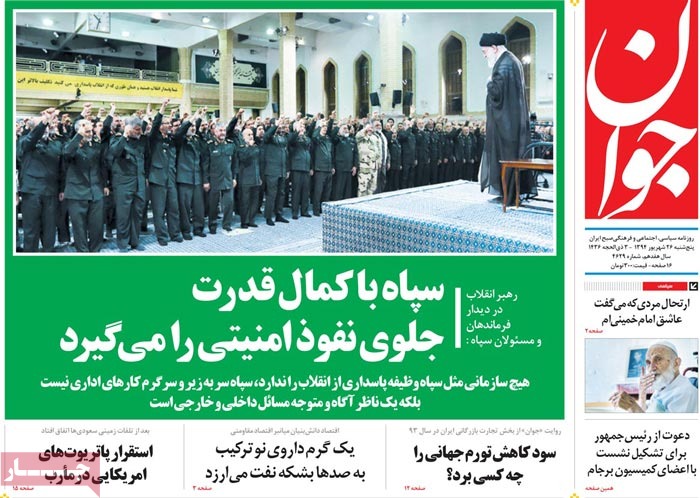
Javan: The commander of the Islamic Revolution Guard Corps has said it was the authority of the armed forces that prevented war [not the negotiations].

Javan:Safdar Hosseini [a former economy minister] has criticized the Central Bank for withdrawing $12 billion form the National Development Fund.


A look at Iranian newspaper front pages on September 2


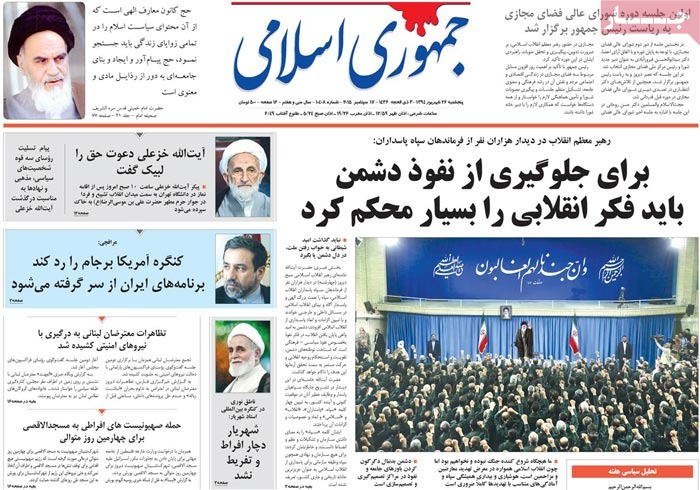
Jomhouri Islami: “Nuclear talks [between Iran and P5+1] posed no threat to any country,” said Foreign Minister Zarif.


A look at Iranian newspaper front pages on September 2


Kayhan: Principlists have been reinstated at the helm of Tehran City Council.

Kayhan: “The clear-cut comments of the Leader are the only criterion to gauge his nuclear stance,” a statement issued by the office of the Supreme Leader said.


A look at Iranian newspaper front pages on September 2


Resalat: “American authority in the region is on the decline,” said the commander of the Quds Force of the Islamic Revolution Guard Corps.


A look at Iranian newspaper front pages on September 2


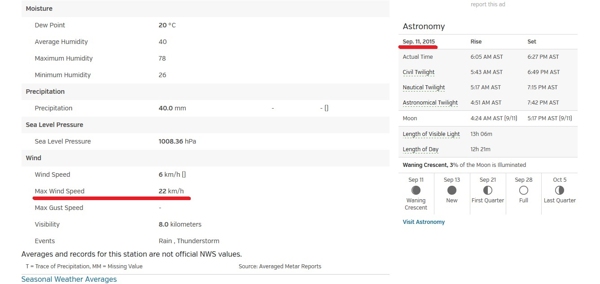
Shahrvand: A storm with gusts of 70 km an hour has kicked up dust in the capital.


A look at Iranian newspaper front pages on September 2


Sharq: The commander in chief of the armed forces has told the military to “have plans to counter all approaches the enemy could possibly adopt.”

Sharq: Following a directive by the Supreme Leader, the National Development Fund will no longer work under the supervision of the Central Bank.


A look at Iranian newspaper front pages on September 2


Taadol: “A giant economic leap lies ahead,” said the Iranian parliament speaker.


A look at Iranian newspaper front pages on September 2


Highlights of Ettela’at newspaper on September 2

Ettelaat

 “Defense options to counter threats should be diversified,” said the Supreme Leader at a meeting with senior officials of Khatamulanbia Air Defense Base.

Ayatollah Khamenei further said that officials in different sectors, especially with the armed forces, should appreciate the trust members of the public place in them, and reciprocate that trust by fulfilling their duties.

 The economy minister has said that a 6-point bill to reform the banking system has been devised.

 A major industrial union in the US has joined an international campaign to boycott Israel.

The United Electrical, Radio and Machine Workers of America has said it wants Israel to end its anti-Palestinian apartheid.

 “The Joint Comprehensive Plan of Action is unprecedented in the history of Iran’s diplomatic talks,” the chairman of the Assembly of Experts said.

Ayatollah Mohammad Yazdi further said that US provision of arms to IS terrorists is designed to divide Muslims.

 To counter the negative impact of dust storms some 100,000 hectares of forests should be created.

 The German chancellor has said that Berlin welcome’s Iran’s constructive role in Syria.

 An interview with Seyyed Kazem Bojnurdi about the release of Encyclopedia Islamica

The important feature of Islamica, which is the English translation of the Greater Islamic Encyclopedia, is its Shiite approach to Islamic questions.


US using IS as leverage to achieve goals: Iran Commander

Soleimani

Senior Iranian commander Major General Ghasem Soleimani has said the United States is using the IS Takfiri group as a tool against Muslims.

Major General Soleimani said Tuesday that the IS terrorist group is a product of Washington, adding that the US plans to maintain IS to keep Muslims dependent on Washington.

The commander of the Quds Force of the Islamic Revolution Guards Corps made the remarks while briefing members of Iran’s senior clerical body, the Assembly of Experts, on the developments in the region.

The senior military commander added that Iran has foiled Washington’s plans in the region.

He went on to say that the United States has turned this policy into a “lever” to achieve its goals in the region.

[…]

Saudi fear

The senior Iranian commander also pointed to the Saudi aggression against Yemen and hailed the Yemeni Ansarullah fighters’ resistance against the deadly onslaught.

“Ansarullah is a popular current and movement that many Yemeni people have been following,” he said.

Recalling the reasons behind the Saudi aggression against Yemen, General Soleimani said, “Saudi Arabia is afraid of Ansarullah’s rise to power and [has therefore] imposed this war against the Yemeni people.”

[…]

Oscar-winning musician highlights attention to details in movie ‘Muhammad (PBUH)’

139406101314012176006524

An Indian musician who has composed the score of Iran’s most expensive film ever, “Muhammad (PBHU), Messenger of God“, said renowned Iranian director Majid Majidi has paid undivided attention to details throughout the production of the biopic.

“It still hasn’t sunk in that the movie has released. The movie was in the making for the past six to seven years. I know how the director nurtured it with attention to details. We can only wish for good things. It has to happen. In this case all of us are lucky that the movie is getting rave reviews. It’s payback for all the hard work,” Indian double Oscar-winner A.R. Rahman said in an interview with Deccan Chronicle on Monday.

Answering a question about what went through his mind when Majidi approached him for this movie, he replied, “Whatever work I do, I always believe that it needs to be blessed for people to like it and love it. I just kept my fingers crossed and prayed in anticipation.

“It was a long-cherished dream to work in a beautiful Iranian movie and a director like Majidi. I learned a lot in the process working with a master director like him. We recorded the music across five countries including India, Iran, Germany, France and Egypt with 200 musicians and it has been mixed in Chennai. I think this is one of my most daring attempts at composing,” Rahman added.

He further said that the movie attempts to depict true features of faith, including compassion as opposed to violence and extremism.

“The director has gone back to the foundation of the faith, which is kindness and upliftment of humankind and not what has been portrayed by the misrepresentation, which has provoked violence and inhuman acts in the past. He has shown that division is a product of evil, and inclusion is divine. I seek to be excused for paraphrasing Jalaluddin Rumi’s words – Out beyond ideas of wrongdoing and right-doing, there is a field. I’ll meet you there. When the soul lies down in that grass, the world is too full to talk about.”

Muhammad, Messenger of God, which is the first part of Iran’s big-budget trilogy on the life of Prophet Muhammad (PBUH), premiered in cinemas across Iran on August 26, and attracted a large audience.

A number of internationally-acclaimed professionals, including Academy Award winning visual effects supervisor and filmmaker Scott E. Anderson, three-time Oscar-winning Italian director of photography Vittorio Storaro and renowned Croat production designer Milijen Kreka Kljakovic collaborated in the making of the film.

Majid Majidi is an internationally and critically acclaimed Iranian film director, film producer, and screen writer whose films touch on many themes and genres. He has won many international awards.

Iran’s Experts Assembly chairman rejects bilateral relations with US

Yazdi

Chairman of Iran’s Assembly of Experts Ayatollah Mohammad Yazdi strongly rejected the possibility of the resumption of diplomatic ties between Tehran and Washington, stressing that the nuclear agreement does not mean rapprochement between Tehran and Washington.

Addressing the opening ceremony of the 18th meeting of the Assembly of Experts in Tehran on Tuesday, Ayatollah Yazdi said those in the US who dream of bringing their rulers back to power and turning Iran into their consumer market and source of revenue will never see the realization of their dream.

He said that the nuclear negotiations and agreement between Iran and P5+1have nothing to do with Iran’s relations, adding, “We are not to talk about bilateral and trilateral relations and the gradual flow of their companies into Iran.”

In July, Supreme Leader of the Islamic Revolution Ayatollah Seyyed Ali Khamenei underlined the nuclear agreement between Tehran and six world powers will not change Iran’s policy toward the US.

[…]