Wednesday, December 31, 2025
Home Blog Page 4757

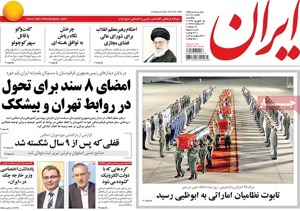
A look at Iranian newspaper front pages on September 7

Iranian Newspapers Headlines

The comments of the president at separate meetings with the Hungarian and Iraqi ambassadors to Tehran dominated the front pages of Iranian newspapers on Monday.


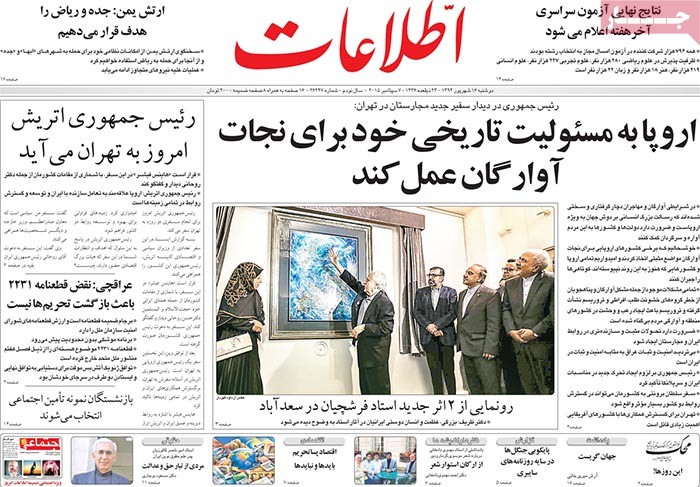
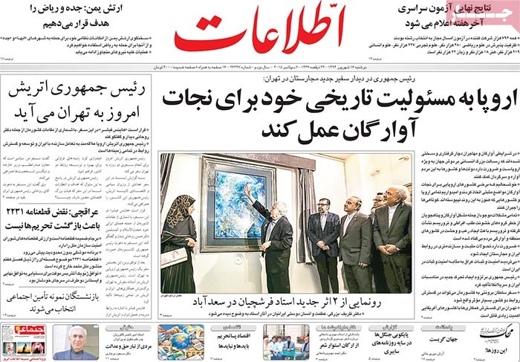
Ettela’at: President Rouhani has urged Europe to live up to its historic duty to help refugees.

The president made the call at a meeting with the new Hungarian ambassador to Tehran.


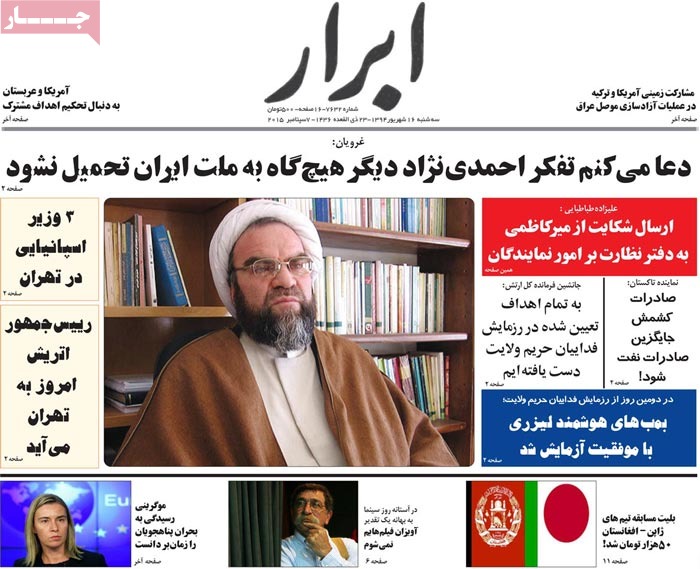
Abrar: The deputy commander of the Army has said that the Army has achieved all its set goals in a recent military exercise it held.
 

A look at Iranian newspaper front pages on September 7


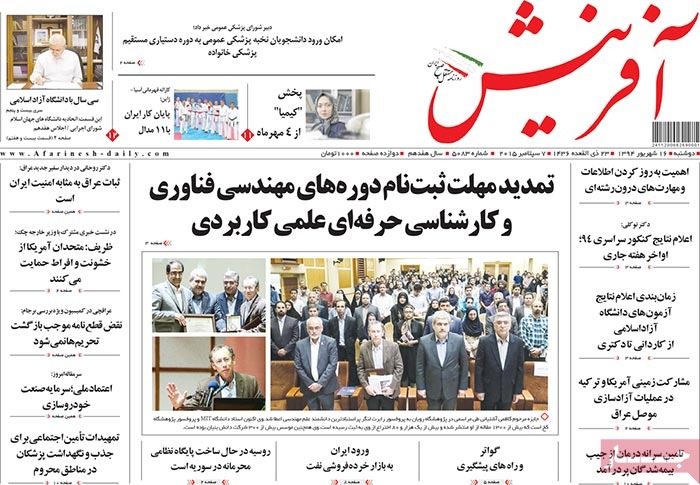
Afarinesh: American and Turkish ground troops will take part in operations to liberate the Iraqi city of Mosul.
 

A look at Iranian newspaper front pages on September 7


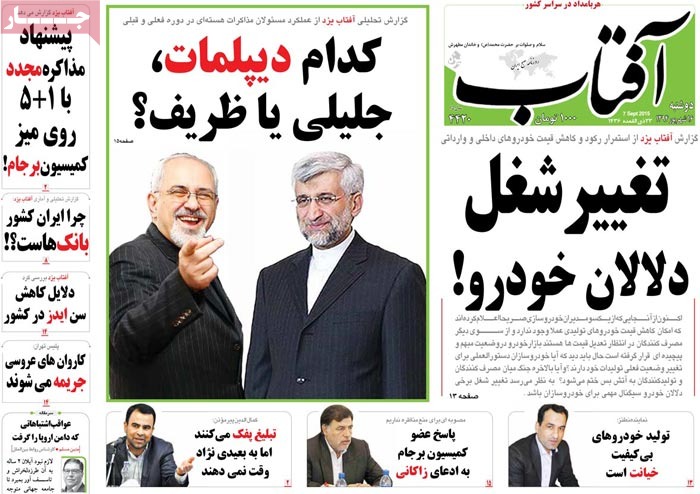
Aftab-e Yazd: Parliament’s JCPOA Review Committee suggests Iran hold fresh talks with P5+1!

Aftab-e Yazd: “IRIB has time to air cheerios commercials, but does not have time to allocate to Baidinejad [an Iranian nuclear negotiator],” Kamaladin Pirmoazzen, a reformist MP, said [as he lashed out at the national broadcaster].
 

A look at Iranian newspaper front pages on September 7


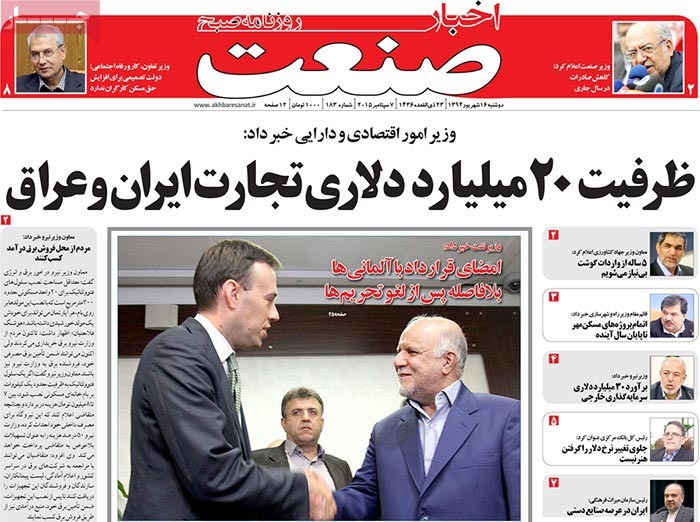
Akhbar Sanat: The Iranian economy minister has said that Iran-Iraq trade can rise to $20 billion.

Akhbar Sanat: Iran will no longer need to import meat in five years.
 

A look at Iranian newspaper front pages on September 7


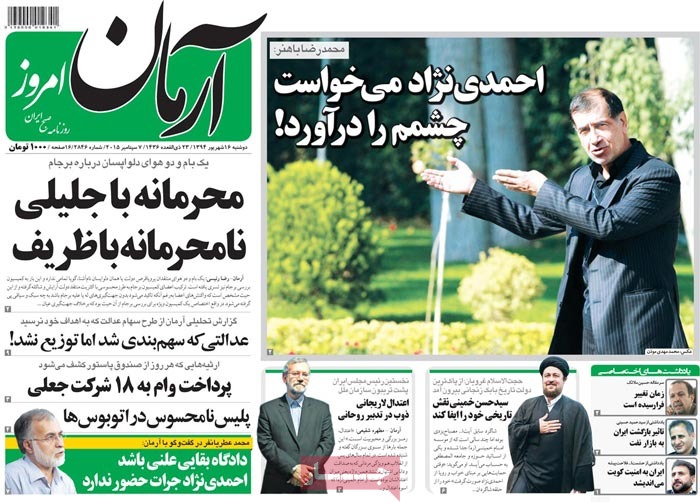
Arman-e Emrooz: Handing out loans to 18 fakes firms

New legacies of the Pasteur Fund [which was set up by the former president] pop up by the day.
 

A look at Iranian newspaper front pages on September 7


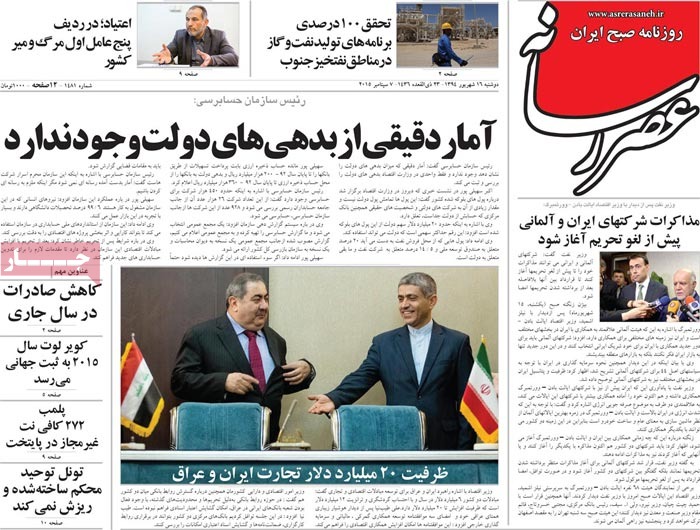
Asr-e Rasaneh: Addiction is among the top five causes of death in Iran.

Asr-e Rasaneh: Lut Desert will become a globally registered site later in 2015.
 

A look at Iranian newspaper front pages on September 7


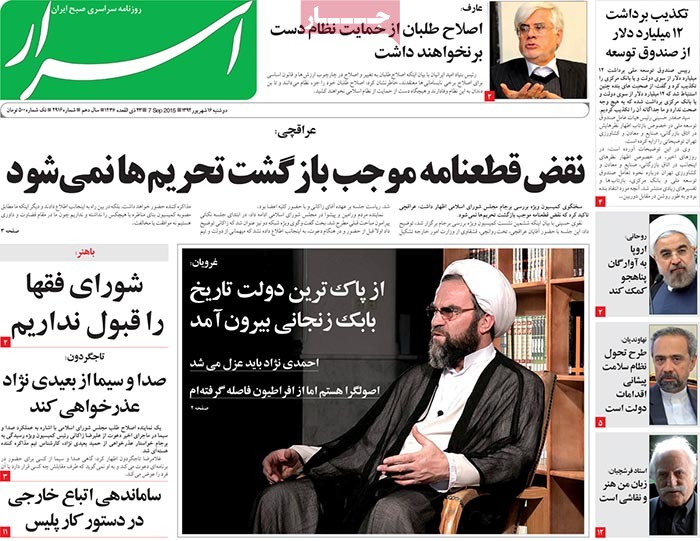
Asrar: “Reformists won’t stop supporting the establishment,” said Mohammad Reza Aref, a reformist leader.

Asrar: Mohsen Gharavian, a Qom Seminary teacher, has lashed out at Ahmadinejad and his government by saying: “The most immaculate government of history produced Babak Zanjani [a billionaire who stands accuse of massive corruption]!”

He further said Ahmadinejad should have been impeached and voted out of office. “I am a principlist, but I have disavowed hardliners.”
 

A look at Iranian newspaper front pages on September 7


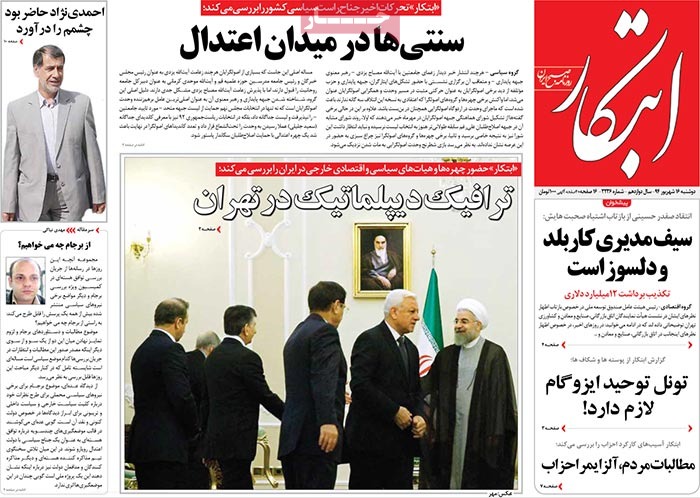
Ebtekar: The director of the National Development Fund has criticized media for misquoting him.

Safdar Hosseini said the governor of the Central Bank is a skilled manager with a strong work ethic.

He also denied that the Central Bank has withdrawn $12 billion from the fund.
 

A look at Iranian newspaper front pages on September 7


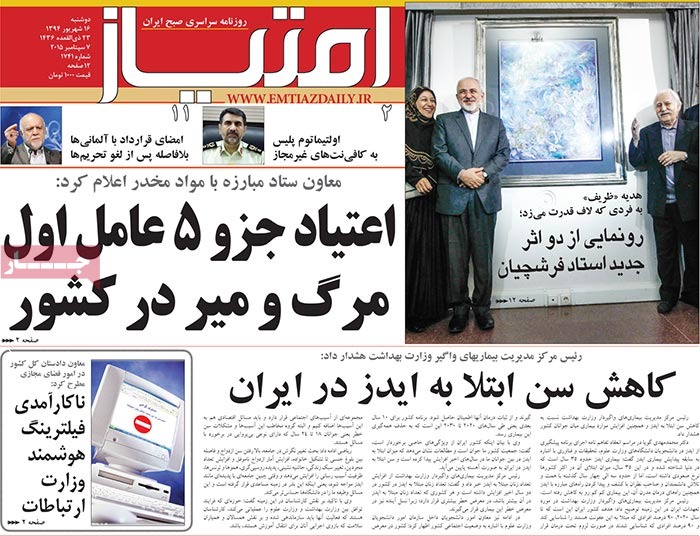
Emtiaz: “The age of developing AIDS in Iran has slipped,” said Mohammad Mehdi Gooya, the director-general of the Health Ministry’s Department for Communicable Diseases.
 

A look at Iranian newspaper front pages on September 7


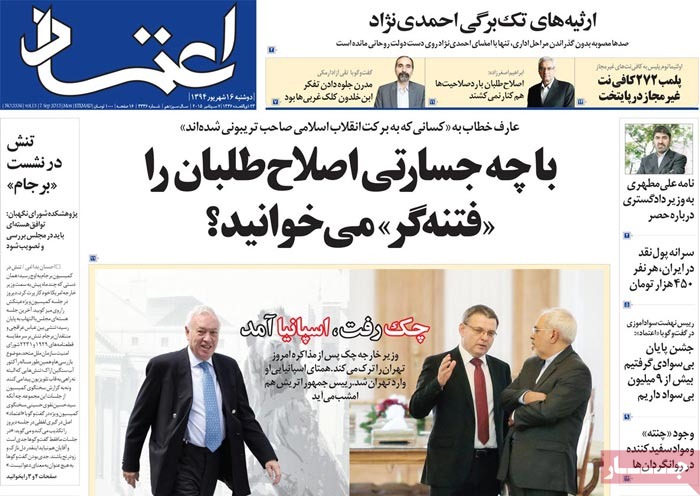
Etemad: “How dare you slam reformists as seditionists?” Mohammad Reza Aref said in comments aimed at “those who have secured a bully pulpit thanks to the Islamic Revolution.”

Etemad: Tension runs high in the JCPOA meeting

The research center of the Guardian Council has said that the nuclear deal should be reviewed and approved by the Islamic Consultative Assembly.
 

A look at Iranian newspaper front pages on September 7


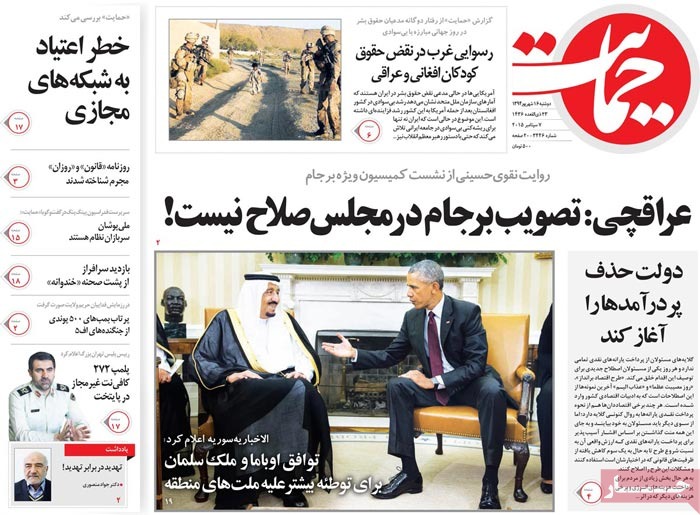
Hemayat: More than 270 unauthorized Internet cafes have been shuttered in the capital.
 

A look at Iranian newspaper front pages on September 7


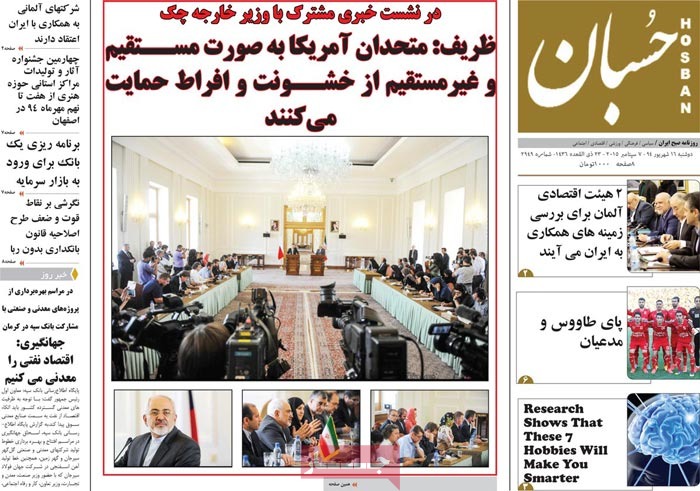
Hosban: Two German delegations will visit Iran to explore the ways of closer economic cooperation.
 

A look at Iranian newspaper front pages on September 7


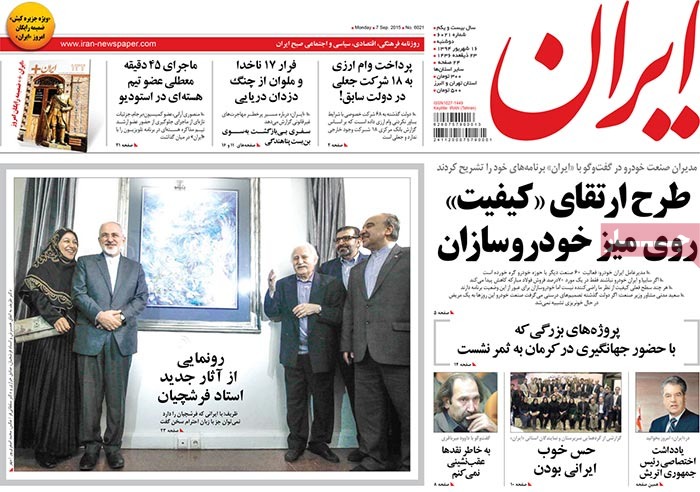
Iran: The Austrian President has published an opinion piece [in Farsi] in Iran daily.
 

A look at Iranian newspaper front pages on September 7


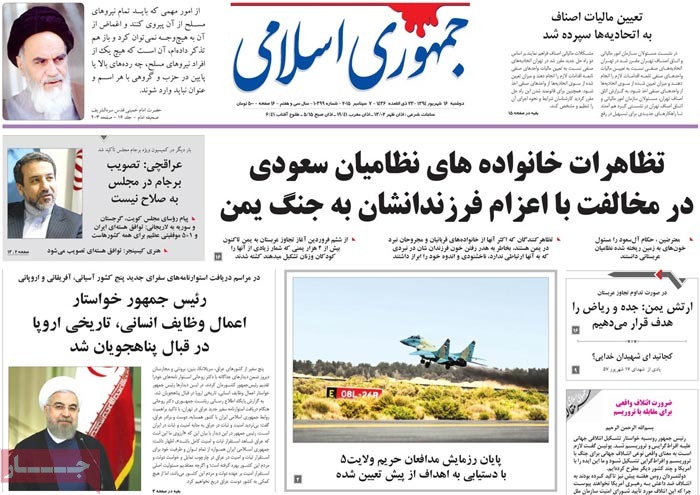
Jomhouri Islami: The families of Saudi military personnel have staged a rally in protest at deployment of their loved ones to Yemen.
 

A look at Iranian newspaper front pages on September 7


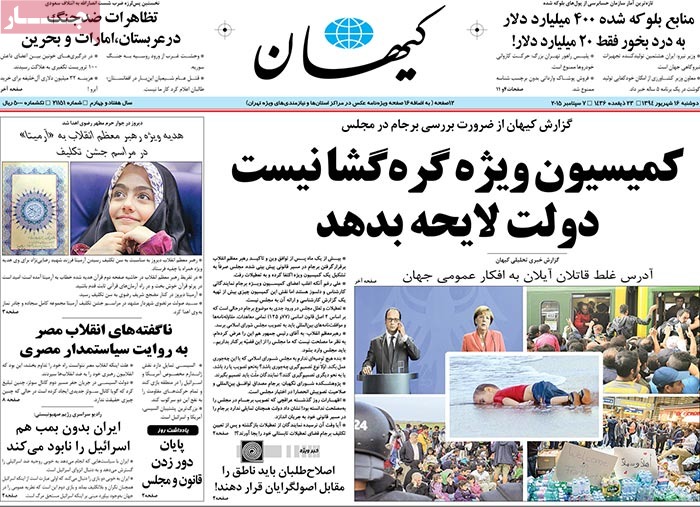
Kayhan: The daily says formation of a committee to review the Iran nuclear deal in parliament won’t settle the problem; the government should present the deal to the legislature in the form of a bill.
 

A look at Iranian newspaper front pages on September 7


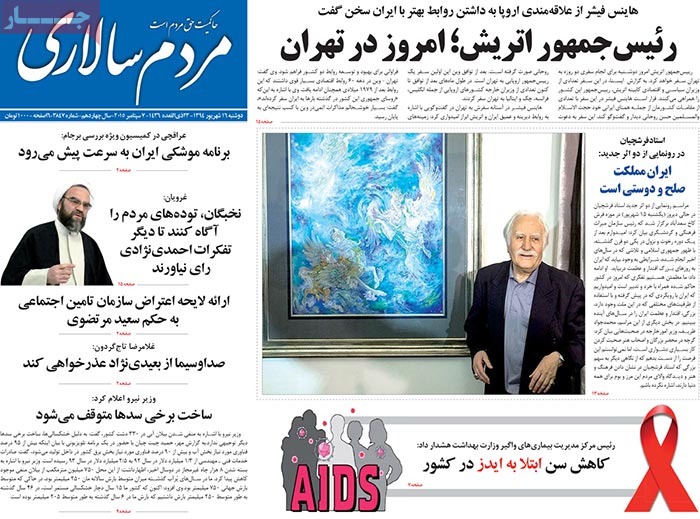
Mardomsalari: Gharavian, a Qom Seminary teacher, has urged the elite to raise public awareness so that the line of thinking Ahmadinejad and his followers promoted does not secure votes [to rise to power again].

Mardomsalari: The energy minister has said that construction of some unfinished dams will be halted.
 

A look at Iranian newspaper front pages on September 7


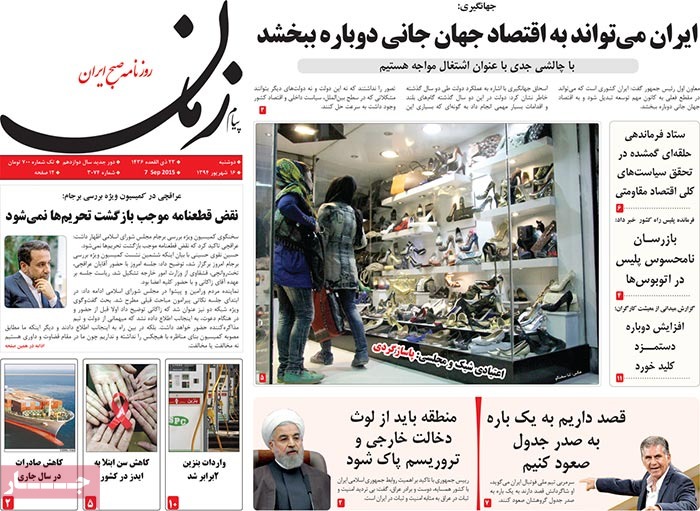
Payam-e Zaman: “The region should rid itself of foreign interference and terrorism,” President Rouhani said at a meeting with the Iraqi ambassador.
 

A look at Iranian newspaper front pages on September 7


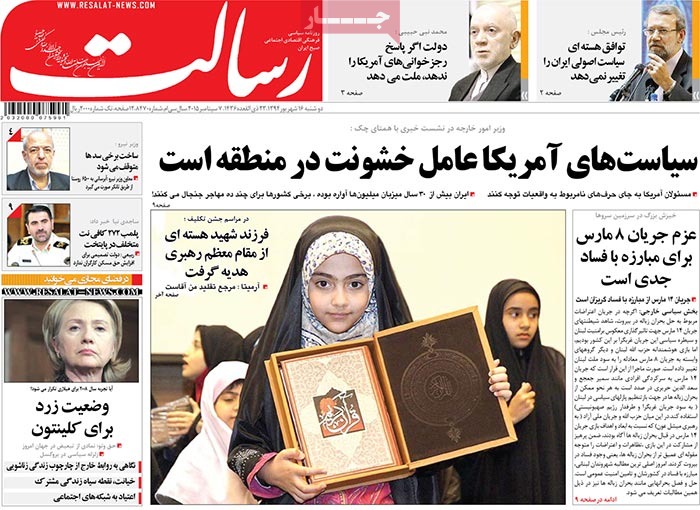
Resalat: “The nuclear deal won’t change Iran’s core policies,” said Parliament Speaker Ali Larijani.

Resalat: “US policies are partly to blame for violence in the region,” said the Iranian foreign minister at a joint press conference with his Czech counterpart.

Resalat: The daughter of a martyred nuclear scientist has received an award from the Supreme Leader at her coming of age ceremony.
 

A look at Iranian newspaper front pages on September 7


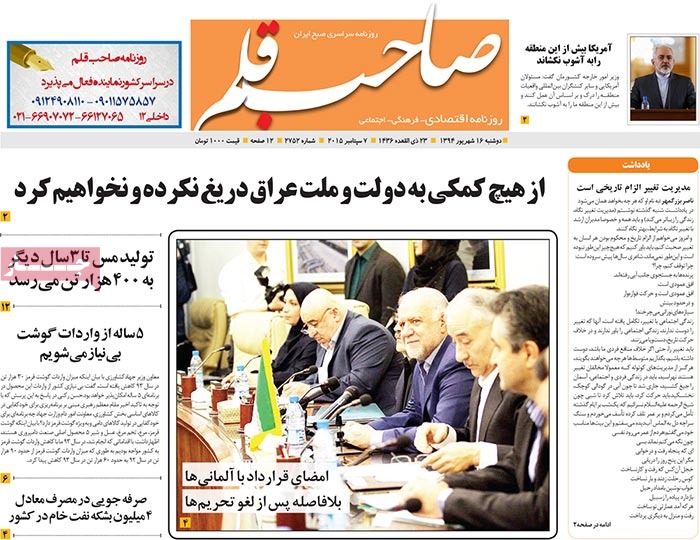
Saheb Ghalam: “Iran has and will spare no effort in helping the Iraqi people and government,” said the president at a meeting with the Iraqi ambassador.

Saheb Ghalam: Iran’s copper production will hit 400,000 tons in three years.

Saheb Ghalam: [The oil minister has spoken of] Conclusion of deals with the Germans immediately after the termination of sanctions.
 

A look at Iranian newspaper front pages on September 7


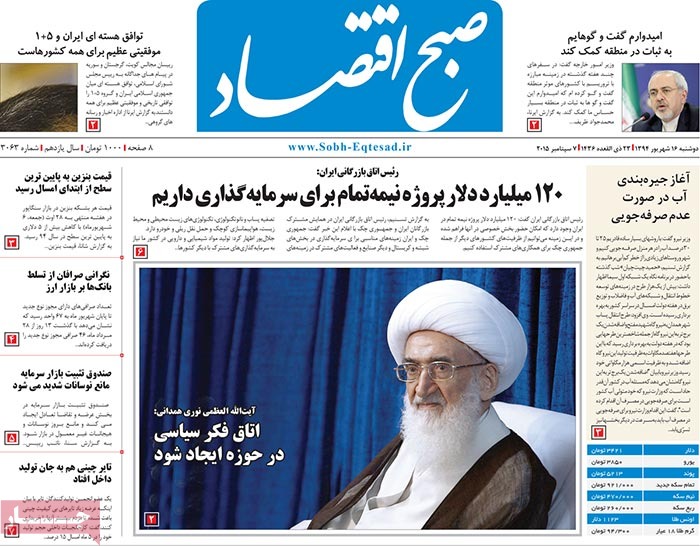
Sobh-e Eghtesad: “Iran has $120 billion worth of unfinished projects ready for investment,” said the chairman of Iran’s Chamber of Commerce.
 

A look at Iranian newspaper front pages on September 7


Highlights of Ettela’at newspaper on September 7

Ettelaat-september-7

President Rouhani has urged Europe to live up to its historic duty to help refugees.

The president made the call at a meeting with the new Hungarian ambassador to Tehran.

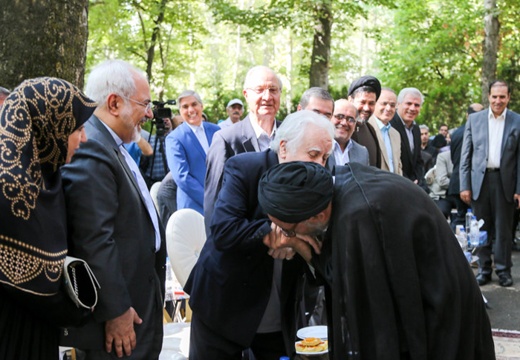
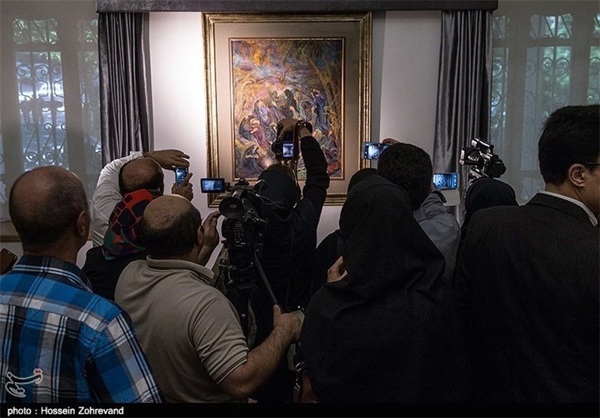
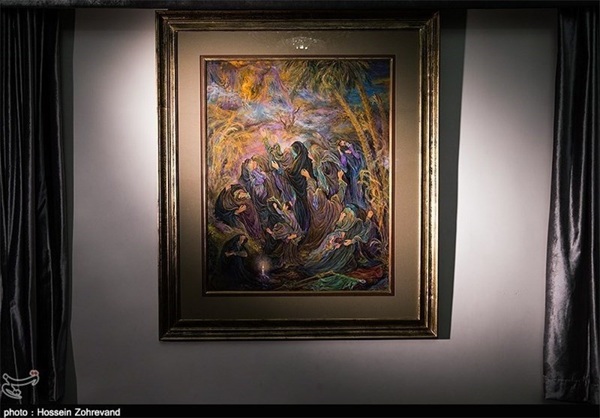
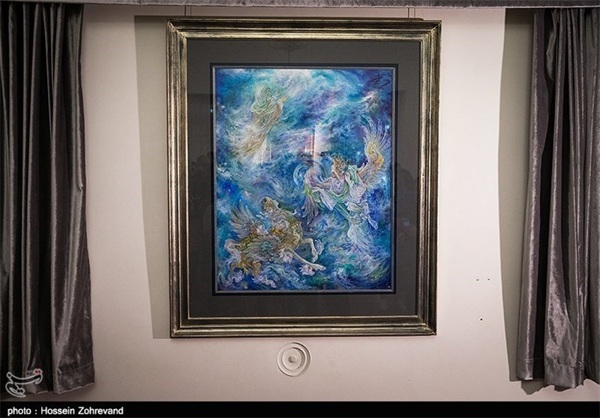
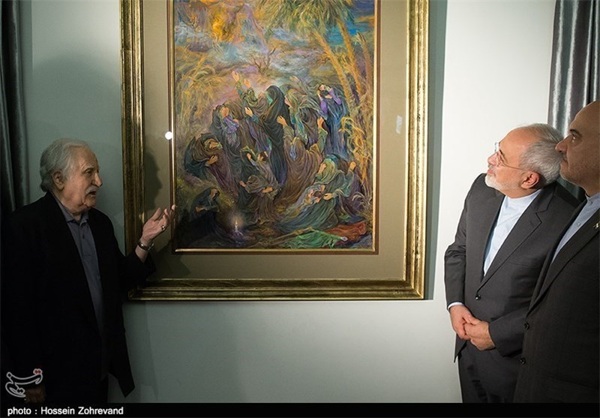
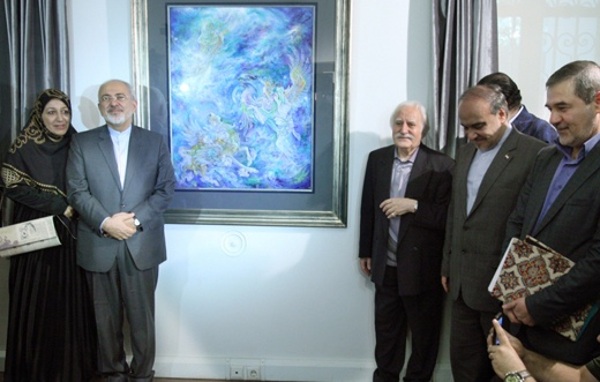
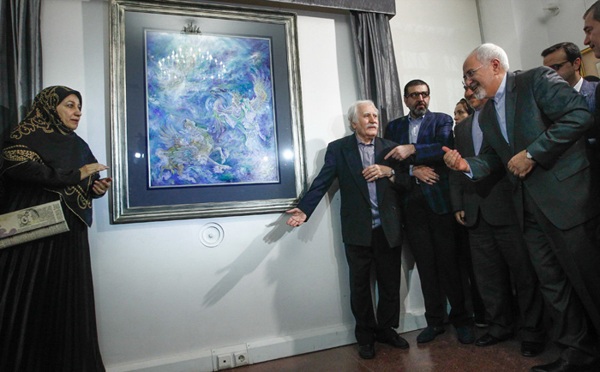
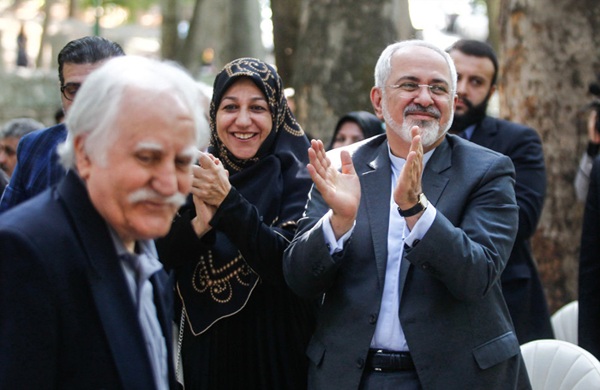
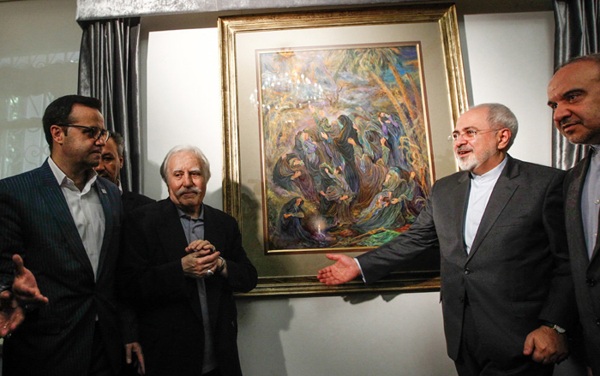
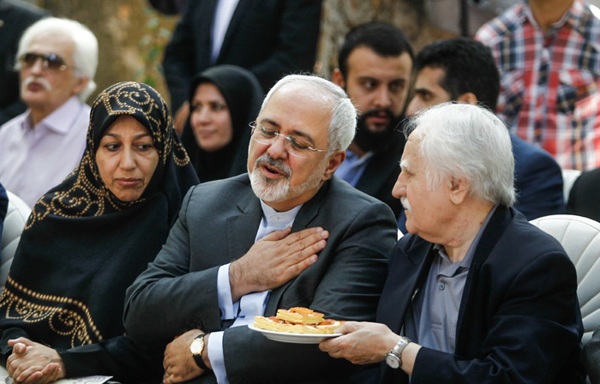
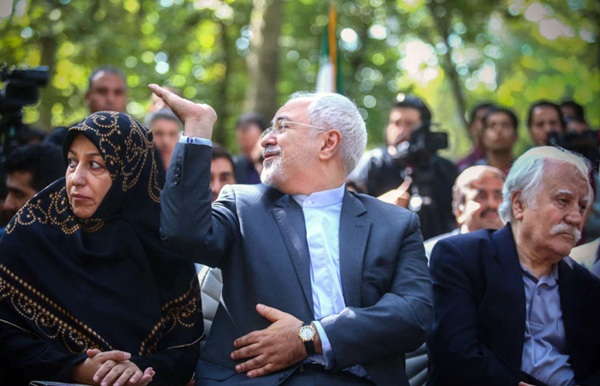
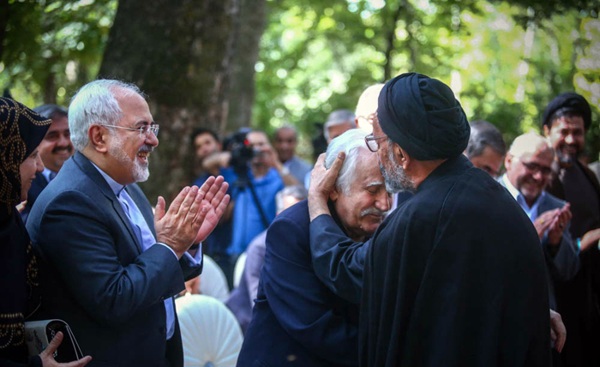
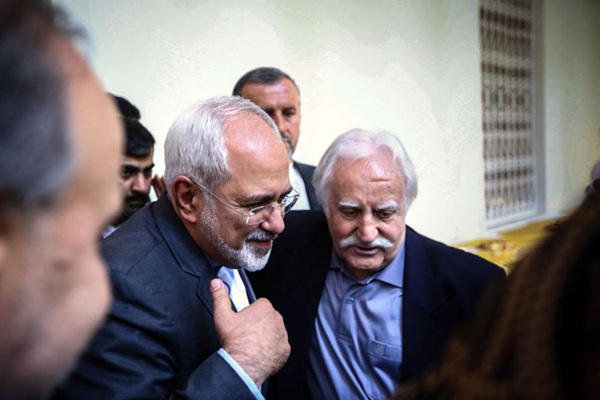
 Two new paintings of Iranian master Mahmoud Farshchian have been unveiled at Sa’dabad Cultural Complex.

At the ceremony, Foreign Minister Zarif said that the magnanimity and philanthropic nature of Iranian people are quite evident in the works of Master Farshchian.

 The results of the nationwide university entrance exam will be made public this week.

 The Yemeni army has threatened to target Jeddah and Riyadh.

A spokesman for the Yemeni Army said operations against the aggressors will continue.

 The Austrian president arrives in Tehran on Monday.

During the state visit, the Austrian head of state is to hold talks with a number of senior Iranian officials, including President Rouhani.

 “Violation of Security Council Resolution 2231 would not result in sanctions snapping back into place,” said Iranian nuclear negotiator Abbas Araghchi.

He further said Iran’s missile program will go ahead unhindered.

 The top retirees of the Social Security Organization will be named.

Czech top diplomat visits Isfahan (PHOTOS)

Czech top diplomat_207

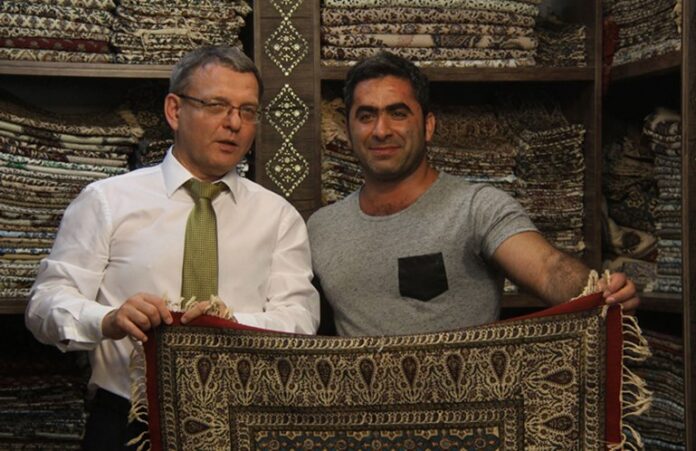
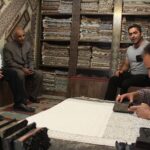
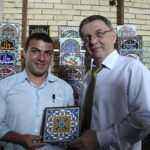
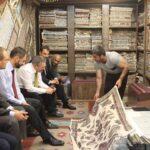
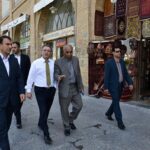
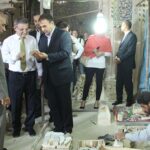
The Czech foreign minister visited historical sites in Isfahan and bought souvenirs from the city’s handicraft workshops.

Lubomir Zaoralek arrived at Isfahan International Airport on Friday, heading a high-level economic delegation, and was welcomed by Isfahan Governor General Rasoul Zargarpour.

The Czech top diplomat attended a meeting of Isfahan Chamber of Commerce, Industries, Mines and Agriculture on Saturday.

Images of the Czech minister on a shopping tour in Isfahan released by fararu.com:

Iran president calls on Europe to ‘help’ refugees

Rouhani-Hungary

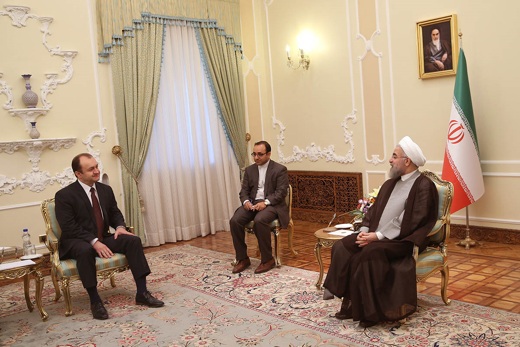
President Hassan Rouhani has called on European governments to fulfill their humanitarian duty concerning tens of thousands of refugees who are fleeing their crisis-hit countries.

President Rouhani made the call in a meeting with new Hungarian Ambassador to Tehran Yanosh Kwach, on Sunday, saying dealing with the refugee crisis is a “great humanitarian mission” assigned to the world, especially Europe.

“It is urgent that governments and countries help these refugees,” Rouhani said.

The Iranian president welcomed the move by some European countries to take in refugees, saying, “We are happy that some European countries have decided to save refugees and hope that all of Europe and the countries that have not joined this process” would follow suit.

Rouhani said the current refugee crisis stems from the “threat of violence-seeking extremist groups and terrorism.”

“Terrorism has sparked intimidation and fear in the regional countries and [resulted in] the displacement of innocent people,” he said.

Rouhani expressed hope that through “determination and collective cooperation,” the entire world would see lasting stability and security.

Over the past few days, thousands of asylum seekers have left Hungary, where they had been stuck for days, for Austria and Germany after Berlin and Vienna officials voiced their readiness to receive them.

Pope Francis on Sunday called on churches across Europe to welcome refugee families.

The United Nations estimates 300,000 people have left the Middle East and North Africa for Europe this year, but 2,500 have died in their attempt, mainly through dangerous voyages across the Mediterranean in rickety boats. Media reports, however, say 350,000 have crossed into Europe this year.

The Hungarian ambassador, for his part, described Iran as the cornerstone of stability and security in the region, saying a recent nuclear agreement between Iran and six world powers can be taken as an appropriate example to resolve international issues.

No support spared for Iraq

Rouhani also received the new Iraqi ambassador to Tehran, Rajih al-Mussawi, saying Iran will keep supporting Iraq in its fight against terrorism.

“We will withhold no assistance” to Iraq, Rouhani said, adding that the primary responsibility for establishing security in Iraq rests with the people and government of the country.

Mussawi, for his part, appreciated Tehran’s support for Baghdad, saying Iraq is willing to broaden its relations with Iran.

The northern and western parts of Iraq have been plagued by violence ever since IS terrorists mounted an offensive in June 2014. The militants have been committing vicious crimes against all ethnic and religious communities in Iraq, including Shiites, Sunnis, Kurds, Christians and others.

The Iraqi army together with fighters from the Popular Mobilization Units has been engaged in operations to liberate militant-held regions.

Iran, Venezuela stress expansion of bilateral ties

Venezuela-Nahavandian

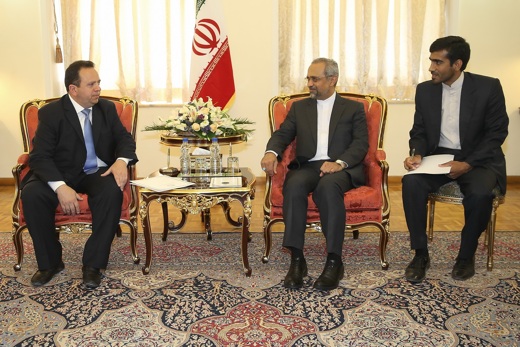
Head of the Presidential Office Mohammad Nahavandian in a meeting with Venezuelan Vice-President for Economy Rodolfo Marco Torres underlined the need for further expansion of Tehran-Caracas relations.

“The good cooperation between the two countries should also expand in cultural and scientific fields in addition to the economic areas,” Nahavandian said.

The Iranian official lauded Venezuela’s decision to walk down the path of economic development, and said, “Reducing reliance on oil should be prioritized by the economies which are oil-dependent.”

Nahavandian pointed to the problems caused by the West’s oppressive sanctions against Iran, and said, “Iran managed to considerably reduce the inflation rate and turn negative growth into positive growth by minimizing the damage oil market fluctuations caused in the country.”

[…]
The Venezuelan vice-president, for his part, described Iran as Venezuela’s close friend, and said, “During the meetings with Iranian officials, the most important programs for the development of Tehran-Caracas relations were explored.”

The Venezuelan vice-president also submitted President Nicolas Maduro’s written message to President Rouhani, and underlined the need for a balance in the oil market and cooperation in this field.

Turkish oil company experts visit Amirabad port to invest

Turkish oil

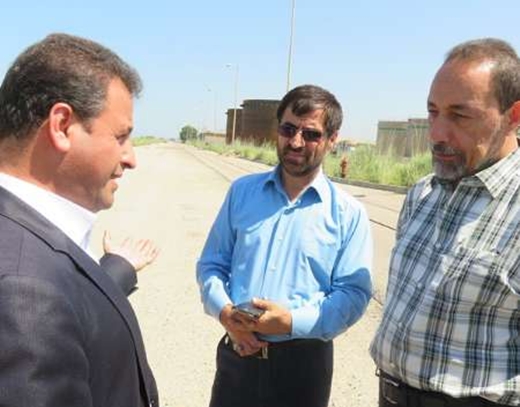
A delegation from Panta International Company visited Amirabad Port to consider investment in the field of oil.

Director of Ports and Navigation Office and head of Amirabad Economic Special Zone Ali Khedmatgozar called Amirabad as the biggest port in northern Iran and said construction of oil storage facility is an investment priority in the port.

[…]

He also announced the intention of his office to entrust construction of an oil harbor to the private sector based on a B.O.T contract.

The representative of Turkish company, for his part, said that his company has branches in the Netherlands, Switzerland, Hong Kong and Central Asian states and the main focus of the company is in the field of swap, oil investment and fuel transit to other countries.

At the end of the meeting, the Turkish delegation visited installations of the port.

Iran, Kyrgyzstan plan for long-term cooperation

Rouhani-Kyrgyzstan

Kyrgyz President Almazbek Atambayev arrived in Tehran on September 4 and held talks – during his stay – with senior state officials such as President Hassan Rouhani. Later the two presidents held a joint press conference which covered a wide range of issues, including mutual ties and regional cooperation.

Kayhan daily on September 6 published a report on the Kyrgyz president’s visit, the cooperation deals the two sides signed and the remarks the two presidents made in a joint press conference. The following is the translation of part of that report:

[…]

President Rouhani said in the press conference that Iran and Kyrgyzstan have close cooperation on regional and international issues,

Recalling the new Kyrgyz government’s adoption of approaches that favor independence, Rouhani said that the closure of Manas Air Base in Kyrgyzstan which used to be manned by American troops has brought Tehran and Bishkek closer together as far as regional and international questions are concerned. He added the two countries can raise the scope of their cooperation as a result of Bishkek’s new international approach.

[…]

“We have decided to draw up a ten-year plan for mutual ties. We should take into account the two sides’ potential for promotion of ties. Such a plan, when implemented, will benefit the two nations,” President Rouhani said.

For his part, the Kyrgyz president said that his country and Iran have no differences whatsoever, adding, “As the esteemed Iranian president mentioned, we had good talks and reached agreement on many issues. This shows a bright future lies ahead for the two countries.”

President Atambayev further said, “We also discussed the implementation of a big railroad project which connects China, Kyrgyzstan, Tajikistan, Afghanistan and Iran, and decided to study a plan to operate Iran-Kyrgyzstan flights.”

“Bishkek supports Iran’s full membership in the Shanghai Cooperation Organization (SCO) and I am sure this will help SCO raise its economic capabilities and improve the infrastructure [of its members],” he added.

The Kyrgyz president also said that Bishkek and Tehran agreed to put together a ten-year-old plan for their cooperation, adding the cooperation deals the two sides inked [during my trip] is proof of the two sides’ willingness to upgrade cooperation.

Iran, Iraq sign three agreements on economic cooperation

Tayebnia-Iraqi

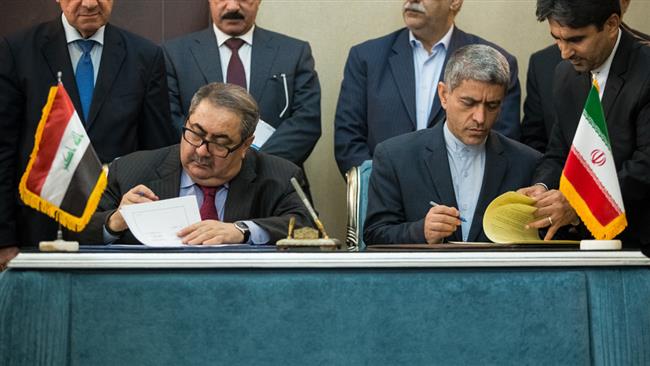
Iran and Iraq have signed three agreements for expansion of cooperation in various economic fields between the two neighboring countries.

The agreements were signed in the presence of Iran’s Minister of Economic Affairs and Finance Ali Tayyebnia and his Iraqi counterpart, Hoshyar Zebari, in Tehran on Sunday.

The agreements aim to boost cooperation between Iran and its western neighbor in such areas as customs, taxation and mutual investment.

Speaking to reporters on the sidelines of the signing ceremony, Iran’s minister of economic affairs and finance said according to the agreements, Iran and Iraq will expand customs cooperation while taking steps to do away with double taxation and encourage mutual investment in the two countries.

Tayyebnia further said that the volume of bilateral trade between Iran and Iraq currently stands at $12 billion a year, expressing hope that the new agreements will increase the figure to over $20 billion.

Zebari, for his part, congratulated the Iranian nation and government on the conclusion of the nuclear talks between the Islamic Republic and P5+1, which led to an agreement between the two sides, known as the Joint Comprehensive Plan of Action (JCPOA).

Zebari described the nuclear agreement between Iran and the sextet as rational, helpful and beneficial to both Iran and the entire region.

The Iraqi minister also said that the relations between the two countries are progressive, expressing hope that Iran-Iraq ties will further expand in the future.

Zebari arrived in Tehran Saturday at the head of an economic delegation.

He met with Foreign Minister Mohammad Javad Zarif Sunday, during which the two sides explored various aspects of bilateral relations.

Iran unveils new miniature paintings by Mahmoud Farshchian

Farshchian

Two new miniature paintings by world-renowned Iranian artist Mahmoud Farshchian have been unveiled in Tehran.

‘Sham-e Ghariban’ (The Night of the Oppressed) and ‘The Fourth Heaven’ were unveiled during a ceremony at Farshchian Museum of Sa’dabad Cultural and Historical Complex.

The ceremony was attended by a number of senior officials, including Foreign Minister Mohammad Javad Zarif and head of Iran’s Cultural Heritage, Handicraft and Tourism Organization Masoud Soltanifar.

“Farshchian’s works have always been the most significant gifts I’ve ever offered to ministers and ambassadors of other countries,” Zarif said during the unveiling ceremony.

He added that no other work can express the prominence, spirituality and human nature of Iranian art better than Farshchian’s creations.

Farshchian is known as Iran’s master of miniatures, whose works have been displayed in numerous galleries and museums around the world such as the British Library, Freer Gallery of Art, Bibliotheque Nationale, Metropolitan Museum and Harvard University.

The 85-year-old artist was chosen as an outstanding 21st century intellectual by Cambridge and has received an honorary doctorate in Iranian painting and Islamic arts from the High Council of Culture and Art.

He has won numerous national and international awards, including the gold statuette of Italy’s Vessillo Europa Delle Arte in 1984 and the gold medal of Belgium’s 1958 International Art Festival.

Iran’s Cultural Heritage Foundation established the Museum of Master Mahmoud Farshchian, devoted to the works of the veteran artist, at Tehran’s Sa’dabad Cultural and Historical Complex in 2001.


Prague takes a big step to get closer to Tehran

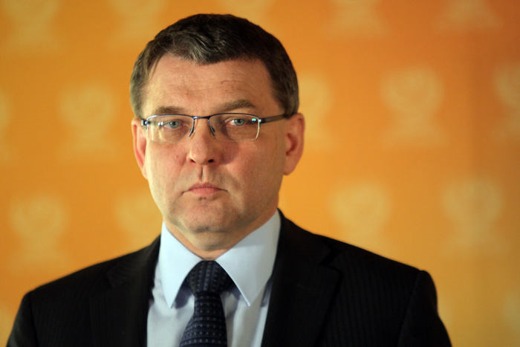
Lubomir Zaoralek

Iran Newspaper-6-sep

This year marks the 90th anniversary of the establishment of diplomatic ties between Iran and [former] Czechoslovakia and the 85th anniversary of the signing of a friendship pact between the two countries.

This is the opening of an opinion piece by the Czech Republic’s Foreign Minister Lubomir Zaoralek on the prospects of ties between the two nations. The following is the translation of the piece published in Farsi by Iran newspaper on September 6:

Ninety years ago the two countries [former Czechoslovakia and Iran] established diplomatic ties and 85 years have passed since the two nations signed a friendship pact. These events show that Iran is among the first non-European countries Czechoslovakia established and developed ties with. These deep-seated ties have improved the prospects of my current trip to Iran.

I am the first foreign minister [of the Czech Republic] to visit Iran in many years. I am happy that there is a firm historic reason for my trip and that is to reconstruct the age-old friendship between the two countries. Over the years I have been involved in political activities, I have always believed in working out diplomatic solutions to the world’s problems. That’s why I’m happy to see that lengthy talks between Iran and P5+1 over the former’s nuclear program have finally produced an agreement.

If such an approach is sufficiently employed, it would pave the way for resolving a number of regional issues and would patch up ties among regional nations. Given the conditions in the Middle East and North Africa, this approach is badly needed. Let me tell you about an article I recently read and found interesting. This article – The Imperative of a Comprehensive Strategy to Fight Violent Extremism – was written by my [Iranian] counterpart Mr. Zarif.

I have paid special attention to the shared willingness by the international community to defeat ISIL and all its extremist affiliates, and to remove all symbols of sectarian violence all over the world. It is highly important that we hear such a powerful message from the Islamic Republic of Iran which places emphasis on cooperation against evil forces that are acting in the name of Islam.

I am very happy to say that my country fully agrees with Iran in this regard. The Czech Republic actively supports all efforts which may help defeat ISIL and its violent state in parts of Syria and Iraq. To that end, my country is actively helping [with the fight against ISIL] in different forms such as sending ammunition to the Iraqi government and participating in non-combat projects there. We have also taken different measures to help asylum seekers from Iraq and Syria. The Czech government has always paid attention to efforts to support war-stricken people and help them get access to welfare.

As I said before, I’ve always backed the possible and workable diplomatic settlement of disputes between people and governments anywhere. This is yet another reason why I hope diplomatic ties between the two countries as well as their relations on other fronts will be revived and boosted. It is quite natural for the two countries not to see eye to eye on all issues, but they are expected to talk about all these issues and seek a sustainable, peaceful compromise.

One key way to build and improve ties among world nations and prevent confrontation and war among them goes through activation of economic cooperation. We in Europe know this very well. That’s why a relatively big economic-commercial delegation bringing together representatives from 50 Czech companies which are big industrial names in my country’s long history is accompanying me on this visit.

Their presence reminds us of the fact that the two countries have had good cooperation from the past and that there are areas for them to develop their cooperation. I would like to say that the two countries can cooperate on different fronts, especially public transport, non-military air transport, water treatment and management, medicine, healthcare, medical equipment, agriculture, machinery, mining, construction, science and technology.

For sure, the two sides will have a wide range of options for cooperation and I’m sure that at least a number of them should be developed. In addition to these, let me stress the importance of building cultural bridges between people in these two countries. I would like to express my gratitude to the Iranian government for its support for the Farsi Language and Literature Program at Charles University in Prague. I hope this can reestablish an old tradition of Iranian studies in the Czech Republic’s universities.

I am also hopeful this [Iranian studies in the Czech Republic] can help revive studies on the Czech Republic in the Islamic Republic of Iran. As I mentioned in this article, good relations between the Islamic Republic of Iran and the Czech Republic are based on good, old traditions. I am very hopeful about the bright prospects of our ties and my trip to Tehran will greatly help build a better future [for the two nations].