Monday, December 29, 2025
Home Blog Page 4739

Delegation of authority: US seeks to leave Syria to Russia

atvan

After five years of futile attempts to topple the Syrian government, the United States is now grappling with new problems such as terrorism and the refugee crisis. The White House has now come to the conclusion that it should drop its insistence on the ouster of Bashar Assad and get along with Russia as far as the Syrian conflict is concerned.

With the refugee crisis getting closer to a boiling point, things are changing on the ground in Syria. Five years have passed since the Syrian crisis erupted. Now the West and certain Arab countries have lost hope in efforts to overthrow the Syrian government, and the US and Europe – more than Saudi Arabia and Turkey – have come to realize that they have to come to terms with a [new] Russian role in Syria and with the survival of Bashar Assad.

Fars News Agency on September 19 published a report on the Russian role in the Syrian civil war and the new US Syria strategy, quoting remarks by Abdel Bari Atwan, the editor-in-chief of Rai al-Youm – an Arab world digital news and opinion website – on the Syrian crisis and its twists and turns. The following is the translation of that report:

Abdel Bari Atwan writes [in his editorial] that US Secretary of State John Kerry dropped a political bombshell when he – in a joint press conference with United Arab Emirates Foreign Minister Abdullah bin Zayed in London on Friday – welcomed talks with Russia on the fight against ISIL in Syria. [“The president believes that mil-to-mil conversation is an important next step and hopefully will take place very shortly and help to define some of the different options available to us as we consider next steps in Syria”.]

Atwan goes on to say that the [US] acceptance of talks with Moscow on the Syrian conflict has given Russia the opportunity to station its state-of-the-art military hardware in Syria. Russia, which has announced Bashar Assad as its red line, is getting prepared to help him stay on the job.

He then puts forward a question as to what has caused the US to change tack and welcome cooperation with Russia on the Syrian issue, and sets out the following reasons for such a change of heart:

1. After conducting around 6,000 sorties against ISIL positions, Washington has learned that it has achieved nothing [in its fight against ISIL]: not only has the terror group not retreated from its positions, but it has also captured Ramadi in Iraq and Palmyra in Syria.

2. Saudi Arabia, Turkey and Qatar – all three US allies – are opposed to deployment of ground troops to take on ISIL. Forces of the Iraqi Army have withdrawn from Ramadi and Mosul, Saudi Arabia has got embroiled in a bloody war against Yemen, and Turkey has been caught in a war of attrition against PKK [Kurdistan Workers’ Party].

3. All plans to train the Syrian opposition have ended in failure and the trainees have fled the conflict before taking one single shot at ISIL.

4. Expression of readiness by Moscow to send troops to Syria – if and when Syria asks for them – means that Russia is seriously committed to helping Bashar Assad survive even if it takes a third world war.

5. Following the conclusion of a nuclear deal with Iran and its passage at Congress, the United States is ready to implement a phased-out departure from the Middle East simply toward [pursuing its policies on] East Asia, especially at a time when it is close to becoming independent of the Middle East’s oil.

6. The exodus of thousands of Syrian refugees who are fleeing the crisis [in their homeland] toward Europe has left an impact on the [green] continent and sparked off a demographic crisis there. Europe has been divided into two parts: Germany, France, Britain and Belgium vis-à-vis the New Europe which comprises Poland, Hungary, Romania and Bulgaria. There are fears that the European Union can be splintered.

Abdel Bari Atwan continues to say that the reasons above are good enough to say that the US administration has handed over the Syrian case to Russia and is trying to devolve its responsibilities toward the Syrian opposition and its supporters (Saudi Arabia, Qatar and Turkey).

He adds nothing happens in Europe and the US by chance. Spanish Foreign Minister Jose Manuel Garcia-Margallo’s insistence (1) on the need for holding talks with Bashar Assad and remarks by British Foreign Secretary Philip Hammond (2) on the presence of Bashar Assad in the transitional period together with comments by German Chancellor Angela Merkel (3) on Moscow’s role in Syria have all aimed to [prepare the world public opinion and] set the stage for the US withdrawal from Syria.

Close military talks between Russia and the US will soon create a US-Russian coalition for the fight against ISIL. This will be the first time ever that two world powers agree to take on one single enemy. The Syrian government or Iran seems likely to be part of this coalition. The new coalition will possibly inflict the most painful losses on Saudi Arabia, Turkey and Qatar – three sides of a triangle.

1. [“The time has come to start negotiations with the Assad regime if we do not want this war, which has already killed 250,000 people, to keep causing human tragedies”.]
2. [“If there is a sensible plan for transition that involves Assad remaining in some way involved in the process for a period of time we will look at that, we will discuss it. We are not saying he must go on day one”.]
3. [Germany and other western European powers need to work with Russia as well as the United States to solve the crisis in Syria]

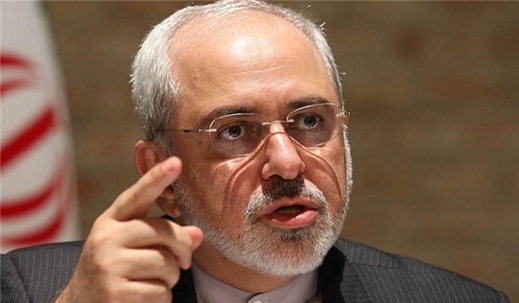
Iran government, nation do not trust US officials: FM Zarif

zarif

Foreign Minister Mohammad Javad Zarif has said that the lack of trust on the part of the Iranian nation and government in US statesmen is the main problem in relations between Tehran and Washington.

“What the American officials have done in recent months, particularly after [the finalization of] JCPOA [the Joint Comprehensive Plan of Action], to satisfy critics inside the US has unfortunately failed to help restore the trust,” Zarif said in a joint press conference with visiting Dutch Foreign Minister Bert Koenders in Tehran Sunday.

Zarif expressed hope that the US will live up to its obligations in the implementation of the nuclear agreement with Iran to help resolve the mistrust.

[…]

Iran-Netherlands ties

Zarif said Iran and the Netherlands are determined to improve relations in all fields.

He added that relations between the two countries date back to several centuries ago but due to the conditions the level of ties has downgraded over the past few years.

“There have been extensive political and economic relations between Iran and the Netherlands,” Zarif said, adding, “Today, we have the opportunity to overcome the obstacles [that existed] in the past and achieve a favorable level in relations [between the two nations].”

The Iranian top diplomat said that in addition to oil, gas and energy sectors, Tehran and Amsterdam can cooperate in the fields of water management, agriculture and other areas in which the Netherlands has made considerable progress.

He also expressed Iran’s readiness to interact with its partners in the European Union in various political, economic and cultural fields.

“The expansion of economic relations will provide an appropriate ground for Iran’s cooperation with the Netherlands and other countries in the European Union,” Foreign Minister Zarif said.

The Dutch foreign minister, for his part, said that the “historic” nuclear agreement on July 14 was a victory for multilateral diplomacy and the policy of engagement.

Koenders said Iran and the Netherlands have deep-rooted relations, adding that the Dutch government is eager to work with Iran in oil and gas sectors.

The Dutch top diplomat arrived in Tehran Sunday at the invitation of his Iranian counterpart. He is set to hold talks with President Rouhani and other senior Iranian officials.

Larijani: Islamic world sound asleep in face of Palestine developments

Ali Larijani

Parliament Speaker Ali Larijani said the Islamic world is sound asleep in the face of what is going on in Palestine.

He said in parliament on Sunday that the Islamic world is feigning sleep as far as the Palestinian developments are concerned, giving the Zionist regime the chance to misuse the situation as best as it could.

He touched upon the “very horrendous and insulting” incidents in the Al-Aqsa Mosque in the occupied Palestine over the past few days and said that the Zionist regime is misusing this to insult the first Qibla of Muslims.

The speaker condemned the Zionist regime’s heinous act and called on all international bodies including the Organization of the Islamic Cooperation to play an active role in this regard.

World’s best red soil on Hormuz Island (PHOTOS)

red soil00

Hormuz, an Iranian island in the Strait of Hormuz, is a secluded spot loved by environmentalists and those who long for peace and quiet.

The oval island, known as the key to the Persian Gulf because of its geographical position, has gained popularity with artists too.

Its beaches which are covered with colorful soil are the canvas of artists.

Among green, brown, white, ochre, red and black mountains, the island’s Red Mountains are distinctive. Locals use its soil for baking special bread and add it to pickles as spice.

The following images have been published by the Iranian Students’ News Agency:

A world-wide-web fight against a terror group on the ground

Ghostsec

We are the ghosts that you created. We continue our fight. We will not rest until we eliminate them [the terrorist groups] and their manifestations from the net. This is the main message of Ghost Security, a cyber-group which was founded after Charlie Hebdo’s offices [a French satirical weekly magazine] were attacked by fundamentalist elements and has now expanded its activities to other areas. The [hacking] group, which targets ISIL affiliated accounts, says its mission is to remove extremist groups, ISIL in particular, from cyberspace and stymie their recruitment and limit their ability to organize international terrorist efforts.

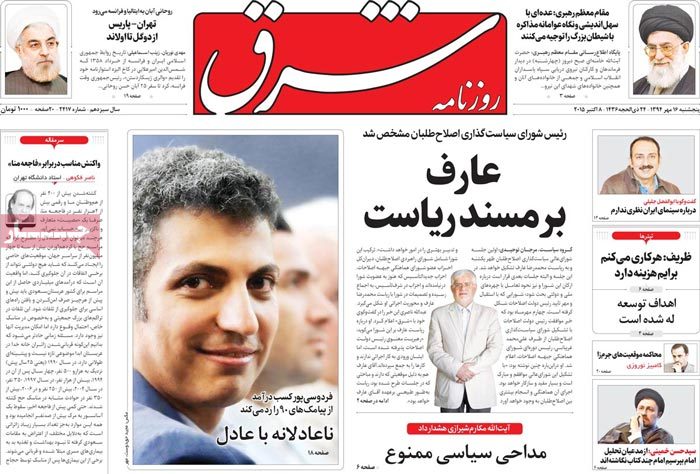
sharq-ghostsecThe group of hacktivists has extended its activities and taken measures against accounts of Boko Haram [an extremist group based in northeastern Nigeria] supporters. The online group has answered questions asked by Sharq daily’s Nozhan Etezad Saltaneh.

Ghost Security says everybody – regardless of their race, gender or nationality – can join the anti-terror group in its fight against ISIL, arguing that the anti-ISIL fight needs international cooperation and partnership. The following is the translation of part of the interview Sharq daily published on September 15:

[…]

Q: Does a foreign (Western or Arab) government support you? Who supports you? Where is the source of the finances your website receives?

A: Currently, no government supports our measures against ISIL. The success of our operations is credited to the financial support we get from our backers.

[…]

Q: There were reports that you hand over intelligence on ISIL members to foreign intelligence services. Do you confirm such reports? What intelligence services do you cooperate with? Doesn’t it affect your independence?

A: When we trace a terror plot against governments and nations, we analyze the intelligence on that plot. If it poses an imminent threat, we contact the officials of the countries which might be exposed to that threat and let them in on it. They can take necessary measures to foil the plot or capture suspected individuals or groups.

We are primarily an intelligence and cyber-attack source which monitors the activities of ISIL operatives and their relatives. We cannot foil ISIL attacks without contacting government intelligence agencies. To stop that group’s plans, we direly need to tap into the legitimate use of force which is only available to governments. We can simply intercept [their plots].

[…]

Q: Do you welcome assistance by different countries, including Iran and its Cyber Army, to take on ISIL?

A: ISIL is a global problem. Wherever you live does not matter because you can still be a victim of ISIL attacks; in a Paris street or a small town in the US, you can be targeted by members of this group.

Ghost Security is perhaps one of the first groups to embark on countering ISIL in the digital world, but we are not the only people who are fighting against ISIL. Irrespective of race, gender and nationality, everybody can join the fight [against ISIL]. This fight takes international partnership [to prove effective].

Q: You have said that in addition to ISIL, you will target Al-Qaeda, the al-Nusra Front [a militant group in Syria] and Al-Shabaab [an al-Qaeda affiliate in Somalia]. What have you based your picks on? How come a group like the Taliban is not on your list? There are hundreds of Salafi groups – in addition to al-Nusra Front and ISIL – in Syria and Iraq. Can you take on all of them?

A: We are engaged in [a fight against] any group which has been registered as a terrorist organization. Compared with ISIL, the Taliban hold little sway on the Internet. We discover and block any new website or account which belongs to ISIL or similar groups.

Q: How does the online performance of ISIL differ from that of other extremist groups? How many ISIL members are active on social networking sites? How are they intercepted by Ghost Security?

A: ISIL fares better than any other terrorist groups in organizing and managing its presence on social networking sites and websites. It has managed to relay its message in the cyber world and recruit new members. That’s why we have focused our attention on this group’s activities. Nonetheless, if we discover a website or account with links to other terrorist groups, we will take action against them as well.

[…]

Q: Are you going to take on non-Islamic or non-religious fundamental groups made up of Christian, Buddhist or Neo-Nazi extremists?

A: Currently it is not on our agenda, but perhaps in the future.

Q: What are Ghost Security’s future plans?

A: We aim to continue the fight against ISIL and other terrorist groups until we can completely foil their online activities and cause them to lose their effectiveness on the web. We fight against ISIL in the virtual world so that human lives can be saved and protected in the real world and on the ground. We will go ahead with our fight and we will not rest until we eliminate the terror group and its manifestations on the Internet. We are the ghosts they have created.

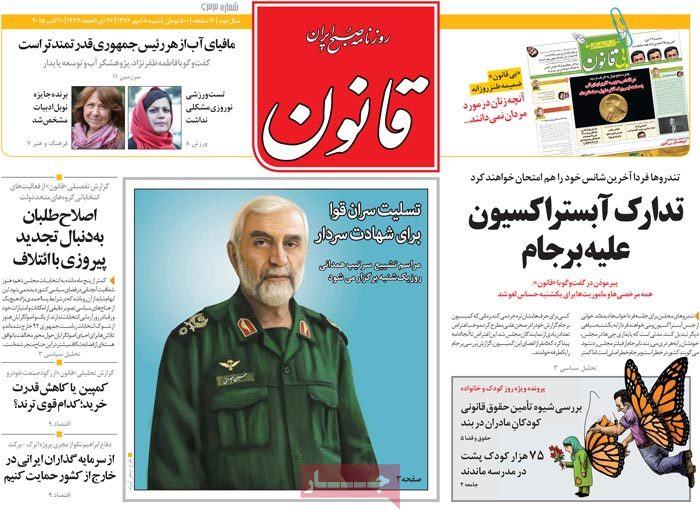
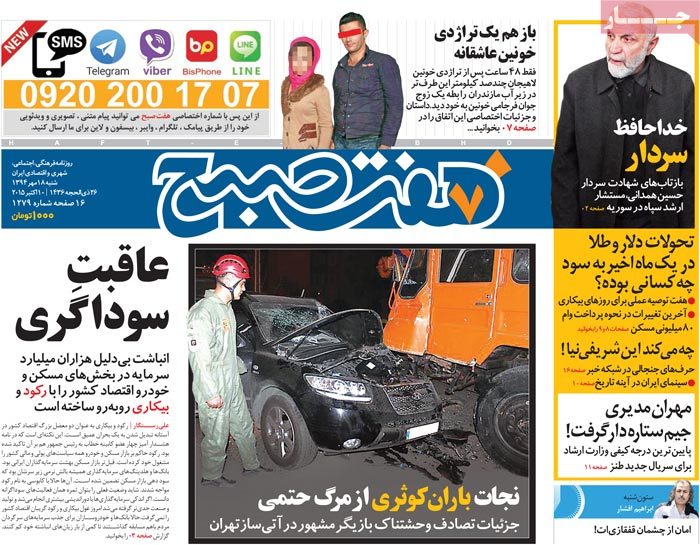
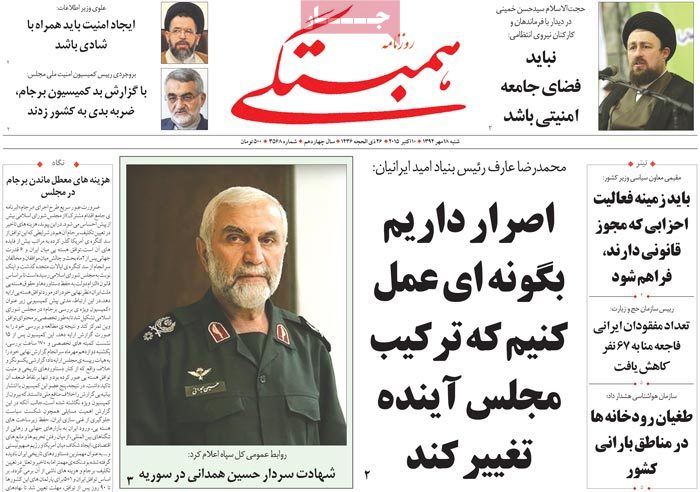
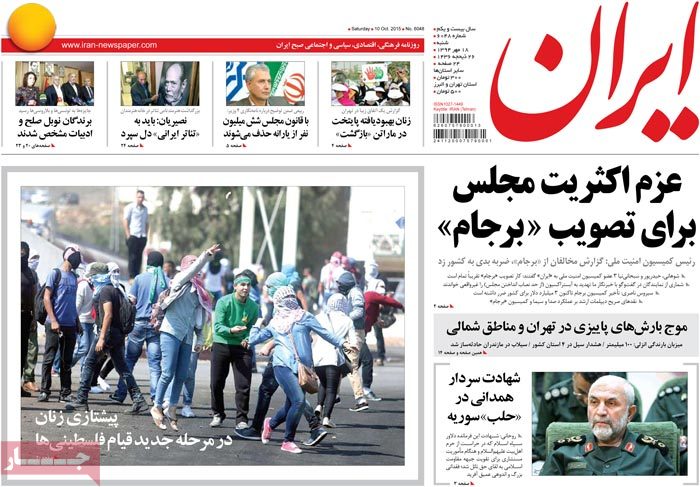
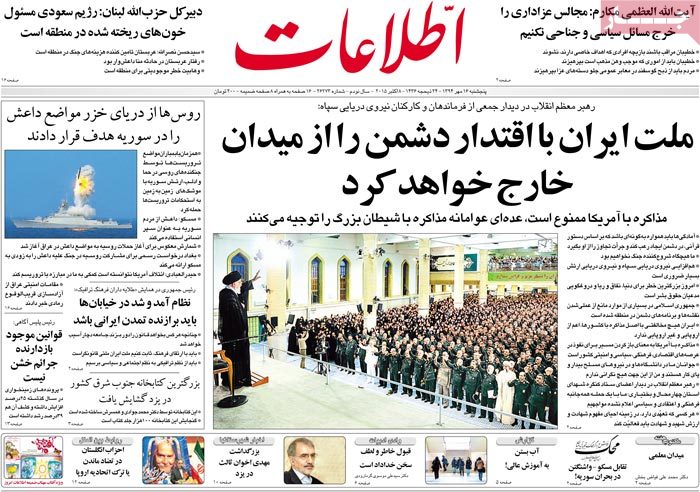
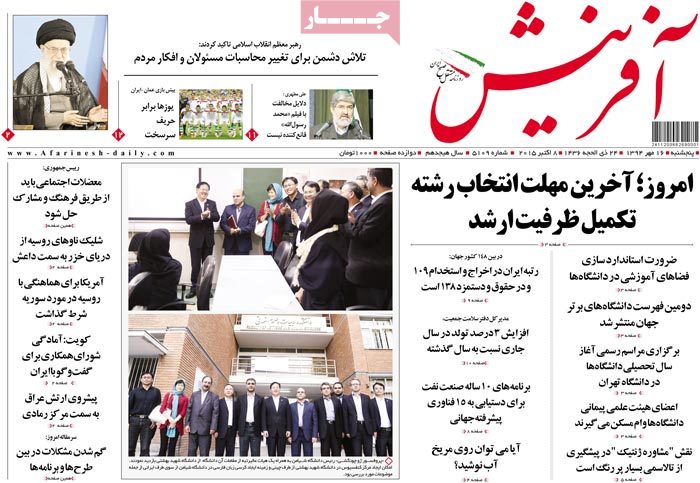
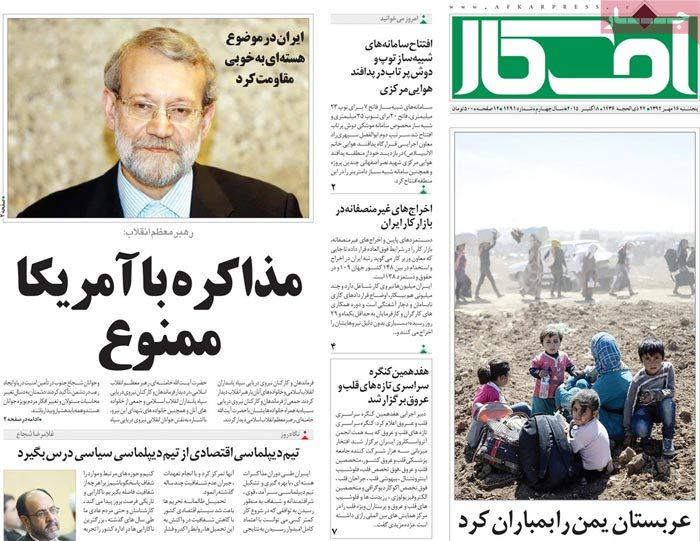
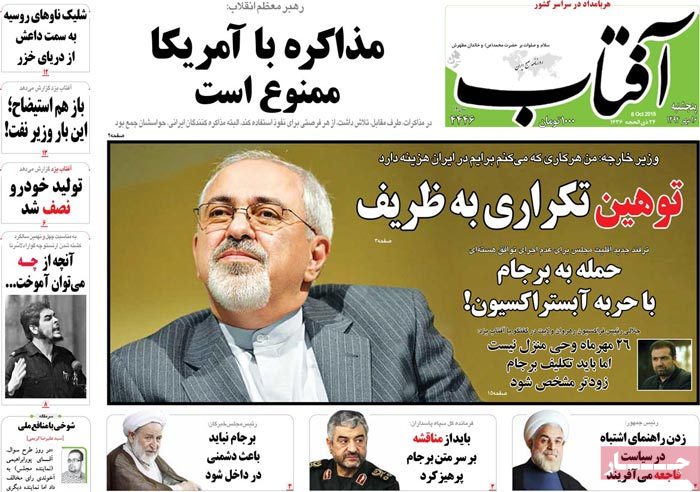
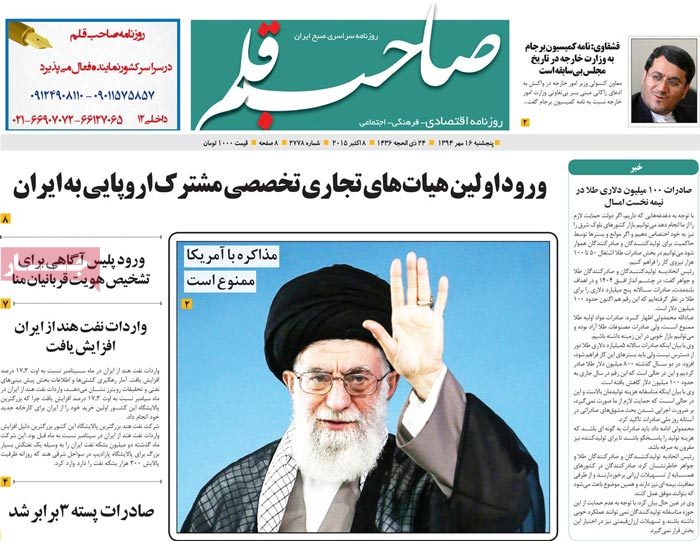
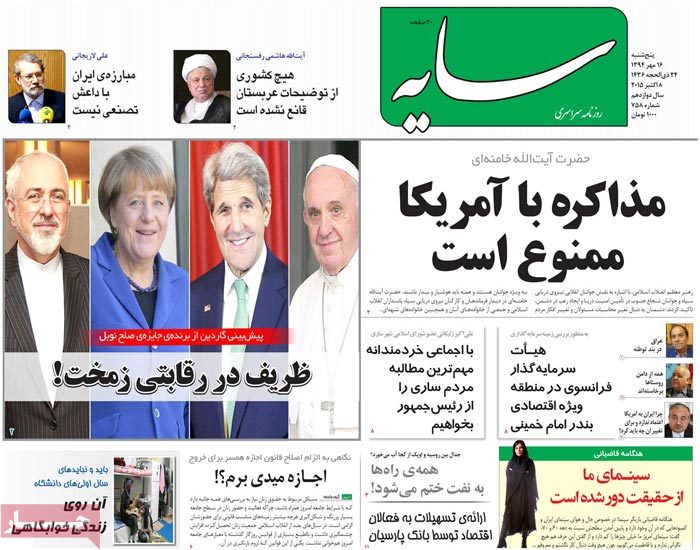
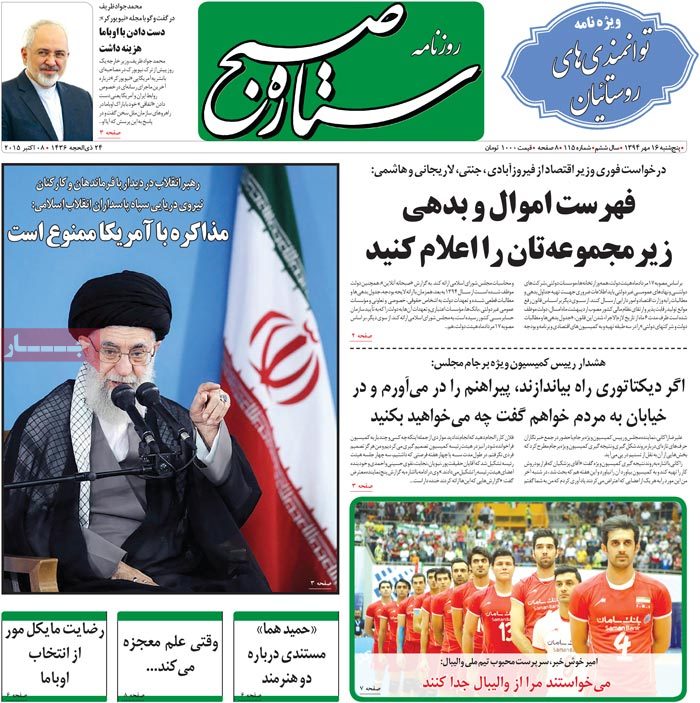
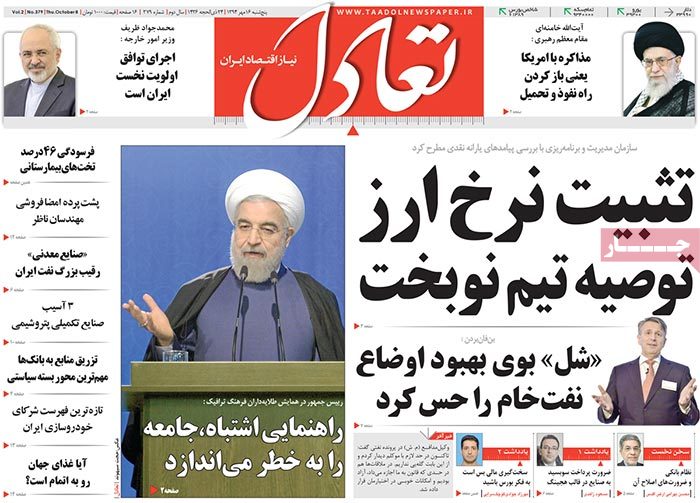
A look at Iranian newspaper front pages on September 20

Iranian Newspapers Headlines

The comments of President Rouhani on relations between Iran and the United States and those of his deputy on development and corruption dominated the front pages of Iranian newspapers on Sunday.


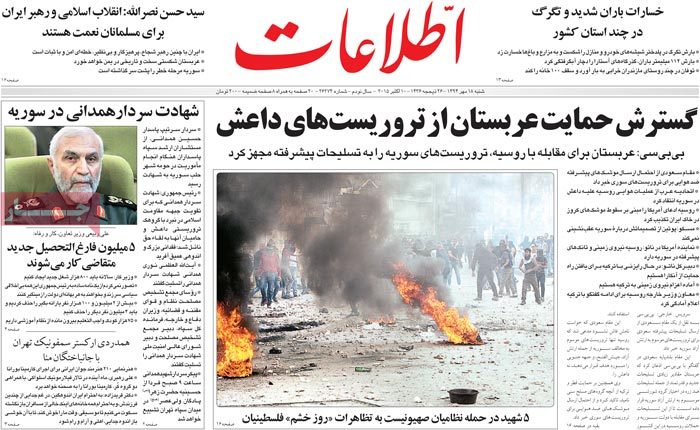
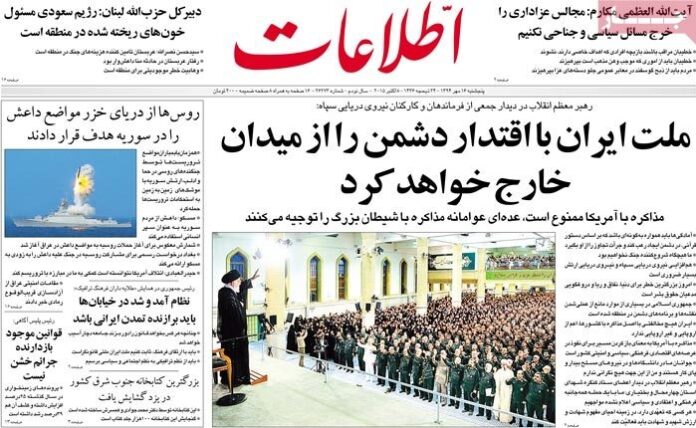
Ettela’at: First Vice-President Eshagh Jahangiri has announced government’s development plans for impoverished provinces in the east.

He urged the public to contribute to the implementation of policies on the resistance-based economy.


Afarinesh: “‘Down with the US’ is not aimed at the American people,” President Rouhani said.


A look at Iranian newspaper front pages on September 20


Aftab-e Yazd: “Some are struck by grief over the fact that people are no longer concerned [about pocketbook issues],” said Vice-President for Parliamentary Affairs Majid Ansari.


A look at Iranian newspaper front pages on September 20


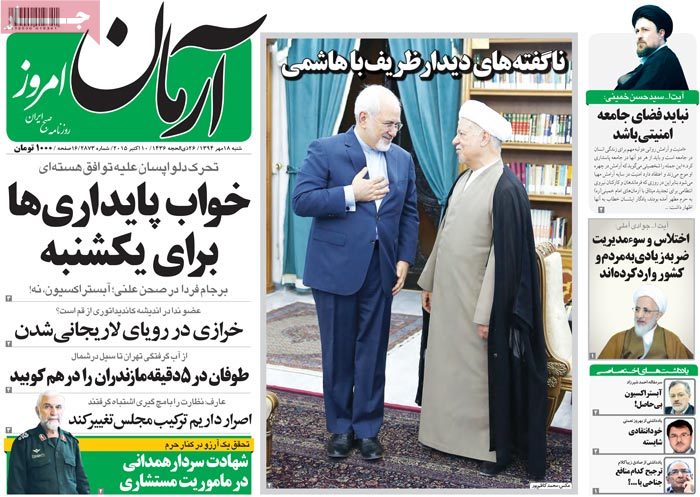
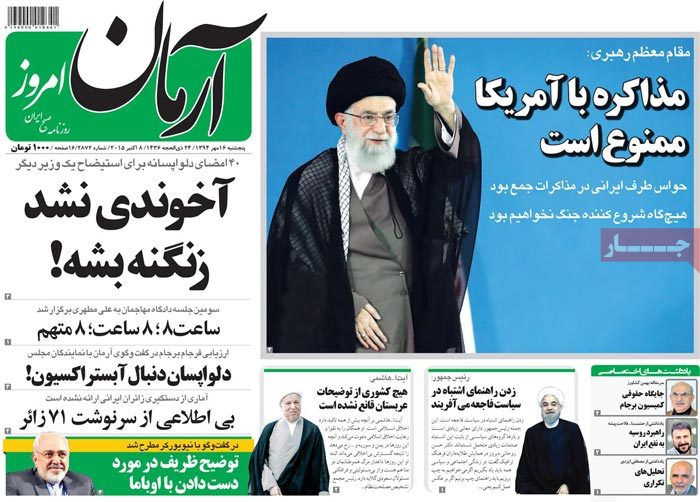
Arman-e Emrooz: “Women seek to have a 30 percent presence on the reformist ticket,” said Fatemeh Rakei, a former MP.


A look at Iranian newspaper front pages on September 20


Asr-e Rasaneh: The deputy economy minister has said that Germans are willing to have a presence in Iran’s automotive industry.

Asr-e Rasaneh: A British trade delegation is to visit Iran.


A look at Iranian newspaper front pages on September 20


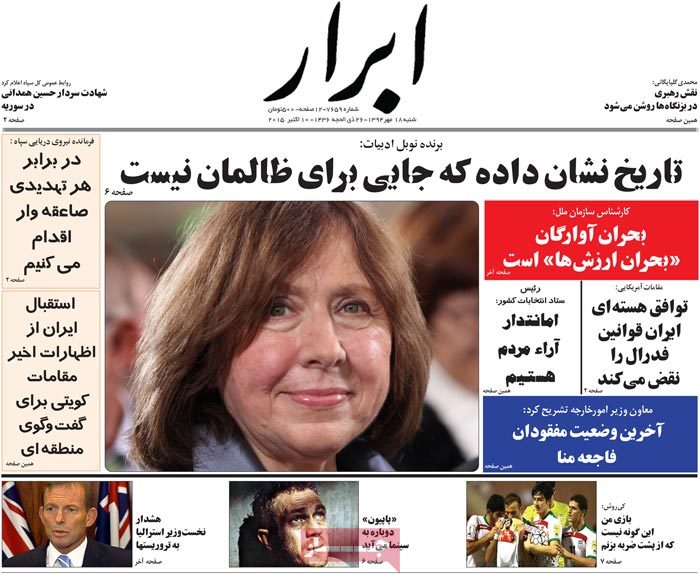
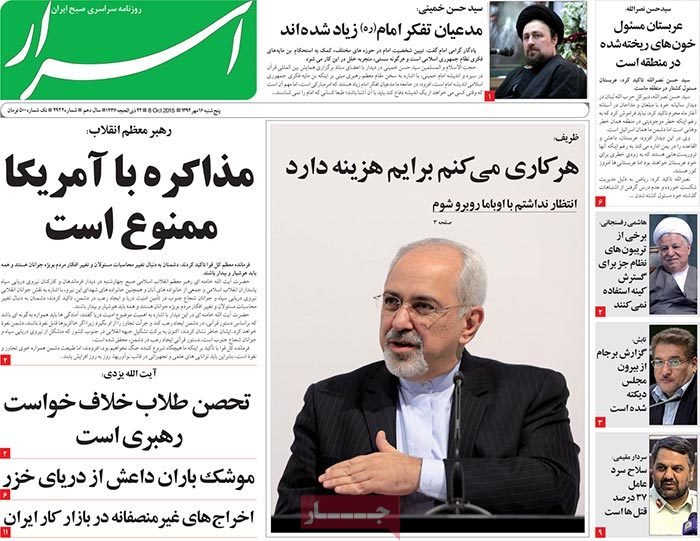
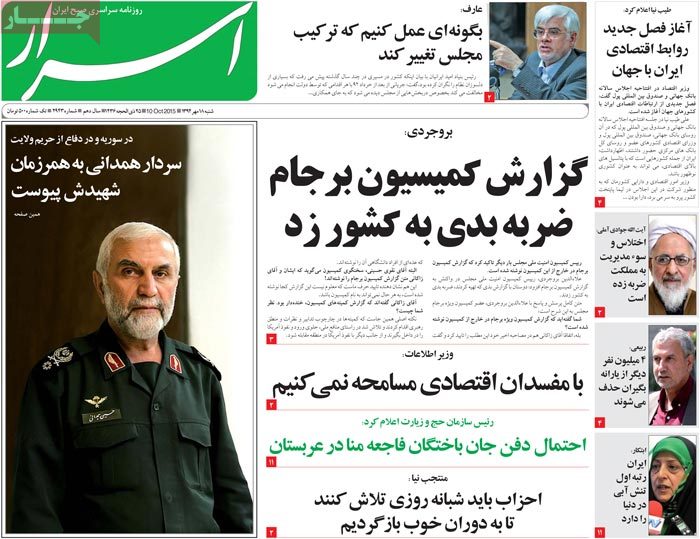
Asrar: “We won’t react to the mudslinging of the previous nuclear team,” said nuclear negotiator Abbas Araghchi.

Asrar: “The issues of the past should be raised even 100 years after the fact,” said First Vice-President Eshagh Jahangiri [in reaction to those who argue that government should let go of corruption cases of the past].

He further said that government has taken out a loan from the National Development Fund after securing the go-ahead of the Leader.


A look at Iranian newspaper front pages on September 20


Eghtesad-e Pooya: Iran and Luxemburg stock markets will soon launch cooperation.

Eghtesad-e Pooya: A New Zealand economic delegation will travel to Iran.


A look at Iranian newspaper front pages on September 20


Emtiaz: The deal to export natural gas to Basra, Iraq is in its final stages.


A look at Iranian newspaper front pages on September 20


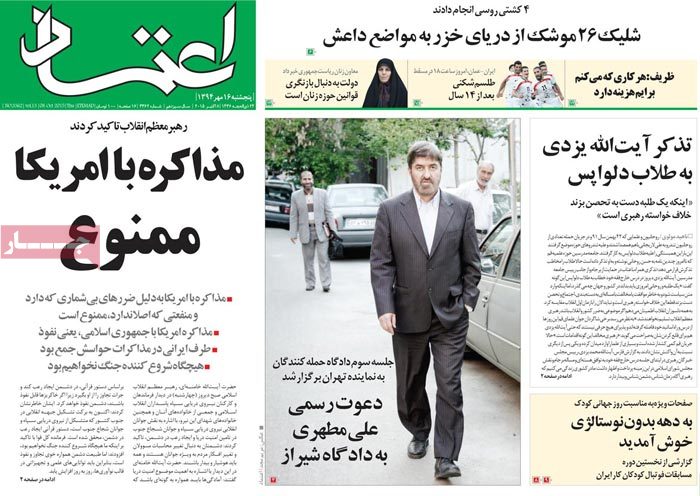
Etemad: Saeed Mortazavi is dragging his feet

Etemad takes a closer look at the case involving former Tehran prosecutor.


A look at Iranian newspaper front pages on September 20


Hambastegi: The education minister has said that one third of the country’s schools are sub-standard.

Hambastegi: “The interests of the nation cannot be sacrificed simply to appease certain individuals,” said the first vice-president.


A look at Iranian newspaper front pages on September 20


Hamkari Melli: “Ways of making up for the shortcomings of the past should be found,” said the chairman of the Expediency Council.


A look at Iranian newspaper front pages on September 20


Hemayat: In light of the fact that the nuclear deal is binding it should be reviewed in parliament, jurists have told the JCPOA Review Committee.


A look at Iranian newspaper front pages on September 20


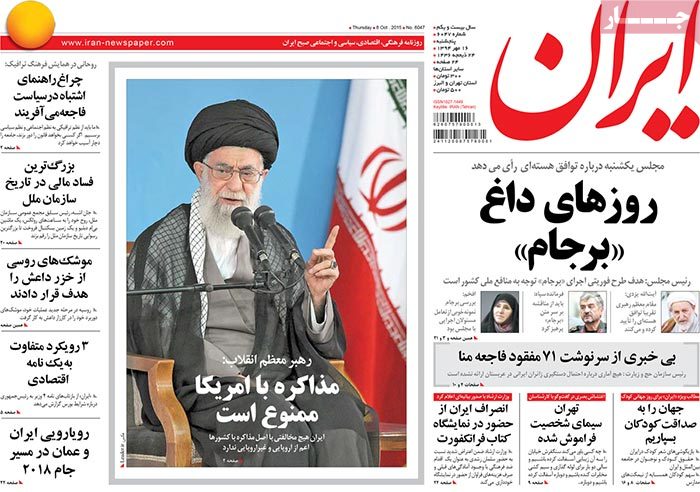
Iran: Ali Akbar Velayati, an advisor to the Supreme Leader, has told a French delegation that the nuclear deal opens the way for new ties with the West.


A look at Iranian newspaper front pages on September 20


Jamejam: The hot seat of the Joint Comprehensive Plan of Action waiting for IAEA director.


A look at Iranian newspaper front pages on September 20


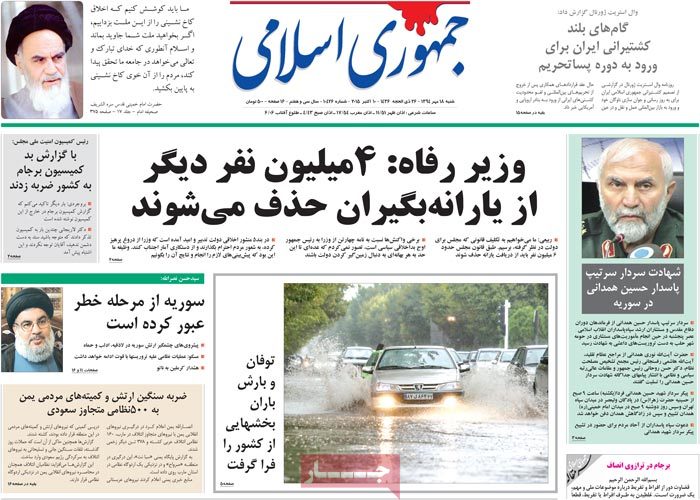
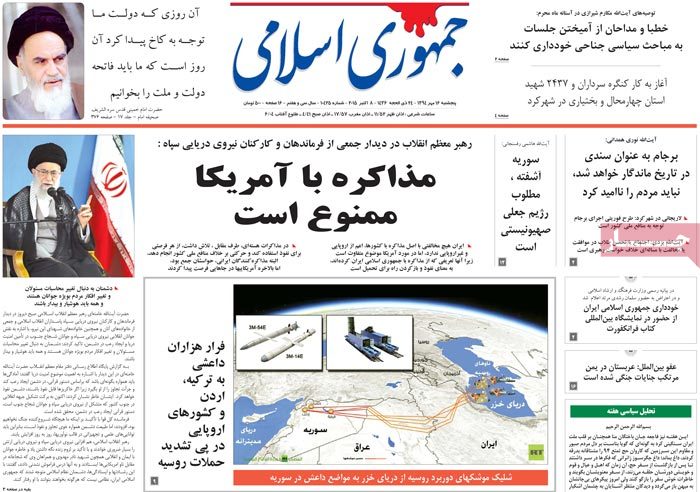
Jomhouri Islami: The US gave in to Syrian resistance.

The US Secretary of State has implicitly signaled Washington’s approval of Assad’s reinstatement.


A look at Iranian newspaper front pages on September 20


Kar va Kargar: “The final report of the JCPOA Review Committee will be read on parliament floor next week,” said the chairman of the chamber’s National Security and Foreign Policy Committee.
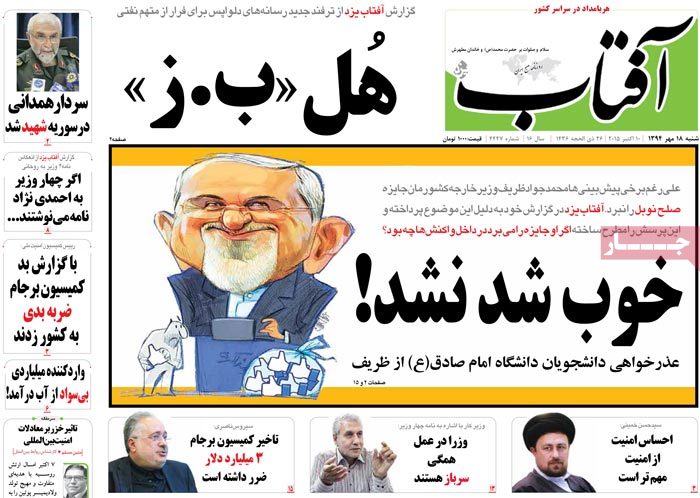
 

A look at Iranian newspaper front pages on September 20


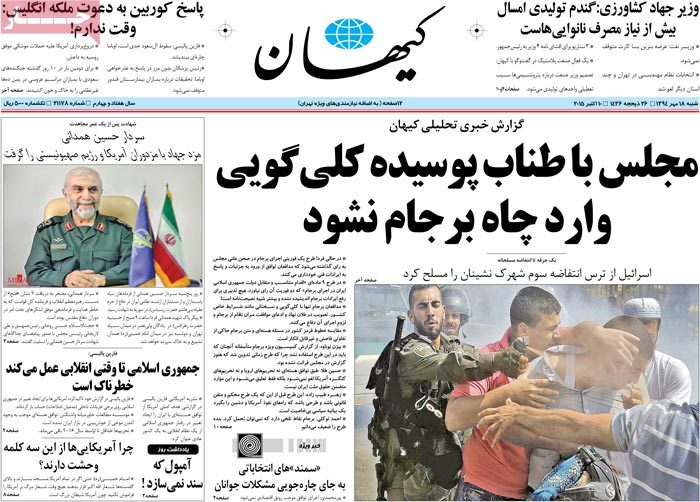
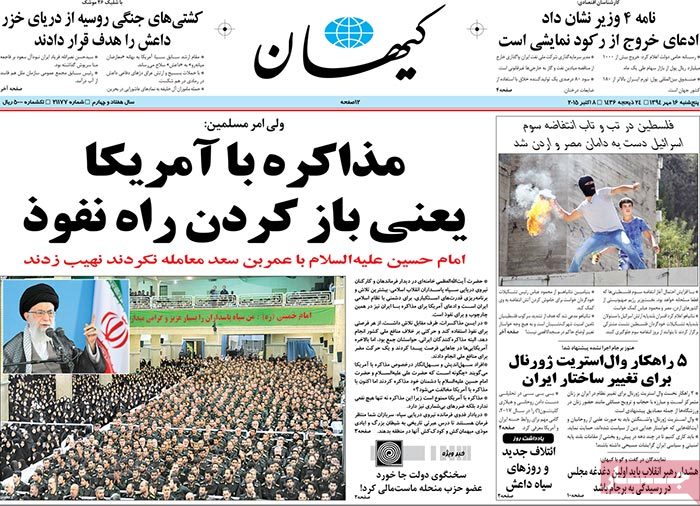
Kayhan: Reestablishment of ties with the Great Satan is the repeat dream of the so-called reformists.

Kayhan: The Saudis have dropped chemical bombs on Saada, Yemen.


A look at Iranian newspaper front pages on September 20


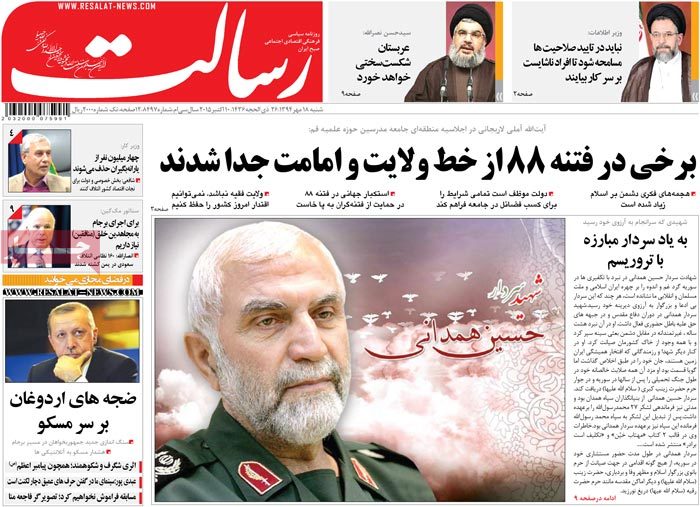
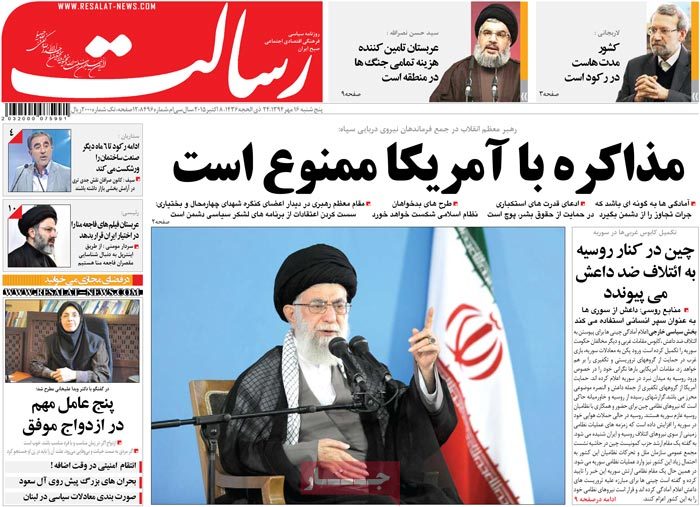
Resalat: “The share of the private sector of Iran’s economy is 20 percent,” said the chairman of the Cooperatives Chamber.


A look at Iranian newspaper front pages on September 20


Sanat: Talks are underway with Total and Eni on development of Iran’s oil fields.


A look at Iranian newspaper front pages on September 20


Setareh Sobh: “Zanjani has failed to return $2.7 billion,” said First Vice-President Eshagh Jahangiri.


A look at Iranian newspaper front pages on September 20


Highlights of Ettela’at newspaper on September 20

Ettelaat

 First Vice-President Eshagh Jahangiri has announced government’s development plans for impoverished provinces in the east.

He urged the public to contribute to the implementation of policies on the resistance-based economy.

 The Supreme Leader has issued a message of condolences following the demise of Martyr Jahanara’s father.

 Amnesty International has expressed concern over the conditions of migrants on borders of Europe.

 Evidence on Saudi war crimes in Yemen has been presented to the Human Rights Council of the United Nations.

It came as the Yemeni Health Ministry put the number of Yemenis killed as a result of Saudi aggression at 5,400.

 President Rouhani has said that Iran does not seek war against any country.

In an interview with CBS’s Steve Croft, the Iranian president said that Iranians respect the American people, but had not forgotten the US policies against their national interests.

 “Iran has a new round of ties with other countries ahead,” said the director of the Environment Protection Organization.
A change in the approach of different executive institutions to management and use of water resources is among the primary environmental plans of the Rouhani administration, Dr. Masoumeh Ebtekar said.

 Tehran’s subway system will be complete next year.

 The primary responsibility of religious scholars is to make efforts to whittle down violence and hostility.

The comment was made by senior Iranian scholar Ayatollah Mohaghegh Damad in an international “Religions for Peace” conference in New York.

 Flooding has taken 12 lives in four provinces.


No immature judgment should be made on JCPOA: Velayati

Velayati

Head of the Strategic Research Center of Iran’s Expediency Council Ali Akbar Velayati said Saturday that passing immature judgment on the Joint Comprehensive Plan of Action (JCPOA) should be avoided.

As Iran’s nuclear dossier has yet to be closed, only Iranian legal institutions and entities should make the final decision on it and others should avoid making comments or immature judgment, Velayati said on the sidelines of his meeting with the visiting head of the Chinese Social Academy in Tehran on Saturday.

It is among the duties of the country’s legal bodies to make a decision on JCPOA and other comments seem immature at this juncture, he said, adding that JCPOA is now being reviewed in parliament.

“We hope the decision on JCPOA will be in line with the country’s interests and expediencies,” Velayati said.

Amano’s visit in line with Iran-IAEA Roadmap: Spokesman

13940310093523245401364

The spokesman of the Atomic Energy Organization of Iran said the visit to Iran by director general of the UN nuclear watchdog has nothing to do with interviews with Iranian scientists and takes place in line with the implementation of a Roadmap signed between Tehran and the agency.

The Associated Press quoted unnamed diplomats as saying that during his visit, Director General of the International Atomic Energy Agency (IAEA) Yukiya Amano “plans to push for long-delayed interviews with Iranian scientists linked to alleged experiments” as well as to discuss a planned inspection of Parchin military site.

Behrouz Kamalvandi dismissed the report, and said, “Some international media release biased reports with certain motives and this is not a new practice.”

The visit by Amano is intended to pave the way for the “implementation” of the Roadmap signed between Iran and the IAEA in mid-July, he added.

[…]

Iran strongly condemns airstrike on Omani envoy’s residence in Sana’a

afec304f-1e3b-4277-a69f-af2d4b69a6ef

Iran has strongly condemned the recent Saudi-led coalition’s targeting of the residence of the Omani ambassador to Sana’a.

Foreign Ministry Spokeswoman Marzieh Afkham said Saturday, “The attack was against international regulations on the immunity of diplomatic missions in other countries.”

She called on international organizations, the United Nations in particular, to fulfill their duty and immediately bring an end to the war and aggression of Saudi-led coalition on forbidden targets, including the residential areas and diplomatic sites.

Afkham praised the constructive role that Oman played in the Yemeni crisis, and said the unacceptable act by the coalition forces proved that “they do not even tolerate humanitarian acts of a country like Oman that makes efforts in cooperation with the International Red Cross Committee and the United Nations to ease the sufferings of Yemeni people.”

The Omani Foreign Ministry has condemned the attack on the residence of the country’s ambassador to Yemen, and described it as a blatant violation of international law.

The coalition airstrikes hit the residence in Sana’a on Friday and seriously damaged the Omani ambassador’s home and nearby houses in al-Sabin district.