Wednesday, December 31, 2025
Home Blog Page 4739

Iran is an influential regional power: Rousseff

Rouhani-Brazil

Brazil regards Iran as an influential power in the region and supports joint investment between Tehran and Brasilia, said Brazilian President Dilma Rousseff in a meeting with President Rouhani in New York Friday.

President Rouhani welcomed a boost in bilateral relations with Brazil and said terrorist groups should not be allowed to turn to terrorist states.

He also supported the expansion of economic, trade, scientific and cultural ties in line with the capacities and commonalities between Iran and Brazil.

The president recalled Tehran-Brasilia friendly ties and said the Iran visit by the Brazilian foreign minister was a new step in expansion of bilateral ties which he hoped will be further developed in the future.

“The Islamic Republic of Iran has no limits in expansion of ties with Brazil,” he said, adding that both countries should try to implement the existing bilateral agreements.

As for the opportunities created in the aftermath of the nuclear deal between Iran and world powers, President Rouhani said that Brazilian firms can contribute to Iran’s construction projects and the capital market.

Rouhani said Iran and Brazil can promote their ties in the cultural and political fields and added, “Our countries can cooperate in regional issues, global security, anti-terrorism, the fight against drug smuggling, and South-South relations.”

He said that Iran is willing to expand ties with BRICS countries, particularly with Brazil, adding that Tehran welcomed interaction between the private sectors in both countries.

“Iran lies at the heart of a market with a population of 300 million in its neighborhood. Iran is a major energy hub and enjoys educated and capable young human resources,” he added.

Rouhani invited the Brazilian president to visit Iran and said Tehran and Brasilia can serve as a bridge between the Middle East and Latin America.

On the Syrian crisis, he said that the Syrian nation is entangled in the fight against terrorism and undermining the central government in Damascus has helped terror groups go about massacring civilians.

“Terror groups should not be allowed to become terror states. If the fight against terrorism in Syria becomes a priority of all countries, it will be an appropriate course for the settlement of problems and political reform in Syria,” he said.

Rousseff, for her part, said the world respects Iran’s great civilization and history and added, “Iran and Brazil enjoy common viewpoints in various international organizations.”

She supported expansion of trade, economic and cultural ties between Iran and Brazil and said Brasilia welcomes the swift removal of sanctions against Iran.

“Brazil regards Iran as a regional power and is interested in expansion of bilateral trade and economic ties. We invite Iranian firms for investment in Brazil,” she added.

President Rousseff said Iran has an outstanding role in the establishment of stability in the region, adding, “We think weakening the Syrian government will give rise to strengthening terrorism. World has understood that repercussions of the continued war in Syria means reinforcing of     IS.”

She further said that there is no doubt over the necessity of political reforms in Syria, but the priority has to be given to saving its people and stop the flood of refugees.

President Rouhani is in New York to take part in the United Nations General Assembly and the UN Sustained Development Summit.

Toll from Hajj stampede outside Mecca reaches 2,000: Sources

161c454b-fe76-4afc-abc6-f2a96f1dbd18

The death toll from a deadly crush during Hajj pilgrimage rituals in Mina, outside the holy city of Mecca in Saudi Arabia, has soared to about 2,000, says the head of Iran’s Hajj and Pilgrimage Organization, citing Saudi sources.

“Based on the latest announcement by Saudi Arabia’s officials, the number of those who were killed in the Mina incident is around 2,000,” Saeed Ohadi said on Friday.

‘Prince’s convoy’

The incident occurred on Thursday, after huge pilgrim processions were joined in their course, leading to the catastrophic entanglement.

It has been reported that the convoy of Prince Mohammad bin Salman Al Saud, the son of Saudi King Salman bin Abdulaziz, had arrived at the site, forcing the pilgrims to change their original directions.

Ohadi added that imprudence, irresponsibility and mismanagement of Saudi authorities are the main factors behind the tragic incident in Mina. He said the Saudi army blocked access to all medical centers Thursday evening.

The Iranian official said four committees have been tasked with investigating the latest situation of the Iranian pilgrims wounded in the event.

He said two planes are ready to transfer the bodies of the killed Iranian pilgrims to their home country after legal procedures are completed, which could be September 28 or 29.

National mourning

Leader of the Islamic Revolution Ayatollah Seyyed Ali Khamenei on Thursday called on Saudi Arabia to shoulder the responsibility over the deadly incident in Mina, declaring three days of national mourning. At least 131 Iranian nationals are among those killed in the deadly stampede.

According to Iran’s Hajj and Pilgrimage Organization, 80 Iranian pilgrims have been confirmed injured in the catastrophe.

Meanwhile, the head of Iran’s Hajj mission, Ali Ghazi Askar, said on Friday that 365 Iranian pilgrims are still missing after the tragedy. He added that a number of the missed pilgrims are due to be identified later Friday.

“Saudis do not allow our forces to identify the corpses and this is the reason that the figures are announced by delay,” Askar said.

Special task force

In a Friday message, Iran’s President Hassan Rouhani ordered the formation of a special task force to address the incident in Mina.

Iran’s Deputy Foreign Minister Hassan Qashqavi said on Friday that a delegation comprising senior officials of Iran’s Foreign Ministry and the Iranian Red Crescent Society would be dispatched to Saudi Arabia soon.

He told IRNA that the delegation would set off for Saudi Arabia immediately after receiving visa.

He added that the delegation is duty-bound to investigate the situation of those who are still missing and to transfer the bodies of the dead to the country.

Qashqavi emphasized that teams in the Iranian Foreign Ministry, the Supreme National Security Council and the cabinet are also investigating the incident.

The cabinet held an emergency meeting Friday to investigate the incident.

During the meeting, presided over by Iran’s First Vice President Eshagh Jahangiri, the latest situation of those killed and wounded was discussed and necessary decisions were made.

Summoning Saudi diplomat again

Iran’s Foreign Ministry on Friday once again summoned Saudi Arabia’s charge d’affaires over the tragedy in Mina

The Saudi diplomat was summoned to the ministry following a sharp rise in the number of Iranians killed in Mina.

Iran called on the Saudi envoy to Tehran to work for facilitating the return of the bodies to the country and transfer the wounded Iranians to medical centers for treatment.

The Saudi diplomat was first summoned on the day of the tragedy to hear the Islamic Republic’s protest over the mishandling of the deadly incident by Saudi authorities. He expressed regret over the fatal incident and offered condolences to the Iranian government and the families of the killed pilgrims.

Saudi government responsible for Mina tragedy: Ayatollah Rafsanjani

Hashemi Rafsanjani

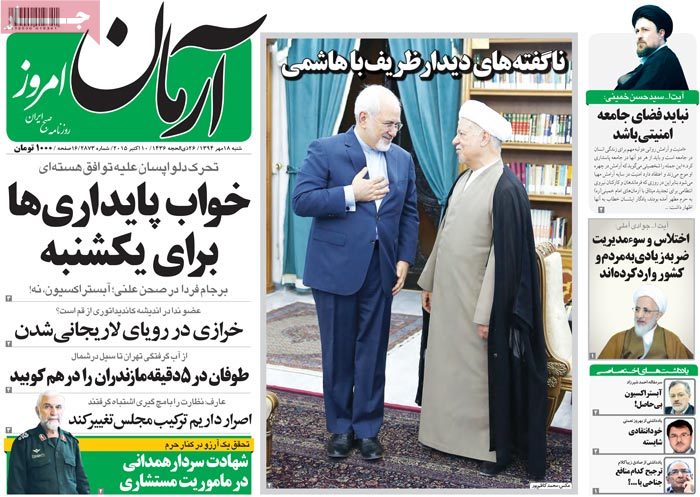
Chairman of the Expediency Council Ayatollah Akbar Hashemi Rafsanjani has held the Saudi government accountable for a recent deadly crush during Hajj rituals near the holy city of Mecca, which led to the deaths of several hundred people.

“The officials in the Saudi government in charge of [maintaining] order in this huge ritual are responsible for the incident and should be answerable to the Islamic world,” the chairman of Iran’s Expediency Council said in a message on Friday.

The senior cleric extended his condolences to Muslims and the bereaved families of the victims over the deadly tragedy, which he said has brought grief upon the Islamic world, and hoped that those injured in the incident would recover soon.

According to Saudi officials, at least 717 pilgrims lost their lives in an overcrowding outside Mecca. Iran’s Hajj and Pilgrimage Organization has, however, has put the death toll at more than 1,300, which also includes 131 Iranians.

Meanwhile, Tehran interim Friday Prayers leader Ayatollah Mohammad Imami-Kashani also took a swipe at the Riyadh government for its mismanagement of the annual ritual.

“As stated by the Leader of the Islamic Revolution [Ayatollah Seyyed Ali Khamenei], Saudi Arabia must shoulder the responsibility and meet its obligations regarding the incident,” the senior cleric said, dismissing as “unacceptable” the Saudi claim that the pilgrims themselves were to blame for the incident.

He also urged Muslims to take the issue to the Organization of Islamic Cooperation (OIC), stressing that the Hajj ritual did not concern only Saudi Arabia but all the Islamic countries.

Iranians rally to condemn Saudi Arabia

Also on Friday, Iranians took to the streets across the country to condemn the Saudi government for its mismanagement in the deadly incident.

On Thursday, Ayatollah Khamenei called on Saudi Arabia to shoulder its responsibility over the recent deadly incident in Mina and declared three days of national mourning.

“The Saudi government is obligated to shoulder its heavy responsibility in this bitter incident and meet its obligations in compliance with the rule of righteousness and fairness. The mismanagement and improper measures that were behind this tragedy should not be overlooked,” the Leader said.

Iran’s President Rouhani orders task force to address Mina disaster

5142748f-f2f6-494b-bf93-cbf28f74d1d4

Iran’s President Hassan Rouhani has ordered the formation of a task force to address the recent incident outside the holy city of Mecca in Saudi Arabia in which overcrowding led to the deaths of hundreds of pilgrims.

In a message, Rouhani asked First Vice President Es’haq Jahangiri to set up the mission as soon as possible and constantly inform him and the nation about its findings, the president’s official website reported early Friday.

Among its objectives, the task force would have to send over aid teams, if needed, and dispatch aircraft to Saudi Arabia in order to assist the pilgrims and the wounded and also transfer the bodies of the Iranian pilgrims killed back to the country.

The stampede occurred in Mina, near Mecca, at 9 am local time on Thursday after two large masses of pilgrims fused together.

Saudi authorities say 717 people were killed in the incident. […] The number of the Iranian pilgrims killed has risen to 131.

In his message, Rouhani also asked Riyadh to take responsibility for the disaster and fulfill its legal and Islamic obligations in this regard.

Arabic-language daily al-Diyar has said the presence of the convoy of Prince Mohammad bin Salman Al Saud, the son of Saudi King Salman bin Abdulaziz Al Saud, in the middle of the population prompted a change in the direction of the movement of the pilgrims and the subsequent crush. […]

Leader of the Islamic Revolution Ayatollah Seyyed Ali Khamenei has declared three days of national mourning following the disaster.

Iran declares 3-day national mourning over Mecca deaths

20873248-76b4-40a8-84c0-46435b3d6bea
Leader of the Islamic Revolution Ayatollah Seyyed Ali Khamenei declared three days of national mourning following the deaths of several hundred Hajj pilgrims, including at least 90 Iranian nationals, in the holy city of Mecca.
“Offering condolences to the bereaved [families of killed pilgrims], I declare three days of national mourning in the country,” Ayatollah Khamenei said in a message on Thursday.
“The Saudi government is obligated to shoulder its heavy responsibility in this bitter incident and meet its obligations in compliance with the rule of righteousness and fairness. Mismanagement and improper measures that were behind this tragedy should not be overlooked,” the Leader said.

Iran always supported Syria during four years of conflict

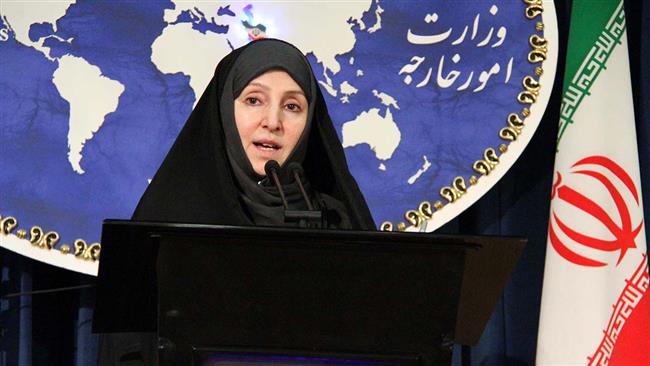
Afkham

Iranian Foreign Ministry Spokeswoman Marzieh Afkham has dismissed the recent comments of US Secretary of State John Kerry regarding Iran’s role in Syria as distortion of facts on the ground in Syria.

“Since the beginning of the crisis in Syria, Iran has announced that the only path to ending the war and crisis in Syria goes through the organization of Syria-Syria talks and political agreement,” IRNA quoted Afkham as saying on Wednesday.

She was reacting to comments by Kerry that the US hopes Russia and Iran would play a positive role in Syria and support a political transition aimed at ending the turmoil in the country.

She also noted that incorrect and bigoted policies towards the crisis in Syria are even affecting the efforts of the UN and other organizations.

[…]

Afkham added that any plan that does not give priority to a serious fight against Takfiri terrorists and other extremist groups in Syria is doomed to failure.

Number of Iranian victims of Saudi stampede rises to 47

81771976-70184490

The Hajj and Pilgrimage Organization announced the names of 47 Iranian pilgrims who were confirmed dead in the Hajj stampede in Mena, Saudi Arabia on Thursday. All 47 Iranian victims are men.

The stampede in Mena killed more than 700 pilgrims and more than 800 others injured.

Ohadi, the head of the Hajj and Pilgrimage Organization, blamed the failure of Saudi security officials to properly manage the rituals for the deadly accident.

He added that the Saudi officials had blocked two ways leading to the stoning point, thus causing the stampede.

FM spokeswoman condemns Sana’a bombing

7d83eb52-1114-472d-bfb4-3bc10e5bbd41

Foreign Ministry Spokeswoman Marzieh Afkham on Thursday condemned the blast in a mosque in Sana’a, Yemen which killed at least 25 people and injured dozens.

Afkham voiced sympathy with the bereaved families of the victims.

She said the innocent people of Yemen are falling victim to attacks by both terrorists and the Saudi-led coalition.

She called on the international community to take action and abide by their responsibility to stop military operations which have encouraged the terrorist and Takfiri groups in Yemen to expand their activities.

Recalling to the unfavorable and hard conditions of the people of Yemen, Afkham underlined non-stop humanitarian aid and said international organizations should set the stage for swift shipment of humanitarian assistance.

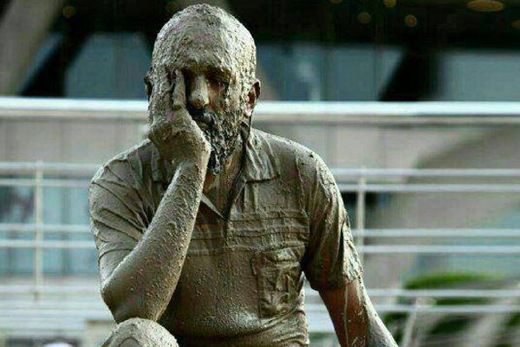
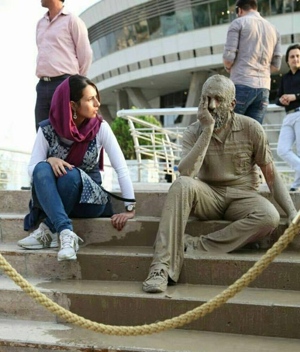
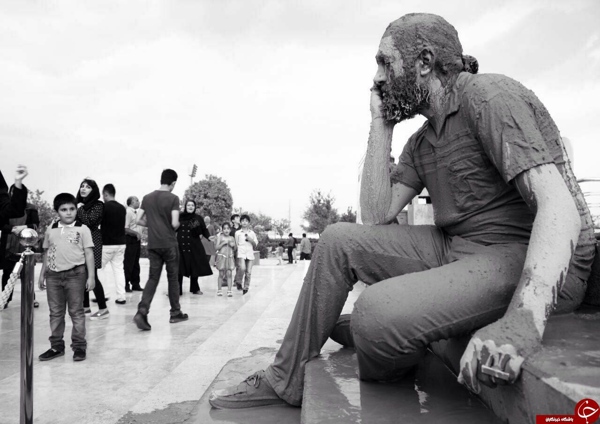
Street theater in Tehran (PHOTOS)

Street theater000

A play by Amirhossein Shafiei, a theater director and playwright, narrates the story of a mother who has been waiting for a long time for the return home of the remains of her martyred son.

The play, which is intended to keep alive the memory of the 175 divers who were martyred during the Iran-Iraq war, is on stage for ten nights at Tehran’s Daneshjou Park until September 26.  

Snapshots of the street theater released online by different websites:

An economist: Mr. Zarif is in the right

Saeed Laylaz

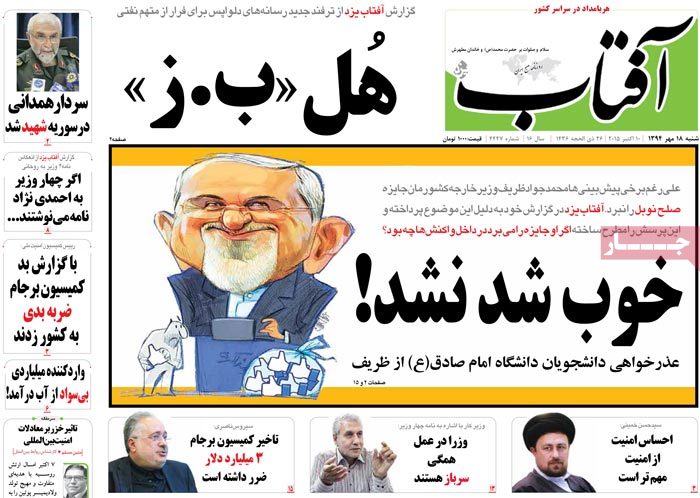
The state of our stock exchange is not strong thanks to the conditions the country went through in the eight-year period [when Ahmadinejad was president]. In that period, windfalls were handed to some individuals, the conditions got worse and now the state of the country’s stock exchange is not good.

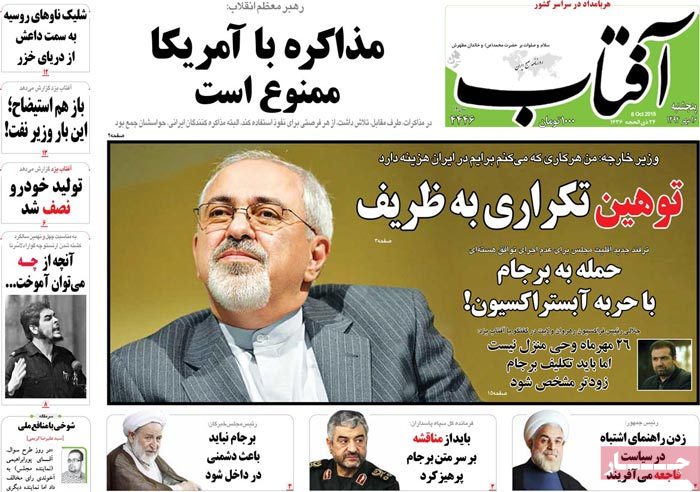
These are Foreign Minister Mohammad Javad Zarif’s words in response to an MP who quizzed him about a stock market crash following the conclusion of the Iran nuclear deal. What the top diplomat said set off a firestorm last week in a session of parliament’s Joint Comprehensive Plan of Action (JCPOA) Review Committee on post-deal market crash.

In that session, Zarif made the comments – above – in response to critical remarks by Mehrdad Bazrpash MP on the uselessness of the nuclear deal as far as the national economy, especially stock exchange, is concerned.

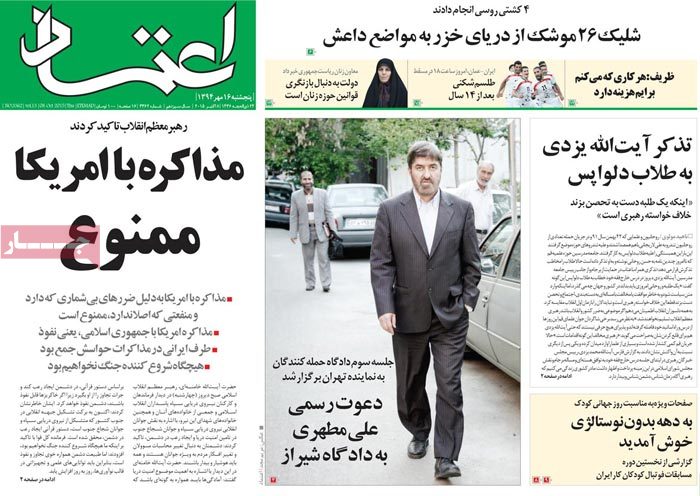
Saeed Laylaz, an economist, has confirmed Zarif’s comments and said that the losses the Iranian economy has suffered in 2005-2013 [Ahmadinejad’s two-term presidency] are mainly to blame for the stock market crash. Laylaz made the comment in an interview with Etemaad daily and said that Mr. Zarif is in the right. It is not appropriate to say that a deal should help solve all economic problems overnight, he said, adding that the Iranian economy needs serious, fundamental, long-term and sustainable measures for its recovery and this takes time.

Laylaz also blamed the expansionary monetary policies of the ninth and tenth governments for a rise in inflation and sluggish economic growth, which in turn, created stagflation for the country’s national economy. The following is the translation of part of Laylaz’s remarks in the interview as published by Fararu.com on September 23:


Poor economic conditions, the reason behind market crash

In that eight-year period, the government never cared about production and economic growth. It just channeled all monetary resources toward consumers. That’s why the state of our stock market is bad. It is to blame for the poor performance of different sectors of the country’s economy.

The problems the stock exchange is grappling with are not solved all at once. To rebound, the stock exchange needs time, improvement of business atmosphere and economic conditions as well as market growth.

The only way forward for us is to double back on the same path we embarked on in those eight years and begin to make up for the losses.

The country is still wrestling with a lack of investment ($ 300-400b) in different sectors and people’s purchasing power has diminished because they see no justification to buy [goods] and make investment. […]


Nuclear deal stopped things from getting worse

The effects of the nuclear deal on the stock exchange will be felt when such effects on the country’s economy become visible, because stock exchange is not independent from economy and economic conditions at large, and any improvement of the stock market is tied to economic growth and the improvement of economic situation and business atmosphere.

The nuclear deal has manifested itself in recent months by preventing things from deteriorating. Things have not changed for the worse in these [past few] weeks. The government has tried to take appropriate measures so that things will not go from bad to worse. It has also managed to help the country’s negative economic growth (-7 percent in 2012) land in positive territory (+3 percent [in 2014]).

Like last year’s, Iran’s economic growth is projected to be positive, but not remarkable, in 2015. This shows that the government’s measures have been effective in turning the negative trend of those eight years into positive growth.

The country is expected to experience better economic conditions in winter [early 2016] and, as a result, stock exchange and other economic sectors will post growth as of early 2016 (January-February) and the impacts of an economic boom will be seen in Iran.

[…]