Monday, December 22, 2025
Home Blog Page 4730

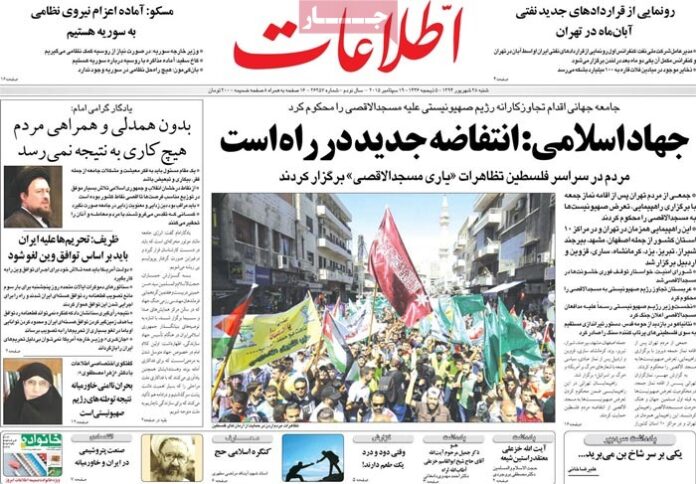
Highlights of Ettela’at newspaper on September 19

Ettelaat

 “A new Intifada is underway,” said the Islamic Jihad.

The international community has condemned the Zionist regime for desecrating the Al-Aqsa Mosque. In Tehran worshippers took to the streets after Friday prayers to condemn the Zionist aggression against the holy site.

 New oil contracts will be unveiled in Tehran in a conference in early November.

That conference will be followed by another one in London 1-2 months later.

 Moscow has said that it stands ready to send troops to Syria.

It came as the Syrian foreign minister said that his country would ask for Russian assistance if needed.

 The grandson of the late Imam Khomeini has said that without public contribution and cooperation nothing will produce results.

Seyyed Hassan Khomeini further said officials should care about societal problems such as poverty, unemployment and discrimination.

 “Anti-Iran sanctions should be terminated in line with the Vienna accord,” said Foreign Minister Mohammad Javad Zarif.

The Iranian top diplomat further said that the US administration should make every effort to implement the Vienna deal.

 Dr. Zahra Mostafavi [the daughter of the late Imam Khomeini] has said that insecurity in the Middle East stems from Zionist plots.


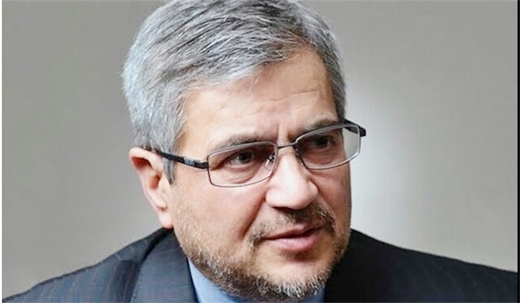
Tehran backs UN efforts to reconstruct Afghanistan: Envoy

Gholamali Khoshroo

Iran’s Ambassador to the United Nations Gholamali Khoshroo underlined Tehran’s strong support for the United Nations Assistance Mission in Afghanistan (UNAMA) as well as for the UN agencies in their efforts to provide development and reconstruction assistance to Afghanistan.

“Tehran will continue its full support for the promotion of security, stability and comprehensive and sustainable development in Afghanistan through strong bilateral relations as well within UNAMA, since the security in Afghanistan is the security of Iran’s borders and the region,” Khoshroo said in statement to the Security Council session on Situation in Afghanistan on Thursday.

He said the formation of the national unity government in Afghanistan and assuming full leadership is a major step toward establishing peace and prosperity in the country.

“Iran continues to fully support the national unity government and is confident that this government is well positioned and enjoys necessary capacities to face the political, economic and security challenge,” he added.

Khoshroo said the latest report by the secretary general on Afghanistan indicates that although the overall number of attacks shows a very slight decrease compared to 2014, the ongoing conflict grew in both intensity and geographical scope.

“The spike in terrorist attacks in Kabul, following the confirmation of the death of Taliban leader Mullah Omar was visible. The deterioration of security, especially in the north and west of Afghanistan is a matter of concern.”

He condemned all violent attacks committed by the Taliban and other terrorist groups as well as any cooperation with them.

The envoy further said, “We see the expansion of our political and economic ties with neighboring Afghanistan as a priority, Iran stands ready to increase its bilateral cooperation, particularly on security matters, counter-narcotics efforts, developing projects and economic cooperation in the fields of infrastructures and agriculture as well as durable solution for Afghan refugees.”

[…]

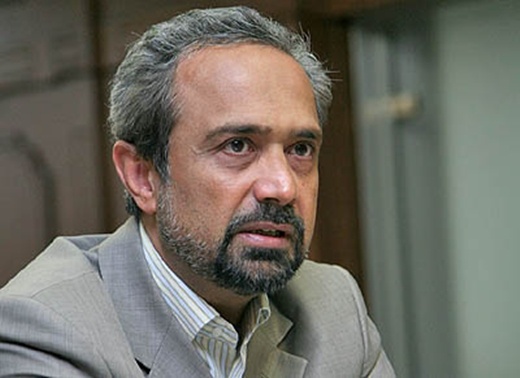
Foreign firms should bring capital, technology to Iran: Nahavandian

Nahavandian
Nahavandian

President Rouhani’s Chief of Staff Mohammad Nahavandian said that foreign companies should bring capital and technology to Iran in the post-sanctions era.

Recalling the arrival of foreign companies in Iran and their interest in investing in the country’s economy, he added that post-sanctions opportunity should be seized properly to bolster national production and economy.

Nahavandian said that the government insists that the agreements with foreign firms not turn the country into a gateway for imports, adding that foreign sides were clearly informed that the only way for their presence in Iran is participation and investment.

Only the companies which bring in capital and technology will be allowed to enter the country’s economic undertakings, the official said, noting that in that case, Iranian projects will be mutually beneficial.

Nahavandian also said that the yardstick for the selection of foreign companies will be general policies of the resistance-based economy.

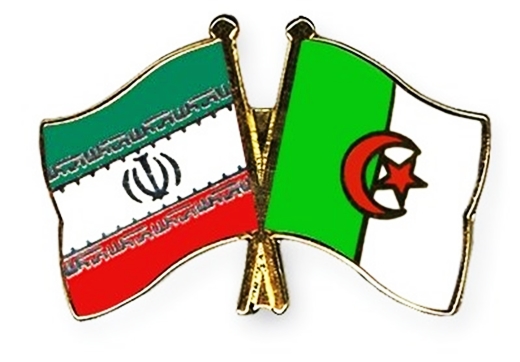
Iran, Algeria ink MoU on banking ties

Iran, Algeria

High-ranking officials from Iran and Algeria’s central banks signed a memorandum of understanding (MoU) as part of efforts to boost banking relations between the two Muslim countries.

Governor of the Central Bank of Iran Valiollah Seif and Bank of Algeria Governor Mohammed Laksaci signed the agreement in a meeting in Tehran.

During the meeting, the two officials agreed that Tehran and Algiers exchange experience in various areas of monetary and regulatory policies as well as the management of monetary reserves.

Other provision of the agreement between Iran and the North African country includes visits by expert delegations from the two countries, joint seminars, establishment of working and training groups, as well as a joint bank.

In a meeting with Algerian President Abdelaziz Bouteflika earlier this month, Iranian Foreign Minister Mohammad Javad Zarif praised cultural, economic and political commonalities between Iran and Algeria.

He expressed hope that a meeting of the two countries’ High Joint Commission would help promote mutual cooperation in the oil and gas industries, banking and tourism.

Bouteflika, for his part, emphasized the need for expansion of ties between Tehran and Algiers in all political and economic fields.

Israeli regime crimes shortening its life: Iran cleric

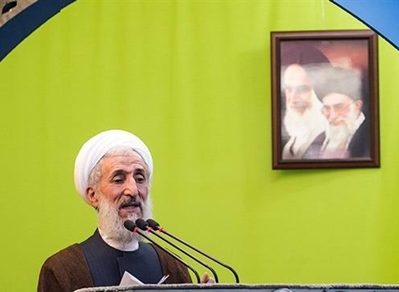
Sedighi

A senior Iranian cleric has said Israel’s ongoing attacks on Al-Aqsa Mosque in East Beit ol-Moqaddas (Jerusalem) will push the regime closer to its demise.

“These crimes that are being committed in occupied Palestine will lead to the shortening of the Zionist regime (of Israel)’s life,” Kazem Seddighi said in an address to worshipers during the Friday prayer in Tehran.

The Iranian cleric also criticized inaction on the part of the United Nations over the Israeli regime’s aggression against Al-Aqsa Mosque.

“These criminals (Israelis) are not confined by any boundaries and are not even bound by their own laws; and at the same time, the United Nations shows no reaction, either,” Seddighi said.

Israeli settlers and troops have been attacking worshipers at Al-Aqsa Mosque since September 13, following the deployment of Israeli forces to the area for the Jewish Rosh Hashanah New Year holiday.

Israel has imposed restrictions on entries into the mosque compound since August 26.

The Islamic Republic has officially called for the condemnation of the Israeli raids on the mosque by countries and world bodies.

Iran’s Foreign Ministry Spokeswoman Marzieh Afkham said on September 15 that all world countries, particularly Muslim states, and international bodies, especially the Organization of Islamic Cooperation (OIC) and the UN, are expected to react to the Israeli crimes.

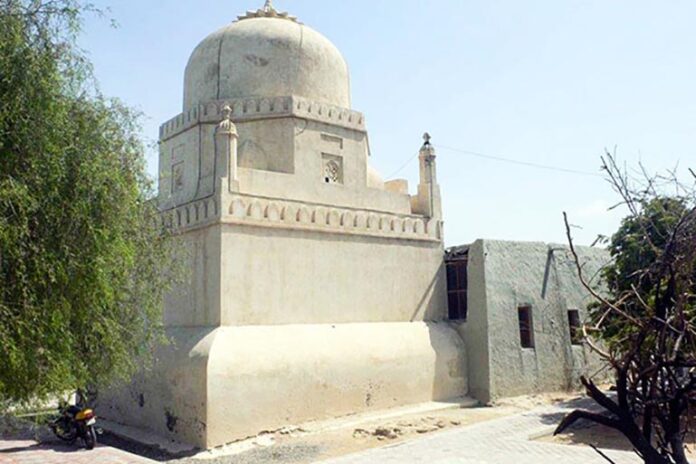
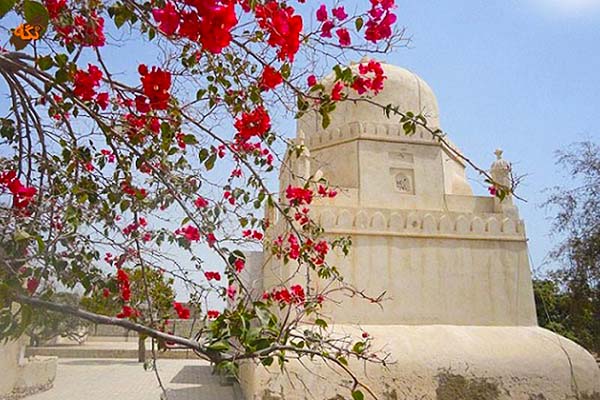
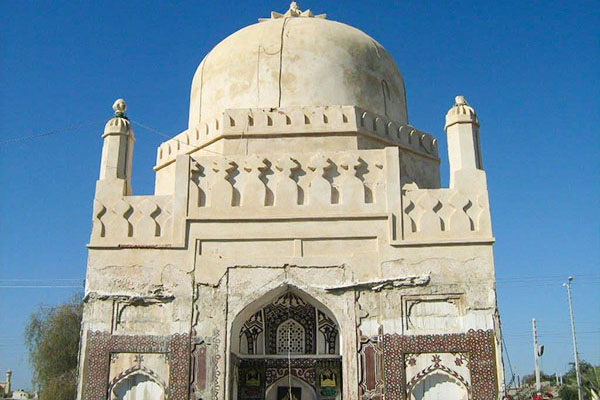
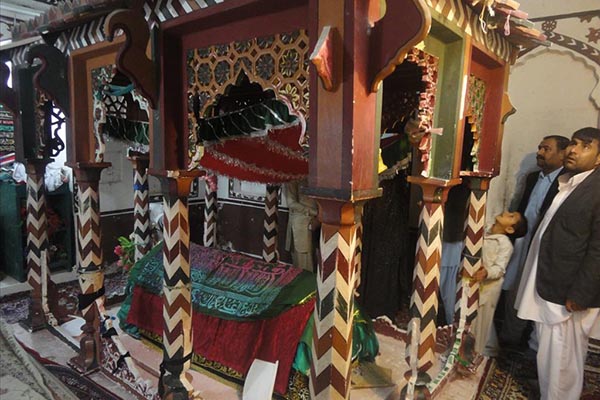
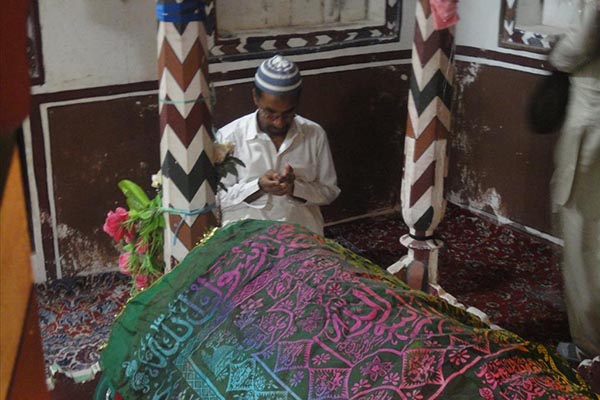
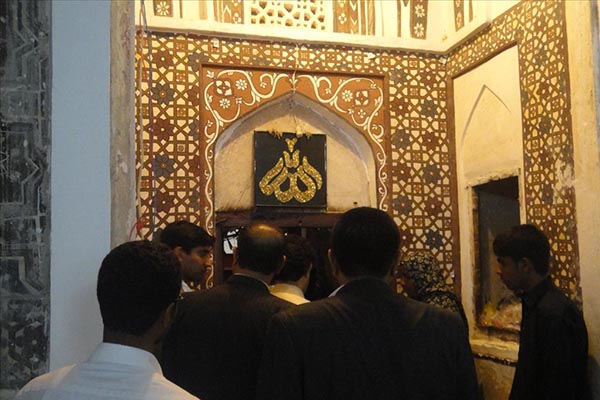
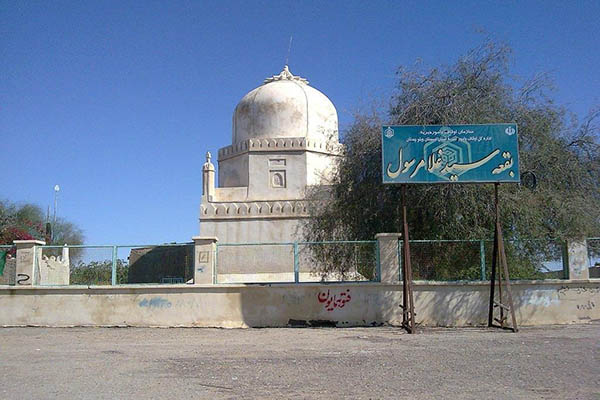
Tomb of Seyyed Gholam Rasoul in Iran’s Chabahar

chabahar seyyed gholam rasoul tomb

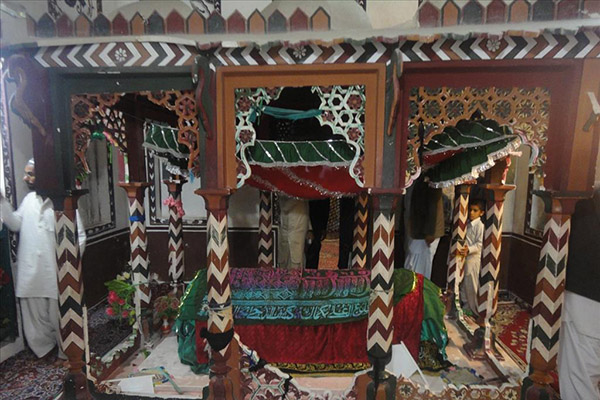
According to Muslim accounts, the tomb belongs to Seyyed Gholam Rasoul, originally known as Seyyedena Mohammad, was a Muslim Indian. On a visit to Chabahar, he decided to marry a local girl, but on his wedding night he fell ill. In his will, he asked others to refrain from mourning for him and instead celebrate for ten nights to secure blessings for his soul.

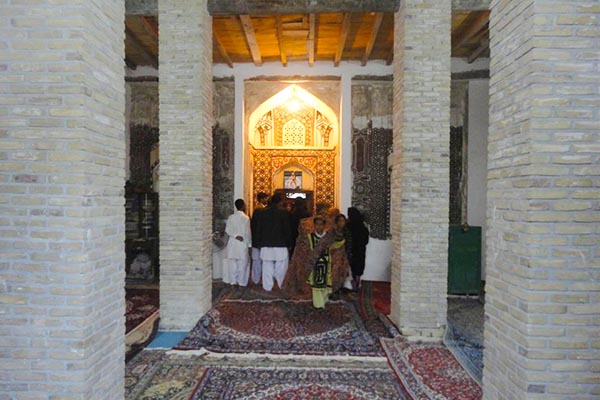
Every year on the 15th of the 11th month of the Lunar calendar, a 10-day celebration is held in his memory at his tomb, 5 km to the northwest of Chabahar.

During the ceremony, elderly women enter the tomb to say prayers for others and ask God to heal the sick while men stay outside and play music.

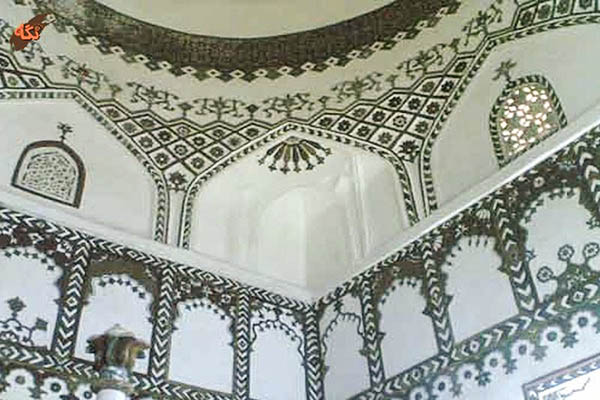
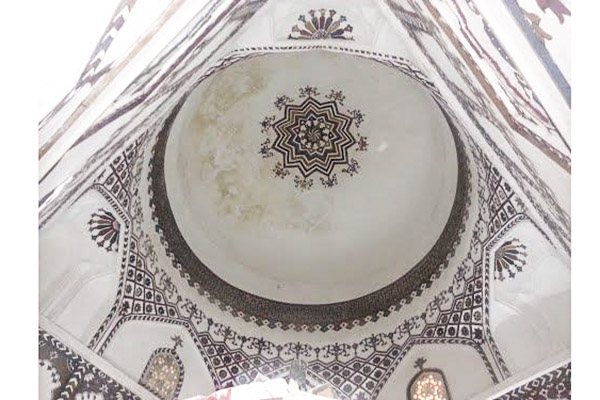
The tomb has white walls and Indian-style architecture. The exterior of the structure is graced with paintings and religious phrases. This structure was built in the Seljuq era; its murals were painted later during the Safavid era. The tomb dates back to the 11th century AD.

What follows are images of the tomb of Seyyed Gholam Rasoul released by different Iranian websites:


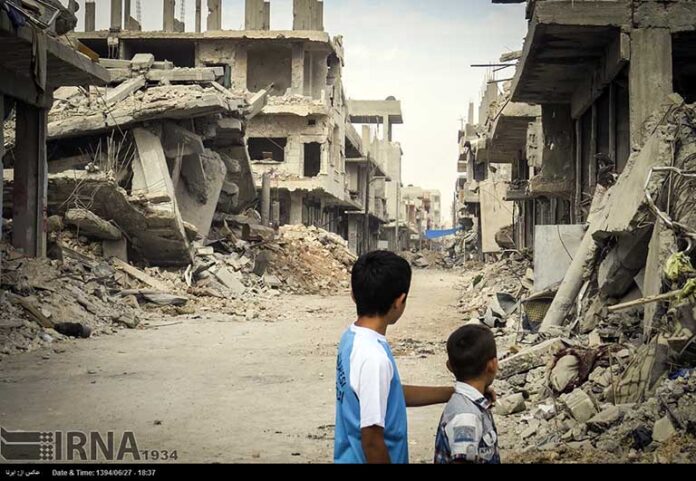
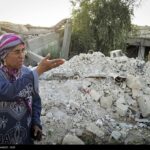
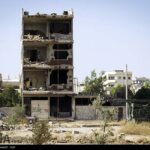
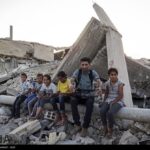
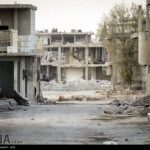
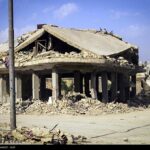
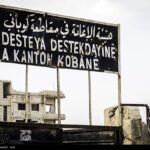
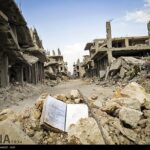
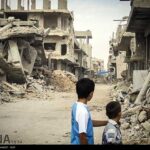
Kobani (PHOTOS)

Kobani00

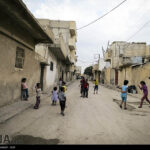
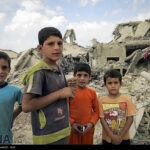
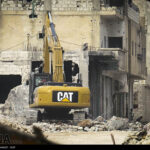
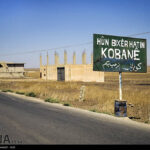
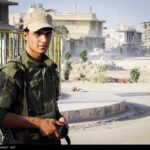
Kobani is a town in Aleppo Province in northern Syria which was under IS siege for four months and 11 days last year. Although IS terrorists overran 70 percent of the town, the resistance of its residents resulted in the liberation of the border town on January 26, 2015.

Snapshots of the Kobani published online by the Islamic Republic News Agency:

Ebtekar: I think President Rouhani knows how to play chess

ebtekar

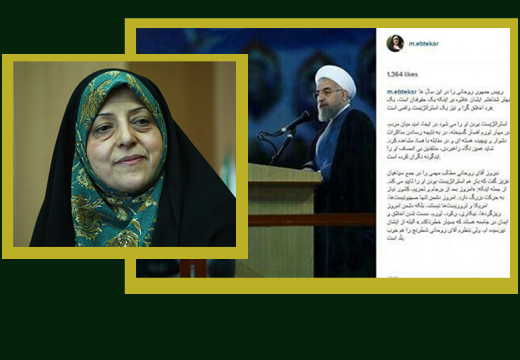
The director of the Environment Protection Organization has said that President Rouhani is a lawyer, ethical person and a real strategist.

This is the caption Masoumeh Ebtekar put on a picture of President Hassan Rouhani on her Instagram page, saying that she has gotten to know the president better over the years. The following is the translation of what the Islamic Republic News Agency (IRNA) quoted the environment chief as writing on her page on September 17:

Masoumeh Ebtekar wrote, “I got to know the president better over time. In addition to being a lawyer, the president is a real strategist and an ethical individual. ”

She went on to say that the president is a strategist and that is clearly evident in his efforts to instill a sense of hope among people, curb the runaway inflation, render complicated nuclear talks conclusive and counter corruption. Perhaps this strategic approach of the president has concerned his unfair critics, she added.

Ebtekar further said, “On Tuesday Mr. Rouhani made important comments in a meeting with the dear [members of the Islamic Revolution] Guard corps. His remarks confirm the fact that he is a strategist.

“Remarks such as ‘After [the conclusion of] the Joint Comprehensive Plan of Action and [removal of] the sanctions, the country needs to take a big step. Today the Zionists, the US and terrorists are not the only enemies [of Iran]; rather, the questions of dust particles, unemployment, recession, inflation, the weakening of ethical norms and faith are our enemies in society which are very dangerous’.

“I have not asked the president, but Mr. Rouhani seems to know how to play chess [and have a good command of chess strategies]” prove that he has a strategist’s mind.

A look at Iranian newspaper front pages on September 17

Iranian Newspapers Headlines

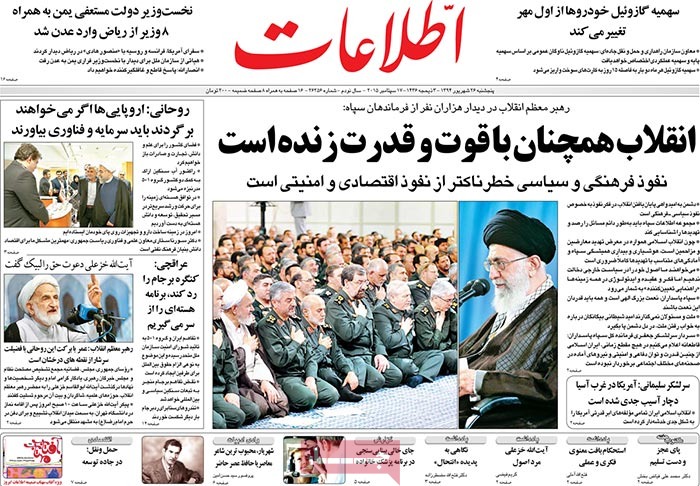
The comments of the Supreme Leader at a meeting with commanders of the Islamic Revolution Guard Corps (IRGC) dominated the front pages of Iranian newspapers on Thursday.


Ettela’at: “The revolution is still powerful and in good shape,” the Supreme Leader said at a meeting with thousands of IRGC commanders.

“The cultural and political infiltration is more dangerous than economic and security infiltration,” Ayatollah Khamenei further said.


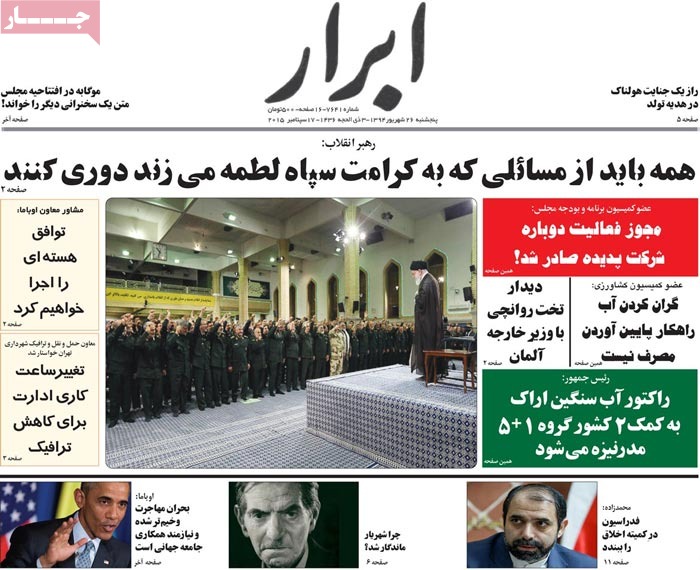
Abrar: Majid Takht-e Ravanchi, Iran’s deputy foreign minister, has met with the German foreign minister.

Abrar: “Arak’s heavy water reactor will be modernized with the assistance of two members of P5+1,” President Rouhani said.       
 

A look at Iranian newspaper front pages on September 17


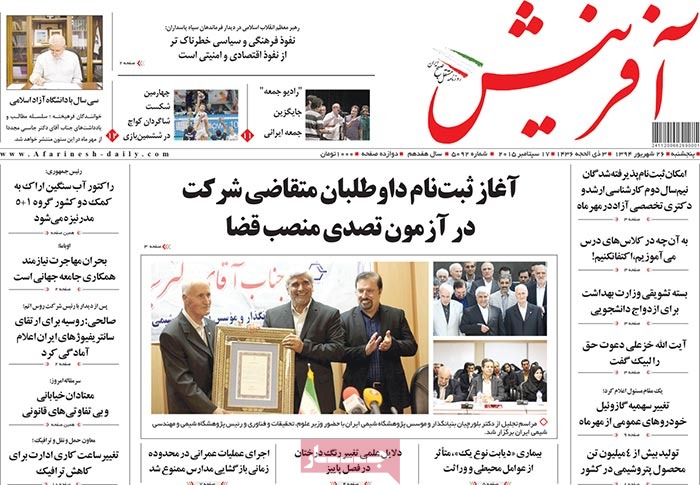
Afarinesh: “Russia has expressed readiness to help upgrade Iran’s centrifuges,” said the director of the Atomic Energy Organization of Iran.

Afarinesh: To ease traffic congestion the working hours of government offices will change.
 

A look at Iranian newspaper front pages on September 17


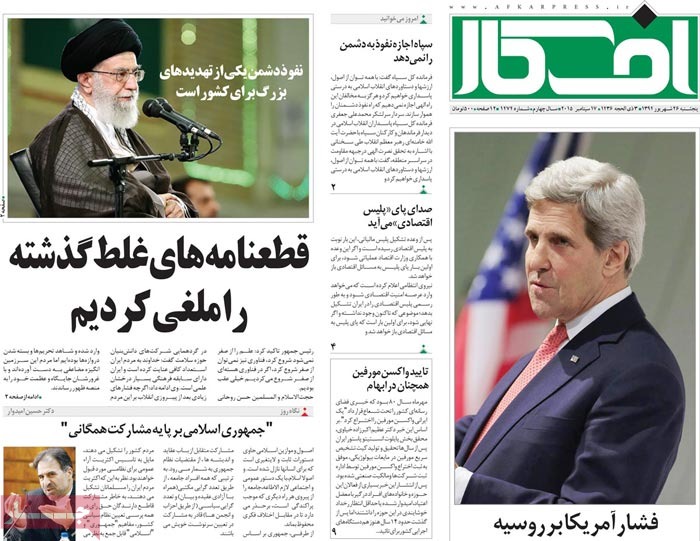
Afkar: The commander of the Islamic Revolution Guard Corps has said that his men won’t allow the enemy to infiltrate the country.
 

A look at Iranian newspaper front pages on September 17


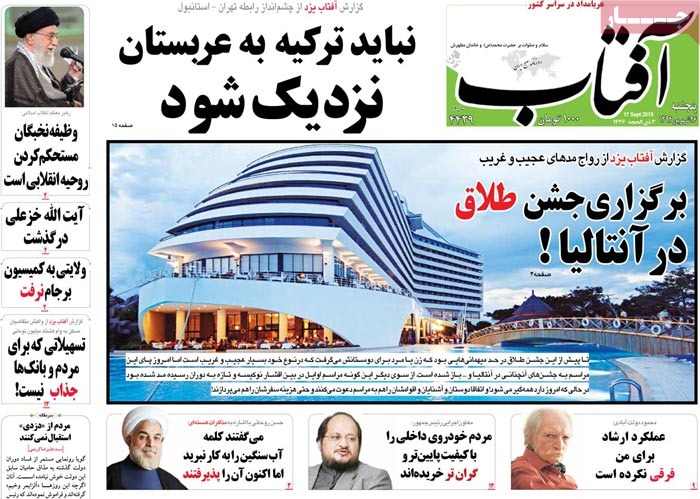
Aftab-e Yazd: Ali Akbar Velayati [an advisor to the Supreme Leader] has failed to show up for a session of parliament’s JCPOA Review Committee.
 

A look at Iranian newspaper front pages on September 17


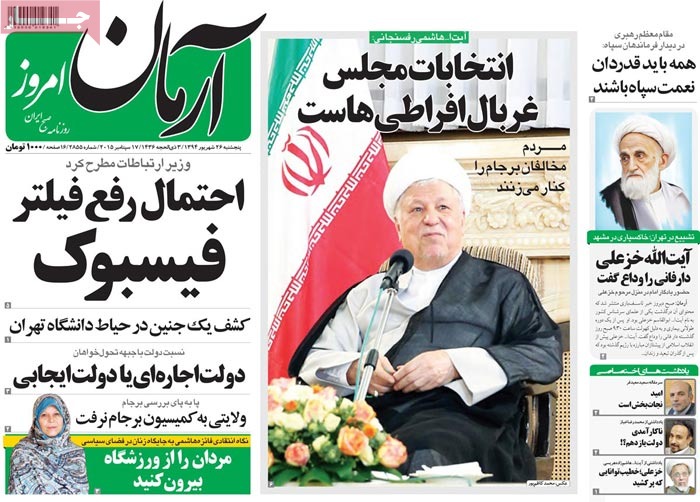
Arman-e Emrooz: The minister of communications has said that Facebook is likely to be unblocked.

Arman-e Emrooz: “In the [upcoming] parliamentary elections hardliners will be set aside,” predicted the chairman of the Expediency Council.

Ayatollah Akbar Hashemi Rafsanjani further said that people will vote the opponents of the nuclear deal out of office.
 

A look at Iranian newspaper front pages on September 17


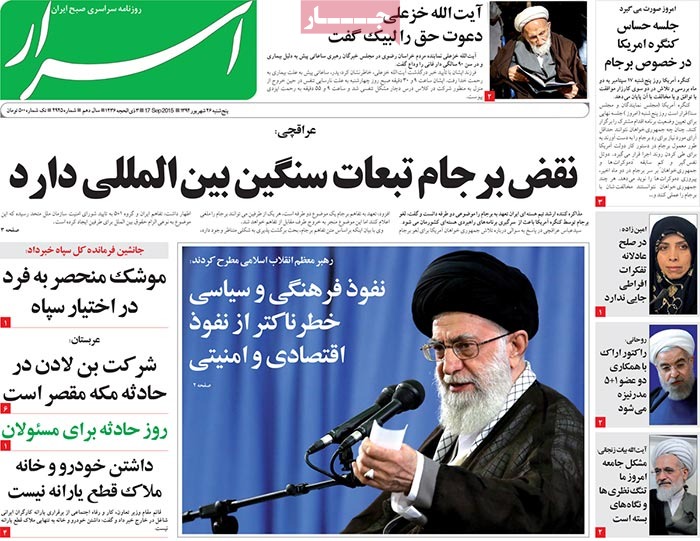
Asrar: Saudi Arabia has blamed the Bin Laden Company for the deadly construction crane collapse in Mecca.
 

A look at Iranian newspaper front pages on September 17


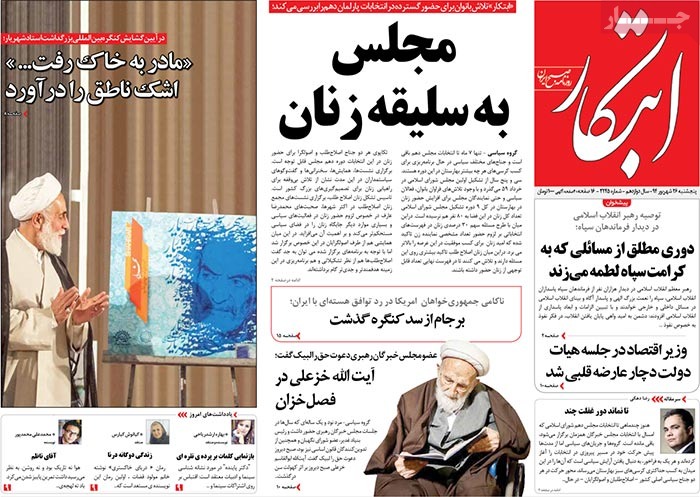
Ebtekar: The Supreme Leader has urged Revolution Guards commanders to shun things that might damage the dignity of the Islamic Revolution Guard Corps.

Ebtekar: The economy minister had a heart problem during a Cabinet session.
 

A look at Iranian newspaper front pages on September 17


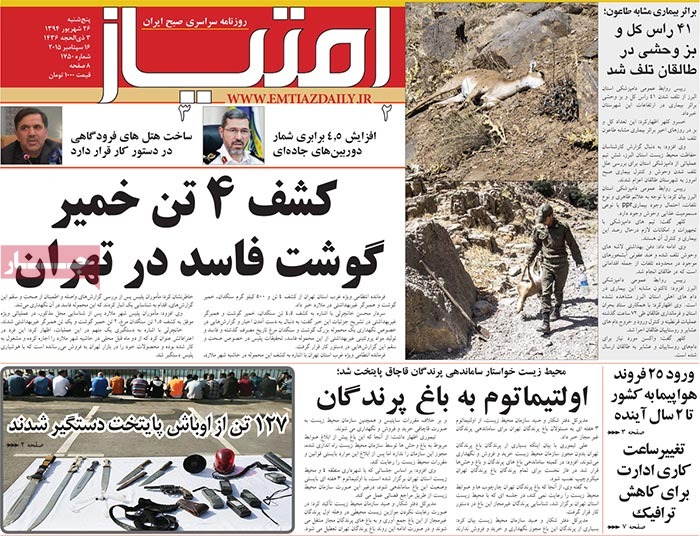
Emtiaz: Twenty-five aircraft will join the Iranian fleet within two years.
 

A look at Iranian newspaper front pages on September 17


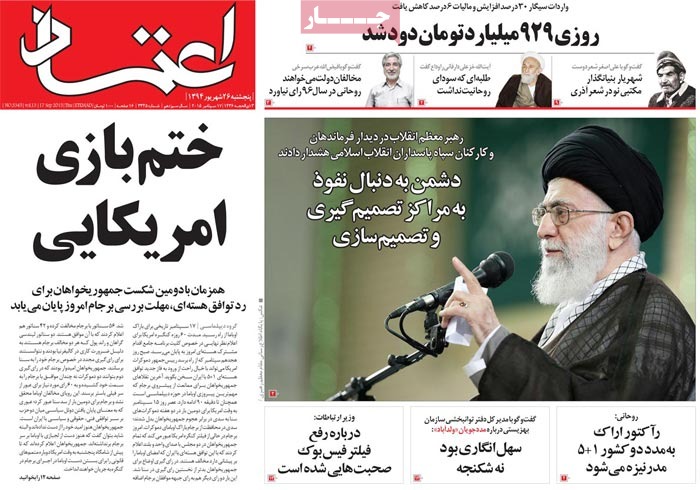
Etemad: End of the American game

Republicans have suffered a second setback in their bid to reject the Joint Comprehensive Plan of Action. The deadline for review of the deal is today.

Etemad: Each day around $310 million goes up in smoke.

Cigarette imports went up 30 percent and taxes were down six percent.
 

A look at Iranian newspaper front pages on September 17


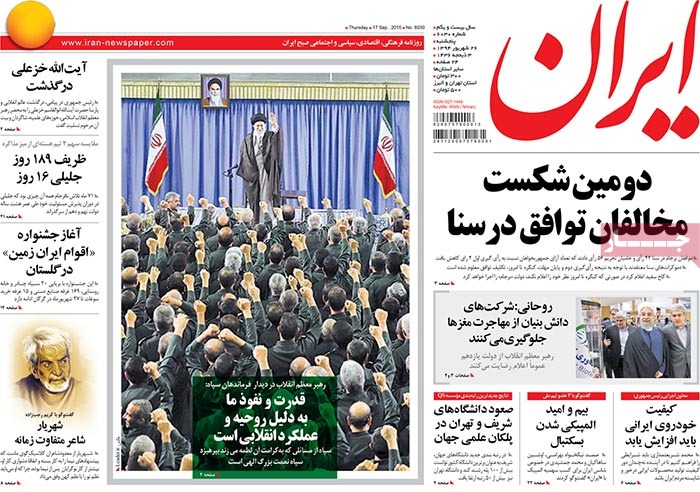
Iran: The global ranking of the University of Tehran and Sharif University of Technology has improved.

Iran: Foreign Minister Mohammad Javad Zarif has spent 189 days talking to P5+1 over the nuclear issue. His predecessor Saeed Jalili was at the talks for no more than 16 days.
 

A look at Iranian newspaper front pages on September 17


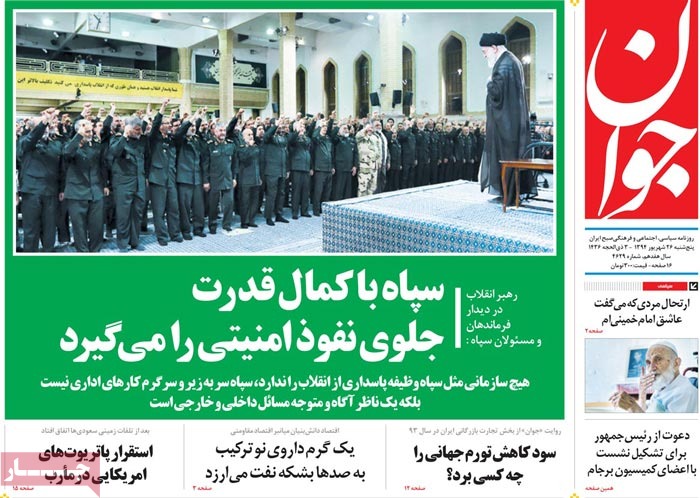
Javan: “The Islamic Revolution Guard Corps will stop security infiltration with a vengeance,” said the Supreme Leader at a meeting with IRGC commanders.
 

A look at Iranian newspaper front pages on September 17


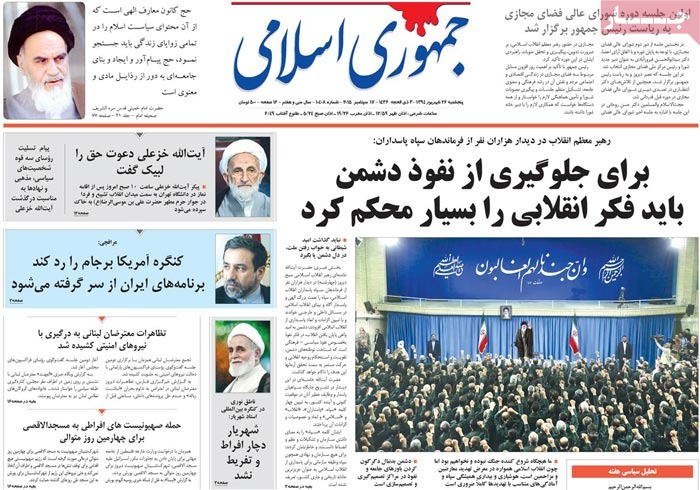
Jomhouri Islami: The heads of the three branches of government and senior political and religious figures have issued messages of condolences following the demise of Ayatollah Khazali.
 

A look at Iranian newspaper front pages on September 17


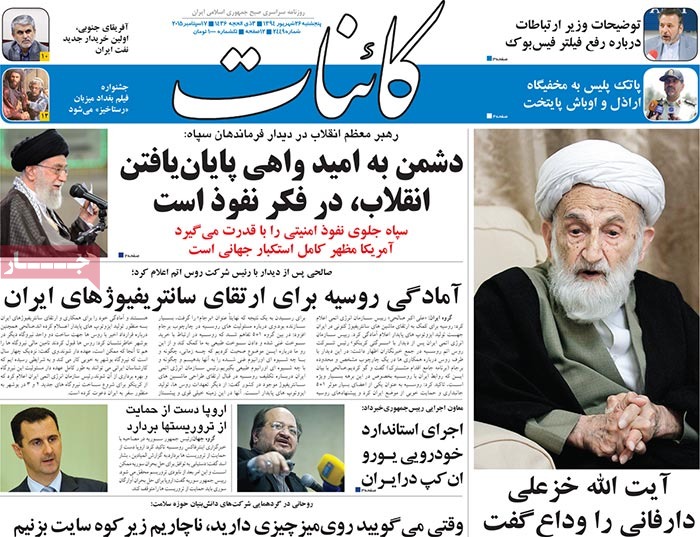
Kaenat: “When you said everything was on the table [a reference to military option], we had to set up a site under the mountains,” President Rouhani said in comments aimed at the West.
 

A look at Iranian newspaper front pages on September 17


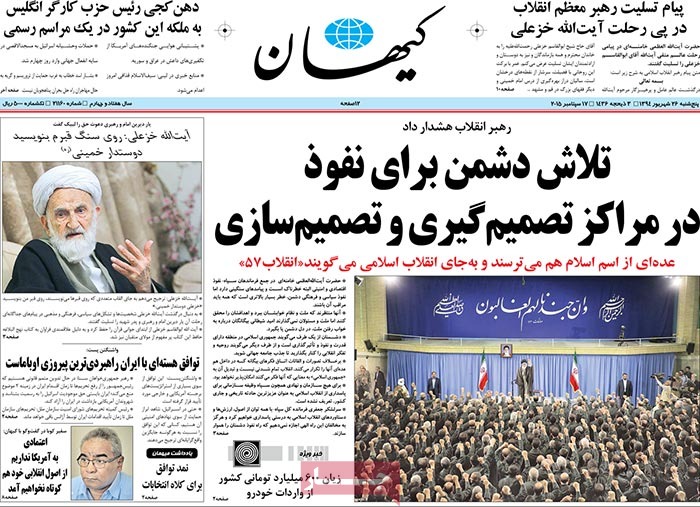
Kayhan: The Supreme Leader has released a message of condolences following the passing of Ayatollah Khazali.

In his will the late Ayatollah instructed his family to write “A friend of Khomeini” on his gravestone.
 

A look at Iranian newspaper front pages on September 17


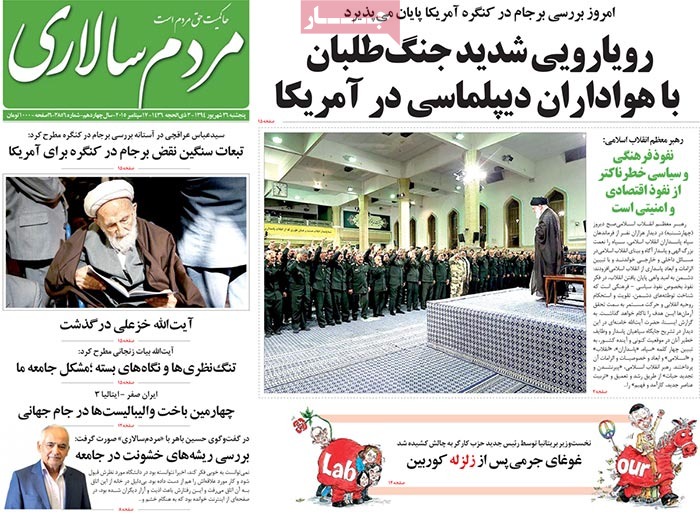
Mardomsalari: Iran has suffered a fourth defeat in the Volleyball World Cup.
 

A look at Iranian newspaper front pages on September 17


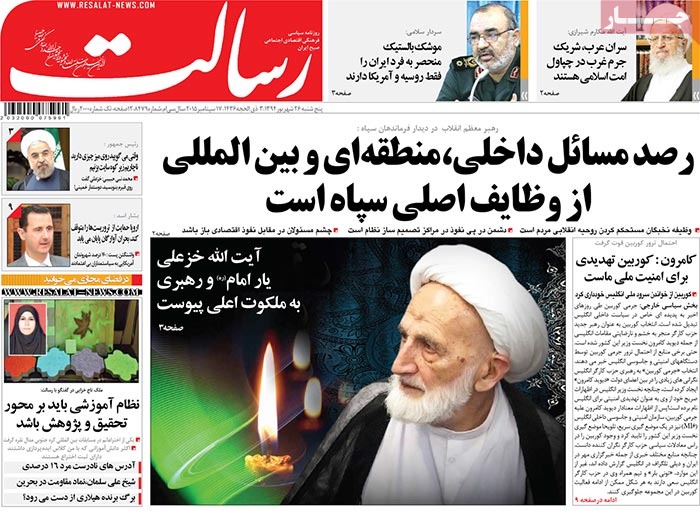
Resalat: “Keeping an eye on local, regional and international developments is a major responsibility of the Islamic Revolution Guard Corps,” the Supreme Leader said.
 

A look at Iranian newspaper front pages on September 17


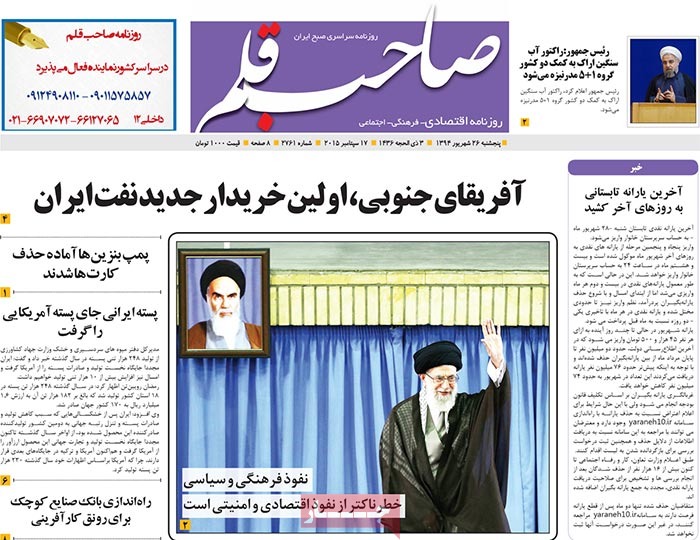
Saheb Ghalam: South Africa, the new buyer of Iranian oil
 

A look at Iranian newspaper front pages on September 17


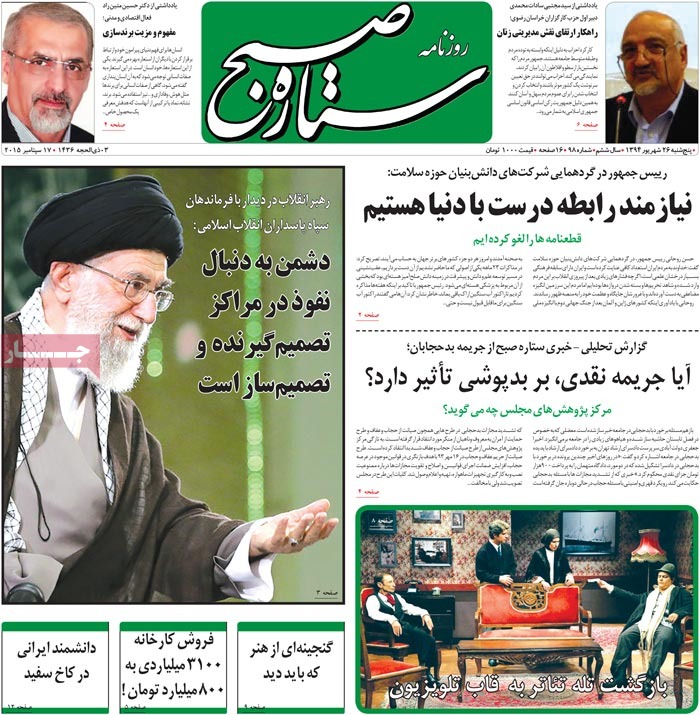
Setareh Sobh: “We need to have good relations with the rest of the world,” said President Rouhani.
 

A look at Iranian newspaper front pages on September 17


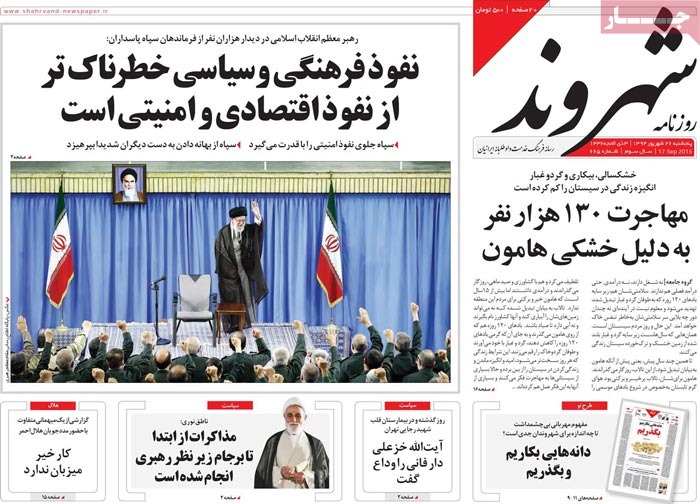
Shahrvand: With the Hamoon Lake drying up as many as 130,000 people have left their homes.

Shahrvand: “From the very beginning until the finalization of the Joint Comprehensive Plan of Action, nuclear talks were under the supervision of the Leader,” said Ali Akbar Nategh Nouri, a former parliament speaker and member of the Expediency Council.
 

A look at Iranian newspaper front pages on September 17


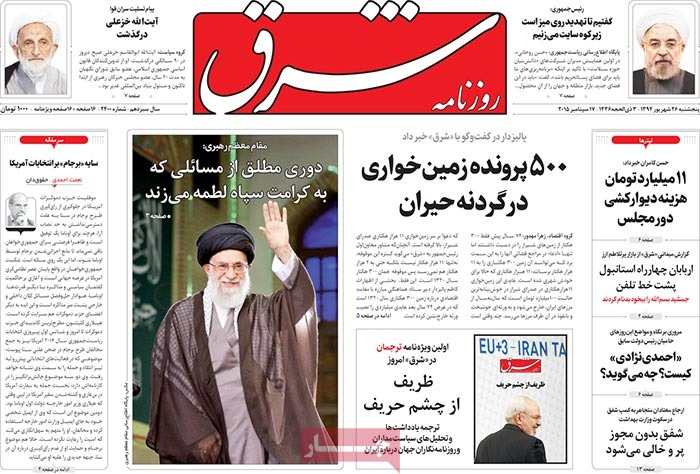
Sharq: There are as many as 500 land-grab cases in Heyran area.
 

A look at Iranian newspaper front pages on September 17


Were high winds really to blame for the deadly crane accident in Mecca?

Mecca Accident

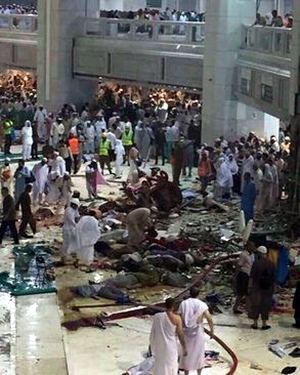
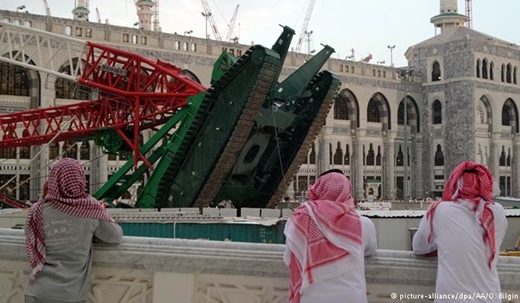
Mecca-4A construction crane tumbled at the Grand Mosque in Mecca at 5:10 p.m. on September 11, leaving more than 300 people dead or injured.
The following is the translation of a report Haft-e Sobh daily published on Tuesday, casting doubt on Saudi accounts on the cause of the deadly accident:

Saudi media were quick to blame the accident on the elements. Al-Arabiya claimed that winds traveling at 65 kph were blowing at the time of the crane collapse. CNN Arabic went one step further and said that the wind gusts of 95 kph, unprecedented in the Middle East for 37 years, were blowing Friday afternoon.

Dr. Mansour al-Mazroui, an expert with the weather center of King Abdulaziz University, said winds at the time traveled at between 40 and 55 kph and blamed the accident on freak weather.

Was storm really to blame for the deadly accident? Studies suggest that there were no storms at the time of the accident and that worshippers were walking around in the courtyard of the Grand Mosque without any difficulty.


Wind-Mecca


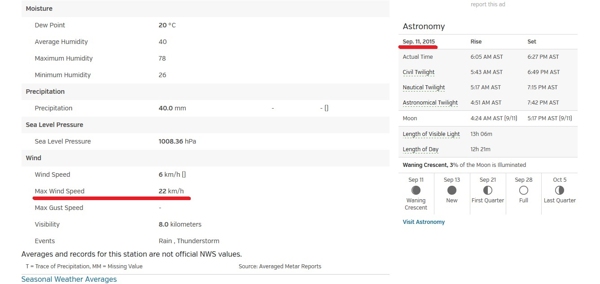
A look at Mecca weather report on September 11 shows that wind speeds on that day never went beyond 22 kph. The reports released by weather.org and worldweatheronline.com prove Arab media suggestions wrong.

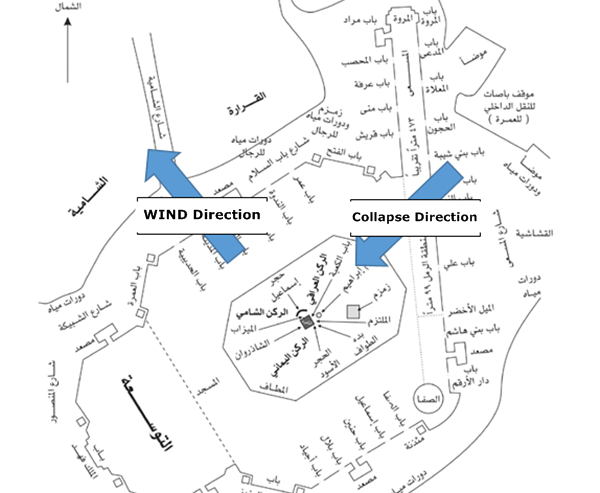
What is interesting is that weather news sites have suggested that winds were blowing in a northwesterly course in Mecca at the time; whereas the crane fell toward the southwest.


Mecca


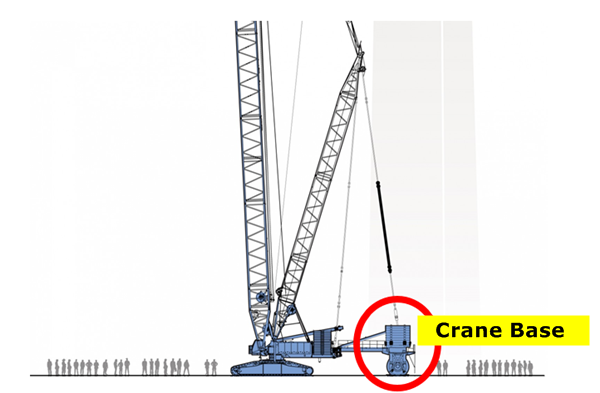
Another issue is that the crane tumbled where there was the highest concentration of worshippers. And a look at the tumbled crane shows that its base had been detached from its body.


Mecca-1


With weather no longer a suspect, and given that the crane structure seems to have been tampered with, one needs to wait and see what the real cause of the accident has been. An accident which came on the anniversary of 9/11 and at the busiest location of the Grand Mosque.