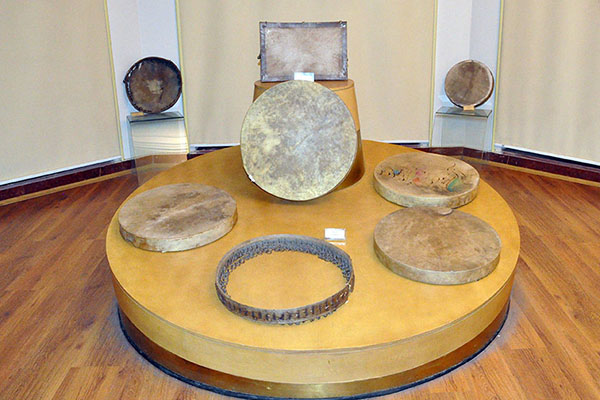
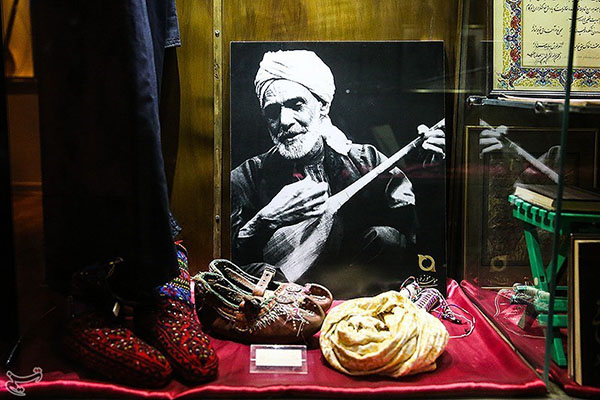
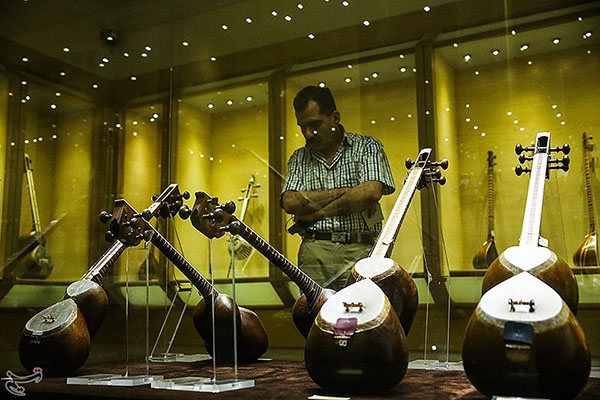
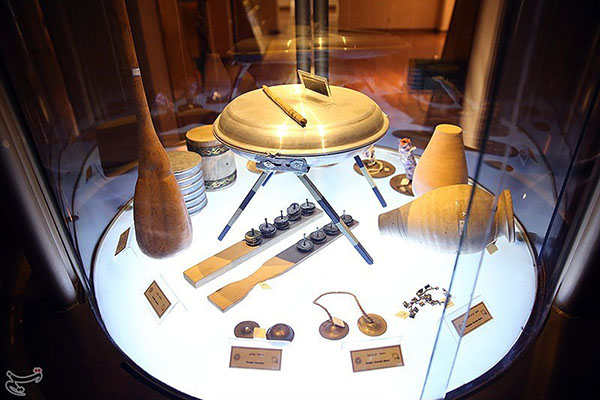
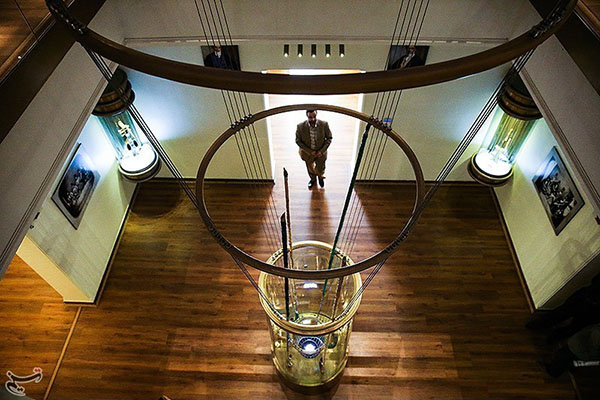
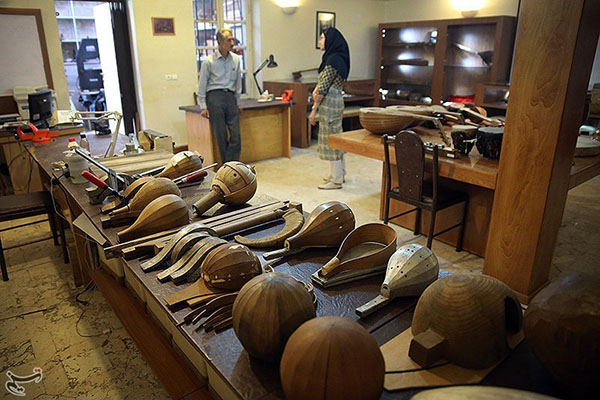
The town of Lalejin in Hamedan Province is home to a large number of pottery workshops. Mehr News Agency has posted online snapshots of colorful earthenware created by the town’s skilled craftsmen:
Iran is in a very sensitive environmental situation where ramifications of war and insecurity [in the region] such as haze can be felt, the director of the Environment Protection Organization told a conference Tuesday to mark the International Day for Preventing the Exploitation of the Environment in War and Armed Conflict.
What appears next is the translation of what else Masoumeh Ebtekar said at the gathering as reported by the Islamic Republic News Agency on November 10:
The conference is one of a few gatherings held in the world to assess the impact of war and violence on the environment.
It has been a few years since governments and international institutions began to take notice of the impact of war on the environment. National and international organizations can play an effective role on this front.
Iran started taking measures in dealing with the impact of war on the environment many years ago. One such measure was the formulation of a bill on compensations. Under the bill, Iran submitted a report to the United Nations on the destructive effects of war on Iran’s environment, including oil and air pollution, and asked for a big chunk in damages.
For instance, haze and particulates are a product of war which has bedeviled our country, that problem is escalating by the day.
Haze originates from countries such as Iraq, Kuwait, Syria and Saudi Arabia. It also comes from some areas within the country. Separate studies are being conducted on the issue in the provinces.
Water crisis in Iran and the wider region is an important issue and its settlement requires water diplomacy.
What the 11th government did with the backing of the Supreme Leader and the president as part of nuclear talks to have unfair sanctions lifted reflects the success of the diplomacy Foreign Minister Mohammad Javad Zarif and his colleagues employed.
Mr. Zarif and his colleagues did a great job. In a world where divisions mostly lead to war, his measures are valuable. The Iranian nation has thanked Mr. Zarif and his negotiating team multiple times; today we want to extend special thanks to his team, as well.
As the nuclear deal has proceeded in line with national interests so far, there is hope that it helps remove the sanctions so that Iran can play its major role in the region. Actually, that role has already started.
The region has become insecure thanks to the presence of IS and other terrorist groups; we should bring back security to the region and thus preserve the environment.
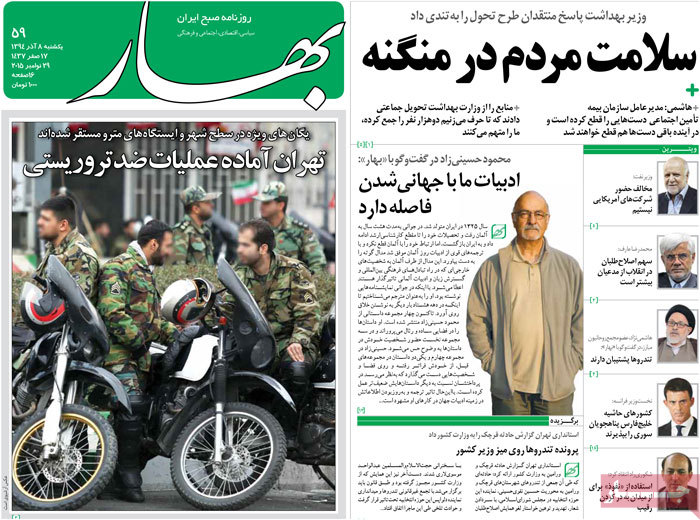
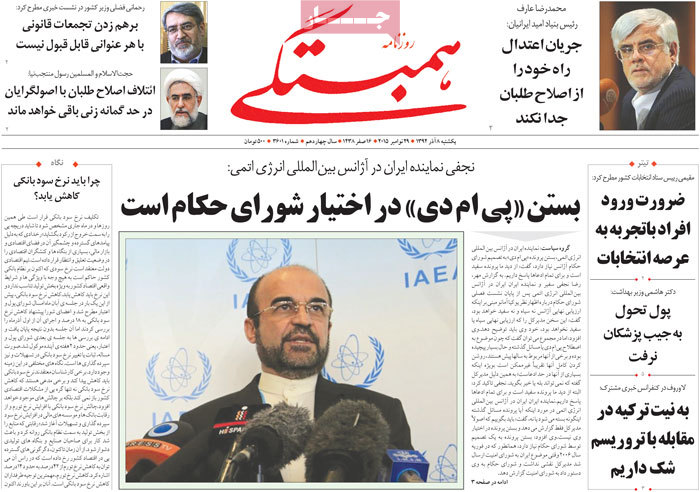
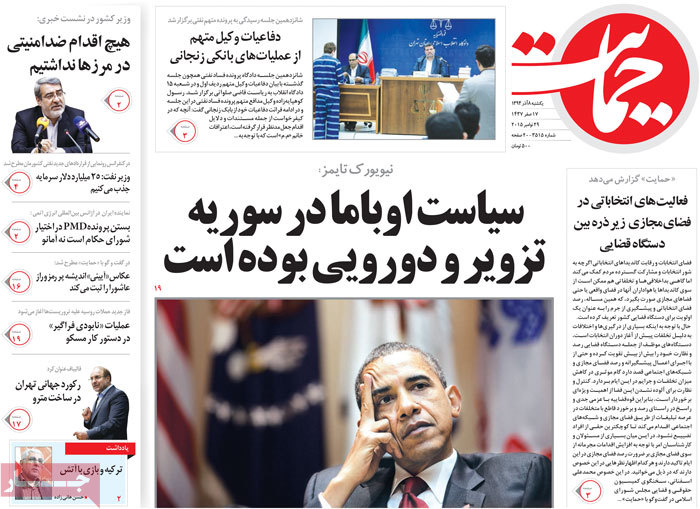
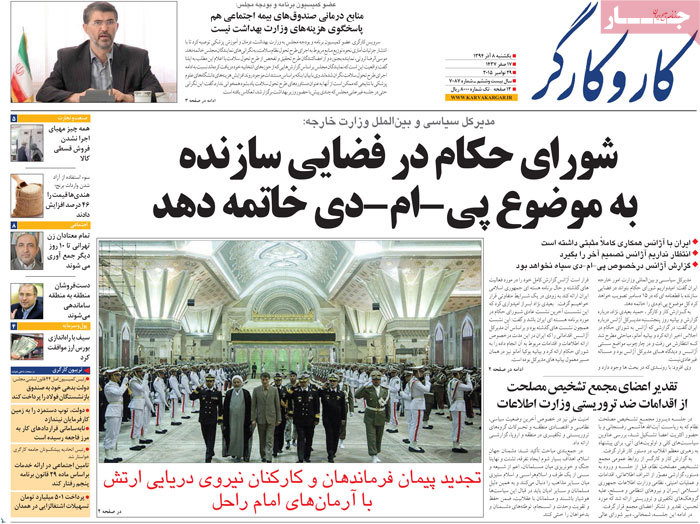
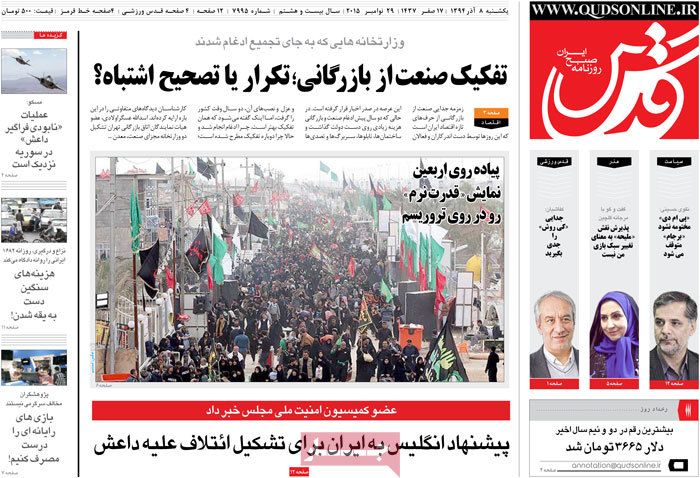
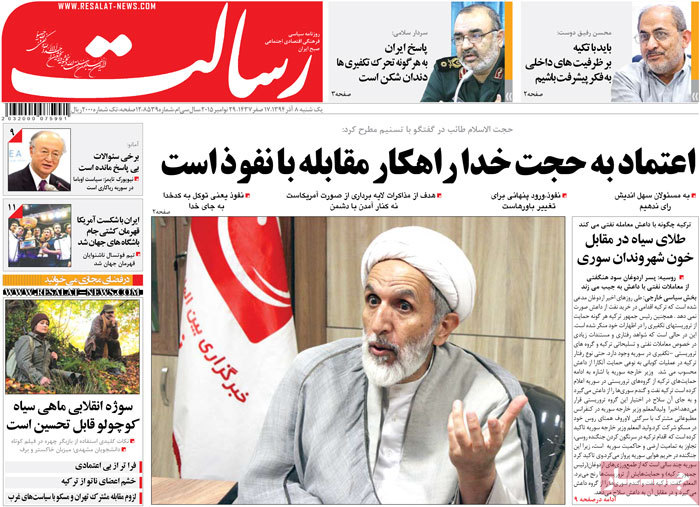
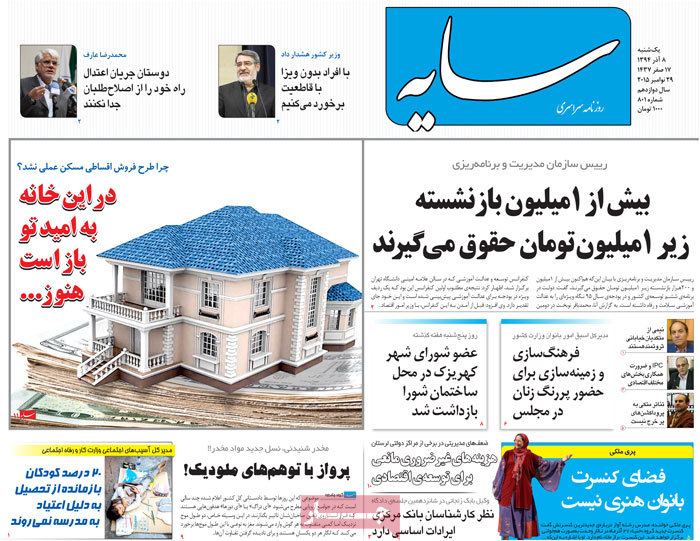
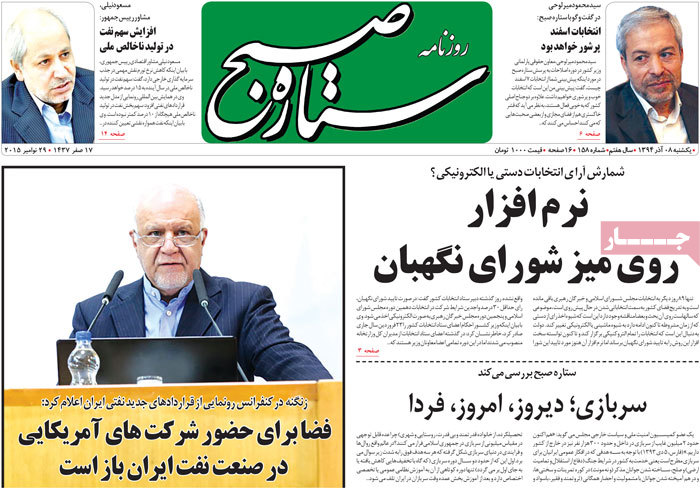
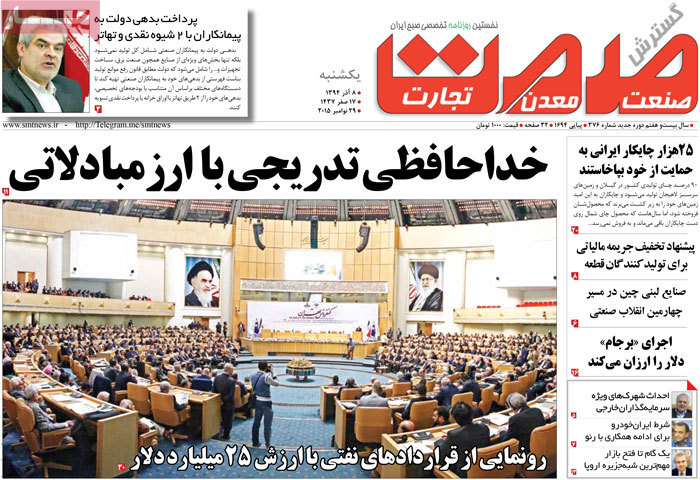
The comments of the Judiciary chief on a number of issues including the press, the nuclear deal with P5+1 and relations between the judicial and executive branches of government dominated the front pages of Iranian newspapers on Tuesday.
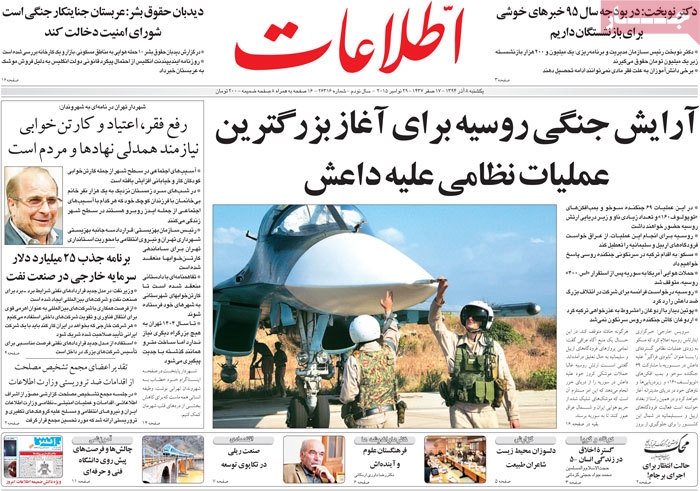
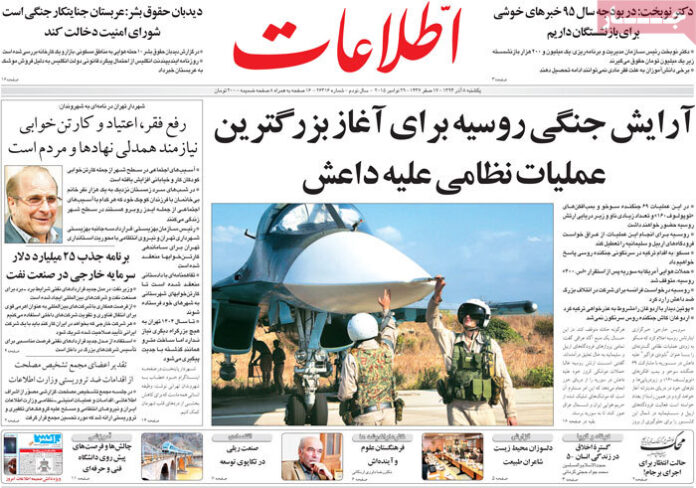
Ettela’at: The problem of the Internet bandwidth will soon be resolved, said the minister of communications as he visited the Ettela’at stall at the Press and News Agencies Exhibition.
Mahmoud Vaezi further said the number of people applying for access to the Internet is growing by the day.
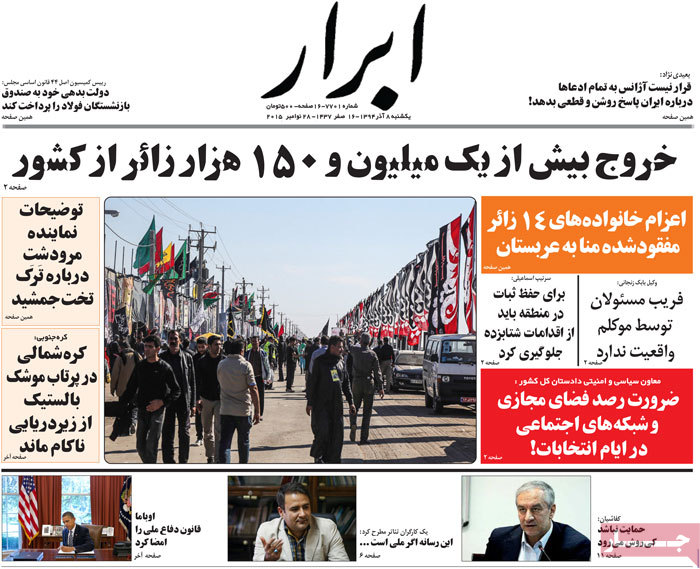
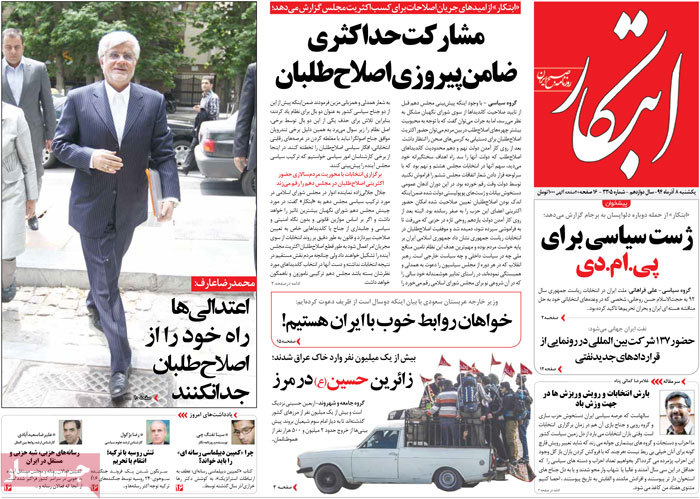
Abrar: The deputy interior minister has warned Iranian pilgrims against traveling to Iraq without securing a visa first.

Afkar: All media are entitled to making critical remarks, said Minister of Culture and Islamic Guidance Ali Jannati.

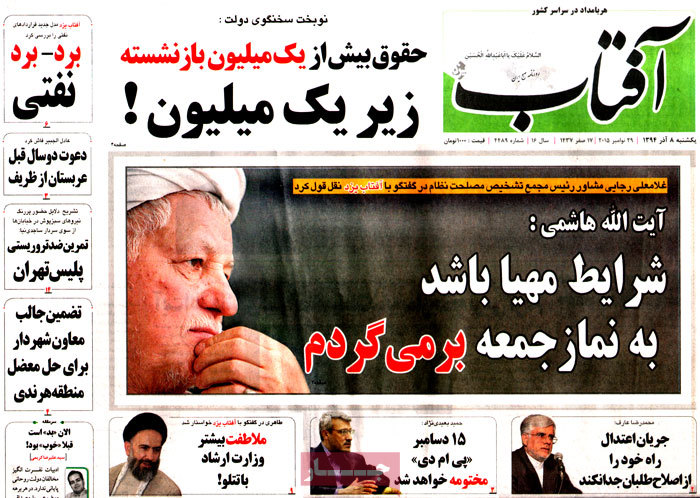
Aftab-e Yazd: The absence of a number of publications in the Press and News Agencies Exhibition won’t hurt Islam, said the minister of culture and Islamic guidance.

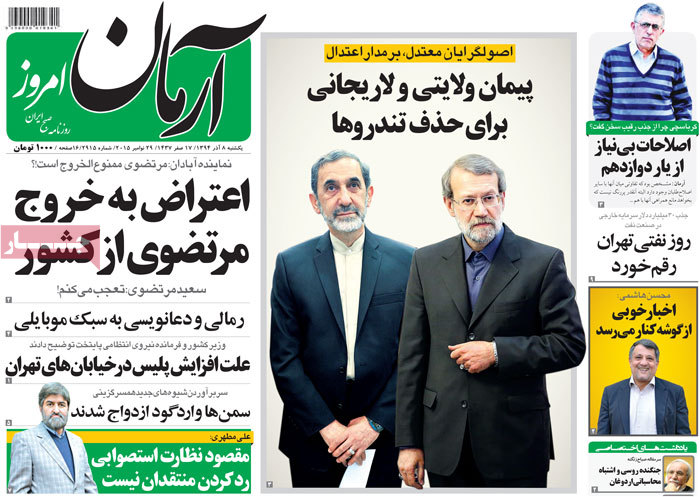
Arman-e Emrooz: You bother me and I’ll bother you!
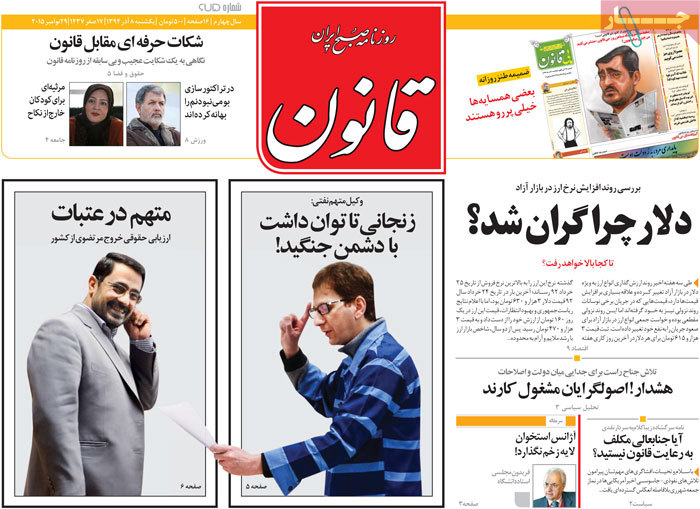
Instead of presenting a defense, Babak Zanjani [a young billionaire who is on trial for corruption] issued threats during a sixth hearing of his trial.

Asrar: “If the West keeps its end of the bargain, we’ll keep ours,” said President Rouhani at a meeting with the Belgian foreign minister.
Asrar: Government has taken steps above and beyond what is prescribed by freedom of press, said the minister of culture and Islamic guidance.
Asrar: Cooperation with the US hinges on progress in the implementation of the Joint Comprehensive Plan of Action, said the president’s chief of staff.

Ebtekar: Announcement of candidacy in the Press Exhibition
Mohsen Hashemi [Ayatollah Hashemi Rafsanjani’s son]: If I win the nod of the public and politicians, I will field my candidacy.
Mohammad Gharazi [A former presidential candidate]: I’ve made no deals with reformists or principlists to appear on their tickets.

Emtiaz: The deputy interior minister has said that each year more than 700 tons of illicit drugs is confiscated in the country.

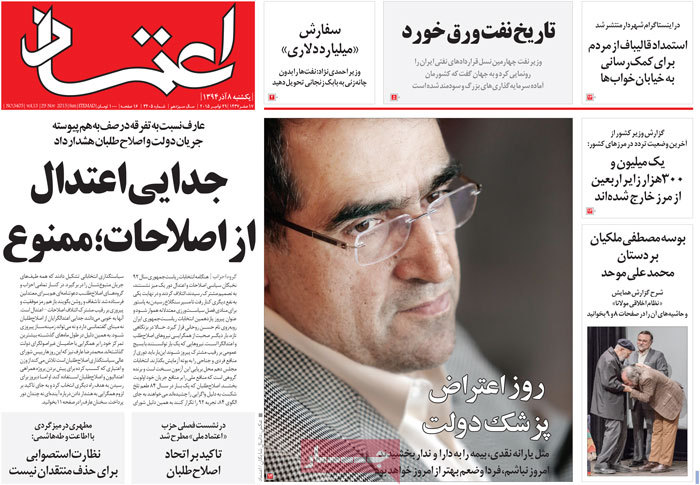
Etemad: On the first day banks began to grant car loans, some 12,000 cars were sold.
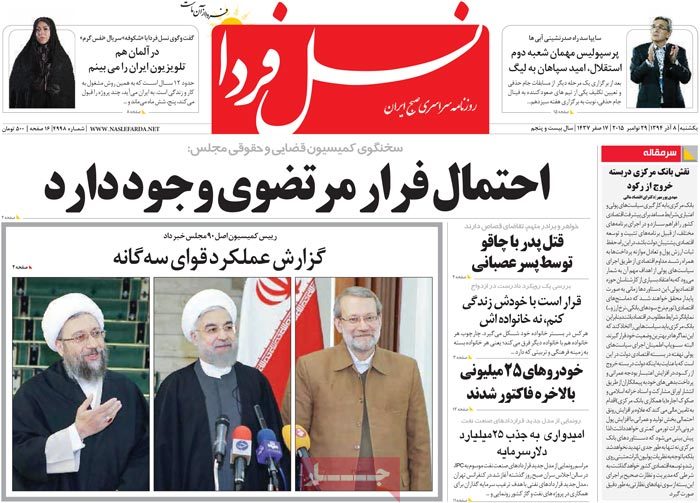
Etemad: “Don’t do injustice to the Judiciary,” said Judiciary Chief Ayatollah Sadegh Amoli Larijani.

Hemayat: The Judiciary should not be subjected to injustice,” said Judiciary Chief Ayatollah Sadegh Amoli Larijani.

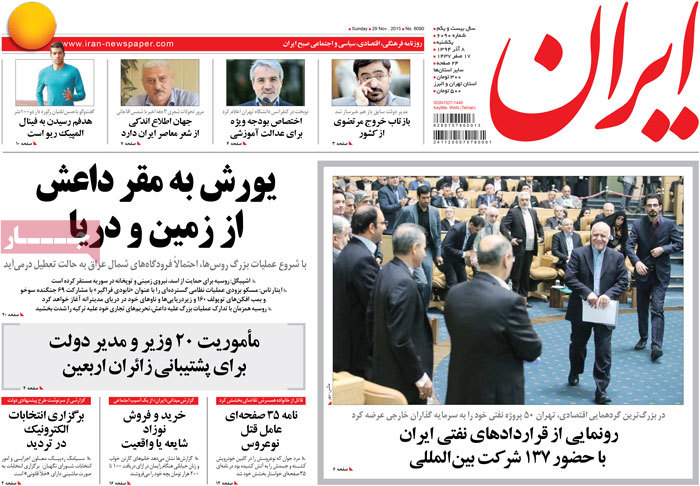
Iran: Citizens of 190 countries can secure airport visa in Iran.
That does not cover the citizens of the US, Britain and a number of Southeast Asian countries.

Jamejam: The IRIB President has underlined respect for ethnicities and solidarity among ethnic groups.

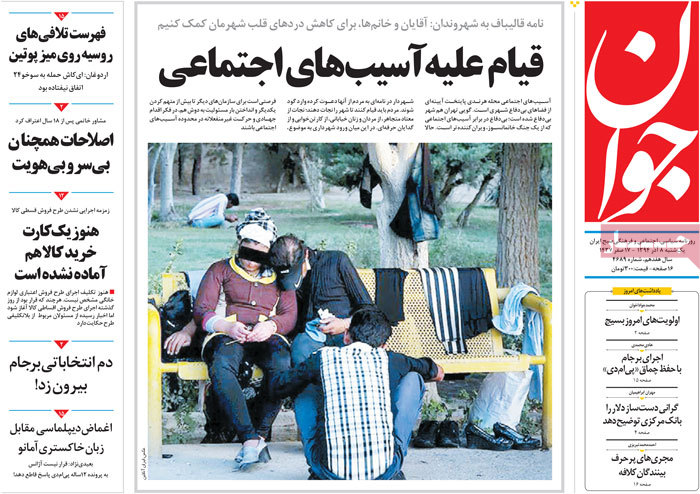
Javan: American confusion in the face of Iran and Russia’s Syria strategy
Washington is contemplating sending more troops and arms to Syria.

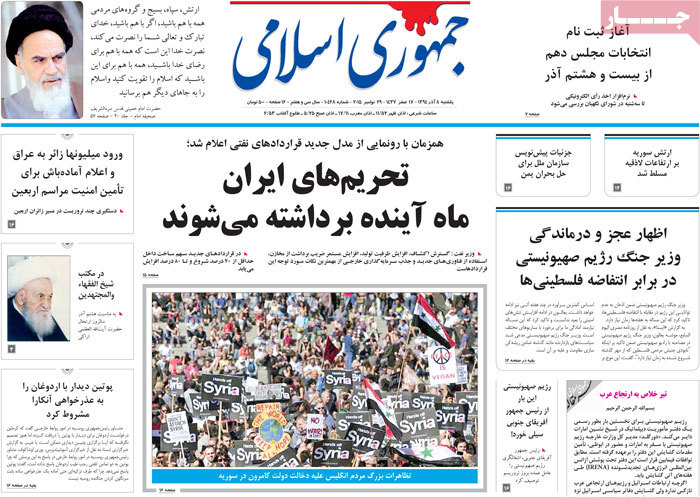
Jomhouri Islami: Ayatollah Hashemi Rafsanjani has criticized obstructionism in the post-JCPOA era.
“Why wouldn’t anyone do anything to prevent the corruption committed by the previous government?” asked the chairman of the Expediency Council.

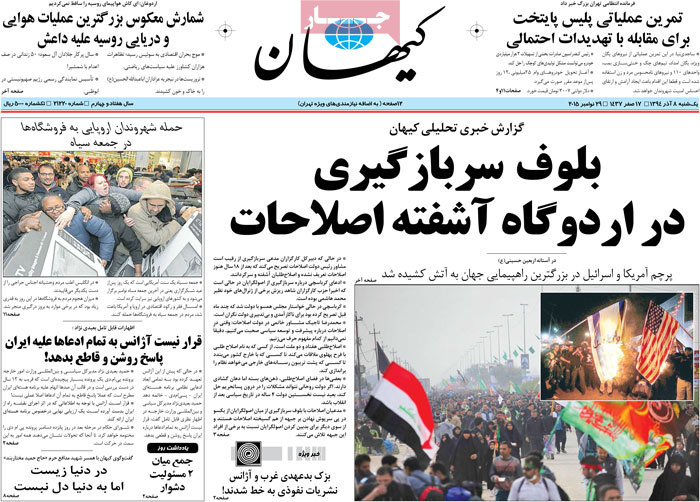
Kayhan: Babak Zanjani and the Oil Ministry at each other’s throats during a sixth hearing in the trial of the young billionaire who faces corruption charges.

Resalat: “We are worried about infiltration too,” said Foreign Minister Mohammad Javad Zarif.

Sharq: The three Iranian nationals executed in Saudi Arabia for drug smuggling did not have legal representation.

♦ The problem of the Internet bandwidth will soon be resolved, said the minister of communications as he visited the Ettela’at stall at the Press and News Agencies Exhibition.
Mahmoud Vaezi further said the number of people applying for access to the Internet is growing by the day.
♦ “Iran can serve as a center to coordinate ties between the European Union and the Middle East,” President Rouhani told the Belgian foreign minister.
♦ A balance should be struck between national interests and people’s reputation, the interior minister said.
Abdolreza Rahmani Fazli further said that the issue of infiltration should not be used as a tool for mudslinging and incrimination.
♦ A Syrian Army operation has left 58 IS terrorists dead.
The Syrian government forces wrested control of three towns south of Aleppo from the IS terrorists.
♦ Meetings will be held in Vienna later this week on a contract on the re-configuration of Arak Reactor.
Foreign Minister Zarif said talks on the document are over and it is ready to be signed.
♦ The minister of culture and Islamic guidance has said that his ministry acts in compliance with laws and is not hard on individuals and entities it deals with.
All those who want to air their criticism are writing what they want without restrictions, Ali Jannati said.
♦ The president will fly to Italy and France next week.
The visit comes at the invitation of senior Italian, French and Vatican officials. During the visit, the president will deliver a speech at the General Forum of UNESCO.
President Rouhani’s chief of staff Mohammad Nahavandian said Monday that progress in the implementation of the Joint Comprehensive Plan of Action is a test for seriousness and honesty of the US and Iranian cooperation with the US.
Nahavandian told El País, the Spanish newspaper, that people chant the slogan “Down with the US” to express their objection to US foreign policy in the Middle East and its hostility to the Iranian people over the past three decades.
He said that the slogan carries the message of opposition to US foreign policy, not to the American people.
Nahavandian said when people chant slogans in streets, what they have in their mind is US support for the coup that toppled the popular government of former Prime Minister Mohammad Mosaddegh in 1953. They do remember when the US Navy downed Iranian passenger plane over the Persian Gulf.
He said what should be corrected is the hostile foreign policy of the US administration and if a policy shift, as certain officials in the US talk about, happens, and Iranian people see the change in practice, the slogan may be reviewed.
In response to a question on whether opponents of JCPOA will be successful to derail it, Nahavandian said Iranian people closely follow the nuclear issue and different political groups present their comments on the issue because Iran is a democratic state.
“However, Iran has always been loyal to its commitments. JCPOA is the outcome of a decision made by the legal authorities of the governing system and there is substantive backing for its success.
“On our part, there is no doubt that such an issue should go on. Of course, due to the long record of distrust in the US, people should be very careful that all the dimensions are taken into consideration and confidence should be obtained that the other party will not violate the accord and will not seek pretext to violate it. If the other party is serious and honest, no doubt, Iran will also be serious and honest,” he said.
On the possibility of promotion of Iran-US cooperation, Nahavandian said as the Supreme Leader has already said the nuclear accord is a test for seriousness and honesty. If they adhere to what they have promised, that will be a positive sign. Any possible cooperation will depend on the way the accord is implemented.”
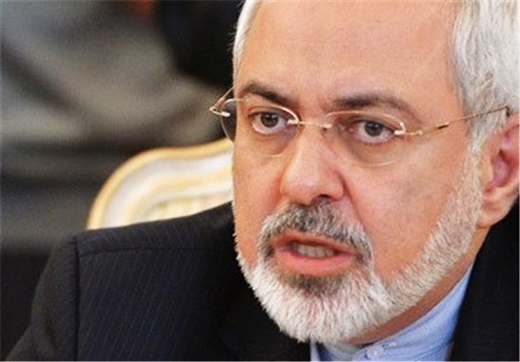
Foreign Minister Mohammad Javad Zarif on Monday said that an official document for re-configuring Iran’s Arak Reactor is ready, but the parties have yet to agree about signing it.
In a joint press conference with visiting Belgian Foreign Minister Didier Reynders Telematin in Tehran, Zarif said that the document is ready to be signed.
However, he added, how to sign the document has yet to be agreed upon, since all foreign ministers will not take part in upcoming Vienna talks due to be held on the Syrian crisis.
Zarif said that the document should be immediately signed, predicting that alternative ways may be used to get the document signed.
Under the Joint Comprehensive Plan of Action (JCPOA), Iran’s Arak heavy water reactor is to be reconfigured.
On Thursday, Director of the Atomic Energy Organization of Iran (AEOI) Ali Akbar Salehi said Iran was waiting for an official document from P5+1.
“Until that document is produced, we certainly will not take any measures on Arak heavy water research reactor,” he said.
[…]
Iran’s Ministry of Energy has signed an agreement with a German company to build 1,250 megawatts of solar energy projects in Iran’s latest move to green its energy supply chain.
Under the deal, Germany will build several solar farms in Tehran, Tabriz and Isfahan as Iran embraces clean energy, Head of Tehran Electricity Distribution Company Ali Barband said Monday without naming the foreign firm.
The plan for Tehran is to build 500 MW of solar projects, including 150 MW in Kahrizak, 200 MW in Varamin and 150 MW in Malard.
A further 750 megawatts of photovoltaic energy will be installed in Isfahan and Tabriz, he told Tasnim News Agency.
“It was decided that the issue of land acquisition for construction of the plants is determined soon, after which a 20-year agreement for guaranteed purchase of power will be signed with the Germans,” Barband said.
In August, Iran and Germany signed a document for generation of 100 megawatts of wind power plus 400 MW of solar in the southern province of Khuzestan.

German companies are reportedly about to begin building wind farms in Iran at a cost of $331 million next year.
The government plans to install 5,000 MW of renewable capacity, putting Iran among the likes of the UK and France. The Ministry of Energy is already implementing 500 MW wind converters and further 100 MW biomass projects.
Iran’s renewable energy potential is huge, where only the wind capacity is estimated at 30,000 MW.
The existing renewable mix is focused on hydro power plants which produce about 8,500 MW. Just 150 megawatts of green power plants are currently operating in the country.
A consortium of Iranian, Indian and South Korean companies seeks to set up an energy park in Khuzestan Province in a project worth $10 billion, including 1,000 MW of solar projects.
President Rouhani has warned that if not confronted seriously, terrorism will spread from the Middle East to the entire world.
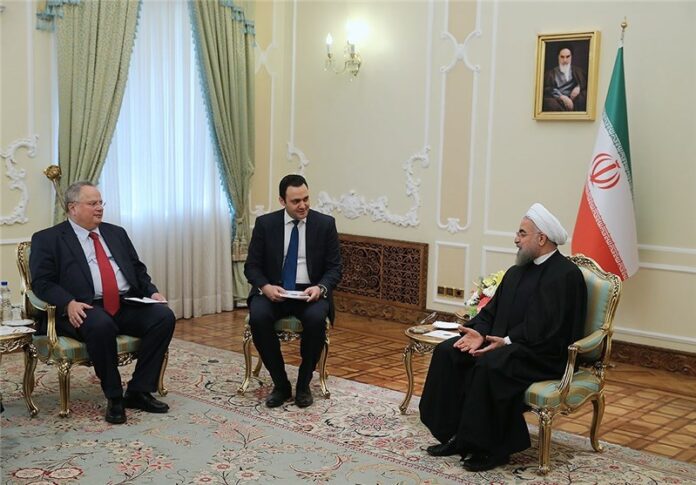
In a meeting with Belgian Deputy Prime Minister and Minister of Foreign Affairs, Didier Reynders, in Tehran on Monday, Rouhani called for a collective fight against terrorism and violence.
“Today, violence and extremism have engulfed a large part of the Middle East region, and if these phenomena are not confronted seriously, the consequences of violence and terrorism will not definitely be confined to this region and will spread to other areas in the world,” the Iranian president said.
He added that Iran has properly played its role in the fight against terrorism and urged all countries to give priority to the campaign against the common threat of terror.
Rouhani emphasized the importance of strengthening cooperation between Iran and the European Union in the fight against terrorism and expressed hope that collective cooperation would restore stability and security to the region.
The president recalled “cordial and constructive” relations between Iran and Belgium and said the two countries should improve relations in different fields such as in economic, industrial, energy, scientific, academic, research and tourism sectors.
“The Islamic Republic of Iran, due to its very important geopolitical and geoeconomic position, can be a center to organize and expand economic ties of Belgium and the European Union with the entire region and a timely use of this opportunity will be beneficial to our nations,” Rouhani said.
The Belgian foreign minister, for his part, said his country attaches significance to the serious and collective fight against terrorism.
Reynders added that Iran plays an effective role in settling regional problems and called for political solutions to the crises in Syria, Yemen, Iraq and Libya.
West threats hinder Iran-P5+1 ties
Secretary of Iran’s Supreme National Security Council (SNSC) Ali Shamkhani said on Monday that the persistence of threats against Iran will hinder Tehran’s cooperation with P5+1.
“Any unconstructive act or the persistence of threats and hostility [toward Iran] will prevent the expansion of cooperation and will lead to [Iran’s] revision of [its] policies,” Shamkhani said in a meeting with the Belgian foreign minister.
He pointed to a nuclear agreement reached between Iran and P5+1 in mid-July and said that the proper and on-time fulfillment of the commitments by P5+1, including the removal of all sanctions, will be a test to determine the six countries’ determination to bolster bilateral cooperation.
“The nuclear agreement between Iran and P5+1 have created new opportunities for economic cooperation between Iran and Europe,” the SNSC secretary added.
[…]
The Belgian foreign minister, for his part, said Brussels has always maintained relations with Tehran and expressed hope that the two sides would improve ties following the removal of sanctions.
ME woes must be solved through diplomacy
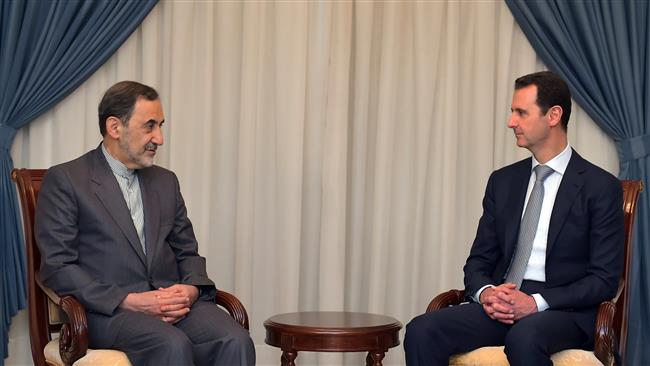
Deputy Foreign Minister for Arab and African Affairs Hossein Amir Abdollahian stressed the importance of resolving Middle East woes through political and democratic solutions.
In a meeting with Reynders Monday, the Iranian official added that terrorism is the main and common problem of countries in the Middle East and Europe and called for the fight against the scourge.
The Belgian foreign minister, for his part, said regional problems could be only settled through political mechanisms.
He added that regional problems are rooted in terrorism and extremism and called on all countries in the region and across the world to jointly solve the crises in the Middle East.
The Belgian foreign minister arrived in Iran on Sunday at the head of a delegation for talks with the country’s senior officials.
President Rouhani will pay an official visit to Italy, the Vatican and France and deliver a speech at the Leaders’ Forum of the United Nations Educational, Scientific and Cultural Organization (UNESCO) in Paris.
Rouhani will set off for Rome on Saturday at the head of a high-ranking delegation to hold talks with senior Italian officials, the Presidential Office’s Deputy for Communications and Publicity Affairs Parviz Esmaili said on Monday.
He added that the president is scheduled to hold meetings with Italy’s President Sergio Mattarella and Prime Minister Matteo Renzi.
Rouhani will also hold a meeting with Italian investors and leading industrialists in Rome, Esmaili said.
He said President Rouhani will then head for the Vatican to meet Pope Francis and Prime Minister Archbishop Pietro Parolin.
He added that Rouhani will also address UNESCO Leaders’ Forum as a special guest at the organization’s headquarters in Paris on November 16.
Esmaili said the president plans to sit down with his French counterpart Francois Hollande in Paris on November 17.
He noted that during Rouhani’s four-day visit, Iranian officials accompanying the president will sign a number of memoranda of understanding for expansion of relations in different fields.
An exhibition of rugs woven by tribal people has opened in Arak, the capital of Markazi Province.
More than 150 items aged between 30 and 70 years are on display. They come from provinces such as Hamedan, Kurdistan and Markazi.
The following photos of the exhibition have been published by Mehr News Agency: