Thursday, December 25, 2025
Home Blog Page 4689

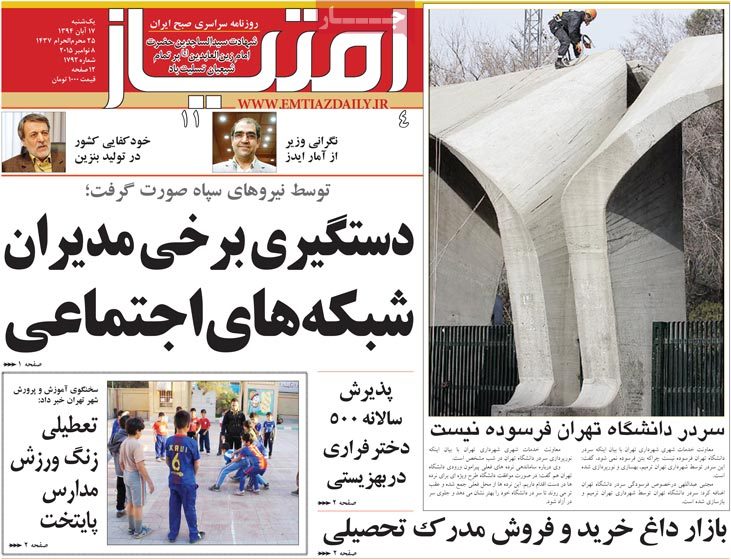
IRGC arrests mobile social network managers for undermining moral security

IRGC

The Islamic Revolution Guard Corps (IRGC) has detained managers of a number of mobile social networking groups on charge of acting against moral security in society.

Over 170 managers were identified following a complicated intelligence operation and a number of them were taken into custody by IRGC forces in Qazvin Province, west of Tehran.

Facilitating access to obscene content through social networks, encouraging immoral behavior, and publishing insulting content about ethnic groups, officials and national figures were among the illegal activities for which they were detained.

Those arrested have been handed over to related authorities following necessary judicial procedures.

Iran, South Africa sign economic MoUs

Jahangiri

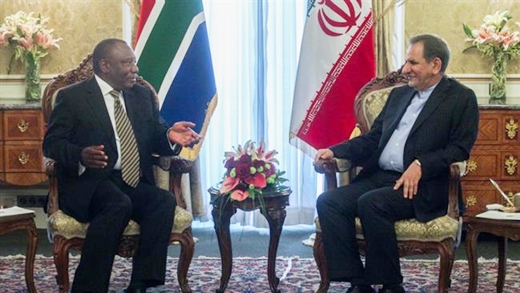
Iran signed three memoranda of understanding (MoUs) with South Africa to expand mutual trade ties.

The MoUs were signed Saturday during a meeting between Iran’s First Vice-President Eshagh Jahangiri and visiting South African Deputy President Cyril Ramaphosa.

Under the documents, the two countries have agreed to create a center to exchange information to fight money laundering, create joint markets and also expand technical and economic cooperation.

Jahangiri told Ramaphosa that Iran attaches great significance to expansion of ties with South Africa.

He described as unsatisfactory the current level of economic relations between the two countries and called for concrete measures to boost trade between the two countries.

Jahangiri emphasized that Iran and South Africa still can benefit from huge potential that exists in sectors such as mining, banking, agriculture, insurance and energy.

Ramaphosa, who is heading an 80-member trade delegation to Tehran, for his part emphasized that the expansion of relations between Iran and South Africa will mutually benefit both sides.

He also said South African companies are pursing serious plans to invest in Iran, adding that expansion of banking relations between the countries will specifically help investors from both sides.

[…]

Carter’s remarks show US destabilizing policies in Middle East: Iran

Marzieh Afkham

Iran has said recent remarks by US Defense Secretary Ashton Carter show the “destabilizing policies and measures” of the US in the region persist.

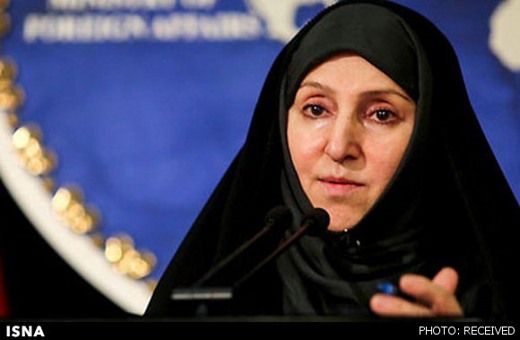
Foreign Ministry Spokeswoman Marzieh Afkham made the remark on Saturday in reaction to comments made by Carter in an interview with The Atlantic published on Friday.

Carter advised Arab nations to unite against Tehran and IS by bolstering their ground forces.

“If you look at where the Iranians are able to wield influence, they are in the game, on the ground,” he said.

He added that the reason why Persian Gulf states lack influence in the region, “is that they have weighted having high-end air-force fighter jets and so forth over the hard business of training and disciplining ground forces and special-operations forces.”

Afkham noted that Carter’s remarks clearly show America’s “destabilizing policies and measures in the region.”

She added that instead of requiring an answer from Iran, Carter’s remarks should be responded to by Arab countries in the region, because they are the ones who have been “humiliated and insulted.”

“These words show that from the US official’s point of view, Arab countries are even incapable of… using the weapons they need,” she said.

Rouhani urges on-time, complete Iran bans removal

9ea21471-6785-4159-bb87-7405073e228a

President Rouhani has reaffirmed Tehran’s full commitment to the nuclear agreement reached between Iran and P5+1 in July, calling for on-time and complete lifting of sanctions against Iran.

“The opposite side should also remain committed to its obligations and the lifting of economic sanctions [against Iran] and implement it [a reference to the agreement] completely, precisely and on time,” Rouhani said in a meeting with visiting President of the European Parliament Martin Schulz in Tehran on Saturday.

In line with the expansion of economic and trade relations, Iran and EU member countries should also improve cultural and scientific cooperation following the removal of sanctions, he added.

[…]

Necessity for anti-terror fight: Rouhani

The president further underlined the need for a global campaign against terrorism.

Iran, as a victim of terrorism, is fighting terrorism decisively and seriously, President Rouhani said, adding, “Today, more opportunities have been created for closer cooperation between Iran and the European Union to contribute to stability in the region.”

He said that Iran and the EU should tap into their potential “in favor of economic development of all countries.”

Schulz said JCPOA will be an unprecedented chance and a new chapter in relations between Iran and the EU.

The nuclear agreement proved that diplomacy is the best way to settle differences and serve common interests, he added.

He expressed the European Parliament’s willingness for promotion of bilateral and international cooperation with Iran.

Growing Iran-EU economic ties after JCPOA

In a meeting with the visiting president of the European Parliament on Saturday, Foreign Minister Mohammad Javad Zarif said JCPOA will lay the ground for improving Tehran’s economic cooperation with the EU.

Zarif said that Iran welcomes bolstering economic cooperation with the EU based on mutual respect and in line with basic principles accepted by the two sides’ parliaments.

Iran foresees numerous economic opportunities for further promotion of Iran-EU ties following the conclusion of the nuclear agreement, the minister said.

Schulz, for his part, told Zarif that the European Parliament is interested in the expansion of parliamentary cooperation with Iran through adoption of new approaches.

The European Parliament welcomes economic cooperation, trade exchanges and investment in Iran in line with the framework of JCPOA, he said.

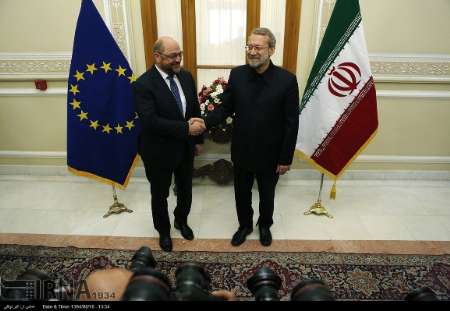
Schulz arrived in Tehran on Saturday at the head of a delegation and held talks with senior officials, including Parliament Speaker Ali Larijani.

Iran, South Korea can cooperate to help promote peace: Rouhani

rouhan01

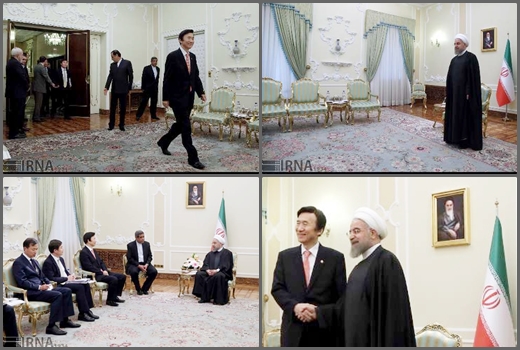
President Rouhani said on Saturday that Iran and South Korea can cooperate to help promote peace and stability in the Middle East and East Asia.

Rouhani made the remarks in a meeting in Tehran with visiting South Korean Foreign Minister Yun Byung-se.

The president said that Iran as a country with significant regional status and South Korea as an important country in East Asia have remarkable potential for expansion of ties in all areas such as economy, culture and politics.

He expressed hope that South Korean companies can have an active presence in the Iranian market along with their rivals from other countries.

The South Korean foreign minister said that his country is eager to expand all-out relations with Tehran.

Yun said that major South Korean companies are anxiously waiting for the removal of anti-Iran sanctions to return to the Iranian market.

He said that cultural commonalities and fifty years of bilateral relations have paved the way for further expansion of ties between Tehran and Seoul in economic and political areas.

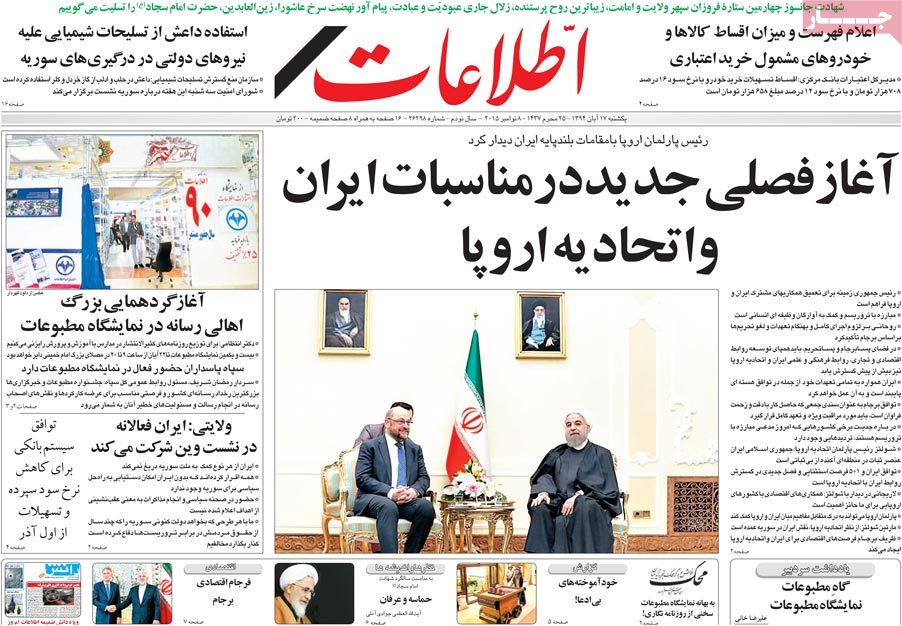
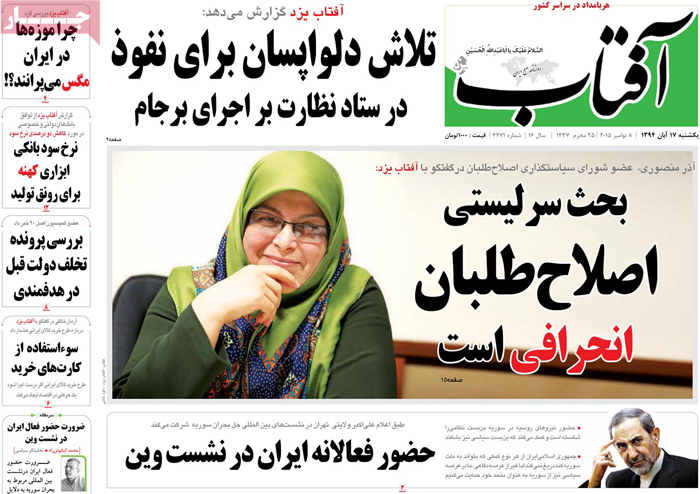
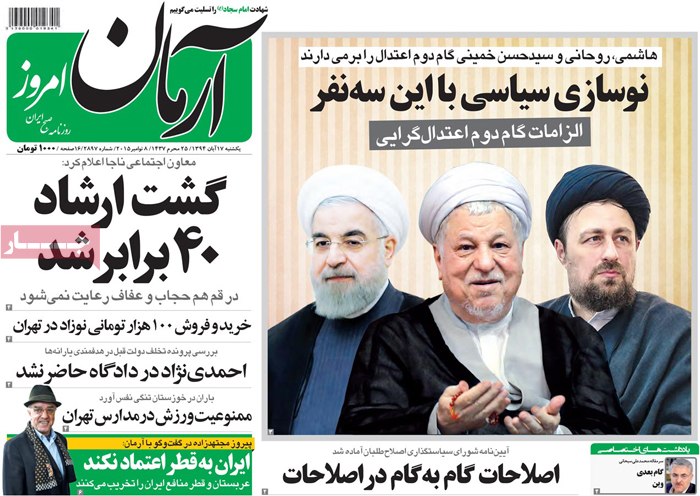
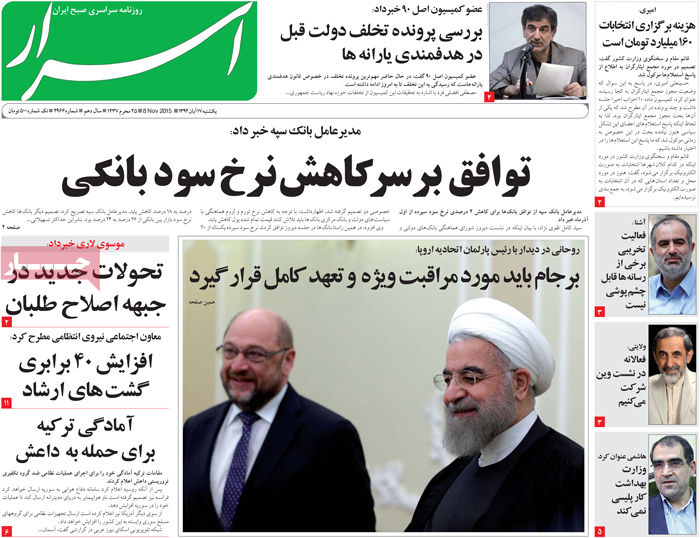
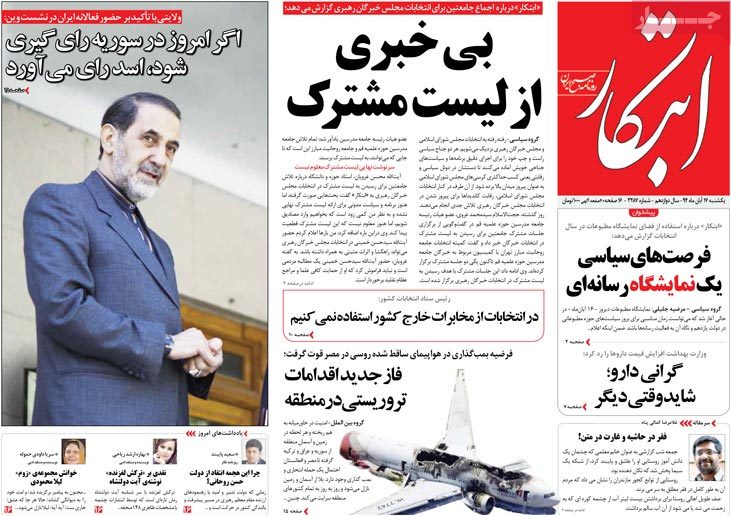
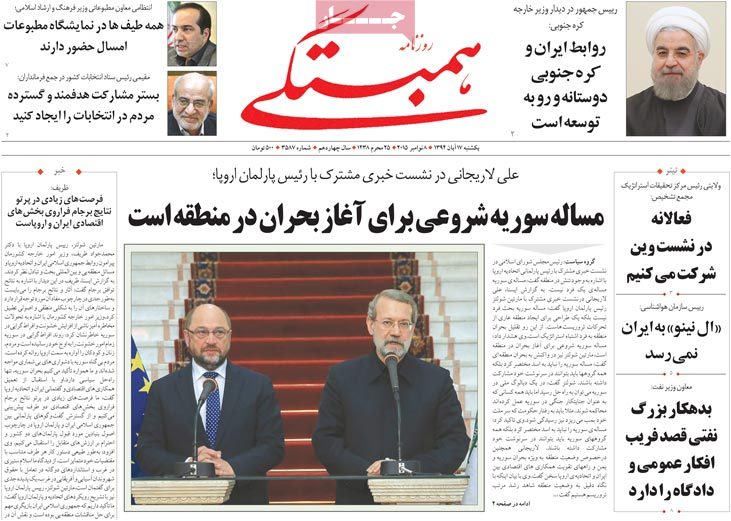
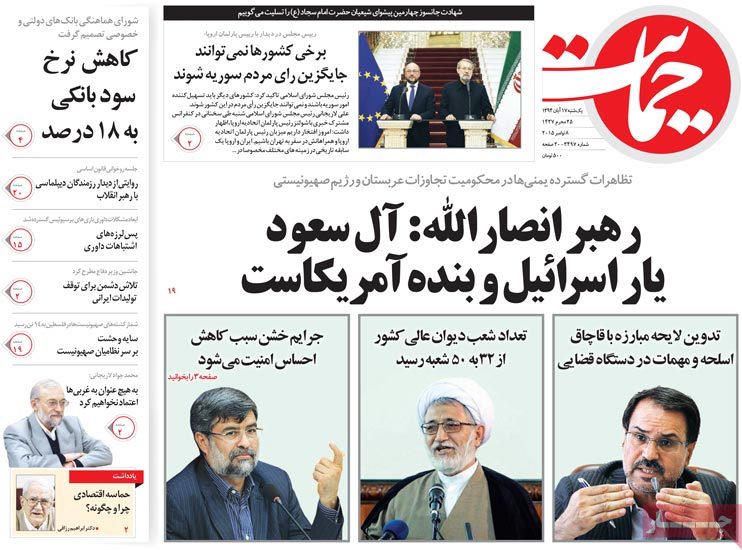
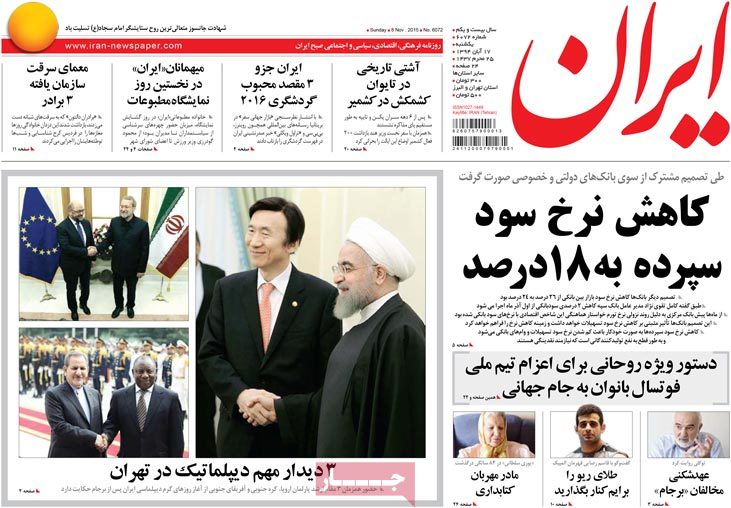
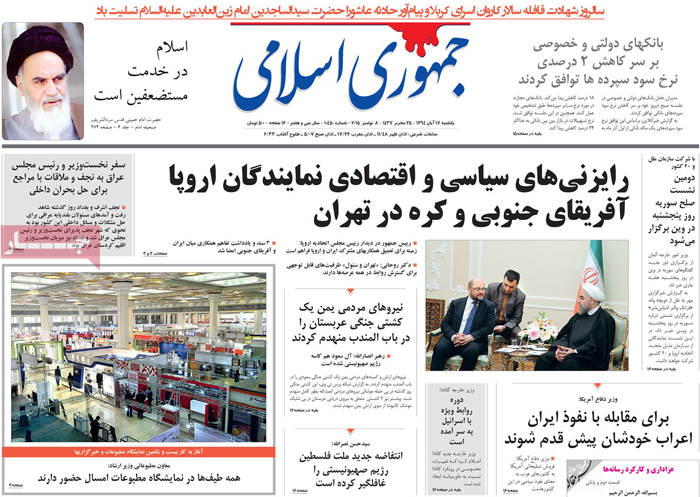
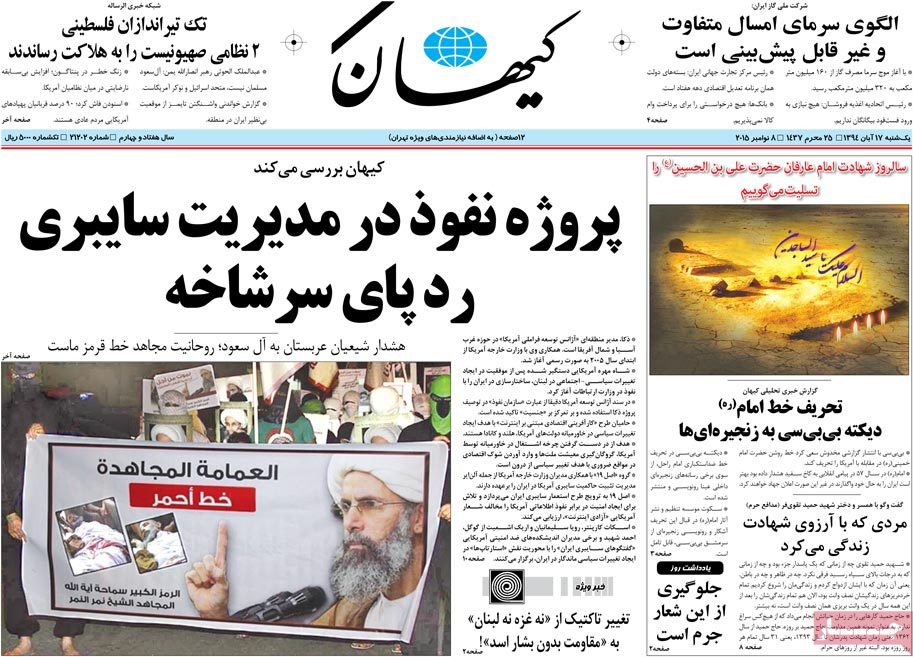
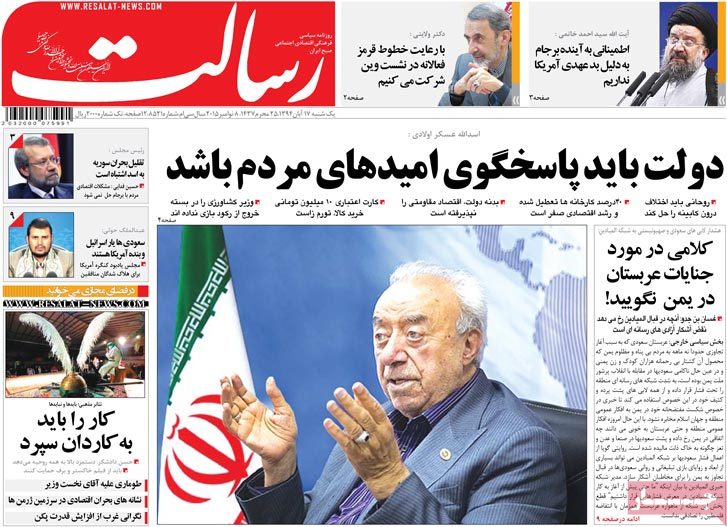
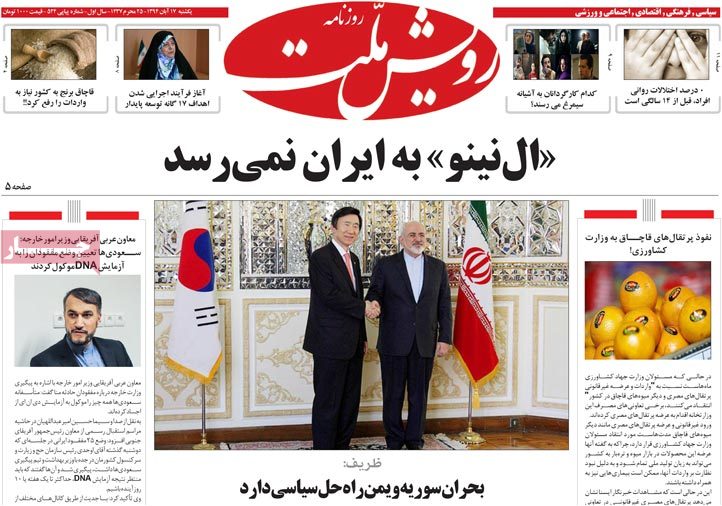
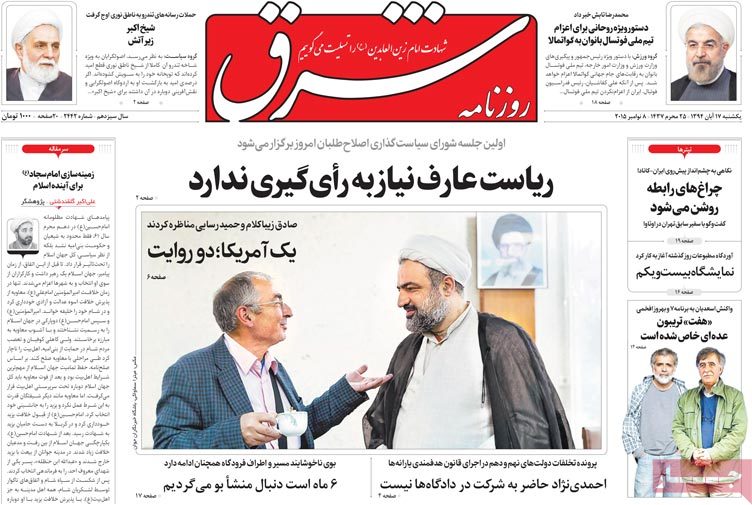
A look at Iranian newspaper front pages on Nov. 8

Iranian Newspapers Headlines

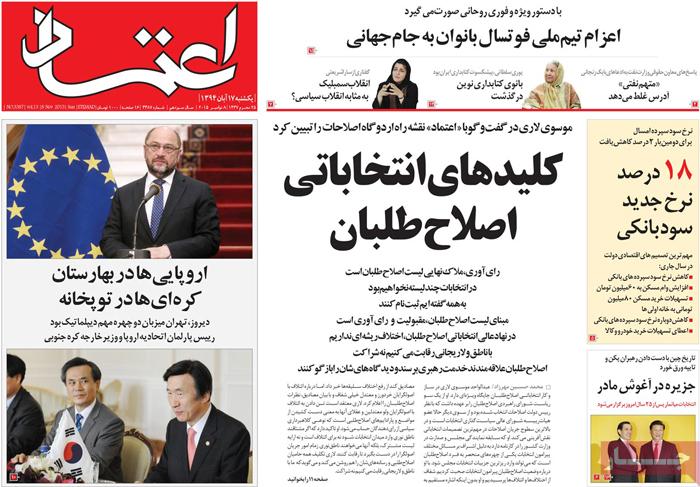
The meetings in Tehran between the European top MP, the South Korean foreign minister and the South African deputy president with Iranian officials dominated the front pages of Iranian newspapers on Sunday.


Ettela’at: A new chapter opens in relations between Iran and the European Union.

The President of the European Parliament has met with senior Iranian officials.

President Rouhani told the visiting European top MP that the stage is set for measures to “deepen Iran-Europe cooperation”.


Aftab-e Yazd: An exclusive report by the daily takes a look at “efforts by the Worriers [opponents of President Rouhani’s policy of moderation and interaction] to find their way into a commission charged with supervising the implementation of the Joint Comprehensive Plan of Action.


A look at Iranian newspaper front pages on Nov. 8


Arman-e Emrooz: Ahmadinejad did not show up in a court session which heard the alleged offenses his government committed in making state subsidies targeted.

Arman-e Emrooz: Political revival with these three people

Hashemi, Rouhani and Seyyed Hassan Khomeini take the second step down the path of moderation.


A look at Iranian newspaper front pages on Nov. 8


Asrar: The number of officers on Promotion of Virtue and Prevention of Vice patrol is to increase 40-fold, said the deputy police chief for social affairs.


A look at Iranian newspaper front pages on Nov. 8


Ebtekar: “If elections were held in Syria today, Assad would win reelection,” said Ali Akbar Velayati, an advisor to the Supreme Leader.


A look at Iranian newspaper front pages on Nov. 8


Emtiaz: Iran is now self-sufficient in production of gasoline.

Emtiaz: The administrators of a number of groups active on social networking sites have been arrested [for promoting immorality].


A look at Iranian newspaper front pages on Nov. 8


Etemad: Tehran hosted two prominent foreign figures yesterday: the president of the European Parliament and the foreign minister of South Korea.


A look at Iranian newspaper front pages on Nov. 8


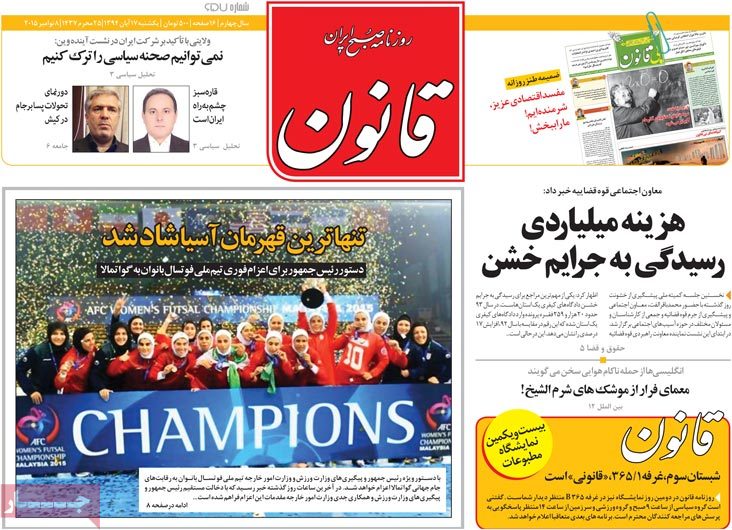
Ghanoon: The president has ordered measures to make sure the Iranian women’s futsal team flies to Guatemala to take part in the 2015 World Championships.


A look at Iranian newspaper front pages on Nov. 8


Hambastegi: Media outlets from across the spectrum are present in this year’s Press and News Agencies Exhibition, said the deputy culture minister.

Hambastegi: El Nino won’t affect Iran, said the director of the Meteorological Organization.


A look at Iranian newspaper front pages on Nov. 8


Hemayat: Foreign countries cannot replace the Syrian people in deciding their future, said the Iranian parliament speaker in a meeting with the president of the European Parliament.

Hemayat: The number of Supreme Court branches has increased from 32 to 50.


A look at Iranian newspaper front pages on Nov. 8


Iran: In a joint decision, private and public banks have agreed to cut interest rates to 18 percent.


A look at Iranian newspaper front pages on Nov. 8


Jomhouri Islami: European, South African and South Korean envoys in Iran for political and economic talks


A look at Iranian newspaper front pages on Nov. 8


Kayhan: The Saudi Shiites have warned the al-Saud family that clergymen are their red lines.


A look at Iranian newspaper front pages on Nov. 8


Resalat: We will actively take part in the Vienna conference on Syria while respecting our red lines, said Ali Akbar Velayati, an advisor to the Leader.


A look at Iranian newspaper front pages on Nov. 8


Rooyesh Mellat: The Saudis have said identification of Iranian pilgrims missing since the Mina tragedy will take place on the back of DNA tests, said the Iranian deputy foreign minister.


A look at Iranian newspaper front pages on Nov. 8


Sharq: Attacks by hardline media on Ali Akbar Nategh Nouri [a principlist figure and former parliament speaker] have come to a head.


A look at Iranian newspaper front pages on Nov. 8


Iran plays key role in regional developments: EP President

81828506-70284363

Iran plays a pivotal role in regional developments, Visiting President of European Parliament (EP) Martin Schultz said on Saturday in a joint press conference with Parliament Speaker Ali Larijani.

The EP president said, “Iran-Europe relations are at a crucial stage,” adding Larijani played a pivotal role in nuclear talks between Iran and P5+1.

Schultz went on to say, “The two sides are keen on expanding joint interests.”

Touching on the Syrian issue, he said that Iran plays a key role in the settlement of crisis in the Arab country.

Schulz who arrived in Tehran on Saturday to discuss stepping-up dialogue between the EU and Iran is to meet with President Rouhani as well as Foreign Minister Mohammad Javad Zarif.

Schulz is also scheduled to meet with Secretary of Iran’s Human Rights Council Mohammad Javad Larijani and Head of parliament’s Research Center Kazem Jalali.

[…]

It’s a pity that certain media are no-shows in press exhibition

Ashena

President Rouhani’s cultural advisor has said that he wished all media outlets were represented at the 21st Press and News Agencies Exhibition in Tehran.

Hessamoddin Ashena made the comment in an interview with Tasnim News Agency on Saturday and added, “We really wish all news agencies, including Tasnim, participated in the cultural event.” The following is the translation of what else the presidential advisor said about this year’s press exhibition:

Ashena said that the government always listens to critical voices and is ready to enter into talks with them, rejecting reports that the Cabinet, including the Ministry of Culture and Islamic Guidance, has refused to listen to the reasons why certain news agencies do not attend this year’s press exhibition.

Asked about why the government has yet to try to talk with these media, he said that the government would have launched talks with the media if they had stepped forward.

“Did you expect the absent media to ask for a meeting and explain the reasons for their absence?” he was asked. In response, the presidential advisor said nobody asked for a meeting, adding if they had anything to say, we were ready to listen to.

Ashena dismissed as untrue reports that the president and his cultural advisor had asked the Culture Ministry to limit the presence of critical media circles in the press exhibition and said that it is sheer lie. “We should not resort to lies in pursuing our objectives”.

Tehran-based religious site for English speakers

1876871 (1)

The Iranian capital is a metropolis of around ten million. People originally from other cities account for a big chunk of Tehran’s population. Those who move into the capital stick to the traditions of their hometowns when observing religious rites and rituals, especially in mourning ceremonies for Imam Hussein (PBUH) – the grandson of the Prophet Muhammad and the third Shiite Imam – in Muharram.

The bustling megacity is brimful of religious sites attended by, say, the capital-based Azerbaijanis or the Tehran-based Hamedanis. But have you ever heard of a religious site dedicated to Tehran-based English speakers?

“Mourning ceremonies for Imam Hussein (Peace be upon him) in English language each night after first evening prayers with Tehran-based English speakers and students of the English language in attendance….” This was part of a text which changed hands on social networking sites like Telegram and WhatsApp and aroused the curiosity of Mehr News Agency’s Azadeh Bagheri, compelling her to pay a visit to the site.

Marzieh Hashemi, an American-born Iranian TV presenter, journalist, and documentarian and the host of Press TV, is the founder of this small group. Two years ago, she launched the group by holding Dua Kumayl (Supplication of Kumayl) on Thursdays. She and other members of the group are trying to introduce the group to people and bring together foreign Muslims who are based in Iran to ease their homesickness.

The following is the translation of part of a report Mehr News Agency released in late October on the activities of this English-speaking group and its objectives as well as comments of Marzieh Hashemi and Behrouz Alipour, who are active members of the group:

A group, low in quantity but high in quality

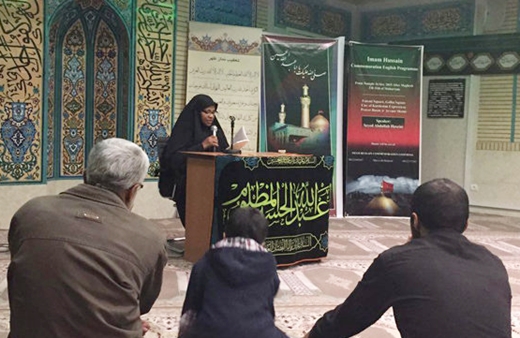
Eyvan Shams was not much crowded, but the get-together of the few people there was too attractive to be ignored. This group is different because its every single member has made a personal decision to embrace Islam. Some are not Iranian; those who are have been away from their homeland for years. They get together and hold mourning ceremonies in a language which sounds more familiar to them: English.

Marzieh Hashemi speaks a few minutes about Imam Hussein and his uprising [which culminated] in Tasoua and Ashura, and then it is the turn of Abdollah Hosseini, a cleric, to take the podium and speak – in English – about Imam Hussein and his companions.

Going public after two years

Behrouz Alipour, one of the group’s active members, has been with the group ever since it was formed two years ago. Alipour, who has a B.A in Islamic art and an M.A in political science, says, “The Dua Kumayl group, which is an English speaking group, was formed by Ms. Marzieh Hashemi whose real name is Melanie Franklin, and Messrs. Foad Izadi and Marandi. The group used to meet at the Faculty of World Studies in the University of Tehran. Back then those interested would gather at the faculty’s mosque on Thursdays to read Dua Kumayl.

“[…] Currently the group has 50 main members, but on some days a variable number of people, for instance up to 100, are present here.”

He says, “The group absorbed more members and people learned about it a bit after it held an Iftar [fast-breaking] ceremony in Mellat Park in Ramadan. […] Generally speaking, people warmly welcomed the ceremony. There were oppositions, but it produced a satisfactory result. That night we spread a table cloth in the park and everybody who was there joined us. We asked people to join us for Iftar. […] People asked where we were based. That was how contacts were established and the number of members increased until the month of Muharram started.”

He says that they launched a group on social networking sites such as WhatsApp and Telegram after being warmly welcomed by people. They wanted to see more people get familiar with this group. […]

We were denied a place because we were anti-American

The group has faced certain problems. It does not have a fixed place and has moved to different sites. Alipour says, “We wanted to stay in the university’s prayer room, but some issues came up and they did not want this anti-US group to remain in the Faculty of World Studies. On different grounds, we were told we had better not be there.

“So we went to the Faculty of Foreign Languages, but we had to leave that place for the same reason. Later we went to a building of the Supreme Leader’s Office on Zartosht Street. […] Now we want to change our place. For the first ten days of Muharram [this year] we were in the prayer room of Eyvan Shams.”

We aim to launch an Islamic training center in English

Alipour says that Iranian Muslims have limited contacts with fellow Muslims in other countries, adding that formation of such groups helps boost contacts between Muslims. “We intend to launch an Islamic center to help Muslims in Iran establish contacts with other Muslims outside Iran. I think Iran’s contact with the outside world is limited. If we can establish international contact through this group, it would be great.

“Our motto is that borders and races do not count. Some members of this group hold different programs; for instance, the New Horizon Conference which has been held for three years led by Mr. Nader Talebzadeh raises international questions focusing on tyranny and injustice, especially by the US. It aims to reveal the true colors of the United States where racism is clearly evident”.

He further says that the group aims to set up an Islamic training center in English. “Our major goal is to have a place for our members to receive training on Islam in English, because it is an international language by which we can transfer what we have to other societies. We want to hold courses and teach Islamic concepts. If we can have a place supervised by the Education Ministry and offer trainings authorized by the ministry, it would be great. There are similar cases outside Iran. It takes a long time to reach such a goal.”

It has always something to do with Marzieh Hashemi!

Marzieh Hashemi, the founder of the group, says, “I converted to Islam more than 30 years ago. In addition to Iran, I have had religious activities in the US. […] People came to Iran from the US and elsewhere in the world. They got deeply involved in their profession in Tehran and their activities became more personalized. They were no longer engaged in their previous activities. What a pity, I thought. I talked with a few people in this regard and I realized that we had to do something to bring those people together again. […]”

We help foreign Muslims with their homesickness

“[…] The foreigners who have come to Iran after embracing Islam are alone. We have to help ease their homesickness one way or another. I think the group we have formed can be very much helpful. Currently, we have focused our attention on Tehran. […]

The group is the foundation of an international gathering

[…] Hamidreza Gholamzadeh, who holds a B.A. in translation and an M.A. in American Studies, has been in contact with the group since its inception. He says, “[…] This is a small gathering with a big goal which acts as the foundation for a massive international gathering.”

Foad Izadi, who is among the founders of this group, has lived in the US for 23 years. He is now a professor at the Faculty of World Studies and teaches American Studies.

He says, “I knew Ms. Hashemi from many years ago. I saw she was so concerned about foreign Muslims in Iran trying to bring them together. Reading the Supplication of Kumayl was good enough reason to that end. Group members and I would eagerly follow her. We hope the current trend persists and the group can achieve its ultimate goal.”

Founding father of numismatics in Iran

page

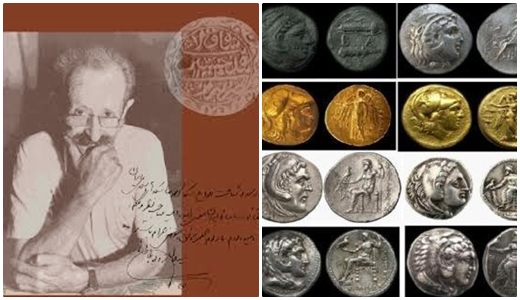
Seyyed Jamal Torabi Tabatabaei, who was born in 1925, has a bachelor’s degree in history and geography from Tehran University. Thanks to his efforts over the years which have resulted in the identification of coins dating back to Islamic and pre-Islamic eras in Iran, he has made a name for himself as a numismatist.

The following is the translation of some part of the comments he made in an interview with tebyan.net in late October:

When I was young, because of my great interest in history, I began to study coins and eventually found out that certificates of nearly 50 percent of those coins were not based on true information.

Given that Iranian coins are varied, numismatics is of great importance in this country and Iran stands first in this field in the region and around the world.

A majority of coins minted in Iran have been identified, more than 95 percent of them by me. I have collected over 3,500 coins from across Iran. Actually, I have mostly bought them from middlemen involved in illegal trade.

Coins dating to the Achaemenid Empire are the most ancient minted in Iran.

Coins dating back to the reign of Mohammad Ali Shah Qajar are the world’s rarest and most expensive because many of them were destroyed due to public resentment toward the king. A 5-rial or a 2-rial coin of that era is worth about $6,000.

The cheapest coins go back to the Eldiguzids era when a majority of coins were made of copper. The most beautiful coins belong to the Ilkhanate era when variety came first.

The largest coins were minted during the reign of Sultan Hossein, a Safavid king, reflecting the country’s booming economy.

I have donated most of the coins I collected to Azerbaijan Museum, but unfortunately a large number of those precious coins have been transferred to other museums across the country.