Monday, December 22, 2025
Home Blog Page 4687

Iranian trains won’t cross Turkey’s border unless security is guaranteed

1418884764573_34308

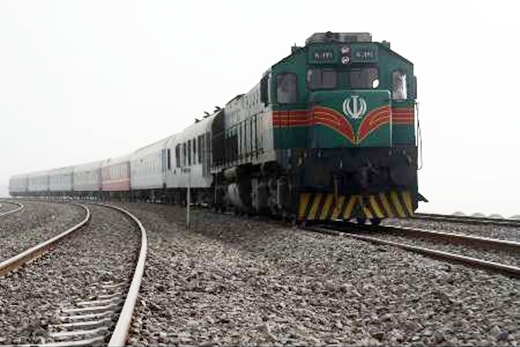
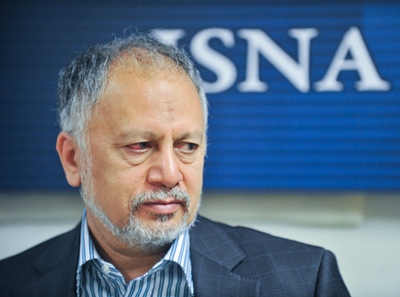
1420023048311_amin khosroshahi-8Iranian trains won’t leave for destinations across the border in Turkey as long as Turkish authorities do not provide official explanation about last week’s incidents and guarantee the security of Iranian trains, Managing Director of the Islamic Republic of Iran Railways Hassan Mousavinejad said Sunday.

The following is the translation of an excerpt of the report the Iranians Students’ News Agency filed on Mousavinejad’s comments on August 2:

In the first incident, an explosion hit a Turkish train carrying Iranian passengers and damaged the railroad and rendered it impassable, he said, adding: “Iran sent an empty train across the border to Turkey to evacuate the passengers. Although Turkish officials had verbally guaranteed the security of the second train, that one came under attack too.

“That means the security problems railroad travel is exposed to in Turkey are far from settled, thus the Islamic Republic of Iran Railways has decided to stop sending trains across the border unless it is assured there will be no security problems.”

He went on to say Turkish authorities have yet to issue an official report on these incidents.

No one has claimed responsibility for the terrorist attacks, but a Turkish news agency has reported that PKK has been behind the explosions.

A look at Iranian newspaper front pages on August 2

Iranian Newspapers Headlines

The comments of parliament speakers past and present (Akbar Nategh Nouri and Ali Larijani) in support of the nuclear deal and about upcoming parliamentary elections dominated the front pages of Iranian newspapers on Sunday.


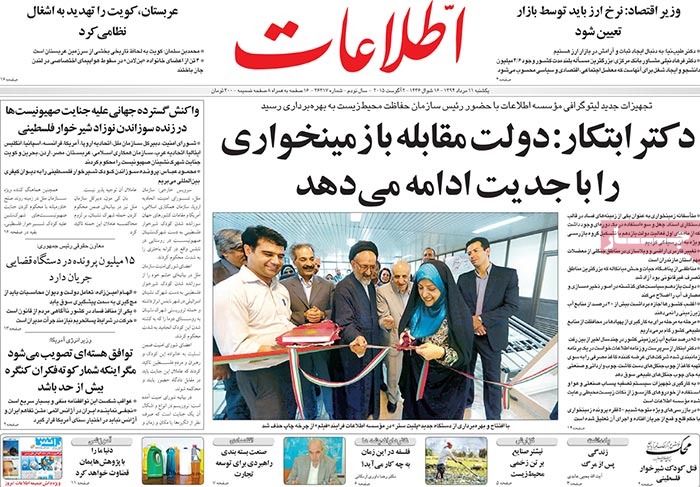
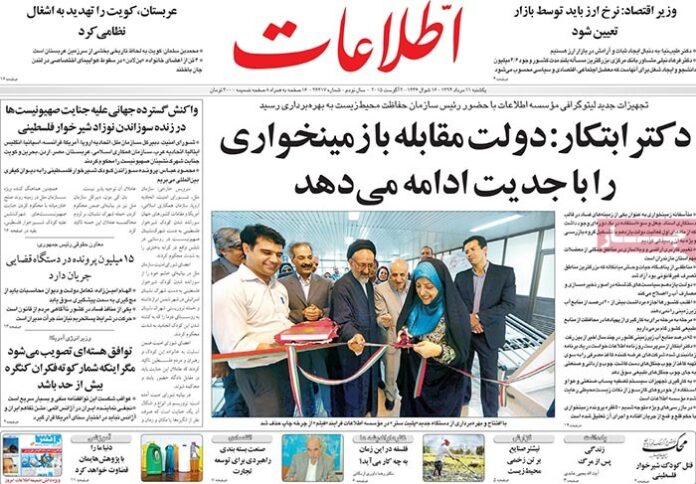
Ettela’at: “The government is determined to continue to fight land-grab,” Director of the Environment Protection Organization Masoumeh Ebtekar said.

The environment chief made the comment as she attended a ceremony at Ettela’at offices to inaugurate a new lithography service.


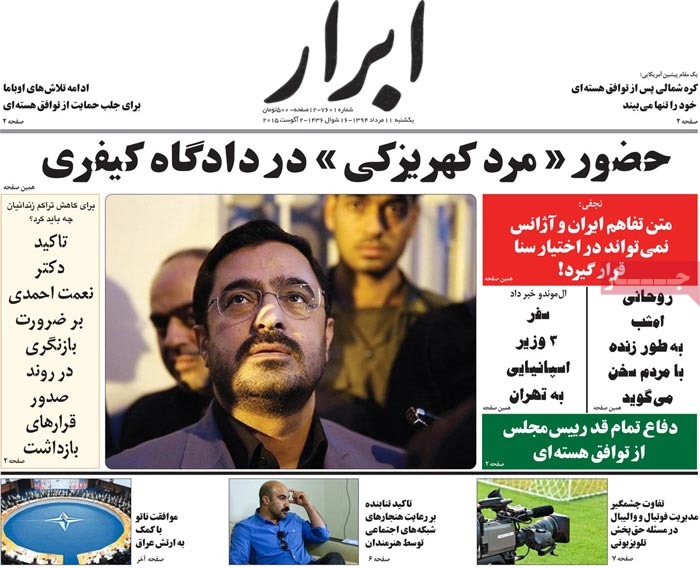
Abrar: “The US Senate cannot be given the text of the deal Iran and the UN nuclear watchdog have signed,” Iran’s ambassador to the International Atomic Energy Agency Reza Najafi said.

Abrar: President Rouhani will make a live televised speech Sunday evening.

Abrar: Three Spanish ministers will soon pay a visit to Iran.

Abrar: Parliament Speaker Ali Larijani has lent unflinching support to the nuclear deal Iran and P5+1 clinched in Vienna, Austria.
 

A look at Iranian newspaper front pages on August 2


Abrar-e Eghtesadi: The problem of unemployment has worsened under a government that views joblessness as the biggest local problem the country is facing.


A look at Iranian newspaper front pages on August 2


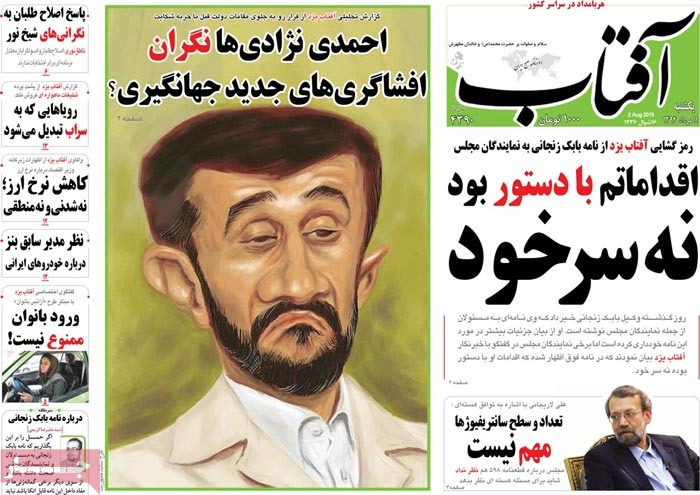
Aftab-e Yazd: Babak Zanjani [a young billionaire who stands accused of massive corruption when Ahmadinejad was in office] has said in a letter to MPs that he acted the way he did in line with orders, not on his own initiative.

Aftab-e Yazd: Are supporters of Ahmadinejad worried about new revelations by First Vice-President Eshagh Jahangiri?

The daily features an analysis on the preemptive complaint the previous government has filed [against the current government] to avoid accountability.
 

A look at Iranian newspaper front pages on August 2


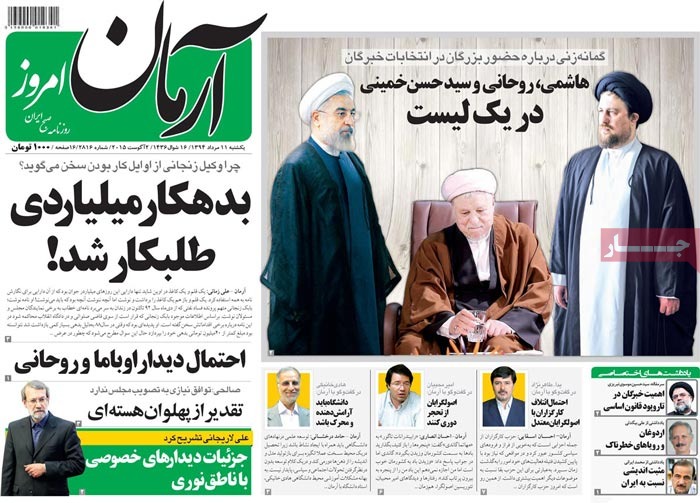
Arman-e Emrooz: There are speculations that Akbar Hashemi Rafsanjani, Hassan Rouhani and Seyyed Hassan Khomeini will run for the Assembly of Experts on the same ticket.
 

A look at Iranian newspaper front pages on August 2


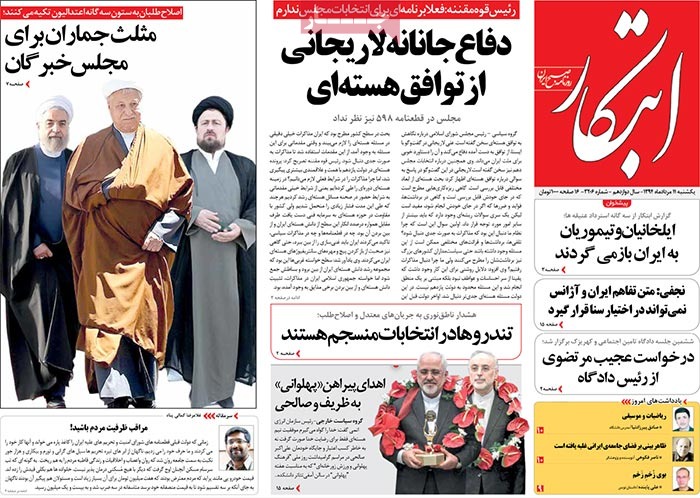
Ebtekar: Foreign Minister Mohammad Javad Zarif and nuclear chief Ali Akbar Salehi have been awarded the Heroes Jersey.
 

A look at Iranian newspaper front pages on August 2


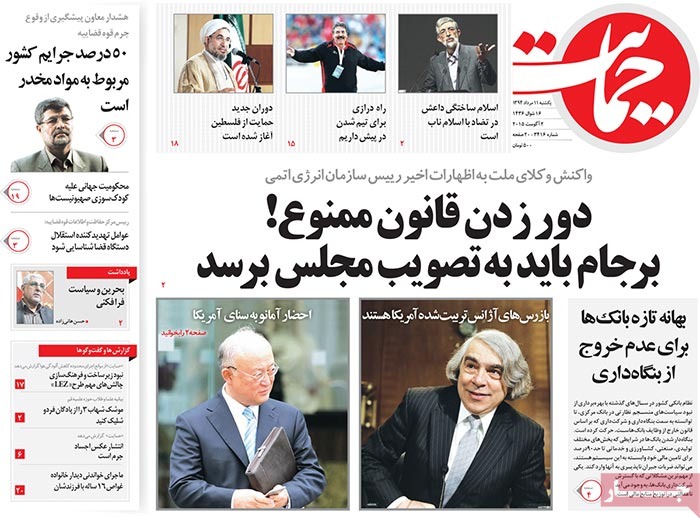
Hemayat: “Up to 50 percent of all offenses committed in the country are drug-related,” said the deputy judiciary chief for prevention.

Hemayat: MPs have reacted to the most recent comments of the director of the Atomic Energy Organization of Iran. “Don’t try to bypass the laws. The Joint Comprehensive Plan of Action should be voted on in parliament.”
 

A look at Iranian newspaper front pages on August 2


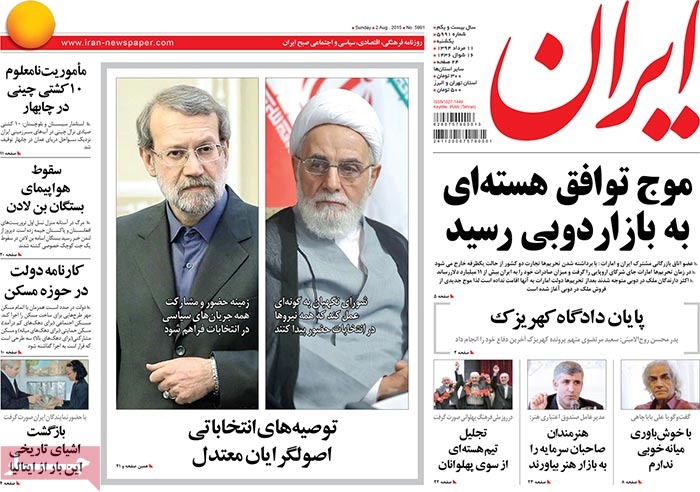
Iran: The trial of Saeed Mortazavi [a former Tehran prosecutor] in connection with the death of Mohsen Rouholamini in detention at Kahrizak has come to an end.

Iran: The electoral advice of moderate principlists:

Former Parliament Speaker Akbar Nategh Nouri: The Guardian Council should act in a way that makes the participation of all factions in the upcoming elections possible.

Current Parliament Speaker Ali Larijani: The stage should be set for all political factions to be part of the electoral process.
 

A look at Iranian newspaper front pages on August 2


Jomhouri Islami: Former Parliament Speaker Nategh Nouri has said that the Iranian nuclear negotiating team tactfully turned threats into opportunities.

Jomhouri Islami: The current parliament speaker has said that the nuclear deal should be looked at from a national angle and cherished as an achievement.
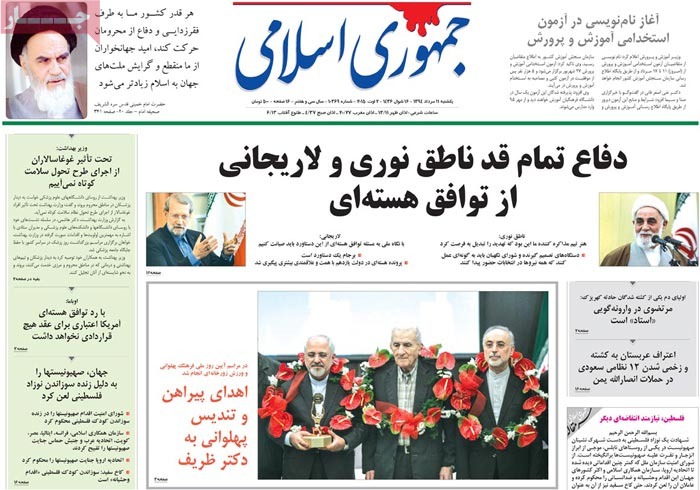
 

A look at Iranian newspaper front pages on August 2


Kayhan: The US Senate has summoned the arbiter of the deal [a reference to the director-general of the International Atomic Energy Agency]; Baharestan [Iran’s parliament] is still in recess.
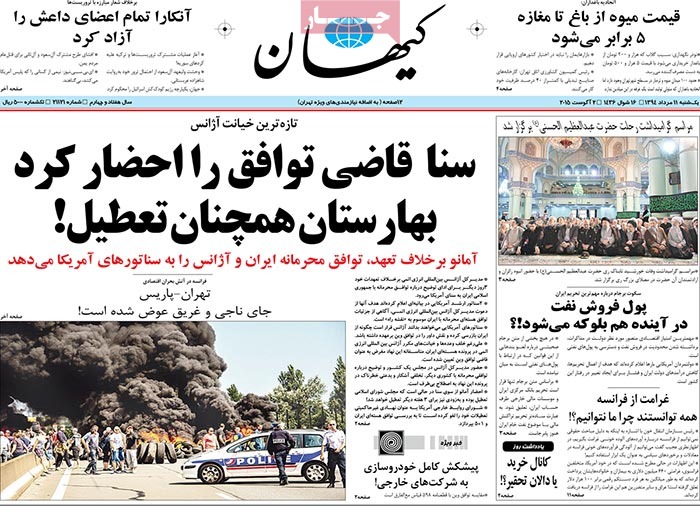
 

A look at Iranian newspaper front pages on August 2


Qods: A petition signed by 40 MPs calling for the impeachment of the oil minister will be presented to the Presiding Board of parliament next week.
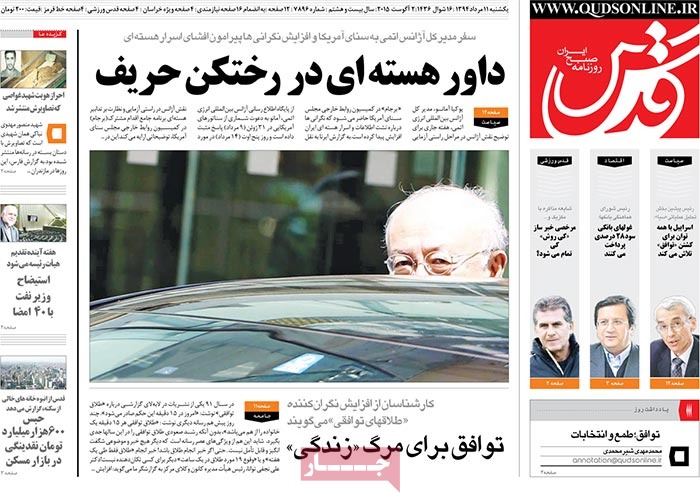
 

A look at Iranian newspaper front pages on August 2


Resalat: “Failure to uphold the national glory would carry a heavy political price tag,” said Tehran MP Ahmad Tavakoli.
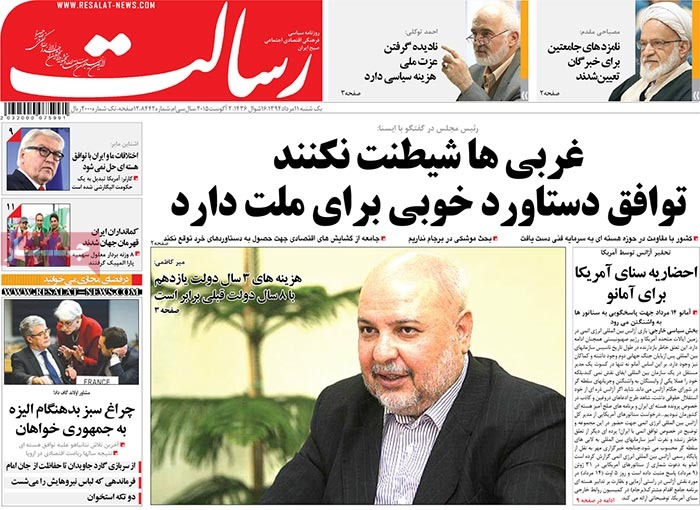
 

A look at Iranian newspaper front pages on August 2


Shahrvand: “The establishment made the right choice in the nuclear case,” said the parliament speaker.
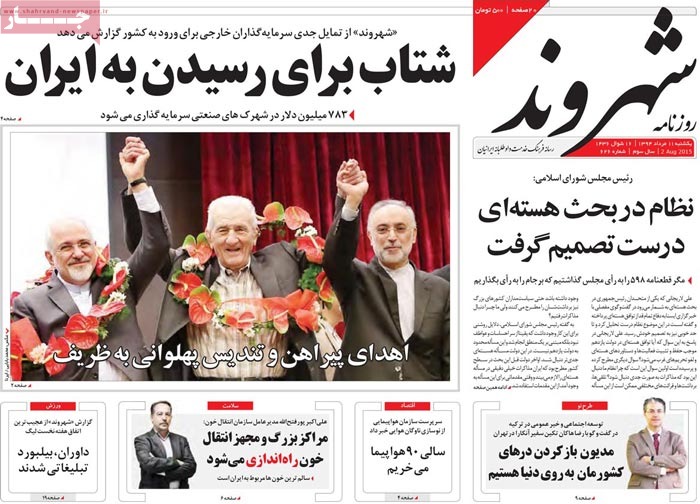
 

A look at Iranian newspaper front pages on August 2


Sharq: The president has sent a message of congratulations to the Iranian team after it won the title in the World Archery Championships.
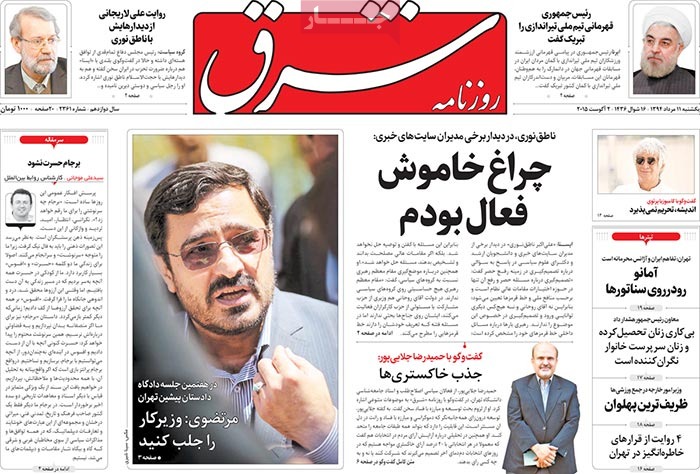
 

A look at Iranian newspaper front pages on August 2


Taadol: Free trade zones are hosting a first wave of investors [following the July 14 deal between Iran and P5+1].
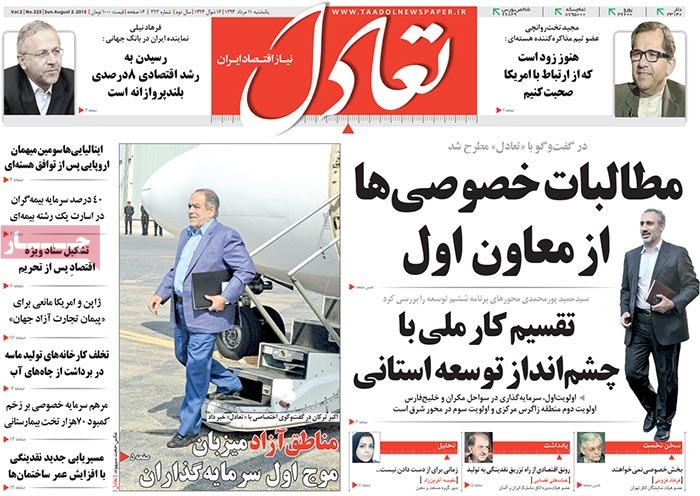

 

A look at Iranian newspaper front pages on August 2


Highlights of Ettela’at newspaper on August 2

Ettelaat-August 2

 “The government is determined to continue to fight land-grab,” Director of the Environment Protection Organization Masoumeh Ebtekar said.

The environment chief made the comment as she attended a ceremony at Ettela’at offices to inaugurate a new lithography service.

 “Market factors should determine the price of foreign currencies,” said the minister of economy and financial affairs.

Dr. Tayyebnia further said that government seeks to inject a sense of calm and stability into the forex market.

 Saudi Arabia has threatened to take over Kuwait militarily.

The new Saudi King has said that historically Kuwait has been part of the Saudi territory.

 The world has reacted sternly to the Israeli crime of burning a Palestinian toddler to death.

The Palestinian Authority president has threatened to take the case involving the burning alive of the Palestinian child to the International Criminal Court.

 “The Judiciary is looking into 15 million legal cases,” said the vice-president for legal affairs.

Elham Aminzadeh further said that interaction between the executive branch and the Supreme Audit Court should focus on prevention rather than catching offenders in the act.

 “I remain confident that this agreement [a reference to the Vienna accord] will go into effect, unless there are too many closed minds,” the US energy secretary said.

Earnest Moniz also said that the consequences of failure to implement the nuclear deal would be vast.

Judiciary, Welfare Org. to work together to reduce social harms

Persian carpet exports to rise drastically in 2016

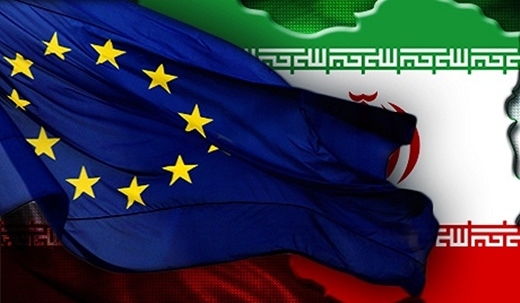
This time around Europeans won’t oblige US neocons at the expense of their interests

Iran-Europe

The Ukraine crisis and [Russia’s annexation of] Crimea plus the financial crisis in Greece and the economic burden this EU member has placed on the shoulders of Eurozone have all played a part in motivating European members of P5+1 to clinch an agreement with Iran over its nuclear program.

Europe also needs Iran’s cooperation to work out a resolution to the crisis in the Middle East. By and large, Europe’s shift [toward Iran] is a wise decision at a historic crossroads, and the obstacles the US neocons, Israel and Saudi Arabia throw in the way to reverse Europe’s new decision [shift toward Iran] will not work, according to a history researcher and expert in European affairs.

Khabaronline.ir on July 30 published an interview with Majid Tafreshi as to why the Europeans have turned to Iran immediately after the conclusion of the historic Iran nuclear deal. The following is the translation of part of the expert’s answers:


Europe and Iran and the economy

“What transpired in Ukraine and Crimea has made the European Union worried about its overdependence on Russia’s oil and gas. Iran can be a safe, strategic replacement or a parallel alternative to Russia in supplying household and industrial gas to Europe and in letting oil and gas pipelines through its territory.

“Of course, Iran is not seeking to take the place of Russia, nor does Europe want to totally remove Russia from its market; however, neither side doubt the growing strategic importance of Iran’s involvement in this regard.

“For Greece, interaction with non-eurozone countries, especially Iran, is one way to get out of the economic crisis. Greece – especially its current government – has taken no negative policy on and shown no negative feeling about Iran. Interaction with Iran can serve the interests of the two sides and can also help the two weather the economic crisis. Compared with other countries, Iran and Greece have more historical and civilizational common ground thanks to their long history”.

It is wisdom, not love or hate

Tafreshi also takes a look at political and social crises in the Middle East – which seem likely to spill over into the European countries – as another factor that contributes to a change of heart in the West toward Iran and says, “Europe has truly come to the conclusion that it can do nothing serious on several fronts without Iran’s cooperation, whether it loves Iran or there is no love lost between them. The fight against regional and international terrorism; the war on cultivation and smuggling of narcotics to Europe; peace and détente in Syria, Lebanon and elsewhere in the Middle East; peace and stability in Central Asia; and efforts to secure, develop and transfer energy in the Persian Gulf are a few examples of the areas Europe can achieve nothing with Iran not cooperating”.

The Iranian researcher described the Vienna accord as an inevitable option for European countries and a wise shift in their Iran policies and says, “That’s why alarms have been sounded in European countries warning that if the US Congress throws a wrench into the works and tries to take Iran back to three years ago or even before that, the European Union will not follow in the footsteps of the American neocons this time around and will not – in this special case – support the wishes and demands of the US neocons at the expense of its own interests”.


A 400-million-strong market with unique investment opportunities

As for Iran’s market, Tafreshi refers to research by foreign sources and says, “Reports produced by research centers in the West describe Iran as a 400-million-strong, not 80-million, market (taking into account Iran’s potential to turn into a regional economic hub in Central Asia, the Persian Gulf and other surrounding areas).

“In response to reservations about cooperation with Iran, which is grappling with serious economic and financial problems, some experts have said that although Iran is facing a liquidity crisis in the short term, it is one of the few countries in the world with almost no foreign debts despite its economic woes. This lends credibility to Iran to enter into partnership with the EU from a position of strength.

“Iran has the second-largest [proven] natural gas reserves in the world. Its gas reserves have mainly remained intact with enormous potential to be fulfilled. On the other hand, Iran has a stable security and political situation within and along its borders; it has a geopolitical and geostrategic position [in the region], so long-term interaction with Iran is a serious question for Europe which also seeks to import energy – either from Iran or from neighboring oil-rich countries – to the [green] continent”.


Futile attempts by Israel and Saudi Arabia

“In addition to undeniable economic and commercial aspects, the historic Vienna agreement has opened a new chapter on strategic, security and political fronts between Iran and the West. The United States and Europe together with China and Russia inked the agreement admitting that in spite of what has been done over the past three decades to isolate, undermine or bypass Iran, the geopolitical and geostrategic importance of Iran – a big, effective and safe country – in the region and all over the world cannot be denied. They have also acknowledged that efforts to settle many regional disputes will be a nonstarter without Iran’s participation and assistance.

This [Europe’s shift toward Iran] ran counter to efforts by Israel on the one hand and Saudi Arabia and its allies on the other, but the six world powers were reminded of the indisputable position of Iran through a slap across the face [they were given because of events over time] and the lesson they learned from their experiences”.

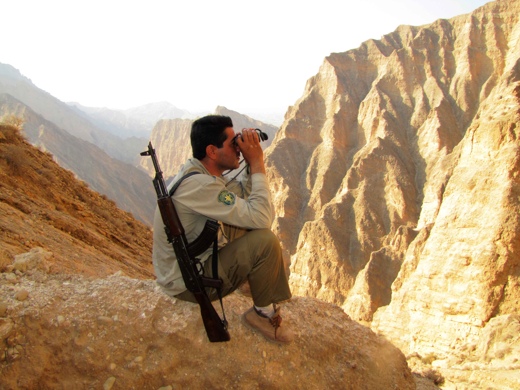
Ranger sets two conditions for forgiving his assailant

Ranger

A park ranger in West Azerbaijan Province forgave an illegal fisherman who had attacked him after the latter agreed to meet his two conditions.

The following is the translation of an excerpt of a report Setareh Sobh published on July 29 about the incident:

Karim Khezri, the head of the Environment Department in Sardasht, a city in West Azerbaijan, said, “Azad Ghaderi, a park ranger, was attacked a few months ago by illegal fishermen who had been trying to catch fish in the Zab River in Mirabad Protected Area.

Fearing arrest and confiscation of their electricity generator after being caught in the act, the fishermen started pelting the ranger with rocks which caused Ghaderi to pick up severe injuries in his leg.”

Khezri added that after a complaint was filed, judicial investigation into the case revealed that the poacher was a repeat offender who had been caught twice already for breaking environmental rules.

After the legal proceedings, the court sentenced him to two years in jail and fined him over $600.

The environment chief went on to say, “After the offender showed remorse, the good-natured park ranger said that he was ready to forgive his attacker if he promised to give up illegal fishing forever and become an environmentalist. The convict was forgiven after he agreed to fulfill those two conditions.”

Iran ready for energy cooperation with Armenia: Veep

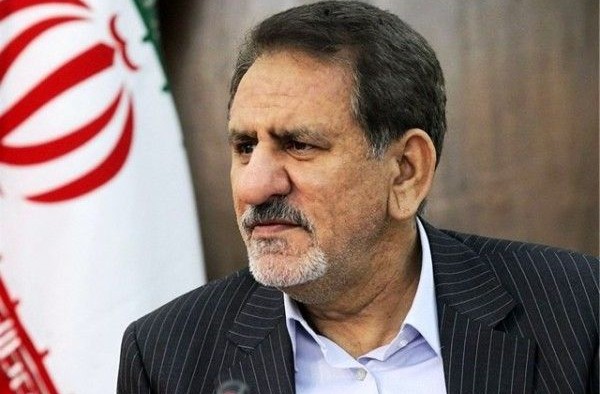
vice- president , eshagh jahangiri

First Vice President Eshagh Jahangiri in a telephone conversation with Armenian premier said that Iran is ready to expand its cooperation with Armenia in different fields.

According to a Presidential Office report, Eshagh Jahangiri in a telephone contact with Armenian Prime Minister Hovik Abrahamyan on Saturday discussed collaborations in energy, generation and transfer of electricity, goods and passenger transit.

Jahangiri also wished success and prosperity for the Armenian people and government.

He underlined the necessity for the expansion of ties between the two countries and added that by developing relations and expansion of cooperation an effective step will be taken in the direction of national interests for both countries.

Abrahamyan renewed his invitation to Jahangiri to visit Armenia and expressed pleasure for the removal of a number of obstacles blocking bilateral cooperation in the sector of energy and gas transfer, calling for upgrading cooperation.

The Armenian prime minister also wished success and honor for the Iranian government and nation and expressed his country’s readiness for trilateral cooperation between Iran, Armenia and Georgia in the field of transit.

World Archery Championships: Iran compound team wins title

139405101717084725794524

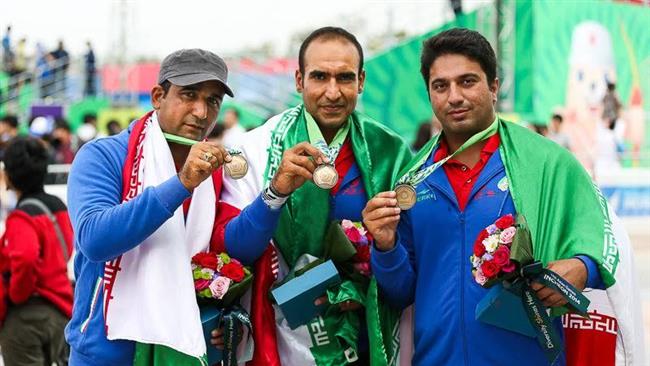
Iranian compound men’s team defeated Canada to win gold medal in the Copenhagen 2015 World Archery Championships on Saturday.

Iran’s trio – Esmaeil Ebadi, Amir Kazempour and Majid Gheidi – won their first two matches against Venezuela and Colombia by one point, 228-227.

In the semis, the trio beat Italy by two, 226-224.

Drawn at 226, the final match went to a tiebreaker.

In the shoot-off, Canada started with a nine, then Esmaeil Ebadi had a 10 for Iran – and those first arrows set the tone, worldarchery.org reported.

While the Canadians would follow with 10-10, neither Amir Kazempour nor Majid Gheidi – Ebadi’s Iranian teammates – would miss the middle either.

Ebadi, Kazempour and Gheidi won the tiebreaker with a perfect 30 points, for just the second time in the match, to Canada’s 29 – and won Iran’s first ever world title.

The World Archery Championships 2015 was the biggest championship in history. More than 600 archers from 96 nations were competing for glory in Copenhagen.


5fc866cf-ec29-467d-9a04-a8941c6200a6

Iran says piping gas to EU not economical

63060276-cc27-4333-8b30-47ea0c0aa464

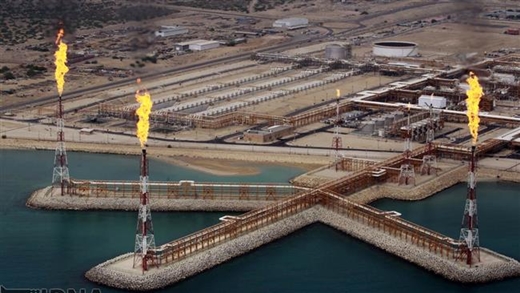
The recent breakthrough in Vienna by Iran and P5+1 over the country’s nuclear energy program triggered hopes that many of Iran’s energy projects that had been suspended due to sanctions could be revived. One such project is to pipe Iran’s natural gas to Europe. However, Iranian officials are now voicing skepticism over whether this is today any more feasible given the various complications involved.

Alireza Kameli, the managing director of the National Iranian Gas Export Company (NIGEC), has been quoted as saying by Iran’s domestic media that piping natural gas to Europe is not economically justifiable under the present conditions.

Kameli has emphasized that neighboring states as well as Asian markets are today the prime target of Iran’s gas export plans.

Exporting gas to nearby countries, the official said, is much more cost-effective than taking it to Europe through a pipeline several thousand kilometers in length.

“Besides, taking the pipeline through the territory of each host country will require paying transit fees. That comes on top of other technicalities involved,” Kameli has been quoted as saying by the Persian-language newspaper Afarinesh. “These will eventually reduce Iran’s profits from the whole scheme.”

Iran had for years pursued plans to export natural gas to Europe. A tentative scheme that was developed in cooperation with Nabucco – a consortium led by Austria’s OMV – envisaged piping Iranian natural gas from the southern energy hub of Assaluyeh to Turkey and thereon to Europe.  However, Nabucco eventually abandoned Iran in 2008 after the emergence of complications such as US-engineered sanctions against the Iranian energy sector.

A parallel plan to export Iranian gas to Europe – again through Turkey – has been pursued by Switzerland’s EGL, also known as Elektrizitaetsgesellschaft Laufenburg.

Based on the EGL scheme, the Iranian natural gas would be taken to Greece and Albania through Turkey. From there it would flow to Italy through a pipeline under the Adriatic Sea before reaching Switzerland. This scheme had a fate similar to that of Nabucco.

Different parties involved in both projects have recently tried to revive them, specifically in light of Vienna developments.

Even though doubts have been lately emerging over the feasibility of piping Iranian gas to Europe, officials in Tehran have not openly announced that it will be totally off the agenda.

Analysts believe that Iran will continue to view Europe as a potential gas market but at the same time will wait for more modern supply mechanisms to reduce costs and increase profit margins.

An example of such mechanism could include turning natural gas into LNG and shipping it overseas. Iran’s access to the related technology for liquefying natural gas is banned under the current sanctions regime and many are already hoping that the breakthrough in nuclear talks with P5+1 would lead to the lifting of sanctions on LNG technology to open the way for Iran’s ambitious gas export plans.

Iran warns IAEA against leakage of confidential data to US Senate

4784f7a8-0cce-4709-b211-dae0ae6e36b2

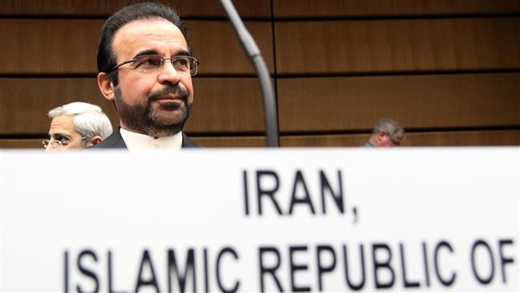
Iran has warned the International Atomic Energy Agency (IAEA) of the repercussions of disclosing to the US Senate the confidential data on the recently signed roadmap between Tehran and the UN nuclear agency.

Reza Najafi, the Iranian ambassador to the IAEA, told IRNA on Saturday that the confidential texts between Iran and the IAEA have not even been provided to the US government and can certainly not be given to the Senate either.

“Definitely, the agreements between a country and the [UN] agency, which are classified, can by no means be presented to any other country,” Najafi said.

IAEA Director General Yukiya Amano is set to travel to Washington next week to meet with members of the US Senate Committee on Foreign Relations to speak about the agency’s role in verifying and monitoring nuclear-related measures in Iran.

On July 14, Iran and the IAEA signed a roadmap in the Austrian city of Vienna for “the clarification of past and present issues” regarding Iran’s nuclear program.

After signing the agreement, Amano said the roadmap “sets out a clear sequence of activities over the coming months, including the provision by Iran of explanations regarding outstanding issues.”

He added that the roadmap enables the IAEA to “issue a report setting out the agency’s final assessment of possible military dimensions to Iran’s nuclear program, for the action of the IAEA Board of Governors, by 15 December 2015.”

The signing of the agreement came on the same day that Iran and P5+1– the United States, Britain, France, China and Russia plus Germany – finalized the text of an agreement, dubbed the Joint Comprehensive Plan of Action (JCPOA), in Vienna.

Under JCPOA, limits are put on Iran’s nuclear activities in exchange for a set of commitments by P5+1, including the removal of all economic and financial sanctions against the Islamic Republic.

Some members of the US Congress have asked that more information be made public on the IAEA’s role in verifying Iran’s implementation of the agreement.

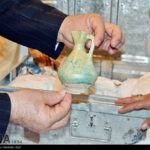
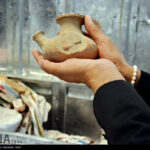
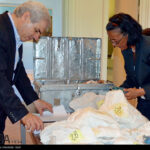
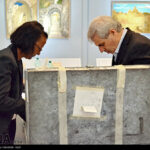
Iran secures return of stolen artifacts from Italy (PHOTOS)

stolen artifacts 0

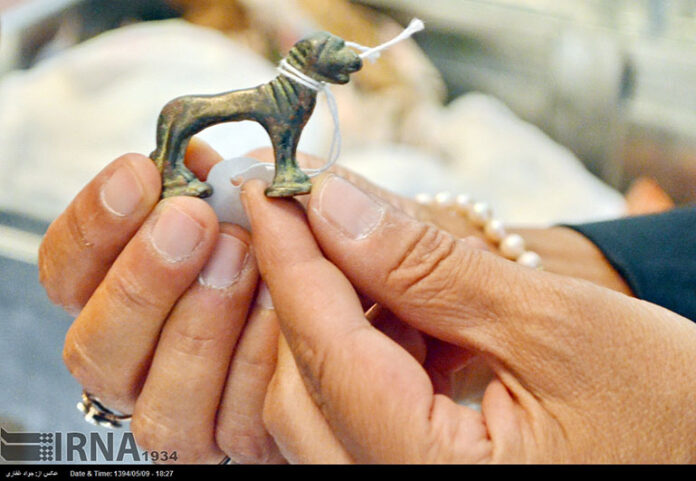
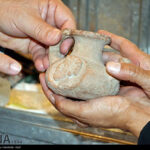
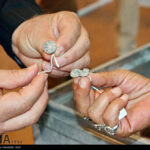
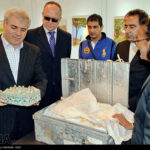
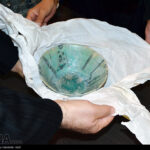
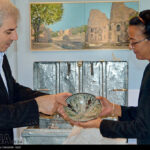
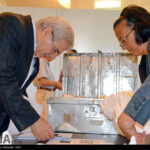
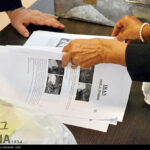
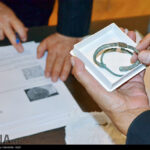
An appeals court in Italy has ordered the return of 30 artifacts smuggled out of Iran over the past decade.

The following are the images IRNA has released of the items Italy has returned to the country: