Monday, December 22, 2025
Home Blog Page 4688

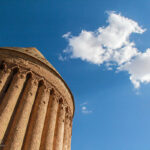
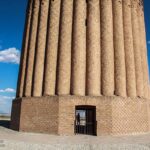
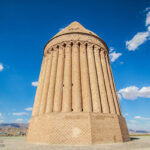
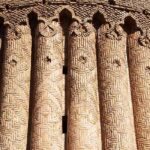
Radkan Tower (PHOTOS)

Radkan Tower11

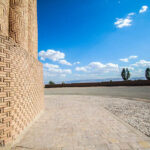
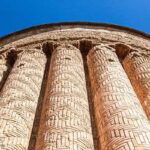
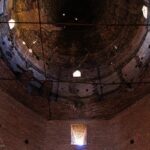
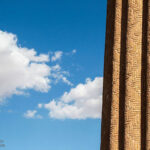
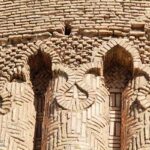
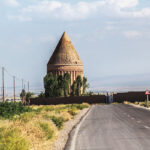
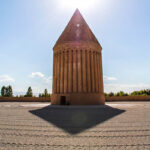
Radkan Tower, in northeastern Iran, was a structure which helped residents determine the beginning of the four seasons, leap years and Nowruz.

The structure seems to have been completed in 1261 AD.

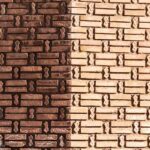
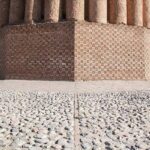
The following are images of the tower released online by Mehr News Agency:

A look at Iranian newspaper front pages on August 1

Iranian Newspapers Headlines

President Hassan Rouhani’s call for measures to seize the opportunities that arise in the post-sanctions era; Foreign Minister Zarif’s appeal for creation of a nuclear-free world in an opinion piece in The Guardian; and comments by the director of the Atomic Energy Organization that the Vienna accord does not need the approval of the Islamic Consultative Assembly dominated the front pages of Iranian newspapers on Saturday. The tragic burning alive of a Palestinian child at the hands of Israeli settlers also appeared on the covers of dailies.


Ettela’at: Foreign Minister Mohammad Javad Zarif has said that it is now time to review the threat posed by the nuclear arsenal of the Zionist regime.

In an opinion piece in The Guardian, the Iranian top diplomat wrote, “The nuclear deal reached in Vienna this month [July] is not a ceiling but a solid foundation on which we must build.”


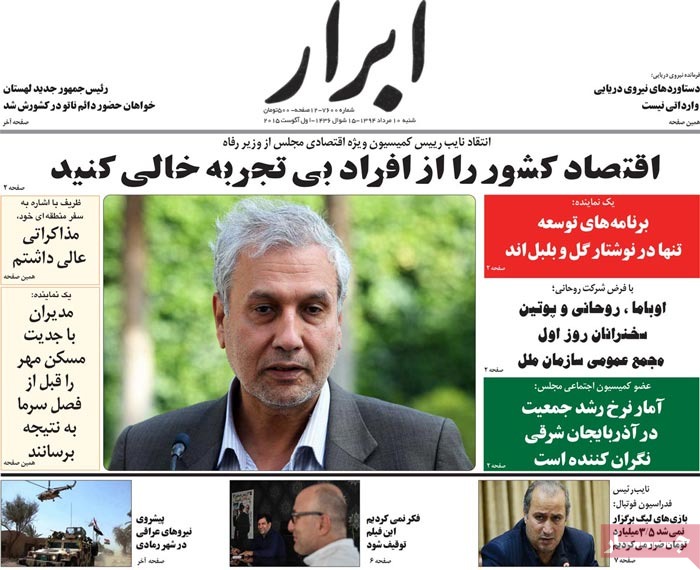
Abrar: The deputy chairman of parliament’s Economic Committee has urged the welfare minister to “rid the country’s economy of inexperienced individuals”.
 

A look at Iranian newspaper front pages on August 1


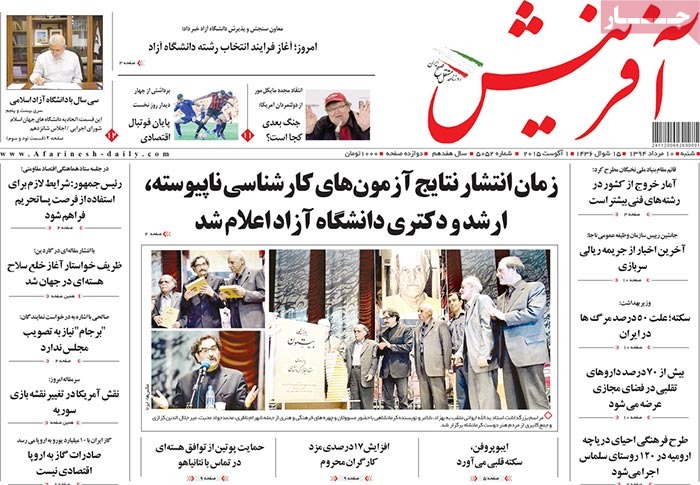
Afarinesh: The health minister has said that heart attacks are to blame for 50 percent of deaths in Iran.
 

A look at Iranian newspaper front pages on August 1


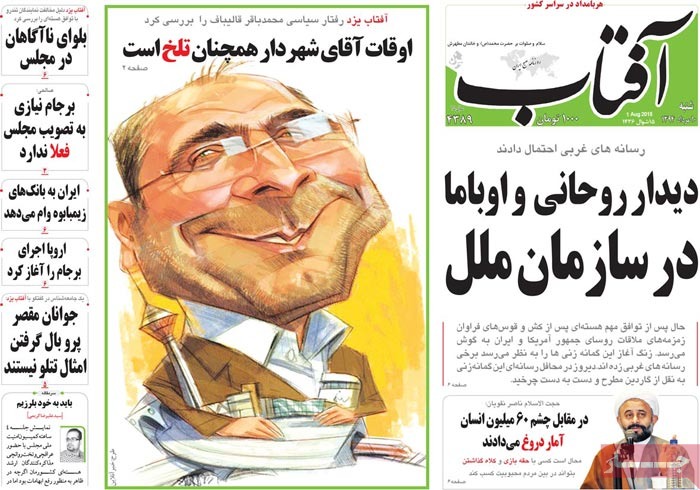
Aftab-e Yazd: Western media speculate that Presidents Rouhani and Obama are likely to meet on the sidelines of the UN General Assembly in New York.

Aftab-e Yazd: Tehran Mayor Mohammad Bagher Ghalibaf still feels bitter.

The daily takes a look at the political behavior of the mayor of the capital.
 

A look at Iranian newspaper front pages on August 1


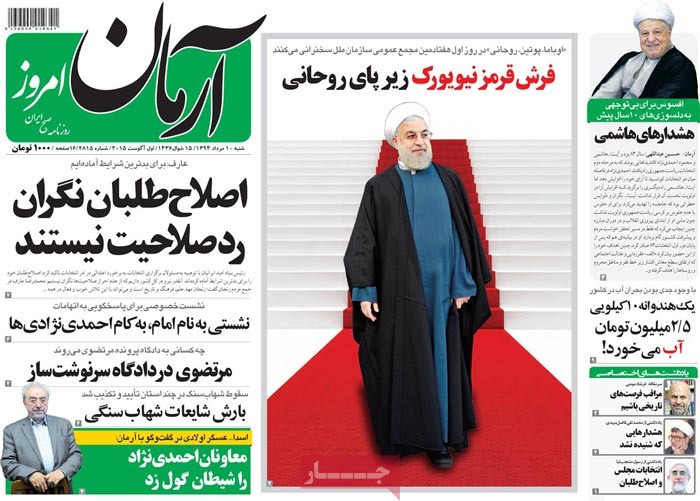
Arman-e Emrooz: “Reformists are not worried about being barred from running for parliament,” Mohammad Reza Aref, a reformist leader and former first vice-president said.

Arman-e Emrooz: Reports that meteorites have hit a couple of Iranian provinces have been both confirmed and denied.

Arman-e Emrooz: New York is to roll out the red carpet for Rouhani.

Presidents Rouhani and Obama will deliver speeches on the first day of the 70th General Assembly of the United Nations.
 

A look at Iranian newspaper front pages on August 1


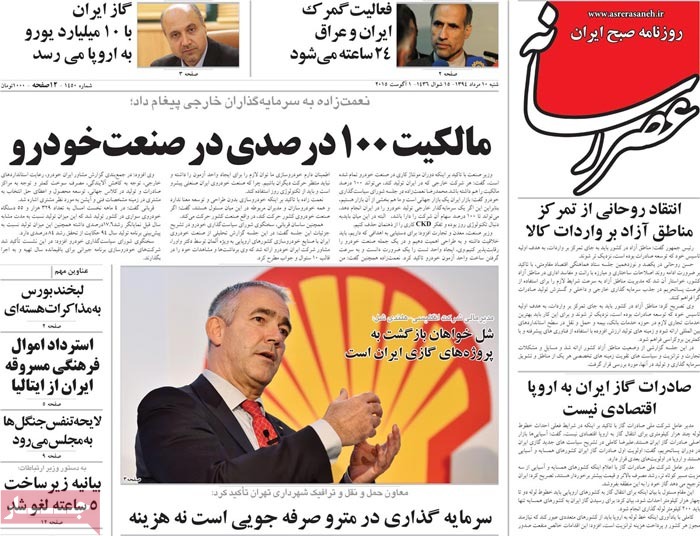
Asr-e Rasaneh: The project to take Iranian natural gas to Europe carries a staggering 10 billion euro price tag.
 

A look at Iranian newspaper front pages on August 1


Asrar: Royal Dutch Shell has expressed interest in returning to Iran’s gas projects.

Asrar: “Some 47,000 female employees have been dismissed after taking maternity leave,” the deputy director of the Social Security Organization said.

Asrar: In light of the fact that the problems the Guardian Council has found with the motion to hold elections on a provincial scale cannot be fixed, the plan will be shelved.


A look at Iranian newspaper front pages on August 1


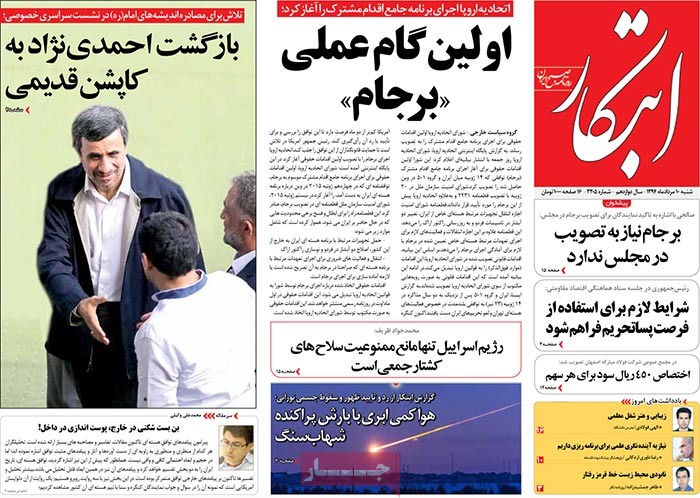
Ebtekar: The first practical measure in line with the Vienna accord

The European Union has started implementing the Joint Comprehensive Plan of Action (JCPOA).

Ebtekar: “The Joint Comprehensive Plan of Action (JCPOA) does not need to be approved in parliament,” the director of the Atomic Energy Organization of Iran said.
 

A look at Iranian newspaper front pages on August 1


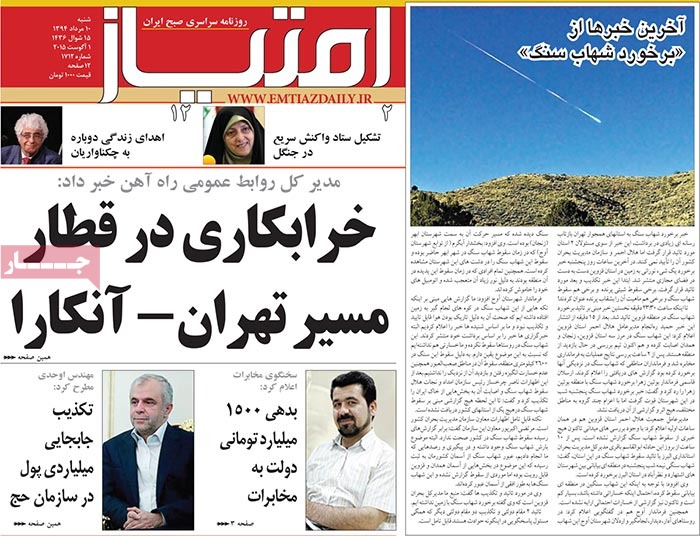
Emtiaz: Sabotage in the train en route from Tehran to Ankara
 

A look at Iranian newspaper front pages on August 1


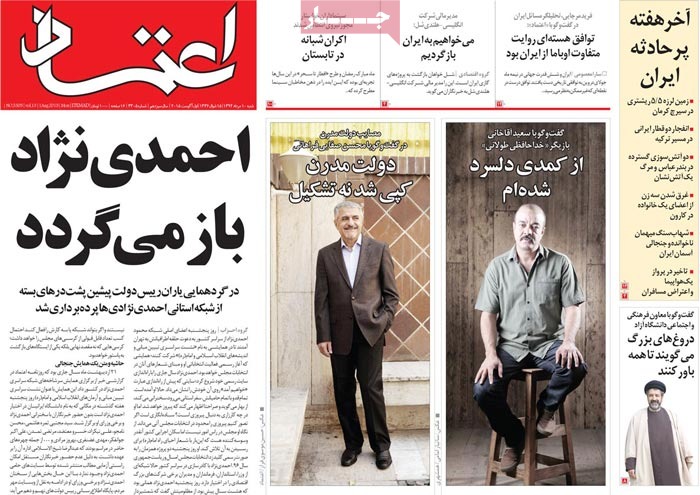
Etemad: A weekend rife with accidents

There were explosions on board two Iranian trains en route to Turkey; two massive fires erupted in Bandar Abbas and a firefighter died as he was trying to contain the flames; three members of a single family drowned in the Karoon River.

An earthquake measuring 5.5 on the Richter scale hit Kerman; the delay in the takeoff of a plane sparked passenger protest; and a meteorite was the unwelcome, controversial guest of the Iranian sky.
 

A look at Iranian newspaper front pages on August 1


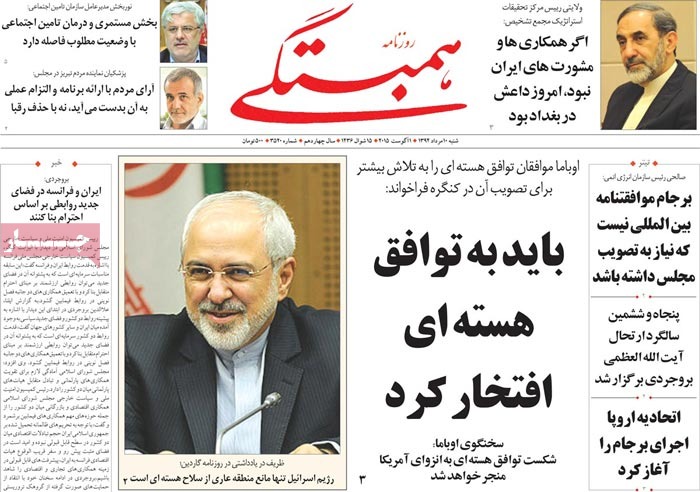
Hambastegi: “Had it not been for Iran’s cooperation and consultation, IS would have been in Baghdad today,” said Ali Akbar Velayati, the director of the Center for Strategic Studies affiliated to the Expediency Council.
 

A look at Iranian newspaper front pages on August 1


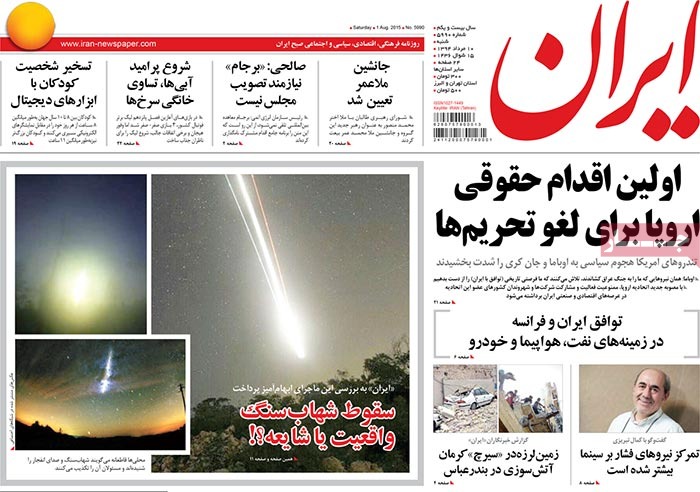
Iran: Iran and France have reached an agreement that covers the oil, aircraft and automobile sectors.
 

A look at Iranian newspaper front pages on August 1


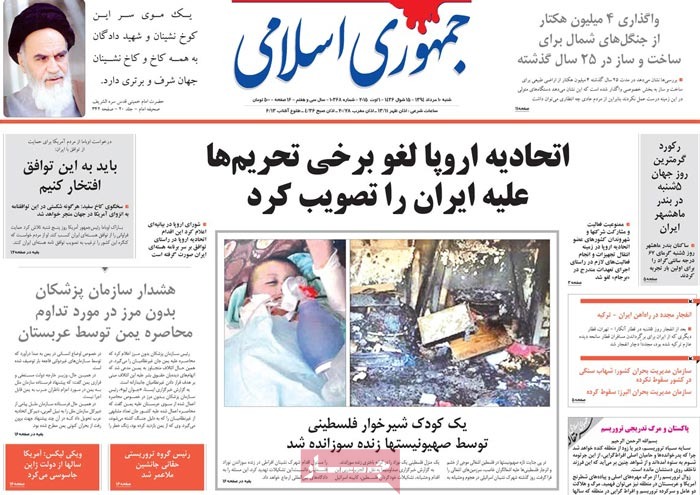
Jomhouri Islami: Mahshahr has experienced the hottest day in the world ever registered.

Temperatures surged to 62° Celsius in the southern Iranian city on Thursday.
 

A look at Iranian newspaper front pages on August 1


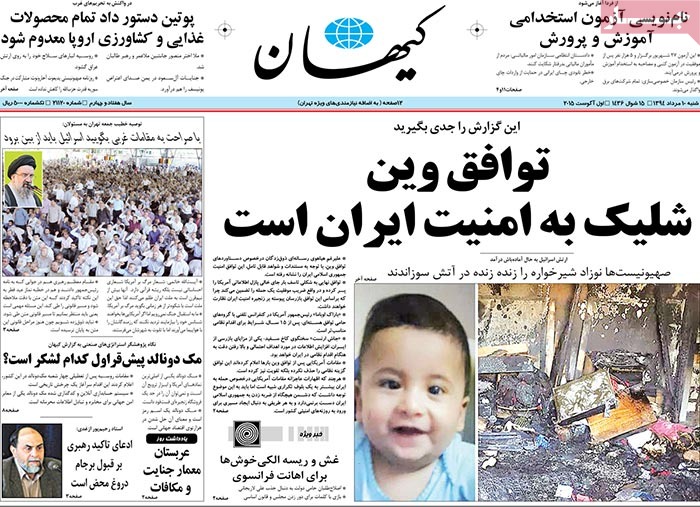
Kayhan: The Vienna accord amounts to a blow to Iran’s security; take this report seriously.
 

A look at Iranian newspaper front pages on August 1


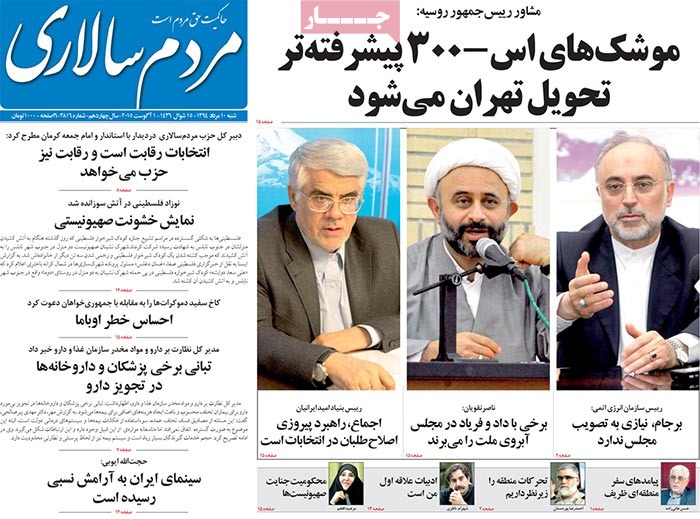
Mardomsalari: The Iranian Foreign Ministry has condemned the Israeli crimes [the burning of a Palestinian child alive].
 

A look at Iranian newspaper front pages on August 1


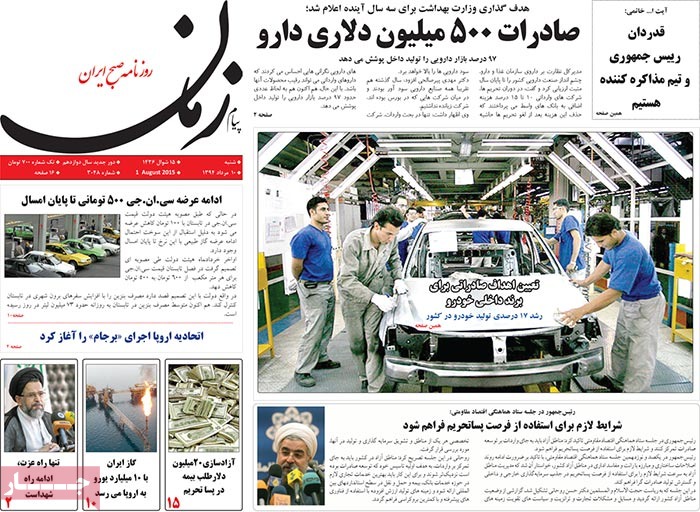
Payam-e Zaman: Tehran’s Friday prayer leader has said that the Iranians appreciate the efforts of the president and the negotiating team.
 

A look at Iranian newspaper front pages on August 1


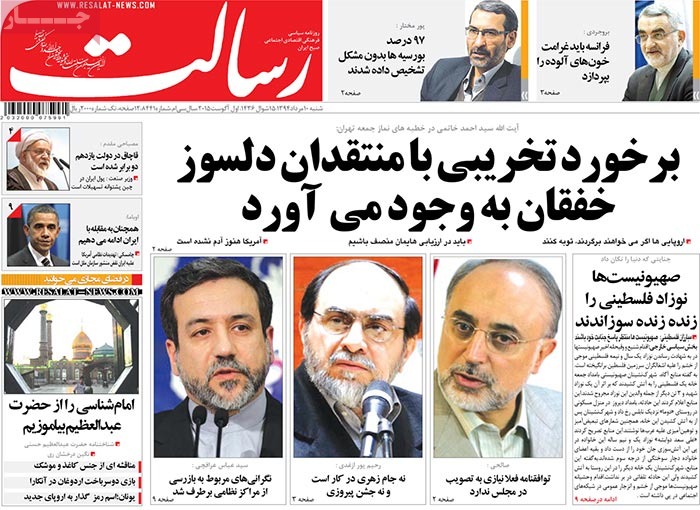
Resalat: “France should pay compensation for the tainted blood it exported to Iran in the 80s,” said the chairman of parliament’s National Security and Foreign Policy Committee.

Resalat: “Concerns about inspections of military sites have been removed,” said Deputy Foreign Minister Abbas Araghchi.
 

A look at Iranian newspaper front pages on August 1


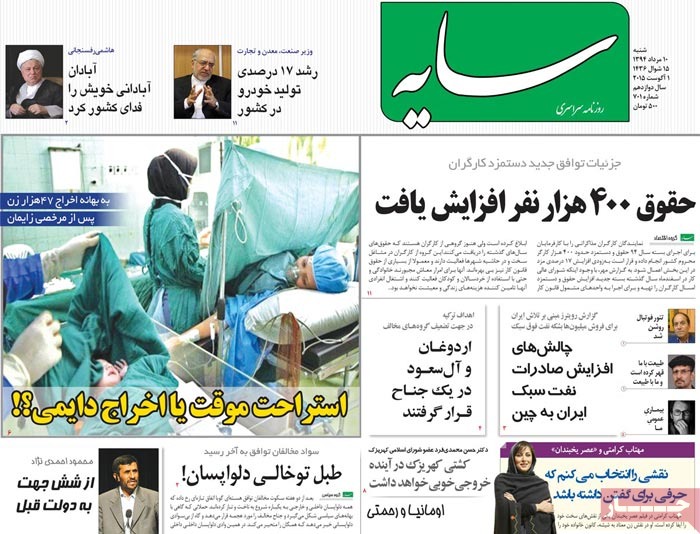
Sayeh: “Automotive production in Iran has registered a 17 percent hike,” said the minister of industries, mines and trade.
 

A look at Iranian newspaper front pages on August 1


Setareh Sobh: Ahmadinejad has launched an electoral campaign.
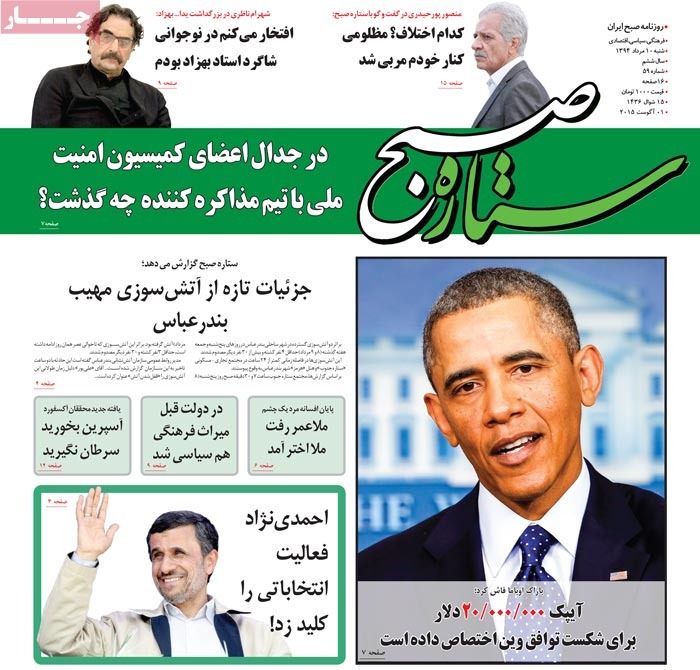
 

A look at Iranian newspaper front pages on August 1


Sharq: Supporters of Ahmadinejad have been ordered to launch a blitz against the government on the diplomacy front.
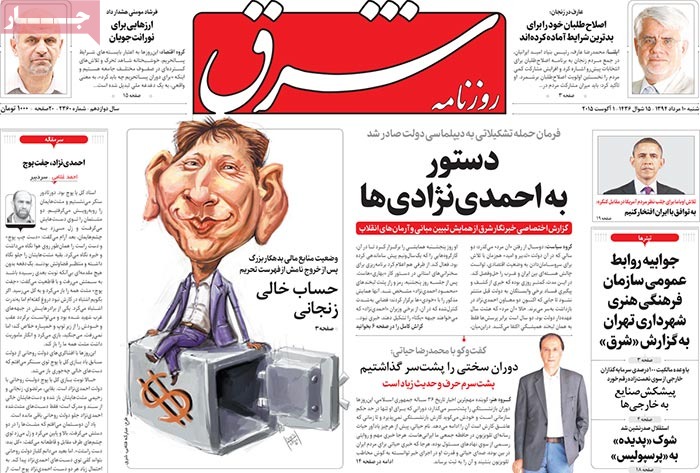

 

A look at Iranian newspaper front pages on August 1


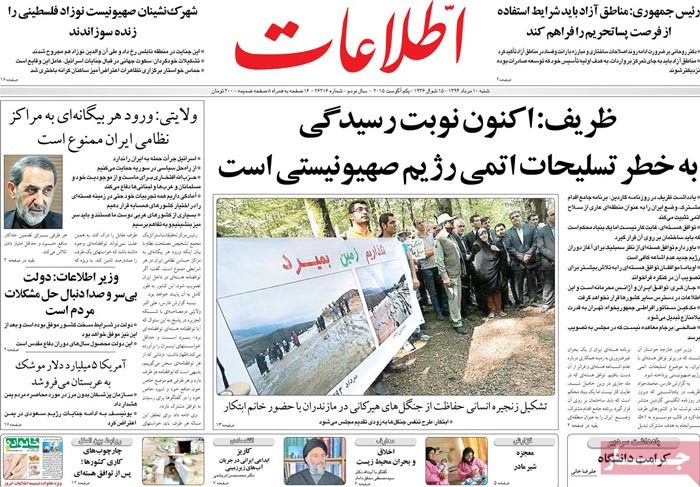
Highlights of Ettela’at newspaper on August 1

Ettelaat-August 1

 Foreign Minister Mohammad Javad Zarif has said that it is now time to review the threat posed by the nuclear arsenal of the Zionist regime.

In an opinion piece in The Guardian, the Iranian top diplomat wrote, “The nuclear deal reached in Vienna this month [July] is not a ceiling but a solid foundation on which we must build.”

 The president has called on the body that runs the free trade zones to set the stage for the opportunities that arise in the post-sanctions era to be seized.

President Rouhani has stressed the need for continued efforts to introduce structural reforms and fight corruption in free zones.

 Zionist settlers have burned a Palestinian child alive.

The Palestinian Authority has blamed the crime on the silence of the international community in the face of Israeli measures.

 “Foreigners are not allowed to enter Iran’s military sites,” said Ali Akbar Velayati, an advisor to the Supreme Leader.

The former foreign minister further said that Israel does not dare attack Iran and that Tehran supports a political solution to the crisis in Syria.

 Activists have formed a human chain in Hyrcania in Mazandaran Province to protect forestland.

Director of the Environment Protection Organization Masoumeh Ebtekar was on hand.

 The intelligence minister has said that government is quietly trying to settle the problems of the public.

“This government has been successful in tough times; it will remain successful from this point forward,” Mahmoud Alavi said.

 The US is to sell $5 billion worth of missiles to Saudi Arabia.

Doctors without Borders (MSF) has warned about the conditions of the Yemeni people under siege, and UNICEF has objected to Saudi measures in Yemen.

OPEC: World market ready to absorb Iran’s oil after sanctions

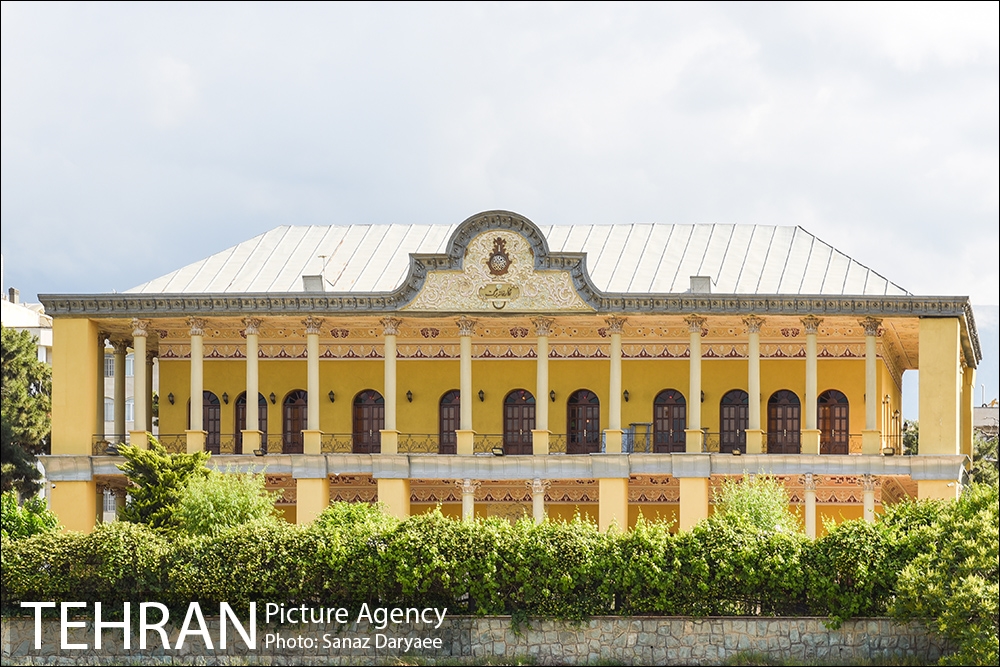
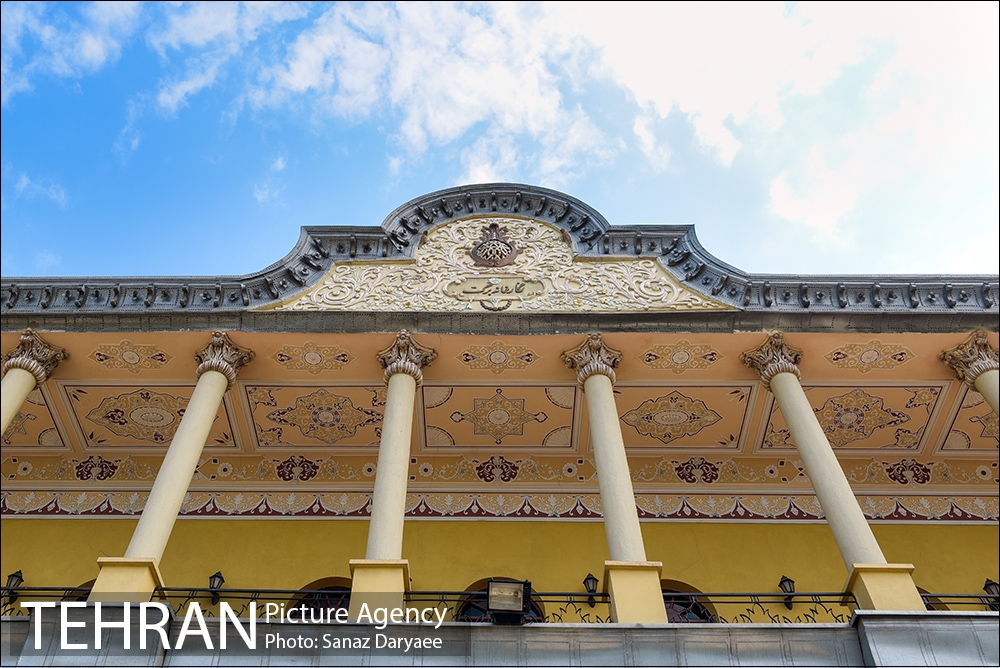
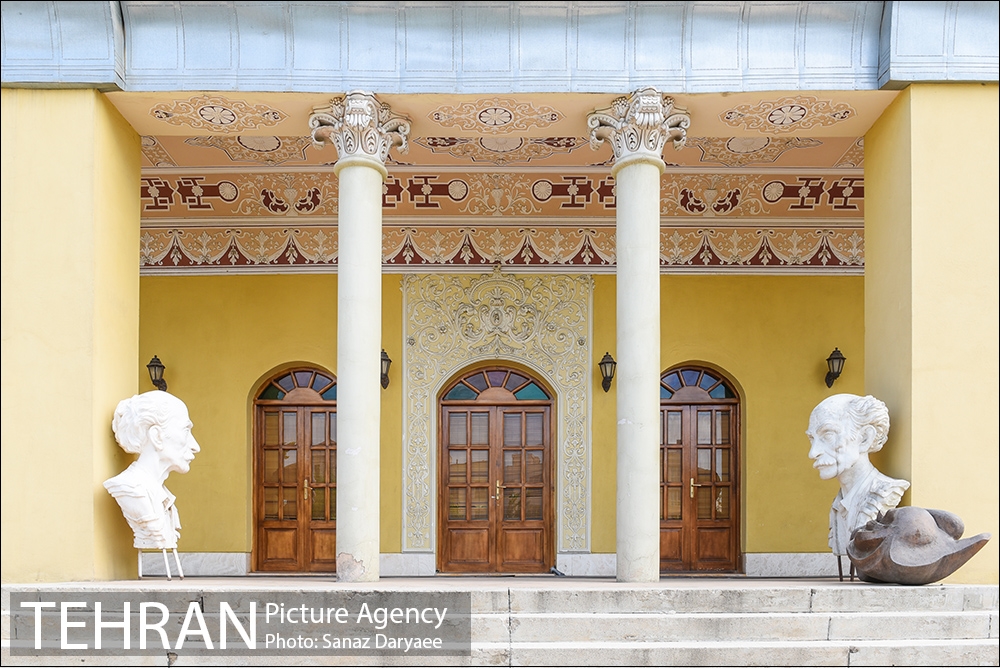
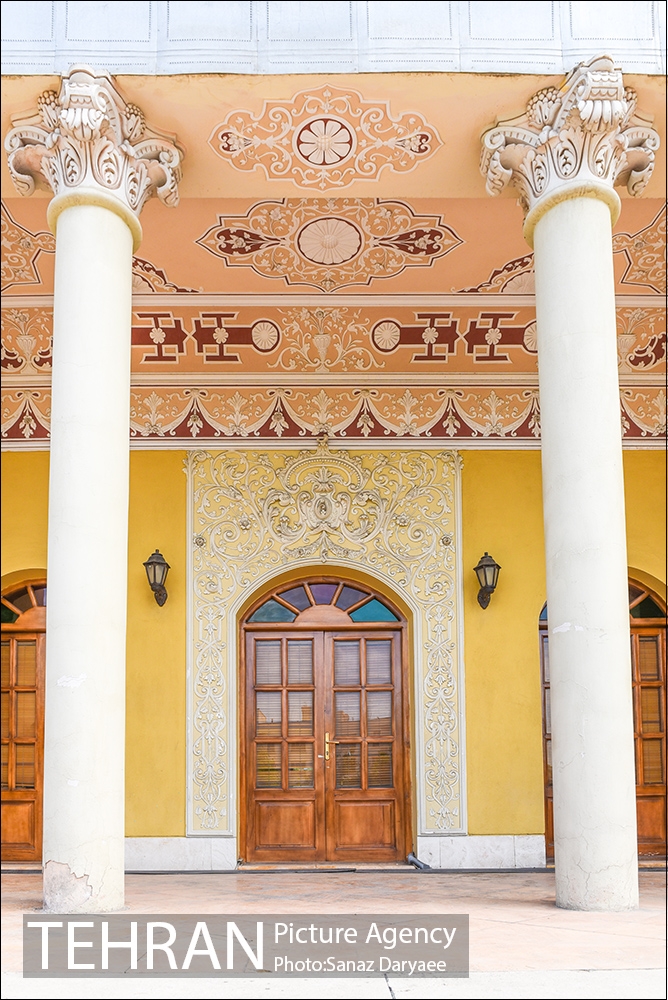
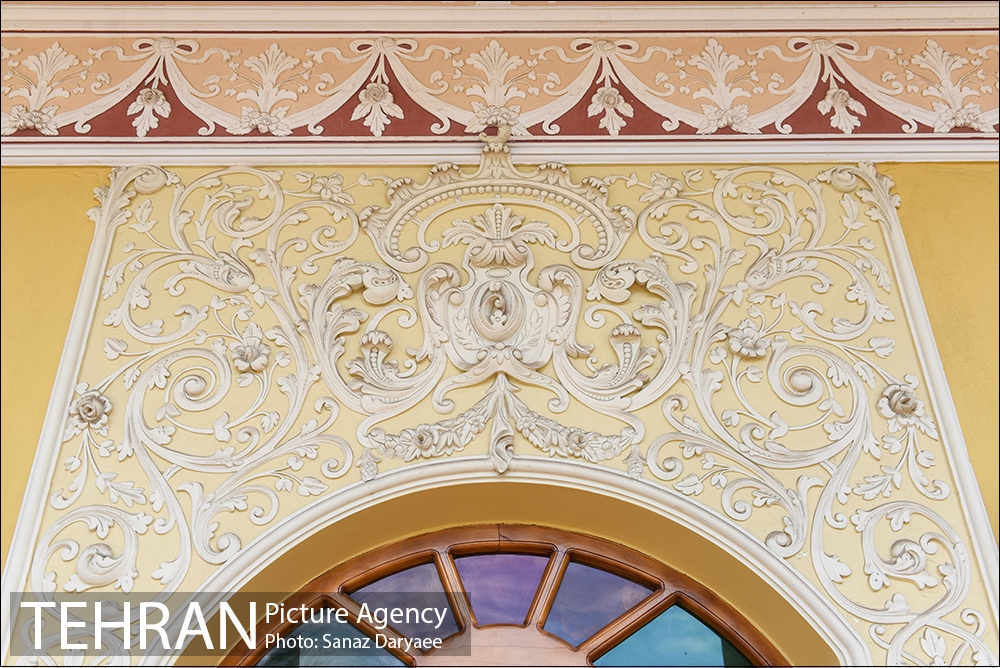
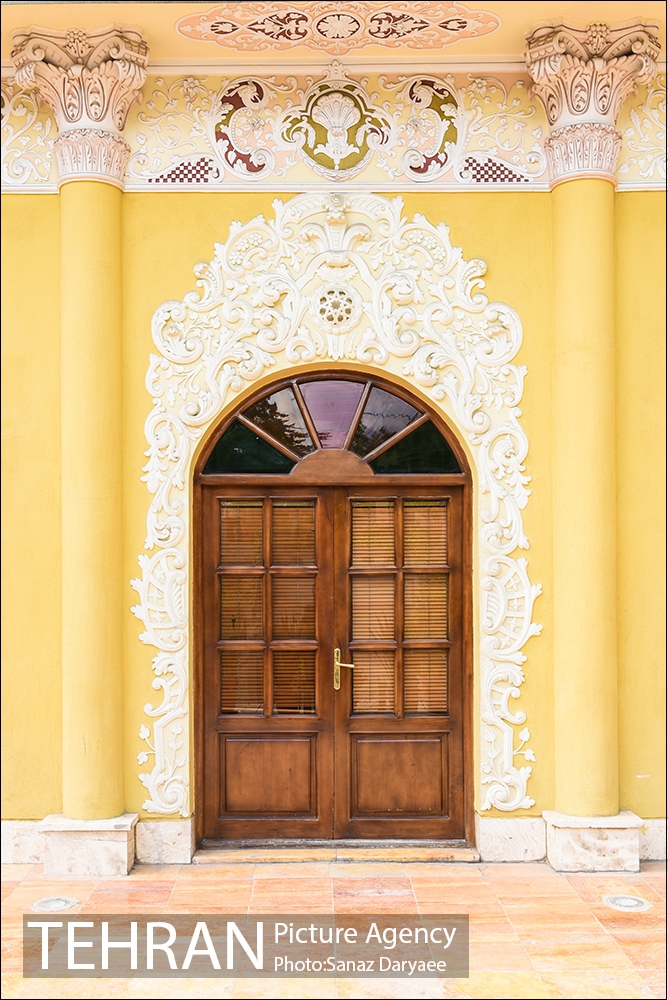
Persian Architecture in Photos: Einoldoleh Mansion

Einodolleh Mansion0000

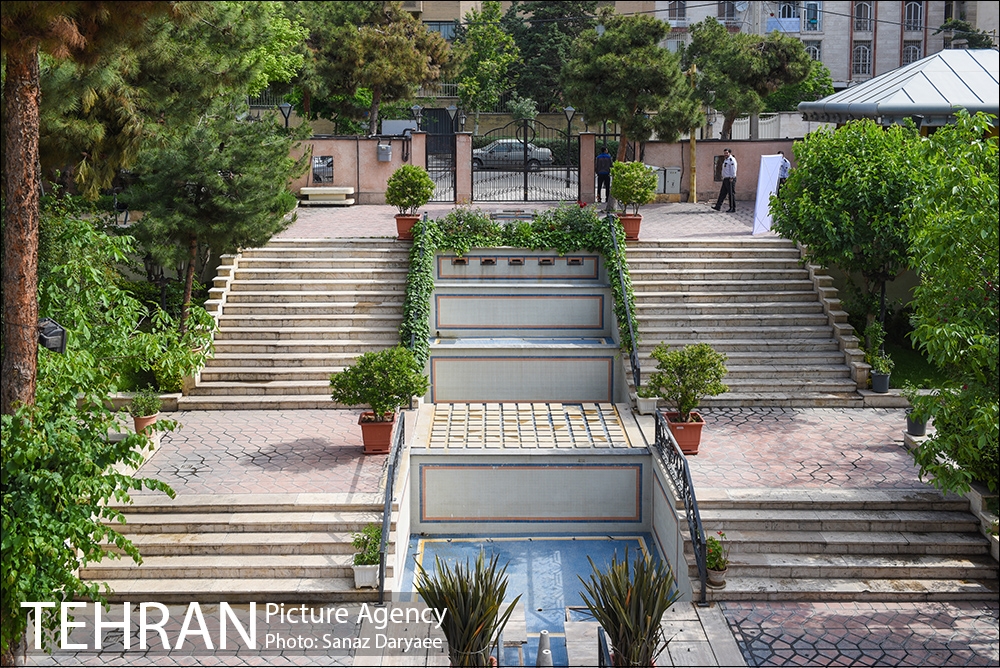
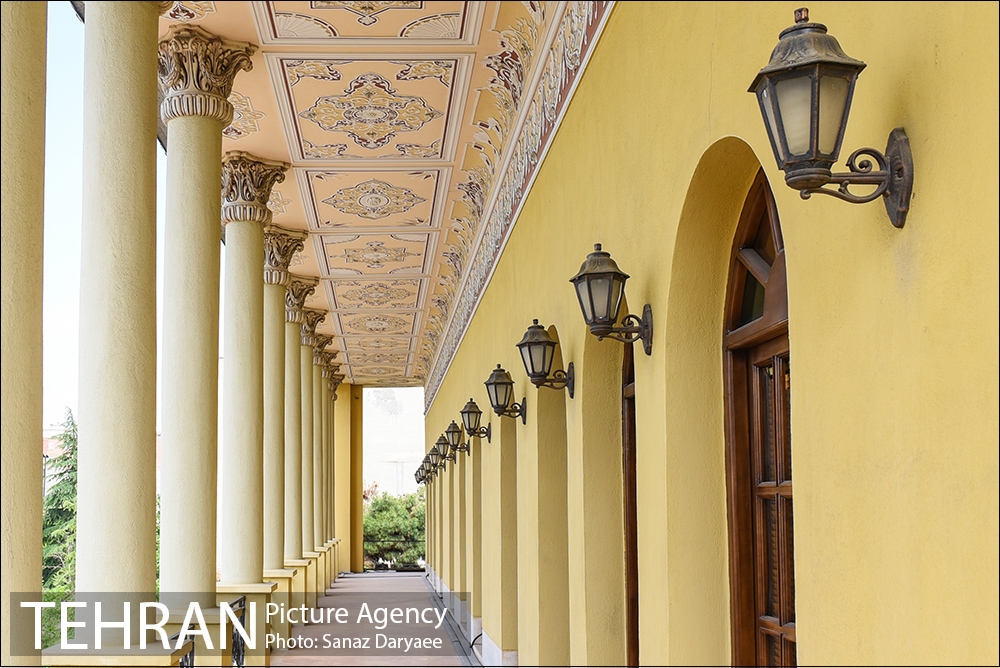
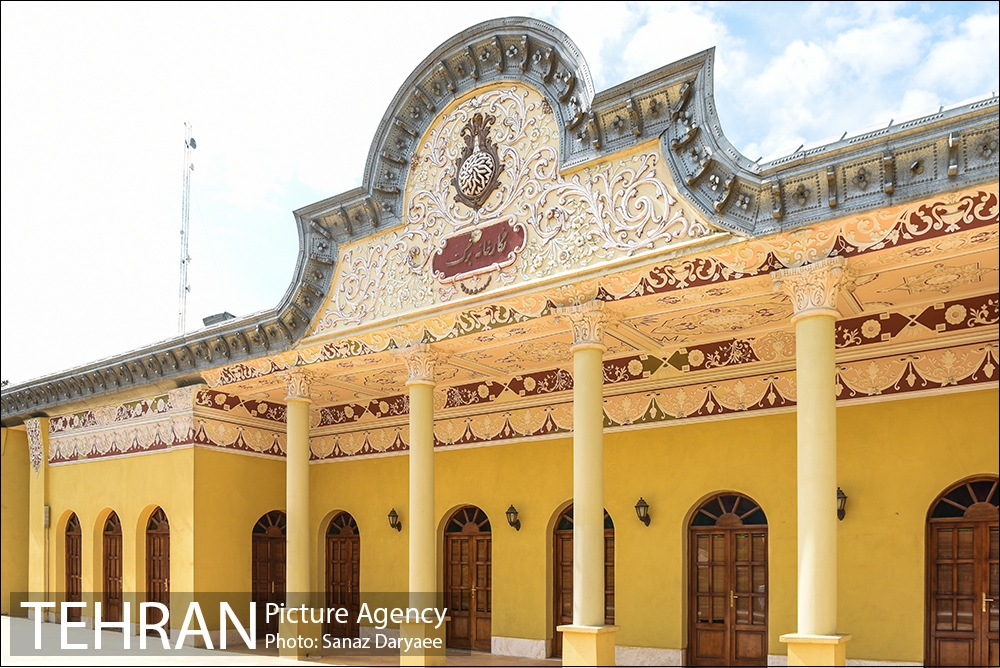
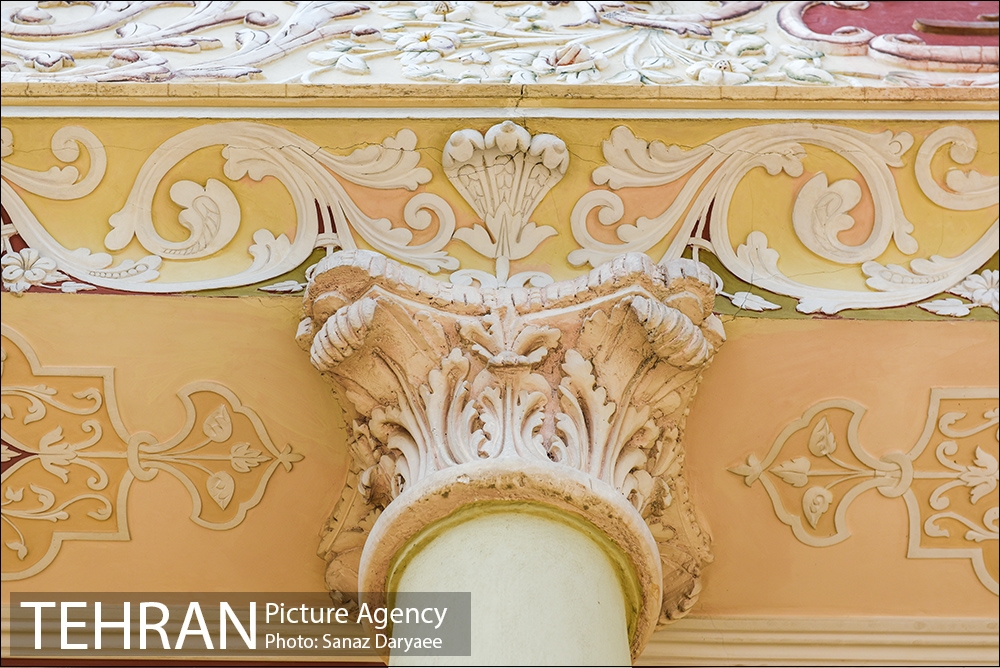
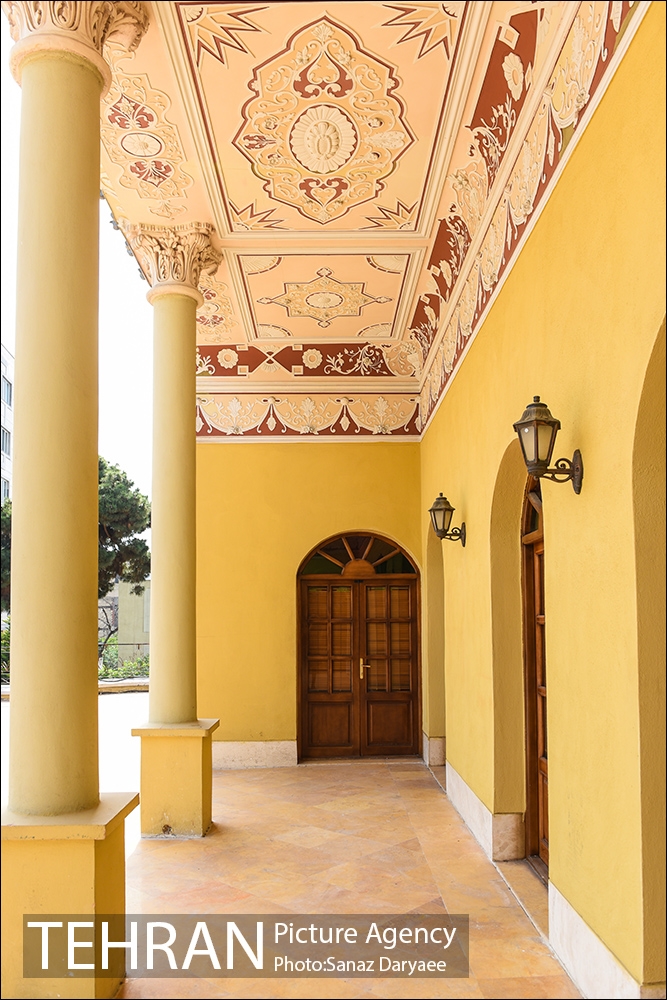
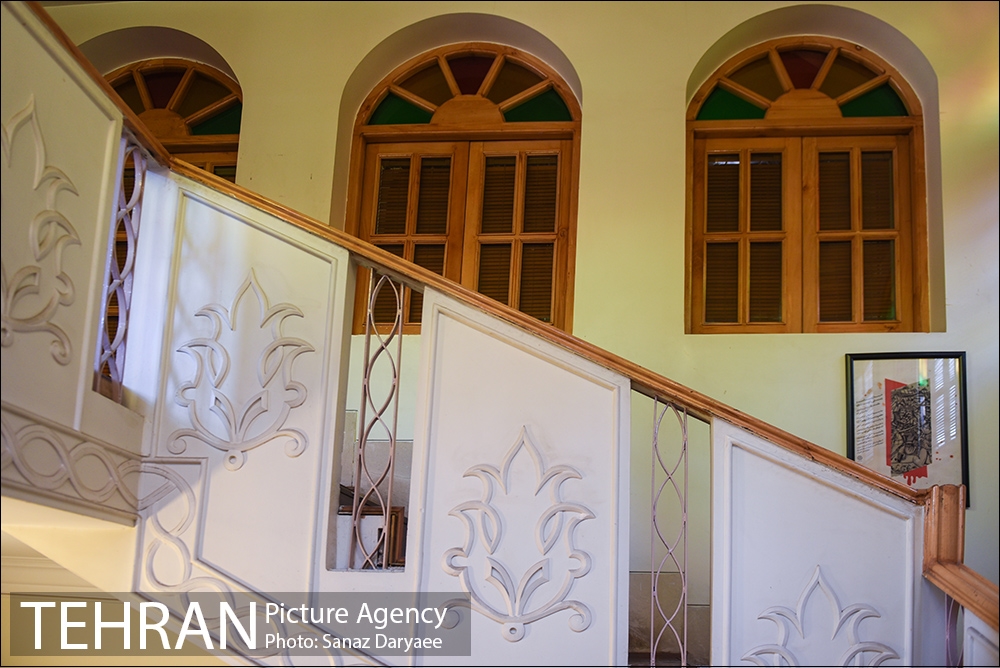
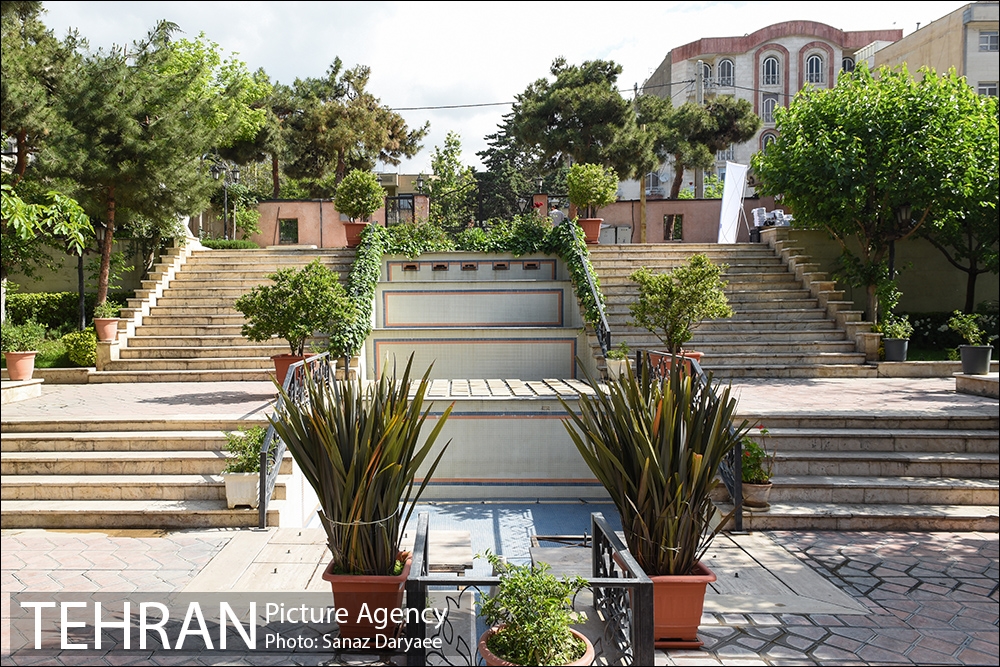
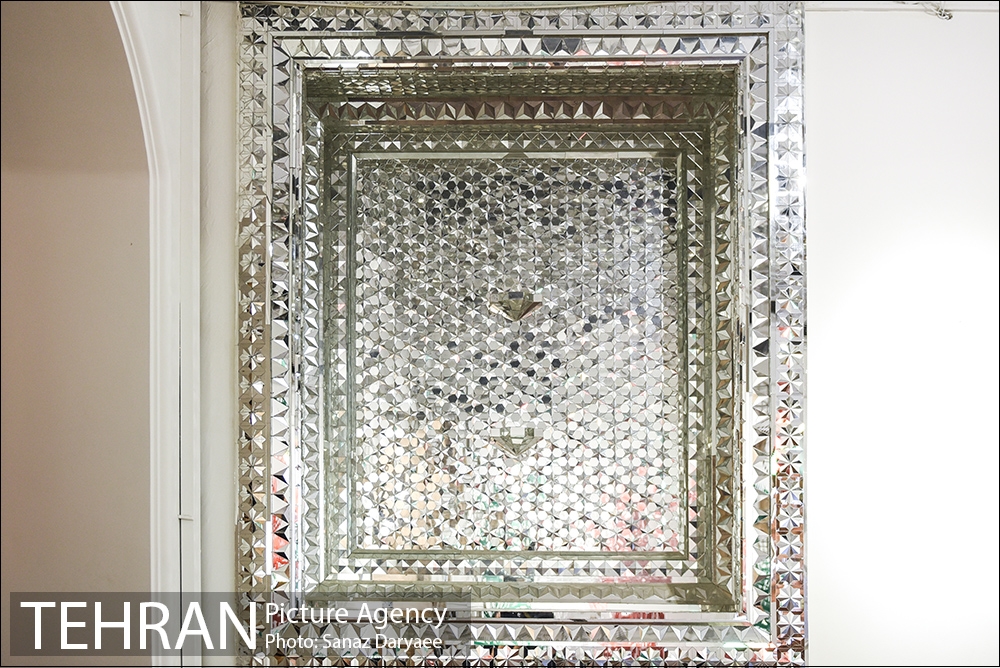
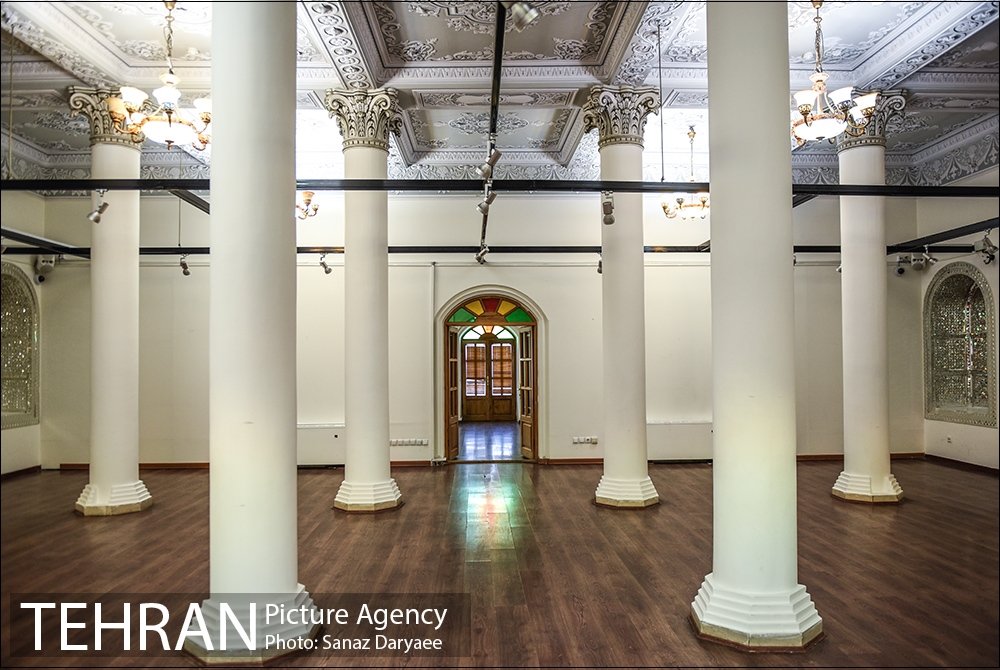
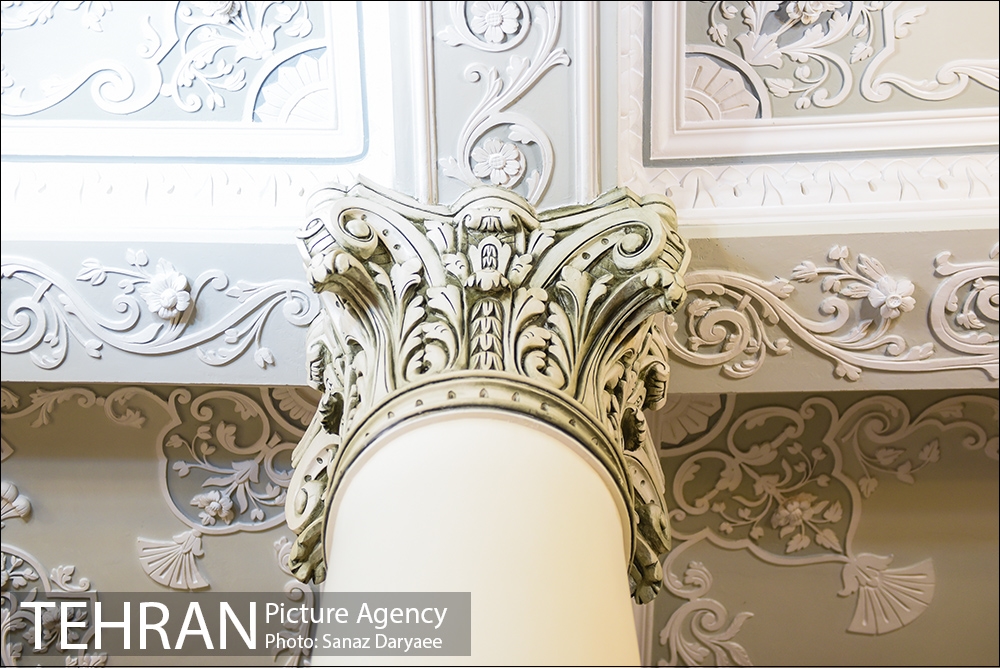
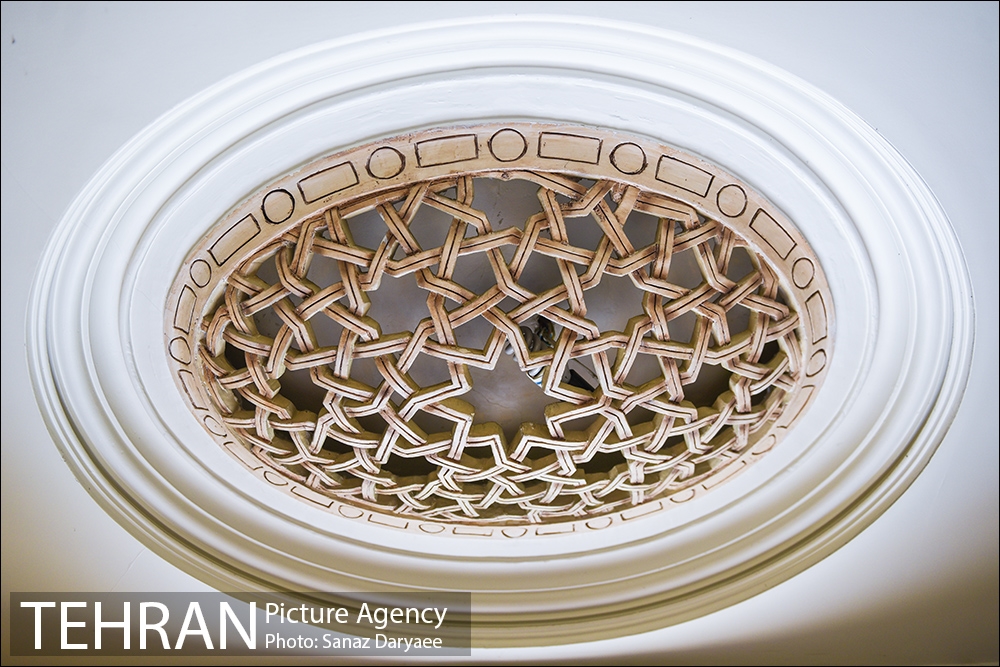
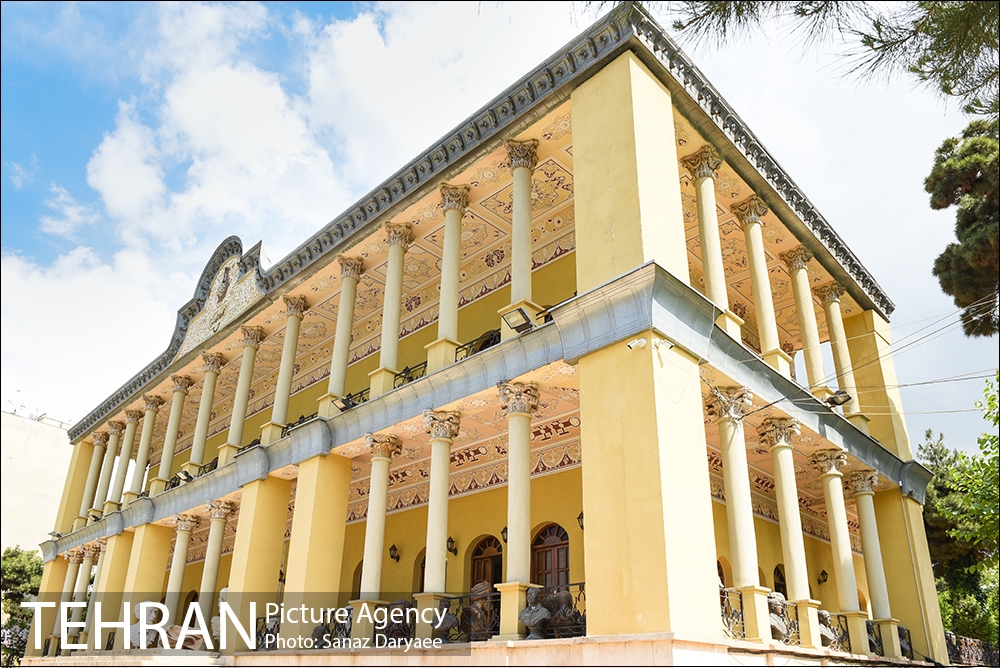
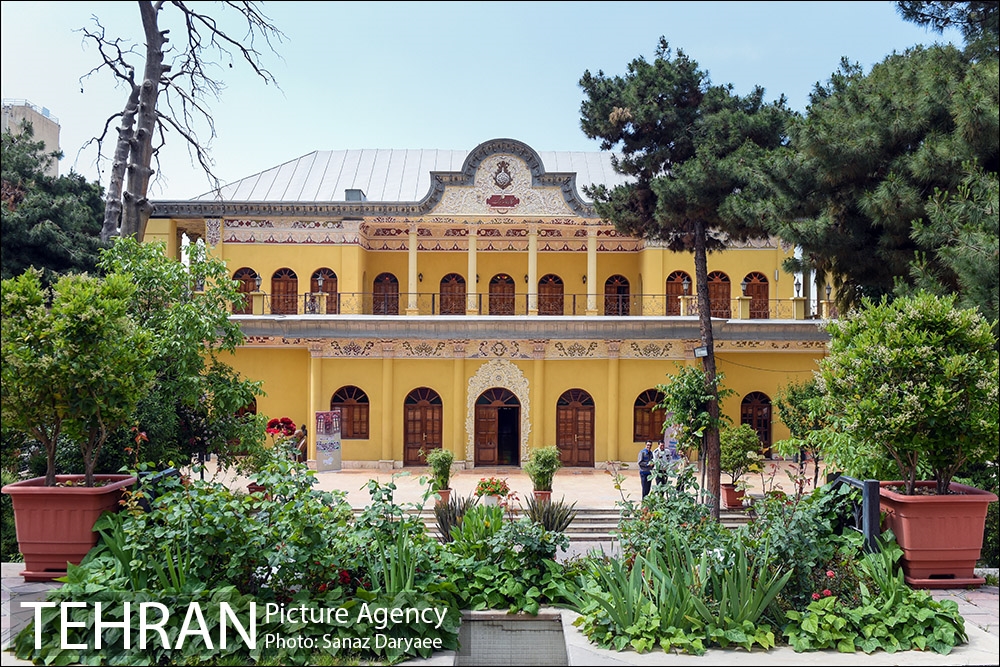
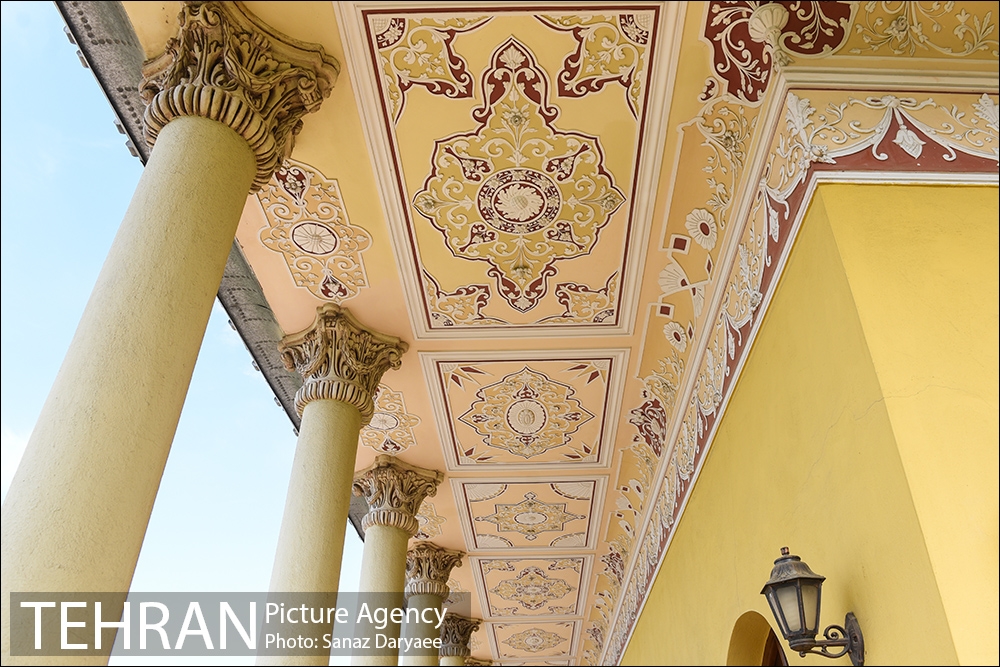
Einodolleh was a despotic first minister of Mozaffar ad-Din Shah Qajar who cracked down on freedom-fighters. Einodolleh, who was a fierce opponent of the Constitutional Movement, built a mansion in what is now Heravi neighborhood of the capital.

The mansion which sits on an expanse of land 11,900 square meters in area hosted an important World War II conference which brought together senior officials from Russia, Britain and the US whose forces were deployed in Tehran back then.

Images of the mansion released online by tpaa.ir:

Iran condemns killing of Palestinian infant by Israeli settlers

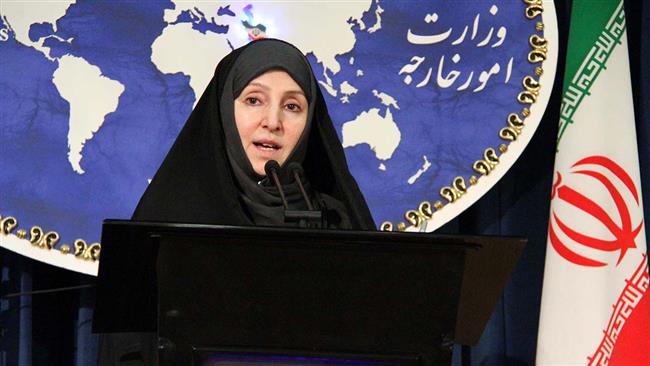
Afkham

39ace0c7-4352-4e1b-b3a4-67e53f2af622


Iran has strongly condemned the arson attack by Israeli settlers in the occupied West Bank that claimed the life of a Palestinian toddler.

“This incident is another obvious sign of the occupying and terrorist nature of the Zionist regime (Israel) as well as the violence institutionalized within the society and policies of this aggressive regime,” Iran’s Foreign Ministry Spokeswoman Marzieh Afkham said on Friday.

She called upon the international community to help put an end to such heinous Israeli crimes.

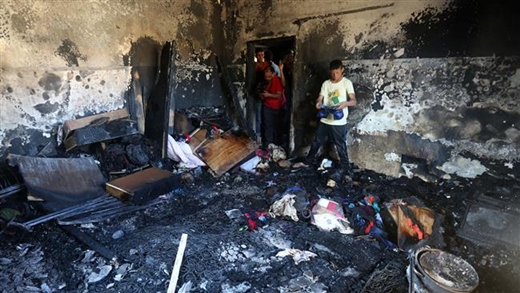
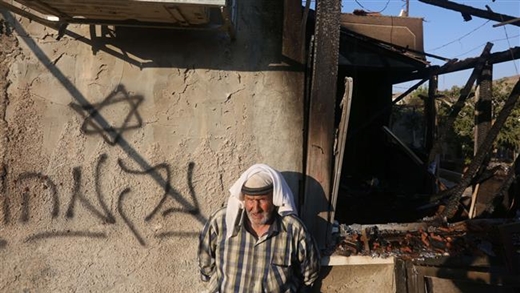
Earlier on Friday, fire broke out at two Palestinian houses in the town of Duma, located about 25 kilometers (15 miles) southeast of Nablus, when Israeli settlers threw firebombs and Molotov cocktails into them.

An 18-month-old Palestinian boy burned to death in one of the houses.

The parents of the baby, Ali Saad Dawabsheh, and his four-year-old brother were also injured in the attack.

According to local residents’ accounts, the parents woke up and tried to remove their children from the house, but were unable to save their youngest son. The other torched house was empty at the time.

Various Palestinian factions condemned the attack, holding the Israeli regime responsible for it.

Israeli settlers have in recent years carried out various attacks on Palestinian property in the West Bank and al-Quds (Jerusalem).


c25bd84e-0ea1-4ed8-b115-8618e81334c2


Iran’s Zarif calls for global nuclear disarmament

Mohammad-Javad-Zarif1

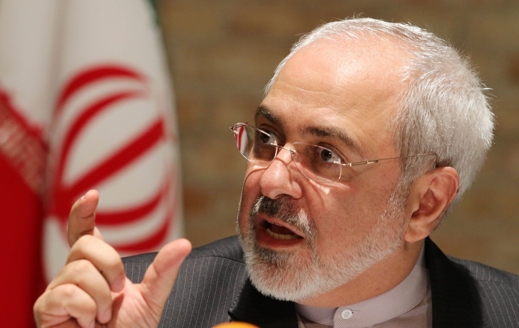
Iran’s Foreign Minister Mohammad Javad Zarif has called on nuclear weapons states across the world to give up their nuclear stockpiles.

“I sincerely believe that the nuclear agreement between my country – a non-nuclear-weapon state – and P5+1 (which control almost all nuclear warheads on Earth) is symbolically significant enough to kick-start this paradigm shift and mark the beginning of a new era for the non-proliferation regime,” Zarif wrote in an op-ed published in The Guardian on Friday.

“One step in the right direction would be to start negotiations for a weapons elimination treaty, backed by a robust monitoring and compliance-verification mechanism,” he added.

Iran and P5+1– the United States, Britain, France, China and Russia plus Germany – finalized the text of a nuclear agreement, dubbed the Joint Comprehensive Plan of Action (JCPOA), in the Austrian capital Vienna on July 14.

Under JCPOA, limits are put on Iran’s nuclear activities in exchange for a set of commitments by P5+1, including the removal of all economic and financial bans against the Islamic Republic.

In his article, Zarif also criticized states having nuclear arsenals, because they “have hardly even talked the talk, while completely brushing off their disarmament obligations under NPT (nuclear Non-Proliferation Treaty) and customary international law.”

He further slammed Israel’s non-compliance with the NPT and its long-standing aggressive campaign against diplomatic efforts by Iran and P5+1 to find a solution to the Western dispute with Tehran over its nuclear program.

“That is to say nothing of countries outside the NPT, or Israel, with an undeclared nuclear arsenal and a declared disdain towards non-proliferation, notwithstanding its absurd and alarmist campaign against the Iranian nuclear deal,” the Iranian minister wrote.

Israel is widely believed to be the sole possessor of a nuclear arsenal in the Middle East and has so far blatantly violated the international rules regarding nuclear non-proliferation.

In December 2014, the United Nations General Assembly adopted a resolution urging the Tel Aviv regime to join the NPT and put its nuclear facilities under the safeguards of the International Atomic Energy Agency. Tel Aviv reportedly maintains between 200 and 400 atomic warheads.

Zarif also called for the establishment of a zone free of weapons of mass destruction in the Middle East, and expressed the Islamic Republic’s willingness to cooperate with the international community in this regard.

He added, “Iran, in its national capacity and as current chairman of the Non-Aligned Movement, is prepared to work with the international community to achieve these goals, knowing full well that, along the way, it will probably run into many hurdles raised by the skeptics of peace and diplomacy.”


Iran rejects report of confidential annexes to JCPOA

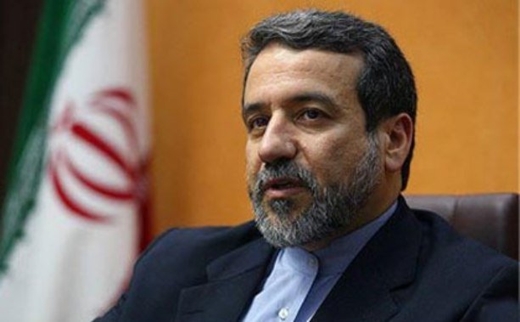
araghchii

A senior Iranian nuclear negotiator says there is nothing confidential in the Joint Comprehensive Plan of Action (JCPOA) on Tehran’s nuclear program and its annexes.

Abbas Araghchi further said that the content of a roadmap signed by Iran and the International Atomic Energy Agency and its related documents are secret, and that the agency is obliged to protect them under international law.

The two sides agreed on July 14 to clarify some outstanding issues regarding Iran’s nuclear program. Araghchi also said Tehran will only allow IAEA inspectors from nations that have diplomatic relations with Iran, which does not include the US and Canada. He also said the inspectors will have no access to classified military documents.

After signing the roadmap, IAEA Director General Yukiya Amano said it “sets out a clear sequence of activities over the coming months, including the provision by Iran of explanations regarding outstanding issues. It provides for technical expert meetings, technical measures and discussions, as well as a separate arrangement regarding the issue of Parchin site.”

In his latest meeting with members of the parliament’s National Security and Foreign Policy Committee on Sunday, Araghchi said European foreign ministers have lined up to visit Iran, but that does not mean we will offer whatever they want, we are the one who chooses.

“We will decide how to treat each country on the basis of national interests,” Araghchi stressed.

During the meeting, Araghchi answered the questions raised by some MPs on topics including the conditions for lifting of sanctions, inspection of military sites, West’s contradictory statements about JCPOA, confidential agreement with the IAEA, conditions of providing 20% of fuel for Tehran reactor’s operation, inspections of nuclear facilities, conditions for sanctions return, US selective approach to human rights and support for terrorism, uncertainty about the cancellation or suspension of sanctions, arms and missile embargo as well as financial and banking sanctions.

He explained that the nuclear deal between Iran and P5+1 stipulates that Iran would voluntarily execute the Additional Protocol until the US sanctions against Tehran are removed.

He noticed that a new roadmap has been signed between the IAEA director general and the Iranian nuclear chief to settle points of differences and that roadmap includes confidential contents.

Iran’s seeks removal of all sanctions, including economic and financial sanctions, on the very first day of implementing the deal, Araghchi said.


Italy returns large haul of Iran’s stolen artifacts

cb93c4a8-1272-4511-8f5c-2a48f0a6754e

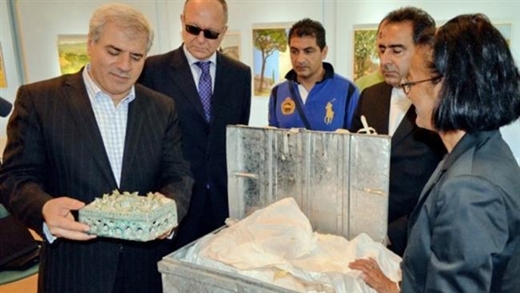
Italy has returned to Iran some 30 stolen artifacts that had been smuggled to the European country during the past 10 years.

After years of hard-fought legal battle with the Italian art authorities, the Iranian legal team managed to win back the stolen artifacts following a restitution order by an appellate court in the northern Italian city of Milan, IRNA reported on Friday.

The haul, comprised of items belonging to Iran’s pre- and post-Islamic era, had been recovered by the Italian art police and was handed over to a representative from the Iranian Embassy in Italy during a ceremony held at the National Museum of Oriental Art in Rome.

Paola Piacentini, from the administrative office of the museum, and Mohammad Hassan Talebian, the deputy head of Iran’s Cultural Heritage Organization, were present in the ceremony.

The artifacts have been delivered to the Iranian Embassy thanks to the UNIDROIT Convention on Stolen or Illegally Exported Cultural Objects, an international treaty on the subject of cultural property protection signed in 1995 in Rome, Talebian said on Friday. The convention aims to reduce illegal traffic of cultural property by obligating buyers to check the legitimacy of their purchase.

He added that the procedure to transfer the art pieces to the Iranian National Museum would start in an official ceremony scheduled to be held in the Iranian Embassy in Rome in September.

Duilio Cortassa, a lawyer with the Iranian Embassy in Rome, also said that the Italian art police seized the haul of pre- and post-Islamic era artifacts in the northern Italian city of Monza in 2007.

Shell, Eni say look to return to Iran

a1940782-1f13-4e3e-b99b-3887bf12cc37

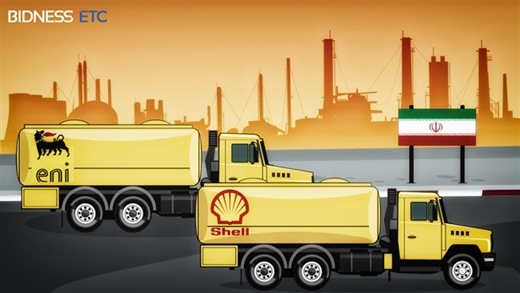
Royal Dutch Shell and Italy’s largest oil producer Eni say they are looking to return to projects in Iran’s upstream oil and gas sectors.

“For us, (Iran) is a huge gas province so it would be good to be there — in conventional gas — at the right terms,” Shell’s financial chief Simon Henry said in London.

The company has a history of activities in Iran’s upstream projects, including in South Pars, but the firm pulled out of the world’s largest gas field’s Phase 13 development in 2008.

Shell also operated Iran’s Soroush and Nowruz oilfields in the Persian Gulf at a capacity of 200,000 barrels per day. An outstanding debt to the tune of $2.3 billion remains unpaid by the company to Iran since 2012.

The energy news provider Platts quoted Henry as saying Thursday that Shell was interested in returning to Iran ‘in the fullness of time’ but did not expect any quick, easy deals.

“Anybody who thinks that we are going to suddenly swan in and end up with great contracts that make a difference within 12 months, I think is a little naive. It’s not going to be easy, it will take time,” he was quoted as saying.

Iran wants to unveil its new energy contracts at a conference planned for December in London.

Deputy Oil Minister Amir Hossein Zamaninia told a Vienna conference last week that Iran has identified nearly 50 oil and gas projects worth $185 billion up for grab.

Shell and other European energy giants such as France’s Total, Italy’s Eni and BP had built strong relationships with Iran through work in the country’s oil and gas fields as well as crude oil purchases before halting them under sanctions.

Shell was Iran’s second biggest corporate client along with Total in 2012 when the Anglo-Dutch company lifted 100,000 barrels of crude oil per day.

Executives from Eni and Shell traveled to Tehran in June and May to discuss new opportunities in the resource-rich country and outstanding debts.

On Thursday, Eni’s Chief Executive Officer Claudio Descalzi said his company was interested in returning to Iran once the sanctions ended.

“Iran in terms of oil and gas is a huge and big country, very interesting, but we need to wait,” he said in a Bloomberg Television interview.

Meanwhile, BP Chief Executive Bob Dudley said his company was looking for opportunities in Iran’s upstream oil industry.

Iran’s Minister of Petroleum Bijan Zanganeh said he looked to “a new chapter” in cooperation with Total as French Foreign Minister Laurent Fabius visited Tehran.

Nuclear deal does not require parliament approval

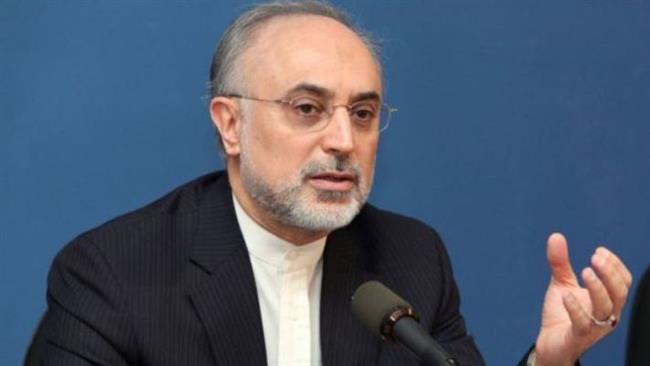
Salehi

Director of the Atomic Energy Organization of Iran (AEOI) Ali Akbar Salehi said on Friday that since the nuclear deal between Tehran and P5+1 is not an international agreement, it does not need to secure the approval of parliament.
“The text is not regarded as an international agreement, convention or treaty. Therefore, it has been named the Joint Comprehensive Plan of Action (JCPOA),” he said in reply to a demand by lawmakers who want to ratify it in the chamber.

The Foreign Ministry is responsible for nuclear negotiations and has to decide about it, he was quoted as saying by the parliament’s News Agency (ICANA).

As for the quality of an unofficial translation of JCPOA, he added that based on the announcement of the Foreign Ministry, the English version is the valid and authorized text.