Thursday, December 25, 2025
Home Blog Page 4685

No military solution to Mideast conflicts: Iran

Zarif-Qom

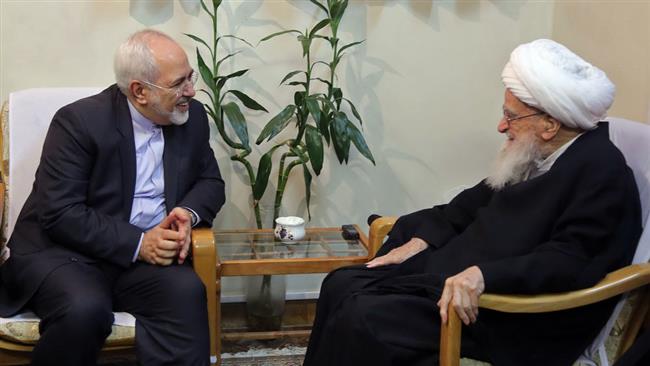
“The current crises [in the Middle East] have no military solution. We should be able to help bring an end to war and conflicts between Muslims,” Mohammad Javad Zarif on Thursday during a one-day visit to the holy city of Qom in central Iran.

The top Iranian diplomat also said foreign governments must stop meddling with internal affairs of regional states, noting that foreign interference is the root cause of the regional crises.

Zarif further criticized some governments for adopting double-standard approaches toward terrorism and extremism in the Middle East. He said people in regional countries should decide the future of their countries.

During his stay in Qom, Zarif briefed a number of senior Iranian clerics on the latest developments in the three Muslim countries of Iraq, Syria and Yemen.

He said Qom, where Iran’s top authorities on religious matters are based, could be instrumental in promoting Islamic teachings in the fight against extremism and Takfirism in the region.

Iran urges UN action to stop Israeli atrocities

274b7561-1b1a-4497-87dc-8d9d21fc628c

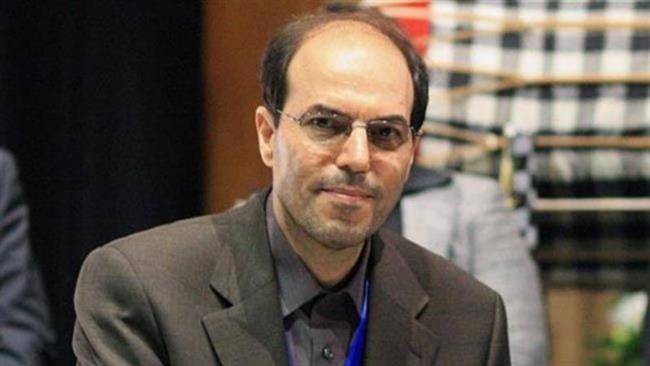
Iran’s deputy ambassador to the United Nations (UN) has called on the international community to take action to stop Israeli atrocities against the Palestinians.

Addressing a meeting of the UN Special Political and Decolonization Committee, Gholam Hossein Dehghani denounced Israel’s “systematic violation of Palestinian rights,” including the demolition of their homes, the forced displacement of residents and the detention of women and children.

Dehghani referred to Tel Aviv’s expansion of settlements on the occupied Palestinian lands, citing it as the main source of the recent escalation in tensions in the occupied Palestinian lands.

More than half a million Israelis live in over 120 illegal settlements built since Israel’s occupation of the Palestinian territories in the West Bank and East al-Quds (Jerusalem) in 1967.

Much of the international community regards the settlements as illegal because the lands taken by Israel in 1967 fall under the Geneva Conventions, which forbid any construction on occupied territories.

“It is time to end the abhorrent Israeli atrocities and occupation that have brought so much sufferings to the Palestinian people, and are the most destabilizing factors at the regional and global levels,” the Iranian envoy said.

Tensions have dramatically escalated since Israel imposed restrictions on the entry of Palestinian worshipers to the al-Aqsa Mosque compound in East al-Quds.

Palestinians are also angry at settler attacks on their properties and rising Israeli raids on the al-Aqsa Mosque, which they see in line with Tel Aviv’s policy to change the demographic status of the compound.

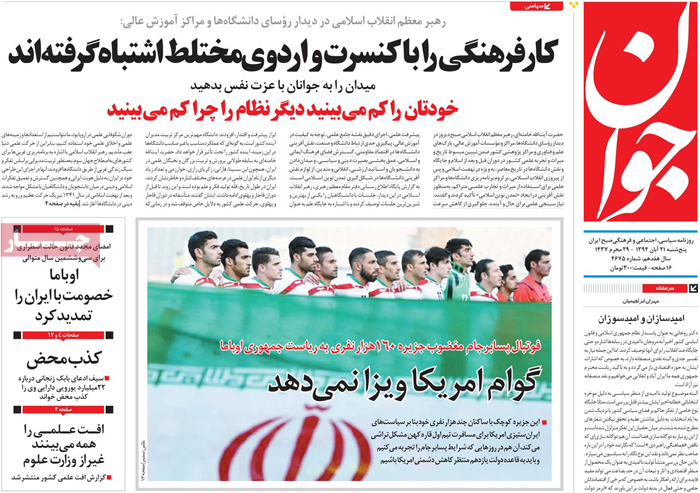
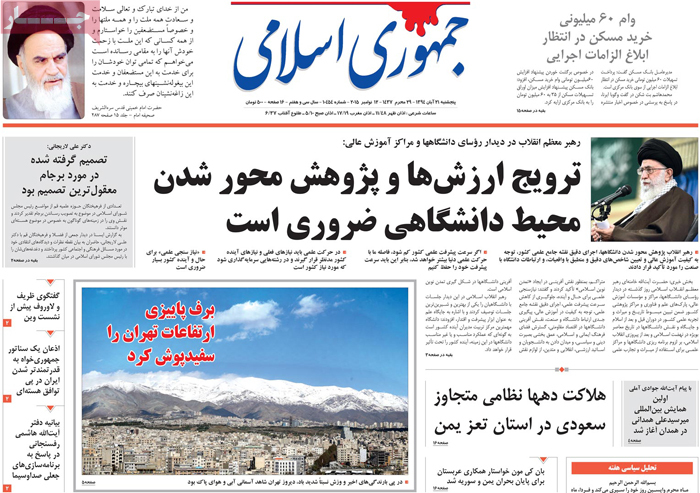
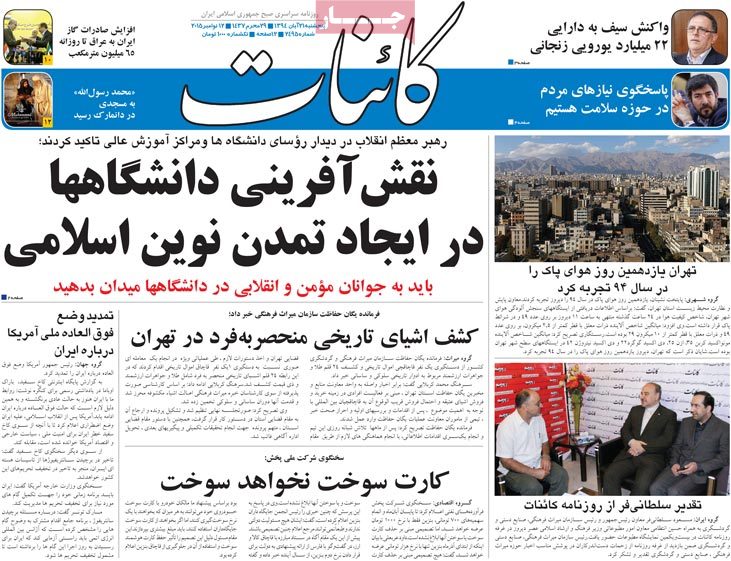
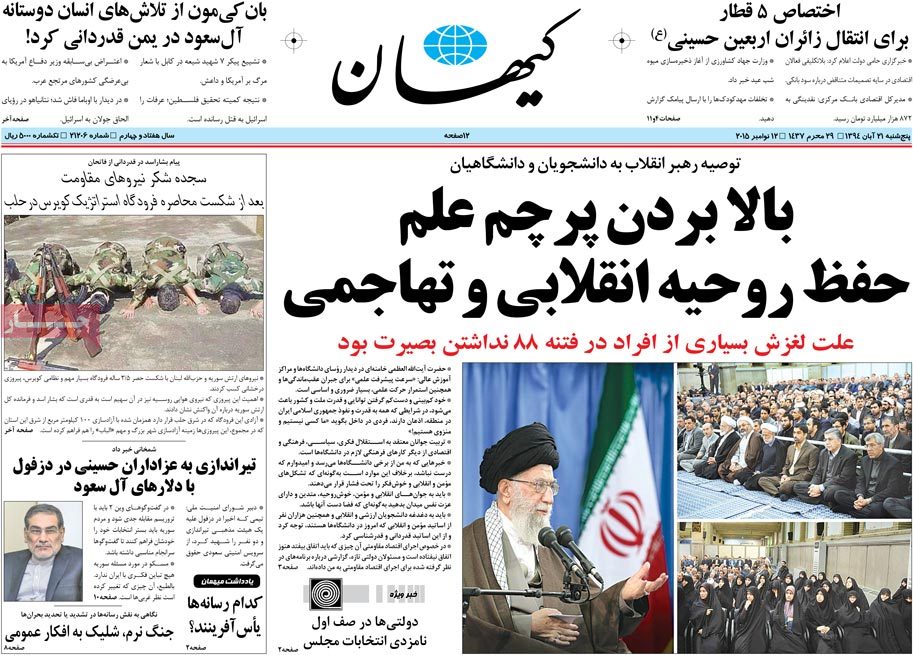
A look at Iranian newspaper front pages on Nov. 12

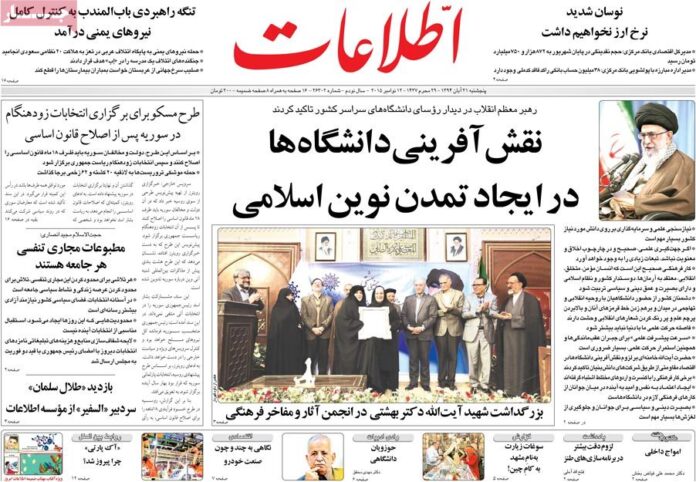
Iranian Newspapers Headlines

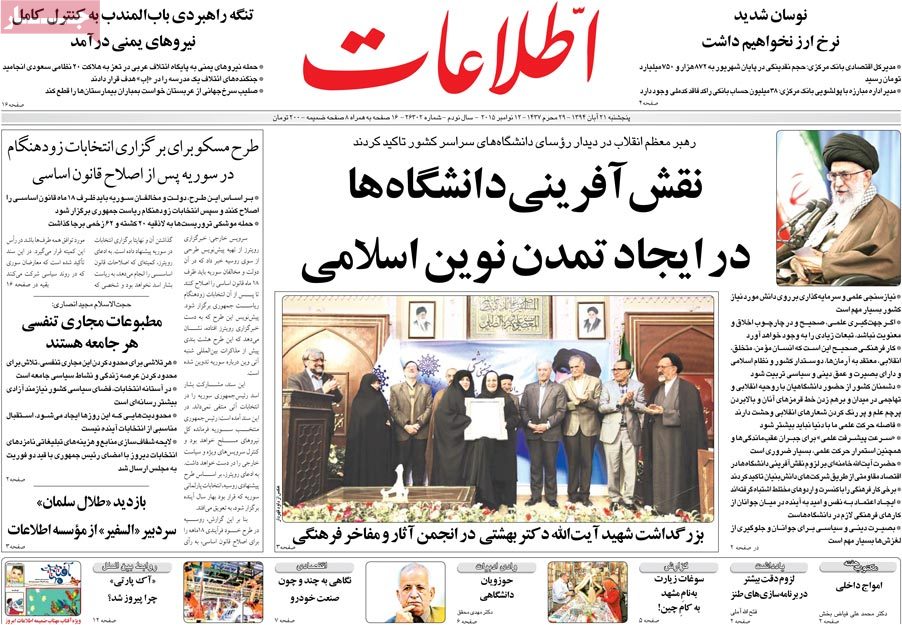
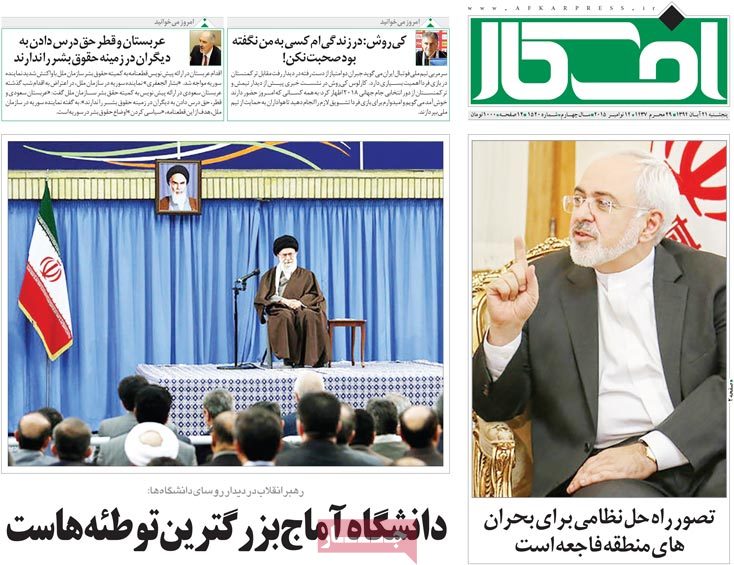
The comments of the Supreme Leader at a meeting with university presidents from across the country dominated the front pages of Iranian newspapers on Thursday.


Ettela’at: The Supreme Leader has underlined the role of universities in helping create a modern Islamic civilization.

“Scientific needs assessment and investment in the kind of science the country needs are of paramount importance,” Ayatollah Khamenei said in a meeting with university presidents from across Iran.


Afkar: It is disastrous to think there are military solutions to regional crises, said Foreign Minister Mohammad Javad Zarif.


A look at Iranian newspaper front pages on Nov. 12


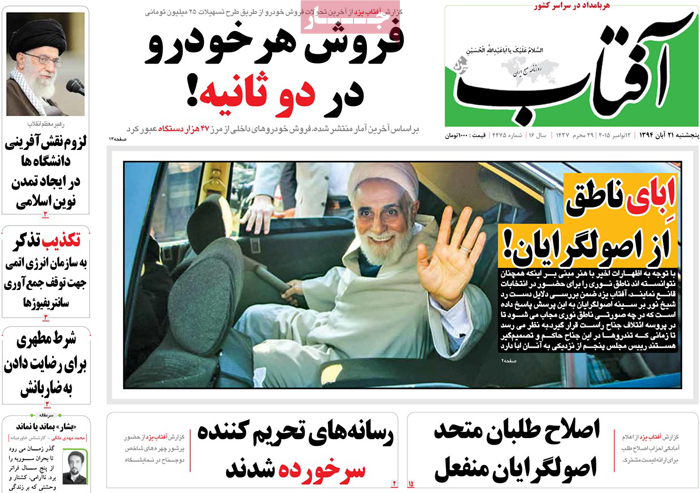
Aftab-e Yazd: Following the launch of a plan to grant some $8,000 in car loans to applicants, a car is sold every two seconds.

More than 47,000 vehicles have since been bought, carmakers say.

Aftab-e Yazd: Nategh-Nouri [a former speaker of the Islamic Consultative Assembly] is staying away from fellow principlists.

It seems that as long as hardliners dominate decision-making in the rightist camp [a reference to principlists] the speaker of the fifth parliament will stay away from principlists.


A look at Iranian newspaper front pages on Nov. 12


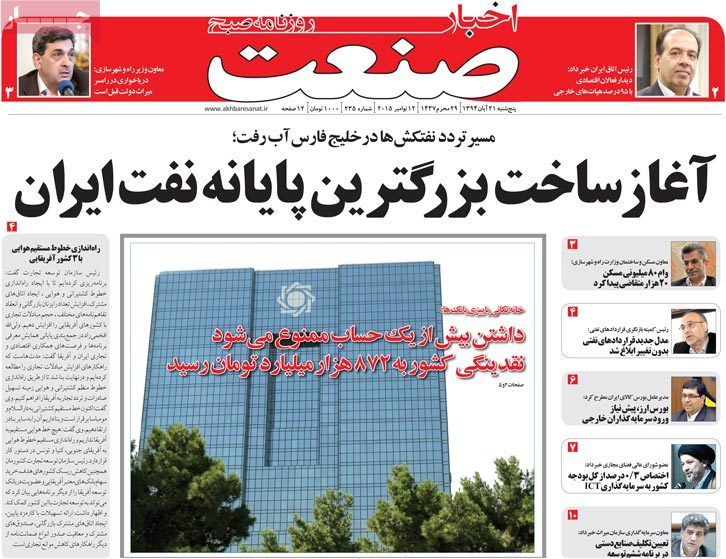
Akhbar Sanat: The Central Bank has put the country’s liquidity at less than $291 billion.


A look at Iranian newspaper front pages on Nov. 12


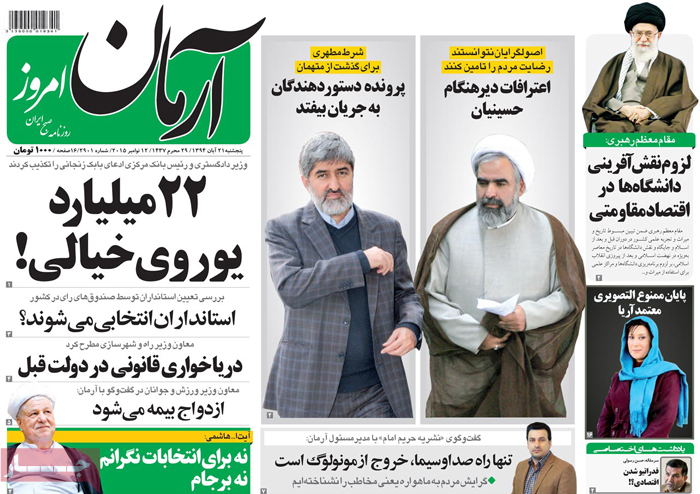
Arman-e Emrooz: The imaginary €22 billion!

The justice minister and the Central Bank have dismissed claims by Babak Zanjani [on trial for corruption] that he has €22 billion in cash.

Arman-e Emrooz: Ali Motahari [a Tehran MP who was attacked earlier in 2015 when he was in Shiraz to deliver a speech] has said that he’d forgive the assailants only if those who ordered the attack were put on trial.

Arman-e Emrooz: I am neither worried about the [upcoming] elections, nor about the Joint Comprehensive Plan of Action, said Chairman of the Expediency Council Ayatollah Akbar Hashemi Rafsanjani.

Arman-e Emrooz: An end to the ban on Fatemeh Motamed-Arya’s appearance on the small screen.


A look at Iranian newspaper front pages on Nov. 12


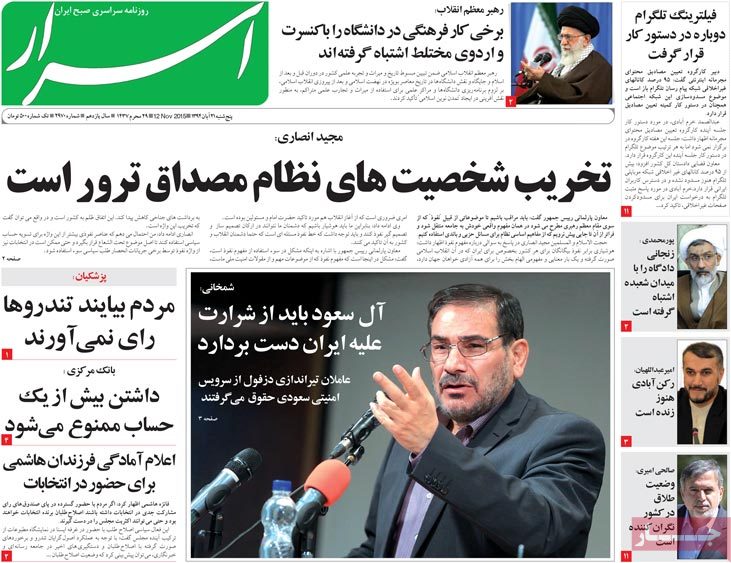
Asrar: Blocking Telegram [a very popular messaging app in Iran] is once again on the agenda.

Asrar: The Saudis need to stop their evil acts against Iran, said the secretary of the Supreme National Security Council.

Ali Shamkhani further said that the individuals involved in a shooting incident in Dezful [southwestern Iran] were on the payroll of the Saudi security agency.

Asrar: The Central Bank says having more than one bank account will be banned.


A look at Iranian newspaper front pages on Nov. 12


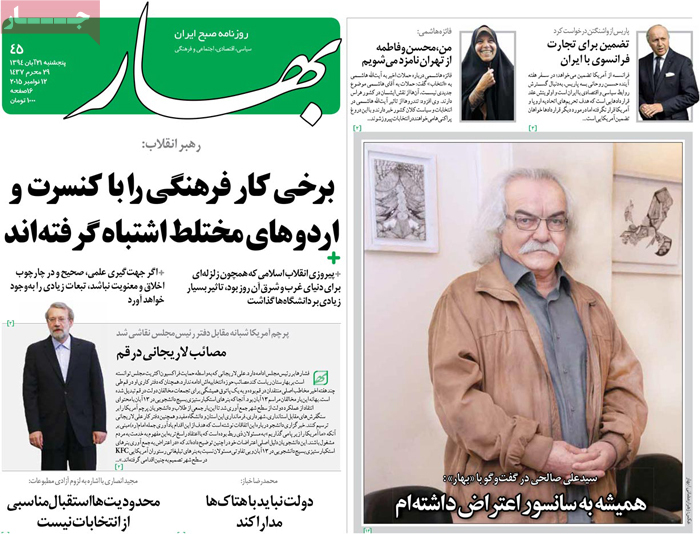
Bahar: Larijani’s woes in Qom

A US flag was painted outside his office overnight.


A look at Iranian newspaper front pages on Nov. 12


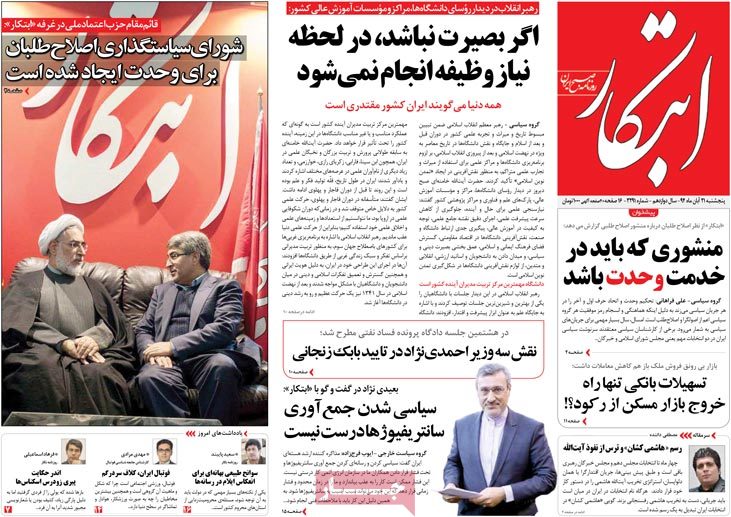
Ebtekar: Politicizing the removal of centrifuges is not right, said Hamid Baeedinejad, an Iranian nuclear negotiator.

Ebtekar: Three Cabinet ministers of the Ahmadinejad administration played a role in confirming Babak Zanjani, an 8th hearing in the corruption trial of the young billionaire heard.


A look at Iranian newspaper front pages on Nov. 12


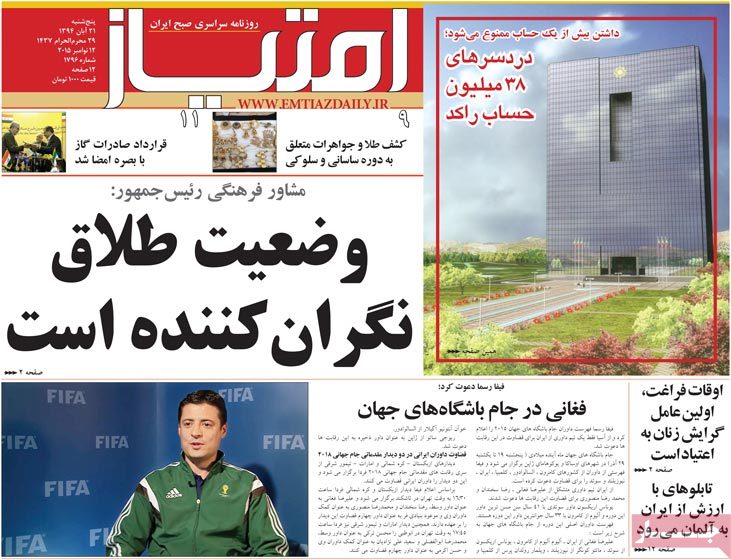
Emtiaz: Iranian Referee Alireza Faghani has been invited by FIFA to officiate in the FIFA Club World Cup.


A look at Iranian newspaper front pages on Nov. 12


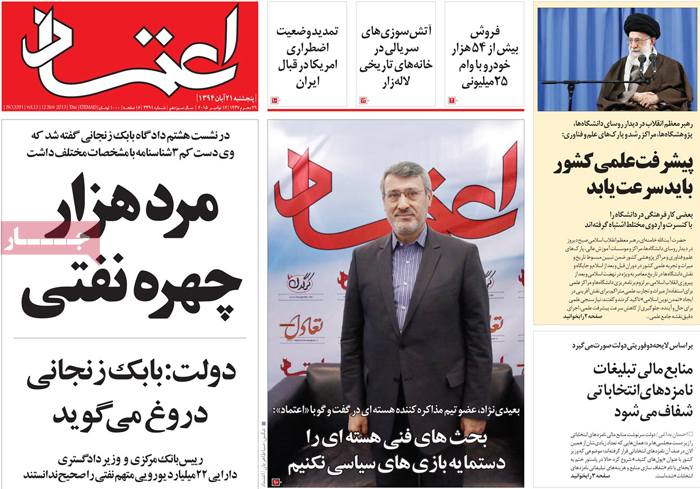
Etemad: The Supreme Leader has called for the country’s scientific drive to gather momentum.

Etemad: Let’s not take advantage of technical nuclear issues for political gamesmanship, said Hamid Baeedinejad, a senior nuclear negotiator.


A look at Iranian newspaper front pages on Nov. 12


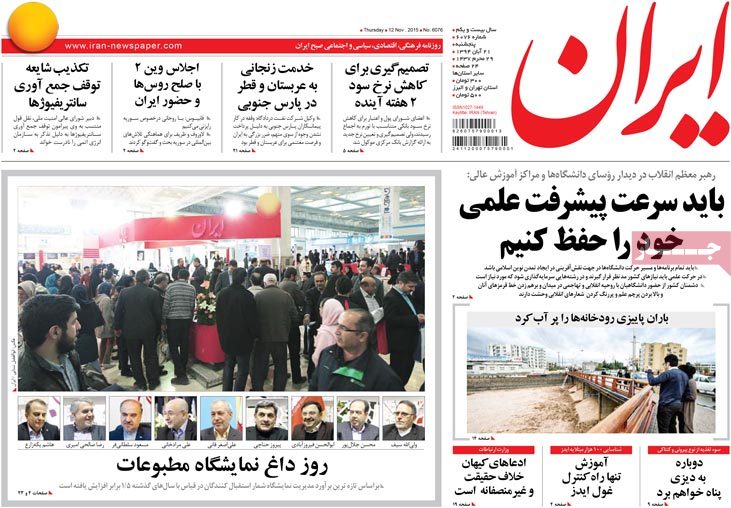
Iran: The Money and Credit Council will finalize its decision to lower interest rates in two weeks.


A look at Iranian newspaper front pages on Nov. 12


Javan: President Obama has renewed hostility toward Iran by extending the state of emergency against the Islamic Republic.


A look at Iranian newspaper front pages on Nov. 12


Jomhouri Islami: The decision made with regard to the Joint Comprehensive Plan of Action was the most logical one, said Parliament Speaker Ali Larijani.

Jomhouri Islami: Autumnal snow has blanketed the mountains to the north of Tehran.


A look at Iranian newspaper front pages on Nov. 12


Kaenat: The Cultural Heritage Organization has said that “unique historical objects” have been found in Tehran.


A look at Iranian newspaper front pages on Nov. 12


Kayhan: Executive officials are leading the way in seeking parliamentary seats.


A look at Iranian newspaper front pages on Nov. 12


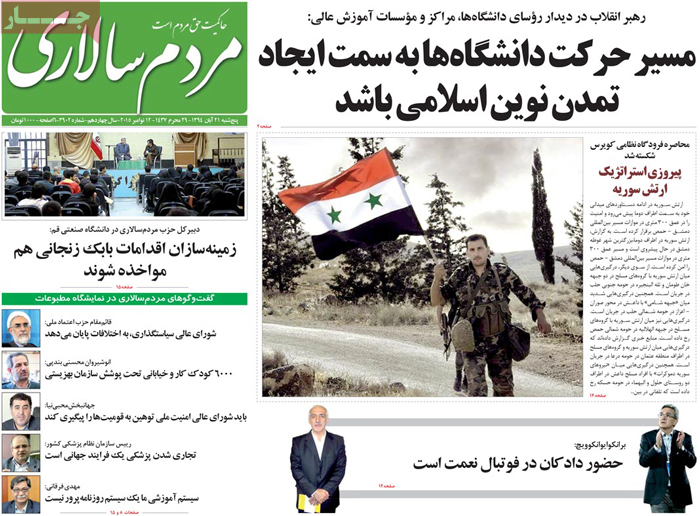
Mardomsalari: A strategic victory for the Syrian Army

Government forces have broken the siege on Kweyris military airport.


A look at Iranian newspaper front pages on Nov. 12


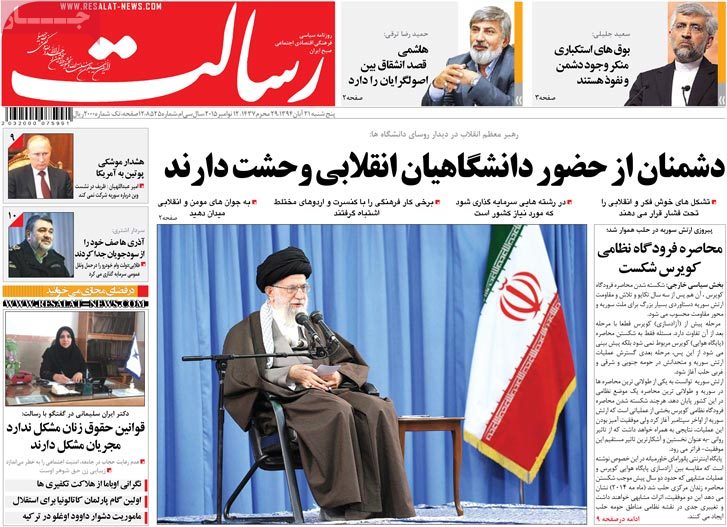
Resalat: People of Azerbaijan [in northwestern Iran] have distanced themselves from opportunists, said Police Chief Brigadier General Hossein Ashtari.


A look at Iranian newspaper front pages on Nov. 12


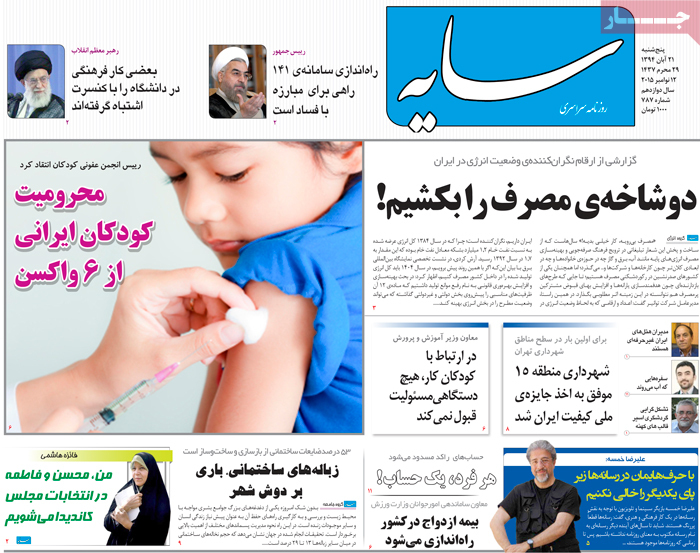
Sayeh: Faezeh Hashemi [a daughter of Ayatollah Hashemi Rafsanjani] has said that her brother Mohsen, her sister Fatemeh and herself will run for parliament.


A look at Iranian newspaper front pages on Nov. 12


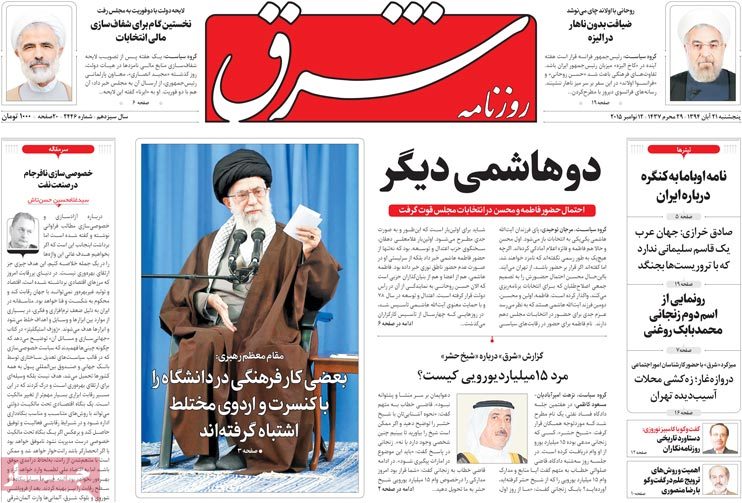
Sharq: A lunch-less banquet in the Elysee Palace

Presidents Rouhani and Hollande will simply have tea.


A look at Iranian newspaper front pages on Nov. 12


Highlights of Ettela’at newspaper on Nov. 12

Ettelaat

♦ The Supreme Leader has underlined the role of universities in helping create a modern Islamic civilization.

“Scientific needs assessment and investment in the kind of science the country needs are of paramount importance,” Ayatollah Khamenei said in a meeting with university presidents from across Iran.

♦ There will be no fluctuations in foreign currency values, said a senior official with the Central Bank of Iran.

The CBI’s anti-money laundering chief said that there are 38 million idle bank accounts with no national code numbers.

♦ The strategic Strait of Bab-el-Mandeb is now fully controlled by Yemeni forces.

An offensive by Yemeni forces against a Saudi-led coalition base in Taiz has left 20 Saudi forces killed.

♦ Moscow’s plan for holding early elections in Syria

According to the plan, the Syrian government and opposition should agree to amend the Constitution within 18 months before early presidential elections are held.

♦ The vice-president for parliamentary affairs has likened media to the respiratory tract of society.

Majid Ansari said that any attempt to block this tract would limit life and political liveliness in society.

♦ Talal Salman, the editor-in-chief of Lebanon’s As-Safir daily, has visited the offices of the Ettela’at daily.

♦ A ceremony has been held at the Society for the Appreciation of Cultural Works and Dignitaries to honor the memory of Ayatollah Beheshti.


What are the reasons behind Saudi Arabia’s hostility to Iran? (PART ONE)

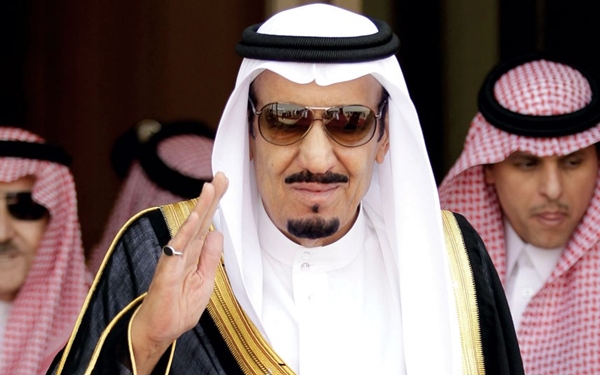
Prince-Salman_2251916k

The hostility of Saudi Arabia toward the Islamic Republic of Iran came to a head with the Mina tragedy. Officials in the kingdom insist on maintaining their hostile attitude instead of walking down the path of realism and being accountable for their mismanagement of the deadly stampede.

Hostile ties between Iran and Saudi Arabia have a long history dating back to when the kingdom was formed. Saudi Arabia’s hostile approaches to Iranian pilgrims and dispute over three Iranian islands [in the Persian Gulf] are classic examples of such historical hostility. This hostile attitude, which has been escalated following the victory of the Islamic Revolution, has shown itself in different forms, from a proxy war to threats to wage war.

Fararu.com on November 10 released a report on the reasons behind the hostility Saudi Arabia nurses against Iran. The following is PART ONE of the partial translation of the report which references an article by the Islamic Revolution Document Center:

Support for Saddam Hossein during the imposed war and attempts to undermine Iran’s interests in Iraq, Syria, Lebanon, etc. are among the measures Saudi Arabia takes to counter Iran. Nonetheless, what Saudi Arabia has done to consolidate its foothold in the region – to bring to power a government in Iraq with close ties with Al Saud family; to separate Syria from Iran; to stop Hezbollah in Lebanon from gaining power, to name only a few – has done little to help it achieve its stated objectives, even through open support for ISIS.

Reasons behind Saudi hostility toward Iran are as follows:

1. Changing the Persian Gulf’s name

[…] A number of countries, including Saudi Arabia, use the term “Arabian Gulf”, which is a fake name, instead of the Persian Gulf. All fabrications by the Arab countries come in line with longer-term objectives such as tribal disputes directly plotted by Britain. To prove that the British hands are at work, we can say that all through these years the British embassies in Arab countries have adopted conflicting stances fuelling the differences, with protests by Iran and Iran-lovers leading nowhere.

2. Saudi role in separation of Bahrain from Iran

[…] Bahrain was part of Iranian territory until 1957 when it was separated from mainland Iran thanks to interferences by the British government. History shows that the Iranian government held no sway in Bahrain from the start of the Qajar era because of the presence of colonial powers. In fact, Bahrain was under the influence of Britain with the Iranian government maintaining its nominal sovereignty over its islands. […]

After Iran declared Bahrain its 14th province in 1957, Saudi Arabia tried to separate Bahrain from Iran by setting up a union of which Bahrain was an independent member. […] In 1968, the [then] Saudi king welcomed the emir of Bahrain as the head of state. […] Eventually the Iranian government renounced its claim to Bahrain. It was either because it was afraid of the US and Britain, or it was preparing Arab nations to accept Iran’s offer to trade Bahrain for the islands of Abu Musa, the Greater and Lesser Tunbs. As a result, Bahrain was separated from Iran through a distorted referendum.

3. Triple Persian Gulf islands

[…] Since 1992, Saudi Arabia has supported baseless claims by the UAE to the three Iranian islands [in the Persian Gulf], saying that Iran’s takeover in 1971 of these islands from Britain has had expansionist intentions. […] Unfounded claims by the UAE which have the backing of Arab rulers are repeated each year.

4. Saudi Arabia’s downright hostility to Islamic Republic

[…] Post-revolutionary Iran’s ideas such as establishment of a global government of Islam, negation of domination, support for the oppressed, etc. drew reactions first from authoritarian governments such as that of Saudi Arabia. Propaganda by Arab nations against Shiite Iran and news on human rights violations in Iran influenced the public opinion in the Arab world.

[…] Opponents of the Islamic Revolution, especially in Saudi Arabia, took advantage of any development inside and outside the kingdom to undermine the revolution in court of public opinion. […]

5. Fight against ideals of Islamic Revolution

[…] Thanks to its oil and Hajj revenues, the Al Saud government has spent staggering amounts of money on promoting Wahhabism, which paints a conservative picture of Islam. The Saudi clerics – backed by Riyadh and the West – have tried to offset the Pure Muhammadan Islam which is championed by the Islamic Republic.

[…] Iran is facing regional rivals such as Turkey, Saudi Arabia and Egypt. Turkey is the leading country from an economic point of view, but Saudi Arabia is unique among Middle Eastern countries for its socio-cultural structure in which different tribes and sects – with their traditional and religious teachings –have created a special culture.

6. Cooperation with the US in Tabas Desert

Following the failure of the US government to release the Americans taken hostage during the 1979 takeover of the US embassy in Tehran by Iranian university students, President Jimmy Carter ordered the launch of an operation to release the hostages. The Delta Force carried out Operation Eagle Claw [in vain] to release the hostages in Tehran.

[…]

Later Zbigniew Brzezinski [an American political scientist] pointed to the cooperation of Egypt and a few other countries [in this plot] saying that a friendly nation cooperated with the US and a few other regional countries indirectly helped the US in this operation. […] He refused to name names, but the Iranian students said that Saudi Arabia, Turkey, Oman and Pakistan participated in the US operation, citing some documents which survived the US bombing of the helicopters which crashed in the botched rescue attempt. […]

7. Historic disrespect for Iranian pilgrims in 1943

– Disrespect for Iranian pilgrims and the killing of an Iranian pilgrim

[…]

In 1943, Iran and Saudi Arabia severed their diplomatic ties due to the killing of an Iranian pilgrim in Saudi Arabia.

– Massacre of Iranian Hajj pilgrims in 1987

[…] In 1987, Saudi security forces killed as many as 400 Iranian and non-Iranian pilgrims. This disaster escalated hostility between Iran and Saudi Arabia. The late Imam Khomeini slammed Saudi Arabia as the symbol of the so-called US-style and Royal Islam. […]

The massacre of Iranian pilgrims dealt the heaviest blow to ties between the two countries. The late Imam Khomeini said the crime Riyadh committed in this incident is unforgivable. […]

Commander: Enemy never dares to attack Iran

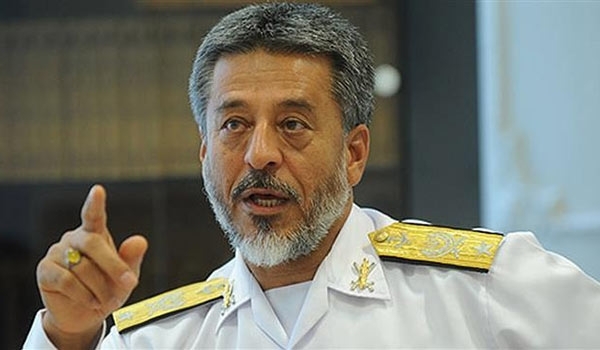
13940820001013_PhotoI

Iranian Navy Commander Rear Admiral Habibollah Sayyari said the enemies do not dare to attack Iran because they are well aware of the Iranian Armed Forces’ preparedness.

“No enemy will dare to give a dirty look to Iran due to the extent of the Iranian Armed Forces’ readiness,” Admiral Sayyari said, addressing the Navy personnel in the southern city of Sirjan in Kerman province on Wednesday.

The Iranian Navy commander underlined the full preparedness of his forces to confront and defeat all types of enemies and under any condition.

Last week, Iranian Defense Minister Brigadier General Hossein Dehghan underlined the Armed Forces’ capability to give a rapid and crushing response to any enemy threat.

“The Iranian Armed Forces are able to control and repel threats decisively and swiftly in accordance with their level and type,” Dehghan said, addressing a gathering Iran’s diplomatic corps abroad.

He also underscored the country’s huge progress in the past few years in building different weapons and military equipment to defend itself.

[…]


Saudi must stop mischievous acts against Iran: Shamkhani

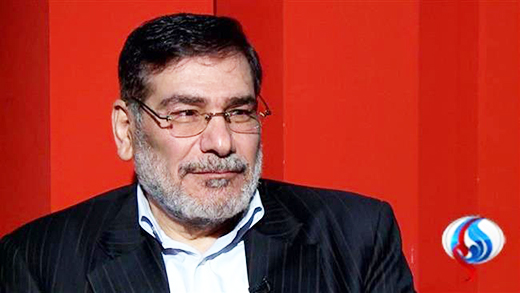
7e939777-faff-41c9-a76b-315539342ebb

Secretary of Iran’s Supreme National Security Council Ali Shamkhani says the Saudi regime has to “stop acting mischievously” against the Islamic Republic if Riyadh seeks settlement of differences with Tehran.
Saudi Arabia takes “unfavorable actions” inside Iran, the website of Iranian al-Alam Arabic-language news channel quoted Shamkhani as saying in an interview with the network .
Referring to a recent terrorist attack in Iran’s southwestern province of Khuzestan, he said the perpetrators had been funded by the Saudi security service.
At least two people were killed and two others sustained injuries after masked assailants opened fire on a group of people who were holding a mourning ceremony for Imam Hussein, the third Shia imam, in the city of Safiabad, located in Dezful county in Khuzestan, on October 16.
Shamkhani further said Saudi money is instrumental in Syria, which is in the grip of a deadly foreign-sponsored conflict that erupted in March 2011, adding that Riyadh is also bombing the defenseless people of Yemen.
The relentless bombardment of the impoverished nation, which started on March 26, without any international mandate, has been meant to undermine Houthi Ansarullah movement and restore power to the fugitive former Yemeni president and a major ally of Saudi Arabia, Abd Rabbuh Mansour Hadi.
Shamkhani, however, stressed that Iran and Saudi Arabia enjoy good historical relations and that the rift in the Muslim world must be healed.
He also pointed to the upcoming round of talks on Syria in Vienna, Austria, planned for November 14, saying that the Islamic Republic will support the Syrian people’s opinion about the future of Syrian President Bashar al-Assad.
During the previous round of talks on October 30, the participants, including the United States, Russia and Iran, agreed to push forward a peace plan for Syria that would include a ceasefire.
However, the talks failed to reach consensus over the role President Assad would play in Syria’s political process. While some countries want the removal of the Syrian leader as part of a solution to the issue, Iran and Russia say only the Syrian nation can have a say on that matter.
Shamkhani said the West has sought in vain to topple the Syrian government since 2011 militarily, adding that the same governments are now seeking the ouster of Assad politically.
The foreign-backed militancy in Syria, which flared in March 2011, has so far claimed the lives of over 250,000 people and displaced hundreds of thousands.

People should be discussed in Syria talks, not Assad: President Rouhani

Rouhani-message

Iranian President Hassan Rouhani says discussions on the crisis in Syria should focus on the Syrian people and not President Bashar al-Assad.
“It’s not about a person. It’s about a nation; it’s about the Syrian nation. It’s about security and stability for Syria,” President Rouhani said in a Wednesday interview with TV channel France 2 and French radio Europe 1, according to excerpts broadcast by the two outlets.
His remarks came ahead of a new round of international talks on Syria in the Austrian capital, Vienna, on Saturday. The talks will bring together some 20 countries and international bodies to try to agree on a roadmap for peace.
The Iranian president also stressed that all sides attending the talks need to make efforts to eradicate terrorism in Syria and make it possible for peace and stability to return to the region.
He said certain people are trying to divert the debate on Syria away from the questions that matter.
Previous negotiations on the Syrian crisis were held in Vienna on October 30, bringing together top diplomats from 17 countries, including Iran, as well as envoys from the United Nations (UN) and the European Union (EU).
The participants agreed on the necessity of respect for Syria’s unity and sovereignty as well as the eradication of the extremist groups operating in the Arab country, stressing that the political process to end the bloodshed there “will be Syrian-led and Syrian-owned.”
Syria has suffered from over four years of foreign-backed militancy.
The Arab country is experiencing a relative ease from the turmoil as the government forces have made significant gains against Daesh (ISIS) and other terrorist groups under a six-week air cover provided by Russia.
The crisis in Syria, which flared in March 2011, has so far claimed the lives of over 250,000 people and displaced nearly half of the country’s population within or out of its borders.

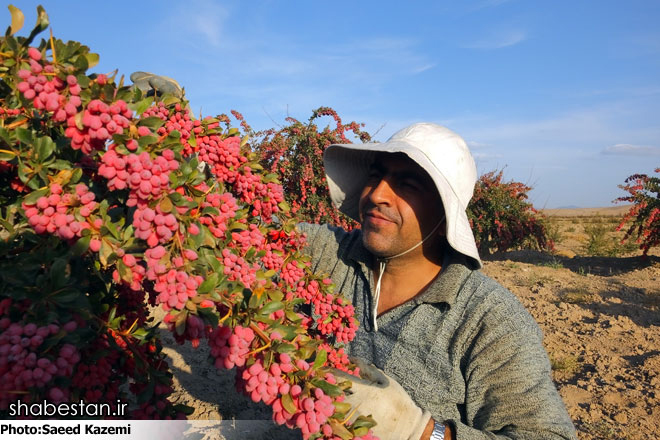
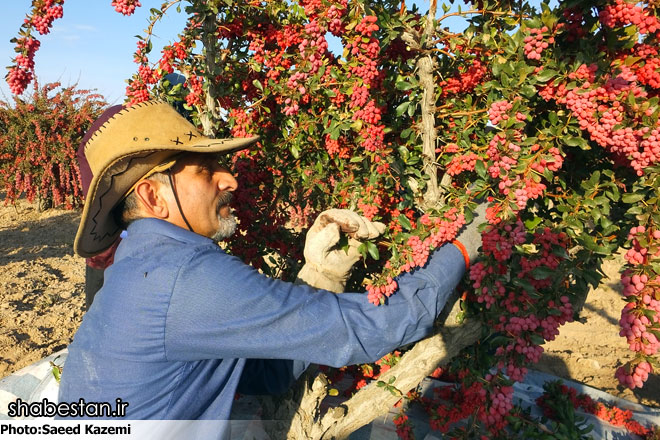
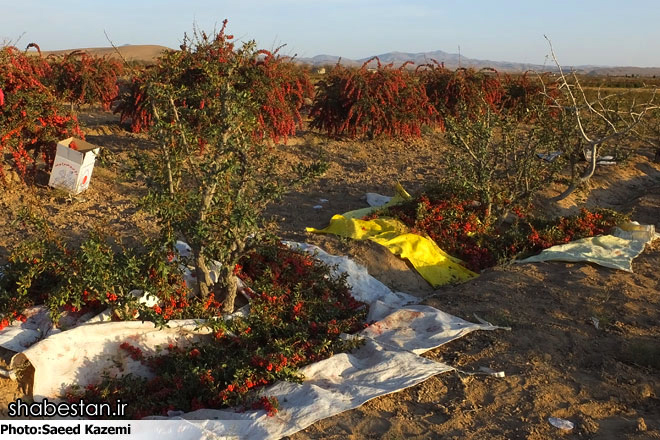
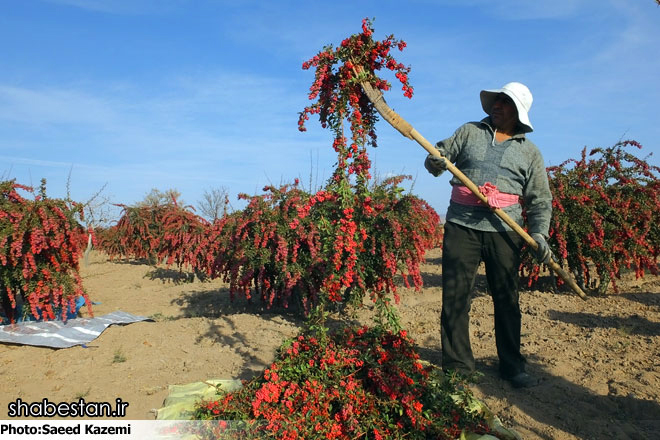
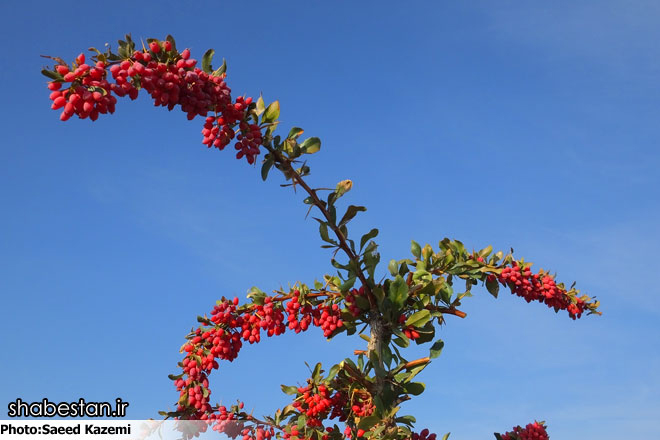
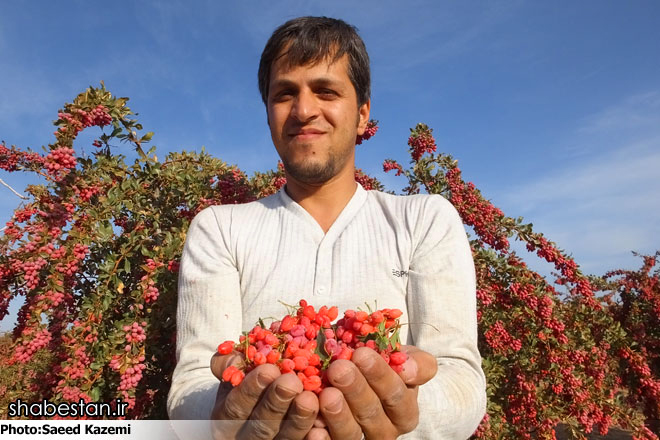
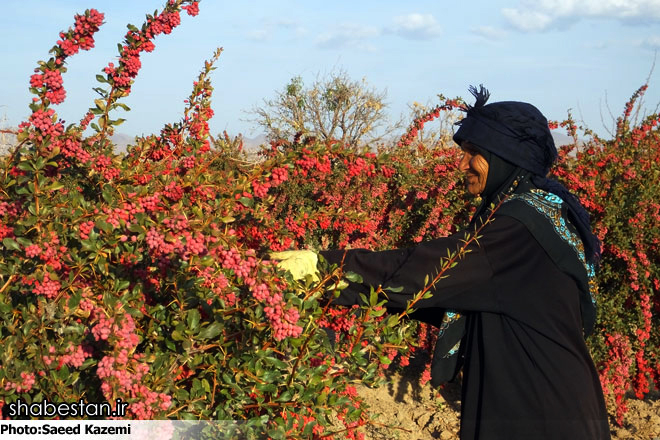
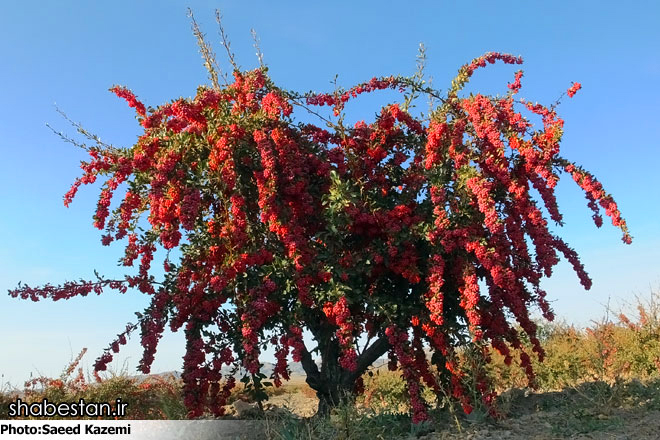
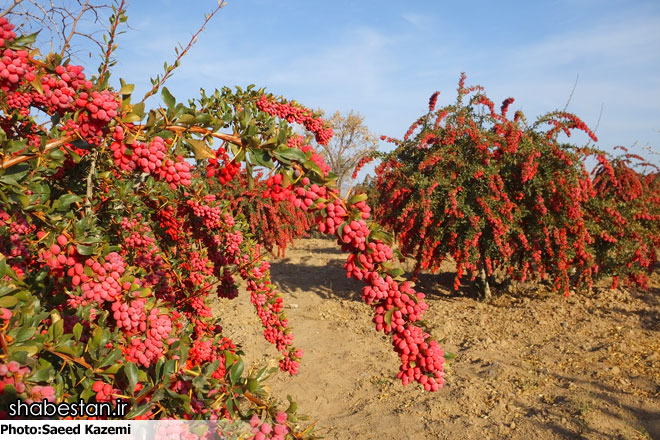
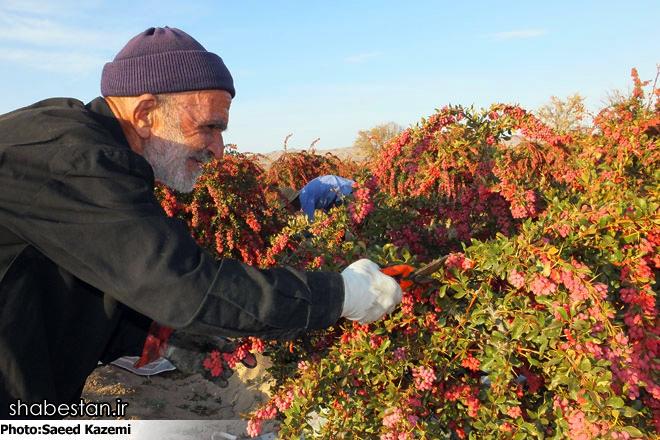
Barberry collection in South Khorasan Province (PHOTOS)

zereshk28

Barberry plays a key role in the livelihood of people in South Khorasan Province. It has been cultivated in as much as 14,228 hectares of land in the province this year [ending March 2016].

Around 16,500 tons of barberry is expected to be harvested in this area.

Shabestan.ir has released the following pictures of barberry farms in eastern Iran:


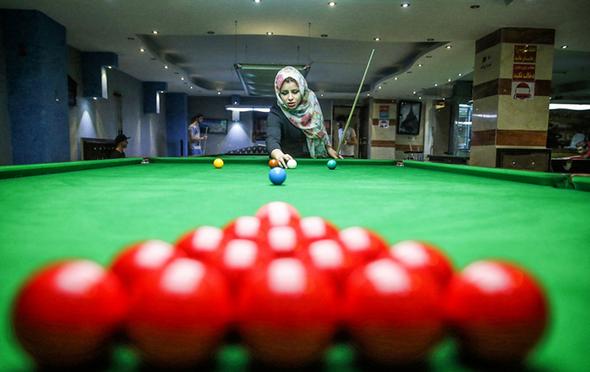
Great female pool player (PHOTOS)

10

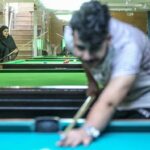
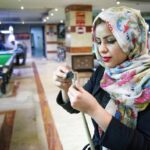
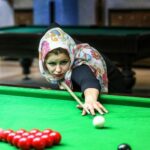
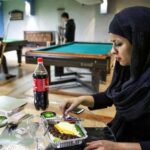
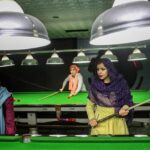
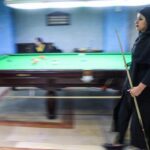
Akram Mohammadi Amini, aged 28, is among a small number of Iranian women who play billiards at a national level.
Mohammadi Amini, a physical education major, has won three gold medals in national snooker competitions. She has been practicing hard to represent Iran in overseas championships.
The Islamic Republic News Agency has published snapshots of her practicing: