Monday, December 22, 2025
Home Blog Page 4684

A look at Iranian newspaper front pages on August 4

Iranian Newspapers Headlines

What the first vice-president said and what he didn’t say about corruption during the previous government’s term in office dominated the front pages of Iranian newspapers on Tuesday. Reformist dailies put an announcement by the chairman of the Expediency Council about his candidacy in upcoming Assembly of Experts on their front pages. Principlists continued to lash out at President Rouhani for his comments during a prime-time televised speech on Sunday.


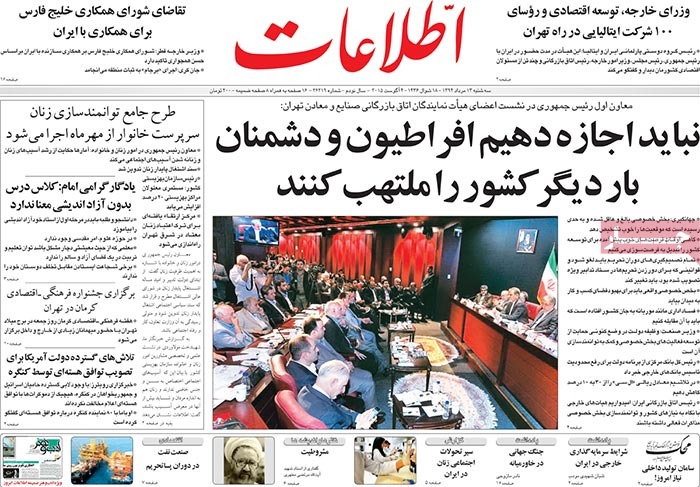
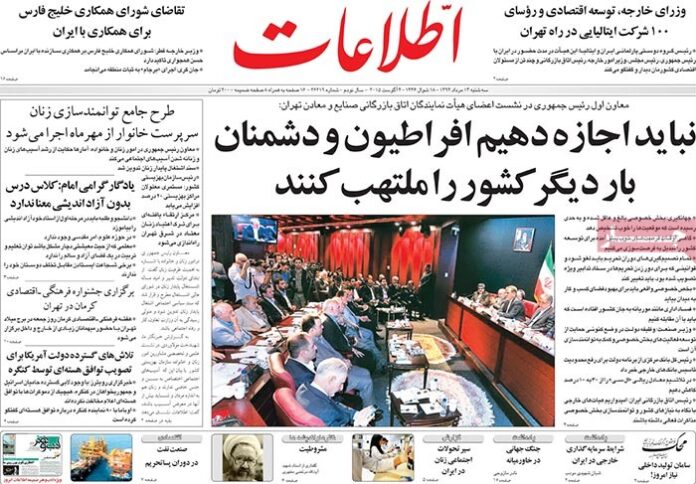
Ettela’at: “We should not allow hardliners and the enemies to stir things up in the country once again,” said the first vice-president at a meeting with members of Tehran Chamber of Commerce, Industries and Mines.

Eshagh Jahangiri further said the private sector is mature enough to seize trade opportunities.


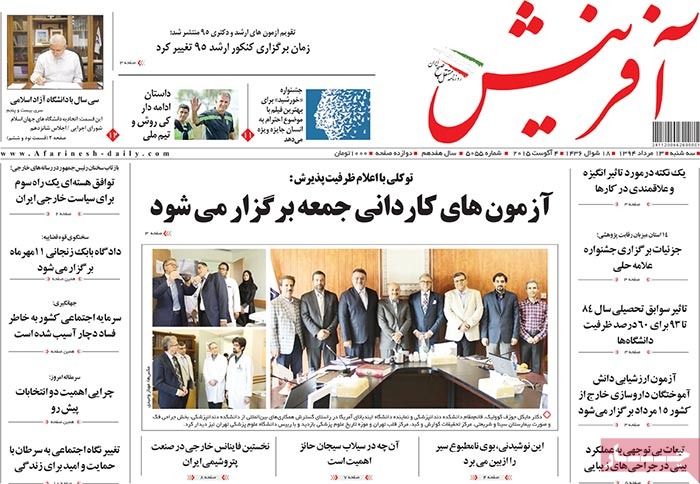
Afarinesh: “The trial of Babak Zanjani [a young billionaire who stands accused of massive corruption when Ahmadinejad was in office] will open on October 3,” the judiciary spokesman said.
 

A look at Iranian newspaper front pages on August 4


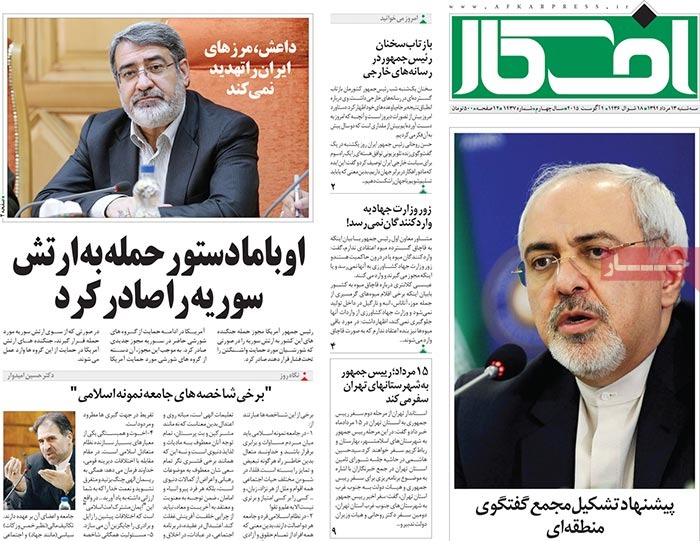
Afkar: “IS does not pose a threat to Iran’s borders,” said the Iranian interior minister.
 

A look at Iranian newspaper front pages on August 4


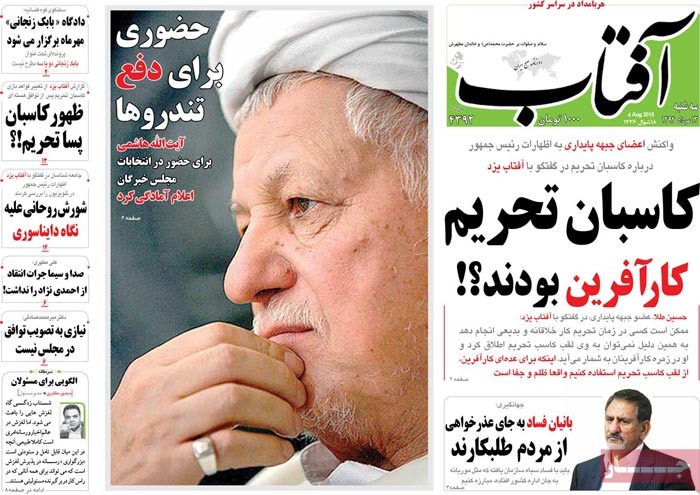
Aftab-e Yazd: Participation to repel hardliners

Ayatollah Rafsanjani has signaled his readiness to run for the Assembly of Experts.

Aftab-e Yazd: “Instead of apologizing, those behind corruption act as if they are owed by members of the public,” said First Vice-President Eshagh Jahangiri.
 

A look at Iranian newspaper front pages on August 4


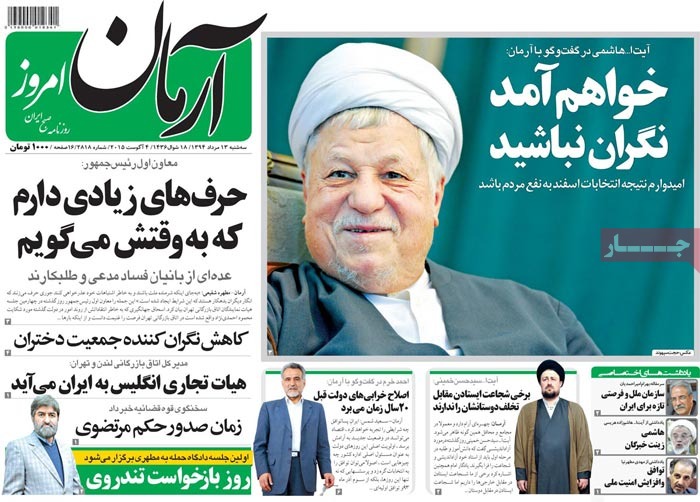
Arman-e Emrooz: “I have many things to say; I’ll make them public all in due time,” said First Vice-President Eshagh Jahangiri.

Arman-e Emrooz: Extremism on trial

Those who attacked Tehran MP Ali Motahari when he traveled to Shiraz for a planned speech will appear in court on Tuesday.

Arman-e Emrooz: “It takes 20 years to fix the problems caused by the previous government,” said Ahmad Khorram, a former transport minister.
 

A look at Iranian newspaper front pages on August 4


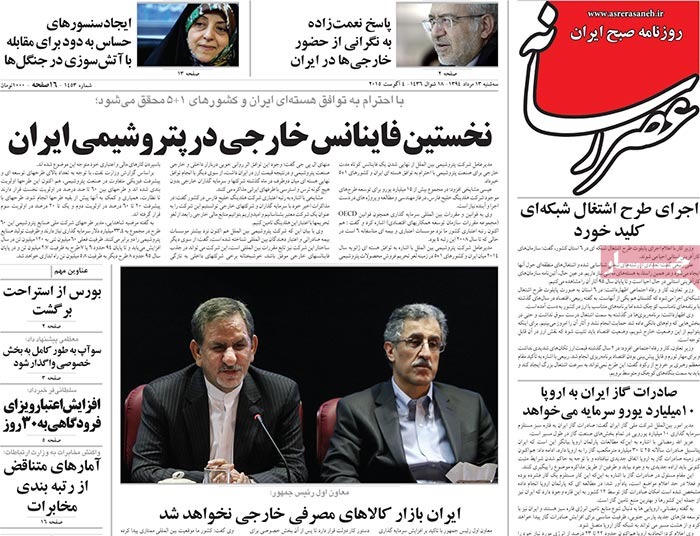
Asr-e Rasaneh: The director of the Environment Protection Organization has said that smoke alarms will be installed in forested areas to detect forest fires.
 

A look at Iranian newspaper front pages on August 4


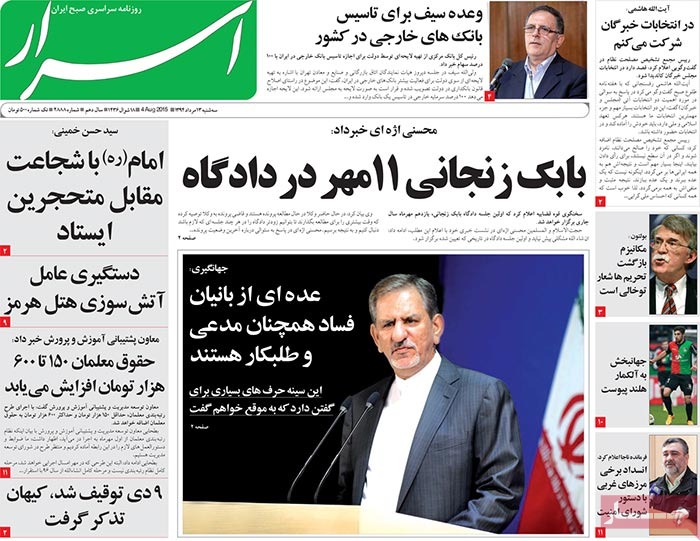
Asrar: The arsonist who set fire to Hormoz Hotel in the southern port city of Bandar Abbas has been arrested.

Asrar: Dey 9 [a weekly run by hardline MP Hamid Rasaei] has been banned; Kayhan has been given an admonition.
 

A look at Iranian newspaper front pages on August 4


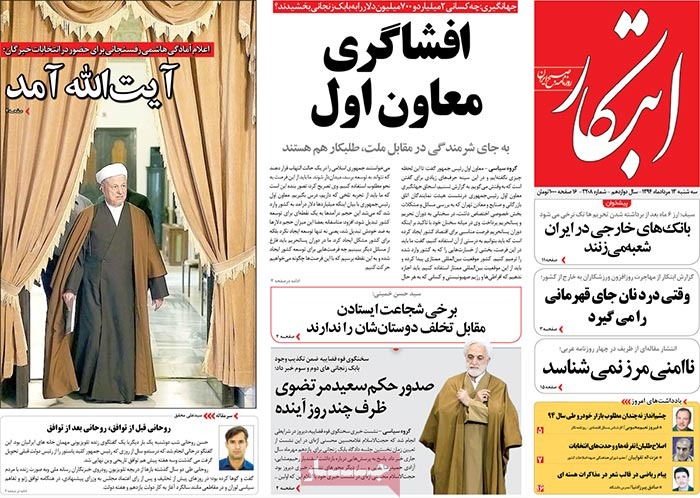
Ebtekar: “Foreign banks are to set up branches in Iran,” said the governor of the Central Bank.

Valiollah Seif further said six months after the termination of sanctions, a single foreign exchange rate will be introduced in the country.

Ebtekar: “A verdict in the case of Saeed Mortazavi [a former director of the Social Security Organization who is on trial, among other things, for corruption] will be issued within days,” said the judiciary spokesman.

Gholamhossein Mohseni Ejei denied the existence of a second or third Babak Zanjani [a young billionaire who stands accused of committing massive embezzlement when Ahmadinejad was in office]
 

A look at Iranian newspaper front pages on August 4


Emtiaz: A rehabilitation center for addicted mothers has been set up in eastern Tehran.
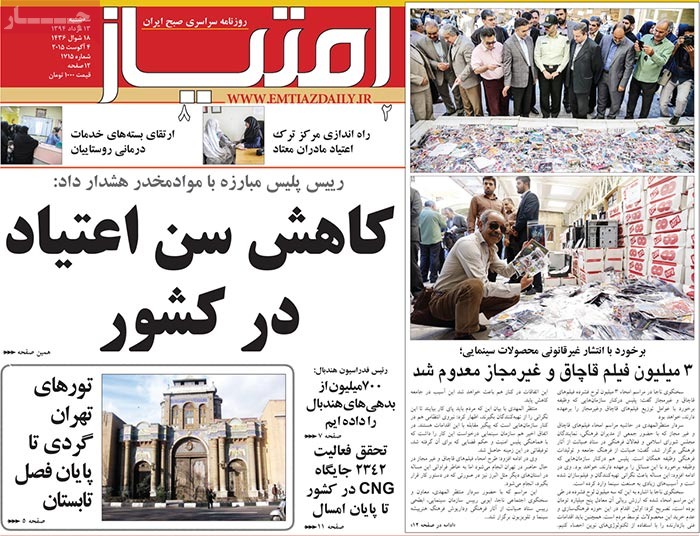
 

A look at Iranian newspaper front pages on August 4


Etemad: “Frankly, I am worried [about the nuclear deal Iran has struck with P5+1 in Vienna,” said Tehran MP Gholamali Haddad Adel.
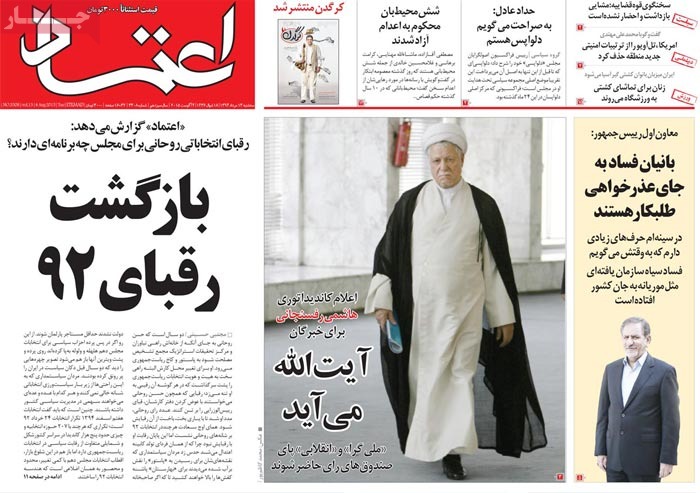
 

A look at Iranian newspaper front pages on August 4


Hambastegi: The police chief has said law enforcement is blocking some border areas following an order issued by the Supreme National Security Council.
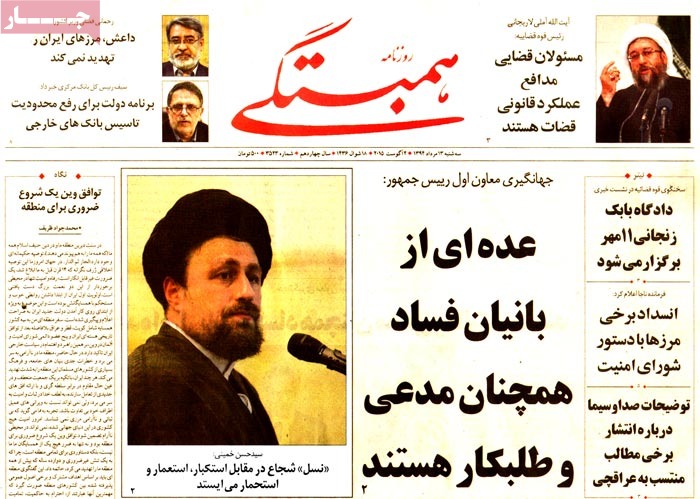
 

A look at Iranian newspaper front pages on August 4


Hemayat: “The gray points of the nuclear deal will be examined,” said Judiciary Chief Ayatollah Sadegh Amoli Larijani.
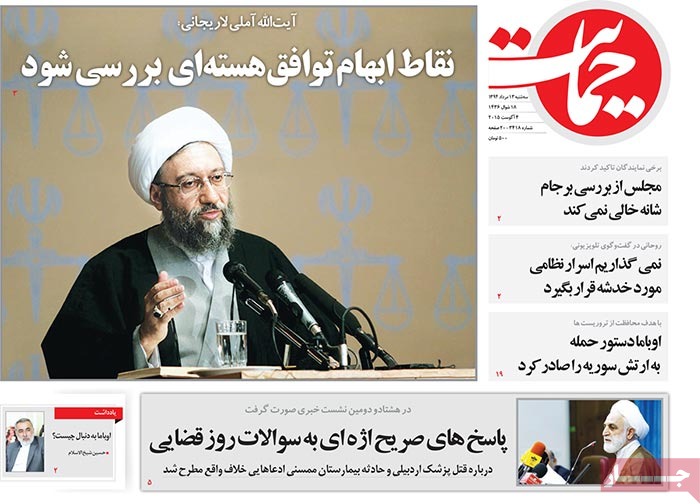
 

A look at Iranian newspaper front pages on August 4


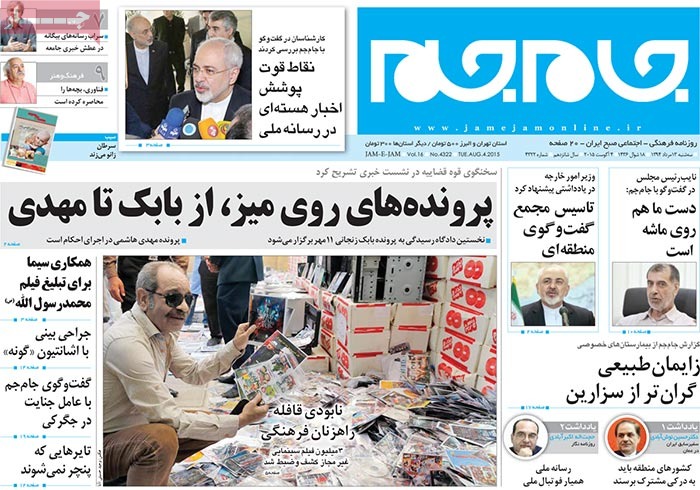
Jamejam: The Iranian foreign minister has proposed the formation of an assembly for regional dialogue [in an opinion piece published by four Arabic-language papers in the Middle East].
 

A look at Iranian newspaper front pages on August 4


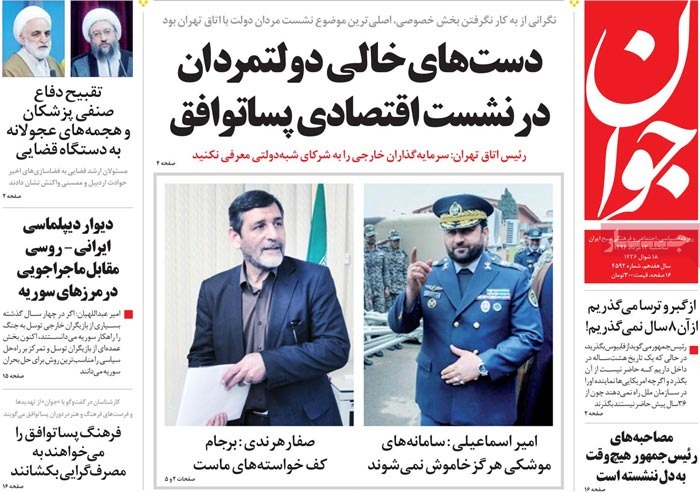
Javan: “Iran’s missile defense system won’t be switched off,” Brigadier General Farzad Esmaili, the commander of Khatam al-Anbiya Air Defense Base, said.
 

A look at Iranian newspaper front pages on August 4


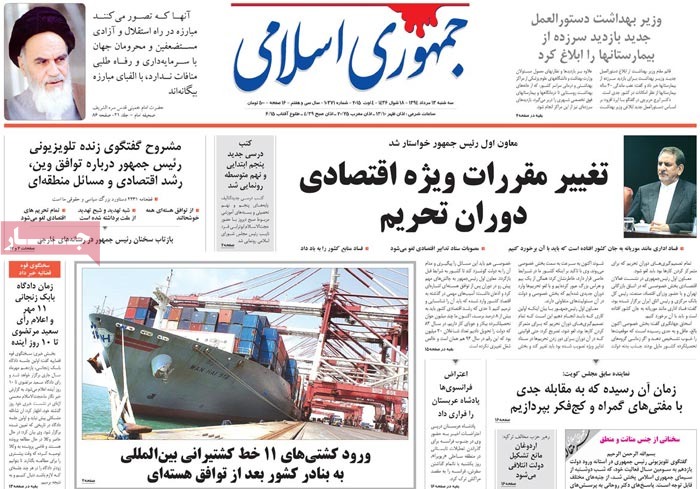
Jomhouri Islami: Ships belonging to 11 international carriers have docked at Iranian ports following the nuclear deal of July 14.
 

A look at Iranian newspaper front pages on August 4


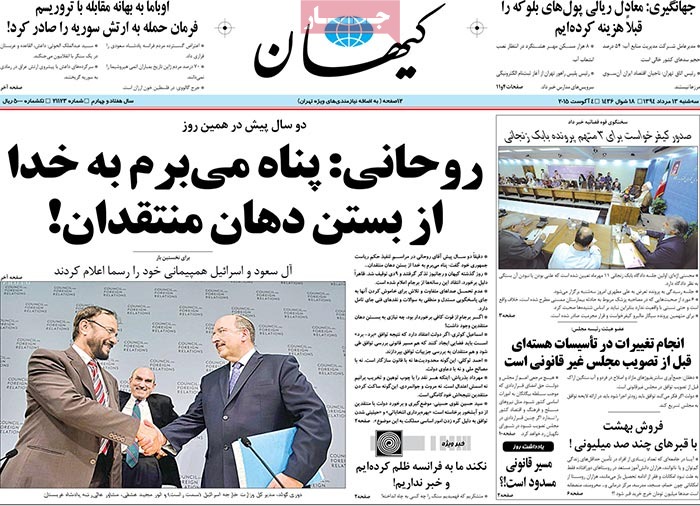
Kayhan: Saudi Arabia and Israel have for the first time announced their official alliance.

Kayhan: “I seek refuge in God from muzzling the critics!” President Rouhani said two years ago today.

[The sarcastic banner headline was in reaction to the closure of a hardline weekly and the admonition Kayhan received from relevant officials for their coverage of the nuclear deal between Iran and P5+1.]
 

A look at Iranian newspaper front pages on August 4


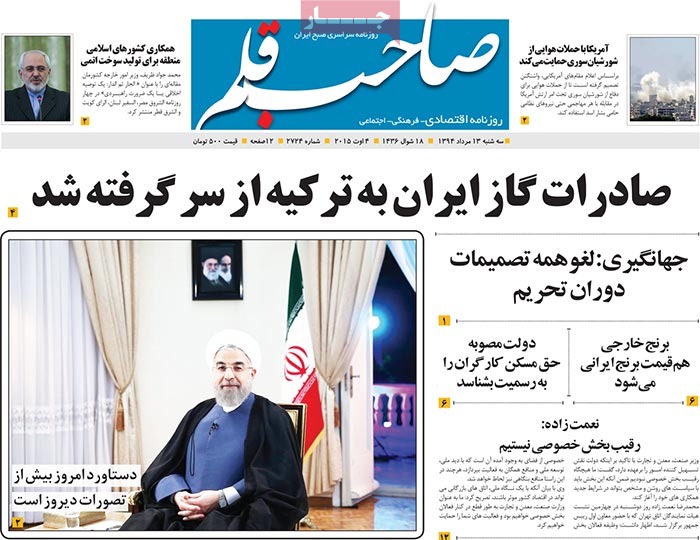
Saheb Ghalam: Iran has resumed exports of natural gas to Turkey.

Saheb Ghalam: The minister of trade has said his ministry does not act as a rival to the private sector.
 

A look at Iranian newspaper front pages on August 4


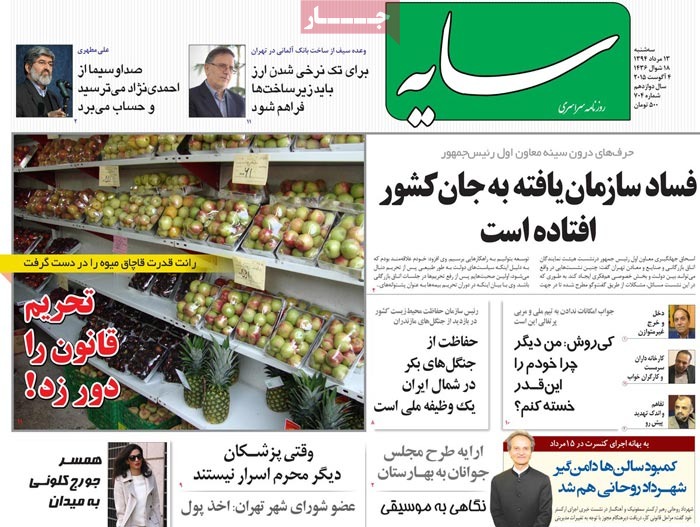
Sayeh: “Islamic Republic of Iran Broadcasting [IRIB] was afraid of Ahmadinejad and wouldn’t do anything to cross him,” said [outspoken] Tehran MP Ali Motahari.
 

A look at Iranian newspaper front pages on August 4


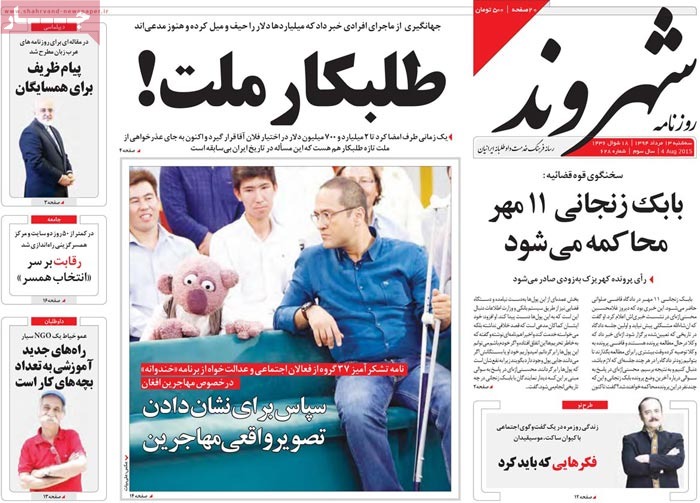
Shahrvand: Twenty-seven social activists have sent a letter to Khandovaneh, to thank the host of the popular TV show for painting a realistic picture of Afghan immigrants.
 

A look at Iranian newspaper front pages on August 4


Highlights of Ettela’at newspaper on August 4

Ettelaat-August4

 “We should not allow hardliners and the enemies to stir things up in the country once again,” said the first vice-president at a meeting with members of Tehran Chamber of Commerce, Industries and Mines.

Eshagh Jahangiri further said the private sector is mature enough to seize trade opportunities.

 The Italian ministers of foreign affairs and economic development are to visit Iran at the head of a delegation which also includes the top executives of 100 Italian firms.

During its stay in Tehran the Italian delegation will meet, among others, with the president, parliament speaker, foreign minister and the chairman of the Chamber of Commerce.

 The Persian Gulf Cooperation Council [PGCC] has called for cooperation with Iran.

The Qatari foreign minister has said that PGCC favors constructive cooperation with Iran based on the principle of good neighborliness.

 A plan to empower women who head families will be implemented as of late September.

The news came after the drafting of a document to create sustainable jobs for women was completed.

 The grandson of the late Imam Khomeini has said education loses its meaning in the absence of freethinking.

Seyyed Hassan Khomeini further said university and seminary students should first learn from their teachers how to become a freethinker.

 Tehran is to play host to a Kerman cultural and economic festival.

A number of local and foreign guests will attend the festival at the capital’s Milad Tower.

 The Obama administration is making extensive efforts to have the Iran nuclear deal approved in Congress.

Despite extensive lobbying by Republicans and supporters of Israel, Democrats on Capitol Hill have not opposed the deal yet.


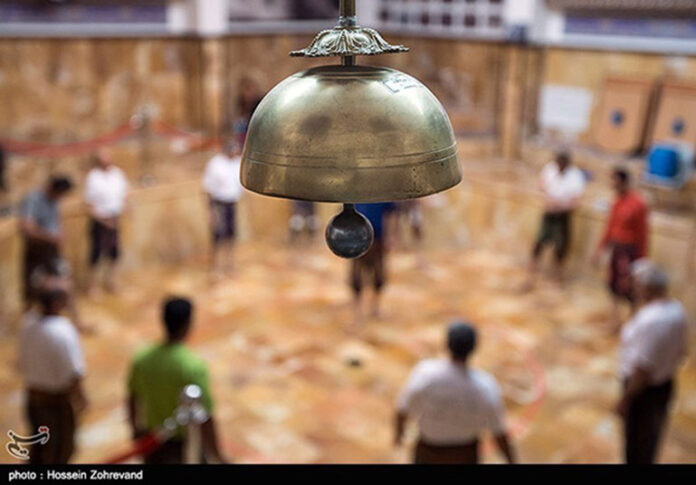
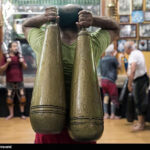
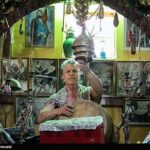
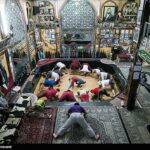
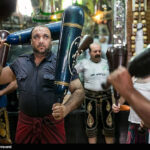
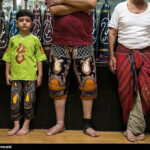
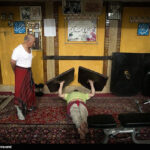
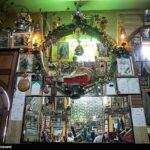
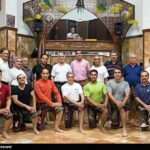
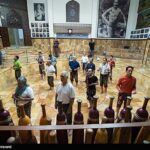
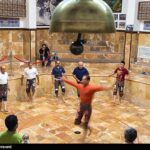
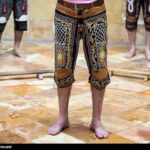
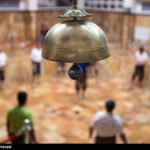
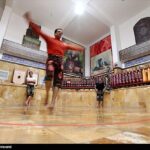
Zoorkhaneh (PHOTOS)

Zoorkhaneh00

Zoorkhaneh (traditional Iranian gymnasium) features a system of athletics originally used to train warriors. It is believed to have been pioneered by Pourya-ye Vali, who was famous for his chivalrous behavior and strength, about 700 years ago.

The traditional sport is assumed to be much older; ancient Iranians practiced traditional wrestling to build up their physical stamina.

Images of Zoorkhaneh posted online by Tasnim News Agency:

Germany to set up Bank in Iran: Official

139404111551065115612554

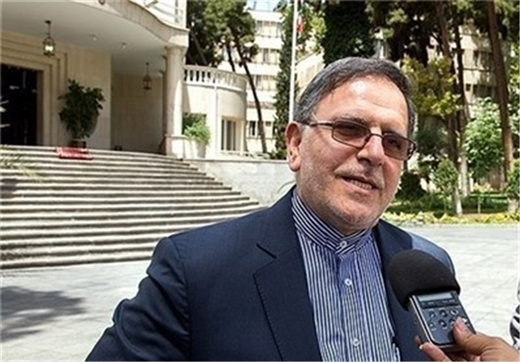
Central Bank of Iran (CBI) Governor Valiollah Seif announced that in a recent visit by a high-ranking German delegation to Tehran, it was agreed that Germany establish a bank in Iran.

In a meeting with representatives of Tehran Chamber of Commerce, Industries, Mines and Agriculture on Monday, Seif said that there is no restriction for foreign banks to establish financial institutions in Iran.

“According to the regulations of free trade zones, foreign investors can establish new banks or bank branches in these zones,” he said.

Seif further pointed to his recent meeting with the German economic delegation, saying it was decided in the meeting that the Germans launch a bank in Iran.

Back on July 19, a 100-strong German delegation, headed by Vice-Chancellor and Minister for Economic Affairs and Energy Sigmar Gabriel, arrived in Tehran to meet with top Iranian officials and hold talks on ways to boost economic ties.

[…]

Experts believe that Iran’s economic growth will rise remarkably after a nuclear deal it struck with world powers on its nuclear program in July takes effect.

Iran billed ‘most lucrative’ hospitality market

fa6898dc-b904-4f1b-b5bf-8503e31fc828

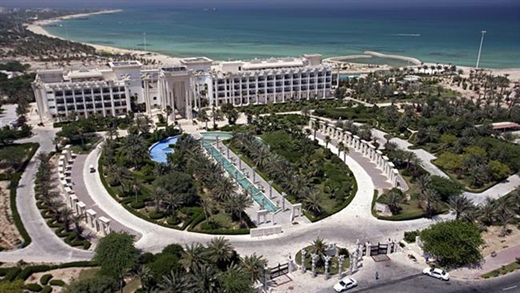
Hotel groups in Persian Gulf Arab states are seeking to boost their portfolios in Iran as they see the country emerging as the most lucrative hospitality development market.

Iran has an ambitious target to increase annual visitor count by five folds to 20 million by 2025 in order to generate $30 billion a year.

International hoteliers are heartened by the plan and spurred by the recent finalization of nuclear talks, they see the ground being paved for expansion of the country’s infrastructure and industrial base.

“There has already been talk of an investment of $185 billion in oil and gas projects, as well as further development of the country’s metals and automotive industries, while general trade is certain to rise which will give a tremendous boost to the region,” president and CEO of UAE-based Cristal Hotels Peter Blackburn says.

The legion of traders, entrepreneurs and politicians is already trickling in and Tehran is struggling to offer suitable and sufficient accommodation.

“In addition to business interests, there is considerable demand for Iran as a new tourism destination,” Blackburn told the Arabian Business.

“And we can see potential to grow in all sectors in the country, taking advantage of new financial incentives as well as the transformation of the image of Iran in global markets,” he added.

According to Iranian officials, hotel groups from Germany, Greece, South Korea and Singapore have recently traveled to Iran for talks.

Europe’s largest hotel group Accor is reportedly building two four-star hotels at Imam Khomeini International Airport outside the Iranian capital.

The UAE-based Rotana plans to open a five-star 600-room hotel in Tehran this year and another in the pilgrimage city of Mashhad.

Head of the Iran Touring and Tourism Investment Company (ITTIC) Mohsen Gharib has said the country has to prepare for a “tsunami” of foreign tourists. But the torrent is on course to pose serious challenges, given Iran’s underdeveloped hospitality market.

Majority of Iranians support JCPOA: Araghchi

araghchii

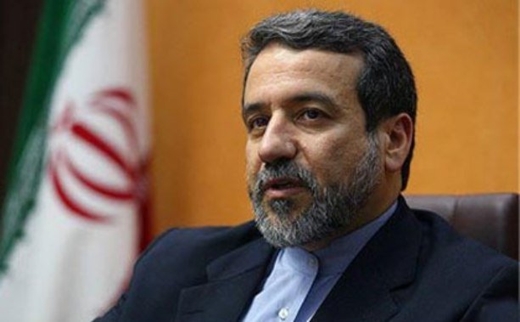
Deputy Foreign Minister and top nuclear negotiator Seyyed Abbas Araghchi said on Monday that according to opinion polls the majority of Iranians support and are pleased with the Joint Comprehensive Plan of Action (JCPOA).

The deputy foreign minister who made the comment at a meeting with university researchers and media analysts did not offer statistics on the opinion polls he mentioned.

[…]

Araghchi praised the political growth and maturity of the general public in recognizing national interests and the macro-scale security sensitivities of the country, giving them assurances that President Rouhani’s Cabinet tries to observe maximum transparency in informing the public.

“With all due respect for surveys on Iranian nation’s opinion of JCPOA, the agreement’s international and regional aspects are worth thorough review,” said the top member of the Iranian nuclear negotiation team.

US playing with ISIL pawn: Iran parliament speaker

ad45e974-0b7a-46a2-9cf1-79e123cb1b47

Iranian Parliament Speaker Ali Larijani says the United States is using the ISIL Takfiri terrorist group as a means to advance its own interests in the region.

“It seems that the US is playing with the ISIL pawn in the region,” Larijani said Monday in a meeting with visiting Serbian Foreign Minister Ivica Dačić.

The top Iranian legislator said that a lack of serious efforts by the US in dealing with ISIL has enabled the terrorist group to freely operate in the region.

Larijani said such a policy has further emboldened ISIL terrorists to press ahead with their crimes, which is detrimental to peace and security in the region.

Drawing a comparison between the developments in the Balkans in the early 90s and the current situation in the Middle East, Larijani said in both cases “intervention by outside elements” hampered the restoration of tranquility.

The Serbian foreign minister, for his part, criticized the international community’s double standards vis-à-vis the war on terror, saying the policy has exacerbated violence and extremism.

Dačić slammed the big powers for their interventionist policies in various parts of the world, saying they sow discord among ethnic and religious groups with the aim of disintegrating big countries.

He said such policies further intensify instability across the world.

Iran-Serbia business council to meet

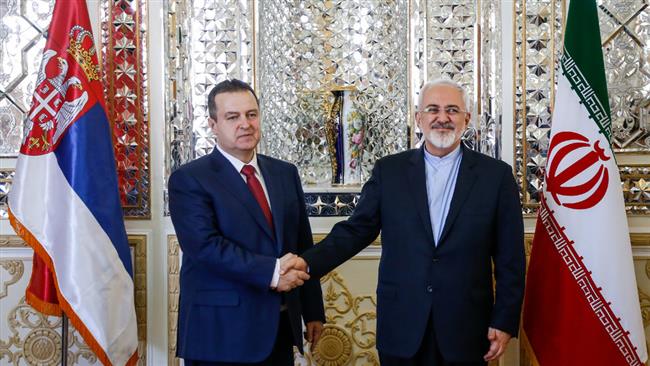
Earlier in the day, Dačić also met with Iranian Foreign Minister Mohammad Javad Zarif and the two top diplomats discussed ways of boosting bilateral relations, especially in business and economic fields.

During the meeting Zarif welcomed a proposal by Dačić for the holding of the 14th Iran-Serbia Joint Economic Committee.


cc8ae8eb-40ad-4914-a9c5-bb572e6f293c


Zarif welcomed the proposal, saying, “In this regard, an economic delegation from Iran’s government and private sectors will head for Belgrade in the future.”

Referring to the countries’ long-standing and favorable relations, Zarif expressed hope for the development of bilateral cooperation in political, economic, energy, agricultural, parliamentary, cultural, scientific, and academic areas.

The Serbian minister, for his part, voiced Belgrade’s readiness to open a new chapter in ties with the Islamic Republic in the political, economic, and parliamentary fields.

The Serbian official also felicitated Iran on the conclusion of nuclear talks between Tehran and P5+1 – the United States, Britain, France, China, Russia and Germany – in the Austrian capital Vienna last month.

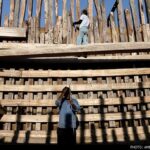
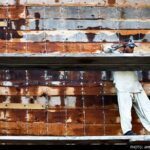
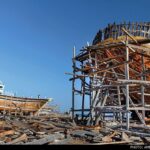
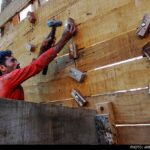
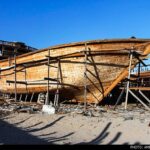
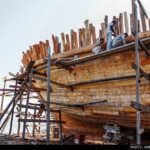
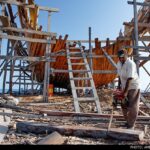
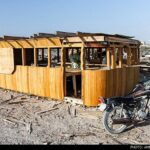
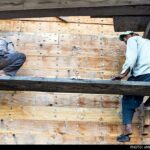
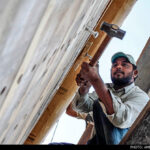
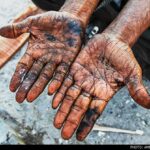
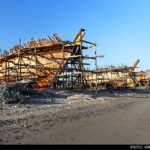
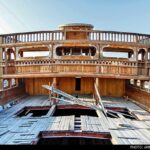
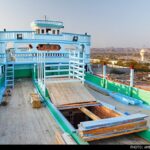
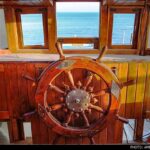
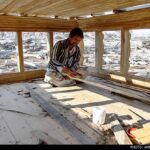
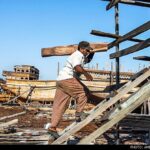
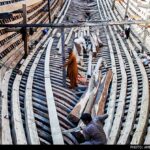
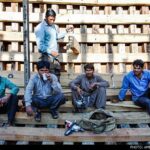
A dhow workshop in southern Iran (PHOTOS)

boats0

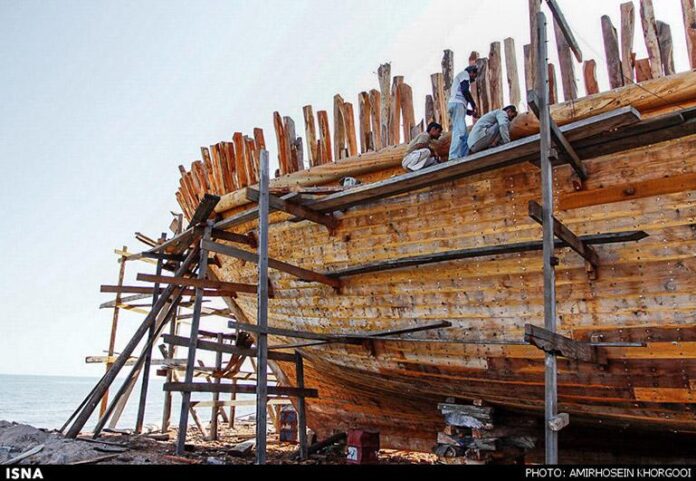
The port city of Kong in Hormozgan Province is home to workshops where sailing boats are built.

The following are images of a dhow workshop released online by the Iranian Students’ News Agency:

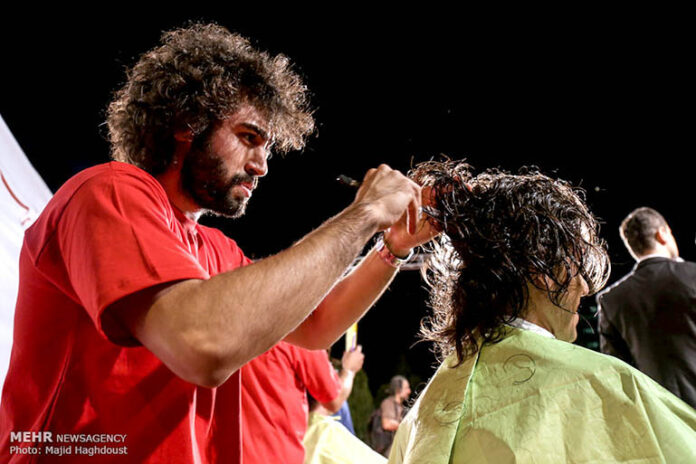
Iranian stylists show their stuff at festival (PHOTOS)

stylists504

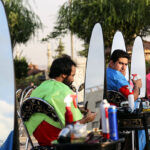
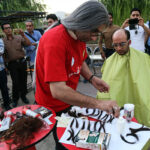
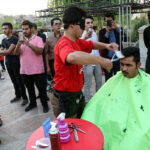
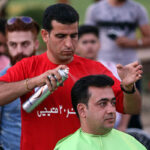
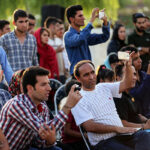
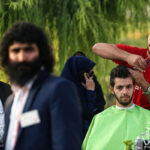
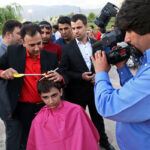
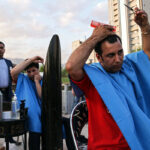
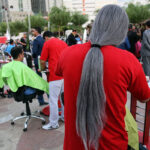
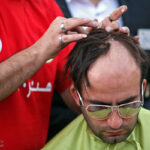
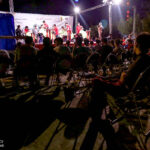
At a festival held in a Tehran park late in July, male stylists tried to put on display their skills to cut hair.

Images of the festival released online by Mehr News Agency:

Official: Positive signals are coming from Saudi Arabia

amir-abdolahian1

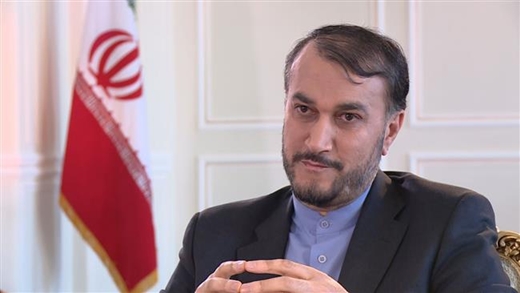
Iran’s deputy foreign minister for Arab and African affairs says that Tehran has received positive signals from Riyadh and is waiting to see what the Kingdom does in practice.

Hossein Amir-Abdollahian made the comment in an interview – with Al-Alam News Network – which covered a wide range of questions, including ties with regional countries and the fight against ISIL. The following is the translation of parts of his remarks in the interview as reported by entekhab.ir on August 3:

Iran’s policies

Interaction with neighbors and regional countries tops the list of Iran’s foreign policy priorities. The eleventh government is trying to pay more attention to its main priority [ties with regional nations] after the Iran nuclear deal. To that end, Tehran is seeking to deepen ties with regional countries on all fronts, including environmental and security issues. A new opportunity has opened up for the region to take appropriate measures to get out of regional crises.

Iran held talks with P5+1 simply on the nuclear issue. The Foreign Ministry has had no plan for talks with world powers on regional issues, because Tehran believes regional questions should be solved by regional nations.

Saudi Arabia

The Saudi solution to regional problems, especially its aggression against Yemen, is a strategic blunder. Iran does not approve of this Saudi approach, but seeks to help Tehran-Riyadh ties return to previous levels. Iran and Saudi Arabia can have constructive interaction to both settle bilateral differences and solve regional problems. […]

I met with Saudi Foreign Minister Adel Al-Jubeir on the sidelines of an Organization of Islamic Cooperation conference in Jeddah and provided transparent and frank answers to his transparent comments on regional questions.

At that meeting, we agreed that diplomacy is the only way forward to remove misunderstandings and set the stage for the two countries to help settle regional disputes. We agreed that Iran and Saudi Arabia should launch straightforward, constructive talks, play a positive role in the fight against extremism and terrorism and help restore security and stability in the region.

I heard positive remarks from Mr. Al-Jubeir there. We hope what he said will materialize in practice. We also hope the Saudis pave the way for working out a diplomatic solution in Yemen, Syria, Lebanon and other regional countries.

We have received positive signals from the Saudis, but they are just messages. We are waiting to see what Saudi Arabia does in practice. We will respond positively if Riyadh plays a constructive role. Saudi Arabia is expected to act insightfully, stay away from war, stop the killing of civilians in Yemen and focus on diplomatic approaches in its regional policies.

Bahrain

[…] If Iran had intended to get involved in the Bahraini question, the situation in the Persian Gulf country would have been different. Authorities in Bahrain are creating security scenarios simply to suppress public demands. […] Manama’s resort to force and its human rights violations have widened the gap between people and the government. The Bahraini government is expected to return to the diplomatic path and reconcile with its people. Now that the stage has been set for regional cooperation, Manama is expected to play a constructive, not destructive, role. Iran has always supported a national dialogue and diplomatic solution in Bahrain.

Syria

Regional players have changed their Syria policies, stressing the need for a diplomatic, not military, solution to the Syrian crisis. We have held constructive talks with Mr. Staffan de Mistura [the UN special envoy in Syria] whose new initiatives will be discussed at the UN Security Council soon. […] The Syrian foreign minister will be in Tehran later this week to talk with his Iranian counterpart on the pursuit of Iran’s solution to his country’s crisis.

The nuclear deal 

The Iran nuclear deal revived a long-forgotten concept in the international relations: diplomacy and dialogue can solve the most complicated of political problems. Another message the deal carried was that it is possible to let go of war and walk down the path of diplomacy to reach solutions. It can set an example for regional countries to follow. The deal showed to regional nations that they can solve all regional crises through diplomacy and without foreign interference.

Fight against ISIL

Iran and Turkey have strategic ties, although they do not see eye to eye over Syria’s future. Turkey’s security matters to Iran, but Tehran does not support measures which endanger the sovereignty of Turkey’s neighbors. The fight against terrorism, especially on ISIL, by Turkey or any other country should be in coordination with the Syrian and Iraqi governments. Countries should not take measures which violate the territorial integrity and sovereignty of neighboring countries. […]
Cooperation with the US

Iran was among the first countries to help Iraq and Syria in their fight against terrorism and ISIL in the region. Tehran has no plan to enter partnership with the US against ISIL. We will continue to offer assistance, including consultation, to Baghdad and Damascus.

The US has its own plans for taking on ISIL. Washington has adopted double-standard policies on terrorism. We have no contact or cooperation with the US on fighting ISIL. In the future, Iran will simply help those regional countries which have been targeted by terrorist threats.
Israel

[…] The Zionist regime’s officials make comments [on Iran] out of fear, weakness and concern. The nuclear deal Iran has clinched with P5+1 has raised the regime’s concerns. Western officials have repeatedly said that the Iran nuclear deal has boosted Israel’s security, but the fact remains that the Zionist regime is now at the nadir of its power.
Lebanon

The political future of Lebanon is of great significance to Iran, so is this country’s security. Iran supports the finalization of the political process in Lebanon and the pick of a president in the Middle Eastern country. We hope diplomatic efforts will bear fruit in the next several weeks and Lebanon can enjoy more security and move toward bolstering its political stability.

Egypt

Iran has always welcomed establishment of sustainable, constructive ties with Egypt. It is now up to the Egyptians to decide about the development of relations with Tehran. Talks at political levels are ongoing between the two nations. Iran approves of Egypt’s stance on taking on extremism and terrorism in the region. We hope the challenges in Egypt can be overcome and the demands of revolutionary Egyptian people can be met.