Thursday, January 1, 2026
Home Blog Page 4684

‘International firms ready to accept Iran Petroleum Contract’

9cd486e5-4ac2-468c-b4e1-a77e991a1831

An Iranian deputy oil minister says following introduction of the new format of Iran’s oil contracts, international companies have indicated their readiness to work with Iran based on the new contract.

Roknoddin Javadi, deputy oil minister and managing director of the National Iranian Gas Company (NIGC) made the remarks on Saturday after a meeting with senior executives of a number of international oil giants on the sidelines of an international conference in Tehran.

The conference, dubbed “Tehran Summit: Iran Oil and Gas Projects and Domestic Capacities,” opened in Tehran on Saturday to lay out 50 oil and gas projects for development through foreign investment which Iran hopes to pour in with the lifting of Western sanctions.

In an interview with SHANA, the Iranian Oil Ministry’s official news agency, Javadi said his negotiations with representatives of foreign companies have been positive, adding, “These and other international companies active in the oil industry are ready to cooperate with Iran within the framework of deals based on the new Iran Petroleum Contract (IPC).”

The official added that during his talks with France’s Total and Malaysia’s Petronas, they have discussed available grounds for development of hydrocarbon fields in Iran and commissioning of liquefied natural gas (LNG) plants.

“Representatives of [Russia’s] Lukoil have also indicated their readiness to cooperate with the National Iranian Oil Company in the field of developing [hydrocarbon] fields,” he said.

As many as 250 representatives from 33 countries attended the Saturday conference, during which Iran introduced a new contract format offering better incentives to investors than the previous buy-back deal.

Head of the Iran Contracts Restructuring Committee (ICRC) Mehdi Hosseini said no American company took part in the event, but a number of big oil and gas entities sent their representatives.

The new contract includes specifications of the production-sharing agreements, which will encourage investors to produce more oil and develop a field for longer terms.

Each individual project will have tailor-made contracts, rather than a uniform format for all projects.

Companies will be allowed a share of the oil they produce, enabling them to sell it abroad. They will share the rise or fall in recovery; hence, the more they produce, the more they will earn.

The Iran Petroleum Contract (IPC) also gives investors the opportunity to participate in operation and production for 20 years that can be extended to 25 years, according to officials.

Iran’s General Soleimani headed Russian pilot rescue team: Syrian officer

0ba8fb3b-9586-47f8-bff4-f6fcdeda35e0

The pilot of Russian Su-24 fighter jet downed by Turkey Tuesday was saved during a joint rescue operation in Syria supervised by a senior Iranian commander, a Syrian officer says.

Commander of the Quds Force of Iran’s Islamic Revolution Guards Corps (IRGC) Major General Ghasem Soleimani assembled a rescue team made up of 18 Syrian special force members and six Hezbollah fighters for the operation, a report by the Sputnik news agency on Saturday cited a Syrian officer as saying.

The unnamed Syrian officer said the team was tasked with rescuing the pilot while air and intelligence support was being provided by Russian forces.

According to a report published by Fars News Agency, Russian fighter jets carried out airstrikes in the region to push militants away, which allowed the team to gain better access to the terrorist-held territory.

Apart from rescuing the pilot, the team also eliminated all terrorists active in the region, before returning safely to base.

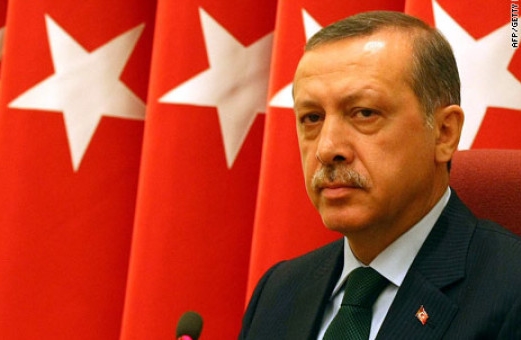
On Tuesday, Turkish Air Force shot down the Russian jet, accusing it of having violated Turkish airspace, an allegation Moscow has denied. One of the pilots was killed by militants in Syria after ejecting from the jet and the other was rescued.

Subsequently, the IRGC strongly dismissed rumors spread by Israeli media outlets that Soleimani had been killed.

“Often, the Israelis write down their dreams in the form of news and spread them through their media in the cyberspace,” the head of the IRGC’s Public Relations Office, Brigadier General Ramezan Sharif said. “The fake news about Major General Ghasem Soleimani’s martyrdom is of this sort.”

Italy is a reliable partner for investment in and transfer of technology to Iran

Riccardo Monti

Riccardo Monti, the president of the Italian Trade Promotion Agency (known by its Italian acronym ICE) has said that Italy can be a good partner for Iran which is after reliable partners for joint investment and technology transfer.

The president of ICE whose agency is tasked with promoting Italy’s overseas trade made the comment in an interview with the Italian official news agency (ANSA) on the eve of his Iran trip. The following is the translation of a report in Farsi the Islamic Republic News Agency filed on November 28 on the comments of the Italian official:

Riccardo Monti said: “This delegation is the biggest Italian economic delegation which goes to Iran. In recent months Iran has made it clear that it does not solely intend to purchase foreign products, rather it is trying to find reliable partners for joint investment as well as transfer of technology for domestic production. Italy can be a good partner for Iran in this regard.

“Entrepreneurs accompanying the Italian delegation are mostly active in areas such as mechanics, medical equipment, building materials, vehicles, renewable energies and the environment.

“On this economic mission, more than 700 meetings are to be held between the Italian and Iranian companies in Tehran to enable cooperation on different fronts from joint investment to trade deals.

“Italian entrepreneurs are interested in returning to a country where efficient entrepreneurs are supported by a strong hands-on approach of the government to the economy.”

Representatives of as many as 178 Italian companies, 20 associations and 12 banking groups (370 in total) travel to Iran as part of Italy’s biggest economic mission to Tehran.

Italy’s Economic Development Ministry, Foreign Ministry, ICE, and the Unions of Industries and of Chambers of Commerce planned the visit after the Joint Comprehensive Plan of Action was signed. The visit comes as sanctions against Iran are on the verge of being lifted.

The Italian economic delegation aims to both spot and deepen the prospects of trade and industrial cooperation between Iran and the Italian manufacturing sector that intends to win back its past status in Iran.

Bilateral transactions between the two countries stood at €7 billion before the imposition of economic sanctions, and it has now shrunk to about €1.6 billion.

Why is Iran’s security tied to regional peace and security?

Middle-East

Hossein Alaei, who has the stewardship of the IRGC’s Navy under his belt, is a familiar face on Iran’s political scene. His strategic and independent political views have made his analytical articles, which are released in Iranian media every now and then, all the more read-worthy and contemplative.

Alaei delivered a speech at a scientific meeting on “The Russian presence in Syria and its impact on Iran’s national security and interests” which was recently held in Tehran in cooperation with the Iranian Political Sciences Association (IPSA) and the Center for the Middle East Strategic Studies.

Tabnak.ir, a news website, on November 18 published the full text of his speech. IFP has already released the translation of the first part of Alaei’s remarks. Part one came with the original headline “Why has Russia intervened in Syria?” and Part two is headlined “Why is Iran’s security tied to regional peace and security?” The following is PART TWO of his speech:

The security of the Islamic Republic of Iran

The question that arises here revolves around what threatens Iran’s national security. I think what has posed a threat to Iran’s security over the past 50 years has been the situation on the ground and the type of governments in neighboring countries.

During the previous regime [Mohammad Reza Pahlavi’s regime] Iraq was the primary threat to Iran. After the formation of the Islamic Republic, Iraq remained the main threat and [its ruler] Saddam Hussein invaded Iran. The fact is that military action against Iran was devised by the neighbors run by dictators.

In my opinion, terrorism which is on the march in neighboring countries is the biggest threat likely to be carried out against Iran. Our neighbors lack enough fire power to launch military attacks on Iran. Therefore, the absence of a [strong] government or the establishment of weak governments in neighboring countries poses the gravest threat [to Iran].

The absence of a strong government has contributed to the emergence of [terror] groups such as al-Qaeda, the Taliban, ISIS, the al-Nusra Front, etc. which are highly likely to be hired by rival powers. That’s why Iran’s security is threatened by the absence of [strong] governments or the existence of weak governments in surrounding countries. In such circumstances, [rival] powers and [terror] groups can plan, coordinate and carry out anti-Iran measures.

Another threat against Iran comes from Israel. Whether we like it or not, Israel has been the primary threat to Iran. Israel, too, views the Islamic Republic of Iran as a threat. Israel has carried out – and will do [in the future] – any measure it deems feasible against Iran. A case in point is the assassination of nuclear scientists on Iranian soil. Tel Aviv will do what it thinks is possible against Iran in the region.

For Israel, what matters most is the formation of governments in Syria and Lebanon which are alienated from Iran. If that happens, the stage would be set for Israel to push its own agenda.

Imagine a government in Syria similar to that of Turkey. Israel would have access to the airspace of countries which lie between Iran and Israel. In that case, Iran would have no air security, and Israel would have full control over the skies in the region. This would be a grave menace to the Islamic Republic of Iran.

I think the governments that rise to power in Syria, Lebanon and Iraq should be on the same wavelength with Iran, or at least on a different wavelength with Israel so that they cannot be influenced or pressurized by Israel.

Even a government like the one in Turkey which has inked a military cooperation treaty with Israel and its Incirlik Air Base is used by the US Air Force poses a grave threat [to Iran], because the United States and Israel would be given access to the Turkish airspace once Ankara reaches an agreement with Washington and Tel Aviv.

US policies pose yet another threat to Iran’s security. The United States believes that Iran should be managed and contained. To Washington, any method to secure such management is ok. The most useful methods [the US has chosen] have been economic and banking sanctions over the past ten years.

An in-depth look at Iran’s security makes you wonder whether Russia’s intervention in Syria can contribute to efforts which serve Iran’s interests.

There is a skeptical view that suggests basically any military intervention threatens security, and that embracing military intervention anywhere in the world jeopardizes the national security of all countries.  A textbook case of such military intervention was the presence of trans-regional powers in the region since the occupation of Kuwait whose consequence, read insecurity, is still felt in the region and the world.

I think ISIS and groups as such are the product of the [US-led] invasion of Iraq. Unfortunately the activity of such groups is growing and their terrorist acts are spreading. At the beginning, these groups are managed [by States], but after their formation they are no longer backed by States.

There’s no doubt that the US created al-Qaeda. [The 9/11] Attacks on Twin Towers [of the World Trade Center] were carried out by al-Qaeda when the terror outfit was no longer managed by the United States, because the CIA had no control over it.

There’s no doubt, ISIS has been created through the support of these [global] powers, but the terror group is no longer managed or controlled by countries such as Turkey, Saudi Arabia and Qatar which used to give it financial support and military training.

When the Syrian crisis was at its early stages, 48 members of the IRGC on board of a bus – heading for Syria to pay a pilgrimage visit to the shrine of Hazrat Zeinab (Peace be upon her) – were taken hostage by terrorist groups among them ISIS militants. Iran secured their release with the help of Qatar. If Qatar had had no influence over ISIS, Iran’s hostages would not have been freed.

Certain countries such as Saudi Arabia, Qatar and Turkey have influence over terror groups, but it does not mean that they have been involved in the planning of the attacks on Paris. ISIS and other terror groups do not seem to be managed by these countries anymore. No longer do the terrorist groups coordinate their plans with the governments which once supported them.

The question is whether the terrorist attacks in Paris, Lebanon and Iraq can be analyzed from a single angle. There are different offshoots of ISIS which are likely to be guided by intelligence and security services – which intend to pursue their own agenda – to take action against Shiites or stage attacks on mosques or public places.

Pessimists might say that the Paris attacks were mounted to set the stage for a bigger job by the US and the Europeans in the Middle East. They are seeking to solve other issues by seizing this opportunity. But I think there is no need to make such an analysis. The spread of terrorism, especially ISIS, has dragged other countries into the crisis.
All things considered, the governments and countries should put the following measures on their agenda to help boost security in the region and the world:

1) Condemnation of and opposition to military intervention by all countries

2) All-out fight against terrorism by those countries which view terrorism as a scourge of human security

3) Respect for the votes of nations and approval of their sovereignty in all countries through fair, not interventionist, mechanisms.

If these three measures are promoted by tapping into diplomacy and dialogue, perhaps we can move down the path of security and peace.

I made a stand against the killer gasoline and they are taking revenge

Masoomeh-Ebtekar

Rarely a week passes without Iran’s environment chief and her organization not coming under fire by Islamic Republic of Iran Broadcasting (IRIB) and hardline media. These media outlets either criticize her performance or accuse her of pursuing a political agenda instead of focusing on professional management of the environment.


Vaghaye-e Etefaghiyeh in its fourth issue on November 28 published an interview with Masoumeh Ebtekar who has taken the helm of the Environment Protection Organization for the second time in Iran. The following is the translation of the interview in its entirety.

Q: Since the day you were appointed director of the Environment Protection Organization, IRIB and some media outlets which are critical of the government have shown opposition to you and created ballyhoo [about your performance]. Why? 

A: I have never been involved in political ballyhoo; rather such ballyhoo has been created for me. My colleagues and I at the Environment Protection Organization (EPO) have, by no means, pursued a political agenda. Unfortunately certain media have a political attitude toward EPO.

From day one, I tried to distance my organization from political and factional issues, but some political currents seem to be displeased with the EPO advancing its own agenda. The fact of the matter is that since the beginning, the eleventh government has received an unkind treatment by certain media circles, and it is not only me who is treated this way.

IRIB – in some of its news bulletins – has treated the EPO unfairly. I think IRIB is dealing with the question of environment and me in a one-sided manner. IRIB does not cover all my plans and activities; it only airs marginal issues about the EPO which is a sort of chantage.

Q: Why do you think some media organizations are seeking to create ballyhoo for you?

A: By and large, I think some media do not critique the government fairly. They are after ballyhoo more than critique. I expect to see the eleventh government be compared with its predecessors. We expect to see that the whole government is treated properly and critiqued fairly. How come they [IRIB and other media] kept silent over the same problems and mismanagement under the previous government?

A just critique is expected to review both the current situation and the past. In 2002, we purchased the most advanced radio masts and towers for the Environment Protection Organization. Did anybody ask why these towers have disappeared? These radio towers have been sold under the previous government. Why doesn’t nobody ask what has become of these towers?

Is there anybody to ask about the reason behind land grab or reclamation in Varjin Protected Area [in Tehran Province] and Abr [Cloud] Forests [in Shahrood]? In Varjin, villas have been built, sold through deed. This is just one, out of hundreds, of the cases of land grab which has been done in the name of serving people.

The head of [the EPO’s] Tehran Department under the previous government kept hundreds of property deeds in his house in the name of development. Withdrawing from public coffers, they [the previous government officials] did a treacherous act of betrayal as far as the Abr Forests were concerned. What I want to say is that if you try to critique [the situation on the ground], try to have a look at what has happened over the past years too.

In 2006, a road was built in the middle of Muteh, which is an environmental place [northwest of Isfahan Province]. How come IRIB has not broadcast a report on what has happened in Muteh since 2005? There are multiple issues for IRIB to be concerned about. The previous government tried to dissolve the Environment Protection Organization to prevent it from dealing with that terrible crime [road building in Abr Forests].

Q: In spite of what you said, they are critical of the current state of the environment.

A: We expect them to review all periods. The MPs who have constantly pursued investigations into the [performance of the] EPO over the past two years, called me to parliament many times. We are still facing cases of land grab, corruption and so forth.

When a road was being built through the Abr Forests – a grave and unforgivable act of betrayal of the Iranian nation – they put forward a plan to dissolve the EPO. During the eight years the previous government was in power, the number of environment organizations halved.

The environment organizations were treated in a highly charged atmosphere and this resulted in their shutdown. With the removal of such organizations, nobody was there to stand up to the road building in Abr Forests. There were no organizations to make the voice of the environment heard.

Q: You didn’t explain the main reason behind their strong opposition to you. You have repeatedly said what you just said.

A: First we raised question about the distribution of carcinogenic gasoline which was another act of betrayal. Supporters of [former president] Ahmadinejad hold grudges against me. Mr. Mirkazemi summoned me to parliament several times. The gasoline was carcinogenic thanks to the existence of abundant volumes of benzene which was 1,000 times the international standard.

We shouted this. Half of the gasoline used in Tehran had benzene. We tasked Tehran Air Quality Control Company (AQCC) with measuring the volume of benzene in the gasoline. The findings of those tests – whose documents are now available – showed that the gasoline which was distributed in Tehran and other cities over the past two years was highly carcinogenic.

Right then a barrage of charges and criticism was unleashed against me and my family. The day I wanted to discuss these questions, I was told not to do that. They threatened me and then they began to attack me on different grounds.

Q: Once you said that you are faced with family problems?

A: They said that my husband imported gasoline! Does it mean that my husband is not allowed to live his own life, because I have got involved in the areas that I should not have been? I appeared before parliament seven times to offer explanations about cancerous gasoline.

After the carcinogenicity of the gasoline was established, Mr. Mirkazemi, an MP in the ninth parliament, told me that I had stood up to the achievements and glories of a great government. That’s right! I take pride in the fact that I have objected to the [use of] gasoline which was cancerous, killing people.

We receive threats for any question we try to deal with. For instance, “Euro 4” gasoline is distributed in some cities at a time when sanctions [against Iran] are still in place. In the early days of the eleventh government, I called on Oil Minister Mr. Zanganeh to oppose [the use of] the deadly gasoline. And now over the years these gentlemen [a reference to Ahmadinejad’s supporters] accuse me of treason. I want to ask who the [real] traitor is.

I expect to see the environment treated fairly and critiqued expertly. As I already said, certain media outlets have adopted a political attitude toward the EPO, and what is being done against me is politically motivated.

The state of Iran’s environment was complicated thanks to the inattention to and the abandoned management of the natural life by the previous government. But I hope that we have not missed out on the opportunities, and that negligence has not delivered a serious blow to the country’s environment.

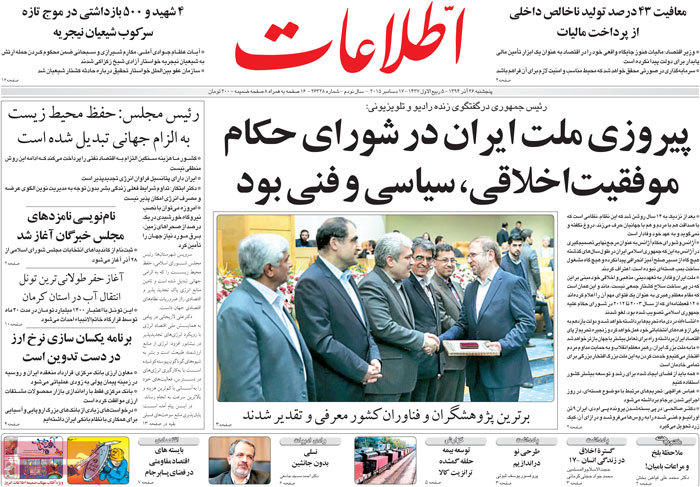
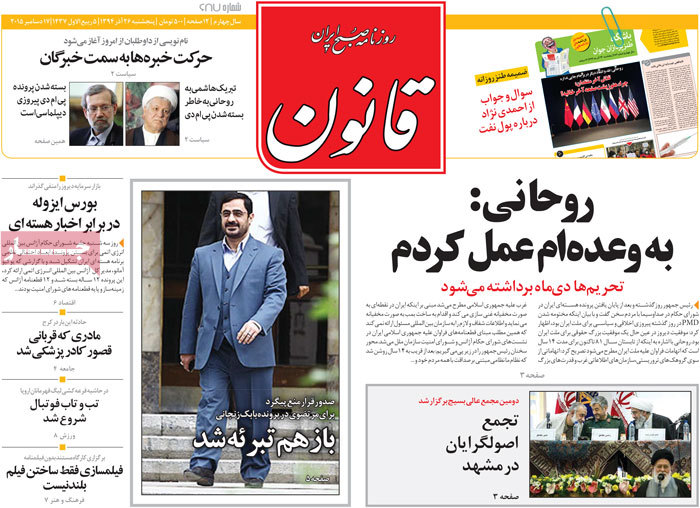
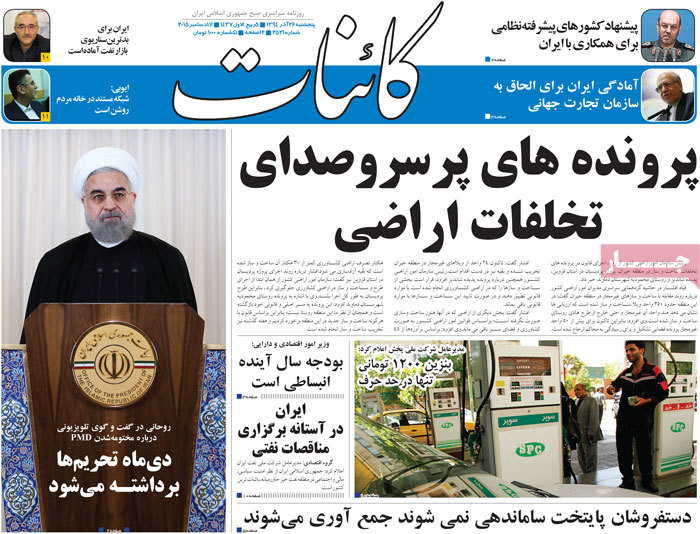
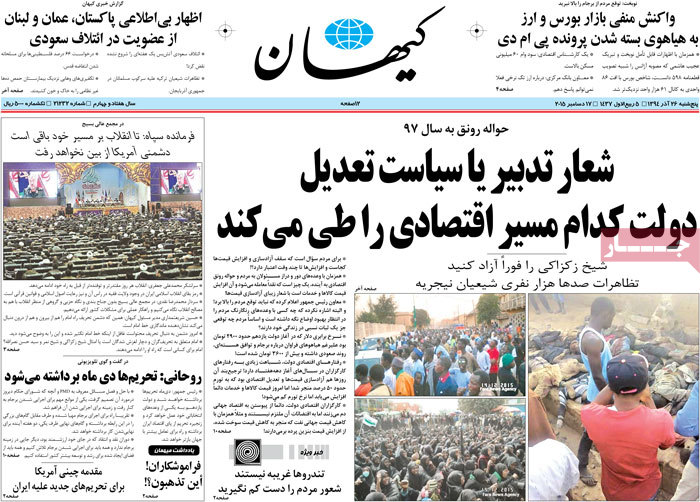
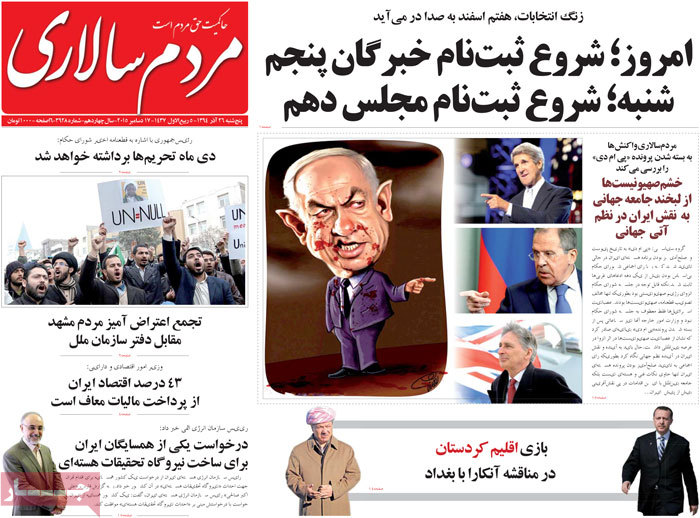
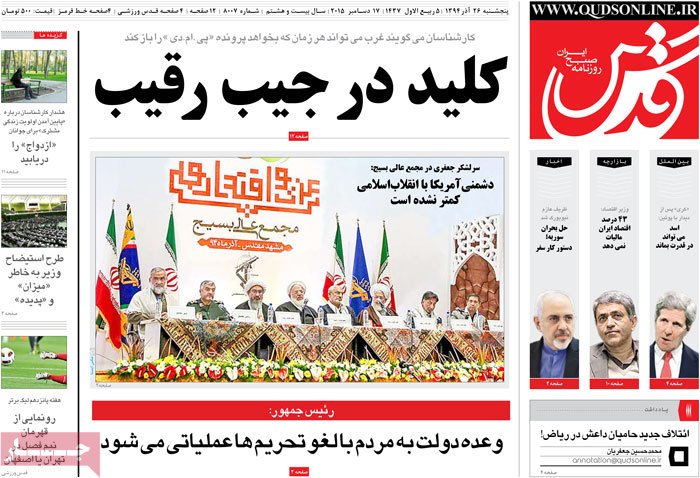
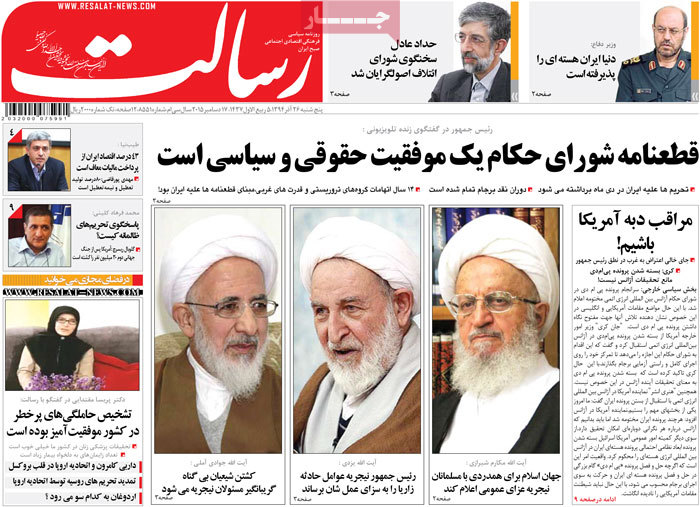
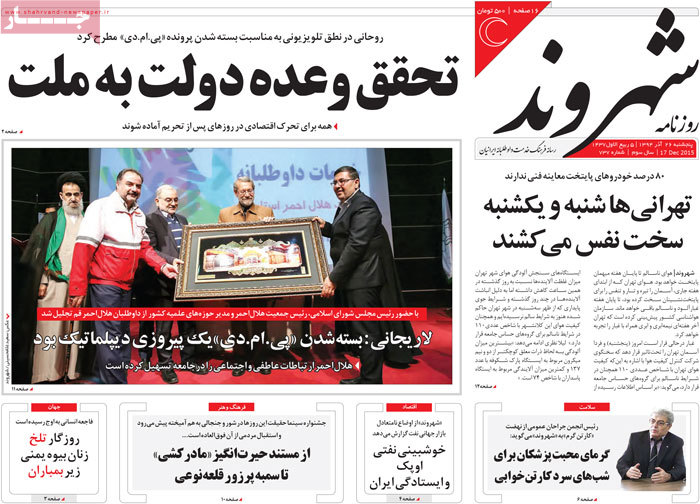
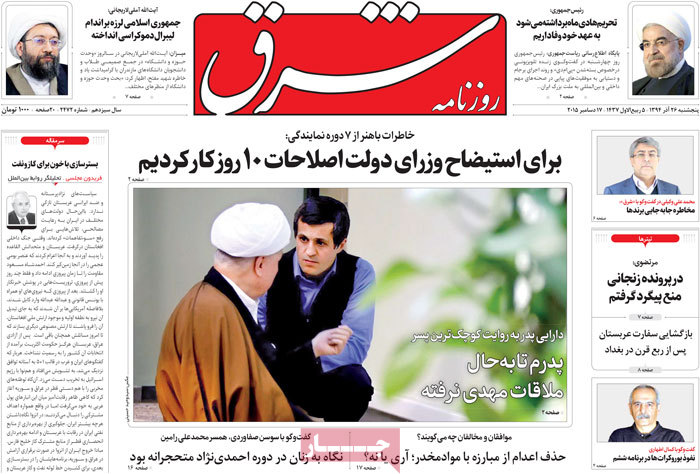
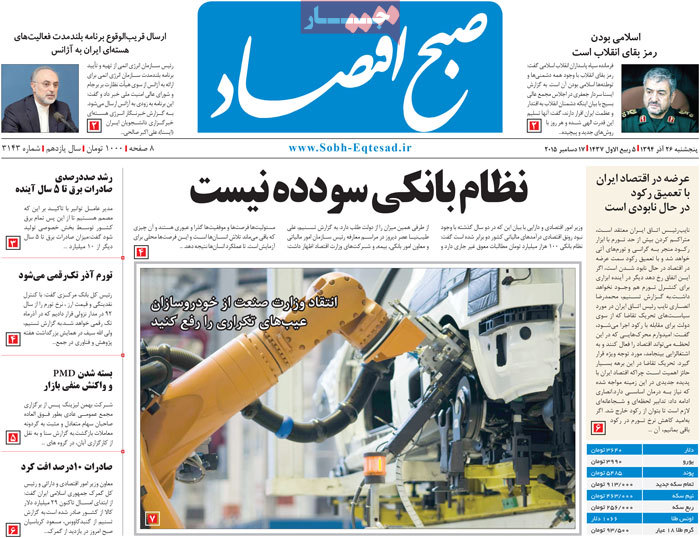
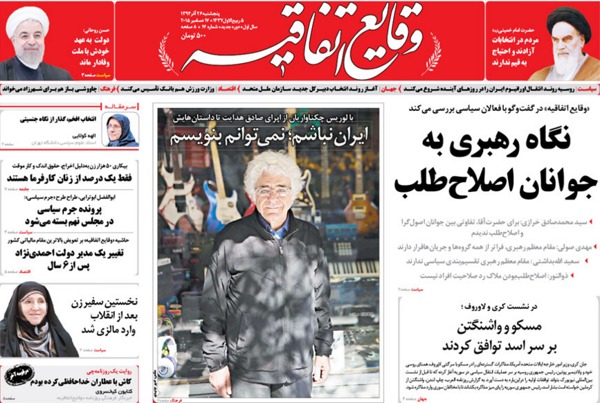
A look at Iranian newspaper front pages on Nov. 28

Iranian Newspapers Headlines

The comments of the UN nuclear chief about Iran’s nuclear program were on the front pages of most Iranian newspapers on Saturday. Reformist dailies also gave extensive coverage to the comments of the grandsons of the late Imam Khomeini.


Ettela’at: Russia has stepped up its political and economic measures against Turkey [following the downing of a Russian warplane by the Turkish Air Force].

Russia has installed an S400 missile defense system in Syria.

Ettela’at: The country’s new oil contracts will be unveiled in Tehran today.

Representatives of 33 countries will attend a conference in the capital where 50 upstream oil, gas and petrochemicals will be introduced to local and foreign investors.

Ettela’at: Grand Ayatollah Nasser Makarem Shirazi has sent letters to prominent scholars of the world of Islam calling for measures to prevent the repeat of the Mina tragedy.

In a world when sometimes a lot of noise is made for the loss of a single person, doesn’t the silence of Muslim scholars in the face of such a great loss send the world the message that Muslims do not care about their co-religionists?

Ettela’at: The grandson of the late Imam Khomeini has said that measures to settle the problems of unemployment and poverty are the greatest service and act of worship.

Seyyed Ali Khamenei further said that the government should not be blamed for all the country’s economic woes.

Ettela’at: The vice-president for women and family affairs has said that violence against women costs society dear.

Shahindokht Molaverdi further said that a bill to protect women in the face of violence was taken off the agenda of the Executive when the 10th government was in office.

Ettela’at: Iran has finished first in the World Wrestling Club Championships.

Ettela’at: A funeral procession has been held in Tehran for Ghazanfar Roknabadi, a former Iranian ambassador to Lebanon who was killed in a deadly stampede in Mina, Saudi Arabia in late September.

The Iranian Foreign Ministry spokesman has said that the Iranian diplomacy machine will follow up the legal aspects of the tragedy through bilateral and inter-Islamic talks.


A look at Iranian newspaper front pages on Nov. 28


Abrar: The director of the Atomic Energy Organization of Iran has said that Iran will get yellow cake in return for enriched uranium.

He further said the removal of centrifuges is continuing.


A look at Iranian newspaper front pages on Nov. 28


Afarinesh: Foreign Minister Zarif has called for more contribution by Turkey to the fight against terrorism.

Afarinesh: Brigadier General Mousa Kamali has said that the decision to take exemption from or completion of military service off the list of requirements to secure a driver’s license for male applicants runs counter to Article 110 of the Constitution.


A look at Iranian newspaper front pages on Nov. 28


Amin: There are no signs to suggest that the other side [a reference to P5+1] is not complying with its commitments, said Parliament Speaker Ali Larijani in a meeting with Ayatollah Yasrebi in Qom.


A look at Iranian newspaper front pages on Nov. 28


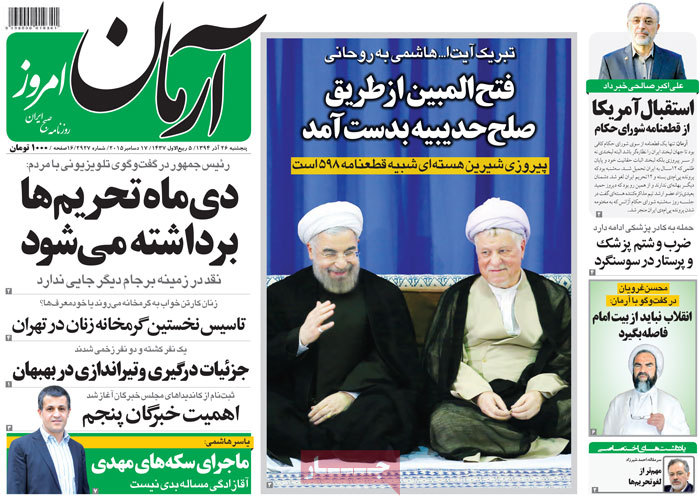
Arman-e Emrooz: Saeed Mortazavi [who is on trial for corruption] has left the country.


A look at Iranian newspaper front pages on Nov. 28


Asr-e Rasaneh: Iran and Turkey have underlined measures to boost the volume of bilateral trade to $ 30 billion.


A look at Iranian newspaper front pages on Nov. 28


Asrar: A senior advisor to President Rouhani has said that a third automotive heavyweight will emerge in the country after sanctions have been lifted.

Asrar: Abdolvahed Mousavi Lari [a reformist leader] has said that reformists and principlists won’t issue a single ticket in the upcoming elections.


A look at Iranian newspaper front pages on Nov. 28


Bahar: Protest at a defendant’s departure from the country

Saeed Mortazavi has left the country to participate in Arba’een ceremonies in Iraq.

An attorney for the Social Security Organization [which is locked in a court battle against Mortazavi] has said that Mortazavi has left the country without putting up bail.


A look at Iranian newspaper front pages on Nov. 28


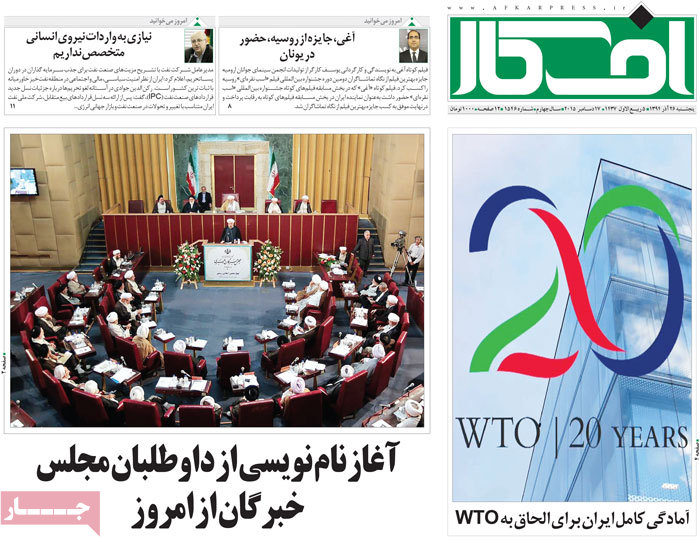
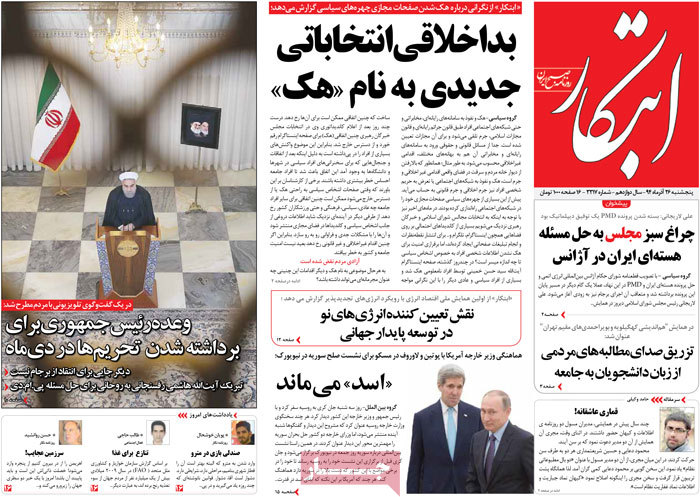
Ebtekar: Abbas Araghchi, an Iranian deputy foreign minister, has said that P5+1 should either opt for PMD [Possible Military Dimension] or JCPOA [Joint Comprehensive Plan of Action].

Ebtekar: Foreign Ministers Zarif and Al-Jubeir held their first meeting since the rise to the throne of King Salman in Saudi Arabia.

The meeting was held in Vienna on the sidelines of a conference on the Syrian crisis on November 14.


A look at Iranian newspaper front pages on Nov. 28


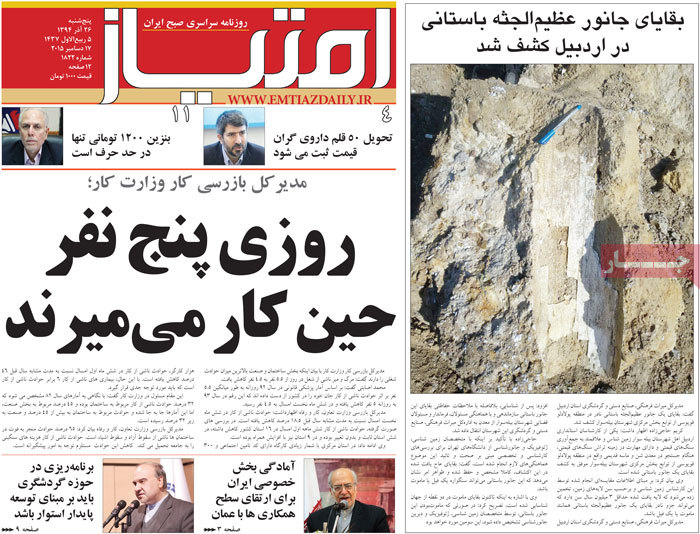
Emtiaz: A 370-strong economic delegation led by the president of Italy’s trade promotion agency arrives in Iran soon.


A look at Iranian newspaper front pages on Nov. 28


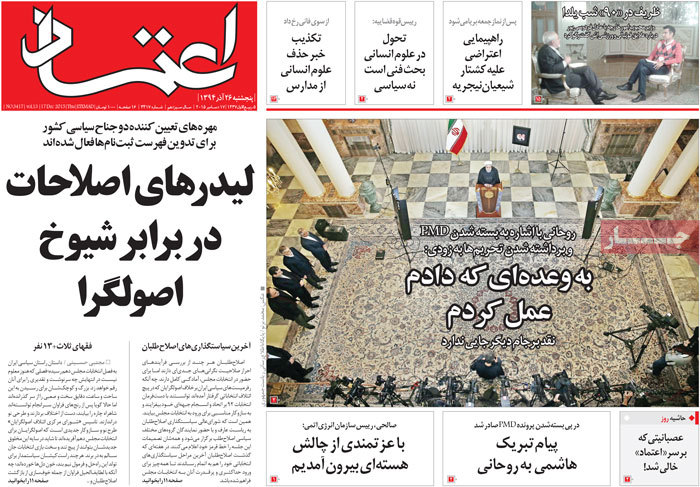
Etemad: Boycotting the elections won’t be beneficial, said Seyyed Ali Khomeini, a grandson of the architect of the Islamic Republic.

Etemad: Iran defeated the US to be crowned champions of the World Club Wrestling Championships.


A look at Iranian newspaper front pages on Nov. 28


Hambastegi: The health minister has said that his ministry is not worried about the spread of cholera to Iran from Iraq.


A look at Iranian newspaper front pages on Nov. 28


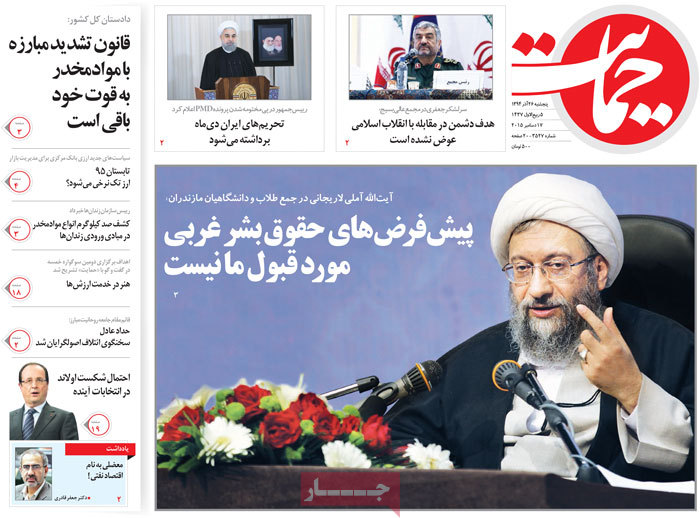
Hemayat: Iranian officials react to Amano’s less-than-direct comments: P5+1 should choose one between PMD and JCPOA.


A look at Iranian newspaper front pages on Nov. 28


Iran: Iranian actress Fatemeh Motamed Arya has been praised in the Asia Pacific Screen Awards.

Iran: Iranians have bid farewell to a former diplomat who was killed in the Mina tragedy.


A look at Iranian newspaper front pages on Nov. 28


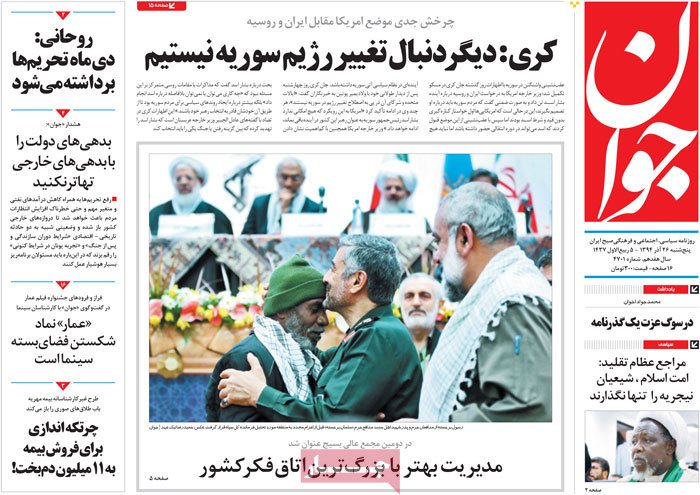
Javan: The commander of the Basij Force has said that $200 million of the $2 billion the US has set aside for regime change in Iran is at the disposal of Secretary Kerry.


A look at Iranian newspaper front pages on Nov. 28


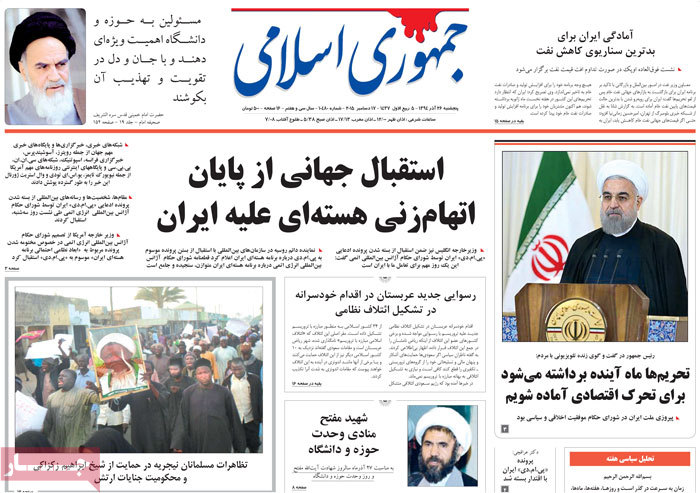
Jomhouri Islami: The revenue the country had predicted to secure from oil sales did materialize in the first half.


A look at Iranian newspaper front pages on Nov. 28


Kayhan: The value of foreign currencies against the rial increased; the stock market stagnation is in its 23rd month.


A look at Iranian newspaper front pages on Nov. 28


Qods: Iran will have the highest growth rate in the region, said the minister of finance and economic affairs.

Qods: The commander of the Basij Force has said that US Secretary of State John Kerry is leading the so-called soft war [against the Iranian establishment].


A look at Iranian newspaper front pages on Nov. 28


Resalat: Ali Akbar Velayati, an advisor to the Supreme Leader, has said that Obama’s commitment to the termination of sanctions should come in writing.

Resalat: The interior minister has said that unauthorized individuals won’t be allowed to cross the border to Iraq to take part in Arba’een ceremonies.


A look at Iranian newspaper front pages on Nov. 28


Rooyesh Mellat: The chairman of parliament’s National Security and Foreign Policy Committee has described ties between Tehran and Moscow as strategic.


A look at Iranian newspaper front pages on Nov. 28


Roozan: Tehran MP Ali Motahari has said that deputies should view themselves as representatives of their constituents rather than the establishment.


A look at Iranian newspaper front pages on Nov. 28


Setareh Sobh: Laws on free access to information are being implemented in 60 countries, said Hossein Entezami, a deputy minister of culture and Islamic guidance.


A look at Iranian newspaper front pages on Nov. 28


Shahrvand: As many as one million Iranian pilgrims have crossed the border to Iraq to take part in Arba’een ceremonies.

Some 1,120 Iranian physicians, nurses and relief workers will also be in Iraq to render services to pilgrims.


A look at Iranian newspaper front pages on Nov. 28


Sharq: A battle to appear on the cover of Time Magazine

President Rouhani and Secretary Kerry are among candidates.


A look at Iranian newspaper front pages on Nov. 28


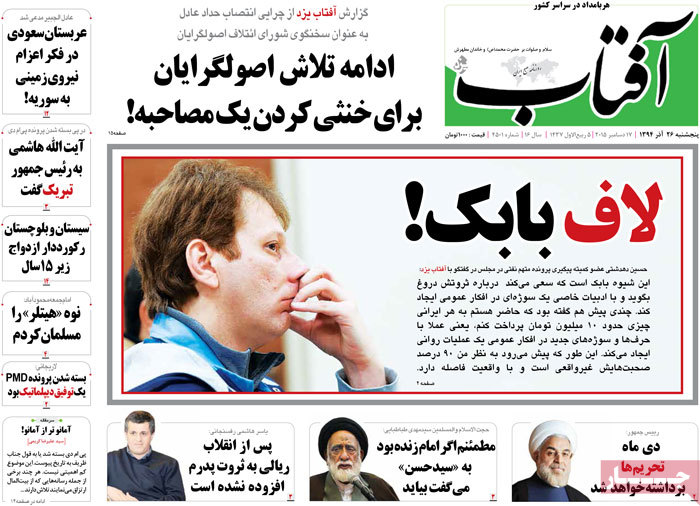
Vaghaye-e Etefaghiyeh: I made a stand against the killer gasoline and they are taking revenge, said Director of the Environment Protection Organization Masoumeh Ebtekar.

A look at Iranian newspaper front pages on Nov. 28

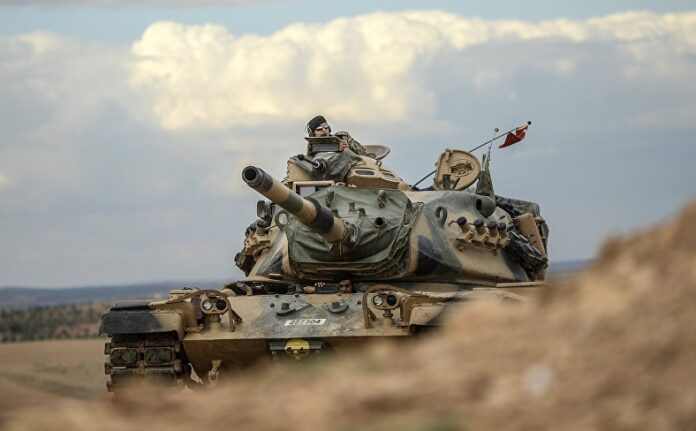
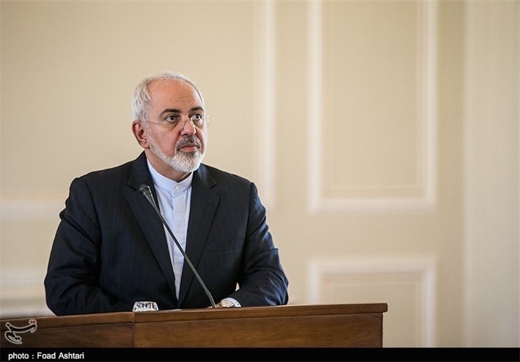
Prudence will solve Russia-Turkey row over downed jet: Iran FM

Zarif

Foreign Minister Mohammad Javad Zarif says the recent escalation of tensions between Moscow and Ankara over Turkey’s downing of a Russian jet can be settled through mutual discretion and prudence.

“I am confident that the problem that has recently emerged between two of our neighboring and friend countries in the region (Turkey and Russia) will be settled through the two sides’ prudence and discretion, and all of us will be able to fight the main problem in the region and in the world, namely terrorism,” Zarif said in a message to Turkish Foreign Minister Mevlut Cavusoglu on Friday.

He also called for further promotion of mutual cooperation between Tehran and Ankara, saying that constant consultations between the two sides would play a positive role in finding solutions to issues facing the region and the Muslim world, which is now in a “very sensitive and complicated” situation.

[…]

Necessity for restraint between Russia, Turkey

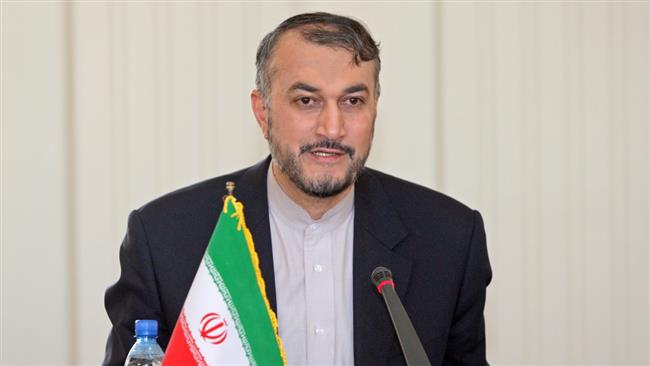
Meanwhile, Deputy Foreign Minister for Arab and African Affairs Hossein Amir-Abdollahian called on Moscow and Ankara to exercise restraint in dealing with the rising tension between the two countries over the downing of the Russian jet by Turkey.

“Under the circumstances that Russia is fighting terrorist groups, targeting aircraft which is battling terrorists is a mistake,” Amir-Abdollahian said, emphasizing that all efforts should be directed at fighting terrorism.

[…]

Iran never responded to cyber-attacks with counter raids: Foreign Ministry

Jaber Ansari

Iran says it has never reciprocated cyber-attacks with counter raids, although it has been a victim of such illegal attacks in the past.

“Iran has never responded to these illegal attacks with reciprocal cyber-attacks,” Foreign Ministry Spokesman Hossein Jaberi Ansari said on Friday.

He also noted that the Islamic Republic has been the victim of serious cyber-attacks, such as the Stuxnet case, in recent years.

The spokesman was referring to the 2010 cyber-attacks on Iran’s nuclear facilities by the Stuxnet computer worm, built jointly by the US and the Israeli regime.

He made the remarks in response to a recent New York Times report, which cited unnamed US officials as claiming that there has been a surge in cyber-attacks by Iran against US State Department officials over the past month.

Jaberi Ansari went on to say that the absence of an efficient legal system in the international arena to prevent and prohibit cyber-attacks is one of the serious shortcomings in countering cyber raids.

Pointing to Iran’s rotating presidency of the Non-Aligned Movement (NAM), the diplomat said Tehran has always been committed to adopting and strengthening international deterrent mechanisms to prevent cyber-attacks, urging all countries, especially the West, to cooperate and prevent such destructive measures.

Saudi mustn’t allow Hajj tragedy to become political issue: Iran

Jaberi Ansari

Iran says Saudi Arabia must not allow the deadly human crush during this year’s Hajj rituals in Mina, near the holy Saudi city of Mecca, to turn into “a major political issue.”

Foreign Ministry Spokesman Hossein Jaber Ansari made the remarks while speaking to reporters in Tehran on Friday on the sidelines of a funeral procession for the former Iranian Ambassador to Lebanon Ghazanfar Roknabadi who died in the Mina incident.

Roknabadi had been missing since the September 24 crush in Saudi Arabia until recently, when his body was identified after DNA testing. The Iranian diplomat’s body was returned to the capital early on Friday and was laid to rest after a funeral procession attended by Friday prayers.

“We hope that cooperation between Iran and Saudi Arabia will continue to determine the fate of others who went missing [in Mina] and that [Riyadh] does not turn this matter into a major political issue,” Jaber Ansari said.

He said that the fate of some missing Iranians has not been determined yet, adding, “The Saudi government has the humanitarian, political and legal responsibility” in this regard.

Jaber Ansari emphasized that Iran would do all it has in power, within the framework of its relations with Saudi Arabia and its regional and international potential, to restore the rights of the victims and those missing in the Mina crush and to prevent the recurrence of such incidents.

The Iranian spokesperson said the Islamic Republic would adopt necessary political and legal follow-up measures over the Hajj tragedy.

[…]

Iran has censured Saudi Arabia for failing to responsibly carry out its duties during Hajj, saying Riyadh’s incompetence in handling safety at the rituals caused the deadly incident.

Araghchi: JCPOA commitments reciprocal

Araghchi

Deputy Foreign Minister said that Iran’s fulfillment of its commitments vis-à-vis the Joint Comprehensive Plan of Action (JCPOA) depends on the reciprocal measure by Western countries.

Abbas Araghchi further said that Iran will fulfill its commitments under JCPOA only if the six world powers fulfill their commitments.

“The board of governors and the International Atomic Energy Agency (IAEA) should choose between the possible military dimensions (PMD) case and JCPOA,” Araghchi said.

If IAEA Director-General Yukiya Amano or the board of governors prepares their report in a way that they do not fulfill their commitments, the Islamic Republic of Iran will also stop JCPOA, he added.