Friday, December 26, 2025
Home Blog Page 4673

Claims about past Iranian nuclear activities void of credibility: Zarif

Zarif

Iran has once again rejected claims about its past nuclear activities, saying its cooperation with the International Atomic Energy Agency (IAEA) has helped resolve all outstanding issues.

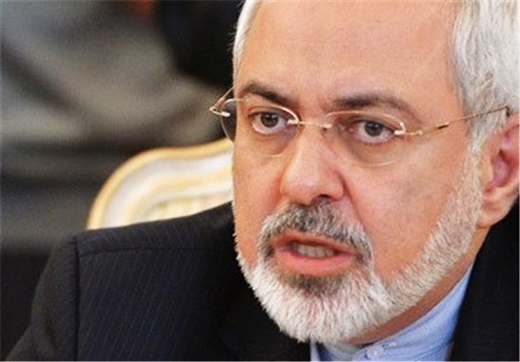
Iran has always declared that the allegations made about Iran’s past nuclear activities “lack credibility,” Iran’s Foreign Minister Mohammad Javad Zarif said on Sunday at a joint press conference with his visiting Greek counterpart Nikos Kotzias in the Iranian capital of Tehran.

“Regarding the ‘roadmap,’ we reached an agreement with the Agency to once and for all clear these issues out of the way,” he said, referring to the roadmap signed between Iran and the IAEA on July 14.

The roadmap for “the clarification of past and present outstanding issues” regarding Iran’s nuclear program was signed by IAEA chief Yukiya Amano and Head of the Atomic Energy Organization of Iran Ali Akbar Salehi on the same day that Iran clinched a deal with P5+1 in the Austrian capital of Vienna.

Zarif said, “The agency, too, has verified that Iran has answered all the [relevant] questions and implemented the roadmap.”

Amano is to present a report on the Iranian nuclear program on December 1; and the IAEA Board of Governors will convene on December 15 to make a final decision on the issue of the so-called possible military dimensions (PMD) regarding Iran’s nuclear program based on the report.

Iran says it expects the Board of Governor’s decision to result in the closure of the “PMD” file. The Islamic Republic says it will not implement the agreement with P5+1 unless the “PMD” issue is taken off the agenda.

Zarif reiterated, “We are certain that the past and present issues should be firmly closed in the Board of Governors’ resolution, which would likely be released over the next two to three weeks.”

He also said the case was wrongly being called “possible military dimensions” since Iran’s nuclear activities have never had any military dimension.

Zarif also expressed hope that P5+1 would comply with their obligations under the agreement reached with Iran, which is dubbed the Joint Comprehensive Plan of Action (JCPOA).

Among other things, the agreement obliges the removal of all nuclear-related economic and financial bans against Iran in exchange for limits applied by Iran to its nuclear activities.

The Iranian foreign minister further announced that cooperation with Greece in the field of energy, which had been suspended as a result of the sanctions imposed on the Islamic Republic, would be resumed.

Kotzias has traveled to Tehran on a two-day visit to meet with Iranian officials and attend an economic gathering.

Official: IAEA Board of Governors’ decision counts, not Amano’s remarks

Behrouz Kamalvandi

The spokesman of the Atomic Energy Organization of Iran (AEOI) said on Sunday that IAEA Director General Yukiya Amano has made various comments and has been quoted differently in media, but what really counts is the agency’s report and the Board of Governors’ decision.
Behrouz Kamalvandi who was speaking on the sidelines of a memorial service held for former Iranian ambassador to Lebanon Ghazanfar Roknabadi, made the comment in response to a question on his opinion about recent remarks of the International Atomic Energy Agency (IAEA) director general on the Possible Military Dimension (PMD) file.

“The IAEA viewpoint and the decision of its Board of Governors is of great importance and the agency’s report will be forwarded to the Board of Governors within the next couple of days, which will have till December 15 to make a final decision on the Iranian nuclear file,” he said.

Asked about Iran’s reaction if the agency will not close the file concerning the past and present activities, also known as the PMD file, the AEOI spokesman said that the Joint Comprehensive Plan of Action (JCPOA) is a bilateral agreement, hoping that both sides will properly heed their commitments.

“The Islamic Republic of Iran has met all its commitments and is waiting for the result of Amano’s report, so that both sides can continue their respective moves one after the other,” added Kamalvandi.

He further said, “Fulfillment of each side’s commitments is of great importance and presently we are waiting for their performance in accordance with Article 14 of JCPOA.”

He went on to say, “The agency must now present the draft of a resolution, based on which Iran’s past activities file will be closed for good”.

The AEOI spokesman said that if that resolution is passed, the Joint Comprehensive Plan of Action will enter its implementation phase and the implementation of the remaining works will begin.

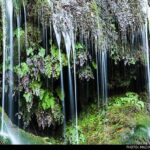
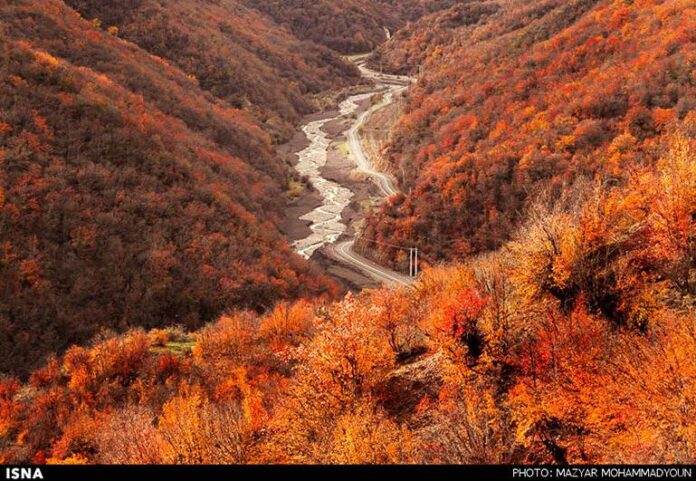
Kaboud-Val Waterfall in northern Iran (PHOTOS)

Kaboud-Val Waterfall000

Kaboud-Val Waterfall is in the northern Iranian province of Golestan near Aliabad-e Katul whose low altitude from sea and proximity to forests makes it a very temperate town.

Kaboud-val is Iran’s largest full-moss waterfall. Its height is about six meters and its water is cool and potable.

The following images of the waterfall have been released by the Iranian Students’ News Agency:

Iranian professor wins OPCW Award

1935342_924

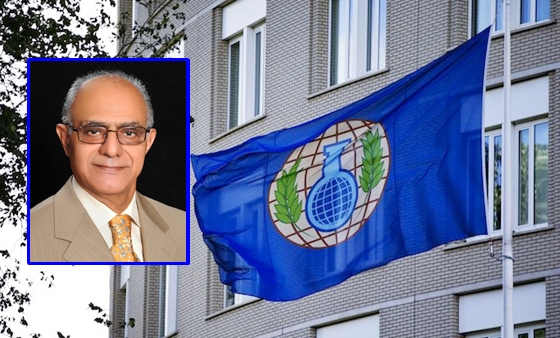
Dr. Mahdi Balali-Mood, a senior professor at Mashhad University of Medical Sciences, has won the second annual Hague Award of the Organization for theProhibition of Chemical Weapons.

Balali-Mood, who is known as the father of Iran’s toxicology, and Dr. Alastair Hay of the United Kingdom have been named joint recipients of the second annual OPCW-The Hague Award.

The following is the translation of a story Ettela’at daily published on the Iranian professor’s achievement on November 29:

The 2015 award winners will be honored at a presentation ceremony – attended by representatives of 192 countries – at the Headquarters of the Organization for the Prohibition of Chemical Weapons (OPCW) in The Hague on November 30.

The Iranian professor, who largely served the victims of chemical attacks during the Iran-Iraq war, has released multiple books and articles on the medical-toxicological aspects of chemical elements in war which come with related documents and images.

Dr. Balali-Mood, who had left for Britain to pursue his studies, returned home during the war because he felt he was duty-bound to help his countrymen.

Back then, he said, those had been exposed to chemical agents would be sent to Mashhad and admitted to the holy city’s Imam Reza and Ghaem hospitals.

“During the years of war, I would travel to different cities to treat patients and carry out research projects on those wounded in action in addition to what I was doing [routinely] in Mashhad. I remember that I could not sleep more than two-three hours due to my heavy schedule,” he added.

Dr. Balali-Mood, who works closely with WHO and OPCW to advocate for victims and to develop international guidelines for response to the use of chemical warfare agents, further said that he has published the findings of his scientific research on the chemical attack victims – which come with videos and images – in different conferences.

The Iranian researcher, who has dedicated his career to the treatment of victims of chemical warfare agents, has prolifically penned books on Clinical Toxicology of Chemical Warfare Agents, Organophosphorous Pesticide Poisonings, Heavy Metals, Drug Abuse/Overdose, Epidemiology of Poisonings, Occupational and Environmental Toxicology, Natural Toxins, including snake and spider bites, toxic plants and mushrooms (31 in total).

Iran is an active member of the Organization for theProhibition of Chemical Weapons which was established in 1997. The Award, created by the OPCW as an outcome of its winning of the 2013 Nobel Peace Prize [and supported by a generous financial contribution from the City of The Hague], is intended to honor and recognize individuals and non-profit, non-governmental organizations that have made an outstanding contribution to achieving a world free of chemical weapons.

We’ll render unsighted those who set their sights on Iran’s foundations

Sardar-mohsen-rezaei

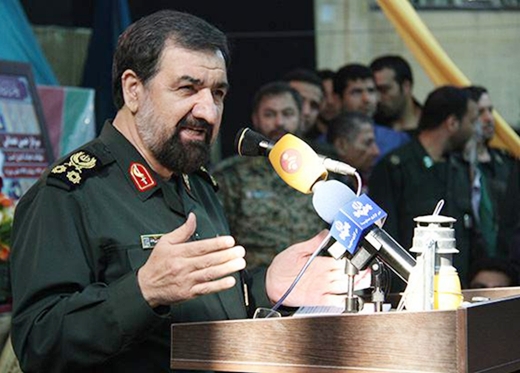
The secretary of the Expediency Council has said that the behavior of Takfiris [a reference to IS and other marauding terrorist groups in Iraq and Syria] is akin to that of the Zionists in occupied Palestine, adding that the footprints they leave behind is indicative of a plot they have hatched to block the progress of Muslims.

Mohsen Rezaei, who used to be the commander of the Islamic Revolution Guard Corps, made the comment in a gathering of the volunteer Basij forces in the Greater Tunb in the Persian Gulf on Thursday and added that the Americans have destabilized Syria and Iraq and displaced 15 million Muslims through Takfiri groups.

On November 27, Tabnak.ir covered Rezaei’s comments on Iran’s islands in the Persian Gulf, ties with the US, security and infiltration. The following is the translation of part of his remarks:

Iran and the Islamic Revolution

[…]

The Islamic Revolution put the Iranian nation, which was on the margins, front and center. This remarkable achievement identified Iran on the world stage as a big nation which holds sway in the region and around the globe. Today we Iranians decide on our own and get involved in global interactions proudly. […]

Three islands remain Iranian forever

The three Iranian islands [of the Greater Tunb, Lesser Tunb and Abu Musa] remain part and parcel of Iranian territory forever. Historically, this is a question of great significance to Iran.

These three Iranian islands are the islands of peace and brotherhood. The enemies should know that Iran will blind those who set their sights on the foundations of this nation.  […]

Midway through the [Iraqi-imposed] war, I came to these islands with Martyr Sayyad Shirazi to review the situation in the region. Back then they were very impoverished. But today development in this island is remarkable and made me really happy. You [soldiers and Basij forces] are serving in a key strategic region. […]

Ties with US do not serve interests of Muslim world

[Addressing people and Basij members in Abu Musa], Major General Rezaei said, “The world of Islam does not benefit from ties with the United States.”

How has the establishment of ties with the Americans served the interests of Muslims? Through Takfiri groups, the Americans have destabilized Syria and Iraq, and displaced 15 million Muslims. What the Takfiris are doing [in the region] resembles the behavior of the Zionists in occupied Palestine. If you follow their footprints, you will realize that a plot is at play to stop Muslims from making further progress.

Basij formation   

The formation of the 20 million-strong Basij Force by order of the late Imam Khomeini created a big change in the country. We proved that we could stand up on our feet and that Iran is not like what it was in the previous decades. Thanks to the Islamic Revolution, we toppled the shah, and during the war, we put the interests of colonial powers at stake and solidified the Revolution. […]

No change to geographical borders

The fake Israeli regime was created thanks to the open support of the West so that it can destabilize the region and the West can plunder the resources of the region, including those of the Muslim nations. They sought to take advantage of the situation by pitting Islamic nations against each other. They have resorted to such plots for almost 70 years.

These three islands which herald the call for unity, peace and brotherhood are described by certain countries as hotspots. These countries should know that Israel benefits from a destabilized region. In an insecure region, the riches of Muslims will be spent on buying arms.

The West also pursues another objective by targeting this region’s security: shattering Muslim unity. Don’t those who seek to redraw the regional map know that such policies are to the detriment of Muslims?

We say it explicitly that borders of countries should not be redrawn. No country in the region should be disintegrated. Our nation does not get frightened by their planes and fireworks. We have proved that we can defend ourselves and our homeland’s stability.

Iran, anchor of regional security

Iran, which serves as the anchor of security in the region, makes efforts toward regional security. We can band together with regional Islamic states to establish collective security cooperation to stop outsiders from entering Muslim nations and taking advantage [of their resources] under the pretext of ensuring security.

Russia and Turkey should let cooler heads prevail

[Following the downing by Turkey of a Russian warplane] The two countries should show restraint to prevent a war from erupting in the region, because such a war would serve the interests of Zionism and terrorism.

The US and infiltration

[…]

The Americans once walked out the door [in this country] and now they are seeking to come in through the window, ostensibly for economic purposes. They are trying to infiltrate the country under the pretext of doing business in Iran.

We need to remain vigilant inside the country and beyond our national borders, especially in these three islands [in the Persian Gulf] and shatter such their pipe dream.

[…]


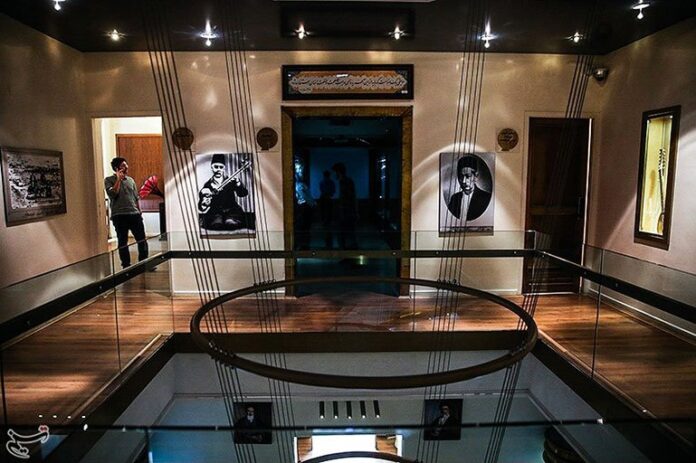
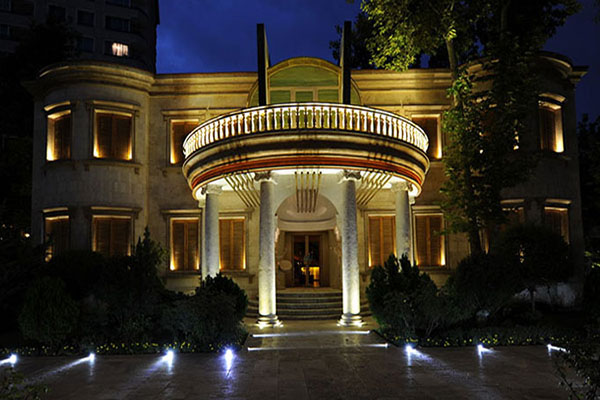
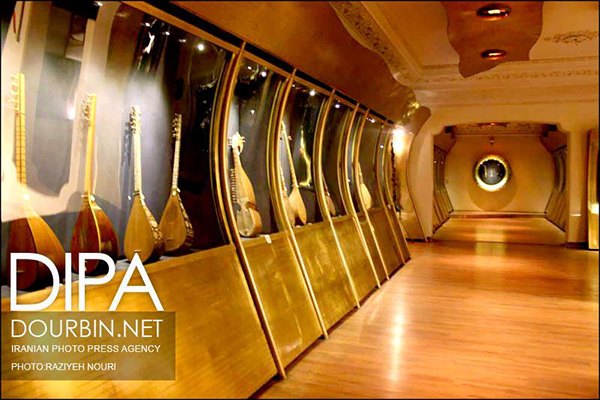
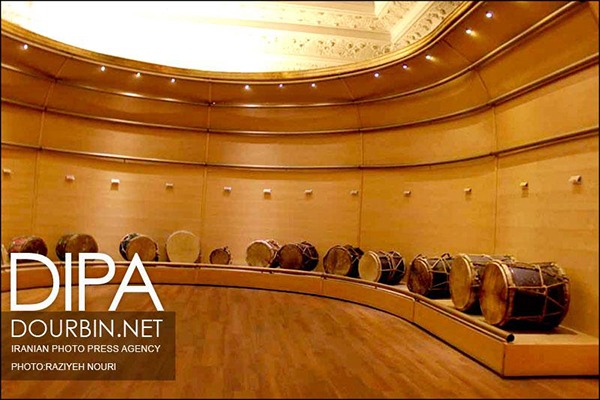
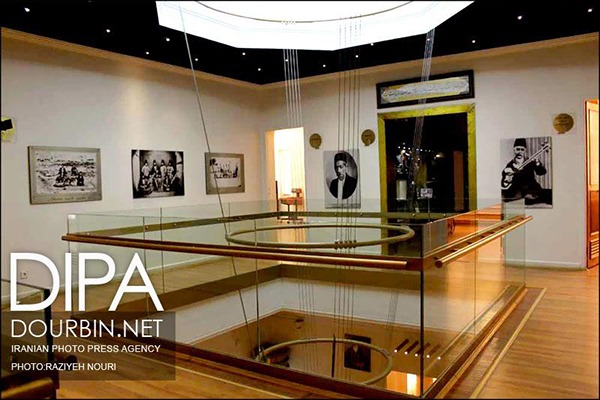
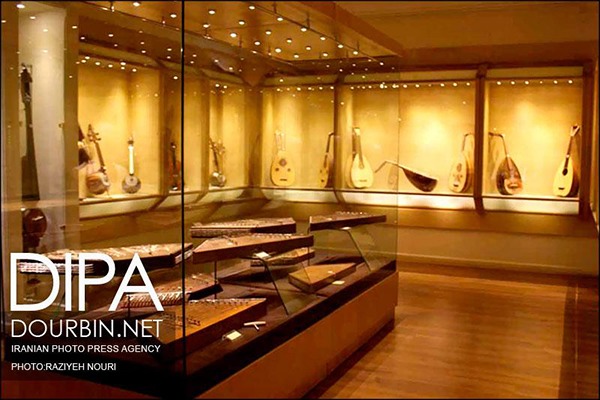
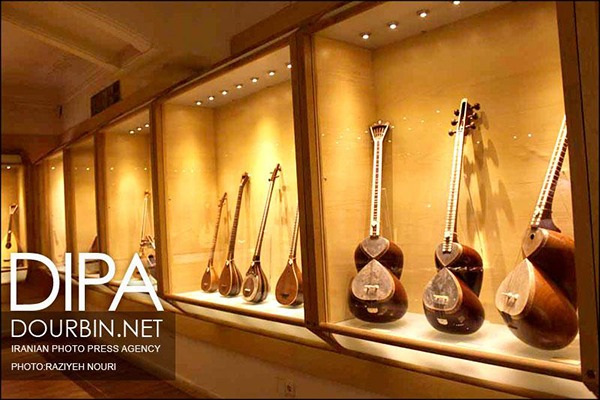
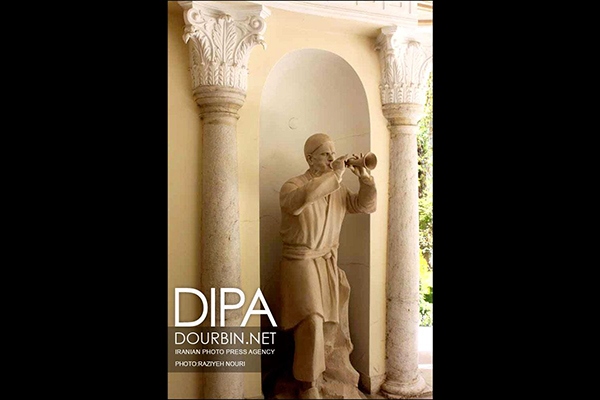
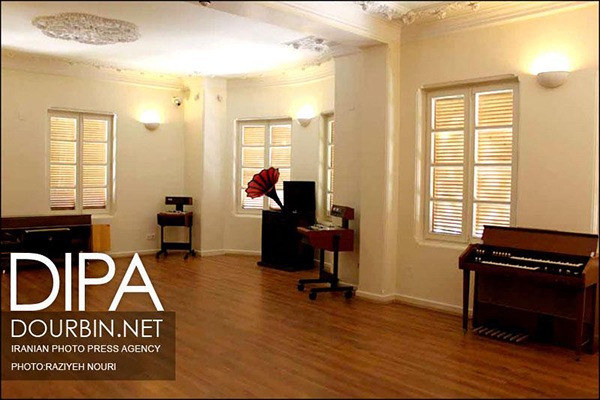
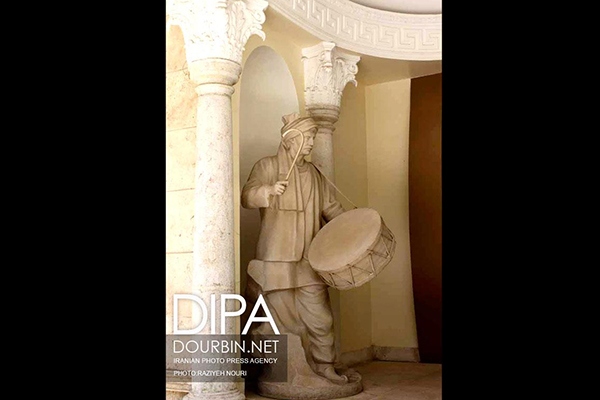
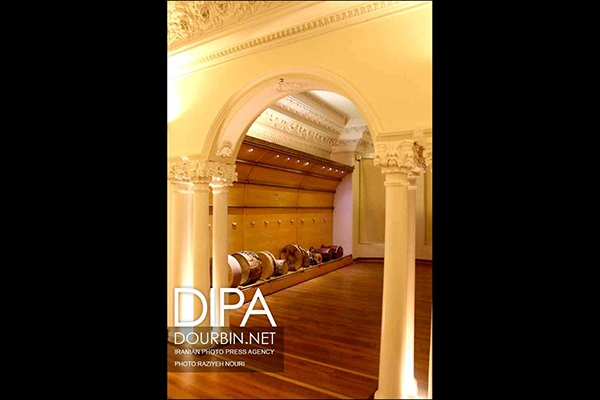
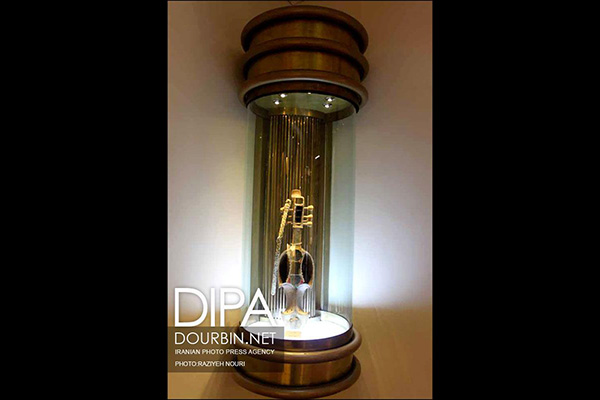
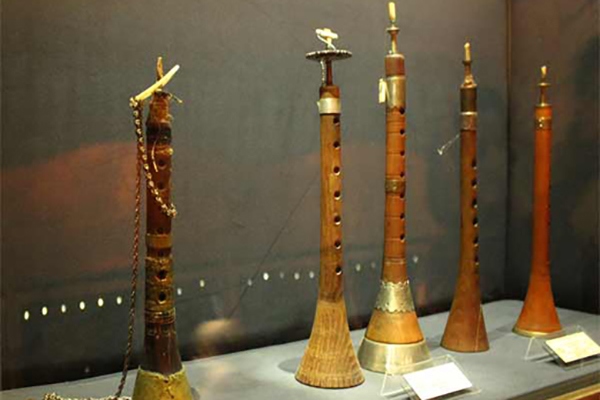
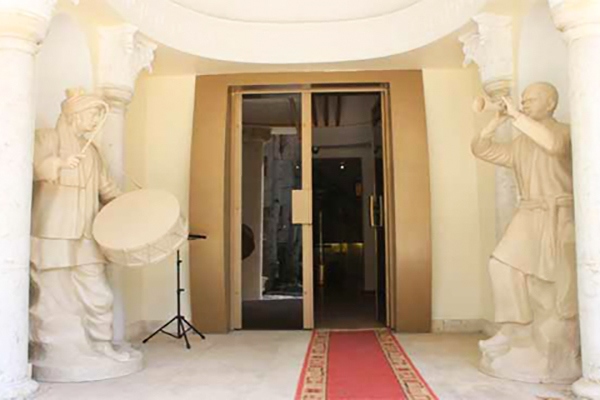
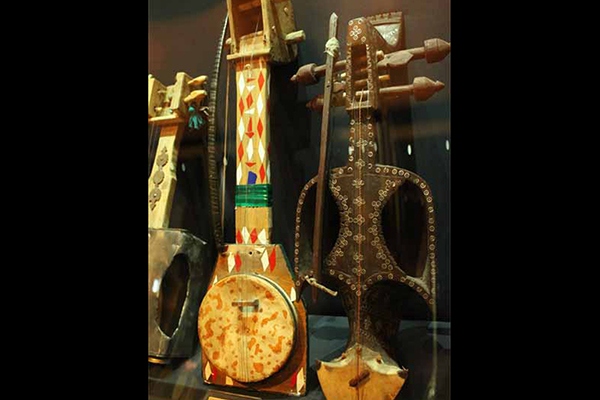
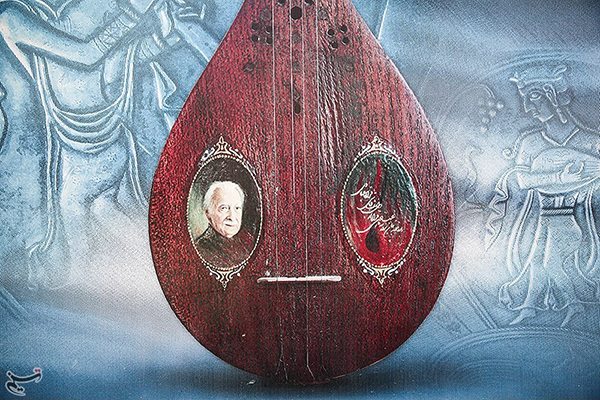
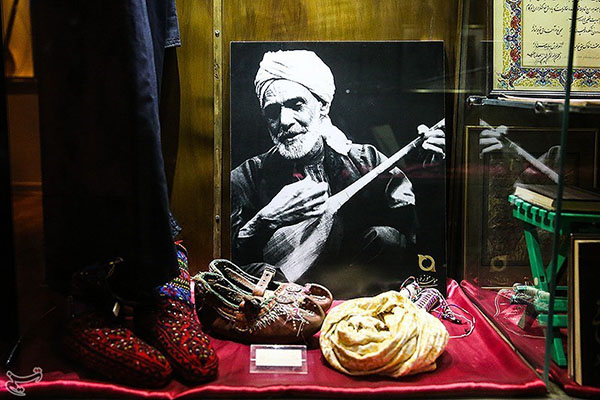
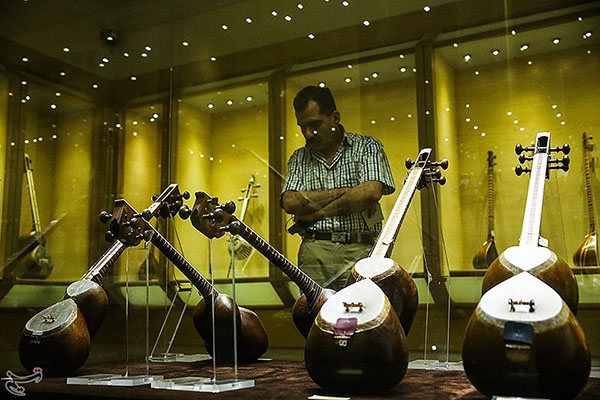
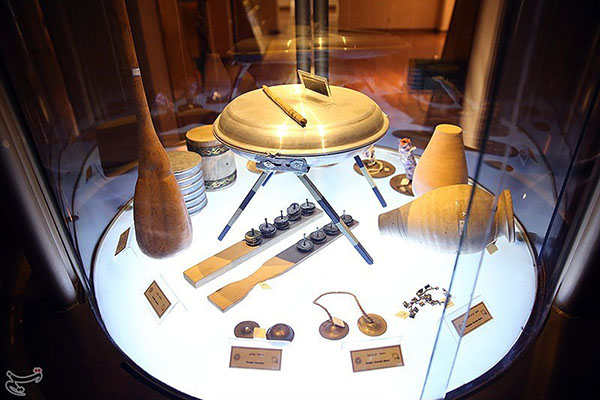
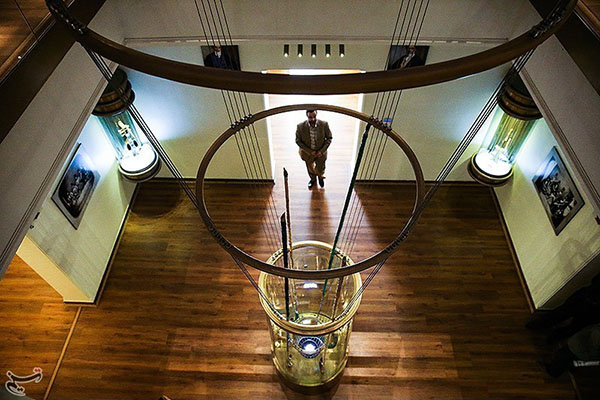
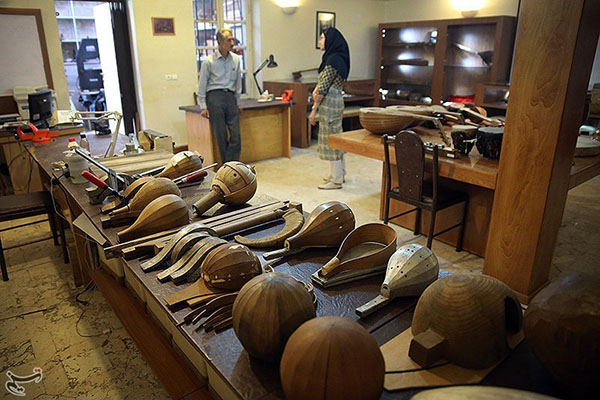
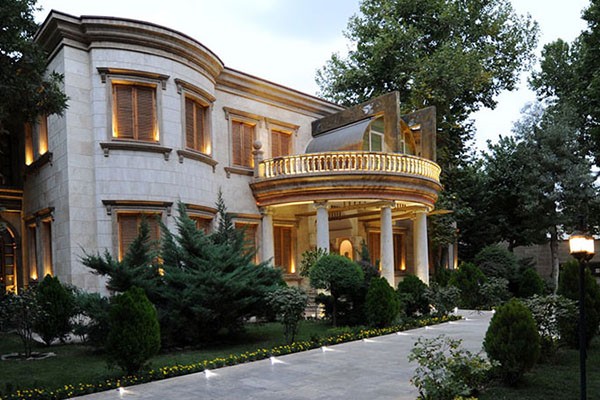
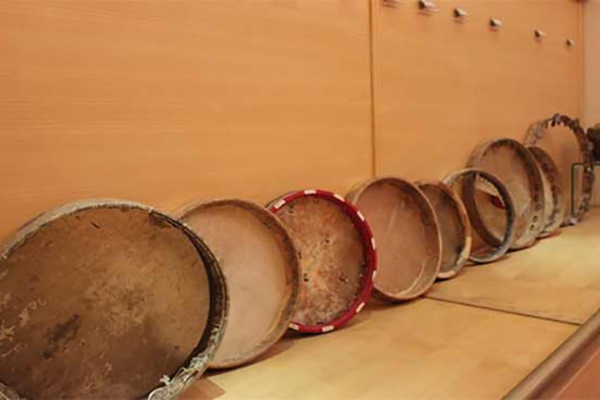
Tehran Museum of Music (PHOTOS)

Museum of Music03

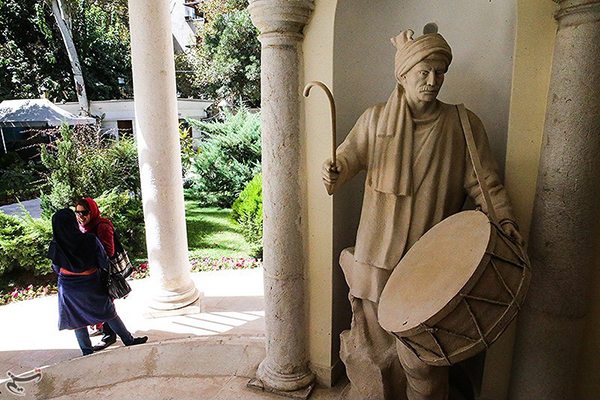
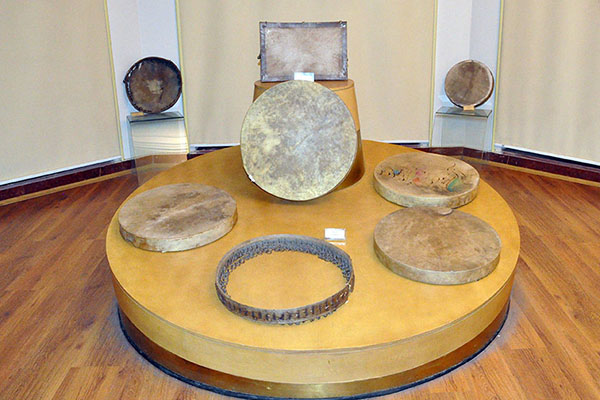
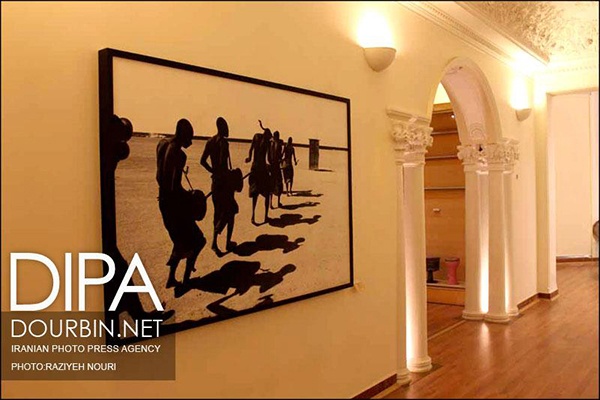
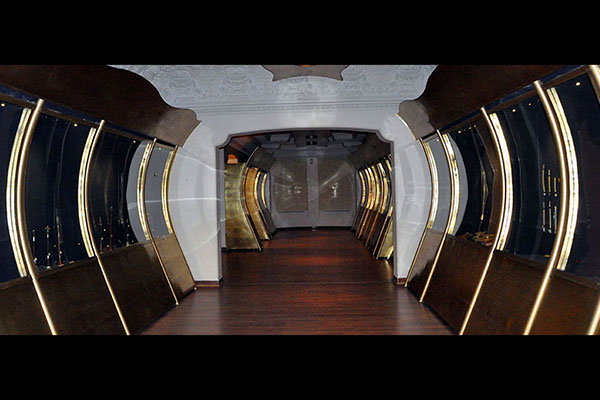
Tehran Music Museum in Tajrish square is one of the most spectacular museums of the capital.

This museum opened its door to the public in 2009 to preserve the country’s national heritage.

Some 240 musical instruments from various cities across the country are showcased at this museum.

The following images of the museum have been released by the Young Journalists Club:

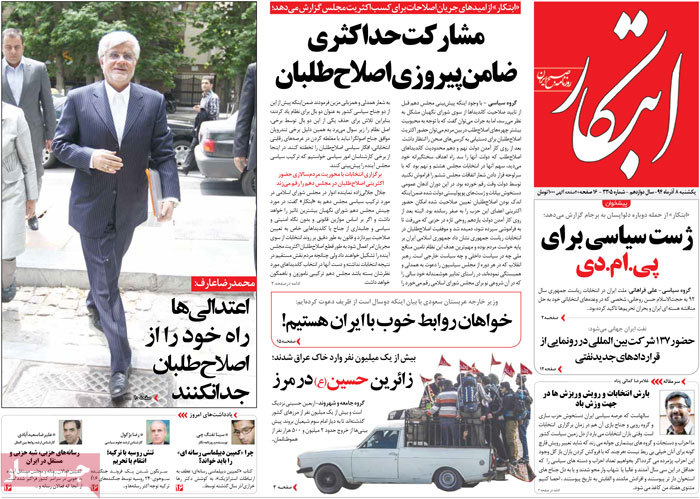
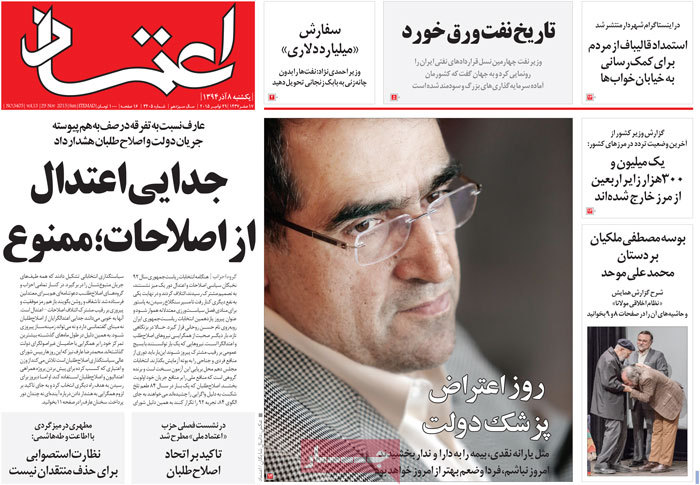
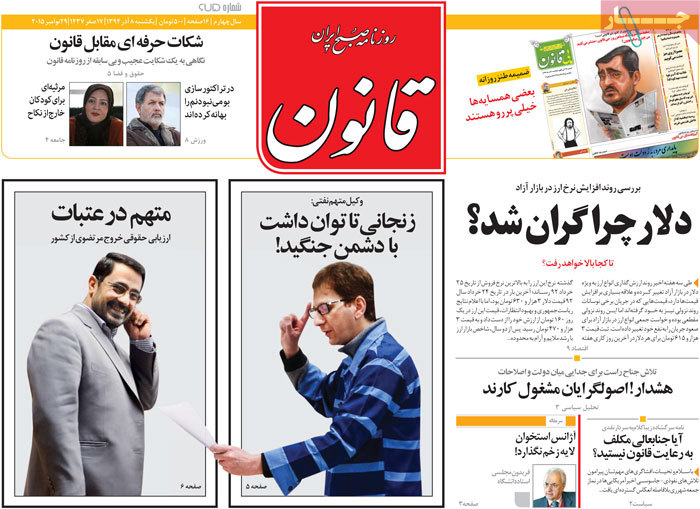
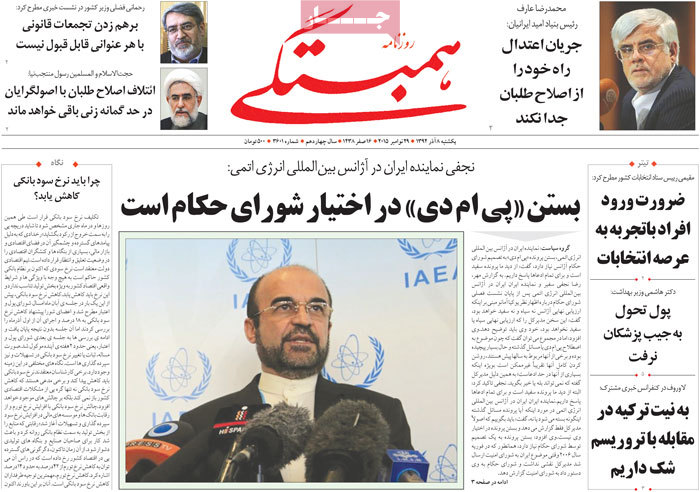
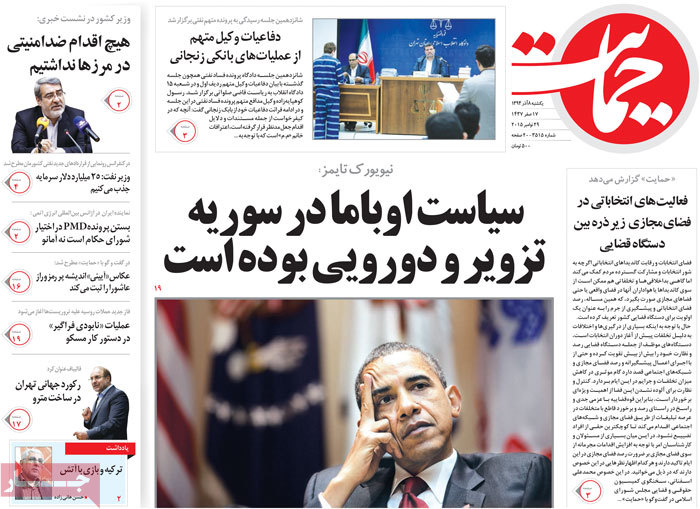
A look at Iranian newspaper front pages on Nov. 29

Iranian Newspapers Headlines

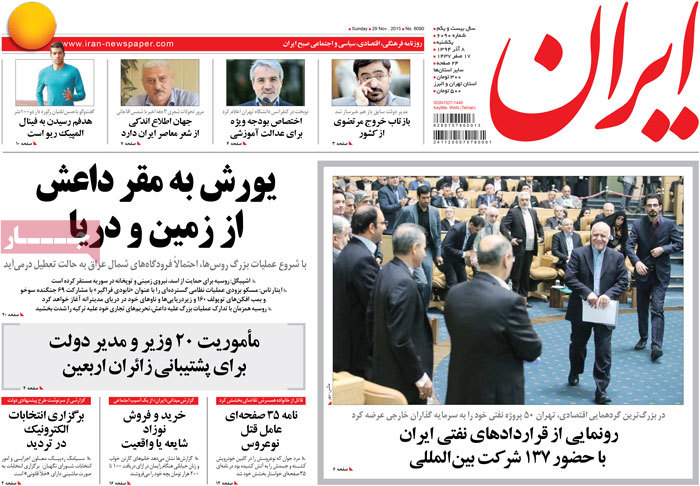
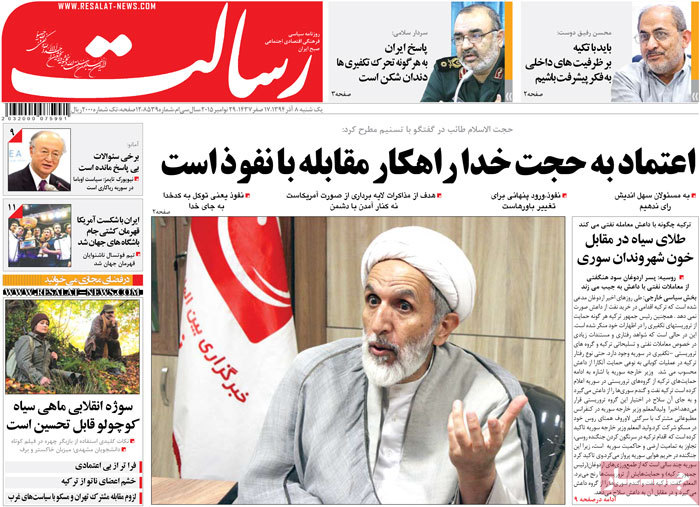
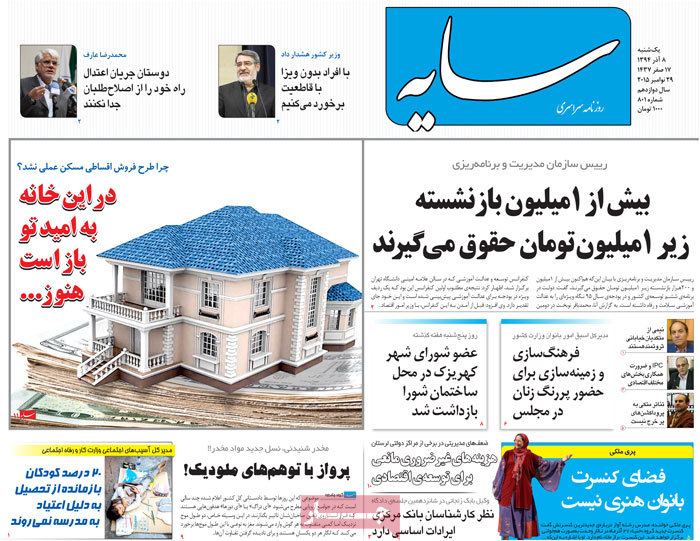
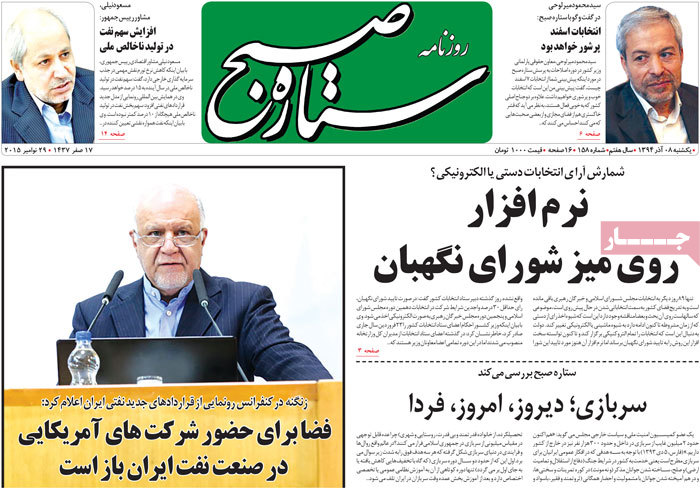
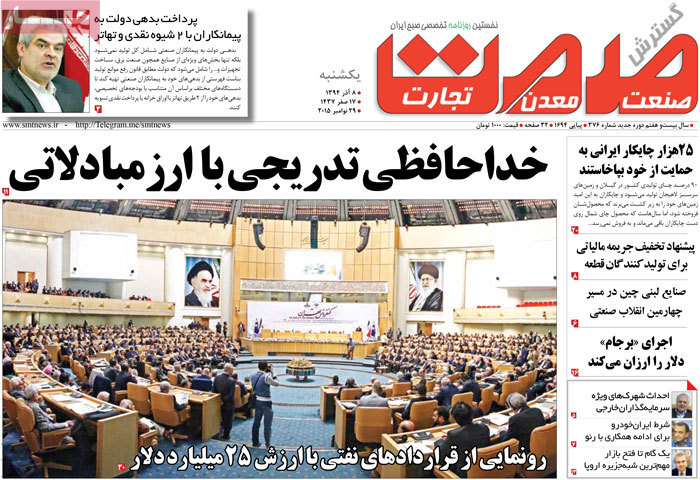
A Tehran conference in which a new model of Iran’s oil contracts was unveiled to local and foreign investors dominated the front pages of Iranian newspapers on Sunday.

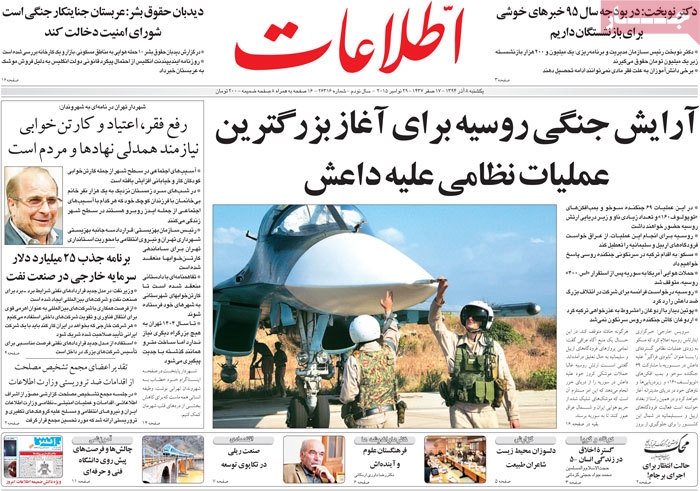
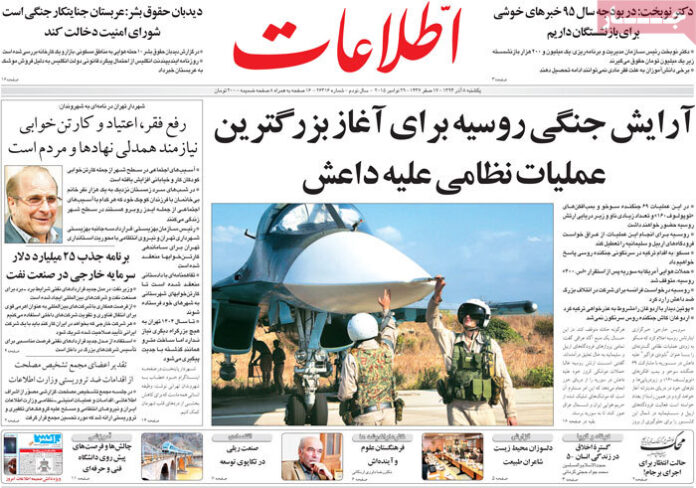
Ettela’at: Russia’s tactical formation to launch the biggest military operation against IS

The operation will include 69 Sukhoi fighters and Topolev 160 bombers and a large number of warships and submarines.


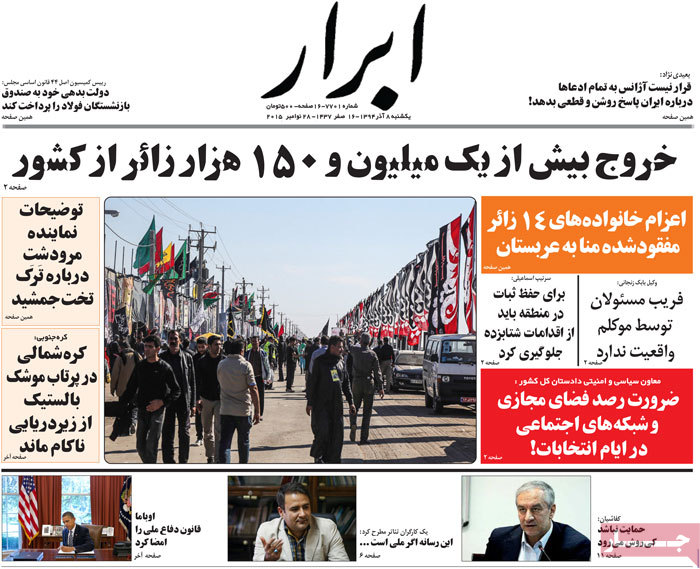
Abrar: More than 1.15 million Iranian pilgrims have already crossed the border into Iraq to take part in Arba’een ceremonies.

Abrar: The families of 14 Iranian pilgrims who have been missing since a late September stampede in Mina will travel to Saudi Arabia to try to identify their loved ones.


A look at Iranian newspaper front pages on Nov. 29


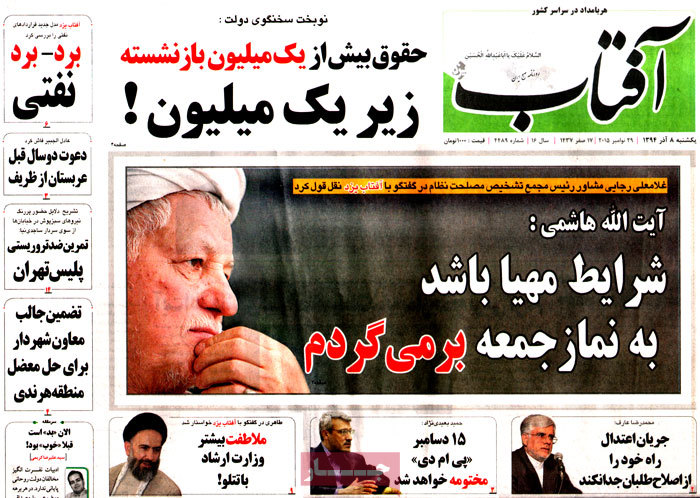
Aftab-e Yazd: “I will lead Friday prayers again, if the stage is set,” said Ayatollah Hashemi Rafsanjani.


A look at Iranian newspaper front pages on Nov. 29


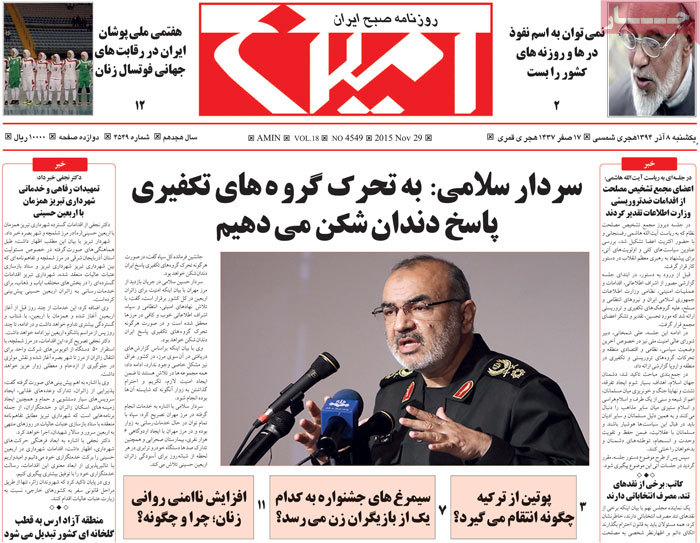
Amin: The deputy commander of the Islamic Revolution Guard Corps has said that any movement by Takfiri groups [a reference to IS] will draw a crushing response from the Revolutionary Guards.


A look at Iranian newspaper front pages on Nov. 29


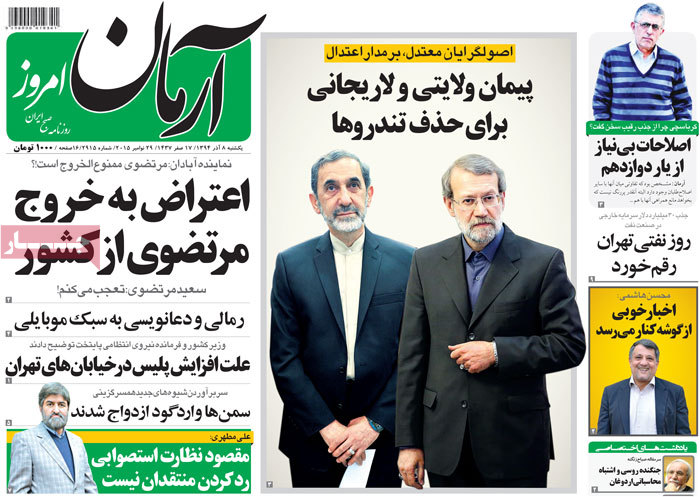
Arman-e Emrooz: Velayati and Larijani [two prominent principlist figures, one serving as an advisor to the Supreme Leader and the other as parliament speaker] unite to put aside hardliners.

Moderate principlists land on a moderation course.


A look at Iranian newspaper front pages on Nov. 29


Asrar: Police in the capital have staged an anti-terrorism drill to counter possible threats, said Tehran Police Chief Brigadier General Hossein Sajedinia.

Asrar: Arts and the environment cannot be walled off, said Masoumeh Ebtekar, the director of the Environment Protection Organization.


A look at Iranian newspaper front pages on Nov. 29


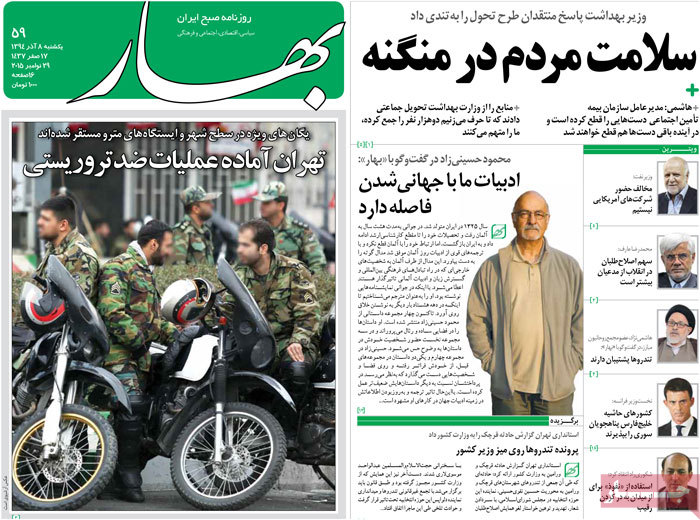
Bahar: Tehran readies for anti-terror operations

Special units have been deployed across the city, including in subway stations.


A look at Iranian newspaper front pages on Nov. 29


Ebtekar: Representatives of 137 international companies were on hand as Iran unveiled a new model of its oil contracts on Saturday.

Ebtekar: Riyadh has said that it favors good relations with Tehran!

The Saudi foreign minister has said that he extended an invitation to his Iranian counterpart two years ago.


A look at Iranian newspaper front pages on Nov. 29


Etemad: Tehran’s mayor has appealed to members of the public to help those who sleep rough.

Etemad: No to separation of moderation and reformism

Mohammad Reza Aref [a prominent reformist leader] has warned against divisions between moderates [supporters of the Rouhani administration] and reformists.


A look at Iranian newspaper front pages on Nov. 29


Ghanoon: A defendant [in a high-profile case] leaves the country

A look at the departure of Saeed Mortazavi [who is on trial for corruption] from a legal perspective


A look at Iranian newspaper front pages on Nov. 29


Hambastegi: The interior minister has said that disrupting authorized gatherings under any pretext is unacceptable.


A look at Iranian newspaper front pages on Nov. 29


Hemayat: The interior minister has said there have been no “anti-security” measures in border areas.


A look at Iranian newspaper front pages on Nov. 29


Iran: Twenty ministers and state managers have been tasked with overseeing services offered to Arba’een pilgrims.


A look at Iranian newspaper front pages on Nov. 29


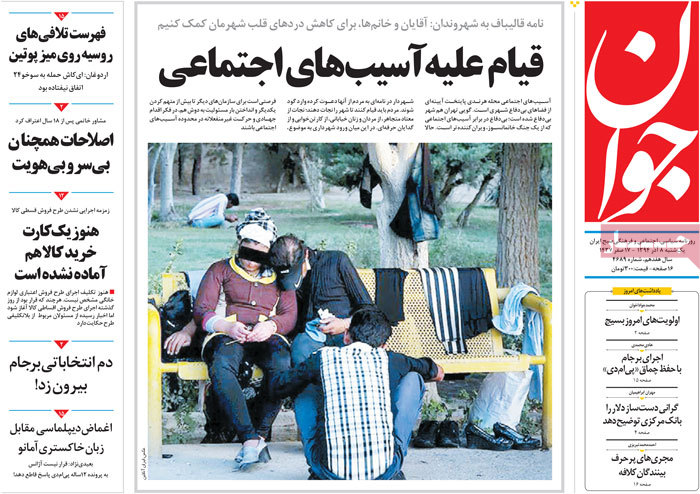
Javan: An uprising against social harms

Tehran Mayor Mohammad Bagher Ghalibaf has urged residents of the capital to help heal the metropolis’ social problems.


A look at Iranian newspaper front pages on Nov. 29


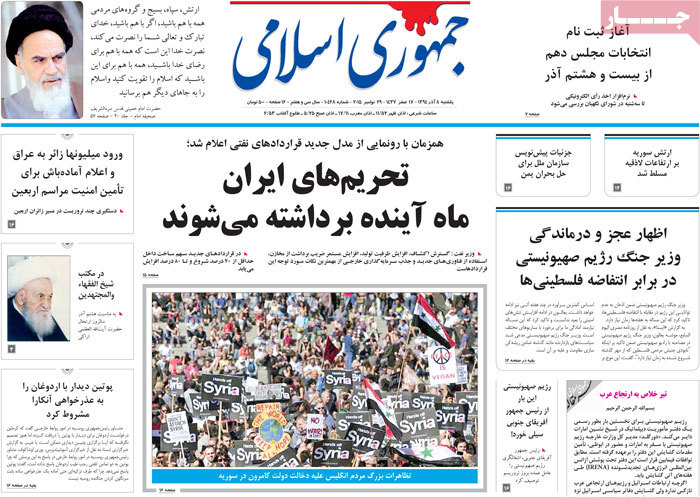
Jomhouri Islami: Iran sanctions will be lifted next month.

The announcement came as Iran unveiled a new oil contract model to world investors.


A look at Iranian newspaper front pages on Nov. 29


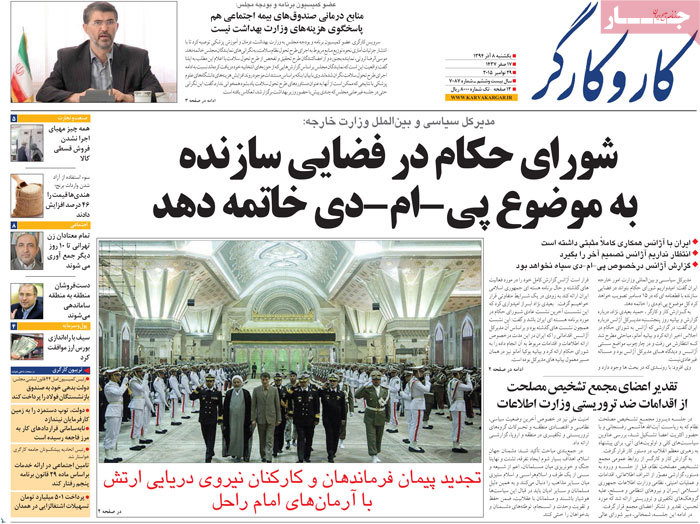
Kar va Kargar: An Iranian Foreign Ministry official has urged the IAEA Board of Governors to close the so-called PMD (possible military dimension) in a constructive atmosphere.

Hamid Baeedinejad further said that Iran has had good relations with the International Atomic Energy Agency.


A look at Iranian newspaper front pages on Nov. 29


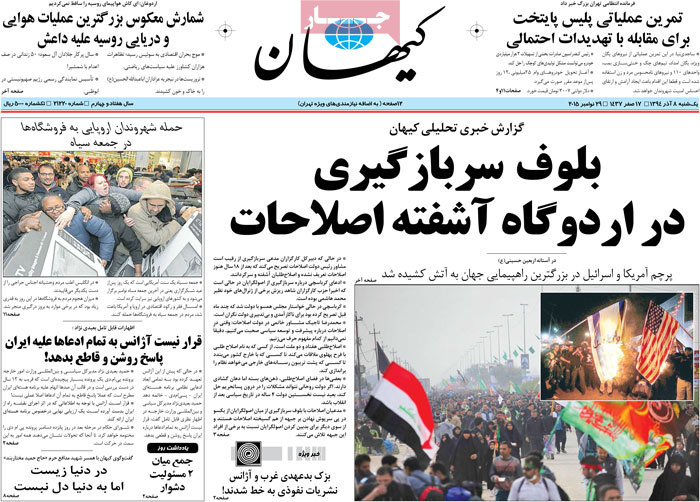
Kayhan: A countdown is on for a major air and sea offensive by Russia against IS.


A look at Iranian newspaper front pages on Nov. 29


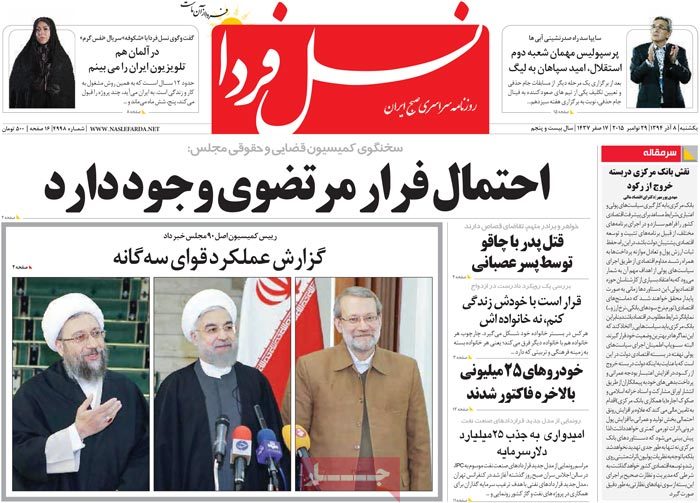
Nasl-e Farda: The spokesman of parliament’s Judicial Committee has said that Saeed Mortazavi [a former director of the Social Security Organization on trial for corruption] is a flight risk.

[Mortazavi has left the country to take part in Arba’een ceremonies in neighboring Iraq.]


A look at Iranian newspaper front pages on Nov. 29


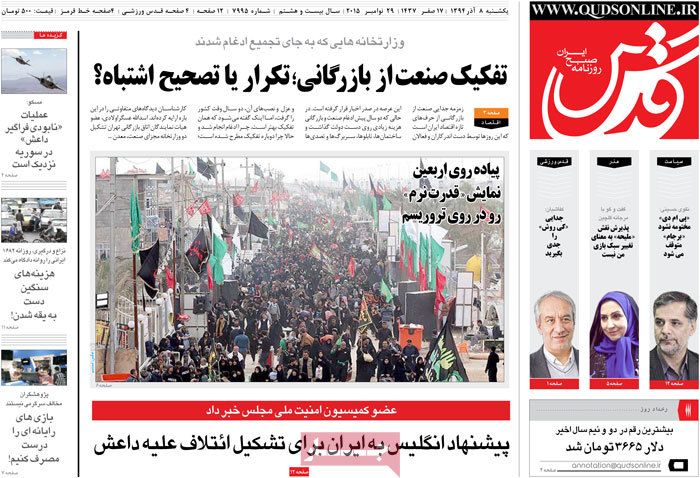
Qods: A member of parliament’s National Security and Foreign Policy Committee has said that Britain has put forth the idea of Iran establishing an anti-IS coalition.


A look at Iranian newspaper front pages on Nov. 29


Resalat: The black gold in exchange for the blood of Syrian citizens

A look at how Turkey is involved in oil trade with IS


A look at Iranian newspaper front pages on Nov. 29


Sayeh: Those who cross the border into Iraq without a visa will be dealt with, warned the interior minister.


A look at Iranian newspaper front pages on Nov. 29


Setareh Sobh: The Iranian oil industry is open to investment by American firms, said the Iranian oil minister.


A look at Iranian newspaper front pages on Nov. 29


SMT: Oil contracts worth $25 billion have been unveiled at an international conference in Tehran.


A look at Iranian newspaper front pages on Nov. 29


Highlights of Ettela’at newspaper on Nov. 29

Ettelaat

 Russia’s tactical formation to launch the biggest military operation against IS

The operation will include 69 Sukhoi fighters and Topolev 160 bombers and a large number of warships and submarines.

 The government spokesman has said that next year’s spending package will feature good news for pensioners.

Mohammad Bagher Nobakht, who also serves as director of the Management and Planning Organization, further said some 1.2 million retirees are getting less than $350 a month.

 Human Rights Watch has said that Saudi Arabia has committed war crimes, calling for UN Security Council intervention.

A report by the rights agency has catalogued 10 airstrikes against residential areas, markets and a factory.

 Cooperation between institutions and members of the public is needed to make poverty, addiction, and rough sleeping a thing of the past, said Tehran Mayor Mohammad Bagher Ghalibaf in an open letter to residents of the capital.

The letter further said social harms such as vagrancy and the number of child laborers and street children are on the rise.

 Plans to absorb some $25 billion in foreign investment to the oil industry

The oil minister said that the new model of oil contracts is a win-win for both Iran’s oil industry and international companies.

 Members of the Expediency Council have thanked the Intelligence Ministry for its anti-terrorist measures.


Closing Iran’s PMD Case Up to IAEA Board of Governors: Envoy

139406201648251326065474

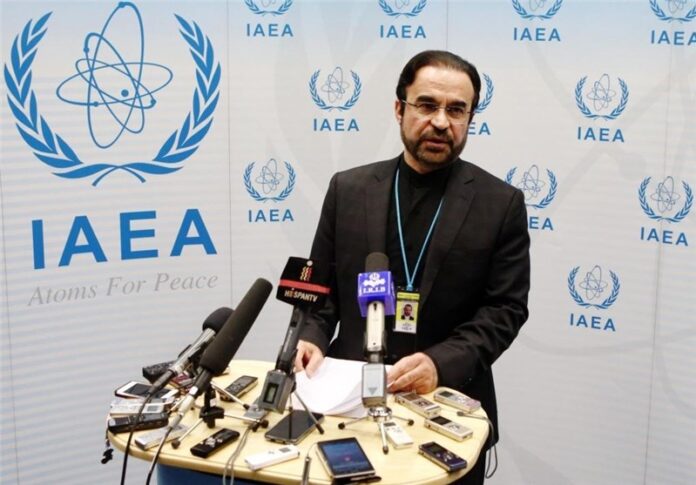
Iranian Ambassador to the International Atomic Energy Agency (IAEA) Reza Najafi underlined that the IAEA’s Board of Governors, not its director general, has the authority to close the so-called PMD (possible military dimensions) case in Iran’s nuclear program.

Speaking after the seasonal meeting of the Board of Governors in the Austrian capital, Najafi pointed to recent remarks by IAEA Director General Yukiya Amano, saying that he has no power to close the PMD case.

“I should say that basically, the director general only releases his report (on Iran’s nuclear program) and the closure of the case is not in his authority,” the diplomat said.

Amano is planned to release a report on the Iranian nuclear program, including the PMD issue, next week, and the Agency’s Board of Governors will review the report and make a final decision in a meeting on December 15.

“The report will not be black and white,” Amano told a news conference on Thursday when asked about the final assessment of PMD file which is due next week.

“What I can now say is that this is an issue that cannot be answered by ‘yes’ and ‘no’,” Amano said.

Tehran and 5+1 (Russia, China, the US, Britain, France and Germany) reached a conclusion on a nuclear agreement, the Joint Comprehensive Plan of Action (JCPOA), on July 14.

The IAEA has been given the role of verifying Iran’s commitments under the nuclear deal.

JCPOA was officially adopted on October 18, and is going to take effect within the next few weeks, after the IAEA releases its final report.

‘International firms ready to accept Iran Petroleum Contract’

9cd486e5-4ac2-468c-b4e1-a77e991a1831

An Iranian deputy oil minister says following introduction of the new format of Iran’s oil contracts, international companies have indicated their readiness to work with Iran based on the new contract.

Roknoddin Javadi, deputy oil minister and managing director of the National Iranian Gas Company (NIGC) made the remarks on Saturday after a meeting with senior executives of a number of international oil giants on the sidelines of an international conference in Tehran.

The conference, dubbed “Tehran Summit: Iran Oil and Gas Projects and Domestic Capacities,” opened in Tehran on Saturday to lay out 50 oil and gas projects for development through foreign investment which Iran hopes to pour in with the lifting of Western sanctions.

In an interview with SHANA, the Iranian Oil Ministry’s official news agency, Javadi said his negotiations with representatives of foreign companies have been positive, adding, “These and other international companies active in the oil industry are ready to cooperate with Iran within the framework of deals based on the new Iran Petroleum Contract (IPC).”

The official added that during his talks with France’s Total and Malaysia’s Petronas, they have discussed available grounds for development of hydrocarbon fields in Iran and commissioning of liquefied natural gas (LNG) plants.

“Representatives of [Russia’s] Lukoil have also indicated their readiness to cooperate with the National Iranian Oil Company in the field of developing [hydrocarbon] fields,” he said.

As many as 250 representatives from 33 countries attended the Saturday conference, during which Iran introduced a new contract format offering better incentives to investors than the previous buy-back deal.

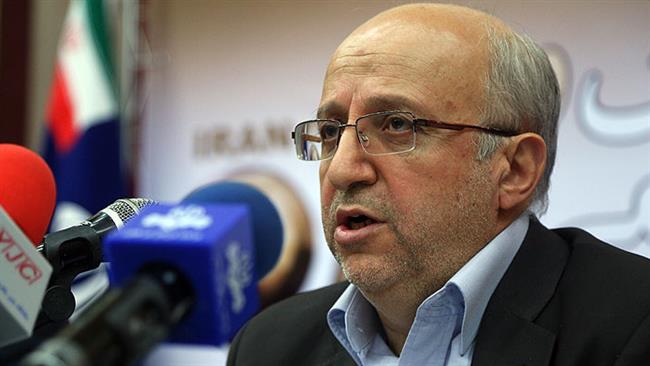
Head of the Iran Contracts Restructuring Committee (ICRC) Mehdi Hosseini said no American company took part in the event, but a number of big oil and gas entities sent their representatives.

The new contract includes specifications of the production-sharing agreements, which will encourage investors to produce more oil and develop a field for longer terms.

Each individual project will have tailor-made contracts, rather than a uniform format for all projects.

Companies will be allowed a share of the oil they produce, enabling them to sell it abroad. They will share the rise or fall in recovery; hence, the more they produce, the more they will earn.

The Iran Petroleum Contract (IPC) also gives investors the opportunity to participate in operation and production for 20 years that can be extended to 25 years, according to officials.