Sunday, December 21, 2025
Home Blog Page 4655

Where does tourism stand in Iran’s Sixth Development Plan?

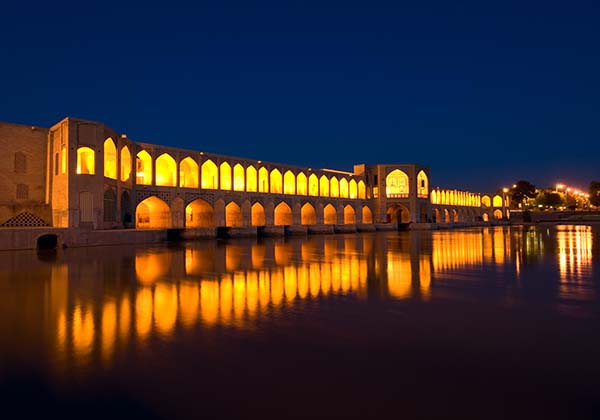
esfahan-010-www-mehrad-co-coml

Iran has detailed development plans. Experts say that the country’s first five development plans – each running for five years – have failed to achieve their intended results either because of mismanagement, especially during the ninth and tenth governments under Ahmadinejad, or because of international sanctions, especially in the last three years.

Under Article 50 of the general policies of the country’s Sixth [Economic, Social, and Cultural] Development Plan, the tourism industry should be boosted to ensure a minimum five-fold increase, by 2020, in the number of foreign tourists visiting Iran. According to the deputy director for investment at the Cultural Heritage, Tourism, and Handicrafts Organization, the Management and Planning Organization has defined twelve areas in the Sixth Development Plan with one solely focusing on tourism.

Donya-e Eqtesad on August 26 published a report on tourism and the place it has been given in the country’s Sixth Development Plan. It also compares the sixth plan with previous five-year plans asking whether the new development document creates enough opportunities for the country to boost its tourism. The following is the translation of part of that report which includes an interview with Gholamheidar Ebrahim-Bay Salami, the head of the Iranian Tourism Scientific Association (ITSA):

Some experts say that government should take the first step toward developing the country’s tourism industry. They say government should decide to give top priority to tourism and take measures in this regard. Gholamheidar Ebrahim-Bay Salami, a member of the Supreme Cultural Heritage and Tourism Council, says in the general policies of the Sixth Development Plan, the Supreme Leader has openly stressed the need for increasing the number of foreign arrivals; that’s why the government too should focus all its attention on boosting the tourism industry.

He says, “If we want to generate revenues, create jobs, eliminate poverty, promote justice, and protect the environment and the country’s material and spiritual resources, we need to bolster tourism. A country is deprived of progress and security when its tourism stops growing.[…]”.

[…]

He says in the third and fourth development plans, tourism was the country’s 43rd to 46th priority respectively. “Now that we are about to putting together the sixth plan, we need to redouble our efforts to place tourism on top of this plan’s priorities. To make it happen, we should focus on core points such as tapping into the potential of international companies and streamlining joint ventures in the post-sanctions era”.

The ITSA chief went on to highlight the necessity for the adoption of laws to smoothly run the industry, saying, “This can be an incentive and catalyst for investment by the private sector in the tourism industry so that the country can absorb both national and international investors and those involved in the industry can make profits.

“Making laws which can streamline things can direct the huge volume of un-invested liquidity in the country – hovering above $250 b – toward the tourism industry. Major tourism laws such as Article 11 of the law on the Cultural Heritage Organization which focuses on finances, ten-year tax exemption, duty-free services for importing tourism-related cars and production of quality cars in Iran should be reformed.

“The sixth development plan calls for the expansion and improvement of transportation in the country. Proper measures should be taken to develop roads and raise the quality of vehicles. As the general policies of the sixth plan focus on developing transportation and creating a competitive market, we need to put development of rail and air fleet on the agenda. The country now needs to add 1,500 cars to its rail fleet and 400 planes to its air fleet,” the official said.

“The country’s airports should be developed and equipped, especially Imam Khomeini International Airport whose passenger-transfer capacity [passenger load factor] should be raised to 25m a year. We all know that the glory of the Islamic-Iranian culture and the hospitality of the Iranians are reflected in the planning we make for the tourism industry. We should make proper planning so that any tourist who comes to Iran can feel the noble culture of Iran firsthand.

“The sixth plan should also pay close attention to the following: a science-based look at the tourism industry, tapping into the experiences of other countries in developing tourism, organizing and exploiting the potential of tourism graduates, and setting the stage for local communities to get involved in the development of tourism.

“All Iranian officials have started to pay attention to the role tourism plays in the country’s economy, but they have yet to take basic steps toward that goal, steps such as placing tourism on the priority list of the sixth plan and implementation of measures to boost tourism,” he concluded.
Bank Melli Iran pursuing case of frozen assets in US

13940608000745_PhotoI

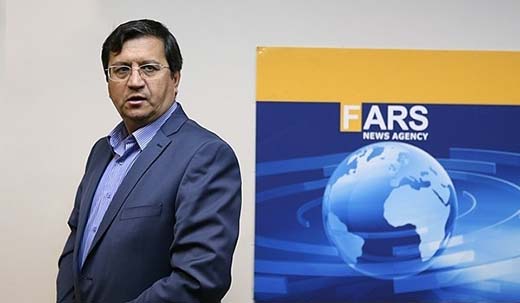
Managing Director of Bank Melli Iran Abdolnaser Hemmati announced on Sunday that the state-owned bank seeks to overturn the given verdict by a court of appeals in the US on its frozen assets in two American institutes.

Hemmati said Bank Melli Iran used to cooperate with American Master and Visa Card institutes and had up to $15 million there by 1995.

The bank’s money was frozen in the same year as part of the US government sanctions against Iran for its peaceful nuclear program, he added.

“When a new round of Western-led sanctions was imposed on Iran in 2007, the said frozen assets plus the added interest grew up to $21m, according to the available documents,” Hemmati said, and added, “A Jewish-American family made a complaint in the United States in that year and the court asked Visa Card institute to block Bank Melli assets.”

As Hemmati explained, an American court of appeals, which has been held recently to re-investigate the case, has issued permission for making withdrawals of Bank Melli assets.

“The lawyer for the Bank Melli Iran is very seriously pursuing the case and we hope for a solution,” Hemmati said.

An Iranian scientist with a UNESCO award under her belt

45684964

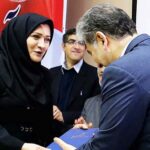
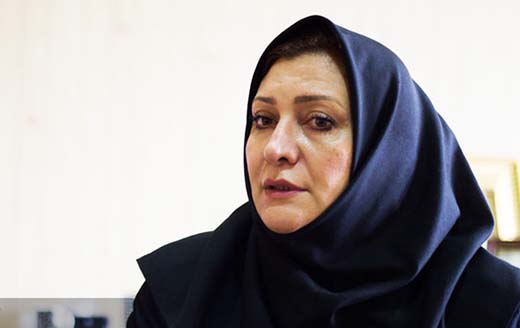
Soodabeh Davaran, an associate professor at the Faculty of Pharmaceutical Medicine at the University of Tabriz, received UNESCO’s Contribution to Science and Nanotechnology Award in Paris in April.

The following is an excerpt of an interview jamejamsara.ir conducted with the 49-year-old Iranian scientist who has dedicated her life to promotion of science and hopes to win the Nobel Prize one day:

You were named elite woman of the year in Iran in 2007, you appeared on University of Cambridge’s list of top 100 scientists in 2008, and you were on the list of outstanding intellectuals of the 21st century issued by the International Biographical Centre. Your 15 inventions and publication of more than 35 articles in internationally-known journals and the recent UNESCO award make your track record quite stellar.

I owe all of my achievements first to God’s grace and then to my diligence and passionate interest in acquiring knowledge as well as the support of my family.

When did you first develop an interest in science?

Many years ago, before I went to school. My father, Professor Hossein Davaran, was among the founding fathers of chemistry in Iran. My interest in this science was so great that we had a small laboratory at home. My sister and I would spend much of our days in the lab.

You are among people whose adulthood calling is the same as their childhood dream job.

When I was a primary school student, I always read the biographies of successful figures in the history of science.  Marie Curie, the first woman who won a Nobel Prize, was one of the people who inspired me to a large extent. I always wished that I could one day make a difference in the world of science.

And now you have the opportunity to get there.

One of my personal characteristics is that I always try to lead a dynamic scientific life. I don’t like stagnation. I like to constantly move forward, because I want to serve my country and humanity and fulfill my childhood dream of winning a Nobel Prize.

Tell us more about the UNESCO award.

I heard about my nomination in early March. Before that I didn’t know anything about it at all because I had not submitted anything to the center.

The award supports those who have a remarkable impact on science and nanotechnology. A jury evaluates articles, inventions and proposals presented by different scientists in over 100 countries before naming the winner.

How did scientific circles react to your winning of the prize?

Based on the reaction and comments of people from far and wide, I concluded that their views about the position of women in the Islamic Republic of Iran have changed. Probably, in the past they assumed that women did not hold a respected position in Iran and their presence was only felt at home. My winning of the title proved otherwise and showed that along with honoring family obligations Iranian women can pursue their ambitions, be active on the social scene and climb up the scientific ladder.


A look at Iranian newspaper front pages on August 31

Iranian Newspapers Headlines

The comments of the judiciary spokesman in a news conference about a range of issues including the ban on media coverage of news related to the former reformist president dominated the front pages of Iranian newspapers on Monday.


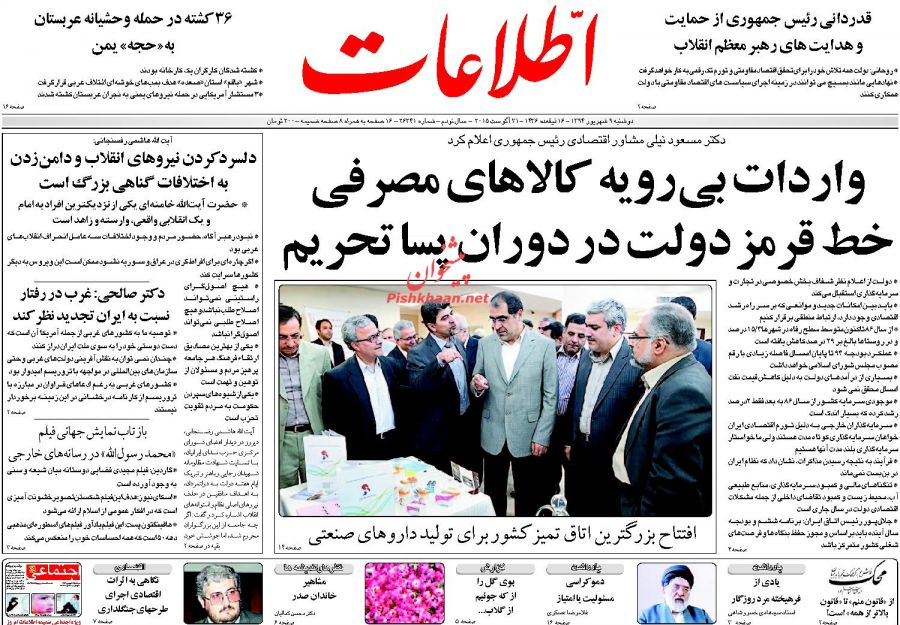
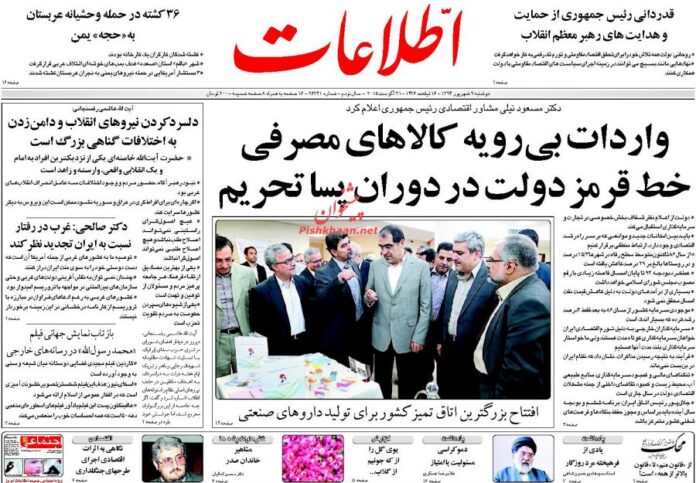
Ettela’at: “Limitless imports of consumer goods in the post-sanctions era are a red line for the government,” said Dr. Masoud Nili, an economic advisor to President Rouhani.

He further said the administration welcomes the private sector’s clear-cut views on trade and investment.


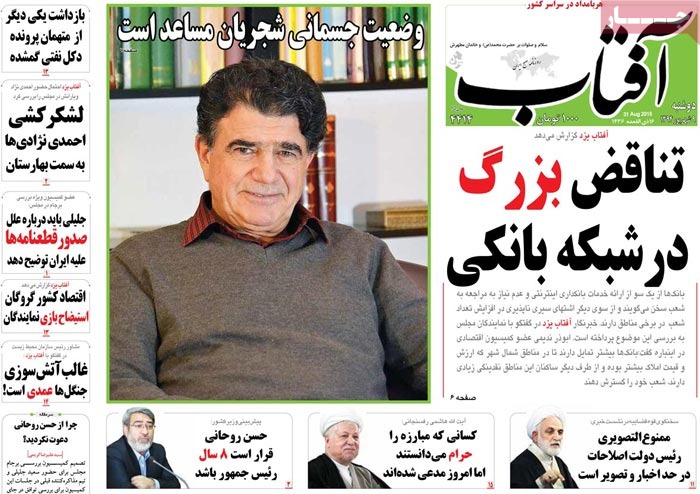
Aftab-e Yazd: The country’s economy has been hijacked by MPs who play the impeachment card too often.

Aftab-e Yazd: Master vocalist Mohammad Reza Shajarian [who was hospitalized for respiratory problems] is in a good condition.

Aftab-e Yazd: The ban on media coverage of news about the former president does not include mere mention of his name.


A look at Iranian newspaper front pages on August 31


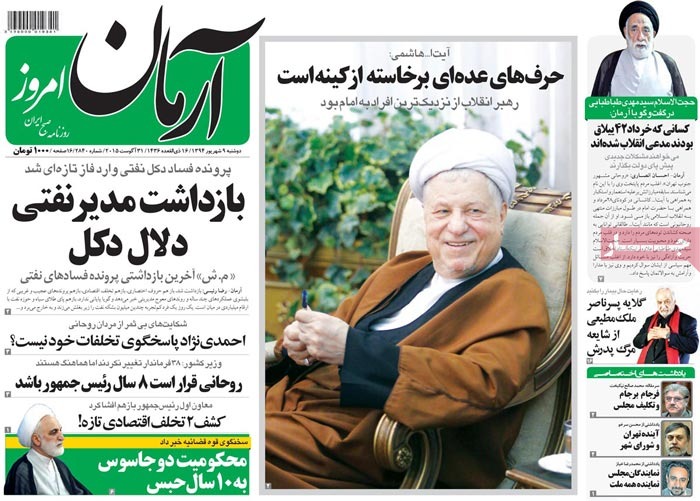
Arman-e Emrooz: Without naming names, the judiciary spokesman has said two individuals found guilty of spying [for the US and Israel] have been sentenced to 10 years in prison each.

Arman-e Emrooz: An oil industry manager has been arrested in connection with the missing oil derrick.


A look at Iranian newspaper front pages on August 31


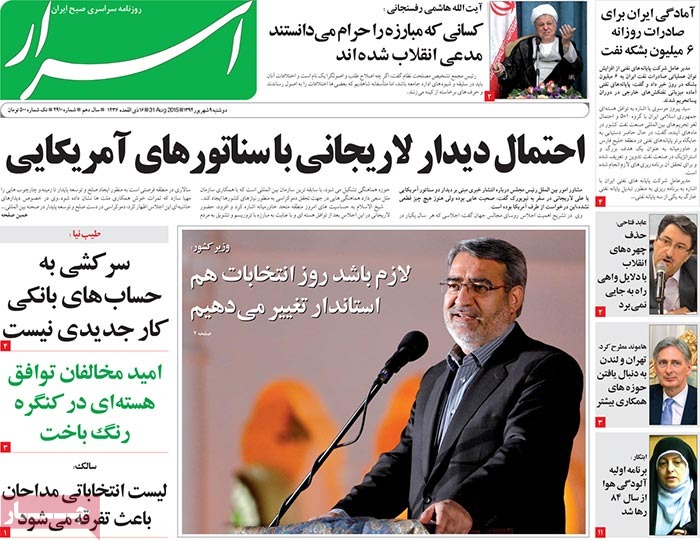
Asrar: Iran is ready to export six million barrels of crude per day.

Asrar: Parliament Speaker Ali Larijani is likely to meet with American senators during his New York visit.

An advisor to the top MP has said that there have been requests by the American side for such meetings, but nothing is final.

Asrar: The interior minister has warned, if necessary, he would name new governors general on the same day general elections are held.


A look at Iranian newspaper front pages on August 31


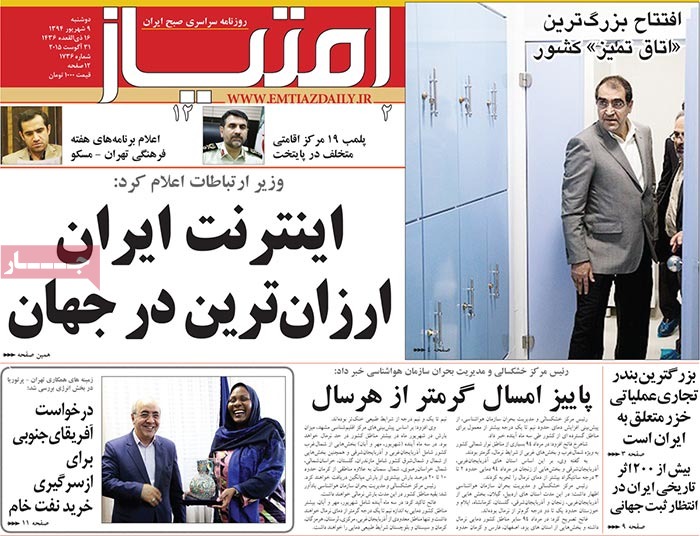
Emtiaz: South Africa has signaled willingness to resume imports of Iranian crude oil.


A look at Iranian newspaper front pages on August 31


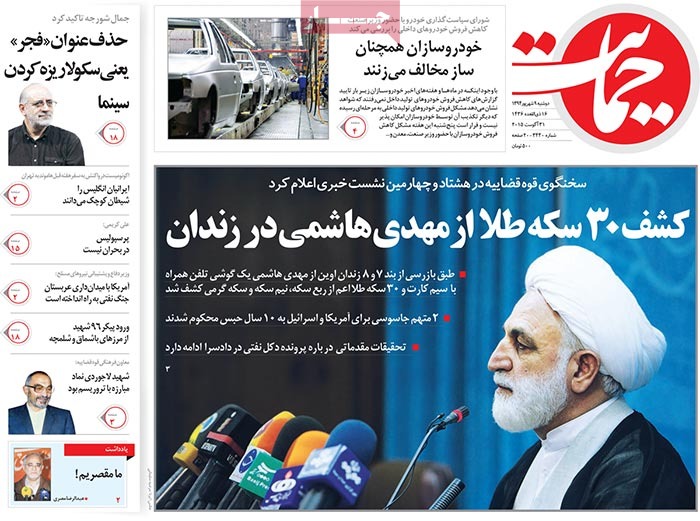
Hemayat: The judiciary spokesman has said an inspection of the cell where Mehdi Hashemi [a son of the chairman of the Expediency Council] is serving time has produced 30 gold coins and a cell phone complete with SIM card.


A look at Iranian newspaper front pages on August 31


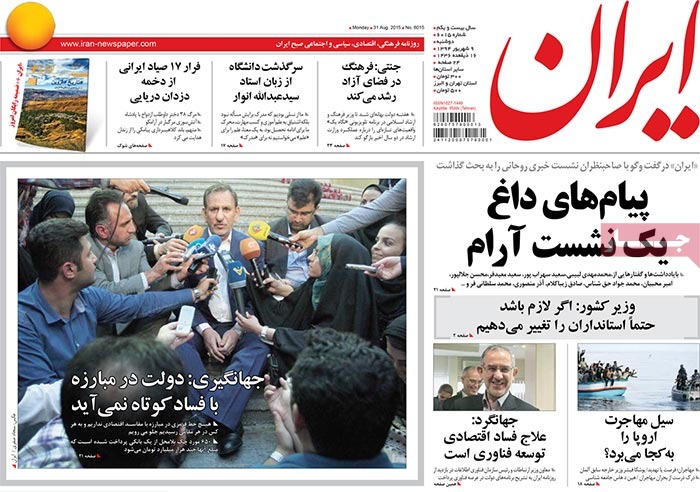
Iran: The first vice-president has said that government will not back down in the fight against corruption.


A look at Iranian newspaper front pages on August 31


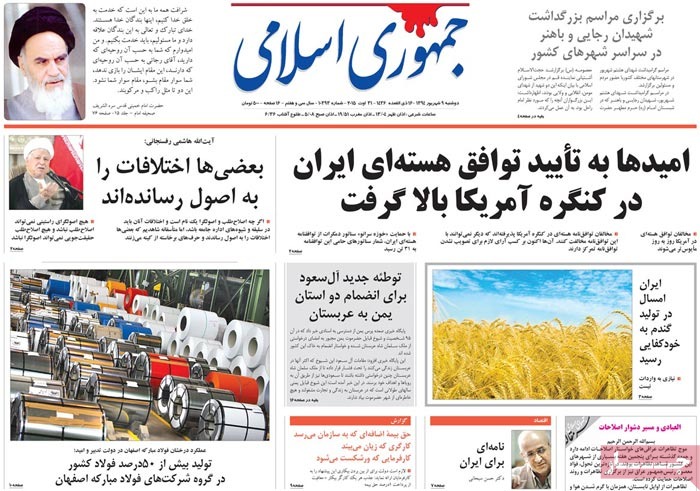
Jomhouri Islami: Hopes of congressional approval of the Joint Comprehensive Plan of Action have been boosted.


A look at Iranian newspaper front pages on August 31


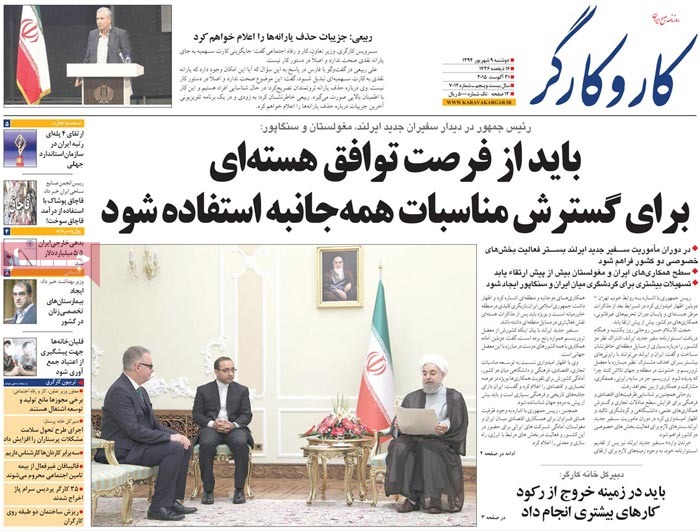
Kar va Kargar: In separate meetings with the new ambassadors of Ireland, Mongolia and Singapore, the president has said that the nuclear deal is an opportunity that needs to be seized for expansion of all-out ties.


A look at Iranian newspaper front pages on August 31


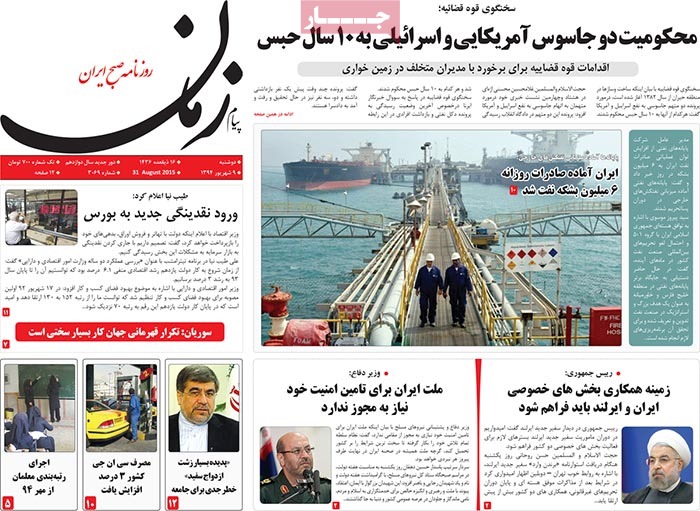
Payam-e Zaman: “The Iranian nation does not need anyone’s permission to ensure its security,” said the defense minister.


A look at Iranian newspaper front pages on August 31


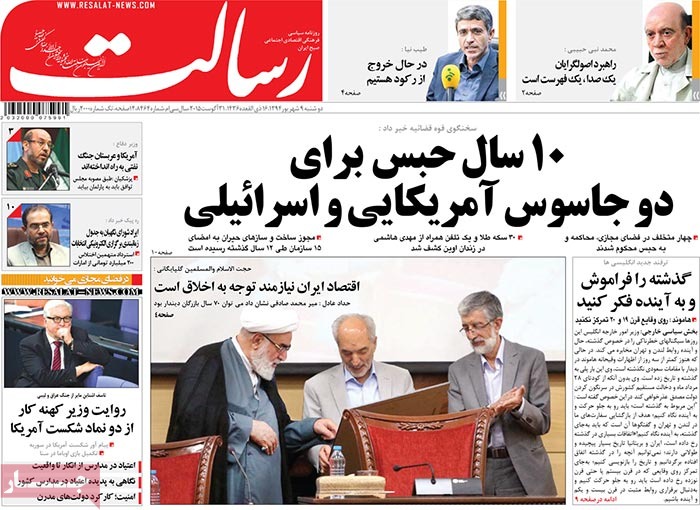
Resalat: A new trick by the Brits: Forget the past, zoom in on the future.

British Foreign Secretary Philip Hammond has said that Iranians should not focus on what happened in the 19th and 20th centuries.


A look at Iranian newspaper front pages on August 31


Highlights of Ettela’at newspaper on August 31

Ettelaat

 “Limitless imports of consumer goods in the post-sanctions era are a red line for the government,” said Dr. Masoud Nili, an economic advisor to President Rouhani.

He further said the administration welcomes the private sector’s clear-cut views on trade and investment.

 President Rouhani has thanked the Supreme Leader for his support and guidelines.

The president said his administration will try its best to make resistance-based economy a reality and push inflation into single digits.

 A Saudi attack on Yemen has left three dozen factory workers killed.

Three American advisors are said to have died in an attack by Yemeni forces on Saudi Arabia.

 The country’s largest cleanroom for production of industrial medicines has been inaugurated.

 “Dampening the enthusiasm of revolutionary forces and stoking divisions are big sins,” said the chairman of the Expediency Council.

Ayatollah Rafsanjani described Ayatollah Khamenei as one of the closest figures to the late Imam and a genuine, devout revolutionary.

 The director of the Atomic Energy Organization of Iran has urged the West to rethink its Iran policy.

“We urge Western countries, including the US, to extend a hand of friendship to Iran,” Ali Akbar Salehi said.

 Global media reaction to the screening of Iranian film Muhammad, Messenger of God.


Baeedinejad appreciates Iranian reporters for taking initiative

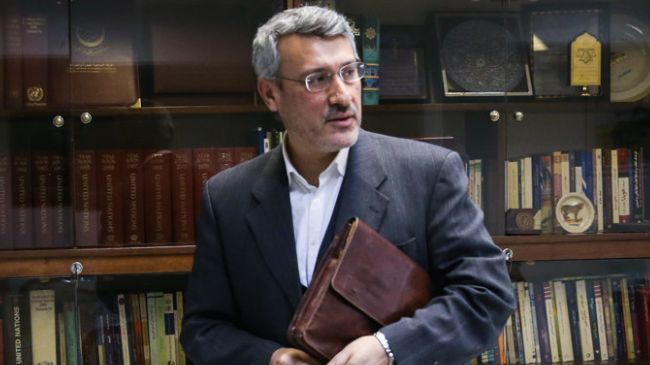
Hamid Baeedinejad

A member of Iran’s nuclear negotiating team, Hamid Baeedinejad, on Sunday appreciated Iranian reporters for taking the initiative in reporting the news on the nuclear talks.

He said that Iranian reporters carried their duty skillfully in a way that foreign news corporations preferred to quote Iranian news agencies in doing their job.

The way Iranian reporters and news agencies gave coverage to the nuclear talks in Vienna was unique in its kind, he said.

In all cases the West was the source of all news items, but this time the Iranian reporters and news agencies took the lead and became the source for the Western news agencies, he said.

In most cases, the Western news agencies referred to the news covered by the Iranian news agencies, he said, adding this should be regarded as a significant achievement proving that the Western media can no longer have the upper hand in this regard.

To maintain the trust the Western sources have built in the Iranian news centers for reflecting the news and events, the media people should exercise vigilance and continue such a trend so that their news can be referred to as an accredited source, he said.

Iranian FM to start North African tour Monday

zarif1

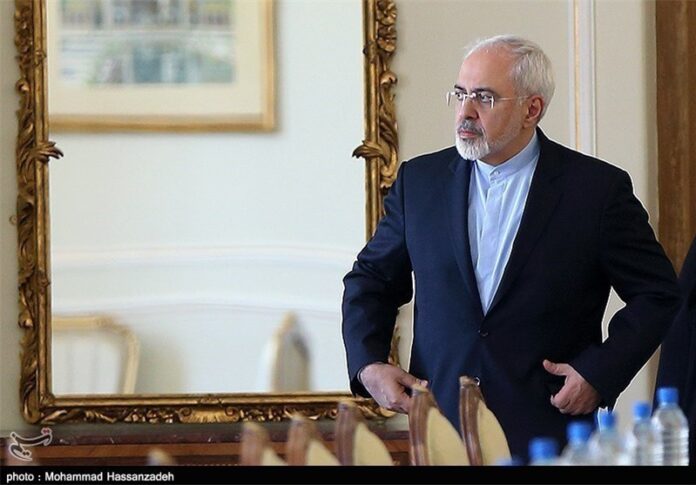
Iran’s Foreign Minister Mohammad Javad Zarif will begin a new international tour on Monday by visiting two North African states.

During his third tour after the conclusion of nuclear talks in the Austrian capital of Vienna on July 14, Zarif will fly to Tunisia and Algeria.

During the visits, the Iranian top diplomat will explore avenues for the promotion of bilateral ties with the two African countries.

He will also confer with high-ranking of the two countries officials on the latest regional and international developments and the necessity for focusing on a political solution to the ongoing crises in Syria, Yemen, and Libya.

Consultations on the outcomes of the nuclear deal reached between Tehran and world powers, and explanation of Iran’s principled policy of strengthening regional ties will be on agenda during Zarif’s talks with senior North African officials.

In his previous international tours after the Vienna talks, Zarif visited several countries including Kuwait, Qatar, Iraq, Lebanon, and Syria as well as India, Pakistan, and Russia.

President Rouhani has repeatedly emphasized that his government’s approach in foreign policy is to have constructive interaction with the entire world.

Iran opposes Berlin orchestra’s performance with Israeli conductor

13940608000590_PhotoI

The Iranian Culture and Islamic Guidance Ministry voiced opposition to the presence and performance of the Berlin orchestra in Iran as long as it is conducted by Israeli-Argentinian Daniel Barenboim.

“The conductor of Germany’s symphonic orchestra is affiliated to Israel in terms of nationality and identity,” Spokesman of the Culture Ministry Hossein Noushabadi told reporters in Tehran on Sunday.

“Germany’s symphonic orchestra can change its conductor and then apply for performance in Tehran. Only then will its application be studied,” he added.

Barenboim, 72, who is the general music director of the German capital’s flagship opera house, the State Opera, “is in talks with Iran about a possible concert in Tehran by the Staatskapelle Berlin,” the house said in an emailed statement earlier this month.

But his Israeli nationality prompted Tehran to voice opposition to his trip while the Iranian officials have underlined that there is no obstacle to German orchestra’s visit.

FM Zarif urges Iran-South Africa cooperation against terrorism

139406081919473245994274

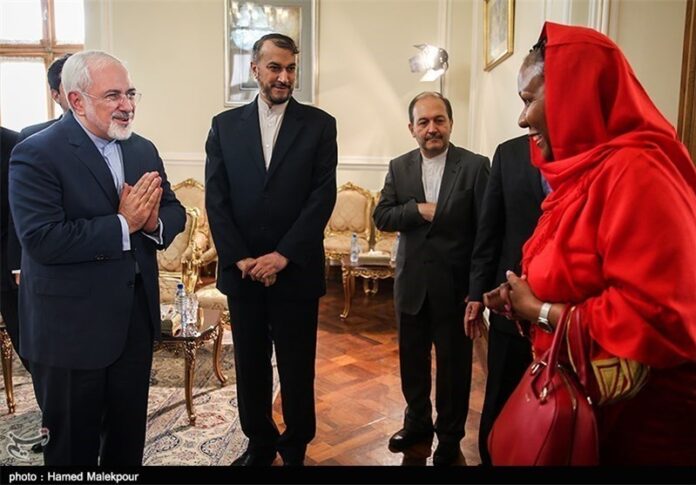
Iranian Foreign Minister Mohammad Javad Zarif warned about the threat posed by terrorist groups against global security, and called for closer cooperation between Iran and South Africa against the phenomenon.

Speaking at a meeting with visiting South African Deputy Foreign Minister Nomaindia Mfeketo in Tehran on Sunday, Zarif highlighted the two sides’ high capacity for cooperation in different political, economic and security fields.

“Terrorist groups in Africa are a threat to regional and global peace and security and (therefore) the fight against extremism is regarded as a major subject for mutual cooperation,” he noted.

Zarif described Iran-South African relations as excellent and beyond political and economic relations, and added that South Africa can be a major trade partner for Iran.

The South African delegation has come to Iran to partake in the sixth Iran-South Africa political commission.

Mfeketo, for her part, offered congratulations on the nuclear deal between Iran and P5+1.

She described her visit to Iran as very positive and expressed hope that the achievements of the visit would help boost all-out relations between the two countries.

Some Mideast countries dream of restoring empires: Iran official

362ee487-ae44-452e-adb6-8734bcc2510b

A senior Iranian official has said certain countries in the Middle East are harboring fantasies about resurrecting long-defunct empires in the region.

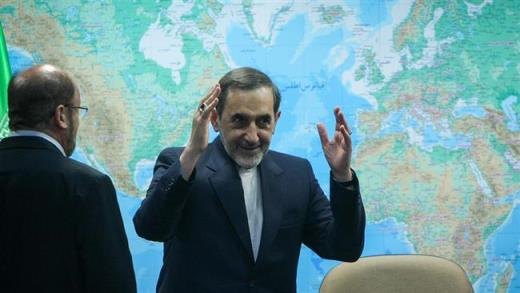
“Some countries in the region dream of reviving former empires which dominated the Arab countries, and certain countries support terrorism in the region with different motives,” Ali Akbar Velayati, a top advisor to Leader of the Islamic Revolution Ayatollah Seyyed Ali Khamenei, said in a meeting with a Lebanese delegation in Tehran on Sunday.

He added that some Western and regional officials have already acknowledged that they have helped create terrorist groups in Syria and Iraq.

Velayati described the ongoing crisis in Syria as a “world war on a small-scale,” adding, “The satanic move of meddling in Syria is unprecedented in contemporary history.”

He reaffirmed Iran’s support for the government of Syrian President Bashar al-Assad, saying the Islamic Republic is opposed to any “foreign interference” in Syria’s internal affairs.

“The destiny of the Syrian people should be determined by themselves, not by anyone else,” he stressed, praising the Syrian president for defending the Syrian people’s interests.

Velayati also heaped praise on Lebanon for its resistance against the Israeli regime, saying, “Lebanon plays a significant role in forming the front to counter Zionists and their supporters in the Muslim and Arab world.”

He stressed that Iran “will keep supporting Lebanon.”