Tuesday, January 13, 2026
Home Blog Page 4636

Arms, financial supply to terrorists must be blocked: Iran’s Rouhani

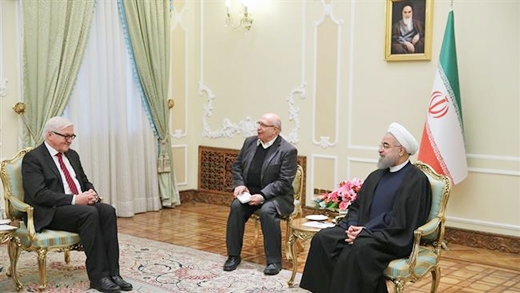
The Iranian president made the remarks in a meeting with visiting German Foreign Minister Frank-Walter Steinmeier in Tehran on Wednesday.

Rouhani further pointed to the landmark nuclear agreement between Iran and the five permanent members of the UN Security Council – the UK, the US, France, Russia and China — plus Germany, noting that the precise and immediate implementation of the deal serves the interests of both sides.

“The JCPOA (Joint Comprehensive Plan of Action), as a successful model, has prepared a very good condition in the international area for dialogue and interaction on other issues. We should try to utilize this win-win equation for the resolution of other regional issues,” Rouhani pointed out.

He added that Iran has a great deal of opportunities available in the fields of industry, mining, energy, railway transport and tourism, and that Berlin can seize the opportunity to have a more active business cooperation with Tehran.

The German official, for his part, underscored the need for a concerted campaign against terror, stating that the root causes of the menace must be explored and addressed.

He also called for further promotion of Tehran-Berlin ties following the implementation of the JCPOA which started on January 16.

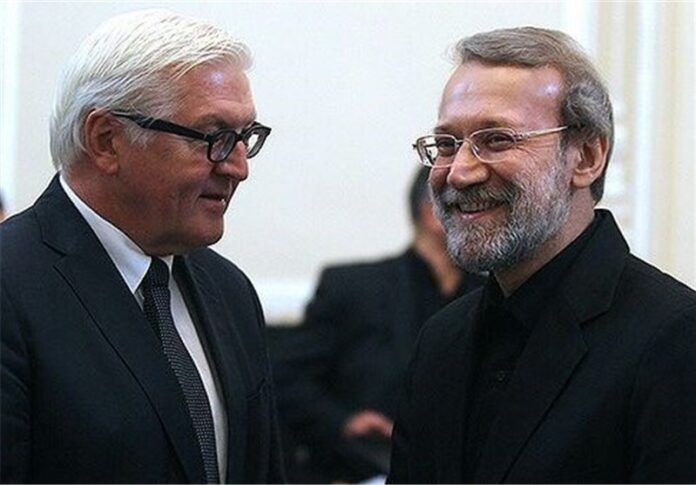
Earlier in the day, Steinmeir also held a meeting with Iran’s Parliament (Majlis) Speaker Ali Larijani, during which the Iranian official expressed concern over growing tensions in the Middle East and criticized some regional states over their role in fomenting regional conflicts.

Larijani also said Saudi Arabia’s military adventurism in the region will fail just like US military aggression against Afghanistan and Iraq.

Steinmeir, for his part, voiced concern over growing tensions and crises in the Middle East, stating that Berlin and Tehran are eager to help resolution of regional issues.

The German foreign minister also condemned attempts to derail the ongoing Syria peace talks in Geneva, Switzerland, warning that the negotiations would fail if Syrian opposition groups do not put aside their differences to reach a consensus.

The foreign-sponsored conflict in Syria, which flared in March 2011, has reportedly claimed the lives of more than 260,000 people and left over one million injured.

The UN says 12.2 million people, including more than 5.6 million children, remain in need of humanitarian assistance in Syria. The violence has also displaced 7.6 million people.

German Firm to Invest One Billion Euros in Iran’s Copper Industry

“The MKM has expressed its willingness to invest in Iran’s mining projects and particularly downstream industries up to one billion euros,” Mohammad Esfandiar, a member of the NICICO board of directors, announced.

The NICICO is after “trade and technological interaction” with the world, branding and presence in international markets, the official noted.

The deal comes against the backdrop of a new wave of interest in ties with Iran after Tehran and the Group 5+1 (Russia, China, the US, Britain, France and Germany) on July 14, 2015 finalized a comprehensive deal on Tehran’s nuclear program and implemented it on January 16.

The comprehensive nuclear agreement terminated all nuclear-related sanctions imposed on Iran after coming into force.

Earlier in July 2015, German Vice-Chancellor and Minister for Economic Affairs and Energy Sigmar Gabriel visited Iran at the head of a high-ranking trade delegation, including the representatives of 20 German economic giants, and held meetings with senior Iranian officials to develop economic cooperation between the two countries.

Iran’s Larijani: Syria Talks Cannot Continue Unless Certain Sides Change Path

Certain countries sitting at the negotiating table to resolve the Syrian crisis pursue their own interests and make instrumental use of terrorism, Larijani said in a meeting with German Foreign Minister Frank-Walter Steinmeier here in Tehran.

Unless their approaches are corrected, continuation of the Syria talks would be more like a “joke”, he stated.

“Unfortunately, there are certain countries in the region that do not play a positive role but provoke conflicts and help terrorism,” Larijani stressed.

He lashed out at the Saudi regime’s military approach in the Middle East, saying such an attitude would get nowhere just as the Americans could not achieve anything by invading Iraq and Afghanistan.

Steinmeier, for his part, referred to the unresolved crises and tensions that have escalated in the Middle East as what worries Berlin.

“I am sure Iran and Germany are keen to have regional issues resolved, because we have now experienced the sweet taste of bilateral ties,” he added.

A look at Iranian newspaper front pages on Feb 3

Iran Newspaper front pages


Ettela’at:

1- We changed the world’s view of Iran. The President, in a TV interview, says the government is a supporter while the people play the main role

2- Countdown has started for ending 4-year siege of Shiite communities of Aleppo

3- Minister of Roads: Iranian air fleet capacity will double

4- 22 new drugs produced by Tehran University of Medical Sciences unveiled


A look at Iranian newspaper front pages on Feb 3


Afkar:

1- Paying tribute to athletes who safeguard values

2- Minister of Roads and Urban Development: Iran and Lebanon have signed 3 cooperation agreements


A look at Iranian newspaper front pages on Feb 3


Arman Emrooz:

President Rouhani calls for massive turnout in elections: Don’t turn your back on the ballot box


A look at Iranian newspaper front pages on Feb 3


Emitiaz:

1- Covering vehicle’s number-plate is an offence

The daily devoted its main headline towards drivers who cover their car’s number-plate to enter off-limit areas

2- Azadi Sport Center the second-most frightening stadium in the world

3- Americans eager to purchase Iranian Kilim (woven rugs)


A look at Iranian newspaper front pages on Feb 3


Etemad:

1- Supreme Leader: sacrifice for religion and revolution is not limited to a specific segment of society

2- Iran and Germany moving towards all-out cooperation

Zarif: I call on Saudi Arabia to surrender to wisdom

Steinmeier: No need for our mediation between Tehran and Riyadh


Etemad daily


Hamdeli:

1- Americans Pull the Hand-Brake on Trump

2- The Anti-Iranian US Presidential Candidate Stopped at First Step


A look at Iranian newspaper front pages on Feb 3


Hemayat:

Honoring Guard commanders with Fath Decoration, a humiliation to US

Global responses tothe tribute paid by the Supreme Leader to those who detained trespassing American sailors


A look at Iranian newspaper front pages on Feb 3


Iran:

1- Rouhani in a TV interview: Now it’s the nation’s turn

2- Steinmeier heads high profile economic delegation to Iran


A look at Iranian newspaper front pages on Feb 3


Javan:

Rouhani: Hollande said our goal is creating jobs for Iranian youth


A look at Iranian newspaper front pages on Feb 3


Kayahn:

1- If Hollande was capable of creating jobs, he would have found employment for French youth

2- Determining the future of American people with a coin-toss


A look at Iranian newspaper front pages on Feb 3


Khorasan:

1- More than a championship – Supreme Leader: the value of female athletes observing Islamic dress code, refusing to compete against Zionist rivals and kneeling down after victory is greater than the championship itself

2- Daesh and Al-Nusra terrorist groups should not be allowed into Syrian peace talks, Zarif says in talks with German Foreign Minister

3- Production of gasoline increases by 2 million litres/day


A look at Iranian newspaper front pages on Feb 3


Resalat:

1- Hilary Clinton: Americans are angry, disappointed and anxious

2- Rouhani: We don’t want to look Westwards


A look at Iranian newspaper front pages on Feb 3


Rozan:

1- Mohammad Reza Aref: People will have the final word on election day

2- Ziba Kalam (Iranian University Professor) invited to deliver a speech in the UK House of Commons


A look at Iranian newspaper front pages on Feb 3


Sayeh:

1- First Vice President: Bullying creditors should know that the law is more of a bully than them

2- Mohammad Javad Zarif a popular personality among artists

At the closing ceremony of the 4th International Fajr Theater Festival, artists talked about their respect for the Foreign Minister, Mr. Zarif


A look at Iranian newspaper front pages on Feb 3


Vaghaye Etefaghiyeh:

Iran on path for dialogue

Velayati in Moscow and Steinmeier in Tehran


A look at Iranian newspaper front pages on Feb 3


Senior MP calls Riyadh as obstacle to success of Syria talks

Speaking to IRNA, he said that Syrian government has upper hand in the conflict and Takfiri groups’ power is in decline with the advisory help of Iran and air support of Russia.

ISIL has experienced several defeats in Iraq and Iraqi government and volunteer forces’ victories are continuous, the lawmaker added.

His comments came as the so-called High Negotiations Committee (HNC) cancelled a scheduled meeting with the UN envoy, saying, “At this moment, there is no reason to repeat ourselves with de Mistura.’

The gathering was to be the opposition delegation’s second meeting with the Swedish-Italian diplomat as part of the UN-brokered Geneva negotiations aimed at finding a political solution to the deadly conflict in Syria.

The foreign-sponsored militancy, which began in March 2011, has claimed the lives of more than 260,000 people and displaced almost half of the country’s population.

First Europe bank to open Iran office

RBI is in “intensive talks” with Iranian banks as Tehran is rejoining international banking system, its board member Peter Lennkh said in an interview with Austrian newspaper Wirtschaftsblatt.

“We are already working on the preparations and want to offer our customers everything the sanctions relief allows,” he said.

Lennkh said RBI had a very good deal of business in Iran before sanctions were imposed on the country in 2012 and “would like to be again the leading bank in the Iran business.”

International lenders are linking up, though slowly, with their Iranian counterparts using global transaction network SWIFT.

As of this week, Iran is able to use the worldwide transaction network which handles cash transfers and letters of credit between financial institutions.

Central bank officials have said banks from European countries including Germany, France, Britain and Italy, have been in talks to open branches after the lifting of sanctions.

Commerzbank has said it is reviewing its policy of not doing business in Iran.

‘US weapon’

Other major banks are cautious, however, seeking all the assurances they need to return to Iran. They are deterred by Washington’s heavy fining of some lenders in the past for doing business with Iran.

Thierry Coville, of the French Research Centre for International and Strategic Studies (Iris), said Washington is happy to let uncertainty persist.

“It could be a US policy to say, ‘careful, it’s complicated’, so people don’t understand what’s going on and think they the sanctions remain in place,” the AFP news agency quoted him as saying.

In 2014, the US imposed a record $8.9 billion fine on France’s BNP Paribas while German giant Deutsche Bank took a $258 million fine for doing business with Iran.

Coville lamented a “strategic mistake which is today being paid for” to allow the US to place “direct pressure on the European banks” when it comes to a return to Iran.

“Politically, this is lamentable on the part of the Europeans. This is now a financial and geopolitical weapon that the United States won’t shirk from using again in other circumstances.”

European assurance

However, Europe’s rush for resurrecting trade with the global energy superpower sitting on the worlds’ biggest oil and gas reserves combined as well as massive mineral deposits is set to trump existing reservations.

Italy and France signed initial deals worth more than $40 billion in a variety of fields — from oil and gas to car manufacturing, construction, health and agriculture and clean energy development — last month during President Hassan Rouhani’s visit to Europe.

Major groups would need financial support to seal contracts and leading banks would inevitably move in to reopen their offices in Iran.

Seeking to reassure, Paris last Tuesday unveiled an accord offering state guarantees to back French investments in Iran through credit management firm Coface in order to cover onsite non-payment risks.

High Turnout in Elections to Further Raise Iran’s Int’l Status: Larijani

Speaking in an open session of the parliament on Wednesday, Larijani pointed to the parliamentary and Assembly of Experts elections due to be held later this month, saying that in the “disturbed security situation” of the region, holding competitive and glorious elections is of high importance.

“At the current juncture, holding high turnout elections attended by maximum number of voters will have a positive role in raising Iran’s status in the international arena,” he noted.

He further emphasized that in the critical situation of the region, the country is in need of “national consensus and convergence”.

In similar remarks, Leader of the Islamic Revolution called on Iranians from all walks of life with every political orientation to take part in the February elections, describing people’s involvement in the voting process as a major factor in survival of the Islamic Revolution.

It is necessary for the whole eligible voters to cast their ballots in the February 26 elections for choosing members of the Assembly of Experts and the Parliament, Ayatollah Seyed Ali Khamenei said on January 9.

“We insist, like the past, that everybody should go to the ballot box, even those who disapprove of the Establishment and the leadership, because the election belongs to the nation, to Iran and to the Islamic Republic Establishment,” Imam Khamenei stressed.

The Leader explained that elections contribute to the survival of the Revolution, because people’s action to feel responsibility and vote will stymie the enemy’s plots.

The maximum turnout in the elections will strengthen the Islamic Establishment, guarantee constant provision of security, add to the Iranian nation’s credibility in the world, and boost the grandeur of the Islamic Republic in the eyes of enemies, Ayatollah Khamenei pointed out at the time.

The Assembly of Experts and the parliamentary elections are slated to be held simultaneously on February 26.

There will be 290 seats in the Iranian parliament and 88 in the Assembly of Experts up for grabs.

Members of the assembly are directly elected to office by people for an eight-year term. It holds biannual meetings to appoint a new chairman.

Rafsanjani’s Controversial Remarks on Iran’s Elections Cause a Stir

On February 1, the former Iranian president Ayatollah Akbar Hashemi Rafsanjani directed harsh criticism at the country’s Guardian Council. He made his remarks in defense of Seyyed Hassan Khomeini, the grandson of Ayatollah Ruhollah Khomeini, the founder of the Islamic Republic. The Council had earlier excluded him from running for the upcoming Assembly of Experts election. His comments have drawn widespread attention from the Iranian media and news websites.

In the wake of the recent implementation of a nuclear deal between Tehran and world powers (known as the JCPOA), Iran finds itself at a critical juncture in its political history. The country is on the verge of a major evolution, especially in terms of its international ties. At the same time, political competition has escalated between the country’s conservatives and reformists, with an eye on gaining the most out of the upcoming Parliamentary and Assembly of Experts elections, which are due to be held on February 26.

Under such circumstances, it seems that the wisest politicians of both parties – particularly the reformists, who have bitter memories of the protests after Iran’s 2009 presidential elections and are still paying the price for ignoring the rules of the game – are not looking to increase the pressure generally in Iran’s atmosphere by aiming criticism at the Guardian Council’s views on candidates’ qualifications.

In recent days, senior officials within the moderate government of Hassan Rouhani, including the president himself – as well as prominent reformists like Mohammad Reza Aref – have expressed their criticism of and discontent with the Guardian Council’s disqualification of moderate and reformist candidates in a tone of moderate complaint at most. They have been voicing their criticism with soft and cautious words, mentioning their expectation of a review of the disqualification cases and their high hopes for the Council to reconsider its decisions.

In this atmosphere, Ayatollah Hashemi Rafsanjani’s remarks are clearly considered as being contrary to the cooperative approaches of the reformists, and have worried certain party figures. Certain reformists fear that such remarks and opinions in support of the disqualified candidates will only deepen the gaps instead of helping to resolve the issue, namely the disqualification of certain prominent figures, including the grandson of Imam Khomeini.

Ayatollah Hashemi Rafsanjani attacked the Guardian Council at a Monday ceremony marking the “Ten Days of Fajr (Dawn)”. This celebrates the 37th anniversary of the 1979 Islamic Revolution, when Imam Khomeini, the leader of the revolution, returned to the country after almost 15 years in exile.

The former Iranian president spoke out in protest at Seyyed Hassan Khomeini’s disqualification, saying “You [presumably the Guardian Council] have disqualified the person who is the most similar to Imam Khomeini. Where have you got your own qualifications from? Who has permitted you to judge? Who allowed you to take control of the parliament, the government, and other institutions? Who allowed you to have guns or to have an opinion? Who gave you this permission? If it was not for Imam Khomeini, his uprising, and the people’s will, you could not have had any of these. At a time when all of us should celebrate together [during the Fajr days], you gave Imam Khomeini’s family a poor gift.”

The remarks, however, drew reactions from several political figures and activists, from both the conservatives and the reformists.

Conservatives, not unexpectedly, attacked Hashemi Rafsanjani for his remarks. Hossein Shariatmadari, an outspoken conservative, said that Hashemi Rafsanjani should consider himself, rather than the Guardian Council, as being indebted to the family of Imam Khomeini. This is, he claimed, due to a secret project which Ayatollah Hashemi Rafsanjani has designed for Seyyed Hassan.

Shariatmadari claims that Hashemi Rafsanjani had persuaded Seyyed Hassan Khomeini to register his name for the Assembly of Experts election, then later on, had encouraged him not to take the qualification test.

“Mr. Hashemi Rafsanjani is indebted to Imam Khomeini’s family in this case, because of a special scheme he has designed… Therefore, his recent remarks are solely aimed at switching his position from debtor to creditor. He has labeled the Guardian Council as indebted to the Imam’s family, instead of considering himself a debtor, and apologizing to Ayatollah Khomeini’s family.”

Another conservative, Mojtaba Zon-Noor, also demonstrated a harsh reaction to the remarks. He referred to Hashemi Rafsanjani’s comments as being aimed at spoiling the Islamic Establishment, Imam Khomeini’s descendants, and the values of the Revolution and revolutionary institutions.

“Imam Khomeini said the Guardian Council is the final arbiter, and if anyone defies the acts of the Council, he should be considered as a person who “spreads corruption on earth”, and should be prosecuted accordingly,” Zon-Noor said, stressing that Hashemi Rafsanjani deserves to be imprisoned.

“If the Islamic Establishment does not show mercy, such people [Hashemi] should be transferred to Evin Prison, where their sons are imprisoned,” he added.

The remarks were also condemned by reformists. Abbas Abdi, a prominent reformist journalist and activist, described Hashemi Rafsanjani’s argument for proving Hassan Khomeini’s qualification using his family relations as “hereditary, weak, irrelevant, and incorrect”. He stressed that the disqualification of Seyyed Hassan was wrong, and that he deserved to run in the elections; however, Abdi categorically rejected Hashemi Rafsanjani’s reasoning.

“Defending the claim [that Seyyed Hassan should have been permitted to run] has nothing to do with making appeals to his family roots or to the debt owed to Imam Khomeini and his family. This argument is not only weak and irrelevant, but also wrong. Whether he [Hashemi Rafsanjani] wishes to or not, his remarks contribute to the justification of Seyyed Hassan’s disqualification, and exacerbate the political tension. This is a hereditary logic, which runs counter to well-known cases.”

Abdi also lashed out at the reformists’ refusal to criticize Hashemi Rafsanjani over such remarks, calling them “wrong”.

“I think he [Hashemi Rafsanjani] preferred that Seyyed Hassan not be qualified to run for the elections, or else he is seeking to take all the credit, making others indebted to him if the Imam’s grandson is later approved… The reformists should not keep silent over such remarks, or even worse, welcome them. These remarks have nothing to do with reformist logic, and just legitimize the other side’s ideologies. Unfortunately, the blind – or perhaps inevitable – obedience of reformists to Mr. Hashemi’s plans is a consequence of the situation which they have created for themselves, one which is dangerous for the future of the country and for reformism.”

Mohammad Ali Abtahi, another distinguished reformist, also criticized Hashemi Rafsanjani’s remarks, describing them as “populist”.

“I really don’t understand Mr. Hashemi Rafsanjani’s harsh criticism of the Guardian Council at this time. Right in the middle of consultation and dialogue, at a time when there is a dire need for accord in order to create a better future, and while many wish for the presence of Seyyed Hassan Khomeini and others in the Assembly of Experts and the parliament; at such a time, this sort of sharp, knee-jerk attack can only be to the detriment of the disqualified figures. This is not something that the politician Hashemi Rafsanjani does not know. Of course, such behaviour would work well within a populist framework, one in which Hashemi Rafsanjani takes all the credit for the votes of a popular figure like Seyyed Hassan.”

Reaction was much more widespread than merely the ones mentioned above. Although reformist newspapers tried not to embolden Hashemi Rafsanjani’s hereditary argument, such remarks cannot be concealed or censored. Much more reaction is expected in the coming days.

One Telegram Message Brings 50 People to Hospital

Shahrvand, reporting from Mazani News Agency, wrote that the members of this Telegram group, upon realizing that a pregnant woman needed a blood donation due to severe bleeding, forwarded the message to other Telegram groups from neighbouring cities, saving this woman from danger.

In less than one hour after the initial message, more than 50 people with the AB blood type from Babol, Babolsar, Bahnemir, Qaemshahr and Amirkola had turned up to donate blood.

The patient, who had already received 50 units of blood, was saved from danger with these donations.

7,000 Year-old Female Body Found in Tehran is Infected

Experts at the Health Faculty of the Tehran University of Medical Sciences have carried out a scientific examination of the remains of a 7,000 year-old body of a female resident of ancient Tehran.

Test results showed that the body was infected by a type of pinworm called Enterobiasis.

This infection is caused by a worm found in enclosed spaces, and is easily transmitted between family members.

The outcome of various studies and tests carried out on this amazingly well-preserved body are available in a professional journal called Parasites and Vectors, which is accessible on the internet.

The skeleton was discovered last year during sewage excavation works in Molavi St. in downtown Tehran, and now is on display in a special glass case in the Iranian National Museum near the Grand Bazar.


Related Posts:

Residence in Tehran dates back to 7,000 years ago

Facial reconstruction of 7,000-year-old skeleton

7,000-year-old skeleton goes on display (PHOTOS)