Saturday, December 27, 2025
Home Blog Page 4594

A look at Iranian newspaper front pages on Nov. 11

Iranian Newspapers Headlines

Apprehension of dozens of terrorists by the Intelligence Ministry agents and the wide-ranging comments of the government spokesman and secretary of the Supreme National Security Council dominated the front pages of Iranian newspapers on Wednesday.


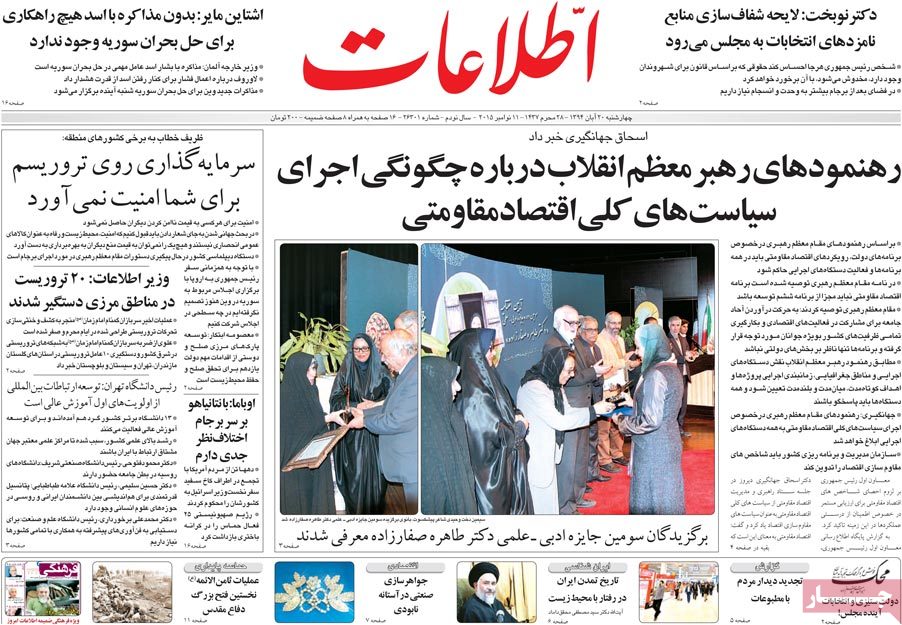
Ettela’at: The vice-president has said that the Supreme Leader has issued guidelines on how the macro-policies of a resistance-based economy should be implemented.

According to those guidelines, measures to introduce a resistance-based economy should be integrated into the Sixth Development Plan.


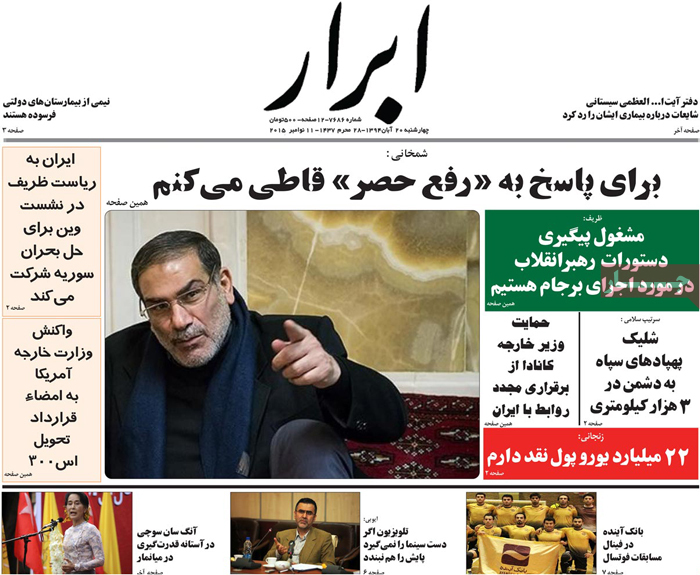
Abrar: The office of Grand Ayatollah Ali Sistani has rejected rumors that the source of emulation is ill.

Abrar: We are following the Leader’s orders in implementing the Joint Comprehensive Plan of Action, Foreign Minister Mohammad Javad Zarif said.
 

A look at Iranian newspaper front pages on Nov. 11


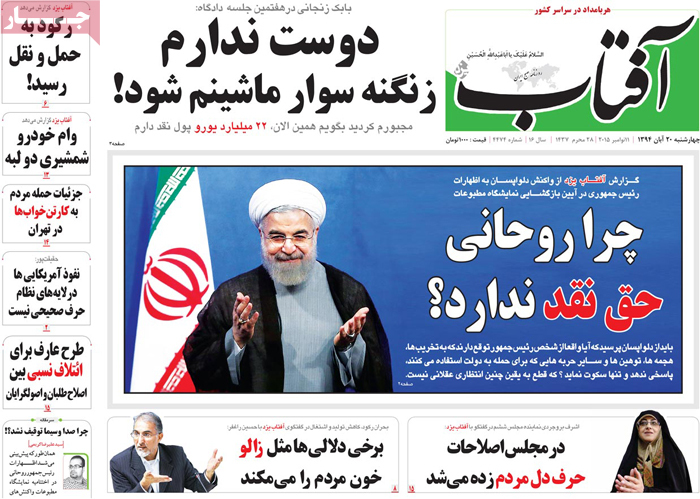
Aftab-e Yazd: “I don’t like [Oil Minister Bijan Namdar] Zanganeh to drive my car!” said Babak Zanjani in a seventh hearing of his corruption trial.

The young billionaire further told the court, “You forced my hand; I have to say I have €22 billion in cash.”

Aftab-e Yazd: Why isn’t Rouhani entitled to being a critic?

The Worriers [opponents of the Rouhani administration] should be asked whether they expect the president to remain silent in the face of their mudslinging, insults and other tools they employ to attack the government. Such expectation is definitely irrational.
 

A look at Iranian newspaper front pages on Nov. 11


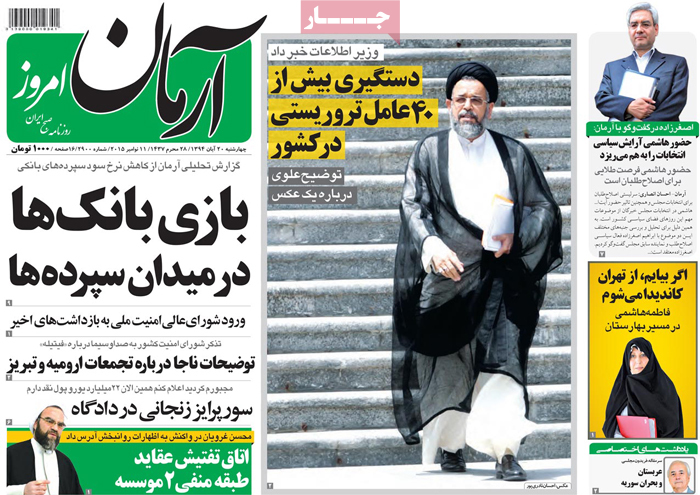
Arman-e Emrooz: The intelligence minister has said that 40 terrorists have been arrested across the country.
 

A look at Iranian newspaper front pages on Nov. 11


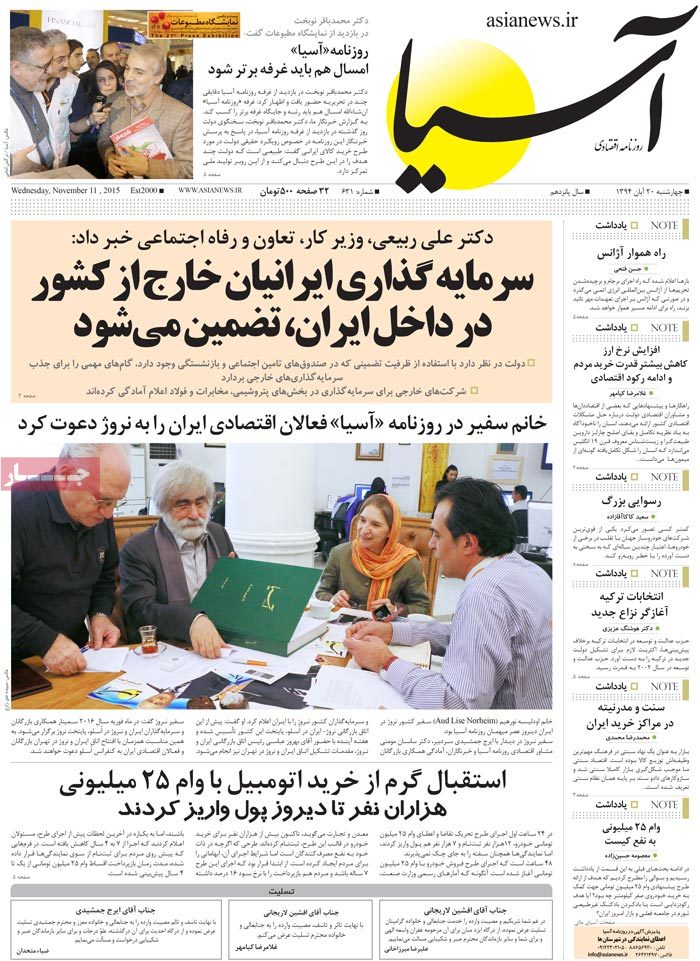
Asia: The investment Iranian expatriates make in Iran will be guaranteed, said the minister of labor, cooperatives and social welfare.
 

A look at Iranian newspaper front pages on Nov. 11


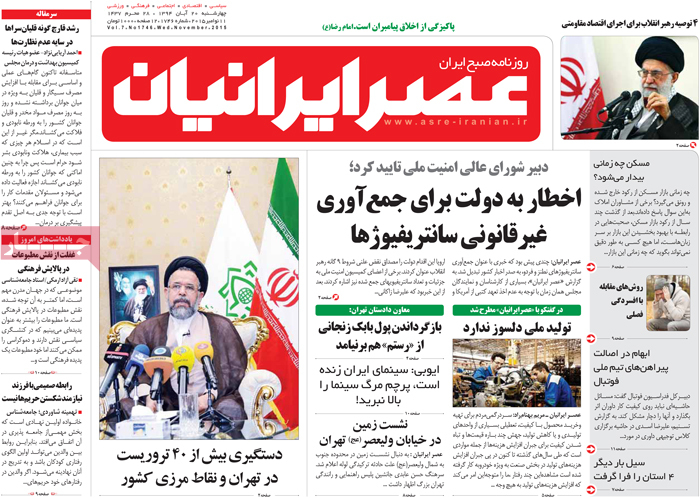
Asr-e Iranian: There has been a sinkhole on Tehran’s Vali Asr Street.
 

A look at Iranian newspaper front pages on Nov. 11


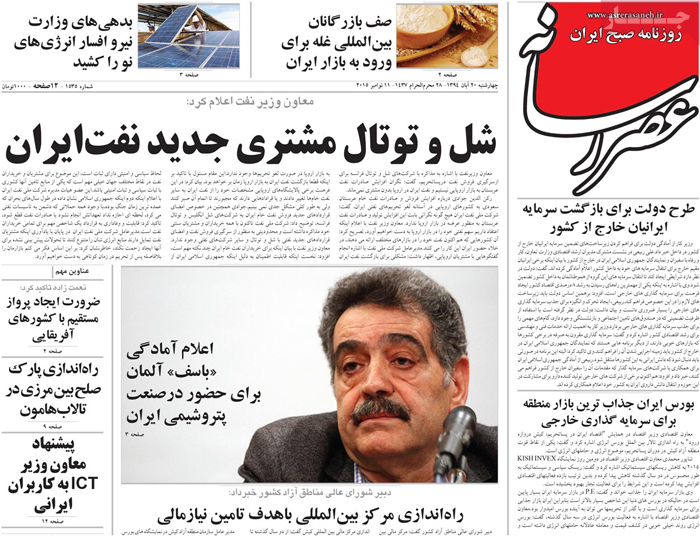
Asr-e Rasaneh: Germany’s BASF has signaled readiness to have a presence in Iran’s petrochemical industry.
 

A look at Iranian newspaper front pages on Nov. 11


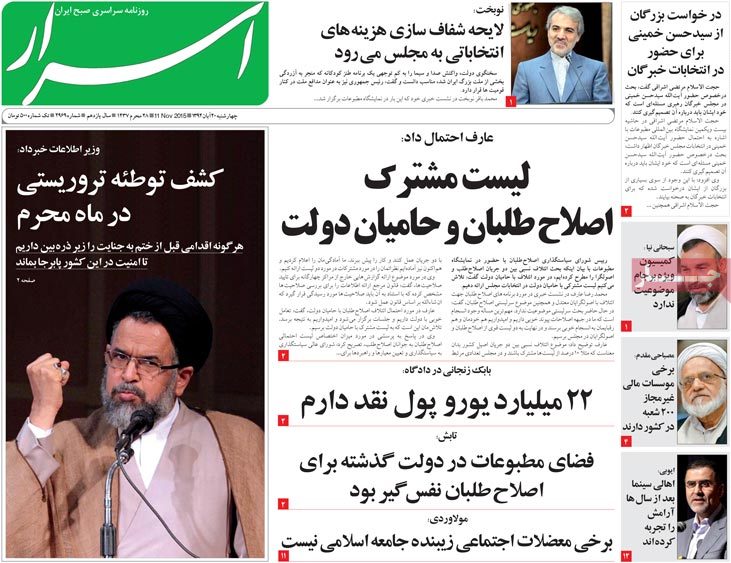
Asrar: Reformist leader Mohammad Reza Aref has said that reformists and government supporters are likely to release a single ticket for the upcoming parliamentary elections.

Asrar: Hossein Sobhaninia, MP, has said the [continued existence of] JCPOA Committee is now irrelevant.
 

A look at Iranian newspaper front pages on Nov. 11


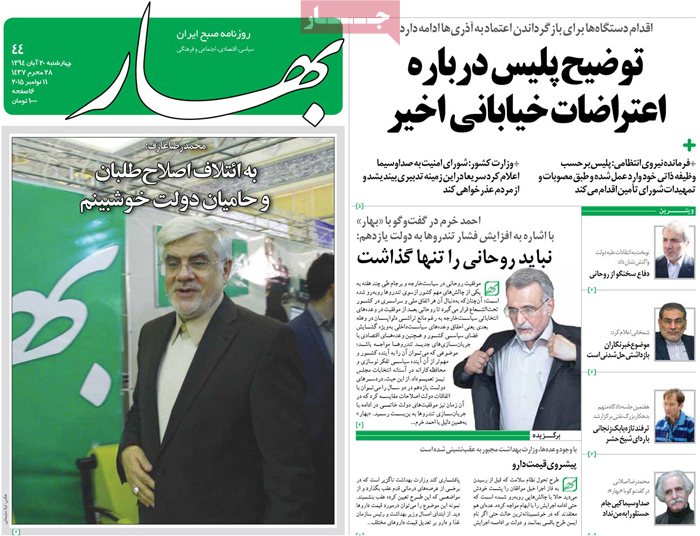
Bahar: Police offer an explanation about recent street protests

State institutions carry on with their measures to win back the trust of the Azeri people [after the airing by IRIB of a program the Azeris have found insulting.]

The interior minister has said after the program was aired on Friday the Supreme National Security Council asked the broadcaster to apologize to the public.
 

A look at Iranian newspaper front pages on Nov. 11


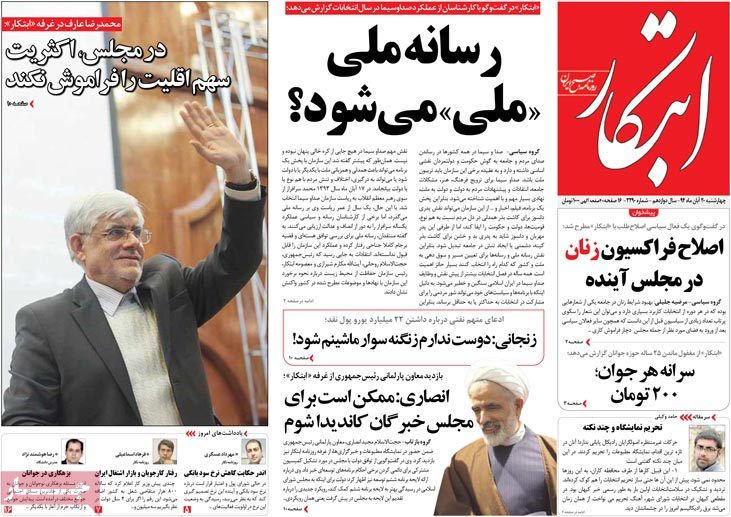
Ebtekar: Will the national medium become what it’s called: national?

In a report featuring interviews with experts the daily takes a look at the performance of the Islamic Republic of Iran Broadcasting in an election year.

Ebtekar: Majid Ansari, the vice-president for parliamentary affairs, has said he is likely to run for the Assembly of Experts.
 

A look at Iranian newspaper front pages on Nov. 11


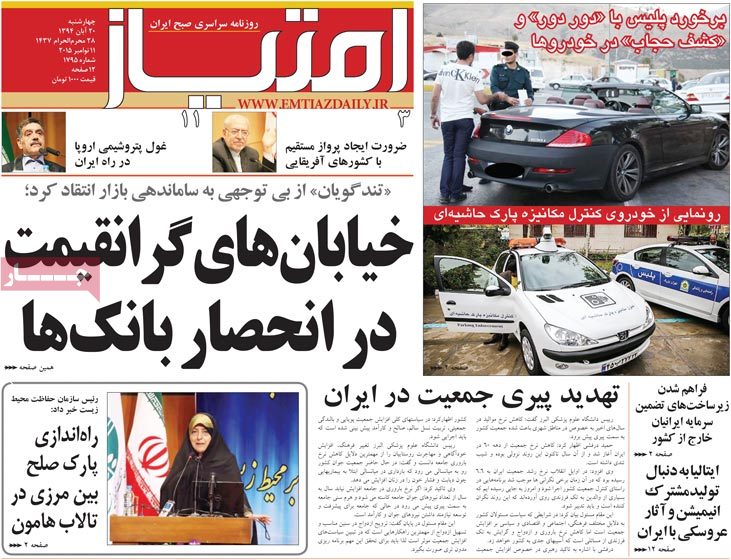
Emtiaz: The minister of industries, mines and trade has underlined the importance of measures to establish direct flights to African destinations.
 

A look at Iranian newspaper front pages on Nov. 11


Etemad: The health minister has said that middlemen will be eliminated from the pharmaceutical supply cycle.
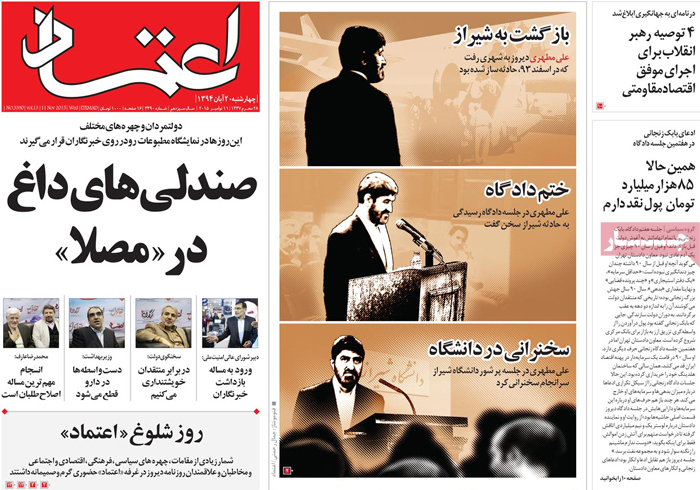
 

A look at Iranian newspaper front pages on Nov. 11


Farhikhtegan: “Iran stands ready to have scientific cooperation with the rest of the world,” said the chairman of the Expediency Council at a meeting with a delegation of Norwegian academics.
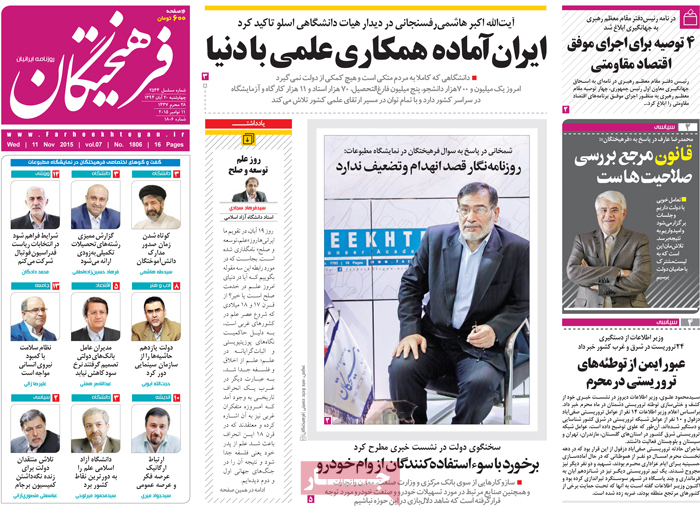
 

A look at Iranian newspaper front pages on Nov. 11


Hemayat: Deep cracks are emerging in the Saudi-led coalition attacking Yemen.

Hemayat: The removal of centrifuges was halted after a warning, said Secretary of the Supreme National Security Council Ali Shamkhani.
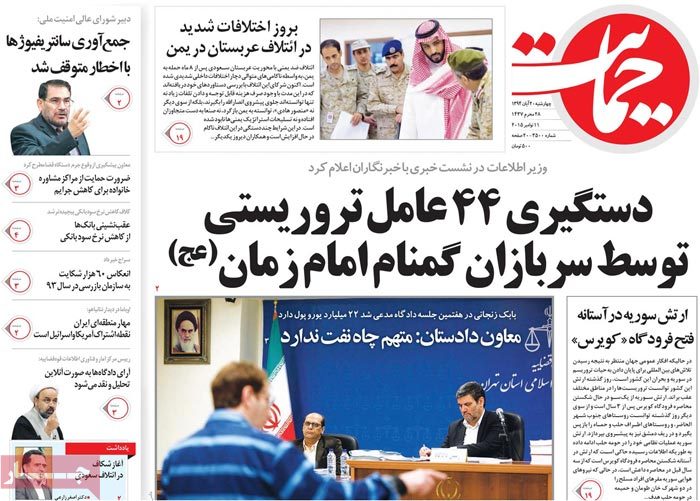
 

A look at Iranian newspaper front pages on Nov. 11


Iran: The secretary of the Supreme National Security Council has said that the case involving the recent apprehension of a number of journalists is being “managed”.

Iran: “The president stands up for the rights of all ethnic groups,” said the government spokesman.
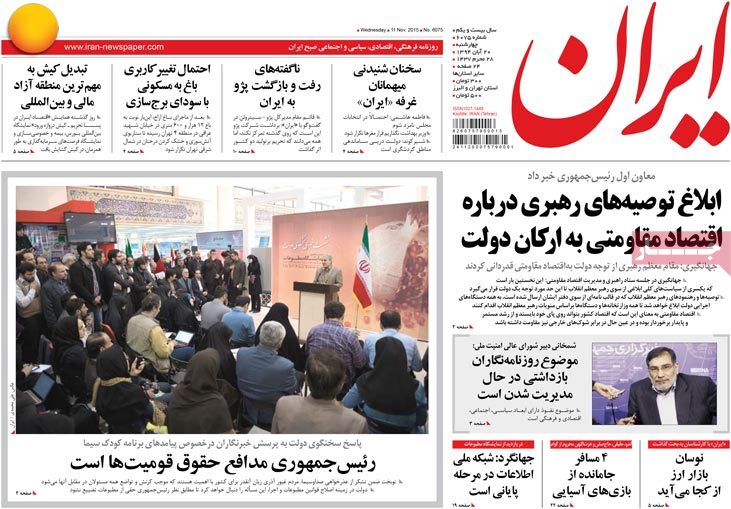
 

A look at Iranian newspaper front pages on Nov. 11


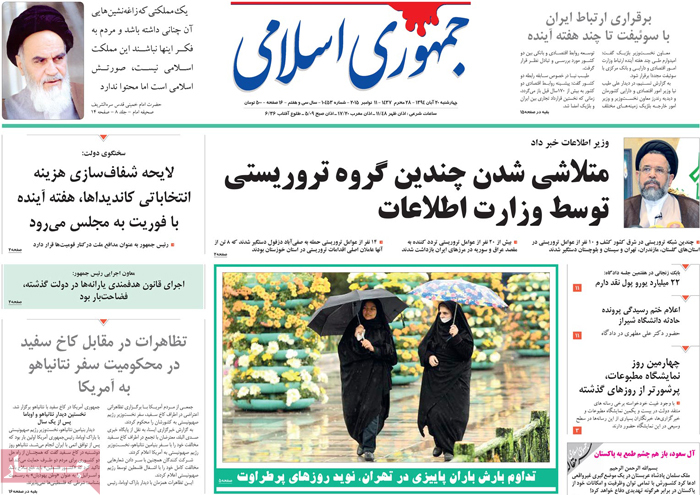
Jomhouri Islami: A final hearing has been held in the trial of people who attacked Tehran MP Ali Motahari when he was in Shiraz to deliver a speech earlier in 2015.
 

A look at Iranian newspaper front pages on Nov. 11


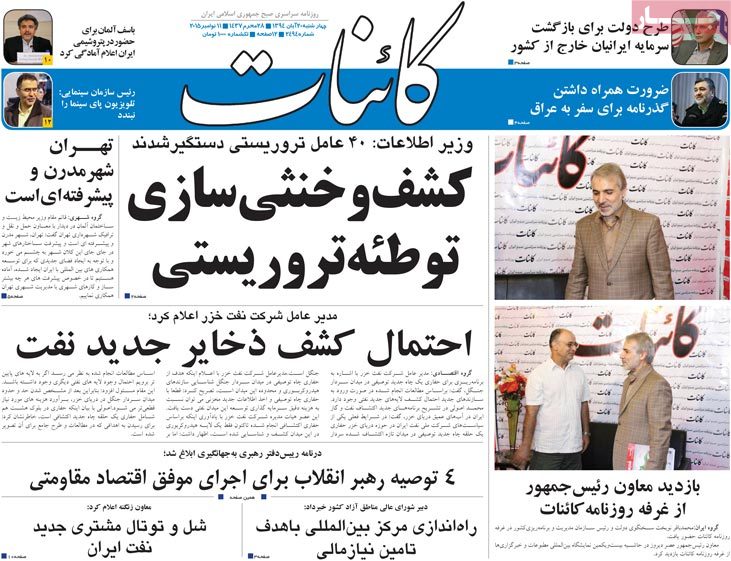
Kaenat: The secretary of the Supreme Free Zones Council has said that an international center is to be set up to finance Iranian projects.
 

A look at Iranian newspaper front pages on Nov. 11


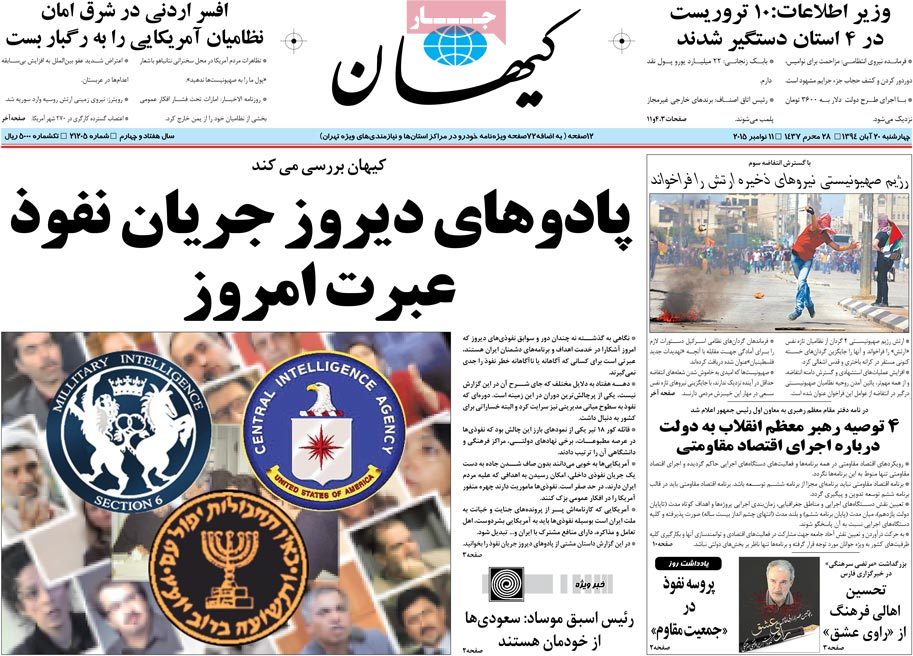
Kayhan: With a third Intifada expanding, the Zionist regime has called up army reservists.
 

A look at Iranian newspaper front pages on Nov. 11


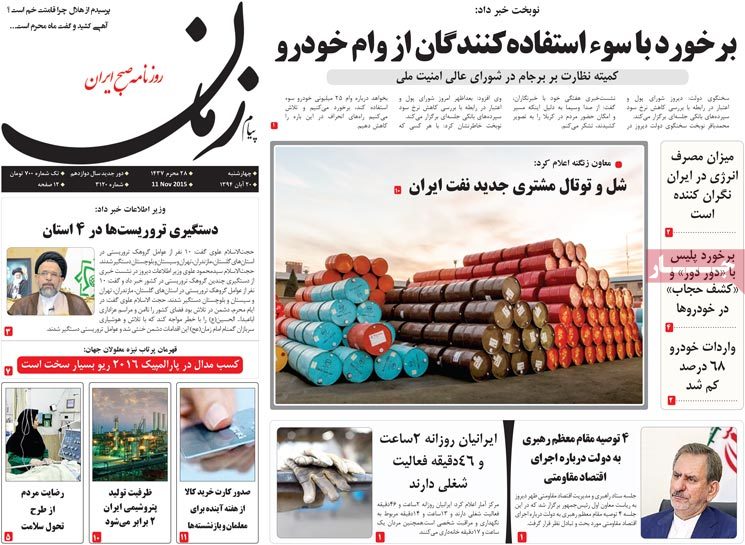
Payam-e Zaman: Car imports have registered a 68 percent decline.

Payam-e Zaman: Production of petrochemicals is to post a 100 percent increase.
 

A look at Iranian newspaper front pages on Nov. 11


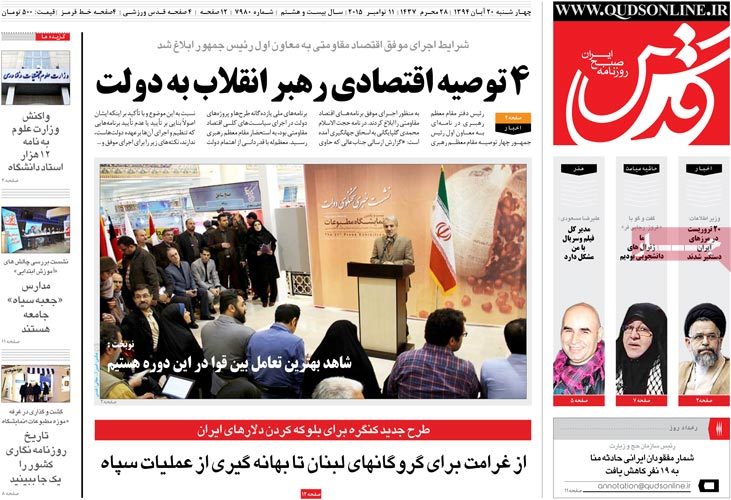
Qods: The new motion in the US Congress to block Iranian assets focuses on compensations for hostages in Lebanon and the alleged problem associated with IRGC operations.
 

A look at Iranian newspaper front pages on Nov. 11


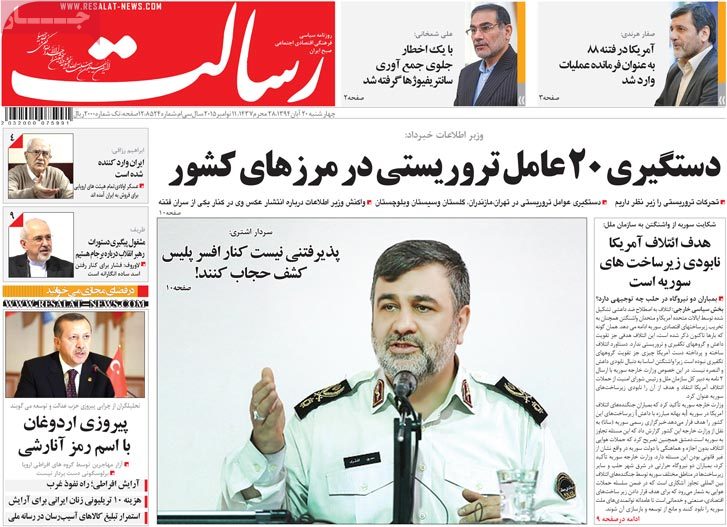
Resalat: In the 2009 sedition [unrest in the wake of presidential elections] the US served as the operations commander, said Mohammad Hossein Saffar Harandi, a former minister of culture and Islamic guidance.
 

A look at Iranian newspaper front pages on Nov. 11


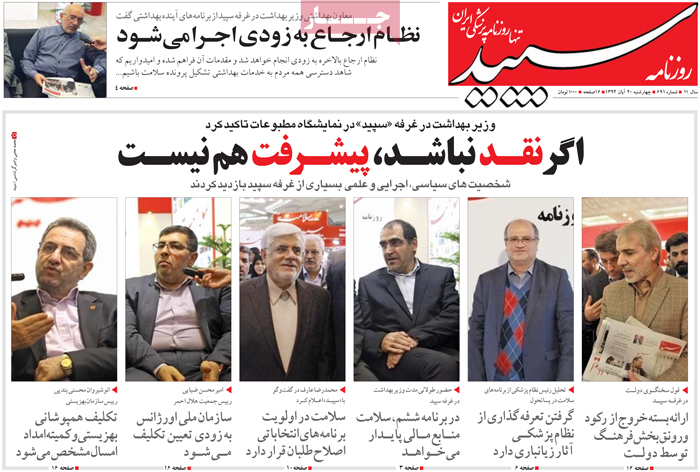
Sepid: In the absence of criticism, there will be no progress, said the health minister as he visited the stall of the daily at the Press and News Agencies Exhibition.
 

A look at Iranian newspaper front pages on Nov. 11


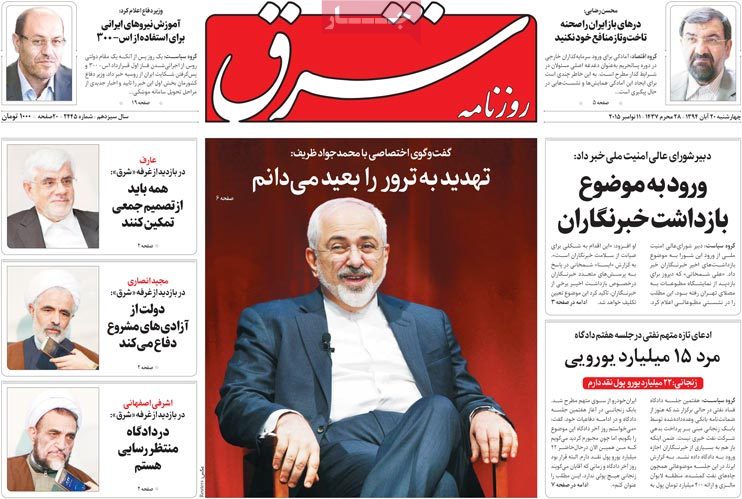
Sharq: Foreign Minister Mohammad Javad Zarif has said that he thinks critics of his performance are unlikely to have threatened him with assassination.

Sharq: Government supports the legitimate freedoms of citizens, said the vice-resident for parliamentary affairs.
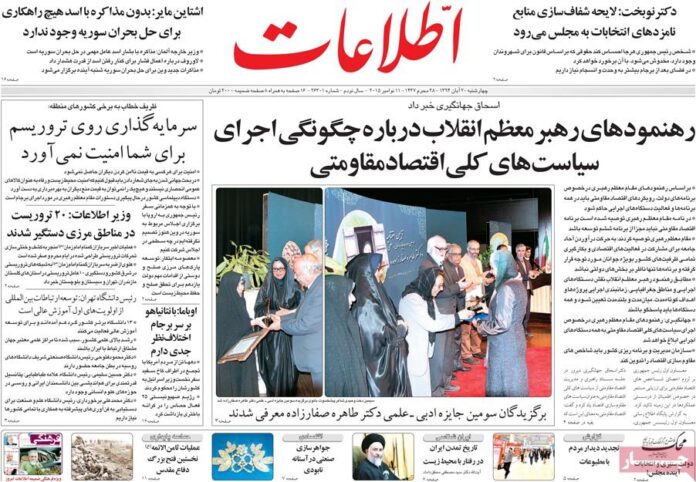
 

A look at Iranian newspaper front pages on Nov. 11


Highlights of Ettela’at newspaper on Nov. 11

Ettelaat

Ettela’at: The vice-president has said that the Supreme Leader has issued guidelines on how the macro-policies of a resistance-based economy should be implemented.

According to those guidelines, measures to introduce a resistance-based economy should be integrated into the Sixth Development Plan.

Ettela’at: Dr. Mohammad Bagher Nobakht has said that a bill designed to shed light on the campaign finances of parliamentary candidates will be sent to parliament.

The government spokesman further said that the president will step in anytime he feels the rights of citizens as envisioned in the Constitution are being violated.

Ettela’at: German Foreign Minister Frank-Walter Steinmeier has said that there will be no solution to the Syrian crisis unless talks are held with Bashar al-Assad.

His comments came ahead of a new round of Syria talks in Vienna come Saturday.

Ettela’at: “Investment in terrorism won’t bring about security to your countries,” Foreign Minister Zarif said in comments aimed at regional countries.

The top diplomat further said that security for one country does not come at the expense of insecurity for others.
Ettela’at: The intelligence minister has said 20 terrorists have been arrested in border areas.
A recent operation by the Intelligence Ministry agents has foiled terrorist plots which were to be carried out in the mourning months of Muharram and Safar, Mahmoud Alawi said.

Ettela’at: The president of Tehran University has said that expansion of international communications is among the priorities of the higher education system.

Ettela’at: Israeli Prime Minister Benjamin Netanyahu has said he has serious differences with President Obama over the Iran nuclear deal.

Netanyahu’s comments came as scores of people gathered outside the White House to denounce his US visit.

Ettela’at: The winners of Tahereh Saffarzadeh Literary-Scientific Award have been named.


Military approaches no solution to Mideast crises: Iran

2932ba7d-01a7-432b-ba6f-0dd989a2f1c7

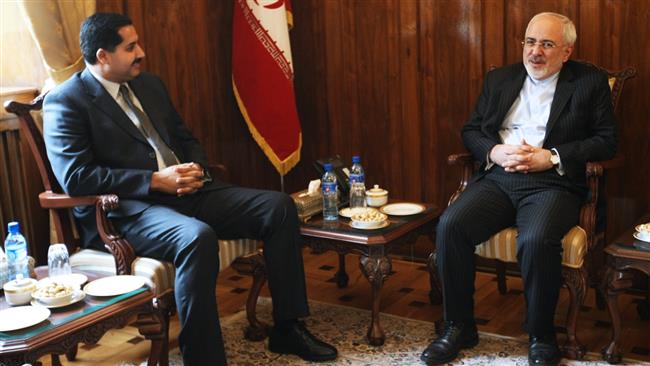
Foreign Minister Mohammad Javad Zarif has warned against the adoption of military approaches to resolve the ongoing crises in the Middle East.

“If some players still have the illusion of a military solution to regional crises, that would be disastrous,” Zarif said in a meeting with Tunisia’s Secretary of State for Arab and African Affairs Touhami Abdouli in Tehran on Tuesday.

He added that regional crises should only be settled through dialogue and political approaches.

The minister also commended Tunisia’s contribution to the settlement of regional conflicts.

Zarif further said Tehran and Tunis have great potential to improve relations and emphasized that no obstacle can hinder expansion of political and economic cooperation between them.

War, militancy will never solve ME crisis: Abdouli

The Tunisian official said regional crises would never be settled through war and military intervention.

Abdouli added that the Tunisian people have suffered greatly at the hands of terrorist groups such as IS and the al-Qaeda-linked al-Nusra Front and would never tolerate terrorists.

He also called for closer cooperation with Iran and expressed hope that political relations between the two countries would positively affect economic ties.

A mosque unearthed in the desert (PHOTOS)

masjed4

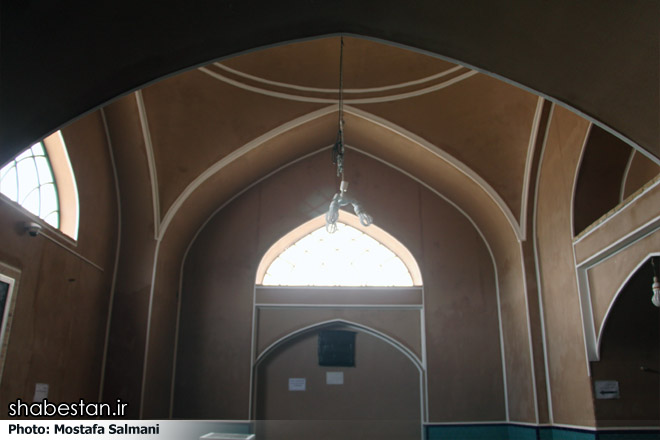
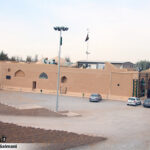
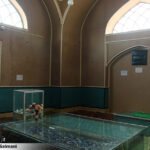
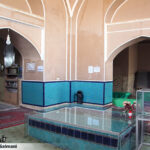
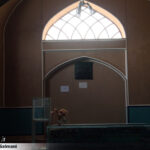
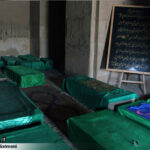
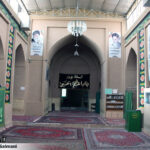
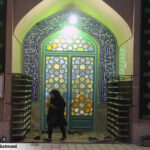
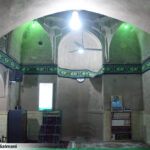
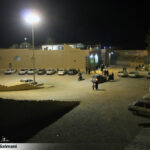
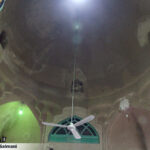
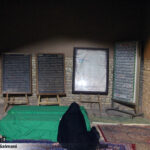
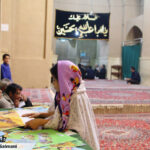
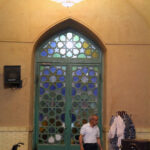
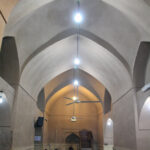
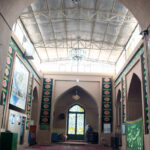
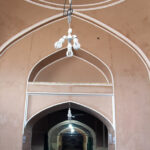
Archeological excavations have dug up a mosque in Rezvanshahr, Yazd Province, which dates back to the Timurid Empire (1370-1507 AD).

Rig Mosque, which has been unearthed from the sands in the desert in central Iran, hosts pilgrims from across the country.

The following are the pictures shabestan.ir has released of the unearthed mosque at the heart of the desert:


Iran will receive Russian S-300 missile system by yearend: Dehghan

7185696d-172b-4b8b-939b-c2f494526e53

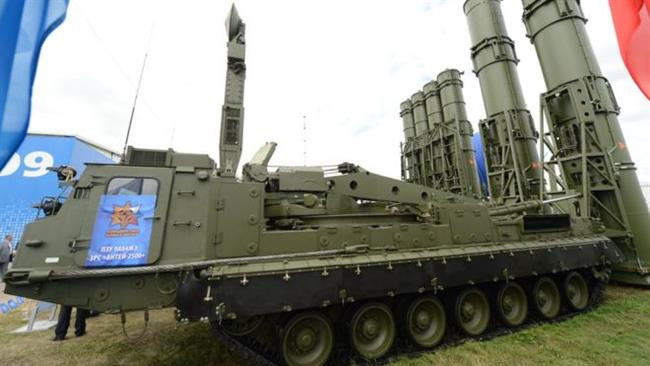
Defense Minister Brigadier General Hossein Dehghan has said Iran will take delivery of Russian-made S-300 surface-to-air missile defense system by the end of the year.

Speaking to reporters in Tehran Tuesday, the minister added that the “executive stage” of the agreement for the delivery of the missile system is over, adding that Iran will receive a “major part” of the shipment in less than two months.

“We have concluded a contract with the Russian side and it has also been signed,” Dehghan said in response to a question about an earlier report on an agreement between Tehran and Moscow on the delivery of the S-300 system.

RIA Novosti on Monday quoted Sergei Chemezov, the chief executive of Russian state-owned defense conglomerate Rostec, as saying that Tehran and Moscow have signed a contract for the long-overdue delivery of the missile defense systems to Iran.

Dehghan said Iran has purchased as many S-300 missile defense batteries as it needs.

He also said that Iranian forces are currently undergoing training in Russia on the S-300 system.

Russia banned the delivery of the S-300 system to Iran back in 2010 under the pretext that the agreement it signed with Tehran in 2007 was covered by the fourth round of the UN Security Council sanctions which barred hi-tech weapons sales to the Islamic Republic.

In April 2015, however, Russian President Vladimir Putin signed a presidential decree paving the way for the long-overdue delivery of the missile defense system to Iran.

Iran, Russia stress political solution in Syria

b0832b6b-0c58-40fa-912a-828743145e66

Iran and Russia have reiterated the necessity of finding a political solution to ongoing crisis in Syria.

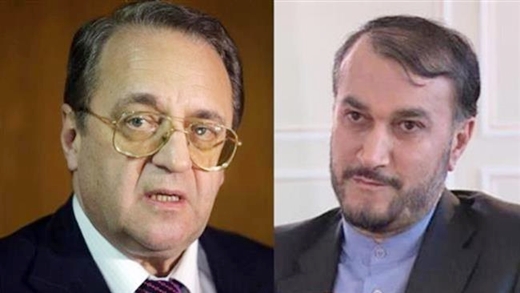
Deputy Foreign Minister for Arab and African Affairs Hossein Amir Abdollahian and his Russian counterpart Mikhail Bogdanov discussed the latest developments in Syria in a meeting in Moscow Tuesday.

The two officials underscored the need for the convergence of the countries’ stances about regional policies in the run-up to upcoming international talks on Syria in Vienna.

US State Department Spokesman John Kirby said Monday a new round of international talks aimed at resolving the crisis in Syria will be held in Vienna Saturday.

The event will be a continuation of October 30 negotiations in Vienna, which were attended by 17 nations, including Iran, as well as envoys from the United Nations and the European Union.

At the end of the talks, the participants agreed on respecting Syria’s national unity and sovereignty as well as eradicating the terrorist groups operating in the Arab country.

However, they remained at loggerheads over the role President Bashar al-Assad would play in Syria’s political process. While some countries, such as the US and its regional allies, want the removal of the Syrian leader as part of a solution to the issue, others, including Iran and Russia, say only the Syrian nation can have a say on that matter.

Amir-Abdollahian and Bogdanov also stressed intra-Syrian negotiations under international supervision for the settlement of the Syrian crisis.

The two diplomats further emphasized the continuation of consultations between Tehran and Moscow for the restoration of peace and stability in the Middle East, particularly in Syria.

The foreign-backed militancy in Syria, which flared in March 2011, has so far claimed the lives of over 250,000 people and displaced millions.

Iran’s presence in Syria talks, a victory for diplomacy

Sobhani

A former Iranian ambassador to Lebanon says that Iran’s presence in the Vienna talks on Syria signifies that the government’s diplomatic efforts have paid off.

Mohammad Ali Sobhani, who is now an advisor to Foreign Minister Mohammad Javad Zarif, further said thanks to the conclusion of the nuclear deal between Tehran and P5+1 earlier this year, the world now looks at Iran differently.

A new round of talks over the Syrian crisis is to be held on Saturday in the Austrian capital and an Iranian delegation led by Dr. Zarif will attend the talks. On November 10 Entekhab.ir released a report on the take of the former ambassador on the Syria talks. The following is the translation of what else the foreign minister’s advisor, who is also an expert in the Middle Eastern affairs, said:

Vienna talks, start of a positive trend

The positive trend of working out a solution to the Syrian crisis has gotten underway. The path [the participants of Vienna talks are walking down] can help hammer out a solution to the crisis in Syria. In the previous round, a nine-point statement came out of the meeting that could serve as the basis for future cooperation and dialogue.

Above all, the culture [conclusion of] the Joint Comprehensive Plan of Action (JCPOA) fostered helped instill a sense of hope that such cases can be settled in an international atmosphere. I think this is a good start if we can cut the role of military options. It can be viewed as a model for dialogue and settlement of differences.

Iran’s presence in Vienna, a success for diplomacy

The fact that Iran has been invited to the Vienna talks means that the Iranian government has been successful in its foreign policy. Now world nations look at Iran differently, especially after the conclusion of the nuclear deal. On top of that, almost all parties involved in the Syrian crisis – Saudi Arabia excluded – have come to the conclusion that military solutions cannot defuse the Syria crisis. Over time, Saudi Arabia will gradually come on board.

Currently the stage has been set to pursue a political solution and proceed with peace talks through multi-tier efforts. There is no denying the fact that this trend will be associated with multiple challenges, because not everything will go swimmingly as long as outside players keep supporting armed groups [involved in the Syrian conflict].

The opposition should attend the talks

The groups opposing the Syrian government should be invited to the talks. This is a must. It is not acceptable for international players to hold a meeting in a European country and decide the future of the Syrian people. The Syrian opposition too should be part of the process [if it is expected to produce a solution]. Whether or not it happens in this round of talks remains to be seen, but there is no doubt whatsoever that it should happen for a solution to be worked out.

Powerful terrorists, the main challenge

Due to such problems, the road ahead is bumpy. Both the government and the opposition groups, which are familiar with the mechanisms of dialogue and are not viewed as armed, should be included in the talks.

Unfortunately, under the present circumstances the terrorists hold more power compared with other opposition groups, and this makes the task ahead still tougher. We need to continue such talks attended by the opposition and representatives of the Syrian government to make it hard for militants to forge ahead with their terrorist activities [in Syria]. In parallel, international supporters of the terrorists should stop their financial assistance to militant groups.

Judiciary chief’s frank comments in support of the press and journalists

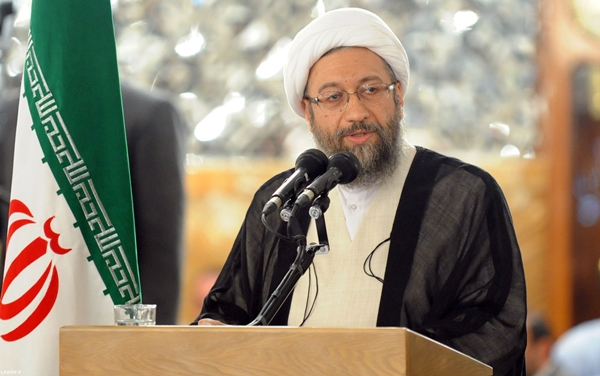
Larijani

Judiciary Chief Ayatollah Sadegh Amoli Larijani has said he has urged judges to take account of the unique role mass media play in disseminating information, preventing corruption and raising public awareness as they hear cases involving the press.

Speaking at a meeting of senior judicial officials on Monday, the top judge said the Judiciary has always appealed to the press and mass media to help it administer justice. “Given the sensitive role media play in these areas, they should be lent all-out support to be able to be instrumental in prevention of corruption.”

The top judge expressed displeasure with president Rouhani’s implicit criticism of the Judiciary in a keynote speech at the inaugural of the Press and News Agencies Exhibition Sunday, but said, “Up to now, I have avoided divisive comments which do not serve the country’s interests or those of solidarity and fraternity. I will continue to do so in the future.”

Ayatollah Larijani also reaffirmed his support for the nuclear negotiators and the Joint Comprehensive Plan of Action, saying, “Some critics of the deal have been unfair, making hardline comments which are anything but true. I believe some of them are even actionable. I don’t think the number of such people is very large.

“On the other hands, there are some prudent, pious individuals who critique the deal point by point. All through the talks, I have always supported the negotiating team and the esteemed government. That remains the case to this day. The negotiating team brings together religious individuals who strove around the clock to push things forward. That is no easy task. So the end result of their endeavors deserves praise and gratefulness.”


The judiciary chief further said taking pride in the deal depends on its practical results and how it is implemented. “To me it is not clear whether the Joint Comprehensive Plan of Action is actually a source of honor.”

The following is the translation of additional comments the top judge made as reported by Mizanonline.ir, affiliated to the Judiciary, on November 9. The news agency originally titled its report: “Frank comments by the Judiciary chief in response to president’s remarks”.

The press should comply with principles of ethical criticism and laws

Ayatollah Amoli Larijani said that the press should play their role and fulfill their mission in line with ethics of criticism along with ethical and legal principles, adding, “You should not insult, slander or commit acts against national security under the pretext of being critical.”

The judiciary chief went on to say, “Unfortunately, some media outlets fan the flames of public concerns. The Judiciary is duty-bound to prevent offenses while supporting the press. It is not acceptable for media to be on foreigner payroll and act against national security instead of playing a role in raising awareness and promoting ethics.”

He said, “A few years ago, a motion about parliamentary deputies’ immunity from prosecution was floated. Under the motion, if a deputy made an untrue statement deemed libelous, he/she couldn’t be prosecuted, but the parliamentary motion was vehemently rejected by the Guardian Council.”

Larijani added, “That applies to the press, too. But it’s for judges to make decisions in this regard and outsiders are not entitled to get involved.”

Tough punishments dished out when individuals knowingly break the laws

Ayatollah Larijani said that the Judiciary fulfills its duties with authority and won’t be swayed or scared by pressures. “A lot of individuals working for media and the press might not be aware of the laws and the red lines and might make a mistake out of negligence. Therefore, I have repeatedly advised esteemed judges not to mete out harsh punishments for those who cross the red lines unknowingly; I have told them to commute the sentences as they see fit.”

On the recent barrage of criticism against the Judiciary in the run-up to the elections, Larijani said that compliance with the law and serving national interests under the Constitution is what the Judiciary pursues. “Pressures and criticisms over human rights should not have an impact on our job. Certainly, they won’t. What we expect from the press and those in authority in the country is to help the judicial branch which is a pillar of the establishment. They should know that the authority of the Judiciary, like other branches, contributes to security in the country.”

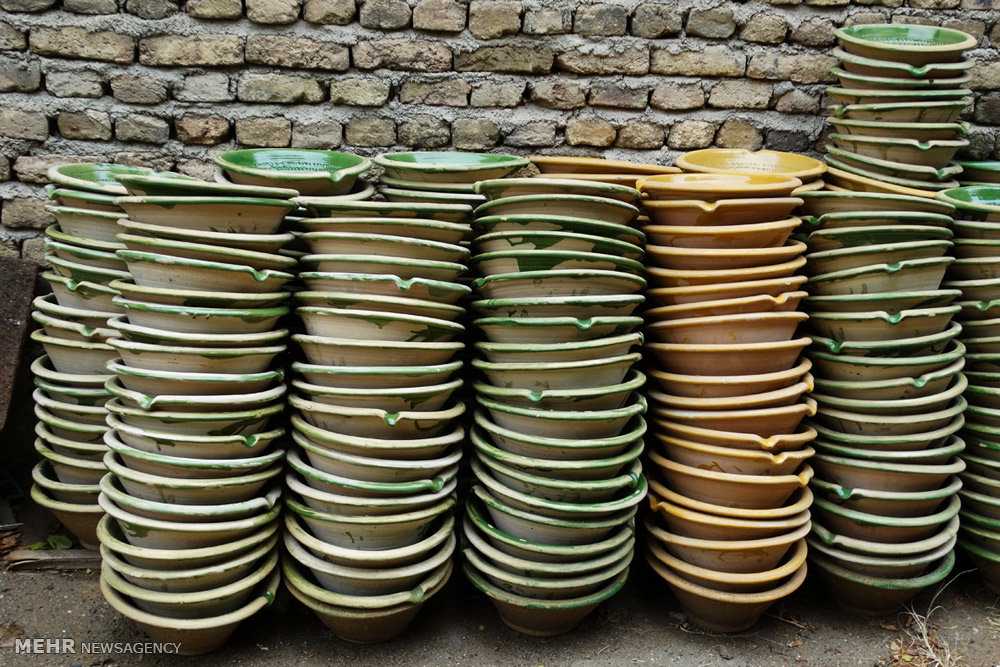
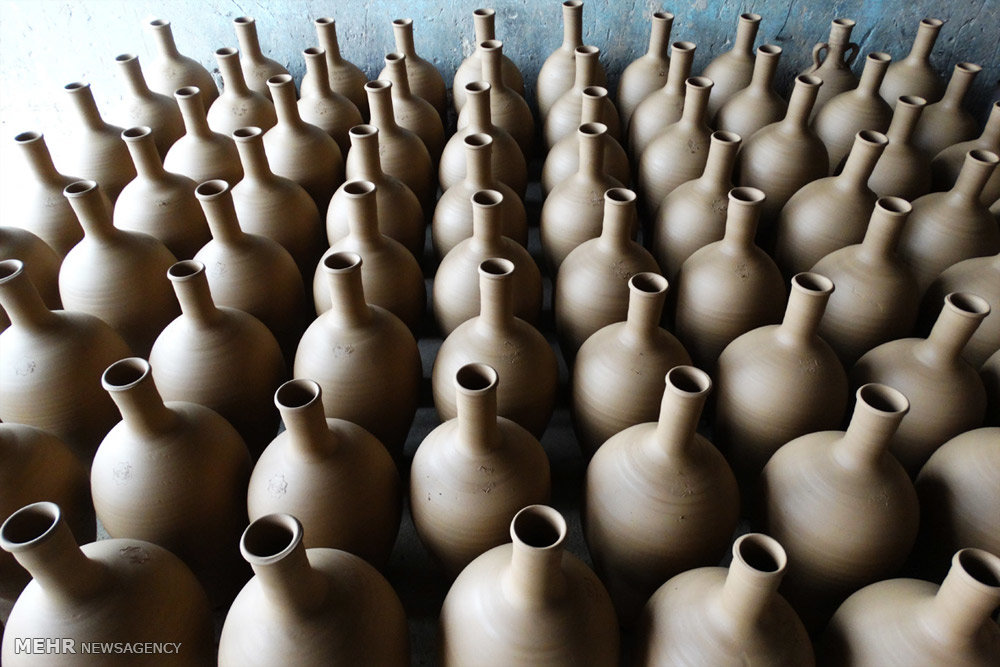
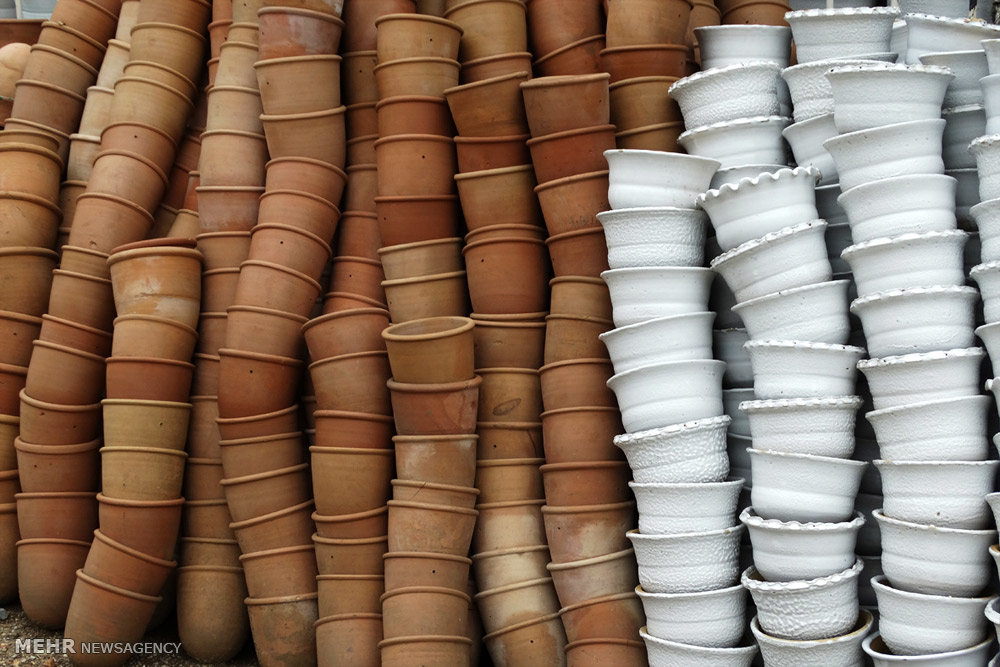
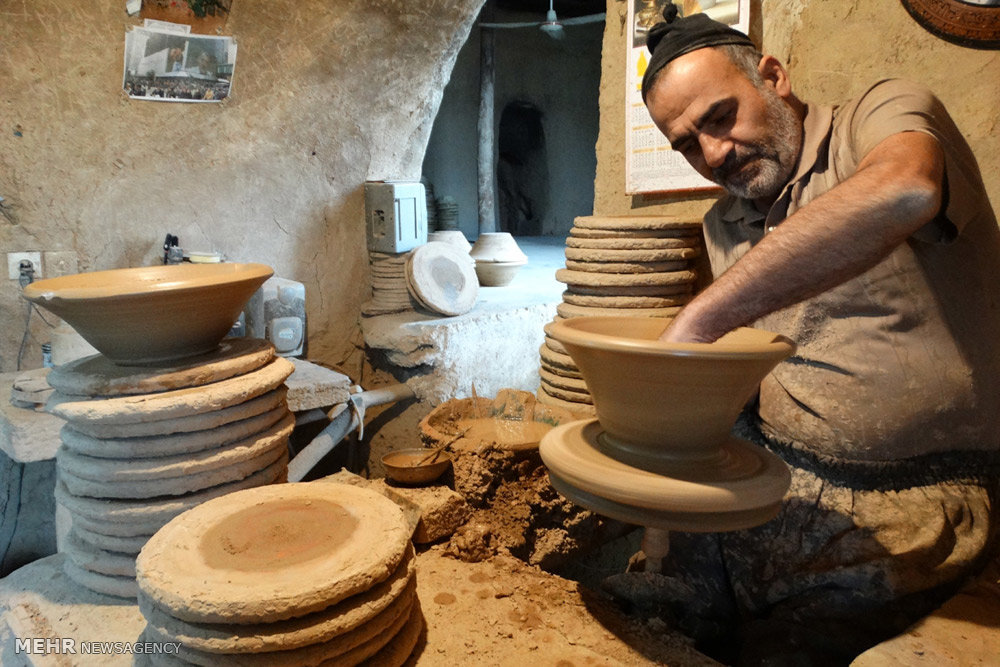
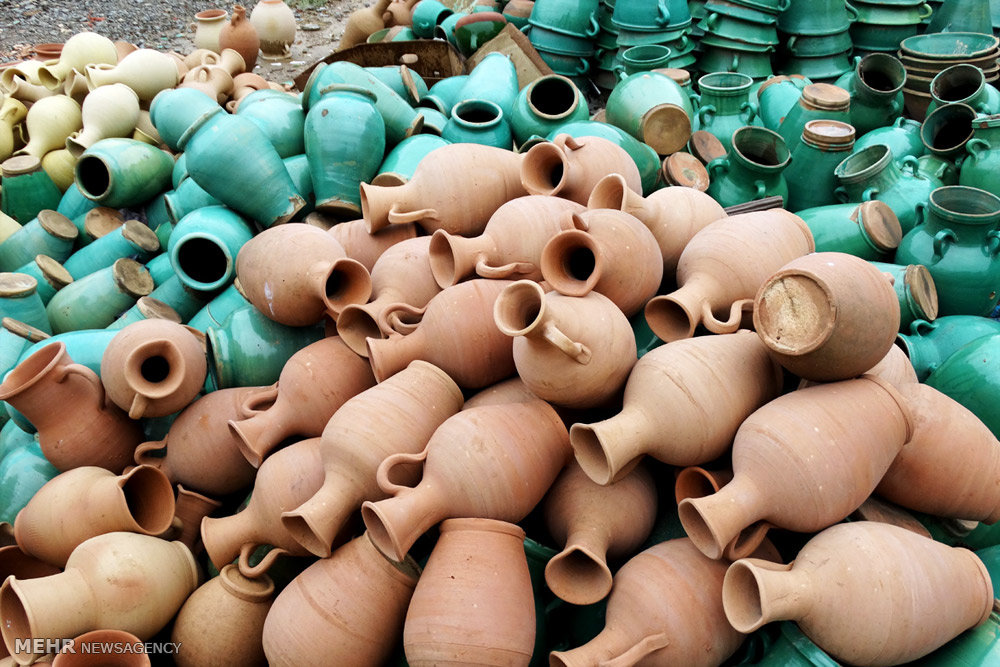
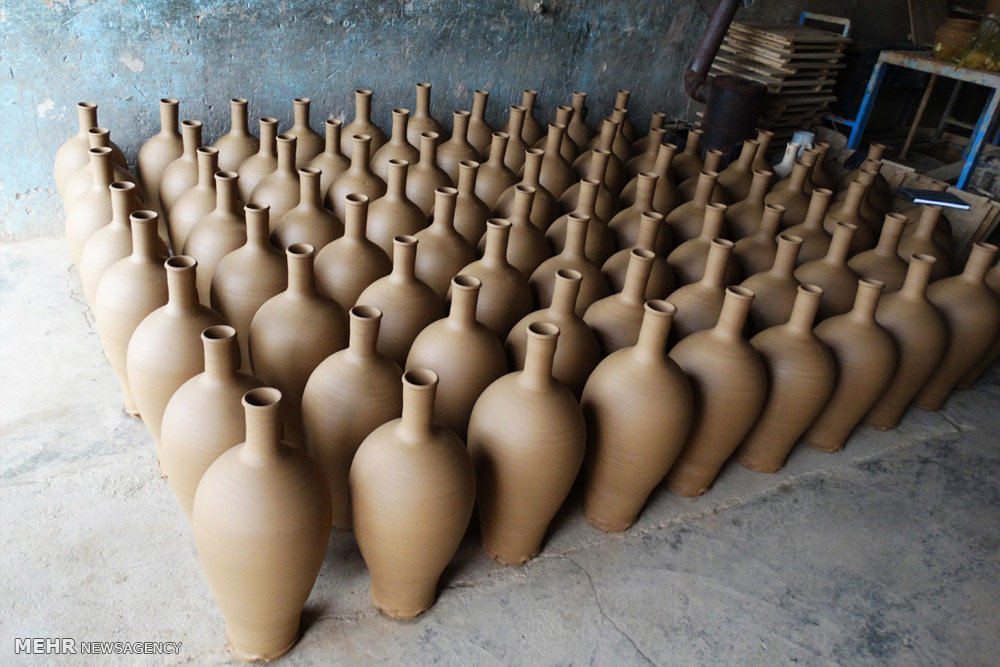
Pottery workshops in western Iran (PHOTOS)

Pottery5

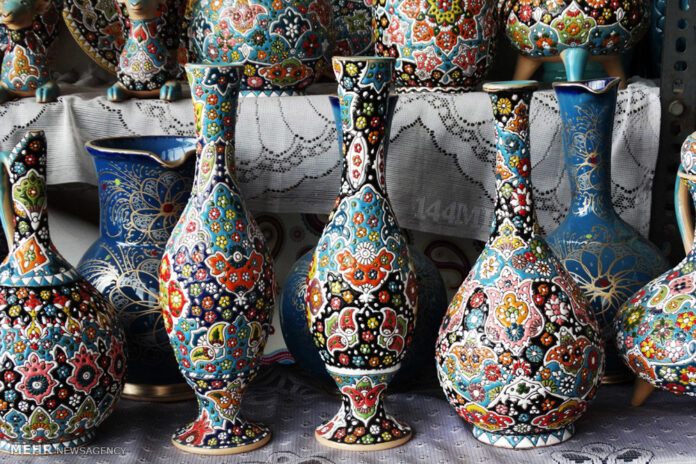
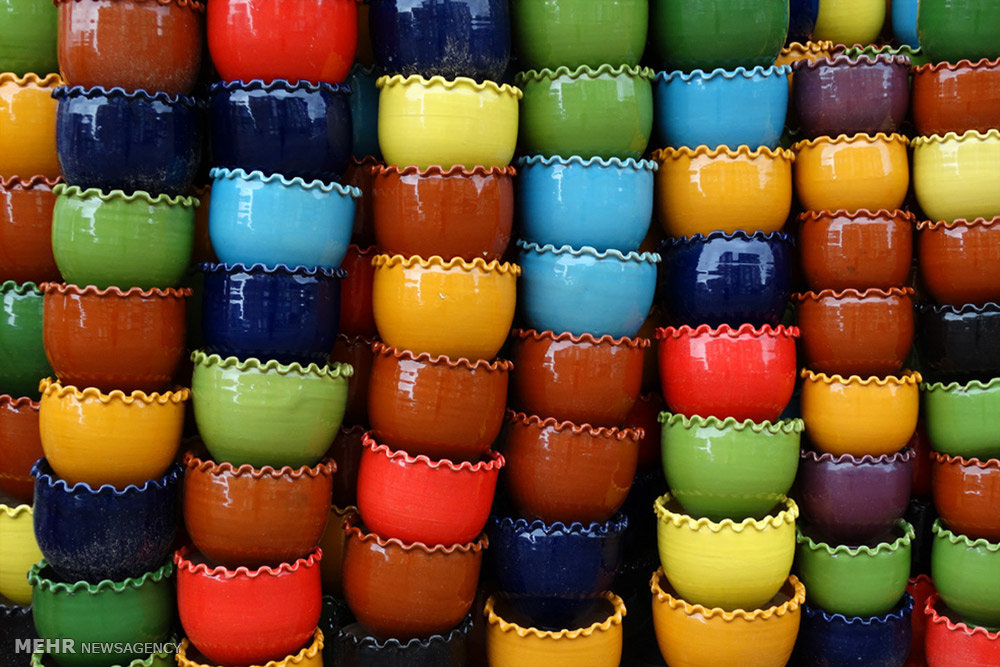
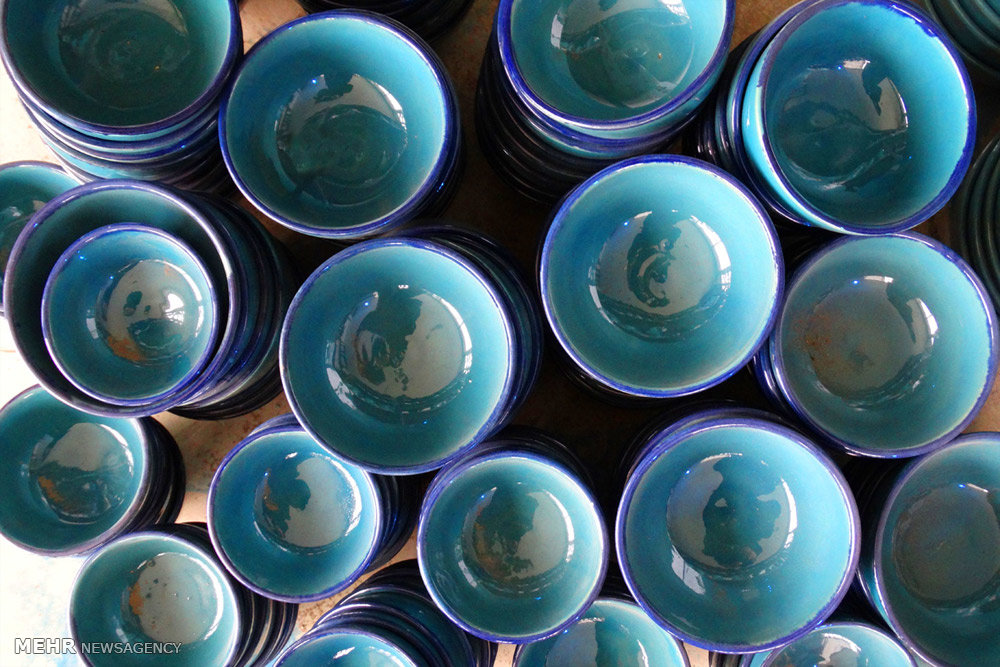
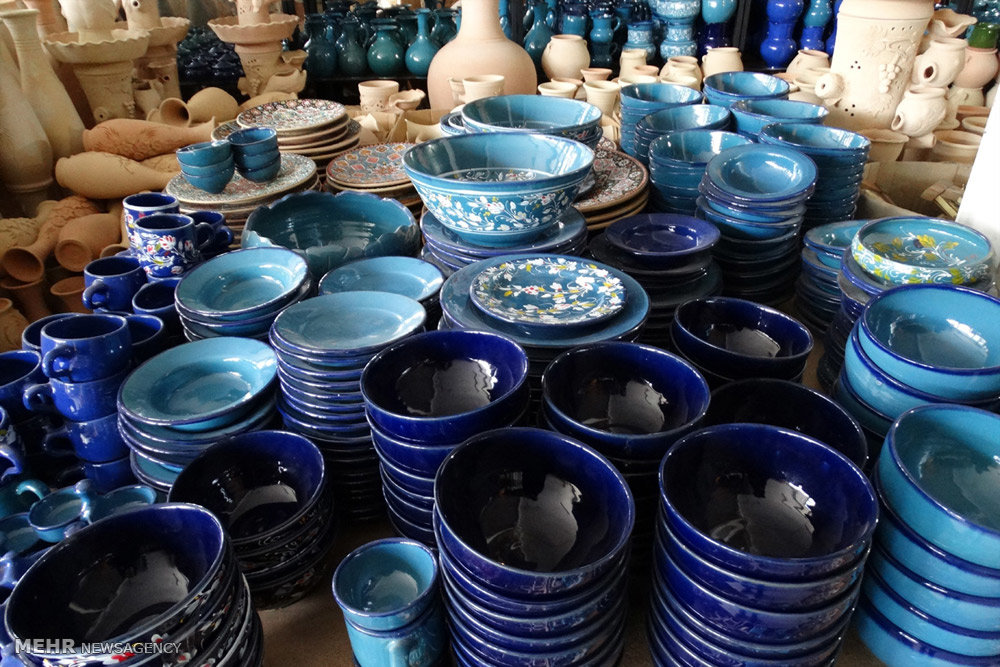
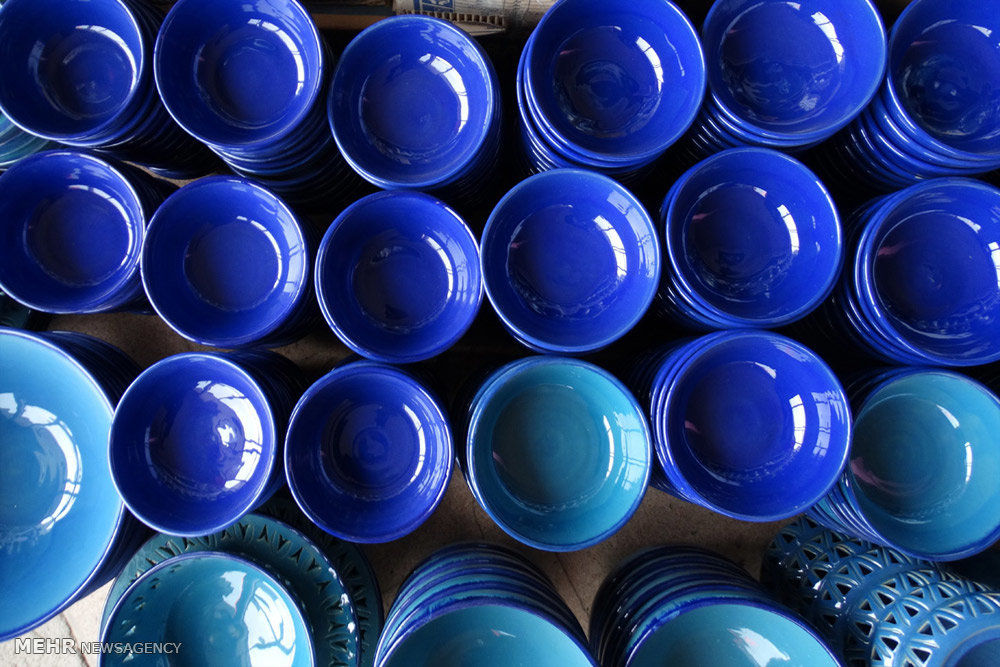
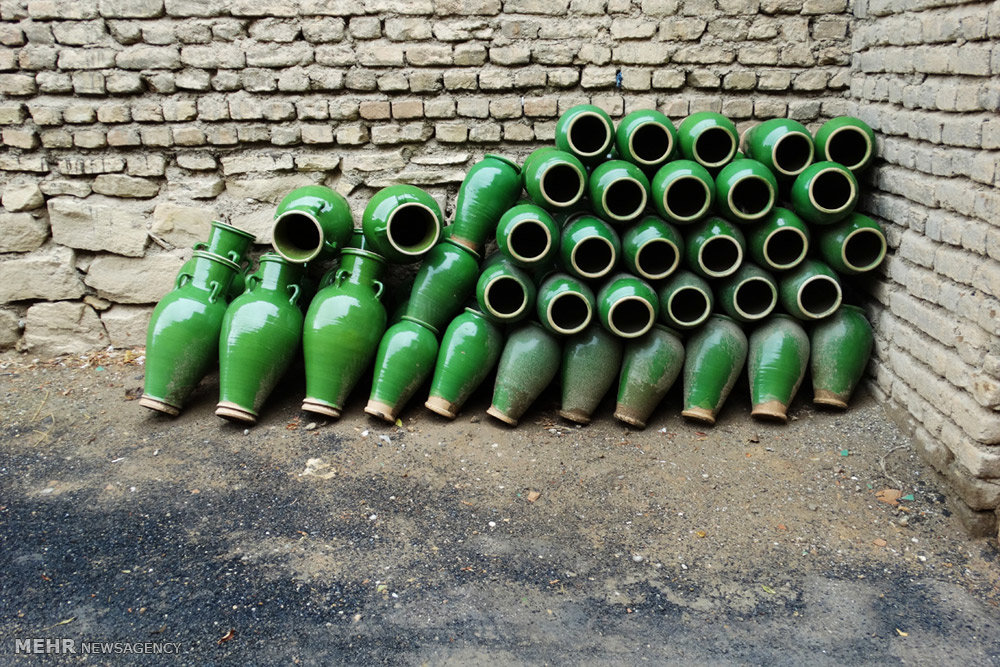
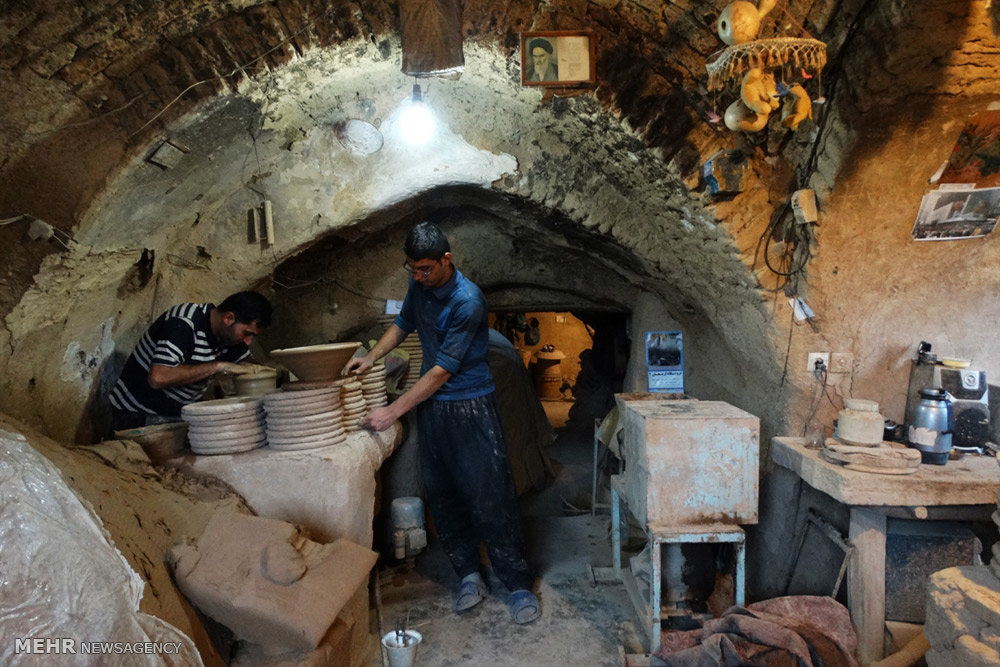
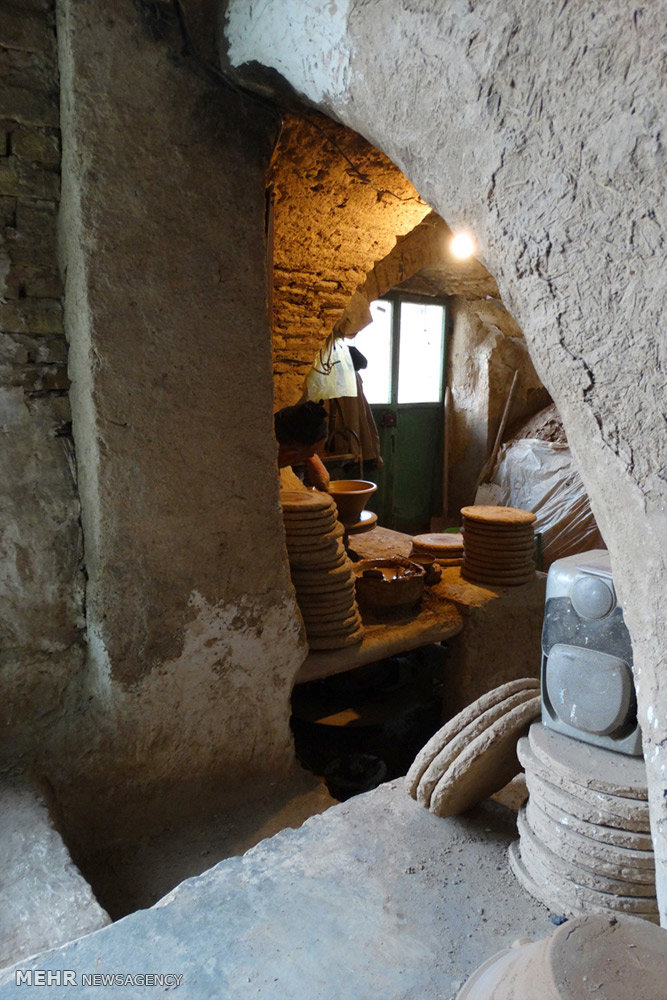
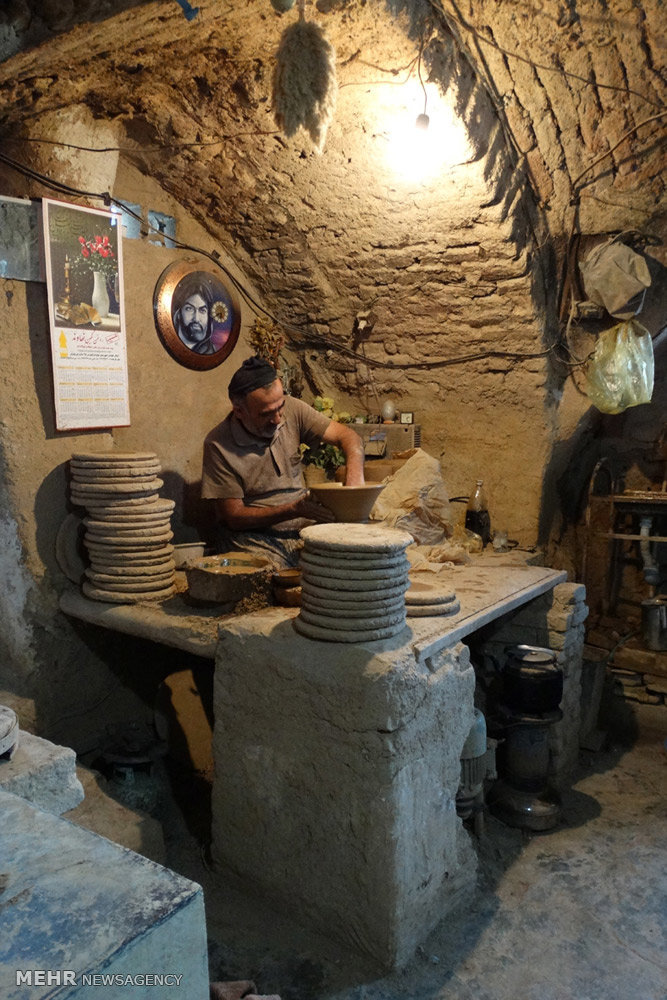
The town of Lalejin in Hamedan Province is home to a large number of pottery workshops. Mehr News Agency has posted online snapshots of colorful earthenware created by the town’s skilled craftsmen:


Haze in Iran is a product of war: Environment chief

Ebtekar

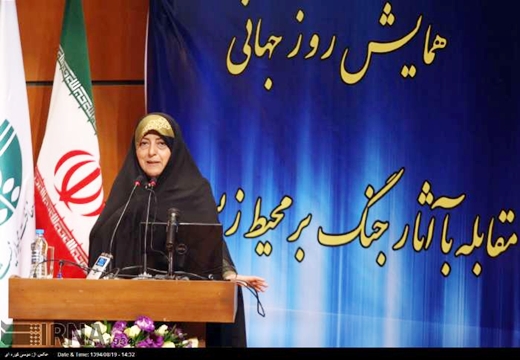
Iran is in a very sensitive environmental situation where ramifications of war and insecurity [in the region] such as haze can be felt, the director of the Environment Protection Organization told a conference Tuesday to mark the International Day for Preventing the Exploitation of the Environment in War and Armed Conflict.

What appears next is the translation of what else Masoumeh Ebtekar said at the gathering as reported by the Islamic Republic News Agency on November 10:

The conference is one of a few gatherings held in the world to assess the impact of war and violence on the environment.

It has been a few years since governments and international institutions began to take notice of the impact of war on the environment. National and international organizations can play an effective role on this front.

Iran started taking measures in dealing with the impact of war on the environment many years ago. One such measure was the formulation of a bill on compensations. Under the bill, Iran submitted a report to the United Nations on the destructive effects of war on Iran’s environment, including oil and air pollution, and asked for a big chunk in damages.

For instance, haze and particulates are a product of war which has bedeviled our country, that problem is escalating by the day.

Haze originates from countries such as Iraq, Kuwait, Syria and Saudi Arabia. It also comes from some areas within the country. Separate studies are being conducted on the issue in the provinces.

Water crisis in Iran and the wider region is an important issue and its settlement requires water diplomacy.

What the 11th government did with the backing of the Supreme Leader and the president as part of nuclear talks to have unfair sanctions lifted reflects the success of the diplomacy Foreign Minister Mohammad Javad Zarif and his colleagues employed.

Mr. Zarif and his colleagues did a great job. In a world where divisions mostly lead to war, his measures are valuable. The Iranian nation has thanked Mr. Zarif and his negotiating team multiple times; today we want to extend special thanks to his team, as well.

As the nuclear deal has proceeded in line with national interests so far, there is hope that it helps remove the sanctions so that Iran can play its major role in the region. Actually, that role has already started.

The region has become insecure thanks to the presence of IS and other terrorist groups; we should bring back security to the region and thus preserve the environment.