Saturday, December 27, 2025
Home Blog Page 4592

A look at Iranian newspaper front pages on Feb 20

Iran Newspaper front pages

It is now only less than a week to Parliament and Assembly of Experts elections in Iran. Candidates from all political parties and factions are jockeying to win the largest number of supporters and papers do play a special role in this regard. On Saturday, February 20, 2016, most of the top headlines were devoted to election campaigns.

Here are the top headlines:


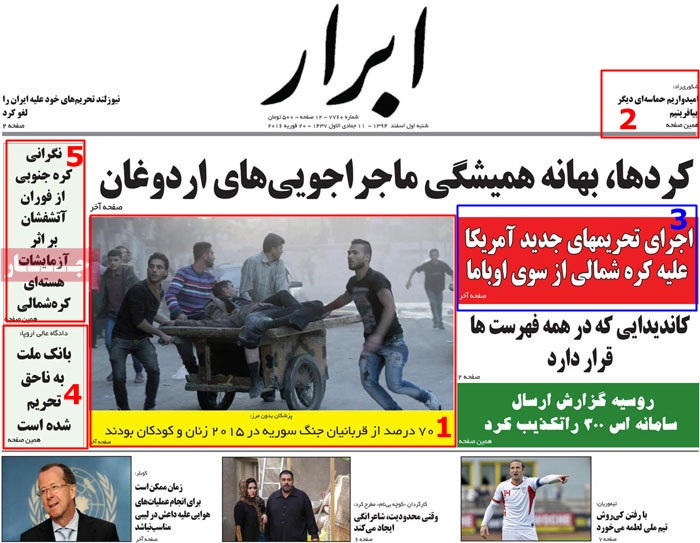
Abrar:


1. Women and children make up 70% of Syrian casualties in 2015

2. A candidate in all election lists!

3. Obama signs off fresh US sanctions on N. Korea

4. European Court of Justice says Iran’s Bank Mellat Was unfairly sanctioned

5. North Korea’s nuclear tests ‘could trigger catastrophic volcanic eruption’: S. Korea
Abrar


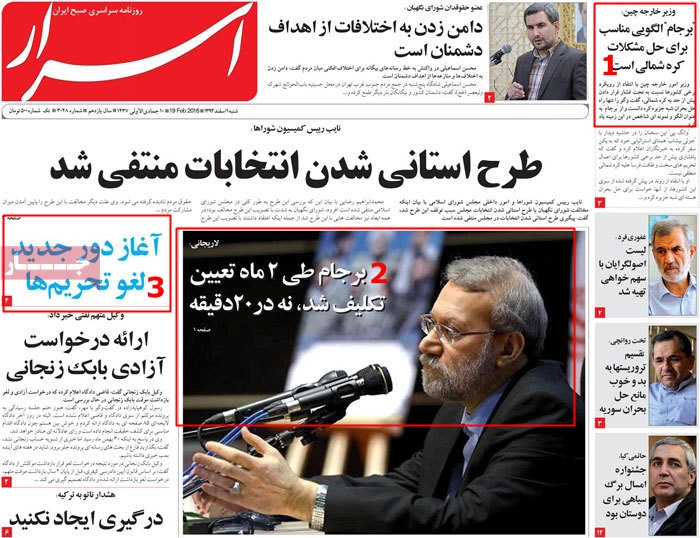
Asrar:

1. Chinese FM: Iran Nuclear deal could be used as a model to solve N. Korea issue

2. Parliament Speaker: N. deal took 2 months to implement not 20 minutes

3. New round of sanctions relief
 

Asrar


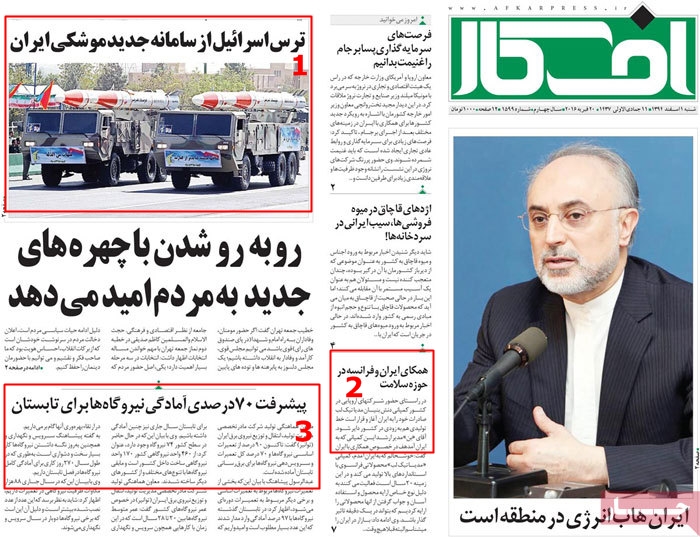
Afkar:

1. Israel fears new missile system in Iran

2. Iran, France to start healthcare cooperation

3. 70% of power plants ready for summer peak
 

Afkar


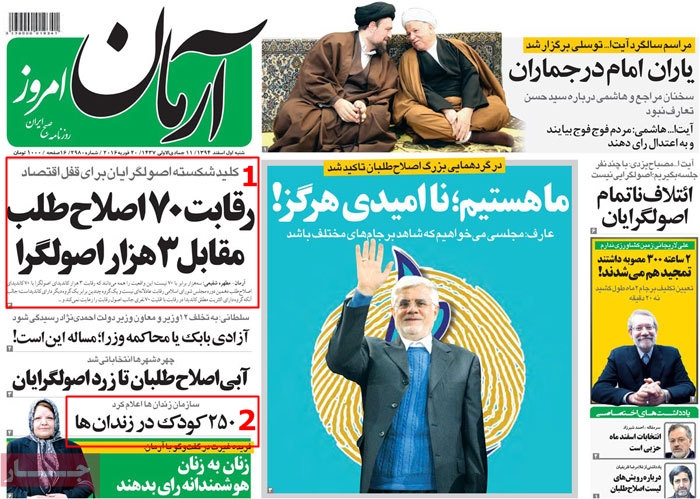
Arman-e Emrouz:

1. 70 reformists against 3,000 principalists in parliament election

2. 250 kids in Iranian prisons
 

Arman


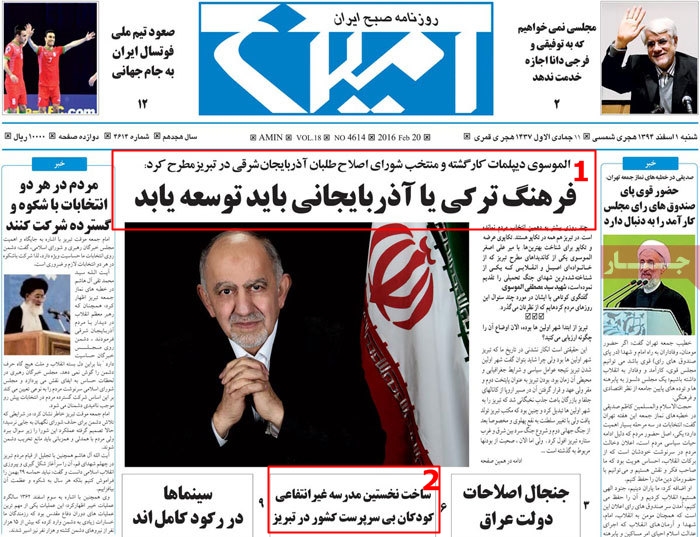
Amin:

1. Diplomat calls for promoting Turkish culture in Iran

2. Iran builds first private school for Tabriz orphans
 

Amin


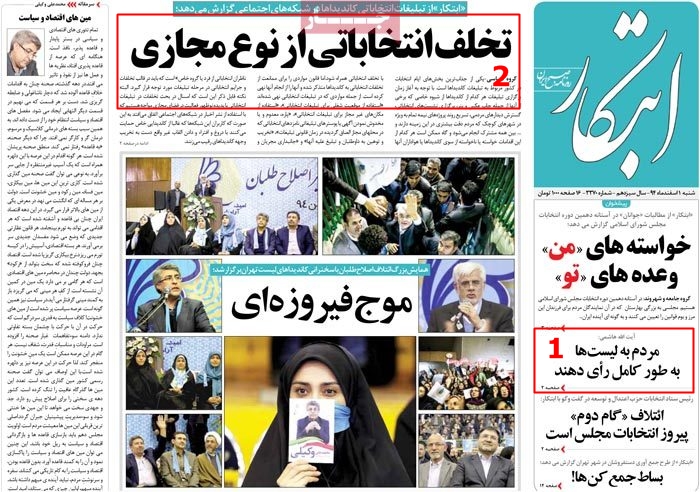
Ebtekar:

1. Rafsanjani calls on nation to vote for full lists

2. Virtual election fraud
 

Ebtekar


Ettela’at:

1. Economy of Resistance will be the basis of development in Iran

2. Terrorist blast kills 40 in Turkey

3. Friday Prayer leader: Certain figures holding posts will harm the country

4. Unscrupulous fraud by institute for supporting kids suffering from cancer

5. Knowledge-based firms can help country’s progress
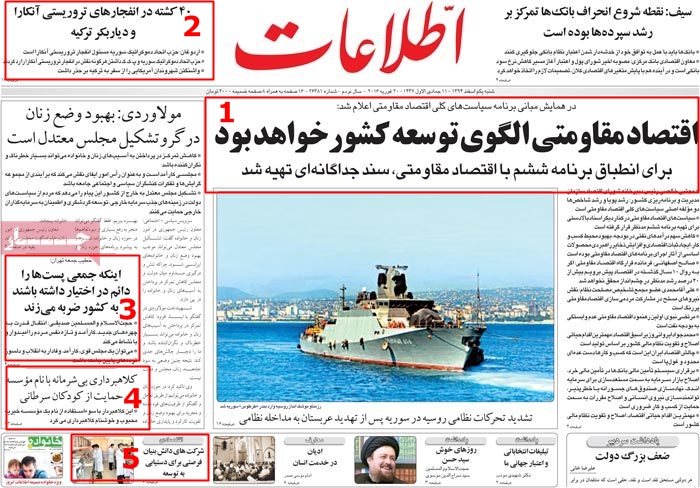
 

Ettelaat


Etemad:

1. Expect a “News Bomb”: Mogul’s advocate

The defendant of Babak Zanjani, corporate mogul charged with fraud, has said big news is underway

about his client’s case.
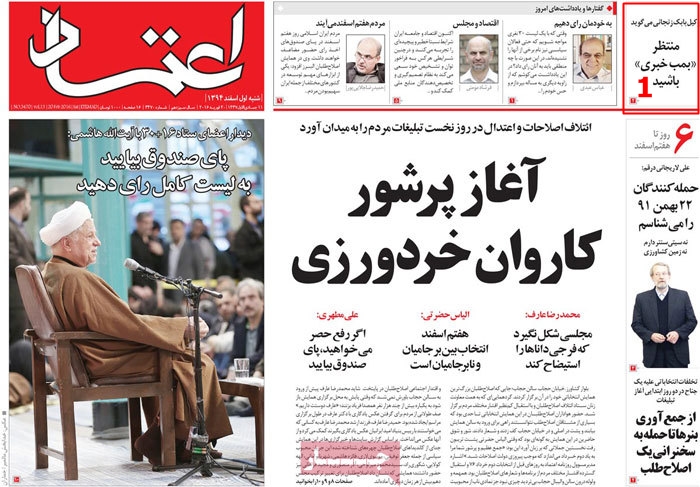
 

Etemad


Emtiaz:

1. 60% of taxpayers evade taxes in Iran: Vice President for legal affairs

2. Iranian futsal players thrash Vietnam to face hosts in final
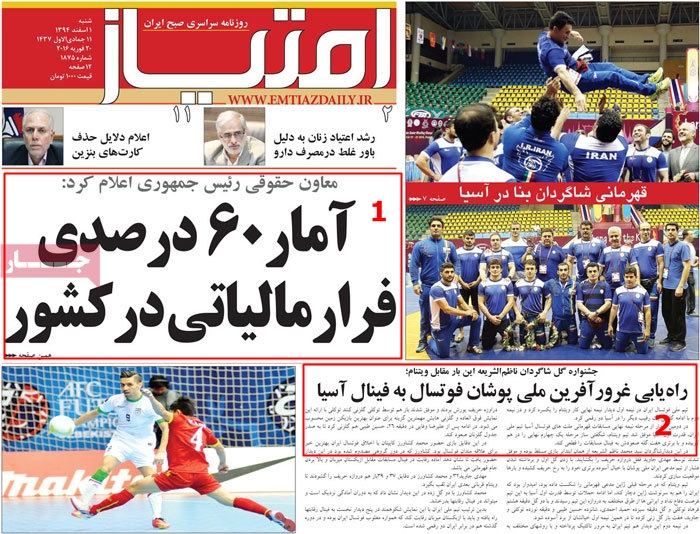
 

Emtiaz


Iran:

1. Culture Minister: Running country in 1394 was like a miracle

2. Report: Women’s status in 9 Iranian parliaments

3. Candidate lists jockey in election campaign

4. Turkey hits Kurdish targets after Ankara bombing
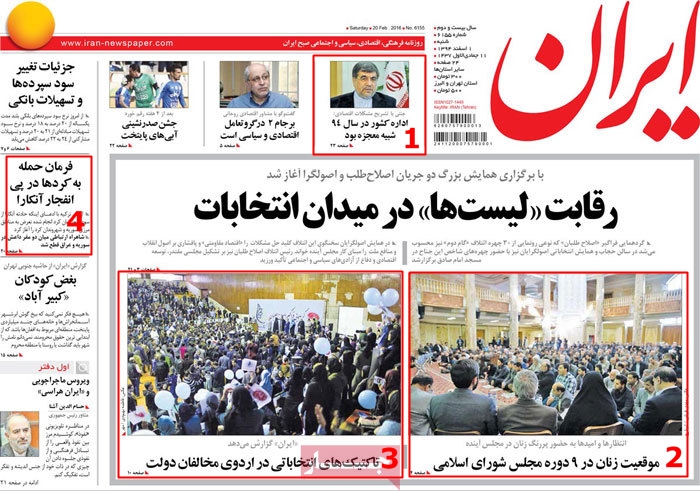
 

Iran


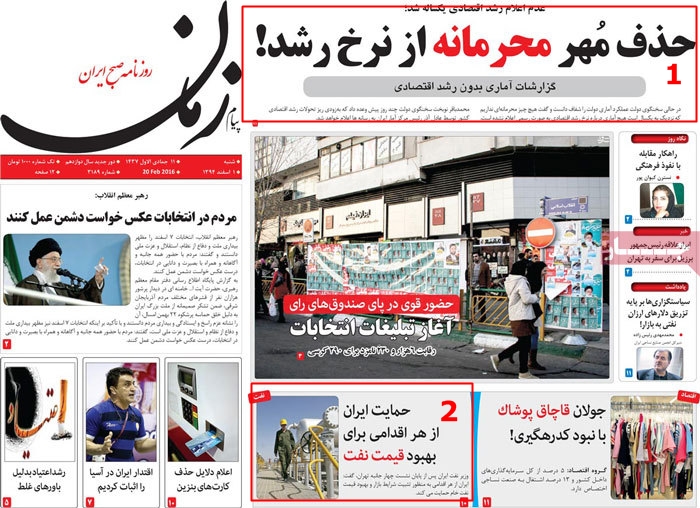
Payam Zaman:

1. Economic growth no longer confidential

A detailed report about the country’s economic growth

2. Iran supports any measure to help crude oil prices
 

Payam


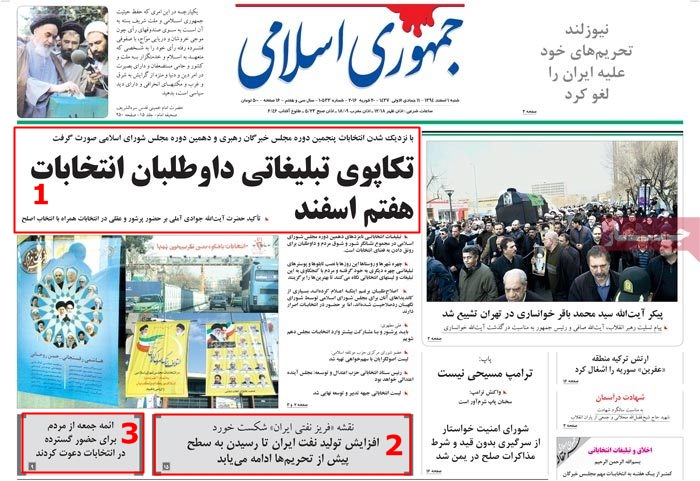
Jomhouri Eslami:

1. Election bustle in Iran

As days pass, the Election Day comes closer adding to the hustle and bustle of campaigns by

candidates vying to win a seat at the Iranian parliament.

2. Iran to stick to boosting-crude-output policy to revive pre-sanctions exports

3. Friday Prayer leaders urge nation’s high turnout in upcoming elections
 

Jomhouri


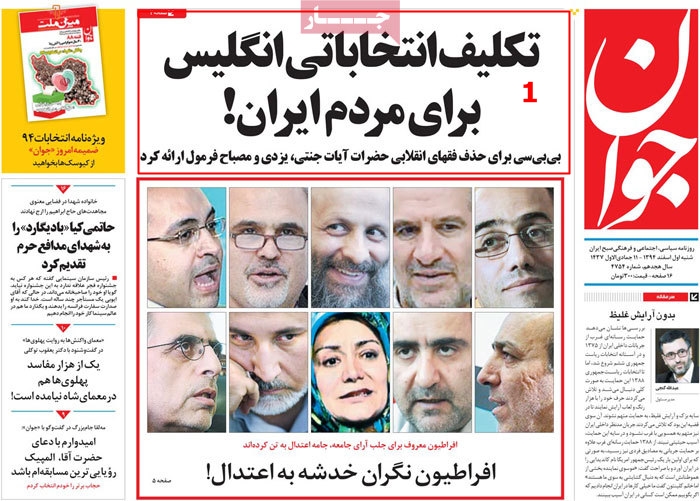
Javan:

1. British dictate of election for Iranian nation!
 

Javan


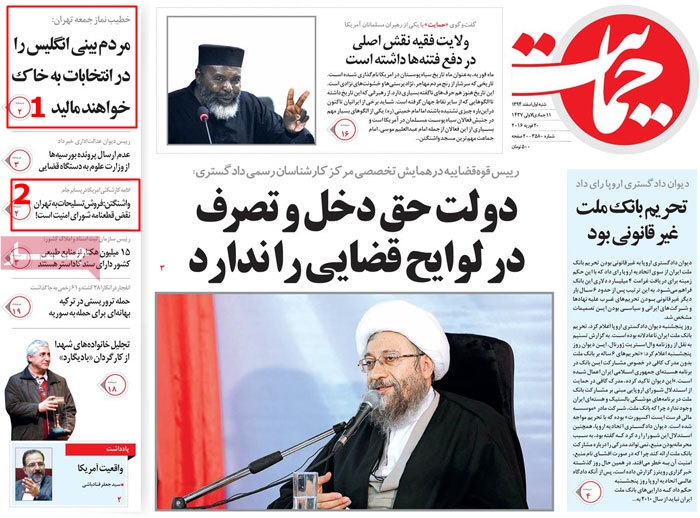
Hemayat:

  1. Friday Prayer leader: People will rub UK nose in dirt in election
  2. Washington: Selling arms to Tehran is violation of UNSC resolution
 

Hemayat


Khorasan:

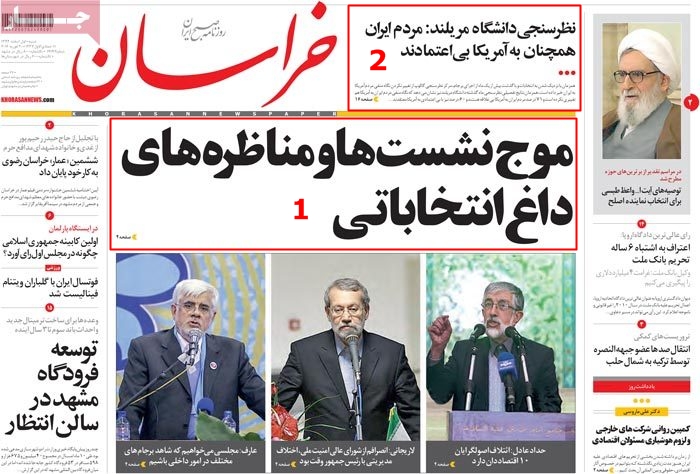
  1. Wave of election debates in Iran
  2. Maryland University Poll: Iranian people still mistrust US
 

Khorasan


Resalat:

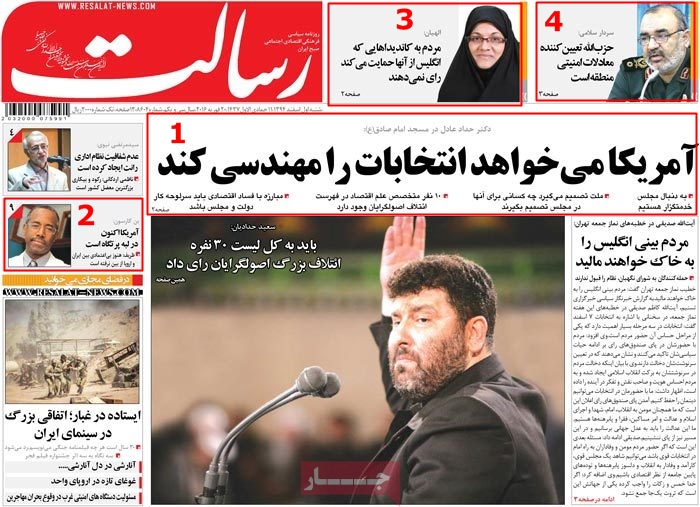
  1. Hadad Adel: US planning to engineer Iran elections
  2. US Presidential hopeful: US on the brink
  3. MP: People will not vote for candidates who have UK support
  4. IRGC Commander: Hezbollah determines security equations in region
 

Resalat


Royesh Mellat:

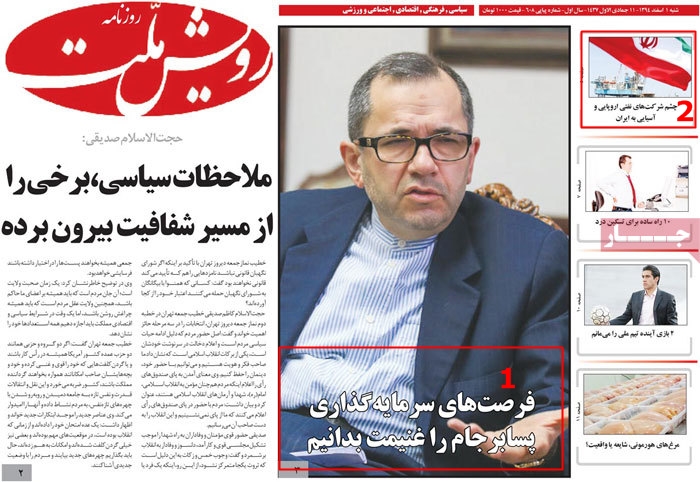
  1. Diplomat calls for grasping post-sanctions opportunities
  2. European, Asian oil firms eye Iran market
 

Rooyesh-e-emellat


Sayeh:

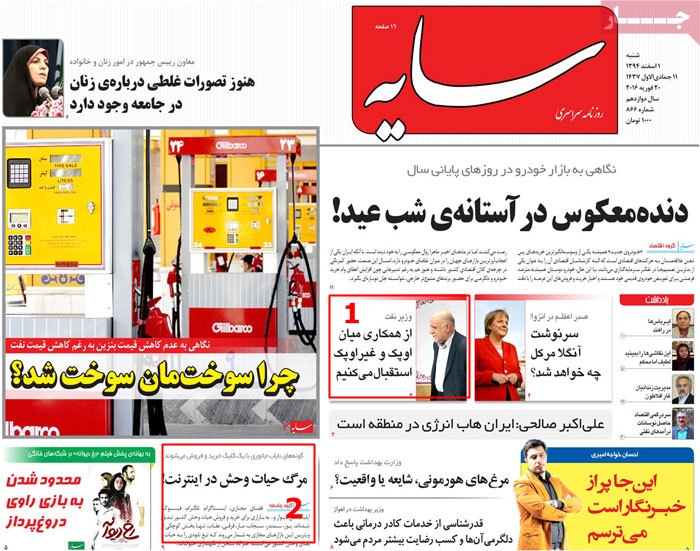
  1. Iran welcomes OPEC-Non OPEC cooperation
  2. Online death of wildlife

A report about trading rare species online
 

Sayeh


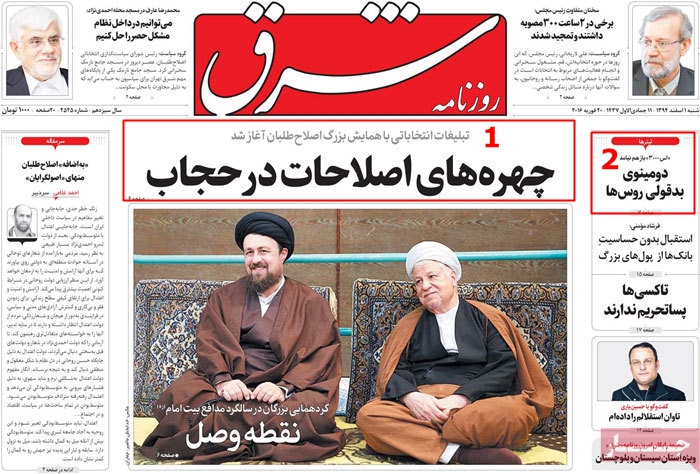
Shargh:

  1. Reformist celebrities under cover
  2. Domino of Russian dishonesty

Russia again failed to deliver S-300 missile systems to Iran.
 

Shargh


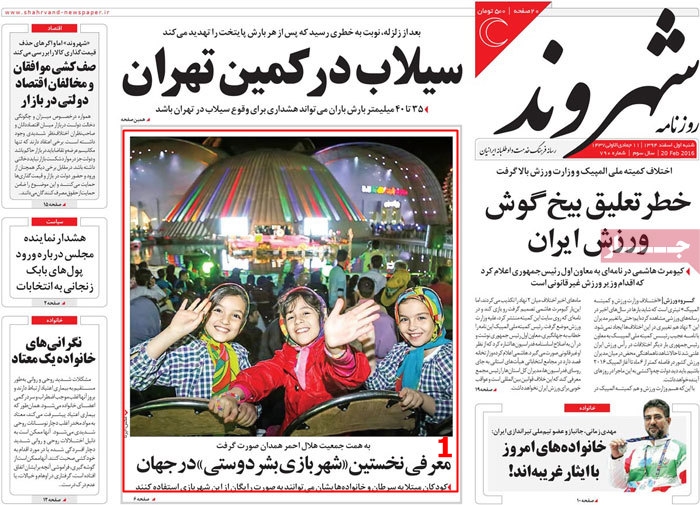
Shahrvand:

  1. Introduction of world’s first humanitarian amusement part [in Hamedan

An amusement park in the western city of Hamedan is now free to cancer kids and their families.
 

Shahrvand


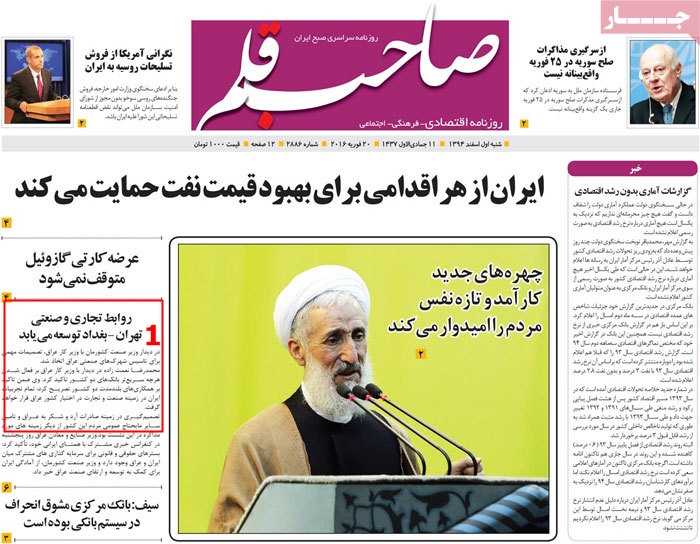
Sahib Ghalam:

  1. Iran, Iraq bent on boosting trade ties
 

Saheb-ghalam


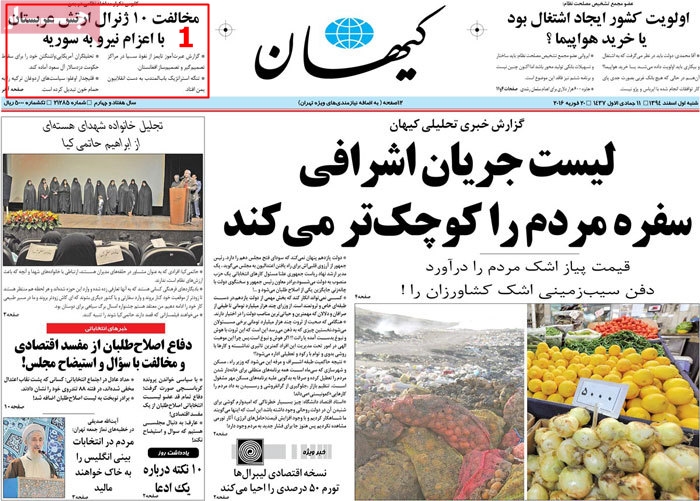
Kayhan:

  1. Saudi generals oppose sending troops to Syria
 

Kayhan


Asia:

  1. Iran, US prepare for military talks
  2. US Treasury plans to cement banking bonds with Iran
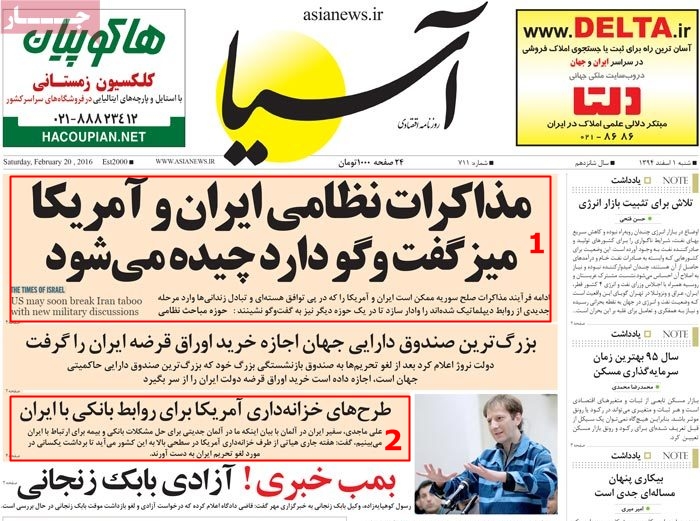
 

Asia

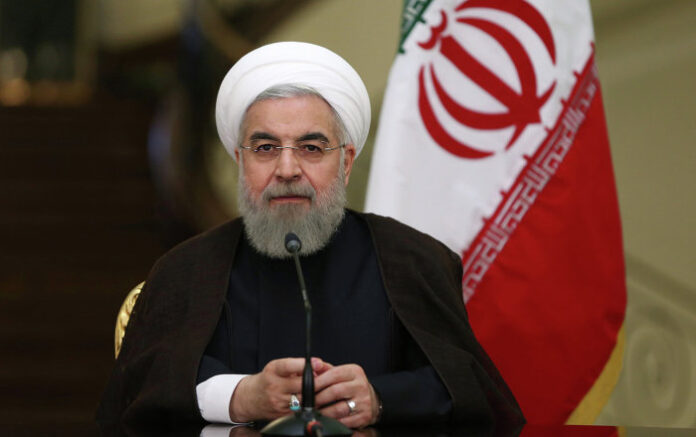
President: Regional countries eyeing Iranian elections

President Rouhani made the remarks in a ceremony on “laborers and future of the Iranian economy”.

He reiterated that the Iranian nation would never let the remarks of Supreme Leader of the Islamic Revolution go unheard.

Supreme Leader of the Islamic Revolution Ayatollah Seyed Ali Khamenei has urged Iranians to make a strong turnout in the elections.

‘Massive turnout in the elections would pave the way for economic prosperity, further investment and youth employment,’ he added.

Elections for the 10th term of the Parliament as well as the 5th term of the Assembly of Experts will take place simultaneously on February 26.

Iranian nanocarrier fixes antibiotics side effects

There have been significant medical advances in recent years in the area of drug delivery systems. Using these systems allows the medicine to be delivered exactly to the target tissue or organ, and the rate of drug release will be controlled for a long time. The purpose of using drug delivery systems is to maintain long-term optimal drug concentration in the blood and thus increase the effectiveness and reduce the side effects of medication.

Simin Shibani, the project manager, explained “Azithromycin is an antibiotic used to treat many different types of infections caused by bacteria. Since this antibiotic has a high molecular weight and size, it can hardly pass through the outer membrane of bacteria. Thus, even in the case of using a drug delivery system, it has a low treatment efficiency.”

She maintained that the aim of the project was to tackle the mentioned problems by synthesizing molecular polymers through polymerization; “the benefits of using this drug delivery system include maintaining drug concentrations at a relatively fixed level for a specific period of time, adjustable speed rate of releasing drugs, and the possibility of drug delivery in nanometer dimensions to a specific organ or tissue.”

In this project, molecular polymers were synthesized through sedimentary polymerization method first with and then without Azithromycin. Then, the obtained polymer particles were isolated by centrifugation, washed by water and dried by heat. Finally, morphology, thermal stability and the rate of drug release were assessed for produced polymers.

The results of the research confirms production of spherical and homogeneous polymer particles with a size less than 100 nm. Also, studies on the thermal stability of the molecular polymers indicate their stability in high temperatures.

The results of the research have been published in RSC Advances, vol. 120, issue 5, 2015, pp. 98880-98891.

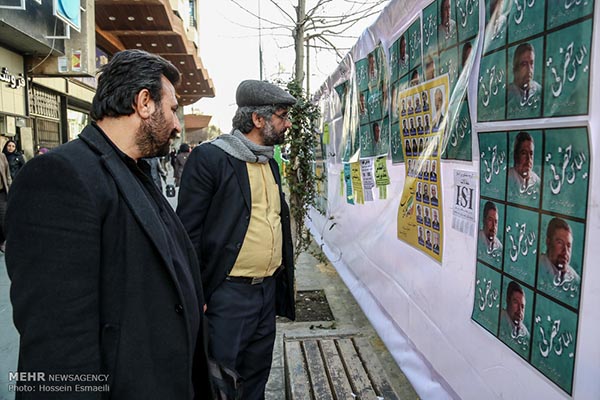
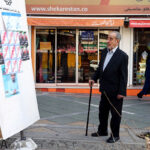
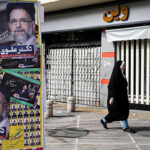
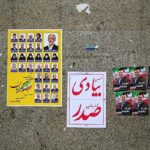
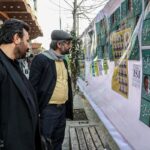
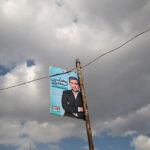
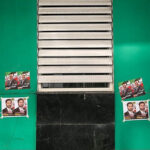
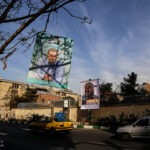
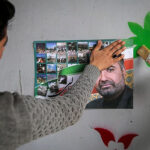
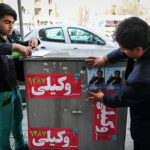
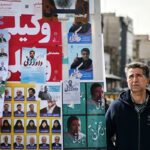
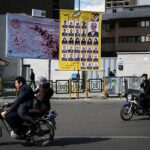
Election Campaigns Officially Started in Iran
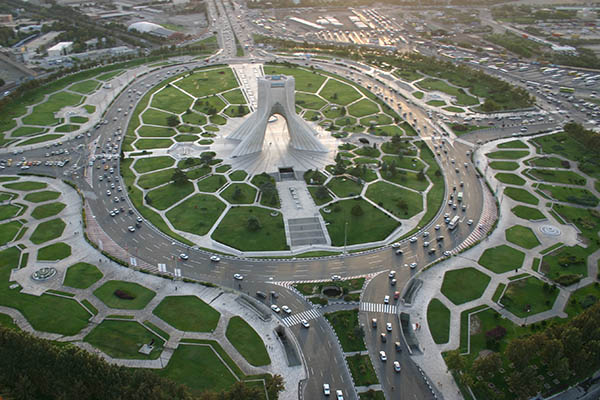
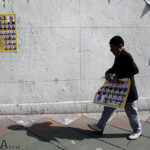
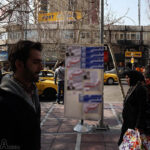
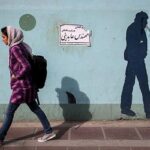
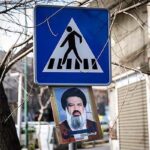
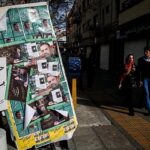
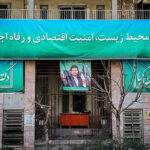
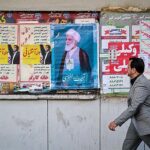
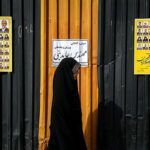
The election campaigns officially began in Iran on Thursday, and will last until the end of next Wednesday, February 24. The nationwide votes for the parliament and the Assembly of Experts will be held simultaneously on February 26.

The following images have been released by different websites:


US pistachio growers worry about competition from Iran

The NPR said in a report that the return of Iranian pistachio will specifically raise the stakes for American growers given that their yield this year has already been halved as a result of a lack of water and warm temperatures.

Many producers are worried that the Iranian pistachio will be a threat to the American growers not only in the domestic market, but also in the overseas markets.

Nevertheless, the fact that the US has implemented a hefty tariff of 300 percent on Iranian pistachios is already believed to have made competition for Iranian growers harder.

But this tariff may not be in place forever. This is because some are speculation that Iranian farmers will likely try to prove they are not subsidized by their government as soon as this summer, in a meeting with the US International Trade Commission, in an attempt which will be meant to reduce the tariff.

Iranian officials said last April that the country had ousted the as the leading producer of pistachio nuts and reclaimed the position which it has long held to its credit.

Production of the nut surpassed 235,000 tons thanks to satisfactory precipitations and Iran’s implementation of development measures for better yield, an official with the agriculture ministry, Ali Mohseni said.

Iran outpaced the United States as the top producer after unofficial figures of 240,000 tons of pistachio crop in the US for 2014 were brushed aside by the Food and Agriculture Organization (FAO), Mohseni said.

Iran is the top pistachio exporter, a position the country has strongly maintained, thanks to the premium quality of its produce.

Iran exported 180,262 tons of the nut worth $1.62 billion in 2014. Those exports marked a 50% rise both in terms of volume and value.

Iran also has the largest acreage of land dedicated to pistachio plantation, spread over more than 20 provinces in the country.

Iran Sees Possible No-Fly Zone over Syria ‘Repetition of Previous Mistakes’

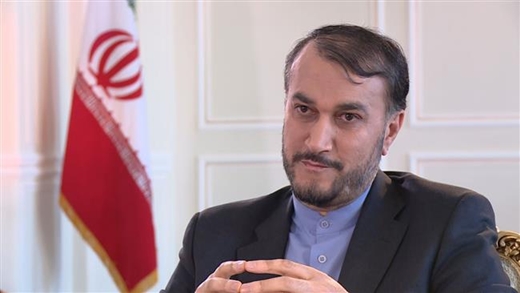
amir-abdolahian1

“The solution to the Syrian crisis, which has negatively affected regional security, is merely political,” Amir Abdollahian told the Islamic Republic of Iran Broadcasting (IRIB) on Friday.

He further censured some regional and Western countries, which are members to the International Syria Support Group (ISSG) and participate in the UN-brokered peace talks on Syria but in practice, they are pursuing a military approach to Syria.

“Undoubtedly, renewing the idea of a no-fly zone [over Syria] will not provide any help for regional security and stability,” Amir Abdollahian noted.

The idea of no-fly zone was first raised by Turkey. On Wednesday, Turkish President Recep Tayyip Erdogan claimed that a no-fly would have prevented Russia’s air campaign in the region.

German Chancellor Angela Merkel on February 17 denounced the humanitarian situation in Syria as “unacceptable” and renewed her call for a no-fly zone in the war-stricken country.

Syria has been gripped by civil war since March 2011 with various terrorist groups, including Daesh, currently controlling parts of it.

Meanwhile, Russia’s recent aerial support for the Syrian forces has given fresh impetus to the fight against the foreign-backed terrorists.

According to a new report by the Syrian Center for Policy Research, the conflict has claimed the lives of over 470,000 people, injured 1.9 million others, and displaced nearly half of the country’s pre-war population of about 23 million within or beyond its borders.

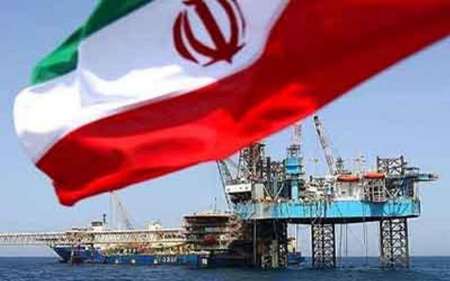
Expert: It is only fair for Iran to increase oil production

Manouchehr Takin told Deutsche Welle radio that Iranian officials have already stressed that they are going to go on with their marketing attempts.

He said he was sure Iran will in no way consent to maintaining a fixed level of production, noting that this would not be fair to the country.

The expert said Iran has got its own customers and is quite able of going on with its plan in the present complicated market.

The radio went on its report to note that Iran says it will ship its second crude oil consignment after the sanctions’ removal before the end of February.

Managing Director of National Iranian Oil Company (NIOC) Roknoddin Javadi said Iran will send its second oil shipment before the end of February.

Iran shipped its first oil consignment after sanctions’ removal earlier this week and has said it will continue the shipments until it restores its pre-sanctions export levels.

The Islamic Republic has promised to add at least a million barrels a day to its crude oil exports a year after the sanctions removal.

US, France Oppose UN Resolution to Respect Syrian Sovereignty

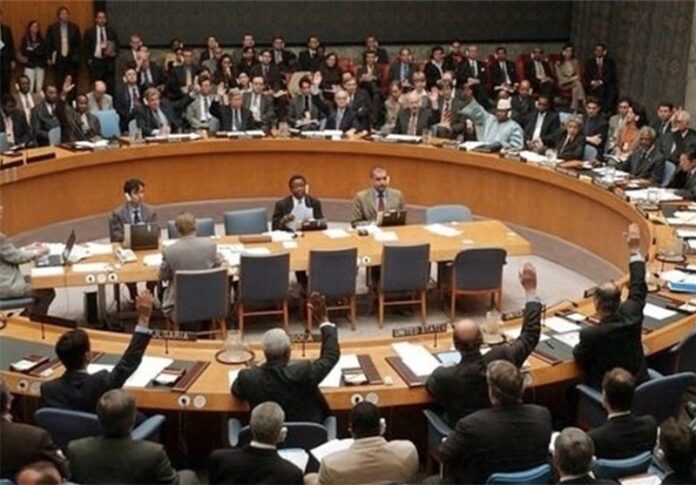
A Russian draft resolution demanding respect for Syria’s territorial integrity and sovereignty – an effort to curb Turkish military action in the country – has failed to gather support at the UN Security Council.

Russia called for a meeting of the council as Turkey intensified its shelling of Kurdish militants in northern Syria and was allegedly considering sending Turkish ground troops into the country.

The draft resolution, which does not mention Turkey or any other country specifically, “strongly demands to fully respect the sovereignty” of Syria and to “immediately halt any cross-border shellings and incursions as well as abandon all attempts or plans for foreign ground intervention”.

Vladimir Safronkov, Russia’s deputy ambassador to the UN, told reporters after the meeting that putting troops on the ground would “undermine all fundamental decisions” taken so far to end the conflict in Syria, and that Russia will insist on pushing the resolution forward.

However, the draft was quickly dismissed by the US and France, which are both veto-wielding members of the council.

Samantha Power, US ambassador to the UN, said the resolution was a distraction, the Associated Press reported.

“Rather than trying to distract the world with the resolution they just laid down, it would be really great if Russia would implement the resolution that’s already agreed to,” Power said, citing a resolution endorsing a roadmap to end the Syrian crisis.

Asked whether France supported the Russian draft, Francois Delattre, French ambassador to the UN, said “the short answer is no”.

He warned of a “dangerous military escalation” in northern Syria, which he claimed was “the direct result” of increased military operations by the Syrian army and its ally Russia, calling for an end to the offensive.

Yasar Halit Cevik, Turkish ambassador to the UN, defended his country’s military operations against the Kurds, saying Turkey was exercising its right to self-defense against terrorist threats.

Cevik said Turkey would not put boots on the ground unless it was part of a “collective action” authorized by the Security Council or by the US-led international coalition against Daesh (ISIL).

Russia Says to Start Construction of 2 Power Plants in Southern Iran

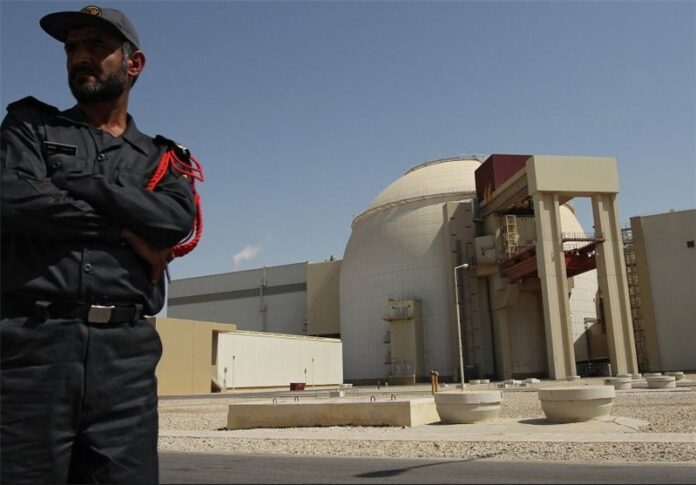
“We are coordinating the date with our Iranian colleagues, everything is basically ready, we are about to complete the survey of the seismological situation,” Sergey Kiriyenko said Friday speaking of the two reactors, Sputnik reported.

Back on January 31, Head of the Atomic Energy Organization of Iran (AEOI) Ali Akbar Salehi said Iran and Russia have signed agreements for the construction of “two big reactors in Bushehr.”

In November 2014, Tehran and Moscow struck a deal to build eight more nuclear power plants in Iran.

Russia has already built a power plant in Bushehr. The agreement for Bushehr Nuclear Power Plant was finalized in 1995, but the project was delayed several times due to a number of technical and financial issues.

The move came more than a month after implementation of the Joint Comprehensive Plan of Action (JCPOA), a lasting nuclear deal between Iran and the Group 5+1 (Russia, China, the US, Britain, France and Germany).

The JCPOA, which came into force on January 16, has terminated all nuclear-related sanctions on Iran, reopened the doors of foreign investment to the country’s market, and prepared the ground for a much-anticipated economic boom.

How to build tomorrow cities?

According to Mohsen Tabatabaei Mozdabadi, secretary of Iran Urban Economics Scientific Association (IUESA), best cities are where Social interaction and citizenship participation are improved and people are gathered together after their work into public places.

Mozdabadi made the remarks in an article a copy of which was sent to IRNA on Saturday.

An international conference on urban economy is to be held on May 18, 2016, by IUESA to discuss major topics in urban economy including, economy of smart city, economy of urban tourism, economy of urban infrastructures, economic culture of city and citizenship education, urban dilemmas and the environment, and air pollution.

The full text of Mozdabadi’s commentary reads:

Cities are places that they have both the problem and solution simultaneously. They are fruitful area for science, technology, culture, innovation, and individual and collective creativity. Yet, cities are the place for problems such as unemployment and poverty. All evidences and assumptions indicate increase in urban population in the world. On the other hand, UN predicts that slums will be doubled by 2050. It seems that tomorrow cities should pay more attention to this issue. Cities can collect data and information by smart tools about different dilemmas such as traffic, but it is necessary to listen to citizens. It is important to listen to low-income class of the society who live in suburbs more compassionately. City decision-makers should know that what things would be more valuable in the future. They should know that they would face with condensed and populated cities. Therefore, they can hail future through creating new infrastructures and rehabilitation of existing ones.

Tomorrow cities are those that they care streets and public areas collecting people together. Streets are the force of momentum and life in cities. They are valuable public assets. They should have better position in city planning. Streets devote 20 to 30 per cent of existing cities to themselves, but considered as a less valuable place merely for movement. Streets should have roles that are more important in tomorrow cities than movement from one place to another. Best cities in the world are those where they gather people together after their work into public places. These cities offer various options such as sidewalks and path for cycling. Social interaction and citizenship participation are improved in these places. It seems that people, behaviors, and their activities should be planned in tomorrow cities.

World Health Organization (WHO) considers nine square meters per capita green space for city dwellers. This figure is very slight in many cities. Creating and improving green spaces should not only be the challenge of city policy-makers, but they should try to improve this sense among citizens owning green spaces. Cities will take step in the path of being smart. However, being smart is not only economical and powerful use of existing technologies and current data, but it also means that cities should be able to improve data, produce, simulate, and finally design urban issues data by analyzing them.