Thursday, January 1, 2026
Home Blog Page 4566

PART ONE: On the war on terror

A former French premier has said that his country will not follow in the footsteps of the United States if Washington unilaterally goes back on its promises under the Iran nuclear deal.

Jean-Pierre Raffarin, who served as French prime minister (2002–2005), made the remark in an interview with Etemaad daily’s Ehsan Badaghi and added that JCPOA is an agreement between Iran and six world powers and that one country, out of P5+1, cannot unilaterally violate the nuclear deal.

The opposition UMP party senator – who is now the chairman of the French Senate Committee for Foreign Affairs, Defense and Military – also talked about trans-partisan policies of France on the war on terror and stressed that Iran should be a key player in international efforts to take on terrorism.

Raffarin was in Tehran in mid-December as part of a French delegation led by President of the French Senate Gerard Larcher. The following is the translation of PART ONE of the interview which focused on the international fight against terrorism and implementation of the Iran nuclear deal:

Q: How similar, or how different should I say, are what you had in mind about Iran and what you see here in Iran today?

A: The comments of those who have seen Iran first-hand greatly differ from those who have never traveled to the country and simply pass judgment on it from afar. I already knew that a trip of a few days to Iran will change my impression about the country. Naturally political leaders have a sketchy view of countries and, as a politician, I am no exception.

What was shocking for me was the depth of insight and delicacy of assessment by the [Iranian] officials I met with. During my trip, I did not have the opportunity to get into close contact with members of Iranian society, but from the contacts I had with high-ranking political officials, I realized that we had to have a different look at Iran. Thus it would be quite natural to come across differences when establishing contact with Iranian society and its people.

Q: How will such a different look affect your policies? We believe that positive attitudes should show themselves in practice as well.

A: Never can I guarantee an immediate, instantaneous change. I want to give the good news that we will definitely pursue our assessment of Iran today in the form of a practical policy in France. What we are to do relies on how the two countries can maintain the positive atmosphere created between them.

Q: You need to give us the right not to remain indifferent to incorrect judgments which are passed on us from time to time. We are seeking to fairly judge France’s policies in Iran. Let’s go to the second comparison: A relatively calm France at the heart of Europe and a France which has been repeatedly rattled by terror attacks over the past two years and has – on some days – turned into an unsafe place. How different is today’s France which has gained bitter experiences of terrorism from France in the past years?   

A: Following these events, France came to realize that the war on terrorism would be a very prolonged war, a war which will spill over into many other geographical places. We learned about the abilities of our enemy and also learned that the enemies – the terrorist groups – are very much powerful and lethal. The lessons we learned prompted us to prioritize our goals. A case in point is [the decision by] President Hollande to appear before parliament and say [the fight on] terrorism is the country’s number one priority.

Q: You talked about the enemy’s abilities and a prolonged war with it. What you are saying evokes the comments US President George Bush made following the 9/11 attacks before the United States got involved in a full-scale war in the Persian Gulf. What does such a resemblance mean? Shall we wait for France to adopt a tactic similar to what the US did 15 years after September 11 attacks in the US?

A: No. This is simply a lexical similarity. France’s assessment [of the situation on the ground] is different from the way the Americans saw things back then. On those days [in the wake of 9/11 attacks] the US had already made up its mind and was seeking to [make its case for war and] build a [global] consensus. But today we say that we need a broad international consensus before we can make the final decision. We are trying to reach a consensus which does not – on the grounds of mutual differences – exclude those who are seeking to wage war on terrorism.

Q: Let’s go back to the comparison between France today and France in the past. Given the experiences you have gained today and the developments which have unfolded in the world, especially in the Middle East and North Africa, do you see any change in your assessment of terrorists, effective methods to take on terrorism and what supports and boosts such methods? Let me be frank, haven’t you already made mistakes in this regard?    

A: I’m not sure whether we made a mistake. I do not insist that all we did was correct, because we lack an accurate judgment now. What I can say is that we [in France] deepened our analysis of this phenomenon [terrorism] following the developments which unfolded [in France and across the world].

We moved toward developing a profound and accurate insight [of the ground situation]. We tried to analyze terrorism – which is a nebular phenomenon – more than before. We tried to create more suitable tools to stage a fight on this phenomenon or work toward developing such a tool in the near future.

Q: For over 30 years Iran has been grappling with terrorism one way or another. We lost a large number of citizens and officials because of terrorism in the early years after the victory of the Islamic Revolution. Back then a terror group, Mojahedin Khalgh Organization (MKO) which claimed responsibility for a number of terrorist attacks in Iran was given shelter by the French government, and your country turned into the base for the group’s main leaders in Europe. Paris has lent political and legal support to this group on many occasions. Where do you stand on such a decision [which was made years ago]?  

A: This is the question which came up for discussion in our official meetings during this trip. It was also raised and pursued by Iranian officials in the previous years when I was in charge in the French government. I think there were days when the fight against terrorism was not like what it is like today.

In other words, in those days each country would counter its own terrorists and terrorism was more of an internal [within-national-borders] phenomenon. A case in point is France itself which was hit by terror attacks when the war in Algeria was raging on.

But today we are facing a multilateral and trans-border aspect of terrorism and suffer its dire consequences. Today the question of terrorism is not simply about one country; rather, it involves a number of countries and regions across the world. I think the front-and-center mentality in France suggests that all those countries which honestly fight such a phenomenon should join hands and improve coordination within their ranks.

It comes as there are still a number of countries which are believed to be partners of terrorists. The fight on terrorism goes through one single way: national determination inside countries and multilateral determination on the part of [all] countries.
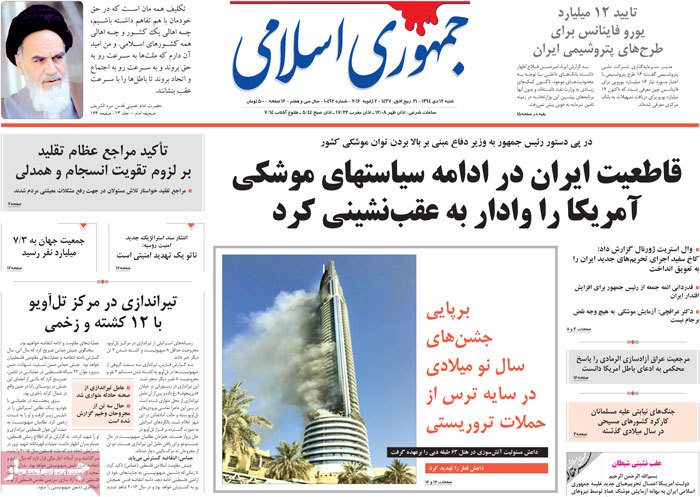
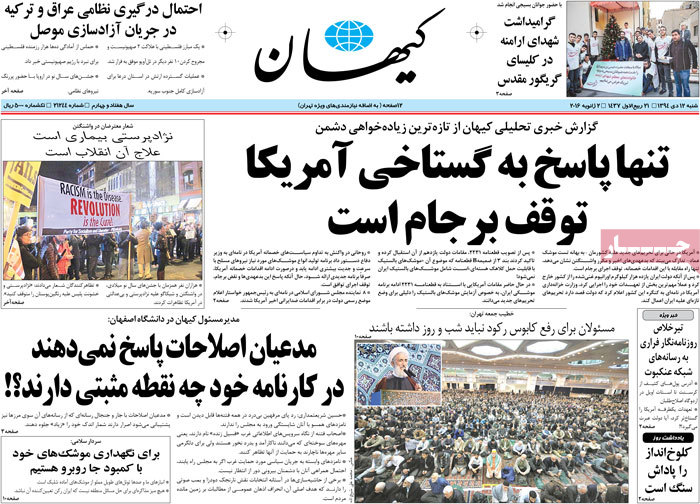
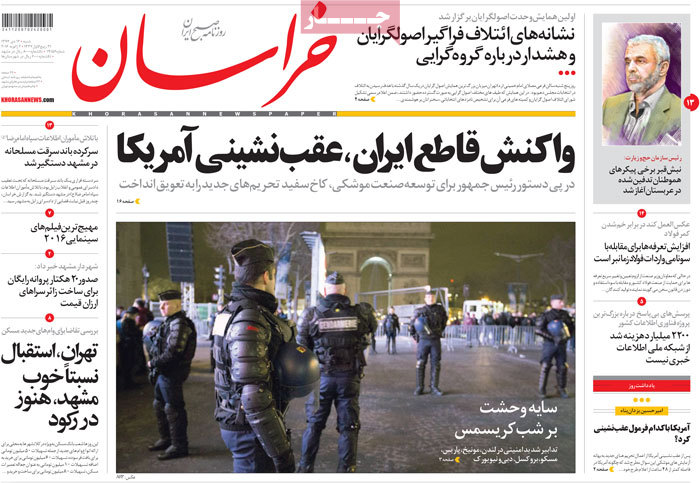
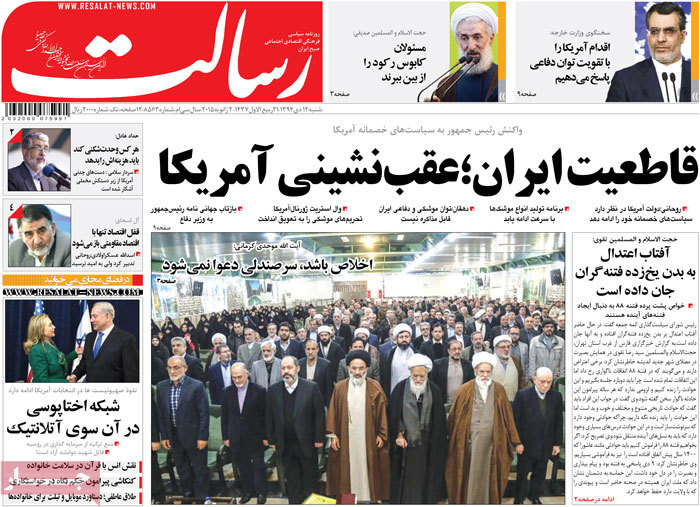
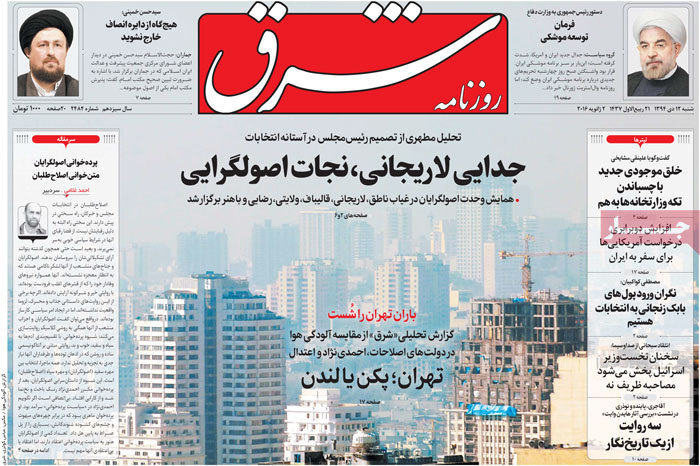
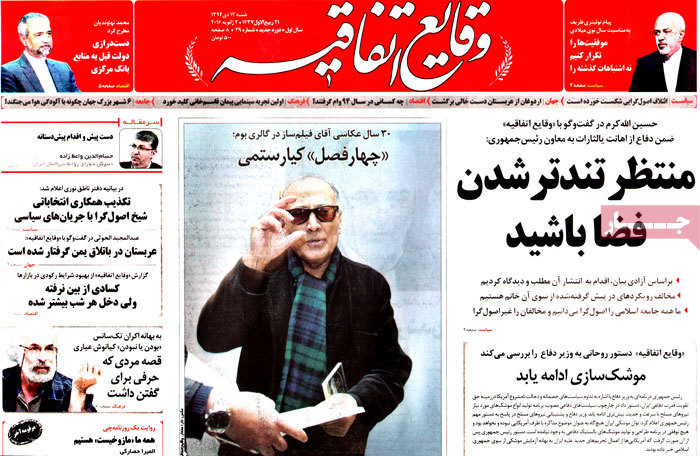
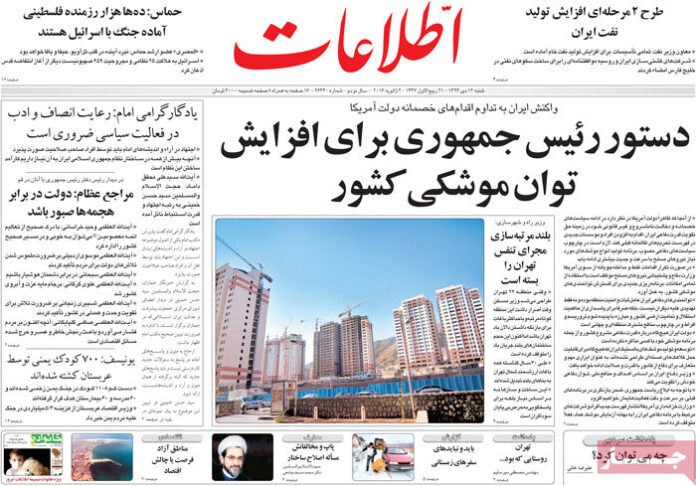
A look at Iranian newspaper front pages on Jan. 2

Iranian Newspapers Headlines

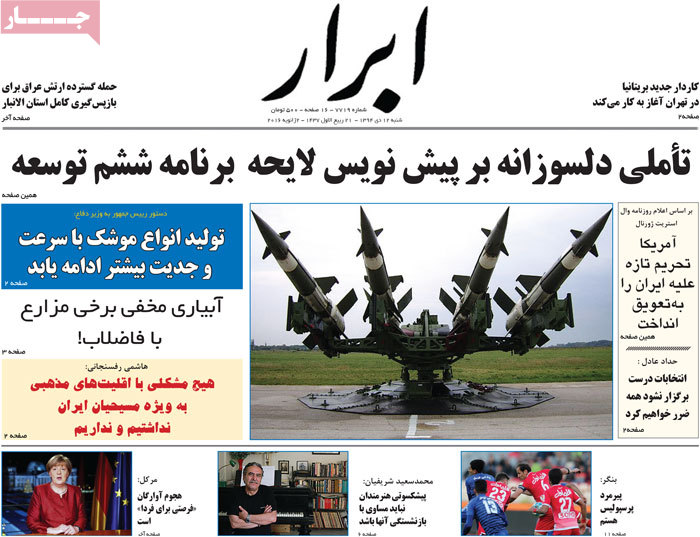
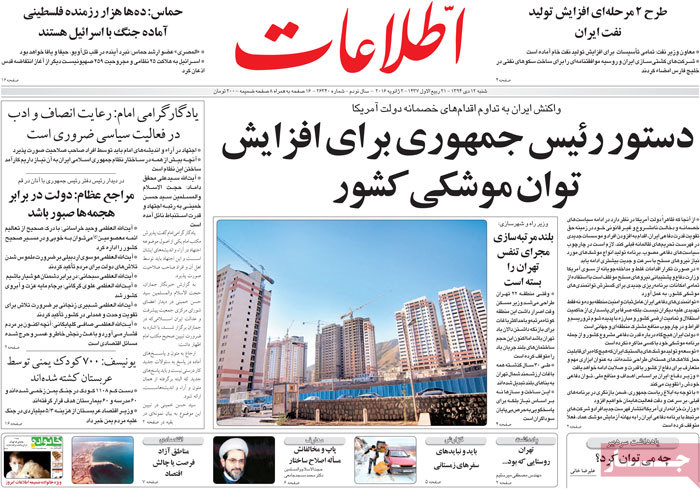
The president’s order to accelerate the country’s missile program dominated the front pages of Iranian newspapers on Saturday.


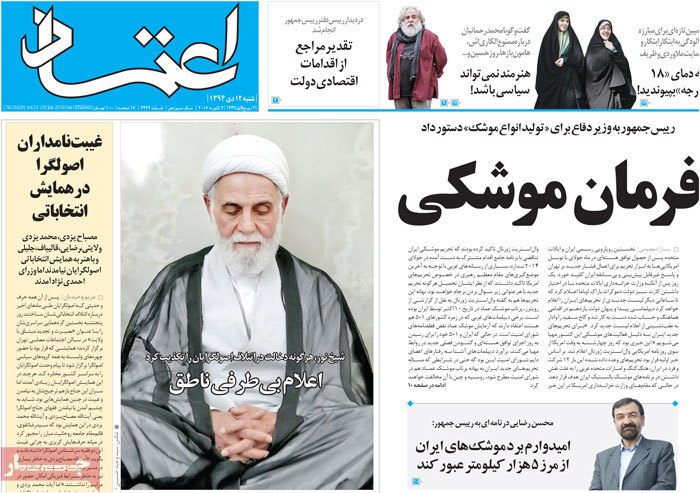
Ettela’at: The president has ordered Iran’s missile capabilities boosted.

It came in reaction to continued hostilities by the US administration.


Abrar: The chairman of the Expediency Council has said that the establishment has no problem with religious minorities, especially Christians.


A look at Iranian newspaper front pages on Jan. 2


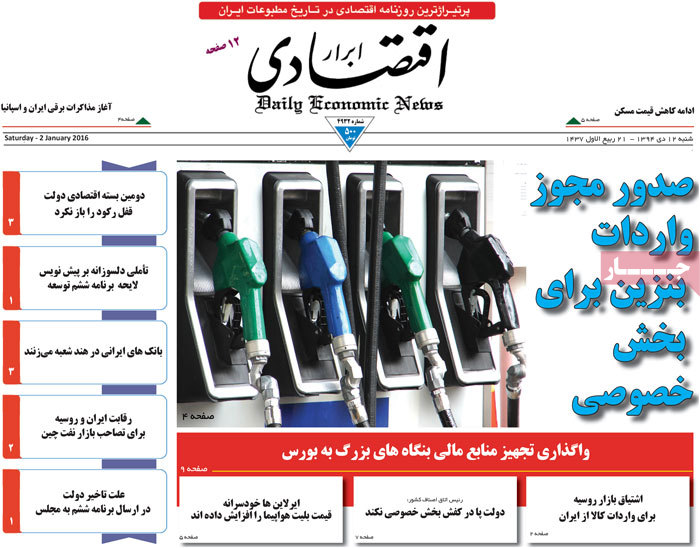
Abrar-e Eghtesadi: The private sector has been given the go-ahead to import gasoline.


A look at Iranian newspaper front pages on Jan. 2


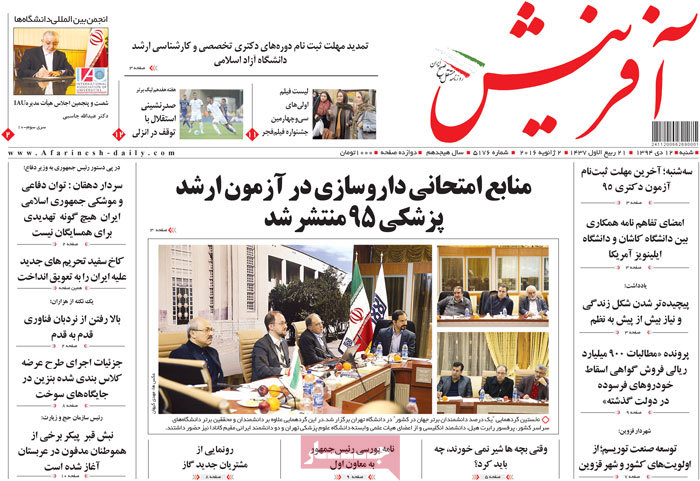
Afarinesh: Kashan University and University of Illinois have signed a cooperation document.

Afarinesh: The defense minister has said that Iran’s defense and missile capability poses no threat to neighboring countries.
 

A look at Iranian newspaper front pages on Jan. 2


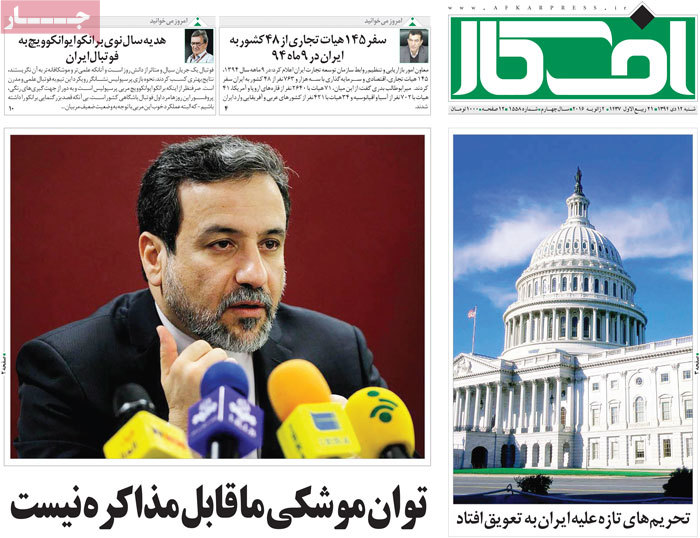
Afkar: In the first nine months of the year [started March 21, 2015] 145 trade delegations from 48 countries visited Iran.

Afkar: Iran’s missile capability is not negotiable, said Deputy Foreign Minister Abbas Araghchi.


A look at Iranian newspaper front pages on Jan. 2


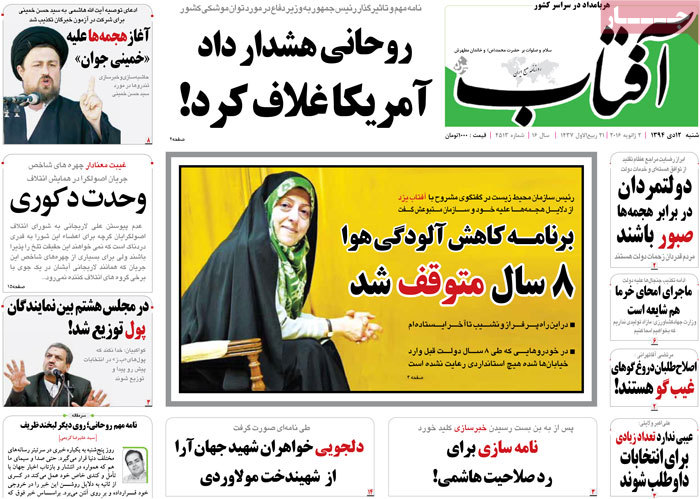
Aftab-e Yazd: The plan to ease air pollution stalled for eight years [a reference to Ahmadinejad’s presidency], said the director of the Environment Protection Organization.


A look at Iranian newspaper front pages on Jan. 2


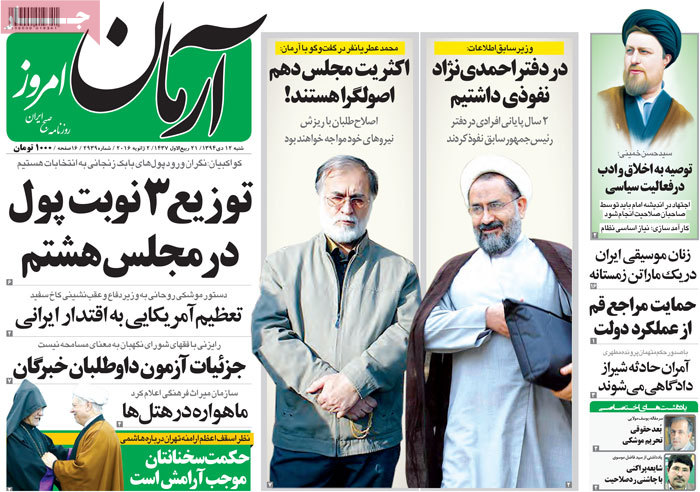
Arman-e Emrooz: The former intelligence minister has said that his men had infiltrated the Presidential Office in the final two years of Ahmadinejad presidency.

Arman-e Emrooz: Those who ordered an attack on Tehran MP Ali Motahari when he was in Shiraz to deliver a speech will go on trial.

The announcement came as a court in the southern city issued a verdict in the case of those who carried out the attack.


A look at Iranian newspaper front pages on Jan. 2


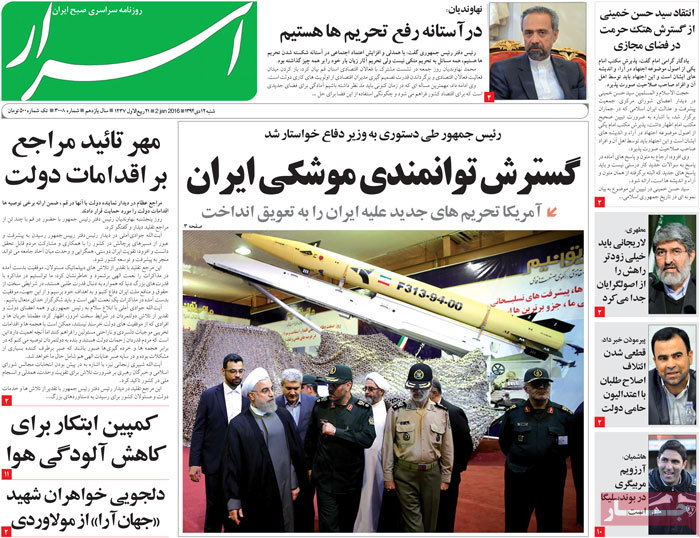
Asrar: President Rouhani’s chief of staff has said the sanctions are on the verge of being eliminated.

Asrar: Ali Motahari, an MP, has said Parliament Speaker Ali Larijani should have parted ways with principlists much earlier.


A look at Iranian newspaper front pages on Jan. 2


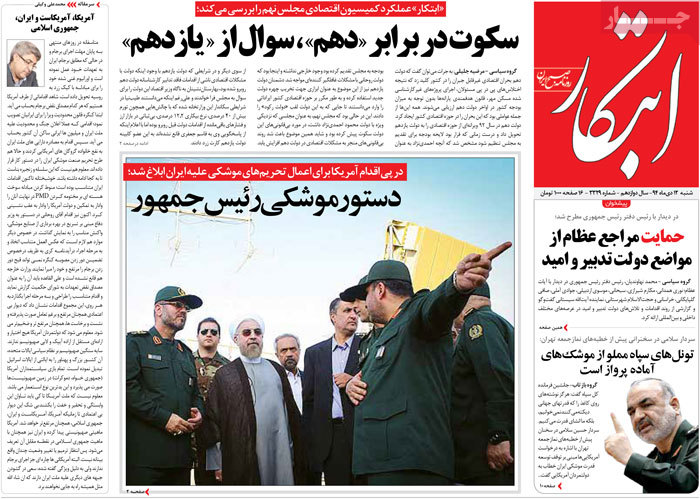
Ebtekar: Our tunnels are full of missiles ready to blast off, said Brigadier General Hossein Salami, the second in command of the Islamic Revolution Guard Corps.


A look at Iranian newspaper front pages on Jan. 2


Etemad: I hope Iran can develop missiles with a range of more than 5,000 km, said Mohsen Rezaei [a former Revolution Guards commander] in a letter to President Rouhani.


A look at Iranian newspaper front pages on Jan. 2


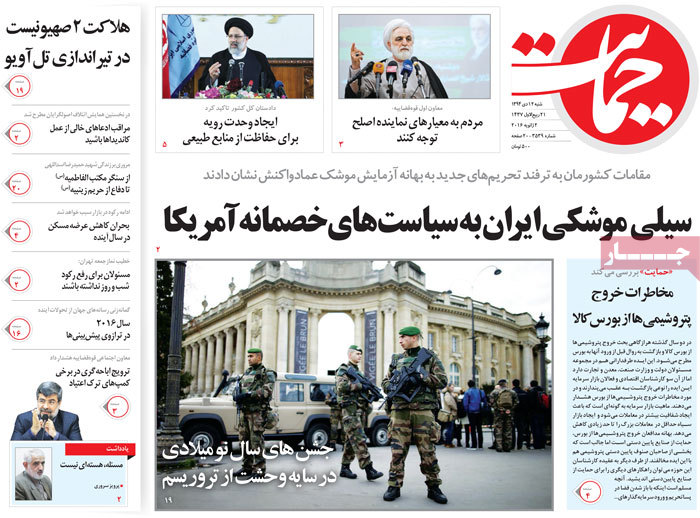
Hemayat: The attorney general has underlined a unified approach to protecting the environment.


A look at Iranian newspaper front pages on Jan. 2


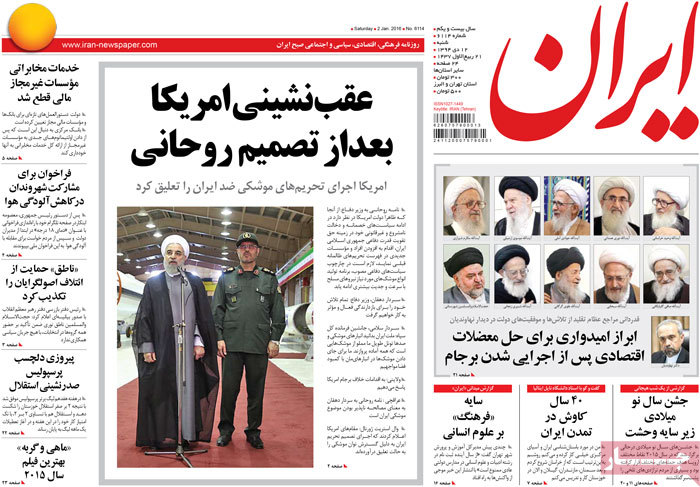
Iran: The US backed down after a decision by President Rouhani [to boost Iran’s missile capability].

New missile sanctions against Iran have been put off.


A look at Iranian newspaper front pages on Jan. 2


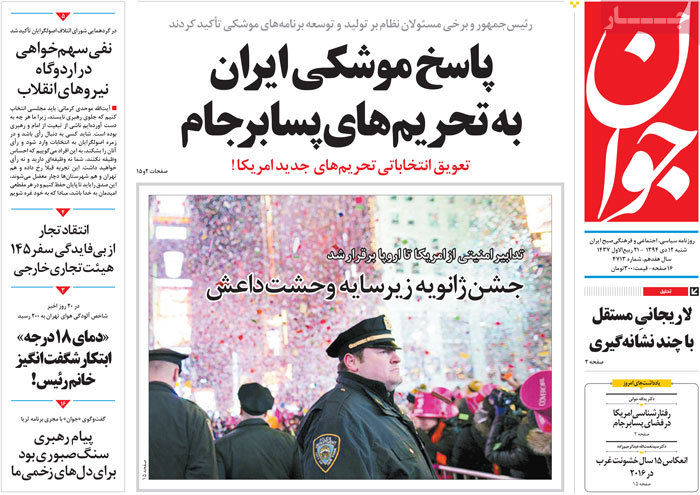
Javan: Iran’s missile response to the post-JCPOA sanctions

Imposition of sanctions has been put off.


A look at Iranian newspaper front pages on Jan. 2


Jomhouri Islami: Petrochemical products to receive €12 billion in finances.


A look at Iranian newspaper front pages on Jan. 2


Kayhan: Stopping the nuclear deal would be the best response to American audacity.


A look at Iranian newspaper front pages on Jan. 2


Khorasan: The director of the Hajj and Pilgrimage Organization has said that the exhumation of the bodies of a number of Iranian victims of the Mina tragedy has started.


A look at Iranian newspaper front pages on Jan. 2


Resalat: The Foreign Ministry spokesman has said Iran will respond to the American measures by boosting its defense capability.


A look at Iranian newspaper front pages on Jan. 2


Sharq: Applications by American citizens to travel to Iran have doubled.


A look at Iranian newspaper front pages on Jan. 2


Vaghaye-e Etefaghiyeh: Wait for the rhetoric to get tougher.

In an interview with the daily, Hossein Allah Karam has defended the insulting comments Yalasarat weekly published against the vice-president for women and family affairs.

We published that piece in line with the principle of freedom of speech, he said.


A look at Iranian newspaper front pages on Jan. 2


Highlights of Ettela’at newspaper on Jan. 2

 The president has ordered Iran’s missile capabilities boosted.

It came in reaction to continued hostilities by the US administration.

 The minister of roads and urban development has said that building high-rises has blocked Tehran airway.

 A two-stage increase in Iran’s oil output

A deputy oil minister has said that the country’s facilities are all set to raise crude production.

 Hamas has said that tens of thousands of Palestinian fighters are ready to take on Israel.

A senior Hamas leader said the future battle will be fought in the heart of Tel Aviv and Haifa.

 The grandson of the late Imam Khomeini has said that civility and fairness are imperative in politics.

Seyyed Hassan Khomeini further said infusion of efficiency into the establishment is what we need more than anything else.

 In separate meetings with the chief of staff of President Rouhani, senior Shiite scholars have urged the executive to exercise patience in the face of attacks.

 UNICEF has said that 700 Yemeni children have been killed in Saudi airstrikes.

Tightened security measures in Bahrain concerning: Iran

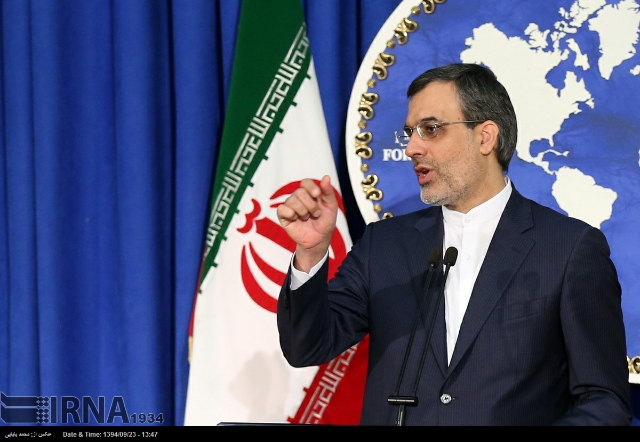
Jaber Ansari

Iran has expressed concern over tightened security measures in the face of the “legitimate civil demands” of the Bahraini people, saying the adoption of punitive action in the tiny Persian Gulf state is of no avail.

“The Islamic Republic of Iran believes that methods used by the Bahraini government will only intensify the crisis in the country and will provide an opportunity for enemies of the Muslim Ummah [to achieve their objectives],” Iran’s Foreign Ministry Spokesman Hossein Jaberi Ansari said on Friday.

He expressed hope that the Bahraini government would stop clinging to an “inefficient security approach” which has led to the complication of the situation in the country over the past four years.

He also advised the Arab country to resume serious dialog with recognized leaders of popular movements to find a peaceful and political solution to the country’s crisis.

In the latest instance of intensifying crackdown on dissent and members of civil society, a court in Bahrain on Thursday handed down a death sentence to one activist and life imprisonments to 22 others.

Bahrain’s Higher Criminal Court convicted the 23 Shias in connection with the death of a policeman last year. They were found guilty of terrorism-related charges, including setting off the explosives that killed the policeman.

The harsh verdicts are the latest in a string of court rulings in Bahrain involving people who have played a role in four years of popular protests and demonstrations in the kingdom.

Since March 2011, Bahrainis have taken to the streets to demand a change in the political system.

The regime in Manama has responded with a massive crackdown by killing dozens and arresting hundreds of people, including notable opposition leaders. The demonstrations have gradually turned into platforms for outright calls for the ouster of the Al Khalifa regime.

Amnesty International and other rights groups have repeatedly censured the Bahraini regime over the “rampant” human rights abuses against protesters.

Fresh protests

Several people were injured on Friday as Bahraini people took to the streets of the northwestern city of Sitra under strict security measures. Among those present in the rally were activists and family members of those killed in the crackdown by the Al Khalifa regime.

Regime forces responded by firing tear gas and birdshot at the defiant protesters, including children and women.

Fierce clashes also reportedly erupted between the Al Khalifa forces, backed by the armored vehicles, and protesters.

Sources also said the Al khalifa forces vandalized the property of some of the citizens in Sitra.

Let’s look for peace, not hostility in 2016: Rouhani

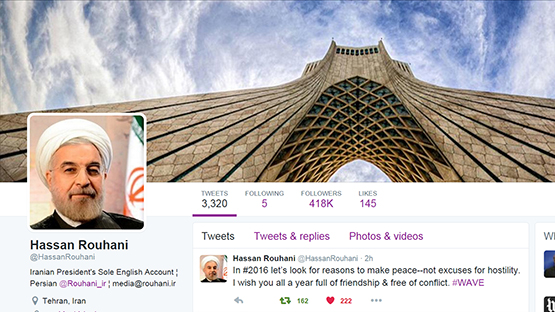
President Hassan Rouhani has offered New Year congratulations to people in the world, stressing the importance of promoting peace across the globe.

“In 2016, let’s look for reasons to make peace – not excuses for hostility,” Rouhani said in a congratulatory message on his Twitter page.

He wished all a year “full of friendship and free of conflict.”

Rouhani-tweet

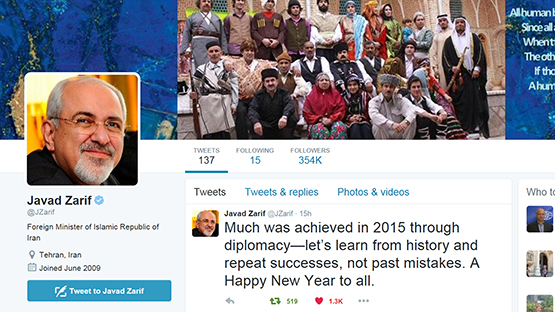
Foreign Minister Mohammad Javad Zarif too wished a happy New Year to all and reiterated the need for diplomacy to make achievements in dealing with ongoing developments.

“Much was achieved in 2015 through diplomacy – let’s learn from history and repeat successes, not past mistakes,” Zarif wrote on his Twitter page.


Zarif-Tweet


Iran draws red line on missile program

Defense Minister Brigadier General Hossein Dehqan said on Friday Iran will “forcefully continue boosting its missile capabilities within the framework of its defense policies.”

Dehqan’s remarks came in response to President Hassan Rouhani’s letter, ordering stepped-up production of missiles after reports that the US was preparing fresh sanctions on international companies and individuals in Iran.

“In view of America’s recent hostile steps and the esteemed President (Hassan Rouhani)’s emphasis, we will increase the speed and scope of our missile capabilities,” Dehqan said.

US officials claim the new sanctions are in line with the Joint Comprehensive Plan of Action (JCPOA), the nuclear agreement, and the Treasury Department can impose new sanctions on Iran over its missile development.

Leader of the Islamic Revolution Ayatollah Seyyed Ali Khamenei has made it clear that Iran would consider any new sanctions a breach of the JCPOA.

In an October letter to President Rouhani, outlining his conditional approval of the JCPOA, the Leader said that in case of a violation, “the government would be obliged to take necessary measures and halt JCPOA activities.”

On Friday, Dehqan said, “Iran’s missile capabilities have never been the subject of negotiations with the Americans and will never be.”

“Iran’s defense power is a guarantee for security and stability in the region,” he added.

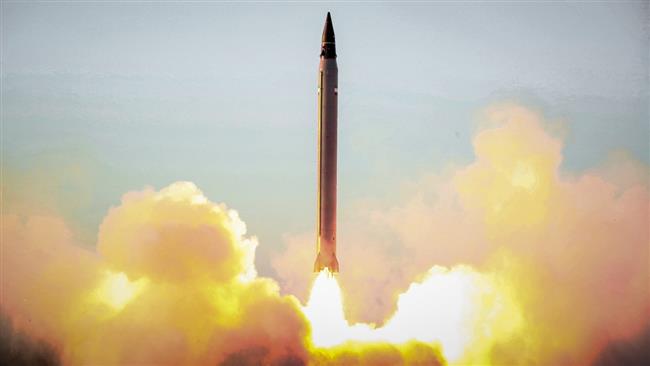
Iran tested a conventional missile in October, prompting several politicians in the US to call for fresh sanctions on the Islamic Republic.

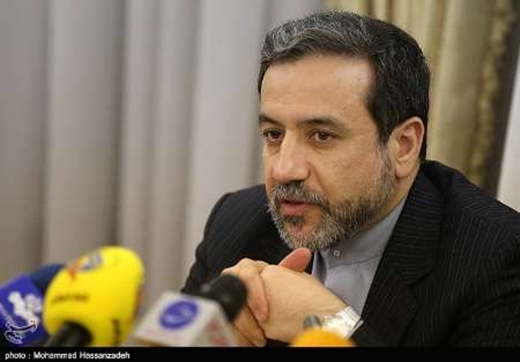
Senior nuclear negotiator Abbas Araqchi said the test did not violate the July nuclear accord.

“There is a clear difference between the JCPOA issue and the missile test and the missile test is not a breach of the JCPOA in any way,” he told the national television on Thursday night.

Araqchi said President Rouhani’s letter indicated that Iran’s missile program is not negotiable.

Deputy commander of the Islamic Revolution Guards Corps (IRGC) Gen. Hossein Salami said Iran will accelerate expanding its missile capabilities.

“The Iranian nation should know that our missile depots and long tunnels are filled with missiles ready for launch,” he told worshipers before Friday Prayers in Tehran.

Salami reiterated IRGC’s denial of a rocket test near US warships in the Strait of Hormuz.

“We tell the Americans we are so powerful, strong, brave and realistic that if we launched a missile, we would publicly announce it,” he said.

“The Americans must know that our tactics are a function of our strategies and we will not engage in any blind action. Whether they are scared or worried is not our business,” Salami added.

On Thursday, the Wall Street Journal said the White House had delayed plans to slap new sanctions on Iran but the measures remained on the table.

A senior Iranian politician, Ali Akbar Velayati, said Tehran would respond to new US sanctions.

“This measure by the American government and stepped-up sanctions will adversely affect the Islamic Republic of Iran’s good will but it will not go unanswered by the state officials,” he said.

Araqchi: Iran missile test never violates JCPOA

Araghchi

Noting that President Hassan Rouhani’s letter to Defense Minister Brigadier General Hossein Dehqan means Iran’s missile program will not be compromised, he said that the country’s missile program is quite distinct from JCPOA.

Araqchi, also head of the Headquarters for Pursuing Implementation of JCPOA, added in a televised interview on Thursday night that the nuclear deal does not imply an end to the US’ enmity against Iran and that the enmities will not terminate.

Until the time Iran is withstanding against the US policies in the region, Washington’s hostile policies against Tehran will continue, he said.

Asked whether the US hostile approach immediately after the exit of uranium from Iran has a special message, he replied that elements within the US administration are seeking to kill the nuclear deal.

They have also attempted in the past two years to block the progress of the talks and after the talks and also created obstacles in the way of its approval by the US Congress, Araqchi added.

The Zionist and regional lobbies which are playing a crucial role in the US policies are attempting to prevent implementation of the JCPOA, he said.

Stating that six UN anti-Iran resolutions are in force, he said all past resolutions will hopefully be rescinded within the next two weeks.

The Americans are seeking to sanction certain elements involved in the missile test under the pretext of violating resolutions, the official said.

The US is attempting to put 11 legal and real persons as well as eight individuals’ cooperation with Iran’s missile program in the list of sanctions, he said.

Araqchi reiterated that Iran’s missile program will continue unwaveringly as the president in his letter insisted that the program is non-negotiable.

Happy New Year

NewYear2016

The staff at IFP would like to offer your hearty congratulations on the turn of year and wish you the best in 2016.

May 2016 bring you peace, joy, success, and of course good health.


Rouhani orders Iran’s missile program accelerated

Rouhani

In a decree to Iran’s Defense Minister Brigadier General Hossein Dehqan on Thursday, Rouhani ordered an acceleration in Iran’s program for production of “various types of missile” needed to improve the country’s defense capabilities.

The decree came a day after a report by The Wall Street Journal that Washington is preparing sanctions against firms and individuals in Iran, Hong Kong and the United Arab Emirates over alleged links to Iran’s ballistic missile program.

The planned new sanctions come as the US is obligated under a recent nuclear deal between Iran and the P5+1 group of countries, known as the Joint Comprehensive Plan of Action (JCPOA), to lift the sanctions on Iran over its nuclear program.

The lifting of the bans is expected to come in January as Iran is swiftly moving to carry out its commitment under the deal, namely curbing its nuclear program.

Rouhani, in his decree to Dehqan, called the purported plan by the White House a measure in line with hostile US policies to “illegally interfere in the Islamic Republic of Iran’s programs for boosting the defense power.”

“In line with the [country’s] ratified defense policies, it is necessary that the program for the production of various types of missiles needed for (Iranian) Armed Forces continue with more speed and seriousness,” Rouhani said.

The Iranian president also warned that in case the US repeats such “wrong and interventionist” measures, the Iranian Defense Ministry must develop a new plan for expanding the country’s missile capabilities.

Rouhani said that Iran’s missile power, which he described as a means to protect the country’s sovereignty and a major deterrence against terrorism in the Middle East and the world, has never been up for negotiations, including in the nuclear talks with the P5+1 group – the five permanent members of the UN Security Council plus Germany – which resulted in the JCPOA in Austria on July 14.

He once again rejected claims that Iran is planning to produce missiles capable of carrying nuclear warheads, saying that Iran will continue to produce and test ballistic missiles as a “conventional and important” instrument for defending the country.

“It is clear that Iran’s missile program has never been part of the JCPOA, as [already] acknowledged by US officials,” said Rouhani, stressing that “nuclear weapons have no place in Iran’s defense doctrine; therefore, Iran’s ballistic missiles have not been designed to carry nuclear warheads.”

The Iranian chief executive further said the Islamic Republic would not accept any restrictions on its legitimate right to promote its defense might.


IRGC rejects rocket test near US warships

Technical Features of IRGC's Coronavirus Detection System to Be Announced Soon

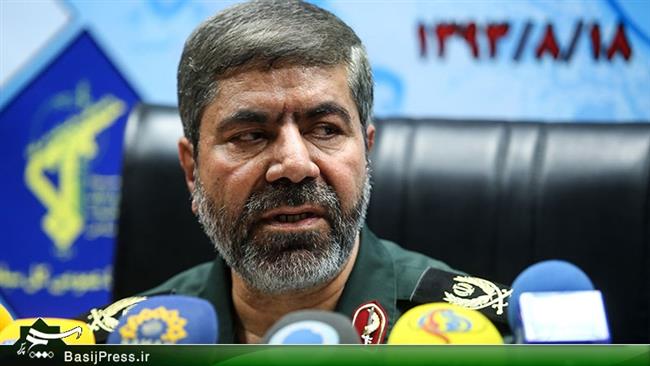
Iran’s Islamic Revolution Guards Corps has dismissed US accusations of a rocket test near American warships in the Strait of Hormuz in the Persian Gulf.

“The IRGC Navy has had no drill in the Strait of Hormuz over the past week during the time claimed by the Americans for launch of a rocket or missile,” head of the IRGC’s Public Relations Office Brig. Gen. Ramezan Sharif said on Thursday.

The rebuttal came a day after the US accused Iran of launching a “highly provocative” rocket test last week near its warships and commercial traffic passing through the Strait of Hormuz.

“Publication of such false reports under the current conditions is more of a psychological warfare and questionable,” Sharif said.

“Security and peace in the Persian Gulf is among serious strategies for Iran and the Guards carries out its drills according to the table of its programs at the prearranged time in order to upgrade required preparedness in this field,” he added.