
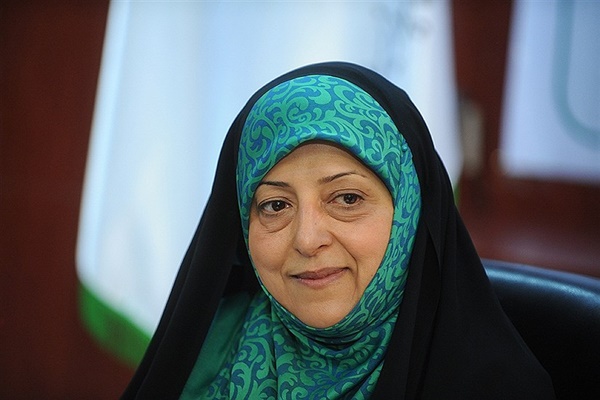
She made the remarks at the 2nd International Seminar on Environment, Religion, and Culture.
Masoumeh Ebtekar said that Iran has taken effective steps to protect the environment at the national level, and that programs have been designed to keep up with the international standards.
Referring to the signing of the Paris climate deal by Iran’s Foreign Minister at the UN on April 22, she hoped that the international community would adopt effective measures to lower greenhouse effects.
She said that destruction of green areas, reductions in water resources, and soil pollution have posed threats to the future of the Earth.
Ebtekar said that religious teachings call for protection of the environment by their followers.
She praised the cooperation between UNESCO and UNEP in holding this event.
The 2nd International Seminar on Environment, Religion, and Culture is held from April 23-24.
Iran Signs Climate Change Deal to Reduce Greenhouse Effects: Ebtekar
Falling Asleep While Listening to Symphony of F-16
Here in the IFP, we usually do not write comments or articles. Our job is to cover the reports and comments published by Iranian media on the most recent developments in the world. This is how we introduce Iran and the Iranians to non-Iranians!
However, we are sometimes tempted to write. It is like having a lump in our throat. We feel like we should shout, or else we would not get rid of it.
We are living in the Middle East, the region of war and crisis. However, in an amazing and admirable way, Iran is stable and its people live in peace. In a country where citizens are upset by the huge number of people killed in car accidents, and the media keep urging its officials to do something about the dangerous roads and improve the traffic problem, one should be happy that everything is so simple, and no one talks about getting killed by a skilled shooter or a bomb explosion!
Nevertheless, Iran has paid the price for its position in the Middle East and its oil reserves: it has had the horrible experience of an eight-year war whose memories still linger in people’s minds, especially when funerals are held every now and then for the newly-excavated bones and dog tags of soldiers.
To these people, fighter jets – whether a MiG-29, a French-made Mirage, an F-4 or F-5 or F-14, and so on – just bombard and kill innocent people, and are of no other use.
Now, something strange has happened; something that tempts one to write, even if it seems more like a dream. Is it possible to give over all fighter jets to such organizations as the Red Cross or Red Crescent, the Doctors without Borders (MSF), and the like, and stop killing people for a few years?
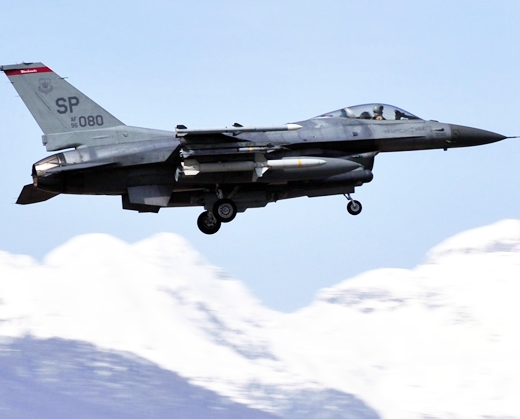
Saving a human’s life using an F-16 fighter jet might be a meaningful incident under the current situation in the world; in an era when fighter planes in Syria, Yemen, and Libya are competing with each other for killing more people, oh my God, is it possible for an F-16 to save a man’s life? Is it for real or is it just a dream? I do not at all want to wake up and hear someone saying that the location of operation and the patient’s nationality matter! These planes are built to kill you and your siblings! Do not think wishfully!
But no, that is a lie. All human beings are like each other. Nations are not the enemy of each other. Religion is a means of kindness and flexibility. People of the Middle East, Africa, Europe, America, etc. are not hostile to each other. They have no enemy more savage than ignorant rulers.
I fell asleep with the roar of a fighter jet. Isn’t it strange? I am not at all ready to hear Donald Trump’s voice. Trumps are like each other everywhere in the world. I do not want to wake up, even if the price is to remain asleep forever.
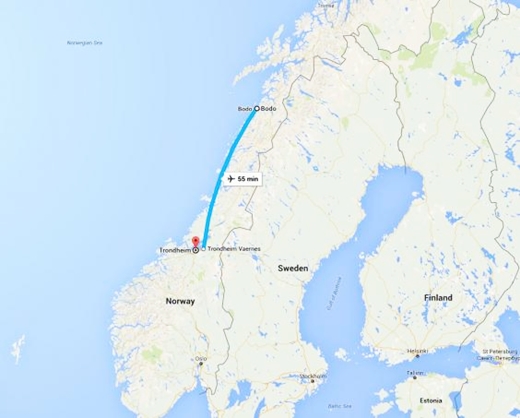
A critically ill patient’s life was saved after an F-16 fighter jet was used to rush specialised medical equipment halfway across Norway in less than half an hour, according to a report by the Independent.
Doctors knew the closest one available was at a hospital in Trondheim, 280 miles to the south. A 10-hour journey by car, they feared the man would die before it could arrive.
Therefore, after a moment of inspiration, they decided to contact an air force base near Trondheim to ask if there was any hope of getting the equipment to Bodø in time to save the patient, whose precise condition was unclear.
Within 40 minutes of the call being received, the medical equipment had been delivered to the hospital in Bodø.
Bright prospect for Iran-South Africa cooperation
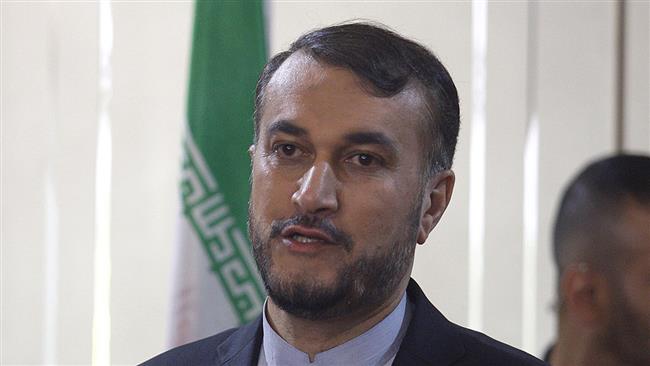
In an article printed in Saturday issue of the Persian daily ‘Iran’, Amir Abdollahian noted that the African continent in general and South Africa in particular have had abundant attractions for the emerging economies. Therefore, he added, in the past decade markets of those countries have become an arena for intensive rivalry of foreign countries.
He stressed that in recent years the Islamic Republic of Iran has taken great strides for the strengthening of the private sector and the emphatic instructions of the Supreme Leader for the implementation of Article 44 of the Constitution and the ‘resistance economy’ require preparation for development of Iran’s presence in international markets.
Pointing to the forthcoming visit of South African President Jacob Zuma to Tehran, he said ground is now prepared for the expansion of bilateral cooperation in the private and public sectors. He announced that simultaneously with the visit of President Zuma to Tehran the grand bilateral trade assembly will be held.
Amir Abdollahian further remarked that in the past decade bilateral relations between Iran and South Africa have surpassed oil so that activities of the two big telecommunication companies of MTN and Sasol are considered successful examples of mutual cooperation and joint ventures which can be generalized in other areas.
He said prior to the imposition of unjust sanctions against Iran economic and trade ties between the two countries enjoyed a specific status on the basis of which Iran was among the 10 major trade partners of South Africa and supplied 25% of the crude oil requirements of the refineries in that country.
But, he stressed, with the escalation of the sanctions against Iran since summer of 2012 refining companies of that country stopped purchasing oil from the Islamic Republic of Iran.
Elsewhere in his article, Amir Abdollahian referred to the role South Africa plays in developing peace and stability in the African continent and Iran’s role in pursuing to strengthen peace, stability and sustainable security in the region and the world.
He noted that the two countries’ approach to important international issues such as terrorism, support for Palestinian people and opposition to foreign interference in other countries, including Syria, are close to each other.
He said similarities of geographical locations, capabilities and capacities between Iran and South Africa have provided for the mutual access of the two countries to regional markets in the Middle East, Central Asia and South Africa.
Referring to bilateral relations between Iran and South Africa Amir Abdollahian said with the victory of the people, removal of the apartheid regime and election of Nelson Mandela diplomatic relations between the two countries resumed in 1994.
“Norfolk” different from its script: director
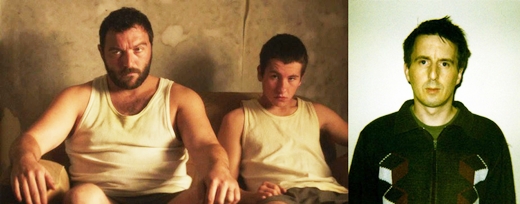
“Norfolk” starring Denis Menochet and Barry Keoghan is a haunting thriller about a reclusive father and son whose close relationship is threatened when the father’s violent past catches up with them.
In a recent email interview with the Tehran Times, Radich talked about his father-son drama. The following is the full text of the interview:
Q: What was it that enticed you into making the movie considering the fact that the idea behind it came from two photographs, one of which depicts you as a ten-year-old boy and the other a World War II soldier.
A: Often ideas for stories are kick-started by an image. Many years ago I came across a photograph of a soldier from World War II.
I would stare at his face but be unable to figure out his expression. One moment he seemed heroic, the next shell-shocked. His gaze could be both alert and vacant.
I liked that idea of people and scenarios being read in two completely opposite directions. And then I remembered visiting Norfolk when I was ten years old; how mysterious it seemed to me.
It felt like I was the first person to ever walk these lands and travel down those rivers.
These two images became the two main characters in the film – the father and son.
Q: What was the toughest part about making “Norfolk” and what was the most rewarding?
A: Without question, the toughest part is realizing that the tiny budget you have cannot make the film that you’ve written.
I am incredibly proud of the script but when I glance back at it I am reminded of all the wonderful scenes and characters that we had to let go of. That is tough.
I always knew the budget, I thought I wrote the script knowing the budget, but I was naive in regards to the costs of shooting on the water and how many days we would actually get to shoot the film.
Always the greatest pleasure is being on set with the actors. Your words on paper come to life before your very eyes. This is very exciting.
Q: How did the project change from your original idea to the final production?
A: As mentioned previously, the film is considerably different from the script. I wrote a script that was seventy pages long but the scene count was astronomical.
We had only twenty-two days to shoot something like six or seven or eight scenes per day. Something had to give.
Q: How did your film find its way to the official section of the 34th Fajr International Film Festival?
A: I believe our international sales agent sold the film to Iran at the European Film Market and, as a consequence, it was selected for Fajr.
Q: What clear message do you expect the audiences receive after watching your film?
A: That simply communicating with one another is the key to understanding one another. Keeping thoughts and emotions locked inside leads to colossal misunderstandings. This might seem like an obvious point to make but somehow it’s forgotten the world over.
Q: With all of your knowledge and experience, what is the one lesson you would share with the novice filmmakers?
A: If you can’t please your soul then you can’t please yourself… Stay true to who you are. Do not mimic other filmmakers. Do not bend to fashion. This way your work will be unique. That is something special.
Grand Ayatollahs Strongly Support Nuclear Deal
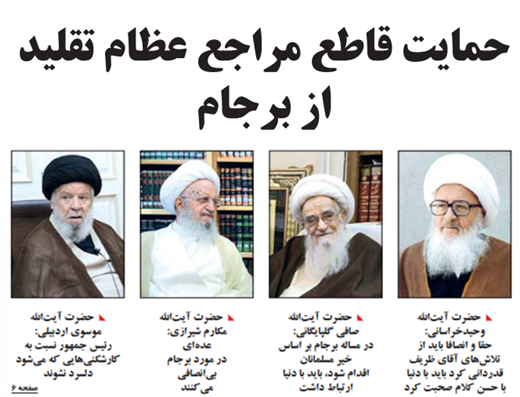
Grand Ayatollah Hossein Vahid Khorasani said the efforts made by Foreign Minister Mohammad Javad Zarif should truly be appreciated.
He underlined the significance of “talking to the world in a proper way”, and stressed that it is a religious order emphasized by Islam.
Grand Ayatollah Lotfollah Safi Golpayegani also pointed to the JCPOA, and urged the government to do what is in the interest of Muslims.
“At the same time, we should have interaction and connection with the world,” he added.
Grand Ayatollah Abdul-Karim Mousavi Ardebili asked the health minister to urge President Rouhani not to get disappointed by the troubles made for JCPOA implementation and seriously pursue the resolution of people’s problems.
Meanwhile, Grand Ayatollah Nasser Makarem Shirazi expressed surprise that even though Ayatollah Seyed Ali Khamenei, the Leader of the Islamic Revolution, has agreed about the JCPOA, some people, claiming to be his followers, consider the deal a treason, and are opposed to it.
“Some are really unfair towards the JCPOA. The fact is that it is now done, and we should not forget that the other side is a sly one, and gives concessions little by little. It does not want us to have power in the region, and thus do not tolerate Iran’s presence as a strong country,” he added.
Qazizadeh Hashemi, for his part, told the Qom-based Grand Ayatollahs that the JCPOA is a good opportunity to settle the country’s problems. “We should tap into the chance,” he noted.
Iran and Canada to Cooperate on Oil Industry Equipment Construction

On this cooperation with other companies, Amirabbas Hosseini , Technology and International Relations Deputy from the Research Institute of the Petroleum Industry, told IRNA that Iran and Canada will cooperate in constructing equipment for oil industry surface facilities and desalination installations.
In addition to Canada, negotiations have been conducted with some European and Asian countries to exploit new technologies in the oil and petroleum reservoir industries, and the contracts will be signed soon.
The Director of Research and Technology at the Iranian Offshore Oil Company (IOOC) said that the Canadian company had previously started cooperation with Iran, and that the project of investigating the economic justification and the feasibility study of the Binaloud oil field development was assigned to this company.
Iran Signs Deal to Export Heavy Water to US
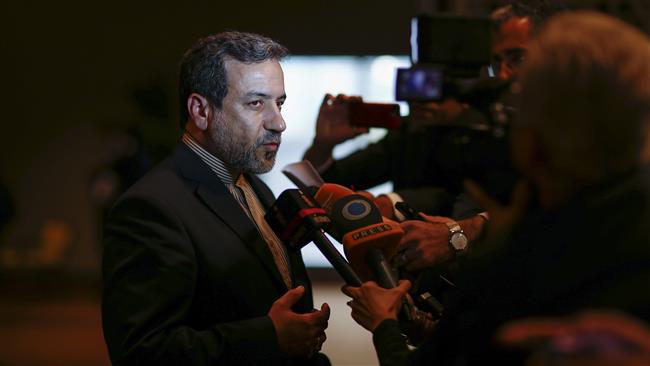
Araqchi, who is in Vienna to attend talks with the EU on formula for the third Iran-G5+1 joint commission meeting, said the Iranian delegation had signed the deal with a US company on Friday.
Iran had been negotiating a commercial contract for three months, and finally the Iranian delegation signed a deal to sell as much as 32 tons of Iran’s excess heavy water supplies to a US company, he explained.
Araqchi added that some other countries have voiced interest in buying heavy water from Iran.
Iran is currently negotiating with some other parties for the export of heavy water, the deputy foreign minister noted.
Exporting heavy water supplies to the US is a major step for Iran, one which is expected to take the country toward the commercialization of its nuclear energy program.
A Look at Iranian Newspaper Front Pages on Apr. 23

The majority of newspapers today covered the remarks made on Wednesday by the Leader of the Islamic Revolution, Ayatollah Seyed Ali Khamenei, against Saudi Arabia and the United States.
They also covered President Hassan Rouhani’s comments on a recent plan by the Iranian police to utilize 7,000 plainclothes police and auxiliaries for “moral security”.
Foreign policy was another prominent topic, with headlines about Foreign Minister Mohammad Javad Zarif’s meeting with his US counterpart John Kerry in New York, as well as on another meeting in the Austrian capital of Vienna on the implementation of the nuclear deal between Iran and world powers (JCPOA).
There were also numerous articles on a recent US court ruling to seize Iran’s assets and the reactions by the Iranian foreign ministry, as well as lots of commentary on US President Barack Obama’s state visit to Saudi Arabia, where he urged Arab monarchies to avoid conflict with Iran.
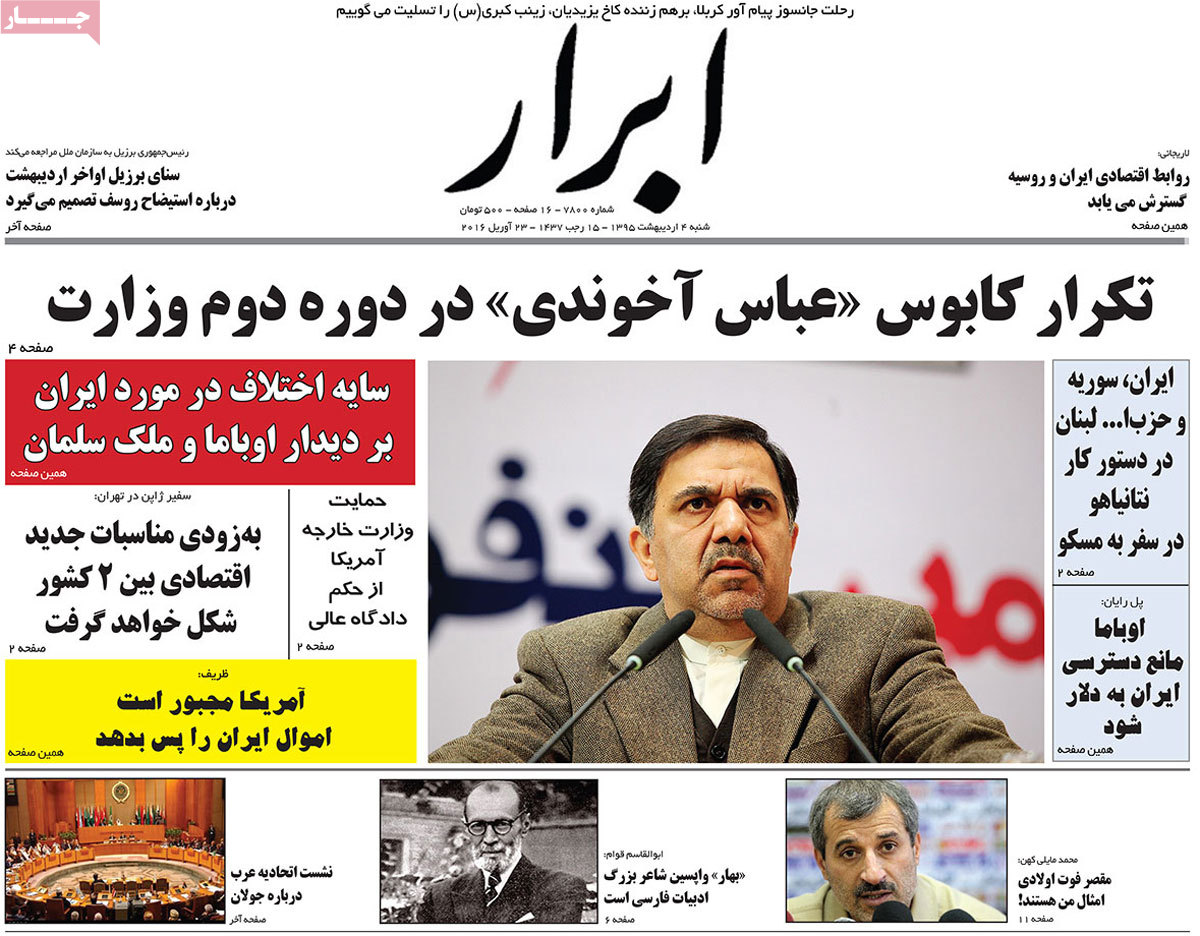
Abrar:
1-Iran, Syria and Lebanon’s Hezbollah on Israeli PM’s Agenda for Moscow Visit
2-Iran and Russia to Expand Bilateral Economic Ties: Parliament Speaker
3-House Speaker Ryan Urges Obama to Prevent Iran’s Access to US Dollar
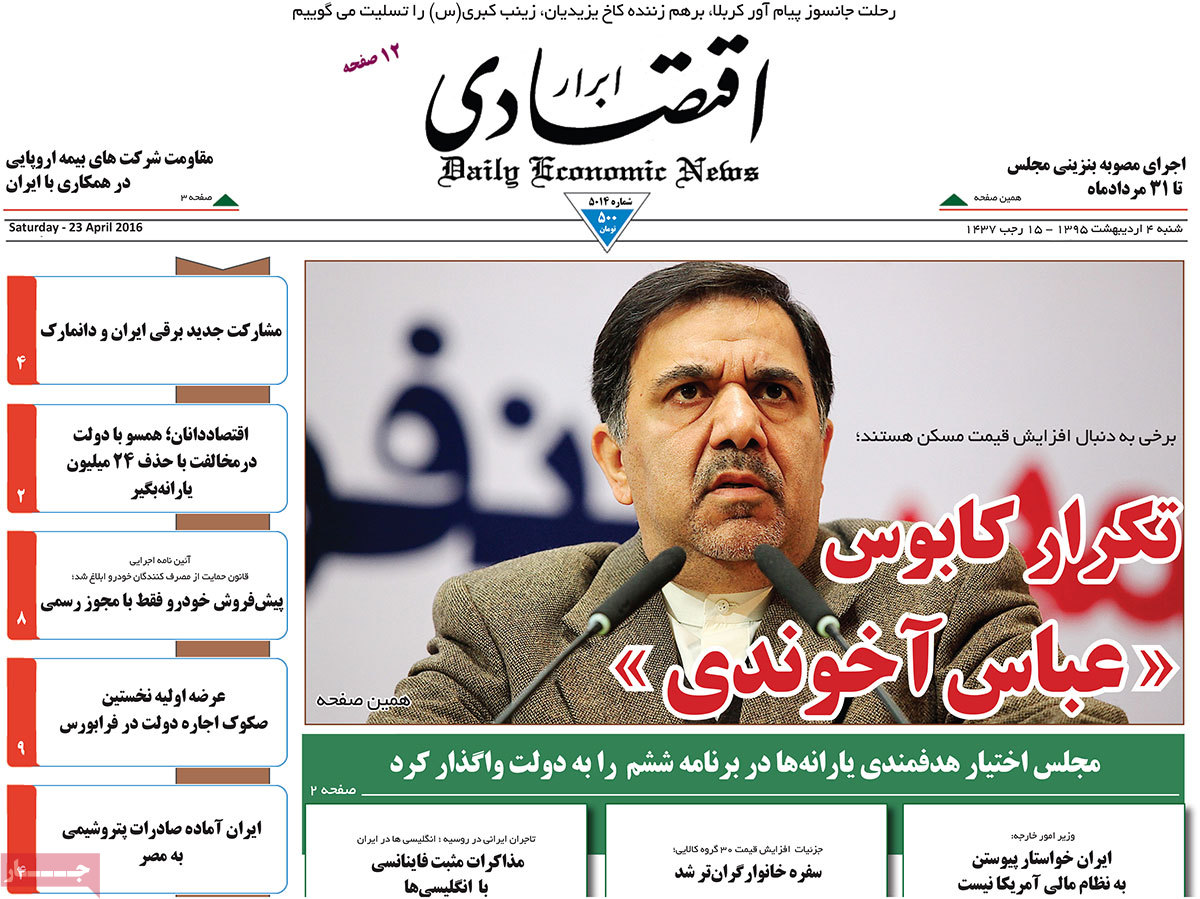
Abrar-e Eqtesadi:
1-Iranian Businessmen in Russia, Britons in Iran: Positive Financial Talks with Britain
2-Iran Not Willing to Join US Monetary System: FM Zarif
3-European Insurance Companies Show Resistance in Cooperation with Iran
4-Iran and Denmark to Start Power Cooperation
5-Iran Ready to Export Petrochemical Products to Egypt
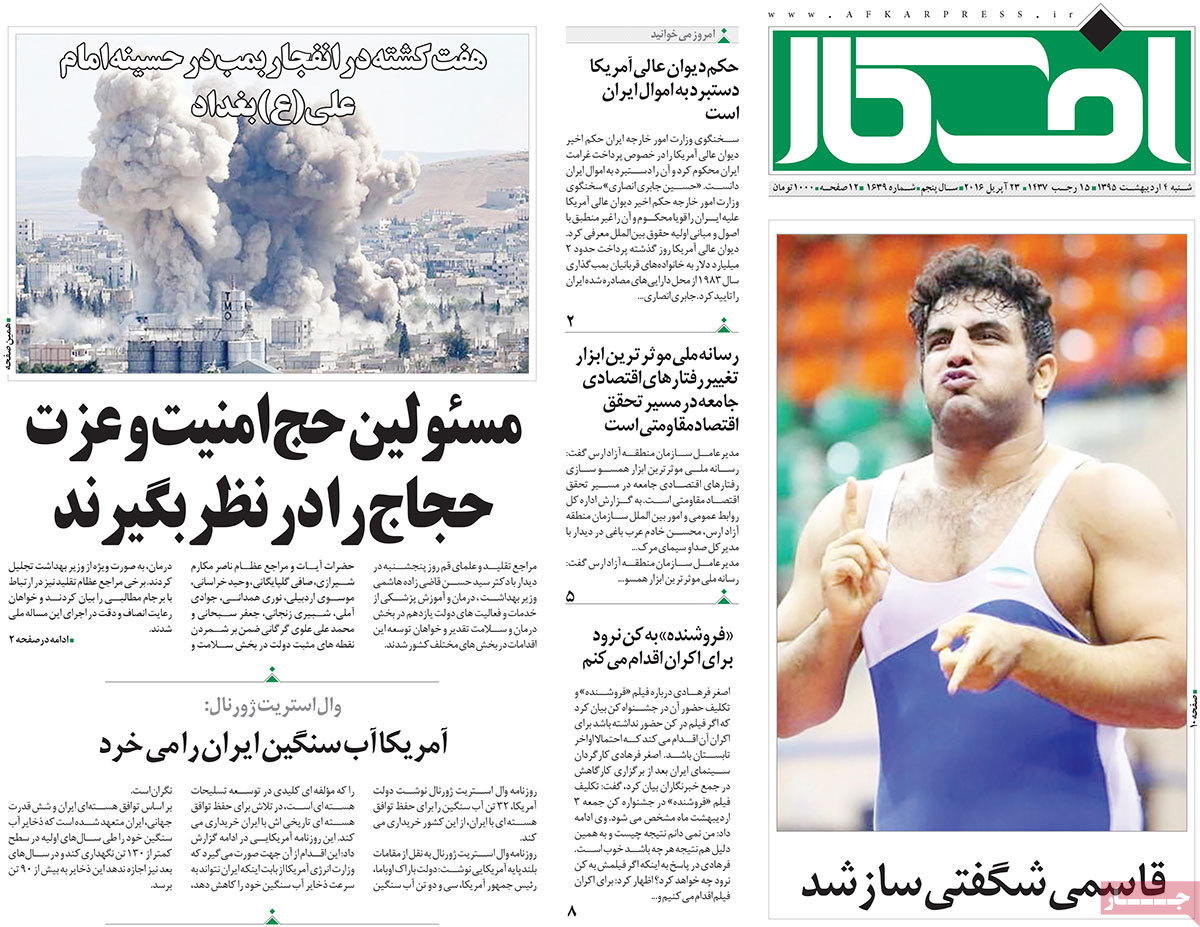
Afkar:
1-US Court Ruling Is Appropriation of Iran’s Property: Spokesman
2-Seven Killed in an Explosion in Baghdad’s Imam Ali Mosque
3-US to Purchase Iran’s Heavy Water: Wall Street Journal Reports
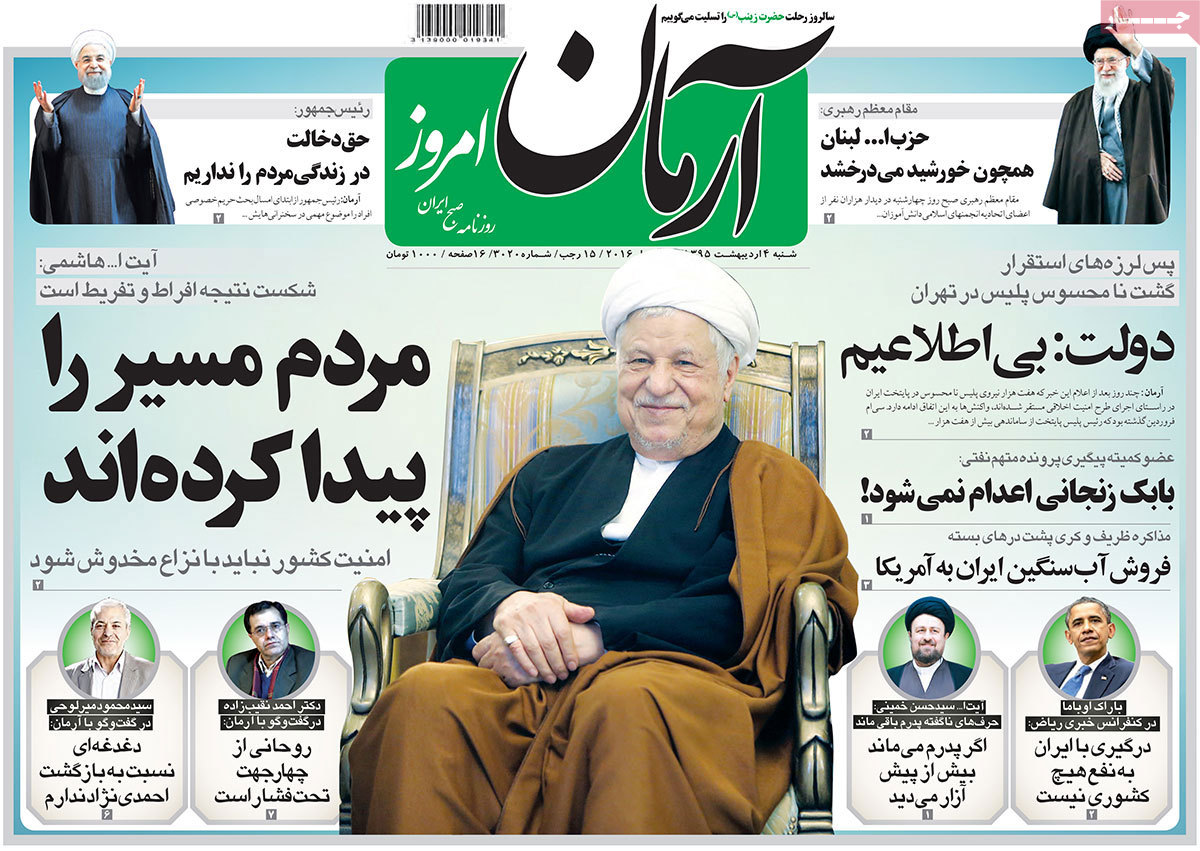
Arman-e Emrooz:
1- Iran’s President: We Have No Right to Interfere in People’s Lives
2-Conflict with Iran Not in Anyone’s Interest: Obama in Riyadh
3-Ayatollah Khamenei: Lebanon’s Hezbollah Shining Like the Sun
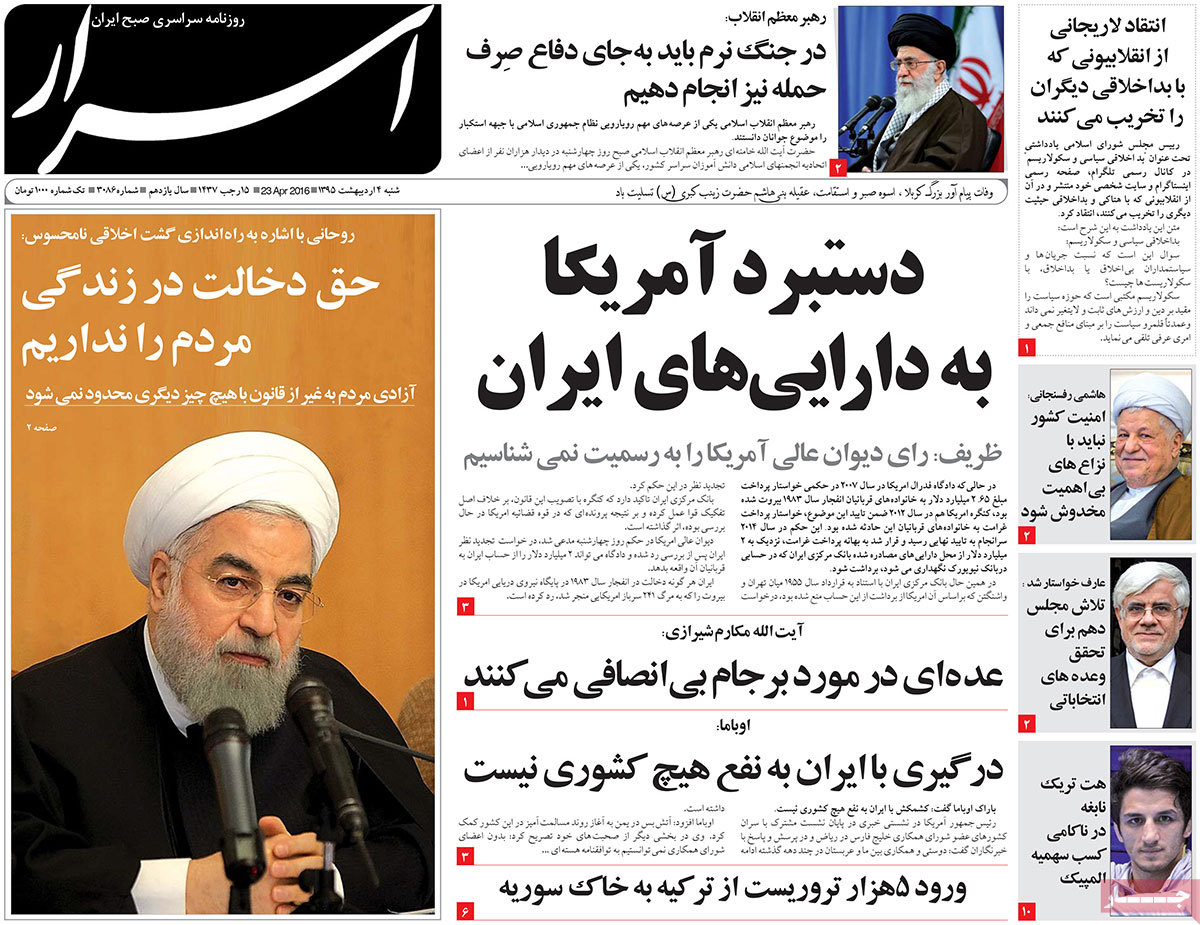
Asrar:
1-Senior Cleric Makarem Shirazi Raps Unfair Treatment of JCPOA
2-5,000 Terrorists Arrive in Syria through Turkey
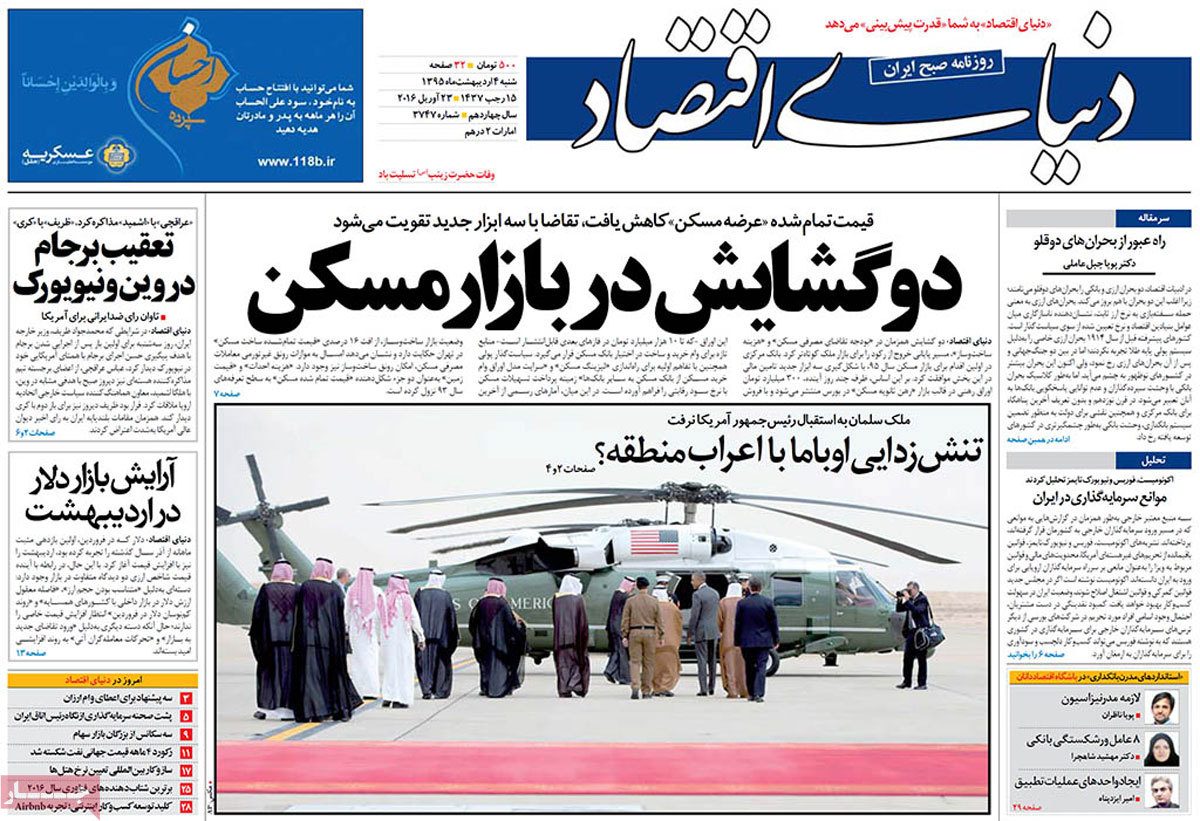
Donyaye Eqtesad:
1- Saudi King Salman Refuses to Welcome US President: Obama Easing Tensions with Middle East Arabs?
2- JCPOA Implementation Pursued by Iranian Diplomats in Vienna and New York
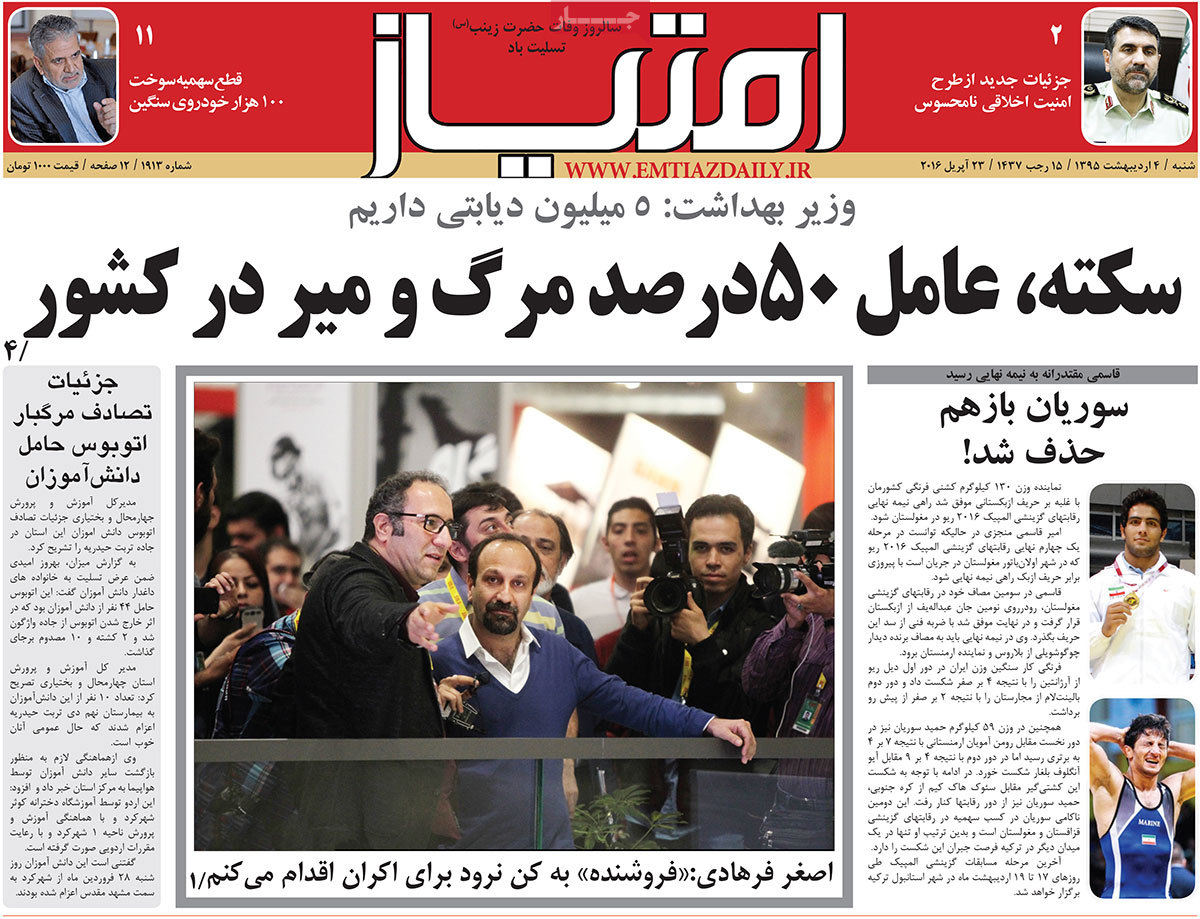
Emtiaz:
1-Five Million Iranian People Diagnosed with Diabetes: Health Minister
2-Strokes and Heart Attacks Account for 50% of Deaths in Iran: Minister
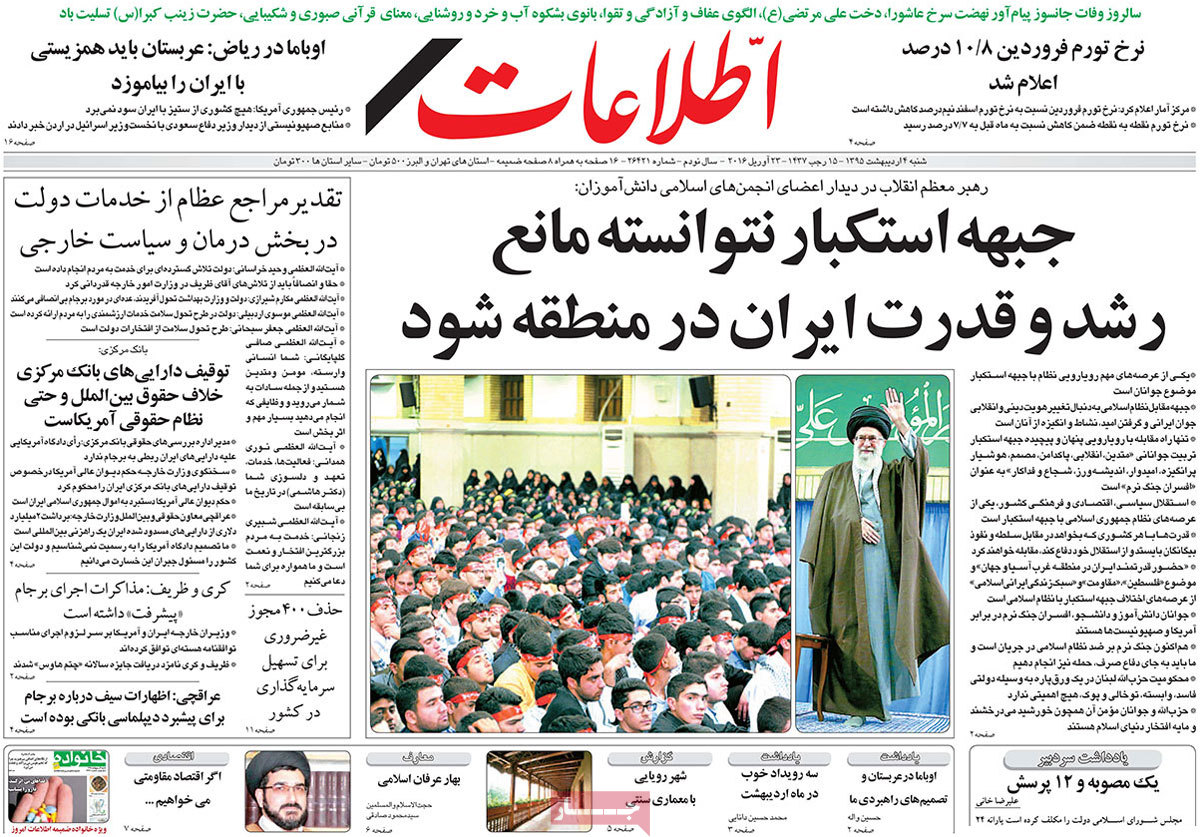
Ettela’at:
1-Leader: Hegemonic Powers Failed to Prevent Iran’s Regional Power
2- Inflation Rate Stands at 10.8% in Farvardin (Mar. 20-Apr. 19)
3-Top Iranian Clerics Praise Rouhani’s Administration on Healthcare and Foreign Policy
4-Seizure of Iran’s Assets against Int’l Laws and Even US Legal System: CBI
5-Progress Made in JCPOA Implementation Talks: Kerry and Zarif after Meeting in New York
6-Saudi Arabia Needs to Learn to Co-Exist with Iran: Obama
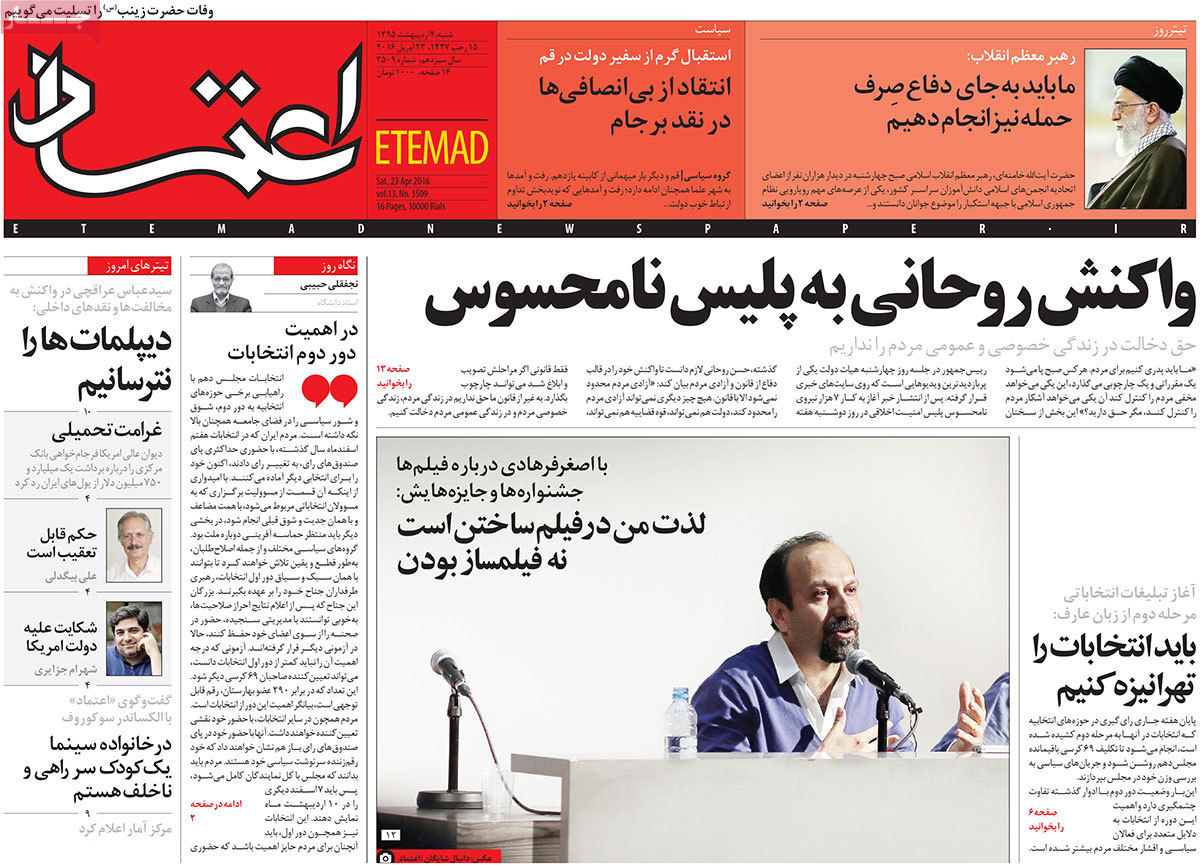
Etemad:
1-Iranian Businessman Jazayeri to Sue US Administration over Iran Sanctions
2-Asghar Farhadi: I Enjoy Making Films, Not Being a Filmmaker
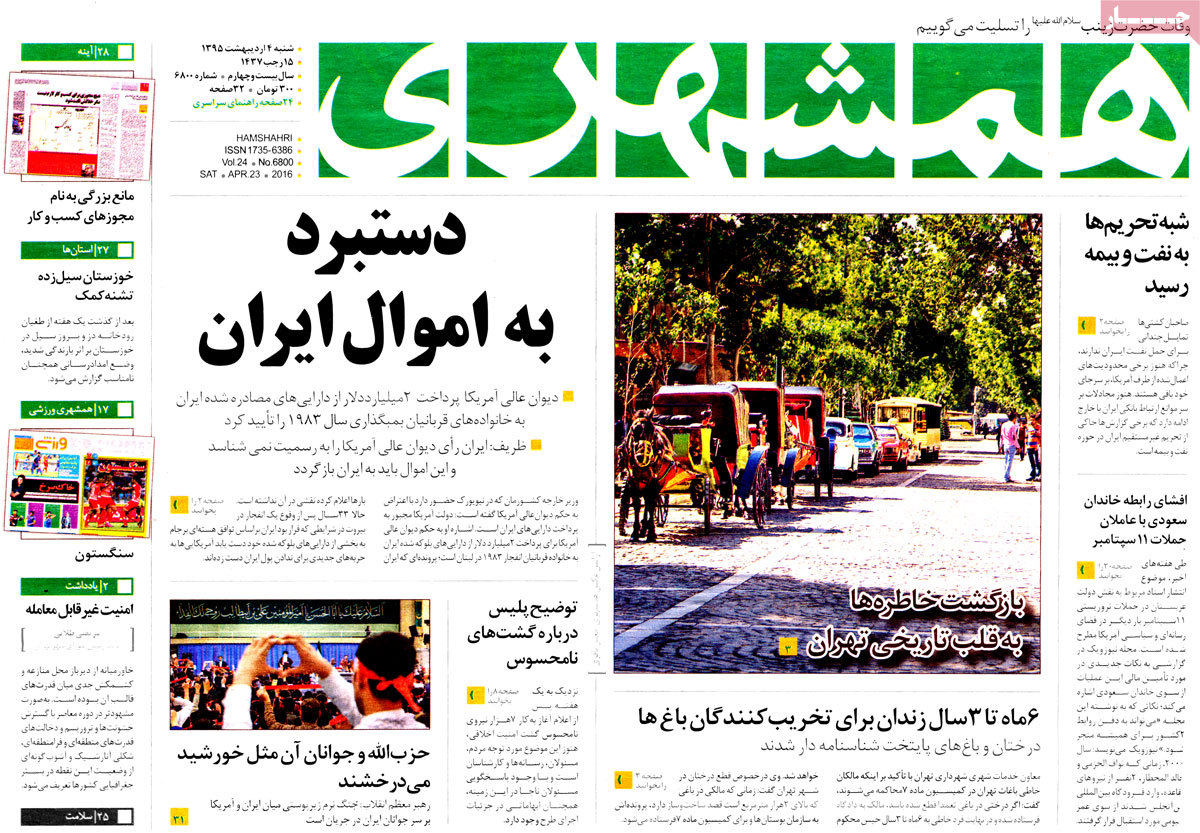
Hamshahri:
1-6 Months to 3 Years of Prison for Those Who Destroy Gardens in Iran
2-Links Revealed between Al Saud Royal Family and 9/11 Attacks
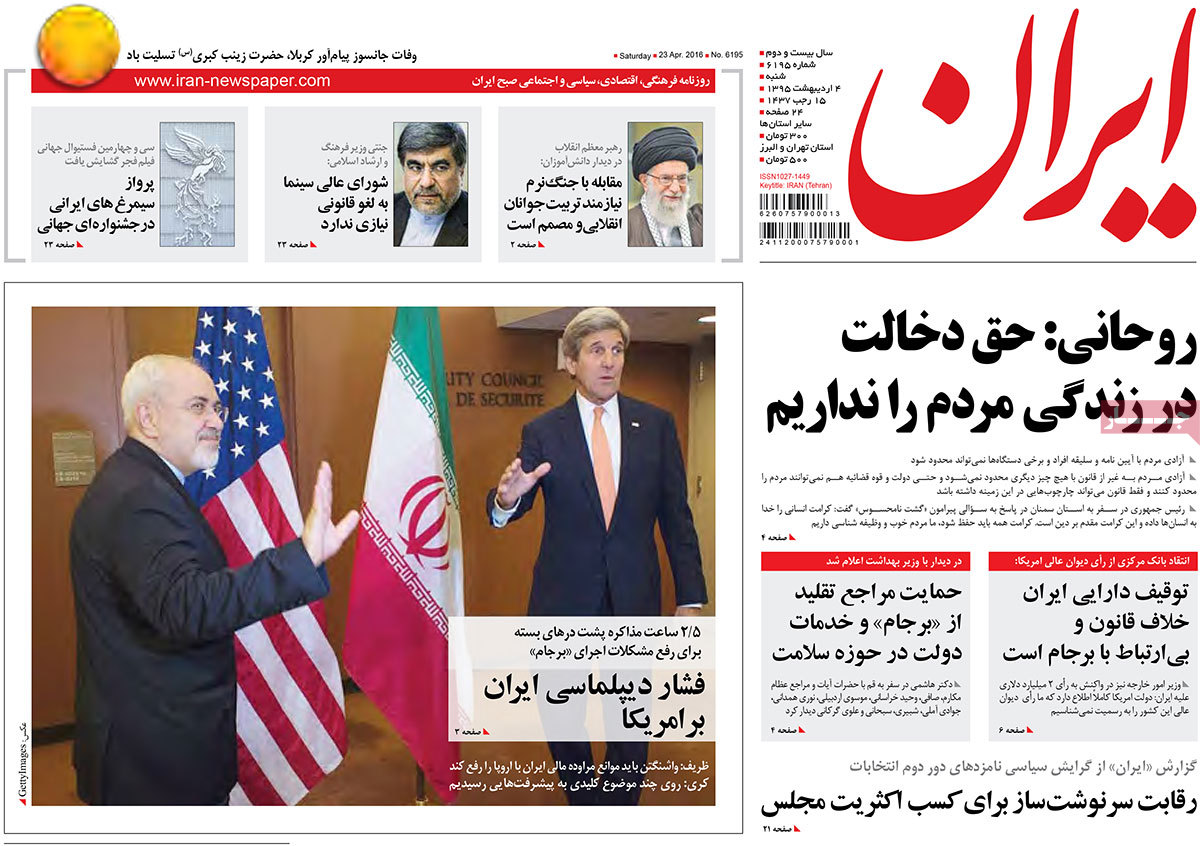
Iran:
1- Zarif Urges US to Remove Obstacles to Iran’s Financial Ties with Europe
2-Int’l Fajr Film Festival Kicks Off in Tehran: Iranian “Simorghs” Flown in Global Festival
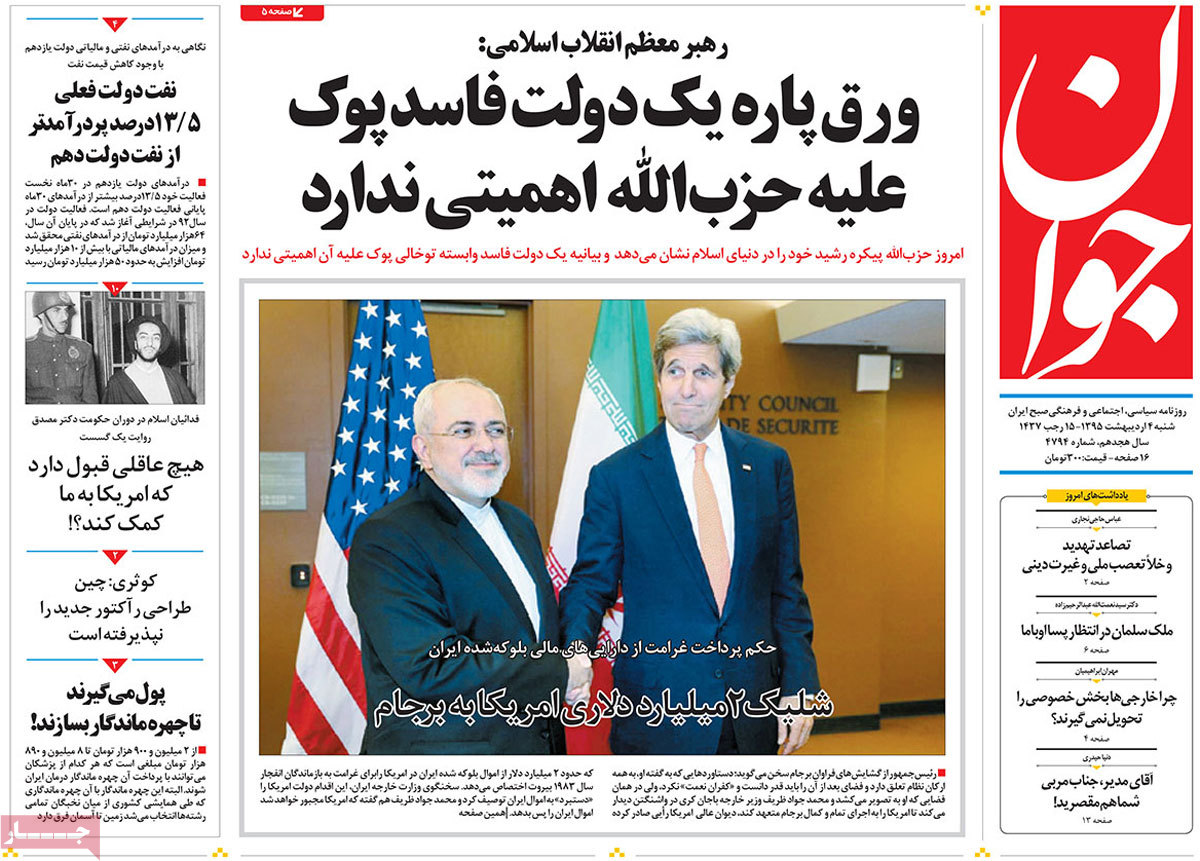
Javan:
1-A Hollow and Corrupt Gov’t’s Anti-Hezbollah Statements Do Not Matter: Leader
2-Saudi King Salman Waiting for Post-Obama Era
3-Why Foreigners Do Not Pay Enough Attention to Iran’s Private Sector
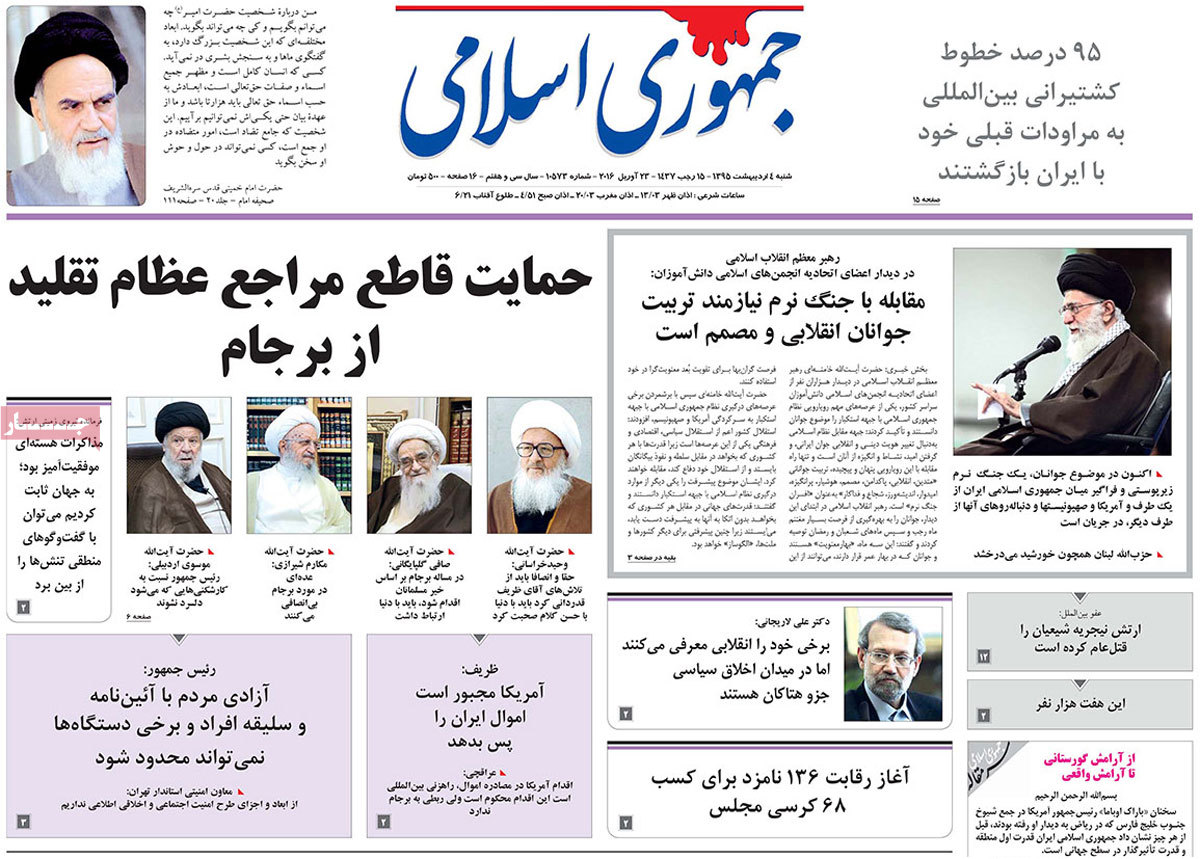
Jomhouri Eslami:
1-Iran’s Grand Ayatollahs Strongly Support JCPOA
2- 95% of Int’l Shipping Lines Back to Normal Ties with Iran
3-Candidates Start Campaigns for Parliamentary Election Run-Off
4- FM Zarif: US Has to Return Iran’s Assets
Kayhan:
1- Ayatollah Khamenei Harshly Rejects US Threats against Iran
2-Latest Outcome of JCPOA: US Seizes $2bn Iranian Assets
3- What US Expects of JCPOA Is to Force Iran’s Capitulation
4- Fourfold Increase of Iran’s Imports from US under Rouhani’s Administration
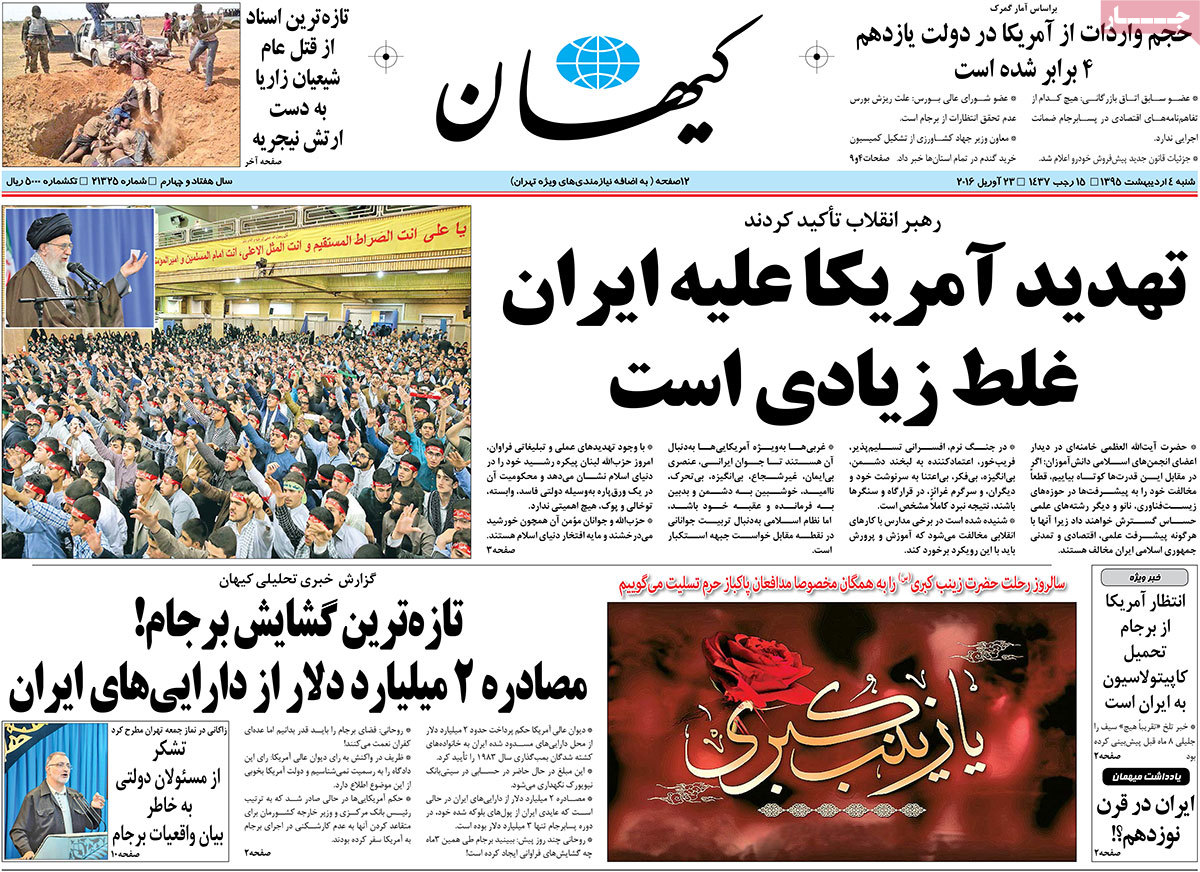
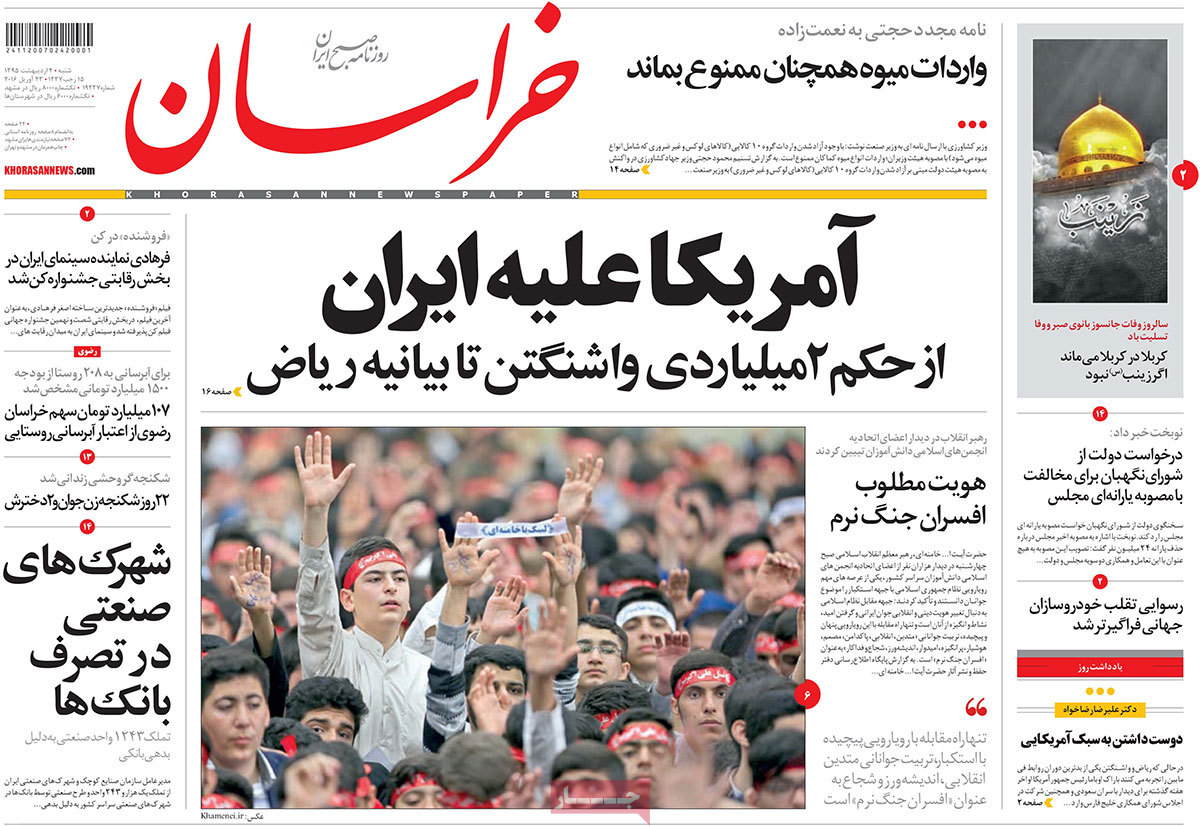
Khorasan:
1-US against Iran: From $2bn Court Ruling to Riyadh Statement
2-Iran Arrests Man Who Brutally Tortured Wife and Daughters for 22 Days
3- Asghar Farhadi’s “Salesman” to Represent Iran in Cannes Film Festival
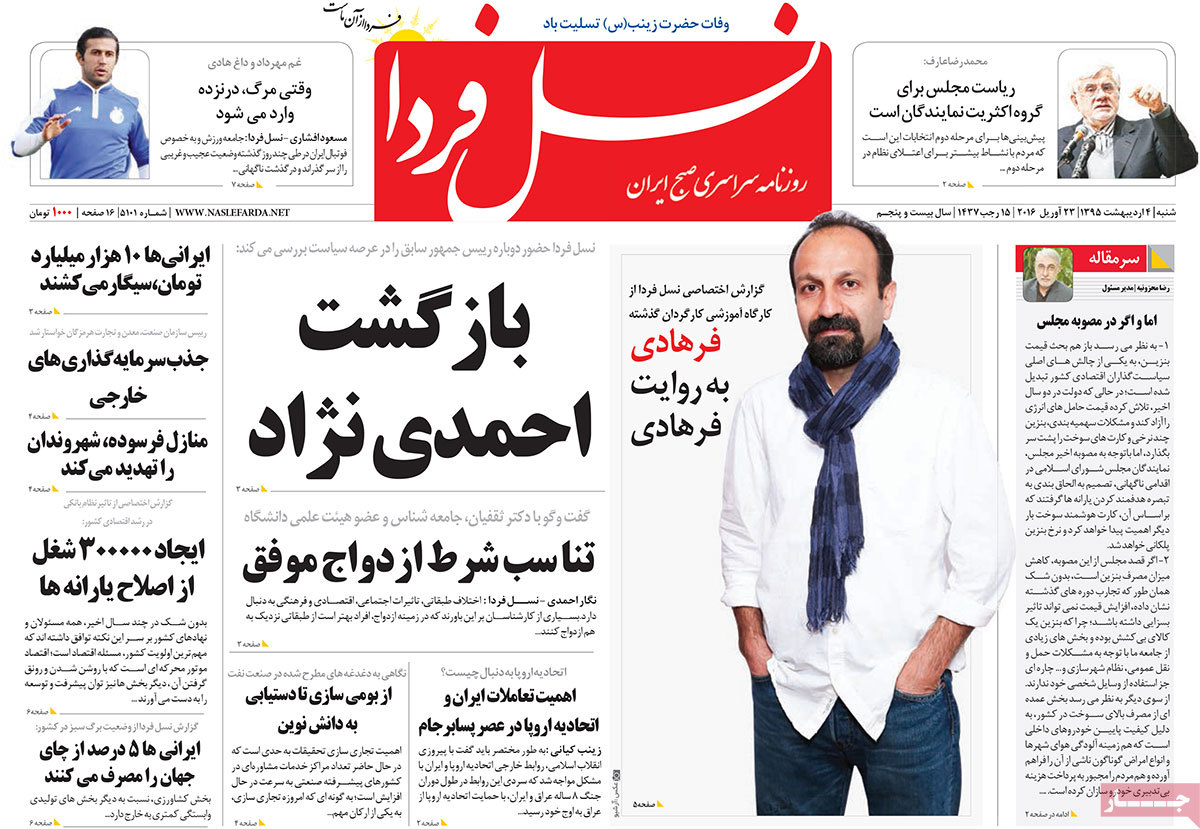
Nasl-e Farda:
1-Return of Ahmadinejad: Analysis of Ex-President’s Reappearance in Iran’s Politics
2-Iranian People Consume 5% of World’s Tea
3-Subsidy Reform to Create 300,000 Job Opportunities in Iran
4- Why Iran-EU Interactions Matter in Post-JCPOA Era
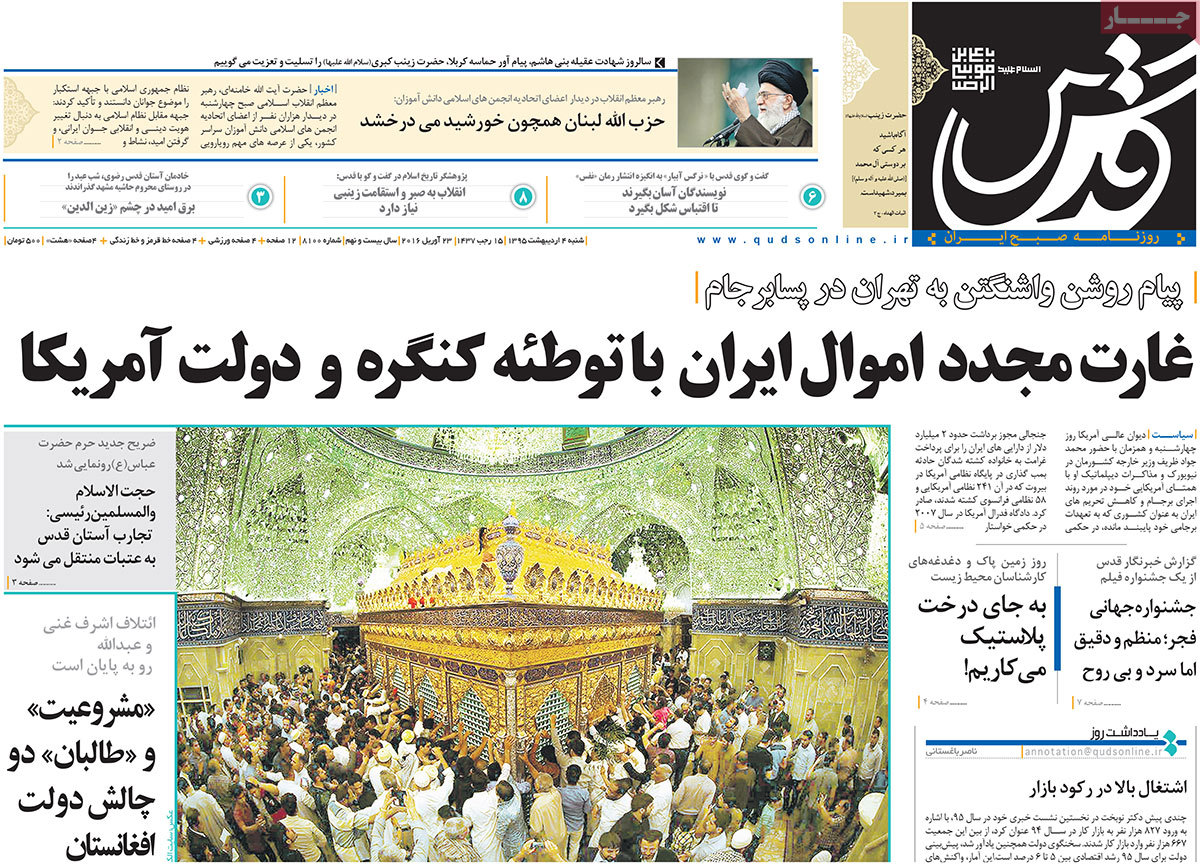
Quds:
1- Washington’s Clear Message to Tehran in Post-JCPOA Era: US Congress and Gov’t Plot to Loot Iran’s Assets Once Again
2- Ghani-Abdullah Coalition Coming to an End: Afghan Gov’t Faced with Challenges of Legitimacy and Taliban
Resalat:
1-Divine Vengeance Awaiting Al Saud Regime: Senior Iranian Cleric
2- Saudi Arabia’s Preconditions for This Year’s Hajj Not Acceptable: Iranian MP
3-Threats Have Become More Serious after JCPOA: IRGC Commander
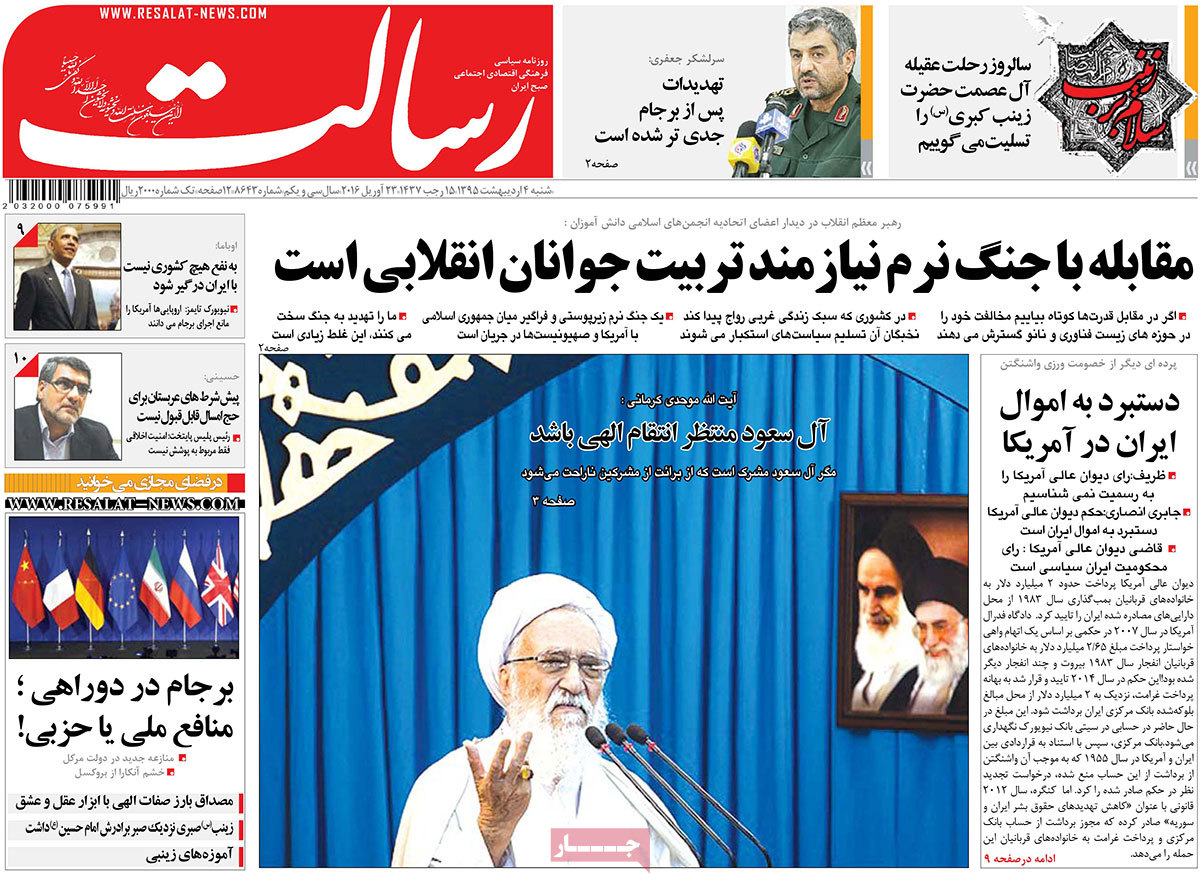
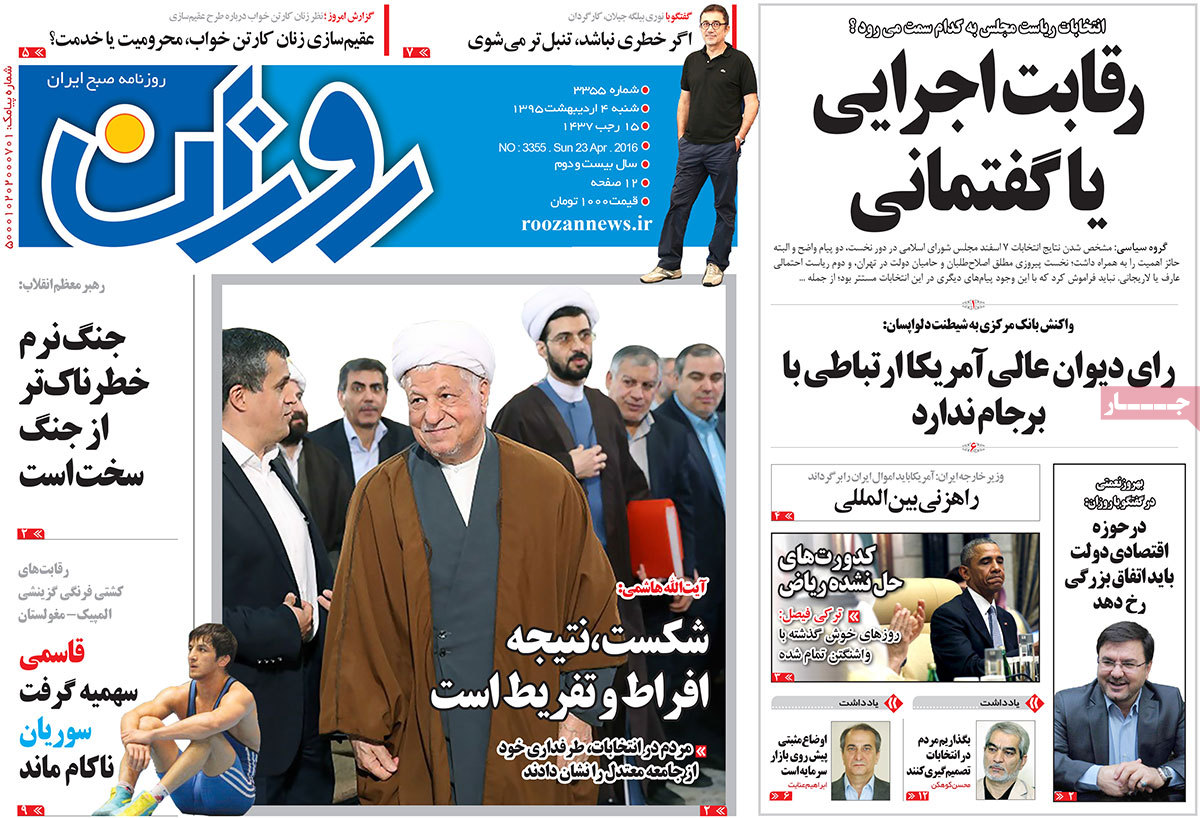
Roozan:
1-US Supreme Court Ruling Unrelated to JCPOA: Iran’s Central Bank
2-Good Old Days with Washington Over: Saudi Prince
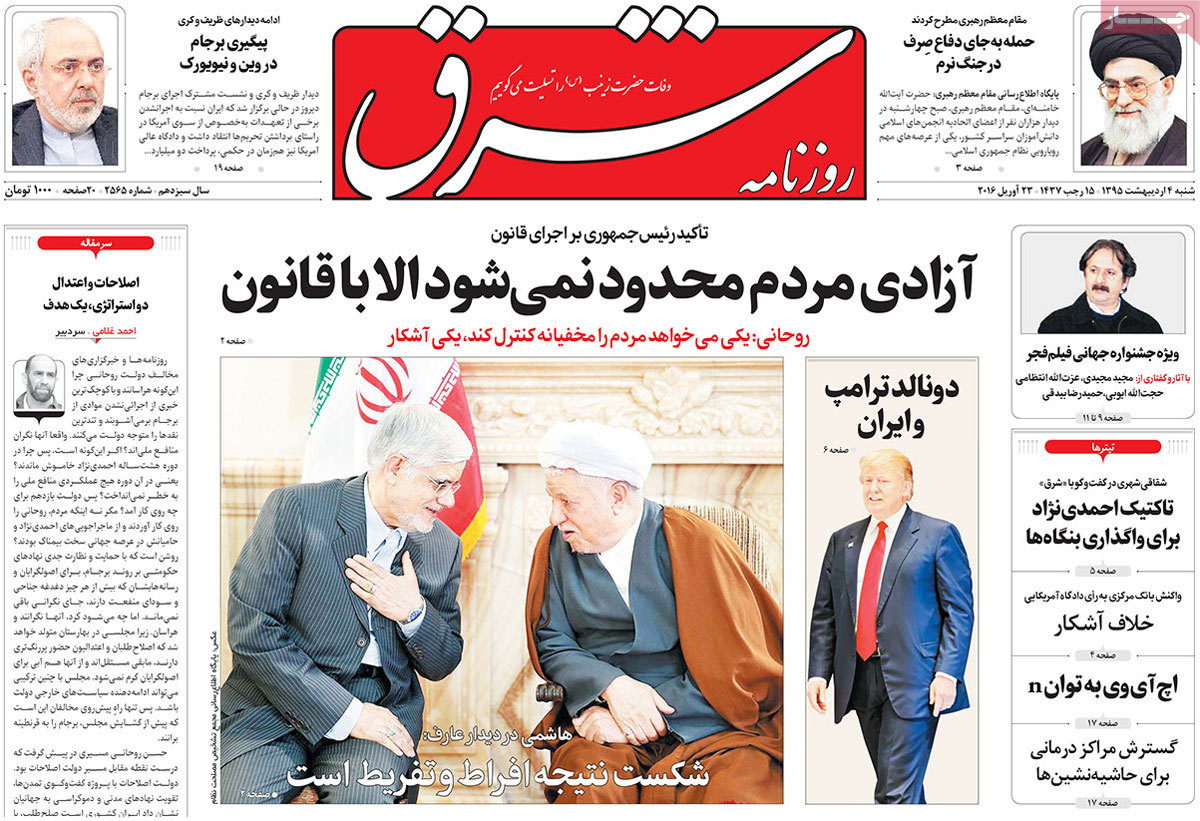
Sharq:
1-Only Legislation Can Limit People’s Freedom: Iran’s President Emphasizes Rule of Law
2-Reformism and Moderation: Two Strategies, One Goal (Editorial)
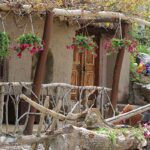
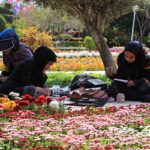
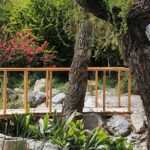
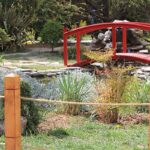
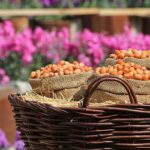
Isfahan Flower Garden
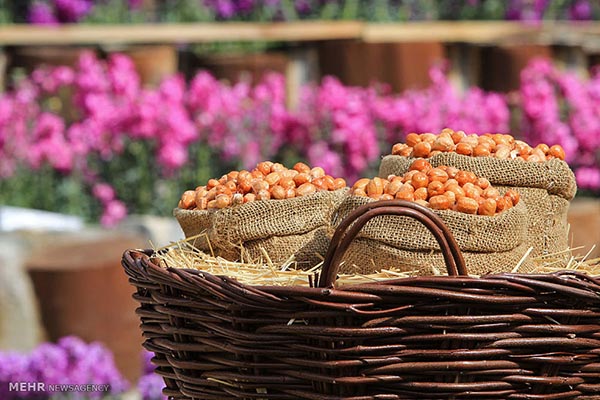
Flower Garden of Isfahan offers a beautiful collection of Iran’s floral diversity.









Kerry: No objection in the way of foreign banks engaging with Iranian banks

Discussing the implementation of the Joint Comprehensive Plan of Action (JCPOA), Kerry emphasized on the fact that U.S. has lifted nuclear-related sanctions, as U.S. committed to do, and there are now opportunities for foreign banks to do business with Iran.
Referring to the existence of confusion among some foreign banks, he said that we try to clarify that as much as we can.
He added that among the nuclear-related sanctions that were lifted were those that prevented Iran from engaging with non-U.S. banks, including getting access to Iran’s restricted funds that were previously held overseas.
On the reason for which the State and the Treasury Departments have been actively engaged with partner governments and the private sector in order to clarify those sanctions that have been lifted, Kerry said that, ‘We understand that banks and businesses have complicated business decisions to make, and they have to make them.
He noted that, ‘We recognize it is going to take some time for companies to feel confident in reengaging with Iran, and in all fairness, that is due to concerns other than sanctions.’
‘I want to make clear the United States is committed to doing our part as we believe it is in our interest to ensure that the JCPOA, the nuclear agreement that we reached, that it is in fact working for all participants’, Secretary Kerry said.
