Thursday, December 25, 2025
Home Blog Page 4481

Yemeni Army Fires Ballistic Missile at Saudi-Led Forces

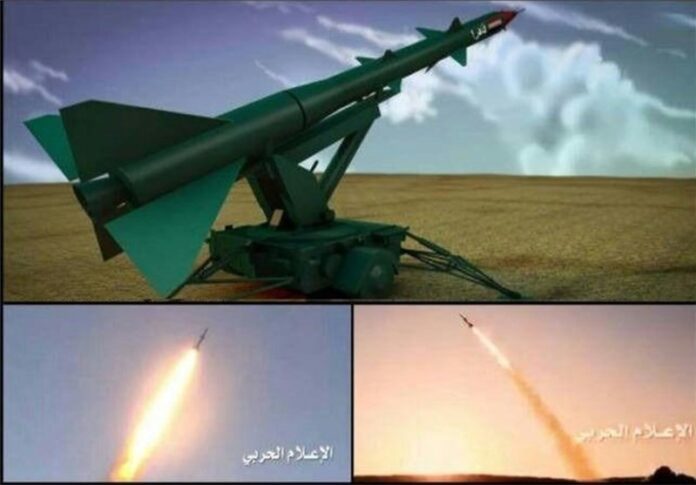
The Yemeni forces fired the missile dubbed “Qaher-1” at a gathering of the Saudi-led forces in Bir al-Maraziq in Jawf Province in northwestern Yemen, the Arabic-language Al-Ahed news website reported.

There were no immediate reports of possible casualties and the extent of damage, the report added.

This is while, Saudi warplanes continued airstrikes on various districts of Yemen on Thursday. Two Yemenis lost their lives in the strikes on the southwestern province of Taiz and three were killed in the northern province of Sa’ada.

Qaher-1, which has a range of 500 kilometers, was first fired by the Yemeni Army at the Khaled bin Abdulaziz military base in Saudi Arabia’s southwestern city of Khamis Mushait, located 884 kilometers (549 miles) southwest of the capital, Riyadh.

Yemeni Ansarullah movement’s technicians have produced the new surface-to-surface ballistic missile after making major alterations to the Russian-made S-75 Dvina surface-to-air missile system.

The military innovation came after Ansarullah forces realized that the S-75 missiles cannot be efficiently utilized for targeting the advanced military warplanes belonging to a Saudi-led military coalition, which have been pounding Yemen for about a year.

Since March 2015, Saudi Arabia and some of its Arab allies have been launching deadly airstrikes against the Houthi Ansarullah movement in an attempt to restore power to the fugitive former President Abd Rabbuh Mansour Hadi, a close ally of Riyadh.

More than 8000 Yemenis, including many women and children, have died in the Saudi-led aggression so far.

Iran Frees 49 Indian Fishermen

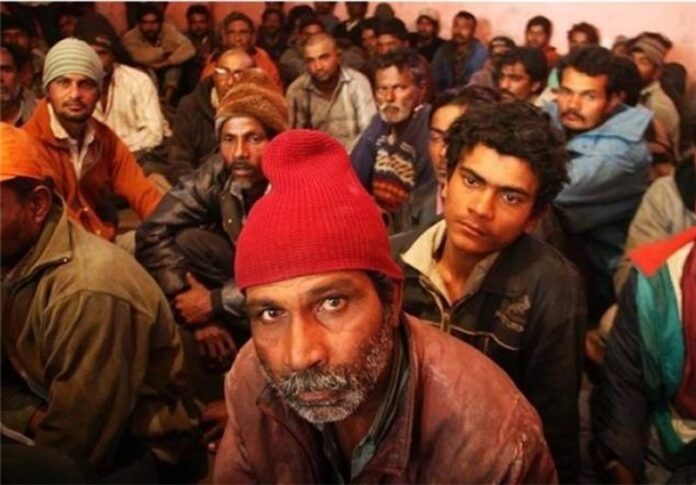
“On December 1, 2015, 49 Indian fishermen, who are employees of M/s. Al ShamsiAn Ajman (UAE based company) were detained while they were unknowingly fishing between the UAE and Iranian water in the Kish island,” MEA Spokesperson Vikas Swarup said Thursday, Outlook India reported.

“These 49 fishermen have been released by the Iranian authorities,” he further said.

Swarup added that they left Iran yesterday for Chennai via Dubai and arrived in India this morning.

Last year in October, nine Indian sailors, who had been arrested on smuggling charges, were also released by the Islamic Republic.

The sailors were freed two months after Indian External Affairs Minister Sushma Swaraj met Iranian Foreign Minister Mohammad Javad Zarif in New Delhi and requested for the release of the Indians who were in prison in Iran for two years on charges of smuggling oil.


Iran raps Persian Gulf Cooperation Council for labeling Hezbollah terrorist

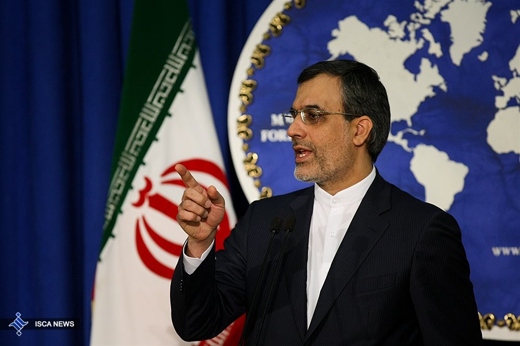
Iran’s Foreign Ministry Spokesman Hossein Jaberi Ansari condemned a Wednesday announcement of Saudi-dominated bloc of Persian Gulf countries for designating Hezbollah a terrorist organization.

“The Islamic resistance movement, Lebanon’s Hezbollah, has ended decades of lethargy and inaction in confronting occupiers of Palestine by resisting the Zionist regime and fully supporting Palestinian nation’s resistance movement,” said Jaberi Ansari reacting to the announcement that added fuel to the confrontation between the region’s Sunni Muslim monarchies and the Lebanese Shiite movement’s main ally—Iran.

“Hezbollah has obtained the first major victory of the Arab world and Muslims in the anti-Zionism conflict and has became established as an outstanding symbol of resistance against Zionist occupation and racism,” he said on Thursday.

“Opposition of certain Arab states to Hezbollah, an agile and diligent representative of Islamic Umma’s lasting ideals regarding independence, freedom, dignity, esteem and confrontation with oppression and occupation and racism and terrorism, which are institutionalized in the Zionist regime, and blind Takfiri extremism and terrorism, does not justify their government’s fine-tuned move with Palestine occupiers in labeling the resistance movement with being a terrorist organization; government officials who support such stances by disseminating lies and putting pressure on other states to adopt similar stances, are, willingly or unwillingly, acting against the interests of Islamic countries,” he added.


Iran says labeling Hezbollah as terrorist group harmful to regional stability

amir-abdolahian1

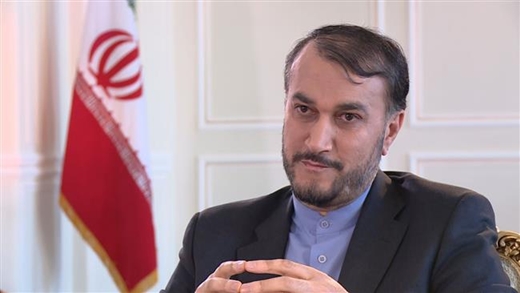
Speaking with IRNA, the deputy FM said that accusing Lebanon’s Hezbollah resistance movement of terrorism and ignoring Zionist regime’s crimes are new mistakes that can harm regional stability and security.

Those states which called the Lebanese’s Hezbollah as terrorist group aim to damage that country’s unity and security either intentionally or unintentionally, Amir-Abdollahian said.

He highlighted the fact that Hezbollah is fighting the occupying forces of Zionist regime in the frontline and said that Iran is very proud of its conrdial relations with that prestigious resistance movement.

Supporting the national unity, security and stability of Lebanon is Iran’s principled policy, he aded.

The Arab Interior Ministers’ Council in its ‘Tunis Declaration’ issued in conclusion of their 33rd session of the Council of Arab Interior Ministers on Wednesday in the Tunisian capital accused the Lebanese Hezbollah movement of terrorism.

The action follows Arab monarchies of the Persian Gulf move to declare Lebanon’s Hezbollah as a terrorist group.

A Saudi-led bloc of six Persian Gulf had earlier formally branded Hezbollah as a terrorist organization on Wednesday.

The move by the Persian Gulf Cooperation Council comes less than two weeks after the Saudi Arabia announced it was cutting $4 billion in aid to Lebanese security forces.

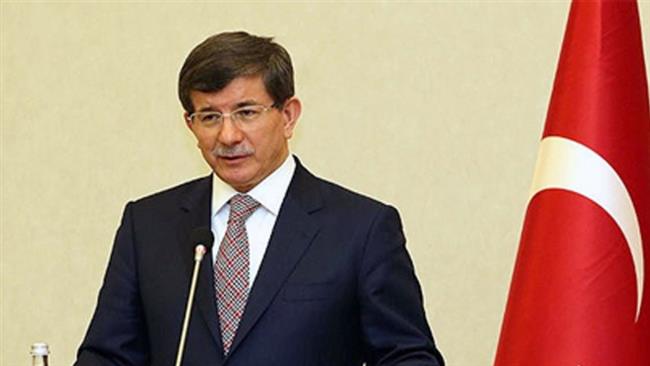
Turkey’s Davutoglu to visit Iran Friday

The premier’s office said in a statement that Davutoglu will travel to Iran on Friday on a two-day visit.

The two sides are slated to discuss regional crises, particularly the five-year-old conflict in Syria. Tehran and Ankara have different views on the war in the Arab country.

Turkey backs militants and insists that President Bashar al-Assad should not be part of Syria’s future. Iran says the decision on Assad’s fate is up to the Syrian people and supports the Syrian army and its allies fighting militants.

Davutoglu’s planned trip is significant as the next round of Syria peace talks is scheduled to kick off in Geneva, Switzerland, on March 9.

A ceasefire agreement in Syria brokered by Russia and the United States entered into force on February 27 amid hopes the truce would end hostilities there.

The visit also comes at a sensitive juncture. Turkey and Saudi Arabia have recently announced plans for possible deployment of ground troops to Syria, prompting warnings, including by Iran, that the move could escalate the conflict.

At least four Saudi airplanes have reportedly arrived at Turkey’s Incirlik base which the US and its allies use to carry out operations in the region.

Despite their differences, Turkey and Iran have largely maintained cordial diplomatic relations.

The travel will be the first high-level state visit to Iran since President Recep Tayyip Erdogan visited the country in April 2015.

The two neighbors seek to expand trade relations after the lifting of sanctions on Iran in January. Turkey kept buying a limited amount of crude oil from Iran even under sanctions and maintained other business ties with Tehran.

Turkish companies are seeking to cash in on those commercial connections now that the sanctions have been lifted, pushing for new opportunities in the country.

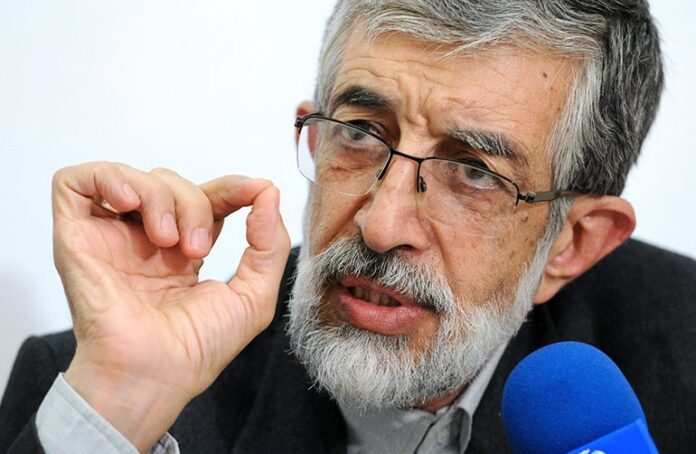
Radicals Absent from New Iranian Parliament: Conservative Leader

During the parliamentary elections held on Friday across Iran, conservatives lost all the seats in the Iranian capital to reformists and pro-government candidates, and this to some extent changed the formation of previously conservative parliament of Iran.

Gholam-Ali Haddad Adel, the prominent Iranian conservative who was the spokesman for the Great Coalition of Principlists – one of the two major sides in the February 26 elections – believes that the tenth parliament will have a special identity not similar to any of previous ones, because the radical lawmakers of sixth and ninth parliaments will not be present in this parliament.


“The results of parliamentary elections are not finalized yet, and there will still be run-off elections in some towns and counties. If we would like to make a realistic prediction using our experience, the tenth parliament will not be similar to any of previous nine parliaments,” Haddad Adel said on the sidelines of a ceremony.

“The tenth parliament will have a special identity, because it lacks the radicals and norm-breakers of the sixth and ninth parliament,” he added.

“It is believed that the conservative camp has the majority in the tenth parliament, and moves can possibly be made to make reformists and conservatives have further cooperation with each other,” Haddad Adel, who is a former parliament speaker, noted.

“Conservatives are satisfied with the results of these elections; although they did not win the elections in Tehran, this coalition has taken root, and we will try to keep it for future,” he said.

Haddad Adel further referred to the defeat of conservatives in Tehran, and considered it as a result of Tehran’s special conditions.

“All factions have the right to protest. Conservatives or reformists both can protest at the final results. There is no problem with raising one’s objection through the legal mechanism, but bringing your fans into the streets is very bad. Protests should be pursued through legal mechanisms, and everyone should submit to law. I myself have no intention to raise objection, however,” the leading conservative went on to say.

He further pointed to the atmosphere created in the Iranian cyberspace during the recent elections, and said, “Asking about the cyberspace is like asking about the jungle.”

He also anticipated that in the run-off elections, the conservatives will make it to the parliament in larger numbers.

A look at Iranian newspaper front pages on March 3

Iran Newspaper front pages

Abrar:

1.  MKO presence terrorist threat for Albania

2.  13 judges make way to parl.

3.  Nation’s election turnout meaningful: Zarif

4.  Australia softens sanctions on Iran

5.  Tehranis turn to youths in parl. election

6.  Twin elections held exceptionally peaceful: Official


A look at Iranian newspaper front pages on March 3


Ettela’at:

1.  Rouhani calls for measures to tackle water shortage crisis

2.  Hezbollah chief says group will not remain silent against Saudi crime

3.  Countdown to West’s attack on ISIS in Libya

4.  Iran jumps 6 ranks in HDI


A look at Iranian newspaper front pages on March 3


Etemad:

1.  May God bless nation for blessing everyone: FM Zarif

2.  10th Parliament, more moderate, efficient

3.  Clinton, Trump gain key wins in Super Tuesday


A look at Iranian newspaper front pages on March 3


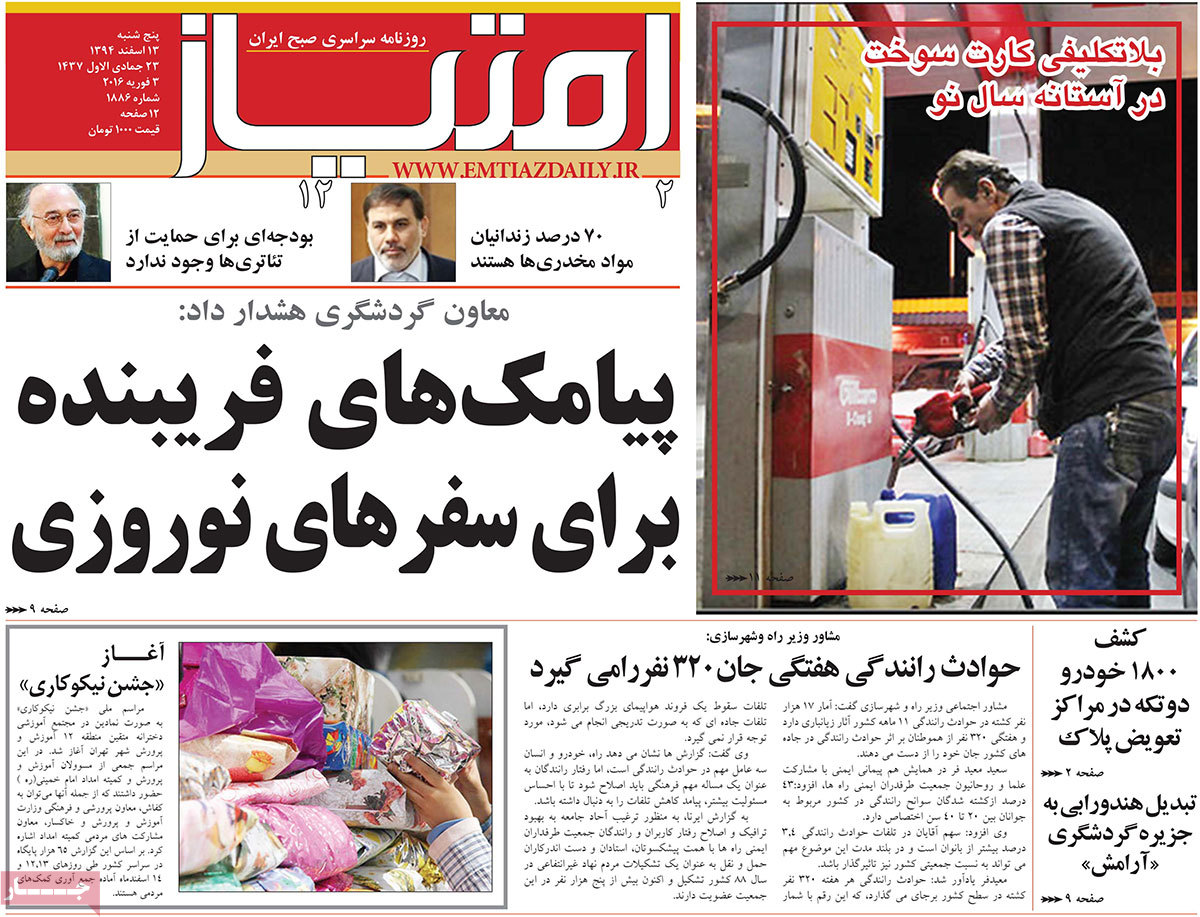
Emtiaz:

1.  70 of inmates kept for drug-related crimes

2.  320 weekly deaths in car accidents

3.  Iran to turn Hendurabi into “peace” tourism resort
 

A look at Iranian newspaper front pages on March 3


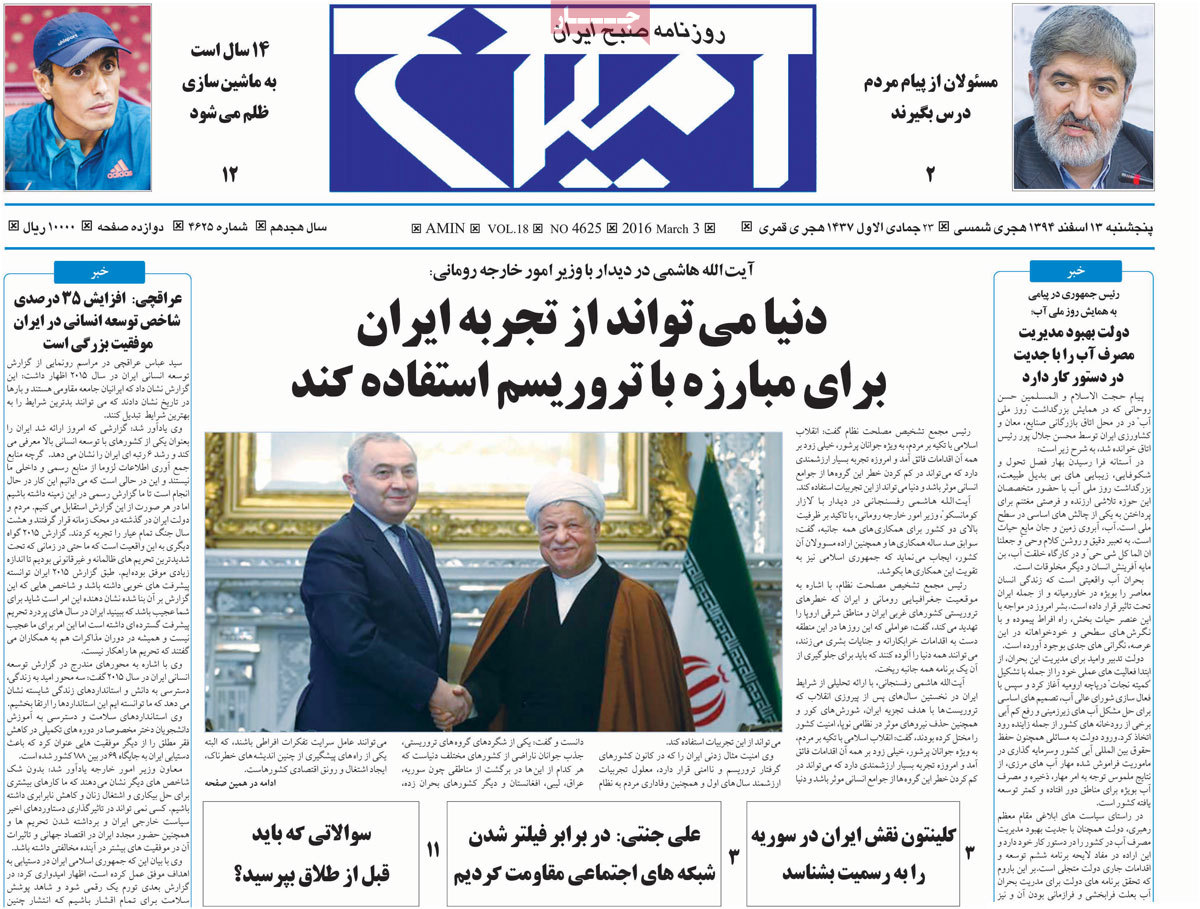
Amin:

1.  World can use Iran’s experience in fights against terrorism: Rafsanjani to Romania FM

2.  35% boost in Iran HDI major achievement: Araqchi
 

A look at Iranian newspaper front pages on March 3


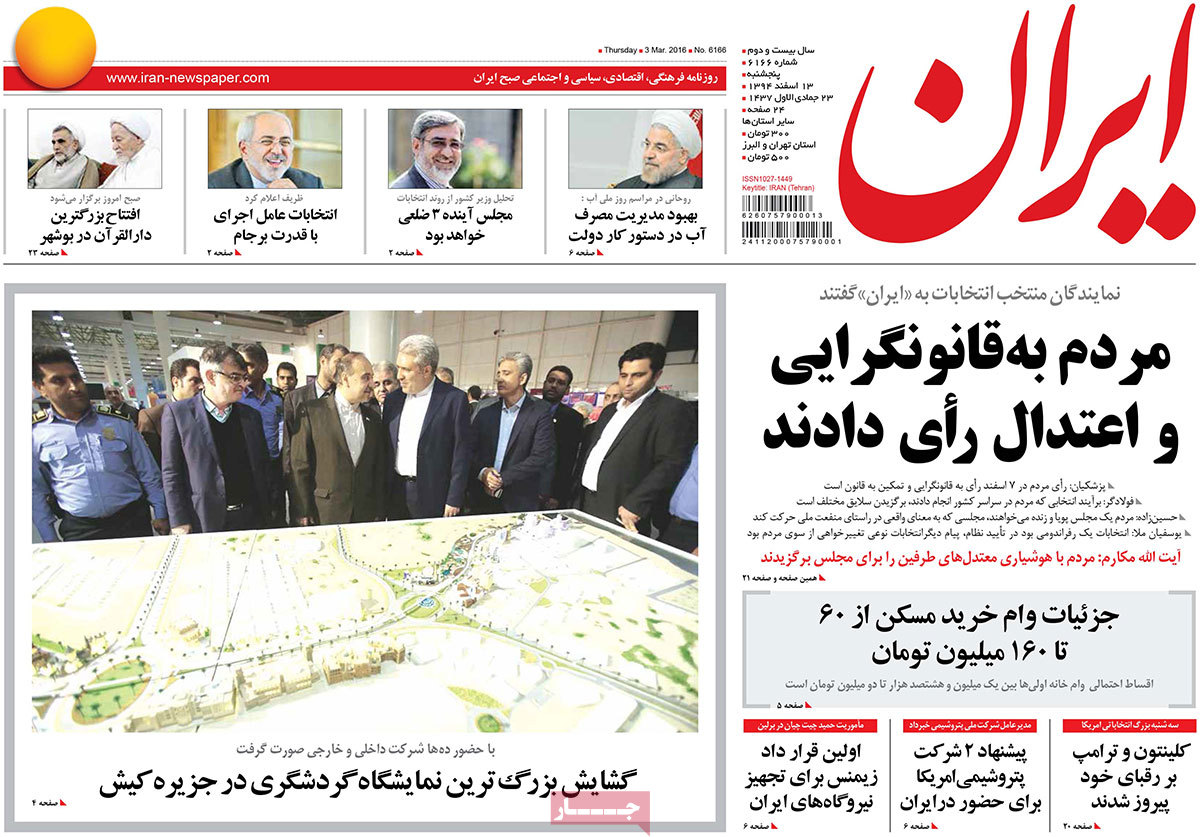
Iran:

1.  Select MPs: Nation voted for moderation, legitimacy

2.  Iran opens landmark tourism exhibit in Kish Island

3.  Zarif: Voter turnout will help JCPOA implementation

4.  Major Quran school opens in Bushehr

5.  Rouhani calls for efficient water consumption management

6.  Clinton, Trump gain sweeping victories against rivals

7.  Two US chemical firms bid to join Iran Petchem Industry

8.  Siemens signs deal to modernize Iran power plants
 

A look at Iranian newspaper front pages on March 3


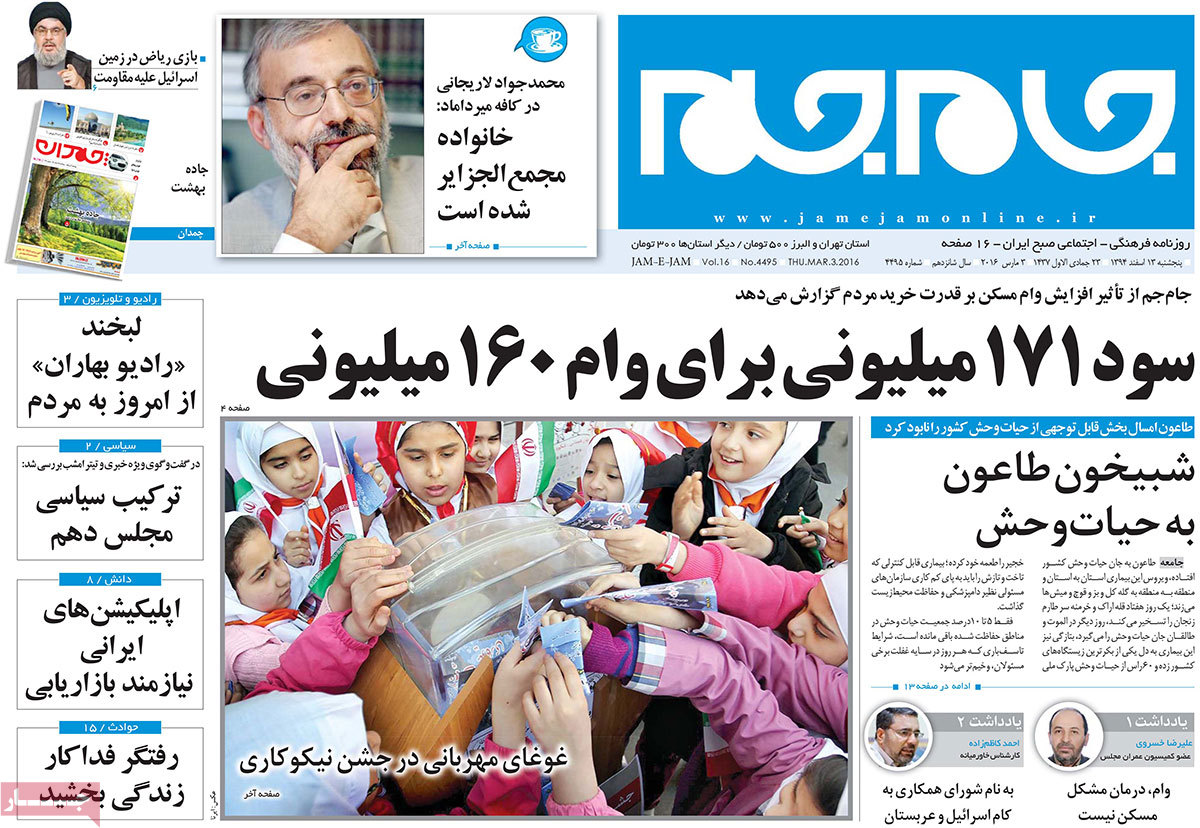
Jamejam:

1.  Iranians display massive kindness in sympathy festival

2.  IRR1.71bn interests for IRR1.6bn housing loans
 

A look at Iranian newspaper front pages on March 3


Jomhouri Islami:

1.  Zarif: People’s meaningful election turnout helps JCPOA implementation

2.  President honors election staff

3.  Australia softens Iran sanctions
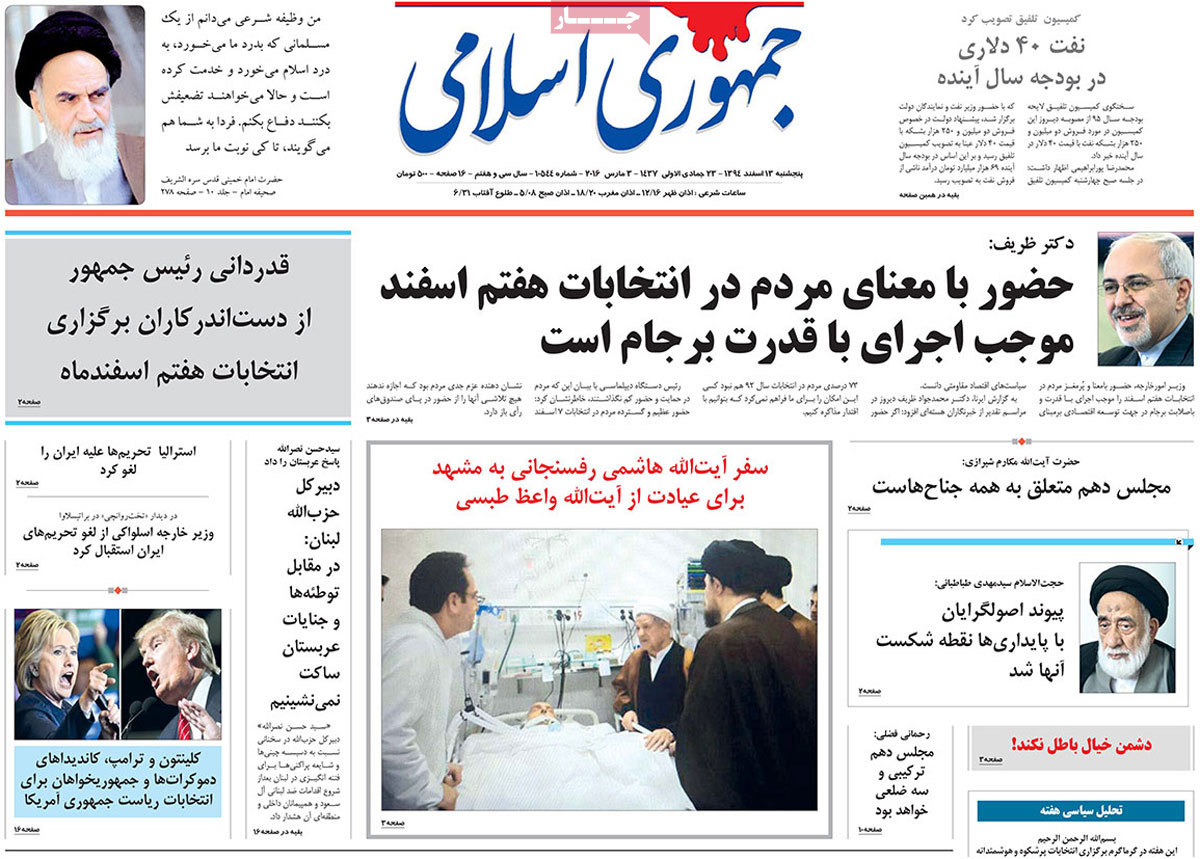
 

A look at Iranian newspaper front pages on March 3


Javan:

1.  Zarif concerned about JCPOA implementation

Problems with US not settled yet: FM

Parliament speaker says P5+1 has not lived up to Iran deal

2.  Trump, Clinton make major advancements to White House
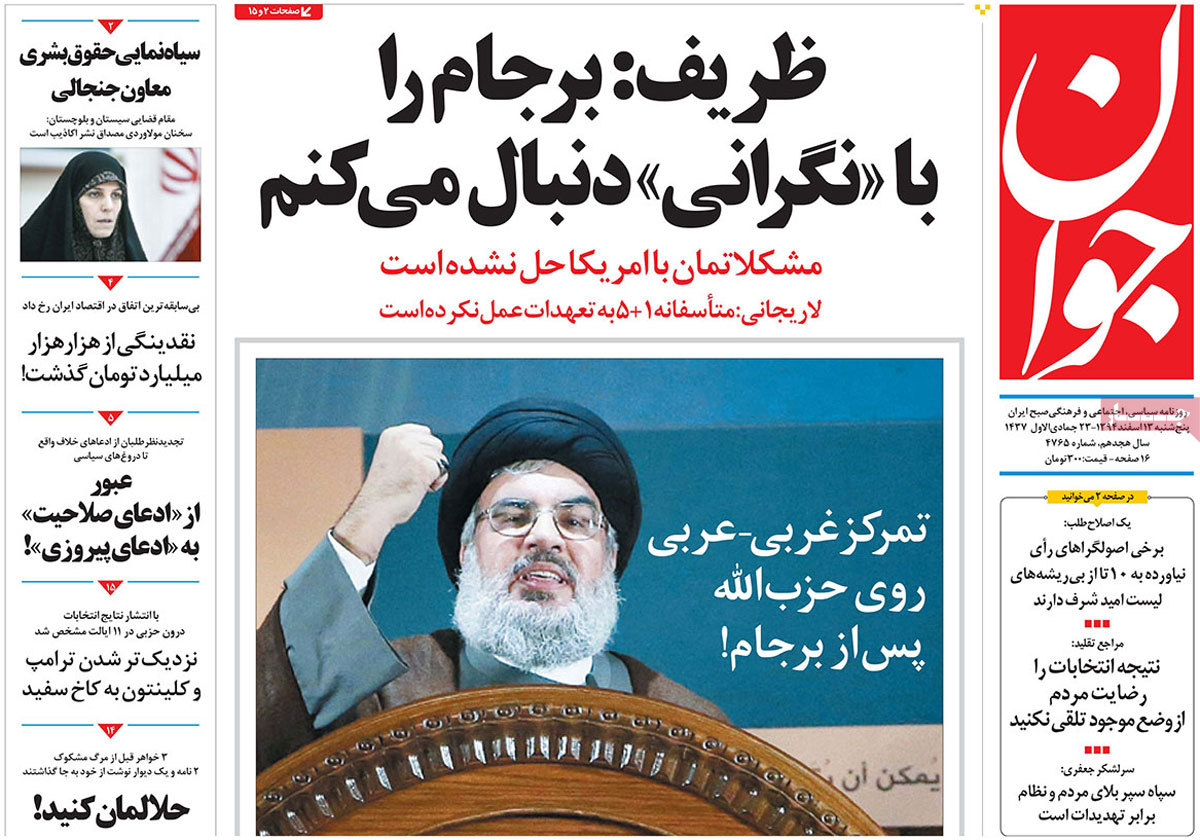
 

A look at Iranian newspaper front pages on March 3


Hemayat:

1.  Hezbollah chief: Saudi Arabia, Israel source of region’s seditions

2.  Deputy Judiciary chief: Focusing on Quran only way to survive modern ignorance

3.  Self-appointed human rights claimants hypocrites

4.  Inmates enjoy full citizenship rights in Iran
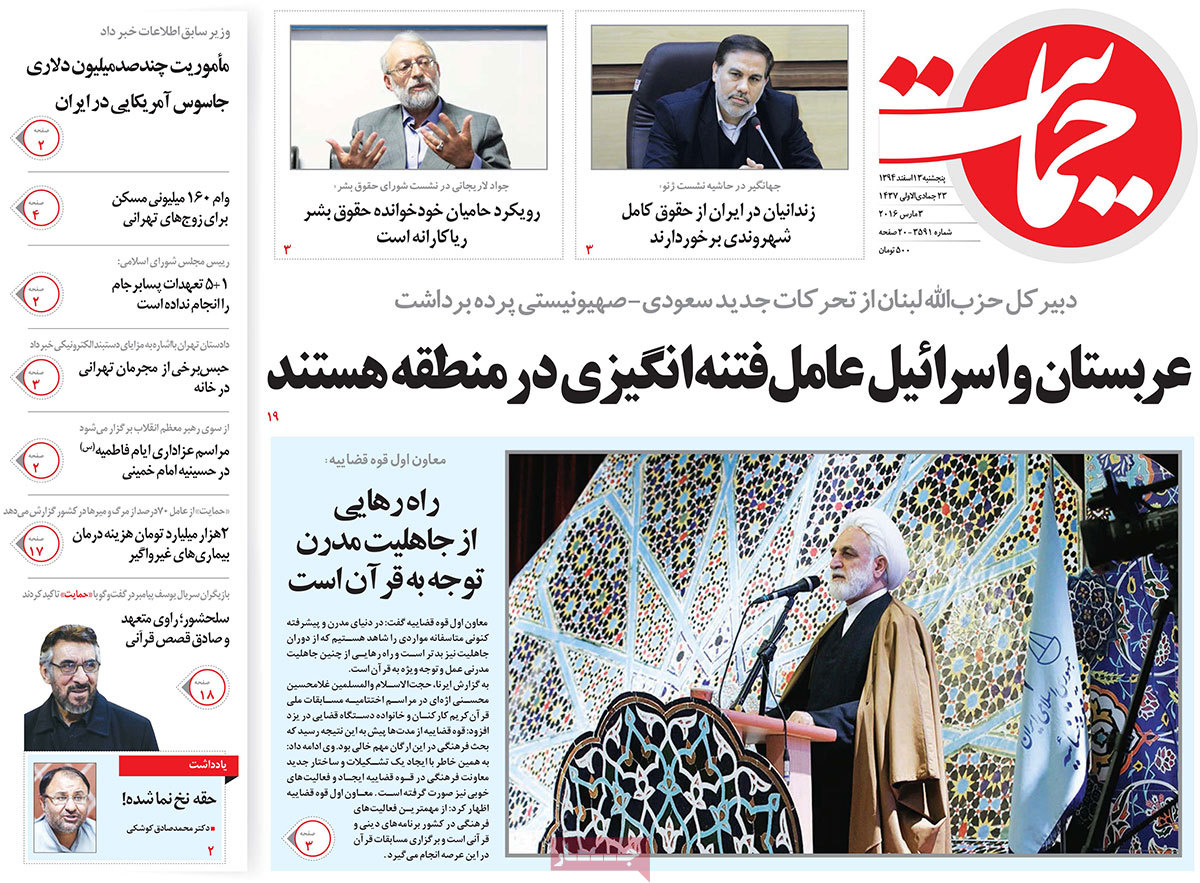
 

A look at Iranian newspaper front pages on March 3


Khorasan:

1.  Super Tuesday smiles at Hilary, Donald

2.  Iran, Russia finalize major customs coop. document

3.  Aref says reformist eye 70% seats in Tehran city council
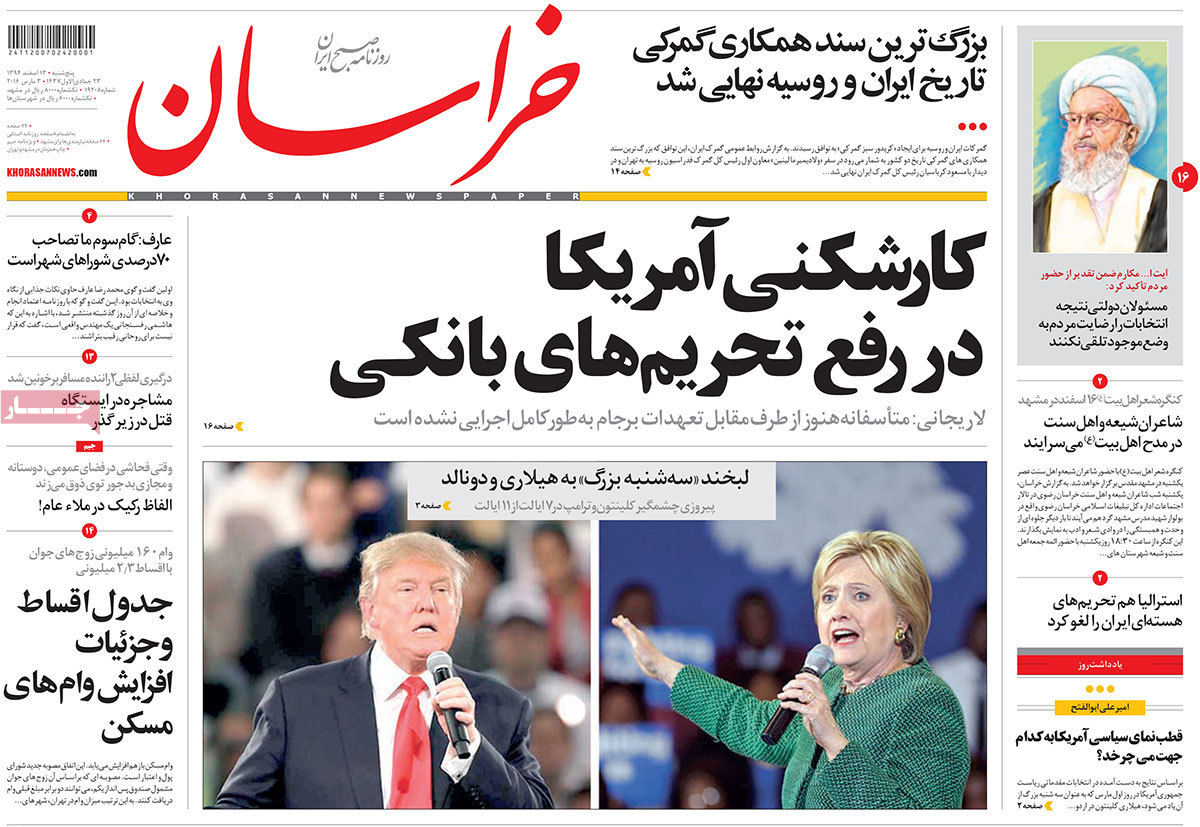
 

A look at Iranian newspaper front pages on March 3


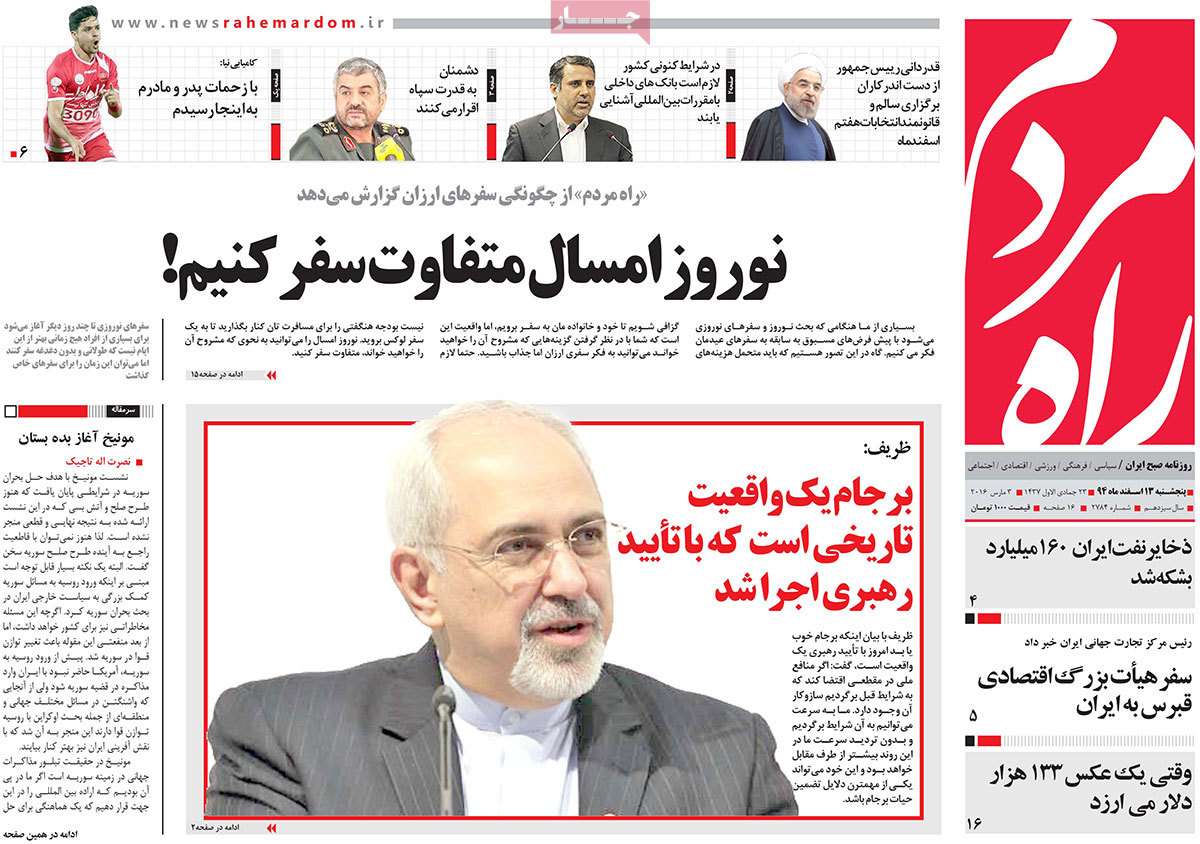
Rah-e Mardom

1.  Zarif: JCPOA a historic reality, enjoys leader’s backing

2.  Report calls on new year travelers to reconsider traveling habits

3.  Iran oil reserves cross 160bn barrels

4.  Large Cyprus delegation heading Tehran
 

A look at Iranian newspaper front pages on March 3


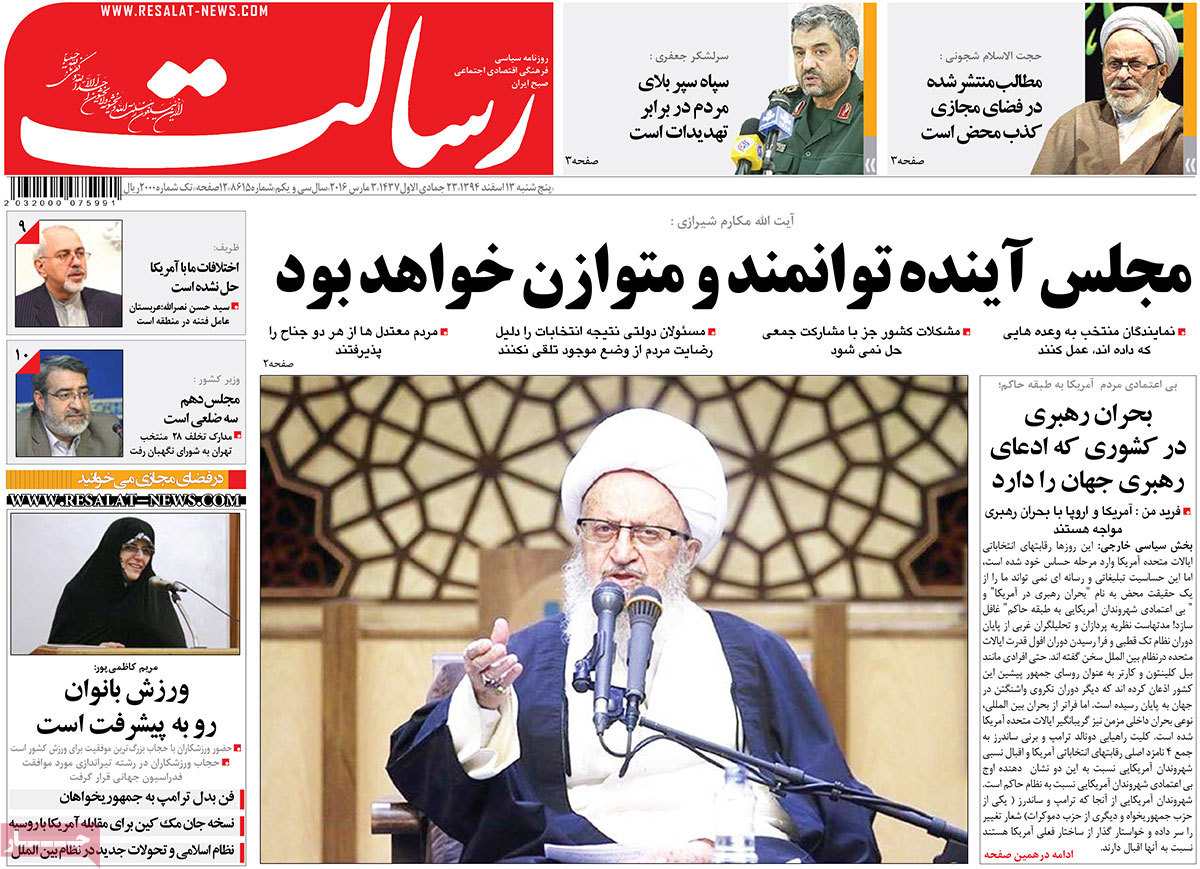
Resalat:

1.  IRGC shields nation against threats: commander

2.  Cleric: Next parl. to be powerful, balanced

3.  Leadership crisis in country that says leads world; American population distrust their political leaders
 

A look at Iranian newspaper front pages on March 3


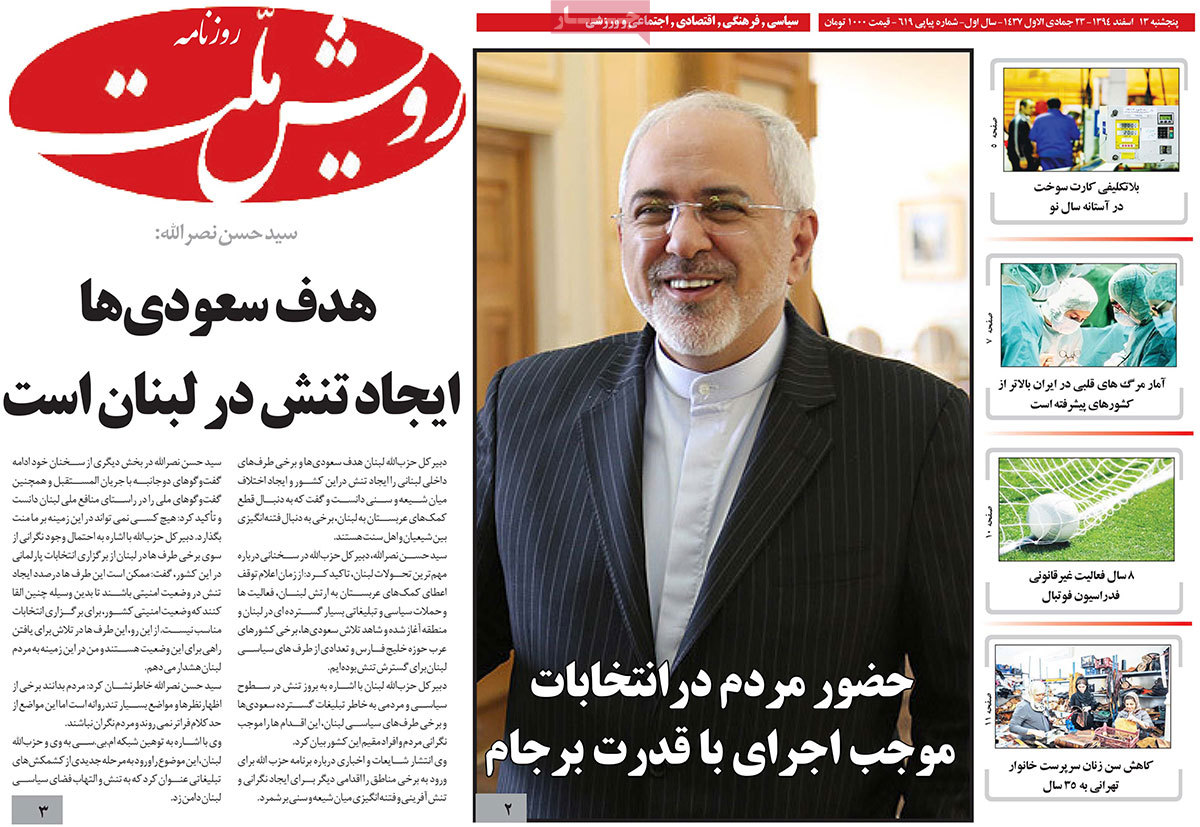
Rooyesh Mellat:

1.  Hezbollah chief: Saudis seek tensions in Lebanon

2.  Massive election turnout secures JCPOA implementation: Zarif
 

A look at Iranian newspaper front pages on March 3


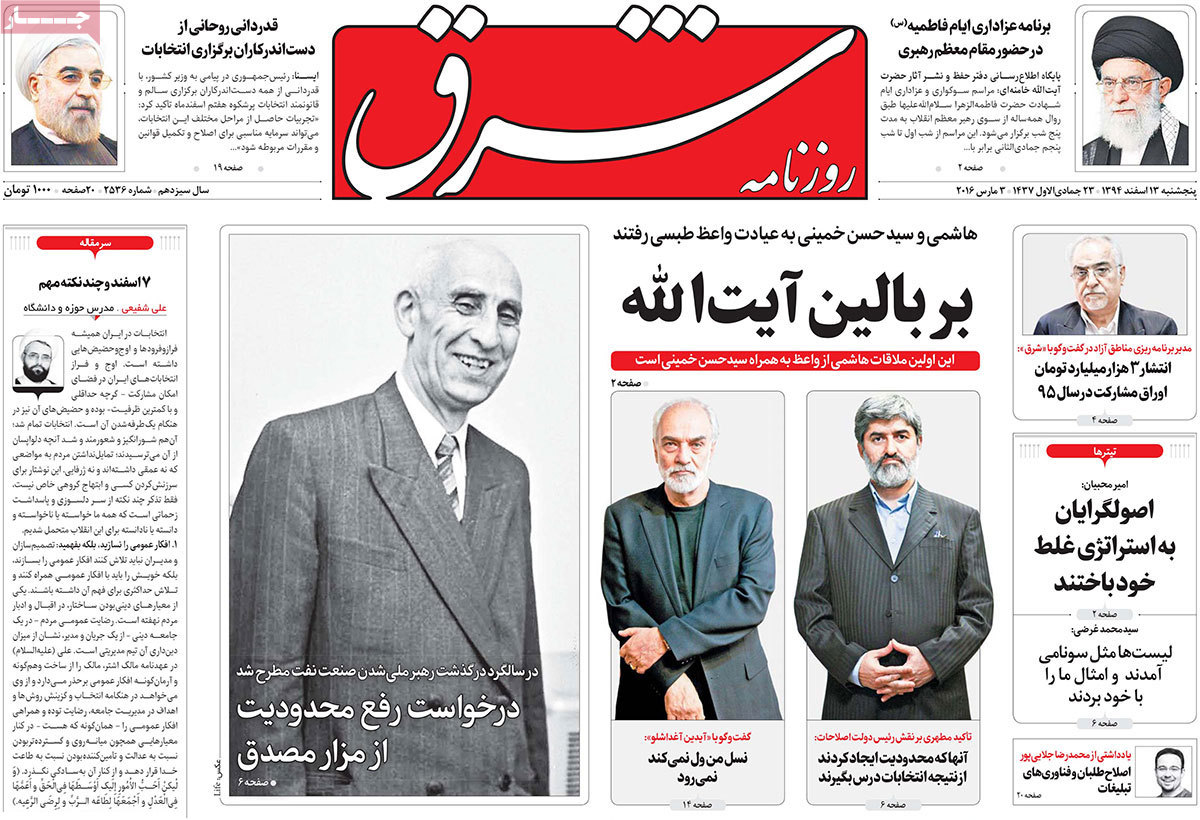
Shargh:

1.  Principalists lost to their wrong strategies: analyst

2.  My generation never leaves: artist
 

A look at Iranian newspaper front pages on March 3


Shahrvand:

1.  29% price cuts on imported drugs in post-sanctions

2.  Good or bad deal enjoys leader’s confirmation: FM Zarif
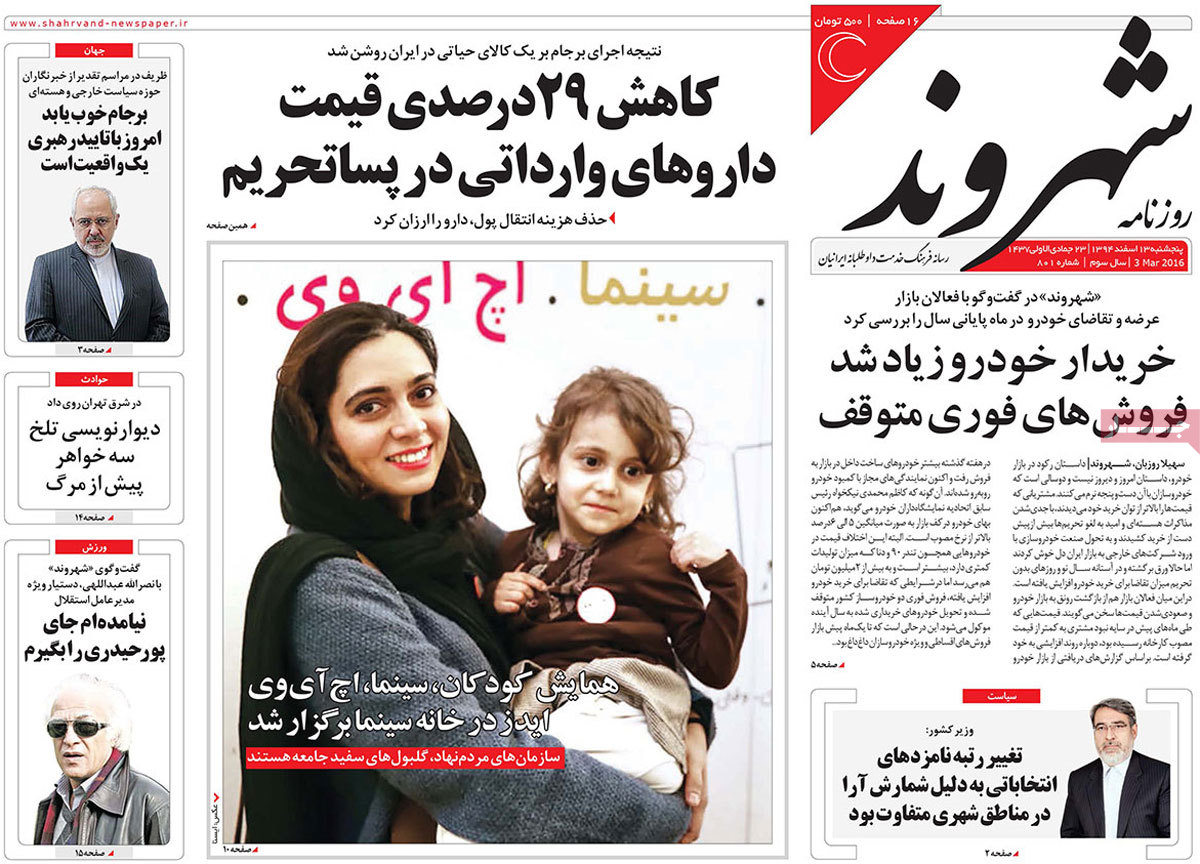
 

A look at Iranian newspaper front pages on March 3


Kayhan:

1.  Pentagon says will launch attack on Libya soon

2.  Decline in housing market unprecedented in 30 years

3.  Officials: No links for Swift for Iran banks despite claims
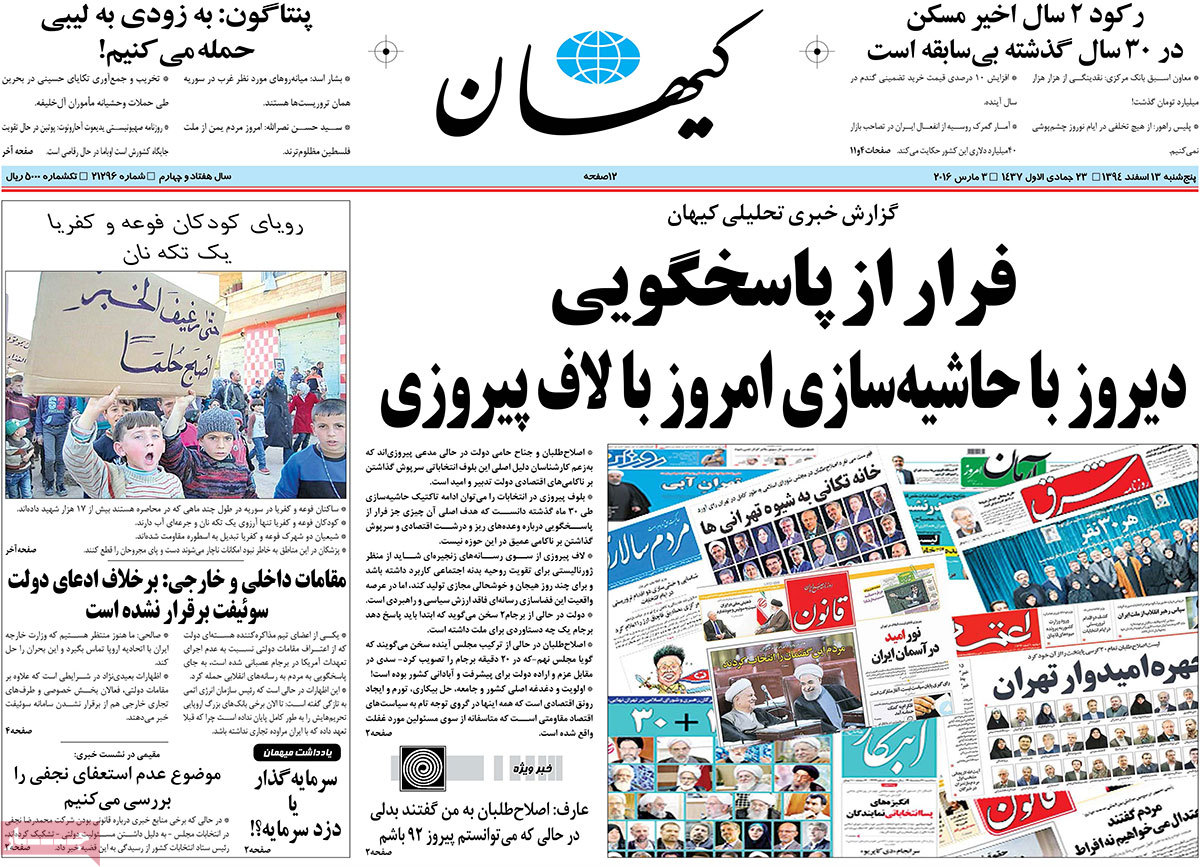
 

A look at Iranian newspaper front pages on March 3


Vatan Emrouz:

1.  Nasrollah: Yemenis more oppressed than Palestinians

2.  Warning: Dust storms under way
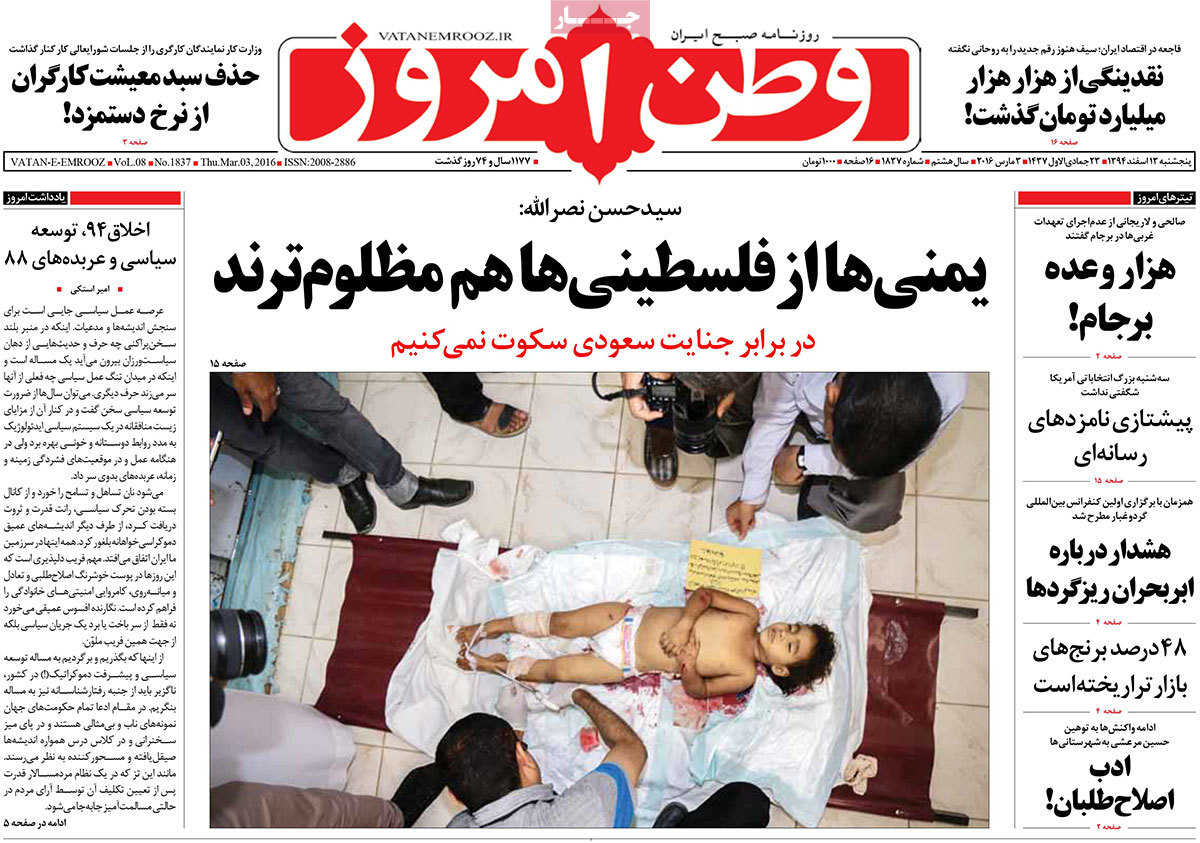
 

A look at Iranian newspaper front pages on March 3


Abrar-Eqtesadi

1.  Iran doubles housing loans

2.  Iran crude exports pass Iraq behind in OPEC

3.  Tax evasion twice oil budget

4.  Iran sets oil price at $40/b in national budget
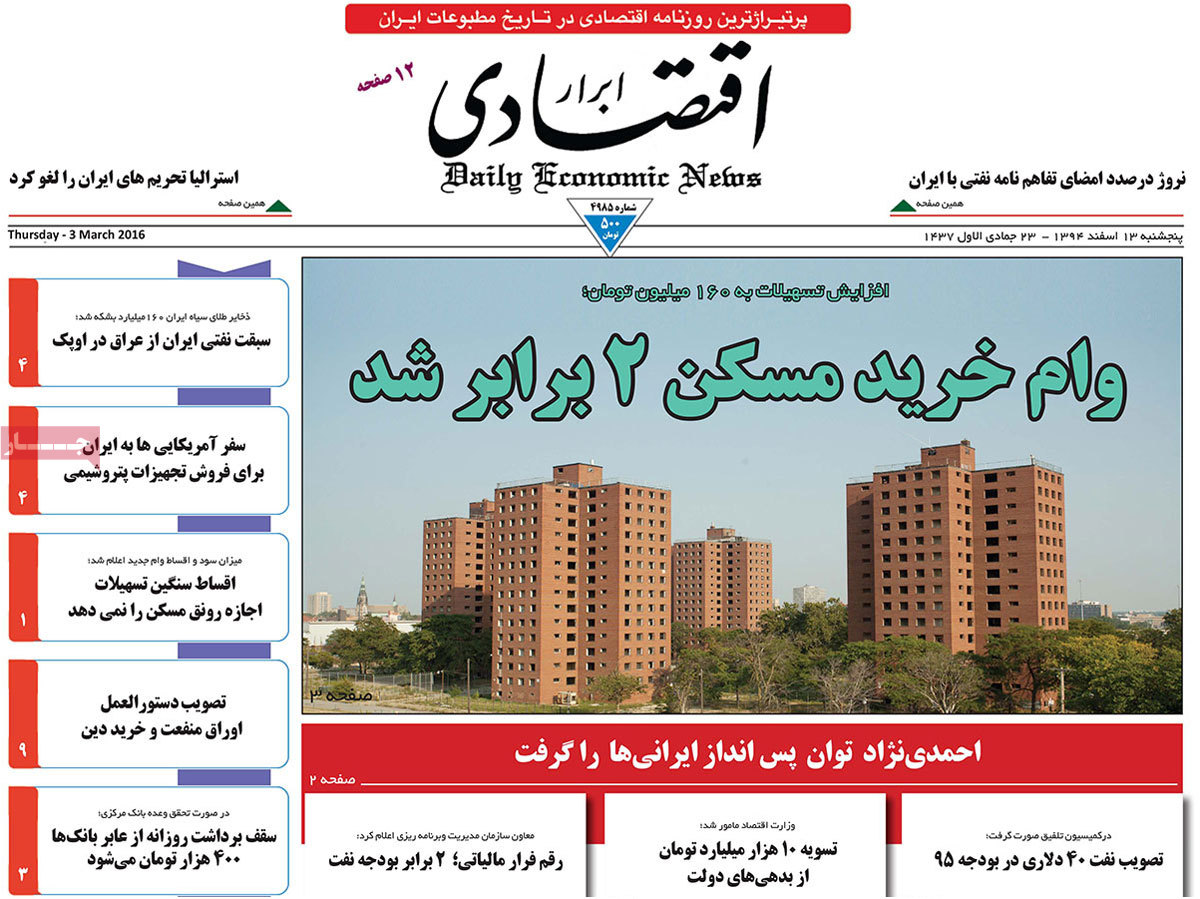
 

A look at Iranian newspaper front pages on March 3


World Tour – 7000 Years of Iranian Art

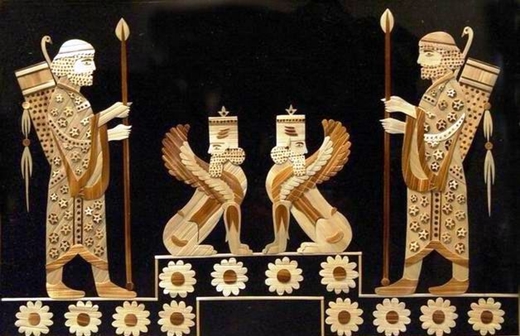
As reported by ISNA, Mohammadreza Kargar talked about the cultural, scientific and historical experiences and achievements of 7000 Years of Iranian Art. These exhibitions were originally held in Europe from 2000 to 2005. He said, “With the new government’s approach toward cultural diplomacy, Iran’s Cultural Heritage, Handicrafts and Tourism Organization (ICHTO) has given priority to the 7000 Years of Iranian Art exhibitions, with the goal of introducing the world to parts of Iran’s history and civilization.”

He added, “The first Iranian exhibition will be held in Germany with special meetings and seminars from late 2016 to early 2017.”

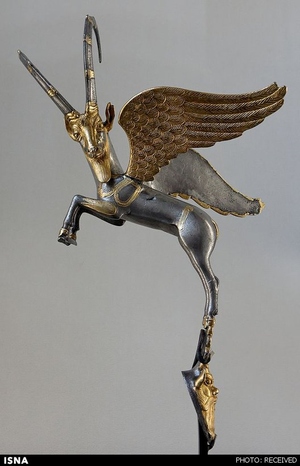
Iran historical artAccording to the ICHTO public relations centre, the 7000 Years of Iranian Art exhibition is comprised of 178 precious objects representing ancient Persian art, culture and civilization, covering the period up to the beginning of the Islamic era. They were first taken out of the country in the autumn of 2000.

The first exhibition was held in the same year at the Vienna Art History Museum (Kunsthistorisches Museum). The exhibition was extended for 20 days beyond its scheduled dates due to popular interest and high attendance.

The success of 7000 Years of Iranian Art in Austria led to other countries clamouring to host it in their own countries as well. The objects were subsequently exhibited at the Art and Exhibition Hall of the Federal Republic of Germany in Bonn, and after that at Saint Peter’s Abbey Art Hall in Ghent, Belgium.

Basel Museum in Switzerland later hosted this exhibition for 5 months, before it was displayed to the public in the three Spanish cities of Seville, Zaragoza and Santiago.  In September 2004, the exhibition travelled to Croatia. At this stage, the objects were supposed to be returned to Iran, but after a Portuguese request to host the exhibition, they were moved there and displayed for two months. The artifacts were finally returned to Iran in May 2005.

Iran to Launch Industrial Production Lines in Afghanistan: Minister

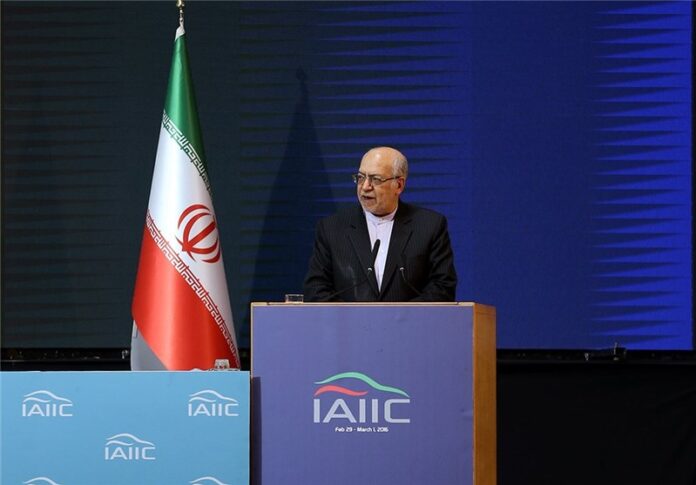
“Our country plans to launch its production lines in small and medium industries in Afghanistan,” Nematzadeh said Wednesday at the opening ceremony of Iran’s third specialized exhibition in the Afghan capital of Kabul.

For this reason, Iran is going to stage another specialized exhibition on industrial and manufacturing machinery in the near future in Afghanistan, he added.

The minister said Iran is fully ready to boost economic relations with Afghanistan, calling on “the Afghan brothers” to pave the way for further mutual economic cooperation between the two countries.

Last month, Deputy Minister of Industry, Mines, and Trade Mojtaba Khosrotaj described the Afghan market as “strategic” for Iranian merchants.

“Although Afghanistan is not considered a new market, presence in the market is strategic for Iran because we can have economic activities there in the long term,” the deputy minister said at the time.

Back in April 2015, Iran and Afghanistan signed two cooperation agreements as part of efforts to boost relations between the two neighbors in various areas.

In a ceremony attended by Iranian President Hassan Rouhani and his Afghan counterpart Ashraf Ghani, high-ranking officials from the two countries singed the documents.

Iran foresees ‘tangible’ rise in oil exports in March

South Korea said on Wednesday it is boosting imports of Iranian oil, especially condensate, to meet growing demand after sanctions on Tehran were lifted.

The major Asian importer has tripled crude purchases from Iran since the lifting of sanctions in January but shipments are still far below pre-sanction levels.

“We will increase oil and natural gas liquids imports from Iran, especially Iranian condensate,” Reuters quoted South Korea’s Trade and Energy Ministry as saying.

On Monday, Minister of Petroleum Bijan Zangeneh said Iran hopes to double oil exports to South Korea which is currently buying 100,000 barrels of oil a day from the Middle Eastern country.

Zangeneh hosted South Korean Minister of Trade, Industry and Energy Joo Hyung-hwan in his office in Tehran where they signed new documents for cooperation.

A memorandum of understanding reportedly envisages leasing out oil storage in Iran, the South Korean Trade Ministry said.

Faced with a steep decline in exports, South Korea has rushed to revive trade with Iran, sending a number of high-profile delegations to Tehran. President Park Geun-hye will also visit Tehran soon.

Iran has already ramped up production by 500,000 barrels per day and plans to add another 500,000 bpd to reach the level before 2011 when the country exported 2.5 million bpd at its peak.

On Tuesday, Director of international affairs at National Iranian Oil Co (NIOC) Mohsen Qamsari said export volumes will rise significantly this month from February.

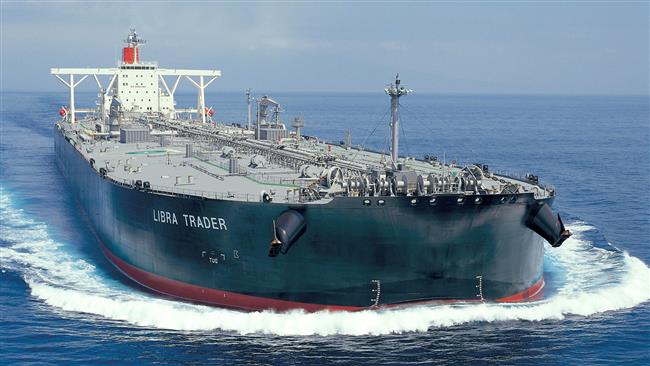
“The difference between March and February is going to be quite tangible. The main or biggest portion of these additional cargoes is going to be destined for Europe,” he told Reuters in an interview.

Last month, Russia’s Lukoil, Spain’s Cepsa and France’s Total shipped the first oil cargoes from Iran for Europe since the removal of sanctions.

Qamsari said Iran still faces difficulties for shipments, adding “some shipping companies are somehow reluctant to come and banks also.”

Frontline, one of the world’s largest independent tanker firms, said on Tuesday securing insurance for its cargoes carrying oil from Iran was likely to take another two to three months.

“There are still some outstanding issues. But we expect that to be in place within two to three months,” Reuters quoted Frontline CEO Robert Hvide Macleod as saying.