Monday, April 13, 2026
Home Blog Page 4411

Deputy FM: Zarif Had a Harsh Conversation with UN’s Ban

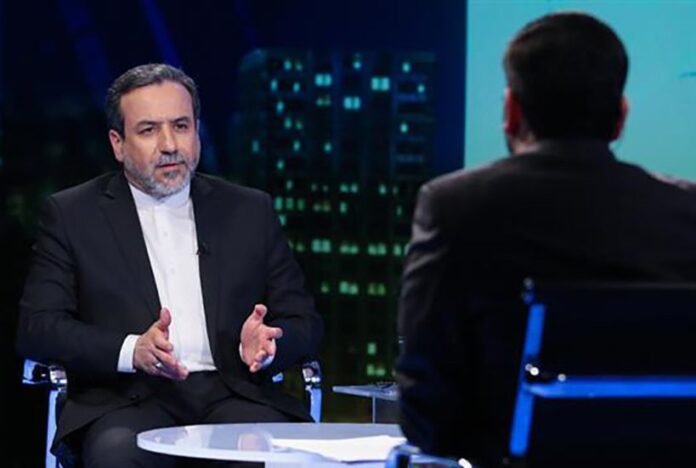
Seyyed Abbas Araqchi
Iranian Deputy Foreign Minister for Legal and International Affairs Seyyed Abbas Araqchi

“We will severely confront any move — be it political, legal, or technical — that hinders our missile program,” Araqchi said on national television on Monday night, July 11.

His remarks came in reaction to a report by UN chief Ban last week, claiming that Iran’s missile tests were not in the spirit of the country’s landmark nuclear deal with world powers.

In his first six-monthly report to the Security Council on implementation of a UN resolution endorsing the landmark deal, Ban called on Iran to stop conducting ballistic missile launches.

“Mr. Zarif had a very harsh telephone conversation with Mr. Ban Ki-moon” right after, Araqchi said, adding that Iran however did not take an official stance because the draft was not official.

He said Iran hopes Ban will revise the report for publication, “otherwise, it will entail a harsh treatment from the Iranian Foreign Ministry.”

Press TV quoted Araqchi as saying that the claims in the draft report are “certainly made under pressure from the US and Europe.”

Earlier, the Western military alliance of NATO also expressed concern about Iranian missile tests, linking them to Resolution 2231.

Reacting on Monday, Iranian Foreign Ministry Spokesman Bahram Qassemi rejected the NATO claim, reiterating once again that Iran’s missile program is not in breach of the resolution.

Iran has time and again emphasized that its military activities, including its missile work, are based on the doctrine of deterrence and are hence defensive in nature.

In his live interview with the IRIB on Monday, Araqchi said that through the nuclear agreement, Iran managed to set the two issues of the missile program and that of the nuclear program apart.

He said a previous United Nations Security Council resolution — Resolution 1929 — had prohibited Iran from engaging in ballistic missile activities, a prohibition that he said was “dangerous.”

“One of our achievements in the JCPOA was that, by whatever means at hand, we managed to end the state of the missile and nuclear [activities] being intertwined,” Araqchi said.

“This was a huge feat and took a lot of effort,” he said.

Araqchi pointed out that, following Iran’s first test-firing of a missile after the deal, US officials acknowledged that the JCPOA had not been breached, testimony to the fact that missile activities were no more associated with the nuclear program by the Americans.

However, he said, the US continued to be “worried about our capabilities.”

“Our missile tests were taken to the Security Council; yet, the US failed to get even a press release,” the Iranian deputy foreign minister said. “We have pushed them way back.”

Araqchi cautioned, however, that Iran should always be prepared for hostile action on the missile issue.

“We should always expect them to try and come forward regarding the missile issue at whatever opportunity [they can find], and we should push them back,” he said.

Elsewhere in his remarks, Araqchi said Iran will continue to support the Lebanese resistance movement of Hezbollah.

“Supporting the resistance axis is always stressed by the Leader [of the Islamic Revolution Ayatollah Seyyed Ali Khamenei], the administration, and the entire establishment, and this is an unchangeable policy from which we will not derogate,” he said.
Iraq to Employ New Bomb Detection Equipment

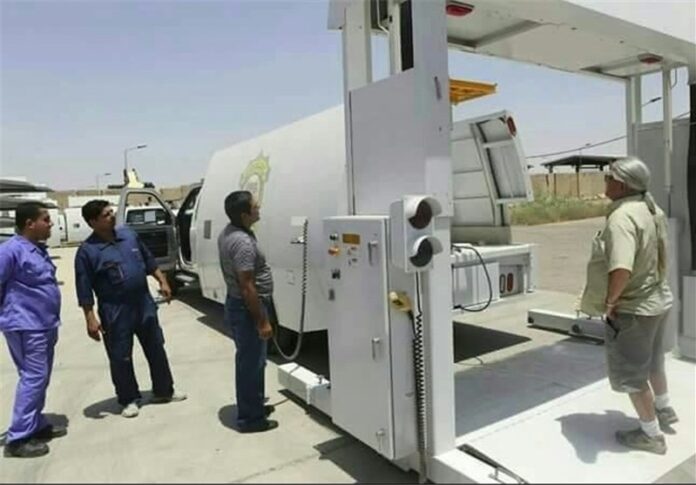
Iraq to Employ New Bomb Detection Equipment

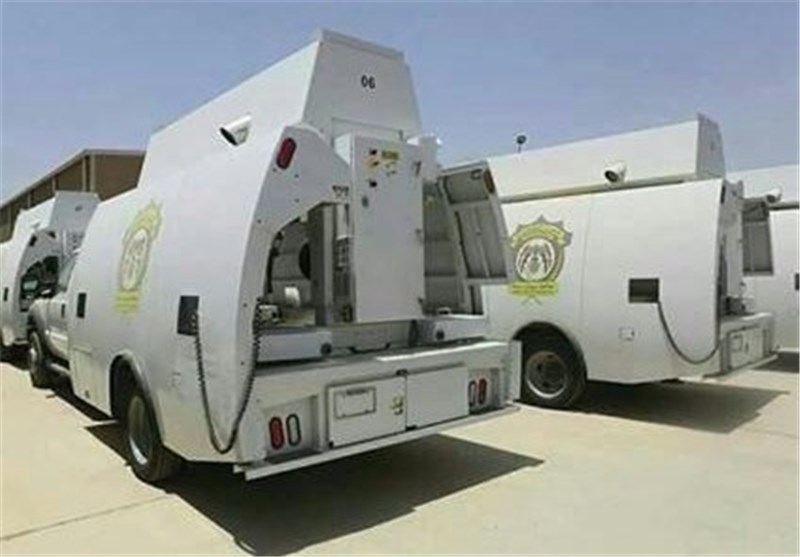
The bomb detection machines and vehicles will soon be used at checkpoints, entrances to the cities, airports and government buildings across the Arab country.

Iraq to Employ New Bomb Detection Equipment

Iraqi Prime Minister Haider al-Abadi ordered the purchase of the new equipment after the deadly terrorist attacks in Baghdad’s Karada district earlier in July.

The prime minister has also issued an order to discard the old explosive detection units, some of which were proved to be fake.

Last week, Iraq’s Health Ministry said the death toll from the massive suicide bombing in Baghdad on July 3 has reached 250.

Hundreds were also wounded in the attack, when a truck packed with explosives blew up in a busy shopping street filled with people.

Daesh (ISIL), the terrorist group controlling parts of Iraq and Syria, claimed responsibility for the attack in a statement circulated by its supporters online.

Saudi Muftis’ Double-Standard Policies towards Terrorist Attacks

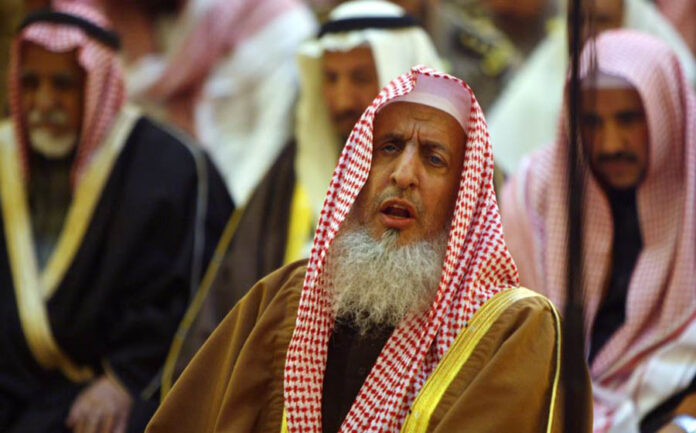
Saudi Muftis

According to a report by IRNA, as translated by IFP, Saudi Muftis are evidently running with the hare and hunting with the hounds. They turned a blind eye to the recent tragic terrorist attack in Karrada, Baghdad; however, they severely condemned the recent suicide bomber who blew himself up near the US consulate in Jeddah, Saudi Arabia.

From 2014 to 2015, graduates of Saudi-funded Wahhabi schools have conducted 5 terrorist attacks in Shiite mosques, but Muftis have refused to take a firm stance on them.

IRNA pointed to the roots of the heinous crimes committed by the ISIS, including burning people alive or ruthless beheading of innocent people, and stressed that the ideology of ISIS and other minor terrorist outfits is rooted in Wahhabism, which is taught in Saudi-funded schools to naïve individuals with malleable minds.

As recently as a few days ago, Saudi twin brothers, Khaled and Saleh al-Oraini, under the influence of Wahhabi thoughts and Mufti’s fatwas [Islamic decree], simply killed their mother after she tried to stop them from joining ISIS.

Iran’s Foreign Ministry Urged to Summon French Envoy over MKO Meeting in Paris

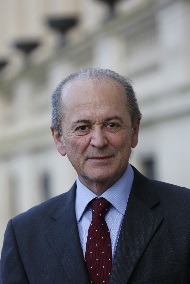
François Sénémaud

François Sénémaud1According to a report by Fars, as translated by IFP, Hossein Hanizadeh, an expert in foreign policy affairs, pointed to the 17,000 Iranians, many of them civilians, who have been killed by the MKO, and slammed the policies held by France, which has played host to the terrorist group’s members.
He further underlined the need for the Iranian Foreign Ministry to take appropriate stances against the group, saying, “The Foreign Ministry should have taken firm stances and prosecuted the MKO leaders a long time ago, but they are now freely pursuing their activities in European countries, France in particular.”

France is one of the countries that hatches plots against the Iranian nation, Hanizadeh said, urging the Foreign Ministry to summon the French Ambassador François Sénémaud.


New French Ambassador to Tehran: An Experienced Diplomat or a Senior Intelligence Agent?

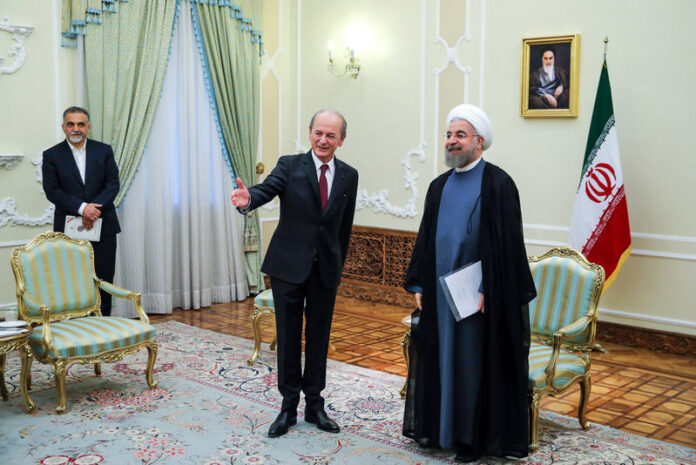
In the past couple of months, Iran’s President Hassan Rouhani has received the credentials of new ambassadors coming from such countries as Slovakia, Indonesia, Azerbaijan Republic, and France. Among these new envoys, the French Ambassador François Sénémaud had the most interesting background.

It is interesting to know that, before being appointed as France’s new envoy to Tehran, Sénémaud served as the Director of Information at the French secret service, the Directorate-General for External Security (DGSE), from 2012 to 2016.

The DGSE is France’s external intelligence agency, and the French equivalent to the United Kingdom’s MI6 and the United States’ CIA.

It operates under the direction of the French Ministry of Defence and works alongside its domestic counterpart, the DGSI (General Directorate for Internal Security), in providing intelligence and safeguarding national security, notably by performing paramilitary and counterintelligence operations abroad.

The DGSE is considered one of the world’s most respected intelligence agencies, especially in regards to economic intelligence.

Sénémaud’s previous jobs in the French government, particularly the one at the DGSE, raise questions over the real mission of the new ambassador to Tehran: Is he an experienced diplomat or a senior intelligence agent?

US Has Failed to Honour Its JCPOA Commitments: Velayati

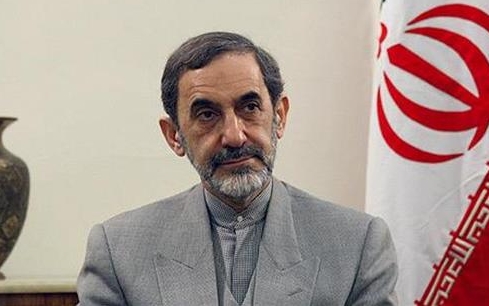
Ali Akbar Velayati

“The Americans have failed to fulfill their obligations, which were the removal of the [anti-Iran] sanctions and their effects, freedom of trade and scientific, technological, and business ties between Iran and Western countries,” said Ali Akbar Velayati on Saturday.

He stressed that the US was supposed to meet all these obligations after the International Atomic Energy Agency (IAEA) confirmed Iran’s compliance with the nuclear deal.

On February 26, the IAEA released its first regular report since the implementation of the JCPOA that verified Iran’s commitment to the nuclear agreement.

He further noted that the US’s failure to abide by its commitments has resulted in a rise in pessimism towards Washington in Iran and other regional countries.

Velayati also censured the other members of the P5+1 group of countries for their silence over the breach of agreement by the US. “We have to demand the reason for their silence on the Americans’ oath-breaking.”

Iran and the five permanent members of the UN Security Council — the United States, France, Britain, China and Russia — plus Germany started implementing the Joint Comprehensive Plan of Action (JCPOA) on January 16.

Under the deal, all nuclear-related sanctions imposed on Iran by the European Union, the Security Council and the US would be lifted. Iran has, in return, put some limitations on its nuclear activities.

Iran’s Judiciary Chief Blasts US Double Standards on Terrorism

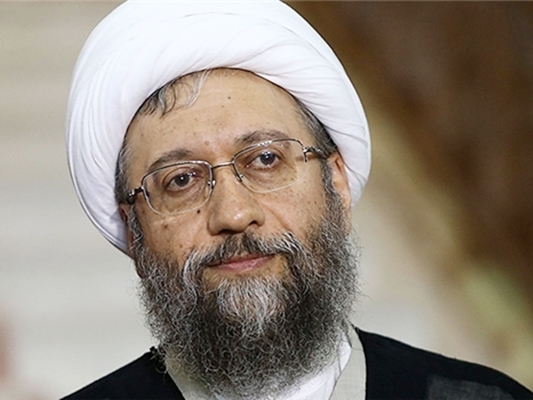
Addressing a high-profile meeting of judiciary officials in Tehran on Monday, July 11, Ayatollah Amoli Larijani said the US should not expect anybody to believe its claims on counterterrorism when it supports the terrorist Mojahedin-e Khalq Organization (MKO), which has assassinated around 17,000 Iranians.

The top official also denounced the French government for hosting a recent meeting of the notorious group in Paris.

The MKO – listed as a terrorist organization by much of the international community – fled Iran in 1986 for Iraq and was given a camp by former Iraqi dictator Saddam Hussein. They fought on the side of Saddam during the Iraqi imposed war on Iran (1980-88). The group has killed thousands of Iranian civilians and officials after the victory of the Islamic revolution in 1979.

Elsewhere in his comments, Ayatollah Amoli Larijani took a swipe at the US for trying to link the implementation of the Joint Comprehensive Plan of Action (JCPOA) – a nuclear deal between Tehran and the Group 5+1 (Russia, China, the US, Britain, France and Germany) – to irrelevant subjects, such as Iran’s missile capabilities.

Leader of the Islamic Revolution Ayatollah Seyyed Ali Khamenei’s predictions are coming true, the Judiciary Chief added, making a reference to the Leader’s prior warnings that Iran’s nuclear program was not indeed the crux of the matter for the US and that Americans would make up new excuses after the nuclear agreement, like raising human rights allegations against Iran, trying to restrict the country’s missile capabilities, opposing the Guardian Council and eventually seeking to define the posts in the Islamic Republic.

Last month, Ayatollah Khamenei highlighted the US unreliable nature and its failure to honour commitments under the JCPOA, saying the US always pursues its vicious objectives behind smiles and words.

Washington will never back down if Iran ever agrees to negotiate on any other subject, such as human rights, missile program, terrorism, Lebanon or Palestine, the Leader said at the time.

While the JCPOA came into force in January, the US has failed to fully meet its commitments to the accord, and has even taken measures that are perceived to run counter to the spirit of the deal, like confiscating the Central Bank of Iran’s assets in an American bank.

Tony Blair’s Apology, a Stain of Shame on UK’s History: Politician

11

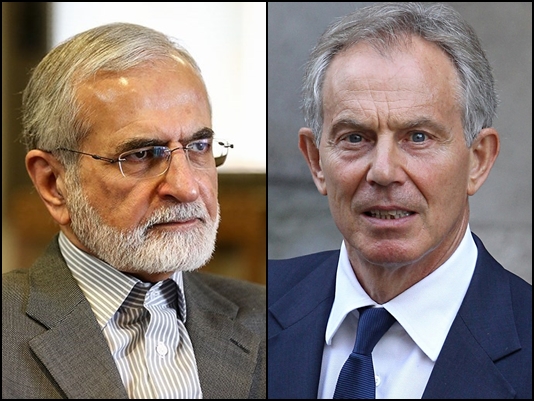
In an interview with Entekhab, as translated by IFP, Kamal Kharrazi, the former Iranian Foreign Minister, described the Former British Prime Minister’s apology as a blemish.

“I gave the due warnings to Blair about the invasion of Iraq and its detrimental repercussions at that time in the meetings where Jack Straw, the English politician, was also present,” Kharrazi said.

He underlined that Blair, in response, flashed a conceited smile which indicated they had made the final decision to invade Iraq.

Kharrazi went on to say that he happened to have another meeting with Blair some time after the invasion of Iraq and seized the opportunity to advise him, “You’d better withdraw your troops before it’s too late.”

“This time, instead of that conceited smile, I found dark strains of regret on his face,” Kharrazi said.

After five years of failure against the fierce resistance of Iraq’s revolutionary people in Basra, Britain decided to make a quick, full retreat which was bad news for the US and its then-president.

A few days ago, ahead of the publication of the long-awaited Chilcot report, Blair expressed his apology over the UK’s role in Iraq war and said that he takes full responsibility for the decisions that led to the UK’s involvement in the 2003 invasion.

Are Turks Disgruntled over Erdoğan’s Gov’t or Syrian Refugees?

1220037_403

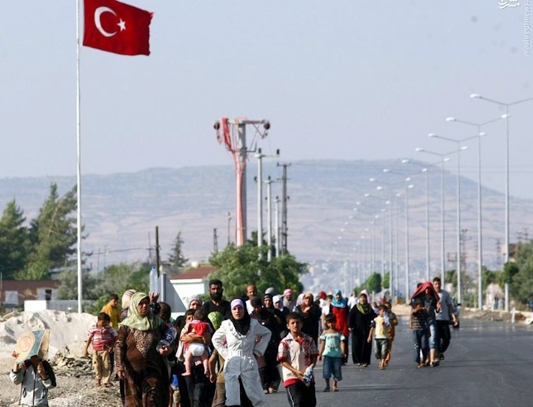
ISNA reported about a new Hashtag which is trending among the people of Turkey, showing a widespread discontent with the presence of their new guests coming from Syria. Here is IFP’s translation of excerpts from the report.

Over five years have passed since the breakout of war in Syria. Half of the 23m-population of the country has been displaced and one-fourth has fled into neighbouring countries to save their lives. The influx of 2m displaced Syrians into Turkey has raised concerns among Turkish people.

Syrian refugees speaking in Arabic language are seen here and there on the streets and in every corner of the country. They have upset the balance between supply and demand, causing a price increase in houses and food.

Following that, a new Hashtag has become popular among Turks that reads, “I do not want Syrians in my country”. However, this is not the whole story. It seems that the culminating sense of frustration among Turks is rooted in something beyond the unwelcomed Syrian guests.

“Erdoğan has purposefully let them flood into our country. Before long, he will give them the right to vote, vying to protract his stay in power,” a hotel worker in Istanbul’s Taksim Square said.

Erdoğan has been 12th President of Turkey since 2014. He previously served as the Prime Minister of Turkey from 2003 to 2014. He founded the Justice and Development Party [AKP] in 2001 and led it to three general election victories in 2002, 2007 and 2011.

In 2014 he made futile attempts to change Parliamentary system in Turkey into Presidential in a bid to gratify his cravings for more power.

President Rouhani to Visit Kermanshah in Spite of Recent Assassination

Rouhani1

According to a report by IRNA, as translated by IFP, an official with President’s office announced that no change has been made in President’s plan to visit Kermanshah.

Ali Asghar Mohammadi said the trip to Kermanshah will be made in the near future.

His remarks came as certain media had reported the cancellation of President’s visit due to the assassination attempt against Heshmatollah Falahatpisheh, a member of Iranian Parliament’s National Security and Foreign Policy Commission.

The vehicle carrying Falahatpisheh, the representative of the county of Eslamabad-e Gharb, came under an attack by four assassins as he was travelling to the village of Rijab on Sunday, July 10.

The governor of Dalahou County and the director-general of the fisheries of Kermanshah, also passengers of the vehicle, sustained injuries while the driver and head of the Veterinary Department of Dalahou lost their lives in the shooting.

Falahatpisheh escaped the attack with little injuries, and local security and judicial officials are investigating the assault.

Iran’s President Felicitates Mongolia on National Day

Rouhani-Hassan

In a Monday, July 11, message to his Mongolian counterpart, Tsakhiagiin Elbegdorj, President Rouhani expressed his sincere congratulations on the advent of National Day of Mongolia, which ended Chinese occupation over the country.

Citing age-old ties and common interests between the two nations, Rouhani expressed the hope that mutual bonds would further boost in future.

Mongolia observes National Day on Monday to commemorate its 1921 revolution when the country declared independence of China.

Iran and Mongolia signed a memorandum of understanding (MoU) on June 2016 to develop friendly ties and expand cooperation in different fields, especially political affairs.

Iranian oil minister, Bijan Namdar Zanganeh had said in a meeting with Mongolia’s visiting Foreign Minister Lundeg Purevsuren on December 2015 that the Islamic Republic is ready to export oil to Mongolia with the cooperation of Chinese companies.