Wednesday, December 24, 2025
Home Blog Page 4314

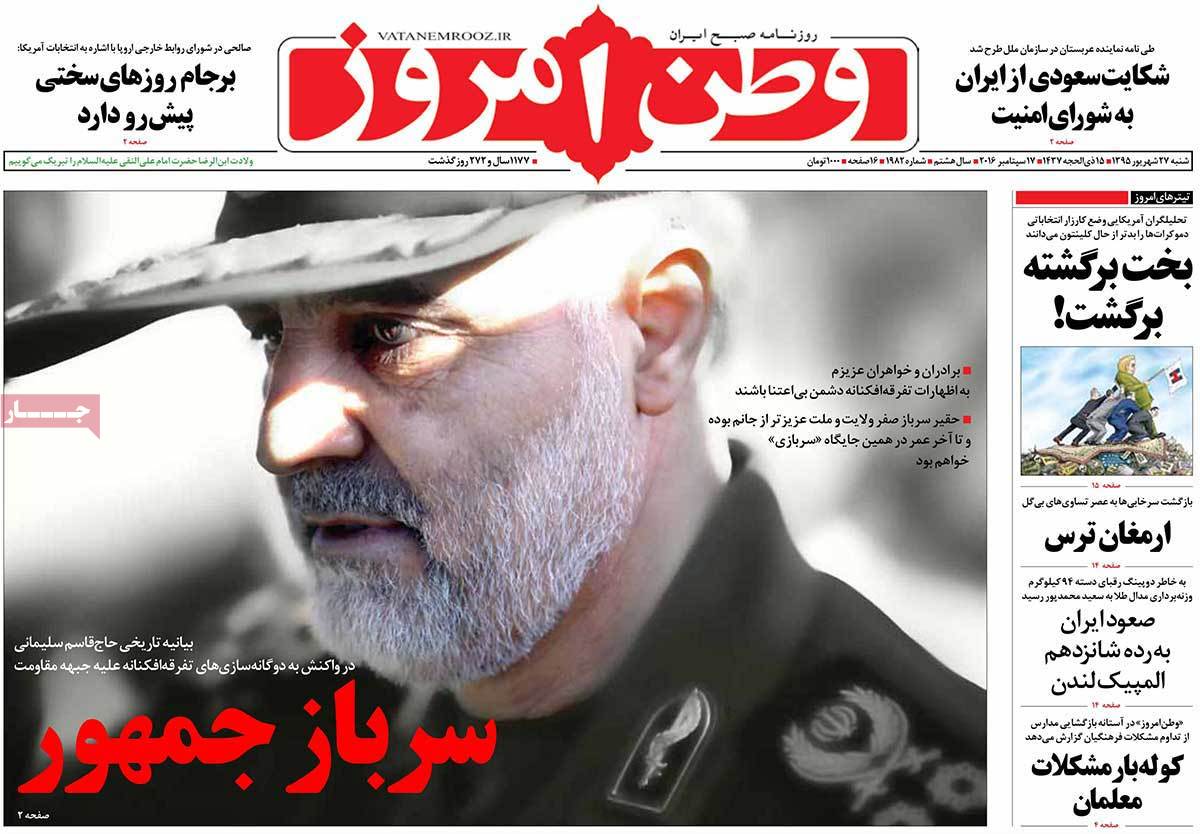
A Look at Iranian Newspaper Front Pages on September 17

Iran Newspaper front pages

The top story today was the European visits of Iran’s nuclear chief Ali Akbar Salehi and his remarks about the future of Iran’s nuclear industry.

Newspapers also covered the visits of President Hassan Rouhani to Venezuela and then the US. Rouhani is due to attend the Non-Alignment Movement (NAM) Summit and the United Nations General Assembly (UNGA) in Margarita Island and New York City, respectively.

The remarks by Seyyed Ali Khomeini, the grandson of Imam Khomeini, about Iran’s fight against terrorism also received good coverage.

The above issues as well as many more are highlighted in the following headlines:


Abrar:

1- Barzani Calls for Agreement with Baghdad before Beginning of Mosul Operation

2- AEOI Spokesman: Draft to Be Prepared on Tehran-Europe Cooperation in 2 Weeks

3- Kerry’s Deputy Consults with Abadi on Preparations for Mosul Liberation

4- Mogherini: Trade Ties between Iran and Europe Have Had Unbelievable Increase

A Look at Iranian Newspaper Front Pages on September 17


Abrar-e Eqtesadi:

1- Crisis of Gini Coefficient Decrease in Ahmadinejad’s Gov’t: In His Term, Capital Output Was $25bn More than Its Input to Iran

2- World Bank: One-Place Improvement in Iran’s Rank in Purchasing Power Parity (PPP) Index

3- Lukoil’s Talks with Iran for Oil Extraction from Caspian Sea

4- Beginning of a New Era in Iran-South Africa Trade Ties

A Look at Iranian Newspaper Front Pages on September 17


Afarinesh:

1- Zarif in NAM Summit: Interference in Other Countries’ Affairs and Extremism Are Threatening World Peace

2- Before Departing for Venezuela, President Rouhani Said We Should All Be Looking for Peace and Stability in Region and World
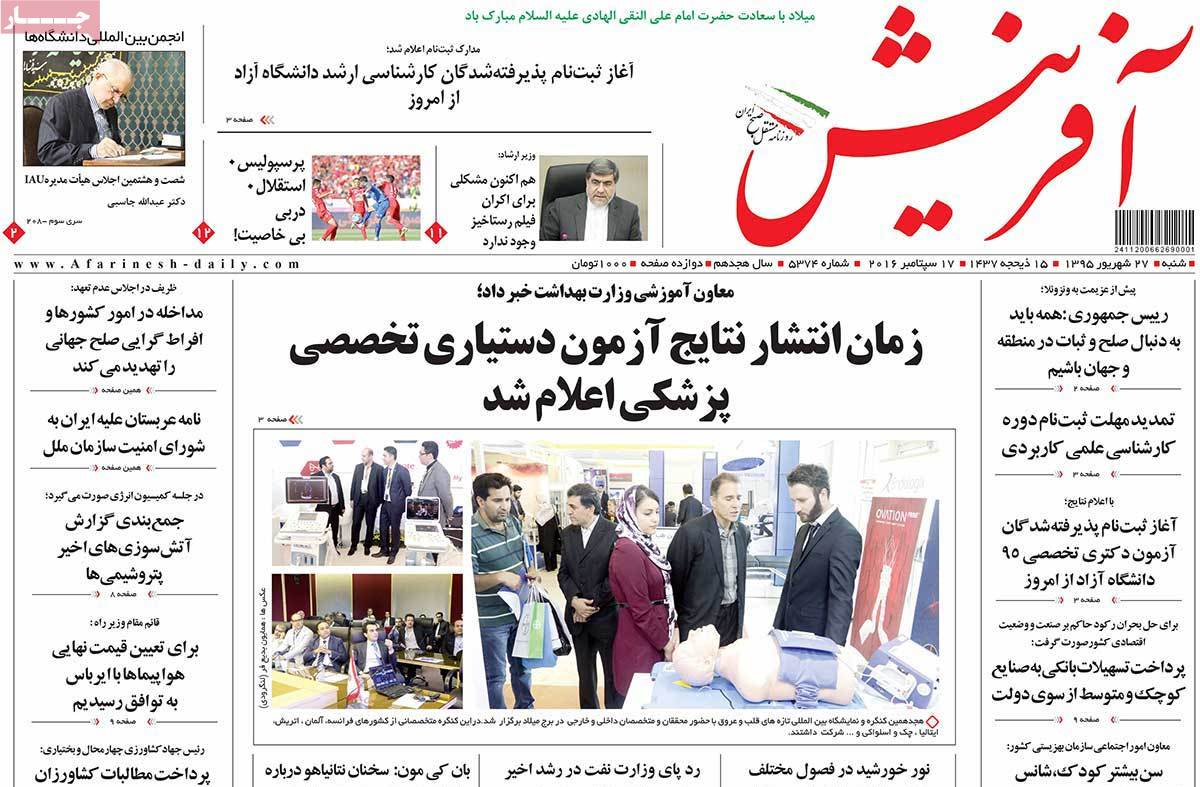
A Look at Iranian Newspaper Front Pages on September 17


Afkar:

1- Ayatollah Khatami: Others Should Be Allowed to Criticize FATF

2- Ban Urges Syrian Opposition Groups to Return to Peace Negotiations

3- Saudi Arabia’s Serious Concern about US Congress’ Bill

4- Abbas Kiarostami Becomes Busan’s Artist of the Year
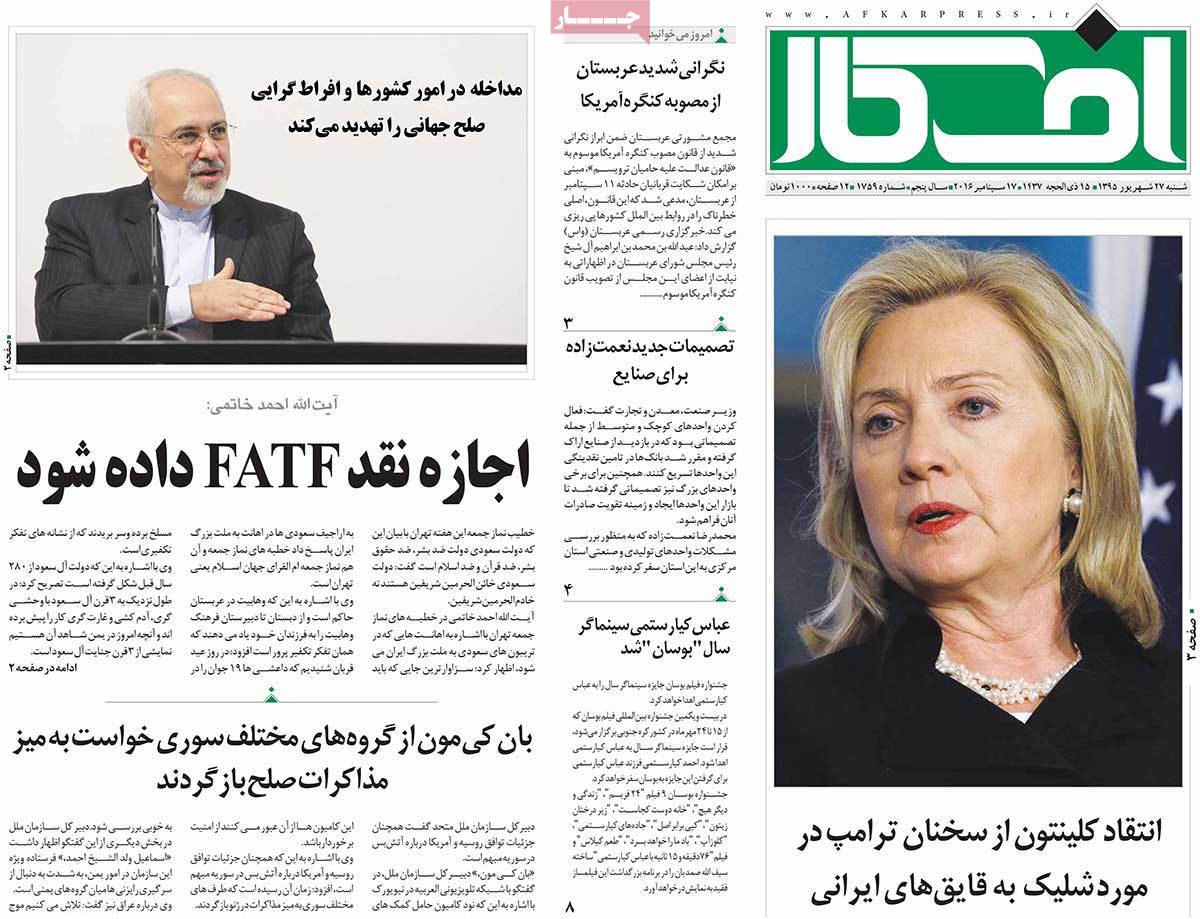
A Look at Iranian Newspaper Front Pages on September 17


Aftab-e Yazd:

1- Ahmadinejad’s Gov’t Imported Wheat from Britain, Rouhani’s Administration Is Exporting Wheat to Italy: Rouhani’s Major Achievement in Wheat Self-Sufficiency

2- Improved GDP in Spite of Decline in Oil Price: Rouhani’s Economic Success Confirmed by World Bank
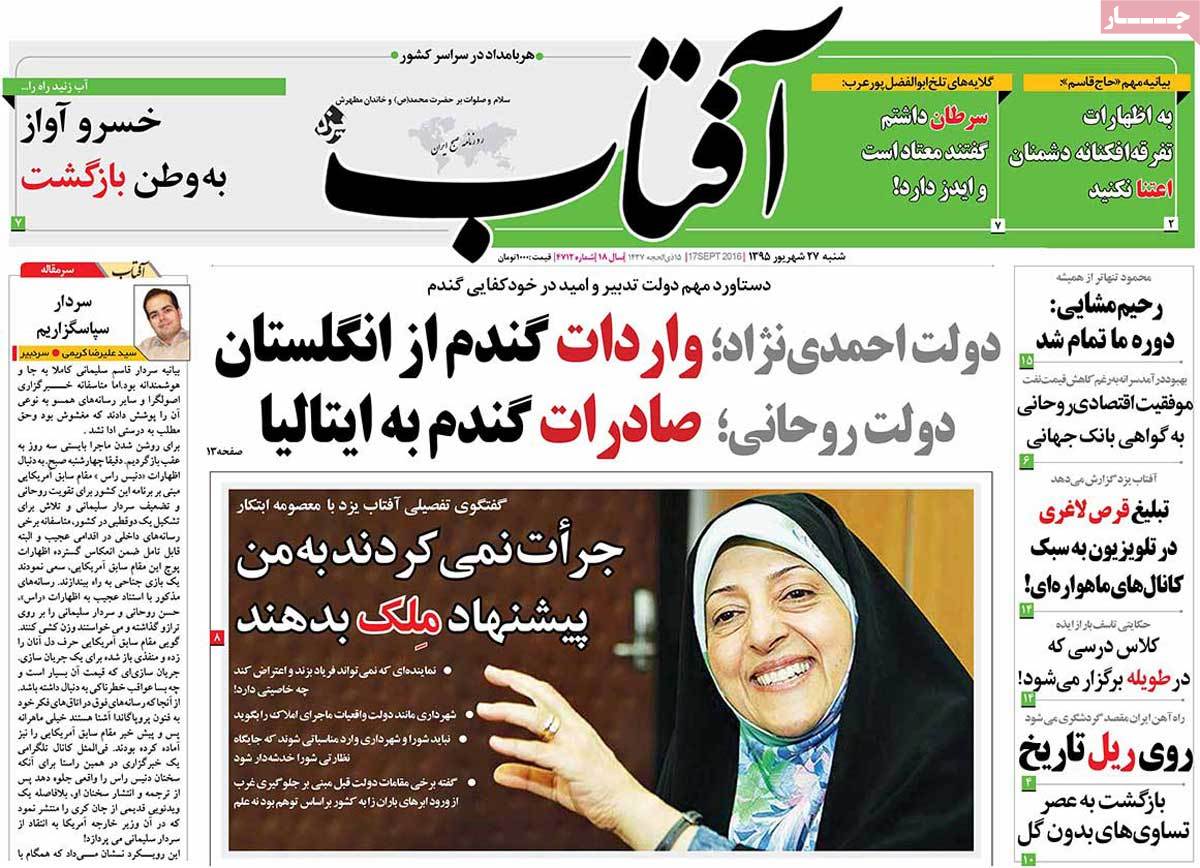
A Look at Iranian Newspaper Front Pages on September 17


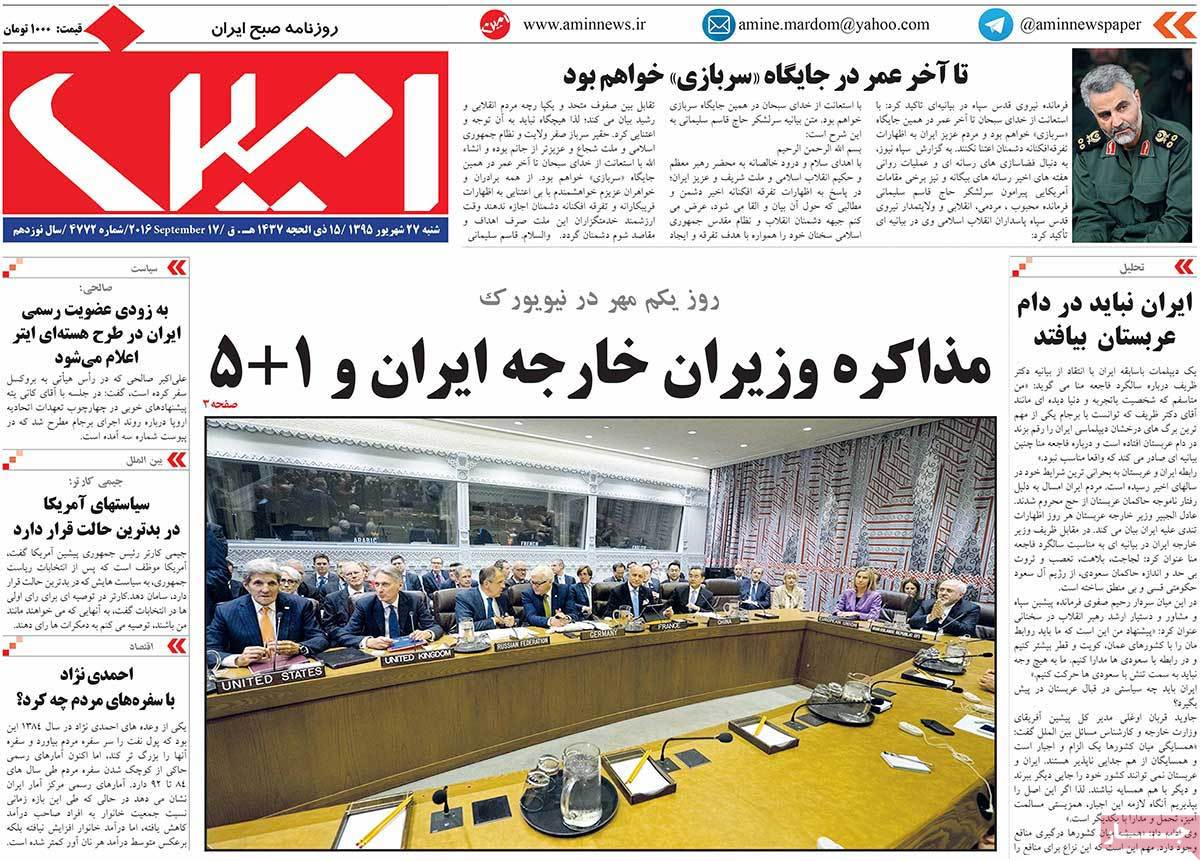
Amin:

1- Iran and Group 5+1 FMs to Convene in New York on September 22

2- Salehi: Iran’s Official Accession to International Thermonuclear Experimental Reactor (ITER) to Be Announced Soon

3- Jimmy Carter: US Policies in Worst Conditions
A Look at Iranian Newspaper Front Pages on September 17


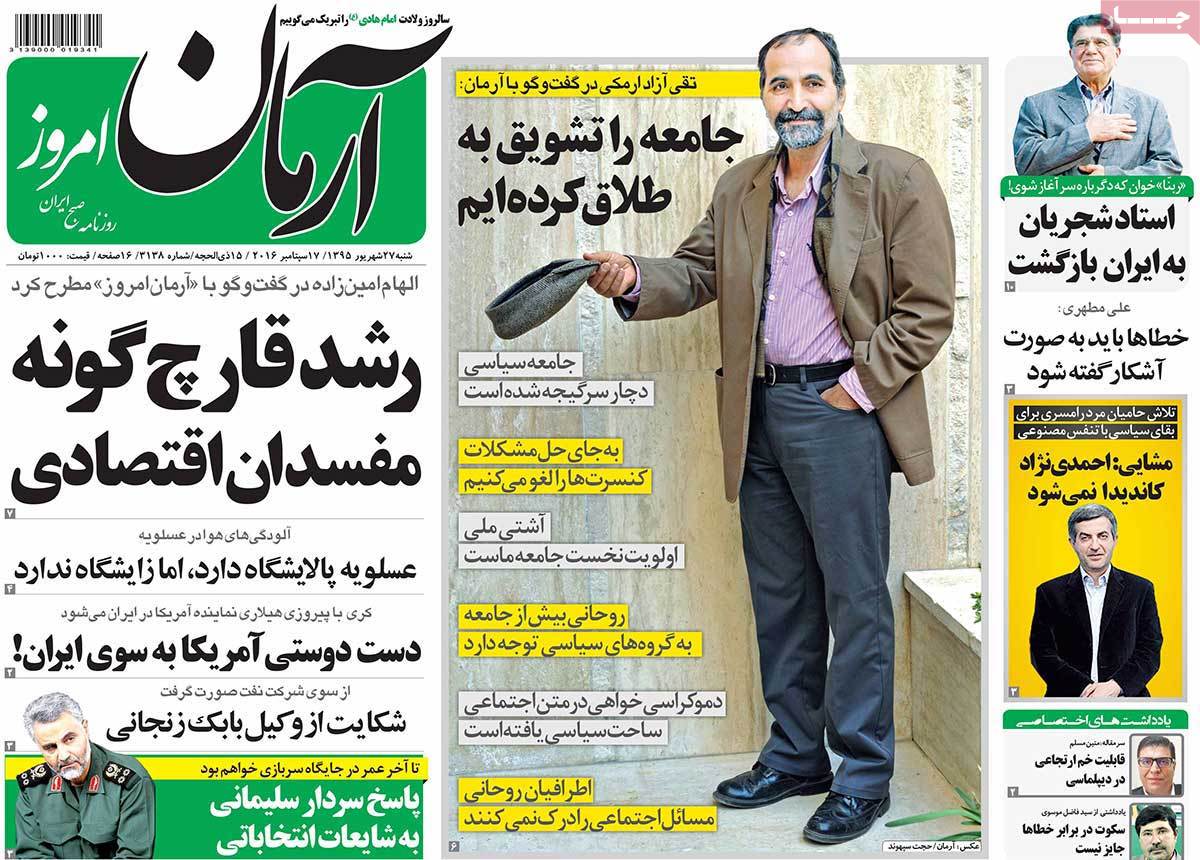
Arman-e Emrooz:

1- Kerry to Become US Representative in Iran Affairs If Clinton Wins Elections: US Hand of Friendship Extended to Iran

2- Adviser: Ahmadinejad Won’t Run for Presidency in 2017 Elections

3- General Soleimani Dismisses Rumours of His Bid for Presidency, Saying He’ll Remain a Soldier
A Look at Iranian Newspaper Front Pages on September 17


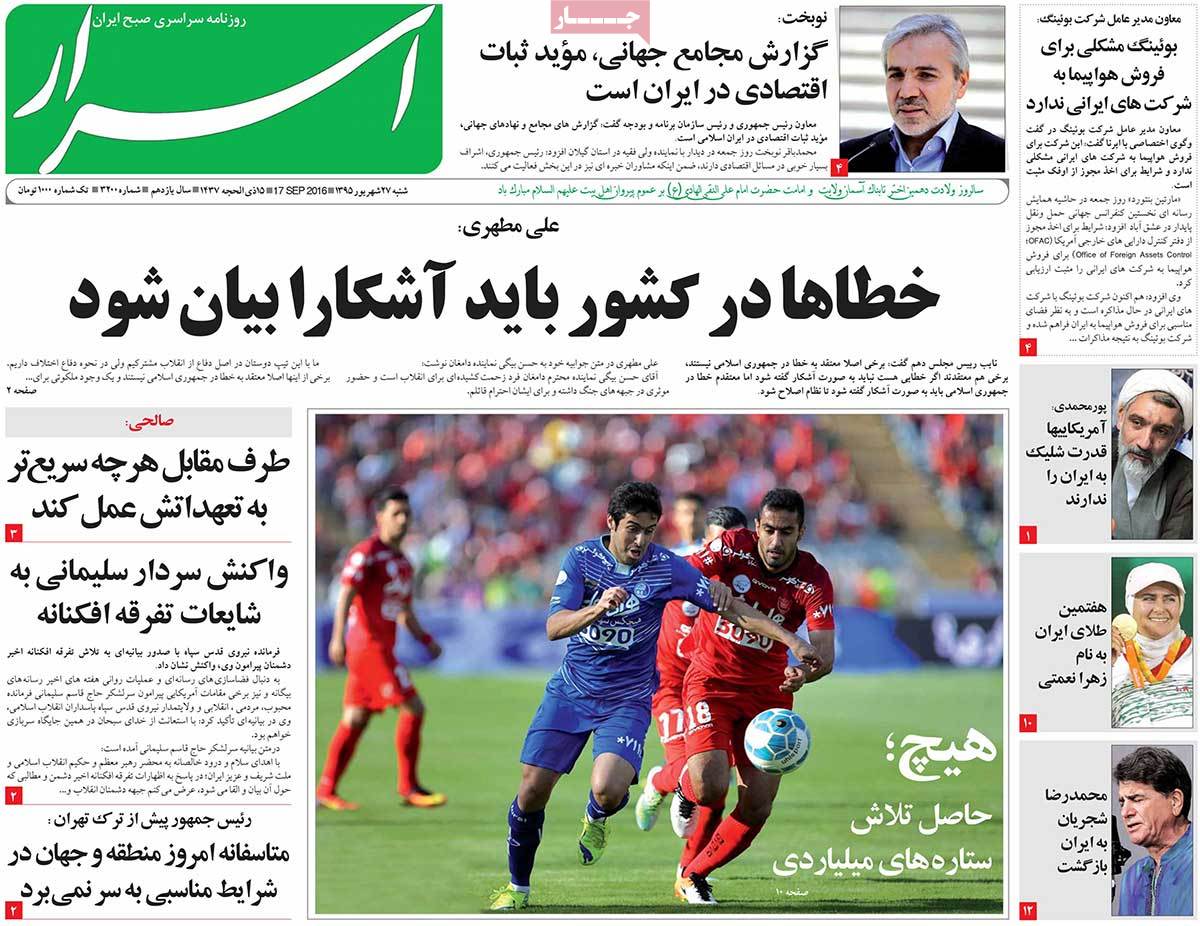
Asrar:

1- Spokesman: Global Centres’ Reports Confirm Iran’s Economic Stability

2- Justice Minister: US Doesn’t Have the Power to Shoot Iran

3- Boeing Official: Boeing Has No Problem with Selling Planes to Iran
A Look at Iranian Newspaper Front Pages on September 17


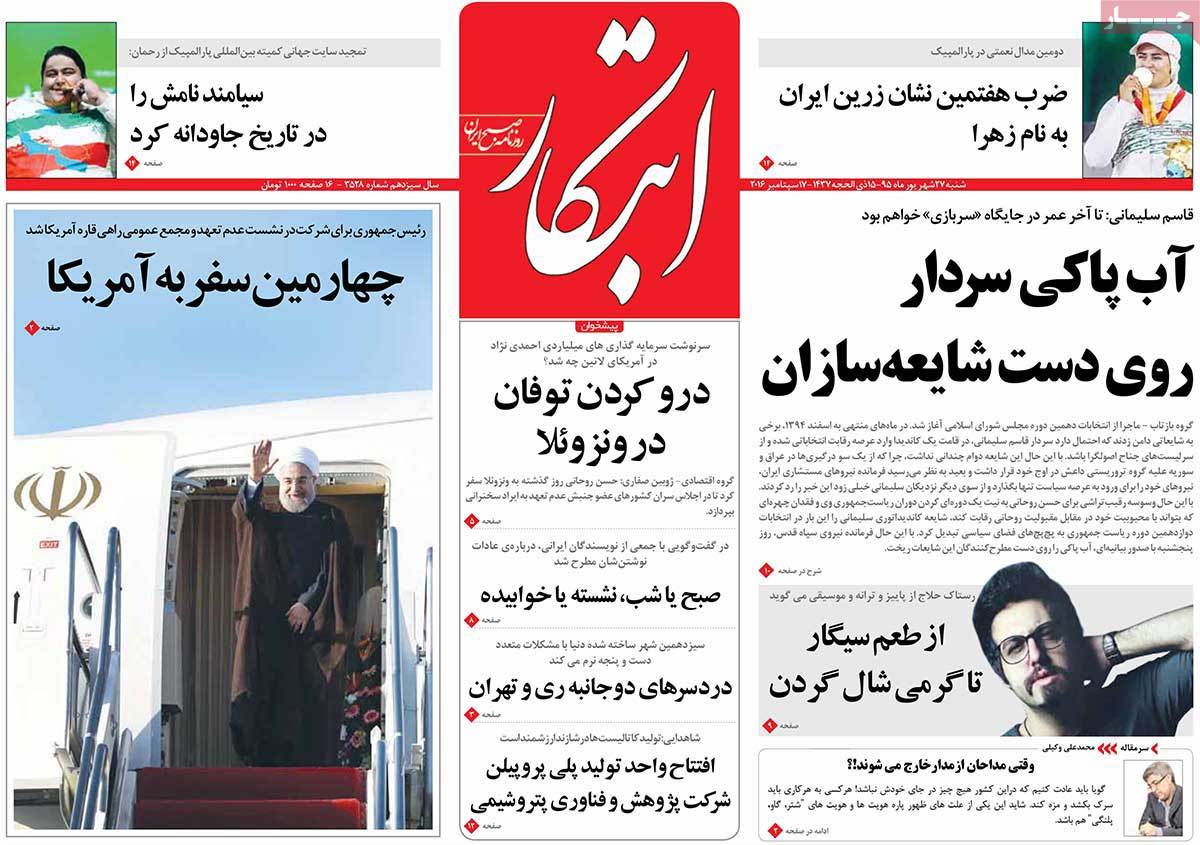
Ebtekar:

1- Fourth Visit to US: President Leaves Tehran for Americas to Attend NAM Summit and UNGA

2- 7th Gold Medal for Iran’s Paralympics Team Won by Zahra Nemati
A Look at Iranian Newspaper Front Pages on September 17


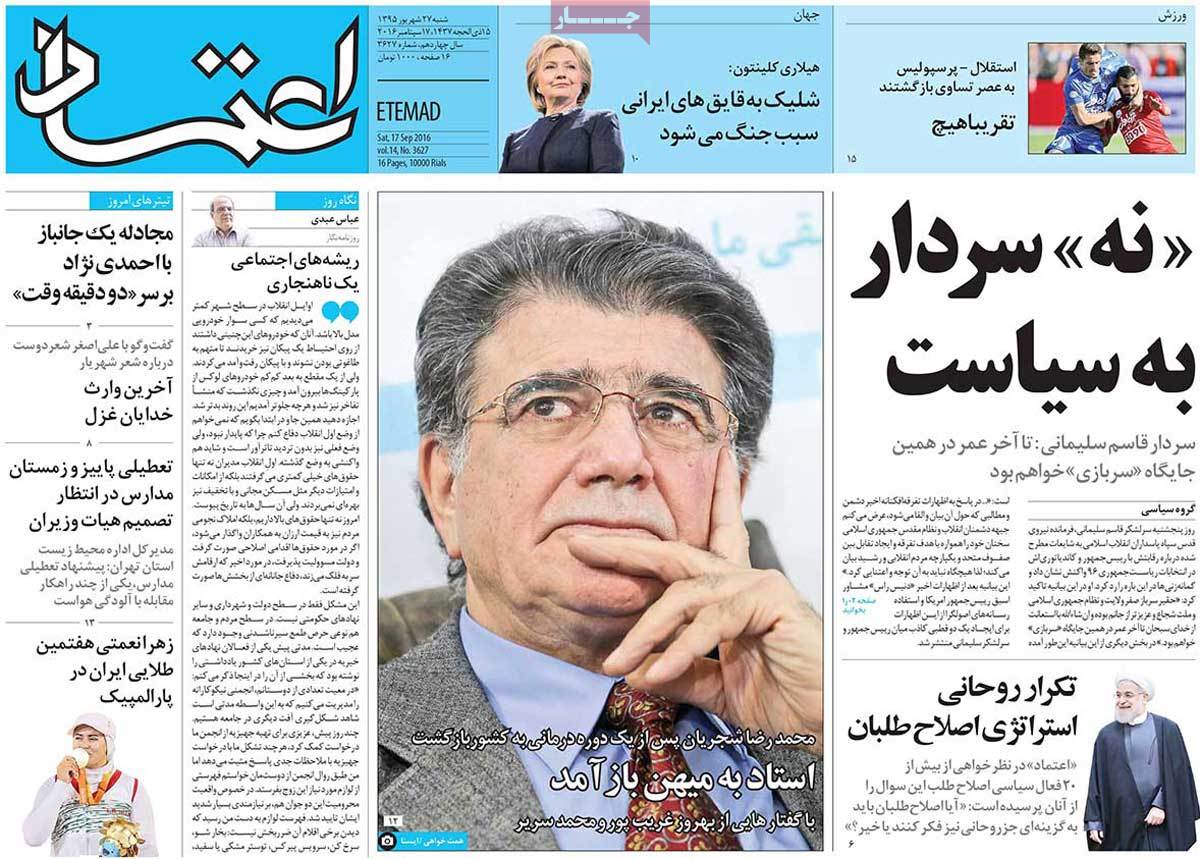
Etemad:

1- Repetition of Rouhani, the Strategy of Reformists

2- Master Shajarian Returns Home after Treatment in US

3- Clinton: Shooting Iranian Boats Would Lead to War
A Look at Iranian Newspaper Front Pages on September 17


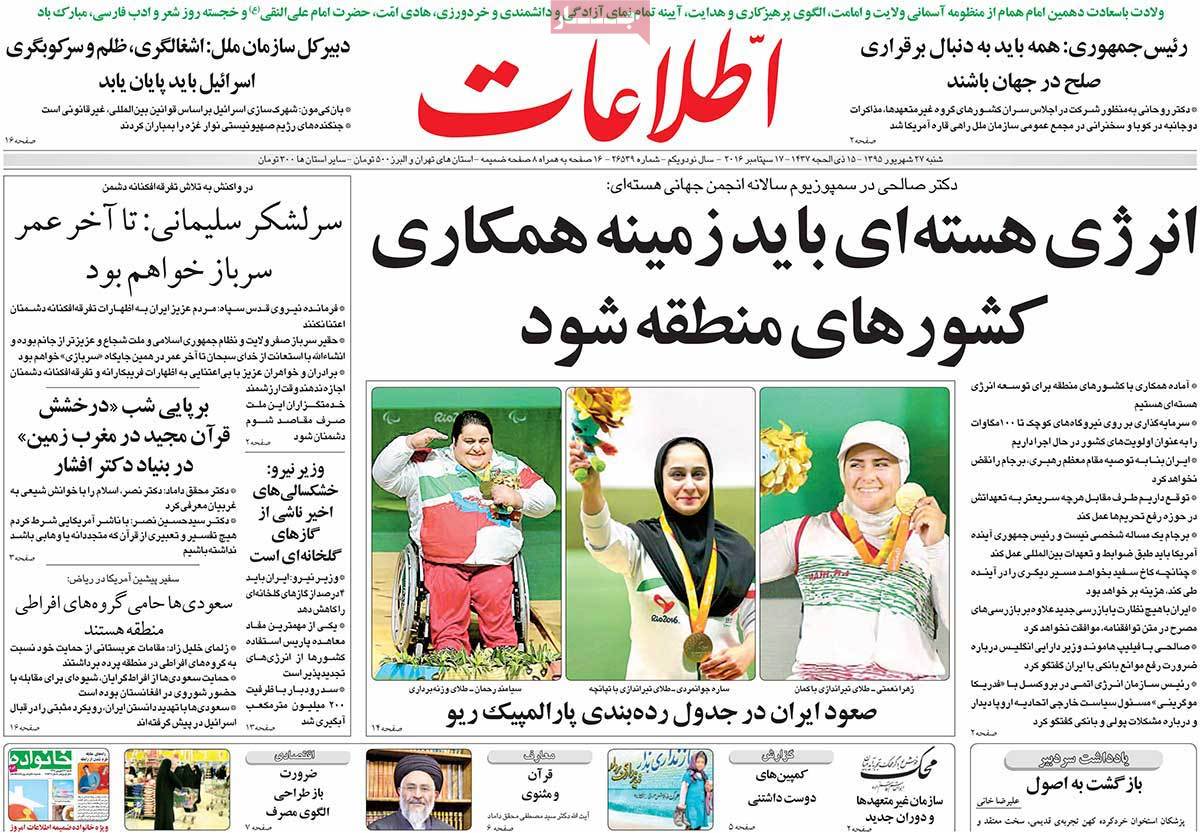
Ettela’at:

1- Salehi: Nuclear Energy Should Be a Ground for Regional Cooperation

2- UN Secretary General: Israel’s Occupation, Tyranny, and Oppression Should Be Ended

3- Energy Minister: Recent Droughts Were Caused by Greenhouse Gases

4- Former US Ambassador to Riyadh: Saudis Support Extremist Groups in Region

5- Iran Goes Up in Paralympics Medal Ranking
A Look at Iranian Newspaper Front Pages on September 17


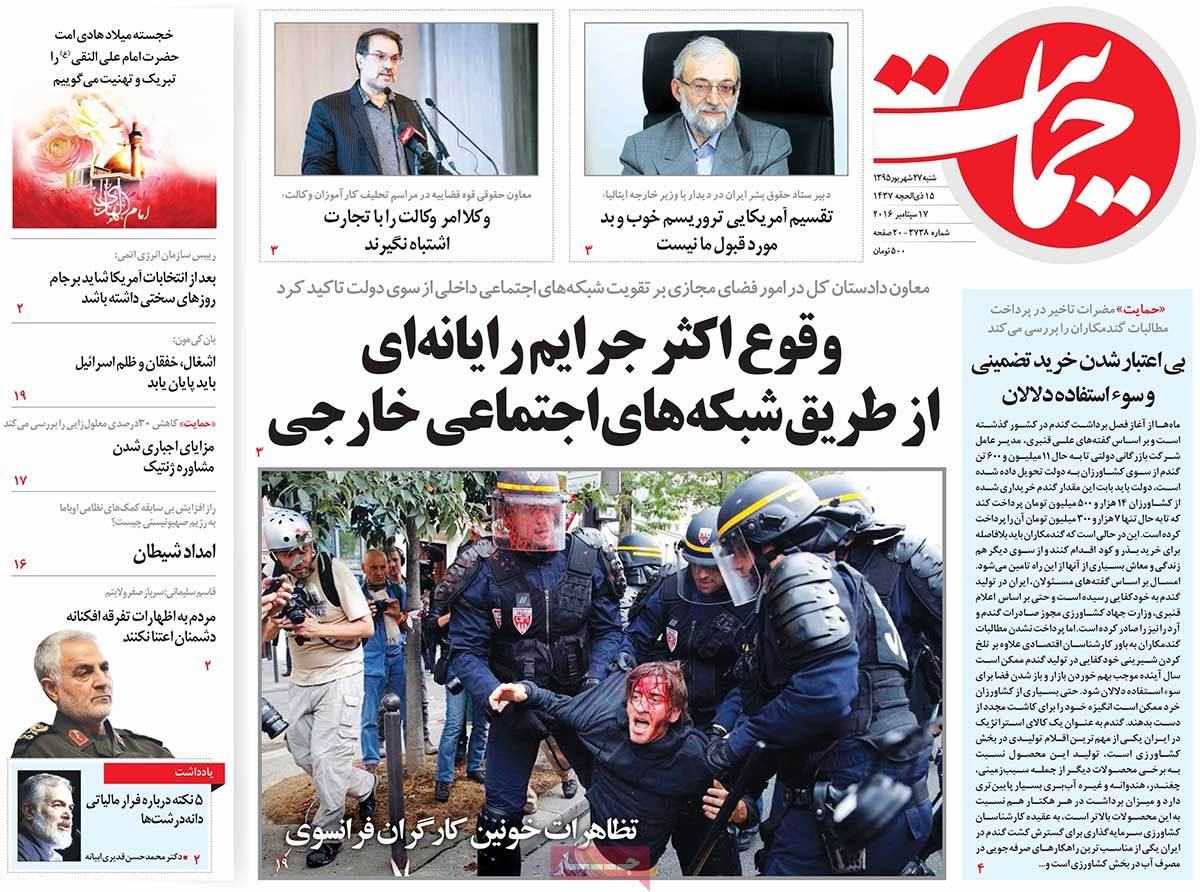
Hemayat:

1- Iran’s Human Rights Council Chief: US Division of Terrorism into Good and Bad Categories Not Acceptable to Tehran

2- Bloody Rallies of Workers in France
A Look at Iranian Newspaper Front Pages on September 17


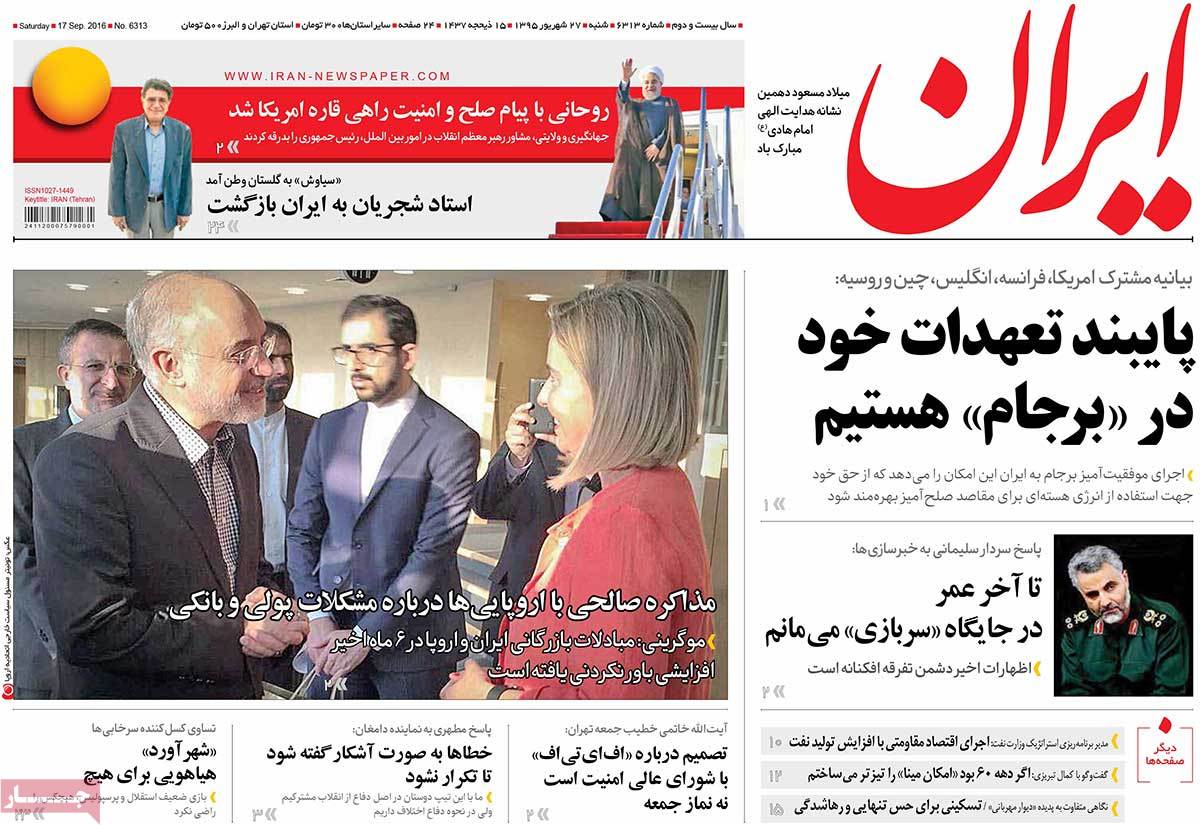
Iran:

1- Joint Statement by US, France, Britain, China, and Russia: We Stick to Our JCPOA Commitments

2- Rouhani Arrives in Americas with Message of Peace and Security

3- Salehi’s Talks with Europeans about Banking and Financial Problems
A Look at Iranian Newspaper Front Pages on September 17


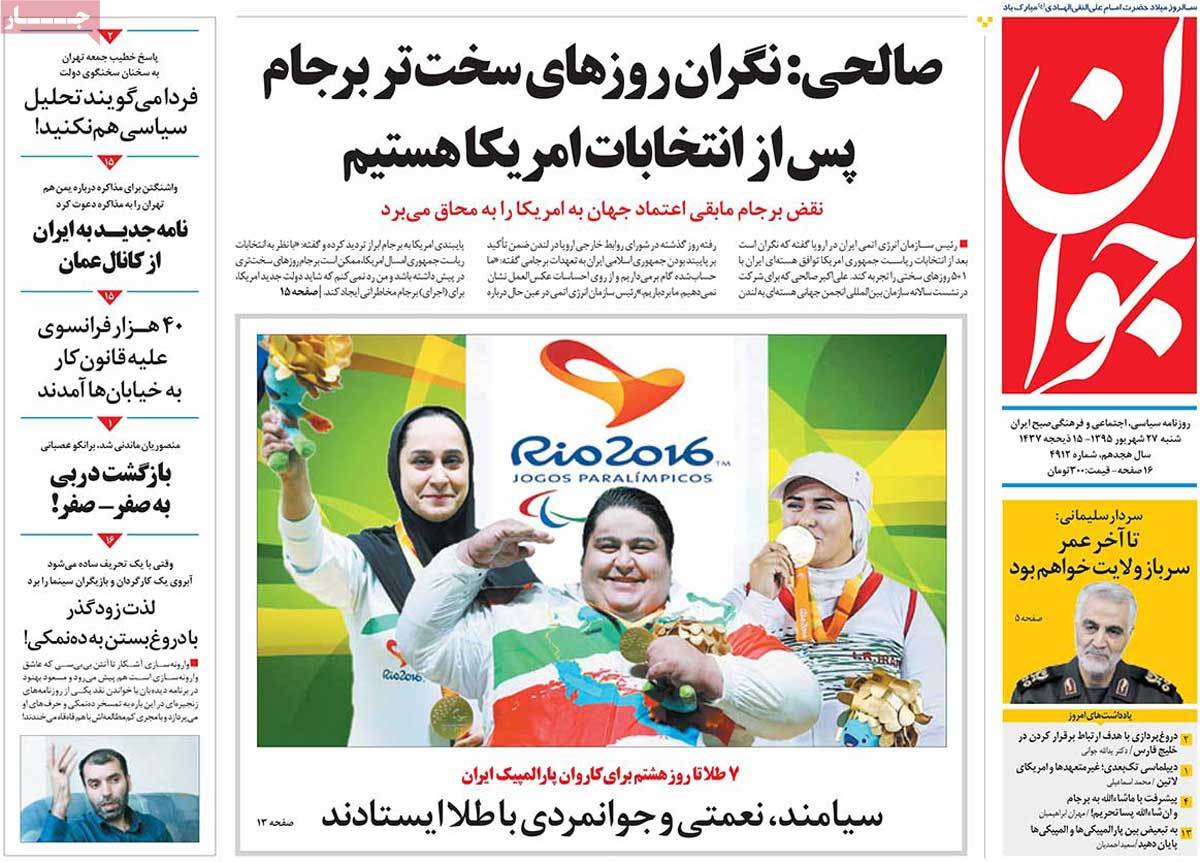
Javan:

1- Salehi: We’re Worried about More Difficult Days of JCPOA after US Elections

2- 7 Gold Medals until 8th Day for Iran’s Paralympics Team: Siamand, Nemati and Javanmardi  Win Gold
A Look at Iranian Newspaper Front Pages on September 17


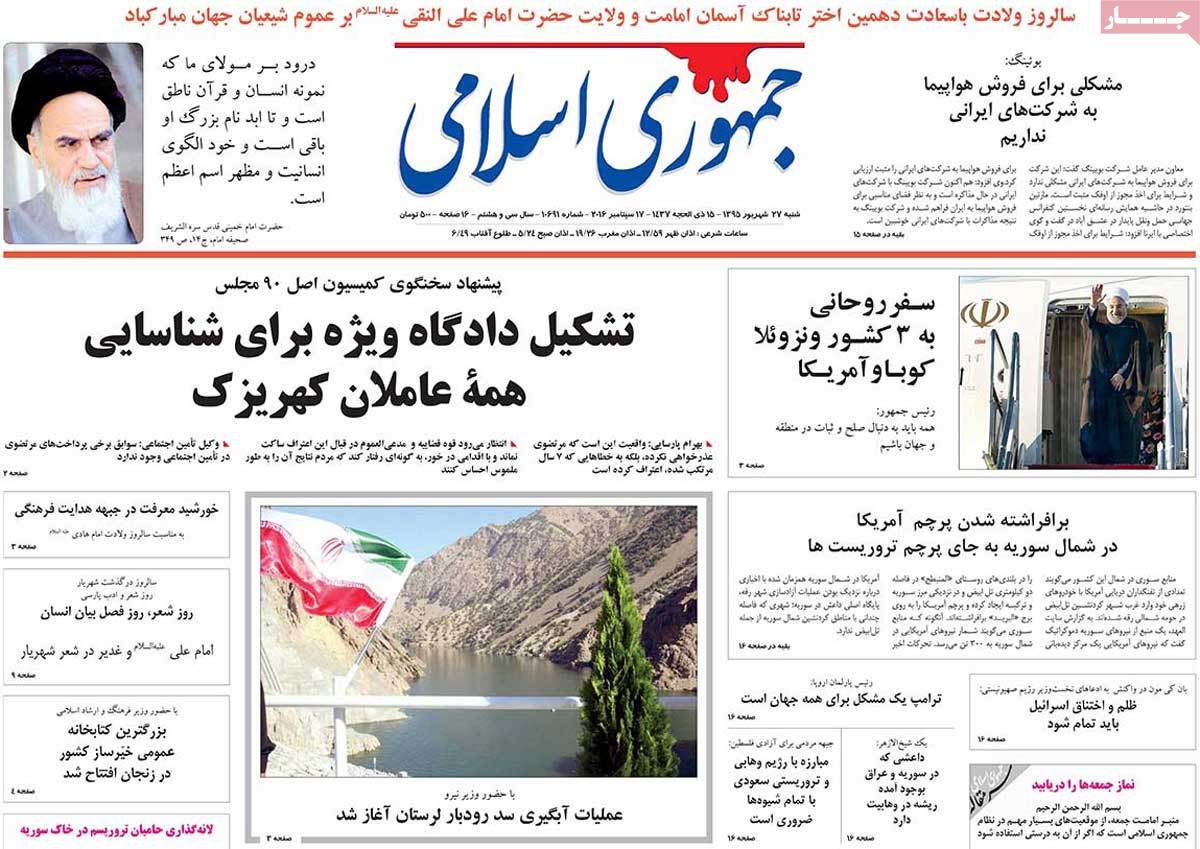
Jomhouri Eslami:

1- US Flag, instead of Terrorists’, Raised in Northern Syria

2- Trump Is a Problem for Entire World: EP President
A Look at Iranian Newspaper Front Pages on September 17


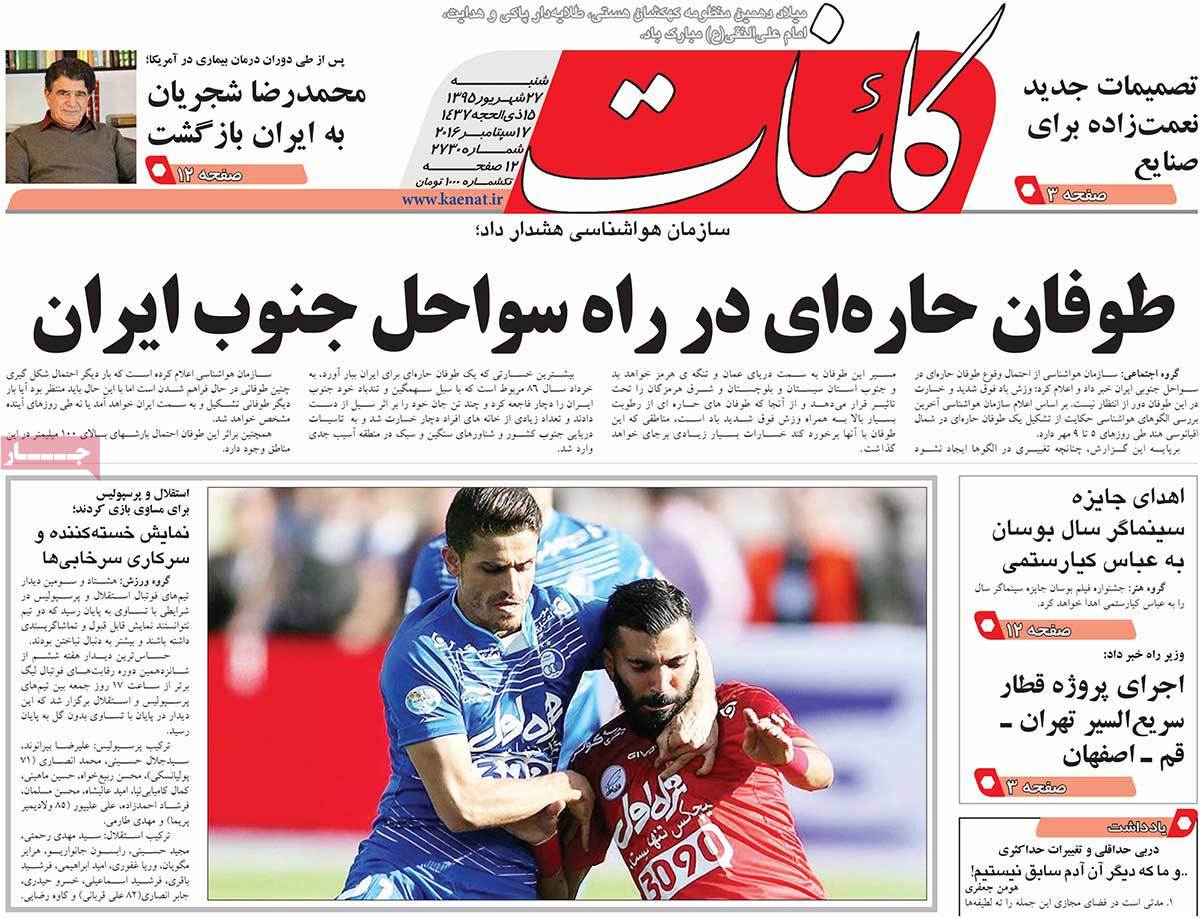
Ka’enat:

1- Tropical Storm En Route to Iran’s Southern Coasts: Official Warning
A Look at Iranian Newspaper Front Pages on September 17


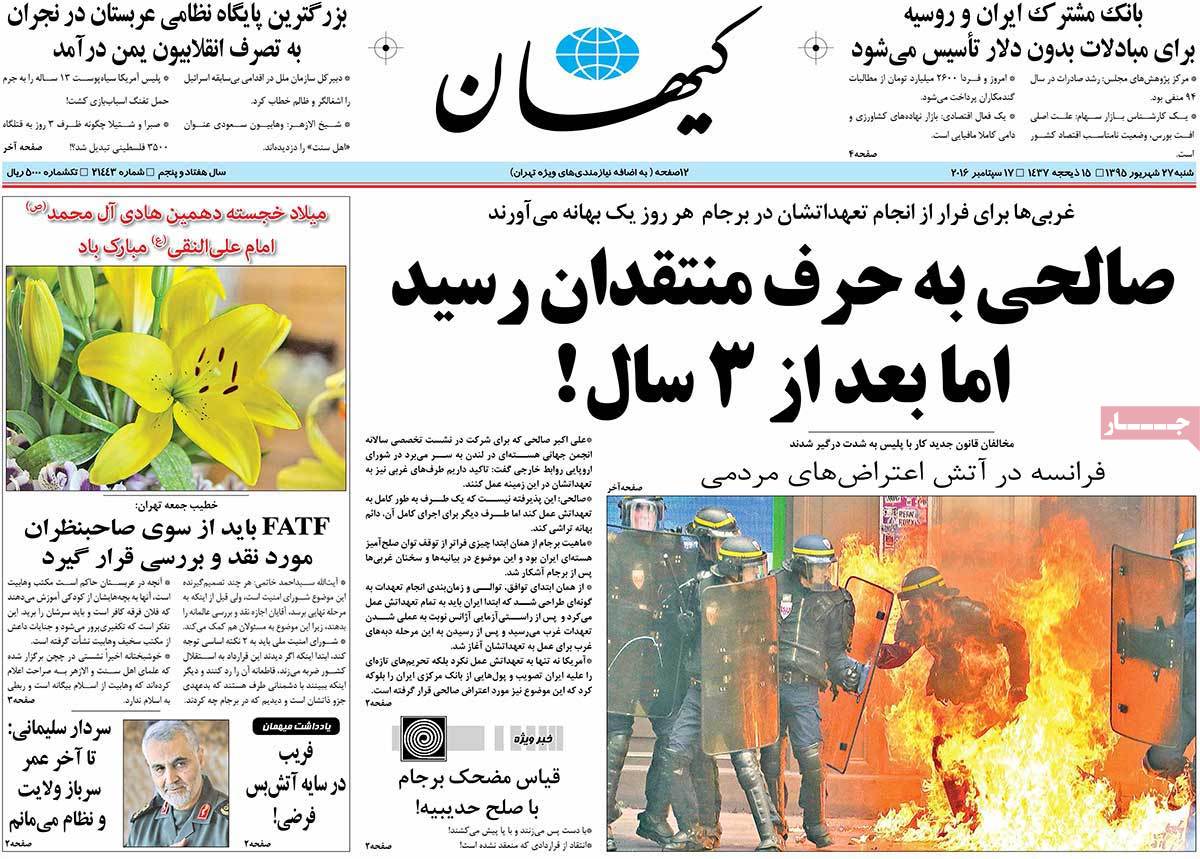
Kayhan:

1- Iran-Russia Joint Bank to Be Established for Dollar-Free Transactions

2- Salehi Confirms Critics’ Arguments after 3 Years! West Raises New Excuses Each Day in a Bid to Evade Fulfilling JCPOA Commitments

3- Saudi Arabia’s Largest Military Base in Najran Seized by Yemeni Revolutionaries

4- Al-Azhar Cleric: Saudi Wahhabis Have Stolen the Title ‘Sunni’
A Look at Iranian Newspaper Front Pages on September 17


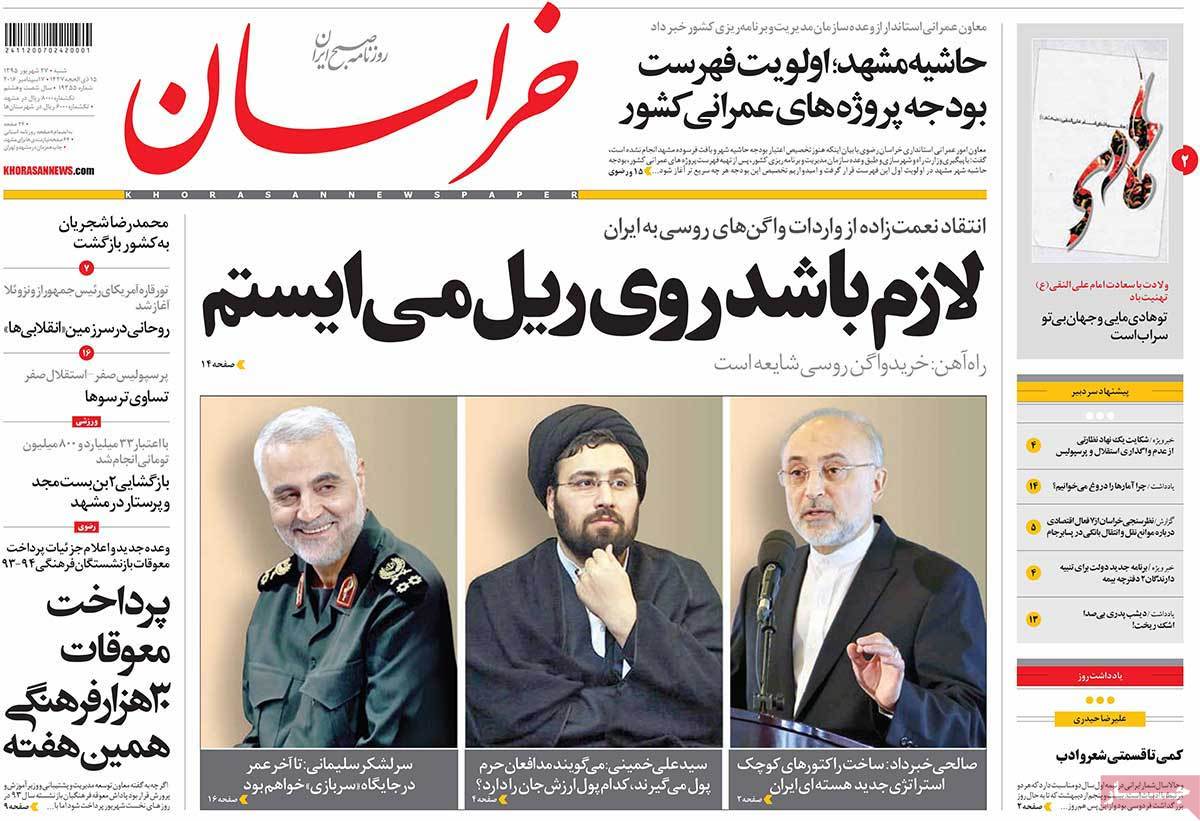
Khorasan:

1- Imam Khomeini’s Grandson [Seyyed Ali]: They Say Those Who Fight in Syria to Defend Holy Shrines Do It for Money; Who Would Risk His Life for Money?

2- Salehi: Construction of Small Reactors, Iran’s New Nuclear Strategy
A Look at Iranian Newspaper Front Pages on September 17


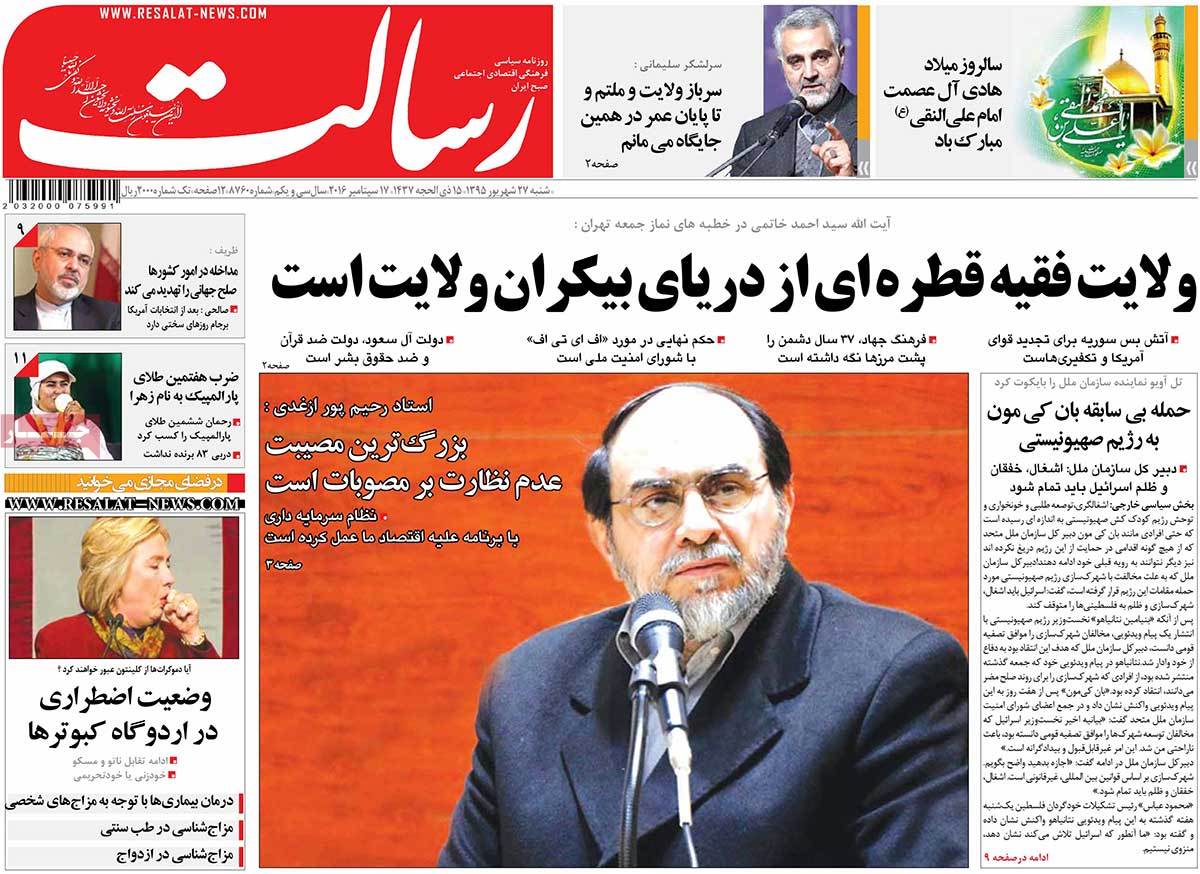
Resalat:

1- Ayatollah Khatami: Syria Ceasefire Is Aimed at Regrouping US and Takfiri Forces

2- Ban’s Unprecedented Attack against Zionist Regime [Israel]
A Look at Iranian Newspaper Front Pages on September 17


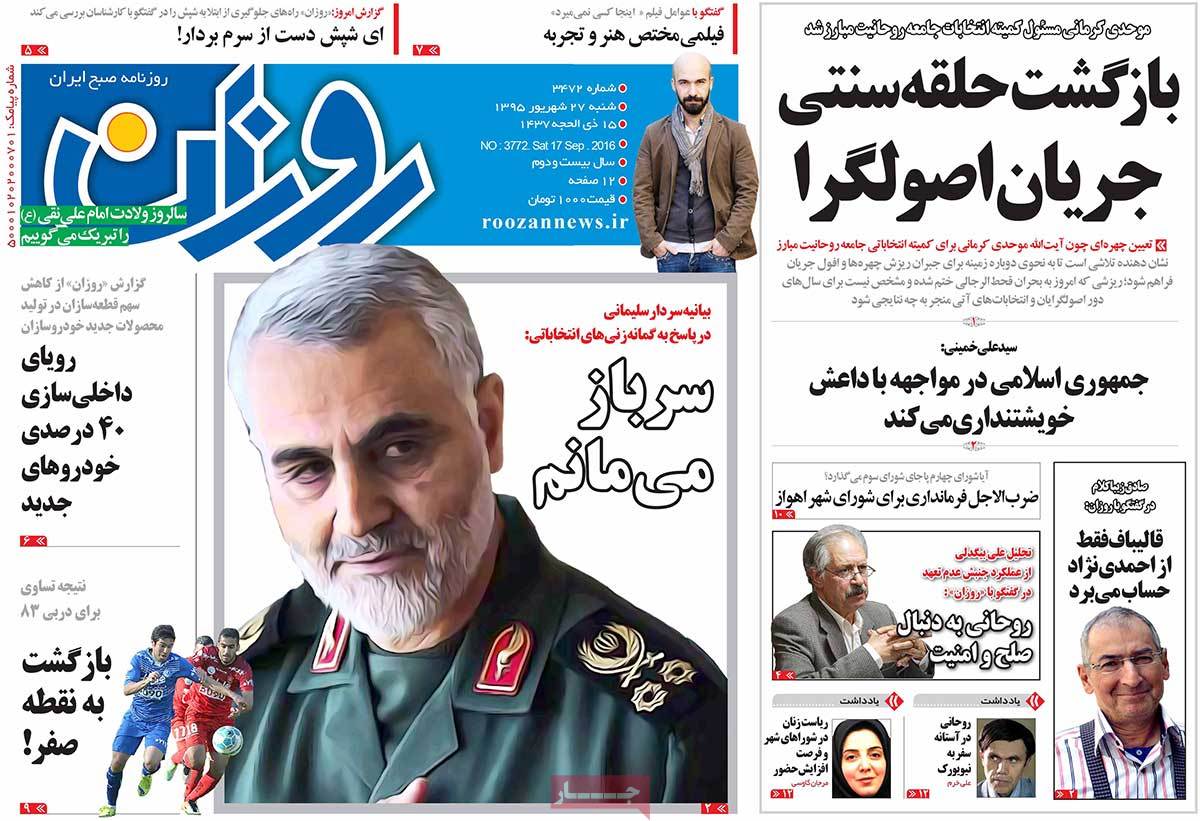
Roozan:

1- Imam Khomeini’s Grandson: Islamic Republic Is Exercising Self-Restraint in Countering ISIS
A Look at Iranian Newspaper Front Pages on September 17


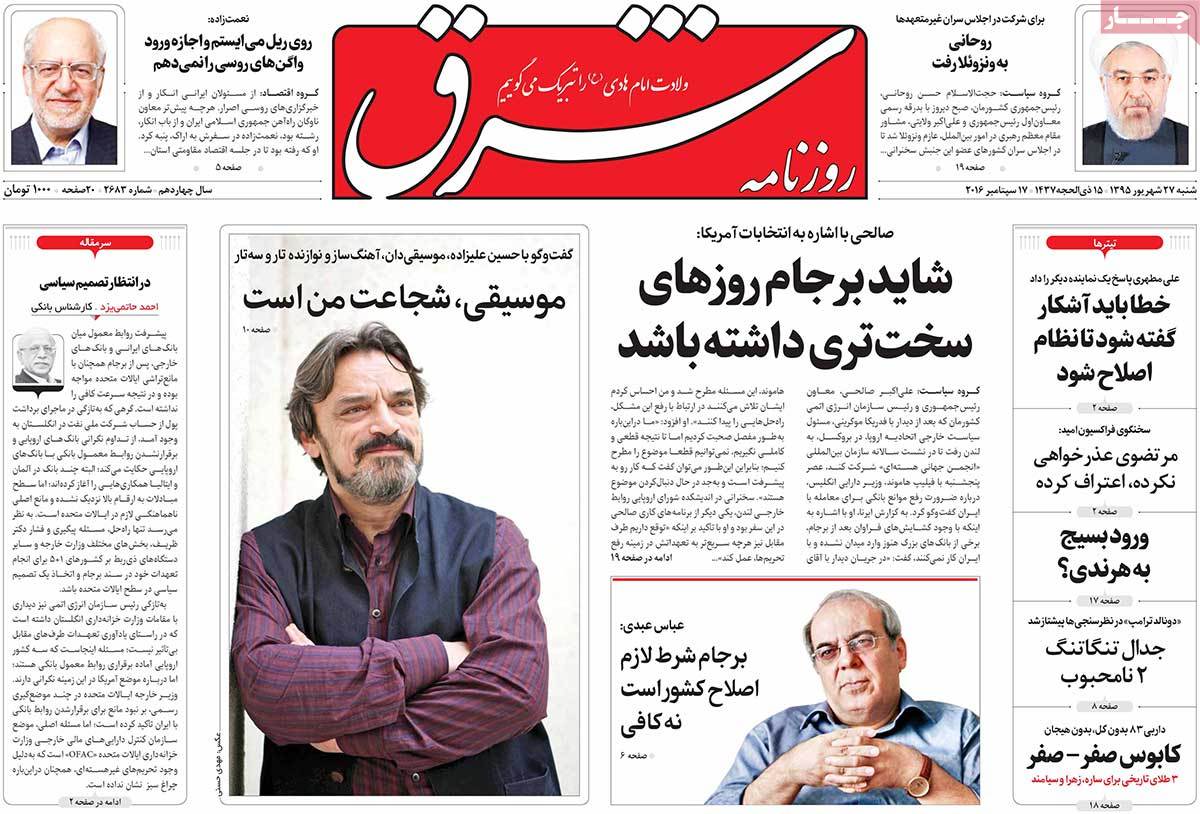
Shargh:

1- Trade Minister: I’ll Stand Still on the Railway and Won’t Allow Entry of Russian Wagons

2- Reformist Figure: JCPOA Is a Required Condition for Improving the Country’s Situation, But It’s Not Enough

3- Trump Leads the Polls: Hot Competition between Two Unpopular Figures
A Look at Iranian Newspaper Front Pages on September 17


Vatan-e Emrooz:

1- Saudi Arabia Files Lawsuit against Iran in UNSC

2- US Analysts Say Democrats’ Conditions in US Presidential Campaigns Are Worse than Clinton’s Health
A Look at Iranian Newspaper Front Pages on September 17

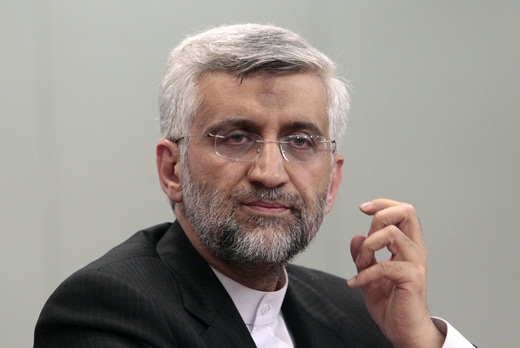
Al Saud Implementing US Policies: Iranian Official

Iran's Chief Negotiator Saeed Jalili meets with reporters in Moscow

“One cannot make any distinction between the Al Saud, extremism and US-born terrorism, as they are all on a same path and the Al Saud is pursuing the US regime’s policies,” Saeed Jalili said in a cultural ceremony in Tehran on Friday.

He also likened the Riyadh regime and the US administration to members of a same tribe that is trying to establish “American Islam.”

The Al Saud has deep bonds with the global arrogance, Jalili said, adding that the Saudi rulers are indeed filling a US puzzle by their measures across the region.

Earlier this month, Leader of the Islamic Revolution Ayatollah Seyed Ali Khamenei also took a swipe at the supporters of the Saudi regime, mainly the US, for being accomplice to crimes committed by the kingdom, as in the Mina tragedy that killed thousands of Hajj pilgrims last year.

“The shameless Saudi regime has flagrantly stood against Muslims with the backing of the US, and is shedding blood in Yemen, Syria, Iraq and Bahrain. Thus, the US and other supporters of Riyadh are accomplice to the Saudi crimes and atrocities,” Imam Khamenei explained.

Ali Sadr, The Most Marvelous Cave

ali-sadr1

The cave walls can extend up to 40 meters high, and it contains several large, deep lakes.

The cave has a river flowing through it and most travel through the cave system is done with a boat. Ali Sadr cave is situated between the large cities Hamadan, Tehran, and Qom making it a popular destination for Iranians.

The cave was originally discovered during the reign of Darius I (521-485 BC) which can be verified by an old inscription at the entrance of the tunnel. However, the knowledge of the existence of the tunnel was lost, and only rediscovered in 1978 when a local shepherd followed the tunnel searching for water or a lost goat.

This cave is located at 48°18’E 35°18’N, in the southern part of Ali Sadr village. The cave digs into a hill called Sari Ghiyeh which also includes two other caves called Sarab and Soubashi, each 7 and 11 kilometers away from Ali Sadr Cave. Apparently the water in Ali Sadr cave is supplied by a spring in Sarab.

In the summer of 2001, a German/British expedition surveyed the cave to be 11 kilometers long. The main chamber of the cave is 100 meters by 50 meters and 40 meters high.

ali-sadr2The natural entrance to Ali Sadr cave (sinkhole) has been made accessible by stairs. It is gated and roofed. The stairs lead down to a concrete walkway in a dry gallery of approximately 3-4 m of height and 6-8 m width. The surface water enters the sinkhole during the wet months of the year, follows the walkway and disappears to the left where the first lake can be found. The dry entrance section of the cave connects through joint-controlled maze of smaller passages to the artificial (main) entrance to Ali Sadr cave.
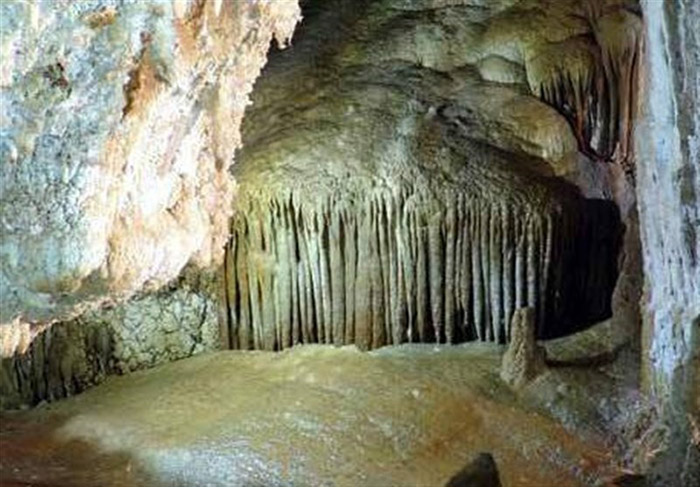
These passages are water-filled in their southern extensions. The artificial (Main) entrance begins as a 20 m long tunnel that slopes gently downhill to a wide gallery of 15 by 6 m formed under phreatic conditions. A calcite/aragonite ledge at the left wall marks a former water level and has some fine stalactites and crystals. To the right of the artificial entrance there is a Tearoom/Cafe for visitors which is operational in the summer.

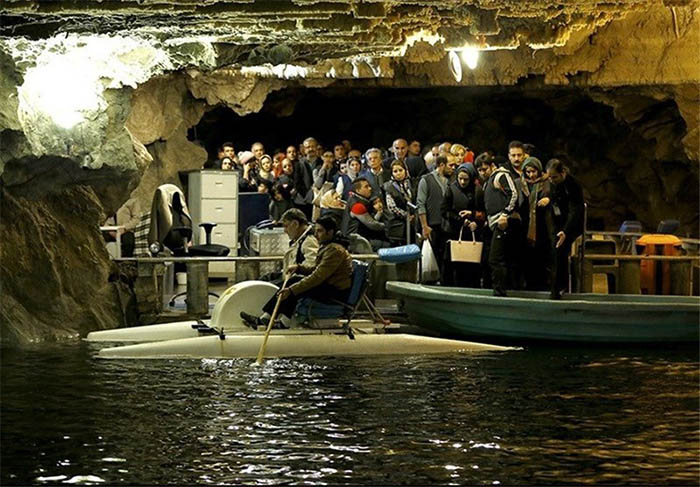
ali-sadr6The walkways coming from both entrances join at the beginning of the water-filled passages of Ali Sadr cave where the main jetty from which the boats that take tourist through the cave are boarded. Tourists are guided into plastic boats at this point and these are pulled through the cave by paddling boats (Pedlo’s) paddled and steered by the guides. The underground boat trip follows the main gallery to the SW that is up to 25 m wide and 4 m high (above water level), passing some maintenance facilities (cabins, boat depots, water-level indicator etc.).
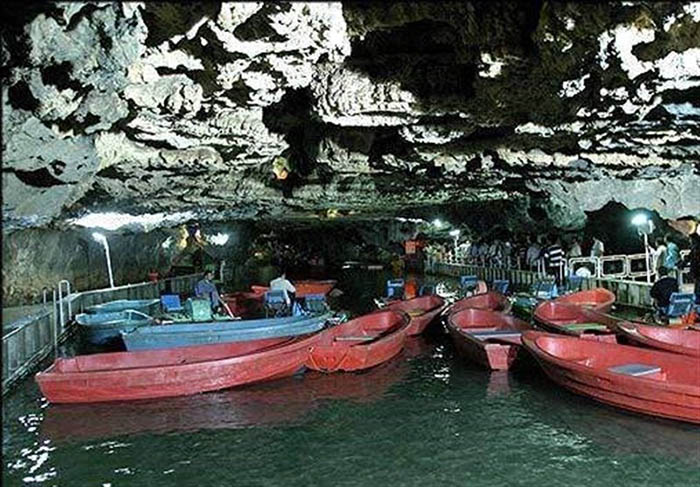
After nearly 200 m the gallery turns to the left (SE) and diminishes temporarily in size. The dip of the layers can be clearly observed in this part of the cave. Some small water-filled galleries branches off to the left to meet the “”six-entrances room”” which is part of the return journey of the tourist trip.

ali-sadr7After approximately 100 m the main route opens up into a wide lake passage once again. This runs straight in a SE direction for the next 300 m. There are four large passages leading to the NE towards the central north-south-axis of the cave (see below) some of which are galleries up to 40 m wide and 30 m high.
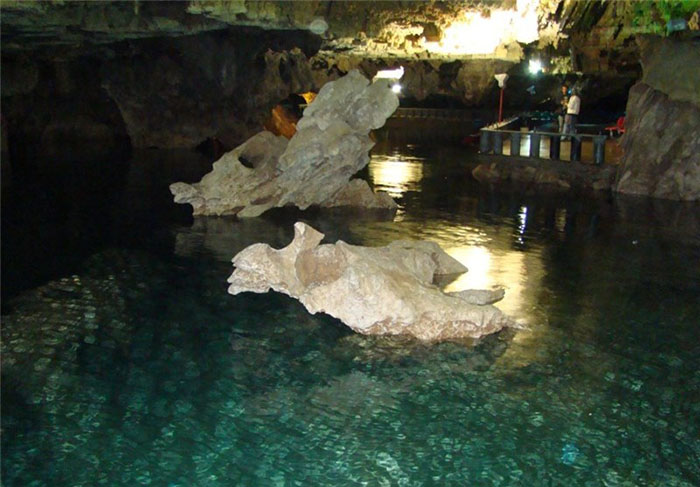
In the middle of the 300 m long section leading to the SE, where the passage reduces in size for some meters and the depth of the water decreases to less than 1 m, a sizeable dinosaur sculpture has been installed for the enjoyment of amusement of children.

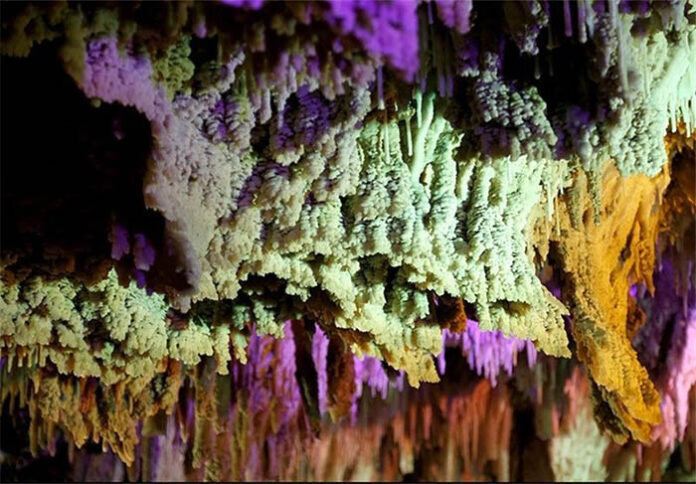
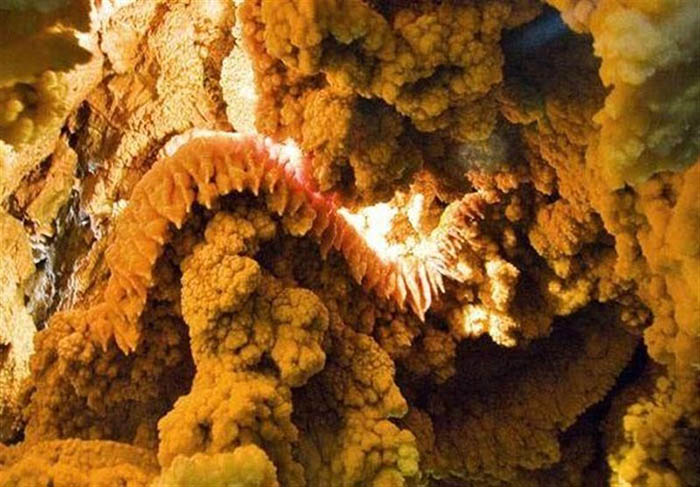
Having reached the end of this section the gallery turns to the NE and one reaches a pontoon where the tourists leave the boats to climb into the largest chamber of Ali Sadr cave, called “Freedom Hall””. From the place where the tourists initially boards the boats to this pontoon the entire roof of the cave is covered by calcitic/aragonitic ledges that are full of crystals and small stalactites, marking former water levels.

This unique 600 m long structure is one of the most remarkable features of Ali Sadr cave and together with the dark green of the lakes, that in places are up to 15 m deep and the white/yellow crystals give the dark rock inside the cave a superb appearance. Just before the point where tourist trail climbs from the pontoon into the “”Freedom Hall”” the ceiling is covered with a fantastic display of up to 9 ledges one upon the other. The mineralization is predominantly aragonitic which indicates a relatively warm environment for the deposition of the crystals.

ali-sadr8Freedom Hall was created by breakdown along tectonic fault zones and the visitor has to ascend about 30m up a boulder pile via a succession of fine marble stairs. At the highest point of the boulder pile the climb ends in a circular marble platform overlooking an impressive chamber that at its longest axis is 100m wide.
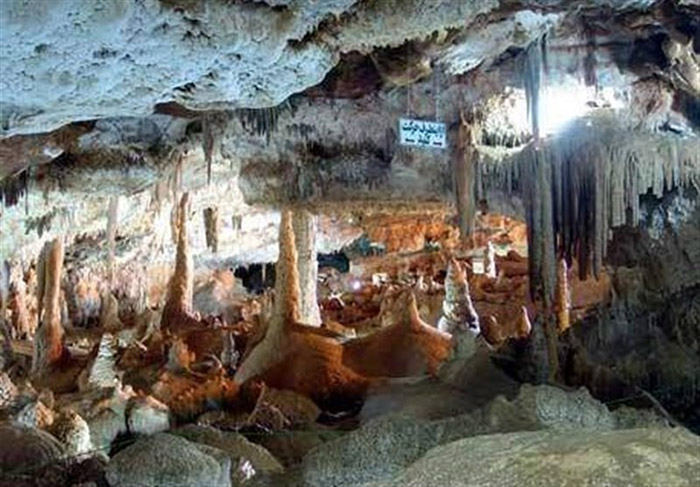
From the platform to the roof of the chamber is a height of 14 m. A massive 8m high stalagmite is located close to this platform. The northern part of the large chamber, which is not accessible for tourists, connects via several parallel and partly water-filled passages with the “”wedding room”” (also called “”1.000 stalactites room””)

Freedom Hall is exited via another succession of fine marble stairs that leave the center of the chamber in SE direction. Before the walkway reaches another pontoon to cross a 40m long lake extremely fine calcite wall coverings can be found. At this point a series of wet galleries lead to the E where they end in breakdown.

Back in the main passage, at the end of the pontoons a dry walkable gallery of more than 100m in length leads to the SE. This passage has a very nice phreatic cross-section.

At the end of this gallery the tourist trail turns to the right where the permanently water-filled passages of Ali Sadr cave are reached once again. Here the roof of the passage is covered with helicities. To the left (SE) the new sections of the cave, which are not open to tourists, branch off.
The tourists board the boats again to start the journey back through the cave passing the aforementioned pontoon where they alighted from the boats earlier in the trip and from there back towards the cave’s entrances.

ali-sadr4To the W extensive labyrinthine water-filled passages of smaller dimensions can be found. However, before the dinosaur is reached again, the guided tour leaves the known gallery to enter a very large passage that makes up the main north-south-axis in the central section of Ali Sadr cave.
This joint controlled axis is partly enlarged to a succession of impressive chambers. After about 100 m a gate closes a water-filled branch to the right (East). The gated passage gives access to a network of waterways leading to the “”wedding room”” (also called “”1.000 stalactites room””). This room is paved with marble slabs. The Wedding Room as it is known has been used for special events in the past and is still today accessible for tourists that are willing to pay an extra fee.

The “”wedding room”” is actually not a wide chamber but a passage that forms a loop decorated with many wonderful small white stalactites, draperies and helicities. The southern part of the “”wedding room”” has connection to the aforementioned (“”Freedom Hall””) main chamber of Ghar Ali. Having reached the end of the spacious central north-south-passage after 220 m the tourist boat tour turns to the left (West) towards the “”six-entrances room””. This room is a crossing of several passages in a small maze of rifts. 150 m later the underground boat trip reaches the starting jetty again where the tourists leave the boats to exit the cave.

ali-sadr9The usual tourist visit uses the artificial tunnel entrances to the cave exclusively. Visitors undertaking the ‘regular’ tour are guided a distance of about 2.100 m through the cave, 1.470 m of which is by boat. The ‘extended’ tour (“”wedding room””) involves an underground boat course of 2.010 m: the longest underground boat trip world-wide.
The new parts in the south of Ali Sadr cave are not accessible for tourists. These passages were surveyed by the 2000/2001 project and only minor open leads were left. The predominantly dry galleries are much smaller than the ones in the tourist section. A narrow and difficult to find passage contains remarkably fine dripstones and helicities. In other places large aragonite crystals are abundant. The southern dry section of Ali Sadr cave is extensive and very labyrinthine as small passages follow wide galleries.

Iran Offers Help for Venezuela in Presiding over NAM

rouhani

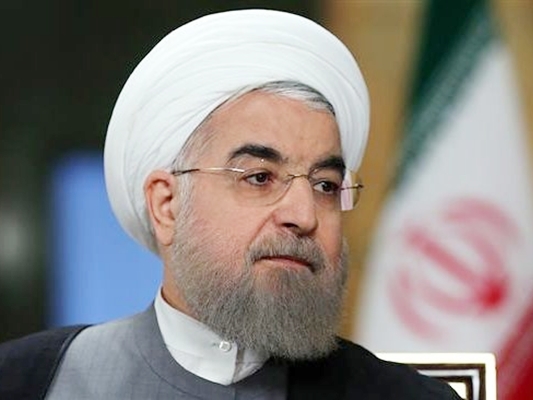
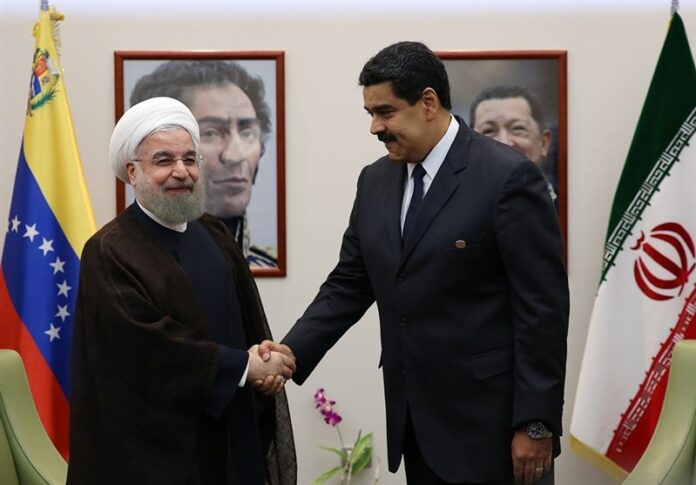
In a meeting with his Venezuelan counterpart Nicolas Maduro on the South American country’s Margarita Island on Friday, President Hassan Rouhani congratulated Venezuela on holding the rotating presidency of the NAM.

He also noted that Iran, Venezuela’s predecessor as the NAM president, is ready to offer its experience during 4 years of being in charge of the movement which “could play a big role in today’s world” and whose members need to have “unity and mutual cooperation” for their collective interests.

The Non-Aligned Movement is a group of states which are not formally aligned with or against any major power bloc.

Elsewhere in the meeting, President Rouhani voiced Iran’s willingness to work with Venezuela on economic and investment projects, calling for activities by a joint economic commission to handle the plans.

Maduro, for his part, said Venezuela is eager to make joint investment with Iran in industry, infrastructures and energy sphere.

Heading a delegation, President Rouhani arrived in Venezuela on Friday for the 17th NAM summit.

He will later travel to the US to attend the 71st Regular Session of the United Nations General Assembly in New York.

Why Falafel Is So Popular in Iran

Falafel Is So Popular in Iran

Here is IFP‘s translation of a report by Shargh newspaper on whether popularity of falafel is a subculture or comes from an economic coercion:

A big red sign that is mostly found at the entrance of every falafel shop grabs your attention. Inside there are brimming bowls of Torshi [pickled vegetables] placed on the tables lavishly.

Customers from the working class or even lower are standing at the tables to stuff their falafel sandwiches chock-full of mustard sauce, pickled cabbage, Liteh and Hafteh Bijar [two kinds of Torshi] while jabbering on about their daily routines.

These people pay no more than $0.85 on a falafel sandwich with a bottle of soft drink to celebrate their festivity; however, a few steps away from Hafte Tir Square, it would cost you about $3.4 to buy a sandwich (e.g. roast beef sandwich).

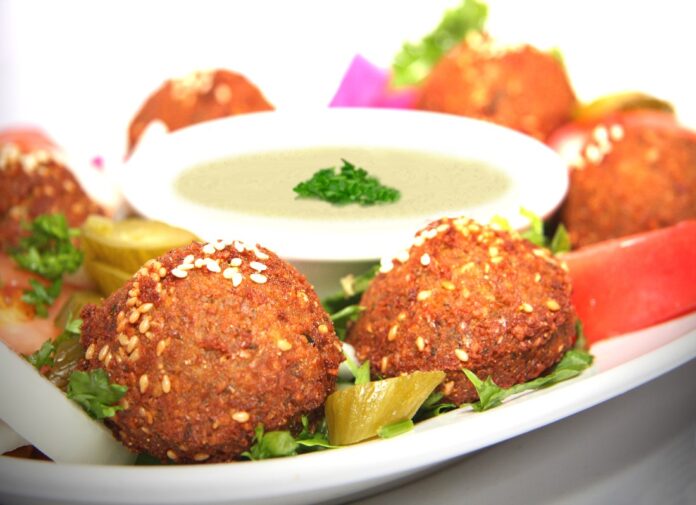
Arab countries are the origins of falafel. According to the Iranians living in southern cities, this sandwich that has become ubiquitous in Iran these days is the same Lebanese falafel which made its way into Iran’s south-western province of Khuzestan at first and then became prevalent throughout the country.

Falafel has sunk its roots into Iranian cities so strongly that has become a widely popular street food. As a fast food, it is compared with the British fish and chips and the American hotdog. ‘Fish and chipsis a common takeaway food wrapped in pieces of newspaper which is quite analogous to falafel.  If you take a walk on the crowded streets of Britain, you’ll definitely see a few people treating themselves with it.

FalafelThese days, falafel sellers have brought innovations into their career as they offer a self-service option for the customers. Masoud Momeni, who owns one of the famous brands of falafel shops in Dolatabad, a district in southeast of Iran’s capital, Tehran, serves falafel in such various ways as ‘falafel and cheese’, ‘falafel and mushroom’, and ‘pizza falafel’.
Asked about why the middle-class community appreciates falafel so much, Momeni said, “Undoubtedly, its low price is the main reason. You can have a substantial falafel here for about $1.”

He referred to the way falafel is served as another reason and noted, “The self-service option is much favoured by people.”

Further on the issue, Dr. Nasrin Omidvar, a dietician, drew a comparison between falafel and foods like fish and chips, saying that “foods like falafel fall into the category of deep fat fries which I believe became prevalent after the immigration of war-stricken people of Iran’s southern cities to the central parts of the country.”

According to her, deep fat fries are fried foods, saturated in oil, that the young people have a weakness for.

“The western version of falafel is the British fish and chips and the American hot dog and fries,” she noted.

Omidvar noted that the constituents of falafel are beans, onions and eggs and added, “In fact, it is a vegetarian food.”

Asked about the popularity of falafel among the middle and working class, Dr. Shirin Behnia, a sociologist and faculty member of Allameh Tabataba’i University, gave pretty much the same answer.

“Falafel is an abundant street food. Being palatable and inexpensive, it can satisfy the hunger of school children while costing them a meagre amount of their pocket money.”

“By no means, falafel can be considered as a restaurant food though,” Behnia stressed.

For a low-income nuclear family, however, falafel shops can act as a restaurant on holidays. This should not be taken as a solid reason implying that the country is poor. We shouldn’t forget that in a country like Switzerland it happens a lot that, after swimming in a holiday afternoon, people enjoy eating grilled sausage on the streets instead of having T-bone steak in a Swiss luxury restaurant. In no way does it mean that Switzerland is a poor country.

While deep-frying the falafel balls, Momeni said that his falafel shop belongs to a well-known brand of chain falafel shops which has 200 branches all over the country.

“Increasing number of customers, being easy to make and turning higher profits have encouraged me to take this job,” he said, noting that its popularity is the main reason for innovation in the way falafel sellers tend to serve it as in self-service option.

Falafel
Switzerland’s Ambassador in a falafel shop in Iran’s southwestern city of Ahvaz

Iranian Cleric Calls Saudi Regime “Enemy of Islam”

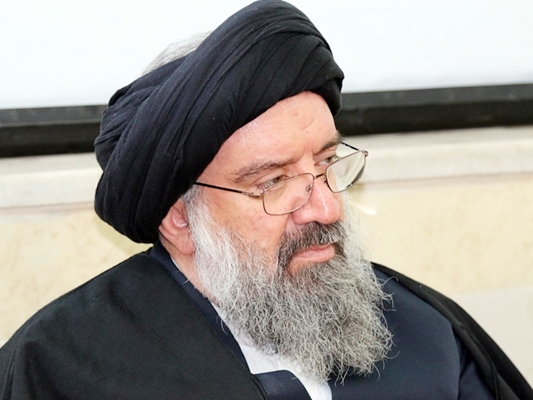
Khatami

Al Saud dynasty came to power 280 years ago and for nearly three centuries, the Saudis have reached their objectives only through brutality, murder and plunder, Ayatollah Khatami said, addressing a huge gathering of worshipers in Tehran on Friday.

What is seen in Yemen today is a small example of the regime’s policies over the past three centuries and clearly shows the Al Saud’s “murderer and looter” nature, the cleric added.

“The Saudi government is a friend of the Israeli regime,” he said, adding that in the past, Saudis denied such friendship, but today, they have open relations with each other.

The Al Saud is a clear enemy of Islam, he said, hoping that the Muslim world would soon witness the collapse of the regime.

Yemen’s defenseless people have been under massive attacks by the coalition led by the Saudi regime for nearly 17 months but Riyadh has reached none of its objectives in Yemen so far.

Since March 2015, Saudi Arabia and some of its Arab allies have been launching deadly airstrikes against the Houthi Ansarullah movement in an attempt to restore power to the fugitive former President Abd Rabbuh Mansour Hadi, a close ally of Riyadh.

Nearly 10,000 Yemenis, including 4,000 women and children, have lost their lives in the deadly military campaign.

Extremism Threatening World Peace: Iran’s FM

Mohammad-Javad-Zarif

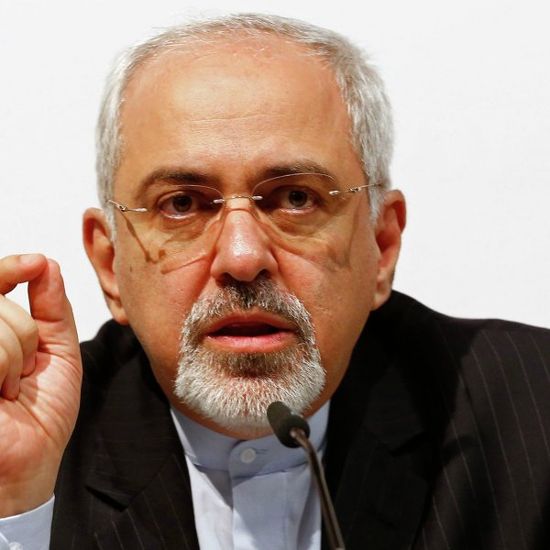
“It is evident that intervention, invasion and occupation as in the cases of Iraq, Syria and Palestine, leads to extremism. The tragedy of Palestine, the center of anger and desperation felt in the Muslim world, is at the heart of this crisis,” Zarif stated at the foreign ministerial meeting of the Non-Aligned Movement (NAM) in Venezuela’s Margarita Island on Thursday.

He added, “In such a difficult and challenging situation, self-restraint and full commitment to international law, regulations and norms in addition to UN Charter principles are a matter of absolute necessity.”

“Violent extremism and terrorism accompanied by their horrific consequences, like growing hostilities and humanitarian crises, are among the gravest threats that require more serious attention from NAM member states,” the top Iranian diplomat pointed out.

The 17th NAM summit started in Margarita Island, Venezuela, on September 15, and will wrap up on September 18, 2016.

Iranian President Hassan Rouhani is scheduled to attend the summit and deliver a speech on Friday. He will later hand over the NAM rotating presidency for three years to his Venezuelan counterpart Nicolas Maduro.

NAM, an international organization with 120 member states and 21 observer countries, represents nearly two-thirds of the UN members. It is considered as not formally aligned with or against any major power bloc.

Iran Attaches Great Significance to Regional and Global Security: President

Rouhani

Speaking to reporters before flying to Venezuela to participate in the 17th summit of the Non-Aligned Movement (NAM) on Friday, President Rouhani pointed to the spread of insecurity in the world and said, “Unfortunately, the region and the world are not in proper conditions today.”

He further emphasized that all countries should be after the establishment of peace, stability and security in the world.

“Peace, non-interference in the national sovereignty of other countries and consultations in line with (efforts to) resolve the problems of the developing world are highly important to the Islamic Republic of Iran,” Rouhani noted.

The president further pointed to his visit to Venezuela and said the issue of global peace is high on the agenda of the NAM summit, which is the second largest gathering of heads of states after the UN General Assembly.

The 17th NAM summit started in Margarita Island, Venezuela, on September 15, and will wrap up September 18.

Rouhani is also slated to deliver a speech at the summit. He will later hand over the NAM rotating presidency for three years to his Venezuelan counterpart Nicolas Maduro.

At the conclusion of the Venezuela visit, President Rouhani will travel to Havana at the formal invitation of his Cuban counterpart Raul Castro.

During his stay in the Caribbean island nation, President Rouhani will meet with his Cuban counterpart and also Fidel Castro, while high-ranking delegations from the two countries are expected to hold negotiations and sign multiple cooperation agreements.

President Rouhani will finally pay a two-day visit to New York to attend the 71st Regular Session of the United Nations General Assembly.

In addition to an address to the UNGA, the president is scheduled to hold several meetings with top foreign officials, religious leaders and political elites in New York.

Iran Rejects ‘Fallacious’ Remarks by UN Human Rights Chief

Iran Human Rights

In a statement, the Iranian Judiciary’s human rights body expressed surprise and sorrow over the September 13 statement made by Zeid Ra’ad Al Hussein and rejected as “fallacious” his allegations that the Islamic Republic has given no access to his office (OHCHR) since 2013.

The Iranian High Council for Human Rights highlighted the measures taken by the country in recent years to boost its cooperation with the OHCHR, saying, “It is unfortunate that the UN high commissioner and his colleagues, who are well informed of such measures, say they are totally unaware…”

According to the statement, Tehran has sent numerous official invitations to the former and current high commissioners and held four rounds of negotiations with the OHCHR officials on different issues since 2013.

Iran’s principled policy on human rights is based on respect for its international commitments and transparency as well as “constructive and logical” interaction, the statement read.

Iran expects international human rights officials to pay heed to the realities on the ground in their statements and avoid making “politically-motivated” remarks, the statement added.

The Iranian rights body also asked international human rights officials to “adopt a professional and impartial” approach and acknowledge progresses and steps that have been taken regarding the issue of human rights.

During the 33rd session of the UN Human Rights Council on September 13, Ra’ad Hussein claimed that the OHCHR has been given “no access (in Iran) since 2013 – despite several years of good technical cooperation prior to that date”.

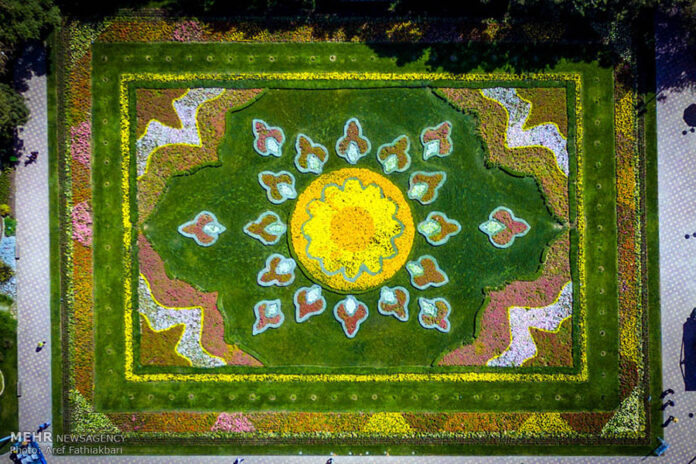
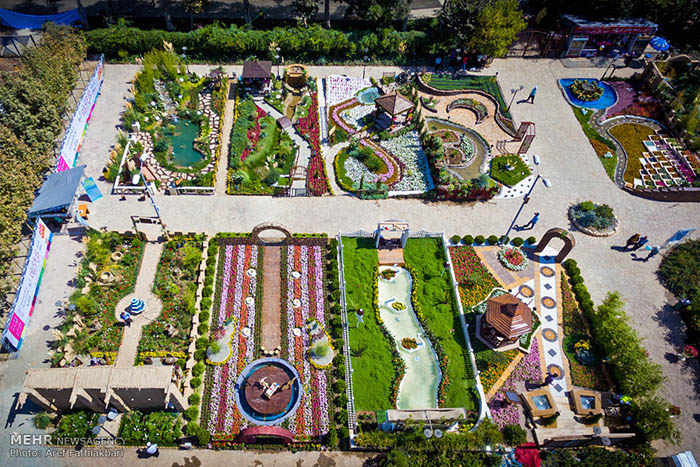
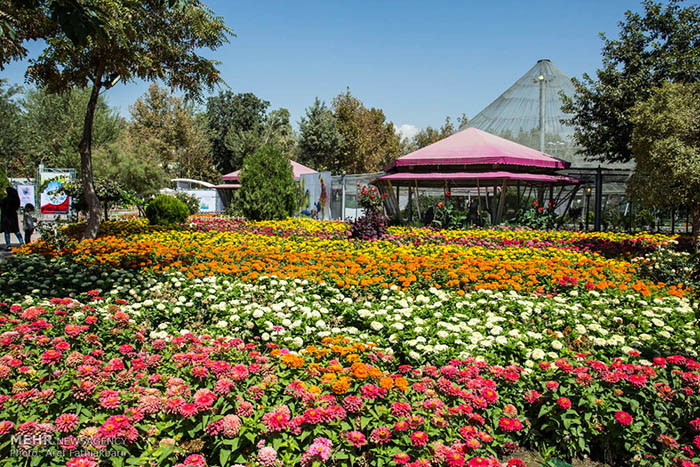
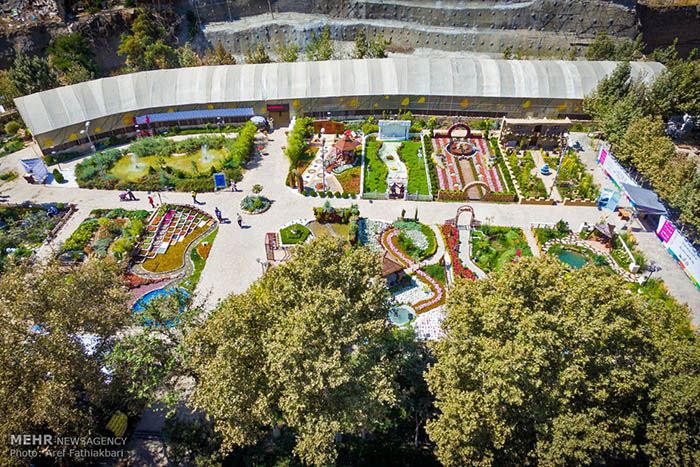
Int’l Flower Exhibition Underway in Iran’s Karaj

Flower Exhibition

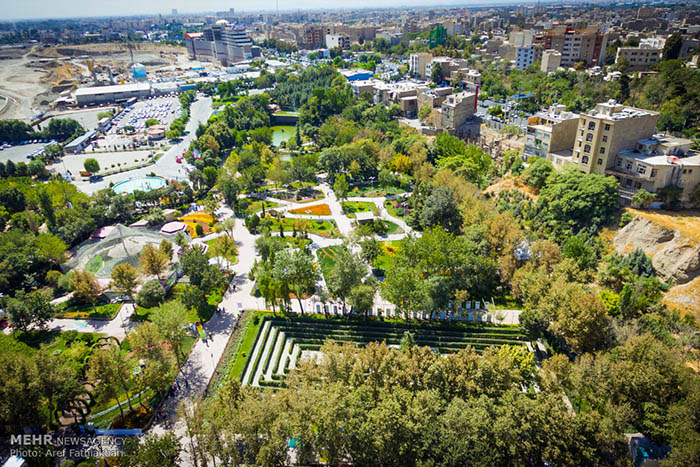
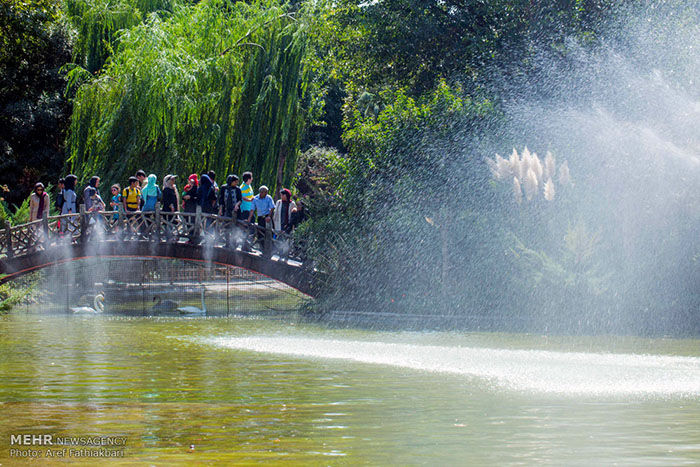
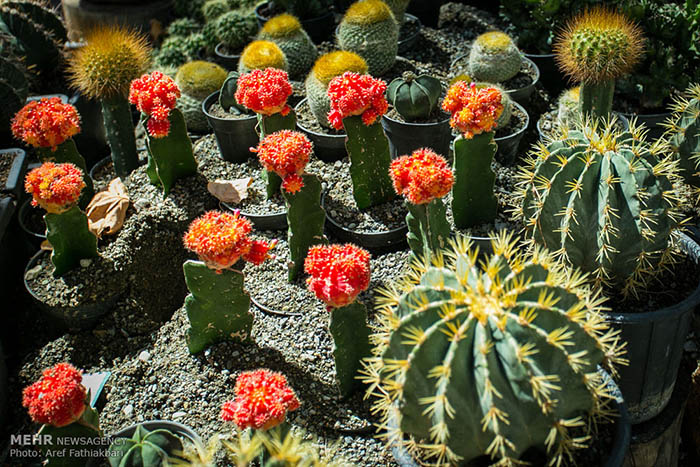
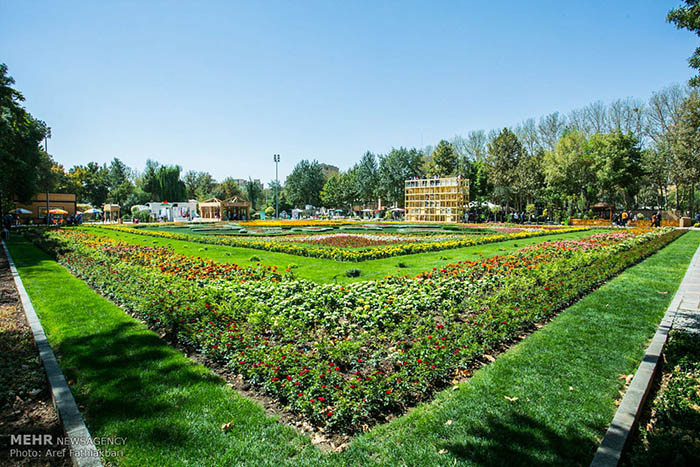
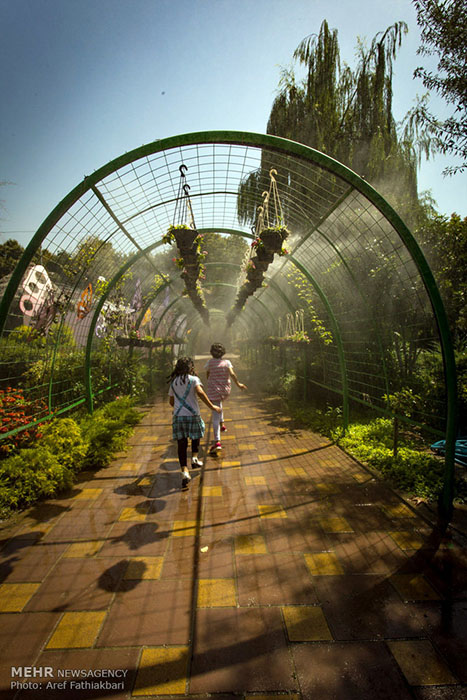
Here are Mehr‘s photos of the exhibition in Karaj, Alborz Province: