Thursday, January 1, 2026
Home Blog Page 4284

European Diplomats Meet Zarif in Tehran

zarif01

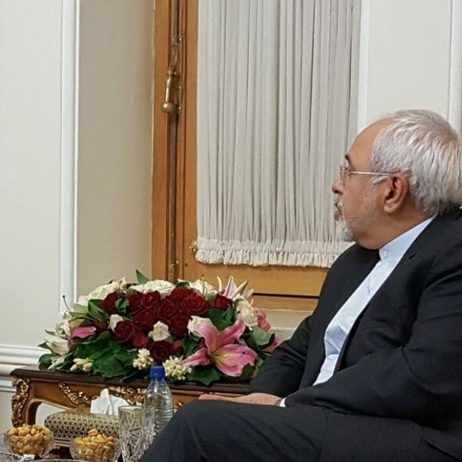
In one of the meetings on Monday, the Iranian foreign minister and Karlheinz Kopf, joint acting president of Austria, who is also the second president of the European country’s National Council, discussed a range of issues, including Tehran-Vienna ties, collaboration between Iran and the European Union, as well as the latest regional and international developments.

In a separate gathering, Greek Ambassador to Tehran Georgios Ayfantis met with Foreign Minister Zarif and talked about the bilateral relations between Tehran and Athens, Tasnim reported.

zarif02

Syria Ceasefire and Delivery of Humanitarian Aid Are Iran’s Priorities

Zarif also had a meeting with the European Commissioner for Humanitarian Aid and Crisis Management, Christos Stylianides.

During the meeting, Zarif said the Islamic Republic attaches great importance to the enforcement of a lasting ceasefire in Syria and dispatch of humanitarian aid to its war-stricken people.

“[The enforcement of] a ceasefire and the dispatch of humanitarian relief have always been among our priorities in Syria and we are ready for any cooperation in this regard,” he said, as reported by Press TV.

For his part, the European official hailed Iran for hosting Afghan refugees and for providing Syria with humanitarian aids.

Stylianides also highlighted Iran’s “key and positive” regional and international role.

Syria has been gripped by civil war since March 2011 with various terrorist groups, including ISIS, currently controlling parts of it.

Some 470,000 Syrians have been killed throughout the five years of bloodshed, 4.8 million have fled the country, and 6.6 million have become internally displaced by the violence.

At Least 60 Killed in Extremist Attack on Academy in Pakistan

photo_2016-10-25_10-55-04

At least 60 people were killed when three militants armed with automatic rifles and grenades attacked a police training centre in the volatile southwestern Pakistani region of Baluchistan, security and rescue officials said Tuesday.

More than 120 people were injured. It was the second major attack in the provincial capital, Quetta, since August.

Security officials said militants shot a guard at the main entrance to the Baluchistan Police College about 9:30 p.m. Monday before entering the compound and taking aim at the dormitories where hundreds of cadets are housed.

At least two attackers detonated suicide vests while a third was shot dead by paramilitary soldiers, officials said, Los Angeles Times reported.

Cadets fled the explosions by scaling the walls of the compound, many of them sustaining injuries.

The death toll by Tuesday morning had surpassed 60. Nearly all the dead were cadets, according to a rescue official who requested anonymity because he was not authorized to speak to the media.

About 700 cadets were usually housed at the facility, about 12 miles outside Quetta, although the numbers were slightly lower Monday because exams had recently concluded, Baluchistan’s home minister, Mir Sarfaraz Ahmad Bugti, told reporters.

“A complete search operation of the sprawling academy has been conducted and it is declared clear,” Bugti said after the siege, which lasted about four hours. He said that three militants had carried out the attack, although previous reports suggested the number was as high as six.

Several cadets were injured as they scaled a 10-foot perimeter wall to escape. Survivors told reporters outside the academy that the assailants’ faces were obscured by masks or scarves.

“They were carrying Kalashnikovs and firing indiscriminately on the cadets inside hostels,” one cadet said.

The bodies of slain cadets were transported to police headquarters in Quetta for a collective funeral prayer, after which they would be dispatched to their homes in different parts of the province, police officials said.
Baluchistan, a remote province along the Afghan border, is home to a long-running insurgency by ethnic separatists seeking to break away from the Pakistani state.

It has been the site of several recent attacks. The most recent came in August, when a splinter group of the Pakistani Taliban claimed responsibility for a suicide bombing that killed 64 people at a Quetta hospital, mostly lawyers who had gathered to mourn a slain colleague.
‘Germany May Fund Iran Plane Purchases’

iranair

Abbas Akhoundi, Iran’s minister of roads and urban development, told reporters that he had raised the issue in a meeting with the visiting German Minister of Transport and Digital Infrastructure Alexander Dobrindt.

“Discussions with the German delegation included the possibility of using the leasing facilities of German companies for purchasing planes by Iran Air,” Akhoundi said after a meeting with Dobrindt, who is heading a major trade team to Tehran.

The move could help push ahead a major plane purchase scheme that Iran is pursuing with giants Airbus and Boeing. Iran has sealed deals with both to purchase over 100 planes from each. Yet, the deals are still pending the identification of leasing institutions to fund the purchases.

German Transport and Digital Infrastructure Minister Dobrindt, for his part, emphasized that Berlin has established a special office at the Federal Ministry of Finance to facilitate financial issues relating to doing business with Iran.

The mission of the Office for Development of Banking and Financial Relations with Iran will be to expedite the proceedings for the finalization of major trade deals with Iran and also to facilitate Germany’s new investments in the country, Dobrindt emphasized.

The German delegation arrived in Tehran this past Friday heading a major trade delegation to discuss the expansion of economic ties between the two countries.

Iran and Germany signed six basic agreements to develop economic relations during the meeting between Akhoundi and Dobrindt.

The agreements mostly concerned the participation of German companies in Iran’s plans to develop its transportation sector.

Iran President Says Any Foreign Intervention ‘Very Dangerous’

rouhani

“We regard as very dangerous [acts of] intervention by foreign countries without any coordination with the host country and believe that [for any foreign measure,] the Syrian and Iraqi governments must request help and demand that another country act against terrorism inside their territories,” Rouhani told reporters at the end of his visit to the central Iranian province of Markazi on Monday.

“This [regulation] is based on international principles and [any move] contrary to it will exacerbate insecurity,” he added.

He said the Middle East has been grappling with the problem of terrorism for years and added that Western powers are not interested in the elimination of this phenomenon in the region despite being plagued by the scourge and its consequences.

“Some big powers are toying with terrorist groups in line with their own illegitimate goals and despite overflowing the region with tools and equipment, they are not carrying out any positive measure against them [terrorists],” the Iranian president stated.

He urged regional countries to respect the territorial integrity of other countries because “shifting borders is very dangerous.”

Rouhani’s remarks came as thousands of Iraqi army soldiers, fighters from pro-government Popular Mobilization Units and Kurdish Peshmerga forces are taking part in the military operation to retake the northern city of Mosul, the last major stronghold of the Daesh Takfiri group in the Arab country, from the terrorists since October 17.

Turkey is adamantly insisting that it wants to play a military role in the recapture of Mosul despite Iraq’s opposition, triggering a serious diplomatic row between the two neighbors.

Ankara has deployed troops to a base near Mosul, claiming that they were there to train Kurdish militants for the battle against Daesh.

Addressing a forum of Muslim scholars and politicians in Baghdad on Saturday, the Iraqi prime minister called on Turkey and Saudi Arabia to stop interfering in the domestic affairs of his country.

“We want the good of Saudi Arabia and Turkey provided that they do not interfere in the domestic affairs of our country,” Abadi said.

He added that Turkey had sent troops without the Iraqi government’s request and emphasized that Ankara is not battling Daesh but is trying to expand its outreach.

The Iraqi premier emphasized that Ankara did not help Baghdad when it was requested.

For more than a year, Turkey has maintained a contingent of its troops in northern Iraq, alleging that it is training local forces in their fight against Daesh Takfiri terrorists.

However, tensions have escalated after the beginning of the major offensive to liberate Mosul.

Turkish Deputy Prime Minister Numan Kurtulmus said on October 12 that the country’s military forces will continue their presence in northern Iraq regardless of Baghdad’s repeated protests and escalating tensions between the two neighbors.

“Turkey’s presence in Bashiqa (military camp) is legitimate. We will continue our presence there as long as it is needed,” Kurtulmus said.

Following Turkey’s deployment of its forces to northern Iraq, Syria condemned the “flagrant” move and said Ankara has repeatedly violated Syrian territorial integrity and is supporting militant groups fighting against the government of President Bashar al-Assad.

Turkish troops are also deployed to northern Syria, a move condemned by Damascus as a violation of its sovereignty.

Iran’s Judiciary Chief Slams US Attempts to Save Terrorists in Region

Larijani

“The Americans frequently make excuses in this regard (liberating Mosul from Daesh) and are looking for ways to save the terrorists and help them escape,” Ayatollah Amoli Larijani said Monday in a meeting of judiciary officials.

He described Washington’s conduct of claiming to advocate human rights while backing the most dangerous terrorist groups when it serves its interests as inhumane and immoral.

The Iranian official also deplored the US and European countries for their silence over the crimes committed against innocent Yemenis and stark violations of human rights in the Arabian Peninsula country.

The Iraqi army backed by Hashd al-Shaabi launched an offensive on October 16 aimed at wresting Mosul from the hands of Daesh.

But analysts say the US actually wants to prevent defeat of the terrorists and liberation of Mosul from happening.

Mosul, which is the second largest city in Iraq, fell into the hands of Daesh, believed to have been created and supported by the US and some of its regional allies, in the summer of 2014.

Yemen, meanwhile, has been under brutal airstrikes by a Saudi-led coalition for over 18 months.

Instead of condemning the aggression, though, the US and some other Western countries continue selling weapons and military equipment to the Riyadh regime.

According to UN estimates, over 10,000 Yemenis, including 4,000 women and children, have lost their lives in the military campaign.

Iranian Man Finds a Bag with over $800,000, Returns It to Owner

13950717000892_photol

In interview with ISNA, as translated by IFP, Saeed Babai, a public relations official at the 35th Commando Brigade, said, “This morning, a committed commando from the Islamic Republic of Iran Army Ground Forces units found a bag containing documents on his way to his military service location.”

“The man who found the bag, First Sergeant Erfan Farhadi, delivered it immediately to the inspection room of the barracks,” he noted, adding that they gave it back to the owner.

Babai stressed that the bag contained a number of signed cheques, debit cards with their security codes attached and some bankbooks all of which were worth around $837,000.

“The man who found the bag has referred to Islamic and ethical values and altruism as the driving forces behind his divine work,” he concluded.

UK Lifts Sanctions on Key Iranian Bank

Bank-Saderat

The announcement was made by the UK Treasury which added that the BSI assets had also been unfrozen.

The Treasury said in a release that the Iranian bank had been blacklisted as a result of nuclear sanctions against Iran.

The decision to delist the bank, it said, was in line with the amended regulations by the European Union regarding the lifting of sanctions against Iran.

The regulations required the sanctions against the BSI to be maintained until 22 October 2016.

“As that date has now passed, Bank Saderat Iran and Bank Saderat PLC are no longer subject to the restrictive measures set out in the Regulation, including the asset freeze,” read part of the British Treasury announcement.

Britain had previously lifted sanctions against three other Iranian banks. In January, the Bank of England announced that it had reactivated the licenses of Melli Bank, Persia International Bank and Bank Sepah International – that had been subject to EU and US sanctions – thus allowing them to resume operations in the UK.

This followed the implementation of a nuclear deal between Iran and the P5+1 group of countries – the five permanent members of the Security Council plus Germany.

Based on the deal that was sealed last summer, Iran agreed to restrict certain aspects of its nuclear energy activities in return for measures by the P5+1 to remove certain economic sanctions imposed against the country.

Iran Advances to 2017 FIFA U-20 World Cup

Football

The Iranian team beat Uzbekistan 2-0 and advanced to semi-final of the AFC U-19 Championship Bahrain 2016.

Reza Jafari scored a brace for Amirhossein Peyrovani’s team in Isa Town, Bahrain.

Iran has returned to the final of the FIFA U-20 World Cup for the first time in 16 years.

The Iranian team will play Saudi Arabia on Thursday to qualify for the final match.

Elsewhere, Japan will face Vietnam in another semis.

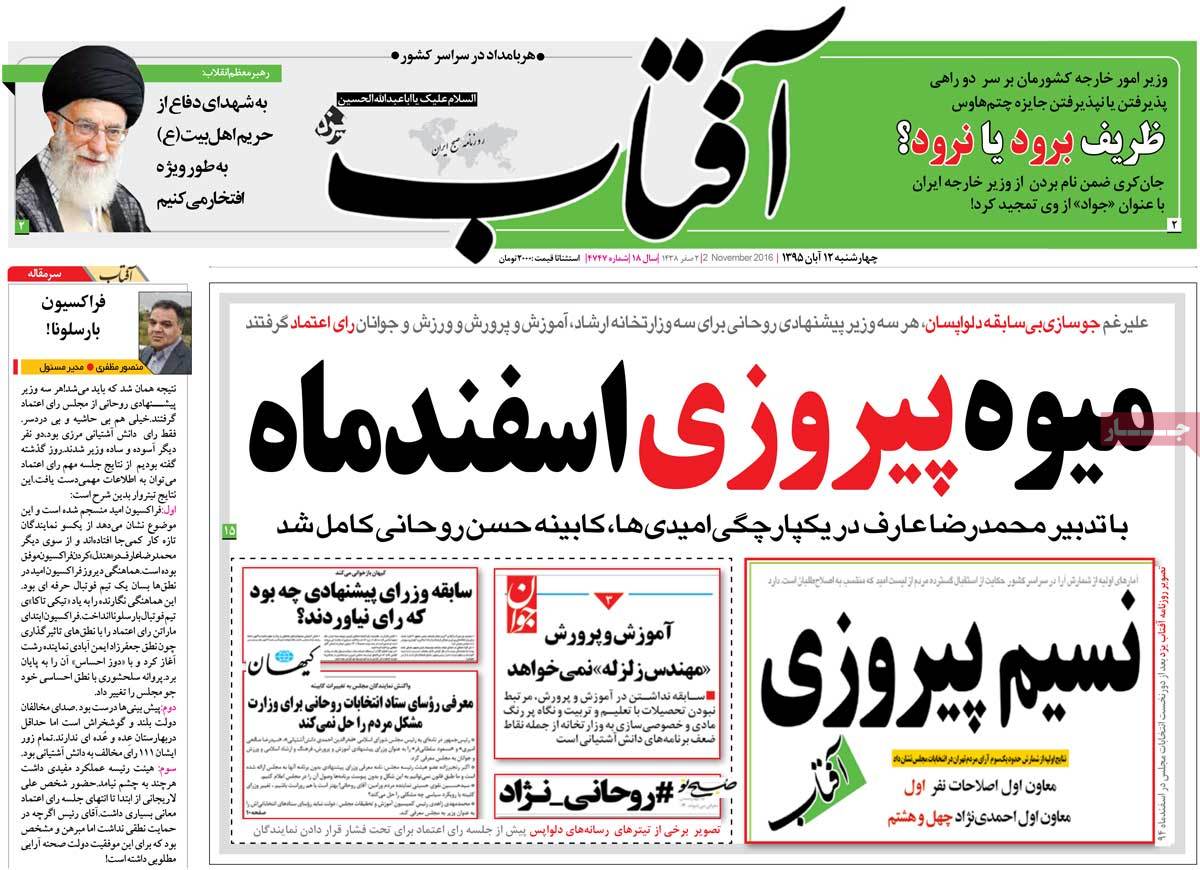
Iran’s Zarif, US’s Kerry Win Chatham House Prize 2016

zarifkerry

Chatham House members voted this year for Zarif and Kerry in recognition of their crucial roles, throughout 2015, in successfully negotiating the landmark nuclear agreement, known as the Joint Comprehensive Plan of Action (JCPOA), between Iran and the Group 5+1, the organization announced on Monday.

The JCPOA was signed between Iran and the five permanent members of the United Nations Security Council – the United States, Britain, France, China and Russia – plus Germany on July 14, 2015, Tasnim reported.

The deal is considered to be a settlement of one of the most intractable diplomatic stand-offs in international affairs in the 21st century as many regarded as impossible an agreement between the two sides.

The Iranian foreign minister and his American counterpart succeeded in overcoming enormous technical complexity and entrenched domestic opposition in both Tehran and Washington in the absence of diplomatic relations in more than three decades, the website of the UK-based Royal Institute of International Affairs, commonly known as Chatham House, reported.

However, Zarif and Kerry’s leadership and commitment, in particular, were imperative to sustaining and driving the negotiations to their successful conclusion, the report said.

With the vital participation of other P5+1 countries, the top Iranian and US diplomats secured the deal which was endorsed by the UN Security Council and more than 90 countries and was a victory for diplomacy, it added, Press TV reported.


Zarif Dedicates His Prize to Iranian Nation

Meanwhile, Iran’s Foreign Ministry Spokesman Bahram Qassemi said FM Zarif offered the Chatham House Prize to all Iranian people, Mehr reported.

Qassemi quoted Mohammad Javad Zarif as saying that the prize is for all Iranian nation, those who proudly left behind pressure and sanctions in recent years with resistance and wisdom.

He underlined that Foreign Minister Zarif will not attend the ceremony to receive his prize due to busy schedules and high compression.

The Chatham House Prize is presented annually to the person, persons or organization deemed by members of the Royal Institute of International Affairs to have made the most significant contribution to the improvement of international relations in the previous year.

Many politicians of all shades in Iran have voiced their opposition to the JCPOA, with some describing it as humiliating. Based on the JCPOA, Iran agreed to scale down its nuclear activities, in return for the West lifting all its nuclear-related bans.

On October 11, 2015, Iranian lawmakers passed the general outlines of a single-urgency motion that gives the go-ahead to the administration to voluntarily implement the July 14 nuclear agreement with the P5+1 group of countries on a conditional basis. The motion was passed as 139 lawmakers voted in favor and 100 voted against it, while 12 lawmakers abstained.

According to the motion, the Iranian administration should stop its voluntary activities and adopt reciprocal measures to restore the rights of the Iranian nation in case the other side violates the terms of the agreement, particularly on the issue of the Western sanctions.

The JCPOA has its opponents in the US too. The majority of the Republican Party members in the US congress oppose the deal, with the party’s presidential candidate Donald Trump saying he would scrap it if elected as president.

Over 700 ISIS Terrorists Killed Since Beginning of Mosul Operation

Iraqi army

According to a report by Al Alam News Website, as translated by IFP, 772 terrorists have been killed and 23 have been arrested since the Mosul Liberation Operation was kicked off by Iraqi forces.

Meanwhile, Iraqi forces have continued to progress towards the ISIS-held strategic city, and liberated the Zalhafa village in southern Mosul.

The anti-ISIS forces are reportedly starting the liberation of several other villages near Mosul after setting fire on several ISIS bases in Wadi Hajar region.