Monday, April 20, 2026
Home Blog Page 4237

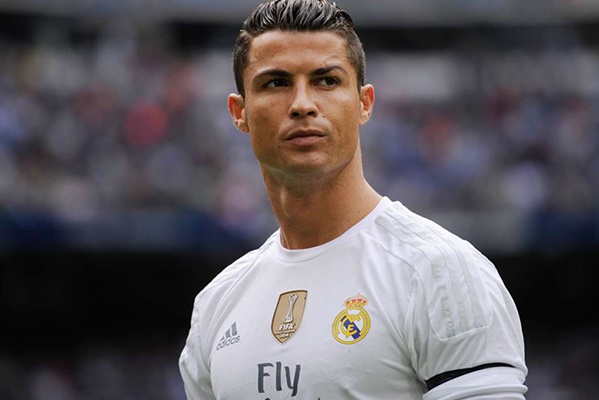
Cristiano Ronaldo Could Face 6 Years of Prison over €150 Million Tax Evasion

0393288001463260456_filepicker

According to a report covered by Entekhab in Farsi, Ronaldo, Real Madrid’s superstar attacker, has allegedly benefited from overseas tax havens, according to reports, and could owe millions of dollars in taxes on that money.

Spanish newspaper El Mundo is reporting that Ronaldo could face a judge as the investigation moves forward, quoting Spanish tax authority general secretary Jose Maria Mollinedo saying that punishment could be two years in prison and up to six if the investigation is open for more than six years.

The funds reportedly come from sponsorship deals and images rights, and the issue here is that Ronaldo has supposedly only paid taxes on these deals at a rate of just four percent, CBS Sports reported.

Jose Maria Mollinedo, the secretary general of the union at Spain’s tax authority (GESTHA), also revealed to Spanish radio station RAC1 the sheer scale of the trouble Ronaldo could find himself in.

El Mundo says the Real Madrid star has directed at least €150 million in income through tax havens, including the British Virgin Islands, since 2009.

Ronaldo’s agency, Gestifute, issued a strong denial and published documents that they believe prove Ronaldo is innocent.

But Mollinedo, one of the tax workers’ union’s most senior figures, suggested Ronaldo may well be facing a prison sentence, Mirror reported.

“The information about Cristiano Ronaldo makes it look like he could have defrauded more than €150million,” he said.

A Look at Iranian Newspaper Front Pages on December 7

Almost all newspapers highlighted the remarks made by President Hassan Rouhani in a speech on the occasion of Student Day. Some of them covered his remarks against the US violation of its JCPOA commitments, and some pointed to his responses to conservative students’ harsh criticisms.

Khorasan newspaper, among others, also referred to the challenging meetings of Iranian politicians with students across the country, and the different atmosphere students felt this year.

Iranian Foreign Minister Mohammad Javad Zarif’s visit to eastern Asia and his meetings with Chinese officials was also a top story today.

The above issues, as well as many more, are highlighted in the following headlines:


Abrar:

1- No Limit in Promotion of Iran-China Ties: Zarif

2- Kremlin Confirms Putin Has Sent Secret Message to Rouhani

3- Moscow: We Informed Iran of US Suggestions for Syria
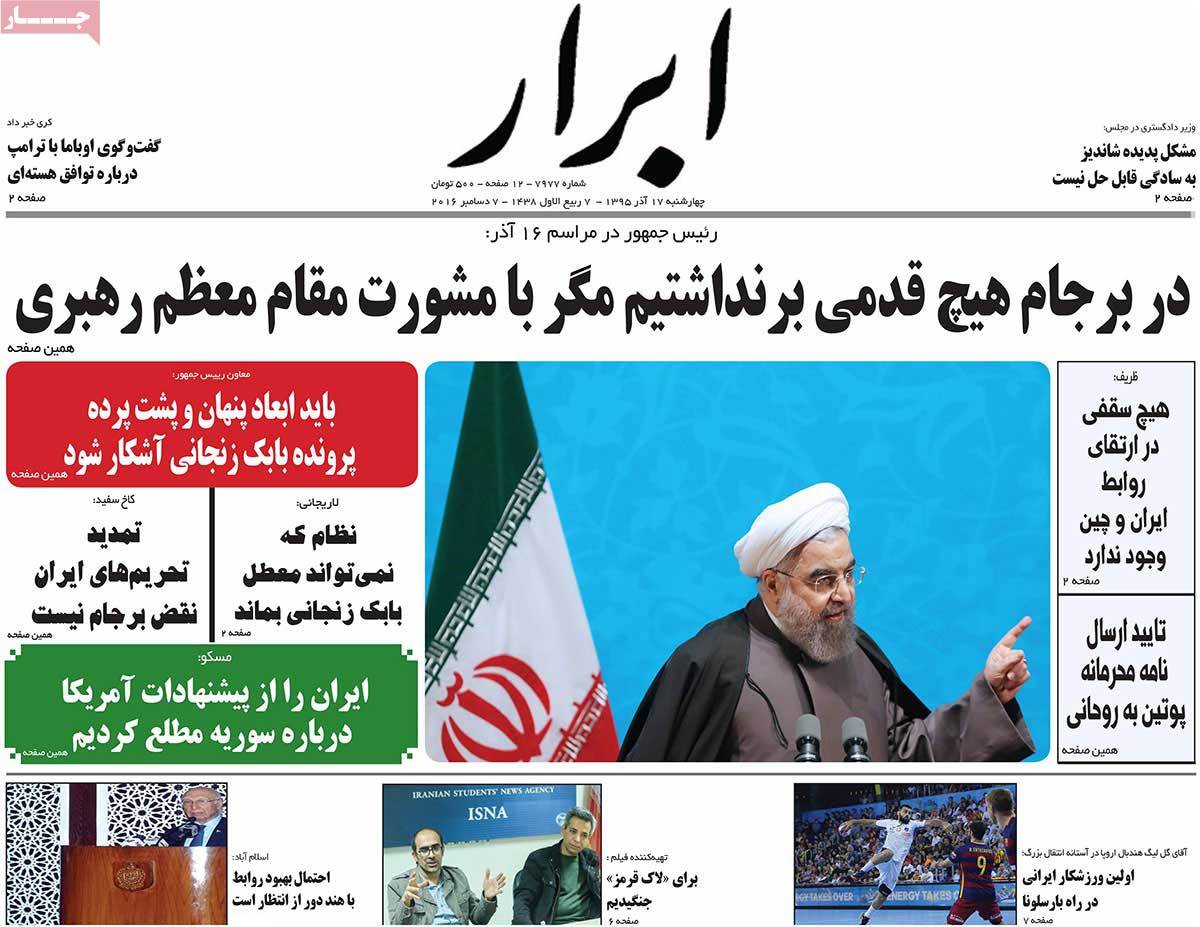
A Look at Iranian Newspaper Front Pages on December 7


Afkar:

1- Rouhani: We’ll Defend Nation’s Rights

2- Velayati: Iran-Russia Cooperation Will Prevent Spread of Plots in West Asia

A Look at Iranian Newspaper Front Pages on December 7


Aftab-e Yazd:

1- Fateful Decision: Iranian Committee that Monitors Nuclear Deal Implementation Will React to US Violation of Its Commitments Today

2- Is Rouhani Intolerant of Criticism? President Was Faced with Harshest Criticisms by Conservative Students in University of Tehran and Responded to Them
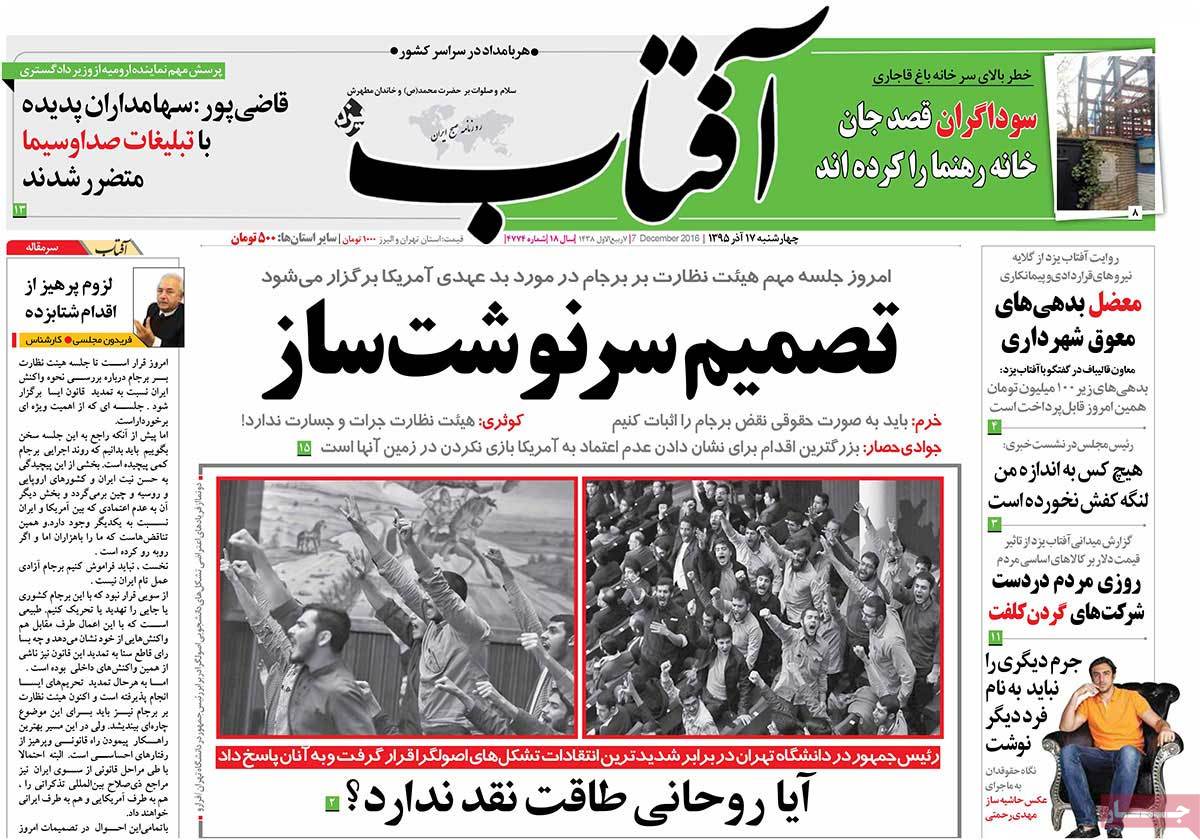
A Look at Iranian Newspaper Front Pages on December 7


Arman-e Emrooz:

1- President’s Patience Displayed in University of Tehran: Critics Chanted Slogans, Rouhani Smiled

2- Rouhani: We Won’t Let US Scrap Nuclear Deal; All Measures Leading to Nuclear Deal Were in Coordination with Ayatollah Khamenei
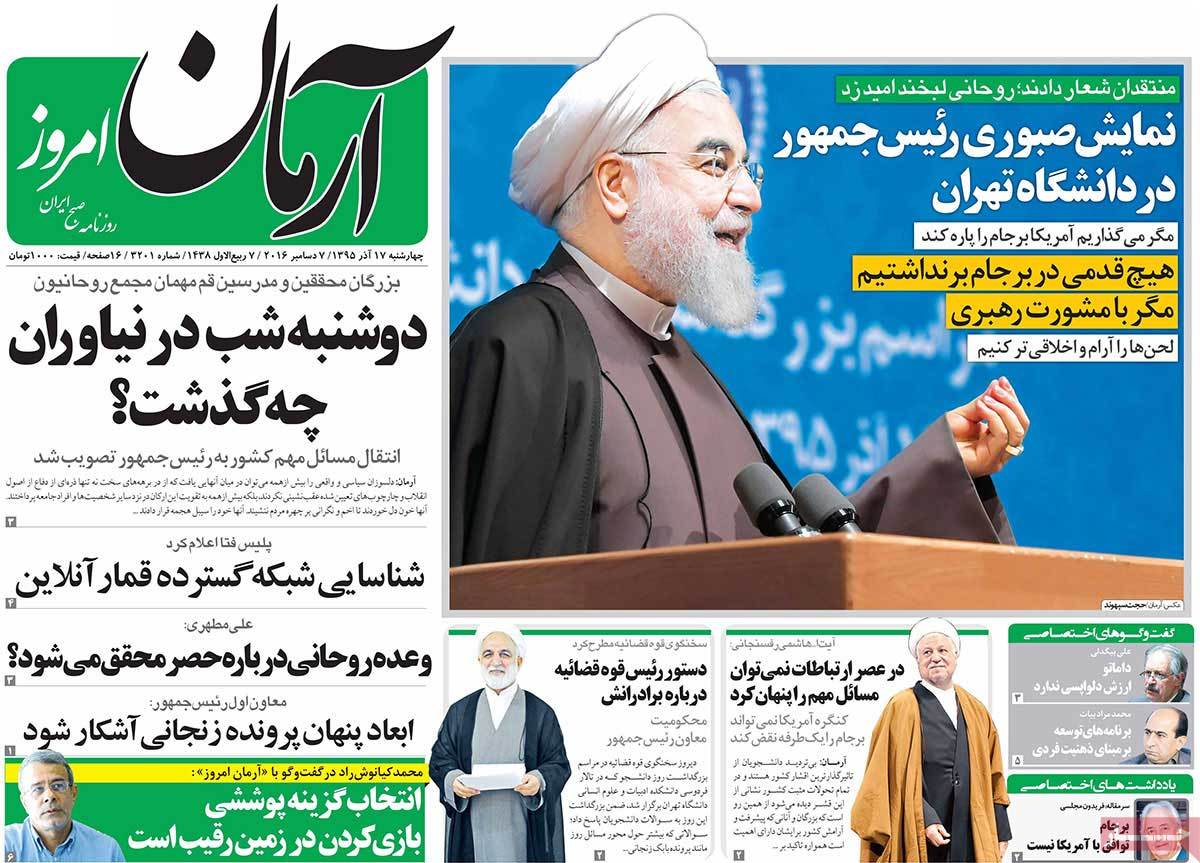
A Look at Iranian Newspaper Front Pages on December 7


Ebtekar:

1- Rouhani: We Should Tone Down Our Remarks and Act More Ethically

2- Ayatollah Rafsanjani: It’s Not Possible to Hide Important Issues in This Era of Communications
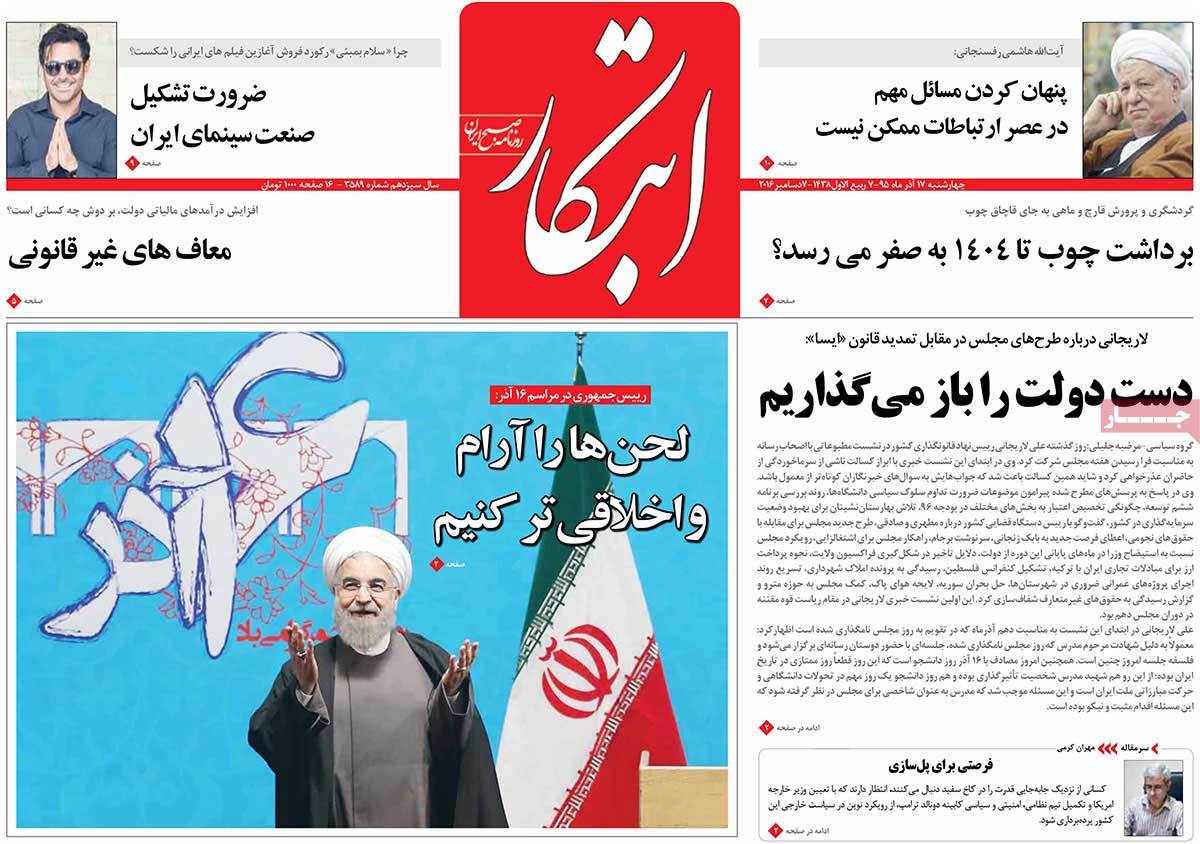
A Look at Iranian Newspaper Front Pages on December 7


Emtiaz:

1- Details of Chopper Crash in Tehran’s Chitgar Lake: 2 Killed, 7 Wounded

2- Central Bank Governor: Dollar Rate Will Decrease in Next 3 Months
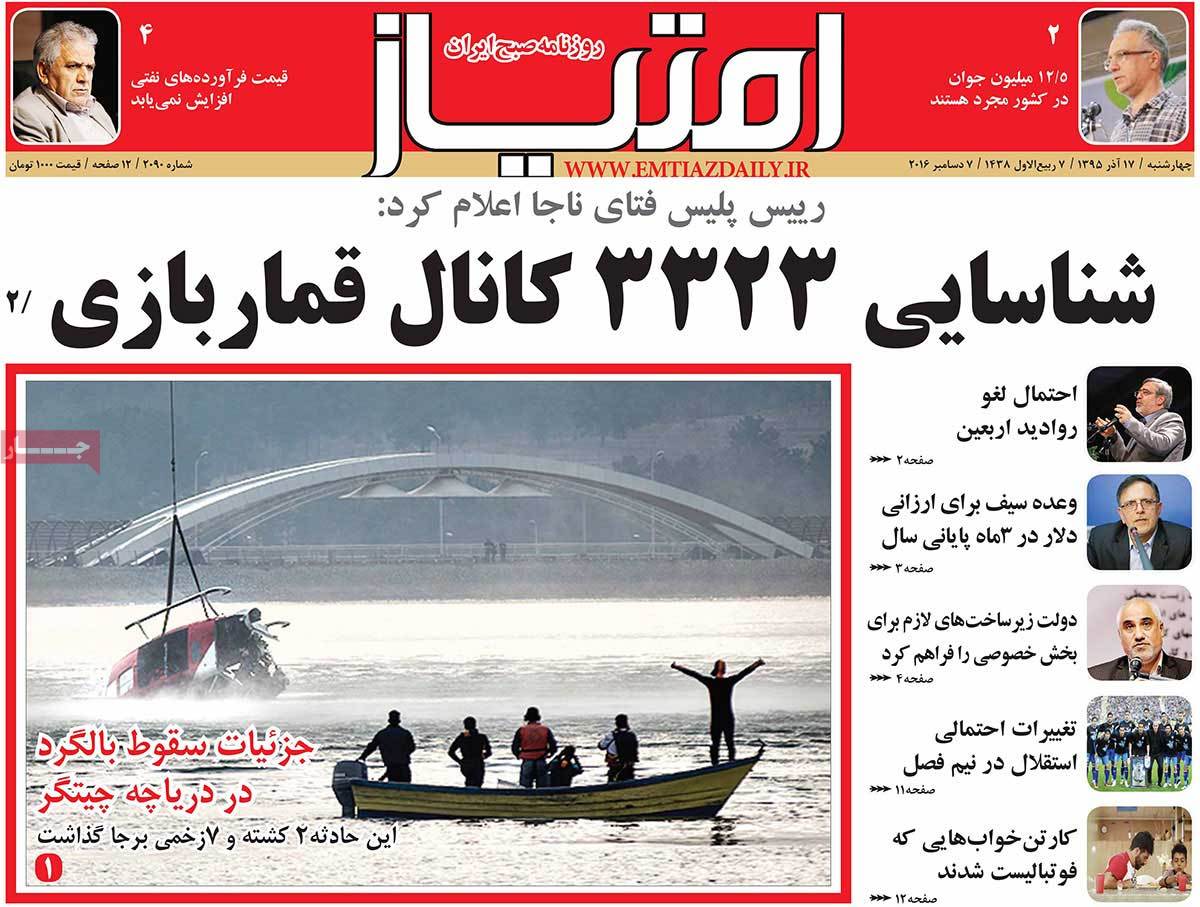
A Look at Iranian Newspaper Front Pages on December 7


Etemad:

1- Argument with President: Conservative Students and Critics Attacked Rouhani on Student Day, but He Replied to All of Them with Great Fluency

2- Members of City Council Protest at Construction of Numerous Malls in Tehran
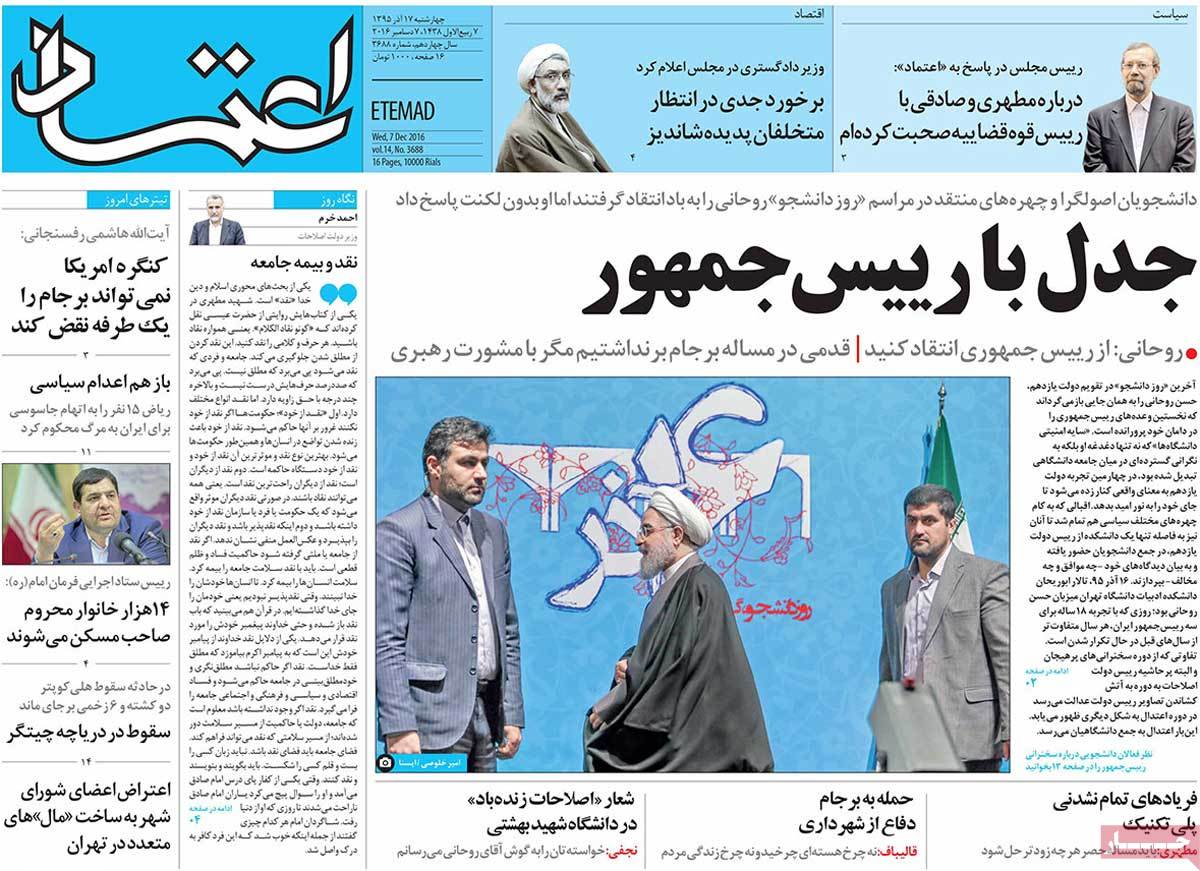
A Look at Iranian Newspaper Front Pages on December 7


Ettela’at:

1- Prosecutor-General: Authorities’ Negligence Is Cause of ‘Pollution’ in Cyberspace

2- Iran Leader’s Int’l Advisor Velayati: Western Asia’s Security Order Will Be Discussed in Tehran Conference

3- Iranians Are Not That Much Familiar with Mystical Literature in West
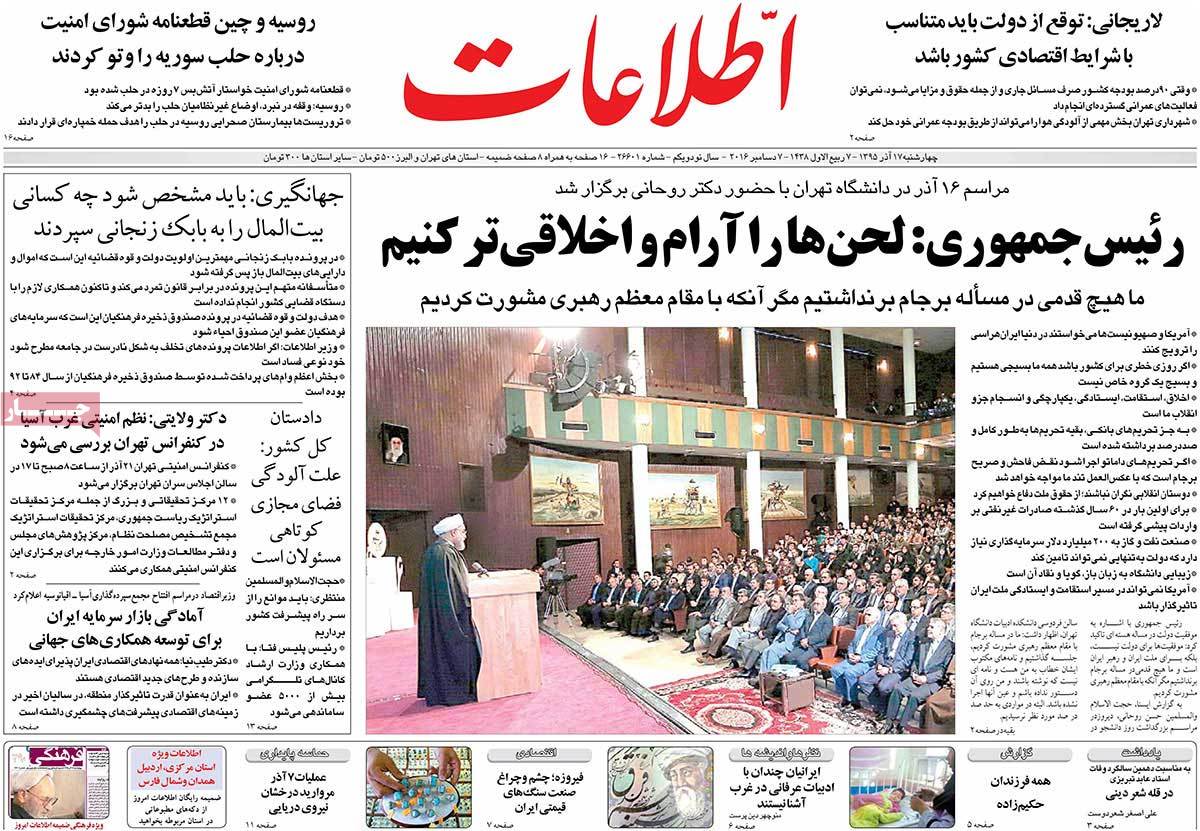
A Look at Iranian Newspaper Front Pages on December 7


Iran:

1- Rouhani: Government Has Based Its Nuclear-Related Measures on Ayatollah Khamenei’s Orders

2- Iran to Sue US: Parliament Speaker’s Solution to Deal with US Violation of JCPOA
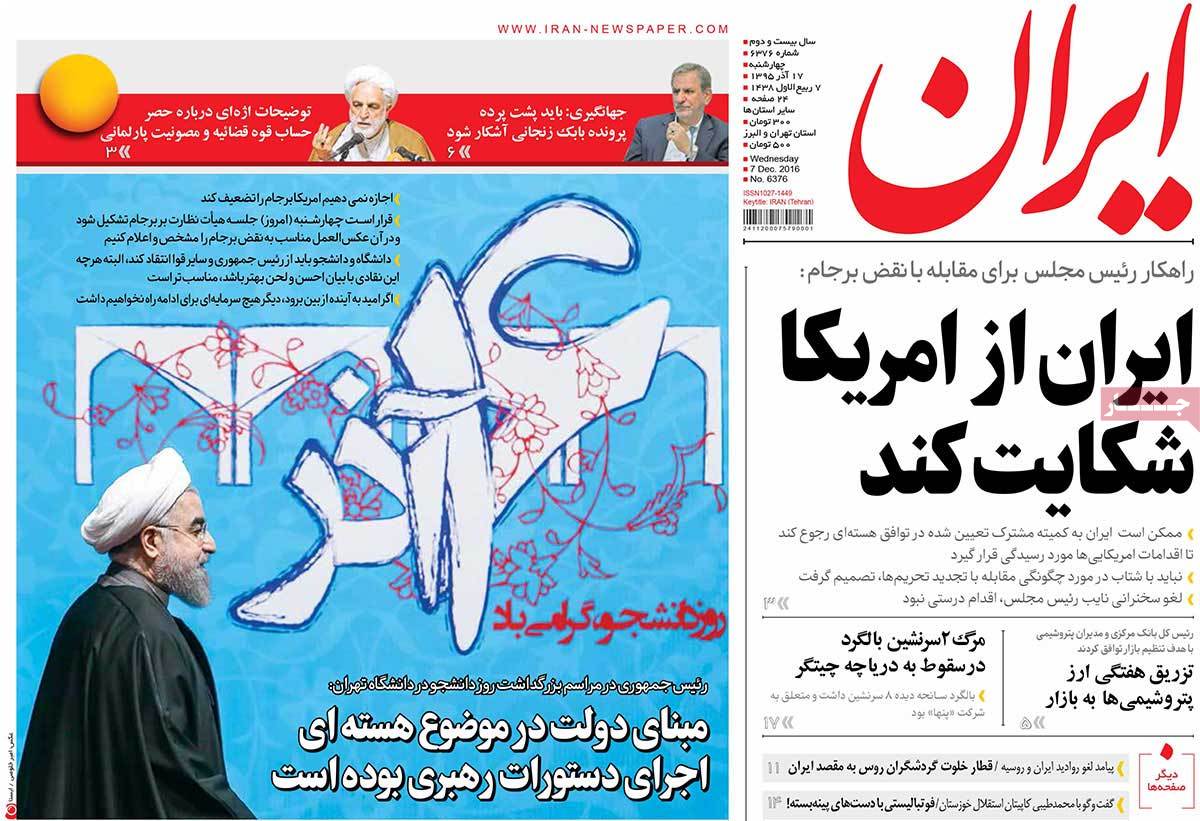
A Look at Iranian Newspaper Front Pages on December 7


Jame Jam:

1- Need for Controlling Cyberspace, Particularly Social Media

2- Day of Decision: Committee to Monitor JCPOA Implementation Will Hold Session Today

3- 14,000 Houses to Be Constructed for Needy Villagers
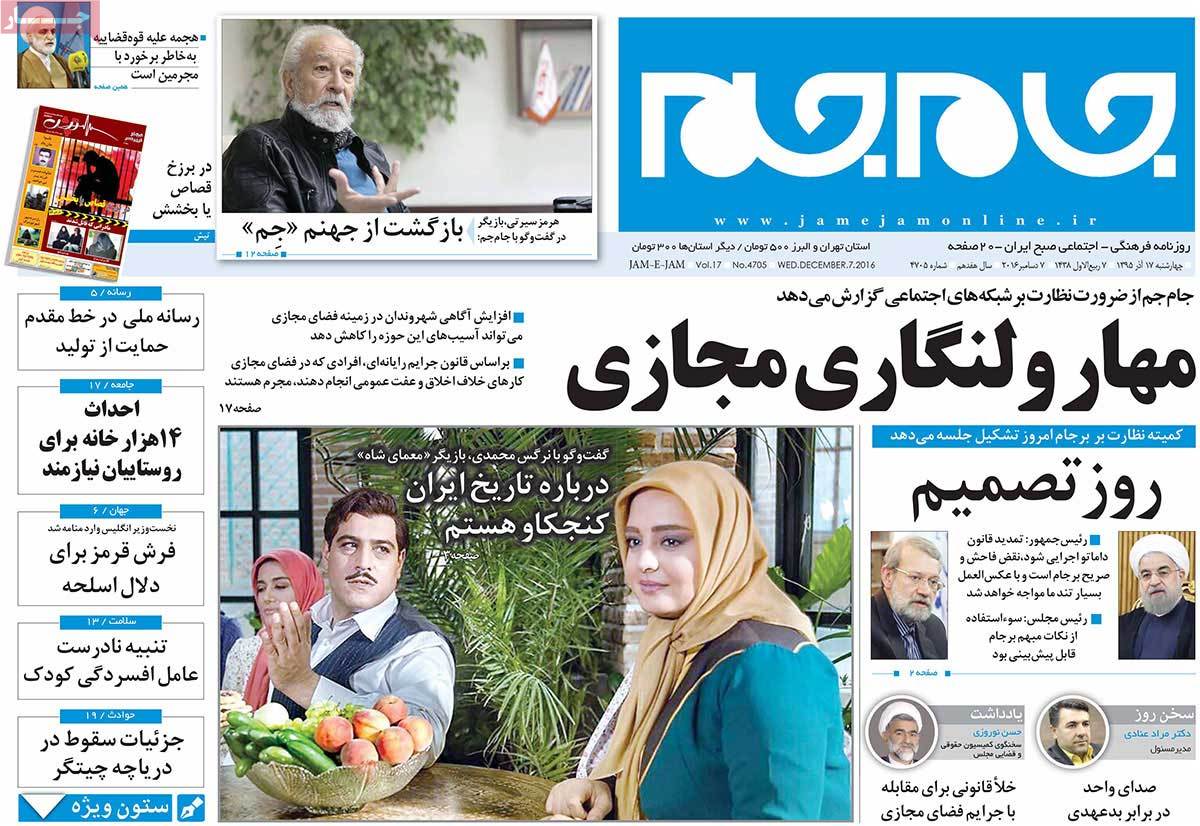
A Look at Iranian Newspaper Front Pages on December 7


Javan:

1- Rouhani: All Sanctions, but Banking Restrictions, Are Gone

2- President’s Gift to Students on Student Day Was to Accept the US Clear Violation of Its JCPOA Commitments
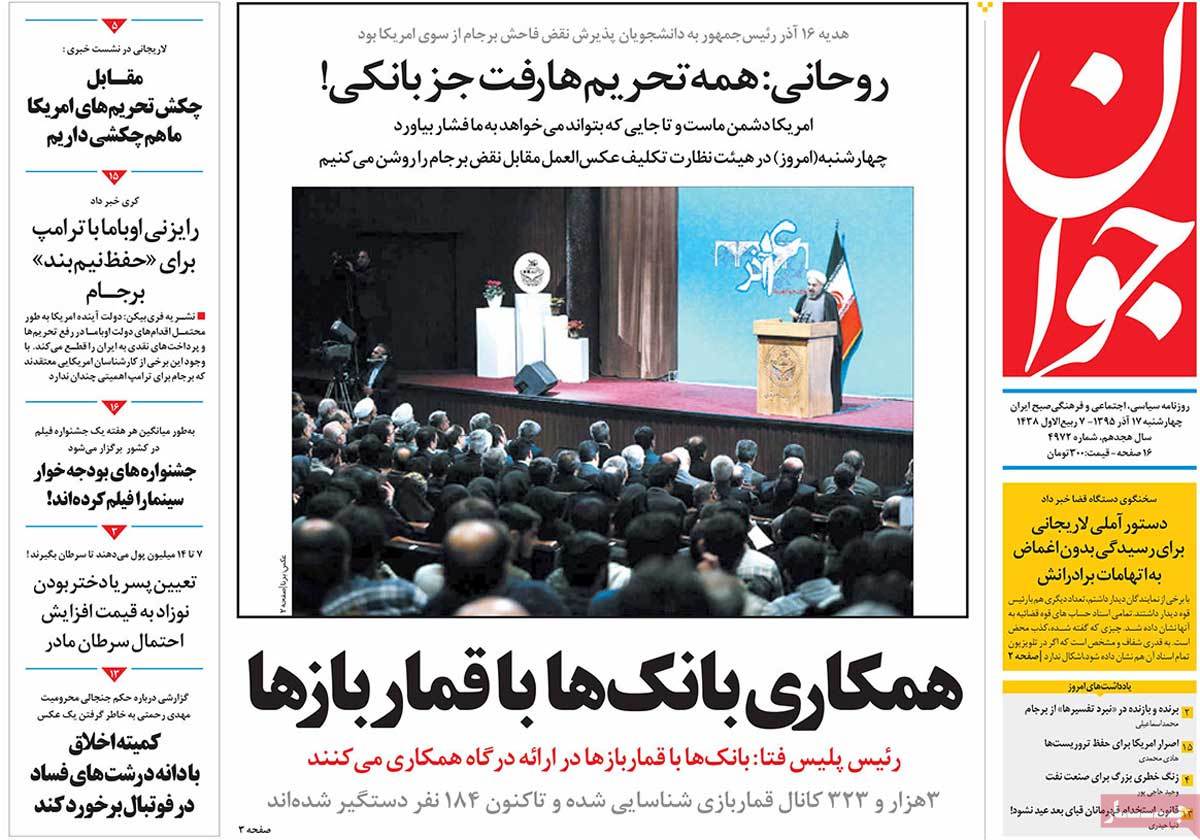
A Look at Iranian Newspaper Front Pages on December 7


Jomhouri Eslami:

1- US Is Not a Spokesman for the World: Rafsanjani

2- Saudi Arabia and Israel Managing Chaos in Syria: Syrian Opposition’s Confessions

3- Sputnik: US Congress Secretly Approves a Bill to Suppress Independent Media

4- 11-Year-Old Girl Miraculously Healed in Shrine of Imam Reza (AS)
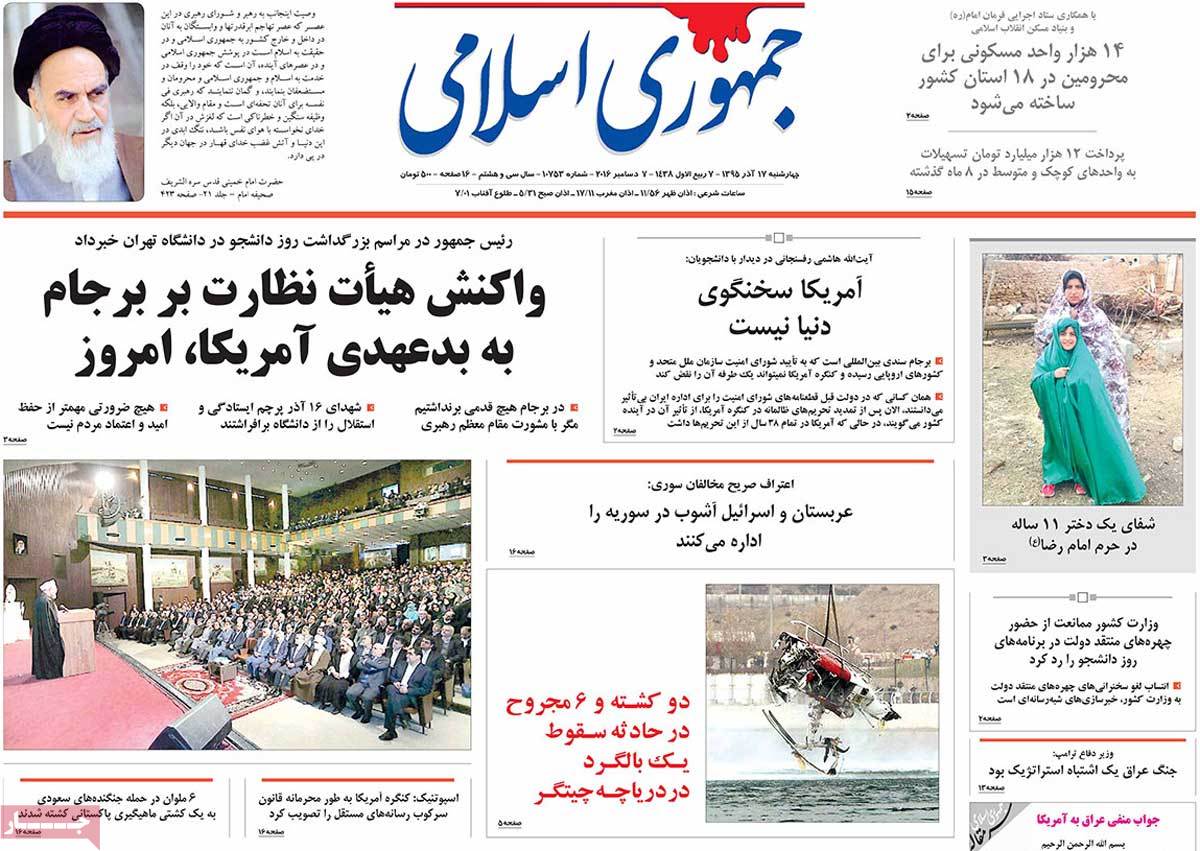
A Look at Iranian Newspaper Front Pages on December 7


Kayhan:

1- JCPOA Disaster Is a Result of Ignoring Ayatollah Khamenei’s Warnings

2- Europe Offers Huge Bribe to Assad for Letting Terrorists Get Involved in Power amid Imminent Liberation of Aleppo

3- Managing Editor of Reformist Shargh Newspaper Admits Too Lately: We Embellished Nuclear Deal
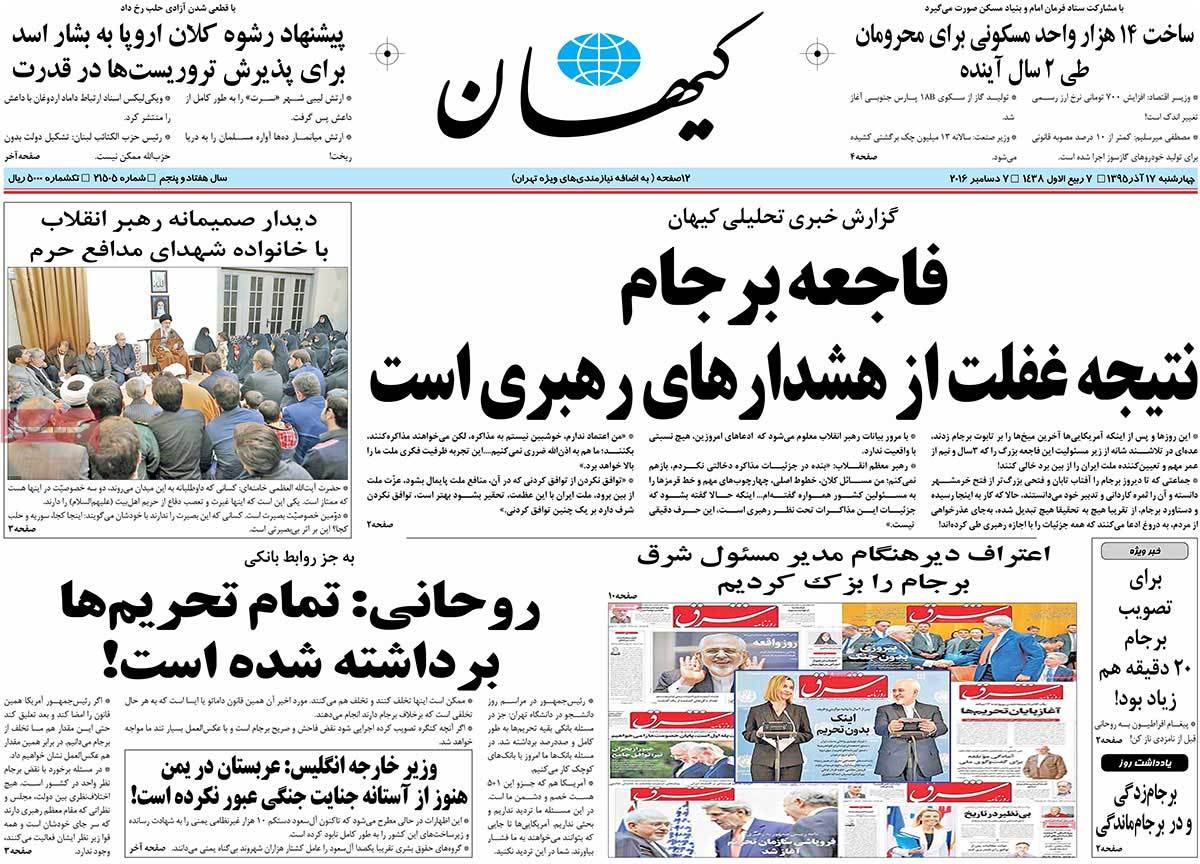
A Look at Iranian Newspaper Front Pages on December 7


Khorasan:

1- US Message Sent to Iran through Russian Channel

2- Challenging Speeches and Passionate Conferences on Student Day across Iran

3- 19-Year-Old Girl Rescued from Hostage-Takers’ Captivity in 24 Hours
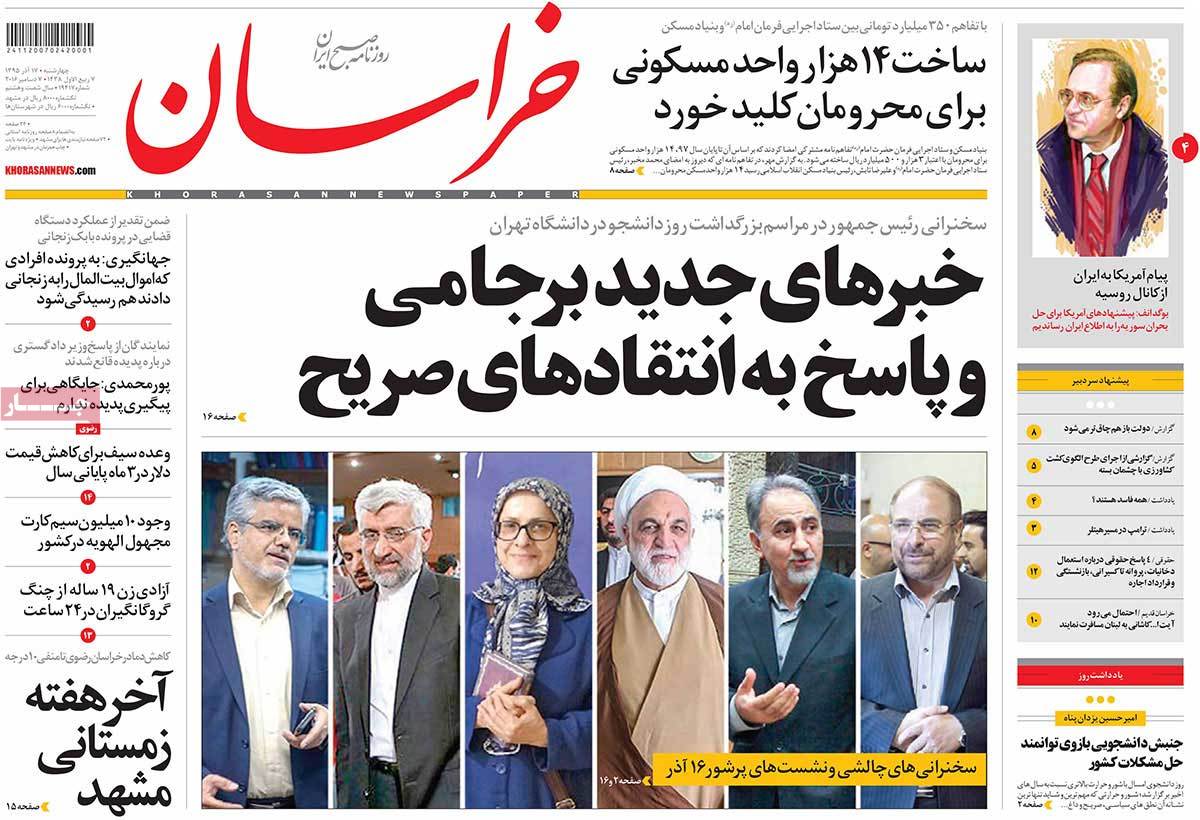
A Look at Iranian Newspaper Front Pages on December 7


Payam-e Zaman:

1- Rouhani: We Have No Doubt that US Is Our Enemy

2- Zarif: The Time of Superpowers’ Hegemony Is Over

3- Private Sector Will Be Put in Charge of Oil Product Exports
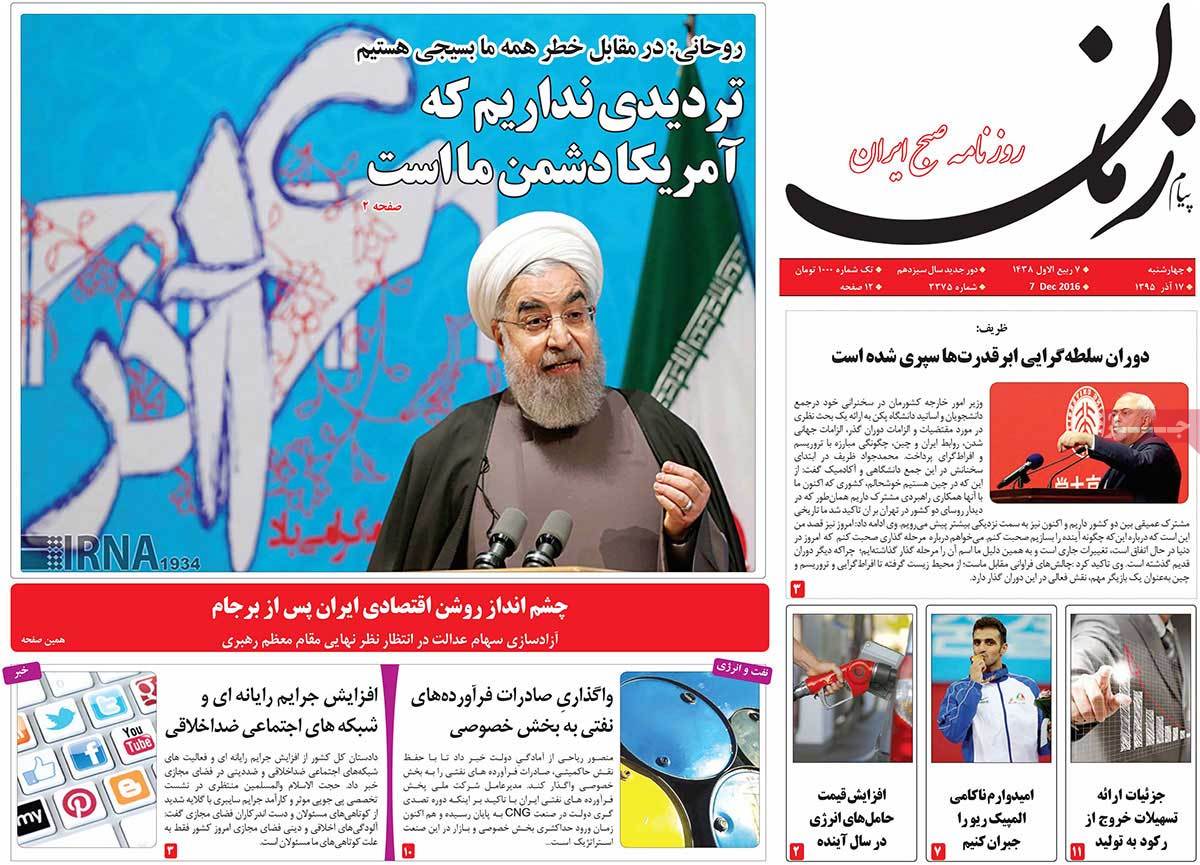
A Look at Iranian Newspaper Front Pages on December 7


Rah-e Mardom:

1- Hanging out with Bad Guys and Dark Future of Teenagers

2- Rouhani: All of Us Should Be Revolutionaries
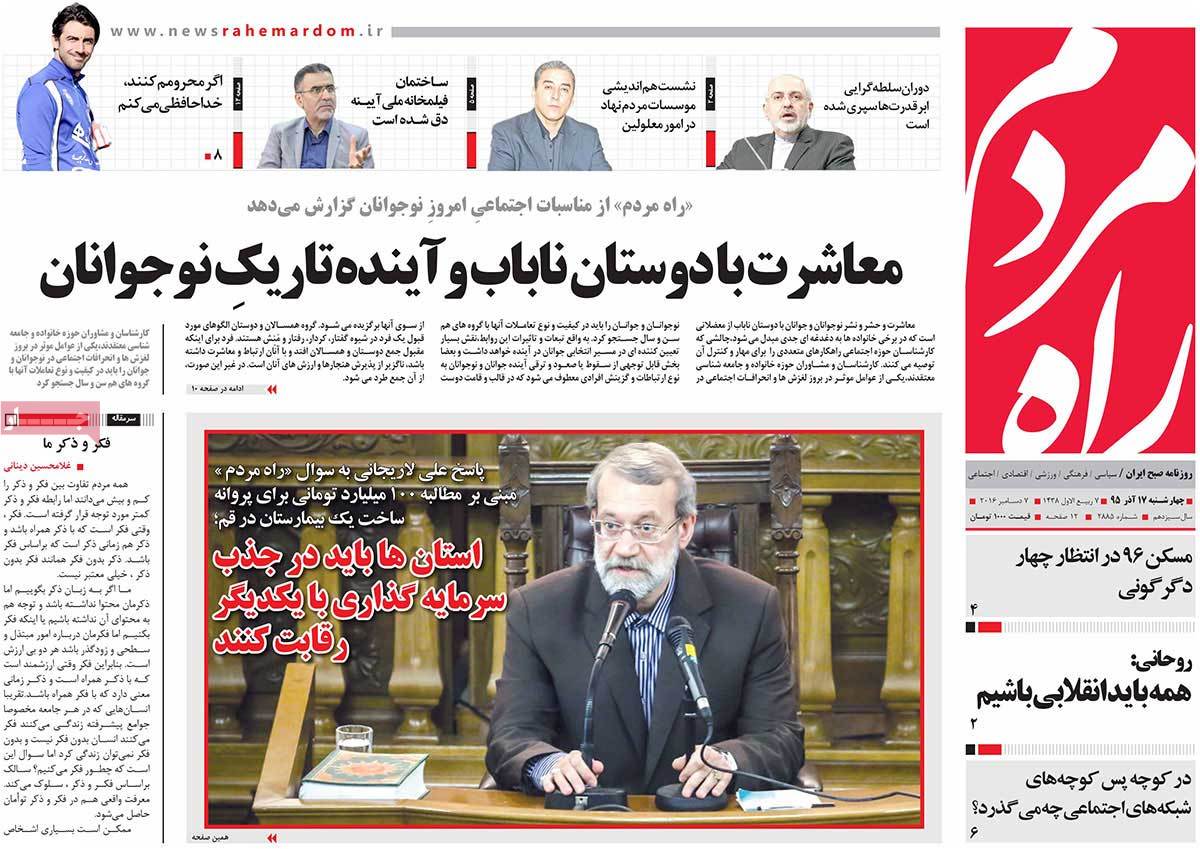
A Look at Iranian Newspaper Front Pages on December 7


Resalat:

1- The United Europe in Chaos: Italy, the New Centre of West’s Political Crisis

2- Economic Problems Are Resolved More Easily than Defence Issues: IRGC General

3- Government Did Nothing to Restore Astronomical Salaries: Larijani
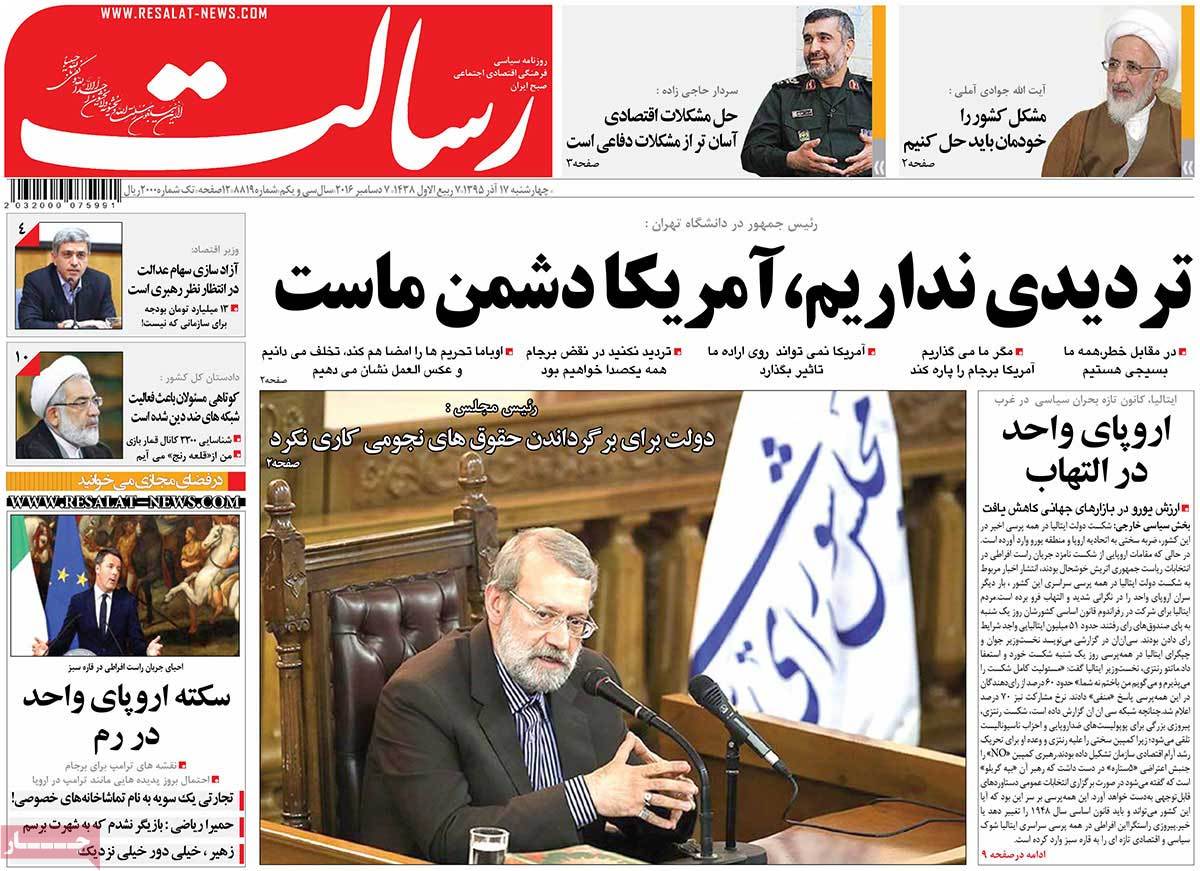
A Look at Iranian Newspaper Front Pages on December 7


Rooyesh-e Mellat:

1- Iran Is Harbour of Security in Middle East: Larijani

2- Russia and China Veto Draft UNSC Resolution on Aleppo
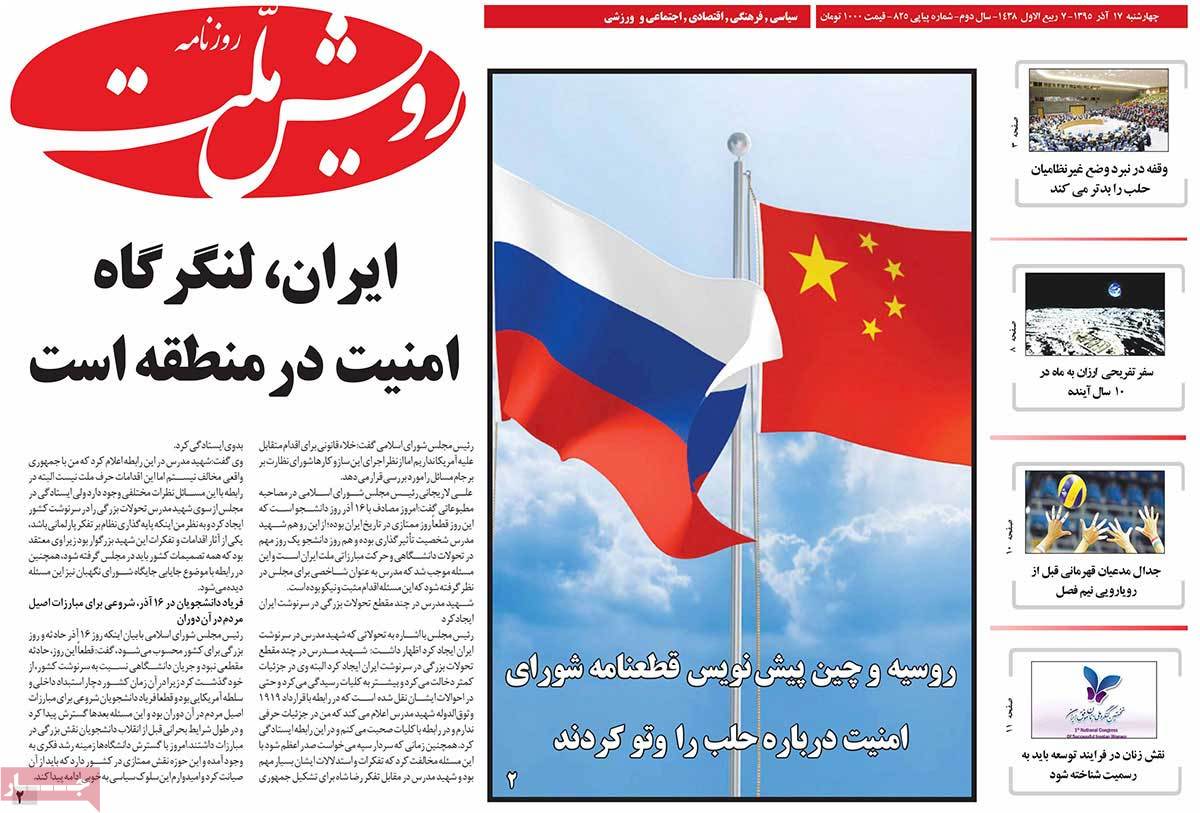
A Look at Iranian Newspaper Front Pages on December 7


Sayeh:

1- Iran Holds Eighth Rank in Producing Handicrafts
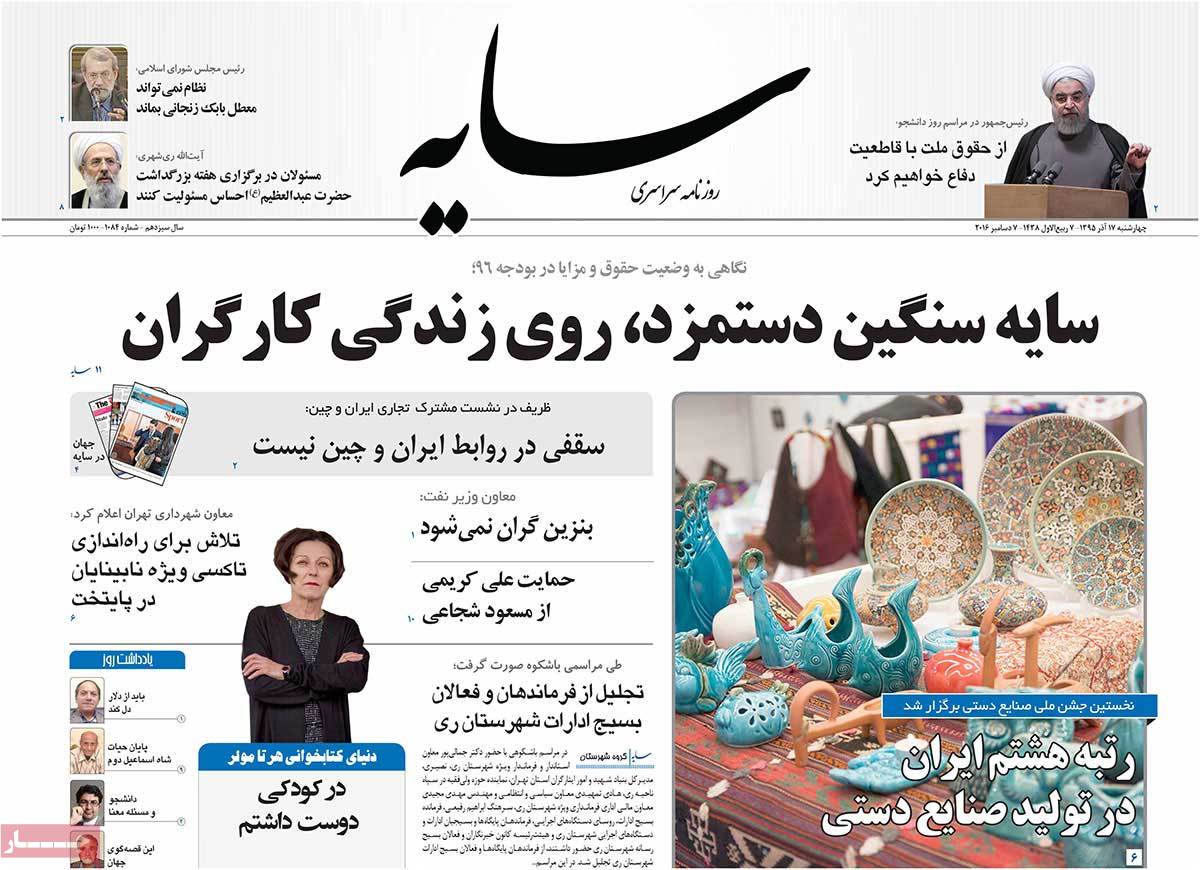
A Look at Iranian Newspaper Front Pages on December 7


Setareh Sobh:

1- President’s Advice to Iranian People on US Senate’s Extension of Iran Sanctions Act: Don’t Worry!

2- Economy Minister: Decrease of Inflation Rate, Security of Foreign Investment
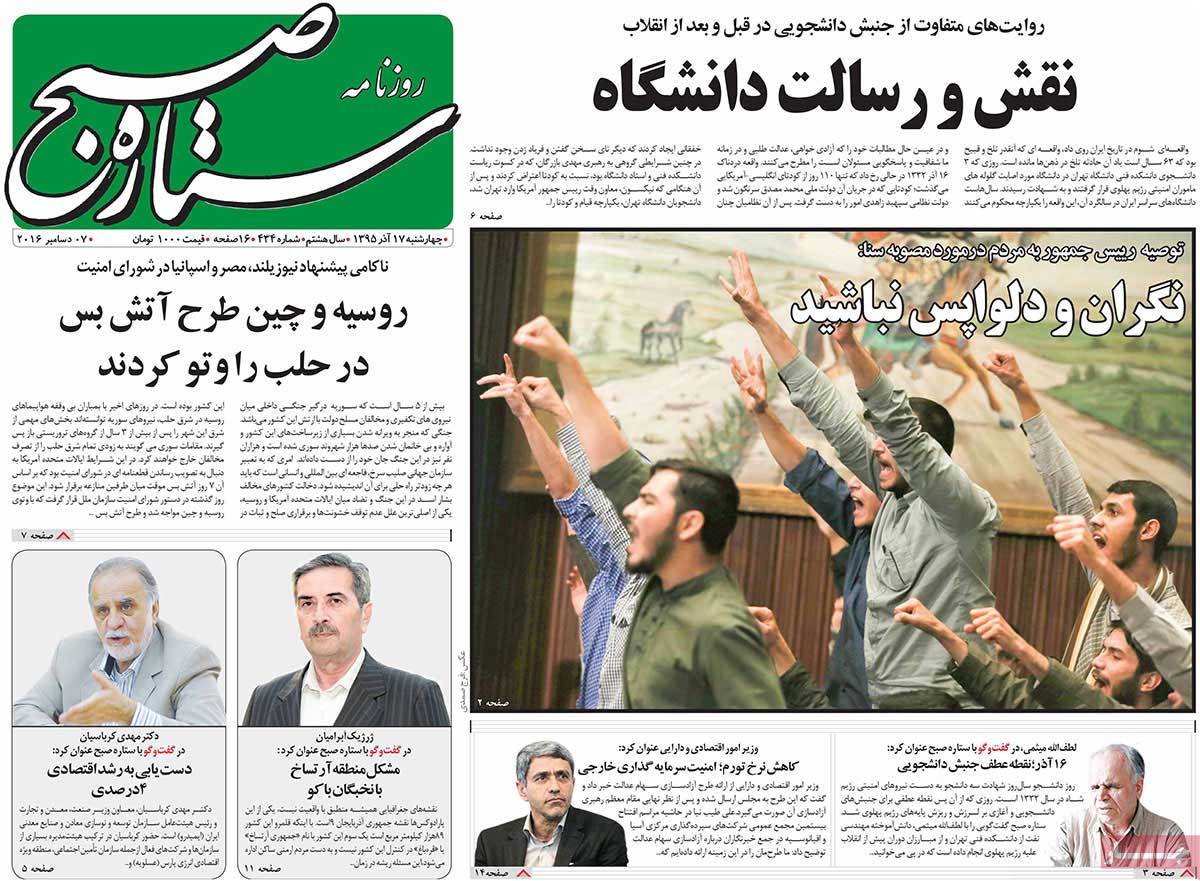
A Look at Iranian Newspaper Front Pages on December 7


Shahrvand:

1- Chopper of Death

2- Humanitarian Crises Become More Complicated: Red Cross Chief in Interview with Shahrvand
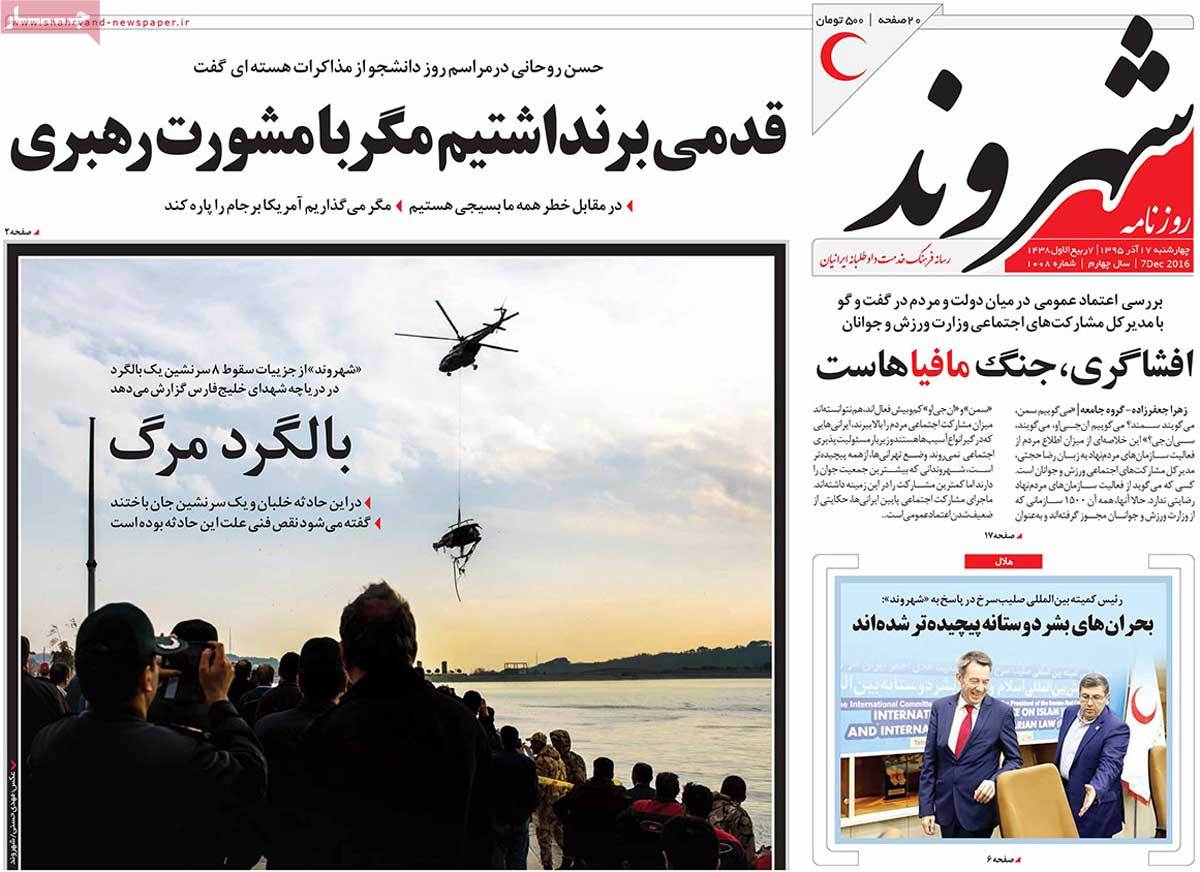
A Look at Iranian Newspaper Front Pages on December 7


Shargh:

1- Reformists in University’s Backyard

2- Attack on Government on Pretext of Student Day

3- Mayor of Tehran Qalibaf: Neither Did Iran’s Nuclear Industry Flourish, nor Did People’s Lives
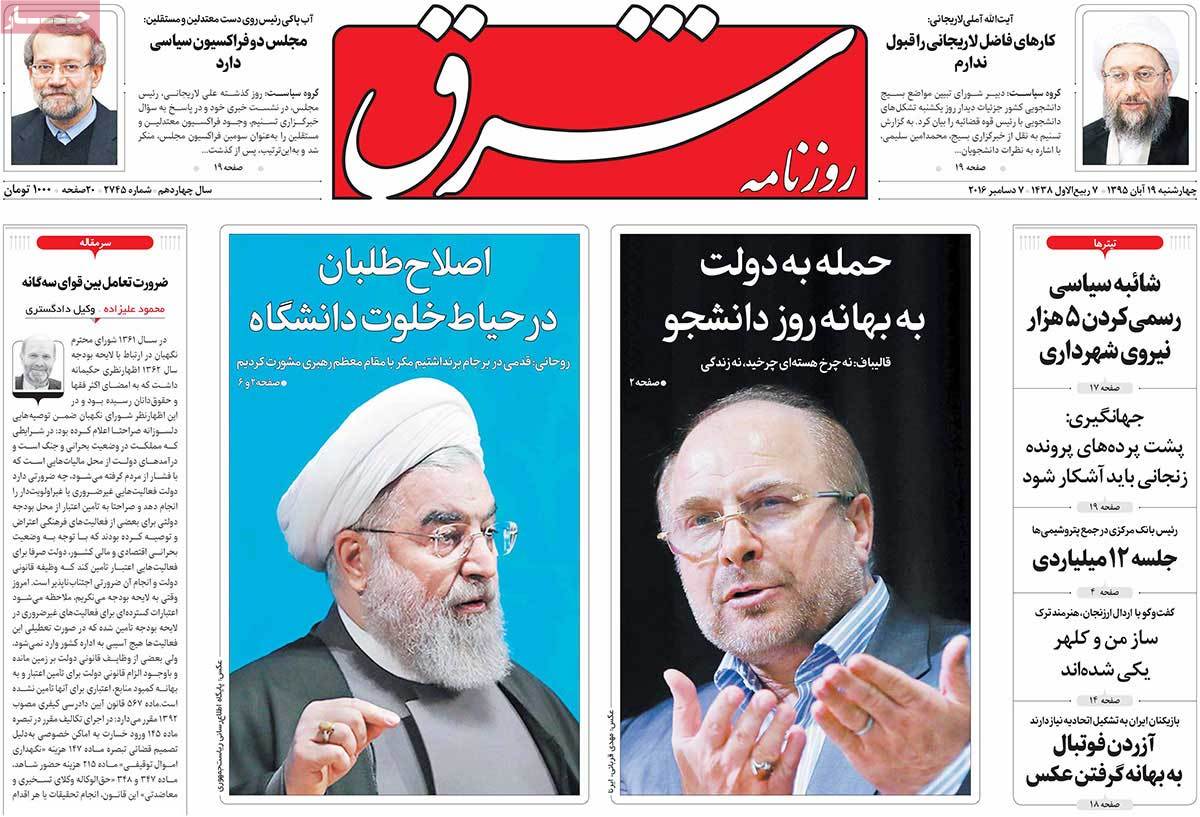
A Look at Iranian Newspaper Front Pages on December 7


Siasat-e Rooz:

1- Russia and Syria Give Ultimatum to Those Who Support Aleppo Murderers

2- Ansarullah Reveals US Plot for Yemen
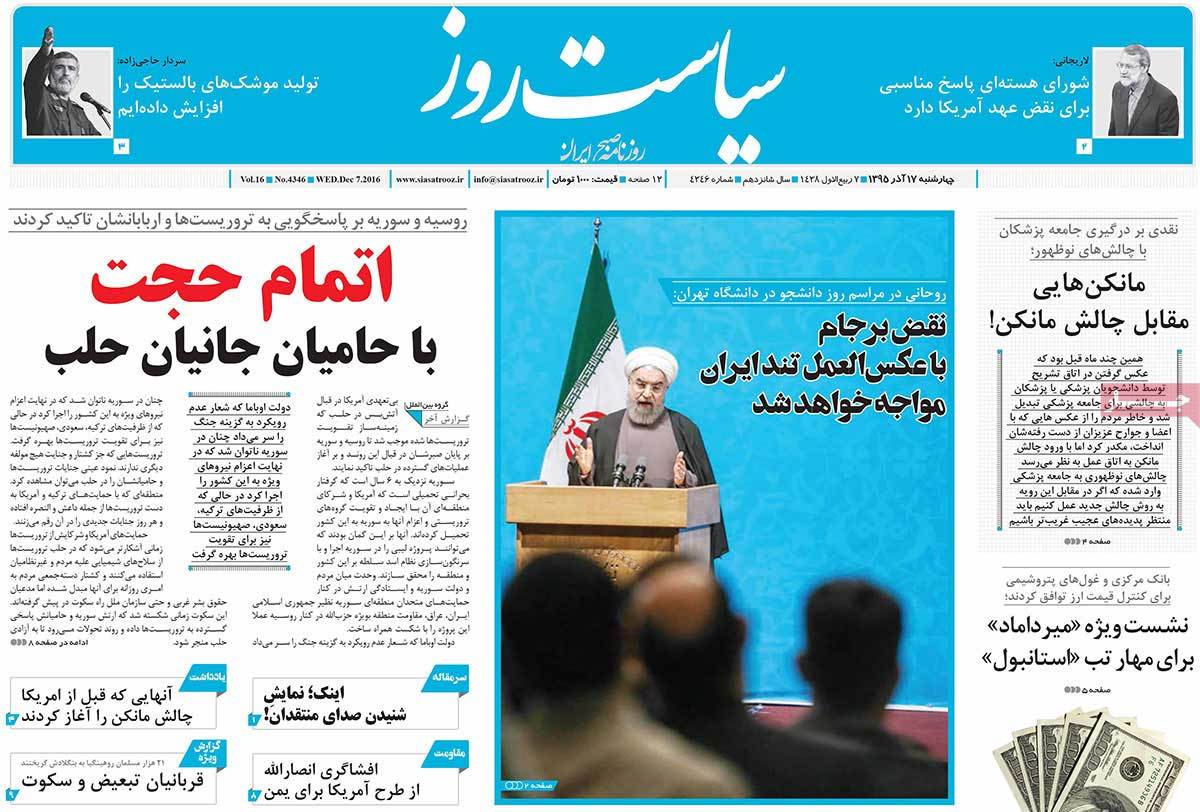
A Look at Iranian Newspaper Front Pages on December 7


Sobh-e Now:

1- Problems Cannot Be Resolved by #Talking: Mayor of Tehran Qalibaf

2- Former IRIB Chief Zarghami: IF JCPOA Is Analyzed Correctly, It Has Potentials for National Unity
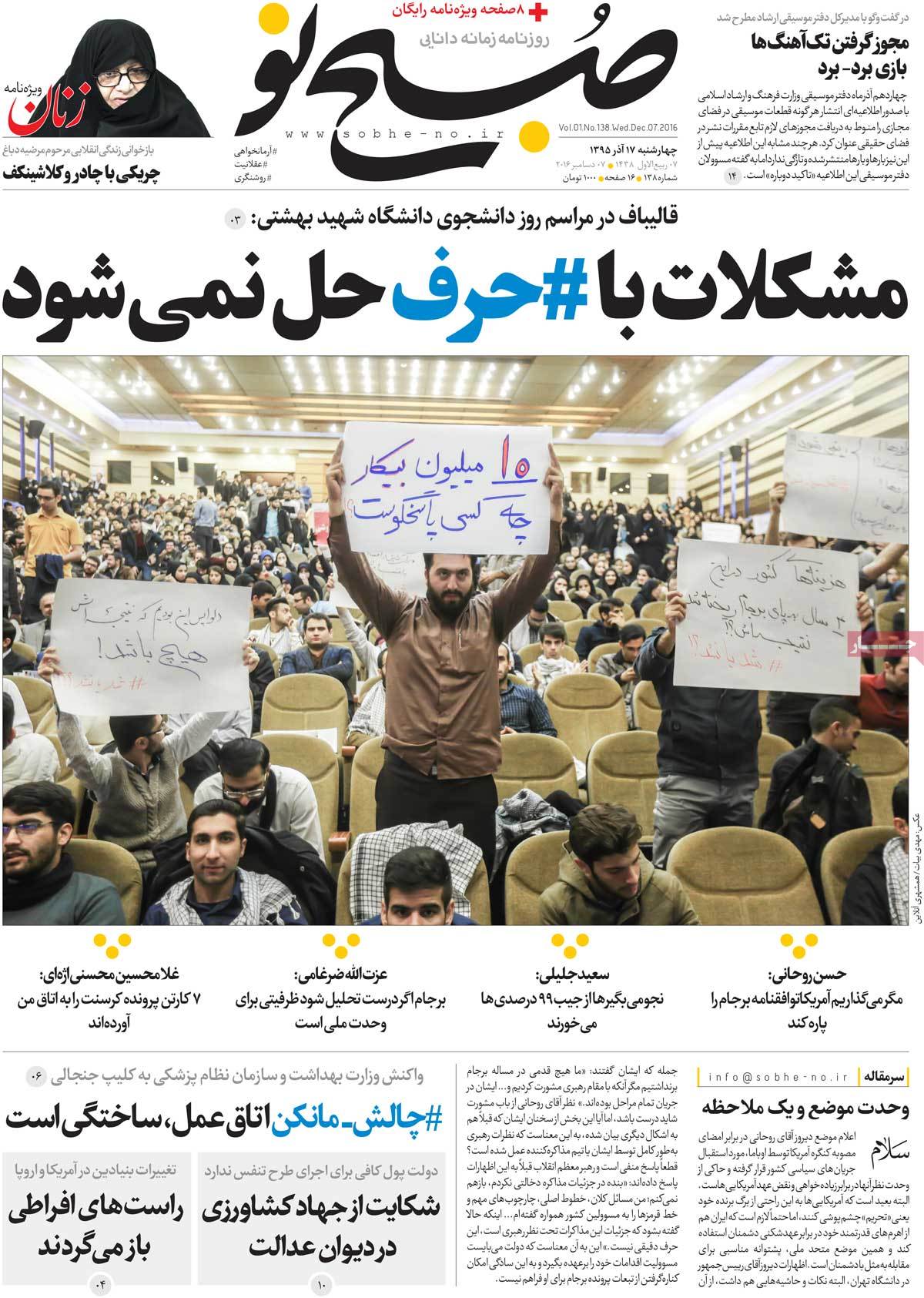
A Look at Iranian Newspaper Front Pages on December 7


Vatan-e Emrooz:

1- Main Objective Was to Prove that US Is Lying: Rouhani

2- Even If US President Signs Off Senate’s Bill to Extend Anti-Iran Sanctions and Then Suspends It, It Is Still a Violation of JCPOA and Tehran Will Show Reaction: President
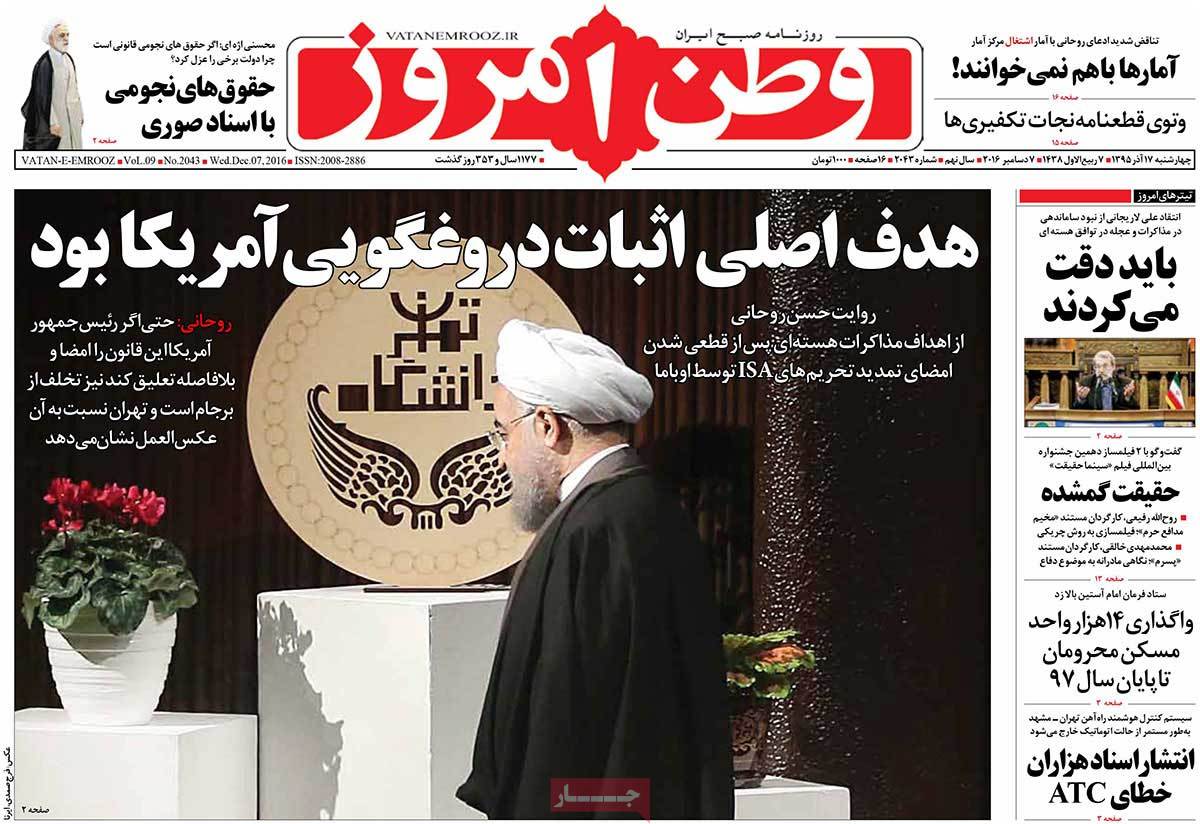

A Look at Iranian Newspaper Front Pages on December 7


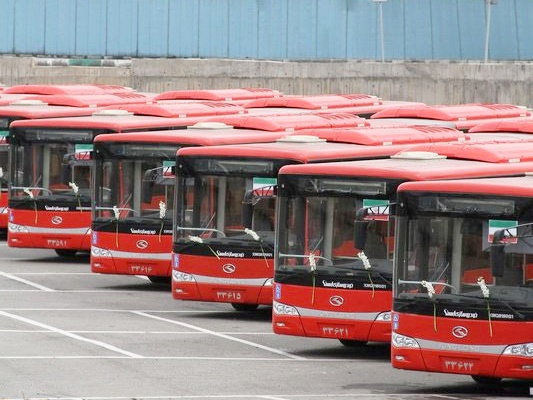
Public Buses in Tehran Are Disinfected Every Day

bus

According to a Farsi report by Mehr, the Managing Director of Tehran’s Bus Operating Company Peyman Sanandaji noted that immediately after the last passengers leave Tehran’s public buses every night, the vehicles are thoroughly disinfected and sanitized.

Even during the day, the moment passengers disembark from the bus, a group of workers get into the buses and clean them using detergents, he added.

As the last steps, trash bins are emptied, bus floors are swept, and glasses are cleaned every night, Sanandaji went on to say.

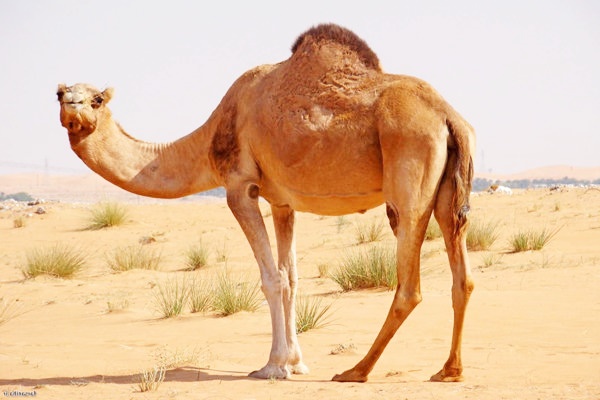
License Plates for Camels in Southern Iran!

“We are going to give identity cards to 35,000 camels during the first phase of issuing licence plates for them,” said Mohammad-Sharif Khaleqinia, the secretary of Iranian Central Task Force to Combat the Smuggling of Commodities and Currency in Sistan and Baluchestan Province.

“95,000 animals have been given licence plates since the beginning of the new Iranian year,” he added, according to a Farsi report by IRNA.

The traffic of camels in roads of Sistan and Baluchestan during the night causes car accidents, losses and damages.

As there has been no means to find out the camels’ identities, their owners couldn’t be recognised. By issuing licence plates, not only the owners feel more responsible in taking care of their animals from now on, but also such problems as animal trafficking would decrease.

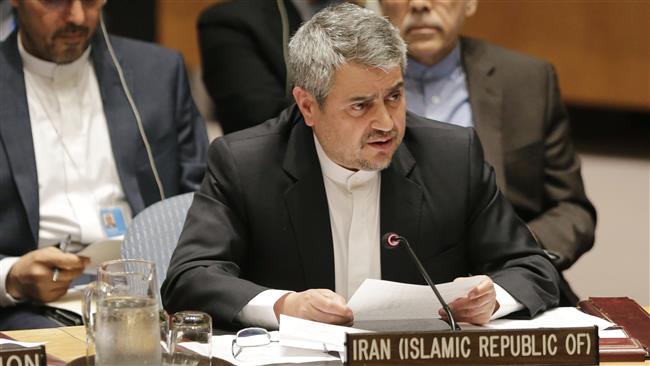
Iran Urges UN Chief to Brief Security Council on US Sanctions Bill

Gholam-Ali Khoshrou

In the letter addressed to Secretary General Ban Ki-moon, Iran’s Ambassador to the United Nations Gholam-Ali Khoshrou wrote that the congressional move flew in the face of the US commitments, which have been enshrined in the accord, known as the Joint Comprehensive Plan of Action (JCPOA).

The US “is, therefore, answerable for any unfavorable consequences and pernicious effects that could result from the measure,” the letter said.

Khoshrou wrote that Washington, as a party to the JCPOA, has pledged to neither ratify nor prolong any nuclear-related bans against Tehran as any such move contradicts “the letter” of the deal inked in July 2015 between Iran and the the P5+1 group of countries, namely the US, the UK, France, Russia and China plus Germany.

Since January, when the deal took effect, the International Atomic Energy Agency has invariably verified Iran’s commitment.

The US Congress, however, voted recently to extend for another decade the president’s power to impose sanctions on the American entities that do business with the Islamic Republic under the so-called Iran Sanctions Act (ISA).

The law was first adopted in 1996 to punish investments in Iran over its nuclear program and support for anti-Israeli resistance groups. The ISA now needs President Barack Obama’s signature to turn into law.

Further in the letter, the senior Iranian diplomat also urged the UN chief to mention Washington’s non-commitment in his next report to the UN Security Council, which has endorsed the JCPOA to make it international law.

“The Islamic Republic’s government considers the Congress’ recent ratification, namely its extension of the ISA until the end of 2026, to be against US obligations as per the JCPOA,” Khoshrou wrote.

Khoshrou also urged the UN chief to press all concerned parties to live up to their contractual agreements.

Iranian authorities have slammed the congressional vote as a violation of the nuclear deal, vowing to adopt appropriate retaliatory measures.

On Tuesday, Iranian President Hassan Rouhani said a committee tasked with monitoring the JCPOA’s implementation is set to decide Wednesday how to respond to the ISA’s extension.

Iran Can Become Global Tech Player: UN

26234580-c8d7-4926-a9da-d571fa737dcb

The report released on Tuesday by the United Nations trade and development agency, UNCTAD, touched on Iran’s “impressive” scientific growth since it last assessed the country’s policies on science, technology and innovation in 2005.

Iran has had one of the world’s fastest growing scientific outputs, climbing from 34th to 16th position in terms of scientific publications, UNCTAD’s new Science, Technology and Innovation Policy Review for Iran said.

Iran’s population now has the world’s second-highest number of engineer graduates per capita. The country has shown it can do top-notch research and work with technology, even in emerging sectors like nanotech, but the challenge now is to commercialize this knowledge, the report said.

“Iran’s impressive human resources position it well to seize the opportunity of reconnecting with the global economy, and its policies on science, technology, and innovation will be critical to its success,” said Shamika Sirimanne, director of UNCTAD’s Division on Technology and Logistics.

US-led sanctions in place since 1980 and strengthened in 2008 have forced the country to become self-reliant despite limiting Iran’s access to foreign finance, technologies and markets, UNCTAD said.

Iran Can Become Global Tech Player: UN

Since 2005, Tehran has taken important steps to put in place the right policies on science, technology and innovation, but needs to better align these with other key policy areas such as trade, investment, industrial development, education, and competition, the report added.

Iran is now the most economically diverse oil-producing country in West Asia. Iran’s $400 billion economy holds the promise of a lucrative market of nearly 80 million consumers as businesses are seeking new opportunities for growth.


Iran Can Become Global Tech Player: UN


According to UNCTAD, Iran will face serious competition from foreign companies. Good policy, it said, can facilitate more innovation by Iranian companies, helping to boost growth and create more jobs.

“Foreign direct investment, for example, will be most useful for Iran if it leads to genuine collaboration on technology and innovation, rather than just an increase in productivity.”

Iran has set up institutions to promote technological development and innovation. UNCTAD said some key institutions remain too focused on production.

The country has increasingly shifted its focus from research and education toward technological development and a stronger emphasis on innovation. The economy has seen 2,700 knowledge-based firms worth $6.6 billion spring up in recent years.


Iran Can Become Global Tech Player: UN


New knowledge-based firms, however, cannot transform the economy on their own and large established industries, such as oil and gas, automobiles and steel, should also invest more in innovation, the report said.

One of the report’s recommendations is to increase spending on research and development to 2.5% of gross domestic product, with an emphasis on increased private sector spending. Currently, the figure sits below 1%, most of which comes from government or state-owned companies.


Iran Can Become Global Tech Player: UN


“Research and development is important, but is not a silver bullet,” said Michael Lim, an UNCTAD economist and one of the report’s authors.

“Iranian companies can boost their competitiveness by improving design capacity and softer, non-technical skills like marketing and management,” Lim added.

The key, the report said, “is not just to create a product that works, it is to create something that sells in markets or solves practical social and environmental problems.”

“To create an environment where innovation and creativity can flourish, Iran needs to strengthen systems that support innovation. And this entails promoting collaboration between industry and universities and research institutes, and strengthening the business environment, for example.”

Iran Producing Better Ballistic Missiles at Lower Costs: IRGC Commander

hajizadeh

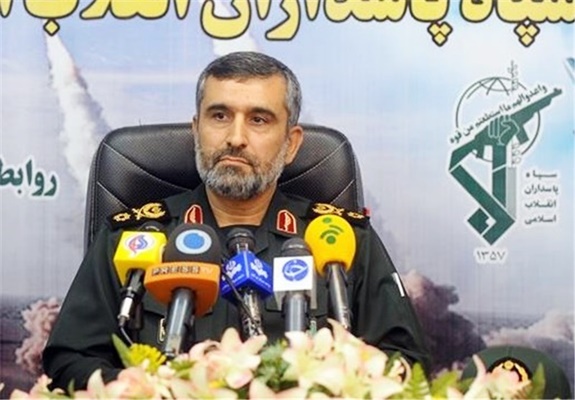
In the missile sphere, Iran has been able to maximize the accuracy of projectiles, as emphasized by Leader of the Islamic Revolution Ayatollah Seyed Ali Khamenei, with reliance on the local forces, Brigadier General Amir Ali Hajizadeh said at an academic ceremony in Tehran on Tuesday.

In addition to an improvement in the accuracy and quality of the ballistic missiles, Iranian experts have developed innovative short cuts to lowering the costs of production, the commander added.

Missile production in Iran has risen despite low funding, he noted.

Iranian military technicians have in recent years made great headways in manufacturing a broad range of indigenous equipment, making the armed forces self-sufficient in the arms sphere.

In August, Defense Minister Brigadier General Hossein Dehqan praised the country’s military might in the face of foreign threats and its self-sufficiency in defense sector, saying the Islamic Republic can mass produce ballistic missiles with any range and destructive power.

IAEA Confirms Iran Has Met Its JCPOA Commitments

According to a diplomat citing a confidential UN nuclear watchdog report, Iran has shipped 11 tons of heavy water abroad to bring its stock back under the limit of 130 tons set by the July 15 nuclear deal, also known as the Joint Comprehensive Plan of Action (JCPOA), Reuters reported.

“On 6 December the Agency verified the quantity of 11 metric tons of the nuclear-grade heavy water at its destination outside Iran,” the diplomat added.

“This transfer of heavy water out of Iran brings Iran’s stock of heavy water to below 130 tons,” it said, adding that Iran had told the agency that the shipment left the country on November 19.

The report substantiated an Iranian statement last month about a transfer to Oman but does not identify the destination.

On November 22, Iran’s nuclear chief declared that Iran had shipped around 11 tons of its excess heavy water, a material used as a moderator in nuclear reactors, to Oman as part of the deal.

Head of the Atomic Energy Organization of Iran (AEOI) Ali Akbar Salehi said at the time that the country sent the cargo of heavy water to Oman after the other parties to the JCPOA expressed readiness to purchase the product.

Heavy water is used in some nuclear reactors, but is not radioactive, Tasnim reported.

Under the JCPOA, which came into force in January, Iran is allowed to use heavy water in its modified Arak nuclear reactor, but should sell any excess supply of both heavy water and enriched uranium on the international market.

IAEA Chief May Visit Iran by Year End

Meanwhile, Salehi announced that Japanese Director General of the International Atomic Energy Agency (IAEA) Yukiya Amano is willing to visit Iran in 2016.

Salehi told IRIB on Tuesday that the head of the UN nuclear agency has expressed willingness to pay a visit to Iran before year’s end.

“We would welcome his trip to Iran,” Salehi added.

It would be Amano’s second trip to Iran in 2016. He once visited Tehran in January, days after the JCPOA came into force.

The IAEA is responsible for monitoring Iran’s nuclear activities as per the nuclear deal and should also help the country develop its nuclear energy program.

Liberation of Syria’s Aleppo Is Now Imminent

Halab

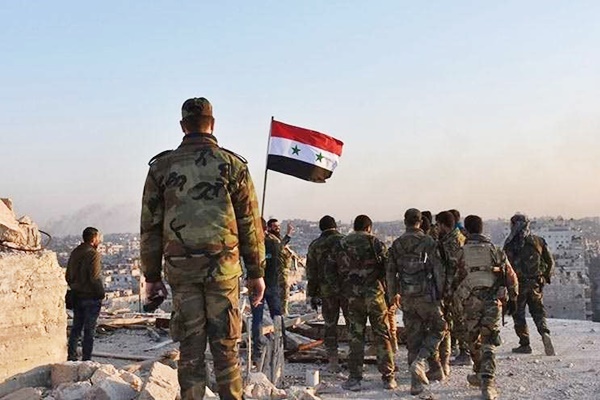
According to a report published by Fars News Agency in Farsi, the Syrian Army has now successfully broken through remaining terrorist strongholds, following the liberation of Aleppo International Airport earlier in the week – being able to push in two directions, west and south.

Within the last hour, the Fatah Halab terrorist group has surrendered the primary remaining districts of Old Aleppo.

A previous militant counteroffensive Karm al-Qaterji and Karm al-Maysar, as well as indiscriminate shelling of locations of humanitarian aid workers, killing Russian medical staff, failed to create an opening. Persian Gulf state news agencies, as well as ‘activists’ on the ground in Aleppo have also confirmed this.

At the time of publication, we are still waiting to hear confirmation that a Russian-Syrian-Turkish tri-lateral agreement on the status of ‘armed insurgent’ (terrorist) groups remaining in one last district, and their surrender or evacuation.

Barring some unforeseen development – which has characterized much of this conflict – reports coming from the ground in Syria strongly indicate that the battle for Aleppo is in its last day, perhaps hours.

Saudi Court Sentences 15 to Death on Espionage Charges

saudi

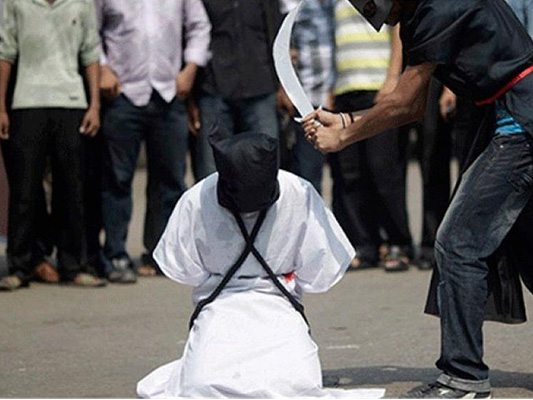
On Tuesday, Saudi Arabia’s Specialized Criminal Court sentenced 15 to death. It also sentenced 15 other suspects to prison terms ranging from six months to 25 years, and acquitted two.

According to a report by IFP, the suspects, comprising 30 Saudi Shiite Muslims, reportedly one Iranian and an Afghan, were detained in 2013 on charges of alleged spying for Iran and went on trial in February.

The rulings are subject to appeal, and death sentences must go to the king for ratification, Reuters reported.

In a Farsi report, Al Alam News Website has quoted a statement by Saudi Shiite community as saying that the ones arrested for alleged espionage are all academics, businessmen, doctors, and nationalists, and the Saudi regime is trying to distract attentions from political reform demands through such trials.