Friday, December 26, 2025
Home Blog Page 4219

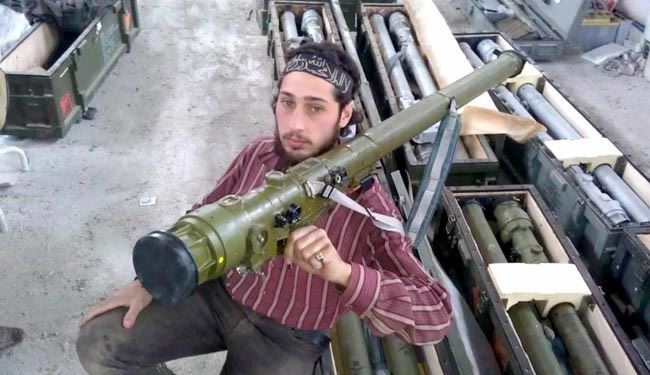
US Congress Authorizes Trump to Arm Syrian Militants with Anti-Aircraft Missiles

Terrorism

According to a report covered by Mashregh News, the US Senate is expected to pass the bill next week.

Until now, the transfer of man-portable air-defence systems, or MANPADs, had been implicitly authorized in the absence of an outright ban.

The new provision was added in while the House and Senate worked out differences between the bills they passed earlier this year. The original House bill expressly prohibited the transfer of MANPADs to “any entity” in Syria, while the Senate version made no mention of them.

“I am disappointed that the House of Representatives’ explicit prohibition on the transfer of these dangerous weapons into Syria was reversed — behind closed doors — by the conference committee,” Rep. John Conyers, D-Mich., told Al-Monitor in an emailed statement.

“This brazen act shows that some in Congress still hope to further escalate the civil war in Syria. Sending these weapons would only prolong this horrific conflict — and endanger civilian airliners across the region,” he added.

Iran to Continue Helping Afghanistan Move towards Prosperity: Zarif

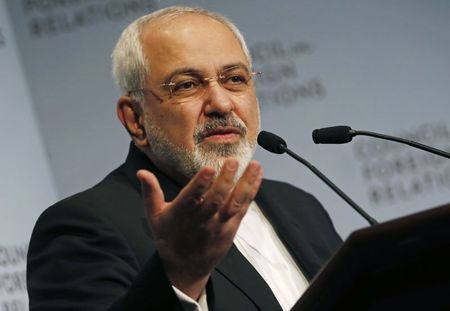
Addressing the 6th Ministerial Conference of Heart of Asia Process in Amritsar, India, Iran’s FM Mohammad Javad Zarif stressed that the stability and security of Afghanistan plays a vital role in regional prosperity.

According to a report by IFP, he also vowed that the Islamic Republic of Iran will continue its all-out support for the National Unity Government of Afghanistan, and help them as they move towards safety and prosperity.


Here is the full text of his speech:
In the name of God, the Compassionate, the Merciful

It is a great pleasure for me to address this important Ministerial Conference of the Heart of Asia Process. Allow me first to express my appreciation to the people and government of India for their gracious hospitality and excellent arrangements for this Conference. I would also like to thank [Afghan] President Ghani and [Indian] Prime Minister Mudi for their inspiring opening statements.

Distinguished Colleagues,

Five years ago, we founded this Process as a platform for regional cooperation by placing Afghanistan at its center, in recognition of the fact that a secure and stable Afghanistan is vital to the prosperity of the Heart of Asia region. We have made some progress; but we have a long way to go. Our region continues to suffer from an alarming surge in extremist violence; and a dramatic increase in drug production is threatening our societies. Afghanistan is most affected by these problems; 2016 has been a very challenging year for the National Unity Government of Afghanistan, as extremist groups such as Daesh [Arabic acronym for ISIS] are expanding their terror inside Afghanistan, even in Kabul.

We continue to fully support the National Unity Government and we stand ready to work with its leaders to help them discharge their responsibilities. We welcome the recent achievement of the government in making peace with Hezbe-e-Eslami [Islamic Party], and we hope that an Afghan-owned and Afghan-led peace process, benefiting from all capacities within the countries of the region, would move towards establishing lasting and comprehensive peace.

Distinguished colleagues,

The challenges facing Afghanistan and our region are interconnected. Recent reports by the UNODC indicate a 43% growth in drugs production last year. Without drug proceeds, terrorists cannot finance their operations. And drug producers need militias and warlords to traffic their deadly commodity. Under-development, low income and lack of economic opportunities provide fertile and abundant recruitment opportunities for terrorist groups and drugs networks.

As a frontline country in the war against narcotics, we have offered alternative cultivation as well as alternative livelihood plans to dissuade Afghan farmers from opium cultivation. But to reverse the current alarming trend of increasing drug production, international cooperation with an integrated strategy for alternative development aiming to turn the war economy into a formal sustainable economy is inevitable.

The trilateral transit agreement between Iran, India and Afghanistan on the development of the port of Chabahar, is one important step in that direction. It makes it possible for Afghanistan to have access to world markets through open seas, making development of Afghanistan’s vast and rich mineral resources economically attractive. We invite interested actors from the region and beyond to consider participating in the development and expansion of Chabahar. The Khaf- Herat Railway project is another key connectivity project that connects Afghanistan to the international railway networks through Iran.

For the past 37 years, we have hosted no less than 3 million Afghan nationals at any given point. They have access to mostly subsidized services available to Iranian nationals, including basic commodities, public transportation, public health, and public education. This year alone, we are providing education to nearly 400 thousand undocumented Afghan students. And we receive almost no burden-sharing assistance from the international community.

As the lead country for the education CBM, we have our bilateral cooperation with Afghanistan within the limits of our national resources, while contribution by supporting countries to this CBM has not been promising. We encourage the donor community to consider contributing to this CBM, to enable implementation of approved programs and activities.

Let me conclude by reaffirming the resolve of the people and government of the Islamic Republic of Iran to continue their support for the fraternal people and government of Afghanistan as they move through this difficult period of their history to a stable, safe and prosperous Afghanistan, contributing to the stability and prosperity of the Heart of Asia.

Music Therapy for the Disabled, for the First Time in Iran

Music therapy

“In music therapy, the therapist interferes in the recovery process based on proven methods, and contributes to the improvement of the patient’s physical and mental condition by using all physical, mental, social, spiritual and aesthetic aspects of music,” said Zahra Noparast, the Director General of State Welfare Organisation’s Office of Daily Rehabilitation.

“We use music therapy for the disabled in such provinces as Hamadan and Kordestan, and will offer it in all provinces in the near future,” she added, according to a report by IRNA, as translated by IFP.

“Last year we had painting therapy for our clients; this year we considered music therapy to promote the use of art therapy in our daily and overnight rehabilitation centres across Iran.”

“We use didactical methodology to serve the disabled,” she said. “Setting up a special room for art therapy and painting has been obligatory in all our mental rehabilitation centres since last year, and we have provided them with some standard tools.”

“In the recovery process, we often use primary musical instruments (such as Orff instruments and harmonica). We train the teacher to realize what method is more effective in his client’s recovery, so not all instruments or music genres are used,” she explained about the use of musical instruments in the process of therapy.

“We choose the genres that make our patients calm.”

“Music therapy is for all patients, but we use painting therapy for our intellectually disabled clients,” she stated.

“In State Welfare Organisation centres, art therapy is often free; however, some families prefer to send their children to private centres,” she noted, adding that within the last year, 403 art teachers have been trained for art therapy.

“Each rehabilitation centre receives nearly $1,300 for all the expenses such as buying educational tools and employing teachers,” she said about the credit allocated for art therapy in welfare centres.

According to studies carried out by State Welfare Organisation, 2% of Iranian population show symptoms that cause them to need rehabilitation; in other words, about 1.5 million people in Iran have above average disabilities. At this moment, almost 1.3 million people are registered as disabled persons in State Welfare Organisation, 36% of which are female and 64% male. This includes 10.5% with visual disabilities, 40% with physical and mobility disabilities, 8% with permanent mental disabilities, 14.5% with hearing disabilities, and 1.5% with speech disorders.

Art therapy includes psychotherapy based on creative activities, using artistic, visual and audio materials and methods. Painting therapy is a branch of art therapy, being used as some form of psychoanalysis. Reducing aggressive behaviour is a result of this method.

Iran’s Response to US Sanctions Will Be Shocking: IRGC General

Mohsen Rezai

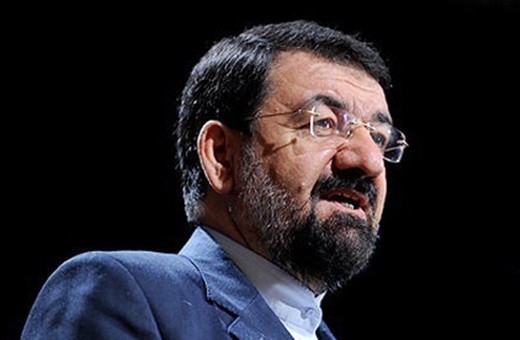
“The United States will be shocked by Iran’s retaliation if it imposes new sanctions on our country,” wrote Mohsen Rezaei, the Secretary of Iran’s Expediency Council and a senior general in the Islamic Revolution Guards Corps (IRGC), in his Instagram page.

“By imposing new sanctions, the US not only acts against Iran, but also scoffs at Europe, China and Russia. It means that the US disregards the UN Security Council,” he added.

“This enables us to act against Washington. Our counterattack will be more severe and decisive than the initial move,” he went on to say in a post entitled “Iran’s severe response to the extension of sanctions,” as reported by IFP.

Rouhani Calls for Further Measures to Facilitate Lives of Persons with Disabilities

Rouhani and Disability day

“How much do we have fit out the dear disabled with a suitable society and organizations that provide them with a fairer, more respectful life?” the Iranian President asked in a post on his Instagram page on the occasion of the International Day of Persons with Disabilities, which is annually marked on December 3.

Rouhani and Disability day“How much have we practiced our religious rules that ask us to be more considerate towards our more vulnerable brothers and sisters? How much have we paid attention to the potentials of disabled people and their employment?” he went on to say.

“We need the cooperation of all governmental and non-governmental organizations to form a society that provides more equal opportunities for the disabled and non-disabled,” Rouhani noted in his post, as translated by IFP.

“By revising the comprehensive legislation of protecting the rights of persons with disabilities, the eleventh government [Rouhani’s administration] has endeavoured to create the appropriate conditions to give equal opportunities to the disabled so that they have a fairer life.”

“The Ministry of Cooperatives, Labour, and Social Welfare managed to allocate houses to the families with two disabled members. Screening the disabled persons is one of the other effective measures taken by the government. The government has put genetic screening on its agenda which reduces the risk of different disabilities to a high extent,” the Iranian President added.

Iran Can’t Unilaterally Breach JCPOA in Reaction to US Violation: Official

In reaction to the US Senate’s approval of a legislation which extends the Iran Sanctions Act (ISA) for another ten years, Aboutalebi wrote on his twitter on Friday that any violation of the landmark nuclear deal would be ‘regarded as an act against all engaged’ parties.

He emphasized the fact that the most legitimate and severe move against violation of the Joint Comprehensive Plan of Action (JCPOA) ‘is a coordinated and severe response by all those engaged based on their consensus and aiming at isolating the violators.’

“If JCPOA is a multilateral agreement, its violation by one of the signatories cannot be reciprocated by unilateral violation,” he noted.

How Iranian Newspapers Covered US Senate’s Extension of Anti-Iran Sanctions

Iran Newspaper front pages

All newspapers today dedicated their headlines to the recent US Senate’s vote to 10-year extension of Iran Sanctions Act (ISA), also known as D’Amato Sanctions, and the possible reactions by the Islamic Republic.

They also continued covering the recent agreement between members of Organization of Petroleum Exporting Countries (OPEC) for a cut in their oil output. Iran’s exemption from the oil cut has been widely described as a victory for Rouhani’s government.

Another top story was the International Day of Disabled Persons and the reports newspaper published about the problems of these people in Iran.

The above issues, as well as many more, are highlighted in the following headlines:


19 Dey:

1- Return to Previous Conditions and Triple-Urgent Motion: Harsh Reaction of Iranian MPs to US Extension of Anti-Iran Sanctions and Violation of JCPOA

2- Will Obama Sign Extension of D’Amato Act?

3- Iran Has a Deterrent Power in Reaction to Violation of JCPOA: Top Security Official

4- $10bn Increase in Iran’s Oil Income: Oil Minister
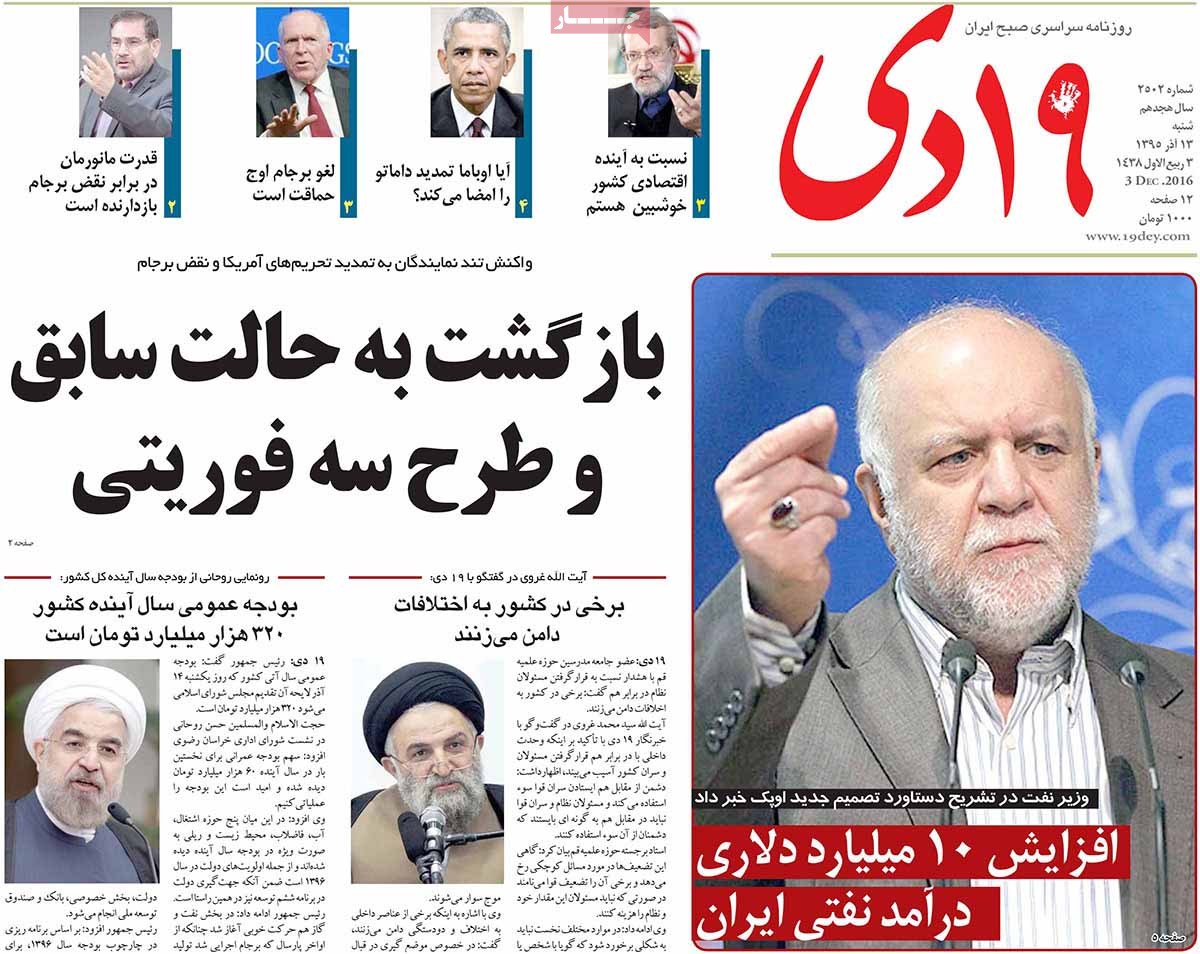
How Iranian Newspapers Covered US Senate’s Extension of Anti-Iran Sanctions


Abrar:

1- Senate Approves Extension of Anti-Iran Sanctions for 10 Years

2- Trump Can Restore Anti-Iran Sanctions Obama Had Lifted: Nominated Secretary of State

3- Trump: Our Stupid Politicians Have Created Security Problems

4- White House Source Obama Will Sign Extension of Anti-Iran Sanctions
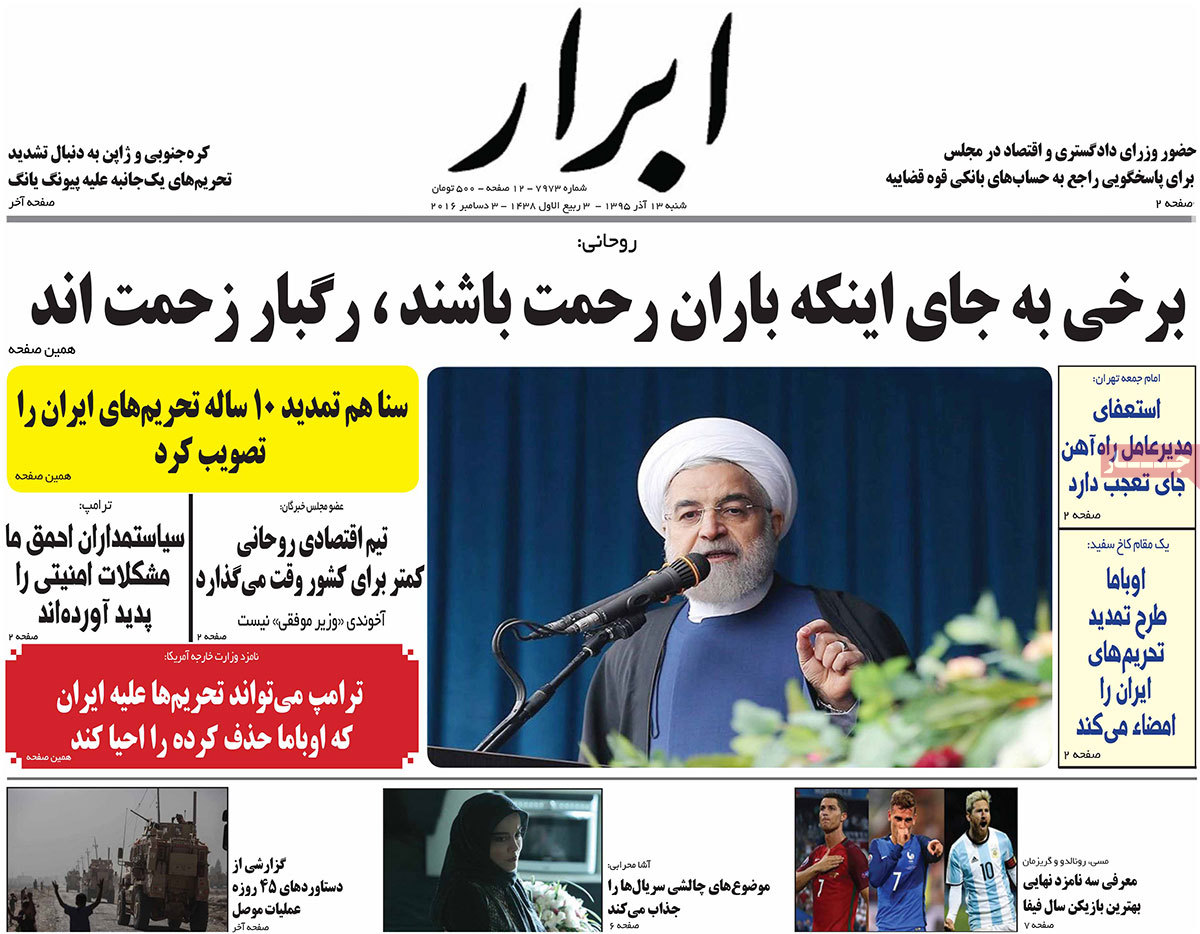
How Iranian Newspapers Covered US Senate’s Extension of Anti-Iran Sanctions


Afkar:

1- If Sanctions Are Restored, It Will Be Violation of Nuclear Deal: Iran’s Salehi

2- Iran’s Foreign Ministry Urges Kenya to Immediately Release Two Iranian Lawyers

3- Navy Is Not Afraid of Any Threat: Army Navy Commander

4- US Government Has No Choice But to Veto Senate’s Bill: Senior Reformist Aref
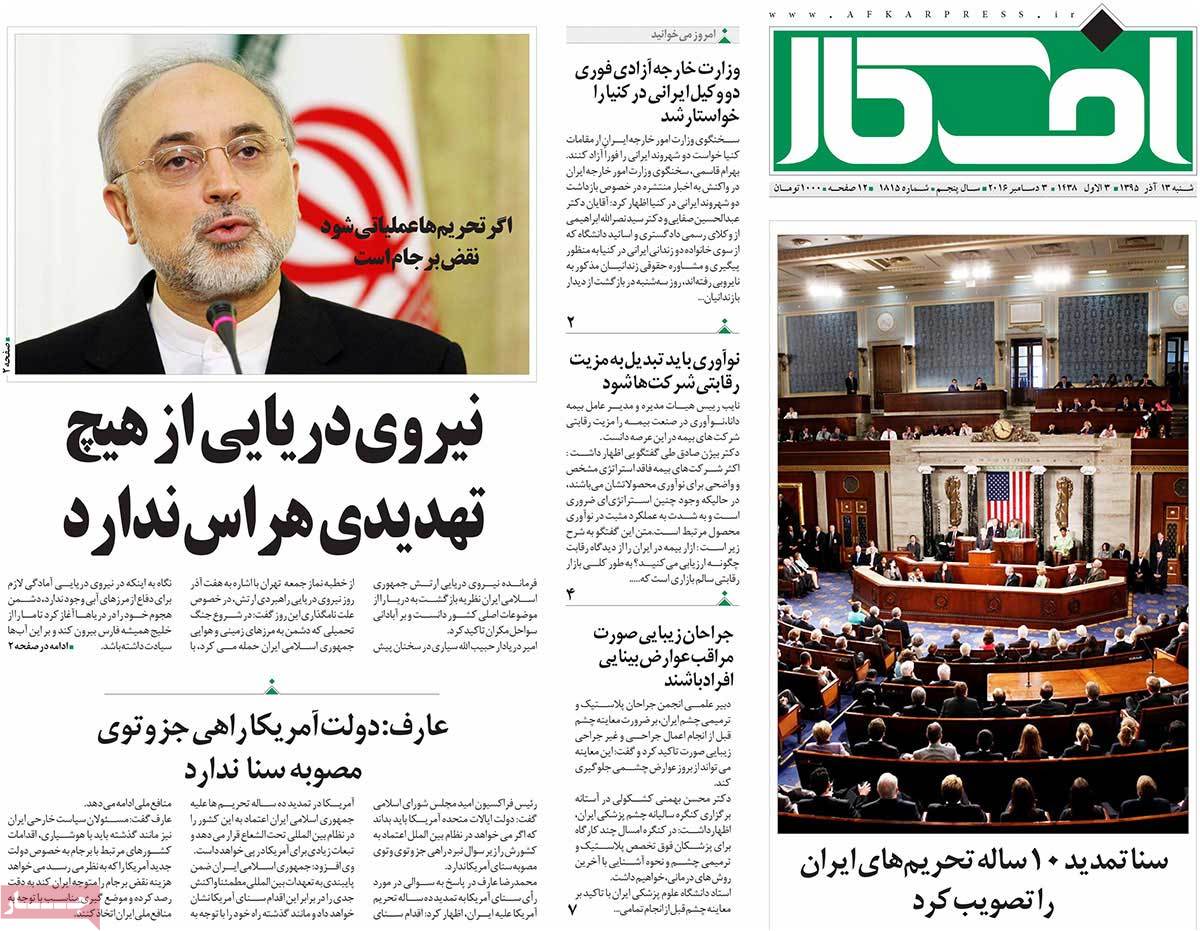
How Iranian Newspapers Covered US Senate’s Extension of Anti-Iran Sanctions


Aftab-e Yazd:

1- These Difficult Days: Senate’s Extension of Anti-Iran Sanctions Pleases Hardliners in Iran and Increased Attacks on Rouhani’s Government and Nuclear Negotiating Team

2- Iran’s Double-Urgent and Triple-Urgent Motions to Counteract US Congress’ Move

3- Strongest Reaction to US Move: All Parties to JCPOA Should Take Coordinated and Integrated Action

4- Iran’s Victory in OPEC, the Real Fruit of JCPOA
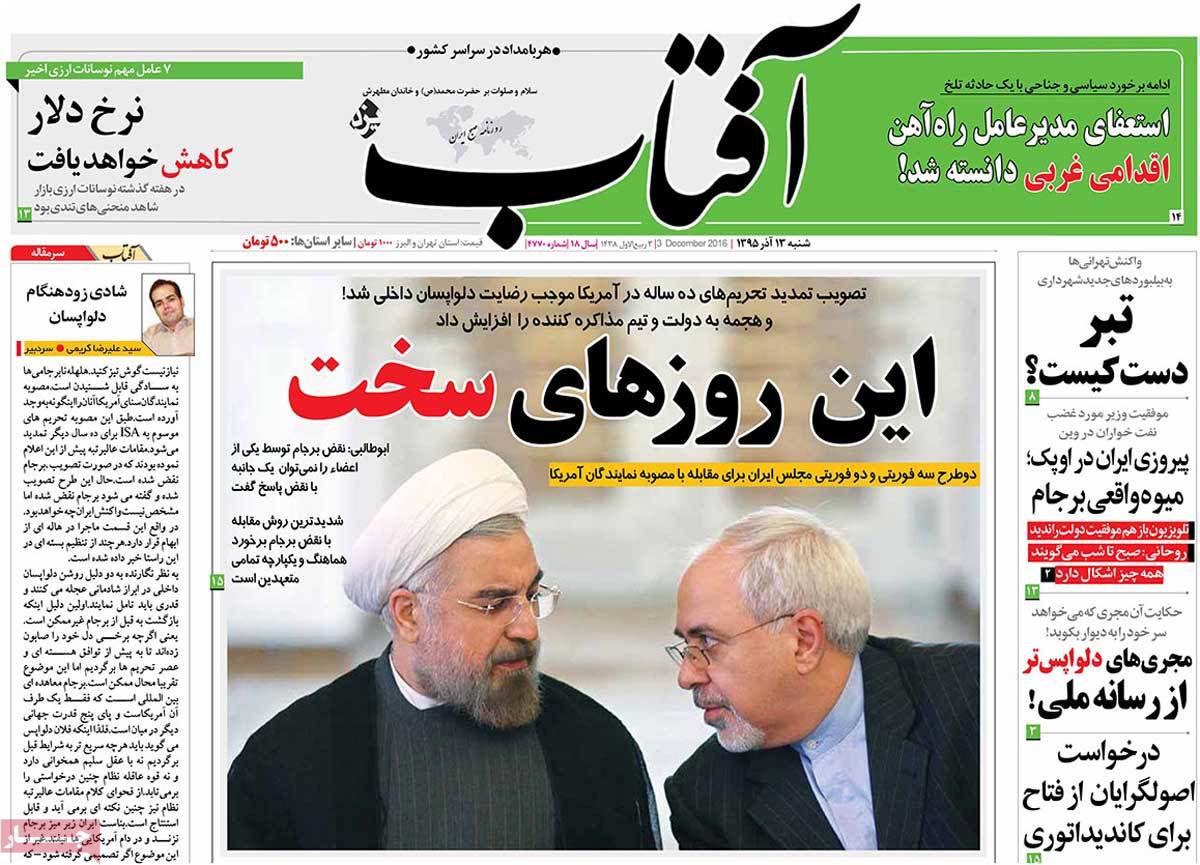
How Iranian Newspapers Covered US Senate’s Extension of Anti-Iran Sanctions


Arman-e Emrooz:

1- Warning to US: Page to Be Turned

2- Foreign Ministry: Obama Should Veto the Bill

3- Obama Has 10 Days to Veto Extension of Anti-Iran Sanctions

4- Iran’s Nuclear Chief: 10-Year Extension of Iran Sanctions Act Is Violation of JCPOA

5- Rouhani: We Should Not Disturb People; President Criticizes Hardliners Who Ban People from Everything
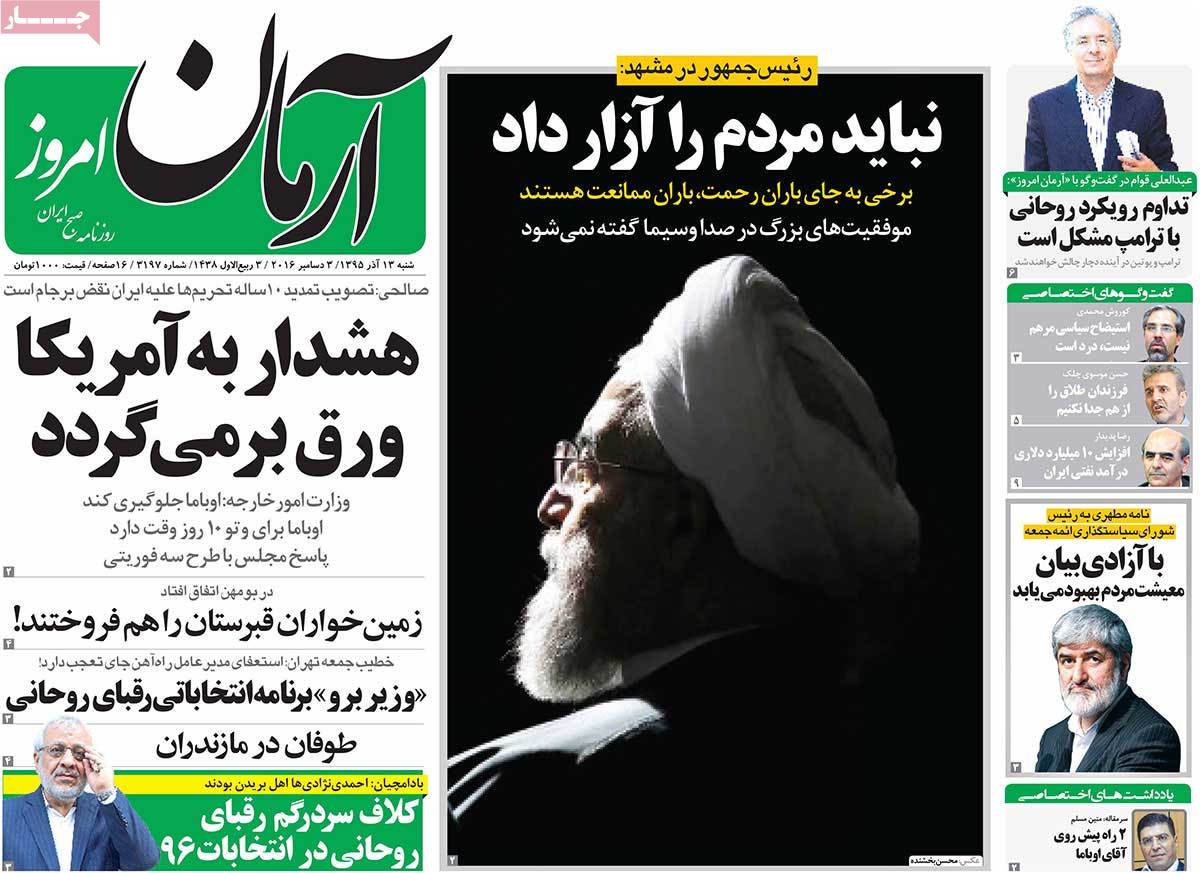
 How Iranian Newspapers Covered US Senate’s Extension of Anti-Iran Sanctions


Asr-e Iranian:

1- JCPOA Is Violated, How Will Government React?

2- If Head of Iran’s Railways Is Guilty, He Should Be Tried: Cleric

3- After Brexit, EU Should Be Expecting Frexit
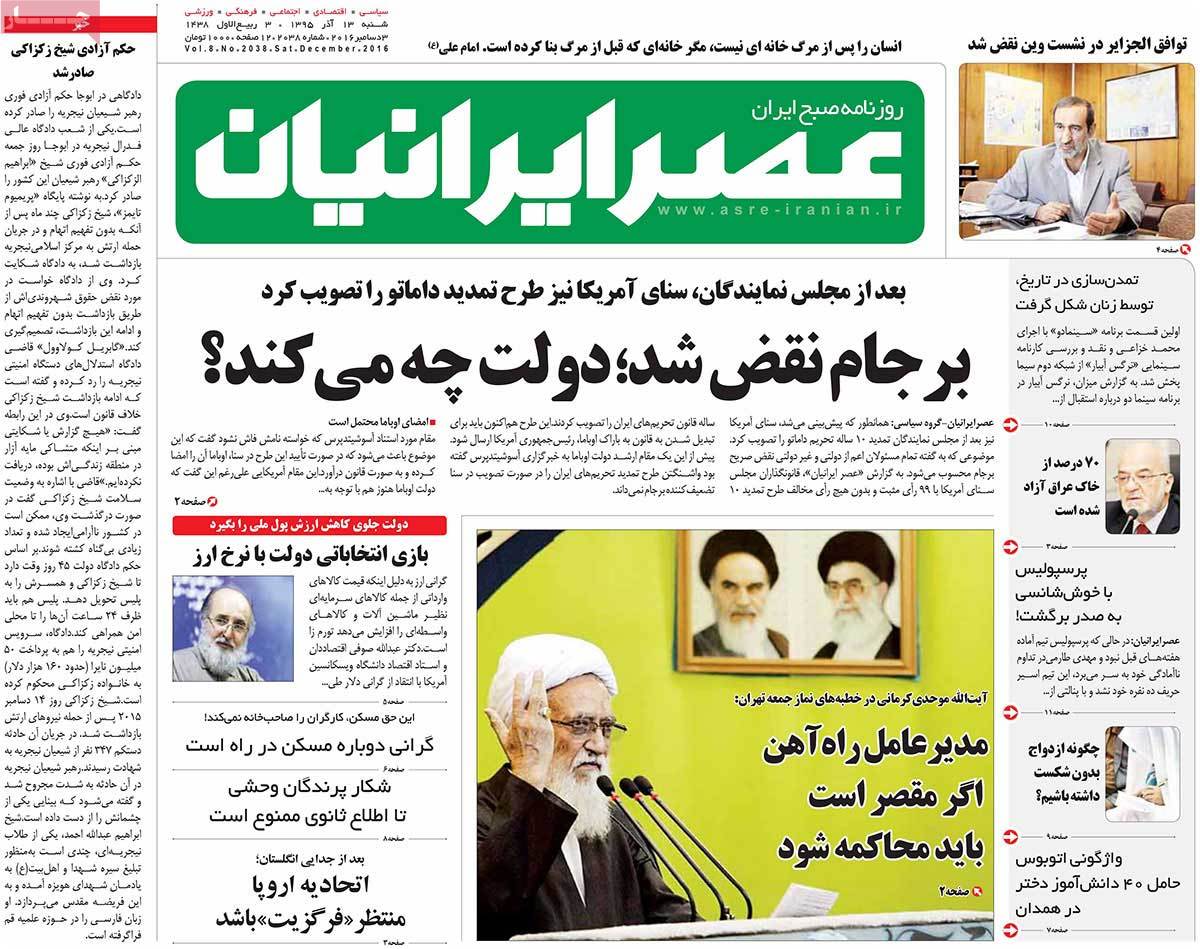
How Iranian Newspapers Covered US Senate’s Extension of Anti-Iran Sanctions


Asrar:

1- White House on Verge of an Important Decision: Will Obama Sign It?

2- OPEC Once Again Revived: Oil Minister

3- Putin’s Special Representative in Tehran

4- Ibrahim al-Jafari: 70% of Iraqi Territory Is Now Liberated

5- Iran to Show Shocking Response to US Extension of Anti-Iran Sanctions
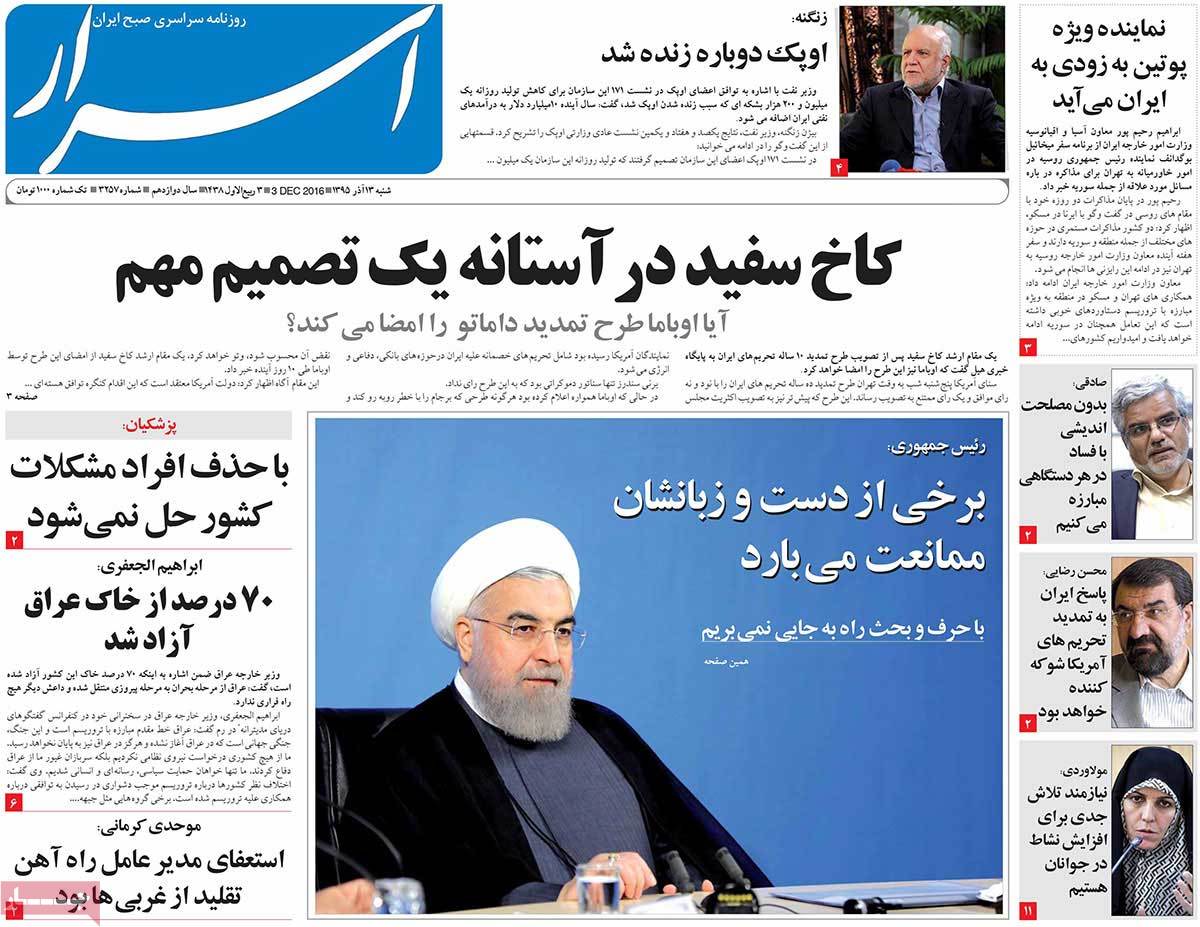
How Iranian Newspapers Covered US Senate’s Extension of Anti-Iran Sanctions


Ebtekar:

1- ISA [Iran Sanctions Act] against JCPOA: Is Extension of ISA a Violation of Nuclear Deal?

2- Imperfect Law for Disabled Persons: A Report on Those Who Have Special Conditions
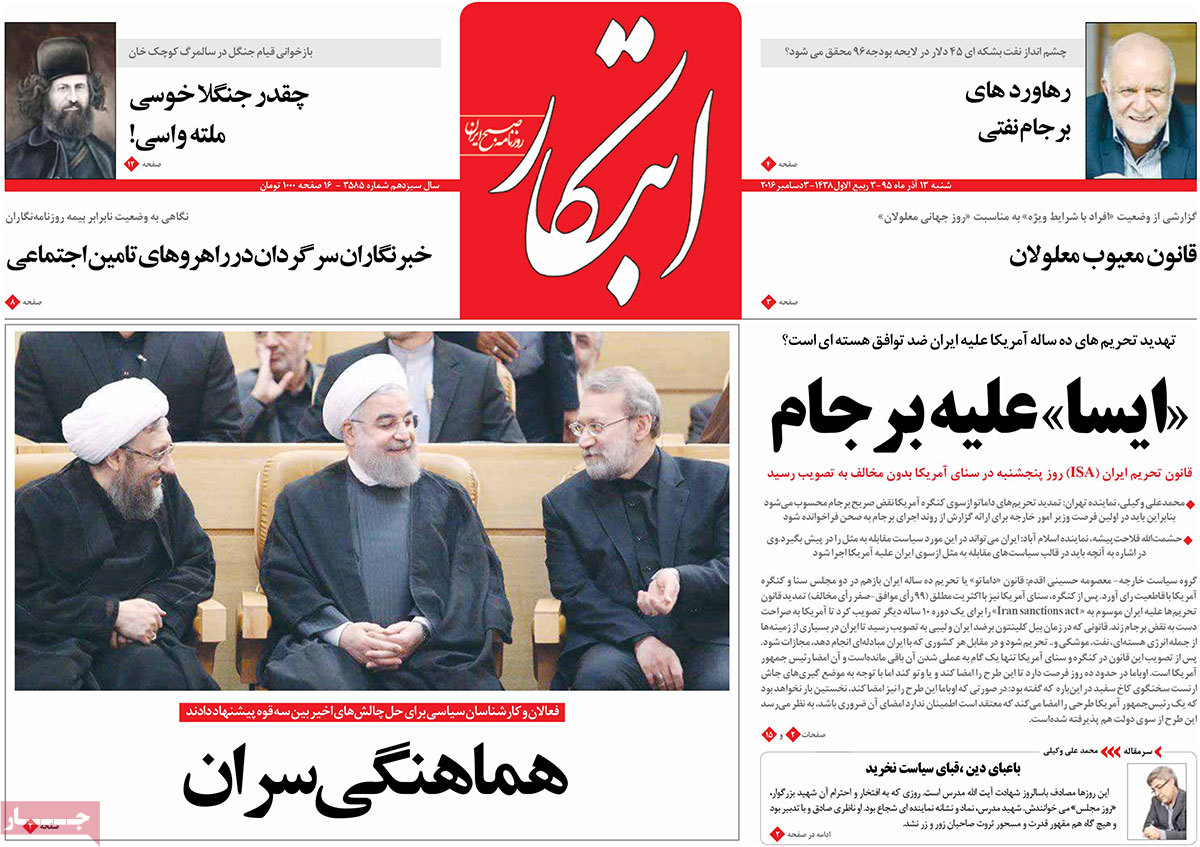
How Iranian Newspapers Covered US Senate’s Extension of Anti-Iran Sanctions


Emtiaz:

1- Environment Department Warns Pollutant Industries

2- Even Rainfall Did Not Manage to Clean Tehran’s Air: Sixth Unhealthy Day of Tehran
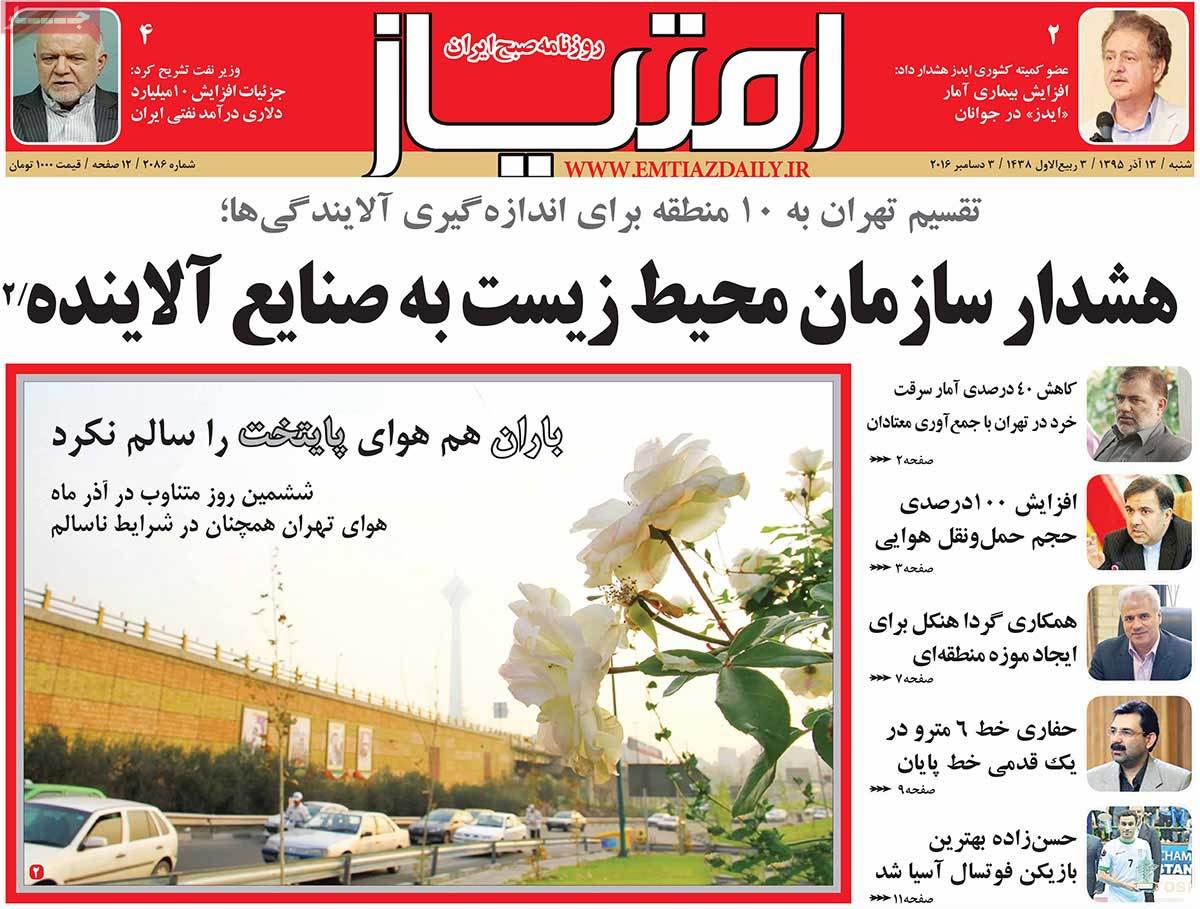
How Iranian Newspapers Covered US Senate’s Extension of Anti-Iran Sanctions


Etemad:

1- Tehran-Riyadh Oil Ceasefire: An Analysis of Iran-Saudi Win-Win Game in Vienna Summit

2- Extension of US Violation of Its Commitments: Iran’s Parliament Says It Would Reciprocate

3- US Congressman in Interview with Etemad: Through Extension of Anti-Iran Sanctions, We Prevented Early Death of JCPOA
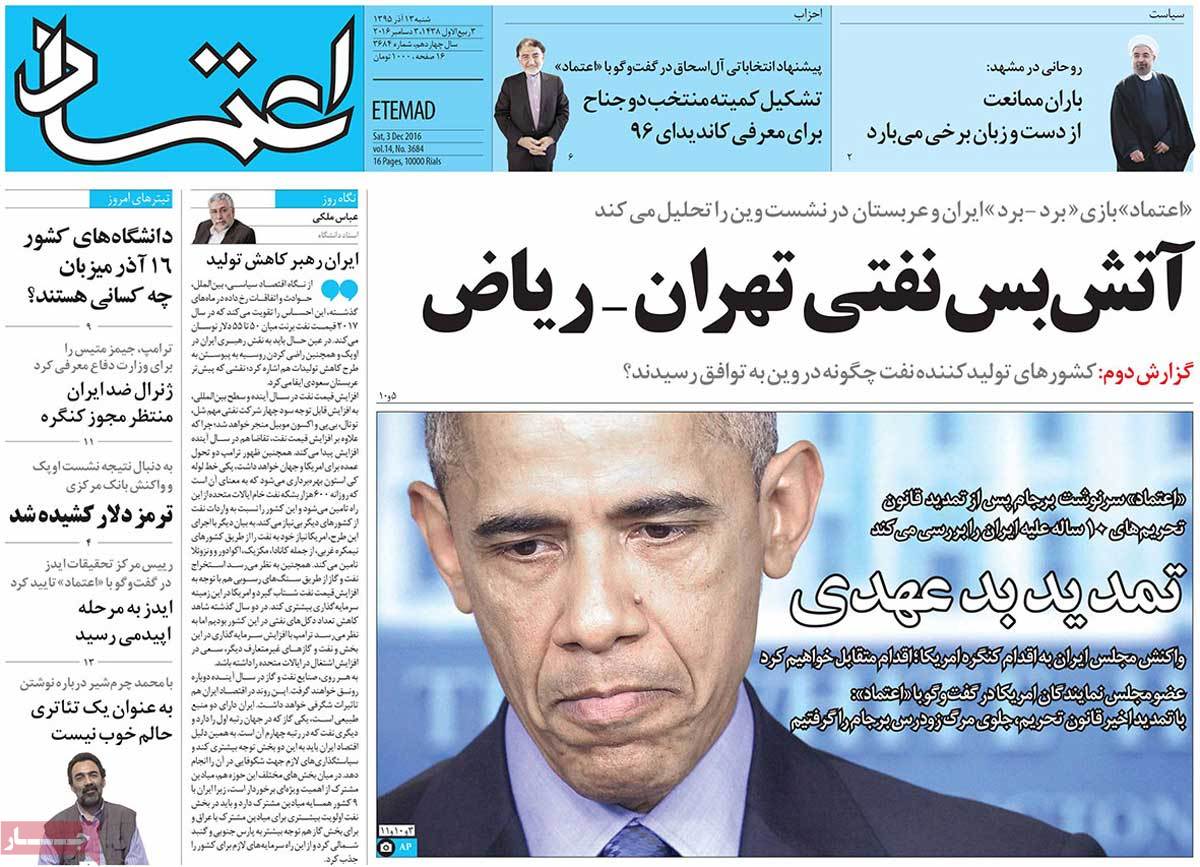
How Iranian Newspapers Covered US Senate’s Extension of Anti-Iran Sanctions


Ettela’at:

1- Iran’s Reaction to US Senate’s Violation of JCPOA

2- Chomsky Warns of EU Collapse

3- A Warmonger Officially Selected as US Secretary of Defence
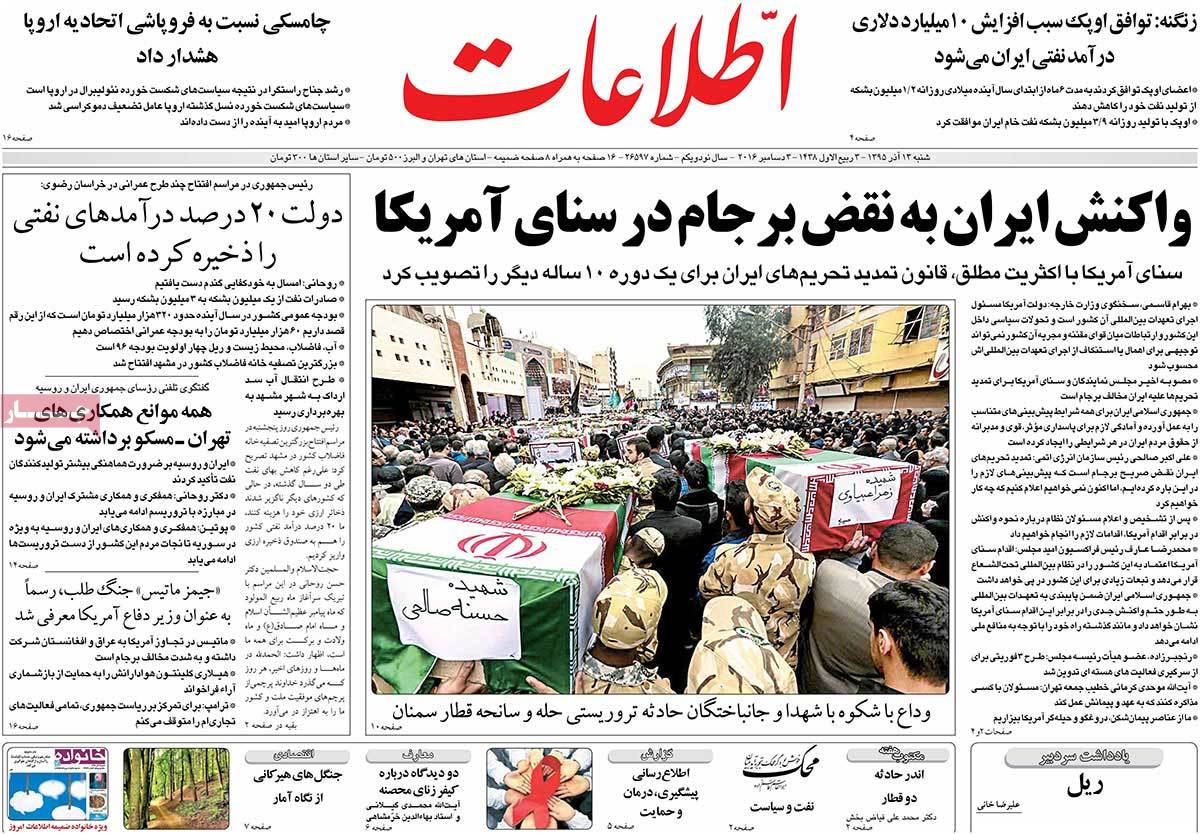
How Iranian Newspapers Covered US Senate’s Extension of Anti-Iran Sanctions


Haft-e Sobh:

1- Busy Weekend with D’Amato Act, Surging Price of Dollar, and Oil Deal: A Totally Economic Weekend with Various Articles about Success in OPEC, Extension of US Sanctions, and Ups and Downs of Dollar Price in Iran

2- Successful Performance of 62-Year-Old Iranian Cyclist in Mediterranean Coasts
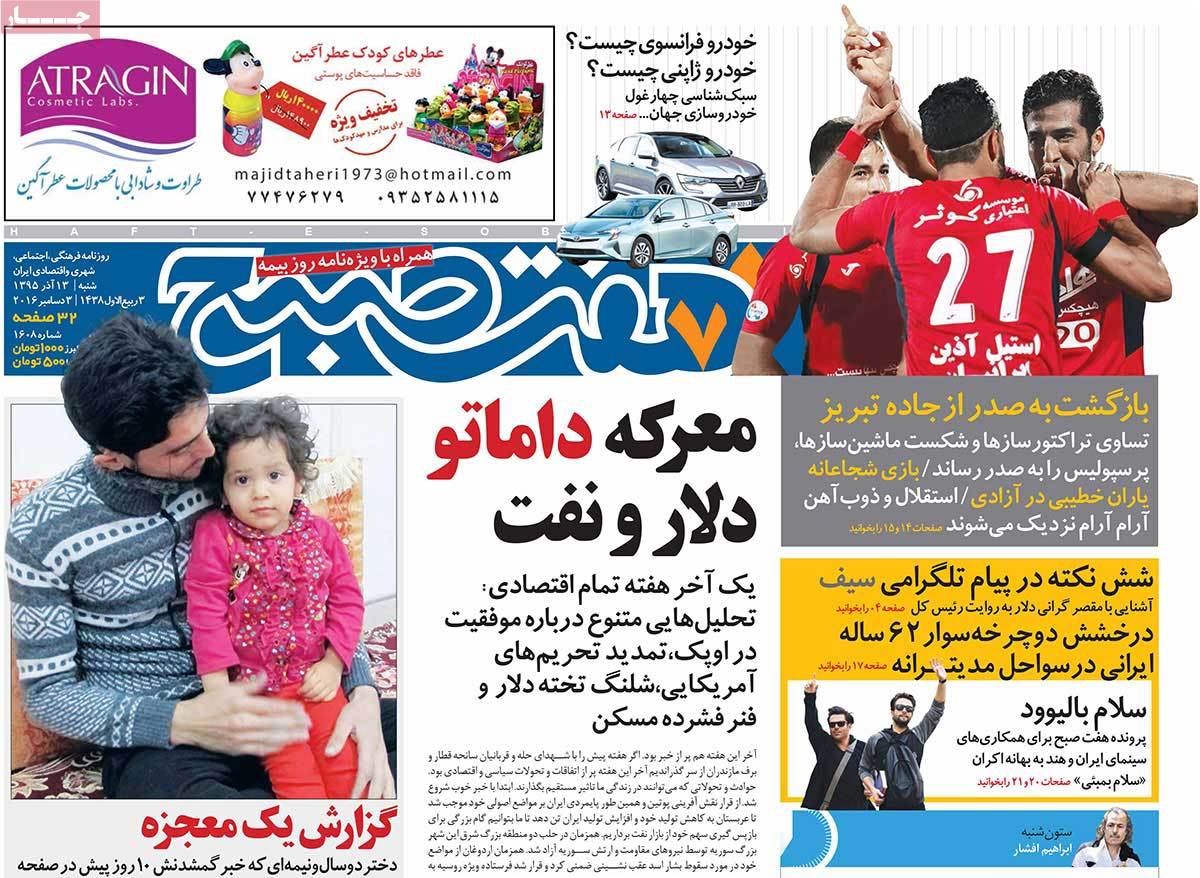
How Iranian Newspapers Covered US Senate’s Extension of Anti-Iran Sanctions


Hemayat:

1- American Senators’ Anti-JCPOA Move

2- Millions of Indonesian Muslims Hold Demonstrations for Trial of Jakarta Governor

3- Iran’s Moves to Counter Cyber-Terrorism: Prosecutor-General in Shanghai Summit

4- Nigerian Court Rules that Sheikh Zakzaky Should Be Released
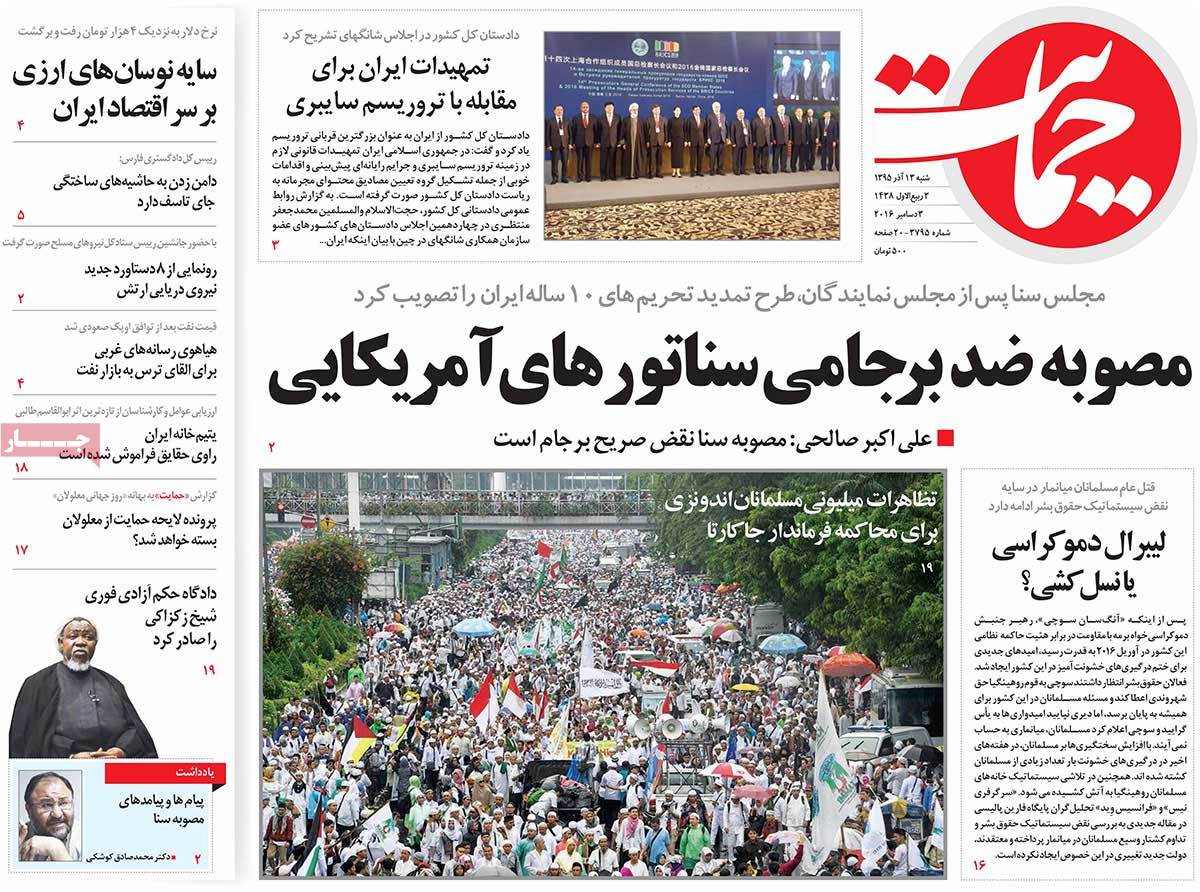
How Iranian Newspapers Covered US Senate’s Extension of Anti-Iran Sanctions


Iran:

1- Reactions of Iran’s Government and Parliament to US Senate: Reformist MP Says Double-Urgent Motion Will Ban Purchase of US-Made Consumer Goods

2- Foreign Ministry Spokesman: Complete Report to Be Given to Board for Monitoring JCPOA on US Government’s Behaviour

3- Iran Suffers from a Shortage of Centres for AIDS Counselling Services
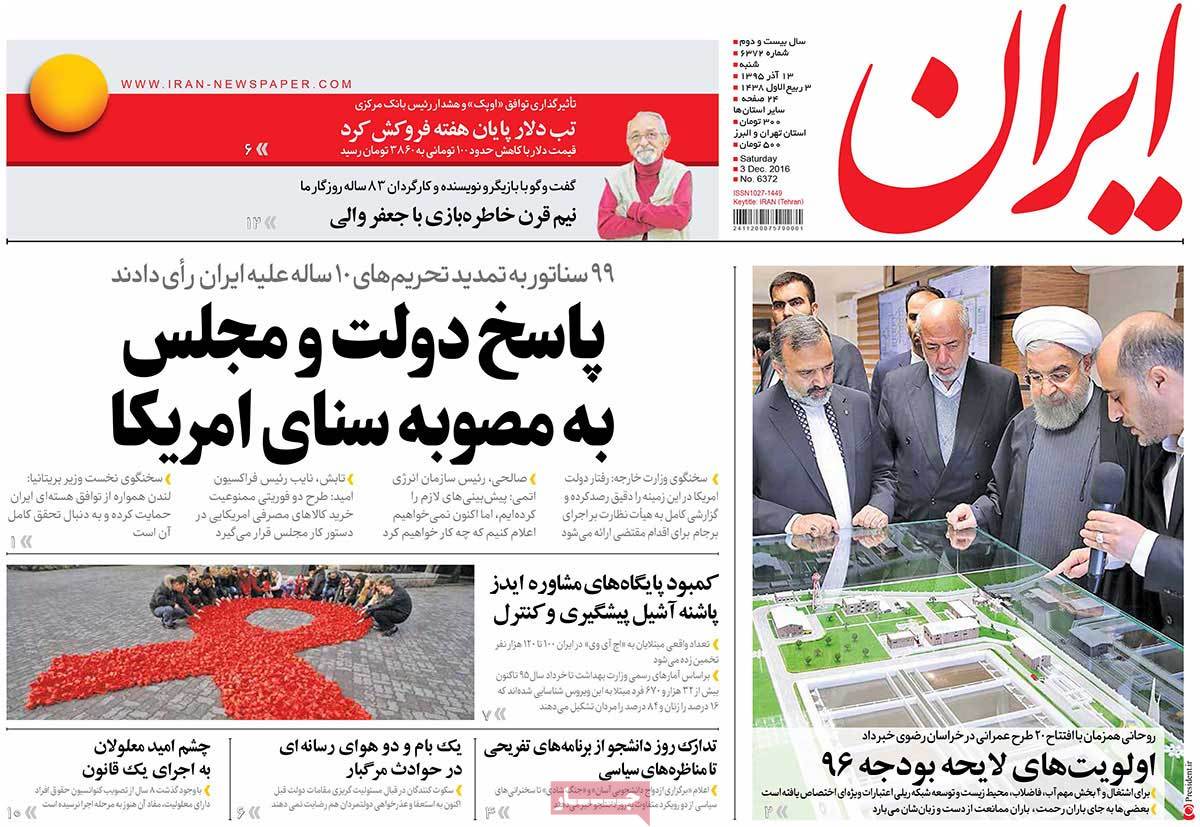
How Iranian Newspapers Covered US Senate’s Extension of Anti-Iran Sanctions


Jame Jam:

1- Firm Reaction to Breach of Commitment: Experts Discuss Appropriate Response to US Violation of JCPOA

2- Cartoon: 10-Year Extension of Anti-Iran Sanctions

3- P5+1 Member States Should Not Remain Indifferent [Editorial]

4- People with Disabilities Waiting for Support: A Report to Mark Int’l Day of Disabled Persons
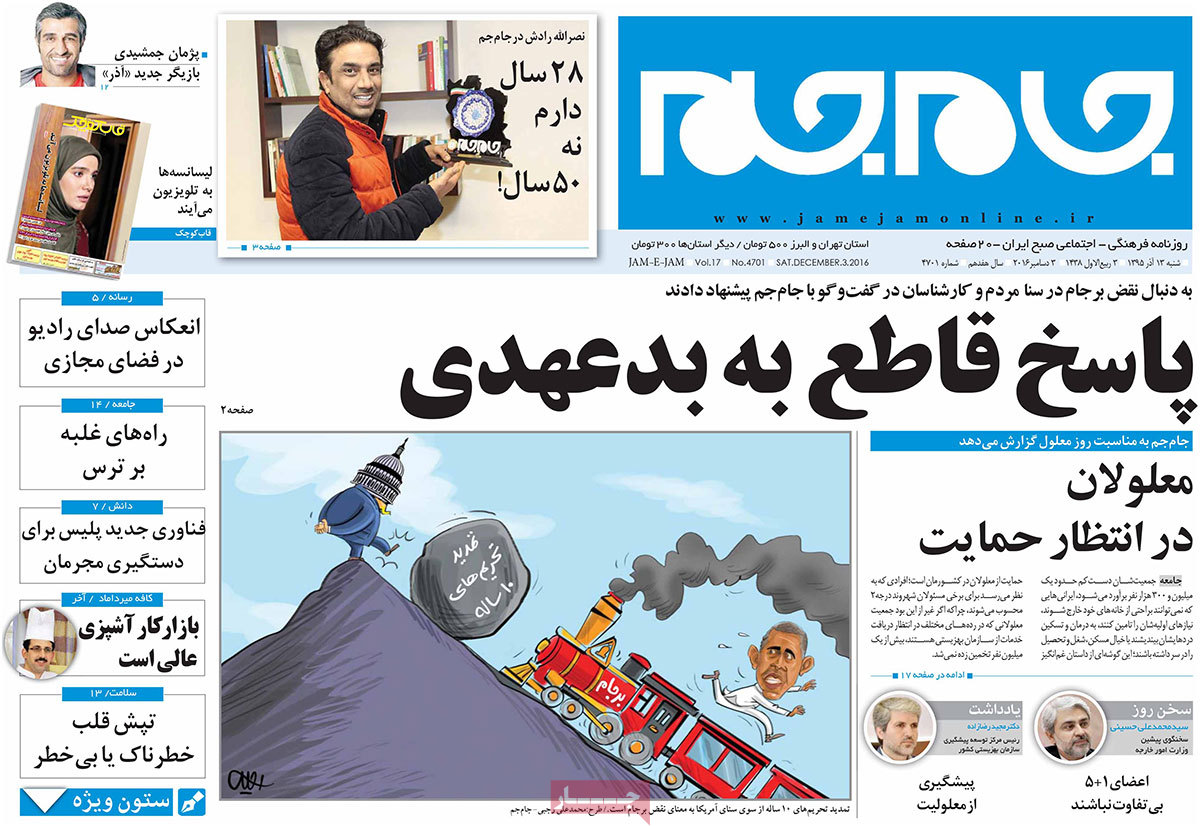
How Iranian Newspapers Covered US Senate’s Extension of Anti-Iran Sanctions


Javan:

1- Leaving JCPOA: Parliament’s Triple-Urgent Motion to Resume Nuclear Activities

2- 2,000 Foreign Child Beggars in Tehran
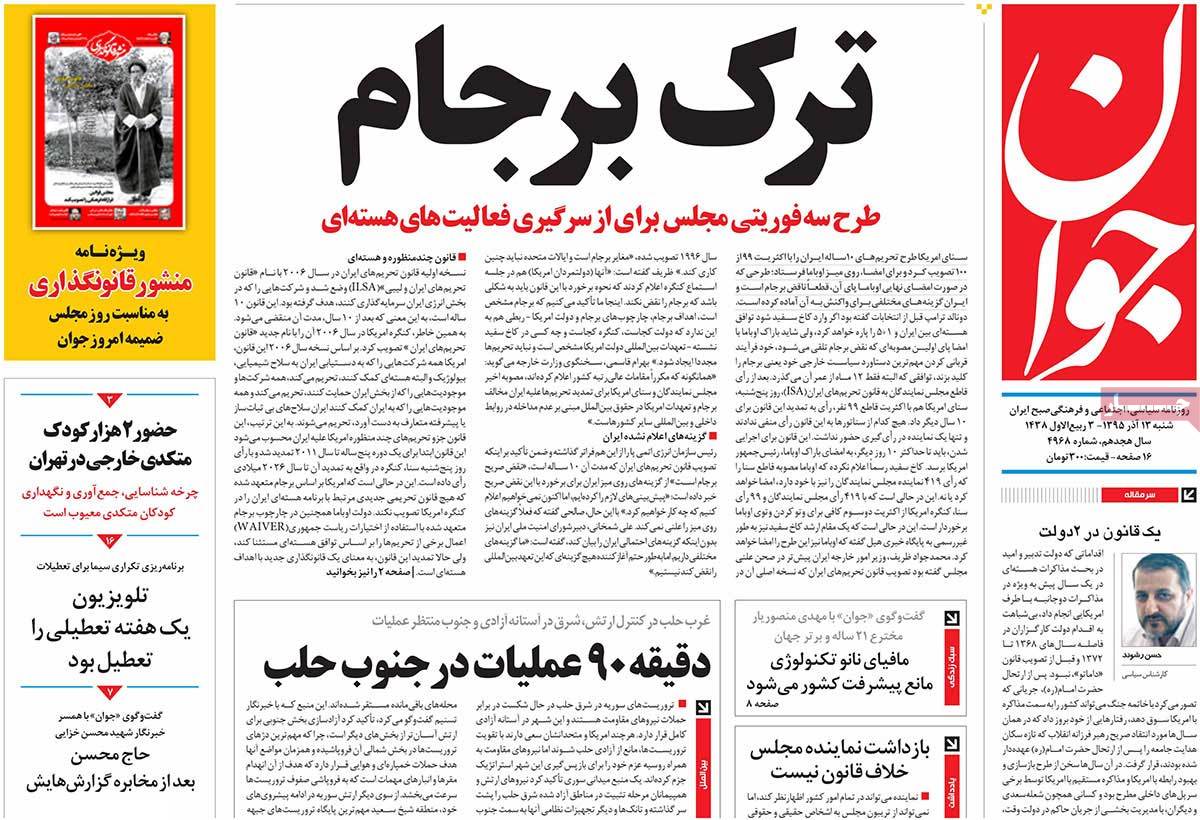
How Iranian Newspapers Covered US Senate’s Extension of Anti-Iran Sanctions


Jomhouri Eslami:

1- Iran’s Reaction to Washington’s Latest Violation of Promises through Extension of D’Amato Act

2- Government to Insure Fluctuations in Rates of Foreign Currencies for Exporters
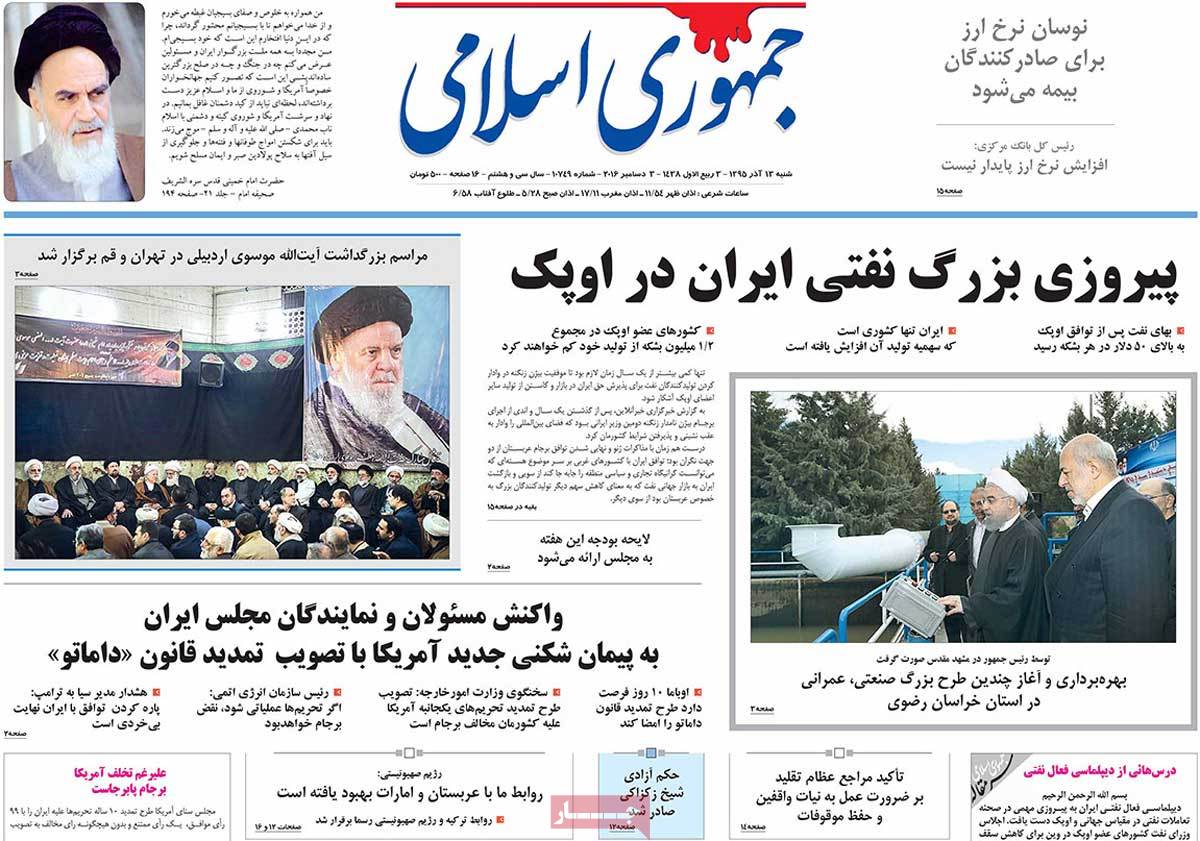
How Iranian Newspapers Covered US Senate’s Extension of Anti-Iran Sanctions


Kayhan:

1- Washington’s Death Blow to JCPOA: Result of Trusting the Satan

2- Value of Iran’s Currency Is Currently at Least Level in History

3- 3 Saudi Youths Sentenced to Death for Taking Part in Demonstrations
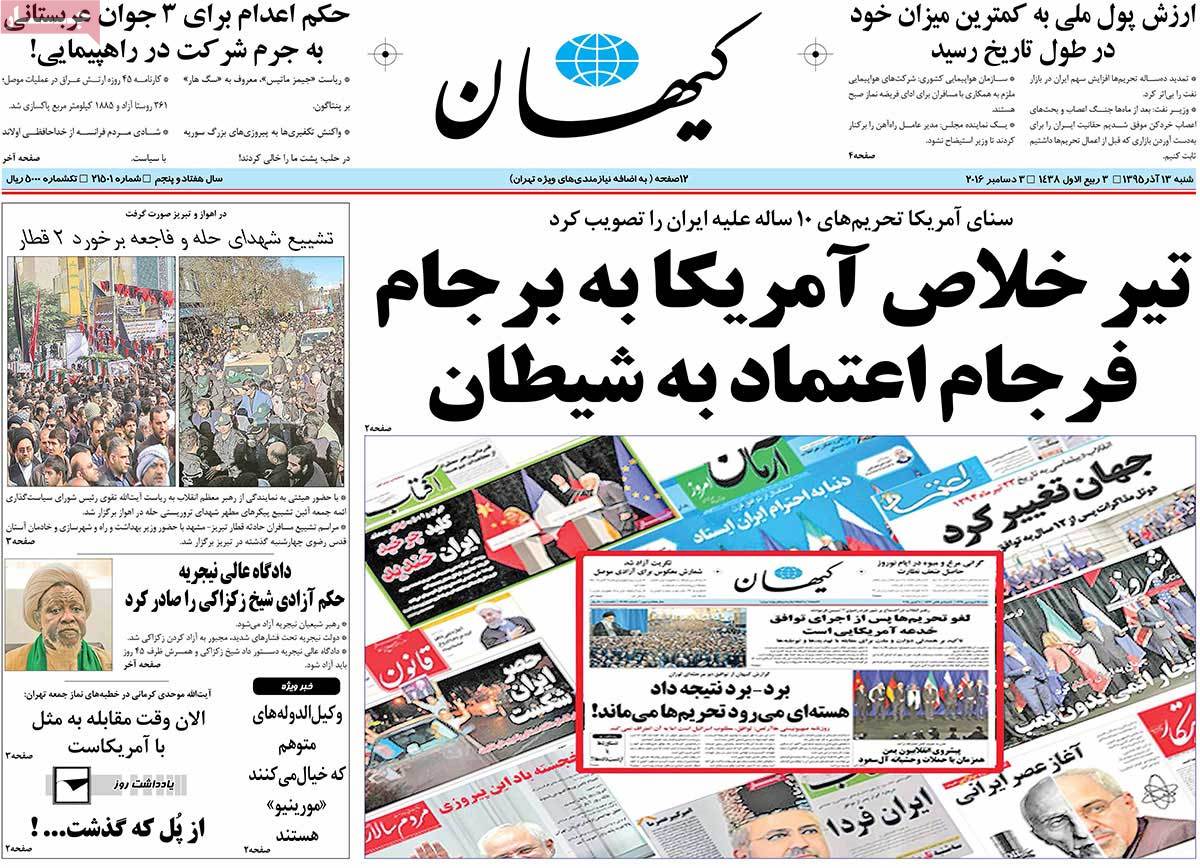
How Iranian Newspapers Covered US Senate’s Extension of Anti-Iran Sanctions


Khorasan:

1- Reactions to Violation of Nuclear Deal

2- Resistance Worked: Nigerian Supreme Court Rules that Zakzaky and His Wife Should Be Released
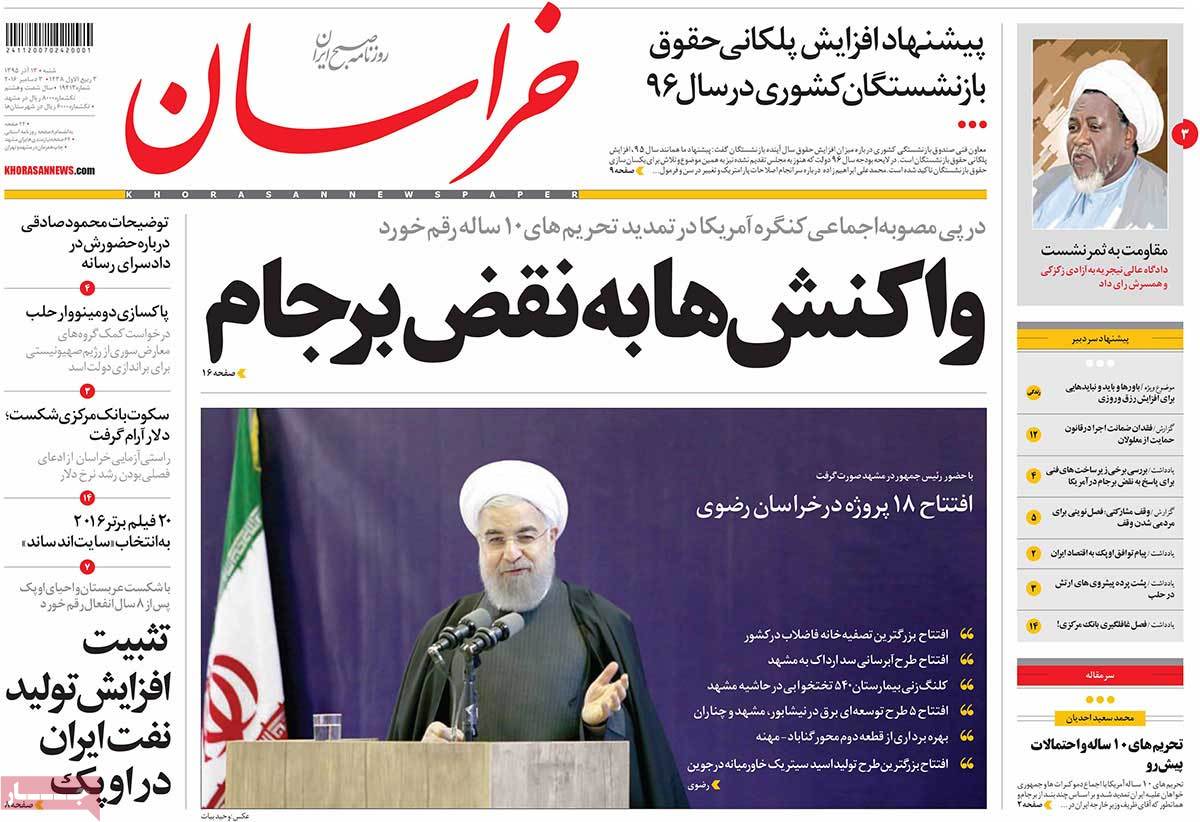
How Iranian Newspapers Covered US Senate’s Extension of Anti-Iran Sanctions


Noavaran:

1- Gap of D’Amato in JCPOA

2- Iran and Saudi Arabia’s Wills to Move towards Peace and Stability in Middle East: Analysis of Recent OPEC Deal
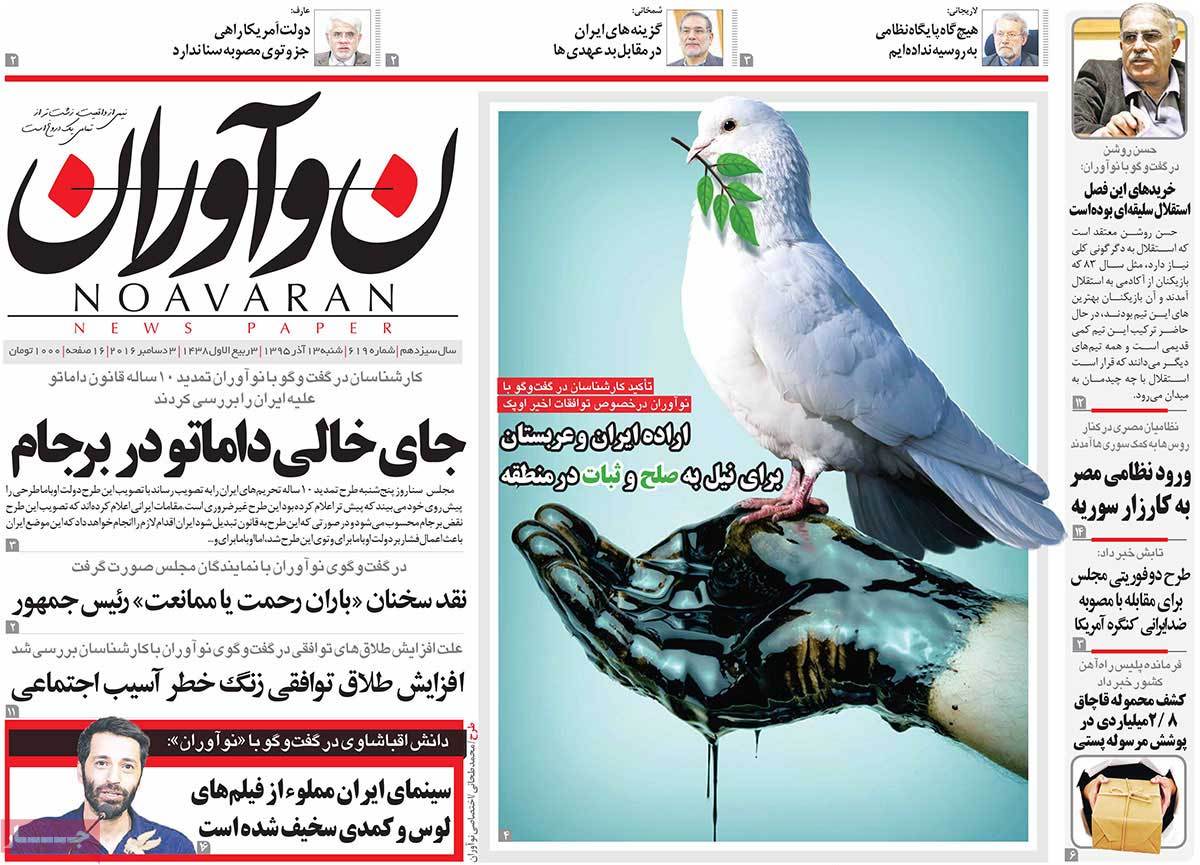
How Iranian Newspapers Covered US Senate’s Extension of Anti-Iran Sanctions


Payam-e Zaman:

1- Dark Angles of JCPOA: Permission for US Abuse and Extension of D’Amato Act

2- Investors May Temporarily Take Out Their Money from Stock Exchange Market and Make Investment in Foreign Currencies

3- Senior Cleric Movahedi Kermani: It’s the Time to Reciprocate US Measures
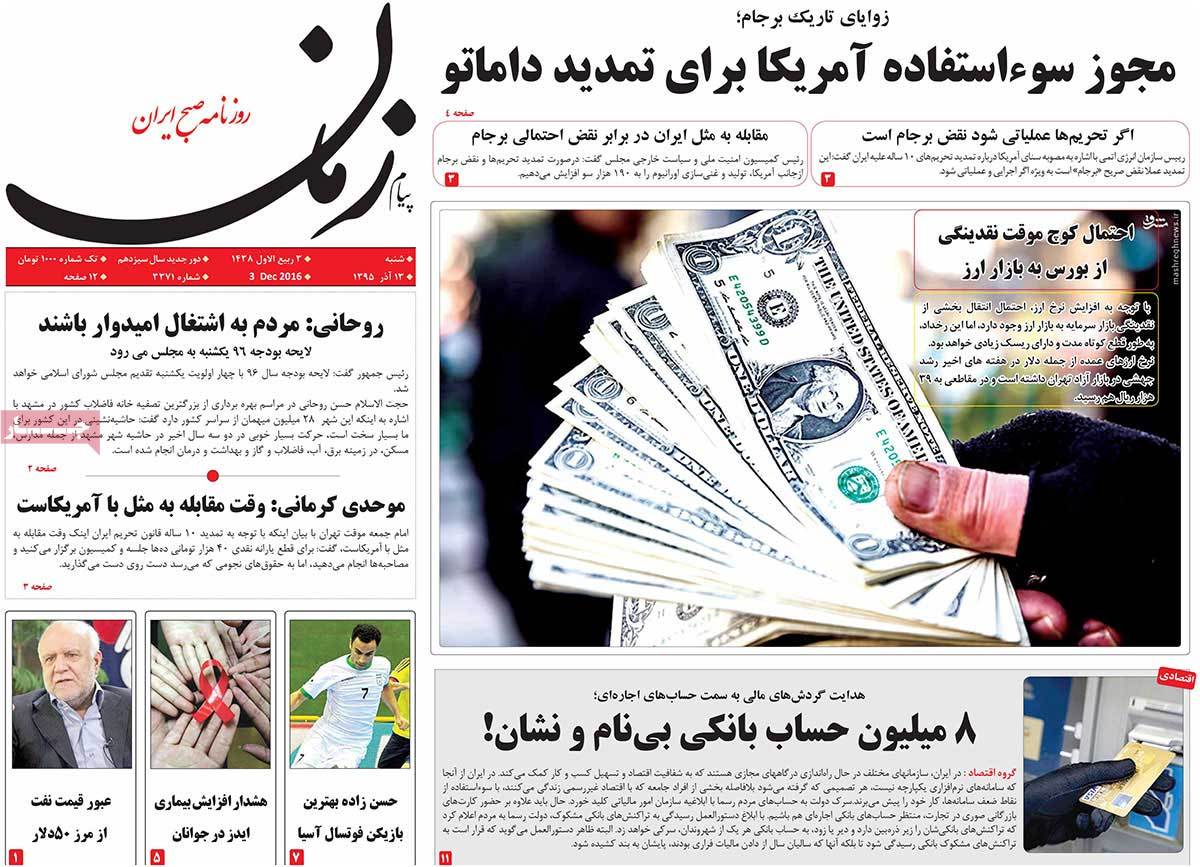
 

How Iranian Newspapers Covered US Senate’s Extension of Anti-Iran Sanctions


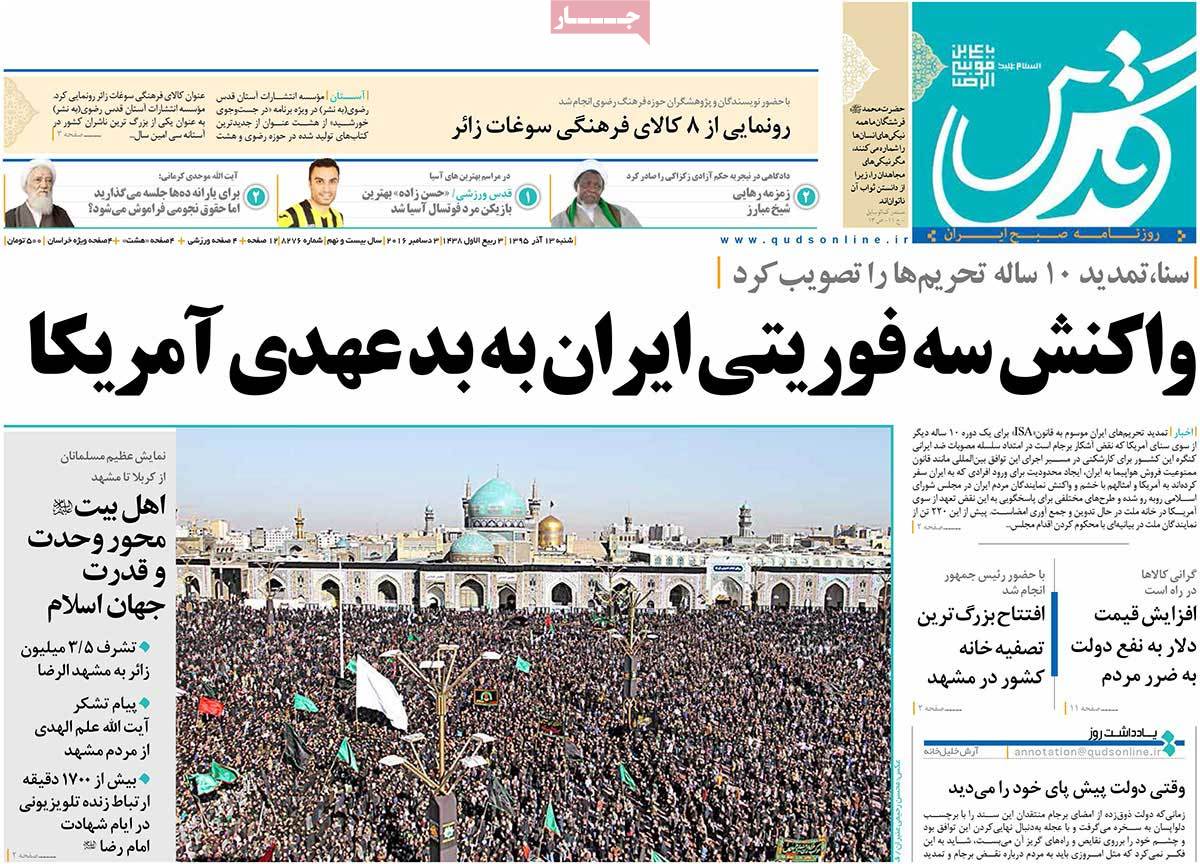
Quds:

1- Iran’s Triple-Urgent Reaction to US Violation of Its Commitments
How Iranian Newspapers Covered US Senate’s Extension of Anti-Iran Sanctions


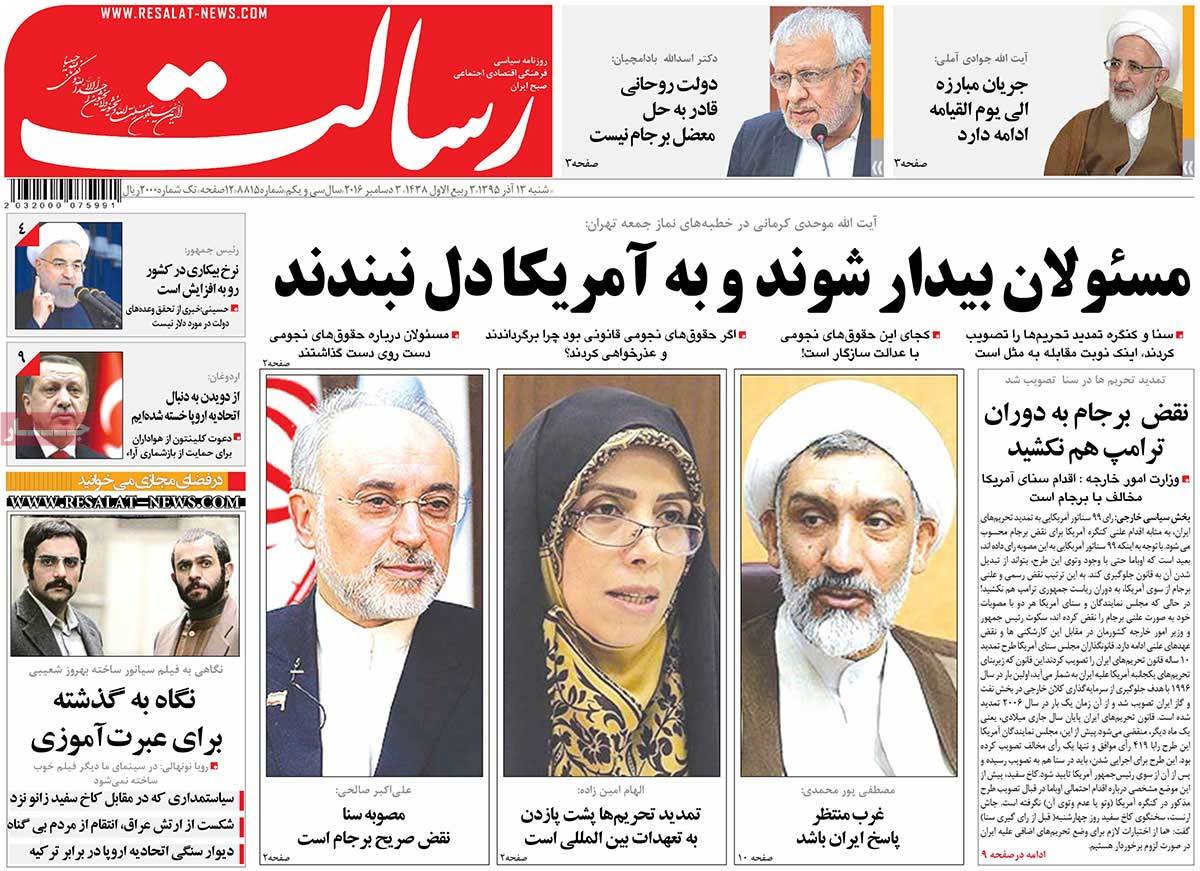
Resalat:

1- Officials Should Wake Up and Stop Relying on US: Cleric

2- Rouhani’s Gov’t Cannot Resolve Issue of JCPOA: Veteran Conservative Figure

3- No Need to Wait until Trump’s Inauguration: Violation of JCPOA Happens in Obama’s Era

4- We’re Tired of Running after EU: Erdogan

5- West Should Expect Iran’s Reaction: Justice Minister

6- Extension of Sanctions Is Turning Your Back to Int’l Commitments
How Iranian Newspapers Covered US Senate’s Extension of Anti-Iran Sanctions


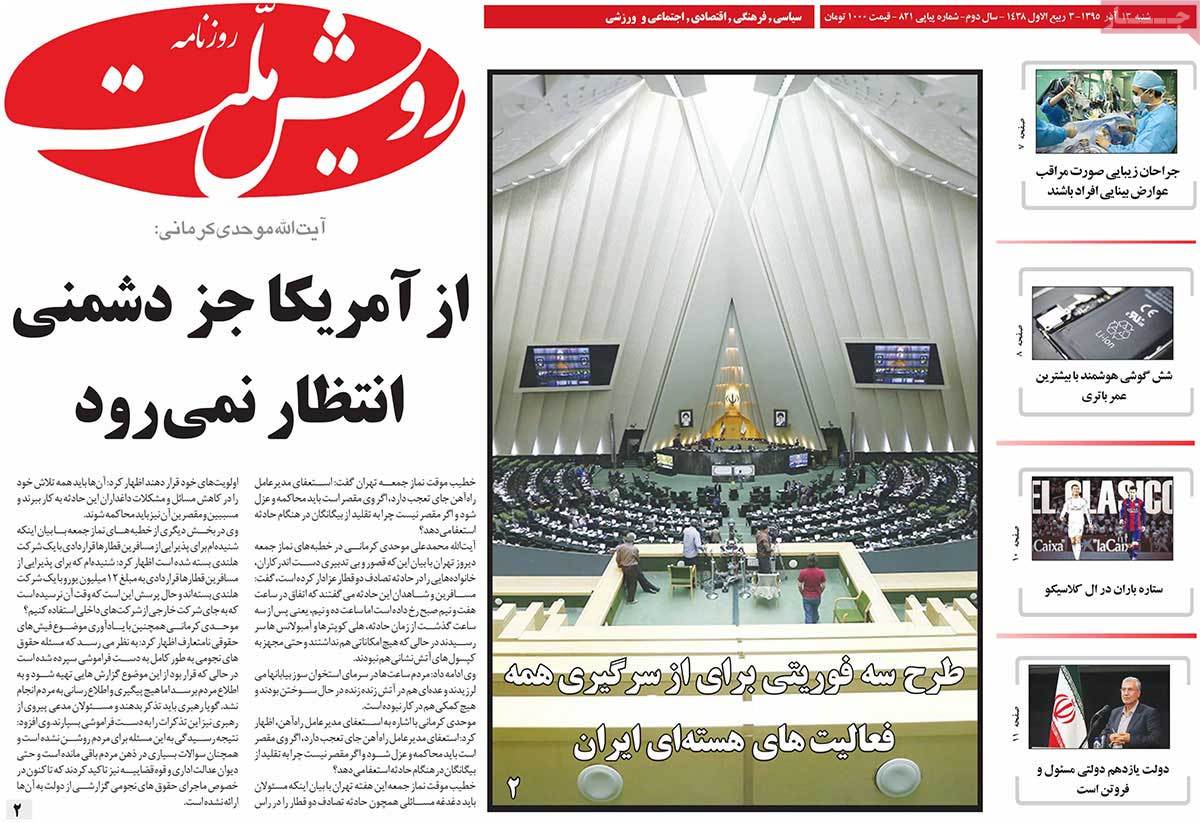
Rooyesh-e Mellat:

1- Nothing but Hostility Is Expected of US: Cleric

2- Iran to Resume All of Its Nuclear Activities
How Iranian Newspapers Covered US Senate’s Extension of Anti-Iran Sanctions


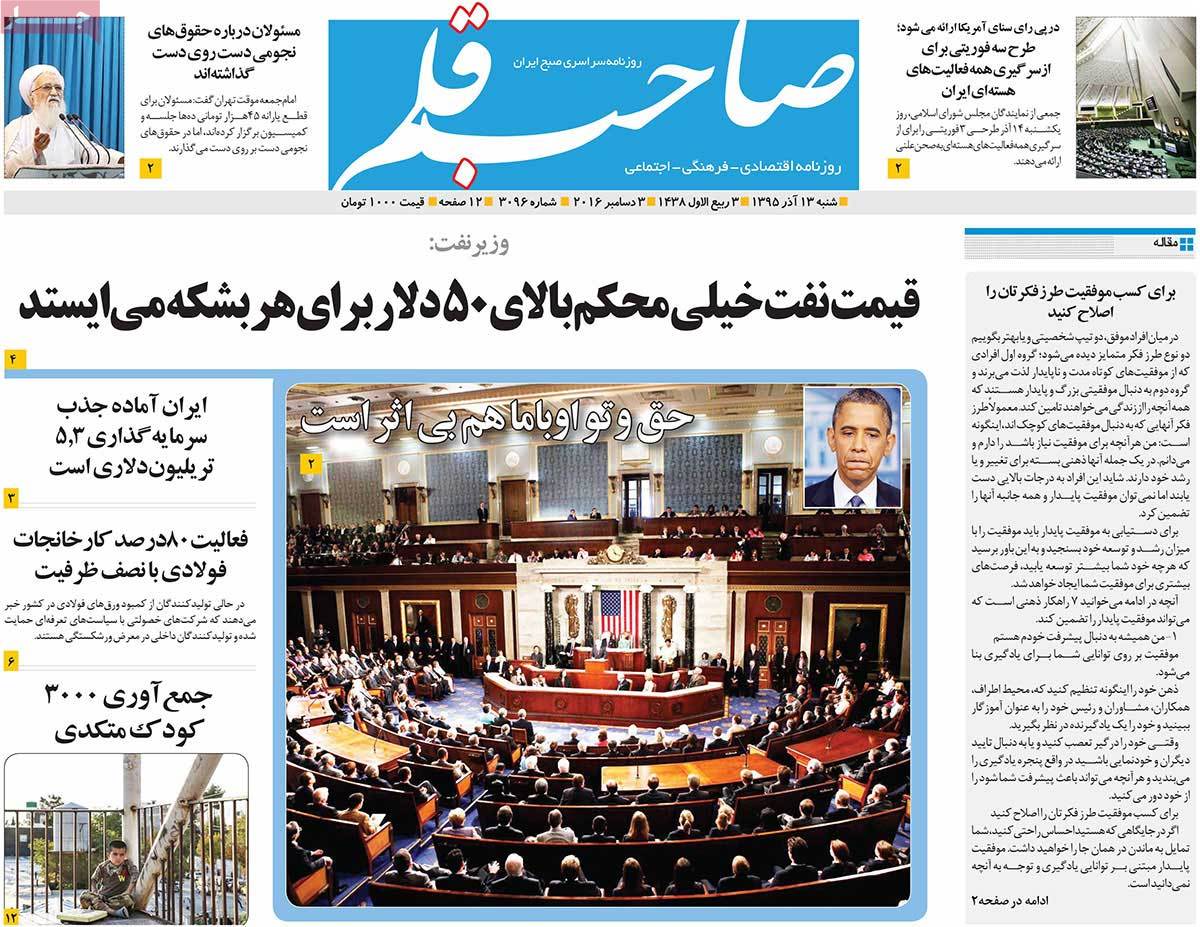
Saheb Qalam:

1- Obama’s Veto Is Ineffective

2- Iran Ready to Attract $5.3 Trillion of Investment
How Iranian Newspapers Covered US Senate’s Extension of Anti-Iran Sanctions


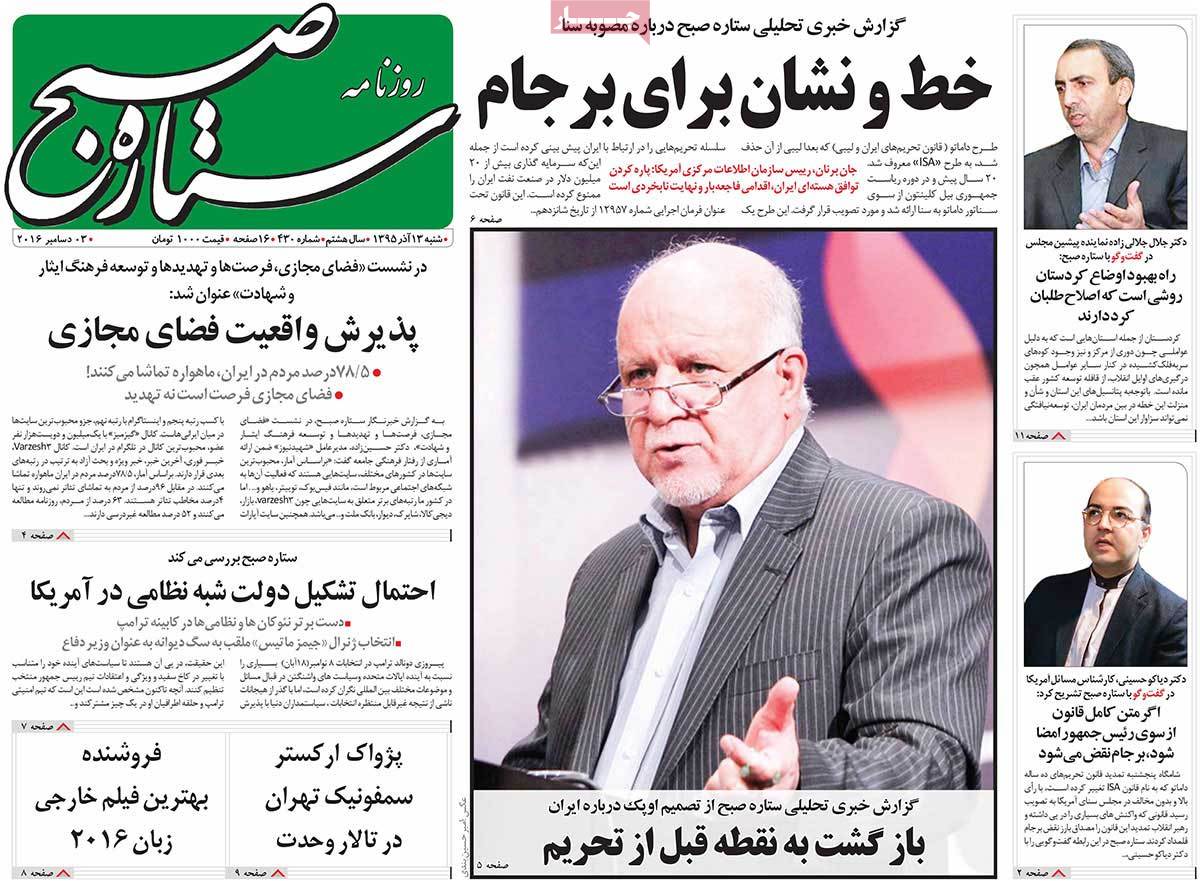
Setareh Sobh:

1- Militia Government May Be Formed in US

2- If Obama Signs D’Amato Act, JCPOA Will Be Violated: Expert
How Iranian Newspapers Covered US Senate’s Extension of Anti-Iran Sanctions


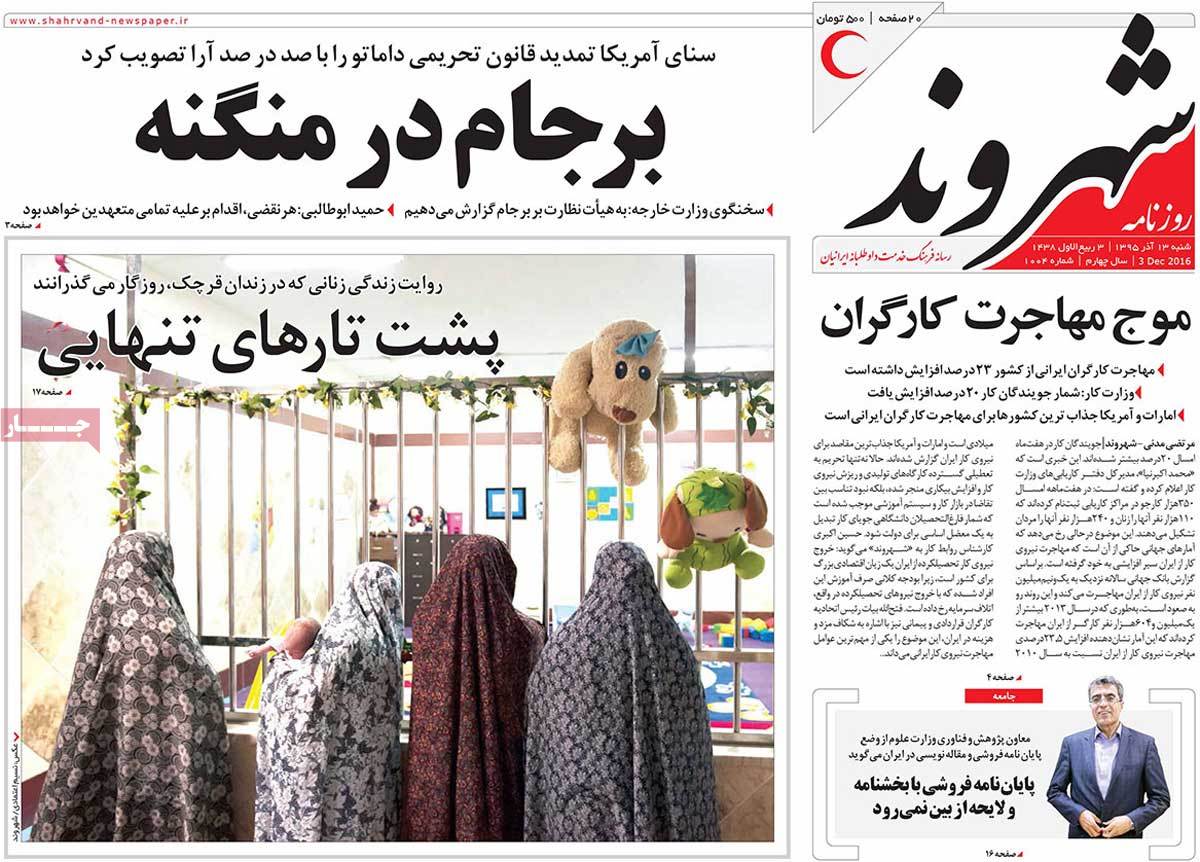
Shahrvand:

1- JCPOA under Pressure: US Senate Unanimously Approves Extension of Anti-Iran Sanctions

2- A Report on Female Prisoners of Qarchak Prison in Southeastern Tehran
How Iranian Newspapers Covered US Senate’s Extension of Anti-Iran Sanctions


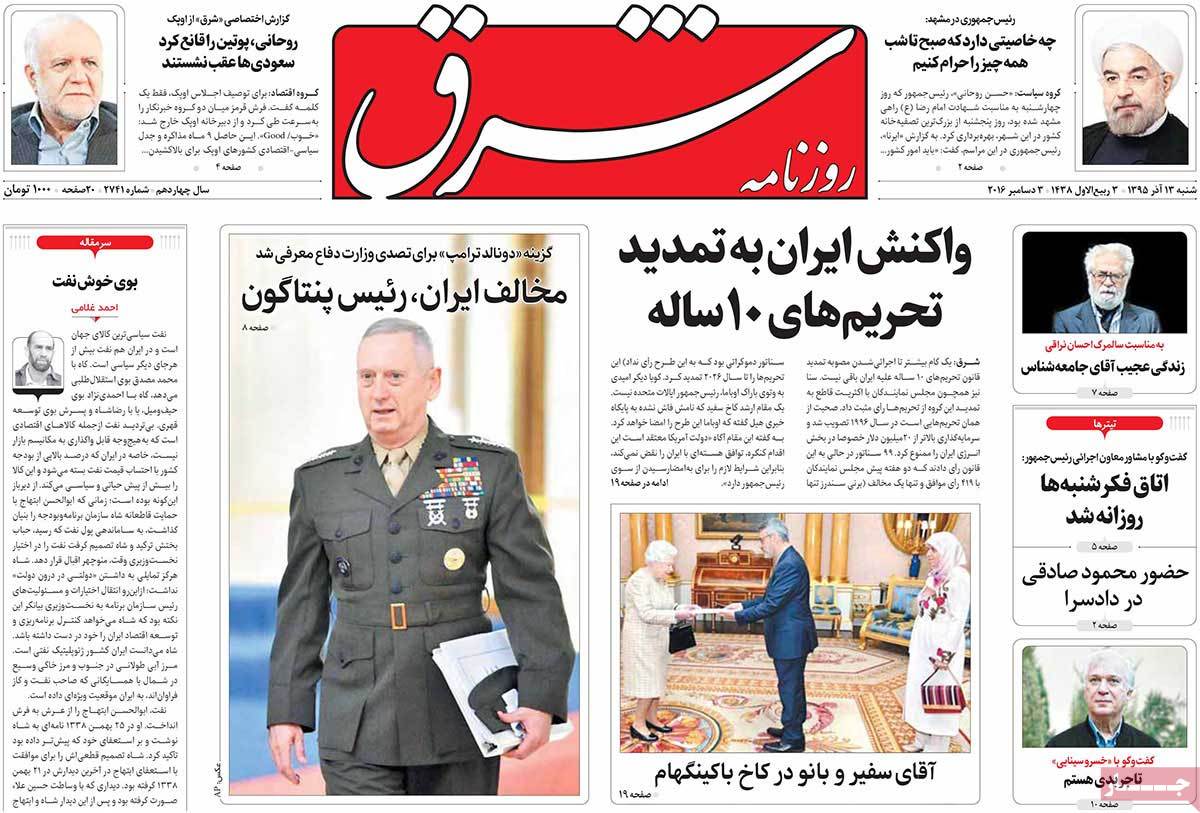
Shargh:

1- Iran’s Reaction to 10-Year Extension of Sanctions

2- Iran’s Opponent Becomes Head of Pentagon

3- Mr Ambassador and His Wife in Buckingham Palace [Iranian ambassador meets with British Queen]
How Iranian Newspapers Covered US Senate’s Extension of Anti-Iran Sanctions


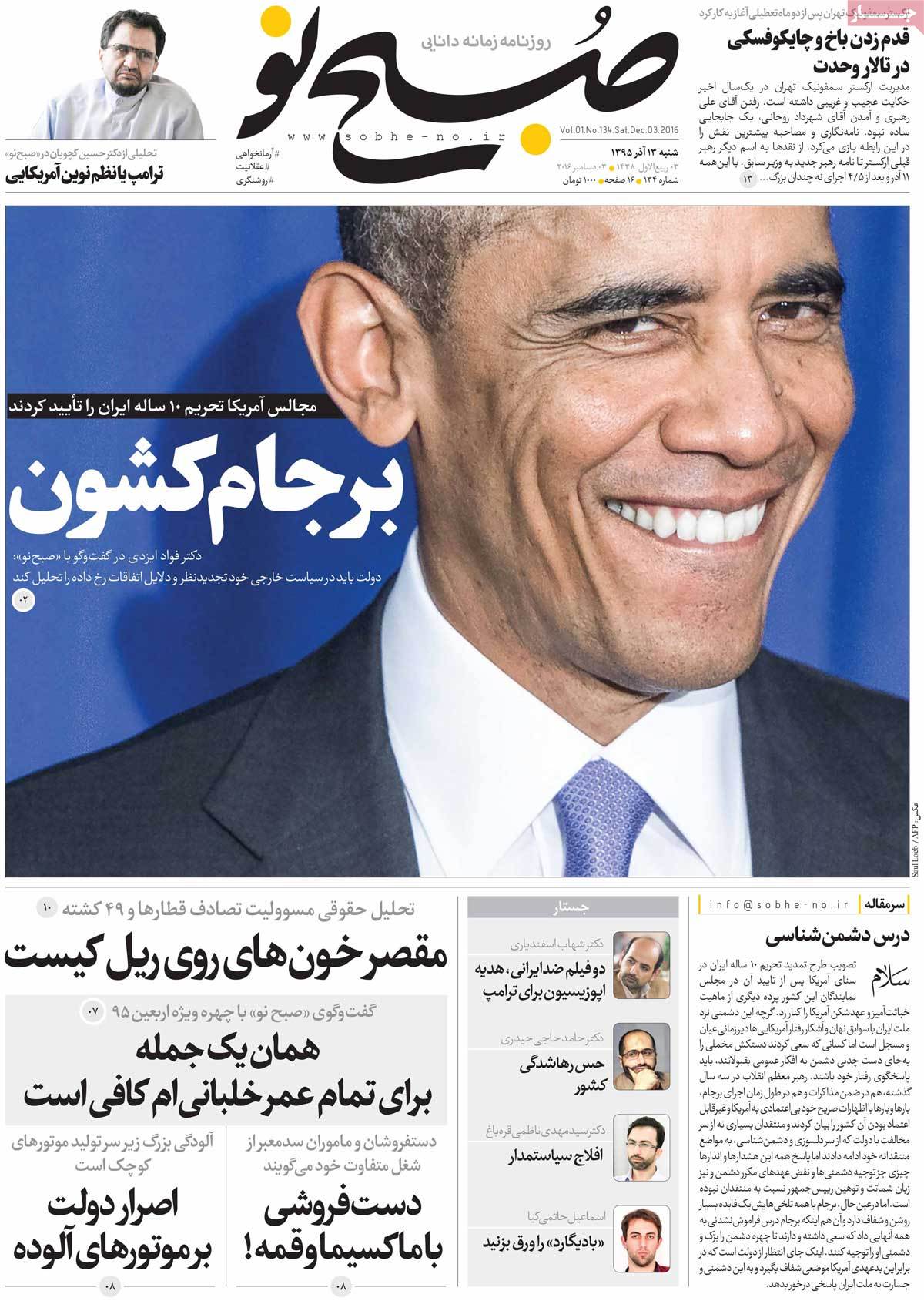
Sobh-e Now:

1- Government Should Reconsider Its Foreign Policy and Study the Reasons of What Happened: Expert

2- Killing the Nuclear Deal!

3- Who’s to Blame for Blood Shed on Railways: Legal Analysis of Those Responsible for Deadly Train Collision
How Iranian Newspapers Covered US Senate’s Extension of Anti-Iran Sanctions


Vaghaye Ettefaghieh:

1- JCPOA under Blade

2- Iran Wins OPEC Game
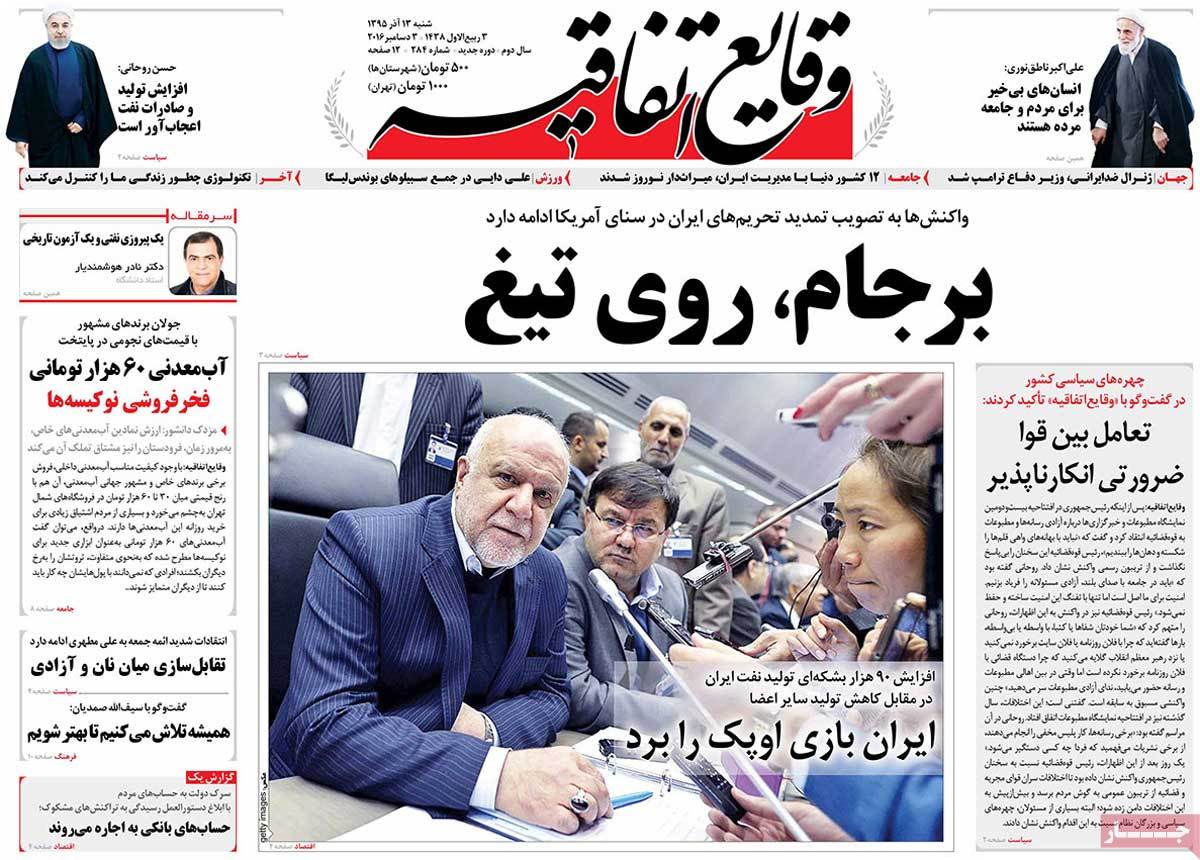
How Iranian Newspapers Covered US Senate’s Extension of Anti-Iran Sanctions


Vatan-e Emrooz:

1- Gone with the Wind; Zarif Said in Parliament: ISA Extension Is Violation of JCPOA

2- Iran’s Nuclear Chief: Senate’s Approval Is against JCPOA
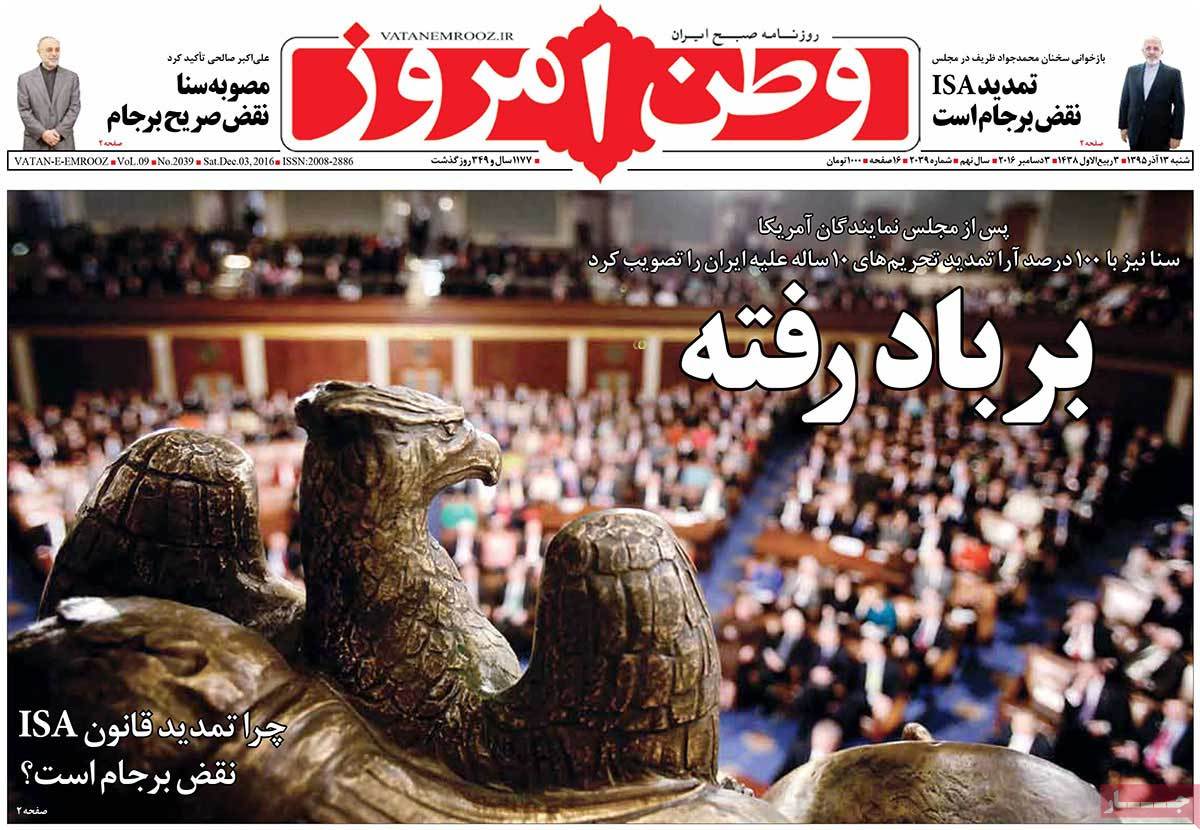
How Iranian Newspapers Covered US Senate’s Extension of Anti-Iran Sanctions

Iran Sends 3rd Consignment of Relief Aid to Syria’s Aleppo

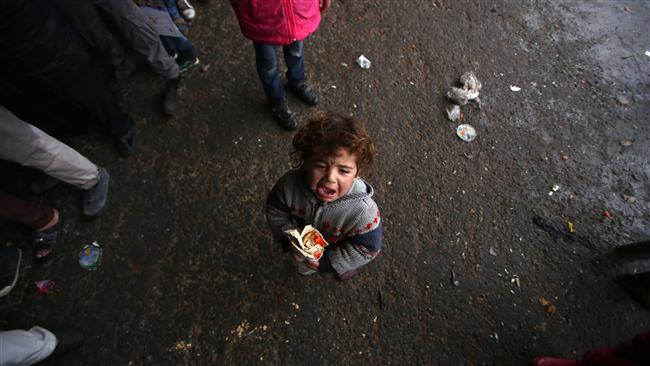
Syrian Child
A Syrian child, who fled with his family from militant-held areas in the city of Aleppo, reacts as he holds a sandwich on December 1, 2016, at a shelter in the neighborhood of Jibrin, east of Aleppo. (Photo by AFP)

The head of the Relief and Rescue Organization of the Iranian Red Crescent Society (IRCS), Morteza Salimi, told IRIB that the shipment included 150,000 food cans.

He added that two consignments of relief aid, weighing about 80 tonnes, have already been sent to the crisis-hit city over the past two days. They included tents, blankets and oil heaters.

The IRCS official noted that Iran has so far dispatched 28,000 blankets, 400 tents, 800 rugs, 5,000 oil heaters, 1,400 boxes of dried bread, eight tonnes of medicines, 700 sets of dishware and 165,000 food cans to people in Aleppo.

The UN Syria humanitarian advisor, Jan Egeland, said in the Swiss city of Geneva on Thursday that Russia has proposed setting up four humanitarian corridors to militant-held eastern Aleppo in a bid to let in aid and facilitate evacuations from the battered Syrian city.

Egeland further estimated at least 400 injured people are in need of urgent medical evacuation, adding that talks will be held on using “these corridors to get medical supplies and food in.”

By Wednesday, some 18,000 people had entered Aleppo’s government-controlled areas while about 8,500 had crossed into Sheikh Maqsoud, a Kurdish-held Aleppo district, the UN official said.

Over the past few days, about 30,000 people have received aid after fleeing eastern Aleppo, taking the total number of displaced people in the city to over 400,000, he said.

In another development on Thursday, the International Committee of the Red Cross (ICRC) announced that it was discussing with the Syrian government the issue of gaining access to people fleeing eastern Aleppo.

Dominik Stillhart, director of ICRC operations worldwide, said the Geneva-based humanitarian institution was in touch with all sides to be able to deliver supplies to trapped civilians and to evacuate the wounded.

Iran’s President Received Ayatollah Khamenei’s Approval before OPEC Deal: Source

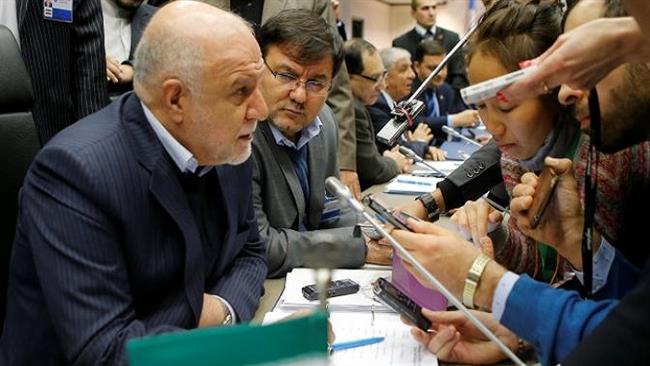
OPEC Zangeneh

According to a report covered by Fars, heading into the recent OPEC meeting in Vienna, the signs were not good. Oil markets went into reverse.

Just a few days beforehand, Riyadh appeared back away from a deal, threatening to boost production if Iran failed to contribute cuts.

But a phone call between Russian President Vladimir Putin and Iranian President Rouhani smoothed the way. After the call, Rouhani and oil minister Zanganeh went to Iran’s Leader for approval, a source close to the Leader told Reuters.

“During the meeting, the Leader Ayatollah Khamenei underlined the importance of sticking to Iran’s red line, which was not yielding to political pressures and not to accept any cut in Vienna,” the source said.

“Zanganeh thoroughly explained his strategy … and got the Leader’s approval. Also it was agreed that political lobbying was important, especially with Mr. Putin, and again the Leader approved it,” said the source.

On Wednesday, the Saudis agreed to cut production heavily, taking “a big hit” in the words of energy minister Khalid al-Falih – while Iran was allowed to slightly boost output.

Corrupt Billionaire’s Death Sentence Upheld by Iran’s Supreme Court

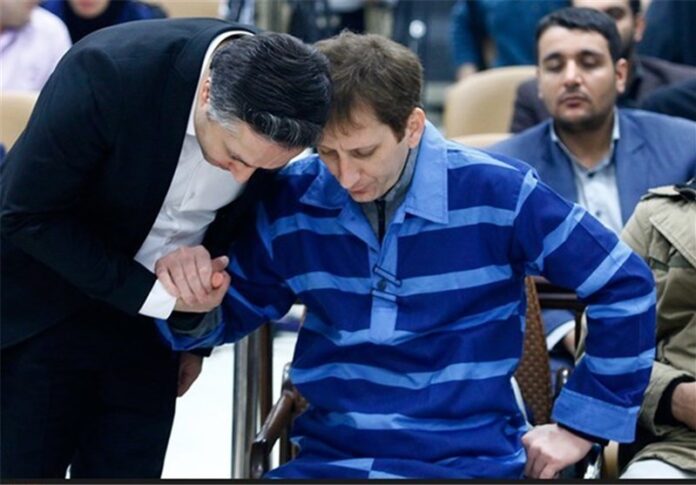
babak-zanjani

Speaking to the Tasnim News Agency, Ansari, a ranking official at the Supreme Court, confirmed that Zanjani’s death sentence has been upheld.

Zanjani and two of his accomplices were given the death penalty in March.

One of Iran’s richest men, Zanjani was arrested in December 2013 after 12 Iranian lawmakers accused him of corruption, calling for an inquiry into his financial activities in a letter to the heads of the three branches of the Iranian government.

According to the indictment against him, the billionaire was faced with charges including ‘corruption on earth’, massive fraud at Iran’s Oil Ministry, and money laundering.

Experts say the estimated net worth of his assets is around $13.8 billion. The business tycoon, aged 42, owned and operated many holdings and companies, including the UAE-based Sorinet group, Qeshm Airlines and Rah Ahan Soccer Club in Iran.