Saturday, December 27, 2025
Home Blog Page 4208

Saudi, UK Anti-Iran Claims, Smokescreen for Terror Support: Iran

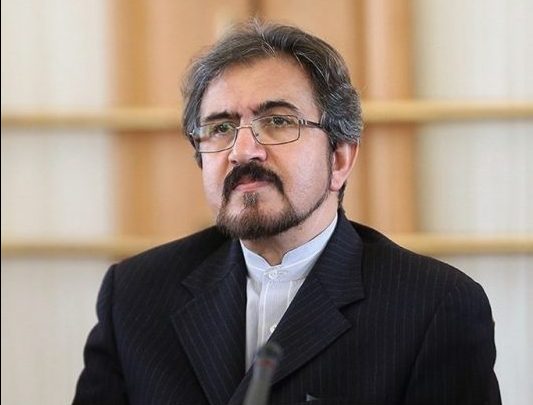
Iranian Foreign Ministry Spokesman Bahram Qassemi said on Sunday that remarks made by British Foreign Secretary Boris Johnson and Saudi Foreign Minister Adel al-Jubeir in a joint press conference in Riyadh against Iran were baseless and an attempt to divert attention away from their support for Takfiri terrorism and numerous and extensive crimes against humanity in the war on Yemen.

There is no doubt that despite the opposition of world public opinion and protests by conscientious people across the world against the provision of weapons by Britain for use in the war against the Yemeni people, statesmen in London still insist on the sale and dispatch of such deadly arms to the countries involved in the aggression against Yemen and supporters of terrorists, he added.

Qassemi further dismissed as ridiculous claims by the Saudi foreign minister about Iran’s support for al-Qaeda and Takfiri terrorists, saying the Islamic Republic pursues independent security strategies and has no connection with terrorist and extremist ideologies.

Addressing the joint presser on Sunday, Johnson, who had told a conference in Rome that Saudi Arabia and Iran were “puppeteering” in the Middle East by supporting rival sides in regional conflict, said he was concerned about the suffering in Yemen, where a Saudi-led coalition has been accused of rights abuses.

In his presser with Johnson, Jubeir, without providing any evidence, accused Iran of supporting terrorism and interfering in the internal affairs of other countries. He also claimed that Tehran had ties with al-Qaeda terrorists and that the group’s leaders had fled to and been living in Iran since 2001. Johnson, meanwhile, said London and Riyadh share similar stances on what he described as the Iranian threat, particularly in Syria and Yemen.

Yemen, the most impoverished Arab country, has been under relentless Saudi airstrikes since March 2015, when Saudi Arabia launched its military aggression against the neighboring country in an attempt to undermine Ansarullah and reinstate Abd Rabbuh Mansur Hadi, the country’s former president and a staunch ally of Riyadh, who has resigned from his post as the country’s president.

The Saudi military aggression has left at least 11,400 civilians dead, according to the latest tally by a Yemeni monitoring group.

Contract with Peugeot, Best Car Deal in Iran’s History: Official

Peugeot

said-mohsen-salehinia“The contract between Iran and France’s Peugeot is a joint venture; that is to say, we have a firm to jointly manufacture cars, which is owned 50% by Peugeot and 50% by Iran Khodro Company,” said Mohsen Salehinia,  Iranian Deputy Minister  of Industry, Mine and Trade, according to a Farsi report by Nasim Online.

“We imported some models of Peugeot before, then tried to increase its domestic production. Now we have a joint firm with Peugeot to manufacture up-to-date cars,” he noted.

“We have had no better contract than this one in the history of Iranian automobile manufacturing.”

“Based on the contract, we start with the joint production of 208, 2008 and 301 models, and will then extend it. The domestic production starts from 40% and is due to reach up to 75%. We will export 30% of products, and have a joint R&D with Peugeot,” he added.

Salehinia went on to say that Iran didn’t give any priority to Peugeot, and that Iranian automobile manufacturers can sign contracts with foreign companies if this is beneficial to them.

He also referred to the possible influence of Donald Trump’s election as the US President on foreign firms’ decision about cooperation with Iran, and said, “I have heard nothing about Trump’s effect on the entry of foreign automobile manufacturers into Iran.”

“Such political changes as Trump’s election have no effect on technical and operational aspects of contracts, unless major global policies are affected. I don’t think that would happen, though.”

American Arms Fanning Flames of Regional Tensions: Analyst

Sabah Zanganeh


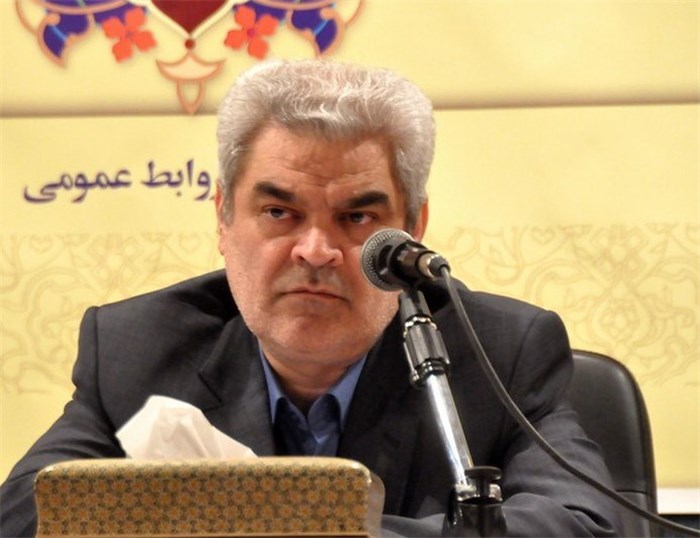
“Based on the ‘noninterference policy’, which White House claims to be following, the US should have ‘no direct meddling’ in the Middle East affairs,” Sabah Zanganeh, a former Iranian envoy to the Organization of Islamic Cooperation (OIC) and a political analyst, said in a Farsi interview with Jame Jam.

However, he added, the country has been spending the petrodollars of Arab states in Western Asia to ensure its strategic presence and influence in the region. This has fueled more tensions, leading to an arms contest by regional players.

“The US Congress has OK’d a bill to offer more than $600 million to the Zionist regime of Israel for missile defense cooperation. This not only supports the idea of an arms contest going on in the region, but also reveals that these supports are of varying nature,” he went on to say.

“When the US sells arms to Israel, it does not bother to monitor how the Zionists use the weapons; however, Washington always controls the way Arabs use the purchased arms. No matter where the weapons are used and against which nations: Syrians, Bahrainis or Yemenis. By selling arms to the Zionists, the US is effectively helping bolster their technical and operational strength.”

“Anyway, the US has a hand in the Middle East’s ongoing tensions as its regional allies commit their crimes by using American weapons; naturally, the victimized nations and states of the Middle East are entitled to seeking accountability from the US government for threatening their lives and may even sue the Washington for its policies towards the innocent people of the region,” Zanganeh noted.

He also said, “The other point to consider with regard to the US arms trade in the region is that Washington has been in fact organizing its regional customers including Saudi Arabia and Israel and helping them coordinate their mischief.”

“As a matter of fact, by selling arms to these countries, the US has thrown its weight behind Saudis and Zionists as well as most [Persian] Gulf Cooperation Council doctrines,” he added.

Iran Condemns Deadly Attack on Cairo Church

Qassemi made the remark on Sunday while condemning a recent deadly attack on Cairo’s Coptic Cathedral which claimed the lives of 25 people and injured some 50 more.

“With this cowardly anti-Christian attack, which was launched just before the Christian New Year, the bloodthirsty and anarchistic terrorists have once again shown that terrorism knows no borders, nationalities or faiths,” he said.

He stressed that all nations and religions must come together to battle terrorism, which is plaguing the world.

The blast occurred earlier in the day in St Peter’s Church during Sunday mass. No group or individual has so far claimed responsibility for the deadly incident.

“As soon as the priest called us to prepare for prayer, the explosion happened… The explosion shook the place … the dust covered the hall and I was looking for the door, although I couldn’t see anything … I managed to leave in the middle of screams and there were a lot of people thrown on the ground,” a survivor told reporters.

Egyptian President Abdel Fattah el-Sisi referred to the bombing as a “terrorist act” which has no place in his country.

The White House released a statement after the attack, stressing that the US “will continue to work with its partners to defeat such terrorist acts.”

The UNSC urged “all states, in accordance with their obligations under international law and relevant Security Council resolutions, to cooperate actively with all relevant authorities” to make those responsible for the attack accountable.

Israel Sole Inherent Crisis in West Asia: Iran official

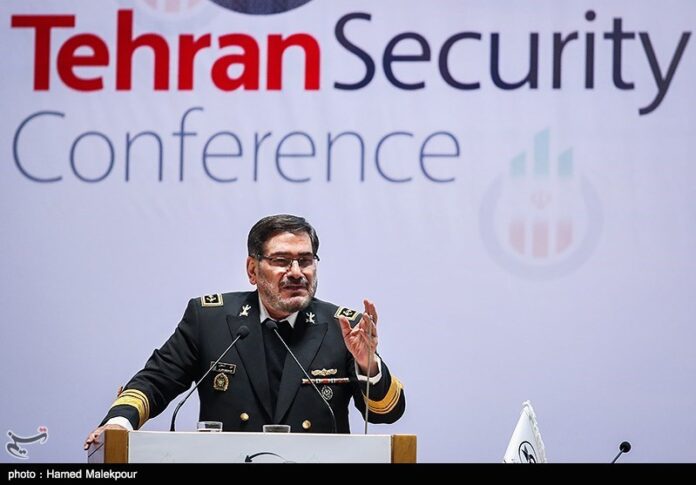
Secretary of Iran’s Supreme National Security Council Ali Shamkhani addresses the International Conference on Regional Security Order in West Asia in Tehran on December 11, 2016. (Photo by Tasnim News Agency)

The existing artificial crises are an outcome of the goals and policies of extra-regional powers in order to cover up the main crisis and drain the capacities to counter the Israeli regime through starting arms race and conflicts in Muslim countries, Ali Shamkhani said in an address to the International Conference on Regional Security Order in West Asia in Tehran on Sunday.

“There is no sustainable military solution to regional crises,” he added, emphasizing that the achievement of a resounding victory or defeat in the current military conflicts should not lead to the illusion of the predominance of the military approach over dialogue-based solutions.

The SNSC secretary also called for efforts to establish a regional power balance through mutual solidarity between countries in political, economic, security and cultural sectors, saying that the Islamic Republic’s security doctrine is based on soft power, because Iran seeks to pursue conventional deterrence in the defense sector.

Shamkhani also stated that terrorism is the common threat to all countries in the world, adding that the “use of terrorism as a means” for political aims and its attribution to Islam with the purpose of spreading Islamophobia and sowing discord among Muslims have created a “complicated” situation in the region, which would only serve the Israeli regime’s interests.

Zionist regime at odds with regional peace: Dehqan 

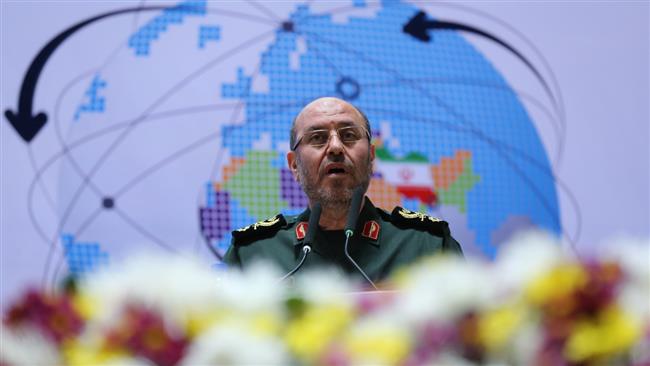
Also addressing the Tehran Security Conference on Sunday, Iran’s Defense Minister Hossein Dehqan noted that under present circumstances, security is the main concern of countries in the Middle East region, adding that the correct understanding of international environment and management of the existing conflicts are among the requisites for the establishment of collective security in the region.

General Dehghan
Iranian Defense Minister Brigadier General Hossein Dehqan speaks at the International Conference on Regional Security Order in West Asia in Tehran on December 11, 2016. (Photo by IRNA)

Elsewhere in his remarks, he added that the Middle East region has not seen peace since the creation of the fake Zionist regime in the occupied lands, which has been the source of a continued crisis across the region.

The Iranian minister then elaborated on the main challenges facing regional countries for the establishment of peace and security, noting that Middle Eastern states are currently facing four challenges in this regard.

Dehqan mentioned inefficiency of national governments for establishment of security within their borders; emergence of extremist and violent groups and currents across the region; interventionist policies followed by some regional powers, including Saudi Arabia, to stoke unrest and chaos in regional countries; and interventions by Western powers, especially the United States, as the main challenges that currently bar establishment of peace and security in the restive region of Middle East.

He added that Iran is among those countries which seek stability and security in the West Asia region through basic reforms and aim to create an Islamic and anti-West order.

“This order will be against the West’s intervention in the management of regional disputes and demands respect for integrity and national sovereignty of countries. This order will also isolate Israel in the region while greatly bolstering the resistance front, and seeks to improve relations among regional countries through a stabilizing and security-building approach,” Dehqan said.

The Iranian minister added that to achieve this goal, countries must take a “security-oriented” approach to regional issues in the coming years, which must also include attention to economic issues.

President Stresses Equal Rights for All Iranians

Iran President Hassan Rouhani

The Islamic Republic of Iran regards all minorities as an advantage and believes that all Iranians should enjoy equal citizenship rights, President Rouhani said in a gathering of Sunni clerics in Tehran on Sunday, held ahead of the Unity Week, an annual occasion marking solidarity among different Islamic schools of thought.

The president underscored that both Iran and the Islamic Republic belong to all religions and faiths, in the same way that the country’s burdens fall on all Iranians.

Disunity will take the country to the brink of disaster, he warned, stressing that Iran’s power is based upon unity.

Leader of the Islamic Revolution Ayatollah Seyed Ali Khamenei has frequently described unity as the only solution to the problems facing Muslims, saying the “arrogant powers” have created religious wars in Muslim countries to divert attention from the fight against Israel.

Syrian Army and Russian Air Force Thwart ISIS Attack on Palmyra

According to a report by IFP, the Russian Defence Ministry said in a statement that “over the past night, with active Russian air support, Syrian government forces repulsed all attacks by the terrorists on Palmyra.”

Over 300 militants were killed in the offensive, RT reported.

“The militants actively used cars filled with explosives, armoured vehicles, and rocket artillery. Russian aircraft carried out 64 airstrikes on militant gatherings, positions, columns, and reserves as they advanced.”

A Look at Iranian Newspaper Front Pages on December 11

Newspapers on Sunday highlighted the imminent liberation of Syrian city of Aleppo and Iraqi city of Mosul, and the efforts made by Western countries to protect militants, particularly in Aleppo.

They also covered Tehran Security Conference in Tehran, which is attended by many experts and officials of Western Asia.

The reactions to British Prime Minister Theresa May’s anti-Iran remarks in a recent Persian Gulf Cooperation Council meeting also remained a top story.

The above issues, as well as many more, are highlighted in the following headlines:


Abrar:

1- Younger Brother of Larijani Family in a Letter to Prosecutor General Call for Probe into Assets of Ahmadinejad’s Companions

2- Iran Is One of the World’s Worst Countries in Terms of Water Planning: MP

3- British Foreign Secretary: We Should Try to Have Good Relations with Iran

4- UNSC: North Korea Still Violating Human Rights
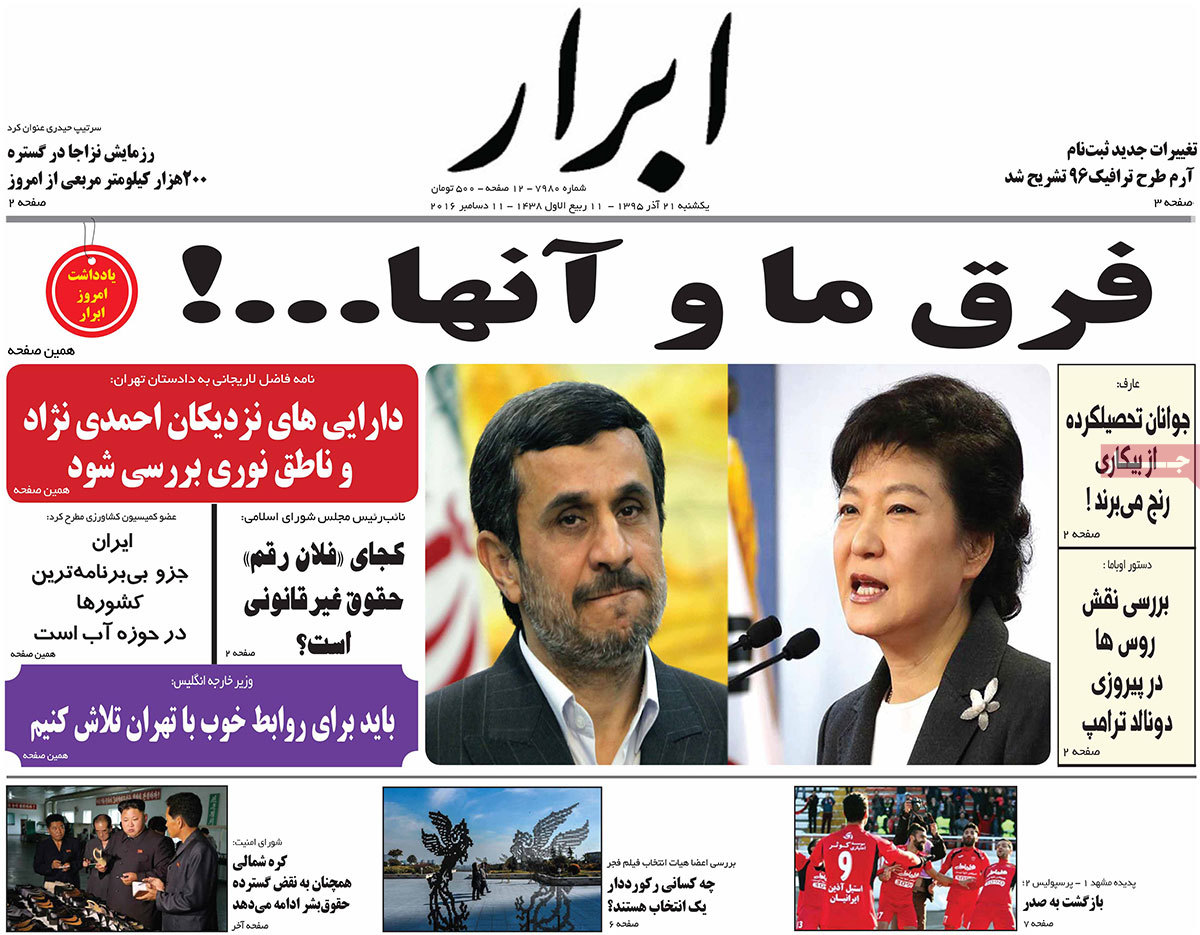
A Look at Iranian Newspaper Front Pages on December 11


Abrar-e Eqtesadi:

1- Airlines in Talks for Purchase of Russian Planes

2- OPEC and Non-OPEC States Agree on Oil Output Cut

3- 5 Tons of Gold Reserves Discovered in Iran: Iran’s Mines under Scrutiny of European and Asian Companies

4- 34-Fold Increase in France’s Imports from Iran
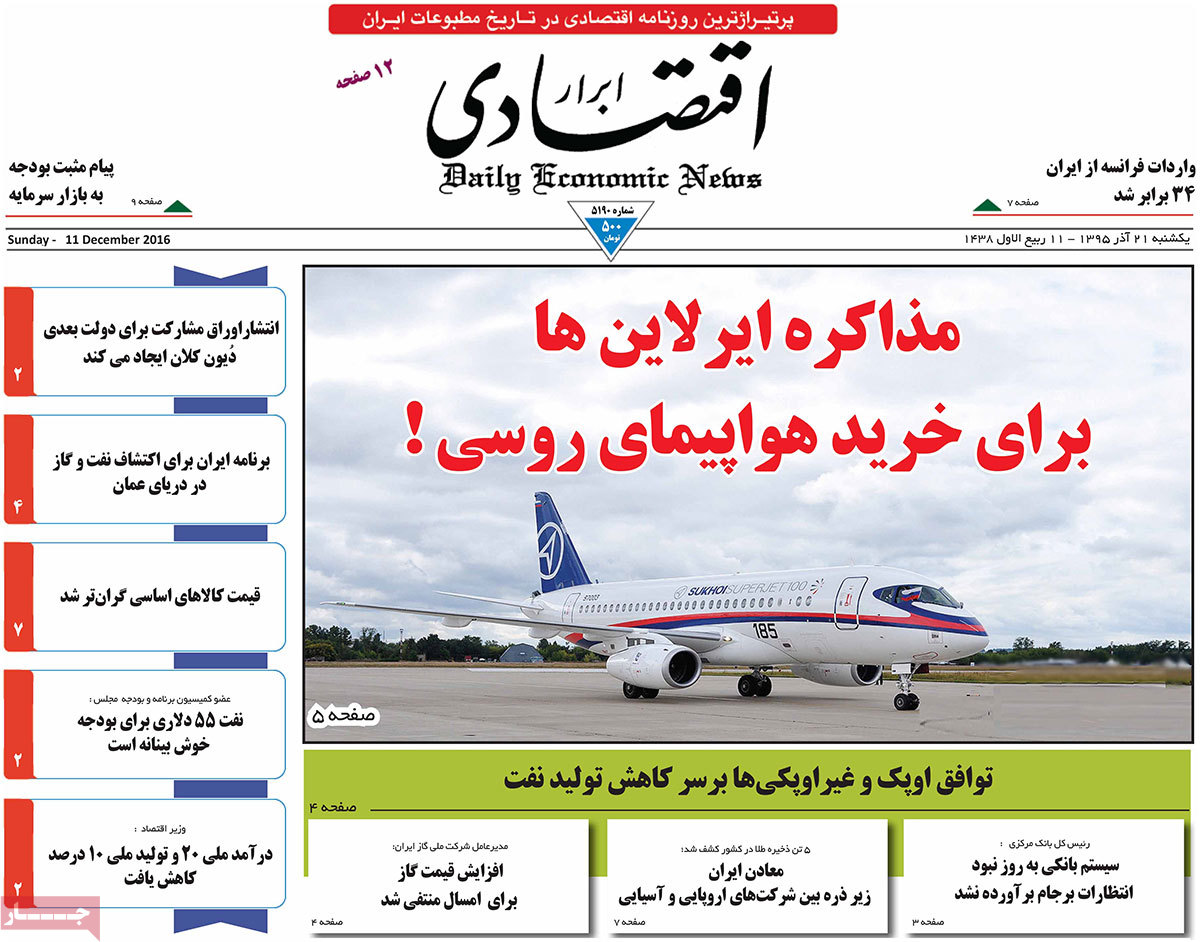
A Look at Iranian Newspaper Front Pages on December 11


Afkar:

1- Expansion of Iran-Sweden Banking Ties

2- Iran Condemns Israeli Regime’s Settlement Plans
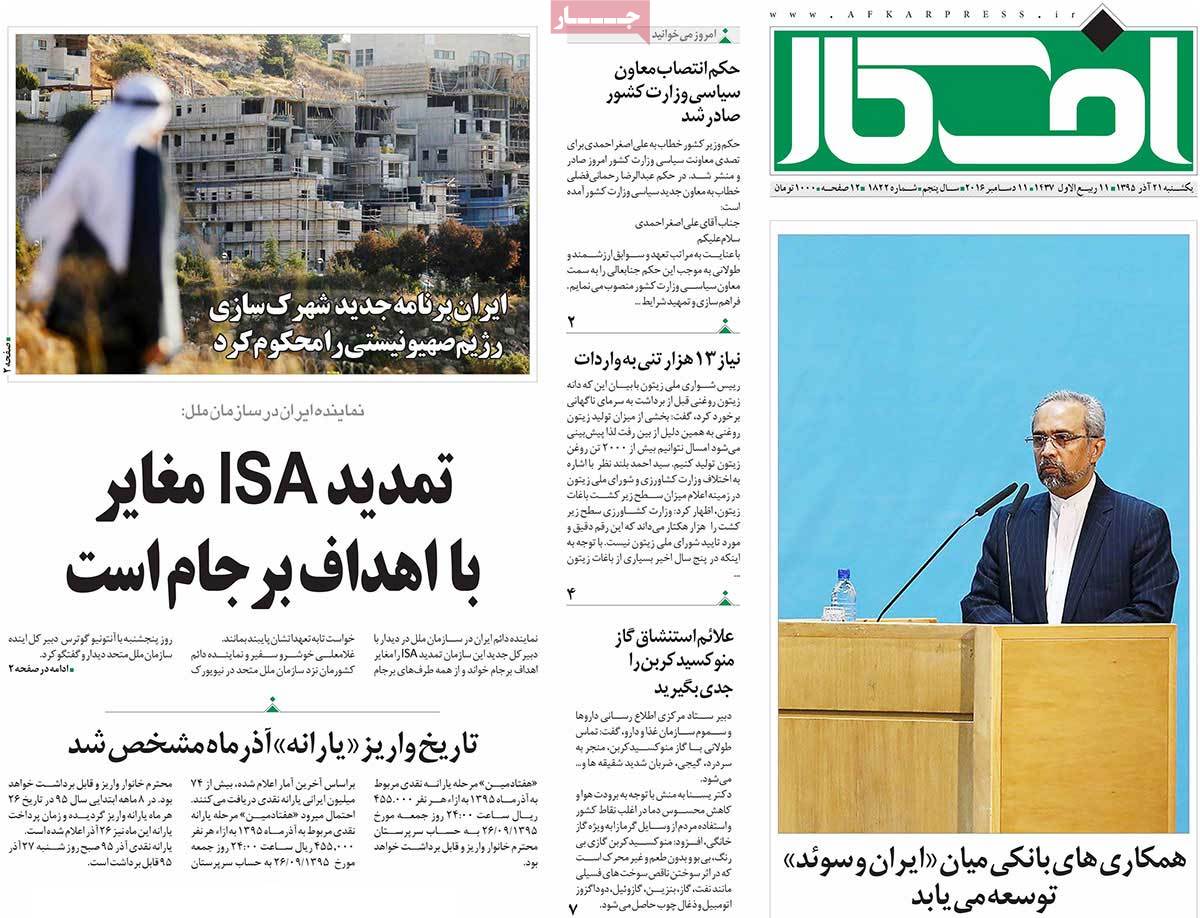
A Look at Iranian Newspaper Front Pages on December 11


Aftab-e Yazd:

1- People’s Happiness for JCPOA Is Ridiculed: Hardliners Put Nuclear Deal in a Coffin and Held Funeral Ceremony for It

2- Reformist Figure: Iran Will Not Scrap Nuclear Deal; Trump’s Model of Presidency Is Like that of a Sultan

3- Hidden War between Start-ups and Traditional Market: Internet Is No Longer an Instrument, It’s Now Part of Our DNA
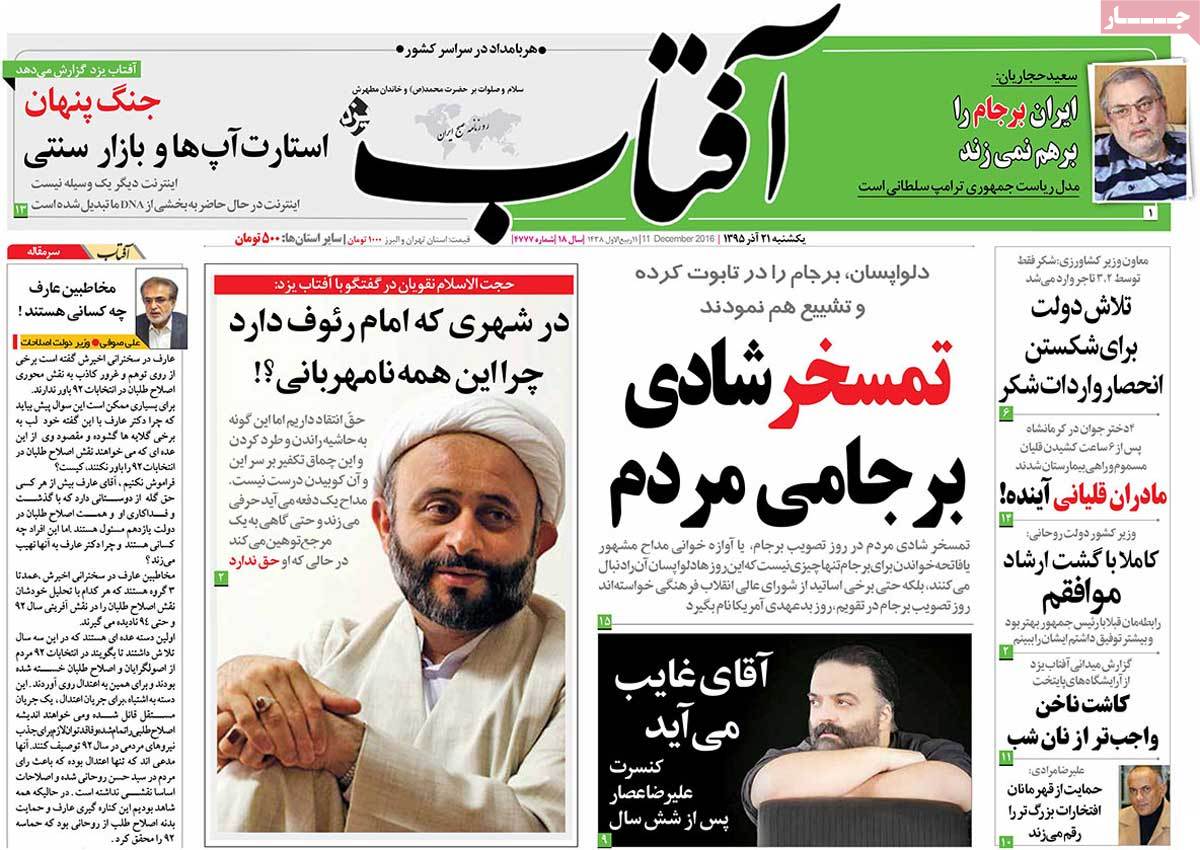
A Look at Iranian Newspaper Front Pages on December 11


Arman-e Emrooz:

1- Iran Has 2,000 Child Widows

2- Based on Obama’s Order: Russia’s Role in Trump’s Victory Will Be Investigated

3- Reformist Figure: Rouhani Is Still Repairing the Country after 8 Years of Devastation
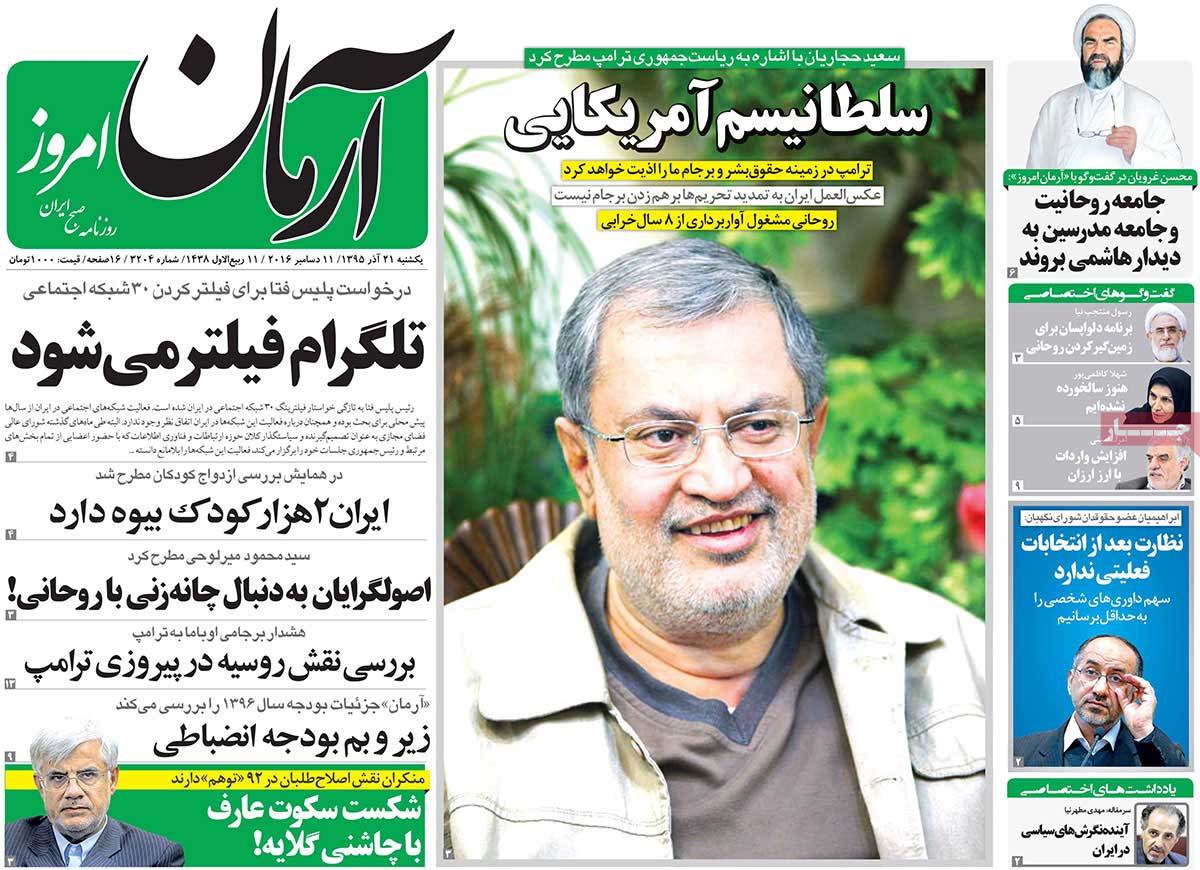
A Look at Iranian Newspaper Front Pages on December 11


Asrar:

1- British Ambassador Summoned to Foreign Ministry

2- “Friends of Syria” Meeting in Paris Ends without Any Result
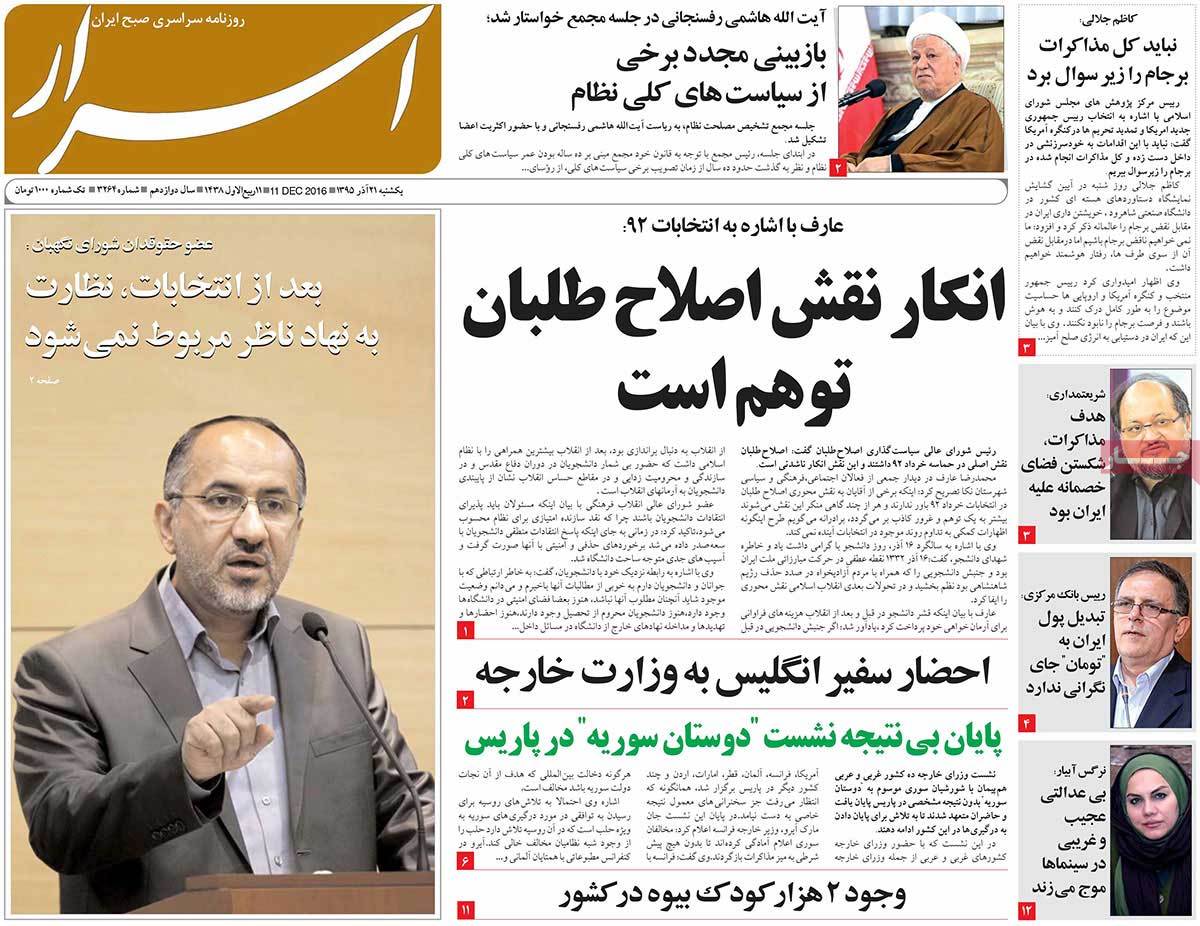
A Look at Iranian Newspaper Front Pages on December 11


Besharat-e Now:

1- Iran Will Become a Dry Country in 15 Years; Agriculture as Main Consumer of the Country’s Water Is the Main Cause of Water Shortage

2- Iran Has the Highest Number of Lawsuits in FIFA and AFC: Official
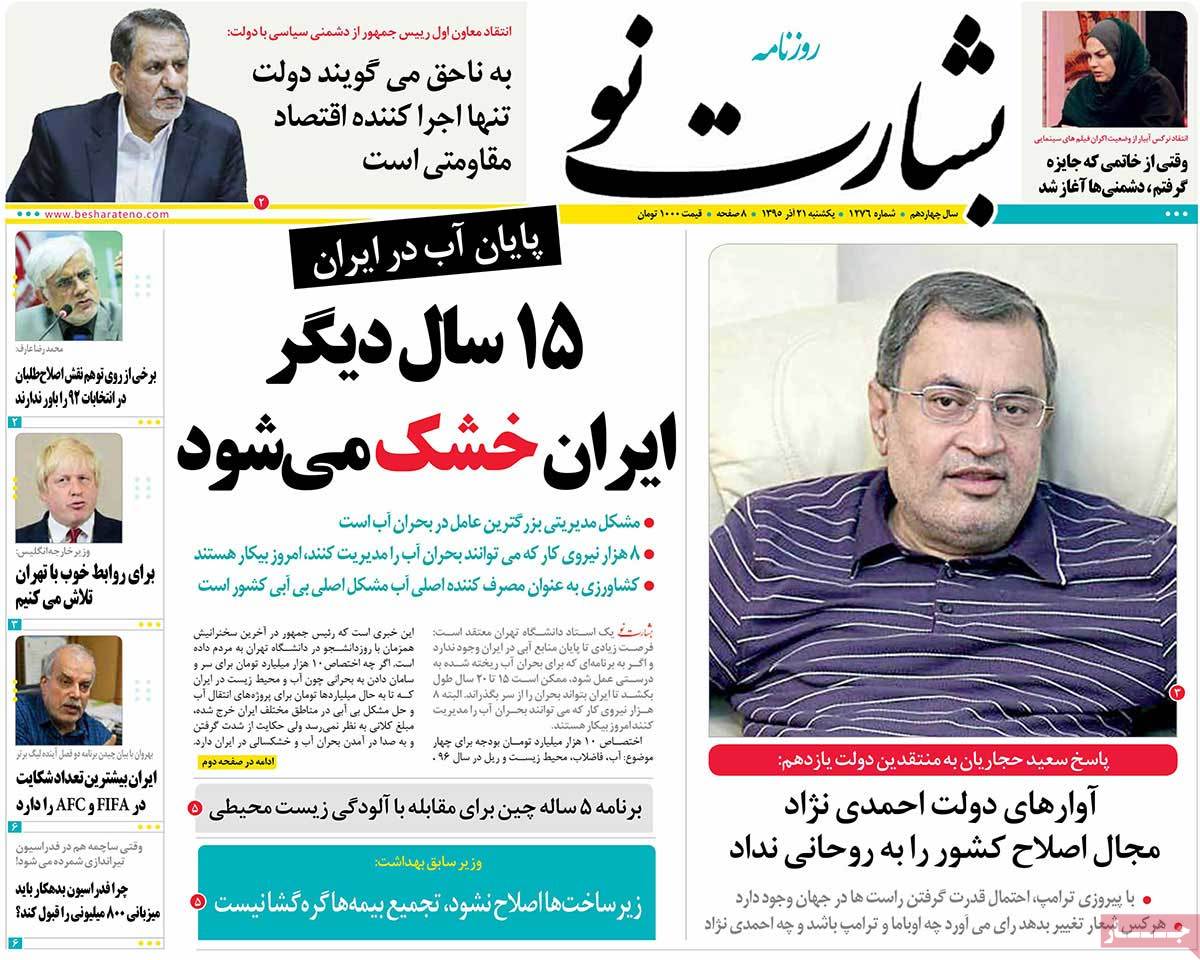
A Look at Iranian Newspaper Front Pages on December 11


Donya-ye Eqtesad:

1- What Will Be the Consequences of Trump’s Protectionism Policy? Horn of War on World Trade
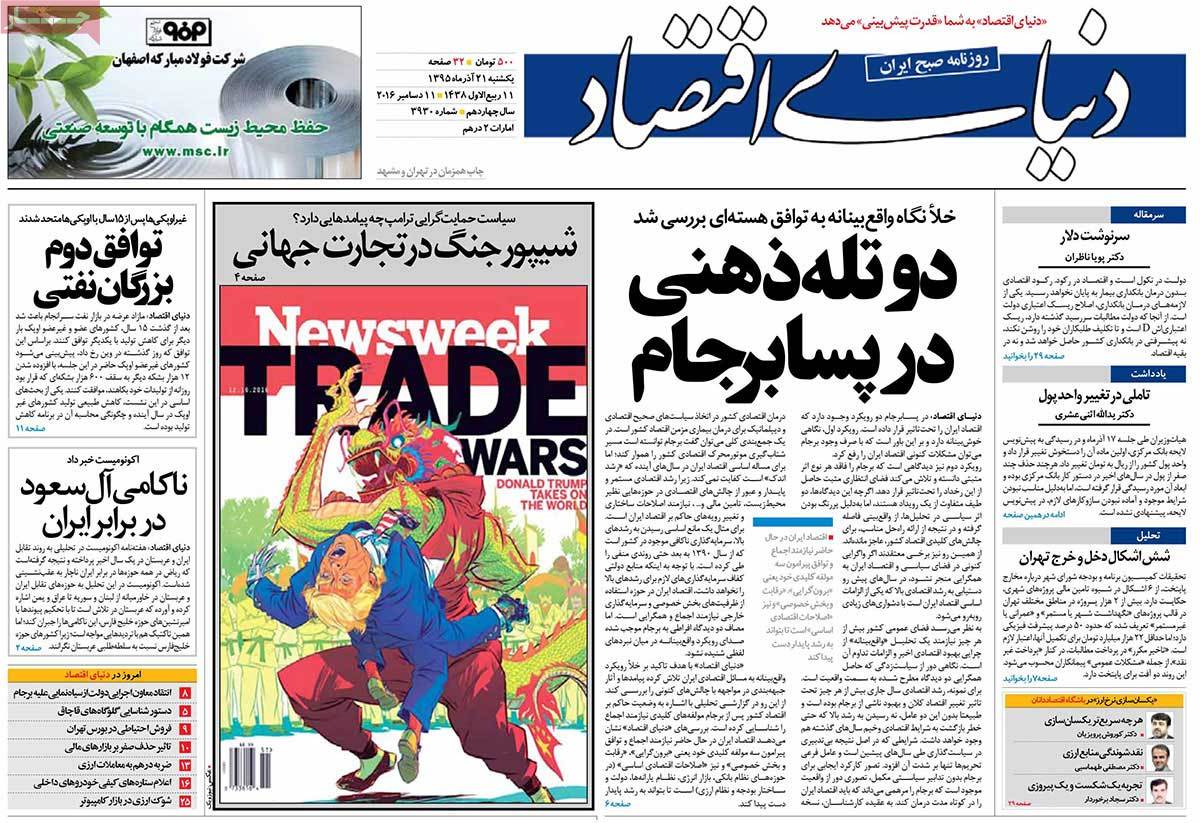
A Look at Iranian Newspaper Front Pages on December 11


Ebtekar:

1- Rubble of Cold Ceiling: Doctor in Hamadan Says Both Legs of a Homeless Man Should Be Cut Off after Frostbite

2- London’s Stances and the Art of Diplomacy [Editorial]
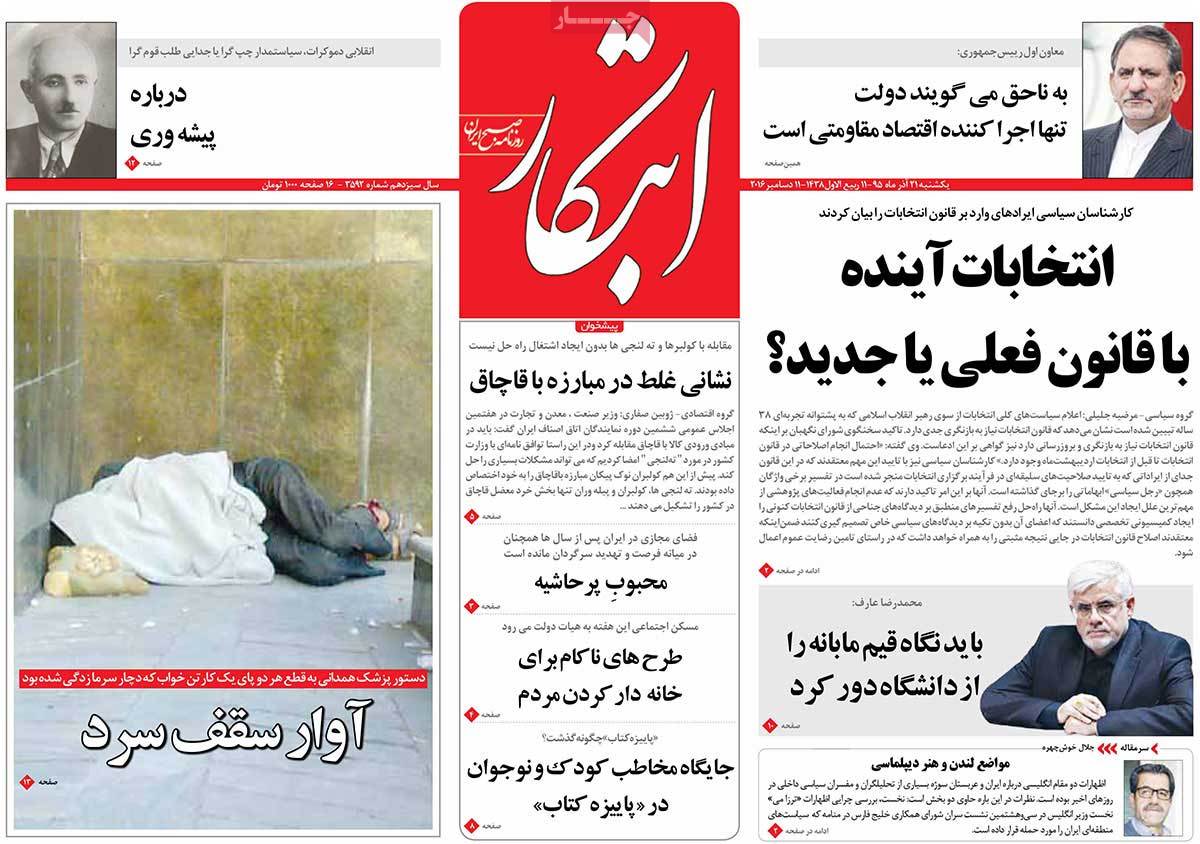
A Look at Iranian Newspaper Front Pages on December 11


Etemad:

1- Russia’s Hidden Hand behind Trump’s Victory: CIA Says Moscow Has Interfered in Spoiling Clinton’s Image

2- Iran’s Ex-Ambassador to Morocco: Saudi Arabia Has Dragged Iran into an Unwanted War

3- Adrenaline Is in Highest Level Here: A Report on Female Motorcyclists’ Training Session in Tehran
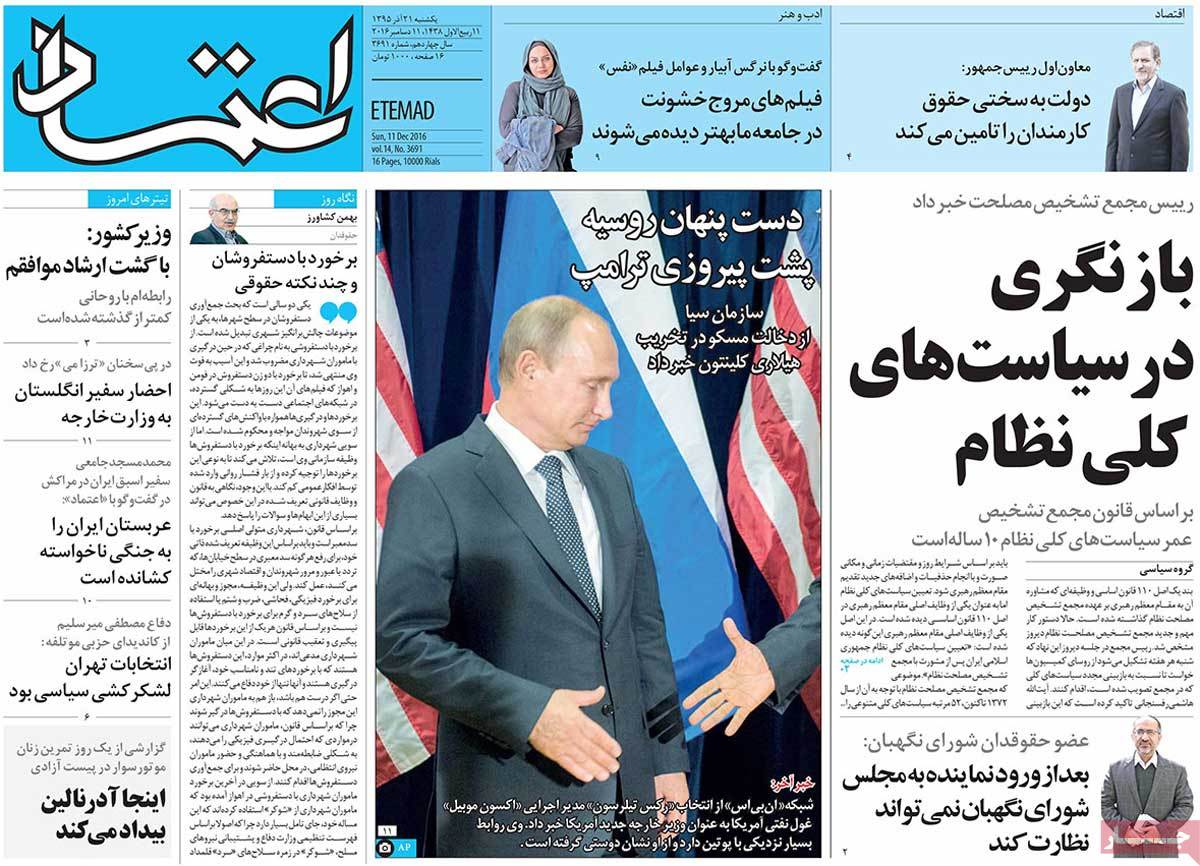
 

A Look at Iranian Newspaper Front Pages on December 11


Ettela’at:

1- Secretary General of Hezbollah: One Step Left to Victory in Syria

2- Tehran Security Conference Kicks Off with West Asian Authorities in Attendance

3- Economist: Saudi Arabia Defeated by Iran

4- Economy Minister: Impacts of Economic Growth Will Gradually Appear in People’s Lives
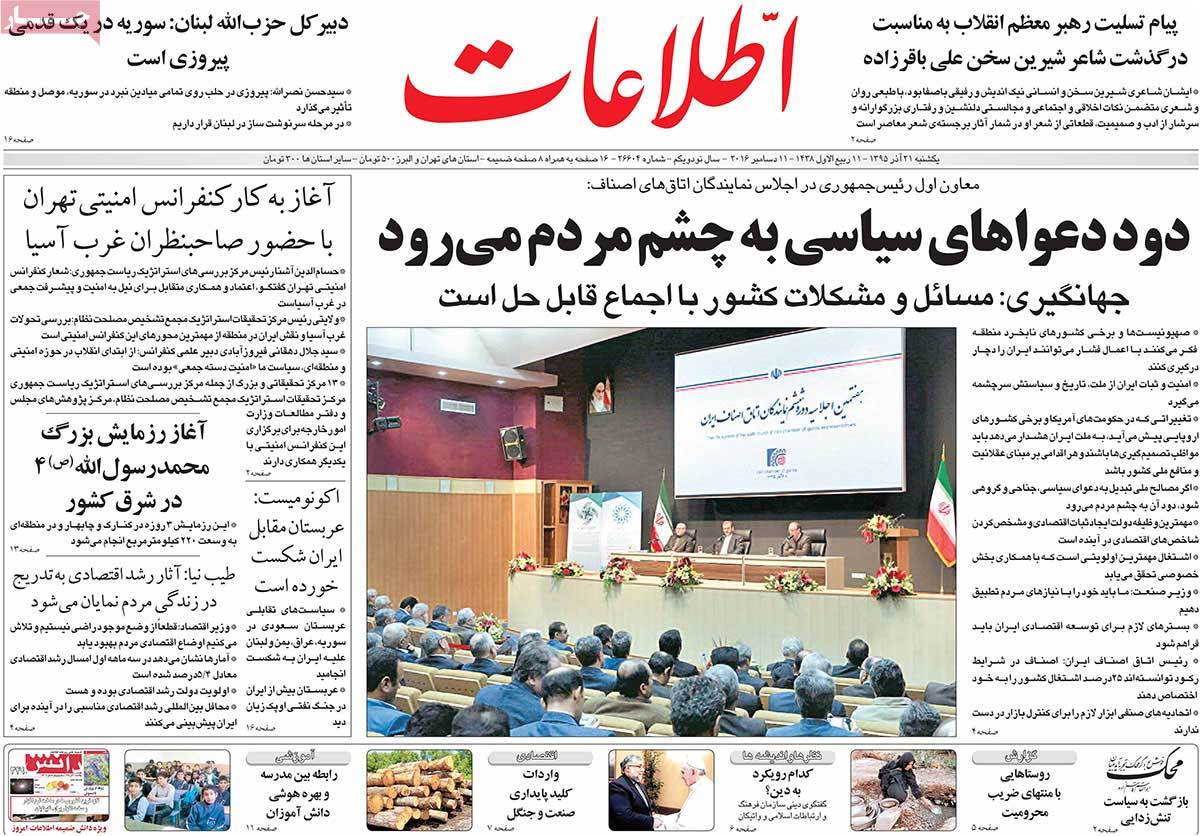
A Look at Iranian Newspaper Front Pages on December 11


Haft-e Sobh:

1- Iran Ranks Higher than Turkey and Dubai: Business Insider Puts Iran in List of Top 50 Tourist Destinations for 2017
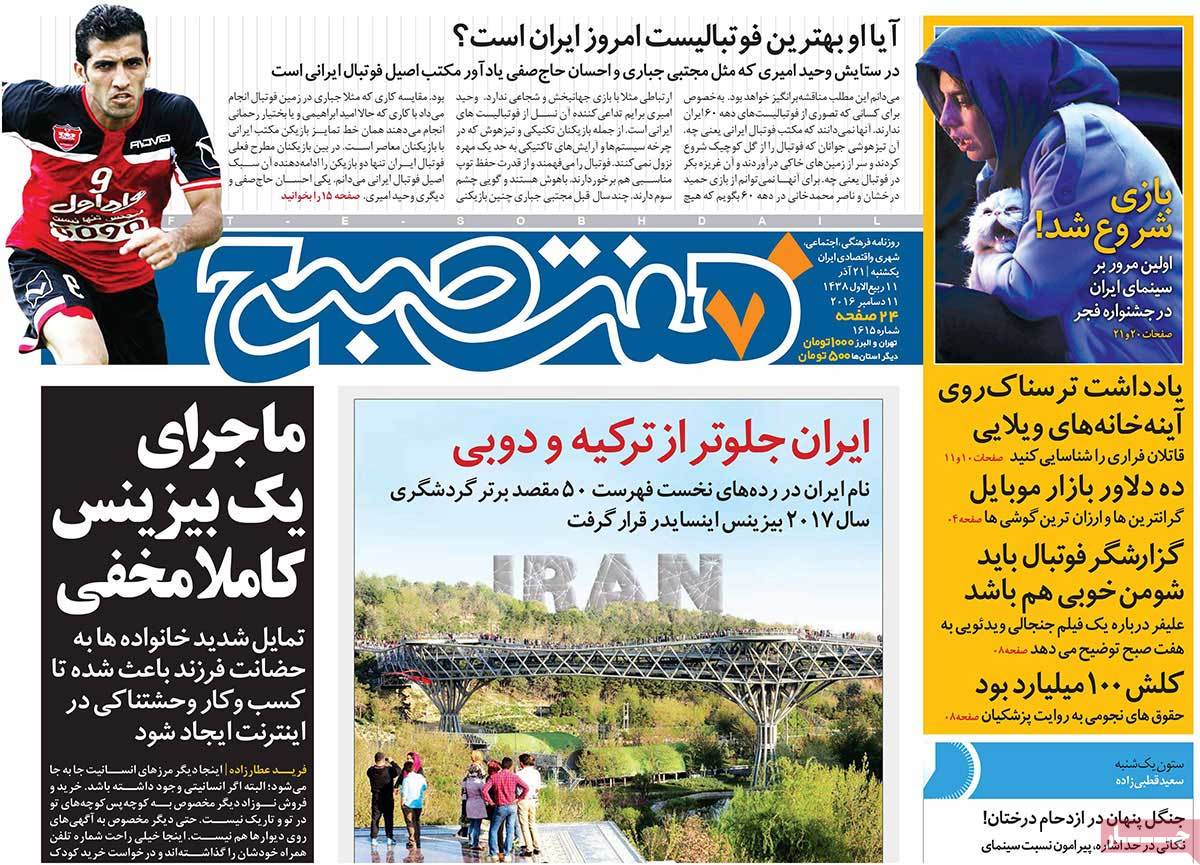
A Look at Iranian Newspaper Front Pages on December 11


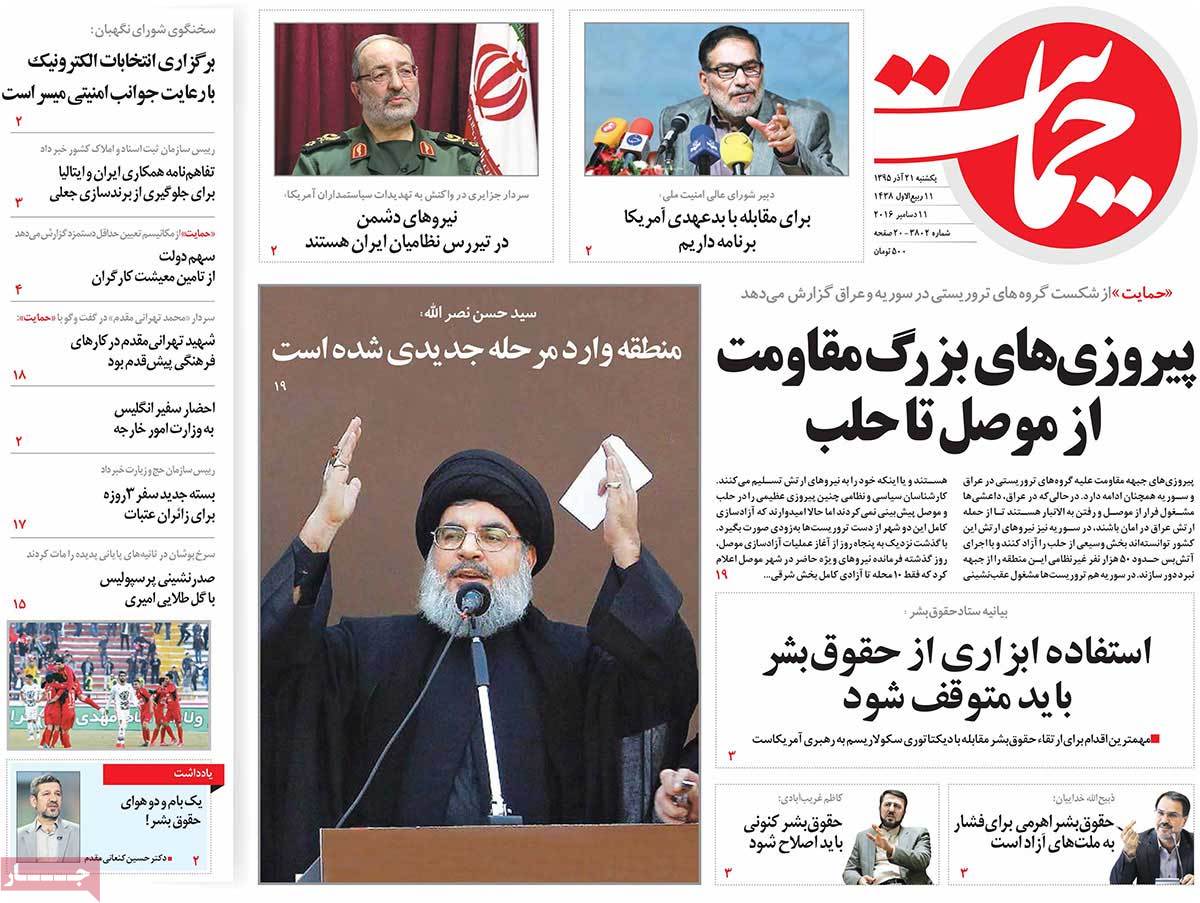
Hemayat:

1- SNSC Secretary: We Have Plans to Counter US Violation of Its Commitments

2- IRGC General: Enemy’s Forces Are within Range of Iran’s Military

3- Holding Electronic Elections Is Possible If Security Is Considered: Guardian Council Spokesman

4- Nasrallah: Region Has Entered a New Stage

5- Resistance Front’s Major Victories from Mosul to Aleppo
A Look at Iranian Newspaper Front Pages on December 11


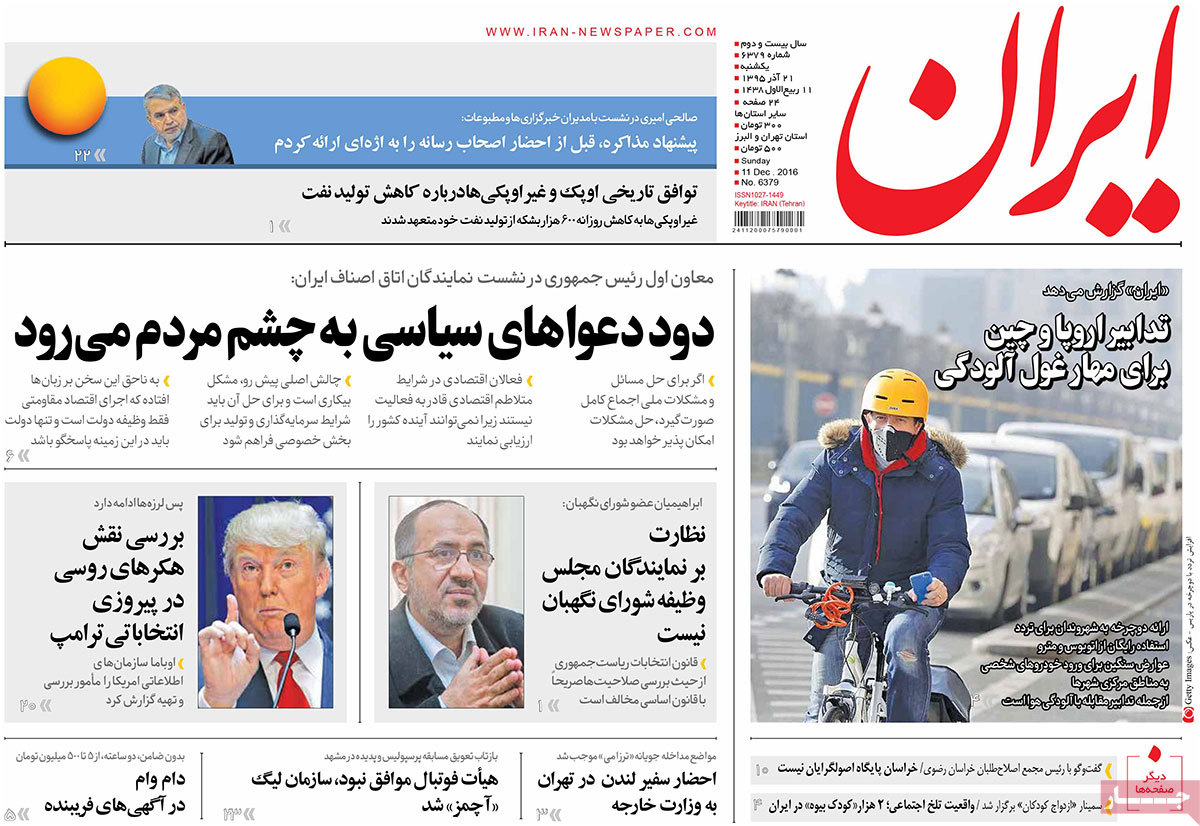
Iran:

1- Europe and China’s Plan for Controlling the Dragon of Pollution

2- First VP: People Will Be Harmed by Political Fights
A Look at Iranian Newspaper Front Pages on December 11


Jame Jam:

1- Year of Al Saud’s Defeat: Reginal and World Media Talk about Saudi Arabia’s Policies


A Look at Iranian Newspaper Front Pages on December 11


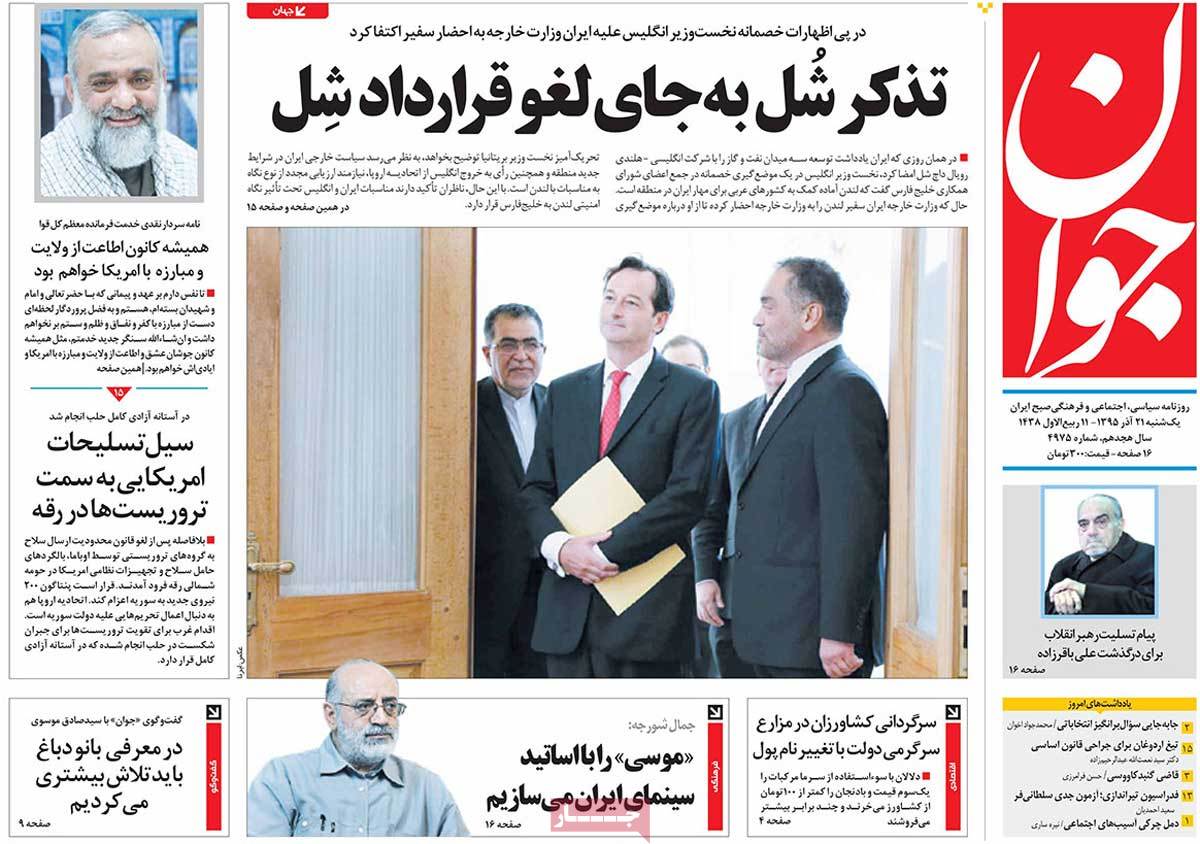
Javan:

1- Amid Imminent Liberation of Aleppo, US Send American Weapons to Terrorists in Raqqa
 

A Look at Iranian Newspaper Front Pages on December 11


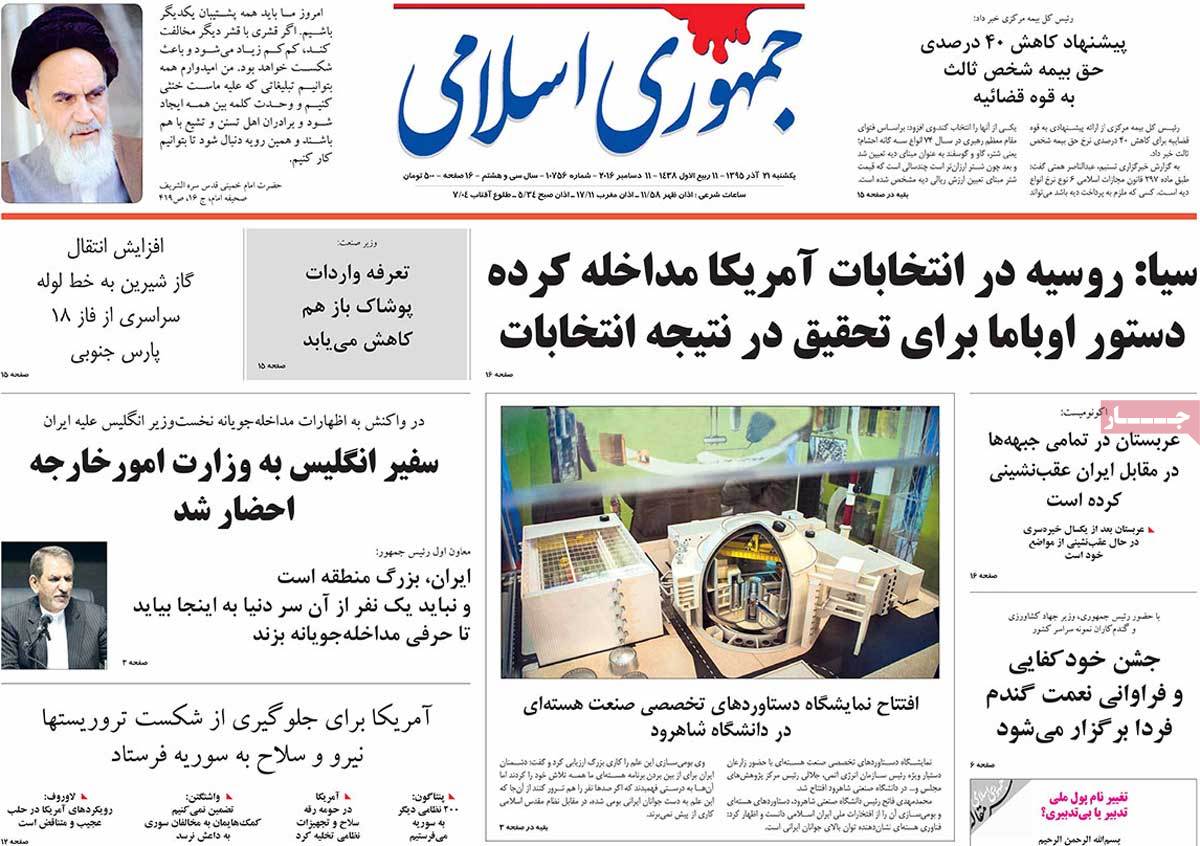
Jomhouri Eslami:

1- Iran Is a Major Power in the Middle East, and Someone Should Not Come to This Region and Make Meddlesome Remarks: First VP in Reference to Theresa May’s Remarks

2- Iran Will Celebrate Its Self-Sufficiency in Wheat Production Tomorrow

3- Economist: Saudi Arabia Has Backed Off in All Fronts in Confrontation with Iran
 

A Look at Iranian Newspaper Front Pages on December 11


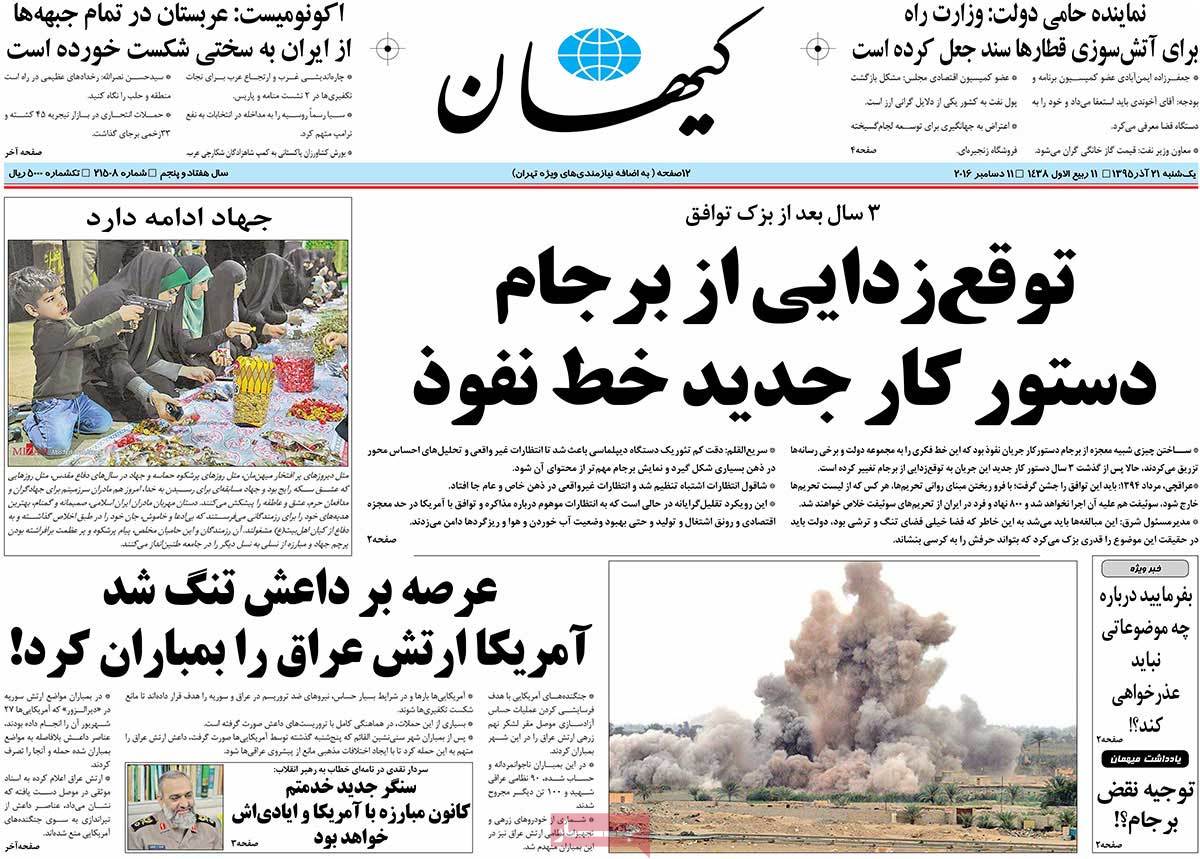
Kayhan:

1- While ISIS Is under Pressure, US Bombs Iraqi Army
A Look at Iranian Newspaper Front Pages on December 11


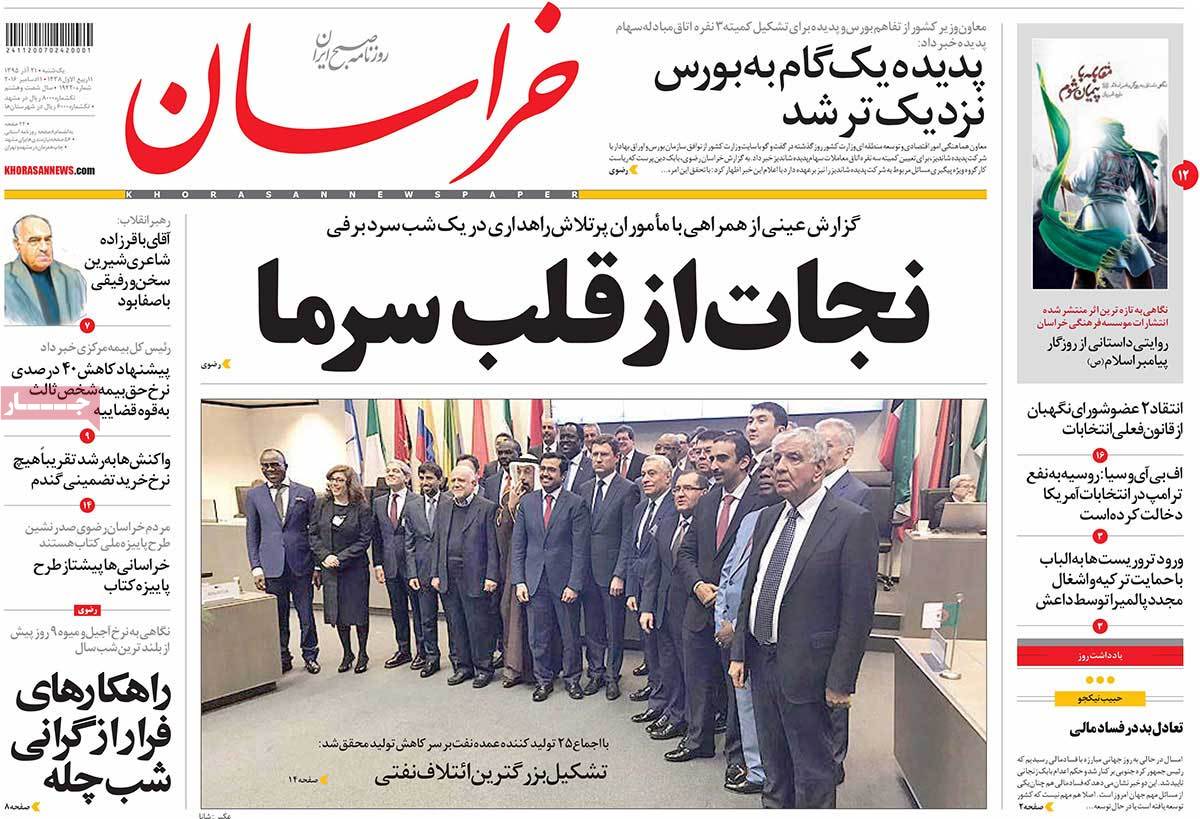
Khorasan:

1- Formation of Biggest Oil Coalition: 25 Major Oil Producers Agree on Oil Output Cut

2- Terrorists Enter Al-Bab with Turkey’s Support; ISIS Seizes Palmyra Once Again
A Look at Iranian Newspaper Front Pages on December 11


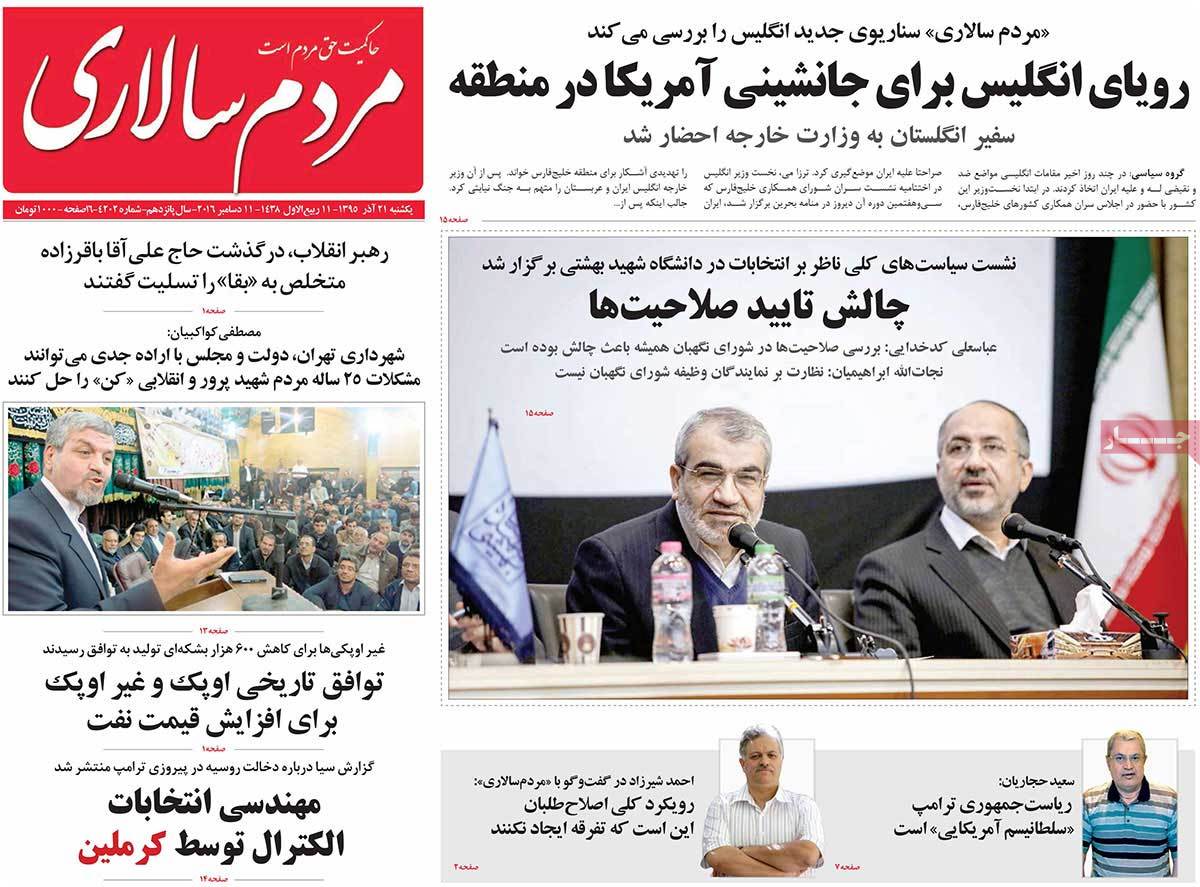
Mardom Salari:

1- Britain’s New Scenario: London’s Dream of Replacing US in Region
A Look at Iranian Newspaper Front Pages on December 11


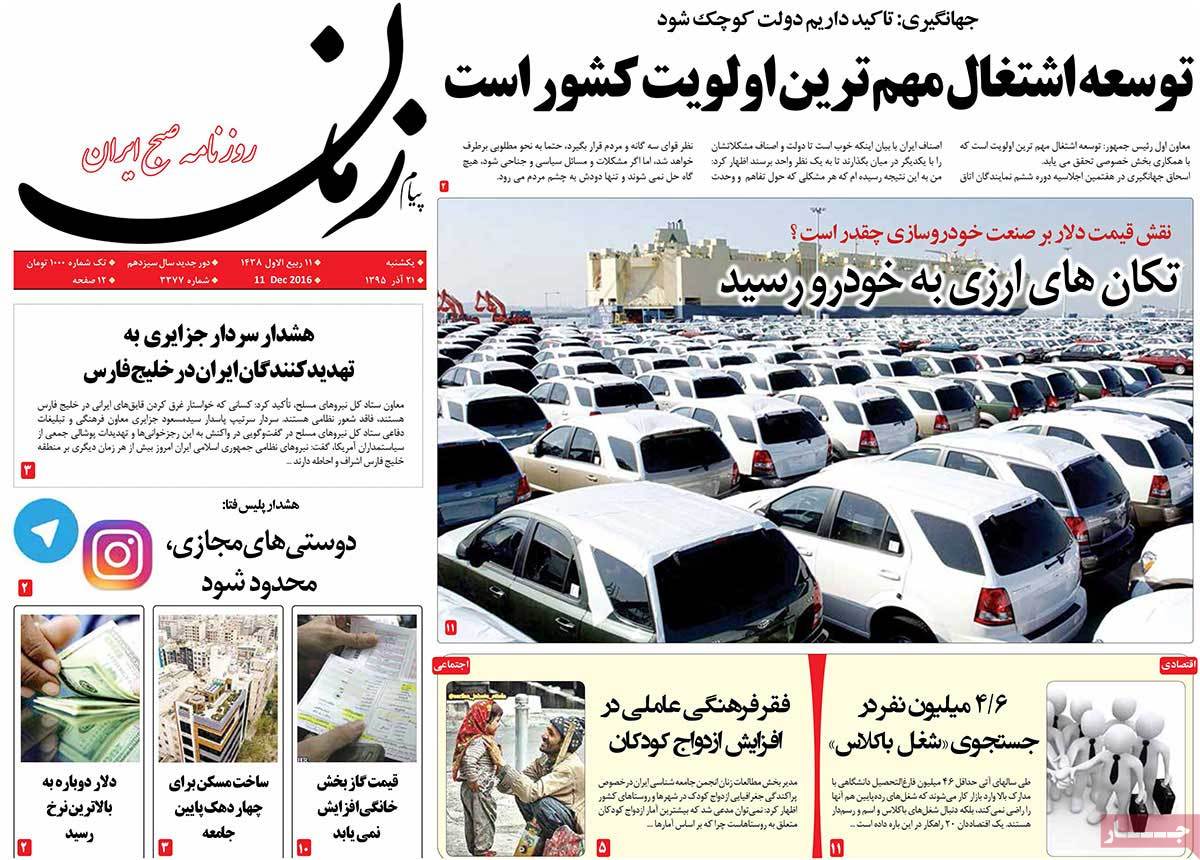
Payam-e Zaman:

1- IRGC General Warns Those Who Threaten Iran in Persian Gulf

2- Cultural Poverty, a Major Cause in Increased Child Marriage
A Look at Iranian Newspaper Front Pages on December 11


Resalat:

1- Secretary of Tehran Security Conference: A New Order Is Being Formed in Middle East

2- West Terrified of Takfiris’ Defeat in Aleppo
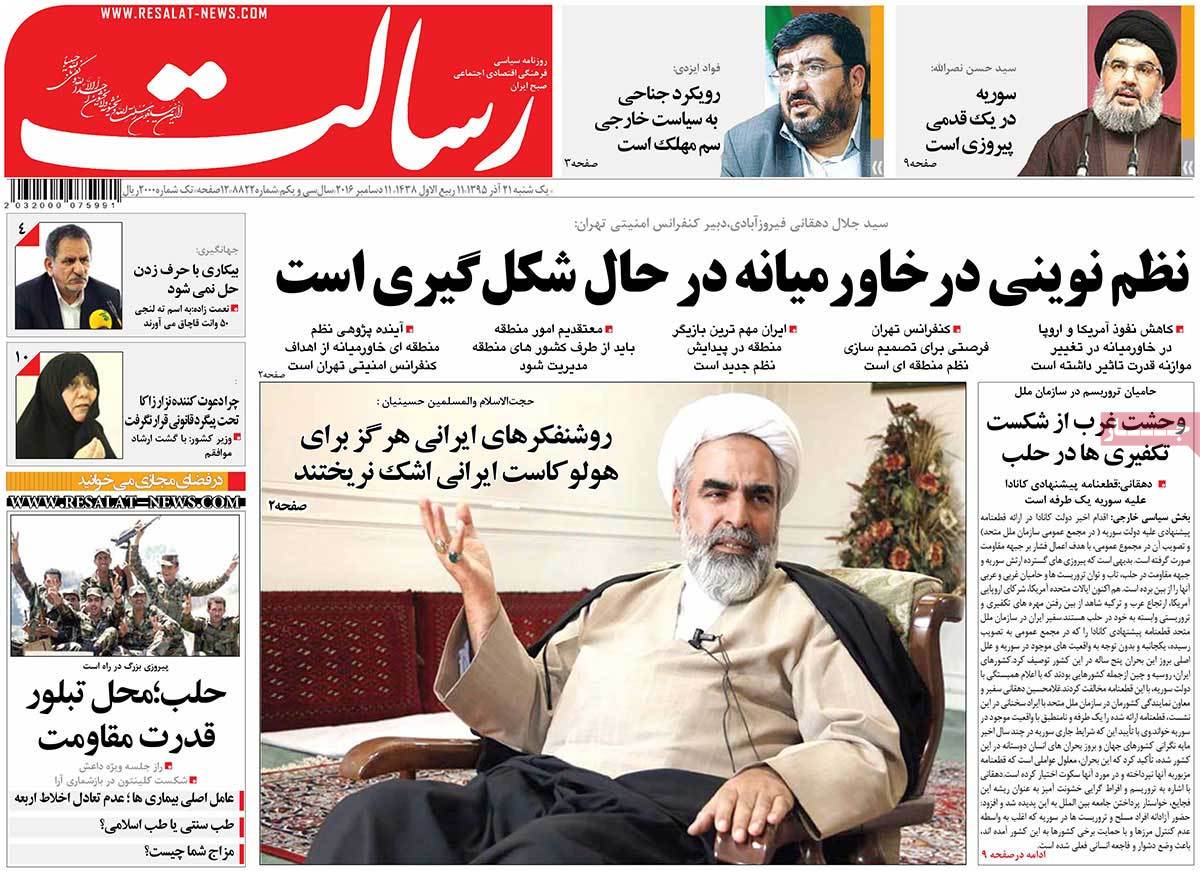
A Look at Iranian Newspaper Front Pages on December 11


Sayeh:

1- First VP in Reaction to Recent GCC Summit: No One Can Take Back Iran’s Security since Iran Has Not Received It from Others

2- IRGC General: Iran Is Very Serious in Defence and Security
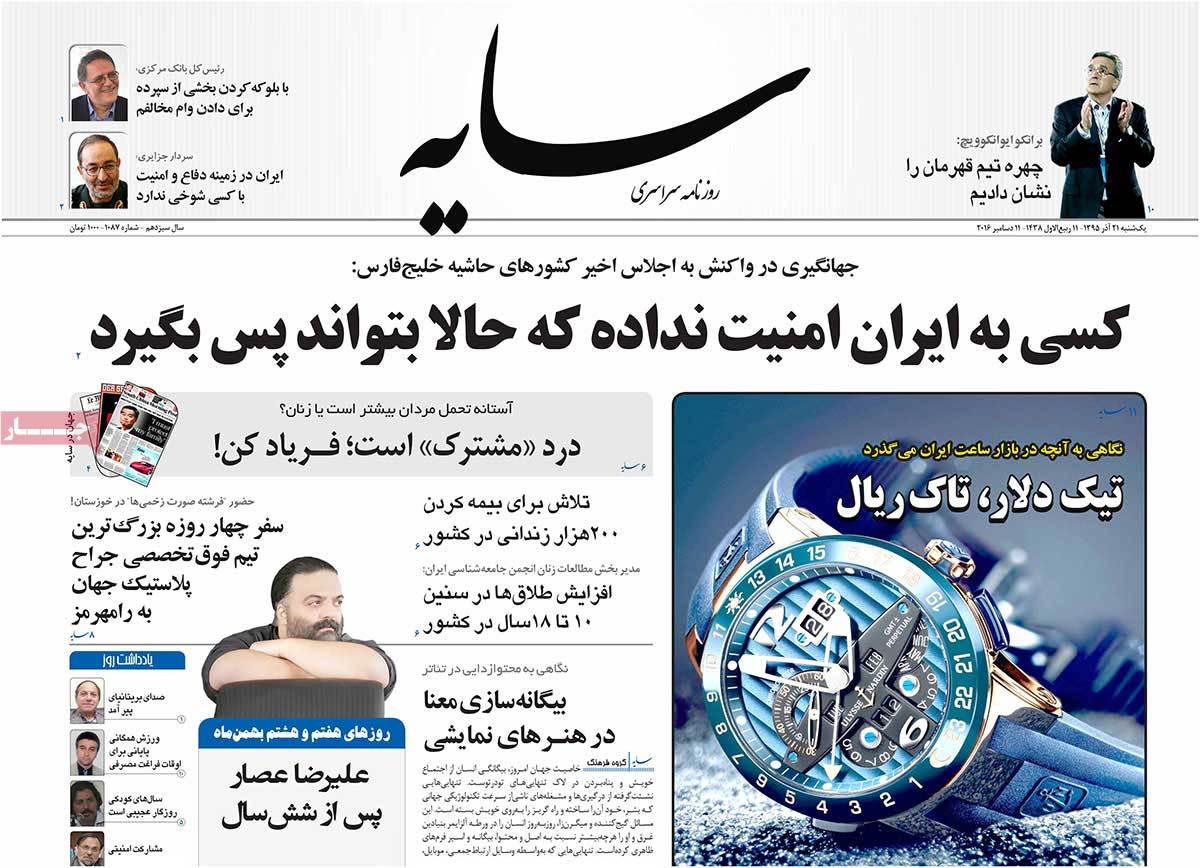
A Look at Iranian Newspaper Front Pages on December 11


Shargh:

1- Reformist Figure: Republicans Deal with Iran in a Better Way
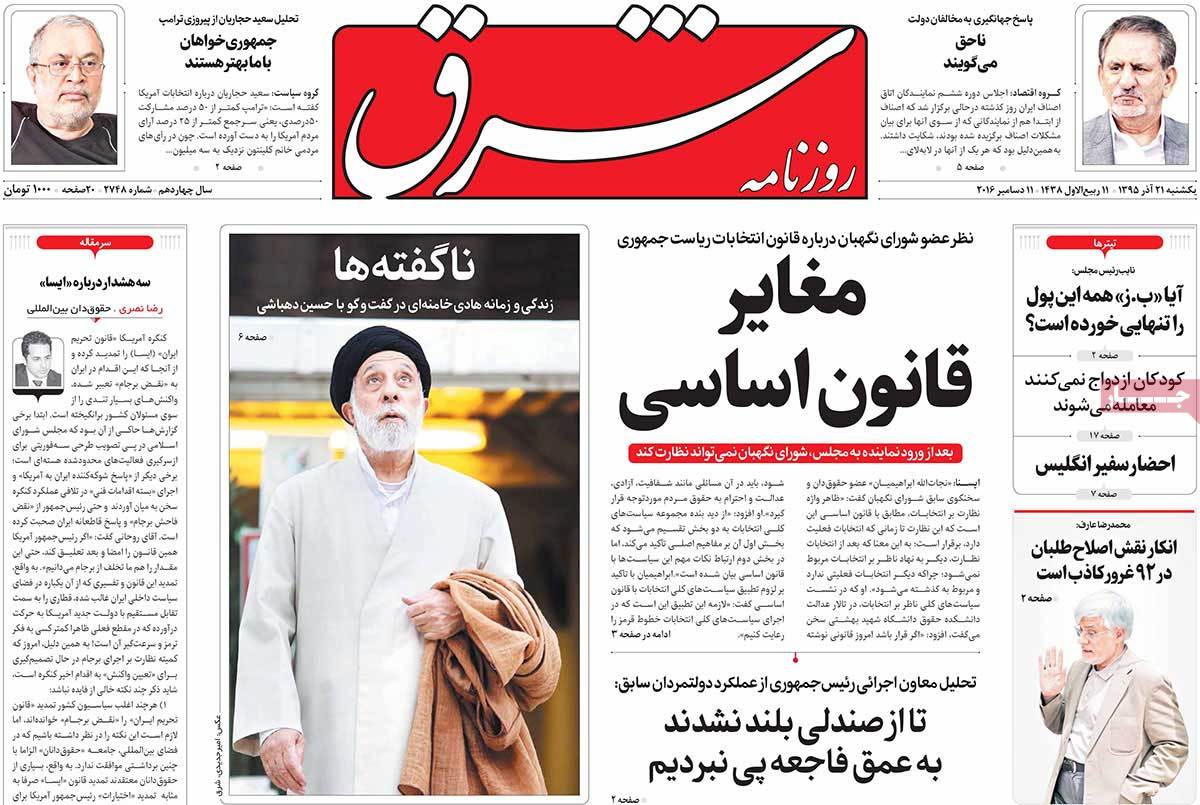
A Look at Iranian Newspaper Front Pages on December 11


Vaghaye Ettefaghieh:

1- Vessels vs Vessels: Repetitious Conflict between Iran and US in Middle East

2- The Beautiful Love Whose Name Is Freedom: A Report on Latin American Music and Songs
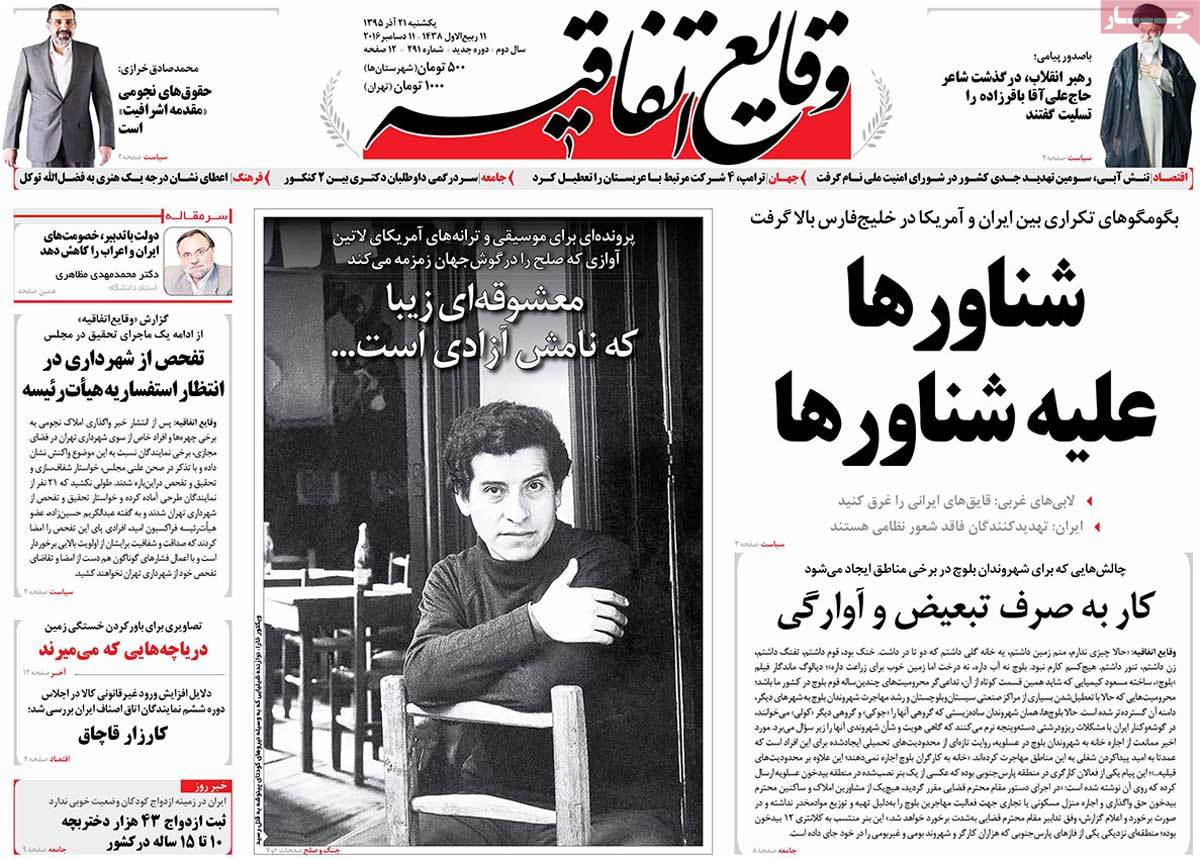
A Look at Iranian Newspaper Front Pages on December 11


Saudis Should Know Iran Is Not Their Enemy: Speaker

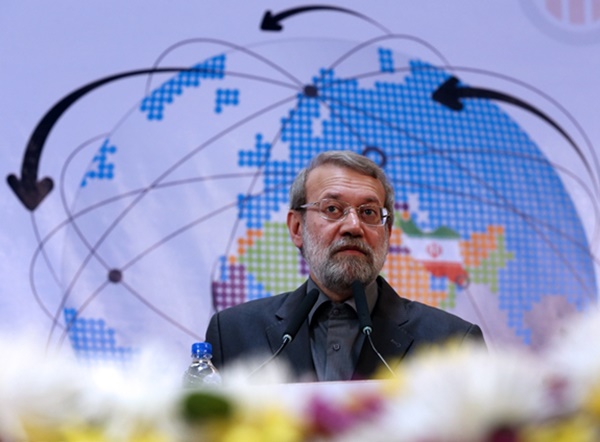
Ali Larijani

“As the problem was resolved in the case of Lebanon, all countries, particularly Saudi Arabia, should know that Iran is not their enemy and is not opposed to their positive role in the Middle East. It rather welcomes such a role,” Ali Larijani said in Tehran on Sunday, addressing the International Conference on Regional Security Order in West Asia.

“We are actually opposed to warmongering in Yemen and Syria and believe it to be wrong; therefore, we explicitly declare that we respect the role played by all Muslim countries in the Middle East in establishing peace in the region, and consider it as beneficial,” he added.

According a report by IFP, Larijani stressed that the current security chaos in the Middle East cannot be resolved in the short-term, but Iran is ready to join hands with all Muslim countries to end this crisis.

As regards the root causes of ongoing insecurity in the Middle East, Larijani pinned the blame on major world powers and certain regional states.

“Using terrorism for tactical objectives is the strategic mistake made by world powers and regional states and is the root cause of insecurity in the region,” he added.

Noting that this strategy has been pursued by world powers and regional countries since the occupation of Afghanistan by the former Soviet Union, he said that they continued this policy until today in Iraq, Libya, Syria and Yemen and “practically, this strategy has led to the spread of terrorism”, Fars reported.

“These acts of interference have been a main factor in the spread of terrorism in the region; NATO’s presence in Afghanistan for countering terrorism has been ineffective, and the war on Iraq also created terrorism in the region,” he explained.

Larijani went on to say that trans-regional powers are incapable of providing security in West Asia, describing their apparent counter-terrorism efforts as mere propaganda that plays “an influential role in creating crisis” in the region.

The social and political situation of the regional nations preclude any chance of success for foreign powers, he added, saying outsiders lack competence to ensure regional security because their interference in the region has been aimed at backing the Israeli regime, Tasnim reported.

May’s Anti-Iran Comments Part of Attempts to Evade Britain’s Crises: Official

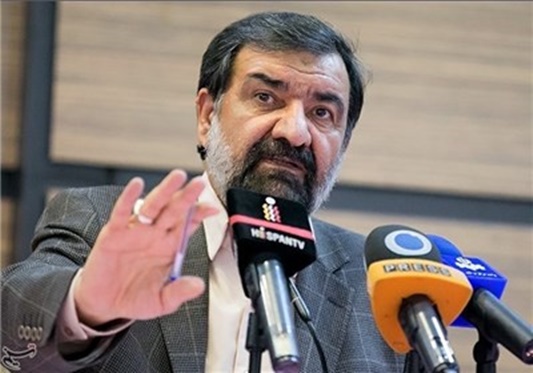
Mohsen Rezaei

“The British government is suffering an economic crisis and they resort to whatever means to get out of the crisis,” Rezaei told reporters on Sunday on the sidelines of Tehran Security conference.

“In addition to the economic crisis, the identity crisis is among the problems facing Britons,” the Iranian official added.

The British have come to the Persian Gul region to replace the US and resolve their economic and identity crises, Rezaei said.

Iran believes that “meddlesome” remarks by the British premier are part of the policy to evade the crises, he went on to say.

In a recent summit of the (Persian) Gulf Cooperation Council (PGCC) in Bahrain, May said that Britain would contribute to counteracting what she called “aggressive regional actions” from Iran, and unveiled plans for a four-billion-dollar military investment in the region for the next 10 years.

In response, Foreign Ministry Spokesman Bahram Qassemi emphasized on the same day that states whose own irresponsible interference has spread insecurity, violence and extremism are in no position to accuse others of interfering in the Middle East affairs.

Slamming London’s “futile and unconstructive” policy of resorting to divisive measures to return to the region, Qassemi said the British premier, whose country’s interests have been at stake following evolution in ties with the EU, has made the anti-Iran comments at a PGCC meeting just to appease some Arab leaders.

These stances seem to be part of British attempts to clinch new deals with the Persian Gulf Arab states to sell them arms, which will eventually aggravate the crises and war crimes against people in Yemen, Syria, Bahrain, Iraq and other regional Muslim nations, he added.