Wednesday, December 24, 2025
Home Blog Page 4132

Iran’s DM Confirms New Missile Test, Denies Breach of Nuclear Deal

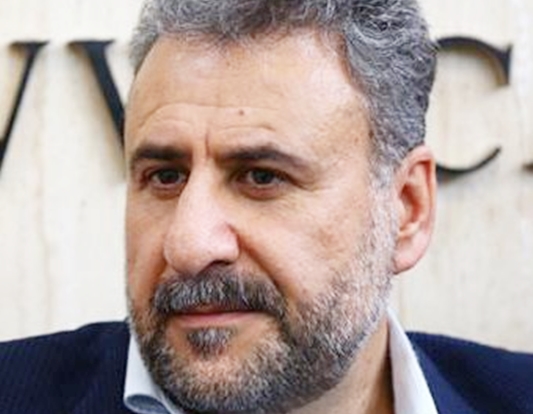
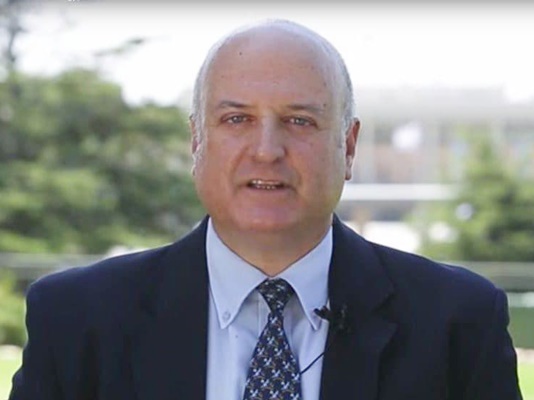
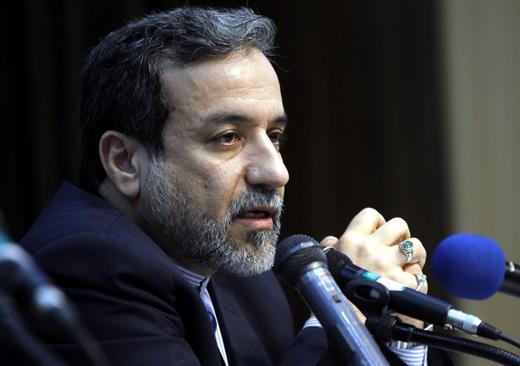
General Hossein Dehghan

“The recent (missile) test was in line with our programs, and we will not allow any outsider to interfere in our defense affairs,” Dehqan told reporters in Tehran.

He underscored that Iran’s missile tests are by no means in contravention of the Joint Comprehensive Plan of Action (JCPOA) or the UNSC Resolution 2231.

The minister also made it clear that missile tests are part of Iran’s defence plans aimed at fulfilling its national interests, saying no one could affect the country’s plans and decisions.

His comments came after US officials criticized Iran on Tuesday for what they called “provocative” and “irresponsible” measure by conducting its first missile test since Donald Trump took office.

After achievement in July 2015 of the JCPOA, a nuclear agreement between Iran and the Group 5+1 (Russia, China, the US, Britain, France and Germany), the 15-memebr United Nations Security Council passed a resolution to endorse the accord.

Resolution 2231 calls upon Iran “not to undertake any activity related to ballistic missiles designed to be capable of delivering nuclear weapons.”

Iran, however, maintains that none of its missiles have been designed to be capable of carrying nuclear warheads, because nuclear weapons have basically no place in the Islamic Republic’s defence doctrine.

Attempts to Increase Iran-Russia Distance Can Harm Fight against Terror

trump

Seyed Hossein Mousavian, a former Iranian nuclear negotiator and a senior analyst, said in an article in Huffington Post that if US President Donald Trump destroys Iran-Russia-Turkey triangle, he would destroy the chance to solve Syria crisis.

He also suggested that Trump would not manage to defeat the ISIS terrorist group if insist on religious bans.

Here is the full text of his article, entitled “Trump Cannot Afford to Shut out Iran If He Wants to Defeat ISIS”:

Throughout his campaign, US President Donald Trump vowed that confronting terrorism and destroying the self-proclaimed Islamic State would be his highest foreign policy priority. Since assuming office, however, he has taken measure after measure that exacerbates, rather than alleviates, the threat of terrorism. His “secret” plan to confront ISIS has so far turned out to just be an order to the Pentagon to develop a plan to destroy the organization ― which, according to some reports, would not be a radical departure from the current anti-ISIS campaign. Other actions he has taken or seems poised to take ― on immigration, Iran and Russia ― will actively harm efforts to combat the terrorist group.

Trump’s current foreign policy approach is not only self-defeating, but also forgoes a golden opportunity to shape a coherent strategy that would allow him to usher in a political solution to the Syrian war, destroy ISIS and repair US ties with the Kremlin. Improved U.S-Russia relations will also open the door to Moscow serving as an interlocutor facilitating mutually beneficial US-Iran engagement.

Rather than pursue strategically wise diplomacy, however, Trump has started his presidency by signing a controversial executive order on immigration; banning temporarily immigrants and visitors and from seven Muslim-majority countries ― with an indefinite ban on Syrian refugees. Not only does this move defy legal precedent, it has also torn apart countless families and upended lives across the world. By failing to distinguish between extremists and the vast majority of peaceful Muslims, the racially inflammatory executive order also utterly fails in its aim of thwarting terrorism and in fact is a boon to terrorist groups like ISIS. It bars over 200 million people from entry in the United States, even as studies have shown that no individuals from these countries have committed terrorist attacks on US soil.

As Iranian Foreign Minister Javad Zarif has said, the ban is a “great gift to extremists” and “aids terrorist recruitment by deepening fault-lines exploited by extremist demagogues.” The Iranian Foreign Ministry also responded to Trump orders by stating it was “considering” taking a reciprocal action, but unlike the US ban, will not apply it to Americans who already have visas. Iran is one of the seven Muslim-majority countries targeted by Trump’s executive order.

Millions of people of Iranian background in America and across the world have been affected ― whether it be because they are on student or work visas, have green cards, or are dual-Iranian nationals with any other country. Iranian-Americans, for their part, have contributed immensely to US society and are among America’s most successful immigrant groups. This ban not only reinforces elements in Iran which have always argued that the US government cannot be trusted, but also signals to Iranians of every political stripe that Washington views them with discriminatory disdain.

Trump Poised to Pursue Self-Defeating Syria, ISIS Strategies

On top of the executive order, which promises to add fuel to the war in Syria by empowering groups like ISIS, unsubstantiated rumours are circulating that the Trump administration wishes to reach a solution in Syria at the expense of Iran. If so, this is a recipe for disaster and will guarantee the failure of diplomacy. Iran, long at the forefront of the fight against ISIS, has significant leverage on the ground in Syria and has participated in the Geneva process since 2015. It is eager to use its leverage to reduce the level of violence and bring about a lasting peace in Syria. But if the US tries to forcefully exclude it from negotiations and approach it in a zero-sum manner, it will have no choice but to use the many tools available to it to thwart such efforts.

Iran’s important role in Syria was demonstrated last week in two days of landmark negotiations over the Syrian war in Astana, Kazakhstan.

The talks marked the first time in nearly six years of war that representatives of the Syrian government and armed opposition negotiated directly. Brokered by Turkey, Iran and Russia ― the latter two the Syrian government’s main backers and the former a leading supporter of the rebels ― the negotiations ended with a signed agreement by the outside powers to uphold the fragile country-wide cease-fire and set up a trilateral body to monitor and enforce it.

By bringing the government and opposition together and solidifying support for the cease-fire, the three convening powers moved the warring parties one step closer to a political agreement. The joint statement they released at the end of the talks also affirmed their support for the underlying principles of the Geneva process, the peace talks led for years by the United Nations and the United States. While the Geneva process has long stalled and struggled to implement its agreed-to principles, the Iran-Russia-Turkey-led diplomatic initiative, as exemplified by Astana, has proven able to bring together the real stakeholders in the conflict, both inside and outside the country. If complemented with the Geneva framework as planned, a peaceful settlement to the Syria crisis ― and an end to the suffering of millions of innocents ― will be in reach.

2

Russia and Iran must be on board in diplomatic efforts

The fact that Iran joined Russia and Turkey in driving the Astana talks, which relegated US participation to observer status and saw no Saudi participation, is a testament to its importance in delivering a viable peace in Syria. At a recent conference in the Middle East, a senior Arab official divulged to me how the Saudi leadership feels overstretched in the region and entangled in Yemen, where they are increasingly dedicating the lion’s share of their capabilities and resources. At the same time, the official told me, the Saudis feel their efforts in Syria have resulted in blowback, given that their preferred groups have either been overtaken or outright co-opted by terrorist groups. As a result, Saudi Arabia did not go to the Astana talks, but the Syrian opposition High Negotiations Committee ― founded in Saudi Arabia in 2016 ―decided to lend its support to the anti-government military delegation going to Astana after debating the matter for two days in Riyadh.

Attempting to increase distance between Iran and Russia will not only be a moot effort, but will also harm regional cooperation and prospects necessary to end the Syrian war.

Having Iran on board is crucial if any peace talks are to be successful. Russia is currently serving as the bridge between Iran and Turkey ― which is de-facto representing Saudi and Gulf Cooperation Council interests ― and is attempting to increase areas of commonality between the two countries. As Trump pursues diplomacy with Russia, it is critical that he recognize the importance of the Russian-Iranian relationship both in combatting terrorism and facilitating a political solution in Syria and elsewhere in the region. Attempting to increase distance between Iran and Russia will not only be a moot effort, but will also harm regional cooperation and prospects for the inclusive diplomacy necessary to end the Syrian war.

3

It would be in the interests of the United States if Trump were to have a positive, win-win mentality in approaching Russia and Iran. While his current approach will almost certainly greatly worsen America’s quagmires in the Middle East and make the threat of terrorism all the more difficult to effectively address, the potential exists for him to choose another path and score major achievements. If Trump elected a more diplomatic and inclusive foreign policy, he could simultaneously achieve four accomplishments: Improve ties with Russia, facilitate a resolution to the Syrian crisis, eradicate ISIS, and through Russian mediation, work to mend US-Iran ties. If such a reality comes to pass, a truly effective coalition will emerge that can manage other regional crises as well.

On the other hand, if Trump tries to sabotage Russian-Turkish-Iranian dialogue, any hope he has in defeating ISIS and diminishing the terrorist threat in the Levant will be eliminated. Furthermore, Trump should know that Iran and Russia are neighbours, and that strong relations between them is a strategic imperative for both of them. Improving the US-Russia relationship should not be envisioned as coming at the cost of Iran-Russia relations. First and foremost, it will simply not work, as it is far beyond the imagination of Russian policy makers that they can count on the United States as a stable, long-term partner in the same way they can of Iran. Secondly, in the region currently, Russia and Iran are bearing a maximum level of burden for keeping regional states intact, while the United States is bearing a minimum amount, a reality which binds them to each other. The region is on the verge of total collapse, and Russia, the US and Iran should welcome collective cooperation to prevent all-encompassing chaos.

If Trump adopts an inclusive, diplomatic foreign policy, he can achieve four things: Improve ties with Russia, facilitate a resolution to the Syrian crisis, eradicate ISIS and work to mend US-Iran ties.

*Seyed Hossein Mousavian is a Middle East security and nuclear policy specialist at Woodrow Wilson School of Princeton University and author of “Iran and the United States: An Insider’s View on the Failed Past and the Road to Peace.”

Some Nations Affected by Trump’s Visa Ban May Stay on List after 90 Days

Trump

Under the order released on Friday, travellers from Iran, Iraq, Libya, Somalia, Sudan, Syria and Yemen may not enter the country for at least 90 days while Kelly and others determine whether there is enough information available to screen them.

“Some of those countries that are currently on the list may not be taken off the list anytime soon, if they are countries that are in various states of collapse, as an example,” Kelly told a press conference.

Kelly said others may be added if it is determined they “could tighten up their procedures” to ensure more secure vetting, Reuters reported.

Trump’s Actions Reminiscent of Hitler: Palme d’Or Winner

shahab hosseini

“It is unfortunate that the world is placed in a conflicting process of science and technology progress and regression of human culture. All around the world we see leaders are guiding the world into the darkness of ignorance instead of the light of consciousness,” Hosseini, a Palme d’Or winner, wrote on his Instagram.

“They advance discord, hatred, division and racism among human societies under any excuse. But nations, unlike their leaders, move toward freedom and unity,” he noted, as reported by ISNA.

Hosseini referred to the executive order recently signed by US President Donald Trump to prevent citizens of several Muslim countries from entering the US, saying that it reminds one of the black era in the late 1930s and 1940s and the rise of Adolf Hitler which had disastrous consequences that will not be erased from world’s memory.

“The fate of all tyrants and criminals of history is like a mirror in front of human beings, especially Trump and his supporters, through which they learn about the past. As an actor and director, I suggest that Hollywood filmmakers put the making of a movie about the king of Shinar Nimrod on their agenda. Nimrod was the king who claimed he is the Lord of the world but was killed by a mosquito,” Hosseini added.

Shahab Hosseini’s reaction came after Taraneh Alidousti, the other star of “The Salesman,” and Asghar Farhadi announced that they would boycott the Oscars ceremony in protest at Trump’s visa ban.

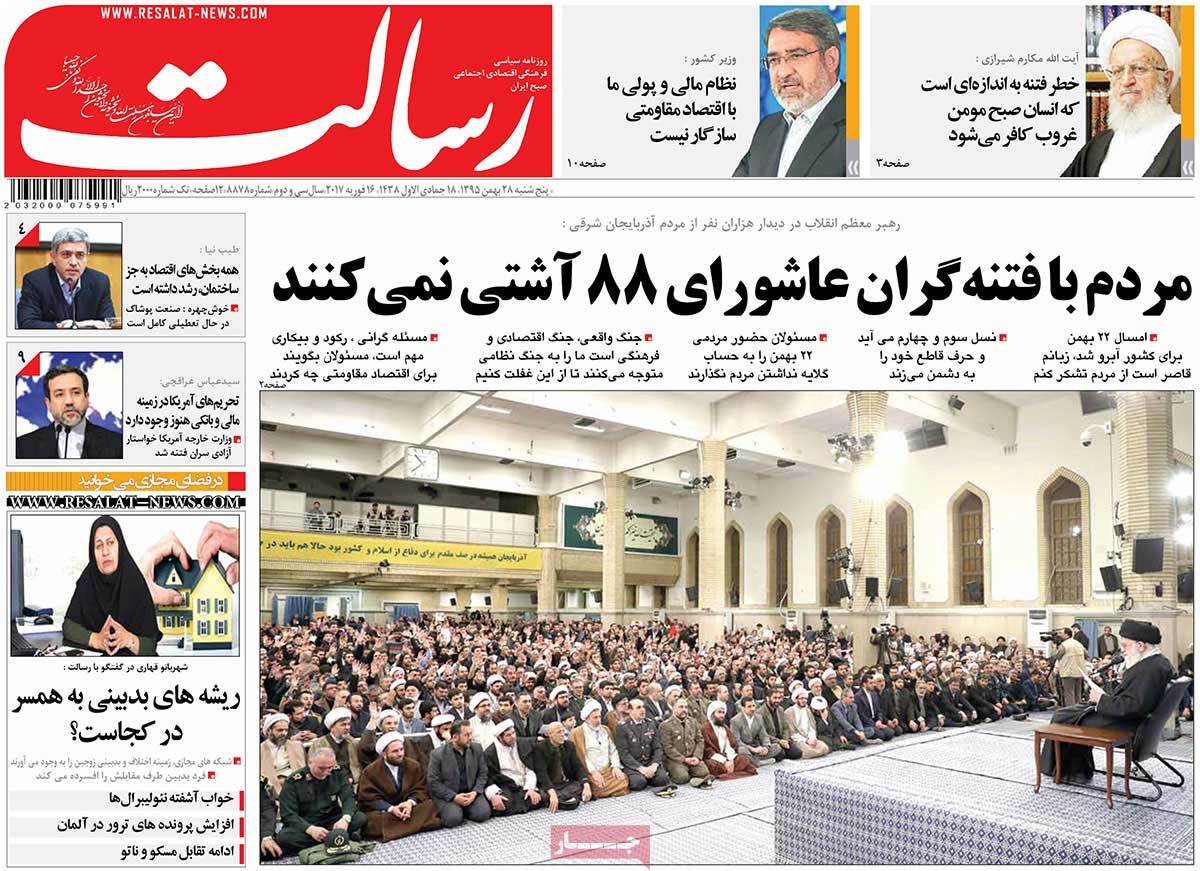
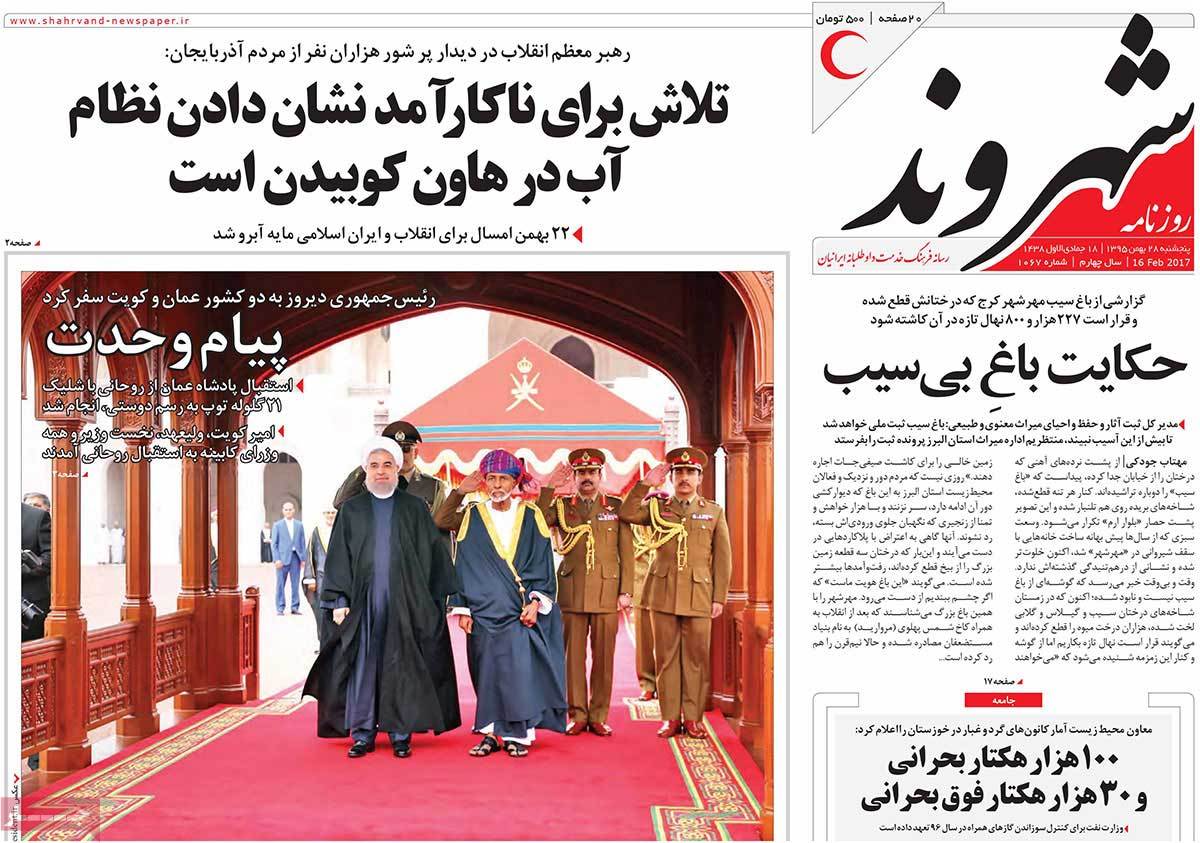
A Look at Iranian Newspaper Front Pages on February 1

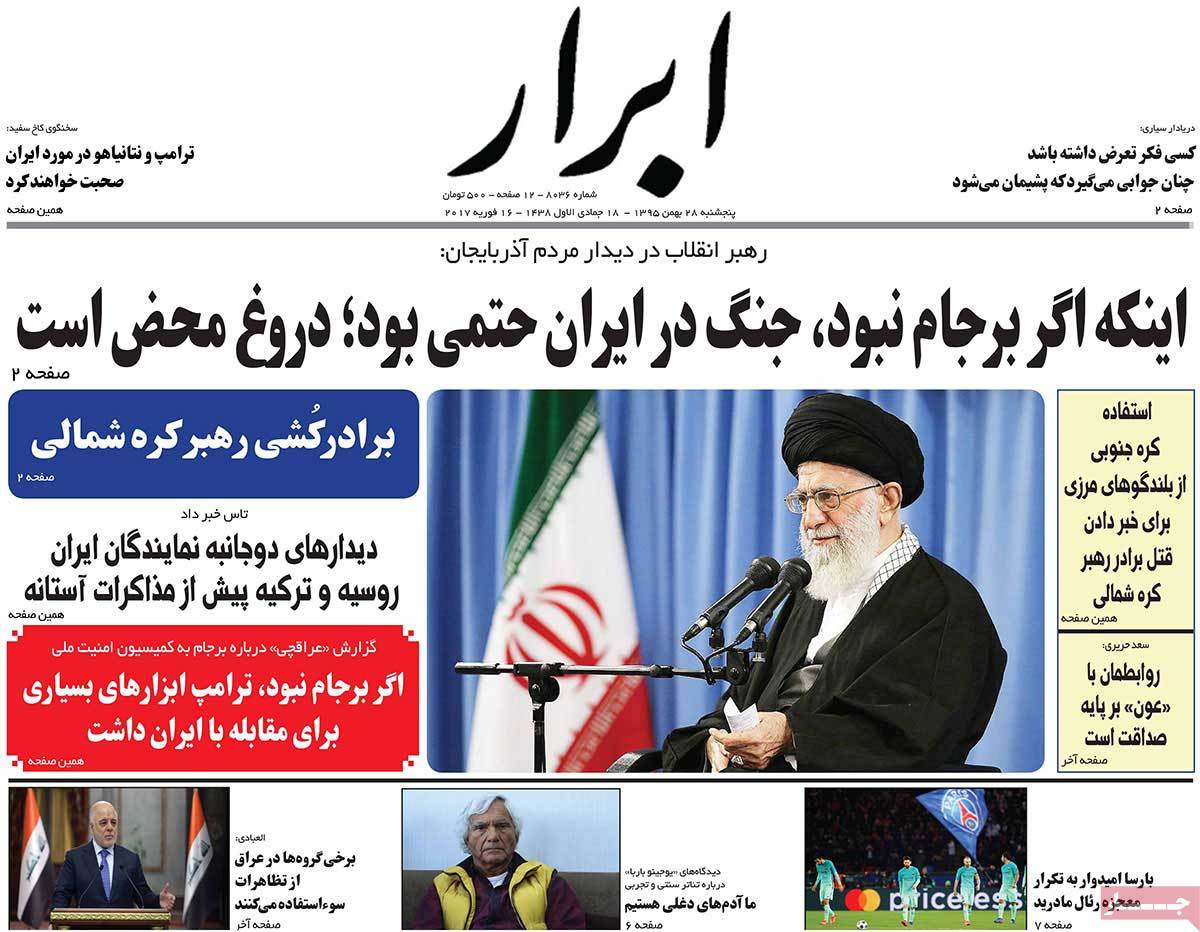
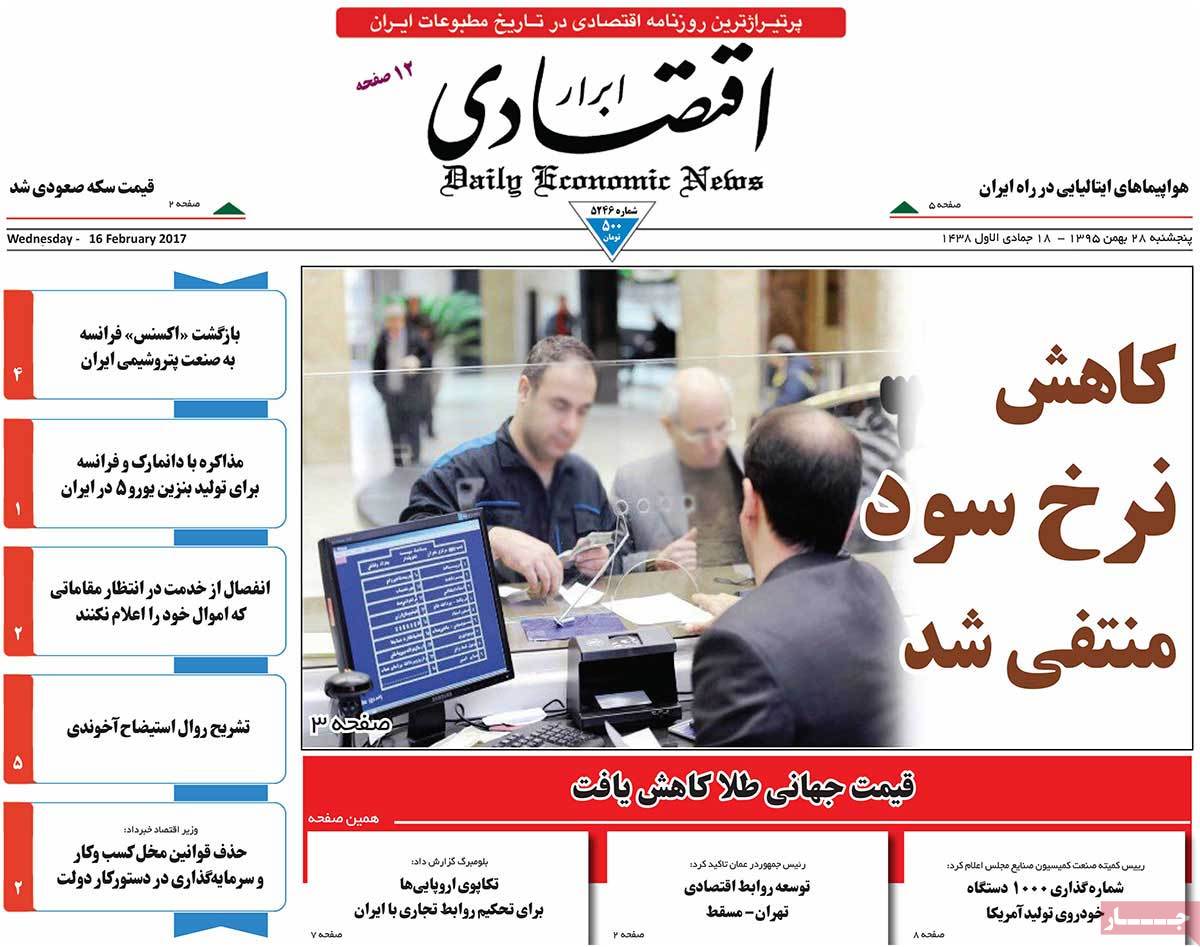
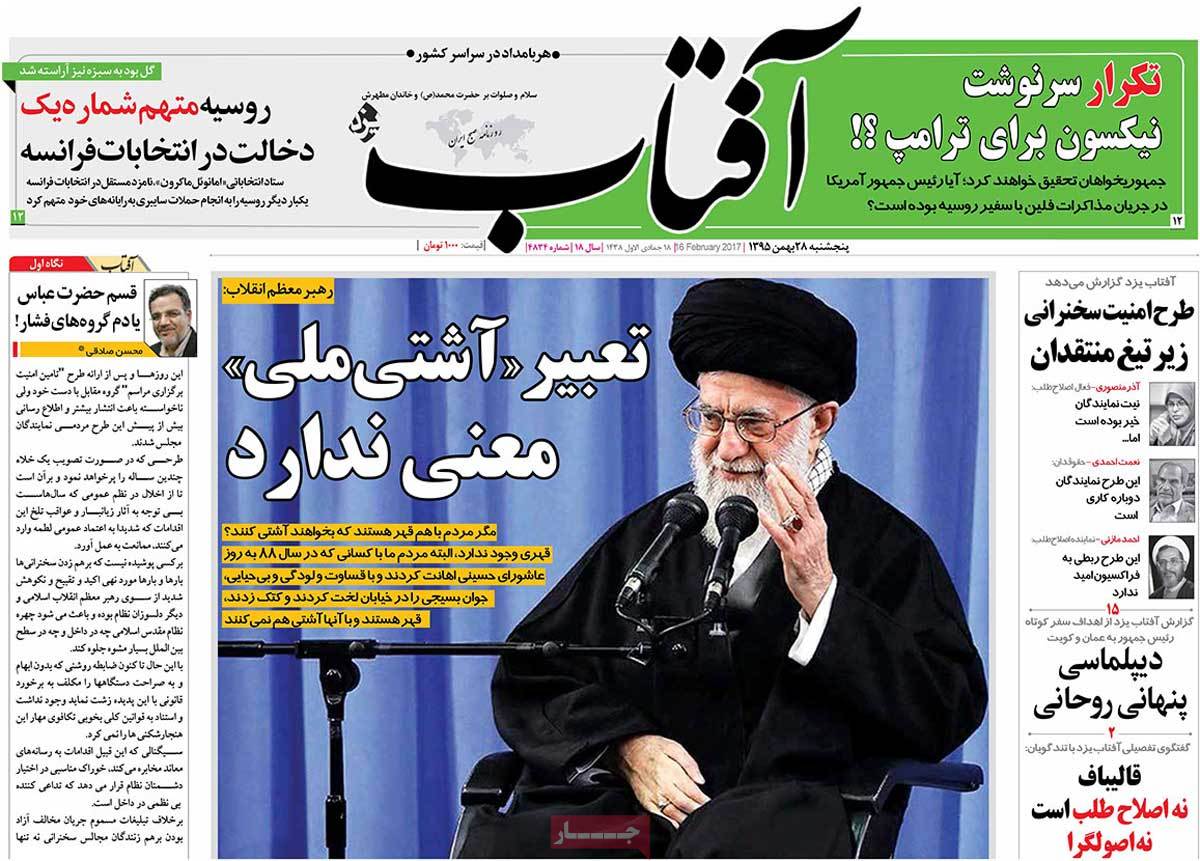
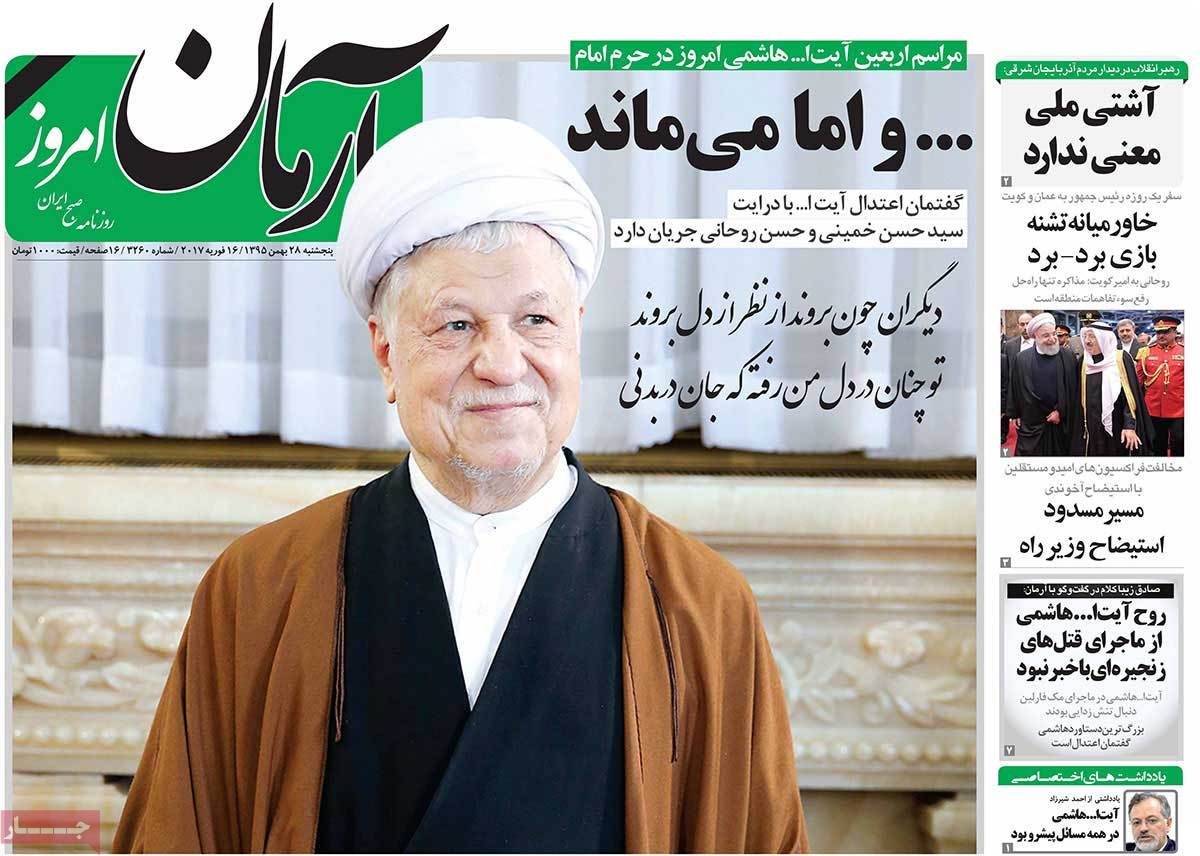
Newspapers today covered the visit of Jean-Marc Ayrault, the Foreign Minister of France, to Tehran and his meetings with high-ranking Iranian officials. His remarks about Iran’s missile test were widely criticized by conservative papers today.

US President Donald Trump’s travel ban that prevents citizens of seven Muslim-majority countries including Iran also remained a top story on Wednesday.

The 38th anniversary of Iran’s 1979 Revolution and the beginning of the ten-day celebrations also received great coverage.

The above issues, as well as many more, are highlighted in the following headlines:


Afkar:

1- Iranian Embassies Receive Directives after Trump’s Travel Ban: Iranian Spokesman

2- Wargames in High Seas Should Be Based on Int’l Laws

3- Assad: War on Syria Not Limited to Military Aspect

A Look at Iranian Newspaper Front Pages on February 1


Aftab-e Yazd:

1- A Report about Lives of Porters Who Import Contraband Goods on Their Shoulders through Mountains: They Do It for $1.3 per Kilogram

2- Parts of Dead Bodies Found in Place Where Plasco Building’s Debris Was Unloaded

A Look at Iranian Newspaper Front Pages on February 1


Amin:

1- Zarif in Joint Press Conference with French Counterpart: We Won’t Wait for Others’ Permission in Defending Ourselves

2- Wheels of Iran’s Economy Are Turning

A Look at Iranian Newspaper Front Pages on February 1


Arman-e Emrooz:

1- Destroying People’s Hope Is a Treason

2- IRGC General: Ayatollah Hashemi Rafsanjani Was the One Who Provided Iran with Missiles

A Look at Iranian Newspaper Front Pages on February 1


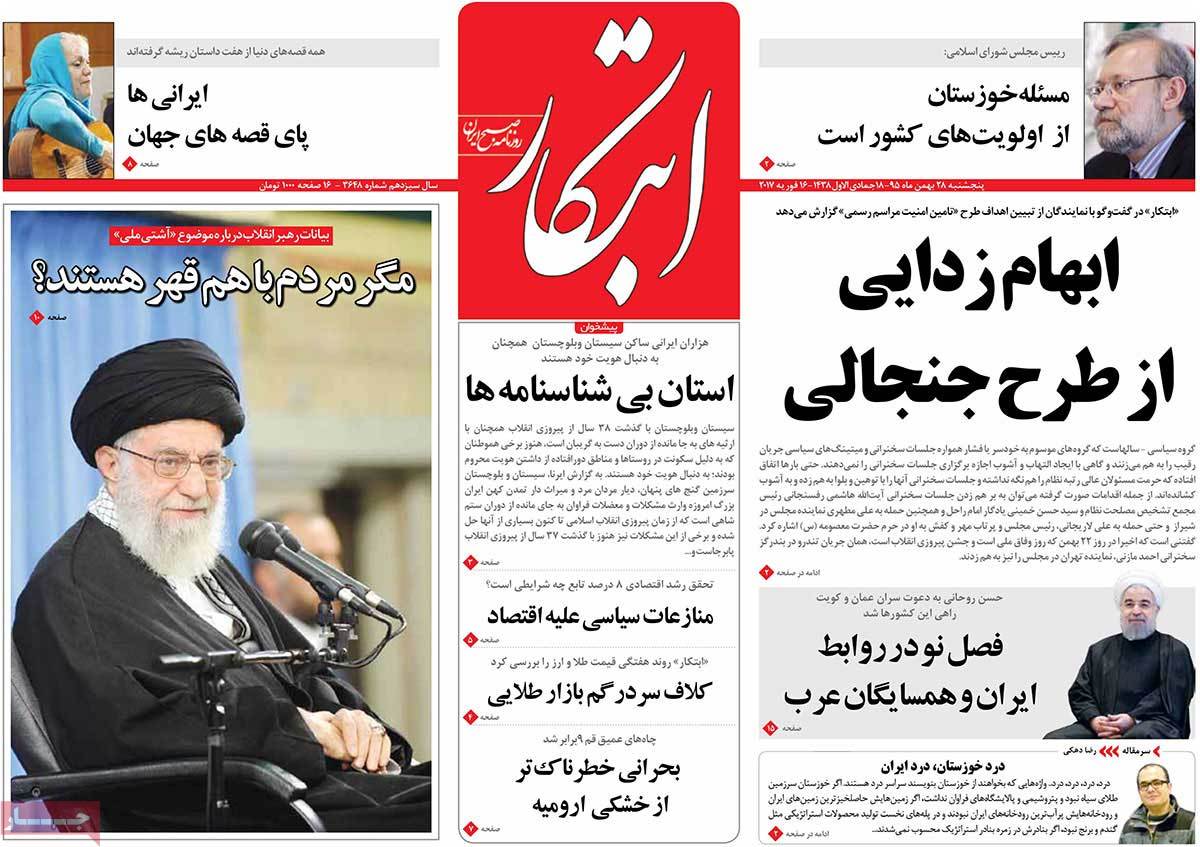
Ebtekar:

1- Iran Trying to Decrease Corruption: The Country’s Corruption Perception Rank Unprecedented in Past 10 Years

2- Trump Threatens His Opponents

3- Two Officials Who Protested US President’s Order Were Dismissed

4- Rouhani: Government Kisses Hands of Those Who Raise Constructive Criticisms

A Look at Iranian Newspaper Front Pages on February 1


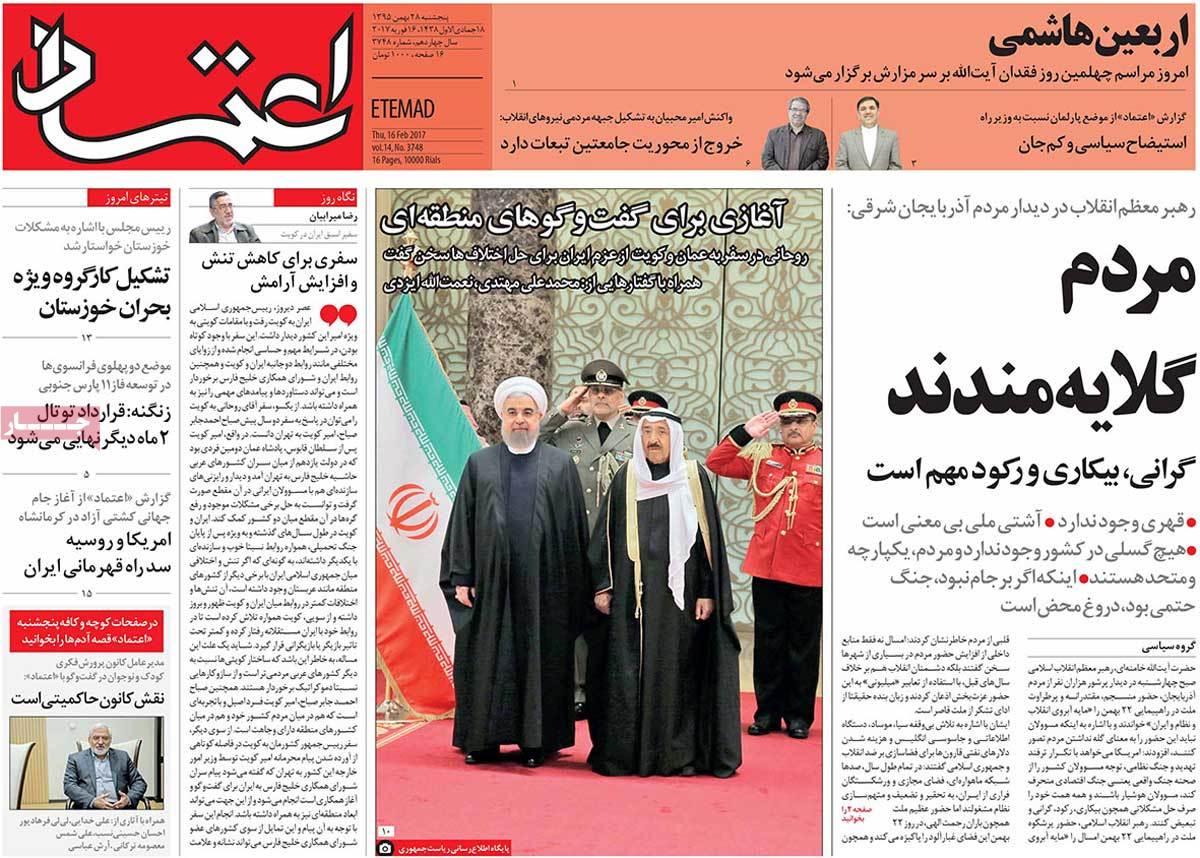
Etemad:

1- Shaky Skyscrapers of Tehran: A Report on Poor Safety of Tehran’s Towers; There Are 979 High-Rise Buildings in Tehran; 267 Towers Built in Past 5 Years

2- Political-Economic Defence of Nuclear Deal: French FM Adds to Knots in Tehran-Paris Ties

A Look at Iranian Newspaper Front Pages on February 1


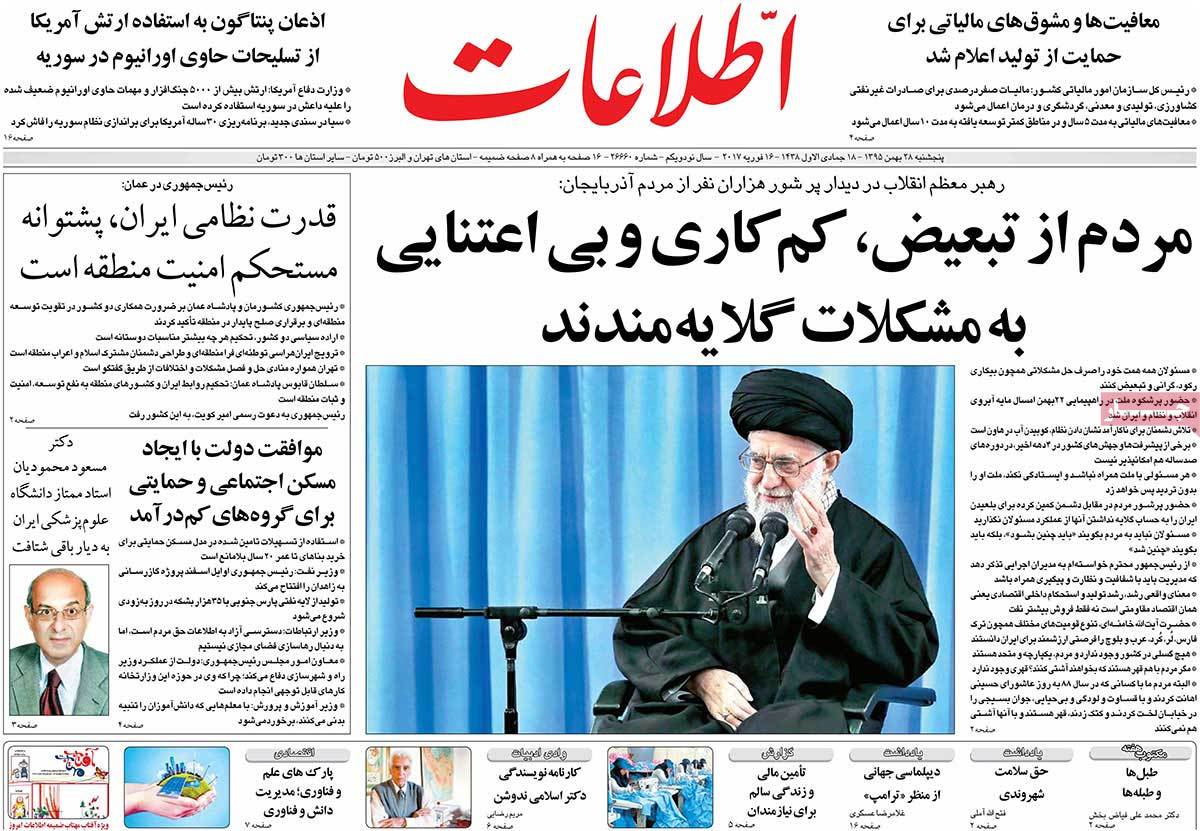
Ettela’at:

1- Iranian and French FMs Stress Full Implementation of Nuclear Deal

2- Anniversary of Imam Khomeini’s 1979 Arrival in Iran Commemorated in Mehrabad Airport and Imam Khomeini’s Mausoleum

3- 6.2% Economic Growth Anticipated for Iran in Next Year: Deputy Economy Minister

A Look at Iranian Newspaper Front Pages on February 1


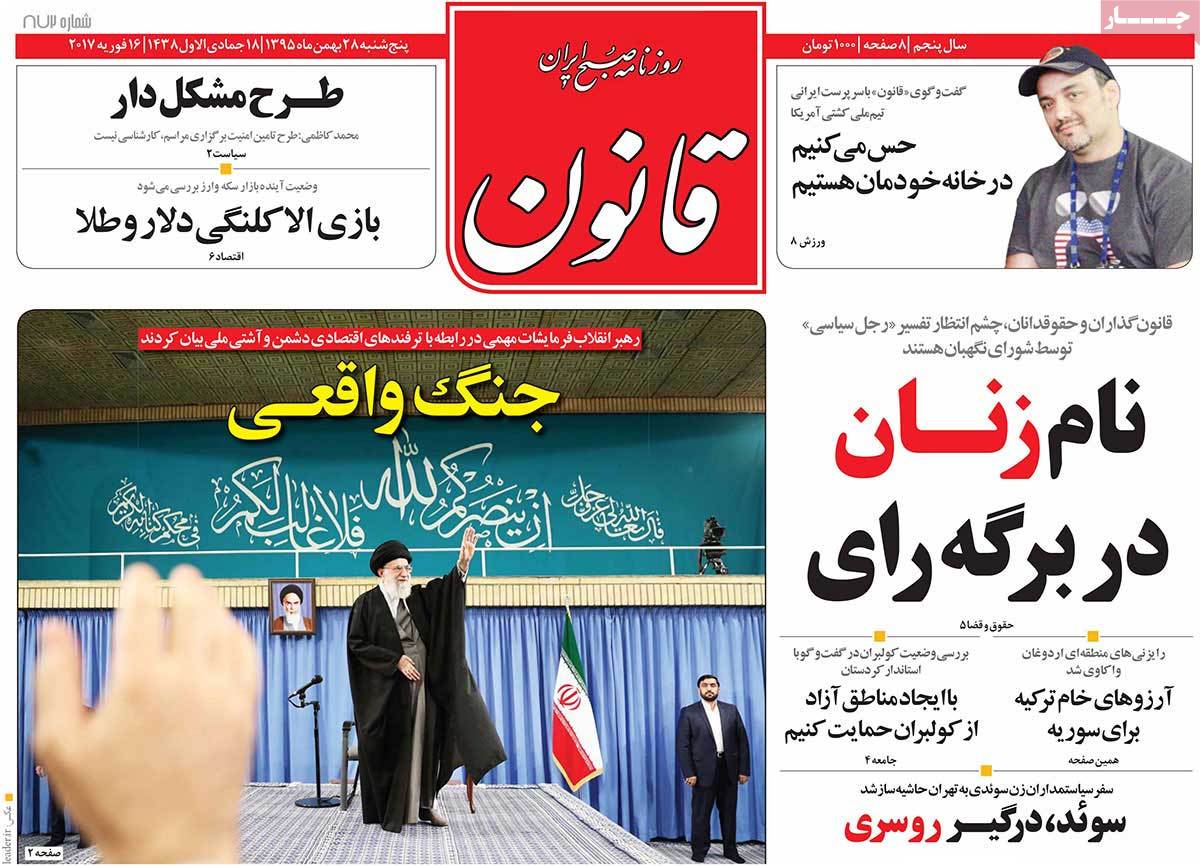
Ghanoon:

1- Sympathy against Racism Continues 4 Days after Trump’s Travel Ban in US

2- Security Meeting against Iran’s Missile Power: Zionists Coordinate UNSC against Tehran

A Look at Iranian Newspaper Front Pages on February 1


Haft-e Sobh:

1- Iranian Immigrants Wealthier than Americans: A Comparison between Income and Education of 500,000 Iranians Living in US and Other Minorities

2- Bring Back Niki: Students of US Top University of Technology Call for Return of Their Classmate

3- Trump Starts Making Excuses Using Iran’s Missile Tests

A Look at Iranian Newspaper Front Pages on February 1


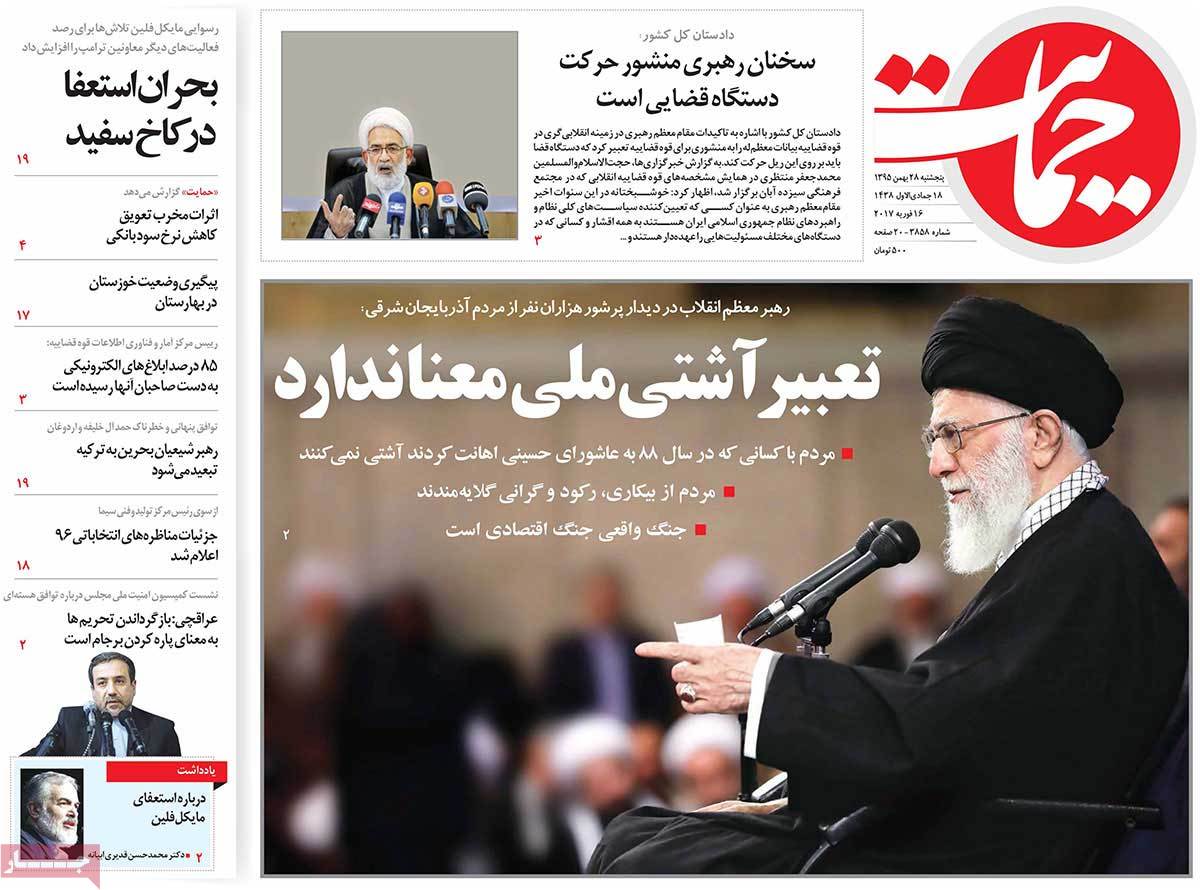
Hemayat:

1- Russia in Reaction to US and Israel’s Claims: Iran’s Missile Test Is Not a Violation of Nuclear Deal

2- Fire of Division in US Flares Up Once Again

3- Middle East’s Biggest Grain Refinery Inaugurated in Karaj

A Look at Iranian Newspaper Front Pages on February 1


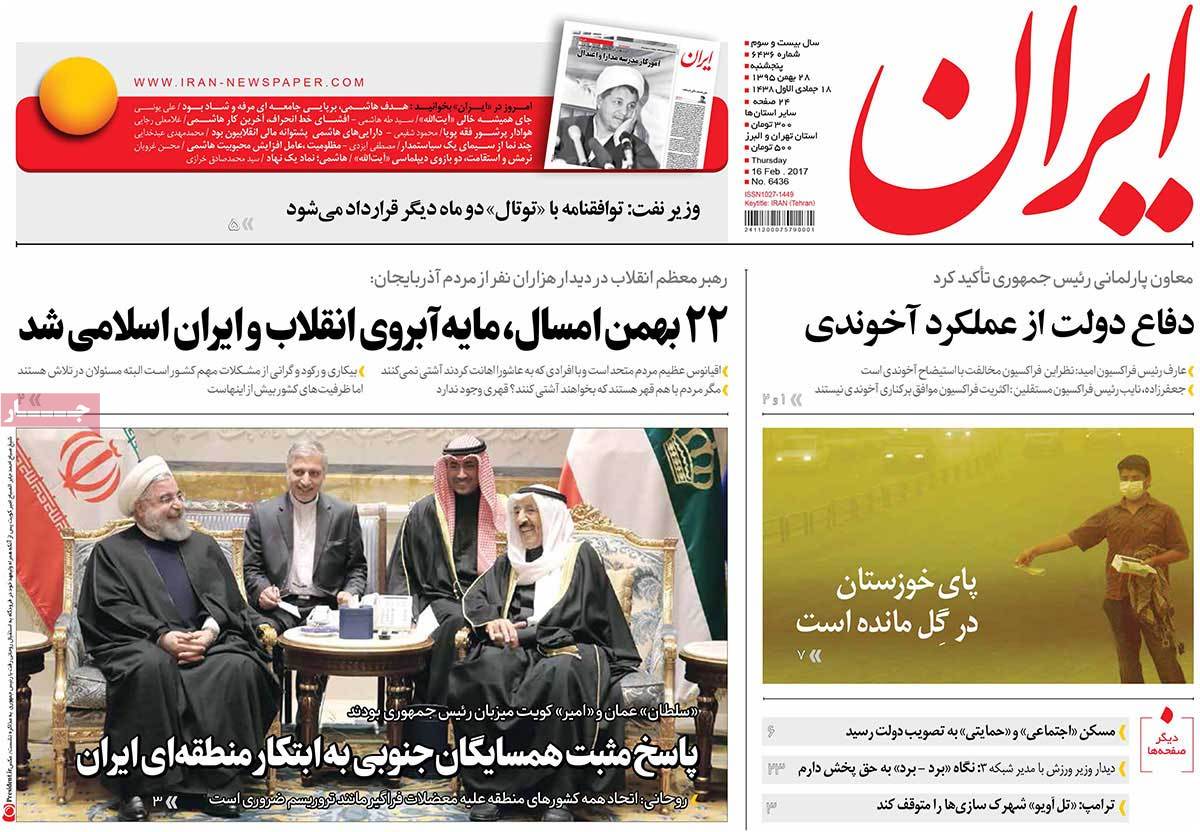
Iran:

1- Everyone Should Remain Loyal to JCPOA Commitments: President Rouhani

2- White House: Whoever Is Not Pleased with Trump’s Decisions Can Go

3- Death Is What Contraband Porters Earn

A Look at Iranian Newspaper Front Pages on February 1


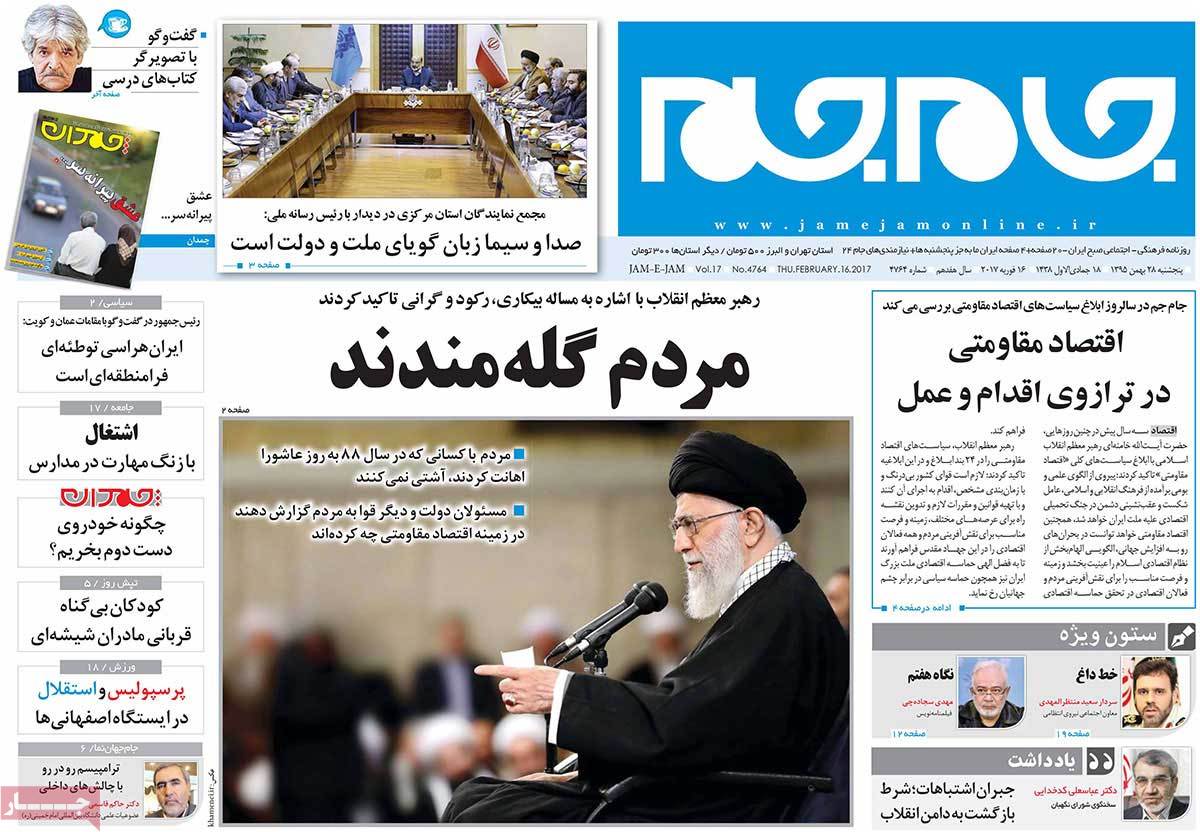
Jame Jam:

1- US Iranophobia Project Now at Missile Stage

2- Trump’s Decisions Won’t Last Long: Iran’s Foreign Ministry Spokesman

3- Cinema Official Urges Politicians to Get Out of Art Industry

A Look at Iranian Newspaper Front Pages on February 1


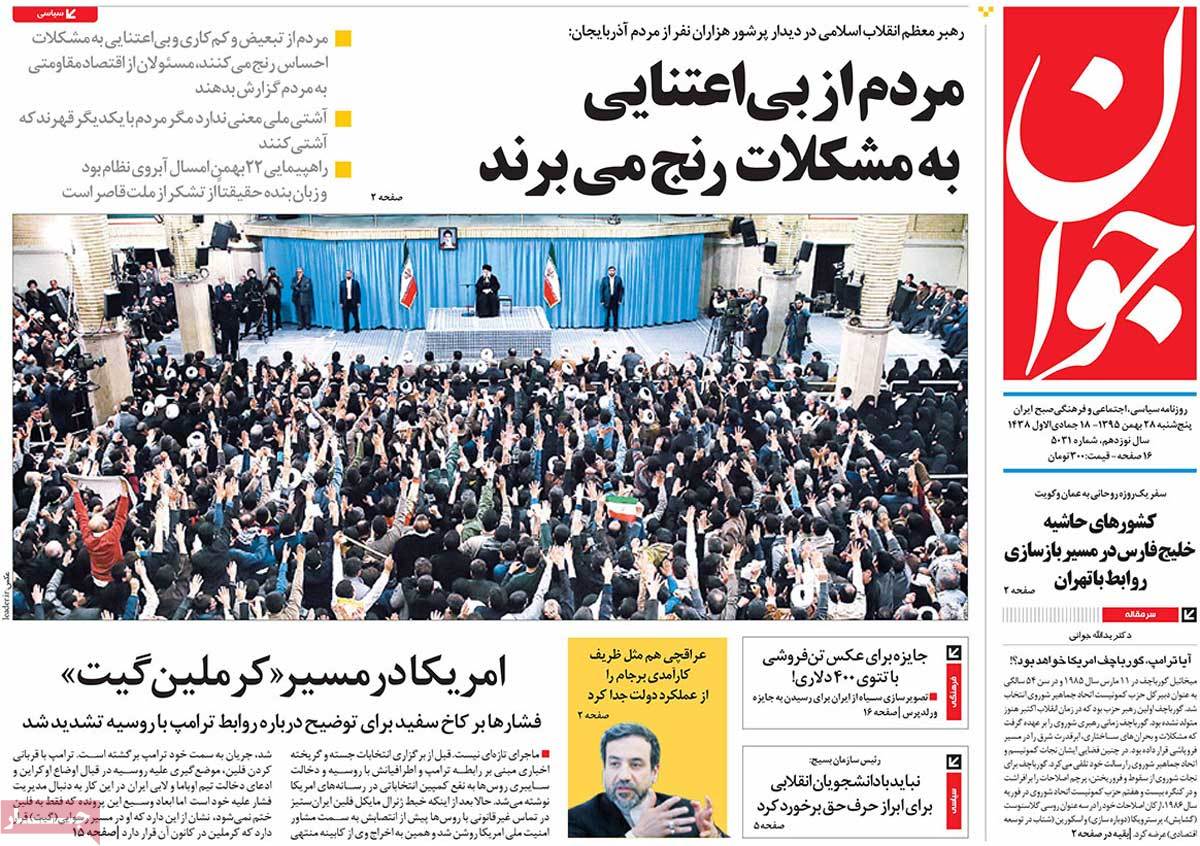
Javan:

1- Zarif: We Won’t Postpone Our Missile Program until Others Give Us Permission

2- JCPOA Bad Cop’s FM: Missile Test Is against UNSC Resolution’s Goal!

3- Celebration of Iran’s Revolution

4- Visa Is a Secondary Issue: We’re Once Again Named Axis of Evil! Two Mistakes in Trump’s Visa Ban for Iranian People

A Look at Iranian Newspaper Front Pages on February 1


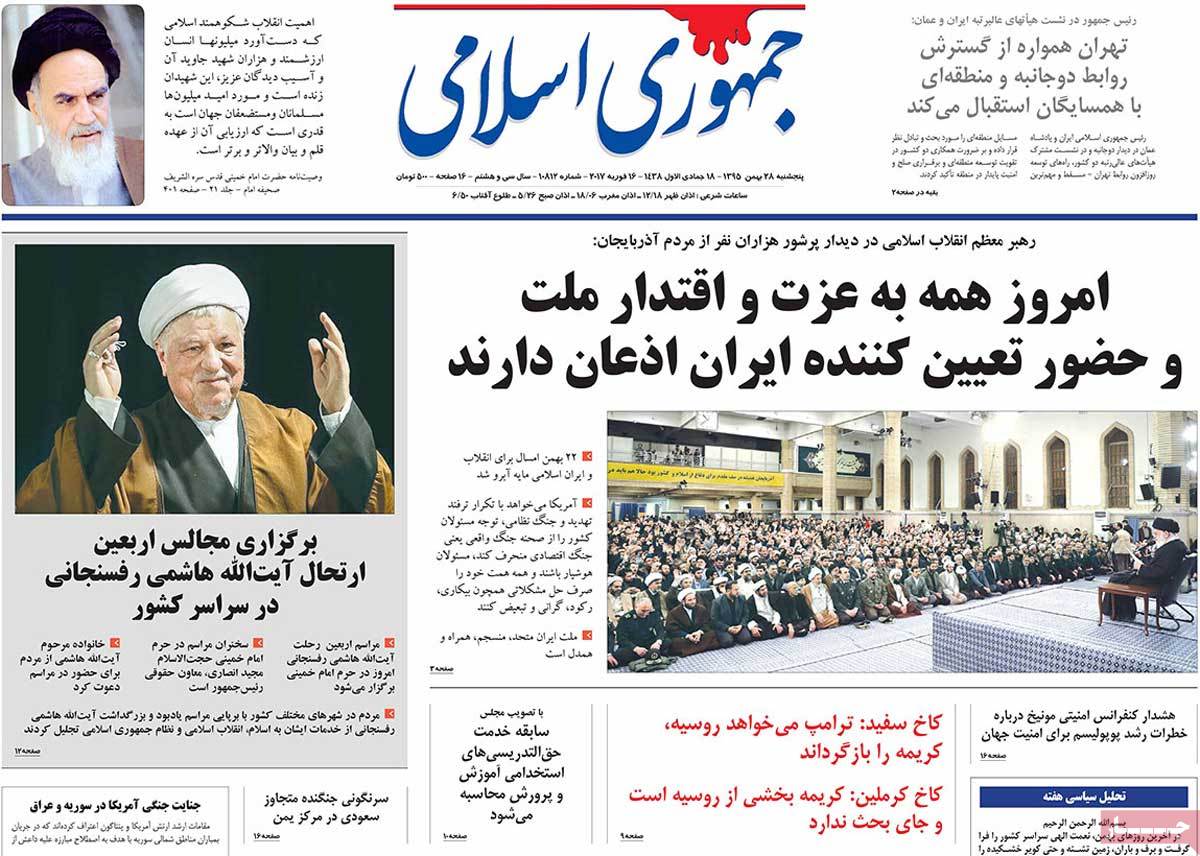
Jomhouri Eslami:

1- 6 Industrial and Infrastructure Projects Inaugurated by President Rouhani in Alborz Province in First Day of Ten-Day Celebrations of 1979 Islamic Revolution’s Anniversary

2- Imam Khomeini’s Photo in Alawi School of Tehran While Responding to People’s Emotions

3- Ceremony Held in Imam Khomeini’s Mausoleum to Commemorate 1979 Revolution’s Anniversary

4- All Astronomical Salaries Returned to Treasury: Official

A Look at Iranian Newspaper Front Pages on February 1


Ka’enat:

1- French FM: Count on France

A Look at Iranian Newspaper Front Pages on February 1


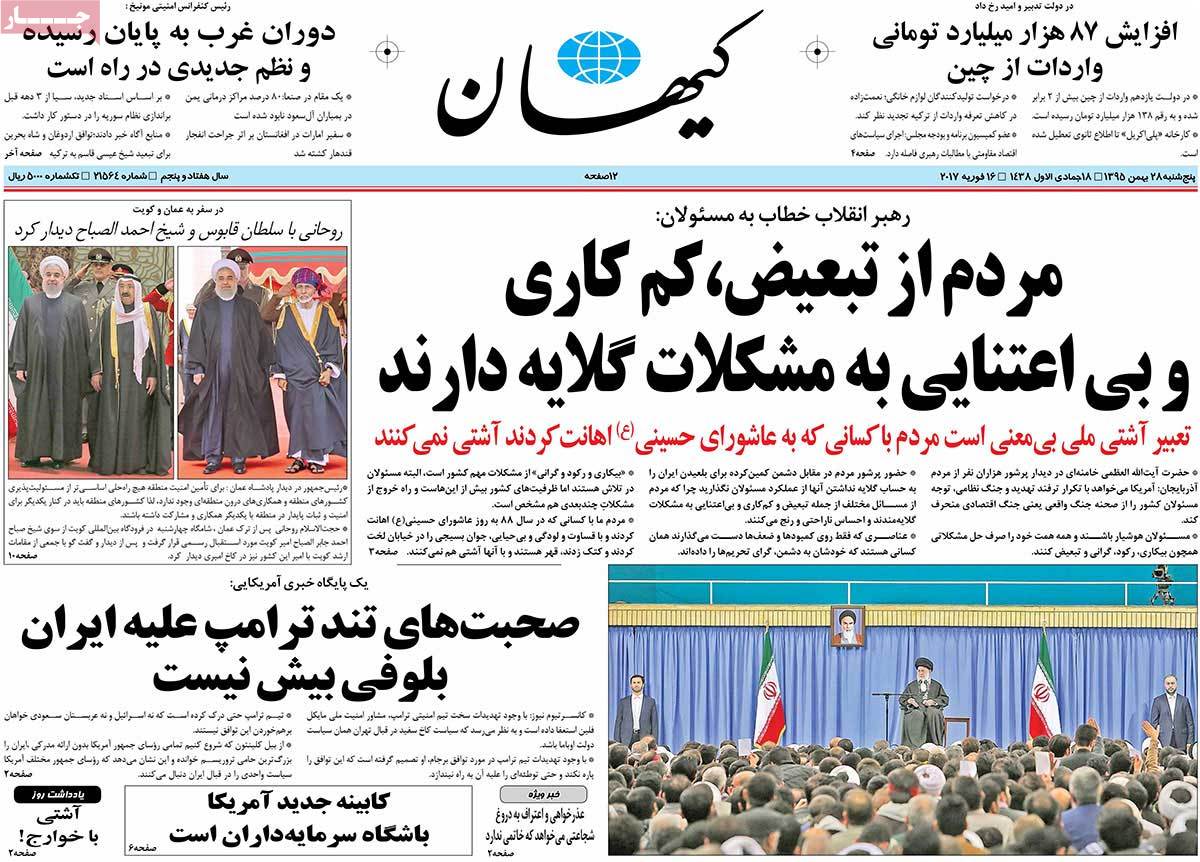
Kayhan:

1- Several Contracts Signed in Ayrault’s Visit to Tehran: Result of Diplomatic Inaction; French FM Rewarded for His Imprudence!

2- Yemen’s Ansarullah Drowns Seventh Vessel Belonging to Saudi Coalition

3- Trump’s Executive Order Leads to Infighting among American Diplomats

A Look at Iranian Newspaper Front Pages on February 1


Khorasan:

1- France Says No to Renegotiation of Nuclear Deal: French FM’s Reaction to US Approach to JCPOA

A Look at Iranian Newspaper Front Pages on February 1


Quds:

1- Accomplice of the Thief and Friend of the House Owner: Amid US, France, and Britain’s War Drills in Persian Gulf, French FM Visited Iran, Questioned Iran’s Missile Tests, and Welcomed Economic Cooperation with Tehran

A Look at Iranian Newspaper Front Pages on February 1


Roozegar-e Ma:

1- World Amazed by Populist President: A Review of Trump’s Radical Approach in Preventing Citizens of Certain Countries from Entering US

2- $3.7 Billion of Facilities Paid to Production Units: Government Spokesman

A Look at Iranian Newspaper Front Pages on February 1


Seda-ye Eslahat:

1- Trump an Opportunity for Conservatives!

A Look at Iranian Newspaper Front Pages on February 1


Siasat-e Rooz:

1- Theresa May Is Trump’s Partner in Racism: Thousands of Britons Protested against London’s Accompaniment with US

A Look at Iranian Newspaper Front Pages on February 1


Sobh-e Now:

1- Trump Opponents Become Defenders of Iran

A Look at Iranian Newspaper Front Pages on February 1

Iranian Family Launches Nationwide Campaign to Protect Asiatic Cheetah

cheetah

Members of an Iranian family are using their car, marked with “Asiatic [or Iranian] Cheetah” slogans, to promote the culture of environmental protection and prevent the extinction of wildlife species, this animal in particular, by travelling to different Iranian provinces in the form of a caravan.

According to a Farsi report by Mehr, the head of this caravan is Bahman Najafi, an Iranian ranger retired from the Environment Department who personally pays the costs of this journey to different Iranian regions alongside his family.

Their trip began seven years ago to inform people about the harms that put the lives of cheetahs in danger.

“We started our journey from Tabas, eastern Iran, and will go on toward the cities in southern Iranian, the desert habitat of cheetah,” he said.

This caravan has arrived in Shiraz, Fars province, in southern Iran after travelling across 16 provinces.


The Asiatic cheetah or Iranian cheetah is a critically endangered species now on the verge of extinction and an important part of Iran’s natural and cultural heritage.

One of the significant aims of the preservation efforts is to raise public awareness not to harm the world’s most graceful wild cats.

In the early 20th century, the population of the Asiatic cheetah was distributed across many countries, including India, Pakistan, the Middle East and Russia.

Currently, the only existing population lives in the northeastern Iranian scrublands, where only 50 to 70 individuals are estimated to survive in the wild.

The United Nations Development Program (UNDP) in Iran is directing a project in conjunction with Iran’s Department of the Environment dubbed the Conservation of Asiatic Cheetah Project (CACP).

Iranian President Unveils Two New Homegrown Satellites

rouhani

The Exhibition of Aerospace Achievements was held  in Tehran on Wednesday to mark the ninth National Space Technology Day.

Also present at the event were Minister of Science, Research, and Technology Mohammad Farhadi and Defense Minister Brigadier General Hossein Dehqan.

During the ceremony, the domestically-designed Nahid (Venus) 1 telecommunications satellite, and student-manufactured Cube satellite were unveiled.

Nahid 1 has been manufactured at Iran’s Space Research Center. Though its production, the country has sought to hone its capabilities in building geosynchronous satellites. It is designed to provide Ku-band telecommunication services, carrying out imaging and calculating the speed at which its two solar panels unfold in space after launch.

President Hassan Rouhani (2nd L) and other officials attend an exhibition of space achievements in Tehran, February 1, 2017 (Photo by IRNA)

Speaking at the ceremony, the Iranian president called for efforts to promote domestic capabilities in the field of space technology with the help of relevant international experience.

“It is wrong for us to either be exclusively reliant on buying [technology] from abroad or totally turn our backs on the world’s experience,” said President Rouhani, adding that the country needs to benefit from domestic capabilities as well as its own scientists concomitantly with international experience.

Why Trump’s Travel Ban Is Pointless

trump

Here is the full text of his article in Malaysia’s The Star Online, which was covered in Farsi by IRNA:


Let’s examine why [Trump’s travel ban is pointless], shall we?

The biggest terrorist attack on American soil is the Sept 11, 2001 airplane hijacks and crashes.

Who were the people involved? They were Saudis. Strangely enough, Saudi Arabia is not on the list above. Which makes one wonder whether Trump is really serious about stopping terrorists (who are exclusively Muslim, naturally) from entering his wonderful country or he is just making a great big show-and-tell to make his voters happy.

Furthermore, since 2001, according to the New America Foundation, 82% of terrorist attacks in America have come from American citizens and Permanent Residents. And according to the Cato Institute, an American is over 250 times more likely to be killed by ordinary homicide than a terrorist attack.

So by taking aim at the peoples of these seven countries, what we have, therefore, is a policy that is utterly misguided and pointless.

Well, maybe I am being overly harsh. There is a point to this policy. It makes racist, misinformed bigots happy. That is surely a good thing for Trump. Also, it is great news for the Islamic State and their ilk because the “Great Satan USA” now has a leader who is an Islamophobe and proud of it. Trump is the ideal poster boy for extremist recruiters.

And what can the world do about it?

In Britain, the answer is to be as subservient as possible. Theresa May, the British PM, was the first world leader to go rushing to pant at Trump’s door and she was quite happy to excuse his vile policies as something within his right to do. The United States has its policies and we have ours, is roughly what she said when asked. How convenient.

However, the people of Britain have not been so pliant. Nearly 1.5 million have signed a petition demanding that the planned state visit of Trump be cancelled. It takes only 100,000 signatures to force a debate in the House of Commons. Within hours, this number was exceeded many times over.

Now, will the government cancel the visit? Of course not, the Brits have no friends in Europe any more so they have to play ball with the Americans. It would be nice for the government to admit that this is the case.

Instead, we have seen the usual political squirming along the lines that Trump was democratically elected and thus we have to respect the will of the American people. How wonderfully hypocritical.

When America chose to cut all aid to Palestine because the people of that country voted Hamas into power, it was perfectly acceptable for them to disregard the democratic will of the Palestinian people.


Of course, their reasoning was that Hamas was a “terrorist” organisation.

If it is acceptable to not respect the democratic choice of a country because you don’t like their elected leaders, why then is it not acceptable for a country to minimise relations with a country that voted a misanthropic, uninformed bigot into power?

If you don’t have the guts to do so, just admit it. Please don’t hide behind the false high horse of respecting democracy, as it seems that the powerful are more than happy to disrespect democracy when it suits them.

Iran’s Leader Pays Tribute to Imam Khomeini and Martyrs

Ayatollah Seyyed Ali Khamenei

On the occasion of the of the 38th anniversary of the victory of Islamic Revolution in 1979, Ayatollah Seyyed Ali Khamenei made a visit to mausoleum of late founder of the Islamic Republic Imam Khomeini in southern Tehran early in the morning.

Ayatollah Khamenei also paid tribute to the Iranian pilgrims killed in Mina crush, the deadly incident in Mecca, Saudi Arabia, which killed hundreds of Iranians, among other nationals, during the Hajj pilgrimage in 2015.

During the visit, the Leader paid tribute to Imam Khomeini, the honourable martyrs of the Revolution as well as martyred firefighters who recently sacrificed their lives during Plasco Incident in Tehran, Mehr reported.

Here are IRNA’s photos of the visit:

School Built in Iran Thanks to Waste Paper Sale

Mehrzad Hamidi, a senior official at the Education Ministry, referred to a directive jointly communicated by Iran’s Education and Energy Ministries and Environment Department to 106,000 schools at the beginning of current scholar year.

“The directive included the reduction of paper use, and waste sorting, especially the paper waste, in the schools.”

“Fortunately we achieved some considerable results such as building the first Iranian school with the funds provided by the sale of students’ old books and waste paper in Neyshabur, eastern Iran.”

“The main rubrics of this Ministry in environmental protection include promoting the environmental morality, improving the students’ knowledge and skills in environment, and considering the green economy with regards to all circumstances,” he said, according to a Farsi report by IMNA.

He also announced that the Education Ministry was ranked first in the recent Iranian National Environment Awards.

“Several measure have been taken by our Ministry to inform the students and teachers about the environment, and to promote the culture of environmental protection.”

Other measures include appropriating 120 pages of textbooks in different grades to environmental information, running related courses for teachers, scouts and students, preparing two educational units about environment in Farhangian University, and implementing the environmental programs of the Iranian students’ organization.

Students get to know rangers

“‘An Hour with a Ranger’ was an important joint project implemented by Education Ministry and Environment Department in 1700 schools near the national parks and environmental protected areas,” announced Kioumars Kalantari, Head of Education in Iranian Environment Department.

He referred to the murder of three rangers in 2016 when they were confronting the hunters in protected areas.

“Projects like this are to inform the local children about a ranger’s profession and tasks, and can contribute to an interaction between the local community and environment which lessens such conflicts.”

“Another joint program is to develop a ‘Human and Environment’ textbook for the 11th grade in seven chapters with a problem-based approach,” he added.

“This is a very important move, as it is the first time the Iranian Education Ministry edits a textbook in cooperation with another department.”

He went on to say that “Human and Environment” will be taught in schools twice a week from September 2017.

He also referred to measures such as adding environmental insertions in work and knowledge field textbooks, setting standards for the five proposed environmental fields, translating environmental guidelines for the trainers, and establishing a strategic national working group for the imparted document to 106,000 schools about green management as other joint projects of the two departments.