Thursday, January 15, 2026
Home Blog Page 4119

Trump Will Change His Mind If He Visits Iran: US Wrestler

trump

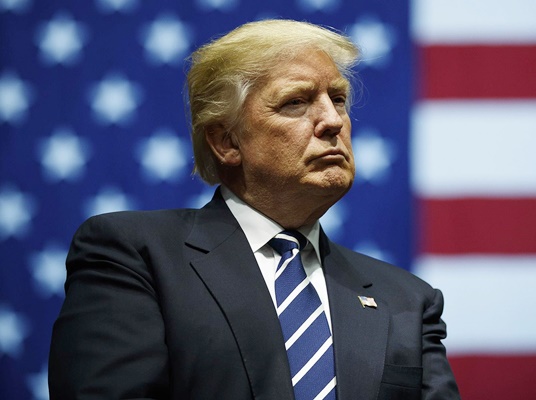
In response to Donald Trump’s hastily slapped-together executive order last month that blocked entry for citizens from seven predominantly Muslim countries, including Iran, the Iranian government barred visa entry for all US citizens. The move had a direct effect on the wrestling World Cup, an international competition that was set to take place in the country, where wrestling is pretty much the national sport.

The United States, of course, has some of the world’s best wrestlers; a wrestling World Cup in Iran without the Americans would be kind of like an NBA finals in the ’80s without the Celtics or Lakers. But after Iranian officials witnessed Americans protesting the president’s executive order, and after the US judicial system struck the ban down, officials reconsidered and eventually granted visas to Team USA. Maybe Iran was inspired by what it saw, or maybe it just wanted to see the world’s best wrestler compete: New Jersey native Jordan Burroughs.

In Iran, Burroughs received a superstar’s welcome, and the 28-year-old was swarmed by fans seeking selfies and autographs. GQ spoke with Burroughs this week about his experience there, what he hopes Americans can learn from his trip, and if he would ever go back to a country many Americans see as a sworn enemy of the state.

GQ: Congrats on a hell of a performance in this past World Cup. How long were you in Iran, and when did you get back?

Thank you, I appreciate it. We were in Iran for a total of eight days, and I got back home to Lincoln, Nebraska, on Sunday night.

Iran ended up winning this year’s wrestling World Cup. They consistently have some of the best wrestlers on the planet. What makes them so good?

It’s interesting, because on a personal level, after seven years on the international stage, I’ve never lost to an Iranian wrestler. But don’t get me wrong: As a team, they are always the best. This was my fifth World Cup, and in each of those competitions, we were beat by the Iranians. It just shows how high of a level those guys are consistently wrestling. Above all else, they are extremely athletic, disciplined, and know how to maintain great positioning throughout a match.

Do you think this type of dominance must have something to do with Iran’s cultural pride?

Absolutely, without a doubt. Other than the US, they’re the only other country that I’ve felt their love for sports is interwoven with their national identity. For Americans, of course, it’s football, basketball, and baseball. We live for it. In many ways, it sums up who we are. In Iran, it’s all about wrestling. The patriotism toward their country comes out in the way they wrestle, so it makes sense why they’re the best.

How difficult was it for you, as an American, to visit Iran after decades of hostile relations? And, most recently, President Trump’s travel ban?

I don’t describe myself as a nationalist, but I do love my country. What I tried to focus on, and what I wanted the Iranian people to understand, is that, listen, America is a democracy. And what that means is we vote for our public officials, and sometimes they don’t win. That means I can still love my country, while wholeheartedly being against certain policies. Donald Trump and I have very different views on Iranians. I am confident that if he ever visited the country, he’d learn a lot about the people and come back to the States with a newfound appreciation for the Persians.

That’s a bold statement. Do you fear for any repercussions it may produce here at home?

I’ve been to Iran twice now, and I can honestly say they are some of the kindest, most hospitable people in the world. It’s such an old culture, and I feel like I’m just starting to learn more about it. So, to answer your question, I’m extremely confident in making that statement and feel comfortable with whatever potential backlash may come with it.
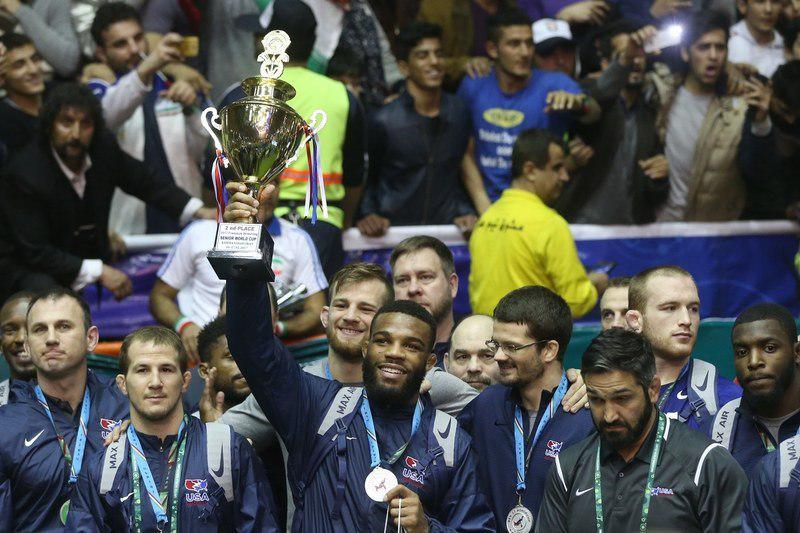
photo_2017-02-25_15-37-07

You are considered the best 74 kg wrestler on the planet in a country that’s obsessed with the sport. Did you feel like a celebrity while you were there?

Honestly, it was insane. It seemed like the entire nation was tuned in to the tournament. Their version of ESPN was talking about the event all day long, streaming throughout millions of homes. There were fans lining the airport when we landed, and fans bidding us farewell after the competition was done. I’ve never gotten that type of reception here in the US in the stadium during the tournament, it was something else. They were cheering our names. It’s crazy, right? Here we were in the middle of Iran, and it felt like home.

Are you friends with anyone on the Iranian team?

I’ve become close with Masoud Esmaeilpour and consider him a friend. We send each other messages from time to time on Instagram, checking in to see how the other is doing. Whenever I see him, he’s always a gentleman, giving me tips about my next opponent. There is a tremendous amount of respect in our friendship.

What would you say to those Americans out there who simply don’t trust Iranians, and who believe the Muslim travel ban is smart policy?

I’d say that the way the Iranian people are portrayed in the media, and in movies, is simply false. It’s not representative of who they are as individuals. And that level of awareness is not possible unless you travel there and experience it for yourself. If you do that, if you see for yourself what it means to be Iranian, I promise you your mind will be changed.

Did you run into any issues at any point while you were there?

No, quite the opposite. At times, the love and support we received was overwhelming. We’d be preparing for a match, and the Iranians would have already formed lines of people waiting to get their picture with us, asking for our autographs. Even after the World Cup was over, there were ordinary Iranian citizens sending me and my family gifts such as traditional Kurdish clothing, a book of Persian poetry, dolls for my young children, saffron, an Iranian toffee called sohan.

If I said there was a flight waiting for you to head back to Iran right now, what would you say?

[laughs] I’d say I’m already out the front door on my way to the airport.
7 Countries Targeted by Trump’s Ban Pose No Terror Threat to US

donald-trump

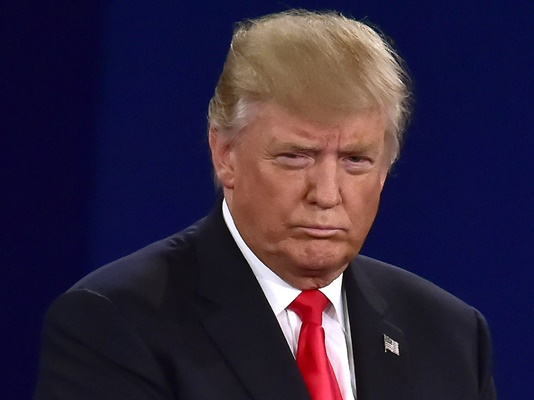
According to a draft document obtained by Associated Press, analysts at the US Department of Homeland Security’s intelligence unit concluded that citizenship in the targeted countries is an “unlikely indicator” of a person’s potential to conduct a terror attack.

It added that few people from those countries have carried out attacks or been involved in terrorism-related activities in the United States unlike what Trump claims.

The countries listed in the temporary travel ban were Iran, Iraq, Libya, Somalia, Sudan, Syria, and Yemen.

Israel Seeks to Divide Middle East: Palestinian Cleric

palestine

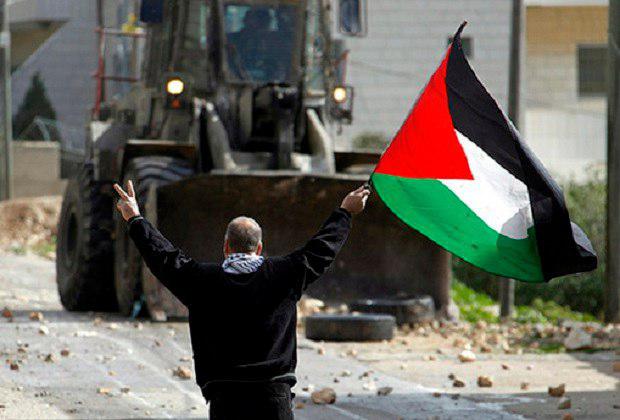
“Despite being brutally oppressed and tortured by Zionists, the Palestinian nation is still showing resistance in its own country,” senior Palestine cleric Sheikh Hossein Mohammad Qassem said on February 21, during the sixth International Conference on Palestinian Intifada in Tehran.

According to a Farsi report by ICANA, he went on to say that Palestine leaders have taught this nation never to retreat from its land.

“A unique, coherent ideology is prominent all over Palestine: we teach our children to resist the enemies.”

“The Zionist regime of Israel sought to occupy not only Palestine, but the whole region as its main target,” he pointed out. “The Israeli Prime Minister stated in 1952 that this regime intended to divide the Middle East.”

He further noted that Muslim nations should point their arms at the Tel Aviv regime.

“Quds is not just Palestine’s issue; it is for the entire Muslim world.”

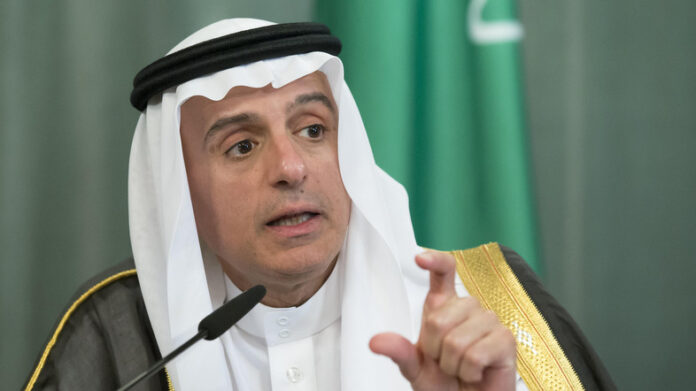
Saudi FM Makes Surprise Visit to Iraq after Years

The Saudi FM met his Iraqi counterpart Ibrahim al-Jaafari, a foreign ministry official told AFP.

Another government official said it was the first visit to Baghdad by a Saudi foreign minister since 2003, marking a key step in efforts to mend frosty bilateral relations.

“This visit is to reestablish relations in a more stable way than previously,” a senior government official said. “It’s the first visit of its kind.”

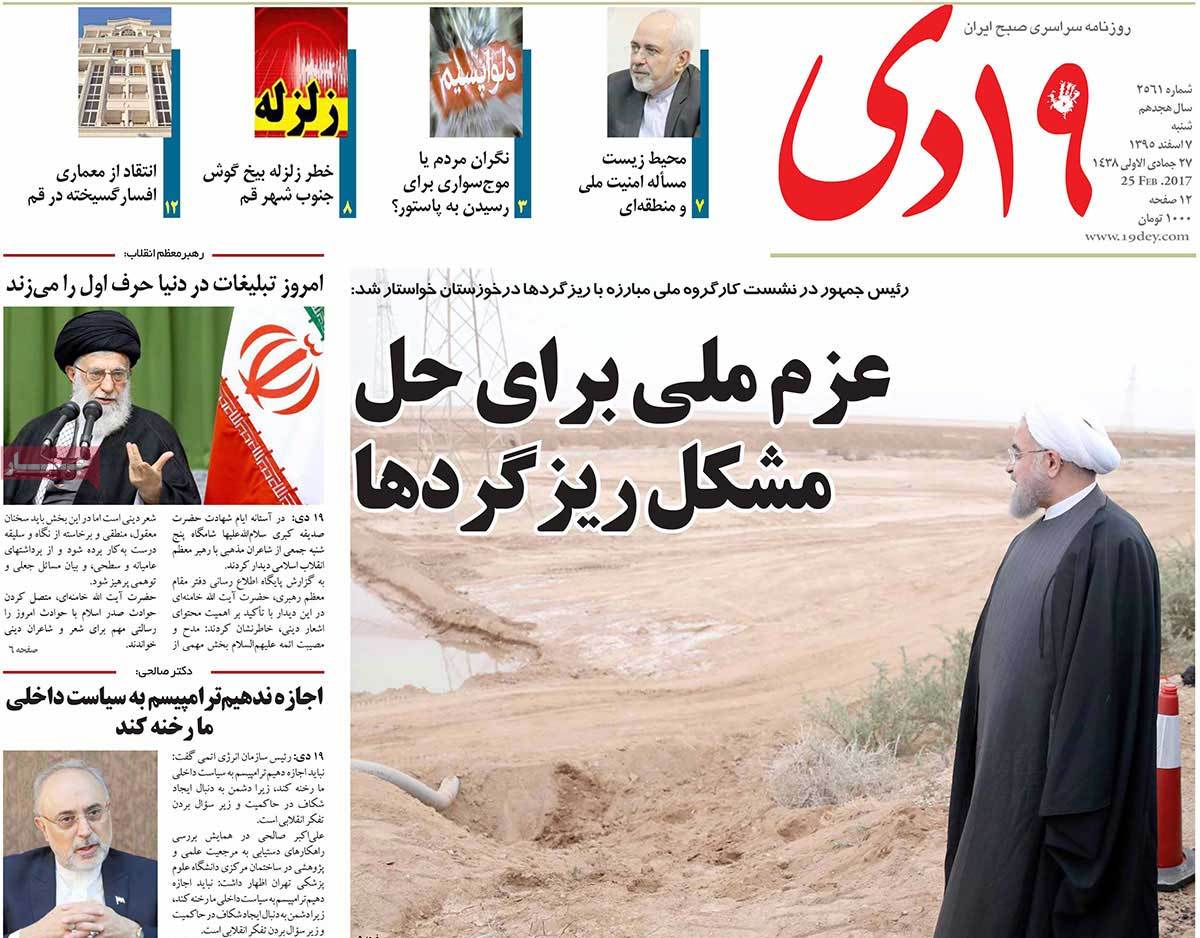
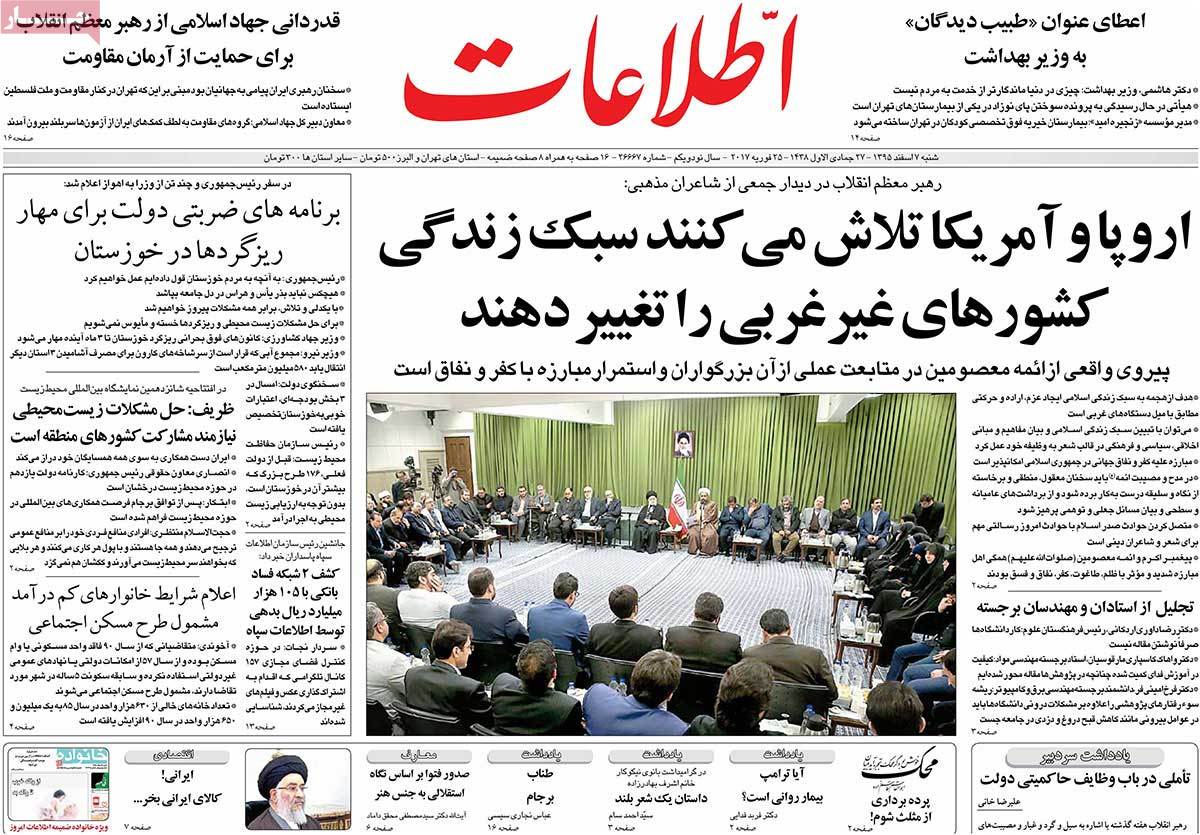
A Look at Iranian Newspaper Front Pages on February 25

The remarks made by Ayatollah Seyyed Ali Khamenei, the Leader of Iran’s Islamic Revolution, in a meeting with a number of poets were widely covered by Iranian newspapers. Ayatollah Khamenei’s comments about the West’s effort to change the lifestyle of non-Western countries were the top story in many front pages today.

Another top story was President Hassan Rouhani’s visit to Iran’s southwestern province Khuzestan and his promise to resolve the crisis-hit province’s problems.

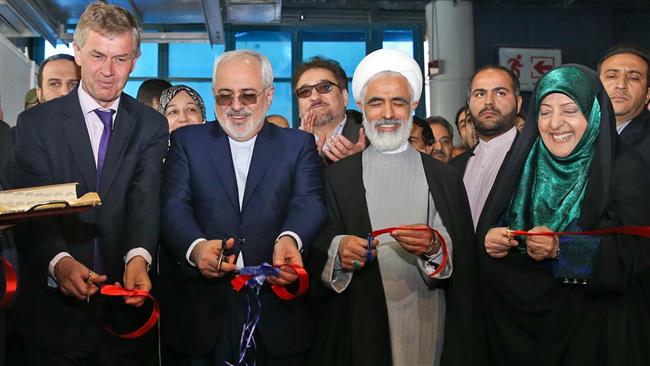
Newspaper also covered the ongoing Environment Exhibition in Tehran and the remarks made by Iranian Foreign Minister Mohammad Javad Zarif at its opening ceremony about the incorrect policies of Middle Eastern countries that have led to current pollution crisis and water shortage.

The above issues, as well as many more, are highlighted in the following headlines and top stories:


19 Dey:

1- President Rouhani Underlines National Resolve to Settle Dust Pollution Issue

2- Zarif: Environment Is National and Regional Security Issue

3- Iran’s Nuclear Chief Warns against Penetration of Trumpism into Iran’s Domestic Politics

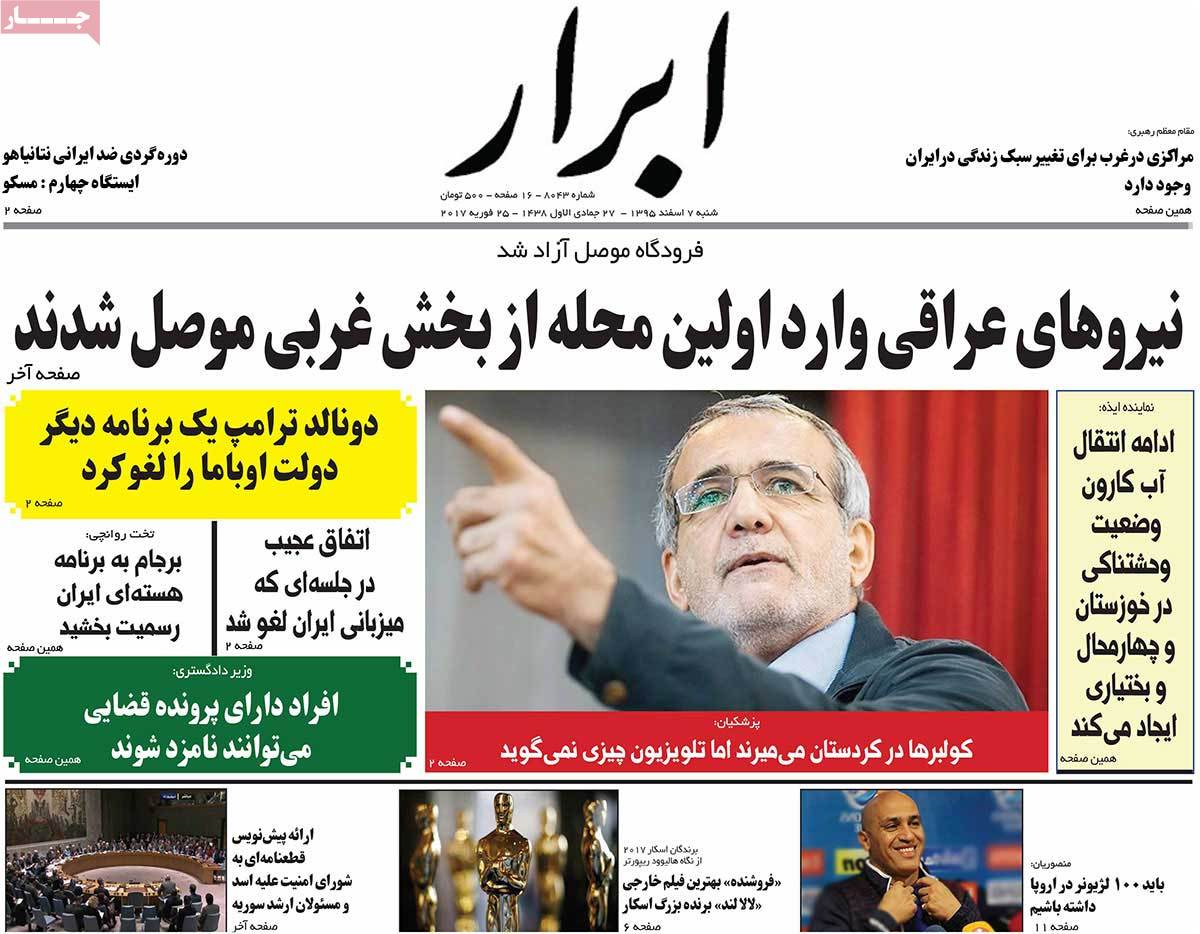
A Look at Iranian Newspaper Front Pages on February 25


Abrar:

1- Ayatollah Khamenei: There Are Centres in West to Change Lifestyle in Iran

2- Mosul Airport Liberated: Iraqi Forces Enter First District in Western Mosul

3- Deputy FM: JCPOA Legitimised Iran’s Nuclear Energy Program

A Look at Iranian Newspaper Front Pages on February 25


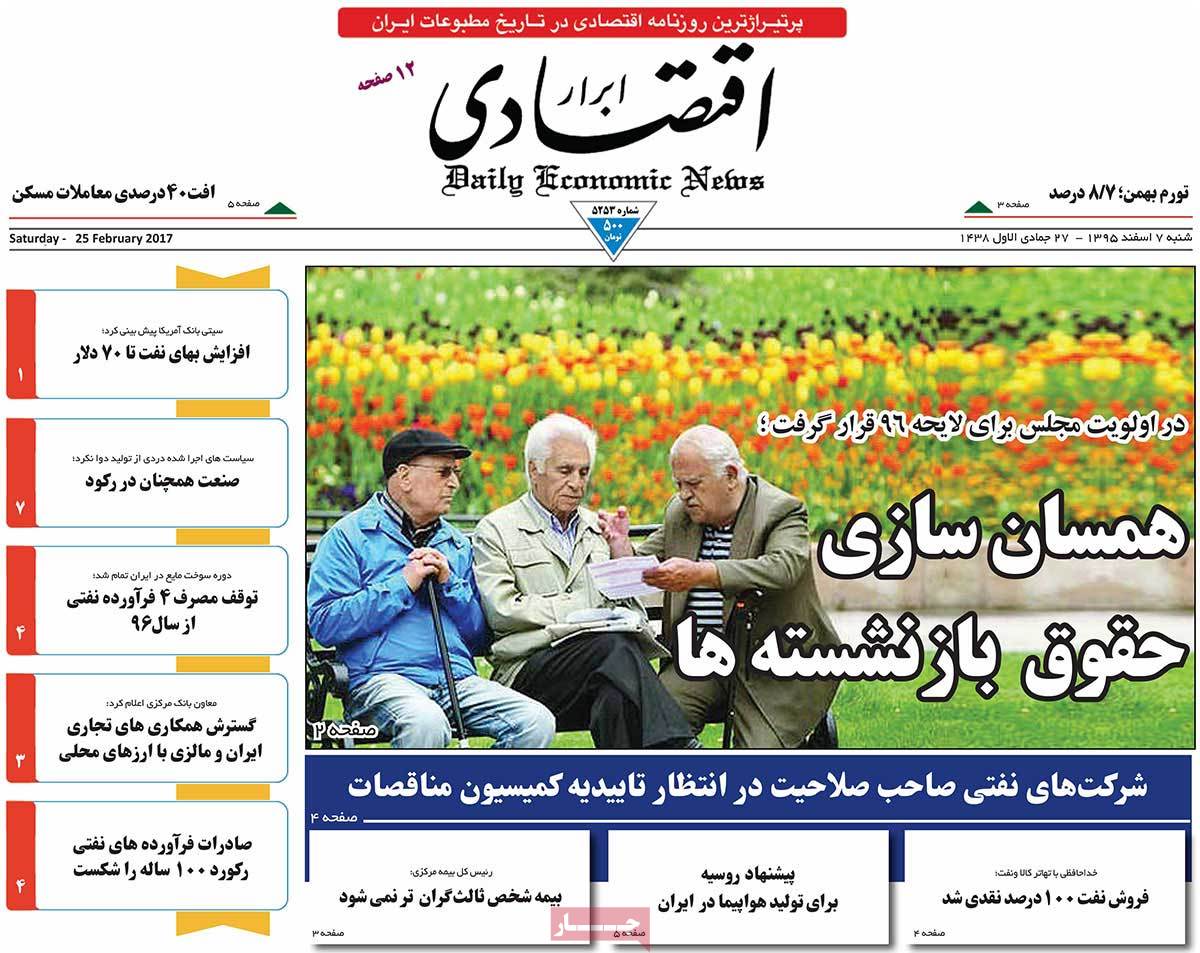
Abrar-e Eqtesadi:

1- Expansion of Iran-Malaysia Trade Ties Using Local Currencies

2- Goodbye to Oil-for-Goods Deals: No More Use of Barter System in Iran’s Oil Sale

3- Russia Offers to Manufacture Plane in Iran

A Look at Iranian Newspaper Front Pages on February 25


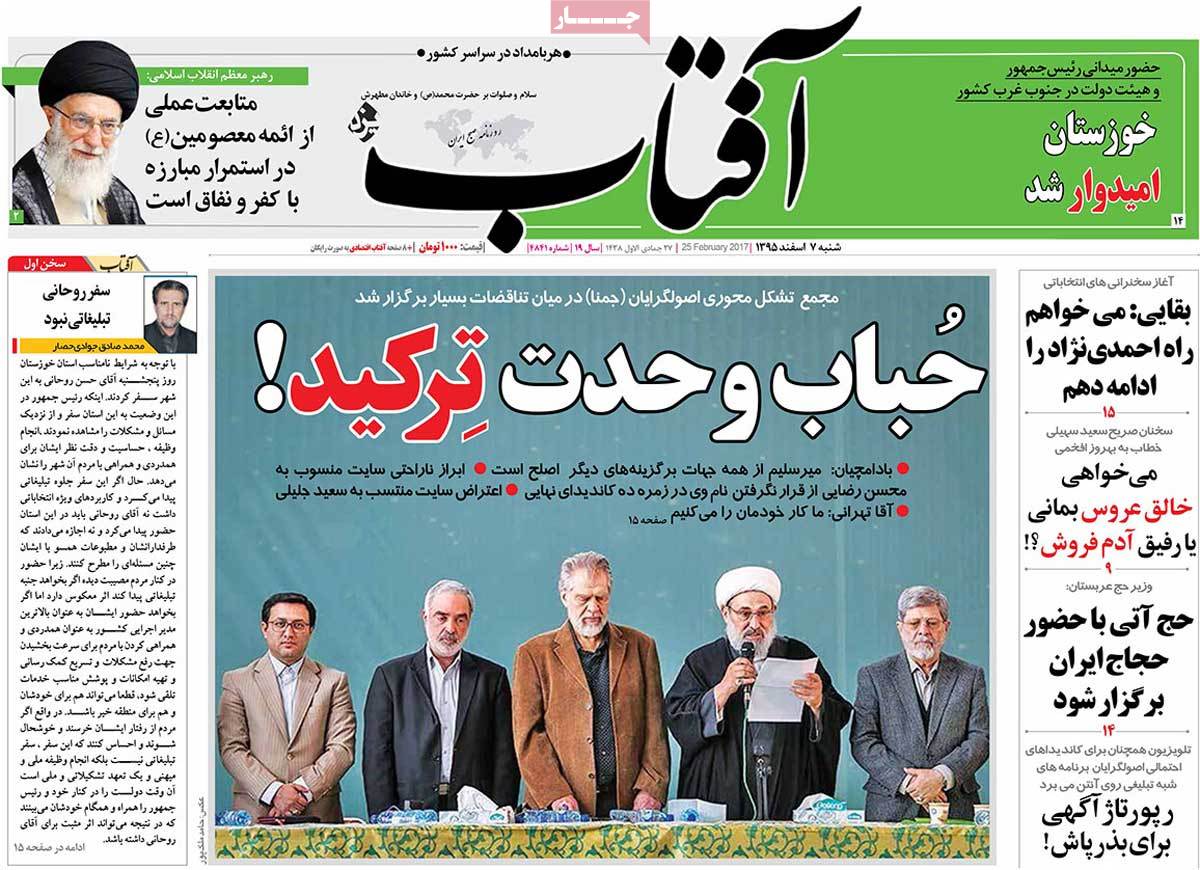
Aftab-e Yazd:

1- Hopes Returns to Khuzestan: Iranian president and cabinet members visited southwestern crisis-hit province

2- Saudi Minister: Iranian Pilgrims to Attend Upcoming Hajj Pilgrimage

A Look at Iranian Newspaper Front Pages on February 25


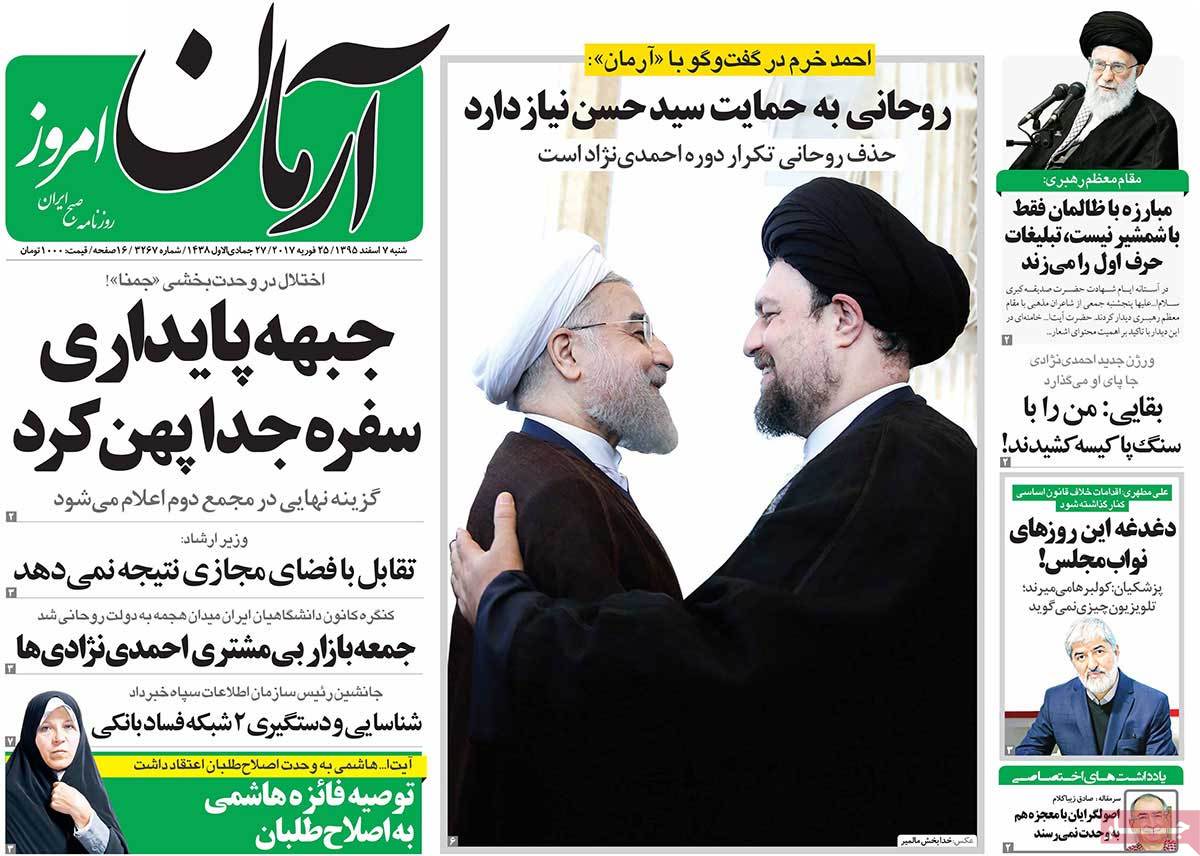
Arman-e Emrooz:

1- Sword Not Only Weapon Used in Struggles: Iran’s Leader highlights role of propaganda in today’s world

A Look at Iranian Newspaper Front Pages on February 25


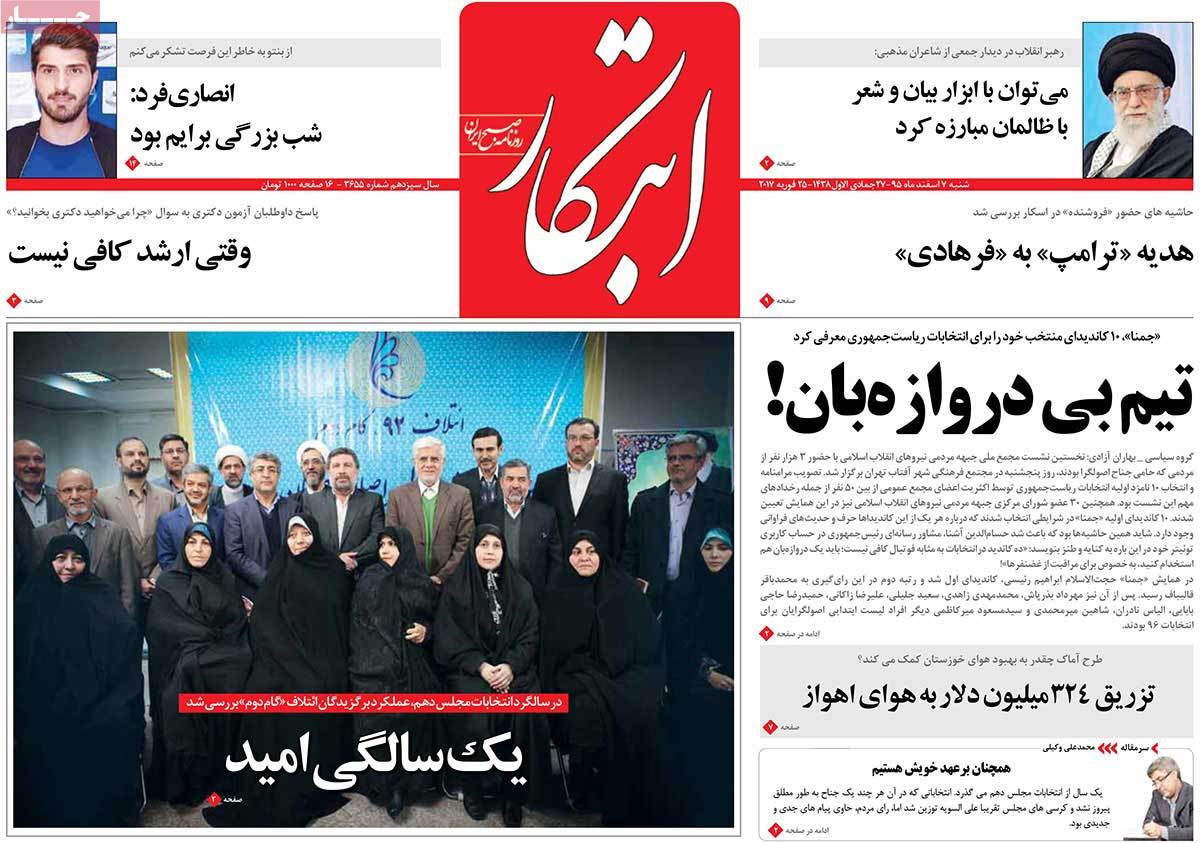
Ebtekar:

1- $324m Injected to Ahvaz’s Air: How Much Can AMAK Plan Help Khuzestan?

A Look at Iranian Newspaper Front Pages on February 25


Etemad:

1- Living Where Oil Is Smelled: President vows to counter environmental problems in Khuzestan

2- Iran’s Ambassador to Kuwait: Formation of Regional Coalition against Iran Unlikely

A Look at Iranian Newspaper Front Pages on February 25


Ettela’at:

1- Iran’s Leader: Europe, US Trying to Change Non-Western Countries’ Lifestyles

2- Islamic Jihad Appreciates Iran’s Leader for Supporting Resistance Cause

A Look at Iranian Newspaper Front Pages on February 25


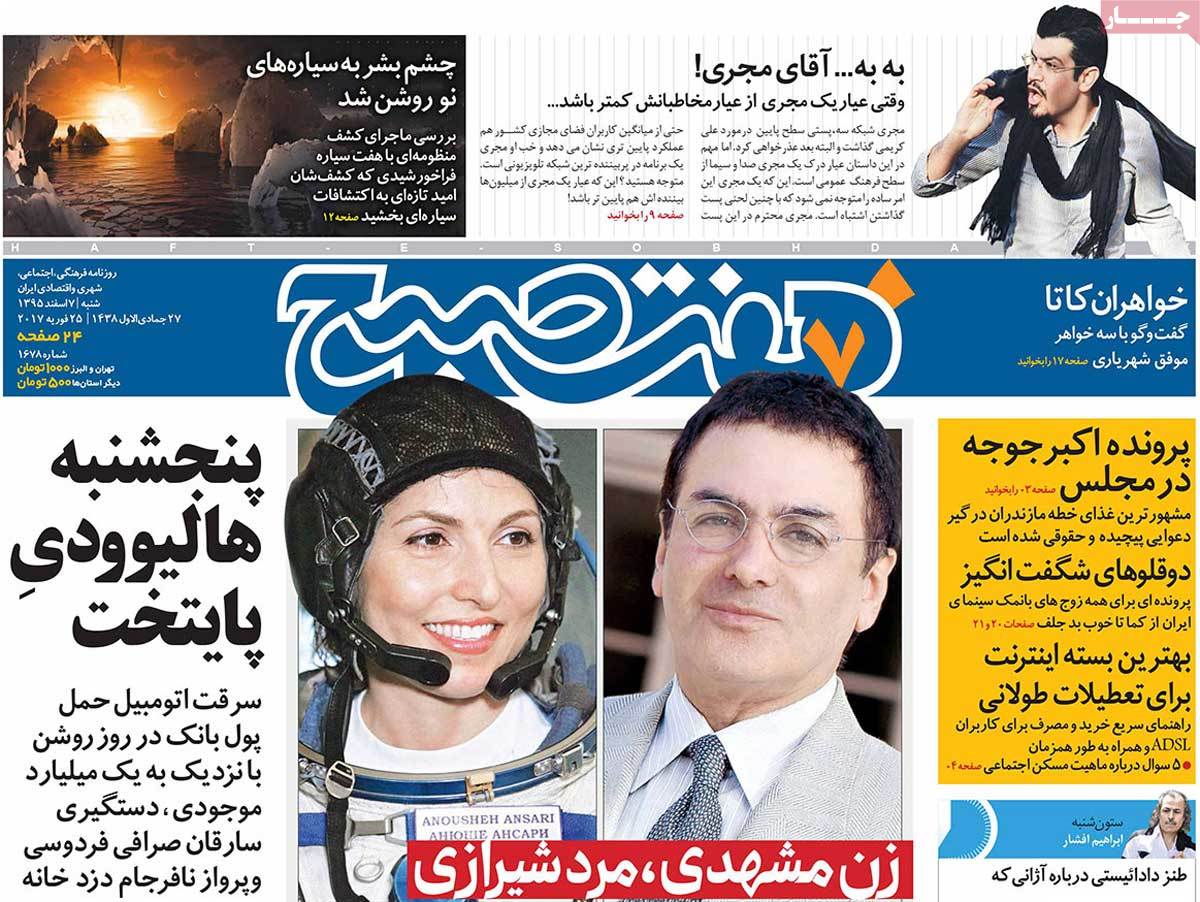
Haft-e Sobh:

1- Hollywood-Style Robbery in Tehran: Armoured cash transport car carrying over $250,000 in cash was stolen in daylight

A Look at Iranian Newspaper Front Pages on February 25


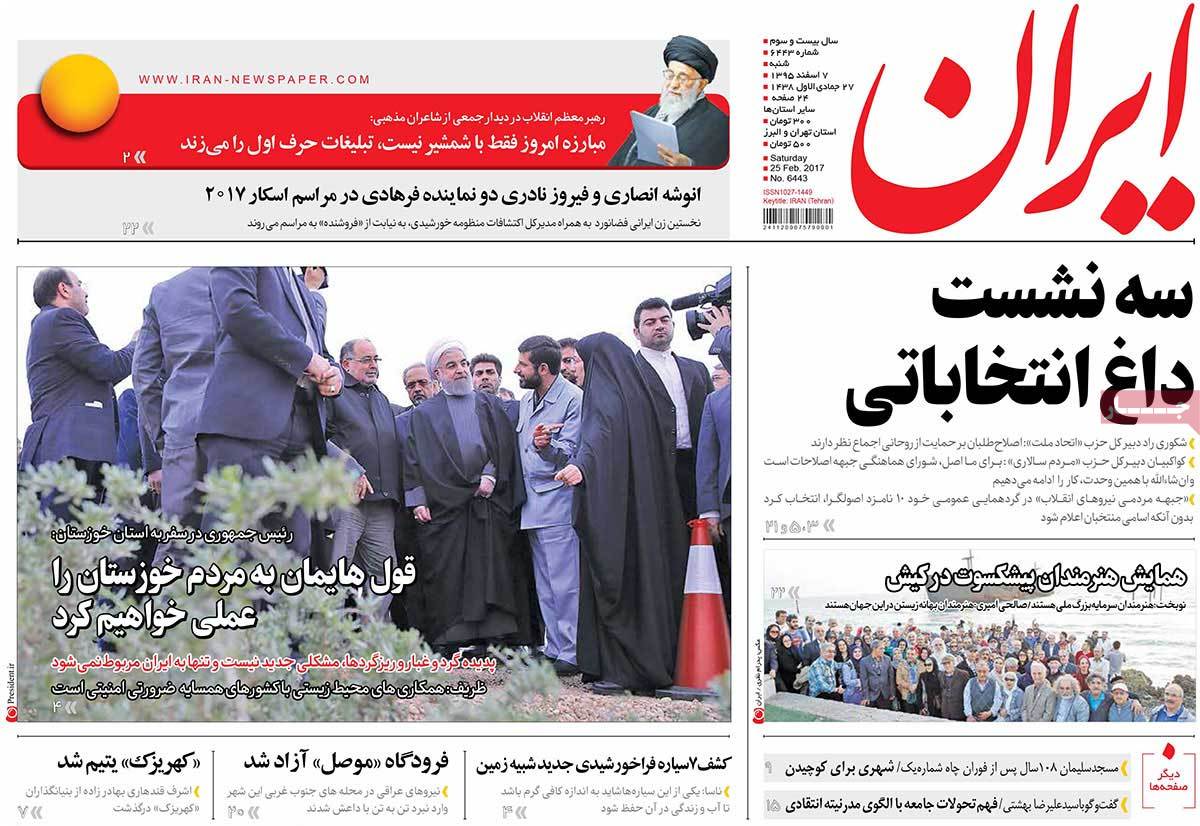
Iran:

1- First Female Space Tourist and NASA Executive to Represent Iran at Oscars

2- Seven Planets Similar to Earth Discovered by NASA: One of them might be warm enough to be liveable

A Look at Iranian Newspaper Front Pages on February 25


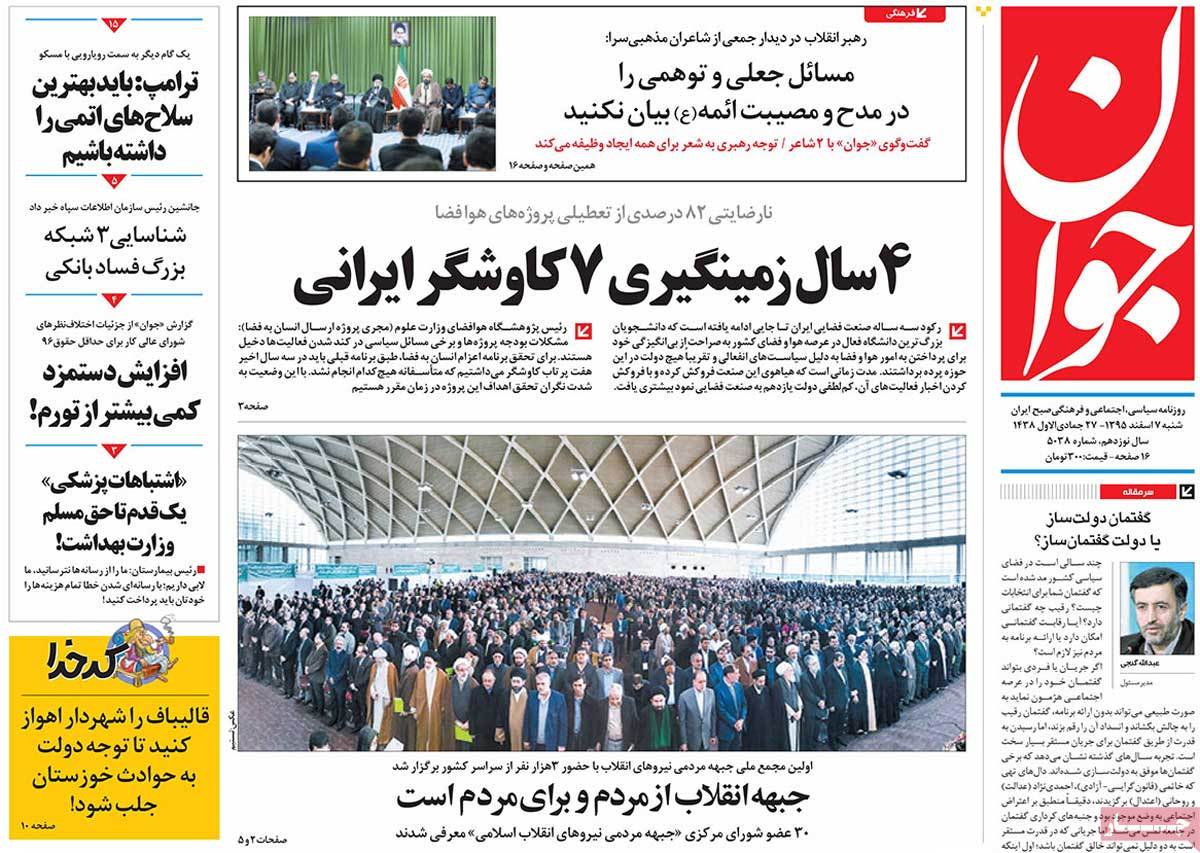
Javan:

1- 82% Dissatisfaction with Shutdown of Aerospace Projects

2- One More Step towards Confrontation with Moscow

  • Trump: We Should Have Best Atomic Weapons

A Look at Iranian Newspaper Front Pages on February 25


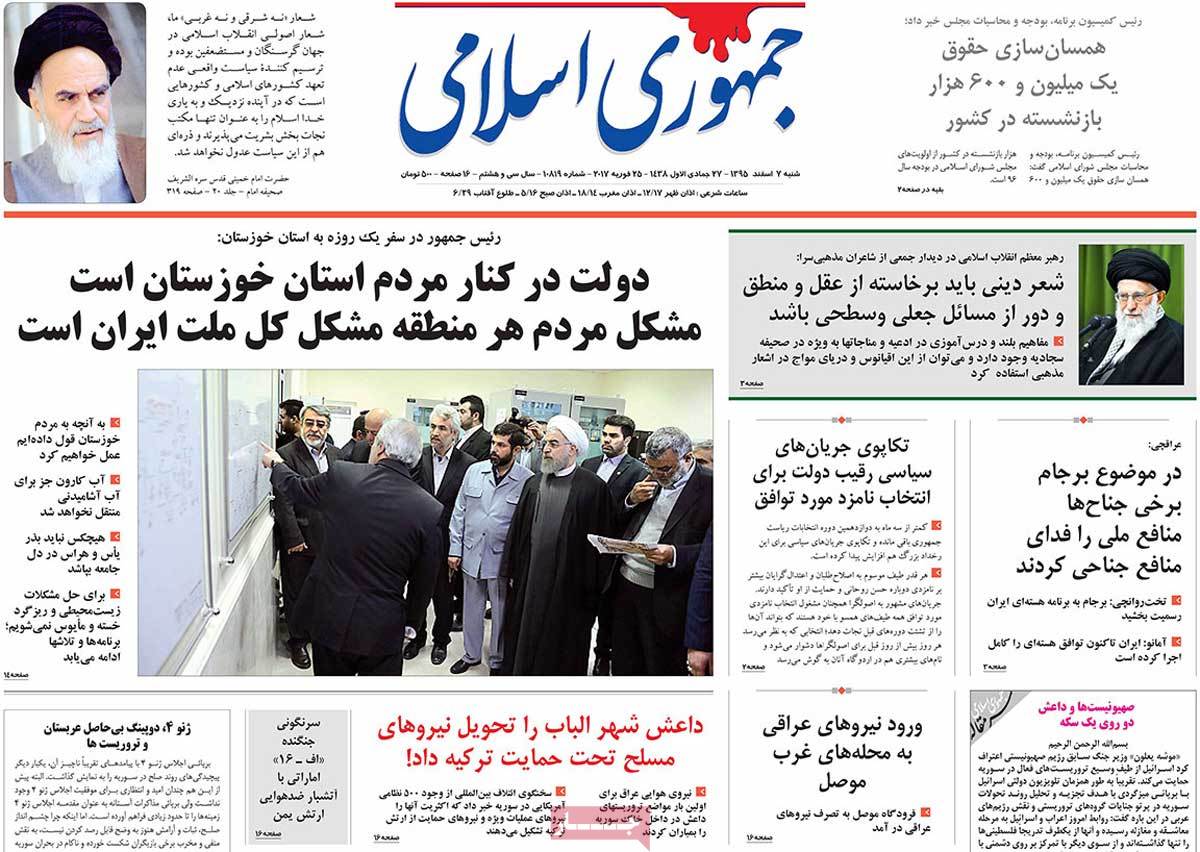
Jomhouri Eslami:

1- Iran’s President: Government Standing by People of Khuzestan

2- Deputy FM: In JCPOA, Some Parties Preferred Partisan Interests to National Ones

3- ISIS Gives City of Al-Bab to Turkey-Backed Armed Forces!

A Look at Iranian Newspaper Front Pages on February 25


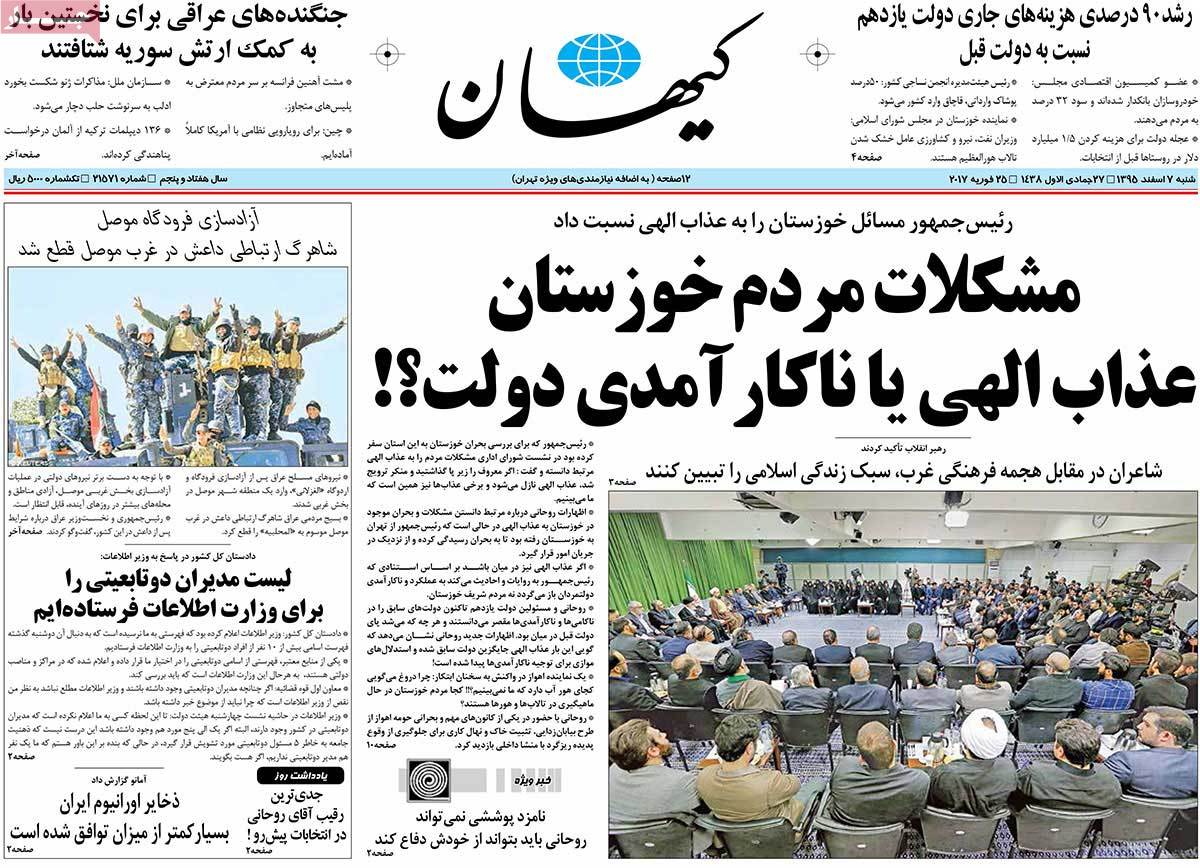
Kayhan:

1- Iran’s Leader Urges Poets to Explain Islamic Lifestyle in Reaction to West’s Cultural Plots

2- Mosul Airport Liberated: ISIS’ Key Communications Line Cut

3- Amano: Iran’s Uranium Reserves Much Lower than What Agreed

A Look at Iranian Newspaper Front Pages on February 25


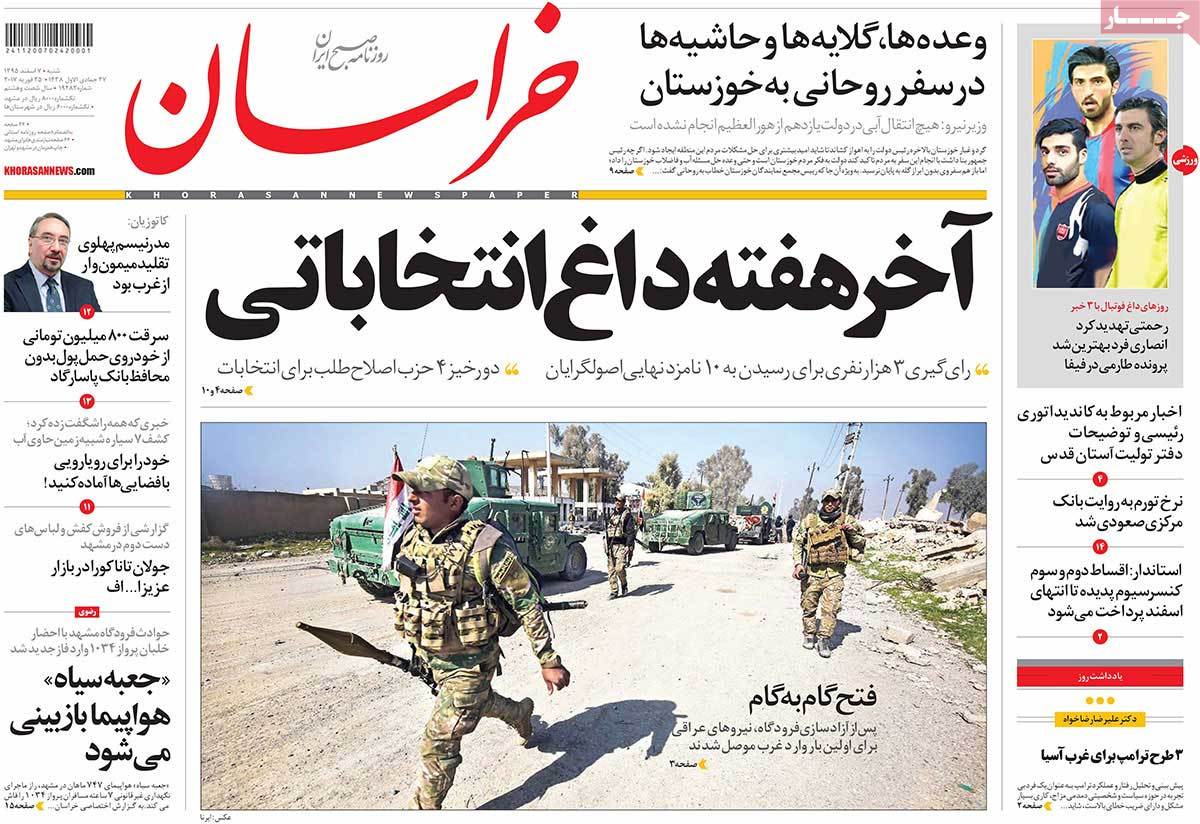
Khorasan:

1- Hot Electoral Weekend: Conservatives gather votes of 3,000 figures to name final 10 candidates; 4 reformist parties making plans for May elections

A Look at Iranian Newspaper Front Pages on February 25


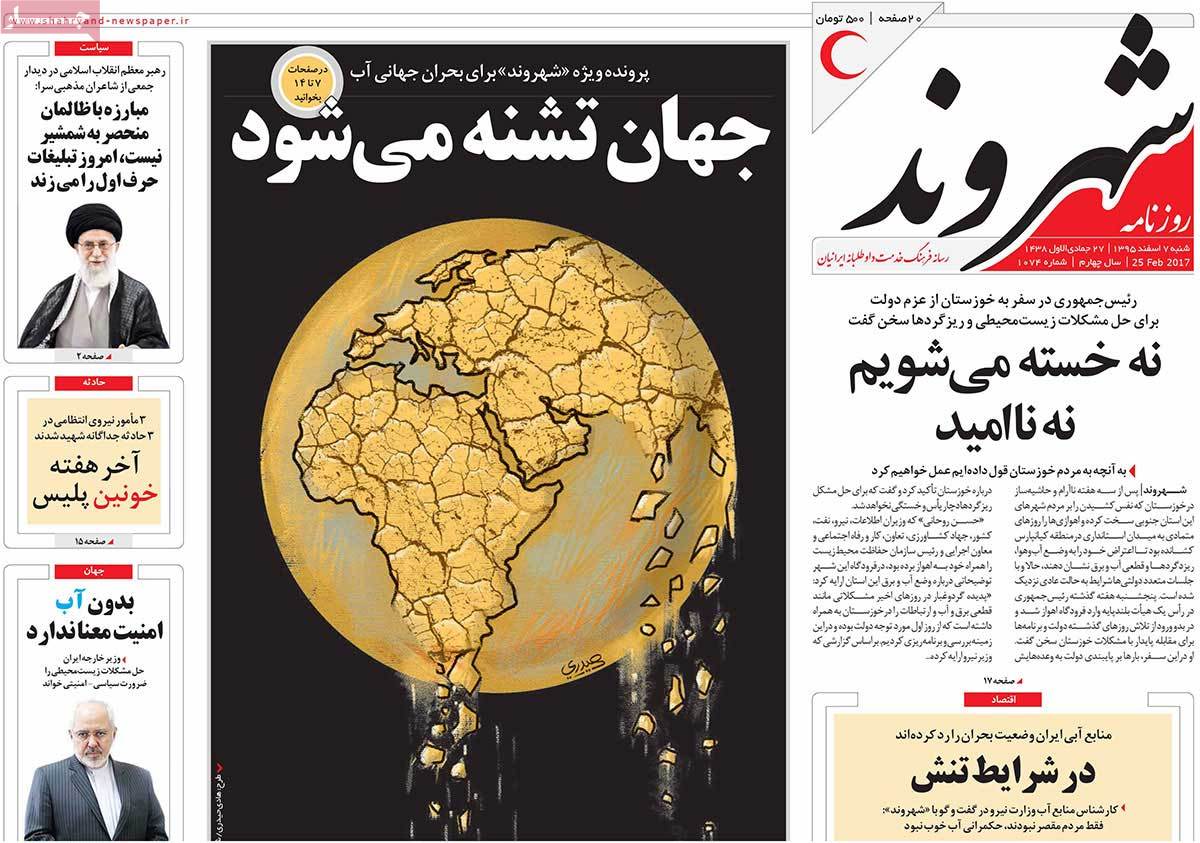
Shahrvand:

1- World to Get Thirsty: A Report on Global Water Crisis

2- Zarif: Security Means Nothing without Water

3- Tension: Iran’s Water Resources beyond Critical Conditions

A Look at Iranian Newspaper Front Pages on February 25


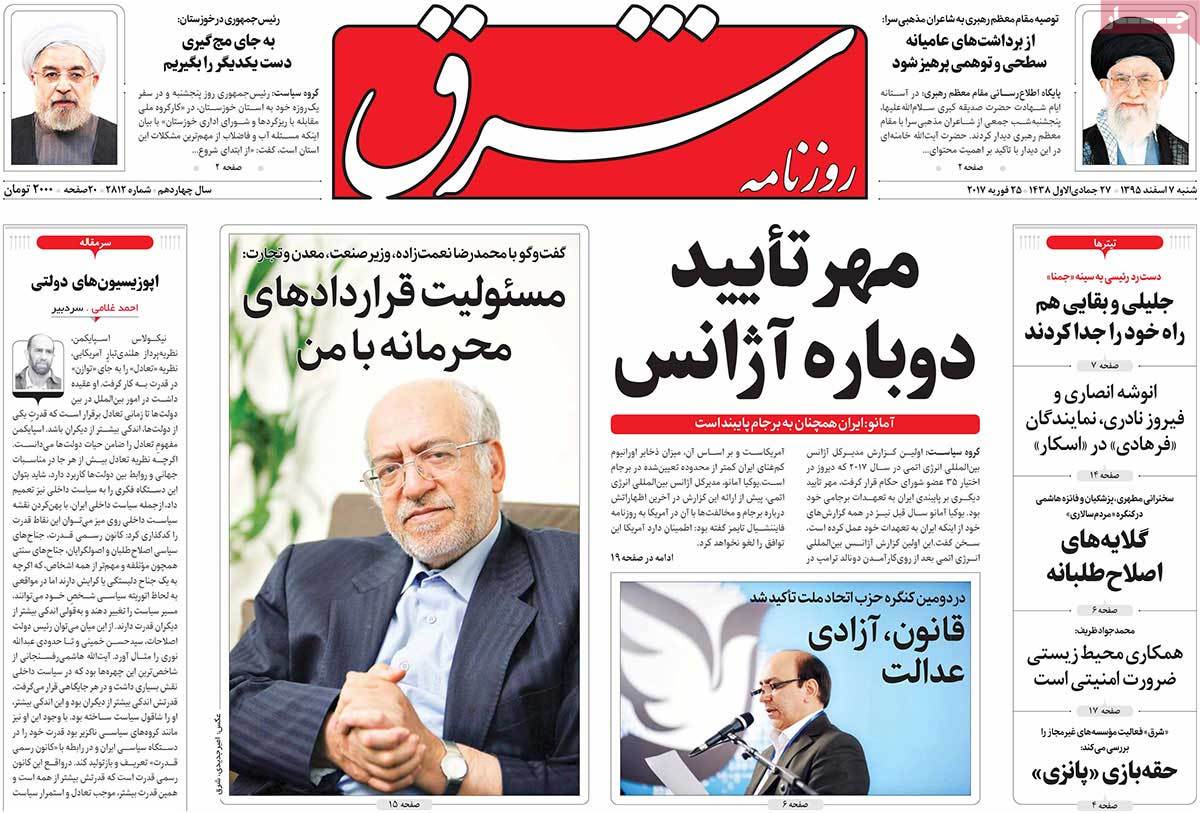
Shargh:

1- IAEA Once Again Confirms Iran’s Commitment to JCPOA

2- Trade Minister: I’m Accountable for Secret Deals

A Look at Iranian Newspaper Front Pages on February 25


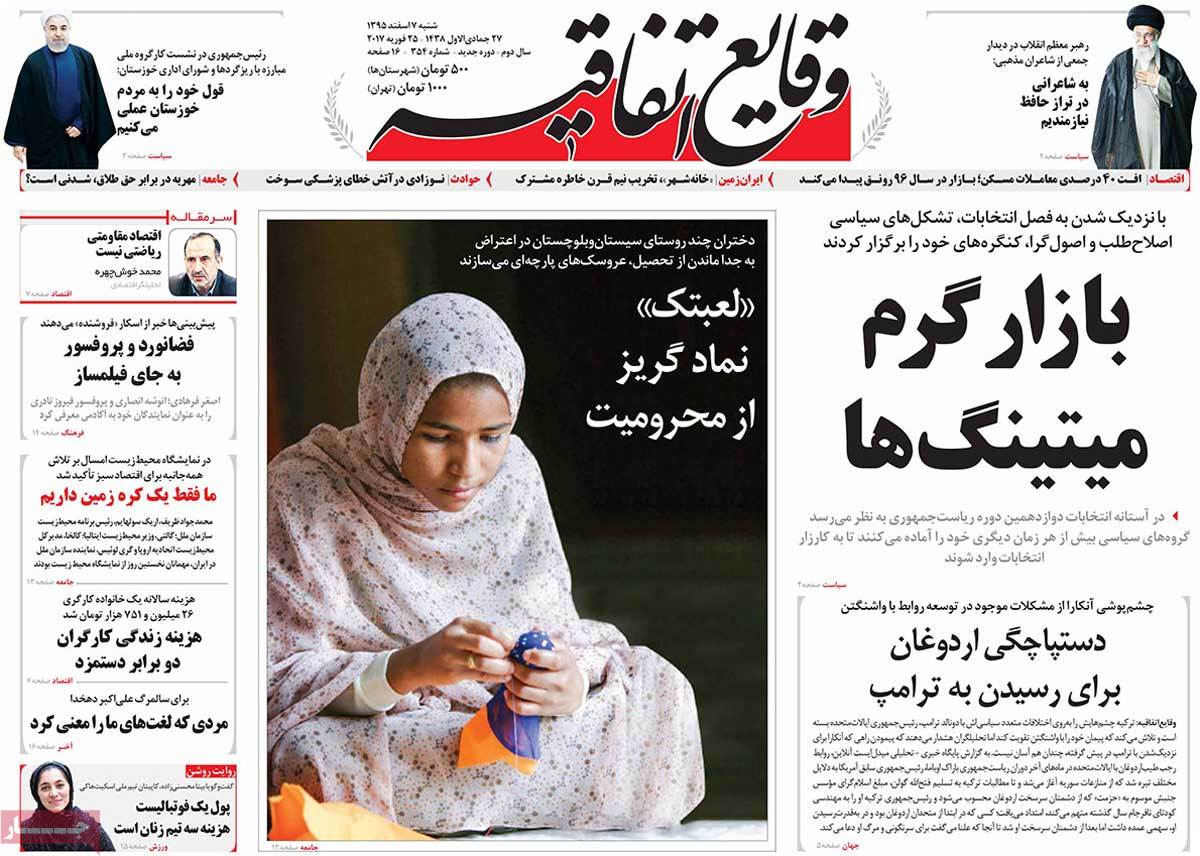
Vaghaye Ettefaghieh:

1- Reformist and conservative parties holding their national congress ahead of May presidential votes

2- ‘Lobatak’, Symbol of Fighting Deprivation

Girls in several villages in Iran’s deprived province Sistan and Baluchestan make handmade cloth dolls in protest at being deprived of education

3- We Just Have One Earth Planet

All-out efforts to realise green economy were emphasised in this year’s Environment Exhibition in Tehran

A Look at Iranian Newspaper Front Pages on February 25

Iranian Filmmaker Addresses Anti-Trump Demonstrators in Beverly Hills

farhadi

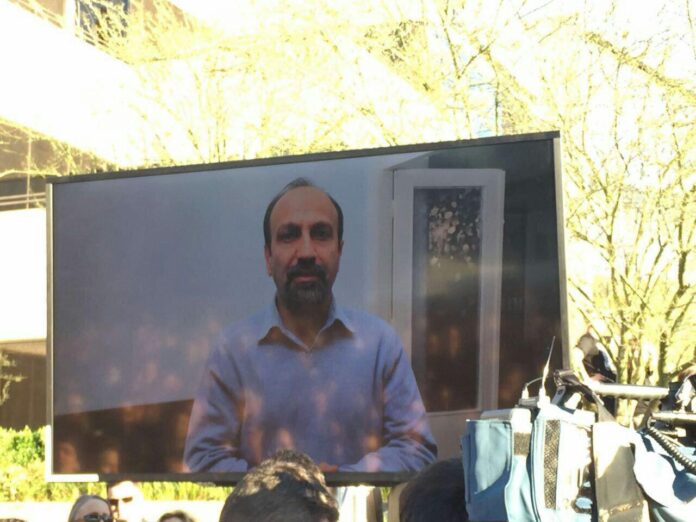
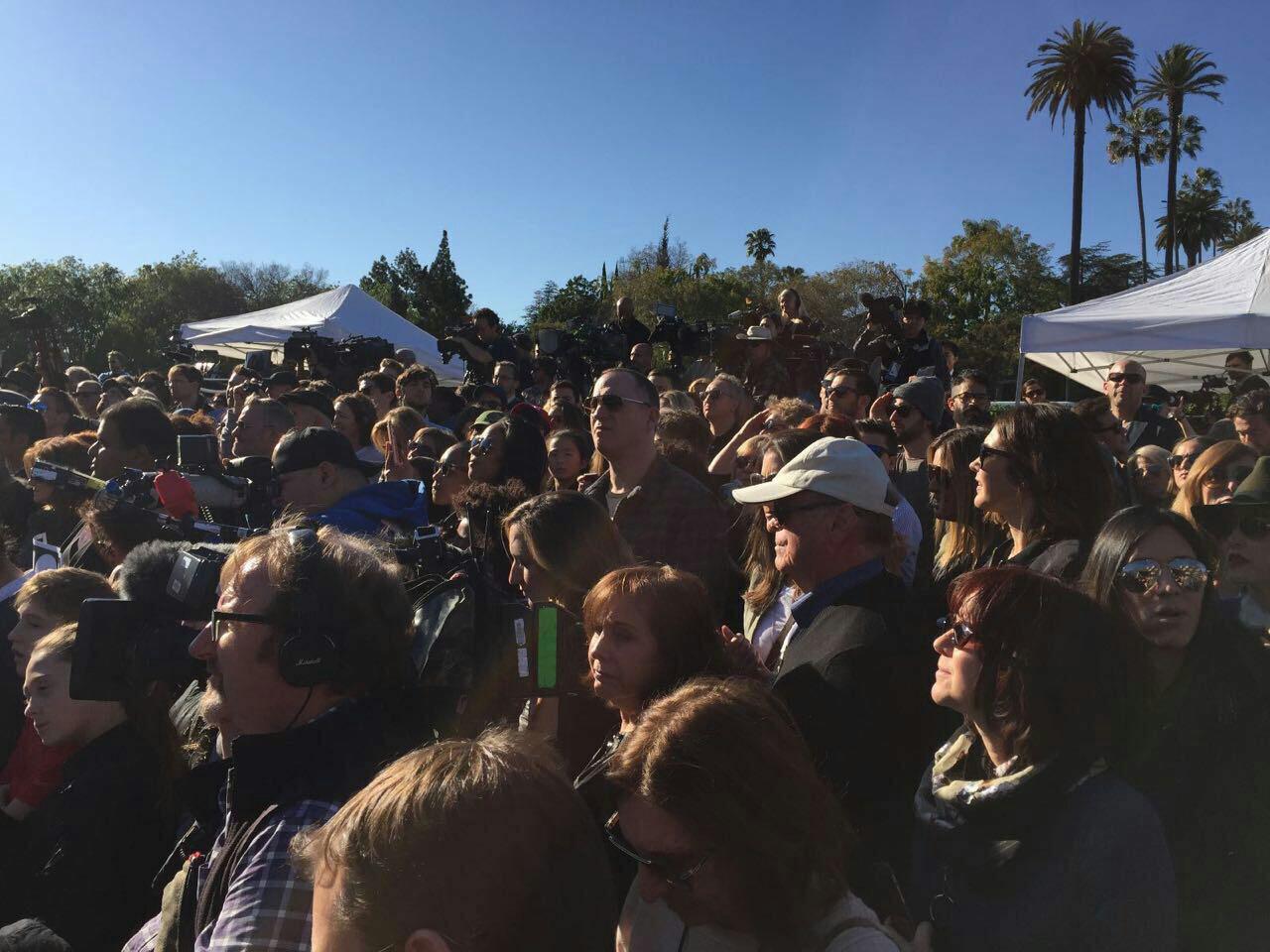
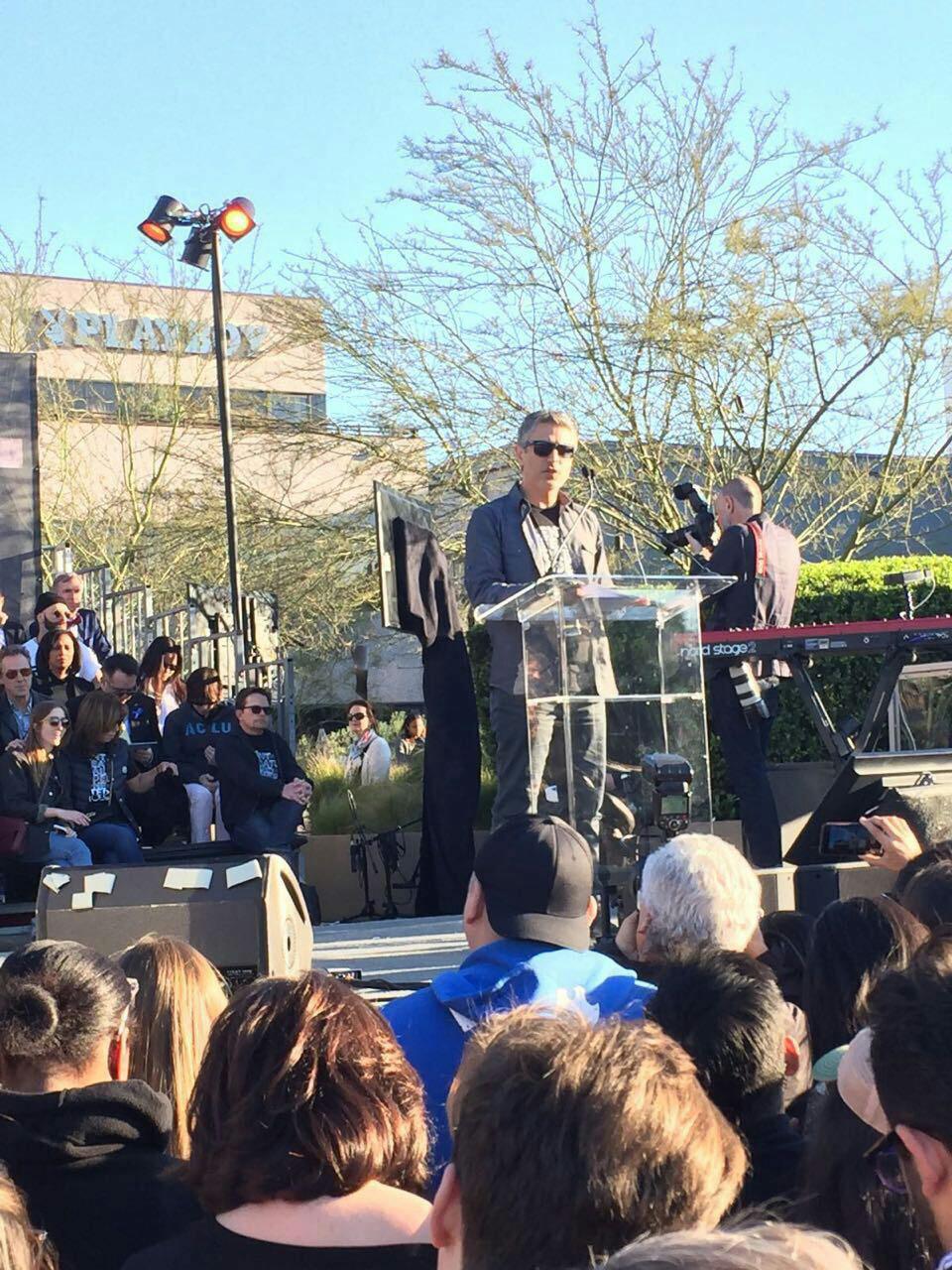
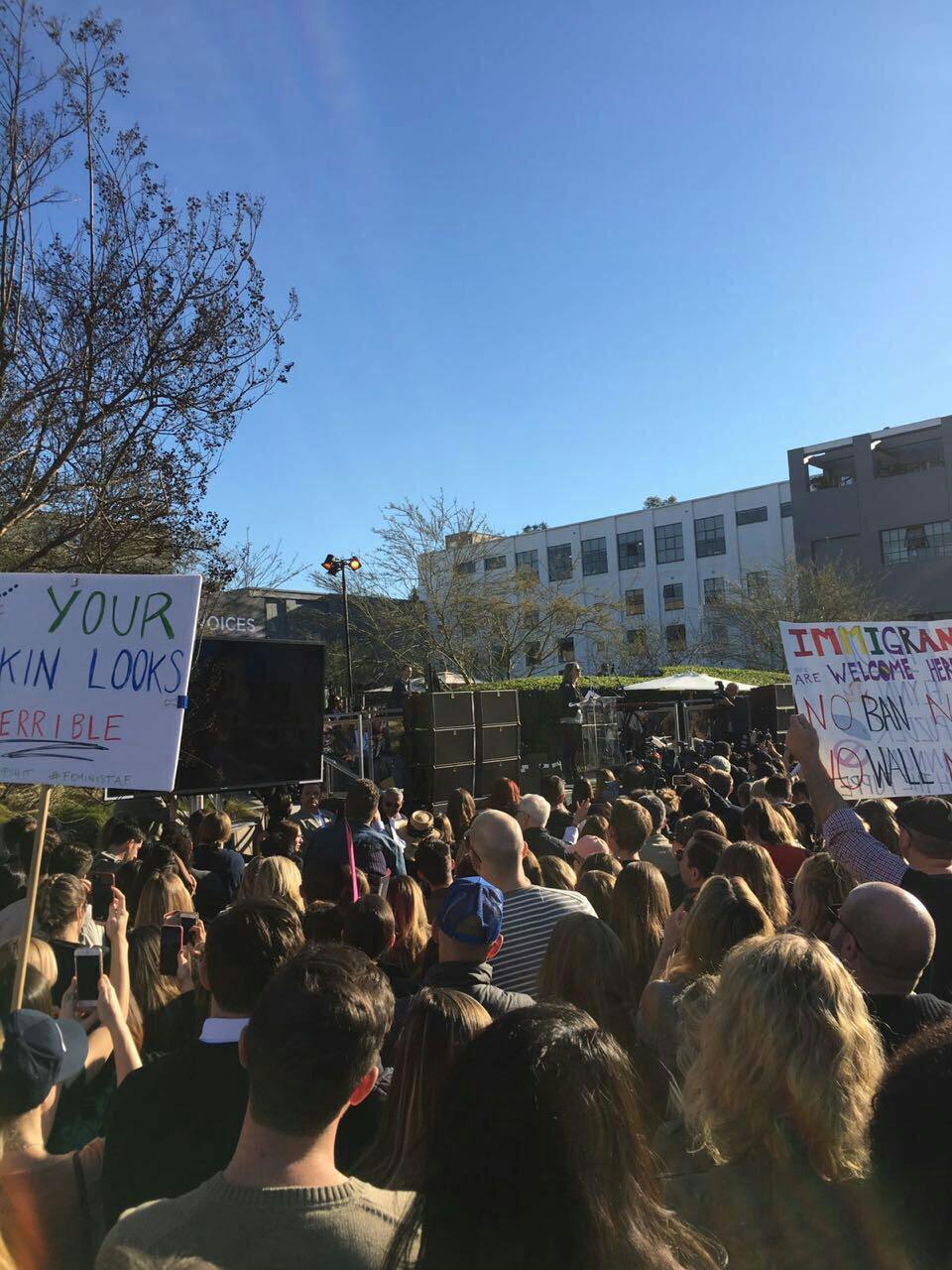
Farhadi applauded the unity shown by the cinema community in his address at UTA’s “United Voices” rally on Friday afternoon.

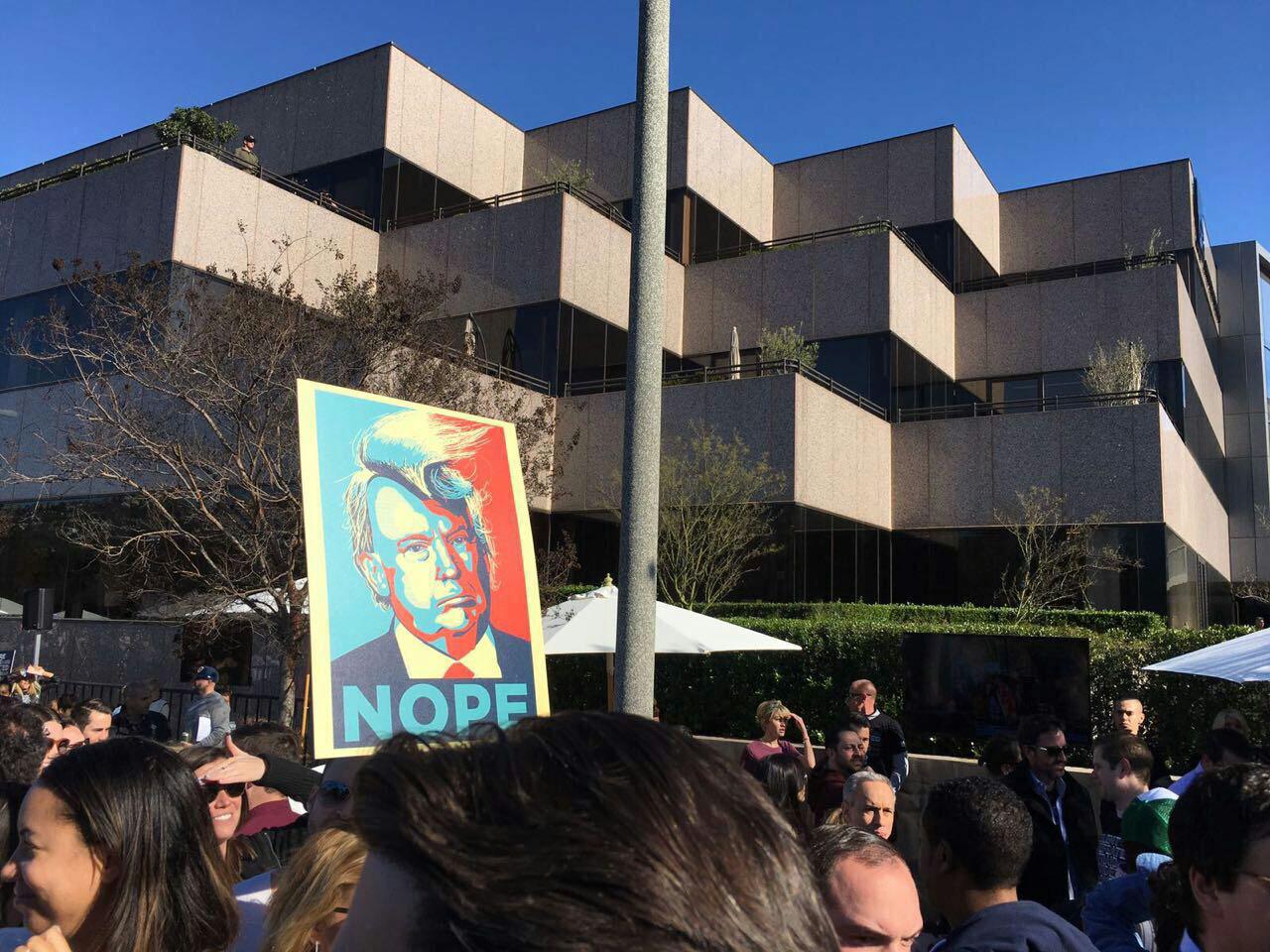
The Iranian director, whose movie The Salesman is nominated for best foreign-language film, spoke via video message from Tehran to the rally crowd of more than 1,500 who gathered outside the agency’s Beverly Hills offices.

“It is comforting to know that at a time when some politicians are trying to promote hate by creating divisions between cultures, religions and nationalities, the cinema community has joined the people in a common show of unity to show its opposition,” said Farhadi, according to a report by Hollywood Reporter.

“I hope this unity will continue and spread to fight other injustices. Filmmakers can break stereotypes around the world by turning their cameras to capture shared human qualities.”

UTA’s decision to forego its annual agency Oscars party for a protest was prompted partially by Farhadi, a UTA client, saying in January that he would boycott the Oscars ceremony in light of President Donald Trump’s travel ban for citizens from seven majority-Muslim countries, including Iran.

Iranian-American engineer Anousheh Ansari (known as the first Iranian in space) and former director of Solar Systems Exploration at NASA Firouz Naderi will attend Sunday’s ceremony in Farhadi’s place.

The “United Voices” rally also featured speeches from Jodie Foster, Keegan Michael-Key, Michael J. Fox, UTA CEO Jeremy Zimmer and California Lt. Gov. Gavin Newsom, among many others.

Iran’s Ansarifard Named Europa League Player of the Week

Ansarifard

Karim Ansarifard helped Olympiacos progress to the Last 16 of the UEFA Europa League by scoring two goals in Olympiacos’ 0-3 victory away to Osmanlispor on Thursday.

UEFA awarded the Iranian’s stellar showing against the Turkish club by naming him as the Europa League’s “Player of the Week”, Agona Sport reported.

In addition, the Europa League’s “Team of the Week” included Alberto Botia (Olympiacos), Giannis Gianniotas (APOEL), Alvarez (Celta), Cabral (Celta), Viergrever (Ajax), Pogba (Manchester United), Pozuelo (Genk), Giuliano (Zenit), Fekir (Lyon), Aboubakar (Besiktas), and Stindl (B. Monchengladbach).

Ansarifard’s team will face Besiktas in the Round of 16.

Ansarifard

Iran Exports $500m Worth of Carpets in 10 Months

carpet

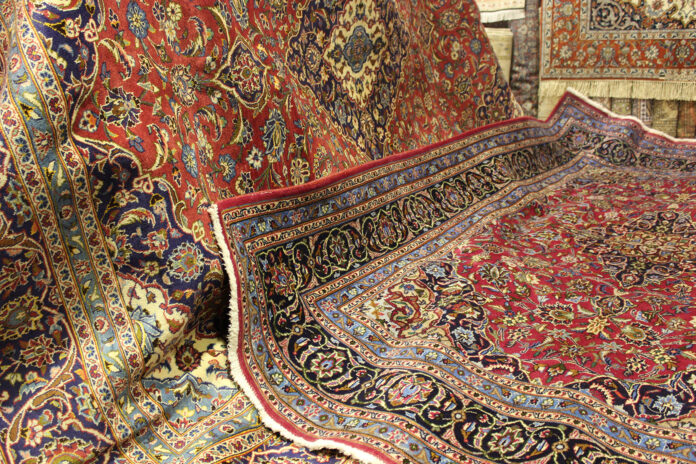
“Hand-woven carpets account for $224 million and machine-made for $276 million of the exports,” Hossein Abouei was quoted as saying by IRNA.

The official noted that Iran produces 125 million square meters of machine-made carpets every year and that Kashan, a city in Isfahan Province, is the biggest hub producing 70 million square meters per year.

The main export destinations of Iranian machine-made carpets are Afghanistan, Iraq, Turkmenistan and Pakistan.

Last week, Hamid Kargar, the head of Iran’s National Carpet Center, put the export of hand-woven Iranian carpets during the 10-month period at 4,400 tons worth $275 million. He said the figure registered a 19% rise compared with the corresponding period of last year.

“Direct exports to the US accounted for $69 million of the total sum. This is while last year we had no exports to that country,” he said.

FM Zarif Slams Turkish Officials’ Improper Anti-Iran Remarks

In a speech at the 53rd Munich Security Conference in Germany on February 19, Turkish Foreign Minister Mevlut Cavusoglu criticized what he called an Iranian “sectarian policy” in the region. Earlier, Turkish President Recep Tayyip Erdogan had accused Iran of promoting “Persian nationalism.”

Reacting on Friday, Foreign Minister Zarif of Iran told Fars news agency that Turkish officials had been entangled in the consequences of their “past mistakes” and were now attempting to play a blame game by making accusations against Iran.

“Unfortunately, the wrong policies of the Turkish government in the past have created a situation that they (Turkish officials) have to project the blame; it is a regret that they do so,” Zarif said.

Turkey has been involved in unauthorized military operations in Syria and is accused of having supported militants fighting the elected Syrian government.

“We hope that regional countries would fully comprehend the need for cooperation… and that such cooperation would turn into the topic of the day instead of such improper remarks,” the Iranian foreign minister said dismissively, referring to the anti-Iran comments by the Turkish officials.

Iran had earlier summoned the Turkish ambassador to Tehran for a diplomatic rebuke over the remarks by Cavusoglu and Erdogan. The Iranian Foreign Ministry had also warned that there was a certain ceiling to Tehran’s patience with the Turkish government.

‘Ungrateful, and with a weak memory’

On Thursday, in an interview with the daily Iran, Foreign Minister Zarif had recalled Iran’s supportive stance vis-à-vis the Turkish government following a failed coup attempt that sought to topple officials in Ankara in July last year and said the Islamic Republic did not expect the behavior that the Turks later displayed.

Following the coup, Iran voiced full support for the Ankara government, and Zarif soon traveled to Ankara to carry a message of support for the legitimate Turkish government. He even visited the damaged parliament building in the Turkish capital, shelled by rogue soldiers.

“[Our] friends [in Turkey] apparently have a weak memory…,” he said in the Thursday interview. “They both have a poor memory and are ungrateful toward those who have been kind to them and supportive of them.”


Also speaking at the Munich conference, the foreign ministers of Saudi Arabia and Israel seemed to echo one another — and Cavusoglu — by making anti-Iran remarks of their own.

‘The coalition of the defeated’

In his Thursday interview, Zarif called Saudi Arabia and the other regimes working in tandem against Iran “the coalition of the defeated.”

“Once… I said that the international anti-Daesh coalition is ‘the coalition of the repentant;’ now I say it is ‘the coalition of the defeated.’ All the parties that have failed in our region have formed a coalition and are saying things. I think one shouldn’t take them very serious,” Zarif said in that interview.

‘The powerful side doesn’t taunt’

The Iranian foreign minister that while Iran has been speaking — including in the Munich Security Conference where Zarif himself represented Iran — of cooperation and dialog, the anti-Iran regimes have been “throwing wrenches in the works, which is often not what the powerful side does.”

“The powerful side should lay out its plans and speak of what the future should look like, not call others names,” Zarif said.

Incorrect Regional Policies Main Cause of Environmental Problems: Zarif

4f01fbc8-d823-451d-882e-28dc083130a9

Addressing the opening ceremony of the 16th Iran International Environment Exhibition in Tehran on Friday, Zarif invited all neighboring countries to engage in close environmental cooperation with Iran.

“I invite all neighbors of the Islamic Republic to launch a joint project to counter the environmental threats caused by former tyrant regimes in the region, particularly [Iraq’s executed dictator] Saddam [Hussein] and some extremist groups, especially Daesh,” the Iranian minister said.

Some of the areas in Iraq where sandstorms originate are under the control of the Daesh Takfiri terrorist group and have turned into battlefields, hindering a response to environmental issues in those territories. Analysts also believe that Saddam’s environmental policies during his tenure have played a major role in the drying up of Iraq’s wetlands and current environmental issues.

“The Islamic Republic of Iran extends its hand of cooperation to all its neighbors in order to provide a better life for our children through a joint project and to counter the threats that the present generation and future generations face,” he added.

He described such cooperation as a “political and security imperative and not just an environmental necessity” and expressed hope that the leaders of regional countries would succeed in solving the issues.

Environmental cooperation can help build confidence among regional countries, he said, adding that all states in the region regardless of their policies need to strengthen their cooperation in this sector.

Zarif further expressed hope that all countries would also boost their cooperation to solve common challenges in all other fields, including economy and poverty alleviation and the campaign against terrorism and extremism.

“Green Economy, Resilience Economy” was the motto of the four-day exhibition which was kicked off in Tehran in the presence of 300 domestic firms and 20 foreign companies.

The exhibition is underway in Tehran as the southwestern Iranian province of Khuzestan is reeling from heavy floods and dust storms, a situation which has led to disruption to the distribution of water and electricity supply in the province.

Speaking upon his arrival in the provincial capital city of Ahvaz on Thursday, Iranian President Hassan Rouhani said the Islamic Republic is currently implementing plans to resolve the root causes of dust storms inside the country, but there is a need for regional and international cooperation to eliminate the other origins of such storms in Iraq, Syria and Saudi Arabia.

Incorrect Regional Policies Main Cause of Environmental Problems: Zarif

Heavy rains have washed filaments of dust and sand into power transmission equipment, leading to long outages. Water supplies have not been unscathed, hindering everyday life in the provincial capital Ahvaz and other cities.

On Monday, Leader of the Islamic Revolution Ayatollah Seyyed Ali Khamenei called on Iranian officials to immediately address the problems facing residents of Khuzestan Province.