Tuesday, December 23, 2025
Home Blog Page 4115

Trump’s Travel Ban Depriving US of Flavour Iranians Could Add

Donald Trump

US President Donald Trump recently signed an executive order indefinitely banning Syrian refugees, and temporarily blocking citizens from six other majority-Muslim countries of Iran, Iraq, Sudan, Somalia, Yemen and Libya from travelling to the US. The ban was temporarily lifted based on a federal judge’s ruling, but it might be put back in force in future.

A former head of Iran Cultural Heritage, Handicrafts, and Tourism Organization (ICHTO) and the current head of ICHTO’s Cultural Heritage Research Centre Mohammad Beheshti Shirazi believes that although Iranians may fail to offer industrial or economic advantages to a country they immigrate to, particularly the US, they have other characteristics that can highly contribute to the improvement of the quality of life in their host society.

In a Farsi article in Etemad newspaper, Beheshti Shirazi presents a number of historical facts to support his idea, the excerpts of which follow:

Seyyed Mohammad BeheshtiDuring the period I was in charge of Iran Cultural Heritage, Handcrafts and Tourism Organization, George W. Bush was the president of the US. At that time, when I had a meeting with the experts and professors of American scientific centres and universities, most of them expressed shame over the statements, deeds and behaviour of their president and apologized on behalf of him.

Now that Trump has become the head of state in the US and given his strange behaviour and remarks, I presume that in my future sessions with American visitors, I would find them embarrassed. With the international spotlight currently on Trump and in view of his childish and mischievous moves, which give people all around the world numerous causes for complaint, I am constantly repeating this question in my mind: What has the US deprived itself of by banning entry of Iranian immigrants and travellers to the country?

Is it depriving itself of Iran’s auto industry? Is it losing access to our engineering or medical innovations? Is Iran considered the US industrial strategic depth, as is the case with China and India, whose severed ties with Washington would worry the Trump administration about the future of his country’s factories?

It is crystal clear that the answer to all these questions is almost completely no.

In such complicated wrathful situations, we suddenly think up national and cultural excuses to defend ourselves. We primarily ask questions about our global advantages. Prior to this, in response to the question about the secrets of their success in the US, Iranian immigrants mostly gave two answers: First, the opportunities the US and its atmosphere had provided them with, and secondly, their own capabilities and talent.

Few would have mentioned the advantages the Iranian culture had given them. In situations similar to the status quo, no matter how successful they are in their profession, everybody would perceive personal achievements as a tiny weapon to battle against the prevailing trend. It is only in such critical periods, when we see ourselves as part of a bigger whole and identity, which is Iran or Iranian culture.

It would be quite natural if we asked ourselves what a trump card we have up our sleeves to win us respect in the international community.

What appears to be disappointing about Iranian-Americans is that it is as if they fail to offer any substantial benefit to the country. Unlike Chinese, Italians and Arabs, they have not even managed to set up any community. Unlike Armenians and Jews, they have failed to provide their fellow Muslims with any special support either. They do not basically stress their distinctive features. They would like to be identified by their differences in the host society. The only reason they quickly adapt to the social mores and norms of their new home and observe its laws, is to fully assimilate with their new housemates as soon as possible. They do not want to be regarded as foreigners, for they plan to climb to the top of the status pyramids in the new country and become in charge of affairs after a few generations. This requires them to become identical members of the new society.

These behaviours displayed by the Iranian immigrant society have triggered a series of reactions by a large number of social analysts who ascribe these attributes of Iranians to their individualistic tendencies or low self-confidence on encountering the host society’s culture. Nevertheless, it would be unfair to give a hasty analysis of these witty and clever behaviours of Iranians. These people’s infiltration into a new society has a special quality. Although it takes some time for the quality to demonstrate itself, its outcomes are long-lasting and essential. Unlike Chinese, Iranians do not monopolize global markets with their art of mass production. They are not like the people of some states who constitute the US cheap workforce population.

As in case of their presence in the US, Iranians’ art is not evident, but it is still perceivable. It is like water that becomes visible only when it has filled the whole place and soaked everything. Iranians are capable of winning the heart of the host society’s people thanks to their art of alchemy which captivates the essence. They know how to speak in any given situation and position, receive kindness and, thus, accumulate social capital and advantages.

They can improve the human quality of everything and make it look more desirable. They hide their differences with the people of the host society in the first place, to be allowed to penetrate into the deep layers of the new society. An analysis of Iranian immigrants in Western states clearly supports this claim. The first generation of the people who had left Iran morosely prior to and after the Victory of the Islamic Revolution (1979), when the country was in tumult, became a dispersed society which, in case required, would hide or deny its identity. This was because they were newcomers, quite unaccustomed to their new environment and under a serious media attack. In that era, Iranians had to work out solutions individually to guarantee their survival.

Almost four decades (two generations) have elapsed since Iranians’ immigration to Western Europe and North America and they have gradually managed to put down roots in their new societies and occupy high positions in their status pyramids. What is interesting is that, depending on their level of self-confidence, they currently underline their nationality deliberately on different occasions and take pride in it. At present, they expect the host society to officially recognize them and respect them as its other native members.

Historically speaking, Western countries have not been the first destination for which Iranians left their country. History shows that whenever put under pressure, Iranians have mostly immigrated to the best places in the world in their own time. However, none of them has aimed to become a thorn in the eye of its host nation. On the contrary, they have improved the condition of their new home — their host societies—as does a fragrant breeze that blows through barbed wires and emits an odor that refreshes its immediate surroundings.

It is said that during Seljuq dynasty (1016-1153), a number of Iranian Zoroastrians left the country for India because of some religious bigotry. Having learned about their intention to reside in Gujarat port city, its ruler sent them a bowl full of milk to both welcome their arrival and implicitly imply that Gujarat is densely populated and does not have sufficient room for the newcomers. The head of the Iranian group, who had understood the ruler’s message, asked for some sugar, solved it in the milk and sent it back to the ruler. By this, he, in fact, had implied that they would both assimilate easily in the host society in a way that their presence would not be perceived as annoying and make the life of those around them sweeter. Whether we believe it or not, this is the role Iranians have always played in the world.

They have played their role very well whenever provided with a suitable opportunity, such as entering a specific profession or obtaining a special position. Cinema is a palpable example in this regard. Iranians’ art of alchemy is the quality they present to their host societies in case of their prolonged presence in it. On the contrary, their wrath leaves a bitter taste in the mouth of their host society.

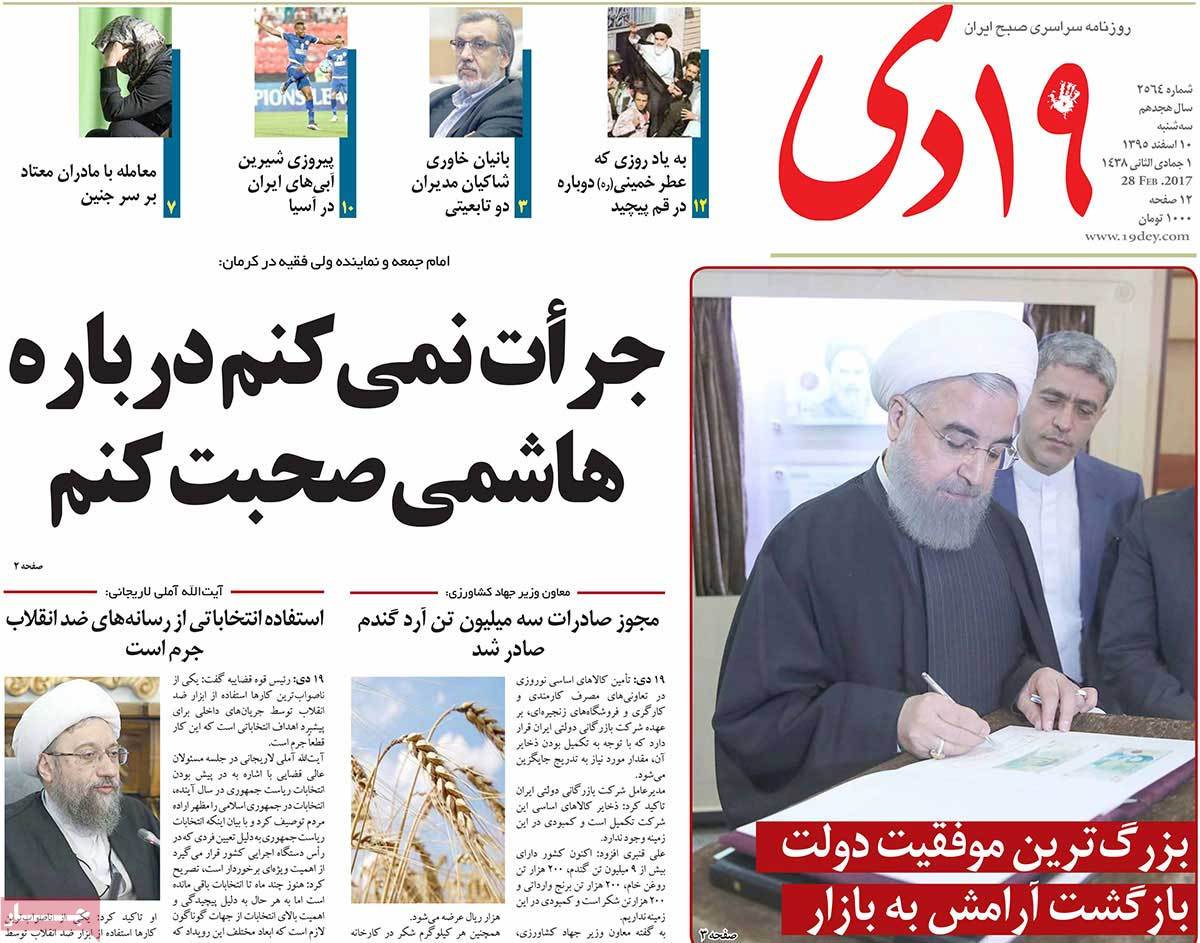
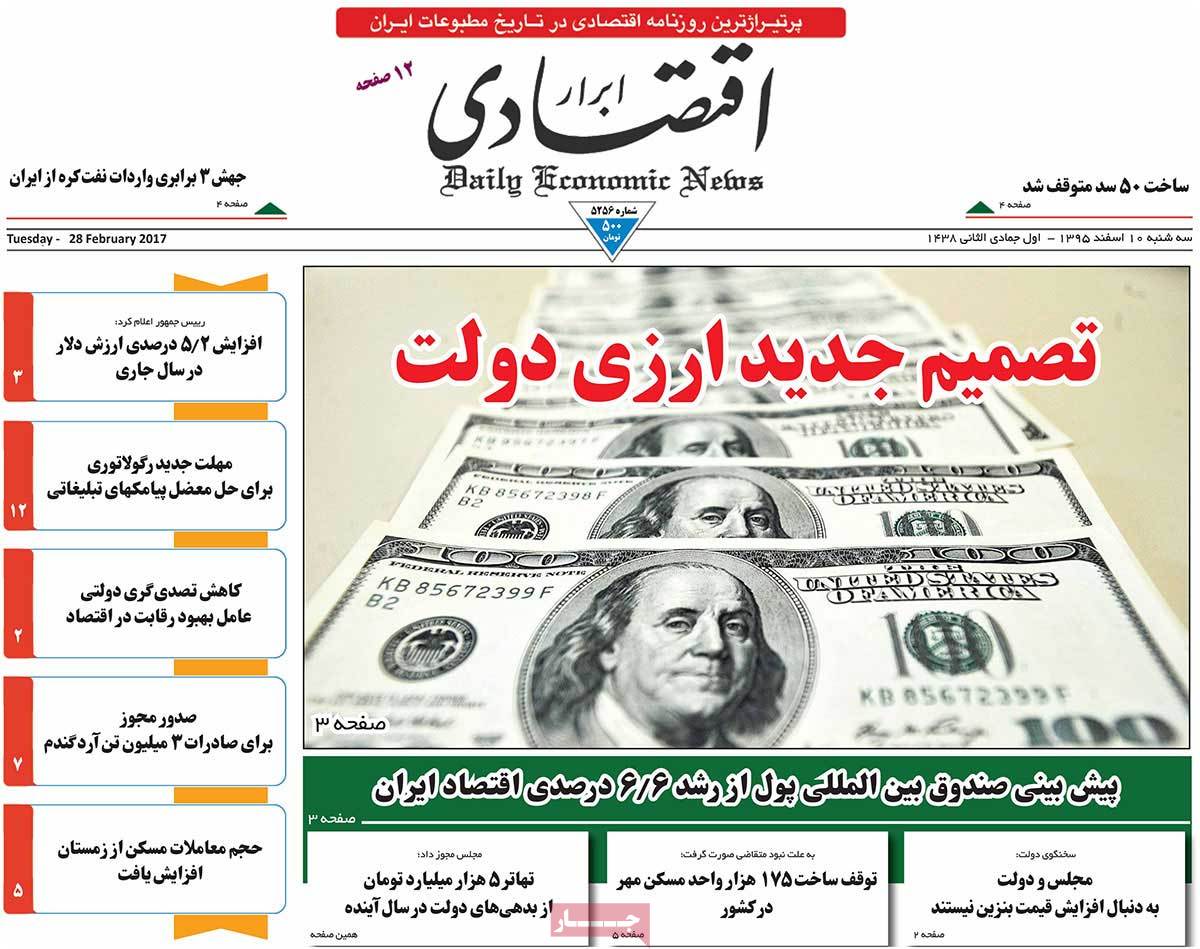
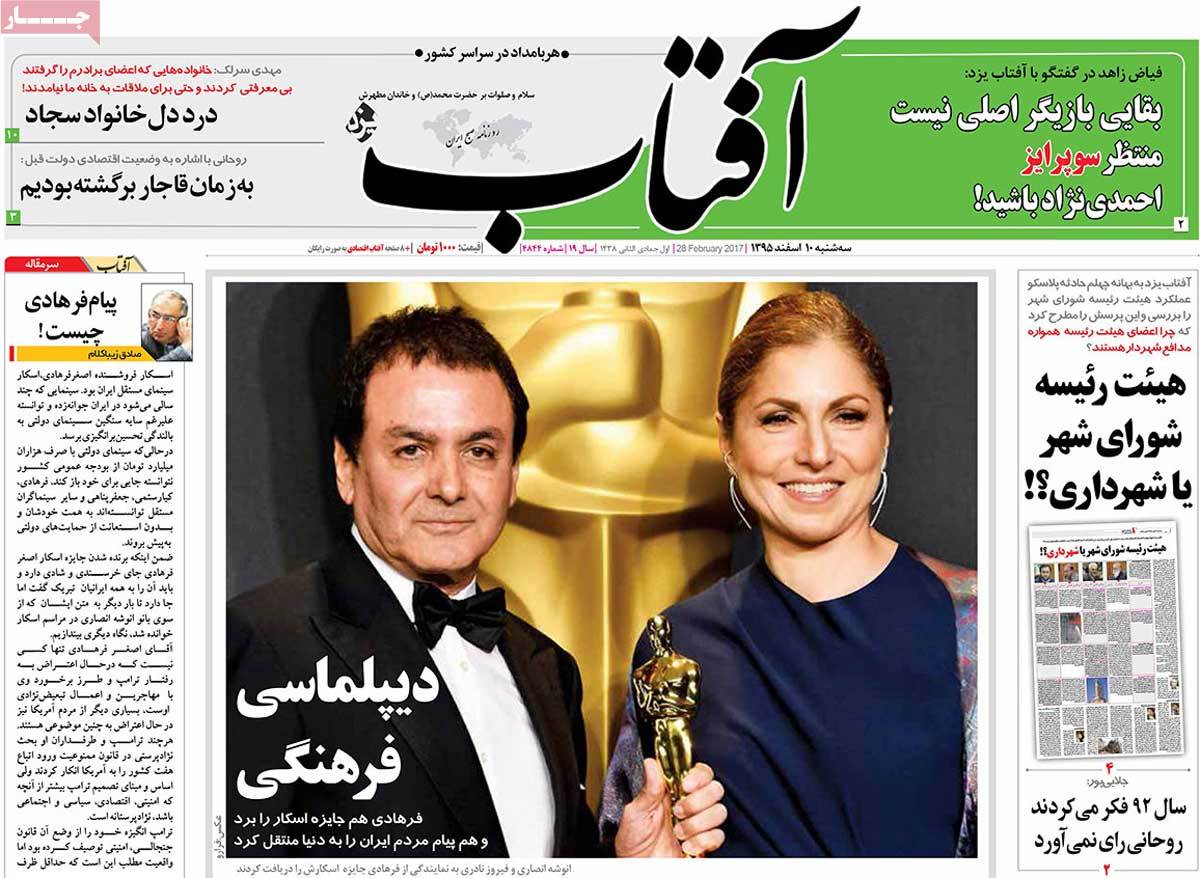
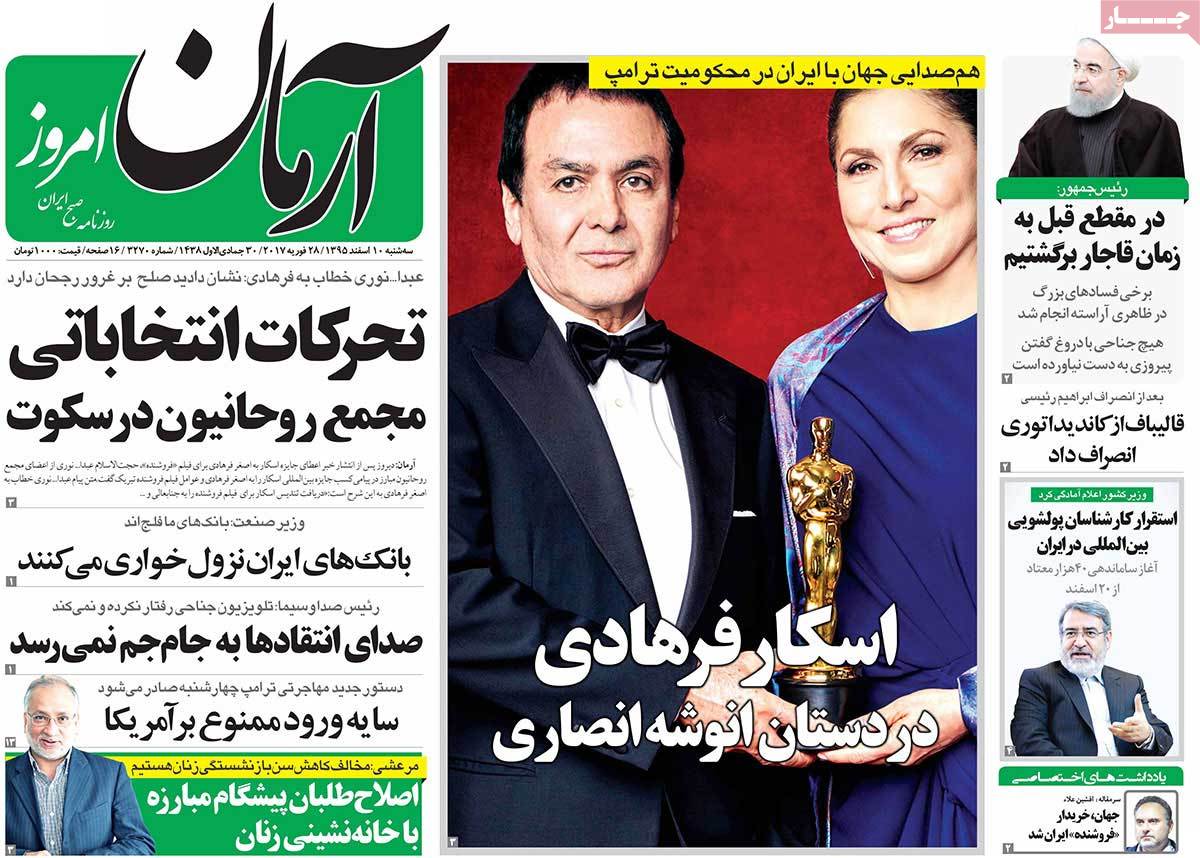
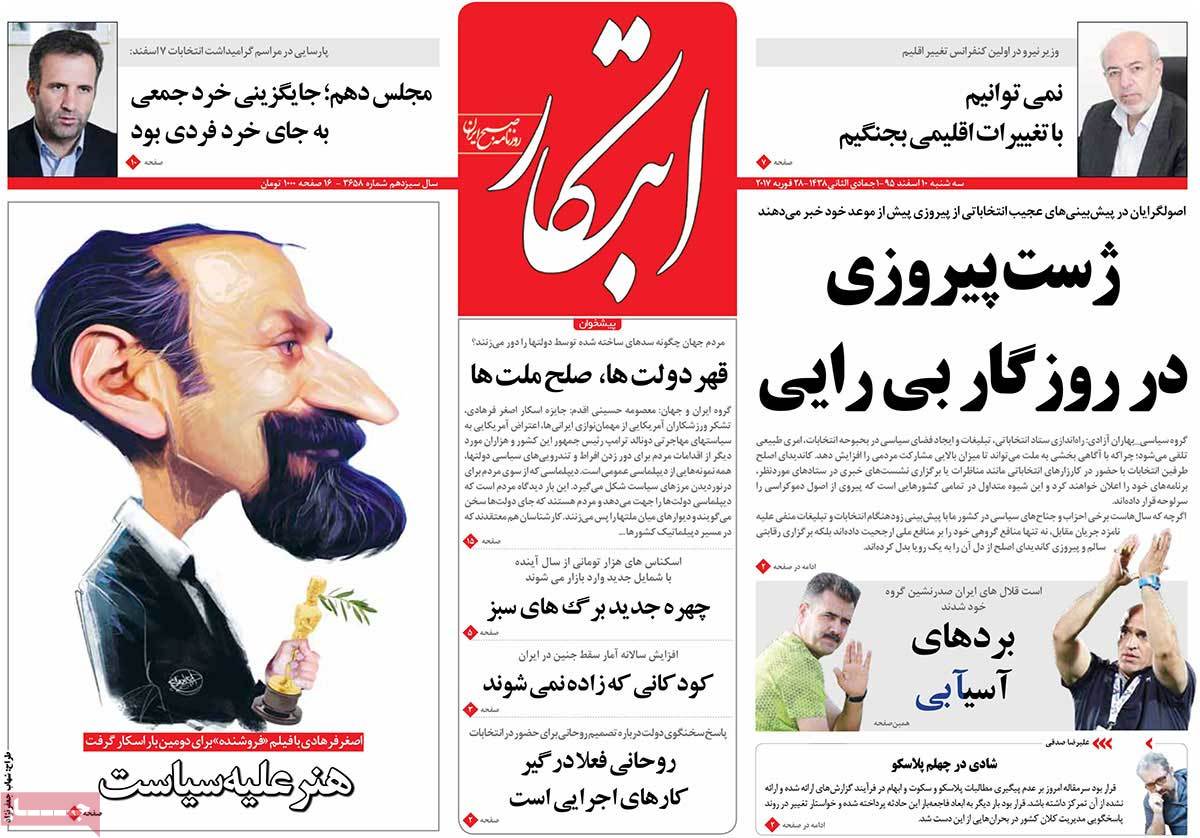
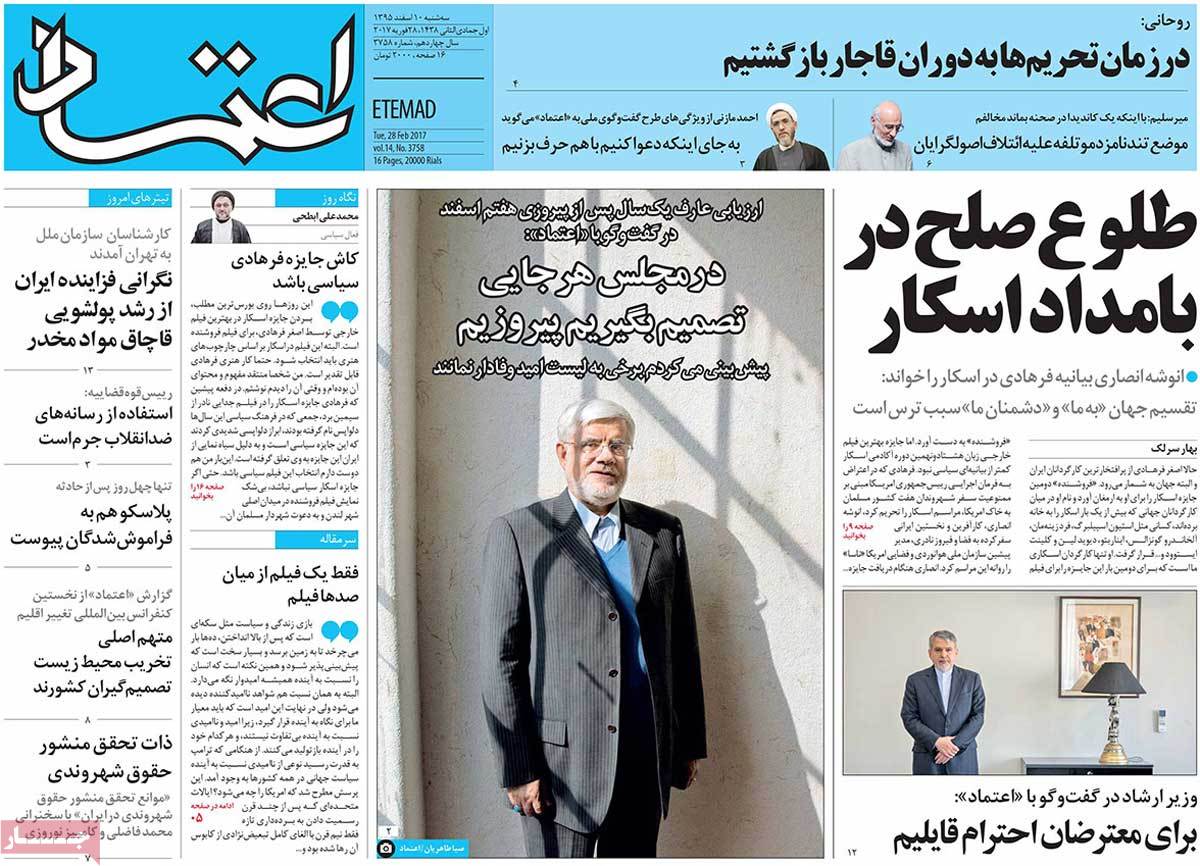
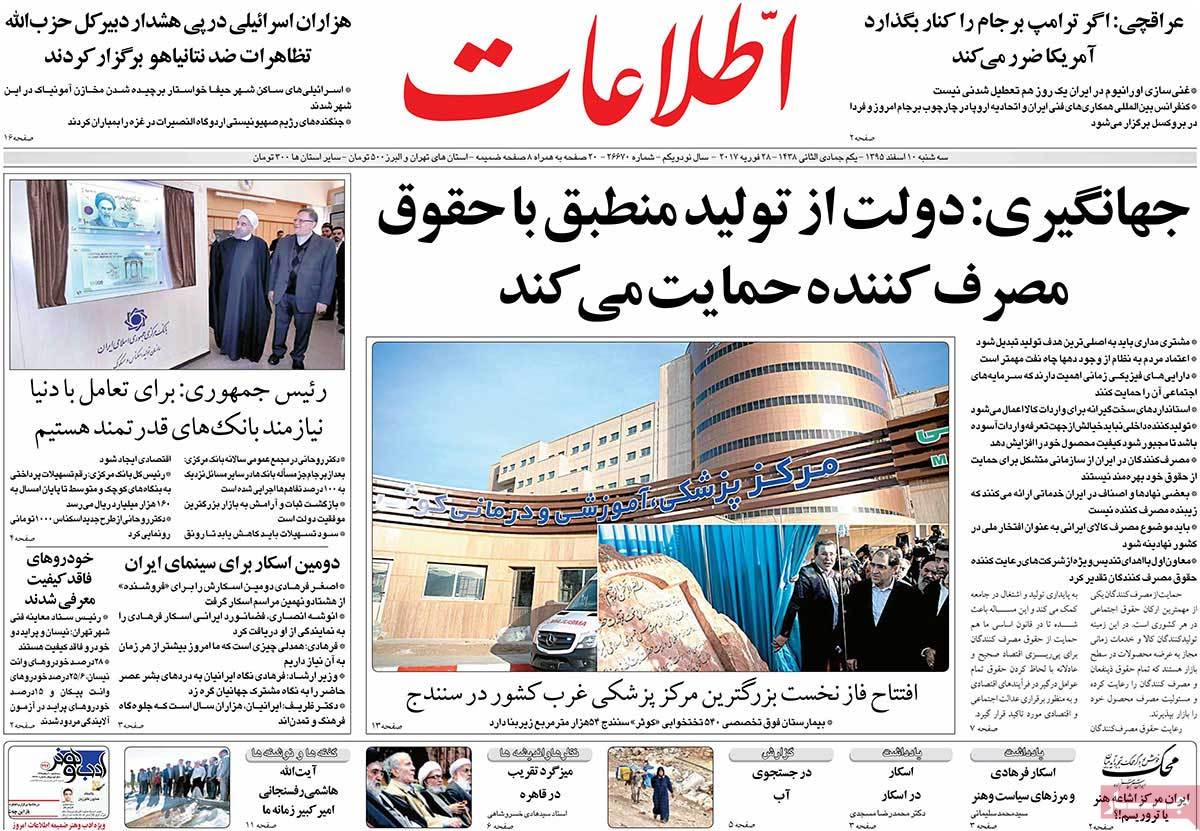
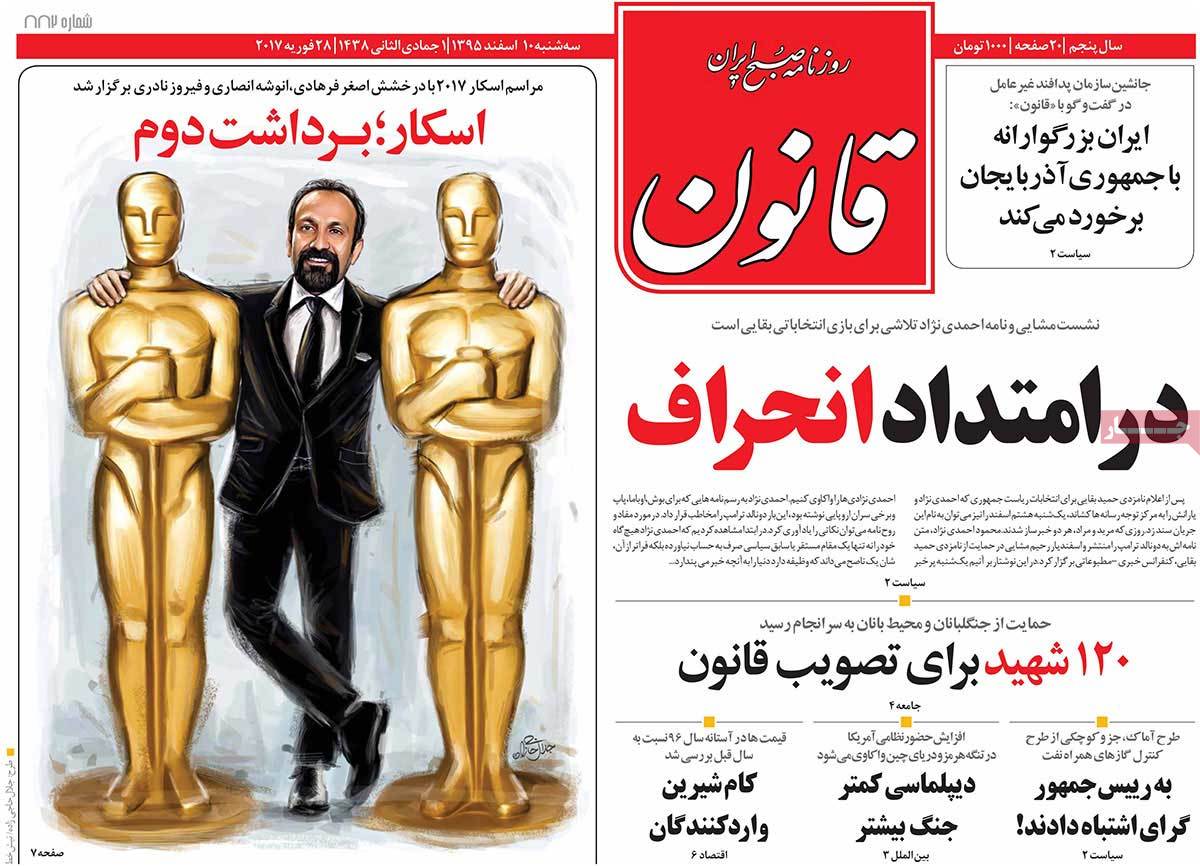
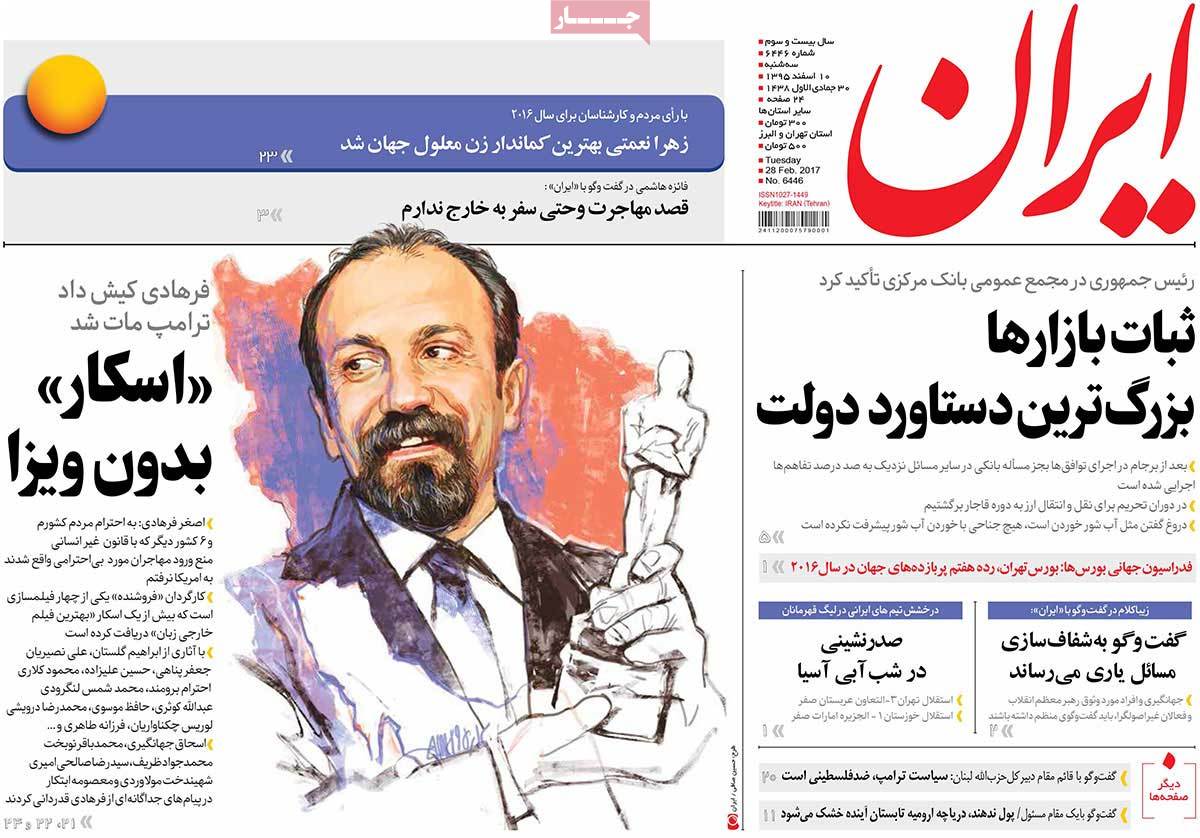
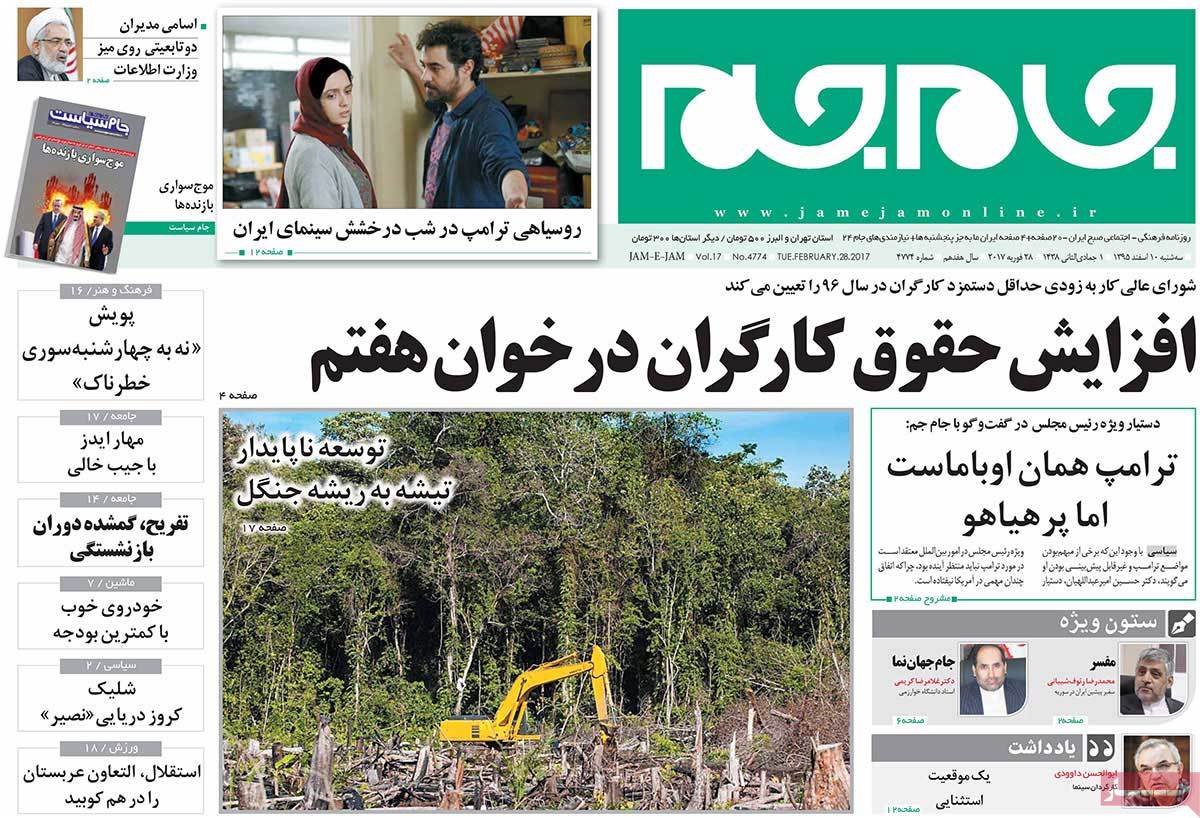
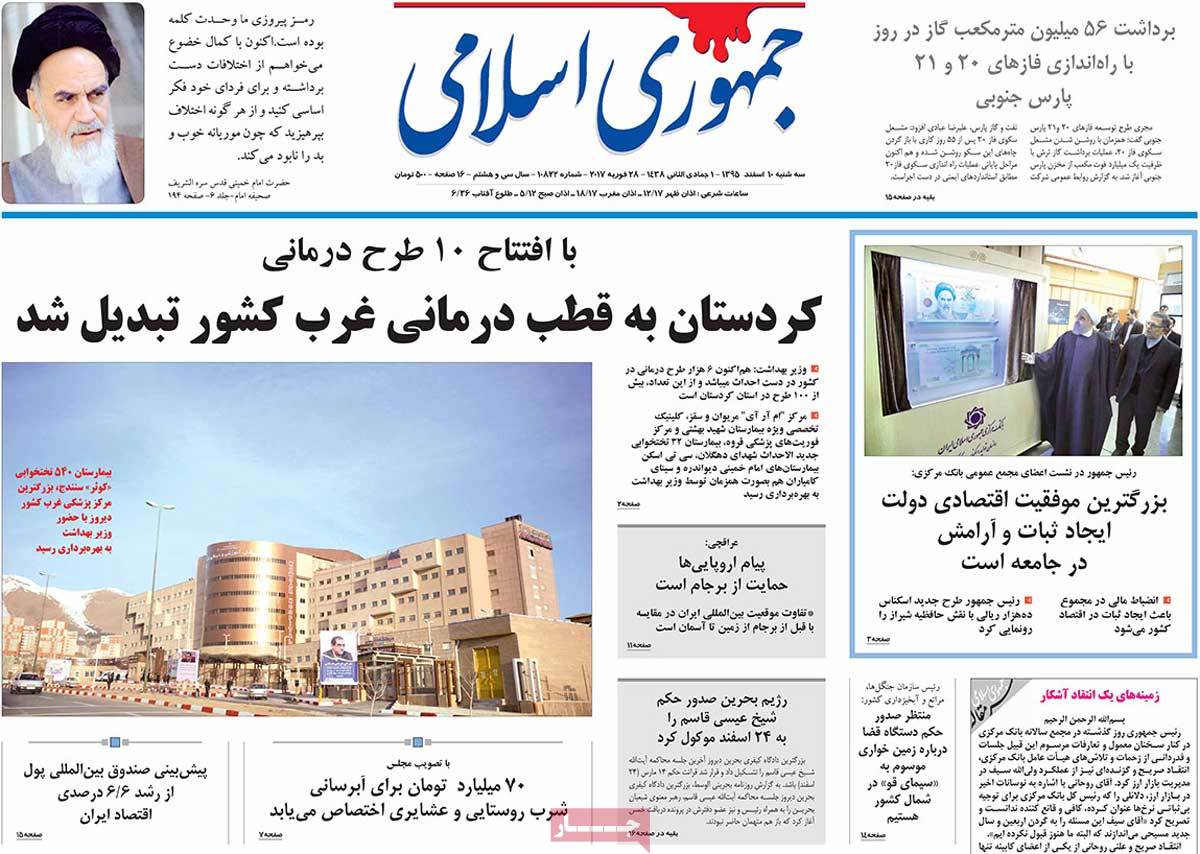
A Look at Iranian Newspaper Front Pages on February 9

The anniversary of the victory of Iran’s 1979 Islamic Revolution will be celebrated on Friday, February 10, in nationwide annual rallies held across Iran. All newspapers today called on the Iranian nation to take part in the rallies and show their solidarity to the US and its new president.

Another top story today was that President Hassan Rouhani will run for presidential election in May, as confirmed by Iranian Health Minister Hassan Qazizadeh Hashemi.

Newspapers also covered the controversial list of Fajr Film Festival’s nominees declared by its jury and the decision by many artists, including even some of those nominated, to boycott the festival in protest.

The above issues, as well as many more, are highlighted in the following headlines:


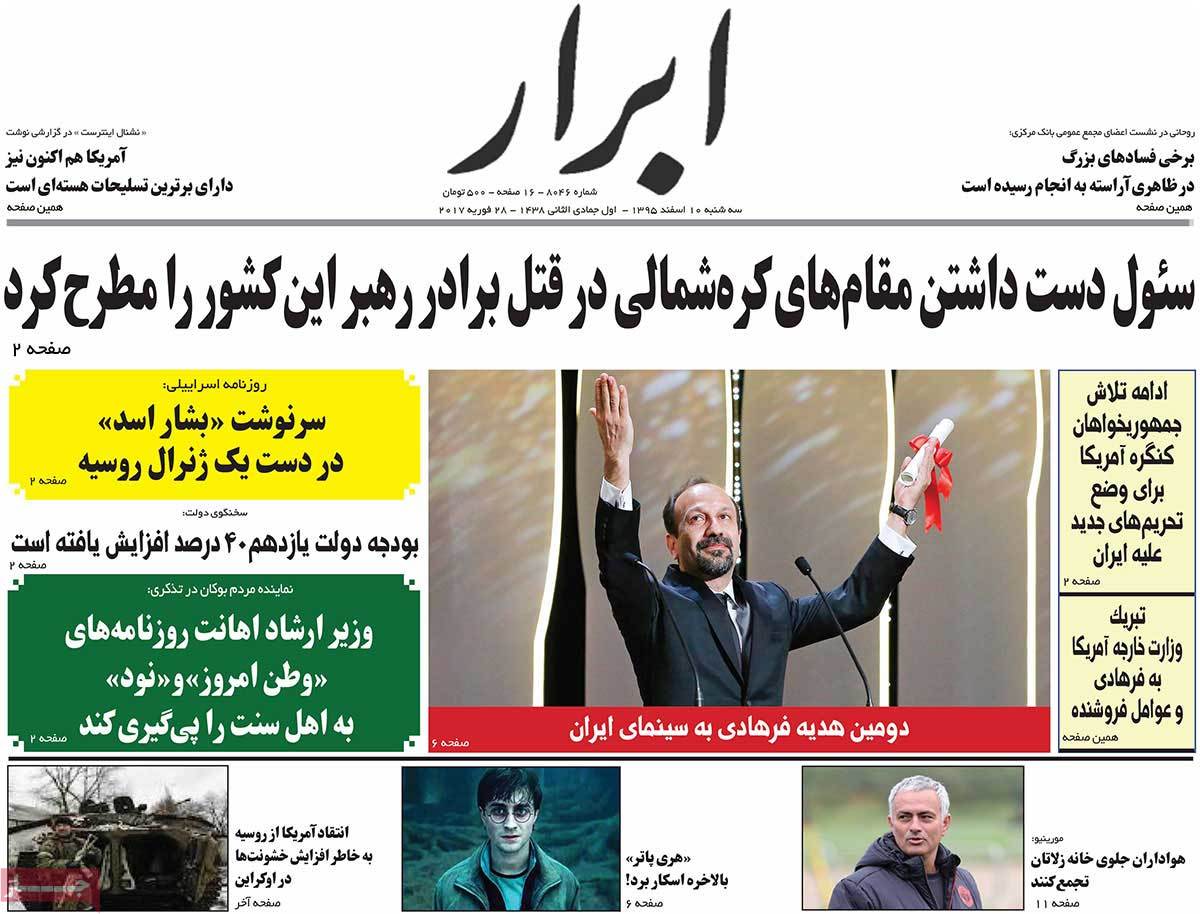
Abrar:

1- Senior Conservative Bahonar: I Think Rouhani Will Receive Less Votes

2- Muslims Should Give Passwords to Their Social Media Accounts If They Want to Obtain US Visa

3- IRGC Commander: Islamic Revolution Will Continue Its Path Strongly and Proudly

A Look at Iranian Newspaper Front Pages on February 9


Amin:

1- Opponents of Iran Will Lead Trump’s Administration to Defeat

2- Top Chess Players in Tehran: Iran Hosting Most Important Sport Event in Its History

A Look at Iranian Newspaper Front Pages on February 9


Arman-e Emrooz:

1- Iran’s Revolution Didn’t Move Based on Arms: Imam Khomeini’s Grandson

2- Health Minister: Rouhani Will Run for May Presidential Votes

3- Tomorrow Everyone Will Come: A Call for People’s High Turnout in 22 Bahman Rallies

A Look at Iranian Newspaper Front Pages on February 9


Asr-e Rasaneh:

1- Capacity of Iran’s Petchem Production Increases by 7.5 Million Tonnes

2- 1.5 Million People Added to Iran’s Job Market in Past Year: Labour Minister

A Look at Iranian Newspaper Front Pages on February 9


Bahar:

1- Living beside the Rubble: A Report of the Place Where Plasco Building’s Debris Are Transferred to in Southern Tehran

A Look at Iranian Newspaper Front Pages on February 9


Ebtekar:

1- In a Ruling System Inspired by Imam Ali (AS), the Red Line Is Armed Struggle, Not Criticism: Vice-Speaker of Iran’s Parliament

2- Our Ties with Tehran More Important than Those with Washington: Iraqi PM

3- Ethics Gives Peace to the Society: Imam Khomeini’s Grandson

4- 22 Bahman Rallies Will Be Held in 5,000 Spots: People Invited to Attend Celebrations of Islamic Revolution’s Victory

A Look at Iranian Newspaper Front Pages on February 9


Etemad:

1- Rouhani Decides to Run for Presidential Election

2- One Iran, One Voice: Nation Will Show Its Unity Tomorrow

3- Glory of Independence, Manifestation of Republicanism: A Special Report on 38th Anniversary of Victory of Islamic Revolution

4- Iran’s Leader Pardons or Commutes Sentences of 631 Prisoners

A Look at Iranian Newspaper Front Pages on February 9


Ettela’at:

1- Iranian Nation’s Call for Independence and Justice-Seeking to Be Heard in the World Tomorrow

2- US Power to Unite the World against Its Enemies Decreased: Rouhani

3- 820 Billion Tomans [$215,000] Allocated to Revival of Lake Urmia

4- Saudi Palaces Evacuated across US for Fear of Yemenis’ Missile Attacks

5- Ayatollah Khamenei’s Comments about 4 Books Unveiled

A Look at Iranian Newspaper Front Pages on February 9


Haft-e Sobh:

1- Good, Ugly, Tough: Controversy over List of Fajr Film Festival’s Nominees Makes Culture Minister Form Special Committee

A Look at Iranian Newspaper Front Pages on February 9


Iran:

1- Call for National Participation: Clerics, Officials, Parties, and Political Figures Invite People to Attend 22 Bahman Rallies

2- 21,000 Inactive Industrial Units Resume Work: Central Bank Governor

3- Iran’s Revolution Most Popular One in History: Imam Khomeini’s Grandson

A Look at Iranian Newspaper Front Pages on February 9


Jame Jam:

1- Tomorrow, the Day of Solidarity and Might


A Look at Iranian Newspaper Front Pages on February 9


Javan:

1- Don’t Try to Scare a 40-Year-Old Revolution Using Threats

2- IRGC Commander: It’s Pointless to Threaten Iran

3- Russia Urges US Not to Provoke Iran into Getting out of JCPOA


A Look at Iranian Newspaper Front Pages on February 9


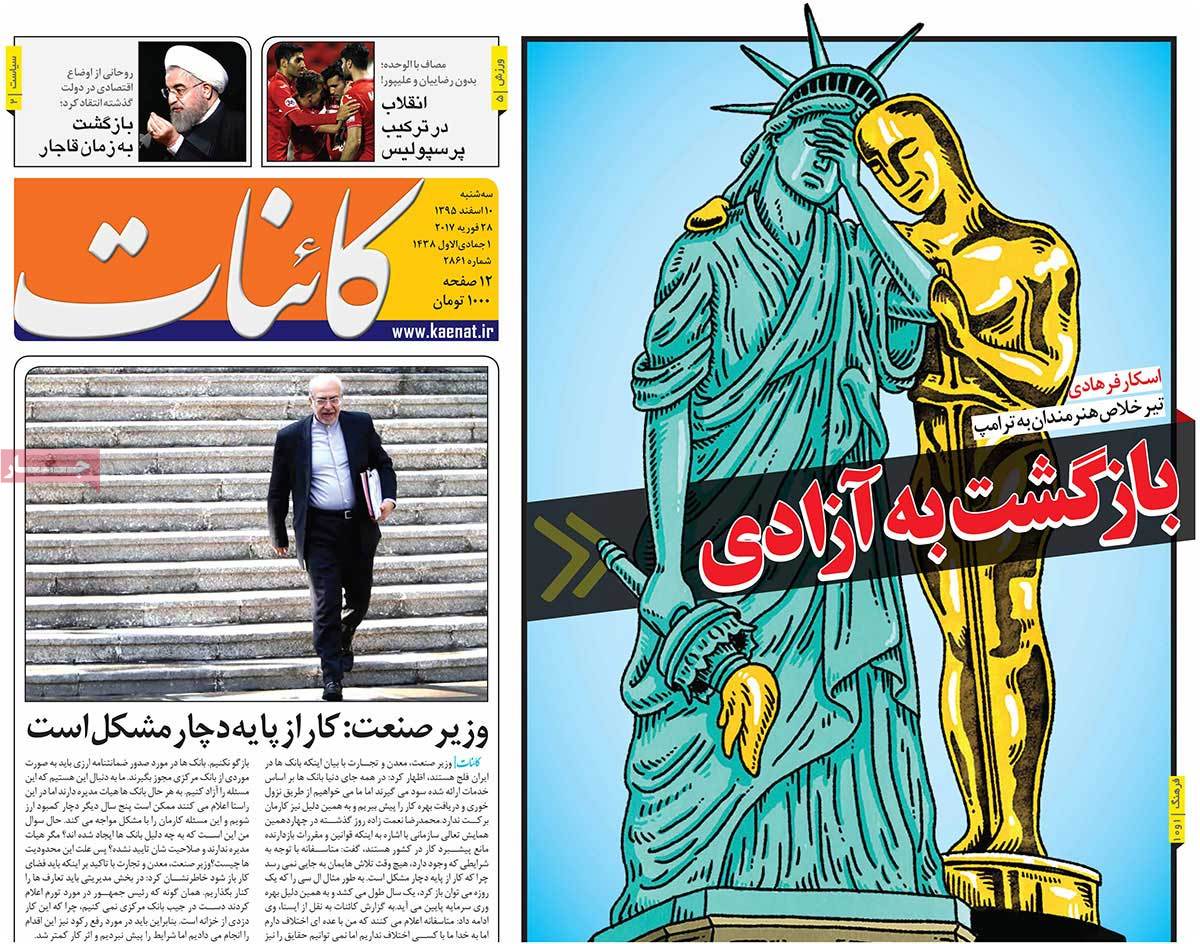
Ka’enat:

1- Rouhani Will Run for Presidency: Health Minister

2- US Secretary of State Should Pick Up the Phone and Call Zarif: Strange Request from Tillerson [Tillerson says in the cartoon: Why should I call? I’m a man of business. I made a fortune thanks to Iraqi Kurdistan’s oil. But Iran’s oil is under sanctions, isn’t it?]


A Look at Iranian Newspaper Front Pages on February 9


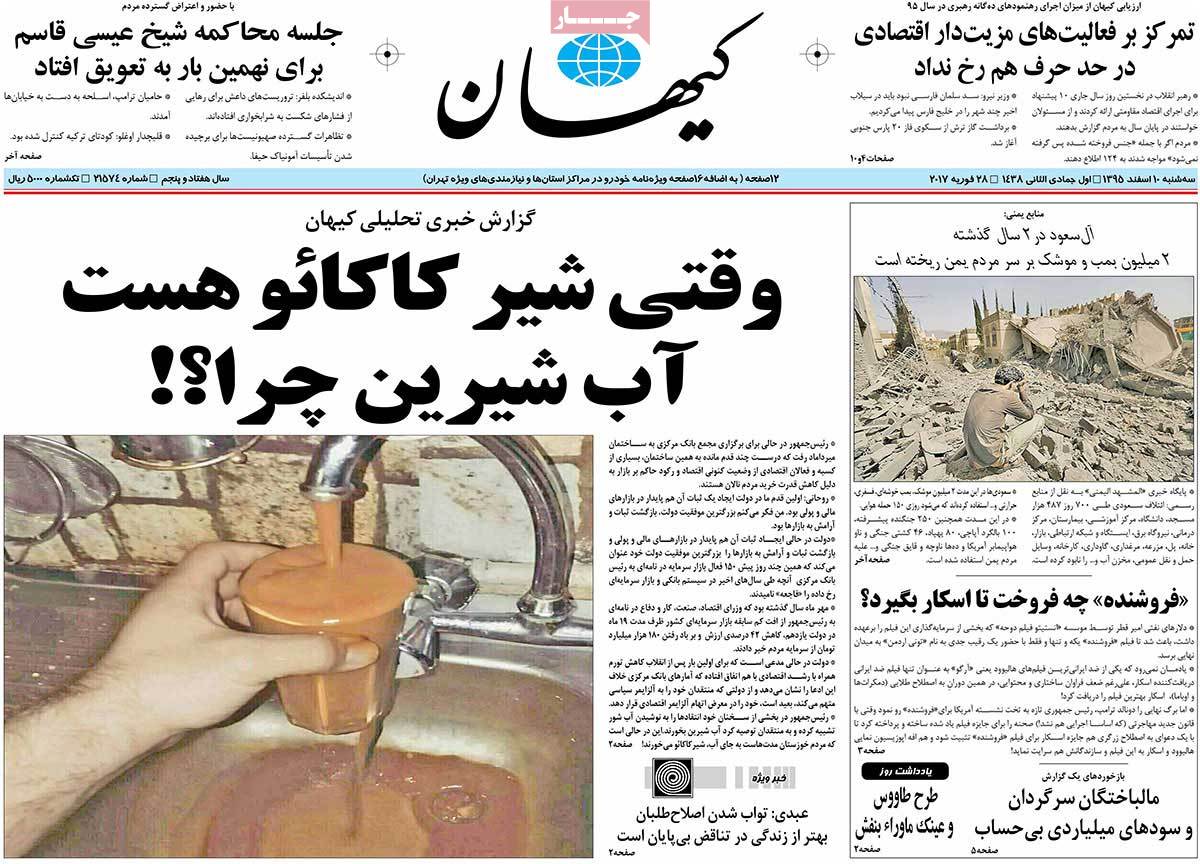
Kayhan:

1- Obama and Trump’s Dreams Will Be Crushed Tomorrow


A Look at Iranian Newspaper Front Pages on February 9


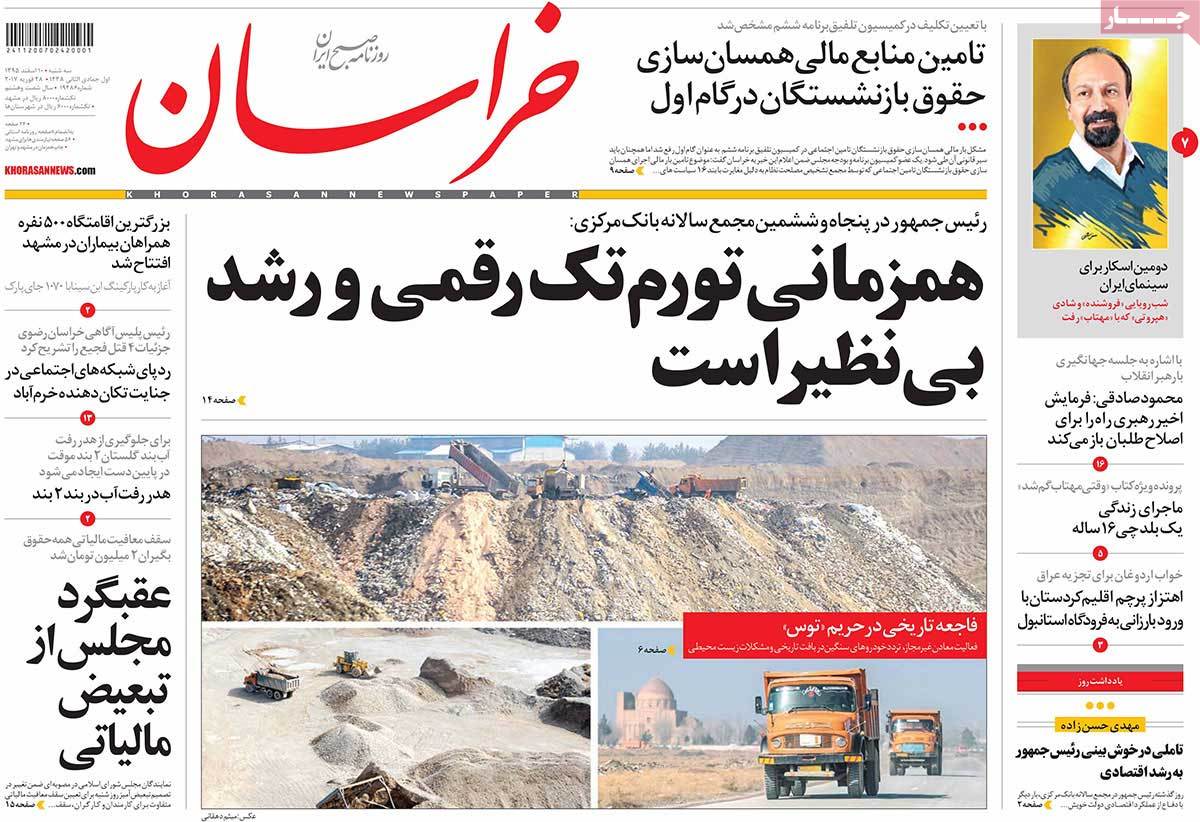
Khorasan:

1- Trump Planning to Violate JCPOA by Putting IRGC on Sanctions List


A Look at Iranian Newspaper Front Pages on February 9


Resalat:

1- Clerics Invite People to Attend 22 Bahman Rallies

2- Islamic Republic Sees US as a Paper Tiger: IRGC Commander

3- Islamic Revolution’s Achievement for Women Is the Possibility of Their Presence in the Field


A Look at Iranian Newspaper Front Pages on February 9


Sepid:

1- After JCPOA, Iran Has Exported $60 Million Worth of Medicine and Medial Equipment

2- 400 Motorcycle Ambulances to Help People in Tehran’s Traffic


A Look at Iranian Newspaper Front Pages on February 9


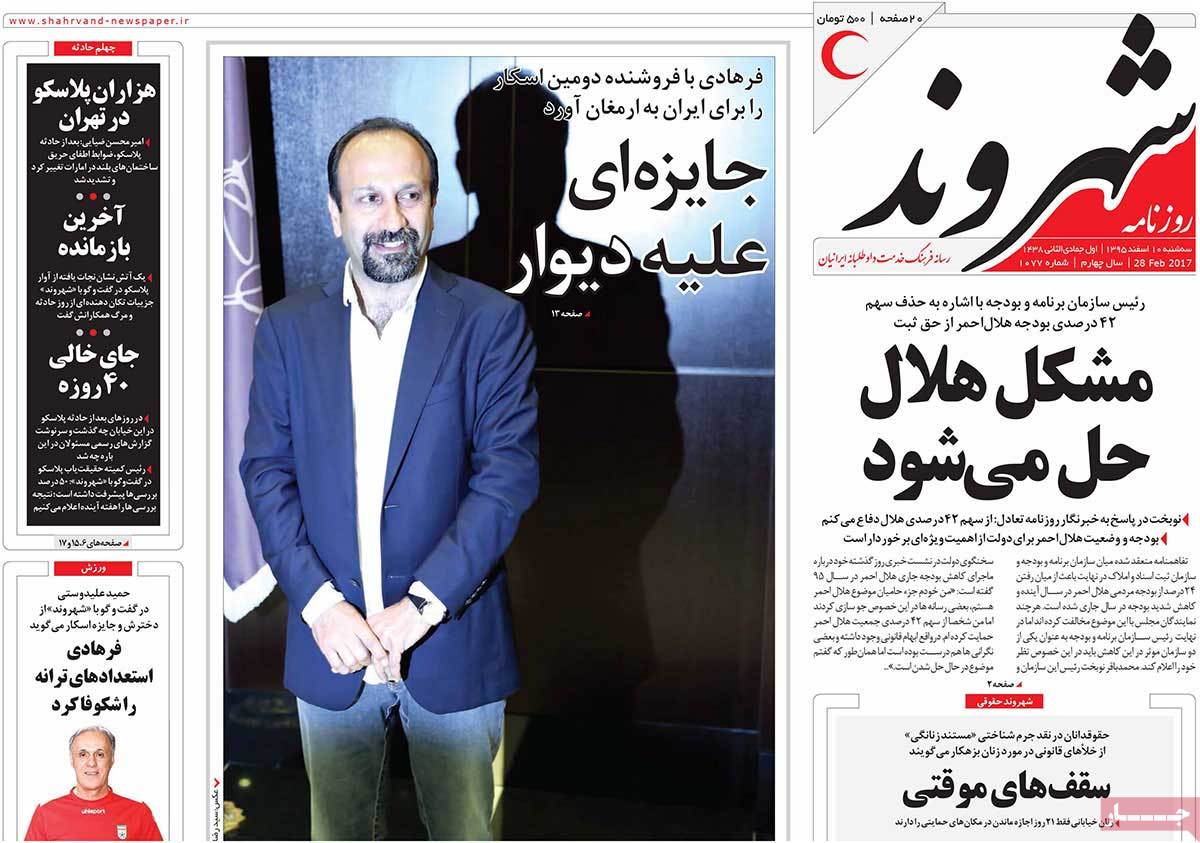
Shahrvand:

1- Iran’s Response to Trump in 22 Bahman Rallies

2- Six Teenagers’ Death Sentence Cancelled: Tehran Prosecutor’s Efforts to Prevent Execution of Convicts under 18 Years of Age

A Look at Iranian Newspaper Front Pages on February 9

Rouhani Administration Promoting Gender Equality in Iran: Activist

Azar Mansouri
Azar Mansouri

Azar Mansouri, a reformist activist, believes President Hassan Rouhani’s administration was the first government to use the term “gender equality.”

The fact that President Rouhani himself used the phrase “gender equality” raised the hopes of women’s rights activists, said Mansouri in a Farsi interview with Khabar Online.

President Rouhani stressed gender equality during his election campaign, and he has also emphasized it over the recent years, she said.

Mansouri said some positive developments have also taken place such as appointing female governors, designating three female vice-presidents, and the like.

However, she added, this is not enough and more needs to be done to promote gender equality.

She also touched upon women’s role in the political arena.

“If Catherine Ashton and Federica Mogherini, the former and incumbent EU foreign policy chiefs, had not led nuclear talks between Iran and the P5+1 group, the talks would not have gone well,” said the women’s rights activist.

Trump’s Visa Ban Preventing US Academics from Visiting Iran

Pablo Martinez Monsivias-AP- Trump
Pablo Martinez Monsivias-AP

Abdolhossein Mokhtabad, a reformist member of Tehran City Council, says the Iranian Foreign Ministry’s move to reciprocate US President Donald Trump’s visa ban has barred American academics and cultural figures from attending Iranian conferences and seminars.

Here is the full text of his Farsi article published in Khabar Online:

If you have followed the latest news over the past few days, you must have read or heard that Iran’s Foreign Ministry reciprocated US President Donald Trump’s decision and issued a visa ban on American nationals travelling to Iran. However, Tehran exempted American wrestlers from the ban and allowed them to travel to Iran to attend Wrestling World Cup due to be held in the Iranian city of Kermanshah.

The eighth Biennial Convention of the Association for the Study of Persianate Societies (ASPS) scheduled to be held in Iran’s Shiraz from 9-13 March was also cancelled due to Trump’s unwise order. Iranologists from 22 countries were to attend the meeting.

A report suggests that organizers of the international event contacted the Iranian Foreign Ministry to discuss the issue, but their talks bore no fruit. At the end, they had to call off the gathering because most of the non-Iranian participants were American researchers. This came as many international researchers had made plans to take part in the conference.

Fortunately, in the case of the wrestlers, the general mood of the Iranian society and efforts by the Iranian Wrestling Federation prompted a decision to allow American wrestlers to travel to Iran. But the Iranian Foreign Ministry could not do anything for American academicians, especially professors of the Persian Language, who are keen on the Iranian culture, and a seminar of such significance was affected by an unwise decision.

It seems the Iranian Foreign Ministry should reverse its reciprocal visa ban on American nationals. We have seen that over the past few days, large numbers of ordinary American citizens as well as academics and artists have staged rallies in different cities in protest at Trump’s decision. Statistics show the presence of Iranians in the United States is of a cultural type. More than 12,000 Iranian university students and renowned professors in the US are making their presence felt in different intellectual, cultural, scientific and other areas, symbolizing Iranians’ potential and capabilities.

So, we recommend that Iranian Foreign Minister Mohammad Javad Zarif and his colleagues at the ministry work out a solution to the problem and turn this threat into an opportunity to promote the Iranian culture.

Israel, Extremists Pose Major Threat to Middle East: Iran’s DM

General Dehghan

During a television talk on Tuesday night, the Iranian minister described Israel as the source of insecurity in the Middle East region while warning about Takfiri terrorism.

“Today the immediate threat to the region [is the presence of] Takfiri terrorists created by the Americans, Israelis and certain Arab countries of the region, including Saudi Arabia,” he said.

Dehqan said that Takfiri terrorists were ordered by their masters to create insecurity in the region but warned that they actually posed a threat to the entire world.

He added that the sponsors of terrorists would “rue their acts and turn against them” eventually.

Elsewhere in his remarks, Dehqan also touched on Iran’s military industry and defense doctrine.

He said that the country was actually self-sufficient in manufacturing necessary military equipment.

He also said that Iran would “punish” aggressors while stressing that the country’s doctrine was solely based on deterrence.

Dehqan also underlined the need for boosting Iran’s defense capabilities in proportion to enemy moves.

‘Iran watchful of enemy moves’

Meanwhile, Brigadier General Ahmad Reza Pourdastan, the second-in-command of the Iranian Army, said that Iran monitored all enemy moves.

“The skies of our country at low, medium and high altitudes are all under the watchful eye of [the Iranian] Air Defense and should a move be made [against the country], [our] domestically-manufactured military hardware” would deliver a proportionate response, Pourdastan (pictured below) said.

“The enemy should know that its moves are under our watchful eye and if it intends to make a move, the [Iranian] Defense will repel it,” he added.

Iranian officials have repeatedly stressed the deterrence nature of the country’s defense program, assuring other countries, including neighboring states, that the Islamic Republic’s military might poses no threat to them.

Iran’s Deputy FM Calls for Europe’s More Active Role in JCPOA Implementation

In a speech at the Korber Foundation in Berlin on Tuesday, Takht Ravanchi highlighted the implementation process of the Joint Comprehensive Plan of Action, and the challenges hampering the process, including hurdles to Iran’s banking ties with other countries.

He pointed to the US moves to renege on the JCPOA and called for Europe’s more active cooperation in the implementation of the nuclear deal, particularly in banking fields.

The deputy foreign minister also talked about the latest developments in Iran’s relations with European countries, including Germany.

Iran and the Group 5+1 (Russia, China, the US, Britain, France, and Germany) on July 14, 2015 reached a conclusion over the text of the 159-page deal on Tehran’s nuclear program and started implementing it on January 16, 2016.

The comprehensive nuclear deal terminated all nuclear-related sanctions imposed on Iran.

However, Iranian officials have complained about the failure of the other side, especially the US, to fully implement the accord, as Iran still has problems in its banking transactions with other countries.

Iran Praises Russia’s Role in Enforcement of Nuclear Deal

araghchii

Araqchi, who is in Moscow for an official one-day visit, met with his Russian counterpart Sergey Ryabkov on Wednesday.

During the meeting, also attended by Iranian Ambassador to Russia Mehdi Sanaei, the two sides underlined continuation of mutual cooperation in international issues, including implementation of the Joint Comprehensive Plan of Action (JCPOA), peaceful nuclear collaborations, nuclear disarmament, and the issue of Syria.

They agreed to continue bilateral talks on the JCPOA and disarmament at the expert level.

Ryabkov in this meeting stressed the need for international cooperation to create a nuclear-free Middle East and more coordination between Russia and Arab countries in this regard.

Araqchi, for his part, thanked Moscow for its continued cooperation in enforcing the JCPOA.

Iran and the Group 5+1 (Russia, China, the US, Britain, France and Germany) started implementing the nuclear agreement in January 2016.

Tehran and Moscow work in close cooperation in the nuclear industry, and have increased contacts after coming into force of the JCPOA.

They have also formed a strong alliance in recent years, with both supporting the Syrian government against foreign-backed militancy.

Iran’s Leader Pardons, Commutes Sentences of over 600 Convicts

Iran’s Leader: Abolishment of Israel Not Equal to Abolishment of Jews

Ayatollah Khamenei on Wednesday granted clemency or eased the sentences of 631 convicts sentenced by various Iranian courts.

Article 110 of the Constitution grants the country’s Leader the right to pardon or reduce the sentences of convicts upon a recommendation from the head of the Judiciary.

The clemency, however, does not apply to all types of convicts, including those who have been sentenced for their role in armed struggle against the country, armed or organized drug trafficking, rape, armed robbery, arms smuggling, abduction, bribery and embezzlement.

Each year in February, when Iran marks the victory anniversary of the 1979 Islamic Revolution, Ayatollah Khamenei grants an amnesty for a number of prisoners.

On Friday, Iran will mark the 38th anniversary of the Islamic Revolution, which put an end to the monarchical rule of the US-backed Pahlavi regime.

US Should Know Threatening Iran Is Pointless: IRGC Commander

General Mohammad Ali Jafari

“Enemies of the Islamic Revolution in recent years have explicitly acknowledged its glory and might, and we advise the American politicians to consider threatening Iran as useless,” Major General Jafari said on Wednesday, in an address to a cultural event in Iran’s western city of Hamedan.

He then made a reference to American analyses that highlight the “considerable risks” of an encounter with Iran, saying some have even advised Donald Trump to be mindful that Iran is in a position that sees the US as a “paper tiger”, Tasnim reported.

Some other analysts also believe that the US must put aside the notion of being even a half-superpower in the world, the commander added.

Russia Says Iran’s Missile Test Did Not Breach UNSC Resolution

“This outcry about Iran’s ballistic missile launches. I was surprised to hear even American experts speaking on CNN and calling it a violation of bans by the UN Security Council. Those bans were there before, all those bans were lifted,” Churkin told RT in an interview published on Wednesday.

Noting that the resolution only “calls” on Iran not to undertake any activity related to ballistic missiles designed to be capable of delivering nuclear weapons, he said, “So it’s just a call, not a prohibition. Technically or legally you cannot argue that they are violating any kind of a prohibition”.

On February 1, Iran’s Defense Minister Brigadier General Hossein Dehqan confirmed that the country had carried out the missile test, stressing that the Islamic Republic will not allow others to interfere in its defense affairs.

He further underscored that Iran’s missile tests are by no means in contravention of the UNSC Resolution 2231.

Iran, however, maintains that none of its missiles have been designed to be capable of carrying nuclear warheads because nuclear weapons have basically no place in the Islamic Republic’s defense doctrine.