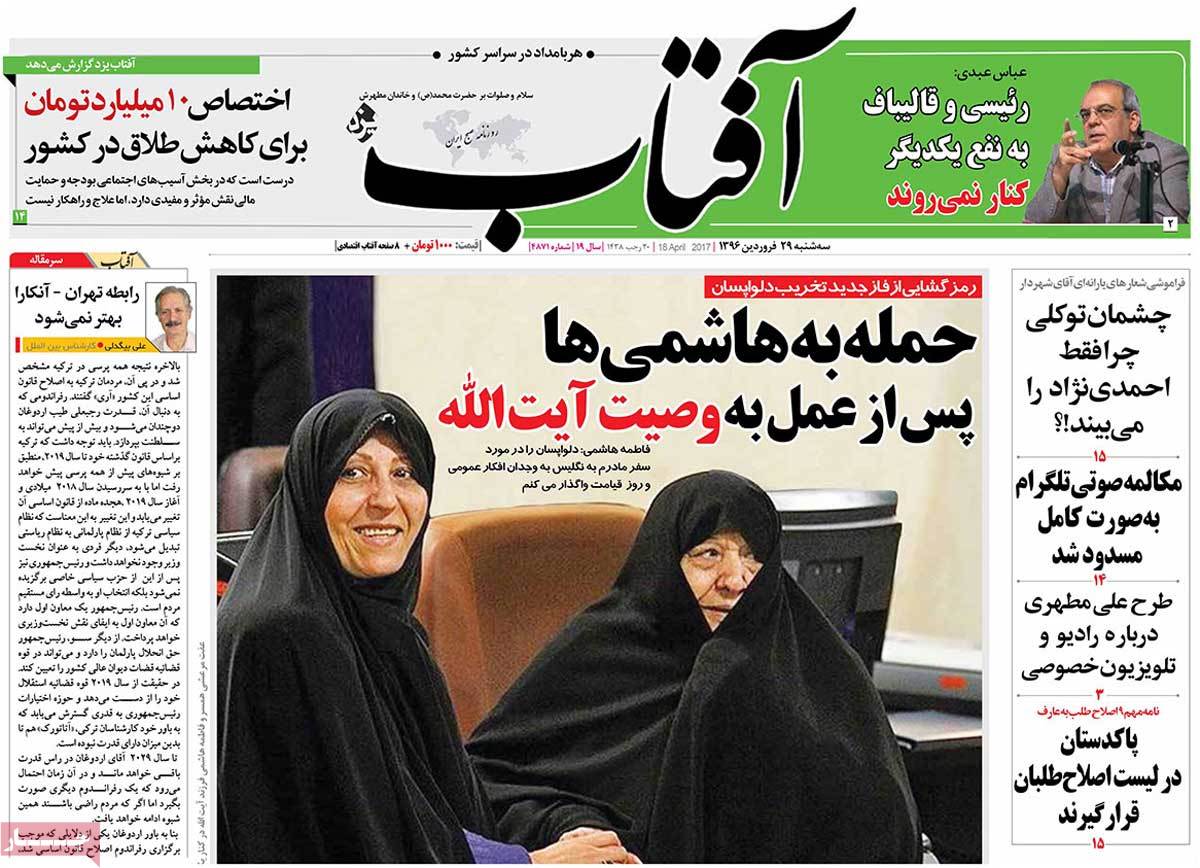
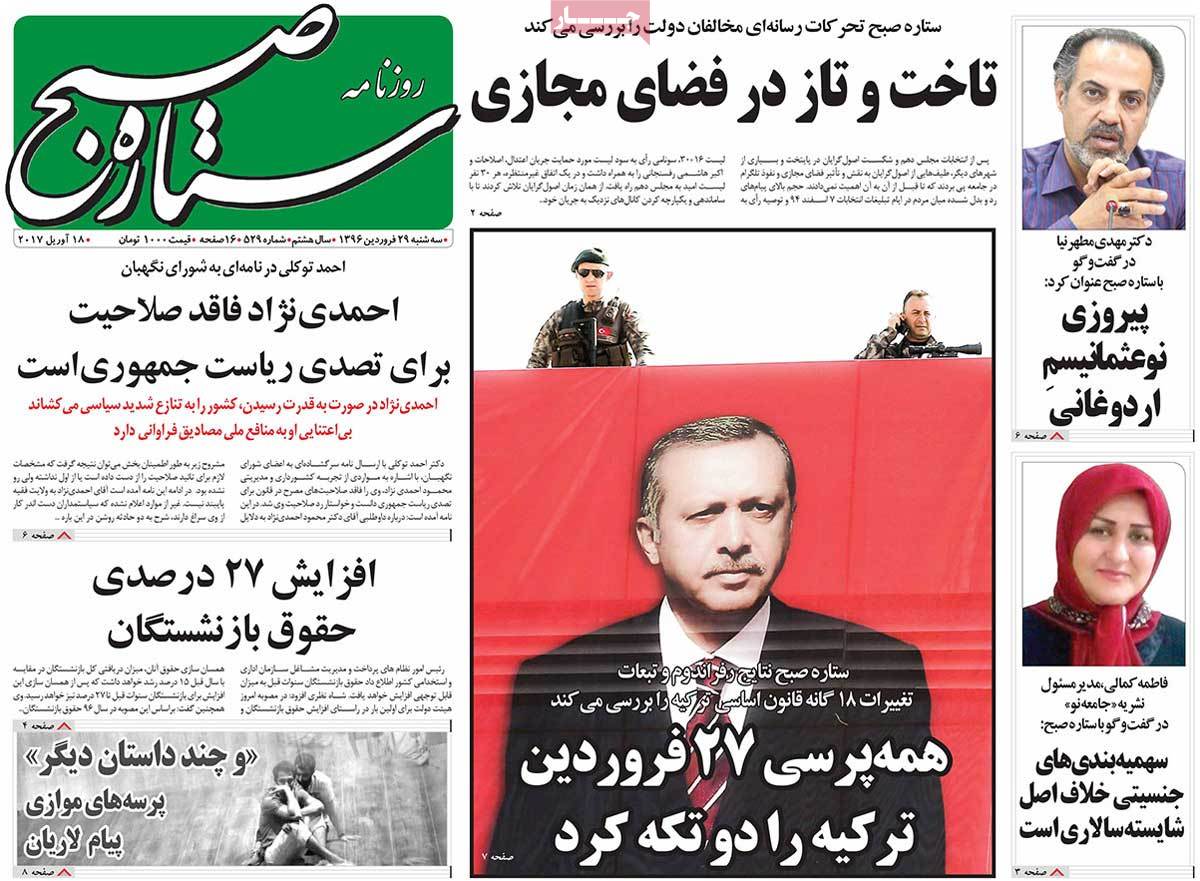
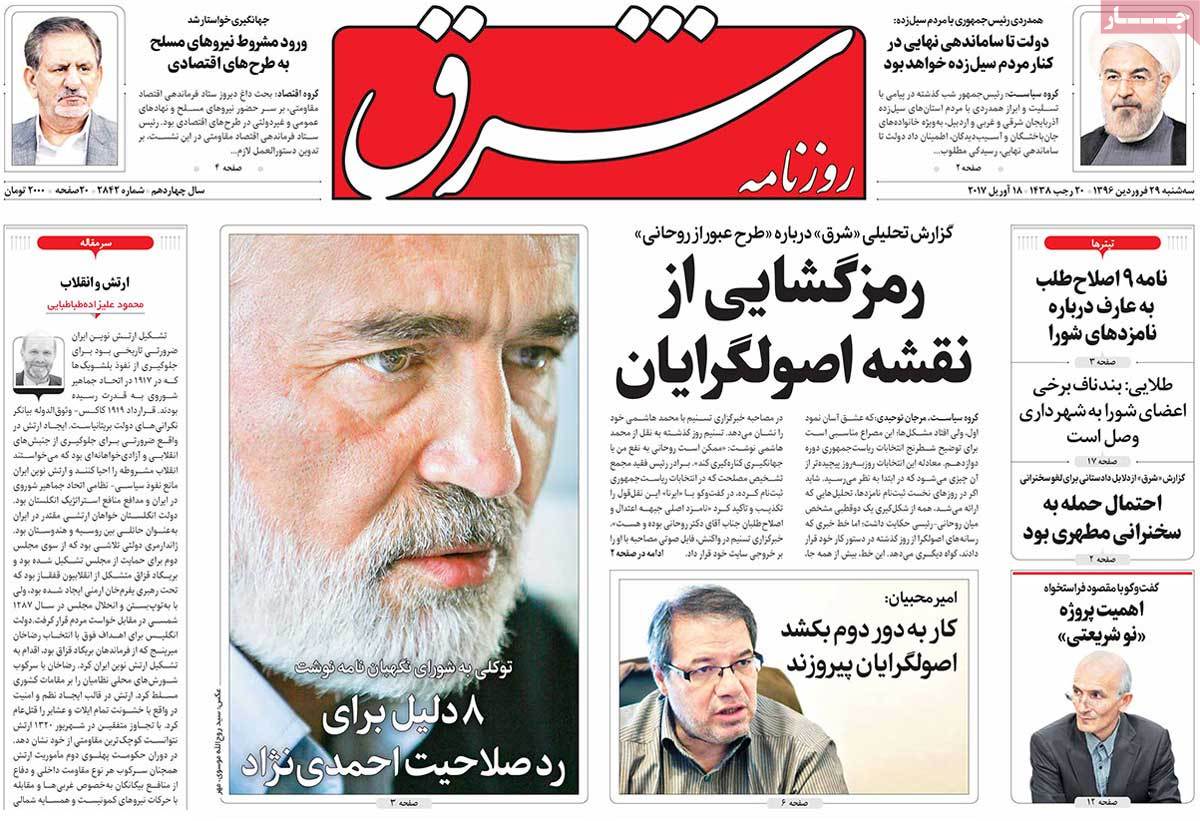
Using the messaging app Telegram, Ahmadinejad asked Trump why he has not answered his letter yet. Here is Trump’s response, as cited by Ghanoon daily newspaper’s satirist Ahmad-Reza Kazemi:

Using the messaging app Telegram, Ahmadinejad asked Trump why he has not answered his letter yet. Here is Trump’s response, as cited by Ghanoon daily newspaper’s satirist Ahmad-Reza Kazemi:

Deputy Foreign Minister for European and American Affairs Majid Takht- Ravanchi added that CBI’s assets were in Europe when international sanctions were still in place and because of those sanctions Iran had no access to them, IRNA reported.
“This is not a new development and the asset freeze took place before negotiations for the nuclear accord began,” Takht- Ravanchi told reporters on the sidelines of a conference on the potential implications of US actions against Iran.
Ardeshir Fereydouni, the head of CBI’s Legal Department, reacted to the news announced by the New York Times on Monday and said US efforts to freeze $1.6 billion of Iranian assets in Luxemburg contravened international laws and treaties.
In comments published on CBI’s website, Fereydouni said the bank’s attorneys, in synch with the Presidential Office for International Law, have presented their defense arguments to recover those assets.
As reported by the Times, a judge in Luxembourg has quietly put a freeze on assets worth $1.6 billion belonging to Iran’s central bank, quoting people familiar with the case.
The paper reports that this is one of increasing instances in which domestic civil lawsuits against foreign entities have raised numerous complications.
Diplomatic and security specialists told the paper that the litigation also has broader significance. The essence of the 2015 deal was that Iran agreed to curb its nuclear program in exchange for the lifting of sanctions so it could reintegrate into the world economy. This goal would be undermined if any Iranian-linked assets in places like Europe were to face the threats of seizure to pay off default judgments handed down by American courts.
Payam Mohseni, the Iran Project director at Harvard Kennedy School’s Belfer Center for Science and International Affairs, was quoted as saying that if the victims succeed in seizing the funds, it could be a step toward a new confrontation, strengthening the hands of those who oppose the deal.
“Already, some of the envisioned investments in Iran with western financing have materialized,” he said.
“A ruling like this would make Iranian assets vulnerable in Europe which, for Iranians, would violate the spirit of the agreement if not its letter.”
The maneuvers in Luxembourg have attracted scant attention because the litigation is largely confidential. But according to the Times, a letter detailing the case is now circulating in Washington.
Lawyers for the palintifs sent the letter on Thursday to the prime minister of Luxembourg, seeking his government’s assistance in opposing Iran’s effort to unfreeze its assets and sent copies of the letter to senior foreign policy officials in the White House.
Last year, the US Supreme Court said the Central Bank of Iran must turn over $2.1 billion in frozen assets held by Citibank to victims of the 1983 Marine Corps barracks bombing in Lebanon. The Obama administration backed the victims in that case, which Iran is now challenging in the International Court of Justice.
Traditional taxi drivers in Tehran were initially outraged by the operation of online ride-hailing apps, Snapp and TAP30, and even staged protests before the Iranian Parliament and asked the lawmakers to stop the operation of over 25,000 cars working as their new rivals.
However, the people’s satisfaction with the services provided by the two apps helped them continue their operation. These services are provided in lower prices, and the citizens of Tehran have reported that their drivers are more polite than the traditional ones.
Now, the traditional taxi industry is trying to claw back the market share it had lost. By launching its own ride-hailing app, Taxi Organisation is admitting the fact that there is no way but to give in to technology and a competitive market.
The service is expected to open in the next fiscal year that begins on March 21, ISNA quoted Meysam Mozaffar as saying. Name and brand of the service will be announced soon.
In the first step, an estimated 8,000 regular (green and yellow colour taxis) drivers will be trained to use the Android application, the official said, as reported by Financial Tribune.
The only competitive edge of the app, compared to its current rivals, is that it will allow passengers to pick the type of car (hybrid, new models, van…) they would like to ride as well as the driver’s gender.
Mozaffar claimed that the application will be the first service that has all the needed certifications to operate legally in the sprawling capital. Initially the service will begin working with Tehran taxi companies and private agency taxis will join later.
Thirty taxi stations have been set up across Tehran specifically for the purpose of picking up passengers through the new app. The stations are set up largely near hotels, hospitals, shopping centres and areas of larger footfall.
Drivers have all been tested for mental and physical health by centres affiliated to Tehran Municipality and will also qualify for insurance coverage.
The drivers will work three shifts for the service which will enable people to hail taxis 24 hours a day across the capital that is home to 12 million people.
Another feature borrowed from the ride-hailing apps, is that the identity and personal details of the drivers will be available to the person hailing the cab.
The taxi organization has access to their home address, “in case of a problem they can be easily tracked,” the official said.
Users who do not have smart phones or Internet access can hail a cab using the number 1800. The official said the fares the new cabbies will charge will be cheaper than those of currently available ride-hailing services.
On average, Snapp’s and Tap30’s costs are almost 40% less than the regular public taxi or the private agency companies.
Deputy for transportation at Tehran Municipality, Maziar Hosseini, said at the weekend that although ride-hailing apps have caused a stir among traditional taxis “the truth of the matter is that the people have welcomed the Internet-based services.”
He went on to say that “logically we should not defy the services, as they increase the income of drivers and decrease costs for passengers.”
Noting that Tehran’s authorities support the lawful use of modern technology, the TM official said, “so long as the applications abide by the law and employ respectful drivers they are welcome and can continue their work.”
Hosseini noted that the other earlier ride-hailing applications have also acquired all the necessary permits.
The services are said to employ a total of 40,000 cars plus another 100,000 private agency drivers.
“Like in the past, nobody in the IRGC, neither the guards (IRGC troops) nor the commanders, is permitted to interfere in the elections politically or factionally and to discredit the candidates,” Major General Jafari said in a gathering of IRGC commanders and officials on Tuesday.
He also emphasized the “monitoring organizations” of the IRGC have been assigned the job of looking for cases of noncompliance with the order, saying violators will be punished without any consideration.
Iran is going to hold its 12th presidential election on May 19.
According to Iran’s laws on elections, all military and armed forces are forbidden from interfering in elections, either in its execution or the monitoring process.
According to a Farsi report by ICANA, the deprived areas of Fars province, southern Iran, have been provided with mobile movie theatres as part of the Cinema Salam (Hello Cinema) plan, which is to be carried out in other Iranian provinces as well.
“There is no cinema in many Iranian cities and regions. The plan makes all people able to enjoy watching films in movie theatres,” Iranian lawmaker Mohammad-Baset Dorrazahi noted, expressing his contentment in this regard.
“This plan reduced people’s costs; it is a good point,” he added, noting that the cinema lovers have to travel to other towns if there is no cinema in their own: something that pushes up their costs.
He then referred to the current long lines before the box offices of Iranian cinemas, and said, “Cinema Salam can be a good temporary solution. We shouldn’t forget, however, that the need for permanent cinemas with more facilities is felt today, as the people, the youth in particular, demand them.”
He went on to say that the film industry is a means of acquiring information and promoting culture in today’s world. “The Iranian youth in many provinces need to have fun, and cinema is a good way to have group fun.”
Dorrazahi believes that the private sector’s capacity can be tapped into for the construction of movie theatres in deprived regions.
“The government should consider facilities for the private sector to do so.”
“We are trying to help these companies [that want to make investment in Iran],” Sapin told reporters at the Ministry of Finance and Economic Affairs in Tehran at a joint press conference with his Iranian counterpart, Ali Tayyebnia.
“They will be able to apply for loans, but it’s not active yet. We are working on this,” Bloomberg quoted him as saying on Saturday.
French companies were among the first to return to Iran after sanctions were eased last year under Tehran’s nuclear deal with six world powers, but officials have said financing issues have hobbled some big infrastructure projects.
Sapin said he was “confident” that banking relations between France and Iran would be normalized in due time and said he was seeking clarification from the US government on the extent to which its sanctions will impact French banks working with Iran.
Iran’s largest state-run and partly state-run banks, Bank Melli and Bank Tejarat, have started brokerage services in France and were working with some French banks, Tayyebnia said, declining to name them.
According to a Farsi report by Khabar Online, Hassan Sajedinia, the police chief of Tehran, referred to the upcoming Fireworks Wednesday festivals and warned that the users of dangerous explosive fireworks will be put in jail until the end of Persian New Year holidays in early April.
“24 million illegal explosives of different types have been discovered,” he noted, adding that the explosives are to be destroyed in coordination with judicial authorities.
“Those who throw the explosives out of their cars during the Fireworks Wednesday will be arrested. Their cars will also be confiscated and transferred to parking.”
The fiery night before the last Wednesday of the year comes a few days before the Persian New Year, known as Nowruz.
Overall, the mood in Iranian cities on Tuesday night is festive, with most of the chaos coming from threat of rogue firecrackers.
Each year, bonfires, many of them unattended, are seen blazing throughout the city side streets.
Some people from their windows and rooftops indiscriminately throw firecrackers into crowded streets with no regard for the people and property below.
Every year people die, many get hurt and burned, but still people will come out.
After what happened to firefighters in the tragic Plasco incident back in January, this year a popular campaign has been launched to discourage people from using dangerous firecrackers.
Iranian people will celebrate the festival next week.
Iranian lawmaker Jalil Rahimi Jahanabadi has blamed Iran’s laws and regulations for failing to prevent judges from granting arrest warrants at will and under any circumstances, urging that such authority, which has caused a remarkable increase the number of prisoners, must be taken away from them.
According to a Farsi report by ICANA, pointing to the growing number of the country’s prisoners, Rahimi Jahanabadi said this has turned into a major social ill.
This is while, he added, prions were supposed to be places for the repentance of criminals, a function they have failed to serve.
He said at present, the large number of prisoners and the issue of managing them have, per se, become a social harm in the Iranian society.
Rahimi Jahanabadi noted that revising the laws and regulations is among the measures which can lead to a decrease in the number of detainees, adding, thus, imprisonment can be replaced by social punishments to bring the number of prisoners down.
“Such punitive measures reduce the number of damages and harms being in prison can cause to the prisoners, enable criminals to be in constant touch with their families and shield their families from probable harms and damages of them being jailed.
He added using traditional methods of settling disputes is another measure conducive to a decrease in the number of prisoners.
“The truth is that not all cases are required to be handled by judicial courts and lead to incarceration. Iran’s history shows that people’s trustees, the country’s clerics and the elders of the society played a very significant role in resolving disputes. Currently, despite the creation of dispute settlement councils in the country, Iran’s Judiciary has failed to play a significant role in solving disputes.”
He said the present laws and regulations give Iranian judges unrestricted authority to imprison individuals, adding whereas, such a privilege is required to be withdrawn.
“Judges should not be authorized to issue arrest warrant under any circumstances. In addition, laws and regulations are required to be revised in a way that imprisonment is used as a measure of last resort.”
The ceremony to unveil the helicopter, named Saba 248, took place in the presence of Defense Minister Brigadier General Hossein Dehqan on Tuesday.
Iran’s Helicopter Renovation and Logistics Company (PANHA), associated with the Defense Ministry’s Aviation Industries Organization, has designed and manufactured the aircraft.
Dehqan introduced the copter as a medium-weight, double-engine, quadrotor aircraft, capable of carrying eight occupants. He said it could be used as a means of shipment, aerotaxi, or to carry out imaging and reconnaissance operations.
Saba 248, he said, can also be used as an air ambulance or to perform other relief and rescue functions.
Among its distinctive features, Dehqan said, were the integration in it of up-to-date navigation technologies, its dependable performance with only one engine, high safety and speed due to a sleek aerodynamic design, low noise and vibration, and capability to endure temperatures reaching as high as 55 ℃.
The helicopter can be offered at a competitive price to the international market, especially Muslim countries, the Iranian defense chief said.
Speaking to reporters on the sidelines of a meeting of Iran’s Assembly of Experts in Tehran on Tuesday, President Rouhani rejected the US Department of State’s 2016 human rights report on Iran, underlining that the country’s elections are “free, healthy, competitive and democratic.”
“I believe that those criticizing elections in Iran need to take a look at their own recent elections and the problems they have had,” he added.
Highlighting the criticism of the process of US presidential election by both Democratic and Republican candidates, President Rouhani said the current US president himself had called into question the election results.
In his election campaign in October 2016, Donald Trump had announced “I will totally accept the results of the election if I win.”
Elsewhere in his remarks, President Rouhani said the election mechanism in Iran is based upon participation of people, noting that a turnout of above 70 percent in Iran’s presidential election and long queues until the very last minutes of the polls at the ballot boxes demonstrate that people believe in the elections.
“We have a very strict executive system (for elections) according to the Constitution and the country’s laws,” the president underscored.