Sunday, January 18, 2026
Home Blog Page 4073

Iranian Lawmaker Blasts UAE Police Chief’s Comments

Dubai Police Chief Dhahi Khalfan said last week that “independence of Kurdestan from Iran will help create a more powerful region … Announce your independent state and I will be the first to recognize your autonomy.”

Responding to Khalfan’s remarks, Mohammad Javad Abtahi said, “Such hostile remarks by submissive US allies are in line with the US ‘New Middle-East’ plan,” ICANA reported.

The plan also known as the “Greater Middle East” was first introduced in 2006 during George W. Bush’s administration.

“The US has been pursuing the policy of partitioning Iran to undermine its strategic geopolitical and geo-strategic positions that threaten the US regional interests,” he said.

“The US and Britain have always sought to disintegrate Iran so as to implement their hegemonic policies.” Abtahi called for the government’s strong response to prevent the recurrence of such moves in the future.

“The Islamic Republic’s intelligence and armed forces should be wary of the plots of Iran’s adversaries,” he concluded.

This is while experts believe the unsound remarks of a low-ranking official of a small city are best ignored.

VP Jahangiri’s Candidacy Aimed at Hedging Rouhani’s Bet

“Jahangiri has participated with the aim of defending the government’s record in the election race and during electoral debates,” Hamid Reza Fouladgar said in a talk with ICANA on Monday.

The May 19 vote pits Rouhani and his moderate and reformist backers against conservative critics who are expected to mainly target the government’s economic performance during the 20-day campaigning scheduled to begin on April 28.

Fouladgar dismissed speculations that Jahangiri decided to run in case Rouhani was disqualified by the Guardians Council, a conservative panel of six clerics and six jurists in charge of overseeing elections and vetting candidates for political and Islamic qualifications.

“The chance of Rouhani’s disqualification is one in a thousand,” he said.

Jalal Mirzaei, another member of parliament, said Jahangiri’s participation alongside Rouhani in the presidential vote was not hard to predict and it had been agreed and planned in advance.

A total of 1,636 individuals, including 137 women, have put their names down for the election.

The screening process by the Guardians Council began on Sunday and will probably last till next Tuesday.

The final list of nominees will be announced by the Interior Ministry, the election organizer, on April 27.

Four of the five members of a short list put forward by the mainstream conservative bloc, known as the Popular Front of Islamic Revolution Forces, signed up for the race during the five-day registration period that ended on Saturday.

Among them, frontrunner Ebrahim Raeisi, a former prosecutor general and the current custodian of the holy shrine of Imam Reza (PBUH), is widely seen as the most formidable rival to Rouhani who enjoys the unanimous support of reformists.

A third prominent contender is former president Mahmoud Ahmadinejad, although it is highly doubtful whether he would secure the Guardians Council’s approval.

Wahhabi Terrorists Using US-Made Weapons for Crimes: Iran DM

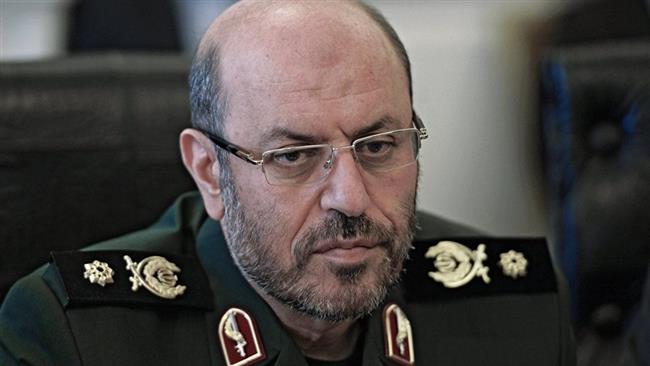
General Dehghan

“Today, Takfiri-Wahhabi terrorists are committing crimes in different parts of the world, particularly in Iraq and Syria, with US-made weapons and munitions,” Dehqan said.

He said the American officials had better review the historical record of US military interventions and war crimes committed in Vietnam, Iraq, Somalia, Afghanistan and recently in Syria and Yemen.

The US levels accusations against others to get itself out of the quagmire it has been stuck in, Dehqan noted, rejecting the US allegation that Tehran is sending weapons to Yemen.

Such claims are made as Washington continues to supply arms to terrorists committing crimes in different parts of the world, including in Syria and Iraq, he added, as reported by Press TV.

Dehqan’s remarks came in response to US Defence Secretary James Mattis, who during a visit to Saudi Arabia on Tuesday, accused Iran of supplying missiles to Yemen’s Houthi Ansarullah fighters.

The oppressed Yemeni people have stood up to the Saudi aggression, which has enjoyed full-fledged US support, by reliance on their own power and capabilities and have managed to prevent their foes from achieving their objectives, Dehqan said.

The US defense chief and other senior US strategists should know that the era of launching military aggression, accusing others and interfering in other countries’ affairs has come to an end, the Iranian minister said, adding that the US needed to avoid playing blame games against other countries.

Dehqan said the US officials also needed to address their domestic problems instead of creating new crises and fanning the flames of war in the Middle East and on the Korean Peninsula.

Yemen has been under Saudi Arabia’s military aggression since March 2015. Certain Arab countries, including the United Arab Emirates, Bahrain and Qatar, are partners to the Riyadh’s military aggression, which has reportedly claimed the lives of more than 12,000 people, most of them civilians.


A Look at Iranian Newspaper Front Pages on April 20


All Iran newspapers today covered the remarks made by Ayatollah Seyyed Ali Khamenei, the Leader of Iran’s Islamic Revolution, in a meeting with Army commanders and personnel.

President Hassan Rouhani’s visit to flood-hit areas and his promise to expedite the efforts to help resolve people’s problems also received great coverage.

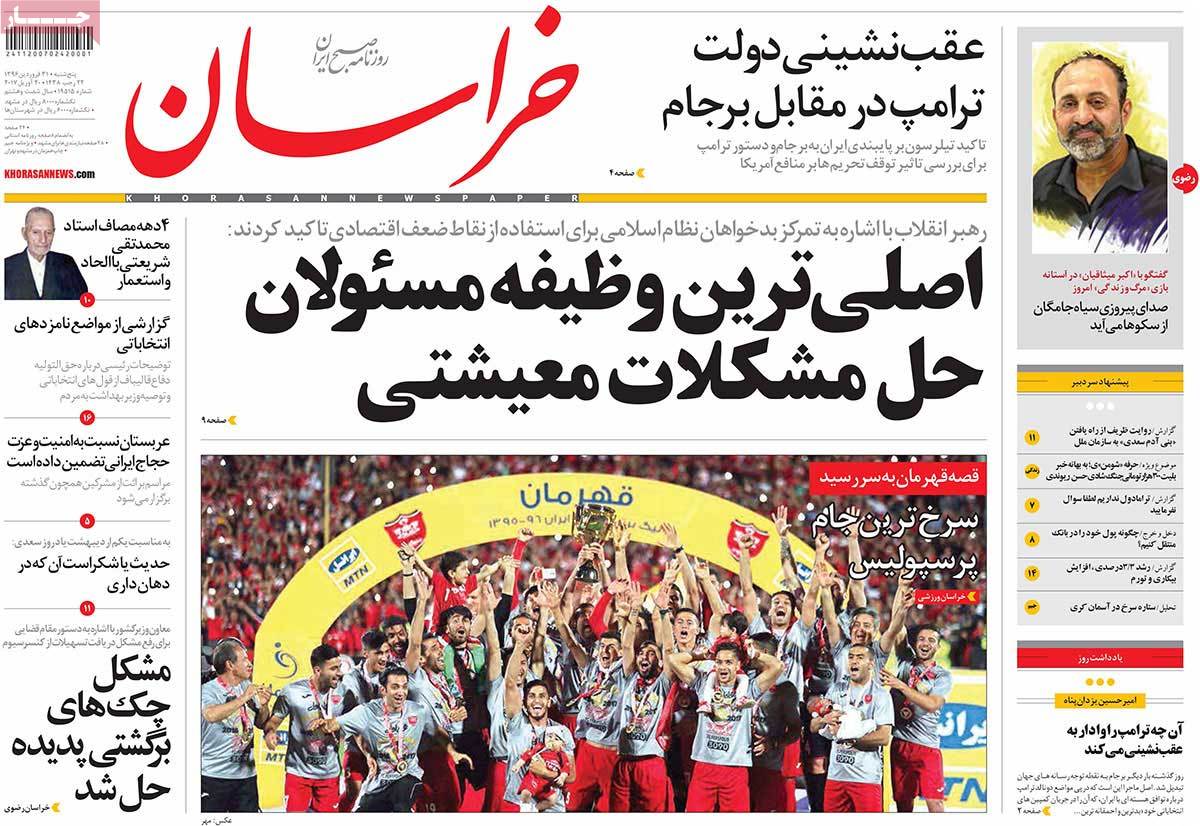
Another top story was the championship of Tehran giant Persepolis FC in Iran Pro League, which was celebrated by over 80,000 spectators in Azadi Stadium in Tehran on Wednesday evening.

Newspapers also highlighted the US move to extend the suspension of nuclear-related anti-Iran sanctions and the statement in which Trump’s administration admitted that Iran has remained committed to the nuclear deal.

The above issues, as well as many more, are highlighted in the following headlines and top stories:


Abrar:

1- Trump Extends Suspension of Iran Nuclear-Related Sanctions

2- Iraqi PM: Kurds Have the Right to Have Independent Country, but Now It’s Not the Time
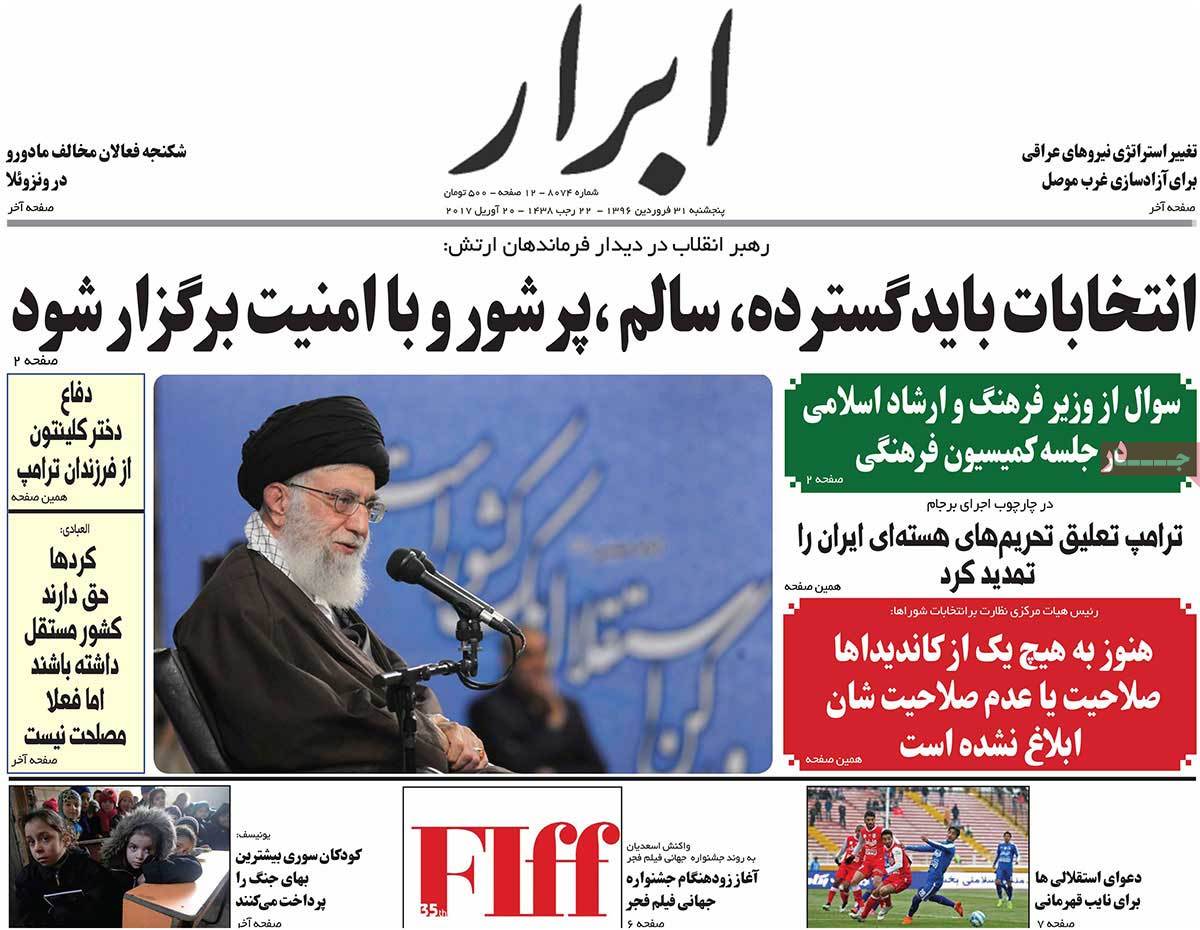
A Look at Iranian Newspaper Front Pages on April 20 - abrar


Afkar:

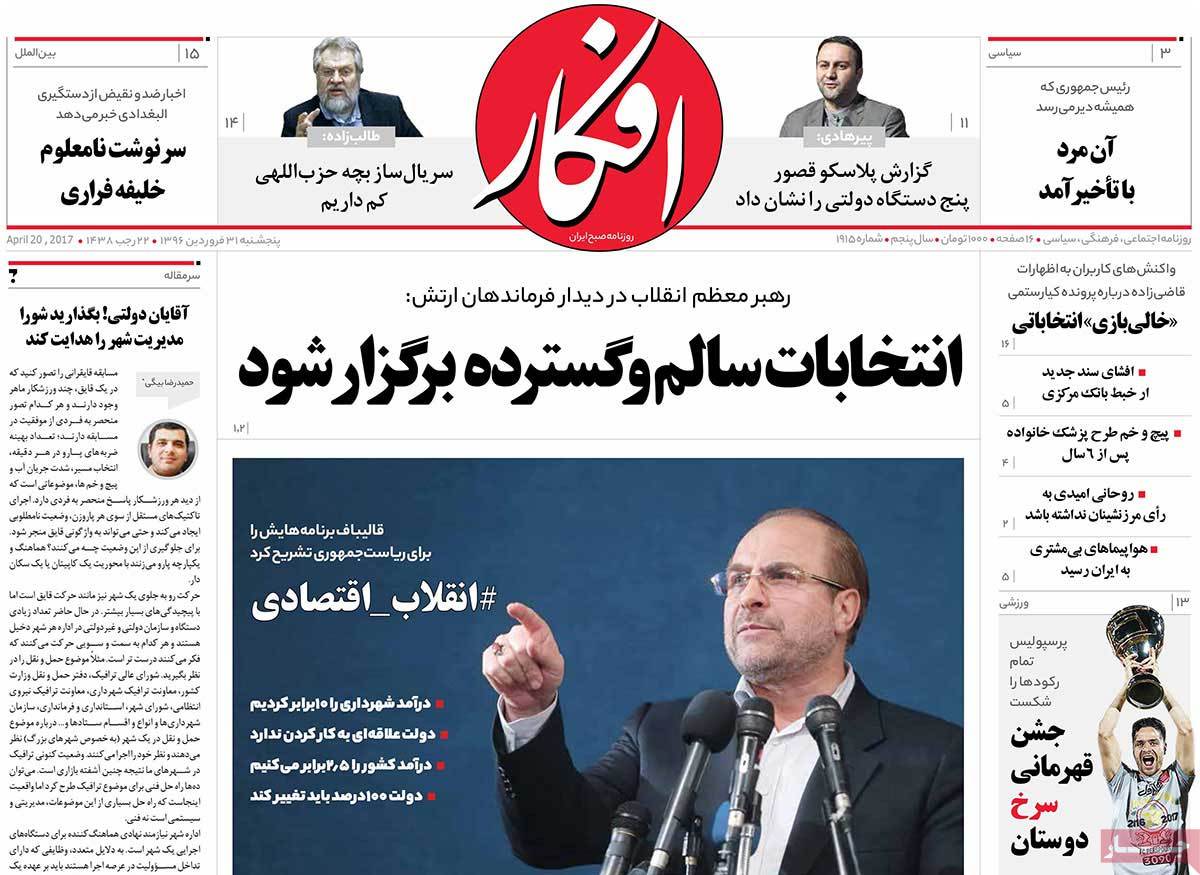
1- Qalibaf Explains Plans for Presidency

  • Government Should Change for 100%
  • I’ll Increase the Country’s Income by 2.5 Times
A Look at Iranian Newspaper Front Pages on April 20 - afkar


Aftab-e Yazd:

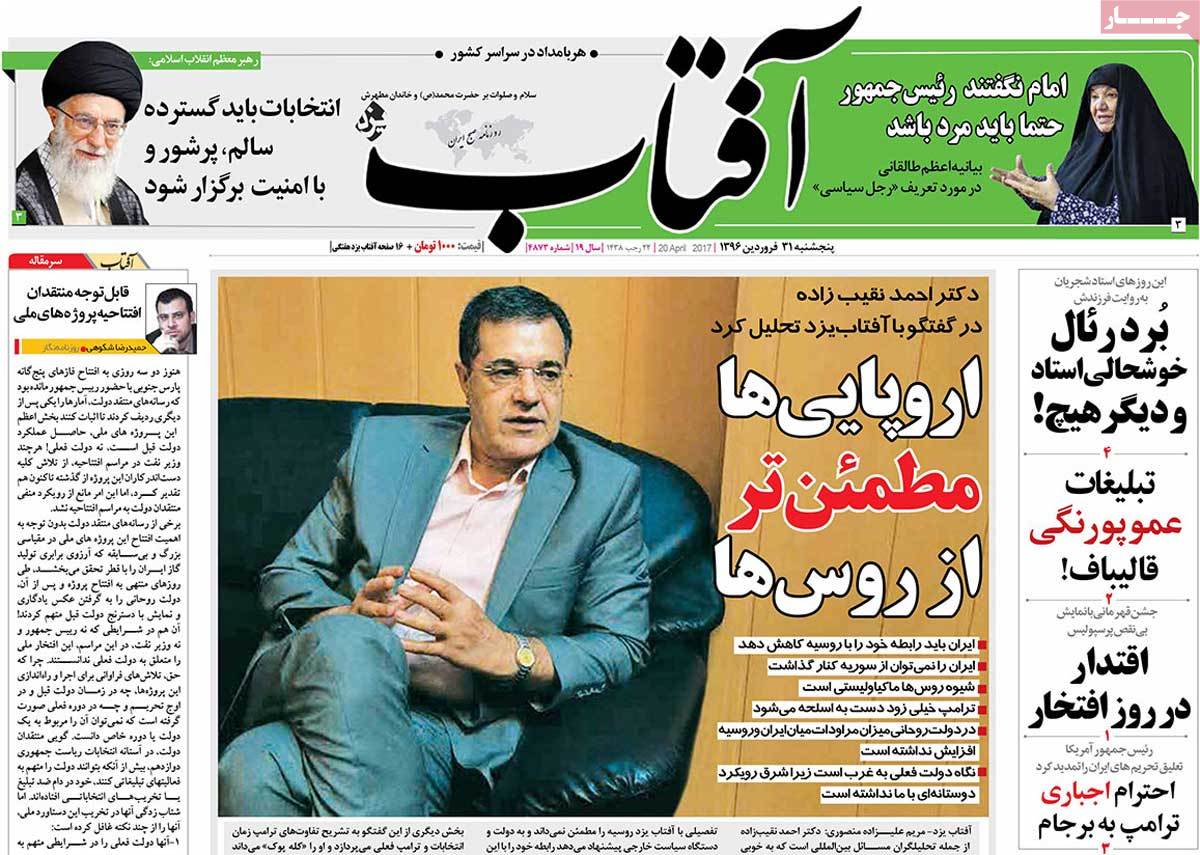
1- Europeans More Reliable than Russians: Analyst

2- Imam Khomeini Didn’t Say President Should Be a Man: Female Presidential Candidate

3- Childish Ad Released as Part of Qalibaf’s Election Campaign
A Look at Iranian Newspaper Front Pages on April 20 - aftabe-yazd


Arman-e Emrooz:

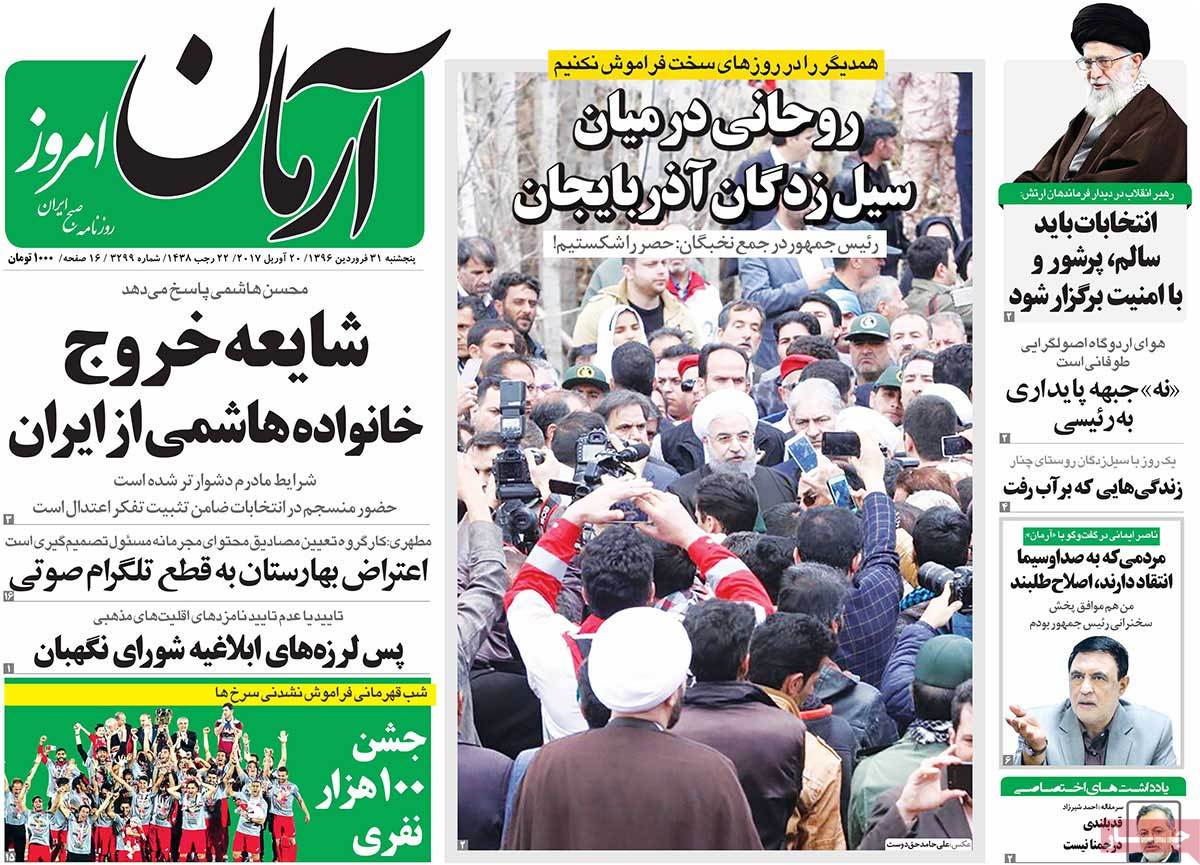
1- Hassan Rouhani Visits Flood-Hit People of Azarbaijan

2- 100,000 in Stadium to Celebratre Persepolis FC’s Championship
A Look at Iranian Newspaper Front Pages on April 20 - arman


Bahar:

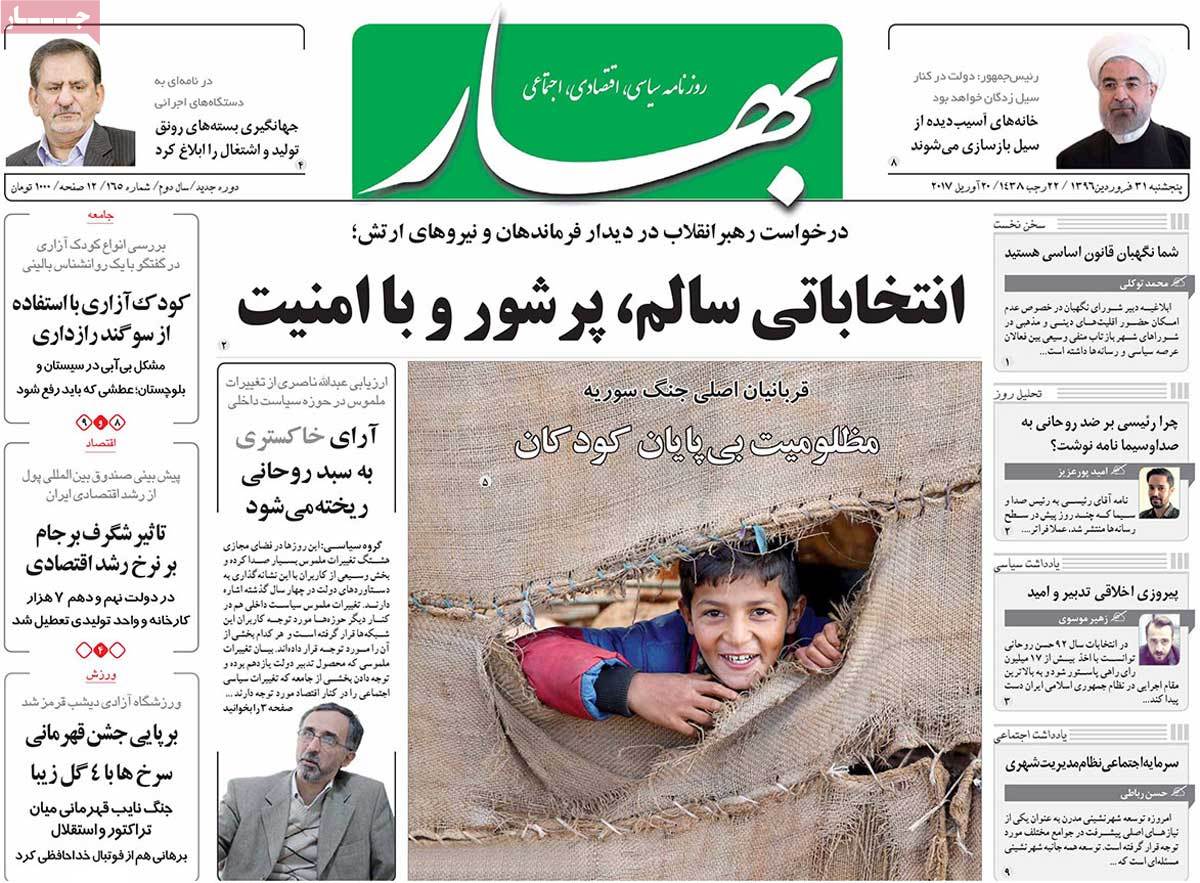
1- Endless Innocence: Main Victims of Syria War

2- Rouhani to Win the Grey Votes
A Look at Iranian Newspaper Front Pages on April 20 - bahar


Ebtekar:

1- Trump Gives in to Nuclear Deal: US Underlines Iran’s Commitment to JCPOA

2- Rouhani: Gov’t to Expedite Resolution of Flood-Hit People’s Problems
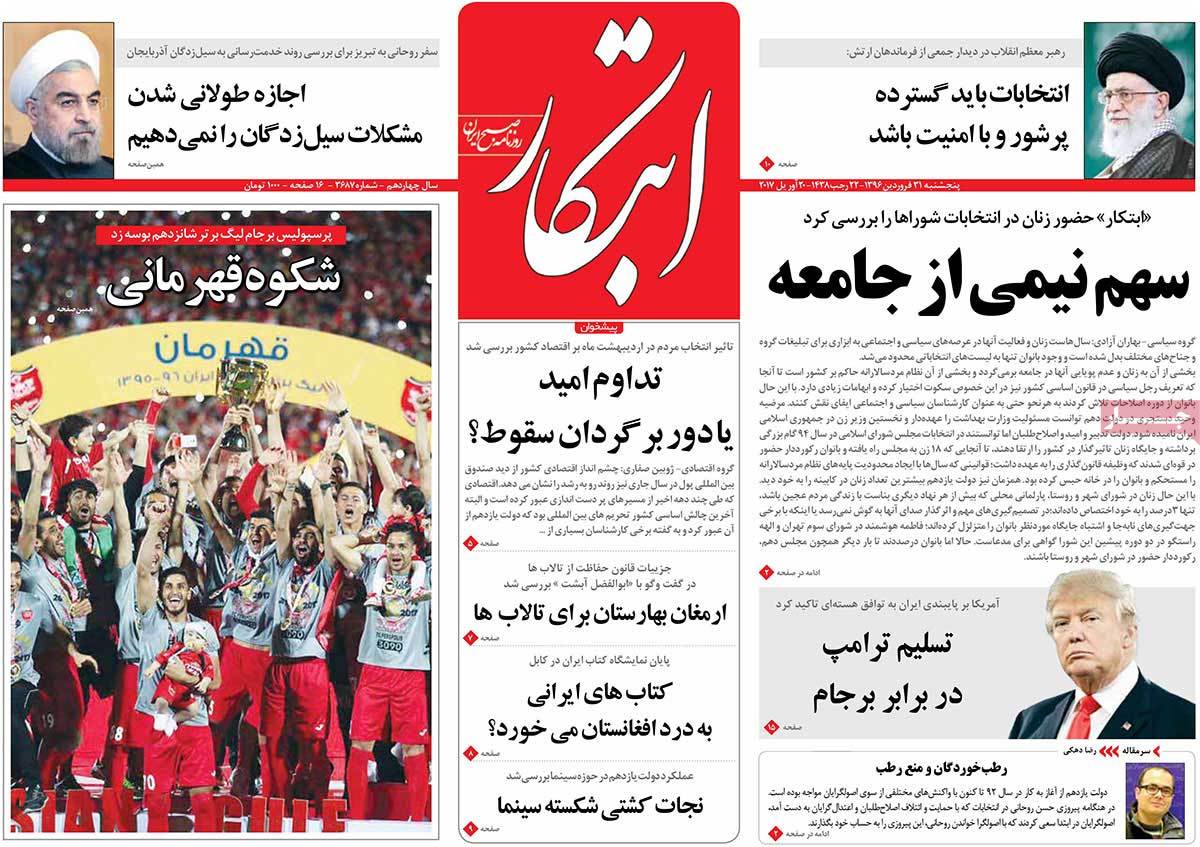
A Look at Iranian Newspaper Front Pages on April 20 - ebtekar


Ettela’at:

1- Iran Leader Calls for Preparation of Grounds for Health, Nationwide Elections

2- Rouhani: We’re Wholeheartedly Standing by People in Flood-Hit Provinces

3- 1,000 Forces to Provide Security for Iran Elections

4- Iran Speaker: Deal between Certain Islamic Countries, Israel Embarrassing
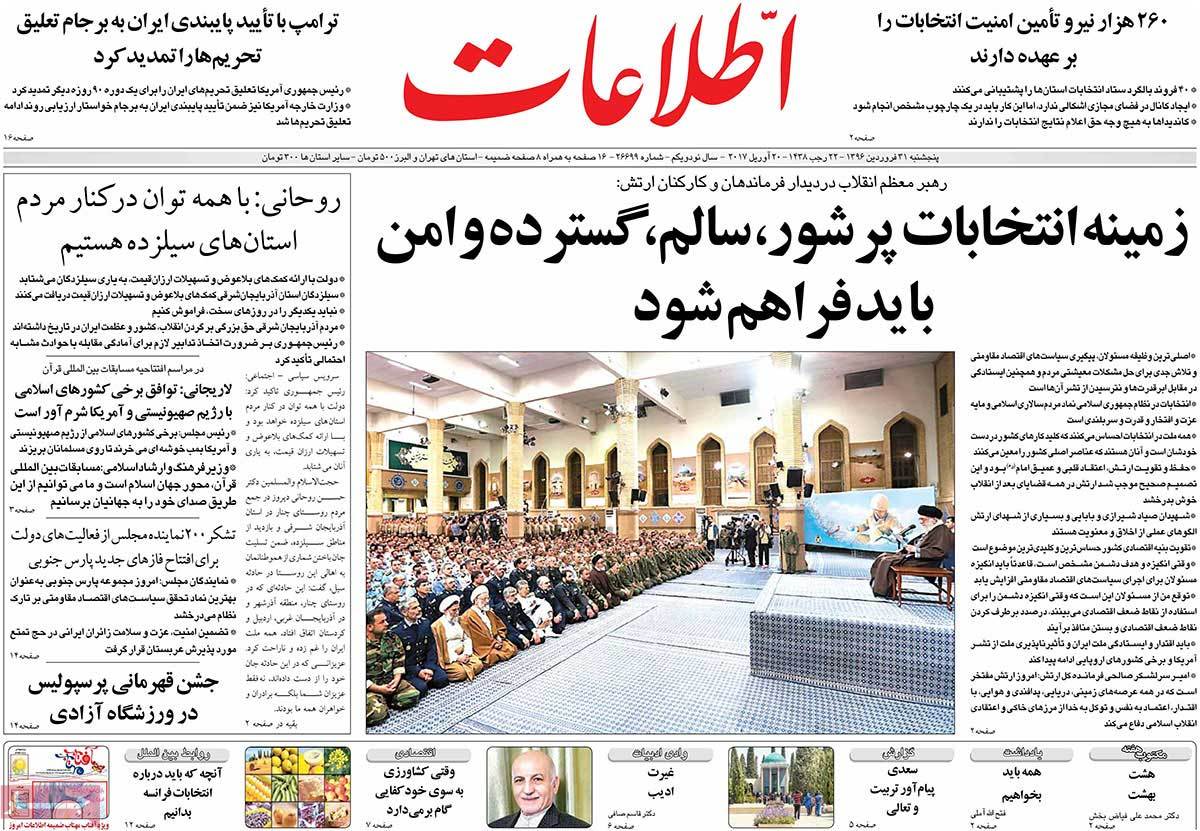
A Look at Iranian Newspaper Front Pages on April 20 - etelaat


Haft-e Sobh:

1- New Regulations for Carrying Foreign Currencies

  • Be Careful If You Have over €10,000 in Cash

2- Uninvited Guests in Great Feast of Persepolis
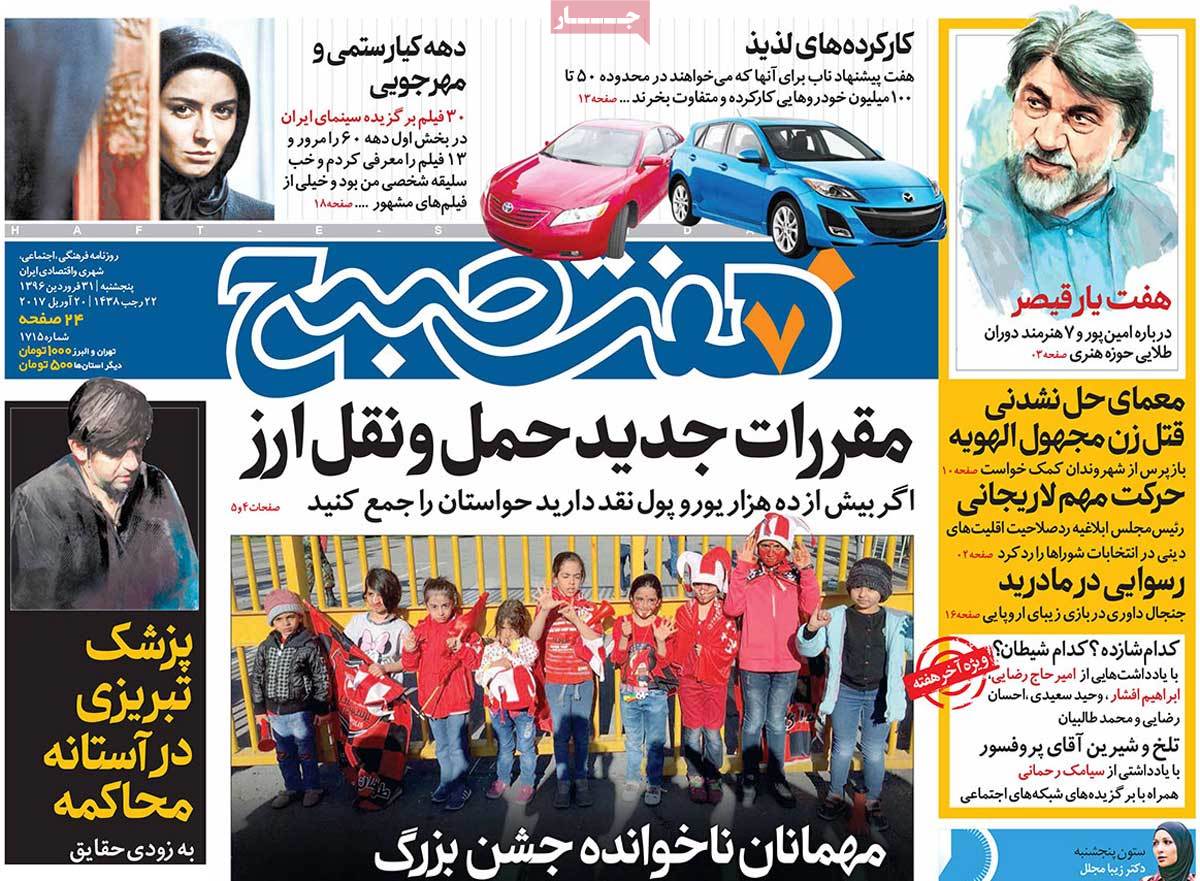
A Look at Iranian Newspaper Front Pages on April 20 - hafte-sobh


Jame Jam:

1- Iran Leader Calls for Healthy, Fair, and Glorious Elections

2- Decrease in Growth Rate of Social Ills

3- Persepolis FC on Fire in Championship Night

4- US Admits Iran Has Been Committed to Nuclear Deal
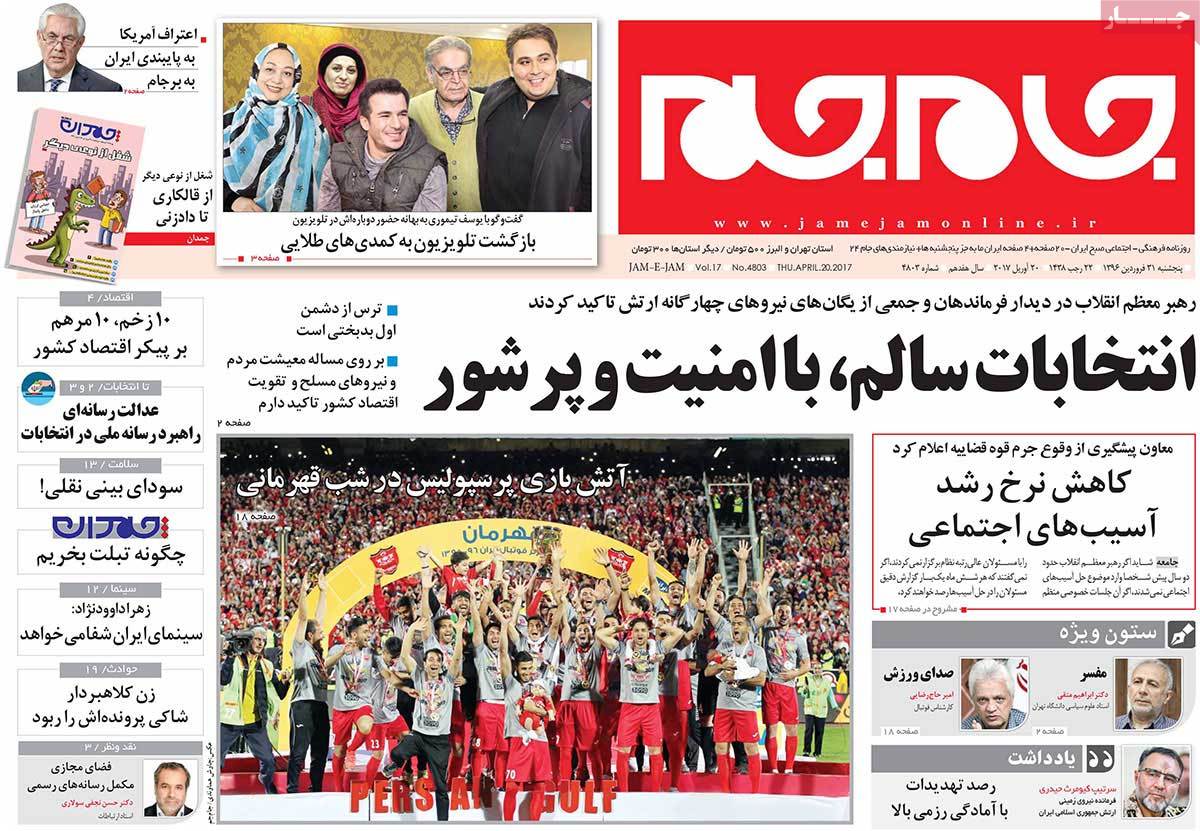
A Look at Iranian Newspaper Front Pages on April 20 - jame-jam


Javan:

1- Election Should Be Held in Healthy, Vibrant, Secure Manner: Leader

2- Trump on Path of Coexistence with Nuclear Deal

3- IRIB’s Programs for Election under People’s Scrutiny
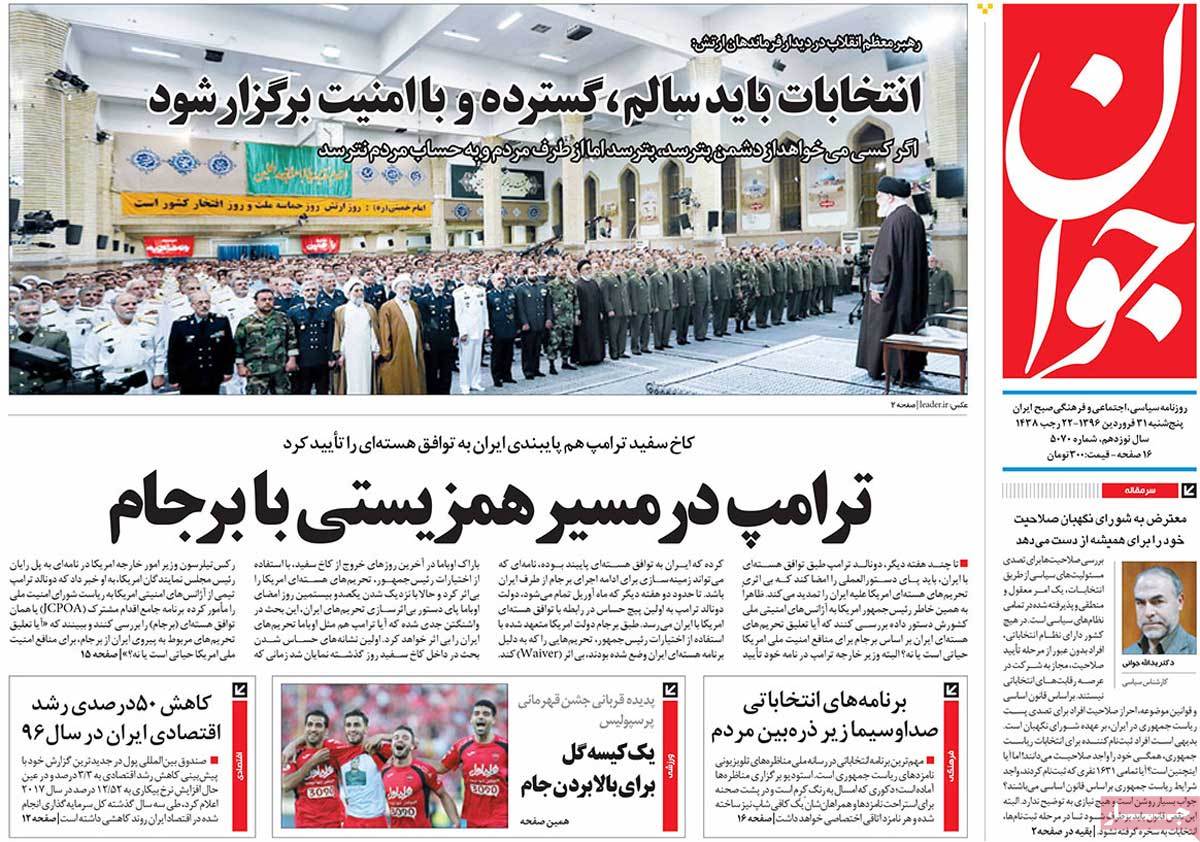
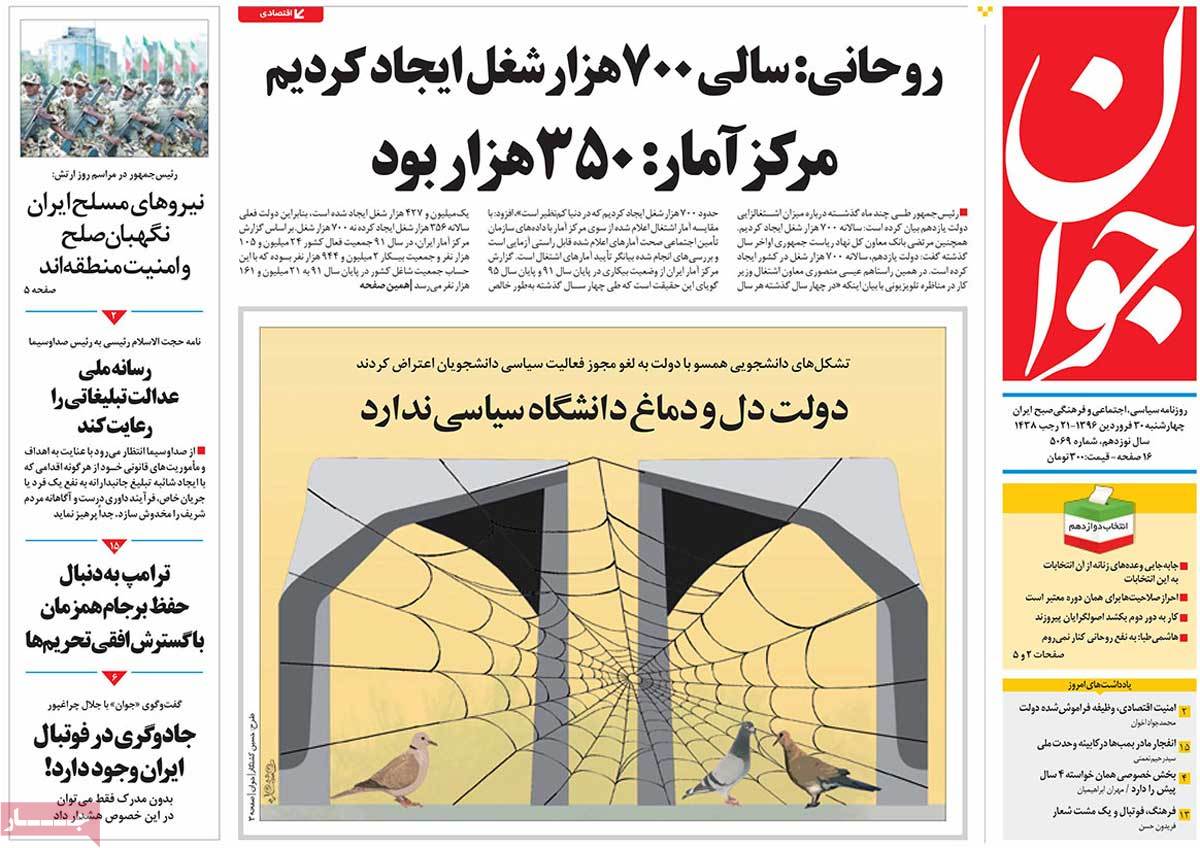
A Look at Iranian Newspaper Front Pages on April 20 - javan


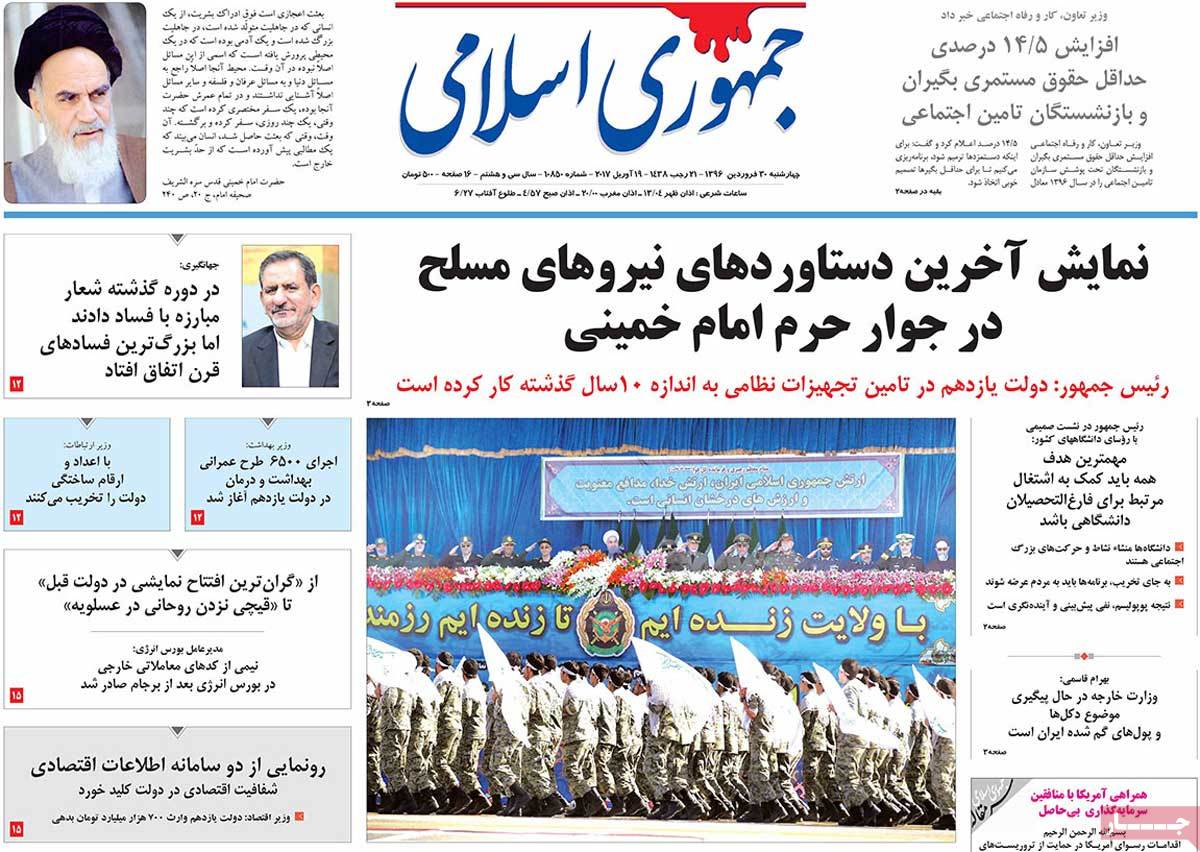
Jomhouri Eslami:

1- 6.5-Time Increase in Value of Europe’s Imports from Iran

2- US Secretary of State Admits Iran Has Been Committed to Nuclear Deal

3- Saudi Arabia Confirms Its Chopper Has Crashed in Yemen with 12 Officers on Board
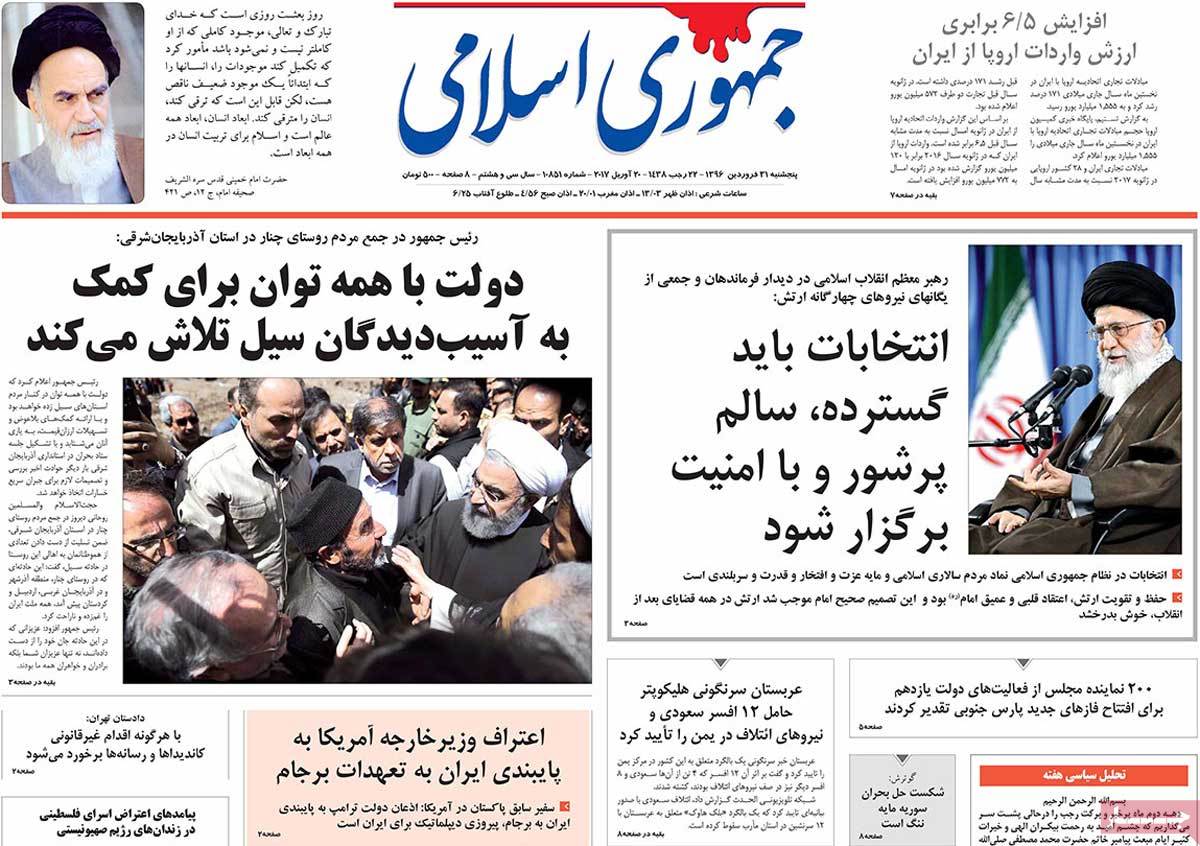
A Look at Iranian Newspaper Front Pages on April 20 - jomhori


Ka’enat:

1- No Unity: Senior Conservatives Have Kept Silent!
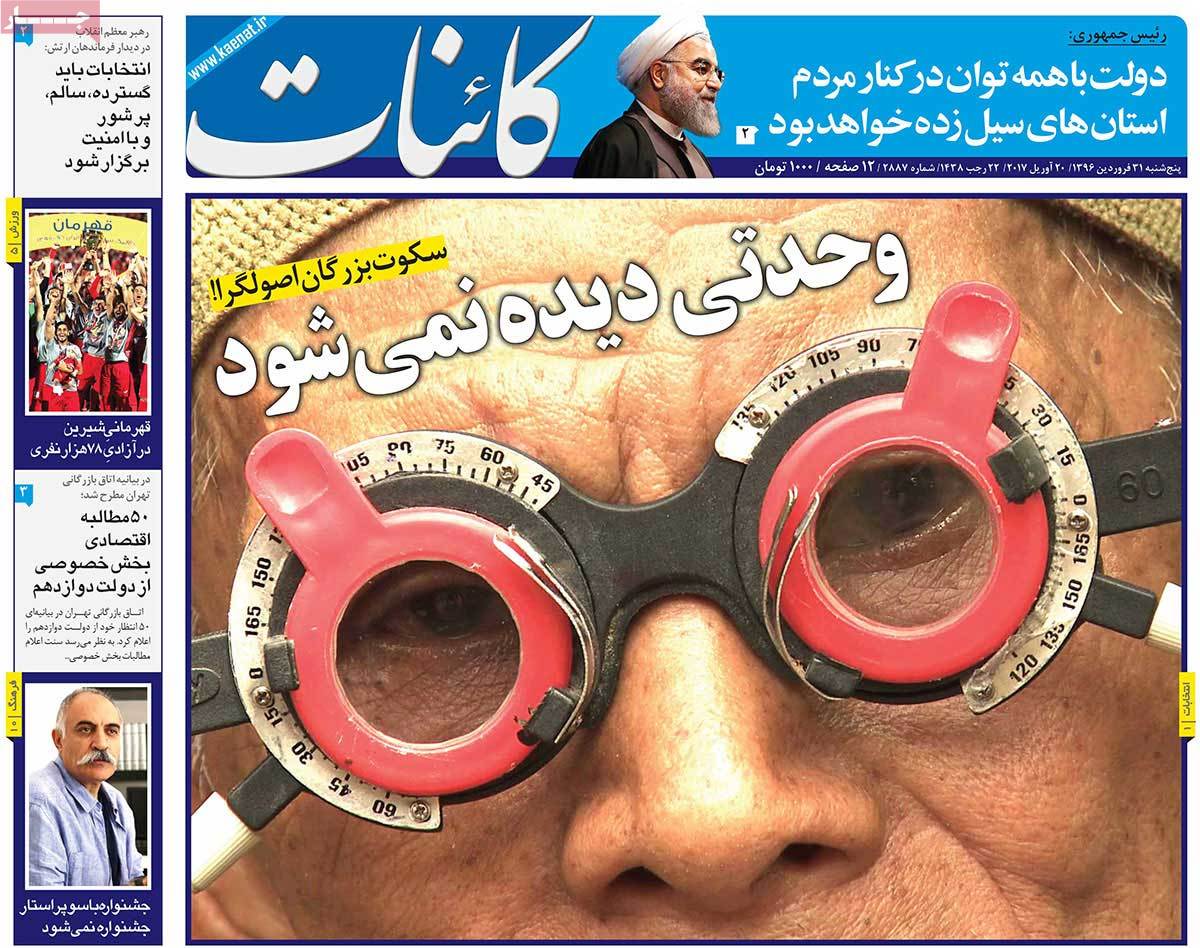
A Look at Iranian Newspaper Front Pages on April 20 - kaenat


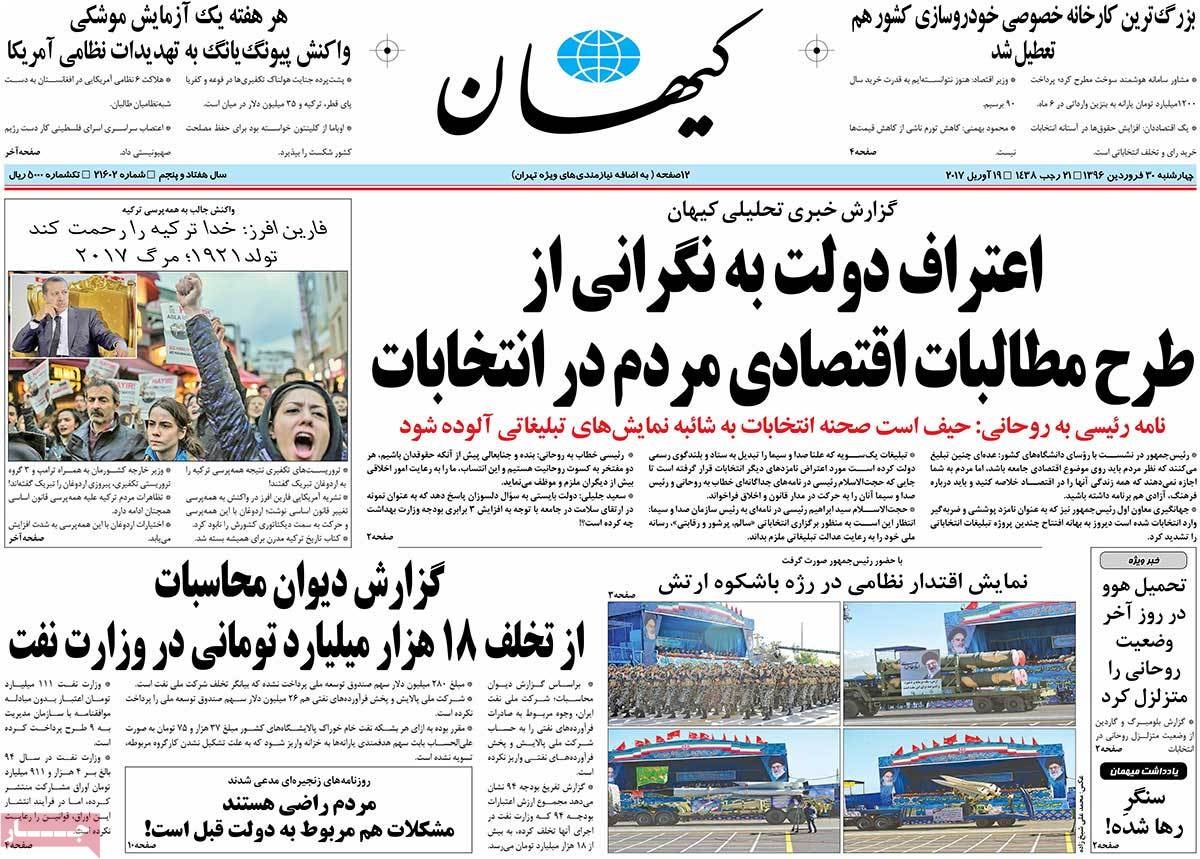
Kayhan:

1- Which One Will Win New War in Korea Peninsula: Trump or Un?

2- US General: Americans Should Remain in Iraq, with or without ISIS!

3- Iran’s Employment Rate Down by 11 Ranks
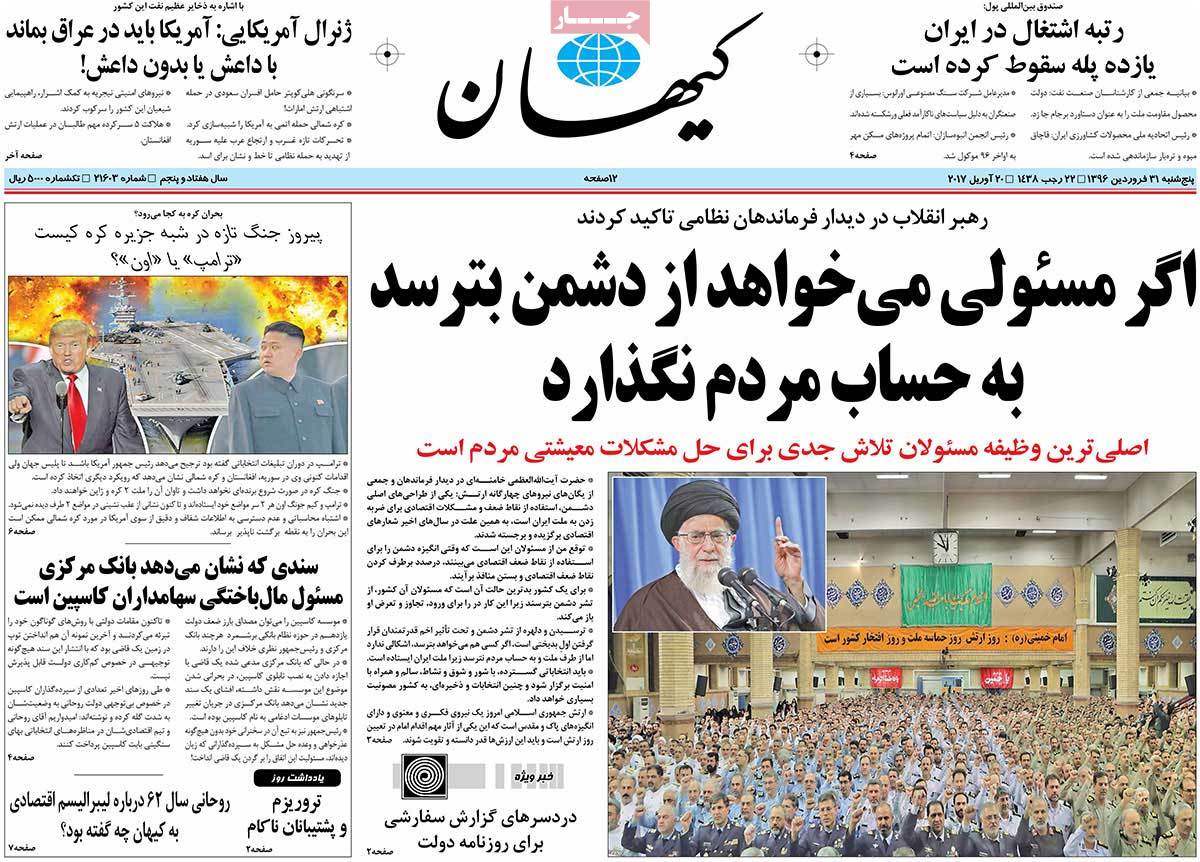
A Look at Iranian Newspaper Front Pages on April 20 - keyhan


Khorasan:

1- Leader: Officials’ Main Duty is to Resolve People’s Economic Problems

2- Saudi Arabia Gives Guarantee on Security, Dignity of Iranian Pilgrims

3- Trump’s Administration Backs off on Nuclear Deal
A Look at Iranian Newspaper Front Pages on April 20 - khorasan


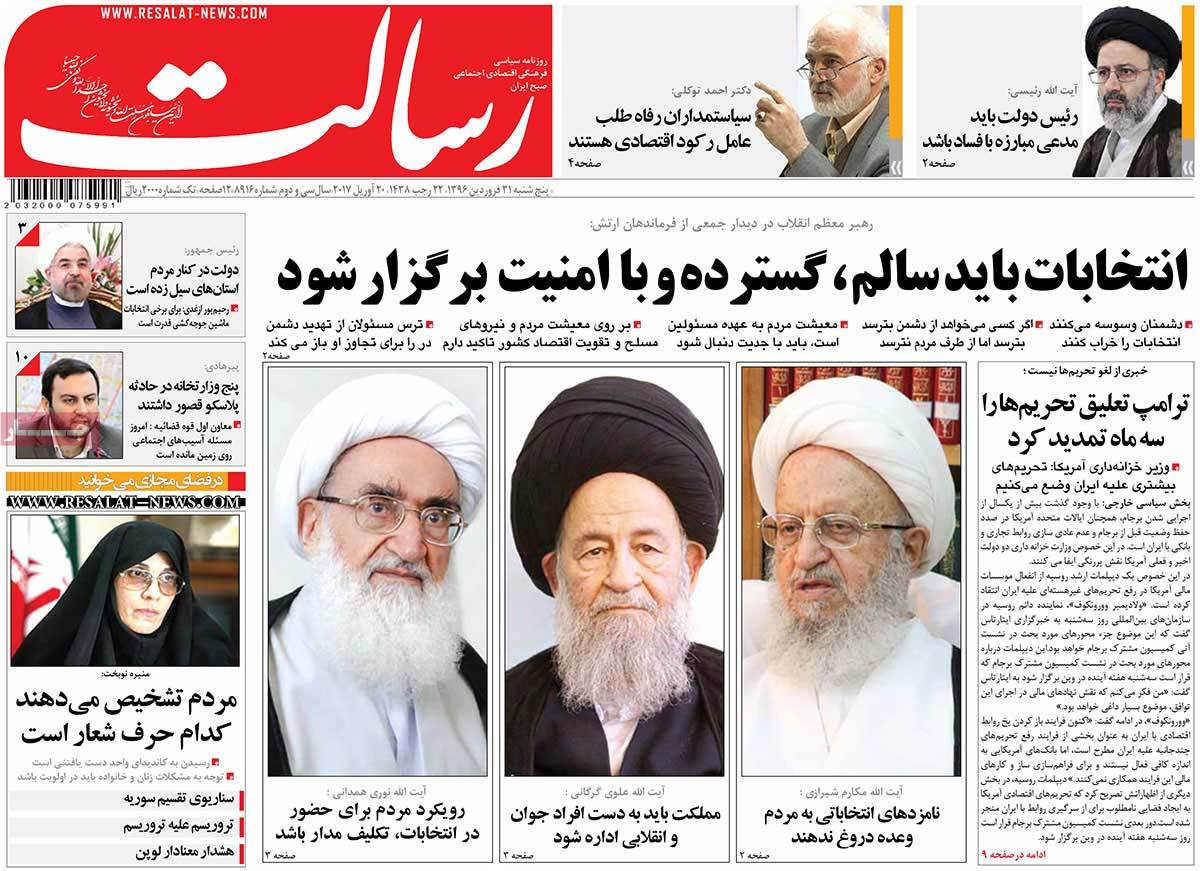
Resalat:

1- Cleric Urges Presidential Hopefuls Not to Give People False Promises

2- Iran Should Be governed by Young, Revolutionary People: Cleric

3- President Should Be Advocate of Fight against Corruption: Raisi
A Look at Iranian Newspaper Front Pages on April 20 - resalat


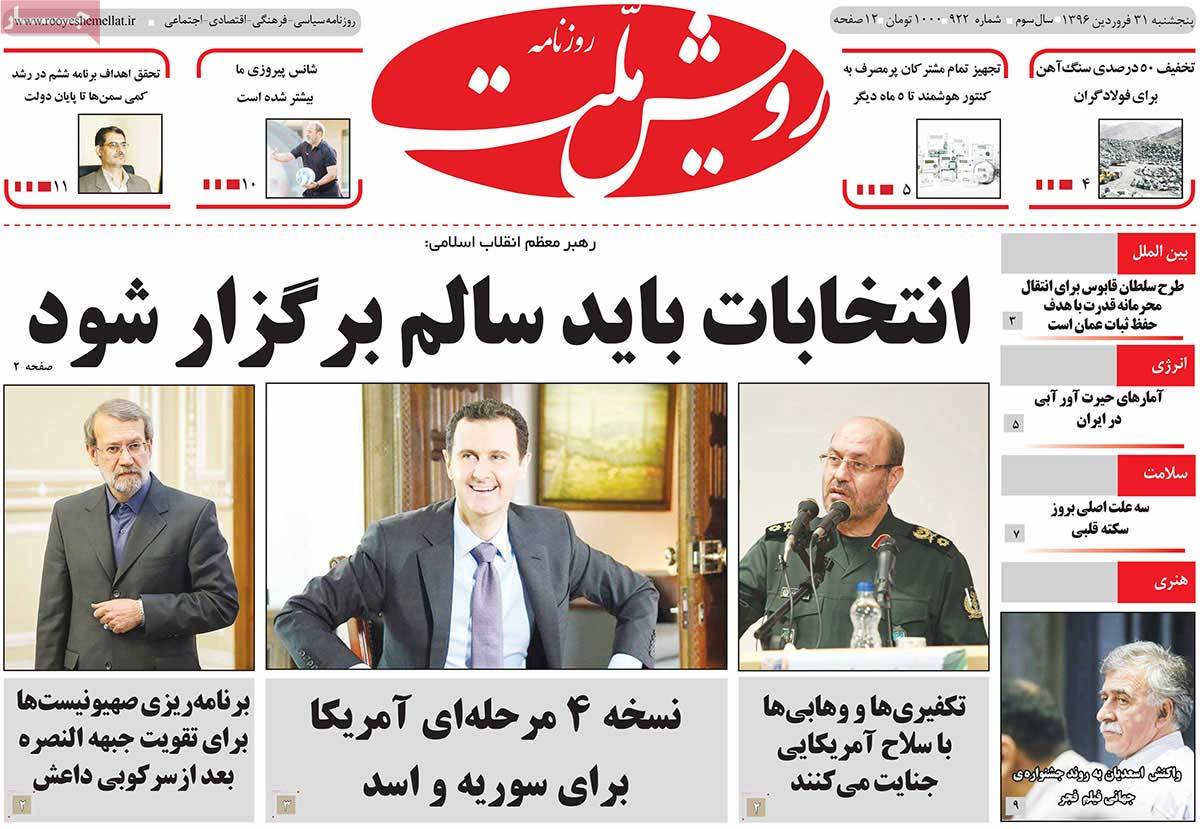
Rooyesh-e Mellat:

1- Takfiris, Wahhabis Committing Crimes Using US-Made Weapons: Iran DM

2- Washington’s 4-Stage Plan for Syria, Assad

3- Zionists Planning to Reinforce Nusra Front after ISIS Eradication
A Look at Iranian Newspaper Front Pages on April 20 - royesh mellat


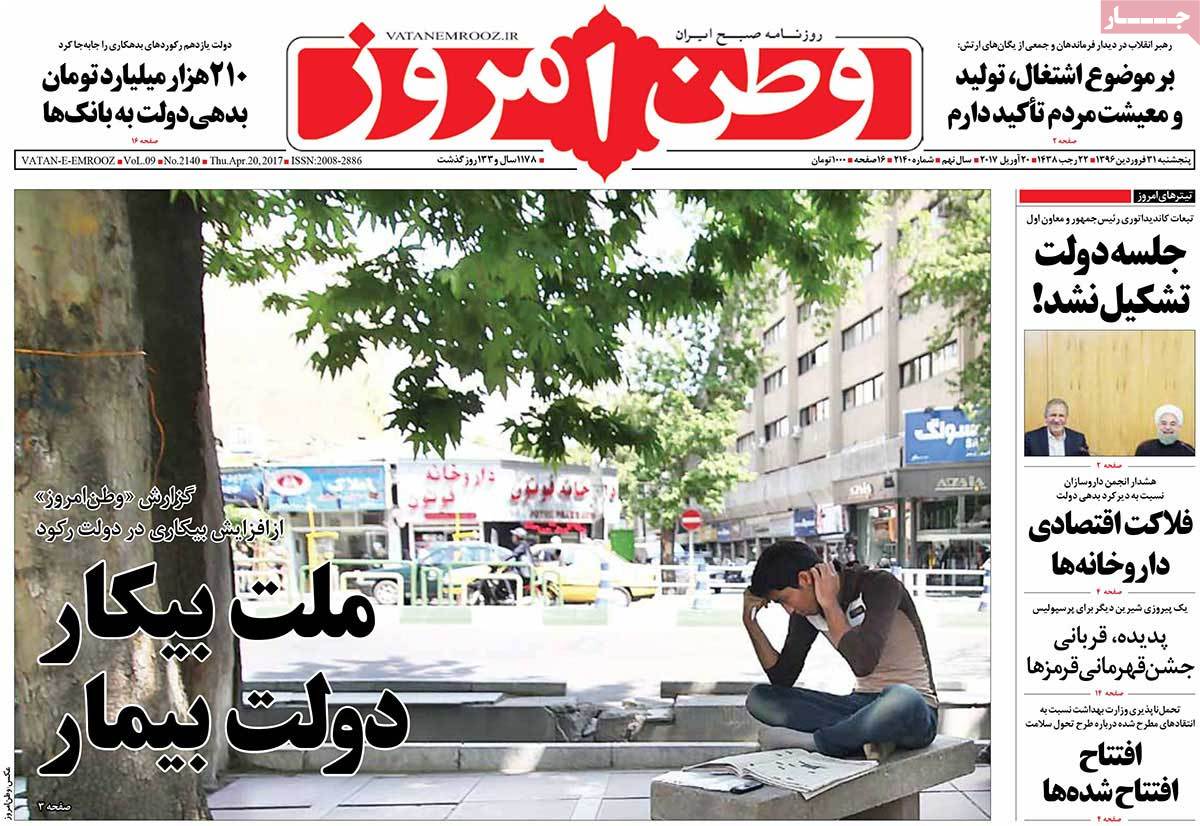
Vatan-e Emrooz:

1- Leader Underlines Issues of Employment, Production, People’s Livelihood

2- Jobless People, Ill Government

  • A Report on Increased Unemployment Rate in Government of Economic Downturn
A Look at Iranian Newspaper Front Pages on April 20 - vatane-emruz

Erdogan Becomes Dictator by Climbing up Ladder of Democracy!

The constitutional referendum in Turkey was held at a time when its outcome was promising for neither side, even for President Erdogan who won the contest. Now the post-plebiscite situation in Turkey is a very tough and sensitive one. Many believe social rifts in the country are widening, which would strongly affect Ankara’s foreign relations. To discuss that further, the Etemad daily newspaper has interviewed Sadeq Maleki, an expert on Turkish affairs, who has shared his views on the different dimensions and possible ramifications of the referendum.

The following are excerpts from his remarks in the Farsi interview.

How Erdogan Emerged Victorious in Referendum

Erdogan sees the challenging referendum held in his country as a triumph. However, even if impartial observers regard it as a victory, it is a weak one. The plebiscite was held against the backdrop of mass arrests following the abortive coup. Pressure piled up on the opposition so much so that one would think Turkey is gripped by another coup in the wake of the first one. One of the key objectives that Erdogan has pursued since 2002 has been to change the country’s constitution and turn its parliamentary system into a presidential one. Erdogan announced his goal after he assumed power as President through popular vote.

He cashed in on the post-coup climate and removed his opponents. If these opponents were in power today, we wouldn’t be witnessing such a restructuring. He managed to lay the groundwork for changing the parliamentary system to a presidential one by garnering just over 51 percent of the vote. So, one should bear in mind that the referendum was held under a state of emergency regarded as a military-security rule. Given the security atmosphere, especially in the Kurdish-dominated regions, Erdogan managed to secure the votes he needed by pressing for and achieving the considerations he had in mind.

All in all, one can say the Turkish referendum was an engineered vote. Moreover, the narrow margin of votes between the rival camps indicates that if the referendum had been held under normal circumstances, Erdogan would have lost. Erdogan’s narrow victory has prompted impartial circles and his opponents to seriously raise the possibility of vote rigging. Opposition leader Kemal Kılıçdaroğlu has called for a recount of 60 percent of the ballots. He has also demanded the votes which were supposed to be declared null and void, but were tallied, be removed from the counting process.

With this referendum, Turkey in fact entered a second republic phase. If we consider Mustafa Kemal Atatürk as the founder of the first Republic of Turkey, the recent referendum has made Erdogan the founder of the second Republic. The only difference is that the powers of Erdogan, who is a political and non-military figure, will be much more than the authority of Atatürk, who was a military man. This comes as Erdogan has time and again accused Atatürk of being a despot.

Dream of Ottoman Empire Posing Threat to Turkey, Region

Erdogan moved toward success by climbing up the ladder of democracy. However, as his performance has shown, especially since 2011, he has failed to remain stable on the path of democracy. The current situation of Turkey both at home and abroad shows an increase in Erdogan’s powers could further deepen the bipolar atmosphere inside the country. Irrespective of Turkey’s internal issues, sweeping presidential powers can affect the crises in Syria and Iraq.

One of the contributors to the crises in the two countries has been Erdogan’s performance. Polls show if Erdogan does not change tack, and given his past performance in the Middle East, the situation will become more critical. A powerful Erdogan will be dangerous to both Turkey and the Middle East. Experience shows dictators mostly seek to achieve their ambitions rather than considering what is good for people. Most dictators crave for power. Erdogan’s performance could partly be inspired by his dream of reviving the Ottoman Empire. But one should bear in mind that history is there to serve as an object lesson to us. The continuation of the policies that Erdogan has pursued, especially since 2011, will be detrimental to both Turkish people and regional nations.

Authoritarianism, Sectarianism, Economic Crisis to Cost Turkey Dearly

Authoritarianism, sectarianism, and economic crisis are three factors that amount to the Achilles’ heel of Turkey under Erdogan. Turkey will have to pay a heavy price for authoritarianism and marginalising the opposition. For instance, a kind of civil war is going on in the southeast of the country. It is in civil strife where tanks and personnel carriers make their presence felt. The army went into action with its tanks in some areas. We witnessed the shelling and bombardment of Kurdish opponents as part of the crackdown on voices of dissent. Erdogan has announced loud and clear that Ankara killed some 6,000 opponents last year. The figure is even higher than the number of those killed at the height of conflicts between Turkey and Kurds in past decades.

This is the result of a gap caused by Erdogan. Statistics show cities and areas near the Mediterranean and the Sea of Marmara, Istanbul, Ankara and Izmir voted “no” in the plebiscite. The social gap can adversely affect the performance of the Erdogan administration in the future. The gap will be more tangible if economic and social crises spread as well. At the moment, signs of an economic crisis are emerging. The value of the Turkish Lira against foreign currencies has decreased compared to the past. The unemployment rate is on the rise, and investment in the country has dropped. These are not good signs for Turkey. The most important measure on Erdogan’s track record which has secured his 15-year rule has been his successful economic plans. But at the moment, this brilliant background has been tarnished in certain sectors, and if his authoritarian approach continues, it can deal a blow to the position of Erdogan and Turkey on the international stage in the long run.

Elimination of Opponents Affected Referendum

Keeping opponents out of the political arena under the pretext that they helped stage the abortive coup has affected the plebiscite. Before the voting, Erdogan pressurized his opponents, and after it was held, he announced publicly that those who voted “no” are not equal to those voted “yes.” It should be mentioned that some 60,000 people have been apprehended and dismissed from their jobs on Erdogan’s orders since the coup. We have witnessed many coups in Turkey, but none has been associated with so many arrests as we are witnessing now. The referendum has been held at a time when Selahattin Demirtas, the leader of the left-wing pro-Kurdish Peoples’ Democratic Party (HDP), is behind bars. Many leftist and rightist and even Islamist figures whose articles could influence millions of people are now in prison. These people stand accused of having links with Fethullah Gülen, who was considered Erdogan’s ally before 2013 and somehow was Erdogan’s mentor. Even Erdogan removed many of his opponents from the political scene with Gülen’s help.

Iran-Turkey Ties after Referendum

The language that Erdogan has used about Iran in recent months has been inappropriate and not the kind of language that a president would use. Erdogan has publicly accused Iran of imposing sectarian and religion-based policies based on Persianism. This comes as Erdogan himself is well known for using such policies and has pursued the same approaches in Iraq and Syria as well as in his own country. Even when Erdogan talks about his regional policies, he gets into Iran’s sectarian issues. The danger is predictable: Erdogan may meddle in Iran’s internal affairs and further complicate the existing tensions with his interference.

Iran, Australia to Save Lake Urmia from Drying Out

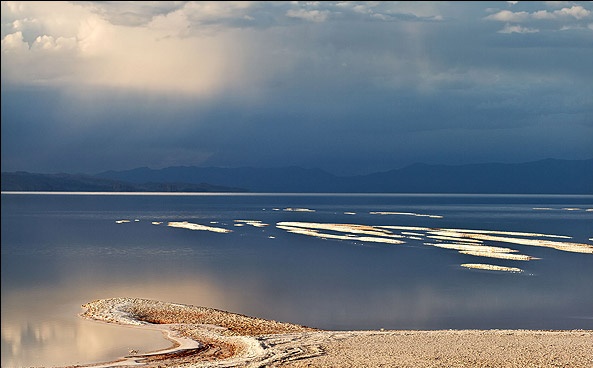
Iran Lake Urmia

In a recent Farsi article, IRNA has highlighted Australia’s efforts to save its Murray–Darling basin, which is very similar to the drying Lake Urmia in Iran. You may find the piece below:

The Murray–Darling basin in Australia, which bears a striking resemblance to Iran’s Lake Urmia, was saved from drying out due to measures adopted by Canberra. Australian experts are to converge in Sharif University of Technology in Tehran on April 19, 2017 to discuss the matter and share their 20 years of experience on that.

Climatic change and its effect on nature is a global and undeniable fact and has engulfed the planet Earth in its entirety. Meantime, the way that existing resources are managed has also contributed heavily to this natural trend.

Amid these ups and downs, lakes and lagoons have been subject to drying out. One of the basins suffering from low water levels was Murray–Darling, but was saved thanks to two decades of efforts by experts.

Murray–Darling bears a marked similarity to Lake Urmia. So, an Iranian delegation travelled to Australia to visit Murray–Darling, exchange experience and technical knowhow, and draw on Canberra’s experience in managing basins. The team comprised of members of a commission tasked with reviving the body of water, the Chamber of Commerce, agriculture officials, and energy authorities.

The trip came within the framework of a water agreement signed between the University of Melbourne, Sharif University of Technology and the commission tasked with preserving, managing and reviving the ecosystem of Lake Urmia. The deal was clinched last fall when an Italian delegation travelled to Iran.

The Murray–Darling basin is a large geographical area located in southeastern Australia. It covers the states of Queensland, New South Wales, Victoria, South Australia and Australian Capital Territory. It covers one-seventh of Australia’s soil and is regarded as the most famous agricultural region in the country. The basin has been named after rivers Murray and Darling.

The basin receives little direct rainfall, and the volume of water it carries is large only by Australian standards. A rather large number of swans live there, which was suffering from drought.

Massoud Tajrishi, the head of an office charged with planning the activities undertaken by the commission responsible for reviving Lake Urmia, told IRNA that a national development congress is held at Tehran’s Sharif University of Technology on April 19. He said experts from the University of Melbourne are to take the podium at the event to share with participants their 20 years of experience in the fields of law, marketing and water allocation.

Prior to that conference, he said, officials of the commission tasked with reviving Lake Urmia and a team comprising Australian water and hydrology experts held a joint meeting. The session was aimed at sharing information on issues pertaining to Lake Urmia as well as on activities and operations carried out by the commission plus discussing areas of cooperation.

Tajrishi noted that the mutual collaboration is in line with a joint Memorandum of Understanding signed between Iran and Australia on cooperation in the field of water. Under the MoU, the Sharif University of Technology and the University of Melbourne are to work together on water affairs.

He said Australia’s Murray–Darling basin and Iran’s Lake Urmia are both grappling with problems such as low water levels, climatic changes and challenges regarding supplying water to meet environmental needs.

Australia spent $30 billion over two decades and managed to save Murray–Darling, he said.

One of the measures adopted was to create a regional market to sell water, which was done successfully.

He also touched upon Iran-Australia cooperation in the field of water and water resources. He said the Iranian and Australian governments have also agreed to establish a joint research centre for water, with efforts being concentrated on Lake Urmia.

People from the Chamber of Commerce, some universities and the Energy Ministry are working on that.

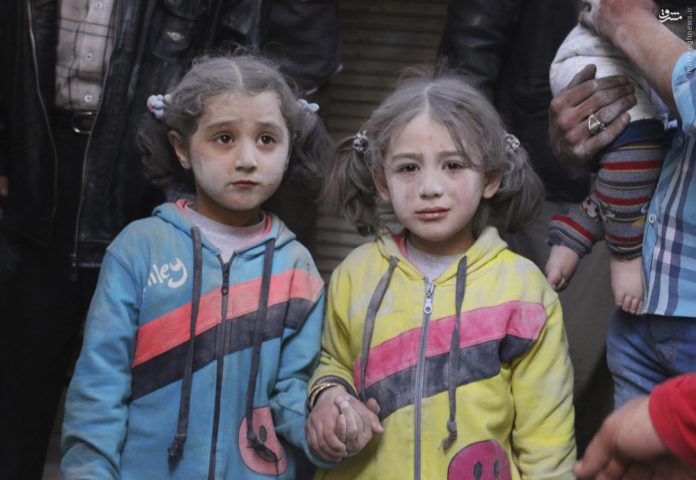
Children of Syria’s Foua, Kefraya Not Attractive to World Media

Children of Syria’s Foua, Kefraya Not Attractive to World Media

Syrian children have a strange destiny. If they fall victim to a chemical attack, their beautiful faces may shock the world. But children in Syrian towns of al-Foua and Kefraya did not know that after death, their faces would be burned and torn to pieces, and will not be attractive to anyone for that matter.

Shortly after the suspicious chemical attack on Syria’s Idlib province, US President Donald Trump said that children with beautiful faces were mercilessly killed in the brutal attack, and stressed that seeing the beautiful faces of the dead kids made him change his approach on Syria and decide to directly intervene in the country’s conflict.

It is not clear the body of whose Syrian child Trump had seen that touched him so much. Ostensibly, Trump was so deeply moved that he, before the perpetrators of the chemical incident in Idlib were identified, ordered 59 missiles to be fired on a Syrian airbase used to fight terrorists, contravening international law. But how could Trump see the images of charred and torn bodies of Shiite women and children of al-Foua and Kefraya [killed in the terrorist attack on civilians’ buses]? After being under siege for two and a half years and suffering from starvation, they were massacred by Western-backed “moderate militants.” Ironically enough, Trump had said no child should suffer from horror and fear!

More than 55,000 children have been killed in Syria’s 6-year war. But their deaths draw Western media and government’s attention only when they can cash in on the scenario for political gain. That is why the very same media outlets that kept talking about the deaths of a number of Syrian kids in the suspicious chemical attack in Idlib have now turned a blind eye to the massacre of children of Foua and Kefraya near Aleppo.

The terrorist attack on the buses carrying Shiite residents of al-Foua and Kefraya killed 118 civilians, including 68 children, and wounded over 500 others. This comes as CNN’s account of the attack described the massacre as the “killing of dozens of Bashar Assad’s supporters.” CNN also claimed the killing of civilians triggered a “hiccup” in the trend of transferring residents from Foua and Kefraya.


This indifference and biased reaction by the West have even drawn the ire of prominent Western experts. Minutes after news of the Foua and Kefraya attack was released, Max Abrahms, a member of George Washington University’s Center for Cyber and Homeland Security, wrote on his Twitter page that it is predicted the incident will not receive extensive coverage if those killed are Shiites.

WikiLeaks founder Julian Assange also reacted to Western media’s indifference to the massacre of Syrian Shiites. He likened the West’s backing for terrorists who it calls “moderate militants” to the Western support for Osama bin Laden in the 1990s. On his Twitter page, Assange wrote that we should not forget the “moderate militants” backed by the CIA and frequently mentioned by Western media.

Syrian children have a strange destiny. They do not know that if their deaths are to move the world and make missiles fly in retaliation, they must be beautiful, and their deaths should serve the interests of media and governments that have now turned a blind eye to the Foua and Kefraya massacre.

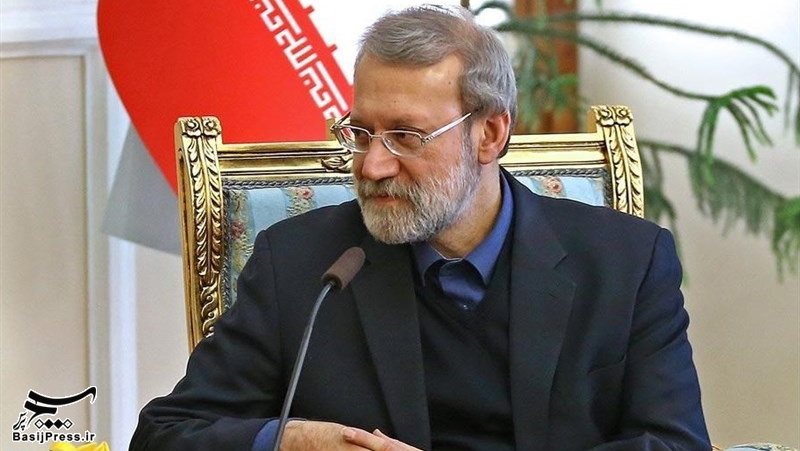
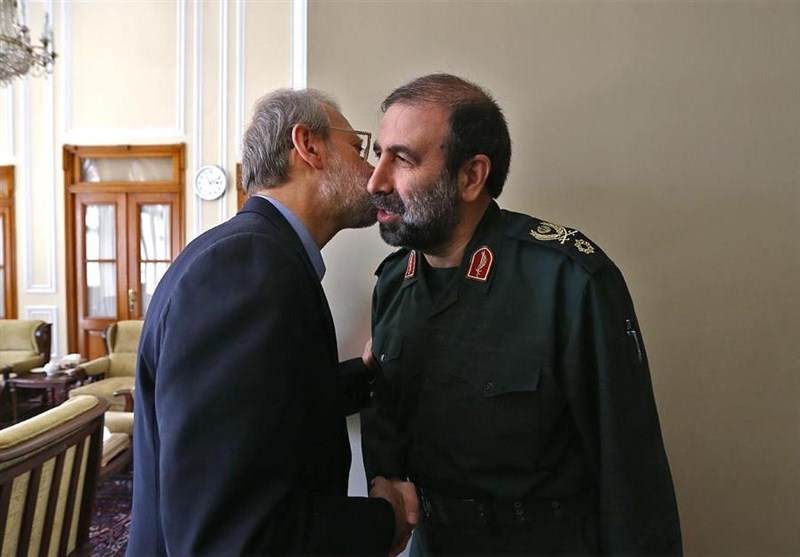
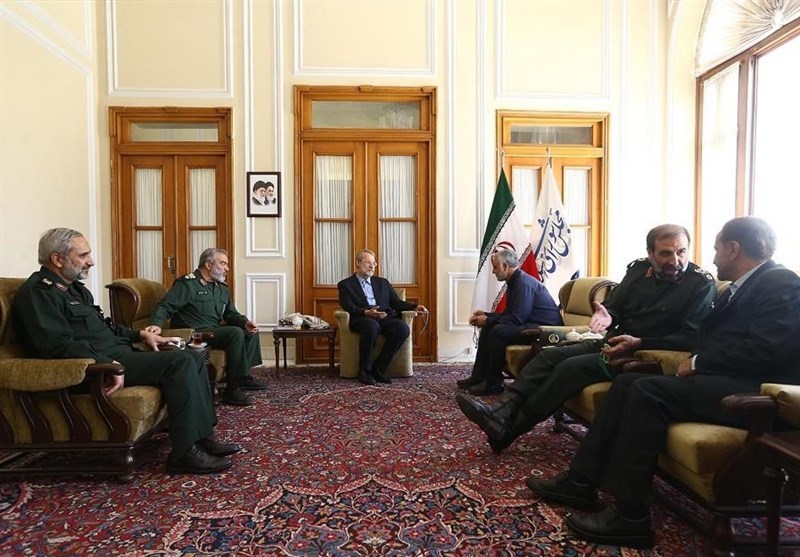
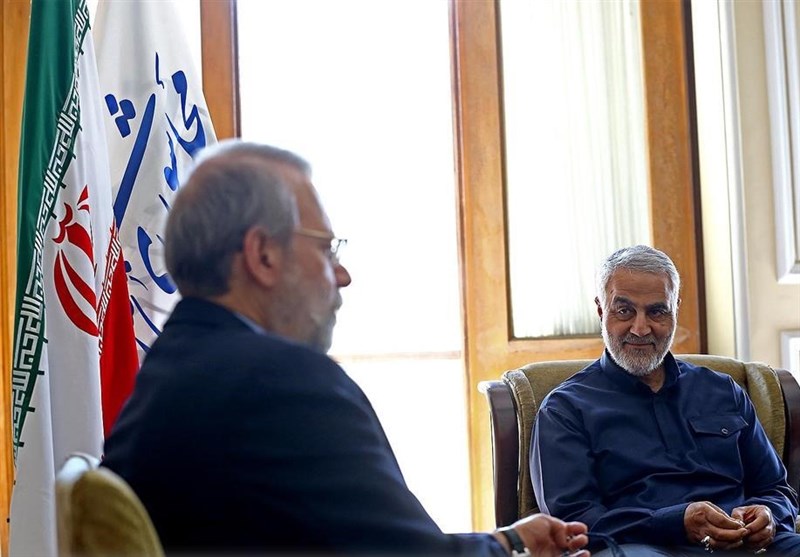
Top IRGC Commanders Meet Iran’s Parliament Speaker

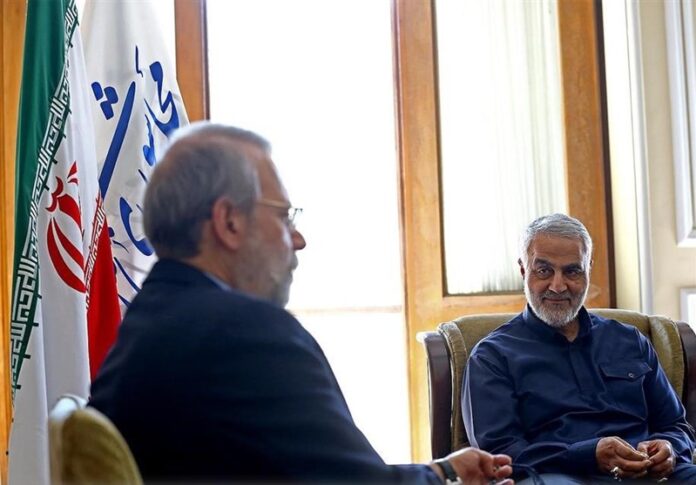
Top IRGC Commanders Meet Iran’s Parliament Speaker (5)

According to a Farsi report by Basij Press, Larijani received the Quds Force Commander Major General Soleimani and IRGC Navy Commander Brigadier General Ali Fadavi.

Brigadier General Mohammad Reza Yazdi and Brigadier General Jamaloddin Abroumand were among other IRGC officials who held talks with the Parliament speaker.

Zarif Narrates Story of Iranian Carpet Hung up on UN’s Wall

Iranian Carpet in UN

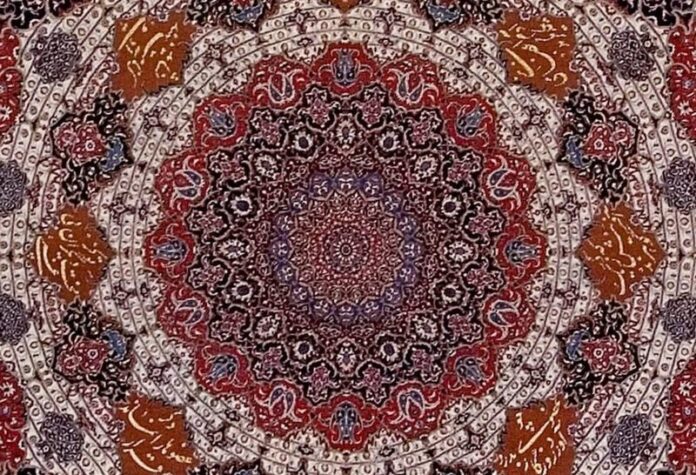
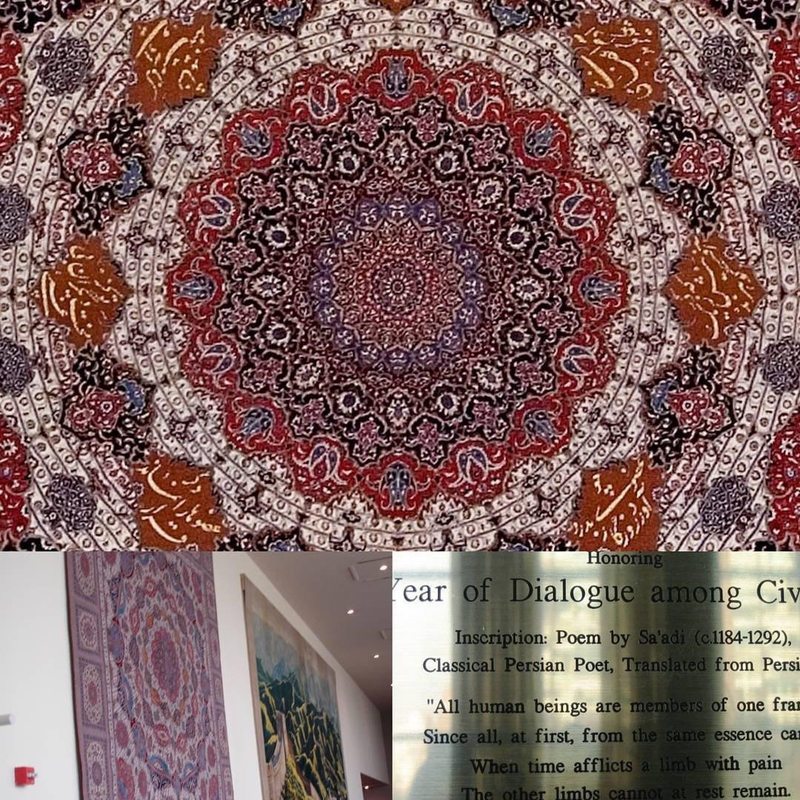
In an Instagram post to commemorate prominent 13th century Persian poet Saadi, Iranian Minister of Foreign Affairs and Iran’s former envoy to the UN Mohammad Javad Zarif has narrated the story of an Iranian carpet, ornamented with one of the poet’s famous poems, adorning the wall of the United Nations headquarters.

According to a report by IFP, the full text of Zarif’s post reads as follows:

“The story of hanging the precious Iranian carpet adorned with Saadi’s most famous poem titled ‘Human Beings” on the UN’s wall is probably interesting to my friends.

Iranian Carpet in UNAlmost all of us have read it at school that this famous poem is written above the UN portal. In 1982, when I first travelled to the US and visited the United Nations headquarters, I searched every nook and cranny of the building but I could not find the poem. Later in 1988, when I was in Geneva [Switzerland] to take part in the negotiations on the UN’s Security Council Resolution 598, again, I failed to find the poem written anywhere in the European headquarters. I even asked some of my friends and more experienced people if they had seen the poem written anywhere in the buildings of the UN’s headquarters, but received a negative response.

In 2004, during the period (2002–2007) I served as Iran’s permanent representative to the UN, I was informed that Mohammad Seirafian, one of the most famous carpet traders of the central Iranian province of Isfahan, had a precious carpet, with a length and width of five metres, at the centre of which Saadi’s poem had been sewn with golden thread. He had voiced willingness to offer the carpet to the UN as a gift providing that they place or hang it up somewhere appropriate.

Given the dimensions of the carpet, it was difficult to find a suitable wall to hang it up on. There were only a few walls at the UN’s headquarters suitable for the purpose. One was the wall on which the big 6×4 carpet given to the UN as a gift by Mohammad Mosaddeq, Iran’s prime minister during 1951-1953, was hung up and the other was that of the hall in which representatives held their talks. A Chinese carpet, nevertheless, was hung up on the latter.

Given the large number of the gifts presented to the UN and inadequate room for all of them, I, inevitably, had to enter into negotiations with the then UN Secretary-General [Kofi Annan] to convince him to hang up the carpet on a suitable wall as a symbol of the idea of Dialogue among Civilizations, put forward by the then Iranian president Mohammad Khatami. Interestingly, the year 2001 was named after Mr. Khatami’s idea at his proposal.

In my later follow-ups, I was faced with a proposal by the UN to hang up the carpet on the wall adorned by the carpet presented by Mosaddeq and replace it with his gift, but I turned down the offer.

A little bit later, I learned that they intended to detach the Chinese carpet from the wall and wash it. The surface of the wall on which the Chinese carpet was hung up, had enough room for two carpets. However, the Chinese one was hung up right at its canter. Nevertheless, with the assistance and thanks to the constant follow-ups of one my good colleagues at the representative office, we eventually managed to hang up the carpet ornamented with Saadi’s poem next to the Chinese one, as you can see in the photo.

In addition, we had Saadi’s poem translated beautifully into English and wrote it on a plate pinned on the wall next to the carpet so that viewers could both enjoy the beauty of the Iranian art and further know about the sublime, elevated and deep humanitarian concepts of the Iranian culture.

And finally Saadi’s poem found its way into the UN.”

The translation of the poem reads as follows:

Human beings are members of a whole,

In creation of one essence and soul.

If one member is afflicted with pain,

Other members uneasy will remain.

If you have no sympathy for human pain,

The name of human you cannot retain.

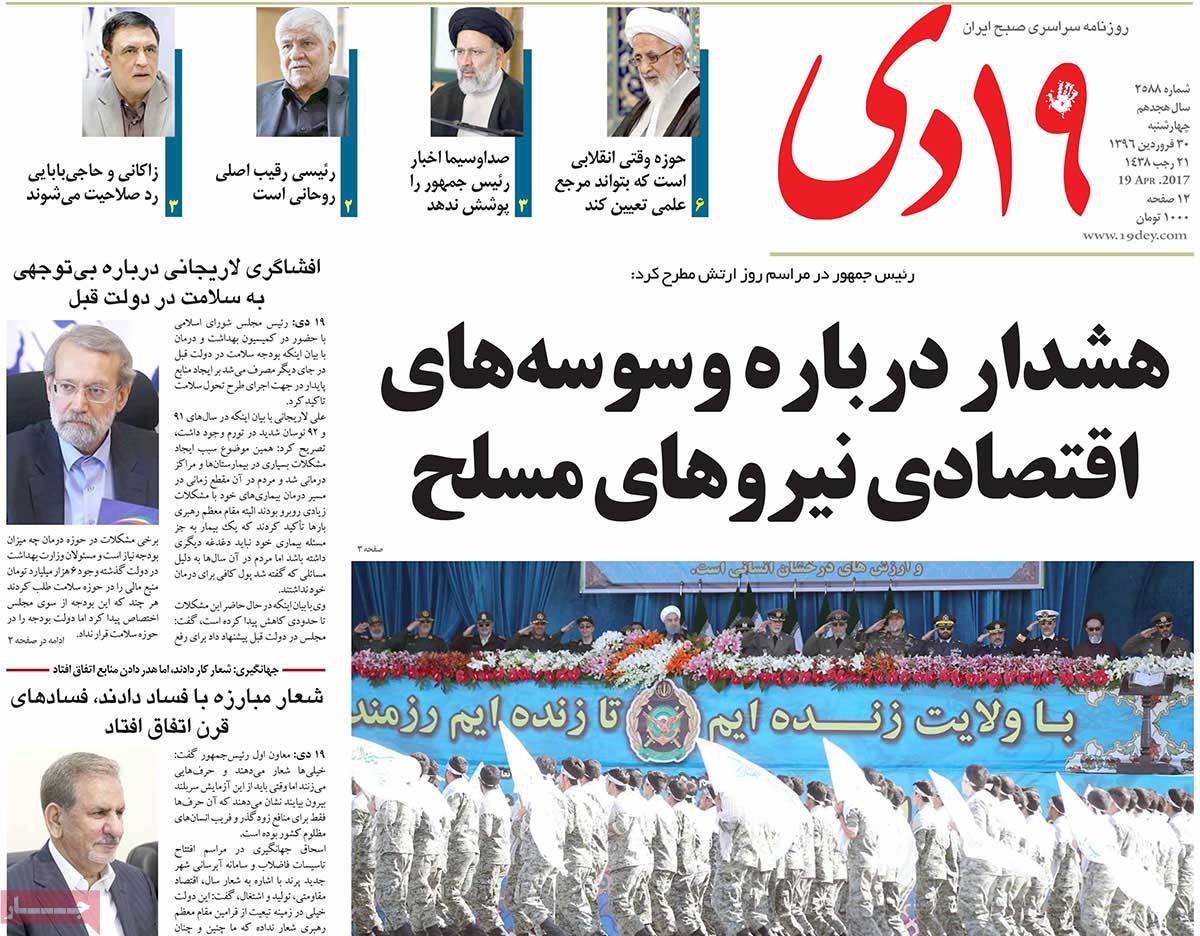
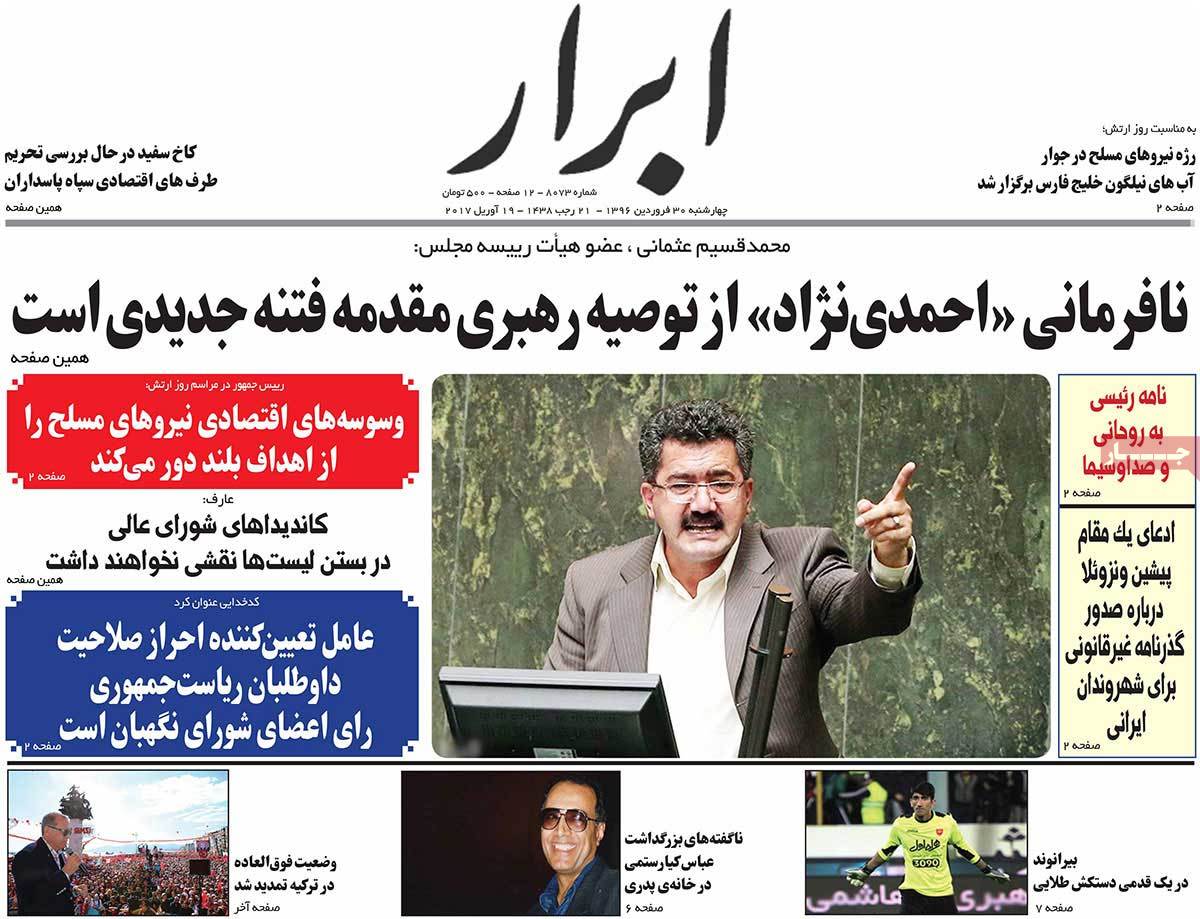
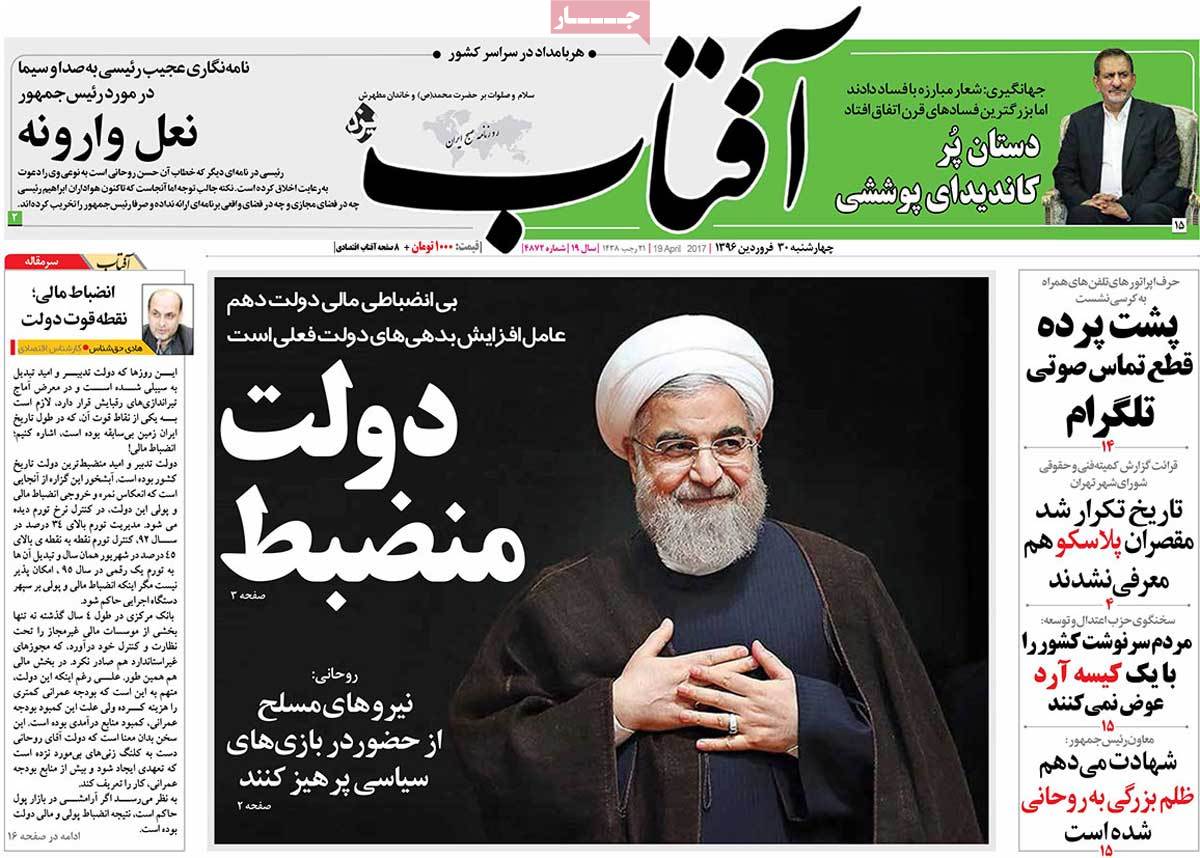
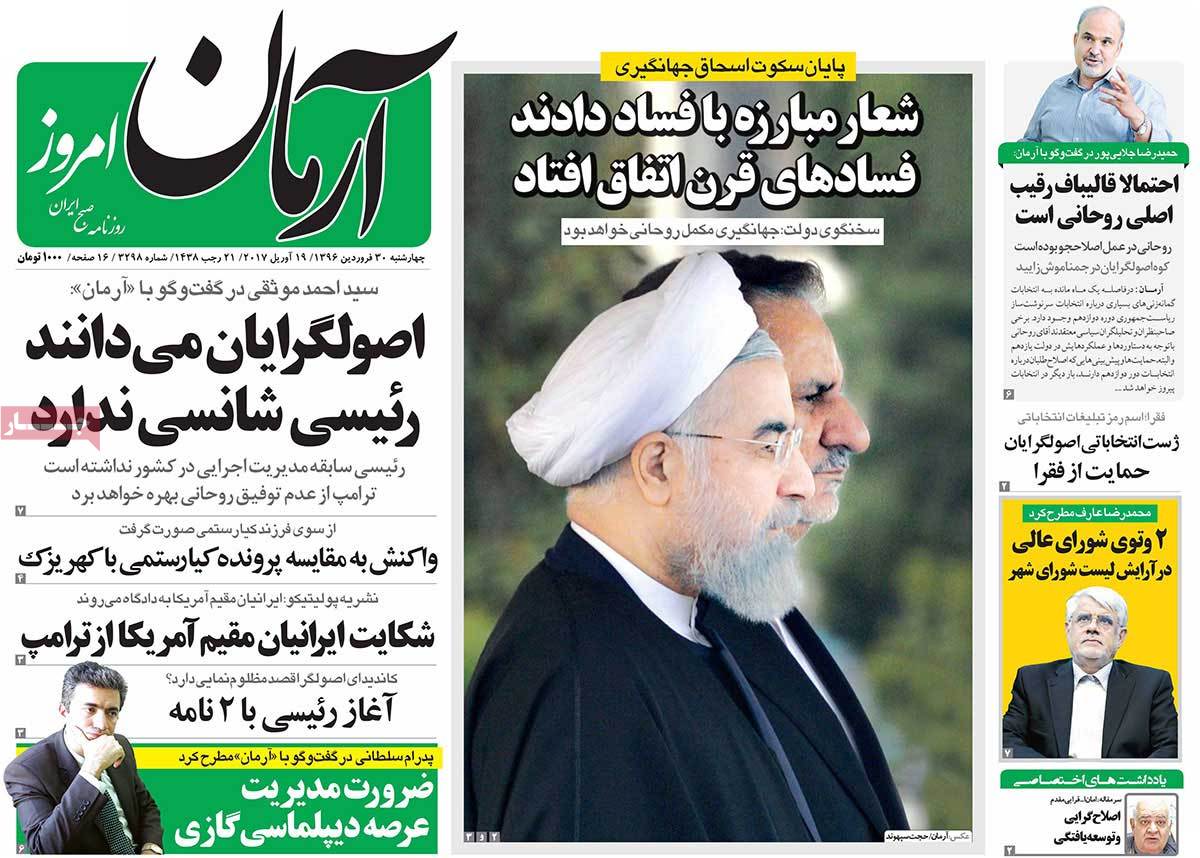
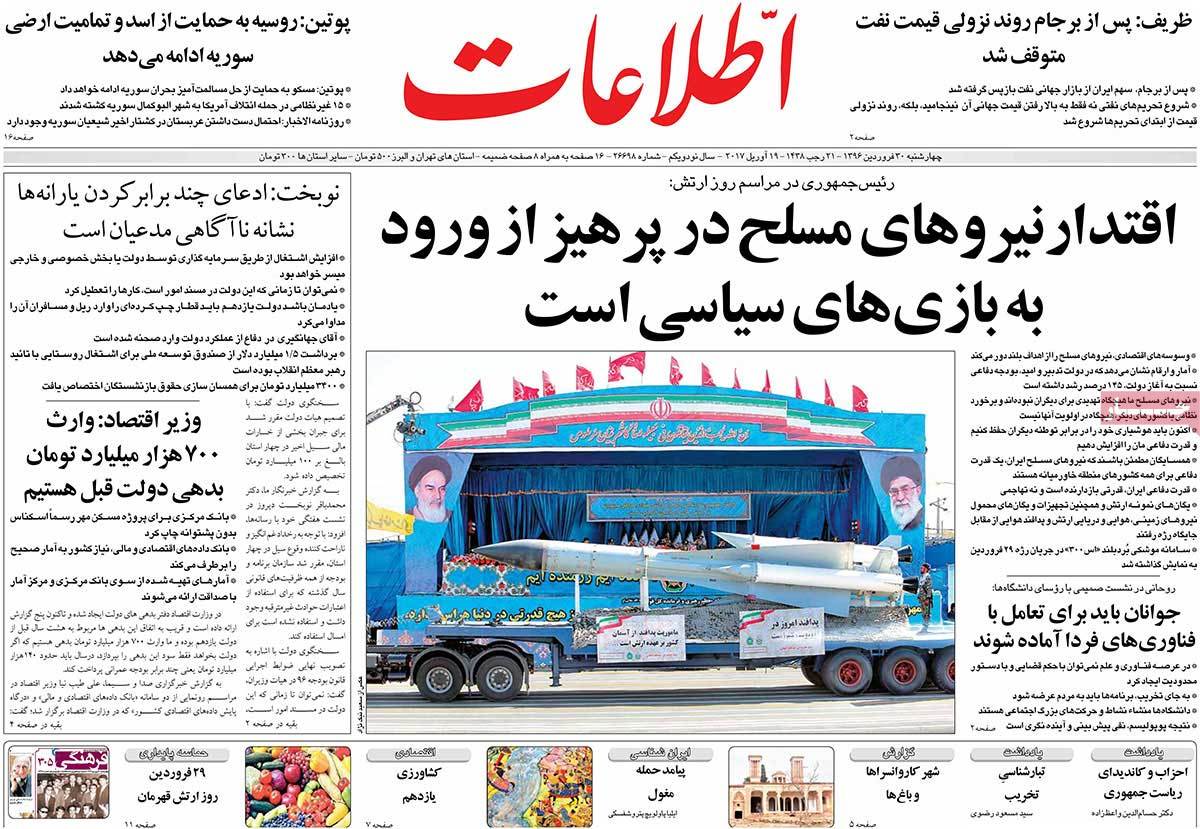
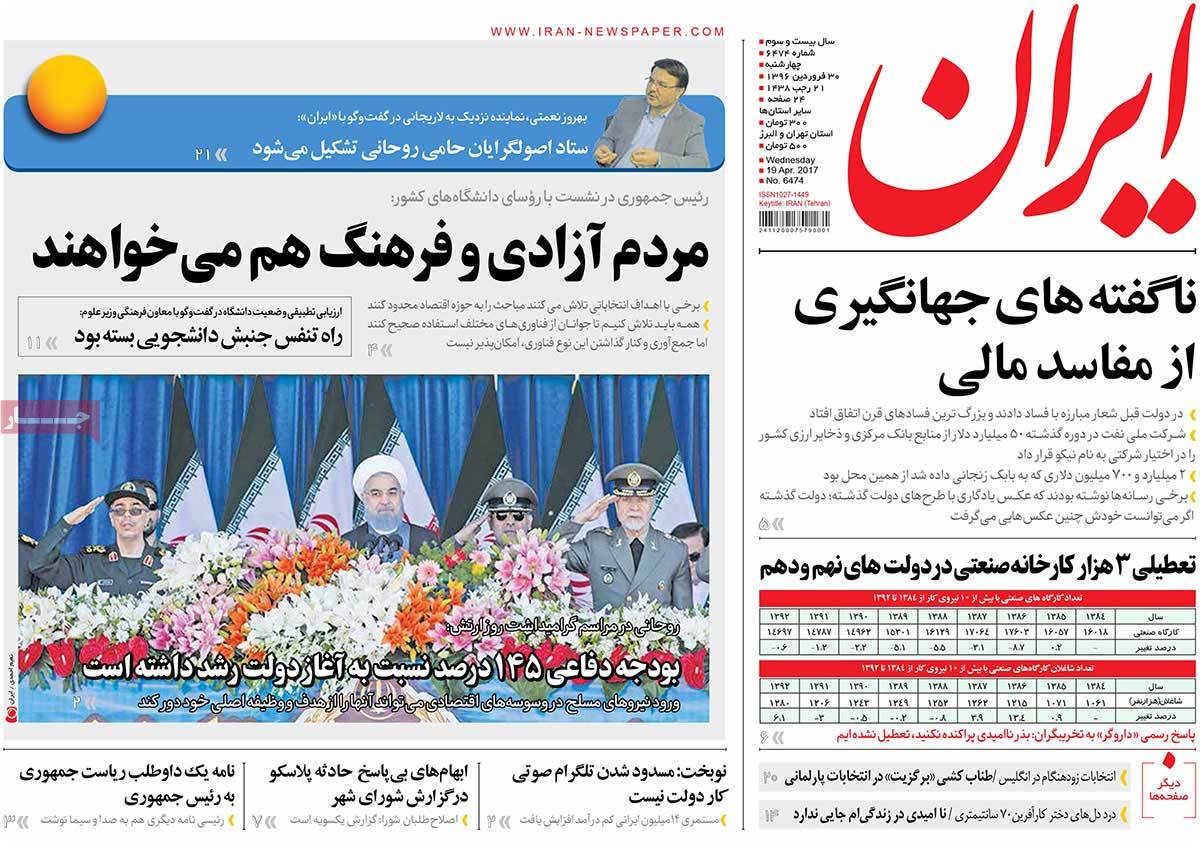
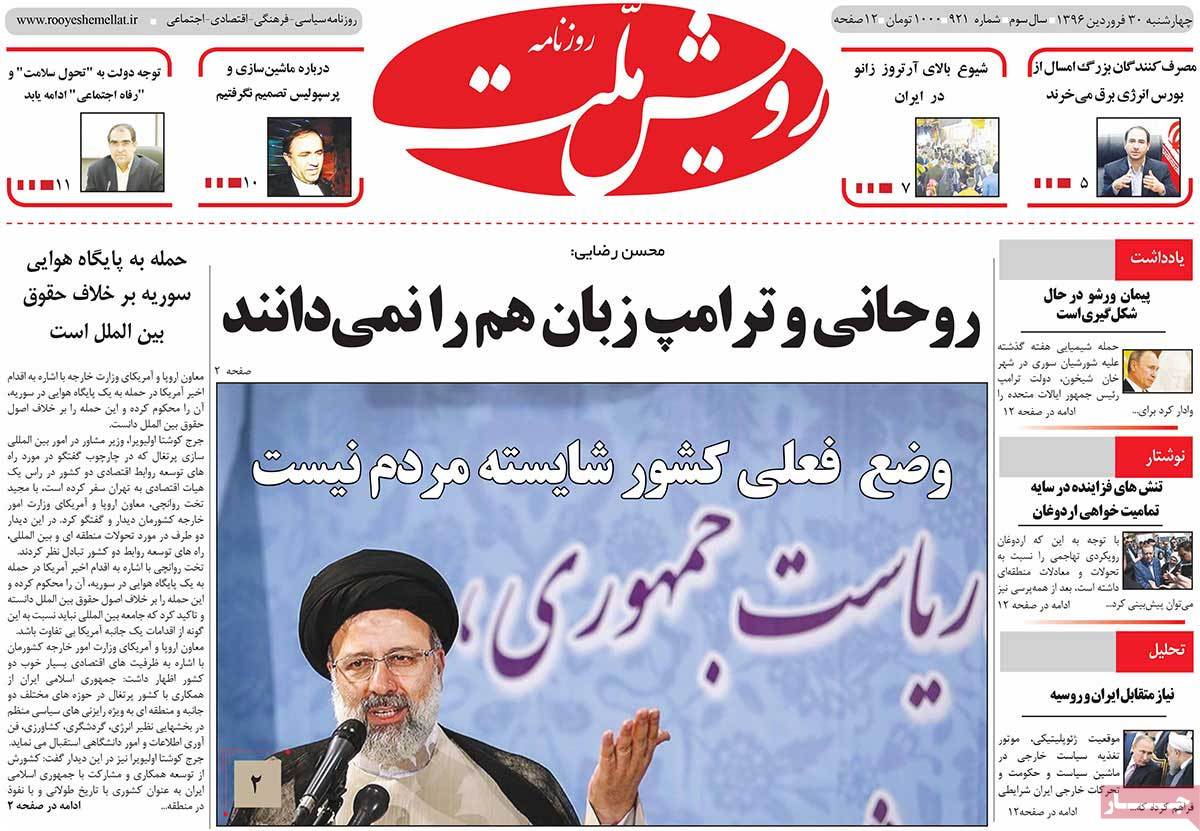
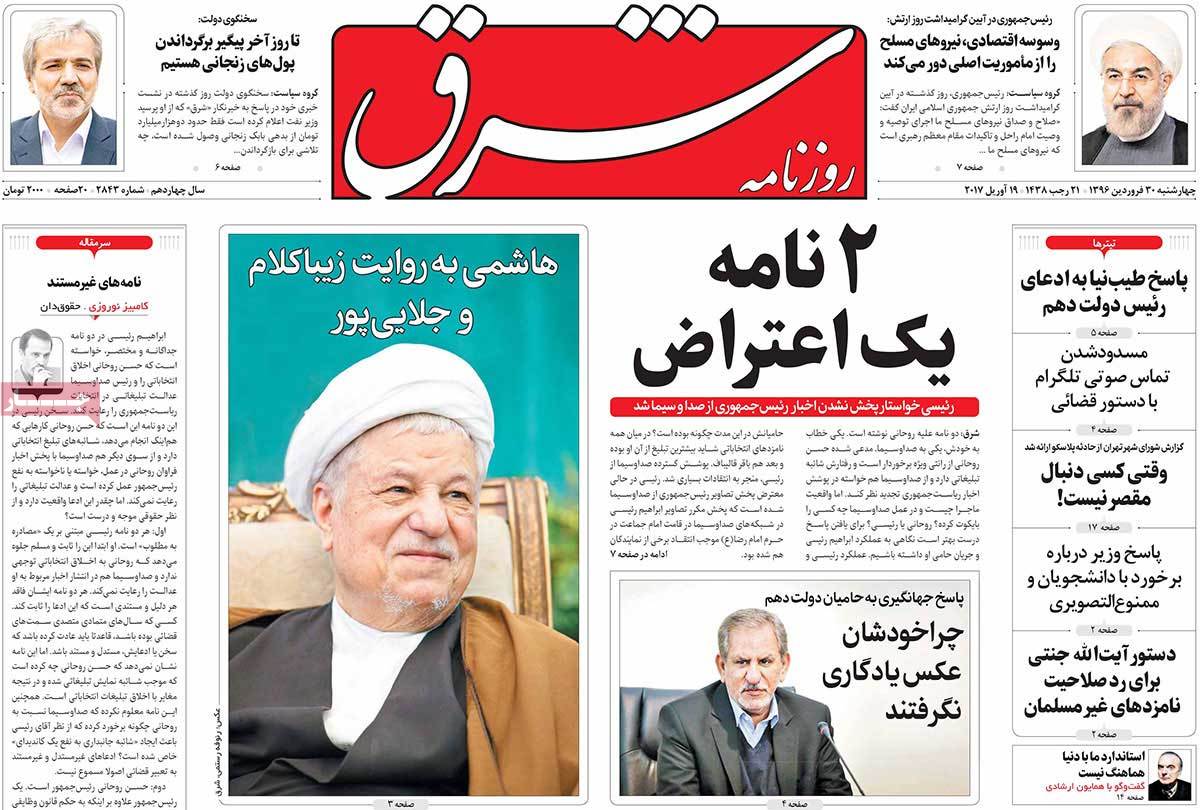
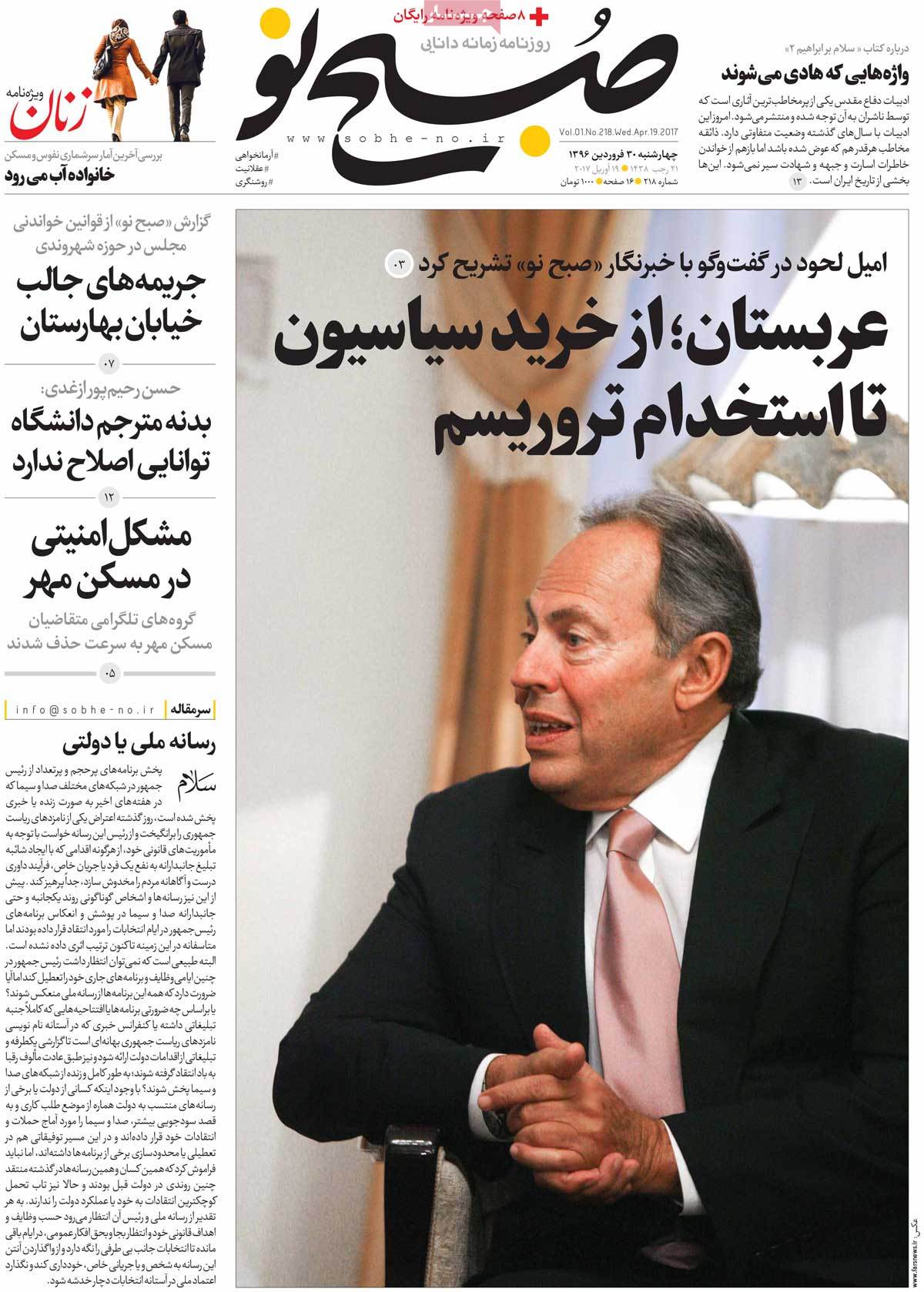
A Look at Iranian Newspaper Front Pages on April 19

Iranian newspapers today covered the remarks made by President Hassan Rouhani against the presence of military forces in Iran’s politics, particularly the upcoming elections.

Rouhani made the remarks in a ceremony to display the country’s military achievements. His remarks about these achievement also received great coverage.

Comments by Rouhani’s deputies and ministers about the poor performance of ex-president Mahmoud Ahmadinejad’s administrations were among other top stories.

The above issues, as well as many more, are highlighted in the following headlines and top stories:


19 Dey:

1- Larijani Discloses Ahmadinejad Government’s Negligence in Healthcare

2- President Rouhani Warns against Armed Forces’ Presence in Election

A Look at Iranian Newspaper Front Pages on April 19 - 19 dey


Abrar:

1- Ahmadinejad’s Refusal to Obey Leader’s Advice is Beginning of New Sedition: MP

2- White House Considering Fresh Sanctions against Firms Working with IRGC

A Look at Iranian Newspaper Front Pages on April 19 - abrar


Aftab-e Yazd:

1- Rouhani Urges Armed Forces to Avoid Getting Engaged in Politics

2- VP: I Testify Rouhani Has Been Treated Very Unfairly

A Look at Iranian Newspaper Front Pages on April 19 - aftabe yazd


Arman-e Emrooz:

1- Politico: Iranians Living in US to File Lawsuit against Trump

2- End of Jahangiri’s Silence

  • They [Ahmadinejad’s gov’t] Kept Talking about Corruption, but Had Worst Corruptions in History

A Look at Iranian Newspaper Front Pages on April 19 - arman


Ettela’at:

1- Zarif: Falling Trend of Oil Prices Stopped after JCPOA

2- Putin: Russia to Continue Supporting Assad, Syria’s Territorial Integrity

3- Economy Minister: We’re Heir to 700,000 Billion Tomans [$186bn] of Previous Government’s Debts

A Look at Iranian Newspaper Front Pages on April 19 - etelaat


Iran:

1- Rouhani: Iran’s Defence Budget up by 145% Compared to Beginning of My Term

2- 3,000 Factories Shut Down in Ahmadinejad’s 8-Year Presidency

3- Conservative Supporters of Rouhani to Form HQ for Election: MP Close to Larijani

A Look at Iranian Newspaper Front Pages on April 19 - iran


Javan:

1- Rouhani: We Created 700,000 Jobs Each Year

2- Statistics Organisation: 350,000 Jobs Created Each Year!

3- President: Armed Forces Protect Peace, Security in Mideast

A Look at Iranian Newspaper Front Pages on April 19 - javan


Jomhouri Eslami:

1- President: Government’s Supply of Military Equipment in 3 Years Equal to that of Past 10 Years

2- Health Minister: Government Started Construction of 6,500 Medical Centres

A Look at Iranian Newspaper Front Pages on April 19 - jomhori


Kayhan:

1- Gov’t Admits It’d Be Worried If People’s Economic Demands Raised in Election

2- Pyongyang in Reaction to US Military Threats: We’ll Test Missiles Every Week

A Look at Iranian Newspaper Front Pages on April 19 - keyhan


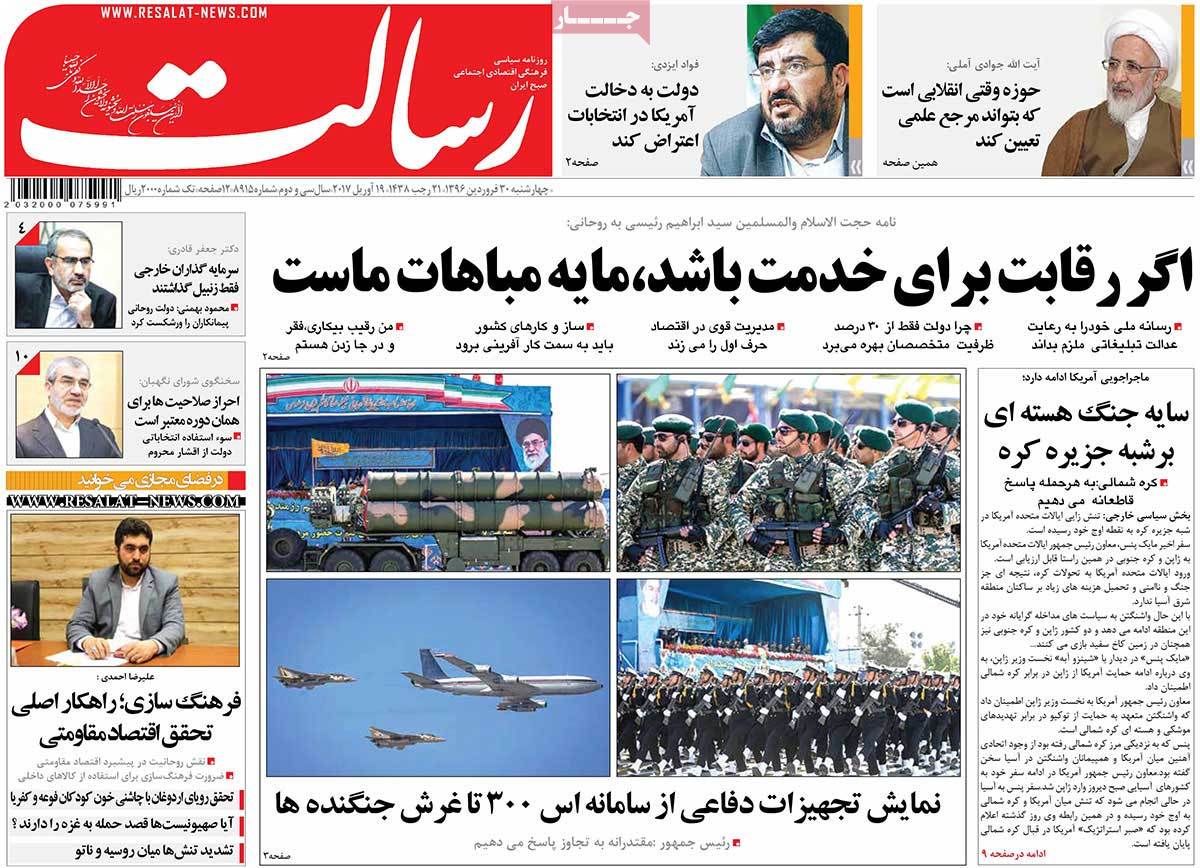
Resalat:

1- Display of Defensive Equipment: From S-300 Missile Defence System to Roar of Jet Fighters

2- President: We’ll Strongly Respond to Aggression

3- Analyst Urges Government to Protest against US Interference in Iran Election

A Look at Iranian Newspaper Front Pages on April 19 - resalat


Rooyesh-e Mellat:

1- Rouhani, Trump Don’t Know Each Other’s Languages: IRGC General

A Look at Iranian Newspaper Front Pages on April 19 - royesh mellat


Shargh:

1- Telegram’s Voice Calling Service Blocked by Iran’s Judiciary

A Look at Iranian Newspaper Front Pages on April 19 - shargh


Sobh-e Now:

1- Émile Lahoud: Saudi Arabia, from Buying Politicians to Hiring Terrorism

A Look at Iranian Newspaper Front Pages on April 19 - sobhe no