Wednesday, April 29, 2026
Home Blog Page 4060

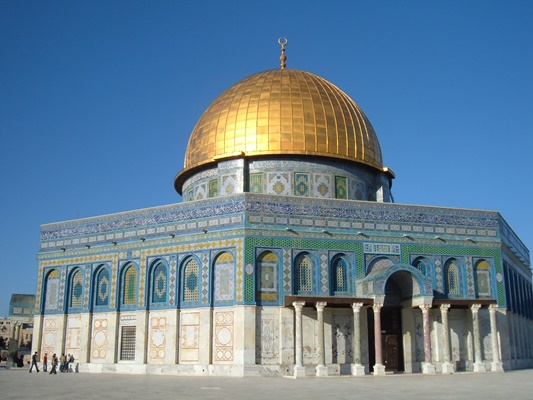
“Hamas Paving Way for Israel’s Relocation of Capital to Quds”

Quds

Although the Palestinian Resistance Movement, Hamas, has announced it does not recognize the Israeli regime, the Movement has, by agreeing to return to the 1967 borders, practically accepted Israel’s plan to move the capital from Tel Aviv to al-Quds, said Hossein Naqavi Hosseini in a Farsi interview with ICANA.

He said the agreement to return to the 1967 borders is tantamount to accepting Washington’s demand and a betrayal of the cause of Palestine.

On the changes made to the Articles of Association of the Hamas movement, the MP said, “Developments unfolding in occupied Palestine and the region show certain groups and organizations established in the name of defending Palestinians are clearly retreating [from their positions],” said Naqavi Hosseini, who sits on the Parliament’s National Security and Foreign Policy Commission.

Given the current situation, he said, the Israeli regime and US allies in the Middle East are securing their rip on Palestinian land and expanding Jewish settlements.

Hamas’ backing down on its previous stances and giving the nod to the West’s policies in occupied territories will definitely not be accepted by Palestinian people, said the top MP, adding that “we will be facing reactions in protest.”

“After several decades of resistance and [Palestinians] paying the price for it, the changes in the Articles of Association are, in a way, regarded as folly,” said Naqavi Hosseini.

He touched upon US President Donald Trump’s upcoming trip to occupied Palestine and the plan to transfer the American Embassy from Tel Aviv to al-Quds, and said, “Hamas, intentionally or unintentionally, is paving the way for the transfer of the Israeli regime’s capital.”

He also referred to Intifada as another key issue related to Palestinians’ reaction to the plan to move the Israeli capital.

He said ongoing developments show the Israeli regime is cashing in on some Arab dictators’ silence in order to secure its domination over Palestinian land.

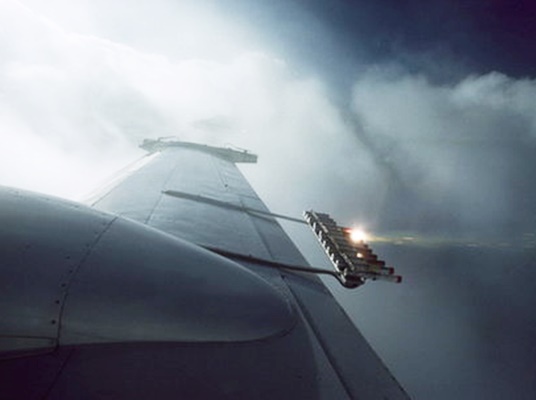
Iran to Use Drone for Cloud Seeding in Desert Areas

Iran to Use Drone for Cloud Seeding in Desert Areas

Farid Golkar, the director of Iranian Water Research Institute, announced that the centre has signed a contract with a reputable private company that designs drones for cloud seeding.

“The first test flight is to be taken in four months. It will take at least one year to carry out the necessary research and go into the clouds to seed them,” he added.

“The drone can fly in an altitude of 15,000 feet for eight to twelve hours, and has an effective payload of more than 50kg,” he noted, according to a Farsi report by Iran’s Department of Environment (DoE).

He then pointed that the cloud seeding plan has been earlier carried out using other types of aircraft in eight provinces.

“It is a new method to influence the natural clouds using chemicals which take more water out of them in the form of rain and snow,” he explained.

The growing drought in recent years has forced Iranian authorities to search for new ways of dealing with the water crisis.

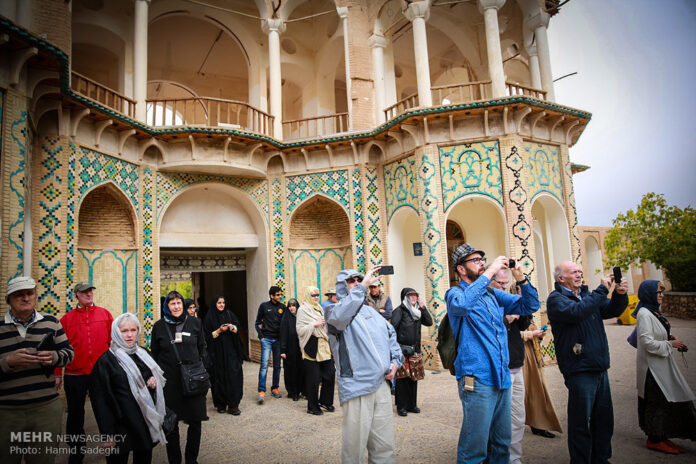
“Tourism Industry in Iran Needs Greater Attention”

Iran to Allocate $250,000 to Make up for Tourism Industry Losses

Iranian lawmaker Zahra Saeidi has highlighted the importance of tourism sector and the social, cultural, economic and political harms caused in the absence of due attention to the expansion of the industry.

She blamed a lack of theoretical foundations concordant with the country’s cultural framework as the main problem slowing down the development of Iran’s tourism industry.

Saeidi said undoubtedly, Iran is among the world’s main tourist destinations thanks to its ancient history, rich culture and cultural heritage, numerous irresistible natural tourist attractions and climatic diversity.

In case of doing thoughtful and careful planning, tourism industry will become a lucrative and reliable source of income for the country, she noted, according to a Farsi report by the website of the Iranian Parliament’s Research Centre.

She added, “Enormous stress is laid in Iran on achieving and pursuing the targets and policies of the Resistance Economy, set and formulated by the Leader of the Islamic Revolution Ayatollah Seyyed Ali Khamenei. Creating jobs and promoting entrepreneurship, using the country’s human resources as well as indigenous capacities, are among the main principles laid down in the strategies of resilient economy.”

“Given the present bottlenecks delaying the development of other domestic industries, and in view of the incumbent government’s plan to reduce reliance on oil revenue, the domestic tourism industry, more than any other time in istory, requires thoughtful planning, enactment of effective administrative laws and establishment of modern related infrastructure.”

She said a comparison between Iran’s tourism revenue and the global average income generated by the industry, as confirmed by the figures of the World Tourism Organization, indicates that the country has failed to achieve and receive the status and share it deserves in this sector.

“Iran has difficulty attracting foreign tourists. The country’s domestic tourists are also faced with a host of problems in their trips.”

Saeidi said currently, investors are faced with a large number of problems for funding Iranian tourism projects, adding construction of hotel in Iran, as the most important infrastructure in the industry, involves heavy costs such as the price of land, construction expenses and taxes imposed by municipalities.

She called on the government to help remove the obstacles to making investment in the sector and constructing hotels.

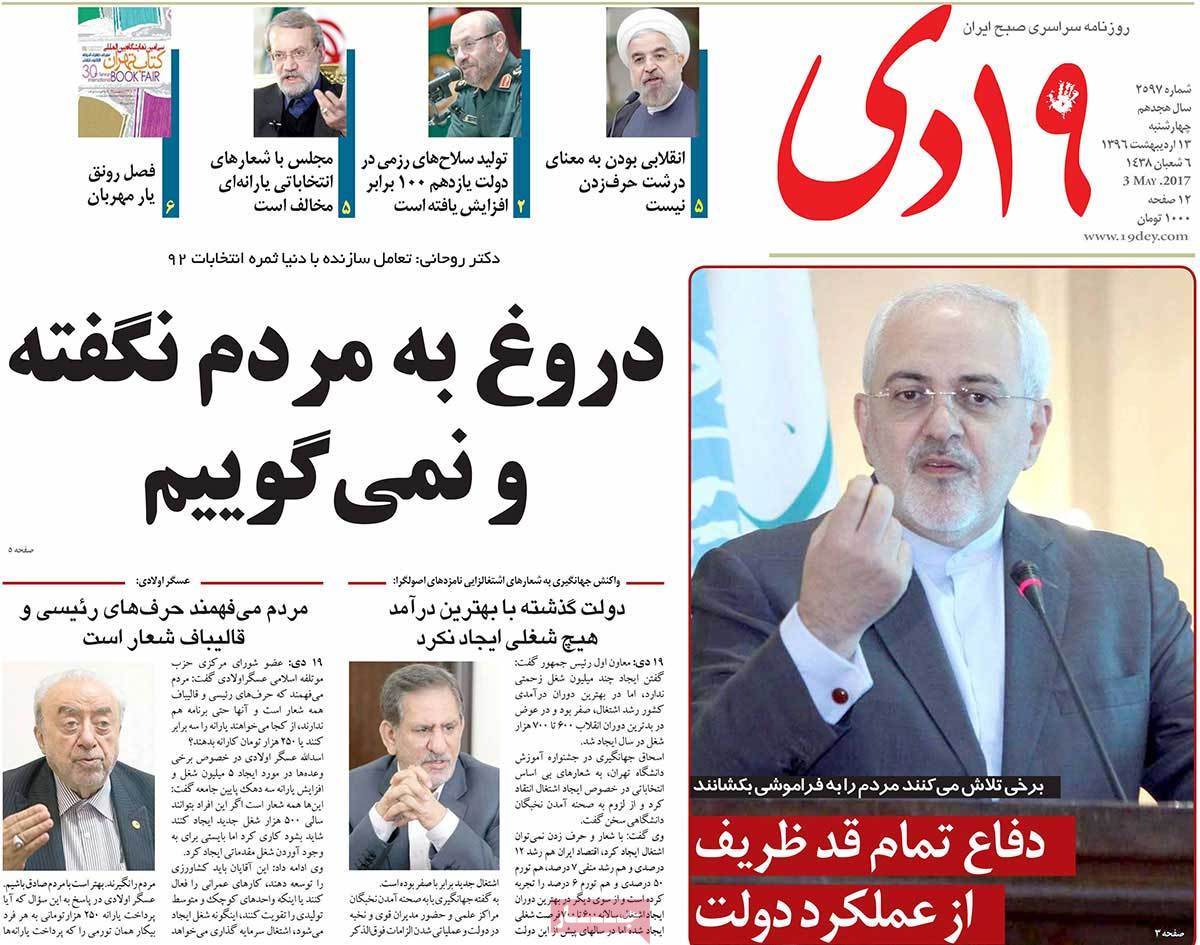
A Look at Iranian Newspaper Front Pages on May 3

A couple of weeks before Iran’s presidential election, almost all Iranian newspapers are covering the remarks made by the six candidates in their presidential campaigns.

Reformist and pro-government media criticize the promises made by conservative candidates, and the right-wing papers highlight the incumbent administration’s weak performance in different fields.

A top story today was the remarks made by Foreign Minister Mohammaad Javad Zarif in support of Rouhani’s government and what the cabinet has done in the past four years.

The above issues, as well as many more, are highlighted in the following headlines and top stories:


19 Dey:

1- DM: Production of Weapons in Rouhani’s Gov’t Increased by 100 Times

2- Larijani: Parliament Opposed to Campaign Promises on Cash Handouts

3- Rouhani: Being Revolutionary Doesn’t Mean Speaking in a Bold Way


Iranian Newspaper Front Pages on May 3- 19 dey


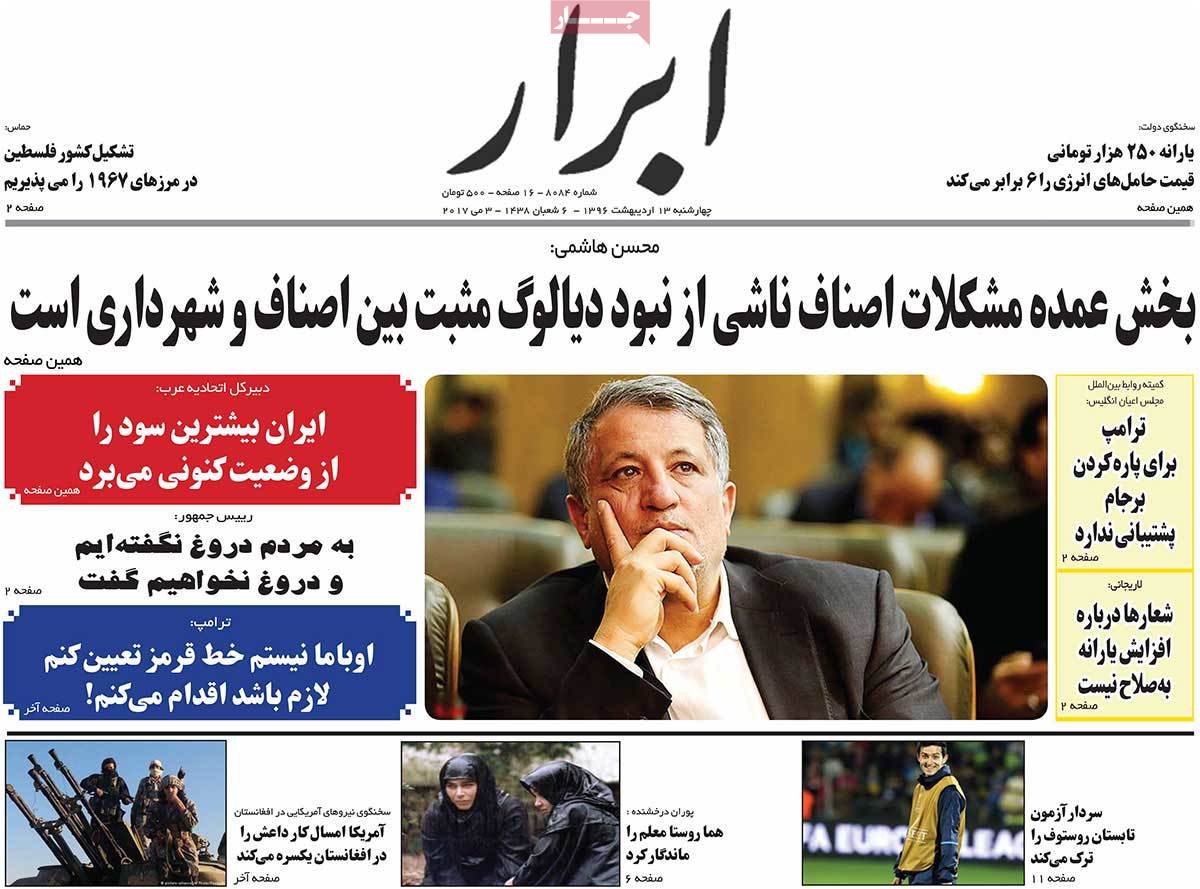
Abrar:

1- Gov’t: 5-Fold Rise in Cash Subsidies Will Lead to 6-Fold Increase in Energy Prices

2- Arab League Secretary General: Iran Benefiting the Most from Current Situation

3- Trump: I’m Not Obama, So I Don’t Set Redlines; I’ll Take Action If Needed!

4- Trump Has No Support for Scrapping Nuclear Deal: British Parliament


Iranian Newspaper Front Pages on May 3 -  Abrar


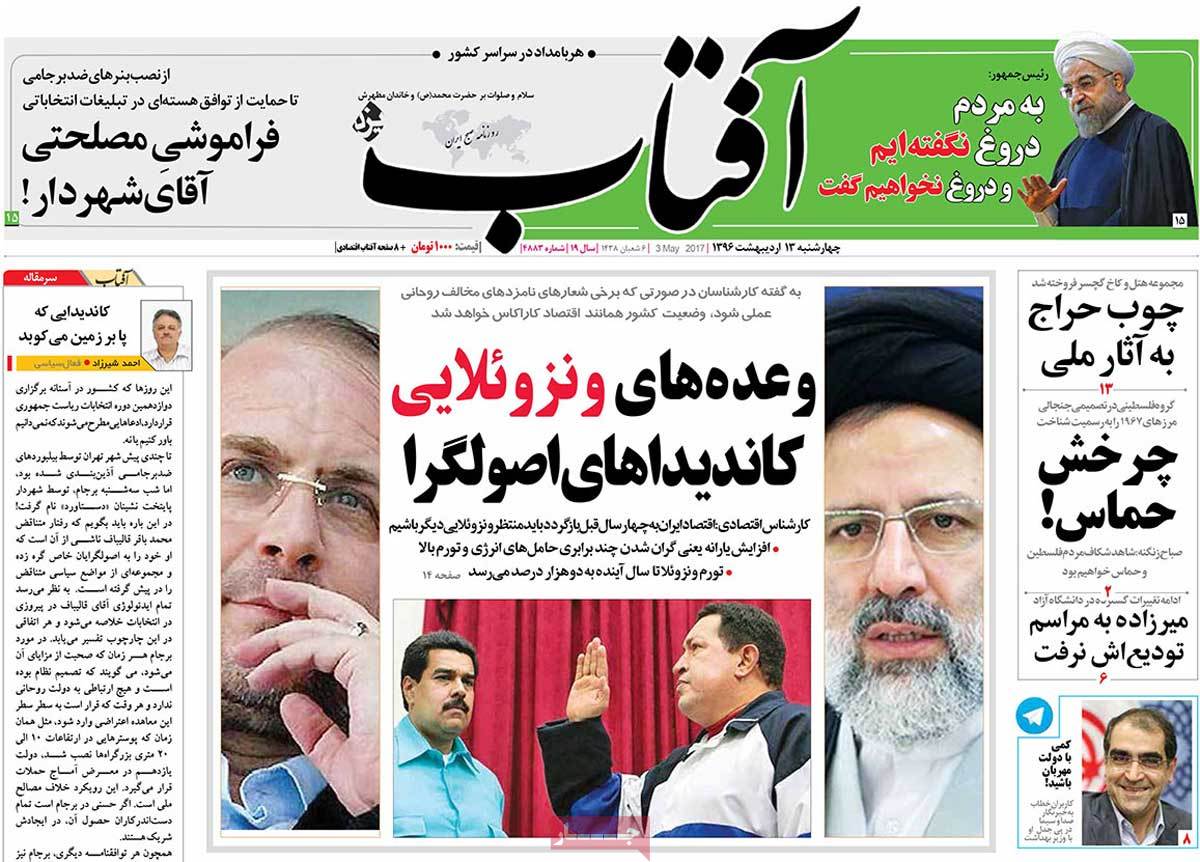
Aftab-e Yazd:

1- Conservatives’ Promises in Venezuelan Style

  • Analysts: If Some of These Promises Are Fulfilled, Tehran Will Become Caracas

2- President: We’ve Not Lied and Won’t Lie to People


Iranian Newspaper Front Pages on May 3- Aftab-e Yazd


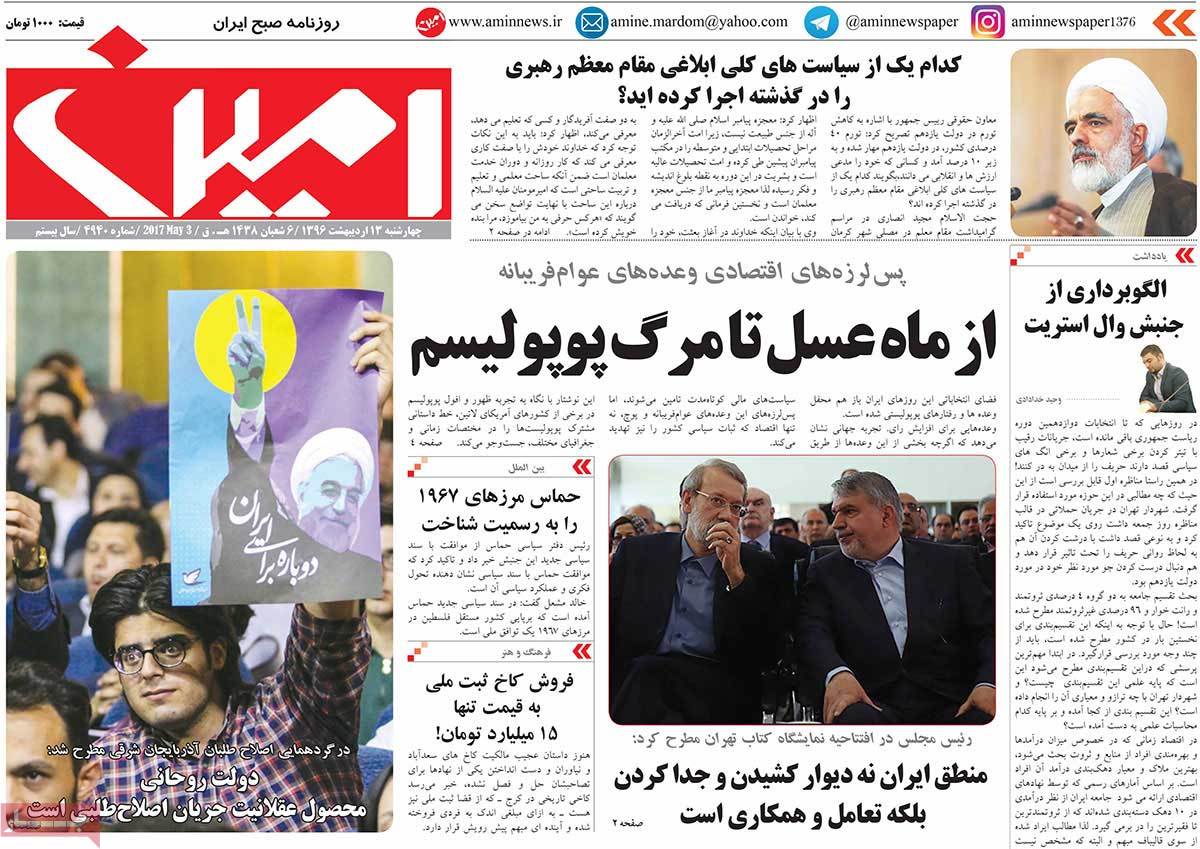
Amin:

1- Parliament Speaker: Iran’s Logic is to Interact, Cooperate with World


Iranian Newspaper Front Pages on May 3- Amin


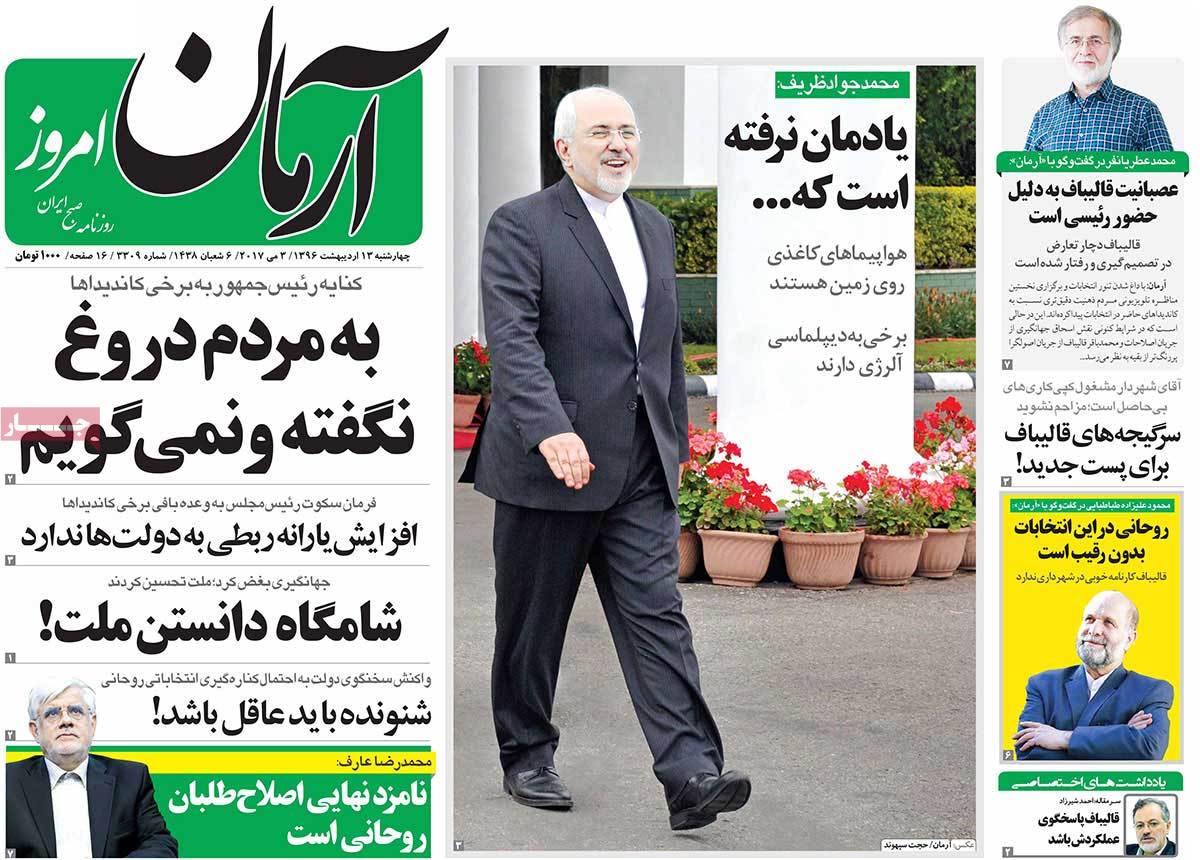
Arman-e Emrooz:

1- Parliament Speaker Asks Certain Candidates to Keep Silent

  • Increasing Cash Handouts None of Government’s Business

2- Gov’t Spokesman Rules Out Possibility of Rouhani’s Withdrawal from Candidacy

3- Aref: Rouhani Will Be Final Candidate of Reformists


Iranian Newspaper Front Pages on May 3- Arman-e Emrooz


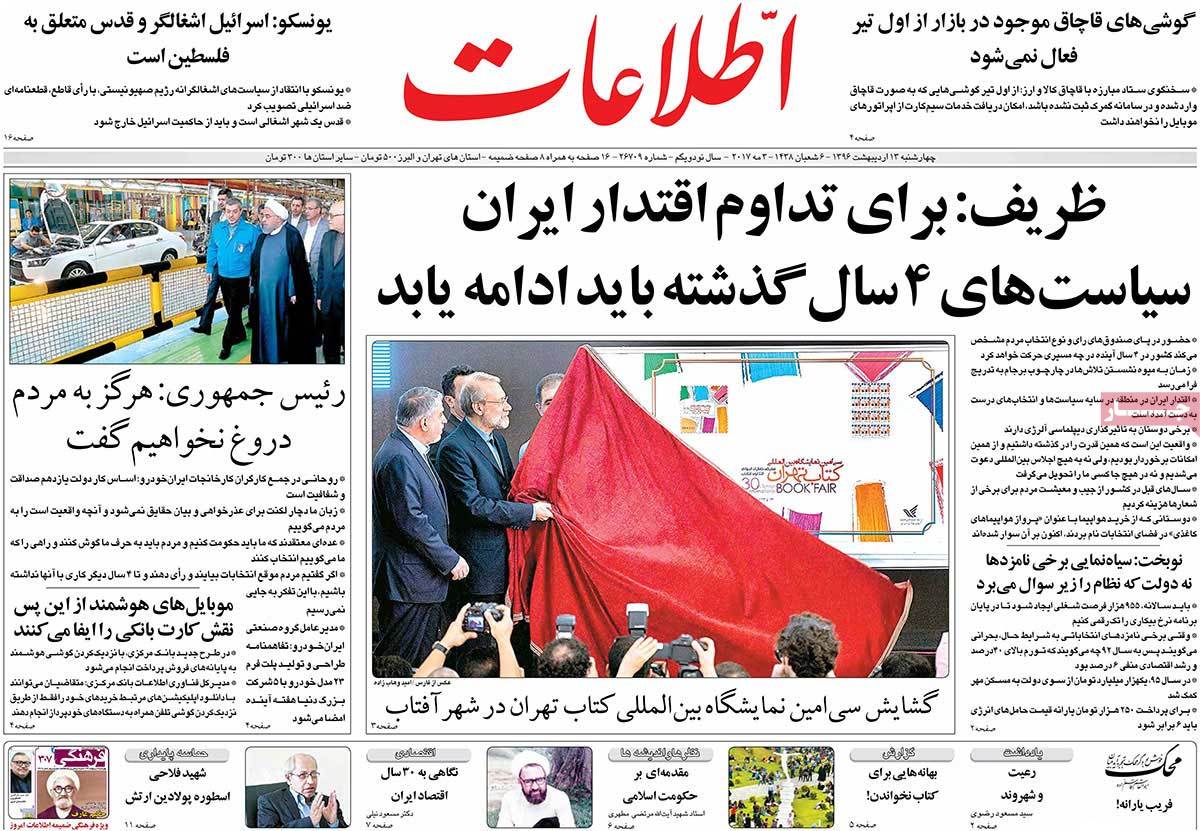
Ettela’at:

1- Zarif: Policies of Past 4 Years Should Be Continued to Maintain Iran’s Power

2- 30th Edition of Tehran Int’l Book Fair Kicked Off in Shahr-e Aftab


Iranian Newspaper Front Pages on May 3


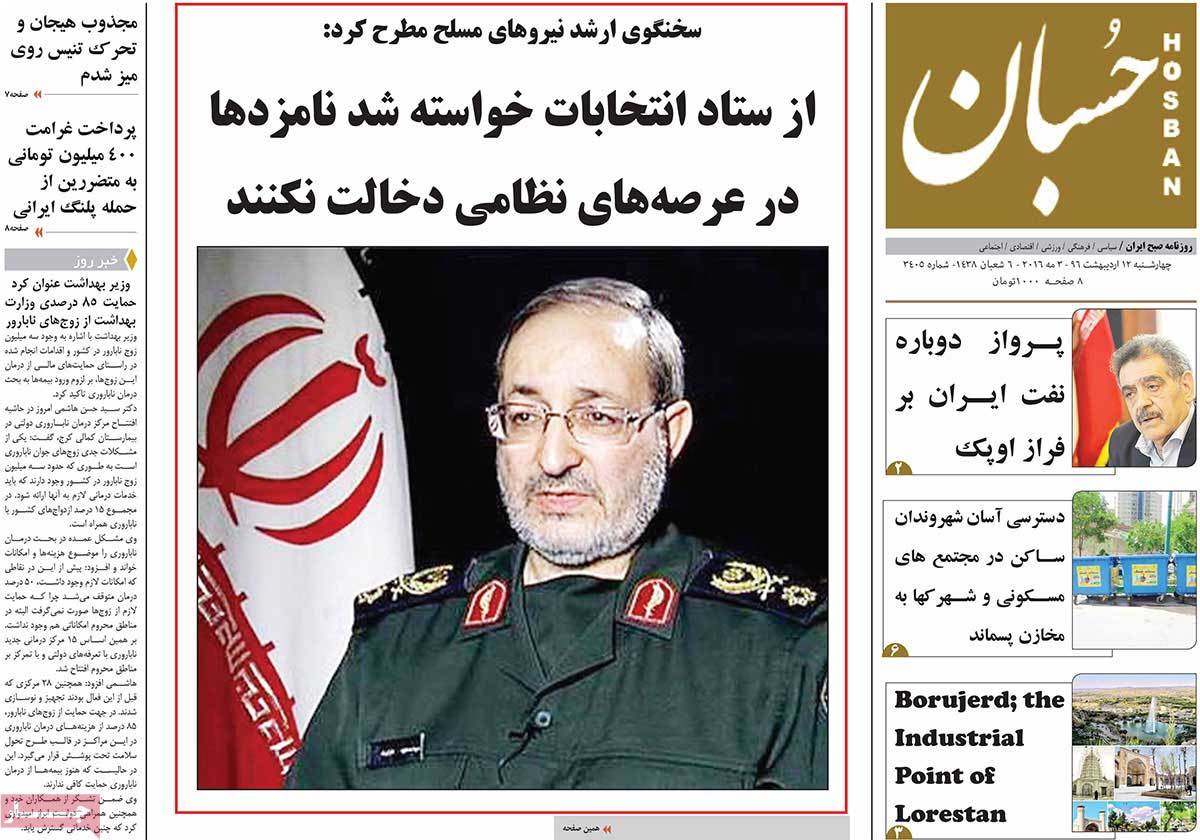
Hosban:

1- Iran Armed Forces: Presidential Candidates Urged Not to Interfere in Military Fields


Iranian Newspaper Front Pages on May 3- Hosban


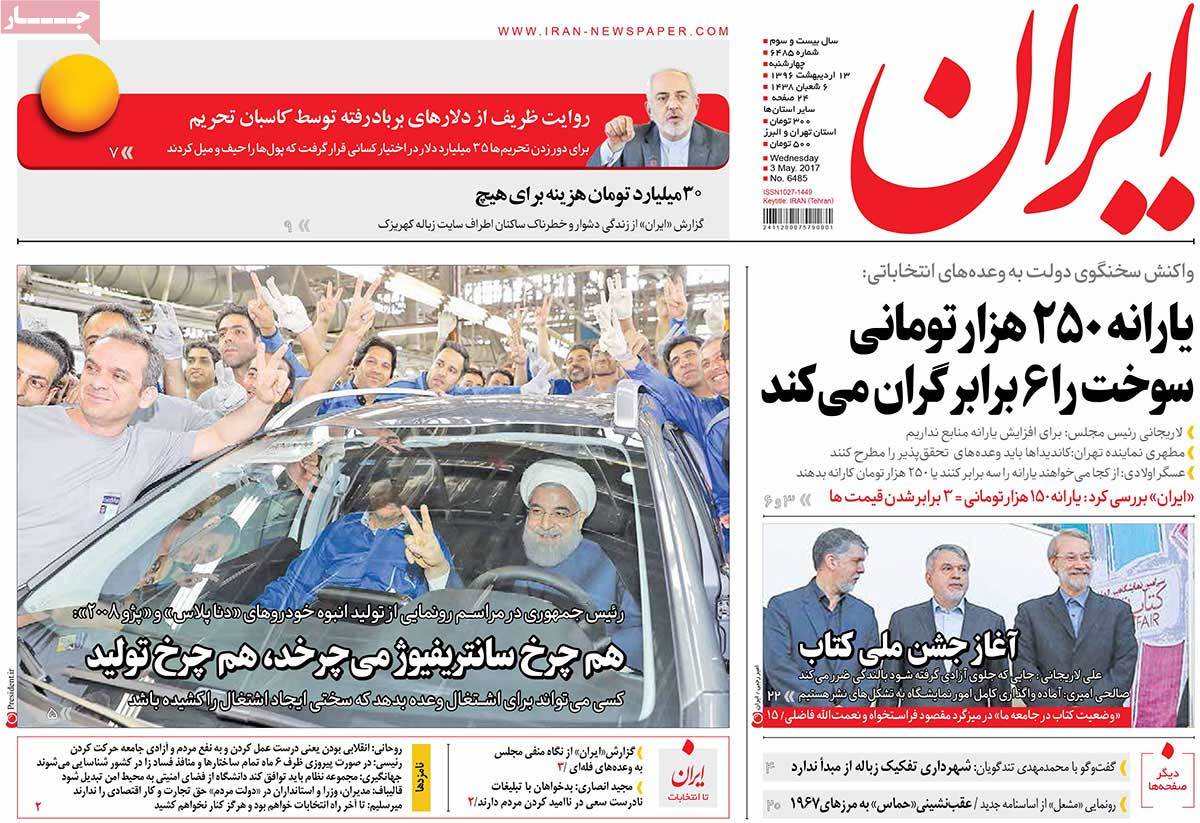
Iran:

1- Zarif’s Account of Dollars Wasted by Those Who Made Money through Sanctions

2- Rouhani: The Wheels of Centrifuges and Factories Are Both Spinning


Iranian Newspaper Front Pages on May 3- Iran


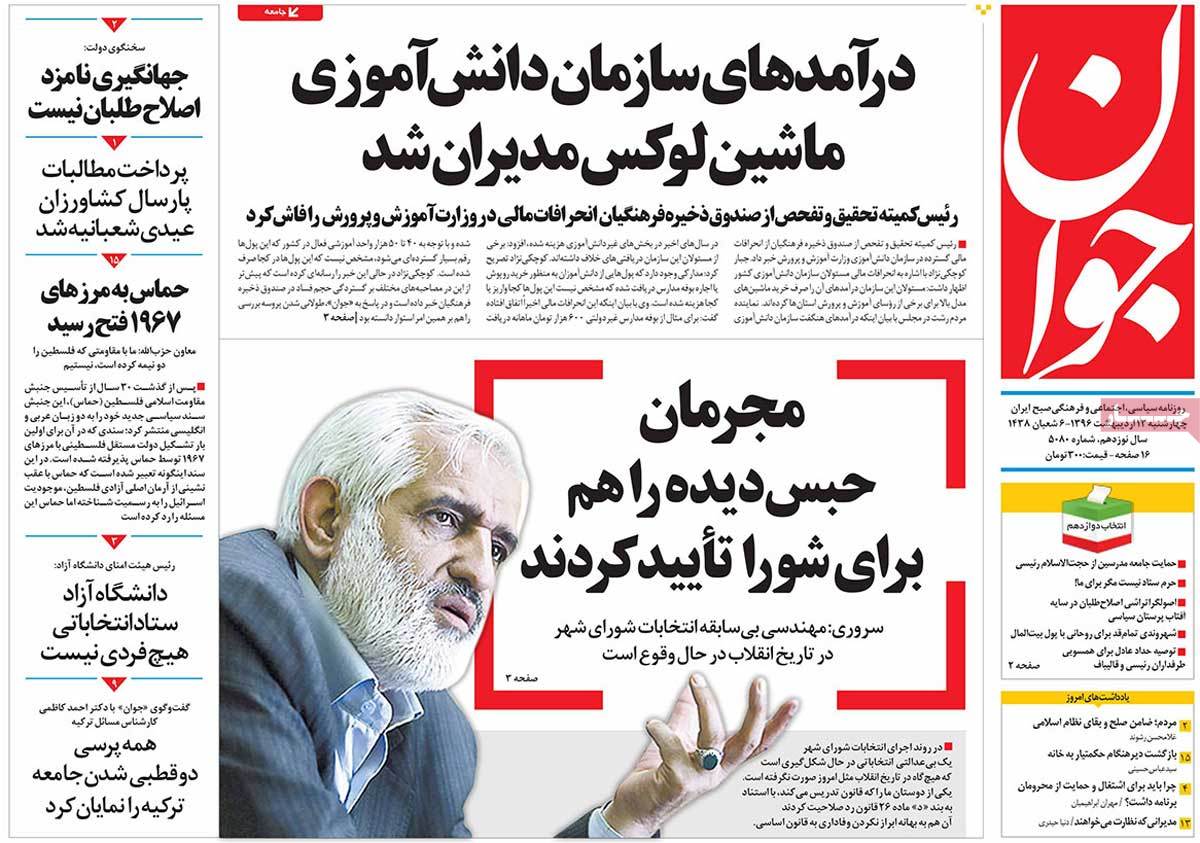
Javan:

1- Funds Supposed to Be Spent for Students Paid for Executives’ Luxury Cars


Iranian Newspaper Front Pages on May 3- Javan


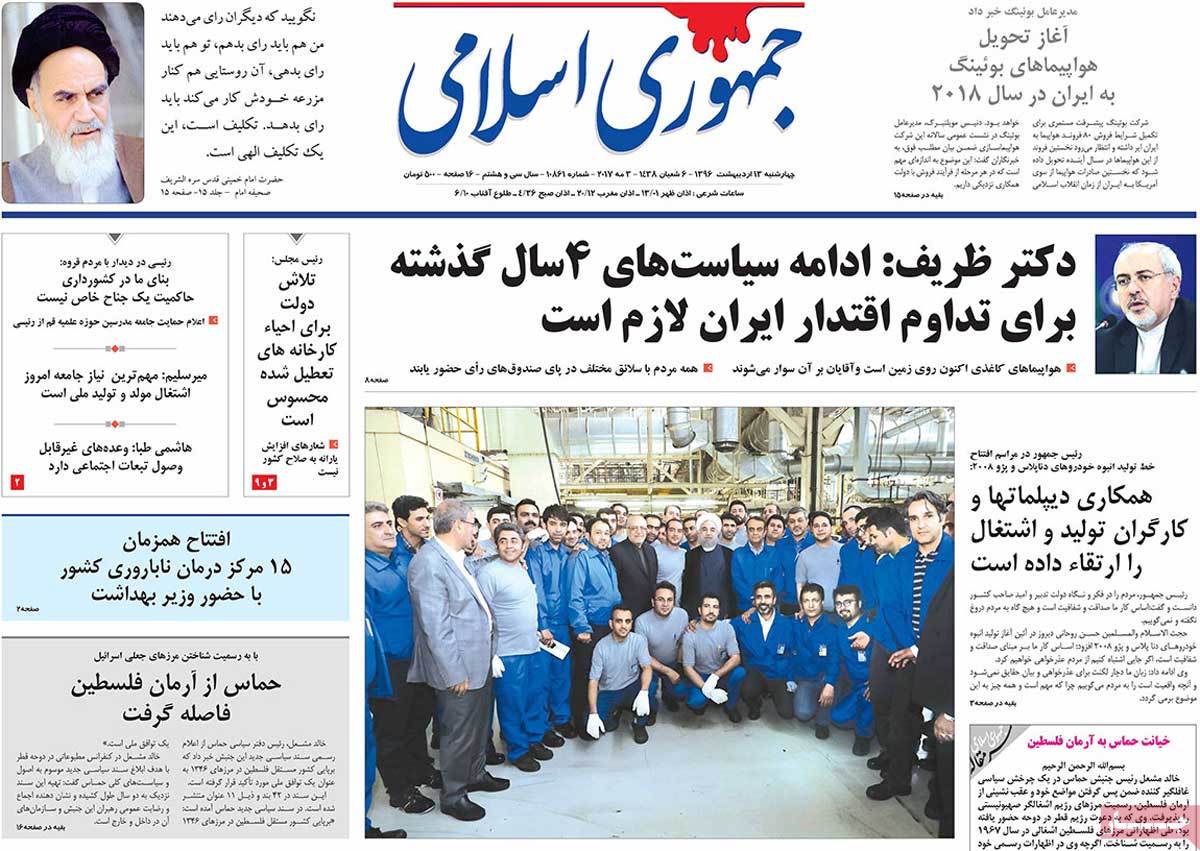
Jomhouri Eslami:

1- Rouhani: Cooperation between Diplomats, Workers Improve Production, Employment

2- Parliament Speaker Hails Government’s Efforts to Revive Shut-Down Factories

3- Raisi: We Won’t Rely on Particular Party in Governing the Countr

4- Hashemi-Taba: Infeasible Promises to Have Social Consequences


Iranian Newspaper Front Pages on May 3- Jomhouri Eslami


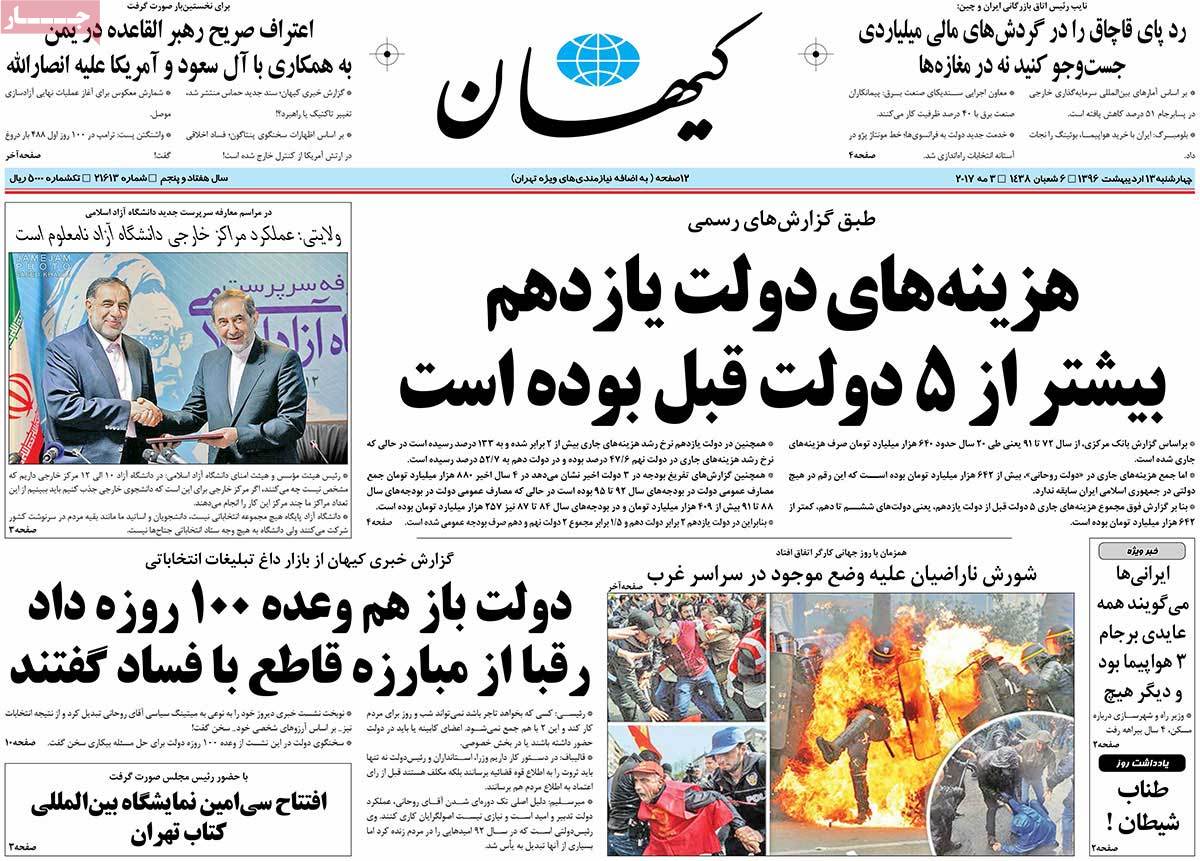
Kayhan:

1- Expenses in Rouhani’s Gov’t 5 Times More than Those of Ahmadinejad’s

2- Gov’t Once Again Makes 100-Day Promise; Rivals Vow to Fight Corruption


Iranian Newspaper Front Pages on May 3- Kayhan


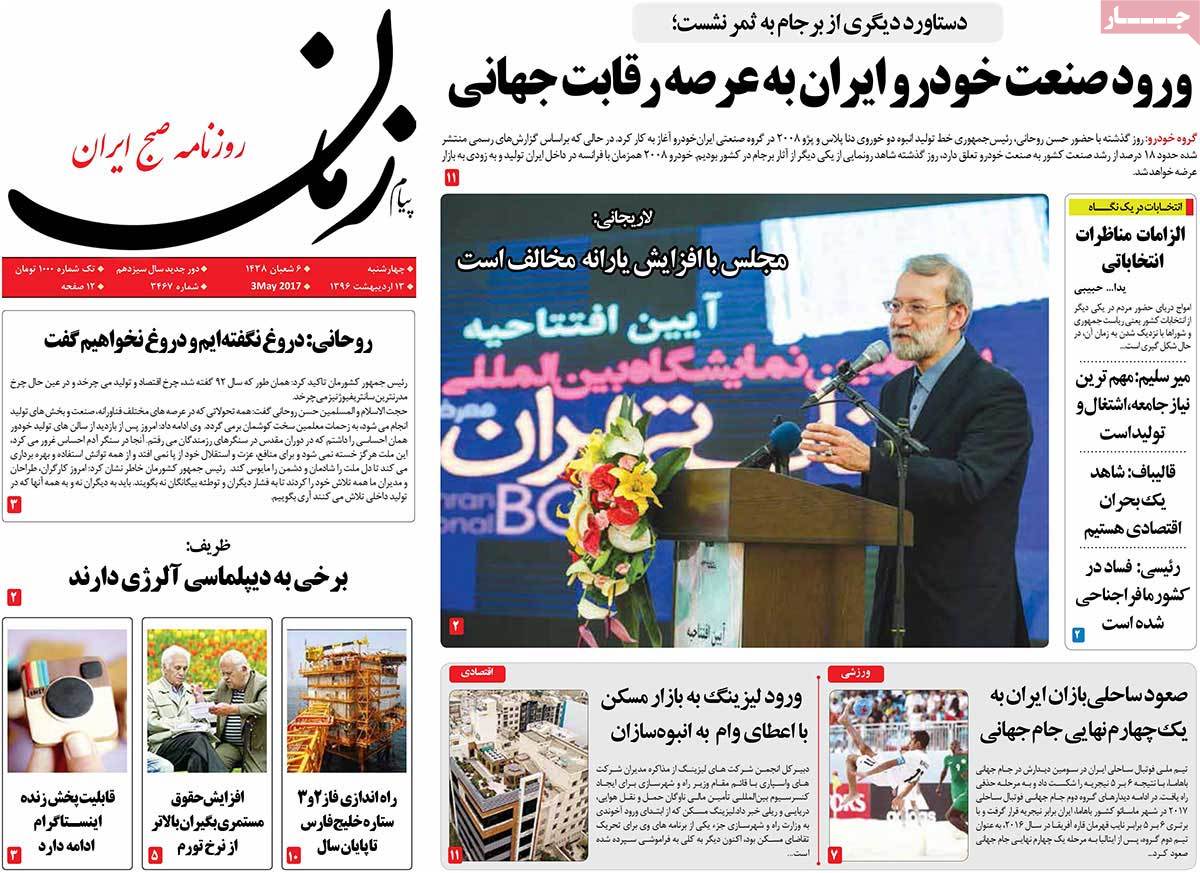
Payam-e Zaman:

1- Zarif: Some Are Allergic to Diplomacy

2- Mirsalim: Production, Employment Most Important Needs of Iran Society

3- Qalibaf: We’re Faced with Economic Crisis

4- Raisi: Corruption in Iran Not Limited to Particular Party


Iranian Newspaper Front Pages on May 3- Payam-e Zaman


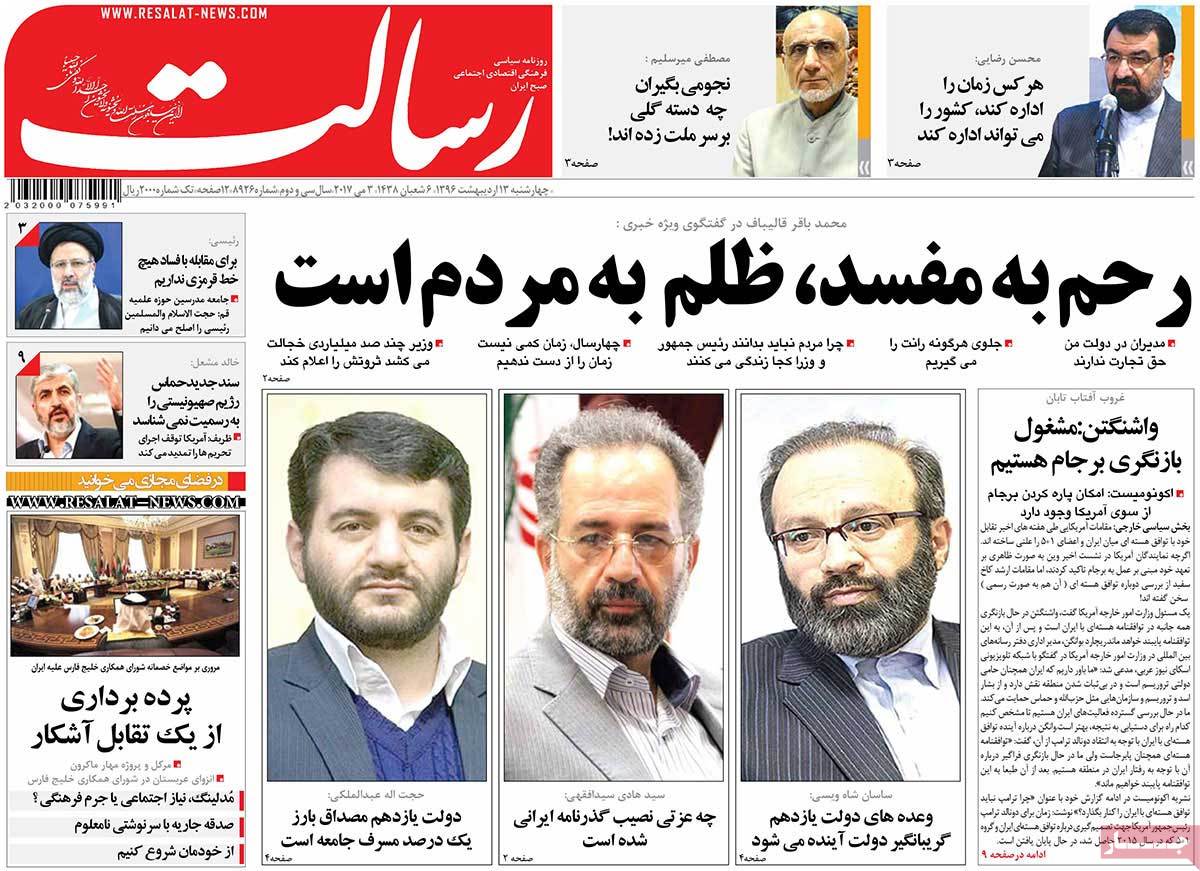
Resalat:

1- Mirsalim: What Have Those Who Receive Astronomical Salaries Done for Iran?

2- Qalibaf: Showing Mercy to Corrupt People is Cruelty towards Nation

3- IRGC General Rezaei: Whoever Manages the Time Can Manage the Country

4- Raisi: We Have No Redline in Fighting Corruption


Iranian Newspaper Front Pages on May 3- Resalat


Shargh:

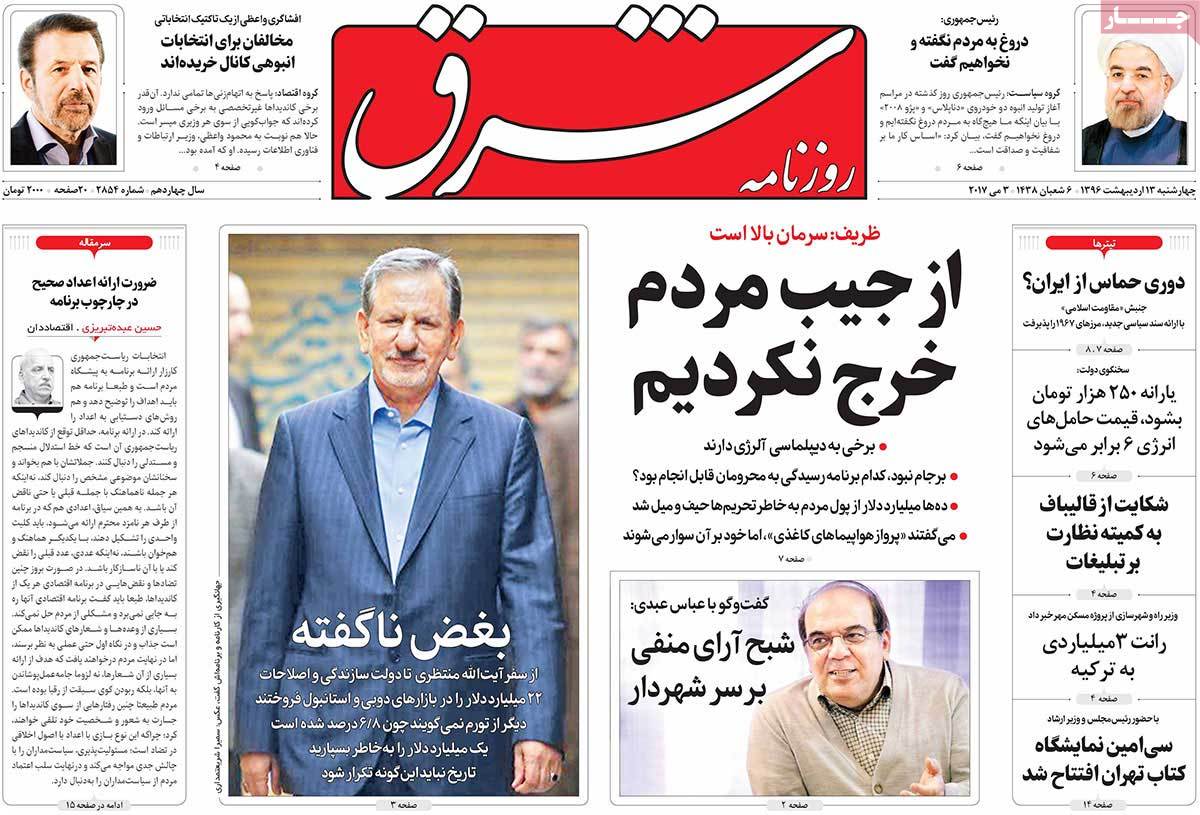
1- Zarif: We’re Proud of What We Did

2- ICT Minister: Opponents Have Bought Huge Number of Telegram Channels for Elections


Iranian Newspaper Front Pages on May 3- Shargh

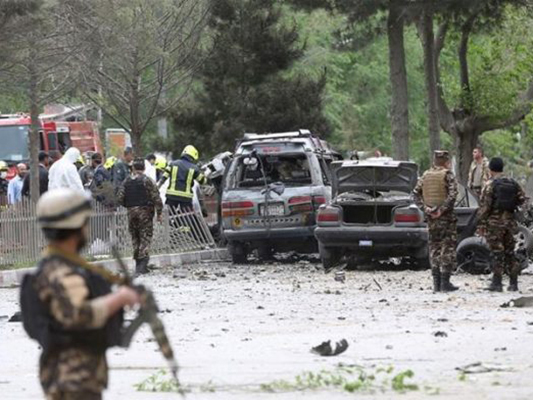
8 Civilians Killed in ISIS Attack on NATO Convoy in Kabul

ISIS Attack on NATO Convoy in Kabul

The attacker blew up his explosive-laden vehicle next to the NATO convoy near a National Defence Security (NDS) checkpoint on Shash Darak road in the central Macroyan area early on Wednesday, military officials said.

At least eight Afghan civilians were killed and 22 others wounded, including three US service members, officials said.

“The injured were transferred to two hospitals in the area; the Wazir Akbar Khan hospital and the Emergency Hospital,” Wahid Majrouh, a health ministry spokesman, told Al Jazeera.

“Some of the wounded are in a critical condition,” Majrouh added.

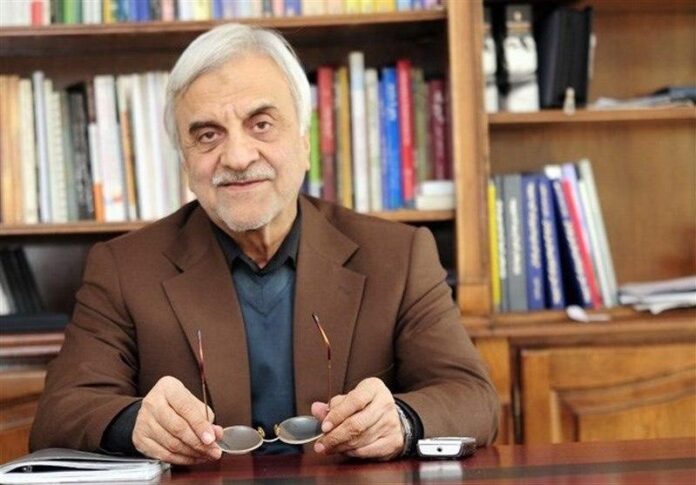
Immediate Action Needed to Save Iran’s Environment: Hashemi-Taba

Speaking at a radio program on Tuesday, Hashemitaba lamented the fact that a third of the country’s woodlands have been destroyed because of construction activities or land-use change.

He also stressed the need for plans to curb a rise in the number of deep-water wells by making a change in the “medieval pattern of agriculture” in Iran.

With modern methods, Iran can satisfy its domestic needs for food and stop harming the environment at the same time, Hashemitaba added.

Unveiling plans for the appropriate distribution of budget for the agriculture sector and for training programs, the presidential candidate said a reform in agriculture could resolve the bulk of environmental problems.

Hashemitaba, a former minister of industry and former head of the country’s top Sport organization, has launched a campaign for the May 19 election in a race with five other candidates, including Mohammad Baqer Qalibaf, Ebrahim Raisi, Mostafa Aqa-Mirsalim, Hassan Rouhani, and Eshaq Jahangiri.

Iranian 3D Printers to Be Exported to World Markets

Iranian 3D Printers

An official with Iran’s Vice-Presidency for Science and Technology, Dr Mahmoud Shokrieh, says Iran has drawn up a 10-year plan to develop the 3D printing technology in the country and has set up a roadmap to this end.

Speaking on the sidelines of an exhibition on 3D printing industry titled “Iran 3D Print Show 2017”, Shokrieh said currently 30 domestic companies are involved in the field of producing 3D printers in Iran, according to Farsi report by the Khorasan newspaper.

He added the Vice-Presidency for Science and Technology offers support to expand the market for these companies’ activities.

“The African and Southeast Asian markets are, currently, our main targets for exporting the products equipped with the technology.”

The national document for developing 3D printing technology was also unveiled on the sidelines of the expo. According to the 10-year document, $760 million has been set as the target and outlook for selling products with 3D printing technology by 2025.

According to a report by Mehr, 17 Iranian firms are displaying 3D printing technologies in this exhibition. From the various 3D printing techniques, Iranian firms are only using two, DLP and FDM.

In DLP projectors, the image is created by microscopically small mirrors laid out in a matrix on a semiconductor chip, known as a digital micro-mirror device (DMD). These mirrors are so small that DMD pixel pitch may be 5.4 micrometres or less. The pixel pitch makes this method ideal for academic work.

On the other hand, fused deposition modelling (FDM) is an additive manufacturing technology commonly used for modelling, prototyping, and production applications.

The printers will be tested by officials with the vice president’s office and academia. The best printer will be introduced on the last day of the event.

Iran’s FM in Pakistan to Pursue Deadly Attack on Border Guards

The ministry’s spokesman Bahram Qassemi said on Tuesday that Zarif plans to hold talks with the eastern neighboring country’s officials on ways to counter terrorist groups, particularly along the joint border areas.

Zarif will pursue the recent terrorist attack against Iranian border guards serving on the country’s southeastern frontier.

Zarif would also hold talks with senior Pakistani officials on ways to maintain security along joint borders and prevent terrorist groups from infiltrating into the country.

Earlier, Iran’s Foreign Ministry had summoned Pakistan’s ambassador to Tehran over an attack on an Iranian border post that killed 9 troops last Wednesday.

Qassemi said at the time that the Pakistani ambassador has been summoned to the ministry to voice protest at the cross-border attack launched from inside Pakistan.

The raid, claimed by the so-called Jaish al-Adl Takfiri terrorist group, killed 9 Iranian troops in a border post in Mirjaveh, at the southeastern province of Sistan and Balouchestan.

According to Qassemi, the Pakistani envoy was notified of Iran’s protest at the incident, and was told that Tehran strongly expects Islamabad to take “serious and substantial” measure to arrest and punish assailants.

On Thursday, Iranian President Hassan Rouhani sent a letter to Prime Minister of Pakistan Nawaz Sharif, calling on Islamabad to prosecute and bring to justice perpetrators of the attack.

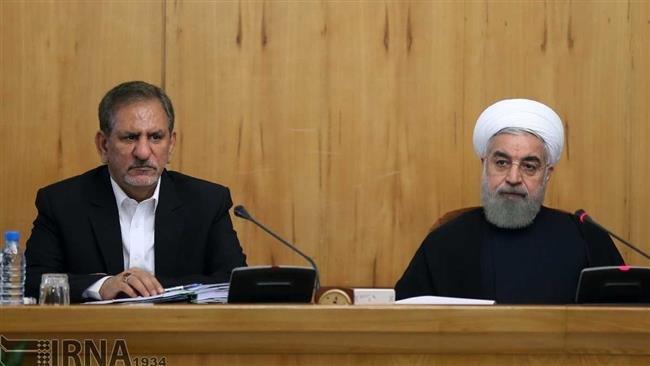
Rouhani, Jahangiri Defend Past Performance, Explain Future Plans

Addressing Iranian expatriates in a televised program on Wednesday, Rouhani said the country would not let in “the virus of terrorism,” emphasizing the need to ensure national unity and ethnic amity as a means of deterring terror threats.

Stronger national unity, he said, translates into stronger national security, adding that treating various ethnic groups with dignity would also avert infiltration by terrorists.

The Iranian chief executive said poverty and ignorance also provides terrorism with breeding ground.

The Islamic Republic, however, is enjoying “exemplary” security thanks to the vigilance of its people and security forces and under the auspices of national integrity, Rouhani noted.

While ensuring security inside its borders, Iran has also contributed security in many countries such as Syria, Lebanon, Iraq, Pakistan and Yemen, he stated.

Rouhani said Iran is duty-bound to fight terror, and it is ready, if possible, to help promote security in countries far away like China and European countries.

The Iranian president further highlighted the significance of the Palestinian cause, reminding that the terrorism waged by such brutal outfits as al-Qaeda and Daesh had either consigned the issue of Palestine to oblivion or sidelined it.

“We should not let terrorism continue its course in the region. Towards confronting the phenomenon, the Iranian nation and government see it as its responsibility to take whatever measure in its power,” he added.

On a separate note, the Iranian chief executive said the number of foreign tourists visiting the country had increased by 12 percent under his administration.

He said cyberspace was now in the service of the tourism industry, noting that much of handicraft sales was now taking place using the Internet and social networks.

First Vice President Jahangiri likewise took on the issue of tourism on Tuesday, saying the country has everything it would take to turn up among the 10 countries attracting most tourists worldwide.

“We should move towards attracting foreign tourists, especially cultural tourists, who would visit the country for the purpose of pilgrimage. These bring along billions of dollars, contribute to the economy and create employment,” he said.

Iran, he said, had to reach a point when its exports would be valued at USD 50 billion or even more. To do this, the country had to enter the international markets “with an active diplomacy,” the official asserted.

The electorate will go to the polls on May 19.

Tehran Mayor Mohammad-Baqer Qalibaf, member of Iran’s Expediency Council Mostafa Aqa-Mirsalim, Seyyed Ebrahim Raeisi, the current custodian of the Holy Shrine of Imam Reza (PBUH) in the northeastern city of Mashhad, and former vice president Mostafa Hashemi-Taba are also contesting the race.

Rouhani Vows to Decrease Average Age of Cabinet Members

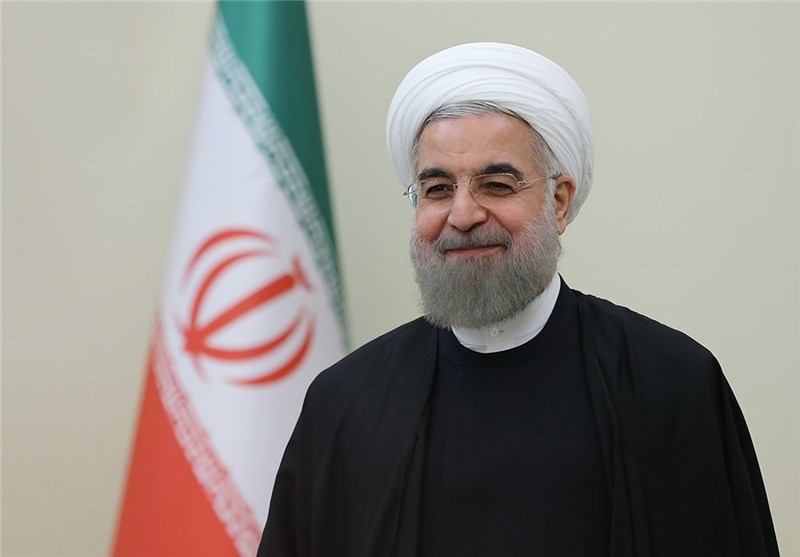
Rouhani

Iranian presidential candidate Rouhani has taken part in a televised interview as part of his campaign in the run-up to the May 19th vote. Here are excerpts from the interview, according to a Farsi report by Khabar Online.


Average Age of Cabinet Members

We should give more leeway to the youth all across the country. The Cabinet comprises 30 members. Whether they are young or not is unimportant. What counts is their competence and capabilities [to meet the requirements needed] for a given ministry and their responsibilities. But given the circumstances, the Cabinet will change compared to [what it was] before and its members will be younger on average.


Looking to Domestic Resources for Progress

[Asked about his views regarding the recent comments by Leader of the Islamic Revolution Ayatollah Seyyed Ali Khamenei, who had urged presidential hopefuls to focus their attention on local potentialities rather than foreign resources, Rouhani replied] The Leader mentioned an important point, and stressed it several times, urging all officials to look to domestic capabilities. The Leader emphasized that looking to foreign resources can weaken our national might and prompt the enemy to become greedy [and have an eye on our country]. We saw that when we were dependent on oil revenues, the enemy immediately imposed sanctions on us in order to get us into trouble. [The idea of having] a resilient economy [proposed by the Leader] is aimed at ensuring an endogenous economy. I have repeated a sentence time and again, and that is, this administration looks to the blessings of the Almighty in the first place, and to the people, in the second place, and will never look to foreign countries. Of course, we will have interactions, constructive interactions, but we should pin our hopes on domestic potential and resources.


Foreign Policy Priority

Our policy is based on constructive engagement with the world, but our neighbours take priority, and the reason is we are facing insecurity in the region and we need to have more interaction. The next priority is the Muslim world.


Supporting Resistance Fronts

[On what approach he has adopted to back resistance fronts, Rouhani said] our region has numerous enemies. Western governments have an eye of greed on our region. Terrorism has also emerged as another enemy. We should join hands against threats posed by interventionist and terrorist elements as well as other dangers which might be threatening our region.
Rouhani

Iran’s Policy on US

[On his administration’s reaction to possible new US sanctions on Iran, Rouhani noted] In the ISA (Iran Sanctions Act) issue, when Americans took a step against our interests, we showed reaction, and the two orders I gave the Atomic Energy Organization of Iran was in line with this matter. So, our reaction to sanctions will be to respond in kind.


US Cannot Do a Damn Thing

[Asked on his viewpoint about these famous statements by the late Leader of the Islamic Revolution Imam Khomeini that “The US is the Great Satan,” and “The US cannot do a damn thing,” Rouhani said] This is a well-known statement by Imam Khomeini made at a time when

Americans had made threats against Iran and the Islamic Revolution, taken the [former Iranian dictator] Shah to the United States and taken actions such as [the US encroachment upon Iranian soil and illegally sending troops to the] Tabas [desert]. Under those circumstances, the late Imam said “the US has not yet stopped making mischief in dealing with Iran.” We were seeking détente with the whole world, but Washington didn’t stop [its hostile approach toward Iran]. The Leader made a key point, that we should disappoint the enemy. For that to happen, we should promote faith across the region.


Strategy to Counter US Bullying

It is important to boost national might. Unity, national self-confidence, as well as our smart, hard and soft power are all important. When we managed to create economic growth in Iran, we saw its immediate effects on the negotiations. This is the same social, economic and military power which should come together to show those adopting a hostile approach on Tehran that Iran is a country of peace and friendship.


Iran’s Ties with Neighbours

[On the kind of Iran’s Relations with neighbouring countries in his next administration, Rouhani said] in the 11th administration, a lot of efforts were made, many attempts were made to enhance [our] relations and power in the region. We should continue these efforts. Our relations with Syria, Iraq, Yemen and Lebanon are better. [Our relations with neighbours are good] except with one of the neighbours which has ruined bilateral ties for the sake of its own regional interests. Today, we have good relations with regional countries and we will continue to have those relations. We will keep our ties on economic, political and cultural fronts.


Dealing with Violation of JCPOA

As for the JCPOA (Joint Comprehensive Plan of Action), as the Leader said, we won’t breach it. Iran has complied with whatever agreement it has concluded with other countries. The same goes for the JCPOA. As long as the other party to the deal complies with its obligations, Iran will live up to its commitments, too. If they harm the agreement, we have drawn up a reciprocal plan [to respond to their move.] We have prepared different plans for different possible circumstance in the future.

I hope the people will remain on the scene as always. The political arena is very important for our country. God willing, people will create another epic on May 19, 2017.