Tuesday, December 23, 2025
Home Blog Page 4051

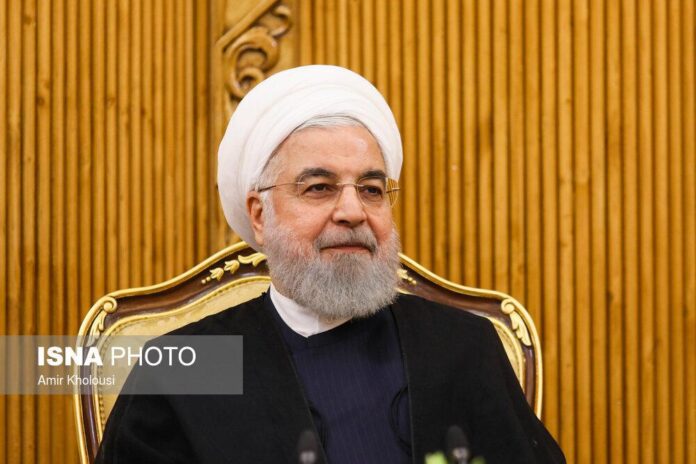
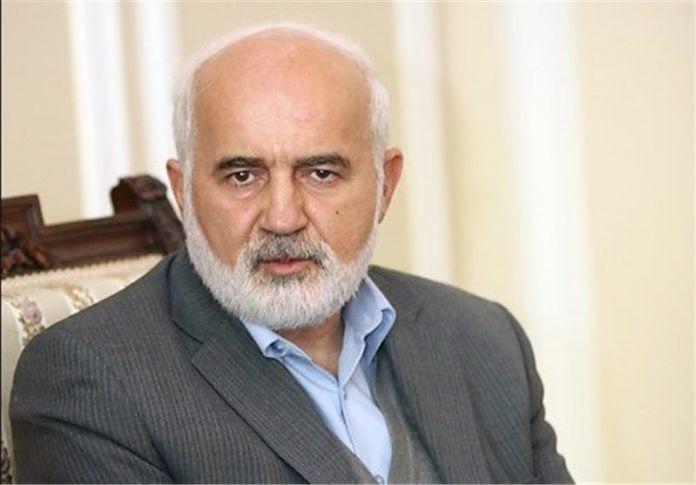
Rouhani, Raisi Register to Run for Iran’s Presidency

Rouhani, Raisi Register to Run for Iran’s Presidency

Rouhani arrived at the Interior Ministry a few hours ago and registered to run for his second term in office.

After signing up, he said he has come for ‘Iran and Islam’ and urged the Iranian nation to vote for him for the same sake.

He also told reporters that protecting the nuclear deal, known as JCPOA, is one of his main plans in political and economic fields.

“The ‘rival-wives’ who for several times decided to kill the nuclear deal ‘baby’ cannot be good parents for it,” he noted.

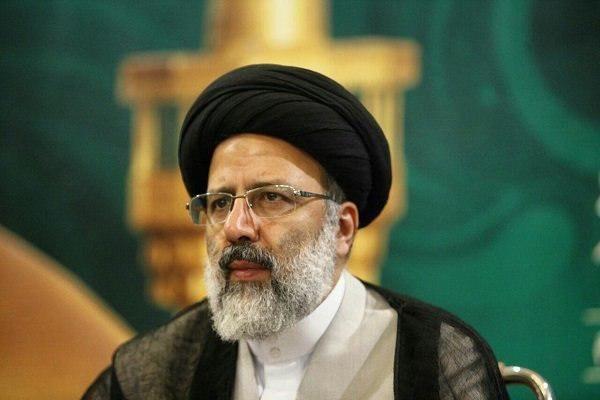
Minutes after Rouhani, Seyyed Ebrahim Raisi, the Custodian of Astan Qods Razavi and Rouhani’s main rival, also showed up in the Interior Ministry and registered to run for presidency.

Rouhani, Raisi Register to Run for Iran’s Presidency-7654Earlier in the day, former MP and a senior conservative candidate Alireza Zakani had also applied for the post.

The 12th presidential election in Iran will be held on May 19.
Among the other renowned figures applying for candidacy for the post of president on Friday was Mostafa Kavakebian, a member of the parliament.
Moreover, the reports said on Friday that a heavyweight of the “principalist” political faction, Saeed Jalili, would not participate in the presidential race, Tasnim reported.
During the previous presidential election in June 2013, Rouhani garnered 50.7 percent of a total of over 36 million votes.
Nearly 50.5 million Iranians were eligible to vote in the 11th presidential election, and the voter turnout in the polls stood at 72.7 percent.

US in No Position to Judge Iran’s Human Rights Situation

Bahram Qassemi

In a statement released on Friday, Qassemi denounced the US move to add an Iranian organization and a judicial official to its sanctions list as “contrary to the indisputable principles of international law”.

“Such measures are repetitive and in line with certain political objectives of the US government,” he said, adding that the unilateral sanctions against individuals or entities of independent countries are in violation of “the indisputable principles of international law and human rights and it is illegitimate and illegal”.

“Due to its domestic and international record, the US government is not in a position to comment or take action on the human rights situation in other countries,” the spokesman noted.

The US Treasury Department announced new sanctions against some Iranian entities over alleged human rights abuses.

A Treasury Department statement said the sanctions were imposed on the Tehran Prisons Organization and Sohrab Soleimani in connection with serious human rights abuses in Iran.

The statement says the action reflects deep concern regarding human rights in Iran, according to AP.

The report said Soleimani is the younger brother of Major General Qassem Soleimani, commander of the Islamic Revolution Guards Corps (IRGC) Quds Force who also advises Iraqi military forces in their fight against Daesh (ISIL) terrorist group.

The Treasury Department alleges that the prison organization is responsible for, or complicit in, the detention of many prisoners of conscience and well-documented accounts of their mistreatment and abuse.

Iran, Russia, Syria Blast US Strike on Homs

Iran, Russia, Syria Blast US Strike on Homs

Syrian Foreign Minister Walid al-Muallem, along with his Iranian and Russian counterparts Mohammad Javad Zarif and Sergei Lavrov, was speaking at a joint press conference in Moscow on Friday.

Muallem further slammed Washington for its hostile policies against the Syrian nation, stressing that Damascus wants an “impartial” and “swift” investigation into the alleged gas attack which killed over 80 people in Khan Shaykhun earlier this month.

The Westerners and the militants have accused the Damascus government of being behind the attack, without offering any proof to support the claims. The Syrian government has,however, rejected any role in such an assault against civilians.

Using the Idlib incident as a pretext, United States struck a Syrian army airfield in western Syria with 59 cruise missiles last Friday.

At the presser, the three top diplomats slammed the US missile attack as an act of aggression and stressed they have convergent and close cooperation in efforts to resolve the crisis in Syria.

“We have reiterated our position and were united in stating that the attack was an act of aggression, which blatantly violated the principles of international law and the UN Charter,” Lavrov said.

“We call on the US and its allies to respect Syria’s sovereignty and refrain from actions similar to what happened on April 7, and which have serious ramification not only for regional, but also global security,” he added.

The press conference came following closed-door negotiations between the three foreign ministers on the situation in Syria.

Iran, Russia, Syria Blast US Strike on Homs

Meeting with Zarif and Muallem, Lavrov pledged continued Russian support for Damascus in fighting terrorism and restoring peace to Syria, RT reported.

“We insist on a thorough, objective and unbiased investigation of the circumstance of the use of chemical substances in Khan Shaykhun on April 4,” he said, adding that the investigating team must include inspectors chosen from nations from different parts of the world to ensure its objectivity.

Zarif, in turn, said “certain countries” have adopted a hyporticical approach in dealing with the issue of chemical arms, citing Iran’s history of suffering from chemical weapons attack by the US-backed regime of ex-Iraqi dictator, Saddam Hussein, in the 1980s war.

Declassified CIA files showed that the US was well aware that Saddam was using CWs against Iranians, but didn’t oppose it and even provided intelligence for such attacks.

The Iranian foreign minister is visiting Moscow at the invitation of his Russian opposite number..

Upon his arrival in Moscow earlier in the day, Zarif said the visit serves to enable some other bilateral coordination concerning President Hassan Rouhani’s late March visit to Russia.

The visit saw Iran and Russia issuing a joint statement outlining a roadmap for the future status of their bilateral relations and cooperation on the regional and international stage.

Zarif also down for talks with the Russian foreign minister to discuss closer Tehran-Moscow cooperation in regional and international issues as well as the fight against terrorism.

At the meeting, the top Iranian diplomat emphasized the need for a political settlement of the Syria crisis and end to foreign meddling in the affairs of the Arab country.

Zarif further called for investigations into a purported gas attack that killed over 80 people in the town of Khan Shaykhun in Syria’s Idlib Province, stressing that such an attack must be used as a pretext against the Syria.

Last October, the three top diplomats held similar talks in the Russian capital where they emphasized the need for unyielding fight against terrorism and working towards the resumption of UN-brokered Syria talks in Geneva, which started last year before breaking down.

In December 2016, Moscow also hosted a meeting of foreign and defense ministers of Russia, Iran and Turkey on the Syria crisis.

The Moscow talks resulted in more concerted cooperation against terrorists in Syria and laid the groundwork for Syria talks in the Kazakh capital of Astana.

Iran has been lending Syria military advisory support against the foreign-backed militancy, which has been plaguing the country since 2011. Russia has been backing up the fight with airstrikes since last September.

Tehran Hosts ‘Iran-Sweden Journey of Singing’

Tehran Hosts 'Iran-Sweden Journey of Singing'

The event scheduled for April 15 is formally known as ‘Iran-Sweden Journey of Singing.’ The show starts at 9 pm at Niavaran Cultural Center’s Persian Gulf Hall.

The group comprises 35 choir singers and is headed by artistic director and conductor Erik Westberg — who studied choral conducting at the Royal College of Music in Stockholm.

The choir will be performing a range of works from the romantic era to the present as well as Swedish folk music, a cappella. Perhaps the most interesting section is the second part of the concert in which the Swedish choir will be performing with Tonal, an Iranian choir conducted by Milad Omranloo.

“The two choirs will jointly perform Iranian and Swedish folk music,” event organizer Adele Zamani told the Financial Tribune.

The musical performance has been organized by the Swedish Embassy in Tehran along with Artasam Cultural Center. Headed by Zamani, Artasam institute started work in 2016 as an organizer of cultural and artistic events.

According to Zamani, the Swedish choir will also meet with musicians in Isfahan. “They will be exchanging choral repertoires and practice together.”

After having toured Europe, the US, Brazil and Africa, this is the first time the choir is performing in the Middle East.

Journeys of Singing are a series of events which look to promote cultural and artistic exchange between nations. “We believe that the best way to transition to globalization is through artistic and cultural exchange with a focus on local cultural identity,” Zamani said.

“This induces natural communication and dialogue among different cultures and nations, which is more effective.”

The first edition of the Journey of Singing was held last year in Tehran when two German choir conductors, Markus Detterbeck and Jan Schumacher, held a workshop and competitions for Iranian choirs. The winning Iranian choirs will attend a musical festival slated for May 25-28 in Germany, Zamani said.

The Chamber Choir of the School of Music in Pitea at Lulea University of Technology was founded in 1990 by Westberg. The choir has performed works by composers such as Bach, Brahms and Mendelssohn and has several recorded albums.

Iran, ATR Sign Major Aircraft Deal

ATR aircraft

ATR Spokesman David Vargas confirmed the deal for the sale of 20 ATR-600s, a twin-propeller aircraft, was signed on Thursday.

“They will definitely help Iran Air to modernize and develop regional connectivity across the country,” Vargas told AP.

The spokesman of the French-Italian aircraft manufacturer declined to offer a value for the overall deal. The confirmed portion of the deal is worth $536 million at list prices, though buyers typically negotiate discounts on bulk orders.

Managing Director of Iran Air Farhad Parvaresh had earlier confirmed the deal for 20 twin-engine turboprop ATR 72-600 aircraft, adding that the European airplane manufacturer will deliver nine ATR 72-600s in 2017 and the rest in 2018.
He said four of the aircraft will arrive within a month after signing the contract.

Iran has taken steps in recent years to renovate its commercial air fleet.

On January 12, the first commercial airliner purchased from Airbus following the 2015 nuclear deal between Iran and world powers landed at Tehran’s Mehrabad International Airport.

During a January 2016 visit to Paris by Iranian President Hassan Rouhani, Tehran signed a major contract with Airbus worth about $27 billion to buy 118 planes.
Iran and Airbus intensified business negotiations in October 2016 following the US decision to remove a final hurdle for Western aircraft manufacturers to sell planes to Iran under contracts signed after coming into force of the Joint Comprehensive Plan of Action (JCPOA), the nuclear agreement between Tehran and the Group 5+1 (Russia, China, the US, Britain, France, and Germany).

Iran to Provide Social Security for Foreign Nationals

Refugees in Iran

Foreign nationals and refugees who have a work permit and are residing inside the country will be covered by the Social Security Organisation and can benefit from pension payment, blood money coverage and disablement benefits, said the director general of foreign nationals’ affairs at Social Security Organisation Hossein Joudaki.

“Most foreign residents who have been in Iran for more than 20 years are not currently eligible for any benefits since they have not been insured all these years,” he noted, according to a report by Financial Tribune.

He regretted the fact that Iran has not been able to benefit from foreign residents– most of whom are Afghans and Iraqis– in line with national interests despite three decades of their presence in Iran.

“5,000-Year-Old Skull Reveals Iran’s Medical Advances”

5,000-Year-Old Skull Reveals Iran’s Medical Advances

The skull of a 13-year-old girl was dug out during archaeological excavations in Sistan and Baluchestan province in 1977. It was found among the remains of 13 people in a mass grave dating back to 4,800 years ago.

“5,000-Year-Old Skull Reveals Iran’s Medical Advances”According to a Farsi report by Mehr, the right part of the skull, kept at the Tehran Museum of Medical History, bears the mark of a deep triangular incision. Archaeologists’ observations as well as the research conducted by anthropologists show a surgery had been carried out on the skull to treat hydrocephalus.

After the skull was discovered and studied and some questions were answered, Seyyed Mansour Seyyed Sajjadi wrote a book titled “A Compilation of Articles on Burnt City”. The book is a compilation of papers by Hossein Sarhadi, Rouhollah Shirazi and Hossein Moradi.

5,000-Year-Old Skull Reveals Iran’s Medical Advances“Initial studies on the skull revealed it belonged to a female person, estimated to have been 18 years old with a crack on the right side of the bones of the mandible. The skull was studied again whereupon the definite age of the owner was determined to be 13, plus or minus 6 to 9 months,” reads part of the book which concerns the results of the study.

In terms of size, the skull is rather big, mostly because its central part had grown beyond the normal size on both sides. Also it was observed that the left side of the skull at the back was bigger than the right side.

However, the right part of the skull in the front was protruding compared to the left side. So, the face seems normal, but she had an extraordinarily large skull. The height, though, is normal.

The skull, on which an operation had been performed, is one of the key archaeological discoveries in the field of medical history. The skull belonged to a girl between 11 and 12 years of age. She survived at least a few months after the surgery before her death. Archaeologists have not yet found out the reason for the girl’s death. It is not clear whether she died of post-surgery infection or something else.

Of course, archaeologists have studied the other human remains found in the mass grave in Burnt City. Studies conducted on 110 skeletons have revealed that the women aged between 20 and 25 years old. Therefore, the death of a person between 13 and 14 years old in the community of Burnt City was not considered an unusual phenomenon.

It is one of the wonders of the Iranian medical history that physicians in Burnt City knew about this disease as well as its causes and treatment methods some 5,000 years ago. The skull is now on display at the Tehran Museum of Medical History.

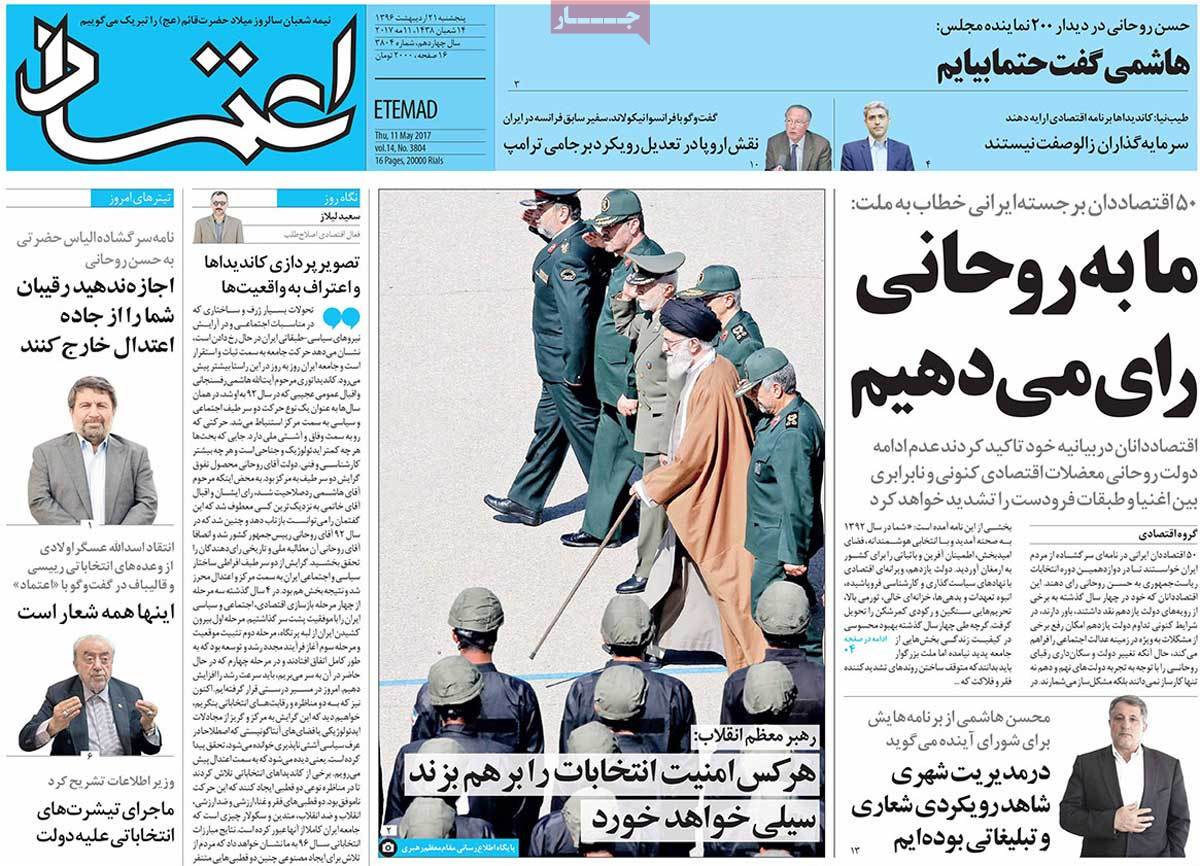
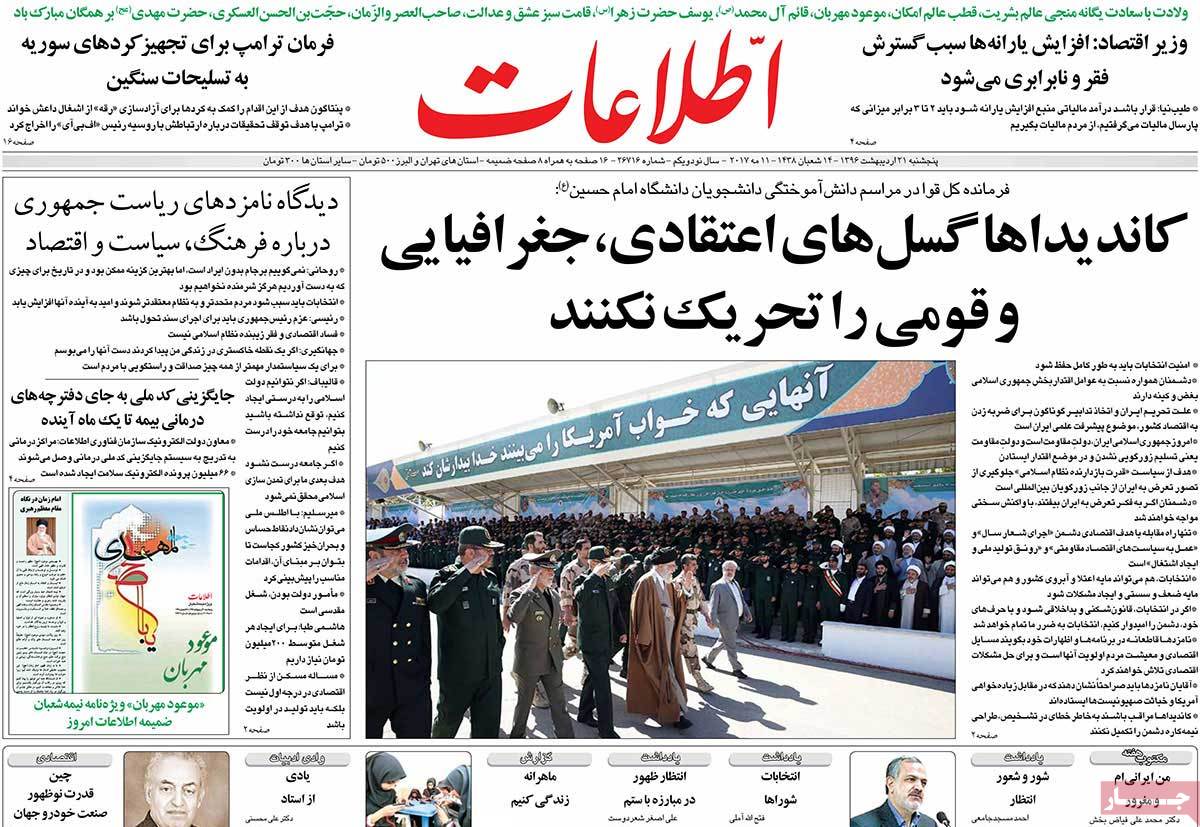
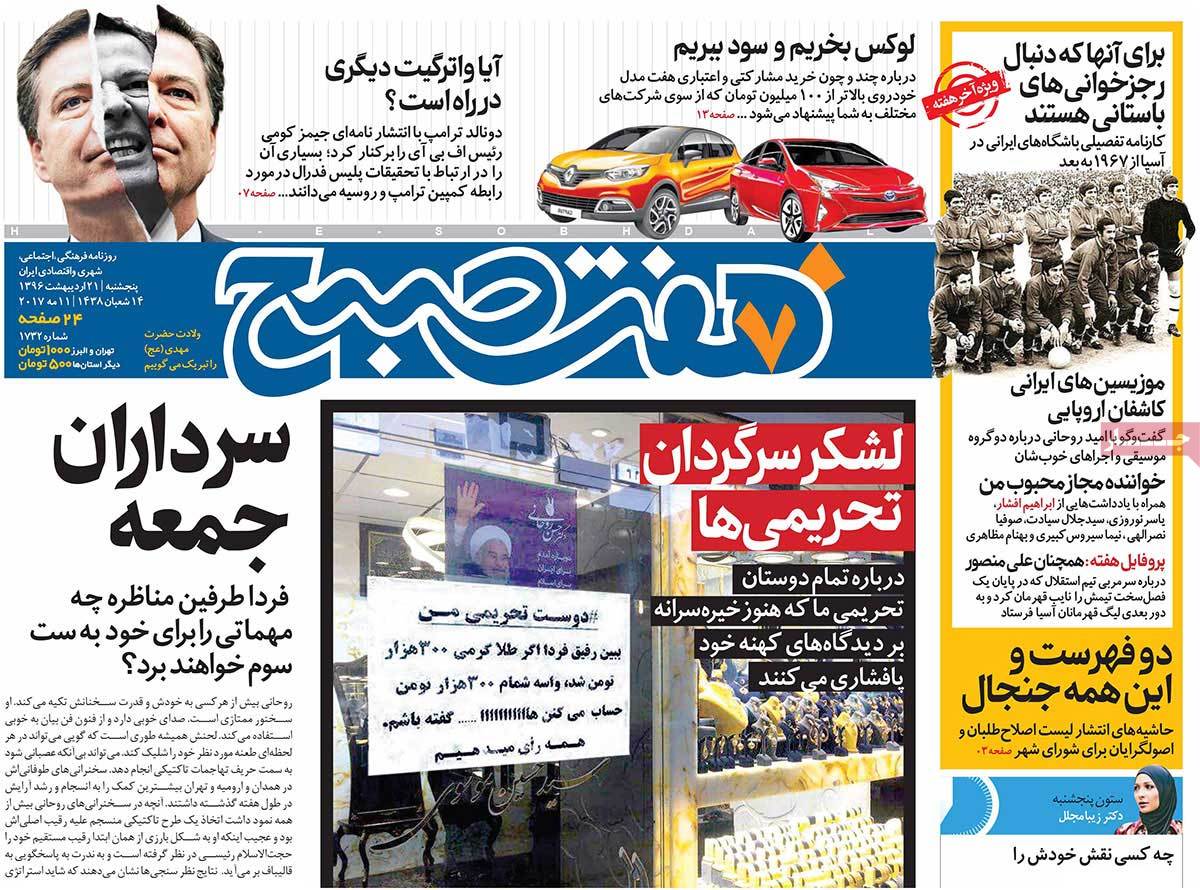
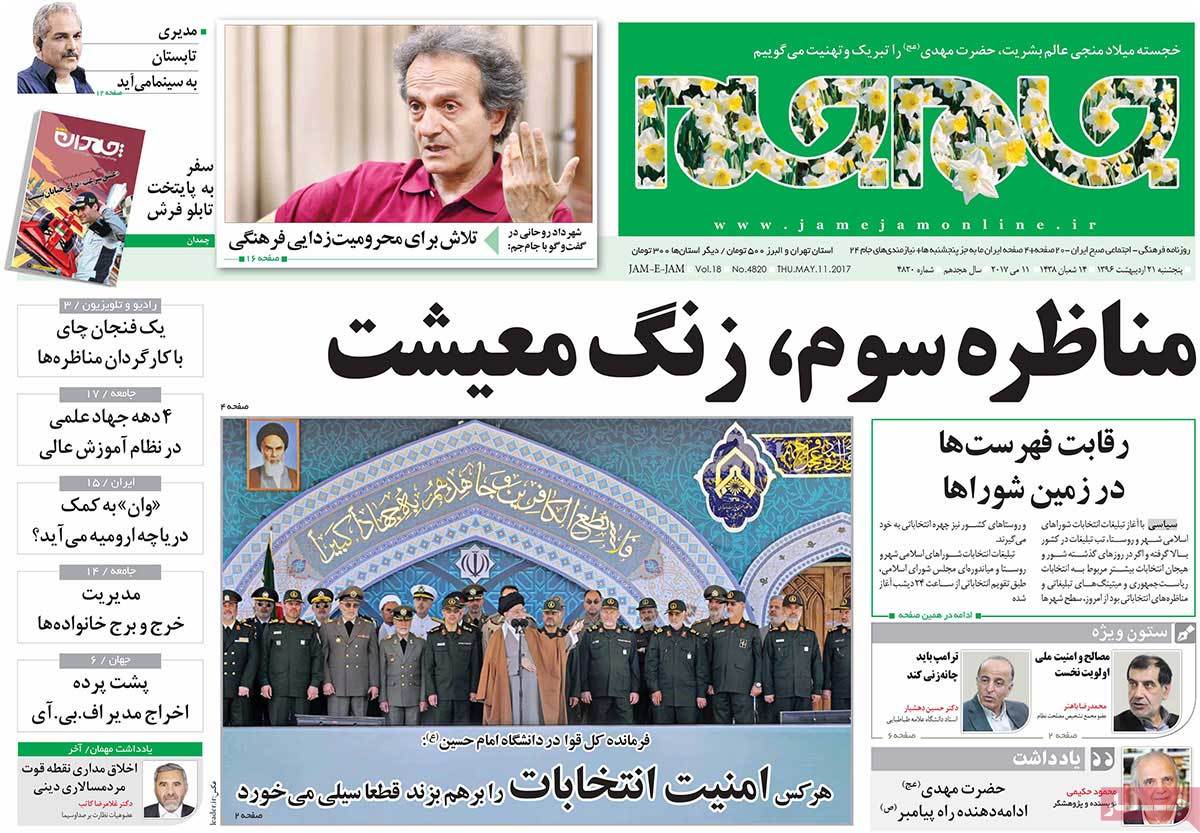
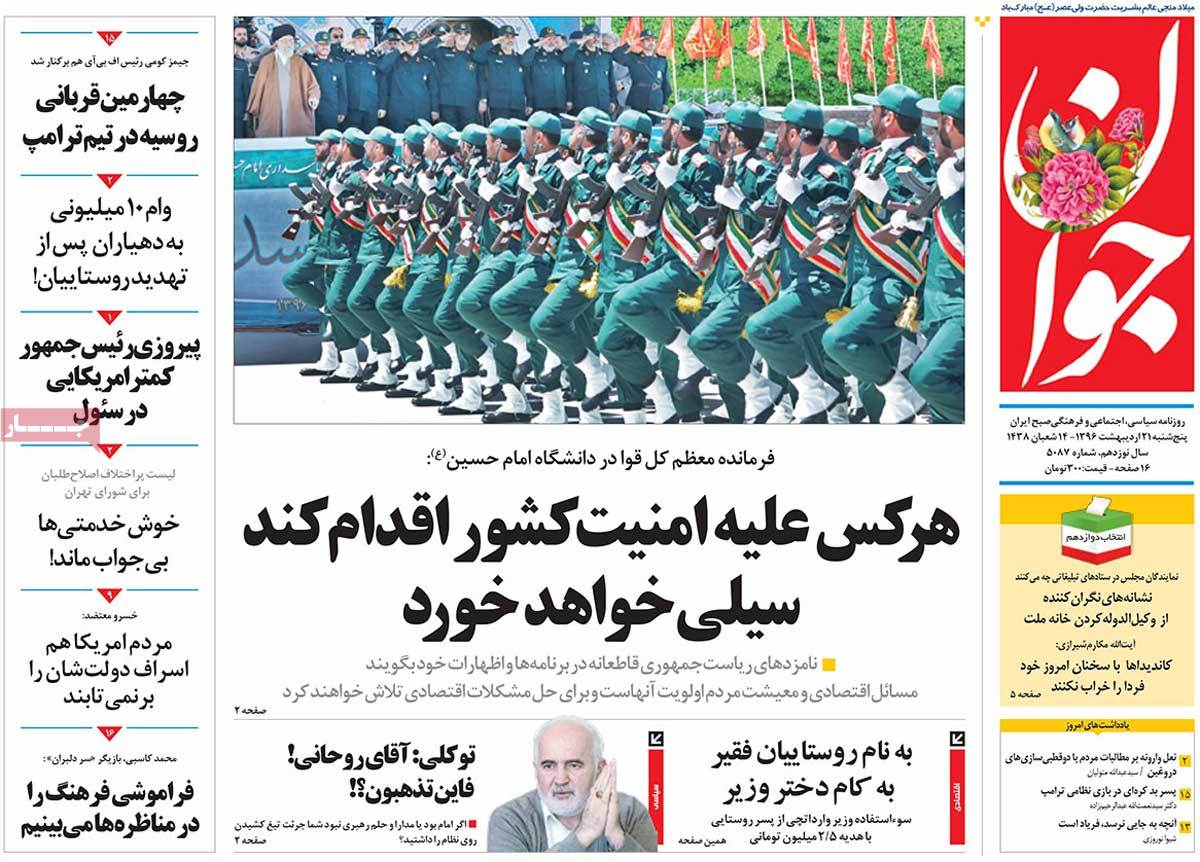
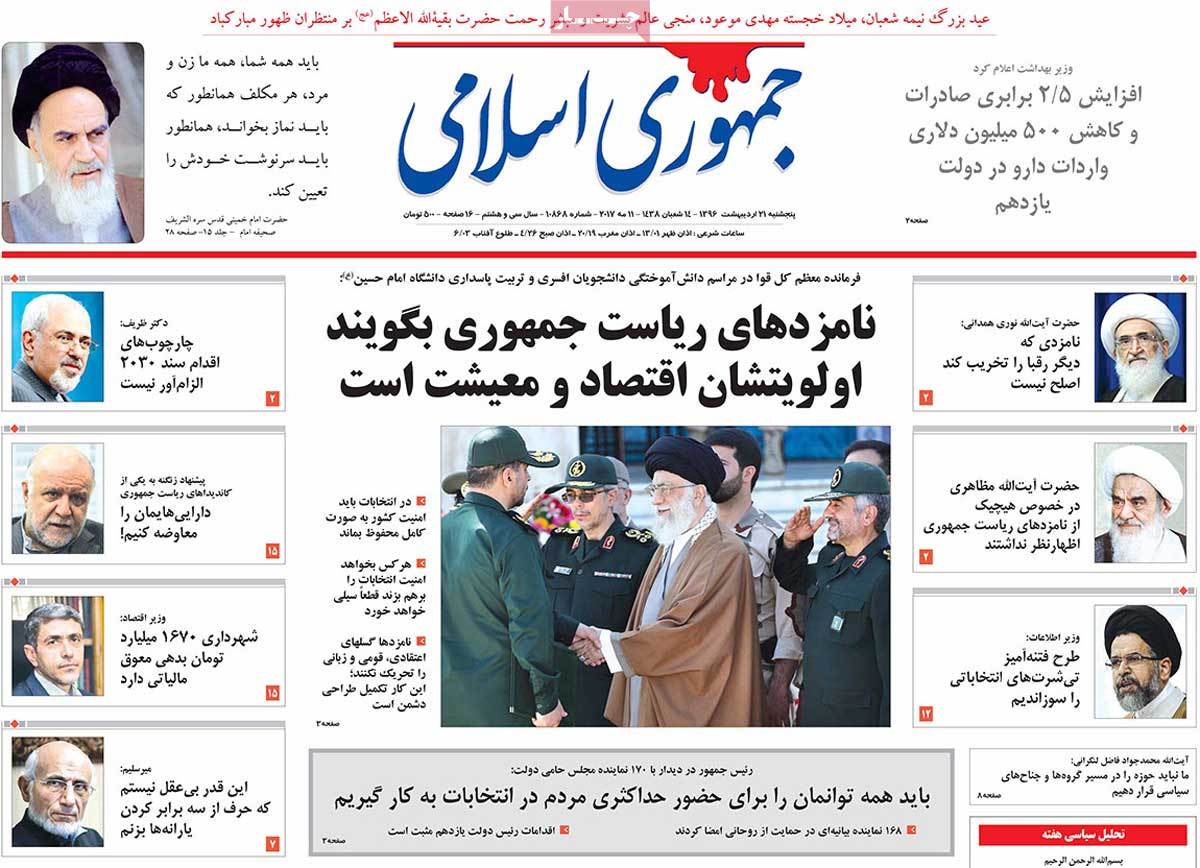
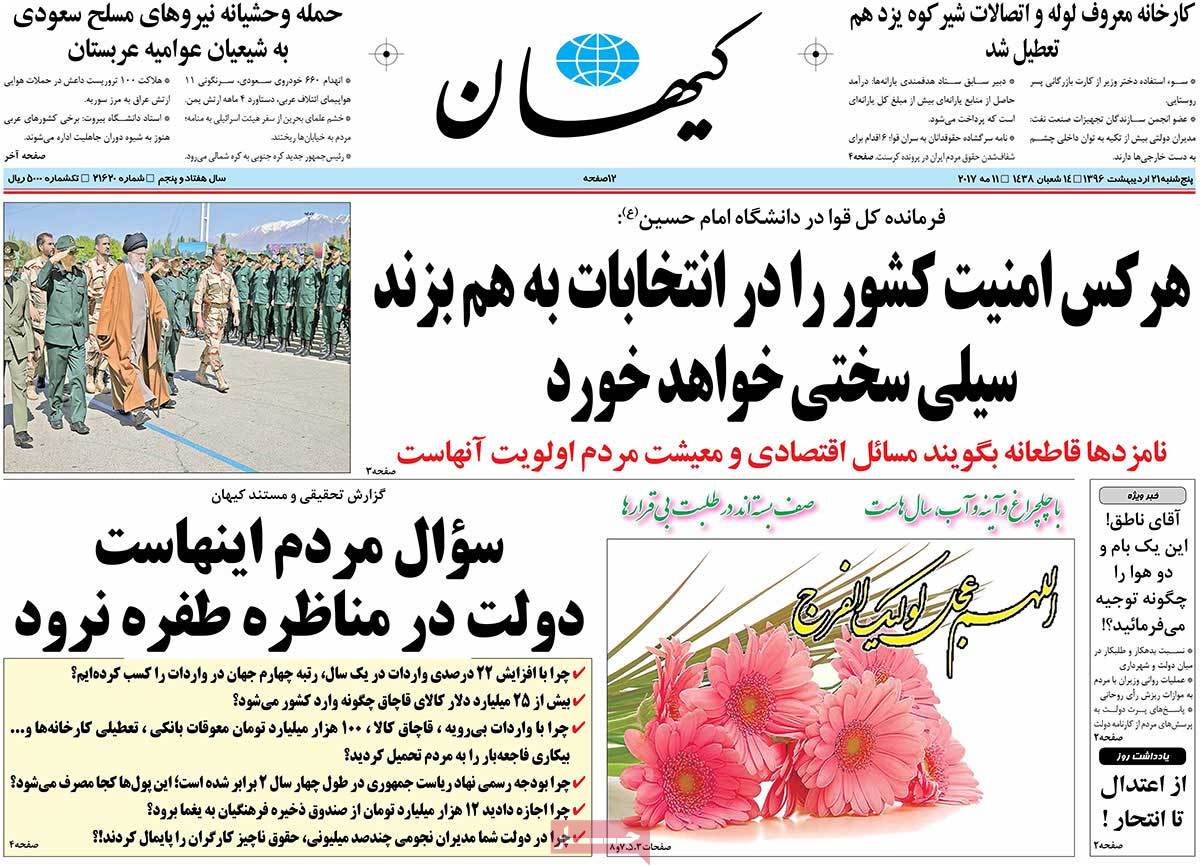
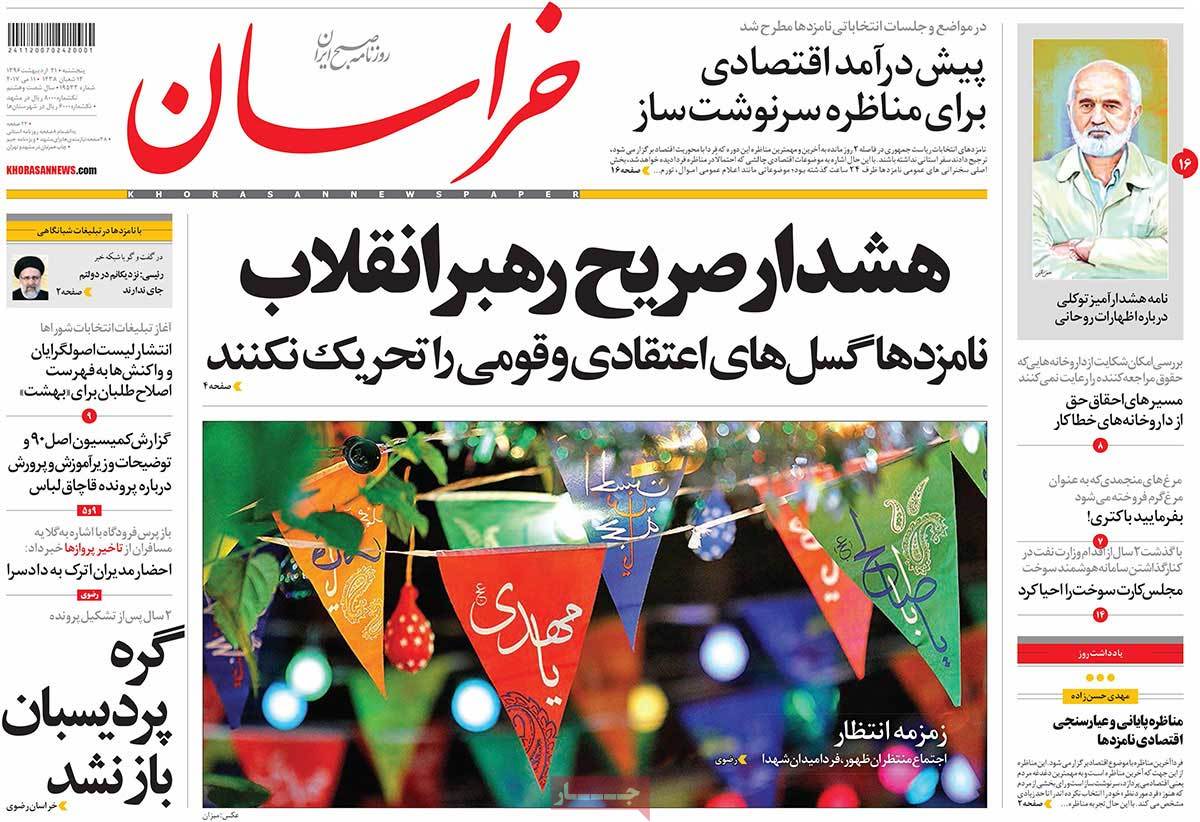
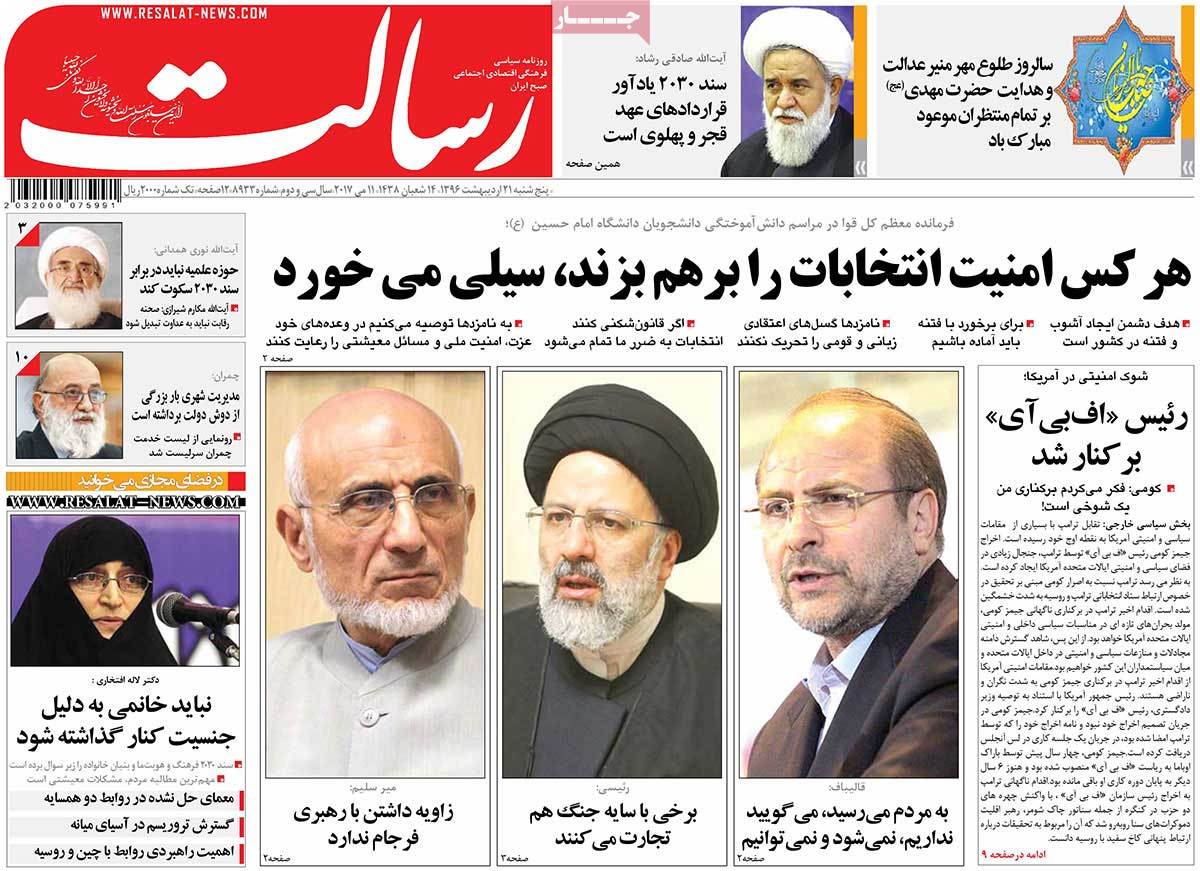
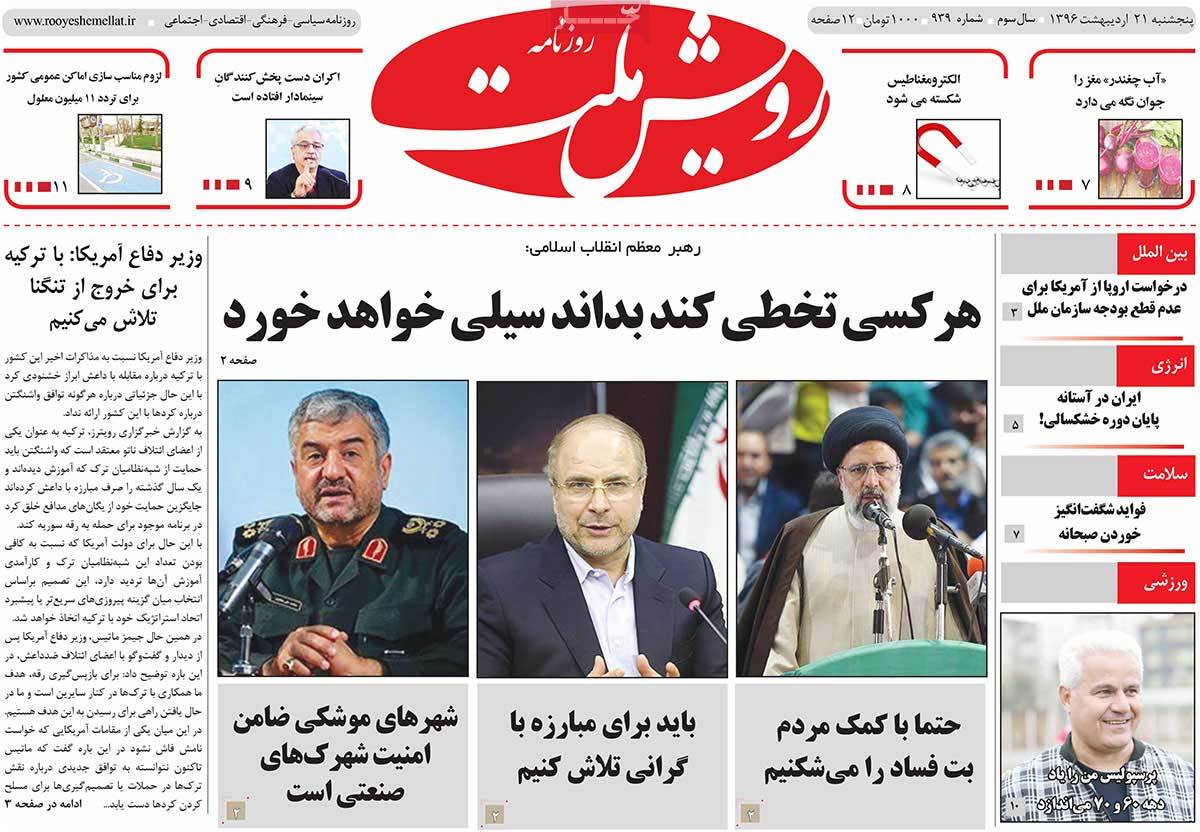
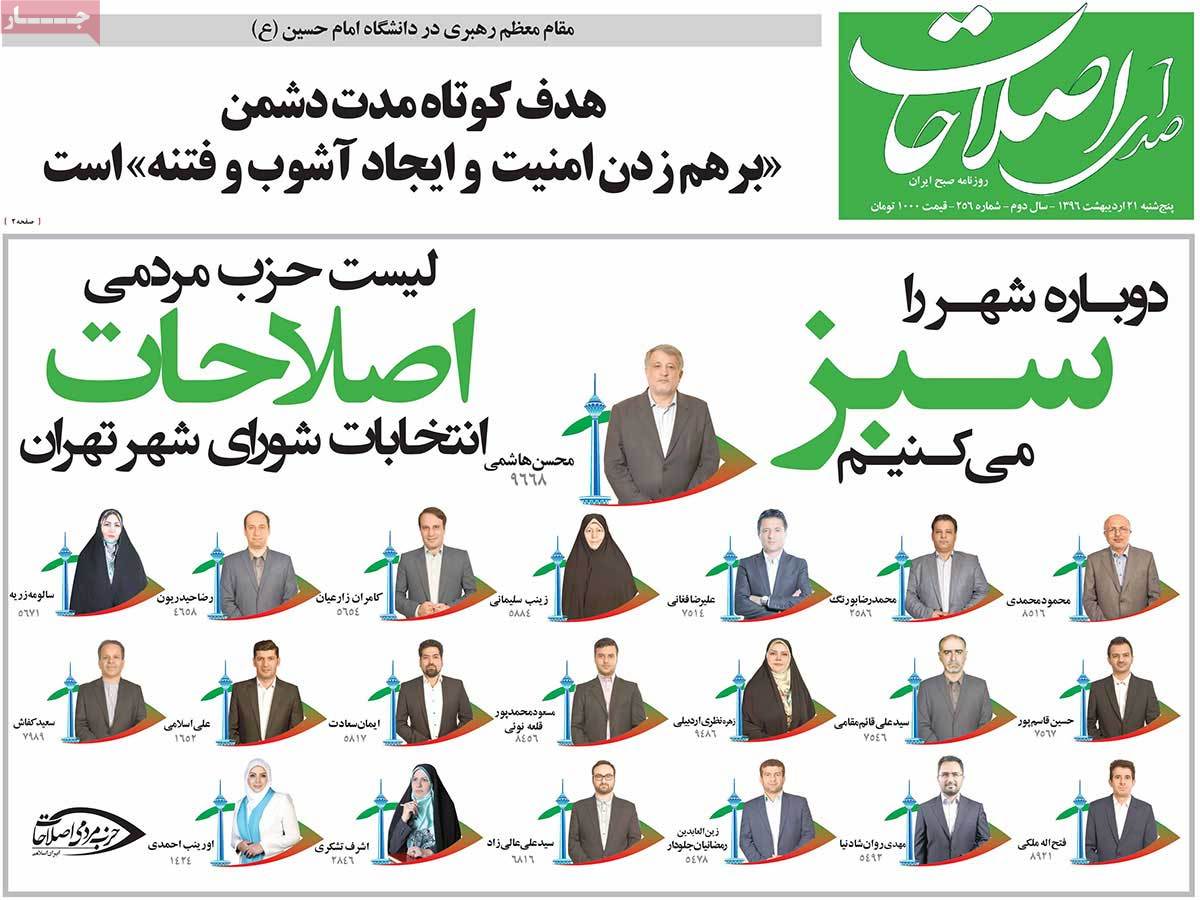
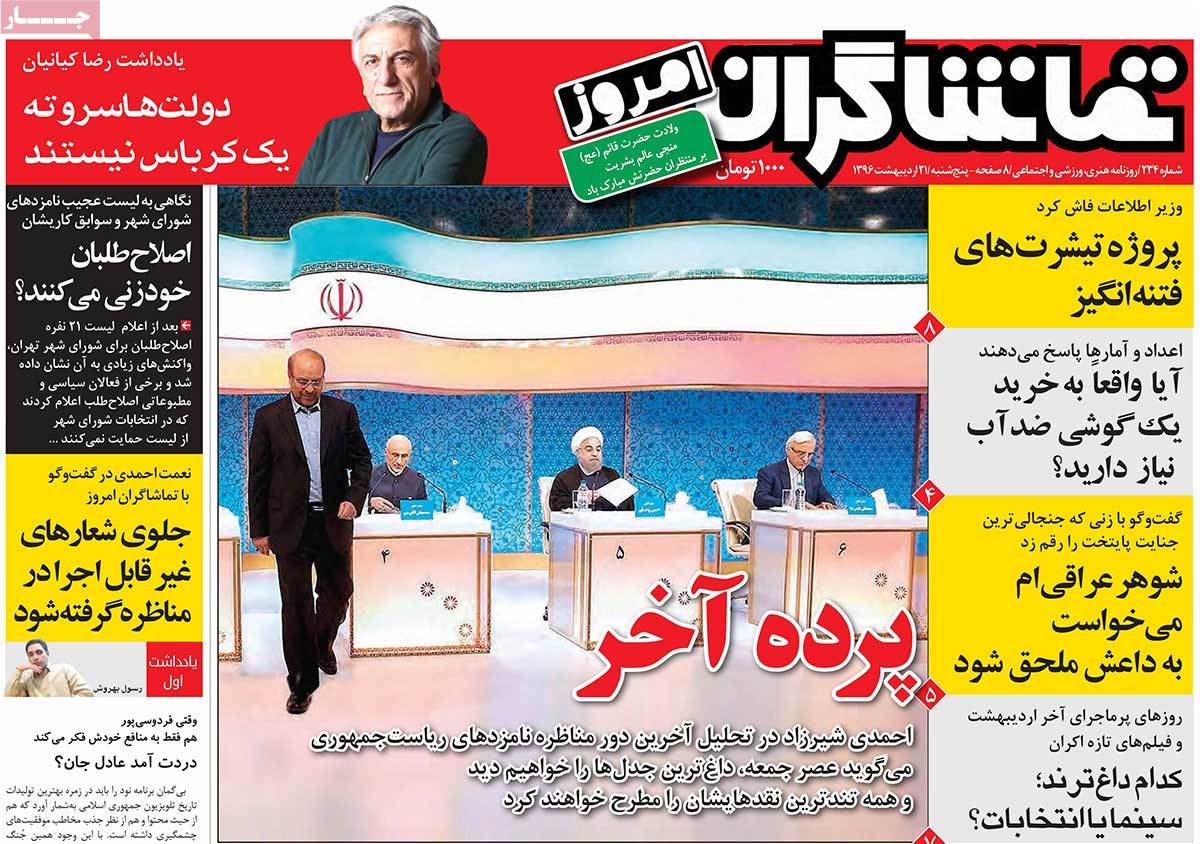
A Look at Iranian Newspaper Front Pages on April 13

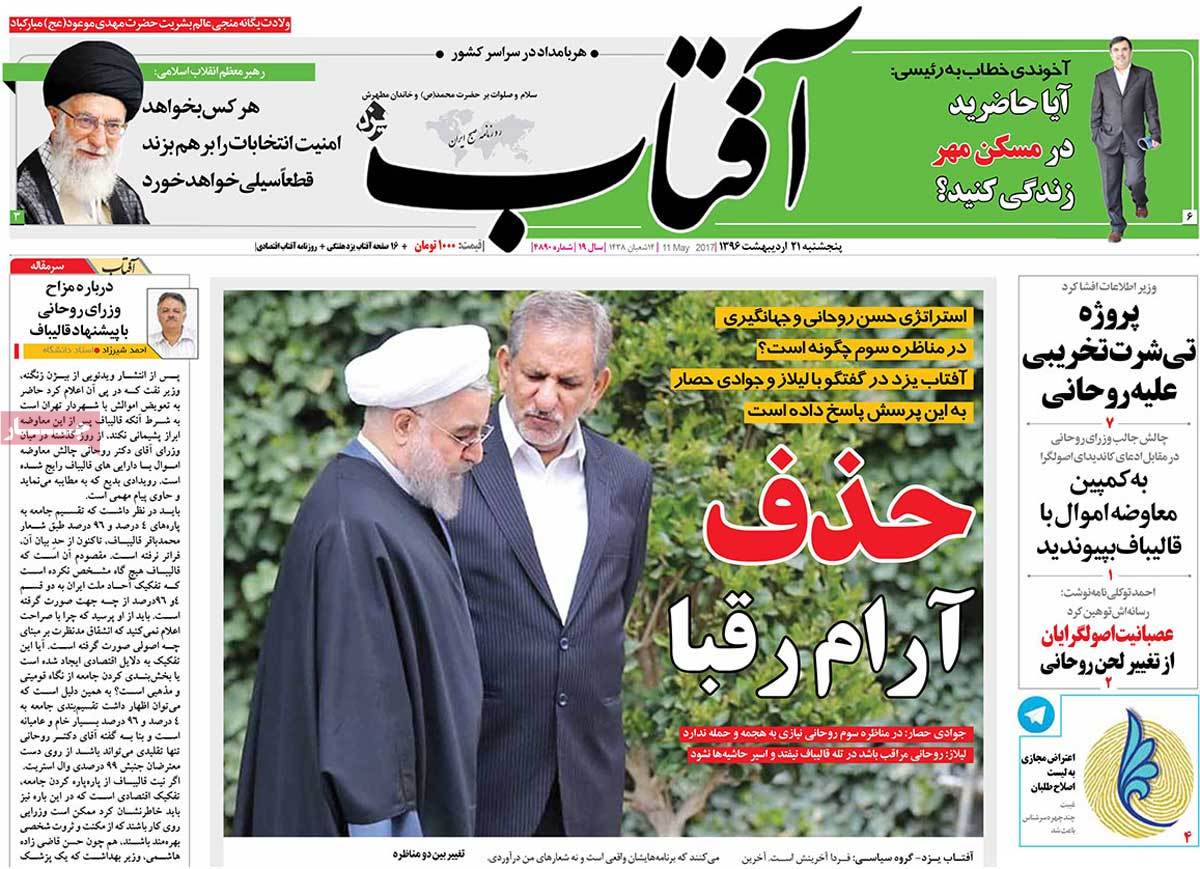
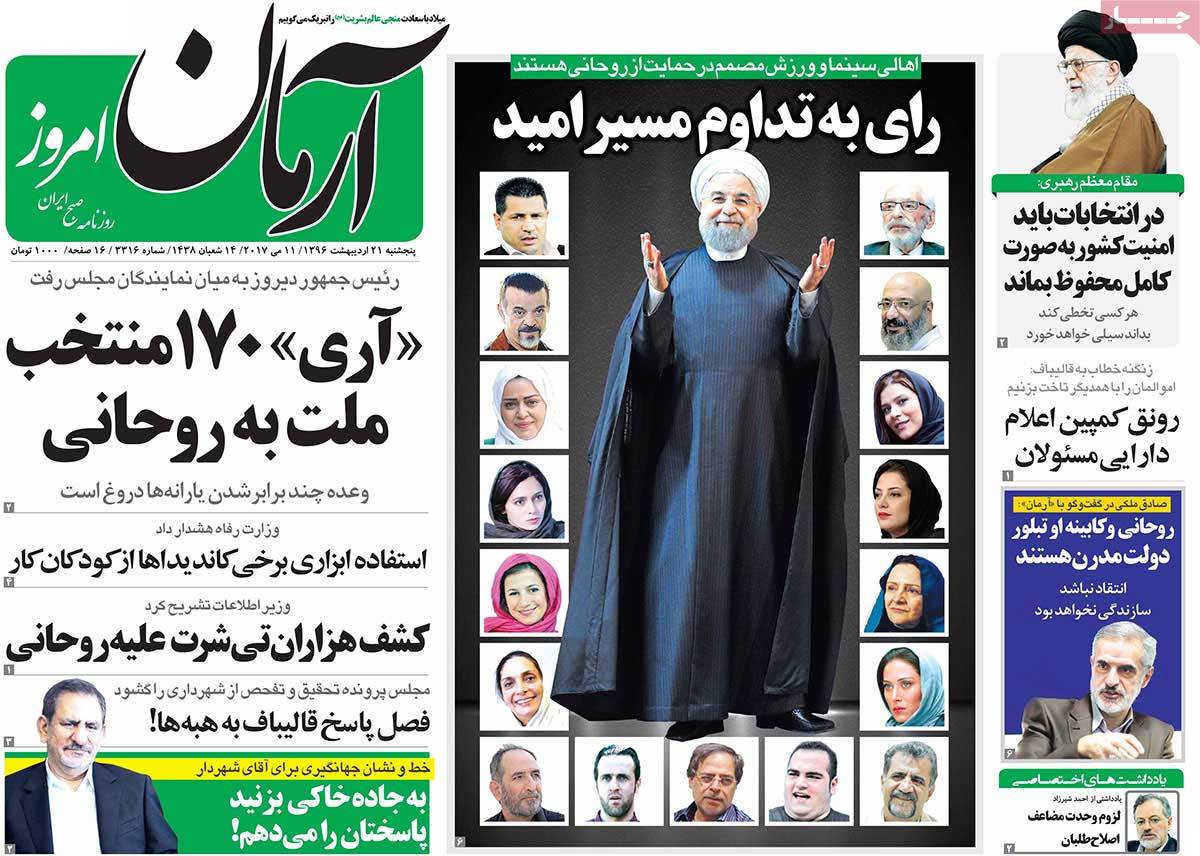
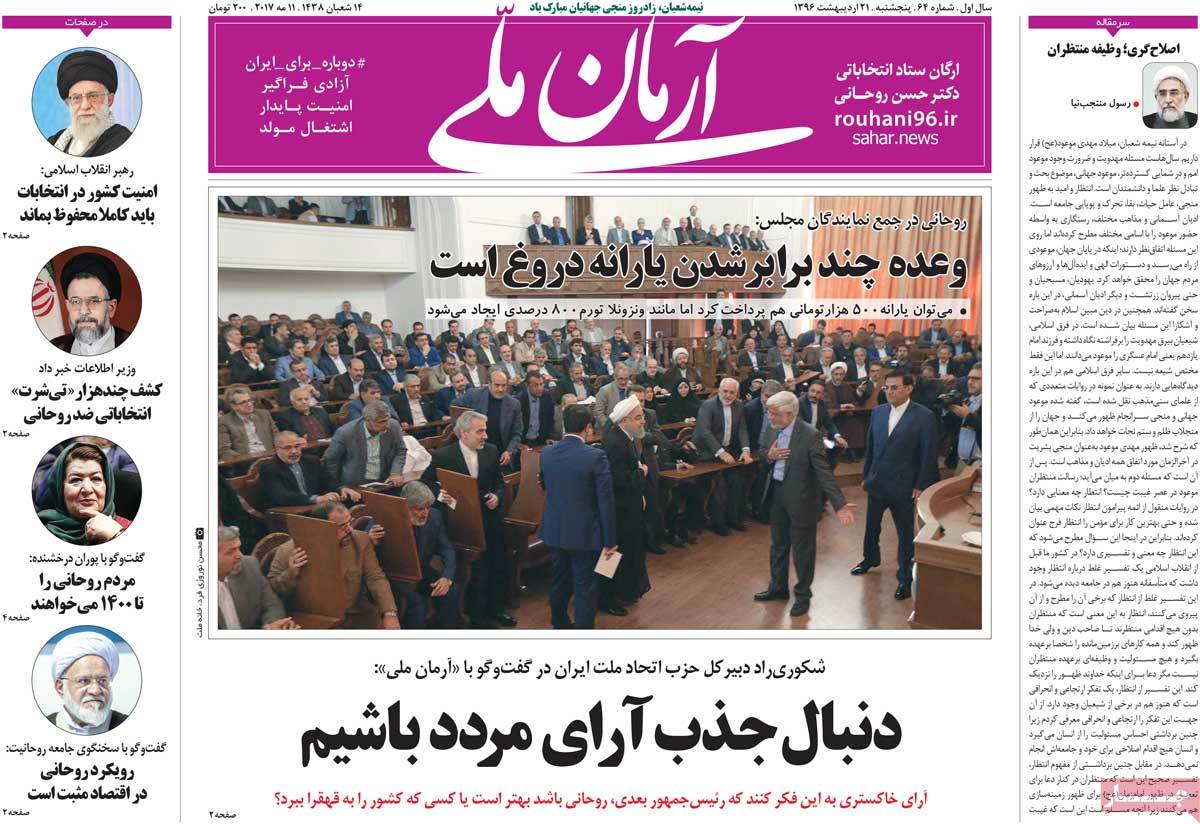
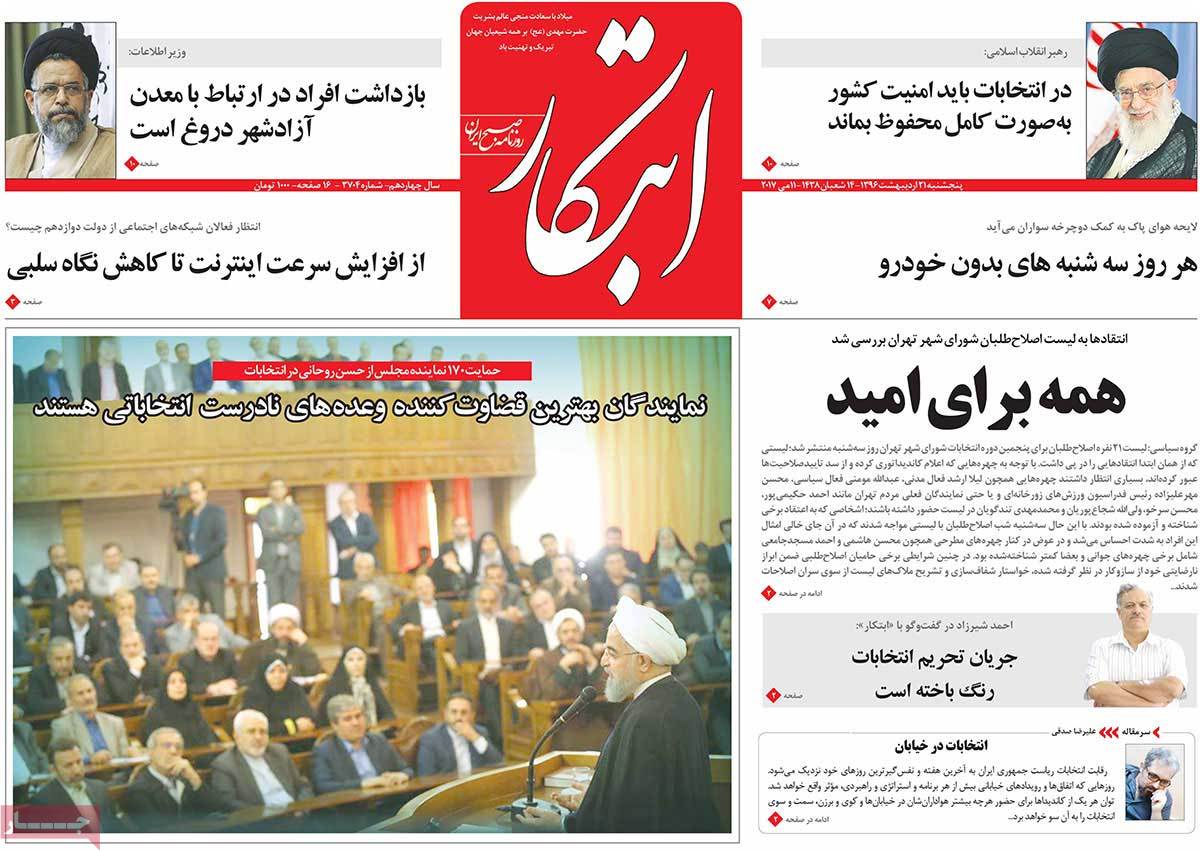
The top story today was the former president Mahmoud Ahmadinejad’s unexpected move to register to run for Iran’s presidency. Most reformist and moderate newspapers covered the surprising move, but major conservative papers decided to ignore it on their front pages.

Many newspapers also covered the other unusual candidates who are applying for Iran’s presidency in the absence of rules that prevent ordinary people from running.

The meeting between the US Secretary of State and Russian Foreign Minister in Moscow and their talks on the recent US strike on Syria also received great coverage.

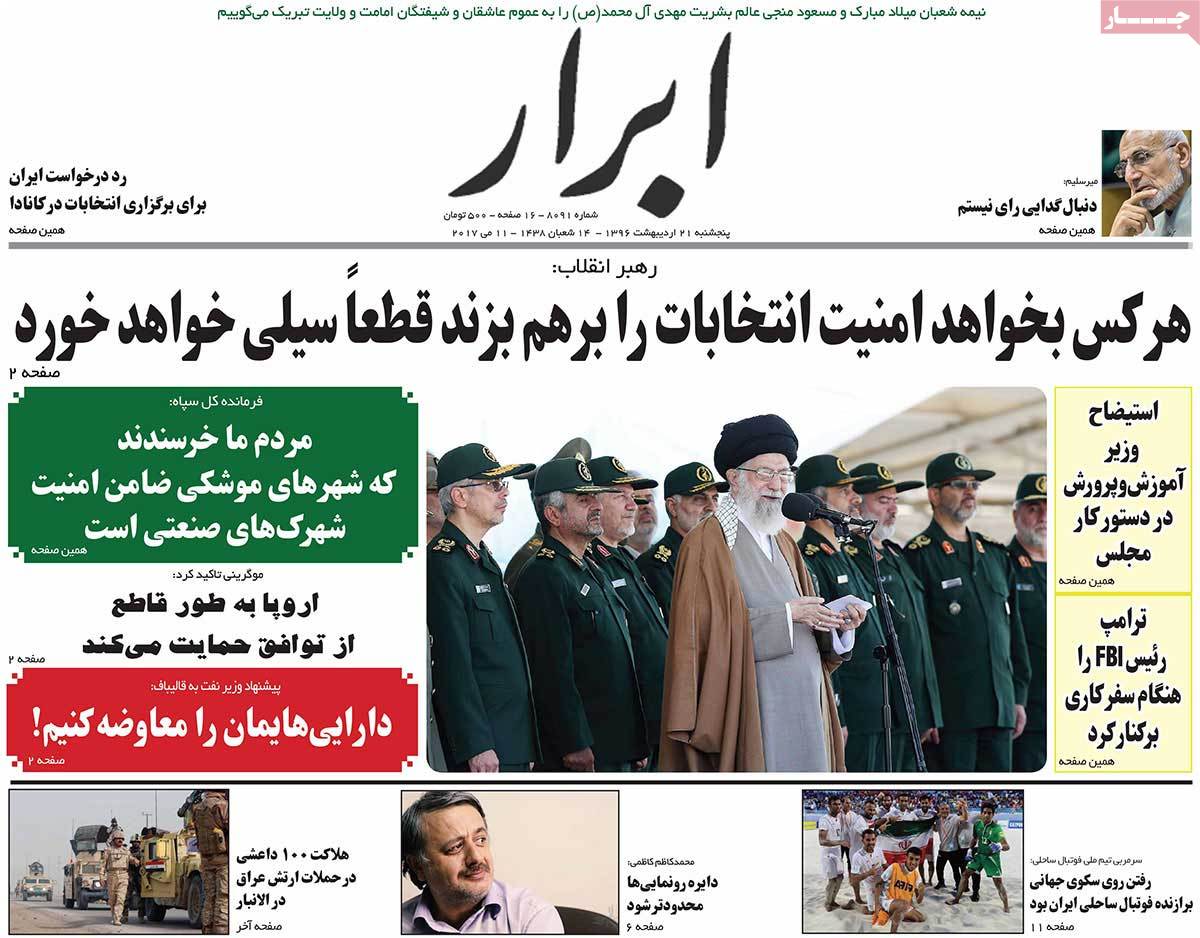
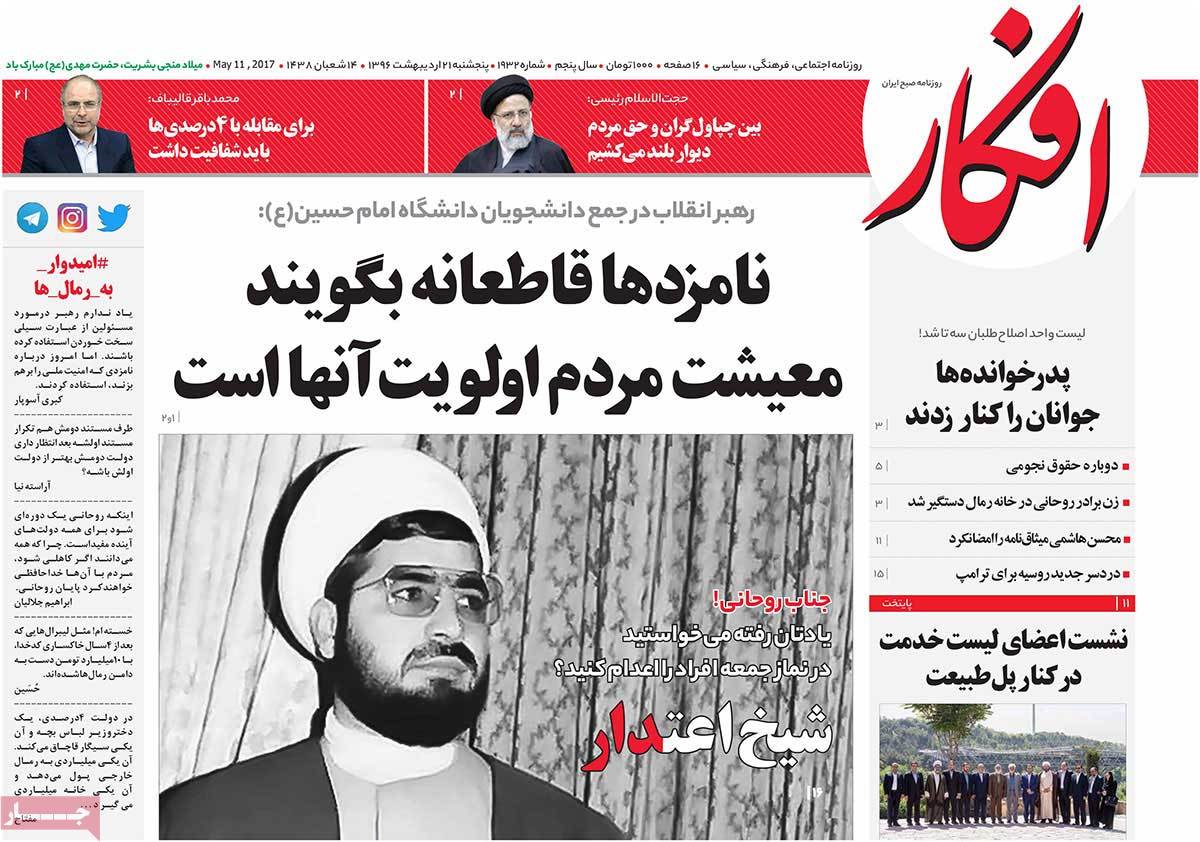
The above issues, as well as many more, are highlighted in the following headlines and top stories:


Aftab-e Yazd:

1- Ahmadinejad’s Shock: Despite Earlier Promises, Ex-President Registers for Presidency

A Look at Iranian Newspaper Front Pages on April 13


Amin:

1- Unusual Volunteers Register to Run for Iran President on Second Day


A Look at Iranian Newspaper Front Pages on April 13


Arman-e Emrooz:

1- Suspicious Sedition: Conservatives’ Reaction to Ahmadinejad’s Surprising Move

A Look at Iranian Newspaper Front Pages on April 13


Ebtekar:

1- Ahmadinejad’s Game

2- Moscow’s Dilemma: Which One to Choose, Tehran or Washington?

A Look at Iranian Newspaper Front Pages on April 13


Emtiaz:

1- Saving Lake Urmia’s Life

A Look at Iranian Newspaper Front Pages on April 13


Etemad:

1- Six Scenarios of Ahmadinejad’s Candidacy

  • Shock in Second Day: Ahmadinejad Runs for President

2- Iran’s Condition for Boeing

A Look at Iranian Newspaper Front Pages on April 13


Ettela’at:

1- G7 Calls for Immediate Cessation of Saudi Military Aggression on Yemen

2- Rouhani’s Gov’t Adds $40bn to National Development Fund Reserves

3- Biggest Projects in History of Iran’s Oil Industry to Be Unveiled Next Week

4- Iran Leader’s 10-Billion-Rial [$270,000] Aid to Quake-Hit People in Khorasan

A Look at Iranian Newspaper Front Pages on April 13


Hemayat:

1- Judiciary Spokesman: Telegram Administrators Arrested on Security, Ethical Charges

2- Prosecutor General: HQs Formed to Prevent Electoral Offenses

3- Europe Making Instrumental Use of Human Rights: Iran

A Look at Iranian Newspaper Front Pages on April 13


Iran:

1- Sharp Decrease in Contraband Goods from $25bn to $12bn

2- Lavrov: US Missile Attack on Syria Shouldn’t Be Repeated

  • Russia’s Serious Warning to Trump’s Secretary of State

3- Ahmadinejad Will Be Disqualified from Running: Conservative Analyst


A Look at Iranian Newspaper Front Pages on April 13


Javan:

1- Trump: We Have No Plan to Enter Syria War [in reaction to Russia’s threatening rhetoric]

2- Iran Army’s Ground Force to Adopt Aggressive, Rapid Reaction Approach

A Look at Iranian Newspaper Front Pages on April 13


Jomhouri Eslami:

1- Britain’s Role in Khan Shaykhun Chemical Attack

2- 287 Candidates Have So Far Registered to Run for President

3- CEO: ATR Ready to Supply Iran with Planes It Needs

4- Thousands of Britons Call on London to Apologize to Palestine

A Look at Iranian Newspaper Front Pages on April 13


Seda-ye Eslahat:

1- Ahmadinejad and His Allies Commit Political Suicide!

2- VP: I’ve Never Heard Candidates Are Disqualified Just for Being a Woman


A Look at Iranian Newspaper Front Pages on April 13


Siasat-e Rooz:

1- Aspiring for Power [Ahmadinejad’s registration]

2- No More Attack [Russia to US over Syria strike]

A Look at Iranian Newspaper Front Pages on April 13

EU Turning Blind Eye to Realities of Civil Rights in Iran: Spokesman

The Islamic Republic of Iran condemns the EU’s “double standards and political approaches” and its “abuse of human rights as a tool,” Foreign Ministry Spokesman Bahram Qassemi said on Wednesday.

He added that the EU’s extension of “unilateral, illegitimate sanctions [against Iran] under the pretext of human rights violations” was a failed, ineffective policy.

On Tuesday, the European Union extended sanctions against Iran for alleged human rights violations until April 2018.

The extended EU sanctions include a travel ban and asset freeze against 82 Iranian people and one entity as well as a ban on the bloc’s exports of certain equipment to Iran.

“Unfortunately, the EU has proved to lack a true and realistic understanding of the human rights situation in the Islamic Republic of Iran, and by adopting politically-motivated approaches it has turned a blind eye to civil rights realities in the religious, democratic establishment of Iran,” Qassemi added.

He said Iran would continue to promote and safeguard civil rights based on Islamic tenets and the country’s constitution despite the propaganda campaign against the Islamic Republic.

Iran’s Missile Tests Not Related to JCPOA, UNSC Resolution

qadr-ballistic-missile

“The Islamic Republic of Iran emphasizes that its defense missile program is in no way related to the Joint Comprehensive Plan of Action (JCPOA) and the nature and design of Iran’s ballistic missiles are such that the tests do not contravene UN Security Council’s Resolution 2231,” Iranian Foreign Ministry Spokesman Bahram Qassemi said in a statement late on Wednesday.

Resolution 2231 was adopted on July 20, 2015 to endorse the JCPOA.

Obviously, the Islamic Republic will continue to enhance its defense capacities to safeguard its national security and boost regional peace and stability regardless of how Western parties perceive the country’s defense program.

Qassemi’s remarks came in response to a recent statement by the G7 countries, which claimed that Iran’s missile tests were “inconsistent” with Resolution 2231.

The International Atomic Energy Agency (IAEA) has repeatedly confirmed Iran’s compliance with its commitments under the JCPOA, he continued, stressing the need for the commitment of all parties to implement the agreement to help guarantee the sustainability of the deal.

Tehran and the Group 5+1 (Russia, China, the US, Britain, France, and Germany) reached the deal on July 14, 2015 and started implementing it on January 16, 2016.

The comprehensive nuclear deal terminated all nuclear-related sanctions imposed on Iran.

Tehran has repeatedly stated that its military might is defensive in nature and poses no threat to other countries.