Friday, December 26, 2025
Home Blog Page 4005

Saudi Arabia Not to Succeed in Yemen Even in Next 20 Years: Iran Leader

Addressing a ceremony held on Sunday to mark the 28th anniversary of the demise of the founder of Islamic Republic Imam Khomeini, the Leader expressed regret that Muslims in some countries, including Yemen, Syria, Bahrain and Libya, were facing numerous problems even in the holy fasting month of Ramadan.

“The Saudi government is bombarding Yemen day and night and exerting pressure on Yemen. Definitely, this is a mistake,” Ayatollah Khamenei said.

“The Saudi government must know that if it proceeds with such an approach even for the next 10 or 20 years, it will fail to achieve a victory against the Yemeni people. This is a crime against the innocent people and will bear no fruit.”

The Leader also condemned the “illogical” presence of Saudi Arabia in Bahrain and said the Bahraini government must engage in negotiations with the people of the country.

Ayatollah Khamenei criticized acts of intervention by a foreign country and Riyadh’s policymaking in Bahrain, saying such moves were “irrational and unwise” and would create problems for nations, according to Press TV.

It is wrong and inefficient to impose one’s own will on a nation, the Leader said, adding that this policy would never yield a result “even if it is accompanied by hundreds of billions of dollars in US bribes.”

Ayatollah Khamenei further criticized the wrongful presence of foreign countries in Syria contrary to the will of its government and nation, stressing, “The Syrian issues must be solved through dialogue.”

The Leader warned that enemies were waging “proxy wars” in Syria, Bahrain and Yemen as well as other parts of the Muslim world.

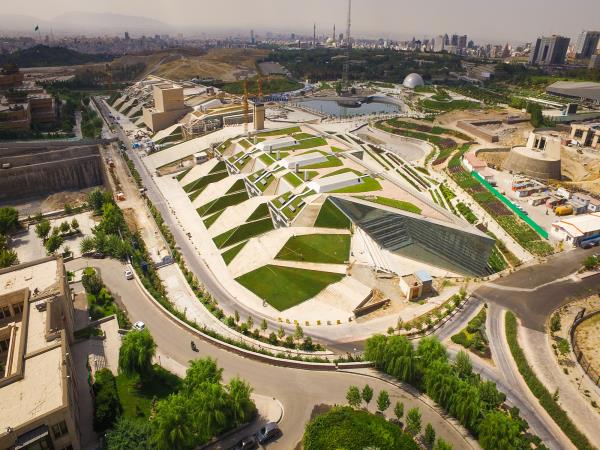
Iran’s Beauties in Photos: Sattarkhan Reservoir

Sattarkhan dam and its reservoir in Ahar, a city in northwestern Iran, are among the country’s top tourist destinations, according to Iran’s Cultural Heritage, Handicrafts, and Tourism Organization (ICHTO).

The dam’s water is used to irrigate 12,000 hectares of gardens, making the city and its suburbs even more enjoyable for thousands of tourists visiting the place annually.

Here are ISNA’s photos of the dam and its reservoir:

Iraqi Forces Retake Baaj Town from ISIS Terrorists

The recapture of Baaj will further shrink the northern region under the extremists’ control as part of an ongoing campaign to retake the city of Mosul, the Iraqi military said on Sunday.

Eight months into the Mosul offensive, ISIS militants have been dislodged from all of the city except an enclave along the western bank of the Tigris river, according to Reuters.

The ISIS’ grip on the Iraqi side of the northern region along the border with Syria, a desert area where sources believe ISIS leader Abu Bakr al-Baghdadi is hiding, has been ebbing as forces fighting on the side of Iraq’s government have advanced.

Iran Slams Trump’s ‘Irresponsible’ Exit from Paris Agreement

trump-environment

Speaking at a ceremony in the White House Rose Garden on Thursday, Trump said he was withdrawing the US from the Paris Climate Agreement.

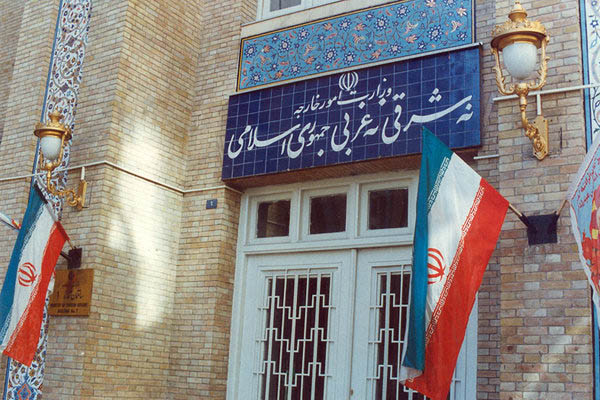
Bahram GhasemiIn reaction, Iran’s Foreign Ministry Spokesman Bahram Qassemi stressed on Saturday that the US withdrawal from the Paris accord indicates the irresponsibility of this country’s government vis-à-vis the international community.

“Climate changes have caused big global challenges and combating the horrific consequences of them requires complete and sincere cooperation of all countries, particularly industrialized governments,” he added.

He emphasized that these changes would have “destructive impacts” on developing countries, especially in West Asia, including excessive rise in temperature, vast economic and social damage, drought, dust storm, newly-emerging diseases, displacement and immigration.

The Iranian spokesperson condemned as “unacceptable” the lack of commitment to the Paris agreement by a country that is the second largest producer of greenhouse gases.

He urged the international community to compel the new US administration to completely and precisely implement Washington’s international commitments, Press TV reported.

It is imperative to avoid undermining international agreements such as the Paris accord, which is a symbol of joint cooperation among countries across the world and enhanced multilateralism, he said.

Qassemi added that the Islamic Republic believes that the US cannot shirk its responsibility towards climate changes emanating from greenhouse gas emissions by its “irresponsible” withdrawal from the Paris agreement.

Iran Slams Trump’s ‘Irresponsible’ Exit from Paris AgreementMassoumeh Ebtekar, the head of Iran’s Department of Environment (DoE), also slammed Trump’s move as a completely unscientific and uncalculated one.

However, she added, the Paris agreement is an international accord and will not collapse by the withdrawal of one country.

She described the Paris agreement as a “golden” accord reached amid high tensions, adding that the deal promotes convergence among countries across the world.

All countries have come to the conclusion that the environment is a common issue in the world, she said, adding, “Therefore, the US unilateral act will have no impact [on the agreement] and will bear no fruit.”

Ebtekar further highlighted the significance of the Paris agreement for the oil producing and exporting countries and said many oil-rich states have so far joined the pact.

“The Iranian administration has also carried out all legal measures to join the Paris accord and we are now waiting for the Guardian Council to make a decision in this regard,” the vice president added.

“In the Paris agreement, Iran has committed to reduce its greenhouse gas emissions by four percent without any precondition and by eight percent provided that sanctions [against the country] were lifted,” Ebtekar said.

The Paris climate accord is an agreement within the United Nations Framework Convention on Climate Change (UNFCCC) dealing with greenhouse gas emissions mitigation, adaptation and finance starting in the year 2020.

It was negotiated by representatives of 195 countries at the 21st Conference of the Parties of the UNFCCC in Paris and adopted by consensus on December 12, 2015. Since June 2017, 195 UNFCCC members have signed the agreement, 148 of which have ratified it.

In the Paris agreement, each country determines its own contribution it should make in order to mitigate global warming. There is no mechanism to force a country to set a specific target by a specific date.

How Iran’s Talks with Brzezinski Led to Hostage Crisis

Former Iranian Foreign Minister Ebrahim Yazdi has, in a Farsi interview with the Entekhab news website, talked about his meeting in Algeria back in 1979 with Zbigniew Brzezinski, the late advisor to then US President Jimmy Carter.

In that meeting, Yazdi was accompanied by then Iranian Prime Minister Mehdi Bazargan and Defence Minister Mostafa Chamran. The following is the highlights of Yazdi’s interview with the Shargh daily newspaper.

If we have differences with Americans, we should sit down and talk to them. Brzezinski was a good party for negotiations. In political negotiations, it’s important to see who the other side is. Some negotiators are off the track and don’t know what’s going on. There’s nothing you can do about them during talks. But Brzezinski was a very smart and canny negotiator. He had good knowledge of what he was talking about. He knew what he was doing.

We wanted to reach agreement on relations between Iran and the US. Brzezinski was a prominent American politician, and he was the best person to negotiate with if we wanted to reach agreement with Washington on issues over which we had differences.

I don’t remember [which side first expressed willingness to start the negotiations], but both sides felt they ought to sit down for talks. Under those circumstances, it was a necessity.

[Asked what the main topic of the talks was, given that the US embassy in Tehran had not yet been seized by Iranian students, Yazdi replied] In fact we wanted understanding [on the part of Americans] on Iran’s Islamic Revolution. It was very important for us to make US officials understand the stances of the Islamic Revolution and those of Iran. We wanted them to accept the revolution because they were afraid of it.

Brzezinski was an anti-revolutionary figure. He was not only against our revolution, but against any other revolution. He was against, because they could not accept revolutionary positions.

Brzezinski was a [Polish] Jew. Russians had persecuted the Poles throughout history and even after the October revolution, and Brzezinski had very bad memories [of them]. So, he thought Iran’s revolution might have similar consequences as well. Basically, they were upset about the revolution and were not optimistic about it.

Generally speaking, Brzezinski was very sceptical about the role of the Soviet Union, and maybe that was because he had a Polish background. Maybe he regarded Iran’s revolution as an Achilles heel to pave the way for the Soviet Union’s further infiltration into the region. He was worried that the revolution might prompt Iran, as a reliable partner for the US, to lean towards Russia. Yes, Americans were concerned about that.

The talks in Algiers included two or three short sessions held on several days in a row. It was the anniversary of the Algeria revolution. We had gone there to take part in the celebrations. It was Algerians that mediated the talks.

We (Yazdi, Bazargan and Chamran) had reached consensus. We had talked together prior to meeting Brzezinski and decided what to say, what to do and how to deal with Americans during the negotiations.

We wanted Washington to return the [toppled Iranian dictator] Shah to us, because Mohammad Reza Shah staying in the US could create trouble for us. We insisted that he be returned. Americans could strengthen him. He’d been hurt by the revolution. We were worried that the Shah might get along with US authorities, which could harm the revolution.

We were worried that an incident similar to the 1953 Iranian coup might happen again because the [Islamic] Revolution [of Iran] had not been stabilized by then and we had numerous problems; so, we were right to be worried.

[Asked whether he thought the US embassy takeover would happen a few days after their return, he replied] In Iran, there were some who wanted us to reach agreement with Americans, and there were some who didn’t. The second group wanted Iran to keep having hostile relations with the US. Most leftist groups had this idea. They didn’t want to see the normalisation of ties. The point is, national interests made it all the more necessary for us to get along with Americans, but the leftists didn’t want us to. The wide range of leftist groups, Islamists and non-Islamists alike, were all unhappy to see us reach agreement; so, they showed reaction. Of course, we anticipated such opposition, but didn’t think the opposition would be so widespread.

[Asked whether he thinks it was the Iranian team’s meeting with Brzezinski that led to the capture of the US embassy in Tehran, or that there were other factors involved, Yazdi said] The leftists were naturally opposed to amelioration of Iran’s relations with the US. They were worried over our meeting with a US politician. Moreover, we, as the negotiating team, had good knowledge of the issues at hand, and we didn’t just talk the talk. We knew how to behave towards Americans. But there were some people who were against improvement of ties between Tehran and the White House, and that’s why they showed reaction.

All of us three negotiators agreed that we should reach agreement with the US. There was nothing else that Washington could do, after all. What did the US want to do?! At the same time, it was in our interest to clinch a deal with the US.

[Asked if those talks had continued, we wouldn’t be facing the issue of the Iranian assets frozen by Washington, the problem of blocked bank accounts would have been settled, our arms deal with the US would have been implemented and we wouldn’t have had any problem buying weapons during the Iraqi imposed war on Iran in the 1980s, he answered] Yes, if the negotiations had continued, our problems would have been solved. Continued talks could have had the results just mentioned.

After we returned to Tehran and the US embassy was seized, our contact with Washington was severed and talks with Brzezinski ended. There was no point in negotiating anymore.

[Question: First Brzezinski made every effort and engineered different scenarios to harm Iran and deal a blow to Iran’s Islamic Revolution, but he had changed in recent years and called for reaching agreement with Iran. Do you think he changed due to the passage of time? Or was it the revolution that changed?]

No, the revolution didn’t change. Revolutionaries didn’t change, either. But Americans somehow became realistic. What else could they do, after all? Iran’s revolution emerged victorious and was in a position of power.

In a joint interview that I had with Newsweek together with Brzezinski a few years ago, I can say he hadn’t changed at that time, either. But he was prudent enough to adapt himself to the situation. Even the circumstances under which the recent nuclear negotiations were held between Iran and the P5+1 countries had changed compared to the past. Of course, our managers and officials have changed, too. We cannot push back a standing wall. We have become realistic. All of us learn from events. Americans, too, leaned lessons from the failure of earlier talks, and learned to modify their positions, and they did so [during the recent nuclear negotiations with Iran].

IAEA Confirms Iran Has Complied with Nuclear Deal

Iran’s stock of low-enriched uranium as of May 27 was 79.8 kilograms, well below the agreed limit of 300 kilograms, the IAEA said in a confidential report on Friday.

It added that the level of uranium enrichment did not exceed a 3.67 percent cap – well under the maximum five percent regarded as suitable for civilian energy uses.

The new IAEA report, the second since the January inauguration of US President Donald Trump, was sent to the member states amid increasing tensions between Tehran and Washington. Trump has called the nuclear agreement, known as the Joint Comprehensive Plan of Action (JCPOA), “the worst deal ever negotiated” and vowed to “dismantle” the “disastrous” deal.

According to the quarterly assessment, Iran’s stock of heavy water, a chemical used as a moderator in a type of nuclear reactor that can produce plutonium, was 128.2 tonnes on May 16. Under the JCPOA, Tehran has agreed to keep its heavy water stockpile below 130 metric tonnes.

Iran and the five permanent members of the United Nations Security Council – the United States, France, Britain, Russia and China – plus Germany signed the mammoth agreement in July 2015 and started implementing it in January 2016.

Under the JCPOA, Iran undertook to put limitations on its nuclear program in exchange for the removal of nuclear-related sanctions imposed against Tehran.

The UN nuclear agency, in its quarterly report in February, the first since President Trump’s inauguration, said the Islamic Republic has stockpiled roughly half of the enriched uranium allowed under the JCPOA.

“As of 18 February 2017, the quantity of Iran’s uranium enriched up to 3.67 percent U-235 was 101.7 kg,” the IAEA said, adding that it is well below the agreed level of 202.8 kilos, which is equivalent to 300 kilos of uranium hexafluoride.

CIA Appoints ‘Ayatollah Mike’ as New Chief of Iran Operations

CIA Appoints ‘Ayatollah Mike’ as New Chief of Iran Operations

D’Andrea, who is also known as the Dark Prince or Ayatollah Mike due to his role in the arrest of Osama bin Laden, will be running the CIA’s Iran operations, according to current and former intelligence officials.

Ayatollah Mike, a chain-smoking convert to Islam, has come with an outsize reputation and the track record to back it up. The New York times says no single CIA official is more responsible for weakening Al Qaeda.

Michael D’AndreaD’Andrea grew up in Northern Virginia in a family whose ties to the CIA span two generations. He met his Muslim wife on a CIA posting overseas, and converted to Islam to marry her, though he is not known to be particularly observant.

According to a report by IFP, his wife Faridah Currimjee D’Andrea is 10 years older than him, and the two are now living in Vienna, Virginia. Mauritius Island is where Faridah comes from, but she originally belongs to a rich family in Gujarat, India.

There is no official photo of D’Andrea, and the US media are not allowed to disclose his identity and photos; however, there are a couple of old photos of him.

CIA Appoints ‘Ayatollah Mike’ as New Chief of Iran OperationsAt the CIA, D’Andrea’s reputation for operational acumen is matched by his abrasive demeanor. “Surly” seems to be the most popular description, say those who have worked alongside him, and some people at the agency have refused to work for him.

Colleagues describe him as a collection of contradictions. A chain-smoker who spends countless hours on a treadmill. Notoriously surly yet able to win over enough support from subordinates and bosses to hold on to his job. He presides over a campaign that has killed thousands of Islamist militants and angered millions of Muslims, but he is himself a convert to Islam.

To those in the CIA, he’s the Undertaker, the Dark Prince, Ayatollah Mike. To Hollywood, he’s the Wolf, immortalized in Zero Dark Thirty, a film about the manhunt for Osama Bin Laden. To the general public, he is nobody, as he is still undercover, a man who has spent 38 years toiling at the CIA, his dutiful service resulting in the deaths of hundreds of people. He is stubbled and gaunt, with a preference for dark suits, his colleagues say, and he has a bad attitude, according to News Week.

People like D’Andrea do not seek the spotlight. Though he joined the CIA in 1979, it was not until April 2015 that a New York Times journalist, Mark Mazzetti, finally outed him. A month after D’Andrea left his post as director of the CIA’s Counterterrorism Center (CTC), Mazetti identified the man—known previously only as “Roger”—who had “presided over the growth of CIA drone operations” during nine years as CTC chief.

Two years later, D’Andrea has landed a new job within the CIA. On June 2, the Times reported that “Ayatollah Mike” will be running the agency’s Iran operations, in what amounts to a show of strength against the country President Donald Trump has branded “the number one terror state.”

Mr. D’Andrea’s personal views on Iran are not publicly known. It is also not his job to make policy but to execute it, and he has demonstrated that he is an aggressive operations officer.

Murderer of Soleimani Killed in US Plane Downing in Afghanistan
Murderer of Soleimani Killed in US Plane Downing in Afghanistan: Sources

Operatives under his direction played a pivotal role in 2008 in the killing of Imad Mugniyah, the international operations chief for the Lebanese Resistance Movement Hezbollah, which is backed by the Islamic Republic of Iran. Working with the Israelis, the CIA used a car bomb kill to Mr. Mugniyah as he walked home in Damascus, where Hezbollah enjoys strong ties with and support from the Syrian government.

At the same time, Mr. D’Andrea was ramping up the drone program inside Pakistan. Drones became the preferred counterterrorism tool of President Barack Obama, who personally approved strikes targeting militant leaders.

20 Killed, 35 Wounded in Fresh Kabul Bombings

Saturday’s funeral ceremony in Kabul was attended by Afghanistan’s Chief Executive Abdullah Abdullah and a number of other senior officials, but later reports showed that Abdullah has survived the blasts.

The funeral was being held for a protester, the son of Senator Mohammad Alam Izdyar, who was killed during demonstrations a day earlier demanding better security in the country.

Friday’s protesters took to the streets to decry perceived security failures after a massive blast on Wednesday killed at least 90 people in Kabul.

At least four people died in Friday’s protests, according to Al Jazeera.

TOLO news, an Afghan news outlet, posted images to its Twitter feed showing bodies blasted to pieces after the explosions.

“Imam Khomeini Refused Offer to Teach in UK”

Ayatollah Haj Sheikh Azizollah Khosravi Zanjani, a student of the late Leader of Iran’s 1979 Islamic Revolution and founder of the Islamic Republic Imam Khomeini, had shared a memory prior to his death in 1995, in which Imam had declined an offer by two British governors to go to the UK and lead philosophy classes there.

Ayatollah Khosravi Zanjani said Imam Khomeini would not exchange an hour of attending classes taught by Ayatollah Hossein Tabatabaei Boroujerdi, one of his teachers and colleagues, with the entire British government.

Ayatollah Khosravi Zanjani’s memory is recounted here to mark the 28th anniversary of Imam Khomeini’s demise (June 4, 1989):

“[Up until that day], I had never had the chance of attending Imam Khomeini’s Islamic jurisprudence classes. At that time, we used to live in the central Iranian province of Qom. He taught Islamic wisdom. At first, he used to teach in a classroom in Faydiyya Seminary – one of the important schools of the Seminary of Qom and a major place for teaching Shiite teachings in Iran. I was among the 10 to 15 students who attended this class.

Imam Khomeini said he would not exchange an hour of attending Ayatollah Boroujerdi’s classes with the entire British government.

Imam was very dear to Ayatollah Boroujerdi and was greatly respected by him. One day, two British governors had gone to visit Ayatollah Boroujerdi at his home and raise a few philosophical questions. Ayatollah Boroujerdi had referred them to Imam Khomeini, who was known as ‘Haj-Aqa Rouhollah’ in those days.

Imam Khomeini, who was then present in Ayatollah Boroujerdi’s house, received them in another room and answered their questions.

By chance, I was also there […] and found the opportunity to attend Imam Khomeini’s session with the British governors, which was very interesting.

Someone translated the questions and answers for Imam Khomeini and the British. On hearing the answers, they nodded their head as a sign of approval.

At the end of the discussion, one of them told the translator [to tell Imam] that they had discussed the questions with different philosophers in non-Muslim and Muslim countries, even in [the Iranian capital of] Tehran and none of whom could have convinced them to the extent that Imam had done.

They said in case Imam Khomeini was willing to, they would very much like him to go to the UK to teach European philosophers there. They added they knew Imam would be more useful in their country.

At that time, I had been attending Imam Khomeini’s classes for quite a few while and enormously enjoyed them. While the interpreter was translating their offer for Imam Khomeini, I got worried by the thought that Imam Khomeini would accept their offer and deprive me of the chance and honour of attending his classes.

Those thoughts were running through my mind when Imam told the translator to tell the gentlemen he would not exchange an hour of attending Ayatollah Boroujerdi’s classes with the entire British government.

Those days, Imam used to attend Ayatollah Boroujerdi’s classes every day after teaching his own courses.”

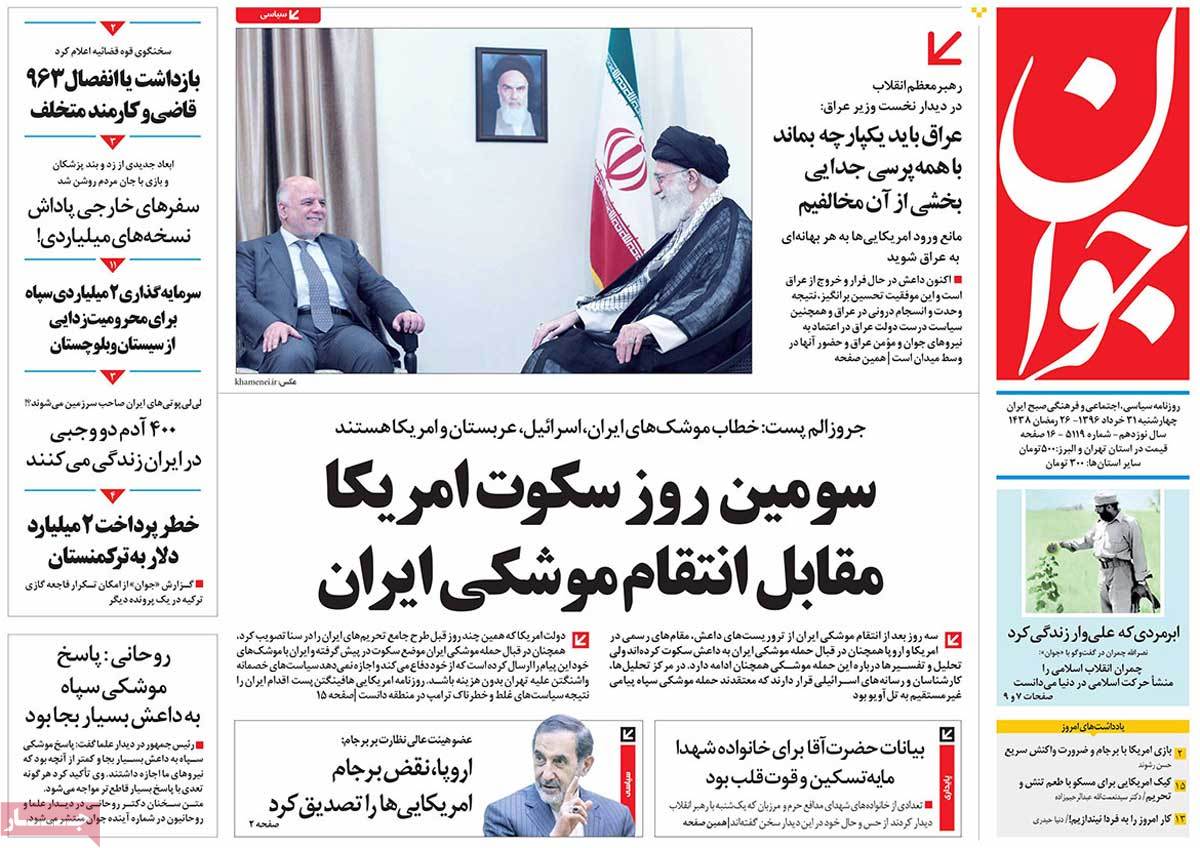
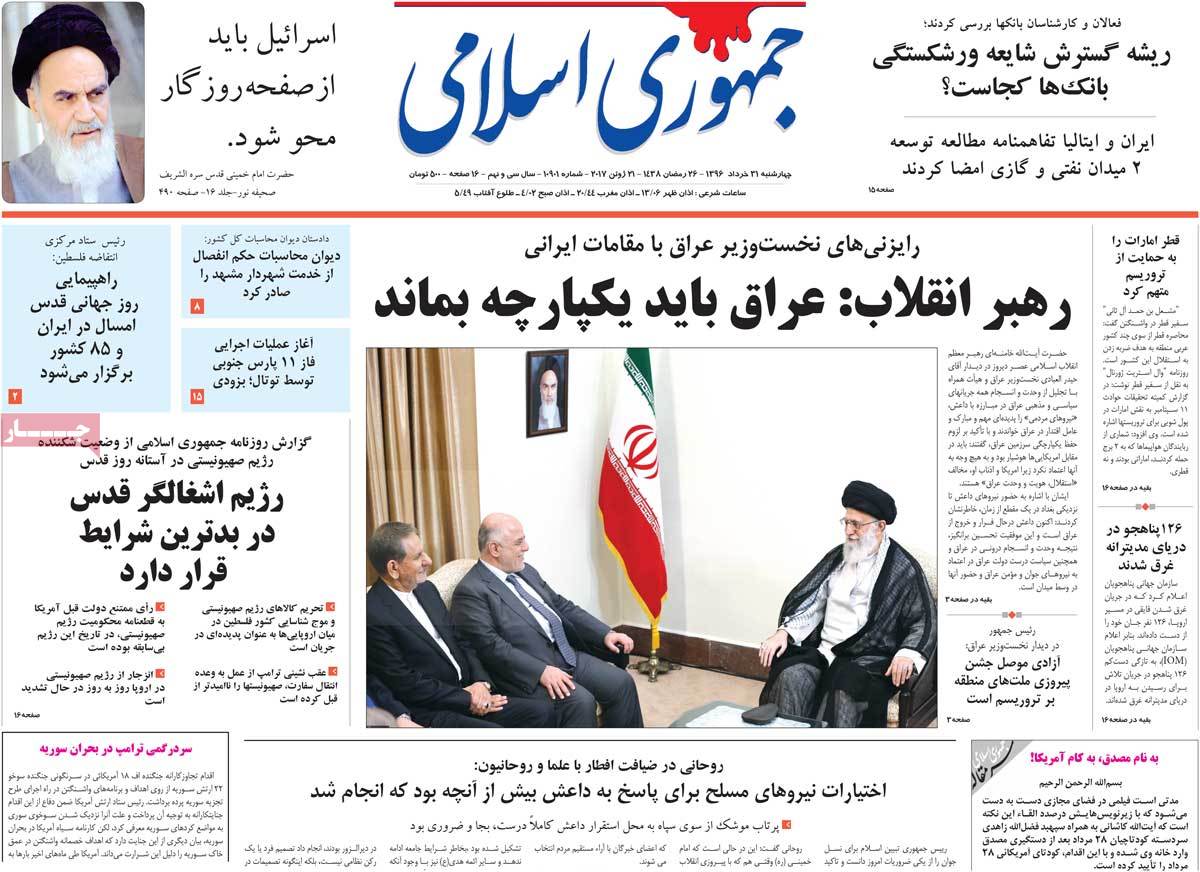
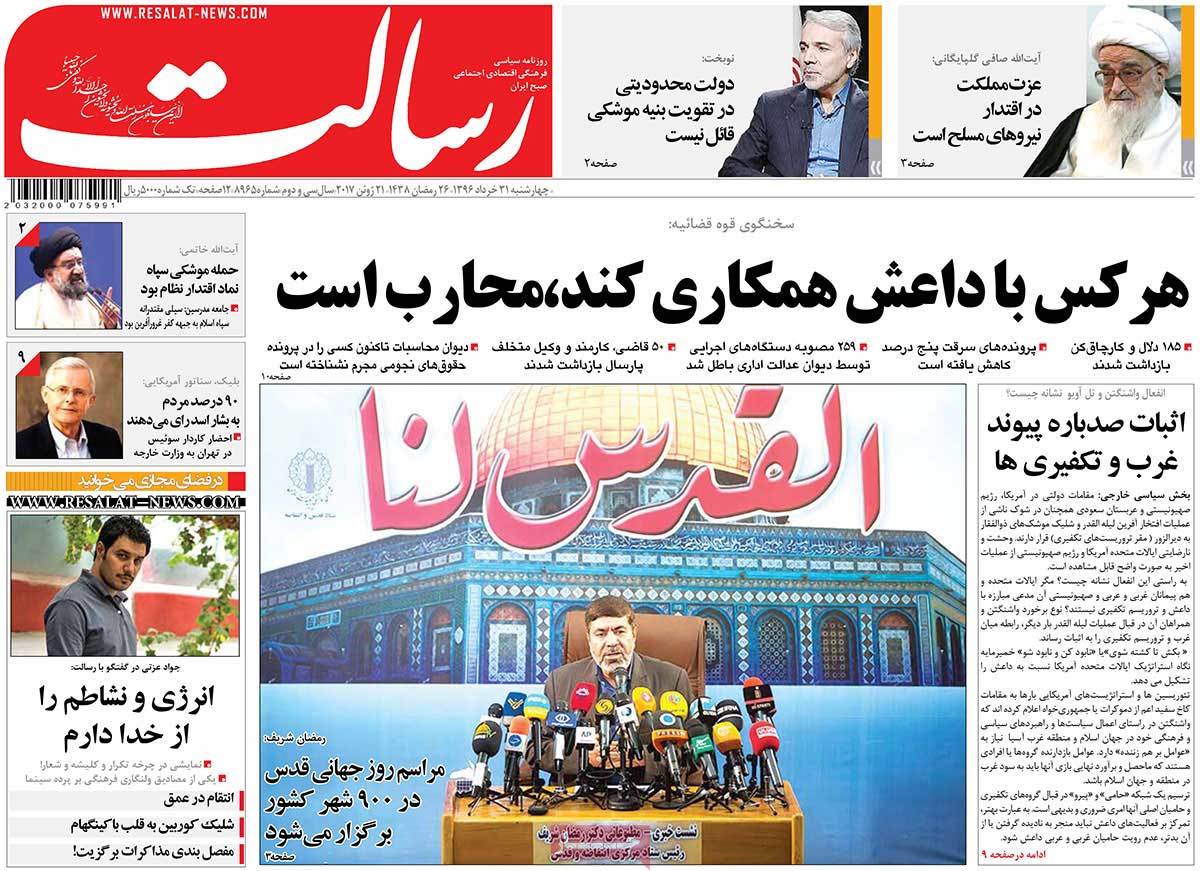
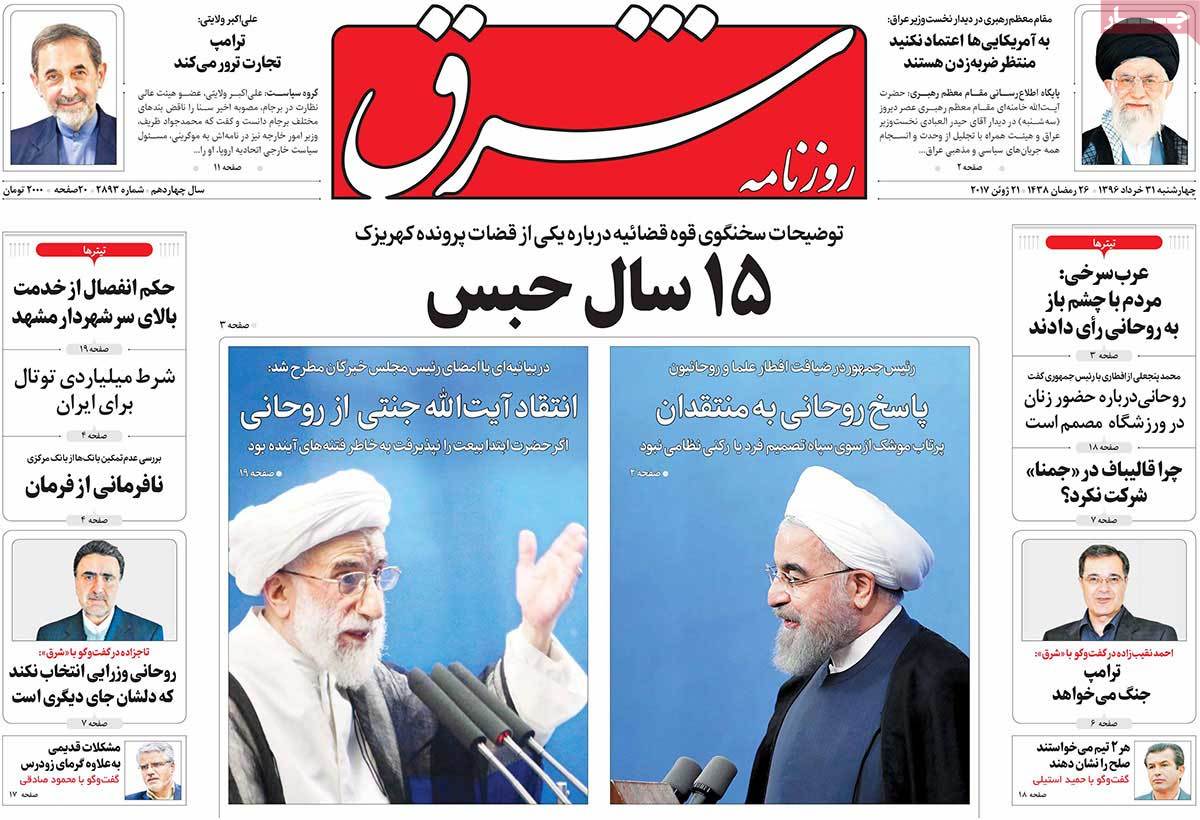
A Look at Iranian Newspaper Front Pages on June 3

Aftab-e Eqtesadi:

1- Iran, Turkey Have $100 Million worth of Trade Exchanges

http://www.jaaar.com/assets/images/pishkhan/1396/3/13/0245952e.jpg


Aftab-e Yazd:

1- Trump’s Shock to World: US Exits from Paris Agreement

2- Huge Anti-Gov’t Protest Rally in Afghanistan

3- Newly-Released Photo Shows Iranian Fugitive Banker in Canada

http://www.jaaar.com/assets/images/pishkhan/1396/3/13/5878a7ab.jpg


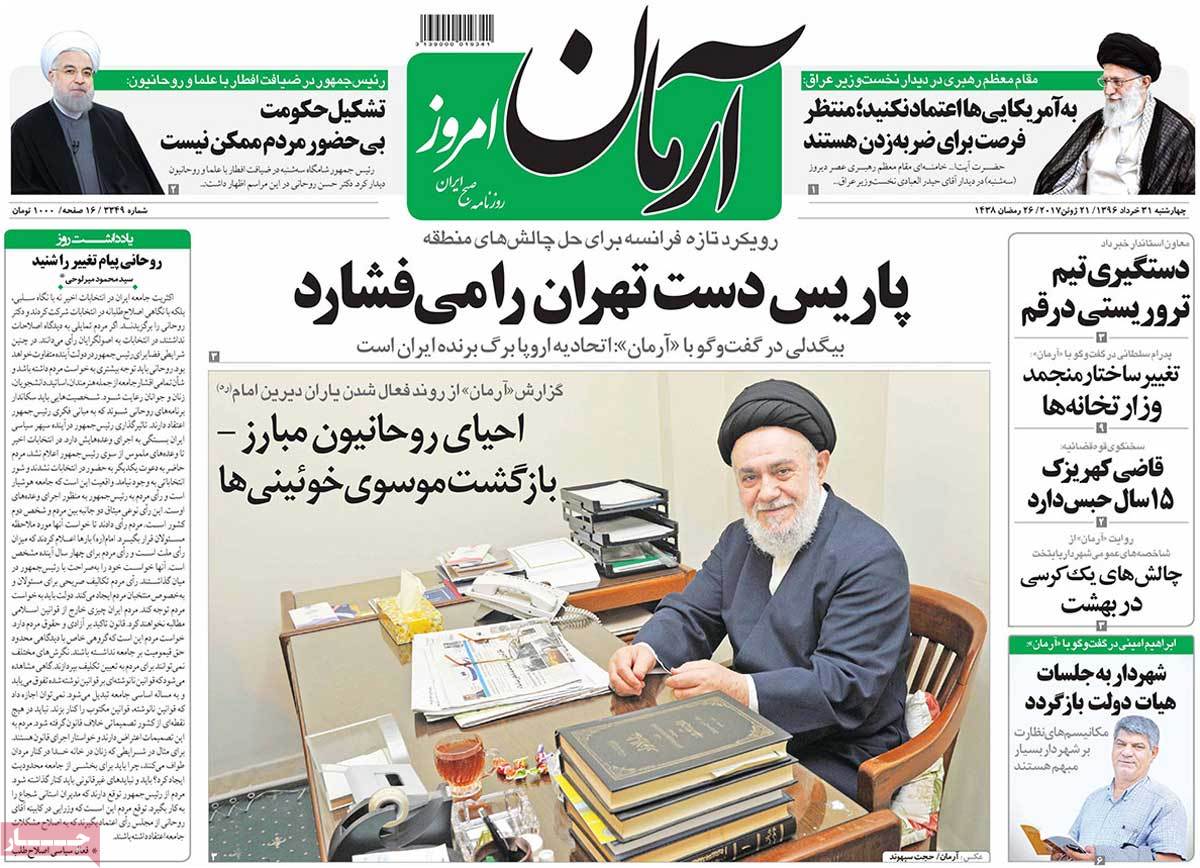
Arman-e Emrooz:

1- Senior Conservative Bahonar: We Admit We’ve Lost Iran Elections

2- Tehran Friday Prayers Leader: Muslims Should Rise against Saudi Rulers

3- Imam Khomeini Was against Reactionary Attitudes


A Look at Iranian Newspaper Front Pages on June 3


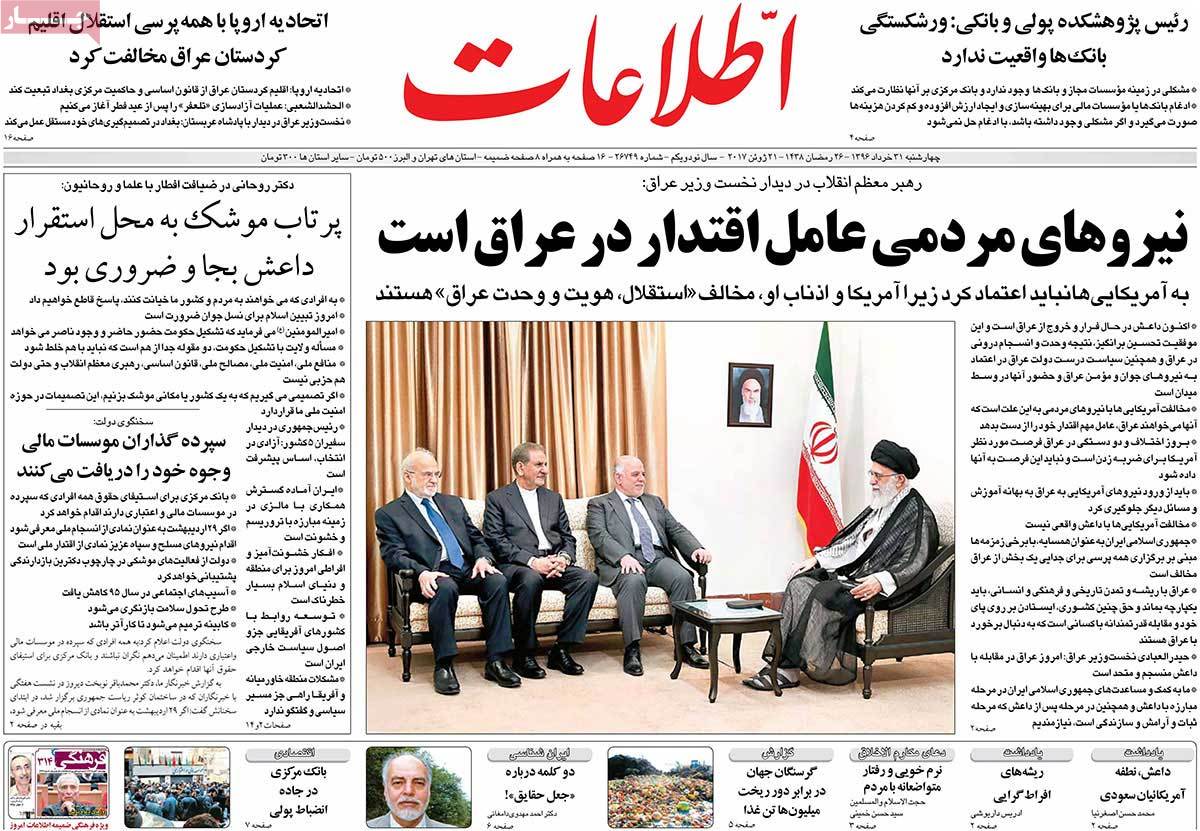
Ettela’at:

1- Iranian Nation, Leader Real Winners of Iran Elections: President

2- 250,000 Muslims Say Prayers in Aqsa Mosque in First Friday of Ramadan

A Look at Iranian Newspaper Front Pages on June 3


Ghanoon:

1- Saudis Begging for Putin’s Help

  • A Report on Moscow’s Secret Deal with Riyadh

A Look at Iranian Newspaper Front Pages on June 3


Haft-e Sobh:

1- Global Mobile Service Providers Fight over Iran’s Market

A Look at Iranian Newspaper Front Pages on June 3


Hamshahri:

1- US against Survival of Earth

  • Harder Life for People on Earth after US Exit from Paris Agreement

A Look at Iranian Newspaper Front Pages on June 3


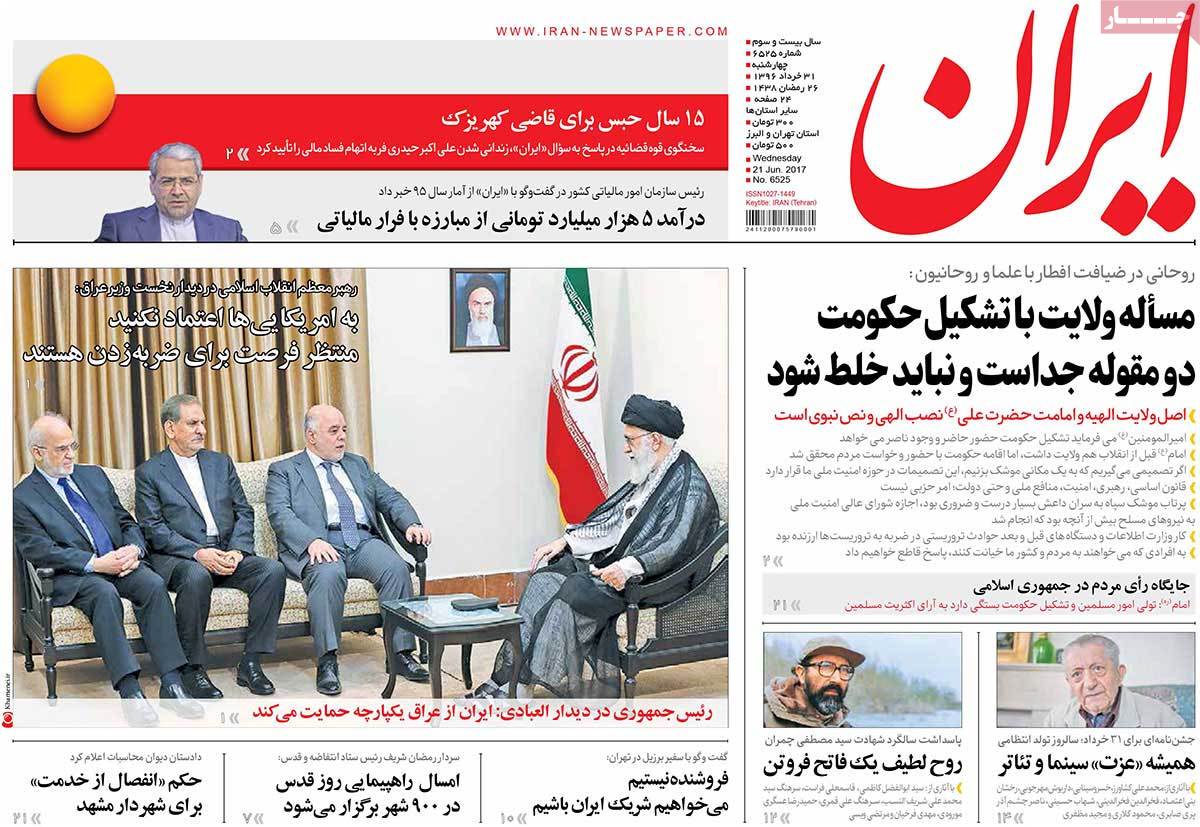
Iran:

1- Central Bank: Iranian People’s Bank Deposits to Be Safeguarded

2- World Surprised by Trump’s Environmental Decision

3- Interior Minister to Probe into Recent Employments in Tehran Municipality

A Look at Iranian Newspaper Front Pages on June 3


Jahan-e San’at:

1- US in Danger of Being Isolated after Trump’s Last Blow to Paris Agreement

A Look at Iranian Newspaper Front Pages on June 3


Jame Jam:

1- Unbreakable Allegiance to Imam Khomeini and Ayatollah Khamenei

A Look at Iranian Newspaper Front Pages on June 3


Jomhouri Eslami:

1- Iran’s Deal with Russia’s Gazprom for Development of Farzad B Gas Field

2- 7 Killed, Dozens Injured in Anti-American Protest Rallies in Kabul


A Look at Iranian Newspaper Front Pages on June 3


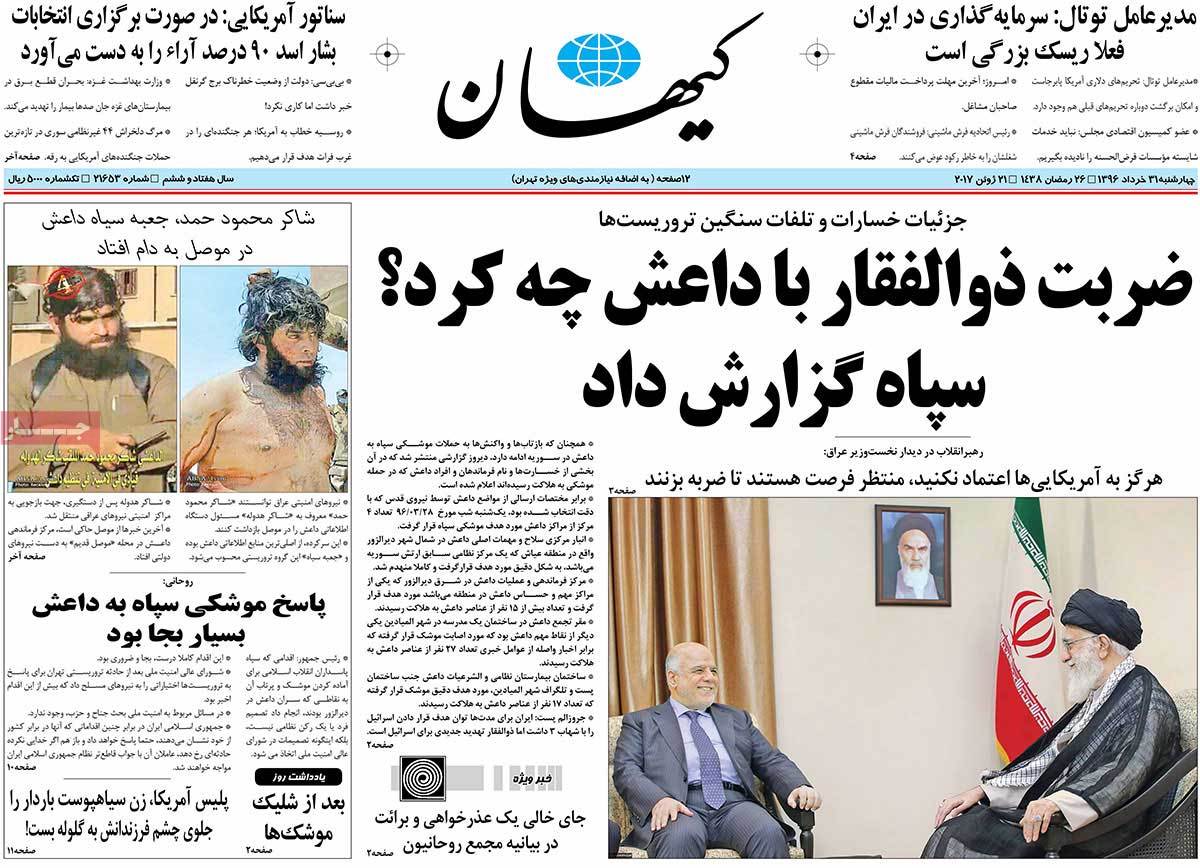
Kayhan:

1- Iran Leader: I Won’t Put Down the Banner You [Imam Khomeini] Raised

2- Iranian People in Mashhad Commemorates Kabul Martyrs

3- Al Arabiya Reveals Qatar’s Ex-Emir’s Remarks about US Plan to Overthrow Al Saud

A Look at Iranian Newspaper Front Pages on June 3


Khorasan:

1- Serious Warning about Iran’s Population

  • Iran’s Fertility Growth to Become Zero in 4 Years

2- Iran Signs MoU with Iraq to Counter Dust Pollution

3- No Difference between This Year’s Elections, Previous Ones in Terms of Offences: GC

A Look at Iranian Newspaper Front Pages on June 3