Friday, December 26, 2025
Home Blog Page 4004

Military Attack on Qatar for Regime Change Not Impossible: Analyst

Military Attack on Qatar for Regime Change Not Impossible

Abdel Bari Atwan, the nationalist editor-in-chief of Ray al-Youm newspaper said in a post in his Twitter account that the move by Saudi Arabia and other Arab states to cut diplomatic ties and closing borders with Qatar amounts to preparatory arrangements to isolate the country.

“The next step could be a military interference for a regime change in Qatar. This is a war which has been in the making for several months,” he noted.

In an article published earlier, Atwan had also referred to three regional conflicts over the past decades which paved the way for a possible war in the Arab world:

First, a border dispute between Saudi Arabia and Qatar back in 1992 called Khafus War. It began after Saudi forces carried out an attack on Qatari border guards which left three dead including one Saudi soldier.

Second, a bloodless coup d’état under then Qatari prince Sheikh Hamad Bin Khalifa against his father when the latter was on an official visit to Cairo back in June 1995. Supported and recognized by the US, the coup raised serious concerns among other Persian Gulf states.

And the third one was a military move by a Saudi-led coalition of United Arab Emirate, Bahrain and Egypt in February 1996 to topple the government of Sheikh Hamad and restore his father’s kingdom who was residing in a hotel in Abu Dhabi.

The military interference ended up in failure, heightening the tensions between Saudi Arabia and Qatar. Qatar accused the former Saudi Defence Minister and the current Saudi King Salman Bin Abdul-Aziz of designing the coup.

Amid the deepening tensions between the sides, particularly after the coalition’s ambassadors were expelled from Doha in 2014, some efforts began to resolve the crisis. But this time, at least so far, there is no report yet of any serious intermediary efforts to bridge the growing gap.


Iran as Qatar’s Only Gate to Outside World

Locked by three neighbouring countries (Bahrain, the UAE and Saudi Arabia), Qatar is connected to the outside world only through regional and international waters as well as air space of Iran. Now the three neighbouring countries of Bahrain, the UAE and Saudi Arabia have already closed their borders with Qatar.

Land border: Qatar’s only land border is with Saudi Arabia which is closed now.

Sea border: Qatari ships can get out of the Persian Gulf only via international waters.

Air border: Qatari planes should pass international airspace to enter the airspace of Iran, Kuwait and Iraq before traveling to various parts of the world.

It’s noteworthy that four Arab countries of Saudi Arabia, the UAE, Bahrain and Egypt have decided to cut their diplomatic ties with Qatar over what they called Qatar’s support for terrorism and endangering their security. Interestingly, the Saudis have called on other “brotherly states” to follow the footsteps of the four countries.

Back in May, Qatar’s Emir strongly criticized the Arab states for increasing tensions with Iran. However, he was forced to take back his remarks later under huge pressure. The Qatari government also claimed that the official news agency of Qatar which quoted the emir had been hacked.

Qatar’s Al Jazeera TV announced the severance of diplomatic ties as a breaking news story. The TV cited the recent remarks by Qatari emir in support of Iran and Hezbollah as the main reason behind the decision. However, it remained silent on the reasons declared by the four Arab states for cutting the ties.

Iran Ready to Boost Food Exports to Qatar

The head of Iran’s Agricultural Products Exporters Union Seyyed Reza Noorani said the Islamic Republic is ready to export various types of agricultural and food products to Qatar through three Iranian port cities.

Saudi Arabia has closed Qatar’s only land border, and Iran, as the closest country to Qatar, can export food products to the Arab country through a 12-hour shipping lane, he added.

Three Iranian ports of Bushehr, Bandar Abbas, and Bandar Lengeh are now ready to be used for the dispatch of Iranian products to Qatar, Noorani went on to say.

Many people in Qatar have flocked to local supermarkets and grocery stores to stock up on food items after waking up to news of Saudi Arabia closing the country’s only land border.

80% of Qatar’s food imports are via a Persian Gulf Cooperation Council food trade supply chain, and unless the crisis is resolved immediately, there will be shortages, according to industry sources.

Early on Monday, Saudi Arabia, the UAE, Egypt, and Bahrain announced that they would close all land, air and sea borders with Qatar within 24 hours. Yemen, Libya, the Mauritius Republic, and the Maldives also joined them later.

Qataris Flock to Supermarkets after Rift with Arab States

Qataris on Monday rushed to supermarkets all around the country to buy food products after Saudi Arabia closed Qatar’s only land border.

Customers could be seen piling their carts high with supplies of milk, water, rice and eggs at several popular grocery stores today, which were even busier than is usual for Ramadan.

Photographs of empty chiller shelves have already been circulating on social media sites, as residents reportedly cleared out stores of chicken and other fresh and frozen meat in some shops, according to Doha News.

80% of Qatar’s food imports are via a Persian Gulf Cooperation Council food trade supply chain, and unless the crisis resolved immediately, there will be shortages, according to industry sources.

Qatar’s foreign affairs ministry, however, insisted in a statement that the border closing would not impact normal life in the country for citizens and residents.

It added that the Qatari government will “take all the necessary measures to make certain of that and to thwart attempts to negatively affect Qatari society and economy.”

The grocery rush follows an escalating rift between Qatar and its neighboring Gulf states.

Earlier this morning, Saudi Arabia, the UAE, Egypt, and Bahrain announced that they would close all land, air and sea borders with Qatar within 24 hours. Yemen and Libya also joined them later.

US Urges Arabs to Settle Their Row While Russia Says Won’t Meddle

Russia’s Foreign Minister Sergey Lavrov said Moscow won’t meddle in Middle-Eastern affairs, adding that it is “these countries’ business and bilateral relations.”

He made the remarks during a joint press conference with his Belarusian counterpart in Moscow in reaction to the move by Saudi Arabia, Egypt, Bahrain, the UAE, and Yemen to sever their ties with Qatar.

The minister stressed that Russia is interested in “maintaining friendly relationships with everyone, especially with the region, whose primary goal right now is to focus their efforts on combating our common threat of international terrorism.”

US Secretary of State Rex Tillerson, however, urged the Persian Gulf nations to work out their differences.

Tillerson, speaking alongside Secretary of Defence James Mattis in Sydney, said he did not believe the diplomatic crisis would affect the war against the ISIS.

“I think what we’re witnessing is a growing list of disbelief in the countries for some time, and they’ve bubbled up to take action in order to have those differences addressed,” Tillerson said, according to Fox News.

“We certainly would encourage the parties to sit down together and address these differences.”

Transparent Dialogue Only Way to Heal Rift with Qatar: Iran

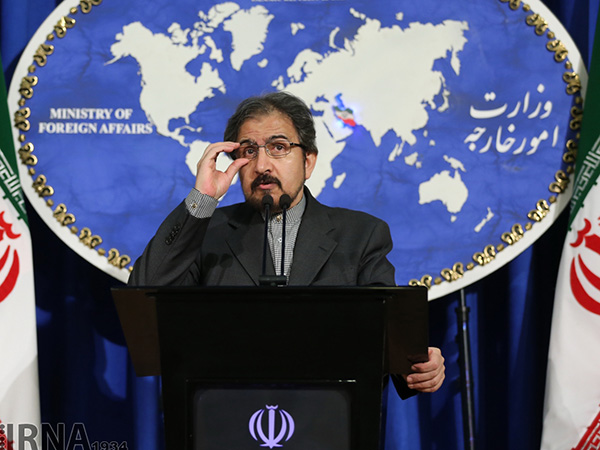
Bahram Qassemi

In reaction to the move by Saudi Arabia, Egypt, the UAE, and Bahrain to sever their ties with Qatar, Iran’s foreign ministry spokesman in his Monday statement voiced Tehran’s concern over the increased tension, and expressed the hope that the differences would be resolved as soon as possible.

“While the region and the world are still suffering from the profound consequences of terrorism and extremism as well as the continued occupation of Palestine by the Zionist regime, the escalation of tension in relations between neighbouring states does not benefit any government and nation in the Middle East,” Qassemi said, adding that such rifts threaten everyone’s interests.

“The Islamic Republic of Iran calls on all neighbouring countries involved in the ongoing row in southern Persian Gulf to learn from the bitter experiences of the region, refrain from emotional reactions, return to rationality and prudence, and show maximum self-restraint to ease the tension and return to peace,” he went on to say.

“The differences between regional countries, including the ongoing rift between Qatar and three of its neighbours, can only be settled through political and peaceful means and transparent and frank dialogues between the parties,” Qassemi added.

He also referred to the instrumental use of sanctions in the ‘intertwined’ modern world as an inefficient, blameworthy, rejected, and unacceptable move.

“Maintaining national sovereignty and territorial integrity of independent states, non-interference in their internal affairs, and respecting the recognized international borders are among the basic principles of international relations and laws, which should be respected by all parties,” he added.

“Rift with Qatar Result of Trump’s Sword Dance with Saudis”

Hamid Aboutalebi, the deputy chief of staff of Iranian President Hassan Rouhani, blamed US President Trump for setting the stage for Qatar’s rift with Saudi Arabia and its allies during his recent trip to Riyadh.

“What is happening is the preliminary result of the sword dance,” Aboutalebi said in a post in his Twitter account, in a reference to Trump’s recent visit to Saudi Arabia.

Trump and other US officials participated in a traditional sword dance during the trip in which he called on Muslim countries to stand united against Islamist extremists and singled out Iran as a key source of funding and support for militant groups.

Saudi Arabia, Egypt, UAE, Bahrain Sever Ties with Qatar

Saudi Arabia, Egypt, UAE, Bahrain Sever Ties with Qatar

After declaring the severance of ties, the Arab countries have closed their transport ties with Qatar, and expelled Qatari nationals.

The coordinated move, with Yemen and Libya’s eastern-based government joining in later, created a dramatic rift among the Arab nations, many of which are in OPEC.

Announcing the closure of transport ties with Qatar, Saudi Arabia, the UAE, and Bahrain gave Qatari visitors and residents two weeks to leave. Qatar was also expelled from the Saudi-led coalition fighting in Yemen.

Oil giant Saudi Arabia accused Qatar of backing militant groups and broadcasting their ideology, an apparent reference to Qatar’s influential state-owned satellite channel Al Jazeera, as reported by Reuters.

“(Qatar) embraces multiple terrorist and sectarian groups aimed at disturbing stability in the region, including the Muslim Brotherhood, ISIS and al-Qaeda, and promotes the message and schemes of these groups through their media constantly,” Saudi state news agency SPA said.

It accused Qatar of supporting what it described as Iranian-backed militants in its restive and largely Shiite Muslim-populated Eastern region of Qatif and in Bahrain.

Qatar said it was facing a campaign aimed at weakening it, denying it was interfering in the affairs of other countries.

“The campaign of incitement is based on lies that had reached the level of complete fabrications,” the Qatari foreign ministry said in a statement.

A split between Doha and its closest allies can have repercussions around the Middle East, where Persian Gulf states have used their financial and political power to influence events in Libya, Egypt, Syria, Iraq and Yemen.

The economic fallout loomed immediately, as Abu Dhabi’s state-owned Etihad Airways, Dubai’s Emirates Airline and budget carrier Fly Dubai said they would suspend all flights to and from Doha from Tuesday morning until further notice.

Qatar Airways said on its official website it had suspended all flights to Saudi Arabia.

Qatar’s stock market index sank 7.5 percent with some of the market’s top blue chips hardest hit.

The measures are more severe than during a previous eight-month rift in 2014, when Saudi Arabia, Bahrain and the UAE withdrew their ambassadors from Doha, again alleging Qatari support for militant groups. At that time, travel links were maintained and Qataris were not expelled.

The diplomatic broadside threatens the international prestige of Qatar, which hosts a large US military base and is set to host the 2022 World Cup. It has for years presented itself as a mediator and power broker for the region’s many disputes.

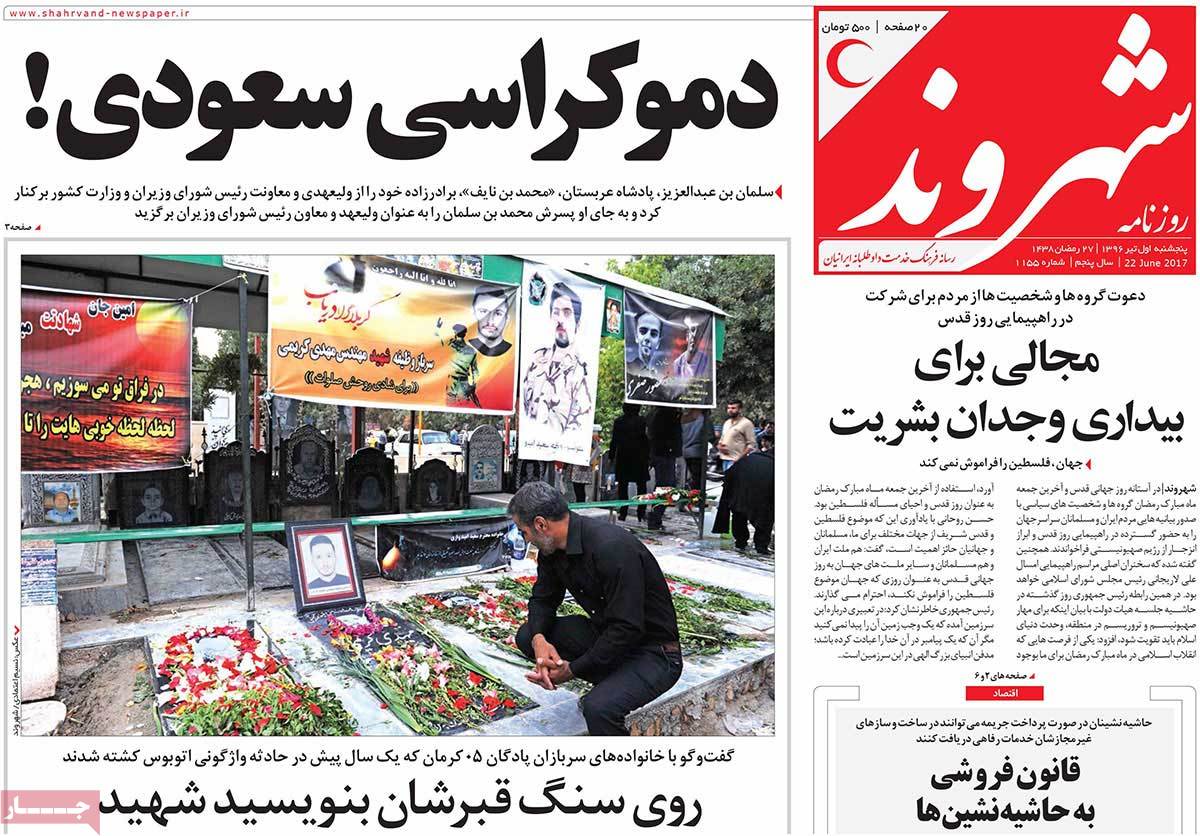
Riyadh Threatens to Mount Coup against Doha

Reports suggest Saudi Defence Minister Mohammed bin Salman has travelled to Moscow to replace Qatar with Russia in its military alliance! Now that Saudis see themselves as the losers in recent developments, they are seeking revenge on Qatar. This desire for vengeance will shed light on what was going on behind the scenes between the two countries.

The Saudi Al-Riyadh newspaper has, in a report titled “5 Coups in 46 Years … The 6th Coup Is Not Unlikely,” has discussed the issue of Qatar and threatened to oust the Qatari emir. The daily claimed that members of the Al Thani family (Qatar’s main rulers and cousins of Tamim, the current ruler of Qatar) have, in a letter to the Saudi king, disavowed the orders by their “thoughtless emir”. The controversy was due to the ‘insulting’ cartoon shared by the Al Jazeera TV’s twitter.

In an open threat to overthrow the Qatari government, the Al-Riyadh newspaper wrote that the “letter by the Al Thani family shows the depth of rifts within Qatari rulers as family members themselves have announced that they are fed up with Tamim bin Hamed’s policies and it is likely that a new coup will take place within the Qatari government, and during the coup the main ruling family will take helm of the affairs.”

According to the daily, those who have followed the history of Qatar since its independence in the 1970s are well aware of the coup scenario and rifts within the country’s rulers. The story of the coup d’état against the Ahmad bin Ali Al Thani’s family goes back to Khalifa bin Hamad, who waged a coup in 1972, and the Ahmad bin Ali family has not assumed power in the country ever since. In fact, the Bin Ali family sent the letter to bin Salman.

In the meantime, Salman al-Ansari, the head of the Saudi lobby in the US, also in an open threat against Sheikh Tamim bin Hamed Al Thani predicted that he will end up having the same fate as Mohamed Morsi’s in Egypt and could face a similar military coup.

“Mosul Liberation May Have Negative Consequences”

Senior Iranian political analyst Sadeq Maleki has, in an interview with the Vaghaye Ettefaghieh daily newspaper, weighed in on the possible ramifications of the full liberation of the Iraqi city of Mosul. The following is the full text of the analytical piece:

No one should get that elated, nor should one become fearful. Neither would the recapture of Mosul sound the death knell for ISIS, nor would its conquest mean the return of tranquility to Iraq. People in Mesopotamia will not become Iraqis in the true sense of the word until they realize the meaning of their identity in terms of being Shiites, Sunnis or Kurds. Iraq has not yet managed to push back its religious and sectarian boundaries and define the Iraqi identity for itself at national and transnational levels.

Although in the operation to purge terrorists form Mosul, Iraqi army troops and the [predominantly Shiite] People’s Mobilization Forces (also known as the Popular Mobilization Units or PMU) are accompanied by nomads and Sunni forces as well, this solidarity will not last if it is only the result of the circumstances and a common enemy, and will not be able to bring about stability, peace, and above all, national unity.

Right the day after Mosul falls to Iraqi troops, players in the battlefield will, instead of caring about Iraq, begin to hijack the triumph to serve their religious and sectarian interests.

Shiites, as the main power players in Iraq, have largely overcome the initial inexperience associated with power transfer in the country. Nevertheless, they still cannot, in practice, manifest the behaviour that would represent numerical democracy in the arena of running the country.

Differences still remain among Kurds who are regarded as the second key factor, having a big share of numerical democracy. They regard independence as something more than a cause, and take advantage of it to regulate their internal relations, the Erbil-Baghdad behavior, and regional as well as global equations.

Sunnis are desperate when it comes to thinking and taking action. They have adopted numerous strategies, from surrendering to ISIS to getting close to Kurds to playing with Shiites. However, none of those approaches has made their wishes come true.

Iraq under Saddam Hussein is gone. Accepting this would be one of the key elements for players who care about Iraq, not about themselves. Any change is coupled with pain, but the pain cannot be cured by negating the reality; rather, it can be cured by accepting treatment principles. As long as Iraqis focus on foreign resources rather than local potential, neither will Iraq be organized, nor will there be an Iraq after all. Washington, Ankara and Tehran, none can provide the remedy for Iraq’s maladies. As long as national awareness is not shaped at a level beyond sectarian and religious interests, the country will be more gripped by foreign equations rather than domestic ones.

Rather than focusing on Iraq, the two recent gatherings of Sunnis in Ankara mostly served the interests that would pave the way for the emergence of ISIS in Iraq or would make Mosul fall to ISIS militants. Iraq and Iraqis should be freed from this game.

The day after the fall of Mosul, we will see Kurds, Sunnis and Shiites asking for their share. If we are optimistic, their demands will be a reason for talks, and if pessimistic, their demands will trigger fresh war and conflict. The day after the fall of Mosul could be a day when the intimacy between Kurds and Sunnis will begin to fade, and instead, Shiites and Sunnis will start to get closer based on an Arab-oriented scenario. In an Iraq where Mosul is liberated, no one will be the winner. Iraq and Iraqis need to understand this strategic point that a civil war has no winners. Yesterday, Mosul fell, and today it was conquered, but the scars of that fall and conquest can set the stage for another fall and conquest.

Iraqis should put an end to falls and conquests. Instead of conquering battlefields, Iraqis should change mentalities and win one another’s hearts. As long as Iraqis think of war more than peace in order to bring about changes, Iraq and Iraqis will not get to see tranquility. The point is that neither Tehran nor Ankara has been the winner in Iraq. Those who regard Tehran as the winner have returned to 10 years ago and are comparing the circumstances at that time with those of today. Although Turkey has not achieved all its objectives in Iraq, it has changed the situation against Iran with its inappropriate policies. Well, this analysis shouldn’t please Turkey after all!

Today, the threat emanating from Turkey’s interference in Iraq and spilling over to Syria, has jeopardized Turkey’s key interests and territorial integrity more than Iran’s. The outbreak of civil war in Turkey is mainly due to Ankara’s wrong calculations regarding Iraq or Syria. Erdogan, who accuses his allies of hatching plots against Turkey at national, regional and international levels, should look at himself as well, and rather than being entrapped by the conspiracy theory, begin to change his behaviour and move forward based on collective interests with a view to Iraq.

If the conquest of Mosul can win Iraqis’ hearts rather than seize territory, then it can lay the groundwork for bringing Iraqis closer together, and replace the Sunni-Shiite-Kurdish mentality with a view to Ankara, Tehran and Washington, make Iraqis deserve national identity, and bring about tranquility to Iraq as well as to the region.

Iran Condemns London Terrorist Attack

In a statement released on Sunday, Qassemi offered his condolences to the bereaved families of the victims of the terror attacks on pedestrians on London Bridge that killed at least seven people and wounded tens others.

An increase in blind terrorist attacks around the world is a warning sign to the international community, he said.

“Terrorism in all its forms and shapes and with any purpose and motivation is blameworthy, rejected and condemned,” the spokesman underlined.

Iran believes that the only way to rid the world of “this inauspicious anomaly (terrorism)” is for all countries to avoid double standards and honestly join an international campaign against violence and extremism, Qassemi added.

Militants drove a van at high speed into pedestrians on London Bridge before stabbing Saturday night revelers on the street and in nearby bars, killing at least six people and wounding more than 30.

Armed police rushed to the scene and shot dead the three male attackers in the Borough Market area near the bridge, as authorities urged Londoners on Twitter to “run, hide, tell” if they were caught up in the violence.

The attacks come days ahead of a June 8 election and less than two weeks after a suicide bomber killed 22 people at a pop concert in Manchester in northern England. There was no immediate claim of responsibility.