Friday, April 24, 2026
Home Blog Page 3988

Iran Leader Urges IRGC to Boost Missile Power

“Keep working on the missile program as far as you can. Look how sensitive the enemy is about [the country’s] missiles, so you should know that your work is highly important,” the Leader said in a meeting with a number of Islamic Revolution Guards Corps (IRGC) commanders last month, hours after the IRGC hit Daesh positions in Syria’s eastern Dayr al-Zawr province.   

In remarks published on Wednesday, Ayatollah Khamenei praised the IRGC for its strike against Daesh in Syria.

“The enemy must be slapped in the face,” the Leader added.

During the meeting, the commanders briefed the Leader on the strike, saying the IRGC had only hit the positions of the terrorists and that no civilians were targeted in the operation.

The IRGC strike came in response to the June 7 terrorist attacks in Tehran, which killed 18 people. The Daesh Takfiri terrorist group claimed the attacks.

The projectiles were the first launched from Iran at targets outside the country.

The IRGC has said the missiles killed more than 170 Takfiri terrorists, including a number of commanders and senior elements, and inflicted heavy damage on their equipment and systems.

‘US Had Plans to Pulverize Iran Passenger Plane in Air’

‘US Had Plans to Pulverize Iran Passenger Plane in Air’

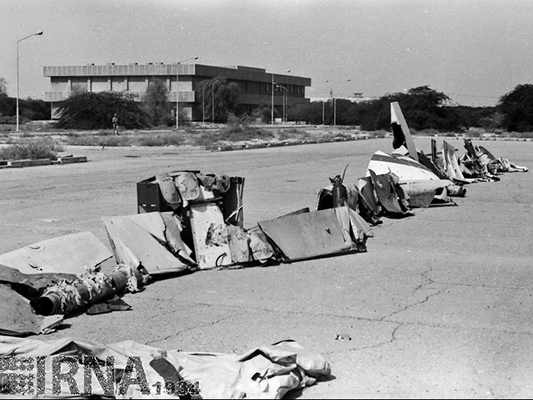
Iranian second flotilla admiral, Nasser Sarnevesht, who was the commander of the operations to recover the pieces of the bodies of the victims of the shoot-down of Iran Air Flight 655 by the USS Vincennes on July 3, 1988, believes that the attack had been aimed at annihilating the jet as well as all its passengers and crew members on board in the air.

The civilian aircraft, an Airbus A300-B2, was flying in the Iranian airspace over the Strait of Hormuz from the port city of Bandar Abbas to Dubai, carrying 274 passengers and 16 crew members, when the USS Vincennes fired two SM-2MR surface-to-air missiles at it, killing all the 290 on board.

In a Farsi interview with the Khabar Online News Agency, Sarnevesht has narrated the sad story of the 50-day operations he and his team carried out in the Persian Gulf to collect the unidentifiable bodies of the victims. Here are the highlights of this interview:

“The horrible incident took place at 10:17 am on July 3, 1988 [the year when the war between Iran and Iraq came to an end]. We were immediately dispatched on a mission [to the site of the incident] to perform the rescue operations. On that day, we were supposed to be sent on another mission to Shaibah Air Base [in the southern Iraqi province of Basra]; however, the mission coincided with [the declaration of] the ceasefire [between Iran and Iraq].”

“We did not require foreign assistance to collect the corpses and the debris of the plane. In addition to the two cruisers that had anchored, we had two hovercrafts, three helicopters and 80 scuba divers to carry out the operations. Recovering the bodies took 50 days. Since the bodies were dismembered, we collected their pieces. During the mission we were constantly exposed to the danger of being attacked by sharks and eagle rays. Due to the dangers involved, we had to perform the rescue operations at night,” he noted.

“Out of a total of 290, we managed to only recover the corpses of 178 victims. The US had intended to pulverize the Iranian aircraft in the air and, therefore, it had fired a surface-to-air standard missile with a range of 300 miles. Such a missile is capable of destroying a spacecraft let alone a passenger jet.”

“Iran can follow up the case, but it would be futile as they will not come back to life. We even recovered the black box from the wreckage of the aircraft and handed it over to related authorities. We transferred every single valuable item left from the crash by a helicopter [to the shore]. After examining the black box it was announced that no warning had been given by the US warship to the Iranian passenger plane. Even the flight’s pilot had not been given a chance or time to divert the plane.”

Following the missile attack, US officials claimed the warship had mistaken Iran Air Flight 655 for a warplane.

Iran, Russia, Turkey Hold Trilateral Meeting in Astana

Iran, Russia, Turkey Hold Trilateral Meeting in Astana

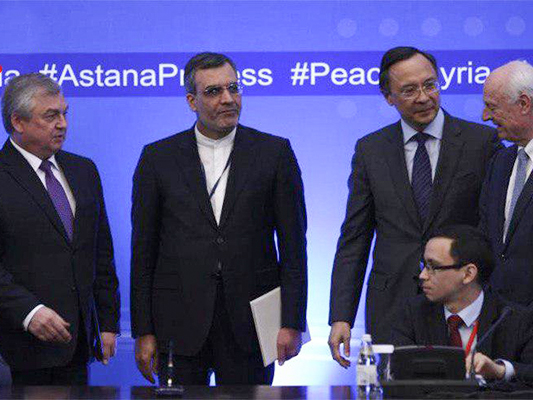
Iran’s Deputy Foreign Minister for Arab and African Affairs Hossein Jaberi Ansari, who heads the Iranian delegation to Astana talks, took part in the tripartite meeting with his Russian and Turkish counterparts on Wednesday.

The representatives of the three guarantor states conferred on the results of political consultations and the expert-level agreements made within the past two days in Astana.

They also exchanged views on the next expert meeting due to be held in Iran in three weeks. Iran will be hosting the Syria peace talks for the second time.

Earlier on Wednesday, Jaberi Ansari held his second meeting with Syrian envoy to the United Nations Bashar Jaafari.

During the meeting, the two sides discussed the latest developments in the war-torn Arab country, the details of de-escalation zones, and the way observers should be deployed.

The Iranian official also held a fresh round of talks with Russian President Vladimir Putin’s point man on Syria, Alexander Lavrentiev. The two sides conferred on the expert meetings to specify the limits of de-escalation zones in Syria.

Jaberi Ansari also met the French government’s special representative on Syria affairs as well as the Kazakh foreign minister, Kairat Abdrakhmanov, on the sidelines of the Astana talks.

A Look at Iranian Newspaper Front Pages on July 5

Iranian newspapers today widely covered the remarks made by Major General Mohammad Ali Jafari, the commander of the Islamic Revolution Guards Corps (IRGC), and IRGC Quds Force Commander Major General Qassemi Soleimani about the significance of the military organization’s efforts to ensure Iran’s security.

The reactions to a huge gas deal signed between Iran and France’s Total also received great coverage today. Conservative papers strongly denounced it as being against the country’s interests, while reformists and pro-government media hailed it as a historic deal that breaks the wall of sanctions.

Many papers also marked the first anniversary of the demise of prominent Iranian filmmaker and photographer Abbas Kiarostami.

The above issues, as well as many more, are highlighted in the following headlines and top stories:


Abrar:

1- Iran Parliament Speaker Hails Ayatollah Sistani’s Role in Iraq Victories

2- Iran Gov’t Spokesman: JCPOA’s Fruits Emerging One after another

3- Without Iran’s Support Iraq Couldn’t Achieve Today’s Results: Iraqi General
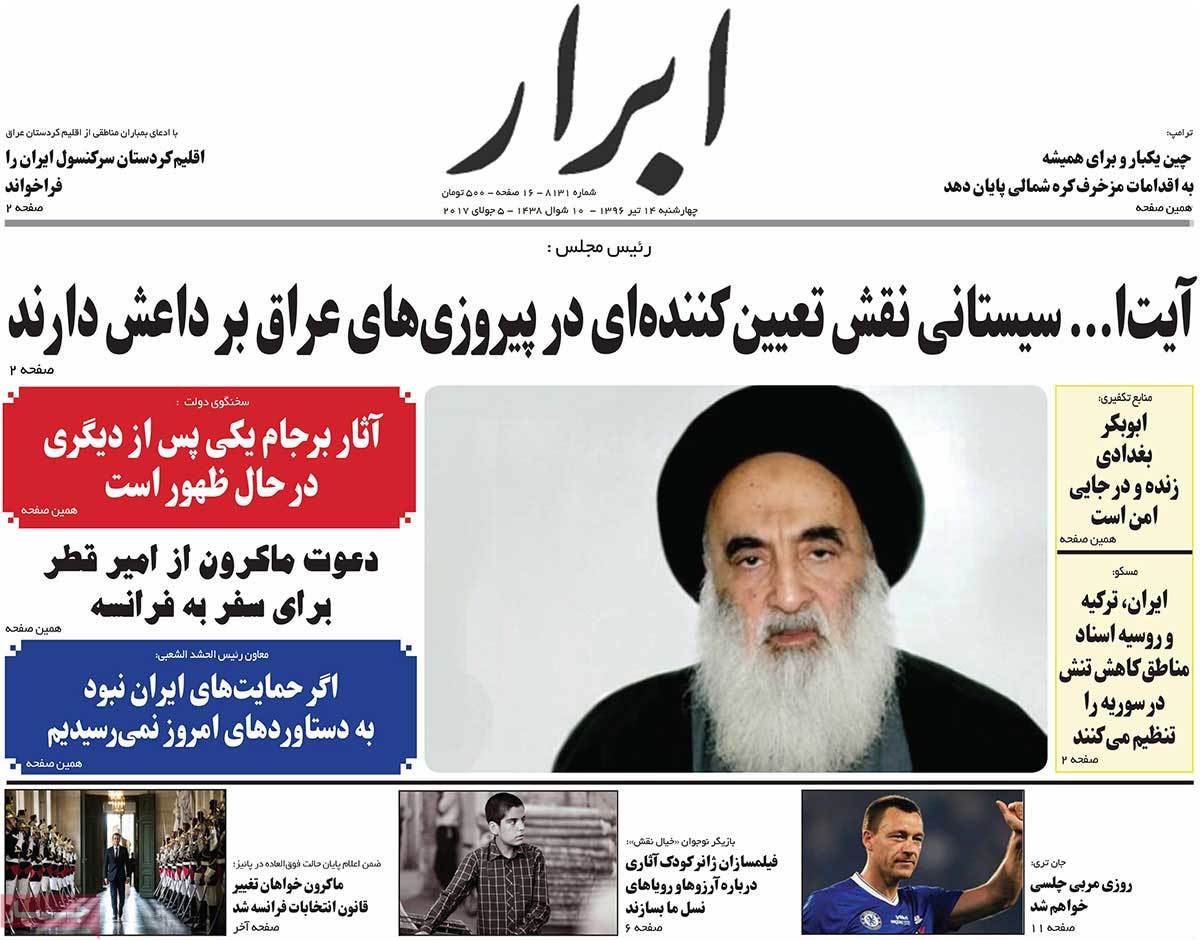
 

A Look at Iranian Newspaper Front Pages on July 5 - abrar


Aftab-e Yazd:

1- Rouhani’s Rational Turn

  • Iran Prefers Cooperation with Europe as Long as Trump Holds Office in US

2- Nothing against Iran Leader’s Words Should Be Uttered: General Soleimani

3- Iran Police: Inside People’s Cars Not Their Private Space
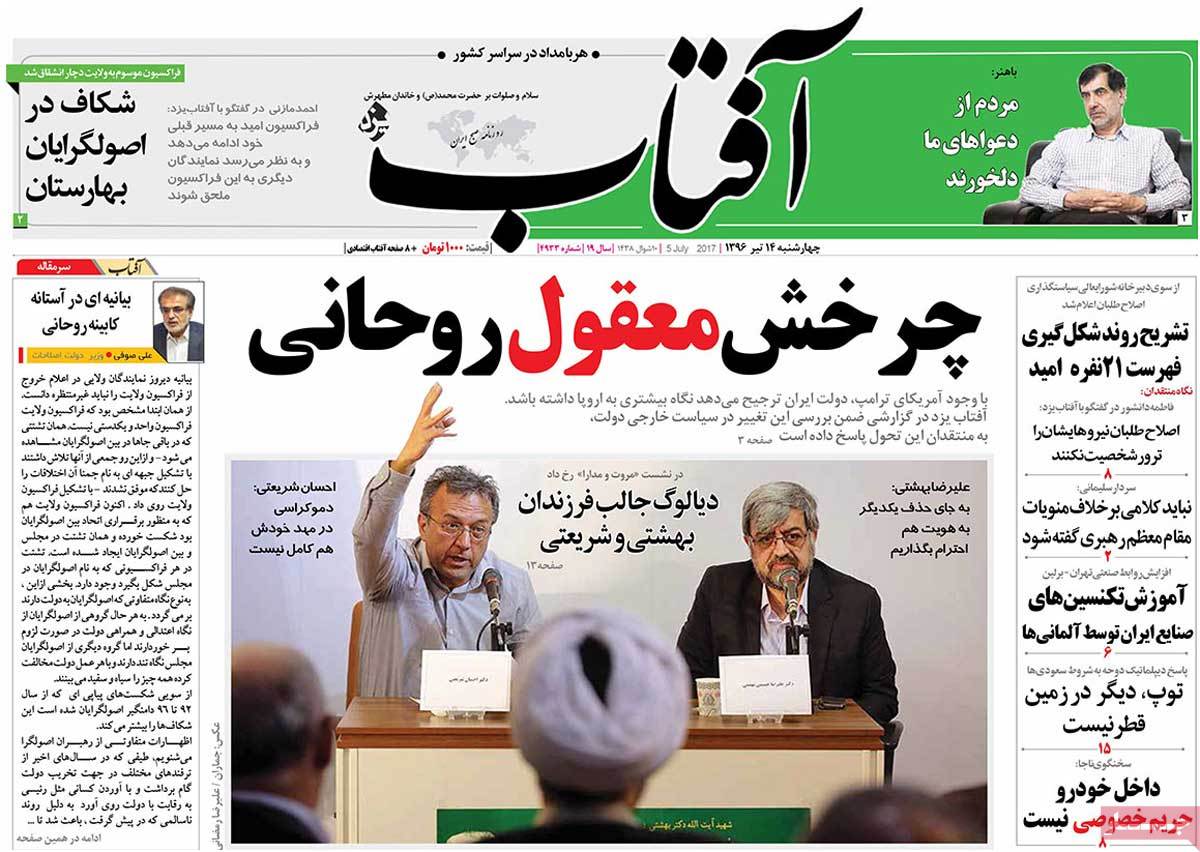
 

A Look at Iranian Newspaper Front Pages on July 5 - aftab


Arman-e Emrooz:

1- Gov’t Spokesman: Wall of Sanctions Collapses after Oil Giants’ Arrival in Iran

2- Top Human Rights Official: Iran Has No Political Prisoner

3- Conservatives Renouncing Radicals: Senior Right-Winger
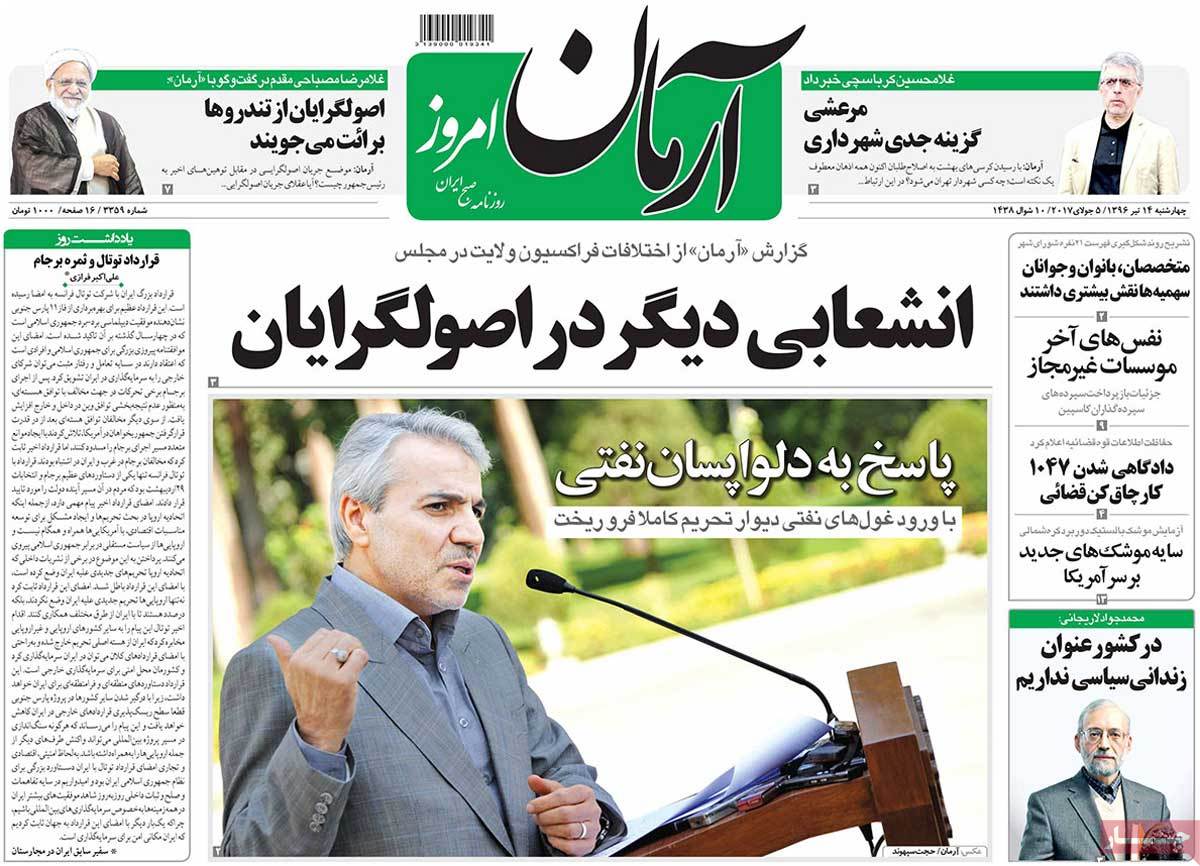
 

A Look at Iranian Newspaper Front Pages on July 5 - arman


Asrar:

1- General Soleimani: Do Not Weaken IRGC

2- Interior Minister: Mayors in 42% of Cities to Be Changed
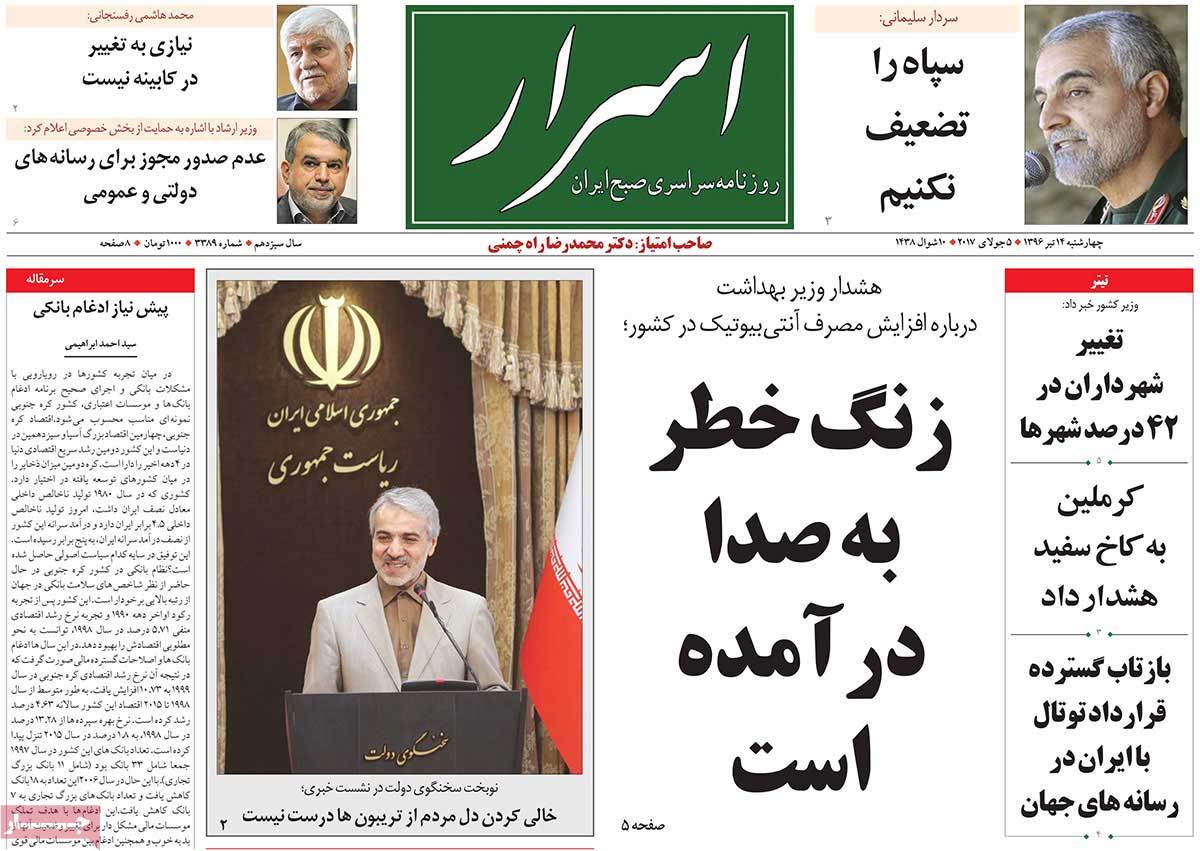
 

A Look at Iranian Newspaper Front Pages on July 5 - asrar


Etemad:

1- Different Account of Total’s Deal with Iran

  • Total CEO: Your Negotiators Well Defend Your Interests

2- IRGC Commander to Remain in Office for 3 More Years
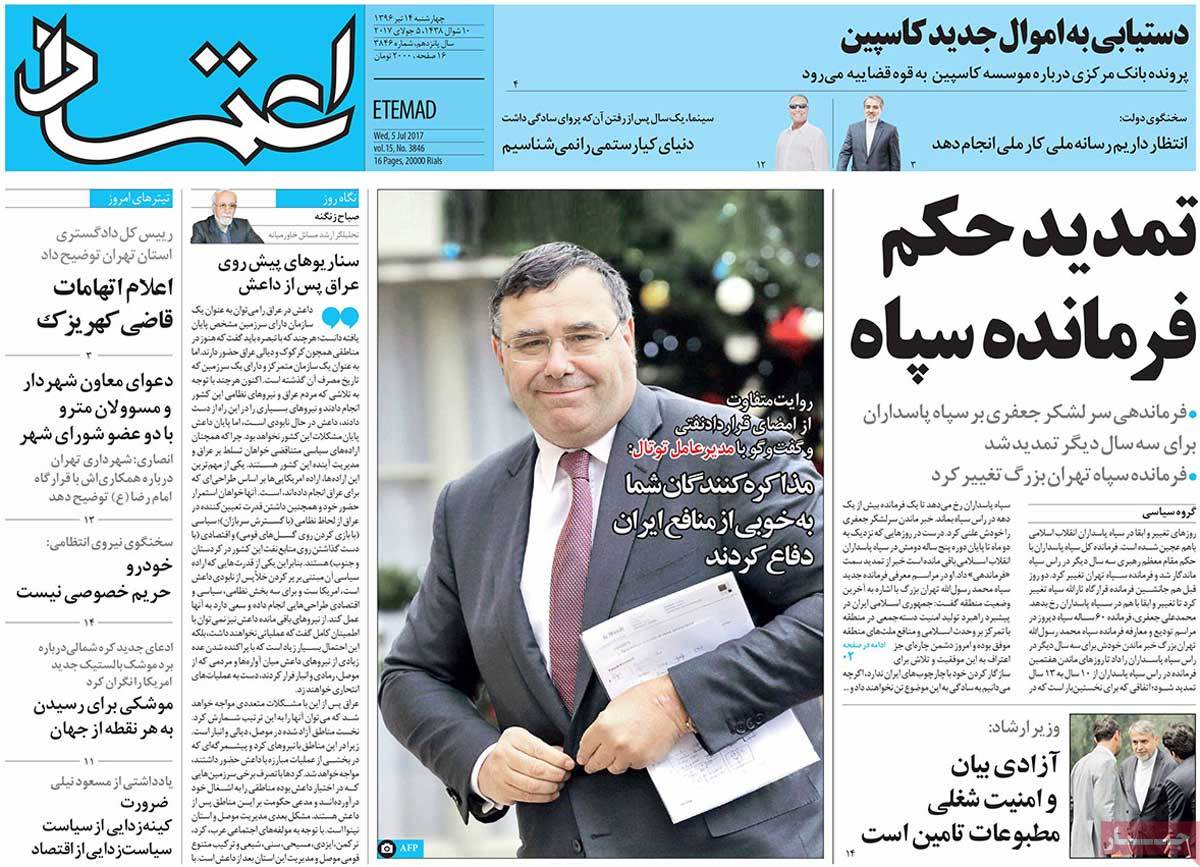
 

A Look at Iranian Newspaper Front Pages on July 5 - etemad


Ettela’at:

1- President: Iran Supports Stable, Integrated Iraq

2- General Soleimani: Unity on Values Main Source of Iran’s Power

3- Resolving Super-Challenges in Iran Needs Unity, National Resolve: First VP
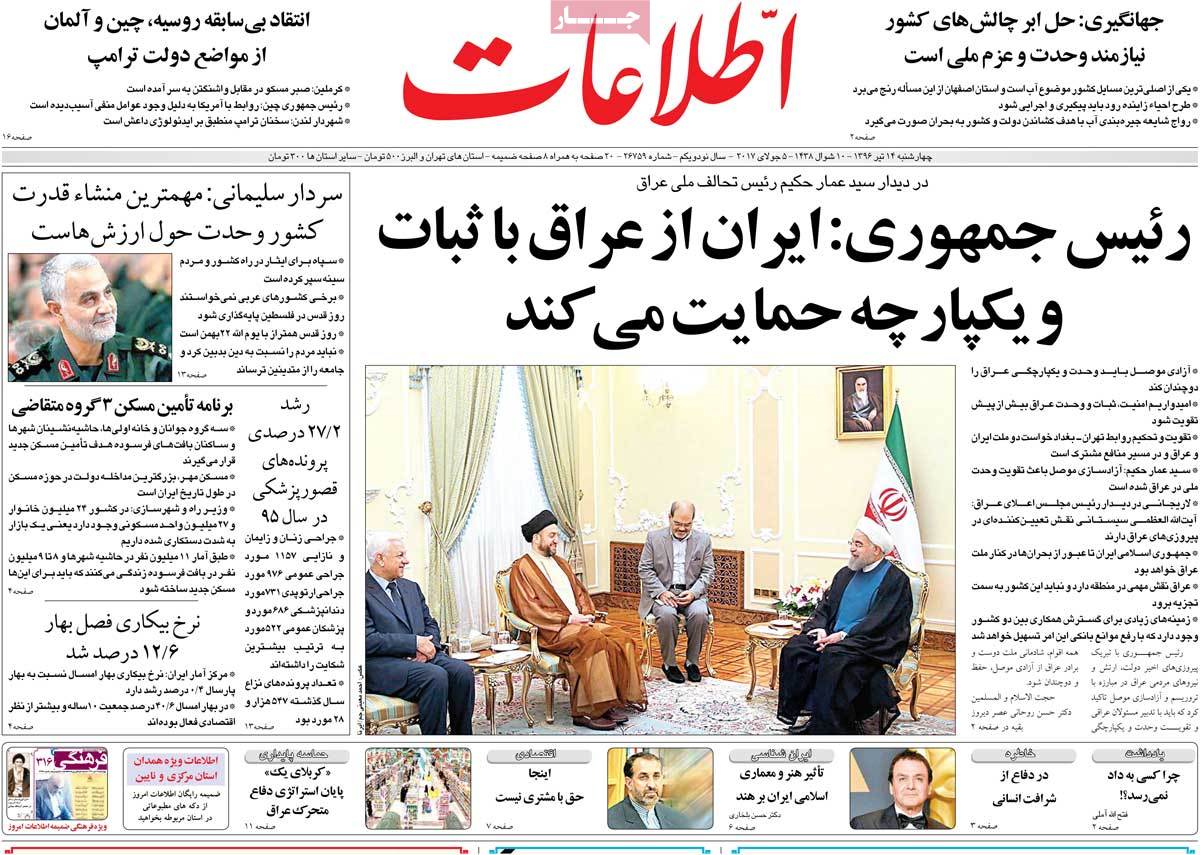
 A Look at Iranian Newspaper Front Pages on July 5 - etelaat


Iran:

1- Global Efforts to Harness North Korean Leader

  • After Trump’s Criticism, Russia, China Urge Pyongyang to Stop Nuclear Tests
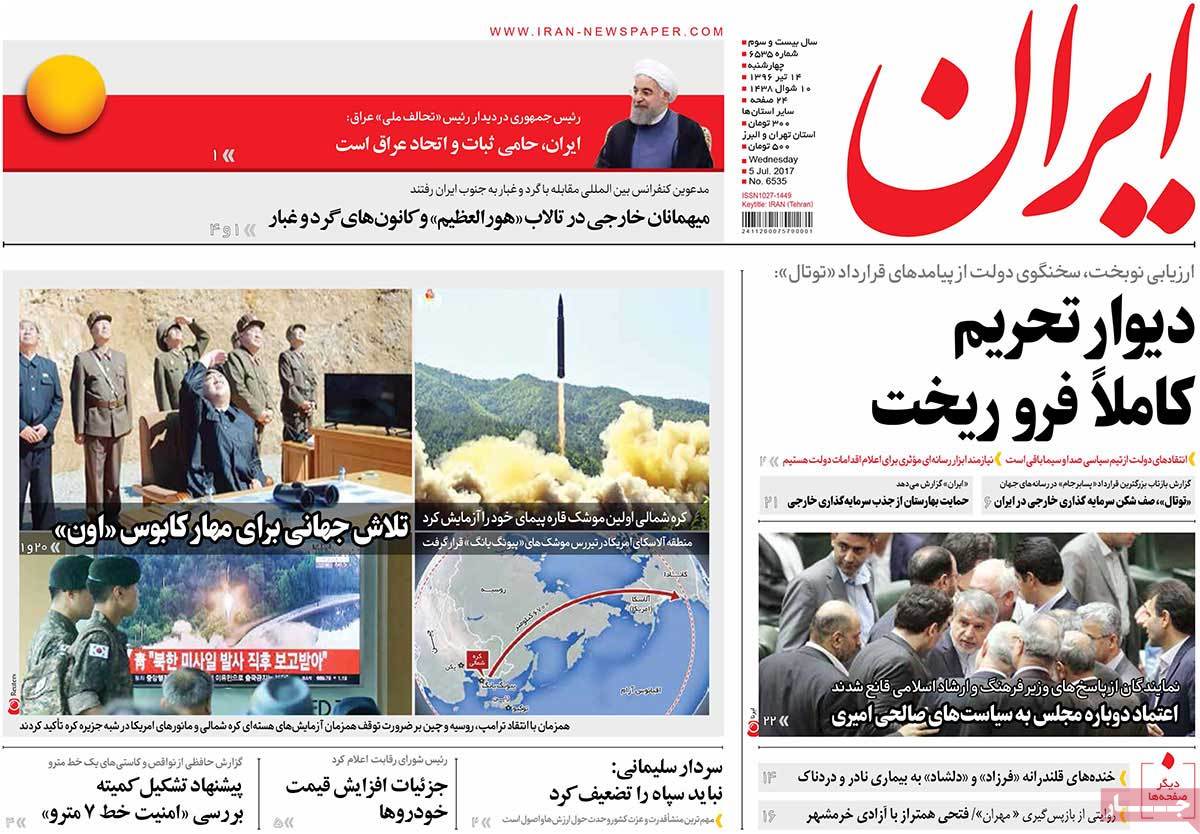
 A Look at Iranian Newspaper Front Pages on July 5 - iran


Javan:

1- Commander: IRGC Looking for Peace by Making Enemies Afraid of Waging War

2- General Soleimani: Attack Me, but Don’t Attack IRGC

3- IRGC Has Saved Governments’ Bankrupt Businesses
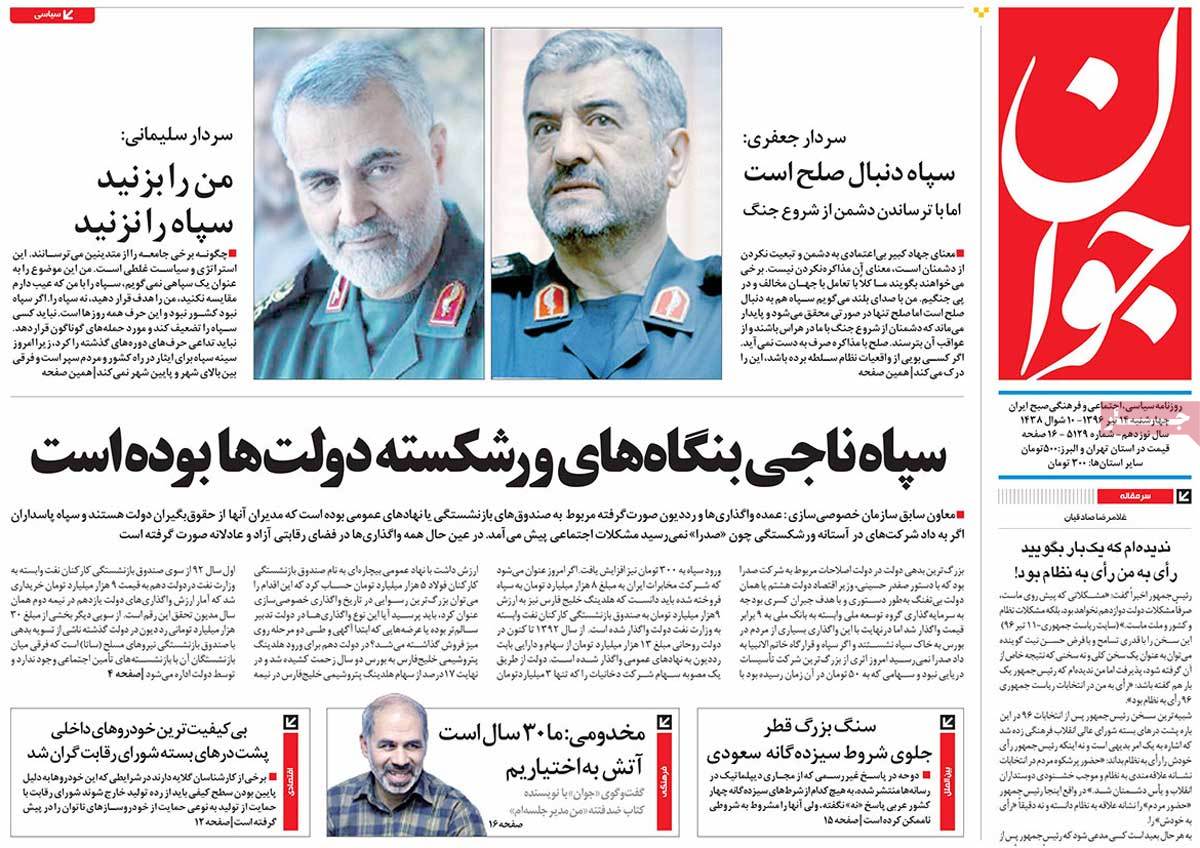
A Look at Iranian Newspaper Front Pages on July 5 - javan


Jomhouri Eslami:

1- Iran’s Big Deal with Total Widely Covered by World Media

  • French Oil Giant Ignores US

2- UNICEF: Millions of Yemeni Children in Urgent Need of Int’l Help

3- Iran, Russia Should Cooperate against US Interference in Syria
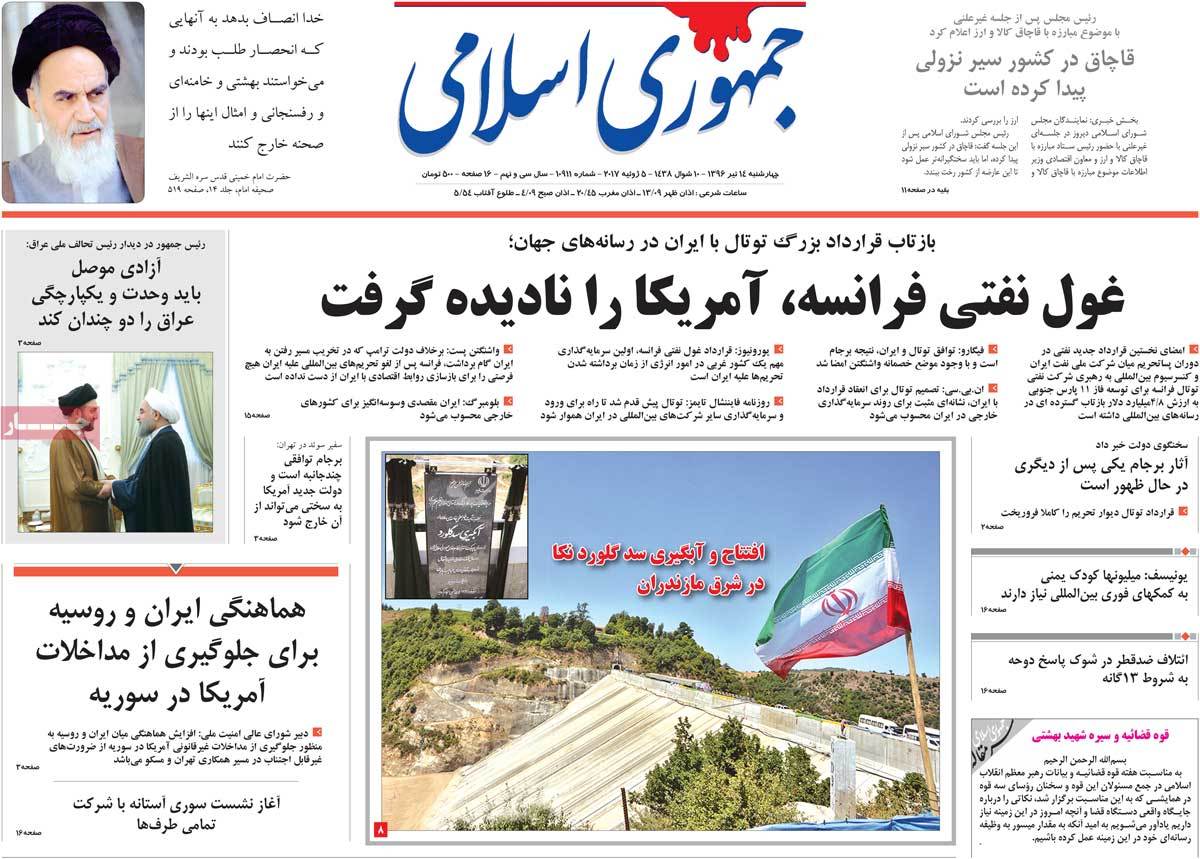
A Look at Iranian Newspaper Front Pages on July 5 - jomhori


Kayhan:

1- Total Smells Like Crescent; Government Should Be Transparent

2- 70% of Apparel in Iranian Markets Have Been Smuggled into Iran

3- Government’s Debts to IRGC Exceed IRR 230 Trillion [over $6bn]
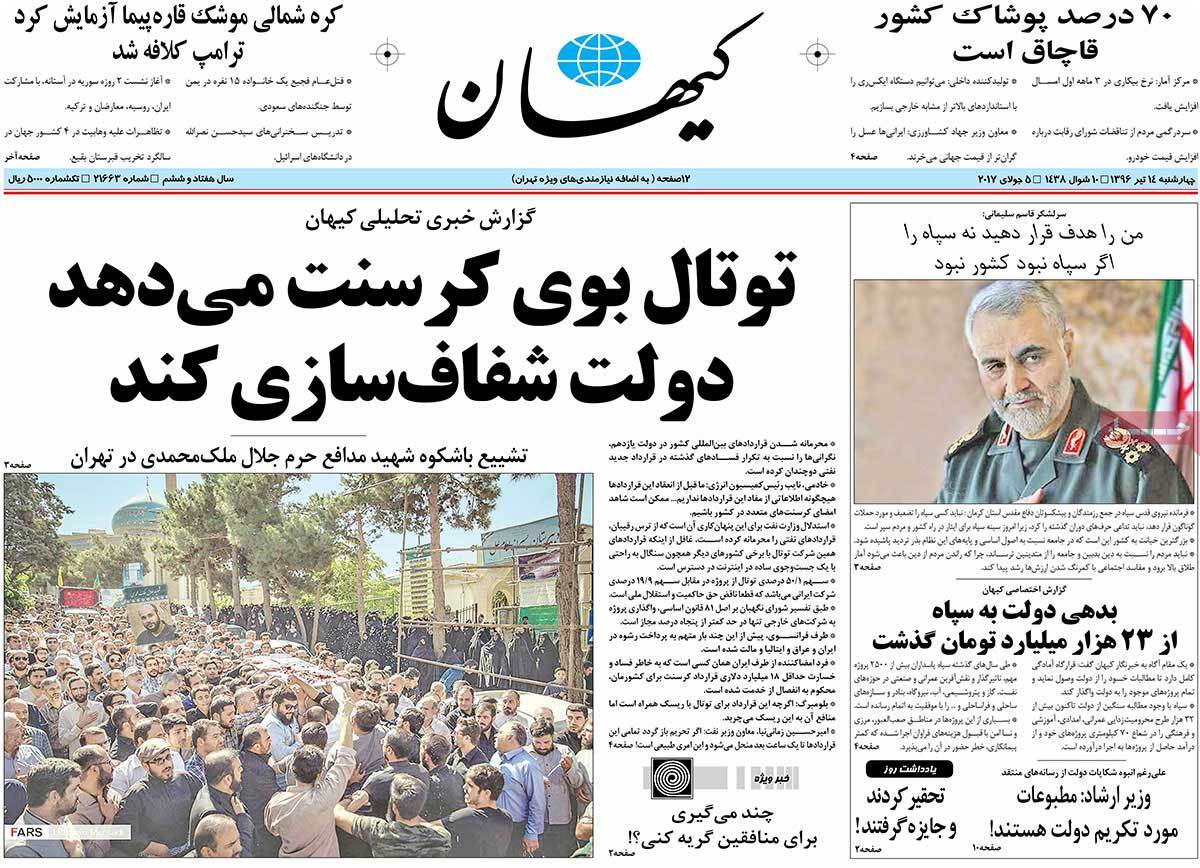
A Look at Iranian Newspaper Front Pages on July 5 - kayhan


Resalat:

1- General Soleimani: We’ll Support Whoever Raises Banner of Quds Liberation

2- Ayatollah Jannati: Why Advocates of Human Rights Are Silent towards MKO Crimes?
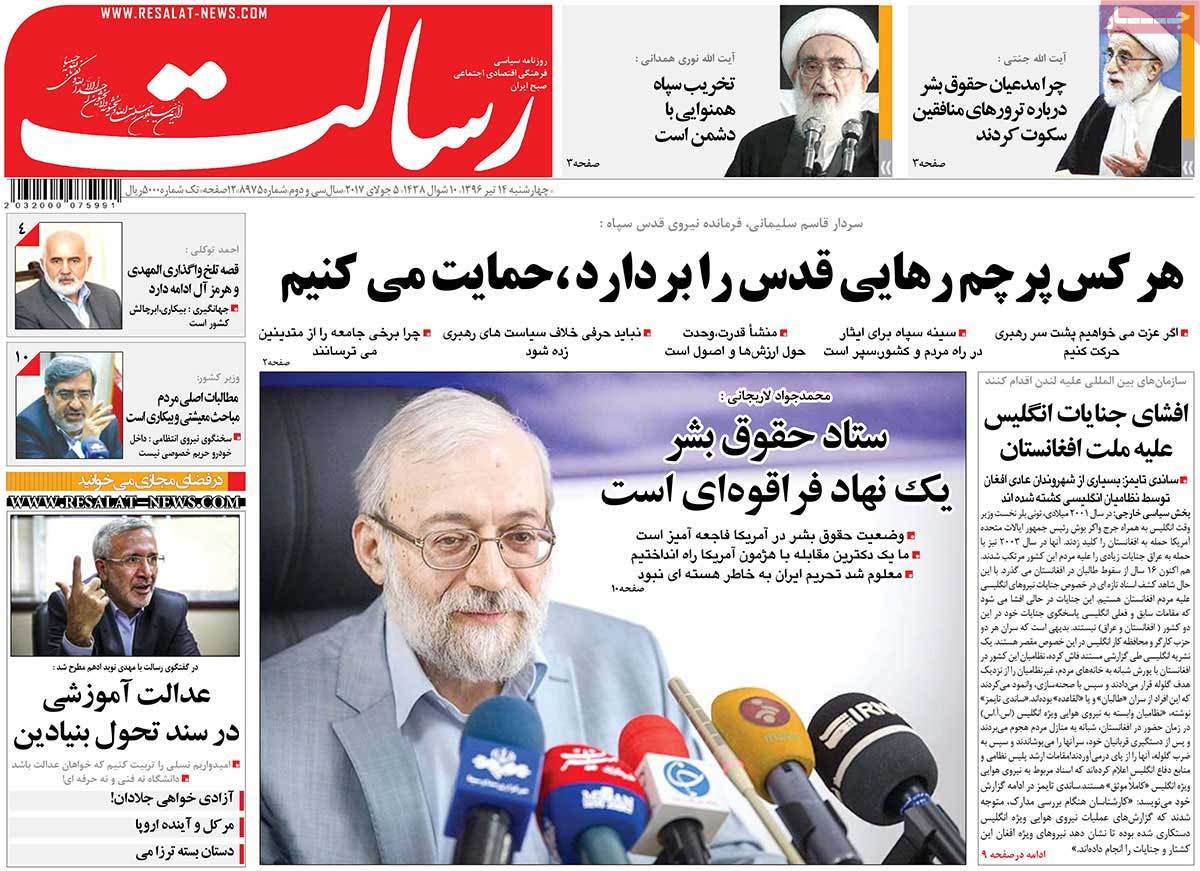
A Look at Iranian Newspaper Front Pages on July 5 - resalat


Shargh:

1- Iranian Connection with a French Woman

  • Three Pictures of Binoche beside Kiarostami

2- Entire Establishment, Not Just Gov’t, Has Decided to Send Pilgrims to Hajj
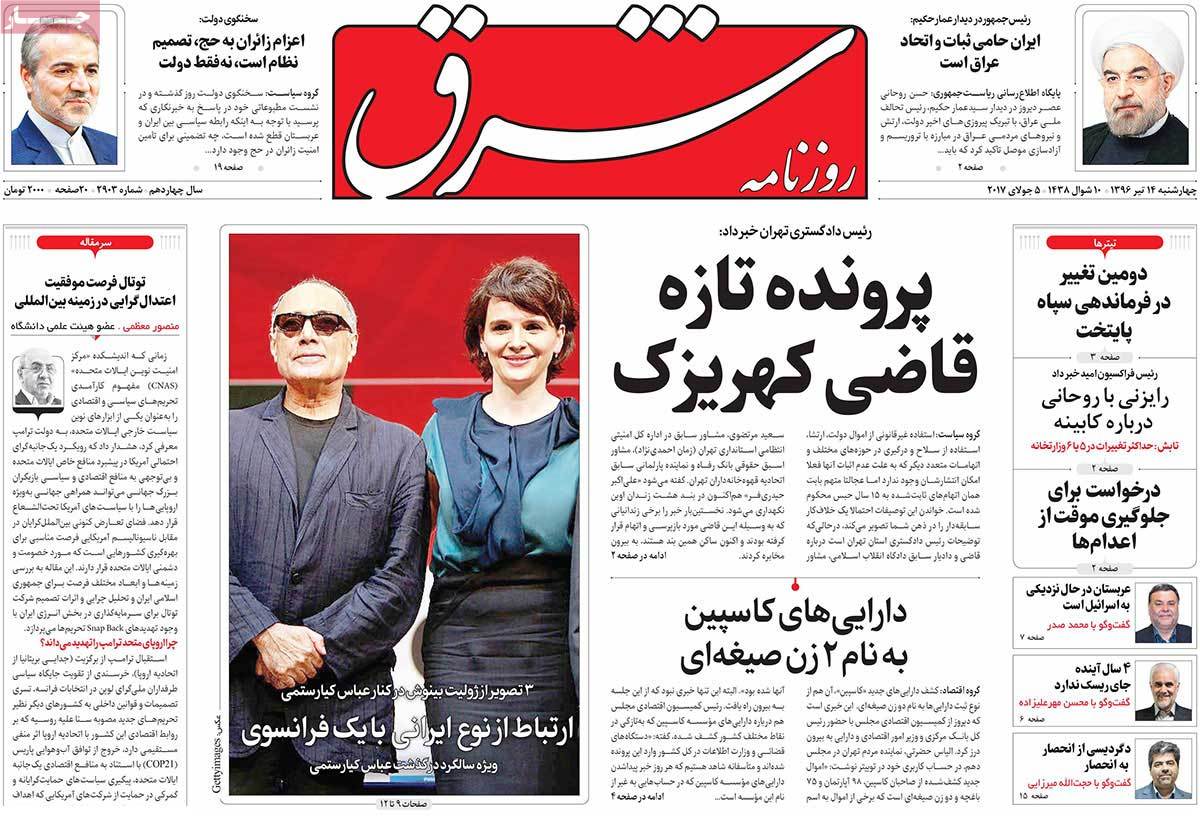
A Look at Iranian Newspaper Front Pages on July 5 - shargh


Los Angeles ‘Freedom’ Sculpture Inspired by Cyrus Cylinder

Los Angeles ‘Freedom’ Sculpture Inspired by Cyrus Cylinder
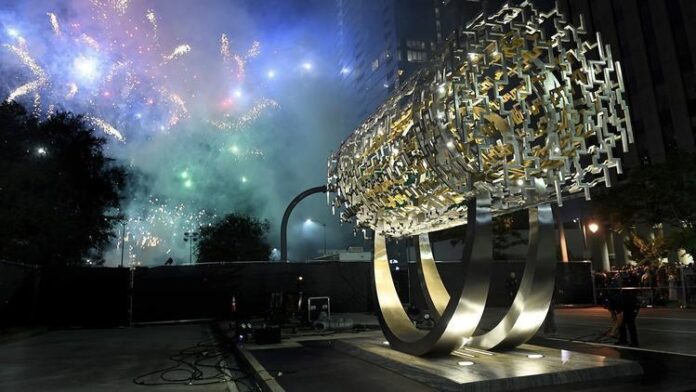
Freedom Sculpture in Los Angeles inspired by the Cyrus Cylinder / Photo by Wally Skalij, Los Angeles Times

On Tuesday, the Fourth of July, prominent Iranian developer Ali Razi, now 77, was on hand to unveil a new public art installation in Los Angeles, the Freedom Sculpture, which Razi and others in the Iranian American community hope will be a beacon for the world.

“America is great because of all the beautiful cultures brought by immigrants,” Razi said. When people drive by the sculpture along Santa Monica Boulevard, he said, he hopes they ask: “What is this freedom? This shared dream is based on what?”

Artist and designer Cecil Balmond agrees it is a symbol of timeless values of freedom and tolerance. Balmond, whose proposal was chosen from among more than 300 others as the design for the $2.2-million sculpture, said the pair of gold and silver cylinders set atop rings is to be seen at speed.

Production of the sculpture was organized by the Farhang Foundation, an L.A.-based nonprofit organization, and the unveiling was part of the inaugural Freedom Festival, a nightlong block party that featured live music, food and fireworks. The Farhang Foundation promotes the study and appreciation of Iranian art and culture. Organizers said they hope the Freedom Festival becomes an annual event.

The area is home to many from a sizable diaspora of Iranian Americans in Southern California. Community groups estimate that about 500,000 Iranian Americans live in the region, the largest enclave outside Iran.

The 20,000-pound piece is set upon travertine stone and was built entirely in the US. It is the newest addition to Century City — a neighbourhood of towering office buildings — but it traces its inspiration back 2,500 years to the Cyrus Cylinder, which was unearthed in 1879.

The 9-inch barrel is inscribed with the story of Cyrus, the king of Persia, and his conquest of Babylon. The artifact is seen as a testament to how Cyrus brought justice and peace to Bablyon, according to the Los Angeles Times.

Razi, the founding chairman of the Farhang Foundation, said the Cyrus Cylinder carries special symbolic weight on the Fourth of July.

“This conqueror, rather than killing or stealing, let people practice their own religion. He was the first to put together a multinational empire based on freedom of religion,” Razi said.

Iran to Give Crushing Response to Aggressors: General Soleimani

In a Tuesday address to a group of Iranian veterans in the southern province of Kerman, General Soleimani referred to the IRGC’s latest missile strikes on ISIS positions in the Syrian city of Deir ez-Zor and said the strikes revealed the Islamic Republic’s strong will to inflict heavy blows on its enemies.

“The strikes also showed that the Iranian youths have made significant progress in the missile industry,” he noted, according to a Farsi report by Mizan.

Our missile attacks have left no doubt that the Islamic Republic will give a crushing response to any aggressor who dares to cross its redlines

He compared the IRGC’s missile strikes with those of the US-led coalition in Syria and said the former ones were more accurate and destructive.

He quoted the late founder of the Islamic Republic, Imam Khomeini, as saying, “I’m satisfied with the IRGC and my opinion would not change [given its good performance,].”

General Soleimani urged that the opponents should not judge the IRGC on his own personal performance.

“If you have problem with me, you are free to criticize me directly, but don’t undermine the IRGC because the military entity is not tied to me. Iran’s survival hinges on the presence of a strong IRGC.”

Soleimani referred to the religious sedition in the region caused by the Takfiri terrorists and said all Sunni leaders admit that a religious sedition has been created. “Though there are differences over the source of the sedition, all the leaders agree that this is a religious one,” he noted.

He added that those behind the sedition thought that they are going to bring to its knees the Islamic Republic, but in practice, they achieved a totally different result because the power and dignity of Iran was multiplied at the end.

“Today, the Islamic Republic has turned into one of the most favourite countries in the world due to its protection of the oppressed people of Iraq and Syria. Meanwhile, the global trust in the Islamic Republic has increased significantly,” he said.

The commander of Quds Force stressed that today the Iranians highly respect their military commanders, saying this is what exactly happened during the eight-year war imposed by Iraq on Iran that strengthened the Islamic Republic.

He referred to the features distinguishing a wise leader from a corrupt one and said the absence of a common sense in a country rich with oil resources leads to bitter incidents.

“The war on Yemen is an example of such condition. The war has become so huge that the corrupt rulers of Saudi Arabia are incapable of putting an end to it,” he said.

Major General Soleimani stressed the important role that religion can play in removing social woes and said by establishing communication with those who have weaker religious beliefs, the believers can make a healthy society.

He warned against undermining the status of the IRGC in the society and said the country needs the military power for its survival.

“Today, the IRGC has devoted itself to protecting people from all walks of life. We should remain vigilant. To have a dignified country in the world, we need to respect the IRGC,” he concluded.

Iran, Italy to Ink €1.2bn Deal on Railway Development

The deal follows an agreement in February last year that saw Italy promise Iran €5bn in export credits in return for contracts to build the 135-km Qom-Arak line and a 320-km link between Tehran and Hamadan.

Italy will also provide rolling stock for high-speed and conventional lines, training for Iranian railway managers, and a research centre to develop railway technology, according to a report by Global Construction Review.

Iran is in the throes of an immense extension to its railway system. According to IRIR’s plans, the present network of 15,000km will be expanded to 25,000km by 2025. Some 7,500km of this extra track is already under construction.

Italy’s FS has also been connected with the planning and construction of a high-speed rail corridor between Tehran, Qom and Isfahan, and may also undertake the electrification of the rail link between Tehran and Tabriz on the way to the Caucasus.

Altogether about $25bn of work is under way or will begin in the next five years. Companies from Russia, China, France and other countries are undertaking work on particular lines.

China has taken a particular interest, since it intends to make the route through Iran to Turkey one of the stages in its new Silk Road to Europe. The China National Machinery Import and Export Corporation has signed a €2.2bn deal to begin work on the electrification of the 1,000km line between Mashhad in the northeast of the country and Tehran.

Saudi Arabia Main Promoter of Extremism in UK: Report

“Since the 1960s, Saudi Arabia has sponsored a multimillion-dollar effort to export Wahhabi Islam across the Islamic world, including to Muslim communities in the west,” the British society’s report said.

“In the UK, this funding has primarily taken the form of endowments to mosques and Islamic educational institutions, which have in turn played host to extremist preachers and the distribution of extremist literature. Influence has also been exerted through the training of British Muslim religious leaders in Saudi Arabia, as well as the use of Saudi textbooks in a number of the UK’s independent Islamic schools.”

It adds, “A number of Britain’s most serious Islamist hate preachers sit within the Salafi-Wahhabi ideology and are linked to extremism sponsored from overseas, either by having studied in Saudi Arabia as part of scholarship programmes, or by having been provided with extreme literature and material within the UK itself.”

The report has further urged the UK government to consider requiring religious institutions, including mosques, in Britain to be required to reveal sources of overseas funding.

The findings come as Theresa May faces pressure to publish the government’s own report into foreign funding of terrorism. The Home Office-led report was completed six months ago, and No 10 says ministers are still deciding whether to publish. MPs nervous of upsetting strategic relations in the Persian Gulf have also decided not to publish a separate Foreign Office strategy paper on the region.

Saudi Arabia is likely to be angered by the findings since its dispute with Qatar has largely been based on the accusation that its Persian Gulf rival is both the primary funder terrorism overseas and harbours terrorists that support the Muslim Brotherhood or Hamas.

The report, cited by The Guardian, has stressed that the level of funding of Wahhabism has been on the increase.

It claims in 2007 Saudi Arabia was estimated to be spending at least $2bn (£1.5bn) annually on promoting Wahhabism worldwide. By 2015 that figure was believed to have doubled.

The impact of this increased spending may well have been felt in Britain: in 2007, estimates put the number of mosques in Britain adhering to Salafism and Wahhabism at 68. Seven years later, the number of British mosques identified with Wahhabism had risen to 110.

It argues that Saudi Islamic charitable groups have tended to fund Wahhabist ideology. Some of Britain’s most prominent extremist preachers — such as Abu Qatada, Abu Hamza, Abdullah al Faisal and Sheikh Omar Bakri — have all sat within what can be described as a broadly Wahhabi/Salafi ideology, the report says. In 2014, it was estimated that Britain’s Salafi Mosques had a collective capacity for a 44,994-strong membership.

The report concludes, “The attempt by several states to influence Islamic communities and advance an illiberal – and at times anti-western – version of the Islamic religion appears to have been an intentional and systematic policy, with the level of funding allocated to this effort believed to have grown in recent years.

“While some of this financing appears to originate from private individuals and independent foundations, research by the German intelligence agencies and others has pointed to these foundations being closely linked to governments of several Persian Gulf states.”

IRGC Promoting Peace in Middle East: Top Commander

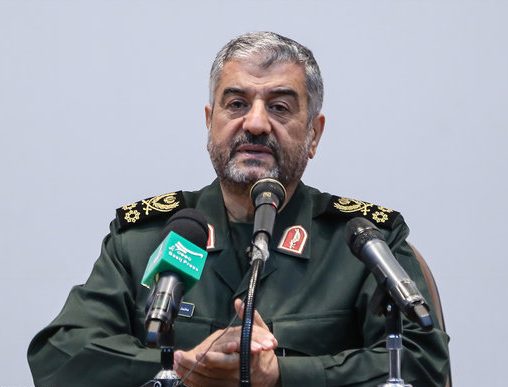
Major General Mohammad Ali Jafari

“I declare it with a loud voice that like other organizations of the Islamic Republic, the IRGC is after peace. We are not seeking war, but peace cannot be secured only through negotiations,” General Jafari said in a Tuesday ceremony in Tehran.

General Jafari stressed that the IRGC does not reject interaction and negotiation, but we should not put our trust in the enemies and not follow them blindly.

The Iranian commander went on saying that some officials claim that the IRGC is totally against interaction with the outside world and seeks war.

“I declare with a loud voice that the IRGC is after peace but a permanent peace can be achieved only if the enemies are afraid of us and remain concerned with the consequences of their animosity towards us.”

“Peace cannot be achieved only through negotiations. This is completely clear for anyone with the slightest knowledge of the global dominance system,” he added.

The Iranian top commander also referred to Riyadh’s atrocities in the region, saying that today Saudi Arabia is turning into a terrorist state in the region.

He advised regional states not to try to turn into a leading power because “they usually end up in bringing disgrace on themselves and putting other states in trouble.”

He also referred to the extension of his term as the IRGC commander for three more years, and added, ”I’ll double my efforts to serve the Islamic Revolution and Establishment.”

“The IRGC has no hesitation in preserving the Islamic Revolution and achieving its goals. Without the support of Jihadi [hard-working] and revolutionary managers at different levels of the IRGC, achieving such goals will be impossible,” he said.

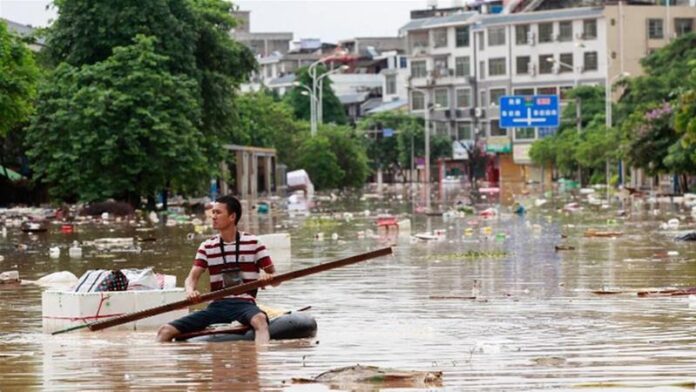
Iran Sympathizes with China over Deadly Floods, Landslides

In a statement on Wednesday, Foreign Ministry Spokesman Bahram Qassemi expressed regret over the recent floods and landslides in China, which have left dozens of people dead and missing, and influenced the lives of millions of people in southern Chinese provinces.

Qassemi also sympathized with the Chinese nation and government as well as the bereaved families of the victims.

At least 56 people have been killed and 22 others have gone missing as heavy rains left a trail of destruction in 11 Chinese provinces, authorities said on Tuesday.

A total of 27,000 houses collapsed and 37,000 others damaged in floods, landslides and hailstorms since 29 June in Zhejiang, Anhui, Jiangxi, Hubei, Hunan, Guangdong, Chongqing, Sichuan, Guizhou, Yunnan and Guangxi Zhuang Autonomous Region, the Ministry of Civil Affairs said.

Water levels in more than 60 different rivers have risen above warning levels, forcing more than 1.2 million people to evacuate.