Friday, April 24, 2026
Home Blog Page 3987

US to Pay Dearly for Anti-Iran Measures: Larijani

“They might think that they can create new problems for us, but they cannot impose costs on us and evade paying anything themselves,” Larijani said on Thursday, addressing a gathering in Rasht, northern Iran.

He referred to the support provided by world powers for terrorist groups, and said it has not been limited to the past few years. “They have been sponsoring terrorism for so many years,” he added.

“They might even think that they create problems for us by making anti-Iran decisions, but it is not so,” Larijani said.

Enormous Book Garden Inaugurated in Tehran

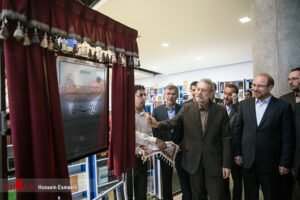
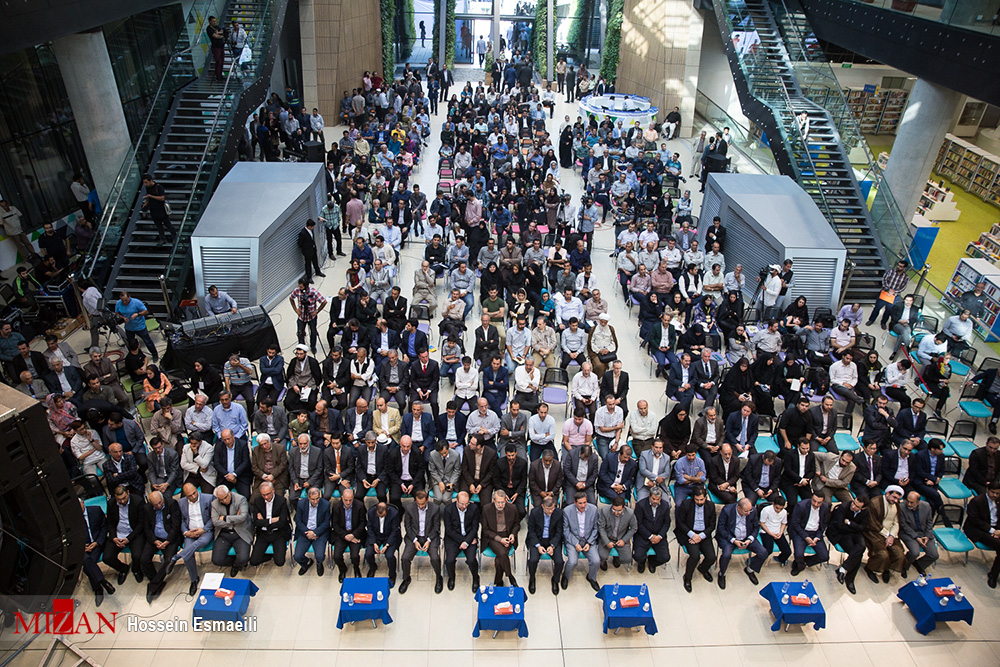
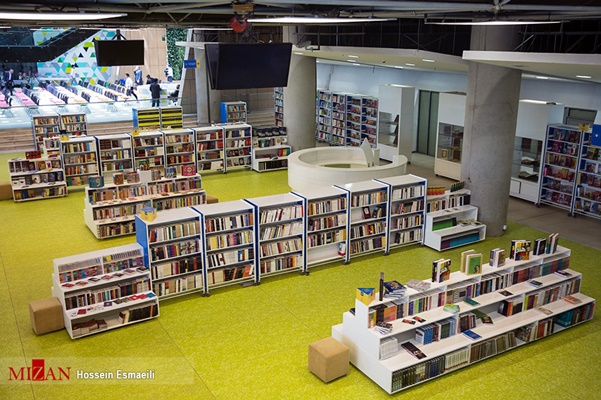
Enormous Book Garden Inaugurated in TehranThe Tehran Book Garden, Iran’s biggest scientific and cultural complex, opened in the capital city on Wednesday, July 5, in a ceremony attended by the Speaker of the Iranian Parliament, Ali Larijani, and Tehran Mayor Mohammad Baqer Qalibaf.

The idea to establish the complex, as a permanent alternative for holding the Tehran International Book Fair, was first put forward in 2004. The project, however, was completed in 2017.

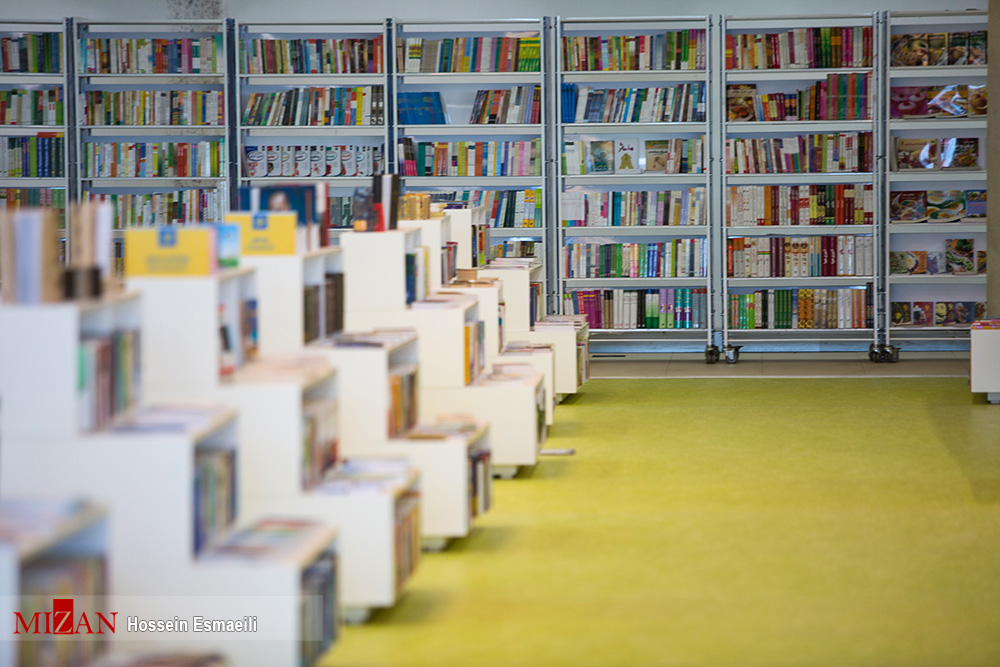
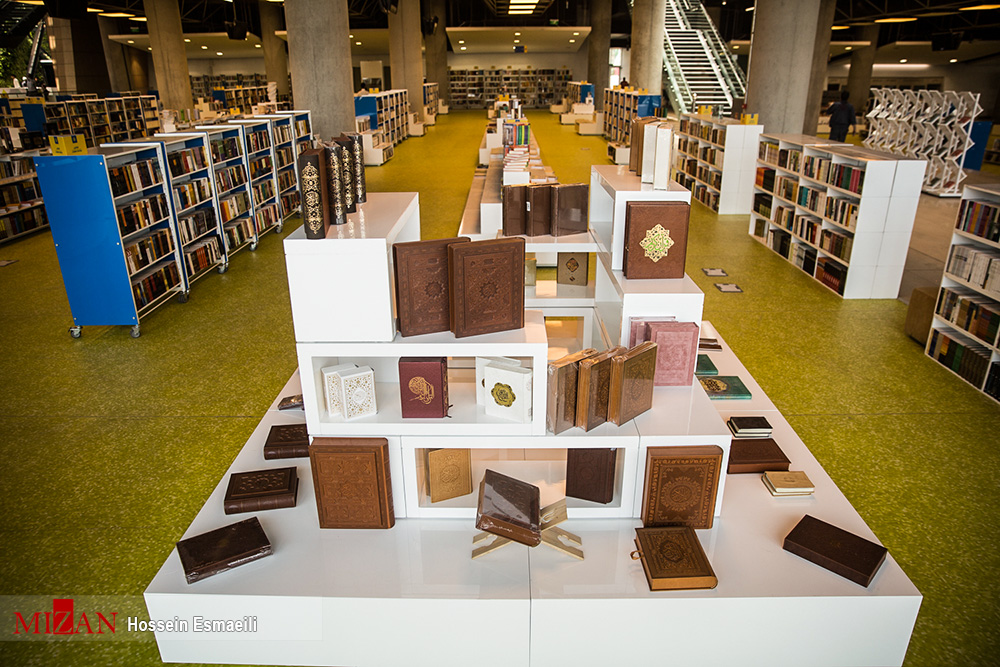
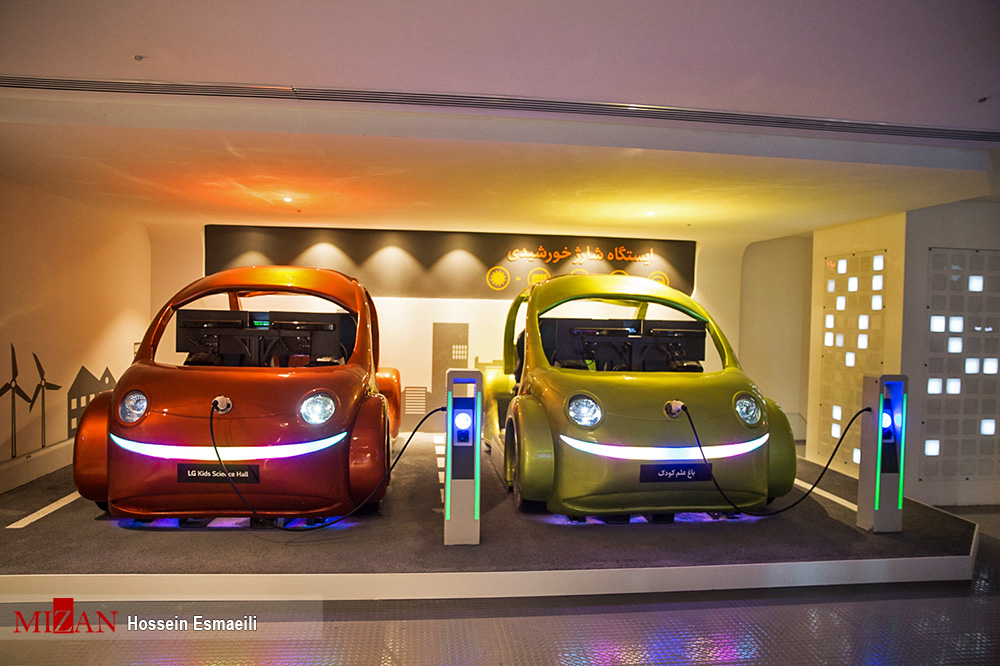
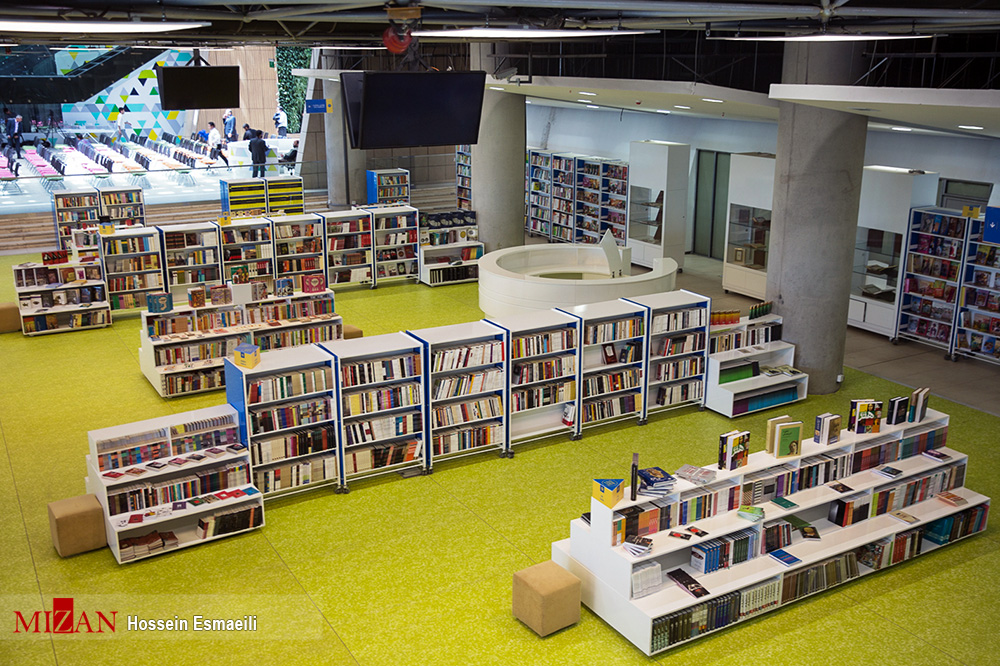
The complex has the world’s biggest bookshop which has a large number of books suitable for children, young adults and adults. It has eight movie theatres, an amphitheatre, and two science halls for children and young adults.

The garden has been designed in four separate blocks. Block A, titled “Baharestan”, consists of a permanent and a topical bookshop. Block B, named “Khialestan” is home to a pathway named the “Pathway of Culture” which, per se, comprises of a number of main entrances, the “Wonderful Corridor” and the “Depository”. Block C, known as “Negarestan” consists of the garden’s main amphitheatre, a gallery and a shop selling cultural products. And finally, Block D, called “Sarvestan”, includes a specialized exhibition and a hall as well as a number of workshops for children and young adults.

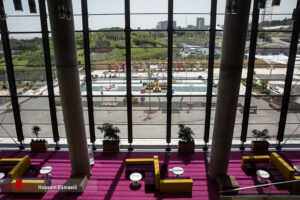
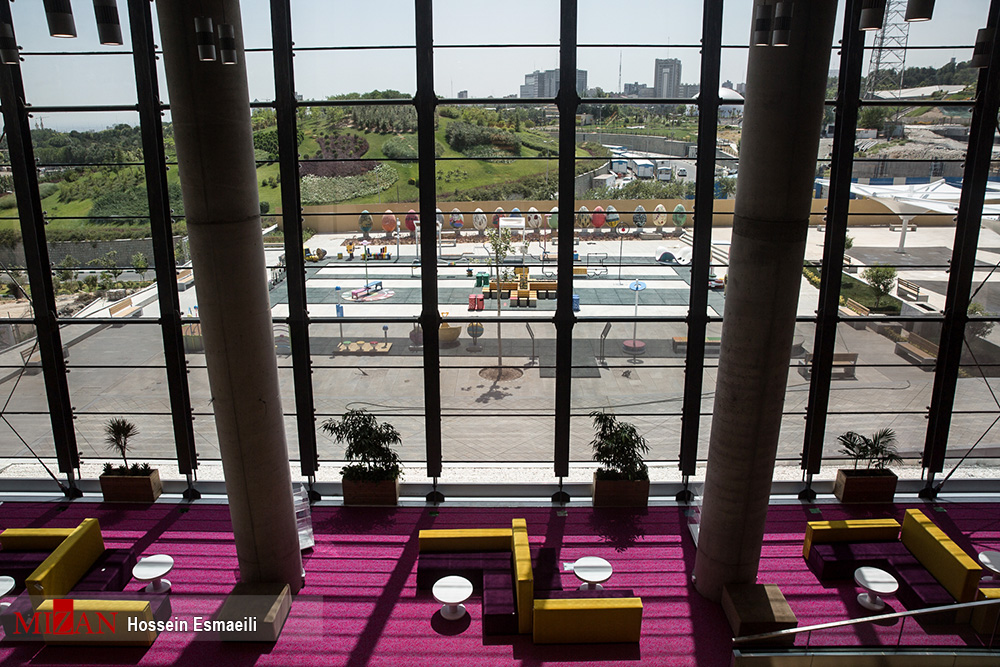
In addition to the four blocks, the cultural complex has a stereo hall, a boulevard, a prayer room, a restaurant and a lake.


Different Sections  

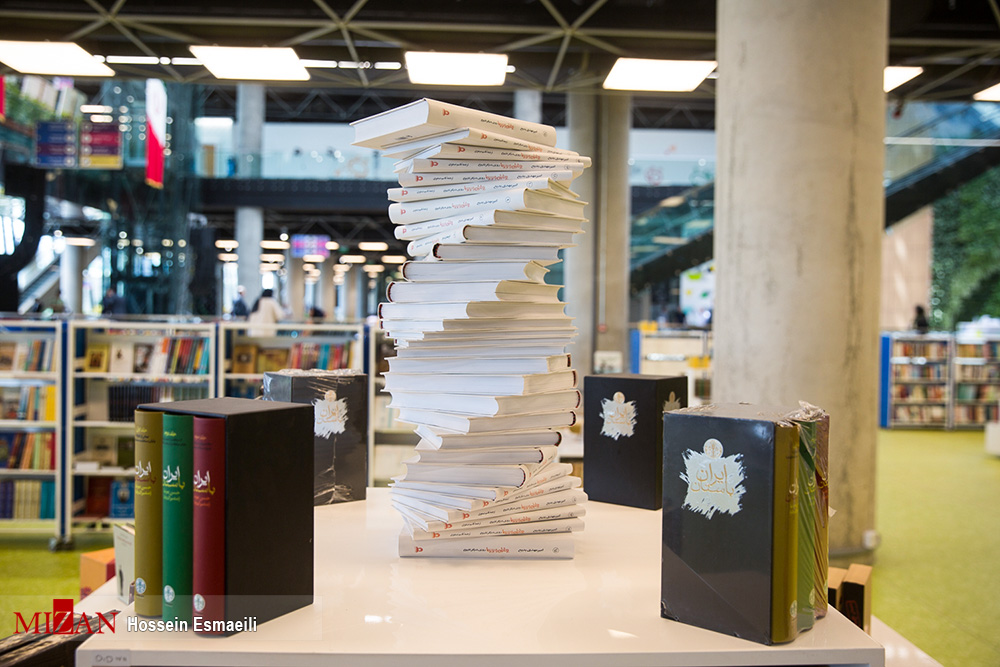
Book GardenWith a gross floor area (GFA) of 25,000 square metres, the world’s biggest bookshop provides children and adults with the largest number of books suitable for their age group. These two age groups are supplied with some 400,000 books in 70,000 topics. In addition, books suitable for all age groups, from children to adults, are available in this bookshop. On top of the bookshop, a giant 25,000-square-metre roof garden has been built. In addition to the green roof, 20,000 square metres of green spaces have been created inside the garden.

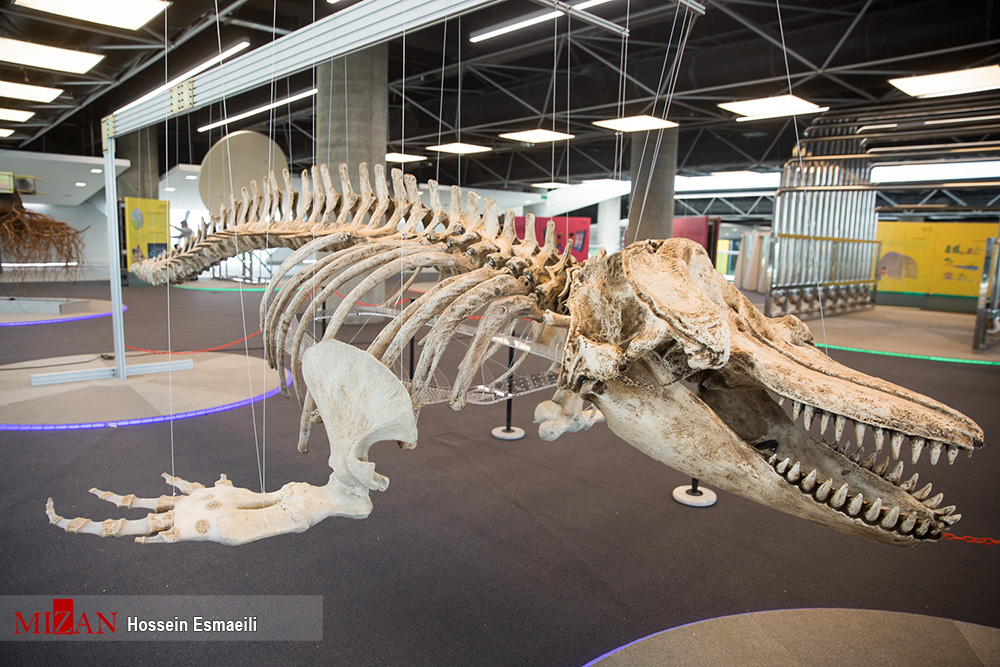
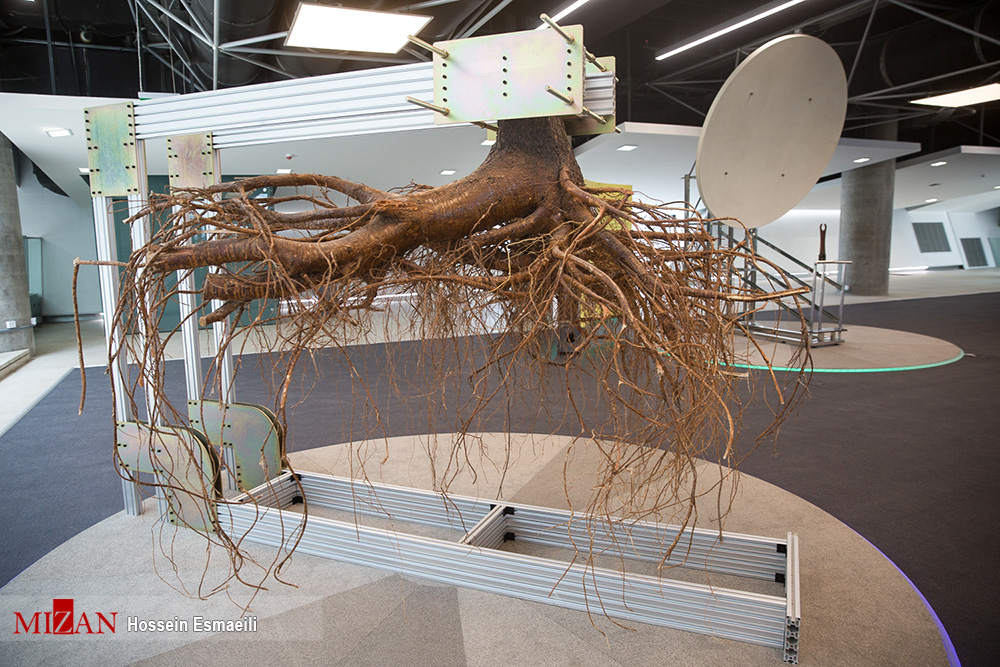
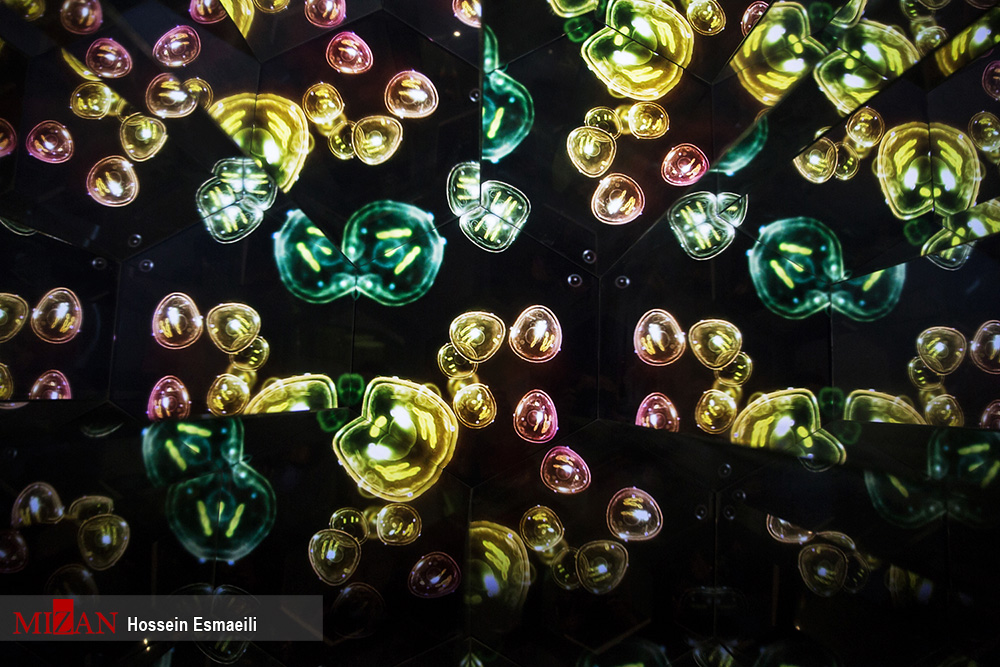
The garden has a giant science complex for children and young adults. The section, which has an area of 12,000 square metres, is a science amusement park.

The book garden is also home to the country’s biggest art gallery. With a GFA of 1,700 square metres, the gallery has been set up to host painting and visual art exhibitions.


Robotic Club

The garden’s robotBook Gardenic club is a unique part of the complex. The members of the club can take specialized courses in artificial intelligence. The club also provides its members with the opportunity to share their information with their fellow members and those of the similar clubs across the world.

Following that of the Tehran Book Garden, the world’s second to fourth biggest bookshops are Barnes & Noble® Store (14,300 square metres) in New York City, Powell’s Books (6,300 square metres) in Portland and Strand Book Store (5,000 square metres) in New York City. The interesting point is that the area of the bookstore in the Tehran Book Garden is almost same size of the aggregate area of these three American bookstores.


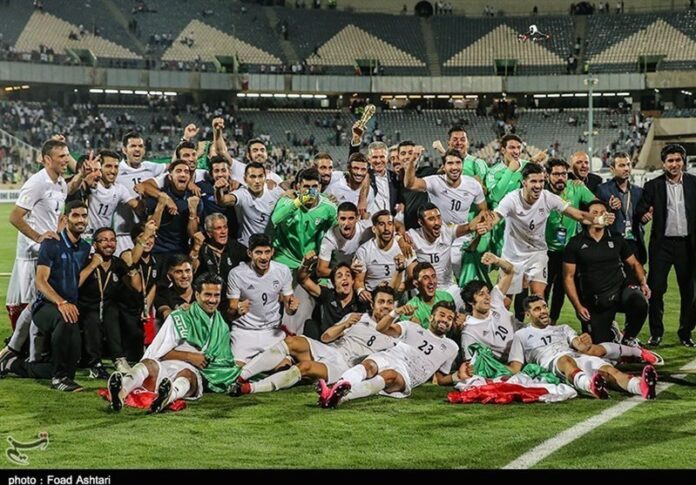
Iran Moves Up Seven Places in FIFA World Ranking

Iran is ranked the highest Asian team in the rankings, while Australia (45) is second followed by Japan (46) and South Korea (51).

Team Melli has become the second team to qualify for FIFA 2018 world cup after Brazil.

Germany has capped a sensational week on the international stage by returning to the top of the FIFA World Ranking for the first time since being knocked off the top spot exactly two years ago.

The next FIFA World Rankings will be published on 10 August 2017.

How Serious Are Internal Divisions in Iran?

How Serious Are Internal Divisions in Iran?
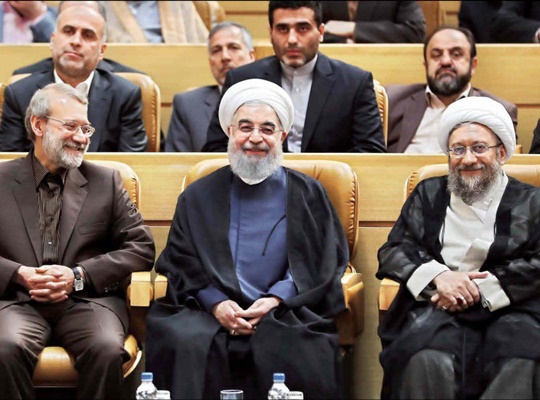
Iranian President Hassan Rouhani, Parliament Speaker Ali Larijani, and Judiciary Chief Ayatollah Sadeq Amoli Larijani in a gathering of Judiciary officials on July 2, 2017

The analysis by Haaretz is half right but at the same time half wrong drawing on wrong premises.

The analyst rightly discerns the stable standing of the Islamic Republic in the region but makes a blatant mistake in trying to find the consequences of Iran’s internal divisions in its regional policy. This is the same mistake that the US and its allies have committed many times over the past decades without learning a lesson.

Last month, the two main political camps in the Islamic Republic, the conservatives and the reformists, unanimously condemned the interventionist statements made by US Secretary of State Rex Tillerson. He had called for a regime change in Iran through interfering in the domestic affairs and realignment of the political factions of the country.

Having misunderstood the internal divisions in Iran, the US top diplomat had pinned hope on the reformist camp to topple the Islamic Republic. But he immediately faced fierce criticisms voiced by reformist figures who vehemently denounced the US and reaffirmed their allegiance to the Islamic Establishment.

Just recently, a plot by the US and its regional allies to broaden divisions in the Islamic Republic was foiled by the Iranians’ high turnout in the presidential election on the one hand, and the crushing response of the religious minorities to their demands on the other.

In less than one week ahead of the presidential election in May, the Friday prayer leader of the Sunni-populated city of Zahedan in southern Iran said the Sunnis proudly devote themselves to Iran. In response to a question on the foreigners’ efforts to broaden ethnic and religious conflicts in Iran, he called on all Iranians from all walks of life to stick to legal and political principles to resolve disputes and achieve their legal rights.

Last month, the Islamic Revolution Guards Corps (IRGC) fired several missiles at the positions of ISIS terrorists in the Syrian city of Deir az-Zor in retaliation for twin terrorist attacks on Iran’s parliament and the mausoleum of late founder of the Islamic Republic, Imam Khomeini in Tehran. The missile strikes were carried out from two Kurdish-populated cities in Kermanshah province, western Iran. The strikes were aimed at sending a clear message to the terrorists: Iranians do not hesitate in defending their country against enemies’ attacks. The message became clearer after the participation of former commander of IRGC, Major General Mohsen Rezaee, in the Sunnis’ Eid al-Fitr Prayer in the province.

As the latest show of grown-up interactions between Iranian political camps, Ali Reza Zakani, a former conservative lawmaker, called for a self-restraint at his camp.

As the US, Israel and Saudi Arabia in line with some European states have pinned their hopes on the terrorist Mojahedin-e-Khalq Organization (MKO or MEK) to make a regime change in Iran, a call for a unilateral ceasefire by a conservative politician was warmly welcomed by many reformist figures.

In response, one of the main figures of the reformist camp, Abdollah Ramezanzadeh, called for a national dialogue. In a post on his Twitter, he wrote, “In an appropriate move, Mr. Zakani has advised his camp to observe a unilateral ceasefire, but why unilateral? Let’s start a national dialogue.”

The high turnout in the recent elections is a sign of true religious democracy in Iran and the current interactions between the conflicting political camps is one of the main fruits of such democracy.

Despite their bitter disputes over many issues, the camps are united against the foreign enemies and prioritize the national security over their factional interests.

In a nutshell, if the Israeli analyst was familiar with the concept of religious democracy, he would not wonder why Iran’s regional standing is not undermined by it internal divisions.

Riyadh Accepts Tehran’s Conditions for Hajj Pilgrims’ Security: Minister

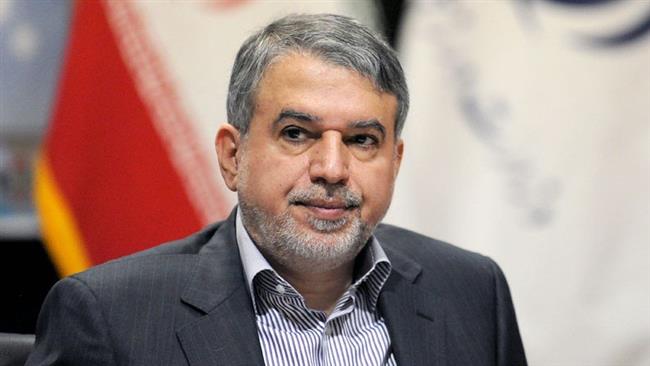
Reza Salehi Amiri

Speaking to reporters on the sidelines of the cabinet meeting on Thursday, Reza Salehi Amiri underlined Tehran’s resolve to maintain the “dignity” of Iranian Hajj pilgrims, the Iran newspaper reported.

“For this aim, we have taken all the possible paths. The Saudi Arabian side accepted the conditions required by Iran for [ensuring] the security of Hajj pilgrims and given [assurances] in writing,” he added.

The culture minister said that Iran has currently dispatched medical teams and different logistics to the holy cities of Mecca and Medina, noting that the first group of Iranian pilgrims will be sent to Saudi Arabia on July 31.

“We normally monitor the situation and if there is any likelihood for an incident, we will follow it up at the senior levels of the [Iranian] establishment (top officials),” Salehi Amiri pointed out.

In January, Iran’s Ministry of Culture responded to an official invitation by Saudi Arabia to attend meetings to discuss the resumption of the Hajj pilgrimage for Iranians and conveyed Iran’s ideas and concerns to the Saudi side.

In September 2015, a deadly human crush occurred during Hajj rituals in Mina, near Mecca.

Days into the incident, Saudi Arabia published a death toll of 770 but refused to update it despite gradually surging fatality figures from individual countries whose nationals had been among the victims of the crush.

Unofficial sources put the death toll at almost 7,000 people. Iran said about 465 of its nationals lost their lives in the incident.

Riyadh Accepts Tehran's Conditions for Hajj Pilgrims' Security: Minister

Earlier that same month, a massive construction crane had collapsed into Mecca’s Grand Mosque, killing more than 100 pilgrims, including 11 Iranians, and injuring over 200 others, including 32 nationals from Iran.

Serious questions were raised about the competence of Saudi authorities to manage the Hajj rituals in the wake of the incidents, and, facing Saudi intransigence to cooperate and refusal to guarantee the safety of Iranian pilgrims, officials in the Islamic Republic subsequently decided to halt pilgrimages over security concerns.

Saudi Arabia also unilaterally severed its diplomatic ties with Iran in January this year after protests in front of its diplomatic premises in Tehran and Mashhad against the execution by Riyadh of eminent Saudi Shia cleric Sheikh Nimr al-Nimr.

Iran-Total Gas Deal Sparks Controversy in Tehran

The opponents and proponents of the deal signed on July 3 have missed no opportunity to state their opinions about it. But the main question is whether or not they are all qualified enough to express their ideas.

Iran and a consortium headed by Total signed a five-billion-dollar gas deal to develop the South Pars offshore gas field’s phase 11. The consortium consists of Total from France (with a share of over 50%), CNPS from China (30%), and Petropars Group from Iran (lower than 20%).

In his remarks during the signing ceremony, Iran’s Oil Minister Bijan Zanganeh said this is a very good day for Iran’s oil industry. He also expressed the hope that the industry develops into a new phase with the signing of the deal.

Mohammad Baqer Nobakht, the spokesman for the Iranian government, also said with signing the agreement, Iran has demolished the wall of sanctions.

The deal has sparked mixed reactions among a larger number of Iranian political and economic players. Government officials have warmly welcomed the deal, while the issue of signing new oil contracts with foreign companies particularly the French giant of Total has been controversial provoking serious disputes inside Iran over the past months.

In one case, Leader of the Islamic Revolution, Ayatollah Seyyed Ali Khamenei, ordered the officials in charge that no new oil and gas contracts for international companies must be awarded without necessary reforms.

In a letter to Iran’s First Vice-President, Es’haq Jahangiri, two weeks before signing of Iran-Total gas deal, former lawmaker Ahmad Tavakoli criticized the government for violating its own approvals about the necessity of observing security measures in dealing with foreign companies.

As the founder of the corruption watchdog, non-governmental organization Justice and Transparency Watch, Tavakoli also said as stipulated in the Leader’s guidelines on oil contracts with foreign companies, the government is obliged to observe all security considerations.

“The 8th stipulation of the guideline says that the companies’ access to the secret information about Iranian oil fields should be discussed in the National Security Council,” Tavakoli added.

Now most of the critics say their main question is whether the government has addressed the issues raised by Tavakoli. But there are other opponents of the oil deal who have taken one step further. Ali Reza Zakani, a former Iranian MP says he is against the deal for reasons beyond what Tavakoli raised in his letter.

“We are against the deal because the French company left Iran alone during western sanctions and is notorious for its corrupt deals,” he added.

The proponents of the deal, however, view it as a victory for the Islamic Republic. In response to the critics, Zanganeh said the gas deal was signed despite opposition from inside and outside the country because the opponents begrudge Iran’s dignity and achievements particularly its restored relations with the world.

He also stressed the deal has been signed according to the Constitution of the Islamic Republic of Iran. “Based on the government approvals, a seven-member board is now assigned with making sure the deal does not violate any government approvals. The board is comprised of four former ministers and three other senior officials,” he said.

Speaking on the sidelines of the signing ceremony, Zanganeh also said Iran has invested five billion dollars, but Total is expected to invest nearly six billion dollars.

“Some critics say we have given away between 50 to 70 percent of the whole shares of the deal to the foreign side. But this is wrong. The whole income of Total and its consortium from the gas fields would stand at less than 15 percent in the next 20 years.”

This comes as Hedayatollah Khademi, a member of the presiding board of Iranian parliament, says the lawmakers are set to conduct a review of the deal with Total and expressed hope that there will be an appropriate mechanism to oversee the deal.

“We also hope the French side remains committed to its pledges under the deal and won’t leave it unfinished,” he said.

He went on saying that over the next couple of days, the parliament’s presiding board will enter into correspondence with the Oil Ministry to get the details of the deal.

“Having got the details, the relative commission will begin a probe into the agreement,” he said.

The statements of the lawmaker reveal an important point: Neither the opponents, nor the proponents are not aware of the deal’s details. It seems the Oil Ministry has decided to keep the details secret.

So, it goes without saying that all the opinions expressed for or against the deal are based on some partial media speculations.


Follow Reza Khaasteh in Twitter via @Khaaasteh

Tehran to Host Iran-Italy Joint Orchestra Performance

The performance entitled “The Roads of Friendship” will be staged on July 6 at Tehran’s Vahdat Hall.

The ensemble is composed of Italian as well as Iranian musicians conducted by Maestro Riccardo Muti from Italy and Maestro Shardad Rohani from Iran.

Muti from Italy and Maestro Shardad RohaniThe Italian maestro is going to conduct the Tehran symphony orchestra, which according to Rohani is an honour for the Iranian music community.

Rohani told the Mehr News Agency that the historic presence of such a great master in Iran is a turning point in Tehran symphony orchestra’s activities.

A second performance with the same ensemble will be later held on July 8 in the Italian city of Ravenna.

Rohani referred to the Iranian musicians’ performance in Ravenna, and said it is a source of honour for members of Tehran symphony orchestra to send a message of peace and friendship to the world through their performance in an Italian city in a time when the entire Middle East is grappling with war.

He said the world has negative perceptions of Iran, and the Iranian musicians’ performance in Ravenna can improve the Islamic Republic’s image as a cultural state.

The joint performance in Iran is going to be held as the country has a busy musical week ahead.

Many singers from pop to traditional singers with different musical styles are going to hold concerts in different parts of the country from north to south and east to west.

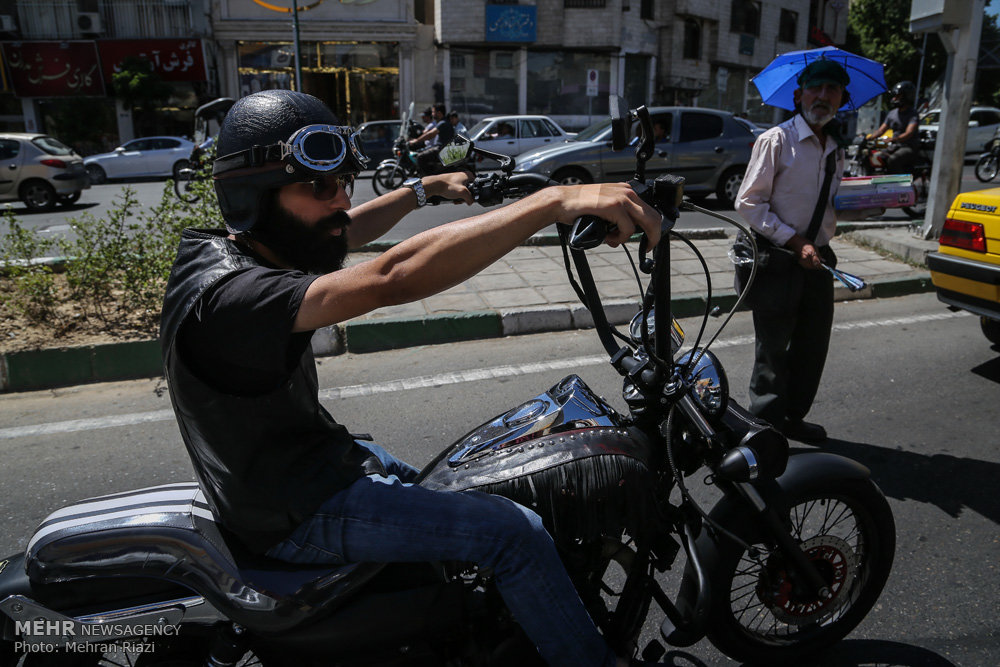
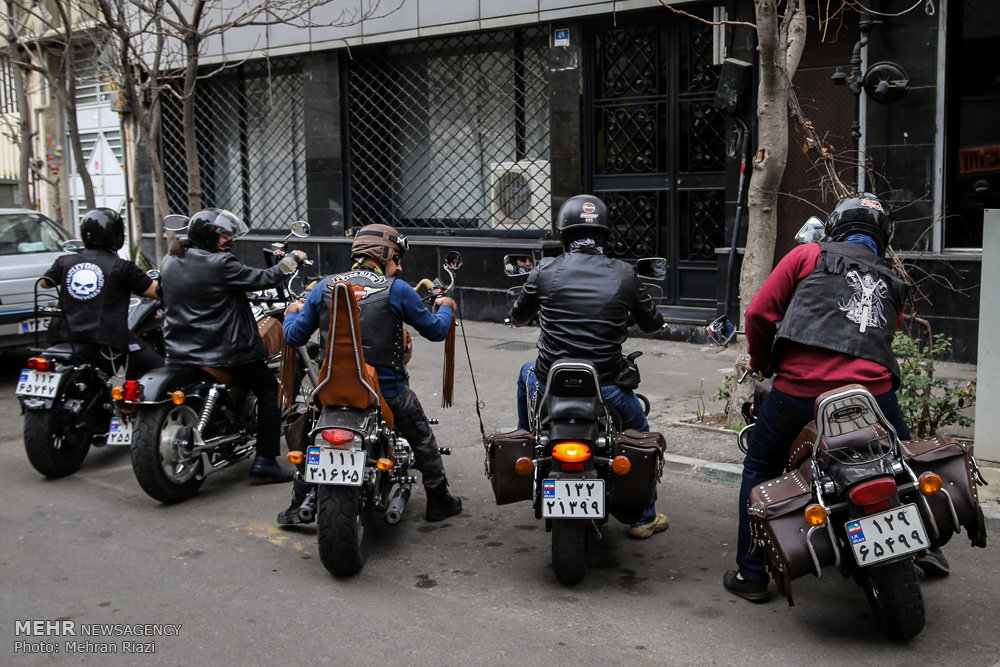
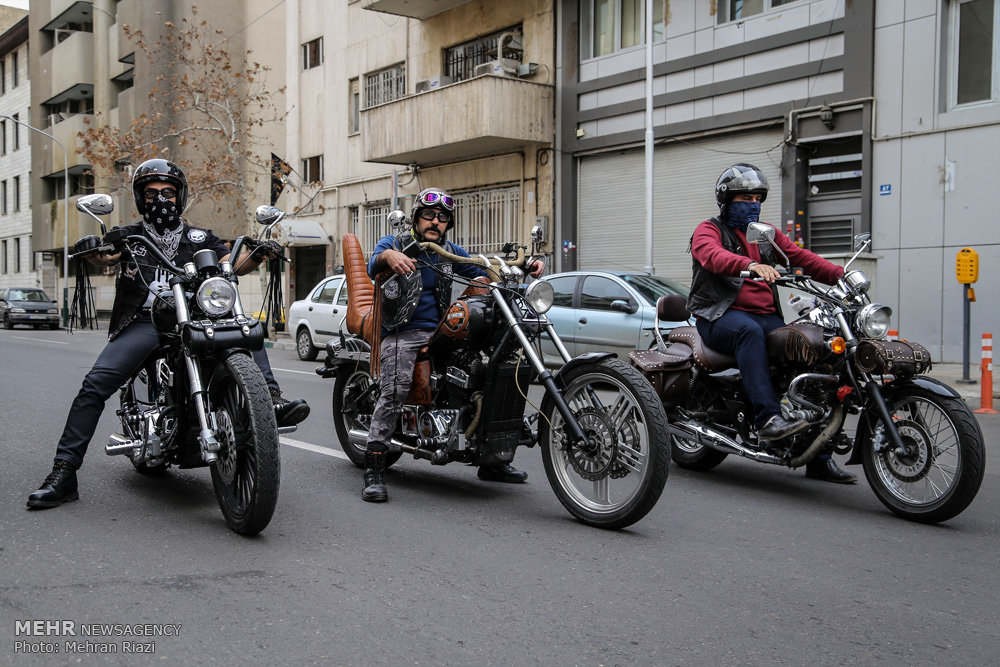
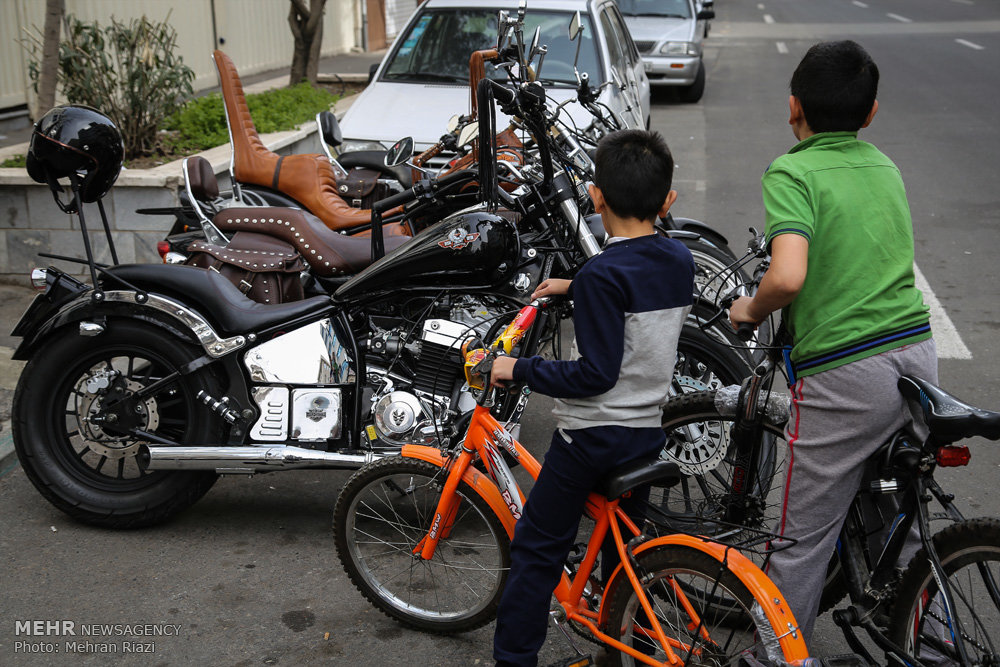
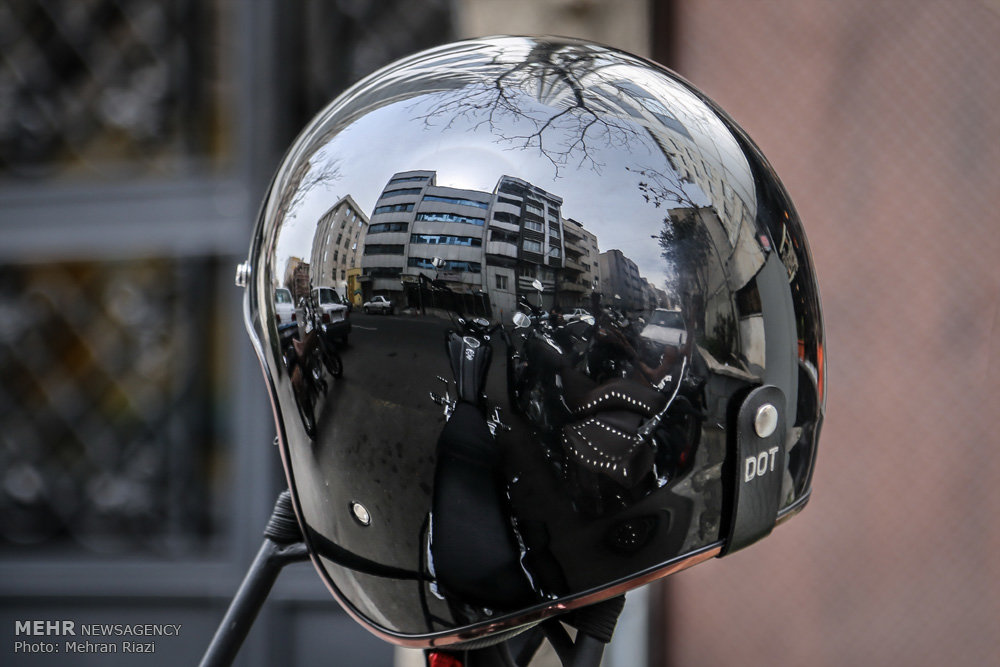
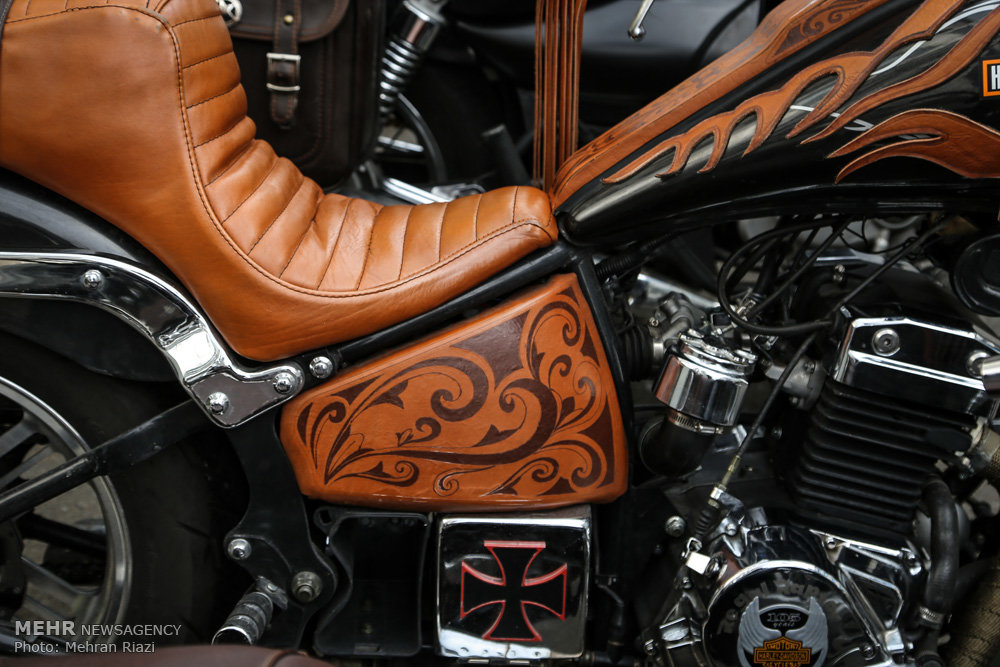
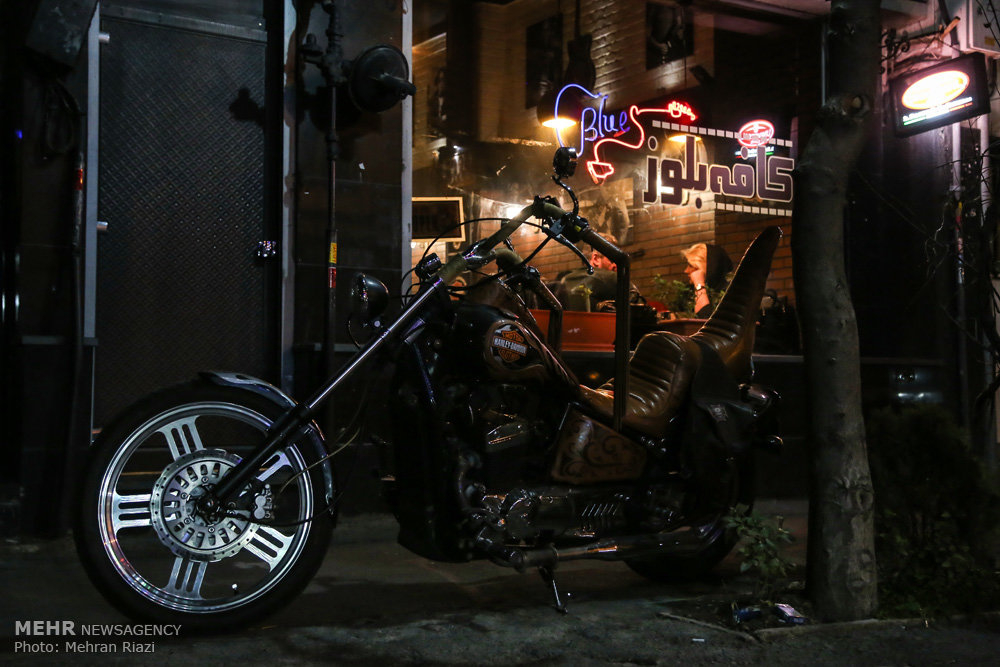
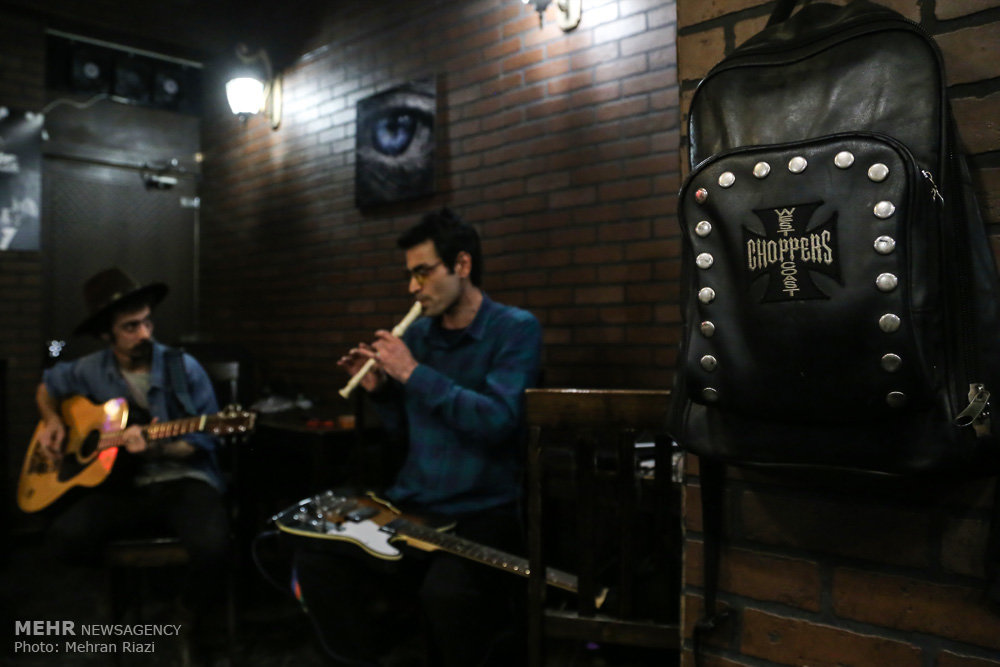
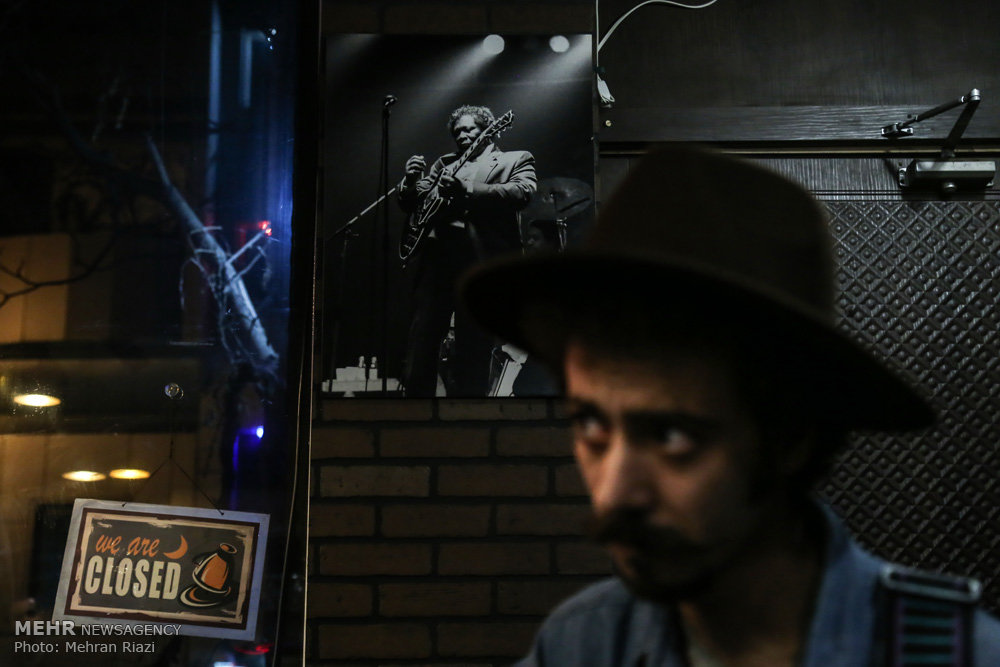
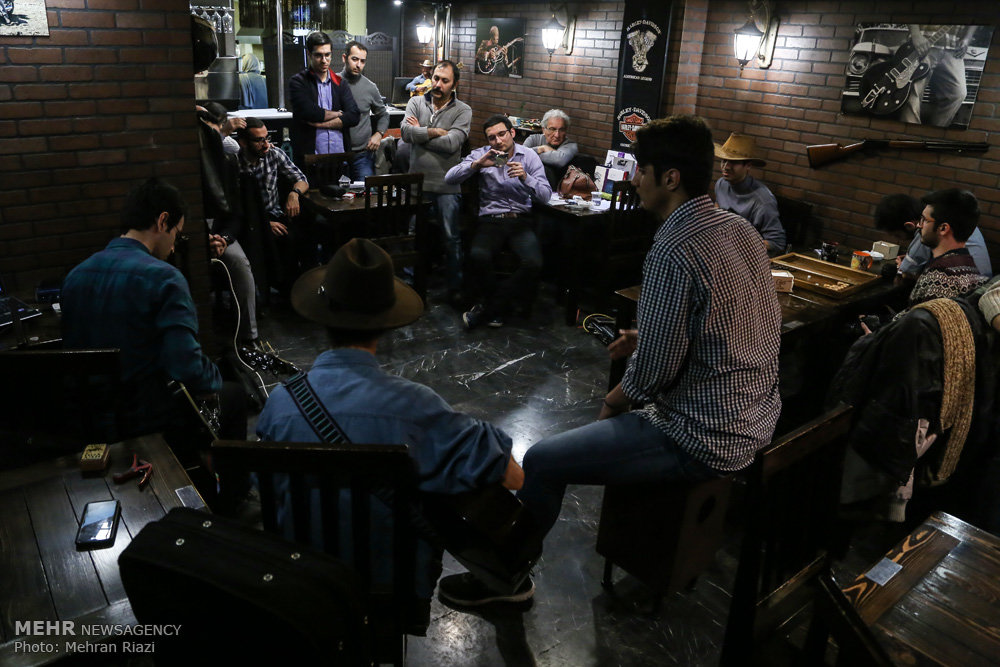
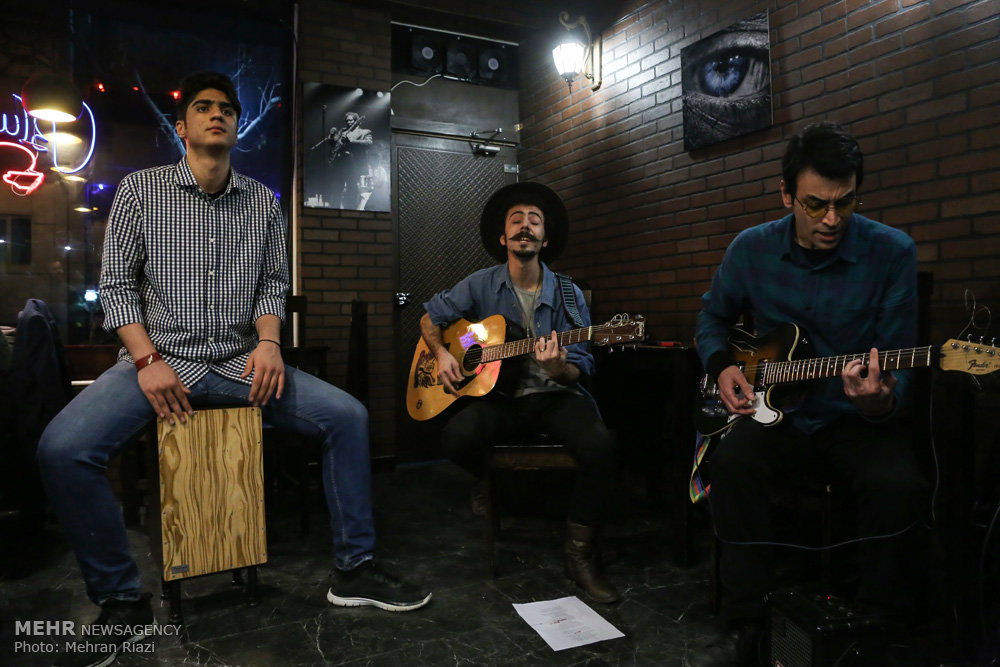
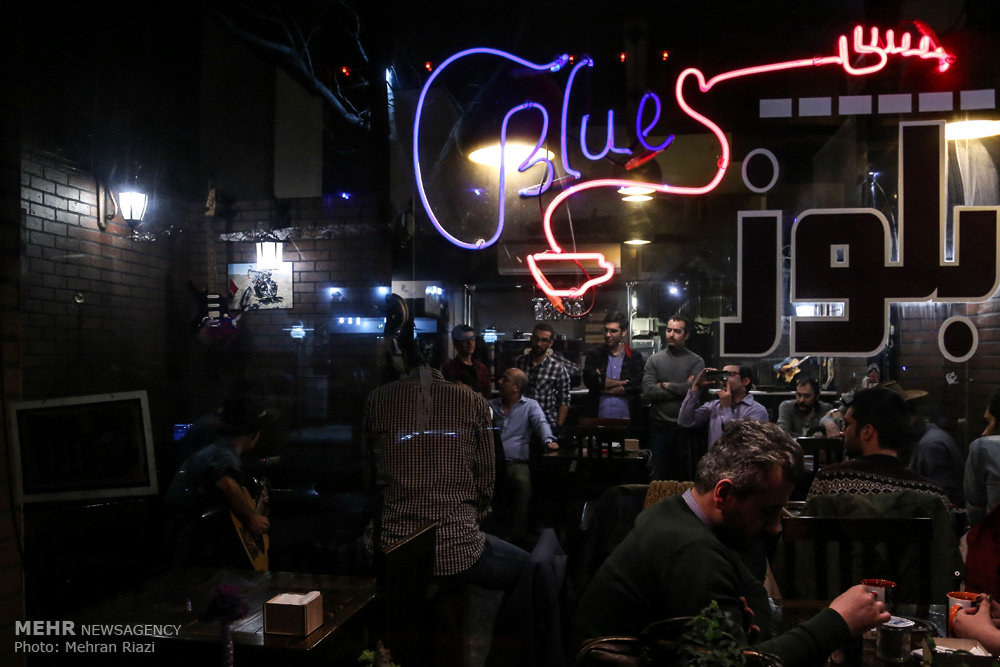
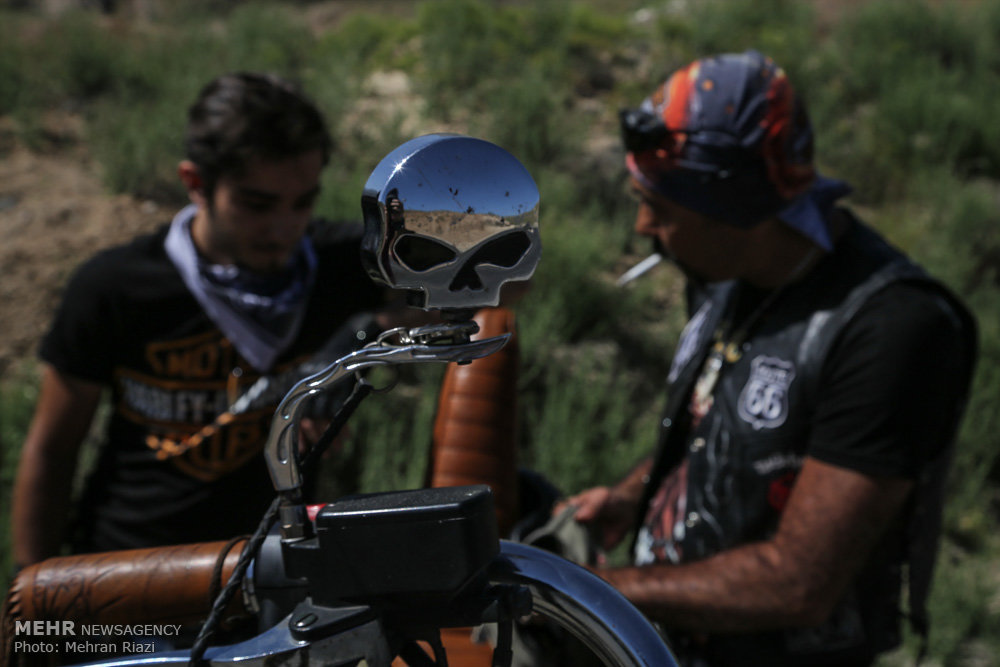
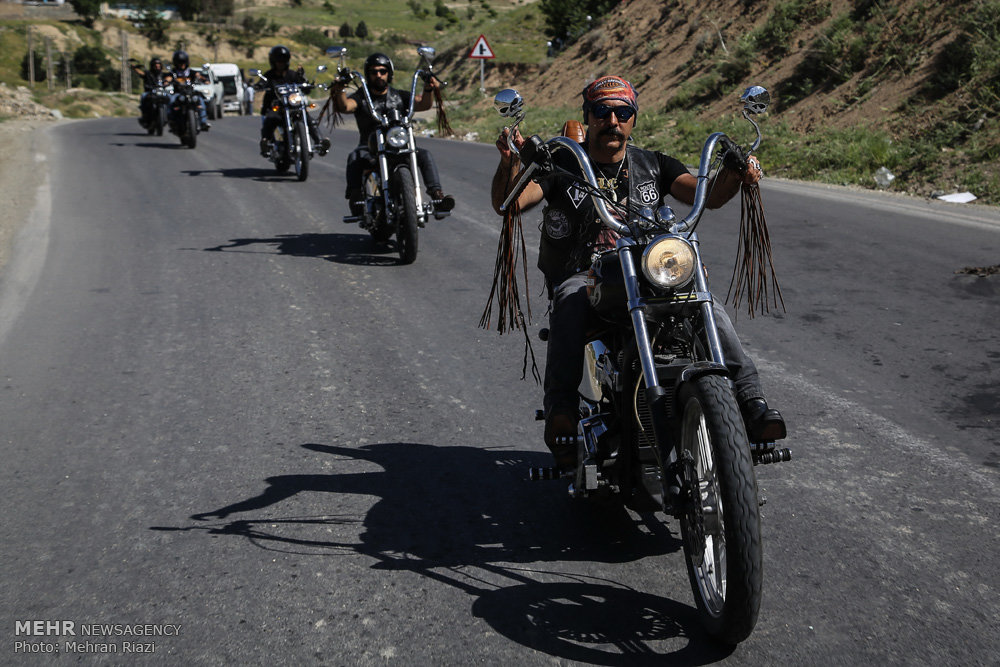
Blues Coffee Shop, Hangout for Iranian Cruiser Motorcyclists

Cafe-Tehran (26)

Blues is an African-American music that traverses a wide range of emotions and musical styles. “Feeling blue” is expressed in songs whose verses lament injustice or express longing for a better life and lost loves, jobs, and money.

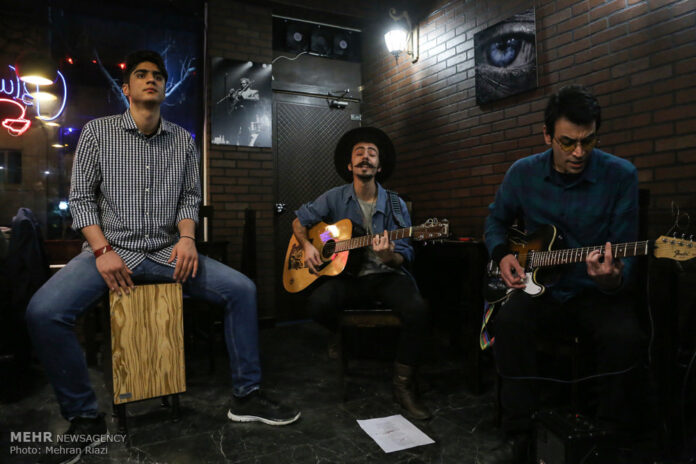
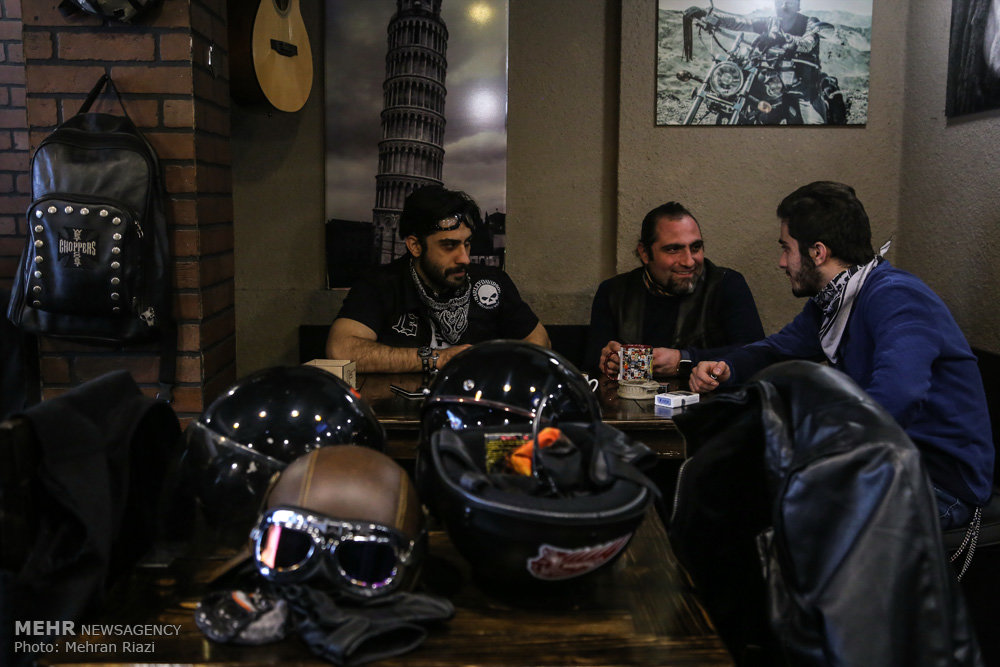
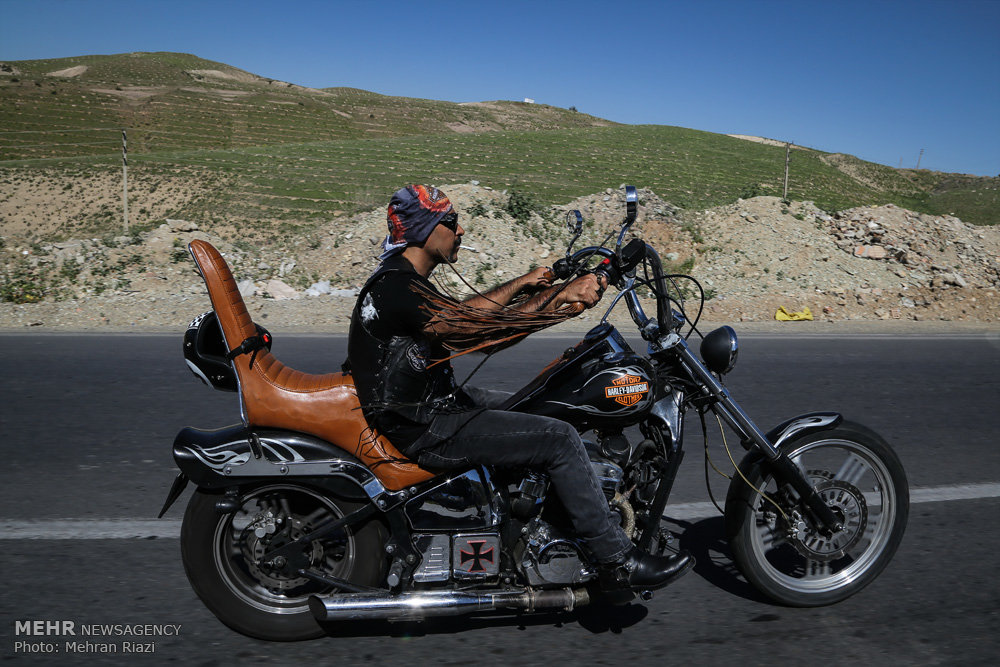
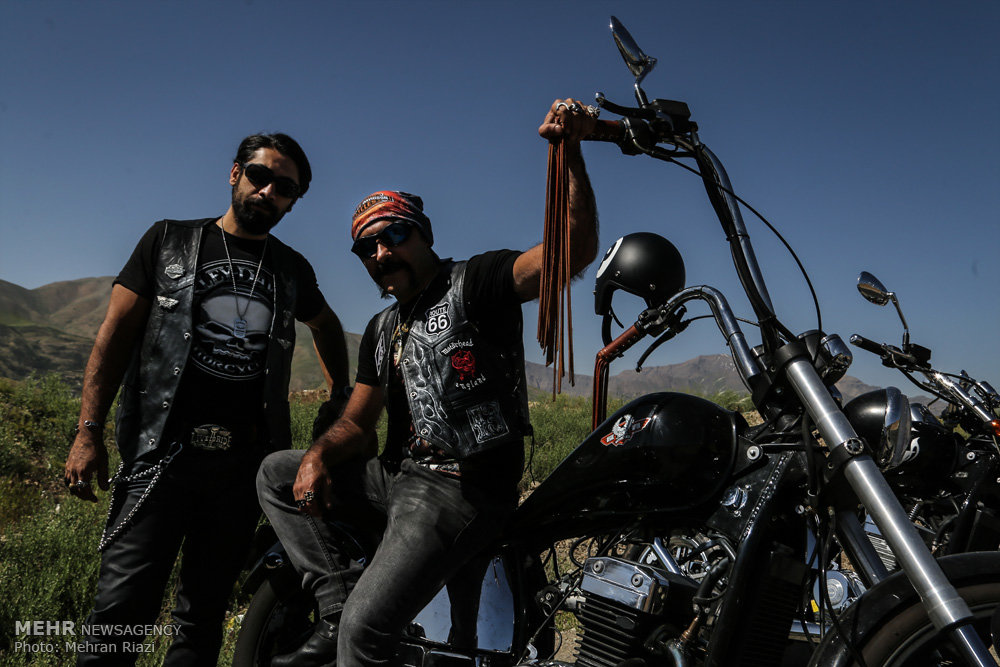
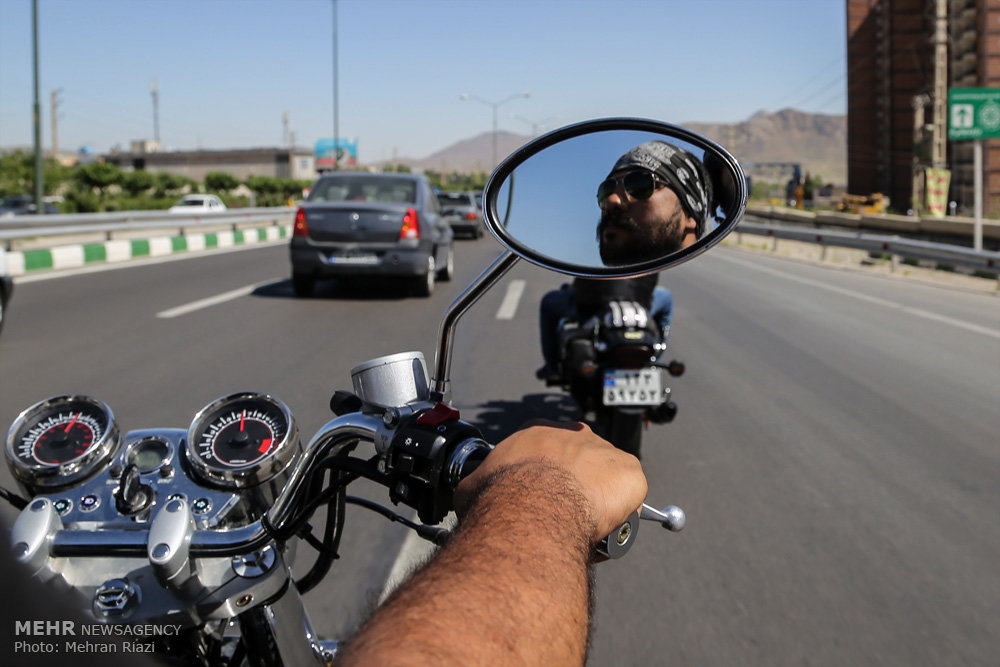
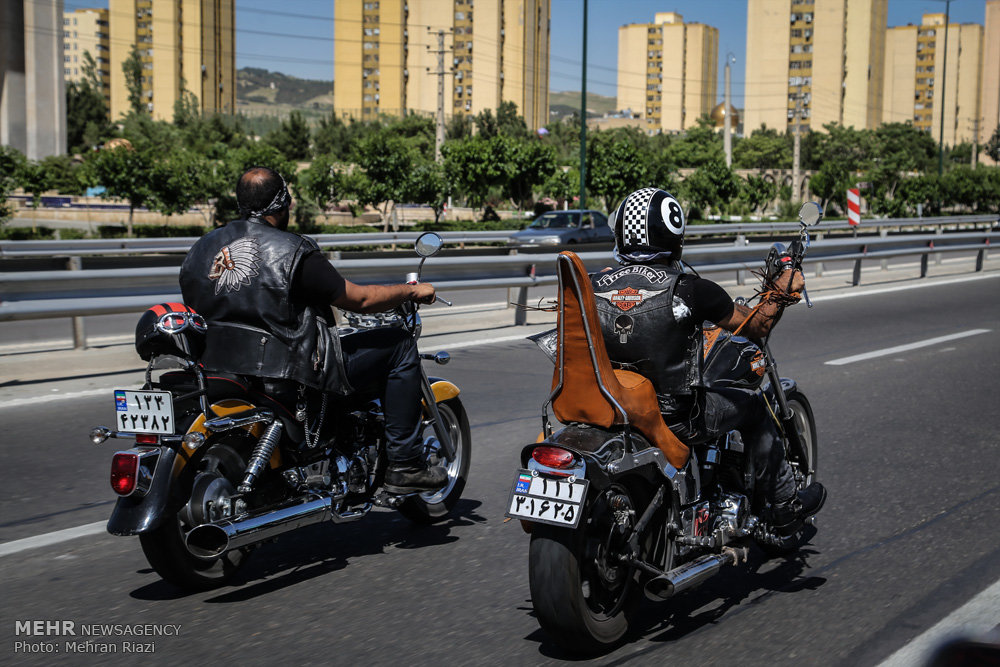
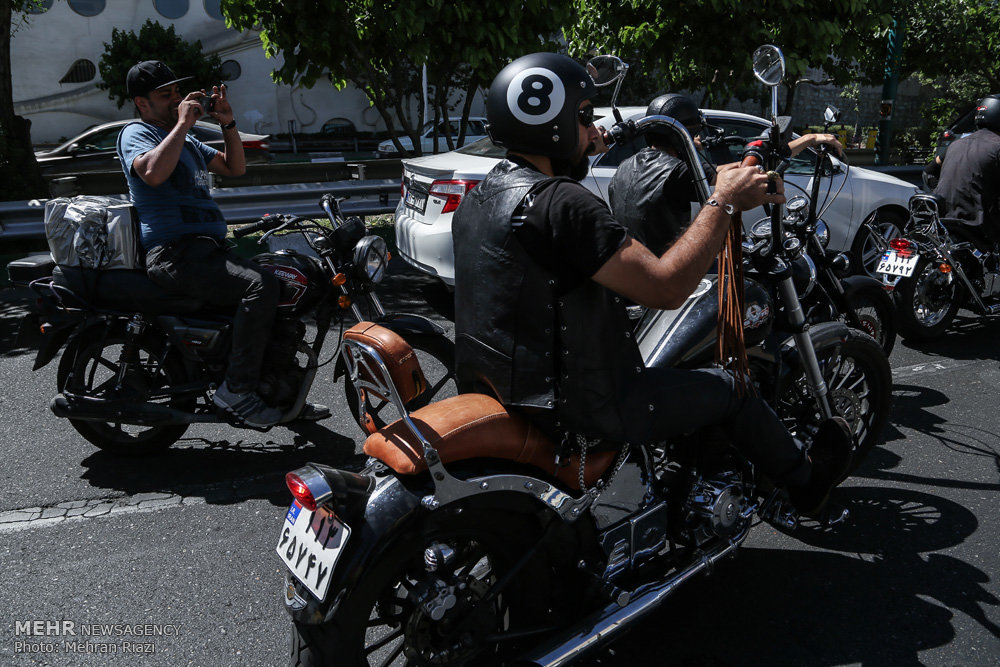
Robert Hakoupian, 42, is the owner of the ‘Blues Coffee Shop’ in Tehran. He has established it to provide amateur musical players filled with a longing for motorcycling with a hangout to come together and hold live concerts. He is now planning to organize the cruiser motorcyclists into a cohesive group and involve them in charity events.

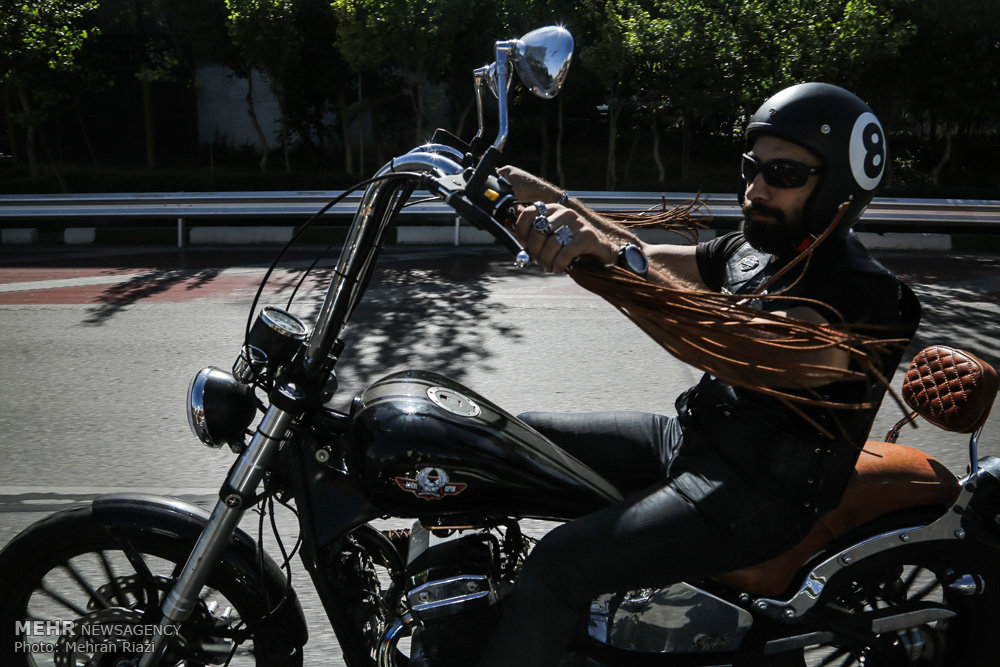
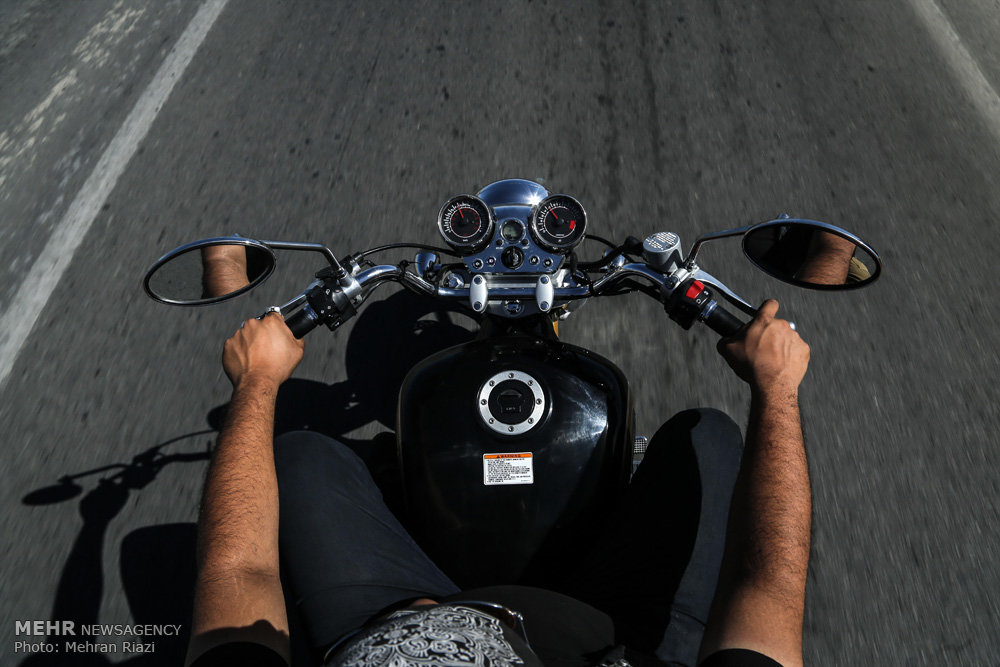
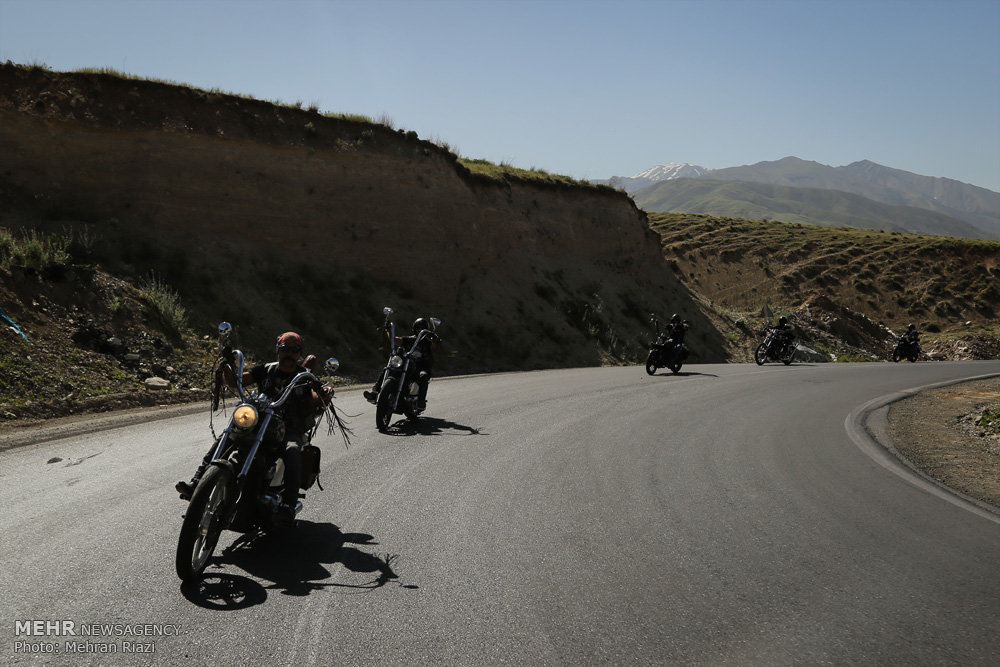
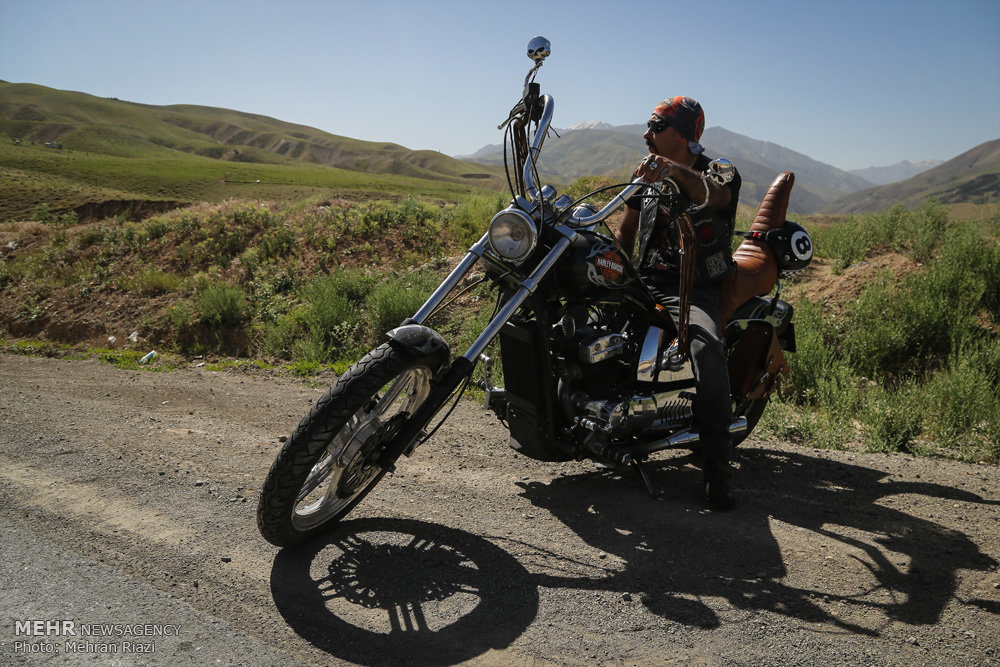
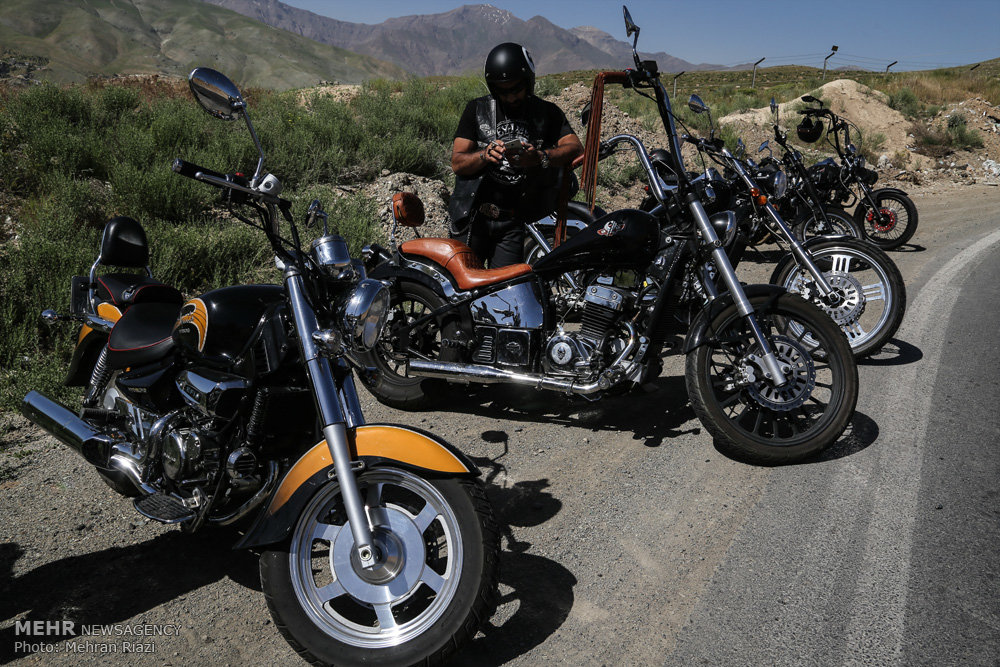
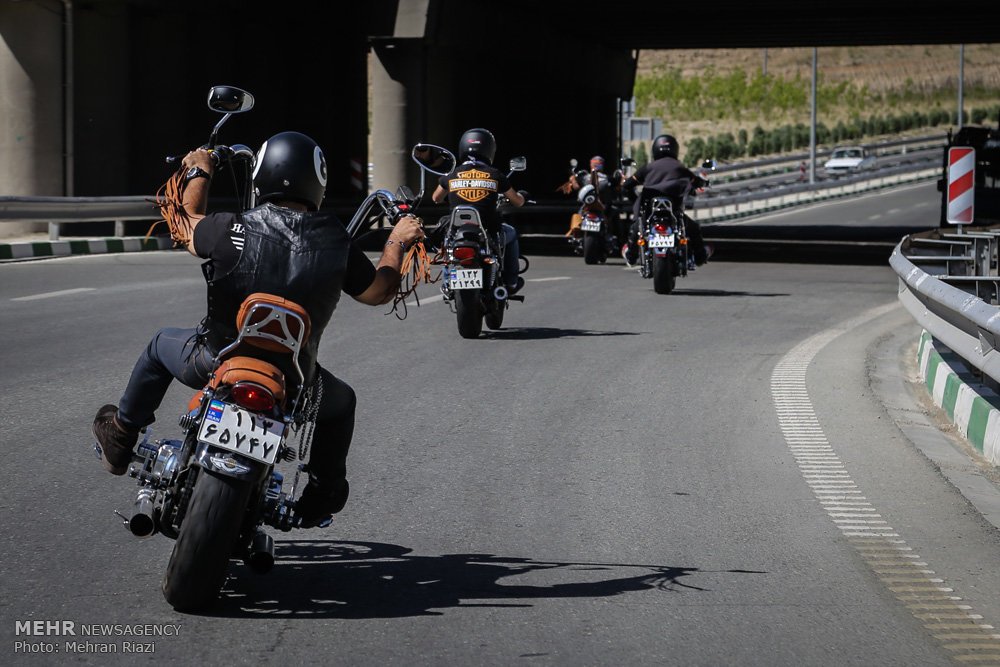
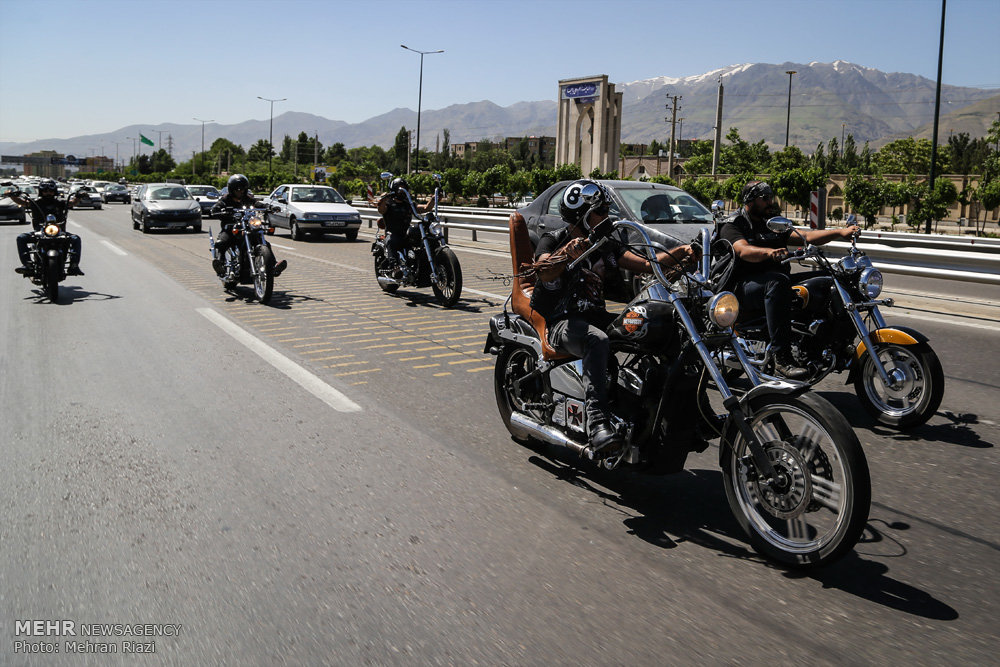
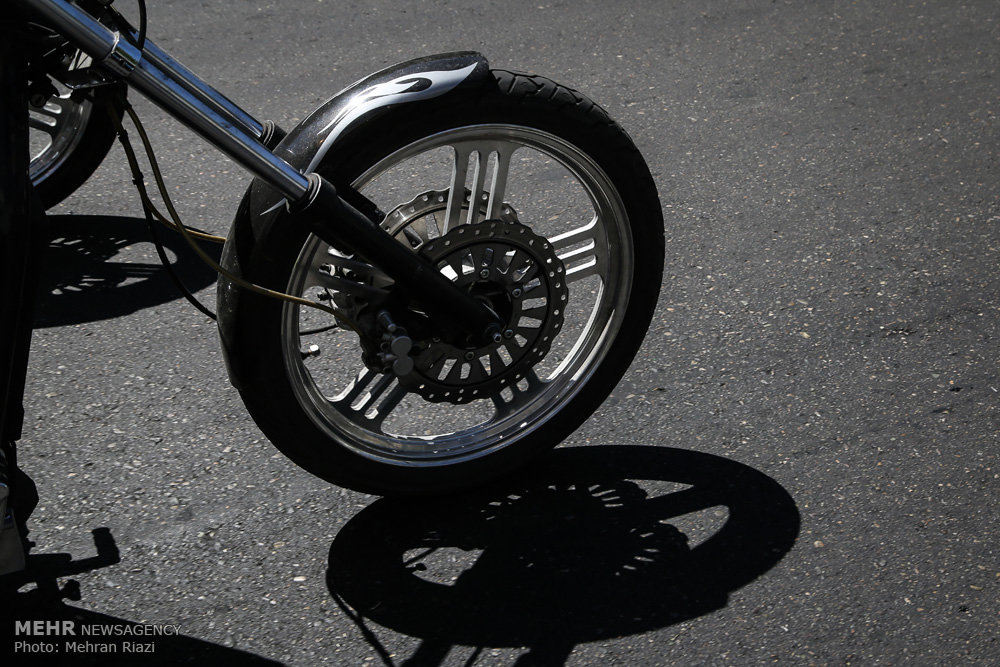
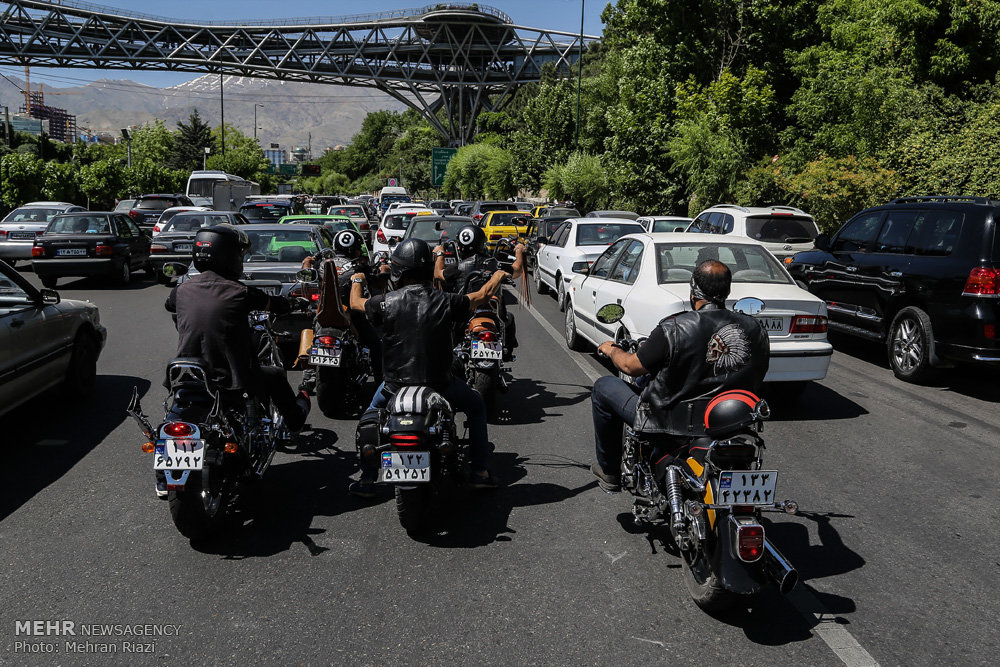
Robert, himself, has been crazy for motorcycles since his childhood. Later during his teenage years, he developed an interest in the Harley-Davidson motorcycles and bought his first bike in 2005. Cruiser motorcycles are not fast. They are mainly designed for group rides in the country roads.

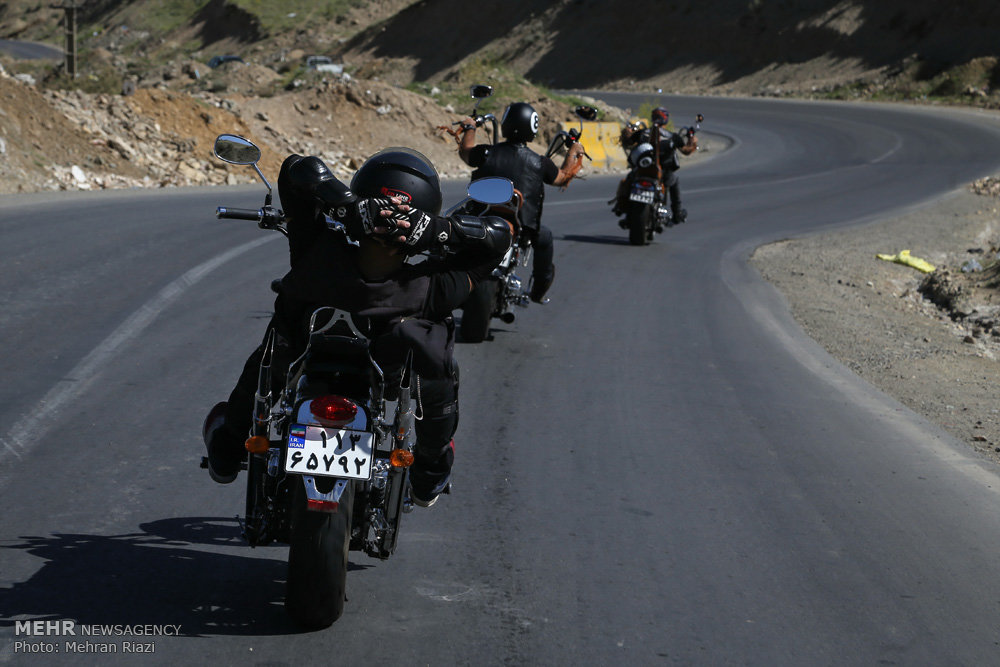
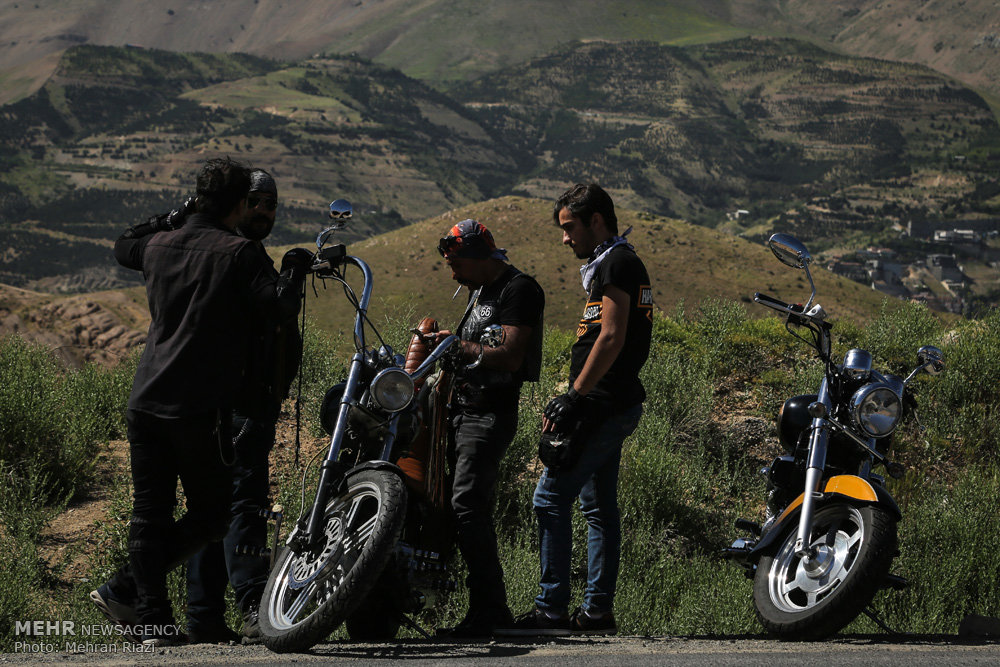
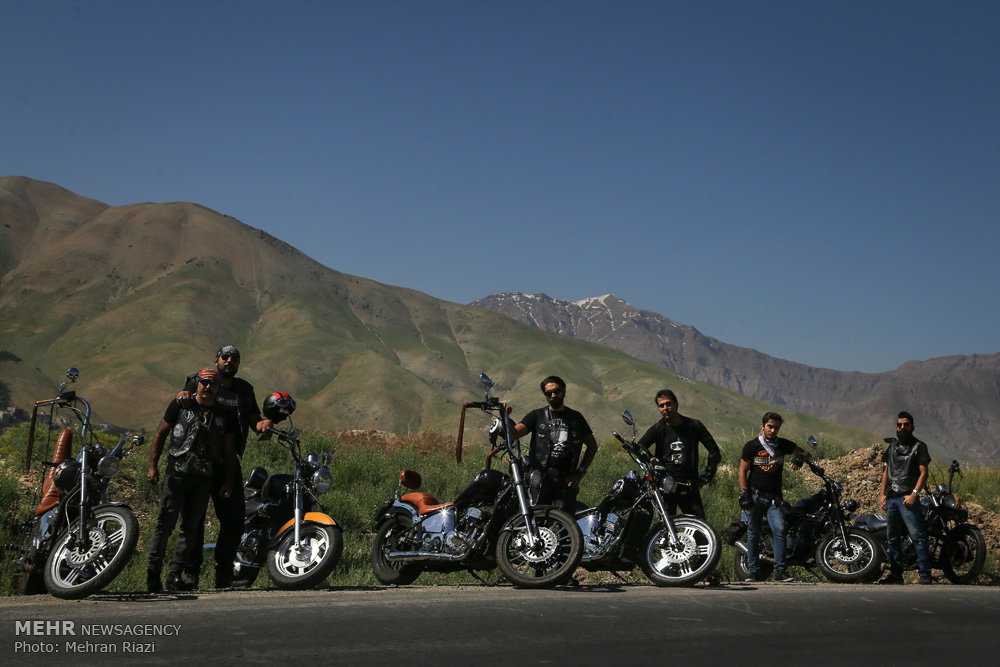
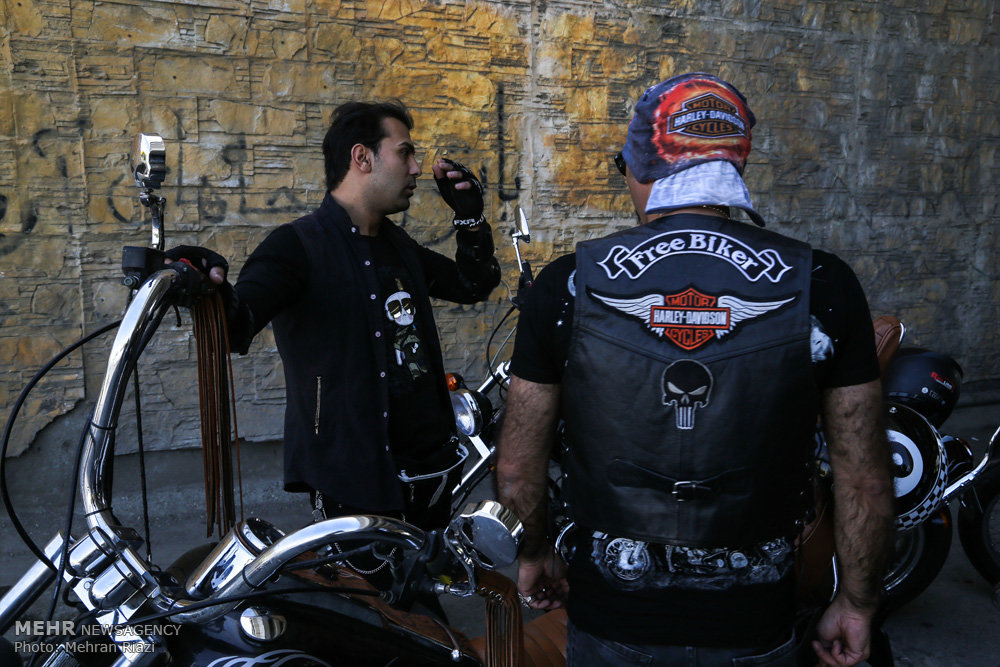
Iranian cruiser motorcyclists are conformists fully observing the country’s rules. They are not affiliated with any illegal groups or organizations. They ride on the country roads in large numbers and view motorcycle riding as a lifestyle.

Robert and his friends do not care about their destinations. They are just crazy for the roads.

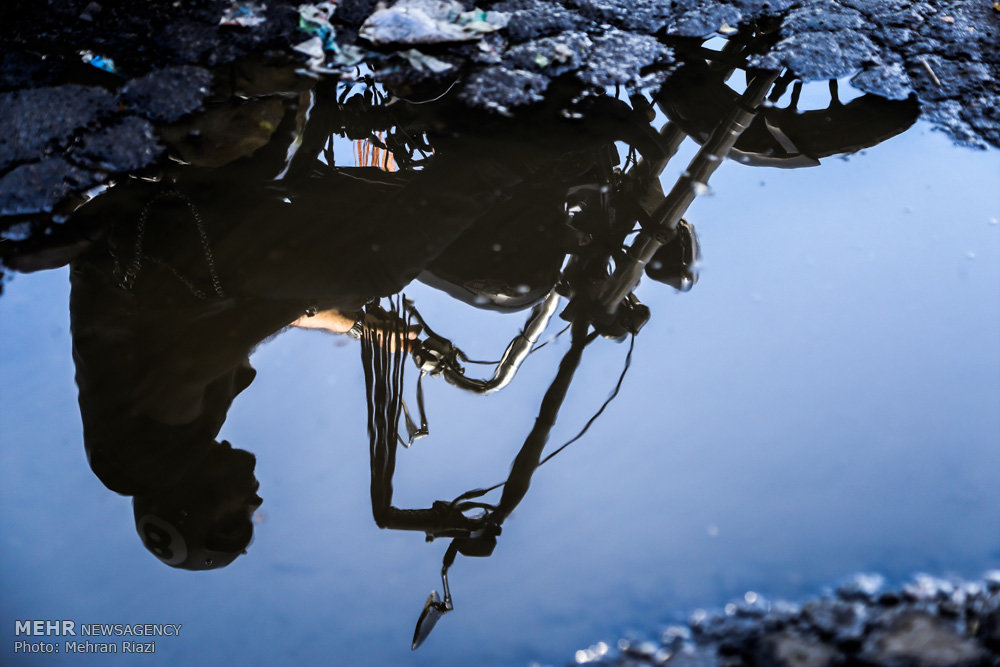
Here are Mehr’s photos of the motorcyclists and their café in Tehran:

Iran Calls for Int’l Cooperation against Drug Trafficking

Iranian Parliament Speaker Ali Larijani has criticized the absence of any consolidated international will to fight drug trafficking saying that all expenses should not be paid just by Iran and the other countries must take it seriously.

Ali Larijani, who was speaking at a conference in Tehran to discuss drug abuse and illicit trafficking, said drug trafficking is the dirtiest kind of organized crimes.

“Drug trafficking destroys the bodies and lives of people, hurts the families and creates social disparities, so it is a very annoying phenomenon for societies,” he added.

Larijani called the increase in production of different types of drugs “alarming”, saying that the hub of narcotics production is bordering Iran.

“In 2001, Americans went to Afghanistan to fight drugs and terrorism. Now 16 to 17 years have passed, but statistics show no decline in drug production, and instead it has increased,” he went on to say.

He also referred to the sacrifices made by the Islamic Republic of Iran in fight against drugs saying, “We [Iran] work as a shield in war on drugs, but why no one helps Iran and why the borders are not controlled?”

“Iran is partly controlling the path of drug trafficking, so the rest of the world needs to think of themselves, because Iran does not have to pay all the costs,” Chief of Iranian Parliament stressed.

Referring to the fact that terrorism today is funded by drug trafficking, Larijani said during diplomatic talks much stress is put on the issue of combating drug trafficking, but we do not see the results. There should be more diplomatic efforts to eliminate the sources of drug trafficking.

In another part of his statements, the Iranian official pointed out that now in Afghanistan various laboratories have emerged and modern equipment has been found.

“From where have they been brought to Afghanistan? The sources are clear. While all Western intelligence services say everything is under control, how is that they cannot root out narcotics trafficking, and eliminate these labs,” he asked.

Larijani concluded that in Iran there is a serious determination among the authorities in the field of counter-narcotics, and everyone emphasizes that it is important to combat this social harm.
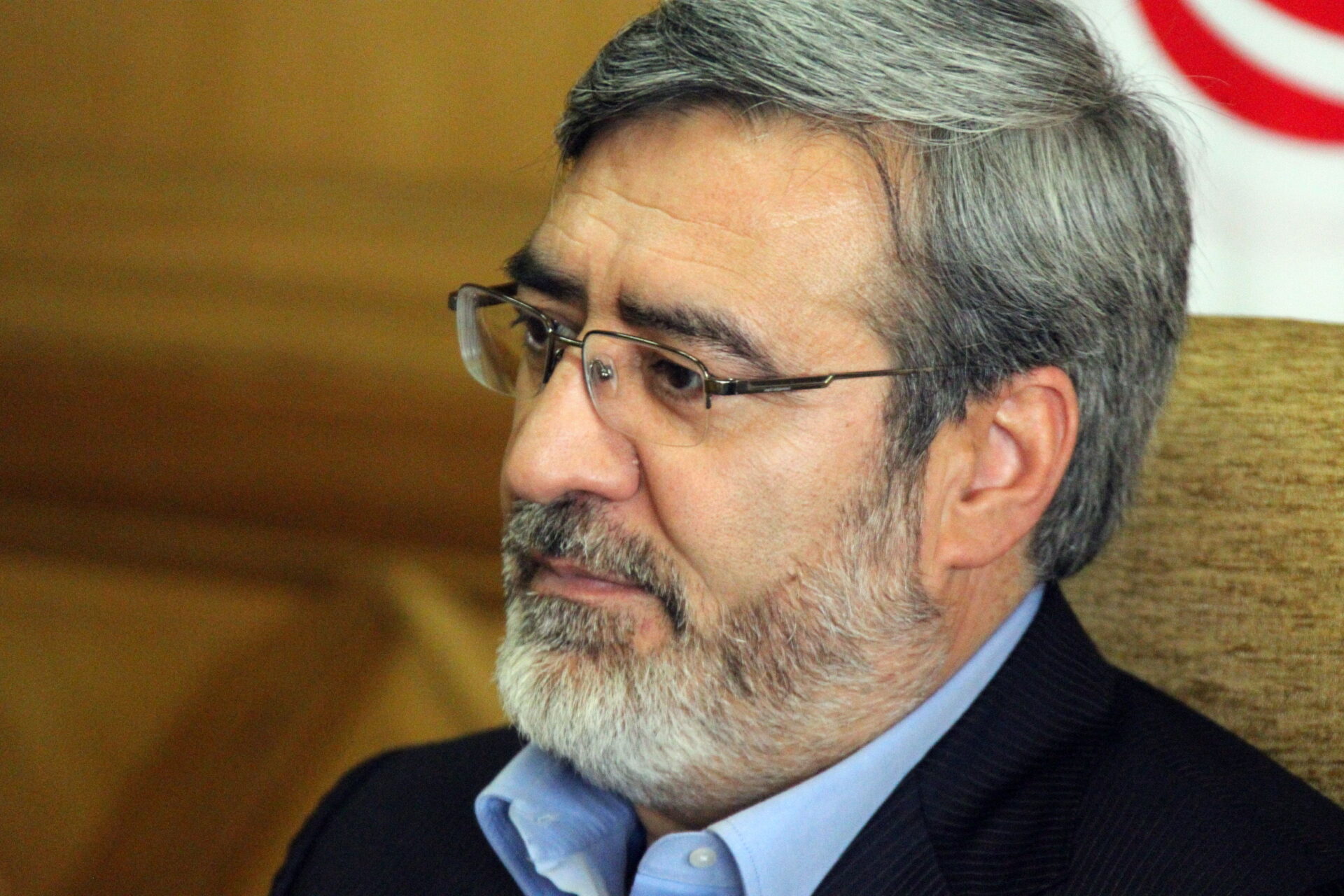
 Abdolreza Rahmani Fazli

Iran Has World’s Highest Rate of Drug Seizure

Elsewhere in the ceremony, Iran’s Interior Minister Abdolreza Rahmani Fazli also took the podium saying that the highest rate of drug discovery in the world could be seen in Iran.

He pointed out that the Islamic Republic of Iran is considered a successful country in primary prevention of drug abuse, and rehabilitation of addicts in the international community.

Rahmani Fazli also highlighted Iran’s efforts to fight against illicit drugs, saying that all of the country’s law enforcement, judicial and intelligence organizations have had “an acceptable performance” in this area.

“In order to reduce the access to drugs and psychotropic substances, 8,880 operations were launched in which we had armed clashes with smugglers,” Rahmani Fazli underlined.

The Interior Minister added that in the clashes, over 2,500 tons of illicit drugs, including narcotic drugs and psychotropic substances, have been captured from the traffickers.

Elsewhere in his remarks, Rahmani Fazli stressed that organized crimes have endangered the peace and security of human beings around the world and have led to violation of human rights. It has also undermined the efforts to realize economic, social, cultural, political and civil development around the world.

Referring to this year’s slogan of the United Nations Office on Drugs and Crime (UNODC), “First Listen!”, he emphasized that listening to children and youths is the first step in helping them to have a healthy and safe life.

“This slogan directly refers to the need for expansion and institutionalization of the primary prevention in social communities especially in the families,” Rahmani Fazli added.

Iran shares hundreds of kilometers of borders with Afghanistan and Pakistan, and lies on the main trafficking route for poppy, the source of opium and heroin, from Afghanistan to the West.

Despite high economic and human costs, the Islamic Republic has been actively fighting drug trafficking over the past three decades.

Iran has spent millions of dollars to seal the borders and prevent the transit of narcotics destined for European, Arab and Central Asian countries. The war on drug trade originating from Afghanistan has claimed the lives of thousands of Iranian police officers.

A Look at Iranian Newspaper Front Pages on July 6

Most Iranian newspapers on Thursday covered the remarks made by Ayatollah Seyyed Ali Khamenei, the Leader of Iran’s Islamic Revolution, in a meeting with a group of IRGC commanders. The Leader praised the IRGC’s missile attack on ISIS positions in Syria, and said Tehran’s missile defence power should be enhanced.
Iran’s huge gas deal with France’s Total for the development of a South Pars Gas Field phase and the reactions to the deal also remained a top story today.

The crisis in relations between Qatar and Saudi Arabia, and the negative response by Doha to the preconditions set by Riyadh and its allies also received great coverage.

The above issues, as well as many more, are highlighted in the following headlines and top stories:


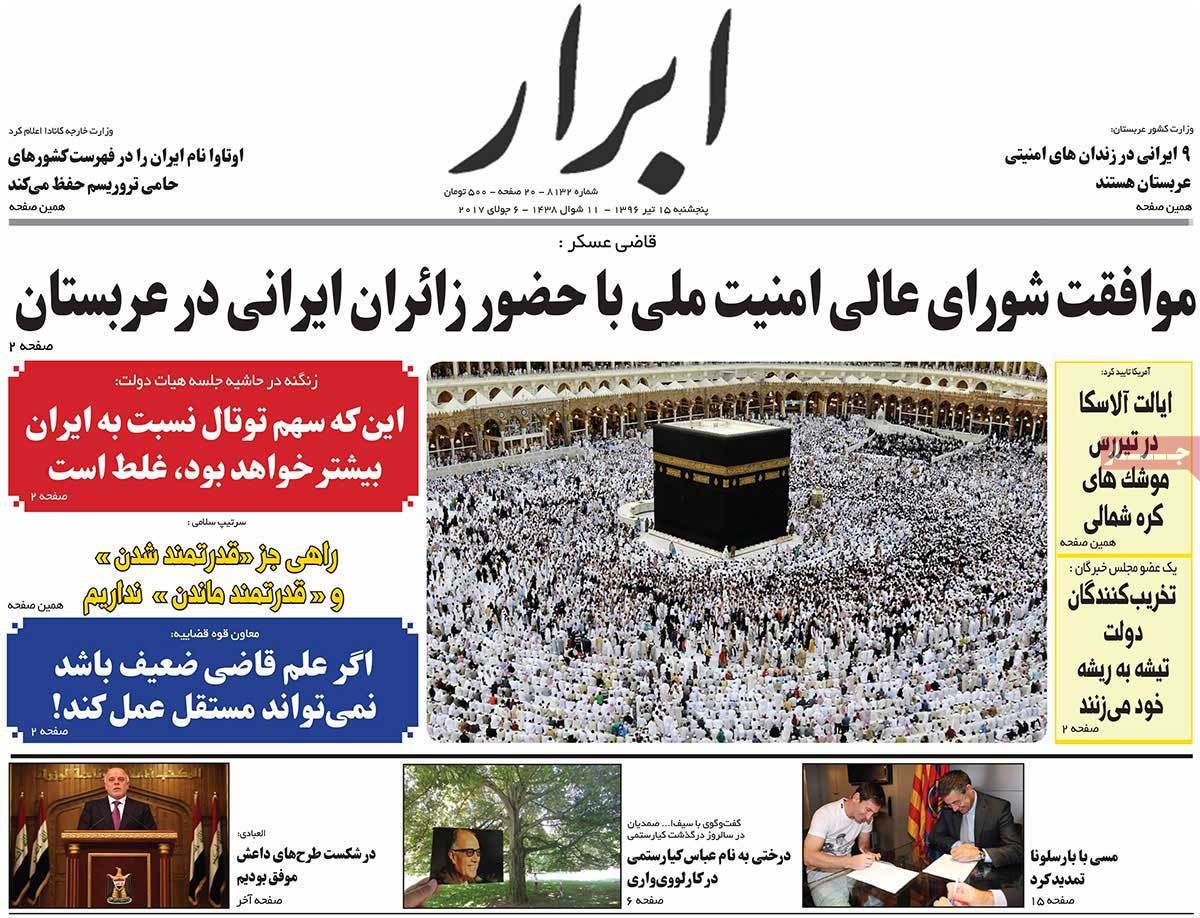
Abrar:

1- Iran’s SNSC Okays Dispatch of Pilgrims to Hajj

2- Saudi Interior Ministry: 9 Iranians Kept in Saudi Prisons

3- Oil Minister: It’s Wrong that Total’s Share Is More than Iran’s

A Look at Iranian Newspaper Front Pages on July 6 - abrar


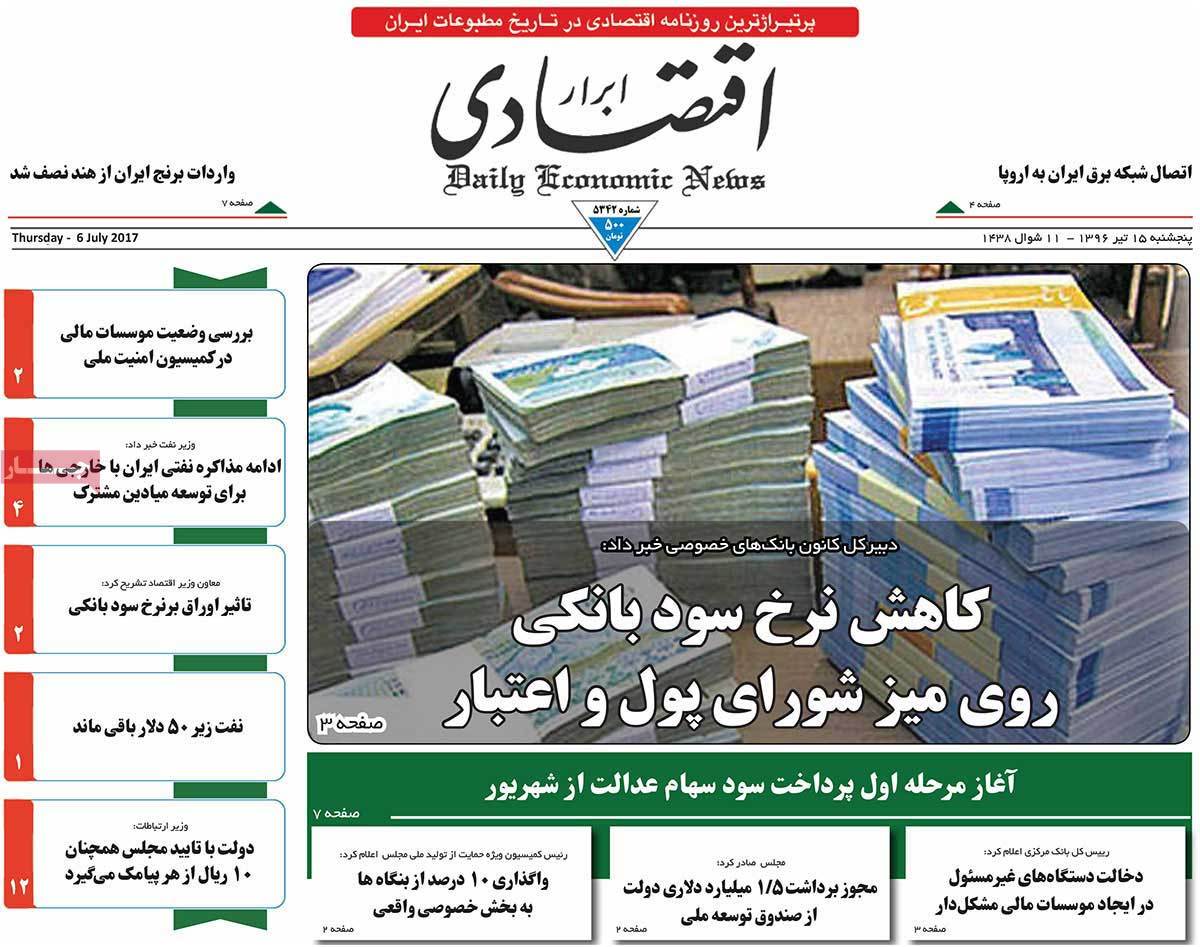
Abrar-e Eqtesadi:

1- Iran’s Power Network to Be Connected to Europe

2- Iran’s Rice Imports from India Halved

3- Minister: Iran to Resume Talks with Foreigners for Development of Joint Fields

A Look at Iranian Newspaper Front Pages on July 6 - abrar egtesadi


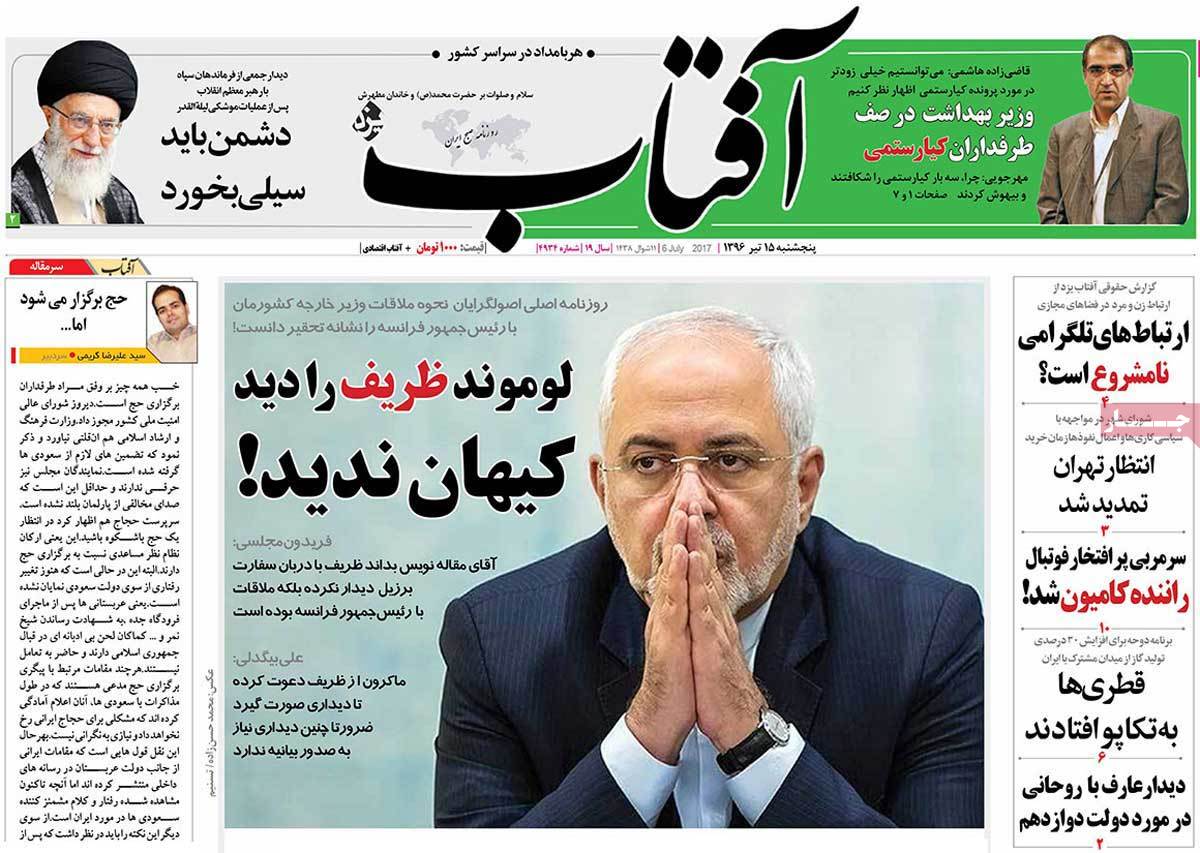
Aftab-e Yazd:

1- Le Monde Noticed Zarif, Kayhan Didn’t!

2- Health Minister among Kiarostami Fans

A Look at Iranian Newspaper Front Pages on July 6 - aftab


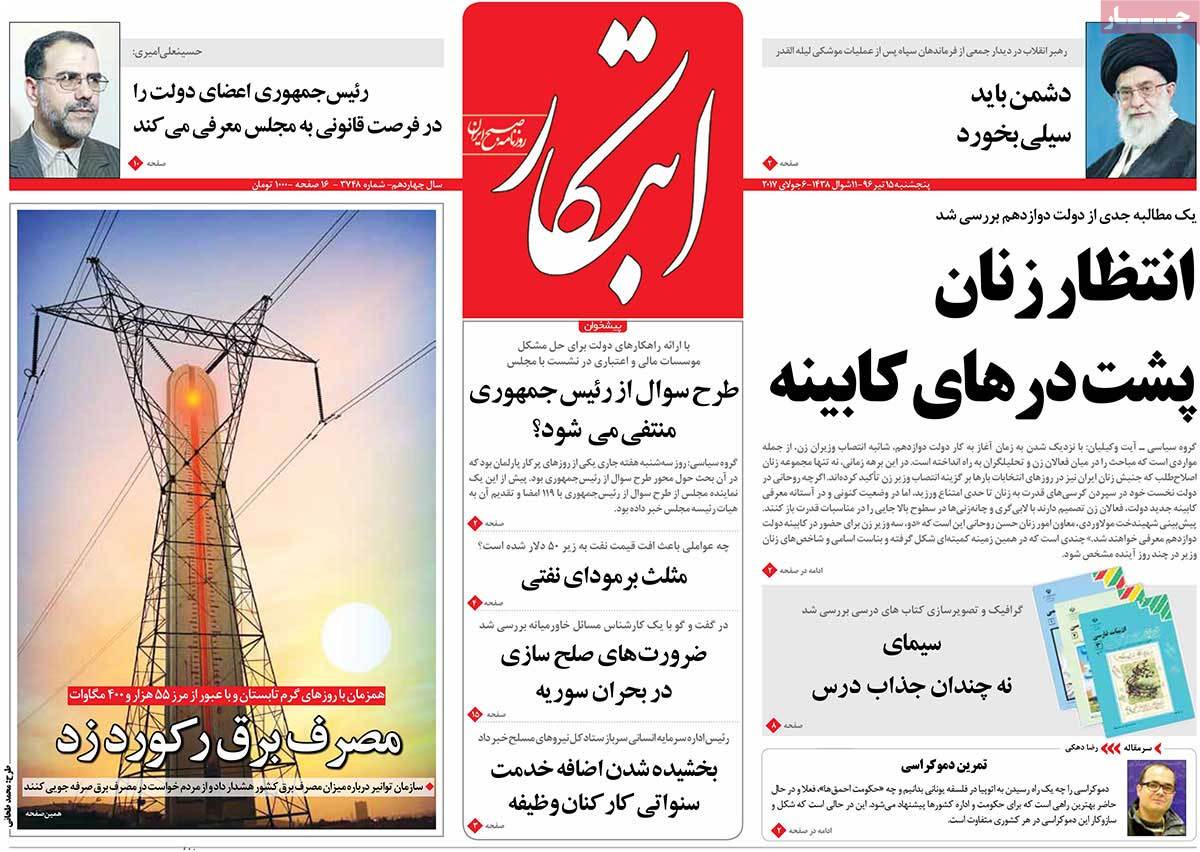
Ebtekar:

1- Rouhani Urged to Appoint Women Ministers in Next Cabinet

2- Analyst Discusses Necessities of Peace-Making in Syria Crisis

A Look at Iranian Newspaper Front Pages on July 6 - ebtekar


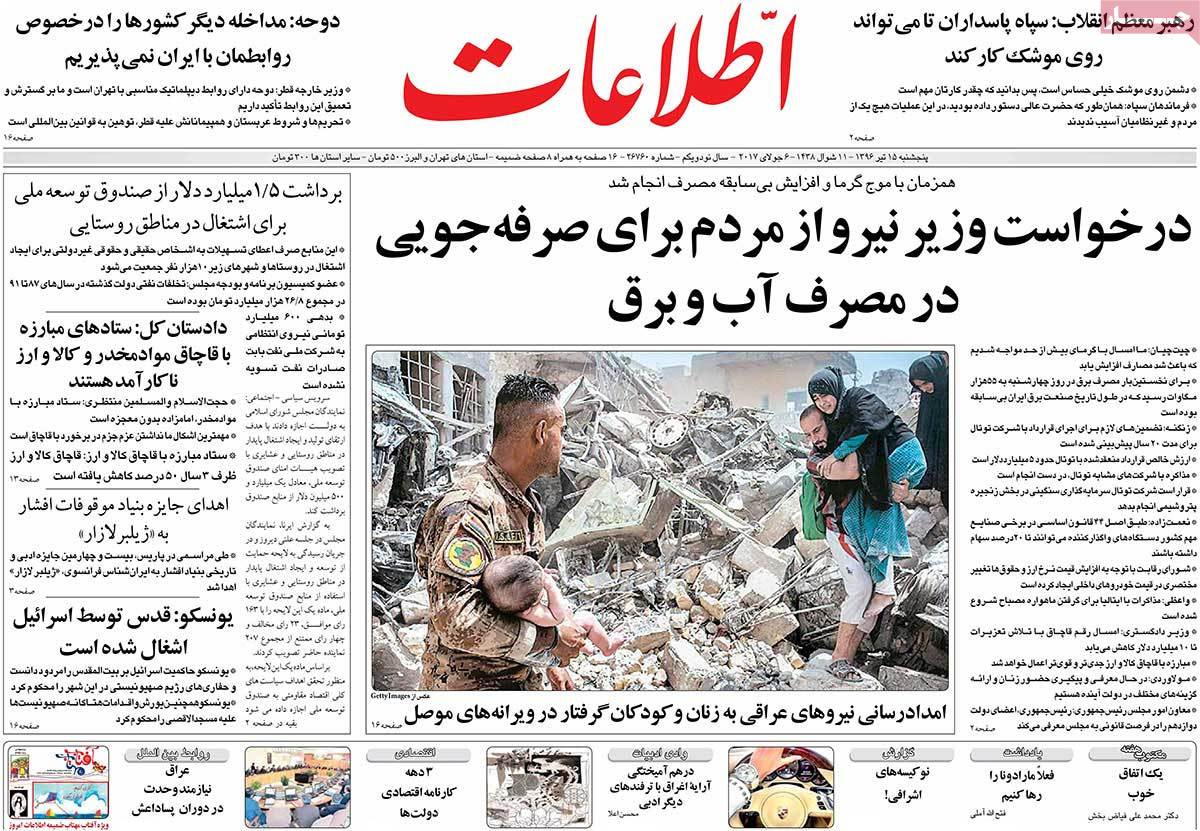
Ettela’at:

1- Iran Leader Urges IRGC to Work on Missiles as Much as It Can

2- Doha: We Won’t Accept Other States’ Meddling in Our Ties with Iran

3- Iraqi Forces Helping Women, Children Stranded in Ruins of Mosul

4- UNESCO: Quds Occupied by Israel

  • UNESCO Rejects Israel’s Rule over Jerusalem

 A Look at Iranian Newspaper Front Pages on July 6 - etelaat


Iran:

1- UN’s Priority Is to Fight Dust Pollution in Ahvaz: Official

2- Official Responds to Criticisms of Iran’s Deal with Total

  • Iran to Earn $84bn, Total’s Share to Be $12bn: Minister

3- Total Deal Symbol of JCPOA Strength: Ex-Diplomat

A Look at Iranian Newspaper Front Pages on July 6 - iran


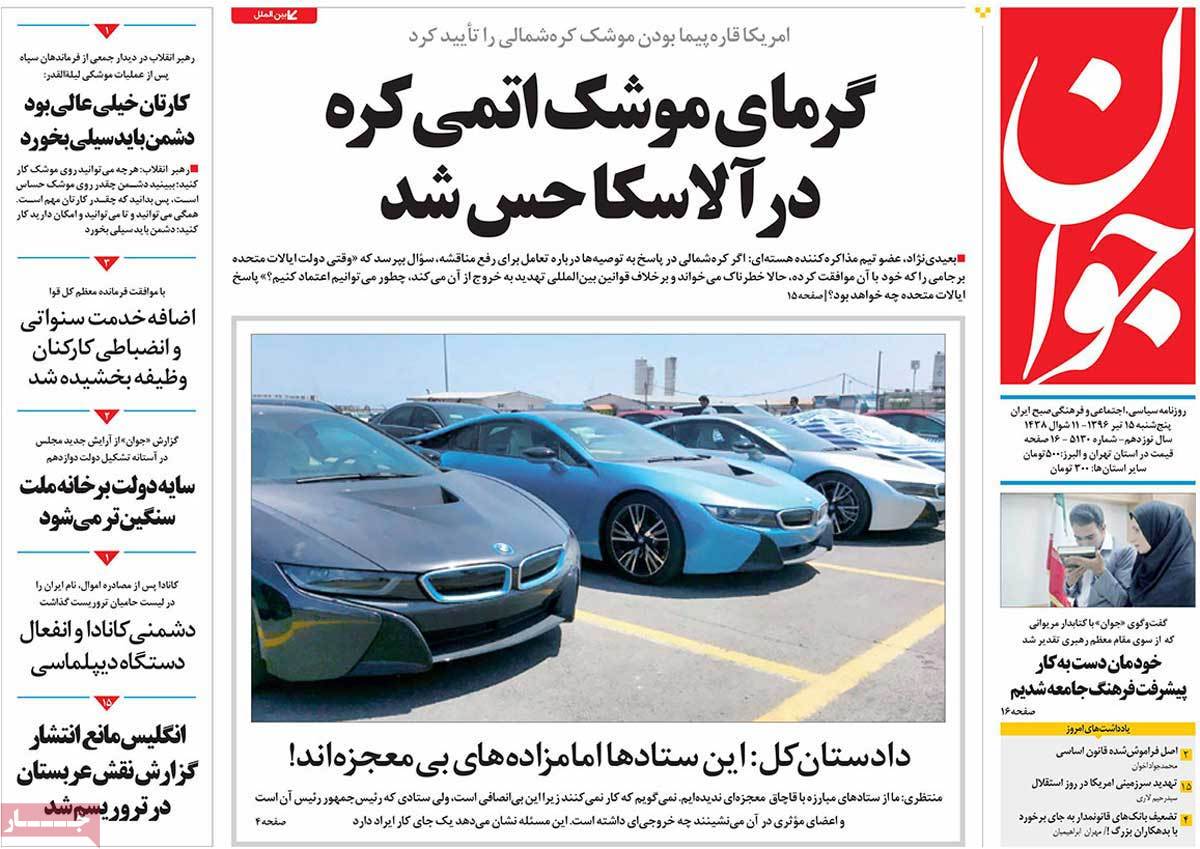
Javan:

1- Iran Leader to IRGC Commanders: You Did Great Job, Enemy Should Be Slapped

2- US Confirms North Korea’s Missile Was Continental

  • Heat of Pyongyang’s Atomic Missile Felt in Alaska

3- Britain Prevents Release of Report on Saudi Arabia’s Role in Terrorism

A Look at Iranian Newspaper Front Pages on July 6 - javan


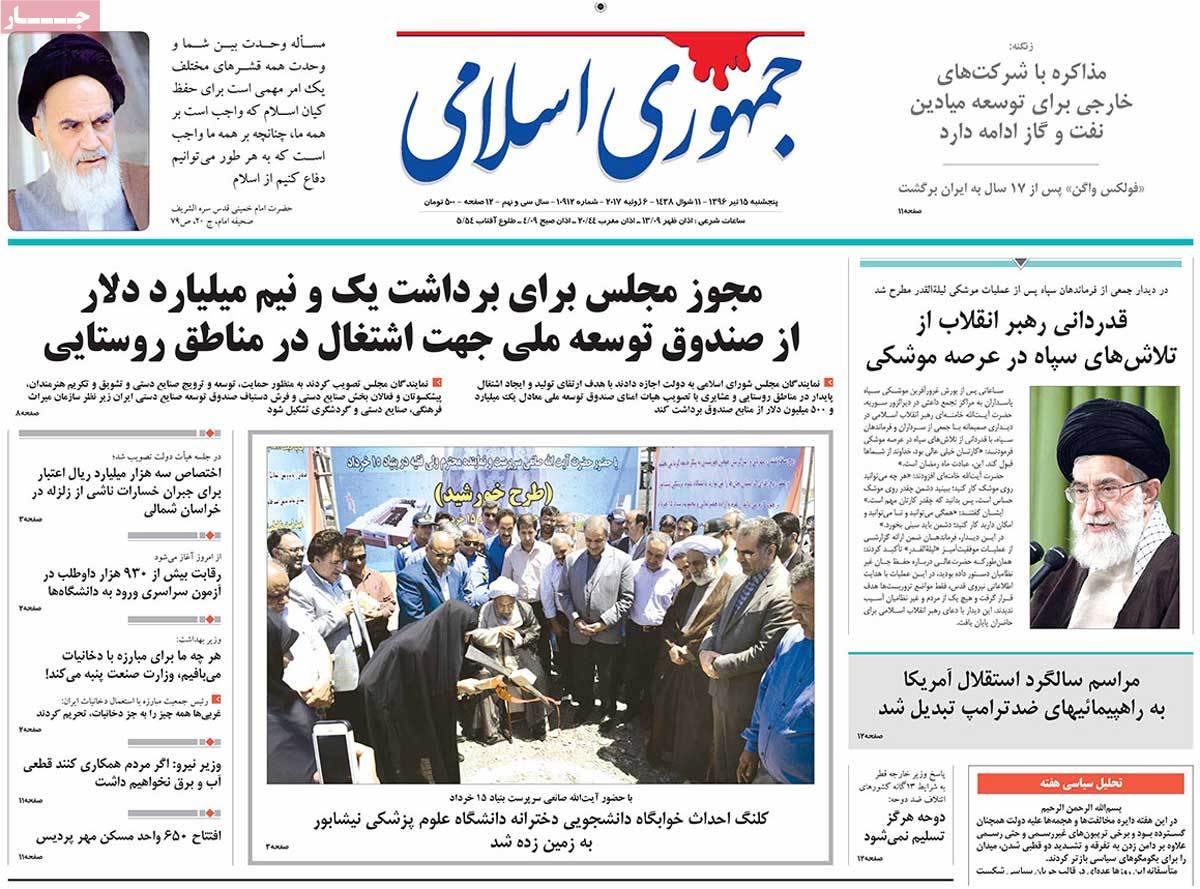
Jomhouri Eslami:

1- Volkswagen Returns to Iran after 17 Years

2- US Independence Day Ceremony Turned into Anti-Trump Rallies

A Look at Iranian Newspaper Front Pages on July 6 - jomhori


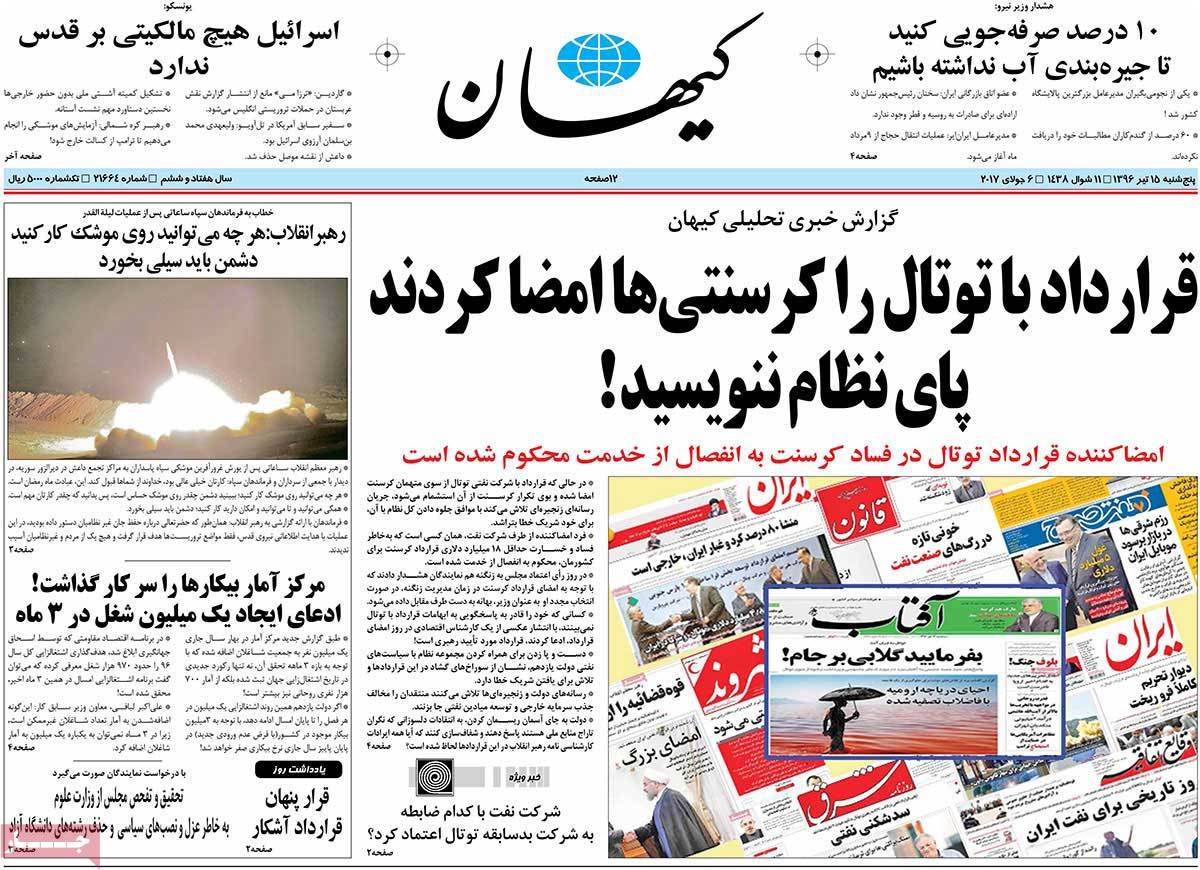
Kayhan:

1- Deal with Total Signed by Those Who Signed Crescent Deal

  • Don’t Blame Establishment for Total Deal!

2- Signatories of Total Deal Had Been Dismissed after Crescent

A Look at Iranian Newspaper Front Pages on July 6 - kayhan


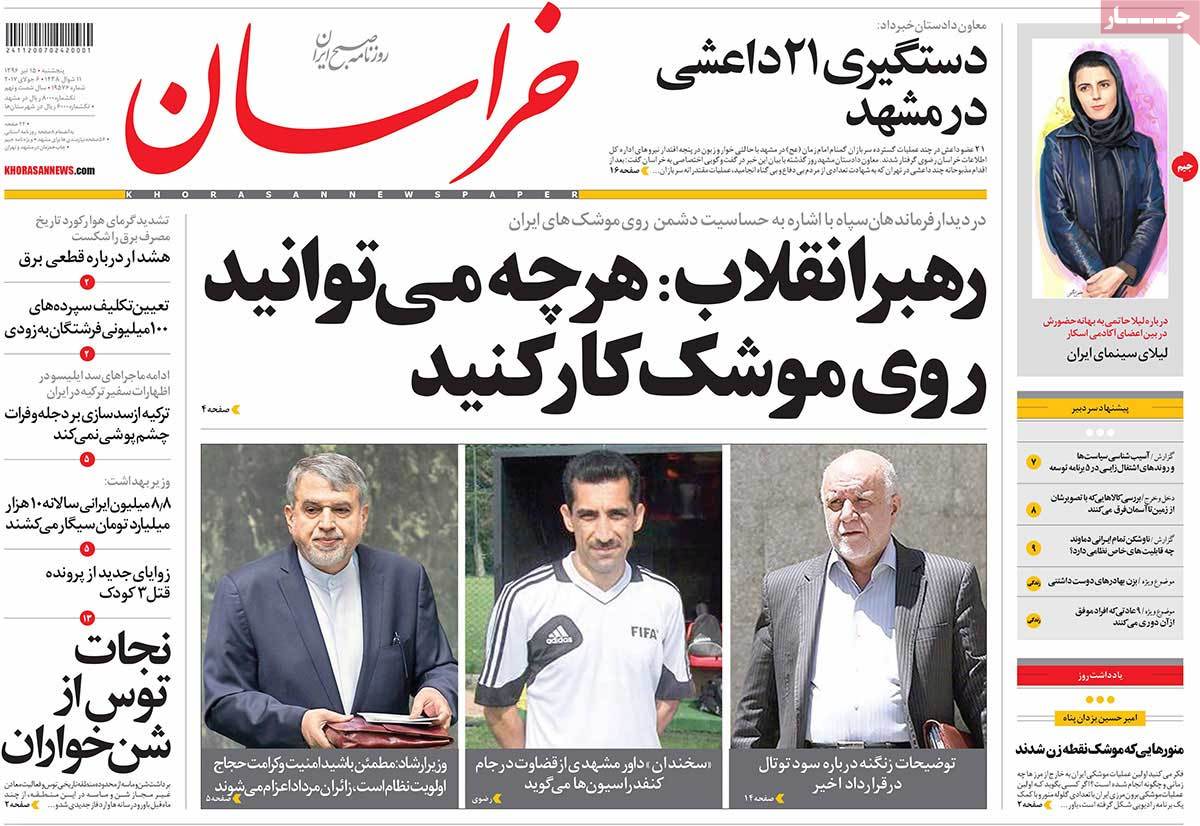
Khorasan:

1- 21 ISIS Elements Arrested in Mashhad

2- Iranians Annually Spend IRR 10 Trillion [$266m] on Smoking

A Look at Iranian Newspaper Front Pages on July 6 - khorasan


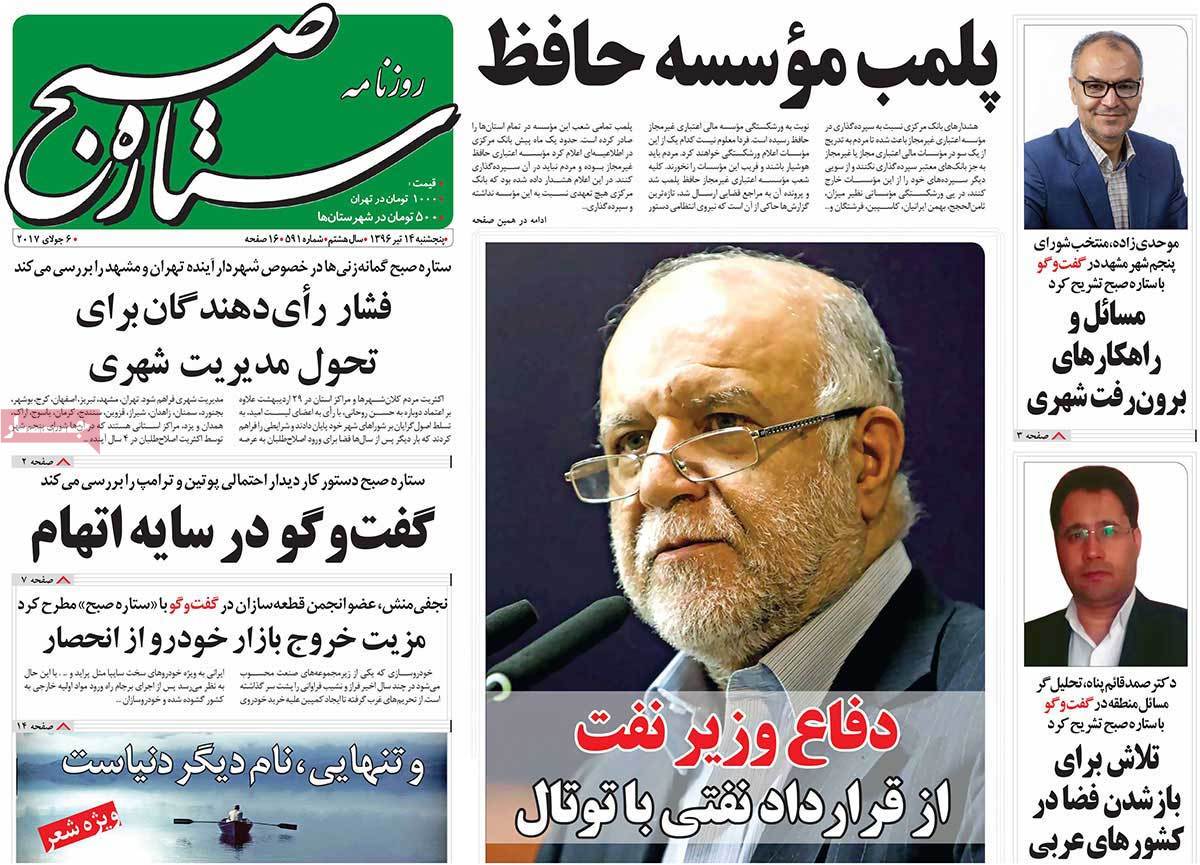
Setareh Sobh:

1- Putin-Trump Talks to Be Held under Shadow of Accusations

A Look at Iranian Newspaper Front Pages on July 6 - setare sobh


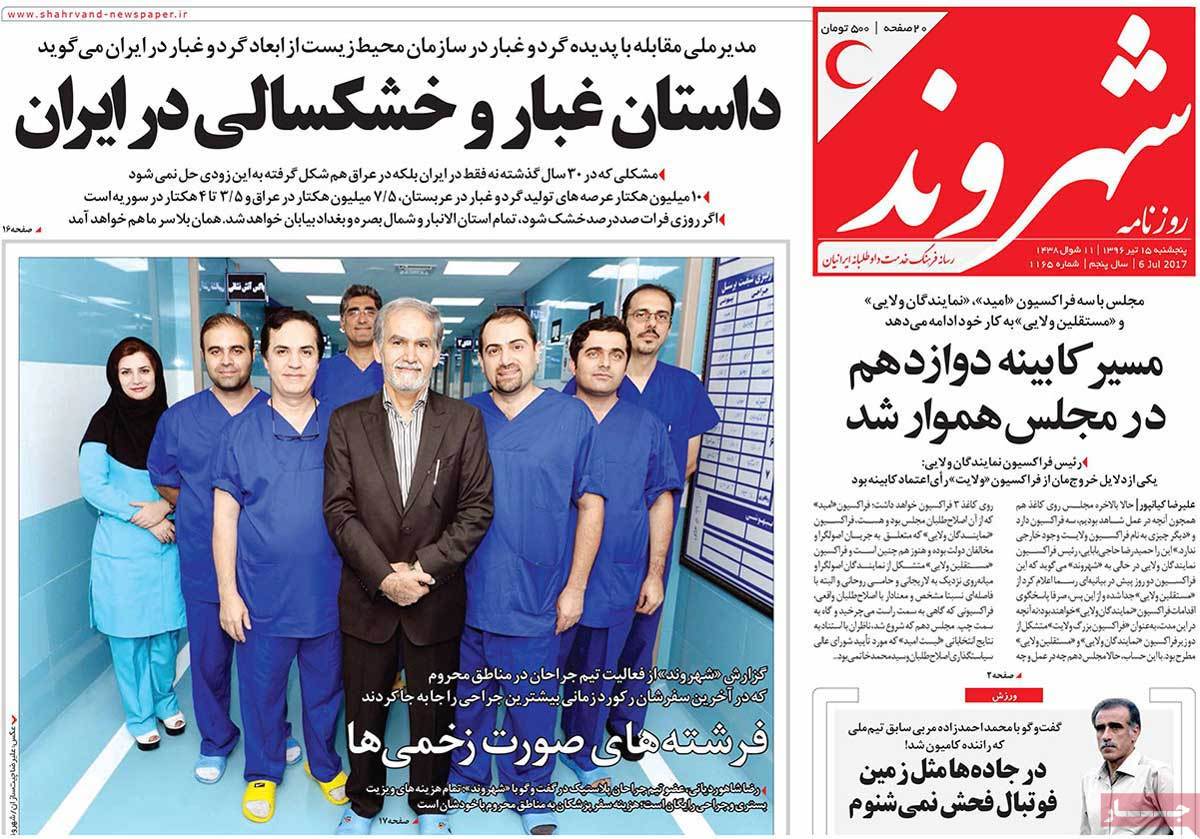
Shahrvand:

1- Story of Dust and Drought in Iran

2- Scarface Angels: Group of Plastic Surgeons Visit Deprived Areas for Free Surgery

A Look at Iranian Newspaper Front Pages on July 6 - shahrvand


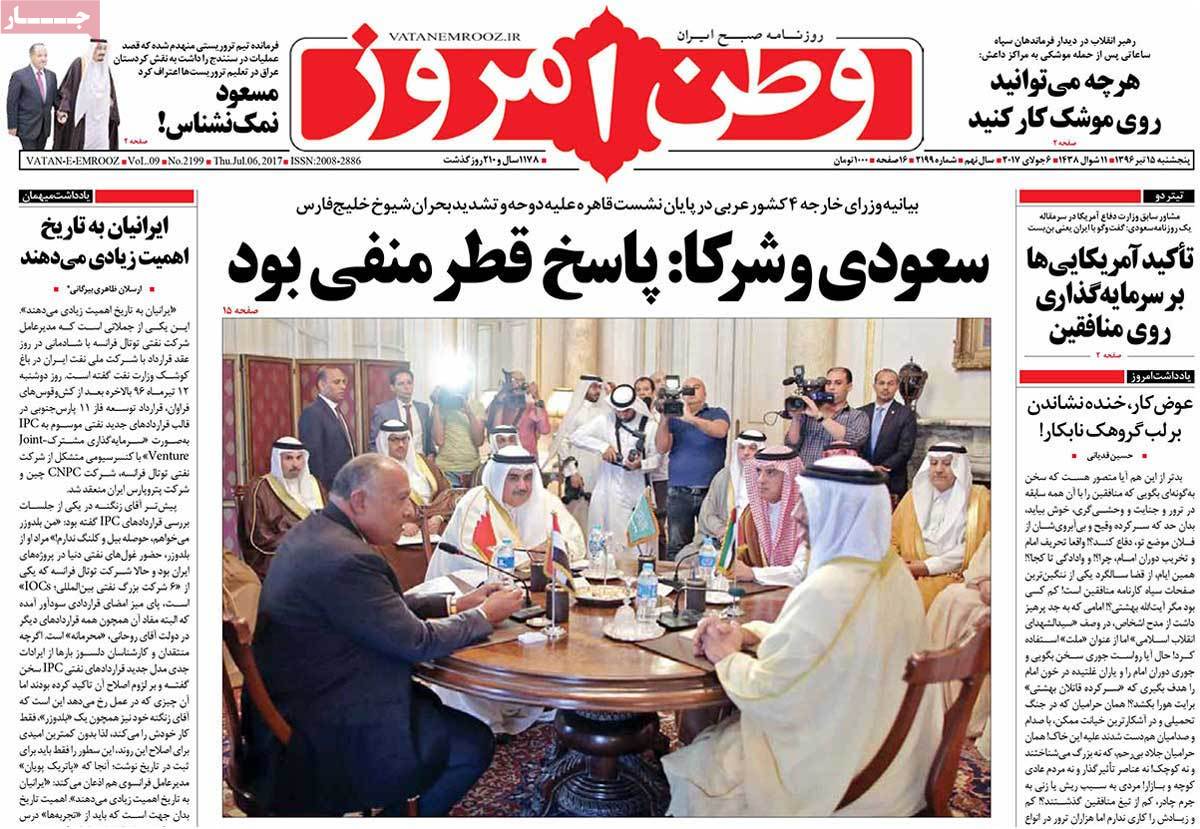
Vatan-e Emrooz:

1- FMs of 4 Arab Countries Release Statement against Doha: Crisis Deepens

2- Saudi Arabia and Partners: Qatar’s Response Was Negative

3- Americans’ Emphasize Making Investment on MKO Terror Group: Ex-NSA

A Look at Iranian Newspaper Front Pages on July 6 - vatane emrooz