Matin Lashkari and Shirin Tahanan are two Iranian women who had lived abroad and are now back in Iran. The first one returned three years ago and the other, who grew up in Britain, came back 10 years ago.
According to a Farsi report by the Hamshahri newspaper, these two women got to know each other on Instagram and then the idea of launching a kitchen called “Shirin (Sweet) Kitchen” came into existence.
The culture of any country could be understood by the food they make and eat, and can be touched by the customs, traditions, foods, and the way its people buy foodstuff.
Despite the fact that in the past four years, many foreign tourists easily obtained visa to travel to Iran and brought the foreign currency into the country, the issue of Iranian foods has been underestimated, because most tourists come to Iran to see its history.
However, they would like to know about Iran’s current culture. They want to know what does an Iranian man or woman do during the day? Where do they go shopping? What are the raw materials and the foodstuff in Iran? What points make them distinguished from other countries? What materials and methods of cooking make the Iranian cuisine different from others? They do not know much about these questions when they come to Iran, because Iran’s tourism sector has not worked on this area.
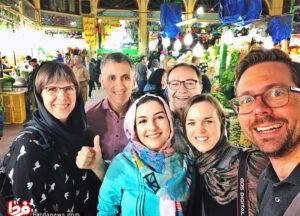
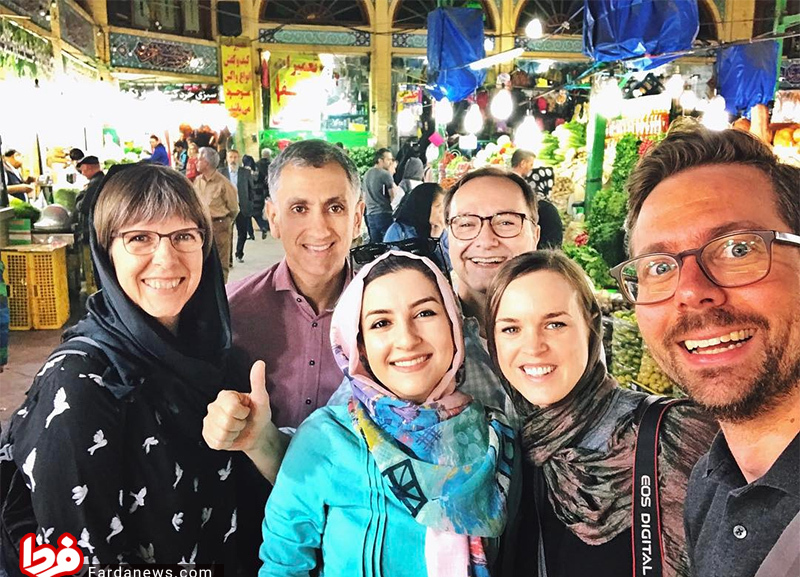
Simon and Dominica from Switzerland and Marcela from Chile have formed a three-member food tour. They are looking forward to entering a world of Iranian styles. The starting point of their tour is a marketplace at Tehran’s Tajrish Square located north of the capital city.
They are good-looking and friendly tourists. And it seems the intimacy and warmth of Iranians has made them have a smile on their faces all the time.
We, along with Matin Lashkari, accompanied them through the attractive corridors of Tajrish Bazaar where one can find everything from soup to nuts, and it’s very interesting for the tourists, especially when they get familiar with a world of different flavours such as pickles, stuffed olives, whey, jam, fruit leather, etc. Taking a few tastes is enough to force them to spend money.
Getting Familiar with Iranian Markets
Simon and Dominica have travelled to different cities of Iran, and today is the last day of their stay in the country. However, all this variation in the market is still new to them, and it seems they have never been paying such attention to the goods sold in the Iranian markets.
Marcela still has a week to see Iran and is pleased about it. She is somehow sad for not choosing Iran as a tourist destination during all these past years. Today’s special dish is Kuku Sabzi (kind of vegetable omelette similar to Italian dish frittata) and Loobia Polo (rice with beans). So, they buy all the materials they need for today’s lunch and do not forget about the stuffed olives. Marcela is a vegetarian, so she’s going to use soybean instead of meat in Loobia Polo.
From Draining the Rice to Making Carrots Halwa
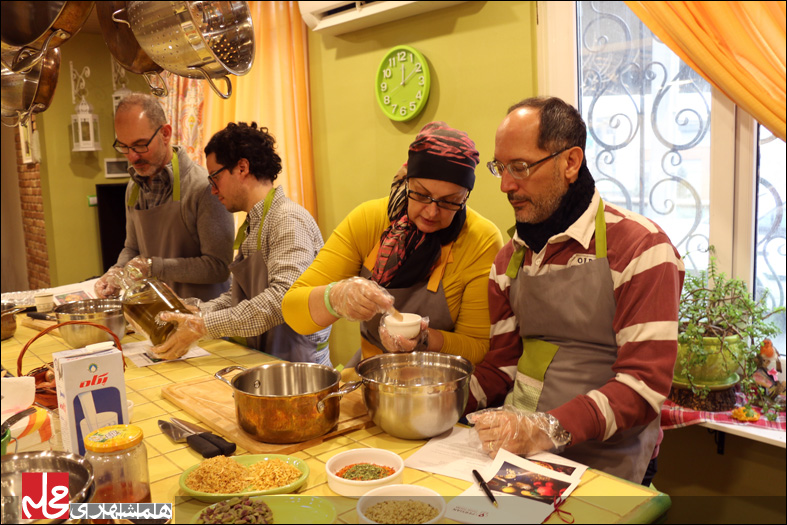
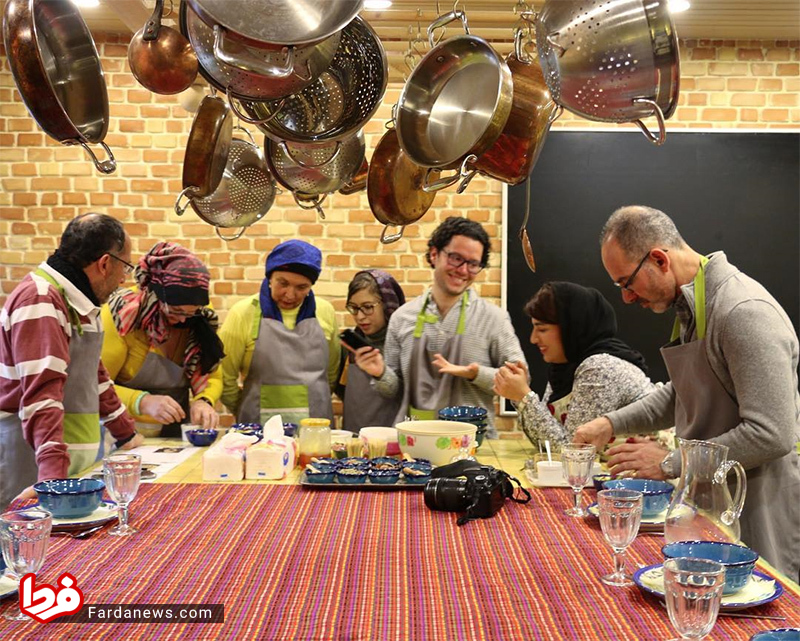
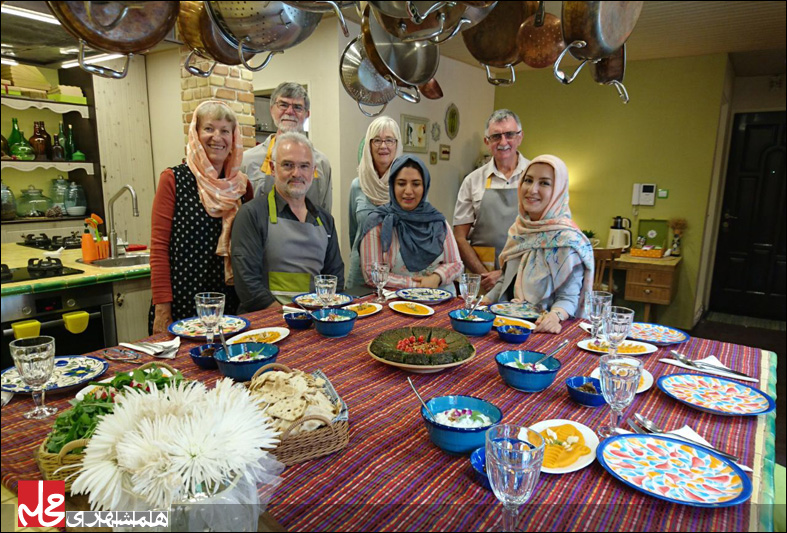
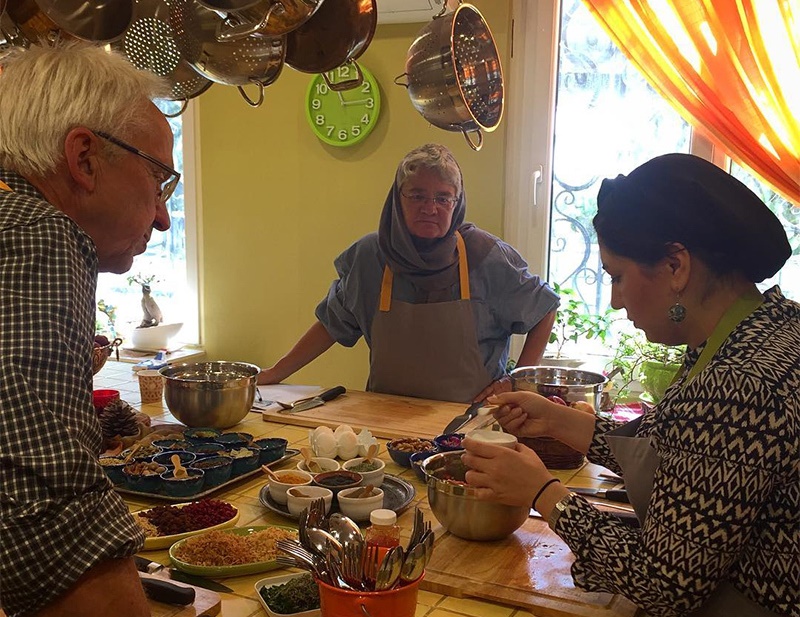
 Shopping in Tajrish market is over. We all get on the car and go to the “Shirin Kitchen”; a kitchen whose beautiful decoration amazes every visitor. Simon, Dominica, and Marcela put their aprons on and get ready to be trained by ‘Shirin’. Matin here ends his mission and leaves the rest to Shirin.
Busy with chopping onions, soaking up the rice, making Mast-o-Khiar (yogurt and cucumber dip) and Kuku Sabzi, draining the rice, preparing Loobia polo, next to making carrots halwa and Khak-e Shir (flixweed) drink, the tourists hardly have time to breathe.
When the rice is being steamed, it is a good time to make desserts with the help of Shirin. If they have time, they try to write down important points to learn what she says.
A World of Flavours and Colours at a Sufra
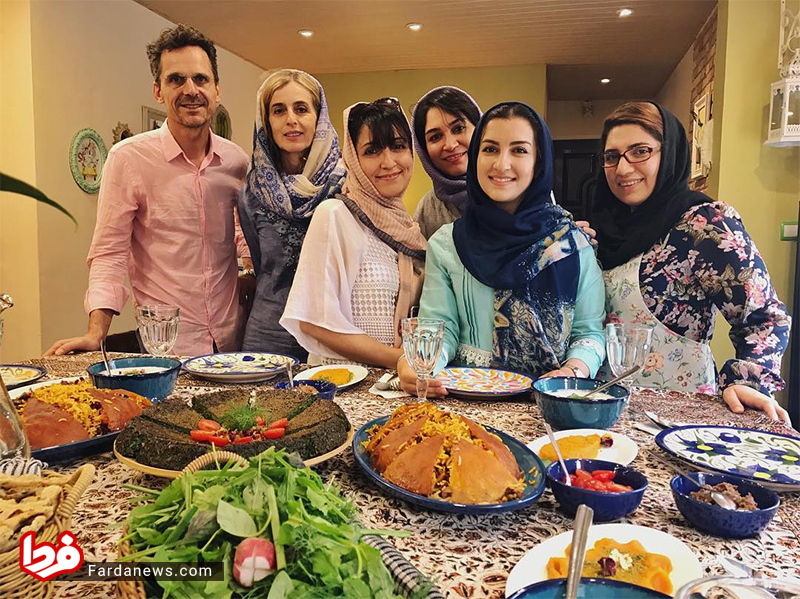
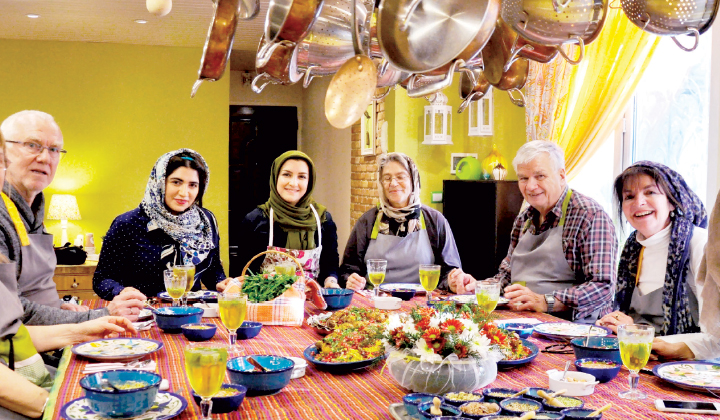
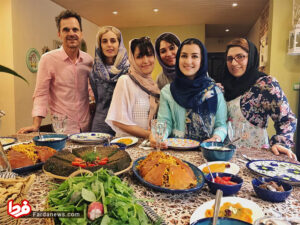 Setting the Sufra (a piece of cloth on which the Iranian food is served) with delicious Iranian dishes is the next stage. A Sufra designed with Loobia polo, Kuku Sabzi, Halwa, Mast-o-Khiar (yogurt and cucumber dip), leafy greens, and stuffed olive amazes everyone.
Dominica says she has not experienced such a thing, and it’s totally exceptional to her. Marcela gets surprised after eating any of the foods saying how on earth it could be possible to have all these flavours together and enjoy them. Simon fills his plate for the third time and finds out why the Iranians’ food servings are so plentiful. That’s because of the unique taste of Iranian foods.
Seasonal Menu Variation of Tours
This two-person group composed of Matin and Shirin also designs a separate menu on each tour they set up. In this way, the foods are changed, and the tours provide a different experience. Matin Lashkari describes that in every season the menu of the tour gets changed.
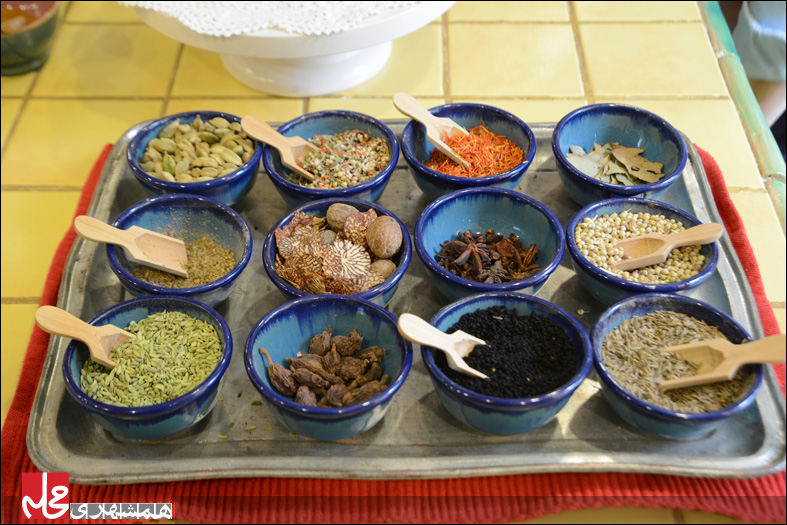
“The foods on the menu change depending on what material is available in that season. For example, now is the season for the green beans. That’s why Loobia Polo is an option on our menu. We prepare homemade foods, especially the ones that are less found on the restaurants’ menu. Moreover, on our menu, we teach how to steam rice. We also have an appetizer, such as Tarator, Kuku Sabzi, one side meal, like Shirazi salad, Bourani, Mast-o-Khiar, and a dessert like Masqati (sort of soft and transparent confection), Halwa, Sholezard (traditional saffron rice pudding), Ferni (rice flour dessert), etc.”
They even pay attention to the style of tourists’ eating. Matin says “If one is vegetarian, the menu of that tour is formed in a vegetarian style. Of course, it is announced before the tour is conducted, and usually faces no opposition from the other members of the group.”
Food Tours Held for 2 to 10 People
It’s clear that going on these tours have some costs for the tourists. Matin says the cost of tours can be between 65 and 80 euros.
“When a tour is conducted with fewer than five people, we get 80 euros per person, but for the tours conducted with more than five people, they have to pay 65 euros each. The tours are conducted with at least two people. The two-person tours are not cost-effective, but as we have started the business recently and we need money, we conduct them. We are just at the beginning and sometimes there is no way out. But when these two people get back to their home country, they describe their experience for other ones and they say let’s try Iran and its food once.”
Market; Exciting Part of the Tour
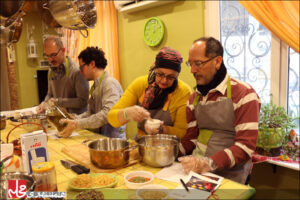 One of the most exciting parts of this food tour is the market and Matin has chosen Tajrish market for this exciting section. Initially, the tourists who have registered for this food tour meet up in front of Tajrish market. Then, as Matin arrives, they step into the market where they get familiar with a new world called Iran, its people’s taste, and the specific foodstuffs the Iranians use. After that they enter the shops and come across to the things they may have never encountered.
Matin says the tourists love Tajrish market very much. “When the tour is over, we always ask them which part was more interesting. Everyone welcomes the market part and says this part is very good before going into the kitchen. Although these tourists have often seen the Iranian market, it’s totally different for them because this time there’s someone who gives them a thorough explanation when they walk in the market. Sometimes tourists have seen Tajrish market before, but they say this time it’s different for them because the things learned in bazaar are used when they come to the kitchen. Therefore, the tourists remember how to use the Iranian foodstuff. Many of them go to the market and do the shopping again when their class is over because they have just learned how to use many Iranian foodstuff. For many of them, the stuffed olives have an interesting and extraordinary taste. Although they have already eaten olives, this taste is new to them. They also love pickles. They welcome the tastes. Some people do not like whey, but they cannot skip Ash-e-Reshte or noodle thick soup served with whey. In the wintertime, we never forget to include Ash-e-Reshte in the menu. Our clients like it very much.”
Iran Not Introduced Properly
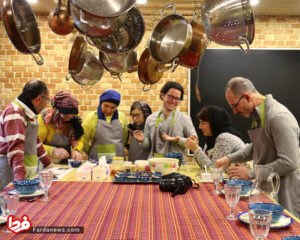 In the interview with the initiator of the idea, we asked her how the idea of a food tour developed. We found out that Matin has been living abroad for many years and has returned to the country 3 years ago. During her lifetime, she had seen many tours for those who visit that country. It has been a question for her why there is no food tours in Iran despite the diversity of foods.
“The food tours are very popular outside Iran and many tourists are curious about what’s going on in a special tour. They want to know what kind of foods they can try. I myself was also very interested in these tours and I tried them several times,” Matin noted.
When she returns to Iran she decides to write about her experience of domestic and foreign trips on an English weblog.
“When I wrote my memories on my blog, I got interested in directing my work to tourism business. Then I passed tour-leading courses. As I was familiar with Spanish and Portuguese next to my good command of English, I became a tour leader for Spanish travellers. But over time, I realized that I was not very interested to have a job which demands making many trips. Then I found out that the food variation is limited at Iranian restaurants, and in most restaurants just meat and chicken kebabs are served. For those who are 15 days in Iran, eating just these two foods is not very fascinating, and they will not understand how diverse the foods in Iran are. That’s why I came to the conclusion that the Iranian foods have not been introduced well. Even Iranians living abroad have not worked in this field. Vietnamese, Indians, Chinese, Italians and others have introduced their foods to the world, but we Iranians have not. When an Iranian restaurant is launched abroad, just meat and chicken kebabs are served. No one serves homemade foods. That’s why I thought it’s a good idea to serve homemade foods to introduce Iranian foods.”
Getting to Know Each Other on Virtual Space
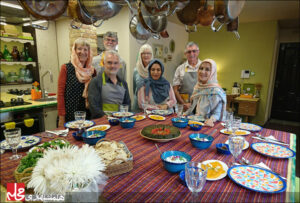 The idea to start a food tour has come to Matin Lashkari, and now she needed to implement it. Her acquaintance with Shirin Tahanan on Instagram developed the idea.
“I got to know Shirin on Instagram, and I understood that she’s teaching professional courses in cooking. She was fluent in English. I called her and talked about my plan. She welcomed the idea and it took three months to arrange everything. It was in January 2016. We discussed what to include on the menus and then we began our tours,” Matin explained.
Attracting Tourists via Weblog
Two years of blogging in English and writing about her experience of travelling helped Matin to get in touch with many foreign tourists.
“The best way that came to my mind was to introduce the food tour on a blog through which I was communicating with many tourists. Many of them read my idea and liked it. When they came to Iran, they tried our one-day food tour. In 2016, most of our clients were attracted through the weblog and they really liked it when they came to our country. We first started with a very small number of tourists. Our first clients were from Germany. When they returned to their country, they wrote about the food tour, and this encouraged their relatives and others to travel to Iran and experience our tour.”
Cooking after the Return
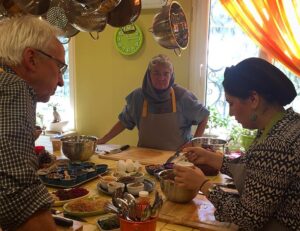 After a short time, the number of food tour enthusiasts increased day by day. So far, Matin and Shirin have conducted 28 food tours, with most of their clients from Germany, Switzerland, Australia and New Zealand.
“Up to now, it’s been very welcomed. The tourists write comments after they experience our tour. As we have high standards, the tourists’ comments are mostly positive. The capacity of the tour is up to 12 people, but we conduct tours with at most 10 people. As we maintain high standards, they never forget it. The high quality of the materials is very interesting for them. A good printed-out menu, a neat website, et cetra are really motivating for them. I reply to the emails very soon, and most of them wonder how fast I answer. Fast response is important to us because all our marketing is online and we can’t drag our feet. It’s because of all these efforts that our food tours have been received warmly and there has been nothing negative about it. The experience of cooking Iranian foods is so exciting for some of them that when they return home, they once again make the foods and send us the photos.
Food Tour Chef Talks of Foreigners’ Tastes
Shirin Tahanan is the chef of this food tour. She returned to Iran 10 years ago. She grew up in Britain and came to Iran at the age of 22.
“I was in England till the age of 22. I studied there and majored in visual arts. When I came to Iran, I finished my postgraduate studies in painting. Although my major has nothing to do with cooking, I like it very much. When in England, I was in touch with a lot of friends from different countries and their food was interesting to me and I tried to learn to make them. When I returned to Iran and got married, I was making different dishes for my guests. Mostly they suggested me to teach the recipes. People in Iran have a very limited range of food choices and they do not experience different types of foods; especially the young people who are working and do not even have time to make stews.”
Shirin’s skill at cooking encourages her to run some courses since 4 years ago.
“This goes back to about four and a half years ago. I got motivated by these words and initially started to teach cooking meals at small family groups. Gradually, more people were informed about the courses and I decided to expand my business and rent a place as a kitchen. When I rented this place there was nothing in it. All decorations and constructions are my own designs. Its decoration finished two years ago and I opened the kitchen. I began the courses with some Persian-speaking learners,” Shirin said.
Right at this time, Matin Lashkari gets acquainted with Tahanan and her kitchen.
“When I was preparing for this, I got to know Matin on my Instagram page. She gave me a message and talked about her idea. I liked the idea and now it’s about a year that I and Matin teach cooking to foreign tourists.”
Introducing Iranian Culture through Iranian Food
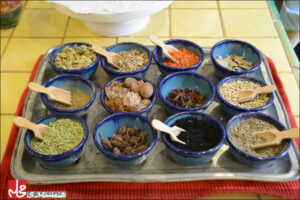 Tahanan believes that the culture of every country could be understood in the food they make and eat.
“The culture of every country can be understood by food customs and their shopping habits. Despite the fact that in the past four years, many foreign tourists easily received visa to travel to Iran and brought the foreign currency into the country, this issue has been underestimated, because most tourists come to Iran to see its history. However, they would like to know about Iran’s current culture. They want to know what does an Iranian man or woman do during the day? Where do they go shopping? What are the raw materials and the foodstuff in Iran? What points make them different from other countries? What materials and methods of cooking make the Iranian food different from others? They do not know much about these questions when they come to Iran, because Iran’s tourism sector has not worked on this topic.”
An Attempt to Give More Information about Iran
“We have received good feedback during the time we set up the food tour. The have left Iran with a smile on their lips and we’ve been able to give them so much information about our country. When we sit at the colourful Iranian Sufra, food is not the only topic we talk about. They ask questions about Iran and we answer as far as we know. They contact us even during their trip, and if they have any questions, we will answer them. This is how we communicate with them in a more intimate way and they count on us when they need help. We’re so happy that we can introduce part of the Iranian culture to the foreigners who travel to Iran.”
Colourful Sufra Exciting for Foreign Tourists
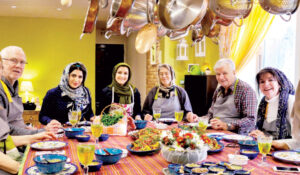 Besides the market, one of the most attractive parts of the food tour is when the Sufra is set, and they can enjoy a world of tastes and colours.
“Those who try out tour mostly have some experience in cooking and now they want to learn about Iranian cuisine. They often try different flavours, but the most attractive part for them is when the whole Sufra is set. All the foods are set and everyone is surprised to see these foods on a colourful Sufra.
In European culture, food is served separately for each person. Although the tables are set in an attractive way, you can’t find a variety of dishes there. When we set the table with a Qalamkar Sufra (kind of printed textile) from Isfahan, everyone is thrilled and very happy. They eat the foods and try different flavours while everything is really attractive for them. As the tastes are different from the ones they had already experienced, it turns into a special thing for them,” Shirin concluded.



 Military equipment experts consulted by The Globe identified the machines appearing in these videos and photos as Gurkha RPVs, produced by Terradyne Armored Vehicles in Newmarket, Ont., just north of Toronto.