Friday, April 17, 2026
Home Blog Page 3936

Israel Benefiting from Ongoing Crises in Mideast: Iran

“The continuation of conflicts and crises in the region is in the interest of the Zionist regime [of Israel],” Iranian Deputy Foreign Minister for Arab and African Affairs Hossein Jaberi Ansari said on Monday.

“This regime has benefited from conflicts in the regional countries and the undermining of its rivals,” said Jaberi Ansari in a meeting with Lebanese lawmaker Walid Jumblatt in Beirut.

Moreover, he added, given that the current crises have overshadowed the issue of Palestine, it (Israel) would like to see these crises go on.

“That is why Iran’s top priority is to make efforts to end crises and draw attention to the issue of Palestine,” he added.

Israel Benefitting from Ongoing Crises in Mideast: IranFor his part, Jumblatt expressed concern over the fact that the cause of Palestine has slipped into oblivion amid the ongoing crises.

He added the Lebanese government, people, army and resistance movement, by working in tandem, have managed to stave off the danger of terrorism.

During the talks, the two sides also discussed the developments in the region and Lebanon, highlighting the need to forge closer cooperation between Iran and Lebanon as well as with the Arab world.

Iran, Lebanon Discuss Resolution of Syria Crisis

During the meeting, Iran’s Deputy Foreign Minister for Arab and African Affairs Hossein Jaberi Ansari and Lebanese Foreign Minister Jebran Bassil discussed regional issues, bilateral cooperation and the developments in Lebanon.

In the talks, Jaberi Ansari briefed Bassil on Tehran’s efforts to further boost interaction with its partners in the Astana talks aimed at resolving the Syria crisis. He said Lebanon and other regional countries’ help is needed to settle the Syria conflict.

He expressed hope that through cooperation between Iranian and Lebanese foreign ministries, a planned trip to Tehran by Lebanese President Michel Aoun will be arranged in such a way that his meetings would usher in a new era of closer cooperation between the two sides in all fronts, especially political and economic arenas.

The Lebanese foreign minister, in turn, thanked Tehran for supporting Beirut in its fight against terror.

“The establishment of a ceasefire and creation of de-escalation zones in Syria within the framework of the Astana talks will help Lebanon tackle terrorism and relieves the country from the dire consequences of the Syria crisis,” he said.

The two sides also highlighted the need to deepen and enhance mutual relations and continue consultations on bilateral and regional issues.

Iran Praises Lebanon’s Role in Countering Israeli Occupation

During the meeting, Iran’s Deputy Foreign Minister for Arab and African Affairs Hossein Jaberi Ansari and Lebanese Parliament Speaker Nabih Berri discussed regional issues, mutual cooperation and the developments in Lebanon.

Jaberi Ansari conveyed Iranian Parliament Speaker Ali Larijani’s greetings to his Lebanese counterpart, and thanked Berri for attending the swearing-ceremony of Iranian President Hassan Rouhani.

The top Iranian official also thanked Lebanon for its major role in fighting terrorism and countering the Israeli occupation.

Jaberi Ansari also referred to Imam Musa Sadr’s prominent role in establishing a resistance front against the Zionist regime of Israel’s occupation and realizing peaceful coexistence among Lebanese religious and ethnic groups.

He also presented a report on the regional issues and the latest developments pertaining to the Astana Process aimed at restoring stability to Syria and settling the crisis in the Arab country.

Iran’s deputy foreign minister said two priorities of the Iranian Foreign Ministry during President Rouhani’s second term in office are to boost regional cooperation and give fresh impetus to economic diplomacy. He said Iran pays due regard to Lebanon in that respect.

The Lebanese parliament speaker, in turn, conveyed his warmest greetings to Larijani, and highlighted Iran-Lebanon age-old relations as well as Imam Musa Sadr’s key role in consolidating bonds between the two nations.

Berri also underscored the need to enhance mutual cooperation. He then touched upon plots to disintegrate the regional countries and put emphasis on the importance of regional cooperation to ward off that threat.

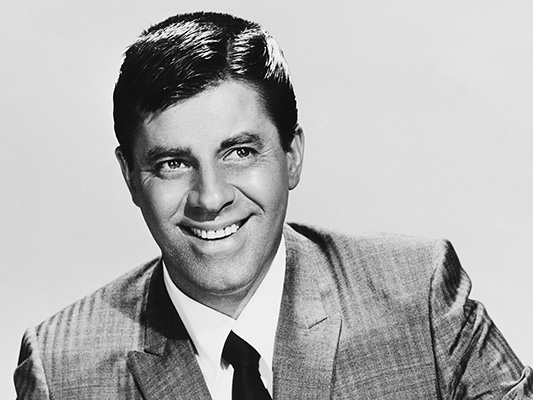
Legendary Comedian Jerry Lewis Dies at 91

Jerry Lewis

Lewis first gained fame for his frenzied comedy-and-music act with singer Dean Martin. When that ended in the mid-1950s, Lewis went solo, and by the early ’60s, he had become a top draw in movies such as “The Bellboy,” “The Nutty Professor” and “The Patsy.”

Along the way, he pioneered the use of videotape and closed-circuit monitors in moviemaking, a now-standard technique called video assist.

Lewis was, and still is, a huge star in Iran. For years his voice was dubbed into Farsi for Iranian audiences by actor Hamid Qanbari.

Qanbari’s special voice made Lewis even more popular among Iranian people who were saddened by the news of his demise on Sunday.


‘White House Resignations Sign of Trump’s Indecision’

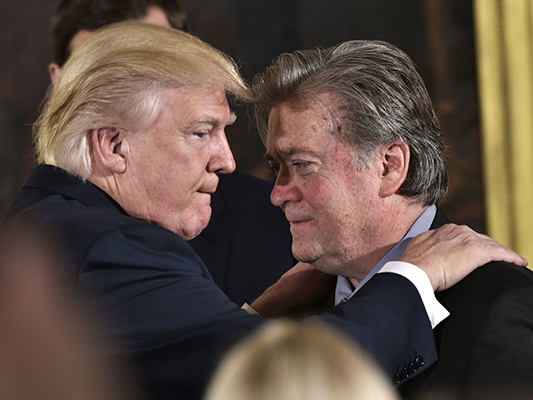
Stephen Bannon-trump

The Aftab-e Yazd newspaper, in its Sunday editorial, has discussed the resignation of White House’s chief strategist Stephen Bannon, the trend of such developments in the White House, and their possible impact on Tehran-Washington relations.

Here is the full text of the Farsi article:

In the eyes of American men and women as well as other people across the globe, it would have seemed impossible that White House chief strategist Bannon leaves Donald Trump. Even the thought of such a separation would cross no one’s mind. But Trump has shown over the past six months that nothing is impossible for him, and that with his powers he can bring people to the top before sitting down and watching them fall. No sooner had Bannon tendered his resignation than special advisor to Trump Carl Icahn joined the individuals who had stepped down at 1600 Pennsylvania Avenue. The resignations of US officials on a daily basis indicate the country’s uncertain future.


Jitters over Trump’s Future

Bannon, who political activists regard as the most dangerous politician in the world, has said, “Trump presidency that we fought for, and won, is over.” Bannon’s resignation was front-page news across the world on Friday as Trump had called Bannon a brain out of its skull. The director of Breitbart, the same website that promotes racist ideas and had ridiculed Barack Obama for the colour of his skin, believes populist slogans, traditional Republicans and also Trump’s family have triggered Bannon’s resignation.

Analyses by political experts suggest Bannon has fears about Trump’s shaky future, and indicate it is the very same fears which are to blame for the separation of his brain from the skull. Trump’s approval ratings have hit rock bottom following his mixed reactions to a rally by white supremacists in Charlottesville. Even high-profile Republicans such as Senator John McCain have expressed their hatred of Trump. This very development, analysts say, has led Bannon to return to the Breitbart website.


Wandering Trump

However, Ali Bigdeli, an expert on international issues and a university lecturer, believes Trump’s flip-flop approaches are the reason behind Bannon’s resignation.

“From the very early days when Trump took office, he was facing a kind of uncertainty in running the country because his flip-flop political behavior was not compatible with any of the American politics patterns. In particular, he had no political stability in areas directly under his control,” said Bigdeli in an interview with Aftab-e-Yazd.

“Based on the figures published by the White House, so far 25 senior officials have come to the Oval Office, but they stepped down or were fired shortly afterwards. That happened due to Trump’s political inexperience,” the analyst added.

“Such a vacillation in Trump’s decision-making in the US political arena over the past few days coupled with his mixed reactions to the recent racist conflicts has pushed his popularity down to 30%, i.e. lower than the approval ratings of all other US presidents. Now, there is talk of his impeachment,” said Bigdeli.

“There is uncertainty in the White House over whether or not Trump will have a fate similar to that of Nicholson, whether or not Congress will ask him to appear on Capitol Hill for impeachment and whether Trump will have to step down or the case will be referred to a court like that of Clinton. All these issues have prompted Trump’s associates to leave him” said Bigdeli.


Outdated Men!

Only 202 days have passed since Trump entered the Oval Office and a picture was released of him and his strategists. The bitter fact is that all but two of the men present at the office have either resigned or been fired. National security advisor Michael Flynn, White House chief strategist Steve Bannon, chief of staff Reince Priebus and White House press secretary Sean Spicer were members of Trump’s think tank. Vice President Mike Pence is the sole survivor of Trump’s strategists. Walter Shaub, former director of the Office of Government Ethics, Attorney General Jeff Sessions, Mark Corallo, the spokesperson for the president’s legal team, acting US ambassador to China David Rank and communications director Mike Dubke are but a few of the officials of the Trump administration who have resigned or been removed from their jobs.


Situation to Change if Trump Leaves

These Days the White House is being frequented by men who have either stepped down or been recruited. Radicals in the US government, i.e. those whose ideas were close to those of Trump, are leaving the 1600 Pennsylvania Avenue and being superseded by individuals who are trying to put Trump back at the helm of affairs. The development begs the question of whether or not the departure of radicals from the White House and the arrival of real Republicans will be in the interest of countries such as Iran.

“Trump and his associates belong to an offshoot of the Republican Party whose members are xenophobic and only care about white Americans. They are very dangerous and perverted. In my idea, even the departure of people like Bannon will result in no change in the situation of Iran. Trump himself belongs to the group of American radicals. It was Trump himself that initiated the Iranophobia scenario. Only the departure of Trump will tip the balance in favor of Iran,” said Bigdeli.

Twitter Blocked in Iran for National Security Concerns: Minister

twitter

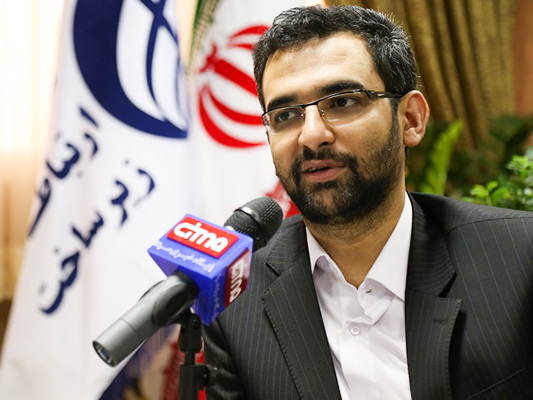
Mohammad Javad Azari JahromiMohammad Javad Azari Jahromi, the new Iranian ICT minister, has voiced his opposition to the filtering of Twitter in Iran, but at the same time noted that the service is blocked for certain security reasons.

Speaking in a Farsi interview with ILNA, Jahromi said Twitter was not filtered by the ICT Ministry, so it is not the one that can decide about its unblock.

“It is not right to say we can end the filtering of Twitter. The body that has decided to block this social medium has made the decision for certain considerations,” he noted.

“I myself use Twitter. It is a good instrument for public diplomacy, establishing relation with people around the world, and expressing comments about different issues,” the 36-year-old minister added.

“To be honest, Twitter was blocked for national security reasons, not for ethical and cultural issues,” he added.

“We should hold talks [with relevant Judiciary authorities] on the issue [unblocking Twitter]. We will try to achieve good results in this regard,” Jahromi vowed.

US Must Pay Iran $245m in Damage for Role in Chemical Attacks

Gholam-Hossein Mohseni-Ejei, Iran’s Judiciary spokesman, made the remarks on Sunday, while noting that the amount would be distributed among 18 victims of the attacks who had filed for the legal action.

Hundreds of thousands of Iranians were killed in the Iraqi-imposed war and many more were affected by the chemical weapons like mustard gas that were used by the regime of the Iraqi dictator Saddam Hussein. Many of those Iranians who were attacked by chemical weapons and are alive today continue to suffer the lingering aftereffects.

US Must Pay Iran $245m in Damage for Role in Chemical Attacks

Iraq once possessed a huge arsenal of chemical weapons, the production of which was facilitated by exports of chemicals as well as financial and technological support from the United States and other Western countries.

Iraq is believed to acquire the technology and the materials to develop chemical weapons from the US and a number of Western countries. According to reports, US spy agency, CIA, had knew about Iraq’s use of chemical weapons as early as 1983, but the US took no action against the violations of international law, and even failed to alert the UN.

Iran Looking for Closer Ties with Neighbours in Rouhani’s New Term

Speaking at a weekly press conference on Monday, Foreign Ministry Spokesman Bahram Qassemi said the new administration has shaped its foreign policy on the basis of improvement of relations with neighbors, contribution to peace and stability in the region, and efforts to combat terrorism.

He referred to plans for establishment of a new economic bureau in the Foreign Ministry, saying it would help the ministry pursue economic diplomacy more actively to attract foreign investment, boost exports and send workforce abroad.

Highlighting Iran’s mutual cooperation with neighboring countries, Qassemi pointed to a recent visit to Turkey by Chief of Staff of the Iranian Armed Forces Major General Mohammad Hossein Baqeri, saying the high-profile trip marked a “progress and complementary step” in Tehran-Ankara ties and its positive impacts on regional developments will emerge in future.

As regards the tensions with Saudi Arabia, the spokesperson said Iran has taken the necessary measures with regard to the bilateral relations, expressing the hope that the kingdom would observe the regional situation with a better sense of realism.

He further described the political negotiations in the Kazakh city of Astana as an “effective approach” to settling the crisis in Syria, saying the initiative has no alternative.

Syria’s warring sides have so far attended five rounds of peace talks in Astana, brokered by Iran, Russia and Turkey, known as the guarantors of a ceasefire in the Arab country.

The fourth round of those talks in May produced a memorandum of understanding on de-escalation zones in Syria, sharply reducing fighting in the country.

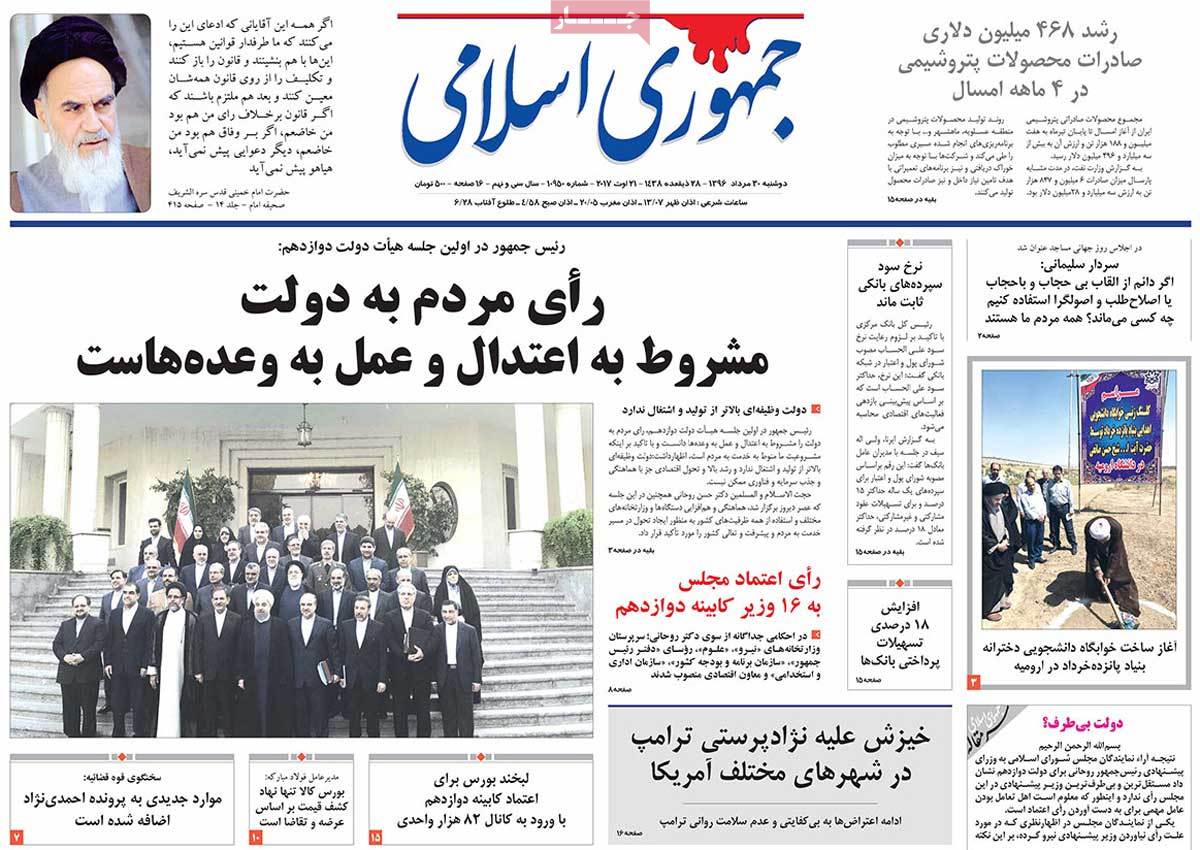
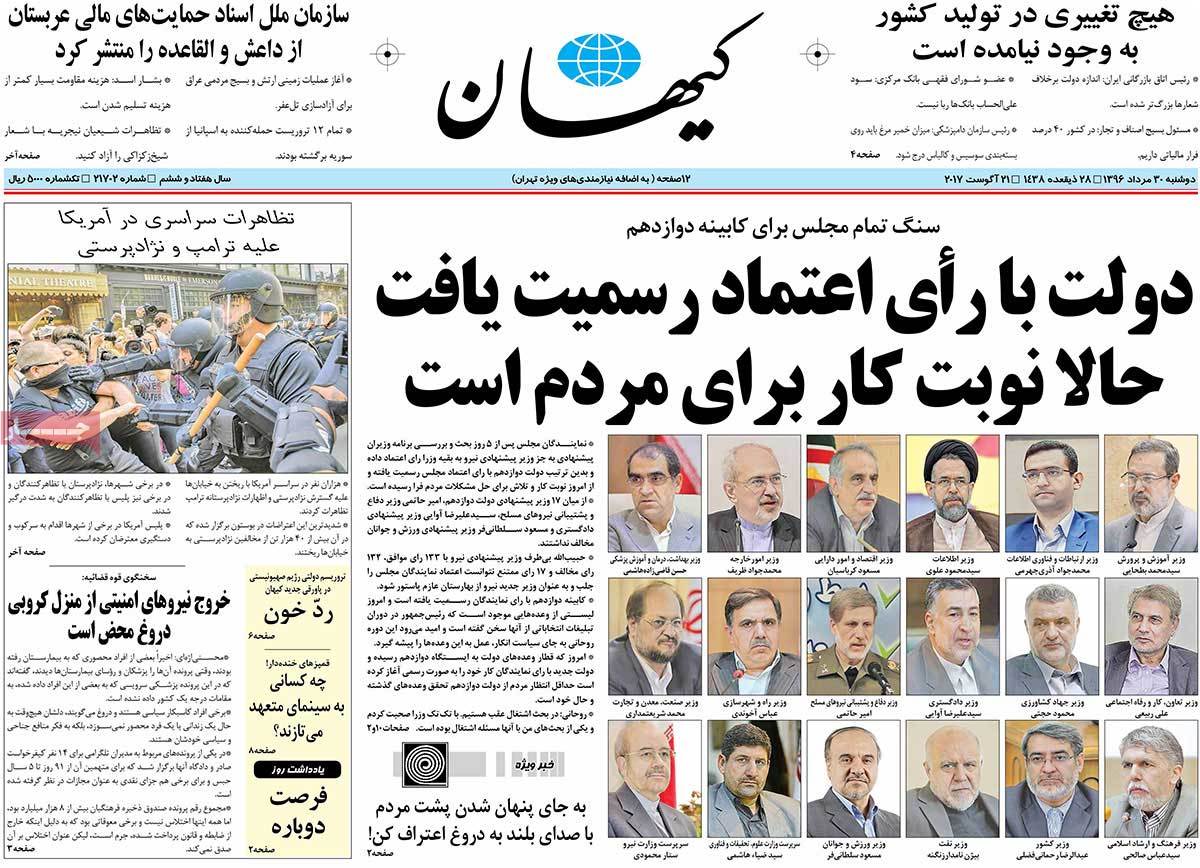
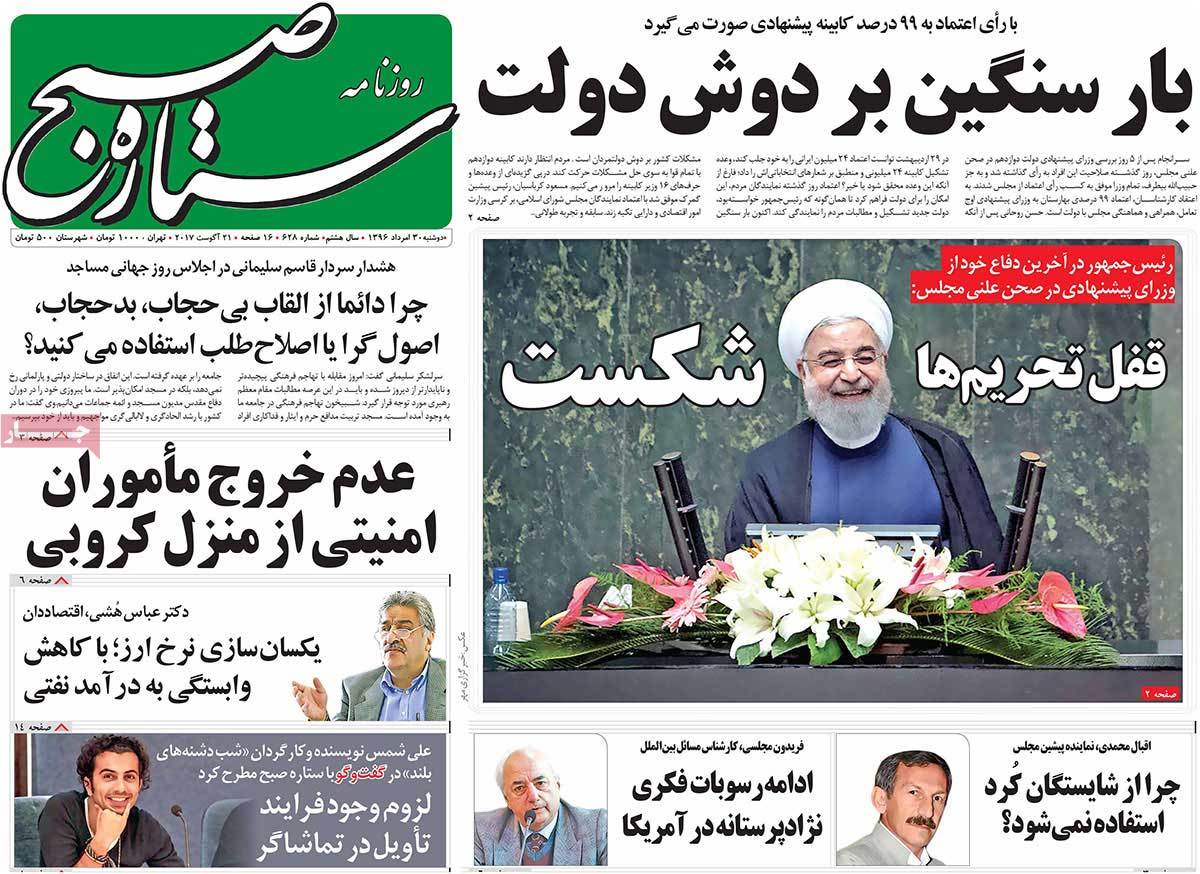
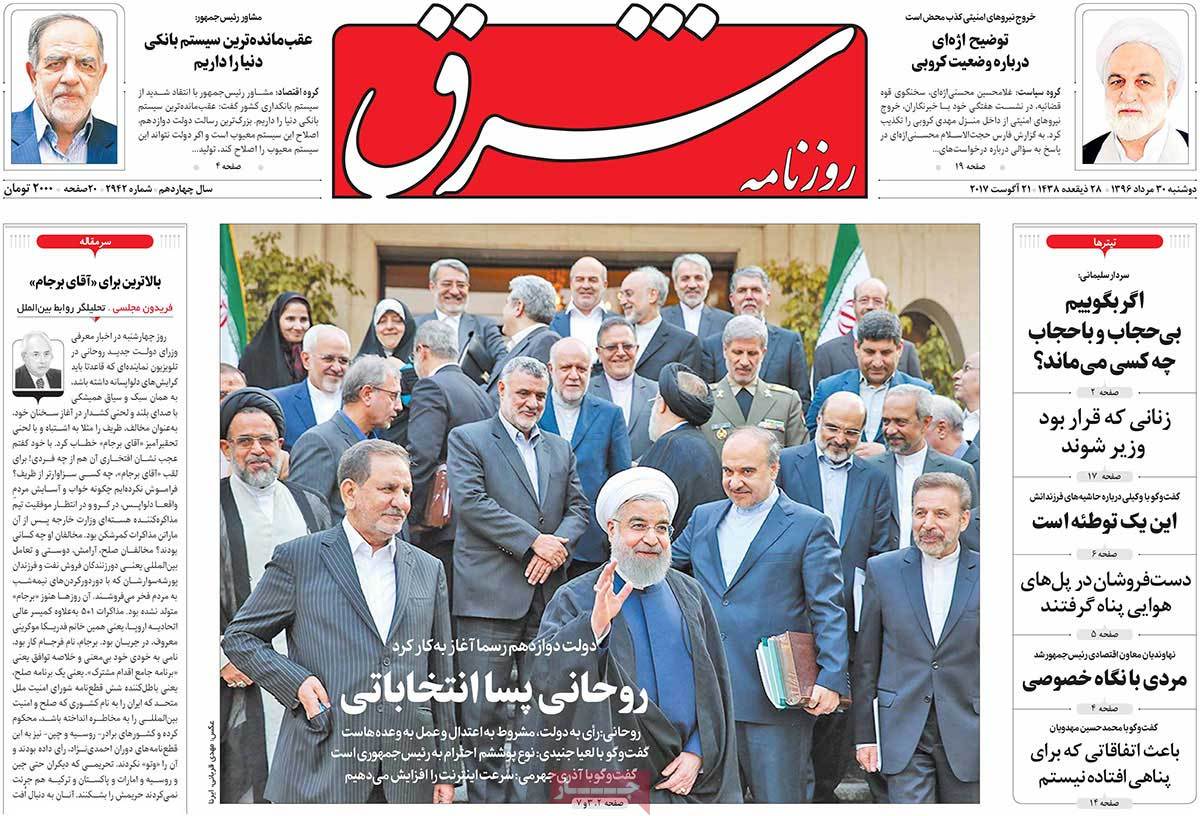
A Look at Iranian Newspaper Front Pages on August 21

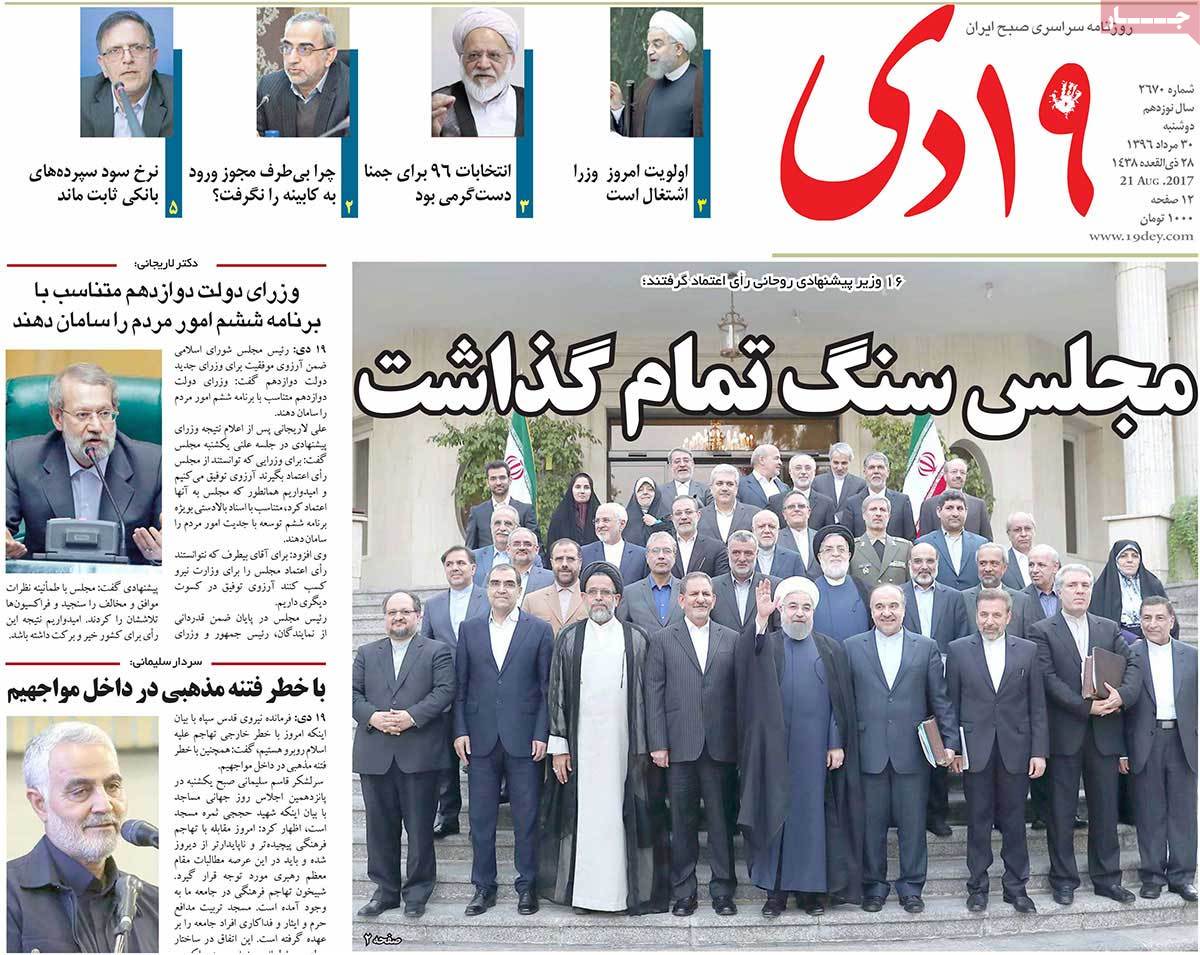
All newspapers today covered the almost unanimous vote of confidence Rouhani’s proposed ministers received from the Parliament in the Sunday session.

Some papers, both reformist and conservative, criticized the Parliament for approving so many of Rouhani’s ministerial nominees, but several others welcomed the support and highlighted the heavy burden on his administration’s shoulders.

Another top story was the remarks made by IRGC Quds Force Commander Major General Qassem Soleimani about the dangers of dividing people into reformist/conservatives and those who observe or don’t observe the Islamic dress code.

The above issues, as well as many more, are highlighted in the following headlines and top stories:


19 Dey:

1- Parliament Did Its Best
A Look at Iranian Newspaper Front Pages on August 21


Abrar:

1- Kissinger: Nuclear Deal Postpones Emergence of Iran’s Nuclear Capabilities

2- Barzani: Iran’s Influence in Iraq More than Any Other Country’s

3- ISIS Front Line Destroyed in Tal Afar

4- Iran Topic of Netanyahu’s Discussions with Putin
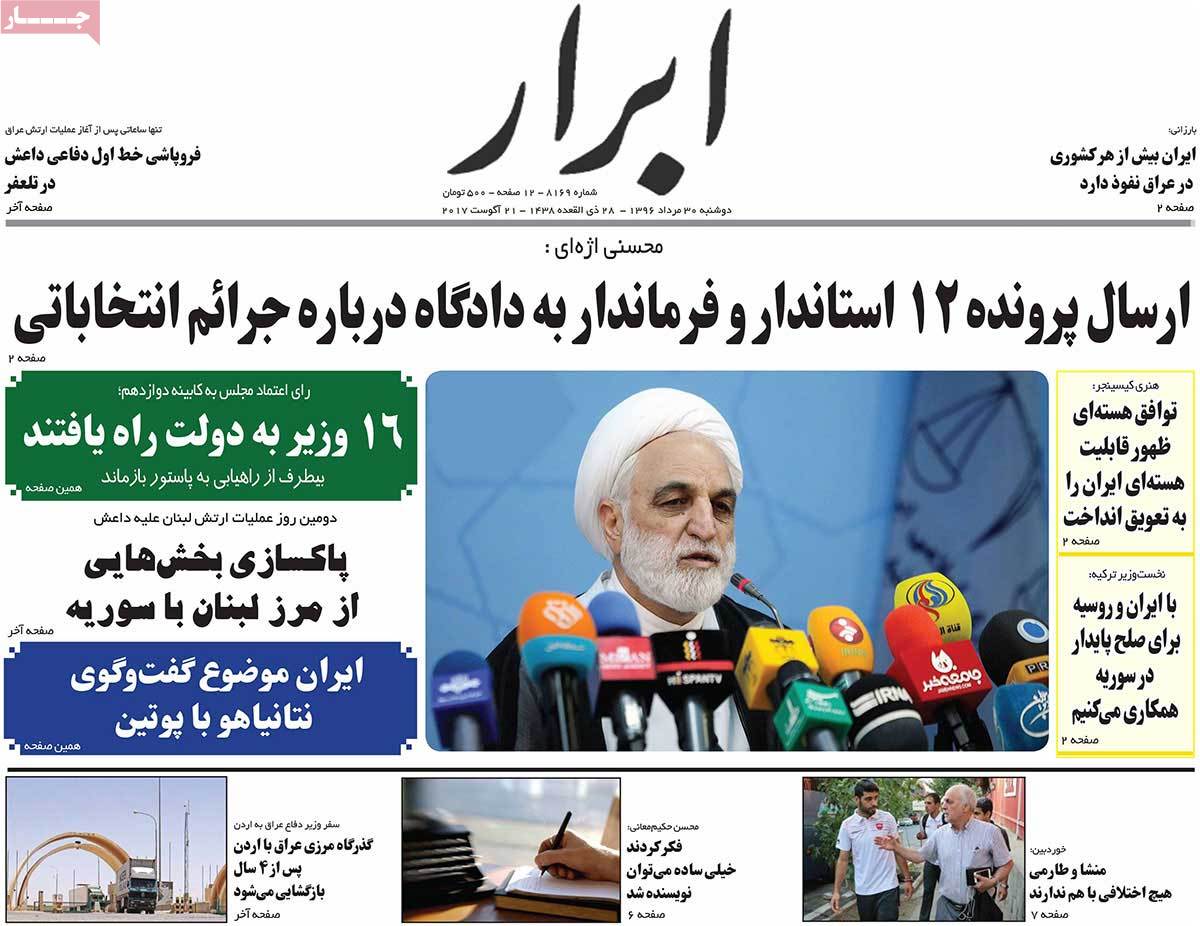
A Look at Iranian Newspaper Front Pages on August 21


Abrar-e Eqtesadi:

1- Iran to Export 100,000 Barrels of Oil per Day to Russia as of Late September
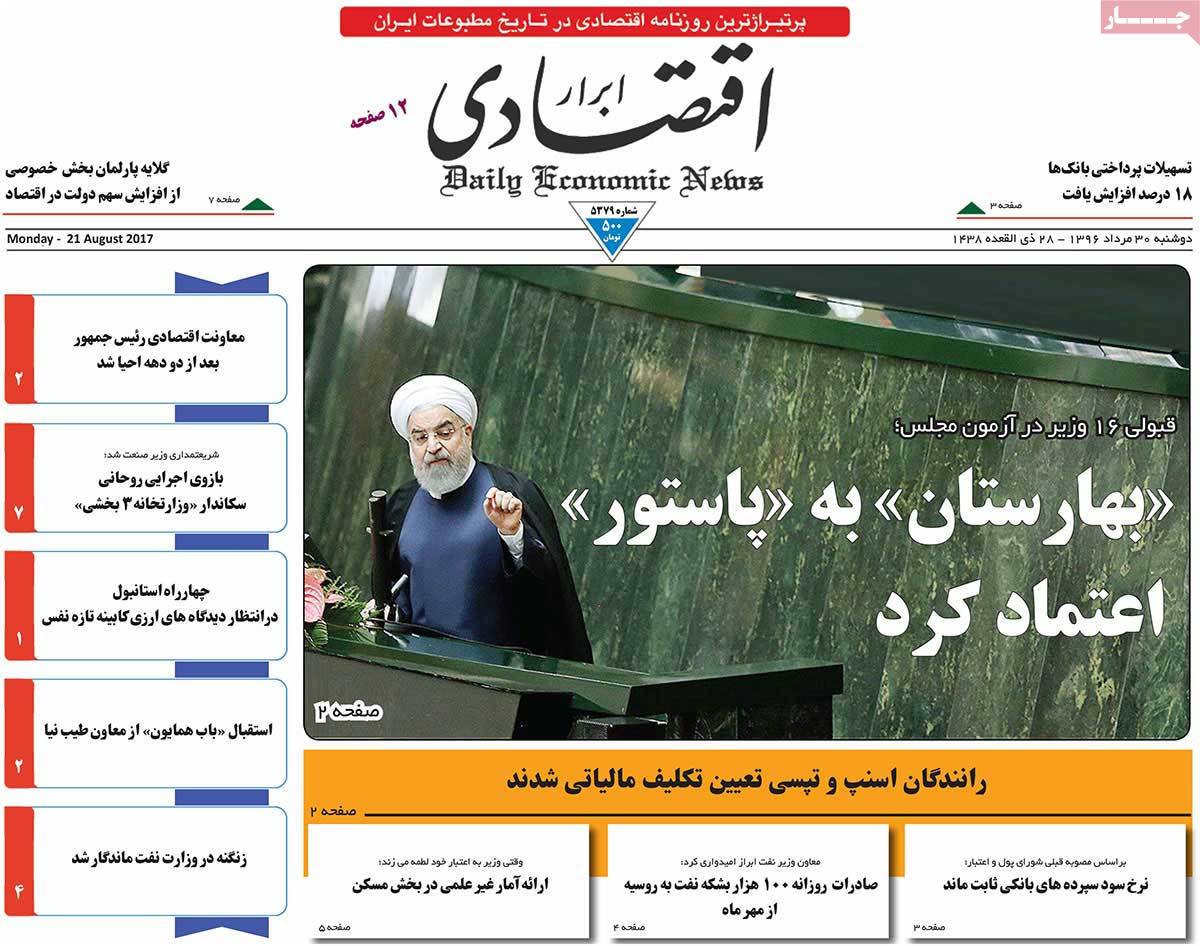
A Look at Iranian Newspaper Front Pages on August 21


Afkar:

1- General Soleimani: We Prevented Sectarian War Using Religion

2- Iraq on Verge of Conquering Last ISIS Stronghold

3- Assad: Arab Countries Have No Role in Int’l Political Issues
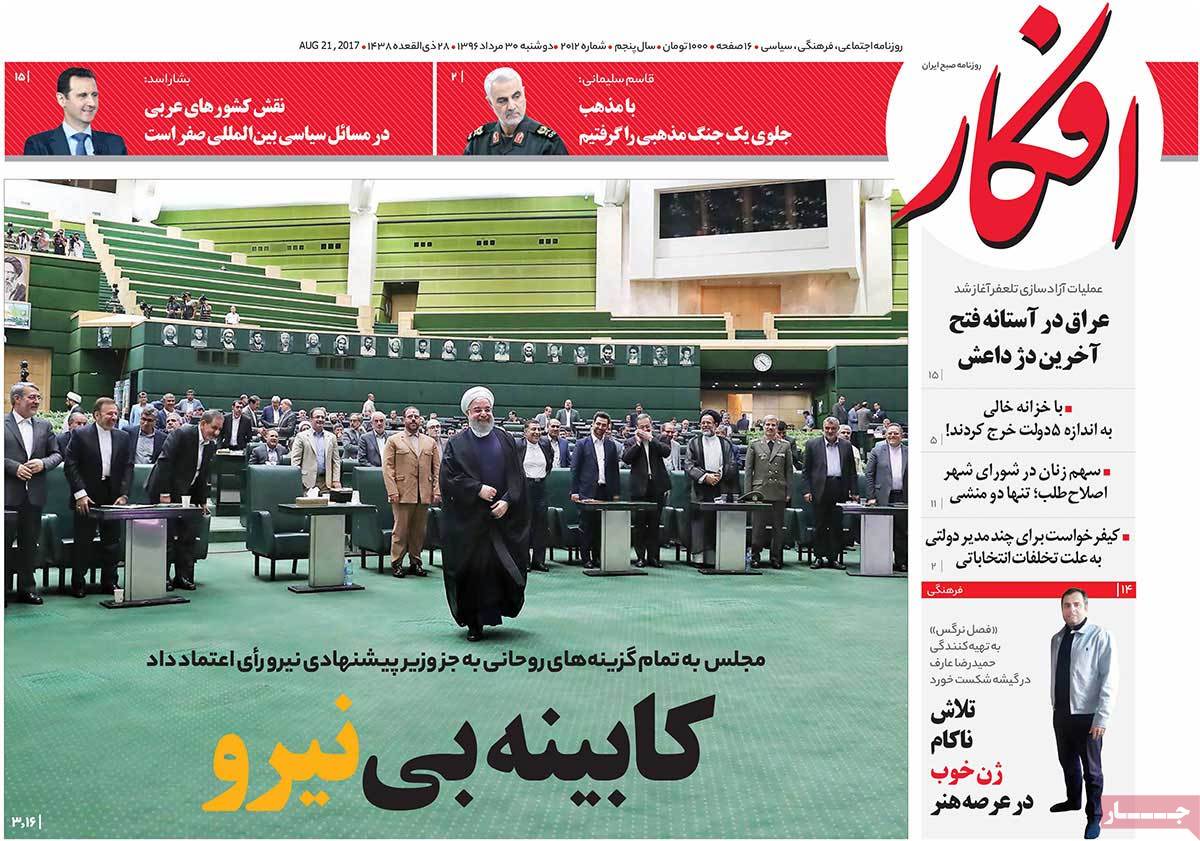
A Look at Iranian Newspaper Front Pages on August 21


Aftab-e Yazd:

1- Parliament’s Red Carpet for Government

  • Unprecedented Vote of Confidence for Proposed Ministers
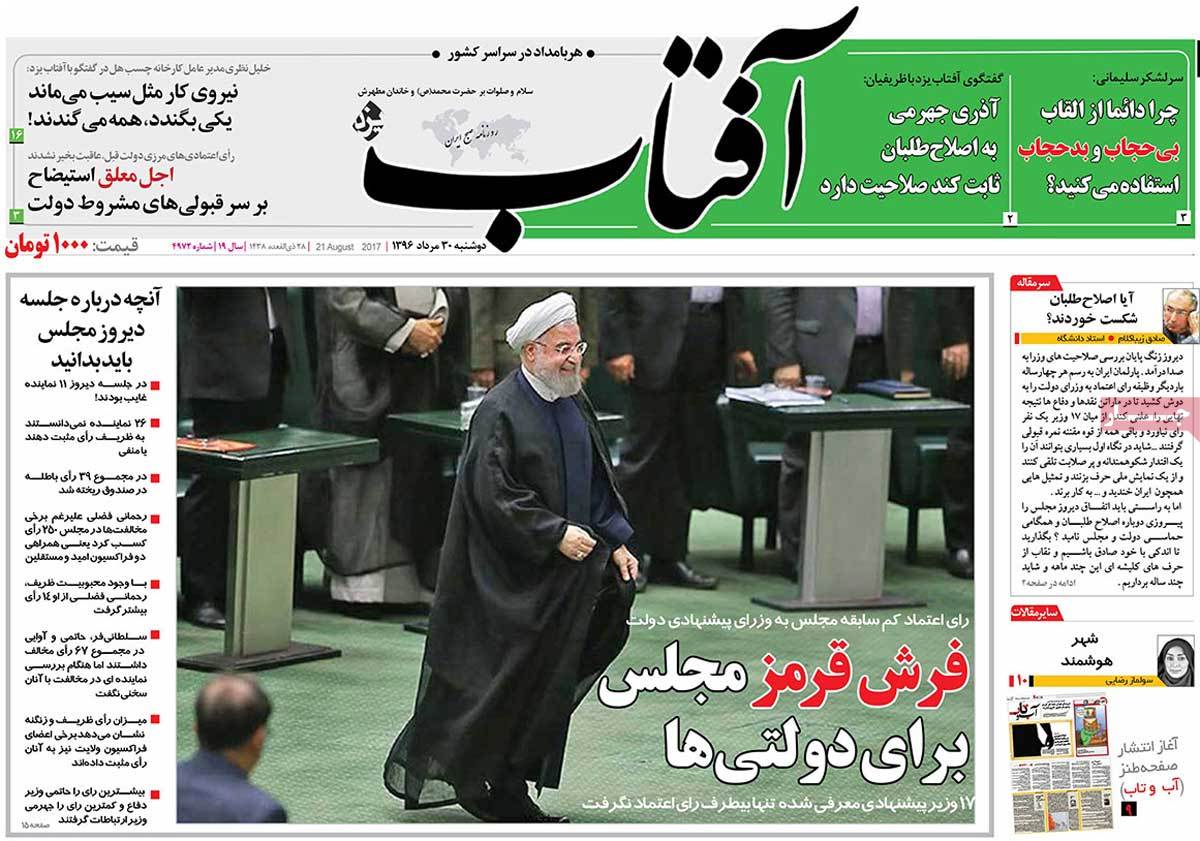
A Look at Iranian Newspaper Front Pages on August 21


Arman-e Emrooz:

1- Rouhani: People Haven’t Given Us Blank Cheque

2- Politician: Reformists’ Reputation Hinges on Rouhani’s Performance

3- Political, Meaningful Vote of Lawmakers [Editorial]
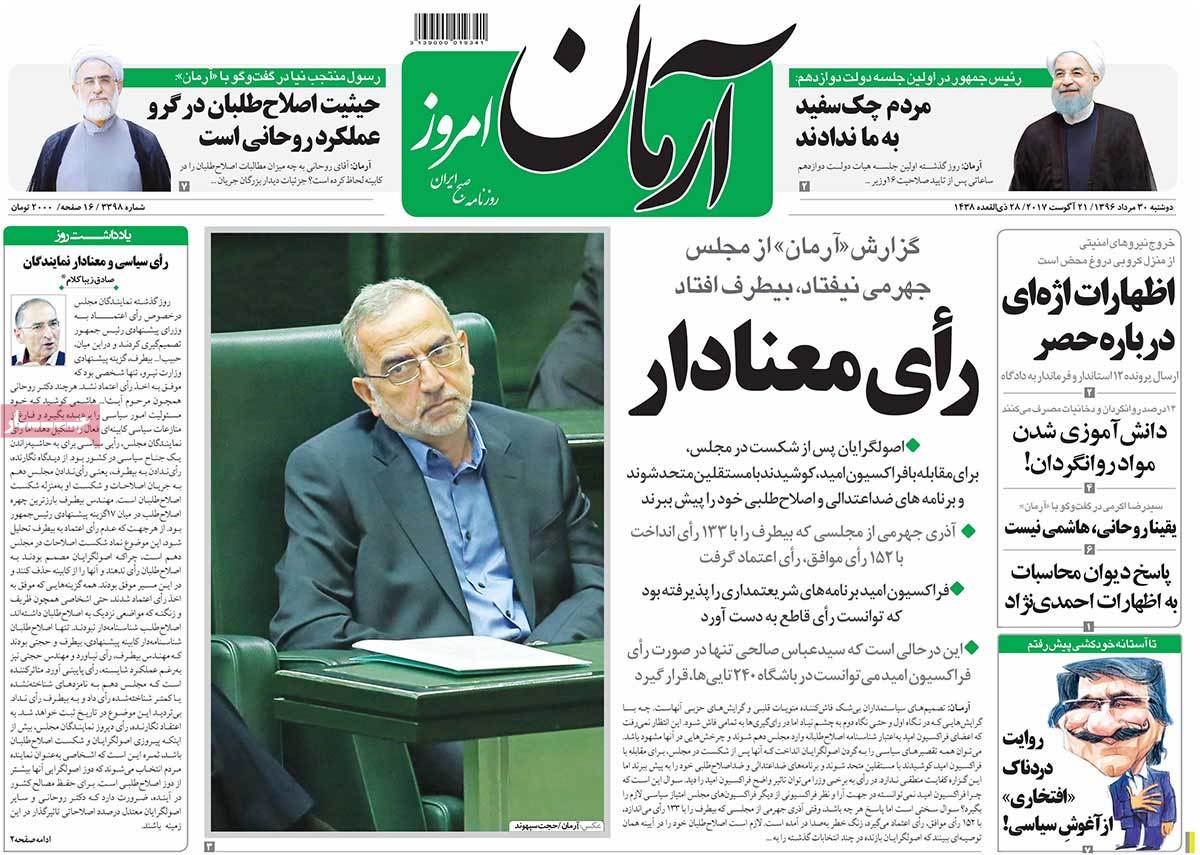
A Look at Iranian Newspaper Front Pages on August 21


Ebtekar:

1- 17 Minus 1: Parliament’s Great Gift for Rouhani

2- Once Again Mr Diplomat: Challenges Faced by Zarif in Second Term
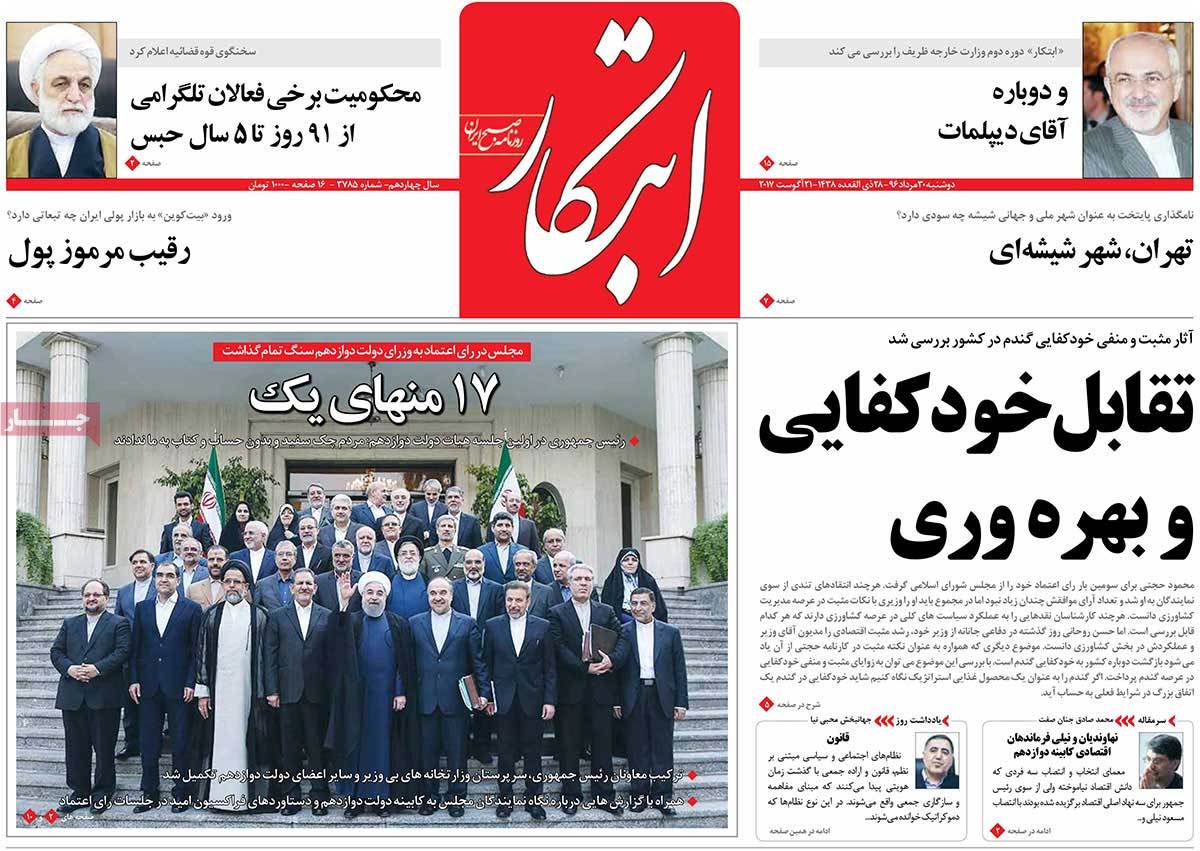
A Look at Iranian Newspaper Front Pages on August 21


Etemad:

1- Parliament’s Unexpected, Different Vote for Rouhani’s Second Cabinet

2- Reformist Analyst: No Serious Barrier for Rouhani in Second Term

3- General Soleimani: Why Do You Keep Dividing People into Reformist/Conservative?
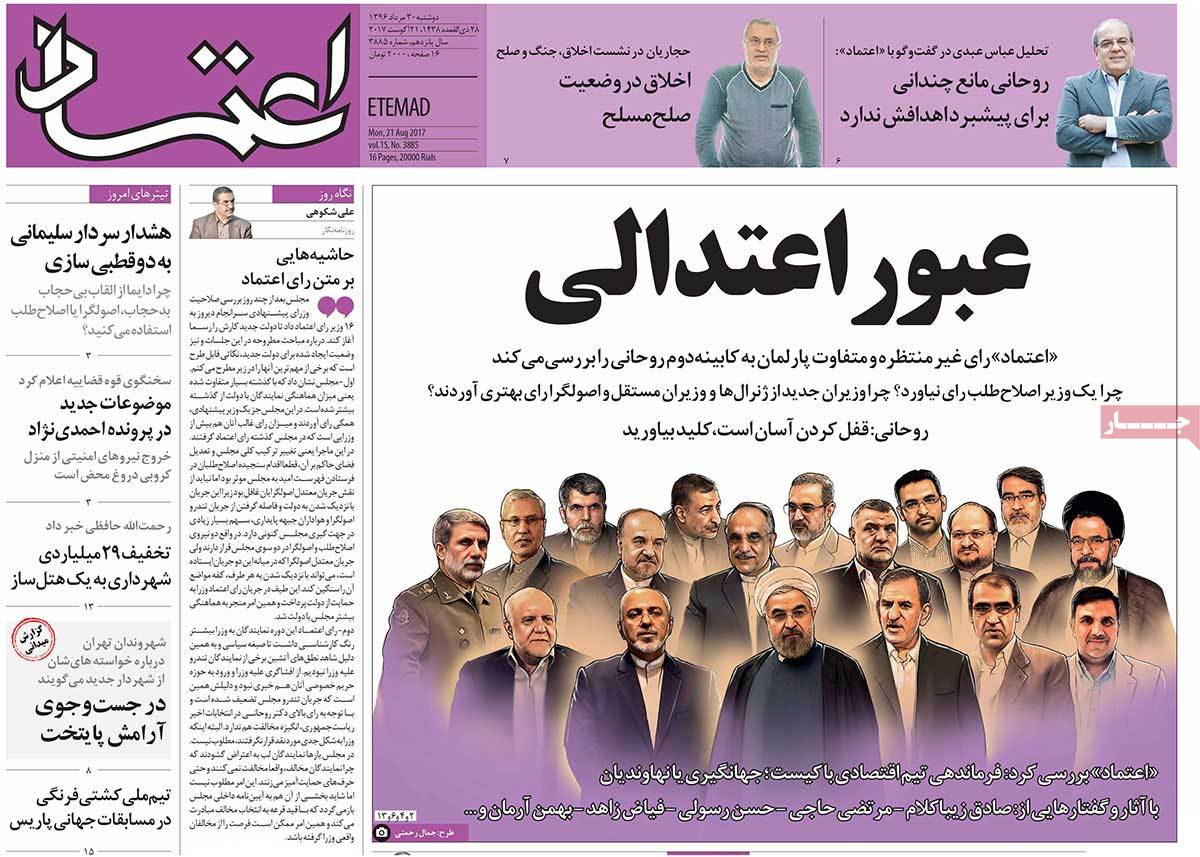
A Look at Iranian Newspaper Front Pages on August 21


Ettela’at:

1- Rouhani: Government’s New Plan Is to Establish Security, Freedom, Progress

2- Our Legitimacy Hinges on Giving Service to People: President

3- Al Jazeera Reveals Documents on Saudi Support for ISIS, Al-Qaeda

4- Judiciary: US Condemned to Pay Iran Compensation for Role in Chemical Attack
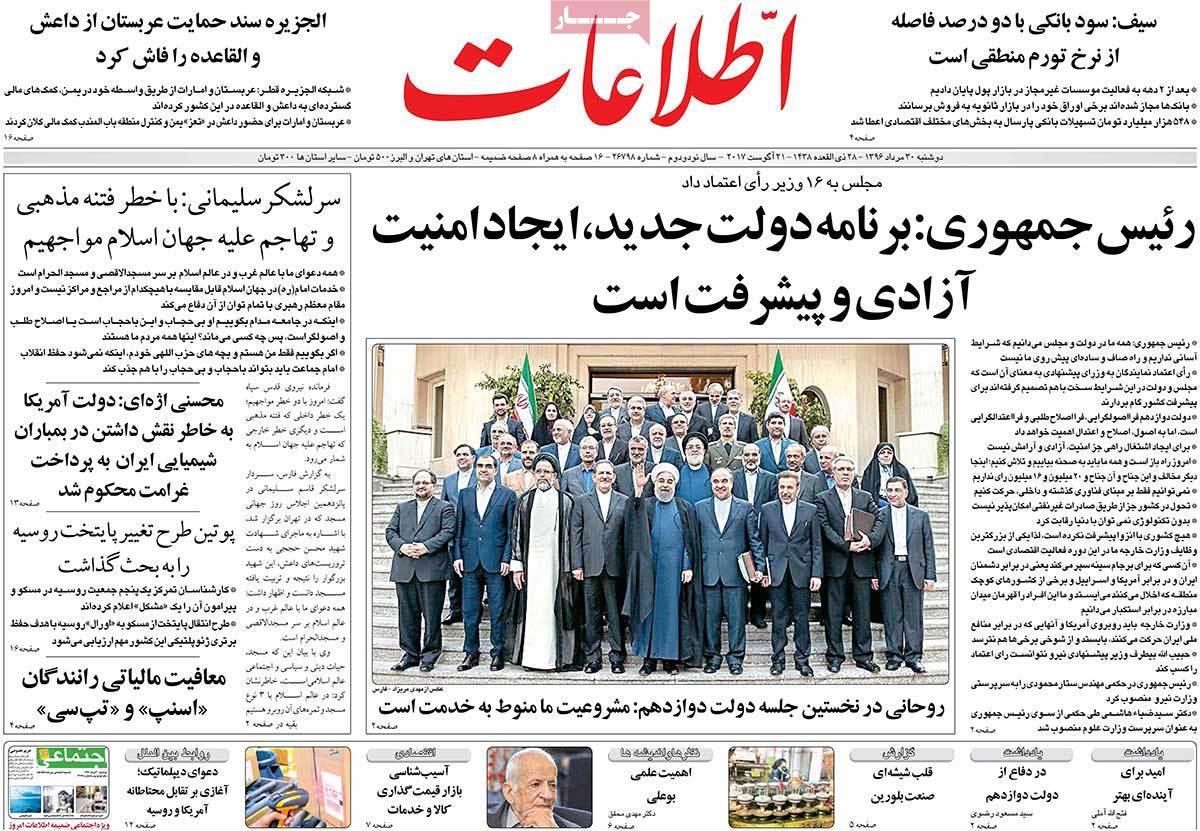
A Look at Iranian Newspaper Front Pages on August 21


Haft-e Sobh:

1- Shadow of Water on Cabinet: All Ministers, but Power Minister, Receive Vote of Confidence

2- Damn Crystal Vases: Interview with Famous Rapper Accused of Killing Step-Father
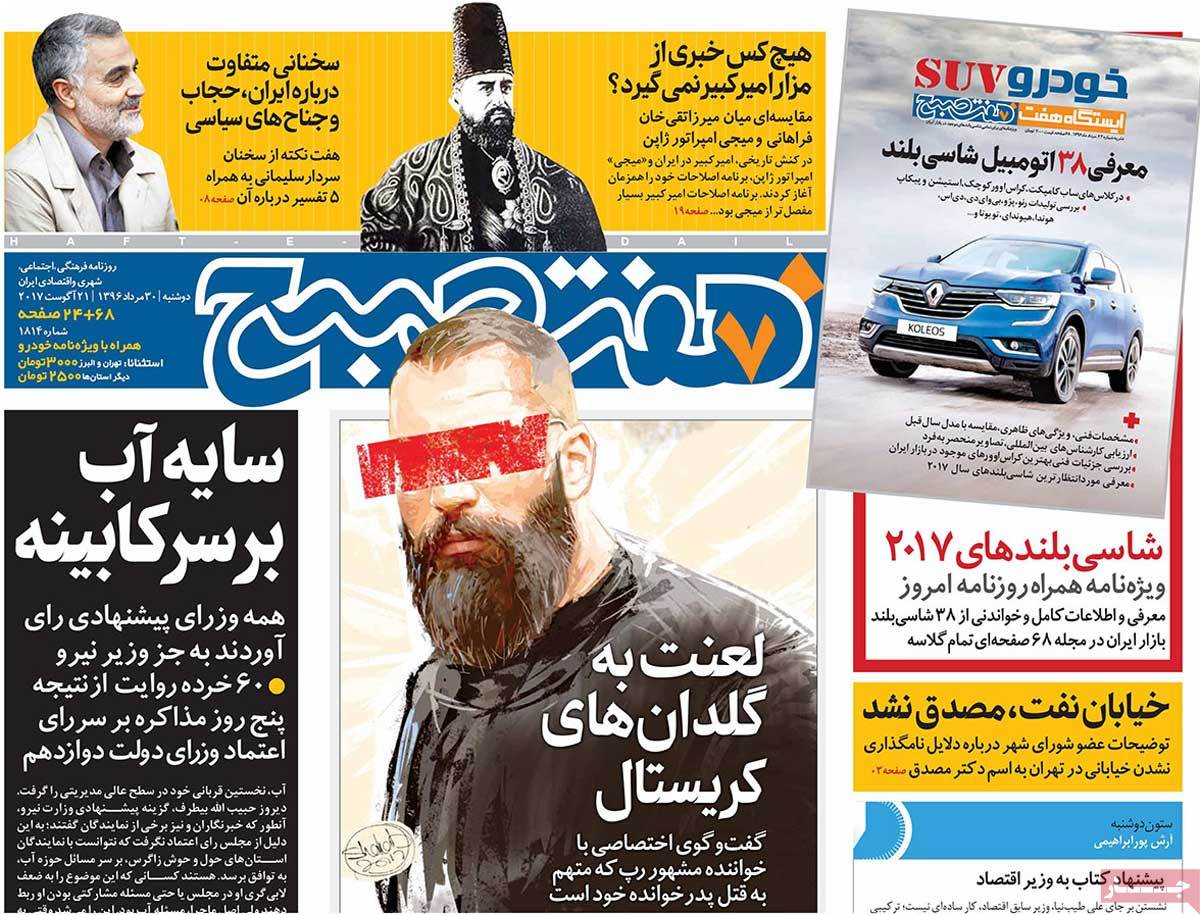
A Look at Iranian Newspaper Front Pages on August 21


Hamshahri:

1- Mosque Helping People Quit Drug Addiction for Past 10 Years
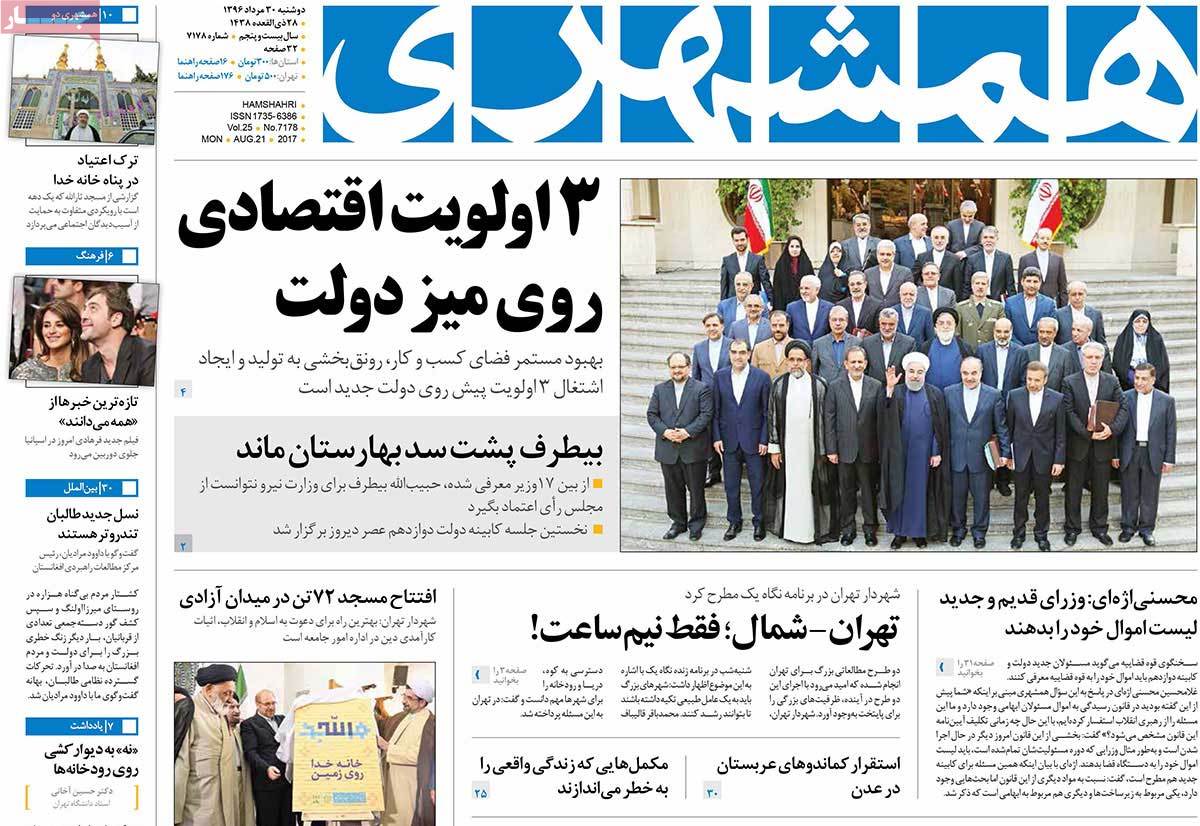
A Look at Iranian Newspaper Front Pages on August 21


Iran:

1- Trust in Moderation: 16 Ministers Receive Vote of Confidence
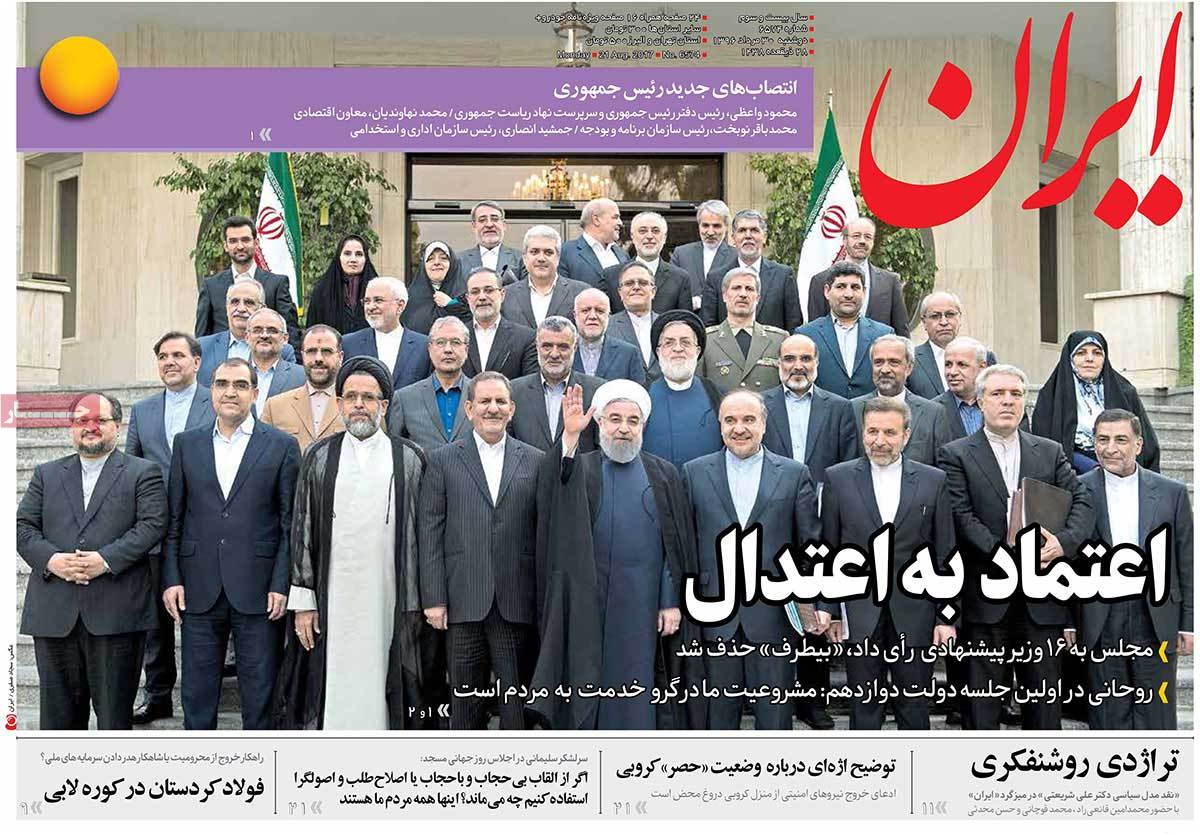
 

A Look at Iranian Newspaper Front Pages on August 21


Javan:

1- Rouhani: Parliament Acted Professionally This Time!

2- 75% of Proposed Ministers Receive Over 225 Votes of Confidence

3- Judiciary Spokesman: Opposition Leaders to Remain under House Arrest
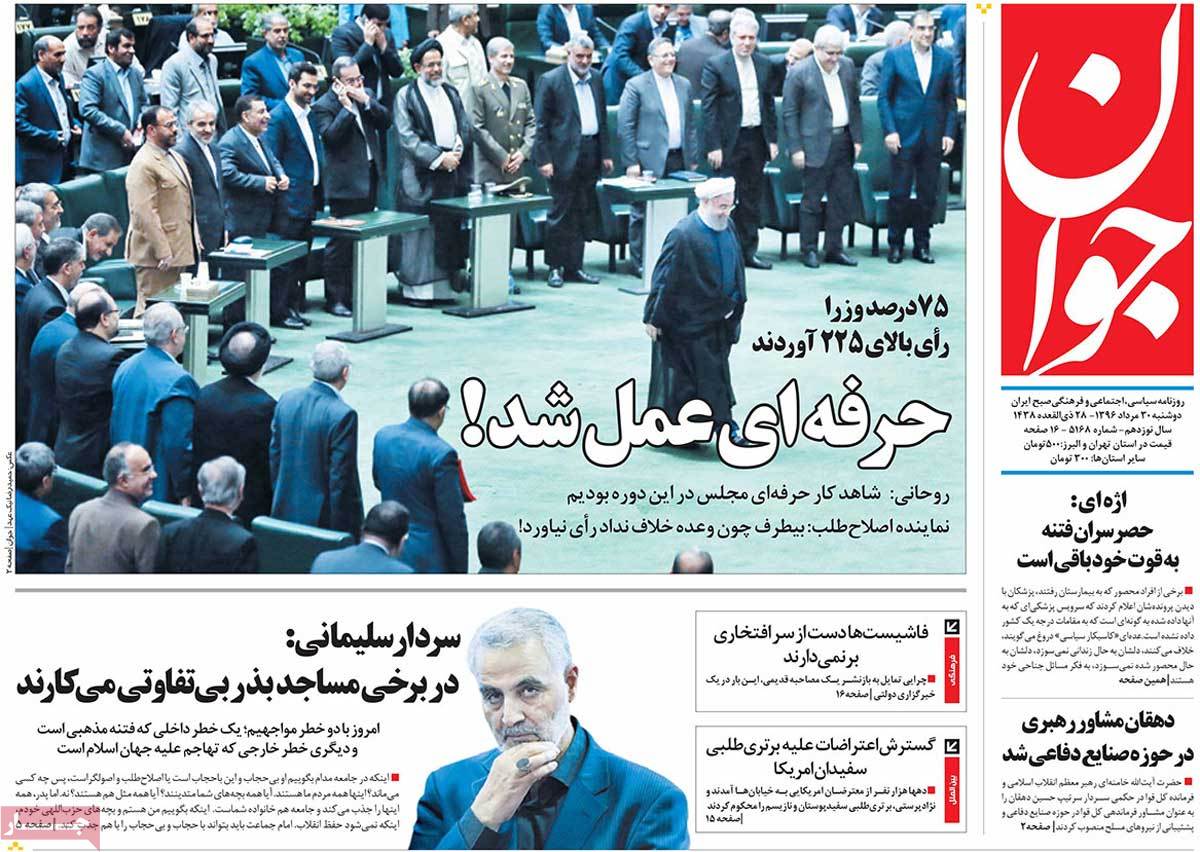
 

A Look at Iranian Newspaper Front Pages on August 21


Jomhouri Eslami:

1- $468m Increase in Iran’s Petchem Exports in Past 4 Months

2- Various US Cities Rise against Trump’s Racism
A Look at Iranian Newspaper Front Pages on August 21


Kayhan:

1- Government Officially Starts Work: It’s Now Time to Work for People
A Look at Iranian Newspaper Front Pages on August 21


Setareh Sobh:

1- Analyst: Continued Racism in US

2- Heavy Burden on Gov’t Shoulders after Vote of Confidence for 99% of Cabinet
A Look at Iranian Newspaper Front Pages on August 21


Shargh:

1- Post-Election Rouhani: New Gov’t Officially Starts Work
 

A Look at Iranian Newspaper Front Pages on August 21


Sobh-e Now:

1- Friendly Gathering! Parliament Smiles at Government
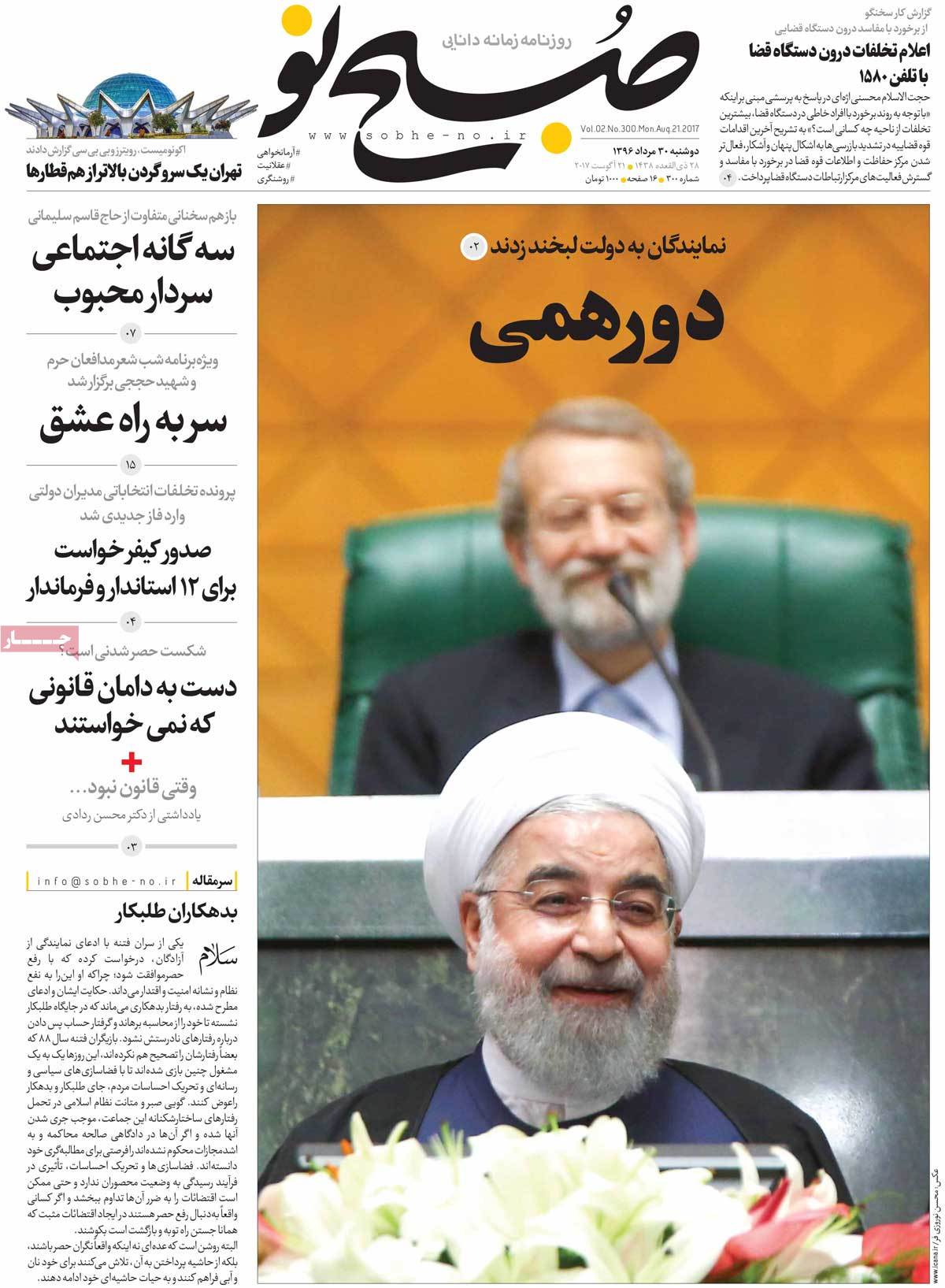
 

A Look at Iranian Newspaper Front Pages on August 21


Vaghaye Ettefaghieh:

1- Zarif Once Again Takes Control of Iran’s Foreign Policy

2- Three Groups Trying to Take Over Trump’s Administration [Editorial]
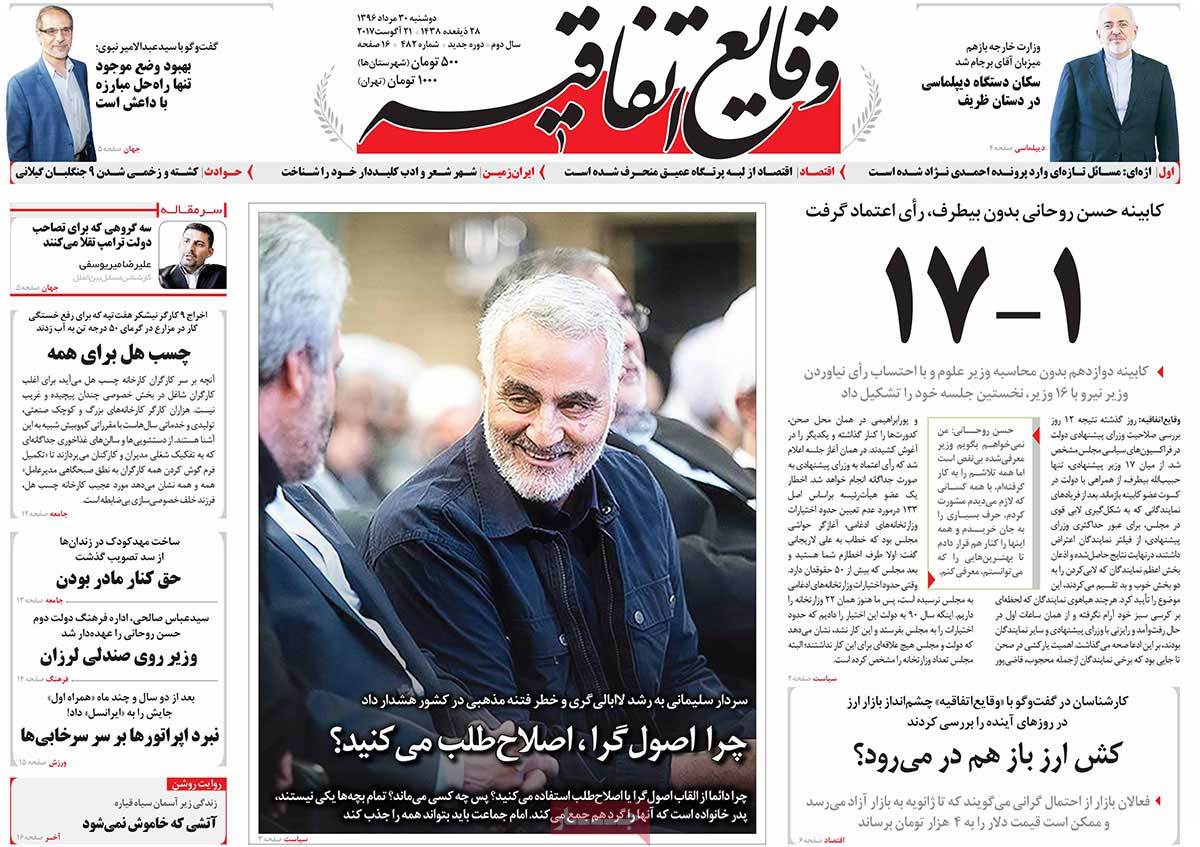
 

A Look at Iranian Newspaper Front Pages on August 21


Vatan-e Emrooz:

1- Several Captains in Rouhani’s New Economic Team!
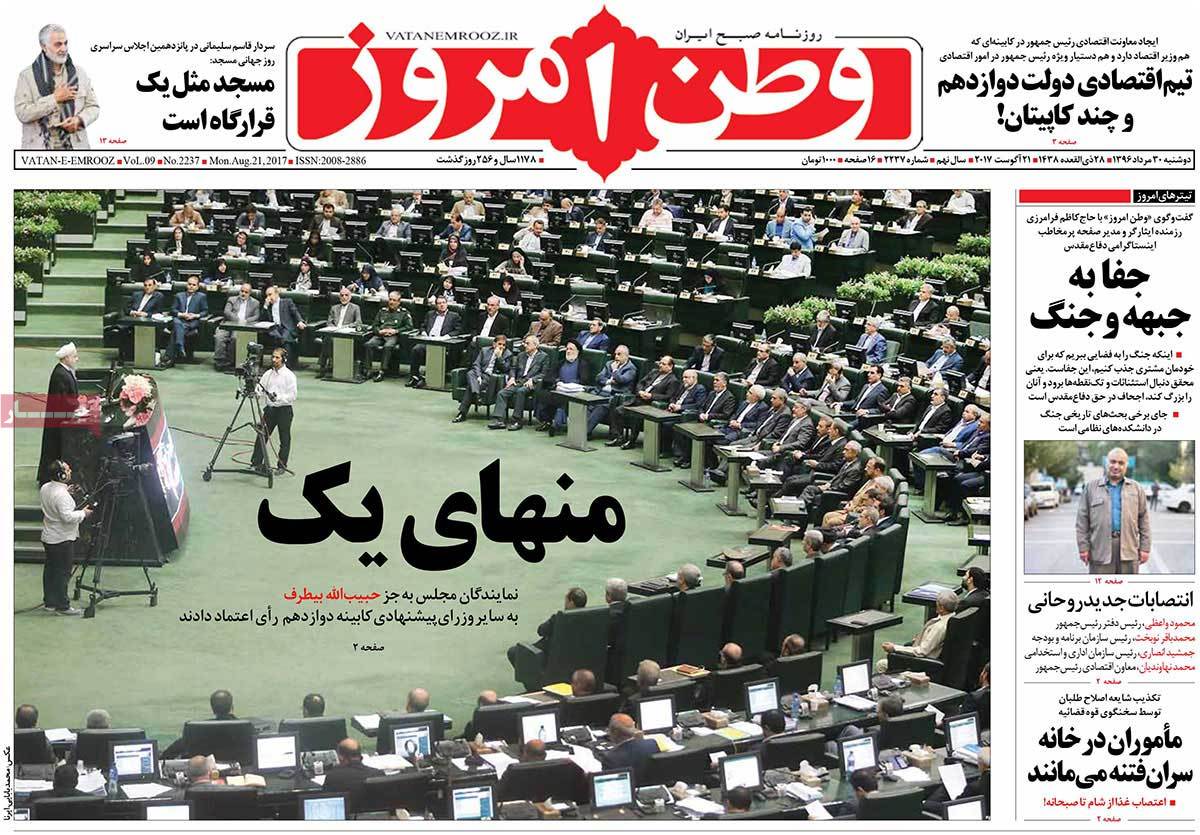
A Look at Iranian Newspaper Front Pages on August 21


Sustaining Nuclear Deal Iran’s Top Priority: FM Zarif

Speaking in a televised interview on Sunday night, Foreign Minister Zarif said the ministry under his watch would work first and foremost to keep the Joint Comprehensive Plan of Action (JCPOA) in place.

Priority number one of the diplomatic apparatus will be to sustain the JCPOA and to prevent America’s deal-breaching,” he said. “We must not allow America to execute or violate the deal at Iran’s cost.

He said the JCPOA had been built on distrust and envisaged the necessary rules to deal with non-performance by parties.

Earlier in the day, Zarif had received a favorable vote of confidence at the Iranian Parliament (Majlis) to work as foreign minister in President Hassan Rouhani’s second cabinet. During a final debate at the Parliament, President Rouhani, who was in attendance to defend his cabinet picks, stressed the preservation of the JCPOA.

Sustaining Nuclear Deal Iran's Top Priority: FM Zarif

The JCPOA, a major foreign policy achievement of President Rouhani’s first term, was finalized between the Islamic Republic on the one side and the United States, the UK, France, Russia, China, and Germany on the other in July 2015.

Zarif was Iran’s chief negotiator in the multilateral talks that culminated in the deal.

When it started being implemented some six months after conclusion, the deal terminated all nuclear-related sanctions against Iran in return for certain measures by the Islamic Republic to limit its nuclear program.

But the new US administration has been unhappy with the deal, which was negotiated under the administration of former president Barack Obama. The new White House occupant has attempted to undo every one of Obama’s major policy achievements.

And that includes the Iran deal.

Trump has adopted a hostile posture toward the JCPOA even as his administration has certified Iranian compliance twice so far, allowing for the continued waiving of certain sanctions against Iran. After the second certification, Trump assigned a team of his White House confidantes to search for and offer to him “options” to potentially decertify Iranian compliance. He had wanted the State Department to search for such options previously, but the department had come up empty-handed.

Also during a recent summit of the G20 in Germany, Trump attempted to urge European countries not to do business with Iran. That activity by the US president constituted a violation of the text of the JCPOA, according to Iran.

All of that Trump administration rhetoric and action has strengthened speculation and concern that the US may want to unilaterally pull out of the deal. Iran has been in contact with its European partners to urge against American non-performance but has said it is prepared for any scenario.

Relations with neighbors & economic diplomacy

Elsewhere in his Sunday interview, Zarif said the enhancement of relations with Iran’s neighbors and activating economic diplomacy were two other major priorities.

“We are in a region, where, unfortunately, there are upheavals and turbulence stemming from the wrong policies of [certain] regional countries, dangerous foreign interventions, and a surge in extremism,” he said. “Our region needs calm.”

He also said Iranian diplomacy had to facilitate the country’s development.

“In the past,” he said, “foreign policy was not only incapable of helping our development but also incurred costs, because of pressure by foreign powers.”

Things had changed under President Rouhani, he said.

The Iranian foreign minister suggested that the JPCOA had removed barriers in the way of trade with Iran by removing United Nations Security Council resolutions that had been imposed under Chapter VII of the UN Charter.

Zarif said that would also help a revitalized Iranian role in international organizations on the issue of human rights. He said Iran had to play that role more strongly now.