Saturday, April 18, 2026
Home Blog Page 3930

2015, year of economic boom for Iran: IMF

Iran-Economy

The International Monetary Fund has predicted a prosperous economic year for Iran in 2015.

In its latest report, the organization has outlined the prospects of the Iranian economy in 2015, predicting seven improving infrastructure indicators for the country.

The IMF projected a 2.2% real GDP growth for the Islamic Republic of Iran in 2015.

The figure shows a drop from 2.3% that was predicted in its earlier report in April.

The Iranian economy which experienced growth in 2014 after two years of recession is now to have a better year ahead.

Iran’s Gross National Growth is predicted to increase by $53 billion in 2015 compared with the last year. Based on consumer price index in the previous year, the GNP rate which stood at 402 billion dollars in 2014 will rise to 417 billion dollars this year.

Iran’s real GDP growth picked up in 2014 with 1.5% growth and is expected to grow 2.2% in 2015, after two years of negative economic growth, the IMF said.

In the report, the IMF has also published its downward revisions for the World’s economic growth.

Iran to celebrate “nuclear victory” soon

Salehi

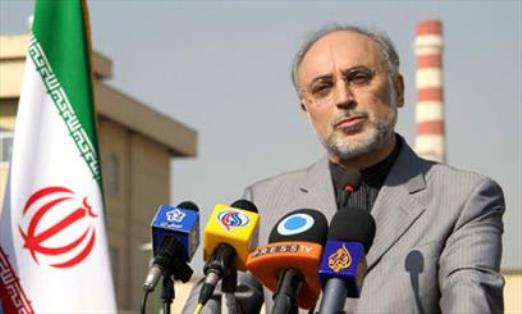
Head of Atomic Energy Organization of Iran (AEOI) Ali Akbar Salehi says that talks with P5+1 will conclude in Tehran’s favor in the near future.

Salehi made the remarks during a speech before Friday prayer sermons at Rudbar-e Qasran District in Tehran’s Fasham region.

“Rest assured that the nuclear issue will resolve in favor of Iran and we will celebrate Tehran’s victory in the near future,” the AEOI chief told worshippers.

Salehi maintained that Iran had shown great resistance and patience in the face of 35 years of pressure, restrictions and sanctions imposed by imperialist powers, and would soon achieve its desired results, Mehr news agency reported.

Failing to reach an agreement by Nov. 24, 2014, Iran and the P5+1 – Russia, China, Britain, the US, France plus Germany – decided to extend their discussions for seven more months. They also agreed that the interim deal they signed in the Swiss city of Geneva last November remain in place during the remainder of the negotiations until July 1, 2015.

At the end of the first round of talks after the seven-month extension on Dec. 15, Iran’s Deputy FM and senior negotiator Seyyed Abbas Araghchi expressed satisfaction with the positive atmosphere during the talks in Geneva.

According to Iran’s FM spokeswoman Marzieh Afkham, the next round of nuclear talks will be held on January 15 at deputy foreign ministerial level in Geneva. There is no plan for other talks ahead of that date, she has clarified.

Sunni Basiji, Shia teacher killed in Iran terror attack

Iran-Systanjpg

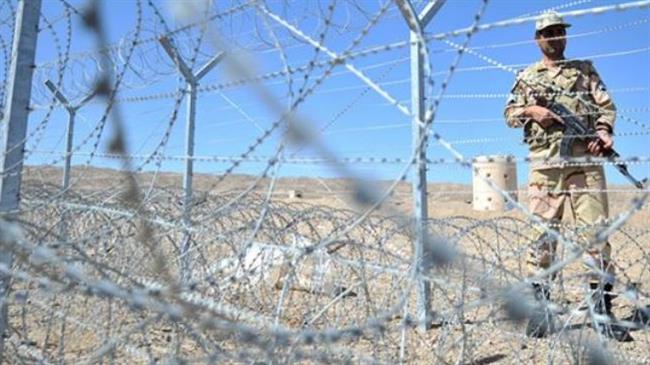
The terror attack happened in the city of Sarbaz Thursday night, said Sistan and Baluchestan Police Chief Brigadier General Hossein Rahimi.

“Last night, two masked motorcyclists carried out a terrorist attack in the city of Sarbaz, killing two people,” the police commander said on Friday.

He said that the first victim was a Sunni Basiji who was killed on his way back home from shopping, adding that the second attack occurred when terrorists opened fire on a Shia teacher some 200 meters from the site of the first attack.

The gunmen fled the scene following the terror incident.

Rahimi said that police, forces from the Islamic Revolution Guards Corps (IRGC) as well as the Intelligence Ministry are working to identify the perpetrators of the crime.

Sistan and Baluchestan Province has been the scene of a number of terrorist attacks in recent years.

In late November 2014, three Iranian security forces were shot dead by unknown gunmen in the province.

Three Iranian police officers were also killed in early October last year when they came under attack at nighttime by armed bandits while on a mission in the provincial city of Saravan.

Another police officer was killed after an explosives-laden car taken to the police station by terrorists went off hours after the first incident.

To be good humans, we need to render grudges a thing of the past

ketabkhaneh-Seyed Hassan Khomeini

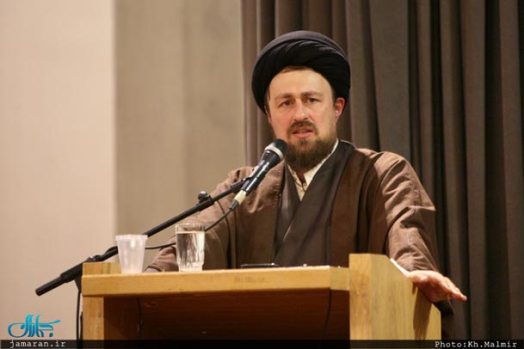
“Let’s make big efforts and start goodness from the inside. The first step on the path to goodness is to let go of grudges, because grudges, lies and slanders are part of what happens in our society.”

This is part of the remarks made by the grandson of the late founder of the Islamic Republic in a weekly session on Mawlana’s Masnavi at the National Library of Iran where he also congratulated the Christians on the birth of Jesus (PBUH).

A society which is not prepared for the reappearance [of the savior], will gain nothing if thousands of Imam Mahdi-like saviors come to their help.

The following is the partial translation of what else a January 3 edition of Ettela’at newspaper quoted Seyyed Hassan Khomeini as telling the gathering to mark the start of Imam Mahdi’s leadership:

One of the big dreams of Muslims, Shiites included, is the reappearance of the Savior. Throughout history people have set their sights on human well-being, waiting for the emergence of a savior. However, one key question arises here: why doesn’t the savior reappear? The clear answer can be found in Mawlana’s words.

A society will reach perfection after the reappearance of Imam Mahdi (PBUH) only if it has strived for perfection and elevation beforehand;

A society which is not prepared for the reappearance [of the savior], will gain nothing if thousands of Imam Mahdi-like saviors come to their help […].

A society will reach perfection after the reappearance of Imam Mahdi (PBUH) only if it has strived for perfection and elevation beforehand; otherwise the imam will be like a scholar who finds no room among the ignorant or he will be hurt by the ignorant.

So we can draw a lesson from Mawlana’s words that if we are waiting [for Imam’s second coming], we should work on ourselves. That applies to every single individual in society.

[…]

Those who tie their goodness to the coming of another person are looking for excuses, because goodness should come out from inside of a society and its members.

The goodness of a society is nothing beyond the goodness of people living in that society. Those who tie their goodness to the coming of another person are looking for excuses, because goodness should come out from inside of a society and its members.

[…]

To become good humans, we should first trample upon our inner self. A society and individuals that are awaiting [the second coming of Imam] should take a step forward. To rise up and take a step for the sake of God, one does not need to take any lesson. It needs perseverance and endeavors.

If we open our hearts, God Almighty will definitely help us. In so doing, we can wait for the arrival of the Savior and the creation of a Utopia. If not, the twelfth imam will be left alone in society.

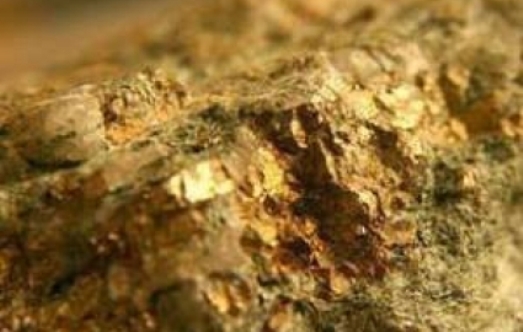
Ninety thousand tons of ore extracted from Khomein Gold Mine

ore
ore

On December 30, Mehr News Agency quoted the head of the Department of Industry, Mines and Trade in Khomein as saying that between March 21 and December 21, 2014, some 90,000 tons of ore was extracted from Khomein Gold Mine. The following is a partial translation of what Mohsen Basardeh had to say to the agency:

The experimental stage of processing and extracting gold from ore through heap leaching – a method which extracts precious metals, copper, uranium, and other compounds from ore via a series of chemical reactions that absorb specific minerals and then re-separates them after their division from other earth materials – has been successful. As of late January the extraction of gold will get underway on an industrial scale.

Over the last year, 170,000 tons of ore has been extracted from Khomein Gold Mine. In light of the fact that the mine is an invaluable reserve, adoption of an industrial method to process gold will turn Khomein – a city in Markazi Province – into a hub for production of precious metals.

The license for the exploitation of the mine was issued three years ago and its exploitation got officially underway with about $1.6 million in investment two years ago.

Khomein Gold Mine holds 1.5 million tons in reserves with a purity grade of 36.03 gram per ton which is a high grade compared to those of other gold mines in the world.

The monthly extraction capacity of the mine is projected to stand at 180,000 tons of minerals.

[…]

So far, exploration licenses for gold and copper have been issued for ten regions in Markazi Province, of which two in Delijan, and one in Zarandieh, in the vicinity of Saveh have produced good results.

[…]

Iran rejects AP report of nuclear deal with P5+1

Marziyeh-Afkham
Marziyeh-Afkham

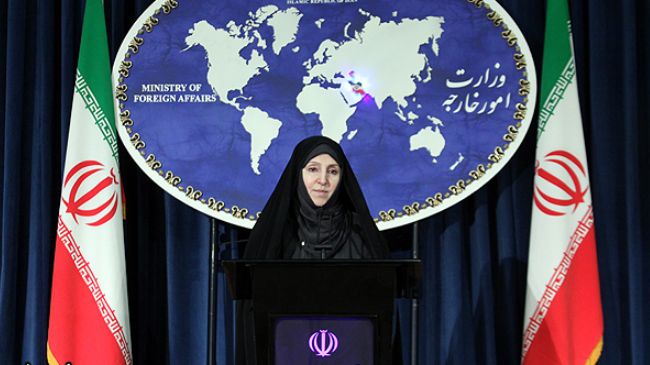
“No agreement has been reached yet on any of the issues [being discussed] during nuclear talks” between the Islamic Republic and six world powers, said Iran’s Foreign Ministry spokeswoman, Marzieh Afkham, on Saturday.

The reaction came after The Associated Press quoted two unnamed diplomats as claiming that “negotiators at the December round of nuclear talks drew up for the first time a catalog outlining areas of potential accord and differing approaches to remaining disputes.”

The diplomats added that “both sides in the talks are still arguing about how much of an enriched uranium stockpile to leave Iran.”

Afkham, however, said that such “politically-motivated” speculations by certain foreign media outlets are aimed at “harming the atmosphere of the talks and complicating any settlement of the [nuclear] issue.”

The next round of nuclear talks between Tehran and P5+1 will be held at the deputy level on Monday.

Iran and the five permanent members of the United Nations Security Council — Russia, China, France, Britain and the United States — plus Germany wrapped up talks on Iran’s nuclear energy program in the Swiss city of Geneva on Wednesday.

The three-day discussions were organized three weeks after Tehran and the six countries failed to reach a final agreement by a November 24 deadline.

Despite making progress, Iran and the six countries failed to clinch a final nuclear deal during their previous talks in the Austrian capital of Vienna.

However, Tehran and P5+1 agreed to extend their discussions for seven more months until July 1, 2015. They also agreed that the interim deal they had signed in Geneva last November should remain in place during the negotiations.

Is it going to be love at first sight, endangered species-style?

Delbar-Kooshki-Cheetah

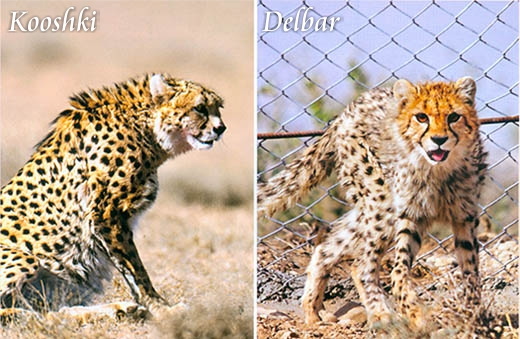
Now that they are engaged, they are no longer kept in solitary confinement. Rather, they can enjoy togetherness, plan their future and decide, for instance, where they are willing to spend their honeymoon and how they would like their future married life to be like. If they decided to brush aside the family planning motto of “Fewer children, better life”, Delbar and Kooshki, two Asiatic cheetah cubs, would cheer up environmentalists and wildlife lovers. What comes below is a partial translation of a short report monthly magazine Sarzamin-e Man [My Land] carried in late December:

“The encounter was short and passed off without any incident,” said Houman Jokar, the manager of Conservation of Asiatic Cheetah.

He went on to say that after considerable discussion, Delbar, a 3-year-old female cub and Kooshki, a seven-year-old male, which are the only Asiatic cheetahs in captivity in the world were finally transferred to Tehran to be looked after in a research site established to study the behavior and reproduction patterns of Asiatic cheetahs. The research center is not aimed at reproducing cheetahs in captivity, though.

Kooshki, which was rescued from poachers in 2007, was taken care in Mian Dasht Wildlife Sanctuary in North Khorasan Province. In 2011 when Delbar showed up [actually she was found by an Afghan shepherd in Khar Turan National Park in Semnan Province], the two cheetahs were handed over to the Environment Protection Organization.

Many wondered why the Environment Protection Organization did not seek to reproduce cheetahs in captivity and later release them into the wild to give the frail, endangered population of 50 to 70 Asiatic cheetahs a shot in the arm.

Although Conservation of Asiatic Cheetah is not responsible for the management of the Tehran research center, experts working on the conservation project have explicitly stated that cheetahs are sensitive species and shots at their reproduction in captivity usually fail.

Besides, reproduction in captivity which is meant to save wild animals like cheetahs from extinction has proven futile. Iranian wildlife experts as well as other conservationists across the world believe that provision of safe natural habitats for Asiatic cheetahs is the key to their survival.

However, the two cheetahs were transferred to Tehran to be studied in the research center.

In response to a question as to why the studies in question were not carried out either in Mian Dasht Wildlife Sanctuary or Khar Turan National Park ,which are the natural habitats of the animal, the Environment Protection Organization pointed a finger of blame at the lack of equipment and absence of enough veterinarians and specialists and said it’s costly to get equipment transferred from Tehran to such places.

[…]

Contrary to expectation, the first brief encounter between Kooshki and Delbar from behind bars in December did not produce any negative reaction by either big cat.

However, it remains to be seen whether the results of the research by the site and future visits between the couple could have a positive impact on endangered cheetahs.

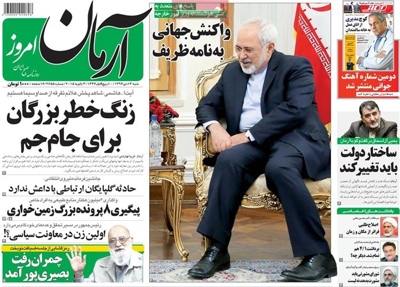
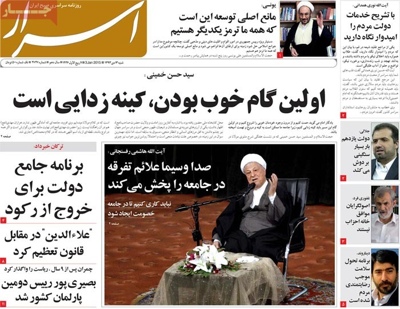
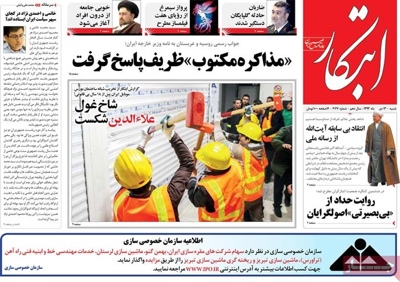
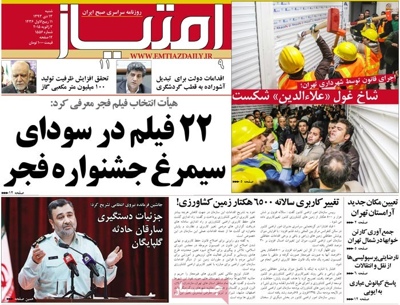
A look at Iranian newspaper front pages on Jan. 3

Iranian Newspapers Headlines

Several reformist dailies on Saturday led on the critical comments of the chairman of the Expediency Council aimed at the national broadcaster for airing programs that promote division. The appeal by the first vice-president for the punishment of those who are to blame for the depletion of the foreign exchange reserve funds along with the demolition of the illegally-built top floor of a famous mall in the capital dominated the front pages of other newspapers.


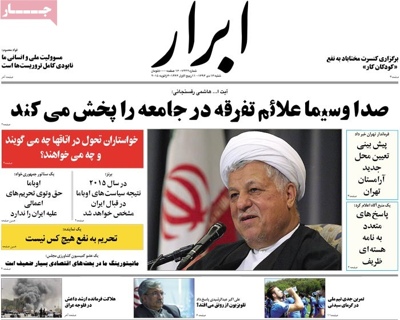
Abrar: A senior IS terror leader has been killed in Fallujah, Iraq.


Abrar newspaper 1- 3


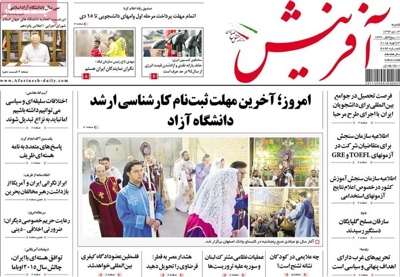
Afarinesh: One of the individuals involved in a deadly armed robbery in central Iran has been arrested. [Two others have been killed in shootouts with the police.]

Afarinesh: “Several foreign ministers have answered the nuclear-centered letter the Iranian top diplomat sent to his counterparts around the world in December,” an informed source said.


Afarinesh newspaper 1- 3


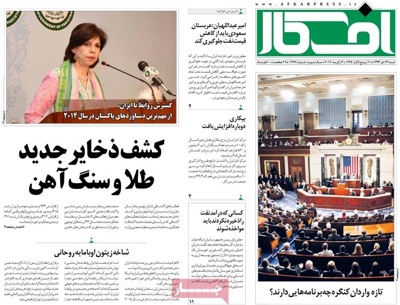
Afkar: Unemployment increased [to more than 10 percent] in the fall.

Afkar: “Those who have failed to save oil revenues should be held to account,” said the first vice-president.


Afkar newspaper 1- 3


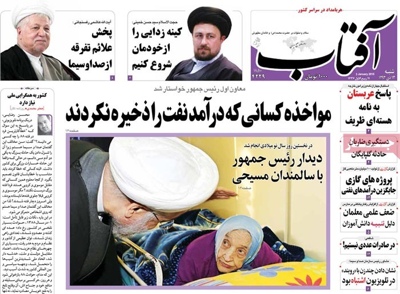
Aftab-e Yazd: President Rouhani paid a visit to elderly Christians at a nursing home on the first day of 2015.


Aftabe yazd newspaper 1- 3


Arman-e Emrooz: “[The deadly armed robbery in] Golpayegan had nothing to do with IS terrorists,” said the deputy commander of the Law Enforcement Force.


Armane emruz newspaper 1- 3


Asrar: After nine years in the job, Mehdi Chamran has been replaced by Gholamreza Basiripour as chairman of the Supreme Council of the Provinces.

Asrar: “Principlists do not favor the formation of a House of Parties,” said Hassan Ghafourifard, a university professor and a former MP.


Asrar newspaper 1- 3


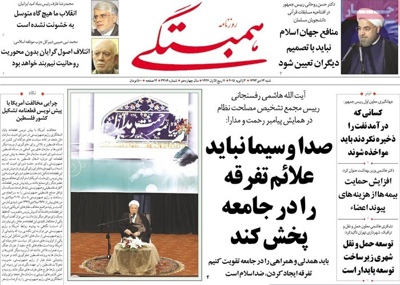
Ebtekar: Ayatollah Hashemi has directed unprecedented criticism at IRIB (national broadcaster). “Signs of division are being aired.”


Ebtekar newspaper 1- 3


Emtiaz: Tehran municipality enforced the law and removed the illegally-built top floor of a mall in downtown Tehran.


Emtiaz newspaper 1- 3


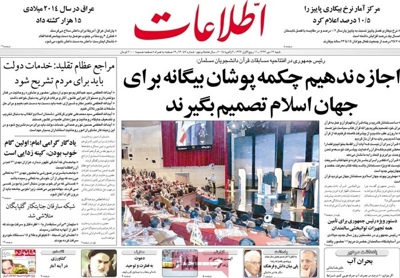
Ettela’at: “We should not allow foreign boots to make decisions for the world of Islam,” said President Rouhani at the inaugural of a Koranic event bringing together Muslim students.


Ettelaat newspaper 1- 3


Hambastegi: “Our revolution has never resorted to violence,” said Mohammad Reza Aref, a former vice-president under Mohammad Khatami.

Hambastegi: “Any coalition of principlists which is not centered on the clergy would be half-cocked,” said Mohammad Nabi Habibi, the secretary general of the Islamic Coalition Party.


Hambastegi newspaper 1- 3


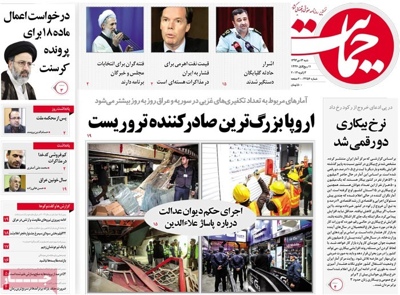
Hemayat: Unemployment is back in double digits following claims that the country is out of recession.

Hemayat: “Seditionists have designs on parliament and the Assembly of Experts in the upcoming elections,” said Tehran Friday prayer leader Kazem Sedighi.


Hemayat newspaper 1- 3


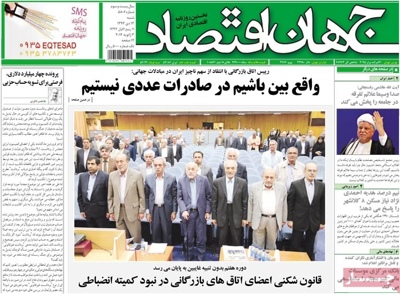
Jahan-e Eghtesad: “Let’s be realistic. We have nothing to boast about when it comes to our share of exports in global transactions,” said the head of the Chamber of Commerce.


Jahane eghtesad newspaper 1- 3


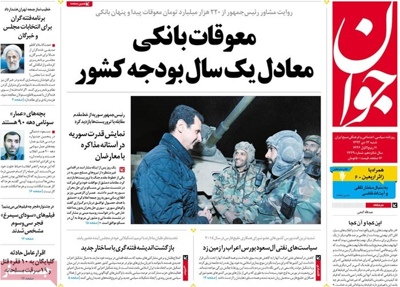
Javan: A suspect arrested in connection with a deadly armed robbery in central Iran has confessed to 10 counts of murder and 19 cases of armed robbery.


Javan newspaper 1- 3


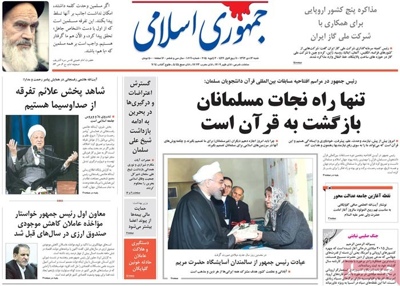
Jomhouri Islami: Five European countries are in talks with Iran to forge cooperation with the National Iranian Gas Company.


Jomhorie eslami newspaper 1- 3


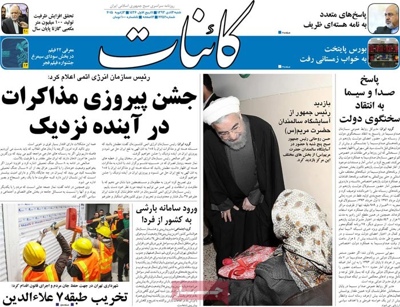
Kaenat: The director of the Atomic Energy Organization of Iran has said victory in nuclear talks will be celebrated shortly.


Kaaenat newspaper 1- 3


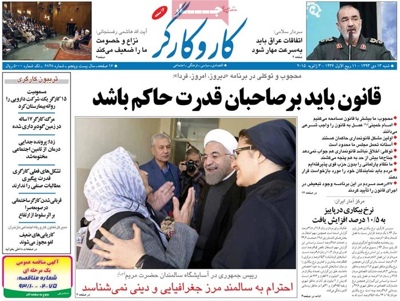
Kar va Kargar: “Respect for the elderly knows no religious or geographical bounds,” President Rouhani said on a visit to the Saint Mary Nursing Home.


Karo kargar newspaper 1- 3


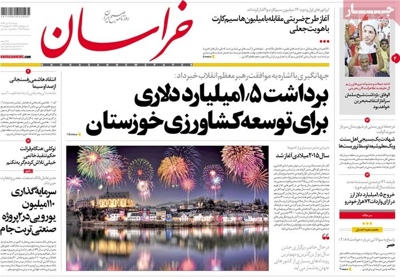
Khorasan: Government has withdrawn $1.5 billion from national reserves after the go-ahead of the Supreme Leader to develop agriculture in Khuzestan province.

Khorasan: In a terrorist attack in Sistan and Baluchestan province a Sunni Basij volunteer and a Shiite teacher were martyred.


Khorasan newspaper 1- 3


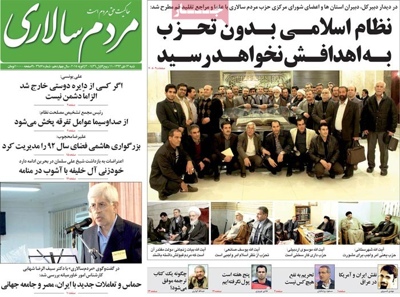
Mardomsalari: “If someone leaves the circle of our friends, they are not necessarily an enemy,” said Ali Younesi, an advisor to President Rouhani for ethnic and religious minority affairs.


Mardom salari newspaper1- 3


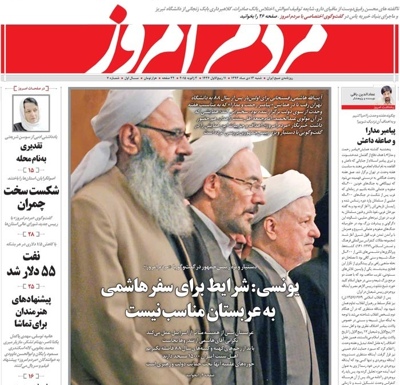
Mardom-e Emrooz: “The stage is not set for Ayatollah Rafsanjani to visit Saudi Arabia,” said Ali Younesi, an advisor to President Rouhani.


Mardome emruz newspaper 1- 3


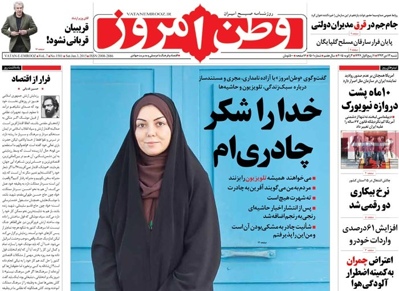
Vatan-e Emrooz: The US still insists on not granting a visa to the diplomat Iran has named as ambassador to the UN.


Vatane emruz newspaper 1- 3


Zoya Pirzad receives France’s Chevalier of Legion of Honor

Zoya Pirzad

After Hossein Alizadeh, a leading classical composer and musician, turned down the prestigious Chevalier of Legion of Honor award in late 2014, many thought the French government would slow down if not stop awarding distinguished figures in Iranian society. But the trend of presenting awards to Iranian artists and scholars carries on. What comes next is a partial translation of a report Sharq daily ran on December 30 on the latest Iranian to win the award:

Zoya Pirzad, an Iranian author who is known for her novels “Things We Left Unsaid” and “We Will Get Used to It” which have been reprinted several times already, has received France’s Chevalier of Legion of Honor.

The Acrid Taste of Persimmon”, “One Day till Easter” and “Like Every Evening” are among Pirzad’s novels which have been bundled together under the title of “Three Books”.

The Iranian novelist has also translated “Alice’s Adventures in Wonderland” by English author Charles Lutwidge Dodgson under the pseudonym Lewis Carroll and a collection of haikus.

Her books are among Persian literary works which have been rendered into different languages, including French.

Over the past years a number of Iranian figures including Mahmoud Hessaby [an eminent scientist, researcher and professor], Abbas Kiarostami [a film director and screenwriter], Pari Saberi [a drama and theater director], Jalal Sattari [an Iranologist, mythologist and writer], Mohammad Ali Sepanlou [a poet and literary critic], Leila Hatami [an actress], Asghar Farhadi [a film director and screenwriter], Shahram Nazeri [a vocalist and composer] and Reza Seyyed Hosseini [a writer and translator] have been awarded the French prize.

Mohammad-Reza Shajarian [an internationally-acclaimed vocalist known as Iran’s greatest living master of traditional Persian music], Dariush Mehrjui [a film director and screenwriter], Kambiz Derambakhsh [a cartoonist and graphic designer] and Mahmoud Dowlatabadi, [a veteran writer] have been the recipients of the award over the last few months.

Also, Lili Golestan, a translator and artist, has been honored with France’s high cultural distinction dubbed the Order of Academic Palms.

Iranian survival does not hinge on a deal with the West

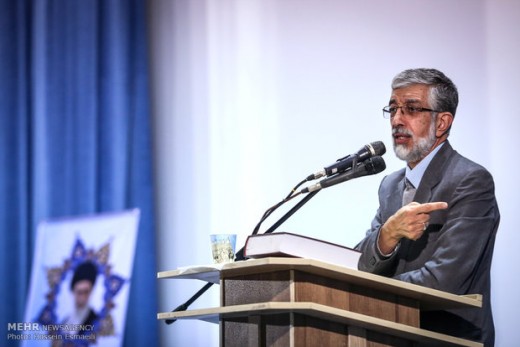
Haddade-Adel

The head of the Principlist Caucus at the Islamic Consultative Assembly has said there are some people who tie our welfare and life and death to the outcome of nuclear talks with P5+1. “We need to act carefully not to fall into such traps.”

According to Mehr News Agency, Gholamali Haddad Adel, made the comment at a sixth congress of the Society of the Devotees of the Islamic Revolution [a principlist faction that supports former president Mahmoud Ahmadinejad. It follows the same line as the Stability Front and other radical principlists who are critical of the government of President Rouhani. They seriously doubt the efficacy of the moderate policies of the 11th government on the international stage and challenge the usefulness of nuclear talks. The principlist faction, which is bracing itself for parliamentary elections of early 2016, has always reiterated that the US administration and its allies are not trustworthy]. The following is the translation of what else the former parliament speaker told the gathering:

The epic of December 30, 2009 [which saw a massive turnout of the public in support of the establishment and spelled an end to unrest that followed the presidential elections earlier in the year] was a shot across the bows of foreigners and political activists. On that day, people officially told political activists that the Iranians were steadfast on their path and that activists should not lead the nation astray through divisions and disagreements.

The Islamic Revolution is now 36 years old. Over the past 36 years we have gained a lot of experience. Our enemies have acquired experience too. What is important here is that prior to the victory of the Islamic Revolution the enemies did not know what Shiism stood for. Over this period we have organized scores of gatherings to promote the intellectual basis of our revolution.

Today many books on Ashura [a Shiite religious observance commemorating the uprising Prophet Muhammad’s grandson led against injustice], Karbala [the place where Imam Hussein fought an unequal battle against the oppressors of his time], and Shiism have been written in American universities. For instance, a Jewish woman has written a book on the uprising of Karbala. That means they have developed a better insight into Shiism and our Islamic Revolution.

Having failed in the war waged against us [through Saddam’s Iraq in the 1980s] and then in creating political groupings [seeking to overthrow the establishment], our enemies are now focusing their attention on economic pressures against the Islamic Republic. That does not, however, mean that our enemies have lost their hope in the cultural onslaught. Exerting economic pressures on us lies at the center of their efforts to counter our revolution today.

The enemy is involved in a war of nerves, trying to make our people believe that their survival hinges on a deal with the Americans and the West and that any change in the sanctions regime depends on conclusion of an agreement with them.

Two or three years ago, some local media and satellite channels acted as if our welfare and life and death hinged on the outcome of [nuclear] talks [with P5+1]. We need to act carefully not to fall into such traps.

[During the 2013 presidential elections] Contenders in their electoral campaign focused on pocketbook issues, each trying to cast himself as the one who could settle the economic problems of the nation. That is exactly what the enemy wants us to do.

Early on in the revolution when we cut our ties with the United States, Imam [Khomeini] said that relations with the US would not serve our interests. But on the campaign trail, that was not what the candidates were taking account of.

A recent drop in oil prices shows that even if we clinch a nuclear deal and all sanctions are removed, the crude prices are so low that the enemy can still deal an economic blow to us. The enemy seeks to instill into our society the belief that our economic conditions would improve only through compromises with the US. They want to influence our local policy and elections through manipulating the public opinion.

A resistance-based economy should take center stage. We should not be deceived by enemy tricks. The resistance-based economy would be a non-starter in the absence of an Islamic lifestyle. We cannot institutionalize the resistance-based economy while we still stick to Western lifestyles.

The pressures our enemies have brought to bear over the recent years show that new areas have been activated on the economic front.

Iran is so powerful today that over 1.5 million Iranians joined their Iraqi brethren across the border for Arba’een ceremonies. Thanks to the same authority, the support Iran lent to the Syrian government prevented its collapse.

The integrity of the Islamic Revolution, the late Imam and the Supreme Leader hold the key to Iranian authority.

Over the past couple of years, some Palestinian combatants have done and said annoying things, still the Supreme Leader has underlined assistance to Palestinian movements citing the fact that such assistance is a principle of our revolution regardless of the stance of one group here or another there. It was because of the wisdom of the leader that during the Gaza War, Palestinian fighters said that they would have been annihilated had it not been for the assistance of Iran.

Honesty is vital to authority. In order for such authority to be effective, we should allow spiritual powers to prevail. What can pave the way for Iranian progress in the world is a pattern which is based on neither colonialism nor hegemony. We are now involved in a serious struggle which is economic in nature. We need to be mindful of the fact that the enemy is using the weapon of economic pressures to divide us and lead our revolution astray. What is important in countering this ploy is unity.

I don’t want to talk about what transpired in the principlist camp in the previous election and open this old wound. Whenever we have joined forces we have emerged victorious and whenever we have been divided we have suffered a defeat. Remember the seventh parliament?

Our rivals have savored the sweet taste of victory thanks to unity. Have we experienced the bitter taste of division? Shouldn’t we draw a lesson from our past experience?

What is important is to have a principlist-majority parliament. We need to take measures that are in line with the instructions of the leader. Who is elected is not important. Principlists should have as many seats in parliament as they can. We should not keep silent when the leader is insulted simply because such silence serves our personal interests. What is important is to protect the revolution.

I am not a member of any party or political grouping, but I like all members of the principlist parties. That individual principlists are not elected is not important, what is important is that parliament should be in the hands of principlists so that we can act better in the future.

The rallies held on Arba’een this year told the world that we follow the same path of Imam Hussein and stick to his motto of never bowing to humiliation. The rally was very important. In fact that rally and the epic of December 30 were different manifestations of a single reality.

Some newspapers failed to put the news of Arba’een rallies on their front pages apparently because they were not newsworthy enough to them. Why didn’t they cover this gigantic event? We need to act more carefully not to allow our revolution to fall into their hands.