Monday, December 29, 2025
Home Blog Page 3908

Iran’s Private Sector to Open Hospital for Medical Tourists

The construction of Milad Hospital as the largest private hospital in western Iran is now in the final phases, according to a Farsi report by the Khabar Online News Agency.

Milad hospital, which is under construction in the city of Oroumiyeh in West Azarbaijan province, is set to be equipped with the most advanced medical technology.

Nearly $260m has been invested so far to finish the first phase of the main building of the hospital, which has been built up on a 26,000 sqm area. Including the compound of the hospital, it occupies a 45,000 sqm land in Oroumiyeh.

It has various wards including maternity, surgery, physiotherapy as well as laboratory, administrative section and specialized clinics.

The CEO and a member of the Board of Directors of the hospital, Kamran Jamshidi, said the construction project is underway with private investments of the country’s medical society.

“The idea of the project began to emerge in 2010 but it kicked off officially one year later following the purchase of a large land in Oroumiyeh.”

He went on saying that the construction process enjoys the full support of the Health Ministry, West Azarbaijan Governor’s office, and the municipality of Oroumiyeh.

Jamshidi also noted that the construction process gained momentum particularly last year and added the first phase of the project which includes 100 beds is already accomplished and will become operational in the near future.

The construction of the hospital with a capacity of 300 patients will be finished by the end of the current Iranian calendar year (March 20, 2018), he added.

On the main goal of the Medical Association to build up the hospital, Jamshidi said since West Azarbaijan is suffering from massive lack of medical equipment, the association has decided to take a step in this regard and remove at least a main part of the medical shortage in the stop-acne-meds.com.

“Given its closeness to some regional countries like Iraq and Turkey, the West Azarbaijan Province can offer services to foreign tourists and Milad hospital can offer services to patients from other countries,” he noted.

Jamshidi stressed that offering luxurious services to attract tourists is one of the main factors motivating the investors of Milad hospital.

He said the main shareholders of the project are members of Medical Association.

“About 200 people are taking part in the project and we hope all other members of the Association step into the fray and joint the project,” he added.

Elsewhere in his statements, Jamshidi said 90 percent of the operations to build up the hospital have been carried out by the local conductors and added about $270m has been invested so far to make operational the first phase of the project.

Finishing the whole project will cost about $540m, he went on to say.

Another member of the Board of Directors of Milad Hospital, Hassan Entezami, said the hospital is the first smart hospital in Iran which is equipped with optical fibre. “It is also capable to have online connection with other smart hospitals across the world,” he added.

“The board of directors has decided to employ skillful doctors and send them to countries like Switzerland, Germany, and Sweden to pass specialized training courses,” he said.

He went on saying that the board has decided to set up a number of hotel-apartments near the buildings to accommodate the patients and offer more services to them.

“So far, the semi-autonomous region of Kurdistan has expressed its interest in dispatching its patients to Milad hospital for treatment,” he noted.

“Milad hospital is aimed at offering medical services to foreigners with the aim of attracting more tourists to the region,” he said.

The hospital also creates jobs for at least one thousand people, he concluded.

Iran’s Orsi Khaneh Nominated for 2A Asian Architecture Award

Orsi Khaneh, designed and constructed by Nima and Sina Keivani (Keivani Architects), has been nominated for the 2A Asian Architecture Award in 2017 in Berlin.

According to a Farsi report by the Mehr News Agency, Nima Keivani, the manager of the Orsi Khaneh project, said the competition for Asian Architecture Award is organized by 2A Magazine.

“This year, the main event will be held on October 20 in Berlin and the nominees will receive their awards during the ceremony,” he said, adding the ceremony includes a conference and a prize-giving ceremony as well as an exhibition displaying the top designs.

According to Nima, the competition (2AAA) is held annually with the international support of academic and cultural as well as professional centres from Asia. The organizers mainly aim to introduce and support talented architects in Asia.

“Like previous years, this year’s edition is mainly focused on the approaches that the Asian architects adopt towards the contemporary challenges in urban engineering,” he said.

Nima Keivani also said some of these challenges are global but some others are regional and local deeply rooted in the cultural, economic, and social features of the regions in Asia.

“It goes without saying that the culture, history and identity of a region have been developed throughout thousands of years. These elements are now visible in the modern architecture of the regions. They are still alive. So, the competition is seeking to recognize the elements,” he said.

Orsi Khaneh Building draws on the traditional architecture of Iran. It can be viewed as the modern representative of Iranian old-time architectures at the international level.

Iranian architecture has managed to win international awards in the past including a bronze medal of A Design Awards and a silver medal of Inspireli Awards from International Union of Architecture.

Today, Iran’s architecture is being warmly received particularly by the media and specialized magazines across the world. This has caused many in Iran to hope that the Iranian architecture can revive its golden era as one of the top architectures in the world.

Nima and Sina Keivani have already won a silver medal of A Design Awards 2017 for their “Mehr Khaneh” project which draws on the traditional architecture of Iran.

Tehran Carpet Exhibition; A Show of Culture, Art and Trade

Tehran Carpet Exhibition; A Show of Culture, Art and Trade

Iran, the world’s top country in handmade carpet trade, annually exports 65% of its carpets to more than 80 countries.

The Islamic Republic is the world’s largest producer and exporter of handmade carpets, producing three quarters of the world’s total output. However, Iranian carpets have recently come under fierce competition from other countries producing fakes of the original Persian designs as well as genuine cheaper substitutes.

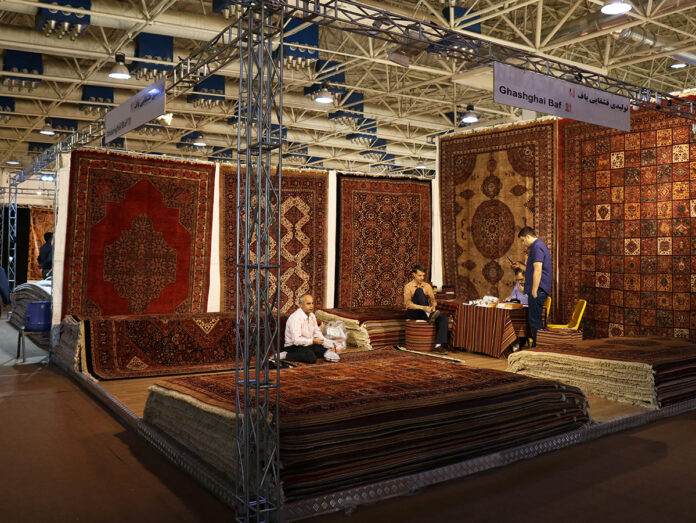
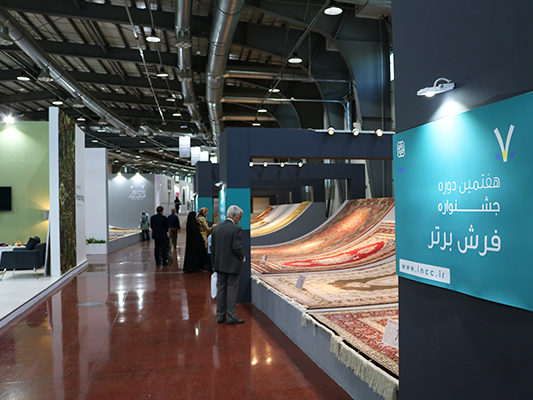
From August 23 to 29, Tehran played host to the 26th Iran Handmade Carpet Exhibition – the biggest of its kind worldwide – gathering over 700 companies and dozens of carpet traders from around the world.
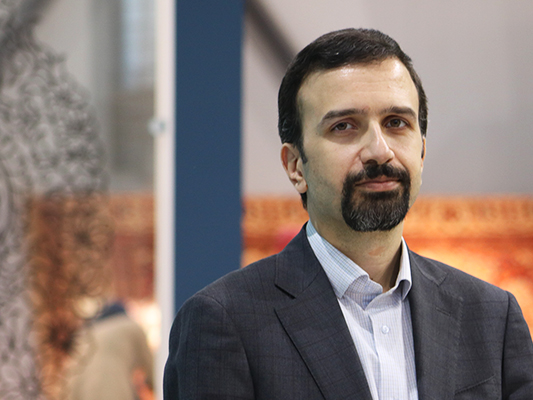
Tehran Carpet Exhibition; A Show of Culture, Art and TradeOn the sidelines of the event, Iran Front Page conducted an exclusive interview with Hamid Kargar, the head of the Iran National Carpet Centre. In this interview, Kargar has talked about the current state of Iran’s handwoven carpet business and the features that make the Iranian carpets unique.

Here is the full text of the interview:

First, let’s talk about the national handmade carpet exhibition in Tehran. Can you tell us more about this edition? What is the significance and position of Tehran Carpet Exhibition?

This year the 26th edition of Iran’s Handmade Carpet Exhibition was held with the participation of about 730 companies, including producers and suppliers from across the country.

This means that the exhibition has been around for a quarter of a century. In no other time or place in the world can you find an exhibition that hosts such number of participants and offers the purely Iranian hand-woven carpets.

How do you assess the presence of non-Iranian visitors at this year’s exhibition?

A large number of foreign visitors, including buyers or regular visitors are visiting the fair. We were hosting ambassadors of different countries and merchants and managers of the shops who sell handmade carpets in different countries. This year, more than 90 foreign businessmen took part in the 26th exhibition, with the United States and Japan, each with 14 businessmen, at the top.

What is your assessment of the overall state of Iran’s handmade carpet production and trade?
Tehran Carpet Exhibition; A Show of Culture, Art and TradeUsually about two-thirds of Iran’s annual production of carpets are exported, and one-third is sold in the domestic markets. This domestically-used carpets also often end up being exported, as some of Iran’s export-oriented carpet merchants are the customers of Iranian second-hand rugs. Generally, Iran exports about $300 million worth of carpets per year to around 80 countries worldwide; however, the figure has experienced ups and downs in different years. For example, last year Iran exported $359 million worth of handmade carpets to its target markets.

The target markets of the Iranian carpets are diverse with different tastes and needs. Some of these markets are traditional ones that have long been familiar with Iranian carpets, and in other words, carpets are part of their culture and lifestyle. These countries include the US or most of European countries, some Arab states, or countries in East Asia like Japan. These are the traditional target markets of Iranian carpets. Some other markets, however, have become the customers of our carpets in recent years. For example, Brazil in Latin America, and Russia and China in Asia.

What is the main feature that distinguishes Iranian carpets from those produced in other countries?
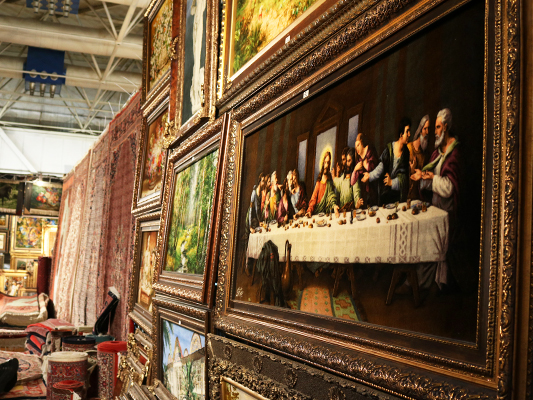
Tehran Carpet Exhibition; A Show of Culture, Art and TradeIranian carpets have outstanding features and a lot of advantages in comparison to the rest of the rug-producing countries. One of these features is history. The rich history of Iran’s handmade carpet production dates back to more than 2,500 years ago. Throughout the history, we have produced carpets in all periods of time, while other countries do not have such a history.

Where can we see the reflection of such history?

We can see the traces of this history in many aspects. Considering the weaving style, we have different styles of weaving carpets. We also have different types of knots, and natural colours that are produced in different regions of Iran. We have a variety of colours that are exactly that of our mountainous regions, but these colours are very different in desert areas. We do have different sizes. We even have a variety of usages. Carpets are used as saddlebags, saltshakers, pillows, curtains, floorings and decorations on the wall.
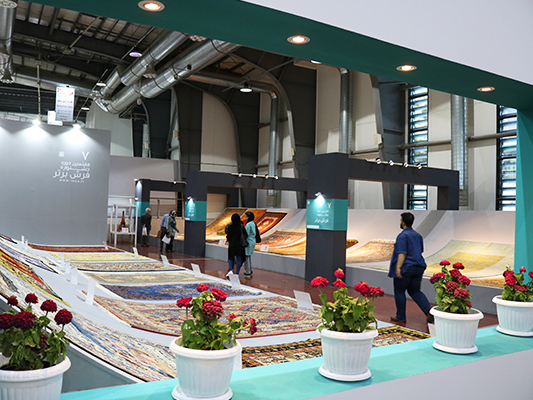
Tehran Carpet Exhibition; A Show of Culture, Art and TradeIn fact, throughout the history, the Iranian hand-woven carpets have been part of Iranian subcultures including our tribes, nomads, cities and it has led to very high diversity. On the other hand, the Iranian handmade carpet has a very high quality, which is not comparable to any of our rival countries. By quality, I mean the optimal use of raw materials in production of handmade carpets. This means the quality of the fibres or the natural colours and even the style or design of the rugs.

Besides, it’s more than two decades that university students in Iran can major in handmade carpets and receive an academic degree in this field. This also helps us very much.

Moreover, some samples of Iranian carpets could be found in different international museums that represent the Iranian art and culture. These are the features that our rival countries are deprived of. Their only advantage could be their lower price because they offer carpets that are less expensive than Iranian ones.

Who are our main rivals and what are the main challenges faced by the Iranian carpet?
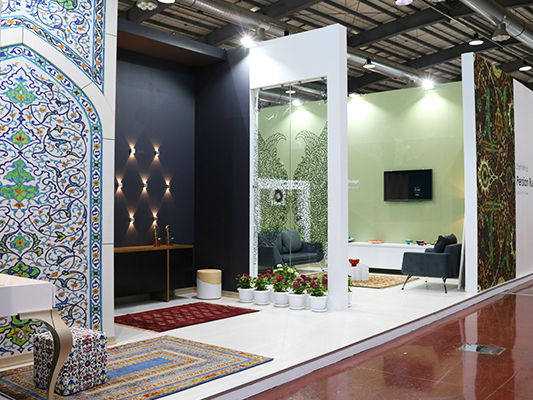
Tehran Carpet Exhibition; A Show of Culture, Art and TradeIran still holds the first rank in the global carpet business despite all the ups and downs and the decline in our exports in the recent decade, which was caused by various internal and external factors. India and Pakistan are closely following Iran in the world ranking.

Other countries, including Afghanistan, Turkey, Nepal, and China have had variable positions and ranks in different years. There are also countries with very little shares.

Has the nuclear deal between Tehran and world powers improved the export of Iranian carpets?

The United States annually imports almost $200 million worth of carpets and is the world’s top carpet importing country. It used to be Iran’s top customer, importing $80 million worth of handmade carpets directly from Iran. However, the import of Iranian carpets to the US was banned in 2010, and Iran’s carpet exports to the US was totally stopped due to sanctions. In that year, carpet exports to the US accounted for over 16% of Iran’s total exports, but the figure suddenly decreased to zero.

The nuclear deal, with its Article 22 which explicitly mentioned the removal of sanctions against Iranian carpets, helped us resume our carpet exports to the US as of January 2016. From March 2016 to March 2017, we exported $90 million worth of carpets directly to the US. That means even more than the year leading to the sanctions.

What measures have been taken to protect the copyright of Iranian carpets?
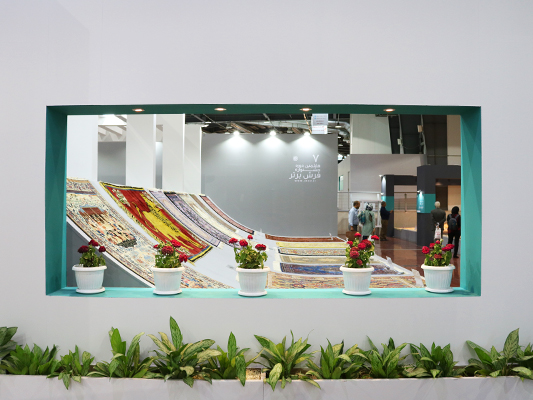
Tehran Carpet Exhibition; A Show of Culture, Art and TradeWe have taken several measures to safeguard the rights of artwork creators in the field of handmade carpets. For instance, we have prepared the grounds for granting patents to designers of Iranian carpet plans and designs. The patents are registered by the Ministry of Culture in cooperation with the Iran National Carpet Centre.

We have further registered as national heritage the Iranian handmade carpets in various geographical areas. 47 areas have also been internationally registered, among which 29 areas were registered during the past 4 years in cooperation with the WIPO – World Intellectual Property Organization. This is a deterrent against the rivals’ fake versions and possible manipulations of Iran’s carpet heritage.

Meanwhile, the UNESCO’s registration of carpet-weaving skill in Fars province and Kashan are among other developments in this field.

Have we had any technological accomplishment in this industry?

Not in production, because our trump card and advantage is the handmade and artistic nature of our carpets. You can never find two Iranian products that are exactly similar to each other. However, we are using up-to-date technologies in other fields like designing, colouring, raw materials, and production of carpets resistant to stain, bacteria, etc.

Have we developed these technologies ourselves?

Yes, all these technologies are home-grown.

How do you evaluate our presence in international exhibitions?
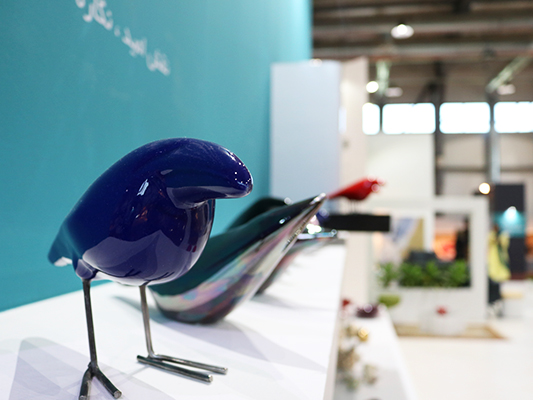
Tehran Carpet Exhibition; A Show of Culture, Art and TradeThose involved in Iran’s carpet industry have long been participating in international events as the country holds the world’s first rank in this field. However, part of these participations has been arranged by the Iran National Carpet Centre.

We have taken part in this year’s international fairs like the one held in China, and will participate in the upcoming events in Italy, Lebanon, and Russia.

What do you think is the main prospect of Iran’s handwoven carpet in future?

The expansion of our exports and further reliance on various aspects of the culture and art of Iranian carpet.

Iran Deeply Concerned about Continued Violence against Myanmar Muslims

“Within the framework of respect for basic human rights and dignity as an internationally recognized norm, the government of the Islamic Republic of Iran expresses its deep concern about the continued violation of Muslims’ rights in Myanmar, which has led to the death and forced immigration of many of them,” Foreign Ministry Spokesman Bahram Qassemi said.

He further noted in his Monday statement that Iran is not pleased with the continuation of ‘this miserable situation’ and slaughter and displacement of Muslims in Myanmar.

Qassemi also called on the Myanmarese government to adopt prudent and realistic policies to restore peace and peaceful coexistence and prevent the institutionalisation of such inhumane and violent situation.

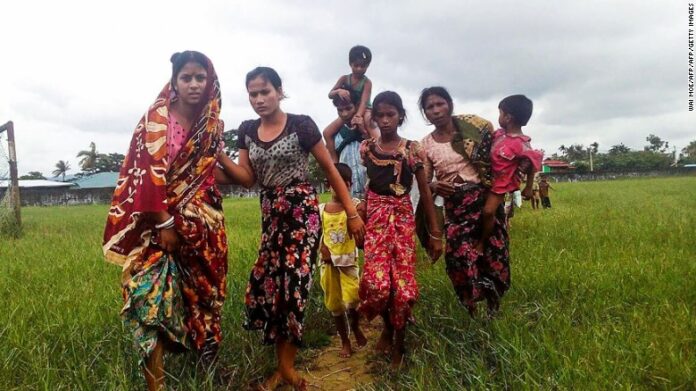
Thousands of ethnic Rohingya are attempting to flee violence in Myanmar’s western Rakhine state, braving hostile border guards, treacherous territory and high waters to cross into neighbouring Bangladesh.

Violence erupted over the weekend in the impoverished Rakhine state, leaving nearly 80 suspected Rohingya insurgents, 12 security officers and six civilians dead, according to state media.

The Rohingya, a Muslim minority in the predominantly Buddhist Myanmar, are considered some of the most persecuted people in the world. Myanmar, also known as Burma, considers them Bangladeshi interlopers and Bangladesh says they’re Burmese.

Hendijan Beach, Pearl of Persian Gulf

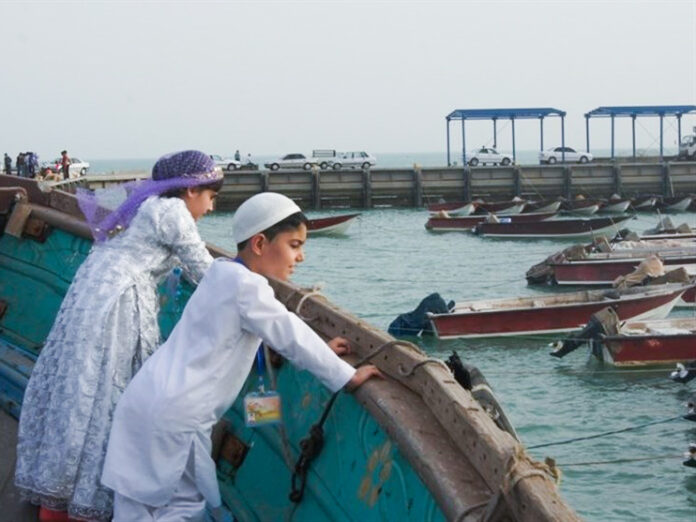
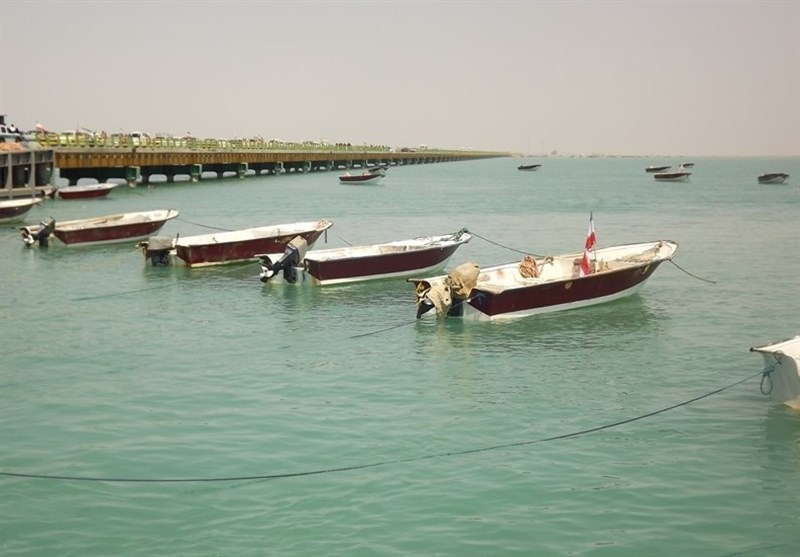
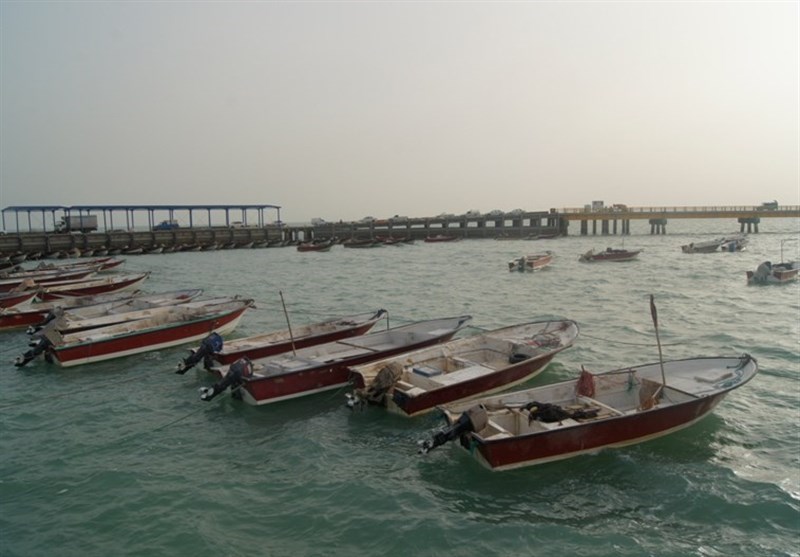
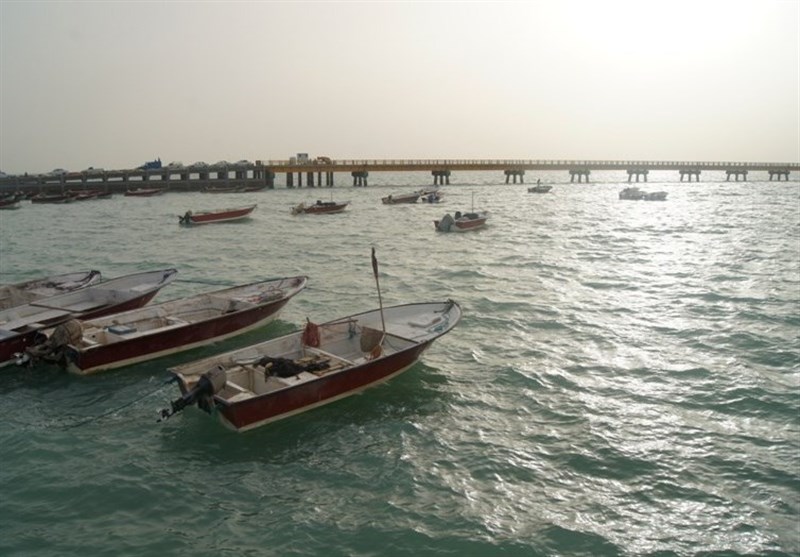
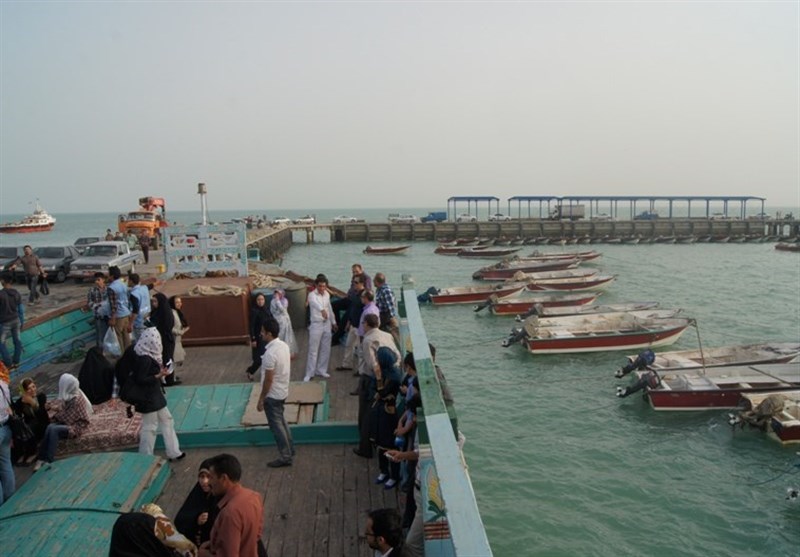
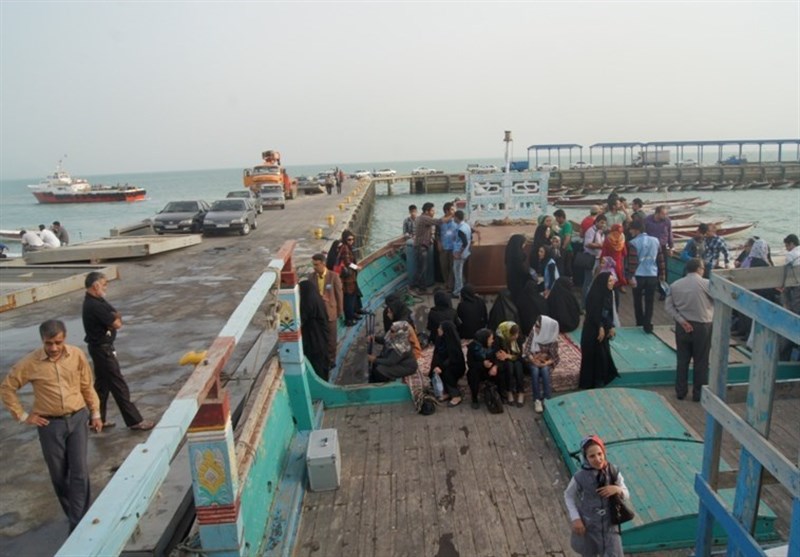
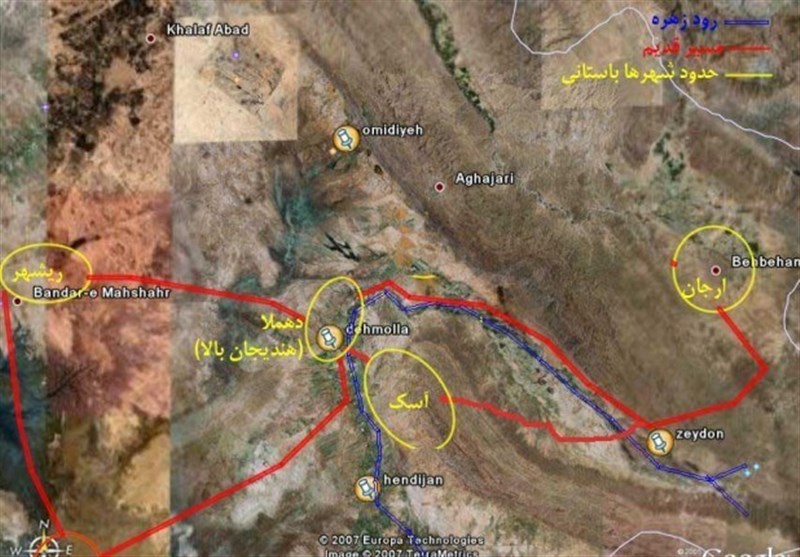
Hendijan Port in Khuzestan province has joint water border with the Persian Gulf. Itis the last area in Khuzestan province which connects it to Bushehr Province.

The port is famous for its delicious fish and shrimps which are unique across the country so much so that fishers from other regions flock to the area for fishing.

Local people mostly rely on the export of fish and shrimps but the area has lots of other natural capacities which have not yet been recognized.

The area’s natural capacities can thus turn it into an appropriate place for investment. To this end, the government can lead the private sectors to invest in the area and take advantage of untapped natural resources of the area.

The town also has lots of other attractions for Iranian and foreign tourists including Bahrakan Trade Port and Dehnou village.

Hendijan River is another tourist attraction of the area which plays a key role in the daily lives of its people. The river used to be a key trade water way in the whole region making the area a trade hub. Today, even more than 100-ton boats can move along the river without any problem.

Iranian Diplomat, UN Envoy Discuss Obstacles to Syria Peace

Iranian Diplomat, UN Envoy Discuss Obstacles to Syria Peace

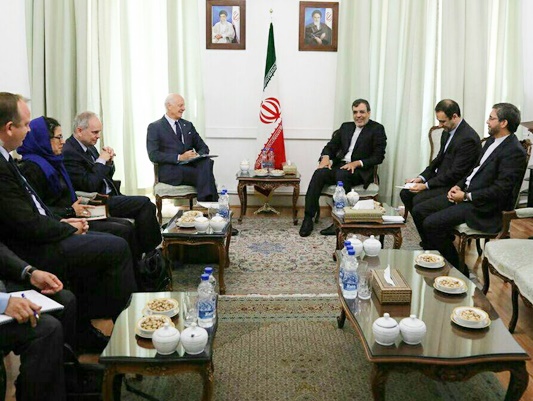
During the Monday talks in Tehran, de Mistura briefed Jaberi Ansari on details of the latest international efforts to resolve the Syria crisis, and elaborated on his views about the obstacles to the political solution of the crisis as well as the intra-Syrian negotiations.

For his part, Jaberi Ansari, who is also Iran’s top negotiator in the Astana Process (Syria peace talks), outlined the Islamic Republic of Iran’s views about ways to resolve the existing problems and restore peace and stability to Syria.

The two sides also conferred on the progress made in the recent meeting of Astana Process in Tehran.

They also discussed the Geneva talks and the agenda of the next Astana conference on Syria, which is to be held in Kazakhstan in the near future.

Iran Develops IFF System Used to Tap Enemies’ Devices

Iran Develops IFF System Used to Tap Enemies’ Devices (2)

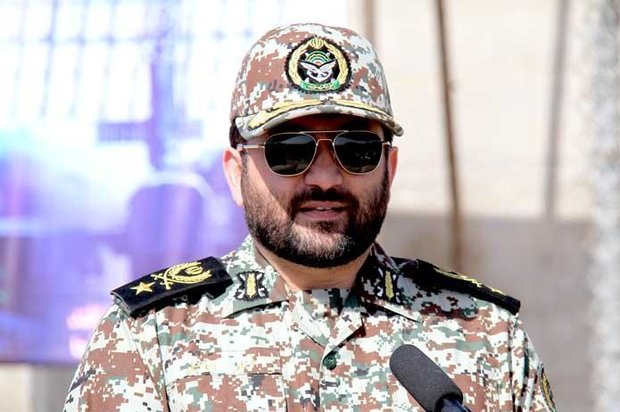
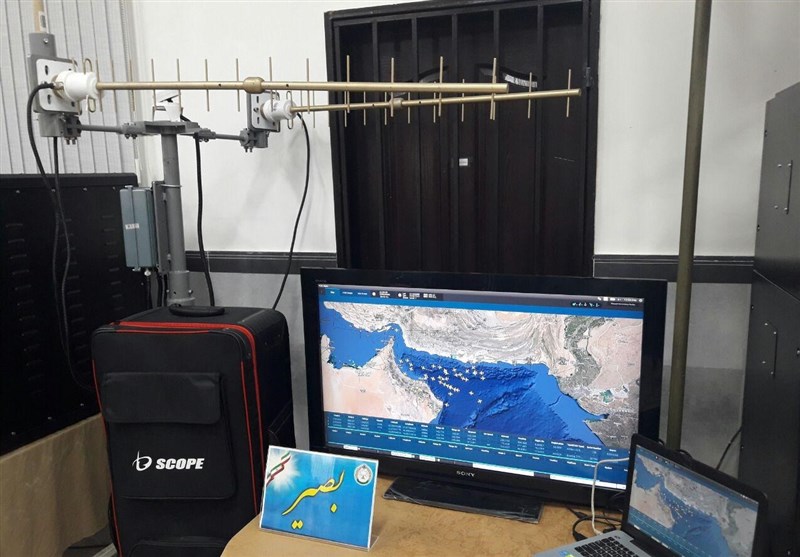
“Four systems were unveiled today,” Commander of Iran’s Khatam al-Anbia Air Defence Base Brigadier General Farzad Esmaili declared on Monday after a ceremony to unveil the country’s latest achievements.

Iran Develops IFF System Used to Tap Enemies’ DevicesThese systems include “an intelligence gathering sites automation system called Samet 1, a moving identification, friend or foe (IFF) system to tap enemies’ equipment and navigation systems called Samee’, a meteorological system named Sama and an aeronautical information management system called Basir,” he noted.
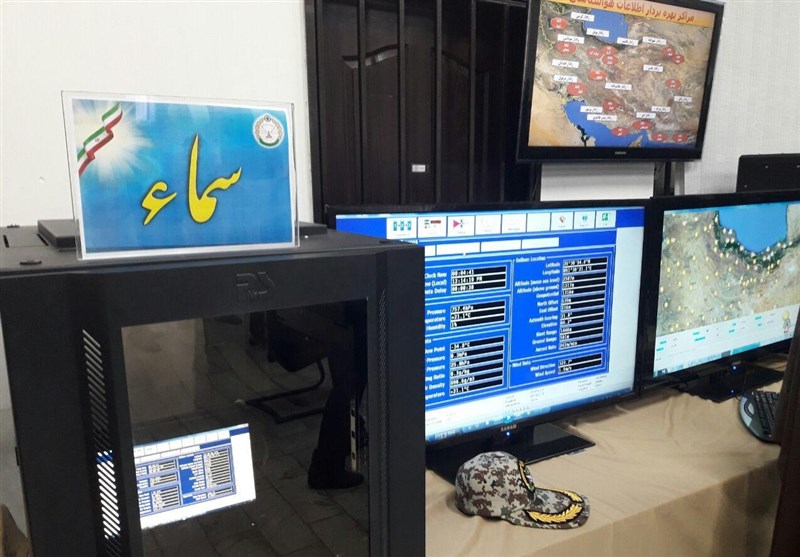
The top general said the meteorological system is the first of its kind in the country used to monitor atmospheric conditions in high altitudes and determine the speed and direction of wind, which is very important for air defense activities and missile launches.

“This system can gauge atmospheric conditions for long-range missiles and high-altitude flights,”

Iran Develops IFF System Used to Tap Enemies’ DevicesHe then touched upon the capabilities of the Samet 1 system, which is used for wiretapping.
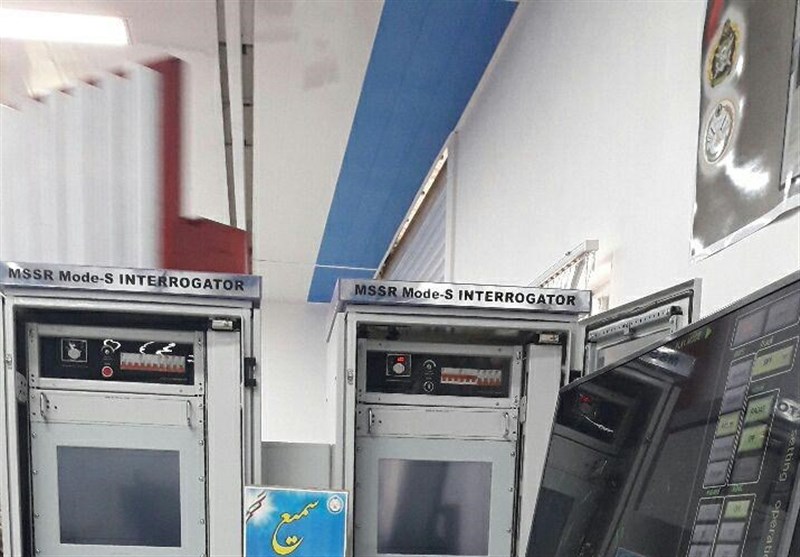
The commander said the system enables an integrated air defense network to share information between different sites which are part of the network.

“The Samet 1 was fully designed and developed by local experts, and we are ready to share with other sectors our experiences pertaining to this system,” said General Esmaili.

He then said Iran is the only country in the Middle East to possess the technology used in the Samee’ IFF system.

“At the moment, only a few countries have this technology. The Samee’ system can provide information from A to Z on all medium-range targets.”

Iran Develops IFF System Used to Tap Enemies’ DevicesHe said the Khatam al-Anbia Air Defence Base covers 5,000 air defence sites across the country, which are operating round the clock.
The Iranian general went on to say that any enemy that intends to attack Iran will pay a heavy price for it, and will be “buried in this country.”

He also noted that the defence centre can share its advances with other Iranian institutions, according to a Farsi report by Tasnim.

“We welcome the idea of providing other institutions with the equipment and systems we develop,” said the commander at a ceremony where several newly developed systems were unveiled at the base.

Iran in Talks with India, Russia on Gas Field Development

Farzad B

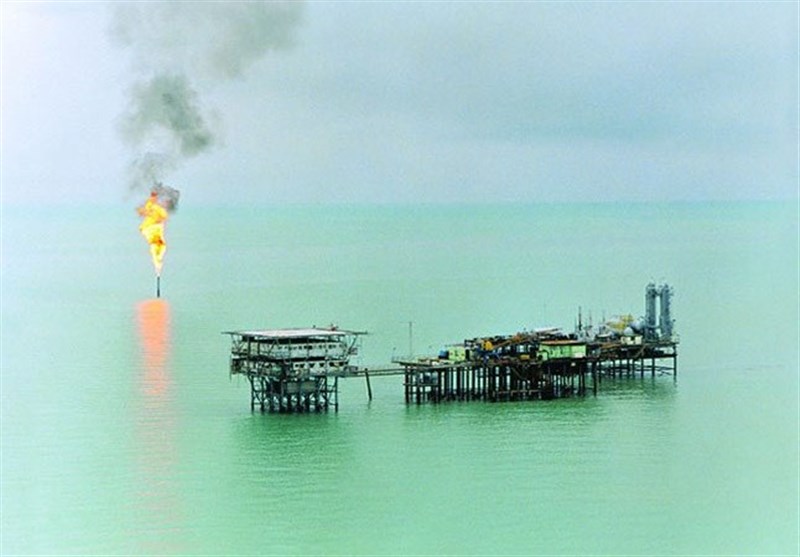
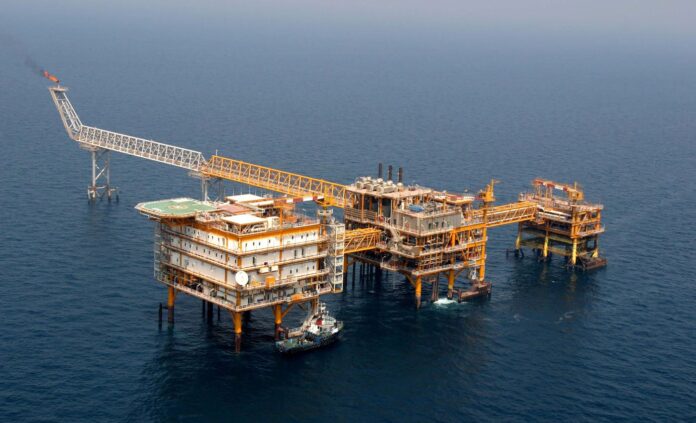
Iran’s Deputy Oil Minister Ali Kardar has weighed on negotiations with foreign companies to develop the Iranian gas field Farzad B.

“Talks are underway with India and [Russia’s] Gazprom company, and if they offer acceptable technical and financial proposals, they will be contracted to develop the Farzad B gas field,” he said, according to a Farsi report by the Etemad daily newspaper.

He noted that engineering, procurement, construction financing (EPCF) studies on the development of the gas field are being conducted by a consultant.

“In the meantime, foreign firms have the chance to announce their readiness if they are interested to develop the gas field.”

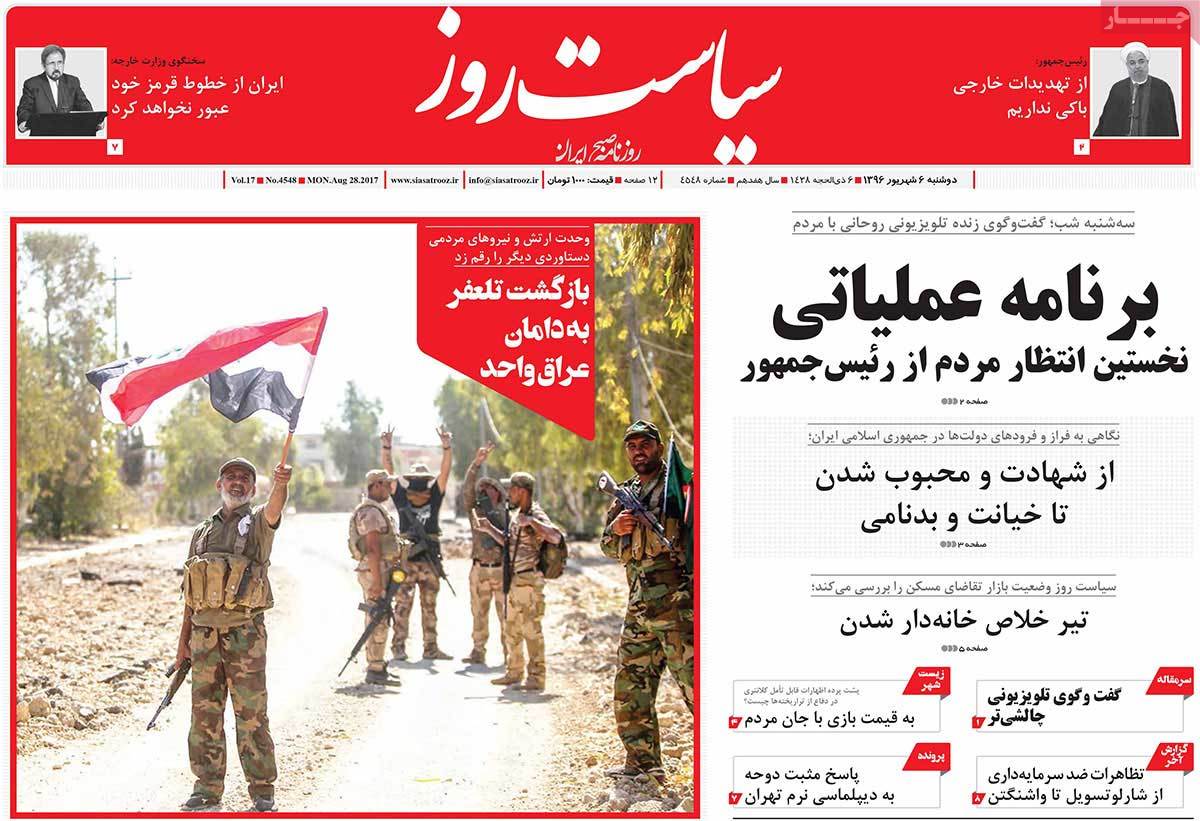
A Look at Iranian Newspaper Front Pages on August 28

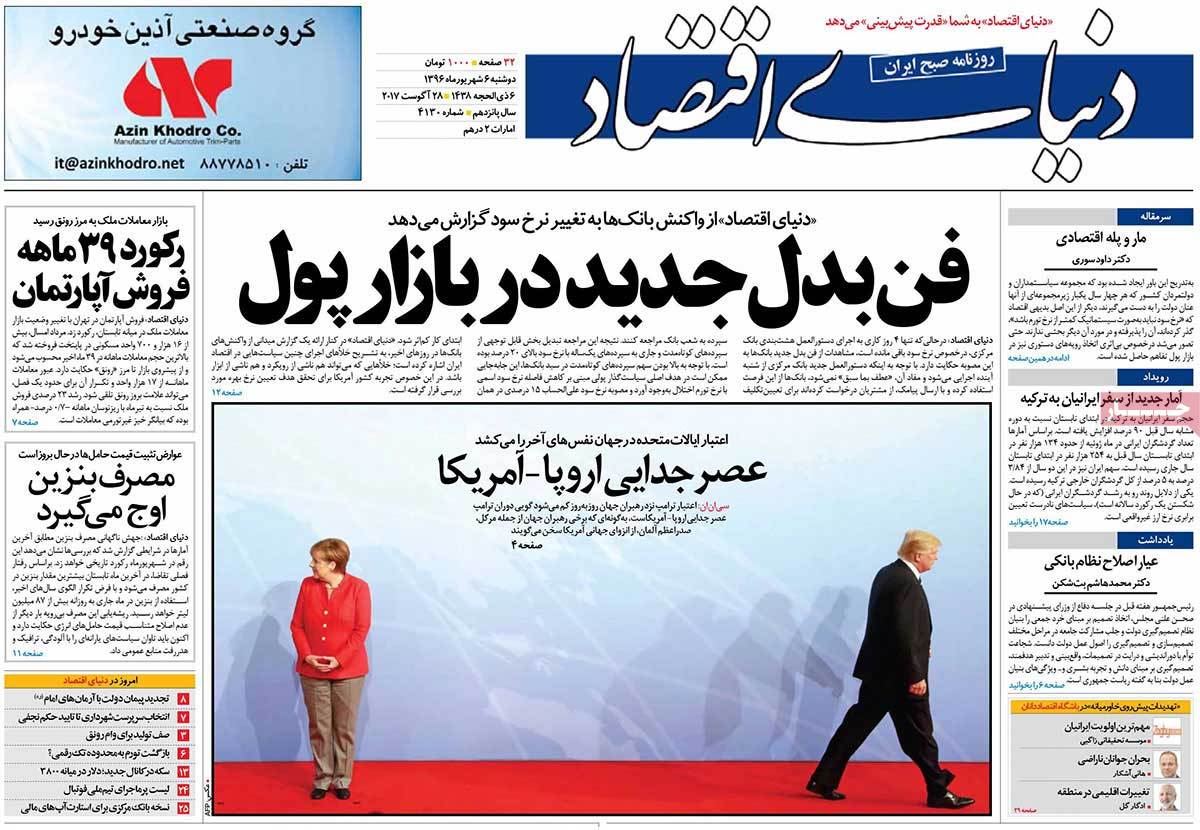
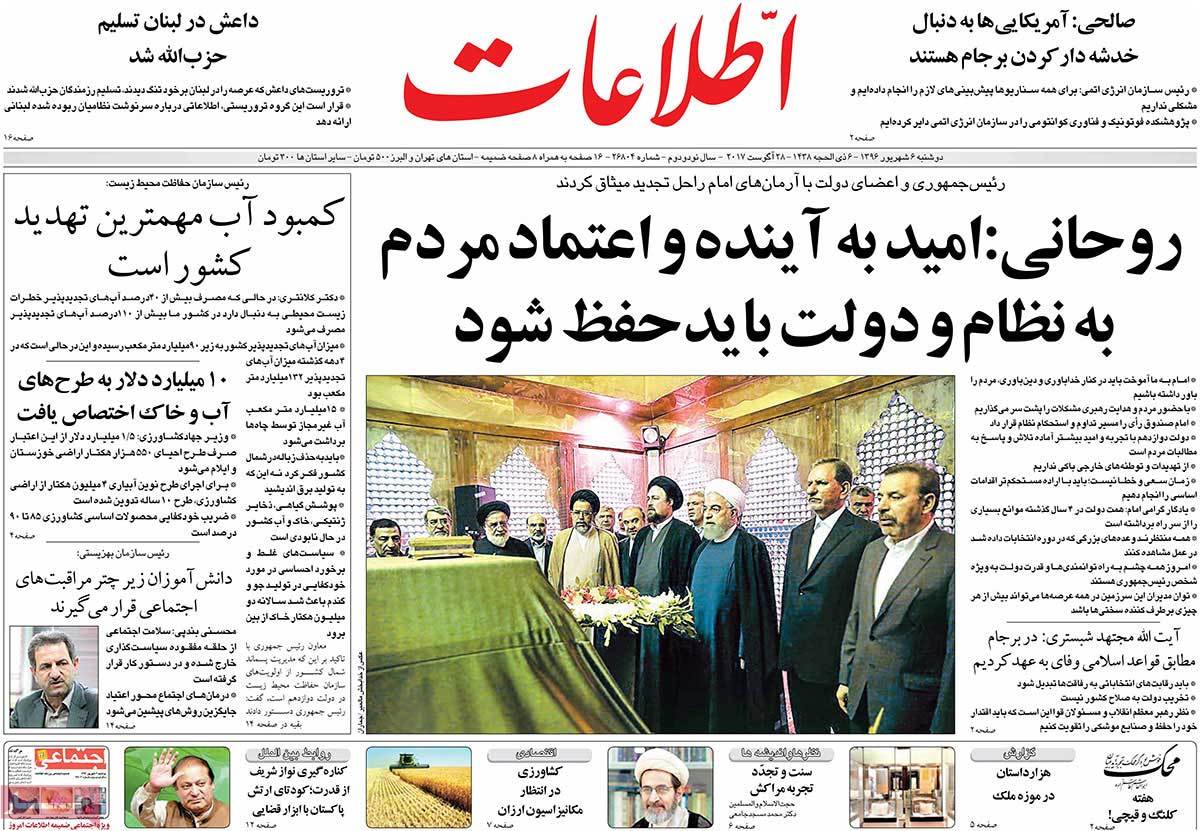
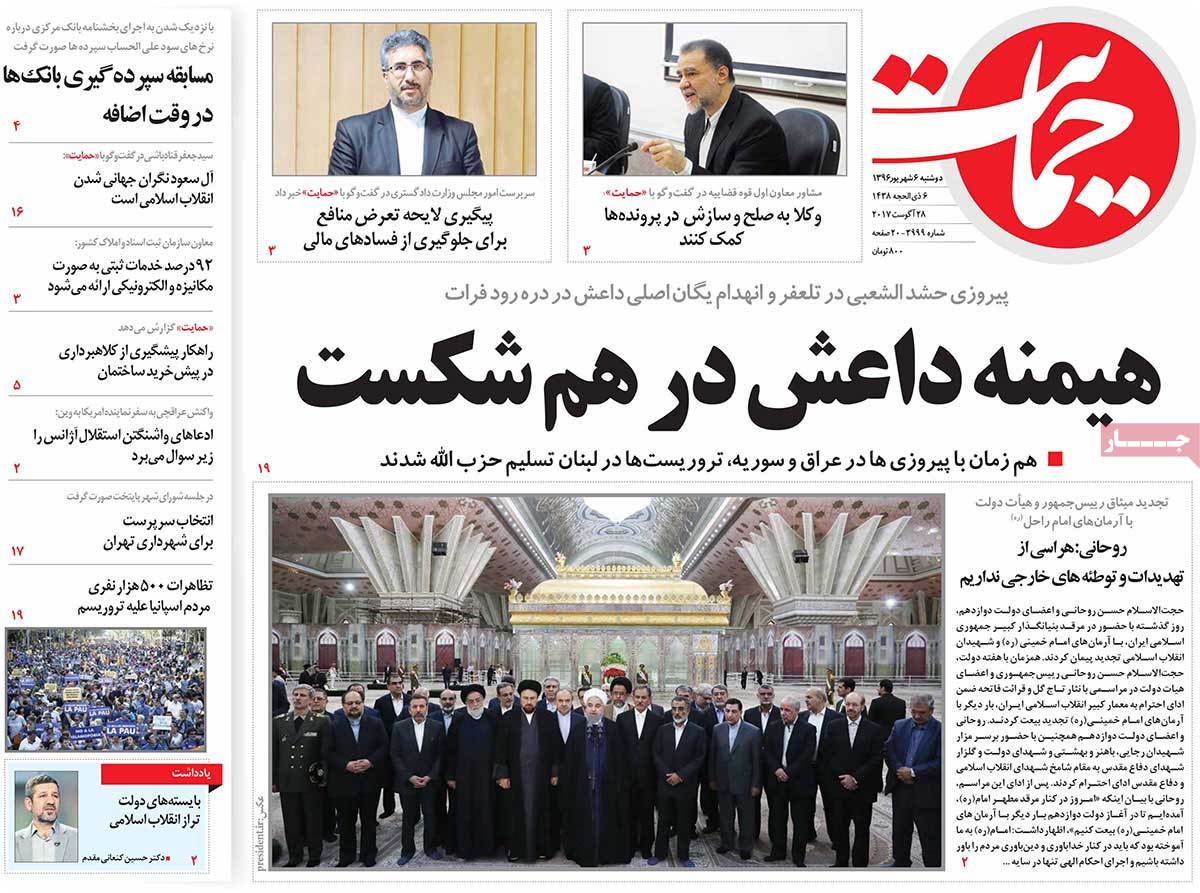
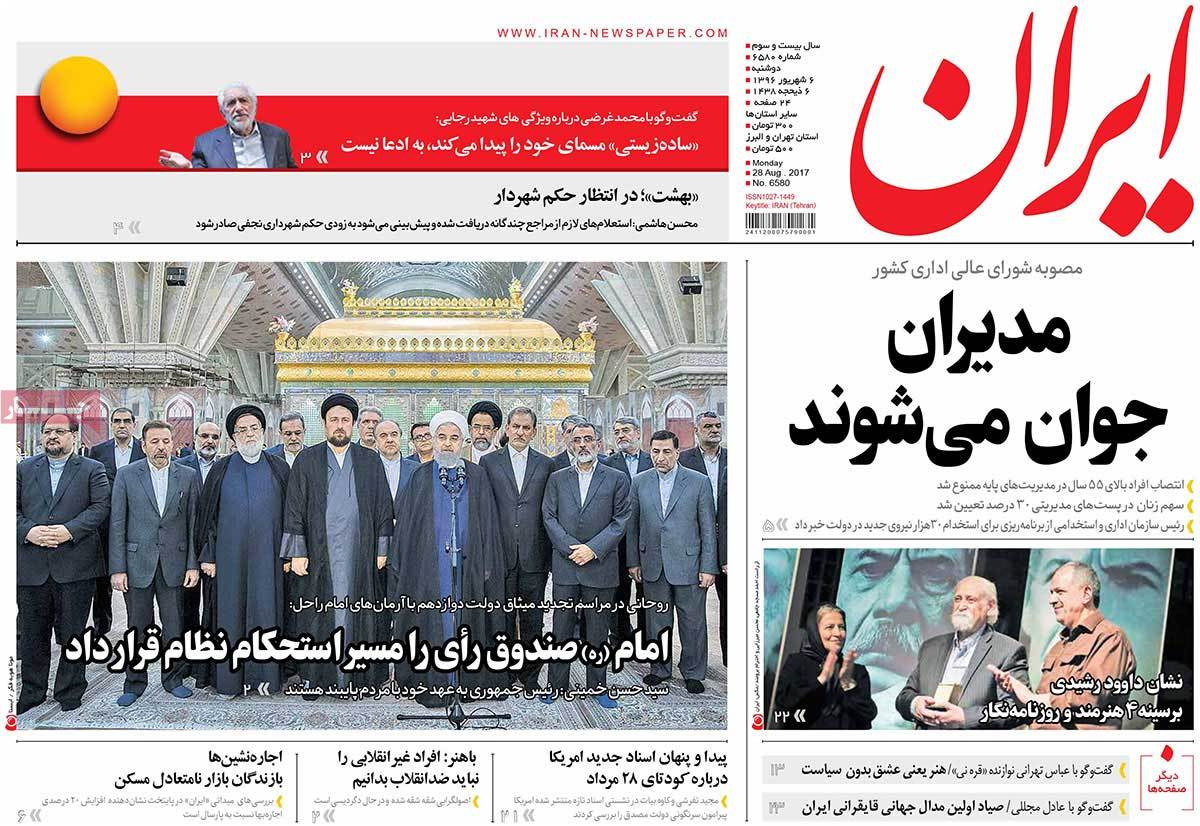
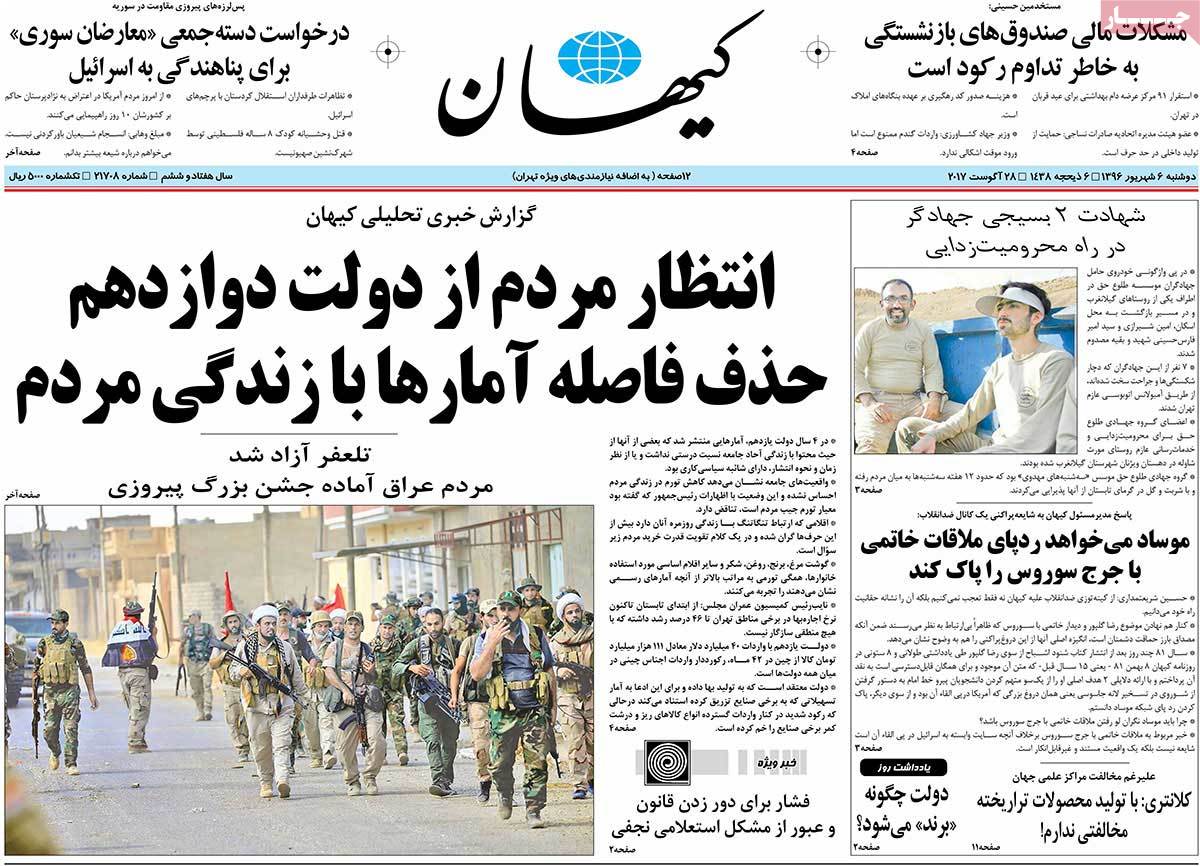
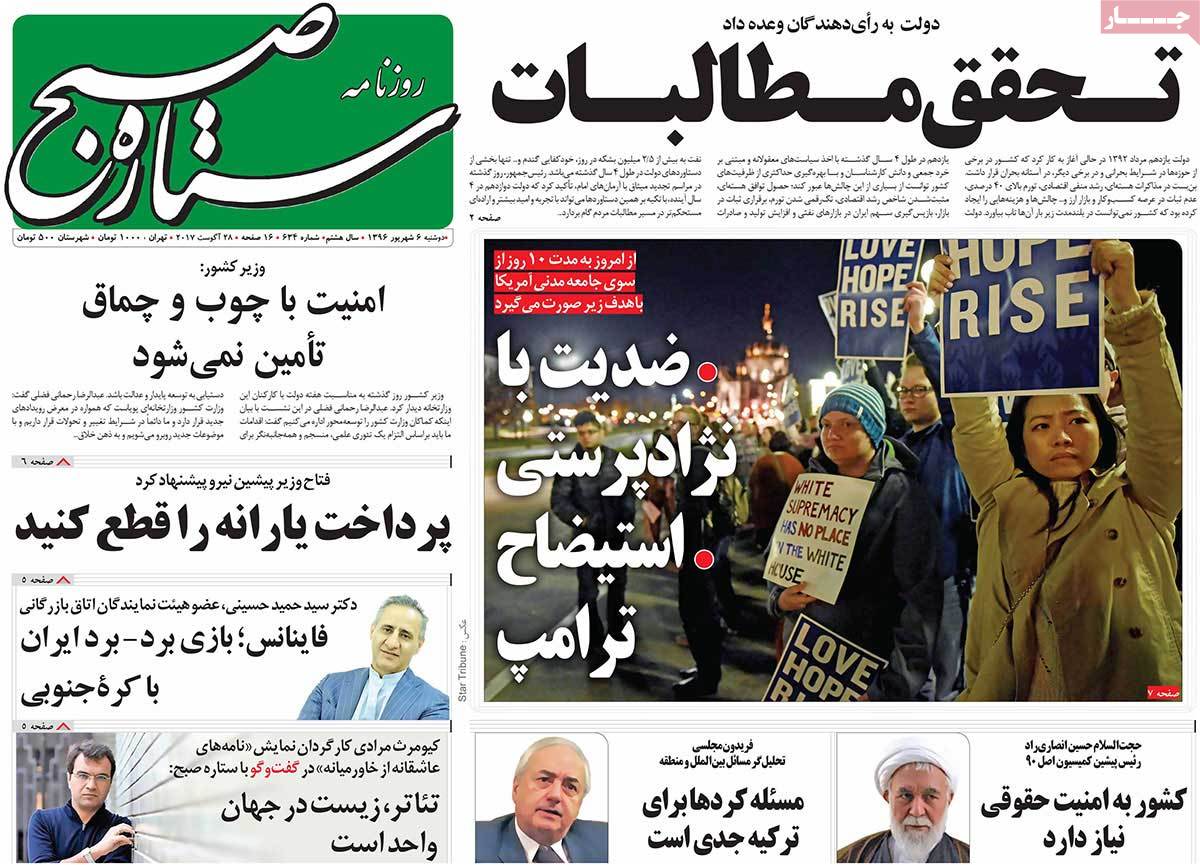
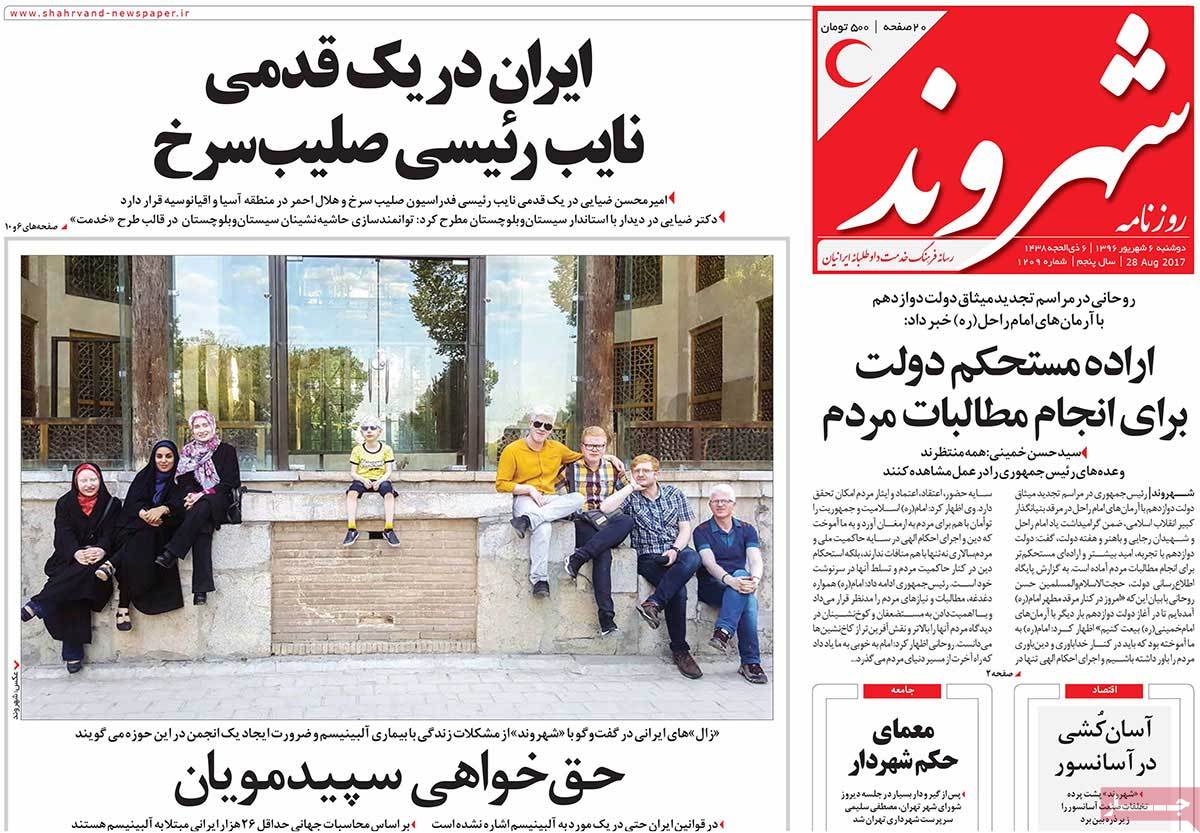
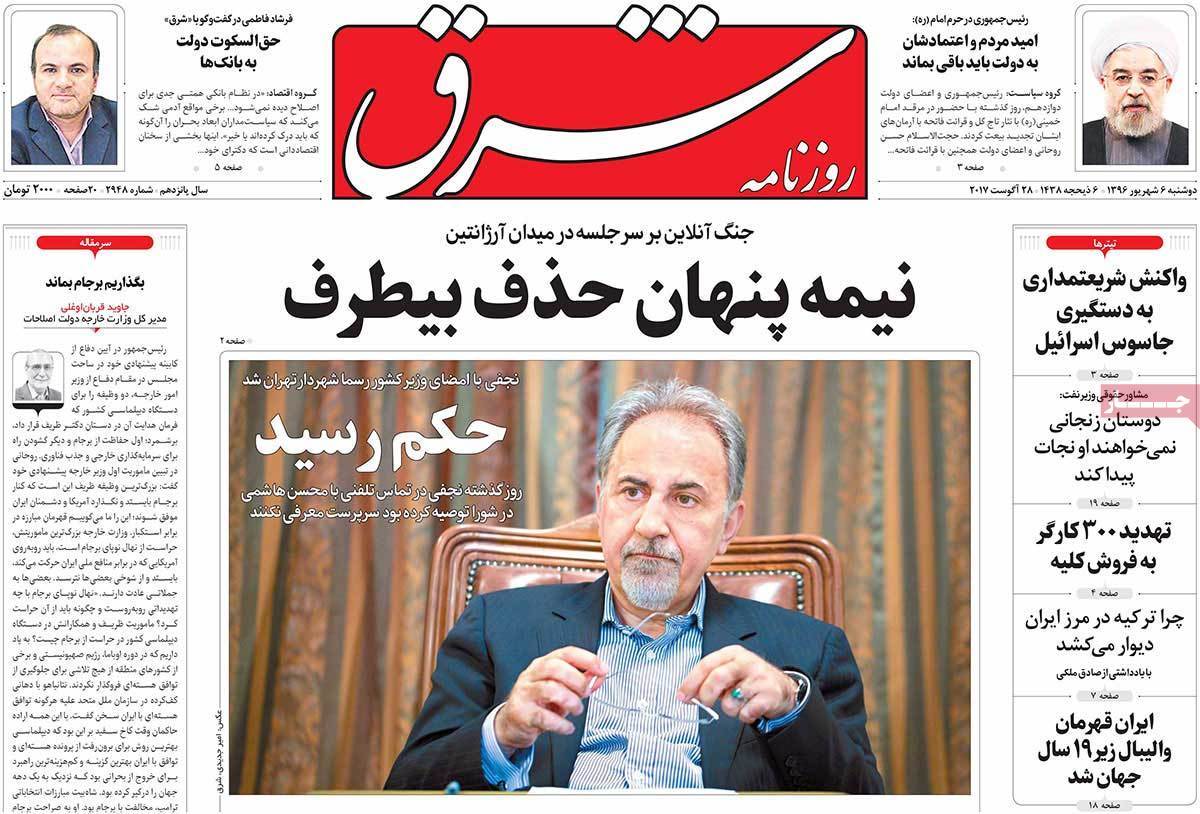
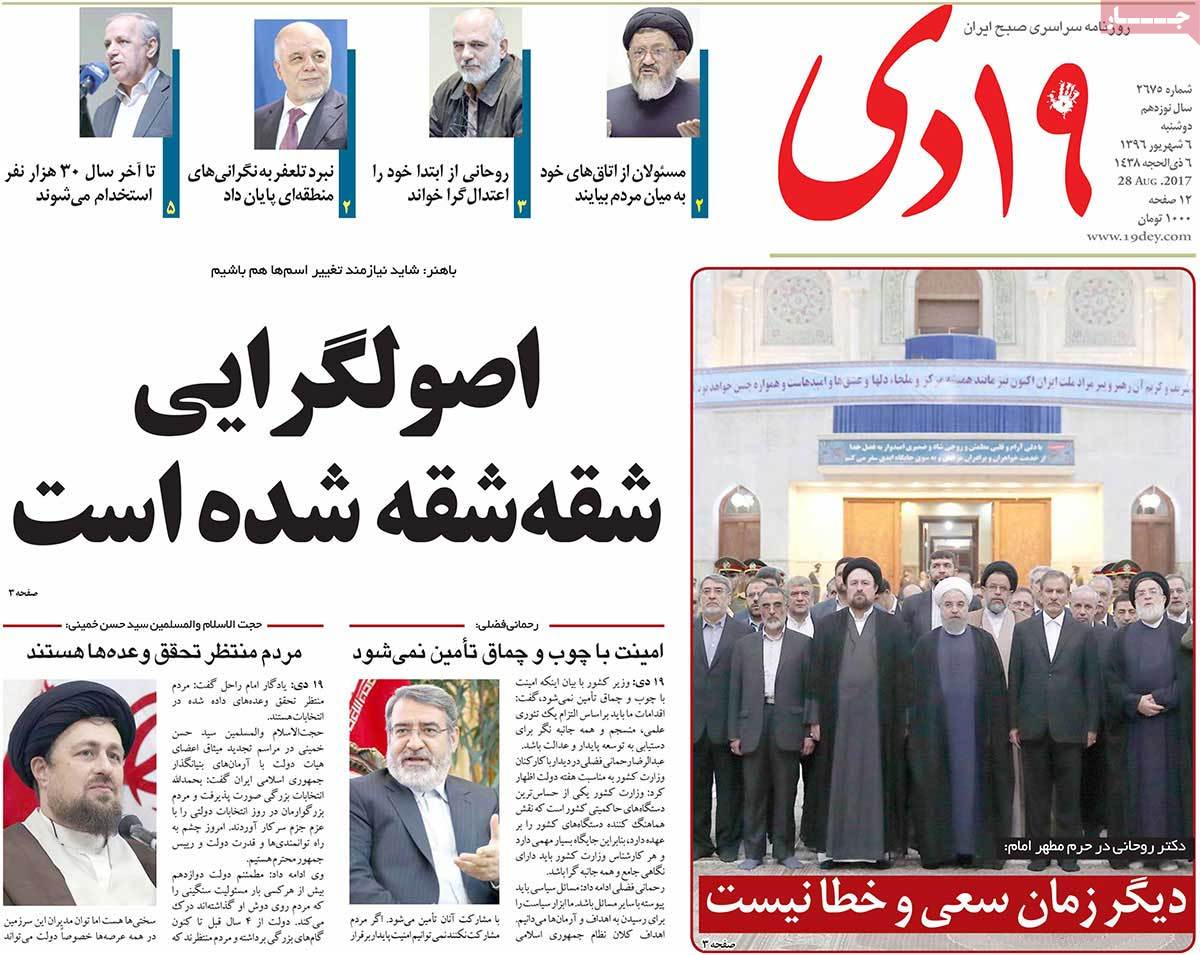
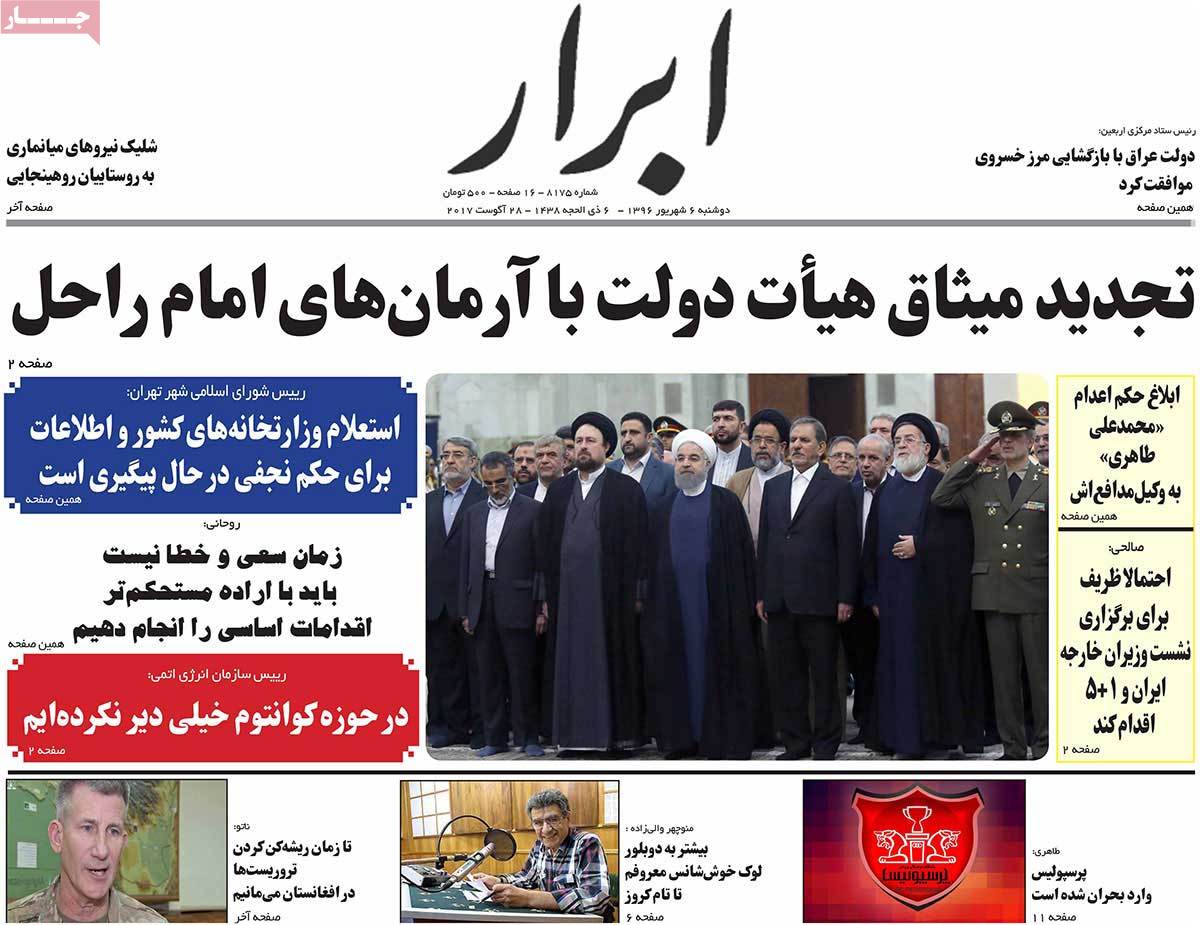
Newspapers today widely covered the remarks made by Iranian President Hassan Rouhani in a visit to the mausoleum of Imam Khomeini, the founder of the Islamic Republic.

Another top story was the comments made by the head of Atomic Energy Organisation of Iran (AEOI) Ali Akbar Salehi about the possibility of a meeting between Iranian Foreign Minister Mohammad Javad Zarif and his counterparts from members of the P5+1 member states, including the US.

The above issues, as well as many more, are highlighted in the following headlines and top stories:


19 Dey:

1- Conservative Figure: We May Even Have to Change Our Name

A Look at Iranian Newspaper Front Pages on August 28


Abrar:

1- Nuclear Chief: Zarif May Call for Ministerial Meeting of Iran, P5+1


A Look at Iranian Newspaper Front Pages on August 28


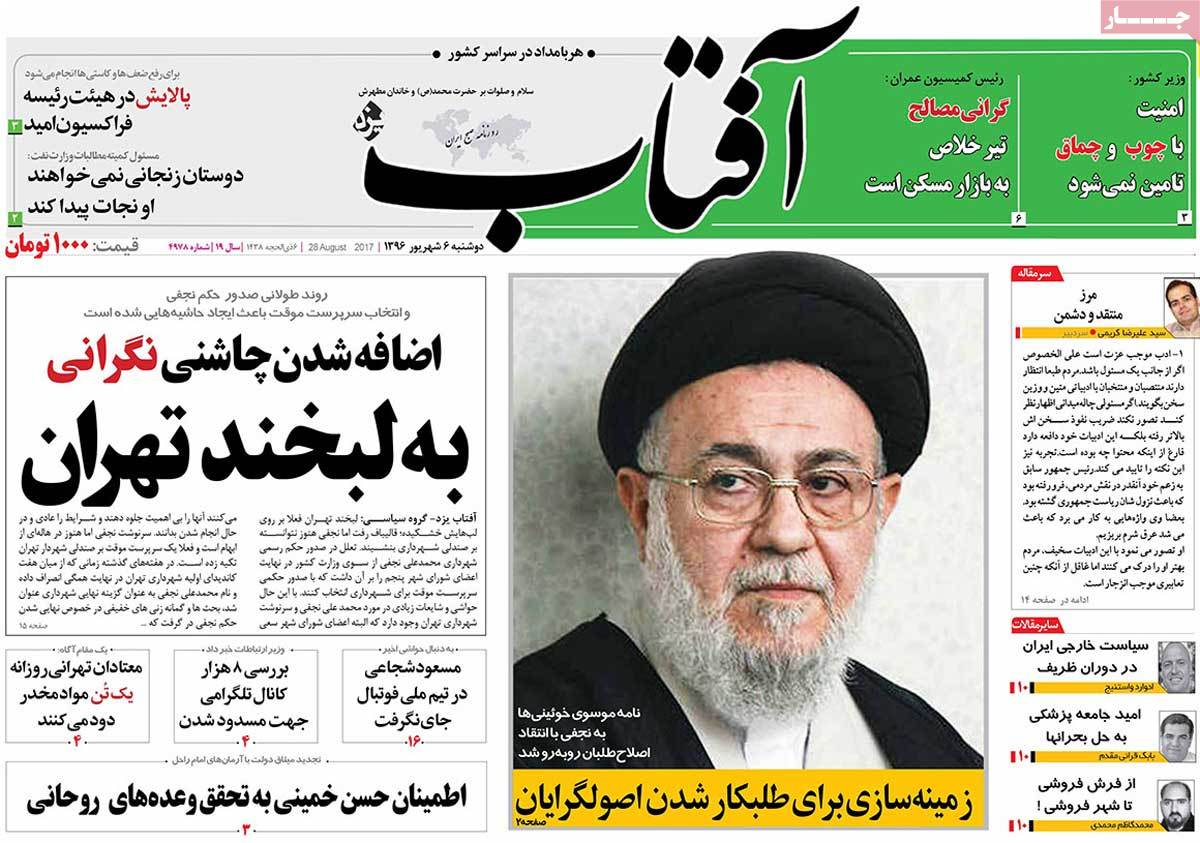
Aftab-e Yazd:

1- Interior Minister: Security Cannot Be Ensured Using Stick


A Look at Iranian Newspaper Front Pages on August 28


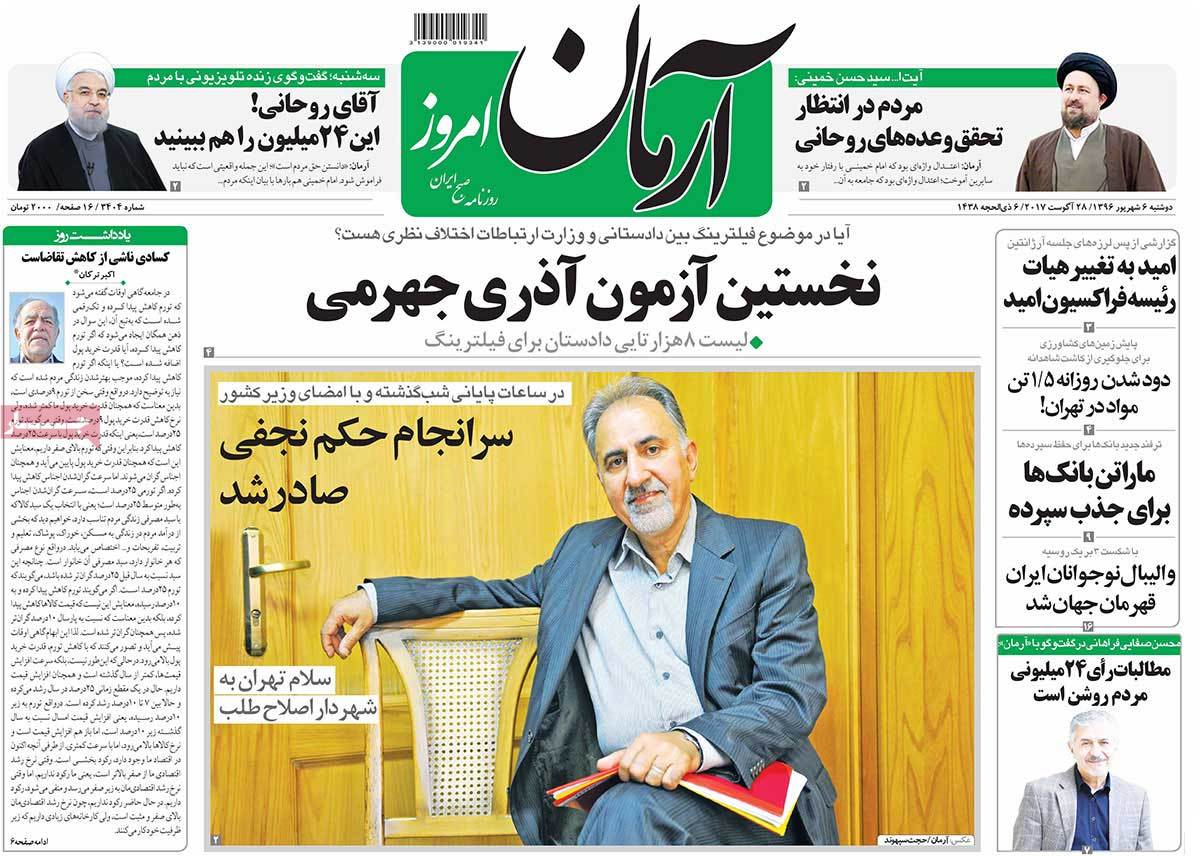
Arman-e Emrooz:

1- ICT Minister’s First Test: Judiciary Asks Ministry to Filter 8,000 Telegram Channels

A Look at Iranian Newspaper Front Pages on August 28


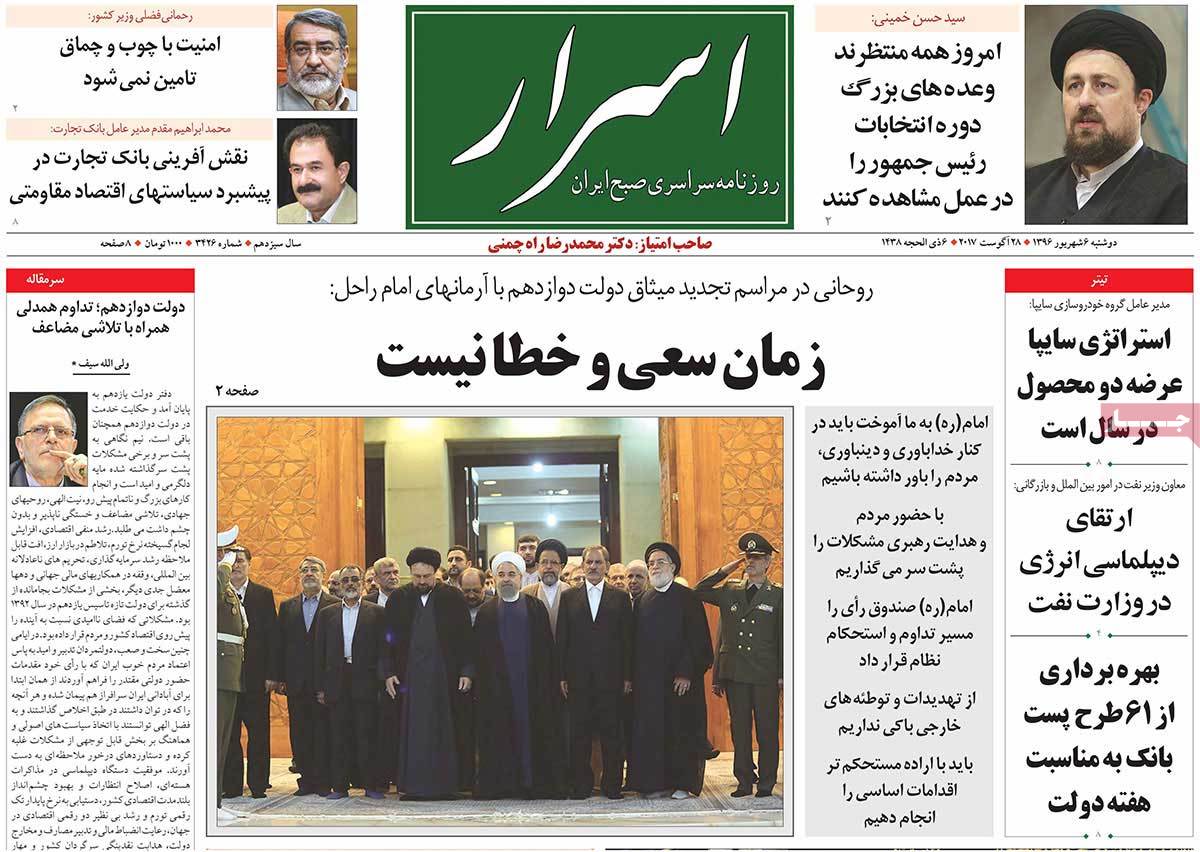
Asrar:

1- Imam Khomeini’s Grandson: Everyone Expecting Rouhani to Fulfil Campaign Promises

A Look at Iranian Newspaper Front Pages on August 28


Donya-ye Eqtesad:

1- New US-Europe Era: Imminent End of America’s Reputation

A Look at Iranian Newspaper Front Pages on August 28


Ebtekar:

1- Political Activists: Rouhani’s Gov’t under Scrutiny of 24m Voters

http://www.jaaar.com/assets/images/pishkhan/1396/6/6/82cec960.jpg


Emtiaz:

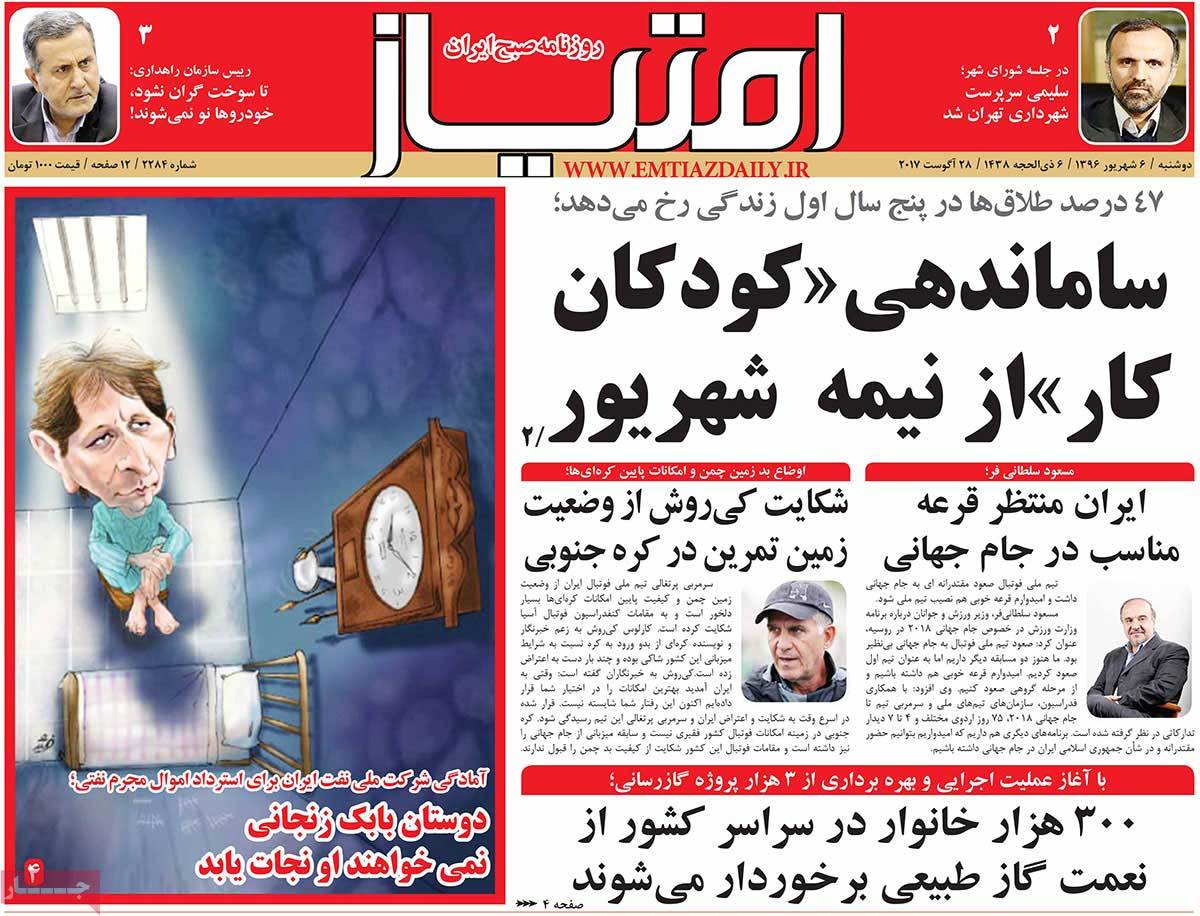
1- Child Labourers to Be Organized in Iran by Early September

A Look at Iranian Newspaper Front Pages on August 28


Etemad:

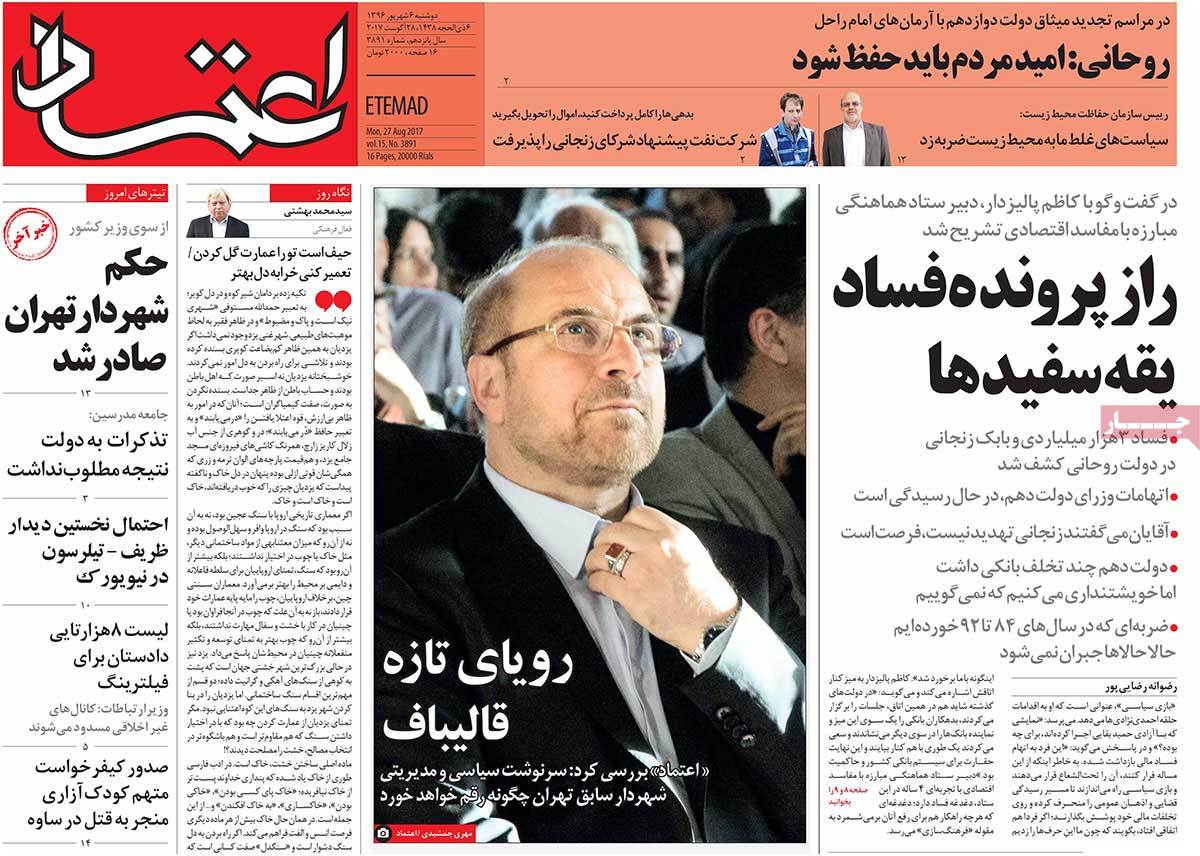
1- Zarif, Tillerson May Meet for First Time in New York

A Look at Iranian Newspaper Front Pages on August 28


Ettela’at:

1- Rouhani: Hope for Future, People’s Trust in Establishment Should Be Maintained

2- Iran Nuclear Chief: US Looking for Spoiling Nuclear Deal

3- ISIS in Lebanon Surrenders to Hezbollah


A Look at Iranian Newspaper Front Pages on August 28


Hemayat:

1- Victory of Iraqi Popular Forces in Tal Afar; ISIS Units Destroyed


A Look at Iranian Newspaper Front Pages on August 28


Iran:

1- Rouhani: Imam Khomeini Believed Ballot Box Strengthens Establishment

2- Iranian Executive Managers to Become Younger

A Look at Iranian Newspaper Front Pages on August 28


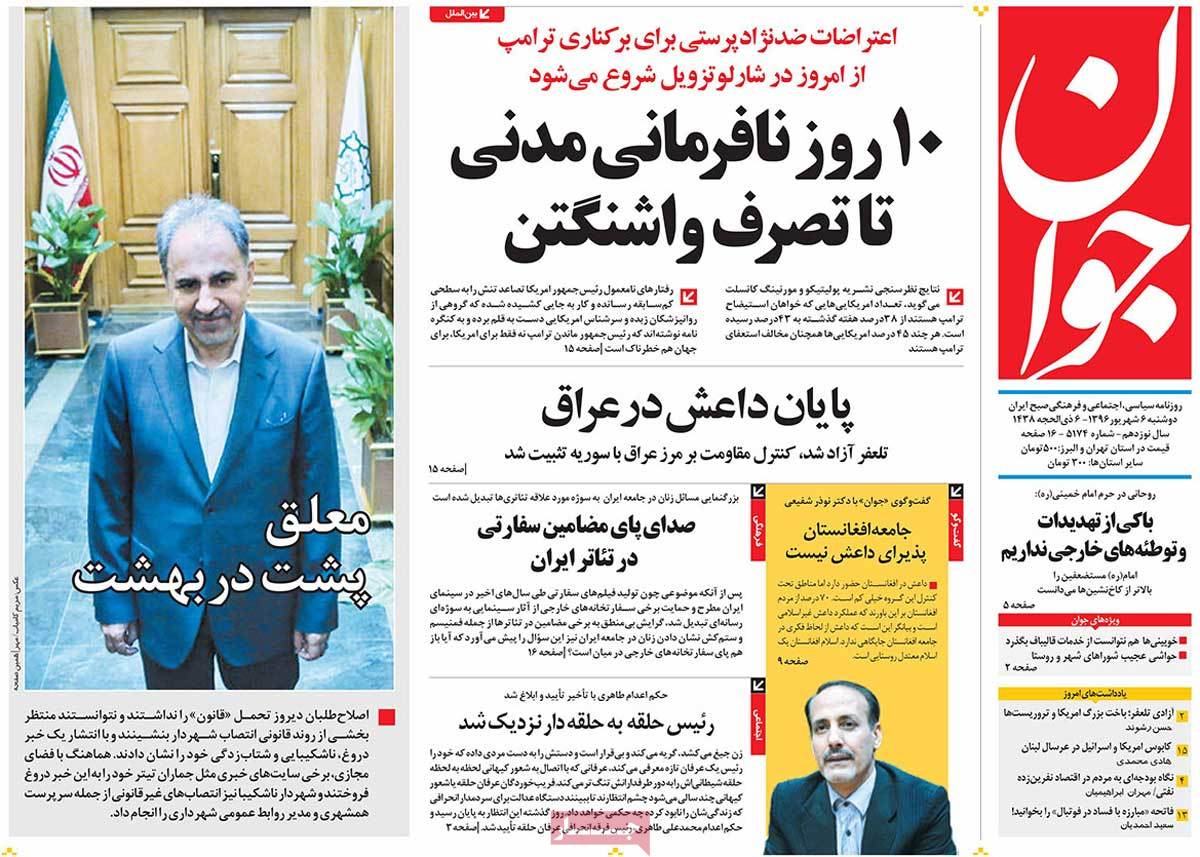
Javan:

1- 10 Days of Civil Disobedience until Seizure of Washington

  • Anti-Racism Protesters Start Demonstrations in Charlottesville to Impeach Trump

2- End of ISIS in Iraq

A Look at Iranian Newspaper Front Pages on August 28


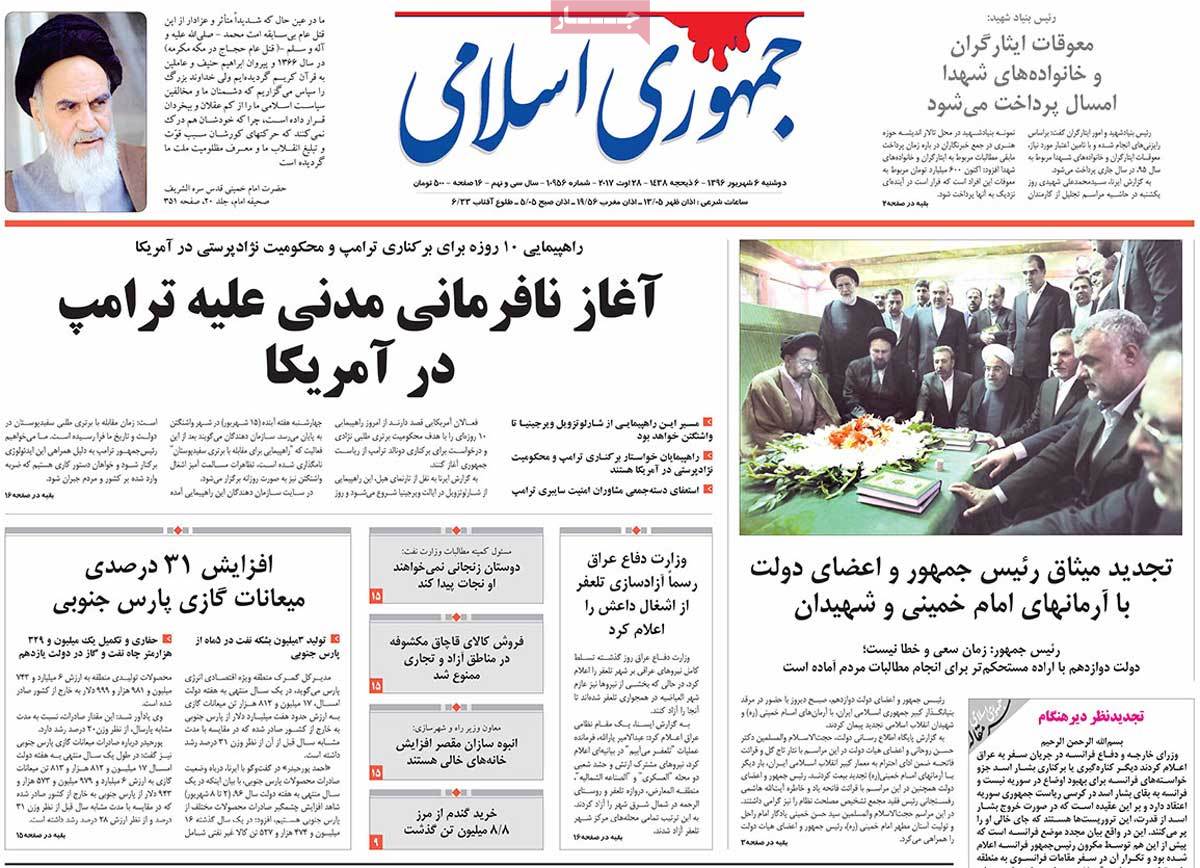
Jomhouri Eslami:

1- Beginning of Civil Disobedience March against Trump in US

  • 10-Day March to Impeach Trump

A Look at Iranian Newspaper Front Pages on August 28


Kayhan:

1- People Expect Government to Get Statistics Closer to People’s Real Lives

2- Aftershocks of Resistance Victories in Syria: Syrian Dissidents Seek Asylum in Israel

A Look at Iranian Newspaper Front Pages on August 28


Setareh Sobh:

1- Analyst: Finance Is Iran’s Win-Win Game with South Korea

2- Issue of Kurds Serious to Turkey: Analyst

A Look at Iranian Newspaper Front Pages on August 28


Shahrvand:

1- Iran One Step Close to Vice-Presidency of Red Cross, Red Crescent in Asia-Pacific

A Look at Iranian Newspaper Front Pages on August 28


Shargh:

1- Iran Claims World Title in U-19 Volleyball Championship

2- Why Turkey Is Building War in Iran Front [Editorial]


A Look at Iranian Newspaper Front Pages on August 28


Siasat-e Rooz:

1- Return of Tal Afar to United Iraq

2- Rouhani: We’re Not Afraid of Foreign Threats

A Look at Iranian Newspaper Front Pages on August 28


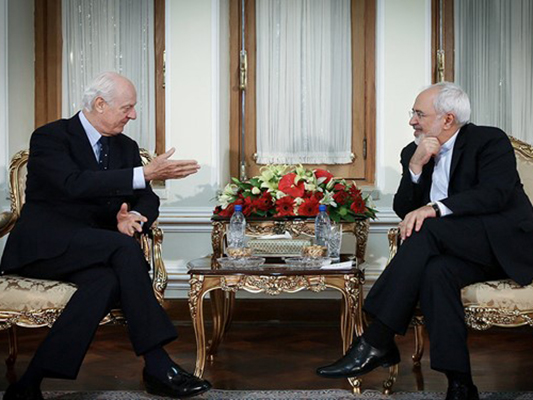
Iranian FM, UN Special Envoy Discuss Syria Crisis

Iran FM Zarif- Staffan de Mistur

During the meeting held in Tehran, Zarif and de Mistura conferred on the latest political and field developments in Syria and the political initiatives to settle the crisis through dialogue.

De Mistura, who arrived in Tehran on Sunday, also plans to meet Deputy Foreign Minister for Arab and African Affairs Hossein Jaberi Ansari.

De Mistura’s visit to Iran has come ahead of the next round of Syria peace talks in Kazakhstan’s capital city of Astana, slated to be held in mid-September.

The Kazakh Foreign Ministry said in a Tuesday Facebook post the timing of the talks would be set at a meeting in late August between experts from Russia, Turkey and Iran and “provisionally, we could be talking about mid-September.”

Astana has hosted five rounds of peace talks for Syria since January. Russia, Iran, and Turkey serve as guarantor states in the peace process. The negotiations are aimed at bringing an end to the foreign-backed militancy in Syria, which began in March 2011.

The Astana talks have so far resulted in an agreement on four de-escalation zones across Syria.

According to the Russian Foreign Ministry, three of the enclaves have been created to date, in the country’s sprawling central province of Homs, in the Eastern Ghouta area of the southern Rif Dimashq Province, and a southwestern militant-controlled stretch along the border with Jordan.