Thursday, April 23, 2026
Home Blog Page 3905

Iran Has Conferred with Syria over Woes of Christians: Speaker

Larijani

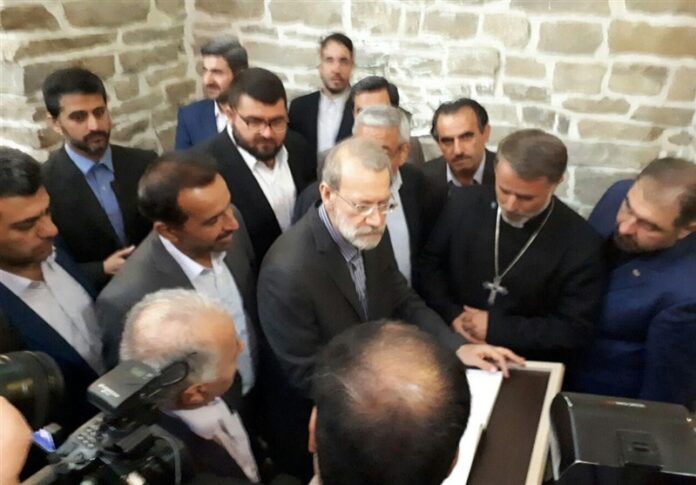
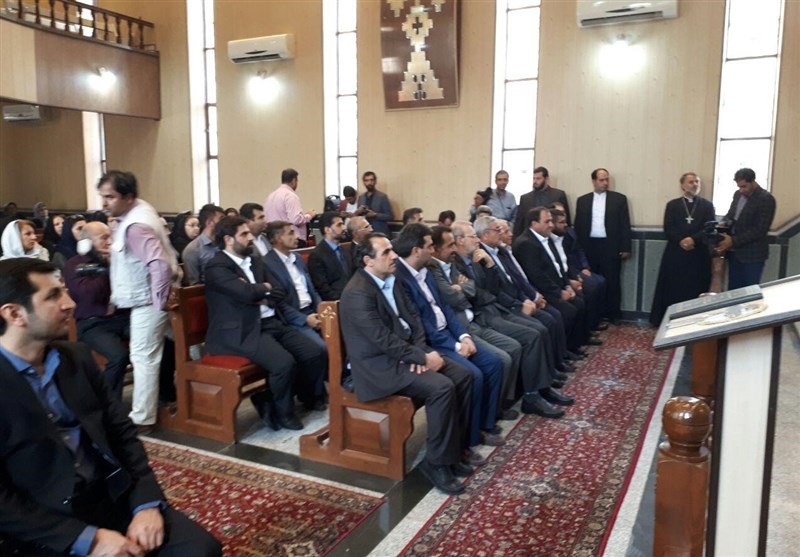
Speaking at a church in Iran’s northwestern city of Oroumiyeh on Sunday, Larijani deplored the pressure that Christian people have come under in various parts of the region, as in Syria.

Expressing concern about the destruction of holy Christian sites in Syria and imprisonment of Christians by terrorist groups, the Iranian speaker said he has held talks with Syrian officials to solve the problems the country’s Christian people are suffering from.

Iran Has Conferred with Syria over Woes of Christians: Speaker

“We should all join hands to rid the region of the plague of terrorism,” he further underlined.

Syria has been gripped by civil war since March 2011 with various terrorist groups, including Daesh (ISIL), controlling parts of it.

According to a report by the Syrian Center for Policy Research, the conflict has claimed the lives of over 470,000 people, injured 1.9 million others, and displaced nearly half of the country’s pre-war population of about 23 million within or beyond its borders.

Iraq Army ‘to Intervene’ If Kurds’ Referendum Escalates: PM

haider-al-abadi

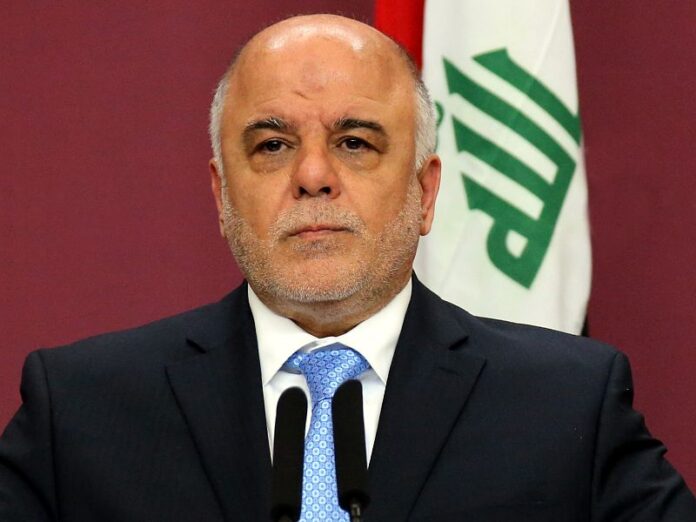
Iraqi Prime Minister Haider al-Abadi said in an interview that if the Iraqi population is “threatened by the use of force outside the law, then the Army will intervene militarily.”

Speaking in an interview with the Associated Press news agency on Saturday, Abadi said, “If you challenge the constitution and if you challenge the borders of Iraq and the borders of the region, this is a public invitation to the countries in the region to violate Iraqi borders as well, which is a very dangerous escalation.”

The leaders of Iraq’s Kurdish region have said they hope the referendum will push Baghdad to come to the negotiating table and create a path for independence. However, Abadi said such negotiations would likely be complicated by the referendum vote.

“It will make it harder and more difficult,” he said, but added: “I will never close the door to negotiations. Negotiations are always possible.”

Iraq’s Kurdish region plans to hold the referendum on support for independence from Iraq on September 25 in three governorates that make up their autonomous region, and in disputed areas controlled by Kurdish forces but which are claimed by Baghdad.

Iraq’s Kurds have come under increasing pressure to call off the vote from regional powers and the United States, a key ally, as well as Baghdad.

Iran Wins Bronze at FIVB World Grand Champions Cup

Iran Wins Bronze at FIVB World Grand Champions Cup

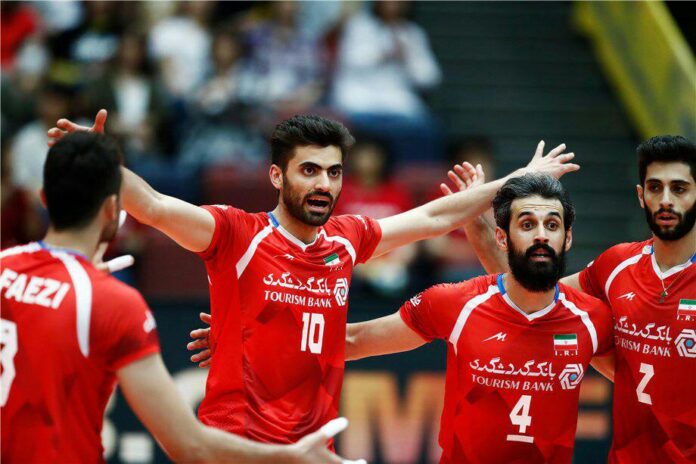
Iran prevailed in the tie-break set against France to win the bronze medal at the Osaka Municipal Central Gymnasium on Sunday.

The 2017 FIVB Volleyball Men’s World Grand Champions Cup is the 7th staging of the FIVB Volleyball World Grand Champions Cup, a quadrennial international men’s volleyball tournament organized by the Fédération Internationale de Volleyball (FIVB).

Iran missed the podium in the last edition, when they finished fourth. After three participations, Iran made its best finish at the World Grand Champions Cup with a bronze medal.

The Men’s World Grand Champions Cup features a total of six teams that play in a round-robin tournament from September 12 to 17. Nagoya and Osaka hosted the seventh edition of the tournament.

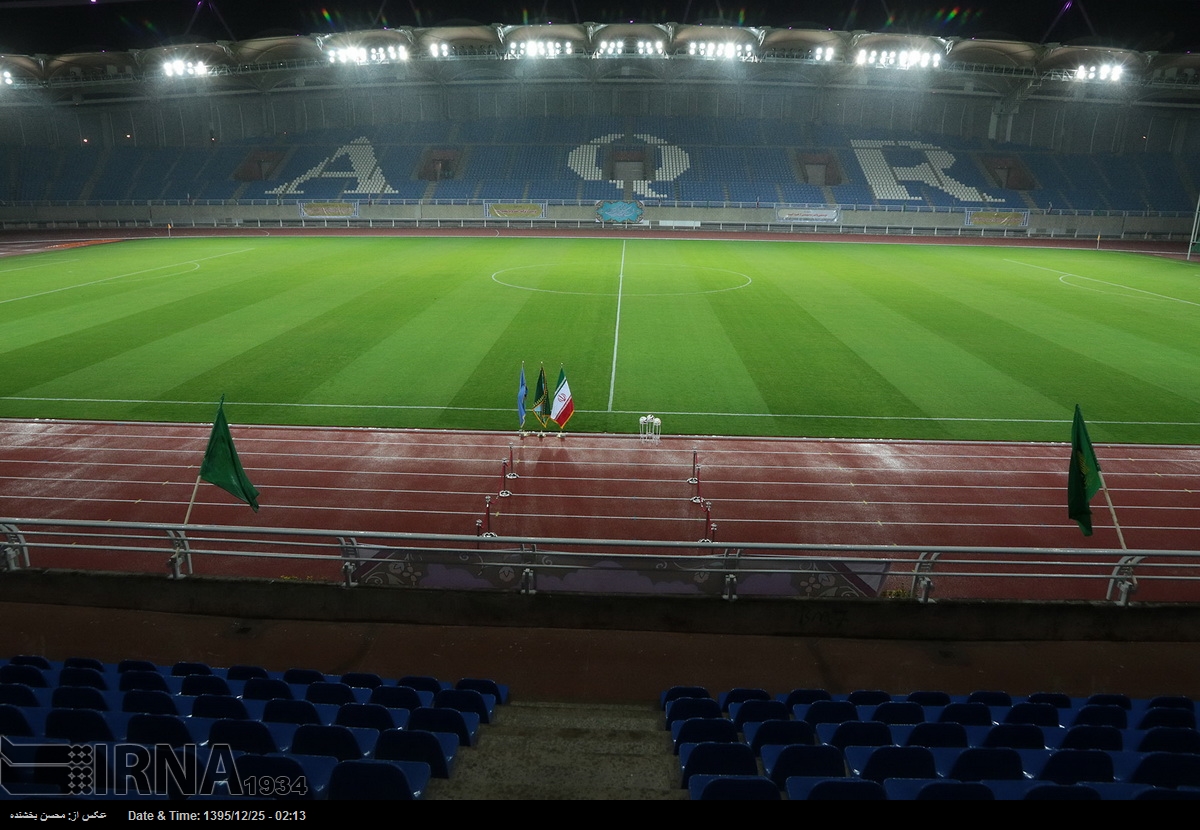
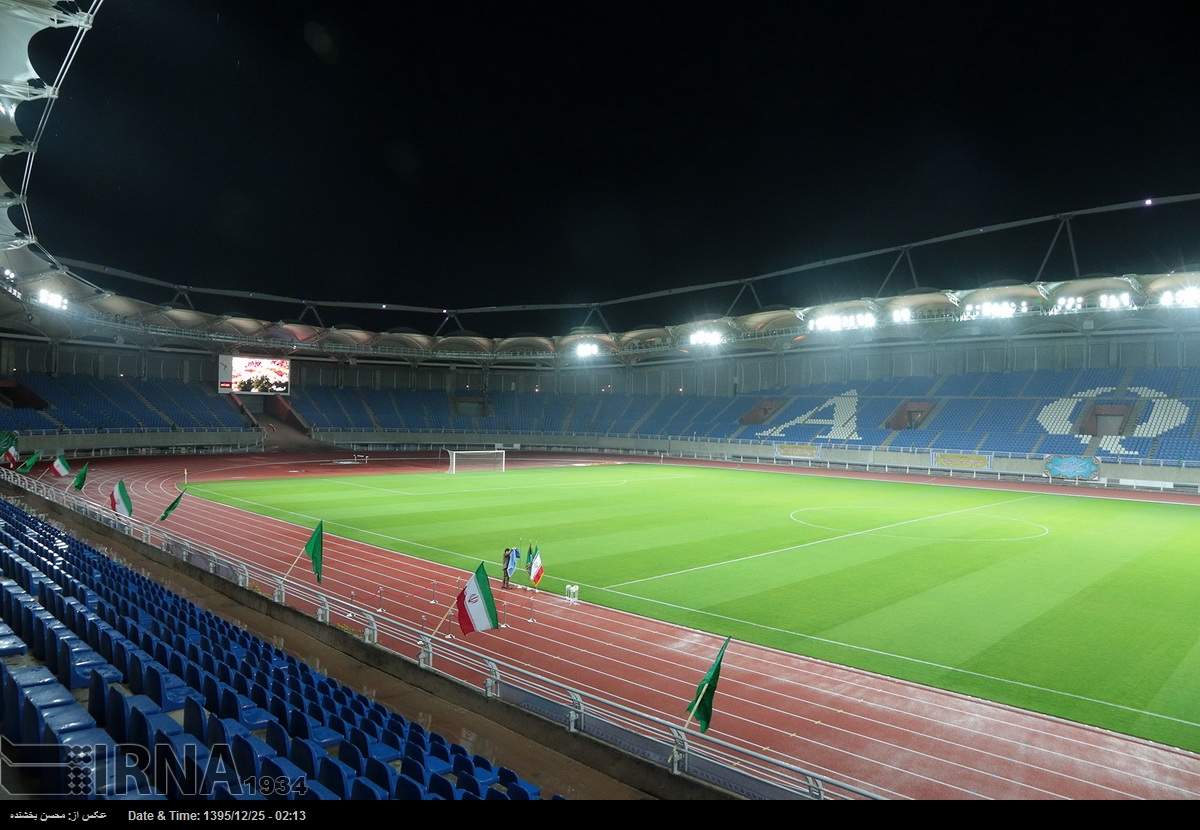
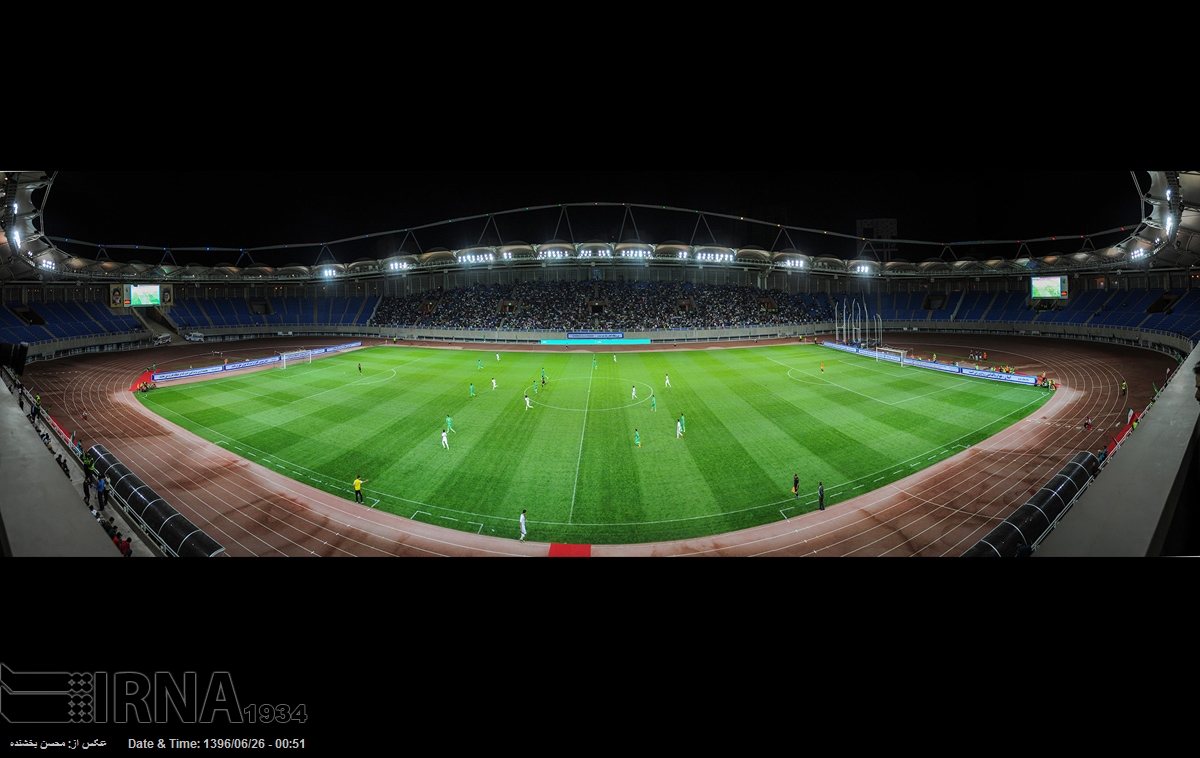
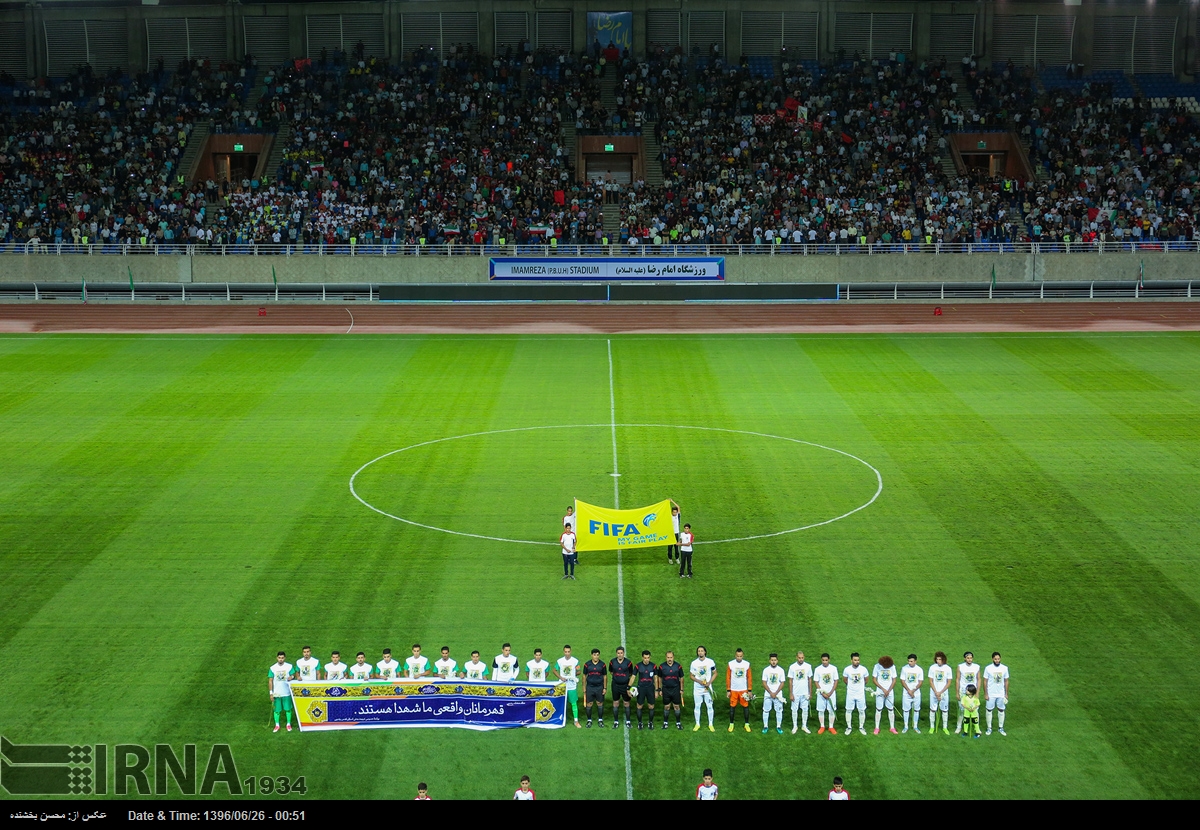
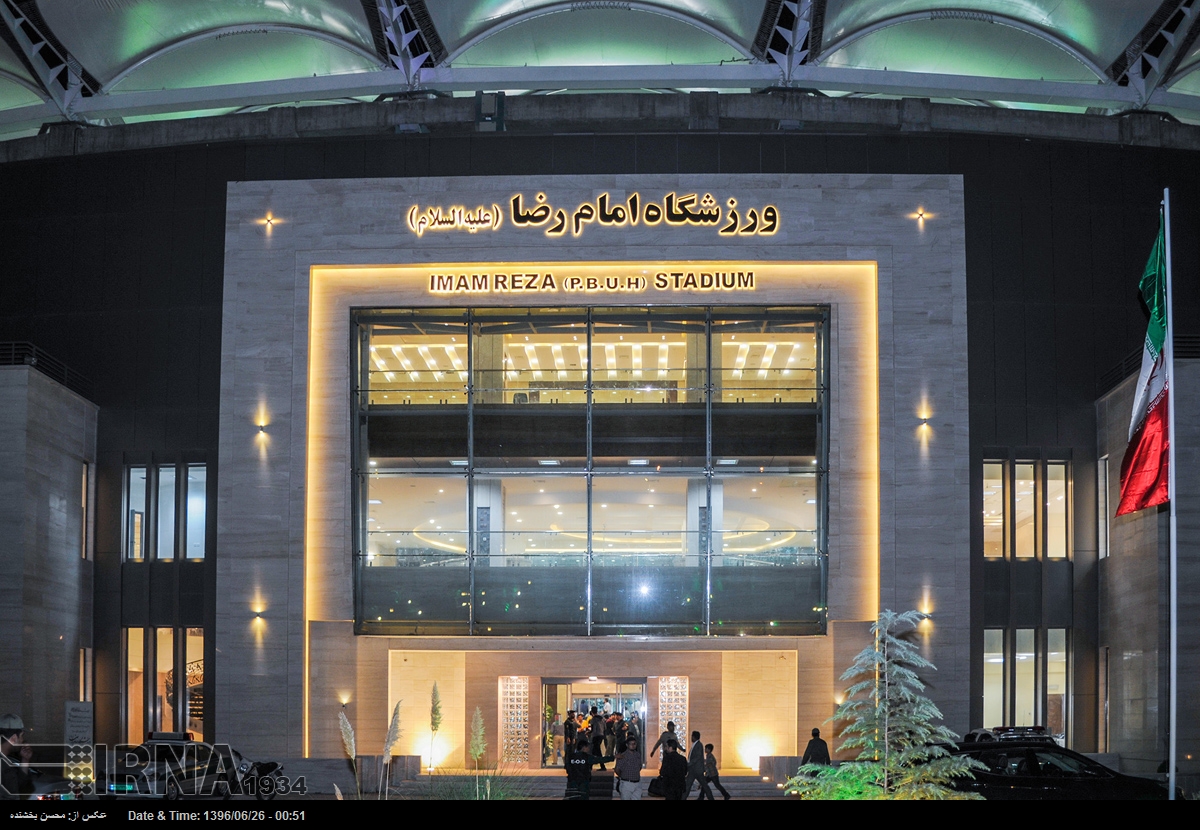
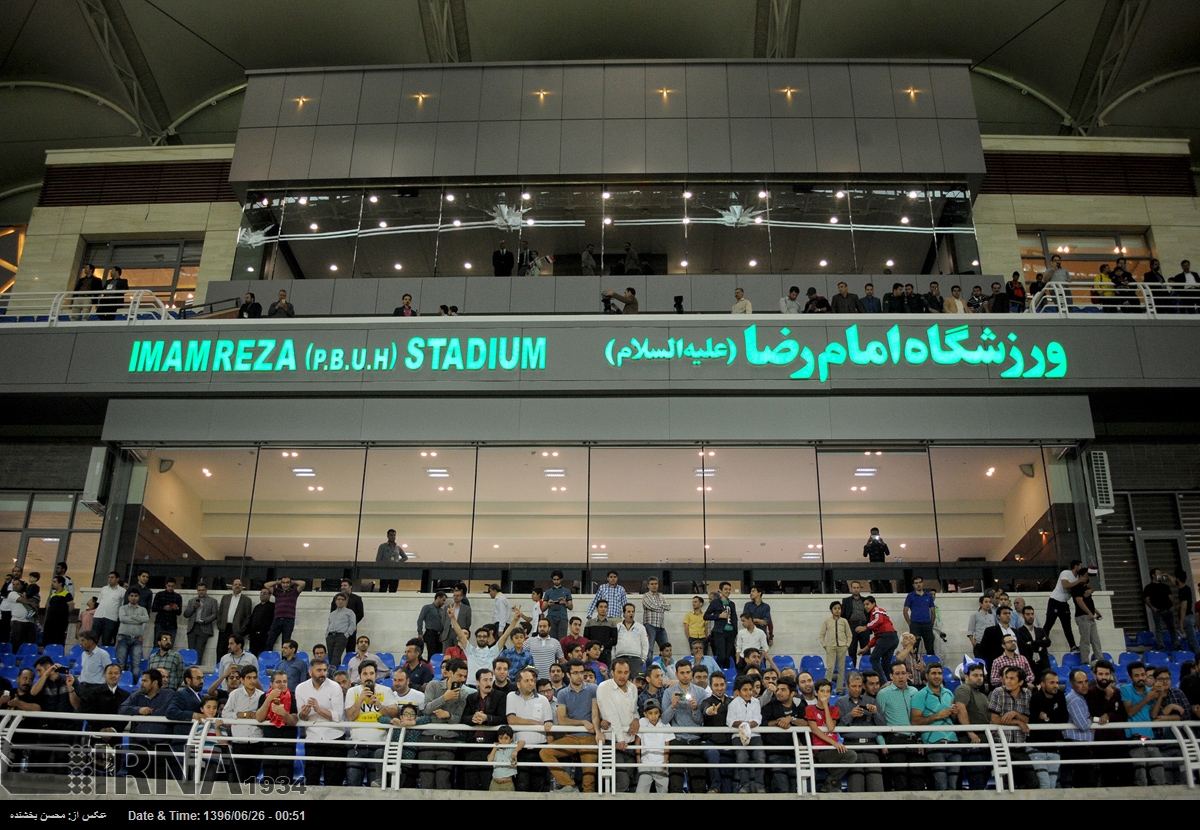
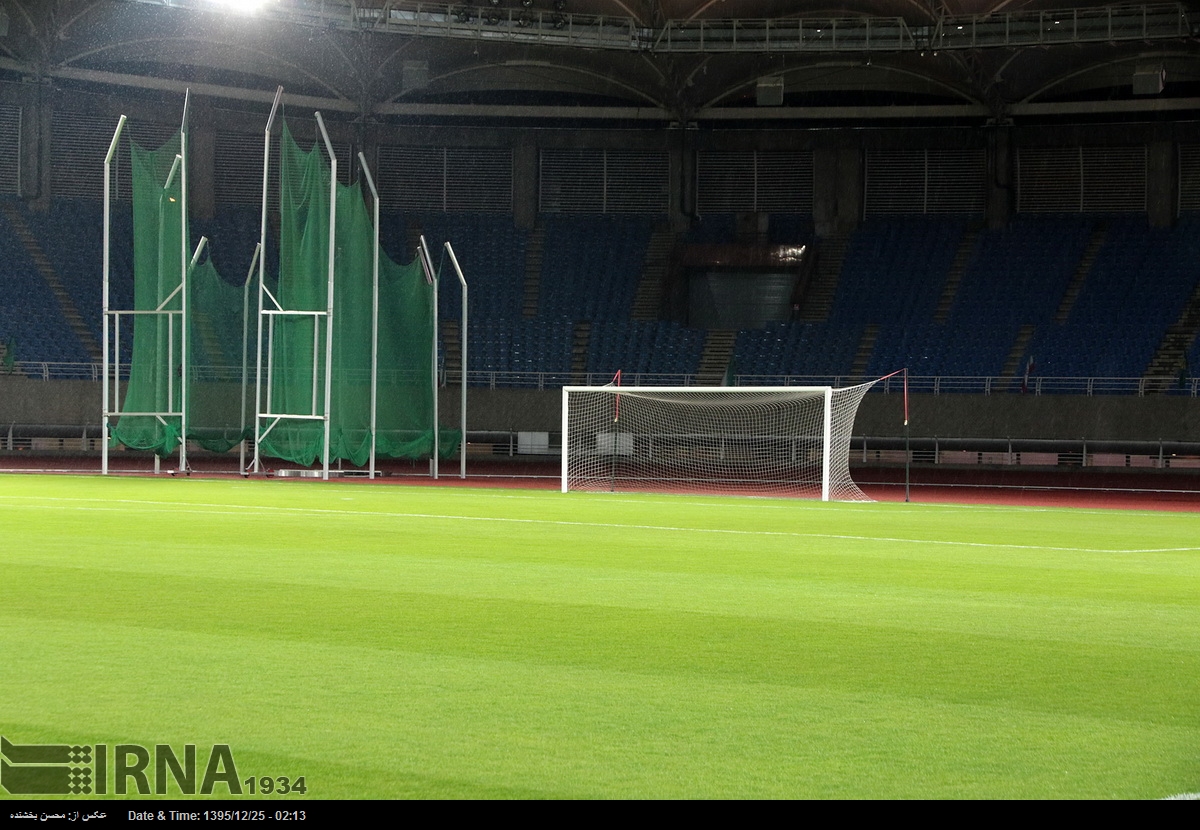
Modern ‘Emam Reza’ Stadium Officially Opened in Iran’s Mashhad

Modern ‘Emam Reza’ Stadium Officially Opened in Iran’s Mashhad13

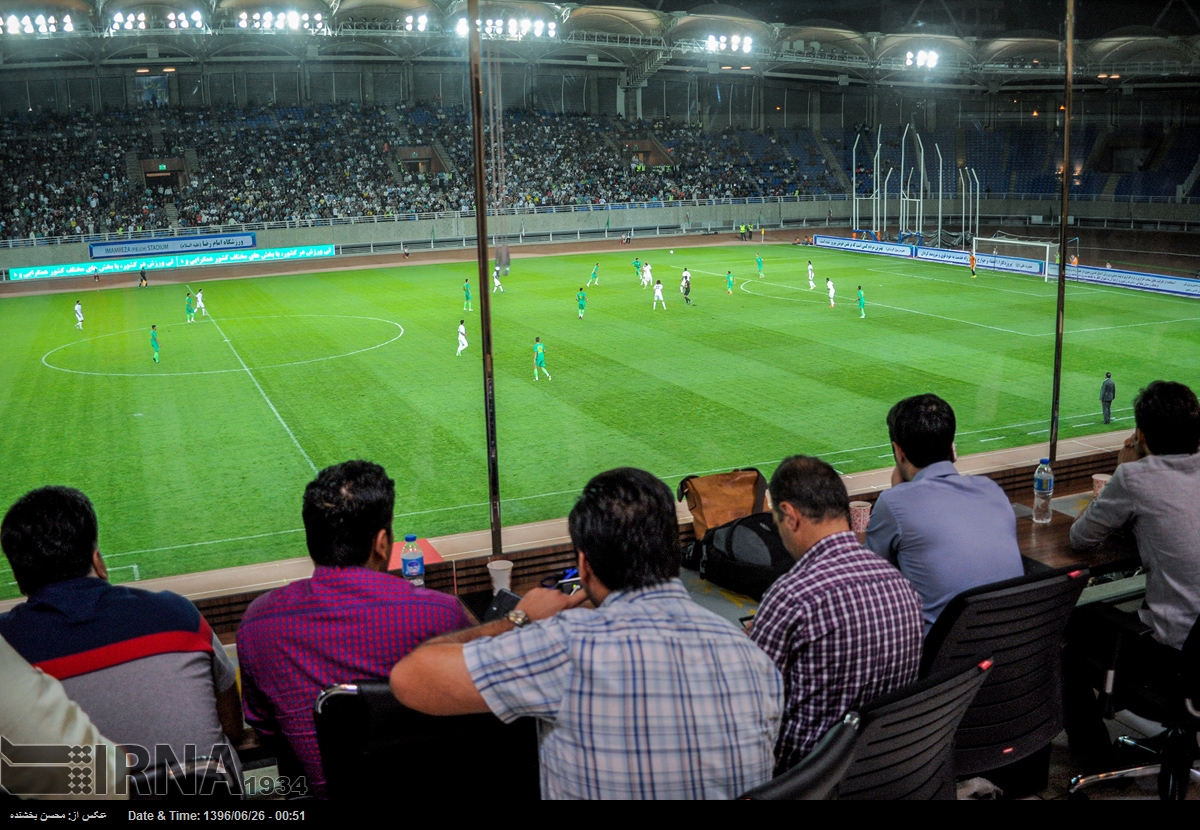
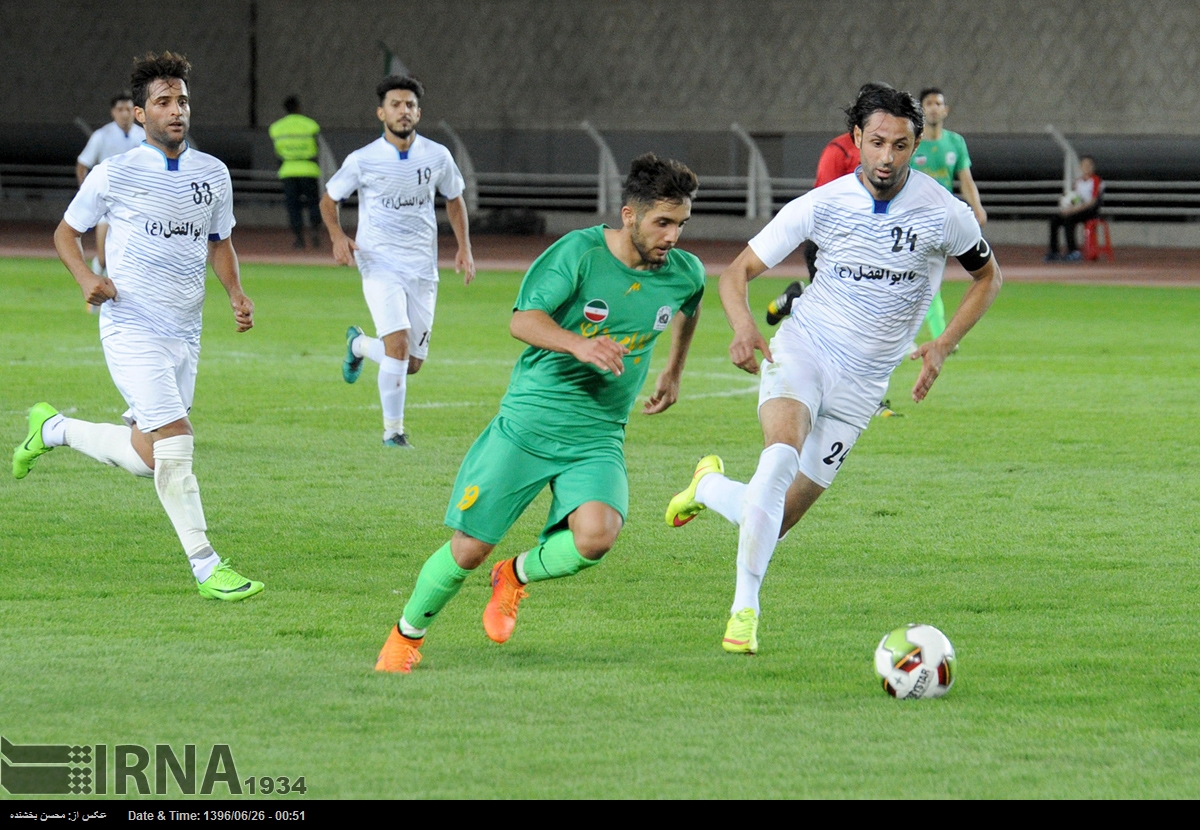
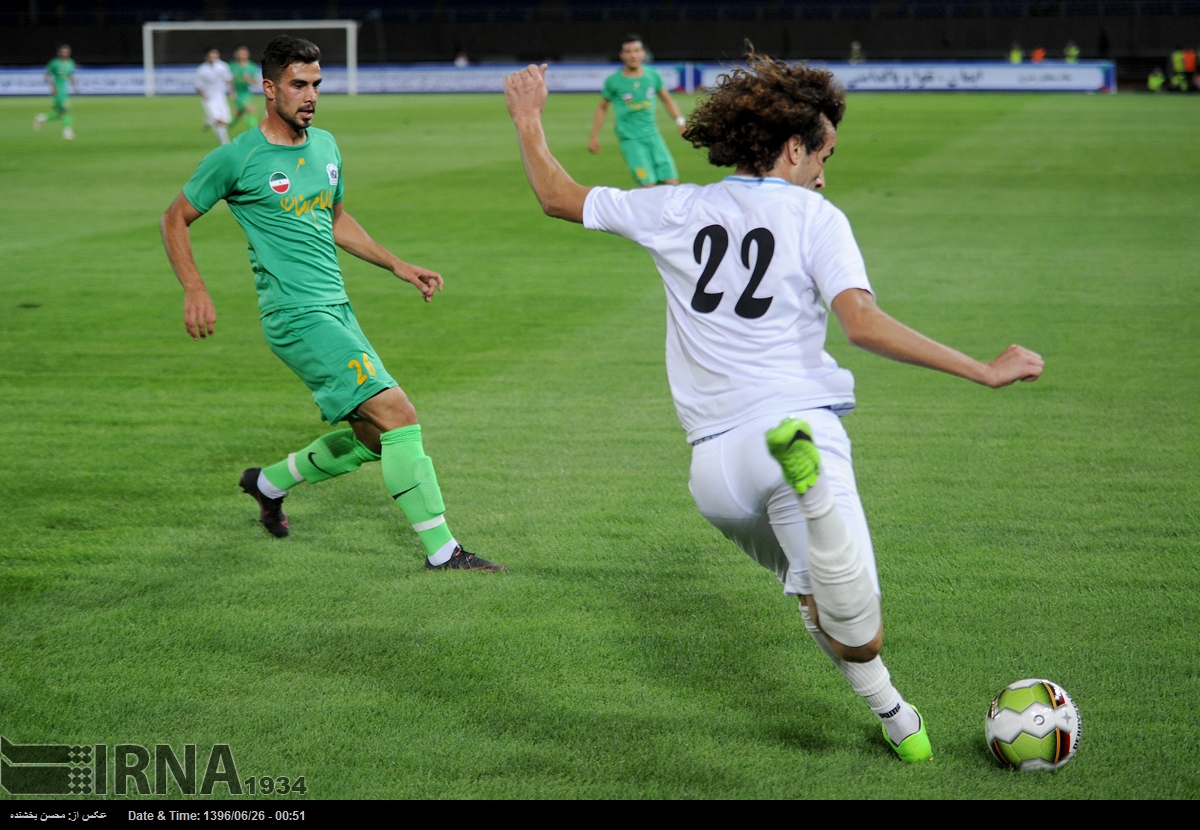
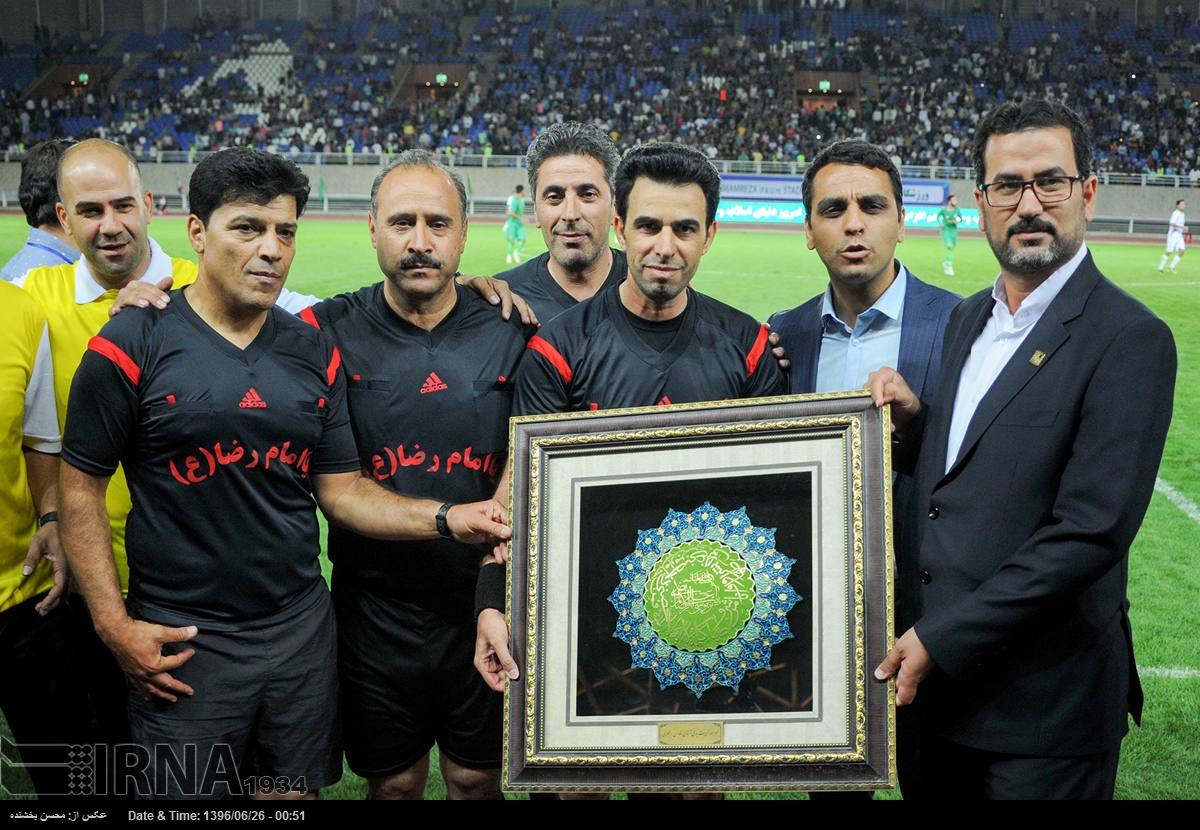
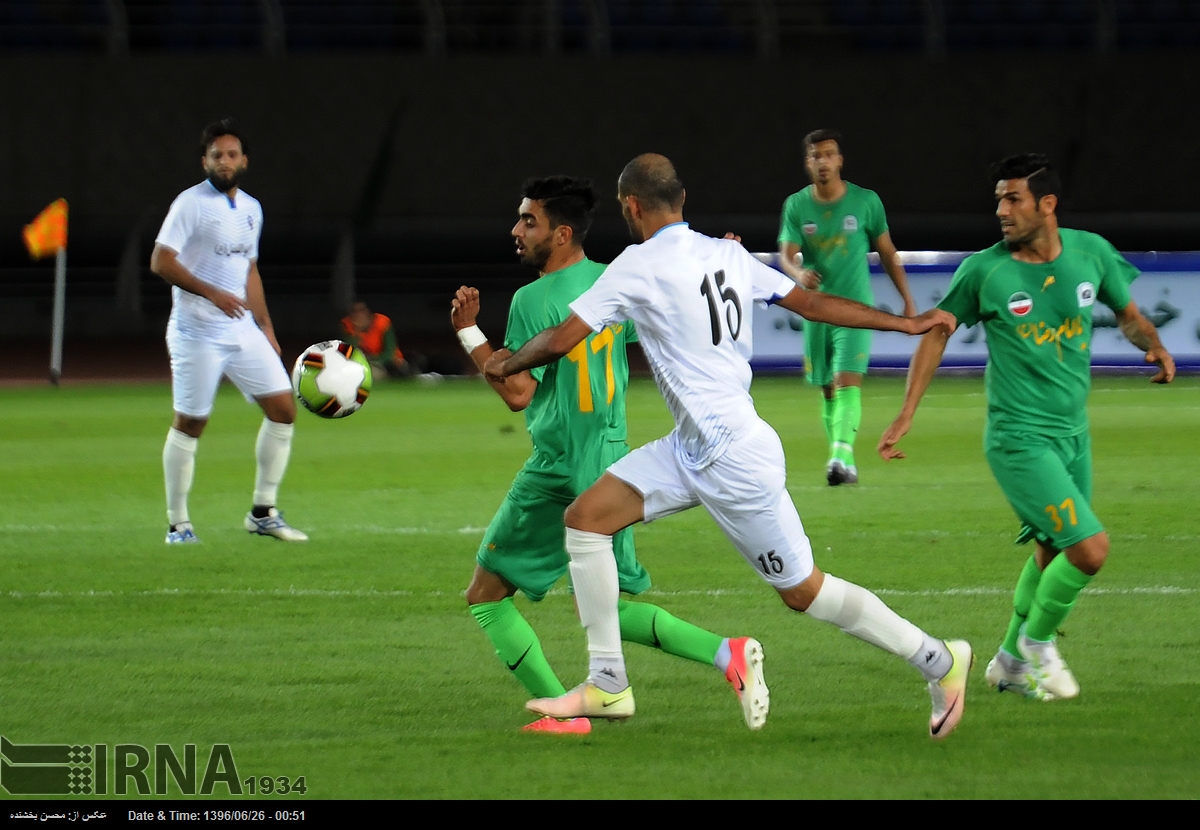
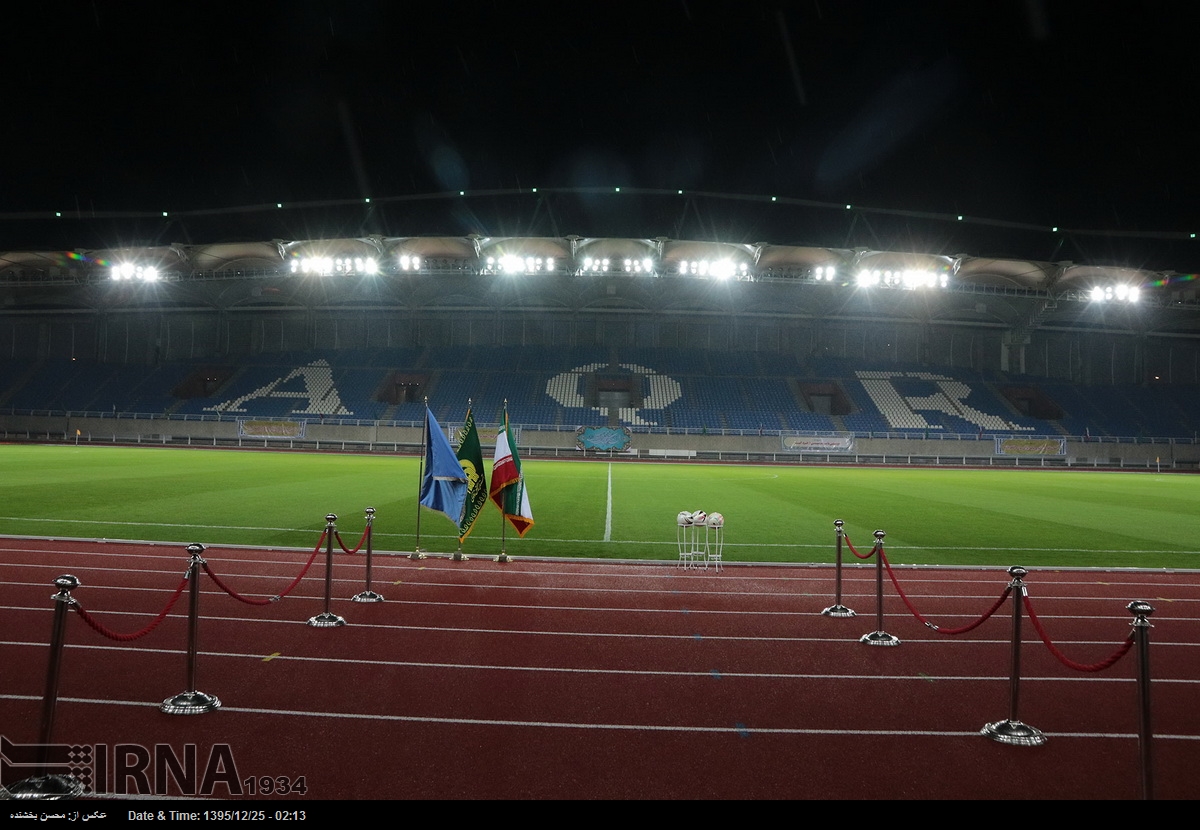
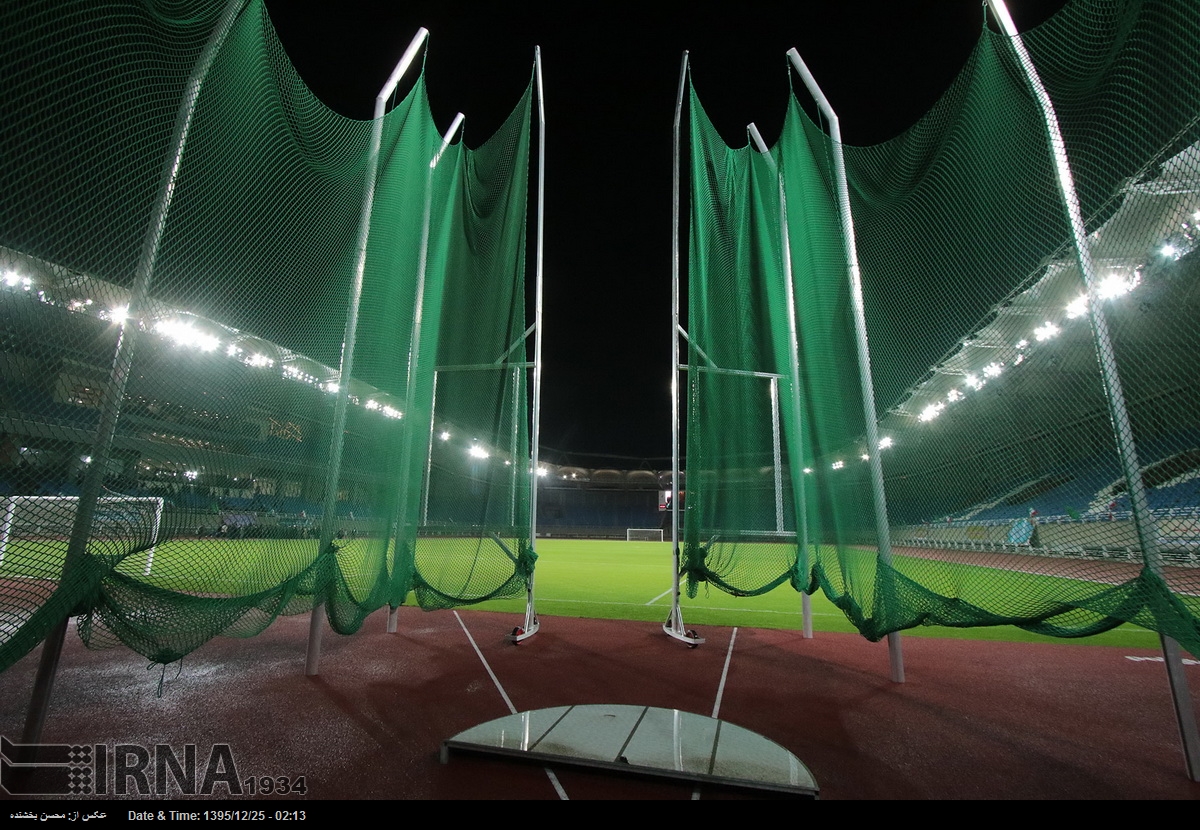
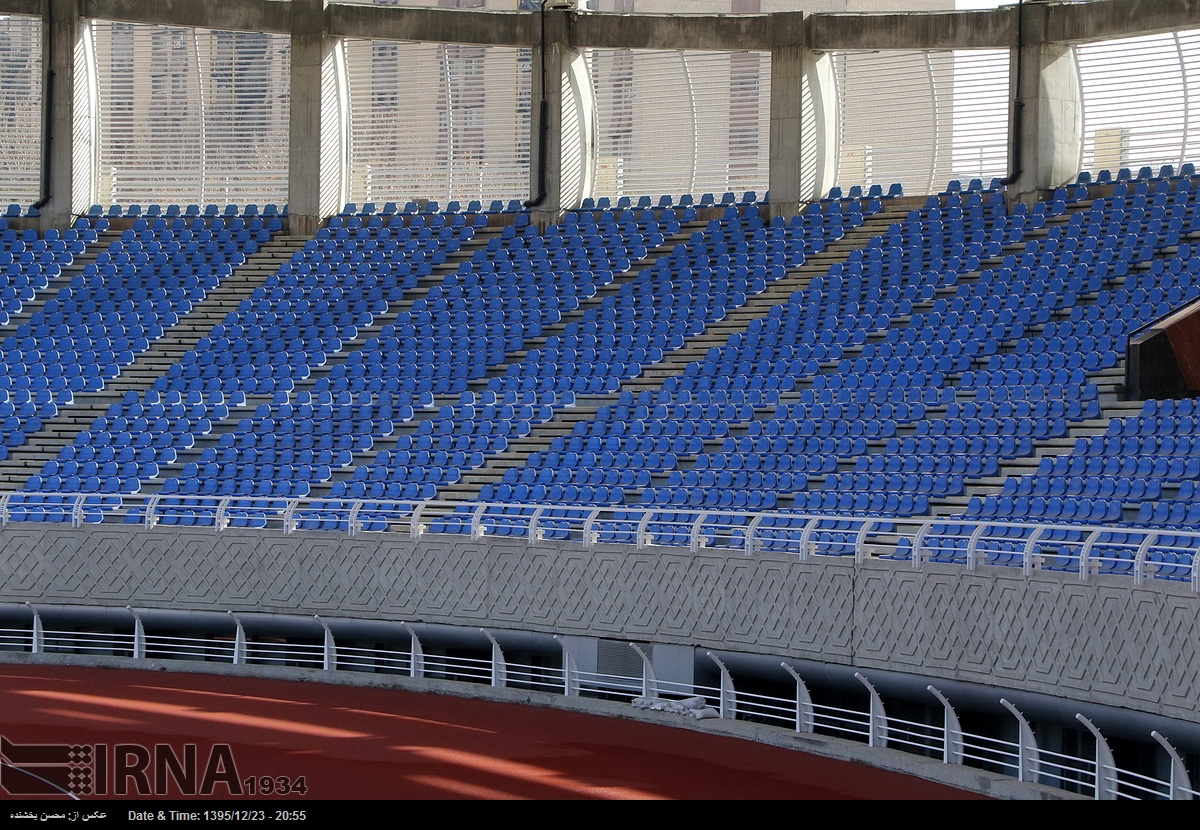
Emam Reza Stadium of Mashhad, the capital city of northeastern province Khorasan Razavi, was opened with a football match between Mashhad XI and Karbala XI, from the Iraqi city of Karbala.

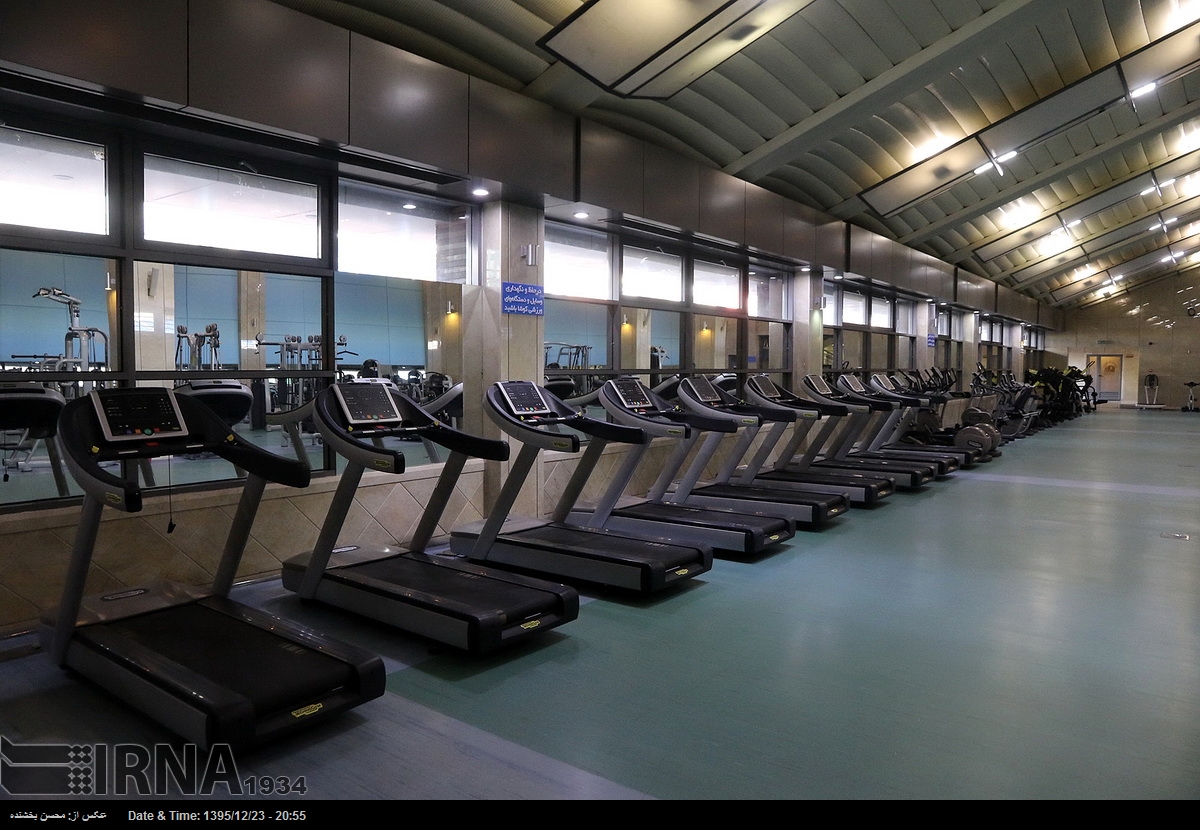
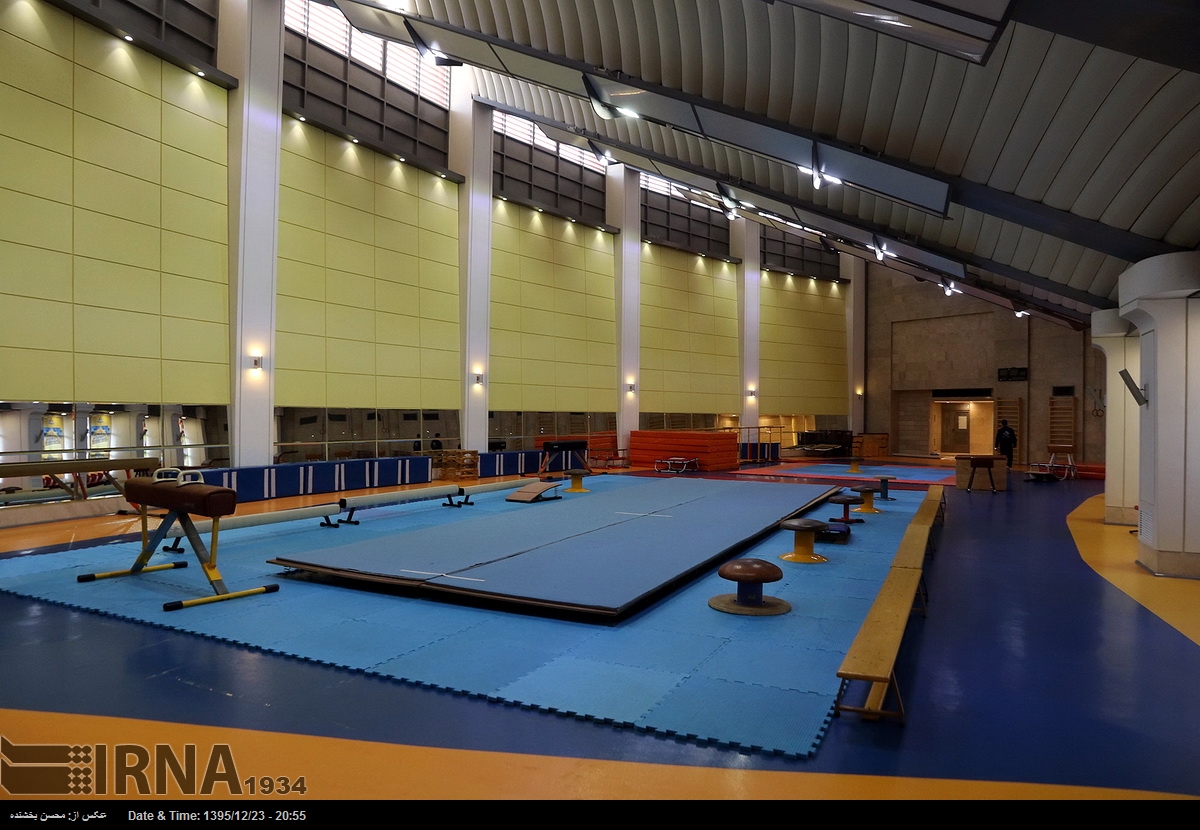
The all-seated football stadium is believed to be the most modern stadium of Iran so far. It has a seating capacity of 23,000 and is the sixth biggest stadium in Iran.

The stadium is in an area of Mashhad that belongs to the Astan Quds Razavi (AQR), a charitable foundation which manages the Imam Reza shrine.

The stadium, whose construction began on 5 March 2011, was designed by Iranian architect Masoud Ziaei.

The stadium’s roof is being built by a French company that has worked in London Olympic Stadium and some of 2014 FIFA World Cup venues. The stadium seats were supplied by Daplast, a Spanish company. The company is being contract with Real Madrid. The natural grass and tartan track along the side is in the hands of a German company. The company also has contracts with several large stadiums in Germany.

The stadium has a Grade A in Asia by the Asian Football Confederation (AFC). Previously, only the Azadi Stadium in Tehran has been grade A among stadiums in Iran.

A Look at Iranian Newspaper Front Pages on September 17

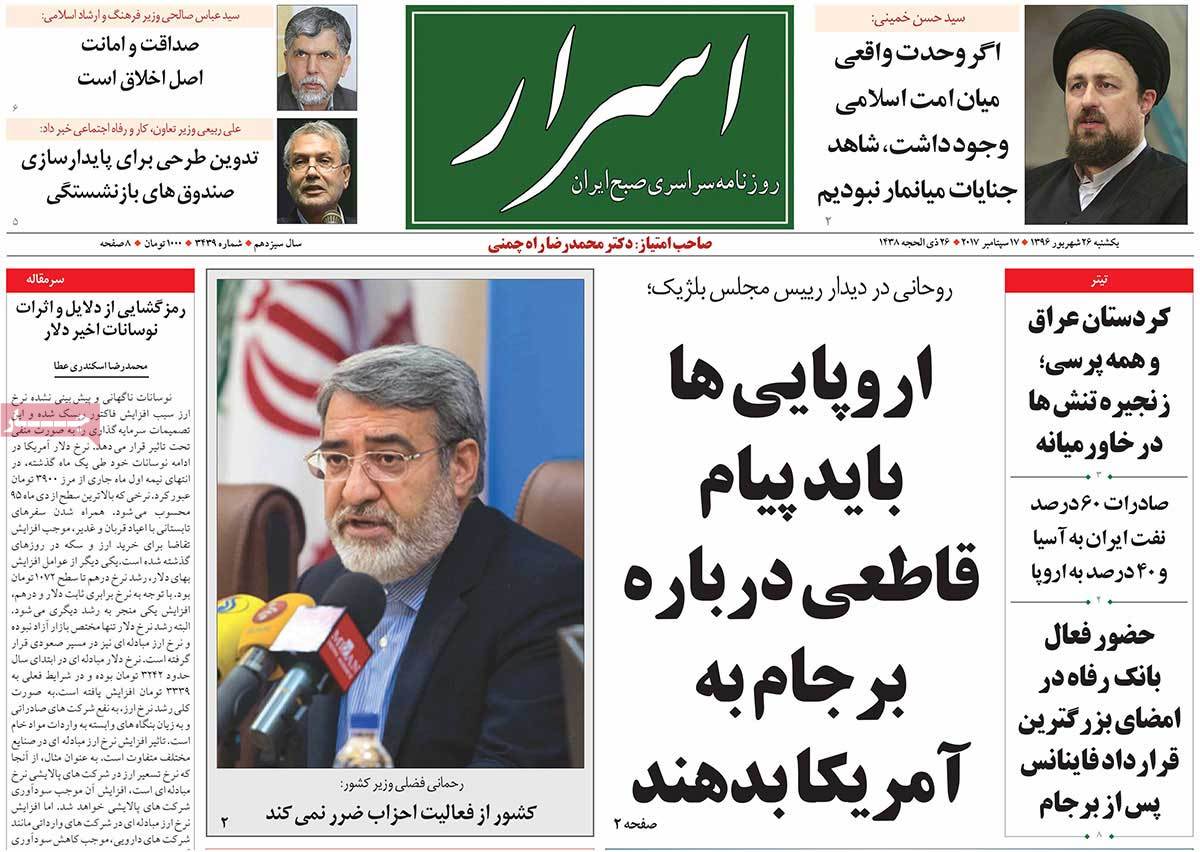
Almost all newspapers today covered the remarks made by President Hassan Rouhani about the US violation of the nuclear deal and the need for Europe to send Washington a strong message in this regard.

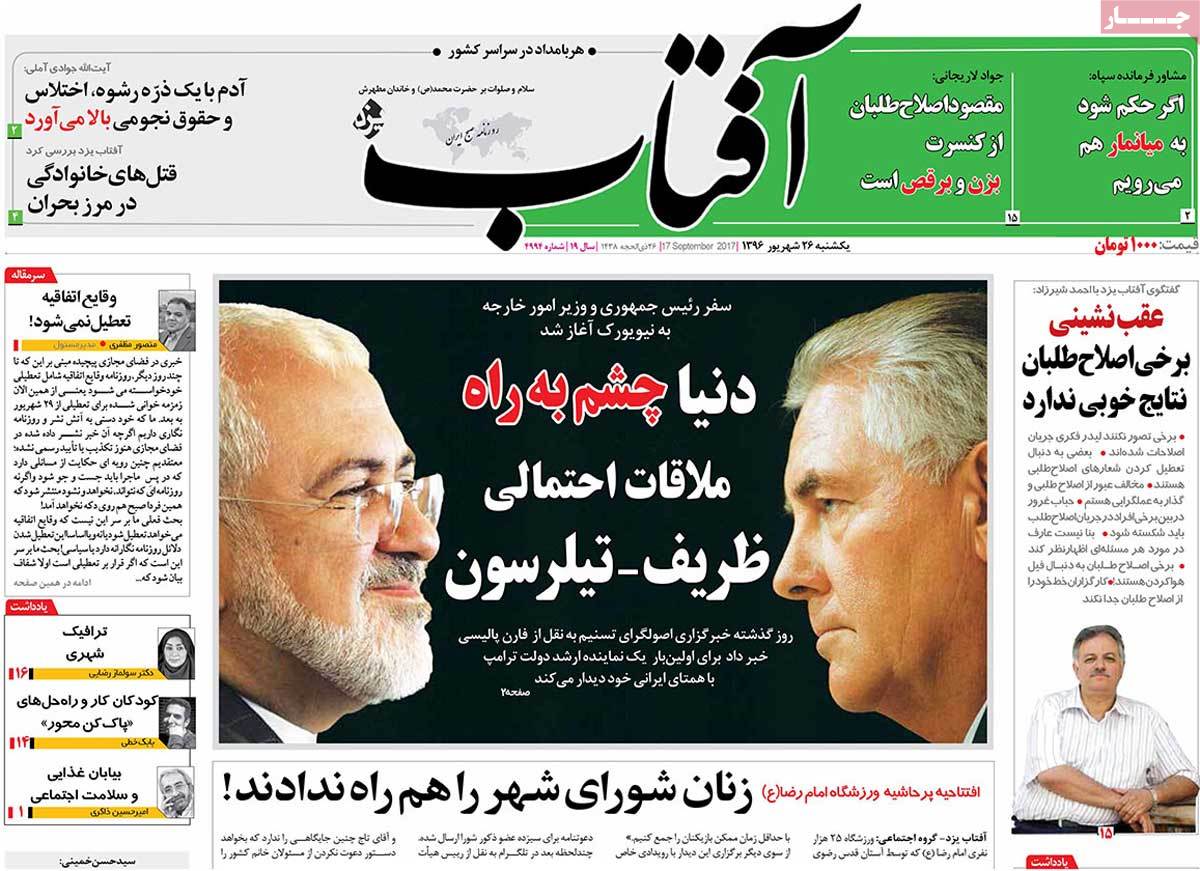
The beginning of a visit to the US by Rouhani and his foreign minister Mohammad Javad Zarif also received great coverage. Iranian media particularly wrote about a possible meeting between Zarif and his US counterpart Rex Tillerson in New York.

The remarks by Deputy Foreign Minister Seyyed Abbas Araqchi about the imminence of a war on water in the Middle East also received great coverage.

The above issues, as well as many more, are highlighted in the following headlines and top stories:

Abrar:

1- Interior Minister: Iran’s First Priority Now Is Not Security, but Economy

2- Haley: Iran Won’t Have Any Role in Syria after Asad

3- Erdogan: Iraqi Kurds’ Decision to Hold Referendum Very Wrong

A Look at Iranian Newspaper Front Pages on September 17


Aftab-e Yazd:

1- World Expecting Possible Bilateral Meeting between Iran’s Zarif, US’s Tillerson

2- Rouhani, FM Zarif Start Visit to New York

3- Foreign Policy: US Official to Hold Meeting with Iranian Counterpart for First Time

4- If Ordered, We’ll Even Go to Myanmar (for military intervention): IRGC Chief’s Aide
A Look at Iranian Newspaper Front Pages on September 17


Asrar:

1- Rouhani to Belgian Speaker: Europeans Should Give US Decisive Message on JCPOA

2- Imam Khomeini’s Grandson: We Wouldn’t See Myanmar Crimes If Muslims World Was United

3- Interior Minister: Iran Not to Be Harmed by Activity of Parties
A Look at Iranian Newspaper Front Pages on September 17


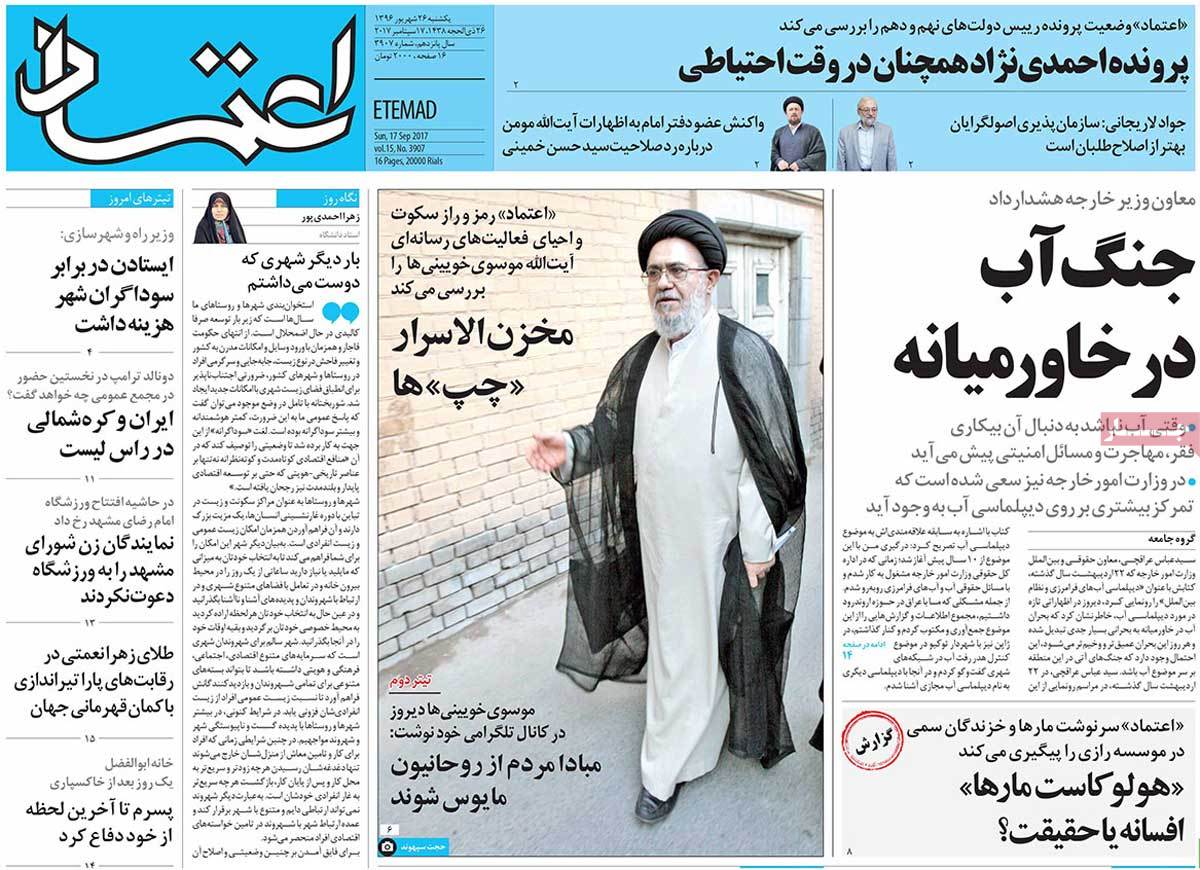
Etemad:

1- Iran’s Zahra Nemati Wins Gold Medal in World Para-Archery Championships

2- Iran Deputy FM Warns of War on Water in Middle East

  • When There’s No Water, There’ll Be Poverty, Immigration, Security Concerns
A Look at Iranian Newspaper Front Pages on September 17


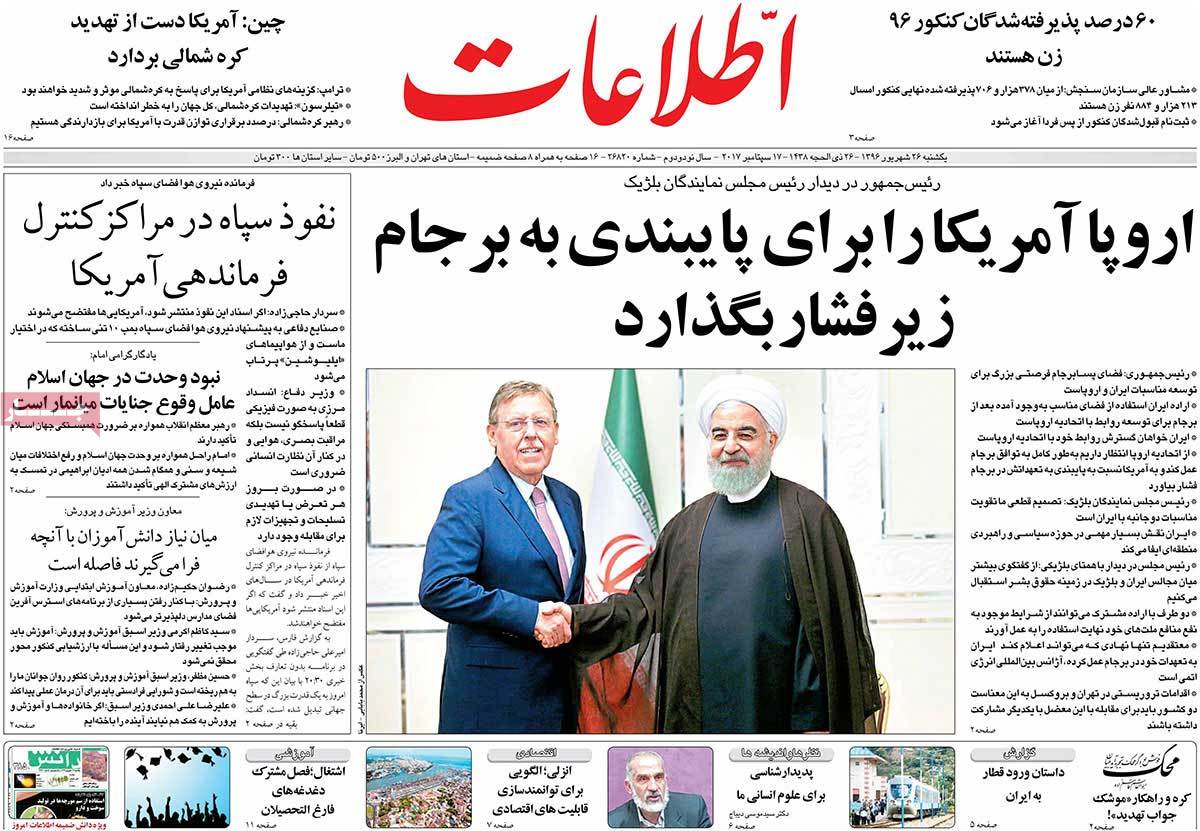
Ettela’at:

1- Rouhani: Europe Should Press US for JCPOA Commitment

2- 60% of Those Accepted in Iran’s National University Entrance Exams Are Women

3- China Urges US to Stop Threatening North Korea

4- Aerospace Commander: IRGC Has Infiltrated into US Command Centres
A Look at Iranian Newspaper Front Pages on September 17


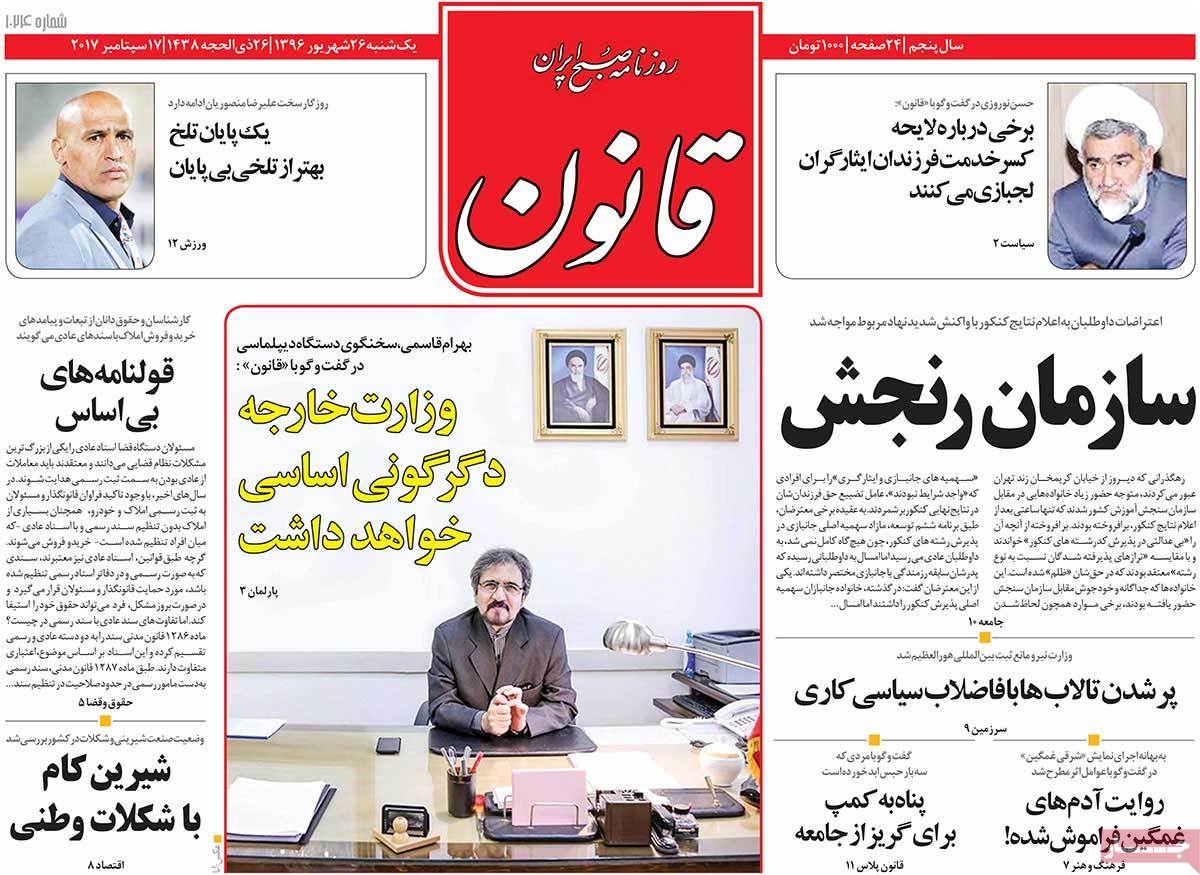
Ghanoon:

1- Spokesman: Foreign Ministry to Undergo Major Changes
A Look at Iranian Newspaper Front Pages on September 17


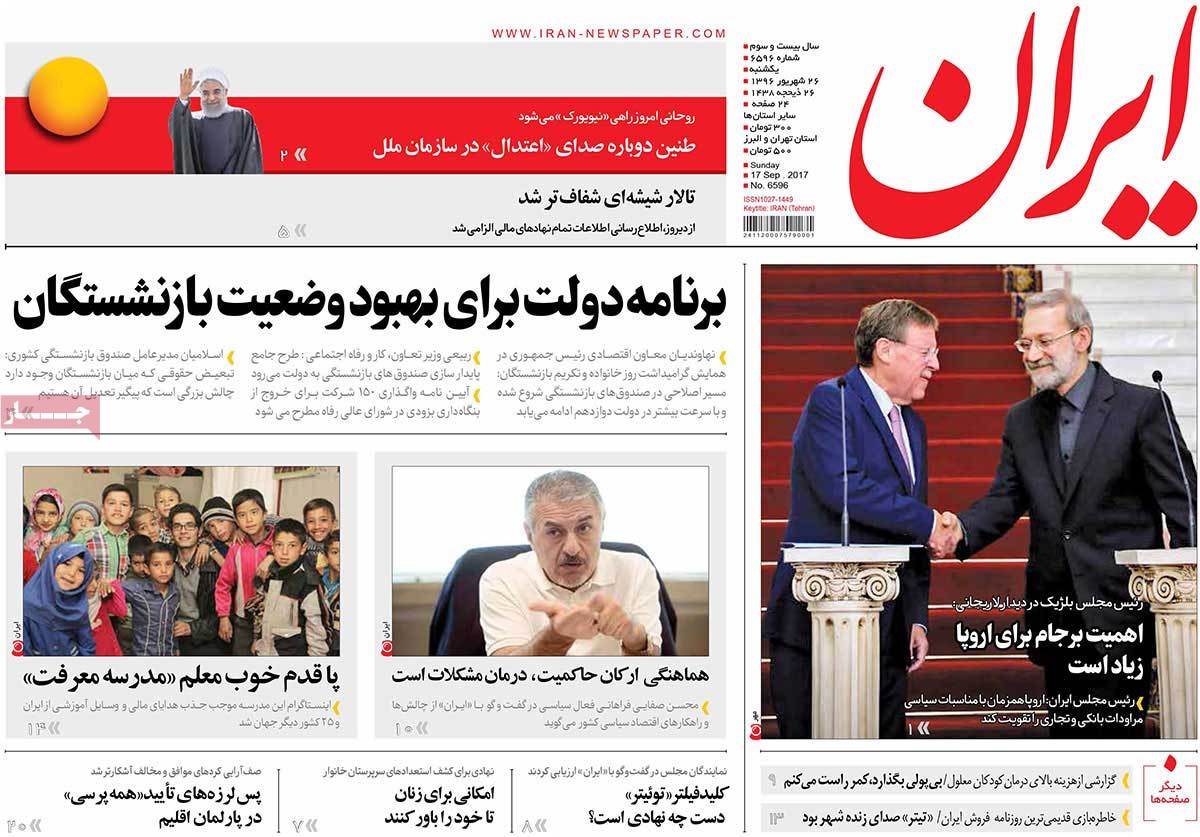
Iran:

1- Nuclear Deal Very Important to Europe: Belgian Parliament Speaker

2- Iran’s Larijani Urges Europe to Reinforce Banking, Trade Transactions besides Political Ties
A Look at Iranian Newspaper Front Pages on September 17


Javan:

1- Rouhani Shares JCPOA Concerns with Unknown European Official

  • While Rouhani held his nuclear talks with US, now he’s asking an unknown European to send US a strong message
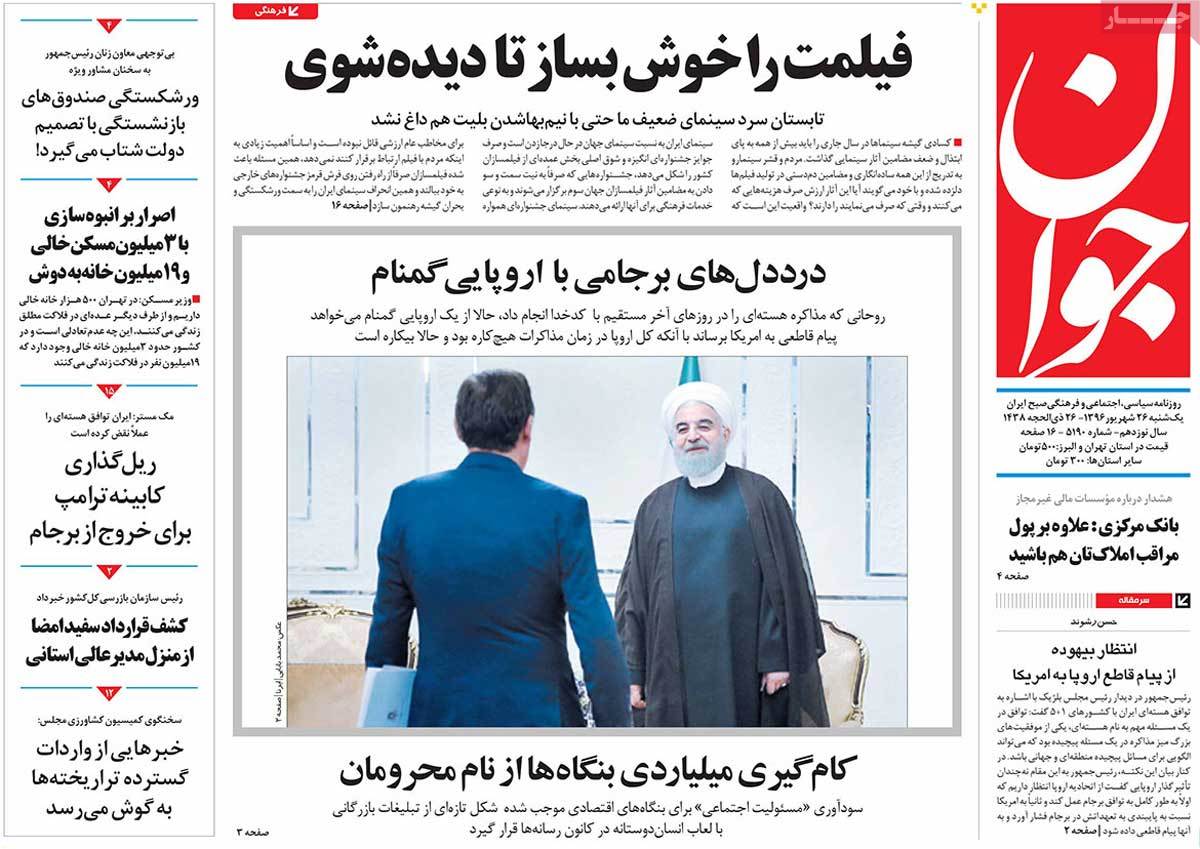
A Look at Iranian Newspaper Front Pages on September 17


Jomhouri Eslami:

1- Russia: Maintaining Iran Nuclear Deal Is Our Message to US

2- Iran, China Sign MoU on €15 Billion Line of Credit

3- Three Factories Used by ISIS for Making Tanks, Booby-Trapped Cars in Syria Destroyed
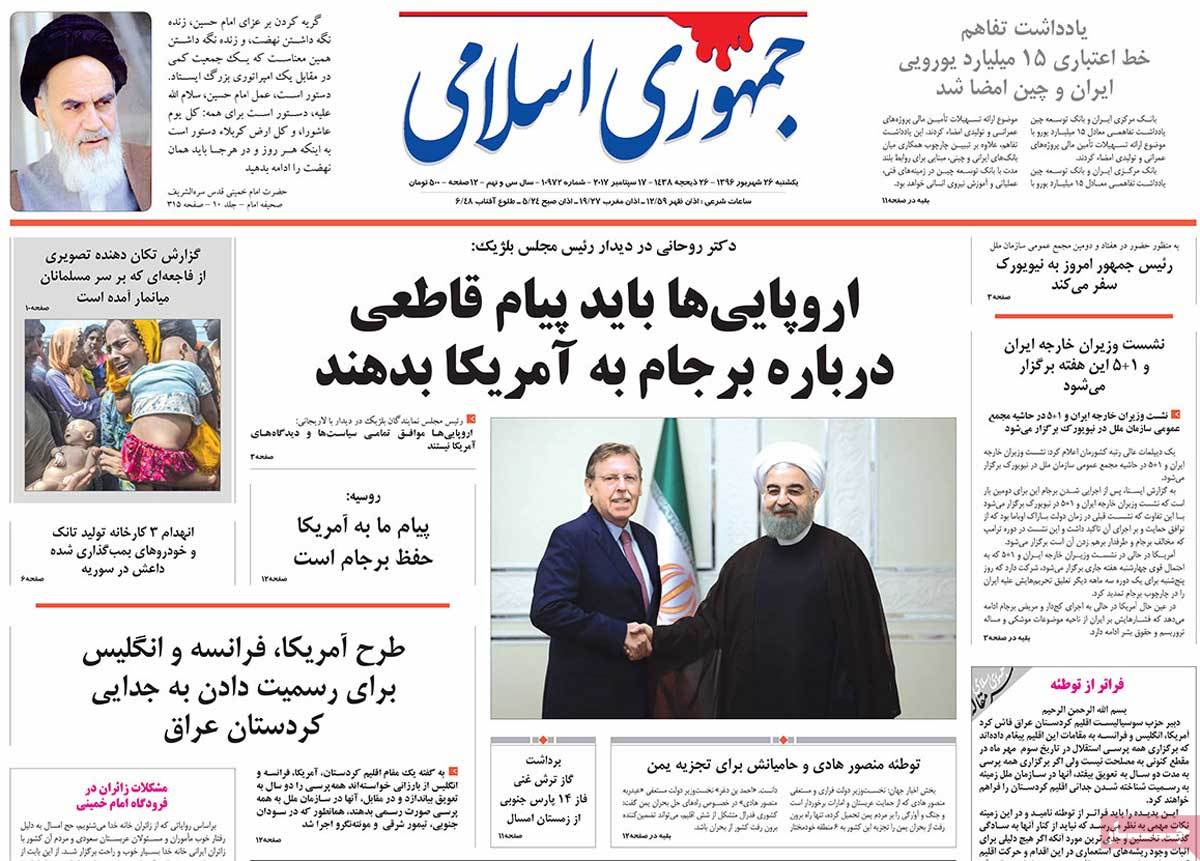
A Look at Iranian Newspaper Front Pages on September 17


Kayhan:

1- Violation of JCPOA Now in Plane Purchase. How Much Will Gov’t Tolerate?

2- St. Louis Rises against Racism: African-Americans Set Fire on US Flag
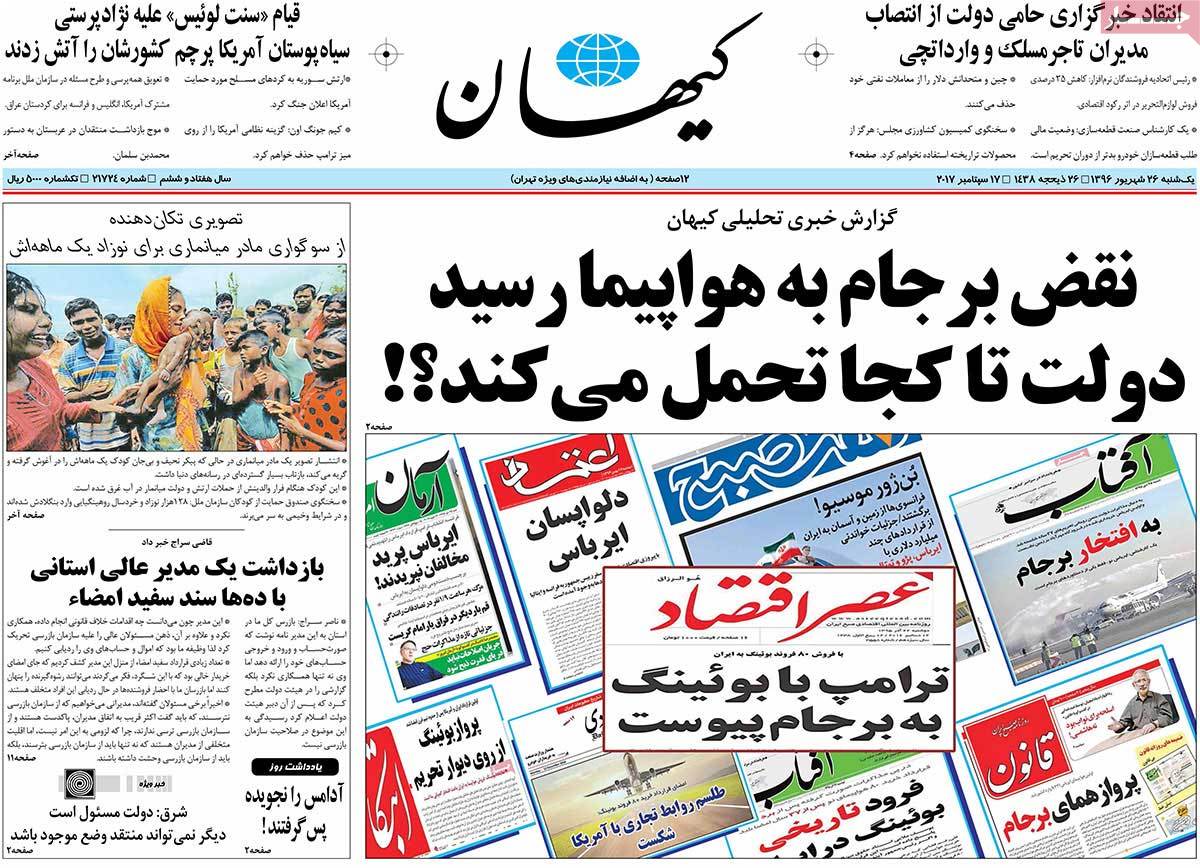
A Look at Iranian Newspaper Front Pages on September 17


Resalat:

1- Rouhani: US Violation of JCPOA Blow on an International Deal
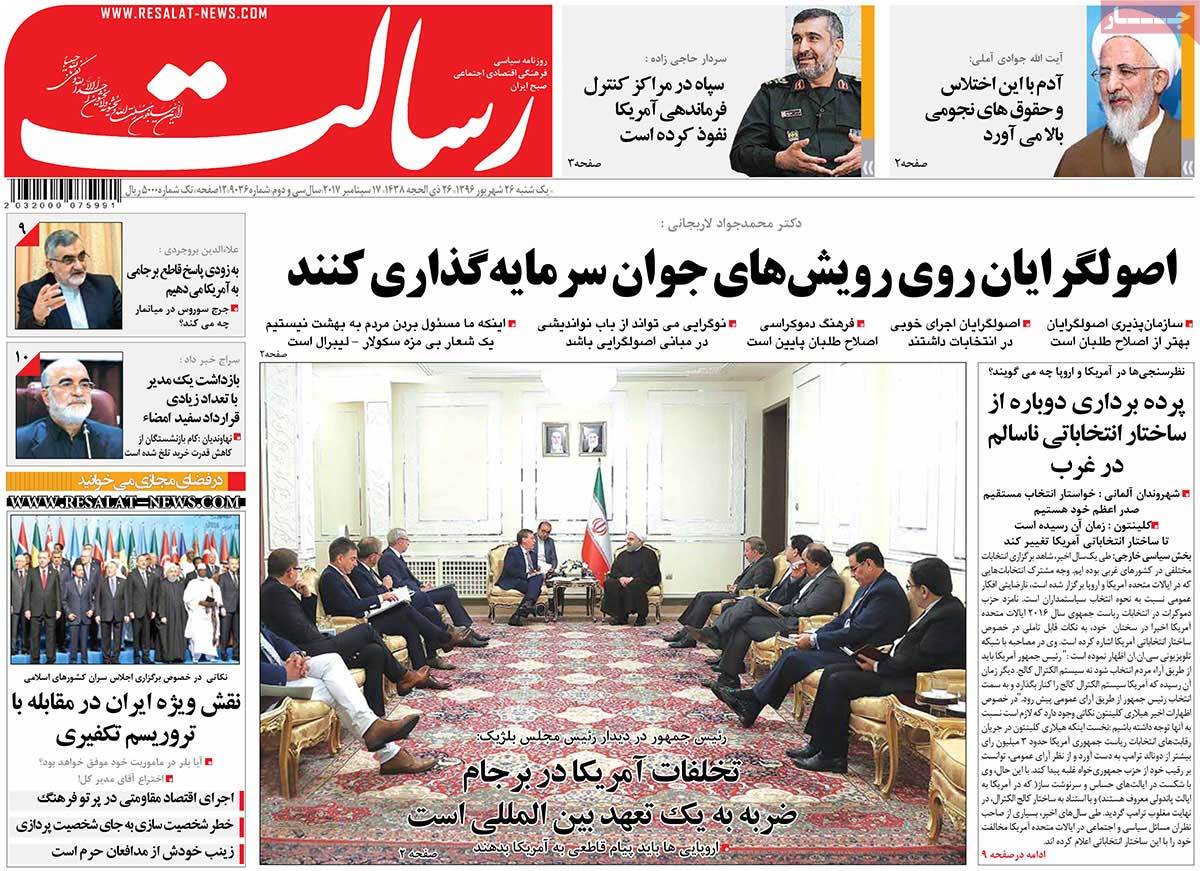
A Look at Iranian Newspaper Front Pages on September 17


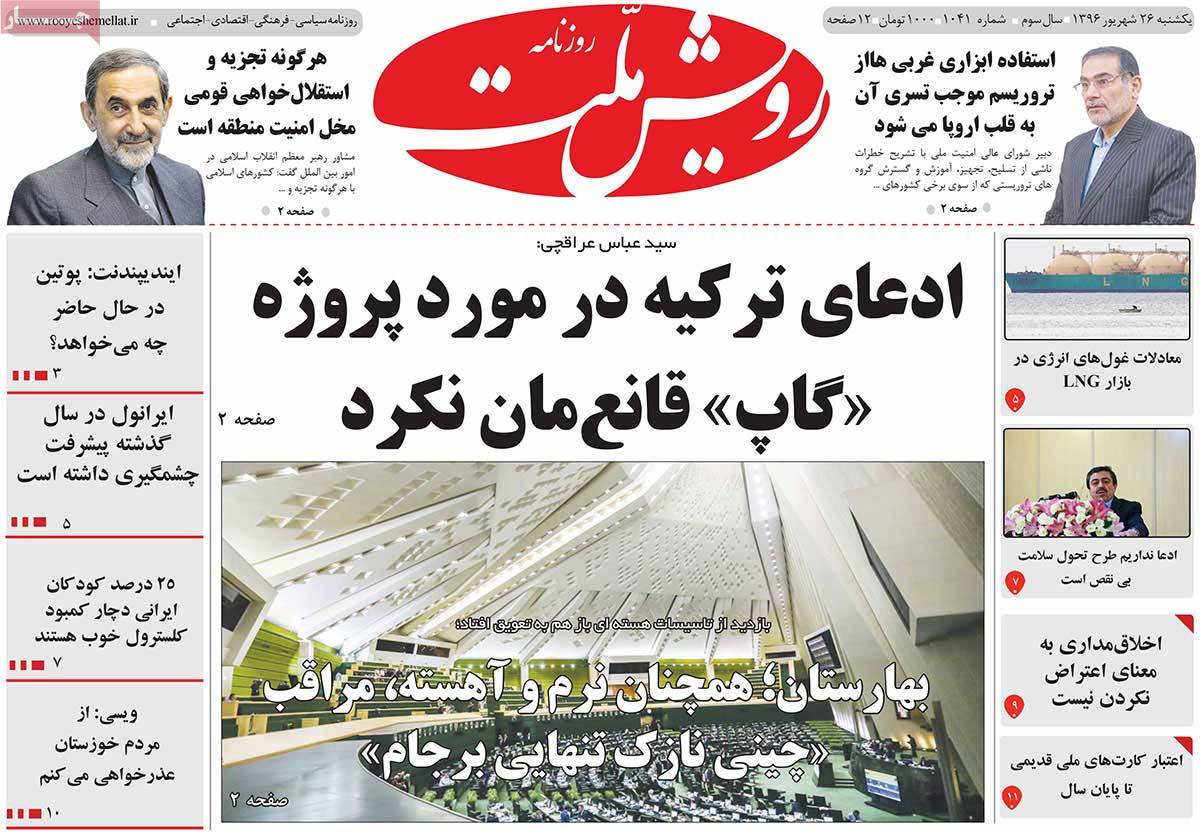
Rooyesh-e Mellat:

1- Shamkhani: West’s Instrumental Use of Terrorism to Spread It into Heart of Europe

2- Deputy FM: Turkey’s Claim about Their Water Project Not Convincing to Iran
A Look at Iranian Newspaper Front Pages on September 17


Why Syrian President’s Letter to Iran Leader Is Important
Why Syrian President’s Letter to Iran Leader Is Important

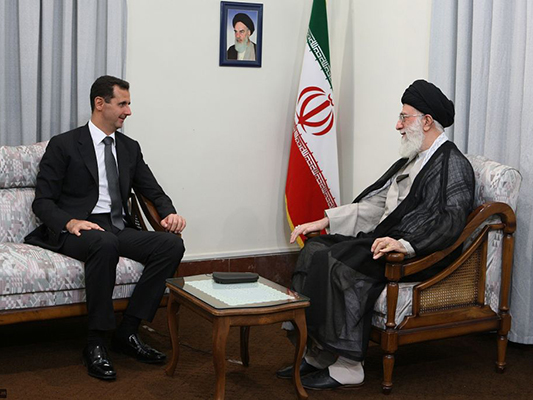
Former Iranian diplomat Hamid Reza Asefi, in a Farsi piece in the Jame Jam daily newspaper, has discussed the significance of Syrian President Bashar al-Assad’s recent letter of gratitude to Iran’s Leader Ayatollah Seyyed Ali Khamenei and the way Tehran helped Damascus almost win the civil war.

Excerpts of the article follow:

Assad’s letter to Ayatollah Khamenei is an example of regional crisis management led by the Leader of the Islamic Revolution of Iran and is a very important letter containing significant points that will be remembered in the history of Iran-Syria relations.

To find out the significance of what Assad has announced, one must get back to seven years ago when in December 2010 the self-immolation of a young Tunisian vendor led to the overthrow of Ben Ali’s 24-year rule and his escape along with his family to Saudi Arabia, which in a short while was followed by the overthrow of the Egyptian and Libyan governments.

The United States and its Arab allies who were shocked by these developments, which later was called the Arab Spring (or Islamic Awakening), sought to manage the crisis and spill it over to Syria that was on the frontline of resistance against the Zionist regime. They also wanted to thwart the most revolutionary Arab state and create a protective shield for some regional countries, especially Saudi Arabia.

Accordingly, dozens of terrorist groups were created to be dispatched to Syria with the support and management of the United States and the financing of the Saudis. Thus, such terrorist groups as ISIS, al-Nusra Front, etc., helped by US-led Western-backed countries and Saudi Arabia, waged a proxy war. In this way, a crisis which lasted for about seven years was created. The leaders of this conspiracy would prefer the removal of Bashar al-Assad from power and a power transfer without providing any logical reasoning or better option.

The conditions of the region and the immense support for the opposition groups were so widespread and unprecedented that no optimistic analyst could predict the victory of Assad in this unequal battle.

Although Iran from the very beginning believed in a spiritual support for Bashar al-Assad due to the legitimacy of his government, it did not see any reasons for entering the war because it believed that Assad could overcome his opponents with his popular base.

But the interference and the proxy war of regional and trans-regional powers prompted the Leader of Iran’s Islamic Revolution to defend and support Iran’s long-standing ally and friend who was unjustly suppressed.

Iran’s support, next to its advisory presence in Syria, led to the creation of a powerful political bloc that included Russia, and could practically neutralise US plot in the UN Security Council.

Iran’s field support besides the presence of volunteer forces, who could target the weak points of the terrorists, helped Bashar al-Assad gain the upper hand in fight against his opponents. Meanwhile, the terrorist groups, in spite of committing inhumane crimes approved by the US, left the battlefield to the government forces day after another.

While at the initial and secondary meetings of Geneva, the global arrogance was humiliating the administration of Assad, the prudence of the Leader of the Islamic Revolution and the confidence given not only to the government of Syria, but also to the army and the Syrian fighters through Iran’s Islamic Revolution Guards Corps (IRGC) and popular forces brought a new victory for the Syrian government every day.

Now that the 6th round of Astana Talks on Syria has been held, there is no word of the future Syrian government, but instead they all emphasise the political unity of Syria and call the fight against terrorism as their first priority.

American politicians have confessed in recent days that they are no longer capable of removing Bashar al-Assad, admitting that talking about Assad’s removal is nonsense, and as one of them said, they have lost the war to Ayatollah Khamenei.

The prudence of Ayatollah Khamenei not only preserved the rule of Bashar al-Assad and stopped the expansion of terrorism, but also was turned into a powerful backing for the Iran’s diplomacy.

Future Wars in Mideast Probably on Water: Iranian Diplomat

Water Crisis

Deputy Foreign Minister for Legal and International Affairs Seyyed Abbas Araqchi says the issue of water, water resources, coping with water scarcity, as well as the use of common water areas have always been top on the agenda of Iran’s foreign ministry.

“In the past few decades, water has become a global concern and in line with it, Water Diplomacy and a science called Water Policy or Hydropolitics have come into existence, and they are currently being taught in some of the world’s leading universities,” Araqchi stressed in a Farsi interview with ISNA on water diplomacy.

“In recent years, water and its scarcity has turned into a sensitive and serious issue in our country, and has even become a security concern.”

“Considering the importance of this issue, the foreign ministry has tried to focus more on water diplomacy. In this context and in the light of the legal and international dimensions of water diplomacy, the matter has been given more attention in the Legal and International Affairs Department of the Foreign Ministry,” the Iranian diplomat added.

In response to a question on the lack of freshwater in the Middle East, he said it is possible to see a water conflict in the region in the near future.

“Water war is not a new issue; it has always existed and has been considered for years as a serious threat in the Middle East. It is likely that future wars in the region would be over water, but history has many lessons for us. According to historical experiences, the grounds for a war on the issue of water can lead to cooperation in this regard, and for the same reason, water has become very important in foreign policy.”

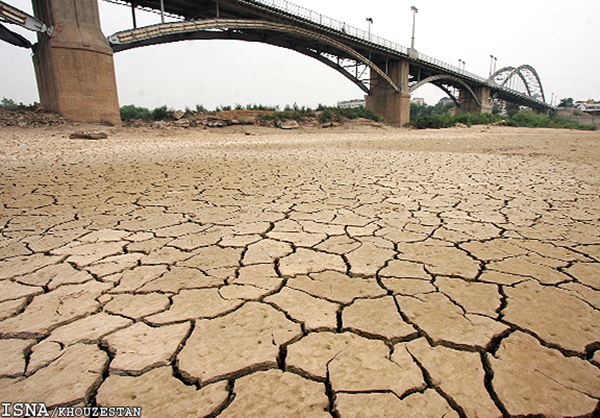
“International assessments show that by 2025, the entire Middle East region will be officially recognized as a dry area, and Iran will not be an exception. This situation will become much worse by 2050, and water scarcity next to drought will become a very serious issue for Middle Eastern countries, including Iran,” he said.

Araqchi also underlined that even some parts of Iran may be completely or largely abandoned because of this issue.

This official added that there are two solutions regarding this global crisis. “The first step is to provide water supplies from abroad, and the second is the management of water resources inside the country.”

Araqchi said that in both ways, foreign policy plays an important role.

In response to a question on how it is possible to provide water from abroad, he said such ideas exist in Iran as well, but how physically these ideas can be operational is another issue.

“At the moment, there are a number of countries that suffer from water scarcity, and they are transferring water into their land from water-rich countries through digging special water channels,” he pointed out.

Iranian Delegation Visits Rohingya Refugee Camp in Bangladesh

The team also met with a group of residents of these camps and got aware of their latest situation.

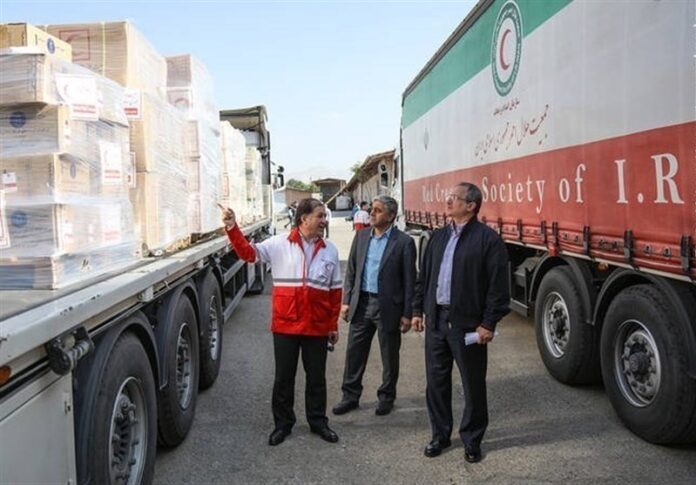
Moreover, the distribution of Iran’s humanitarian aid for the Myanmarese refugees, which had been handed over to Bangladeshi authorities yesterday, began in the presence of the Iranian delegation.

The Rohingya, described as “the world’s most persecuted minority,” have been denied citizenship in Myanmar, which has effectively rendered them stateless.

The United Nations says nearly 400,000 Rohingya Muslims have fled to neighbouring Bangladesh since August 25 due to a fresh wave of violence and persecution.

Iran President Calls on Europe to Press US for Nuclear Deal Commitment

Iran President Calls on Europe to Press US for Nuclear Deal Commitment

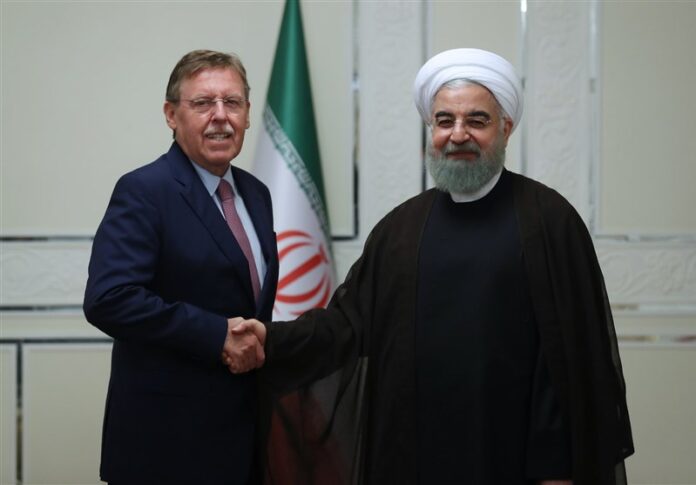
“We expect the European Union, firstly, to carry out the JCPOA deal completely, and secondly, to press the US to honor its commitments under the JCPOA,” President Rouhani said on Saturday, stressing that Washington should be given a decisive message.

He made the comments in a meeting with President of the Belgian Chamber of Representatives Siegfried Bracke, here in Tehran.

According to the International Atomic Energy Agency reports, Iran has fully honored its commitments under the JCPOA, the nuclear accord between Tehran and the Group 5+1 (Russia, China, the US, Britain, France and Germany), the president added, stressing that all of the other parties to the deal should also fulfill their undertakings.

He also referred to the IAEA as the only entity that is authorized to verify Iran’s compliance with the nuclear agreement, in an apparent reaction to the US president who has repeatedly accused Iran of violating the spirit of the JCPOA.

Elsewhere in his comments, President Rouhani voiced his administration’s resolve to broaden ties with the EU, hoping that friendly countries, including Belgium, would participate more actively in the economic and trade interaction with Iran.

Bracke, for his part, said Belgium is determined to expand relations with Iran.

Highlighting the significance that Belgium and the EU attach to the JCPOA, the Belgian official said the European Union would do its utmost to fulfil the JCPOA undertakings.

Iran and the six powers reached a conclusion over the text of the nuclear deal in July 2015 and implemented it in January 2016.

Under the agreement, certain limits have been put on Iran’s nuclear activities in exchange for, among other things, the removal of all nuclear-related bans against Tehran.

In all of its reports after coming into force of the JCPOA, the IAEA has verified the non-diversion of declared nuclear material in Iran as well as the Islamic Republic’s commitment to the nuclear deal.

Iran Joins Countries Having Flight Simulator Technology

Iran Joins Countries Having Flight Simulator Technology

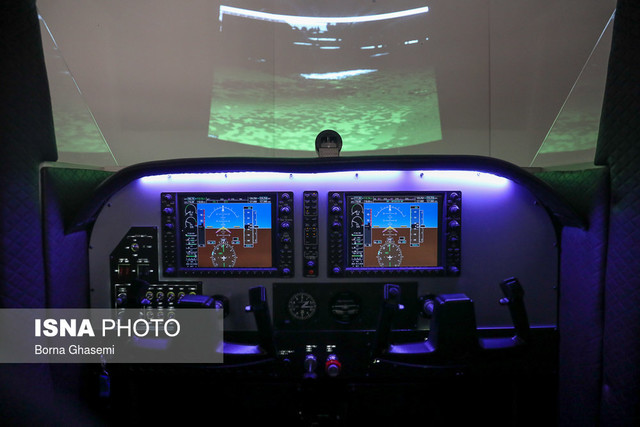
Researchers from Tarbiat Modares University of Tehran have managed to design and manufacture this special flight simulation instrument, ISNA reports.

The flight simulator was unveiled Tuesday, September 12, in the presence of Dr Vahid Ahmadi, Deputy Minister of Science and Technology at the University of Tarbiat Modares.

Mohammad Rostami, one of the researchers of this project, told reporters on the sidelines of the ceremony that the Cessna-172 is a small educational aircraft.

He said that the technology had been imported from abroad so far, adding that some air tragedies happened due to the lack of such system.

“By this project, we succeeded in localizing this device.”

“The technology has already been available to countries such as the Netherlands, France, Japan, the United States and Germany, and Iran is the sixth country having this technology,” Rostami underlined.

Rostami also stressed that before the production of this technology, there was a software system for it in the country, but its hardware was imported.

Tarbiat Modares University, within the framework of a research project, managed to design and manufacture the flight simulation instrument in two years, he added.

According to him, the use of this technology will reduce costs by as much as two-thirds.