Friday, April 17, 2026
Home Blog Page 3899

Kadoobareh; Good Choice for Vegetarians

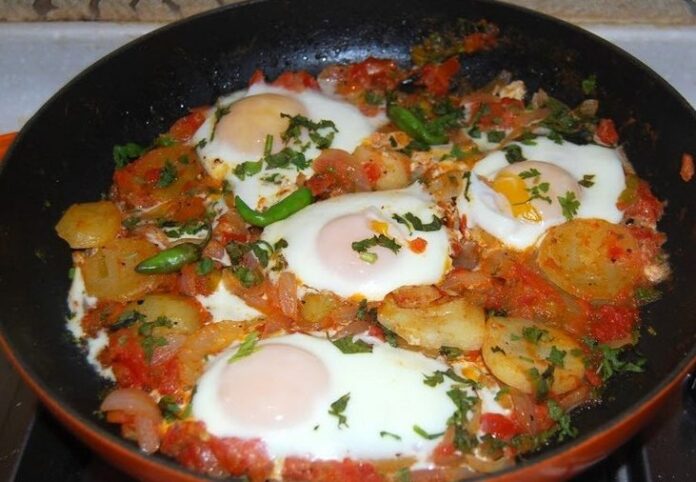
Kadoobareh

Kadoobareh is prepared in a short time, and is a good choice for vegetarians.


Ingredients:

Potatoes: 2 average-size ones

Courgettes: 5 average-size ones

Tomatoes: 5 average-size ones

Onions: A big one

Eggs: 2 or 3

Salt, pepper, turmeric: As much as needed

Recipe:

Chop the onion and sauté it for two minutes. Then add salt and turmeric as well as chopped potatoes and sauté them.

Turn down the flame and put the lid back on the pan, allowing the mixture to be cooked through.

Add sliced courgettes and fry the whole thing for a few minutes. After the courgettes are fried, add chopped tomatoes and eggs, turn the flame further down and let the ingredients cook for 100 minutes.

Sprinkle black pepper on the food before serving it.

You may grate some cheese on Kadoobareh to add to its taste.

It can also be garnished with cream yogurt.

President Rouhani Hits Back at Trump for ‘Ignorant’ Anti-Iran Remarks

Delivering a speech at the 72nd UN General Assembly session in New York on Wednesday, President Rouhani said the “ignorant, ugly, spiteful literature of the US president, which was full of false information and groundless allegations, against the Iranian nation” were beneath the dignity of the United Nations.

During his speech at the UN General Assembly on Tuesday, Trump accused Iran of engaging in “destabilizing activities” in the region.

He also claimed that Iran’s “support for terror is in stark contrast to the recent commitments of many of its neighbors to fight terrorism and halt its financing.”

Trump also denounced the 2015 nuclear agreement between Iran and the P5+1 group of countries, including the US, as “an embarrassment” that Washington may abandon.

He said the Iran deal was “one of the worst and most one-sided transactions the United States has ever entered into.”

In response, Rouhani said that the Iranian nuclear deal, known as the Joint Comprehensive Plan of Action (JCPOA), was an international agreement backed by UN Security Council Resolution 2231.

“The JCPOA does not belong to one or two countries. The JCPOA is a UNSC document, which belongs to the entire international community,” Rouhani said.

Rouhani also responded to the US threat to scrap the deal, saying Iran would respond to any breach of the JCPOA.

“The Islamic Republic of Iran will not be the first country to violate the JCPOA, but will firmly and appropriately respond to any breach,” he said.

President Rouhani Hits Back at Trump for 'Ignorant' Anti-Iran Remarks

He also warned about bids by “incompetent policymakers” to dismantle the JCPOA, but stressed that such attempts would fail to stop Iran from treading the path of progress.

“By reneging on its promises and violating international obligations, the new US administration will only discredit itself globally and lose the trust of governments and nations in any future negotiations and commitments,” said the Iranian chief executive.

Elsewhere in his speech, Rouhani talked about Iran’s defense power, including its missile program, reassuring the global community that Iran’s military might would be only deterrent and aimed at restoring regional peace and stability.

President Rouhani Hits Back at Trump for 'Ignorant' Anti-Iran Remarks

The Iranian president also lashed out at Israel, saying it was not acceptable that the Zionist regime of Israel, which is not committee to international law and whose nuclear weapons pose a threat to the region and the entire world, advises peace-loving nations.

Rouhani said Iran was in the forefront of the fight against extremism and terrorism, stressing the Islamic Republic sought a secure region and welcomed cooperation with other countries to that end.

Heading a high-ranking delegation, the Iranian president arrived in New York on Sunday night to participate in the 72nd session of the United Nations General Assembly and hold talks with senior officials of some other countries attending the meeting.

Rouhani has met and held talks with several leaders and heads of state on the sidelines of the UN General Assembly meeting.

Iran FM Holds Talks with French, German Counterparts

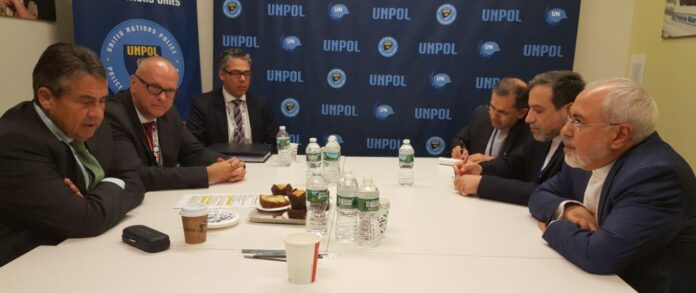
Iranian Foreign Minister Mohammad Javad Zarif and his German counterpart Sigmar Gabriel meeting on the sidelines of the UN General Assembly on Wednesday, September 20 / Photo retrieved from Iran's Foreign Ministry

During the Wednesday meeting, Zarif and German FM Sigmar Gabriel discussed bilateral and regional issues, especially the Iraqi Kurdistan region’s independence referendum and the nuclear deal between Tehran and world powers.

“Supporting the JCPOA and the need for all parties to remain committed to this multilateral and international agreement has always been Germany’s transparent stance,” Gabriel noted.

The two top diplomats also stressed that any damage to the deal would send a bad signal to the international community and cause distrust of any international negotiation and deal.

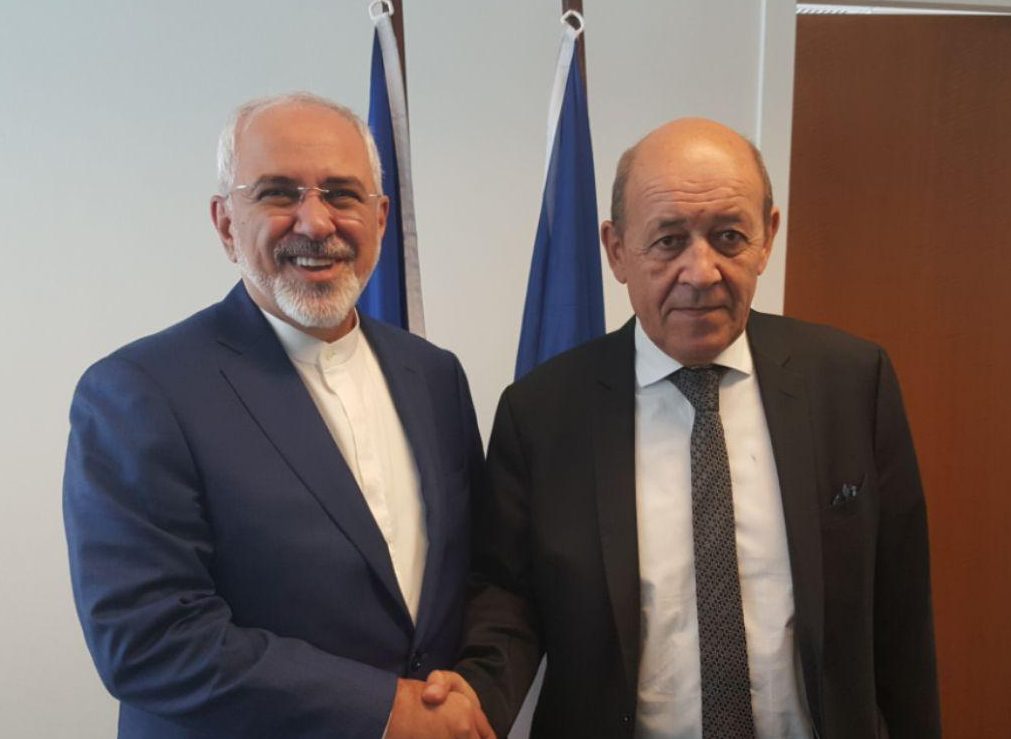
Zarif also discussed issues of mutual interest with France’s FM Jean-Yves Le Drian in a meeting on Wednesday, where they conferred on bilateral relations between Tehran and Paris.

They also exchanged views on regional issues, particularly the referendum on Iraqi Kurdistan’s independence, and underlined the necessity of maintaining Iraq’s territorial integrity and respecting the Arab country’s Constitution.

Iran FM Holds Talks with French, German Counterparts
Iranian, French counterparts meet on the sidelines of the UN General Assembly in New York

Iran, Iraq, Turkey Hold Trilateral on Kurdistan Referendum

During the Wednesday meeting, the three top diplomats exchanged views on regional issues, particularly the issue of Iraqi Kurdistan’s independence referendum.

Iran President, UK PM Call for Expansion of Bilateral Ties

In a meeting with the UK Prime Minister, Theresa May, on the sidelines of the UN General Assembly in New York, Rouhani said the Joint Comprehensive Plan of Action (JCPOA) was signed between Iran and world powers following hard and lengthy efforts.

“So all the involved sides need to stick to their commitments under the nuclear deal,” he added.

President Rouhani went on saying the UK’s support for JCPOA is of great significance and added the world is now closely monitoring the fate of the nuclear deal because the deal will show whether or not diplomacy can successfully play any role in resolving today’s crises.

He said facilitating banking relations between Iran and the UK can pave the way for further economic ties between the two sides.

Iran’s president also highlighted Tehran’s constructive role in fight against regional terrorism and said the country is ready to establish good relations with the UK in war on terror.

Touching on the upcoming independence referendum by Iraq’s Kurdistan Regional Government, he called the vote a dangerous move and said the regional states including Iran, Turkey, Iraq and Syria are against the plebiscite.

He expressed hope the UK government plays a constructive role in this regard by convincing the Iraqi Kurds to cancel the secession vote.

“We are not against the prosperity of Iraqi Kurds but they need to press ahead with their plans within Iraq’s sovereignty,” he said.

Iranian president also referred to the humanitarian crisis in Yemen and said the first step to resolve the crisis is to stop airstrikes.

“Then the Yemenis have to be provided with humanitarian aid. Finally, the conflicting sides of Yemen must sit for talks to restore peace and security in the war-torn country,” he added.

For her part, the UK prime minister called for expansion of ties between Tehran and London.

May voiced her full support for JCOPA and said “as I said in my address to the General Assembly, the nuclear deal is highly important and we remain committed to the deal. Meanwhile, we need to make sure nothing is threatening it.”

She called on the involved sides including the US to stick to their commitments under JCOPA.

‘Trump’s Anti-Iran Remarks Result of US Regional Defeats’

Major General Jafari on Wednesday responded to recent allegations leveled against Iran by Trump during his speech at the United Nations General Assembly, saying that there was nothing new in his remarks.

“What was new is that the US revealed its true face to the world,” he said, adding, “Today, the world can see the same image of the United States that Iran has been trying to reveal it for many years.”

“In fact, these allegations against Iran, perfectly match the US and its corrupt and bullying government,” the commander added.

He then asked the Iranian President Hassan Rouhani, who is in New York for UN General Assembly meeting, to “show strong, revolutionary and revealing stance” in his speech at the UN.

Pointing to the US consecutive failures in the region, Jafari said such “nervous reaction deems natural” given the consecutive and crushing failures that the US has experienced in the region.

He further underlined that the US will receive “much painful” response from Iran due to action, behavior, and decisions that Tehran would take in coming months.

The reaction came after Trump claimed during his first address to the 72nd session of the UN General Assembly on Tuesday that Iran’s “support for terror is in stark contrast to the recent commitments of many of its neighbors to fight terrorism and halt its financing”.

The remarks came as the US and some of its regional allies, including Saudi Arabia, have been staunch supporters of Takfiri terrorists in the Muslim states of Syria and Iraq.

Tehran has, meanwhile, been praised for its support for anti-terrorism efforts by the governments in Damascus and Baghdad.

The Takfiri terrorists of Daesh were initially trained by the CIA in Jordan in 2012 to destabilize the Syrian government.

‘US Slapping Bans on Iran to Make Up for Own Defeats’

The United States has put on its agenda extensive sanctions against Iran’s Islamic Revolution Guards Corps (IRGC) in line with Washington’s bans on the Islamic Republic of Iran. To that end, the US House of Representatives and Senate have, once again, passed a sanctions act aimed at countering “Iran’s destabilizing moves.”

The legislation passed in late July, 2017 imposes sanctions on Iran, Russia and North Korea. Now the development begs the question of whether the US can be trusted as a friendly country and a partner.

To review what objectives Washington pursues by imposing sanctions and what counter-measures Tehran has put on its agenda, the Basirat news website has interviewed Hossein Naqavi Hosseini, an Iranian MP and a member of the parliament’s National Security and Foreign Policy Commission. The full text of the interview follows.


What objectives Washington follows by passing the Countering America’s Adversaries through Sanctions Act, which envisages restrictions on Iran’s missile activities and the isolation of the IRGC in the region?

The victory of the [1979] Islamic Revolution of Iran has jeopardized the United States’ colonial interests in southwest Asia. So, the US government has always pursued Iran’s political isolation and Iranophobia as two of its major schemes in a bid to regain its foothold in the region by undermining Iran’s sources of power. Missile activities and the IRGC constitute sources of Iran’s power. By passing the sanctions, the US has not only violated the Iran nuclear deal, but seeks to undercut the sources of Iran’s power.

The Iran nuclear deal (also called the Joint Comprehensive Plan of Action, the JCPOA for short) is an international agreement between Iran and six world powers. It is not simply a bilateral agreement between Tehran and Washington. Among all signatories to the JCPOA, only one (the US) is not living up to its obligations under the deal. Iran had expected Washington to breach its promises and not to abide by an international agreement. Iran has reached agreement with six countries and has made good on its commitments under the deal. However, since the second day of the implementation of the JCPOA (January 17, 2016), the US imposed sanctions on 11 Iranian natural and legal persons. The move shows Washington wouldn’t like the JCPOA to be implemented and the Iranian nation to benefit from the deal. Ever since, the US has, for 16 times, adopted measures and passed legislation in contravention of the JCPOA, which we presented to the National Security and Foreign Policy Commission in a documented report. The last instance of these violations was legislation passed by the Senate a couple of days ago, blocking the sales of commercial aircraft to Iran. This comes as it is clearly stipulated in the JCPOA that Iran is entitled to purchase passenger planes. So, US statesmen do not want the JCPOA to be implemented. They are seeking pretexts and breaching their commitments.

The International Atomic Energy Agency (IAEA) is the only authority to verify that Iran has delivered on its commitments under the JCPOA, and the agency has so far reiterated in is official statements eight times that Tehran has remained committed to the JCPOA and has fulfilled all its obligations. The IAEA chief has also, time and again, reaffirmed Iran’s compliance with the deal in his speeches. However, the US seeks to create the impression that the agency regards Iran as a violator of the agreement. So, the US ambassador to the UN travelled to the IAEA headquarters and met [IAEA] chief Yukiya Amano in order to persuade him to introduce Iran as a violator of the agreement in the agency’s statements and in his own remarks. The call for inspecting Iran’s military sites and missile activities was in line with the same objective. Washington also resorts to different pretexts in order to neutralize benefits of the JCPOA. Sometimes they say the JCPOA needs addenda, and sometimes say the agreement should include missile activities as well. Sometimes they say the JCPOA needs to be revised. None of these scenarios is acceptable to Iran. We have signed an agreement and act accordingly.

If the new sanctions act is implemented, what will Iran’s reaction be?

The Supreme National Security Council and the parliament’s National Security and Foreign Policy Commission have held several meetings in this regard and reviewed different scenarios. Precisely scheduled operational plans have been envisaged for each of these scenarios, and Iran is definitely prepared to take the necessary action based on the circumstances. The actions taken by the US run counter to international norms. But we should know that sanctions have never been able to impede Iran’s development and progress. Many economic and military experts happen to believe that if Iran’s economic or technological progress is studied, we will see that the peaks of the country’s progress coincided with the time when Iran was under sanctions. It means whenever the sanctions were intensified, Iran’s scientific, economic and military development gained momentum. So, sanctions will definitely not be able to hinder the progress and development of such a nation.

Despite the fact that the IRGC has adopted effective measures in countering Takfiri terrorist groups in the region, why is it that the US calls the IRGC a terrorist entity?

By pressuring the IRGC and calling it a terrorist entity, the US seeks to make up for the frustration and defeats it has suffered in the region. Today, Zionists and Saudis are furious at the situation in the region. They had made a 10-to-15-year investment. They gave financial and military support to a terrorist group called ISIS and trained its members. They spent a lot to help ISIS counter Iran. From the outset, al-Qaeda, the Taliban, ISIS and other terrorist groups in the region aimed to target Iran. This is the reality. Now, the evil triangle comprising the US, Zionism and Saudi Arabia has reached a stalemate, and its plots have been foiled. It is natural that they have got angry. The Americans have bitten the dust in Syria and Iraq. They themselves know that they will soon drown in the quagmire of Bahrain and Yemen. In order to compensate for this frustration and defeat, they are trying to portray the IRGC as a terrorist group. They have also put pressure on the IRGC’s Quds Force in order to soothe their pains a little bit and make up for their defeats in the region.

‘US Supporting Kurdistan Referendum through Israel’

‘US Supporting Kurdistan Referendum through Israel’

The referendum on the Iraqi Kurdistan’s independence, which is planned to be held on September 25 despite global opposition, not only violates Iraq’s constitution but also will further destabilize the region.

While the Iraqi central government, Iraq’s neighbours, the US and many other players have asked the head of Kurdistan Regional Government (KRG) Masoud Barzani to withdraw from his destabilizing decision on holding independence referendum, he insists on his decision and says they will go ahead with it on September 25 despite all these concerns.

The US State Department has stated that it is concerned that the referendum in northern Iraq would distract attentions from “more urgent priorities” such as the defeat of ISIS militants.

There seems to be only one reason for insistence of Erbil on holding the referendum despite all oppositions, and that is “difference between stated and actual policy of the US.”

Such a notion is not farfetched due to its destructive impact on the US relation with Baghdad and its NATO ally, Turkey.

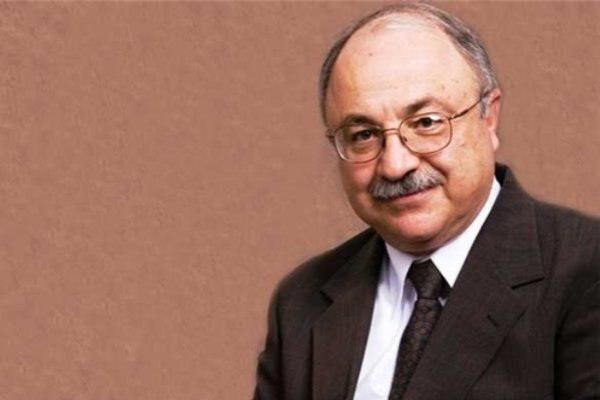
To shed further light on the ongoing developments about the issue, the Tehran Times daily newspaper has reached out to Nader Entessar, a professor and Chair of Department of Political Science and Criminal Justice at the University of South Alabama.

Here is the full text of Tehran Times’ interview with Entessar:

Can we imagine that there is a difference between the US stated policy and its actual policy on the ground?

Yes, I think we should not be surprised if the stated US policy and the actual policy on this issue prove to be incongruent with each other. The US does not have a carefully calibrated policy in the Middle East.  Today, Washington has moods and not well-articulated policies in the Middle East or many other parts of the world.

Despite regional opposition, how far the US will be able to support Arbil? How will the US be able to manage its differences with its regional ally, Turkey on the issue?

The US will not be able to sustain its support for an independent Kurdish state without the support of some of its regional allies, especially Turkey.  However, based on stated Turkish policies, Ankara will oppose the creation of an independent Kurdistan.  Besides, such a move by Washington will require a major redefinition of its relationship with Baghdad.  However, those in favour of creating an Independent Kurdish state count on US support via Israel, the only regional country that has supported the creation of an independent Kurdistan in northern Iraq.

Are there any legal ways to stop Arbil from its destabilizing decision on holding the independence referendum?

There are two major legal problems with holding the referendum as proposed by the KRG.  First, the opponents of the referendum, including Barzani’s Kurdish rivals, have stated that since Masoud Barzani’s term as the president of Iraqi Kurdistan expired two years ago, he does not have the legal authority to decide on holding a referendum on the future of Kurdistan.  Second, constitutionally speaking, the decision to hold a referendum in Iraq’s Kurdish autonomous region must be approved by the Kurdistan Regional Parliament.  However, this body has not fully convened since October 2015, and no Kurdish parliament is functioning today.  Therefore, the Kurdish Regional Parliament cannot legally approve the holding of a referendum as proposed by Mr. Barzani.  However, these two legal obstacles have not prevented Barzani and the Kurdish Regional Government from going forward with the scheduled referendum on Kurdish independence.

Mogherini Reiterates EU’s Support for Iran Nuclear Deal

Mogherini Reiterates EU’s Support for Iran Nuclear Deal

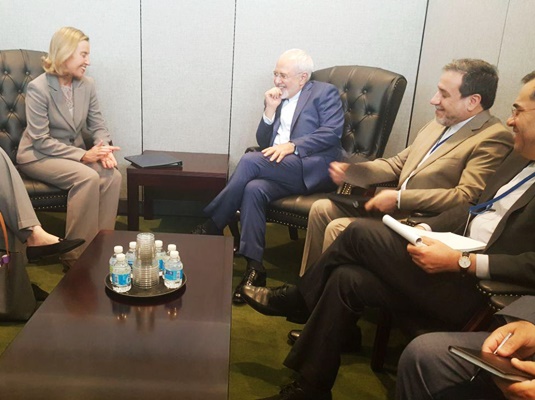
In their Wednesday talks held on the sidelines of the United Nations General Assembly, Zarif and Mogherini conferred on the latest developments regarding the implementation of the nuclear deal.

During the meeting, Mogherini once again underlined the EU’s support for and commitment to the deal, known as Joint Comprehensive Plan of Action (JCPOA).

The meeting came as the foreign ministers of Iran and the P5+1 (Russia, China, the US, Britain, France, and Germany) are due to hold a meeting in New York on the nuclear deal and its implementation.

This could be the first meeting between Zarif and his American counterpart Rex Tillerson.

Iran Has Long Way to Go to Become Top Tourist Destination

Iran Has Long Way to Go to Become Top Tourist Destination

Tourists bring the countries they visit extra revenues and foreign currencies, and this is the most important benefit of tourism for the host state.

Such revenue can be particularly significant for a country like Iran, which is heavily dependent on its oil and gas incomes.

According to a Farsi report by Pool News, Iranian Deputy Minister for Industries, Mines and Trade, Mojtaba Khosrowtaj, recently announced in a TV program that based on 2014 statistics, Iran ranked among the top 10 countries of the world in terms of tourist attractions, but in terms of attracting tourists the country is ranked 40th among 184 countries.

The growth of attracting tourists, however, has witnessed a rising trend in Rouhani’s first term, according to the government’s website.

Based on the figures released by the administration, by the end of March 2017, more than 6 million people visited Iran, which is three times more than 5 years ago.

Interestingly, there has been a steady increase in attraction of tourists to Iran, which, of course, has been slower in the period between 2010 and 2011. This slow pace, however, can be attributed to the start of cruel sanctions against the Islamic Republic.