Friday, December 26, 2025
Home Blog Page 3797

Iran FM, EU’s Schmid Discuss Bilateral, Regional Issues

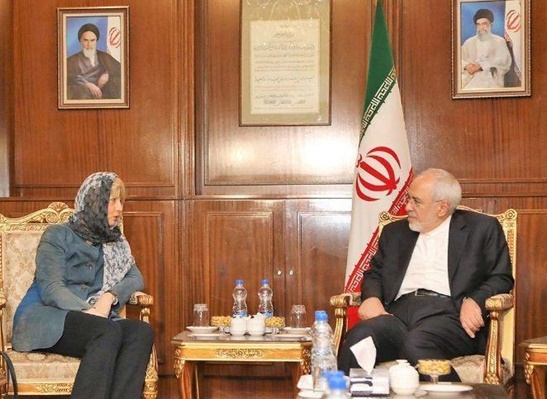
Arriving in Tehran at the top of a high-ranking European delegation to take part in the third round of political talks between Iran and the European Union, Schmid sat for talks with Iranian foreign minister on Sunday.

During the meeting, Schmid first briefed Zarif on her talks in Tehran. Then the two sides discussed the general political situation in the regional states including Syria, Yemen, Qatar and Lebanon and stressed the need for continuation of political talks between Iran and the European bloc to cope with the current political challenges in the region.

The Joint Comprehensive Plan of Action (JCPOA) was among other issues discussed by the two officials. Schmid reiterated the general stance of the EU towards the nuclear deal saying all members of the union call for the full implementation of the deal between Iran and world powers.

For his part, Iranian foreign minister expressed Tehran’s interest in continuation of talks and exchange of views with the European Union in various fields.

“Revival of Silk Road to Bring Iran Tremendous Benefits”

What follows is the full text of Hamidian’s article published by Khabar Online news agency:

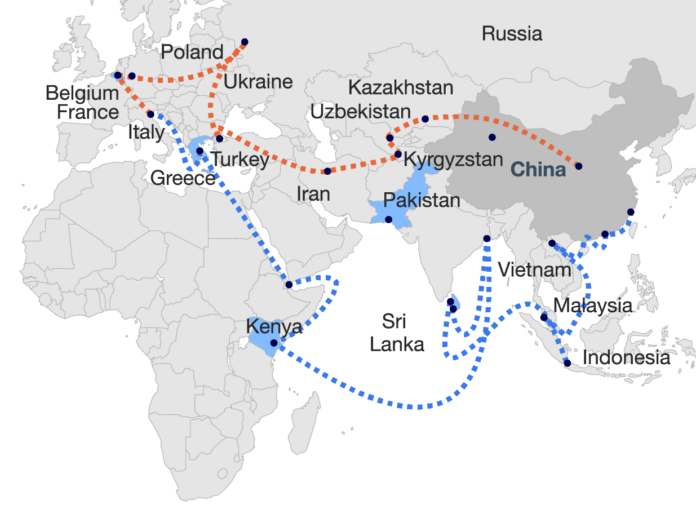
The Silk Road, as the most important trade route, has served as a link between the east and west of the world for centuries, running across China, India, Iran, Egypt, Saudi Arabia and Eastern Europe. To secure higher economic growth as well as new and stable markets for its exports and also in order to supply cheaper exports, Chinese President Xi Jinping proposed the idea of reviving the Silk Road under an initiative called “One Belt, One Road” in 2013. In this proposal, Iran is one of the countries that Beijing has an eye on due to the numerous features the Islamic Republic enjoys. After the initiative was put forward, different countries showed various reactions. India is one of the countries opposing the plan basically due to the China-Pakistan Economic Corridor (CPEC) project. The corridor is one of the most important parts of China’s “One Belt, One Road” initiative and runs across the disputed Kashmir region, which is claimed by both India and Pakistan, but is currently under Islamabad’s control. The United States is another country which might go into action if it sees its interests are at stake due to the initiative. The US and China have extensive trade relations. The economic growth of China and that of the US are interdependent. American firms have invested in China, which, in turn, needs America’s technologies as the Asian nation is lacking in state-of-the-art knowhow. Therefore, the economic growth of China and that of America are inextricably intertwined, and the US will not interfere as long as China’s political growth does not pose a threat to US politics.

Three possible routes have been envisioned for the Silk Road: The first route is China-Pakistan- Gwadar, the second one China-Russia-Europe and third route would cross China, Turkmenistan, Iran and Turkey. As the shortest route is the one passing through Iran, the country should seize the opportunity and make the most of it by closely monitoring the situation. Due to the following reasons, Iran is one of the key options for the plan.


Suitable Geographical, Strategic Situation

Iran has sea borders with 15 countries. Also, a large part of the most important international corridor which links northern Europe, Scandinavia and Russia to countries in the Persian Gulf region, Indian Ocean and Southeast Asia, passes through Iran. This shows Iran used to lie on the transit route and would take advantage of it.


Rich Oil, Natural Gas Resources

With its rich petroleum and natural gas reserves, Iran is a key supplier of crude oil to China. If the new Silk Road runs through Iran, this demand will increase, and Iran will need to seize the opportunity to maintain the market for its oil exports and at the same time process petroleum products to meet other demands in the project. As a founder of the Asian Infrastructure Investment Bank (AIIB), Tehran has somehow won China’s backing for the Silk Road route to run through Iran.

Although Iran has suitable conditions to lie on the route, there are impediments to that as well. Among the key hurdles are the problems with road, rail and air infrastructure, which does not measure up to international standards. To remove the obstacles, Iran needs massive investment by the private and public sectors as well as foreign loans. The link between Iran’s private sector and other regional countries will the set the stage for trade with Iran. Another hurdle which will create problems for Iran both during the implementation of the initiative and afterwards is the high end-cost of domestically produced commodities compared to foreign goods. Given Iran’s dependence on oil revenues and existence of the Dutch disease, the country’s non-oil exports will have high costs and will be unable to compete on world markets. If this problem is not solved, Iran will not be able to take advantage of the opportunity that it would get due to the Silk Road.


Iran should also remain on the watch for the Orient’s domination over the country and utilize the advantages of the East while maintaining its Western trade rivals and keep cordial relations with them


If the Silk Road does run through Iran, the country will face opportunities and threats. The most important advantages for Iran lying on the Silk Road will be higher economic growth, securing regional trade, receiving new demand and creation of more job opportunities, provision of goods at lower costs, prices becoming more competitive, industrialization and modernization, development of the tourism industry, reinforcement of security and the war on terrorism, preservation of natural habitats which lie on the Silk Route, a rise in cultural exchanges, securing the market for goods such as carpets, handicrafts, pistachios, saffron, medicinal herbs, etc. in accordance with international standards, identifying the tastes of consumers and the creation of international as well as Iranian brands, gaining access to cutting-edge technology, and so on and so forth.

While having an eye on the above-said advantages, Iran should openly and farsightedly monitor the situation in order to get connected to China’s economic belt while preserving its strength. One of the dangers threatening Iran is its cybersecurity as China has one of the most sophisticated cybersystems in the world. Iran should also remain on the watch for the Orient’s domination over the country and utilize the advantages of the East while maintaining its Western trade rivals and keep cordial relations with them. All of the above require national determination and giving more leeway to the private sector. By ensuring further stability and security, the Iranian government can boost foreign investment, so, by taking advantage of the Road Silk initiative, Iran will be able to achieve the goals it has envisioned for the country.


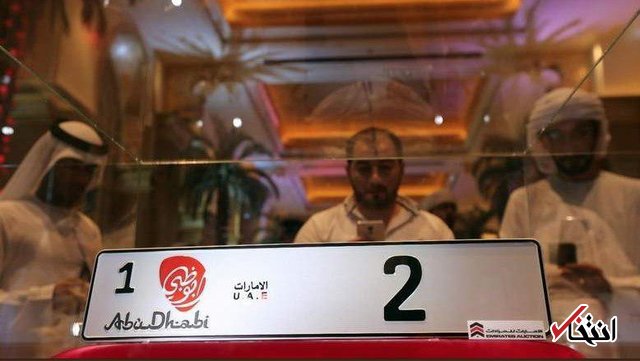
Arab Businessman Pays $3m to Purchase Number 2 Car Plate

“I’m excited. I bought the plate because number 2 is highly important for Emirati people,” the Arab businessman said.

“It is a historic and highly significant number for us because it is the symbol of the establishment of the UAE which was created on December 2,” he was quoted as saying by a Russian-language business daily published in Moscow.

The purchase was the biggest attraction at the Abu Dhabi Police’s open auction of vehicle number plates on Saturday.

The popular auction generated a revenue of more than $15m. 60 distinguished Abu Dhabi number plates were auctioned at Emirates Palace hotel.

Abu Dhabi Police, in cooperation with Emirates Auction, held the public auction on the occasion of the 60th anniversary of the country’s establishment.

Organised by Emirates Auction, the auction listed the numbers on the company’s website, including five double-digit plates, 15 three-digit plates, 19 four-digit and 17 five-digit plates.

Other number plates auctioned were 10, 60, 333, 600, 999, 1000, 1111, 5050, 6000, 6060, 6666, 9090, 9999, 10000, 55555, 60000, 66666.


Iran Blasts Arab League’s “Worthless” Statement

Bahram Qassemi

In a Monday statement, Bahram Qassemi said the Arab League’s statement raised “completely false and distorted”allegations against the Islamic Republic.

Saudi Arabia managed to have the statement issued under the name of the foreign ministers of Arab League after exerting great pressure and spreading political propaganda, he added.

The statement serves the Zionist regime’s policy of fanning the flame of regional conflicts and diverting the attentions of Muslim governments and nations from the occupation of Palestine as the main issue of the Islamic world, he went on to say.

Iran calls on Saudi Arabia to substantiate the statement by putting an immediate end to brutal aggression on its Arab fellows in Yemen, where the civilians including children and women are falling victim to the Saudis’ grudge, Qassemi said.

He also said that Iran urges Saudi Arabia “to end its policy of exerting pressure on its Arab brothers in Lebanon, Qatar and the entire region.”

“Iran also calls on Saudi Arabia to stop its military deployment in Bahrain and let the people of Bahrain start dialogue among themselves to find a peaceful resolution to the current crisis,” he said.

The policy of the Islamic Republic has been based on establishing good relations with the regional states, he said.

Efforts made by Tehran to counter terrorism,its support for initiatives to resolve regional crises, helping restore peace and stability to the region through active participation in Astana Talks on Syria, offering plans like the four-point Yemen Peace Plan and initiating regional talks within this mechanism have all been part of this policy, he added.

“However, unfortunately Iran’s policy has been hampered by the reverse policy of Saudi Arabia, which is based on spreading divisions, conflicts and sabotage.”

“The solution to the current problems in the region, which are mainly caused by Saudi Arabia’s unproductive policies, is not issuing worthless statements like that of the Arab League.”

Rather, he added, the solution is to stop pursuing the policies of the Zionist regime and putting an end to its aggressiveness and sponsorship for terrorism.

Qassemi said Saudi Arabia must also accept the will of the regional nations and governments to achieve independence, freedom and progress and have a life of dignity and respect.

Iran FM, UN Envoy Discuss Afghanistan Security

Iran FM, UN Envoy Discuss Afghanistan Security

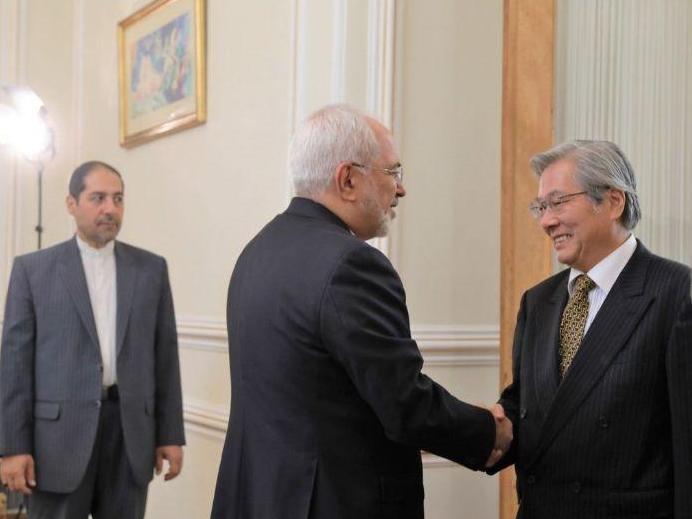
During the Monday talks, Yamamoto briefed Zarif on the current security situation of Afghanistan. He also talked about various ways to continue peace talks in Afghanistan with the aim of establishing stability and security in the war-torn country.

For his part, the Iranian foreign minister referred to the current cooperation between Iran and Afghanistan and stressed the need for rapid development of such collaboration in various fields of politics and economy. He also emphasized the importance of coping with growing threats and dangers of ISIS in the region including Afghanistan given the group’s latest defeats in Iraq and Syria.

Other major topics discussed during the meeting included Iran’s support for Afghanistan’s National Unity Government, its policy of establishing stability in the country as well as its support for the UN efforts in all initiatives to restore peace in Afghanistan.

Zarif also expressed Tehran’s readiness to establish close cooperation with the UN and its affiliated organizations in all fields which are dealing with Afghanistan issue.

“Iran seeks to create stability in Afghanistan and its efforts are focused on this goal,” he added.

Iran Leader Pays Visit to Quake-Hit Areas

Iran Leader Pays Visit to Quake-Hit Areas2

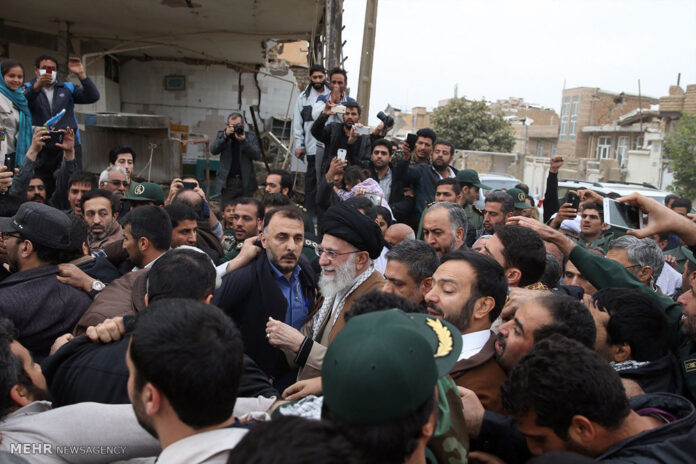
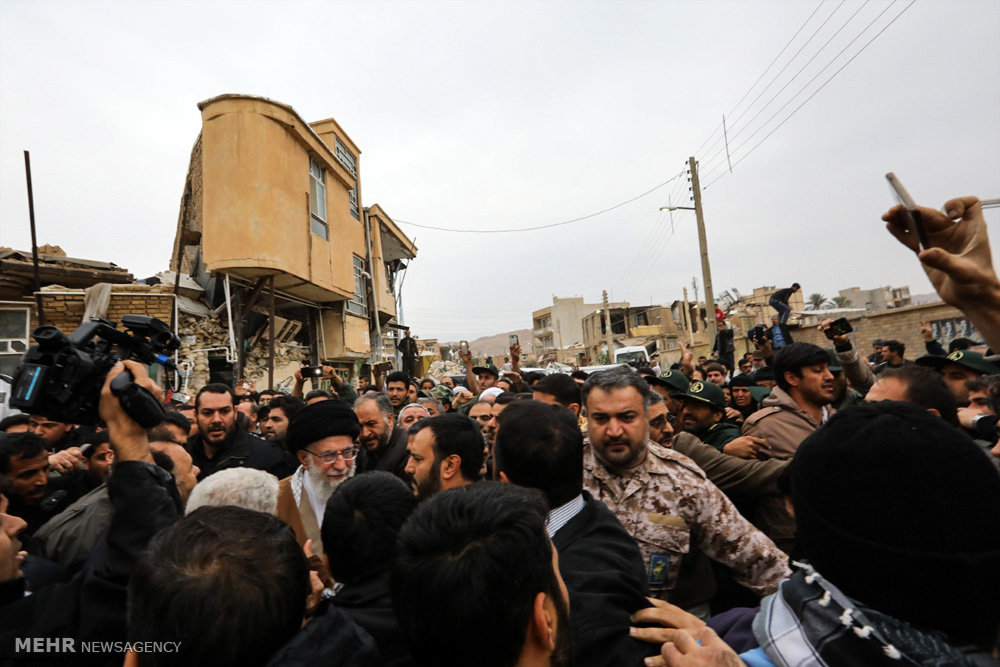
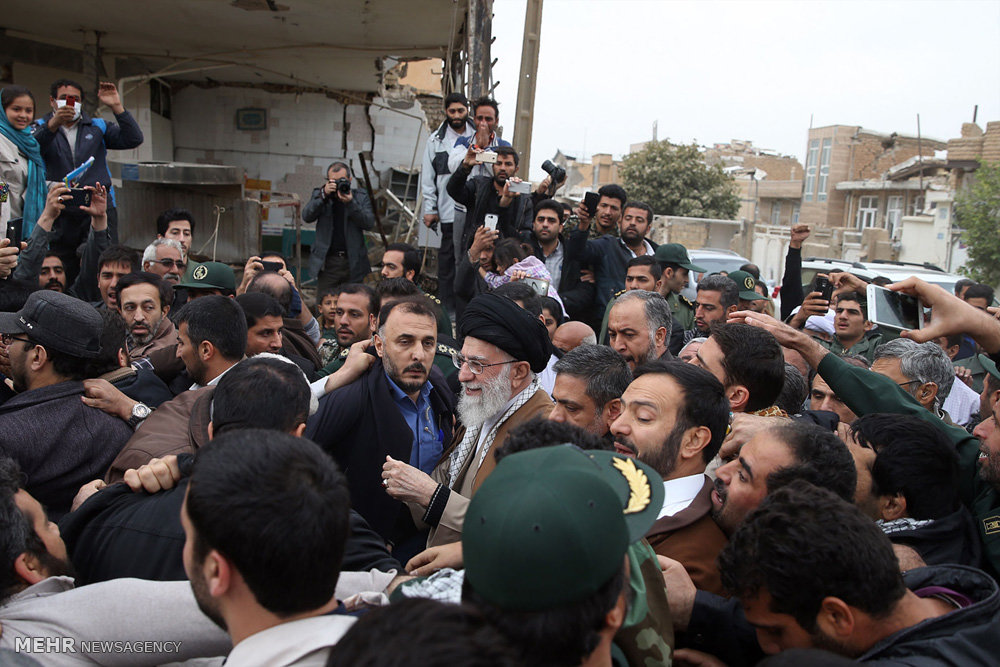
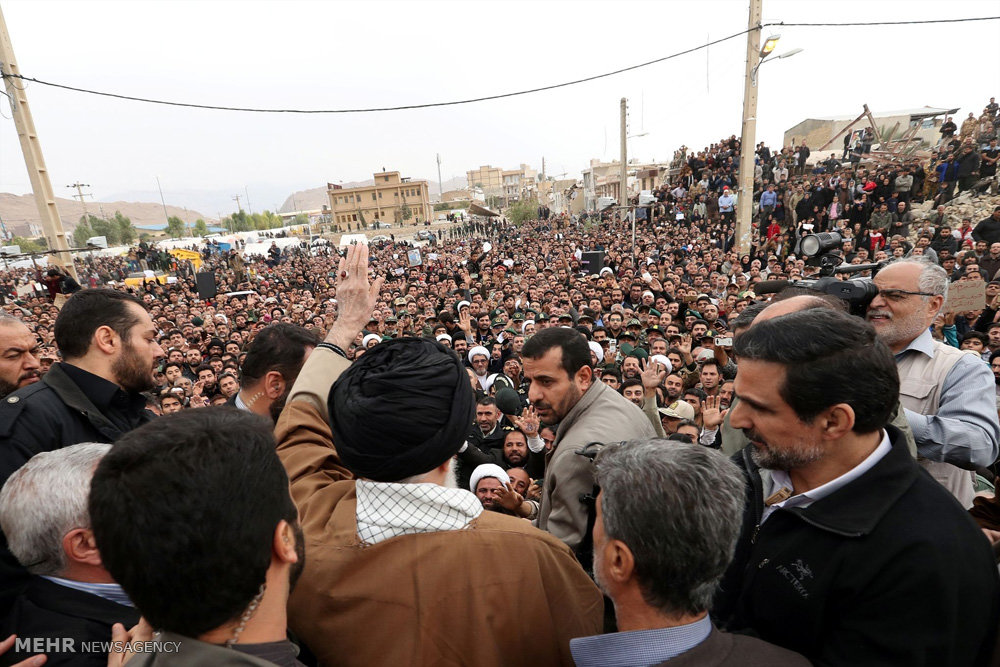
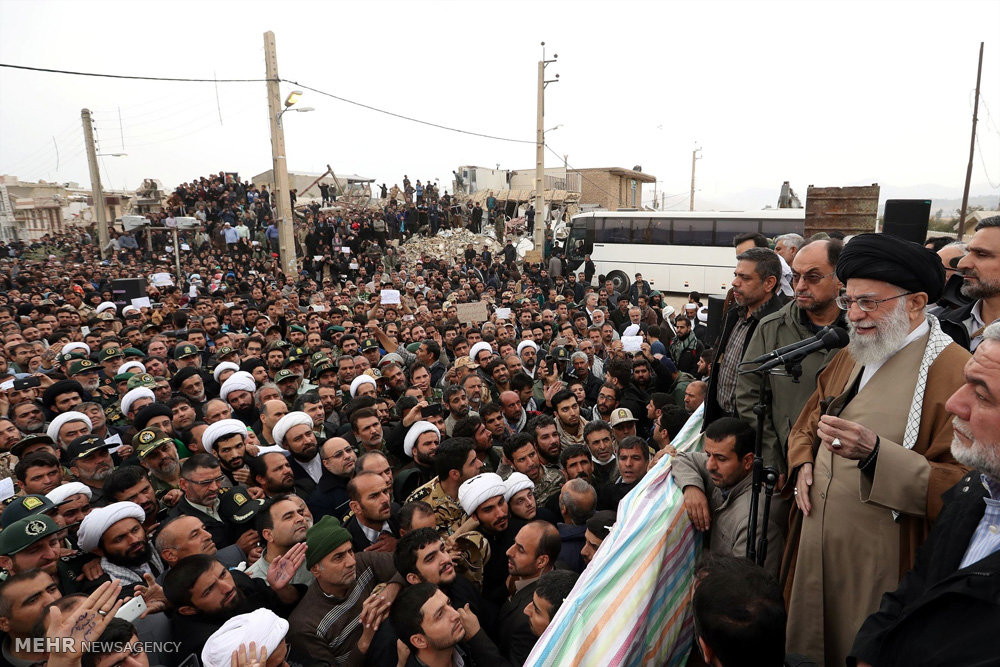
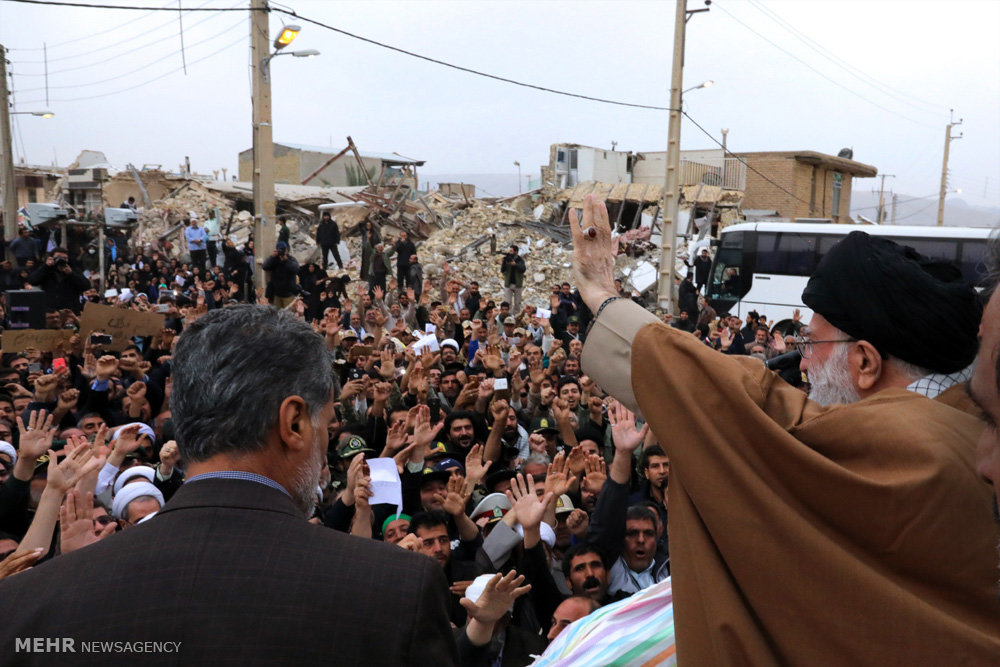
In an address to the people of Sarpol-e Zahab town in Kermanshah Province, the Leader said “I feel the same pain that each of you have in your hearts. I would have liked to be among you at a better time. This is not the first time that the people of this region go through such natural plights.”

He went on to say that “I was among you during the war Iraq imposed on Iran,” and saw that the people of Sarpol-e Zahab showed resistance and endurance in the war.

“I expect you to show it again. The brave and heroic people always stand and defeat the mishap.”

During the Iraq war under the former dictator Saddam Hussein, Iraqi troops captured Sarpol-e-Zahab in 1980 before the city fought back and drove out the invaders.

The Leader further described the 7.3-magnitude quake that hit western Iran and left over 400 dead as a disaster and said “see how the whole Iran considers itself indebted to Kermanshah. Everyone helped as much as their means would allow them.”

Ayatollah Khamenei also said the officials in charge are doing their best to provide help for the quake-hit families.

The Leader called on the officials to double their efforts to help those affected, “in the same way that the Army rushed to the assistance of those caught under the debris in the cities and the Islamic Revolution Guards Corps did so in the villages in the early hours after the earthquake.”

Had they not come, Iran would have suffered much more bereavement and sadness, “and our casualties would have gone much higher, he added.

As many as 436 people were killed after the 7.3-magnitude earthquake hit Kermanshah province on November 11.

Aftershocks continue to rattle the affected areas, with 647 tremors recorded until Sunday noon following the initial earthquake, as medics and rescue teams race to treat the injured and help retrieve bodies from under toppled buildings.

The earthquake has led to an outpouring of solidarity from Iranians across the country and millions more in the diaspora, prompting state officials and personalities to visit the affected areas.

A Look at Iranian Newspaper Front Pages on November 20

Newspapers today continued to cover the ongoing efforts to help the quake-hit people in Western Iran, particularly their accommodation in the cold weather.

Media reports about the unsuccessful assassination of Saudi Crown Prince Mohammed bin Salman also received great coverage.

Another top story was a trilateral meeting between the foreign ministers of Iran, Russia, and Turkey in the Turkish city of Antalya on the Syria crisis and ways to de-escalate tension in the region.

The above issues, as well as many more, are highlighted in the following headlines and top stories:


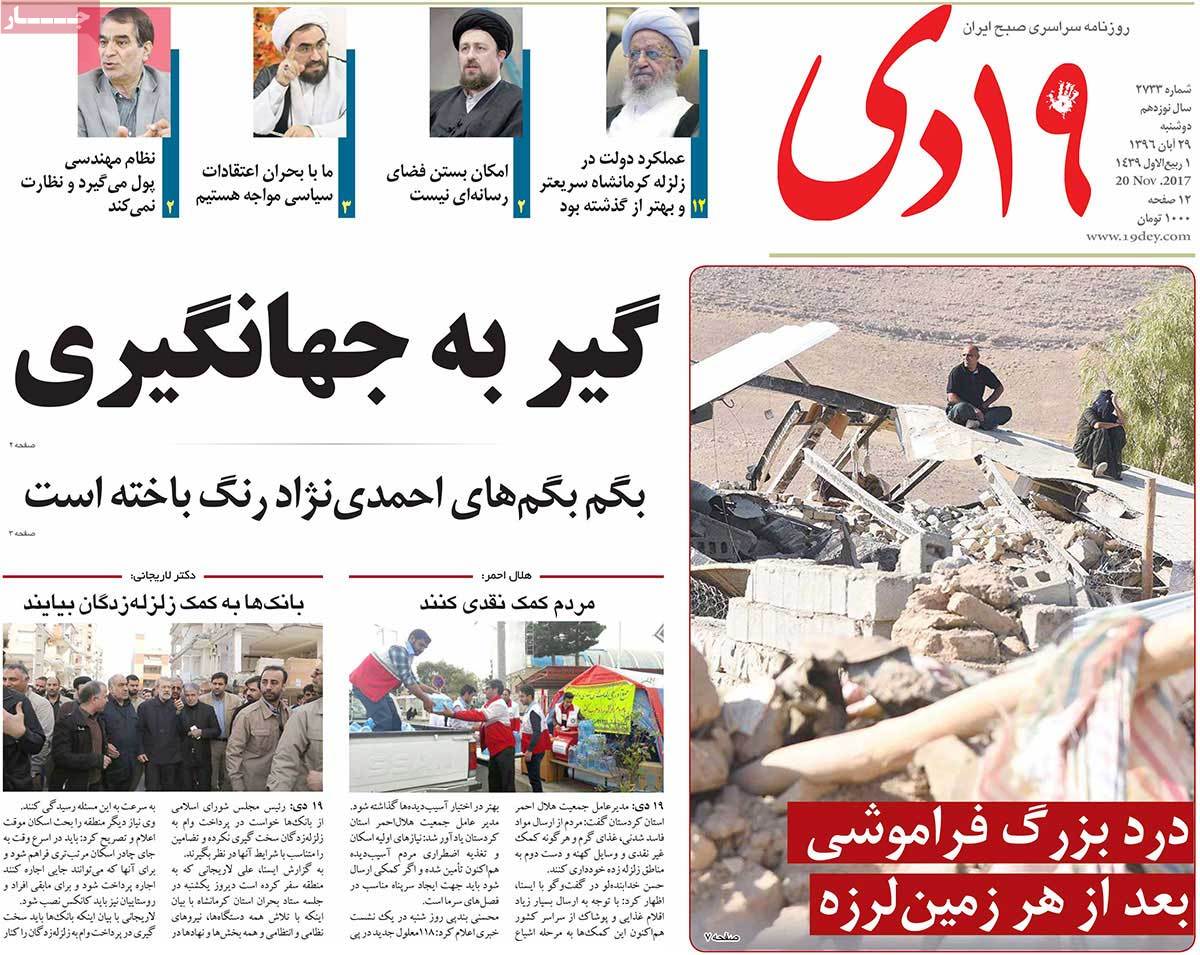
19 Dey:

1- Ayatollah Makarem Shirazi: Government’s Performance in Quake Better, Faster
A Look at Iranian Newspaper Front Pages on November 20


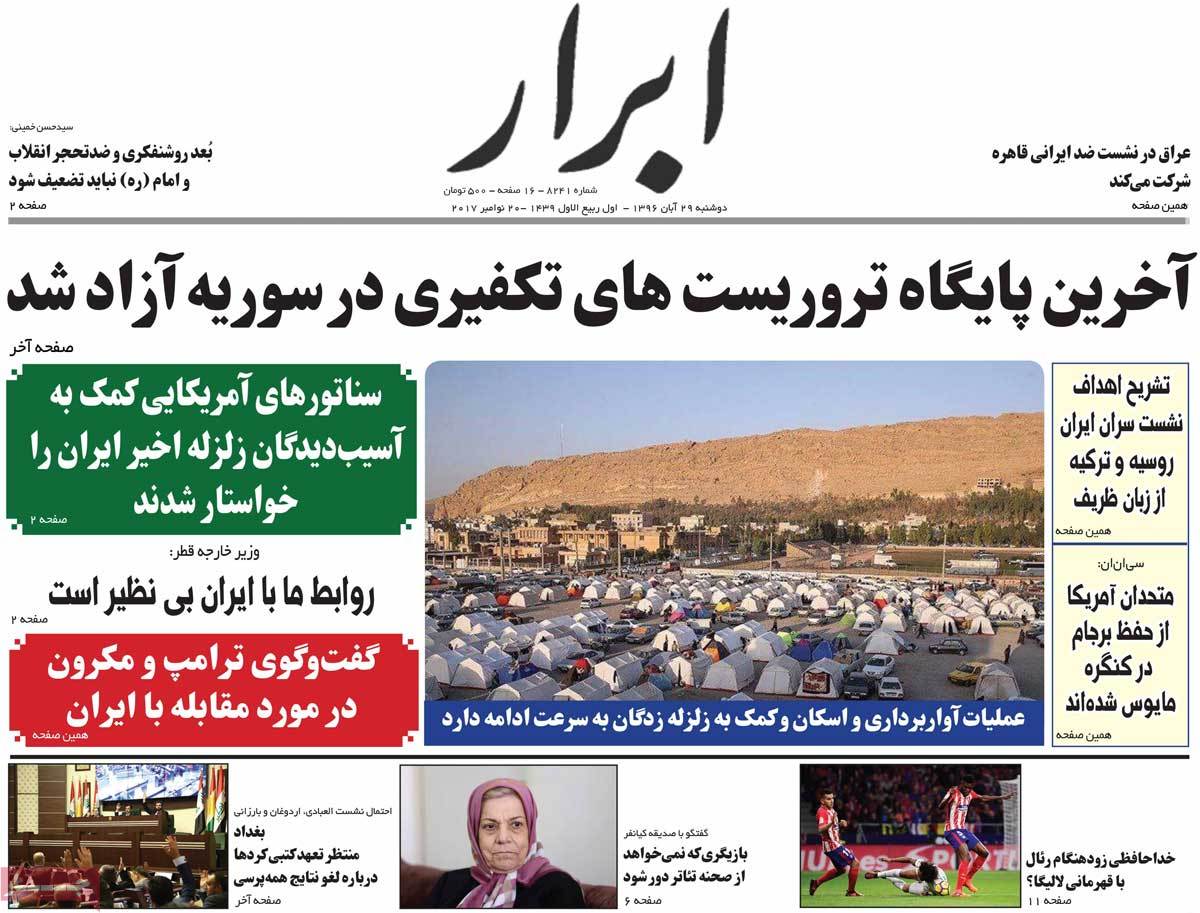
Abrar:

1- Last Stronghold of Takfiri Terrorists in Syria Liberated

2- Iraq to Attend Anti-Iran Summit in Cairo

3- Qatar FM: Our Ties with Iran Unique
A Look at Iranian Newspaper Front Pages on November 20


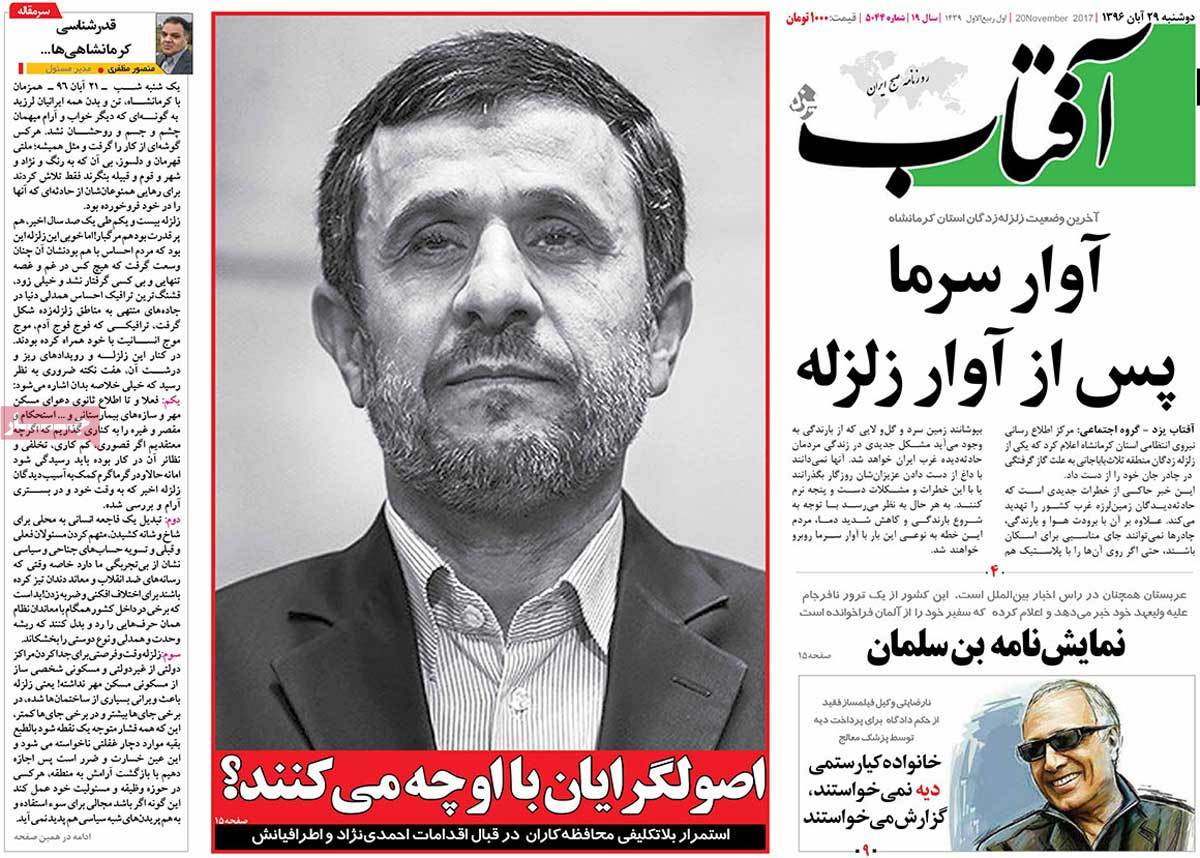
Aftab-e Yazd:

1- Rubble of Cold after Rubble of Earthquake

2- Conservatives Remain Undecided about Actions of Ahmadinejad and His Allies
A Look at Iranian Newspaper Front Pages on November 20


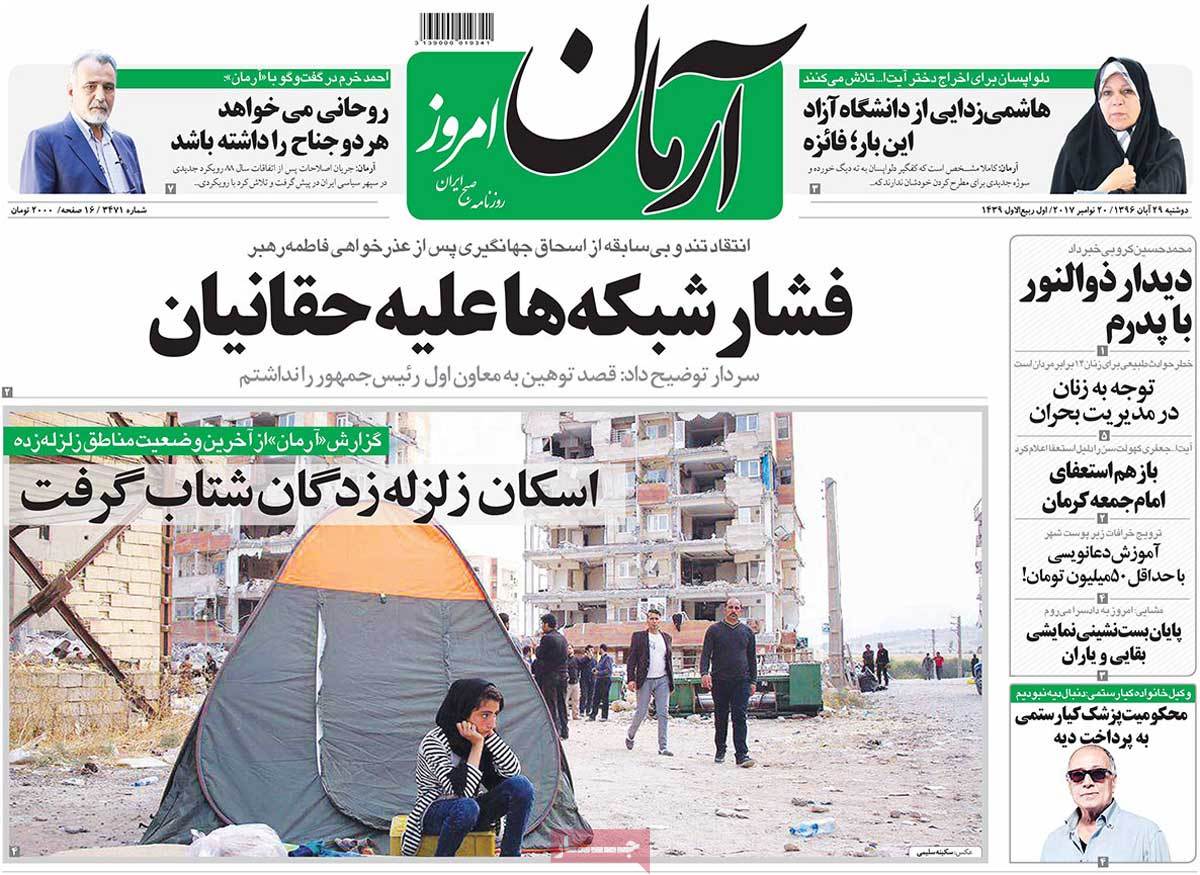
Arman-e Emrooz:

1- Accommodation of Quake-Hit People Accelerated

2- Analyst: Rouhani Wants to Keep Both Parties on His Side

3- Kiarostami’s Doctor Condemned to Pay Blood Money
A Look at Iranian Newspaper Front Pages on November 20


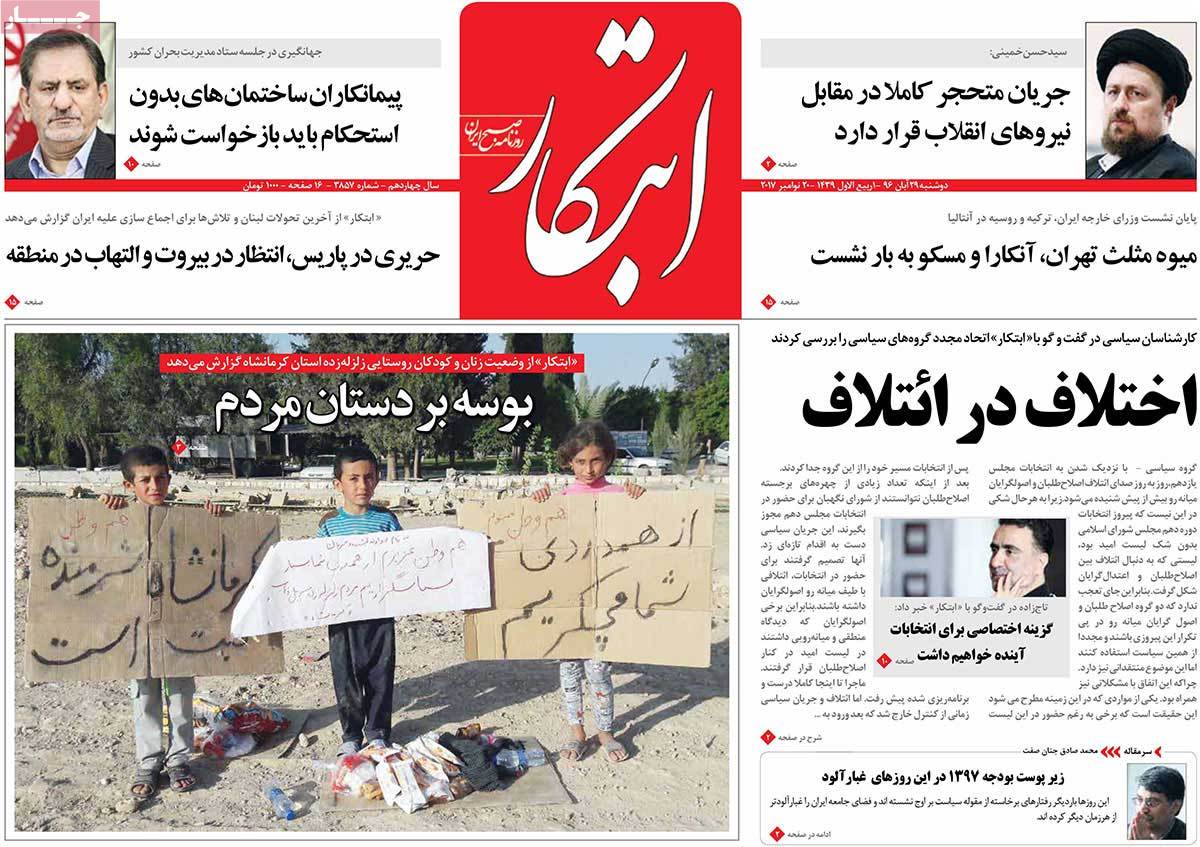
Ebtekar:

1- Imam Khomeini’s Grandson: Reactionary Movements Totally against Revolutionary Forces

2- Hariri in Paris; Beirut Waiting for Him; Tension in Region

3- Trilateral Meeting of Iranian, Turkish, Russian FMs Held in Antalya

  • Tree of Tehran-Ankara-Moscow Bears Fruit
A Look at Iranian Newspaper Front Pages on November 20


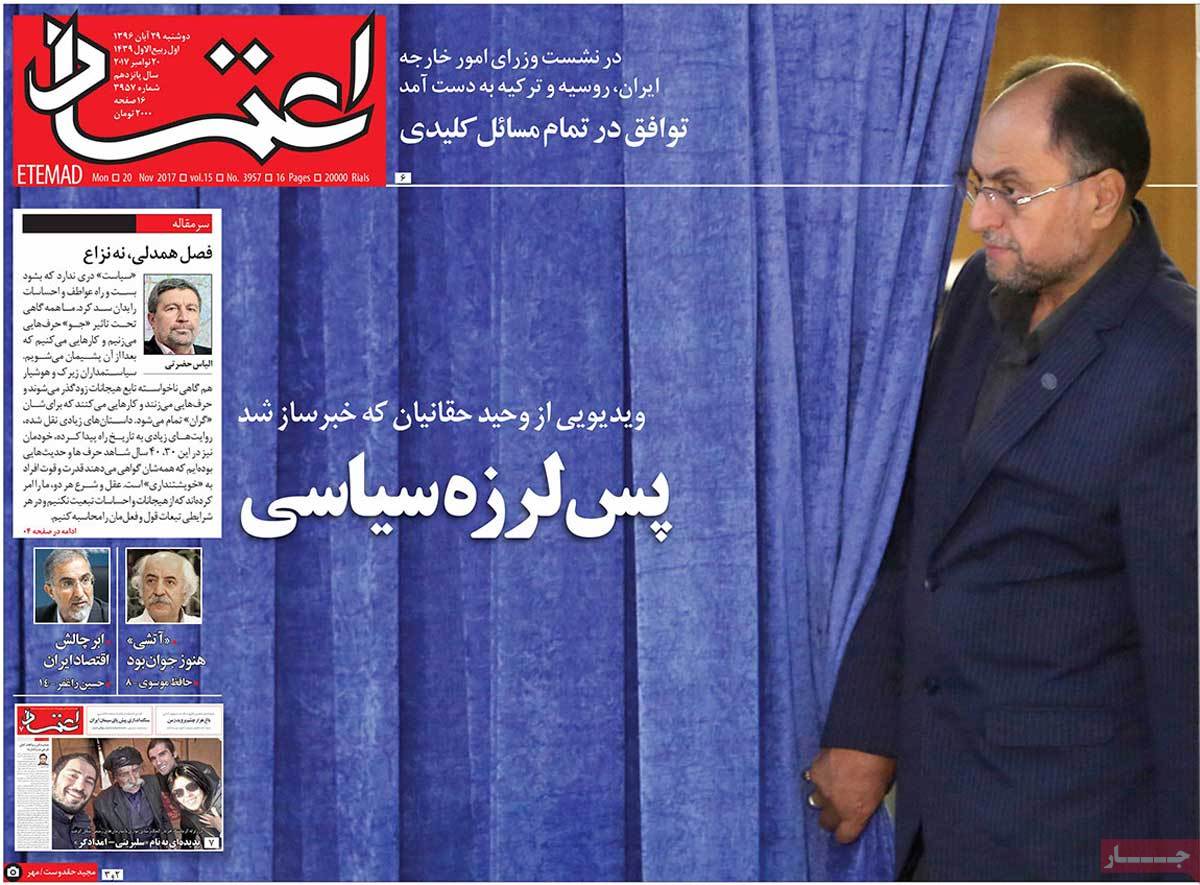
Etemad:

1- FMs of Iran, Russia, Turkey Agree on All Key Issues
A Look at Iranian Newspaper Front Pages on November 20


Ettela’at:

1- Second Wave of Help for Quake-Hit People Begins

  • All Facilities, Equipment Deployed for Temporary Accommodation

2- Leaders of Iran, Russia, Turkey to Hold Summit Wednesday

3- US Commander: We’re Not Required to Implement Trump’s Illegal Orders
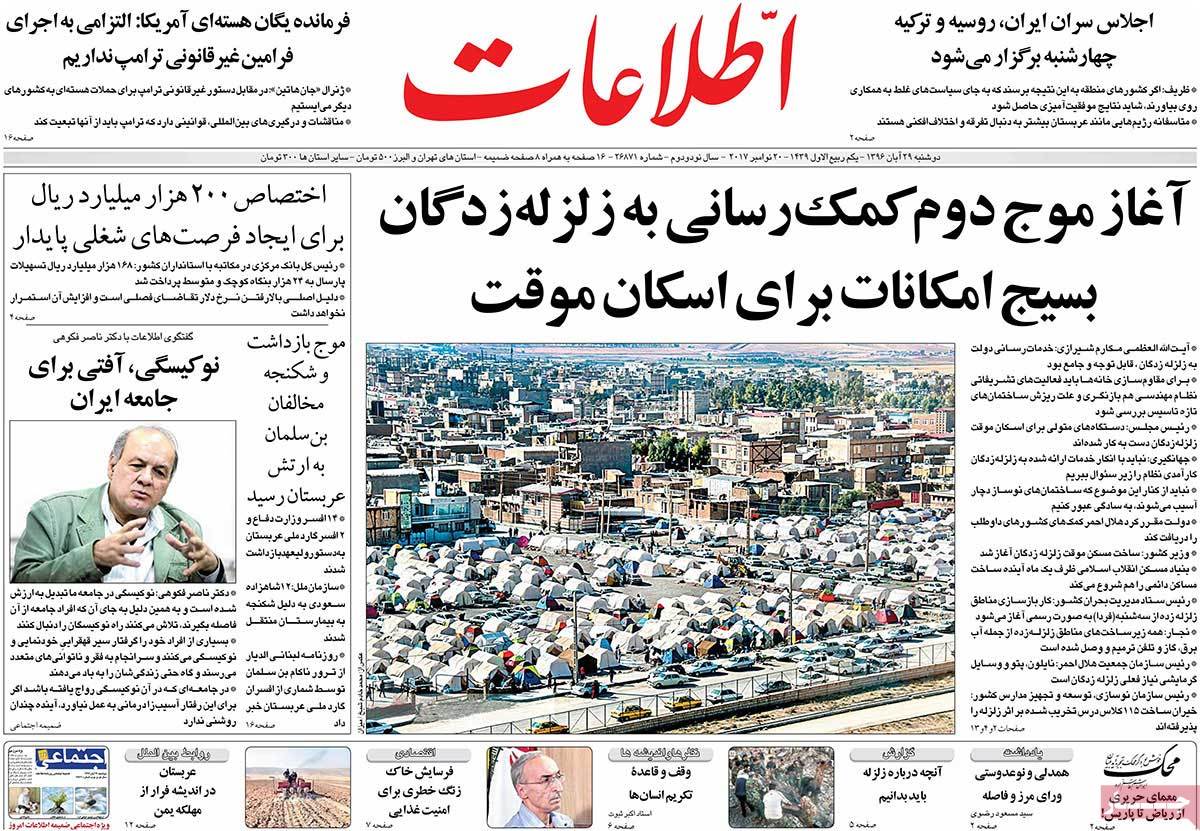
A Look at Iranian Newspaper Front Pages on November 20


Iran:

1- Riyadh’s Anti-Iran Plot Fails

2- Zarif: Saudi Arabia Should Change Its Policies to Be Part of Regional Peace

3- A Week Full of Bitter, Sweet Incidents

  • A Review of 7th Day after Iran Earthquake
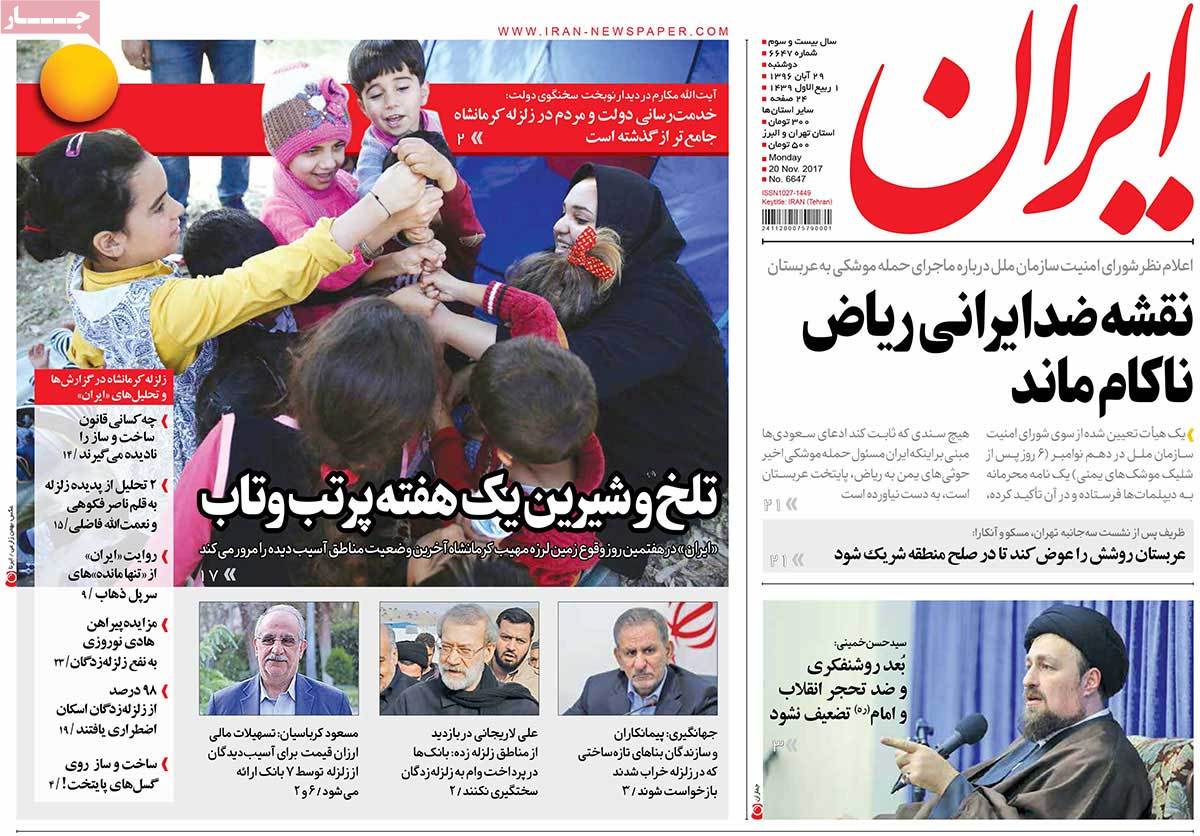
A Look at Iranian Newspaper Front Pages on November 20


Jame’eh Farda:

1- Ballistic Missiles on Negotiating Table?

  • Message of US, France Conveyed to Iran

2- Reformist Figure’s Mechanism for National Dialogue

  • Path of Achieving National Dialogue More Complicated than Path of Achieving JCPOA
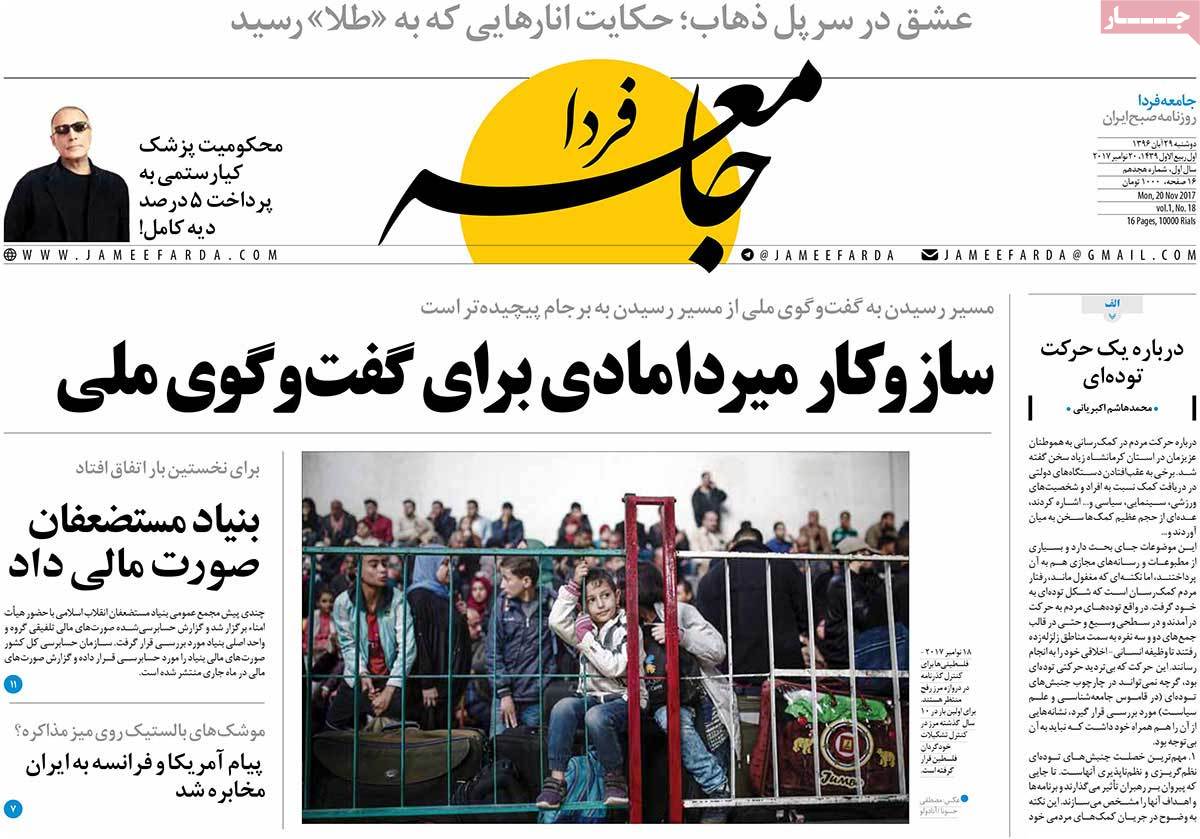
A Look at Iranian Newspaper Front Pages on November 20


Javan:

1- US Uses Oil to Set Iran Nuclear Deal on Fire

2- India, South Korea, Europe Decrease Oil Purchase from Iran

3- Axis of Resistance Eradicates ISIS Terrorists

4- Velayati: Mr. Macron! Be as Independent as Charles de Gaulle
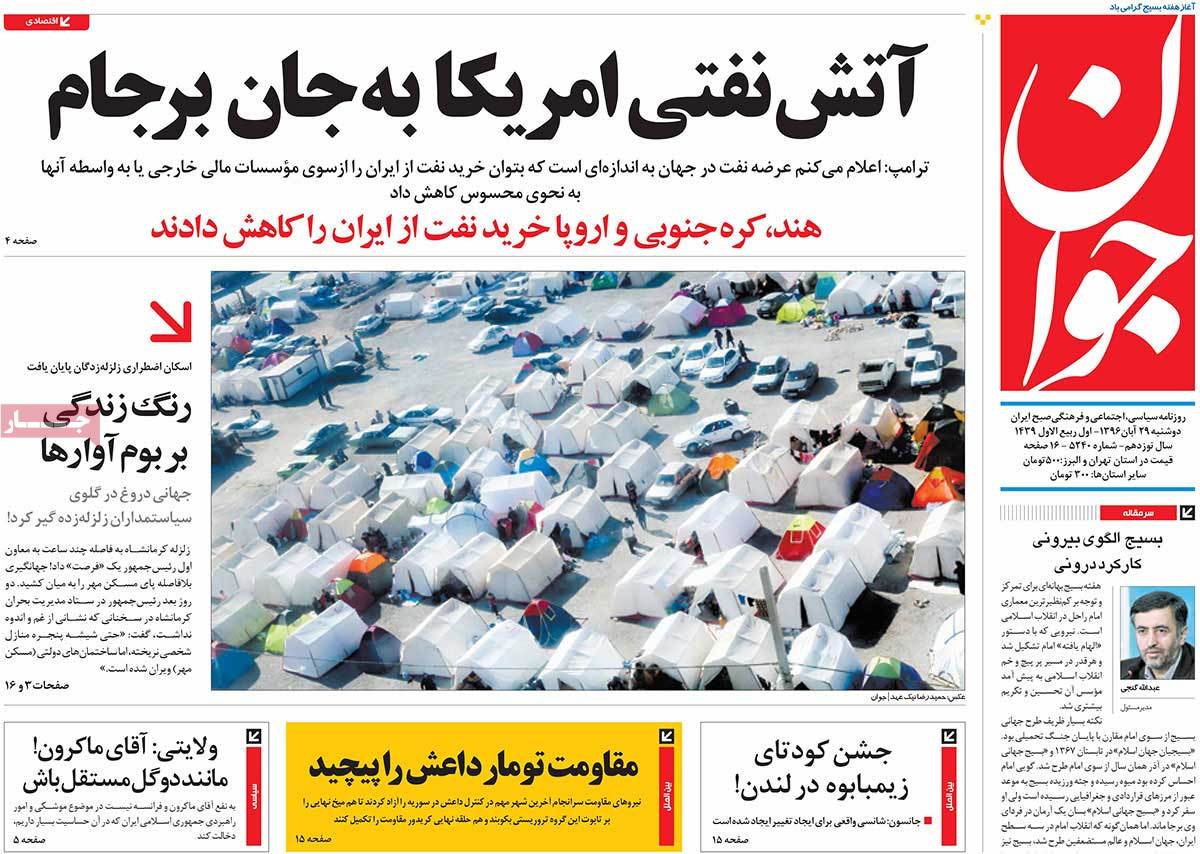
A Look at Iranian Newspaper Front Pages on November 20


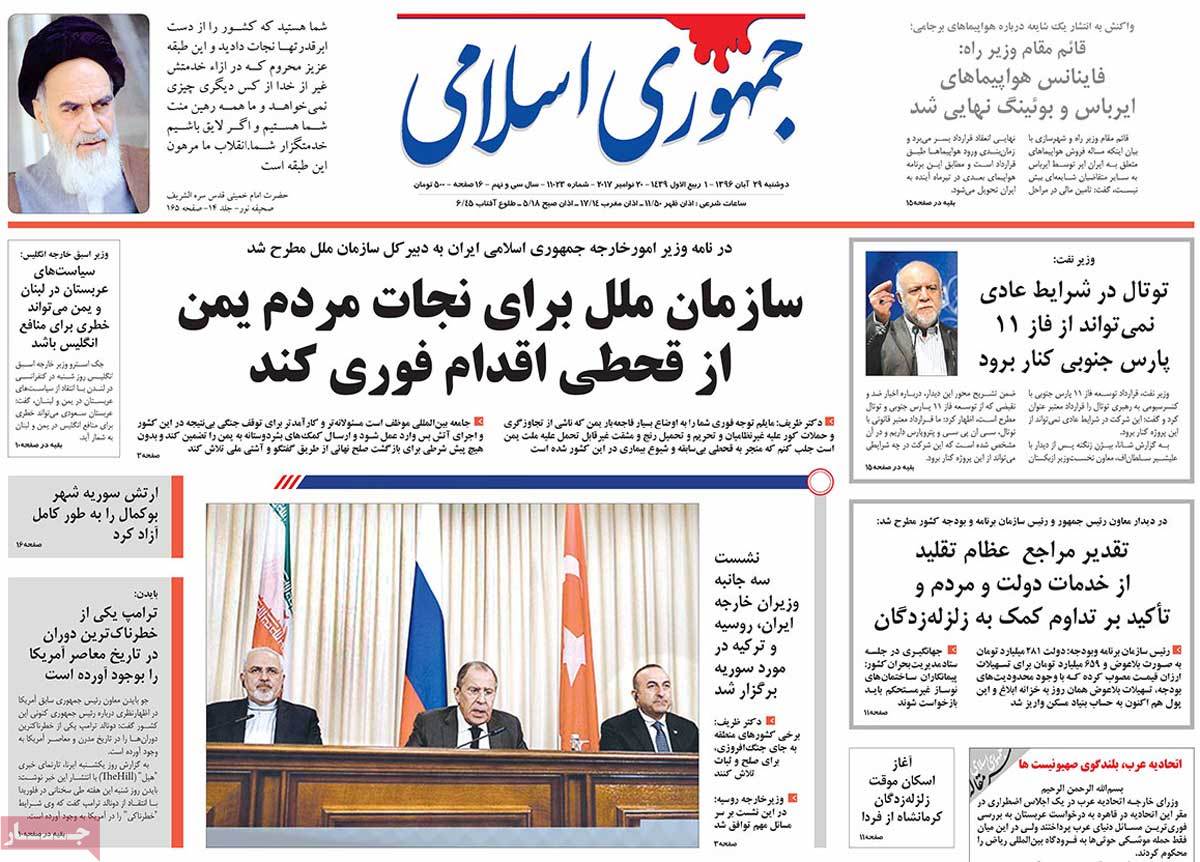
Jomhouri Eslami:

1- FM Zarif: UN Should Take Immediate Action to Save Yemeni People from Drought

2- Oil Minister: Under Normal Circumstances, Total Cannot Leave Phase 11 of South Pars

3- Top Clerics Praise Services of Gov’t, People, Call for Continued Help for Quake-Hit People
A Look at Iranian Newspaper Front Pages on November 20


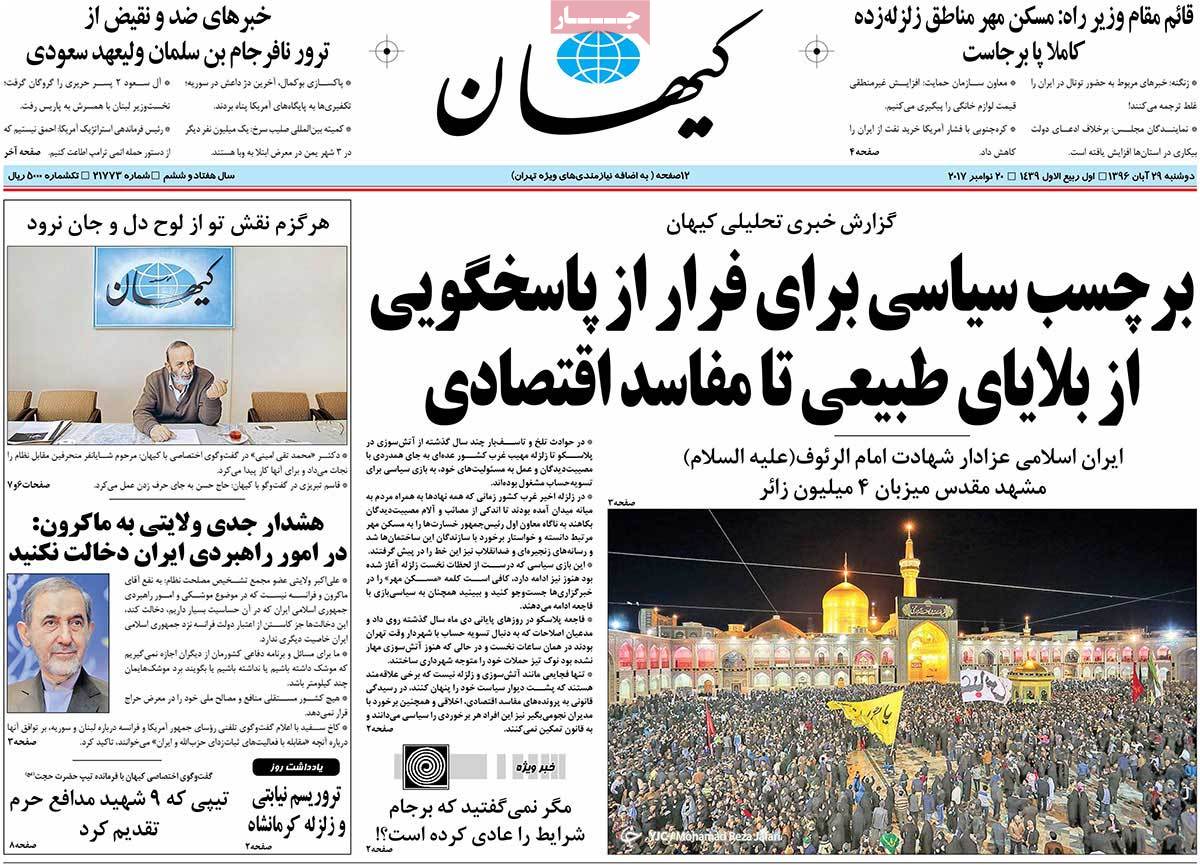
Kayhan:

1- Political Labelling to Evade Accountability: From Natural Disasters to Economic Corruption

2- Mixed Reports about Attempt to Murder Bin Salman

3- Velayati Seriously Warns Macron over Interfering in Iran’s Strategic Affairs
A Look at Iranian Newspaper Front Pages on November 20


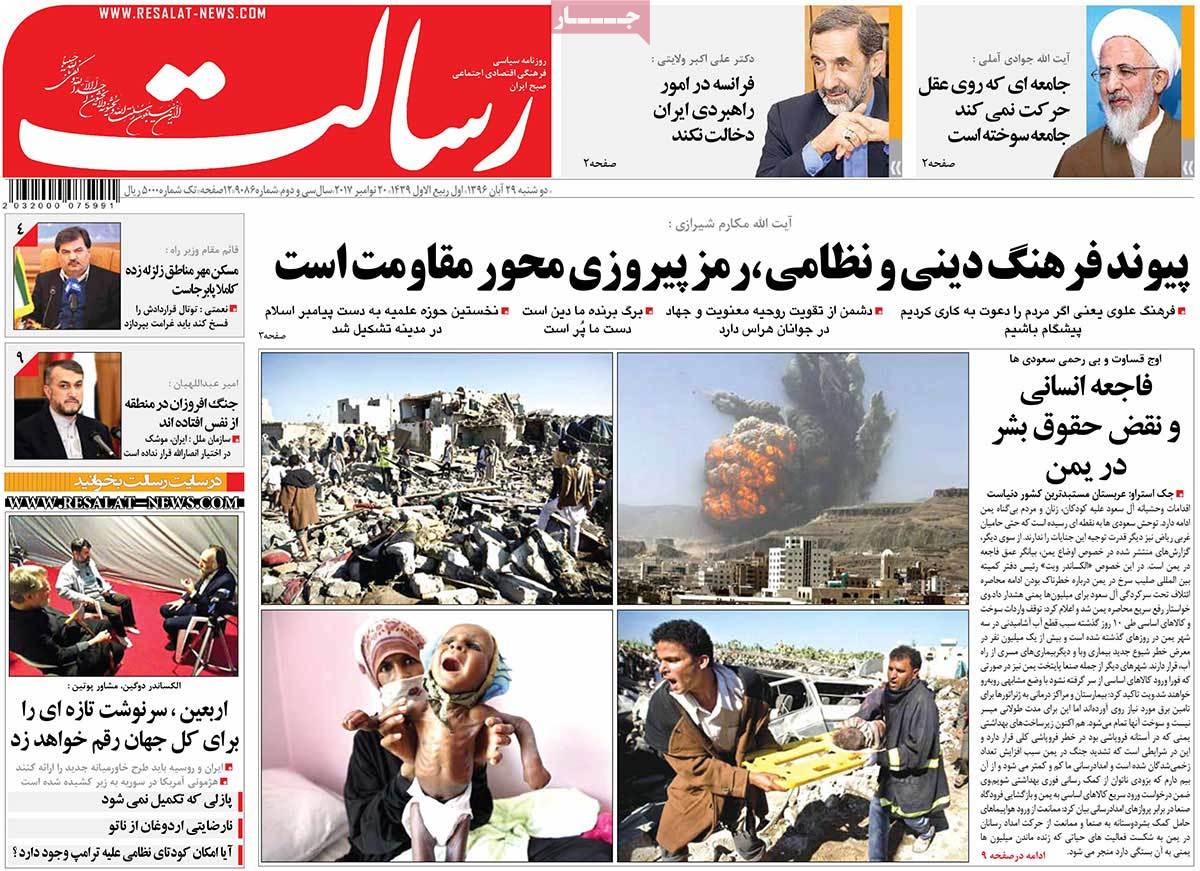
Resalat:

1- Ayatollah Makarem Shirazi: Connection of Religious, Military Cultures Secret behind Victory of Resistance
A Look at Iranian Newspaper Front Pages on November 20


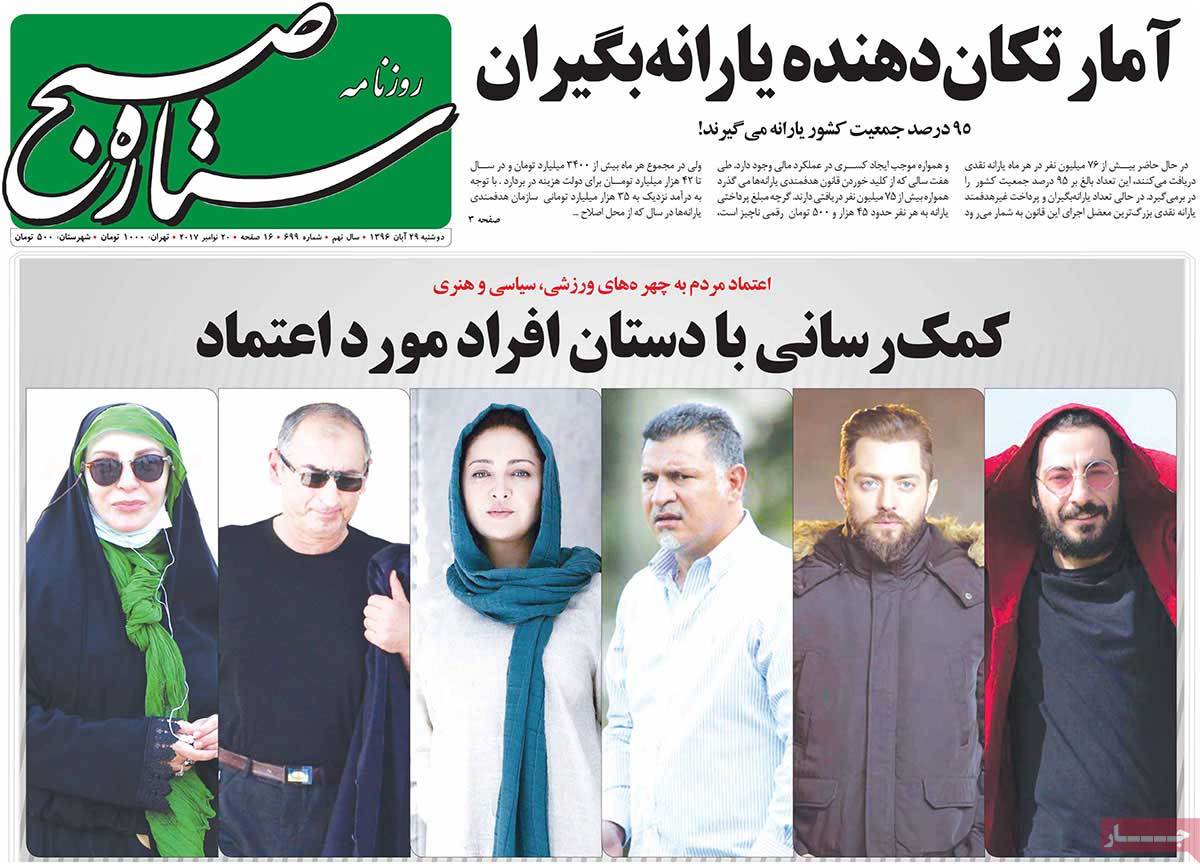
Setareh Sobh:

1- People’s Trust for Athletic, Political, Art Figures: Helping People through Trusted Hands
A Look at Iranian Newspaper Front Pages on November 20


Shargh:

1- Oil Minister on Total’s Withdrawal from South Pars: No One Commits Suicide for Fear of Death

2- Deputy Roads Minister: Boeing to Come to Tehran Next Week; Trump Prolonged Negotiations
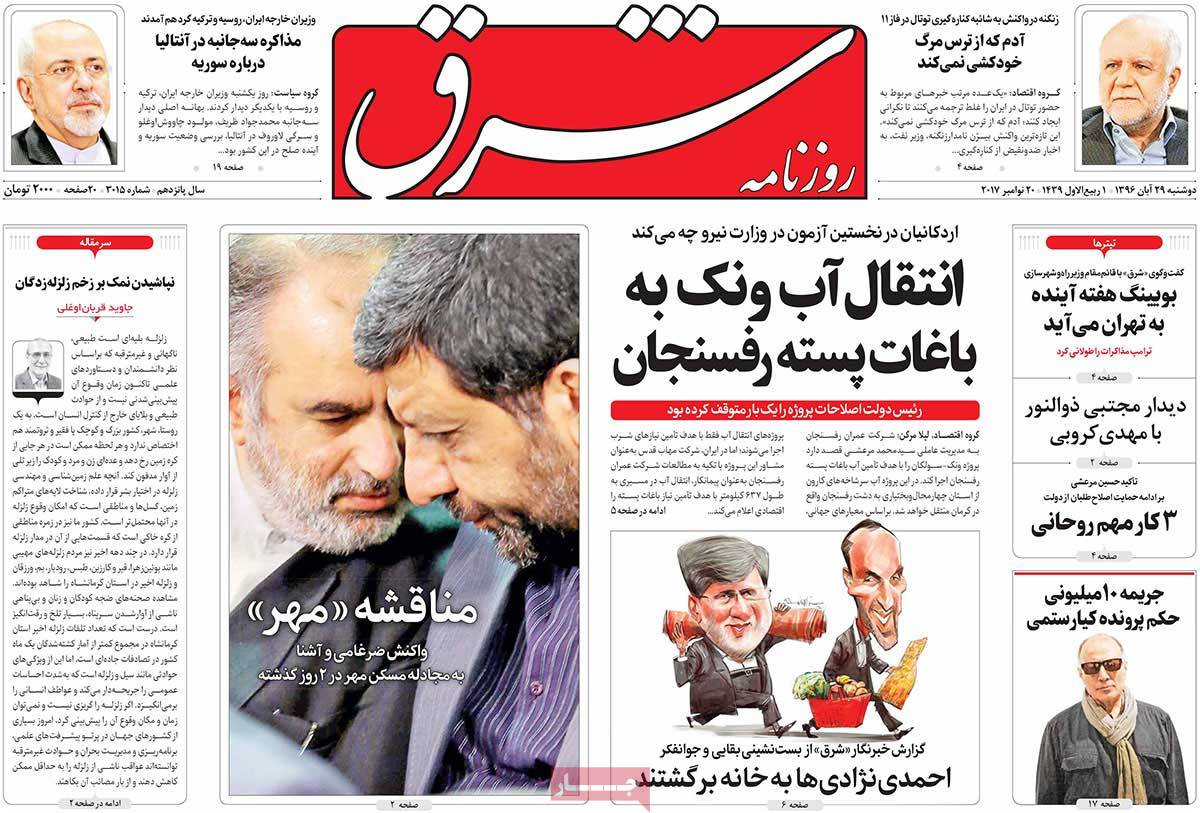
A Look at Iranian Newspaper Front Pages on November 20


Siasat-e Rooz:

1- Settlements before Kingdom: Media Reports Claim Bin Salman Assassinated

2- France Continues to Play Role of Bad Cop

  • White House: Trump, Macron Make Deal on Countering Iran, Hezbollah
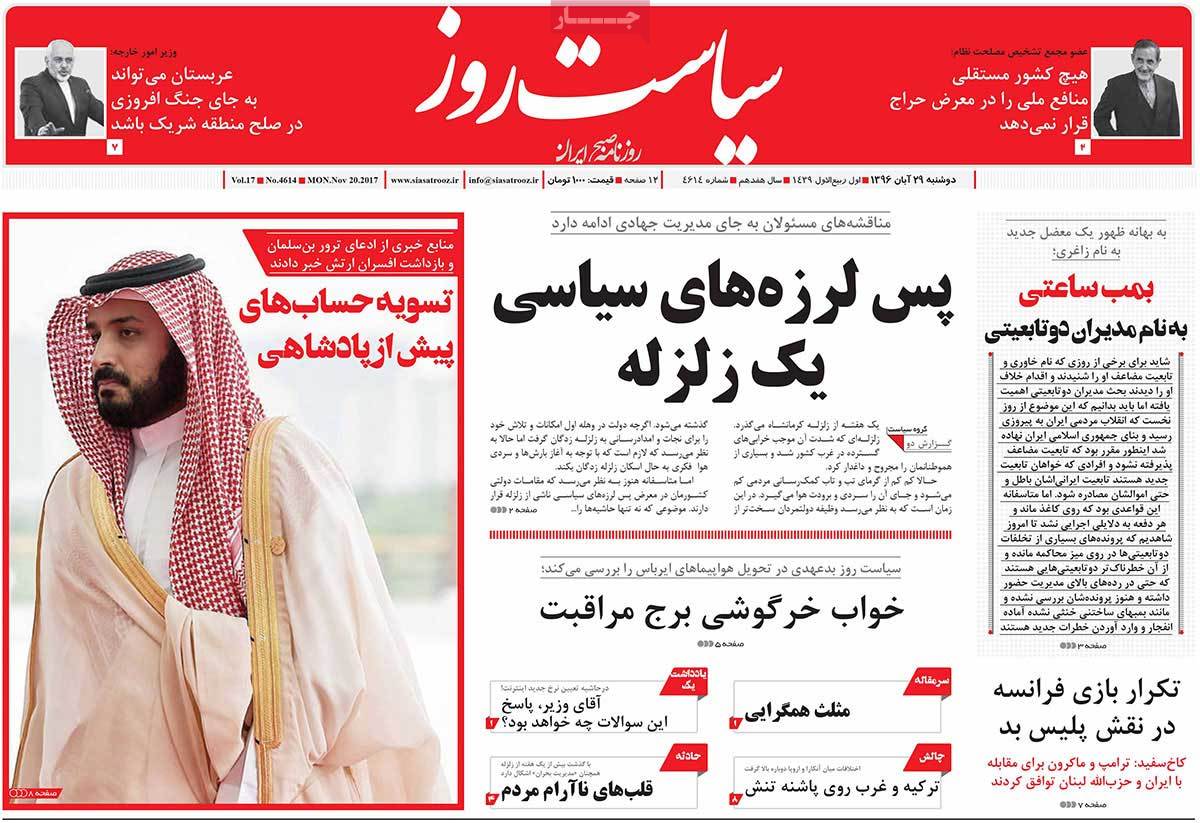
A Look at Iranian Newspaper Front Pages on November 20


Sobh-e Now:

1- Syria’s Bukamal Liberated: General Soleimani Fulfils His Promise
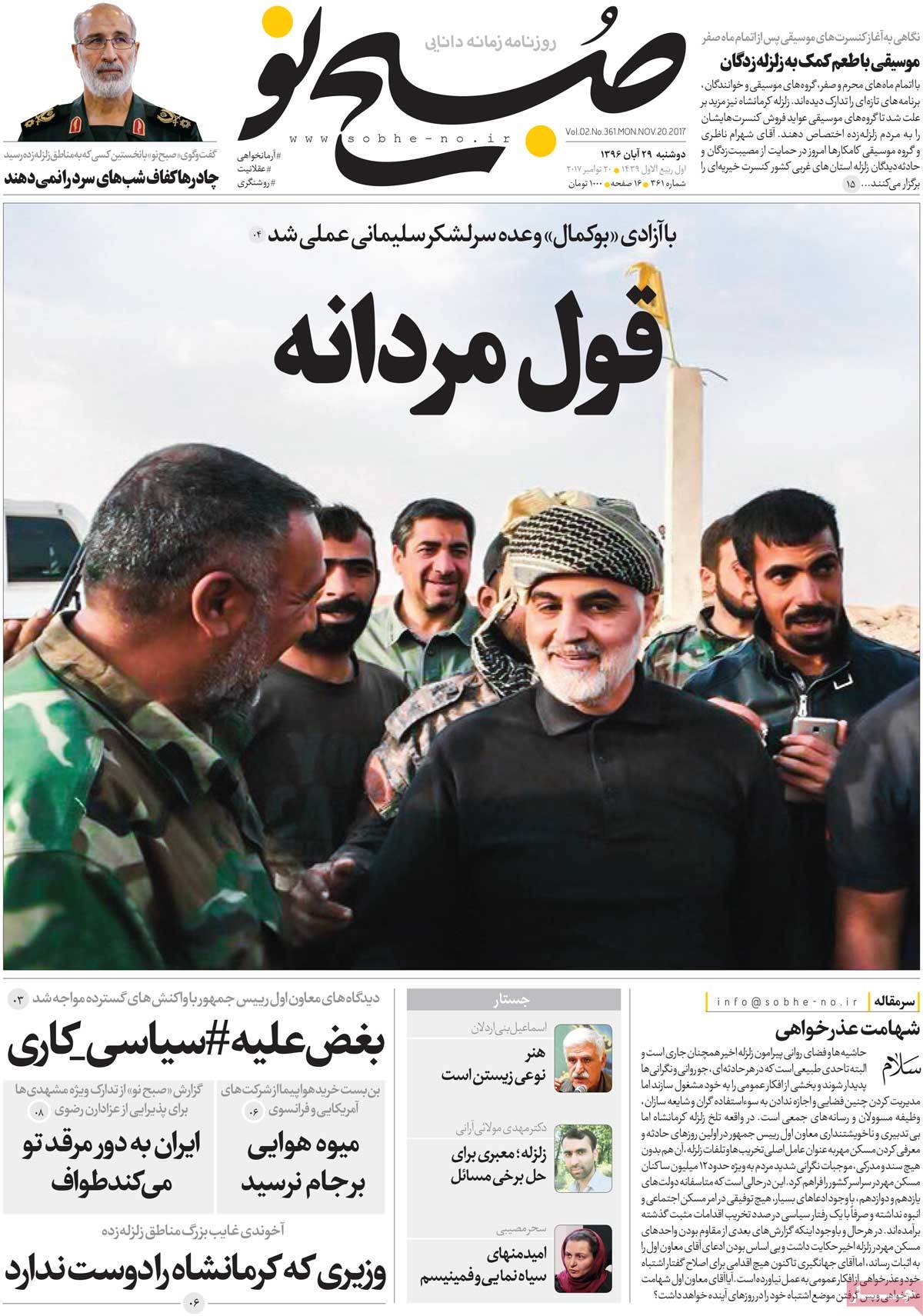
A Look at Iranian Newspaper Front Pages on November 20


Saudi Arabia, Not Iran, Destabilizing Mideast: FM Zarif

“Irony is KSA accuses Iran of destabilization, while itself fuels terrorists, wages war on Yemen, blockades Qatar & foments crisis in Lebanon,” Zarif said in a message posted on his official Twitter account on Sunday.

In the first part of his tweet, the Iranian minister referred to a meeting with his Russian and Turkish counterparts Sergei Lavrov and Mevlut Cavusoglu in the Turkish city of Antalya earlier on Sunday, saying, “Working with Turkish & Russian counterparts to build on ceasefire we achieved in Syria & preparing for inclusive dialog among Syrians”.

The three ministers convened on Sunday in Antalya to discuss the results of expert-level talk on the settlement of Syria crisis.

Iran, Russia and Turkey have so far held seven rounds of peace talks in Kazakhstan to help end the conflict in Syria. The fourth round of those talks in May produced a memorandum of understanding on de-escalation zones in Syria, sharply reducing fighting in the country.

Diplomatic efforts to end fighting in Syria gained momentum in 2017 with the announcement of a ceasefire in the Arab country in early January.

According to a report by the Syrian Center for Policy Research, the conflict has claimed the lives of over 470,000 people, injured 1.9 million others, and displaced nearly half of the country’s pre-war population of about 23 million within or beyond its borders.

No Shortage of Food, Basic Necessities for Iran Quake Victims

The devastating 7.3-magnitude earthquake which struck western Iran several days ago has left well over 400 people dead and more than 10,000 injured.

The large number of people suffering from broken limbs and ribs was a challenge to the medical personnel at makeshift hospitals as well as the medical staff of the Red Crescent Society in the first days after the temblor struck.

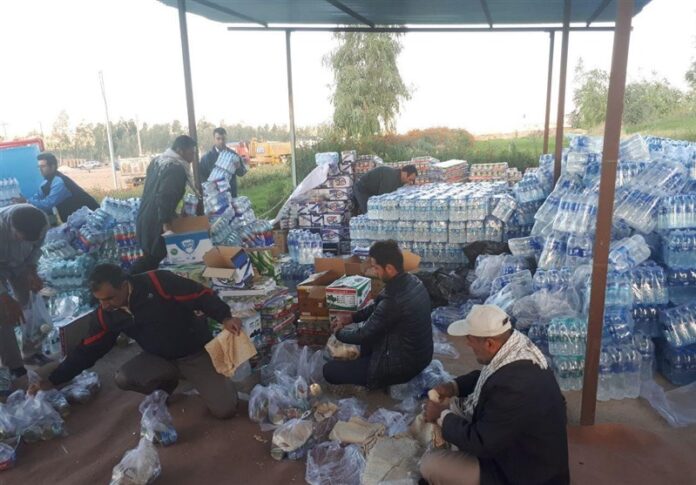
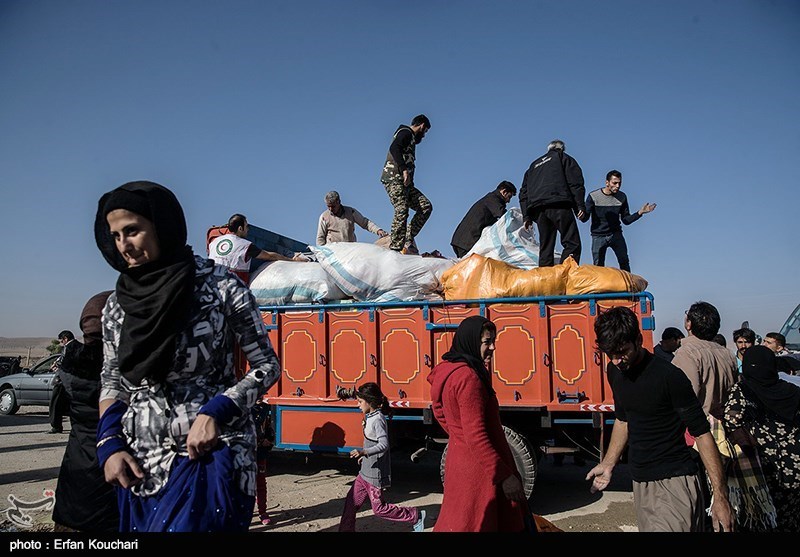
However, aid operations have been in full swing since the tragic disaster happened, and huge quantities of basic supplies have been sent to and distributed among the quake victims.

No Shortage of Food, Basic Necessities for Iran Quake VictimsAccording to senior military officials on the ground, thousands of helpings of warm food are being handed out among the quake-stricken victims every day, and there is no shortage of food in villages. The government, Red Crescent Society, Armed Forces and contingency headquarters are all working round the clock to take to the affected areas the relief aid offered by the general public from across the nation.
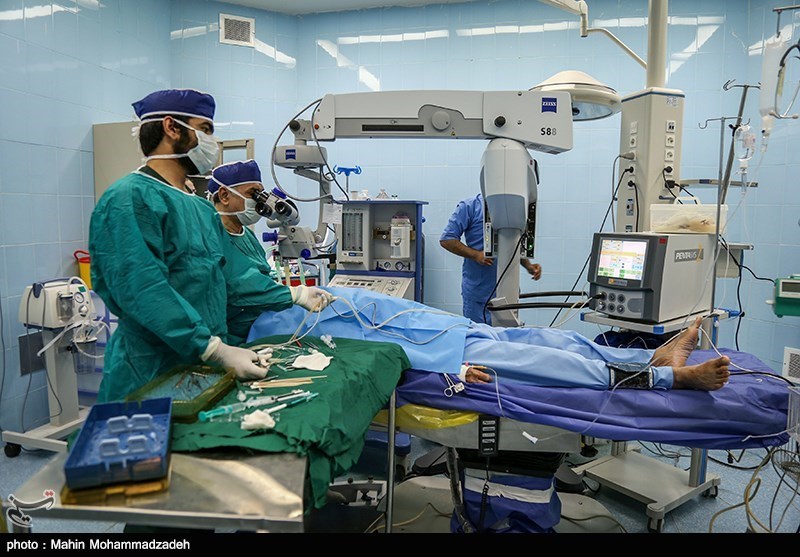
A census has been taken in quake-hit villages to specify the number of households in need of tents. Based on the same figures, tents are distributed among the residents.

The IRGC Ground Force has set up 6 makeshift hospitals to offer medical services to the earthquake victims. Experienced doctors and paramedics working there have played a key role in treating the patients.

Plans are also underway to remove the remaining rubble and bury the cattle killed in the temblor.

No Shortage of Food, Basic Necessities for Iran Quake VictimsThe IRGC’s engineering groups have been dispatched to the affected regions to facilitate work to remove the debris. Over 1000 pieces of machinery and equipment are working in the area to remove the rubble and conduct engineering work.
Some groups also went into action from the early hours after the quake hit and cleared the roads blocked by debris.

Head of the Red Crescent Society Morteza Salimi says all the affected people have been provided with makeshift housing.

The whole quake affected area has been divided into eight regions, and as many committees have been set up to handle the affairs in each region.

Salimi says the huge amount of relief aid sent in by the general public from around the country has somehow turned into a major problem as it is too much to cope with, saying there are more than enough supplies and basic necessities.

Iranian Painter Depicting Loneliness in Wall Paintings

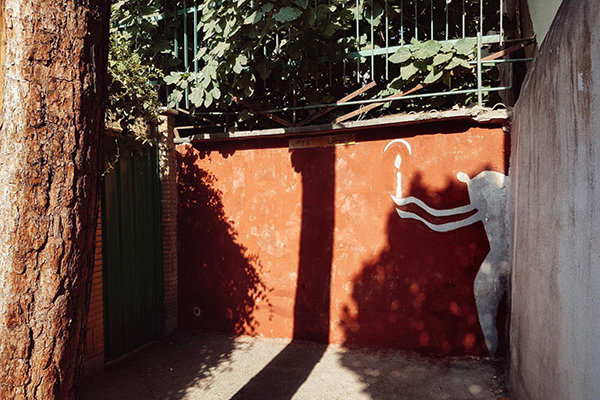
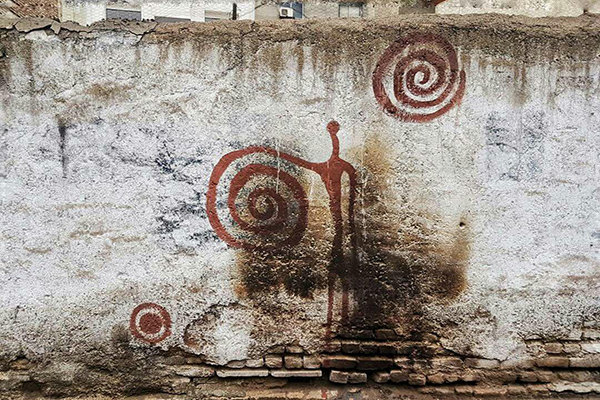
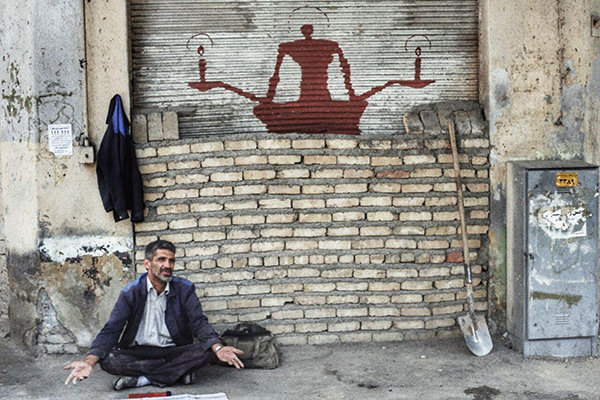
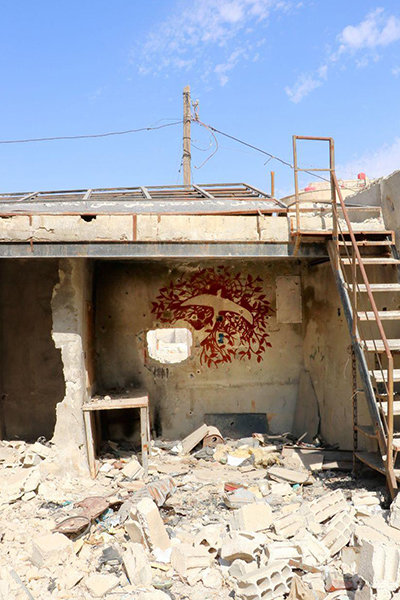
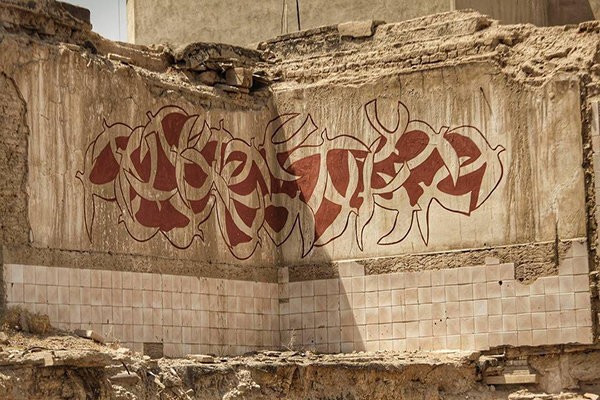
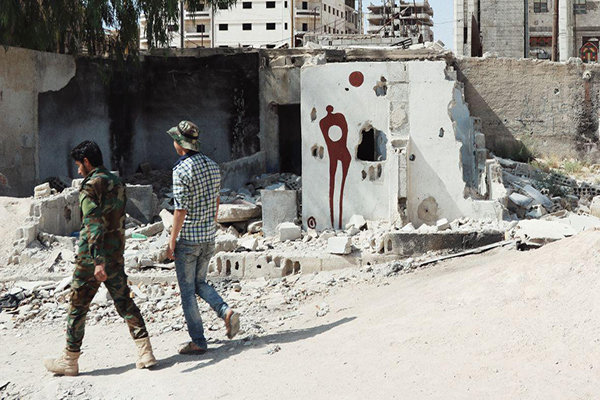
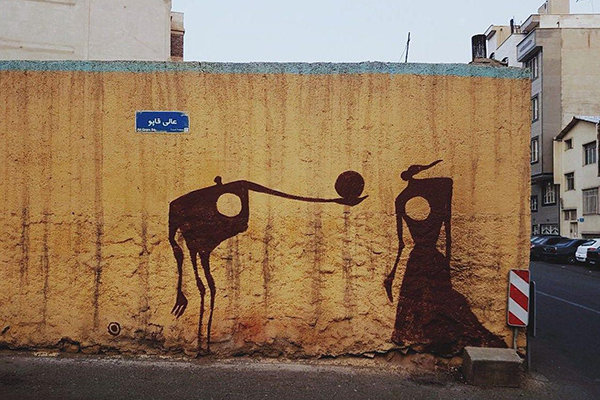
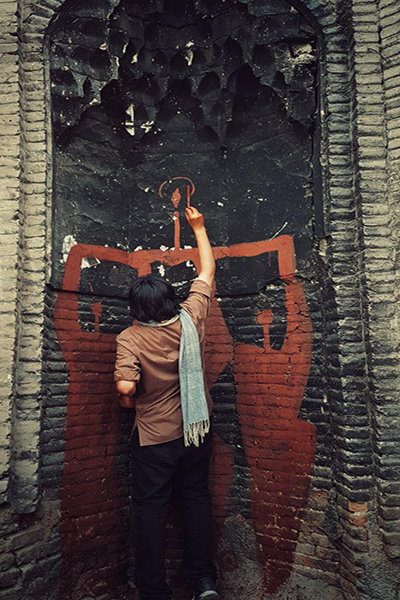
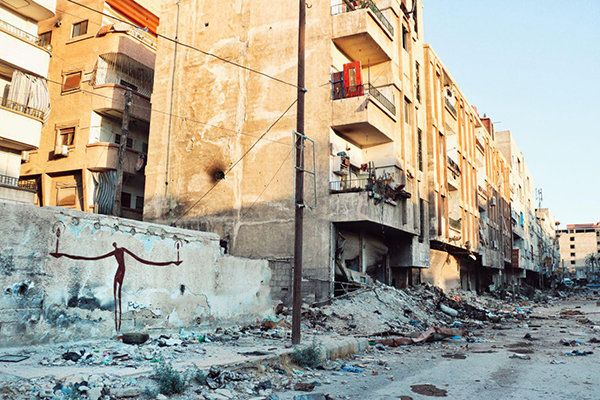
Mirza is an artist who has drawn paintings in ochre on walls everywhere, from old neighbourhoods in Tehran to abandoned dilapidated buildings in Damascus. There is no name or photo of him; it is only his paintings that one can see. Even in videos, he covers his face. The following report elaborates on his paintings.


Iranian Painter Depicting Loneliness in Wall PaintingsWe Have Forgotten to Marvel in Life
In his paintings, Mirza seeks to create and receive marvel. He believes contemporary man does not marvel. He says modern man becomes happy and sad, is surprised, gets angry, but does not marvel!

Ochre: Colour of Primitive Man

Mirza’s paintings all have the same colour, a type of red which he himself calls “the colour ochre.” Anyway, primitive man had the ochre earth and the wall. It seems the impression left behind by the paintings of primitive man has become stronger and more mysterious throug years. Mirza, too, has the same simple tools: the ochre earth, which still hasn’t run out and still exists on the Planet Earth, and the wall which exists in much higher numbers today than in the era of primitive man.


I object to man’s not marveling in life!

Murals and paintings on walls suggest a kind of protest all over the world. In many countries, political, social and civil protest is expressed in this way. But Mirza has a different look. Of course, he has objections, too, but his protest is of a different kind. His grievances go beyond political and social objections. Such objections have an expiration date as they get old and invalid, but how is it that the secret shared by primitive man through their wall paintings are still new? These paintings are an objection to man’s not marveling, and objections addressing man, not politics or ruling systems.

Iranian Painter Depicting Loneliness in Wall Paintings


Iranian Painter Depicting Loneliness in Wall PaintingsExhibition without Borders

Mirza has organized different exhibits, but all of them have been held across the cities, no at galleries where such exhibitions are normally held. He had his first exhibition experience on a street called Arbab-e-Jamshid. His first audience were the rough sleepers on that street, who expressed their views on his artworks and slept next to them. The Arbabe-e-Jamshid street is located in downtown Tehran in a neighbouhood where the sound of water running through street canals can be heard and everything is extremely serene; an old traditional neighbourhood.

Some of our compatriots would sleep under one of his paintings drawn on a column. Once I asked one of them what the story behind the paintings on the street were.

“I think they were drawn by aliens because all of them bear the same sign: a circle with a point inside,” he answered.

Iranian Painter Depicting Loneliness in Wall Paintings


Walking to Hear Silence

War has left behind a trail of destruction. The ravages of war are seen across Damascus as if there is no end to them. However, man will keep making discoveries. Amid the destroyed buildings, Mirza is looking for what human spirit has lost. Being alone is very important to him. Being alone mostly takes the form of loneliness rather than isolation. In his viewpoint, loneliness is the most basic human feeling. Individual loneliness could be seen in his early works: lonely animals, lonely people, separate from one another. But Later, Mirza went for collective loneliness also referred to as public loneliness. The more the number of lonely individuals, the more pure the loneliness is. A clear example of collective loneliness can be seen in the Middle East, he believes. It is a kind of loneliness which can specify the status of man on earth. But such an ambience is hidden in a modern style of living and is hard to notice. So, in his paintings, Mirza mostly highlights collective loneliness. He suggests that we, like all humans, are lonely, regardless of whether or not there is war, and may be that is the only way to salvation.