Wednesday, December 24, 2025
Home Blog Page 3760

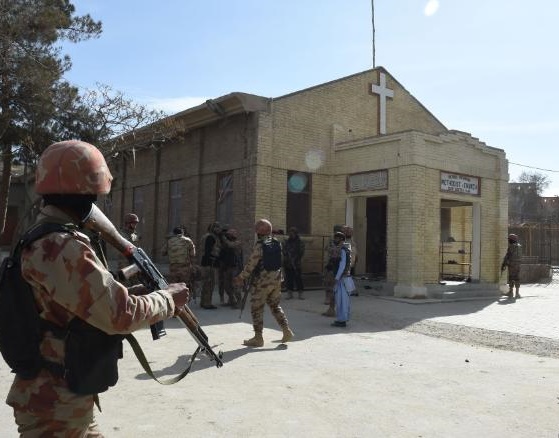
Iran Condemns ISIS Terrorist Attack on Quetta Church

pakistan

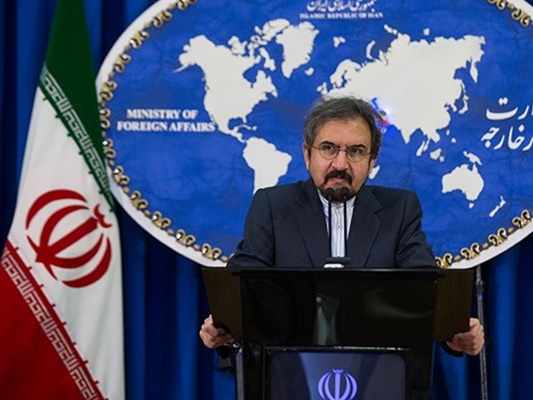
In a Monday statement, Qassemi expressed condolences to the Pakistani people and government over the tragedy and sympathized with the families of the victims of the attack.

“The remnants of the Takfiri-Zionist terrorists of ISIS, who have emerged in the Middle East through the backing of some regional and transregional countries and who have suffered definitive defeats in Syria and Iraq, have spread throughout the region and are killing and shedding the blood of innocent people with whatever religion and ideology in any corner of the world,” he noted.

“Having suffered a defeat, they seek to cause panic among the regional nations and undermine their unity by conducting sporadic, indiscriminate and blind terrorist attacks,” said the spokesman.

“Although the largest terrorist group in the world was busted to ill-wishers’ chagrin and with the steely resolve of the governments and nations in the region, their remnants continue to conduct such brutal acts in a bid to keep the terrorist ideology alive to perpetuate chaos and unrest in the region and in the world,” Qassemi added.

Iran Strongly Condemns Saudi Attacks on Yemen

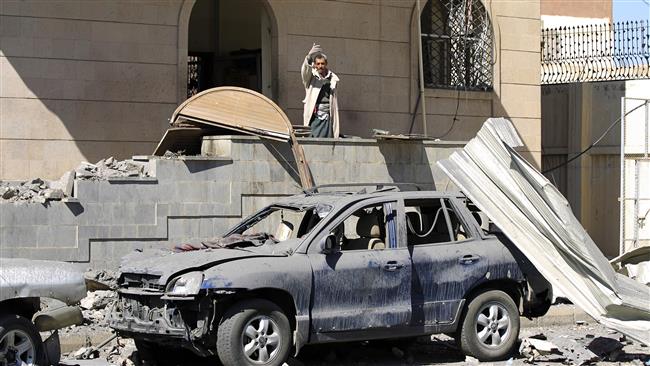
In a Sunday statement, the ministry’s spokesman Bahram Qassemi condemned the recent attacks by Saudi Arabia on civilian targets, including residential houses and shopping malls in different cities of Yemen, as well as the Sunday attack on a wedding ceremony in Ma’rib province, in which dozens of innocent Yemeni citizens including women and children were killed and wounded.

Qassemi also sympathized with the relatives of the victims of these violent crimes, saying that the increased bombardment of residential areas, continuation of the siege, and the closure of maritime, ground, and air borders, besides depriving Yemenis of having access to humanitarian aid and basic needs by Saudi rulers show the disappointment, and repeated failure of this country in achieving its goals of attacking Yemen.

He further criticized the international community’s silence over Saudi war crimes that are committed using US-made weapons saying that attacks on residential areas and civilian targets, and the denial of access to international relief agencies and bodies are obvious violations of the fundamental principles of humanitarian law.

The Iranian spokesman said those who provide the aggressors with weapons are accomplice in the daily crimes of Saudis. Qassemi also called on the United Nations and the countries that are influential in the Yemeni crisis to intensify their efforts to immediately stop the attacks and to take necessary measures to take care of the health and safety of civilians, especially women and children.

Iran Leader’s Aide Slams France for Turning into US “Pet”

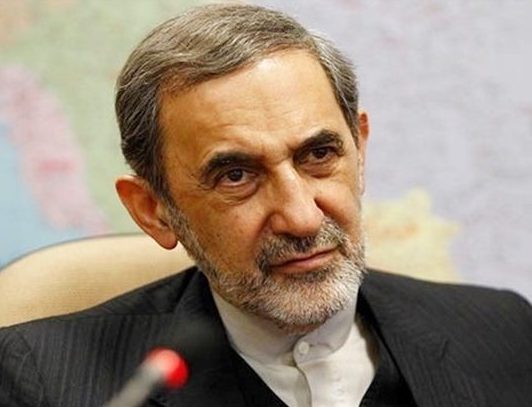
Velayati on Sunday referred to two gatherings of the anti-Iran MKO terrorist group held in France, and said that Paris has not been honest with Tehran since the Islamic Republic’s 1979 Revolution by giving the green light to some mercenaries who escaped from Iran.

“Anyone who has betrayed Iran travels to France, and this shows that Paris has problems with independent states,” Tasnim News Agency quoted Velayati as saying in a Farsi report.

Referring to the statements made by US ambassador to the United Nations, the Iranian official said Nikki Haley is an ambassador and does not know anything about military issues.

“I do not understand why she has made such remarks while all the world are making fun of her because Iran has not sent any missiles to Yemen.”

Velayati also responded to a question about Saudi Arabia or the Zionist regime’s ability to build a consensus about the Islamic Republic of Iran and stressed that they cannot do anything.

About the statement issued at the OIC meeting in Turkey, which divided Jerusalem al-Quds into East and West Jerusalem, Velayati asserted that the Iranian president, in all the ceremonies and international assemblies so far, has supported the Palestinian people and adopted a tough stance on the Zionist regime.

He also noted that Palestine belongs to the Palestinians and holy Quds belongs to the Palestinian people.

Iran Congratulates Kazakhstan on Independence Day

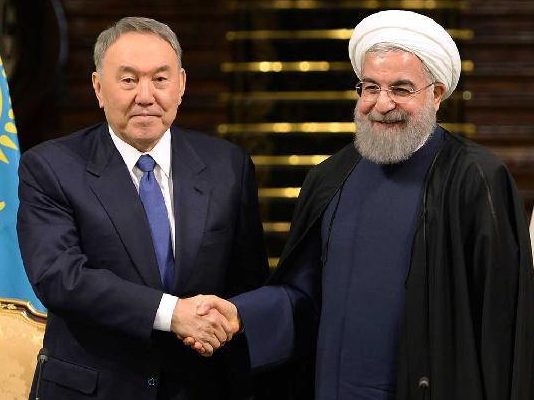
In a Sunday message to Kazakh President Nursultan Nazarbayev, Rouhani sincerely felicitated his counterpart and the Kazakh nation on the 26th anniversary of the country’s independence from the Soviet Union.

“Fortunately, in the past years, our relations have grown and deepened in line with our common interests,” Rouhani noted, according to the president’s official website.

“The Islamic Republic of Iran views Kazakhstan as a reliable neighbour and partner and is prepared to consult and cooperate with Astana for consolidating regional stability, security and solidarity.”

“I am confident that, based on the valuable experiences of the past, bilateral relations between the two countries will continue to deepen,” he added.

The Iranian president also wished health and success for Nazarbayev and prosperity and well-being for the brotherly and friendly nation of Kazakhstan.

On December 16, 1991, the Supreme Soviet passed the Constitutional Independence Law of Republic of Kazakhstan. Despite the swift collapse of the USSR, Kazakhstan was the last to declare its independence.

The Independence Day is annually celebrated for 2 days on December 16 and 17. It is marked by festivities in the presidential palace and many Kazakhs dress up in traditional clothes. Yurts (traditional tents) are set up in many villages where local delicacies are served.

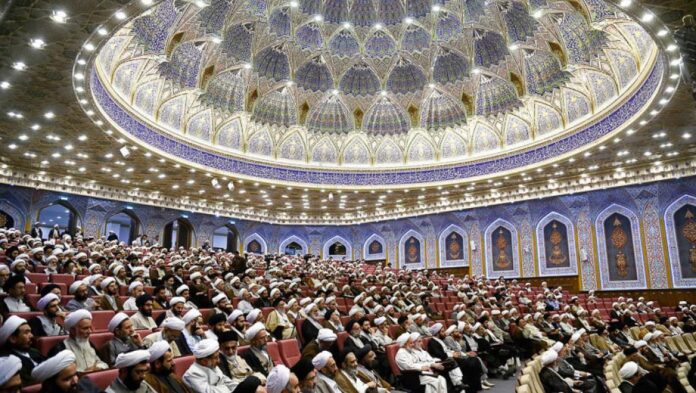
“Iranian Clergy, Seminaries Should Cut Dependence on State Budget”

The Persian-language Jomhouri Eslami newspaper has, in an article, urged the clergy to cut their dependence on state budget and rely on the religious taxes paid by the public. The highlights of the op-ed follows.

The publication of information on budgets allocated to institutions involved in cultural activities, especially those related to the clergy and Islamic seminary schools, has raised many questions in the public opinion.

They are not new questions. For many years, we have asked the question why the clergy and clerical institutions should depend on state budget. But there has been no answer. And if there have been any answers, they have not been convincing. Now that mass media have made it clear to the public opinion, something has to be done and one cannot remain indifferent toward the issue.

There were some top religious figures at the Islamic seminary in Qom who believed the clergy should be independent, and prohibited the use of finances from the government’s coffers. Even now, there are some senior clerics who stress this, and believe the clergy have made a living out of the religious taxes paid by people, and that it has been this very religious bond between people and clergymen which has helped the clergy remain an independent, efficient and sound entity, enabled them to stand up to deviations within governments at sensitive junctures, and helped them fulfill their religious and popular responsibilities.

The same basis should be the yardstick for meeting the costs of seminary schools and the clergy, so that they will remain independent and powerful. Receiving cash from the government, even an Islamic government, makes the clergy independent, and dependent clerics cannot fulfill their real mission. The current differences coupled with confrontations which have downgraded some clerics to a level lower than that of political factions are the result of the same dependence. The clergymen who are not dependent on others’ money and who can make a living through their own efforts will more easily be able to tell the truth, and promote virtue and prohibit vice. Many senior religious figures believed the clergy must not have any expectations from the people who pay their religious taxes to them. The top clerics turned away the people who, by paying money, wanted to cash in on the position, situation and leverage of the clergy. The late Imam Khomeini had such an approach and his demeanor features many cases where he did not allow others to take advantage of the clergy’s position and firmly turned them away. Imam Khomeini’s extraordinary power with which he could stand up to the former Pahlavi regime, and his unique charisma in the eyes of the public which could galvanize people into action and prompted them to enter the scene of the revolution and eradicate the root causes of colonialism and tyranny and establish the Islamic Republic were the result of this very independence and his efforts to safeguard the status of the clergy.

If we want the Islamic Revolution to go on and remain sustainable, we should safeguard the clergy with the same features. The clergy should be independent, and should not depend on state budget for its independence. As for the Institute for the Publication of Imam Khomeini’s Works and affiliated institutions as well as the Imam Khomeini Holy Shrine, which have turned into a hot issue for media, we believe the institutions should turn to the people and wean themselves off government cash. It is noteworthy that Jomhouri Eslami had already warned against the controversy and, ironically enough, came under fire as well. Imam Khomeini is so popular inside and outside Iran that if people know that money is needed to publish his works and further develop his mausoleum, they will pay much more than needed. Of course, officials should have Imam Khomeini’s simple lifestyle in mind and avoid profligacy and extravagance in all areas, especially when it comes to Imam Khomeini’s mausoleum.

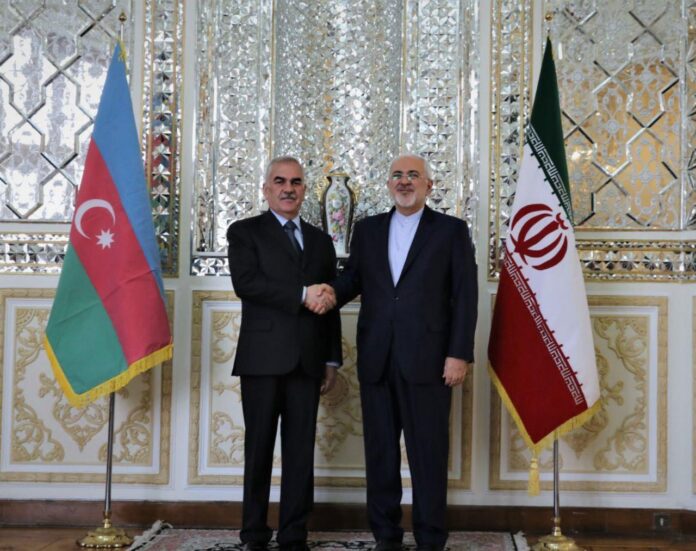
Iran Ready to Promote Ties with Nakhchivan Republic

During the Sunday meeting, Talibov expressed his pleasure with visiting Iran and said Nakhchivan Autonomous Republic is ready to expand bilateral ties with Tehran in energy, tourism and transportation fields.

He also expressed satisfaction with the growing relations between Iran and Azerbaijan Republic, particularly Tehran’s increasing ties with the Nakhchivan Autonomous Republic.

For his part, Zarif said the Iranian and Azerbaijani nations both feel themselves at home when visiting each other’s soil.

“The Islamic Republic of Iran welcomes expansion and facilitation of ties between the two sides in various fields,” he said.

He also noted that Tehran is ready to enhance its relations with the Nakhchivan Republic in different fields, particularly railway and road construction, infrastructural and agricultural projects, joint production, customs facilitation, and electricity production, among others.

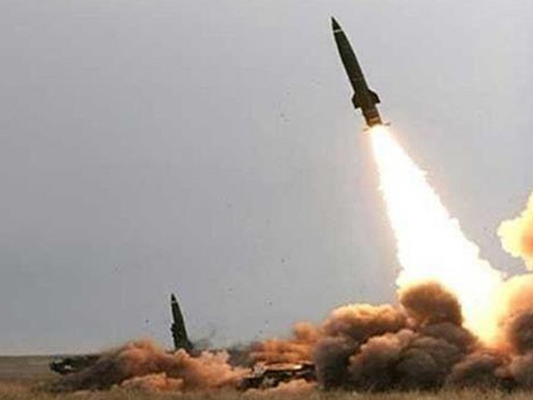
“Yemen Has Long Been Equipped with Soviet, N. Korean Missiles”

yemen

US Ambassador to UN Nikki Haley on Thursday claimed that Iran has violated the UN Security Council resolutions by providing Yemeni fighters with missiles to target Saudi Arabia.

In reaction, Spokesman for the Islamic Revolution Guards Corps Brigadier General Ramazan Sharif rejected her claims and underlined that it is no secret anymore that Yemen has long been equipped with missiles provided in the past by the Soviet Union and North Korea.

“The US envoy stands before a pipe saying there are fingerprints of Iranian nationals on it. This comes as it is a widely-known fact that Yemen used to be a country with missiles after receiving cutting-edge missile technologies from the Soviet Union and North Korea in the past,” he was quoted as saying on Sunday in a Farsi report by Tasnim News Agency.

In an address to a group of Iranian journalists in the northern province of Golestan, he said the enemies have always sought to tarnish the image of the Islamic Republic.

“To this end, the media has served as a propaganda wing which covers up the criminal behaviours of the US, Europe and the terrorist groups in the region,’

He went on to say it is nearly three years that Saudi Arabia is bombarding civilians in Yemen with weapons provided by the US and Europe.

According to General Sharif, the enemies’ media do not allow the public to find convincing answers for their questions.

“For example, the ISIS terrorist group committed heinous crimes over the past six years but the western media never gave a full coverage of the group’s defeats in the region.”

He further referred to the “provocative” decision by the US to recognize Jerusalem al-Quds as Israel’s capital and relocate its embassy from Tel Aviv to Jerusalem, and said it is part of a larger scenario to distract public opinion from the US and its allies’ failures in the region.

“They always cover up their failures by launching new media campaign.”

The IRGC spokesman also said Saudi Arabia, the US and the Zionists have failed to press ahead with their projects in the region over the past ten years.

He referred to the long-time animosity of the enemies against the discourse of the Islamic Republic and said their media are at work in full force to tarnish Iran’s image.

“Like the Communist discourse, the Western discourse cannot stand against the Islamic Republic’s discourse. Trump is afraid of our hegemony. During one of his speech, he called Iranians terrorists. His statement proved right the Iranian leader’s ‘velvet glove’ statement about the west.”

He underlined the enemies’ media seeks to promote this discourse that the Islamic Republic of Iran is not capable of running the country. “But 39 years on, we have good conditions in various fields specially security.”

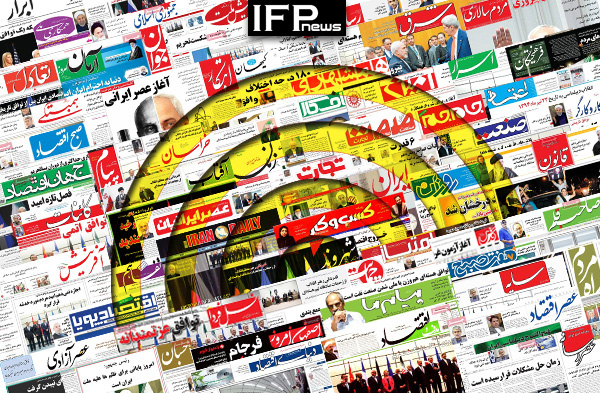
A Look at Iranian Newspaper Front Pages on December 17

A Look at Iranian Newspaper Front Pages on November 5

Among the top headlines today were continued reactions to the US accusations against Iran about supply of ballistic missiles to Yemen.

Several papers published opinion pieces and articles about the future of Iran-US relations and the regional rivalry between Iran and Saudi Arabia.

Also a top story was a wave of criticisms against Iranian President Hassan Rouhani, which has sparked controversy among social media users and politicians.

The above issues, as well as many more, are highlighted in the following headlines and top stories:


19 Dey:

1- Zarif: US Source of Middle East’s Weapons

2- Shamkhani: We Should Take Decrease in People’s Trust Seriously
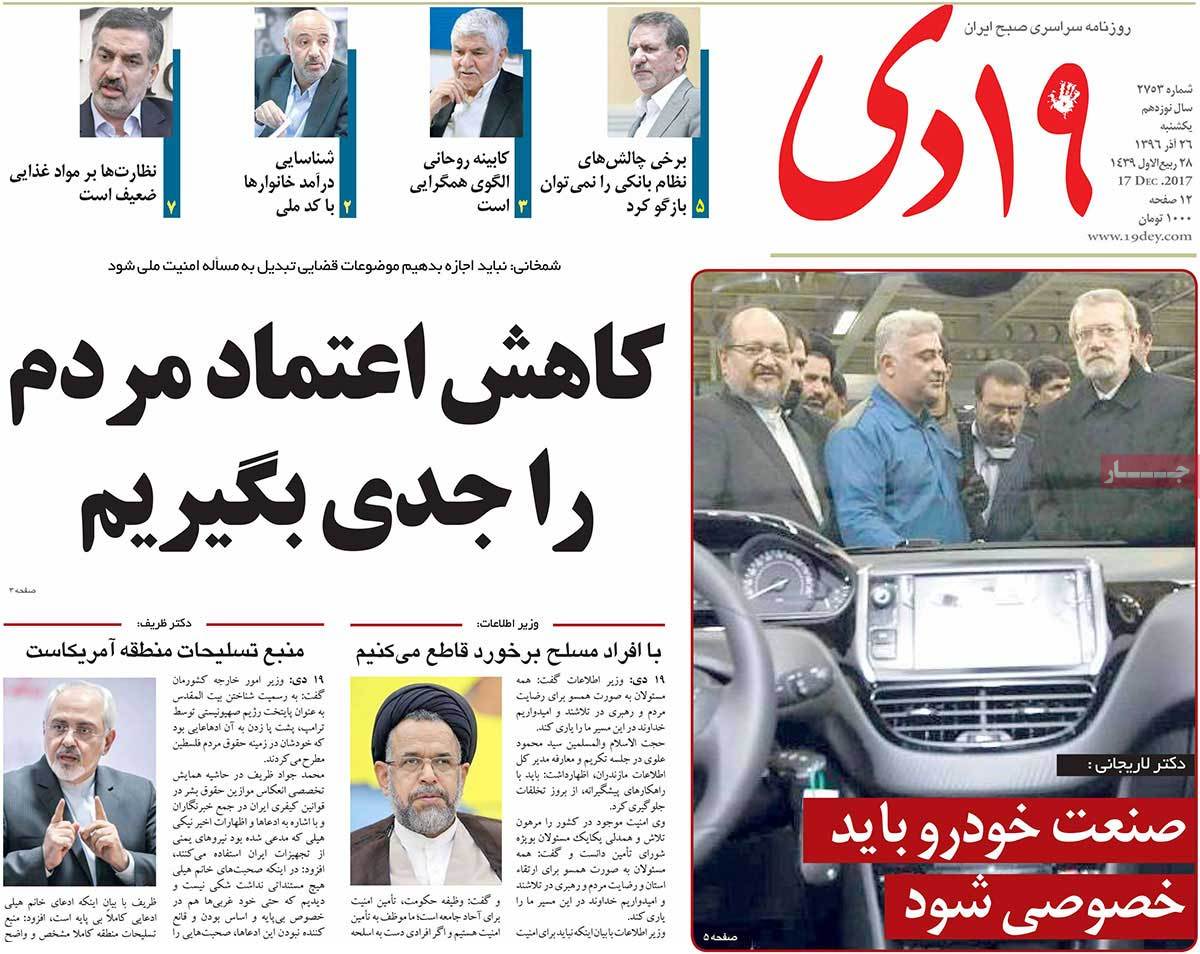
A Look at Iranian Newspaper Front Pages on December 17


Abrar:

1- Saudi Arabia: Trump’s Decision on al-Quds Wrong

2- France Did Not Confirm US Evidence against Iran
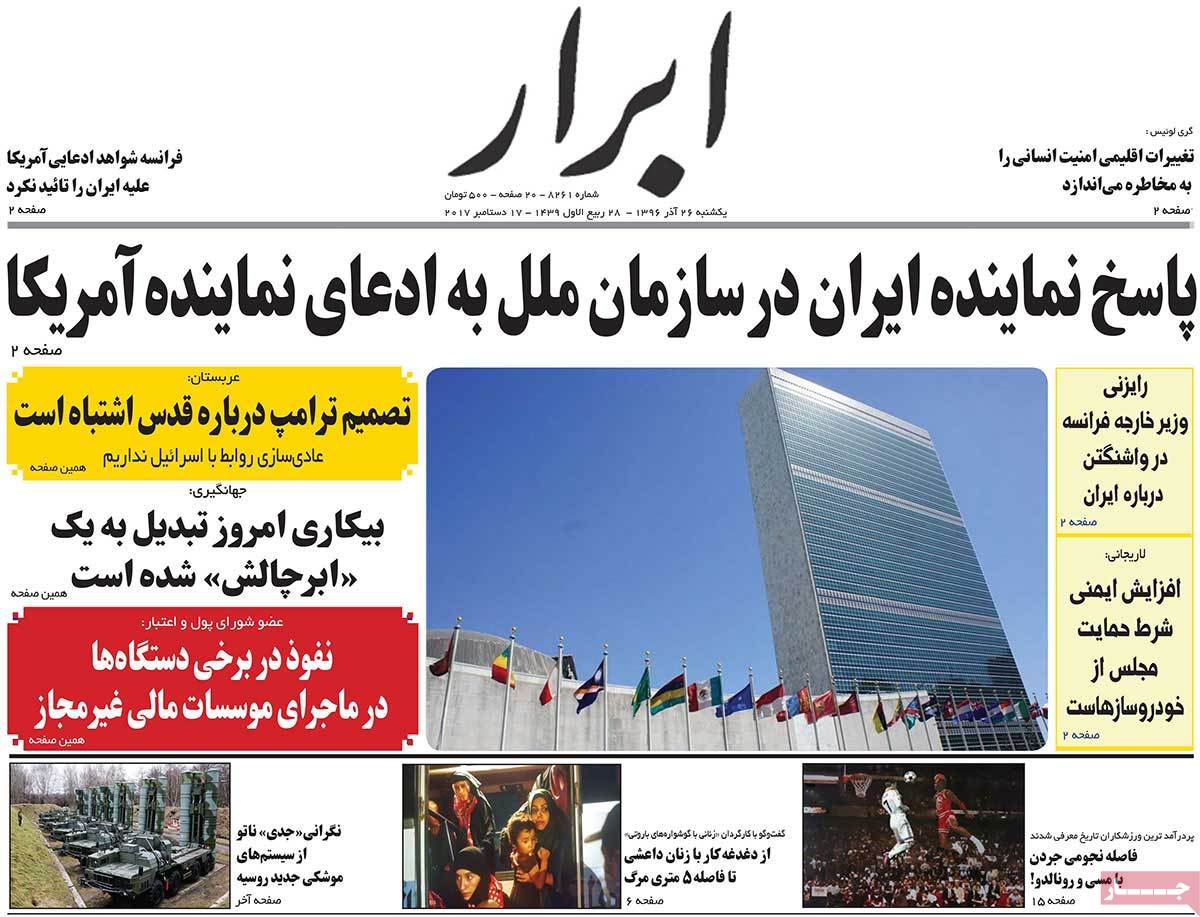
A Look at Iranian Newspaper Front Pages on December 17


Aftab-e Yazd:

1- Russian Attack on Zarif: Lavrov’s Remarks Cited for Attacking Iran FM
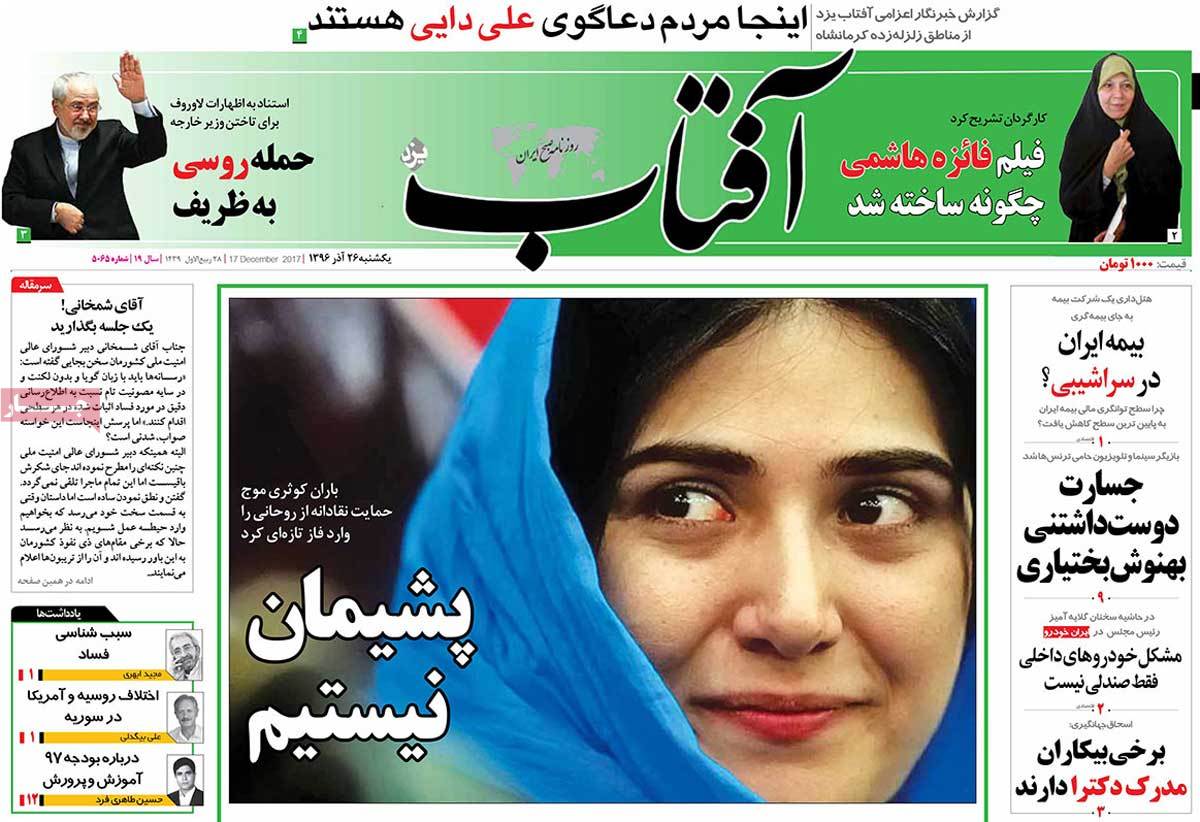
A Look at Iranian Newspaper Front Pages on December 17


Arman-e Emrooz:

1- Analyst: Saudi-Israel Axis Hatching Plots against Iran
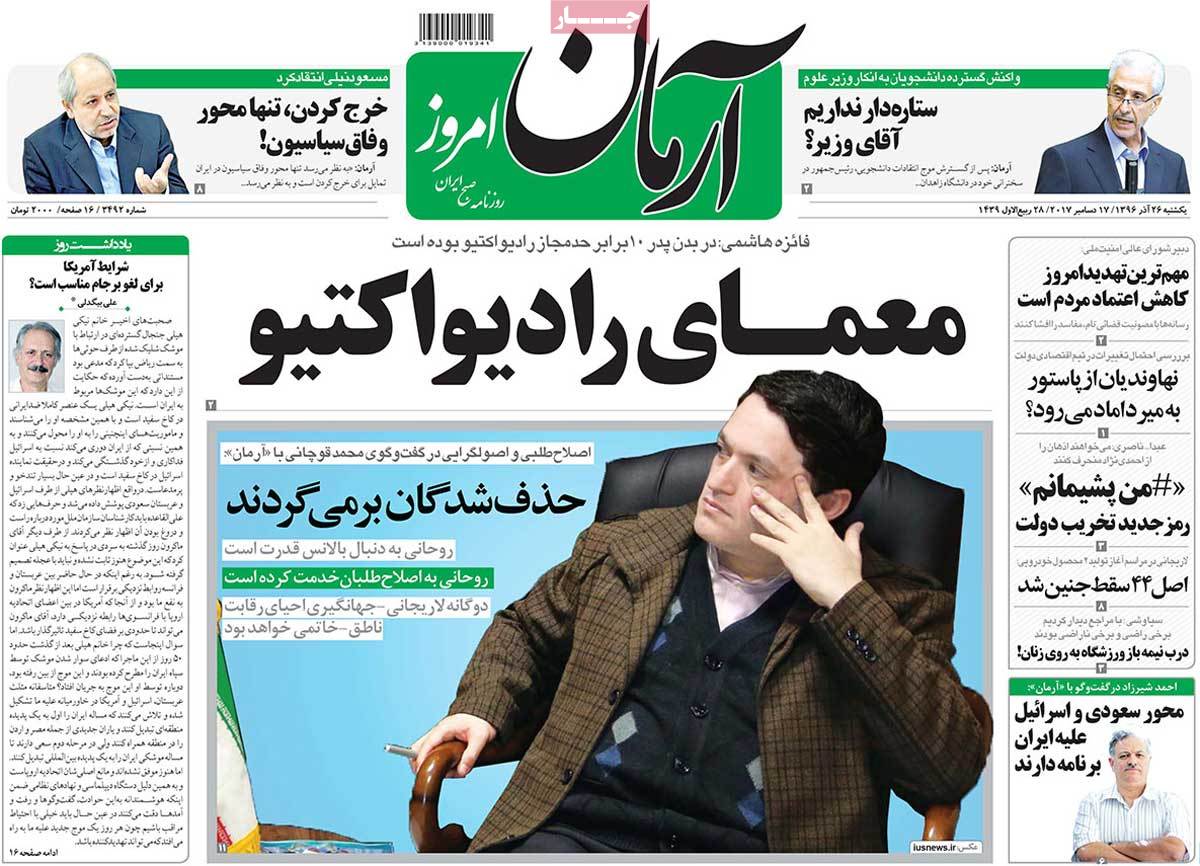
A Look at Iranian Newspaper Front Pages on December 17


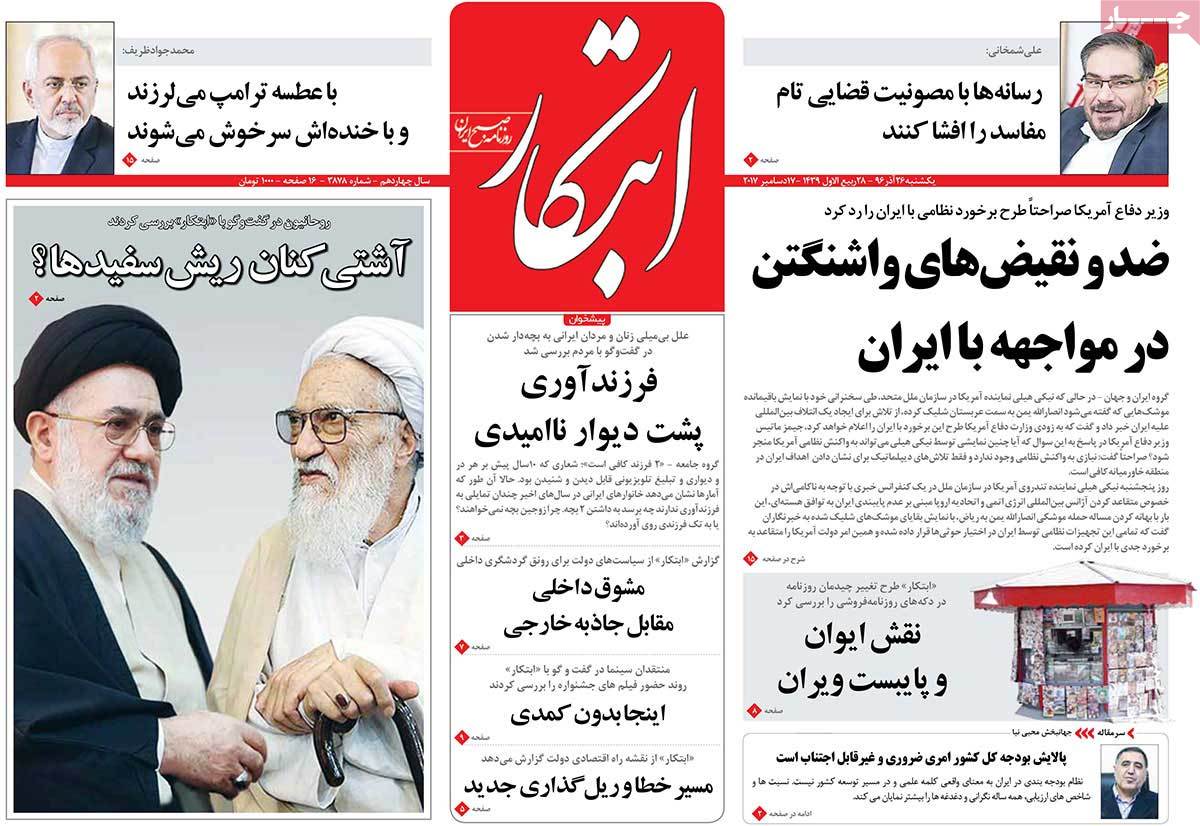
Ebtekar:

1- Washington’s Conflicting Behaviours towards Iran

2- Shamkhani Urges Media to Disclose Corruption While Enjoying Judicial Immunity

3- Zarif: Trump’s Sneeze Scares Them to Death, His Smile Makes Them Happy!
A Look at Iranian Newspaper Front Pages on December 17


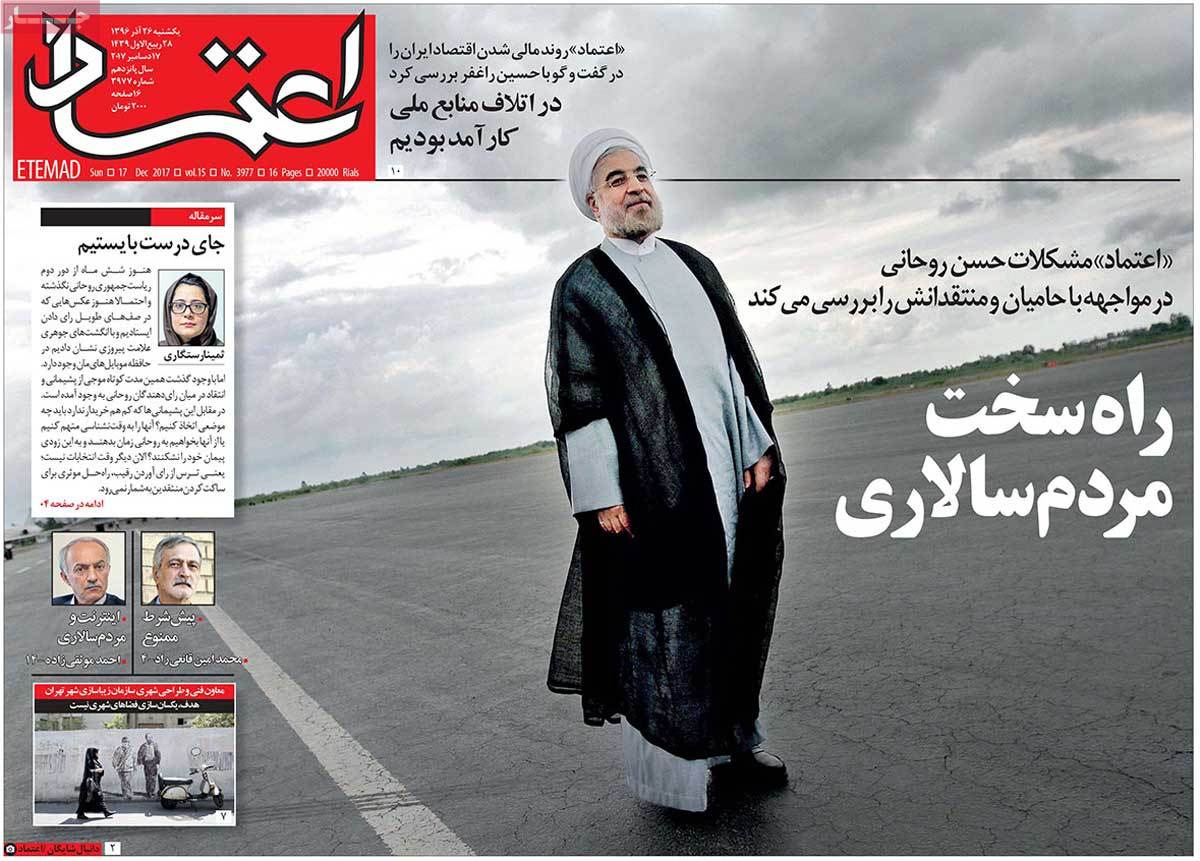
Etemad:

1- Difficult Path of Democracy

  • A Report on Rouhani’s Problems in Facing Supporters, Critics
A Look at Iranian Newspaper Front Pages on December 17


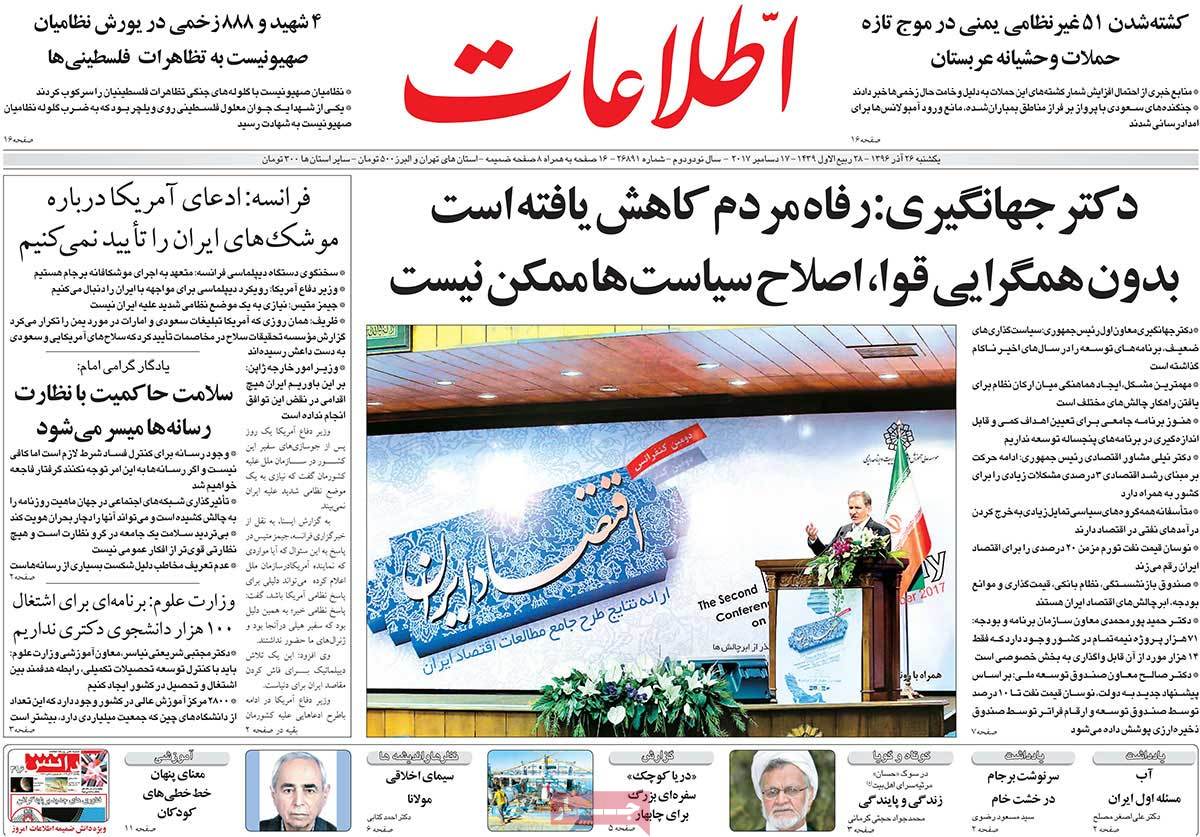
Ettela’at:

1- Iran First VP: People’s Welfare Weakened; Policies Cannot Be Revised without Convergence

2- Over 51 Yemeni Civilians Killed in New Wave of Saudis’ Brutal Airstrikes
A Look at Iranian Newspaper Front Pages on December 17


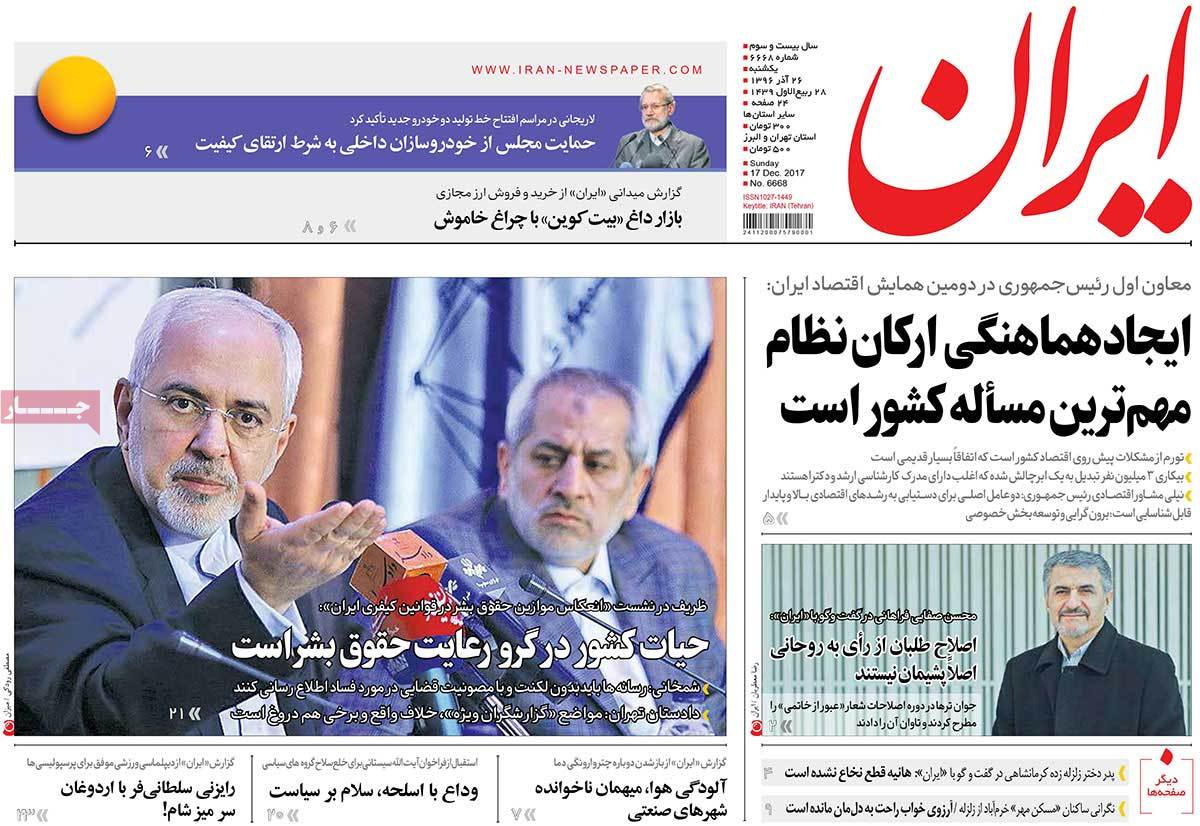
Iran:

1- Zarif: Iran’s Existence Hinges on Observing Human Rights

2- Reformist Politician: Reformists Not at All Regret Voting for Rouhani

3- Bitcoin Market Silently Growing: A Report on Online Trade of Bitcoin
A Look at Iranian Newspaper Front Pages on December 17


Jame’eh Farda:

1- Human Rights Rules Covered in Iran’s Criminal Laws

2- Terrorism of Air Pollution Coming to Iran’s Big Cities

  • A Look at Air Pollution Management Process in Tehran, Megacities

3- Impact of ISIS Attack on Iran Parliament Library

  • A Report on Damages to Heritage of Significant Research Centre
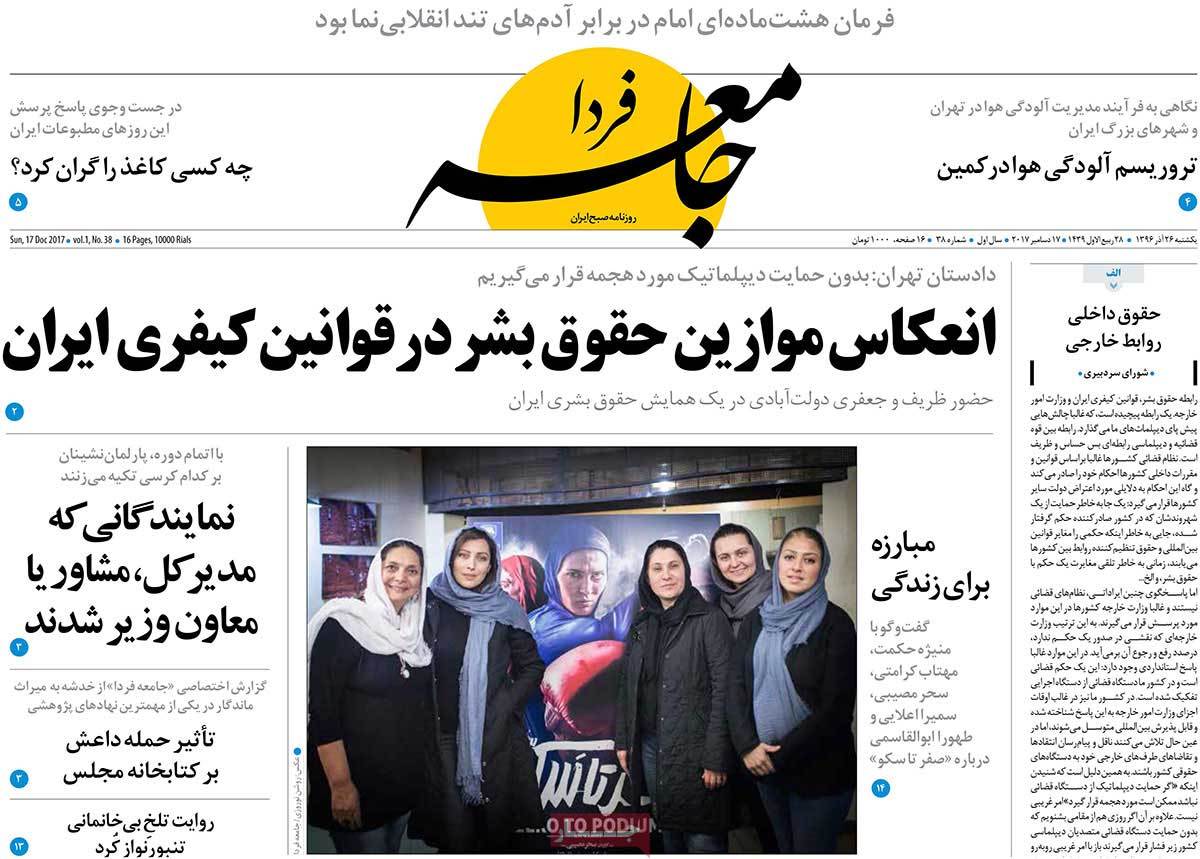
A Look at Iranian Newspaper Front Pages on December 17


Javan:

1- Yemen’s Ballistic Missile Hits Saudi Command Centre

  • At Same Time, UN Works on Plan to Disarm Ansarullah
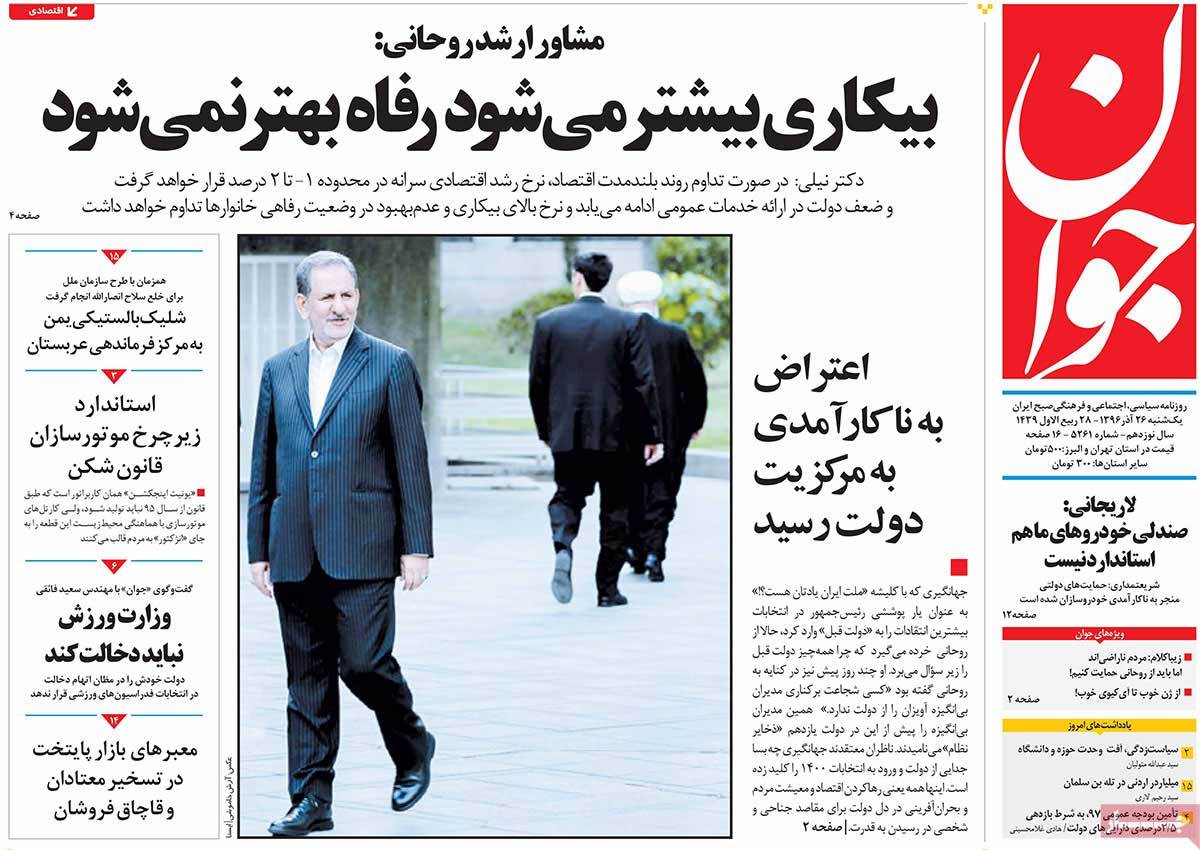
A Look at Iranian Newspaper Front Pages on December 17


Jomhouri Eslami:

1- Zarif’s Reaction to Haley’s Accusations: US Trying to Whitewash Its War Crimes in Yemen
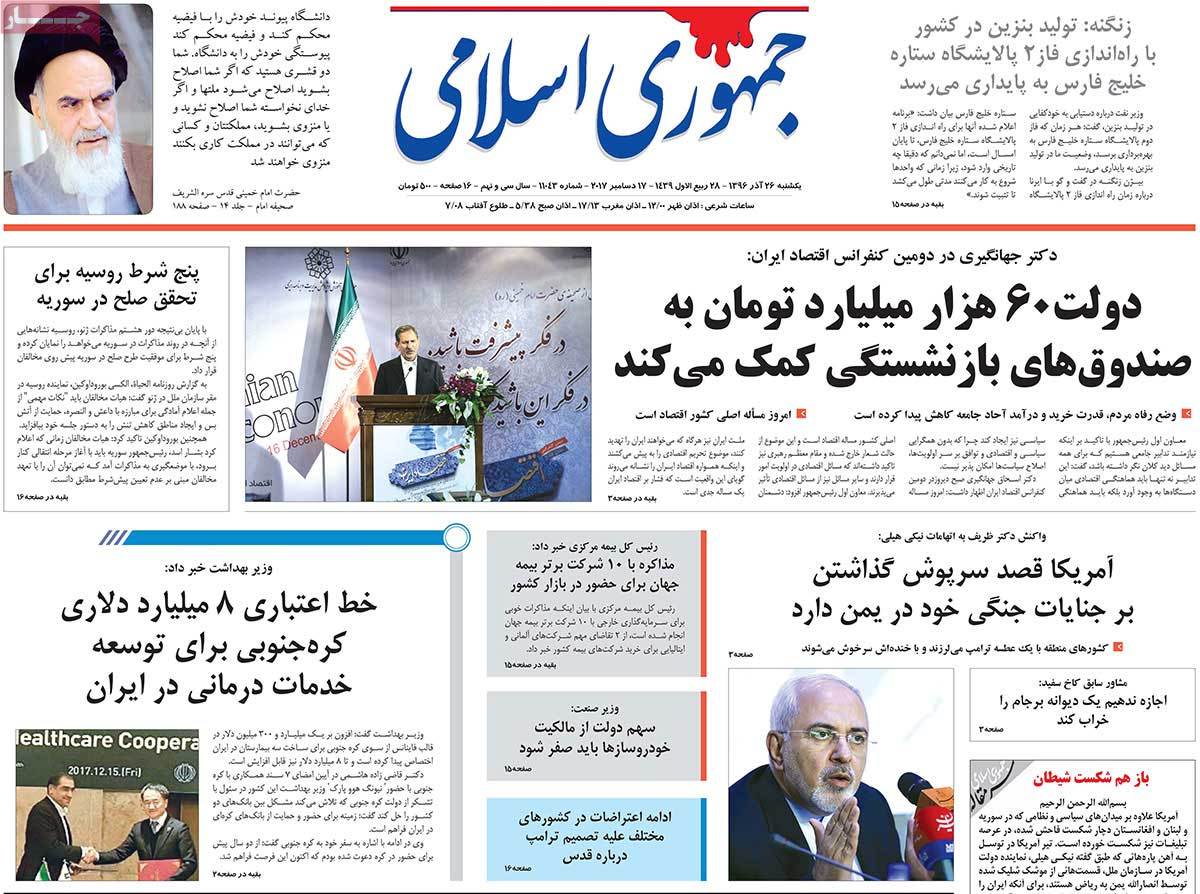
A Look at Iranian Newspaper Front Pages on December 17


Kayhan:

1- Iran First VP: People’s Purchasing Power Decreased, Economic Growth Rate Not Suitable!
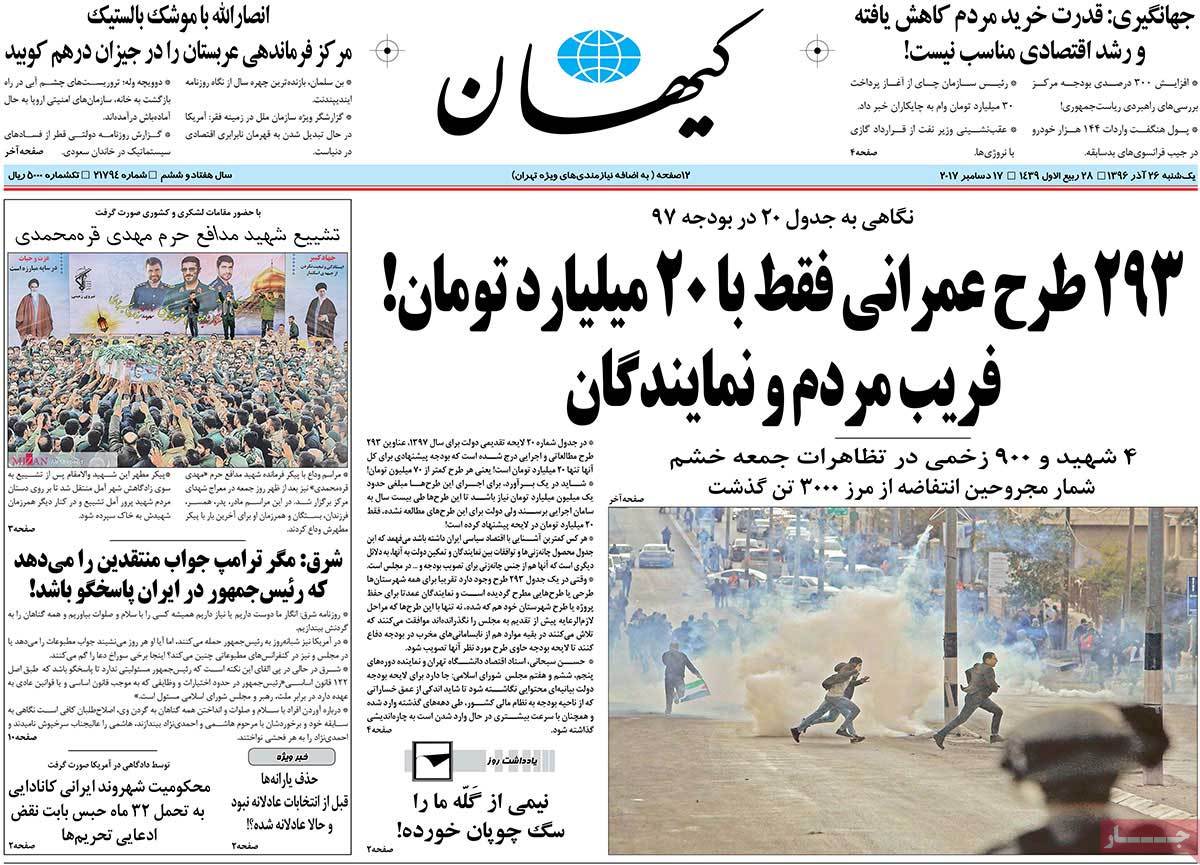
A Look at Iranian Newspaper Front Pages on December 17


Shahrvand:

1- Iran’s Pistachio with Afghan Logo

  • Afghanistan Buying Iranian Pistachio, Exporting Them to Russia World Cup Fans
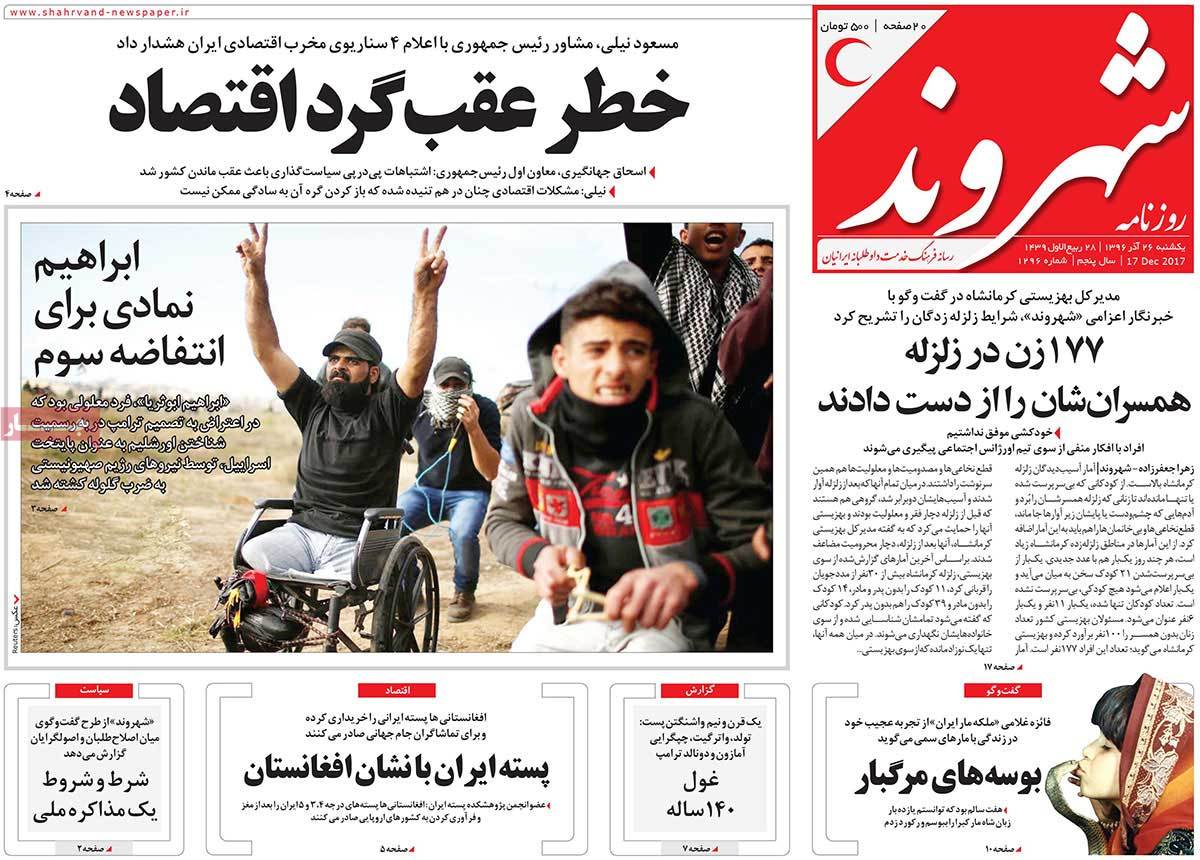
A Look at Iranian Newspaper Front Pages on December 17


Shargh:

1- Gov’t to Give Cash Subsidies Only to Poor People

A Look at Iranian Newspaper Front Pages on December 17


Vatan-e Emrooz:

1- US Defence Secretary: US after Diplomatic Coalition against Iran, Not Military Response

2- Chain Failures of Bin Salman’s Regional Policies: Saudis’ Money Diplomacy No Longer Works

A Look at Iranian Newspaper Front Pages on December 17


Saudi Jet Fighters Attack Wedding in Yemen, Kill 10 Women

The airstrike targeted a wedding procession in the Qaramesh region on Saturday, it said.

Locals said the women were simply returning on foot from the wedding when they were targeted. Several other women, who were riding in a car, escaped the attacks, they said.

“The aggressor committed a hideous crime by targeting ordinary women who were returning from a wedding,” said the father of two of the slain women, using a term widely used by the Yemenis to refer to Saudi Arabia.

The deaths are the latest from more than two years of Saudi Arabia’s devastating military campaign against Yemen. Well above 12,000, including many women and children, have been killed in Saudi airstrikes while millions remain displaced in a dire humanitarian situation.

The military intervention was launched in March 2015 as part of a Saudi plan to reinstate a former president and crush the ruling Houthi Ansarullah movement.

Rights groups and governments have repeatedly lambasted Saudi Arabia for its indiscriminate targeting of civilians in Yemen, saying many of those killed in the airstrikes are ordinary people with no links to groups opposed to Riyadh.

They have documented numerous cases where Saudi warplanes have deliberately dropped bombs on public gatherings, including on weddings. Riyadh simply ignores any criticism after such attacks and calls them a mistake.

Saudi Crown Prince Bin Salman, Man of Year for Failures: Report

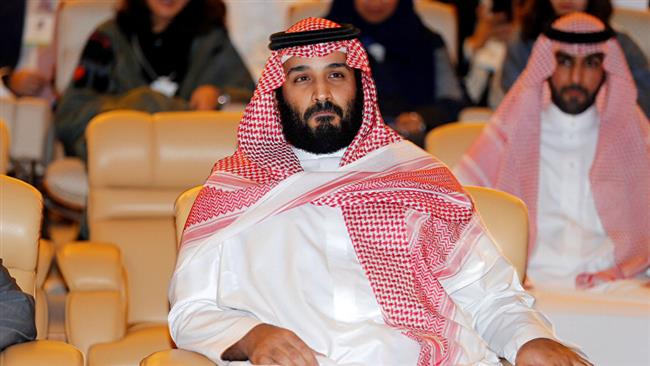
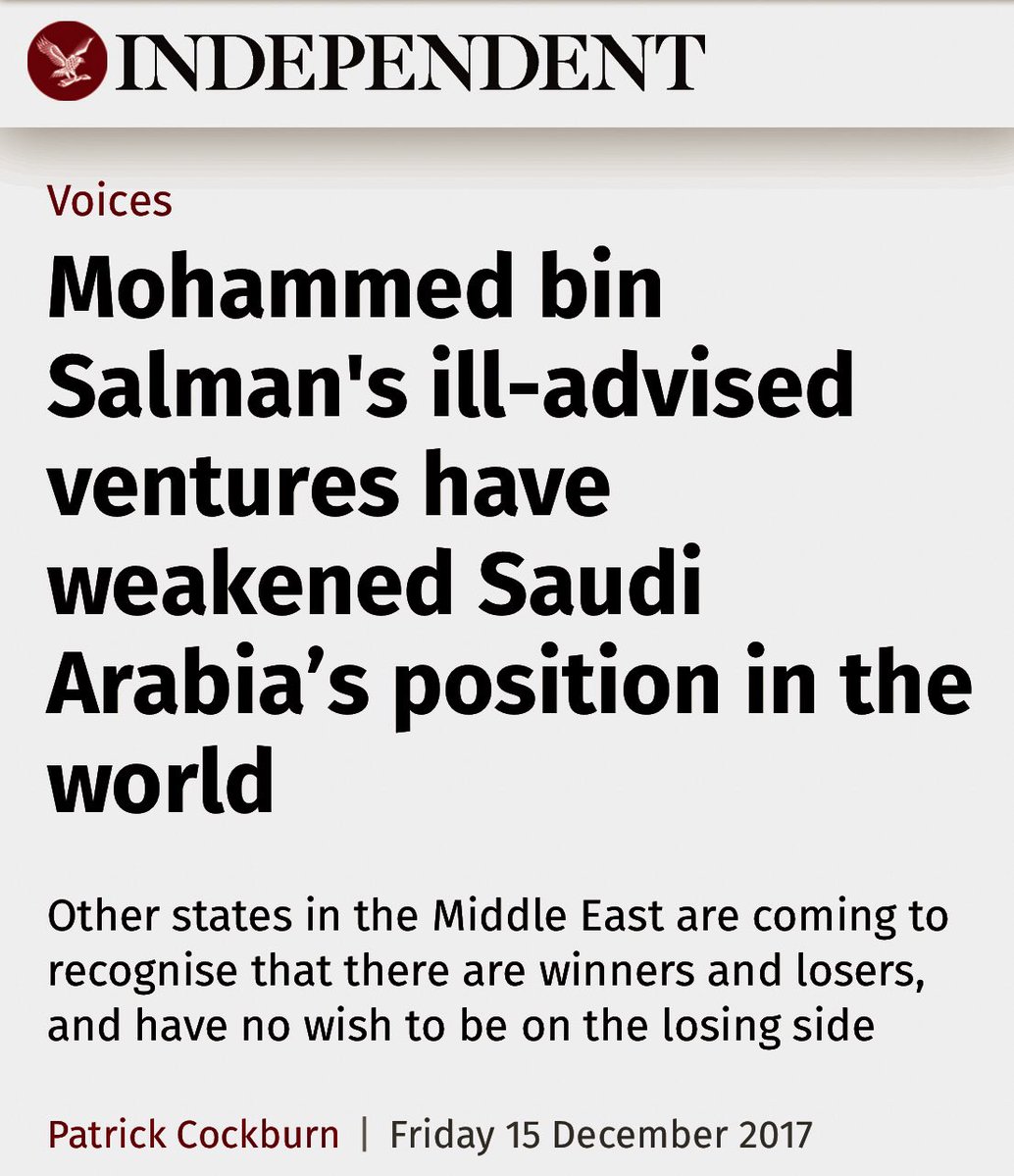
Patrick Cockburn wrote in an article for British online newspaper The Independent on Saturday that bin Salman has “embarked on ventures abroad that achieve the exact opposite of what he intended.”

The young prince was appointed the first in line to the Saudi throne by his father, King Salman bin Abdulaziz Al Saud, in June. Since then, he has engaged in a string of radical economic and social projects in a bid to portray himself as “reformist.” But those projects have been widely seen to be more about consolidating his personal power and less about bringing about real change to Saudi Arabia.

Prince Mohammed has been involved in an aggressive push to purge royals and businessmen critical of his policies under the banner of an “anti-corruption campaign.”

MbS “is the undoubted Middle East man of the year, but his great impact stems more from his failures than his successes,” the article read.

“He is accused of being Machiavellian in clearing his way to the throne by the elimination of opponents inside and outside the royal family. But, when it comes to Saudi Arabia’s position in the world, his miscalculations remind one less of the cunning maneuvers of Machiavelli and more of the pratfalls of Inspector Clouseau,” it added.

It noted that bin Salman’s support for the militancy in Syria and the protracted war on Yemen has had adverse effects, leading to the victory of Syrian President Bashar al-Assad and bringing at least seven million Yemenis close to starvation.

Meanwhile, the Saudi crown prince’s “aggressive opposition” to Iran has increased the Islamic Republic’s influence and the kingdom’s feud with Qatar has driven the Persian Gulf country further into the “Iranian embrace,” it added.

As for Lebanon, the kingdom’s “ill-considered” pressure on Prime Minister Saad Hariri to resign was apparently meant to weaken the Hezbollah resistance movement and Iran in Lebanon, but has in practice empowered both of them, the article read.

“What all these Saudi actions have in common is that they are based on a naïve presumption that ‘a best-case scenario’ will inevitably be achieved. There is no ‘Plan B’ and not much of a ‘Plan A’: Saudi Arabia is simply plugging into conflicts and confrontations it has no idea how to bring to an end,” according to the article.

“It is Saudi Arabia – and not its rivals – that is becoming isolated. The political balance of power in the region changed to its disadvantage over the last two years.”Saudi Crown Prince Bin Salman, Man of Year for Failures: Report

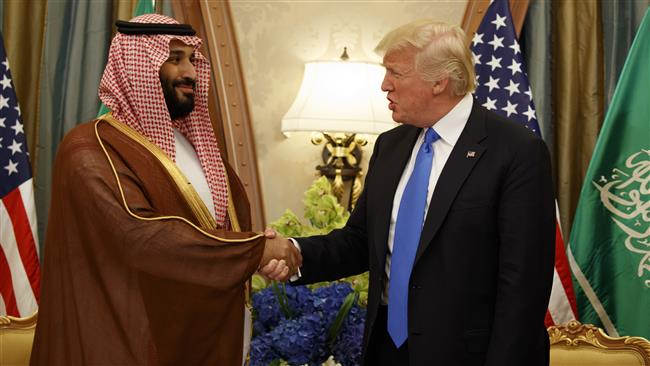
The article further said MbS and his advisers may imagine US President Donald Trump and his son-in-law Jared Kushner are firmly by their side, but “Saudi Arabia is learning that support from the White House these days brings fewer advantages than in the past.”

“The attention span of Donald Trump is notoriously short, and his preoccupation is with domestic US politics,” it said.

It also touched on the new Saudi rulers’ adventurist policies and the fact that “Saudi relations with other countries used to be cautious, conservative and aimed at preserving the status quo.”

“But today its behavior is zany, unpredictable and often counterproductive,” it said, adding “other states in the Middle East are coming to recognize that there are winners and losers, and have no wish to be on the losing side.”

Independent’s article ‘important’ 

Iranian Ambassador to the UK Hamid Baeidinejad hailed the article as “important”.

Saudi Crown Prince Bin Salman, Man of Year for Failures: ReportBin Salman’s lavish purchase

Separately on Saturday, an investigation by The New York Times named Salman as the owner of the Chateau Louis XIV, a mansion outside of Paris named after the 17th century French king that is widely touted as the world’s most expensive house.

The property was sold for more than $300 million back in 2015.

In recent months, the Saudi crown prince was identified as the buyer of the record-breaking da Vinci painting, which sold for $450 million, and a yacht for $500 million.

The lavish purchases come at a time that bin Salman claims to be taking on graft.