Thursday, December 25, 2025
Home Blog Page 3636

Iranian Nomads’ Lifestyle Amazing: Italian Photographer

Mauro Vitale’s collection of photos entitled “People and Land of Wool”, which was put on display in Tehran from March 5 to 11, tried to narrate the differences in the lifestyle of nomads living in Iran and Italy.

The 60-year-old artist has photographed nomads of many countries, including Romania, India and Morocco, over the past 12 years.

In his photos, taken during four trips he made to Iran in recent years, Vitale shows the climate, culture and religion of the Iranian and Italian nomads.

The most interesting feature of the exhibit, which was held in Iranian Artists Forum in Tehran, was that the photos depict the similarities and differences between the nomads of the two nations.

Vitale was the head of a photo project for D’Abruzzo magazine for five years. He collaborates with magazines and publishers at the national level.

The following is the translation of Honar Online’s interview with Vitale and Paulo Richli, the man behind the idea of the exhibition.

Iranian Nomads’ Lifestyle Amazing: Italian Photographer


At the beginning, I would like to ask how you came up with the idea of having “People and Land of Wool” exhibition in the first place?

Mauro Vitale: I met Qashqai nomads of Firouzabad on my first trip to Iran. The idea of holding this exhibition came to my mind when I saw their lifestyle. Upon returning from Iran, I shared my idea with Paolo Richli, who comes up with ideas for the group and we usually seek each other’s opinions. We then decided to start a project that looks into the similarities in the lifestyle of nomads living in Italy and Iran.

Paulo Richli: The idea for holding such an exhibition came to my mind during my first trip to Iran in May 2015. I was in Iran along with a photographer and managing director. We visited people of Talesh. The trip took ten days. When I came back to Italy, I started putting more focus on the project, the result of which you can see today. It should be noted here that the project was not just a photo exhibition. When we put the shots on display in Italy, we also had some nomad tools and equipment on display as well.

As the Italian nomads have been settled for quite a long time, we decided to present their tools and equipment along with their photos at the Tehran exhibition as well. This would help the visitors to compare the lifestyles and cultures of these different nomads themselves. To help the visitors imagine themselves in the real lifestyles of the Iranian nomads, we created a path with the Qashqai carpets that led to a green area.

Iranian Nomads’ Lifestyle Amazing: Italian Photographer


Nomads are part of Iran’s origins, but their traditions are on the wane. How did you find them? Could you relate with them easily?

Paulo Richli: The only problem in Iran for us, which I would like to underline, was the language barrier.

We could easily communicate with people through eyes, smiling or face reactions. This non-verbal communication was very important for us, but as you know, if you really want to know more about people’s lifestyles, you have to talk with them. This talking was the most difficult part for us. However, I can say for sure that Iranian people’s lifestyles were really fascinating to me. Iran’s nature, art, and its artists are all interesting, but what fascinated me most was the kindness which oozed out of the people’s body language and non-verbal communication.

Mauro Vitale: For me, the best part of the trip was the visit to Bushehr.


Iranian Nomads’ Lifestyle Amazing: Italian PhotographerIn Italy, the era of migrating is gone and people no longer move in search of new pasture. But, in Iran we see that the whole family of nomads migrate which is very fascinating.

What was the most attracting aspect of Iranian people’s lifestyle?

Mauro Vitale: Iranian people’s lifestyles are very different from those of people living in Europe. We tend to think that Iranians have a closed and frigid mentality, but in reality when you travel to Iran you see something totally different. Iranians’ open mentality is very interesting. We are constantly told in Europe that Iranians are dangerous. However, we you come here you see hospitality and kindness that run counter to that what you are told in Europe.


You have shot Iranian nomads for a long time. How could you fit their traditions and customs in your photos?

Mauro Vitale: Religion is an important aspect of the Iranians’ lifestyles which can be clearly seen. Shepherds and nomads living in mountainous highlands have a social life which was really interesting to me.

Paulo Richli: In Italy, the era of migrating is gone and people no longer move in search of new pasture. In the past, only men in Italy would migrate with women waiting for their husbands to come back. This means that there was no family or social migration. But, in Iran we see that the whole family of nomads migrate which is very fascinating to me.

At the end, I would like each of you to describe Iran in one sentence.

Mauro Vitale: In my opinion Iranians are very friendly and kind.

Paulo Richli: Iranians are very hospitable.

Iran’s Beauties in Photos: Landscapes of Khuzestan Nature

In addition to pleasant air, there are a lot of ancient relics and natural beauties like dams, lagoons and big rivers in the province.

Natural beauties of Khuzestan province are unique in Iran. Shadegan lagoon, which is considered the biggest lagoon in Iran as well as marshes of Hawr in Dasht-e Azadegan are other scenic places of Khuzestan.

Here are some aerial photos of Khuzestan nature retrieved from ILNA:

Iran’s Persepolis, Esteghlal Advance to ACL Knockout Stage as Table-Toppers

On Monday evening, red-clad Persepolis players beat Al Sadd Sports Club of Qatar 1-0 in front of about 40,000 spectators at Azadi Stadium in western Tehran.

Persepolis, backed by a vociferous home crowd, needed less than three minutes to go in front.

Mohammad Ansari whipped in a tricky cross from the left wing, which Al Sadd defender Morteza Pouraliganji fell for and inadvertently headed past his own keeper to give the hosts an early lead.

The visitors then went to great lengths in search of an equalizer. Spanish midfielder Xavier Hernández Creus, better known as Xavi, and Algerian forward Baghdad Bounedjah came close to scoring in the first half, but their efforts were not particularly effective.

Al Sadd footballers heaped pressure on Persepolis goalpost after the re-start, and looked more dangerous.

Boualem Khoukhi finished off Bounedjah’s cross in the 62nd minute. However, the referee disallowed the goal for offside.

Persepolis maintained its narrow lead afterwards, and advanced to the 2018 AFC Champions League knockout stage as Group C table-toppers.

Iran's Persepolis, Esteghlal Advance to ACL Knockout Stage as Table-Toppers

Separately, Esteghlal Tehran chalked up a 1-0 win over Saudi Arabia’s Al Hilal in Group D.

Al Hilal started the match in a stronger fashion, and its first attempt on goal came in the sixth minute, when Achraf Bencharki was about to score the opener but his header from the edge of the six-yard box sailed over the bar.

The Saudi team then mounted a number of attacks in a bid to break the deadlock.

Mokhtar Fallatah received the ball from Mohmmed Al Burayk’s cross in the 19th minute and dribbled forward to attempt a strike. His shot was, however, saved at the bottom left corner.

Finally, Esteghlal took the lead in the 36th minute. Yasser al-Shahrani made a defensive mistake after he failed to clear the ball in the penalty area, and Esteghlal’s 30-year-old Vouria Ghafouri fired a shot into the center of the net.

Al Hilal tried very hard to level the score in the second half, but all to no avail.

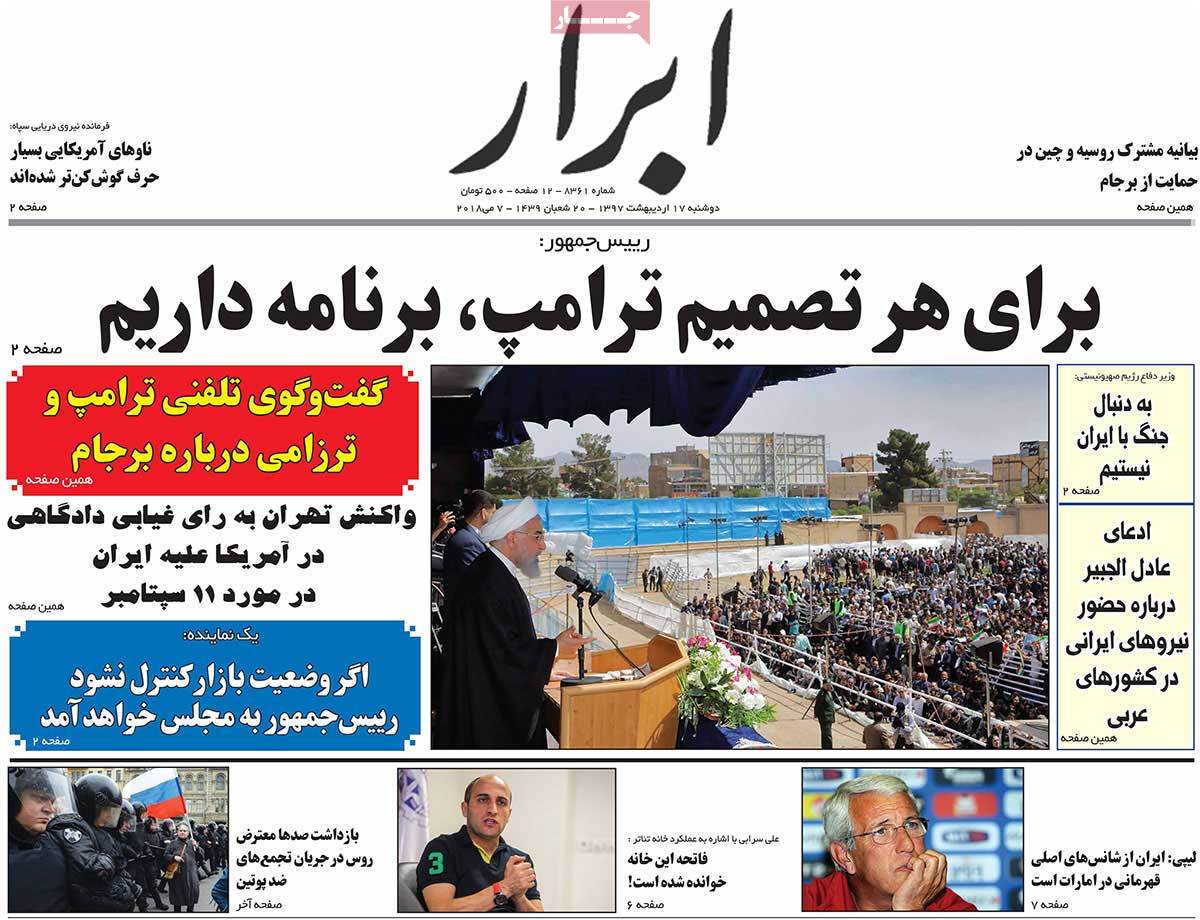
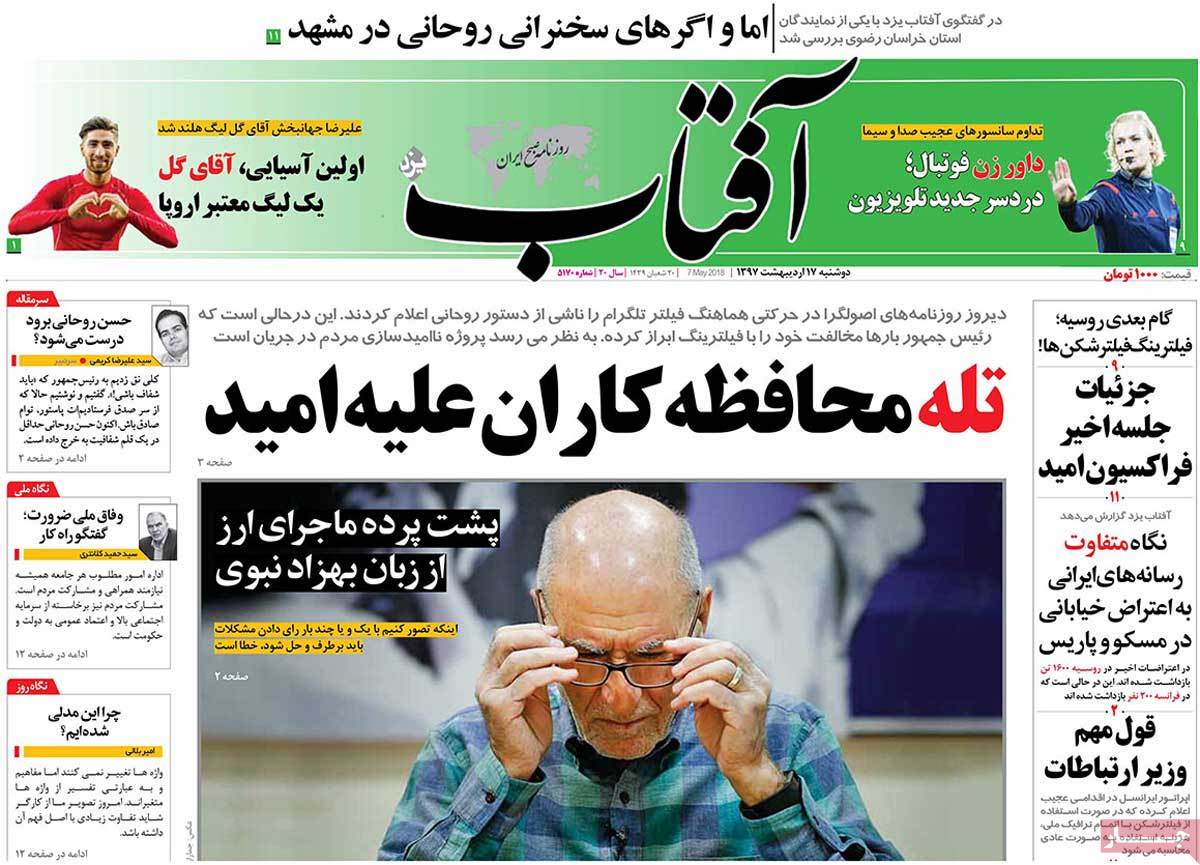
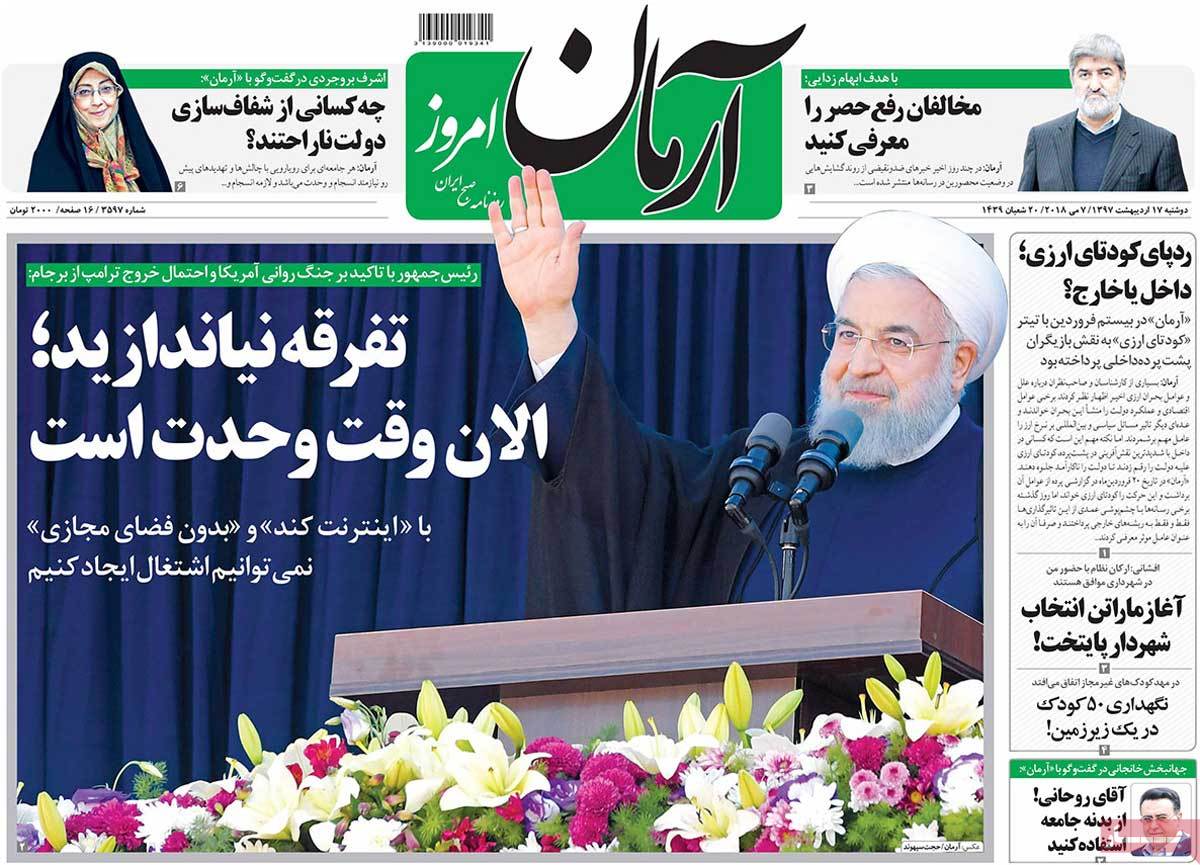
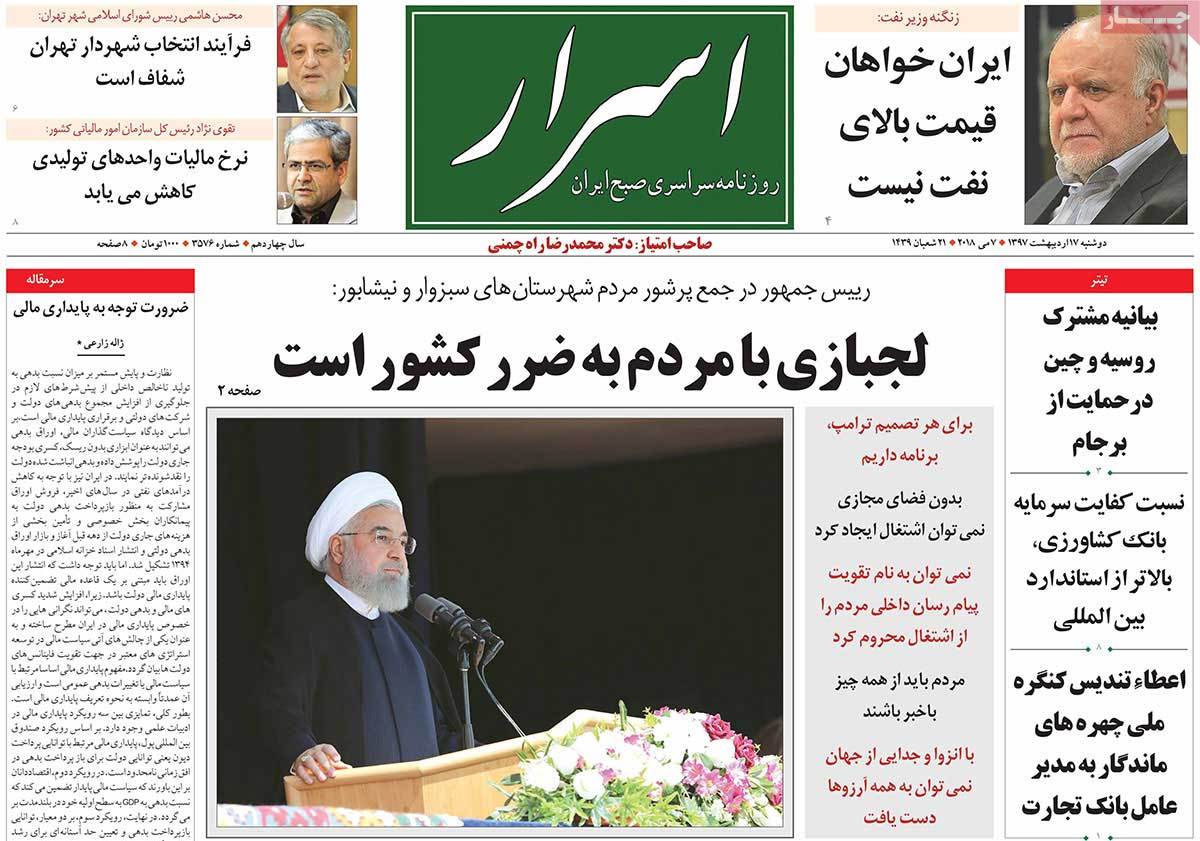
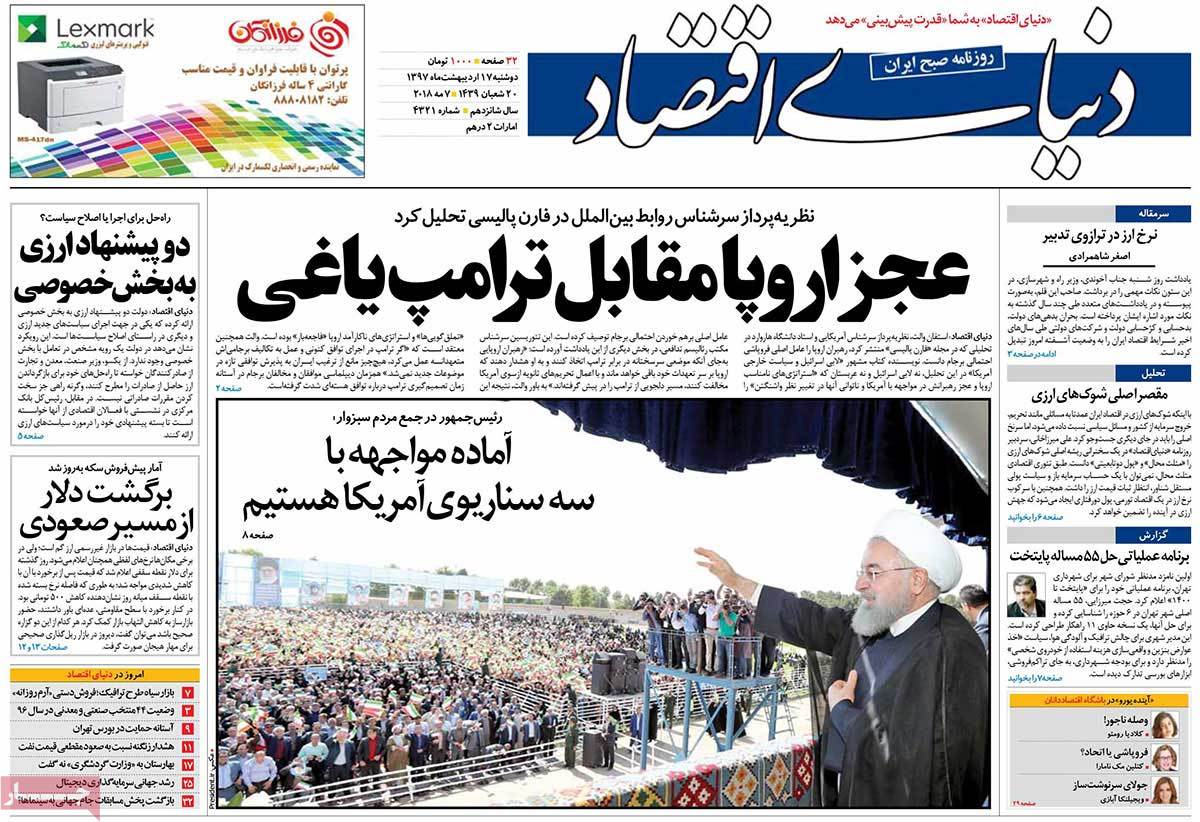
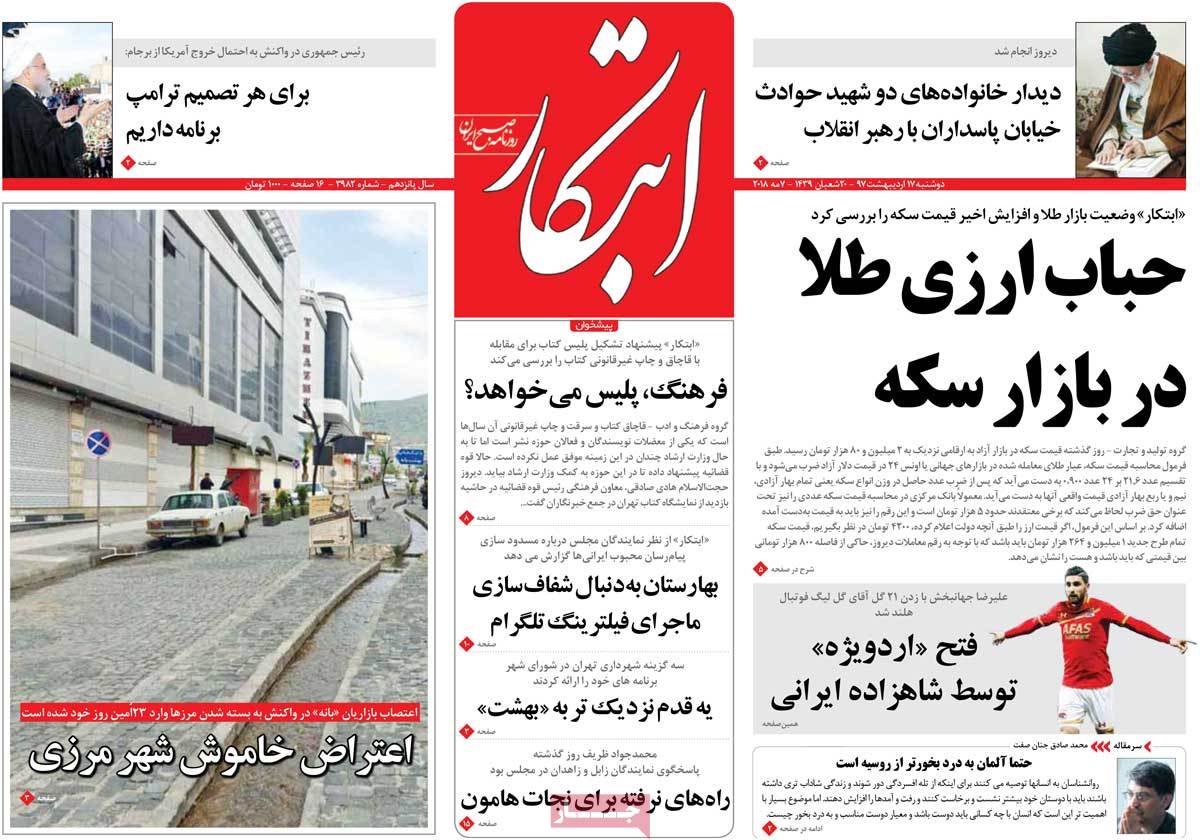
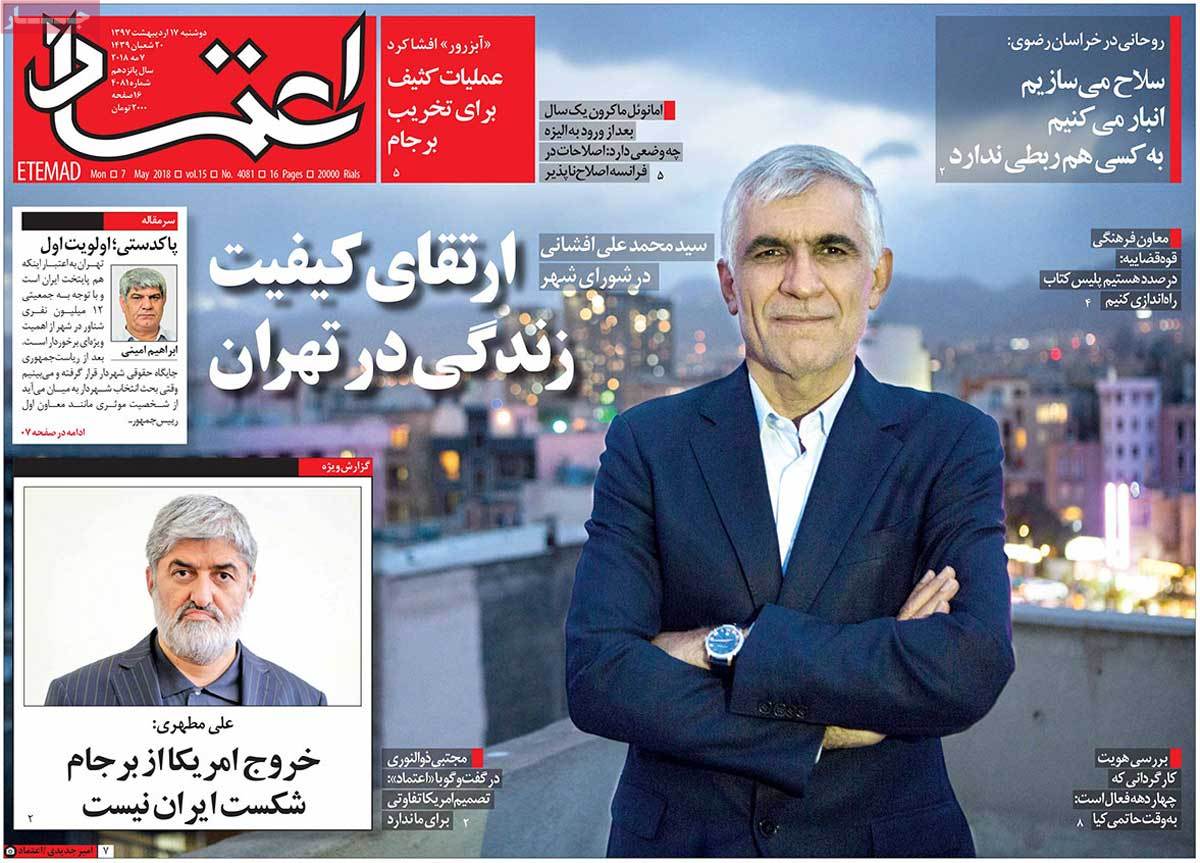
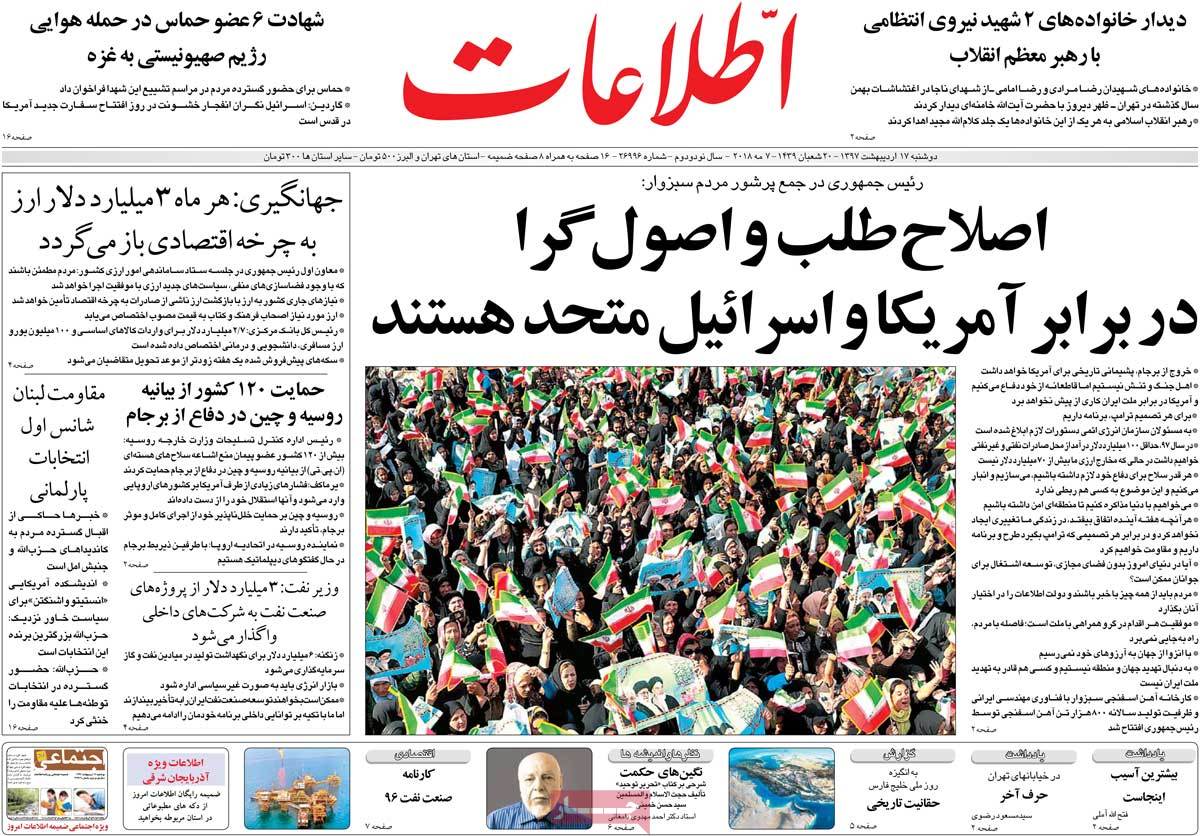
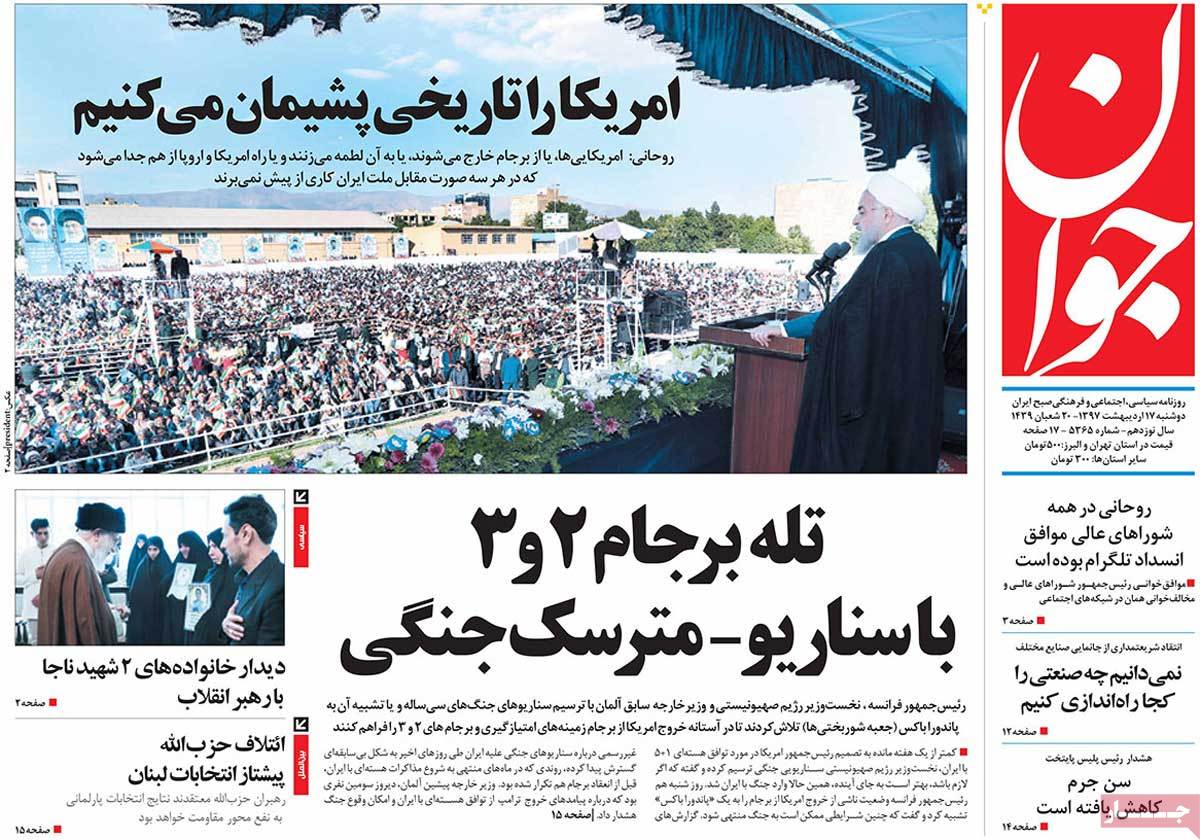
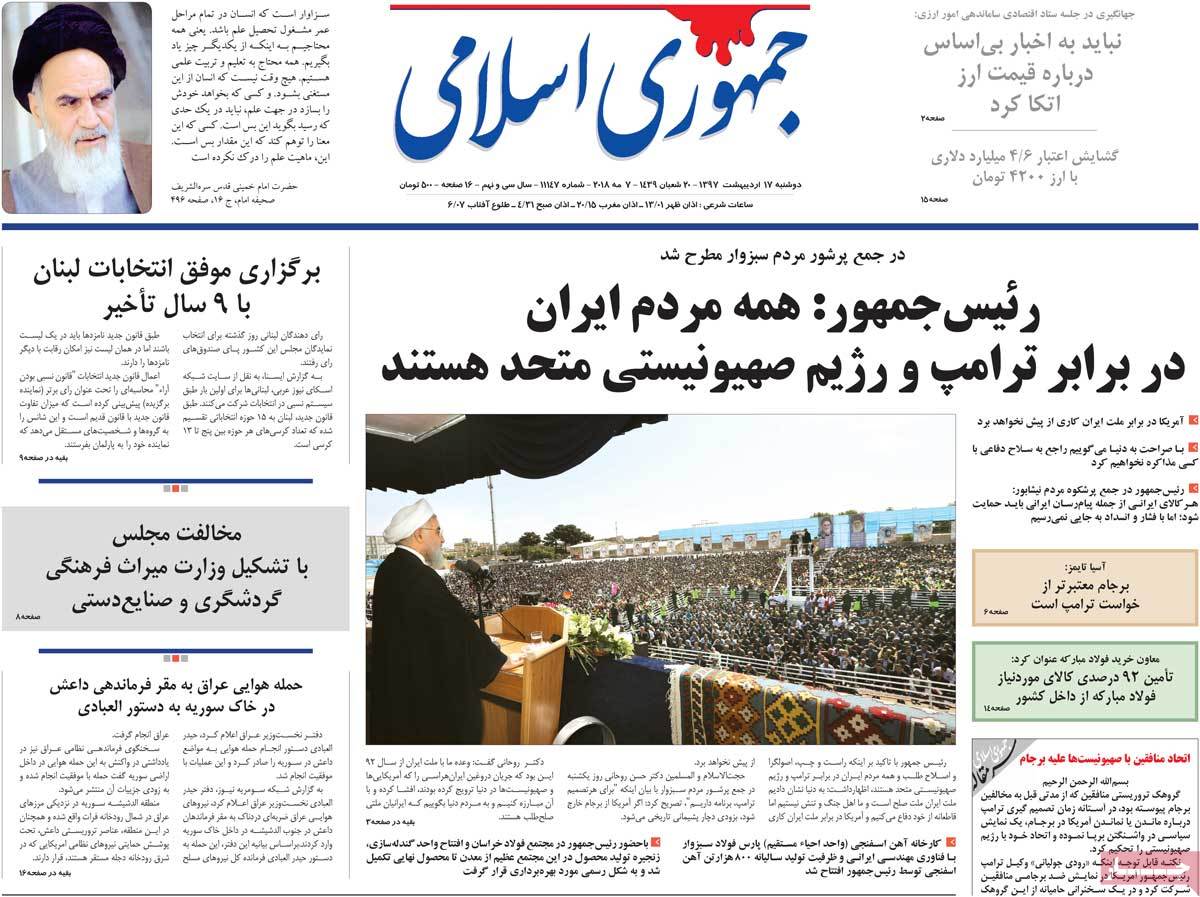
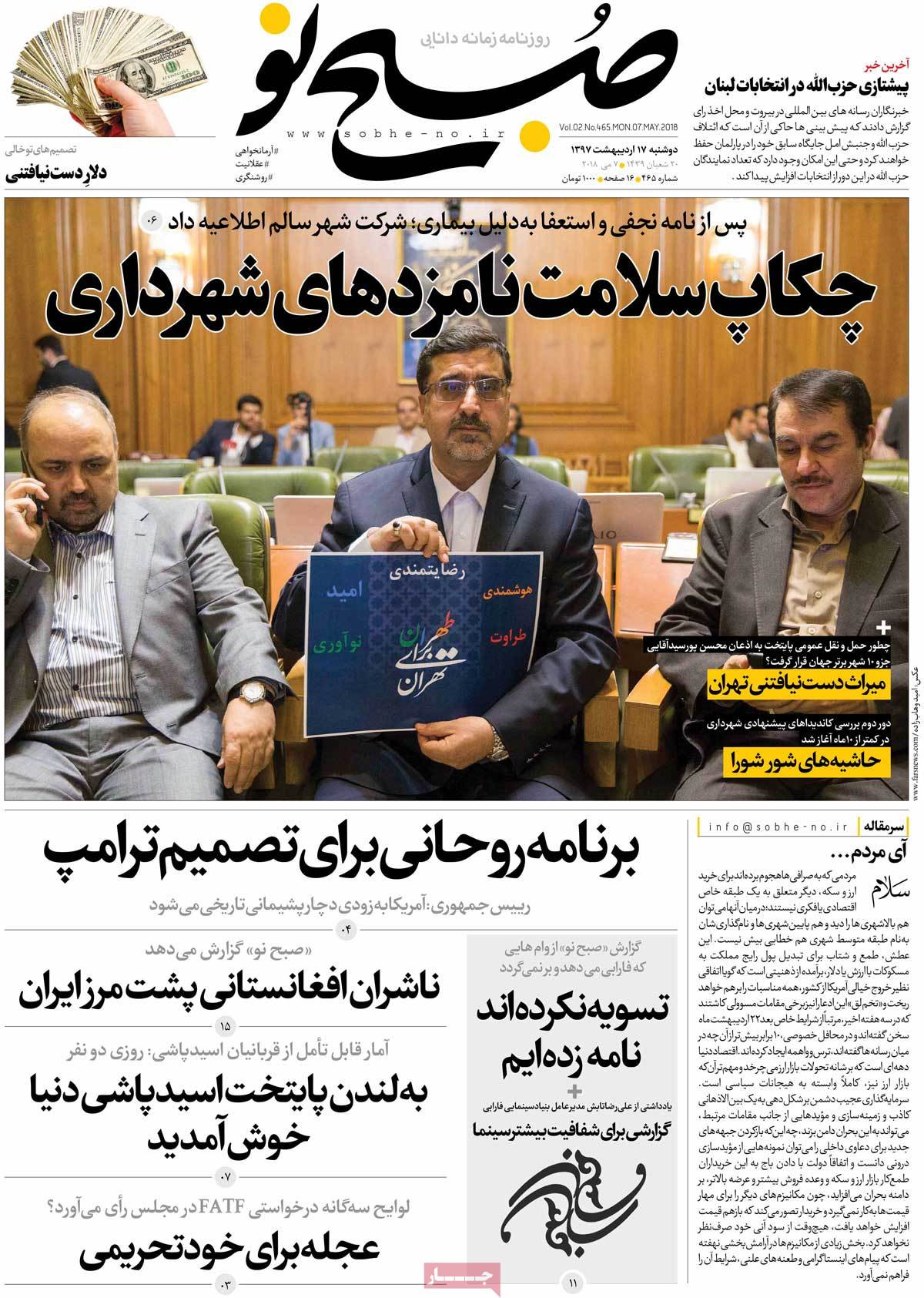
A Look at Iranian Newspaper Front Pages on April 17

A Look at Iranian Newspaper Front Pages on November 18

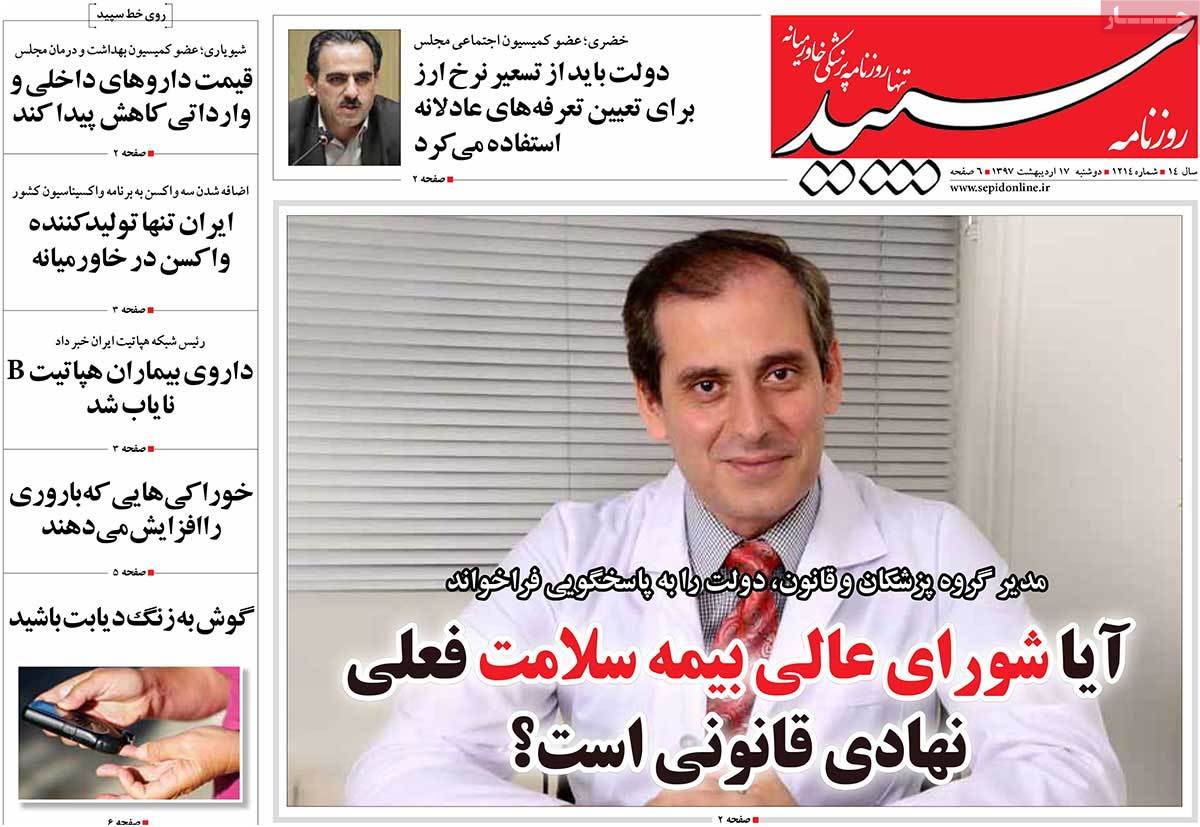
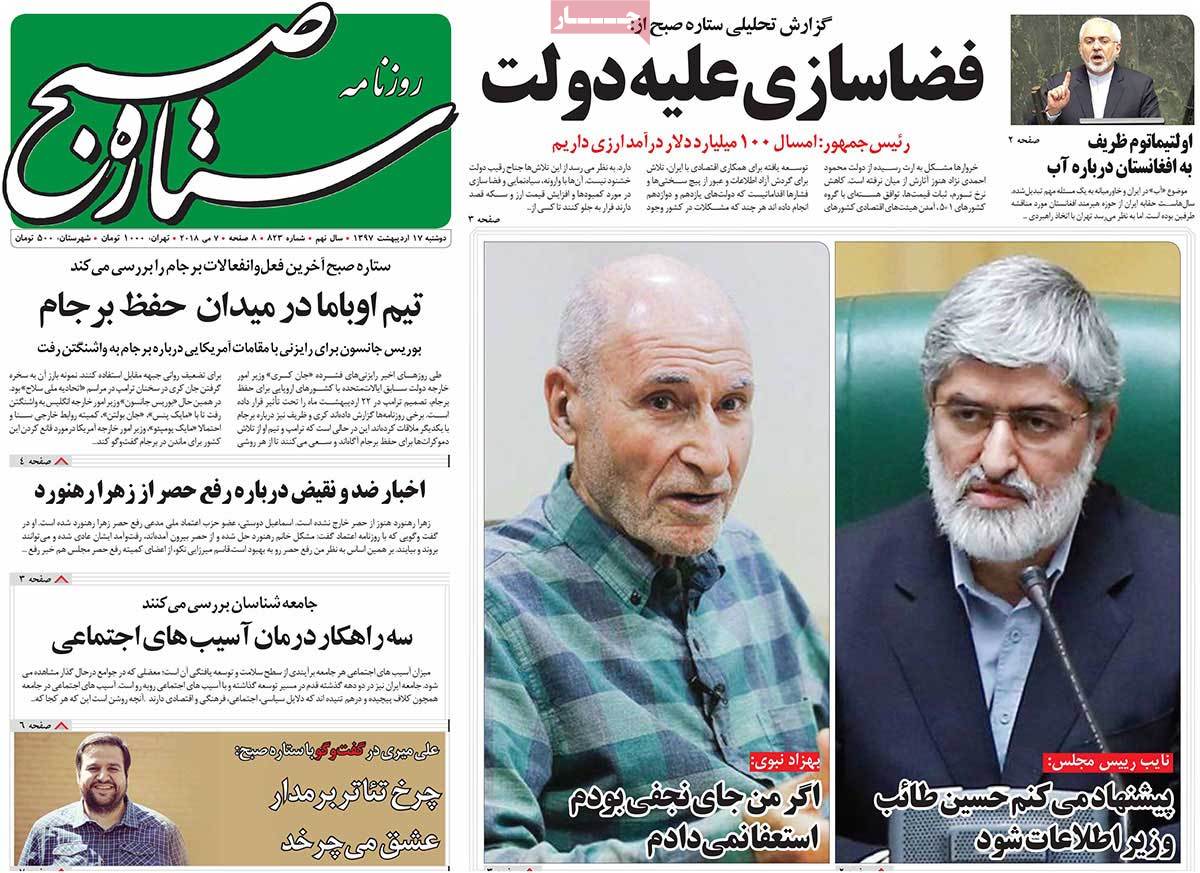
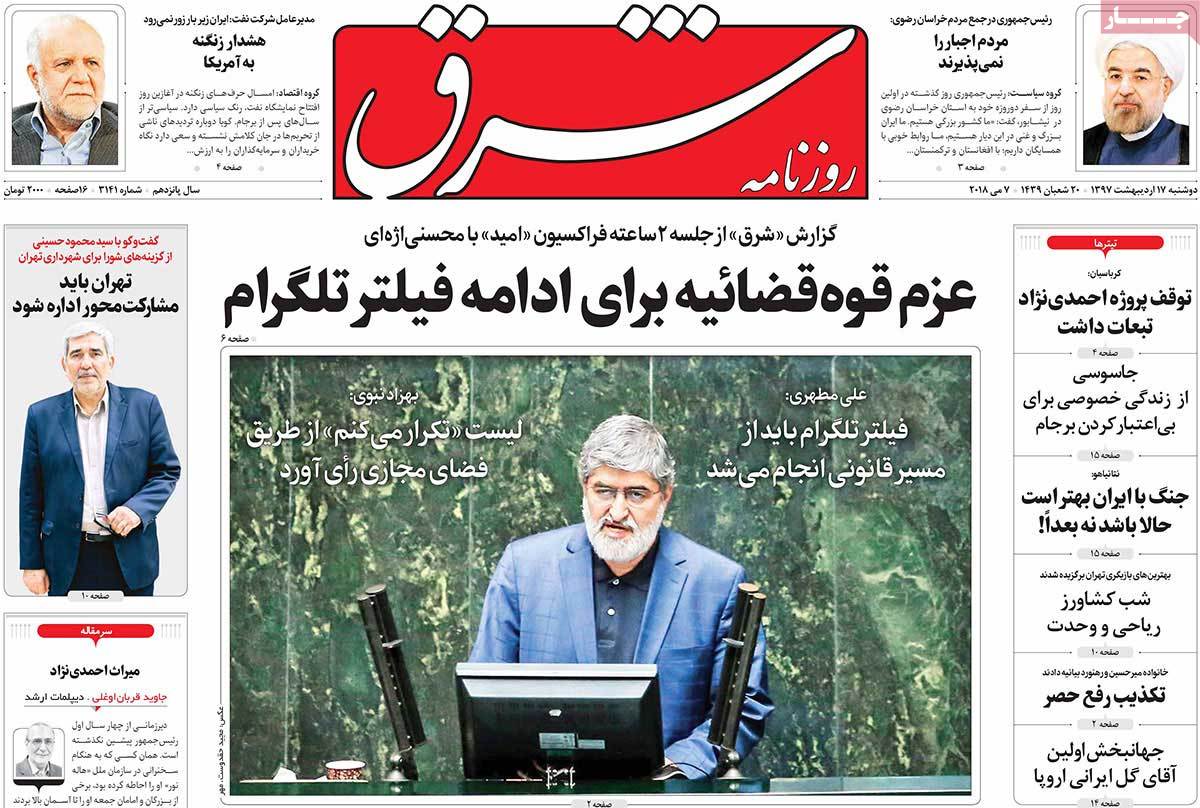
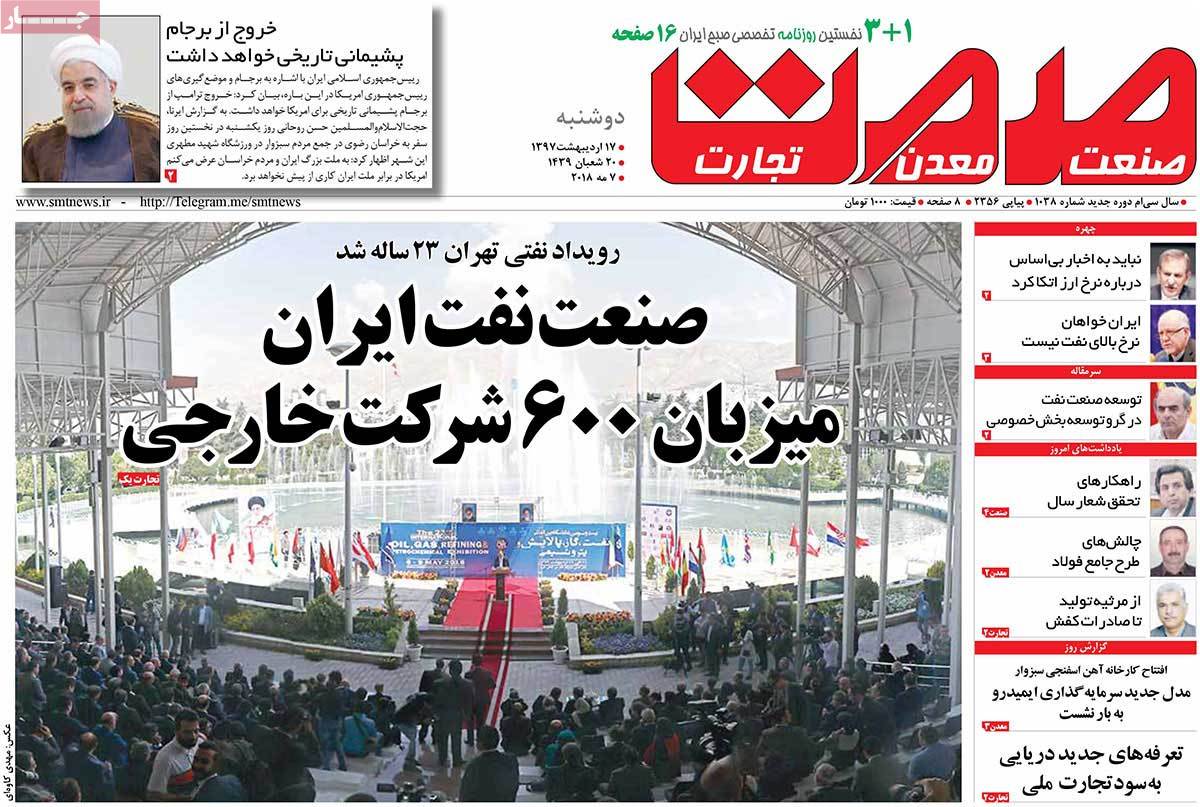
Several newspapers today covered the continued reactions to the Saturday airstrikes conducted by the US, France, and Britain on Syrian targets, and an earlier Israeli attack on a Syrian airbase which killed seven Iranians.

Another top story was the government’s policies to control the foreign exchange market, and the Judiciary’s support for the plans, which are expected to prevent further fluctuations.

The European Union’s support for the Iran nuclear deal and its disagreement with the imposition of new sanctions against the Islamic Republic also received great coverage today. The new sanctions had been proposed by France, Britain, and Germany to appease US President Donald Trump, but other EU member states, including Italy and Sweden, voted against the bans.

Also a major story today was the resignation of Kaveh Madani, a deputy head of Iran’s Department of Environment and a fellow at the Imperial College of London, who refused to return to the country after leaving Iran to attend a conference in eastern Asia. Madani, a well-known environmentalist, had been convinced by the Rouhani administration to return to Iran and work for the government, but he was later arrested for a short time over an espionage case involving several other environmental activists. After his release, a personal photo him was also published, and several conservative media tried to defame him for what they called obscene and inappropriate behaviour.

The above issues, as well as many more, are highlighted in the following headlines and top stories:


Aftab-e Yazd:

  • Fugitive Banker Khavari Has Assets in Iran to Be Confiscated

A Look at Iranian Newspaper Front Pages on April 17


Arman-e Emrooz:

  • Iran First VP Jahangiri Sacrificed to Control Forex Crisis
  • A Report on Efforts to Weaken Position of First VP
  • Mohammad Hashemi Rafsanjani: It’s Time to Ease Tensions in Region
  • Rouhani Must Revive Policy of De-Escalation as Hashemi Did

A Look at Iranian Newspaper Front Pages on April 17


Donya-ye Eqtesad:

  • EU Reaffirms Commitment to Iran Nuclear Deal
  • Mogherini: EU Ministers Unlikely to Pass Sanctions against Iran
  • Russian Model in Forex Market Fluctuations
  • Russia Central Bank’s Reaction to Recent Ruble’s Slide

A Look at Iranian Newspaper Front Pages on April 17


Ebtekar

  • Syria Strikes Aimed at Causing Rift between Iran, Turkey, Russia: MFA
  • Human Errors by Both Iranian, Chinese Ships Cause of Sanchi Tragedy

A Look at Iranian Newspaper Front Pages on April 17


Etemad:

  • EU Opposes US President
  • Former FBI Chief Attacks Trump, Calls Him Disgrace

A Look at Iranian Newspaper Front Pages on April 17


Ettela’at:

  • Qassemi: Syria Strikes Not to Influence Iran’s Policies
  • Int’l Quran Competition to Be Held in Tehran, Qom, Mashhad on Thursday

A Look at Iranian Newspaper Front Pages on April 17


Ghanoon:

  • Judiciary Chief Expresses Support for Gov’t in Protecting Value of National Currency

A Look at Iranian Newspaper Front Pages on April 17


Iran:

  • Iran First VP Promises Value of People’s Assets Will Be Protected
  • Mogherini: Don’t Wait for New Sanctions against Iran

A Look at Iranian Newspaper Front Pages on April 17


Jahan-e San’at:

  • Iran Foreign Ministry in Reaction to Israeli Attack: Time of ‘Hit and Run’ Past
  • French President: Russia Big Barrier to Syria Peace

A Look at Iranian Newspaper Front Pages on April 17


Javan:

  • US Senator: Scrap Iran Nuclear Deal, Kill Assad
  • Ayatollah Amoli Larijani: Judiciary Supports Government’s Forex Policies

A Look at Iranian Newspaper Front Pages on April 17


Jomhouri Eslami:

  • EU Foreign Policy Chief: It’s Crucial for Europe to Keep JCPOA
  • Syrian People Hold Huge Gathering to Support Assad, Resistance Forces
  • Larijani: US Military Intervention Beginning Point of Terrorist Activities in Region

A Look at Iranian Newspaper Front Pages on April 17


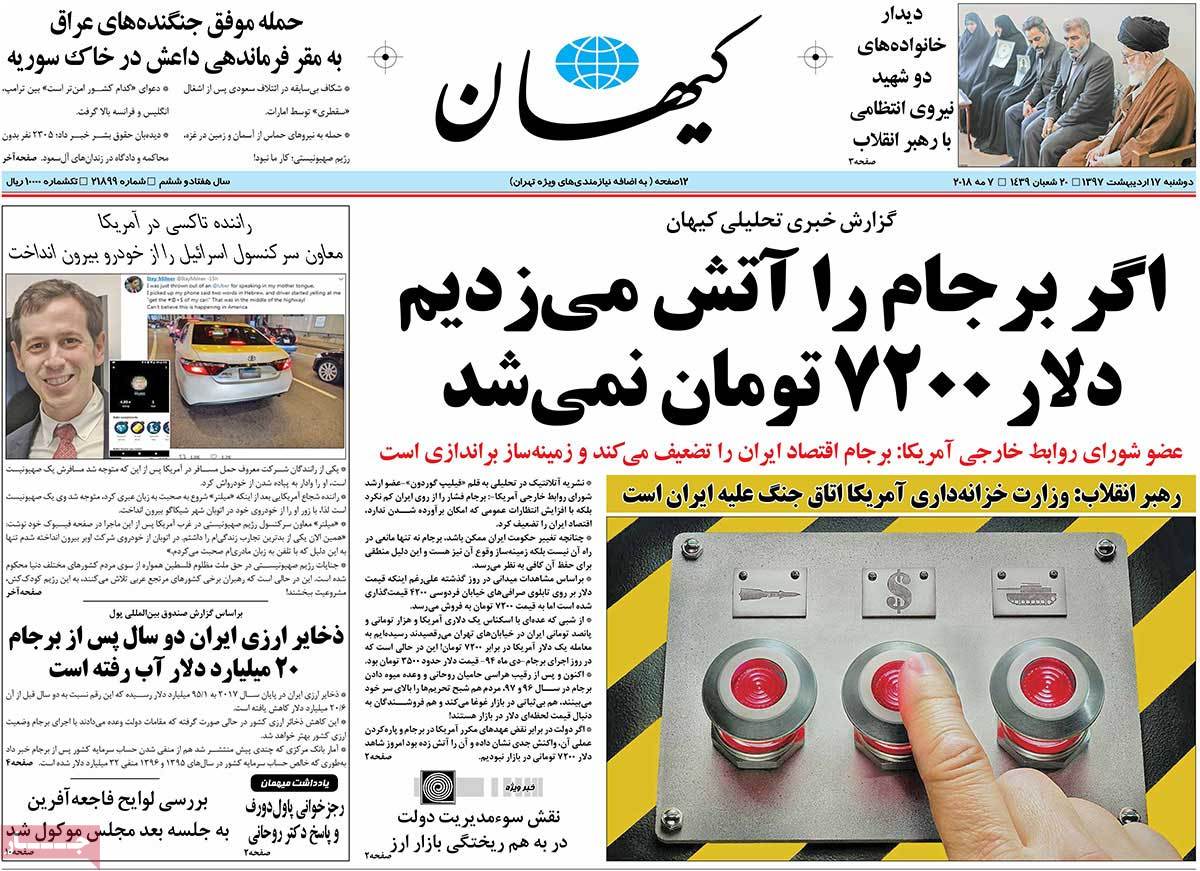
Kayhan:

  • Deals to Trade in Local Currencies to End Dependence on US Dollar
  • A Report on Ways to Counter Enemy’s Forex War
  • Washington Post: Attack on Syria Disgraced US
  • US Foreign Relations Committee Disqualifies Pompeo

A Look at Iranian Newspaper Front Pages on April 17


Kelid:

  • Rouhani: Persian Language Major Part of Iran’s Historical Identity

A Look at Iranian Newspaper Front Pages on April 17


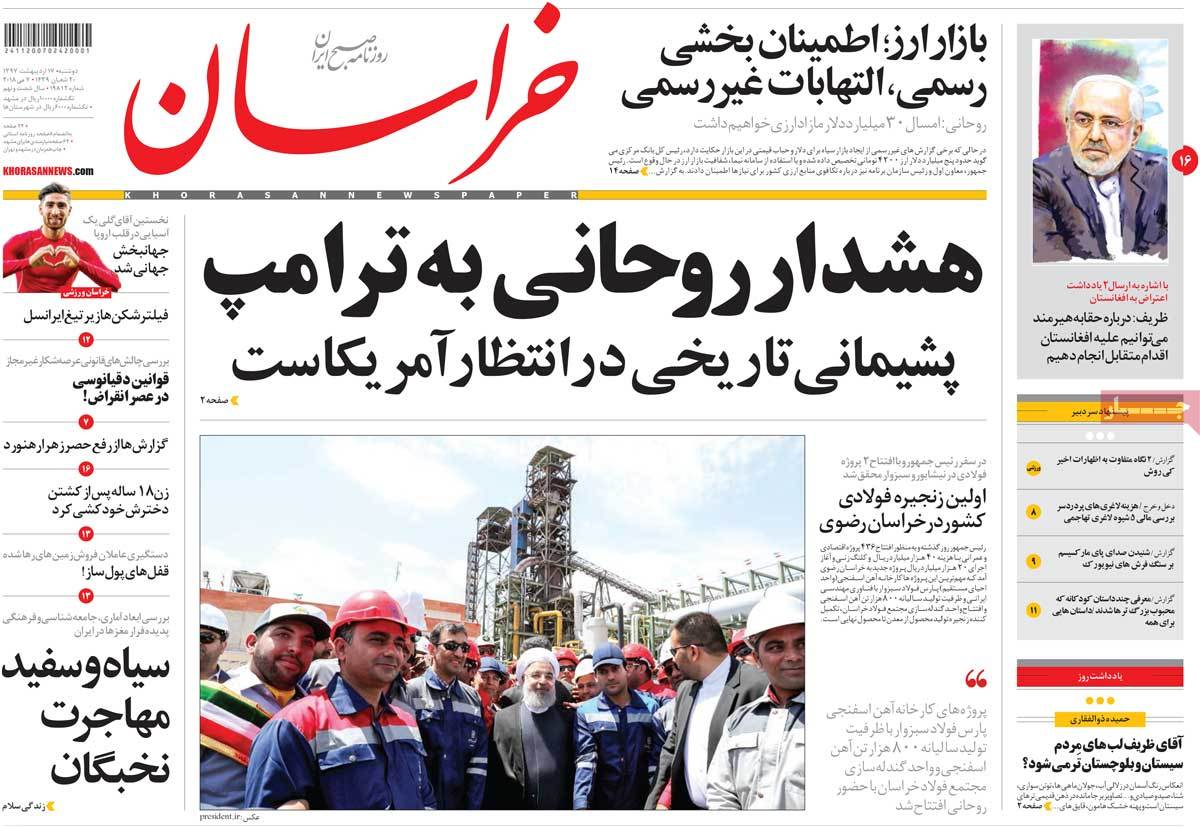
Khorasan:

  • Iran, Turkey Finally Open Line of Credit Using Local Currencies

A Look at Iranian Newspaper Front Pages on April 17


Roozan:

  • Marathon of Banks to Attract People’s Forex Deposits
  • Foreign Currencies Still Banned in Market

A Look at Iranian Newspaper Front Pages on April 17


Seda-ye Eslahat:

  • Iran’s Unemployment Rate Stands at 12%: Official

A Look at Iranian Newspaper Front Pages on April 17


Shahrvand:

  • Winter in Spring: Snow, Rain in Past Three Days Surprise Iranians

A Look at Iranian Newspaper Front Pages on April 17


Shargh:

  • Mogherini: It’s Crucial to Save JCPOA; No New Sanctions Passed

A Look at Iranian Newspaper Front Pages on April 17


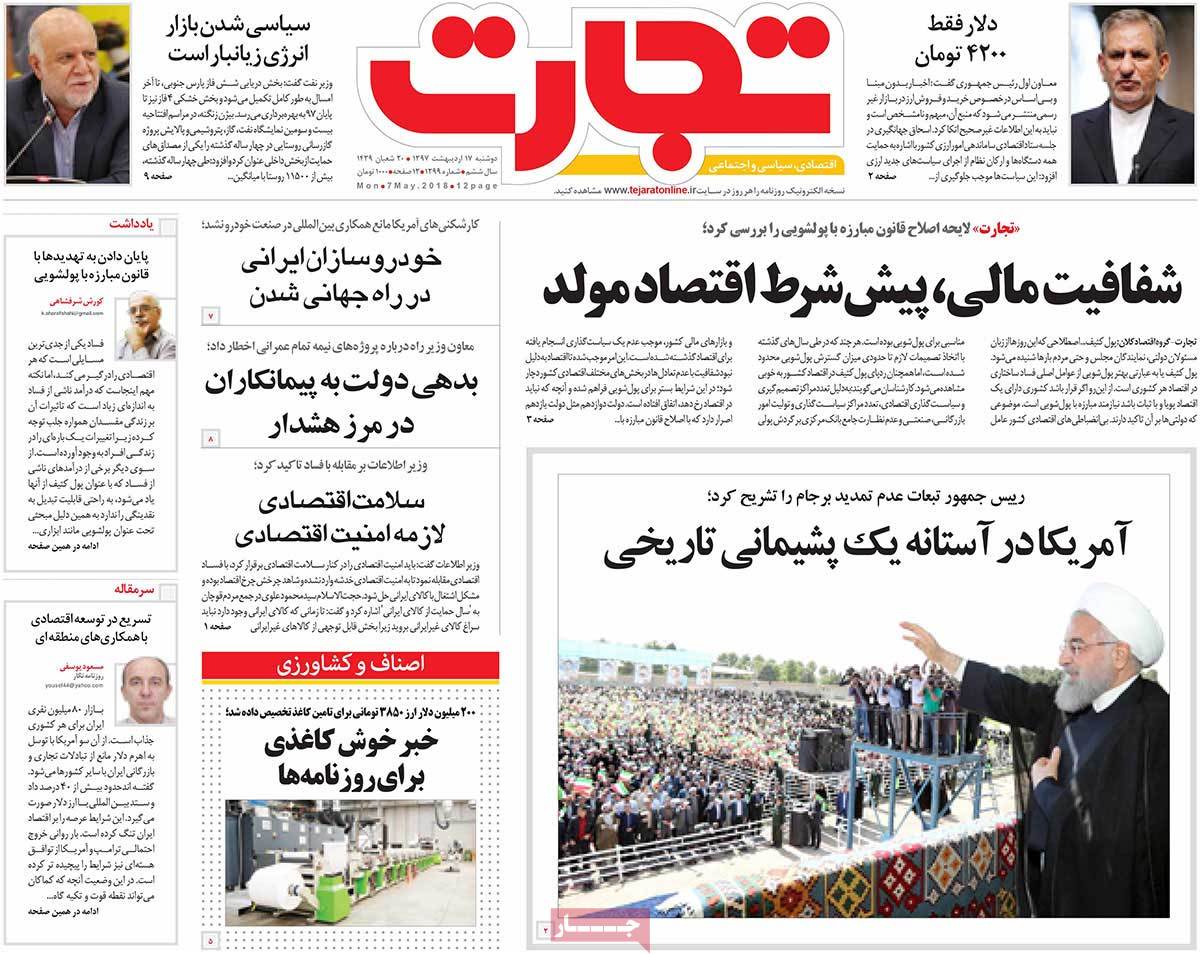
Tejarat:

  • Iran Nuclear Chief: We’re Ready for Any Returns in Nuclear Aspects
  • Iran First VP Warns Forex Dealers: No One Allowed to Damage People’s Lives

A Look at Iranian Newspaper Front Pages on April 17


Vatan-e Emrooz:

  • Dual National Escapes from Iran
  • Kaveh Madani, Deputy Head of Environment Dept., Suspected Spy, Flees Iran
  • Details of Siege on US Base in Iraq
  • How Popular Forces Threaten Pentagon ahead of Syria Attacks

A Look at Iranian Newspaper Front Pages on April 17


“Egyptian Nation to Stand by Syria against Enemies”

In a letter to Syrian President Assad, Abdel Hakim Abdel Nasser condemned the airstrike by the US, France and Britain on Syria on Saturday.

“The airstrike by the triangle of three western countries on Syria reminds us of the tripartite attack by Israel, France and Britain on Egypt back in 1956,” he said, as quoted in a Farsi report by Tasnim News Agency.

He went on to say that at that time, Egypt stood against the enemies and Syria threw its weight behind Egypt against the violation.

Abdel Nasser underlined that Suez Crisis or the Second Arab-Israeli war turned into a graveyard for the violent colonial powers.

He described Syria as the beating heart of the Muslim world and added as the former president of Egypt Jamal Abdel Nasser declared Syria is the graveyard of colonial and aggressive powers which imagine that they can impose their will on the Muslim countries through their regional mercenaries.

Son of Abdel Nasser said never ever can such a dream come true and noted “We the people of Egypt hereby announce that Cairo stands with Damascus against the enemies.”

Suez Crisis was an invasion of Egypt in late 1956 by Israel, followed by the UK and France. The aims were to regain Western control of the Suez Canal and to remove the then Egyptian President Gamal Abdel Nasser, who had just nationalized the canal.

After the fighting had started, political pressure from the other big powers led to a withdrawal by the three invaders. The episode humiliated Great Britain and France and strengthened Nasser.

Abriz; Delicious Dish Indigenous to Bakhtiari Tribe

The local Bakhtiari food, a popular one among people of Chaharmahal and Bakhtiari province, is mostly made with lamb heart and liver, but a mix of liver and mutton or chicken is also used.

First, fry the onions well before adding meat or chicken. Then leave the meat to be cooked through in its own stock without adding any spices.

In the meantime, mix some pomegranate pickles with two or three cupfuls of water and put it on the flame for around 20 minutes.

When the meat is cooked through and has lost some water, add spices and salt. Then sieve the pickles onto the meat. Leave the mixture to cook for another half an hour until the pickles water is absorbed by the meat.

Using potatoes in this food is optional, but if you want to use potatoes, add them before adding the pickles water to the meat. The reason is that pickles make potatoes hard and keep them from being cooked through.

This food in usually eaten with bread, but tastes delicious with rice as well.

Abriz; Delicious Dish Indigenous to Bakhtiari Tribe

Syria Must Fire Missiles at Riyadh, Abu Dhabi: Iranian Analyst

Hossein Shariatmadari, the Chief of the conservative Kayhan newspaper, has in a Farsi piece weighed in on the recent attack of the US, UK, and France on Syria, saying that Saudi Arabia and its allies must pay the price for the attack.

“Earlier, Donald Trump stated that Washington has spent $7 trillion in the region without making any progress. He described the move as costly stupidity stressing that he is not willing to see the presence of US forces in Syria be continued,” noted Shariatmadari.

“Following this decision, Saudi Crown Prince Mohammed bin Salman agreed to pay the costs of US intervention in Syria and spent $4 billion as the first step. Bin Salman then went to the UK and France after visiting the United States to negotiate with the officials of the two European countries.”

“Undoubtedly, it can be concluded that the cost of joint criminal attack of the US, UK and France on Syria has been paid by Al Saud; therefore, Saudi Arabia and its allies should pay the price.”
Shariatmadari also suggested that Damascus must launch missiles at Riyadh and Abu Dhabi in retaliation for the Western countries’ assault.

The editor-in-chief of Kayhan daily further mentioned that the retaliatory move is completely justified in the international conventions, since Riyadh has officially announced that it has paid the expenses of the attack on Syria.

Therefore, the kingdom is one of the parties involved and is considered a major contributor to the recent attack, he added.

He further cited the words of Imam Ali (as) who said, “Throw stones to the same direction they come from.”
The US, UK and France struck some Syrian sites in response to an alleged deadly chemical attack in the town of Douma a week ago.

A fact-finding mission from the Organization for the Prohibition of Chemical Weapons was to begin investigating the claims in Douma. The mission’s job was only to determine whether chemical weapons had been used, not who had used them.

This comes as Syria denies any chemical use and says that attack was fabricated by terrorists.

A UN Security Council vote brought by Russia, to condemn the US-led strikes was rejected.

While Western powers have supported terrorists from early on in the war, the wave of strikes represents the most significant attack against President Bashar al-Assad’s government by Western countries in seven years of Syria’s civil war.

The strikes risked pulling the United States deeper into the complex, multisided war in Syria and raised the possibility of confrontation with Russia. Within an hour after the attack, the Russian ambassador to the United States warned of “consequences” for the allied attacks.
Russia responded with sharp words. “We warned that such actions will not be left without consequences,” Anatoly Antonov, the ambassador to the United States, said in a statement. “All responsibility for them rests with Washington, London and Paris.”

Taking umbrage at Trump accusing Russian President Vladimir Putin in his speech of not living up to a promise to disarm Syria of its chemical weapons, Antonov added, “Insulting the president of Russia is unacceptable and inadmissible.”

Syria Shoots Down Missiles Fired at Homs: Report

According to the report carried by SANA news agency early on Tuesday, the Syrian air defense intercepted all the missiles over Shayrat airbase in Homs and the Dumair military airport in Damascus.

“Syrian air defense shot down missiles that entered its airspace over Homs,” said the report.

Lebanon’s Al Mayadeen broadcaster also reported that Syrian air defense had intercepted three missiles aimed at Dumair military airport northeast of Damascus.

The US and Israel have denied being behind that attack.

A Pentagon spokesman said there was no US military activity in that area at this time.

Asked about the missile attack, an Israeli military spokesman said, “We don’t comment on such reports.”

Shayrat airbase was targeted last year in a US cruise missile attack in response to an alleged chemical attack on the militant-held town of Khan Shaykhun.

Iran Calls for Joint Regional Campaign against Narcotics

In a Tuesday address to a ministerial meeting of ECO in Dushanbe, the capital of Tajikistan, Zarif said we need to synergize and forge a common regional strategy to halt the spread of terrorists’ ideology of hate and cut their financial resources.

“My government has always been ready to cooperate in devising a comprehensive counter-extremism and terrorism strategy that fits the situation in our region,” he noted.

“In this context, a joint counter-narcotics campaign can drain one of the most important resources of extremist terror groups,” he added.

What follows is the full text of his speech:


Mr. Chairman,

Dear Friends and Colleagues

At the outset, let me express my deep appreciation to the Government and people of the Republic of Tajikistan for graciously hosting this important meeting in beautiful Dushanbe.

Dear Brothers and sisters,

Our destinies are intertwined as members of one region; failure or success in one part of this region will impact all of us. Our cooperation is facilitated not just because of our geographical proximity, but also many affinities in so many areas, including civilization, culture, religion and shared history. We are all sitting in the same boat facing the same challenges and opportunities.

Geopolitics of the region that we share has become ever more complicated mostly due to uncertainties and persistent challenges triggered by systemic transitional fluidity since the 1990s. The mutually reinforcing foreign intervention and terrorism and extremism have destabilized many parts of our wider region for close to two decades. Violent extremism continues to represent a threat to the ECO region.  Despite the territorial defeat of Daesh [ISIS] and other terrorist groups and the destruction of their self-proclaimed caliphate, extensive networks of extremist groups, especially Daesh in West, South and Central Asia, represent the most serious threat to the ECO region. We need to synergize and forge a common regional strategy to halt the spread of their ideology of hate and cut their financial resources. My government has always been ready to cooperate in devising a comprehensive counter-extremism and terrorism strategy that fits the situation in our region.  In this context, a joint counter-narcotics campaign can drain one of the most important resources of extremist terror groups.

We are also facing a host of other challenges, including environment degradation, climate change, drought, dust storms and poverty in some sections of population, that we need to address.  In the face of these challenges, we, as ECO Member States, should expand ECO’s capacity and tap its potentials in the fullest possible way. ECO is a unique multilateral platform to mobilize our individual resources to meet collective objectives and confront common transnational calamities.

We can together establish a strong ECO region. Each ECO Member State enjoys various resources and potentials. We can synergize to unleash huge energy for robust, inclusive and sustainable regional development. The ECO has played a prominent role in exploring these potentials and formulating mechanisms for regional cooperation.

At this juncture and after three decades of existence, ECO has proved its capacity to help Member States move towards development and integration. In recent years, ECO has become a visible player in the global arena and a reliable partner for the international community in implementing SDGs and other global agenda and programs.

Iran firmly believes in the benefits arising from regional cooperation and interaction and has always manifested its full commitment to the objectives of the Organization and acceded to all initiatives, programs and agreements within the Organization. We are committed to developing a strong and prosperous ECO region, have allocated substantial resources in the form of development assistance and are determined to promote south – south cooperation within the ECO framework.

Dear Colleagues,

Since the adoption of ECO Vision 2025 during the ECO Summit in Islamabad, a range of activities and programs have been implemented by the Secretariat and Member States. However, the pace of activities and involvement of Member States fall short of the expectations of our leaders.

Apart from ensuring a conductive policy environment by all Member States for the realization of ECO Vision 2025, mobilization of budget and financial resources for its effective implementation is also of high importance. Therefore, all ECO Member States should allocate extra-budgetary financial resources to help achieve our common goals and objectives through a well- formulated scheme.

With the ECO Vision as our agenda for the coming years, we expect to achieve by 2025 increased intra-regional trade and a bigger slice of global trade, facilitating commercial environment and flourishing tourism industry, better connectivity, improved energy cooperation, healthy environment and smooth visa regimes. On this path, it is imperative for all of us to employ our resources to help enhance institutional and operational capacities of the Organization to enable it to respond in a timely and effective manner to the needs and aspirations of Member States.

With welfare and prosperity of our people as the prime target of all the plans and activities of this Organization, the ECO should now focus on projects and programs which bring about maximum economic benefit to our peoples and the entire region.

In the meantime, materializing the envisaged goals and objectives of the ECO Vision requires a very professional and strong Secretariat to follow-up and implement the directives of the ECO-decision-making bodies and be more responsive to developments within and outside the region. Hence, strengthening the ECO Secretariat through providing high quality human resource as well as granting greater authority to the Secretary-General in the recruitment process in this regard should be seriously considered. Let us hope that the reform process, already under discussion, will result in an efficient Secretariat, better and more responsive rules and regulations and professional staffing of the Secretariat. 

Mr. Chairman,

Ladies and Gentlemen

Over the recent years, Iran’s economy demonstrated that it has great potential for expansion and growth. Economic sanctions not only did not impede Iran, but instead solidified popular resolve to enhance domestic capacities. Achieving a good growth rate last year proved that the Iranian economy can become one of the vibrant global emerging economies within the next twenty years. Our strategic choice for achieving such sustainable and balanced growth is extensive global partnership through regional and multilateral arrangements, including utilizing our vast and developed transit and transport linkages on the North–South and South–West Corridors. We are of the strong belief that economy and security can only grow together, and common interests can bind us regionally and globally to guarantee both regional and global security.

We warmly applaud the efforts of our distinguished Secretary-General, H.E. Mr. Halil Ibrahim Akca, and recognize the many achievements under his able leadership. We are also grateful to all of you for placing your valuable confidence in Ambassador Soleimanpour to assume the immense responsibilities of ECO Secretary-General.

Allow me to conclude by underlining our unreserved support for ECO as it moves to accomplish its valuable objectives and programs, including those adopted here in Dushanbe. I am confident that the active commitment and involvement of all Member States will ensure our success in building a strong ECO region.

Thank you.

Spring Snow Covers Tulip Garden in Iran’s Karaj

This is the sixth edition of Tulip Festival that is being held at Karaj’s Chamran Park, west of Tehran. Nearly 50 different varieties of tulips are exhibited at the show.

The visitors come from across Iran and other countries to visit the colourful event.

What follows are Mehr News Agency’s photos of the snowy festival: