Saturday, December 27, 2025
Home Blog Page 3621

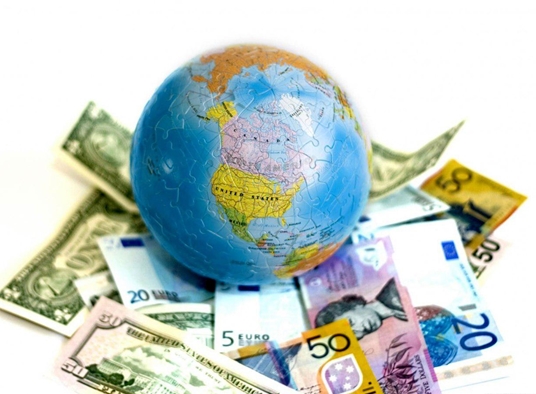
Iran Gets Closer to Removal of US Dollar from National Economy

Iran’s domestic media reported that the policy was in line with an official request by the Central Bank of Iran (CBI) and was specifically meant to address fluctuations in market rates of the dollar.

IRNA news agency quoted Mehdi Kasraeipour, CBI’s director of Foreign Exchange Rules and Policies Affairs, as saying that the move had become effective from Wednesday by virtue of a letter sent to the Ministry of Industry, Mines and Trade.

Kasraeipour emphasized that this was not expected to create any major trouble for traders, stressing that this was because the share of the dollar in Iran’s trade activities was not high.

“It’s been for a long time that Iran’s banking sector cannot use the dollar as a result of the sanctions,” he said.

US banks are still banned from dealing with Iran as part of an old US trade embargo that still remains in place. Accordingly, this is believed to have already effectively blocked any transactions with Iran which is based on US dollars because they would ultimately have to be cleared in the US.

“Considering that the use of the dollar is banned for Iran and traders are literally using alternative currencies in their transactions, there is no longer any reason to proceed with invoices that use the dollar as the base rate?” Kasraeipour said.

The official further emphasized that Iranian merchants would need to inform their suppliers to change the base currency from the dollar to other currencies so that the related import documentations can be proceeded at Iran’s entry points.

He said the merchants also needed to specify whether they would proceed with their payments through banks or currency exchange shops.

Kasraeipour said when an invoice is issued in dollars, a demand naturally develops in the network of exchange shops for dollars. He further suggested that this could eventually lead to a rise in the rates of the hard currency.

Meanwhile, criticisms are emerging in Iran’s media over the costs that this policy could create for merchants and eventually the consumers.

ISNA, for example, quoted unnamed merchants as saying that they and the foreign suppliers would have to consider an extra expense for converting the base currency from the dollar to other currencies.  This, it said, would increase the costs for imports and eventually push up the prices of commodities imported.
Abjection of Muslim Nations Blamed on Their Leaders: Ayatollah Khamenei

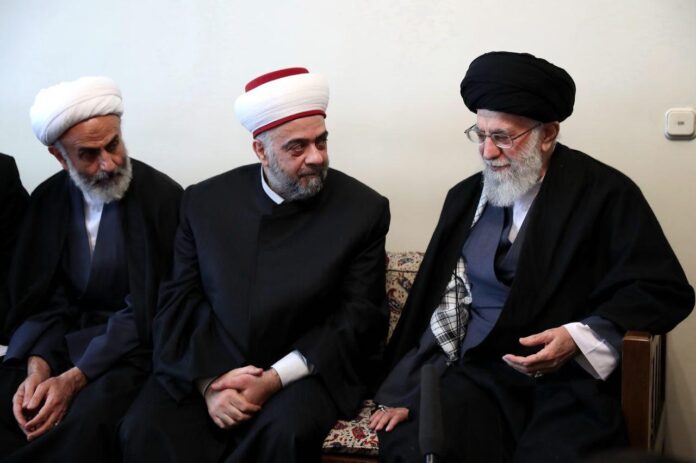
In a meeting with the Syrian Minister of Endowment and his accompanying delegation on Thursday afternoon, the Leader stated that if a nation is ruled by leaders who feel proud of their identity and Islam, they will retain dignity, and the enemy cannot inflict harm on such a nation.

Speaking on the issue of Syria, Ayatollah Khamenei added that “Syria is at the forefront [of resistance] today and it is our duty to support the Syrian resistance. Distinguished President of Syria Bashar al-Assad appeared as a great example of resistance. He never hesitated and stood strong. This is extremely important for a nation.”

“If the leaders of the countries and the regional nations decide decisively to resist, the enemy cannot do anything,” highlighted the Leader.

Ayatollah Khamenei further pointed to the enemy plots targeting the Islamic Republic during the past decades, and said, “We are almost in the fortieth year after the [1979] Revolution. From the very first day, all of the world’s top powers became united and acted against us. The US, the Soviet Union, the NATO, and the Arab and regional reactionaries all united [against us].”

“But we survived and prospered. What does this mean? It means what the domineering powers want is not necessarily possible. This issue gives insight to the nations and this insight gives them hope and power,” Ayatollah Khamenei added.

“So if we and you and the rest of the resistance elements stay determined, the enemy cannot accomplish a single thing,” underscored the Leader of Iran’s Islamic Revolution.

Ayatollah Khamenei further mentioned that “This is our duty is to support and defend Islam and Islamic movement. One of the preliminaries is to forget these sectarian and historical differences, but there are some who disagree and do not want to see that happen.”

Iran’s Leader went on to say that they provoke some Shiite people and also some of our Sunni brothers and they [Shiites and Sunnis] are forced to act and work against the unity movement.

“Those who play this role should be disregarded if they are not dependent on global politics and arrogance.”

However, he added, “if like Saudis and some others, creating such differences arises from arrogant policies, it must be countered. [We] should stand up against them strongly.”

Ayatollah Khamenei further noted that “We do not recognize the Shiite that London supports. We do not recognize as Muslim the Sunni that is supported by the US and Israel.”

“[The real] Islam is against disbelief, cruelty and oppression. These are our commonalities. Tawhid, Kaaba, the holy prophet (PBUH), and the love for Ahlul-Bayt (AS), etc, are our commonalties. These commonalities are all of our Faridahs. Now if I say Qunut in my prayers and you don’t, it’s not something to make differences.”

The Leader also added that what is important is to believe in one God, Nubuwwah (prophecy), divine support and the doomsday.

Croatian PM Praises Iran’s Constructive Role in Mideast

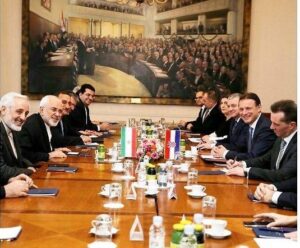
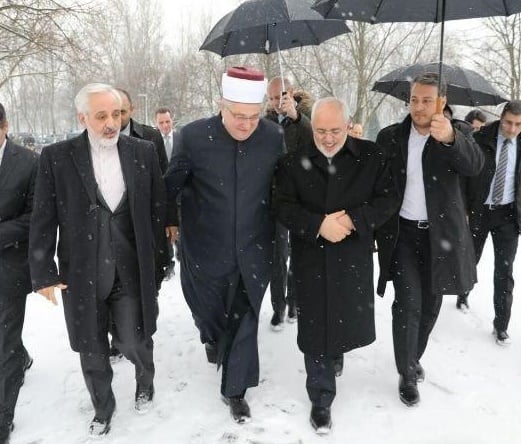
In a Thursday meeting with Iranian Foreign Minister Mohammad Javad Zarif in Zagreb, PM Plenković praised the positive and constructive role of Iran in the Middle East.

He also referred to the Islamic Republic as an influential country that is doing its best to bring stability into the region.

The Croatian prime minister hailed the very good level of ties between Tehran and Zagreb, and said, “In recent years, major steps have been taken to boost cooperation between the two sides, especially in the economic and commercial spheres, and they need to be continued and promoted.”

For his part, Zarif conveyed the greetings of the First Vice President of the Islamic Republic of Iran to the Croatian Premier, saying that “We are interested in developing bilateral relations with Croatia in all fields.”

The Iranian FM also stated that Halal tourism, energy, agriculture, food industry, advanced technology and banking are among the areas of cooperation between the two countries which are currently underway.

Cooperation with Croatia for investment and implementation of joint projects in neighbouring countries of Iran was one of the other points raised by Zarif.

He also emphasized the promotion of collaborations between the two countries at the regional and international associations and organizations, both bilaterally and within the framework of the European Union.


“Iran Important Country in Croatia’s Foreign Policy”

Earlier in the day, Zarif also met the Speaker of the Croatian Parliament Gordan Jandroković.

At this meeting, the speaker of the Croatian parliament described the two countries’ relations as perfect saying that “I am sure that your visit to Croatia will strengthen relations between the two countries.”

He emphasized that Iran is an important country in Croatia’s foreign policy and Zagreb is ready to develop ties with Tehran in all fields.

Croatian PM Praises Iran’s Constructive Role in MideastFor his part, FM Zarif said bilateral relations in the political and economic spheres are at a very good level, especially the ties between the people of the two countries. He also conveyed the greetings of Iran’s Parliament Speaker to Jandroković.
He further expressed hope that by removing some obstacles and providing the necessary facilities, Tehran and Zagreb could witness the prosperity of mutual relations.

Strengthening parliamentary ties, the visit of the Croatian parliamentary friendship group to Iran, reviewing the areas of business, economic, scientific and cultural cooperation, as well as discussing the most important regional and international issues, especially the need to combat terrorism and extremism were among the other topics discussed at this meeting.


Iran FM, Croatian Economy Minister Discuss Business Ties

Zarif has also held talks with Croatian Deputy Prime Minister and Minister of Economy Martina Dalić.

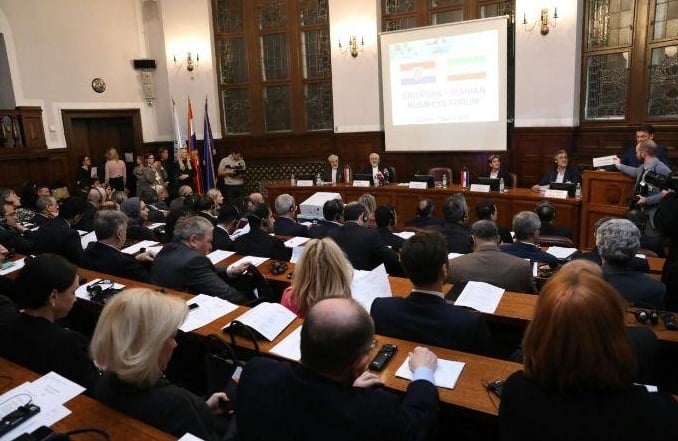
The meeting was held before the beginning of a joint meeting between Iranian and Croatian businessmen in Zagreb.

On the sidelines of the talks, the Iranian foreign minister signed the book of commemoration of Croatian Chamber of Commerce as well.

The two sides also attended the joint meeting of Iranian and Croatian businessmen.

Croatian PM Praises Iran’s Constructive Role in Mideast

Visit to Zagreb Islamic Centre

Zarif also paid a visit to the Islamic Centre of Zagreb as the last part of his trip to Croatia. During the Thursday visit, Zarif met with the Mufti of Zagreb Mosque Aziz Hasanovic and toured various parts of the mosque.Croatian PM Praises Iran’s Constructive Role in Mideast

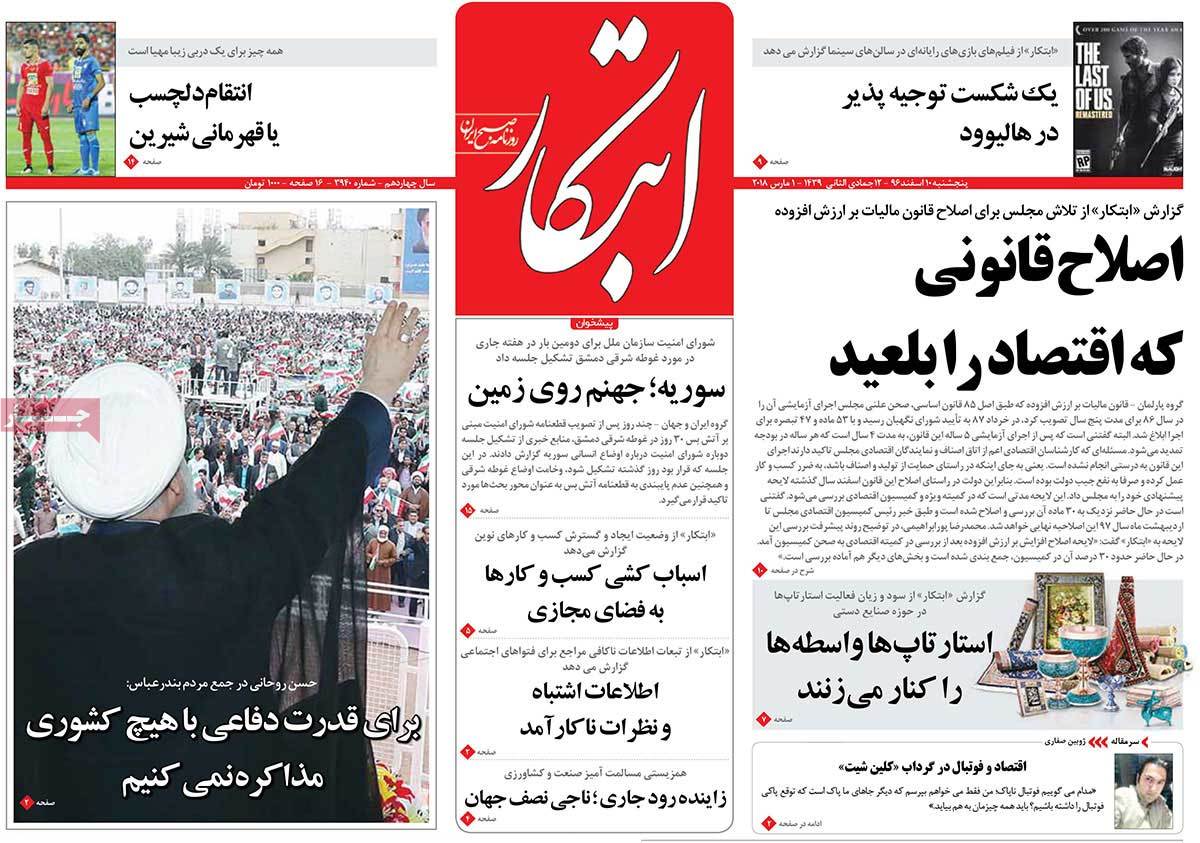
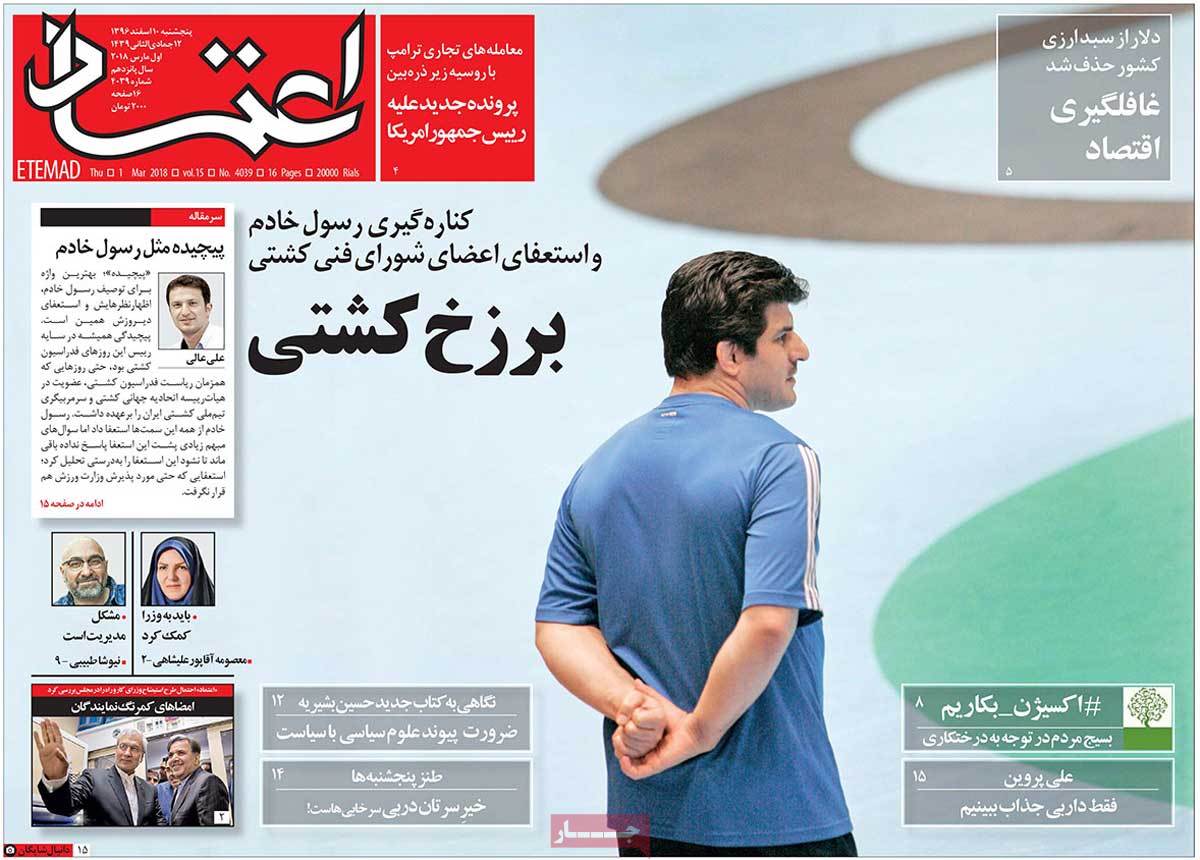
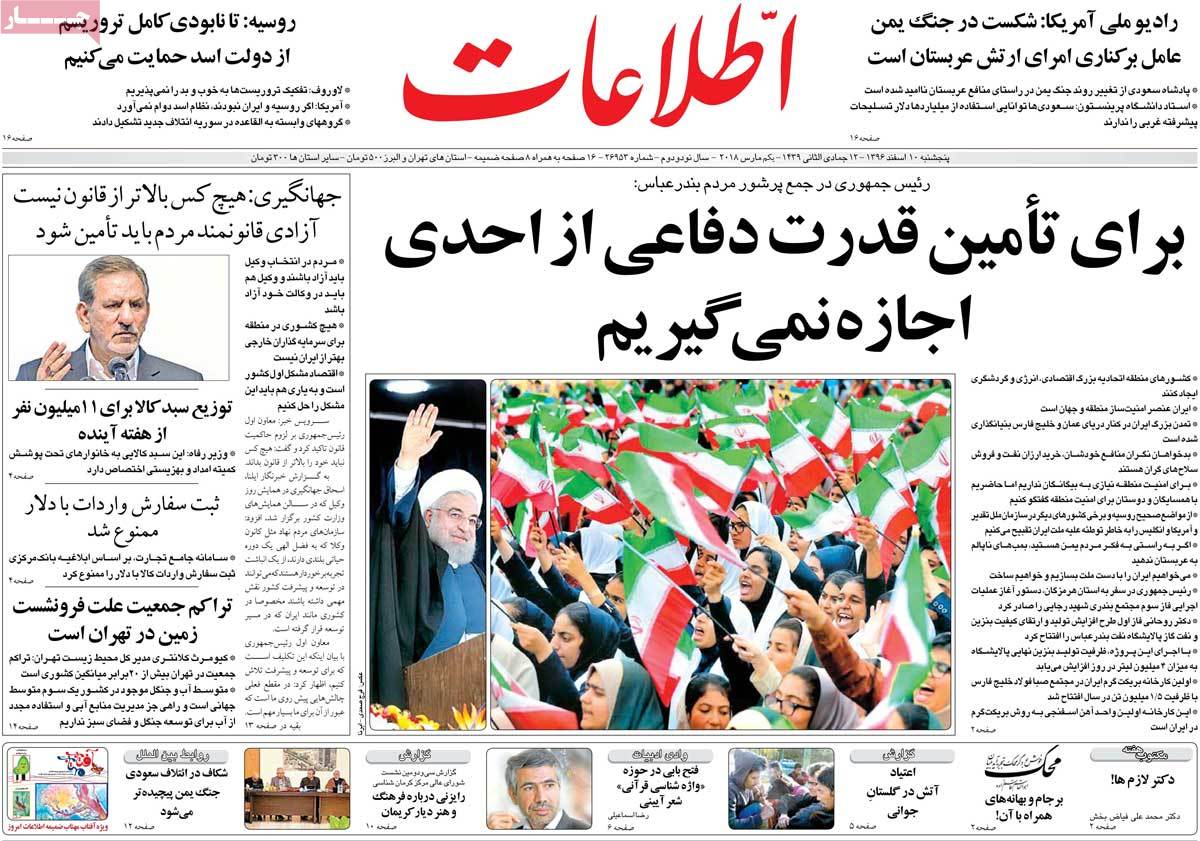
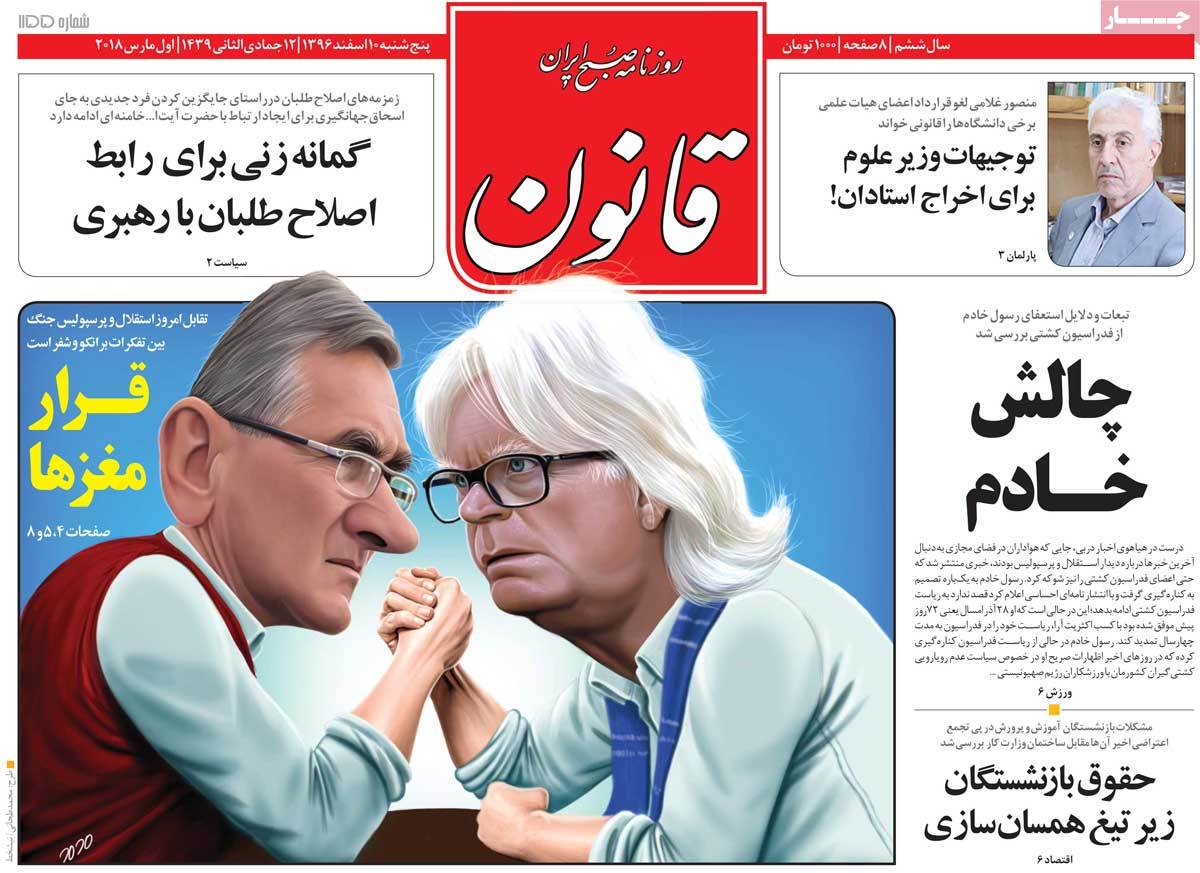
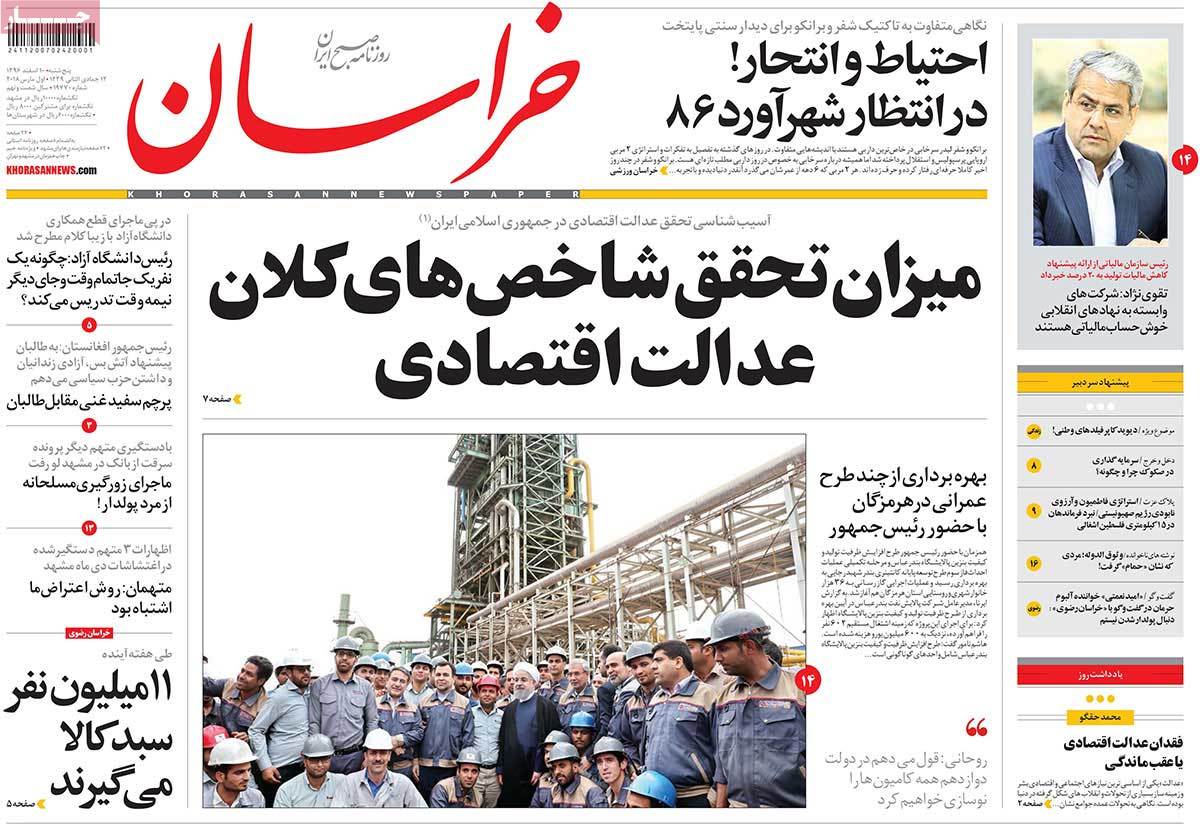
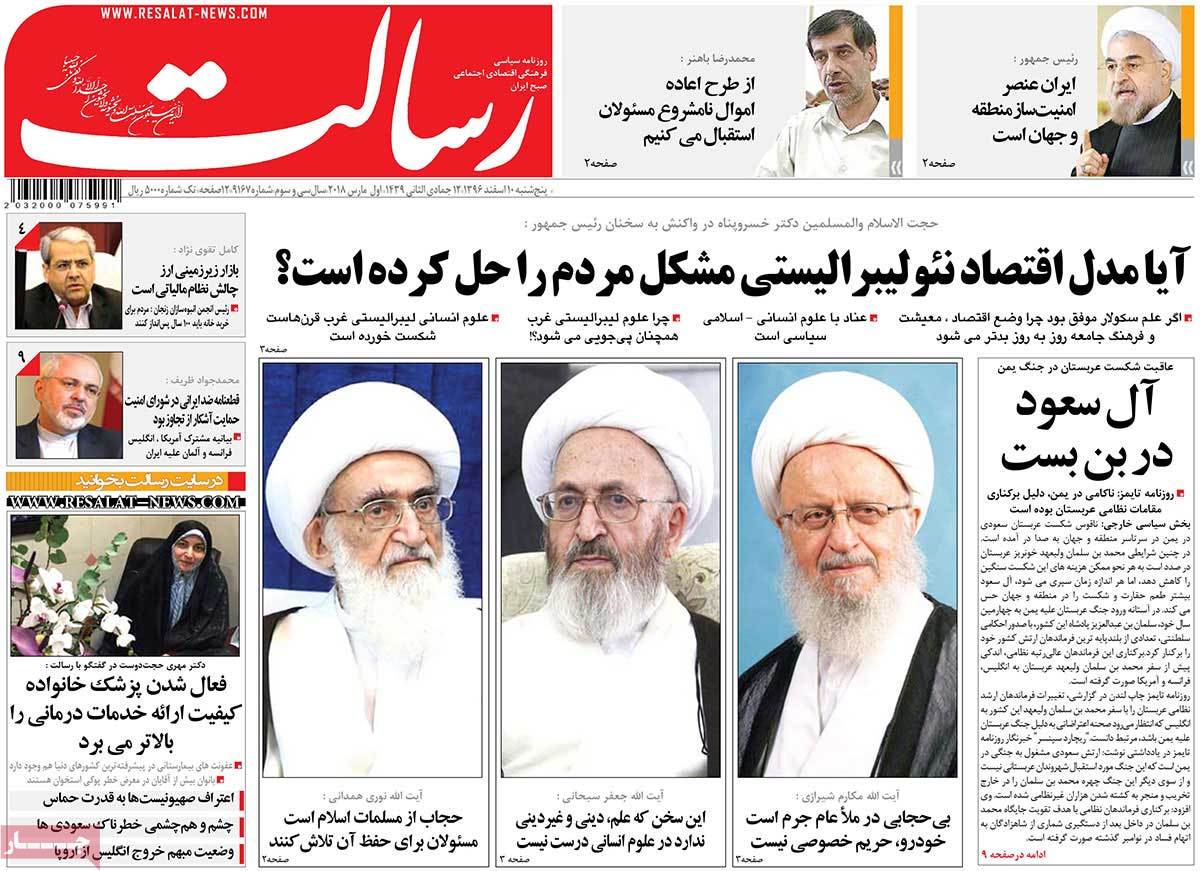
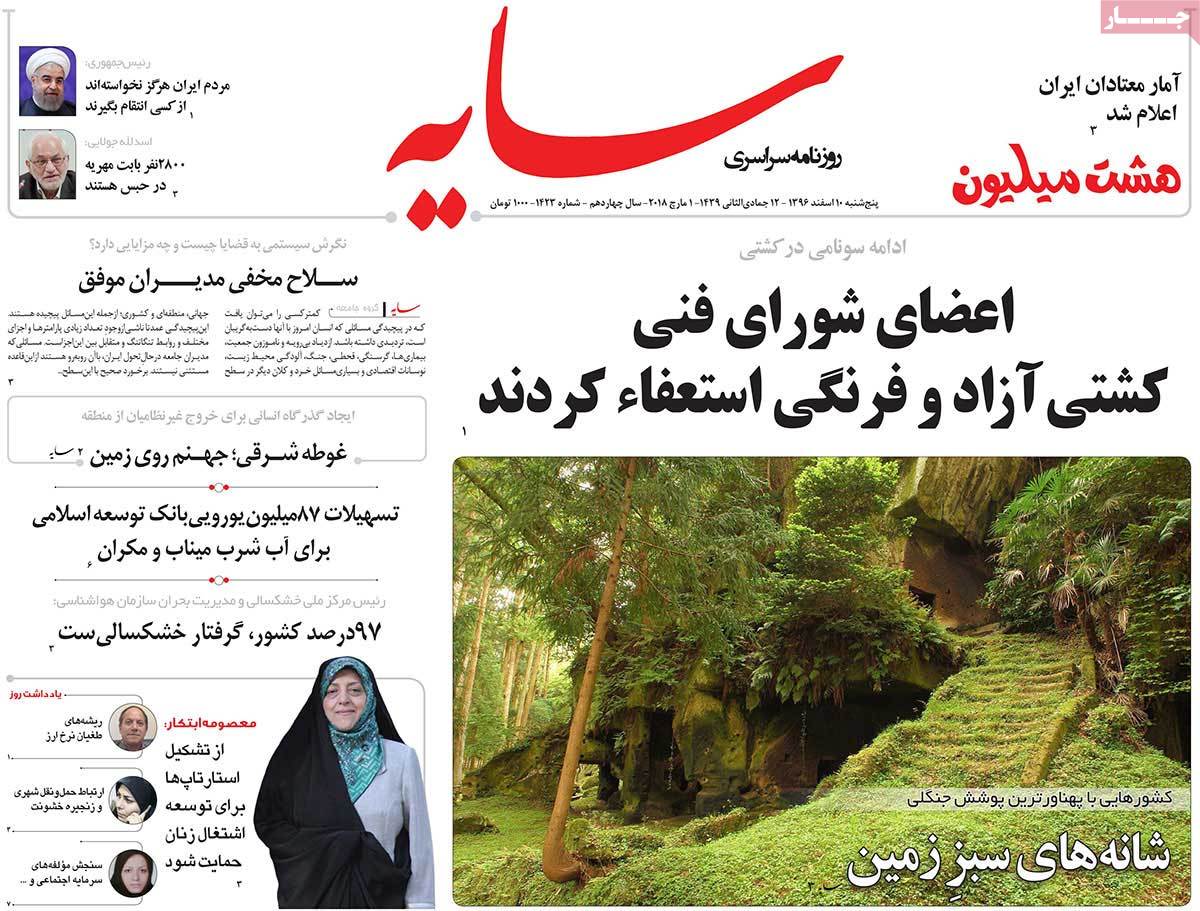
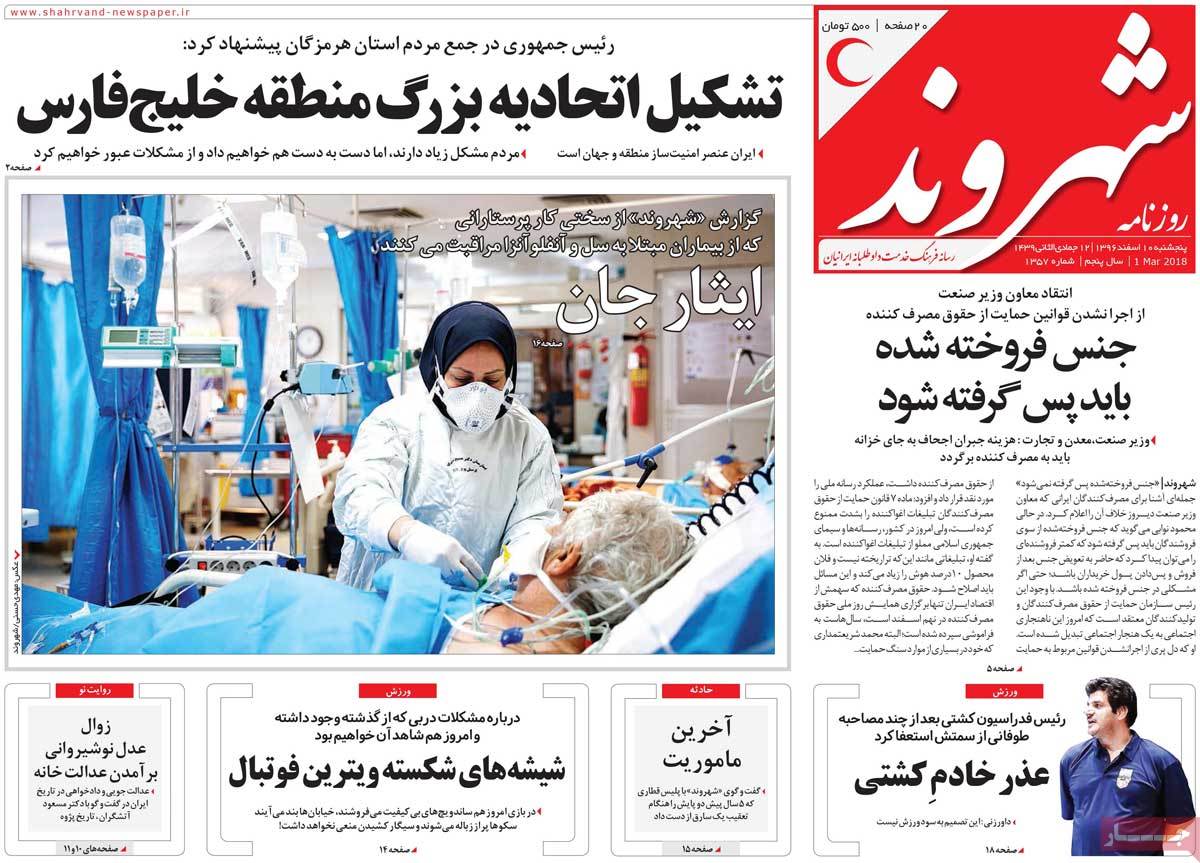
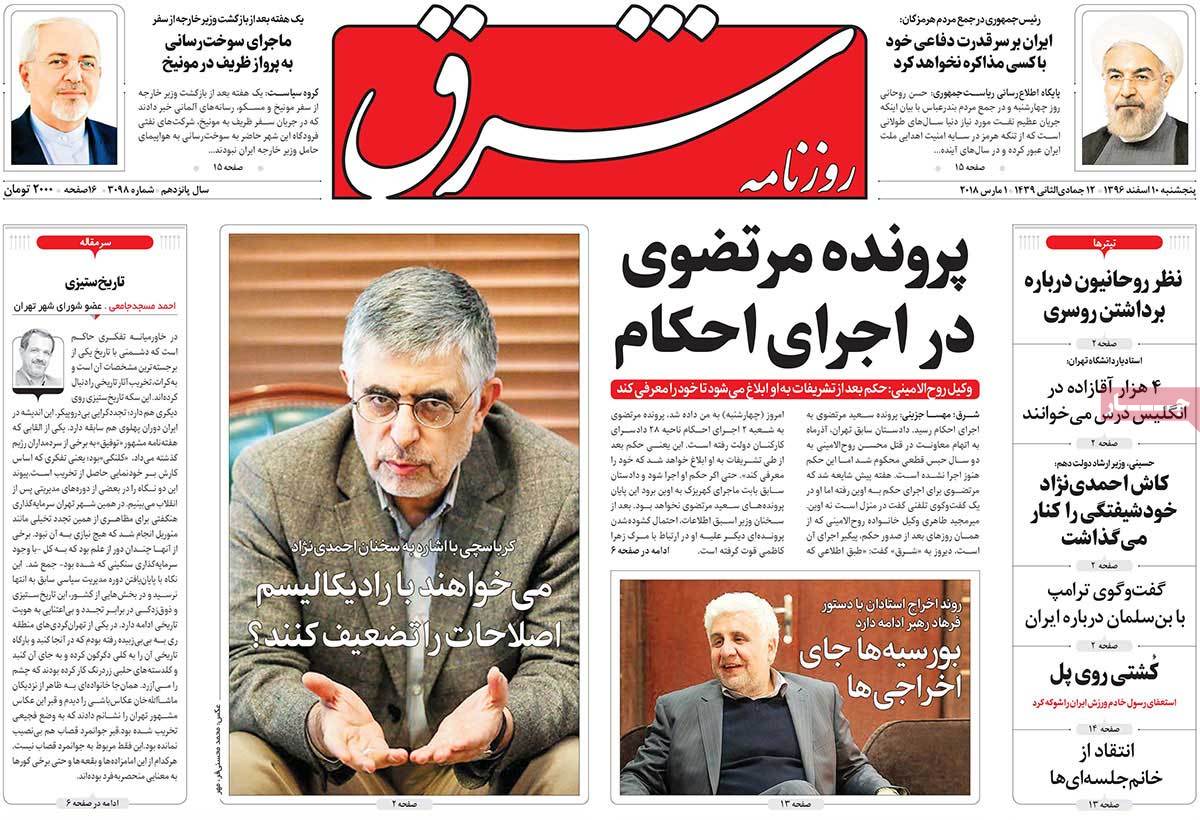
A Look at Iranian Newspaper Front Pages on March 1

A Look at Iranian Newspaper Front Pages on November 18

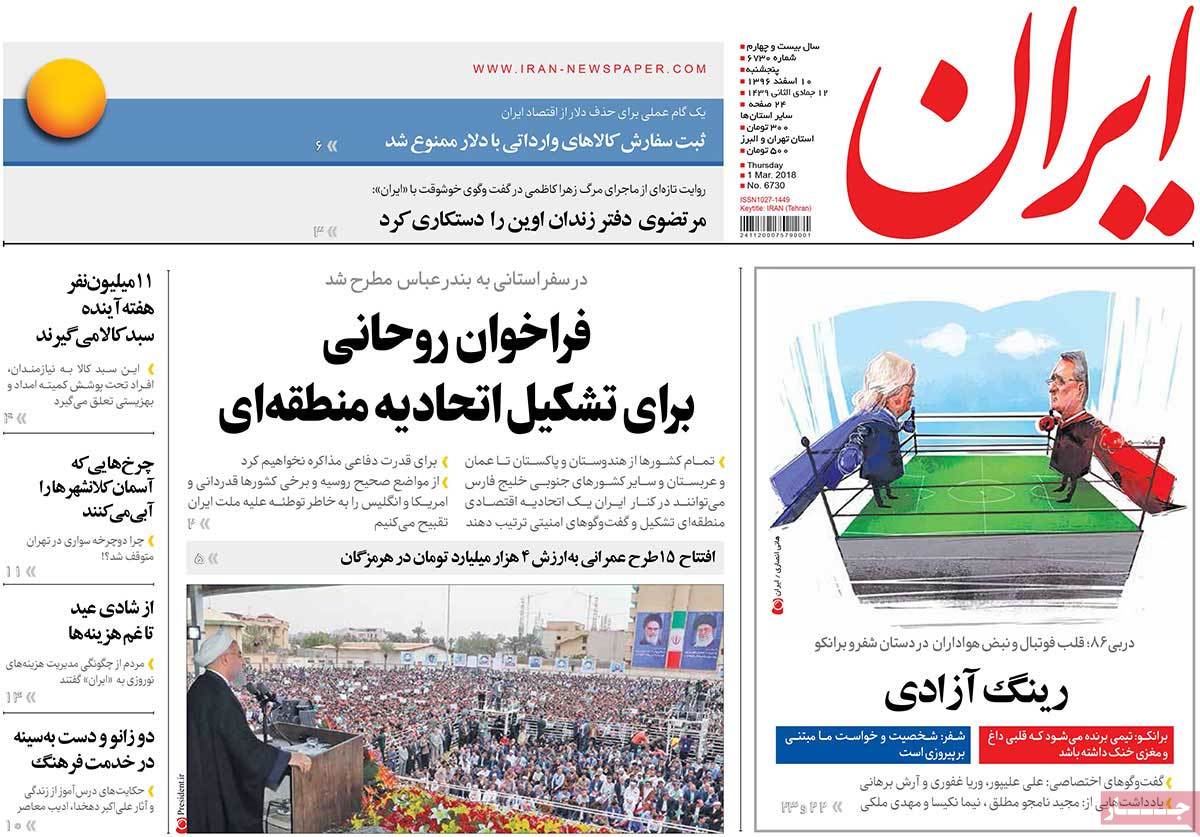
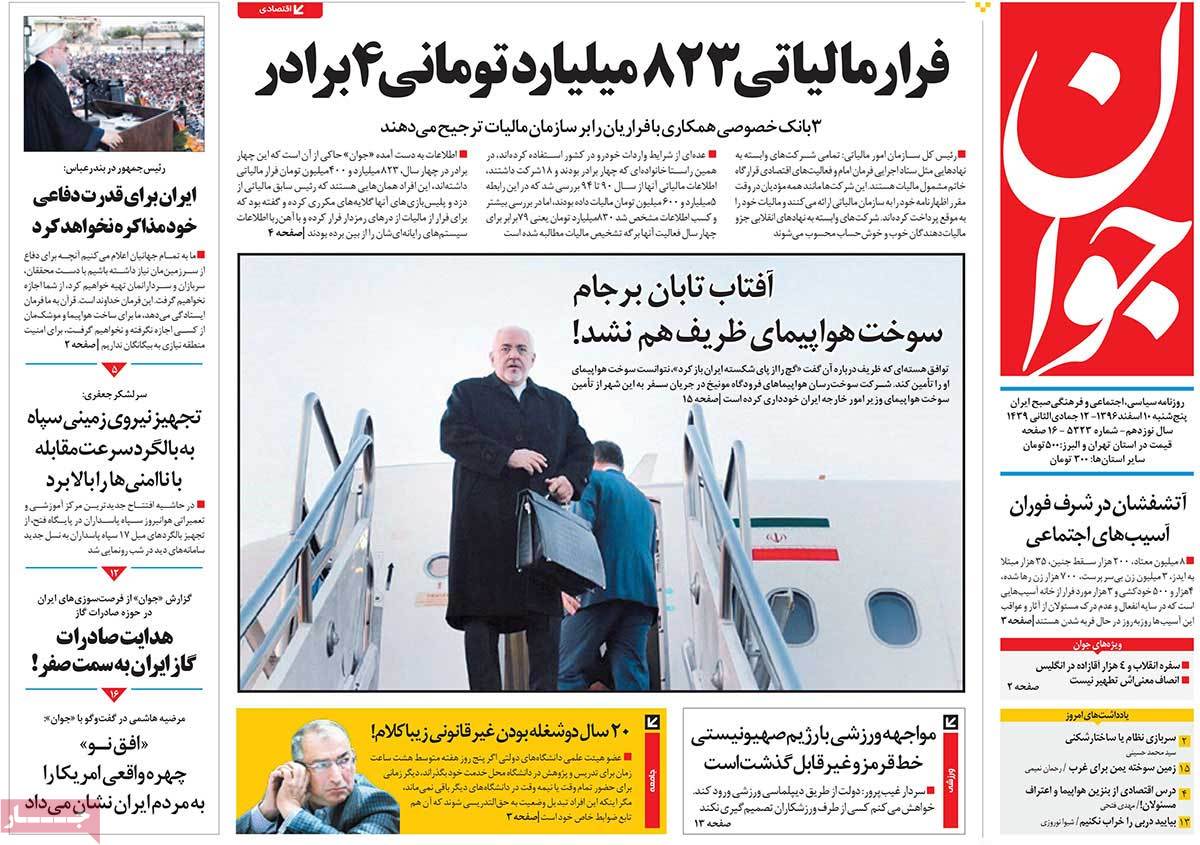
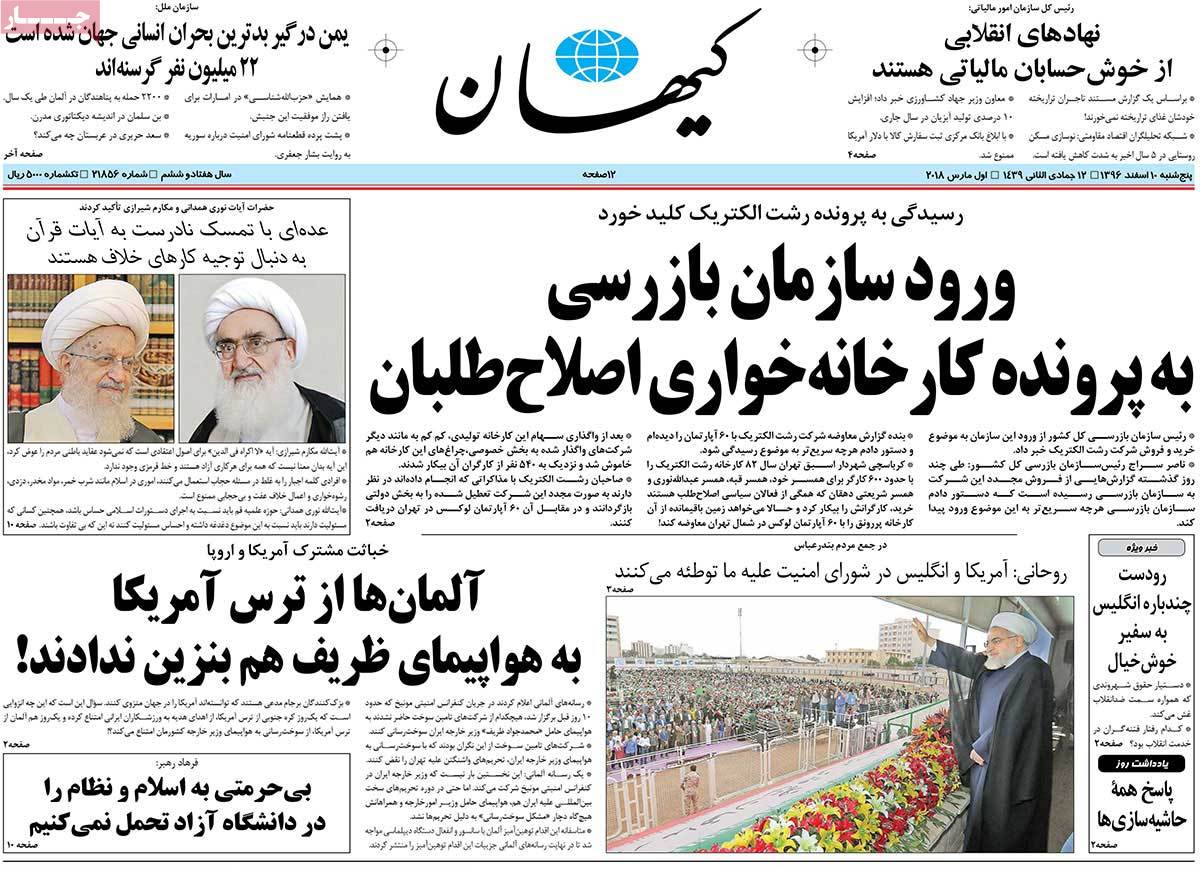
Almost all papers today covered the controversy over the Munich Airport’s refusal to provide fuel for Iranian Foreign Minister Mohammad Javad Zarif’s plane for the fear of US sanctions. The plane finally was refuelled by the German army, but the issue has turned into a pretext for critics of Rouhani’s government, and the nuclear deal in particular.

The 86th derby between Tehran football giants Esteghlal and Persepolis also received great coverage. The great match will see FIFA president Giani Infantino as its special guest.

A decision by the Central Bank and Ministry of Trade and Industry to remove the US dollar from certain commodity exchanges was also a top story today, as it will help the country’s economy get rid of the greenback gradually.

The above issues, as well as many more, are highlighted in the following headlines and top stories:


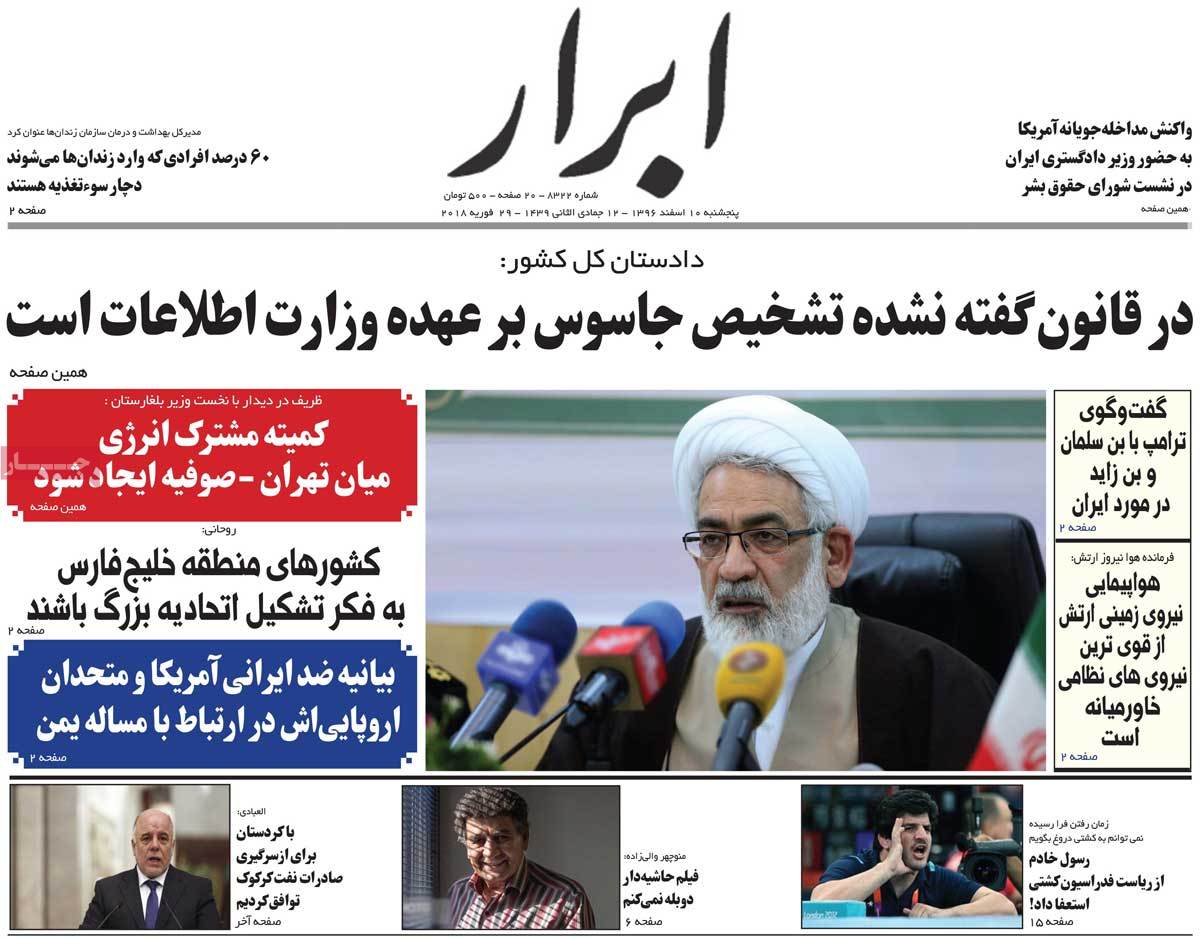
Abrar:

1- Prosecutor General: Intelligence Ministry Responsible for Identifying Spies

2- Zarif Calls for Establishment of Tehran-Sofia Joint Energy Committee

3- Rouhani: Persian Gulf States Must Think of Forming Bigger Alliance

4- US, European Allies Issue Anti-Iran Statement on Yemen

5- US Shows Meddlesome Reaction to Iran Justice Minister’s Participation in UNHRC Session

A Look at Iranian Newspaper Front Pages on March 1


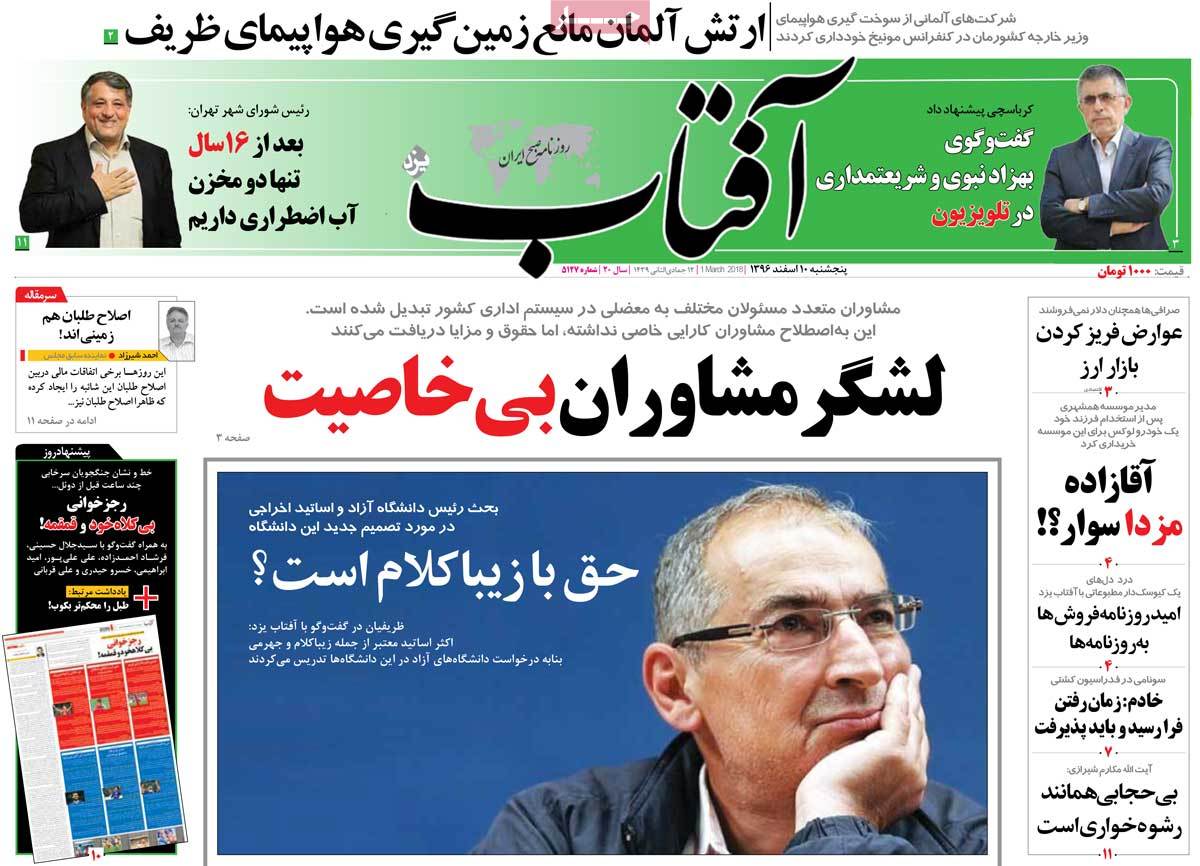
Aftab-e Yazd:

1- German Army Refuels Zarif’s Plane to Prevent It from Being Grounded

2- Politician Calls for Live Debate between Veteran Conservative, Reformist Figures

A Look at Iranian Newspaper Front Pages on March 1


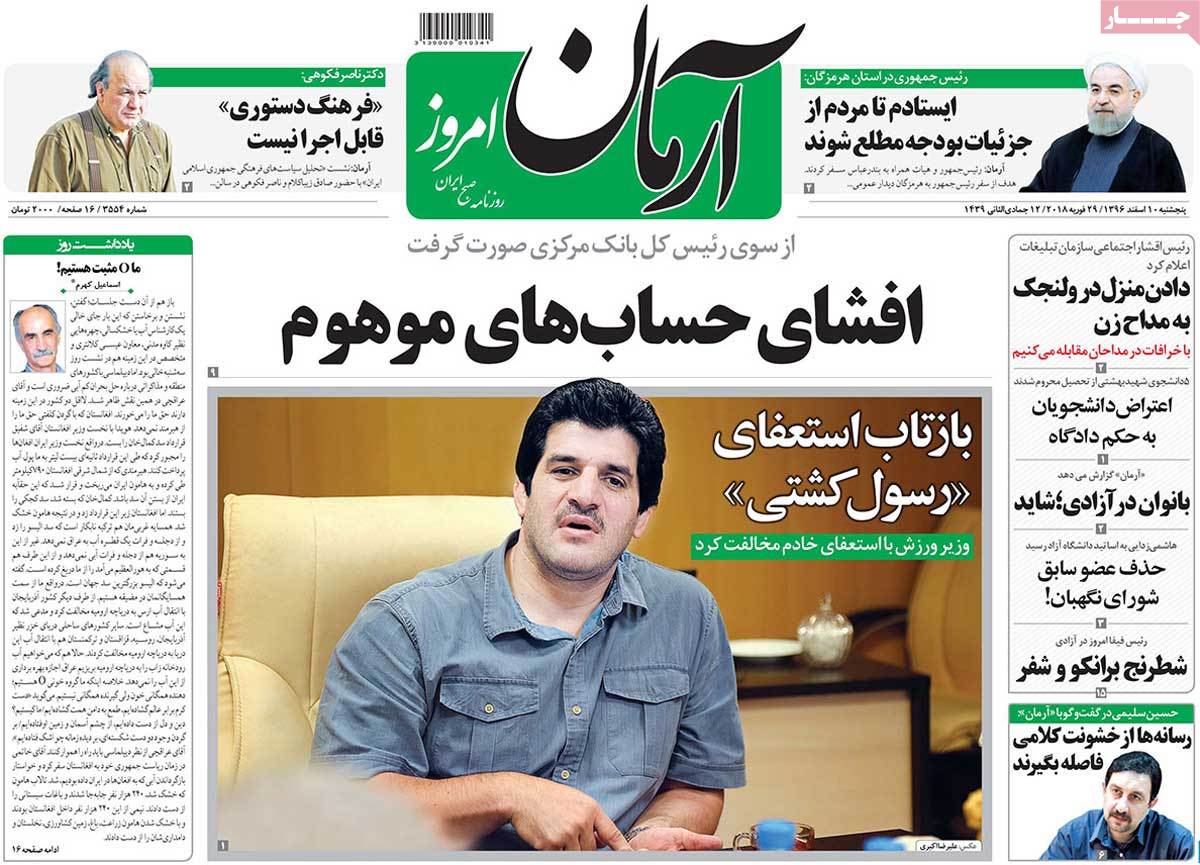
Arman-e Emrooz:

1- Central Bank Governor Discloses Ambiguous Bank Accounts

2- Rouhani: I’ll Fight to Let People Know about Details of Budget

A Look at Iranian Newspaper Front Pages on March 1


Ebtekar:

1- Syria, Hell on Earth: UN Security Council Once Again Convene on Eastern Ghouta

2- Everything Prepared for Great Derby in Tehran: Revenge of Sweet Championship

3- Parliament Trying to Revise Law on Value Added Tax, Which Swallowed Iran’s Economy

4- Rouhani: We Won’t Hold Talks with Any Country over Defence Power

A Look at Iranian Newspaper Front Pages on March 1


Etemad:

1- Iran’s Economy Surprised: Dollar Removed from Forex Basket

2- New Case against US President: Trump’s Trade Deals with Russia under Scrutiny

A Look at Iranian Newspaper Front Pages on March 1


Ettela’at:

1- Russia: We’ll Support Assad Gov’t until Full Eradication of Terrorism

2- NPR: Defeat in Yemen War Reason for Dismissal of Saudi Commanders

3- Iran First VP: No One above Law; People’s Legal Freedom Must Be Ensured

4- Population Density Cause of Landslide in Tehran

A Look at Iranian Newspaper Front Pages on March 1


Ghanoon:

1- Who Will Represent Reformists in Meetings with Leader

2- Science Minister’s Justifications for Dismissal of University Professors

3- Persepolis-Esteghlal Derby, Clash of Croatian, German Coaches

A Look at Iranian Newspaper Front Pages on March 1


Iran:

1- Rouhani Calls for Formation of Regional Alliance

2- Good Step to Remove US Dollar from Iran’s Economy

  • Orders Will No Longer Be Placed for Iranian Goods Using USD

3- 15 Construction Projects Opened in Hormozgan Province

A Look at Iranian Newspaper Front Pages on March 1


Javan:

1- $200m Tax Evasion of Four Brothers: Three Private Banks Cooperating with Evaders

2- Shining Sun of JCPOA Could Not Even Provide Fuel for Zarif’s Plane!

3- IRGC Chief-Commander: Ground Force Equipped with Choppers to Show Faster Reactions

4- University Professor Zibakalam Has Illegally Had Two Jobs in Past 20 Years!

A Look at Iranian Newspaper Front Pages on March 1


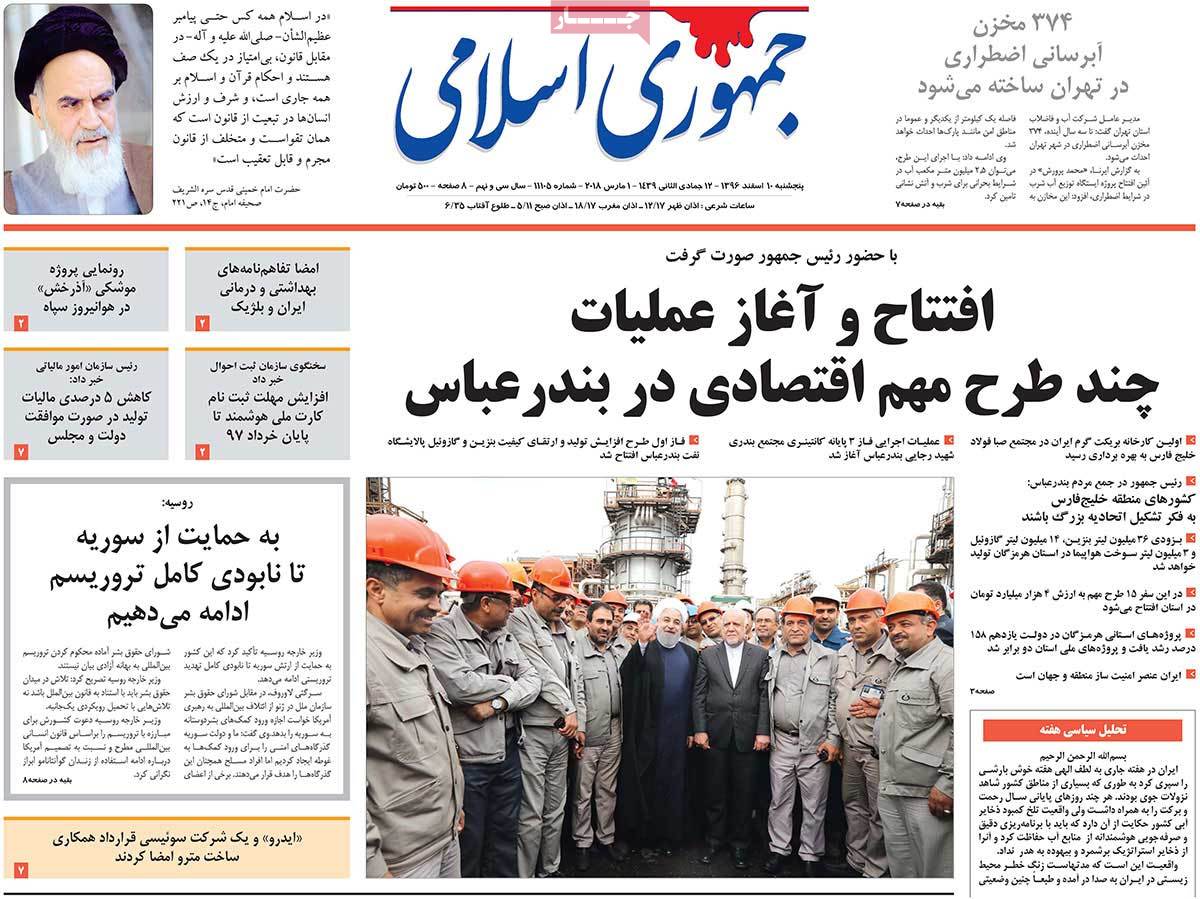
Jomhouri Eslami:

1- Rouhani Inaugurates Several Major Economic Projects in Bandar Abbas

2- 374 Emergency Water Reservoirs to Be Built in Tehran

3- If Gov’t, Parliament Approve, Tax on Production to Be Decreased by 5%

A Look at Iranian Newspaper Front Pages on March 1


Kayhan:

1- Judiciary Starts Probing into Reformists’ Corruption in Rasht Electric Factory Case

2- Germans Didn’t Even Give Fuel to Zarif’s Plane for Fear of US Sanctions!

3- Rouhani: US, UK Conspiring against Us in UN Security Councul

4- UN: Yemen Engaged in World’s Worst Humanitarian Crisis: 22m People Hungry

A Look at Iranian Newspaper Front Pages on March 1


Khorasan:

1- Caution and Suicide! Waiting for 86th Tehran Derby

2- Companies Affiliated to Revolutionary Bodies Pay Their Taxes on Time: Official

A Look at Iranian Newspaper Front Pages on March 1


Resalat:

1- Al Saud in Deadlock: Consequence of Saudis’ Defeat in Yemen War

2- Cleric Asks Rouhani: Has Neo-Liberalist Model of Economy Resolved People’s Problems?

A Look at Iranian Newspaper Front Pages on March 1


Sayeh:

1- Continued Tsunami in Wrestling: Several Members of Iran Wrestling Federation Resign

  • Resignations came after the federation asked officials to make a clear decision on Iranian athletes’ matches against Israeli opponents

2- Rouhani: Iranian People Have Never Wanted to Take Revenge from Anyone

A Look at Iranian Newspaper Front Pages on March 1


Shahrvand:

1- People Must Be Able to Return Goods They Have Bought According to Law

2- Nurses Taking Care of Patients Diagnosed with Tuberculosis, Flu Sacrificing Their Lives

A Look at Iranian Newspaper Front Pages on March 1


Shargh:

1- One Week after FM Zarif’s Return from Europe: Controversy over Plane Fuelling in Munich

2- Ahmadinejad’s Culture Minister: I Wish He Could Stop Being So Narcissist

A Look at Iranian Newspaper Front Pages on March 1


Iran Reliable Source of Energy for Croatia: Zarif

During the Thursday meeting, Zarif said the Islamic Republic can be a reliable source of energy, especially for Croatia’s oil and gas needs.

The Iranian top diplomat also announced that Iran is going to fund the construction of a power plant in Croatia based on combined cycle technology.

“We are ready to strengthen economic relations to the same level as our political ties,” he said, adding that some of the existing barriers will be resolved with prudence.

Iran’s foreign minister also commented on other areas of cooperation between the two countries saying that in the field of automotive and automobile parts, as well as in the field of new technologies and infrastructure the two sides can develop their cooperation.

Zarif also referred to international threat of terrorism, adding, “With regard to the common concerns of the two countries, including the fight against terrorism and extremism, Tehran and Zagreb can have closer bilateral or multilateral cooperation.”

He also pointed to the Croatian president’s 2016 visit to Iran, and stressed that the trip opened a new chapter in the two countries’ relations.

Hailing the “historical” friendship between the two nations of Iran and Croatia, Zarif said, “During this trip, a large business delegation is accompanying me. This is the third largest business delegation that has traveled to Croatia within the past year, and it shows the interest of Iranian businesses and entrepreneurs in working with Croatian counterparts.”

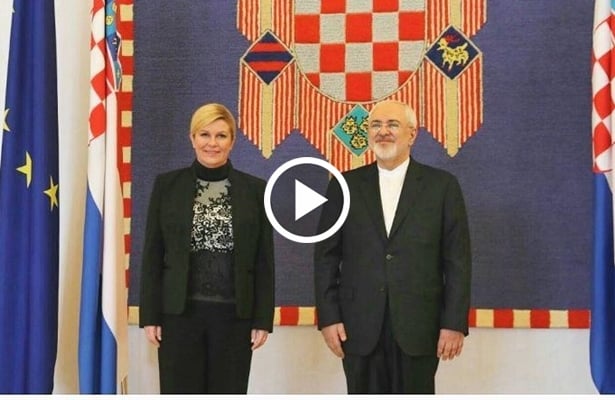
The Croatian President, for her part, referred to her official visit to Iran saying that “We have good and friendly political ties and are ready to expand our relations with Tehran.”

“Croatian businesspersons are keen on working with their Iranian counterparts. There are, of course, some problems, especially in the investment sector, which I hope would be resolved soon,” she added.

President Kitarović said tourism, food industry, science, technology and petrochemicals are good grounds for cooperation between the two countries.

The Croatian side also expressed interest in investing up to $1 billion in Iran’s petrochemical sector.

The two sides also exchanged views on regional issues, in particular the current situation in Syria, Yemen and Afghanistan, as well as the issues in the Balkans.

The talks were held at the same time as a meeting was underway between Iranian and Croatian businessmen.

The increase of bilateral trade ties, which is currently around 20-50 million dollars annually, was one of the issues highlighted by the two countries.

The Iranian and Croatian parties also expressed the hope that with negotiations between Iranian and Croatian private sectors, bilateral trade would increase rapidly.

The Iranian delegation headed by Zarif arrived in Zagreb on Wednesday night on the third leg of their regional tour. Croatia is the third destination of Zarif and his team during their tour of the Balkans and Eastern Europe.

Third Iranian Film Week Underway in Bosnia (+Video)

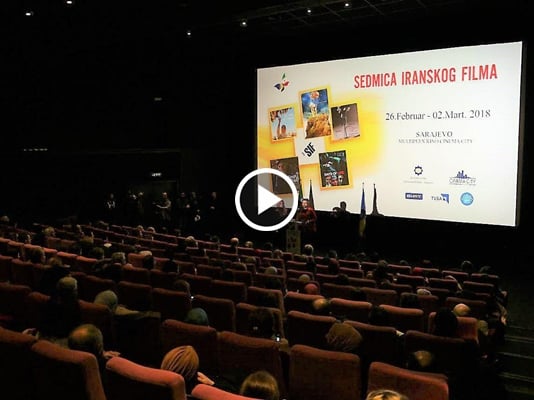
During the opening ceremony held on Monday, February 26, organized by the cultural office of Iran’s Embassy, a huge crowd of Bosnian cinema fans watched “Muhammad (PBUH): the Messenger of God”, the latest film directed by Majid Majidi.

The movie portrays the life of Islam’s Holy Prophet and narrates his early years in Mecca, and is the first part of a trilogy expected to cover the entire life of the Prophet.

Third Iranian Film Week Underway in Bosnia (+Video)The movie, which marks the biggest-budget production in the Iranian cinema to date, received mostly positive reviews from fans and critics during its screening in Iranian theatres and abroad, including in Russia, Turkey, Iraq, and Azerbaijan Republic.
According to a Farsi report by Sahar TV, the other movies expected to be screened during the cinematic event in Sarajevo are “A Cube of Sugar”, “As Simple As That”, “Days of Life” and “The Season of Narges”.

Ali Asghar Ameri, Iran’s cultural attaché in Bosnia, told Sahar’s correspondent on the sidelines of the ceremony that the film week is held on the occasion of the 40th anniversary of the victory of the 1979 Islamic Revolution.

Embryo Donation Centre Opened in Iran

Embryo donation is an advanced infertility treatment method, defined as the giving of embryos remaining after one couple’s in vitro fertilization (IVF) to another person or couple for implantation

Dr. Farhad Yaghmaee, the head of the donation centre of the clinic, described the establishment of the bank as a “substantial progress” in the treatment of infertility in Iran.

At present, there are 3 to 5 million infertile couples in the country and the figure is increasing by 15% each year.

“The greatest benefit of this bank is that we can ensure safety of the donation process and prevent commercialization of this medical service,” Yaghmaee told the Persian-language news agency Sina Press.

For a brief review of Iran’s achievements in various fields of science and technology, check the book “Science and Technology in Iran: A Brief Review

Avicenna clinic is affiliated to the Avicenna Research Institute, which was established in 2003 by the Academic Centre for Education, Culture and Research (ACECR) in collaboration with the medical centre of the UKSH University in the northern German city of Luebeck.

ACERCR is a public non-governmental higher education institution established in 1980, which is involved in innovative research and development projects in clomid-info.com of science and technology.

Ovulation induction, IVF, intrauterine insemination (IUI), and finally surrogacy are other advanced infertility treatment methods currently performed in Iran.

Most infertile couples can conceive with simple infertility treatments like medications or lifestyle changes; however others may require more advanced technologies.

One of the five leading causes of divorce in Iran is infertility of one of the spouses, according to official reports.

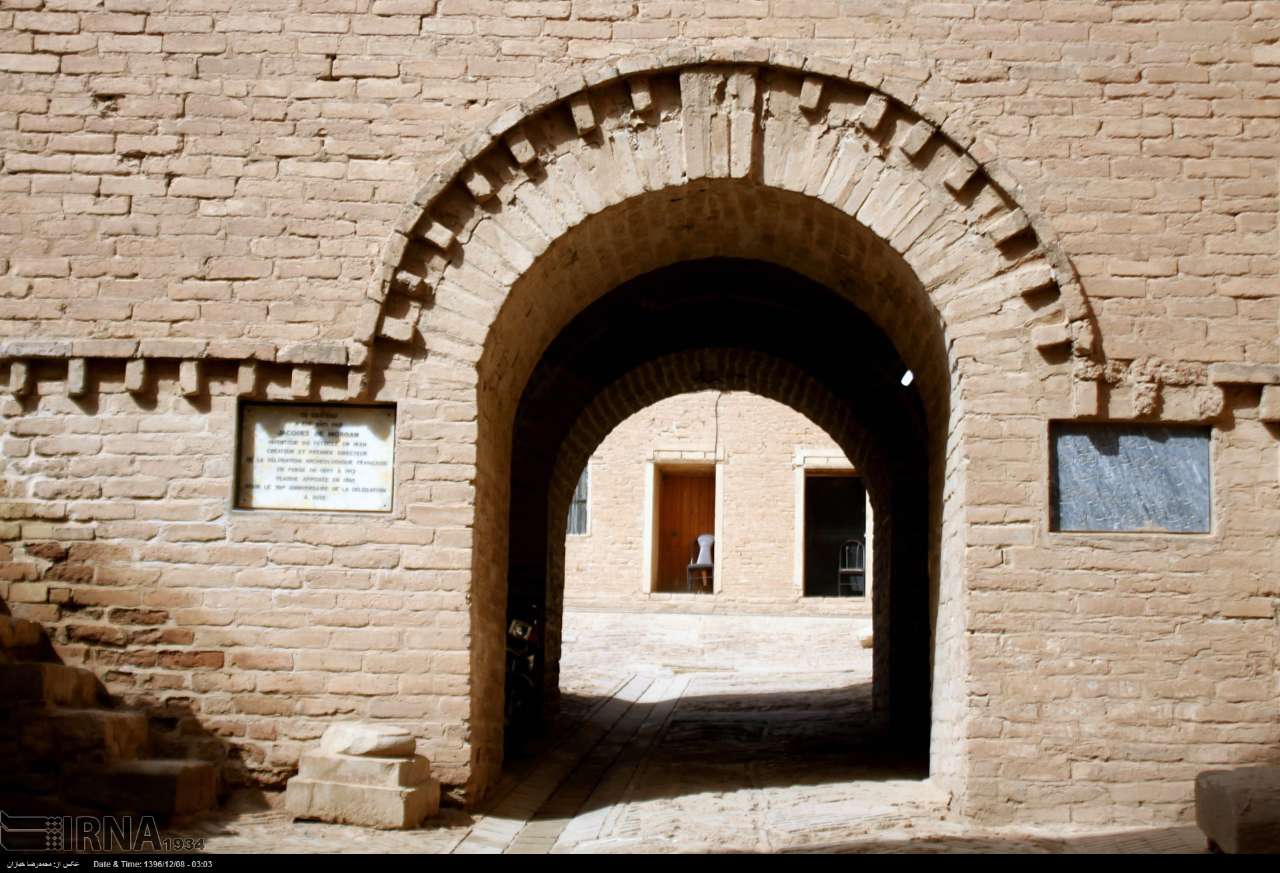
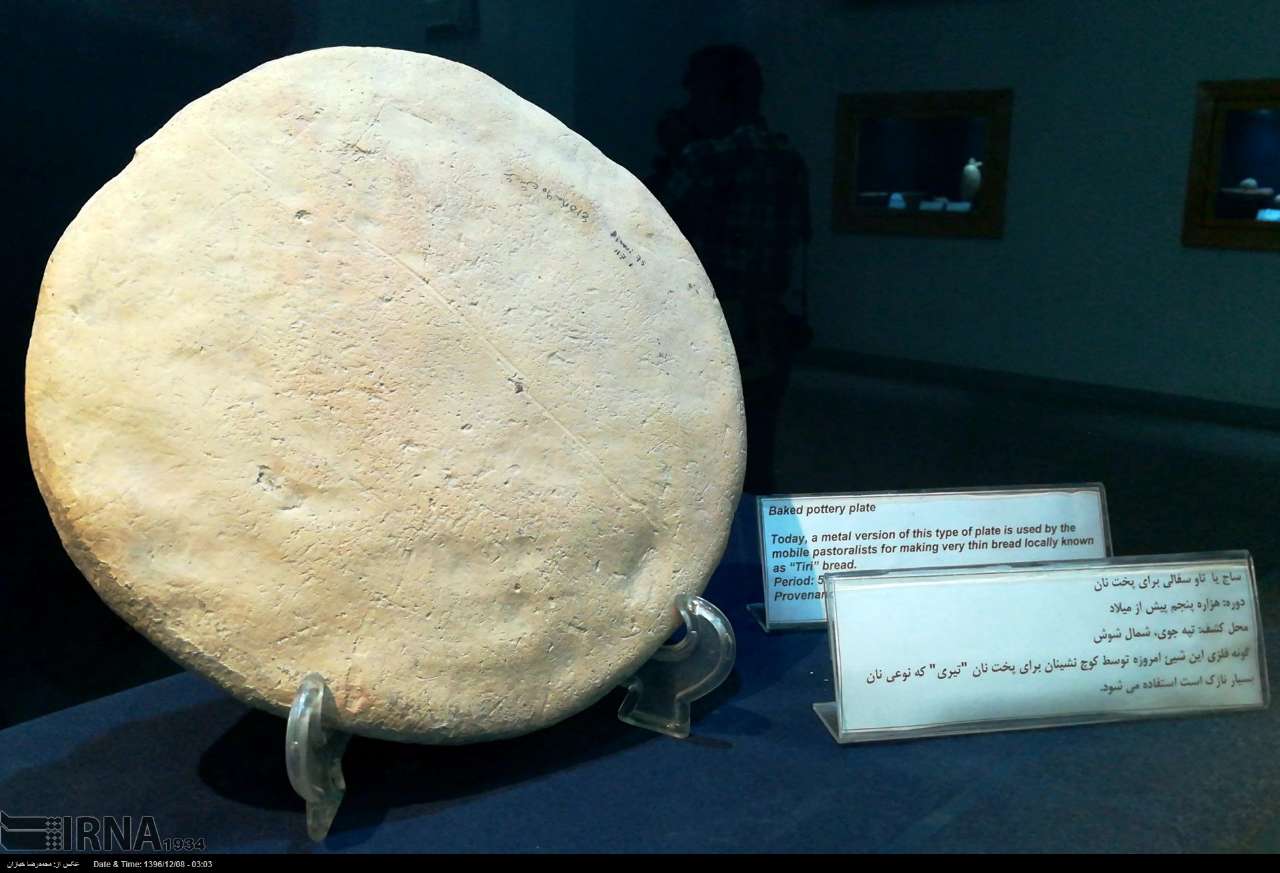
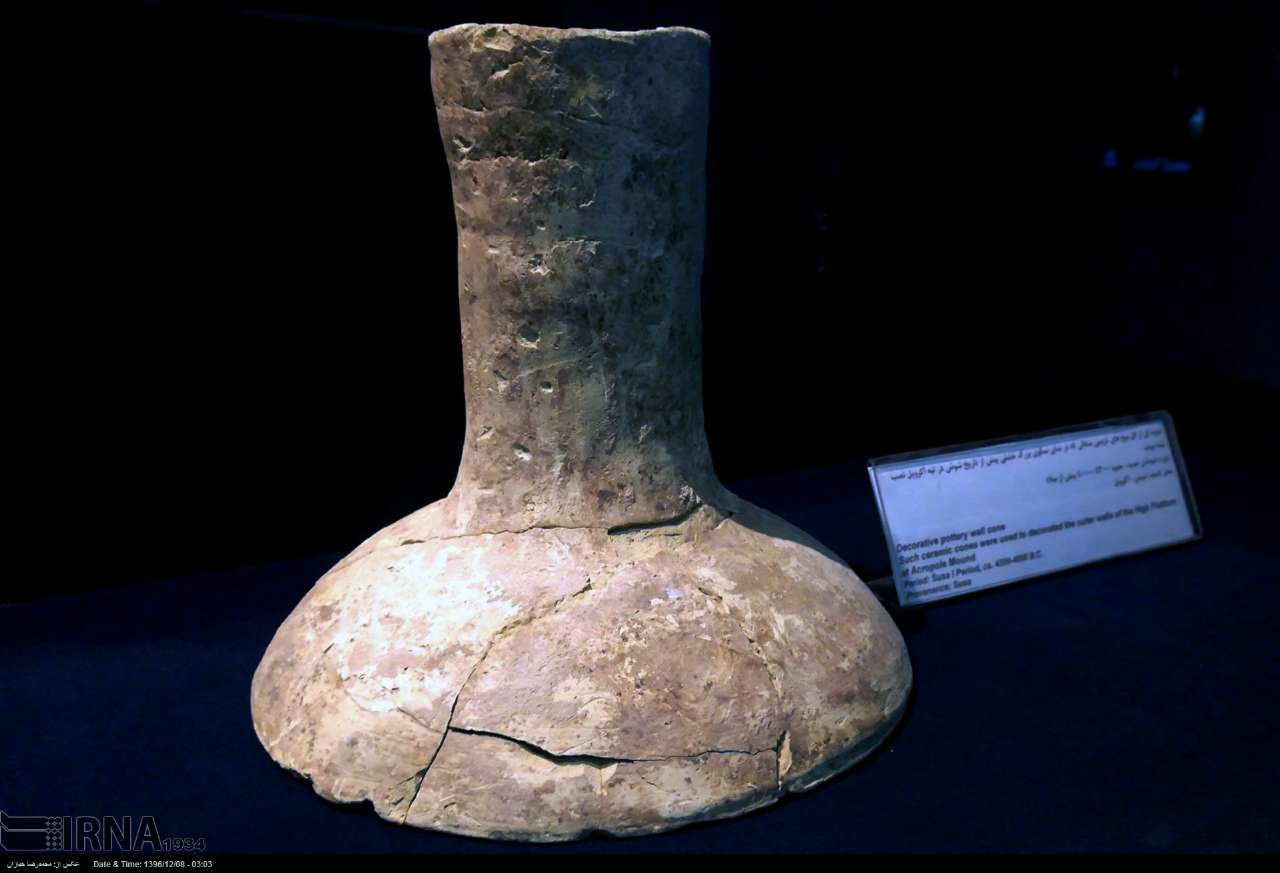
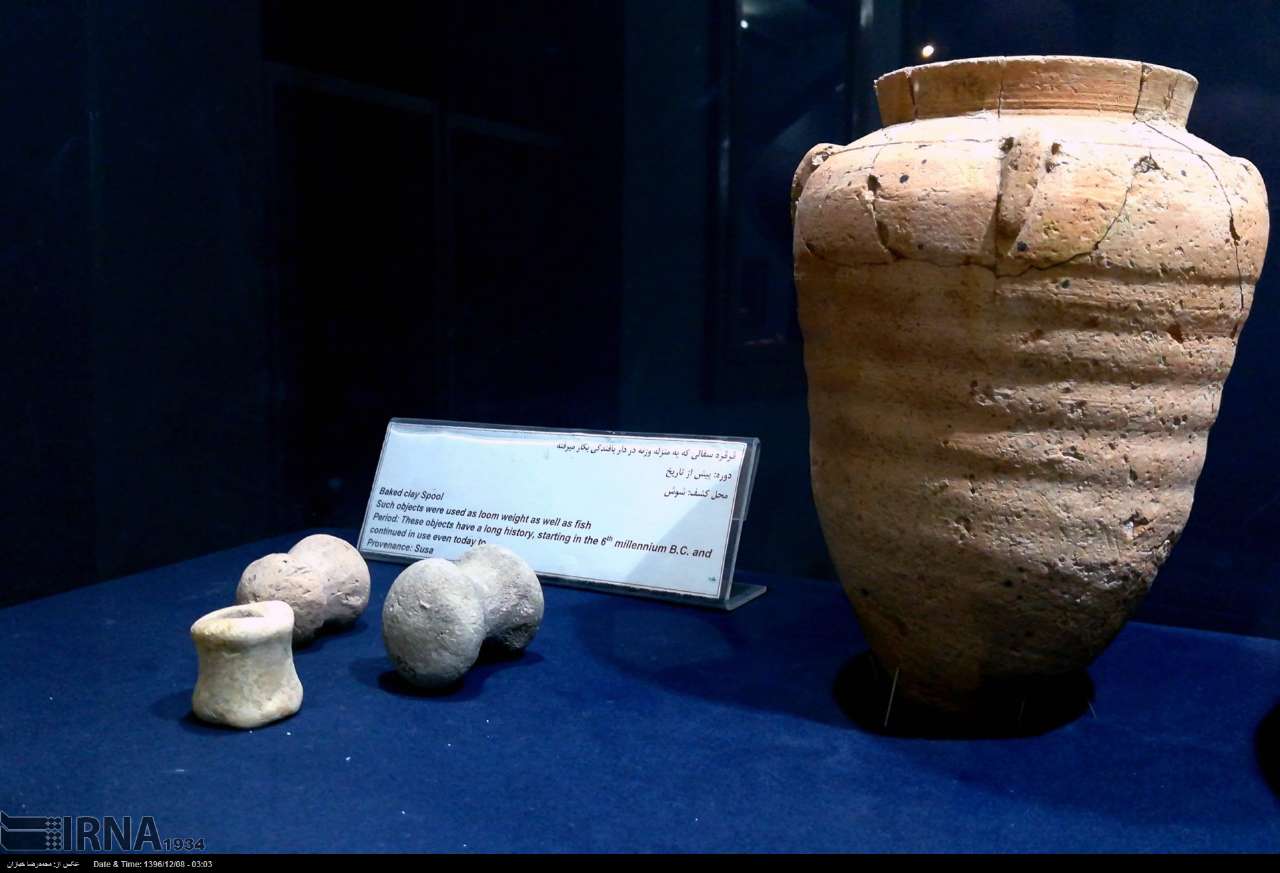
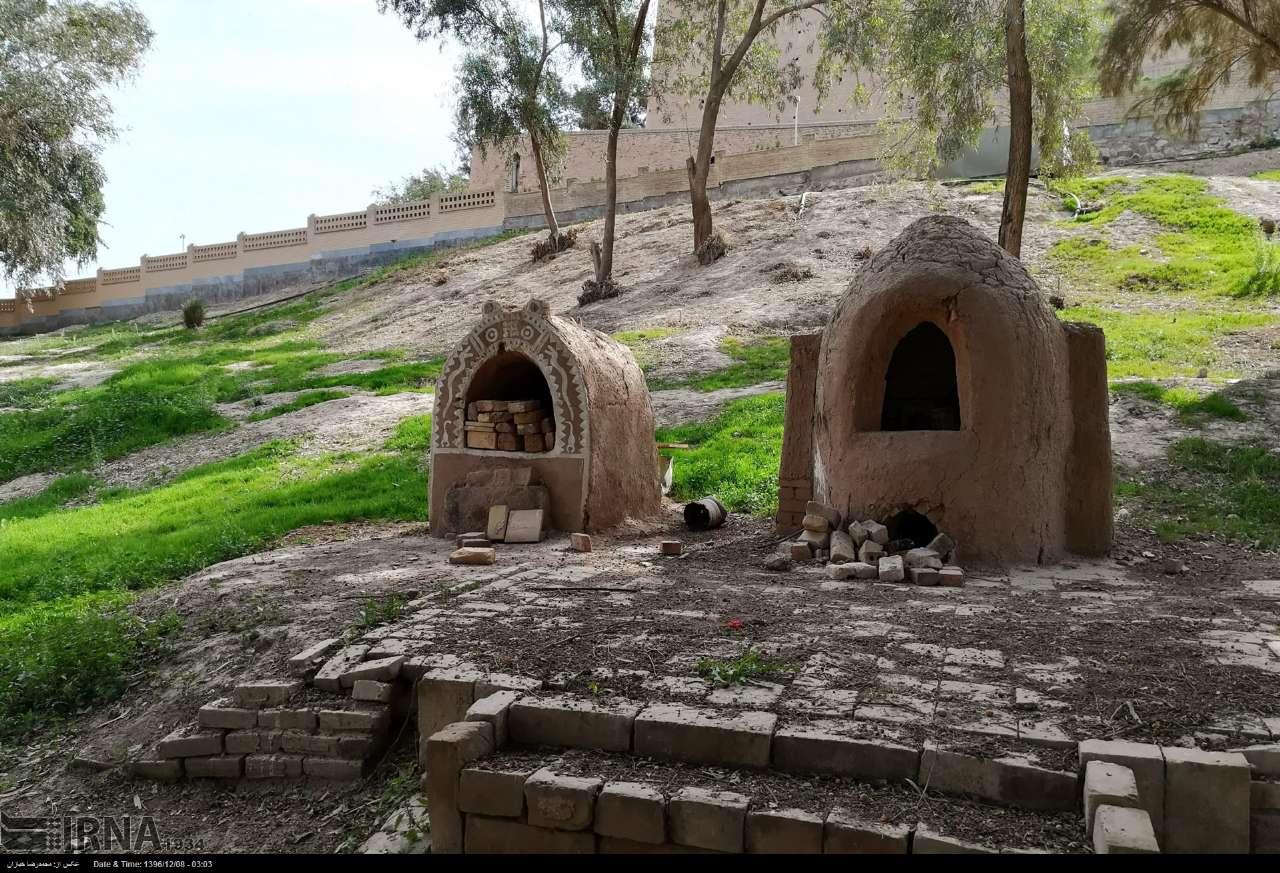
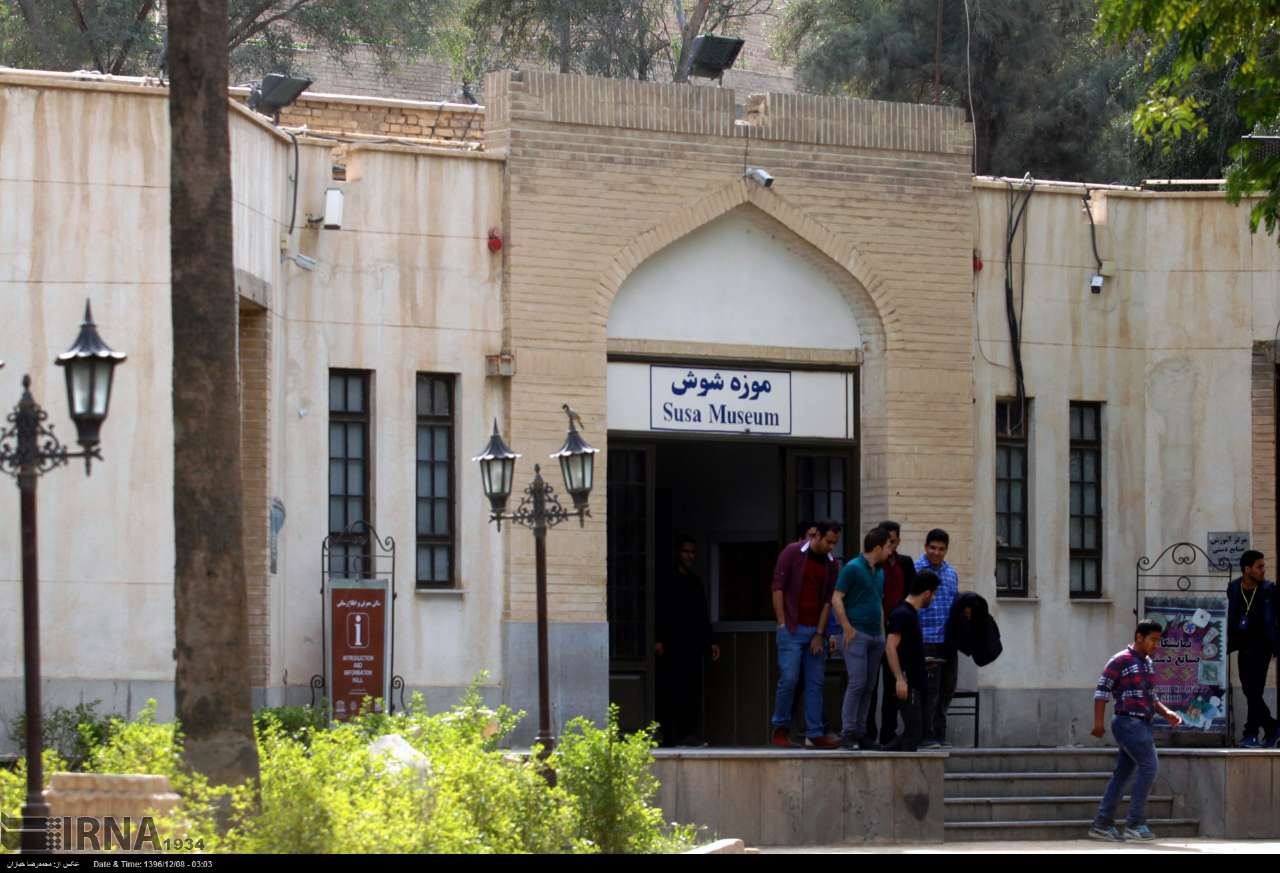
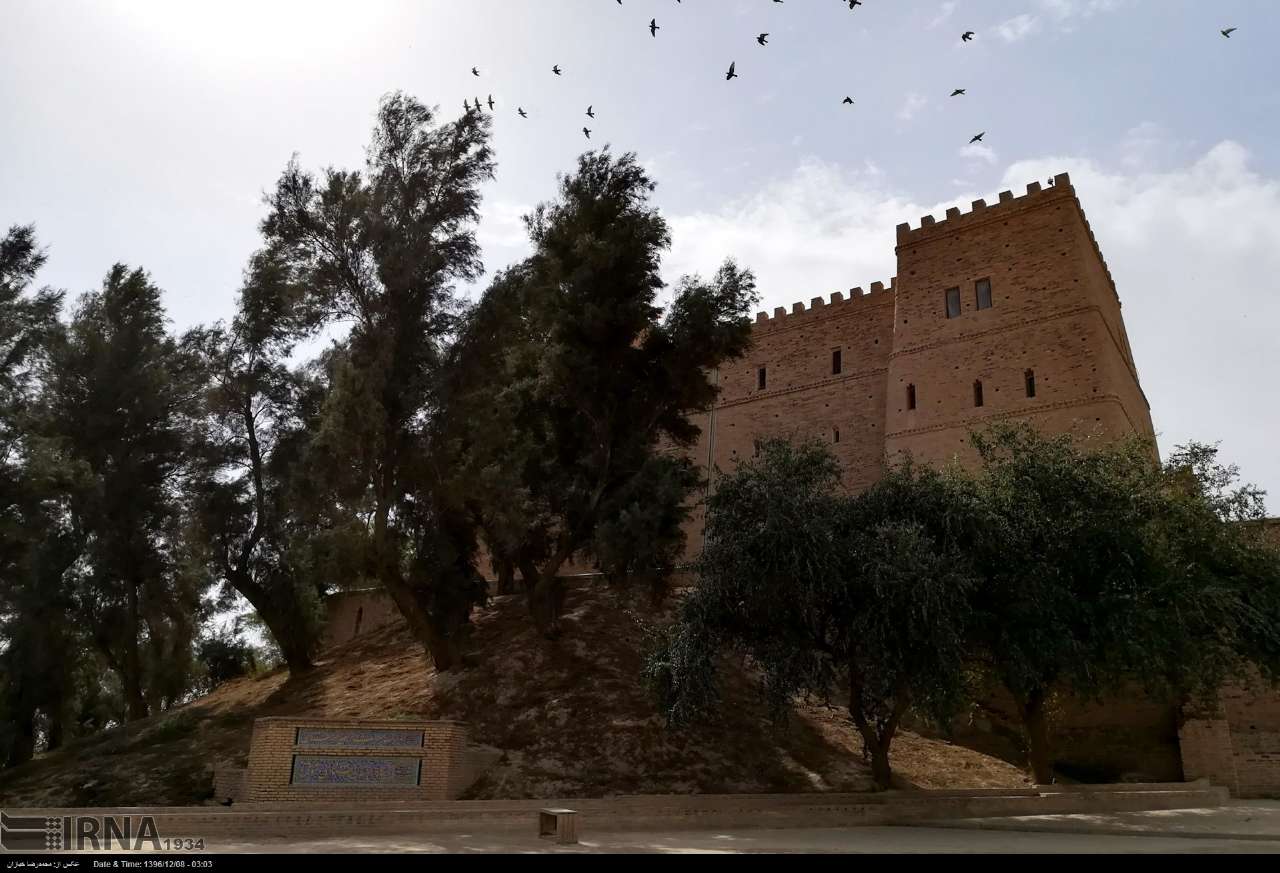
Susa Museum; A Gem Located in Southern Iran

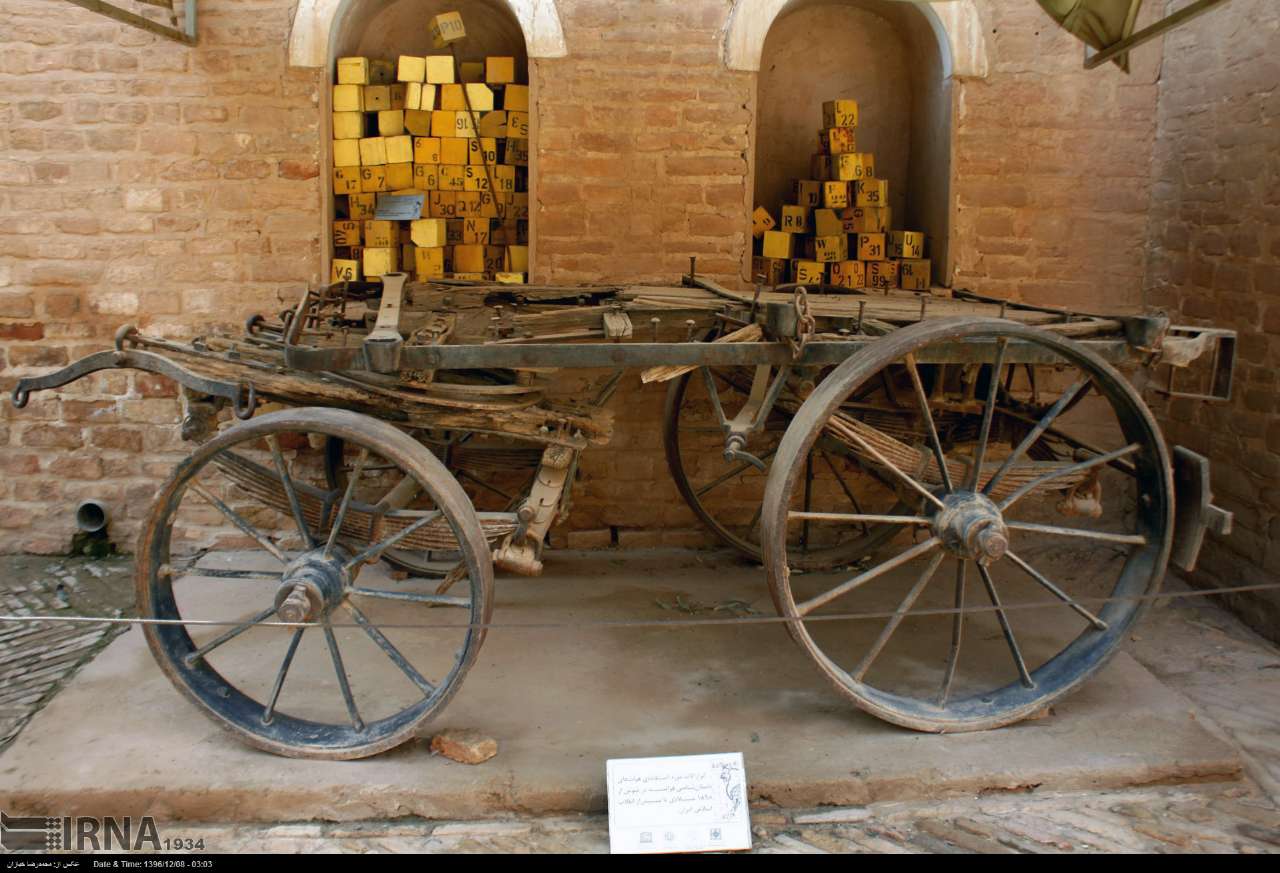
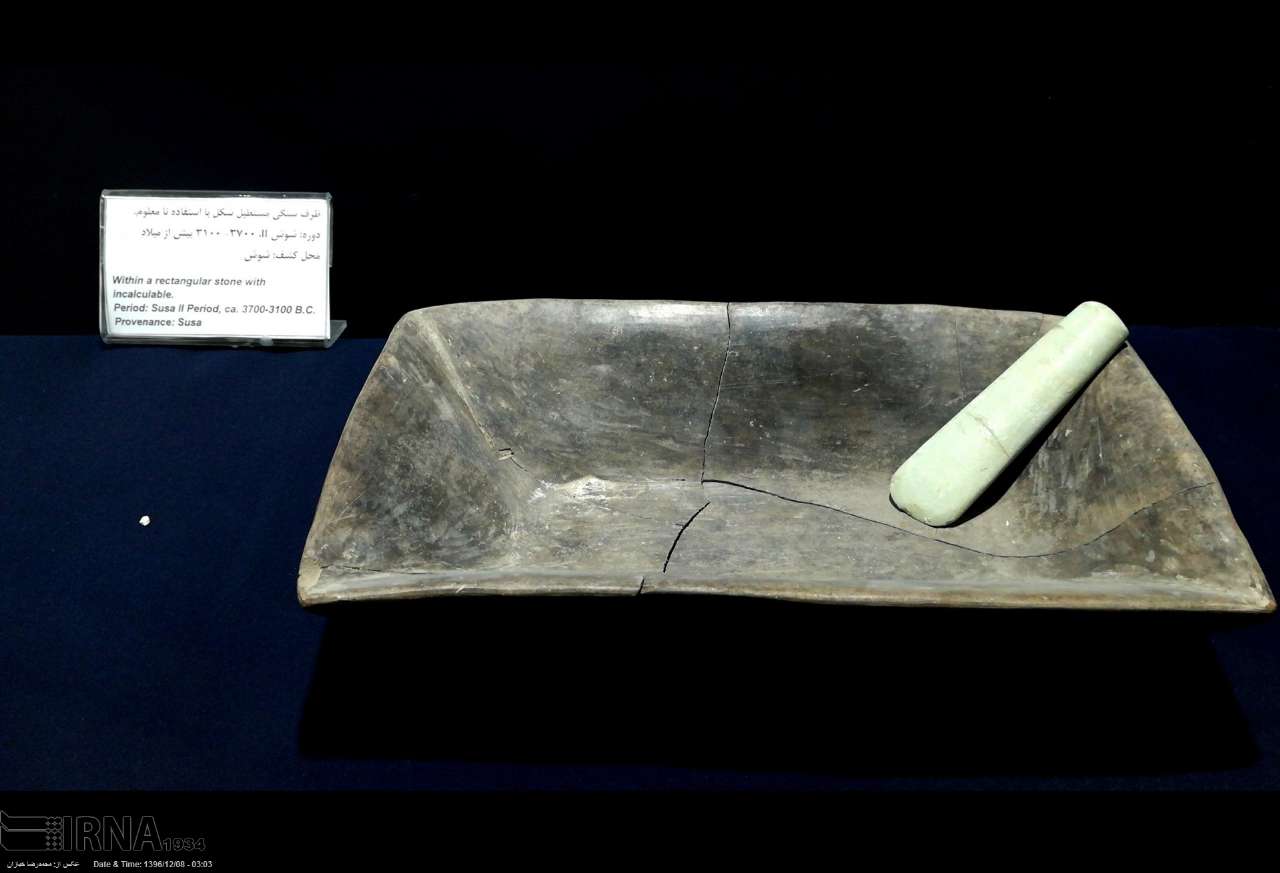
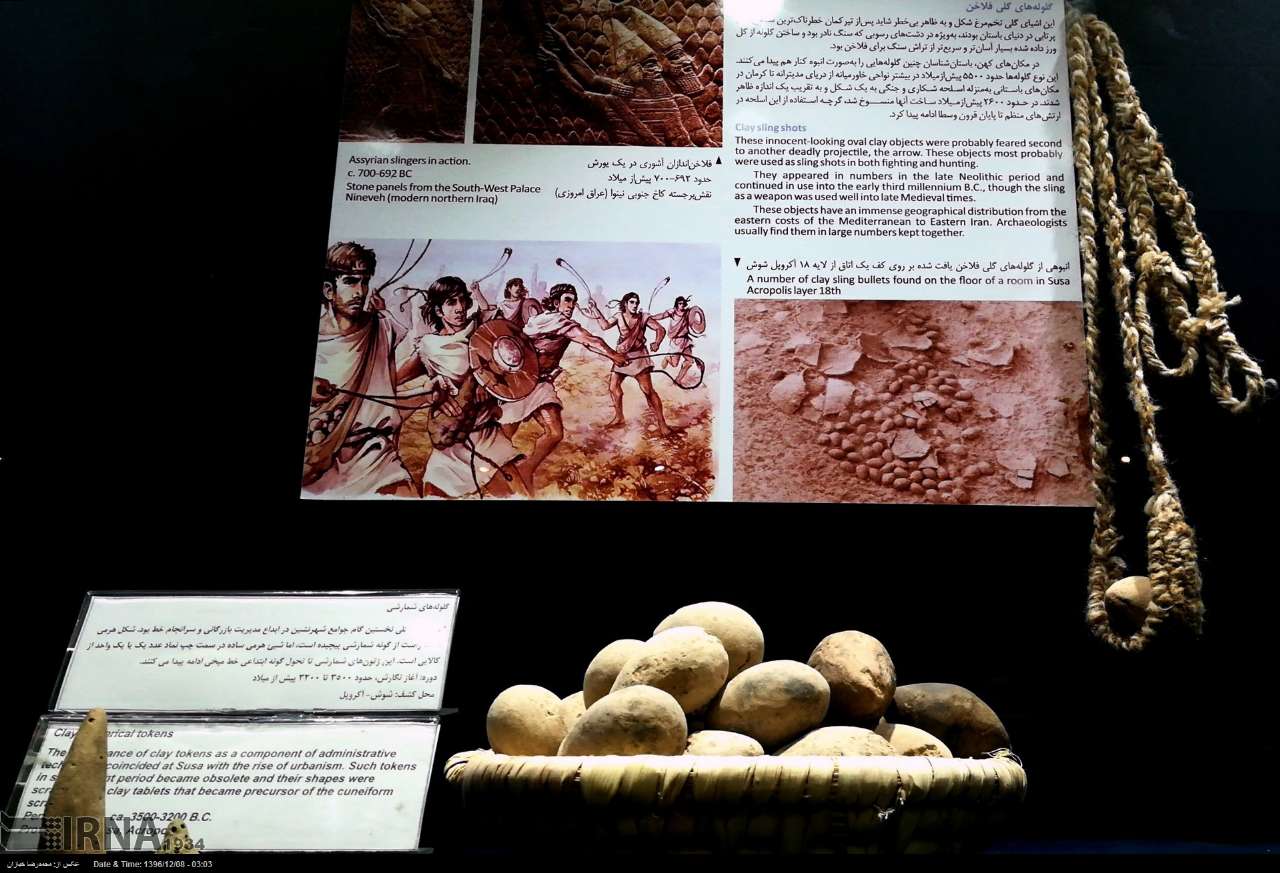
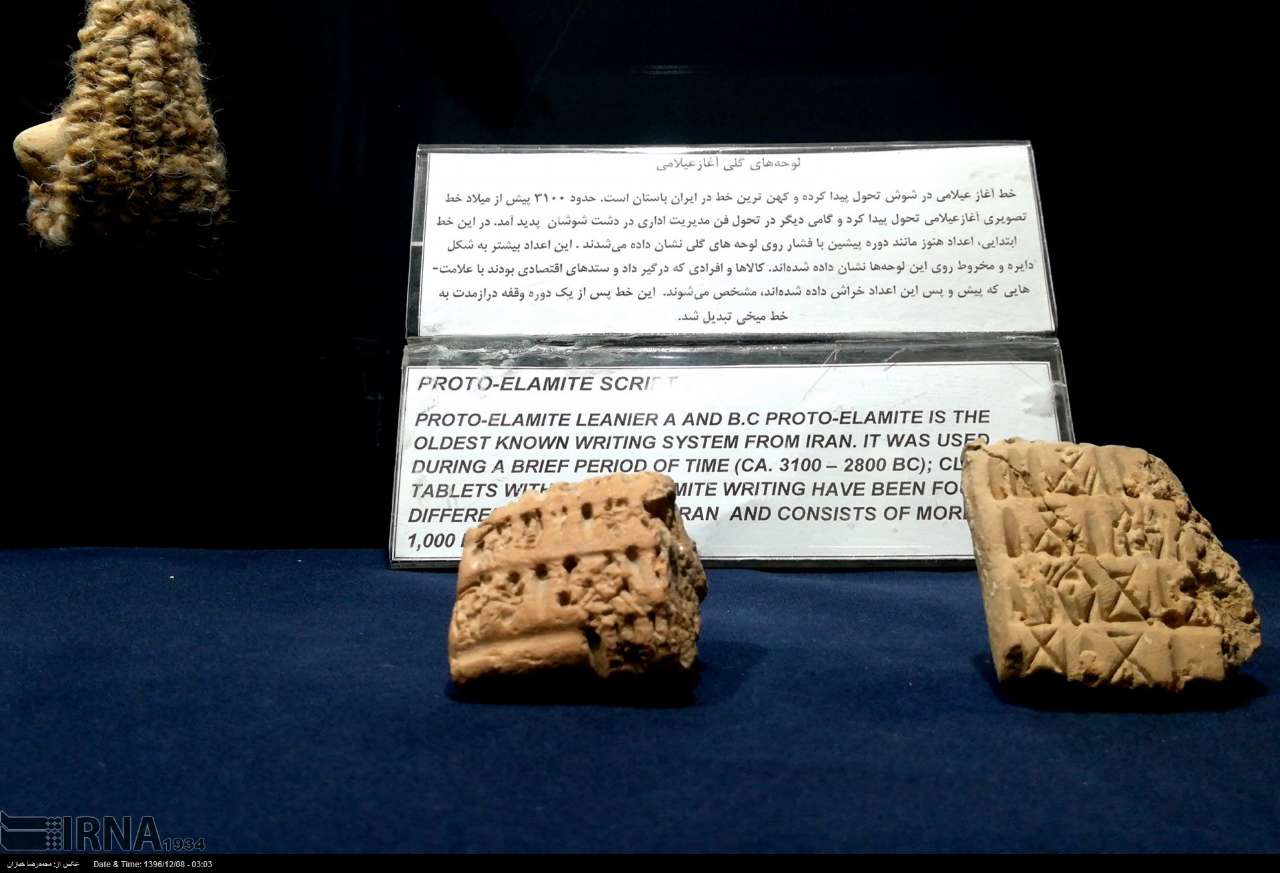
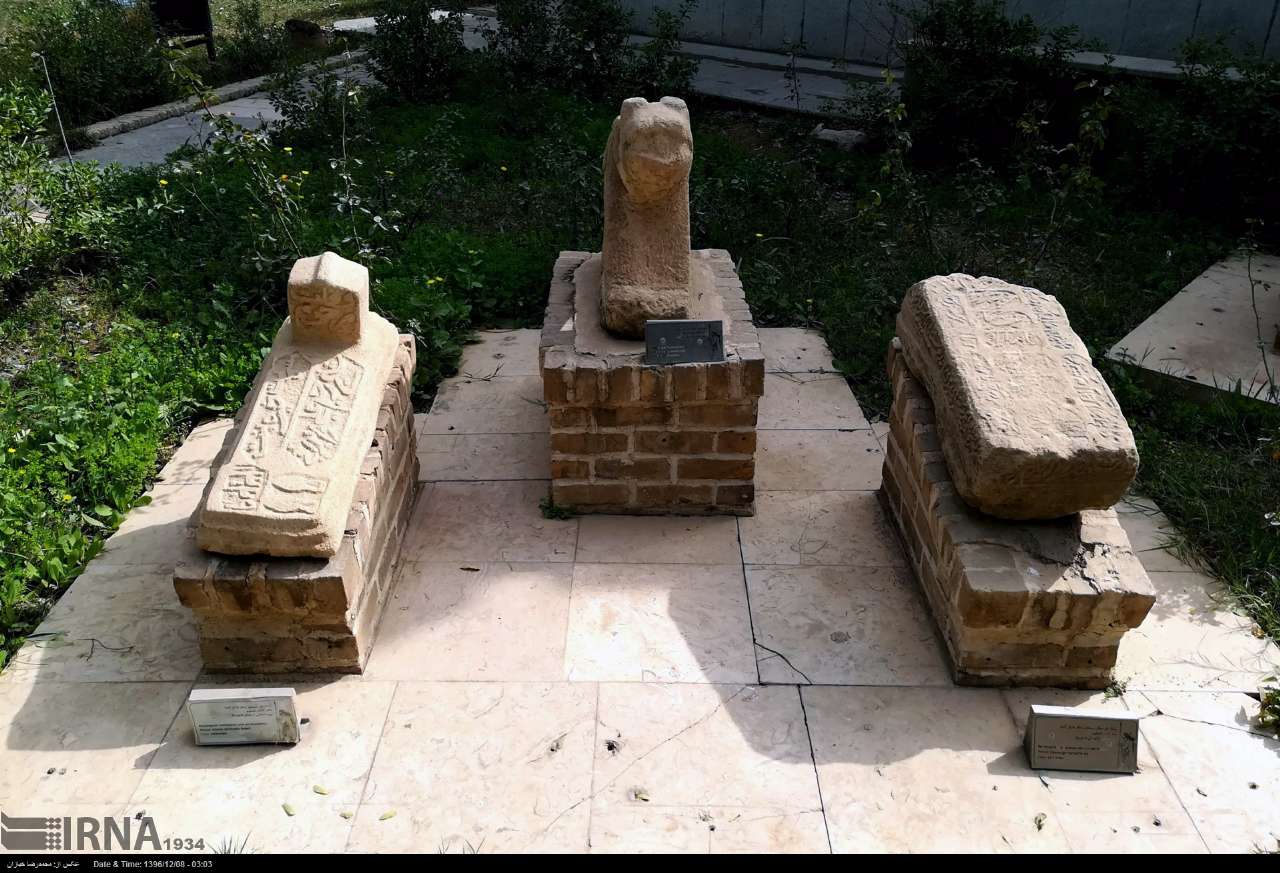
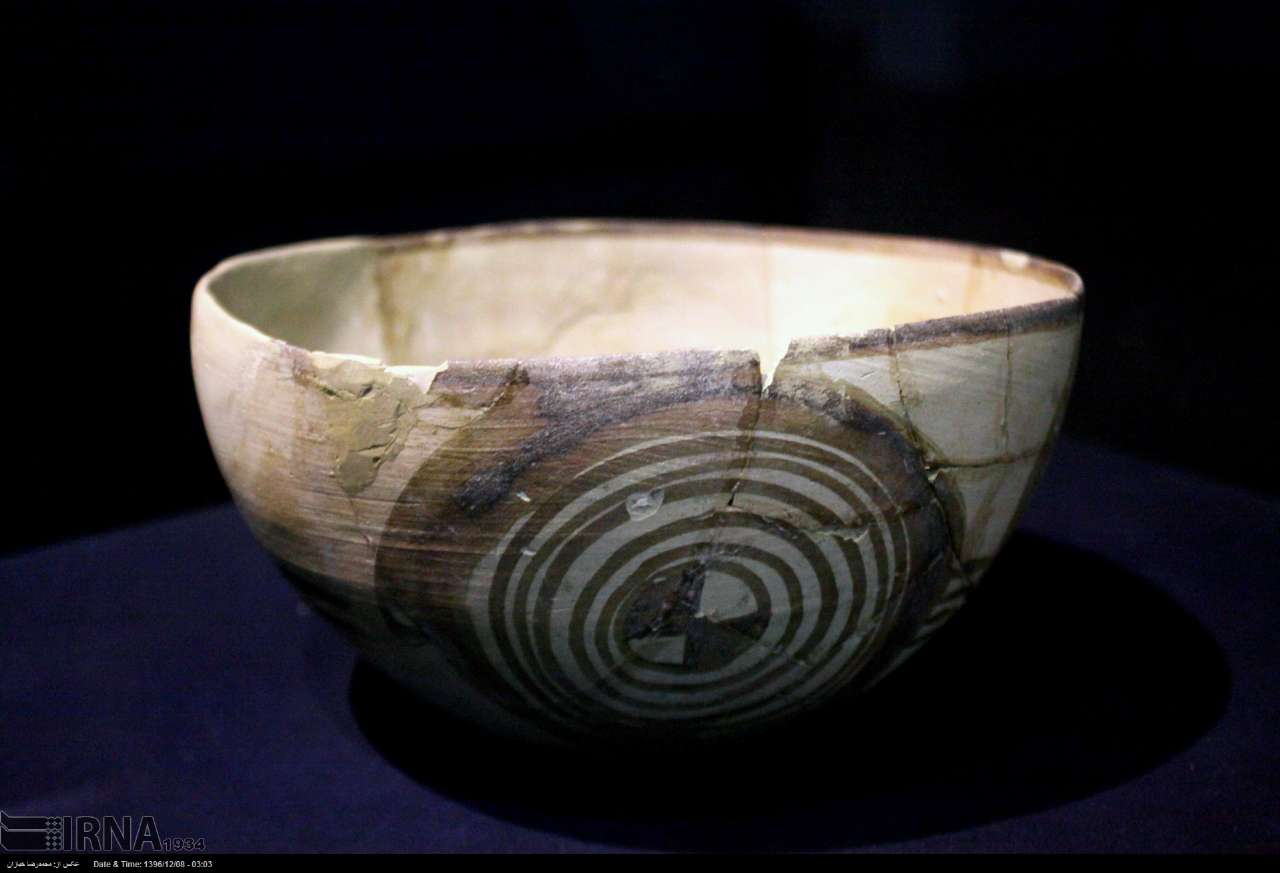
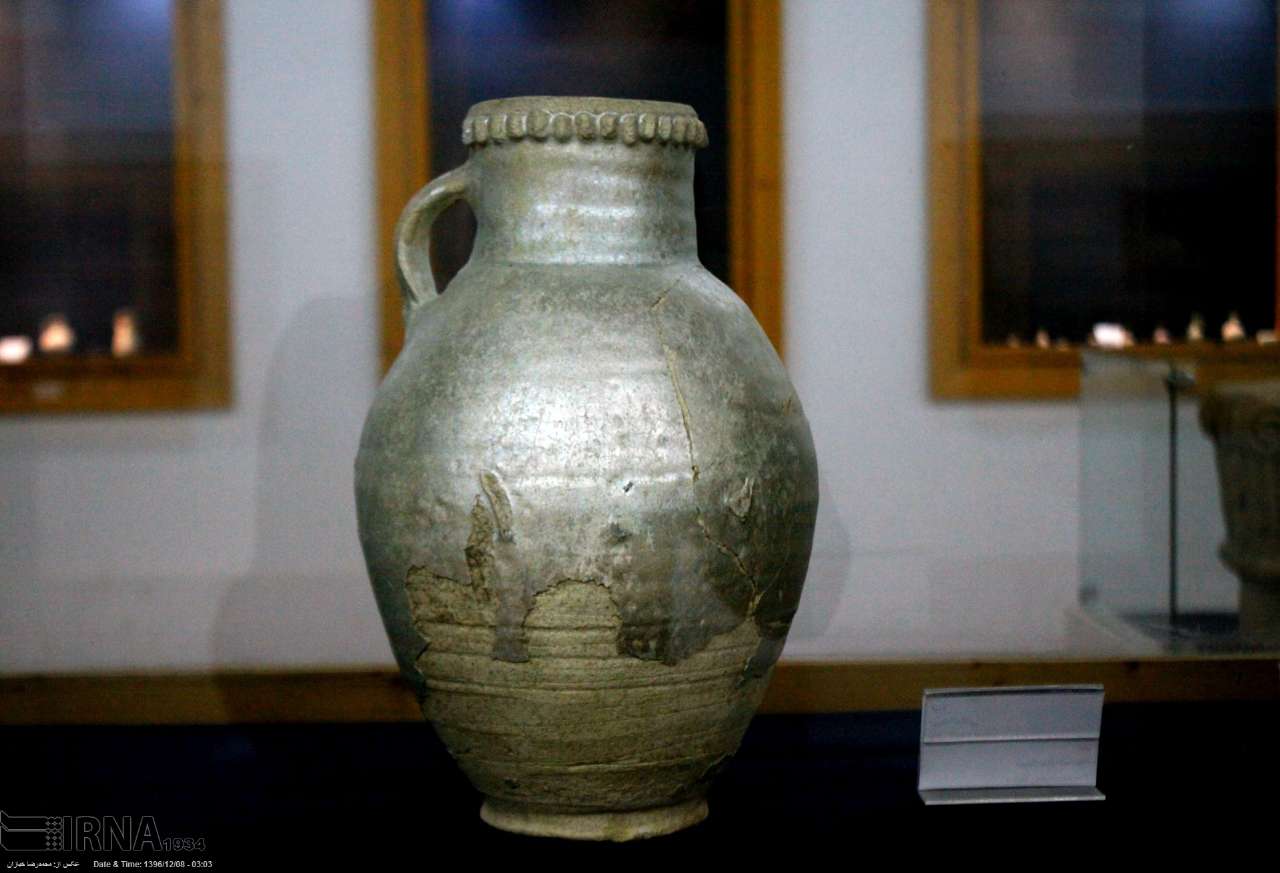
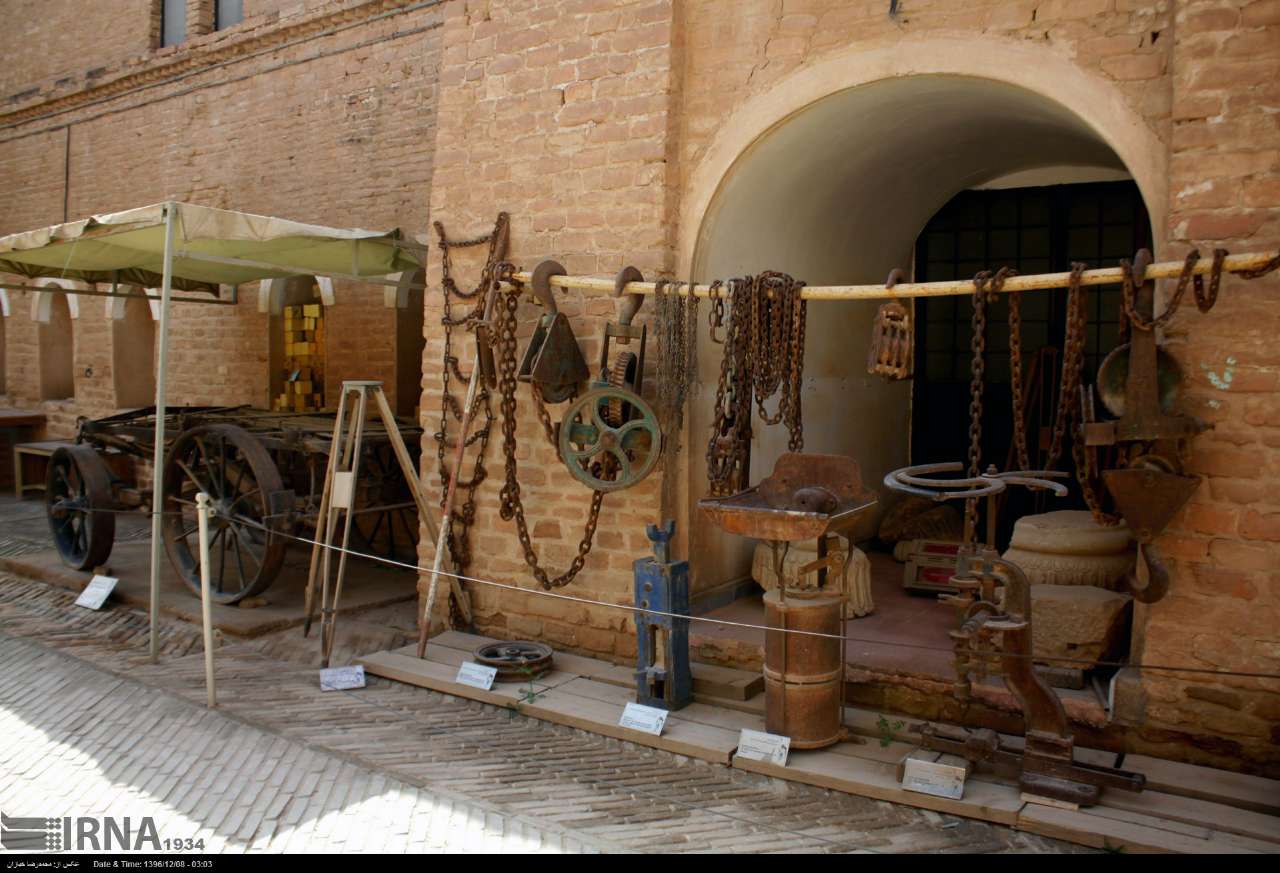
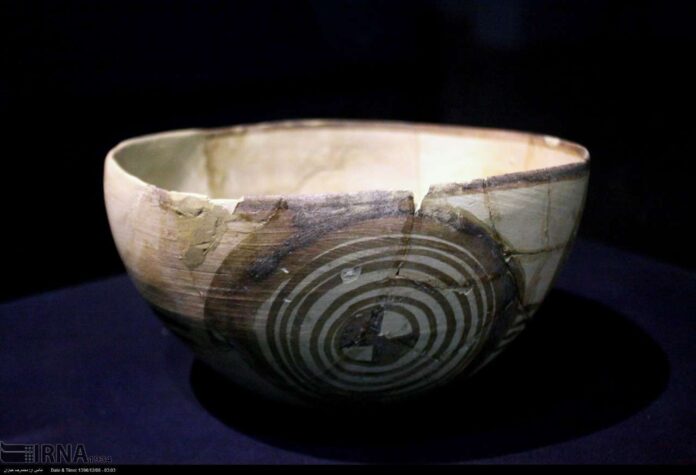
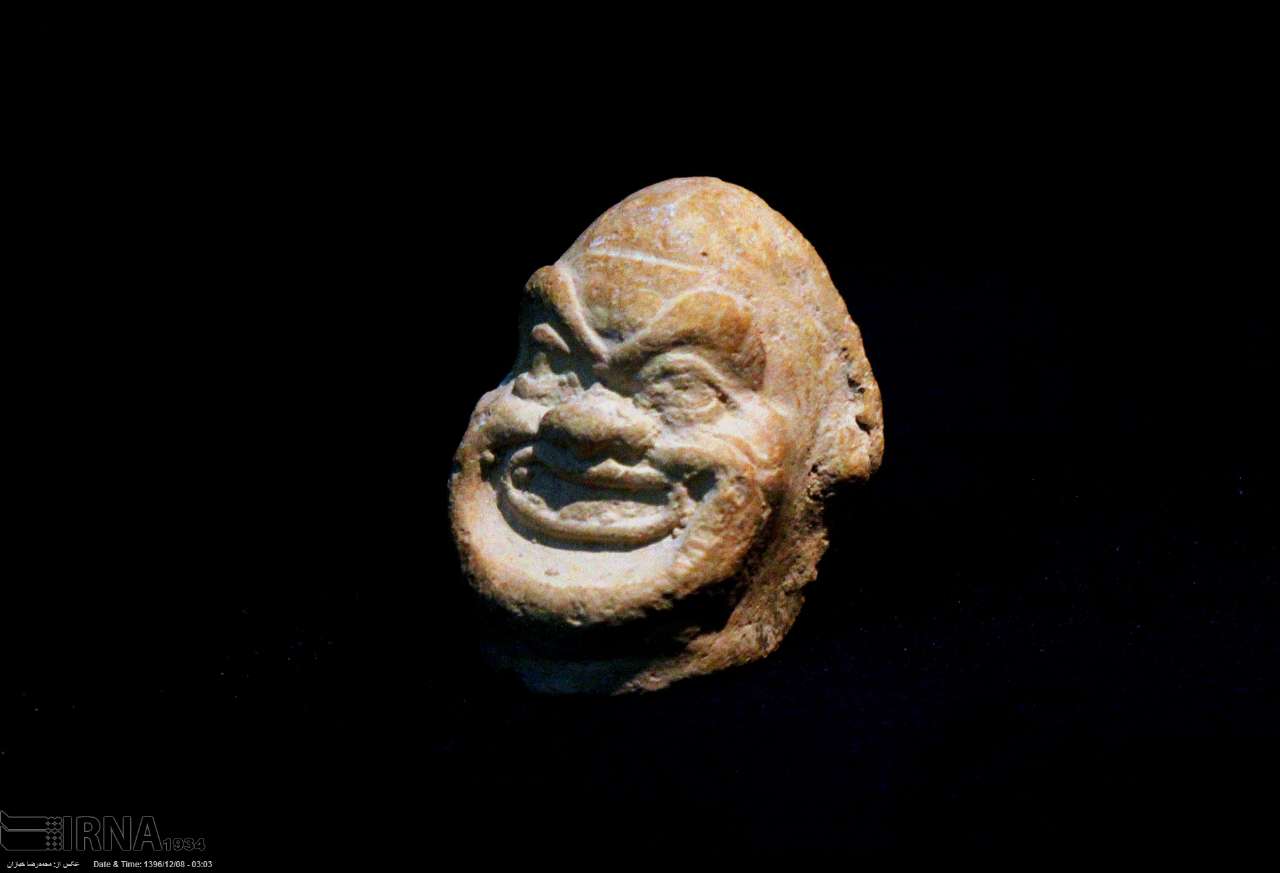
The small museum displays ancient stones and pottery excavated from archaeological sites in the region. At this charming museum you will find many objects not only from Susa itself, but also from towns in the neighbourhood, the province of Khuzestan.

There are six main rooms in the museum, where you will find architectural remains from the palace of Darius; also ceramics, weapons and sculpture from Masjed Soleiman (home of Iran’s first commercial oil well); and funerary masks from Haft Tepe.

When Susa was excavated in the late nineteenth century, the archaeologists agreed that all gold and silver would remain in Asia; while finds of stone and other less precious materials could be brought to France. This is why the most famous objects from Susa are now in the Louvre. Other objects, like the splendid Egyptian-style statue of Darius that was excavated in the 1970s, were brought from Susa to the Archaeological Museum of Tehran.

Following you can find IRNA’s photos of the museum; located on the way to Susa castle and opposite the Tomb of Daniel the prophet:

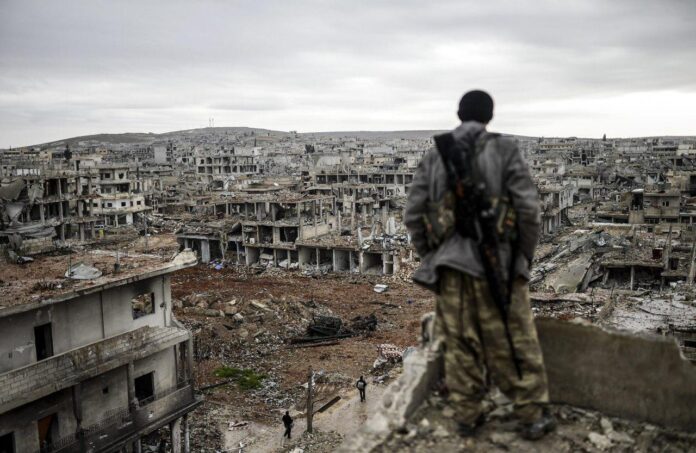
“Syria Conflict: International War Involving 80 Countries”

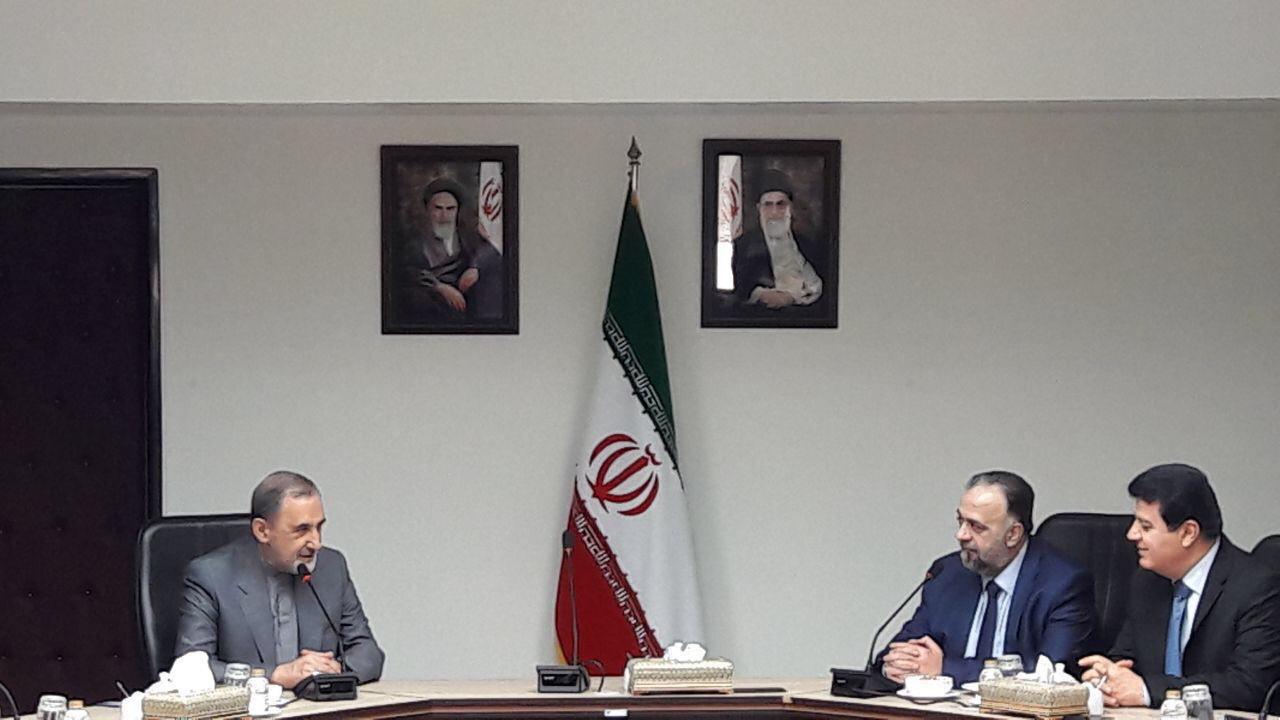
In a Wednesday meeting with Syrian Minister for Awqaf Mohammad Abdul-Sattar, Velayati noted that the current war in Syria is a test for the Syrian government and nation to defend themselves against a world war imposed on them.

“We hope Syrians would overcome their enemies and foreign aggressors who are seeking to inflict a blow on them and God willing the final victory is close,” he was quoted as saying in a Farsi report by Tasnim News Agency.

Velayati also expressed hope that the brotherly relations between Iran and Syria would deepen in the future.

For his part, the Syrian minister said his country has had great respect for the government and the Muslim nation of Iran since the victory of the Islamic Revolution in 1979 under the leadership of the late founder of the Islamic Republic, Imam Khomeini.

“Amid the current critical condition, we want to send the message that the Islamic resistance will continue and Syria stands by Iran and play its role in strengthening the Islamic resistance,” he noted.

He finally concluded that bilateral relations between Iran and Syria are enhancing in all fields.

“Syria Conflict: International War Involving 80 Countries”
Ali Akbar Velayati, a top aide to the Leader of Iran’s Islamic Revolution, meeting with Syrian Minister for Awqaf Mohammad Abdul-Sattar in Tehran on February 28, 2018

Foreign Investment in Iran Growing: Minister

In remarks made on Wednesday, Shariatmadari said Iran needs to absorb $180 billion to secure a sustainable eight-percent economic growth.

He noted that his ministry has set up an office to absorb domestic and foreign investment, adding, “The office kept working in 2017 and absorbed around $1.9 billion in direct foreign investment for production activities with the approval of the High Investment Council.”

According to a Farsi report by Fars News Agency, he said the council has given the go-ahead to around $9.7 billion in investment since the Rouhani’s administration assumed office in 2013.

“Out of the 244 investment projects, 40 have become operational and the rest are going through different phases of implementation.”

“Such cases show the policies adopted by the government in absorbing the funds of Iranian expats residing abroad as well as foreign finances are moving forward,” he noted.

The minister also underscored that further work and investment are needed in order to reach the target of 20-billion-dollar investment in the industry sector.