Tuesday, December 23, 2025
Home Blog Page 3611

Iran Discusses Yemen Crisis with European Officials

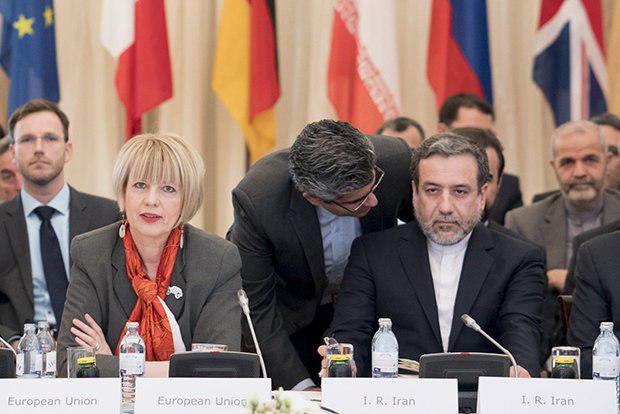
During the Thursday talks in Rome, Jaberi Ansari conferred on the Yemen crisis with Helga Schmid, the Secretary General of the EU’s External Action; and the political directors of the British, Italian, German and French Foreign Ministries.

The officials attending the talks explored various aspects of Yemen crisis, particularly the deteriorating humanitarian conditions in the war-torn country.

Preliminary steps to build trust among the conflicting sides in Yemen were also discussed in the talks.

The first round of talks on Yemen crisis was held in February in Germany’s Munich. Based on the agreements made in the Rome talks, the third round of the negotiations is expected to be held by the EU in Brussels in mid-June.

Earlier on Thursday, Jaberi Ansari had sat for talks with Luca Giansanti, the Director General for Political and Security Affairs at the Italian Ministry of Foreign Affairs.  During the meeting, the two sides exchanged views on regional and bilateral issues.

Years of mediatory efforts by the UN and other international players have failed to bring a peaceful resolution to the ongoing conflict in Yemen.

Meanwhile, a Saudi-led military intervention in the impoverished country has brought the country to the brink of a catastrophic humanitarian crisis.

According to the UN, a record 22.2 million people are in need of food aid, including 8.4 million threatened by severe hunger.

A high-ranking UN aid official recently warned against the “catastrophic” living conditions in Yemen, stating that there was a growing risk of famine and cholera there.

Iran Not to Accept Any Change to JCPOA, Zarif Reaffirms

Zarif

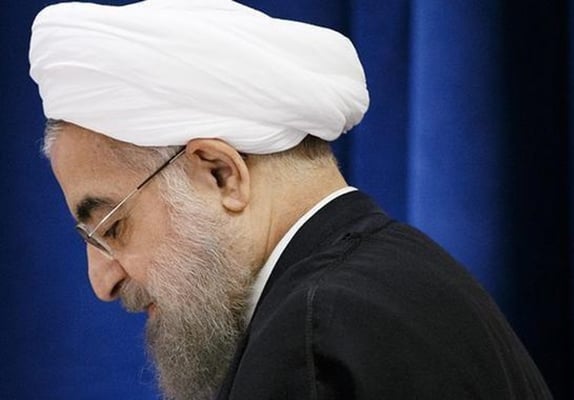
In a video message on Thursday, the Iranian top diplomat called the JCPOA a binding deal for all sides as it was unanimously approved by the United Nation’s Security Council.

“The UN nuclear watchdog has confirmed that Iran has implemented all its obligations. In contrast the US has consistently violated the agreement especially by bullying others against doing business with Iran,” he said.

He expressed regret that apparently the response of some European states to US President Donald Trump’s unhappiness with the deal has been to offer the US more concessions from “Iran’s pocket”.

“This appeasement entails promises of a new deal that include matters that we all decided to exclude at the outset of our negotiations including Iran’s defence capabilities and regional influence. But please understand on both issues it is Iran and not the West that has serious grievances and much to demand,” he noted.

The Iranian foreign minister also said Iran has not attacked any state for centuries but had been invaded by others, the most recent case of which was the invasion by Iraq under former dictator Saddam Hussein backed by the US and its allies.

“Despite that haunting experience, we still spend a fraction of countries like Saudi Arabia and the United Arab Emirates on defence and our missiles have a shorter range than those of Saudi Arabia. And unlike US allies in the region who have brainwashed, financed and armed such groups as al-Qaeda, the Taliban and the ISIS, we have been pivotal in defeating these extremist groups,” he added.

Zarif underlined that Iran will never hold new round of talks on the JCPOA and said threats would not lead to a new deal.

He finally advised the US officials to honour their commitments under the deal or they have to accept responsibility for the consequences of their violations of the deal.

Iranian Artisan Uses Scrap Metal to Make Lovely Statues

Ashofteh, who is from the city of Tabriz in northwestern Iran, makes stunning statues of animals, ancient artifacts, and historical characters.

This Tabrizi designer has displayed his artworks in 10 individual exhibitions and about 50 group exhibitions up to now.

Following you can find photos of his works retrieved from IRNA:

Tony Cragg Gifts Iran with His “Roots and Stones” Sculpture

The sculpture has been erected in the TMoCA’s Art Garden in central Tehran.

In an address to the recent unveiling ceremony, Majid Molla-Nowruzi, the director of Iran’s Visual Arts Department, described the unveiling of “Roots and Stones” as a milestone in the history of the Museum, the Persian-language Iranian Students’ News Agency (ISNA) reported.

“Over the past four years, the museum has established strong interactions with artists from around the world and held several exhibitions showcasing their art pieces in Tehran,” he noted.

Molla-Nowruzi referred to the exhibition of Cragg’s pieces in Tehran last year and said he first visited Tony Cragg’s workshop three years ago in Dusseldorf.

“At that time, given our financial problems, I couldn’t even imagine that one day we coul hold his exhibition in Tehran. But we managed to realise this goal through the hard works of our staff and close cooperation of the British-German artist.”

Elsewhere in his address, he said such exhibitions could pave the way for effective cultural diplomacy which in turn can promote the Iranian culture and art amid the current chaotic situation of the Middle East region.
During the ceremony, Tonny Cragg took the podium and said the exhibition of his pieces in Tehran is highly significant for him.

“I enjoyed the atmosphere of the exhibition. I was deeply moved during the first day of the exhibition by the overwhelming presence of the visitors. It was too crowded to watch the pieces easily,” he noted.
Cragg referred to his first visit to Iran two years ago and added as a professor he used to have some Iranian students.

“But during my first visit to Iran, I was deeply impressed by the Iranian culture and decided to establish a dialogue with it,” he noted.

He described himself as an introvert person and called the exhibition a good chance to exchange views and make friendship between the cultures. “Though I’m not a cultural diplomat, I think we can establish peace, friendship and reach mutual understanding by exchanging views.”

He finally concluded that he donated the “Roots and Stones” to the Tehran Museum of Contemporary Art as a sign of friendship and understanding.

“Netanyahu’s Claims on Iran Nuclear Program Insult to IAEA”

Israeli intelligence agencies claim they have acquired 55,000 pages of documents and other materials detailing an alleged military nuclear program called “Project Amad,” according to Netanyahu, who noted that Israel had shared its intelligence with Washington.
The announcement came ahead of the May 12 deadline for US President Donald Trump to extend his country’s deal with Iran concerning the latter’s nuclear program, which he is expected not to do. It also came amid US Secretary of State Mike Pompeo’s first foreign visit over the weekend. Pompeo visited both Israel and Saudi Arabia — key regional foes of the Islamic Republic.
Political analyst Marwa Osman has lashed out at the Israeli government’s attempt to shape the narrative around the Iran nuclear deal ahead of Trump’s decision deadline. “One of my students in freshman year could do better than that,” she told Loud & Clear hosts John Kiriakou and Brian Becker.

“We all had our laughs, we all made fun, but to be honest with you — this was the most insulting 15 to 20 minutes for the IAEA [International Atomic Energy Agency] that I’ve ever heard,” said Osman, a senior Middle East commentator.

“Benjamin Netanyahu was basically saying that every inspector, investigative team that went into Iran to try to mediate the nuclear deal… is either a liar or an idiot. That’s what he said.”

“Does he really think that with such a presentation he’ll be able to wage war against Iran or against Iranian presence in Syria,” Osman wondered.

“Netanyahu — Israel — has been attacking Syria nonstop for the past six years, if not for the past seven years. But let’s say, with documented evidence, six years, and lately, last night at 10 p.m., with new weaponry,” Osman said.

Specifically, she says that the weapons used in the attack on the 47th Brigade of the Syrian Arab Army, a unit made up of Iranian forces and forces from Hezbollah, were similar to either depleted uranium or an “enhanced nuclear weapon.”

“Netanyahu’s Claims on Iran Nuclear Program Insult to IAEA”The attack, on an military base between the Syrian cities of Hama and Homs, killed a number of Iranian forces Sunday night. Nobody has claimed responsibility for the attack; however, Israel has been blamed by many, Sputnik News reported.

“They have been going wild for the past two weeks,” Osman said, “to provoke an Iranian response.”

“Unfortunately we’re seeing a repeat of disastrous history where the US, Israel and Saudi Arabia are all trying to present, as facts, what is really justifications for a war they already want to do,” author and activist Medea Benjamin told Loud & Clear.

“We have seen that [Secretary of State] Mike Pompeo and [National Security Adviser] John Bolton have, years ago, talked about bombing Iran. John Bolton did it in a New York Times op-ed, saying that to get rid of Iran’s bombs you have to bomb Iran,” Benjamin said.

“They are also thinking that because the economy in Iran is weak — which is their doing, the US’s doing — that this is the time to really hit them hard. And I think they’re under the illusions, just as they were under the illusion back in 2002, that they could easily overthrow [Iraqi leader] Saddam Hussein and put a new government in place,” Benjamin said about the lead-up to the Iraq War. “I think they think they can overthrow, or the ‘people of Iran’ will get rid of this government and then somehow, miraculously, a US-Western-friendly government would be put in place without massive chaos.”

“This is déjà vu all over again, and it is very dangerous,” Benjamin warned.

“Netanyahu’s Claims on Iran Nuclear Program Insult to IAEA”

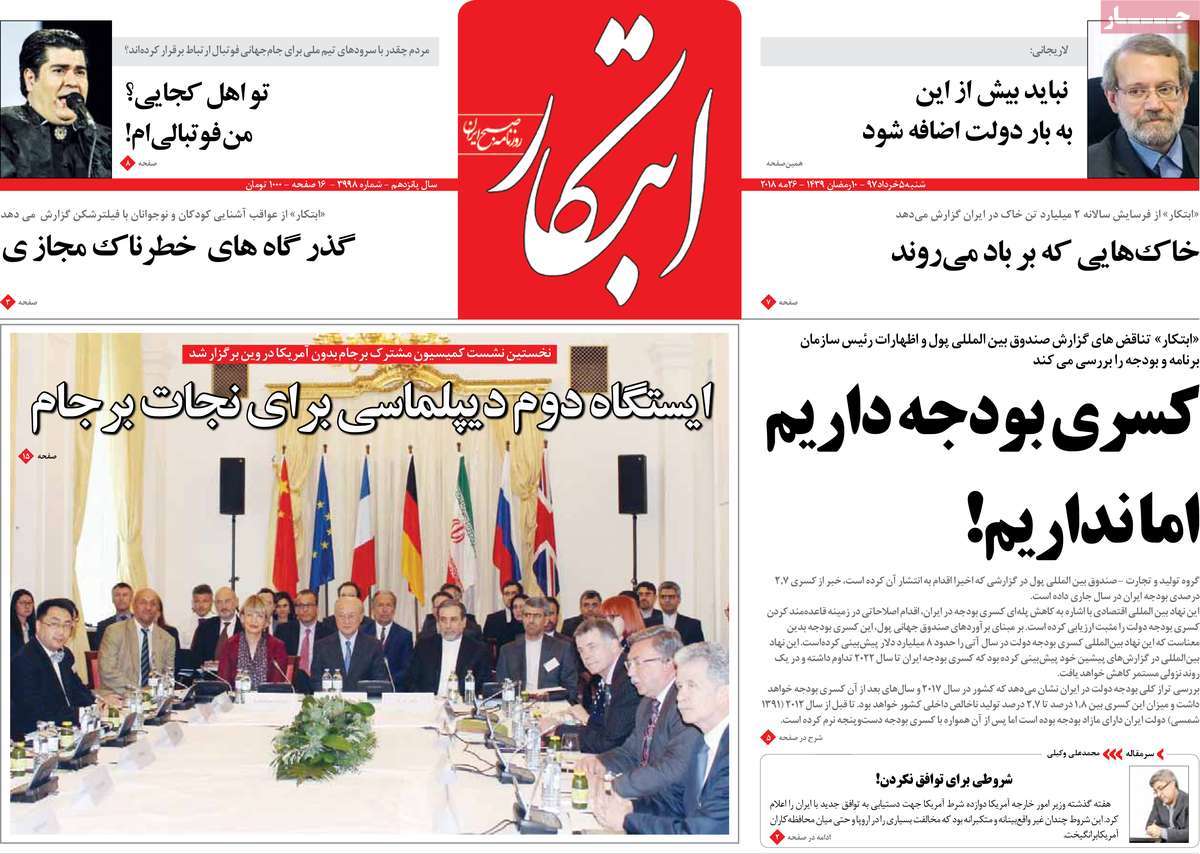
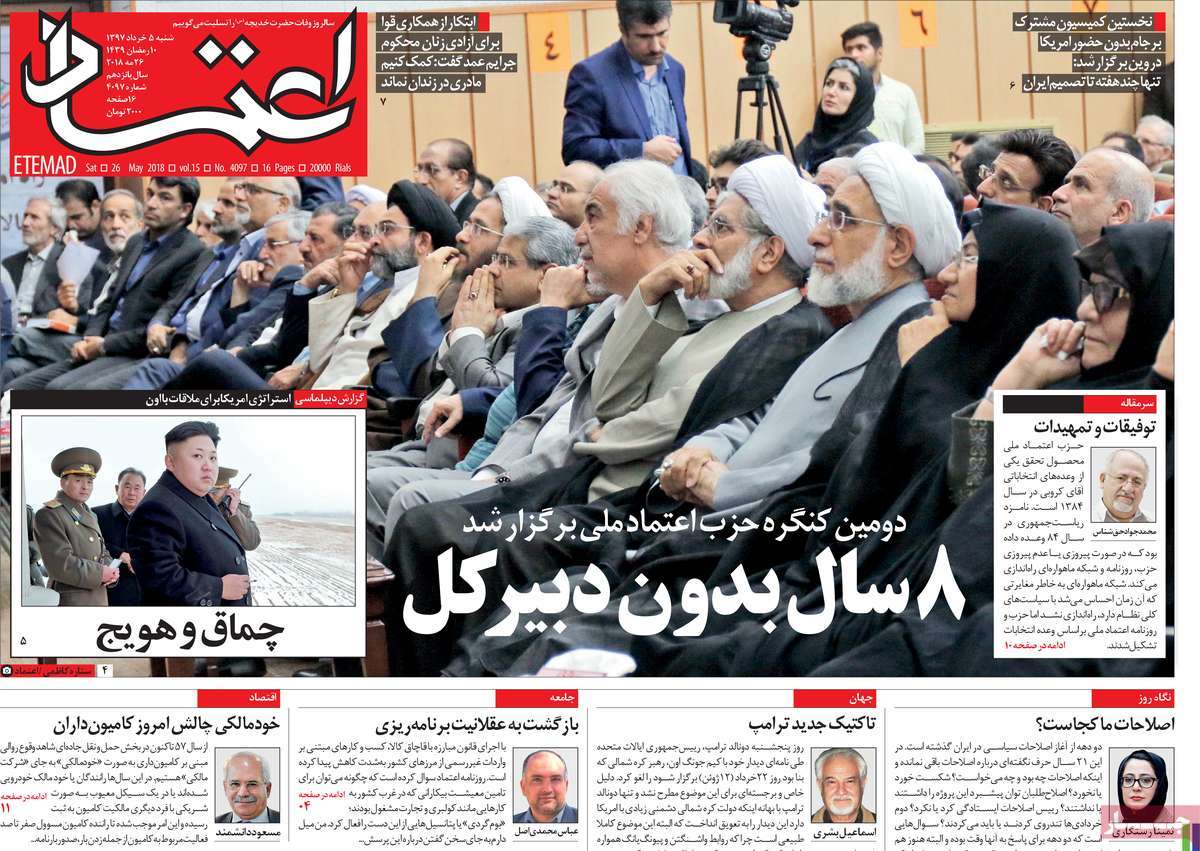
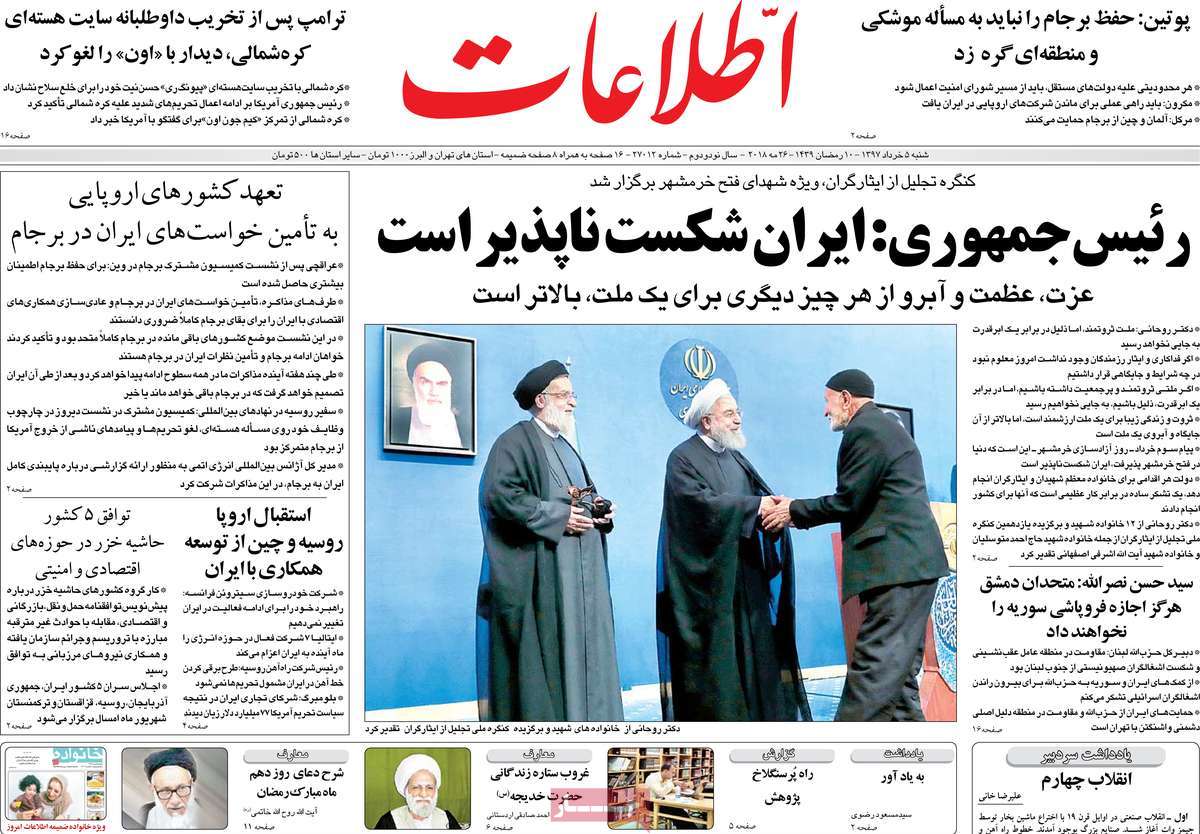
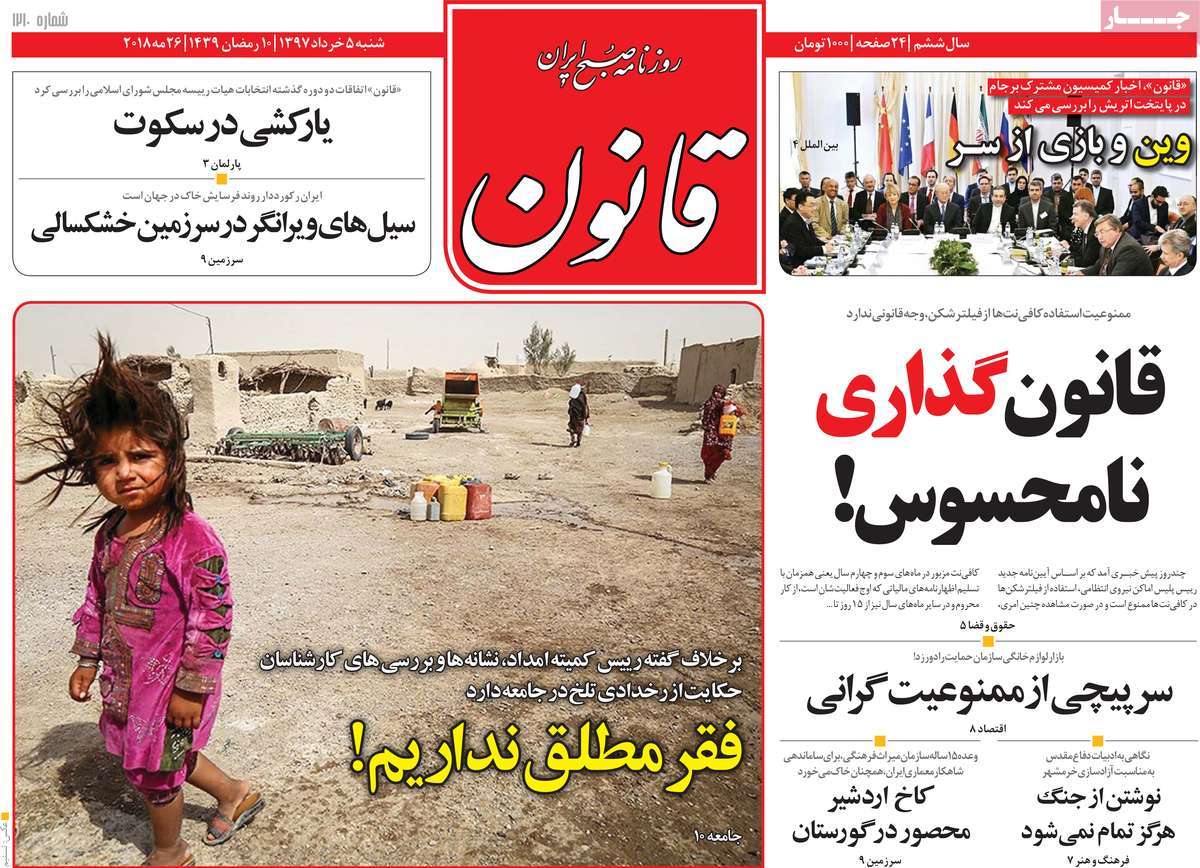
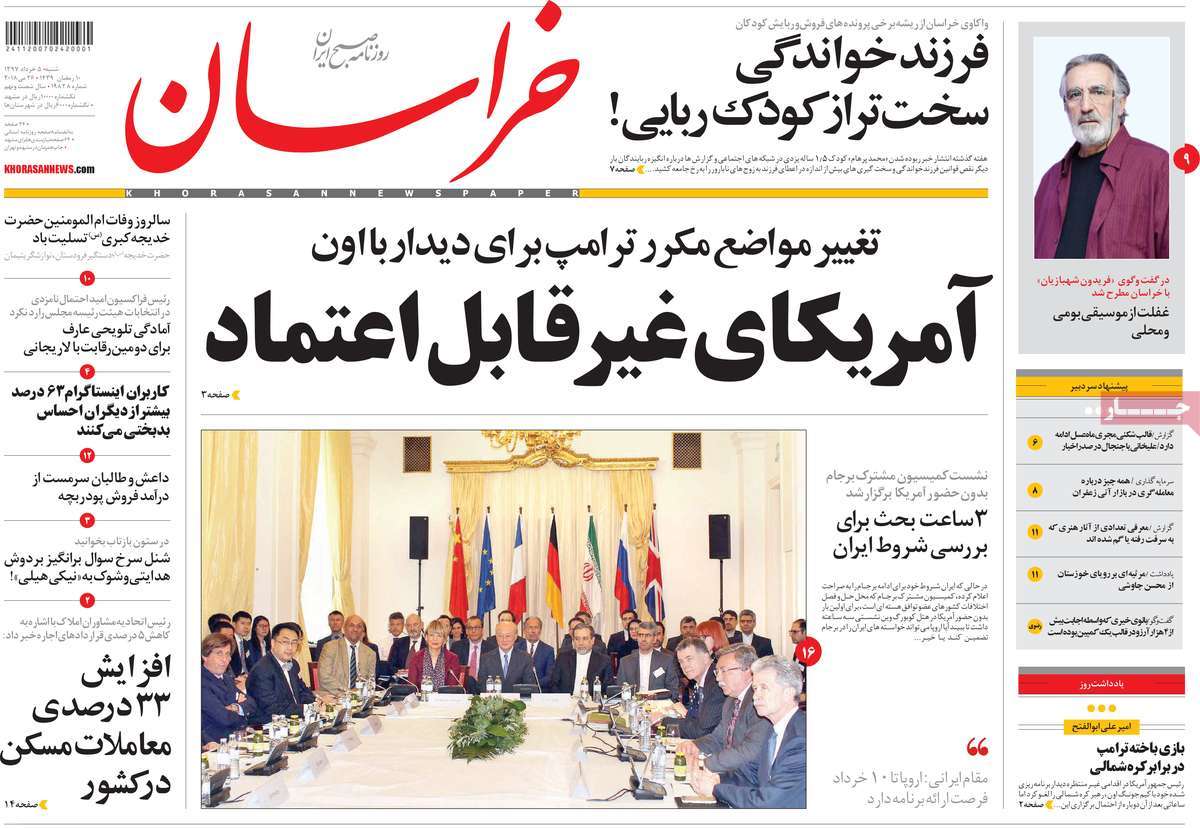
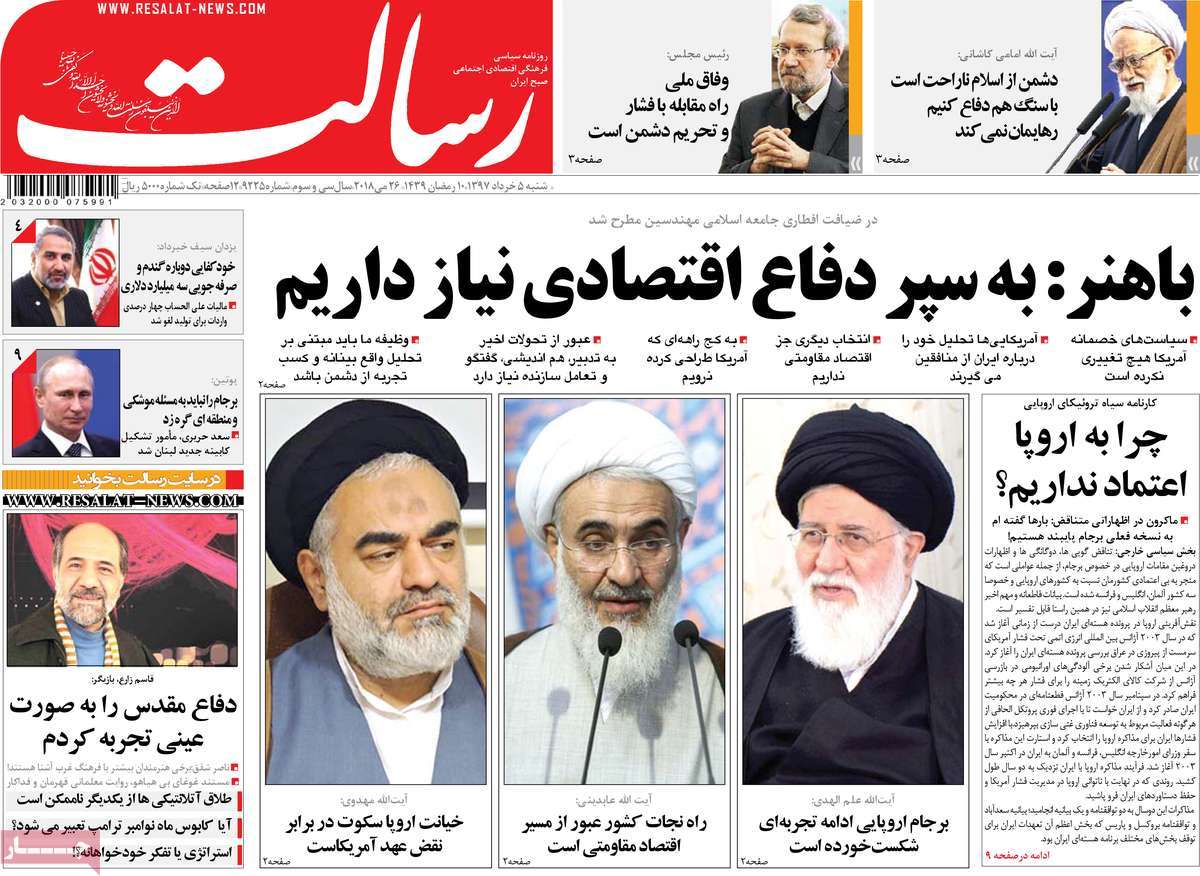
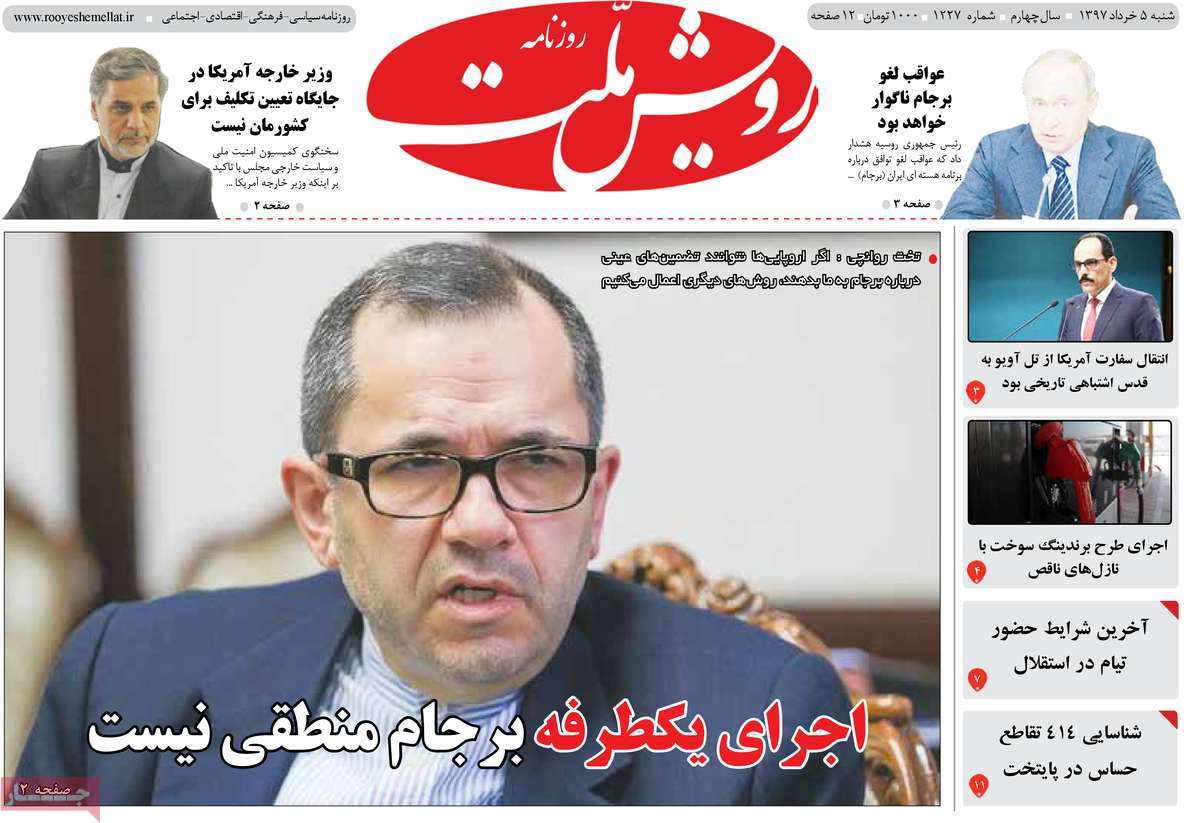
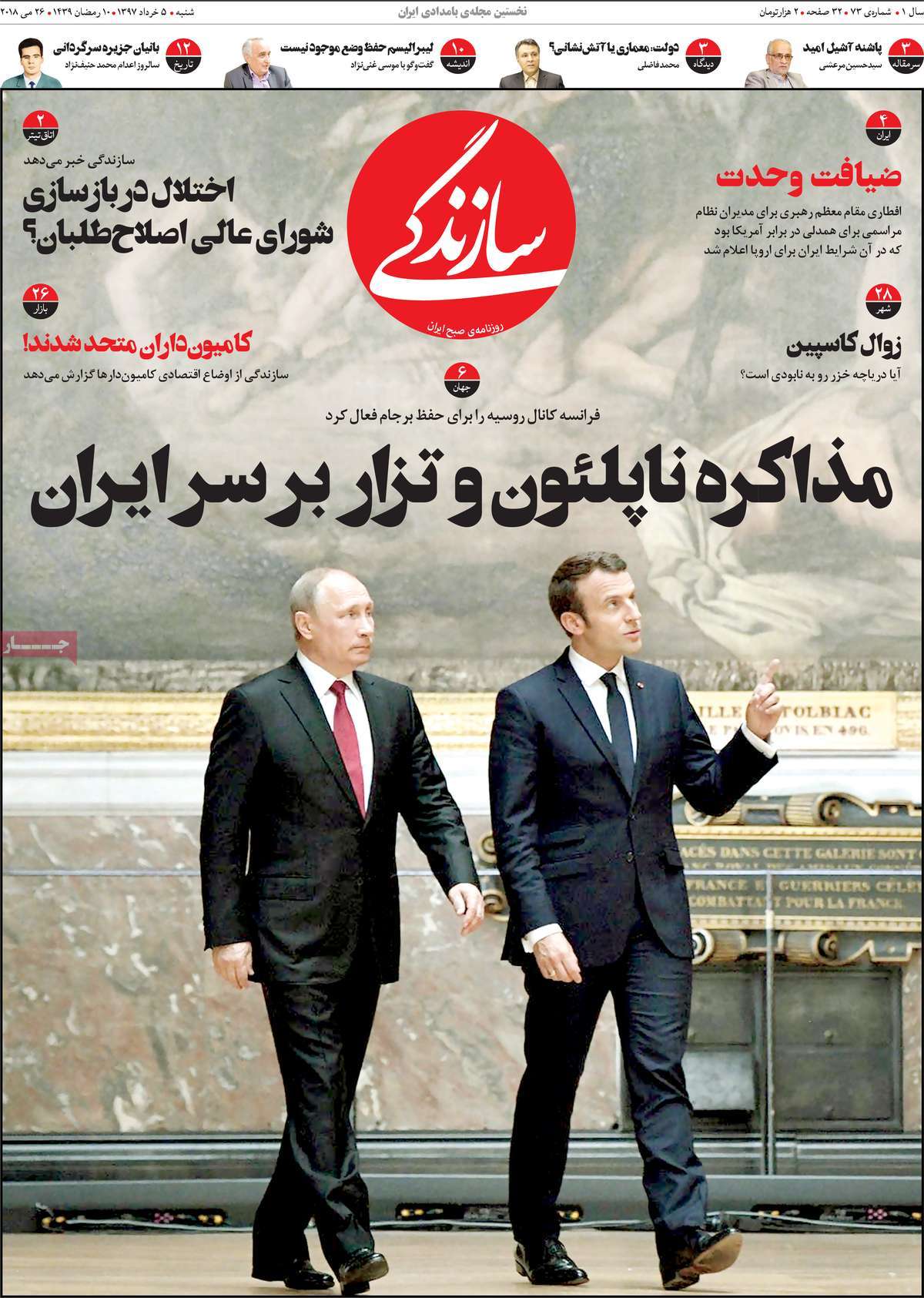
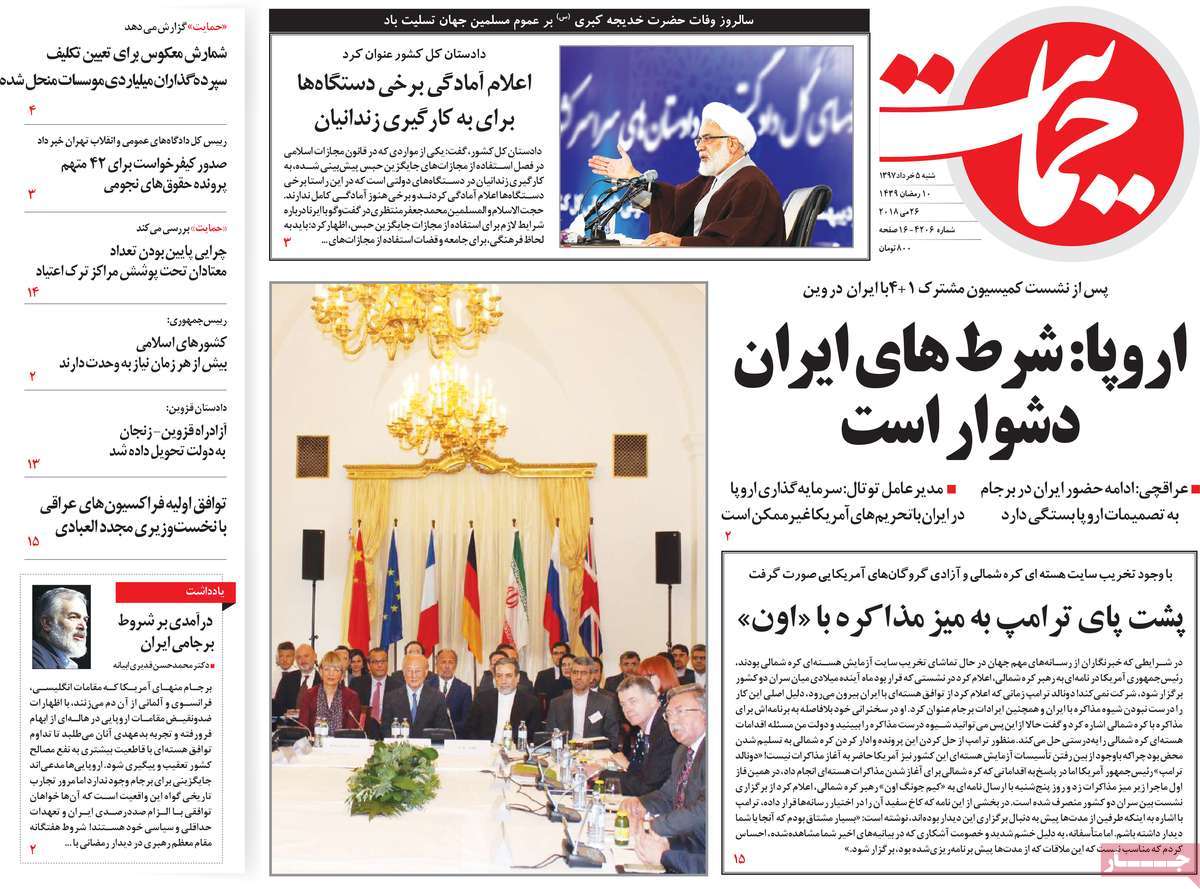
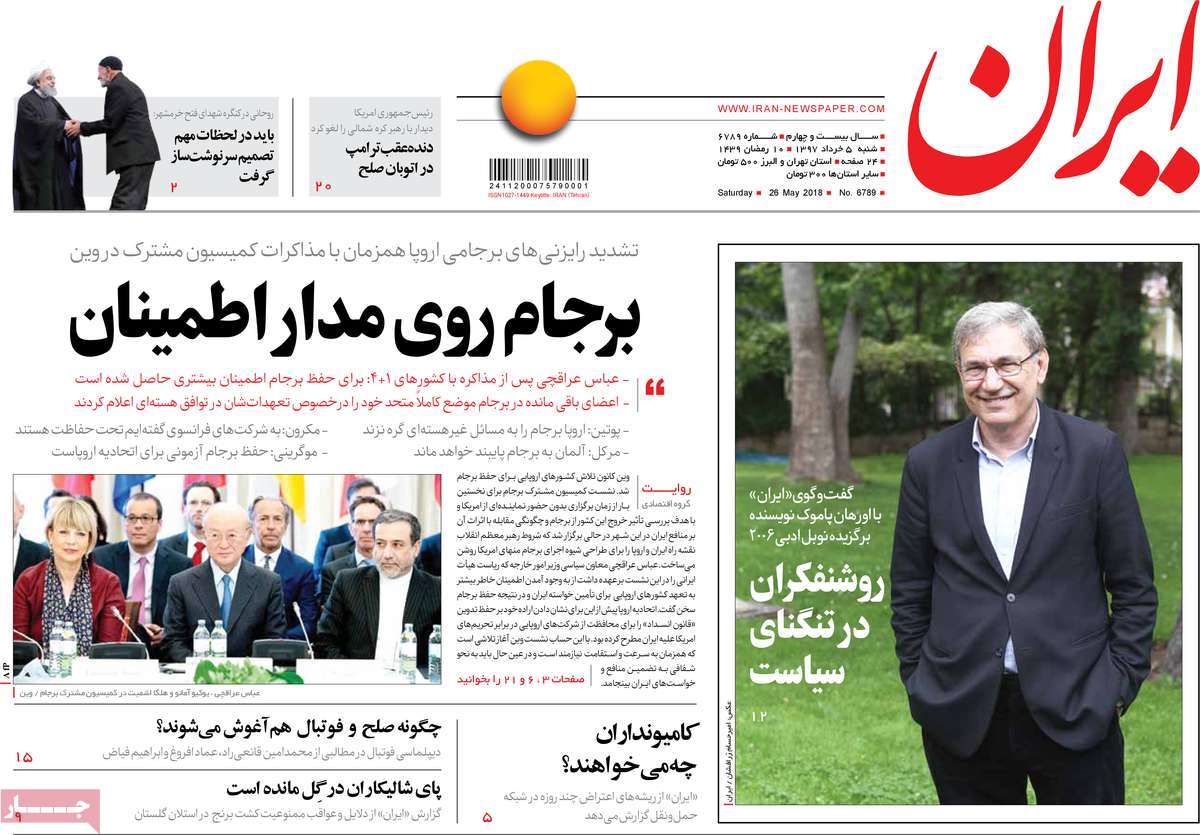
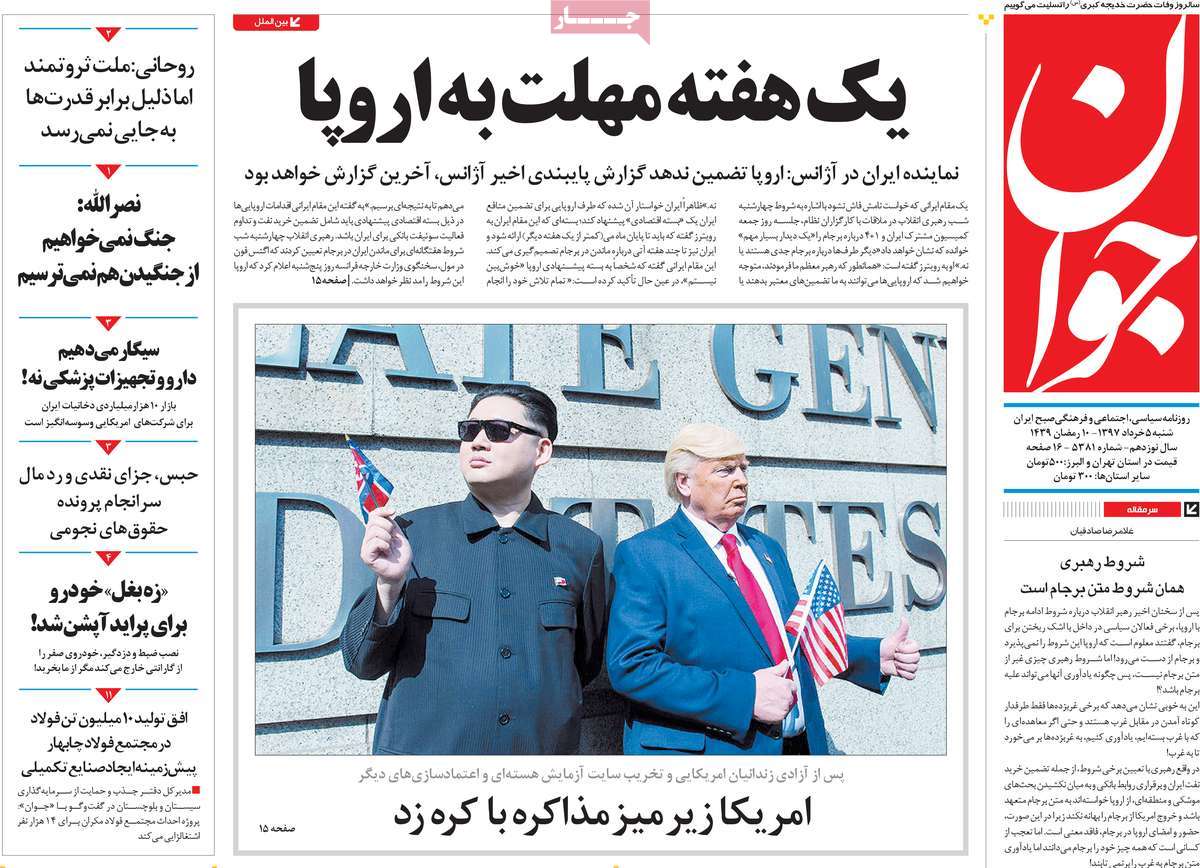
A Look at Iranian Newspaper Front Pages on May 3

A Look at Iranian Newspaper Front Pages on November 19

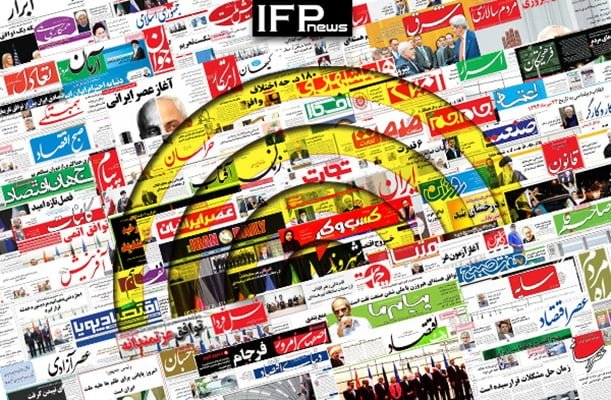
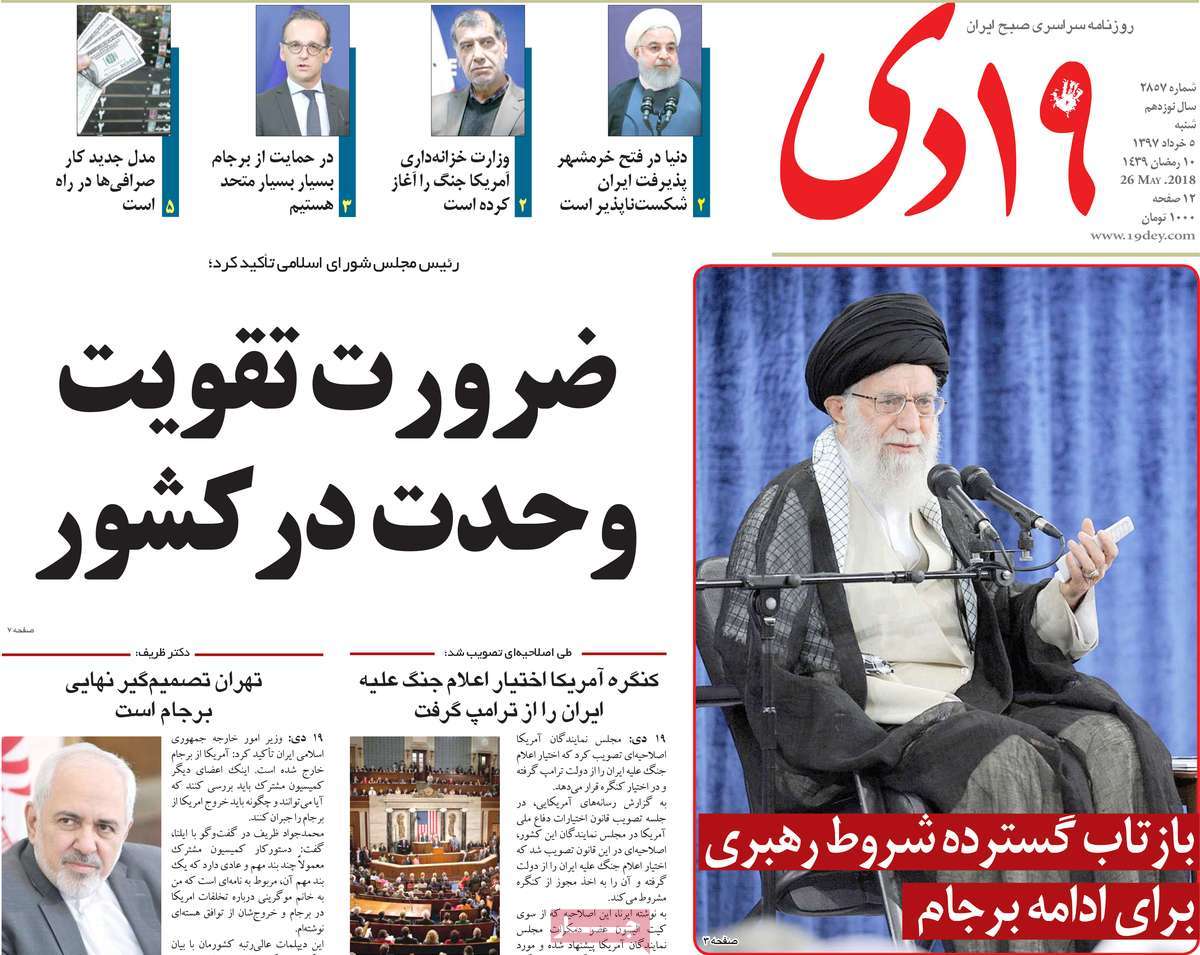
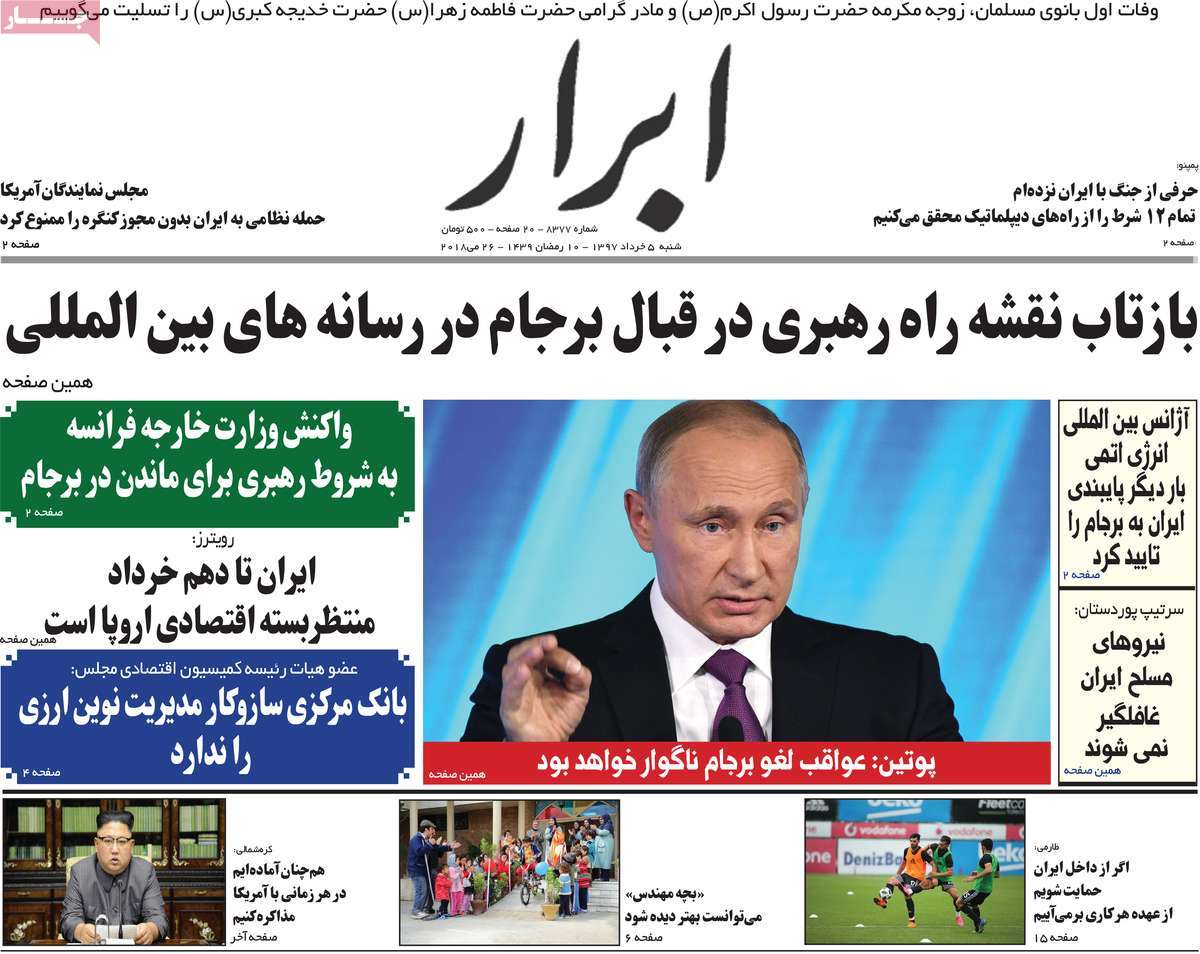
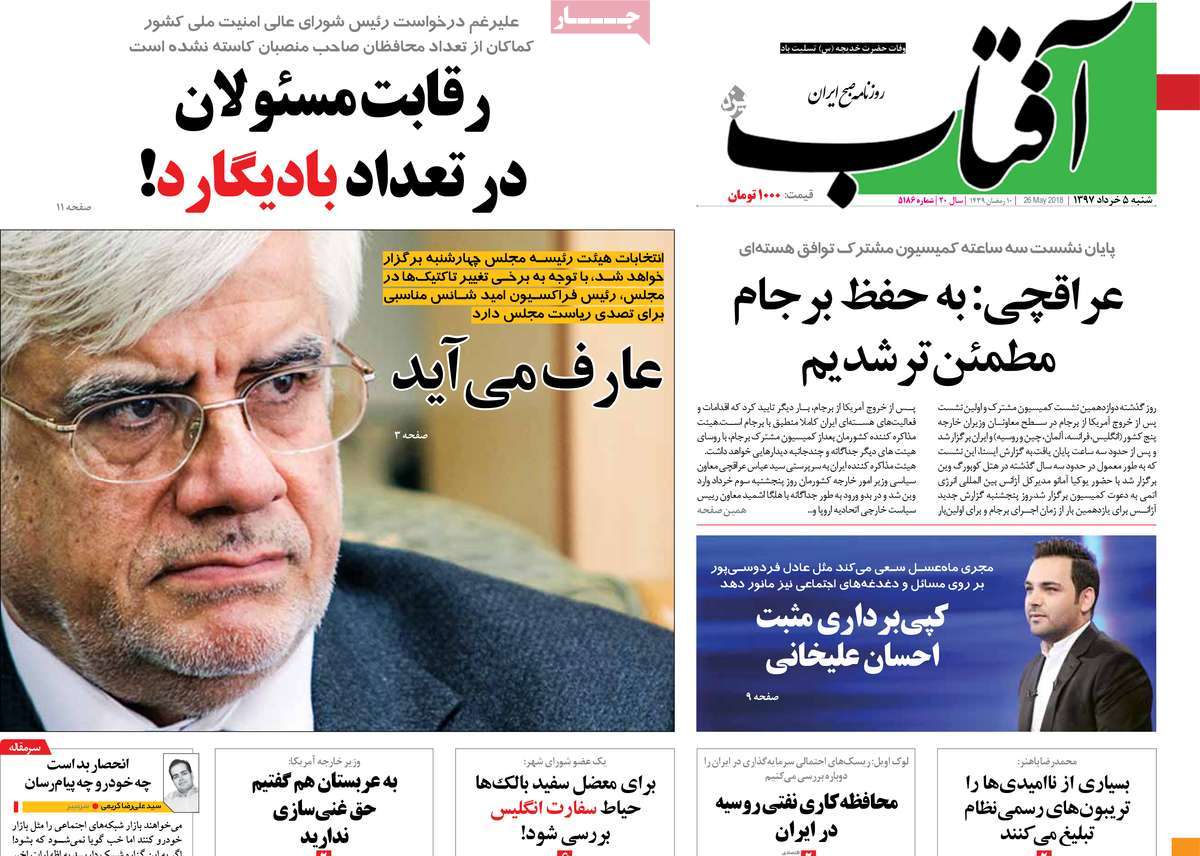
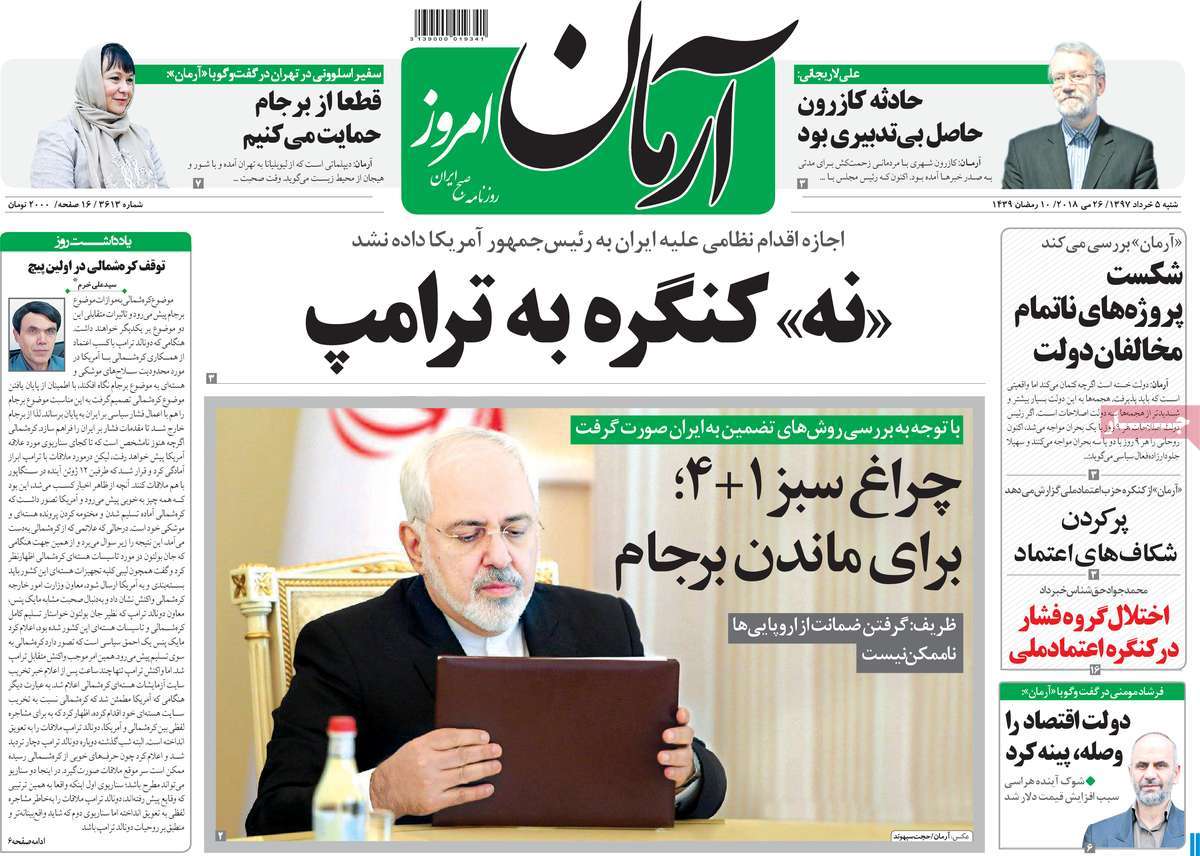
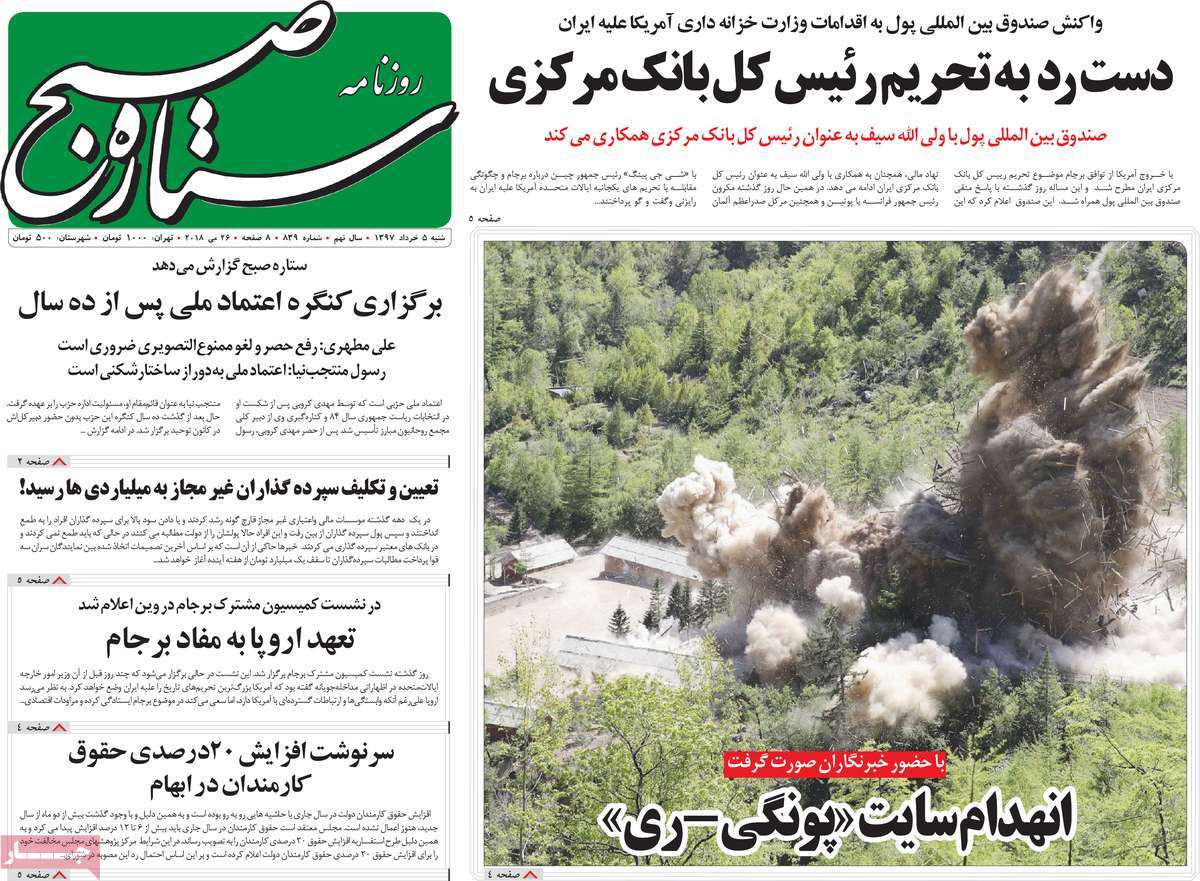
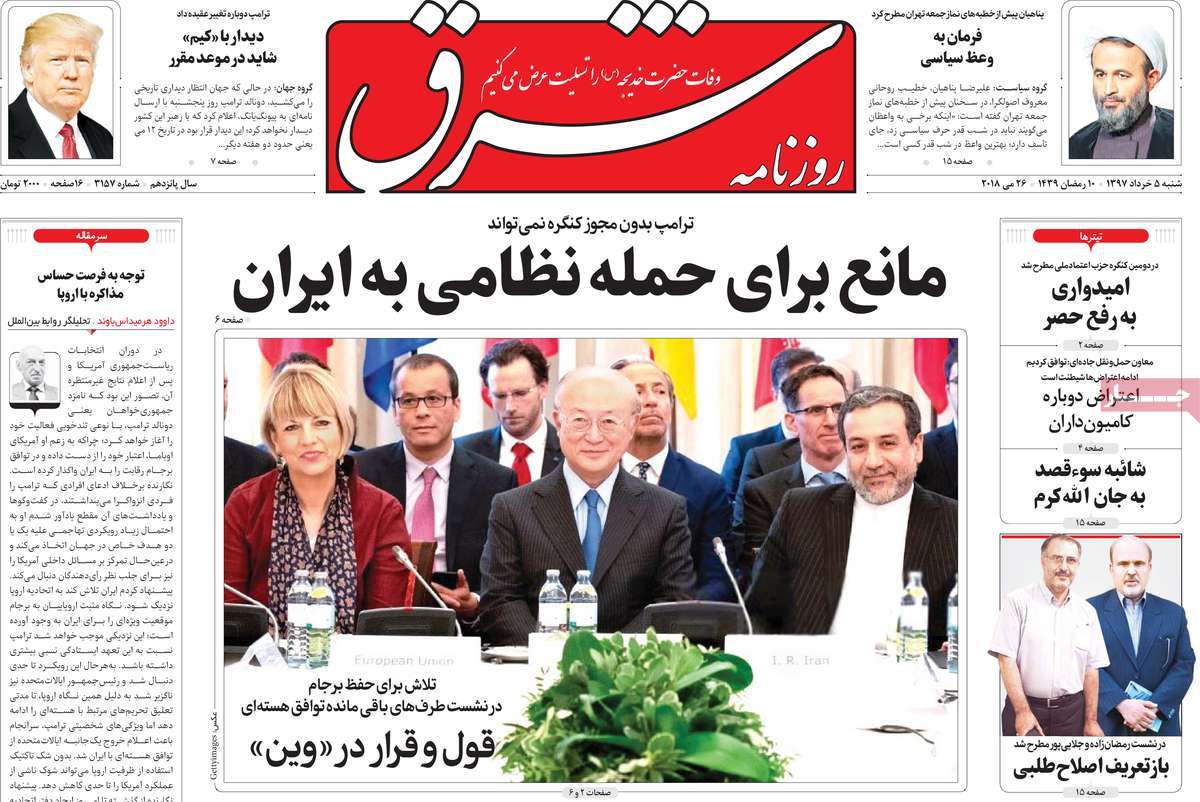
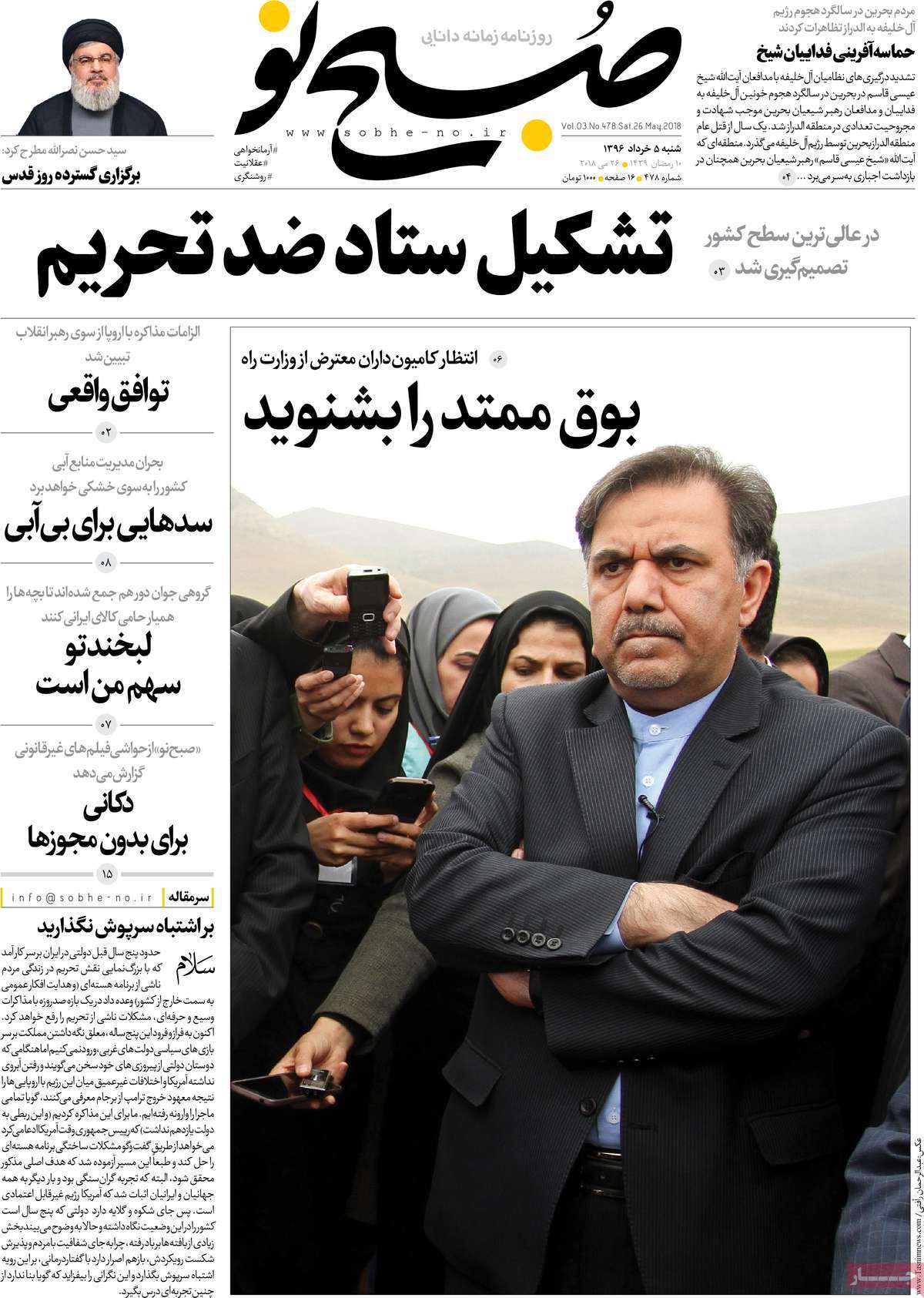
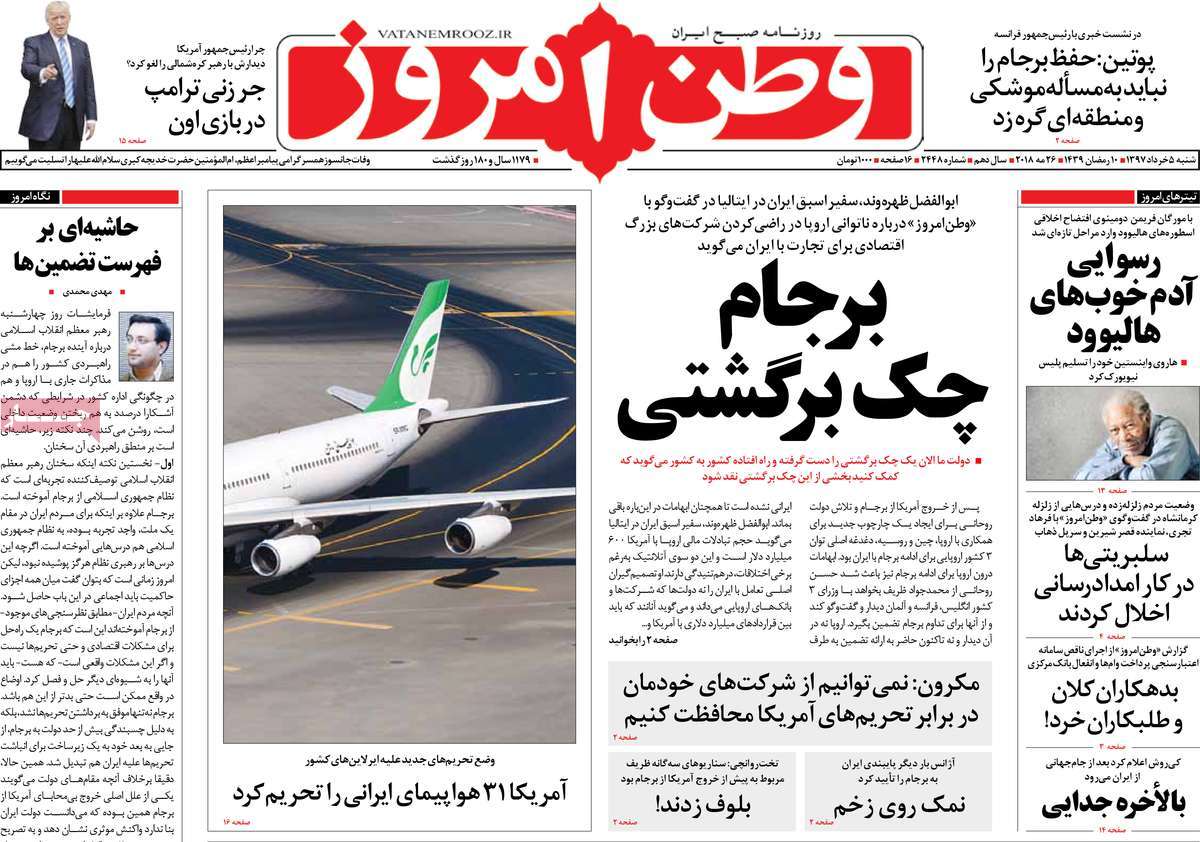
Thursday was a day between two holidays in Iran, and thus many newspapers were not published. However, the few papers published today mostly covered the ongoing reactions to Israeli Prime Minister Benjamin Netanyahu’s recent anti-Iran show.

Also a top story was Foreign Minister Mohammad Javad Zarif’s criticism of the opponents of the Rouhani administration for harming the country’s national interests.

The beginning of the 31st Tehran International Book Fair also received great coverage today.

The above issues, as well as many more, are highlighted in the following headlines and top stories:


Aftab-e Yazd:

  • Mousavian: Pressures to Make Iran More Inflexible
  • FM Zarif’s Car Hit by Protesters Fists, Kicks
  • FM: We Shouldn’t Destroy People’s Self-Confidence Using Certain Media
  • Netanyahu’s Show Booed by Europe
  • Negative Reactions to Israeli PM’s Remarks against Iran

A Look at Iranian Newspaper Front Pages on May 3


Arman-e Emrooz:

  • Iran Nuclear Deal without US
  • A Report on Stances of Various Parties to International Deal

A Look at Iranian Newspaper Front Pages on May 3


Ettela’at:

  • Zarif’s Reaction to Bibi’s Latest Show on Iran Nuclear Program
  • Boy Who Cries Wolf Does Not Deserve a Response
  • Netanyahu’s Claims Aimed at Giving Trump Pretext to Exit JCPOA
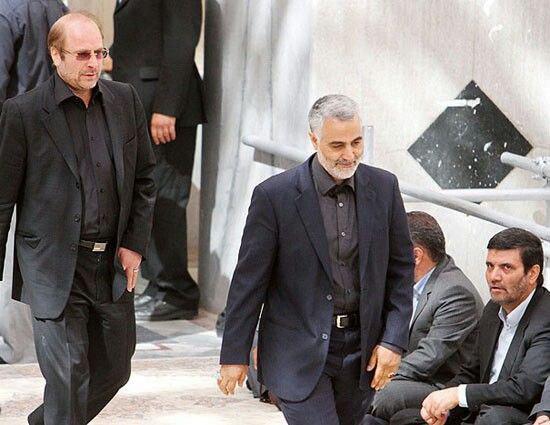
  • Iran Leader Saved Iraq from Total Collapse: Chief of Popular Mobilisation Forces

A Look at Iranian Newspaper Front Pages on May 3


Hamshahri:

  • Gov’t to Mull Over Possibility of Winter Vacations: Tourism Chief
  • Telegram and Filtering
  • A Report on Reactions to Telegram’s Blocking
  • Zarif: Why Are Certain Parties Ready to Harm National Interests?

A Look at Iranian Newspaper Front Pages on May 3


Iran:

  • Bookworms’ Spring Rendezvous in Tehran International Book Fair
  • Domino of Labour Protests in World
  • 200 Arrested, Dozens Wounded in May Day Protests in France
  • Reuters: IMF Supports Iran’s Forex Policy

A Look at Iranian Newspaper Front Pages on May 3


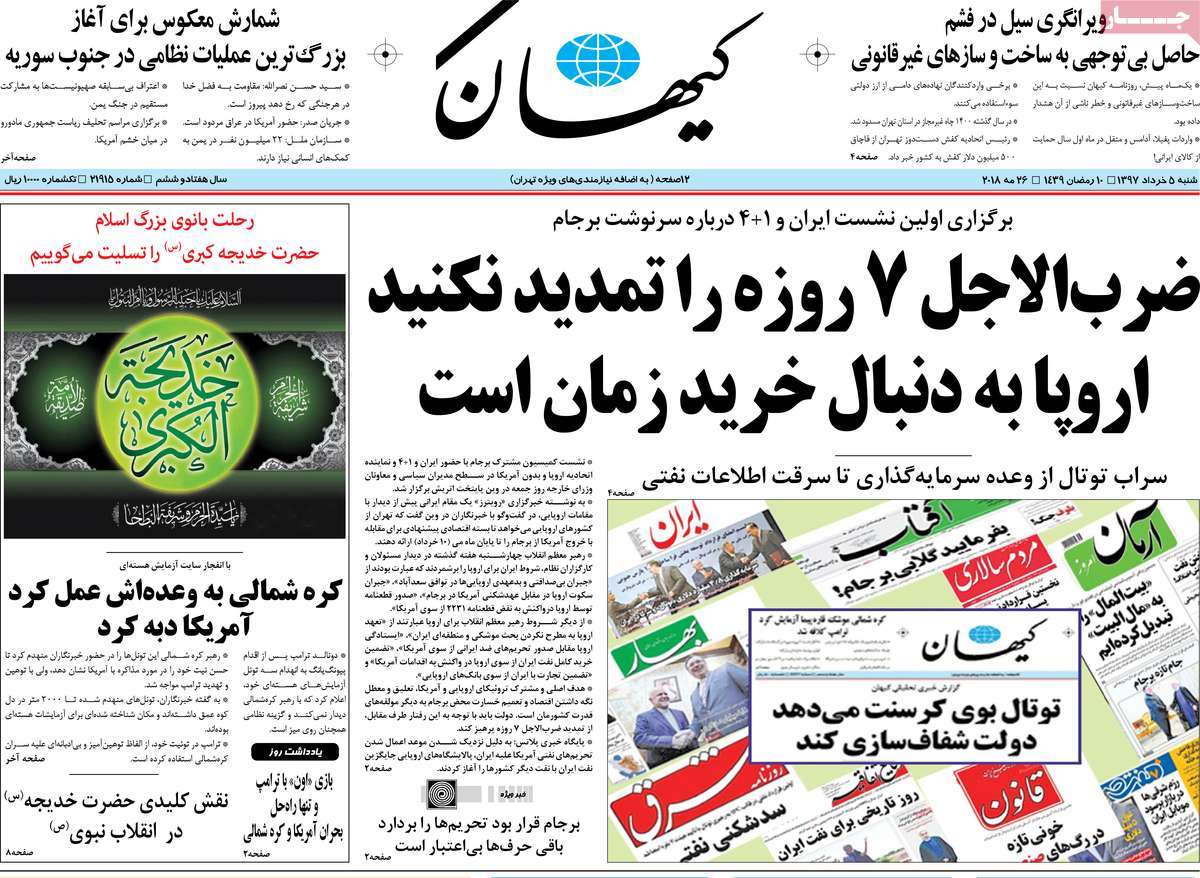
Kayhan:

  • Even Westerners Ridicule Netanyahu’s Anti-Iran Show!
  • Iran to Once Again Become Self-Sufficient in Petrol
  • Second Phase of Persian Gulf Star Refinery to Be Inaugurated Saturday
  • Alarms Activated in Riyadh, Other Saudi Cities for Fear of Ansarullah Missiles
  • Riots, Unrest across France on May Day: Workers Set Fire on Paris
  • US Poised to Steal $6 Billion from Iran, This Time on Pretext of 9/11!

A Look at Iranian Newspaper Front Pages on May 3


Kelid:

  • Education Minister: Teachers Doing Their Best with Minimum Facilities
  • Health Ministry’s New Tests to Prevent Bearing Children with EB

A Look at Iranian Newspaper Front Pages on May 3

Iran Praises Kurds for Standing against US, Israel in Syria

“Fortunately, in Syria, different tribes, including Arabs and Kurds, and followers of various religions are fighting against foreign aggression alongside each other and they have been victorious so far,” Velayati said in a meeting with a delegation of Syrian Kurdish leaders in Tehran on Tuesday evening.

“Undoubtedly, the key to the victory of the dignified nation of Syria is the national unity that exists among the tribes and religions of the country,” he said, adding that even Christians in Syria have sided with other people in the fight against terrorists.

“Our Kurdish brothers in Syria have demonstrated that they would never allow the United States and the Zionist regime to enter this important country in the West Asia,” Velayati further stated.

The representative of Syria’s Kurdish leaders, for his part, expressed his gratitude to Iran for supporting the Syrian people and said the good bilateral relations between Tehran and Damascus date back to the victory of the 1979 Islamic Revolution.

In recent years, the Middle East has been plagued with Takfiri terrorist groups like Daesh (ISIL or ISIS), which are believed to have been created and supported by the West and some regional Arab countries.

The terrorist groups, which claim to be Islamic but whose actions are anything but, have been committing heinous crimes not only against non-Muslims but mostly against Muslims in the region.

Iraq and Syria have been among the countries gripped by terrorism.

Iran, a close ally of the two countries, has supported their legitimate governments in their campaign against foreign-backed militancy and terrorism.

Iran, South Korea Discuss Commercialising Nanotechnology Products

The meeting, called “Iran-Korea Club,” was organised by the government-funded research institute Iran Nanotechnology Initiative Council (INIC) and the Korea Institute of Science and Technology (KIST).

Under a plan for cooperation, the firms select innovative ideas, organise teams, train their members, develop the product and finally put them on market.

The plan will allow Iranian and South Korean firms to obtain easier access to East Asia and Middle East markets, respectively.

The second meeting will be held this July in South Korea, according to a report by the Persian-language ISNA.

For a brief review of Iran’s achievements in various fields of science and technology, check the book “Science and Technology in Iran: A Brief Review

The KIST is a top-security compound for South Korea’s best scientific minds, which has contributed significantly to the economic development of the country.

Founded in 1966, it has a staff of over 1,800 research scientists, visiting scientists, fellows and trainees, and foreign scientists involved in basic research in various fields of science and technology.

The INIC is an affiliate of Iran’s Vice-Presidency for Science and Technology, tasked with promoting knowledge-based economy.

The incumbent administration has adopted plans to commercialise knowledge-based firm, as knowledge-based activities can make a significant contribution to Iran’s economic development by increasing added value among other things.

Experts believe nanotechnology could worth a lot to the Iranian economy, as Iran currently ranks seventh globally in this field.

The government plans to boost export of nanotechnology-related products and equipment to $1 billion by 2019.

Iran Outranks Israel in Scientific Output

According to Scimago Journal and Country Rank (SJR), the Islamic Republic of Iran has managed to achieve the sixth rank in Asia in terms of scientific output despite international pressure and sanctions.

Iran has surpassed the Israeli regime in the ranking which used to hold a top rank in scientific output over the past two decades due to the generous support it received from the US, the UK, and France, a report by the Persian-language Fars News Agency said.

From 1996 to 2016, by publishing 388,672 scientific articles which were cited 6,960,963 times, the Islamic Republic achieved a relatively high rank (22) in the SJR. This comes as Israel ranked 25th with 320,716 scientific articles and 297,964 citations.

Earlier, the Israeli daily Haaretz had admitted that Iran has turned into a scientific superpower. “Today, Iran has far surpassed Israel in science due to hard efforts made by the Iranian government and scientists.”

For a brief review of Iran’s achievements in various fields of science and technology, check the book “Science and Technology in Iran: A Brief Review

The articles produced by Iranian scientists in a number of areas including biology, physics, chemistry, economy and business management are far more cited compared with those of Israeli scientists.

Back in 1996, Iran had only 960 scientific articles but the number reached 41,000 over the past two decades.

The progress is made while Iran is under pressure by certain powers in the world and the region.

Scimago Journal Rank (SJR indicator) is a measure of scientific influence of scholarly journals that accounts for both the number of citations received by a journal and the importance or prestige of the journals where such citations come from.

A journal’s SJR is a numeric value indicating the average number of weighted citations received during a selected year per document published in that journal during the previous three years. Higher SJR values are meant to indicate greater journal prestige.

Flamingos Return to Shrinking Lake Urmia

As Urmia Lake has been suffering from dryness over the past few years, migratory birds preferred to go to the surrounding rivers and temporary ponds to access more water, but these days witnesses have seen these beautiful birds are returning to the lake as the weather is getting more pleasant.

Flamingos are basically non-migratory birds, but because of changes in the climate and water levels in their habitats, one cannot say their colonies are always permanent.

Lake Urmia has been depleted drastically due to a variety of factors, including the construction of a causeway as well as several dams that have choked off water from the mountains on either side of the lake. The Iranian government is after recovering the lake through water management and environmental restoration.

Earlier, Deputy Head of Iran’s Department of Environment Masoud Baqerzadeh Karimi had announced that the water level of the dying Lake Urmia in north-western Iran has elevated by four centimetres compared with the previous year, adding that currently two-fifth of Lake Urmia’s surface area is covered with water.

A report compiled by the UN Development Plan (UNDP) says human factors, particularly building numerous dams over the rivers flowing into the lake, have further complicated the fate of the largest inland body of water in Iran. However many others maintain that that illegal water wells have played a pivotal role in shrinking Lake Urmia.

What follows are ISNA’s photos of Lake Urmia and the flamingos that are returning to their natural habitat: