Friday, December 26, 2025
Home Blog Page 3574

“US-Led Attack on Syria Aimed at Humiliating Russia”

Ali Qaem-Maqami, an expert on Turkey affairs, has weighed in on the objectives behind Washington’s Syria attack and Ankara’s role in the missile strike. The full text of his interview with the Persian-language Khabar Online website follows:

Khabar Online: Hours after the attack on Syria by the US, France and Britain, the Turkish Foreign Ministry issued a statement announcing that Ankara welcomes the military action against Syria by the US and its allies. The statement reads that Turkey regards the attack as a response to the Syrian government. Ankara said that the US-led military action was a reaction to the “inhumane” chemical attack in the city of Douma. The statement was issued at a time when Ankara recently hosted a three-way meeting to settle the crisis in Syria. Was Turkey involved in the attack?

Analyst: The imperialist attack was aimed at impeding the trend of Astana and Sochi talks, testing and humiliating Russia and also countering Iran and Hezbollah. The military action aimed to take revenge on the Syrian army for its victory in Eastern Ghouta and purging Jaysh al-Islam elements from Douma and this very region and removing the threats facing Damascus.

The US-led attack was also aimed at supporting Israel’s operation in Syria, backing the [so-called] Free Syrian Army backed by Turkey and NATO, and emboldening the Democratic Union Party (PYD) affiliated with the PKK, which, in turn, led to Erdogan’s treason and entrapment of Turkey.

One way or another, Turkey was trapped. The Free Syrian Army commander says it will intensify its operation against Syria with the support of the US. Turkey has no choice but to support the United States’ policy in Syria. Erdogan lost his credibility with Iran and Russia, causing rifts in the trend of Astana talks. Turkey aligned itself with Israel and Saudi Arabia on Syria. The US strengthened the positions of the PKK and PYD. NATO started operating in Syria. Turkey renewed allegiance to NATO and Trump. If attacks continue and Russia as well as Assad’s allies do not resist, Syria will be disintegrated.

Video Shows US Targeted Drug Treatment Centres, Not Chemical Labs

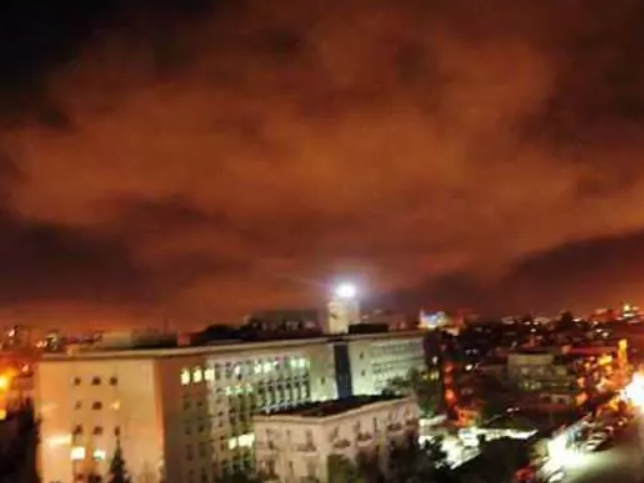
Soon after the US-led strike against Syria on Saturday morning, western propaganda machine began their misinformation campaign claiming that the trilateral airstrikes had destroyed a “chemical weapon research facility” in the district of Barzah, the location of a major Syrian scientific research center.

According to Tasnim dispatches, the research center was dedicated exclusively to developing and producing drugs to fight cancer like many other similar sites that were targeted across the Arab country by the strikes.

Following the strikes, a Pentagon official claimed that the sites chosen were involved in the “research, development and deployment” of chemical weapons.

The report by Tasnim’s correspondent in Damascus and his interviews with locals there, however, proved that the opposite was the case.

“My fellow Americans, a short time ago, I ordered the United States Armed Forces to launch precision strikes on targets associated with the chemical weapons capabilities of Syrian dictator Bashar al-Assad. A combined operation with the armed forces of France and the United Kingdom is now underway. We thank them both,” Trump told Americans in a televised address minutes after ordering the strike on the Arab country.

The US, Britain and France launched airstrikes against multiple places in Syria early Saturday following US President Donald Trump’s order despite international warnings against further escalation of the situation in the Arab country and across the Middle East.

The US-led military coalition has accused the Syrian government of having allegedly attacked the militant-held town of Douma in the Eastern Ghouta region on April 7 and claimed that the Saturday air strikes had been aimed at deterring Syria’s further use of chemical weapons.

The Russian military said Saturday that the US, Britain and France fired 103 cruise missiles, including Tomahawk, at Syria but that Syrian air defense systems managed to intercept 71 of them.

“All together, 103 cruise missiles were deployed. Seventy-one cruise missiles were intercepted,” senior military officer Sergei Rudskoi said at a briefing in Moscow.

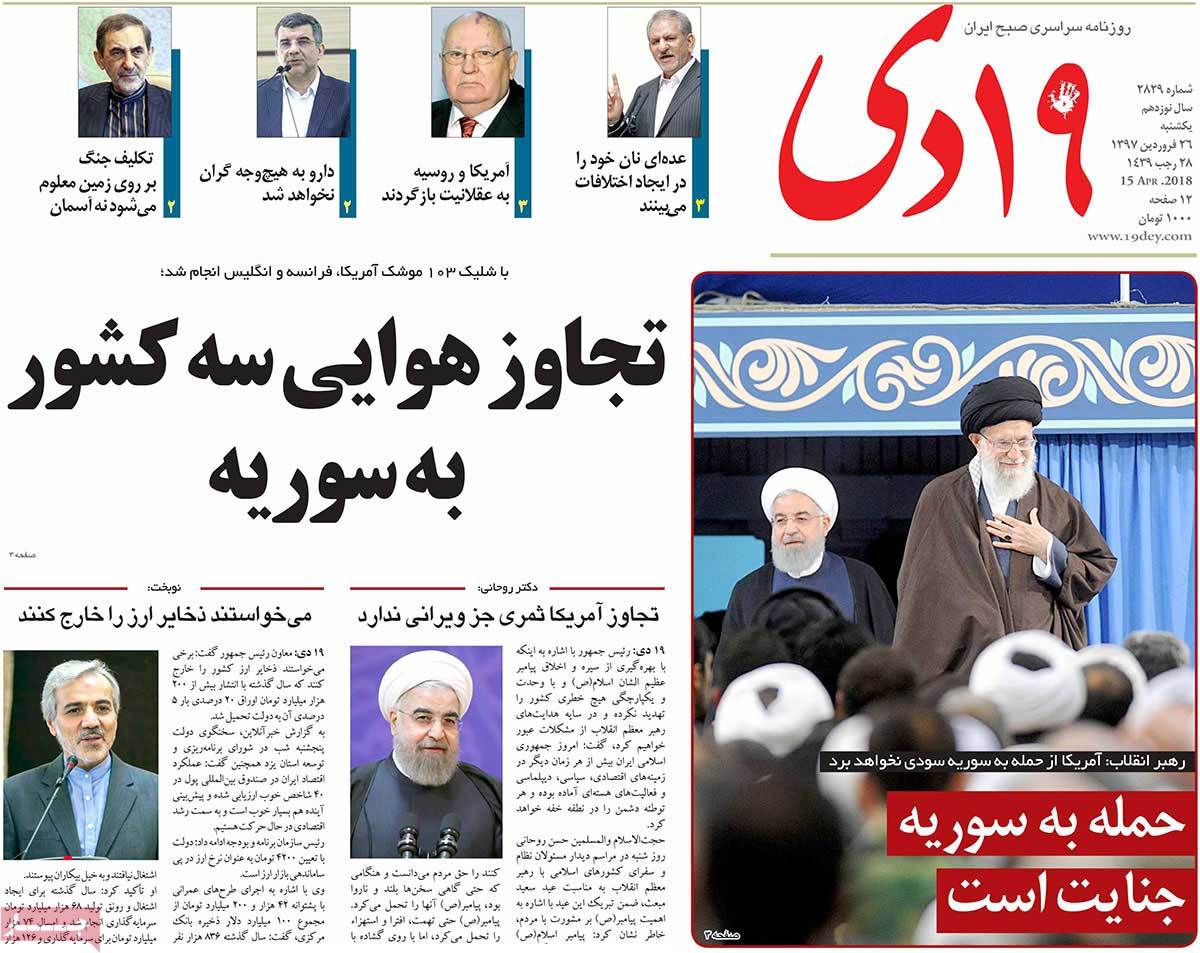
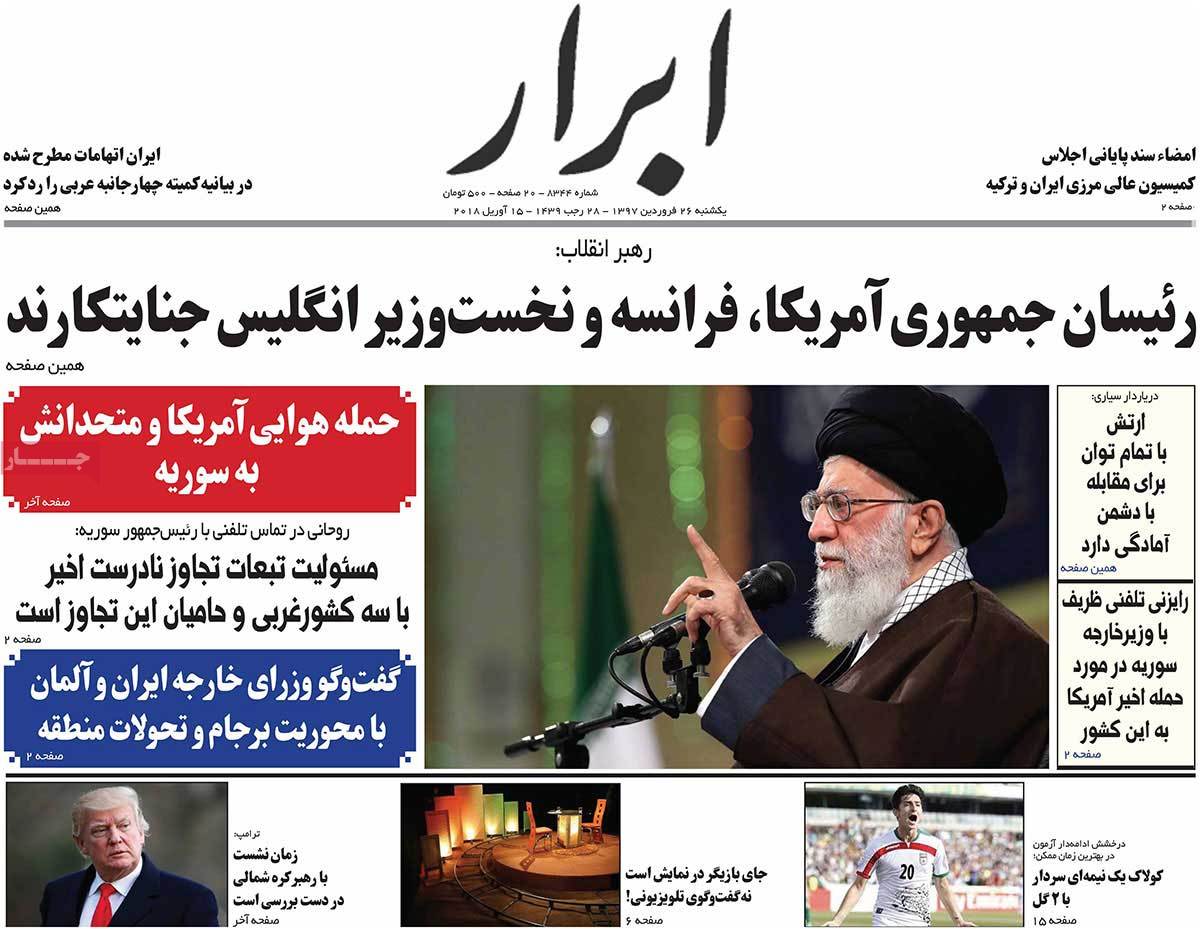
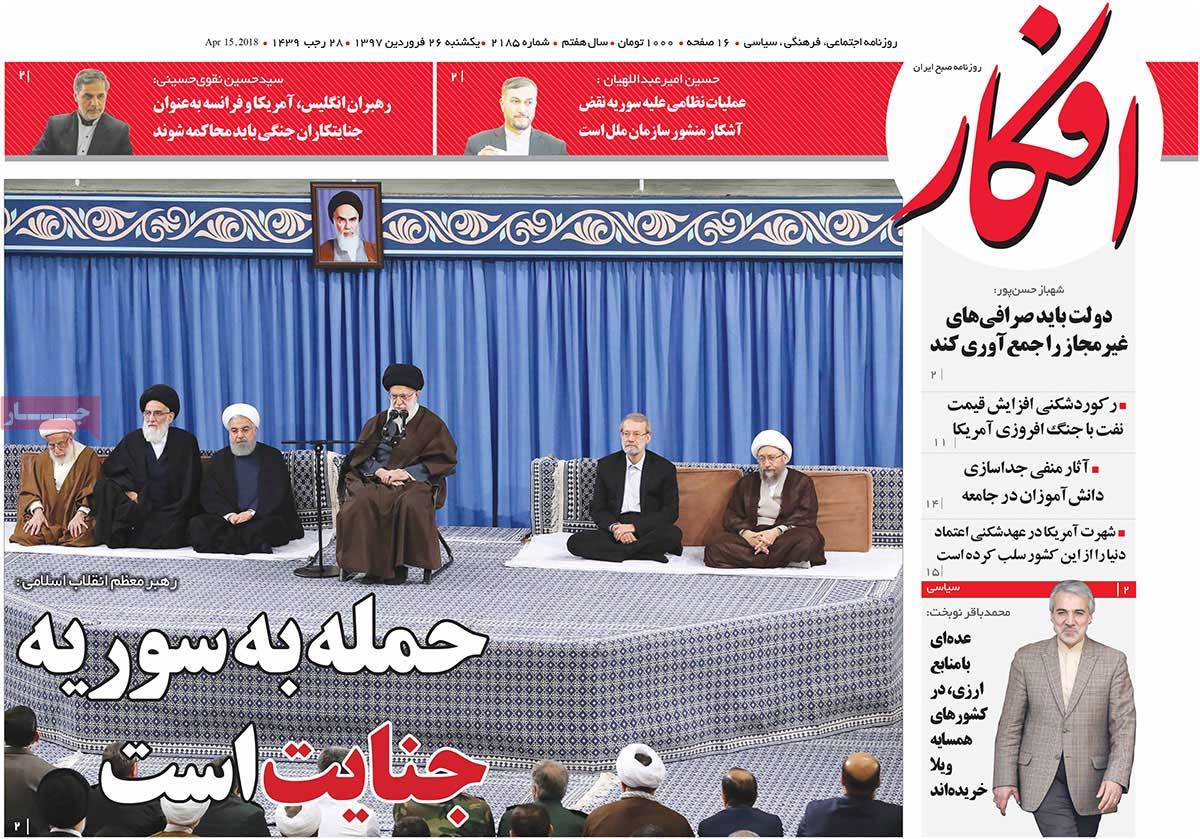
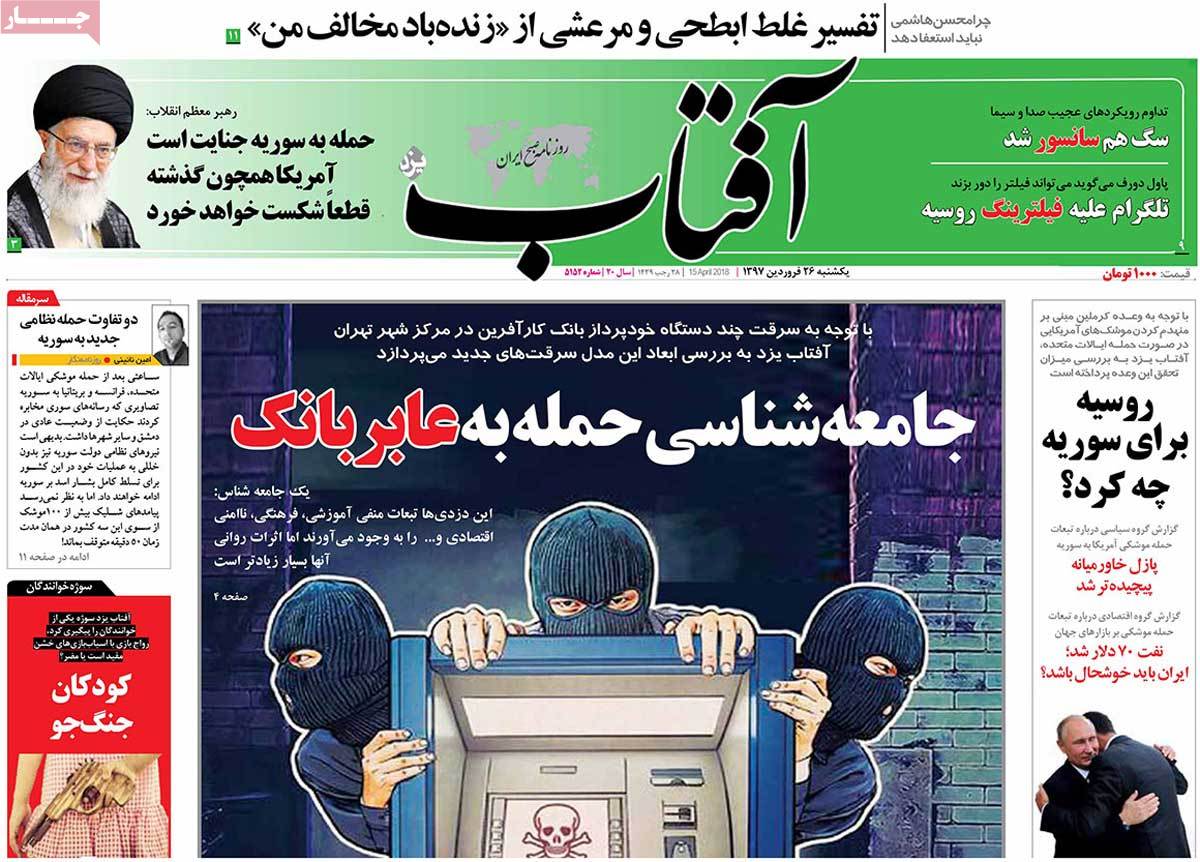
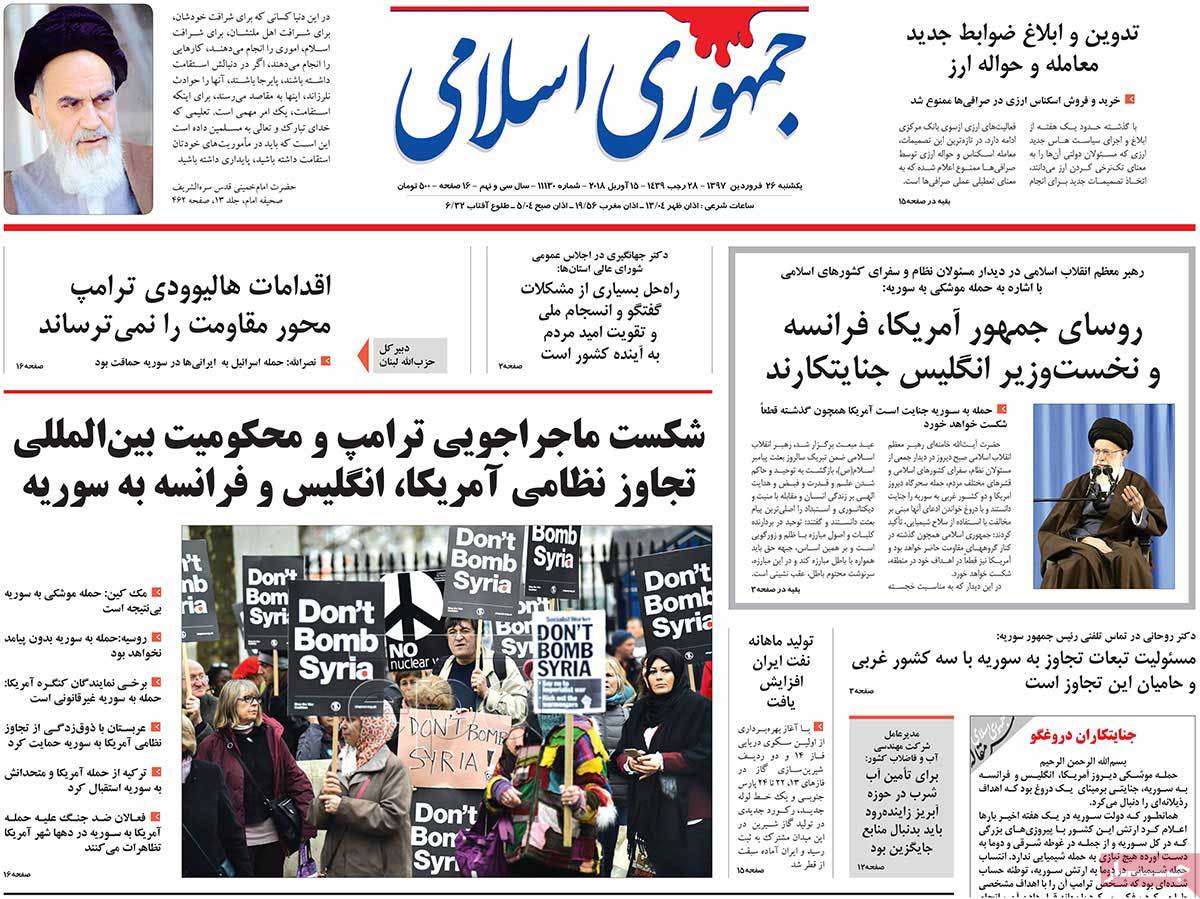
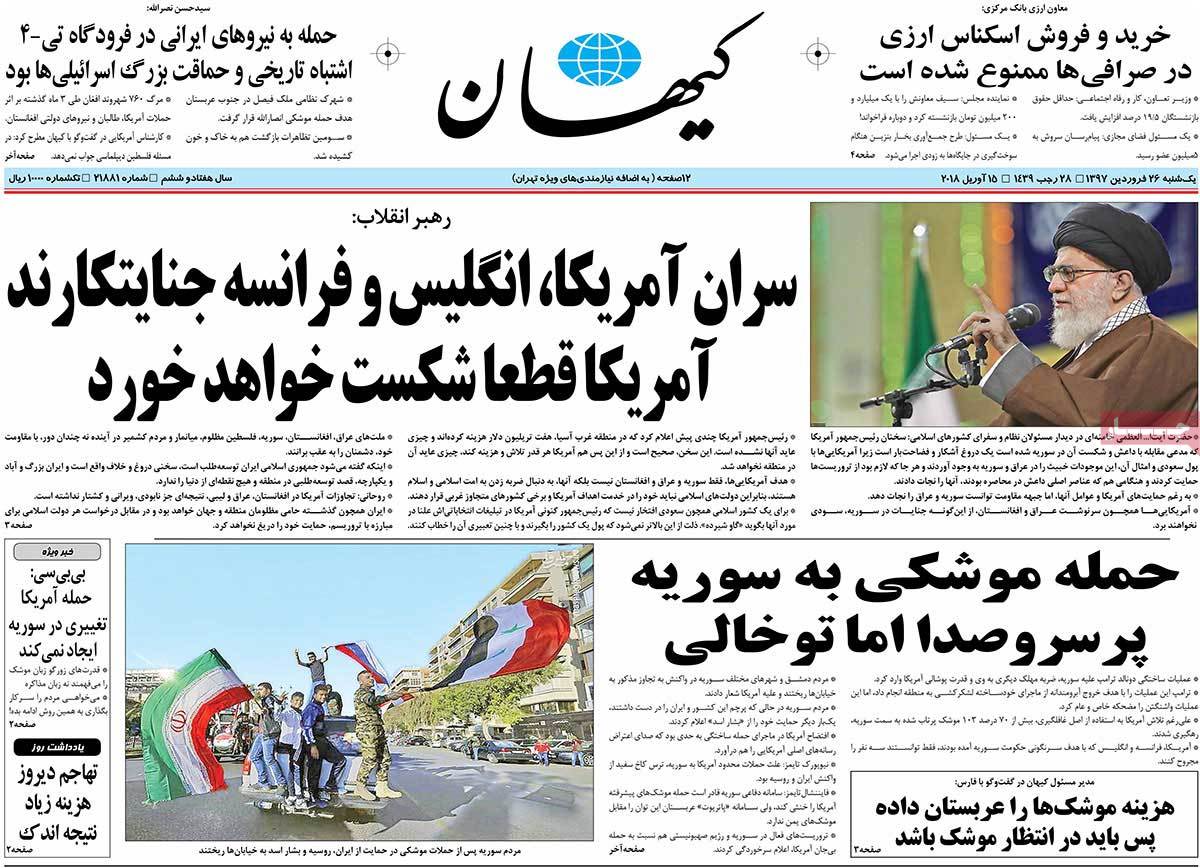
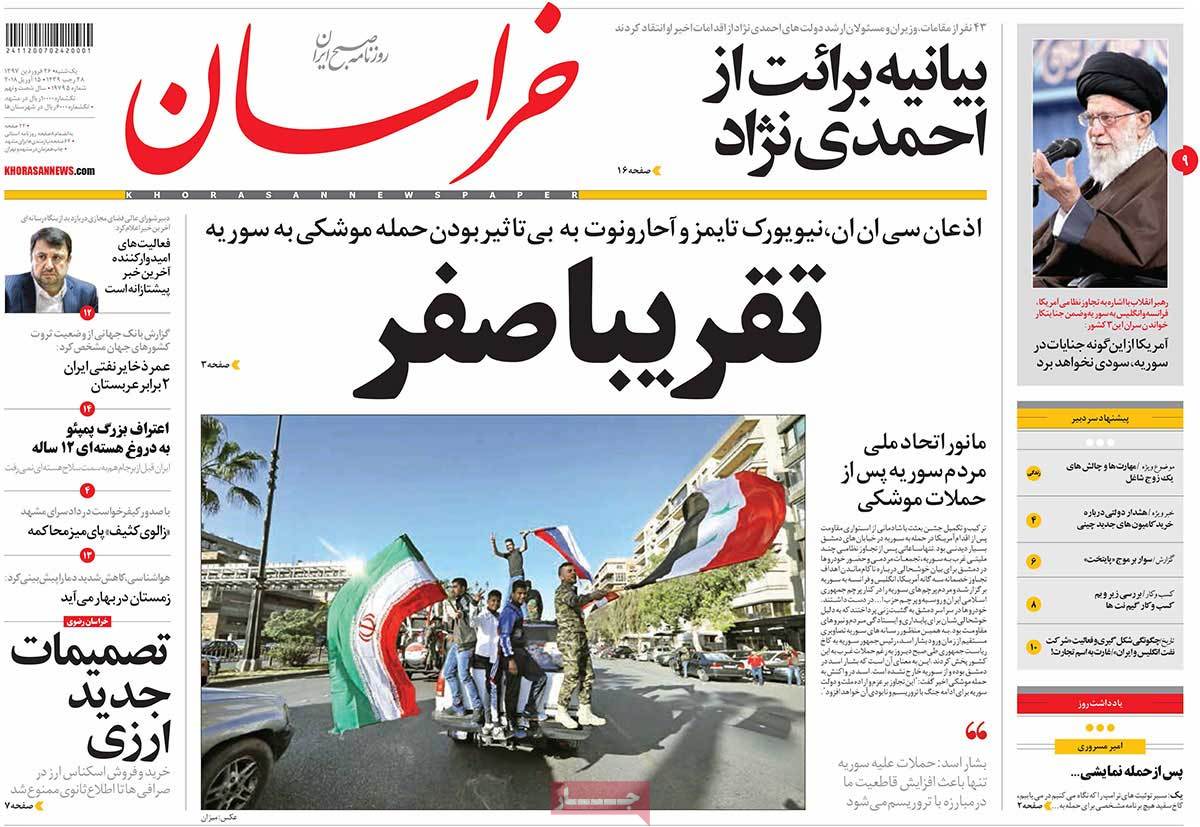
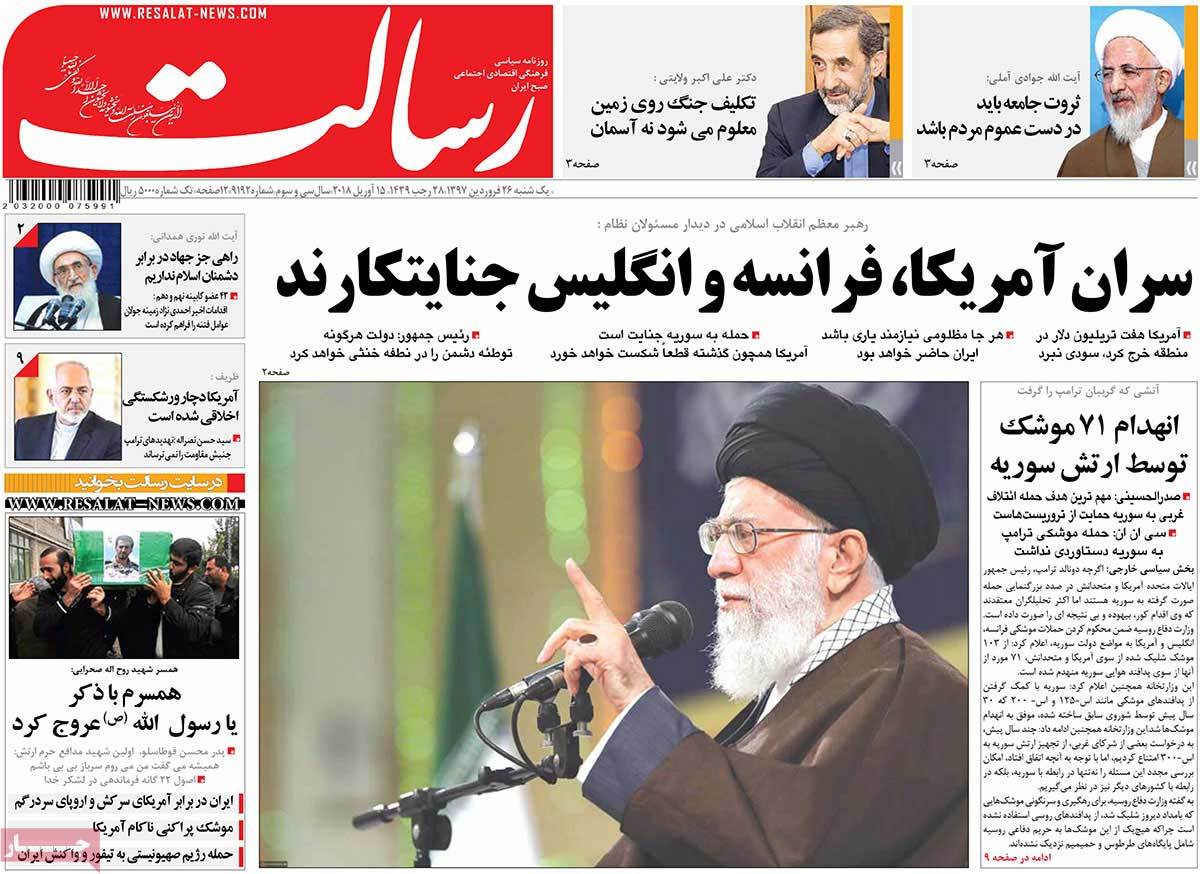
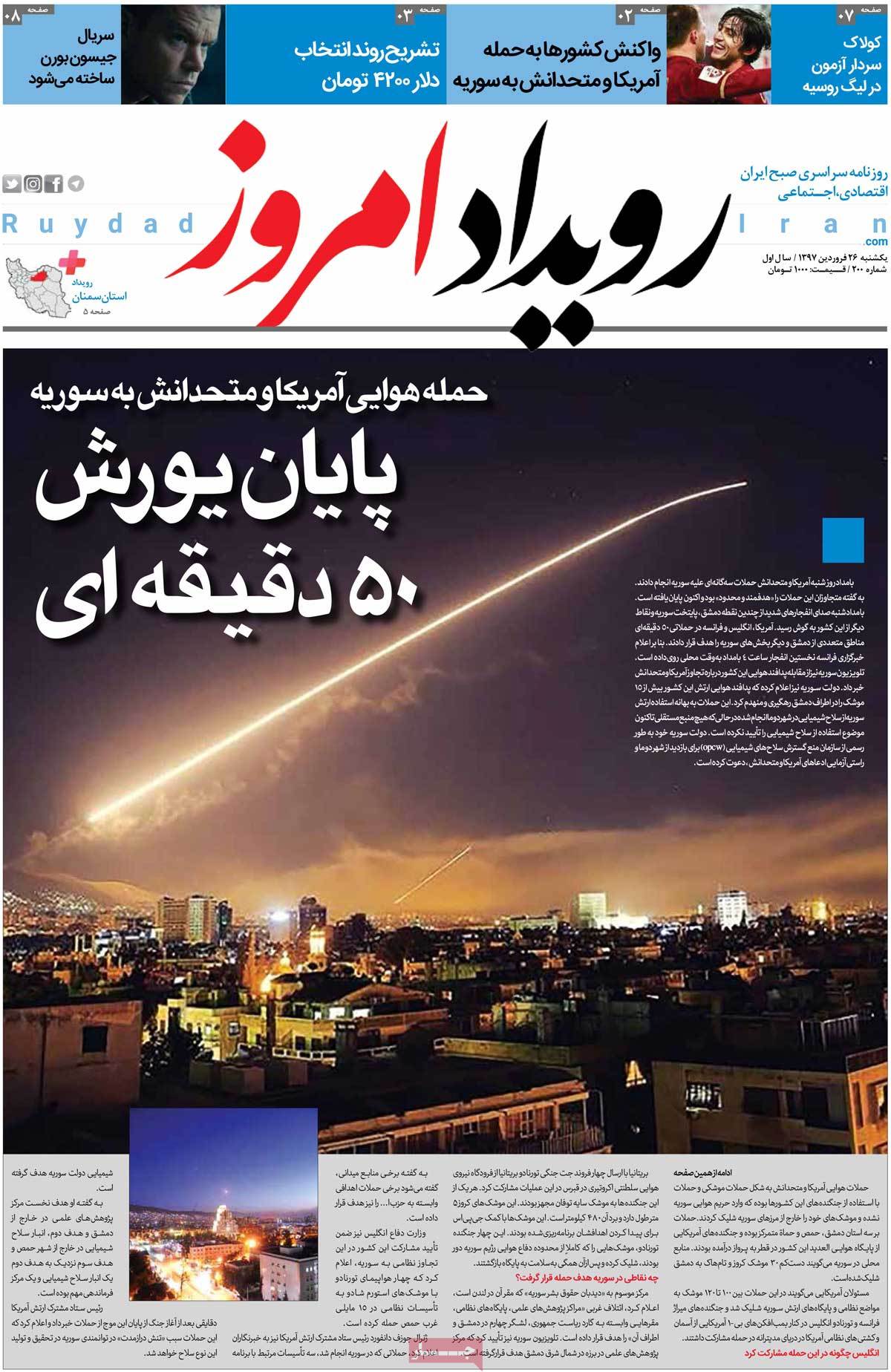
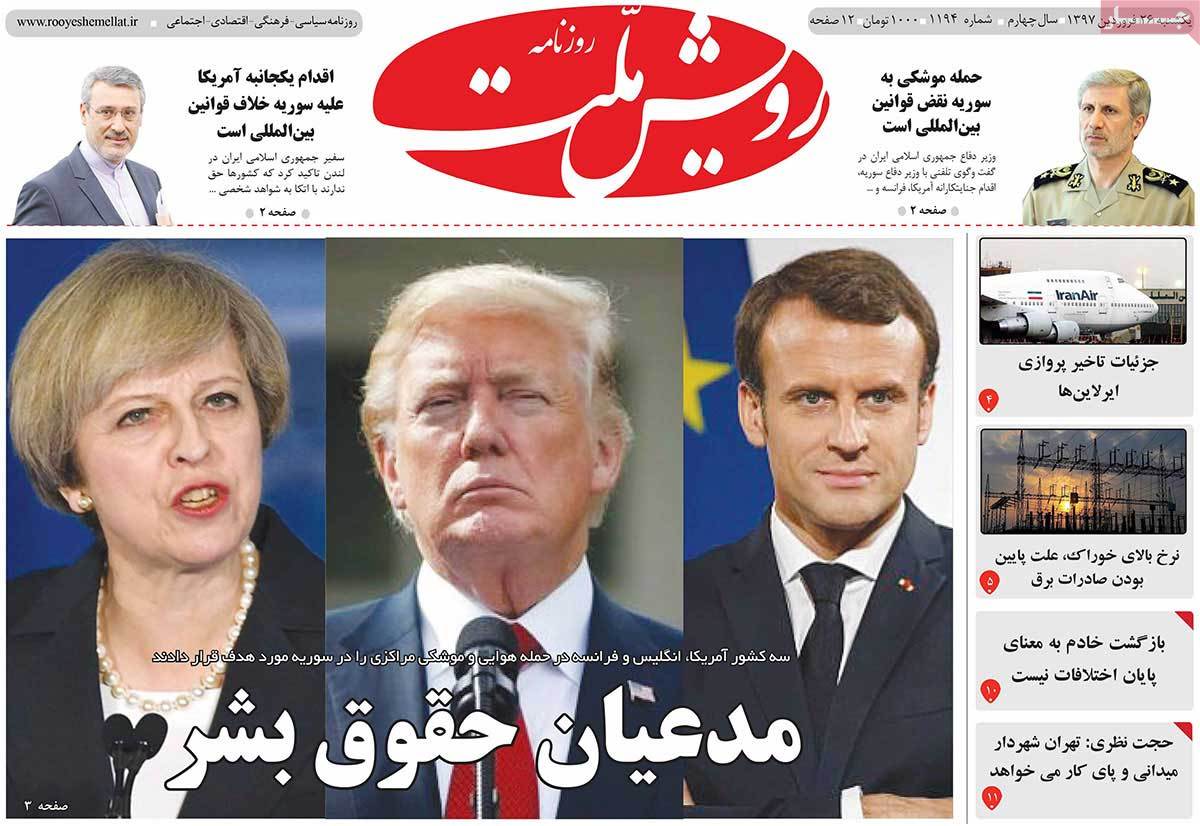
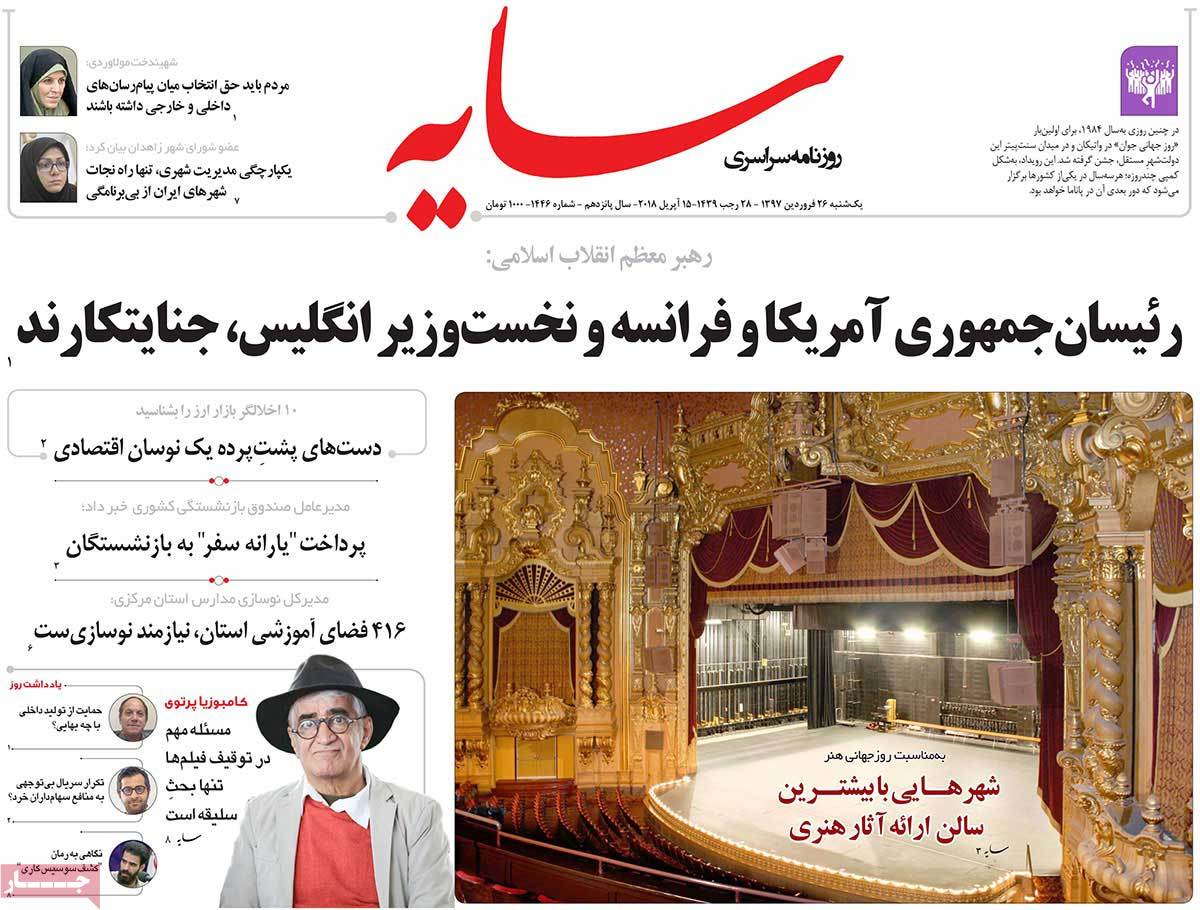
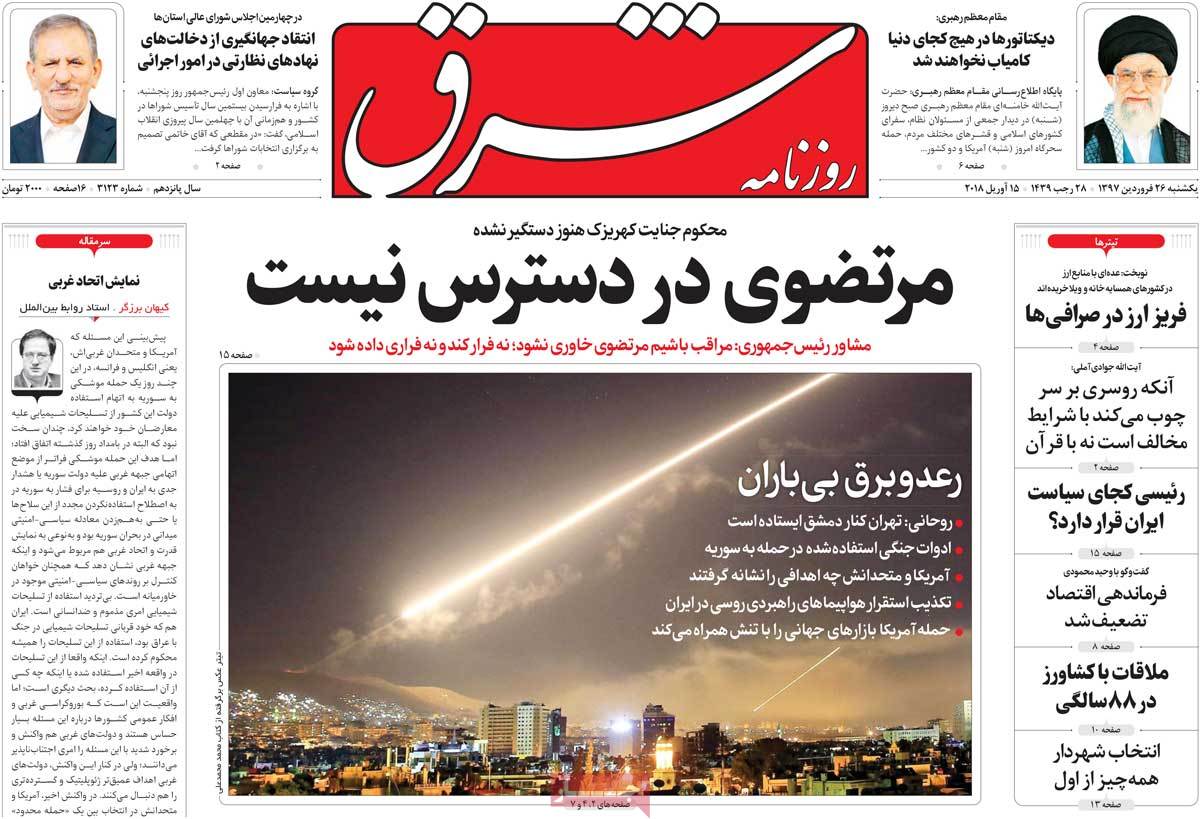
Syria Strikes Widely Covered by Iranian Newspapers on April 15

A Look at Iranian Newspaper Front Pages on November 18

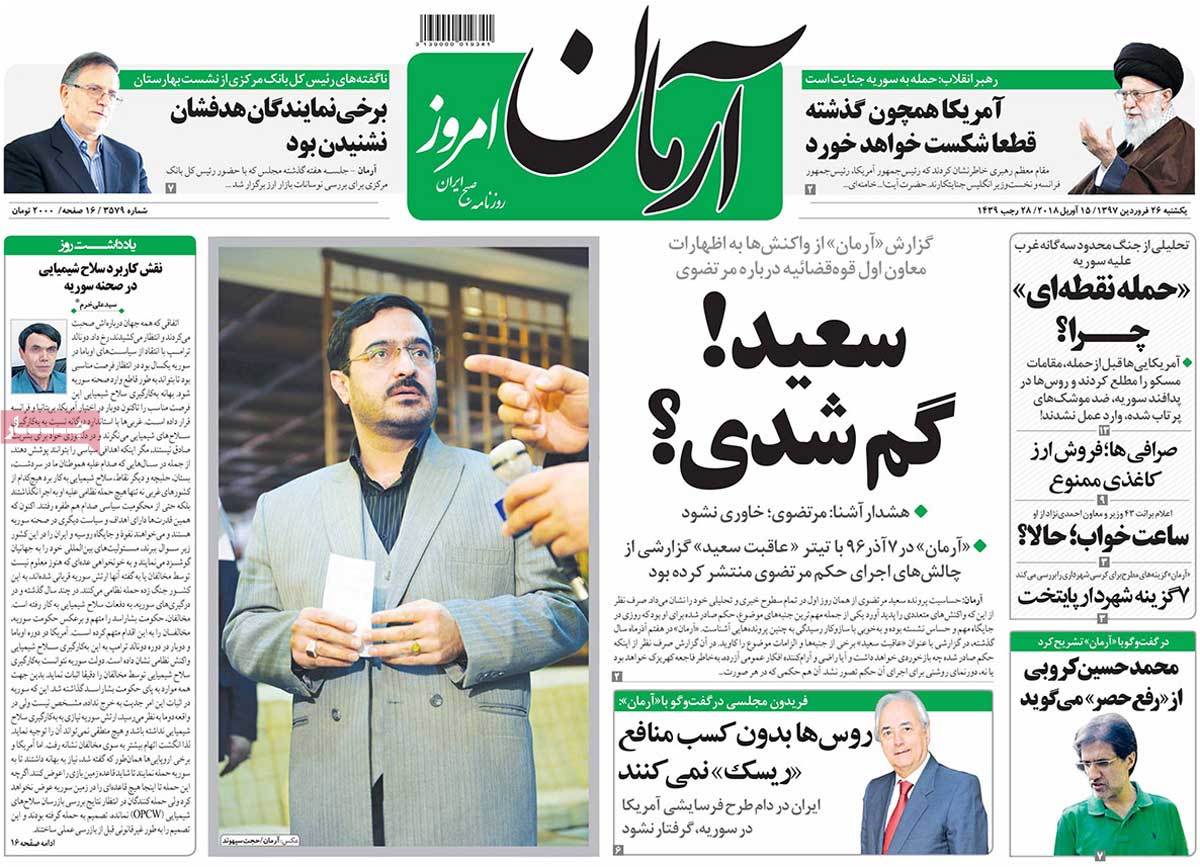
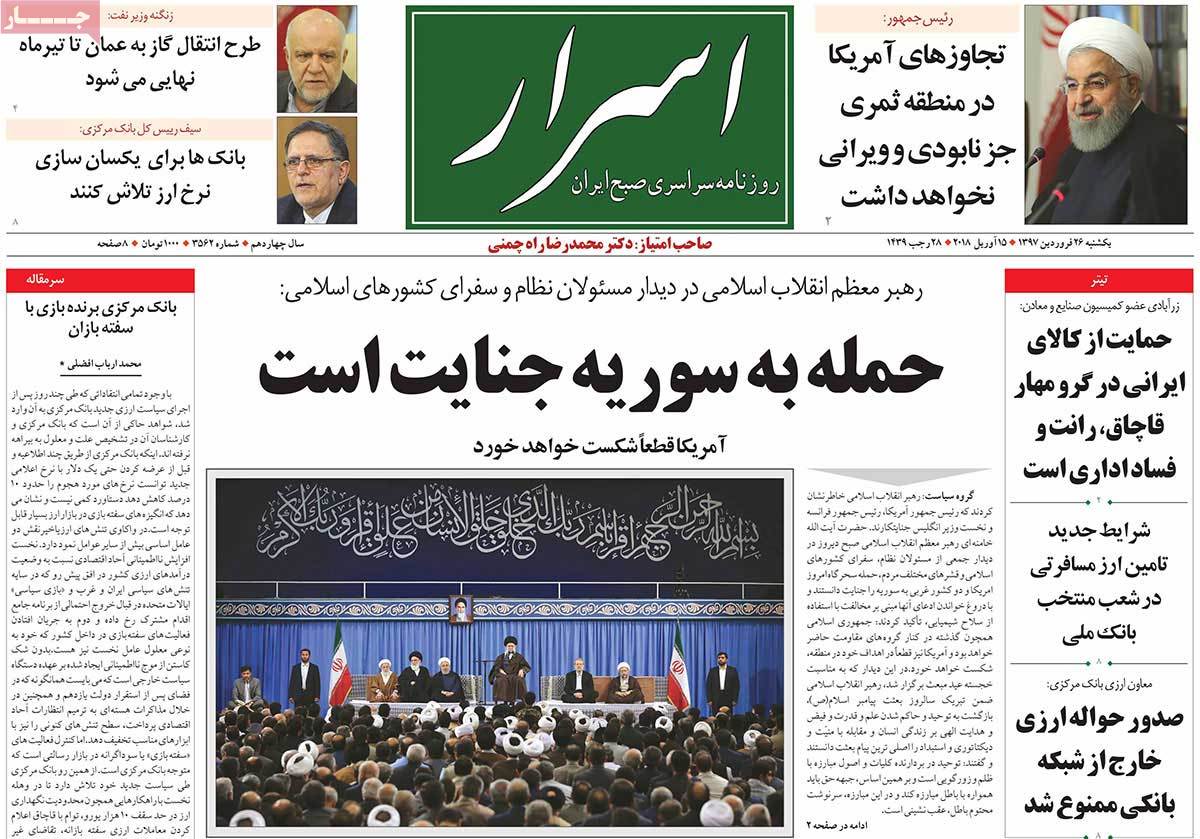
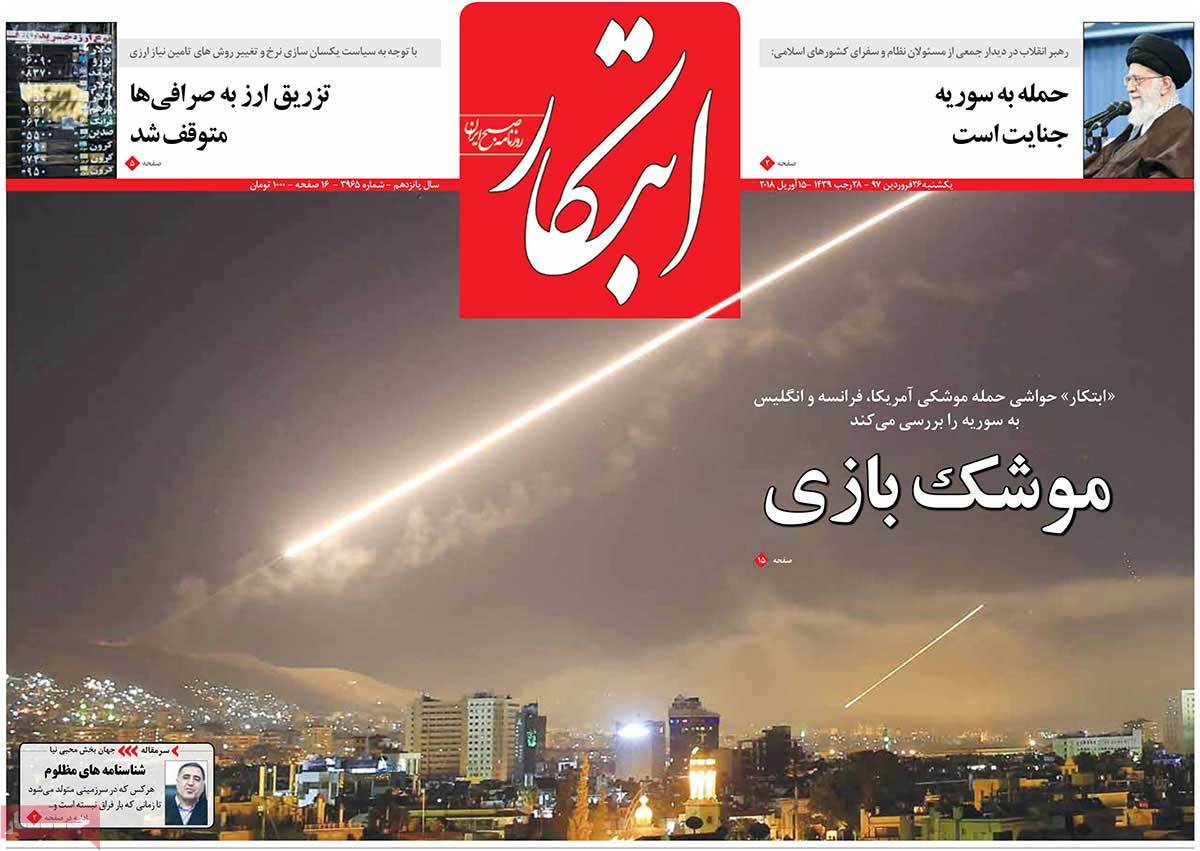
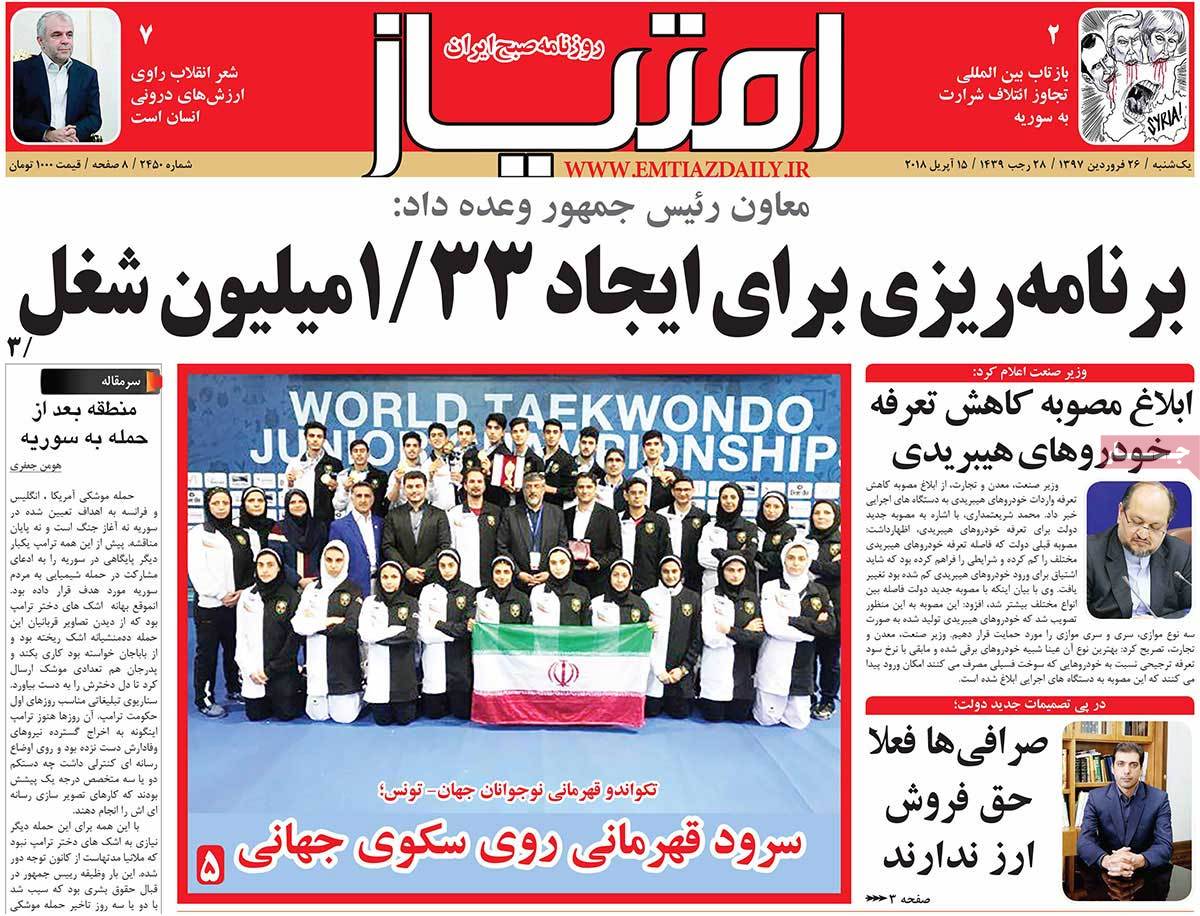
The US-led coalition’s Saturday airstrikes on Syria was the top story in all Iranian papers today. The headlines today were mostly dedicated to remarks made by the Leader of Iran’s Islamic Revolution Ayatollah Seyyed Ali Khamenei and Iranian President Hassan Rouhani, and a statement by the Islamic Revolution Guards Corps (IRGC) about the attacks.

Iran’s strategic alliance with Russia and the comments by Sayyid Hassan Nasrallah, the secretary-general of the Lebanese Resistance Movement Hezbollah, about the recent Israeli attack on the T-4 airbase in Syria’s Homs were among other top stories today.

The above issues, as well as many more, are highlighted in the following headlines and top stories:


19 Dey:

  • Iran Leader: Attack on Syria Major Crime
  • US Won’t Achieve Anything by Attacking Syria: Ayatollah Khamenei

Syria Strikes Widely Covered by Iranian Newspapers on April 15


Abrar:

  • Iran Leader: Leaders of US, France, Britain Criminals
  • Zarif, Syrian Counterpart Discuss US Strikes in Phone Conversation

Syria Strikes Widely Covered by Iranian Newspapers on April 15


Afkar:

  • Amir-Abdollahian: Military Operation against Syria Blatant Violation of UN Charter
  • MP: Leaders of Britain, US, France Must Be Tried as War Criminals
  • Those Who Benefited from Forex Crisis Purchase Mansions in Neighbouring States

Syria Strikes Widely Covered by Iranian Newspapers on April 15


Aftab-e Yazd:

  • Telegram against Russia’s Blocking: Durov Says He Can Bypass Filtering
  • Iran Leader: US Will Once Again Suffer Defeat

Syria Strikes Widely Covered by Iranian Newspapers on April 15


Arman-e Emrooz:

  • Russians Don’t Take Risk without Gaining Benefits
  • Iran Shouldn’t Be Trapped in US War of Attrition in Syria

Syria Strikes Widely Covered by Iranian Newspapers on April 15


Asrar:

  • Rouhani: US Aggressions in Region Will Have No Result but Destruction
  • Oil Minister: Project to Transfer Gas to Oman to Be Finalised in 3 Months

Syria Strikes Widely Covered by Iranian Newspapers on April 15


Ebtekar

  • Playing with Missiles
  • A Review of US-led Coalition’s Strikes on Syria

Syria Strikes Widely Covered by Iranian Newspapers on April 15


Emtiaz:

  • Iran VP: Plans Made to Create 1.33 Million Jobs

Syria Strikes Widely Covered by Iranian Newspapers on April 15


Etemad:

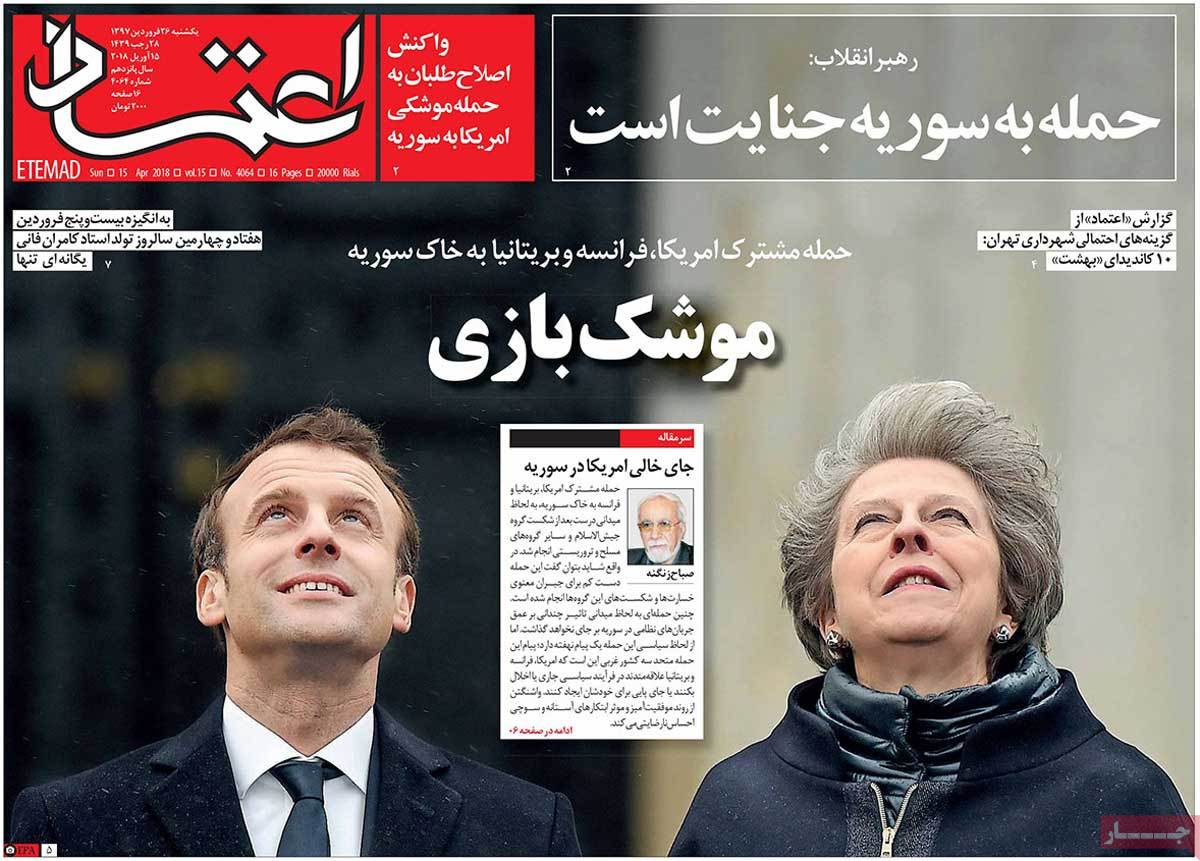
  • Missile Game: US, Britain, France Launch Joint Attack on Syria

Syria Strikes Widely Covered by Iranian Newspapers on April 15


Ettela’at:

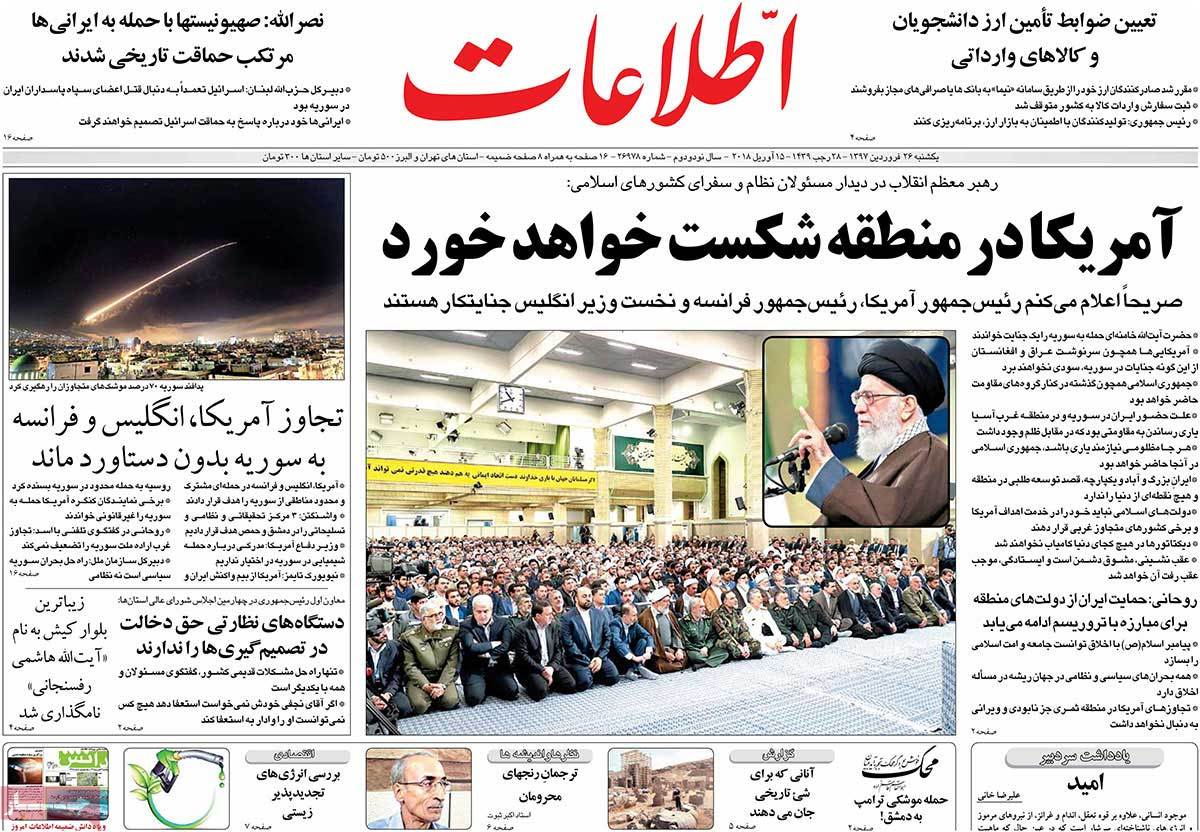
  • Nasrallah: Zionists Made Historic Mistake by Attacking Iranians
  • Attack of US, Britain, France on Syria Left without Any Achievement

Syria Strikes Widely Covered by Iranian Newspapers on April 15


Iran:

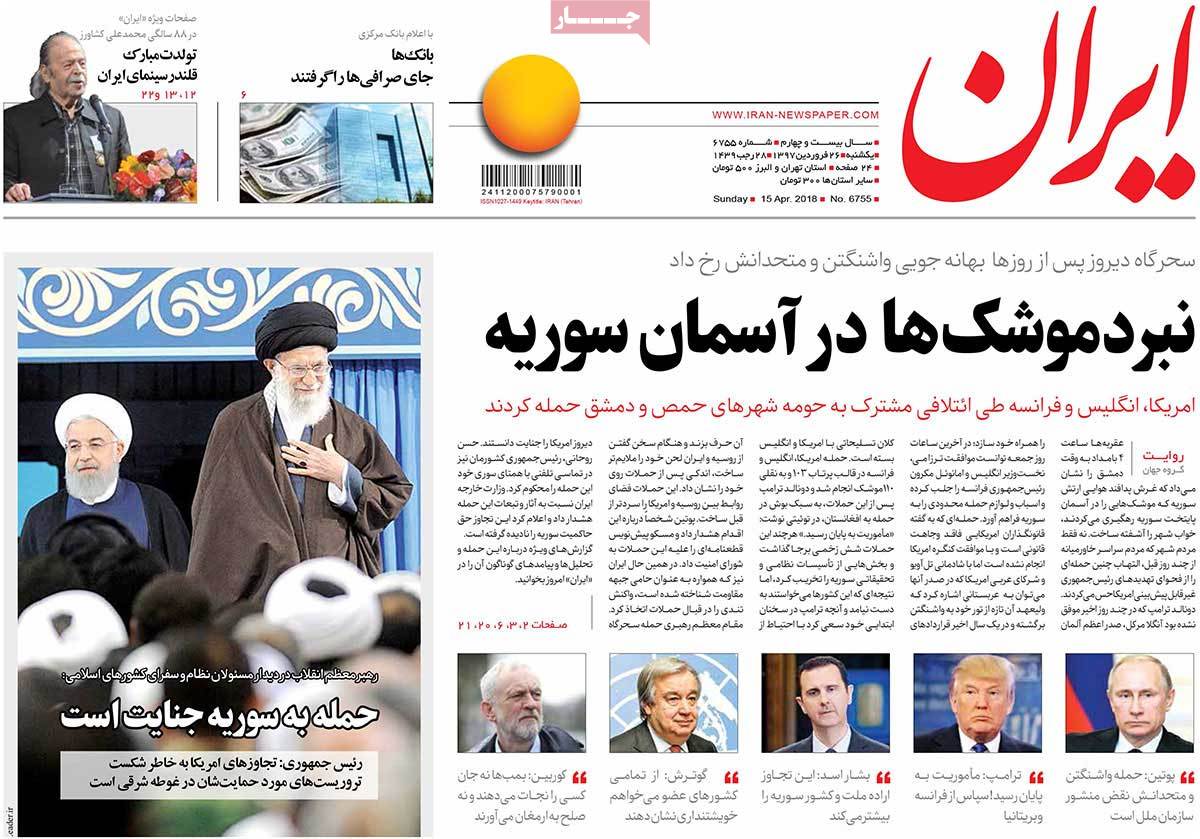
  • Battle of Missiles in Syria Sky
  • US-France Coalition Attack Homs, Damascus
  • Rouhani: US Aggressions Response to Defeats of Terrorists It Supports in Ghouta

Syria Strikes Widely Covered by Iranian Newspapers on April 15


Javan:

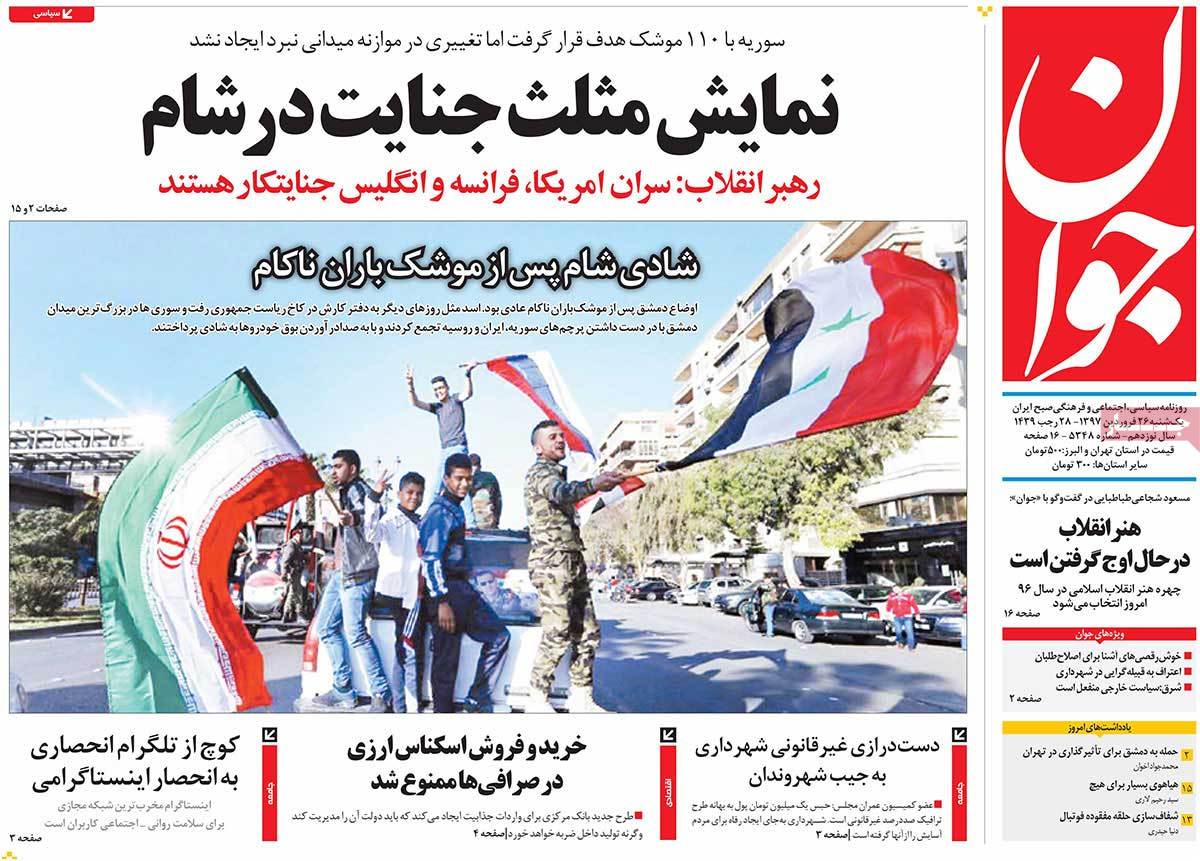
  • Triangle of Crime in Syria
  • Syria Attacked by 110 Missiles, but No Change Made to Balance of Power in Battlefield
  • Celebration in Syria after Failed Missile Attack
  • Syrians Gather in Damascus with Flags of Iran, Syria, Russia

Syria Strikes Widely Covered by Iranian Newspapers on April 15


Jomhouri Eslami:

  • Defeat of Trump’s Adventure; International Condemnation of Attack on Syria
  • Nasrallah: Trump’s Hollywood-Like Moves Won’t Intimidate Resistance Front

Syria Strikes Widely Covered by Iranian Newspapers on April 15


Kayhan:

  • Missile Attack on Syria: Noisy but Empty Inside
  • BBC: US Attack Not to Make Any Change in Syria
  • Nasrallah: Attack on Iranian Forces in T-4 Was Israel’s Historic Mistake

Syria Strikes Widely Covered by Iranian Newspapers on April 15


Khorasan:

  • Almost Zero: CNN, New York Times, Ynet Admit Attack on Syria Was Futile
  • 43 Officials, Ministers, Top Executives of Ahmadinejad’s Gov’t Renounce Him

Syria Strikes Widely Covered by Iranian Newspapers on April 15


Resalat:

  • Ayatollah Javadi Amoli: Society’s Wealth Must Be in People’s Hands
  • Velayati: Fate of War Decided on Ground, Not Sky

Syria Strikes Widely Covered by Iranian Newspapers on April 15


Rooydad-e Emrooz:

  • End of 50-Minute Assault: Aerial Attack of US, Allies on Syria

Syria Strikes Widely Covered by Iranian Newspapers on April 15


Rooyesh-e Mellat:

  • Iran DM: Missile Attack on Syria Violation of Int’l Law
  • So-Called Advocates of Human Rights
  • Britain, France, US Target Centres in Syria in Aerial, Missile Attack

Syria Strikes Widely Covered by Iranian Newspapers on April 15


Sayeh:

  • People Must Be Allowed to Choose between Domestic, Foreign Messengers: Rouhani’s Aide

Syria Strikes Widely Covered by Iranian Newspapers on April 15


Shargh:

  • Iran Leader: Dictators Won’t Succeed Anywhere in the World
  • Iran First VP Criticises Interference of Supervisory Bodies in Executive Affairs

Syria Strikes Widely Covered by Iranian Newspapers on April 15


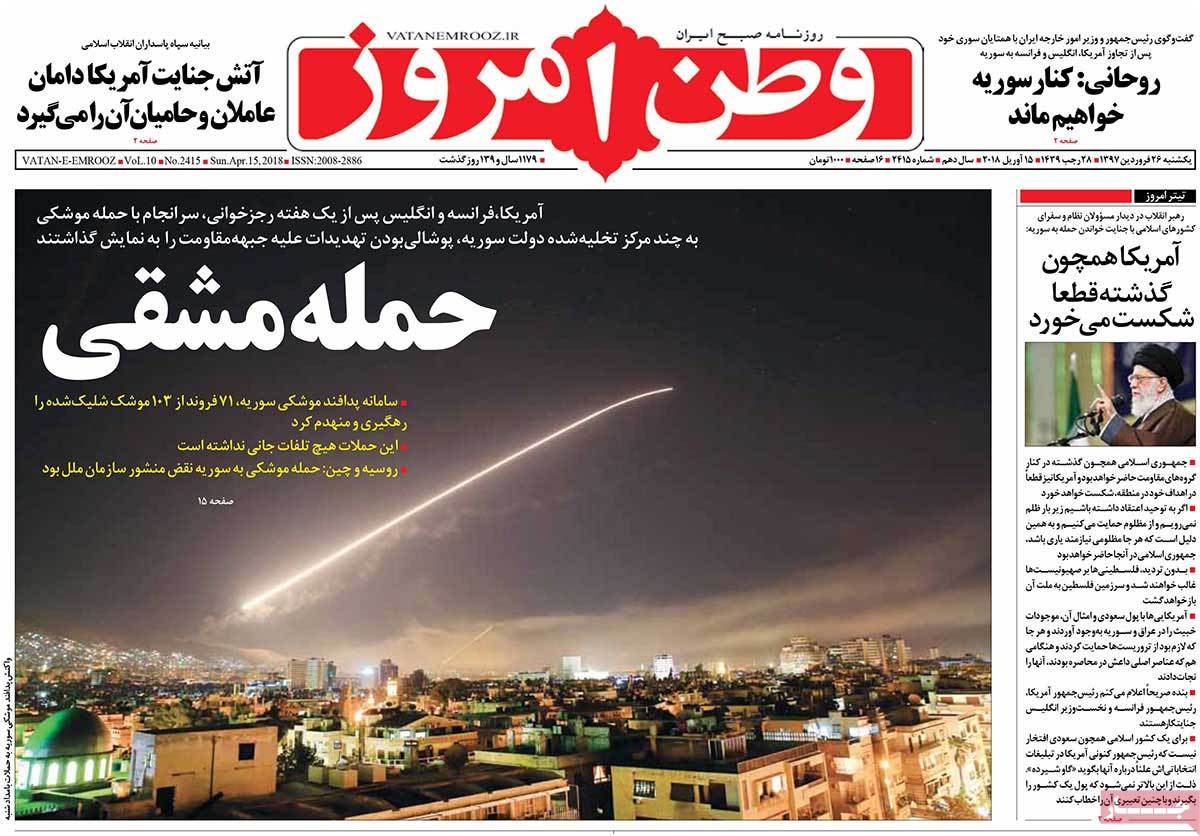
Vatan-e Emrooz:

  • Rouhani: We’ll Stand by Syria
  • IRGC: Flames of US Crimes to Engulf Perpetrators, Supporters

Syria Strikes Widely Covered by Iranian Newspapers on April 15


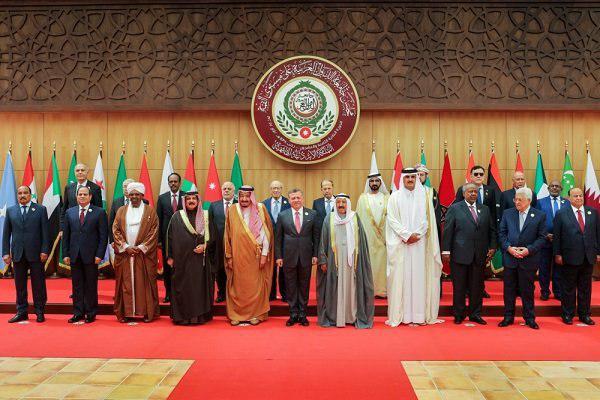
Lebanon, Iraq Back Iran at Arab League Meeting

Saudi Arabia and its Arab and non-Arab allies believe that Lebanon and Iraq are Iran’s backyard and their sovereignty is violated by the Islamic Republic.

However, the representatives of Beirut and Baghdad were the only ones who opposed an anti-Iran provision in a statement issued at the end of the recent ministerial meeting of the Arab League Summit in Dhahran.

The provision accused Iran of interfering in Arab countries’ affairs.

This comes as the Saudi government is seeking to make Arab League member states align themselves with Riyadh when it comes to anti-Iran measures.

The 29th Arab League Summit is scheduled to kick off in the Saudi city of Dhahran on April 15, 2018.

The event was originally slated to be held in Riyadh, but the venue was relocated to Dhahran after Yemeni troops and Ansarullah fighters targeted the Saudi capital with missiles.

Georgian Cinema to Be Reviewed at Iran’s Fajr Festival

The festival will feature five major and exciting works at ‘A Retrospective of Georgian Cinema’.

According to the festival website, the lineup showcases interesting  cultural aspects of Georgia, sheds light on untold tales and shares unique stories with the audience.

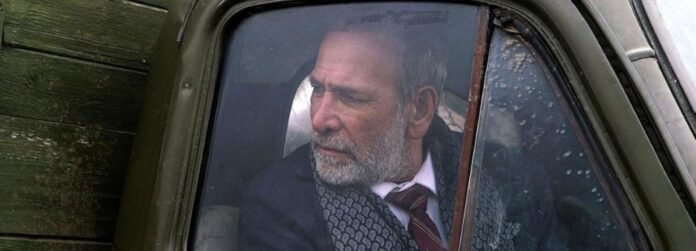
‘Khibula’ directed by Giorgi Ovashvili tells the story of the first democratically elected President of Georgia, Zviad Gamsakhurdia. After being deposed in a coup, the president flees to the mountains with a group of supporters confident that he will return to regain power. Iranian actor Hossein Mahjoob has played the role of the president in the film.

‘Scary Mother’ written and directed by Ana Urushadze, ‘Luka’ directed by Giorgi Barabadze, ‘House of Others’ by Rusudan Glurjidze and ‘Dede’ by Mariam Khatchvani are the other Georgian films to be shown at this year’s event.

Iran Blasts Certain Muslim States for “Treacherous” Positions on Syria Strikes

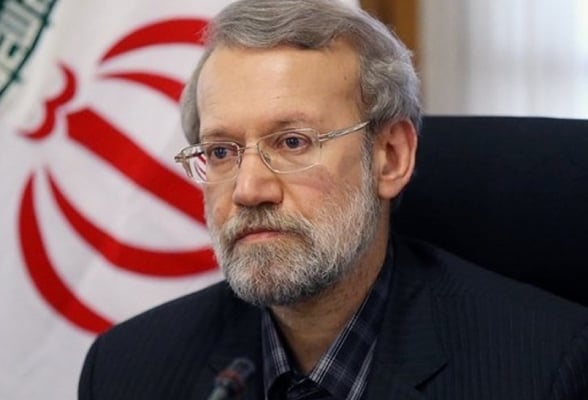
Ali Larijani

Addressing an open session of Parliament on Sunday, Larijani said some Islamic states happily stood by the US, France and Britain in their missile attack on Syria.

He said some Muslim countries claim to be supporters of Muslim unity and human rights, but behind the scenes they support terrorists and make their resources available to aggressors to target Muslim nations.

“The Iranian Parliament condemns this brutal and illegal attack, and announces to these three countries and the contemptible countries supporting them that gone are the days of such false postures, and such savage acts will only shed light on the path where supporters of terrorism and hypocrites are treading,” said Larijani.

He said such attacks will only further strengthen the Syrian nation’s resolve to wipe out terrorists.

Larijani further noted that the US-led military action begs the question why the three countries launched the attack, after all.

“These three countries claim that the Syrian government used chemical arms days ago, and that Syria managed to drive terrorists from the outskirts of Damascus thanks to these very weapons,” the parliament speaker noted.
“However, the Syrian and Russian governments have denied the allegation and called on international circles to look into the case,” he said.

Larijani said the military action was taken hastily without first waiting for the results of a possible probe to be published.
He said the “chemical attack” scenario was just a pretext to launch the missile attack, and the main reason behind the military action was the latest developments on the ground in Syria.

“The area around Damascus had been a den of terrorists for years with the help of major countries and some rogue regional states. They would fuel insecurity in Damascus with modern weapons,” said Larijani.

“What the Syrian army did recently was to purge the area, something that state sponsors of terrorists wouldn’t believe could materialize in a short period of time. So, the Saudis shamelessly made their resources available to the Americans and urged them to bombard Syria, believing they would be able to change the equation and re-establish the terrorists’ safe haven,”

“That they think they can achieve their objectives with such a brutal and illegal act is just s mirage,” said Larijani.

China Still Iran’s Top Business Partner

Iran’s non-oil trade with the East Asian country totaled $22.28 billion in the last Iranian year (ended March 20), indicating an increase of 16.82% compared to the year before, IRICA reported.
Iran exported 34.89 million tons of commodities worth $9.06 billion to China last year, down by 7.57% in tonnage and up by 8.31% in value year-on-year.
Apart from oil, major Iranian exports to China, in terms of value, include methanol, iron ore, ethylene glycol, liquefied propane and gas condensate.

Iran imported 4.80 million tons of Chinese goods worth $13.21 billion during the period under review, registering a rise of 7.92% and 22.91% in tonnage and value respectively YOY.

Iran mainly imported auto parts and rail parts, as well as LCD and LED display modules and parts from China.

China has pumped billions of dollars in Iranian projects since nuclear sanctions against the country were lifted in 2015, giving its firms an advantage over European firms still struggling to find banks to fund their plans.

For instance, it has been involved in Iranian rail projects, reflecting its Belt and Road initiative that aims to improve global transport and trade connectivity.

China National Machinery Industry Corp, known as Sinomach, has signed a contract to build a 5.35 billion yuan (£603.5 million) railroad in western Iran, adding to a wave of Chinese investment in the country, Reuters reported on March 21.

Sinomach will handle the engineering, procurement and construction work for the 410-km (255 mile) railroad connecting the Iranian cities of Tehran, Hamedan and Sanandaj, the company said on its website on Monday.

Earlier, two rail-related contracts were signed in Tehran on March 7.

A contract was signed between Iran’s Construction and Development of Transportation Infrastructures Company and Sinoconst China Machinery Industry Construction Group INC for the construction of Section-1 of the 446-km-long Shiraz-Bushehr Railroad that covers 250 km of the whole route.

“This was an engineering, procurement, construction and finance contract worth CNY5 billion (close to $790 million). Jahanpars Group is the Iranian contractor of the project,” Deputy for Construction and Expansion of Railroads, Ports and Airports of the Construction and Development of Transportation Infrastructures Company affiliated to the Ministry of Roads and Urban Development, Jabbar-Ali Zakeri, told Financial Tribune.

Another contract was signed on Wednesday between the Industrial Development and Renovation Organization of Iran and CRRC Nanjing Puzhen Co., a Chinese railroad rolling stock manufacturer, for the design, procurement, supply, manufacture and delivery of 450 subway wagons for the Iranian cities of Ahvaz, Shiraz and Tabriz.

“The project is worth €500 million and will be financed by the Chinese side. The contract was signed by Naqi Manafi, IDRO’s manager for financial and economic affairs, and Wang Tao, general manager of Puzhen,” said Ali Araqchi, IDRO’s director for international affairs, who negotiated the contract.

The project will take 55 months to complete.

In July 2017, China signed a contract with Iran to finance the electrification of a 926-km railroad from Tehran to the eastern city of Mashhad in Khorasan Razavi Province with a $1.5 billion loan. A letter of credit for that purpose was opened five months later.

Tehran-Mashhad Railroad is a strand of the so-called ‘New Silk Road’–a 3,200-kilometer railroad project that ultimately sees Urumqi, the capital of China’s western Xinjiang Province, linked to the Iranian capital Tehran, connecting Kazakhstan, Kyrgyzstan, Uzbekistan and Turkmenistan along the way.

From Tehran, the grand project will join Iran’s east-west network leading to Turkey and East Europe. It could also open a way to Europe via a developing rail route from southern Iranian ports to Azerbaijan and Europe.

The electrification of Tehran-Mashhad Railroad will take four years.

State-owned China Railway Engineering Corp is building a 415-km high-speed north-south rail line between Tehran and Isfahan via Qom.

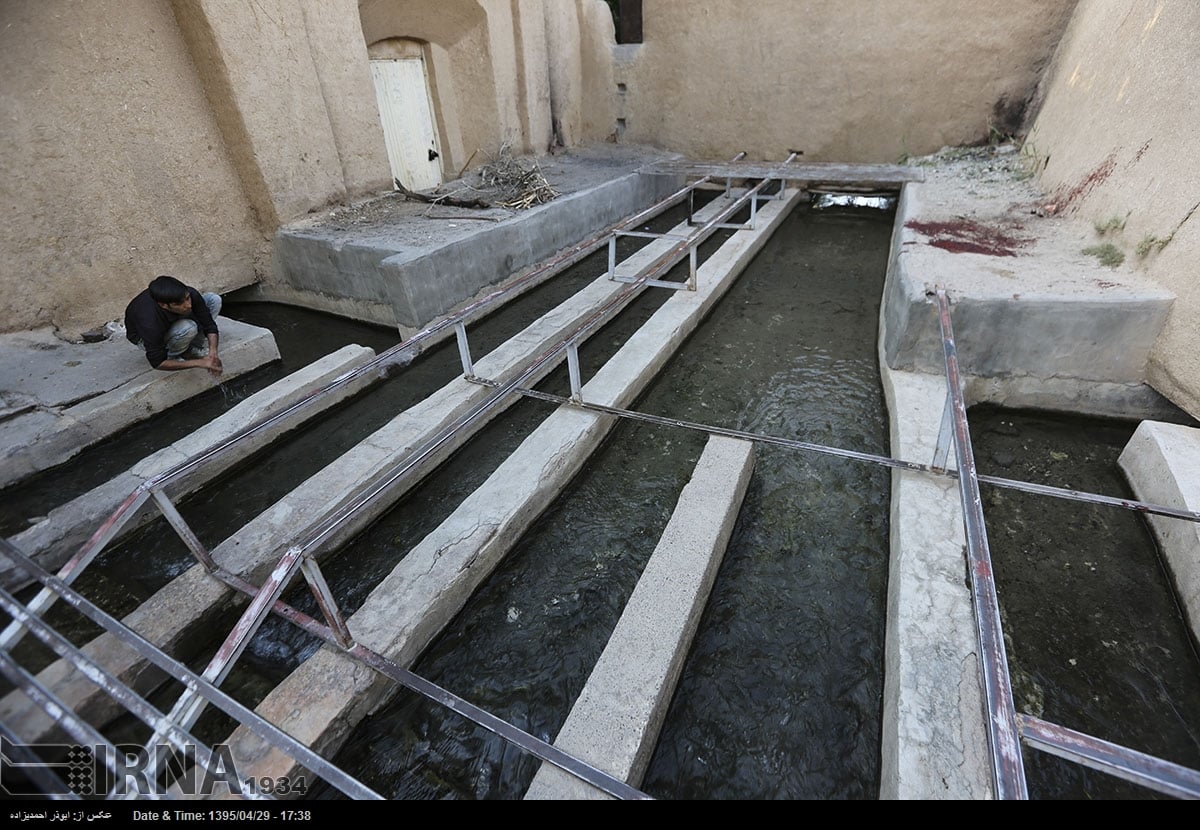
Iran’s Kerman Province Home to Globally-Registered Qanats

Old Iranian Watering System

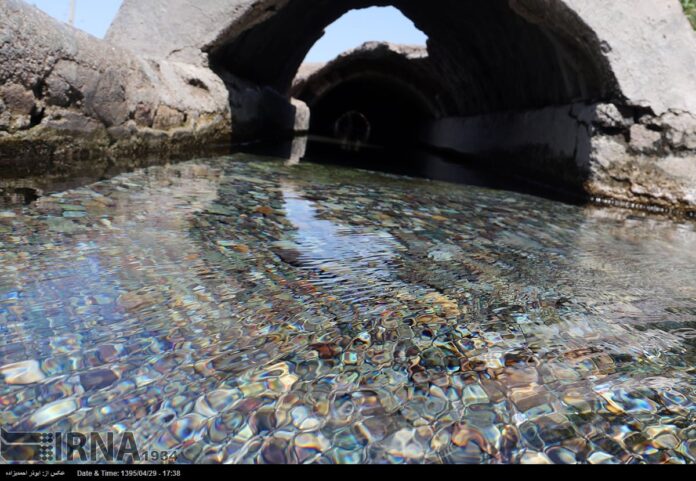
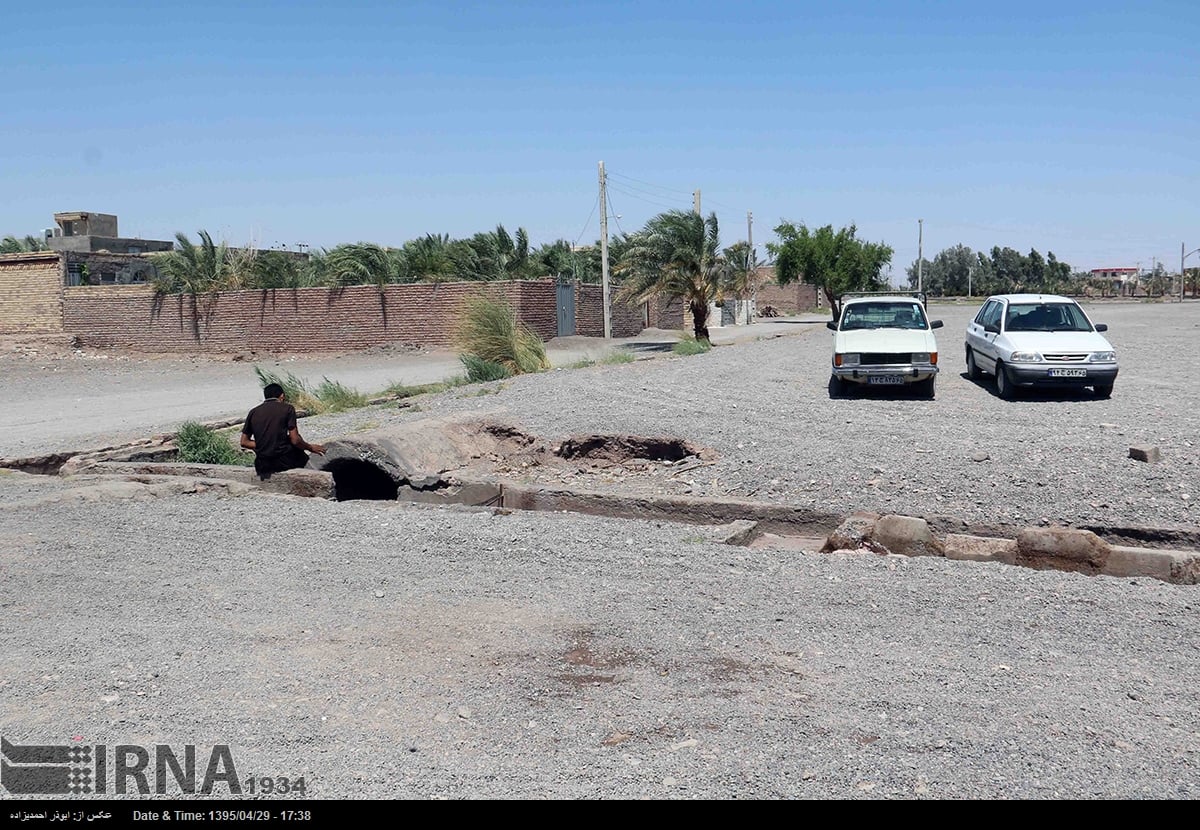
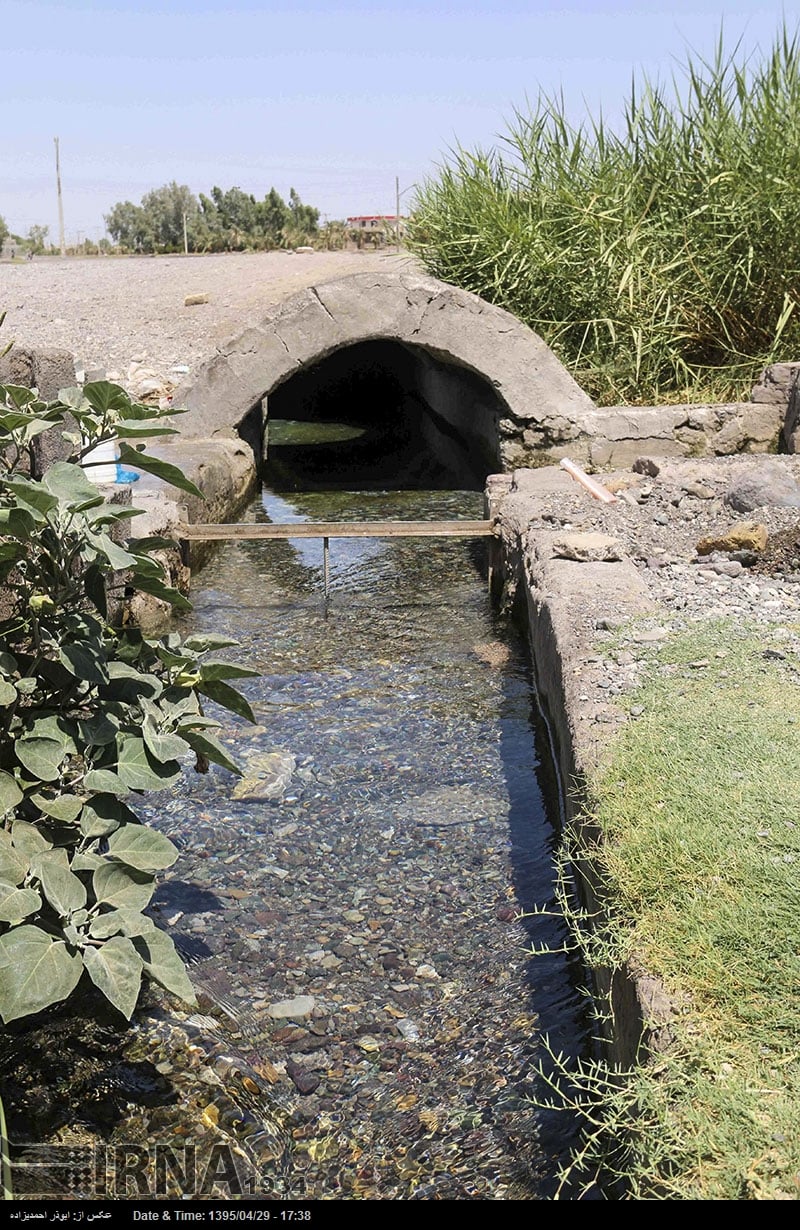
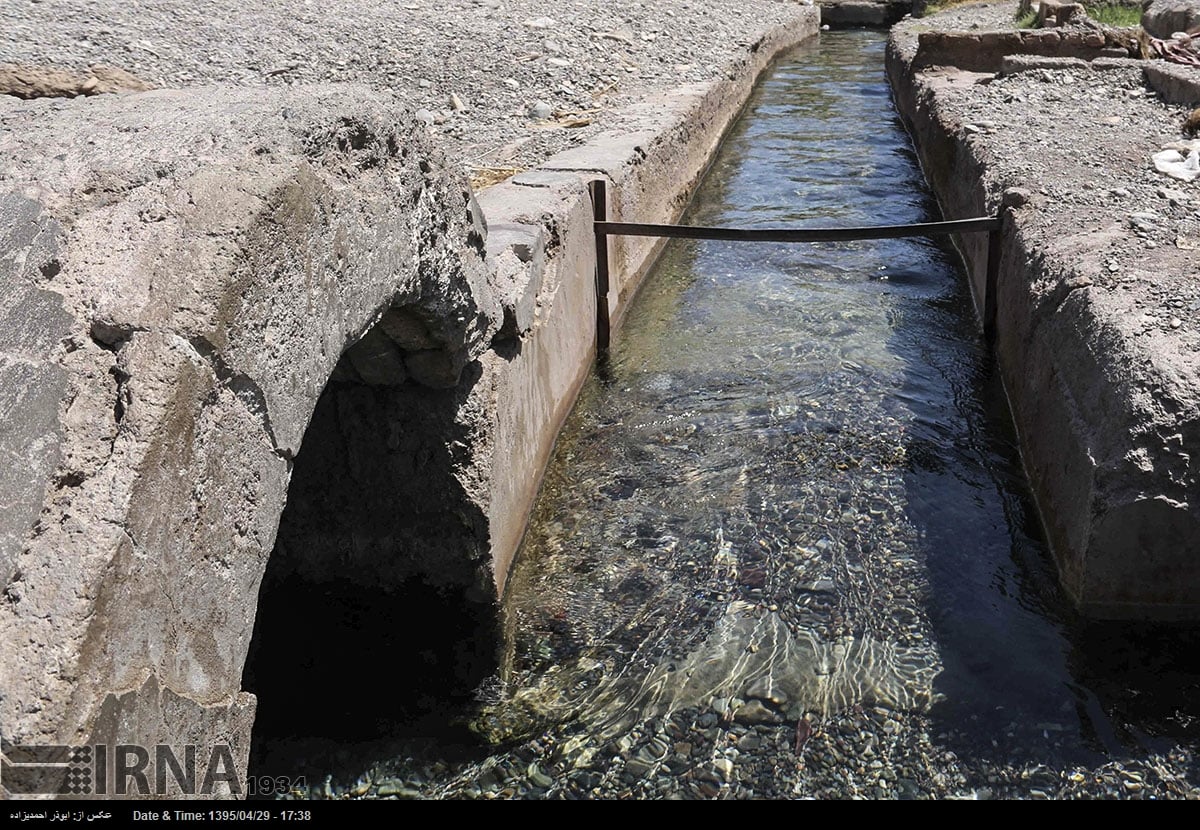
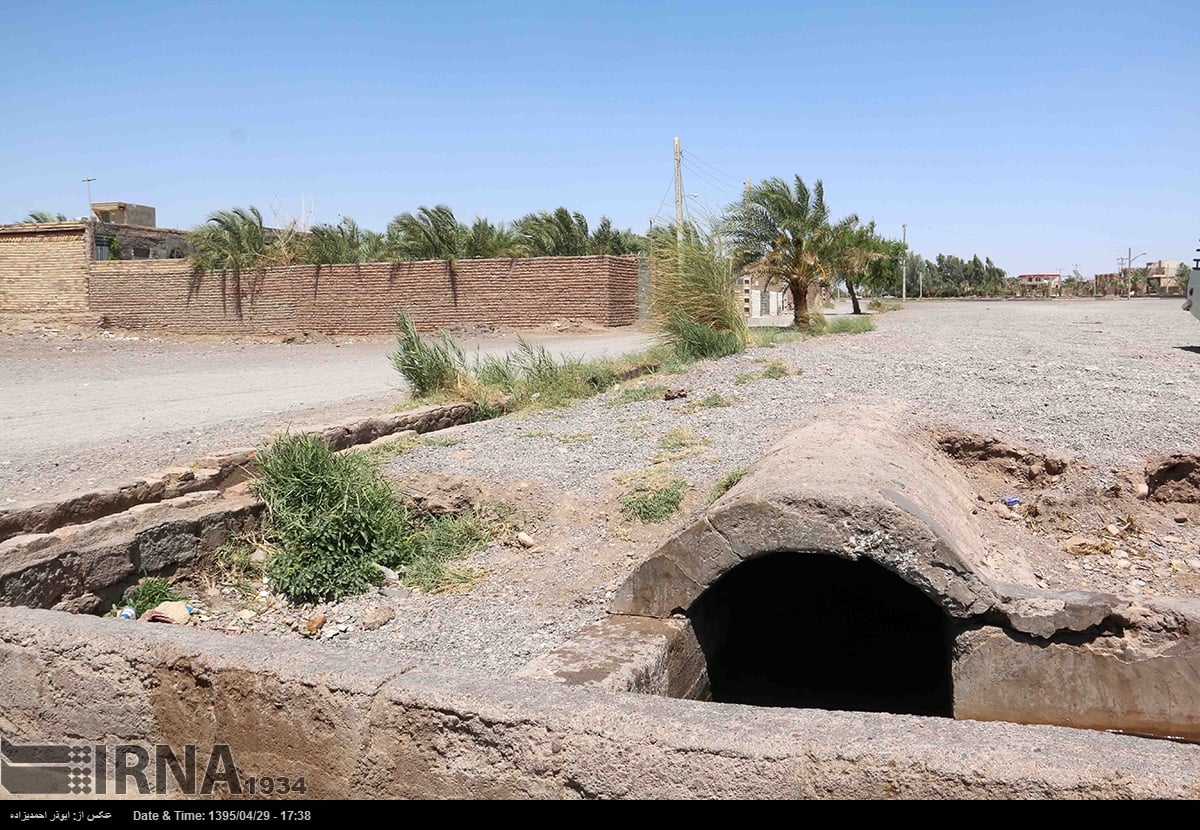
These qanats are considered as the sources of life in the province. In the city of Bam, some of these qanats come out of the desert to irrigate palm trees while the passage of time has not been able to harm them.

Three qanats of Gohar-Riz Jupar, Akbarabad and Qasemabad of Kerman province have been registered in the UNESCO’s World Heritage List, and are visited by thousands of tourists each year.

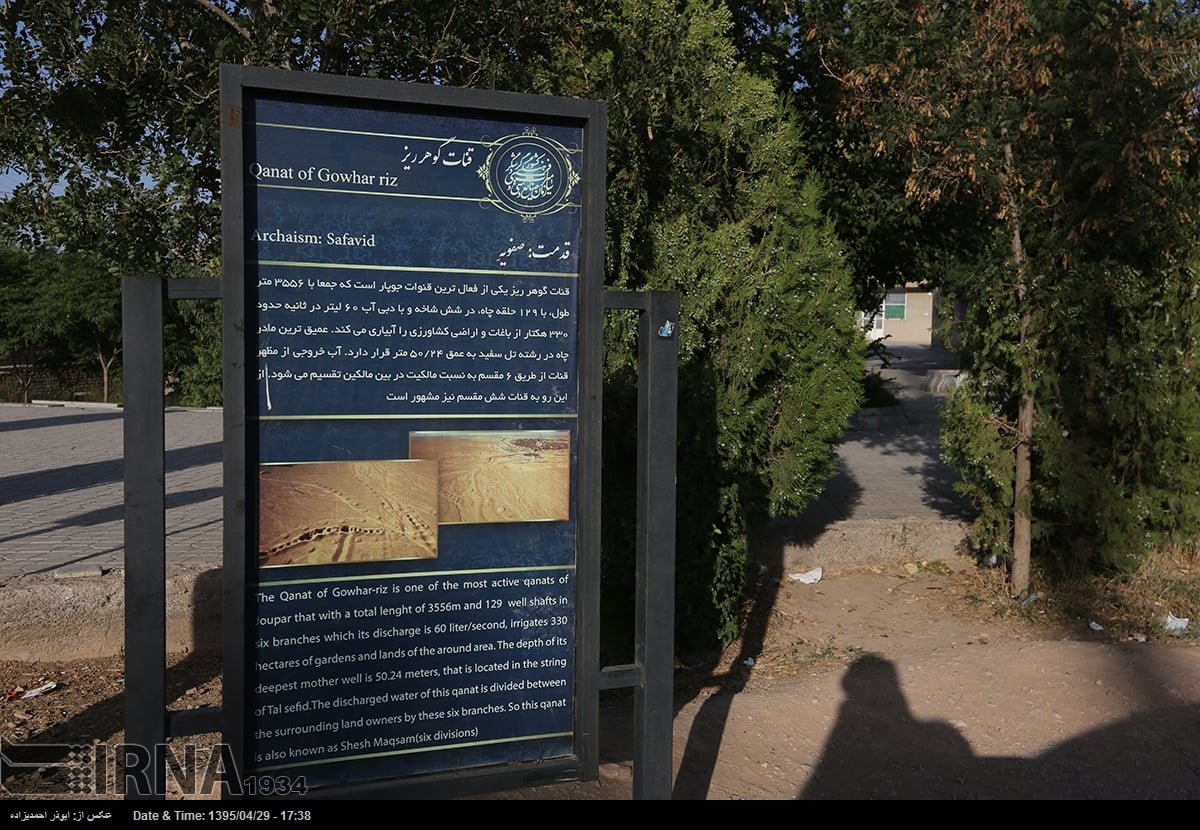
Gohar-Riz qanat is located on the slopes of Jupar Mountains, and is now considered as one of the most important qanats of the province.

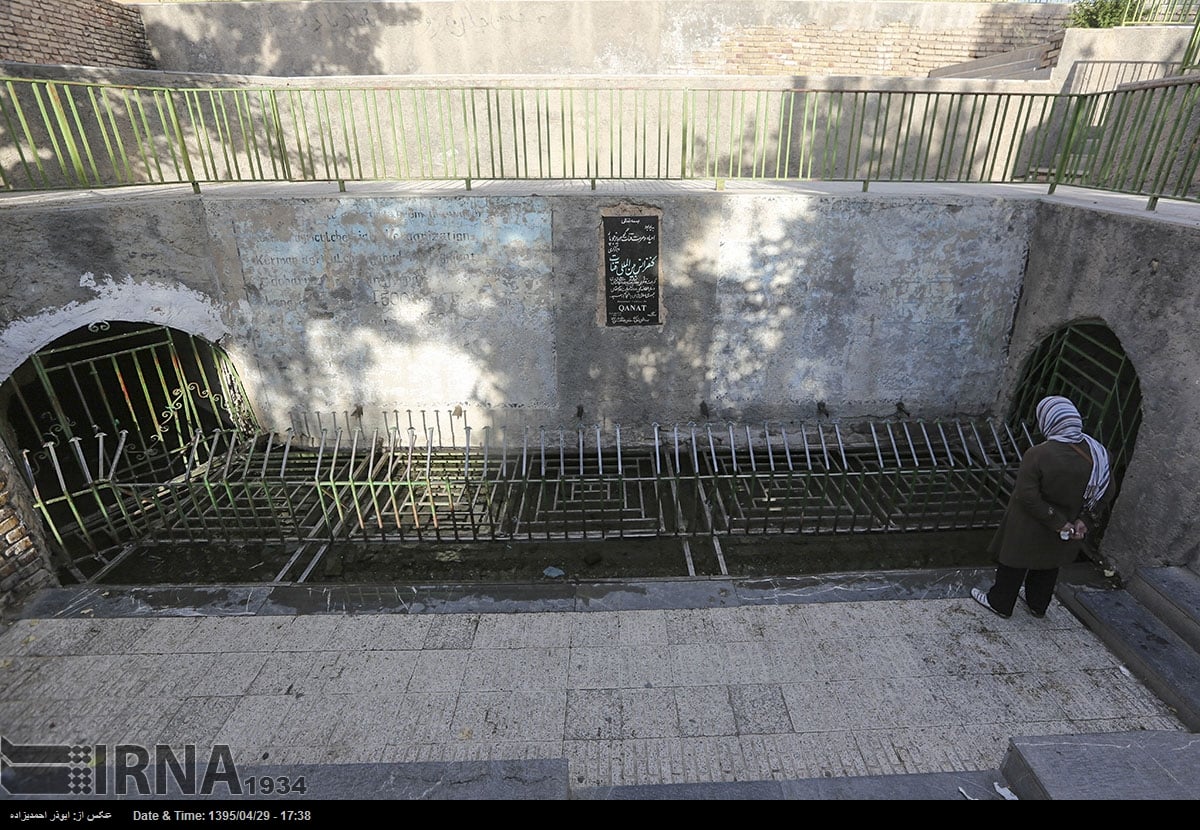
This qanat is 750 years old and dates back to the Safavid era. The 3,356-metre long qanat has 129 wells and irrigates almost 330 hectares of lands in the city of Jupar.

One of the advantages of such qanats is that their water is sourced from faults.

Akbarabad and Qasemabad in the east of Kerman are also among the qanats that have huge amounts of water. They date back to the late Qajar and Pahlavi dynasties with a length of about four kilometres.

Persian Qanat
Persian Qanat Amazing but Less-Known Attraction: Italian Tourist

Qasemabad qanat’s irrigation speed is about 90 litres per second while that of Akbarabad is 60 litres per second. These two provide water for about 300 hectares of gardens in the region.

In recent excavations on the walls of Bam, qanat inscriptions from the Achaemenid era have been discovered.

Extracting underground waters through qanats is one of the wonderful inventions by mankind which has played a crucial role in Iran’s agriculture since ancient times.

Most of the historians and researchers have attributed the technology of qanat building to Iranians and consider Iran as the birthplace of qanats.

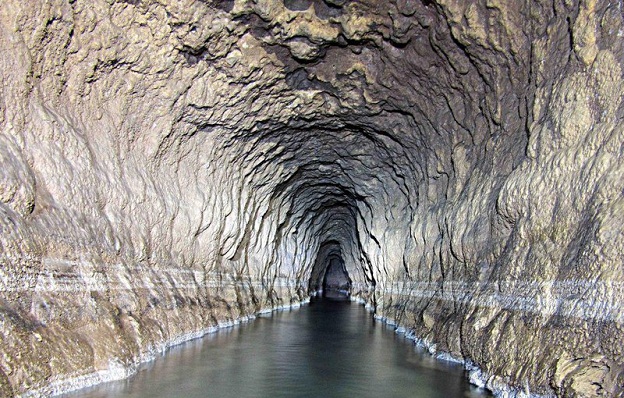
Qanat is one of a series of well-like vertical shafts, connected by gently sloping tunnels. They create a reliable supply of water for human settlements and irrigation in hot, arid and semi-arid climates.

Throughout the arid regions of Iran, agricultural and permanent settlements are supported by the ancient qanat system of tapping alluvial aquifers at the heads of valleys and conducting the water along underground tunnels by gravity, often over many kilometres.

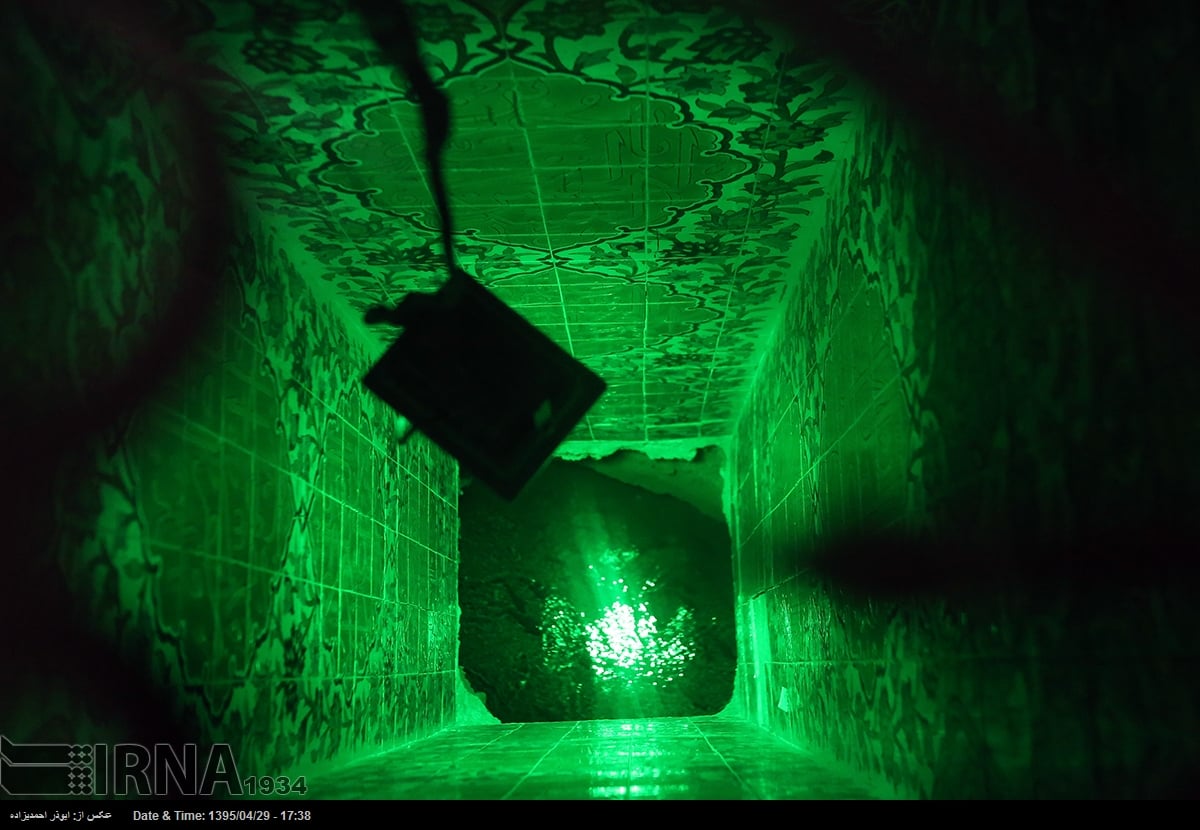
The qanats representing this system include rest areas for workers, water reservoirs and watermills. The qanats provide exceptional testimony to cultural traditions and civilisations in desert areas with an arid climate.

What follows are photos of these qanats retrieved from various sources:

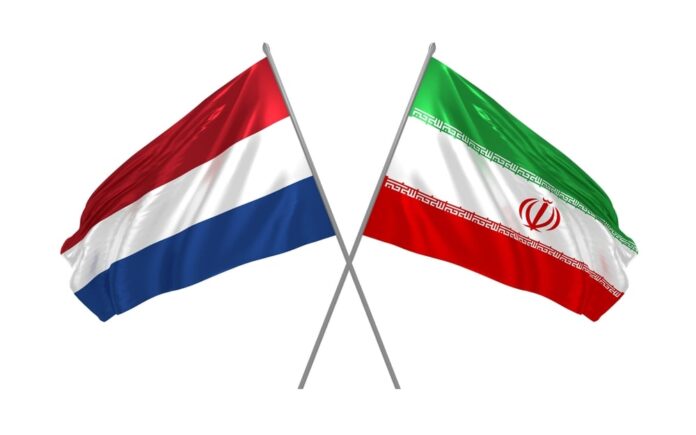
Netherlands Forerunner of Extreme Anti-Iran Moves in Europe: MP

Iranian parliamentarian Seyyed Mohammad-Javad Abtahi says unfortunately, the current ruling government in the Netherlands is strongly anti-Iran and anti-Islam.

In a Farsi interview with ICANA, he said the Netherlands has warned its citizens to remove sensitive information on their laptops and handsets during their trips to Iran.

Abtahi argued that the Netherlands has shown it is a pioneer in extreme movements in Europe, saying, “One may think France, Germany and Britain must take all anti-Iran and anti-Islam actions, but the Netherlands is the one that plays this role.”

“On the other hand, the Netherlands has no direct role in the talks and can also act as a role model for other European countries in this regard.”

“The Netherlands acts in a way to test the reactions of Iran, as well as its friends and international organizations, and in this way forces the international organizations to pass resolutions against Iran,” noted Abtahi.

This Iranian MP concluded that the Netherlands has been the dominant party among European countries to push against Iran. Moreover, the current ruling party in the Netherlands has an anti-Iran approach and its policies are dictated by the strong Zionist lobby that is active there.

Abtahi’s comments came after the Ministry of Foreign Affairs of the Netherlands sent out a letter warning Dutch travellers visiting Turkey, China, Russia and Iran that their electronic devices may be unsafe in these countries, BBC Türkçe reported on Monday.

The ministry warned that data on electronic devices, including laptop computers and smartphones, may be read and copied by third parties in these countries, and said that sensitive information should not be carried on these devices under any circumstances.

“It is painful, but the warnings on cyber espionage will also apply to our NATO ally Turkey, as well as Russia and Iran,” BBC Türkçe quoted a foreign ministry source as saying.

Plane Carrying First Group of Brazilian Tourists Lands in Iran

The passengers including 62 tourists and 14 crew members have earlier traveled to Japan, China and India before arriving in Iran and will head to Italy and Morocco after visiting Shiraz.

According to a Farsi report by Khabar Online, these tourists would spend four days in Shiraz to visit tourist attractions and cultural works of Fars Province in southern Iran.

Shiraz is the fifth most-populous city of Iran and the capital of Fars Province. Shiraz is one of the oldest cities of ancient Persia. In the 13th century, Shiraz became a leading centre of the arts and letters, due to the presence of many Persian scholars and artists. It was the capital of Persia during the Zand dynasty from 1750 until 1800. Two famous poets of Iran, Hafez and Saadi, are from Shiraz, whose tombs are on the north side of the current city boundaries.

Shiraz is known as the city of poets, literature, and flowers. It is also considered by many Iranians to be the city of gardens, due to the many gardens and fruit trees that can be seen in the city, for example Eram Garden.