Friday, December 26, 2025
Home Blog Page 3550

Hunting Scenes on Tiles of Tehran’s Golestan Palace

Hunting Scenes on Tiles of Tehran’s Golestan Palace

Tile art is a small arrangement of tiles; or in some cases, a single one with a painted pattern or image on top. The art has always had an important status among various decorative arts in Iran.

The tradition was pretty strong in the Qajar era (1785-1925) in Iran.

The art has been used to decorate walls of the Golestan Palace in downtown Tehran, which was rebuilt to its current form in 1865.

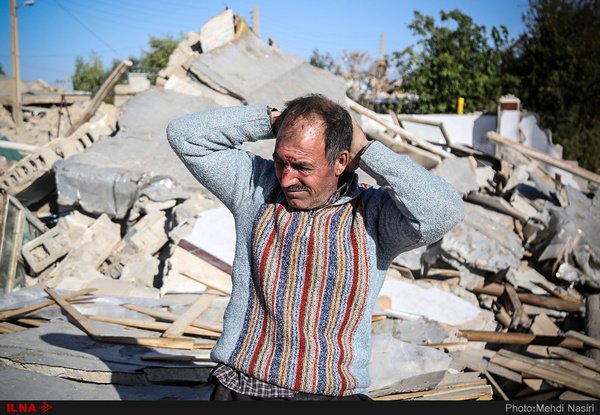
Following are IRNA’s photos of hunters and animals depicted on the ceramic tile wall of Golestan Palace; a prominent world heritage site of Tehran:

Iran Appoints Ten New Ambassadors, Representatives  

Iran Summons French Envoy over Macron’s Anti-Islam Stances

The newly appointed representatives and ambassadors are as follows:

1- Esmail Baqaei Hamaneh as Ambassador and Permanent Representative of the Islamic Republic of Iran to the United Nations Office in Geneva, Switzerland

2- Kazem Gharib-Abadi as Ambassador and Permanent Representative of the Islamic Republic of Iran to the offices of United Nations and other International Organizations in Vienna, Austria

3- Mohammad-Jalal Firouznia as Ambassador of the Islamic Republic of Iran to Beirut, Lebanon

4- Mohammad-Reza Haji-Karim Jabbari as Ambassador of the Islamic Republic of Iran to Bern, Switzerland

5- Abdol-Nasser Hemmati as Ambassador of the Islamic Republic of Iran to Beijing, China

6- Massoud Edrisi Kermanshahi as Ambassador of the Islamic Republic of Iran to Warsaw, Poland

7- Fereydoun Haqbin as Ambassador of the Islamic Republic of Iran to Canberra, Australia

8- Morteza Rahmani-Movahed as Ambassador of the Islamic Republic of Iran to Tokyo, Japan

  1. Seyyed Taha Hashemi as Ambassador of Islamic Republic of Iran to Vatican City, Vatican
  2. Kazem Shafei as Ambassador of the Islamic Republic of Iran to Ljubljana, Albania


“Iran President’s Trips to Bern, Vienna Highly Significant”

Hassan Rouhani

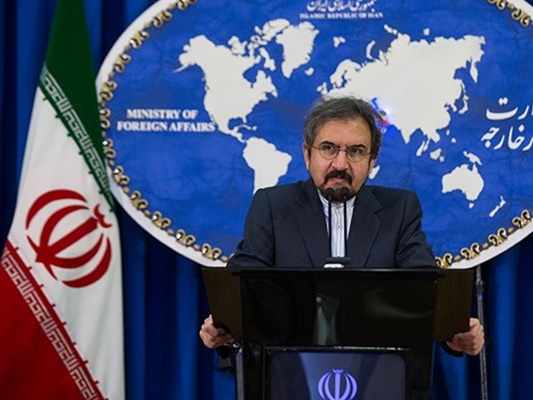
Qassemi on Saturday noted that Rouhani’s trips to Switzerland and Austria, which will begin on Monday as the president’s first visits to Europe since Washington’s withdrawal from the Iran nuclear deal, are important due to several reasons.

“This trip at this juncture can have a positive impact on Iran’s relations with the two countries and with the European Union,” said Qassemi in an interview with the Iranian Students’ News Agency (ISNA).

He said Europe should make it clear that it is willing to safeguard Iran’s interests under the nuclear deal.

“Given the Trump administration’s continued anti-Iran strategy and the US withdrawal from this international agreement (JCPOA), now we are in a situation where other signatories to the JCPOA and the EU should, in practice, prove that they are living up to their commitments and seeking to ensure Iran’s interests under this international deal,” he added.

The spokesman said President Rouhani, heading a high-ranking political-economic delegation, will travel to Bern and Vienna on Monday and Tuesday at the invitation of his Swiss and Austrian counterparts.

“This is a pre-planned visit, and important agenda items are to be discussed during the talks,” he said.

Qassemi underlined that Iran has age-old and wide-ranging relations with European countries, including Switzerland and Austria.

“In the current year, Iran and Austria are on the brink of the 160th anniversary of the commencement of their diplomatic relations. Moreover, the history of Iran-Switzerland ties goes back dozens of years,” said Qassemi.

The Foreign Ministry spokesman further touched upon Iran’s cooperation with Switzerland and Austria in economic and industrial domains.

“At the moment, Austria has a special status among European countries. We see that many international and UN-affiliated institutions, including the International Atomic Energy Agency (IAEA), are located in this country, and Austria can be described as one of the international historical-diplomatic capitals,” Qassemi noted.

He also referred to the several rounds of nuclear talks held between Iran and the P5+1 countries in Austria.

“All officials of this country from different parties and political groups have had a positive view towards these talks and the 2015 agreement both during and after the negotiations, and have seriously criticised the United States’ unilateral policies against this international agreement,” he said.

The spokesman touched upon the Swiss government’s political look at global issues, saying, “Switzerland is an independent country and has always, even during the sanctions and given the kind of viewpoint it has, tried to maintain its relations with Iran. On the other hand, we are seeing that the United Nations’ second important headquarters is located in this country as well,” he said.

He noted that Austria will assume the rotating presidency of the European Union as of July 1, adding, “Mr Rouhani is the first high-ranking official to travel to Austria after the rotating presidency of the EU is handed over to this country.”

“At this juncture when we are seeing the US’ pullout from the JCPOA and intense talks being held between Iran and Europe to discuss ways of preserving this international agreement given the international community and the EU’s desire to maintain the JCPOA, this trip will be extremely important in clarifying how the current path of cooperation should continue,” he said.

Qassemi noted that Iran has continued its policy of interaction with other countries and has always sought to enhance its relations with other states at the highest levels and in a balanced, fruitful and constructive atmosphere.

“During this trip, the authorities of the Islamic Republic of Iran and the two European countries of Austria and Switzerland will review the current trend of their relations while discussing ways of boosting reciprocal ties as well as regional and global developments. This visit can, at this juncture, have positive outcomes for Iran, Austria, Switzerland and other European countries,” he noted.
He also commented on reports that the president’s trip was supposed to have taken place earlier, but was delayed.

“Making arrangements for such trips at such a level can generally be coupled with several technical and protocol issues because arranging such trips entails taking all preparations and requirements into consideration by both countries,” he said.

“Talks and discussions had already taken place between the authorities of both countries on the possibility of this trip taking place earlier, but at the end of the day the necessary technical conditions were not met, and the visit was postponed to another time. Now, given the consultations held between Iran and the two countries, the date of the trip has been finalised,” he said.

Elsewhere in his remarks, Qassemi stressed the importance of President Rouhani’s forthcoming trips to Austria and Switzerland.

“This is the president’s first trip to Europe to discuss the US withdrawal from the JCPOA. Of course, different contacts have been made at different levels between Iranian and EU officials during this time, but this trip at such level is of special importance and can put forward a more precise picture and solutions regarding cooperation between Iran and the European countries,” he said.

He said Iran’s relations with Austria and Switzerland have been calm and non-controversial.

“High-level political and economic consultations with these two countries’ officials at this juncture (the US withdrawal from the JCPOA) and White House authorities’ continued anti-Iran strategy can shed more light on Iran’s compliance with international regulations and its own obligations,” the spokesman noted.

“Switzerland and Austria have always highlighted Iran’s constructive and stabilizing role in the region as well as the Islamic Republic of Iran’s efforts to fight terrorism,” he said.

Qassemi also said some anti-Iran circles, including the Israeli regime and probably the US’ ruling elite, wouldn’t like to see such trips and interactions take place between Iran and European countries.
“Within the same framework, we saw that envoys from the US Treasury representing the US government travelled to Austria in recent days and, by putting pressure on the government of that country, tried to create hurdles on the way of Iran-Austria cooperation,” he noted.
He said the trip features meetings and consultations between senior officials and probably the signature of documents between Iran and the two European countries.

“As I said, a delegation of top political and economic officials is accompanying Mr Rouhani during this trip,” Qassemi said.

The spokesman further touched upon Iran’s foreign policy on the international stage and the country’s efforts to help establish peace and stability in the region and across the world.

“To that end, and in order to establish better understanding between nations, Iran has always sought to use the lever of diplomacy in the best way possible,” he said.

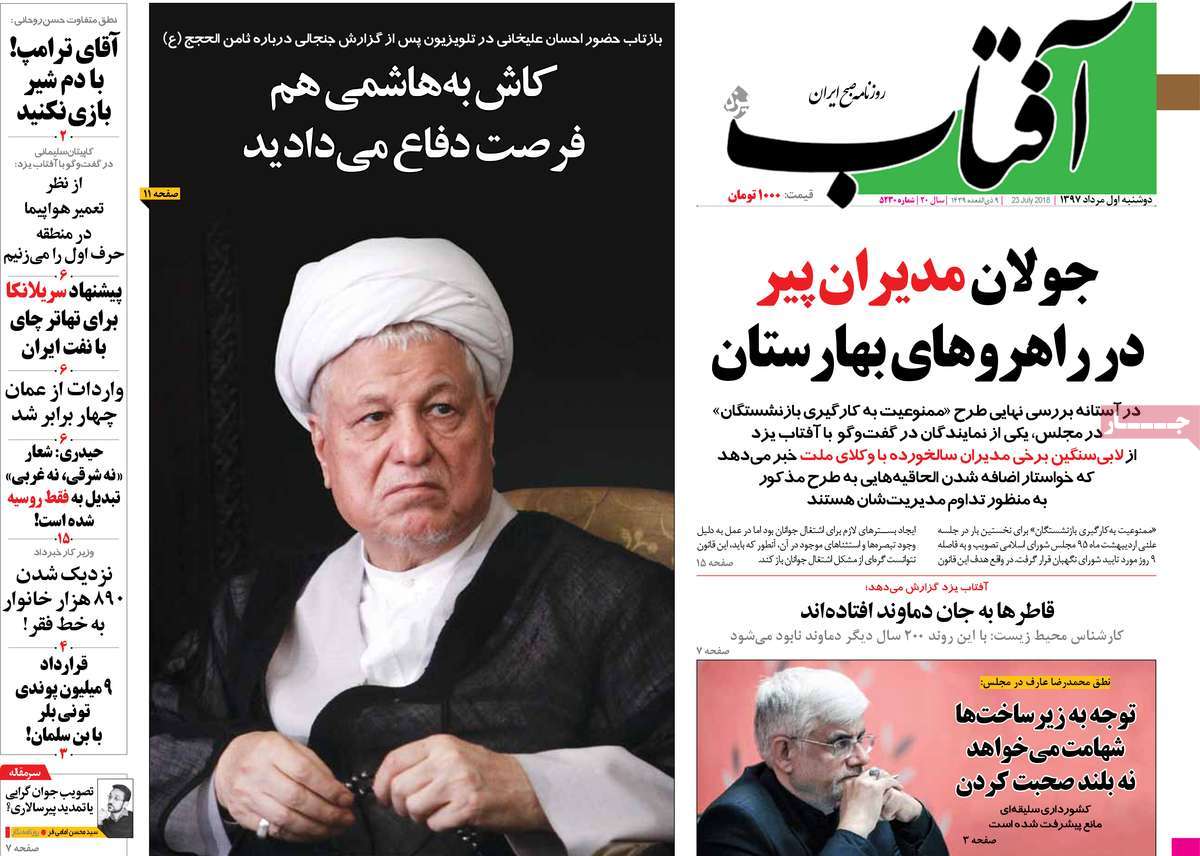
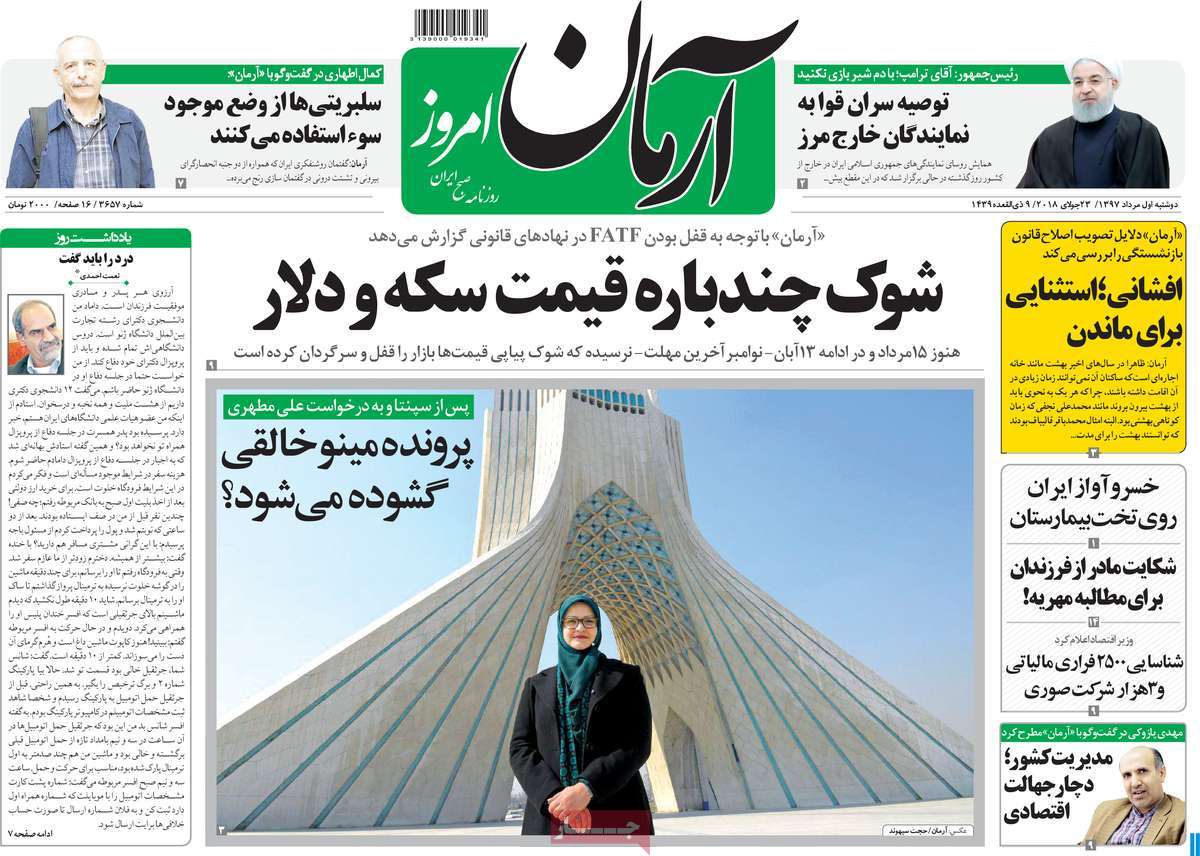
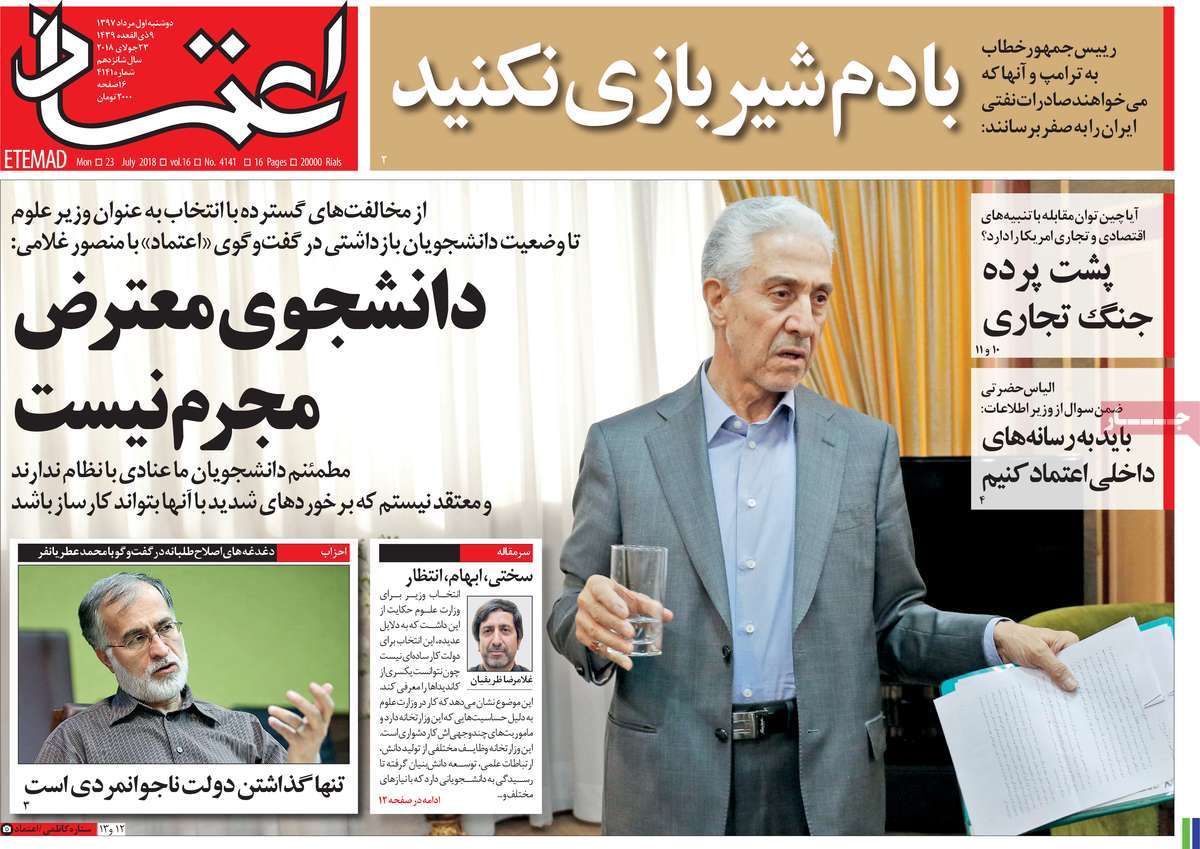
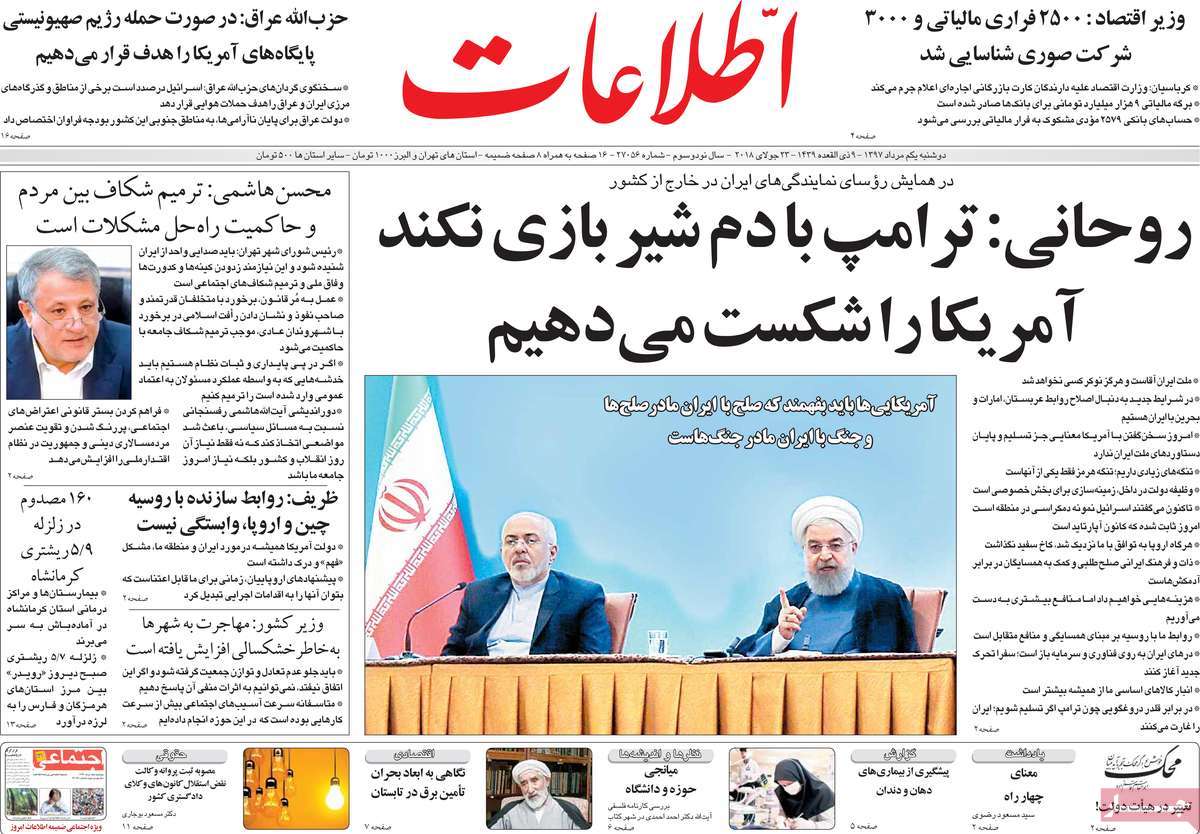
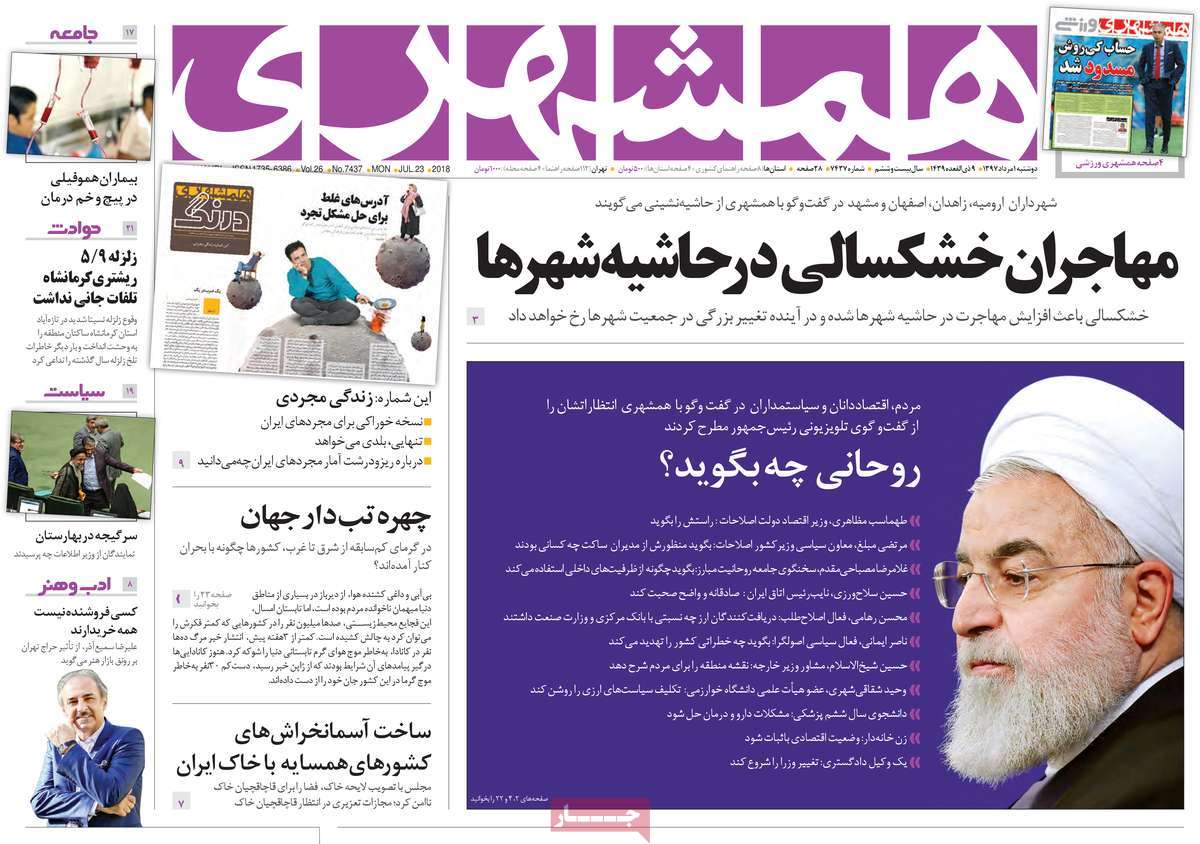
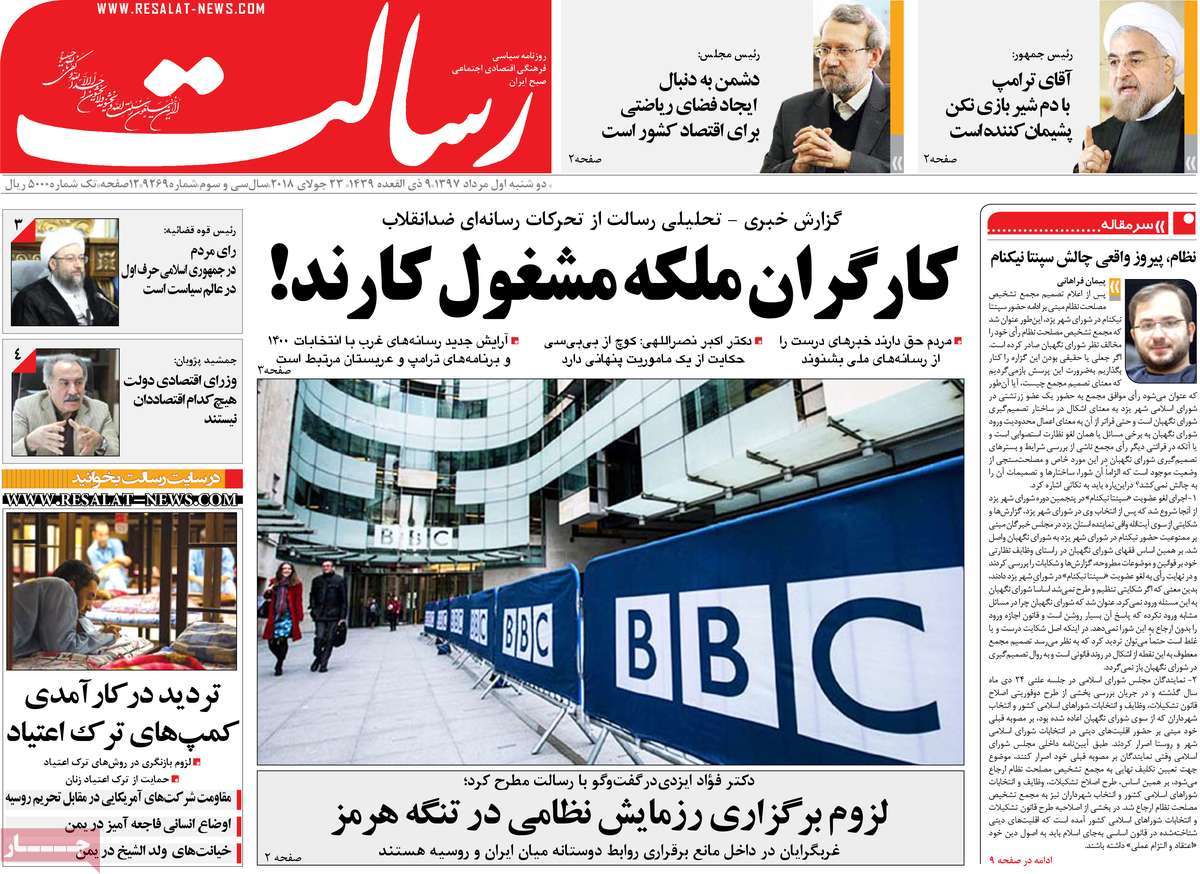
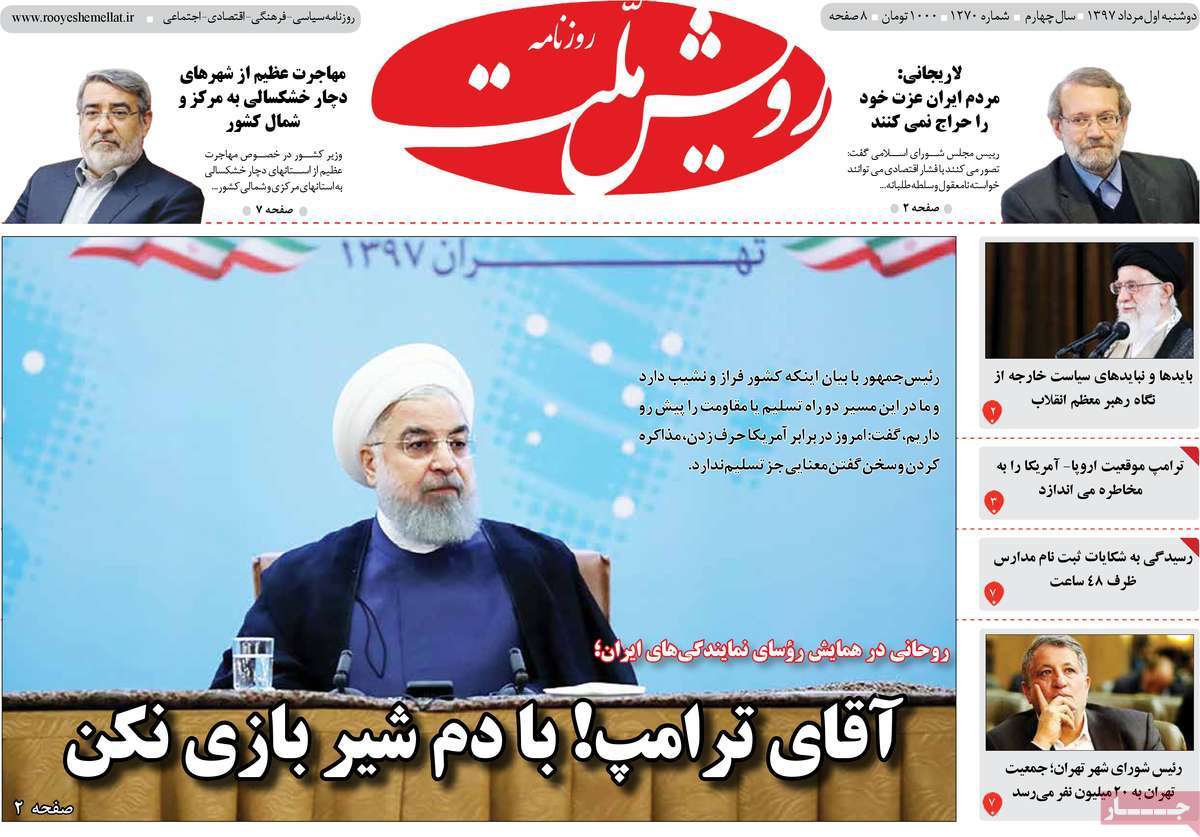
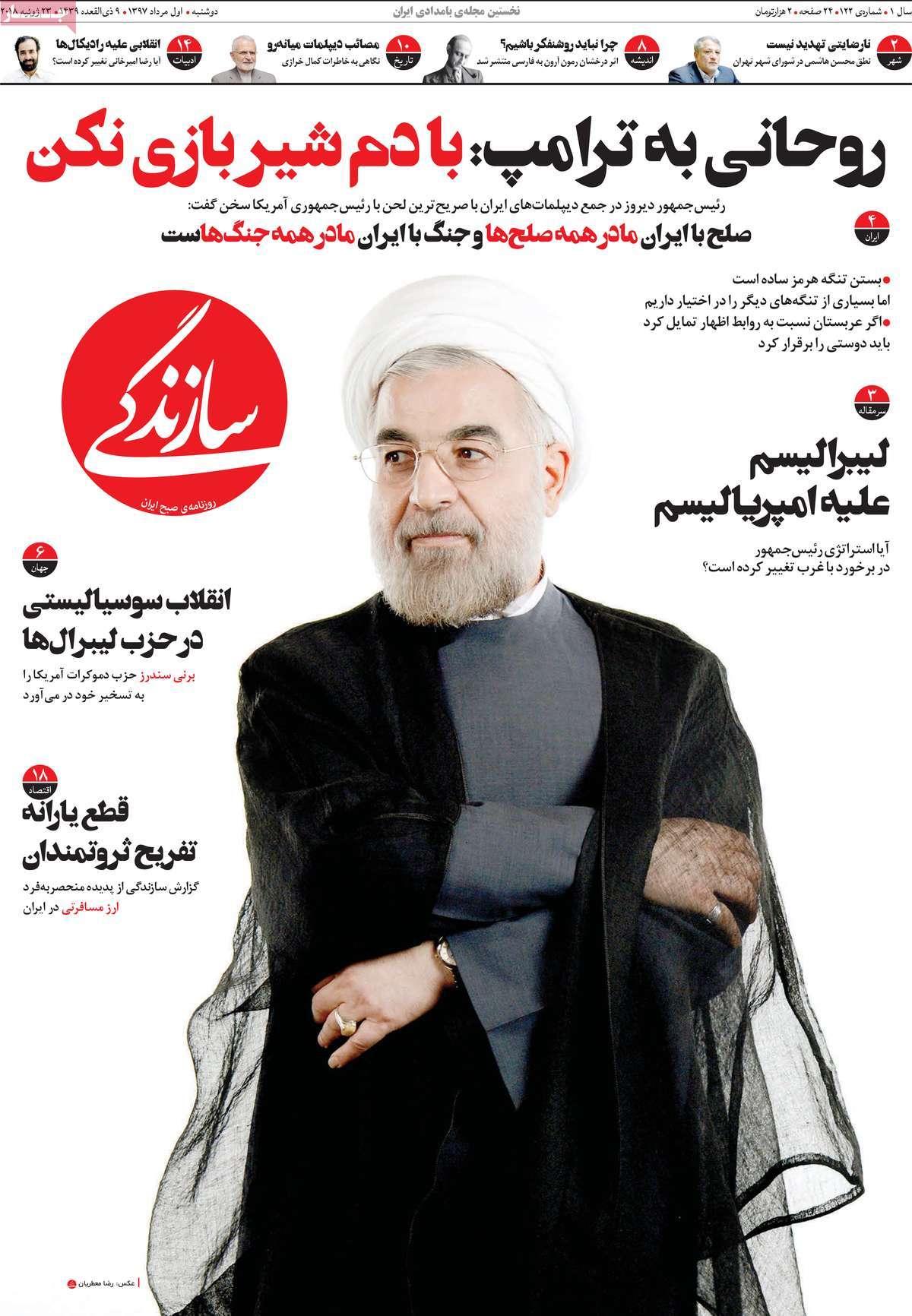
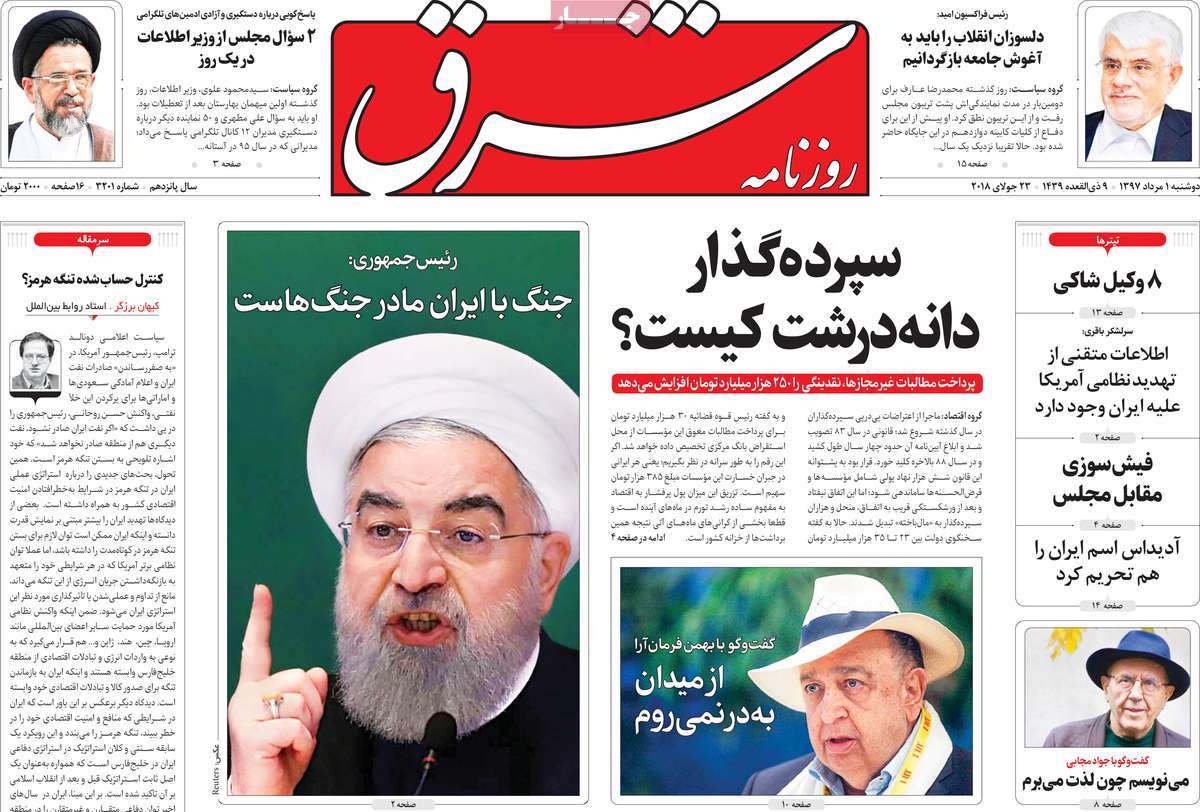
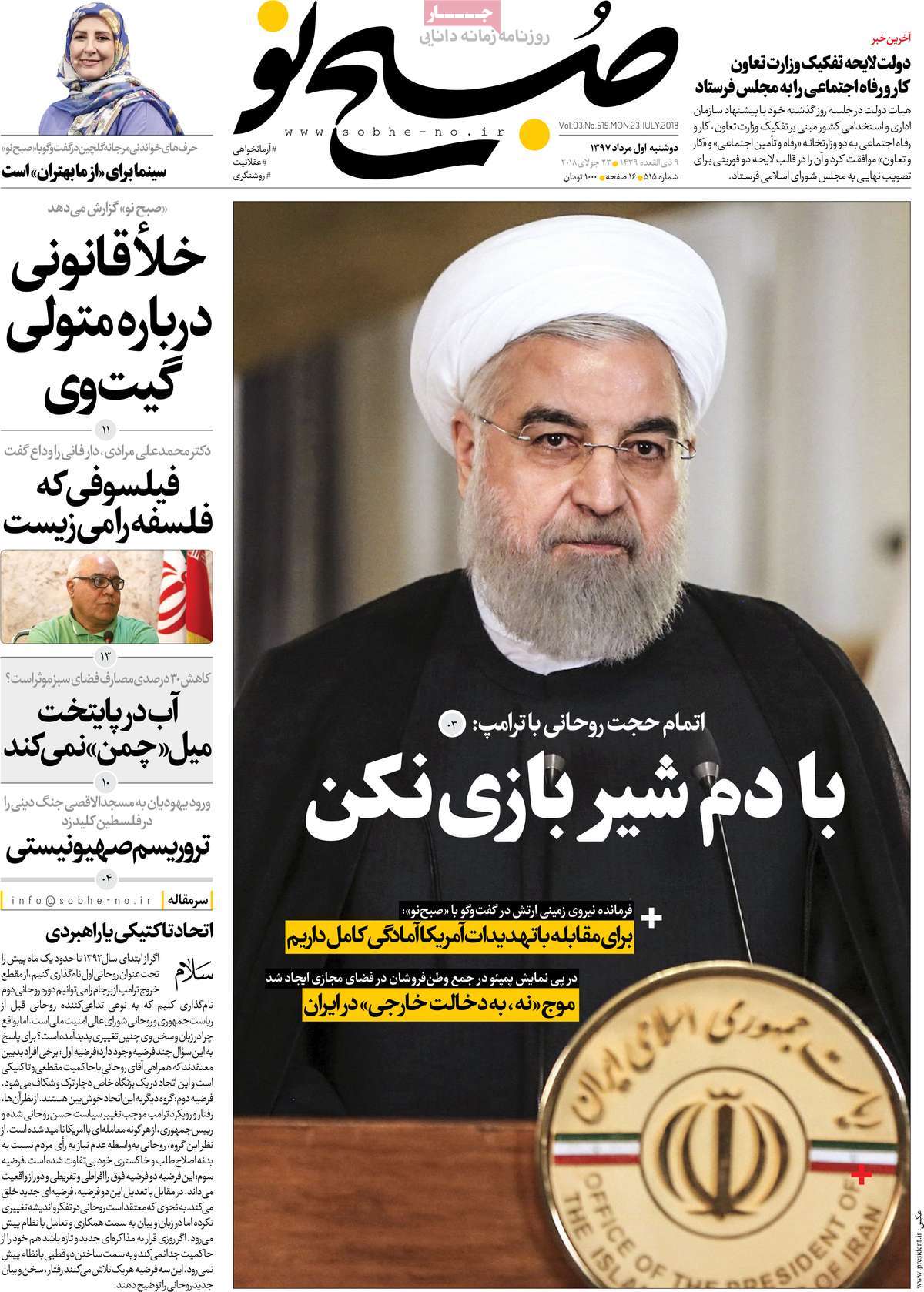
A Look at Iranian Newspaper Front Pages on July 1

A Look at Iranian Newspaper Front Pages on November 19

All papers today covered the remarks made by the Leader of Iran’s Islamic Revolution Ayatollah Seyyed Ali Khamenei about the enemy plots to cause rifts among the Iranian nation and the Islamic Establishment.

The top story, however, was the ICT Ministry’s move to release the names of those mobile phone importers who received foreign currencies with official rates, and the Trade and Industry Minister’s protest against the move.

The water crisis in the south-western Iranian province Khuzestan also received great coverage today.

The above issues, as well as many more, are highlighted in the following headlines and top stories:


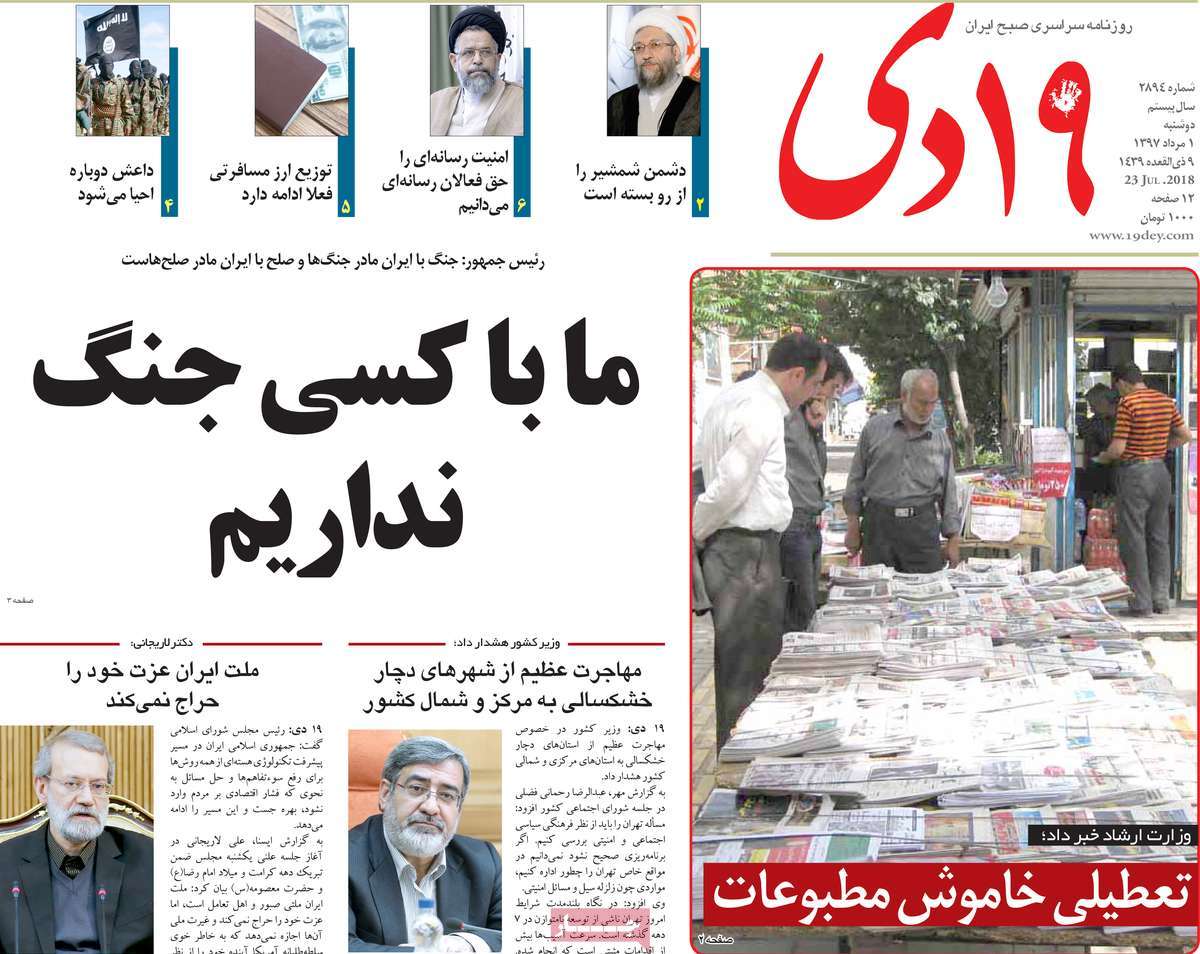
19 Dey:

1- Larijani: Iran Need Spirit of Forgiveness

2- Iran Leader: We’ll Reinforce Bonds with People

A Look at Iranian Newspaper Front Pages on July 1


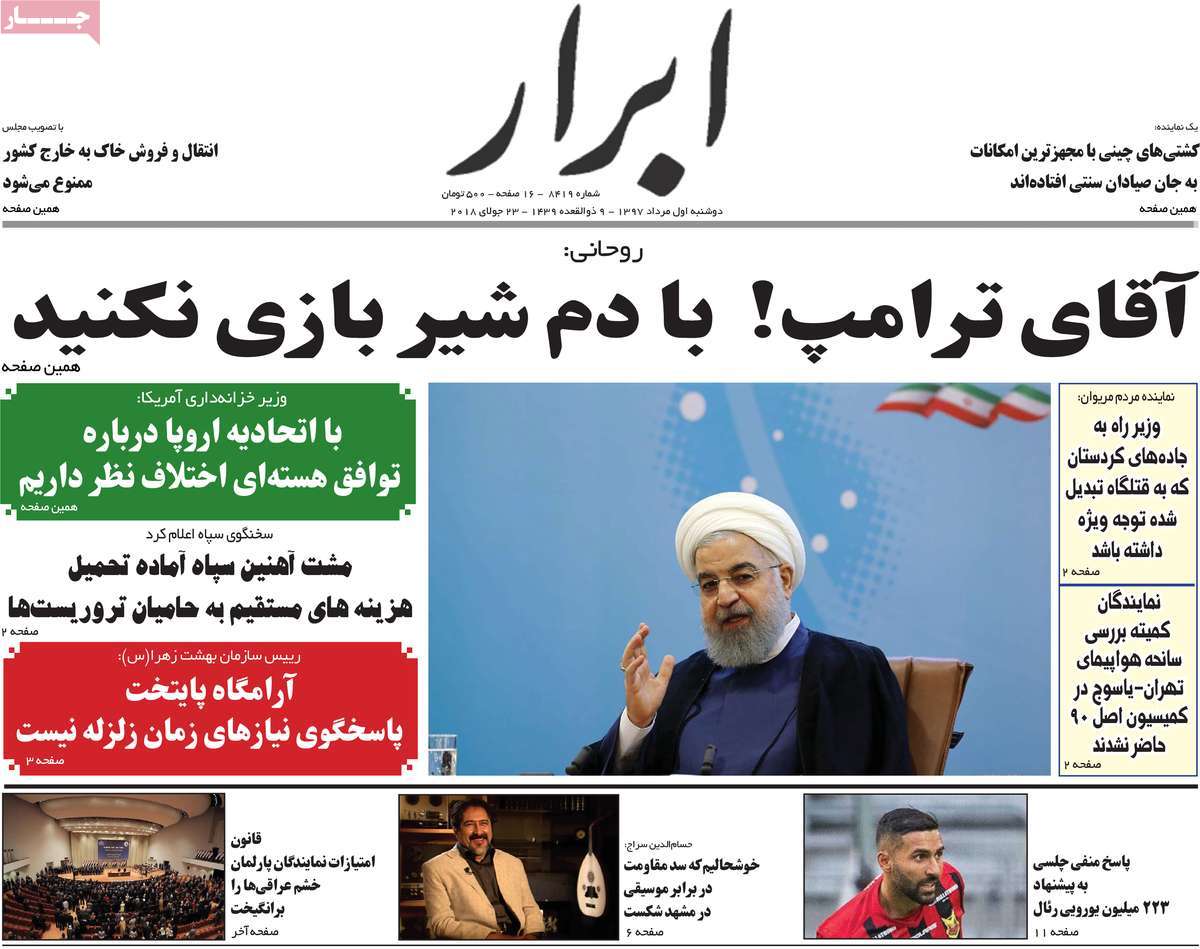
Abrar:

1- Rouhani’s Aide: Central Bank to Blame for Forex Crisis

  • It’s Not Possible to Control Prices with Political Pressure

2- Iran First VP: I Think Mr President Will Make Changes to Cabinet!

3- Moscow: JCPOA a Wonderful but Fragile Agreement

A Look at Iranian Newspaper Front Pages on July 1


Afkar:

1- Qassemi: EU Has Yet to Offer JCPOA Package to Iran

A Look at Iranian Newspaper Front Pages on July 1


Aftab-e Yazd:

1- Trump’s Deceit: US President Trying to Make France Exit EU

A Look at Iranian Newspaper Front Pages on July 1


Arman-e Emrooz:

1- Central Bank Urged to Release Names of Those Who Received Official-Rate Forex

A Look at Iranian Newspaper Front Pages on July 1


Asrar:

1- MP: Profiteers Played Major Role in Bazaar Unrest

A Look at Iranian Newspaper Front Pages on July 1


Bahar:

1- Trade Minister Criticizes ICT Minister for Releasing Names of Those Receiving Official-Rate Forex

  • Azari Jahromi’s Move Led to Chaos in Mobile Phone Market

A Look at Iranian Newspaper Front Pages on July 1


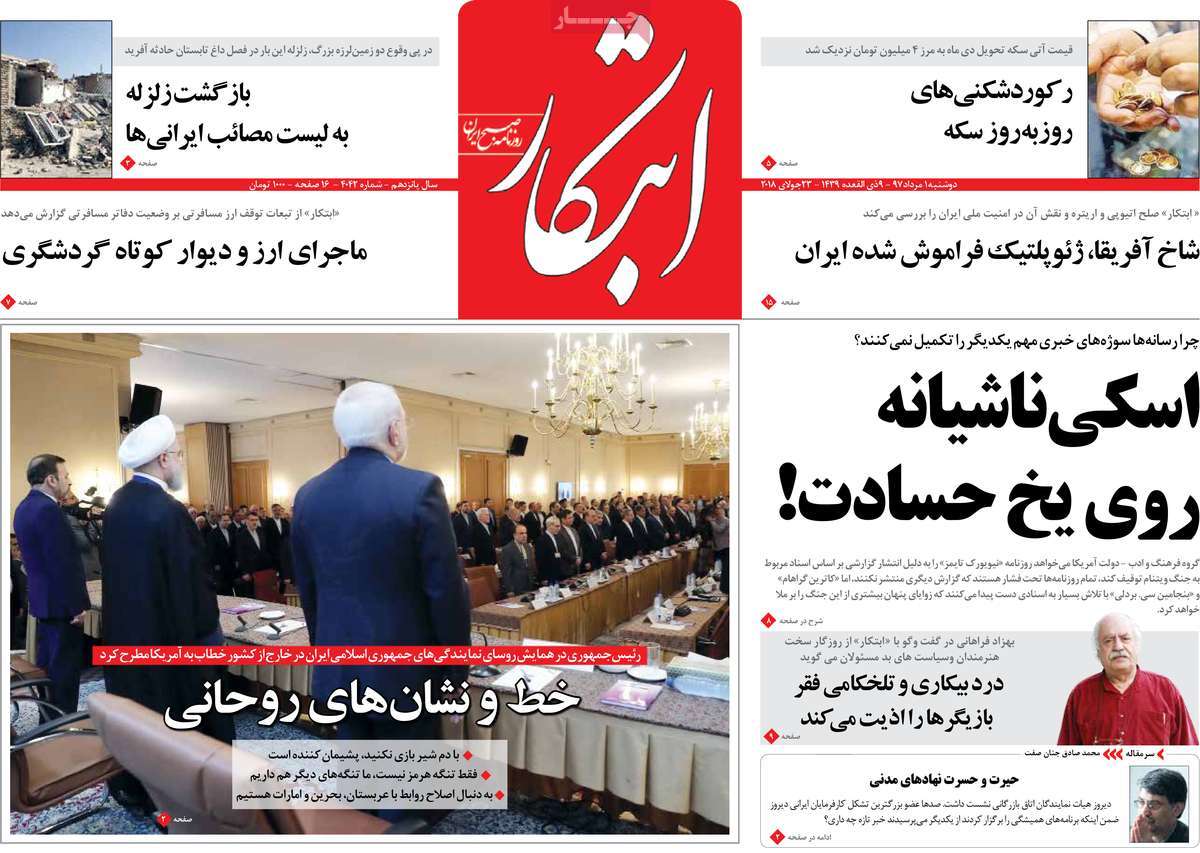
Ebtekar:

1- Rouhani’s Important Agenda in European Visit

  • Qassemi Explains Why Rouhani’s Visit to Switzerland, Austria Matters

A Look at Iranian Newspaper Front Pages on July 1


Etemad:

1- Iran Leader: Being Crushed by Enemies Result of Giving in to Their Demands

A Look at Iranian Newspaper Front Pages on July 1


Ettela’at:

1- Ankara: We’ll Never Turn Our Back on Iran Because of US

2- 7,500 Former Drug Addicts Get Jobs

A Look at Iranian Newspaper Front Pages on July 1


Ghanoon:

1- ICT Minister: People Don’t Tolerate Corruption

  • Pretexts for Not Releasing Names of Those Receiving Official-Rate Currencies Unacceptable

A Look at Iranian Newspaper Front Pages on July 1


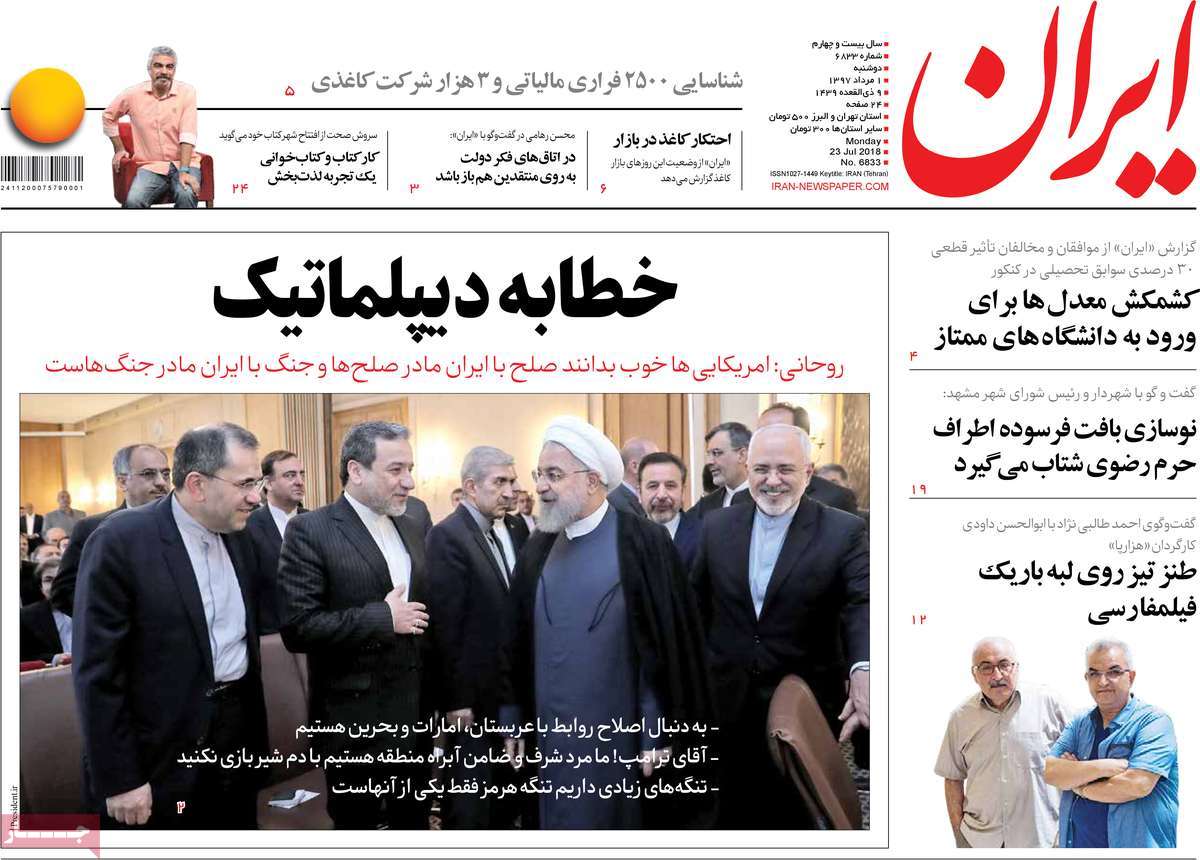
Iran:

1- Government Seriously Pursuing Transparency

  • List of Those Receiving Official-Rate Forex to Be Released after Rouhani’s Order

A Look at Iranian Newspaper Front Pages on July 1


Jame Jam:

1- Iran Leader: Submission Costlier than Resistance

A Look at Iranian Newspaper Front Pages on July 1


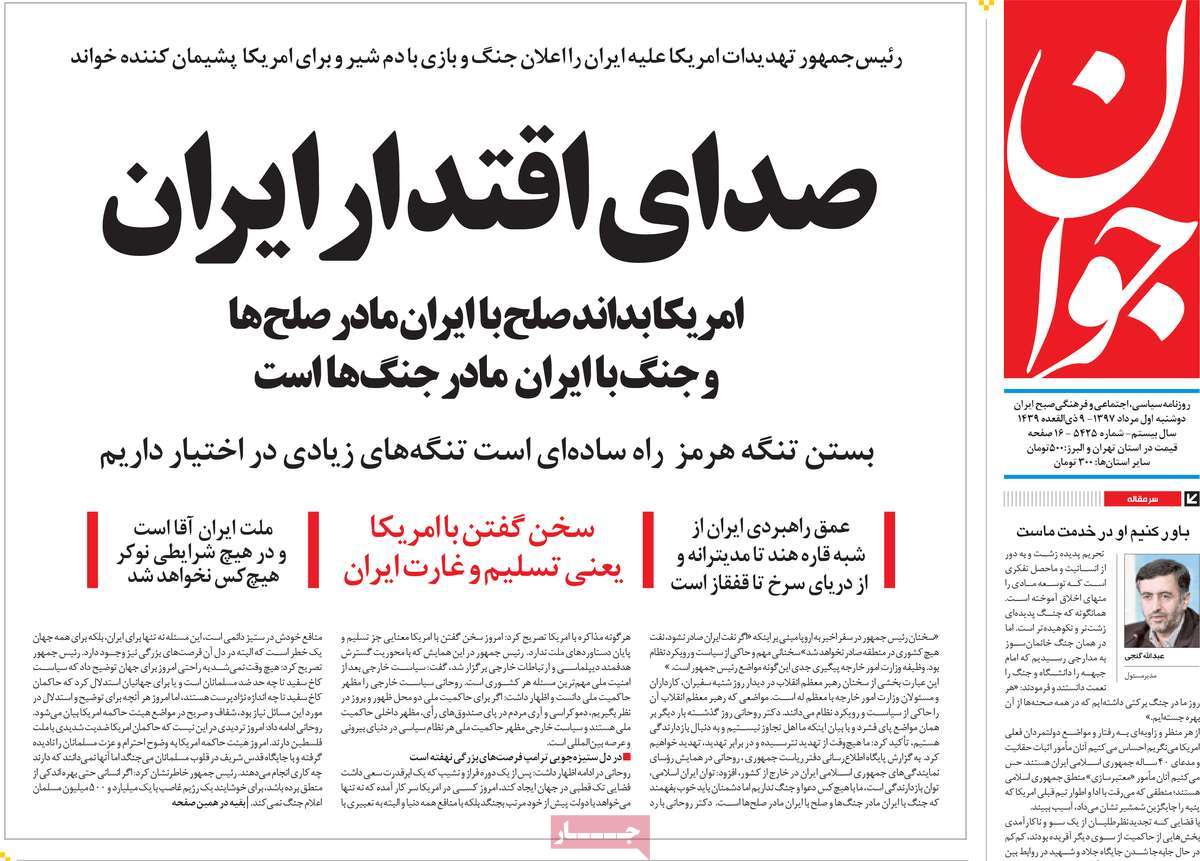
Javan:

1- People, Islamic Establishment Cannot Be Separated: Iran Leader

A Look at Iranian Newspaper Front Pages on July 1


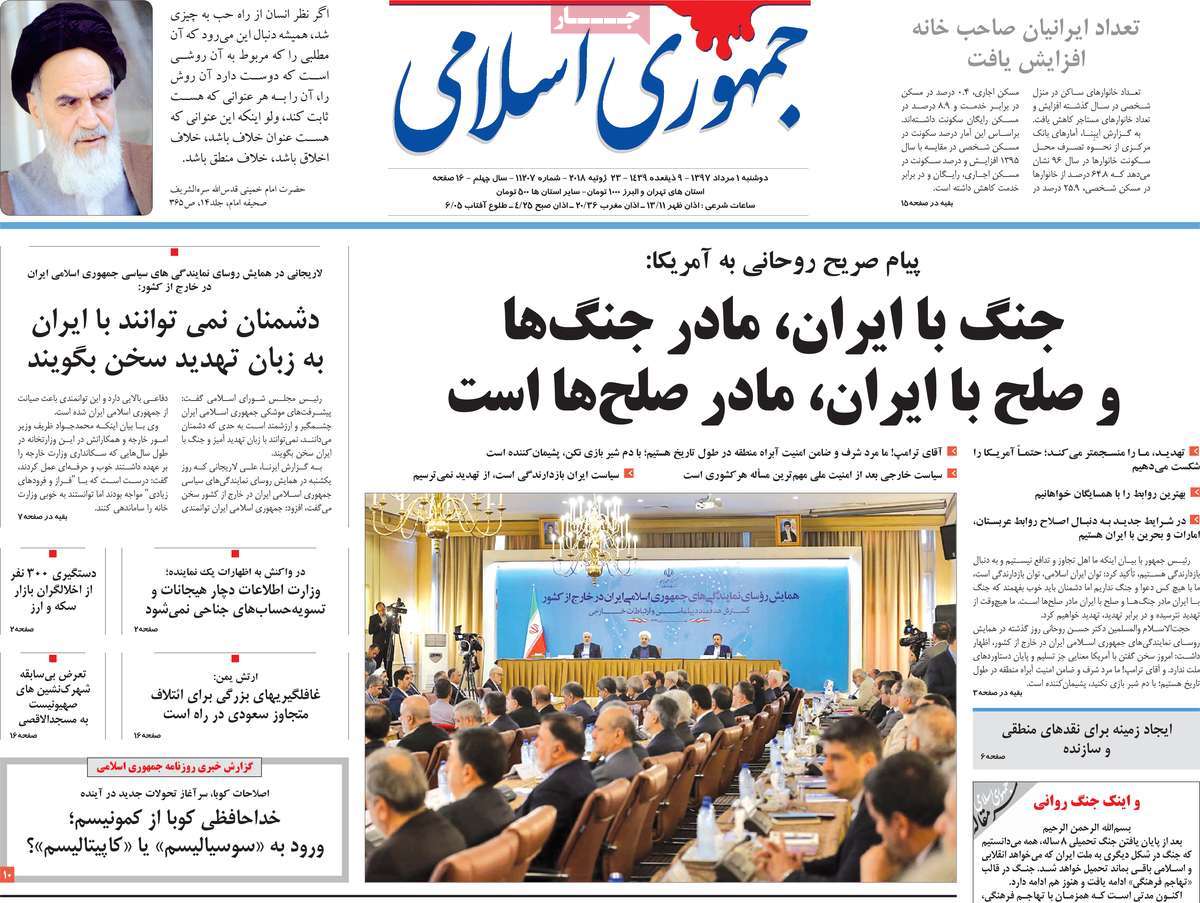
Jomhouri Eslami:

1- Nasrallah Calls for Formation of National Unity Government in Lebanon

2- FATF Extends Suspension of Counter-Measures against Iran until October

A Look at Iranian Newspaper Front Pages on July 1


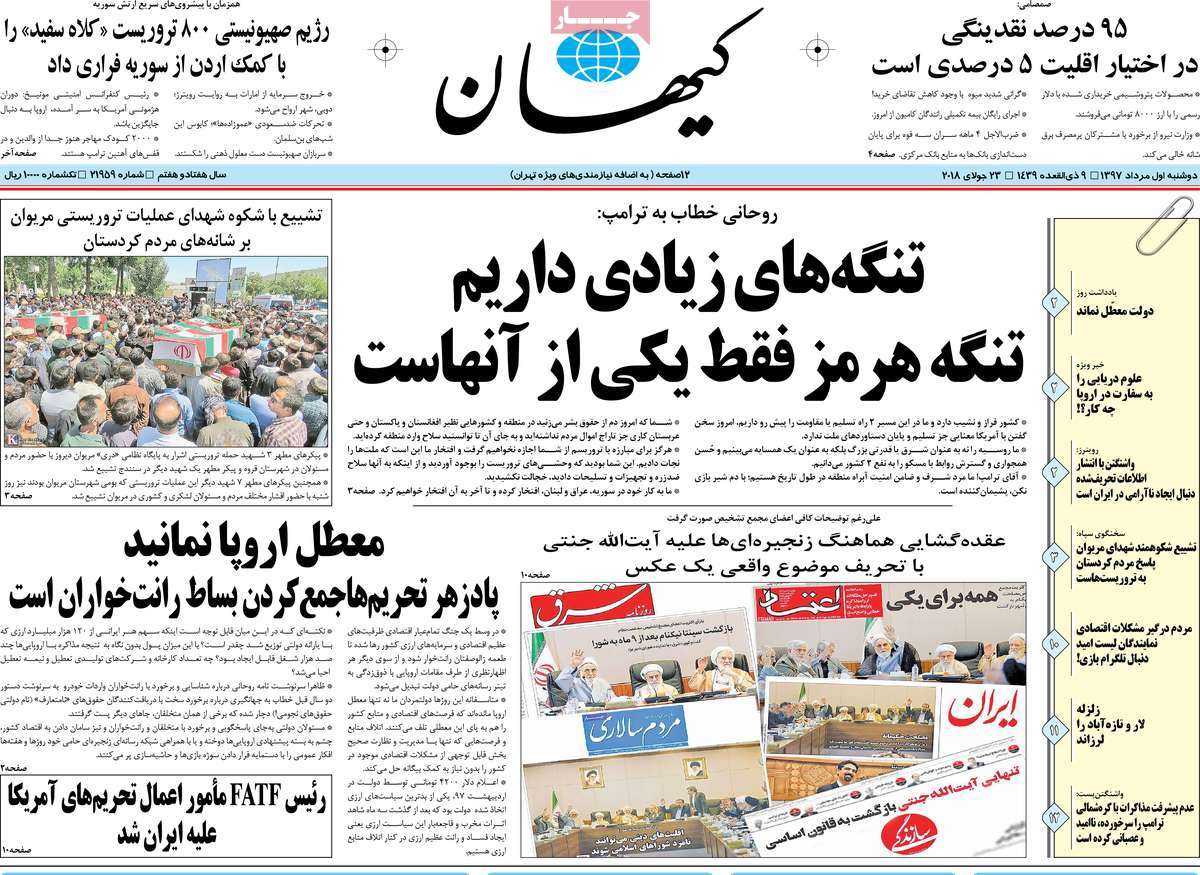
Kayhan:

1- Leader: No Exaggeration in Iran’s Power; It’s All Reality

2- Total Caused Damages and Left Iran, IRGC Construction Base Finished Its Project

  • A Report on Fates of Two Contracts with Iranian, Foreign Firms

3- MP: Video Clip Allegedly Showing Transfer of Iran’s Water to Iraq Fake

A Look at Iranian Newspaper Front Pages on July 1


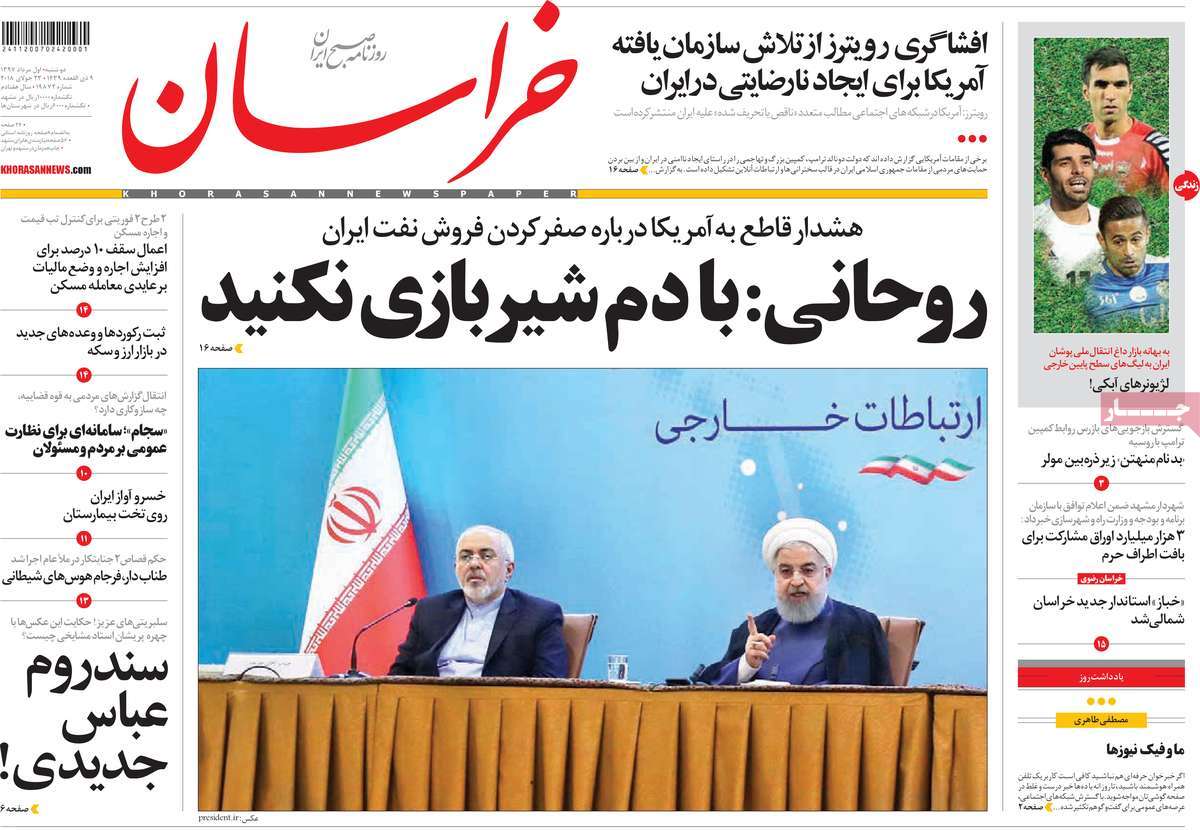
Khorasan:

1- Does Iran Transfer Its Water to Kuwait?

  • Some Taking Advantage of Khuzestan Residents’ Dissatisfaction with Water Quality

A Look at Iranian Newspaper Front Pages on July 1


Rah-e Mardom:

1- ICT Minister Calls on Other Ministers to Release Names of Those Receiving Official-Rate Currencies

A Look at Iranian Newspaper Front Pages on July 1


Resalat:

1- Iran Leader: Officials Must Avoid Laziness, Aristocracy

A Look at Iranian Newspaper Front Pages on July 1


Rooyesh-e Mellat:

1- IRGC Lieutenant Commander: Pakistan Smart to Choose Not to Join Anti-Yemen Coalition

A Look at Iranian Newspaper Front Pages on July 1


Sayeh:

1- Industry Minister: VAT Root Cause of High Production Costs in Iran

A Look at Iranian Newspaper Front Pages on July 1


Seda-ye Eslahat:

1- Iran Leader: Don’t Compromise with Enemies

A Look at Iranian Newspaper Front Pages on July 1


Shakhe-ye Sabz:

1- Obama to Democrats: Your Concerns about Trump Right; US Being Isolated

A Look at Iranian Newspaper Front Pages on July 1


Shargh:

1- A Review of Mobile Phone Importers Receiving Official-Rate Currencies

  • €33 Million Received by Six People

A Look at Iranian Newspaper Front Pages on July 1


Vatan-e Emrooz:

1- Iran Leader: Islamic Republic Nothing Separate from Iranian Nation

2- Trump: King Salman Agreed to Increase KSA’s Oil Output by 2 Million bpd

A Look at Iranian Newspaper Front Pages on July 1

US Bulk Freighter Carrying Chemicals Docks in Persian Gulf: Iran

Brigadier General Abolfazl Shekarchi, a senior spokesman for the Iranian Armed Forces, said the American vessel Cape Ray has arrived in the Persian Gulf with the main goal of delivering the chemical cargo to certain parts of Iraq and Syria.

“The US bulk carrier MV Cape Ray, escorted by an American destroyer, recently docked at one of the Persian Gulf states,” he was quoted as saying in a report by Fars News Agency.

He warned the US against the possible consequences of the vessel’s deployment in the region and added a review of the vessel’s records reveals that it has been used for military actions along Iraq and Syria coasts under the pretext of fighting those sides which ‘used chemical weapons against the militant-held areas.’

“Following its back-to-back defeats in the region against the Resistant Front, the US has now resorted to dangerous methods to justify its illegitimate military presence in the region,” he noted.

The spokesman also noted that the US and its regional allies have been seeking to prolong their military presence by accusing the Syrian government of using chemical weapons against militants in Eastern Ghouta.

According to Shekarchi, the presence of the US vessels in the regional waters unveils the fact the chemical attacks carried out in parts of Iraq and Syria were coordinated by the US government.

“We have enough details about Cape Ray including the number of its crew members as well as the technical information of its chemical cargo which will be published soon,” he concluded.

Iranian Minister Says No One Killed in Khorramshahr Protests

Abdolreza Rahmani Fazli

“There has been a single shooting case in Khorramshahr and one person has been injured, but no one has got killed,” Abdolreza Rahmani Fazli said in a presser in Tehran on Sunday.

Demonstrators in Khorramshahr have staged protest rallies in recent days against the authorities responsible for the shortage of potable water in the city during hot summer.

The protests were peaceful in the beginning, but clashes between police and protesters broke out on Saturday evening, IRNA reported.

Salty and muddy water and the severe dust pollution in the oil-rich Khuzestan province have led to widespread protest during the past decade.

The minister said the government is not opposed to peaceful protests, as long as they can be kept under control.

“We have no problems with protests that could be controlled. However, sometimes these protests reach the streets and even the protestors cannot control them,” he said.

The demonstrations in Khuzestan came after several days of protests in Tehran in the wake of a dramatic decline in the value of rial that has depressed markets in recent days.

https://ifpnews.com/exclusive/water-shortage-in-southern-iran-turns-into-crisis/

Water Shortage in Southern Iran Turns into Crisis

Residents in the cities of Abadan and Khorramshahr in Khuzestan have staged several protest rallies over the past few weeks as they have faced problems due to the excessive salinity of the Bahmanshir river, which is the main source of potable water in both cities.

Last week, the Abadan Water and Sewage Department said water would be rationed in the city because of “the saltiness of the Bahmanshir river (reaching salt levels as high as those at sea), a stoppage in the extraction of water from the river and a drop in pressure levels.” The department announced that water rationing will continue until late July.

“The salinity of the Bahmanshir river has reached that of the sea, and water cannot be extracted from it because of excessive saltiness, which has caused a drop in water production in Abadan,” part of the department’s statement read. The same problem exists in Khorramshahr as well.

“The government is determined to solve the potable water problem in the cities of Abadan and Khorramshahr as soon as possible,” Iranian First Vice-President Es’haq Jahangiri said a few weeks ago.

“We should make every effort to improve water quality in Khorramshahr and Abadan before reaching the critical level,” said Gholam-Reza Shariati, the governor-general of Khuzestan province, a few days ago.

“The tap water that people get in these two cities is salt water,” he added.

Water rationing in Abadan comes at a time when people in many areas across Iran are grappling with the water shortage crisis.

“Given the growing trend of drought over the past few years and a shortage of resources to provide drinking and irrigation water in areas such as Khorramshahr and Abadan, the government drew up an extensive plan to tackle the issue. The measures and efforts culminated in a decision made by the Cabinet on April 4, 2017 about the water and sewage infrastructure, stability of the power grid and environmental problems in Khuzestan,” said Farahmand Hashemizadeh, the deputy governor-general of Khuzestan for development affairs.

“One of the plans was to bankroll a project in the southwest known as the Ghadir Water project,” he added.

“The project provides for a new 2,000-milimetre [water transfer] line with high capacity that will run from the Karkheh dam to gradually provide water for 25 cities and 1,600 villages; but due to the current circumstances, the cities of Abadan, Khorramshahr and Shadegan take priority,” he said.

It is noteworthy that the Ghadir Water Project got off the ground in 2010 to take water to certain high-priority cities such as Abadan, Khorramshahr, Masjed-Soleiman, Andimeshk, Dezful and Shooshtar as well as 1,200 villages in Khuzestan, and the Khuzestan governor announced months ago that the project had no problem in terms of funding.

“Any failure by officials to implement the project is not acceptable,” said the provincial governor.

Major Project Inaugurated to End Water Crisis in Southern Iran


“The water that Khorramshahr and Abadan need is maximum 90,000 and 150,000 cubic metres per day respectively, and this water is to be mainly provided by the Ghadir project, and part of it is provided by Bahmanshir and Arvand (rivers),” said Hashemizadeh.

“With water salinity levels going up in Bahmanshir and Arvand [rivers], it was decided that the entire water needed for Khorramshahr and Abadan be provided by the Ghadir project, and work is being done very fast, the Ghadir project will fully provide the water needed by Abadan and Khorramshahr by July 6, 2018 as scheduled, and water extraction from Arvand, Karoon and Bahmanshir will completely come to a halt; so, dear citizens shouldn’t worry about the drinking water both in terms of quantity and quality,” said the deputy governor of Khuzestan.

“During this time, water tankers have been sent in and packaged water has been distributed to make up for the water shortage as much as possible,” he added.

He also weighed in on rumours that Iran has been selling water to Kuwait and Iraq.

“I’m telling you with certainty that no water is being transferred [from Iran] to Kuwait and Iraq, and no such plan is on the agenda,” Hashemizadeh noted.

“Kuwait had made a request [to receive water from Iran] in the past, but the request was considered out of the question due to the drought and water shortage [in Iran], and no such action has taken place, and these rumours emerged just based on what had been discussed in meetings and what was put on paper,” he added.

Meanwhile, the managing director of the Khuzestan Water and Sewage Company underscored that the damaged part of the pipeline carrying water from Karkheh has been fixed over the past three days.

“With water beginning to be pumped as of early Saturday, June 30, the transfer rate will reach maximum capacity, and it is expected that … our dear people will receive water which can be purified by desalination machines used in homes, and people will no longer need packaged water and water tankers,” he said.

Sadeq Haqiqipour also said the second phase of the Ghadir Water project is being implemented rapidly.

“More than five teams are working in different areas to implement the project, and every effort is being made to put the pipeline into operation as soon as possible to completely desalinate the water,” he said.

“Water levels in Karoon [river] have dropped sharply, and the Ghadir line meets 70 percent of the need for water in Khorramshahr and 60 percent of the need in Abadan,” he said.

He underlined that now there is no other way but to extract water from the Karoon and Bahmanshir rivers.

“Of course, if the amount of water extracted from these resources drops, salinity levels will dramatically decrease, and this decrease [in the amount of water extraction] will happen as soon as line two of the Ghadir project becomes operational,” said the official.

Iran’s Simorgh Satellite Ready to Be Launched into Space

Hossein Bolandi, a satellite project manager at Iran’s University of Science and Technology, says the Simorgh (Phoenix) satellite is ready to be launched.

“The Simorgh satellite weighing between 200 and 250 kilograms is ready to be placed into orbit 500 kilometres above the earth,” he noted.

Bolandi said the Amirkabir satellite is ready as well.

He then touched upon the space activities conducted in the country, as reported by Mizan News Agency.

“The issue of space [activities] in the country almost goes back to the 1990s when the Supreme Leader raised it,” he said.

“With this domestic capability, all the assessment-telecommunications needs of the space sector can be met,” he noted.

He said some 17,000 jobs can be created in the space sector by 2025.

“We made considerable progress in the space industry in less than 20 years, and we are one of the world’s space powers,” Bolandi said.

For a brief review of Iran’s achievements in various fields of science and technology, check the book “Science and Technology in Iran: A Brief Review

“We need satellite images in the water, agriculture and other sectors,” said the satellite project manager, noting that satellites can also meet the needs of the country in the telecoms sector.

“The creation of telecoms satellite systems can meet all the country’s needs in this sector,” he said.

He underlined that domestic experts will be able to meet all the needs in the country’s space sector by 2025.

Bus Crash in Northern India Kills 44

“44 people have died in the accident. At least 3 others are injured,” Deepesh Chandra Kala, a disaster management officer from Pauri Garhwal district where the accident occurred, told AFP.

“The rescue work is still ongoing,” the officer added.

According to TV reports, 20 bodies have been recovered so far.

ANI quoted Garhwal Commissioner Dilip Jawalkar as saying the number of casualties was expected to rise.

President Rouhani Sends Message to Chilean Counterpart

Ansari delivered the message during a meeting with Chilean Foreign Minister Roberto Ampuero in Chile’s capital of Santiago.

In recent weeks, President Rouhani’s special envoys have travelled to different countries in Latin America and conveyed his messages to his opposite numbers and other heads of state.

Ansari, as well as Deputy Foreign Minister Morteza Sarmadi, have earlier carried out the same mission in Brazil, Bolivia, and Venezuela.

The Iranian administration has enhanced political contacts with foreign leaders in recent weeks on the ways to save the 2015 Iran nuclear deal after the US exit.

Last week, President Rouhani told his French counterpart that staying in the JCPOA will be out of the question if Tehran cannot enjoy the benefits of the nuclear deal.

On May 8, the US president pulled his country out of the JCPOA, which was achieved in Vienna in 2015 after years of negotiations among Iran and the Group 5+1 (Russia, China, the US, Britain, France and Germany).

Following the US exit, Iran and the remaining parties launched talks to save the accord.